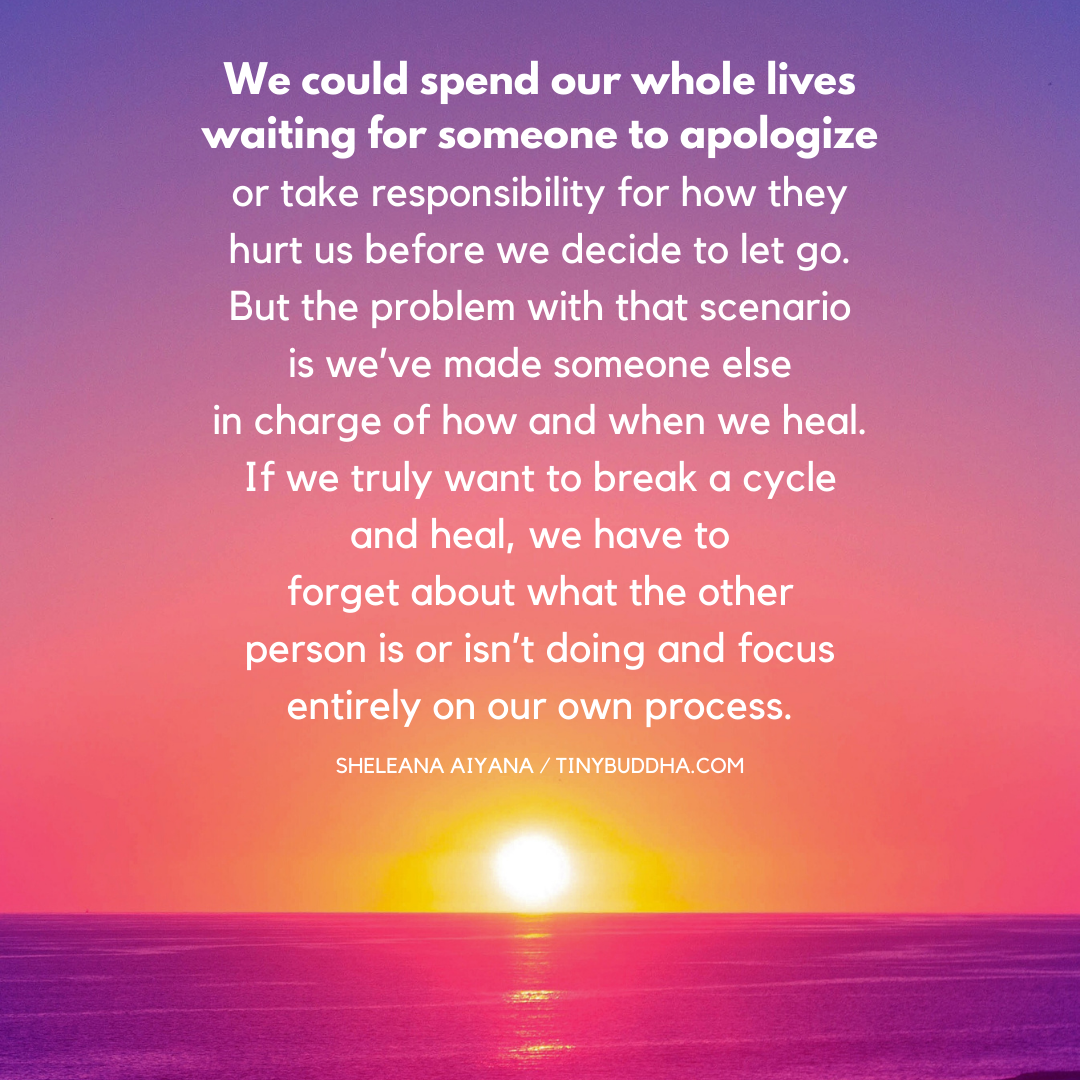
Tag: heal

  • Stop Telling Me to Forgive: Why This Isn’t Helpful

    Stop Telling Me to Forgive: Why This Isn’t Helpful

    “If you force yourself into forgiveness before fully feeling and moving through the layers of anger and hurt, it won’t be a clean and true forgiveness but rather a pseudo-virtuous form of bypassing and suppression.” ~Cory Muscara

    A while back, I was invited to a birthday party, and I was genuinely excited to go. But then I learned that someone I no longer associate with—a former best friend—would also be attending. The news stopped me in my tracks.

    This wasn’t just an “ex-friend.” She had once been one of the most important people in my life, but that changed when I went through a painful experience involving a narcissistic individual. When I needed her most, she didn’t stand by me. Instead, she stayed silent, offering no support as I endured gaslighting, invalidation, and manipulation.

    Letting go of the narcissist was clear and necessary, but recognizing that my best friend was no longer safe for me was much harder. It took more than a year of reflection, emotional processing, and painful physical symptoms for me to accept that this relationship was no longer healthy.

    So, I declined the party invitation, explaining to my friend that for my own well-being, I needed to skip the event. But instead of understanding, I received a lecture about forgiveness. “You need to hear the other side,” she said. “There are two sides to every story.”

    Her words stung. Not because forgiveness hadn’t crossed my mind, but because they dismissed the boundaries I had worked so hard to establish. Why is it that when we try to protect ourselves, others feel compelled to challenge our decisions?

    The Problem with Prescriptive Forgiveness

    In our culture, forgiveness is often upheld as the ultimate solution to pain. We see it in inspirational quotes and self-help advice:

    • “Forgiveness is a choice you make to move forward.”
    • “Not forgiving is like drinking poison and expecting the other person to die.”
    • “Refusing to forgive keeps you chained to the past.”

    While these ideas sound wise, they often oversimplify the complex process of healing. Forgiveness is not always something you can will yourself into. For those who’ve experienced deep and profound trauma, the mind and body don’t always align. You can tell yourself to forgive, but your emotions and physical responses may resist.

    A More Compassionate Perspective

    For me, the turning point came when I discovered a different definition of forgiveness by Teal Swan:

    “When you’ve experienced profound trauma, the focus shouldn’t be on forgiveness but on healing by creating resolve and experiencing the opposite of the harm. As you heal and find love, safety, and protection elsewhere, forgiveness often arises naturally, as the disruption within you resolves on its own.”

    This shifted everything. It reminded me that forgiveness isn’t something you force; it’s something that flows naturally when healing has occurred. And healing often requires us to focus on what was missing during the hurtful experience.

    How to Support Someone Who’s Healing

    When a friend or loved one shares their pain, the best thing you can do is meet their needs in the moment, not prescribe forgiveness or reconciliation. Instead, offer actions that help counteract the harm they’ve endured:

    • If they feel unsafe, help them feel secure.
    • If they feel unheard, listen deeply.
    • If they feel betrayed, show them loyalty.
    • If they communicate a boundary, honor it.
    • If they feel dismissed, validate their emotions and experiences.
    • If they feel abandoned, stay consistent and present in their life.

    These actions create the foundation for healing, which makes forgiveness—if it comes—authentic and meaningful.

    Let’s Change the Conversation

    The next time someone shares their struggle, resist the urge to suggest forgiveness. Instead, focus on understanding their needs and providing genuine support. Healing doesn’t come from empty platitudes; it comes from connection, empathy, and actions that restore what was broken.

    Forgiveness isn’t a prerequisite for healing. It’s a byproduct of it. And when it happens naturally, it’s far more powerful than anything forced or prescribed.

  • How to Cultivate Awareness and Presence, Two Powerful Tools for Healing

    How to Cultivate Awareness and Presence, Two Powerful Tools for Healing

    “The present moment is filled with joy and happiness. If you are attentive, you will see it.” ~Thich Nhat Hanh

    In our fast-paced world, juggling multiple responsibilities while managing chronic conditions can make healing seem elusive. However, by harnessing the power of awareness and presence, we can unlock a profound path to recovery that addresses not just the physical symptoms but also the mental and emotional aspects of well-being.

    My Experience with Chronic Pain

    For a long time, I never really thought about my scoliosis. Not that I didn’t feel pain; it was ever-present and intensified by the demands of my busy career, family responsibilities, and a couple of car accidents.

    As I climbed the corporate ladder and juggled family needs, I neglected self-care. Frequent pain flares forced me to take more time off from daily activities, leading me to realize that my struggles were not solely physical.

    What began as occasional aches turned into never-ending pain accompanied by a fear of movement, leaving me bedridden and wondering how I had reached that point.

    Desperate to change, I started researching the role of the brain and nervous system in processing pain. I learned that stress and anxiety can amplify pain signals, making discomfort feel more intense and persistent. Understanding this connection became crucial to my healing journey.

    I soon realized that healing required more than merely managing or controlling symptoms; it involved understanding and changing the patterns contributing to my pain.

    For years, I tried various treatments and therapies, but the relief was often temporary. Recognizing specific patterns—like dealing with stress, pushing through activities, and failing to fuel my body—became key to my recovery.

    Mindfulness and presence emerged as powerful tools in this journey. At first, mindfulness didn’t come easily; my busy mind was adept at conjuring up ideas and plans, leaving me unaware of my ability to quiet those thoughts. However, after years of internal chatter, I found freedom in stillness.

    Over time, I noticed how this practice allowed my body to rest. By embracing mindfulness, I transformed my relationship with pain.

    The Mind-Body Connection in Healing

    To truly understand the importance of awareness and presence in healing, it’s essential to recognize the intricate connection between our minds and bodies. Neuroscience has shown that our thoughts, emotions, and physical sensations are deeply intertwined, forming a complex feedback loop that can either perpetuate illness or promote healing.

    When we’re constantly caught up in the whirlwind of daily life, rushing from one task to another, it’s easy to disconnect from our bodies. This disconnection can lead to a lack of awareness of the subtle signals our bodies send us, potentially exacerbating existing health issues or creating new ones. By cultivating awareness and presence, we can tune into these signals and respond appropriately, setting the stage for healing.

    The Role of Awareness in Healing

    Awareness is the foundation of any healing journey. It involves consciously paying attention to thoughts, emotions, and physical sensations without judgment. This practice has been essential in my own healing process, allowing me to:

    • Identify patterns: By becoming aware of habitual thoughts and behaviors, I’ve been able to recognize patterns that contribute to pain or discomfort.
    • Detect early warning signs: Increased body awareness helps me notice subtle changes in my physical state, allowing for earlier intervention and prevention of flare-ups.
    • Understand triggers: Awareness helps me identify environmental, emotional, or situational triggers that may exacerbate symptoms.
    • Recognize the impact of stress: By tuning into my body’s stress responses, I’ve learned to manage stress more effectively, reducing its negative impact on health.
    • Make informed choices: Increased awareness enables better decisions about diet, activities, and self-care practices.

    Cultivating Presence for Healing

    While awareness is about noticing, presence is about fully engaging with the present moment. Being here now, without getting caught up in worries about the future or regrets about the past, has been crucial in my healing journey because:

    • It reduces stress: When I’m fully present, I’m not ruminating on past pain or anticipating future discomfort, which significantly reduces stress and anxiety.
    • It enhances body-mind communication: Being present allows me to listen more closely to my body’s signals and respond with greater compassion and understanding.
    • It improves pain management: I’ve found that mindfulness and presence can alter pain perception and increase pain tolerance.
    • It boosts the effectiveness of my movement practice: When I’m present during exercises, I’m more likely to stay and feel my body and derive maximum benefit.
    • It fosters a sense of agency over my life: Presence empowers me to take an active role in healing, rather than feeling helpless or overwhelmed by my condition.

    Practical Techniques for Cultivating Awareness and Presence

    Over time, I’ve developed several techniques that help me cultivate awareness and presence. These practices have become essential tools in my healing journey:

    1. Mindful Breathing

    Setting aside five to ten minutes each day to focus on my breath helps me stay connected to the present moment. I notice the sensation of air moving in and out of my nostrils, the rise and fall of my chest or belly, and gently bring my attention back to my breath when my mind wanders.

    2. Body Scan Meditation

    This practice involves systematically focusing attention on different parts of the body, from toes to the top of the head. It’s an excellent way to increase body awareness and identify areas of tension or discomfort.

    3. Pain Reprocessing Techniques

    Chronic pain is often maintained by the brain’s learned neural pathways rather than ongoing tissue damage. By bringing awareness to my pain and reframing my relationship with it, I’ve begun to rewire these pathways. Observing pain with curiosity rather than fear or frustration has helped reduce the emotional charge associated with it.

     4. Mindful Movement

    Incorporating mindfulness into physical activities enhances body awareness and promotes healing. Whether it’s gentle yoga, tai chi, or simply paying close attention to my body during daily activities and walking, mindful movement has become a key part of my routine.

     5. Emotional Awareness Exercises

    Developing emotional awareness has helped me manage stress and anxiety more effectively. Throughout the day, I check in with my emotions, asking myself how I’m feeling and where I feel this emotion in my body.

     6. Mindful Eating

    Applying awareness and presence to my eating habits has improved digestion, helped me make healthier food choices, and fostered a better relationship with food. During meals, I eat without distractions, paying attention to the colors, smells, textures, and tastes of my food.

    7. Daily Gratitude Practice

    Cultivating gratitude shifts my focus from what’s wrong to what’s right, promoting a positive mindset that supports healing. My morning journaling practice includes writing down three to ten things I’m grateful for. This practice helps bring my awareness to the present and the positive aspects of my life.

    Integrating Awareness and Presence into Daily Life

    While dedicated practice times are valuable, I’ve found that the real power of awareness and presence comes from integrating them into daily life.

    One way I’ve done this is by using daily activities as mindfulness anchors, choosing routine activities, like brushing my teeth or daily walking, to practice full presence and awareness.

    I’ve also created transition rituals, using the moments between activities (like getting in and out of the car) as cues to take a few conscious breaths and center myself.

    Lastly, I engage my senses whenever possible. Regularly, I take a moment to notice what I can see, hear, smell, taste, and feel. This simple practice quickly brings me into the present moment.

    Overcoming Challenges

    Cultivating awareness and presence isn’t always easy, especially when dealing with chronic pain or the demands of daily life.

    Whenever I think I don’t have time, I remind myself that even a few mindful breaths can make a difference. Starting small and gradually increasing practice time has helped.

    When my mind won’t stop racing, I remind myself that this is normal. The goal isn’t to stop thoughts but to notice them without getting caught up in them. I gently redirect my attention to my chosen focus (like my breath) whenever I notice my mind has wandered.

    And when it felt too uncomfortable to focus on my body in the beginning due to the pain I was experiencing, I started with brief periods and focused on neutral or pleasant sensations, gradually building up tolerance for being present with discomfort.

    Awareness and presence are powerful tools in the healing journey. By cultivating these practices, I’ve transformed my relationship with pain, fatigue, and anxiety, allowing me to reclaim my life and fully engage in the activities I love. Healing is not just about alleviating symptoms; it’s about reconnecting with the body, understanding its needs, and responding with compassion and wisdom.

  • Lost, Scared, and Broken: How Self-Awareness Saved My Life

    Lost, Scared, and Broken: How Self-Awareness Saved My Life

    “The first step toward change is awareness. The second step is acceptance.” ~Nathaniel Branden

    I felt lost. I felt broken. I felt scared.

    As I sat alone in that cold, dark jail cell, I felt like I had hit rock bottom.

    My feet chilled against the cold stone floor. The creaky wooden bench, stitched together with narrow strips, tormented me.

    Inmates shouted all around me. Their voices echoed in the dark. It was like the noise of the outside world had finally caught up with the noise inside my head. I just wanted to scream.

    I was sixteen, but I felt as if my life was already over. Shame and regret filled my heart as I wondered: Is this really all there is? Is this the path my life has taken? Who am I becoming?

    For the first time, I faced a truth: I was becoming the person I despised most—my father, a man consumed by addiction and destruction.

    My father’s absence was a constant presence in my life. Only occasionally, when he was off one of his benders and attempting to get clean, was he around. But usually, he would drink a lot of alcohol at the house.

    I hated him. I hated that man so much for the pain that he caused my mom. The sweetest woman that I have ever known in my entire life. She is the person in my life who taught me about true strength and resilience. She is one of the reasons that I know single mothers are some of the most daring and powerful people.

    Despite all the anger and hatred I carried toward him, I was walking the same path, making the same choices.

    I’d started drinking and smoking weed at thirteen, began selling drugs soon after, and was eventually caught with varied substances, lots of cash, and a scale.

    I was becoming no good, like my father. In fact, I was doing the exact same thing I hated him for—causing my poor mom so much pain.

    The weight of that realization was crushing. I felt as though I was drowning in the results of my actions and choices.

    I thought of my mother, a single woman. She did all she could to raise us. She had sacrificed so much for me and my siblings. And here I was, her middle child, sitting in a jail cell as the police smashed our house because they thought I’d been running a big drug operation. I was expelled from not just a school but an entire school district.

    I pictured her at home, staring at the smashed windows and broken-down doors in hurt and disbelief. The shame of that tore at me. I wanted to be the man who made her proud, the man who helped her, not another weight on her shoulders. I had let her down. I had let myself down.

    And at that moment, I knew—I couldn’t keep living this way. Something had to change.

    The Moment That Changed Everything

    In that cold, uncomfortable jail cell, I asked myself: Who am I becoming? Is this the man I want to be? Is this my future? The fear, shame, and regret were suffocating. I had no tools or mentors to help me through them. But even in the darkness, something clicked.

    This was my wake-up call. I had hit rock bottom. I had two choices: continue down this path toward self-destruction or take control of my life. It was now or never.

    When I got out, I made a decision to change. I did everything I had to do. I completed my community service. I attended a wilderness program. They put a group of troubled boys together and had them camp on islands for a month. I followed all the rules.

    It was one of the places where I first learned to face my fears. Because we were climbing a mountain one afternoon, and it was a steep one.

    I had a fear of heights (still do), and I forgot that I had told them this earlier that day or at the start of the program. Honestly, I can’t remember exactly.

    That day, I looked up at the mountain we were told to climb and decided to push through my fears. So I climbed. I was breaking my barriers and overcoming limiting beliefs. One instructor said something I can’t recall any teacher or peer telling me back then.

    “Look at you overcoming your fears, Eddy. I’m proud of you.”

    To be real, I forgot about that moment until now. Writing this blog has brought tears to my eyes.

    None of it was easy. In fact, it was one of the hardest things I’d ever done. It took everything I had. I had to change my habits, face my limiting beliefs, and distance myself from those who wanted to bring me down.

    In fact, one of the hardest things then was that my “friends” abandoned me. None of them were there for me when I got out. None of them reached out to me. Still to this day, I haven’t heard any word from them.

    But it was the only way forward.

    Lessons in Self-Awareness and Reflection

    Looking back, I realize that the moment in the jail cell was the turning point of my life. It was the hardest, most painful experience I’ve ever had. But it opened my eyes to the power of self-awareness and reflection.

    Self-awareness isn’t about acknowledging your mistakes. It’s about knowing your core self. It’s about seeing the patterns in your life that hold you back. Then, you must choose to break those patterns.

    Through self-awareness, I discovered that I had the power to change the course of my life. And that’s what I want to share with you.

    How Self-Awareness Can Change Your Life

    1. Create space for reflection.

    You don’t need to hit rock bottom to start reflecting on your life. Take a few quiet moments in your day. It can be five minutes in the morning or ten minutes before bed. Ask yourself, “Where am I heading?”

    Journaling is an excellent tool for this. It allows you to get your thoughts out of your head and onto the page where you can look at them objectively. Journaling has been the saving grace of my entire life.

    When I lost one of my best friends to pancreatic cancer, I went backpacking and filled a whole journal.

    When I decided to make a big decision and take a risk career-wise, it was through journaling.

    When I had to make a decision or process the pain from a relationship, it was through journaling.

    If journaling feels overwhelming at first, start with one question: What do I need to let go of today? I ask myself this question every morning. Write down the first thing that comes to mind without overthinking it.

    2. Face the truth, even when it hurts.

    Real change starts with honesty. Be brutally honest with yourself. Look at your life—your habits, your choices, your relationships—and ask, “Is this serving me?” This level of honesty is uncomfortable, but it’s the first step toward growth. Growth’s largest leaps stem from stepping out of our comfort zone.

    3. Start small, but be consistent.

    You don’t need to make drastic changes overnight. Instead, focus on making small, meaningful changes in your daily life. Whether it’s improving one habit or letting go of one toxic relationship, these small steps will create lasting change over time.

    I learned this from a mentor of mine and James Clear’s book Atomic Habits. Starting small seems pointless to most of us. That change needs to come in one big, massive swipe. But that’s not how we work as people. That kind of change returns us to our original state.

    My mentor taught me that if we only move a millimeter to the left or right when driving, it will seem like we’re in the same spot at first. But a week, a month, or a year down the road? You will be in a completely different place in life than you would have if you went straight.

    4. Reframe your struggles as opportunities.

    I learned a big lesson: Our failures and mistakes are our biggest chances to grow.

    When you face challenges, ask yourself, “What is this teaching me?” Reframe your failures as lessons and use them to become stronger.

    So often people believe that their pain or the failures they’ve experienced in the past are what’s holding them back when actually it’s their perspective.

    These moments in our lives are actually our breakthrough moments. The moments when what was once a should or sometime later becomes a must.

    Almost all breakthroughs or massive moments of growth in our lives come from these failures, obstacles, or challenges. Whatever word you want to use. Mine had a significant impact.

    That cold, dark jail cell was the lowest point of my life. But it was also the moment that saved me. Through self-awareness and reflection, I was able to take control of my life and change my future.

    For me, the journey started small—taking accountability for my actions, cutting ties with people who held me back, and focusing on one habit at a time. It wasn’t an overnight transformation, and I stumbled many times along the way. But each step, no matter how small, brought me closer to the person I wanted to be.

    You don’t need to have all the answers right now. Take the first step.

    I urge you to embrace your moments of stillness. They may come in peace or struggle. Use them to reflect on your life.

    Don’t wait until you’ve hit rock bottom to ask the hard questions. Take time to reflect on who you are, where you’re heading, and what changes you can make to live a more authentic, fulfilling life.

    Next Step

    If you’re struggling with where you are right now, take a moment today to pause and reflect. Ask yourself, “What can I learn from this? How can I use this to grow?” Embrace the power of self-awareness and start taking small, meaningful steps toward a better future.

    Take it from somebody who has been there—small steps do lead to big changes.

    So, go grab yourself a pen and paper and begin reflecting, reframing, and moving that millimeter in another direction. You’ll be amazed at how much your life will transform.

  • How to Honor Our Grief While Rebuilding Our Lives

    How to Honor Our Grief While Rebuilding Our Lives

    “Grief is not something that ever goes away. You just learn to accommodate it so you can move forward in your life and over time it gets less intense, at least most of the time.” ~David Baxter

    Grief is a natural response to loss. Loss can mean the death of a loved one, the end of a relationship, the loss of a job or home, or a response to trauma, abuse, or betrayal. Grief shows itself differently in different people. But the common denominator is that grief goes deep, and grieving is painful.

    Around six years ago, my life was turned upside down and would never be the same again.

    I was raised in a cult from the age of nine. I was a child of domestic violence and divorce. My father abandoned the family, and we subsequently suffered abuse from my mother’s partners.

    By age seventeen, I met a young man, and we began dating. In line with the strict moral code I was raised with, we were married by the time I was nineteen.

    We had two children, and I struggled to be the perfect wife, mother, and cult member, as I suffered from severe anxiety, coupled with feelings of self-loathing and mistrust of others.

    My husband was selfish and narcissistic, which led to me carrying the weight of the family almost alone. Yet, I battled on, wanting my children to grow up with both parents, feeling safe and in a strong, supportive community.

    Eventually, things came to a head, and I just couldn’t do it anymore. After twenty years of marriage, I separated from my husband and was subsequently excommunicated by the cult. This meant that I was completely cut off from my mother, my community, and childhood friends—basically everything and everyone I knew and loved.

    Outside of the cult, I had no one and nothing.

    Almost overnight, I had lost my whole identity and support network along with beliefs that I had held on to for the whole of my life.

    A few months after the excommunication, a close family member who was only twenty-seven took his own life. I was devastated and still reeling from the other losses that were still so raw.

    Despite all of this, I was determined to rebuild a life for myself and my children. I educated myself, got a better job, made new friends, had relationships, and eventually met a good man who would go on to support and love me with all my struggles.

    I was all about ‘moving on’ and building the life I wanted! But every now and then, I would get so very sad.

    I was receiving counseling specific to my situation, which was helping, I had a good life, and those things that hurt me were in the past. I was doing all the ‘right’ things, so why was I getting so sad to the point that I wanted to push everything and everyone away and be alone?

    I would feel like I had accomplished nothing and would be plagued with guilt and shame and regret. It would make me feel vulnerable and unsafe, and I couldn’t understand why.

    Then, after another tearful and anxious weekend, I decided to try to focus on myself, meditate, journal, and do some yoga—all the things that usually helped at least ease the symptoms.

    It was during my meditation session that it occurred to me: I am still grieving. I am grieving the loss of a childhood, the loss of my community, of my beliefs, of my family and friends. I am grieving the loss of my parents and of my beautiful nephew. I am grieving what I imagined my life would be and what I imagined my children’s lives would be.

    I realized that grief doesn’t have a time limit; it doesn’t get ‘done.’ It’s not something we get through and tick off at the end.

    My grief wasn’t just going to go away over time or with lots of positive thinking.

    When we suffer loss, it hits us throughout our lives. And that’s okay. It’s uncomfortable and it’s sad, but it’s okay. It’s sometimes so painful that it is overwhelming or debilitating. We can allow ourselves to feel that sadness. We can grieve. We can allow ourselves a little space to honor that loss.

    I write this because so many of us have suffered loss in our lives, and we so want to move on, do better, be better, and heal, and we can. But we also have to remember that the loss we felt was real, that grief is not a linear process, and that it’s okay if years later, we are still sad and grieving the loss. We have not gone back to the beginning. We’re not starting again or getting nowhere.

    We cannot force ourselves to ‘get over it.’ We can, however, make room for that grief and still live a rewarding life. By honoring our grief, we can allow place for the loss but see that we can have a future and continue to work toward that.

    I know I will never ‘get over’ the effects that abuse, abandonment, betrayal, and loss have had on me. I know I will always miss and feel sad about the loss of my nephew. I know I will always return to the grief because those things cannot be erased from my memory and because those things were my life and mattered to me.

    But I can allow myself to grieve those losses without guilt or shame. I can soothe myself and take care of myself during those times when I am feeling fragile instead of beating myself up and berating myself for feeling that way and for not ‘being strong.’

    When I do this, I come back feeling comforted and validated, and I can move on for a while to crafting the life I want to live. I can appreciate the friendships and relationships I have formed. I can explore new beliefs. I can entertain hope.

    When I honor my grief, I honor the people I have loved and lost; I honor the beliefs I held and the hopes I had; I honor my hurt; and I honor that they were part of me and my journey and, in some ways, always will be. But I also allow myself to accept that I can honor my grief and still have a good life. I can rebuild. I can be happy.

  • What I Know About Healing Now That I’ve Ended Contact with My Mom

    What I Know About Healing Now That I’ve Ended Contact with My Mom

    “Not all toxic people are cruel and uncaring. Some of them love us dearly. Many of them have good intentions. Most are toxic to our being simply because their needs and way of existing in the world force us to compromise ourselves and our happiness. They aren’t inherently bad people, but they aren’t the right people for us.” ~Daniell Koepke 

    If someone had asked me a year ago if I would ever cut contact with my mom, my answer would have been a definite no.

    After reconnecting with my dad in 2020 (we didn’t speak for over eleven years), I decided to handle this parent business differently.

    Part of me strongly believed that if I was healing and doing this inner work right, I would be able to find a way to coexist in a relationship with my parents, and that I had to do that at all costs.

    My mom and I were always very close. Although our relationship was toxic, we had a bond that I believed was unbreakable.

    She used to say that I was a rainbow baby since she lost my sister to a shooting accident before I was born. After my sister died, they told her she would never have more children. One year later, she got pregnant, and I was born. Everyone was saying that she was beside herself, and I believed it.

    Although there was a lot of abuse and violence happening in our household, I saw her as someone who was fighting for her life to move beyond the trauma of her past while losing it to a bottle of vodka to numb and escape.

    I believe this is why I always had this unsettling drive not to give up and be defined by the past while never shying away from addressing it. I saw the consequences we face when our souls are unhealed and how unaddressed trauma drives everything.

    The first time I clearly saw how toxic the relationship with my mom was and how it affected me was when I read the book Silently Seduced: When Parents Make Their Children Partners by Kenneth M. Adams, in 2020.

    It was the most difficult but revolutionary book that I had ever gotten my hands on. I remember times when I had to put the book down and take deep breaths to stomach the deeply confronting truth I saw myself in. Reading this book marked a breaking point for me when the dynamic between my mom and I started to change.

    As the years went on, her alcohol abuse became uncontrollable. I think she lost any desire to fight her addiction, which she always had before. Although we live on two different continents, I began to wake up to Facebook messages from her attacking me and calling me names while demanding I send her more money.

    Therefore, in December 2023, after pleading with her repeatedly to seek help and threatening her that I would stop talking to her if things continued the way they were, I decided to act on my word. I ended my contact with her for the first time. Since then, we haven’t been in touch. Here are four things this decision and reflecting on it periodically taught me about healing.

    1. Pain doesn’t always subside.

    Someone once told me that the pain that I feel regarding my mom will eventually subside. Although I am doing a much better job at dealing with this situation internally, I understand that pain of this sort doesn’t always subside. I must learn to carry it with grace.

    When we look at the person we love destroying themselves while not being able to do anything, how can we let go of the pain we feel? This pain comes from love, not from others doing us wrong. And those, to me, are two different types of pain. Although learning how to deal with our emotions is up to us, when we love, we also hurt.

    The two most empowering practices that have been helping me are accepting things I can’t change and allowing myself to release what I feel without stuffing it up. I don’t try to hold my emotions in or lie to myself that I don’t care when, in fact, I do. I choose not to shy away from the emotional discomfort and to take time to reflect on how I am progressing with this no-contact situation as I move through it.

    I also see my pain as a sign of the deep love I am capable of. Understanding that my capacity to feel pain reflects the capacity to feel love helps me ground myself and, in a way, befriend the pain instead of rejecting it.

    2. It’s important that we honor our healing.

    There is no right or wrong way to heal. It is one of the most complex and imperfect paths we will ever walk, and honoring every step of it is the only thing we “should” do.

    For all those years, I felt immense guilt that I couldn’t help my mom. I felt like a failure, working with women from all over the world to heal themselves while being powerless to help a woman who gave birth to me.

    Only those who have ever dealt with an addict close to them can understand the pain this brings. After some time, we realize that the only thing left to do is to sit back and watch the tragedy unfold, as if we are watching some heart-aching movie, while understanding that only an addict can help themselves.

    It took me many years to start accepting that I couldn’t fix this situation while paying attention to the pain I felt.

    Often, when a person struggles with alcohol or drug abuse, the focus is, understandably, on them. However, people around them are affected as well. For as long as I can remember, I battled with the desire to turn my back on my mom while shaming myself for wanting that.

    Eventually, I started to pay attention to the effect this had on me and stayed away from people who said things like, “But it’s your mom.” I was and am fully aware that this is my mom, whom I love deeply. I am also mindful that these remarks come from people who’ve probably never stood in my shoes.

    As Brené Brown said, “You share with people who’ve earned the right to hear your story.” This is especially true when it comes to our stories of shame. There were times when I thought about how easier my life would have been if my mom died and I didn’t have to deal with her alcohol. A few moments later, I felt paralyzed by shame, judging myself for having had these thoughts.

    Today, I choose to own my story of shame and work on forgiving myself. I understand that these thoughts come from desperation and a desire to escape her addiction, which, in a way, I did when I moved to the U.S.

    Recognizing the source of it while offering myself compassion and forgiveness helped me work through my unmet expectations of her recovery while becoming more resilient to face our dysfunctional relationship.

    3. Sometimes we have to love people from a distance. 

    One of the hardest lessons I learned on my healing journey was this: love doesn’t equal presence. Requiring presence to love is attachment.

    Eventually, I understood that I could love my mom while choosing not to be around her because it isn’t healthy for me. This, of course, came after a series of inner battles, and it certainly stretched me beyond my comfort.

    The biggest battle for a person who is in contact with an addict is to choose when to leave or when to keep fighting for them. This often comes with doubts because we don’t want to give up on them, and we constantly question whether we did everything we could to help.

    But when we choose to distance ourselves while keeping love in our hearts, we are honoring our mental health while still loving those who struggle. We understand that their paths are not ours and that our mental health, healing, and life matter as much as theirs.

    4. We heal better when we choose to understand. 

    One thing that helped me while healing my relationship with my mom was looking at her life from a place of curiosity and understanding.

    At first, I used this understanding to excuse her behavior while holding lots of anger and resentment toward her. Although I would call her every day and send her money every month, I resented her for the mother she was. As I progressed in my healing, I realized that I could only understand her actions and heal the pain from my past if I honored what was true for me. And that was to distance myself and go no contact.

    It helped me to look at her with more compassion while considering everything she had been through as a child and the fact that she had done no healing work (coming from the era where mental health was taboo). It also helped to recognize that she really tried. I know she did. And I think knowing that hurts the most.

    Reflecting on my mom’s life and understanding her while healing myself helps me to detach from her actions while knowing that whatever she did, it wasn’t about me. It wasn’t because she didn’t love me but because she didn’t know how to handle her own demons.

    It also shows me the importance of making healthy choices for myself. In a way, I am learning to hold her in my heart while, at the same time, holding my well-being there as well. It teaches me that there isn’t a right way to heal while navigating through our recovery.

    At the time of this writing, my mom and I haven’t spoken in seven months. As I am preparing to come home for Christmas, I am planning to reach out to her to meet and talk face-to-face.

    Although I have no idea how the conversation will go, I know that whatever will be true for me at that moment, whether to reconnect or keep things as they are, I will obey what my soul tells me.

    Because listening to what we truly feel and then honoring it, regardless of what it looks like on the outside, is the only thing that heals us and sets us free.

  • How to Move Forward After Loss: The 3 Phases of Healing

    How to Move Forward After Loss: The 3 Phases of Healing

    “Whatever you’re feeling, it will eventually pass. You won’t feel sad forever. At some point, you will feel happy again. You won’t feel anxious forever. In time, you will feel calm again. You don’t have to fight your feelings or feel guilty for having them. You just have to accept them and be good to yourself while you ride this out. Resisting your emotions and shaming yourself will only cause you more pain, and you don’t deserve that. You deserve your own love, acceptance, and compassion.” ~Lori Deschene

    To this day, I still remember that call. I had just come home after an exhausting day at work, put on my sneakers, and went jogging. I left my phone on the table because I just couldn’t handle any more calls from my clients that day.

    As I was jogging, I was hit with a feeling that something was wrong. I tried to shake it, but I couldn’t. It was very pervasive, like an instinctive ‘knowing’ that something terrible had happened.

    I turned around and rushed home. As I got there, I picked up my phone and saw twenty missed calls from my mother and father. I didn’t even have to call back. I knew what it was.

    I grabbed my car keys and started driving to my mother. As I was driving, I called her, but she was so emotional and upset that she could barely talk. My dad picked up the phone and told me to come quickly. “Your brother…” he said. “Your brother is no longer with us.”

    At only twenty-eight years of age, two years younger than me, my brother had decided that enough was enough. He’d lived a life filled with severe anxiety and depression, which he tried to mitigate with alcohol and, I suspect, stronger substances.

    It wasn’t always that way, of course. He wanted nothing more than to fit in—to find his place in society and live his purpose. Nothing was more important to him than friends and family.

    But time after time, society failed him. First, by trying to push him through a “one-size-fits-all” education system that just wasn’t for him. Then, after he was diagnosed with depression, he wanted to get help and heal himself, but the doctors deemed him too happy and healthy to receive psychological care. He was dumped full of medication, which did nothing but worsen his physical and psychological condition.

    After years of trying to cope with depression and fighting a healthcare system that’s supposed to be among the best in the world here in Finland, he could no longer take it. He saw no other way out of the constant pain and suffering other than to end it all.

    My brother, as I like to remember him, was always outgoing and social. Nothing was more important to him than his friends and family. He was very open about this, and the last thing he would have wanted was to cause any pain or suffering for those closest to him. Or anyone else, for that matter.

    But there we were, our parents and me, trying to get a grasp of what had happened and how to deal with it.

    How Not to Deal with a Loss

    The first couple of days, I was devastated. I couldn’t eat or sleep or do anything other than just lie on my bed and stare at the ceiling. I had daily calls with my parents to make sure they were okay, but they did not know how to deal with it either. They could offer no solace to me, and I couldn’t offer anything to them. I had no idea what to do or how to handle my emotions.

    As days went by, I got back to my routines. My boss was very supportive and told me to take as much time off work as I needed. But I told him I was fine and said I had no intentions of taking any sick leave.

    That was the only way I could handle it: by working and taking my mind off what had happened. My method of dealing with my emotions was not to deal with them at all. I did everything I could so that I wouldn’t have to think about it: I worked, I partied with my friends, and I distracted myself by doing literally anything other than giving some time and thought to what had happened.

    Needless to say, that was not a healthy way to deal with the situation.

    Soon enough, I started to notice a total lack of energy. There were days when I couldn’t even get out of bed. I turned off my phone because I was so anxious that I just couldn’t deal with anything and just stayed in bed all day.

    If I wasn’t happy at my job before, now things seemed even more depressing. I could not find joy in anything and avoided social contact. I was irritable and had no motivation, even toward things that I previously enjoyed

    I thought things would improve with time. Time, they say, is a healer. Not in my case. It felt like things were getting worse by the day. I was checking all the marks of severe depression, and I seriously started to contemplate what would become of my life.

    Then one night, when going to bed, I was feeling so sick of it all. I was depressed and anxious, an empty shell of the joyful extrovert that I had previously been. I sighed, closed my eyes, and quietly asked myself, “What’s the meaning of it all? What am I supposed to do? How am I going to get over this?”

    To my surprise, I received an answer.

    “Help.”

    I don’t want to say that it was a divine intervention or anything like that. It was more like suddenly getting in touch with long-forgotten deep wisdom within myself. My purpose. The driving force behind my every action.

    Whatever it was, I understood at that moment that it would be my way out. The reason I’m not healing with time is that I’m supposed to help myself by learning how to overcome depression and anxiety and then help others do the same. It became very clear to me.

    I also understood the source of my problems. The depression, the anxiety—it was all because of my inability to deal with the emotions related to my brother’s demise. Heavy thoughts and emotions were piling up, thus making my mind and body react negatively.

    I vowed that I would find a way to release the thoughts and emotions related to what had happened to my brother. I decided to be happy again. Happiness and good mental health—those would become my guiding principles in life.

    The process of finding answers was an arduous but rewarding journey. I contemplated and studied, meditated, and sought advice for months, but eventually I found the emotional blockages that were holding me back and methods to release them in a healthy way.

    Now I want to share what helped me with you.

    The intention behind sharing my personal experiences is not to diminish or downplay the unique pain that you may be enduring. Loss affects each of us differently, and there is no one-size-fits-all approach. My aim when sharing this story and the following three phases of letting go is to offer solace or insights to each of you navigating your own paths of healing.

    1. Allow yourself to grieve.

    The first phase, and our first natural reaction to a loss, is grief, and the first mistake I made was not allowing myself to grieve.

    Grief, when allowed to be expressed naturally, is a powerful tool for dealing with loss. It is there to help you let go when you can’t otherwise. It allows you to express and process your emotions, including sadness, anger, and confusion, which are common reactions to bereavement.

    Elisabeth Kübler-Ross identified five distinct stages of the grieving process:

    1. Denial
    2. Anger
    3. Bargaining
    4. Depression
    5. Acceptance

    But, as you probably know, the process is highly individual. I never felt the need to deny what had happened. I wasn’t angry about it and wasn’t trying to bargain my way out of it.

    Instead, I repressed my grief. I used all the non-beneficial coping methods, such as overeating, drinking, working around the clock, and so on, and that led me to the fourth stage, depression, and got me stuck there for a long time.

    Fortunately, grieving is very simple. Just allow it to happen naturally, the way it wants to be expressed.

    If you allow yourself to express your grief, it will go away or at least decrease in intensity. My mother was, unknowingly, an expert at this. She said, “I have cried so much that now there are no more tears to be shed.” She had processed the grief and was done with it much quicker than I was.

    When you express your grief naturally, without trying to repress it or ignore it, you can eventually move through sadness. But if you have learned to repress your grief and not cry, your grief can grow into depression, as it did in my case.

    It can take time to heal and recover from the emotional pain and sadness associated with grief. And even though the situation can seem dark, recovering from loss, depression, and psychosomatic health problems is possible, as my story shows. When I finally allowed myself to grieve, I noticed a significant improvement in my mood. I felt lighter and gained more energy, and suddenly life didn’t seem all that dark anymore.

    2. Accept and forgive.

    The second phase is accepting what has happened and forgiving those involved, including yourself, to reduce anger and resentment and, ultimately, create a sense of peace.

    In essence, forgiveness is a two-fold process:

    First, forgive yourself. We tend to blame ourselves, even when there’s nothing we could have done. Odds are, you did everything you could. But especially if you feel like you made mistakes, forgiveness will be crucial for healing. Step in front of a mirror and look yourself in the eyes. Say, “I forgive you.” It will be uncomfortable and hard at first, but it will get easier and easier if you keep working at it.

    Second, forgive others. I firmly believe that, deep down inside, the people we have lost never wanted us to suffer. Forgive them, and forgive anyone you might be tempted to blame for their pain. You can do this by telling them in person or by closing your eyes, imagining them in front of you, and saying to them, “I forgive you.”

    In the case of my brother, it was easy to see that his actions were not intended to cause distress or grief to others. He acted the way he did because it was the only way he knew how to deal with his pain and depression.

    I could have blamed his actions for my depression, but I understood that he was in constant pain and agony and why he saw no other option.

    It would have also been easy to blame my parents for what had happened. They had their problems— including divorce and depression—which heavily affected my brother and me. But the thought never crossed my mind. I love my parents, and I’m sure they did everything in their power to raise healthy and happy children.

    Forgiving myself was the hardest part. I believed that if only I had visited my brother more, given him more of my time, and just listened to his worries, I could have somehow helped him heal. It took time and deep self-reflection to understand that we cannot change other people’s minds. At best, we can help them change their minds, but we cannot make decisions for them. Each of us walks our own path through life, and our choices are ultimately our own to make.

    There’s nothing I could have done that would have made a difference. I’ve accepted that now and forgiven myself and everyone else.

    3. Move forward with purpose.

    For me, the most crucial part of moving on is finding meaning and purpose in the loss. It can be as simple as reflecting on the positive aspects of the relationship, the lessons learned, or the impact your loved one had on your life.

    In my case, I decided to dedicate my life to teaching what I had learned so that no one would have to suffer the same fate as my brother. It was a deep calling that gave meaning to my brother’s life and a purpose to what I had to go through.

    It is my way of honoring his memory, and it feels like it finally gave the meaning to my brother’s life that he was always seeking. He never found his place in this world, but now he would help others live a happy life filled with purpose through my telling of his story.

    The Beauty of Life Lies in its Ephemeral Nature

    One truth about life is that it will eventually end. Consequently, throughout our lives, we are bound to encounter loss.

    Even though letting go and moving on after a loss is undoubtedly one of the hardest things to do, it’s what we should do. There’s no point in giving up on life just because we lost someone dear to us. We can grieve for as long as we need to, but eventually, acceptance and forgiveness pave the way for moving forward, reclaiming joy, and honoring the memory of those we have lost.

    And please remember: There is always hope, and there are those who wish to help. So dare to ask for support whenever you feel like things are too much for you to handle. You don’t have to go through it alone.

  • 5 Lessons Pain Taught Me About Love

    5 Lessons Pain Taught Me About Love

    “If there is love in your heart, it will guide you through your life. Love has its own intelligence.” ~Sadhguru

    Love was something I craved for most of my life. I dreamed that one day, a person would come into my life, preferably a man, who would love me and save me from my painful suffering filled with emptiness and desperation.

    Even when I was single, which I was quite often and for prolonged periods, I would fantasize about a perfect relationship with someone who’d understand and accept me even in my worst moments. I wanted a partner and a best friend.

    When mister BIG wasn’t coming, I turned to my parents. I wished for a loving mom and dad—parents who would heal themselves and give me all that I felt I’d missed out on.

    This led to unmet expectations and a series of disappointments and relationships in my life that were borderline abusive and unhealthy.

    It all resurfaced and pushed me to my limits when I met another man. It was one of those situations where I knew it wouldn’t work out but proceeded anyway. He ended up returning to his previous relationship, and we remained friends. Or rather, I pretended to be a friend while secretly hoping things would change one day and we would live happily ever after.

    After a year and a half of deliberately staying in this dynamic, feeling depleted and deeply depressed, our paths split, and I began healing myself. This time, for real.

    I think that many of us hold the idea that love is beautiful. And although it is one of the most empowering emotions, love is also an emotion that brings pain. When we care about someone and they are struggling or hurting themselves, we feel pain. When we lose people we love, we feel pain. A willingness to love is a willingness to hurt.

    But what if we are hurting because we don’t believe we are worthy of love? What if we are looking at love from a limited perspective?

    It’s been a couple of years since I promised to change the relationship I had with myself. Seeing what the desperation to be loved made me do, I got quite scared.

    Throughout this time, I went through different stages of growth while addressing and looking at every relationship I’ve had, from my childhood through my marriage and divorce to the last encounter with a romantic relationship. Here are five lessons I learned about love.

    1. Love can only exist within. 

    A while back, I watched a video with a yogi named Sadhguru.

    In the video, he asked, “Where do you feel pain or pleasure, love or hate, agony or ecstasy?”

    The answer: only within.

    Our emotions can’t be felt or created outside of our inner experience.

    Growing up, I believed I could only feel and receive love from external sources. It didn’t occur to me that I could awaken this feeling without an outside presence since it is something I can only feel and create within.

    This helped me realize that the love I was seeking had been with me all along, and there must have been a way to access it.

    I decided to focus on my thoughts and overall perception of myself while questioning every belief that told me I wasn’t worthy of love. Then, I would dissect these beliefs while intentionally looking for evidence that they weren’t true.

    I focused on pleasurable things and people who I loved and adored. I could see that any time I focused on the sweetness and kindness of my environment, my emotional state became pleasant.

    2. Love is always available. 

    Love is always available, and you can feel it if you choose to.

    Since I know this is a bold statement, try out this experiment.

    Close your eyes and bring to your awareness someone you love dearly. Maybe it is your child, a puppy, or someone else. You can see something they do that you absolutely love and cherish or simply think of their presence. Focus all your attention on this vision, fully immerse yourself, and stay with it for at least three to five minutes.

    Then open your eyes and check with yourself how you feel. Do you feel that the sweetness of your emotions has increased?

    And all you did was close your eyes and work with your imagination. I am not suggesting you should go live on an abandoned island all by yourself. But as you can see, love is within you, and you can access it through simple exercises like this one.

    3. Love doesn’t guarantee happiness. 

    At the beginning of my recovery, I had to face a question: “What do I expect to gain from others offering me their love?”

    I realized that I never went into any relationship with the idea of giving but, rather, taking. I wasn’t thinking to myself, “Well, I am overflowing with goodness and joy, and I want to share it with someone.”

    Instead, I was looking to fulfill a need. Whether it was in a relationship with my parents or different men in my life, I was looking for a payoff.

    When it didn’t come, my starving soul would throw a tantrum. Since I didn’t have a healthy relationship with myself, I naturally attracted relationships that reflected that.

    Often, we go into relationships looking for something. Whatever our intention is, we unconsciously hope to receive love to make us feel better and happier.

    Initially, we may feel ‘it’ as the dopamine of a new relationship floods our nervous system. But eventually, as the excitement from the newness subsides, we are back to our old challenges, with the persistent longing for something more while missing the fact that it only and always exists within all of us.

    4. Self-love doesn’t always feel good at first.  

    When we say the word love, it has a soft and pleasant connotation. Therefore, when we look at the fact that, let’s say, setting boundaries is an act of self-love, it doesn’t quite fit our ideology because it can evoke discomfort.

    This one was hard for me to accept. I thought that loving myself should always feel good. So, when I did positive things for myself and felt the fear of rejection or worried that others wouldn’t understand or accept me, something that the unhealed part of me struggled with, I felt uncomfortable and scared.

    Eventually, I learned that love goes way deeper, beyond immediate pleasure or comfort.

    Sometimes self-love means setting boundaries, standing up for yourself, looking at your toxic traits, speaking your truth, saying no, loving some people from a distance, or putting yourself first.

    It’s about respecting yourself enough to honor your needs and well-being, even if it means someone else is displeased.

    5. Loneliness results from disconnection. 

    When I was married, I felt lonely. Then I got divorced, and the loneliness was gone. Eventually, I got into another relationship and felt lonely again. After I broke it off, loneliness disappeared again.

    This dynamic got me curious.

    Typically, we expect to feel lonely when we are alone. But I realized that loneliness isn’t about other people’s presence but rather the connection we have with ourselves.

    Since I was staying in abusive and toxic situations, I knew I was betraying myself. But because I ignored it and denied it, I was naturally disconnected from who I was and what I was worth. And that brought painful feelings of loneliness.

    On the other hand, when I stood up for myself and left the situation that was hurting me, my higher self understood that I was taking a healthy step and led me back to myself. This is when loneliness started to dissipate.

    At the time of this writing, I am choosing to be single. I feel that for the first time, I am truly taking care of myself and honoring my worth and value—things that were so foreign to me all my life.

    I see this as a time of deep recovery and healing while peeling away every layer of past conditioning and trauma. Seeing that love is always available to all of us, I am beginning to understand that who I am, where I am, and what I do are and always were enough.

    Although approaching emotional pain will always be a challenge for me, I am beginning to see that my pain was never meant to make me suffer. Instead, it showed me the love I was capable of feeling and taught me how I can use it to heal myself.

  • The Truth About Grieving: There Are No Rules for Healing

    The Truth About Grieving: There Are No Rules for Healing

    Here’s what I know about grief: There is no measuring stick.

    The loss of a mother, father, sister, brother (or all of the above), the loss of a husband, wife, lover, boyfriend, girlfriend, or life partner, the loss of a best friend, dear friend, or close friend, the loss of a mentor, teacher, guider, inspirer… Who’s to measure? Who’s to say how profoundly those losses may or may not break our hearts?

    There are no rules.

    The loss of a happy, loving relationship may be far easier to survive than the loss of a troubled one.

    A lover may feel overwhelmed by sadness years after a husband remarries and starts a family.

    A close friend may feel as much loss and sorrow as a best friend.

    When a person dies, they may have 10, 100, 1,000 friends, or even more grieving them. When Judy Garland died, so many people in the gay community grieved her loss that it was a contributor to the Stonewall riots and the beginning of the gay rights movement.

    At first, when you lose someone, friends, distant and otherwise, shower you with messages and cards saying things like “This, too, shall pass” and “You are strong; you will get through this.” The Jewish religion gives you a week to “sit shiva.” You cover the mirrors. (Who wants to look at such a sad face anyway?!) You wear slippers. People bring you casseroles. You are expected to spend an entire week crying.

    Two, maybe three weeks later, no one asks, “How are you feeling?” No more cards come in the mail. No more “May her memory be a blessing” messages on Facebook. Some friends avoid you for months, saying they “want to give you time to mourn.”

    The overwhelming message feels like, “Times up! Move on! Cheer up!”

    No one seems comfortable around grief.

    Two weeks after I lost my mother, my girlfriend at the time decided to break up with me. She said she loved me (is that love?), but she loved the happy, fun, cheerful Rossi she met, not this sad, brooding, blonde mess.

    I love NOT being with her anymore.

    As much as people like to set limits, there is no time limit on grief.

    I lost my mother, Harriet, thirty-three years ago. A Jewish mother’s love can be suffocating, yes, but also like a vast ocean of endless warmth. I wish I could swim in that ocean one more time.

    “Get over it; she was just a friend.”Just?

    I still mourn the loss of my mentor and friend Catherine Hopper, who passed away five decades ago. I was only eight years old when Catherine died. I can still smell the powder foundation she slapped on her face with abandon.

    Some people feel they are in a grief competition. They downplay your grief by talking up their own (far superior) grief. What is this, the Grief Olympics? What is the medal, a lifetime supply of tissues?

    2022 was my death year. I may always think of it that way. I lost my dear friend Kathryn, my best friend since childhood, Suzy, my friend and co-worker BB, and my sister, Yaya. I thought I was done with death after 2022, but I lost my brother, Mendel, on Halloween the following year.

    I’d like to say that I took the time to mourn each loss and move on before the next came, but it felt more like standing in the ocean getting toppled by a wave. Each time I came up for air, I was toppled by another.

    Most people assumed I would have the hardest time losing my sister and brother. I had more trouble losing Suzy. She was the person I most likely would have been talking to about losing my sister and my brother. She’d known them both since we were children.

    At fifty-nine years old, I found myself to be the last surviving member of my family. My mother used to call herself “The Last of the Mohicans.” At the age of forty-six, she was the last surviving member of her family. Yet another thing my mother and I have in common. This is not a baton I want to carry.

    For eighteen years, BB was the person I could lean on professionally. If I were inclined to call in sick (something I rarely do), it would be okay because BB would be there. I think of our van rides to events together like the rings in a tree. I can trace where I was in my life and in our friendship by the depth of our van chats. Our first rides together, we talked about lemons, limes, and rosemary focaccia. Our last rides together, we talked about heartbreak and love.

    My relationship with my brother, Mendel, was problematic and troubled, riddled with the hypocrisy that often accompanies extreme religion. In some ways, his loss has been the hardest. I mourn the brother I never had as much as the brother I did have.

    I watched a movie on a JetBlue flight in which the main character was crying. His son asked him why he was crying, and he said, “Because I used to be a brother.” He had lost not only his siblings but also his identity as a brother.

    I started crying too, much to the discomfort of the frazzled woman sitting next to me. I used to be a sister. I used to be a daughter.

    In all the many words meant to support and comfort me these last few years, the ones that made me feel the most loved were when my partner, Lyla, decided weeks and months later to start each morning by saying, “Good morning, Honey. I love you. How is your heart?”

    All had gone quiet, but not my morning messages: How is your heart?

    These days, when friends have traumatic losses, I offer love, but more importantly, I check in with them a month or months later when society has revoked their permission to keep feeling sad and ask, “How is your heart?”

    Life is hard. We like to say otherwise, because only Debbie Downers walk around saying things like “Life is hard.” But let’s face it: LIFE IS HARD.

    We hope to have a life filled with love. Aren’t the best things in life about love? But the price of love is loss.

    I like inside pockets, always have. Secret little places to tuck a pair of keys, a tissue, a lipstick, and a $20 bill.

    My heart has inside pockets. I carry my mother there. She wanted to take my whole heart over, but I asked her to make room for Yaya, Mendel, Suzy, Kathryn, BB, and Catherine Hopper and her powdery foundation, too.

    Folks talk a lot about the five stages of grief. I tell those five stages to screw off! No two people are alike. No two losses are alike. My grief is like no other grief.

    My sister, Yaya, maintained a childlike abandon all of her life. She loved to put an “S” in front of words that started with “N.” It was one of the adorable Yayaisms I miss the most.

    In the face of profound loss, I hear her voice. “S’NOT SNICE.”

    In some ways, Yaya was the smartest person I knew.

    That’s right, Yaya. S’not S’nice.

  • Healing Your Broken Heart After Miscarriage

    Healing Your Broken Heart After Miscarriage

    “You never arrived in my arms, but you will never leave my heart.” ~Zoe Clark-Coates

    If you have experienced a miscarriage, I am so sorry for your loss. I know the pain of pregnancy loss all too well, as I recently experienced a miscarriage at ten weeks pregnant.

    It was a complete shock.

    I had two healthy previous pregnancies, and everything felt fine—until it wasn’t.

    As a mental health professional, I have worked with many women who have experienced miscarriage, and I know the statistics show that one in four will experience pregnancy loss.

    With everything I knew and all the stories I had heard, I still hadn’t considered how likely it was to happen to me. During and after the loss, I found myself in a tunnel of darkness, sorrow, anger, shame, and unrelenting guilt.

    Before I go further, I want to affirm that miscarriage is a significant loss, and it is natural to hurt deeply. Your grief is real, and it deserves to be honored.

    “Grief only exists where love lived first.” ~Franchesca Cox

    This quote is an important reminder that the attachment, love, and hopes you had for a future with your baby were real, and it does not matter how many weeks along you were.

    In the aftermath of my miscarriage, I truly expected to move on quickly and didn’t imagine it would take such a toll on my well-being and mental health.

    For months, I was triggered by everything and would break down into tears daily. I felt tremendous guilt for miscarrying.

    The word “miscarriage” itself made me feel like I must have missed something, like I had failed my baby, my husband, and myself.

    At no point had I received a follow-up call or been offered emotional support from doctors, and I truly didn’t realize how traumatic the physical aspect would be.

    I knew I couldn’t change the pain of this experience and that I could not continue to bury it and isolate myself, hoping that the grief would just disappear. From the moment I found out I was pregnant with my third baby, my life changed, and it changed again when I lost the baby.

    Here are some tips as a pregnancy loss survivor and mental health professional that helped me heal and find my sense of self again.

    Grieve and Mourn Your Baby

    Grief is your feelings and thoughts associated with the death, whereas mourning is when you take that pain outside of yourself by showing or doing something. Please give yourself permission to feel your feelings, and if you have any mementos, consider placing them in a special memory box.

    I have a box with my pregnancy test, ultrasound picture, and a picture my four-year-old daughter drew for her angel baby brother or sister.

    Take Time to Heal

    Take some time to heal, and do not rush to get back into your normal routine. Something traumatic has happened to your body and soul, and you need time to recover.

    Take some time off work, cancel commitments, and let household chores slide for as long as necessary.

    Remember: There is no timeline for grieving. It hurts for as long as it hurts, and you need your own patience and compassion every step of the way.

    Set Aside Time to Grieve

    Purposefully invite your pain in and set time aside to mourn your baby. I know this may sound strange, but grief and mourning are hard work, and as human beings, we can easily push away the pain that comes with grief.

    I encourage you to give yourself five or ten minutes of uninterrupted time where you dedicate yourself to your pain and truly allow yourself to feel it.

    In the early days after my miscarriage, I would listen to Taylor Swift’s “Bigger Than the Whole Sky” and allow myself to cry while writing. That song spoke to me after my miscarriage and can still make me feel close to my baby when I listen to it today.

    Find Your Tribe

    I know initiating discussions around miscarriage is difficult, but remember that you are not alone, and that every time you share your story, you are breaking down the stigma and shame associated with talking about miscarriage.

    Whether you join an in-person support group or just post in a community forum online, sharing your feelings can help you process them, and it could also help someone else heal from their loss.

    If you are supporting a loved one through a miscarriage, please do not put pressure on yourself to “fix” their pain.

    Your presence, empathy, and ongoing emotional support will help them in their healing more than you know.

    Some Parting Thoughts

    Be gentle and patient with yourself during this time, and remember that everyone experiences pregnancy loss grief in their own unique way.

    An affirmation that I tell myself on those hard days is: My baby lives in my heart and will be safe there forever.

  • When It’s Time Tell Your Story: How to Step Out of Hiding and Into Healing

    When It’s Time Tell Your Story: How to Step Out of Hiding and Into Healing

    “One day you will tell your story of how you overcame what you went through, and it will be someone else’s survival guide.” ~Brené Brown

    “Hey, can I call you?” read the text from my cousin Dani.

    “Of course,” I responded, nervously drawing in a deep breath.

    I had recently shared some painful experiences with a family member we are both close to. I assumed Dani had heard what I’d said about our family, and I wasn’t sure if she’d be upset by the secrets I had exposed.

    Throughout my life I had always been told to put a smile on my face and pretend that everything was just fine. I was taught that expressing ‘negative’ emotions may upset others. God forbid.

    My mother died from breast cancer when I was only twelve, and on my last visit with her, I was told, “Don’t cry; you don’t want to upset your mother.” The “suppress all emotion” mentality continued after her death while I was conditioned to hide the verbal and emotional abuse I endured as a teen/young adult.

    In my mid-forties I began trauma therapy and was diagnosed with complex PTSD. I began journaling to process the various ordeals I had experienced throughout my life. I am a list-person and found cataloging each incident with its associated emotions a beneficial way to absorb all that I had endured.

    When the full inventory of traumas was complete, I just sat there and stared at the paper, my hand over my mouth. Seeing them together, the pain and the scars, I was stunned by the sheer volume. It was as if a blindfold had been removed, and I could see it all so clearly now.

    I had spent my entire life keeping quiet and acting like everything was okay. I would alter myself, lessen myself, bend to placate others and suit whatever narrative would keep the peace. When that blindfold fell away, I knew I was done.

    I purposefully made the choice to stop abandoning myself. I was tired of being the version of myself that everyone found tolerable. To keep the peace? Whose peace? I certainly wasn’t at peace, and I didn’t want to live like that for one more second.

    I would step out of hiding and bravely bare my scars and tell my story. I have heard the stories others have been bold enough to share and found such comfort in the similarities; I felt like maybe I wasn’t alone.

    I now felt the call to tell my truth in the hopes of being a source of encouragement for others who struggle with childhood trauma and mental illness.

    It was scary, but I hesitantly began telling those closest to me. My husband and children knew the main pieces of my trauma, but I filled them in on all the rest of it. I became more courageous after that and slowly confided in other friends and family, exposing generational trauma, abuse, and abandonment. I was fully transparent and spared no one, not even myself.

    As anticipated, there were unfavorable reactions where I received criticism over my sharing of this type of content. However, those negative responses were the exception, not the rule. I was pleasantly surprised that the majority were positive and incredibly validating. Some even thanked me for sharing my story, telling me what an impact it made or how helpful they found it.

    Some family members, including my cousin Dani, corroborated the trauma and abuse. That was so healing for me to hear, especially when facing disapproval from others. What happened to me was true, even if there are some who want to dismiss or minimize it. A handful even shared their own stories of survival with me after hearing mine.

    One critic asked why I felt the need to put all this negativity out there. They understood the need to journal to process my trauma, but talking to others about it seemed outlandish to them. They felt it would do more harm than good.

    My entire life I had been conditioned to hide the truth and pretend like all was well, ignoring my own needs in favor of everyone else:

    • Never be sad, even if your mom dies when you are a kid.
    • Never be disappointed, even if your dad doesn’t step up for you.
    • Never be angry, even if your stepfather screams at you.
    • Never be upset, even if your stepmother demeans and excludes you.

    In trauma therapy, I learned that hiding ‘bad’ emotions (spoiler alert, there are no ‘bad’ emotions) only causes more pain. The saying “the only way out is through” is popular for a reason. I had to walk through my emotions, honor my pain, and shine a light on it.

    I will no longer put my abusers’ needs above my own. I will no longer be silent. I will no longer hide. I will tell my story of survival and healing with the world in the hopes of it being a guide for others who struggle. A map, an atlas.

    Stepping out of hiding can be terrifying, and sometimes it needs to be done in baby steps. If you are at a point in your life where you feel it is time to shift from pain to healing, try the following.

    1. One Small Step

    • Start small: Reveal one minor secret, experience, or trauma.
    • Tell one person: a close friend, a trusted family member, or anonymously online.
    • Be transparent: Share that you are nervous; say this is difficult for you.

    2. Assess and Appreciate

    • Give yourself credit: Pat yourself on the back for taking a small, brave step.
    • Note how you feel: Proud? Relieved? Lighter?
    • Realize: You did it and survived, and you can do it again.

    3. Repair and Repeat

    • Hits: talking in person, via text, anonymously online?
    • Misses: online trolls, friends offended, certain family upset?
    • Continue: It becomes more comfortable and more healing with each shared connection.

    My reason for sharing my story with the world is that I will never be silent again! I stepped out of hiding to heal and you can too! Tell your story; show your scars. It may be just the map someone else needs to find the way to their own healing.

  • What Forgiveness Really Means and Why It’s the Ultimate Freedom

    What Forgiveness Really Means and Why It’s the Ultimate Freedom

    I used to loathe the word “forgiveness.”

    What it meant to me was that someone could hurt me, lie to me, or even abuse me, say “sorry,” and I was supposed to pretend like nothing happened. If I didn’t, they would say to me, “I thought you were a forgiving person,” or “What? I already said I was sorry.”

    It felt awful, outside and inside.

    I had one relationship that I knew very well wasn’t good for me and I wanted out of, but my misunderstanding of what the word “forgiveness” meant kept me stuck there for a very long time.

    The person would lie repeatedly and never come clean. When things came out (as they often do), the person would claim to be sorry or that they were “getting better” and then expect me to just go on as if nothing had happened.

    My trust for them was eroded, and by staying there, that spilled over into my trust for other people and even myself. My self-worth also became depleted. I felt powerless because I believed that, in order to be a good, forgiving person, I had to accept as many meaningless “sorries” as this person was going to dribble out. I lost motivation and became depressed and drained.

    It felt like forgiving was designed to punish the person who was hurt.

    I had heard the phrases “forgiveness sets you free,” and “forgiveness is for you, not them,” and neither made any sense because I certainly did not feel free, and there appeared to be nothing in it for me to keep allowing their nonsense.

    Well, it didn’t make sense because “forgiveness” wasn’t what I believed it was at all.

    One day, I looked it up in the dictionary.

    Forgiveness definition: “to let go of anger and resentment towards a person or event from the past.”

    Forgiveness is that—just that. Ceasing to carry around resentment or anger inside of yourself for what happened in the past.

    It doesn’t say you’re supposed to pretend it never happened.

    It doesn’t say you’re supposed to trust the person again after they broke your trust, just because you have forgiven them.

    It doesn’t even say you have to speak to them again.

    Ever.

    Forgiveness IS for you.

    Forgiveness DOES set you free.

    Forgiveness means you stop carrying around the pain of the past inside of you. So that you don’t bring it into every new place you go, allowing it to bubble up and explode on people who had nothing to do with causing you injury.

    If you decide to forgive a person but not speak to them again because you know you can’t trust them, that’s 100% wise to do and doesn’t mean you’re unforgiving. It means your trust was broken, and they gave you no reason to think it would not be broken again, so you decided to separate. Or maybe they made promises and broke them again and again until your trust for them was entirely demolished.

    Forgiveness doesn’t have to mean reconciliation.

    Forgiveness means you accept that what happened has happened and can’t be changed. It means if a memory pops up or gets triggered, you’re not fired up by that anger and resentment and completely disempowered in that moment as if you were still living in the past.

    It isn’t instant, nor easy, and there is a process to it that involves acceptance, reflection, wisdom, and presence before the release. It takes time. It takes work. Memories can catch you off guard, but once you are aware of what is happening, you can use the process on them and dissolve them as they come.

    Knowing what forgiveness is—real actual forgiveness—and applying it to my life has been absolutely life-changing.

    I no longer poison present days with past pain. I can hear a song that reminds me of a painful time in the past and not get set off at all. I didn’t forget what happened, but it no longer has power over me.

    This is the gift of forgiveness. It’s not for them, about them, or dependent on them. It is for you, about you, takes place within you, and gives you your life back. It gives you and all those who you choose to have in your life now the best version of you, unencumbered by haunting memories.

    You don’t forget, you don’t erase, you heal.

  • The Surprising Way a Breakup Can Help Heal Your Heart

    The Surprising Way a Breakup Can Help Heal Your Heart

    “Your vision will become clear only when you look into your heart … Who looks outside dreams; who looks inside awakens.” ~Carl Jung

    There is nothing quite like an unwanted breakup to rip your heart open and bring you face to face with your deepest shadows.

    At least, that’s how it was for me.

    Nearly six years ago, on a typically warm and sunny Saturday October afternoon in Los Angeles, I was lying on the floor of my apartment, wallowing to my then-boyfriend on the phone about how everything in my life seemed to just be hitting walls: My career was hitting a ceiling, our relationship felt stagnant, the direction of my life itself was hazy and vague.

    It wasn’t the first time we’d had a conversation like this, but this time was different. On this day, for reasons I can only ascribe to the greatest mysteries of life, the center bearing the weight of it all began to unravel at the seams—with a long, deep sigh after at least an hour of getting nowhere, he spoke, “I think we should break up.

    My mind couldn’t have fathomed hearing these words. Our relationship, no matter how bad it was, did not have an end in my mind. We were connected, we had found something within one another—something special and unique—and he had rekindled a feeling of aliveness in me that I did not want to let go of. It was simply unthinkable to me that what I had found with him would ever come to an end.

    But—as will eventually happen to us all at one point in life or another, whether it be a breakup, loss of a loved one, or something else—the unthinkable happened.

    I wish I could say that part of me found relief in the moment; that the part of me that knew things weren’t totally right came to surface to tell me, yes, this is a good thing.

    Instead, I entered complete denial.

    I listened to his words, and after grappling my way through the remainder of that conversation, I hung up, went to bed, and cried myself to sleep.

    In my head, because I was still so enraptured by a fantasy of “this can’t possibly ever end,” this was just a hurdle. It was a part of our path that would see us separating for a moment, but ultimately coming back together again.

    My mind simply didn’t want to let go.

    In fact, it couldn’t, because that is what happens when the unthinkable occurs. A mind attached to a specific outcome cannot comprehend any other outcome, as anything other than what it has imagined feels like a threat to your survival.

    That relationship, no matter how many red flags persisted throughout our two and a half years together—never having said “I love you” to one another, always feeling like I was just trying to prove myself, consistently being told “can’t you just be more of this or less of that,” to name just a few—was a matter of survival for me. Without it, my mind thought I would literally die.

    In retrospect, I can clearly see I was a woman attached.

    The relationship had been a lifeline for me when we first met. Fresh on the heels of losing my dad, that man came into my life and made me feel something when life had all but lost feeling. Without him, I thought I would lose it all (the irony being, of course, that a relationship born in attachment will lose it all anyway).

    Our relationship had been built on a shaky foundation of codependency and fleeting physical chemistry, and having never experienced a truly healthy relationship before, I couldn’t make sense of how a connection that had once felt so alive couldn’t be somehow fixed or saved. Breaking up was simply not a scenario that existed in my worldview.

    Beyond the Unthinkable

    I would like to say that you do not, in fact, die when the unthinkable happens. But the truth is, you kind of do.

    That is, at least a part of you does.

    Perhaps more accurately stated, a version of who you’ve known yourself to be up until that point starts to wither and asks to be let go.

    It’s the part of you that thinks you need to stay in a relationship that isn’t empowering you, or the part of you that thinks you need to stay in a dead-end job that’s out of alignment with your heart’s desires, or it may even be the part of you that thinks you cannot say no to friends who ultimately don’t bring out your best.

    Whatever scenario is most relevant to your current situation, the attachment to staying somewhere that is not empowering for your heart and soul is ultimately a reflection of how you once learned things needed to be in order for you to survive.

    It is no coincidence or surprise, then, that when the thing you are attached to is ripped away, what’s left is a gaping hole into the depth of your shadow. If you’ve never faced your shadow before, it can feel terrifying to do so. That is why, as was my experience, we often find ourselves in a state of denial about what has happened.

    Denial allows us to hang on to what was instead of facing what is. And what is, is this—a doorway into your very own path of soul initiation; a moment in which you are given a choice to either stay how you’ve been or face what has been swept into darkness so that you can begin to be free.

    The Threshold of a Soul Encounter

    For me, that doorway came one week later when I woke up the following Saturday morning and found myself facing a hard truth I had not yet seen or known: On my own for the first time, I actually had no idea what to do with myself or how to spend my time.

    It hit me like a ton of bricks. There, standing in the bathroom that morning and staring at myself in the mirror, I reached the threshold of all great soul encounters: I realized I simply could not keep living this way any longer.

    I could no longer bear the weight; the center had officially broken.

    Not knowing what else to do, I grabbed my journal, sat on my couch, and began to write about the experience of the breakup and all the thoughts and feelings I had encountered over the past week.

    And that’s when it happened.

    It came like a flash of lightning. As I was recounting a scene from a few days prior when I’d run into my newly ex-boyfriend and felt my mood drop from feeling somewhat okay to feeling excruciating pain and despair, I noticed that my response to seeing him was to retreat inward. I realized in that moment something that I had never been able to see before: When you retreat, you can’t feel the pain anymore.

    The sensation of retreating to ultimately being withdrawn was something I’d felt many times in my life before, but it wasn’t until that moment that I realized the withdrawal was a form of self-protection: In order to stop feeling any pain that a part of me thought I wouldn’t be able to survive, I simply removed myself from it.

    As I continued to journal, I began to see how for much of my adult life, I had made choices to avoid feeling pain. Like staying in a relationship that wasn’t good for my heart for far too long, I often opted for the perceived safety of what was familiar instead of being true to myself by making choices that honored my heart.

    When I really got to the bottom of it, I realized that the pain I had experienced that I had so diligently been avoiding over the years stemmed from believing that there was something outside of myself that could deem me worthy of love and acceptance.

    I had long been living as a woman terrified of being rejected and unloved to the point where I might literally die, and it showed.

    Ultimately, it was in those pages that I began connecting the dots of my life and how I’d come to be someone who stayed in a relationship out of fear rather than real love.

    Perhaps more directly put, I was meeting my shadow.

    The Encounter is Just the Beginning

    The insights I gained that day did not, unfortunately, make everything in my life immediately fall into place and feel better again. What they did do, however, was jump start my journey into real healing and inner growth on a level I had never been able to access before. That day, on my living room sofa, standing in front of life’s metaphorical wide open plain, I was given the gift of meeting my soul.

    The path hasn’t been easy, but facing your shadows and getting acquainted with your soul isn’t meant to be. It is meant to shake you to your core, to make you face the parts of yourself you’ve been too afraid to look at and learn to befriend them so that you can uncover the strength, wisdom, and heart you didn’t even know you had.

    Following the call of my soul to honor my heart took time, patience, gentleness, support, curiosity, and a whole lot of practice and faith to see myself through the darkness, but the rewards have been sweet: No longer automatically shutting down at the first sign of pain, I now know that the love I had been so afraid of not getting was within me the whole time, just waiting to be known.

    It’s been just over six years since the breakup, and I can say with the utmost confidence, it’s been worth every word journaled, every tear shed, and every painful moment encountered on the way down and back.

    In the end, you may not willingly choose the hard things that happen in your life (I certainly would not have chosen to be broken up with at the time), but when you find the fabric of your reality starting to rip at the seams, and you are standing on the precipice of the very depths of your soul, you are being given one of life’s greatest gifts: to meet yourself as you are and, ultimately, to know yourself as you came here to be.

  • How Our Emotional Triggers Can Actually Be Great Gifts

    How Our Emotional Triggers Can Actually Be Great Gifts

    “Be grateful for triggers, they point to where you are not free.” ~Unknown

    Your triggers are your responsibility. I know, it doesn’t land so nicely, does it? But it’s the truth. The moment you truly understand this, you let others off the hook and you’re able to actually see triggers as gifts pointing to where you’re not whole.

    I’ve heard this many times before and felt like retorting with, “But, he/she/they did….” Just because your triggers are your responsibility doesn’t mean that others won’t do hurtful or infuriating things. It just means the only thing you can control is your side of the street. EVER. That’s it.

    Recently, I was out of town and my husband stayed home with our two younger children. I was at my oldest daughter’s softball game when he texted pictures of sushi and asked me to guess where they were. I could tell right away. It was a restaurant near our old house that we used to go often that had shut down during the pandemic.

    I found myself so triggered by the mere memory of it that I responded with, “I remember THAT place quite well.”

    That’s the place we ran into someone my husband knew. Someone I would eventually dislike, maybe even momentarily hate. Someone who years after this innocent run-in would, along with my husband, participate in causing me great hurt.

    It stung, the blindness of it all, the complete disregard for my feelings just as if it had happened yesterday and not close to a decade ago. Interesting how this was the image in my mind’s eye and not the dozens of other times we enjoyed sushi as a family.

    My husband then proceeded to tell me they had reopened and the kids were enjoying themselves. Well, here I was, triggered, feeling this anger rising from my gut and moving into my heart, and they were stuffing their faces with sushi. How nice. I wondered if he even knew, if he had picked up on that sly remark. Did he even remember? Could he sense the change of energy from afar?

    Normally, when I’m triggered, I will lash out, say something snarky, and maybe say or do something that would only lead to a fight. He would absolutely know I was triggered, and I would graciously remind him it was hisfault.

    This time, I walked myself off the ledge, reminded myself that my trigger is my responsibility, took a breath, and made a mental note to dig in at a later time. For the time being I would sit and watch softball and shove this firecracker of a trigger to the side. It seems silly that a sushi restaurant could trigger so much underlying anger, but let me tell you, it did.

    The following day I took the four-hour drive home. I had two teenagers in the car with ear pods in their ears and their faces glued to their phones. This was the perfect time to dig in, as there was nothing but road ahead of me and time to kill.

    I started a mental conversation with myself about this trigger, the same process I would undertake with a client in this same predicament. What about this place was so triggering?

    The memory of being in the restaurant and running into this person flashed in my mind’s eye. There was a back and forth of questions and answers, like a ping pong match happening inside of my head. The mind asking away and the answers rising up from below.

    I peeled layer after layer, until I found myself at the bottom of the dark well, the root of it all, “It’s my fault. It’s my fault I trusted someone enough to hurt me.”

    There it was, this decades old root that had enough charge to take down an entire city, enough charge to strike back and hurt someone deeply when provoked. The present moment so tightly wound in a much deeper, far more ancient wound.

    Aah, it was never about the sushi, never about what anyone else did or didn’t do; it was only ever about me. It was only ever about this false belief that was wrapped in responsibility and armored with guilt and shame. The map is absolutely not the territory.

    Tears streamed down my face. I tried to hide them behind my sunglasses and keep my composure in the silence of the car. I grabbed from the stack of Chipotle napkins in the center console (I know I’m not the only one), dabbed my face, and blotted my nostrils.

    The tears kept coming; they were the release of trapped emotion and relief. They were the realization of the amount of ownership and responsibility for the actions of others that I had decided to take so long ago in order to self-protect.

    When someone’s actions hurt me in either benign or malignant ways, I blamed myself for not having armored up enough to prevent the “attack” from happening in the first place. I should have known and done better, but I hadn’t and, hence the trigger, the subconscious reminder of the pain and shame. It’s unrealistic; there’s no amount of armor one can wear to prevent themselves from ever getting hurt by someone else.

    Our triggers are our responsibility. They point to where we are not whole, where we are wounded, and if we have the courage to unravel them, we find liberation. Our liberation. We find the truth beyond the story or the incident.

    It’s not easy to let others off the hook. It’s not easy to turn the tables on ourselves, to ask what is this bringing up in me? What belief lies buried deep in the unconscious yet, ultimately, has immense control in my life? Oftentimes, it something painful we’ve kept ourselves from looking at—something we, more than likely, have no consciousness around.

    Triggers are a gift only if you have the courage to unravel the tight hold they have on you, only if you choose to uproot the belief that holds the charge. Awareness is everything.

    What I now know is that if I ever hear this restaurant mentioned or brought up again, I won’t be triggered in the same way I was that day on the softball field. The charge will have dissipated. I would know that I am only ever responsible for my circus and my monkeys, not the hurtful actions of others.

    I am also aware this process isn’t a one and done. It may take continual reminders until the trigger ceases to carry any charge at all. Healing, after all, is a journey and a process.

    So, next time you find yourself triggered, I invite you to stop, take a breath, and ask yourself a series of “why” questions followed by “because” statements to see if you can’t get to the root of it all, which is where you’ll find your gift.

  • The Art of Bereavement: A Simple Creative Practice for the Grieving

    The Art of Bereavement: A Simple Creative Practice for the Grieving

    “When we lose someone we love we must learn not to live without them, but to live with the love they left behind.” ~Unknown

    If I look like my best friend just died, that’s because he has. Not the one whom I played with every day growing up and haven’t seen in years, nor the one with whom I went to high school and stayed connected with on social media.

    No. I lost my very best friend of nearly four decades. My gay “husband,” who lived with me for fourteen years and helped me raise my two youngest sons, from ages three and six until they grew up and left our nest. The same human who I loved endlessly and drove me crazy, not in equal parts because our connection was so strong and the “driving crazy” went along with the complete love package.

    I lost the friend who made me laugh like no other human being ever has or will, who has left a hole so big in my heart that I am sure a doctor listening to my chest would know.

    As an artist and art therapist, I have found much purpose working in grief and bereavement. The benefits of the visual arts in this work are well documented, with reports of greatly improved well-being, meaning making, and continuing bonds with those who have passed.

    And yet, knowing all this, serving many others in this difficult journey, and even losing my own father, my very best friend leaving the earth brought forward a new level of something. Pain? Yes, of course; the raw kind that physically rips through the body and soul, abates, and begins again. Loss? Like nothing I have ever felt or can describe. Grief? I am not sure I even knew what the word meant, until now.

    But here’s what I didn’t anticipate: a deeply felt different “frequency” of love that was equally as palpable as my pain.

    Ironically, it occurred as I was leading a grief retreat called “The Art of Bereavement,” only two weeks after my best friend transitioned.

    It didn’t result from a discussion of dreams, mediums, or strange sightings, although this particular group was eager to share their experiences with all of these things. It happened through the very practice I was offering.

    Since the workshop was only ninety minutes, I had decided on mixed media, which is typically engaging to everyone—paints in every color and a plethora of collage materials like magazines, textured papers, sand, glitter, stickers, and shells. These would be used on round canvases as symbolic “mandalas,” which have been found in art therapy to contain difficult emotions and are known for soothing the soul.

    After explaining the process and materials, I guided the group inward through a short meditation. I began working on my mandala alongside them, choosing materials my friend would love: zebra paper, a touch of leopard, glitter, black paint, and a few rhinestones; words to our favorite song from Evita.

    Suddenly, I noticed something stirring deep inside my being, I felt the love of my departed friend coming forward in a powerful, beautiful way that I had never experienced in life. 

    Since I was teaching, I was completely caught off guard, but there it was. Rather than dismissing what was happening, I spontaneously shared with my group.

    In that moment, as a result, something else as equally profound occurred: the people I was facilitating in their heart-wrenching grief began holding the space for mine. 

    A few of them paused their work and gathered around me. They asked questions—who he was to me, why I had chosen the materials I chose, what I would miss the most. With tears streaming down my face, I told them… he was a special kind of soulmate with a connection that could not be compared to anyone else. He was a brilliant artist, my dearest friend and my family.

    I shared that he will make me laugh forever and how I am not sure what life can possibly be like without him. I let them know how devastated I was for my sons, who had also lost their birth father several years after we divorced. Someone hugged me and another cried. They all listened intently while looking at my mandala, honoring my loss alongside of theirs.

    As the teacher became the student, I was humbled. And the profound love I had experienced was now filling the room. No longer were we  separated by any notion of “retreat” or “therapist.” We were fully united as humans, in the ubiquitous experience of deep loss and love.

    I was moved to ask if anyone else wanted to bring their departed loved one into the room, through the art they were making and the materials they had chosen.   

    A moment didn’t pass before everyone was taking turns. Someone’s wife had spent all of her free time in nature, so her mandala was covered with trees. A young woman’s sister had adored her cat, so hers was covered with images of kittens. For a departed husband, musical notes and a guitar symbolized his passion for song.

    The mandalas were full of rainbows, words, landscapes, and hearts, all lifting up the essence of those who were no longer with us. And yet, through image, symbol, and metaphor, each and every one of them was there.

    As I closed the group, I deeply thanked everyone for holding the space for my grief, something I will never forget. I gave thanks to them for attending, as well as to the energies of their lost loved ones for being present. I invited them to continue working on and visiting with their mandalas, whenever they were called. I reminded them to honor the kittens and rainbows, to sing favorite songs and to creatively stay connected, in whatever way made sense for them.

    I let them know how grief is completely different for everyone, that there is no right or wrong, and that they should each follow whatever path worked, including seeking outside support.   

    Inviting everyone to take a few more final deep breaths together, I lifted up the idea of sharing the profound human connection we had all experienced that day, reminding them that we are never really alone in our loss. And, as they had all helped me, they each had the capacity to help someone else.

    “In the end,” I said, “we are all both teachers and students. Namaste.” 

    At Home “Art of Bereavement” Practice

    If you’d like to create your own art to honor the loss of someone you loved and help process your feelings, give this practice a try.

    Grief work can be extremely difficult, and many communities offer free grief groups and counseling services. If any part of this practice becomes too challenging, please honor your experience and move to something else. There is no right, wrong, good or bad to grief work, including the artmaking.

    Materials: heavy paper, preferably watercolor or mixed media

    Special photos, meaningful writing or words, images symbolic of your loved one from google or magazines, stickers, paint, glue, any scrapbooking materials, or tissues.

    1. Get quiet.

    Eyes opened or closed, notice whatever is coming up in your body. Do your best to breathe into it or around it, just for a few minutes.

    2. Bring to mind a special memory of your loved one, tuning into the sensory experience.

    What colors do you see? What sounds stand out? What do you feel? If any of this becomes too difficult, focus only on your breath.

    3. Draw a circle on your paper, either freehand or by tracing a round shape.

    4. Allow the materials to “call.”

    Without much thought, begin using your materials to collage and paint inside of your circle.

    5. Tune in.

    Art materials are a wonderful path to mindfulness. Notice how the paint flows, the paper sounds, and the textures feel.

    6. Open to the experience.

    If tears come, let them flow; if you need a break, step aside.

    7. Take your time.

    Once you feel “done,” reflect on your work and how you are feeling. Notice if this creative approach has helped you in any way.

    8. Honor the image.

    Put your art in a special place where you can visit with it when you are moved to do so. If it feels right, share your art with loved ones.

    9. Be gentle with yourself.

    Give yourself love and compassion for doing this work and be sure to seek outside support if needed.

  • How I Overcame My Fear on My Trauma Anniversary

    How I Overcame My Fear on My Trauma Anniversary

    “It’s okay that you don’t know how to move on. Start with something easier…. Like not going back.” ~Unknown

    I’m one of the 70% of people who have experienced trauma, and it can be hard to deal with. Actually, I’ve experienced more than one traumatic event, which is also common.

    In fact, sometimes it feels like trauma and the symptoms have ruled my life.

    The gut-churning, confused thoughts, sweating, shaking, inability to breathe and panic are horrible parts, though to me there is something worse.

    The fear.

    The fear that it will happen again. The fear of what it took from me and how will I continue to live.

    The fear that I will never be the same again. Forever changed.

    So you kind of repress it as much as you can and learn to live with the symptoms.

    When trauma impacts your life permanently, the diagnosis is post-traumatic stress disorder (PTSD)— the continual fear of reexperiencing what you went through and the avoidance of any potential trigger.

    When people know about the trauma, they often treat you differently. They see the trauma, not you. They just see what happened.

    This week is a significant anniversary of workplace trauma.

    I previously worked in security and was very good at my job. I was a supervisor, and my concern was for those I worked with and the people where I worked.

    As the only female security person there, I made the decision to be approachable to others. Especially women. I wanted them to feel safe to ring up for a chat at any hour if they felt alone working in their office or if they wanted someone to walk with them to their car.

    I used to go for a walk around the area every night, with my uniform covered. Night shifts are long and can be lonely and boring. A good walk helped me stay focused.

    One night, at 3 a.m., I was walking with my uniform covered when I ran into a woman walking home. She was a little tipsy, so I walked her the last little way home. After I left her, something felt off.

    Walking back, I knew I wasn’t alone. I looked around and couldn’t see anyone, but I felt them. I was being watched, and it was terrifying.

    At that moment my brain registered that this was personal, not professional.

    My uniform was covered, so it wasn’t an attack by someone who was angry with me relating to the job. I was a woman, and I was being hunted.

    All my extensive training went out the window. The fear was paralyzing. A fear that, commonly, men don’t understand. They are rarely the prey.

    I walked as fast as I could in the middle of a street with poor lighting, and I kept looking but couldn’t see anyone.

    I was aware that there were four sexual deviants in the area. I’d read all the reports of assaults, rapes, and indecent exposure. Where I worked was a great ‘playground’ for disturbed people.

    This person was in the shadows; I was in the center of the road. At that point, I couldn’t breathe.

    I was almost at the building I was aiming for when I saw him. Right in front of me. And I saw his knife.

    That moment felt like an eternity. When reality slows down and every action is like a dream.

    I got inside the building, and I couldn’t take my eyes off him through the window. He was waiting for me to leave. Even if I hadn’t read the incident reports, there was no doubt about what he intended.

    I tried calling the guards for help on my two-way radio, but I couldn’t speak. No words came out. I tried three times while watching him move back into the shadows.

    Twice I tried to use my phone to call the office (500 meters away) to get help, but again, no words came out. Alone in a brightly lit building, I was terrified to move. I didn’t want to move into the building further. It was dark, but I didn’t want him watching me. My decision was to stand still near the entrance, where most of the cameras were.

    The third time I called, my number was recognized, and all I could say was “help.” I managed to give him a building number and could hear him dispatching help.

    The man who had been following me silently left in the shadows. We never found him, despite the guards hunting for him. Back at base, these men had never seen me fazed by anything. I was always the calm one, the one you call in a crisis, even the physical ones. They didn’t get it.

    This man didn’t have to touch me. I knew his intent; I could see his weapon and his eyes. I had read the reports. This was personal.

    It was something that my employer couldn’t understand; as aggressive men, they were never ‘prey.’ As a rule, men are stronger than women and more violent.

    While some men have been prey, it is far less common. Women have to deal with these feelings and fears so much more. In this case, it was more than just the fear that got to me.

    It was the shame, the humiliation, and the shock.

    Shame that I was incapable of protecting myself and he was left there to hurt others. While I already felt that hit, my employer stated his disgust at my inability to act.

    Humiliation, as I was always seen as the ‘strong one,’ but I felt very much the victim here. I know what being a victim feels like. I’ve been there many times, though I never dreamed that I would be there when working.

    It’s been ten years, and I am still affected by this experience. It has affected my quality of life and how I live.  

    With any trauma, you learn to manage it. Live with it and come to terms with it in your own way. You have a choice: Will you allow the experience to leave you a victim, or will you move through it?

    Recently, someone asked me, “How will you manage the anniversary?” They asked in a caring way, wanting to know that I had support during this time. But it left me in a challenging place.

    In my heart, I know that it is not about repressing, hiding, pretending it didn’t happen, or pretending that I am okay when I’m not. I truly believe that to heal from something, we must stop running from it and look at it, feel it, and allow it to heal.

    I also know that a bad experience can make us stronger, and that we can inspire others with how we rise above adversity.

    The day after that person asked me, “How will you manage?”, my right knee went numb.

    It didn’t hurt, but it did make me limp. Suddenly, I was scared.

    I was thrown back into the energy of being a victim because someone was worried about how I would manage to deal with this thing that had changed my life.

    I spent most of my life in that victim space, and it was a struggle to get out of it.

    It is more than a mindset shift. It is breaking old beliefs, changing old habits, and being willing to see that there is something else there. It was a personal challenge for me to see that life can be more than a meager existence.

    I will be forever changed by my trauma, and I may never be able to do what I used to do, but that doesn’t mean that I cannot live the best life that I can.

    If one looks at the energetic issues around knee pain, it is often related to a fear of moving forward in life. A fear of stepping into your path. A fear of change. So we stay stagnant.

    I am at a crossroads in my life. I am seeking a new path, while aware of my limitations.

    Thrown back into the old energy, it is hard to take the next step and move forward.

    The irony is that this week I was planning to go to a very special crystal garden. A place that feels like a deeper ‘home’ to my soul. Being there is always special, healing, and empowering.

    Yet suddenly, I could not walk easily. Stepping into my power and letting go of the impact of trauma seemed impossible.

    I had to identify that I was sabotaging myself from stepping forward. From progressing with a dream, with a desire, with a passion. I had caused myself to stall.

    Can one truly cause a physical problem, based on fear?

    In my world, yes.

    This does come down to your beliefs, though, to me, this is how I stop myself from moving forward in life.

    Now that I have learned to recognize this (which takes time and courage), when I identify it, acknowledge it, and reconnect with my heart regarding the situation, I can heal the emotional wound, which then frees the energy that causes the physical issue.

    This takes practice, and I’m trained in various healing modalities, so I have a head start here, but this is how I’ve worked through things many times over the years.

    When my knee went numb and it felt like I was trying to walk through cement, I knew that I needed to clear this energetic resistance that had formed in my mind.

    Here’s what I did to regain feeling in my knee again, to release the victim mindset I’d slipped into.

    1. I acknowledged my fears out loud. “I fear stepping into my power.” “I fear not coping.” “I fear I am stuck in trauma.” I had to verbalize these fears, then change them.

    2. I wrote lines in my surrender notebook. “I no longer fear stepping into my power,” “I no longer fear that I am stuck in trauma,” and “I longer fear that I am not coping.”

    3. Then I wrote positive lines: “I am easily stepping into my power,” “I am capable of managing all situations that I am in,” and “I am free from trauma and stress.”

    I kept writing and saying these statements out loud until I could feel them. I wrote several pages worth, but that didn’t matter. What mattered was shifting my mindset and energy.

    After a hot Epsom salt bath, which is a powerful energy-cleansing ritual, I felt better, and my knee had more feeling. I wasn’t fully where I wanted to be; however, I wasn’t dwelling on the trauma and the negative. I was back in the moment.

    Now I needed to visualize and see what I wanted to happen. This is such a powerful skill to learn. I often use my phone voice recorder to create my own visualization that I can play as I sleep or throughout the day.

    What was important here was that I take a step in the direction I wanted to go in.

    I jumped online and purchased the tickets needed for the crystal castle I wanted to go to. I committed to moving forward.

    Then I very slowly started walking on my treadmill.

    Again, as I slowly walked, I was repeating out loud, “I am easily stepping into my power. I am free. I am achieving my dreams.” This wasn’t about exercise or heart rate; it was about showing myself and my body that I am moving forward in life.

    I closed my eyes and visualized walking through the crystal gardens, through the bush, touching the crystals, and letting my vision move into my next life steps.

    At one point, I noticed that I was walking more easily. I could feel my knee again. But I kept going, holding on to the positive, progressive feeling.

    After thirty minutes of slow walking, I felt refreshed and, importantly, I felt in my flow of life again. Able to walk normally and not be caught up in the trauma anniversary.

    In fact, at that point, I was determined to stop remembering this anniversary date and decided to accept it as a time in my life that gave me the opportunity to grow.

    This is a challenging way to look at things, but when you are ready to look at an experience this way, it empowers you and inspires others too.

    This is not saying that any trauma is justified or condoned. It is saying that I refuse to stay a victim of this experience, and if I can, I will find a way it can help me grow as a person.
  • How Embracing Grief Can Open Us Up to a Beautiful New Chapter

    How Embracing Grief Can Open Us Up to a Beautiful New Chapter

    “When we are brave enough to tend to our hearts, our messy emotions can teach us how to be free—not free from pain but free from the fear of pain and the barrier it creates to fully living.” ~Kris Carr

    It’s crazy how you go about your life thinking all is okay, and then BOOM, something happens that changes you forever. Grief and loss come and hit you in the face.

    You know… the days that you start as one person and end as someone else.

    But it’s not your first loss or trauma! You had a childhood of pain and suffering, which resurfaces when the latest loss happens.

    The old stories and beliefs you had about being jinxed come back. You think, “Maybe the world, the universe, or God does, in fact, hate me.”

    This has happened to me multiple times, and I thought I was a pro, especially since I help others process trauma in my work.

    The first big time was when I was twenty-six and a policeman called to tell me my dad—who had been an utter nightmare when I was growing up—had taken his life.

    In theory my life got easier without him, but that phone call triggered a lot of pain from enduring his abuse as a kid.

    I didn’t have the tools to deal with this pain, so I numbed my feelings with alcohol, busyness, helping others, and chasing after unavailable men.

    But I couldn’t outrun it anymore when another grief came along: the loss of the dream of a future with a man I loved deeply, who didn’t choose me or love me back.

    That second grief moment seems smaller and was nearly ten years after I lost my dad, but it seemed to affect me more. My way of surviving grief by running from it just wasn’t working anymore.

    The pain got so bad that I didn’t want to live. I felt hopeless and lost. I had to find different tools, as I wanted to move forward with my life. And find love. Running from my emotions was not helping me.

    This launched my path to healing, which started with self-help books, podcasts, and blogs like this one. I wanted to understand why this relationship-that-never-was had pushed me over the edge.

    I remember reading Facing Love Addiction by Pia Melody. It showed me that this pain I was feeling from the lost relationship was actually from my childhood.

    Slowly, I came back to my loss of my dad and the way he treated me when he was alive.

    I found my way to somatic therapy to help my body process what I had been through.

    I found other tools like mindfulness, emotional freedom technique (EFT) tapping, meditation, inner child work, journaling, and self-care practices. Slowly, I began to heal the past version of myself. The one who lost her dad at twenty-six and the child who didn’t get what she needed from him. Then the thirty-five-year-old who was grieving a relationship with a man who didn’t choose her.

    As the clouds parted I saw the light again through my healing. Therapy, the world of self-help, and personal development saved my life.

    I found a beautiful, healthy man to love me, and we got married. All my dreams were coming true. I even left the corporate world to help others, as I was passionate about the modalities that had changed my life.

    I genuinely believed I was fixed!

    Then the third big grief came along. Maybe small for some, but it rocked my world. I miscarried at ten weeks pregnant. A pregnancy that came so easily at forty was gone like a dream.

    I did the same thing I’d done when I lost my dad: I numbed myself. Mainly with my work and clients. Running a business keeps you busy and is a great escape from yourself. Soon, my friend wine was back to help too. I found all kinds of ways to escape the pain.

    But I couldn’t run from this grief for as long as I ran from my past griefs, as my biological clock was ticking loudly. It was time to try again for a baby, but I just couldn’t do it.

    I was frozen in fear.

    Numb from the loss.

    Not feeling good enough again.

    The darkness was back, and I was lost in it! Thoughts of giving up were back too.

    I thought I was healed! And helping others with their traumas. How could I be struggling with my own?

    Fortunately, I knew to use the same toolkit I had used the last time, but my nervous system was frozen in time.

    So I took baby steps to get help. It started like before, with books and podcasts. Like I was dipping my toe back in.

    I read a book specific to miscarriage loss, The Worst Girl Gang Ever by Bex Gunn and Laura Buckingham and, more recently, Kris Carr’s I am Not a Mourning Person.

    I started to invest in a space where I could process grief. This time, I chose to work with a somatic therapist who could help me release the trauma of this loss from my body through nervous system repair and also does integrated family systems (IFS) parts work. This helped me understand the parts of myself that do not want me to proceed with my dream of being a mum.

    Parts of our minds are trying to protect us and keep us safe. We shame and hate them for limiting us. But when we get to know them, we understand why they are holding us back. It’s such a beautiful way to get to know our inner selves.

    I also began to work with a coach who specializes in baby loss. I found resources and people that were specific to the pain I had experienced. Just how I did with my dad and the relationship loss previously.

    I did get pulled into my shadow behaviors like drinking wine, overworking, and eating sugar, as these had helped me in times of grief before. But they were just a plaster over my sadness and wouldn’t help me move forward to become a mother.

    I have uncovered that this loss is about my relationship with my body and the trauma that has been stored in it. And I have gone back to the childhood wounds around my body, related to my father constantly telling me I was fat, and how I have treated it.

    I have given myself space. To actually grieve. To cry. To be angry. To release.

    I am an EFT practitioner, so I use an EFT tapping technique to process any emotion right when I’m feeling it. In that moment.

    I don’t run from it. I sit with it. I allow myself to feel the discomfort of my emotions. The first time I did this, it brought back the loss I felt for my dad. My childhood. And every other relationship I lost along the way.

    No matter where you are on your journey of life, grief is something we all have in common. None of us escape it.

    We are guaranteed to experience it multiple times in our lives. We can numb and avoid it. We can run from it and let it sabotage our present. Or we can choose to meet it and love ourselves through it.

    After I lost my dad, running from my grief sabotaged my dreams of finding love with a healthy man. Facing it meant I was able to break that pattern. That is what allowing space for grief does.

    Years later, a miscarriage could have stopped me on my dream to have a family of my own. Because I didn’t want to face what this miscarriage brought up within me. The pain of the relationship with my body. How I spoke to it and treated it and what others had said to shame it.

    It is natural to want to avoid the pain. To run. But then you have to look at what the grief is holding you back from. A healthier, happier you. Your bigger dream and vision for your life.

    I had to change my calendar to literally create space for grief. To remove the busyness. To allow my nervous system to feel safe enough to process the grief.

    I decided to only spend time with people who could support me in it and socialize less so I could take really good care of myself. I canceled plans and just nourished myself all weekend with self-care.

    I am not going to pretend grief is not grim. You are allowed to be angry. Sad. All of the things. Don’t ignore your own emotions or try to ‘fix’ them. They don’t need to be fixed. They just need to be felt.

    Be a kind friend to yourself. Listen and allow yourself to cry. Slowly, the light starts to come in and you find your way out.

    It is such a brave thing to meet your grief.

    And just like I had to shed a mountain of grief before meeting my husband in order to start a new beautiful chapter, I know another one is on the other side of this miscarriage.

    Though I am still writing this chapter of my story, it has already taught me so much about coming home to my body. Allowing it to heal from all the traumas and repairing my nervous system after decades of dysregulation. Allowing myself and my body to feel safe enough to feel. After years of dissociation and pain, this chapter has brought a deeper healing.

    Wherever you are in your grief journey, take it slowly, one baby step at a time. Remember to be kind to yourself along the way. You can turn this grief, loss, and trauma into a new beginning.

    This moment too shall pass. Like the others before it and the ones that will come after it.

    We can’t control when these dark times come, but we can be brave enough to move through them by giving ourselves love and getting the right help for ourselves and our needs.

    Be with it and it will pass much more quickly than it would otherwise and cause less damage to your beautiful life.

    Healing has many seasons, and grief is like the winter, but spring soon comes with the buds of your new chapter.

  • How I Healed My Anxiety with Simple Mindfulness Practices

    How I Healed My Anxiety with Simple Mindfulness Practices

    “Every step taken in mindfulness brings us one step closer to healing ourselves and the planet.” ~Thich Nhat Hanh

    When I returned from an extended stay in India at the beginning of this year, I was full of worries and uncertainty. Since I was coming back to a very different life, I had no idea what was next.

    I was without a job but determined to build my coaching business full-time. However, I felt lost as to where I was going to be within the next few months and how I was going to figure things out.

    Eventually, I settled down and started to think. I desperately wanted to go back, but I knew I had to take care of my responsibilities in the states before I could leave again.

    I started to work on my business and was lucky to get a few yoga classes to teach. However, the uncertainty of finances was weighing on me.

    I was always a person who planned my life and took only the safest steps. Suddenly, I was living day by day, not knowing what was going to happen or how I was going to take care of myself. It felt incredibly liberating and scary at the same time.

    After a few months, I got a severe infection in my tooth. Since, at that time, I was without insurance, I did anything I could to avoid visiting a dentist. One night it got so bad, I almost ran to an emergency room.

    At the same time, I developed tremors in my body while becoming increasingly fatigued and lethargic. This got me worried. At first, I thought it was due to the infection in my tooth. However, once the tooth was out, lethargy, fatigue, and shaking persisted.

    A couple of weeks later, my entire chest and face developed some allergic reaction that had no logical explanation.

    Due to all these unexpected and unexplainable health events, I felt desperate and powerless. One day, after another episode of intense tremors and lethargy, I drove to my friend to measure my blood pressure. After she told me my pressure was in perfect condition, I broke down crying. I had no idea what was going on.

    Although I knew that googling my symptoms was the last thing I should do, I did it anyway. No matter what I put in a search, anxiety seemed to be on the top of the list. I reflected on the past couple of months and realized I had been under tremendous pressure. I became increasingly pessimistic and afraid, always turning to a worst-case scenario.

    It was no surprise that this took a toll on my body.

    Since I had some knowledge and understanding of neuroscience and how negative thoughts affect the body, I realized something. If I can make myself sick and anxious by thoughts alone, I can make myself healthy, can’t I?

    Here is what I decided to do.

    1. I began a daily mindfulness practice.

    I knew that to heal my anxiety, I had to be super conscious of what was going on in my head. One thing I understood was that anxiety is worrying about the future, which hasn’t happened yet.

    To sharpen my awareness, I set an alarm for every hour of the day to check in with myself. Once the alarm went off, I asked myself, “How am I feeling? What am I thinking?”

    This allowed me to become more aware of subtle thoughts of worries and negativity.

    Through this daily exercise, I realized how negative I could be. The moment things didn’t go as I wanted them to, it threw me off course and created internal panic.

    I also incorporated mindfulness meditation and pranayama into my daily yoga and meditation practice. First, I would do different breathing exercises I learned in India to activate my parasympathetic nervous system, which is responsible for relaxation. Then, I would sit in silence while focusing on my breath and observing my thoughts.

    Every time a thought of worry entered my mind, I reminded myself that this was only a thought, and it wouldn’t have a meaning unless I gave it one.

    2. I focused on possibilities instead of obstacles.

    Although I was less than thrilled about my fear and anxiety, I understood that these emotions were here to tell me something. If it wasn’t for them, I would never have begun paying such close attention to the way I think.

    After recognizing how I was bringing myself down, I decided to create a more uplifting and positive environment around me.

    I have a big chalkboard above my worktable that I use to write positive affirmations, simple reminders, or quotes that feel empowering. I took a sock from my drawer and wiped everything on it clean.

    Then I grabbed my white chalk marker and wrote in giant letters, “What is the BEST thing that could happen?”

    This question was a reminder for me every day that where my focus goes, energy flows. If I wanted to heal my anxiety, I had to learn to better self-regulate.

    I also understood that instead of pushing my ‘negative’ thoughts away, I could attune to them, listen to them, and understand where they were coming from. They weren’t barriers but healing opportunities.

    For example, I had lots of negative thoughts regarding finances. I felt like a victim because my parents weren’t able to support me through difficult times. Once I ended my pity party, I realized I was holding many limiting beliefs about money and that I didn’t believe I was worthy of having more. So I started learning about investing and the mindset needed for financial health, and it’s changed the way I view and handle money ever since.

    3. I welcomed solitude.

    After realizing that anxiety has been a big part of my life for years, I decided to spend more time in solitude.

    The interesting thing about this was that it felt natural. I didn’t feel as if I was missing out on something. As a matter of fact, it gave me space to reflect on my past. I realized there were so many wounds I’d never healed and pains I’d never acknowledged.

    I also understood that living in a state of anxiety was my normal way of being. My mind and body were accustomed to feeling the emotions of stress and worry, and I didn’t even know it.

    My time in solitude allowed me to see when my anxiety spiked and what kept it alive. Aside from understanding the link between anxiety and my thoughts, I noticed other situations that brought stress. For example, I worried about what people thought of me, placed my worth on reaching my goals, was inauthentic to be liked, or wanted to control things outside of myself.

    When I uncovered these blind spots, I fell in love with solitude. It also gave me more space and time to practice mindfulness and become much better at recognizing when anxiety was creeping in.

    4. I incorporated mindfulness into my regular tasks.

    One of my habits was scrolling through recipes on social media while eating. Although I live alone and there isn’t anyone to distract me with conversations, I realized that I wasn’t mindful of eating at all.

    I decided to put my phone down and observe the taste of the food, the texture, how many times I chewed it, and how I enjoyed it.

    When I went for my evening walk, instead of listening to music or an audiobook, I simply walked. I observed my breath, heartbeat, and the world around me—houses I passed by or palm trees, which were everywhere.

    This intentional mindfulness practice helped me grasp the present moment while realizing that now is all that’s here. As my guru often says, we can’t change this moment; we can only accept it. However, the next moment contains a million possibilities, and if we are present and aware, we can choose how to proceed.

    After about a month of following these steps, something amazing happened.

    I realized that my anxiety was almost gone and my skin rash had completely disappeared, and I was full of energy and optimism. Although my outside situation hadn’t changed much, the way I perceived life and how much I trusted myself had.

    Since then, I sometimes sense anxiety wanting to come in. I immediately feel a slight vibration in my limbs, and my heartbeat rises.

    The moment I observe it, I know it’s time to pause and turn inward because that’s where my healing always takes place.

  • How to Free Yourself from Pain from the Past

    How to Free Yourself from Pain from the Past

    There are two levels to your pain: the pain that you create now, and the pain from the past that still lives on in your mind and body.” ~Eckhart Tolle

    When I read this quote, it stopped me in my tracks. So much of our pain and suffering in the present is caused by us repeating cycles and dwelling on pain from the past. We want so badly to resolve our suffering. But our search for resolution often involves repeating the painful cycles we have already been through, in the hope that someone or something will change.

    How many of us have gone through a divorce and realized in the process that the whole relationship was a repeat of a painful relationship from our childhood? How many of us are realizing that we continue to attract the same kinds of people into our lives? People who take advantage of us, want to use us, or have some form of agenda that creates more pain and suffering.

    We live in our minds trying to think of all the ways we can protect ourselves and avoid more pain and suffering. The irony is that this inevitably creates more of what we are trying to avoid. This is because what we focus on, we create. The law of attraction is always at play.

    For years, I lived highly dependent on my mind. I thought that if I got all the psychology degrees, considered all possible future outcomes, and created a well-thought-out plan of action, I would be able to fix my pain and suffering and free myself for a life of meaning and purpose.

    It was devastating to realize after years of chasing a meaningful life that I could not create safety, joy, and purpose through the actions of my mind.

    Subconsciously, I stayed trapped in cycles of pain while trying to resolve my past by hoping the people around me would change. I kept my life small so I could stay in control. I never wanted to be around crowds of people. I never wanted to share and be vulnerable, and I never wanted to let anyone see my feelings. I stayed hidden away behind my mind, where I felt in control and safe.

    But I also felt miserable. Empty and purposeless. For a while, I was suicidal.

    Thankfully, I left those feelings behind years ago, but the emptiness of going through the motions of life without a true connection to what I was doing or why I was here remained, and it was maddening.

    I have found that more people feel this emptiness than anyone would ever think. Many of us keep it hidden in the silence of shame because we desperately want it to be fixed and go away. Its embarrassing to admit that we feel broken and sad behind all the layers of achievement and pretty social media posts.

    We attempt to fill this emptiness with eating, drinking, scrolling, having sex, shopping, collecting things, and so on. So many of us are terrified at the thought of spending a whole day, much less a whole lifetime, being alone with ourselves. Being with ourselves with no distractions.

    The thoughts in our mind haunt us. We torture ourselves with memories from the past and worries for the future. We torture ourselves with thoughts of how disappointed we are in how our lives have turned out. We recreate pain from the past over and over again by dwelling on the twisted and tormented thoughts in our minds and feel that life is unfair.

    Many people will tell you the answer is praying, reading the bible, going to a therapist, reading self-help books, or doing something with your mind. None of these things are bad in and of themselves, but no amount of staying in your mind will fix or heal the pain of your past that you continue to repeat in the present.

    Unresolved emotions of the past are stored in our bodies, and theyre in the driver’s seat of our lives, causing chaos, disappointment, and frustration everywhere we go.

    I used to think I was really bad at making friends. I usually would wait until someone approached me before striking up a friendship. I isolated a lot because it just felt safer and easier. Over time, I got frustrated because I realized that I kept ending up in these friendships with people who never really saw me.

    My pain and fear of rejection was in the drivers seat, so I protected myself by keeping the real me hidden away. If I caught anyones attention, I would play the role I thought I needed to play to be friends.

    The biggest problem here is that this attracted other people who also played roles instead of being their authentic selves. The role they played was take care of me,” while I was playing the role of Ill take care of you.” This match worked well initially, but always left me in the same broken pattern of not being truly seen. That empty crater in my soul just kept getting bigger and bigger.

    The only way to stop the cycle of pain is to become fully present with yourself here and now. To connect to your body and the spirit within you that is ever present.

    When you drop into your body and feel your emotions, you are then free to just be. So many of us are terrified of the silence of being with ourselves because the pain of the past combined with our present actions to distract ourselves haunt us. The secrets we hold inside are killing us.

    You arent a bad person for the things you do to find some form of pain relief. Life isnt about being a good or bad person. It is about being authentic, real, and connected, or disconnected and fragmented because of the cycles of pain on repeat.
    Are you tired of the constant disappointment? Are you tired of hating yourself and your life? Are you tired of feeling like you are always behind, not quite enough, and devastatingly empty inside? It is so painful, isnt it? It is so painful to feel the destruction and pain of the disconnection to our true selves. It is painful to face the things we do to distract ourselves from the reality of our emptiness.

    Healing happens in the body. Pain is released from your body. Get out of your mind and into your body and you will be set free. You will experience peace and joy. You will stop the cycles of pain and be at peace with the present moment just as it is. 

    I know it feels impossibly hard. There is so much chaos swirling around in your body that it feels dangerous to actually feel your feelings. A great quote from my mentor, Colin Ross, helped set me free. Feeling your feelings wont kill you; its your attempt to not feel them that will.”

    It is uncomfortable, it is painful, it can be overwhelming at times, but feeling your feelings will set you free.

    Here is a place to start: Play some music that brings you comfort and close your eyes. Pretend you are getting in a glass elevator in your mind and ride it down into your body. Once the elevator has arrived in your body, identify the emotions you find. Write them down.
    Lower the elevator a little more and see if different emotions are in a different part of your body. Explore your whole body and write down everything you discover.
    For the days to come, spend some time with each of those emotions and ask them what they have to say. Give each emotion a name if its easier. Once you feel more comfortable with an emotion, you will feel safer to actually feel it. 

    For example, when I ride my elevator down into my chest, I can see anger. I named my anger Carrie. In my journaling time I ask Carrie, what do you have to say? She tells me all the reasons why she is angry and feels that life is unfair.

    She tells me about my former marriage and how much I was taken advantage of. She reminds me of all the times he silenced me when I tried to share my needs and shamed me when I tried to speak up for myself.

    She tells me about how enraged she feels that I never had a voice growing up. I was sexually abused and emotionally neglected, and if I expressed any emotion other than happiness, I was shamed and rejected by my family and culture. She is so angry for the good girl” roles I had to play while never really being seen or valued.

    As I get to know her and hear all of these things she has to say, I feel compassion for her and also start to feel anger along with her myself. Each time I connect with her, I validate why she is angry. The intensity of her emotion gets smaller and smaller the more I connect with her and feel her.

    You can do this exercise with all emotions, and it can help you get to know yourself and not be so scared of what is contained inside. 

    When neither your past nor your emotions haunt you, you are free to love your life in the present moment just as it is. Flawed, imperfect, messy, and unpredictable.

    Now that Im not scared of feeling my emotions, I am at peace. Sometimes I still need to grieve the truth of what has happened to me. I will never be okay with the abuse and neglect I experienced. However, I can feel those emotions when they come up, and they dont overwhelm me. I feel them for that moment, and then I can move on to enjoy the life I have created now. A life that has people who really see me and care about me in it.

    Perhaps the biggest change for me is that I dont feel I have to prove my worth to anyone. I am just me, and I feel at peace with that. This shift has allowed me to get out of my head and just be.

    We dont need to dwell on the past or control how our life looks or what will happen next. We can just be here in the present, full of gratitude, hope, love, joy, and all the messiness from the past lives we have lived.

  • If You Aren’t Happy with Yourself and Your Life Right Now…

    If You Aren’t Happy with Yourself and Your Life Right Now…

    “For the person that needs to see this today: Your heart will heal, your tears will dry, your season will change. Rest tonight knowing the storm will end.” ~Unknown

    When I was fifteen, I officially started engaging in the diet scene. As a teenager who was trying to fit in, feel pretty, and gain acceptance, I thought that food was the fix. Food—or the lack of it—would be the solution to all my problems. All that thought really did was make everything worse.

    As a child, I would visit Europe every other year, to visit family. The culture and the outspoken nature of the people there, often relatives or family friends, were sometimes soul-crushing to me. I understood the language, so I knew that when I would meet someone, they would inevitably say, (not in these exact words, but pretty bluntly, if I do say so myself), “She’s chubby.”

    I would cringe inside. I would want to hide. I would want to cry.

    But instead, I just smiled and pretended I didn’t understand. It was easier to do that than to show them how I really felt inside, which was awful.

    Disgusted with myself. Embarrassed. Ugly.

    When I think about it now, thirty years later, I feel so bad for my younger self. I took all of the criticism from these unknown people and turned it inward.

    I absorbed it. I believed it was true. How could I be anything but chubby?

    And if I was chubby, and that was the first thing people noticed about me (other than my blue eyes), wasn’t that the most important thing?

    It didn’t matter that I was kind, creative, or sensitive. Just chubby. That was the theme of my life once I became aware of it.

    It got to the point where I started restricting what I was eating. At the time, it felt like I finally had willpower. I felt in control.

    It was the beginning of the chaos for me. I lost about forty pounds in a short time and ended up with some health complications. But I felt skinny! I felt pretty.

    Over time, I found myself in a high school relationship and gained some weight back. I don’t remember too many of the details after this point, but I remember that when that relationship failed, I reverted right back to bad habits with food.

    My eating disorder reared its ugly head throughout college. I kept it mostly to myself. I tried to deal with my problems alone, too embarrassed to tell anyone.

    Again, it caused a health flare-up that finally pushed me to get the help I needed. I knew I needed to change. I knew the life I was living was not good for me anymore.

    I wanted to find peace in the new. I wanted to change my life and move forward. I worked really hard on changing my mindset, pushing myself to be uncomfortable, and healing myself from the inside out.

    I found Reiki, a type of energy healing, and it helped me focus my energy on something positive. Instead of worrying about what I ate for the day, I focused on filling my body with positive energy.

    I started thinking about my thoughts. I changed the negative thoughts into slightly more positive ones. Then, as I got practice, the slightly positive thoughts turned into actual positive thoughts.

    I began healing my thoughts by changing my mindset, focusing on my health, and making choices that my mind, body, and spirit would approve of. It was not easy, but man, was it worth it.

    Looking back, I am proud of who I am, who I was, and how I transformed. I know it was a long ten years of self-punishment, but I think it shaped me into who I am today.

    It helped me become more empathetic. It helped me learn coping skills. It helped me learn that it’s okay to feel my feelings (and share them with others!).

    My experience living with an eating disorder could have ruined me. It could have physically, mentally, and emotionally ruined me. Instead, I used it and turned it into a lesson of strength.

    I learned to put myself first. I learned to put my health first. I learned to fight for myself. I learned that hard work was THE work. There is no getting around it.

    Nothing in life comes easily. I think if something come easily for us, it is easy to forget about it. In a way, it loses its value.

    For the things that we need to work at are the things that bring the most growth. Blood, sweat, and tears they say, right? That’s the value. That’s growth.

    This story is a reminder, for me as much as for anyone else who needs to hear it, that you can do the hard things. You are not stuck. There is always room for change, for growth.

    If you are not happy with yourself or your life right now, take some steps to make yourself happy. Find someone you trust and talk to them. Find a mentor or a therapist. Practice self-care.

    Immerse yourself in something that uplifts your energy. Read a self-help book. Get your body moving. (Physical movement can really help shake up stagnant energy!)

    Empower yourself to make the changes you need to make. Picture your life as you want it to be, then take steps to turn that vision into reality.

    Baby steps are still steps. Slow growth is still growth. Keep moving forward. Keep growing.

    When the life you had is not good for you anymore, do something—anything—to change it. You don’t need to remain stuck or unhappy.

    Once you start taking care of yourself in this way, a whole new world will open up for you.

    A world where self-love, self-compassion, and self-growth surround you. A world where you can finally love the parts of you that you never thought were worthy of love. A world where you are wonderful, just the way you are.

    Oh, what a wonderful new world that would be.