Tag: habits

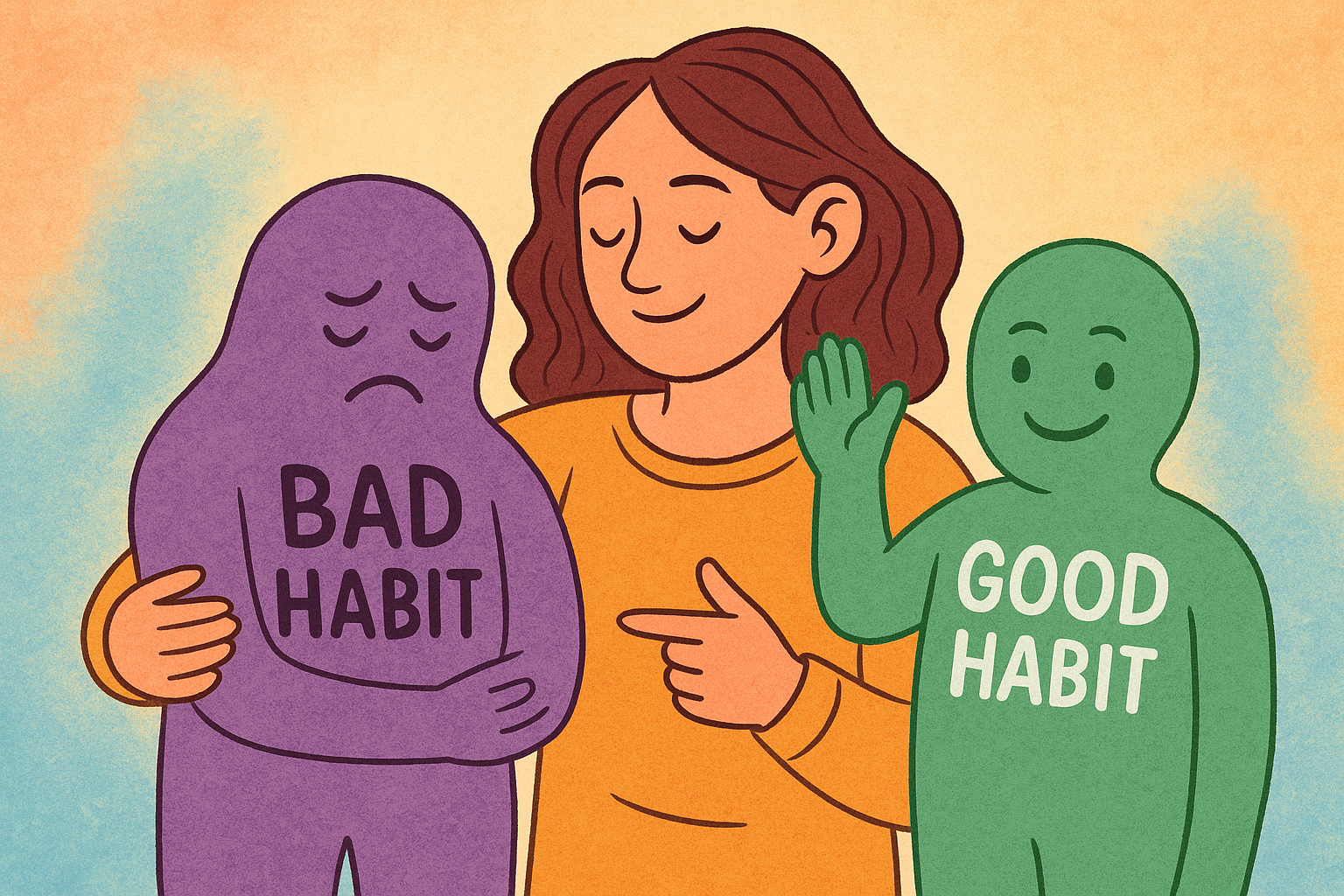
  • How to Change Your Bad Habits by Accepting Them

    How to Change Your Bad Habits by Accepting Them

    “If you don’t like something, change it; if you can’t change it, change the way you think about it.” ~Mary Engelbreit

    “So, what do you think?” my husband asked, the dinner table lit by the soft glow of the overhead light. He’d been talking for a while, and I knew I should have been listening.

    “What do you think?” he repeated with a hint of frustration.

    My mind raced trying to piece together the last few minutes. All I could say was a weak, “Huh?”

    It was the worst possible response. Normally, I’d be right there with him, sharing my thoughts. But this time, my attention was elsewhere: I was scrolling mindlessly on my phone.

    The frustration in his eyes was a clear reminder of how often I was missing out on the present moment.

    I realized that my phone was robbing me of genuine connection. I knew then I needed to change.

    The Struggle with Bad Habits Is Real

    We’ve all been there battling habits we know aren’t good for us. Mine was the endless scrolling and checking social media.

    After that dinner incident, I was determined to reclaim my attention and be present. My first move? Deleting all my social media apps.

    The first week was tough. I wasn’t on social media, but my phone still felt like an extension of my hand. I’d instinctively reach for it, ready to open Instagram, only to remember it was gone. This happened every hour. I was trying to change, but the craving was intense.

    Weeks later, my motivation went away. “What’s the point?” I thought. I felt like I was missing out and losing touch with friends.

    I justified checking my phone during “downtime,” like waiting in line, or after a long day when I needed to “relax.”

    The more I told myself, “Don’t use your phone,” the stronger the urge became. It was like telling yourself not to think about sleeping… you just become more aware of being awake.

    Inevitably, I reinstalled the apps and fell back into my old patterns. I felt defeated and frustrated. I also labeled myself “lazy.” I thought I had failed.

    Discovering A New Approach: Acceptance

    One day, while browsing the library, I stumbled upon the psychological concept of an “extinction burst.” This describes the surge of a behavior after you try to stop it.

    Think of it like this: you decide to give up sweets, and for a few days, it’s fine. Then, suddenly, you devour an entire box of cookies.

    That’s what happened to me. I thought willpower was the answer, but resisting only intensified my cravings.

    Instead, I learned about accepting bad habits. This means acknowledging their presence without judgment.

    When I shifted my perspective, everything changed. My anxiety decreased, and I stopped stressing about “doing the right thing.”

    I realized that falling back into old patterns didn’t make me a failure. It meant I needed more time to understand my habits better.

    Practical Steps for Accepting Bad Habits

    1. Create space for observation.

    Accepting bad habits begins with understanding them. I started observing my phone use with a new level of awareness.

    • I used mindfulness techniques to become more aware of the triggers that led me to reach for my phone.
    • I also started journaling to track when and why I wanted to scroll. What emotions or situations prompted me to seek the distraction of my phone? What needs was I trying to fulfill? For example, did I feel lonely, bored, or stressed?

    2. Change the narrative around your habits.

    Instead of a harsh “Don’t use your phone,” I began to use a gentler approach. I tried saying, “Don’t use your phone now.”

    This acknowledged the urge without completely denying it. It gave me a moment to pause and breathe, to consciously decide whether checking my phone was necessary.

    This simple shift in language created space for mindful decision-making.

    3. Reframe ‘bad habits’ as signals.

    Instead of labeling habits as ‘bad,’ consider them signals. Ask yourself: What need am I trying to meet? What am I feeling now?

    For example, I learned that checking my phone was a signal for a need for connection or a fear of missing out.

    Once you understand the message behind your habit, respond with compassion and understanding. Instead of criticizing yourself, acknowledge your needs and explore healthier ways to meet them.

    This shift transforms habits from enemies into valuable insights about your inner world.

    4. Replace, don’t just eliminate.

    Instead of simply deleting social media apps, I looked for healthier alternatives. I started saying, “I noticed I want to use my phone; instead I’m going to read one page of that book.”

    Finding substitutes helped me fill the gap and made the transition smoother.

    For example, if I felt the urge to scroll when bored, I would reach for a book, walk, or listen to a podcast instead.

    5. Treat yourself with kindness.

    Beating myself up for slipping back into old habits only made the process more difficult. I learned to practice self-compassion, reminding myself that change takes time and that setbacks are a normal part of being human.

    I desired this change the most, so I needed to be patient and kind to myself. And I made more progress by offering myself the same understanding and support I would offer a friend.

    Moving Toward a New Relationship with Your Habits

    Habits are complex, and breaking them isn’t easy. But understanding them is the first step to changing them.

    Accepting bad habits is a powerful tool for transformation. Instead of fighting them, we can observe, understand, and redirect them.

    I’ve learned that accepting your habits doesn’t mean giving up—it means you are gaining control. You’re acknowledging your humanity and approaching change with compassion and understanding.

    You have the power to reshape your relationship with your habits and create a life that aligns with your values and aspirations.

    What habits are you working on? Share your experiences in the comments below! Or share this post with someone who could benefit from it. Let’s support each other on this journey.

  • The Magic of Celebrating Every Little Win

    The Magic of Celebrating Every Little Win

    “Celebrate what you want to see more of.” ~Tom Peters

    In a world that often only celebrates grand achievements, it’s easy to overlook the small victories that pave the way to lasting change.

    BJ Fogg, PhD, a Stanford behavioral scientist and author of the transformative book Tiny Habits, offers a powerful insight: If we want to get great at creating habits, we must celebrate. He insists that immediately after we do our new habit, or even approximate it, we must celebrate. This. Isn’t. Optional.

    Why is celebration so crucial? That’s what wires the habit into our brain. When we celebrate, it triggers a release of dopamine. This not only feels rewarding in the moment but also reinforces the behavior on a neurochemical level, helping to embed the new habit into our neural pathways.

    This concept of celebration took on a deeply personal meaning for me as I embarked on my journey toward mindful eating. As someone who had struggled with binge eating for over two decades, the idea of celebrating small victories felt both foreign and liberating.

    I used to find myself in a dissociation vortex during meals, lost in my phone, mindlessly scrolling through social media. This often led to overeating, as I was disconnected from my body’s signals. Determined to change, I decided to experiment with BJ Fogg’s method of celebration.

    During non-meal times, I would repeatedly practice setting my phone down in another room before entering the dining room and sitting down at the dining table. Each time I did this successfully, I threw my arms up in victory and shouted, “Yes!” This seemingly silly act was a fun and delightful way to grease the groove.

    I remember the first time I genuinely celebrated this small win. It was a sunny afternoon, the curtain rustling in the gentle breeze and the sun casting playful shadows on the floor. I was feeling antsy, the dining room table looming like a trigger, a place where I would often lose myself in the abyss of my phone.

    As I had done many times during practice, I purposefully set my phone down in the other room. Walking across the living room felt like crossing a chasm; each step was deliberate, like an adventurer nearing a crucial milestone. When I finally sat down at the dining room table, I could almost hear my own heartbeat.

    I proceeded to eat my meal without my phone, noticing details I had previously overlooked. The crunches were crisp and satisfying, a symphony of textures in my mouth. The smells filled the air, and the warmth of the sun on my skin made the experience feel almost magical.

    After I put my fork down, I stood up and shouted, “Yes!” and did an ineffable, happy dance. It was a mix of awkward flailing and spontaneous twirls—something that would make any witness question my sanity. The rush of dopamine was undeniable, and I reveled in the victory of learning that I could eat without my phone.

    Yes, it was one time, but if I did it once, I knew I could do it again.

    The act of celebrating these small wins started to transform my relationship with food and with myself. I began to feel a sense of accomplishment and pride each time I successfully avoided a binge by eating with awareness. The eating itself became a mini-meditation, and the celebration was a moment to acknowledge my progress and reinforce my commitment to mindful eating.

    Here are some practical tips and insights to help you incorporate celebration into your habit-building journey:

    1. Make it Personal

    Choose a celebration that resonates with you personally—something that genuinely makes you feel happy and successful. The more authentic the celebration, the stronger the positive emotional impact and the more robust the habit formation. Whether it’s a fist pump, a happy dance (I like to twerk), or a simple smile, make it something that feels right for you.

    2. Consistency is Key

    Celebrate every time you practice your new habit, especially in the beginning. This helps reinforce the behavior and makes it more likely to stick. Consistency is crucial in the early stages of habit formation.

    3. Small Wins Matter

    Don’t wait for big achievements to celebrate. Recognize and celebrate the small wins along the way. These small moments of victory build momentum and keep you motivated.

    4. Be Playful

    Approach celebration with a sense of playfulness and joy. The more fun you have with it, the more enjoyable the habit-building process will be. Let yourself be silly and embrace the positive emotions that come with celebration.

    One of the funniest moments in my journey came when my boyfriend witnessed one of my celebratory rituals for the first time. I had just finished a meal with him. Because it was without my phone, I stood up, threw my arms up in victory, and shouted, “Yes!” with the enthusiasm of a game show winner.

    He looked at me, bewildered, his eyebrows nearly disappearing into his hairline. “What are you doing?” he asked, his voice a mix of confusion and amusement. I could see him trying to decide if he should be concerned or join in the celebration.

    As I explained the concept to him, his bewilderment turned into a wide grin. We both burst out laughing, the sound filling the room like music. Then, in a moment of pure spontaneity, he joined in, matching my awkward flailing with his own equally ridiculous moves.

    It was a moment of shared joy and understanding, and it made the habit-forming process even more enjoyable.

    As time went on, these small celebrations began to have a profound impact on my life. Not only did I become more mindful of my eating habits, but I also started to celebrate other small wins throughout my day. I found myself more engaged and present in my daily activities, and my overall sense of well-being improved.

    The power of celebration lies in its ability to create positive emotional experiences that reinforce new behaviors. When we celebrate our small wins, we acknowledge our efforts and progress, no matter how minor they may seem. This recognition helps to build self-confidence and resilience, making it easier to tackle bigger challenges.

    BJ Fogg’s insight is simple yet transformative: You change best by feeling good, not by feeling bad. By celebrating every win, we create a positive feedback loop that encourages continued growth and development.

    So, whether you’re working on mindful eating, like I was, or any other habit, remember to celebrate your wins. Throw your arms up in victory, do a happy dance, or simply smile and say, “Yes!” Let’s embrace the joy of progress and let celebration be the catalyst for lasting change in our lives.

  • The Subtle (Yet Huge) Perspective Shift That Changed My Life

    The Subtle (Yet Huge) Perspective Shift That Changed My Life

    “Dear self: Don’t get so worked up over things you can’t change or people you can’t change. It’s not worth the anger buildup or the heartache. Control only what you can. Let go. Love me.” ~Unknown

    When I was furloughed from work back in the early months of 2020, I suddenly found myself with more time on my hands than I knew what to do with. I realized it was the freest time I’d had since I was a child on my summer holidays.

    But that Covid-related break was much longer than six weeks; it was three long months. The world felt as if it were in limbo. What was going to happen? Was everything going to change forever? Would I go back to work at my desk like before?

    I had no idea. Everything ground to a halt.

    After the first few days of distracting myself by binge-watching TV shows and playing video games, I was suddenly left with my thoughts and far more time to think than I was comfortable with.

    The sudden stop in momentum forced me to think about where I was in life. I’d been riding that wave momentum for fifteen years, never really feeling as if I’d ever stopped to face where I was in my life or where I was going.

    I looked around me and noticed I’d been stressed for a long time, and I’d put on twenty-two pounds of weight. I’d stopped exercising, and my diet was making me feel sluggish and tired. My life had become working, sitting, and eating junk.

    It hadn’t always been that way, though. Between the ages of fourteen and twenty-three, I was active in the gym, I watched what I ate, and I looked after myself.

    The years had taken their toll on me. I had become someone I didn’t recognize.

    I was suddenly so anxious about the future, worrying about my health and money and whether I would ever be able to own my own place or reach the heights in my career that would make me proud of myself.

    I felt trapped, as if suddenly seeing my true position in life for the first time, and that made me feel depressed.

    This period in my life taught me that too much thinking isn’t good. It’s not particularly helpful. What does help? Action, movement, and forward momentum.

    But I didn’t want to go back to the old momentum; I wanted a more mindful one, one that I felt more in control of. I learned that if you don’t happen to life, life will happen to you.

    My Lightbulb Moment

    The one subtle (yet huge) perspective shift was this: There are things within my control and things that are not. I can influence the things out of my control somewhat, but my time is much better spent focusing on the things I am in control of.

    I am not in control of everything that happens. There are simply too many variables at play in my life.

    I realized that much of my anxiety was tied to things I couldn’t control at all. And the time spent worrying was stealing from what I could actually change and control.

    So I began to outline the things that I could control, and I think this is a healthy exercise for anyone.

    It went something like this:

    • How much I exercise
    • The type of exercise I do
    • What I eat
    • When I eat
    • What time I go to bed
    • What information I allow myself to consume
    • How much time I spend watching TV
    • The people I spend my time with
    • How I decide to react to something

    The things I could not control were:

    • How long the pandemic would last
    • What other people think of me
    • My genetics
    • If something happens to someone I love
    • The rainy days that make me feel low
    • How others behave and act

    And the list went on and on. The things that were in my circle of control were the small yet important habits I had each day. These were things I could change.

    So I began to think about what I could do myself to improve my life, one tiny step at a time.

    I was fortunate enough to have access to fresh foods, so I looked up some healthy recipes for lunches and dinners. I made those meals over and over again for weeks. I felt lighter, lost a few pounds, and had more energy, along with a new appreciation for nutrition.

    I bought a cheap exercise bike from a seller online. I rode that thing consistently, three times a week for months, and felt my legs become stronger. I also learned to enjoy the sensation of my heart pumping faster as I worked harder.

    I began to write more about my experiences and reached out to others. I found likeminded people who were feeling the same as me, and it reminded me that I wasn’t on my own.

    I stopped watching the news as much to give myself a break from the chaos of the outside world so I could focus on my own world.

    I eventually stopped going on social media and spent that time researching and listening to mind-expanding podcasts that offered me new perspectives.

    All of these lifestyle changes made me feel good. They made me feel much better in my body and mind.

    Making These Habits Stick

    These habits and routines changed my life. But I had all the time in the world to keep them up. After all, I had nothing else to do with my time except spend it with my family or stare at the walls. The real change would be making them a habit over time.

    And sure enough, the world began to head back to the way it was before.

    Before I knew it, I was asked to work from home. My work gave me a laptop and told me I would be working Monday to Friday once again from the comfort of my kitchen table. This, in itself, was anxiety-inducing.

    I felt blessed to still have a job, yet I had gotten so used to my new healthy habits that I also suddenly felt that dedicated time was threatened.

    Would I be able to keep my healthy lifestyle going while working a traditional job?

    And then it dawned on me that the real challenge we all have is making the most of the things we can control while we are preoccupied and sometimes overwhelmed by the daily hustle and bustle of life.

    We all know what is good for us, but there are so many things that we have to deal with and think about that it doesn’t take much to tip us back into bad habits.

    One stressful day can cause us to go home and binge on junk food. One stressful morning can cause us to go and grab a ready meal instead of packing our healthy lunch. One hectic week makes us feel too tired to exercise.

    Fast-forward three years, and I’m back in the office, back to getting up at 6.30 a.m. and sitting in traffic. Back to having less money and back to being tired after work and not so motivated to exercise.

    This was the real challenge—keeping perspective and a firm hand on what I could control among the increased noise of life.

    But it’s okay to have less time. You and I have to work, and many of us have family to take care of. We have responsibilities and things we cannot control, but we should never forget about ourselves amongst it all.

    Take care of yourself. Make a list of what you can control and what you can’t. Figure out the gaps in your day—the free time where you can do things that nudge you closer to where you want to be.

    Start small; go for a ten-minute walk once a week before you head off to work.

    Change one meal a week for something new when you have half an hour to cook something healthy.

    Look at your daily screen time and become mindful of how much time you spend scrolling. Cut that back and do something else.

    Do ten push-ups in the evenings. Notice over time if you feel stronger.

    Write 1,000 words once a week.

    Practice mindfulness when you’re feeling stressed.

    Notice how capable you are of changing your life through small, regular actions. You truly are more capable than you realize as you sit here reading this.

    You likely won’t see much change at first, but that’s okay. Changing things in your life is difficult, and it requires a certain degree of trust in the process until you see results.

    Although life is pretty much back to how it was five years ago, I’ve learned a lot. A difficult situation that made me feel anxious and depressed at first gradually helped me grow. It helped me realize that I am worth taking care of. I don’t need to mindlessly stumble through life if I choose not to.

    While life can be hectic, some things will always be within my control if I deem them important enough.

    I can intervene when I need to. I can make the things I can control positive. And when I let go of the things I can’t control, I have more space to grow.

  • Why I Love My Sober Life: Everything I Gained When I Quit Drinking

    Why I Love My Sober Life: Everything I Gained When I Quit Drinking

    “Sobriety was the greatest gift I ever gave myself.” ~Rob Lowe

    I tried and failed to have a fabulous relationship with alcohol for many years.

    When my children were tiny, I drank far more than was good for me, thinking I was relaxing, unwinding, socializing, and having fun. I’d seen my life shrink down from a world with lots of freedom and vibrancy to a socially restricted void, and I wanted to feel normal. I wanted to join in with everyone else.

    All my birthday cards had bottles of gin or glasses of fizz on them, all the Friday afternoon memes on social media were about “wine o’clock,” and I wanted to be part of that world.

    The opening of a bottle in the evening had me thinking I was changing gear, moving from stressed to relaxed, and treating myself to some self-care. Nothing could have been further from the truth; the alcohol made me wake during the night and gave me low-level anxiety and an almost permanent brain fog.

    I’m not proud of the drinking I did when the kids were small. I now feel a deep sense of shame about that time. I’d created such a happy life for myself—lovely husband and kids, nice house in a great town, wonderful friends. What was I drinking to escape from?

    On the outside I looked like I had it all, but I didn’t—I had overwhelm.

    I was a wife and family member, a mum to two small children, an employee, and a freelancer… I had all the roles I’d longed for, and yet it was all too much.

    I didn’t know how to let go of some of my responsibilities, and I didn’t know how to cope with everything that was going on in my life. Alcohol felt like the treat I deserved. It took me a while to figure out that alcohol was the common theme in my rubbish decision-making, tiredness, and grumpiness.

    I’d spent a long time feeling trapped and stuck. I knew I wanted to stop drinking, but I was worried about what others would think of me, how I would feel at parties without a drink in my hand, and whether I’d be able to relax properly at the weekends.

    I kept going back and forth, deciding I’d stop, then changing my mind, thinking I wouldn’t or couldn’t. It was a hellish merry-go-round. When I was forty-one, I finally made the decision to quit alcohol for a year as a little life experiment. I wanted to see how I would feel without it for an extended period of time.

    I decided to take a bold action in autumn 2019. I told a group of online friends that I was not going to drink alcohol for the whole of 2020, and once I had said it out loud, I knew I would have to do it.

    This step toward accountability really helped me to move forward with my sober mission. I started to count down to 2020 (still binge drinking), wondering how this experiment was going to go!

    Toward the end of 2019, my mindset began to shift. Instead of dreading the start of 2020, I started to look forward to it. I made plans that I knew would lead to a successful sober year. I read books about quitting, listened to inspiring podcasts, and watched films or documentaries that didn’t show alcohol consumption in a glamorous light. I followed people who were a few steps ahead of me on their sober journey. I asked questions and I followed advice.

    I had my last drink on Dec 8th, 2019—nothing monumental, out with a few friends and no hangover the next day. It was a total non-event!

    I wanted to have a year without alcohol to know if life would be stressful, lonely, or boring like I’d led myself to believe, or if it was possible to relax, connect with others, and have fun without a drink. The hangovers and brain fog were getting worse. In my late thirties and early forties, I just couldn’t get away with it like I had in my twenties.

    I wanted to be a more patient parent—no more selfishly rushing the kids through bedtime because I wanted to get back downstairs to my drink.

    I wanted hangover-free weekends to enjoy my time away from work.

    I wanted to maximize my nutritional choices—no more rubbish food choices dictated by low-level hangovers, or high-level ones for that matter.

    I wanted to sleep deeply and wake up feeling rested and ready for the day ahead.

    I wanted to know I was giving myself the best chance at not getting high blood pressure, heart disease, liver disease, cancer, dementia, or a compromised immune system.

    I went through the whole of 2020 without a drink. There were some tough days to navigate, some challenging events to negotiate, and awkward conversations to have with friends, but I did it all, and I did it all sober.

    When 2021 rolled around, I knew I wasn’t going to go back to how I’d drunk before. I had changed my relationship with alcohol for the better. I was physically, emotionally, and spiritually a different person, and I didn’t want to go back to numbing my feelings.

    It’s easy to name all the benefits to our bodies and minds when we cut alcohol out—deeper sleep, clearer skin, better mood, more energy, and less anxiety, to name a few—but for me, the real shift has come a couple of years down the line. I feel more spiritually open than I’ve ever felt before, and I cannot wait to see what unfolds next for all of those of us on this sober-curious journey.
  • How Your Worst Days Can Shape Your Best Self

    How Your Worst Days Can Shape Your Best Self

    “It is often those moments you feel least connected that you are actually making your greatest progress. The chaos around you is an invitation to pause, reflect, and grow. You are more than equipped to deal with this. If you weren’t, you wouldn’t be here.” ~Benjamin P Hardy

    It’s 1 a.m., and the silence is broken by a cough that can only be described as sounding like someone who has smoked two packs daily for the last thirty years. There’s no way to predict when I’ll be woken again, but if the past week is any indication, this won’t be the last.

    Unbeknownst to me, I’ve been dropped into the notoriously rigorous training program known as “Hell Week” that Navy SEAL candidates must endure. It’s a gruelling, continuous training exercise lasting several days with little to no sleep, intense physical challenges, and mental stress. Hell Week aims to test candidates’ physical and mental resilience and their ability to work effectively as a team under extreme conditions.

    Here’s the problem: My hell is a twenty-month-old with a nasty cough that she can’t shake. She’s obviously not torturing us on purpose, but it doesn’t make the experience any less exhausting.

    When I finally fall back asleep and am once again awakened by a foghorn for the sixth night in a row, the tears start welling up in my eyes, as I have no idea how the hell I’m going to make it through another day of calls and projects that are relying on me.

    Bipolar and sleep deprivation go together as well as a clown juggling chainsaws in a hurricane—a disaster waiting to happen, with a side of chaos and potential accidental amputations.

    So, if I’m going to be perfectly honest, and to borrow another military term, the team is experiencing a clusterf*ckunder these extreme conditions.

    How else would you describe the frustration and disorder that arises when things do not go according to plan?

    Our team is hanging on by a thread. The fights between my wife and I are wearing us down, the outbursts of anger are cringe-worthy, and the feeling that this will never end is causing enough friction to leave our skin raw.

    These are the moments when I catch myself being a victim of my life.

    Then I realize my expectations are out of whack. Things won’t always go smoothly, and sometimes I need to accept that I can’t do everything I’d like to accomplish, or do anything as well as I can when I’m at my best.

    These are not the moments to thrive.

    These are the moments to survive.

    It’s a reminder that life rarely goes according to plan.

    And that’s the whole point of Hell Week.

    Anyone can crush it on a good day, but how do you handle the inevitable hell you will face as a parent, someone who gets crippled by their mental health, or experiencing any number of painful challenges we all face?

    That question has improved my mental health, business success, and life quality more than anything else I’ve encountered in the last six years.

    Why?

    Because it changed my approach.

    Your choices on your toughest days shape your path more than those made on your brightest.

    When I struggled, I found that having an all-or-nothing approach rarely allowed me to progress on the essential things. Instead, it often felt like I was starting from scratch again. I would go off the deep end and find myself drowning in a negative thinking pattern, saying, “Of course I’m back here! Shit like this always happens when I’m making progress.”

    But as author James Clear said, “You do not rise to the level of your goals. You fall to the level of your systems.”

    It taught me the importance of establishing a solid foundation and that sticking to a routine can provide stability and a sense of control (regardless of what’s happening around me).

    I am nothing without hydration, elevation, meditation, and contemplation.

    This can feel high-level when you’re starting out. Don’t overthink the “perfect” way to implement these power-ups.

    • I’ll crush another coffee 👉 I’ll drink a liter of water.
    • I’ll catch up on emails 👉 I’m taking the dog out for a walk and getting some sun.
    • I’ll get ahead on a few of my projects 👉 I’ll sit down and throw on a twenty-minute guided meditation.
    • I’ll watch a few lessons for a marketing course 👉 I’ll sit on the front porch and read something light and fun.

    These small trades can make a big difference to your physical and mental health when you’re struggling.

    It’s easy to feel overwhelmed in the world of self-growth and personal development. Especially when you’re shamed for not having a clear answer to questions like, “Wait, you don’t have a three-hour morning routine carved out to put yourself in a peak state of abundance?”

    I’m going to categorize that as a “nice to have.”

    It’s similar to my intention of cooking gourmet meals for my daughter every night, yet I often resort to buttered noodles and broccoli because they’re a crowd-pleaser.

    There’s substance, and I’m not adding to an already stressed-out day.

    Meaning she gets a better dad who is enjoyable to be around.

    Winning the day comes back to being far more intentional about what you can stick to on your day from hell than what you can accomplish on your dream day of sunshine, lollipops, and prepping Michelin star meals.

    In the midst of our personal Hell Weeks, it’s the small, intentional actions that become our lifeline. It’s not about mastering every challenge but about grounding ourselves in the routines and habits that offer solace and stability.

    So, when the nights seem endless and the challenges insurmountable, remember: your power lies in your tiny, consistent choices. Harness them and watch as they transform your toughest days into stepping stones toward a brighter tomorrow.

  • How to Live a ‘Good Life’ (Almost Every Single Day)

    How to Live a ‘Good Life’ (Almost Every Single Day)

    “If your vision of your life centers on your highest values, you will be aligned with your dharma far above everyday existence. Whatever the values are—love, creativity, service, spiritual growth, beauty, or whatever you choose—dedicating yourself to the highest values unites purpose and inner growth as nothing else can.” ~Deepak Chopra

    I wasted almost a decade of my life. Don’t make the same mistake as me.

    On my fortieth birthday, I found myself lying in bed, fully awake at 5 a.m., with a tightness in my throat.

    “A new decade,” I thought, without much excitement.

    Staring at the ceiling, I tried to remember what I had accomplished in the past ten years. As I searched in vain for any memorable moments to celebrate, panic began to fill my chest. “I wasted my thirties,” I thought. “One-eighth of a lifetime.”

    Have you ever felt that way, as if life has passed you by? That you’ve wasted some precious years that you’ll never be able to get back?

    Perhaps you got caught in the hamster wheel, being so busy with work and daily chores that you didn’t realize how quickly time was flying by. Maybe you’ve thought of traveling, writing a book, or learning to play the guitar but continually postponed your projects for a ‘someday’ that has never arrived.

    It doesn’t feel good.

    That morning, I realized I had made a mistake. I spent most of my thirties pursuing a single goal: building my business. It became an obsession that consumed all my time and energy to the point that I forgot to nurture my relationships, travel, or do anything else exciting.

    At forty, I had very few friends and no hobbies, and I couldn’t help but feel sorry for myself.

    Later on, I discovered that this could have been prevented by doing one thing differently: by adopting a simple habit that ensures we live a good life almost every single day and avoid future regrets.

    That’s what I want to share with you.

    How Can We Live a Good Life Every Day?

    A few months after my fortieth birthday, I listened to a podcast with Hal Elrod, the creator of The Miracle Morning, in which he shared his perspective on how to live our best lives every day.

    His realization came on a specific day after spending time with his daughter, working a bit on his business (his life’s work), connecting with his wife, exercising, and eating healthy meals. As he wound down after dinner, he thought to himself, “Today was the best day of my life.”

    He then wondered why he had just had this thought since nothing truly special had happened that day—his child wasn’t born, he hadn’t gotten married, and he hadn’t booked any elite clients. So what was it that made the day so great?

    The day had been filled with all the most important things to him, his top values: his family, his relationship with his wife, living a healthy lifestyle, and inspiring people (his life’s work). He realized that living a good life, a regret-free life, comes down to living in alignment with our top values every day.

    It hit me. This was my solution to avoid wasting another decade: value-centered living.

    Here’s how we can implement this into our daily lives.

    Step 1: Identify your top five values.

    Your top values are what you consider most important and meaningful in your life. They come from your personal beliefs about what it means to live a good life.

    Below are a few questions to help you identify your top values:

    • What do you need in your life to feel fulfilled? Or, what’s missing in your life that you need to feel fulfilled?
    • How do you like to spend your time, and what would you like to have more time for?
    • What do you enjoy spending money on?
    • If your life ended right now, what would you regret not having done, accomplished, experienced, and become? And if you had one year to live, how would you spend your time? What would you focus on?
    • What would make you say you have lived a good life when you are 100 years old?

    I recommend identifying your top five values because if we center our life on just one main value, we risk feeling dissatisfied and even having regrets in the future because we won’t have nurtured the other things that are important to us.

    That’s what happened to me when I just focused on building my business (which is my value of doing meaningful work) and neglected the other areas of my life.

    Another example is a friend of mine who has two kids and highly values being a good mom. However, after a few years of taking care of everyone and not addressing her own needs and other desires—she stopped doing art, put her career on hold, and wasn’t taking much care of herself—she began feeling resentful toward her family. She was giving-giving-giving but not filling her own cup by honoring her other needs and desires.

    So focusing on just one of our values for a long time can create an imbalance in our life. That’s why step one of the value-centered living habit is to identify our top five values, not just the top one.

    Step 2: List actionable ways to honor your top values.

    Once you have identified your top five values, make them actionable by expressing them as verbs. For example, if one of your values is meaningful connections, you could phrase it as “connecting deeply and authentically.” Start each value statement with a verb.

    Next, specify more precisely how you can put each value into practice. For instance, for the value of connecting deeply and authentically, it could be:

    • Being fully present when interacting with someone—giving them my undivided attention
    • Listening with the intention to understand, not just to reply
    • Sharing my honest thoughts and feelings
    • Being open and vulnerable
    • Staying in touch with my closest friends and family by sending them messages and calling them regularly
    • Scheduling time every week for social activities

    Try writing at least five actions for each value. It’ll be helpful for step 3.

    Step 3: Do something daily to embody your top values.

    The last step is the value-centered living daily habit.

    Every morning, look at your list of actions you created in step 2, and decide what you’ll do to honor your top values.

    Personally, I write this in my journal. First, I write down my top five values as reminders, and then I write down what I’ll do to nurture each one that day.

    It doesn’t have to be complicated. For my value of meaningful relationships, I may just write a nice comment on a friend’s post. For self-care, I may go to a yoga class. For purposeful work, I may film a Tik Tok video.

    This simple daily habit makes sure that we give attention to and nurture the most important things in our lives. Every single day, even if the day isn’t perfect, we are more likely to feel satisfied because we’re focusing on what matters to us.

    This simple practice has been a game-changer for me (thanks to Hal Elrod!), and I hope it can serve you too.

  • Looking Back: The Silver Linings of the Pandemic and Why I’m Grateful

    Looking Back: The Silver Linings of the Pandemic and Why I’m Grateful

    “You gotta look for the good in the bad, the happy in the sad, the gain in your pain, and what makes you grateful, not hateful.” ~Karen Salmansohn

    The 2010 decade was difficult for me. Hardly a year went by without someone close to me passing away.

    When the tragic decade started, I was in the midst of my residency training and free time was a luxury I did not have. When I graduated and became an attending physician, I was too busy caring for patients on my own to take a break.

    In 2018, my world was shattered when one of my best friends died unexpectedly. The sudden shock of it left me feeling helpless. To counter my feeling of despair, I worked even harder to take care of patients in need.

    Shortly afterward, my father-in-law was diagnosed with a recurrence of his cancer. Over the next year, my husband and I spent whatever free time we had flying across the country to see him. We watched as he slowly deteriorated until he took his last breath in 2019.

    Instead of slowing down, I kept on. It seemed like the more I needed a mental health break to grieve, the harder I worked to suppress my grief.

    When the world stopped due to COVID-19, I too was forced to take a pause. With the whole world quarantined, I finally had the time to heal my broken heart.

    With more time at home, my husband and I found ourselves taking more walks, cooking more meals, and openly talking about our feelings. We visited with family over FaceTime and Zoom and shared stories about those who were now gone.

    We found joy in the small things: a sunrise, a bird’s song, and even just a cup of tea. With the past vastly different from what we were living through and the future feeling so uncertain, we were finally living in the present.

    Though the pandemic brought with it so much suffering and sadness, I found unexpected gratitude in the midst of it:

    Gratitude for the time that we had with our lost loved ones before COVID-19.

    Gratitude for the extra time to spend with one another now.

    Gratitude for the technology that allowed us to stay connected with our family and friends.

    Gratitude for the reminder that life is fragile and that “taking it slow” is sometimes necessary.

    Gratitude for the chance to take a step back and reflect on the important things in life.

    Surprisingly, I realized that I felt gratitude for COVID-19.

    It’s been the darkest of times. I’m devastated by all the lives lost and all the other losses people have experienced. The course of humanity has changed, and likely not for the better.

    But I’ve found solace in the silver linings that have emerged from the pandemic—things that will stay with me long after the virus has passed. I am far more grateful today than I have ever been and with it comes a sense of peace and a newfound strength to carry on.

    My father-in-law, for instance, died peacefully at home surrounded by his loved ones. For a year, we were able to join him at his medical appointments and also create new memories. We arranged for a family trip to Mexico so he could enjoy warmth in the wintertime with his sons and brothers.

    These otherwise normal events would not have been possible during the beginning of the pandemic. If he had passed away a year later, we wouldn’t have been able to say goodbye the way we did. I’m grateful for the quality time we had.

    During the pandemic, I finally grieved my best friend’s death. Instead of keeping myself busy to distract from it as I had done before, I now had time to truly process and feel his loss through the five stages of grief. I think about him at least once a day but instead of feeling sorrow, I’m usually thinking about how he would guide me through this new normal.

    While the pandemic is not something to celebrate, it has certainly opened my mind. I never would have thought that something so awful could bring about so much healing and hope.

    COVID-19 made it very clear that life is too short to worry about the little things. Life is too precious not to enjoy every moment, especially with our loved ones. When we choose to be grateful for all that we have, we open ourselves up to more joy, peace, and connection.

    While we may not be able to control our circumstances, we can control how we react to them. We can choose kindness, understanding, and empathy for ourselves and others.

    Did someone just cut me off in traffic? It’s okay, maybe they’re rushing to the hospital to see a loved one. I hope they make it there safely!

    Is the Wifi connection poor again? No worries, I can use this time to read a book.

    Did I make the wrong decision? It’s okay, I’ll learn from it and make a better choice next time.

    Reframing our thoughts to focus on the good, no matter how small, can have a powerful effect on our mood and outlook. Things that would otherwise be frustrating or upsetting are suddenly not so bad.

    For all of us, COVID-19 has taken away so much. But if we can find a way to look for the positive and cultivate gratitude then we can find happiness amid hardship. We can come out of this stronger, kinder, and more connected to the people and things that matter most.

    I’ve developed several good habits during the pandemic. I now journal every day writing about all the things that made me happy. Whenever I spend time with friends and family, I give them my undivided attention. I enjoy my work—I treat my patients as I would my family and consider it a privilege to be part of their care. I’ve also been taking more time for self-care and nurturing my creative pursuits.

    The world has changed and so have I. I am grateful for the life lessons and growth.

  • How I Stopped Being Everything I Hated About My Parents

    How I Stopped Being Everything I Hated About My Parents

    “The beautiful thing about life is that you always change, grow, and get better. You aren’t defined by your past. You aren’t your mistakes.” ~Unknown

    When I was an angsty fourteen-year-old, I remember screaming at my parents that I never (ever!) wanted to become like either of them. And I meant it.

    My dad was a workaholic who was never at home. When he was at home, he was emotionally unavailable, arguing with my mother, or he’d escape the stress of our house by going to the betting shop to gamble.

    My mother had erratic mood swings, did not allow me to have age-appropriate boundaries, and would talk to me about the lack of intimacy between her and my father. These were, unfortunately, not role models that inspired me.

    As I entered my twenties and experienced adult life for the first time, I continued to carry the ideation that my life would be different. I was determined not to become my parents. And for many years, I naively lived life proudly thinking I had not turned into them.

    Then, one day, I opened my mouth and heard my mother’s voice come out. I can’t even remember what I said, but I recall the feeling of utter despair. Despite all my thinking and wishing over the years, I had become my parents. This prompted me to reflect on my life so far, and I realized that I had repeated many of my parents’ patterns.

    I had become a workaholic to avoid feeling my emotions, was in an abusive relationship but didn’t realize this until well after it had ended, and I struggled to know how to develop healthy friendships due to difficulties setting boundaries.

    Shit. Damn. Bugger it.

    I’d accidentally become my parents! Why was all my thinking and wishing over the years not enough to stop this from happening? I thought that I had more control over my life than this.

    During my own self-discovery journey, I found that there are many reasons why we repeat the same family patterns. I also learned that we can change them.

    Humans learn from watching and copying other people’s behavior, and children are sponges that soak up everything in their environment.

    For example, when I was a child, I remember my dad ordering a meal at a restaurant, and the vegetables on his plate were stone cold. Instead of sending the meal back and asking for hot veggies, he complained about how terrible the restaurant was and ate the cold meal. When I became an adult, I struggled to assert myself in similar situations, which led to a lot of anger and resentment.

    Learned behavior is not just a one-time thing. It is passed down from generation to generation.

    For instance, my paternal grandparents lived through the Great Depression in the 1930s, before my dad was born.

    They taught my dad that food was a scarce resource, so he carried this belief with him into his adulthood, and subsequently passed this down to me through not being able to model assertive behaviors.

    This is called intergenerational trauma because the unhealthy family dynamics continue throughout new generations. Generally, intergenerational trauma is defined by events that affect people profoundly, such as child abuse, parental incarceration, poverty, war, natural disasters, etc.

    Sometimes, we aren’t even aware that our family dynamics are unhealthy, or we might be aware but are too scared to change. This is usually because humans have a strong desire to be accepted and belong. In fact, this is very important for our survival.

    For some people, repeating those family dynamics means that they continue to be a part of the family unit.

    From a young age, I was often labelled as the ‘black sheep’ of the family, because I voiced the unspoken, toxic family rules. It became easier for me to distance myself from my family rather than remain enmeshed in a family environment that was detrimental to my mental health and well-being.

    The good news is we can change our patterns so that we don’t become (or continue to be) our parents.

    The first step is to be aware of the unhelpful patterns that you’re carrying with you. Without awareness, we cannot change.

    I started by asking myself what emotions I experienced frequently and whether they ever seemed like they were out of context or disproportionate to the situation.

    One emotion I often struggled with was jealousy. Whenever a friend would share something positive about their life—if they got a new car, got a promotion at work, or won a competition—my go-to emotion was jealousy.

    This impacted my friendships, as I was constantly comparing my life to theirs and driving them away by trying to find ways to make sure my life was more successful. This led to perfectionism in everything that I did, and let me tell you, it was exhausting! I couldn’t maintain this lifestyle, and I felt like I was drowning.

    When I hit a low point after my relationship ended, I sought therapy. Through therapy, I learned that the reason I compared myself to other people so frequently was due to the beliefs I held about myself. I didn’t feel like I was good enough as I was. This made a lot of sense when we explored the relationship I had with my parents.

    They regularly compared me to other kids and were only proud of me when I performed better than anyone else. It made sense that, as an adult, I would experience strong feelings of jealousy toward other people. Jealousy meant that I was constantly trying to prove my worth to other people rather than living life on my own terms.

    I then looked at my beliefs about this situation/emotion and thought about where and when those beliefs developed. Identifying the patterns behind my behavior was a positive first step in my inner healing journey, because you can’t heal what you don’t know.

    Because I wasn’t taught what emotions were or how to understand my emotions as a kid, I needed to learn how to do this as an adult.

    My therapist helped me to better understand the motivations behind our emotions and develop new strategies to cope with these.

    For example, with my jealousy, I learned that this was a response from fear and insecurity. I was able to learn to identify my thoughts, and when I realized that I wasn’t actually unworthy but rather that was the story I had learned from my parents, I was able to choose different behaviors instead of continuing to follow the same old patterns as before.

    I recognized that perfectionism meant I worked too much, so I learnt how to slow down through mindfulness and yoga. Once I was able to recognize my emotions for what they were, rather than reacting to them without awareness, I was able to make better choices about how I wanted to respond to that emotion.

    Having that space to understand my emotions meant that I could move out of the comparing myself to other people situation, and I was able to step into the entrepreneurial space and create a business that I love. I wouldn’t have been able to do that if I hadn’t done the inner work to change and not become my parents.

    I learned this was why my wishful thinking didn’t work. I knew I didn’t want to be like my parents, but without additional support from a therapist, I didn’t know what to do instead! Therapy helped me learn how to deal with old patterns in new ways.

    From there, it was all about practice. These habits and patterns existed for many, many years. I knew they would not change overnight. However, with perseverance and practice, I was able to make meaningful changes in my life. I found it helpful to keep a journal to record my progress so that I didn’t forget how far I’d come.

    Finally, it was important for me to remember that my parents are human too. In addition to recognizing the unhelpful habits they taught me, I found it useful to remember some of the positive traits or experiences I’ve gained.

    Even though my dad was a workaholic, he instilled a strong work ethic in me, which has helped me when creating my own business. My mother loved to travel, and she has definitely passed that love to me as well.

    Reminding myself of these things allows me to acknowledge my parents’ humanness, especially in moments where I find it hard to offer them grace. For me, reminding myself of the positives is a way to honor my need to have compassion for myself.

  • Stop Waiting for Perfection and Fall in Love with Your Life Now

    Stop Waiting for Perfection and Fall in Love with Your Life Now

    I know, so cliché, right? I can practically hear your eyes roll. But hear me out.

    In a society driven by results, achievements, and ideals of perfection, there is a huge pitfall that I am becoming increasingly aware of—that we can be so focused on trying to achieve our “best life” that life itself could pass us by and we would have missed it. Missed the beauty of just being here.

    We’ve all heard the sayings “Slow down and smell the roses” and “Life is a journey, not a destination.” We hear these sayings and pass them off as embroidery on a quaint pillow, but what if we didn’t? What if life really is in the details?

    I mean, how many of us will ever actually attain the “perfect life” we are being sold? Are we just trapped in never-ending, self-defeating cycles of diets, bad habits, and perpetual “self-improvement”?

    What if we just paused for a second. Took a break from social media. Blocked out all the outside noise. Just got quiet. What would your inner voice, your subconscious, tell you?

    What makes you truly happy? What feeds your soul? Makes you tick? Even reading that back I realize I sound very “new age,” but what I mean is, aren’t we done with being told what will make us happy? And why does life have to be spectacular to be fulfilling? Can’t what we have just be enough?

    Recently, I lost my dad after a very short and aggressive battle with cancer. I didn’t see it coming. I thought he would go on forever.

    I had been estranged from my dad for a few years before he got sick. We had drifted apart for lots of reasons but mainly because he was never there for me. Our relationship was very one-sided and usually consisted of me running after him, wanting him to notice me, to give me the love and approval I so badly felt I needed from him.

    He wasn’t any of the things a father should be. He wasn’t reliable or safe or protective or even present, and I resented him for abandoning me when I was little.

    But when it came down to it, when I faced losing him, when I saw him in his hospital bed and he told me he “wasn’t long for this world,” all of that melted away and I longed desperately for more time.

    I wish I had let go of my expectations, my resentment, and my pride and just accepted him and salvaged a relationship with him. I loved my dad, and I wish I had spent more time just being with him. Now, that time has passed.

    His loss taught me something. Life is precious. We don’t have forever. We have now. This moment. We can choose to love our lives now.

    Don’t wait until you’re skinner, prettier, fitter, earning more money, famous, a millionaire. (Most of us will never be those last two things.)

    If your life is particularly hard right now and your needs aren’t being met, work to change what isn’t working. But don’t get so focused on what you want that you forget what you already have.

    Let’s stop wasting the precious time we have here with the people we love, who make our life beautiful.

    Appreciate all the little things that make you happy.

    For me, it’s coffee shops and lazy mornings, walks by the river or in nature, grabbing lunch with my friends or dancing the night away, cuddles on the sofa, spending time with my kids, those few precious moments with my partner in the morning before the day begins.

    These things are what make a life. While we are striving to “live our best life,” we run the real risk of completely missing the one we are already living.

    My one wish is that we all wake up and start appreciating the life we have right now. That we reject the notion that we have to have perfect bodies, perfect faces, perfect houses, families, relationships, to have a truly happy life.

    Wake up to the fact that we are being sold this lie purely so that we buy more stuff, work more hours, keep striving for the mythical pot of gold at the end of the rainbow.

    Love your life now. Fall in love with all the little things. Happiness doesn’t come from physical possessions. It comes from appreciating everything money can’t buy. You could already be living your “best life” without even trying.

  • Change Made Easy: How to Get Unstuck by Doing What You’re Already Doing

    Change Made Easy: How to Get Unstuck by Doing What You’re Already Doing

    “Don’t wait for your feelings to change to take action. Take action and your feelings will change.” ~Barbara Baron

    You are stuck because you are waiting to want to do the things you know you need to do to get better. You aren’t doing the things you know you need to do because you don’t want to feel bad, but you already feel bad. You are already doing what you don’t want to do. Why not choose to do something that you don’t want to do that will actually move you forward?

    If you are waiting to want to do the things that will create change, you will remain stagnant.

    I was stuck in misery and self-hatred for most of my life. I knew there were things that would help, like diet, exercise, and therapy. I also knew that there were parts of myself that I was afraid to acknowledge or confront. Like how selfish I could be, or how poor my attitude was about almost everything, or how I felt used by men when I too was using them.

    We all have a shadow side; we all have shame and guilt. We are all perfectly imperfect. When I stopped running and trying to hide these parts of myself, from myself and others, it gave me space to heal and nurture myself. It created space for me to take one small step to take control of my mind, which then led to another step, and so on.

    What you need to start doing depends on your level of depression, misery, or disconnection with yourself and spirit.

    If you are at the point where you can’t get out of bed because you hate yourself and your life, then start with mirror work. It’s not easy for most of us to look into our own eyes in the mirror. We have to face ourselves instead of focusing on other people, and this can bring up a lot of self-judgment. But over time, as we say loving words to ourselves, it becomes easier to challenge that judgment.

    Start with something simple. Simply place your hand on your heart and tell yourself, “I am trying to love you.” “I want to learn to love you.” “I love you.” Repeat this over and over.

    If you need a friend to come over to pull you out of the bed, then call and ask a friend.

    It might feel like you’re the only one struggling, and you might fear that asking for help means you’re weak, inferior, or a burden. But no one has it altogether. And people want to help, but we often don’t know how or what to do. It’s okay to ask for help. It’s brave and takes courage to ask for help. Give yourself props for having the courage to ask for help.

    Creating a better life for yourself does not require you to make big changes all at once. Consistently doing small things is what will move you forward. But you might even resist the small things.

    Let’s say a friend suggests you try painting, journaling, going for a walk in nature, meditating, or stretching. More than likely, you’ll say, “I don’t want to.” More than likely, you have received this advice before. I would pick the suggestion you have heard most frequently or the one you feel the most resistant to.

    Let’s use painting, for example. Your knee-jerk reaction might be to say, “I am not an artist” or “I am not creative.” That’s a lie. That is your mind trying to keep you where you are because that’s what the mind does. Even if you are in a bad spot mentally, the status quo feels comfortable to your brain. It is what your mind and body are familiar with.

    We are all creative beings with an unlimited amount of knowledge that resides within us. We have the ability to heal ourselves. To reconnect ourselves to something greater than our mind and our thinking. You have that power within you, but you have to take a different approach to what you are already doing, and that means doing what you don’t want to do.

    Ask yourself: What is the smallest step, the smallest thing that I don’t want to do, that will move me forward?

    For me, it was committing to three minutes of daily meditation, which I knew was an achievable goal. I found that once I got into the practice, I usually ended up spending more than three minutes. In the beginning, I often felt uncomfortable and restless, but after a couple months I started to really enjoy it. Sometimes my heart feels expanded, my mind has only positive thoughts, and it feels like pure bliss.

    I now spend ten to twenty minutes a day in meditation. Once that became a habit, I added to it.

    Meditation has helped me pause and get curious about my thoughts instead of getting carried away with them.

    For example, let’s say I have the thought “OMG, he has not called me in two days. He must not like me. I suck. No one is ever going to choose me. I am so boring. Maybe I should text him. Wait, no, don’t text him…”

    Mediation has given me the ability to hear the first thought—“OMG, he has not called me in two days”—and stop it right there.

    I learned, with consistent practice, to pause and change the course of my thoughts.

    So now my internal dialogue would sound like “He is probably busy, but if he doesn’t like me, that’s okay too because I like me. What is something I can do in this moment that will bring me joy?”

    Mediation has also helped me create space for hidden parts of myself to come forward and for creative ideas to surface. You see, we can only have one thought at a time. If you are constantly ruminating, having negative, judgmental thoughts about yourself or others, there is no space for creative, loving, supportive, healing thoughts to come through.

    I have been on the road to recovery and healing from trauma for years. There were times when I felt frustrated and would spiral back down, but by making things I don’t want to do habits, I’ve changed my life. All by committing to taking simple, small steps.

    Commit to one tiny thing that you don’t want to do, that you can do every day, for a hundred days, and see what happens. Be prepared to have your mind blown.

  • How I Got Sober and What I Now Know About the Impacts of Alcohol

    How I Got Sober and What I Now Know About the Impacts of Alcohol

    “Sometimes deciding who you are is deciding who you’ll never be again.” ~Anonymous

    May 13th, 2011. I finally surrendered to the fact that I had a drinking problem and desperately needed help. The comments from acquaintances, the concern from friends, the complaints from my flatmates, the intensity of my depression, the conversations with my therapist—they all culminated in the decision that I had to break the chains from my liquid abuser.

    It was one of the hardest decisions of my life, one that entailed waving goodbye to the life that I had led before and diving into a new one where I didn’t have any points of reference and safety handles to grasp.

    At that time, the only option I thought was available to me was AA, so I emailed their helpline on that Friday at 2:43 p.m. Only an hour later I received a response from someone who seemed to care and understood my turmoil and despair, who took the time to share some of her own story, which I could relate to.

    I began going to meetings right away, and my friend Federica held my hand for the first two. I felt blessed to have her calming and loving presence next to me while I was full of fear and confusion. I will forever be grateful to her.

    Stopping

    I stopped drinking as soon as I joined AA. I started going to three meetings a week. I was aware that my levels of drinking were quite below the average threshold of most of the fellowship members, but I was advised to look at the similarities, not the differences, so I did.

    My quiver was now equipped with shimmering new arrows: I had the strength of my resolution, my meetings to go to, the opportunity to mix and match them when I wanted to, a whole community of people I could connect with, and, very quickly, a steady group of friends to go out with after our regular meetings and on weekends.

    I had found almost everything I was lacking and more in the space of a few weeks. I know that finding those people was what made it so easy for me to stay sober, because we enjoyed each other’s company and everything we did was not alcohol-related; also, I was never physically dependent. I was an “emotionally dependent” drinker.

    What I didn’t know then was that this bubble I had created was a very fragile one because it lacked my personal foundations of sobriety.

    Nine months after I quit drinking, on a dating website, I met the man that would become my beloved life companion and husband. I made space for him in my bubble, and he opened up to me the portal to his life.

    I became part of an outside world that I had not interacted with and had unintentionally kept at distance since I had quit drinking. I started to feel like the odd one out, and I began to resent everyone else who “could” drink.

    I could recognize other people who were problem drinkers but had not made the same decision as me, and I felt it was unfair that they got away with it, that they were the ones considered normal, and that I was the one with the problem.

    I was a ball of anger that was seeping out toward everyone, but I didn’t know how to process it. I had also started a job that was very demanding, and most of the time I was out of my depth.

    Gradually, I convinced myself that I could revisit that decision I made on that day in May and that I was ready to welcome alcohol back into my life, but in smaller and more reasonable doses.

    The day I decided to drink again was so uneventful that I don’t even remember it. I know it was almost two years after I had quit and that I had a small glass of wine. I didn’t even enjoy the feeling of being tipsy, and I took that as an assurance that alcohol would have never turned into my nemesis, but a presence that I could keep at bay and out of my life when I wanted to. I was proved wrong. Again.

    Breaking

    After approximately six months, those synaptic pathways had been retriggered. I was self-medicating my stress and depression caused by a job that I could not stomach, and the familiar shortcut was in a liquor store.

    What I later learned is that I didn’t start drinking again because I had a disease. I started for the same reason that I was able to ride a bike years after I last rode one.

    On one hand, I had learned through repetition that the quickest way to find relief from my problems was to drink alcohol, and that the pleasure I gained from it activated the reward circuit in my brain; this motivated me to repeat that behavior over and over again by reactivating the neuropathways that had already been established many years before.

    On the other hand, I had not built new, healthier ways to address those problems, I had not created new habits, and that’s why I was back standing in the alcohol aisle.

    I don’t know how I managed to drink heavily, still holding down that job successfully and completing a one-year life coaching training program. But I did both, and when I moved from London to a smaller town on the coast, I solemnly promised myself and my husband that my drinking would change.

    I had left the job I hated so much, and I was studying, searching for employment, and living in a town that I loved. I had no more excuses this time. But, instead of decreasing, my drinking increased because I didn’t have the constraints and responsibility of a job, and that freed up more time.

    My Way Out

    This time around, though, I knew I didn’t want to resort to AA because I felt that it wasn’t the right solution for me. I saw AA as a Band-Aid to stem the bleeding of my alcohol use, and if it were torn off, the wound would start bleeding again.

    AA also did not delve into the reasons I was making these poor decisions, nor did it prepare the future me for an alcohol-free life. I also was not comfortable with the idea of being in recovery and going to meetings forever; I wanted to be free.

    I didn’t know what my solution was going to look like, but I was open to trying other ways. I made a decision to stop and contacted a local organization. I got myself an appointment, had a brief assessment, and was invited to attend groups and activities there.

    I attended a women’s group a handful of times, but I felt in my bones that it wasn’t an environment where my sobriety would have thrived. But by contacting them, I had made the official step to accept and see my problem in full scale before my eyes, and, in my mind, I could not backtrack after that.

    The second step was to educate myself on what alcohol really was, and I dove into anything I could find—books, podcasts, courses, videos, and online communities—like a fish to water.

    I learned the impact alcohol has on our physical and mental health; the extent to which it interferes with the neurotransmitters in our brain and affects our central nervous system; how, as a consequence, it causes anxiety and depression; how it kills our confidence bit by bit under the mask of giving us “courage.”

    I understood that it’s a solution to a problem, and that the problem can be different for any one of us. And that some people decide to suppress their problem with alcohol, others with food, shopping, or other substances.

    I learned that alcohol is a toxin, a carcinogenic psychoactive drug, and a highly addictive substance, and that the reason we get emotionally addicted to it is because it taps on the reward system in the brain.

    I came to understand that the effect it had on me was the result of a chemical reaction, not a disease, and it is explained by science, and that it developed into a problem because it was the easiest shortcut I had to solve my issue.

    The third step was attending to my emotional recovery and looking at the problems that alcohol had solved for me. This, for me, was the key where freedom from alcohol truly lay.

    Setting my sobriety against something that was outside of me and being dependent on a structure to maintain it was one of the things that pushed me away from AA. So, for me, there was only one thing to do. Go back to the source, me, and understand where the pull of alcohol came from.

    A few months before I stopped drinking, as part of my endeavor to find a career that had purpose and meaning for me, I had completed the EFT (Emotional Freedom Techniques) certification. As part of my training, I had to carry out practice sessions with other certified colleagues.

    I met a lady who introduced me to the concept of being a “highly sensitive person” and realized that I was one too. I finally found the validation of my being “too emotional,” “too intense,” and “too sensitive,” epithets that had been used to describe me and that made me feel wrong.

    In my sessions with her, she helped me to uncover layer after layer of emotions, thoughts, and memories that were connected to my drinking and to the pain that I was trying to erase with it.

    We started with the most superficial ones, then reached the deeper and most ancient, which is the safest and recommended protocol to use EFT.

    The work I did by myself, with her, and with other colleagues along the way helped me to relieve my cravings when I had them and release the triggers that used to make me run to the liquor store like a brainless bullet. It also helped me recognize when I’d started to believe that alcohol turned me into the confident and self-assured person I struggled and strived to be.

    I experienced numerous shifts along the way. One of them is that I no longer resent people who drink. I can still recognize when someone has an unhealthy relationship with alcohol, but instead of feeling like they got away with it, my perception has changed. I feel like I am the lucky one who got away because alcohol has no place in my life, and there is not one tiny cell of me that would ever want to drink again.

    I know that there is nothing positive that alcohol can add to my life and that all I need is within me.

    I would like to show this to people who struggle with alcohol and tell them how wonderful, rich, rewarding, fun, and relaxing life is without it. And that their body has the capability to do all of the above without it, and that the fun, the excitement, or the relaxation they find in it is short-lived, but the consequences are not.

    But I know that we all have our own journeys, and it’s not my place to interfere with theirs.

    I already told the most important person I needed to tell, and that is my younger self.

    When I went to find her in my memories, I told her that she didn’t need alcohol to be the amazing and lovely girl that she was. I told her that I loved her with all my heart, and that she had all the resources she needed within her to find her way back to herself.

    She cried, then she smiled and thanked me for reminding her and for believing in her.

  • What Happiness Means and How I’m Boosting My Day-to-Day Joy

    What Happiness Means and How I’m Boosting My Day-to-Day Joy

    “Don’t let this silly world trick you into starving your soul for material things. Cause someday you’re gonna be sitting out under the sun and realize how little you actually need to be truly happy.” ~Brooke Hampton

    Three years ago, at the height of pandemic, I made many pitchers of lemonade from scratch. This newfound ritual was one of the better things about being on lockdown.

    I’d hand squeeze a big bag of lemons for about one-third cup of juice, and experiment by adding vanilla extract, mint, and tablespoons of honey. I’d bring my drink outside, where I sat for as long as I dared in a lawn chair, sipping the elixir and daydreaming. It made me oddly happy, and even after a return to normal, I still like to indulge myself this way.

    My family wanders outside to check on me when I burn up a Saturday—and sometimes dinner—doing this. I’m just as annoyed as they are by the intrusion, little decorated paper straw sticking out of my glass, open book from Target on my lap.

    Isn’t that kind of expensive, my mother asked me once, and I had to laugh because the answer to that question is both yes and no.

    Does self-care cost the same as going out to a really nice meal, a vacation, clothes shopping? No. Then again, sitting for long periods, with a cold drink in your hand and doing absolutely ‘f-ck all’ as my teenaged son would say, isn’t how you’re going to afford a full and active lifestyle.

    I began to wonder if having fun and happiness are the same thing.

    I interviewed about a half dozen people on the subject, from therapists to friends—most were of the opinion that having fun and being happy are not mutually exclusive.

    “We don’t talk about our happiness. When we’re happy we’re busy being happy, and the unimportant things fade away. I never could keep a journal outside of the bad periods, because I forgot to write it down when the good was happening,” wrote a friend on Twitter.

    Dr. Sigmund Freud boiled happiness down to instant gratification:

    “What we call happiness, in the strictest sense, comes from the (preferably sudden) satisfaction of needs which have been dammed up to a high degree.”

    I think when I was a kid, I embodied Freud’s words. At age ten, I was the proverbial lab rat, pressing again and again on the same bar, hoping instant gratification would come out.

    Benny’s Oyster Bar in 1983 was that pellet. My family didn’t have much money at the time, so it was a real treat when we ate out.

    A hole in the wall, Benny’s was about two blocks from my Dad’s office, yet I can’t remember if we walked there or drove. In my unsophisticated mind, that restaurant—now a bike repair shop—was the best place on earth for hotdogs and crinkle cut fries drenched in ketchup that you squeezed from a bottle, while listening to a jukebox that competed (and lost) to noisy air-conditioning.

    We always chose to go there on a whim, and it only happened about four out of every ten times we were dragged to my dad’s place of business.

    He sold insurance, relying on my mom for clerical help. If we went to Benny’s, it usually meant my dad was having a good day.

    Thinking back on Benny’s makes me see that one of the main components to happiness is feeling safe and loved in equal measure.

    It didn’t have to be a trip to Benny’s Oyster Bar to make me practically swoon with happiness as a kid. Sometimes it was pretending to be mermaids in my friend’s pool, binge watching The Smurfs, or spending time with my cat.

    As an adult, my happiest moments remain just as uncomplicated.

    I’m a good guinea pig for this happiness experiment since I’ve never actually been depressed. That being said, I’ve only been “truly happy” a handful of times—my it doesn’t get any better than this moments slipping through my fingers before I’m aware they ever happened.

    I asked a psychologist, who works for a Florida county school board, how he’d define happiness.

    “Happiness can be one of the four core emotions. It involves dopamine hits to your hypothalamus. Easy. Then you have the cerebral cortex interpreting that which makes humans more of a pain in the ass to understand,” he said.

    What I took from this is that human happiness can be as unique as our thumbprints. It’s difficult to define, no matter who you are or where you come from.

    An artist I know put it this way:

    “Personally, I believe happiness is fleeting. I’m trying on using the idea of contentment instead. Am I content? Are there ways I can work on aspects to be more content in my life?”

    She may be on to something.

    I’m sure we’ve all heard expectation is the root of suffering, so maybe instead of expecting anything to make us happy all the time, we just need to prioritize the things that bring us joy—even if they look like “wasting time” to everyone else. Then we could visit our happy places more often and stay as long as we like when we get there.

  • Obsessed with Healthy Eating? 9 Things I’ve Learned Since Recovering from Orthorexia

    Obsessed with Healthy Eating? 9 Things I’ve Learned Since Recovering from Orthorexia

    “Sending love to everyone who’s doing their best to heal from things they don’t discuss.” ~Unknown

    I used to obsess over healthy eating, and I mean OB-SESSSSS. I spent virtually every waking moment thinking about food. What should I eat today? Is there too much sugar in that? What will I eat when we go out next week? Should I claim that I’m allergic to gluten?

    Although I didn’t know it at the time, I was suffering from orthorexia (that is, an unhealthy obsession with healthy eating). Yes, I fully agree that eating nutritious food is good for you—there’s few who would deny that—but when you are thinking about food non-stop, something has definitely gone awry.

    It all started innocently enough. My daughter (who’s my youngest) was about a year old, and I was ready to “get back in shape” and reclaim my pre-pregnancy weight. However, since I was against the idea of fad diets, I was looking for something else.

    That “something else” turned out to be wellness culture, and I absorbed it all. I followed several influencers who said we must eat in a certain way for ideal health, which often meant organic, gluten-free, dairy-free, and absolutely no sugar. The influencers also used a lot of pseudoscience to support their ideas, and I totally fell for it.

    With the idea of eating in a certain way for optimum health swirling round my brain, I decided to follow a thirty-day kick-starter healthy eating plan. It was all about focusing on health (and not weight loss). Easy enough, hey?

    There was no counting calories, macros, or weighing food. No points. It was just about eating nutritious, wholesome food and having a protein shake for breakfast. What could be the harm in that?

    Well, it was probably the long list of “not allowed” foods that you cut for thirty days (such as sugar, dairy, gluten, and soy)—essentially an elimination diet. The idea being that after thirty days you reintroduce the foods to help you identify your food intolerances. See? It’s all for health! Or so I thought…

    And, as my “clean eating” regime was underway, I started to get a lot of positive feedback.

    You’re so disciplined! How do you eat so healthy? Wow, you look really well.

    It was alluring.

    This was my slippery slope and the beginning of an unhealthy obsession with food.

    Three years in, my life looked something like this: I claimed a gluten and dairy intolerance and was experimenting with being vegan, all for the sake of my health. Unfortunately, there’s not much food left to eat on this kind of restrictive diet.

    Every few months I would follow an elimination diet (again) and would cut out all sugar, alcohol, caffeine, and soy (alongside the dairy and gluten that I was no longer eating). I started avoiding social events because the list of “safe foods” was getting so complicated; it often seemed easier to stay home.

    All of this in the name of “health.” Except that it wasn’t healthy.

    I was missing social events and avoided spending time with friends, my mental health was suffering, and I was developing an extremely disordered relationship with food.

    While orthorexia isn’t classified as an eating disorder according to the Diagnostic and Statistical Manual of Mental Disorders, some healthcare professionals believe that it should be. And, personally speaking, my relationship with food was starting to remind me of the time when I’d suffered from an eating disorder back in my twenties.

    I had a series of aha moments that finally woke me up to the fact that my behavior was not at all healthy and my extreme approach to food was doing me more harm than good.

    It was when I started feeling embarrassed going to someone’s house for dinner and sending a long list of foods I couldn’t eat.

    It was when I started to notice bingeing behavior: I’d binge on five sweet potato brownies because they were supposedly “healthy.” I’m sure that if I’d just had access to a chocolate brownie, I might have only eaten one

    It was when I was doing my elimination diet so frequently, I had to make lots of excuses about why I couldn’t join evenings out.

    Eventually I realized that my old eating disorder had morphed into orthorexia.

    Thankfully, I had the resources to make a quick recovery, and my relationship with food has done a full 180 turn… In hindsight I can see clearly how very disordered my thinking, feelings, and behavior were.

    With that in mind, here are nine lessons I learnt from my brush with orthorexia. My hope is that if you question some of your own food behaviors, you seek help before too much damage is done.

    #1 There is no need to restrict food groups from your diet.

    Unless you have a medical reason to do so (like coeliac disease), restricting food groups from your diet is unnecessary. Nope, you don’t need to be carb free; in fact, research shows that in the long term, a low-carb diet is actually bad for you.

    #2 A flexible approach to eating is best.

    You just don’t need overly rigid food rules. My food rules were too rigid, and I tried to eat perfectly all the time. Perfectly to me was organic, gluten-free, dairy-free, and absolutely no processed sugar. Alongside that, I stopped eating fruit because it has sugar in it. So, for a while, the only fruits I would eat were berries. Bananas, red apples, grapes, and tropical fruits were totally out of the question.

    The problem with rigid rules is that all the fun things in life become stressful, like holidays, eating out, and going to a friend’s house, so flexibility is key.

    #3 If you get overly upset when food rules are broken, something’s wrong.

    I felt compelled to stick to my food rules, and I would feel emotional, distraught, and upset if I broke them. Like I had failed. I remember once crying in a French supermarket on holiday because I couldn’t buy the organic and gluten-free versions of food I wanted. It’s kind of missing the point of a holiday, isn’t it?

    #4 Food is NOT just fuel.

    Have you heard the quote “food is fuel”? It’s bandied around everywhere in the wellness and fitness spheres. But food isn’t just fuel. It’s about so much more, and this kind of thinking limits our potential to enjoy food to its fullest potential.

    Food can be comforting; it can be a time to connect with friends and family. It’s nourishing for our bodies, and also nourishing for our souls; it can be nostalgic or related to our culture. A cup of tea and a biscuit can remind you of your granny, while a single meal can take you back to your childhood.
    #5 All foods can fit in a balanced diet.

    Yes, even sweets, chocolate, and pastries. It’s totally unsustainable to cut out “bad” foods for the rest of your life. I’ve also found that you’re more likely to crave these “bad” foods if you tell yourself you can never eat them again. When all foods fit, the ice cream comes off the pedestal and you can keep it in the house without bingeing. It’s a total revelation.

    #6 It’s worse for your health to stress about sugar in food than to actually eat a damn cookie.

    I used to stress about the sugar in food constantly. I would read every food label when shopping; I would calculate grams of sugar in things like raisins; I would only eat a green apple and not a red apple (too much sugar, apparently). Yup, I was one of those mums who cooked gluten-free, dairy-free, and sugar-free cakes for the kids’ birthdays. Yuk! Poor kids.

    I’ve learned the stress of worrying about food is way worse than just eating the food itself. So relax, and enjoy that cookie.

    #7 “Health” is more than just the food we eat.

    Health is not just about what we eat; it’s way more than that. It’s about your genetics and your access to nutritious food and decent healthcare, which means it’s associated with your income level.

    Also, what you consider “healthy” is different to what I consider “healthy.” Maybe my “health” is about being able to run around after my kids without feeling breathless, or improving my flexibility to keep my body feeling supple.

    Your health might be about improving stamina and strength to run a marathon, or about sleeping seven to eight hours a night.

    #8 Social events shouldn’t be awkward.

    Quite the opposite. Social events should be fun, or relaxing and enjoyable. Not fraught and stressful. I had many an awkward conversation with hosts about things that I couldn’t eat.

    I would avoid events when doing my cleanse, or re-arrange things around these months. And if I did venture out, I would endlessly worry about what I’d eat, sometimes calling the restaurant ahead to see what they had on the menu to fit my rigid rules. Or I would claim allergies so I could work out what was gluten-free and dairy-free. #awkward

    And finally, if you are a parent…

    #9 Your kids are watching you.

    You might not say anything to your kids, but they are watching you. They notice what you do, reading those labels, and how you talk about food. They see when you skip the fun meals or cook something separate for yourself. They see when you are down on yourself and your body.

    They are watching. Everything.

    If I’m truly honest, this was the biggest driver for me to heal my relationship with food. The last thing I wanted to do was pass my disordered eating down to my kids.

    Finding food freedom was the best thing that happened to me. I no longer fall to pieces in a restaurant or on holiday. Eating is no longer a stressful experience. I love food for all the things the eating experience gives us—connection, chats, family, and friends. I hope you can too.

  • The Science of Happiness: 9 Feel-Good Tools to Boost Your Mood

    The Science of Happiness: 9 Feel-Good Tools to Boost Your Mood

    “Remember, being happy doesn’t mean you have it all. It simply means you’re thankful for all you have.” ~Unknown

    I remember sitting on the New York City subway, tears streaming down my face, armed with valium and lithium along with other antidepressants that my psych had just prescribed.

    I was desperate, in that cave I had come to know as depression. Dark, hopeless, fearful depression. The cold metal seat of the subway made me feel raw and exposed. I couldn’t function. I couldn’t stop crying. I was panicked that I would be like this forever.

    That was an example of one time in my life. Yeah, I got over it. And there were other episodes of this beast. I gradually became sick and tired of being sick and tired.

    I remember the day. I had been in depression again, and from what seemed like nowhere I started to feel the light of gratitude. I was actually feeling grateful! And it felt so very good! I knew I could start to think and feel differently.

    Then and there I finally vowed to find out how to bring happiness into my life on a consistent basis. Sure, there would be the hard times, but my goal became to live my life in the most positive way I could. I discovered that happiness is an inside job and a process. There is a science to being happier. And I’m here to tell you, it can be done.

    Maybe you’ve never been that down. I hope not. But if you’re feeling low or blue, there is help for you.

    So let’s look at the science of happiness.

    Sonia Lyubormirsky and colleagues have discovered that we can actually raise our happiness levels. According to their research, 50% of our happiness is genetic, hardwired, we are born with a happiness set point. This might explain why your sister is always happy, while you struggle to make it through a day at times. Unfortunately, this set point cannot be changed.

    The next thing to consider: 10% of our happiness is due to life circumstances—our gender, our age, where we grew up, our occupation, significant events in our lives, whether we are married or single, etc.

    For instance, you might think that having more money or having that new car would make you happier, but it only would make you happier up to a point. Then the effect of “hedonic adaptation” takes over. That is the tendency we all have to get used to what we have, causing our happiness levels to go back to the way they were before we got that “new thing.”

    If you’re worried about survival, then having enough money would be critical. But studies show that the rich aren’t any happier than the rest of us. In fact, it’s been reported that they claim they have more headaches and worries. Again, happiness is an inside job.

    Now the good news: 40% of our happiness is left for intentional activity. This is where we have choice. We can change and manage our state of mind. This 40% is where we have control over our happiness levels. We may not be able to change our set point, but we can change our happiness levels! It’s up to us.

    There are many things we can do as intentional habits. We can practice acts of kindness, learn to forgive, connect with others, take care of our bodies (through both physical activity and meditation)—and these are just a few.

    One of the best places to start is with a daily gratitude practice. Write down three things that make you grateful daily. Choose different things each day. Write down why they make you grateful. The why is very important.

    Studies done in corporations like Google have shown this practice increases positivity levels. Make this a daily intentional practice. It may seem corny at first but, hey, science has shown that it works. Guaranteed to change your mindset.

    There is a whole science to happiness, and it consists of daily, (what I like to call), “happiness hygiene habits.” You do these things like you brush your teeth. They keep your happiness levels higher. You choose what works best for you and you make it a daily practice.

    For instance, Harvard Health Publishing has reported that moving your body, be it exercising, walking, dancing, or practicing yoga, has in most cases been as effective as an antidepressant. Low intensity exercise sustained over time spurs the release of proteins called neurotrophic or growth factors, which cause nerve cells to grow and make new connections. The improvement in brain function makes us feel better.

    Back when I was so down, I had an insight and realized that if I wanted to have better days I was going to have to do for myself. I was going to have to understand what helps me change my mindset from negative to positive.

    Happiness isn’t something you go after and then once you get it, you have it for good. It’s an ongoing process of daily maintenance using the tools that the science of happiness has uncovered. 

    Some of these tools:

    1. Setting realistic, achievable, and personally significant goals has given me a purpose.

    My goals become projects that inspire and excite me. I set intrinsic goals versus extrinsic goals. These pursuits make me happier and keep me young. I no longer set goals about money, ego, or power. I value and truly “own” my goals; they are not handed down by what society dictates or what my parents, neighbors, or anyone else externally thinks are worthy

    2. Savoring positive moments has become a real source of joy.

    When I find a sunrise with a glowing moon that is awesome, I hold onto that awe and revel in it. Catch the beauty, savor the positive.

    3. Connecting with people can make a huge difference.

    Reaching out to good friends, (even when I don’t want to) has helped me stay more connected and therefore more content.

    4. Sharing with a close friend what’s going on in my life helps to take the weight off my shoulders and I get to share my secrets.

    You’re only as sick as your secrets. Sharing is caring. Listening to good friends is just as healing.

    5. Practicing random acts of kindness (letting someone go first in a line or writing a “thank you” letter) has shown me compassion.

    These small acts get me thinking along the lines of being of service. Being of service takes the focus off of me and onto others. Where can I make a difference in someone else’s life?

    6. Increasing my spiritual connection has become a source of hope and strength.

    Through meditation, prayer, and contemplation, I have found a connection with the universal source which I tap into daily.

    7. Catching my negative self-talk has been huge in helping me to stay positive.

    Catching negative talk such as: catastrophizing (“This is terrible”), all or nothing thinking (“It always turns out like this”), negative predictions (“My finances will be in ruins”), labeling (“I’m so stupid”) and so on has been a big turnaround.

    Catching these thoughts is not always easy, but I’m on the lookout for them now. I immediately stop myself and switch the thought to a positive, more accurate statement. Our negative thoughts aren’t the truth of the situation; they’re lies and distortions the ego tells us. It’s all in how we perceive it.

    8. Paying attention to the little things helps me maintain a healthy mental space.

    Even something as simple as listening to my music and getting up and dancing will almost always lift my mood.

    9. Finally, living in the moment as much as I can, without bringing the past into it or dooming and glooming about the future has allowed me to be free of torment.

    The “now” is where true peace lies. Present moment awareness is simple but not always easy.

    So all of these actions and more can make up our 40% choice point. We can raise our state of well-being through practice of the happiness hygiene habits. Science has proven that practicing these habits has helped in raising low-level pessimists into low-level optimists.

    Hey, if I can do it, anyone can. And that means you!

  • Movement, Stillness, and Insight: My 3 Daily Non-Negotiables for a Busy World

    Movement, Stillness, and Insight: My 3 Daily Non-Negotiables for a Busy World

    “Put yourself at the top of your to-do list every single day and the rest will fall into place.” ~Unknown

    We live in a busy world. There is always something, or someone, fighting for our attention. It’s easy to feel overwhelmed. It’s easy to lose the time we need for ourselves. The white space in our days is often the first thing to get squeezed out as demands on our time escalate.

    To combat this pull to overwhelm, I decided to create a list of daily non-negotiables.

    Having a list of non-negotiables means I get to control at least a portion of my day. I can ensure some of what is important to me keeps its space when everything else is at risk of being crowded out.

    The Daily Three

    My daily three, as I have coined it, includes time for the following.

    1. Movement
    2. Stillness
    3. Insight

    Let’s break each down.

    Movement

    This is time for either a formal movement practice (most often bodyweight strength work, some weights, or yoga), an informal mobility flow and stretching what is tight, or just a long walk. Some days will include a combination of all.

    I believe deeply in the power of a physical practice. Regular movement is good for the mind and body. It energizes and nourishes us. It can also boost our mood, reduce chronic pain, and help us sleep better at night. All good reasons to make movement a priority in our days.

    And this time doesn’t have to be something we dread, like an early morning trip to the gym (personally, I love these). We can also introduce an element of play. Discovering movement on a deeper level. Rediscovering that childlike quality of just enjoying being in our bodies and seeing what they can do, whether that means dancing, tumbling, hula hooping, playing frisbee, or running down a hill, arms flailing, like we did as kids.

    There are many ways we can settle on what works best for us but also experiment, peppering our day with mini-movement breaks.

    Stillness

    Time to reflect, to ponder. Time to absorb. Time to reset and replenish. Time to be.

    Some will use this time for a seated meditation. I prefer long walks (which, along with writing and yoga, are as close as I get to a formal meditation practice).

    This is also my time for listening to music. Music settles my mind on the busiest of days, bringing me back to myself. For others, it may have the reverse effect, but this works for me.

    Less frequently, this space will also mean time for a more indulgent self-care routine (massage, sauna, steam, etc.). Time to switch off and be pampered. We all deserve some pampering occasionally.

    Time in stillness can often mean thinking of how I can be of service to others and the world around me in some small but meaningful way. This could be a random act of kindness or something more substantial. While self-care and time inside our own heads is important, so is time spent thinking on how we can make the world a little better for those around us.

    This is also the time for a gratitude practice. Thinking of one to three things I’m grateful for today. Big or small, they all count.

    Making space for a gratitude practice is one of the most powerful changes anyone can make to their lives. It shifts the lens through which we see the world. When we feel gratitude, true appreciation, and joy for something, it’s hard to stay in a negative space. When I think about being grateful for something (or someone), my mind clears; it focuses purely and simply on the act of being grateful.

    Too often in life, our mind wants to zig and zag. Striving for the next thing and the next. Planning and plotting ahead. Dwelling on the negative, what we are missing, what we did wrong, how far we are from our goals, how we dealt with a situation in a less than optimal way. This negative bias and future-creep do not serve us well. We suffer.

    Instead, we need to be a little kinder to ourselves and detach from our expectations of what could or should be. Making time in our day for stillness acts as an anchor to bring us back to ourselves. It’s grounding.

    Insight

    Time to learn something new or dig deeper into an area of interest.

    This will usually involve reading (or re-reading) a book, listening to a podcast, or listening to someone smart.

    Sometimes it might be a passage from a favorite book I come back to or a quote that speaks to me. I collect quotes for my writing, but there are several favorites I return to over and over. They always provide me with inspiration and are a source of energy.

    This can also be a time to go deeper on a subject in a more expansive way. A course, workshop, or some time with a coach of some sort. Doubling down on a subject we are passionate about.  Investing in our knowledge.

    Why Have a List of Non-Negotiables?

    Your non-negotiables may be different than mine, depending on your needs and values. Regardless, this practice ensures we prioritize the things that serve us (or we need) amongst other priorities. Writing them down and having them in our mind’s eye keeps them present.

    This can be time for self-development and self-care. Time to grow, time to reset, time to reflect. Time to slow down.

    This is positive fuel that we can run on. A foundation to launch from.

    Why Daily?

    A daily frequency is particularly important when establishing a new habit. Once ingrained, you may wish to revert to a less frequent practice.

    A better question might be, if it’s important, why not daily?

    Why Three?

    Because it’s not too many or too few. Three is doable. You might prefer more or less if you give a similar practice a proper go. Experiment and keep what works for you. As my examples have shown, I have been liberal in what my three encompass, I encourage you to do similar.

    The Time Conundrum: Doing What You Can, When You Can

    When life gets busy, it can be tough to find any free time in your days, especially if you have young children (or babies) to see to, or elderly dependents that count on you.

    The good news is you can work your non-negotiables into the time you have available. A short five minutes here or there, between other responsibilities, adds up.

    If you have trouble making time for half an hour of seated meditation every morning, perhaps you could reduce the pressure and instead allow five to ten minutes before you go to bed (or even in bed) each night instead. Or use a meditation app on your phone for your day while walking from work to home. As I write this, in our home, we are currently experimenting with some Yoga Nidra time just before bed.

    You can even look for opportunities to combine some of these non-negotiables with your other daily activities—for example, dancing with your kids so you get the benefits of movement while bonding with your little ones.

    The important thing is that we make at least some time for things that are important to us and for us, a promise to ourselves and form of self-care. Some days we might have more time, some days less.

    There is no right way to do this. We all work from where we are and with what we have. These non-negotiable elements should add to the quality of our lives, not create an additional stressor.

    So long as we make a little time for the things that nourish and energize us, we will reap the benefits.

    Experiment, make your own list of daily non-negotiables, and feel the power of this simple habit.

  • A Life Full of Favorites: The True Essence of Minimalism

    A Life Full of Favorites: The True Essence of Minimalism

    “Happiness can only be found if you free yourself from all other distractions.” ~Saul Bellow

    What was your favorite toy as a child? Mine was a Spider-Man action figure. The limbs were adjustable, and there was a switch on his back that made his eyes light up.

    I played with that toy for years, even after his fingers broke off and his switch got stuck. While I had plenty of toys as a child, this is the one I remember best.

    Maybe you notice a similar trend in your own children. According to a study conducted by British researchers, the average 10-year-old has 238 toys but plays with 12 daily.

    Even if you don’t have children of your own, maybe you are inundated with your own toys. Outdated electronics that sit on the shelf, trinkets that sit in the closet, or old sweaters that you haven’t touched in the last decade. How many toys do you play with daily, and how many get in your way and cause havoc?

    What if I told you these things are getting in your way of living a happier and more meaningful life? What if you didn’t have to spend time paying off old junk that always needs to be fixed, maintained, cleaned, and repaired? What if you had more time to enjoy friendships, hobbies, and passions?

    As I started to ask myself these questions I noticed others, who called themselves minimalists, asking similar questions. After this discovery, I began my own minimalist journey and never looked back.

    People become intimidated when they discover minimalism because they think they have to sacrifice all their possessions and live like a monk.

    If you think like this, I can’t blame you. I wouldn’t like that either. My five-year-old self would’ve been devastated to get rid of that Spider-Man action figure.

    Fortunately, minimalism doesn’t require such sacrifices. In fact, minimalism doesn’t require anything. There are no rules, judgments, or requirements.

    If the term minimalism is intimidating, think of it as focusing on all your favorite things, every day. This may sound enticing, but what does it look like in practice? Let’s explore together.

    1. Visiting our wardrobe

    If I were to walk with you to your closet, there would be a few different types of clothes.

    Clothes for work.

    Clothes for a formal event.

    Clothes for a night out.

    Clothes for the gym.

    Clothes for lounging and watching Netflix.

    Within each of those categories, which outfits do you usually wear? Which outfits give you the most joy? Which outfits do you gravitate toward, and which outfits sit in the back and collect dust?

    What would your closet look like if you donated the clothes that took up space and hid your favorite apparel? If donating is too daunting, pack them in a box and stash it away for a couple months.

    Giving ourselves space and time helps us realize we never enjoyed, or used, any of that clothing anyways. This gives us the courage to donate the clothes with a sense of pride. If this sounds interesting, but you aren’t sure where to start, look up “Project 333” for some additional tips and support.

    2. Reconsidering our relationships

    In the 1990’s, British anthropologist Robin Dunbar discovered that people can only maintain an upper limit of 150 social relationships.

    Thirty years later, this number sounds like an underestimate. Many people have hundreds of Facebook friends and thousands of Instagram followers. In our everyday lives, this translates into the notion that having more friends leads to more popularity, likeability, and a happier life.

    But the quality of our friendships also matters. Out of hundreds of digital connections, how many people do you spend time with in real life? How many people can you depend on to lend a hand, listen to a problem, or provide feedback to help you improve and grow?

    When I thought about my own friend circles, I realized they were often dictated by proximity rather than by shared values or interests.

    As an avid reader, I like to surround myself with people who are passionate about reading. Using modern technology, I created a book club with members from my local community. What started off as monthly conversations around books turned into regular social gatherings.

    Through discussing our similar values and mindsets, we became close friends who have been a great source of support and joy for each other over the years. Instead of relying on surface level connections that were simply birthed out of proximity, I can now count on these rich and satisfying relationships to help me thrive.

    What would your life be like if you surrounded yourself with people who shared similar values or mindsets? How would your life be different if you spent time with people who enjoyed the same hobbies as you?

    Explore different options, like Facebook groups or Meetup activities, that match your interest. It takes time to foster deep and satisfying social connections, but they can last a lifetime.

    3. Evaluating our time

    I had one of my biggest revelations when I took a hard look at how I was spending my time. I spent all of my time checking my emails and looking productive, while sacrificing the chance to read, write, and spend my time in ways that help me feel happier. I did a lot on any given day, yet none of it was meaningful or fulfilling.

    Does this resonate with you? Look at the commitments and activities taking up your time. Can you delegate anything to someone else, or completely let go of it?

    Are there activities you’re doing because you think you should do them? Ask yourself these questions to pare down your to-do list:

    1) Does this task bring value to my life?
    2) What would happen if I didn’t do this task?
    3) Does this task align with my values?

    Shining light on our habits uncovers fascinating insights.  If someone were to ask me why I was engaging in habits like yoga or meditation, it was because it’s what I thought successful people did, not because I enjoyed those habits.

    Instead of yoga, I now go on walks. Instead of meditating, I express my thoughts through writing.

    Everyone has their own recipes to live a meaningful life, and it will look different for each individual in each season of their life. Consider what you need, what you enjoy, and what habits will be the best tools to help you get there.

    By questioning ourselves, we get better answers that best suit our own needs and desires. Start off with those three questions and add others you see fit.

    What’re your favorites?

    Imagine a life where you only wear your favorite clothing. A life where you surround yourself with people who lift you up and bring joy to your days. A life where you have the time to do the activities that you enjoy most.

    You already have your favorite clothes, friends, and activities. Minimalism isn’t about getting rid of everything, it’s about rediscovering our favorite things—some which aren’t even “things” at all.

    Being surrounded by our favorites can lead us to a happier and more fulfilling life. This switch may even cause our eyes to light up, like my favorite Spider-Man action figure from so many years ago.

  • Why We Often Fail When We Set Big Goals and What Actually Works

    Why We Often Fail When We Set Big Goals and What Actually Works

    “You do not rise to the level of your goals, you fall to the level of your systems.” ~James Clear

    If you pull up any popular motivational video today, you’ll probably hear things like “Set big goals!” and “Aim high and don’t stop until you get there!”

    After watching a video like this, you may get inspired and start mapping out your plan to leave the 99% in the dust.

    And typically, because you’re riding a wave of motivation, you’ll write out these monstrous, Mount-Everest-like goals. These goals paint a picture of your life that is so exciting that you can’t wait to wake up and get to work the next morning. But when you roll out of bed and take a look at the goals you set the day before, reality hits you like a truck.

    Instead of being motivated to take action, you feel a massive wall of internal resistance. You want to take action. You know you need to take action. But for some reason you just can’t force yourself to muster up the discipline necessary to make progress.

    So instead, you choose the path of least resistance. You retreat to the comfortable and the familiar, and then decide that you’re going to wait “just one more day.” One day turns into two, two days turn into weeks, and weeks turn into months.

    But luckily, time heals all wounds, and six months later you get another surge of motivation and try it all over again. This is where most people find themselves in life—stuck on the self-improvement hamster wheel.

    How do you stop this vicious cycle? What’s the best way to facilitate lifestyle changes that you actually stick to?

    How Big Goals Ruined My Life

    When I was a sophomore in high school, I had ambitions to become an NBA basketball player. Despite the fact that I was 5 feet 6 inches tall, had below average quickness, and could barely jump over a stack of books, I was determined to prove everyone wrong.

    At this point, I didn’t have my driver’s license yet, so my wonderful mother would get up at 4:30 a.m. and drive me to my school gym early enough to get up shots before class. To make a long story short, I was cut from the team a few months into my sophomore year, and my NBA aspirations died right then and there.

    When I was a freshman in college, my focus had shifted to day trading the stock market. Once again, I had complete confidence that I was going to turn day trading into a full-time income. And once again, I was wrong. The $1,000 I had deposited into my Robinhood account disappeared in about two months, leaving me with no financial flexibility to invest into my dream of becoming a full-time day trader.

    During my sophomore year of college, I made the biggest decision I had ever made in my life up to that point. Despite having good grades, I decided to drop out of school and start my own marketing agency. Let me tell you, that phone call with my parents is undoubtedly the most emotional conversation I’ve ever had in my life.

    I even distinctly remember my own cousin telling me, “I think that you’re going to regret this decision for the rest of your life.” Still, I was unbothered, because I knew in my heart that I needed to give this a shot. A month after telling my parents I wanted to drop out of school, I was on a flight back home to California.

    Yet again, I found myself in a familiar spot—just a kid following his heart with some colossal goals.

    Filled with passion and drive, I set myself a goal to build the agency to $50,000/month in revenue by the following year. To reach that goal, I committed to at least two hours per day of prospecting, and another two hours of educating myself on the real estate marketing industry.

    By now, I think you can see where this is going. For fifteen months, I worked at trying to achieve my goals, but the highest monthly revenue target I was able to achieve was a measly $6,000/month. Despite desperately wanting to taste wealth and success, I had failed yet again.

    It was at this point in my life where I really took a step back and engaged in deep reflection. After all, I had just been following the wisdom that successful people had been preaching for decades—set big goals and don’t stop working until you accomplish them.

    Was it me that was a failure or was it my system? Why is it that so many people including me continually set big goals that they never accomplish? Pondering these questions drove me to explore the world of self-development.

    The Power of Identity

    I had always been passionate about self-improvement, but I had never really delved into the science and research behind what actually facilitates true behavior change. My research eventually led me to reach two life-changing conclusions:

    • Setting big goals does more harm than good for people who want to change their lives.
    • True behavior change occurs when you commit to small, seemingly insignificant shifts in your daily behavior.

    After spending hundreds of hours combing through research on habits, behavior change, and neuroscience, I finally had the “aha” moment that shifted my entire perspective on life. The fatal problem with setting big goals is that they focus on the outcomes we want to achieve as opposed to the type of person we want to become.

    The most powerful force in the human body is the desire to be consistent with who we’ve been in the past. Behavior that is incongruent with the self will not last, which is why big goals are often so hard to accomplish.

    You may have a goal to build a million-dollar business, but if your identity is that of someone who procrastinates on important work, it’s unlikely you’re ever going to hit that goal. You may have a goal to lose weight, but if your identity is consistent with someone who eats fast food regularly and lives a sedentary lifestyle, you’ll continue to be pulled toward actions that sabotage your weight-loss goals.

    You may have some new goals, but you still haven’t changed who you are. I wanted to build a marketing agency even though I was the type of person who procrastinated and refused to get out of my comfort zone. It was the inability to change those underlying beliefs that ultimately led to my failure.

    How to Achieve Your Biggest Goals by Thinking Small

    If big goals aren’t the answer, then what is? The key is to focus on who you want to be as opposed to the outcomes you want to achieve. You need to become the type of person who can reach the standards you have set for yourself.

    Your identity emerges out of your daily habits. You don’t come out of the womb with a preset identity. Whoever you are right now is a direct result of the daily habits that you’ve developed up to this point.

    In order to start forming new beliefs about yourself, you need to start building new habits. The formula for changing your identity is a simple two-step process:

    • Figure out the type of person that you want to become
    • Commit to small changes that align with your ideal self

    First off, you have to decide what kind of person you want to be. When setting goals, most people are guided by the question “What do I want to achieve?” Instead, try asking yourself, “Who is the type of person that can get the kind of outcomes I want?”

    Instead of setting a goal to lose fifty pounds, ask yourself, “Who is the type of person that can lose fifty pounds?” Instead of setting a goal to build a million-dollar business, ask yourself, “Who is the type of person that can build a million-dollar business?”

    The beauty of focusing on identity change is that your success is no longer tied to arbitrary targets. Let’s say that you set a goal to lose fifty pounds in six months. As you pursue this goal, you start walking every day and improve your diet. At the end of six months, you step on the scale and you’ve lost thirty-seven pounds.

    Did you achieve your goal? Nope, you’re thirteen pounds short. However, what if your goal was simply to become a healthy individual? Did you achieve that goal? Absolutely!

    Once you’ve figured out what kind of person you want to become, the next step is to commit to small shifts in your daily behavior. Too often we convince ourselves that massive success requires massive action. This is the principle that guided my life for nineteen years.

    Through constant trial and error, I’ve realized that true behavior change is the product of small, incremental changes compounded over time. We tend to dismiss the effectiveness of small actions because they don’t make an immediate impact.

    If you walk for two minutes per day for a week, you’re not going to see the number on the scale move much. If you meditate for sixty seconds for a few days in a row, you’re not going to turn into the Dalai Lama. However, what you will do is to give your brain concrete evidence that you’re a different person.

    James Clear puts this beautifully when he says, “Every action you take is a vote for the type of person you want to become. No single instance will transform your beliefs, but as the votes build up, so does evidence of your new identity.”

    Once you’ve nailed down your desired identity, come up with a daily habit that you can perform no matter how you feel. When you set big goals, your brain tricks you into thinking that the present level of motivation you feel will carry over to when it’s time to take action. By focusing on shrinking your daily targets, you’re taking motivation and willpower out of the equation.

    Here’s a few practical examples of this concept in action:

    • Meditating for ten minutes per day becomes meditating for sixty seconds per day
    • Walking for thirty minutes per day becomes walking for two minutes per day
    • Reading for thirty minutes per day becomes reading one page
    • Journaling for fifteen minutes every night becomes writing one sentence
    • Writing 1,000 words per day becomes writing fifty words per day

    It really doesn’t matter how successful you are right now, all that matters is that you’re on the right path. Once these small habits are solidified into your daily life, you’ll have mastered the art of showing up and acting in alignment with your desired identity.

    Since your brain now has some new evidence, you’ll be able to stretch yourself and gradually aim higher. That’s the true power of small habits. The same way that money multiplies through compound interest, the positive effects of your habits multiply as they become a part of who you are.

    So, the next time you get motivated to change your life, forget setting huge goals. If you do this, the power of your identity will loom large over you and prevent you from taking action. Harness the power of small, incremental change.

    Have the courage to set the bar low enough and aim at targets that you can actually hit on a daily basis. Solidify this small habit into your life, and then do the same thing with another habit. And then another. And then another.

    Soon enough, you’ll become someone unrecognizable.

  • The Simple Path to Change When You’re Not Satisfied with Your Life

    The Simple Path to Change When You’re Not Satisfied with Your Life

    “Making a big life change is scary, but you know what’s even scarier? Regret.” ~Zig Ziglar

    Fifteen years ago, I made one of the biggest changes in my life. It was something I had wanted to do for so long but had never found the right time, right plan, or courage to do.

    You see, ever since I was in my teens, I had always felt I was meant to be somewhere else.

    The town where I grew up was pretty perfect for raising young kids, but it just wasn’t for me as I entered adulthood. I always envisioned myself somewhere else doing something different than those that stayed and replaced the generations before them.

    When I came back from school in my twenties, I was eager to get my career going and was not in a rush to settle down and have kids like most of my circle. I wasn’t even sure I really wanted to raise a family. I was more interested in exploring this world and not being tied to one way of life.

    At twenty-five I thought, WOW, I finally feel like I’ve got it all figured out.

    I had lived away from home, finished school, had relationships both good and bad, and had a strong work ethic that was instilled in me from a young age. So here I was, ready to take on the world. Build my career, travel, and maybe eventually settle down and start a family… then BANG! Just like that my world started to crumble.

    Within a span of one year, I was dealt some devastating news. My mother and sister were both diagnosed with different devastating diseases.

    My world was crushed. I can still remember the impact I felt on the day I received the news.

    I was in my office when I got the call about my sister, who had lost her speech and ability to move one of her arms and possibly needed emergency brain surgery.

    I was in shock. I had no idea how I felt, what I was supposed to do, or where I was supposed to be. I just sat there with a blank stare for what felt like an eternity but really was likely just five minutes.

    After weeks of testing, it was discovered my sister had MS (Multiple Sclerosis). A life-long debilitating disease, or so I understood at the time.

    Fast forward six-plus months later, my sister was on track with rehabilitation and signs of a full recovery in speech and limb mobility. Then WHAM! My mother received a stage 3 cancer diagnosis.

    I was absolutely devastated and completely torn apart. My mother is everything to me, the woman who inspires me to stand tall and strong no matter what life throws my way. A woman of pure integrity and authenticity, loved by so many.

    After emergency surgery and intense chemo, I am glad to say that both my mum and sister survived their devastating ordeals and have been living life to the fullest since that awful time. But during that time my world was upside down and I was an emotional wreck.

    I had no idea how to unravel all the emotions I was feeling then. I kept myself busy, though, with work, too much partying, and hitting the gym hard. You see, I kept myself looking good on the outside, but I was a complete mess on the inside. I was no longer thriving; I was just surviving.

    I began taking inventory of my life and realized I was not living the life I’d envisioned for myself. I was scared to make a change and also to not make a change.

    Seeing what my family had endured made me realize how precious life is and that I didn’t want to waste mine living a life that didn’t fulfill me in fear I was next for a diagnosis. So, I decided to seek out professional help to gain control and clarity, to heal, and to push through the emotions I was suffering from. Only then would I be able to truly move forward with my life in a positive and productive way.

    Once I had done the “work” on sorting out my emotions, I was able to start creating real change from a healthy, sound perspective.

    I started creating the life that resonated with me one step at a time. You see, change doesn’t happen overnight. It takes time to build. It is a process, and anyone who has made significant change in their lives will tell you that. Their change likely started way before anyone was really aware.

    I wasn’t living the life I wanted, so I thought long and hard about what needed to change and finally took the leap.

    I moved across the country on my own, away from my most significant support, with no job, to start building a life that resonates with me. It wasn’t without challenge or bumps in the road, and it certainly wasn’t perfect. But it’s been absolutely amazing, and I’ve never looked back.

    Besides the emotional trauma, there were so many things holding me back at first—family, friends, familiarity, and fear. But what I’ve come to realize is when you start making positive change in your life, for you, things fall into place over time and you look back and realize the change was worth it.

    People speak from their own feelings, experiences, and fears, don’t let that hold you back from what feels right to you.

    I now live in a place that felt like home from the first time I landed here. I live by the ocean and mountains, which inspire me every day.

    My sister now lives in the same city (in fact, we live the same complex). My brother and his family moved a one-hour flight away now as opposed to across the country. My mother still resides back in the town where I grew up so, I feel I get the best of both worlds. Living in a place that inspires me while having the chance to revisit a vibrant city and old friends to reminisce with whenever I choose to.

    So, what are the top things people say they regret as they get older? I wish I’d….

    • Saved more money or made better investments
    • Worked in a job or career I was more passionate about
    • Treated my body better and had better self-care
    • Spent more time with loved ones
    • Traveled more

    And the list goes on…

    Why do so many people rush through life without taking the time to recalibrate and ensure they are focused on the right things that mean something to them or will enrich their lives? It’s an intricate topic yet simple. Life. Life gets in the way, responsibilities get in the way, others’ opinions, and our own doubts and fears get in the way.

    We’ve all been there, navigating life as it unravels each day, and as things happen, we go with the flow. But have you ever stopped to consider, what’s my “flow”?

    How do I want this day, month, year to go? Why do I keep getting dragged in other directions or the same direction only to live each day with no change? Why does it seem like others are thriving while I am on repeat or treading without progressing?

    You will never know for sure until you take the time to explore what is going on in your life and create awareness around what might be holding you back. With the right support and guidance, you can create change both big and small. In fact, making little changes frequently will add up to making a big change overall.

    Not sure where to start? Here are five proven tips to begin creating change in your life today.

    1. Break the routine.

    Think about what you can give up or take out of your day to switch up your daily routine and do this for a two-week period. This could mean not scrolling mindlessly through social media on your lunch break or not watching TV at night, then seeing what else you could do instead. Which brings me to my next point…

    2. Bring back doing something you love and make it a deal breaker in your week.

    No excuses, make it happen, even you only have a fifteen-minute window for this activity. Same as above, do this for a two-week period, and this next one, as well.

    3. Discover something new.

    What have you always considered trying out or have an interest in that you’ve never explored? Give it a try now.

    4. Journal.

    Keep notes on how you are feeling through the two weeks. Then do it all for another two weeks.

    5. Build intention.

    Each week set the intention that there is time, this is worth it, and you are worth it!

    The purpose of this process is to help you see how even small shifts can change how you feel and add to your life and well-being. This sets the foundation for believing that change gives more than it takes, which helps you find the motivation to seek out new opportunities so you can make larger life changes. Move if you don’t feel thrilled with where you live, sign up for a course to help you change careers, or finally leave the job you hate to do something you love.

    It takes focus, consistency, and perseverance to make change, but everyone has the ability to do it, especially if they start small and take it one day at a time.

    Surround yourself with those that will respect you and the changes you are making. I bet you’ll be surprised to see how many people are inspired and/or motivated to begin making their own changes after watching you. So don’t wait—start today and open up to change so you can live the life you want to live!

  • How to Create Happiness Outside of a Relationship and Enjoy More of Your Life

    How to Create Happiness Outside of a Relationship and Enjoy More of Your Life

    “Remember, being happy doesn’t mean you have it all. It simply means you’re thankful for all you have.” ~Unknown

    For many years I was single. But I wasn’t just a regular single, I was a miserable one.

    Rather than enjoying a time in my life when I didn’t have to care about anyone else but myself and using it to devote my full attention to my purpose and passions, I chose to ride the “woe is me” train.

    I would complain about being single daily and covet other women’s “luck” in dating. I would blame every guy I dated for “just not being ready,” or somehow else at fault.

    I didn’t realize I was the common denominator in all my failed relationship attempts.

    I was the one who chose to spend time with these men and ignore the big red flags that would crystalize themselves early on.

    Instead of taking time to patiently vet and reject men that were not good for me, I allowed my desperation to entertain any man that would show interest.

    My inability to find happiness outside of a relationship was ultimately what kept me single.

    The saying you attract what you are” was true in my case. I was miserable single, so I kept attracting miserable relationships. 

    I continued down the same path until I decided that something needed to change.

    I realized that I had outsourced the job of making me happy to the many men that I dated.

    Their presence, their commitment, and their interest in me would determine how happy I was. Unfortunately, due to my questionable taste in romantic partners, that would often mean not so happy. So, I decided it was time to change that.

    That is when things started to shift, and I called in the life and love that I wanted. Here is what I did to find happiness outside of a relationship:

    Dealing with the Absence of a Relationship

    One thing I have learned is that in the absence of a romantic relationship I had to find fulfilling activities that made me happy.

    When you are single you have a lot of time. Time to think about everything you feel is missing.

    I would spend my evenings watching romantic movies on Hallmark wishing my life were like the plotline of the movie.

    And more often than not, all it did was make me more miserable. So, I decided to utilize that free time in the evening in a better way.

    I came up with a beautiful nighttime routine that included coloring, listening to music, and reading a book on spirituality or personal growth.

    I would fill the void with activities that filled me up.

    Same for the morning times. Instead of lying in bed and scrolling through Instagram until all I saw were couples and babies, I started running.

    Not only did I get into the best shape of my life because of it, but I also discovered a new passion for running and working out that quickly turned into a hobby I’m now passionate about.

    By dealing with the absence of a relationship head-on I found activities that made me happy.

    Dealing with the Sadness of Singleness

    The second thing I did to find happiness outside of a relationship was learn to deal with the sadness that singleness often brings with it.

    It’s no secret that being single can suck.

    No matter how often single people are made to believe that being single is a blessing, it can be hard to see it when that blessing seems to last forever.

    What I have learned is that rather than avoiding, suppressing, and denying the sadness, I had to learn to embrace it.

    I needed to allow the ebbs and flows to pan out accordingly. By deeply feeling the sadness and despair, I also enabled myself to feel the joy and excitement that followed after.

    Reminding yourself that no emotion lasts forever, and that you will eventually overcome it, is the light at the end of the tunnel that keeps you going.

    Therefore, you must make it a habit to tune into your inner well-being daily. Here are three ways I do it:

    1. Start your mornings with a meditation practice that centers you and puts you in tune with how you are really feeling.

    2. Start journaling your thoughts to better understand your fears and worries. You can commit a few minutes in the morning or evening to it.

    3. Commit to a daily gratitude exercise. Multiple times throughout the day, stop what you are doing and simply list three to five things you are grateful for. They can be as simple things as your home, furniture, or the body parts that serve you well.

    There are many different habits that you can choose from. The only thing that matters is that you create a safe space and routine that allows you to feel your emotions without judging them.

    This will help you deal with the sadness of singleness.

    Dealing with the Uncertainty of Dating

    The last thing I had to learn in order to find happiness outside of a relationship was how to navigate through the dating space without feeling burned out or discouraged.

    Dating nowadays feels like you are entering the twilight zone. With many different terms and stages describing the act of dating, many people are not sure what they are doing anymore.

    Are you dating, hanging out, hooking up, or maybe just “chilling”?

    If you don’t know, chances are you are stressed by the uncertainty. And that feeling of anxiety sucks.

    It’s a constant ride on a roller coaster of emotions controlled by the other person.

    So, how can you learn to deal with the uncertainty that dating oftentimes brings with it?

    The first step is to increase your self-esteem and remind yourself that your relationship status does not determine your worth.

    When a romantic relationship does not progress the way you want, you may feel discouraged and disappointed. These feelings are valid and should be honored; however, you have to remember that they are only feelings. That means they will pass.

    Instead, use affirmations to build yourself up daily and celebrate all your minor successes, the positive impact you have on the people around you, and how far you’ve come as a person. This will help you remember all the great qualities you bring to a relationship and will be a blessing to the person you are with in the future.

    The second step is to focus on the fun.

    In a world of billions of people, it may take some time to find the one person you would like to spend the rest of your life with, who happens to want the same.

    Uncertainty is part of the dating process. Rather than shying away from it, try to focus on the fun of dating. Meet people without any expectations and instead decide to just have a good time and enjoy their company.

    By doing that, you will naturally feel less anxious, because you are not trying to control your date’s experience, only your own.

    Because of today’s societal pressure to be boo’d up by a certain age, it can often feel depressing when you are not in a committed relationship. Which then leads to unhappiness.

    However, by taking matters into your own hands and deciding to create happiness for yourself, you allow yourself to experience life and live in the present moment.