Tag: grounded

  • When You Outgrow Where You Live but Can’t Yet Leave

    When You Outgrow Where You Live but Can’t Yet Leave

    “Living in the moment is learning how to live between the big moments. It is learning how to make the most of the in-betweens and having the audacity to make those moments just as exciting.” ~Morgan Harper Nichols

    There’s a peculiar grief that doesn’t often get named. It lives in the moments when you’re neither here nor there. When you’re packing in your mind but still waking up to the same kitchen.

    When your soul says go, but your bank account or relationship or circumstance says not yet.

    It’s the grief of the in-between, an ache I’ve been swimming in for weeks now, maybe longer.

    My partner might be offered a job soon, or he might not. We might move to Geneva and finally have a place of our own again: furniture, friends, rhythm.

    You see, we’ve been nomadic for five years now. In 2020, we packed up all our stuff and put it into storage just when the pandemic hit and when we moved to Porto in Portugal. Italy, France, Sweden, and the UK followed. My partner now needs more stability again, and I’m not sure what I need yet.

    I might take a leap, board a plane to Chile or China, and follow the whisper that says something there might change everything. I can’t plan anything yet. Not really. And it’s eating me alive.

    I’m not new to longing. I’m half German, and there’s a word we hold close in our language: Fernweh.

    It doesn’t have a perfect English translation, but it lives somewhere between wanderlust and homesickness—not for home, but for somewhere else. For a life not yet lived. For a distant landscape that feels like it’s calling your name, even if you’ve never been.

    Historically, Fernweh has roots in the Romantic period, when writers and artists felt the pull of faraway lands, not to conquer them, but to feel alive inside them. It’s the ache of the horizon. The hunger for distance.

    A soulful discomfort with too much sameness.

    German Romanticism gave rise to this ache. Writers like Johann Wolfgang von Goethe, Heinrich Heine, and later Hermann Hesse lived and wrote from this place of longing.

    As the writer Goethe reflected during his Italian Journey, “Architecture is frozen music,” and he confessed that “the spirit of distant lands was what I needed to restore myself.”

    I feel it now in every cell of my being.

    And even when I’ve answered its call—wandering through Egypt alone last year, losing myself in Istanbul for a month, and living in Bali for two months—I’ve met Fernweh’s twin: homesickness. The longing for my dog, my partner, my kitchen table and shared meals, the known.

    So I always find myself in that strange space between Fernweh and a desire to live a more rooted life. Between craving freedom and craving familiarity. Between the desire to disappear into a new culture, a new version of myself, and the desire to stay close to what grounds me.

    But this time, something’s different.

    I’m not craving the high of escape. I’m craving the quiet of returning to myself. Not in a performance way. Not in a spiritual branding way.

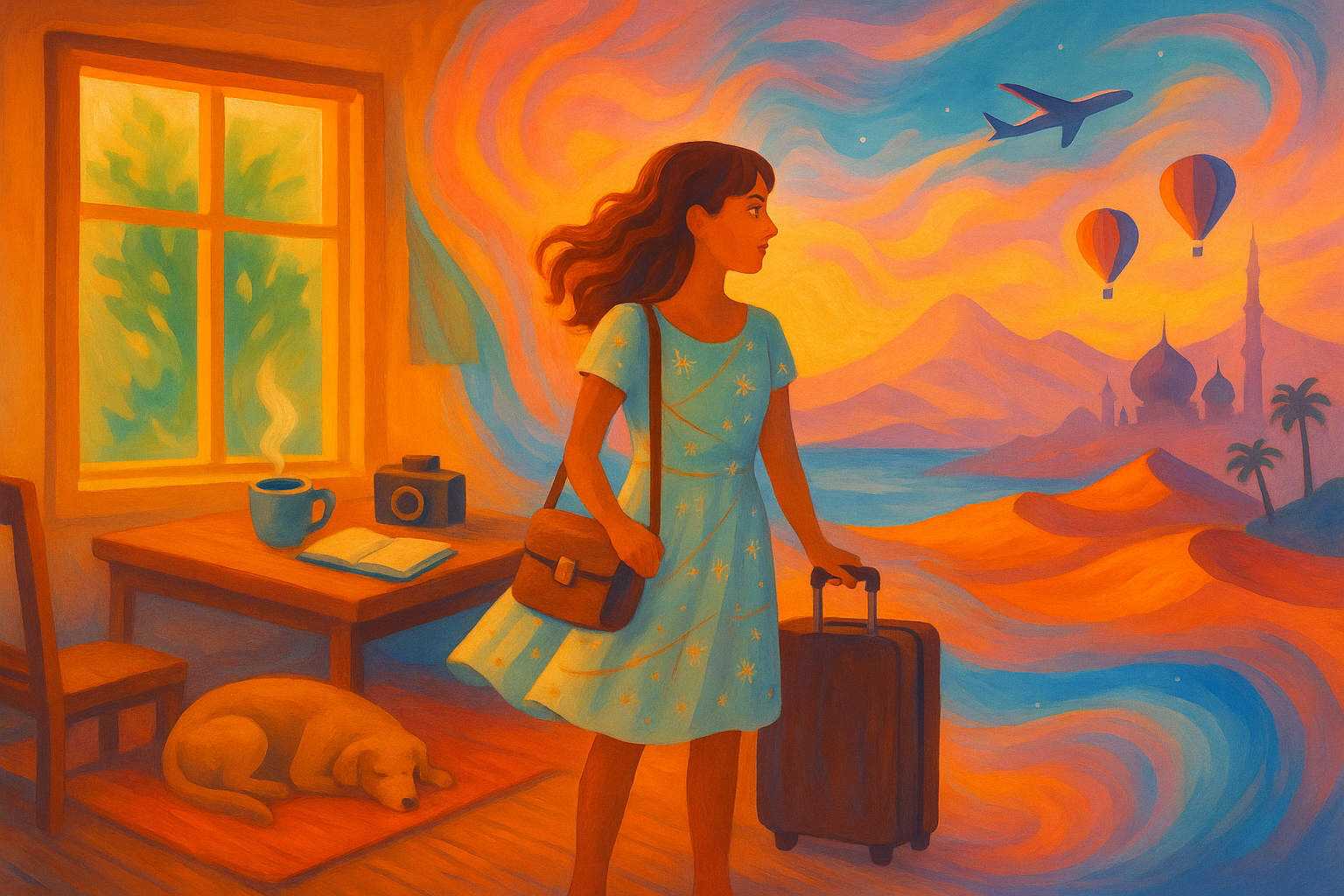
    Just me. A woman with a suitcase. A woman with a camera. A woman with grief in one pocket and curiosity in the other.

    And I’m learning to name this ache not as a failure but as a truth.

    This is the grief of the in-between. The ache of belonging to no one place, because your soul is too wide for borders.

    I used to think I had to choose. Be the grounded woman in a relationship, in a city, building something. Or be the nomad—alone, rootless, following the next passport stamp.

    Then I met my partner, with whom I could be both for the last five years. Now that he wants to settle somewhere long-term again, I wonder what I should choose.

    Or rather, I wonder if the real work is in the not choosing. But allowing both to live inside me. To let myself miss what I’ve left whenever I roam this world alone without him. And to let myself love what I’ve built whenever I live a settled life with him.

    Because the truth is, sometimes, I want to light incense in a place that’s mine. Sometimes, I want to wander through Shanghai with a notebook and no one waiting for me at home. Sometimes, I want both on the same day.

    And I know I’m not alone.

    There are so many of us soul-wanderers, soft-seekers, sitting in limbo. Waiting for clarity. For visas. For a sign. Wondering if we’re selfish. Wondering if we’re just lost. Wondering what the f*ck we’re doing with our lives while others seem so clear.

    If that’s you, I just want to say: you’re not failing.

    Your ache is evidence of your depth. Your longing means you’re alive. Your uncertainty is sacred. And your desire to hold both freedom and rootedness is not a contradiction. It’s a gift.

    So here I am, still waiting to know what’s next. Maybe Geneva. Maybe China or Chile. Maybe somewhere I haven’t dreamed up yet.

    I don’t have answers. But I have language now. And language has always been my bridge back to self.

    I used to think the ache meant something was wrong. That I had to pick a lane: freedom or stability. But now I know: the ache is a compass, not a curse.

    The real lesson? Maybe we don’t need to fix the ache. Maybe we just need to learn how to live with it. To stop asking ourselves “Where should I be?” and start asking “Who am I becoming?”

    Maybe that’s all we need in the in-between. Not a plan. Not a flight. But a sentence that lets us breathe. And for me, today, it is this:

    My task is not to end the ache but to build a life that lets me hold both: the longing to go and the ache to stay.
  • How I Stopped Absorbing Other People’s Energy and Emotions

    How I Stopped Absorbing Other People’s Energy and Emotions

    “And then the day came when the risk to remain tight in a bud was more painful than the risk it took to blossom.” ~Anaïs Nin

    I used to think something was wrong with me.

    I cried at the wrong moments. I felt anxious before a phone call, only to find out the other person was deeply upset. I could walk into a room and instantly sense who was grieving, who was fighting—even if no one said a word.

    People called me empathic. Intuitive. But mostly, I felt weird. Overwhelmed. Other. Too much.

    I tried everything to make it stop. Therapy helped a little, but only on the surface. I learned the language of trauma, boundaries, and projection—but still, I felt like I was carrying more than just my own stuff.

    After about a year with one therapist, she finally said, “It’s not that you anxiously imagine things—you’re honestly always right. That’s a big difference. And I don’t know how to help you.”

    The truth was: I wasn’t broken. I was energetically wide open. And no one had ever taught me how to close.

    The Moment Everything Clicked

    It was years into my wild, seemingly never-ending personal growth journey, and I was sitting on a date.

    I wasn’t looking up, but I responded to what I thought was a question the man across from me had asked. When I looked up, his face had gone pale.

    “I thought that,” he said. “But I didn’t say it out loud.”

    I had done so much inner work. And yet there I was again—caught in a situation I didn’t fully understand. Feeling as though I had done something wrong.

    When someone in the same room spoke about grief, it felt like I’d been punched in the stomach. Not metaphorically—my body literally responded. I had no idea where I ended and other people began.

    In a moment of late-night desperation, I Googled something like “how to stop reading people’s thoughts.”

    I ended up on the phone with a woman I’d found online. She greeted me with, “Whoa, you are wide open, aren’t you?” And then she said the words I didn’t know I’d been waiting for:

    “You need to turn this down.”

    Turns out, I wasn’t just sensitive. I had no energetic boundaries.

    My body, my emotions, my intuition—none of it was contained. I had spent my life walking around like an open door, receiving every gust of feeling and energy that came my way.

    It wasn’t empathy. It wasn’t anxiety. It was a lack of containment.

    The Difference Between Love and Enmeshment

    Growing up, I thought being a good friend, daughter, or partner meant feeling everything other people felt. I was prized for silently predicting the emotions of others in a way that often protected me from harm behind closed doors. If someone I loved was sad, I needed to be sad with them. If they were anxious, I would absorb it and try to fix it. If I thought they could hurt me, I stayed and soothed them—not just to protect myself, but to protect everyone else too.

    This orientation toward helping emotionally volatile people didn’t serve me.

    When I was young, I thought it was compassion. Later, I thought it was codependence. But it was actually energetic enmeshment.

    Over time, I lost track of my own inner compass.

    My attraction was confused. My decisions were reactive. My body was tired.

    I couldn’t tell what I needed because I was constantly responding to so many streams of information.

    The cost wasn’t just emotional exhaustion—it was disconnection from myself.

    The Practice That Saved Me

    The almost funny thing is the solution was simple.

    There are grounding practices intuitive people have used for centuries. I just didn’t have anyone in my life to tell me, “Honey, you can turn that stuff off and use it when you want.”

    I often imagine a parallel timeline where I had elders who taught me to close skillfully, rather than using my intuition to tether myself to people who needed to face their own karma—without my intervention.

    It began with a simple image.

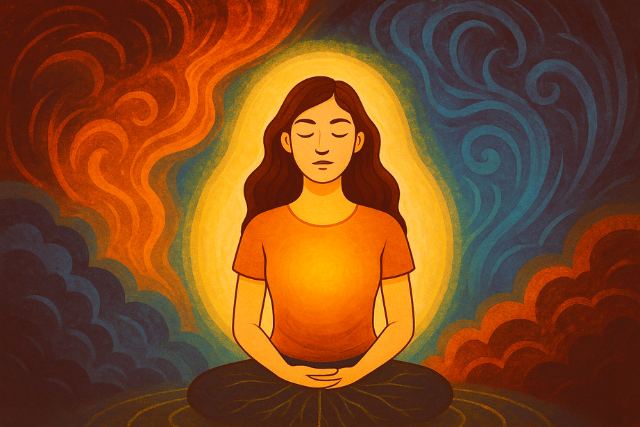
    I imagined a grounding cord from the base of my spine, anchoring me deep into the earth. With every exhale, I released anything that wasn’t mine down into the soil.

    Then I called my energy back. I imagined it returning from all the places I had left it—washed through sunlight—like golden threads being rewoven.

    Next, I zipped myself up. Literally.

    I visualized a golden zipper running up the front of my body, sealing in my energy field. I imagined a soft dome of light around me—just my size. Nothing could come in unless I invited it.

    I was still loving, still intuitive, still me.

    But now I was also separate. Not shut down—just held.

    Grounding and Choosing

    Grounding, closure, and choosing when to open and when to put my “closed” sign up are now part of my everyday life. If something feels even slightly off, I know I’m pulling in information that likely isn’t mine to hold.

    The truth is, without a container, an agreement, and consent, diving into someone’s emotions, fears, or thoughts isn’t good for me or for them.

    Today, using my gifts is something I save for my work.

    The world needs sensitive, intuitive people—but not ones who are depleted and lost in other people’s pain.

    The most powerful thing you can do for others is stay in your own energy and listen with integrity.

    I still feel things deeply. But now I know how to feel from within myself—not from inside someone else’s story.

    And that has made all the difference.

  • 3 Simple Words to Help You Feel Present, Grounded, and Nourished

    3 Simple Words to Help You Feel Present, Grounded, and Nourished

    “The little things? They’re not little.” ~Jon Kabat-Zinn

    Remember Halloween, 2018? No? We wouldn’t, either, except that it happens to be the day our mindfulness journey—and our lives—changed forever.

    First, some background. We (Deborah and Willow) met when our boys played on the same fifth-grade soccer team. We connected quickly through our shared love of books, writing, dogs, hiking, and strong coffee.

    Something else we had in common: We were both failed meditators. To be honest, we were a bit embarrassed that we couldn’t make a mindfulness practice stick.

    Thank Goodness We WEREN’T Paying Attention 

    Now, back to the story. In 2018, October 31st landed on a Wednesday (an important detail, as you’ll soon discover). That morning, we drove to San Francisco to see a new exhibit at an art gallery.

    Parking spot secured, coffee in hand, we were first in line as we waited for the museum doors to open.

    We waited. And waited. And then it dawned on us.

    Was the museum closed on Wednesdays? Yep.

    Had we paid attention to the schedule beforehand? Nope.

    As usual, we’d been too distracted and busy—and now our plans were ruined.

    Before heading home, we decided to walk around and explore downtown San Francisco. As we set off, we decided to try an experiment: We would slow down and tune in to, well, anything and everything.

    We’d notice what was happening around us. We’d notice what was happening inside us. And we’d notice what happened when we intentionally paid attention.

    Oh, the things we noticed! Little pink flowers poking out through a crack in the sidewalk. A tiny dog in a pale blue sequined jacket. A sweet older couple holding hands as they shuffled across the street together, which instantly warmed our hearts.

    Two hours later, we realized that intentional noticing was making us feel present and grounded. Nourished and aware. We were totally engaged with our lives—and we loved it.

    A Three-Word Invitation to Slow Down and Be Present

    We decided—on the spot—to each start a daily journal based on the prompt “Today I noticed.” We’d write a sentence and draw something (anything!) about an observation. Nothing would be too small or mundane to be worth noticing.

    A few weeks later, we shared what we’d been recording. As we paged through our journals, we found ourselves saying things like, “I noticed that!” and “I feel the same way!” As we laughed and talked, we realized how much of everyday life we’d been missing out on because we were too distracted to notice.

    Here are just a few precious moments we might have missed if it wasn’t for our “Today I Noticed” mindfulness practice:

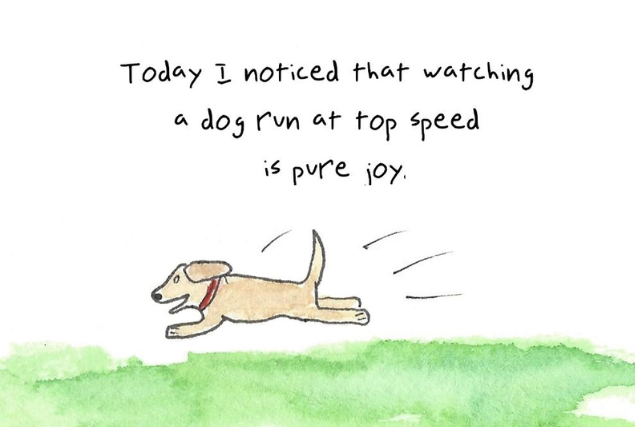
    Today I noticed that just two stalks of freesias make the whole room smell divine.

    Today I noticed how easy it is to practice “lovingkindness” on my dog.

    Today I noticed how happy it makes me to hear my husband unloading the dishes.  

    Today I noticed I love coffee so much that I imagine my second cup while still drinking my first cup.

    Our day-to-day lives were becoming richer and brighter simply because we were paying more attention.

    2000+ Days of Mindfulness—and Still Counting 

    Now, five-and-a-half years later, we’re still observing, writing, and drawing about some of the funny, surprising, sweet, and ordinary moments that we all see but rarely take the time to notice. This daily practice leaves us feeling tuned in, present, and connected—just like any other mindfulness practice.

    Unlike meditation, for us, this approach to mindfulness has stuck. Noticing and recording has become a way of life—and we don’t plan on ever stopping.

    Here are five reasons why we’re convinced that “Today I noticed” is the secret to lasting mindfulness.

    1. It’s 100% natural.

    We’re all noticing things, all the time. The key is noticing yourself noticing. Paying attention doesn’t require a meditation pillow, a yoga mat, or a mantra. It just takes a simple prompt—”Today I noticed”—to shift your mindset.

    2. It makes us feel present.

    As Jon Kabat-Zinn so wisely stated in the quote above, the little moments aren’t little because they’re what make up our lives. When we move too fast or feel too overwhelmed to notice them, we miss out on an essential part of daily life. Intentional noticing is a way to instantly feel grounded in the here and now.

    3. It sparks gratitude.

    When we slow down and pay attention, even for an instant, we stop taking things for granted. Today I Noticed reminds us how easy it is to find things to appreciate if we just slow down and look for them.

    4. It boosts compassion.

    As we discovered during our very first session of showing each other our observations, the little moments are evidence of our shared humanity. Whether we’re seeing a new bud blossom into a beautiful flower, hearing a beloved dog snoring, or appreciating a smile from a stranger, such “ordinary” experiences feel downright extraordinary when we realize they’re part of a bigger collective experience.

    5. It’s a creative outlet.

    If you’d like to have a creative practice but can’t find the time, “Today I Noticed” mindfulness is for you. You can spend as much or as little time as you’d like writing and drawing about an observation. This bite-sized break is an easy way to tap into a delicious right-brain experience and feel both completely focused and completely relaxed. And wonderfully creative!

    Here are some tips and ideas to keep in mind.

    6 Tips to Start a Noticing Practice Today 

    1. Start paying attention to little things—thoughts, feelings, observations—as you go through your day. Nothing is too “small” to notice and appreciate.

    2. On a piece of paper, starting with the words “Today I noticed,” write about your observation with a sentence or two.

    3. Create a sketch or some kind of visual to accompany or illustrate what you wrote. Remember, everyone is an artist in their own unique way.

    4. Find a buddy to share your observations with. Start a “Today I Noticed” club and host monthly sharing sessions. Or hold a weekly noticing session with your team at work.

    5. Instead of asking your kids, “How was school today?” (“BORING.”), ask them what they’ve noticed. It’s a guaranteed conversation starter!

    6. As you notice more and more things (and you will, we promise), keep track of your observations in your phone or a notebook. Then, when you’re ready for a creative break, you can dive right in and start writing and drawing.

    Go Forth and Notice!

    Have we convinced you to try noticing your way to mindfulness? We hope so!

    When you simply let three words, “Today I noticed,” inspire you to pay attention to the little things that usually slip away unnoticed, you feel present, grounded, and nourished. Small things become more interesting and memorable when we simply take the time to notice them.

    We’ll end with what may be the most powerful discovery of all: The more you notice, the more you notice. And that, friends, is where the real mindfulness magic happens.

  • How to Create a Balanced Life: 9 Ways to Feel Calm and Grounded

    How to Create a Balanced Life: 9 Ways to Feel Calm and Grounded

    “Happiness is not a matter of intensity but of balance, order, rhythm and harmony.” ~Thomas Merton

    As a Libra, my sign is the scale, which signifies balance. I’m not sure how much my “signage” plays into my desire to live a balanced life, but I do know that the more balanced I feel, the more free I feel.

    In my work I am often reminded that what works for some people does not necessarily work for others, and that one person’s idea of balance may not constitute anything remotely balanced from another person’s perspective.

    So I wanted to address the various elements of life that can require balancing and offer some suggestions to find the mix that works best for you.

    To start, what does it mean to be balanced?

    To me, it means that you have a handle on the the various elements in your life and don’t feel that your heart or mind are being pulled too hard in any direction. More often than not, you feel calm, grounded, clear-headed, and motivated.

    How do you find your balance?

    The elements in life that require the most balancing can be divided into two categories: internal and external. Oftentimes, people focus on one more than the other.

    For example, you may find that you focus on external things, like work, relationships, and activities, and that you pay very little attention to what is going on inside your heart and mind.

    On the other hand, you may find that you spend so much time being self reflective that you sometimes miss out on the experience of living.

    Other people may be fairly balanced between the two but might want to balance out some specific elements within each category, so I created this little outline to help us better understand the beneficial components on both ends of each spectrum.

    Internal (Mind, Heart, Health)

    • Mind: Challenging yourself intellectually vs. creating opportunities for your mind to rest
    • Heart: Giving love vs. receiving love
    • Health: Eating, drinking, exercising properly vs. resting. and treating yourself to some extra yummies

    External (Work, Social, Family, Fun)

    • Work: Pushing yourself to achieve goals vs. seeing the bigger picture and enjoying the ride
    • Social: Satisfying your social desires vs. taking time for yourself
    • Family: Fulfilling your familial responsibilities vs. creating healthy boundaries
    • Fun: Allocating time for things you enjoy doing vs. making sure you don’t overdo it

    As you can see, both ends of each spectrum are actually positive; but if either side is taken to an extreme, something that is intended to be positive can end up being detrimental.

    It’s helpful to check in with yourself to see if you feel balanced.

    If you feel pulled in any one direction and uneasy about it, these steps may help you get your life aligned:

    1. Acknowledge.

    Take some time to really look at your life, your state of mind, and how you’re feeling. Be honest with yourself and notice the areas of your life that you’re neglecting.

    2. Examine.

    Notice if you’re leaning more toward an internal or external focus, or if there are areas within each category that you would like to be more balanced.

    3. Set Goals.

    Look at the outline to help you decide which ways you want to balance your life. Make a list.

    4. Plan Tasks.

    Make a list of daily, weekly, and monthly tasks that you will need to do to achieve each of these goals. What have you tried in the past? Did it work? If not, what can you do differently?

    5. Reflect.

    What is the most important thing you’ve accomplished in the past? How did you stay focused toward this goal? How did you handle your fears, doubts, anxieties, worries, and negative self-talk? How does it feel to know that you accomplished the goal in spite of these parts of yourself?

    6. Prepare.

    What is your inner “stuff” that will try to keep you from sticking to your plan (fears, worries, doubts, negative self talk)? Can you specify the things you will say to yourself to push you off track? (For example: “Just one more bite, I’ll start eating better tomorrow.”) Make a list.

    7. Empower.

    What do you need to remember in those times? What are things you can say to that self-sabotaging part of yourself? Be kind to yourself. Balance won’t feel good if you’re cruel to yourself in creating it!

    8. Connect.

    Is there a person or a tactic you can use to keep yourself supported, motivated, and focused in those hard times? I highly recommend connecting and sharing your inner process with someone. Find someone who can help you challenge your inner demons, and celebrate your little accomplishments.

    Just like accomplishing any goal in life, it takes time and effort to overcome your habitual patterns and create new ones. If you stay on track with this detailed and intentional process for three whole months, then there is a good chance you will create new habits to enjoy a more balanced life going forward!

  • How to Connect with Your Body to Feel Balanced: 10 Grounding Techniques

    How to Connect with Your Body to Feel Balanced: 10 Grounding Techniques

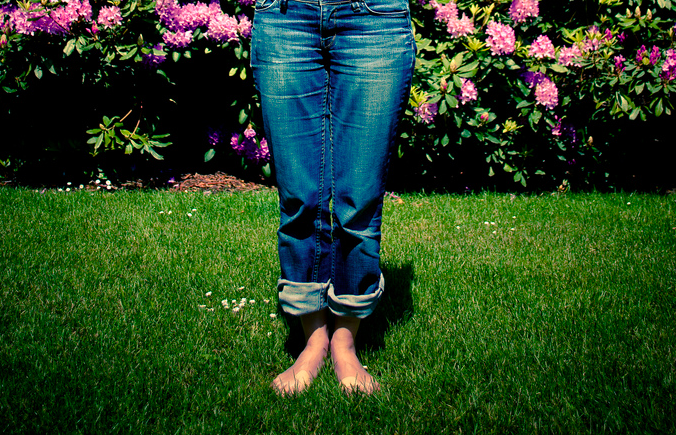
    Feet in grass

    “Get yourself grounded and you can navigate even the stormiest roads in peace.” ~Steve Goodier

    Sometimes my head is in the clouds on a massive scale.

    This isn’t always a bad thing for me. When I am blissfully ignorant of reality, it can feel beautiful and exhilarating—shiny, I call it. It can be a welcome respite from the days when life feels dark and painfully uncertain.

    But this can also be dangerous. When you’re not connected to your body and surrounding environment, you don’t have a strong sense of direction or purpose; you’re just floating. Also, the smallest thing can distract you and it’s difficult to get anything done.

    For example, I’m supposed to be editing another article right now, but instead, I’m playing with this one.

    Even if you don’t have the same struggles I do, you might be able to relate. When you’re dealing with difficult circumstances and emotions, you may feel unbalanced and even start to shut down a little. It’s all too easy to disconnect from the world when it starts to feel overwhelming.

    Let’s face it: the clouds are beautiful, but sometimes it’s helpful to have your feet on the ground.

    With this in mind, I’ve come up with a series of grounding techniques that help me reconnect with my body when I’m feeling a little lost: (more…)