Tag: Gratitude

  • 6 Ways Gratitude Can Improve Your Life and Make You Happier

    6 Ways Gratitude Can Improve Your Life and Make You Happier

    Girl with heart

    “I don’t have to chase extraordinary moments to find happiness—it’s right in front of me if I’m paying attention and practicing gratitude.” ~Brené Brown

    For the longest time I sought after happiness in the wrong place, and I wasn’t always leading with my heart to obtain joy.

    I used to picture myself living in a big house, with nice things to furnish and fill the fantasy home I dreamed of.

    I didn’t obtain this large dream home, and I’ve learned that it’s not important, nor is it what I want. I’ve been fortunate to live in a moderate home with exactly the things I need, and more—a happy, healthy, loving family.

    Prior to gaining the wisdom of wanting less, I spent a lot of money on material items, because, one, I thought I deserved it on a good day, because I was “celebrating,” or I worked too hard not to have it; two, I told myself I had to shop on a bad day, because I needed to cheer myself up; three, I shopped out of boredom; or four, I went shopping as a social activity.

    After collecting these possessions of “happiness,” I realized my life wasn’t totally fulfilling and satisfying.

    In fact, I eventually became short-tempered, overwhelmed, and stressed out. I was overwhelmed with the amount of maintenance these material things required, while caring for my family.

    My belongings took over my life, and, therefore, I lost myself underneath everything. I started to hate what I was becoming—someone who wasn’t consistently happy, and someone that lost track of what mattered most.

    My perspective on life changed when my daughter came into my world in 2014. A few months after her arrival, I made a change that has significantly changed me for the better and brought more happiness by

    Practicing Gratitude and Living Simply

    Being thankful for the essentials—appreciating what I already have—has allowed me to live more simply. It’s also revealed these benefits…

    1. You’re better able to be present.

    Being thankful reminds us of what we have to be grateful for in our current state, and that helps us be more present.

    I used to worry more about what I didn’t have and seemed to constantly strive for these things. That changed when I figured out how to be thankful for what I have and in the most important place—the present.

    There’s no better moment than the now. Practice gratitude to enable yourself to be entirely present.

    2. It boosts confidence.

    When you focus on appreciating what you have, you feel less concerned about what you lack, and that can help boost confidence.

    Now that I’m more accepting of myself and my life, I don’t compare myself to others and I take pride in paving my own path. It’s a great feeling to do things that are best for me and my family, without trying to please the rest of the world.

    3. Being thankful means less worry.

    Practicing gratitude helps lift away worry because you recognize and appreciate that you have enough.

    Knowing that I have the essentials brings me relaxation and eases my mind. I’m also more at peace because I don’t add things that aren’t valuable to my life in order to avoid the stress they carry.

    4. Gratitude improves your sleep.

    Recognizing our blessings and worrying less enables us to sleep better.

    It’s a rare event that I’m up tossing and turning because of stress or worry. If something is keeping you from falling asleep, think of a few thoughts that bring gratitude.

    5. It also improves relationships.

    Showing gratitude toward others goes a long way and creates better connections.

    I’m thankful for my family every day. They’re my favorite people and I love being with them. Prior to practicing daily gratitude, it was easiest to take frustrations out on them first. Why? Because I’m most comfortable expressing myself with them, and they put up with me and love me no matter what.

    Since I’m so thankful for my family, and because they love me without question, I’ve improved how I let anger out and make it a point to convey my love for them on a daily basis.

    I want to leave this world knowing that I tried to give people the best version of who I am, with the hope that they know how thankful I am for them. Being around inspirational and joyful souls is contagious, and I aspire to be this type of individual.

    6. Gratitude leads to generosity, which can be highly rewarding.

    Observing thankfulness helps us identify how fortunate we are, which naturally gives us the desire to give.

    I personally prefer not to give material things, as I don’t find it as rewarding as other forms of giving. Sure, it’s nice to give someone a gift they need, but I believe there is more value in giving time or helping a hand.

    Time is priceless, and these days it seems our schedules are packed to the max. People scurry from one place to another, and at the end of the day, they feel stressed and dissatisfied.

    I’ve discovered immense joy in donating my time or helping someone in need. It’s gratifying being able to help with something as small as holding a door open or as big as helping feed the hungry.

    Discover the benefits of giving by helping a friend, family, or the community.

    Practicing gratitude has led me to greater happiness and a better me. The same can happen for you.

    Allow yourself to live simply and make life less complex, in as many ways possible; remove unneeded possessions, stop doing unimportant tasks, or say “no, thank you” to an activity that doesn’t fit in the schedule.

    Start each day with gratitude. There is always something to be thankful for—family, watching spring bloom, your favorite song, or feeling the warm sun on your face. And don’t forget to smile when thinking about these things; it’s a quick and easy way to fill your heart with gratitude and live in those extraordinary moments.
  • 100 Reasons to be Grateful Today

    100 Reasons to be Grateful Today

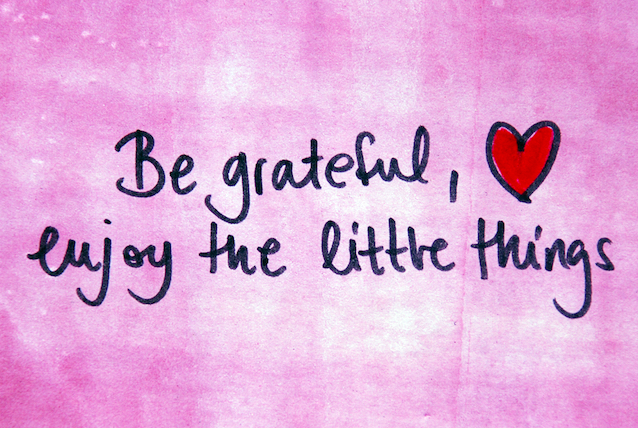
    Be grateful

    “Gratitude is a currency that we can mint for ourselves, and spend without fear of bankruptcy.” ~Fred De Witt Van Amburgh

    I began my gratitude practice at a time when I desperately needed help seeing the good in my life.

    Several failed relationships and a broken heart had left me blind to the incredible gifts the Universe had given me, and I was rutted in depression for three years. I couldn’t seem to focus on anything besides what I had lost. Happiness seemed like a cosmic joke.

    The more I focused on what I wasn’t grateful for, like the love I had lost, the less I focused on doing the things I loved.

    Depression is common, and it happens to many of us at some point. But the longer I chose to wallow in it, the more impossible happiness seemed. After my third year of depression I seriously considered whether life was even worth living.

    Then I came across Zig Ziglar’s empowering audiobook A View From the Top.

    I learned from Zig how giving to others can help us foster a deep sense of happiness, and how gratitude is the missing ingredient to most people’s success.

    Immediately, I began a gratitude practice, focusing on the important people in my life and the many gifts I had to share with others.

    It was a tough transition because there was so much negative momentum to reverse. Habits are like roads—the more you travel them, the easier they are to follow. But I stayed disciplined with my new habit and chose grateful thoughts even when I felt hopeless.

    Within two years my gratitude practice turned into a lifestyle, and today I’m enjoying the fruits.

    I make a living doing what I love as a writer, and I make a difference in the lives of thousands of people through my work—all because I shifted my focus from what I lacked to what I had.

    The amazing thing is that no matter how much or little I think I have, I always have more! And gratitude helps me see it.

    If you’ve felt gypped by the Universe, here are 100 reasons to be grateful today.

    1. The breath in your lungs

    2. Your hard-working heart

    3. The food that fuels your experience

    4. The ever-present opportunity to make better decisions than your last

    5. Your brain and memory that allow you to learn from mistakes

    6. The freedom to make unlimited mistakes on your road to self-improvement

    7. The endless supply of wisdom people and books provide

    8. The natural talents you were born to share

    9. The challenges that allow you to grow

    10. The accomplishments that have improved your life

    11. The mother and father who gave you life

    12. The Internet

    13. Humor

    14. Sweet doggy friends, or cats, if you’re that kind of person

    15. Warm sun on your skin

    16. The beauty and life in nature

    17. The senses that allow you to experience beauty

    18. Clean drinking water

    19. Health in any amount

    20. The arms, legs, feet, and hands that give you freedom of movement

    21. The favorite song that keeps you going when you feel like giving up

    22. The artists who struggle to create beauty for others

    23. The gift of language

    24. The ability to read

    25. The ability to learn from the mistakes and achievements of others

    26. The help that is always there when you ask for it

    27. The roof over your head

    28. Piercing stars in a clear night sky

    29. The inspiration that sweeps you out of your comfort zone

    30. The people who’ve dedicated their lives to inspiring others

    31. The kids who remind you to be playful and adventurous

    32. The ability to connect with family and friends anywhere in the world (Skype)

    33. Carrots (If you don’t know about carrots, click this link)

    34. Family farms that are committed to providing organic and sustainable foods

    35. The fresh start you’re given every day

    36. Rain

    37. Hope

    38. The pain that reminds you of the need to change

    39. Our dreams

    40. The people who pray for you every day, without you realizing it

    41. The hard times that made you who you are

    42. Automatic rice cookers, refrigerators, air conditioning, and every little convenience that saves you time

    43. Bare feet on grass

    44. All the organisms in the soil that support life on earth

    45. Electricity

    46. All of the amazing teachers who helped you reach your potential

    47. Each failure that led to your achievements, and everyone who encouraged you to keep going

    48. The “haters” who helped you build resilience by saying, “No, you can’t!”

    49. The fact that every bit of food you need to be happy and healthy is just a short drive away

    50. The garbage men who keep streets clean

    51. The random smile that got you through your last impossible day

    52. That one cashier who you can always count on to brighten your day

    53. Photosynthesis, and the fact that nature’s beauty works to keep you alive

    54. The one friend you’ve been able to count on through every stage in your life—even if that friend is you

    55. The new friends you’ve yet to meet, and the amazing times you haven’t yet experienced

    56. Your favorite spot to recharge when you’re overwhelmed

    57. Sunsets that make the sky explode with incandescent pinks, peaches, purples, oranges, and golds

    58. Your education

    59. Every single one of the trillions of cells in your body that work hard so that you can experience life

    60. That one mule of a person who challenges you to be kind when it’s most difficult

    61. Grandmas and Grandpas who helped make childhood so special

    62. The special people who filled spots where parents or grandparents were missing

    63. Bananas and peanut butter (or your favorite treat)

    64. Fresh baked baguettes that are crispy on the outside and chewy on the inside (and other delicious food)

    65. The spiritual growth you’ve accomplished (give yourself some credit!)

    66. The renewal of spring

    67. The relaxing sound of trickling water

    68. Gardens with fresh herbs, even if they’re just on your window sill

    69. YouTube, for whenever you need to troubleshoot your car or computer, and especially when you need a laugh.

    70. All the quotes that inspire you

    71. Good cheese, and underrated philosophers

    72. The doors that closed on opportunities you wanted but didn’t need

    73. The windows that opened when you almost gave up hope

    74. All the serendipitous occasions that remind you never to lose faith

    75. Everything coconut-related: oil, water, ice cream, flour, cream pie, etc.

    76. The hardships that transform us into more capable, understanding, giving, and forgiving people

    77. The impossible, for inspiring us to expand our limits

    78. The hot showers that completely change your perspective on life

    79. Gluten-free bread that doesn’t suck

    80. Hearing good news

    81. Making good news for others to hear

    82. The little depressions that remind you to fight hard for happiness

    83. The anxiety that reminds you to feel your emotions so you can learn from them and let them go

    84. The fact that you are unconditionally loved and accepted

    85. A really good cry

    86. Sex

    87. New life

    88. Beautiful men and women (look in the mirror)

    89. The rituals that give security and meaning to daily life

    90. Your favorite things

    91. The ridiculous people you can always count on for a belly laugh

    92. Little touches from people you love that make everything okay

    93. Little munchkins who you can never be with quite enough

    94. The good examples who’ve inspired you to be your best

    95. The bad examples who illuminated the paths you shouldn’t take

    96. The movies, music, art, celebrations, and people that remind you just how good it is to be human

    97. The you from yesterday you get to compete with today

    98. Refreshing walks that calm your mind and ease your spirit

    99. The ability to change your whole life with one good decision

    100. The option to be grateful no matter where you are or what you’re experiencing

    Gratitude is the most important choice in your day—and you can find things to be grateful for everywhere if you look hard enough. If you liked this list, try making your own at the end of each week and put it in a gratitude journal. Your life will effloresce, I promise.

  • 3 Ways to Cultivate Gratitude and Boost Your Happiness

    3 Ways to Cultivate Gratitude and Boost Your Happiness

    “Gratitude can turn common days into thanksgivings, turn routine jobs into joy, and change ordinary opportunities into blessings.” ~William Arthur Ward

    Living in India for more than two years now has been an eye opening experience for me, as I’ve realized how I used to take so many things for granted. While growing up and living in my home country (Bosnia and Herzegovina) in Europe, I was lacking gratitude for all the blessings that surrounded me.

    While sitting in our penthouse apartment in the New Delhi suburbs, in an air-conditioned room, still feeling the need to chill with a cool water or a mango shake due to the intense heat (which can reach up to 118° in the summer), I could observe the construction ground across from our building.

    Constructions workers would come in at 9am and work for twelve hours, with only a short lunch break, without proper safety equipment, chilled water, or any shaded cover to rest.

    While they’d wipe sweat from their face, I’d imagine how hot they must be feeling, as I was sweating even in an air-conditioned room.

    Some of them were working together with their wives, who would help them earn their daily wage (equal to $1).

    These women would carry piles of cement and bricks on big pots on their head, from one side of the construction site to another, sometimes climbing many stairs as well. In my home country, I never saw women working on construction grounds or carrying such heavy loads on their heads.

    Their children would play in front of the construction ground with sand and small rocks, as their parents could not afford to send them to school.

    I thought about how, in my home country, children often complain that they “have to” go to school and people complain about how tough their jobs are. These people in New Delhi could not even dream of sending their children to school or having an eight-hour job in an air-conditioned office.

    The wives who didn’t work on the construction ground would work in our building as maids. One of them cleaned our home. Every day she came in with a water bottle, which she’d cool in our refrigerator, as they did not have an electricity, not to mention a refrigerator, in the slum where she lived with her family.

    After cleaning our home, she’d run back to hers with a chilled water bottle in her hands, almost losing her breath, as if she was afraid the heat might warm that water before she would return. Then she wouldn’t be able to cool her small children, who were waiting in the heat in a slum without a fan.

    Since that day, I never look at the ice cubes in my drink the same way I once did. Ice cubes were just pieces of frozen water, until I saw that for some people, even chilled water is a luxury! Ice cubes are a symbol of wealth and abundance to me now.

    I suddenly became grateful for all the things I am blessed with in my life, even the small things, like ice cubes, chilled water, nutritious food, a fan, an air-conditioner, mosquito repellent in the night, clean running water in my home, electricity—not to mention the “big” things, like an opportunity to get educated, to grow up in a beautiful home, which was warm in winters and cool in summers, my job, the power to choose my own husband.

    I never thought I should be grateful for choosing my husband. Yet, in a place where arranged marriages are still tradition, I realized that it was a blessing that I was born and raised in an environment where I could fall in love with a man and choose to marry him.

    Although arranged marriages do work here, and I see people fall in love after marriage, or at least create a relationship based on kindness, mutual respect, and care, I feel so grateful every day that I had a chance to choose the man I thought was the right for me, with my parents’ blessing and best wishes.

    We often take the things we have for granted, yet in many other parts of the world, there are people who would feel blessed and happy if they could enjoy them on a daily basis.

    If we just take a look around us we could find so many things to be grateful for.

    Some of the practices that can help us to cultivate the feeling of gratitude in our life include:

    1. Gratitude journaling.

    Keeping a gratitude journal, where we note all the things (or at least three things) we feel grateful for every day, can be a powerful reminder of how blessed we are.

    Noting down even simple things—like a delicious dinner we enjoyed, a warm home, a cup of tea or coffee, time spent with our beloved—can be a powerful practice to keep us grounded in a positive mindset on a daily basis.

    2. Creating a list of possibilities and blessings.

    It helps to write a list of all the things we are blessed with, things we usually see as givens, that in other parts of the world are not available to many people.

    So many women around the world still do not have the right or the opportunity to get educated, and so many children cannot attend school or University due to lack of financial resources. According to WHO, 12.9% of the world’s population (over 1 billion people) is undernourished and will probably go to bed hungry tonight.

    Millions of people around the world do not have an access to clean, running water and electricity, which in Western countries we usually take for granted.

    Having a roof over our head, a warm room, a meal on our plate, a degree or opportunity to go to University, electricity lighting our home, and cool water in summers are all big reasons we can feel grateful every single day.

    3. Shifting our perception.

    Instead of feeling sad and frustrated about being single, we can look at this same circumstance from another perspective—as the freedom to be able to choose our partner and wait until we find the right one. This simple shift can help us move from a negative emotional state to a state of gratitude.

    In the same way, we can shift our perception of looking at other things, like the job that we don’t like or our living conditions.

    When we catch ourselves complaining about housework, we can see it as a blessing that we have our own home and, as a result, clean it with gratitude.

    Instead of feeling annoyed that we have to cook dinner, we can feel grateful that we’re able to afford groceries. We can also consider it a blessing that, in this modern era, we do not need to manually wash our dishes or clothes.

    When we catch ourselves complaining about the job we hate or feel bored with, we can feel grateful that we have a job and regular income that can pay our bills.

    We can also be grateful for small things, like air conditioning in our office, having weekends off, or the fact that we don’t need to be exposed to harsh weather conditions or safety threats every day, like so many people in other corners in the world.

    There’s nothing wrong with trying to achieve more and move ahead in life, but we can never be truly happy if we do not appreciate what we already have.

  • 10 Ways to Cultivate a Positive Mindset and Change Your Life

    10 Ways to Cultivate a Positive Mindset and Change Your Life

    “Each morning we are born again. What we do today is what matters most.” ~Buddha

    I remember how I used to think; it was always, “People suck” and “I hate (fill in the blank).” I was constantly focusing on the bad side of humanity, so that was all I could see. It cast a shadow, which took the joy out of life.

    It should have been obvious that I was creating my own misery, but I wasn’t able to see how my own thoughts affected my mood.

    I had to change my entire outlook by training my mind to see things in a new light. It would have been easy to stay on the same path. After all, I had chronic fatigue, no money, and nothing to look forward to because I didn’t have a compelling vision of the future. I felt the present situation was permanent.

    Eventually, I’d had enough and started thinking about what I could do to change my situation.

    Change was slow, but a new path that wasn’t clear to me before started to appear as I worked on my mindset. As things progressed, my goals and dreams became bigger and more ambitious. I started imagining being fit, healthy, running my own business, and traveling the world.

    These are some of the things I did to change my mindset and my life.

    1. Seek positive friends.

    A negative social circle will act as an echo chamber for bad ideas. A positive social circle will also act as an echo chamber, but one that supports your dreams, so choose your friends carefully.

    Find people who reflect the values you want to adopt. Join groups online and go to networking or social events focused on personal growth. As your own mind starts to change, it’ll become easier to connect with more positive people.

    I’m not suggesting that you ditch friends who are going through a hard time and need your support, but rather that you evaluate whether some of your relationships are persistently draining and unhealthy.

    I left my old social circle because it was an echo chamber for negativity. Instead of focusing on a great future, everyone was talking about the things they didn’t like about life.

    It was hard to make new friends at first. The problem was that I couldn’t offer any value to people with much more positive mindsets—the kind of people who I wanted to emulate.

    That changed, but it took time. Once you find your “tribe,” progress will come much more quickly because of your new influences.

    2. Challenge your thoughts.

    When old thinking comes up, as it will, it’s not enough to try and ignore it. We need to challenge our beliefs.

    Is everything too expensive, or is it just that I can’t afford it? Do “people suck,” or am I just looking for things to criticize?

    Weigh your thoughts against the evidence. If they crumble under scrutiny, then explore why you believe them in the first place. By challenging your thoughts, your mindset will begin to evolve.

    3. Consume positive media.

    Consuming positive media daily will alter your perspective through osmosis. “Positive media” is anything that emphasizes the good in life, or how to improve our living standards and the living standards of others.

    We all know that the best way to learn a new language is through immersion. If you hear this new language every day, it starts to stick and become easier to remember. Soon, you’ll not only understand that language but you’ll speak it too.

    New mindsets are exactly the same; if you immerse yourself in personal growth content every day, it will change the language of your mind. That language is your self-dialogue, the way you speak to yourself at every moment, and it’s habitual.

    Learn a positive self-dialogue and you’ll see the world in a different way.

    4. Volunteer.

    Volunteering to help other people can make a huge impact on how you feel about yourself and your view of the world.

    By focusing on how you can help someone else, you’ll draw your attention away from your own woes. It becomes easy to develop a positive mindset when you’re looking for new ways to make someone else’s situation better.

    You can’t focus on the bad while focusing on the good.

    5. Abstain from all “bad news.”

    Wars, murders, and politics all add baggage to our thoughts.

    It makes sense that most of the mainstream media focuses on bad news, though, because tragedy sells. It doesn’t make sense for us to sit around stewing over this bad news. It’s certainly not going to allow for an optimal mindset, one that’s focused on the best that life has to offer.

    By tuning into the news about a plane crash thousands of miles away, we’re putting our mental energy into something that won’t help. We can’t change the bad things happening at any given moment, but if we put our attention into things we can change, our lives will improve.

    6. Write out your action plan.

    This is about looking at the possibilities and then doing something to make it happen. Forward thinking will move your focus away from where you don’t want to be to where could be.

    But it’s not enough to simply write it out, because we only grow when we take action. It’s just a thought until we do something to make it happen.

    Don’t know what the right steps are? Don’t worry, just identify the first thing you could do to start on the path, then do it. Even if it’s a mistake, you’ll still make progress, and that will keep you focused on creating positive change. Never allow paralysis by analysis. You have the vision; go with it.

    7. Adopt a healthy lifestyle.

    A healthy body will support a healthy mind. During the most difficult time of my personal struggles, bad health was a major obstacle. Chronic fatigue could wipe me out for whole days.

    Nonetheless, getting into action, changing my diet, and working out set the foundation for all other changes to take place. Slowly, my energy levels started to rise till the point that my health no longer was an issue.

    Look at how you sleep, what you eat, and your activity levels to identify anything that could be sapping your energy. Sometimes laziness is just fatigue.

    8. Send thank you notes.

    The simple gesture of sending a thank you note can be empowering. Not only does it feel good, a thank you note creates goodwill in other people.

    Thank you notes will also strengthen your relationships and connections, because people like to feel appreciated.

    It doesn’t really matter what they did; any small gesture you appreciated, from good service to a favor, is a candidate. Send a quick email or a card in the mail to let them know you appreciated it.

    9. Create a morning mindset routine.

    A great way to start the day is by making a mental list of each thing we’re looking forward to; it creates a feeling of anticipation and excitement that creates momentum for the entire day.

    Every morning I play personal growth videos or audio books. By focusing on the positive messages coming from this content at the beginning of the day, it’s much easier to be happy and focused. My work gets done more quickly, and it doesn’t seem so hard either.

    10. Write a wins checklist.

    So you started on good note; now finish on a great note by making a mental list of the day’s wins. It doesn’t have to be monumental; the point of the exercise is just to keep your focus on the best your day’s experience.

    Keeping track of losses can help you improve, but dwelling on them will kill your motivation and momentum. Finish strong and it will be much easier to wake up feeling happy.

    Improving your life starts with improving your mindset. Like me, you may find that these steps are a great start.

  • Happiness Hacks: 10 Ways to Infuse Your Life with Joy

    Happiness Hacks: 10 Ways to Infuse Your Life with Joy

    Happy

    “There is no way to happiness. Happiness is the way.” ~Thich Nhat Hanh

    Life seems complicated these days.

    We’re all busy pursuing happiness, yet how many of us ever reach that goal?

    Success, money, and busyness are top of our priority list, yet deep in our hearts we’d prefer time, love, and security.

    It’s the age of making a living, but perhaps at the cost of making a life.

    What really makes us happy, and how do we find it?

    I spent many years trying to fit in, to be someone else, to pursue the dream of success, in my jobs and my relationships.

    I collected material things, often at the cost of what really mattered, and I was left unfulfilled as a result.

    I quit my corporate job and left my long-term relationship to go on a journey of self-discovery. Here are my top nine happiness life hacks, from my experience and the things I’ve learned along the way.

     1. Authenticity: Be who you are, not who you think you should be.

    We live in a world where we are surrounded by ideals, and with a tendency to compare ourselves to others, it’s no wonder so many of us feel like we’re not enough.

    I’d tell myself that writing was a hobby, not a “real job.” I sought approval through promotions and success through status, neither of which made me happy.

    To find happiness, we must be true to ourselves, live our own dreams, and be proud of what makes us unique. So, instead of comparing yourself to others, look to see if you’re fulfilling your own potential in accordance with what you value.

    2. Self-care: Respect yourself.

    Health and happiness are inextricably linked; you can’t have one without the other.

    Our nutrition is so important, as is getting enough sleep and regular exercise. In a world where lifestyle-related disease is at epidemic proportions, taking care of our own health is increasingly critical.

    Yoga, meditation, and regular walks help me look after myself and keep me strong. These practices were key in helping me overcome corporate burnout.

    Sometimes these practices seem too basic, and we ignore the simple principles of good health. It’s often the last thing we prioritize and in our busy lives. But taking time out to care for our health is fundamental. Without our health, we can achieve very little.

    3. Mindfulness: Live in the now.

    Our minds are so busy, and with the evolution of technology, we are now connected 24/7. We never switch off. As a result, we are spending less time in the present.

    Our thoughts are consumed with rehashing the past or worrying about the future.

    The past has gone and we cannot change it, and the future never arrives. The only time we have is now—the present—and of course, this is life.

    In a world where multitasking is seen as a necessary skill, being mindful is the opposite. It’s slowing down and focusing on one thing at a time, one moment at a time.

    Mindfulness is acceptance of what is, without judgment; being yourself, at home with yourself; and seeing the beauty in every moment. It teaches us to slow down and notice more. This leads to a true happiness that arises from within, independent of external circumstances.

    4. Resilience: Learn from experiences.

    Being happy doesn’t mean that everything is perfect. As Thich Nhat Hanh says, “The art of happiness is also the art of suffering well.”

    To be happy, it is critical that we embrace the tough times, too. They come to us all. It’s how we deal with them and bounce back that impacts our happiness. This is our resilience.

    We spend much of our time trying to avoid the bad times and cling to the good, yet both will always come and go. Embracing this and shifting our perspective is key to happiness.

    5. Appreciation: Be grateful.

    In our consumer-driven society, it’s all too easy to focus on what we can get, and to be never feel fulfilled. This leads us into constant craving. Like a bottomless bucket that can never be filled, we always want more.

    I learned that happiness is not about getting what you want; it’s about loving what you have.

    There are many things we are lucky to have, yet take for granted: fresh air, clean water, warmth, shelter, family, and food. It’s not until these things are taken away that we realize how fortunate we are. Gratitude helps us remember our priorities and focus on the things that matter.

    6. Simplicity: Let go.

    We feel we need to have things in order to be free, when in fact it’s the opposite. Our struggle to hold on to things brings the very pain we are trying to avoid. We are terrified of letting go, for fear we’ll have nothing, but this is the true path to living well.

    When I went from a corporate job and material wealth to having nothing and living simply, it put things into perspective for me. After all, everything material we have can be lost tomorrow.

    The irony is, if you’re asked what you most value, it’s likely to be the things money can’t buy—things like love, health, and family.

    There are also things within us that we need to let go of. This can be hurt or anger from the past, or limiting beliefs about ourselves. These things hold us back, and like heavy baggage we carry around with us, they break us down.

    7. Self-empowerment: Look within.

    We have a tendency to look for inspiration externally, in our teachers or gurus, yet we have infinite potential within.

    Often, these people help us tap into our inner well, but so do other ordinary people in our life, along with our own experiences.

    We are capable of amazing things if we stop doubting our abilities. It’s often during our biggest challenges that we find out just how much strength we possess.

    8. Compassion: Reach outside yourself.

    Happiness is less about survival of the fittest and looking after number one, and more about collaboration and acts of kindness. Doing good makes us feel good. The best jobs I’ve ever had were voluntary, unpaid roles helping others.

    Our natural response to seeing someone in distress is the impulse to help. We care about the suffering of others, and we feel good when that suffering is released.

    Feeling like we’re making a difference in the world and helping those who need it brings us joy and meaning.

    9. Enjoyment: Do things you love.

    We need to earn a certain amount of money to provide the basics, and few of us are lucky enough to have a job we love. However, we all still have a whole life outside of work with which to create happiness.

    Instead of just making a living, be sure to make a life. Do things you love every day, spend time with those who nourish your soul, learn new things, take time out for you.

    This can involve small things, like a chat with friends, a walk on the beach, or a cup of tea in the garden; or the bigger things, like enrolling on an art course, traveling to that place you’ve longed to visit, or writing that book.

    10. Challenges: Try something new, something that scares you.

    Sometimes we’d like to change things, but it’s just too hard. We know we’re unhappy where we are, but the alternatives are too scary. We prefer the devil we know, and the familiar feels secure, even if it doesn’t make us happy.

    For me, leaving my relationship, changing careers, and speaking in public all left me gripped by fear. I was afraid of the unknown, and also failure. But it’s only by facing these fears that we are able to grow into the people we’re capable of being.

    To get somewhere you’ve never been, you might have to do something you’ve never done. Life begins at the end of our comfort zone!

    Life doesn’t have to be complicated. Happiness shouldn’t be hard, but we often make it so.

    One of the things I’ve discovered is that we are responsible for our happiness, and it comes from within—which is great news, because it puts us in control and makes it possible!

    It takes work, and it may not be easy, but small steps in the right direction put us on the path to happiness.

    Try focusing on one of these life hacks each week and see how your life changes.

  • How to Stop Taking Things for Granted and Feel Blessed

    How to Stop Taking Things for Granted and Feel Blessed

    Happy Kids

    “I count my blessings every day, quite honestly, because I take nothing for granted.” ~Mario Andretti

    You know that feeling.

    When you feel bad about yourself for not being grateful enough. Maybe not often, but surely sometimes.

    You are busy working hard, trying to make things work. Busy at life.

    But then you see a nine-year-old painting a picture holding a brush with his toes. He has no hands.

    And it hits you: You’re so busy trying to make your life better, you forget that it is already beautiful. You feel guilty for not being happy enough.

    How I Found My Hidden Blessing in Life

    When I left for college it was the first time I went away from home to a different city. My parents were concerned about how I would adjust to life in New Delhi. But I was excited. I wanted to do this.

    As my college life began, I faced a problem: I was bad at managing my expenses. I had no idea how to spend money reasonably. Until then, my parents took care of everything.

    The unspoken message had been, “You focus on your studies, and we’ll take care of your needs.”

    Middle class families don’t lack in money, but the expenses are always modest. So when I ran out on my monthly share in ten days, I was horrified. Exploring the city with new friends, eating delicious meals in restaurants, buying a pair of Nike trousers all contributed to my downfall. Expecting a scolding, I told them what had happened.

    But there was no scolding, just a reassuring “I’ll put more money in account today.”

    A few weeks later, the same thing happened. I was sure this time they would get angry. But they didn’t. They simply poured in more money.

    And that is when I realized: My parents truly loved me, but I had been taking it for granted.

    They had always been there for me. Taking care of me. Loving me.

    I wasn’t a spoiled child, and I knew they cared about me. But now I felt blessed. Their presence was a gift I cherished. The fact that they loved me unconditionally brought my ignorance to light.

    Why Do We Take Things for Granted?

    Our minds run around unchecked all the time, either waiting for a better future or regretting the past.

    We’re always waiting for the perfect vacation, next promotion, more money, more whatever. We think, “Someday when X happens, I’ll be happy.”

    Or we regret the past, like the end of a relationship, a lost job, or financial setbacks. We think, “If only X hadn’t happened, my life wouldn’t be a mess.”

    But whether in the future or past, there is one place our minds are not.

    The present.

    And this is where our blessings reside.

    How to Stop Taking Things for Granted and Feel Blessed

    When I catch a cold, I realize how nice it feels to be healthy. When there are thunderstorms on the day I plan to go out, I realize the joy of a cheery, sunny day with a cool breeze blowing across my face.

    Because our minds are so used to running around uncontrollably, we don’t realize that our focus isn’t where we are. It is almost always somewhere else.

    But hidden blessings are available right now, if you can take a step back and notice where you are.

    Seriously, do this.

    Look at yourself reading this post. Notice the environment around you. I’ll give you a moment.

    ….

    This is your real life. Here are the blessings hidden from your incessant mind.

    Ask yourself: What good things have brought me where I am today?

    You can start with the fact that you can read. You’re smart enough to follow blogs like Tiny Buddha. What about your wonderful friends? Your pet? Your health?

    What else?

    Just like time, blessings are relative.

    Growing up, I went to a school with lots of children who came from rich families. It would have been easy to focus on what other students had that I lacked, such as new lunch boxes and fancy bags.

    However, I was nothing close to sad or miserable. In fact, I had fun at school. Why did I have fun, despite having less than others? I recognized how I was fortunate.

    My parents grew up in villages and received modest educations. And yet, they were smart enough to understand the importance of a good education, and made sure that my sister and I studied in the best English school of the city.

    Now, that is a blessing.

    I didn’t feel unlucky. I feel my parents did their part wonderfully.

    It’s time I do mine.

    Hidden in life challenges are some wonderful blessings. The difference lies in how you look at them.

    You can list all the things you don’t have and feel sad about it.

    Or you could put those very same things as your goals, chase them with passion, and build tremendous character.

    Time to Thank, Time to Love

    Yes, there will always be things you want to accomplish. There are goals yet to be realized. The future surely does promise better things.

    But you know what?

    The present, too, is a portal to hidden gifts.

    Underneath your routine life is a hidden treasure trove of countless blessings. Each of those blessings has helped you reach where you are today. They played a crucial role in molding your life into the masterpiece it is right now.

    So go right now.

    Tell your mother you love her.

    Pat you pet.

    Thank your friends for showing up.

    Celebrate life. Right here. Right now.

    Go live.

  • How to Live a Rich Life Without Lots of Money

    How to Live a Rich Life Without Lots of Money

    Woman with Coffee

    “Ordinary riches can be stolen; real riches cannot. In your soul are infinitely precious things that cannot be taken from you.” ~Oscar Wilde

    Does the race for riches leave you unfulfilled?

    Does the thought of constantly chasing ever more cash leave you stressed, depressed even?

    Does the whole idea of measuring your personal worth in terms of your personal wealth leave you deeply dissatisfied?

    It did for me.

    Poor in possessions and somewhat fiscally challenged, I never fit in with my richer friends.

    And no matter how much I told myself that money didn’t buy happiness, I still felt worthless because I was worth less … financially.

    So in my thirties, I finally caved in and chased the money dream.

    Five exhausting, stress-filled years of ruthlessly pursuing more money.

    But when I got there, it meant nothing to me. It didn’t make me happy. It made me miserable.

    In those five years, even to the small extent I succeeded, the so-called riches that money can buy actually left me poorer in happiness, health, and relationships. My heart and head were as full as my work schedule, but not with the people and things that really mattered.

    I discovered that rocking a 24-carat rock didn’t rock my world. And bling definitely didn’t make me swing.

    So with no idea where to go from there, I found an empty journal and started a record of the True Riches In My Life. For each year of my adult life, I jotted down every experience, achievement, adventure, friendship won or lost, and every decision I could remember making.

    What an epiphany!

    I realized my life had been full of riches long before I started chasing financial wealth and material gain. I realized most of the truest riches in my life actually came when I didn’t have all that much money.

    Sure, when money’s really tight, it’s not so easy to focus on much beyond finding enough for the essentials. When I was lost in the financial doldrums, struggling to pay my rent, and praying there’d be reduced food in the supermarket, it took up a lot of my mental energy. But I wish I’d known then that I would have felt so much better about myself, about my situation, if I’d recognized the riches I did have.

    Whether I’d had enough money or not, I’d missed seeing all those infinitely precious things because I’d been looking for the wrong kind of riches. I’d been measuring my inner wealth by my external wealth.

    I realized in that epiphany that no matter how much a part of me may have wanted it, I would never be materialistic. It just isn’t in my makeup; I am much more spiritual than material.

    Just like you.

    And even though you can have lots of money and still be spiritual, spiritual people measure true wealth in different terms.

    So forget the race for riches, start your own True Riches In My Life journal, and discover your own inner wealth.

    14 Infinitely Precious Things For A Rich Life

    1. Authenticity

    Forever staying true to yourself and being at peace with who you are is the greatest richness in life.

    Each morning, tell your reflection that you are going to do yourself the greatest service of being you. This act alone makes me feel happier, regardless of my personal financial situation or lack of ‘status.’

    Start your Riches In My Life journal with a declaration of the authentic, spiritually rich person you truly are.

    2. Acceptance

    Overcome your natural desire to control the uncontrollable in life, and replace struggle with acceptance and peace.

    Every time you catch yourself wishing you could change the unchangeable, write it down in your journal, and say, “It’s okay. I accept this just as it is.”

    3. Curiosity

    Childish wonder is still within you. Forever questioning and experimenting is the sign of a rich mind. My most enjoyable days are always those marked by a discovery, where I’ve learned something new, however tiny, that I can’t wait to share.

    Reignite your spark and excitement for life by reading different types of books, learning about different cultures, and delving deeper into anything of interest. Jot down these new discoveries in your True Riches journal—you’ll be amazed!

    4. Creativity

    Creating something from nothing is a courageous act that brings a valuable accomplishment amid the practicalities of everyday life.

    Let your self-expression rule in your journal—start that book, paint that picture, or maybe just sketch out an idea or inventive solution.

    5. Forgiveness

    Letting go of anger or hurt rewards one with peace of mind—a priceless freedom. The act of forgiveness is a true testament to your inner strength.

    Write in your journal and say, “I forgive you, [name].” Don’t worry if you don’t feel forgiveness the first time; it will come in due time.

    6. Gentleness

    Confucius listed gentleness as one of the greatest virtues, and it is a quality you can see in spiritual people from Buddha to Gandhi. The ability to be strong without being abrupt or harsh is a rare and valuable quality.

    Next time the kids or a colleague act up, smile, speak softly, and note in your journal how you stood firm but gentle.

    7. Patience

    Being patient isn’t easy in this age of instant gratification. However, with patience, you can achieve things over time that may seem impossible. Journaling my ideas and projects has taken me from being “Missy, I need it right now or not at all,” to truly feeling the joy that more substantial, longer-term projects bring.

    Next time you start beating yourself up over a missed goal, write a realistic time scale in your journal, and remember to be as patient with yourself as you are with others.

    8. Gratitude

    It takes dedication to notice what you have and be thankful for it. But acknowledging all the good things in each day will make you rich in happiness.

    Challenge yourself to note one thing each day you might have taken for granted, and add it to your journal to build a treasury of blessings.

    9. Generosity

    Giving when you believe you don’t have enough yourself is true generosity of heart. And doing so leads to the realization that you always have enough to share.

    Give someone your undivided attention for half an hour when you think you have no time. In this hectic world, your full attention is one of the most generous things you can give. Write these acts of generosity in your journal.

    10. Kindness

    Being kind brings its own rich rewards—inner peace, happiness, and the knowledge that you are making a real difference in the world, one people will remember.

    Next time you feel unhappy or are beating yourself up, do one small act of kindness for someone, then do one for yourself. Note these in your journal.

    11. Compassion

    To understand and feel another’s pain is a truly selfless act. It allows you to appreciate the areas of ease and plenty in your own life.

    In your journal, note all your compassionate thoughts and actions. I find these to be the most powerful of my journal entries; they wrap a security blanket of all that I’m blessed with round me each time I re-read them.

    12. Love

    Making that emotional connection with others, whether it’s your partner, family, or friend, brings an abundance into your life that money can never hope to match.

    Each day, tell someone you love them, and write in your journal every time those wonderful words are said to you.

    13. Vulnerability

    Letting down your defenses and showing your weaknesses allows others to see the full picture, not just a silhouette. Being vulnerable builds trust in relationships. This is my Achilles heel, but by consciously letting others in, initially unremarkable relationships have blossomed into great friendships.

    In your journal, record all your positive experiences of being vulnerable to help you build this rewarding habit.

    14. Contentment

    Realizing you already have abundance in your life brings serenity and contentment. Achieving this in a materialistic world takes a special skill.

    In your journal, read through all the infinitely precious things other than money that you are wealthy in. Acknowledge all the wealth you already have because, as the proverb says, “enough is a feast.

    Find Your Real Riches

    Imagine being unconcerned about the race for riches.

    Imagine no longer stressing over constantly chasing ever more cash.

    Imagine measuring your personal wealth in terms of your personal worth, and feeling true contentment with the result.

    Start that True Riches In My Life journal.

    Embrace the genuinely spiritual person you are, and be at peace for the incredible riches you bring to the world.

    Woman with coffee image via Shutterstock

  • How to Use Self-Care for a Brighter, Less Stressful Life

    How to Use Self-Care for a Brighter, Less Stressful Life

    Girl Doing Yoga

    “The time to relax is when you don’t have time for it.” ~Sydney Harris

    I was working myself into the ground and I knew it. Balancing a full-time job, my fledgling business, studies, home life, and relationships, I was constantly feeling the pressure and slowly, the cracks were showing.

    I was exhausted, I was argumentative, I wasn’t taking care of my health, and my business had transformed from my creative outlet to a source of incredible stress.

    I kept thinking, “I just need one day to relax, just one day!” but even when I had the chance, I couldn’t let go of the pressure I was allowing to take over my life. I felt like I was stuck in a never-ending cycle and I couldn’t escape.

    Of course, I knew I needed to take better care of myself and my health. Deliberately not getting enough sleep so I could work more, skipping yoga to write articles, eating breakfast at lunch time and relying on coffee could only ever take me so far.

    Eventually, I realized that if I wanted to create a life I loved, I needed to start taking self-care a little more seriously. Even though I was ticking the boxes professionally and in my business, I knew I wanted so much more that that.

    What about adventure? What about long baths and good books? What about eating regularly and moving my body? What about sleeping in and taking my dog for walks? I was replacing all of these things that light me up with a cycle of stress, fear, and overwhelm.

    It was time to change.

    I started off small, with a daily five-minute meditation. I figured that no matter what was happening, I could take just five minutes for myself each day!

    After a couple of days, I started to notice how much I was looking forward to my meditations. They refreshed and refocused my mind, uplifted my spirits, and gave me the chance I needed to take a break (even if it was for just a short time).

    As I noticed how these meditations positively affected the way I felt, the way I worked, and the way I thought, I decided it was time to dive deep into this mindful, self-care thing. And I haven’t looked back.

    To bring more mindfulness and self-care into your own life (even when you’re busy!), feel free to try the tips below!

    Take a deep breath, regularly.

    It really is amazing what a simple breath can do! Whenever I’m starting to feel overwhelmed or stressed, my first act of self-care is to take one deep breath. Straight away, I feel any tension in my body begin to release.

    Sometimes that simple breath is enough to refresh and refocus. Sometimes I feel like I need to take a few more breaths. Sometimes I realize that I need a proper break because I’m feeling so overwhelmed that I won’t be doing my best work anyway.

    The beauty of taking a deep breath is that it’s one of the shortest forms of self-care I know! Even if I were to practice it fifty times a day, it would still only take a minute or two, altogether.

    The other wonderful thing about deep breathing is that you can do it anywhere, at anytime. Whether you’re halfway through an exciting meeting, on the cusp of finishing a project, dealing with conflict, or anything in between, you can allow yourself to take that little bit of time to breathe.

    Journal with gratitude.

    Embracing gratitude is another simple way to show yourself some meaningful self-care and inject happiness into your day. I noticed that the more I looked for things to be grateful for, the more I found.

    The wonderful thing about keeping a gratitude journal is that it starts to train your mind to notice the good in your life. Whether you have a safe home, access to nutritious food, an encouraging support network, a healthy body, a beloved pet, or a stable job, gratitude helps you to acknowledge those wonderful things.

    Before I started deliberately practicing gratitude, it was natural for me to focus on the negative aspects of my life because I believed that’s how I would fix them.

    If I kept thinking about not having enough money, it would drive me to make more. If I focused on not going to the gym often enough, I would guilt myself into showing up. If I noticed the things which weren’t going well at work, I would motivate myself to make meaningful changes.

    While that kind of thinking can be useful sometimes, it’s important to keep our eyes open to the good things, too. Our strengths. Our family and friends. Realizing that even if we want more, we actually do have enough.

    Simply note down a few things you’re grateful for at the end of each day to start flexing that powerful gratitude muscle!

    Listen to your body and its needs.

    You know when you’re exhausted, but there’s just one more email to answer? Then, you realize that the dishes need to be washed. And you really should take a shower… Suddenly, it’s after midnight and your alarm is set to go off in less than six hours and just the thought of another exhausting day tomorrow is enough to make you want to cry.

    It doesn’t have to be like that.

    Yes, life gets busy. There might be lots of things to do. However, I noticed that my life started to feel a whole lot lighter when I decided to prioritize my needs above everything else.

    When I’m tired, I try to head to bed early or take a nap. When I’m hungry, I eat. When I’m feeling particularly stressed, I go to yoga or meditate.

    All I had to do was start listening to my body and choosing to honor what it was telling me.

    After all, the emails can wait until morning, I can ask someone else to do the dishes and as for a shower—well, that’s what dry shampoo and deodorant is for!

    Learn to say no.

    There’s a big reason why I often had so much going on that I felt like I was drowning—I just couldn’t say no.

    Not only did I struggle to say no to others, I also found it harder to say no to myself. New idea for an upgrade to my website? Sure. Home-cooked meal and dessert? Why not. Exercise? Of course.

    Learning to say no to others, but more importantly, to myself, was one of the biggest stress relievers and forms of self-care I’ve found.

    It’s quite simple, really. “No, thank you.” You’re allowed to say it! You know you want to…

    Go for a mindful walk.

    Sometimes, we just need a good, old break. Time to be alone, away from technology, in nature and in the moment.

    There are several ways to go for a mindful walk, but my favorite method is to really tune into my sense of sight.

    You can easily try this, too. When you go for a walk, notice all the things you can see. What colors are there around you? What have you not seen before? What does the weather look like? Which natural things do you notice? What about man-made things?

    Simply choose to experience the wealth of sights around you for a refreshing, mindful walk.

    Bonus tip: Remember, you’re in charge, here.

    If self-care is something you want, or need, then go for it! Do what feels good for you, lights you up, and reduces stress and overwhelm.

    If one minute a day is all you can manage, that’s okay!

    If you need a week to unwind, take a break and do some of your favorite things, that’s okay, too!

    It’s entirely up to you.

    Girl doing yoga image via Shutterstock

  • A Science-Backed Habit That Can Change Your Life for the Better

    A Science-Backed Habit That Can Change Your Life for the Better

    Happy Man Jumping

    “He is a wise man who does not grieve for the things which he has not, but rejoices for those which he has.” ~Epictetus

    When I lost my aunt to cancer three years ago, her death sat over me for months and acceptance didn’t begin until I had dinner with Kathy, one of my best friends.

    Over noodles, I shared with Kathy all the things I wouldn’t be able to do with my aunt: the conversations we would never get to have, the places we wouldn’t get to go, the food we wouldn’t be able to eat, and the grand-nephews and nieces she wouldn’t get to hold.

    Kathy asked me, “what about all the things you did get to do with your aunt?”

    I shared with Kathy how every time I experienced a breakup my aunt would make me a bowl of pho and make time to reassure me that everything would be okay, how every time I thought I was working too hard and not having fun she would invite me to play cards with her, and how when I told my family I didn’t want to be a doctor and my family disapproved she supported me.

    Tears sweep over my face with each story I was telling Kathy, but so did the biggest smile I had in a long time.

    “You’re so lucky to have the known your aunt. Think about all the people who don’t have someone like that in their life,” Kathy said.

    After that dinner, every time I thought about my aunt it would be about the memories I was grateful to have shared with her instead of the ones we wouldn’t get to have.

    Kathy helped me understand that the difference between feeling happy and feeling unhappy was the difference between viewing the world in terms of what you do/did have instead of what I don’t/didn’t have.

    This single lesson not only helped me come to terms with my aunt’s death but also taught me to frame potential negatives in my life into positives.

    Each time my flight is delayed (and it seems to happen a lot), instead of viewing it as missing four hours of my vacation, I think about lucky I am to even have an opportunity to travel.

    Each time, I forget my subway card and choose to walk back to my house to get it, I think how lucky I am to even have a subway near my house.

    Years later, I found that Kathy’s lesson wasn’t just coincident but had been scientifically proven.

    The Science and Data Support Kathy’s Lesson

    Psychologists at the University of Northampton studied how people adapt to grief after exceptional experiences such as death of a loved one.

    While this study had a small sample size and found no single factor can help overcome grief, they found having a lens of appreciating what you have/had instead of what you don’t helped one subject, “gratitude in feeling blessed to have had the time [subject] did with [loved one] as well as the overall change in his perspective, which was found to be transformative.”

    The above finding about gratitude and happiness isn’t limited to just overcoming a personal loss, but can also increase our overall happiness when dealing with every day troubles.

    In one study conducted at the University of California at Davis and the University of Miami, participants were randomly assigned into one of three groups and asked to keep a weekly journal.

    The first group (the gratitude group) was asked to list five things they were grateful for that had occurred in the past week; the second group (the irked group) recorded five experiences that irked them from the previous week; and the third group (the control) was asked to list five events that affected them the previous week with no focus on the positive or on the negative.

    When the study concluded ten weeks later, participants in the gratitude group reported feeling 25% happier and just better in general than the irked group.

    How to Let This Habit Change Your Life

    Though I have shared with you a practice that has changed my life and the science behind it, this habit will only change your life if you actively let it. And this is easy.

    In your everyday life, you will encounter inconveniences and hassles—forgetting your keys at home, being stuck in traffic, or spilling wine on yourself. Each time this happens, simply pause and instead of focusing on the negative outcome, remind yourself of the more positive larger picture—you have a home to come back to, you have time to reflect on your day, and you have access to dry-cleaning.

    Over time by focusing on the positives of an event, you will maximize your outward happiness and minimize inner suffering.

    Happy man jumping image via Shutterstock

  • Coping with Loss and Heartbreak: How to Get Through the Pain

    Coping with Loss and Heartbreak: How to Get Through the Pain

    Broken Heart

    The unendurable is the beginning of the curve of joy.” ~Djuna Barnes

    November, 2014. A story you’ve heard a million times. The person I believed with all my heart to be “the one” ceased to feel the same way about me.

    My heart and soul shattered, I had no desire to live, the whole works.

    Having your heart broken, especially by someone you truly loved is, from my perspective, the worst kind of pain there is. It makes you lose all sense of self, reality, purpose, and faith. To me, it felt like my soul was being severed into teeny tiny pieces.

    When we’re in that much pain, it seems like it’s going to be a forever deal. We forget that it’s all temporary.

    To make matters worse, we feel we’re all alone in it—we are rushed to “just move on already” when we can barely find enough energy to open our eyes.

    So keep in mind that there is no shame about the situation that is most painful to you and how long you’re taking to process it.

    You could be facing your darkest hour brought by the death of your pet fish. Or by the fact you didn’t get that dream job.

    Whatever the situation is, do not compare or believe your pain is less legitimate than others: your journey here is your own, and it is just as sacred as that of someone you perceive to have “more legitimate“ reasons to be in pain.

    Also, take your time getting through it. It’s your story. Your shoes. Your life.

    I’d like to remind everyone out there going through a hard time that pain is in fact the greatest catalyst for growth.

    You can’t see that when you’re smack in the middle of it; in fact, you might even say, as I did, “No growth is worth this much pain.” But when you come out on the other side, my friends, it’s like you’re seeing in color for the first time in your life.

    So keep going! You’ll be happier than you ever were once you’ve transcended it, I promise you.

    Here are five of the many lessons I learned throughout this year that I believe can help anyone, at any point, with any struggle, to reach out into all the happiness and bliss that life can offer.

    1. Gratitude

    While I was in that place of suffering, gratitude seemed like a dark humor joke from the skies. How can you possibly find something to be grateful for when you feel you’ve been stripped of every shred of happiness or love and there’s nothing left but pain?

    That feeling kept me in limbo for a while. I kept reading and reading about recovering from a severe heartbreak and every single one of the texts I read were emphatic about gratitude. So at one point I thought “there has to be a reason for this.”

    Finally, I picked up a pen and piece of paper and told myself to write ten things I was grateful for.

    It was hard at first. Only a few things came to mind, like family and a roof over my head. But I kept on trying, day after day.

    By the end of the first week, ten things were too little.

    You begin to see everything as a blessing.

    Now, with a year’s worth of practice, at the end of each day, looking back at things to be grateful for on that one day feels actually overwhelming at times—there’s just so much to be thankful for.

    I feel important to share that what made me click was the realization that gratitude isn’t about exercizing it as a virtue because you should. It’s about the wonderful state of being you put yourself in deliberately. Ultimately, gratitude is about being happy.

    2. Beliefs, beliefs, beliefs

    Next, I was smacked in head with the premise that you create your own reality. Accepting responsibility for your pain is awful, to say the least—until you realize how empowering it actually is.

    What it comes down to is that what you truly believe about yourself and the world is, in fact, what you’re going to experience in your life.

    If you believe that the universe conspires against you, surely enough, that’s what you’re going to get. Every time something goes wrong in your life, you’re going to read it as if you’re powerless and the universe is after your bottom in particular.

    The silver lining is: beliefs are changeable. Wouldn’t it be amazing if you chose instead to believe that the universe conspires in your favor?

    A great technique I picked up from Tiny Buddha itself is: find a belief that you’re holding on to that you feel is doing more harm than good, and work on it.

    Let’s say, for instance, you feel unlovable. Take a piece of paper and write down the opposite of this, e.g. “I am lovable.” Then actively look for evidence that this is true, day by day.

    Every time you felt loved during the day, write it down. If someone was kind to you, if you received a compliment or a warm touch, or were praised in any way, write it down.

    Little by little, you’re going to convince yourself of this, and then proceed to see it more and more in your experience.

    3. You are complete.

    We tend to attach certain situations, people, and experiences to certain feelings. This makes us think that in order to feel complete we need to reach out for these people, situations, and experiences, which obviously causes us more harm than good.

    Take me, for instance. I attached the love that I felt for my ex partner to that person in particular. One meant the other. And it was the most beautiful feeling. So when they were no longer there, I felt I was left with a huge hole in my soul.

    But I came to realize that love I felt had been inside me the whole time. What they did was bring it to surface.

    Which is to say: you can’t feel anything that isn’t within you already—you are a complete being. No one, and no circumstance, puts feelings inside of you.

    It’s easier to let go once you realize that, much like a piano, all of your feelings are already within you in potential. What your reality does is play the notes that bring them into your awareness.

    The beauty is: you can play that piano yourself.

    Find your music.

    It’s the best you’ll ever hear.

    4. Disidentification

    I can’t stress enough how important it is to disidentify with your pain or struggle. We feel it’s so entrenched in us that it’s like an arm or a leg. So I want to be very clear: you are not your pain.

    In my experience, heartbreak felt like it would be forever a part of me. That there was nothing I could do about it because it was so profound and painful that standing for even a minute looking at it made my heart go physically nuts (which was quite scary).

    The moment I learned, and I mean actually understood, that pain serves you immensely by pointing straight at parts of yourself you need to heal, and is not part of your now-being, everything changed.

    So, imagine your pain as a separate entity from you. Imagine seeing your pain in front of you, talking to it, hugging it. Dress it festively according to the occasion, hang out with it, draw it, make a Play-Doh version of it. Be creative and let loose.

    It’s going to become a second nature to you to actually love your pain.

    5. Integration, integration, integration

    This came as a consequence of the latter lesson. By loving your pain, you integrate it. You don’t reject it or try to run from pain; you accept it.

    What happens next is that you expand. And that is the best thing ever. Trust me.

    Everything becomes that much full of life, of passion, of color.

    It’s so important to understand this. Every time you integrate an aspect of your pain, you’re going to feel more joyful, more awake, more excited.

    So don’t run from your shadows. Instead, invite them over for a cup of tea and have a nice, honest, accepting chat.

    These five lessons helped me form a new understanding of life—I went from dreading each and every day to feeling excited and passionate for every new morning. I hope they can help you find your way there as well.

    Be gentle with yourself and hang in there—it’s worth it!

    Broken heart image via Shutterstock

  • Something Good Can Come from Pain and Struggle

    Something Good Can Come from Pain and Struggle

    Girl in the Rain

    “How thankful I am today, to know that all my past struggles were necessary for me to be where I am now.” ~Unknown

    Ten years ago when I was diagnosed with anorexia nervosa, my first thought was “Why me?” and it was this thought that followed me throughout my journey. It wasn’t until I was well enough to look back that I realized how much of my life was shaped by my anorexia. But not in a bad way.

    Today, I am thankful for the struggles I endured, for the deepest lows I dragged myself through, and all the places my illness took me, good and bad. If not for this experience, I believe I would not be who I am or where I am today.

    Today I am happy. I am happy with the life I live and the people I surround myself with. I am happy about my body and my eating habits, and I am happy to have survived. I didn’t think I would.

    Being thankful for our past experiences, our struggles, and our demons can be a hard thing to do. We sometimes wish events in our past could be erased so we could start anew. But without these events, we wouldn’t grow, learn, and change. 

    The day I realized this I was sitting in a small church that I had just started attending with my boyfriend at the time (who I asked to join me).

    The preacher’s wife came up to me to see how I was and to meet my friend. She asked me how school was, and I said I didn’t like it that much. She then responded by saying, “Well, if you hadn’t gone, you wouldn’t have met him” and pointed at my boyfriend (who later became my husband).

    This really opened my eyes, and after I left I started seeing everything in my life through this perspective.

    If I hadn’t gone to that school, I would never have met my future husband. If I hadn’t worked at that job I disliked, I would have never met one of my best friends. If I hadn’t battled anorexia, I wouldn’t have found my true self.

    When we are caught up in the moment, sometimes it’s hard to take a step back and look at the full picture. We see ourselves as victims and find it hard to identify what we could learn.

    One of my favorite authors, Christine Hassler once wrote, “Instead of asking yourself why this is happening to you, ask why this is happening for you.”

    Of course this advice is nice and everything, but at times our struggles seem pointless and we fail to recognize what they are teaching us. We may even see them as burdens or setbacks in our lives, but the way we look at these challenges can change everything.

    At first I didn’t see how having anorexia could have ever been a blessing. But when I looked at it as an experience for me, rather than to me, I started to see that I had a lot to be thankful for.

    I grew closer to my mother while healing. I gained knowledge about myself that I could only have gained through struggle, and learned how to take care of my wants and needs in a way that made me happy.

    I found weightlifting, which allows me to confidently accept my body and move through my life with more vigor and strength (both physically and mentally). I also found my purpose, which is to help others in some way with their own struggle with food and weight.

    When we see our pain as just that, we tend to overlook the positives, or feel there are none. We also prevent ourselves from finding some way to leverage our pain for good. Some of the world’s most helpful resources and beautiful works of art likely wouldn’t exist if someone hadn’t endured immense pain and struggle.

    There is something from your pain or struggle that is now helpful to you, or could be helpful to you in the future. Whether it allowed you to see something from a new angle, find new friends you never thought you’d have, or create a new life purpose, there is always something to be thankful for.

    Challenge yourself to look for the light rather than the darkness. I promise, you can find it. And if not you can create it.

    Girl in the rain image via Shutterstock

  • How to Be Your Own Hero When Faced With a Hopeless Challenge

    How to Be Your Own Hero When Faced With a Hopeless Challenge

    Superhero

    “You are very powerful, provided you know how powerful you are.” ~Yogi Bhajan

    Can you remember a time when you felt completely helpless?

    I do. It was the day my daughter was diagnosed with a serious digestive illness. The doctor told us in the hospital chapel, and he acted like it was a death sentence. His one and only solution was to hand us sets of harsh prescriptions.

    I was in shock, and I knew deep down that something just didn’t add up. Her symptoms hadn’t even been that severe, although she had lost a significant amount of weight. What was happening to my little girl?

    I turned to some of the most highly respected specialists, hoping to stumble upon one who was willing and able to think outside the prescription pad. Instead, the best any of them could do was offer a pill of a different color.

    At that point, doctors seemed more like villains than the heroes I was hoping for. So, I took matters into my own hands.

    The journey was long, and we had many ups and downs. With every step forward, we had to take a step back. I became concerned that my daughter would never lead a normal life, but we kept going and never gave up.

    Then, something amazing happened. After four long years, we finally found the missing piece of her complicated health puzzle. Not only did our persistence and determination pay off, but my daughter got her life back! Her digestive system had healed, and the future was bright once again.

    It was a true miracle.

    After that experience, I realized that I could overcome almost any obstacle, as long as I set my mind to it. Now I know that no matter how unbearable or hopeless a situation may initially seem, I have the power to do something about it.

    You do, too.

    Here’s how to unleash your inner superhero, if and when you’re faced with a serious challenge of your own.

    1. Act like a sea star, not a wounded bird.

    While a wounded bird usually can’t heal on its own, a sea star regenerates its own limbs. It doesn’t have to wait for another sea star, or a human, to come to the rescue.

    Doctors backed me into a corner when they implied there was no alternative to their short sighted, one-size-fits-all solution. One even accused me of being a bad mom. That’s when I knew that I had to empower myself to help my daughter as best I could.

    The bottom line:

    You don’t always need someone or something else to help you overcome your obstacle. Yes, outside help can be beneficial. But you have the power within you to seek and potentially find solutions to your problem. First, you must acknowledge that you have tremendous power within. Then, and only then, can you take steps to unleash it.

    2. Remember: the world is your oyster.

    Did you know that oysters form pearls as a way to protect themselves from foreign substances, such as sand? Well, you could say that you have “pearls of wisdom” that give you the power to protect yourself and your loved ones.

    It all starts with trusting your gut instincts. If I had ignored mine early on, then I would have missed an important clue that doctors’ advice could be more harmful than helpful to my daughter. And I would not have given myself a chance to connect the many dots that ultimately set her health free.

    The bottom line:

    Listen to your inner voice. Not only is it there to protect you, but it can guide you toward people, places, information, and ideas that can transform your life.

    3. Dive deep into the research.

    Just think about how many expert opinions, and stories of real and imaginary people who have walked in similar shoes, are available in books and online resources. But the best ones are not always easy to find.

    I can’t tell you how many books and articles I’ve read ever since my daughter was diagnosed. Some were helpful; others were not. But there was one book that truly changed, and quite possibly even saved, my daughter’s life. And countless others as well.

    The bottom line:

    To become your own hero, go above and beyond surface level information. Reading the right book or article can not only relieve stress, but also provide you with valuable guidance that you probably won’t find anywhere else.

    4. Avoid becoming overwhelmed.

    On the other hand, so much information is available these days that exposing yourself to too much of it can actually work against you. Confusion can lead to indecision, which can easily prevent you from moving forward.

    I caught myself going down the rabbit hole many times during those four years. Eventually, I learned to nip it in the bud, using simple stress-reduction techniques. I would practice deep breathing, go for a walk, listen to music, cook, or write. The time away allowed me to see things with a fresh perspective.

    The bottom line:

    Stress relief is crucial during challenging times, and especially when negative thinking patterns set in. Try different techniques, and set aside time for them every day, even if it’s only for a few minutes. The mental break will do you good, so don’t feel guilty taking it.

    5. Learn from your mistakes. (We all make them!)

    While every decision and action may seem like a monumental task, in reality, you will likely go through a lot of trial and error before you find a complete solution. Be patient with yourself.

    During our four-year journey, I made decisions based upon the limited information I had at the time. Nothing was ever clear-cut. I moved forward, knowing I’d make mistakes. And in the end, those mistakes allowed me to connect important dots and make the necessary adjustments.

    The bottom line:

    Do not strive for perfection. Learn from mistakes and move on. Fully immerse yourself in the journey, without allowing fear to paralyze you along the way.

    6. Don’t be afraid to ask for help.

    Sometimes, life can get so challenging that we isolate ourselves. And while a certain amount of alone time can be transformative, you should find a source of emotional support as well.

    This was a tough one for me since most of my friends and family members just didn’t understand what I was going through, and seeing my daughter experience the same thing at such an awkward age was heartbreaking. But I got a lot of support from a handful of people, including some forward-thinking health care providers. I couldn’t have gotten through those four years without their help.

    The bottom line:

    Do what you need to do on your own, but don’t be afraid to ask for personal and/or professional support. Seek out people who lift you up, rather than pull you down.

    7. Make gratitude a daily habit.

    When you stop and think about everything you have to be thankful for, the situation seems a lot less bleak. A little gratitude can go a long way. And true hero power cannot be unleashed without it!

    It was my gratitude for having been blessed with such a wonderful family that fueled my every action during our four-year journey. I was reminded of it every day, when I looked at my two beautiful children. At times, I felt like a lion protecting her cub. Love motivated me from the core of my soul, each and every day.

    The bottom line:

    Every day, count on one hand five good things that are happening in your life. May they remind you of the five arms of a sea star. Jot them down in a journal, so you can revisit them anytime.

    Do you believe you can become your own hero?

    It’s not as hard as you might think.

    And you don’t have to risk your life to do so.

    Looking back on my experience with my daughter, it wasn’t any one grand, heroic gesture that turned her life around. It was small, consistent actions taken by both of us that ultimately got us where we needed to go.

    It was our faith in a positive outcome, even when the path was unclear.

    So, if and when life ever throws you a hopeless challenge, know that you can face it head on and make it through to the other side.

    All you have to do is have faith in yourself, and make the decision to try.

    Because no matter how difficult a situation may be and how helpless you may initially feel, there’s always hope. Even if you’ve hit rock bottom and have lost all faith in many of the people around you, the one person you can always count on is you.

    As a true American hero, Theodore Roosevelt once said, “Believe you can, and you’re halfway there.”

    If you believe in yourself, there’s nothing you can’t do!

    Superhero image via Shutterstock

  • Why We Should Accept Our Foes and Adversaries

    Why We Should Accept Our Foes and Adversaries

    Fighters

    “Happiness can exist only in acceptance.” ~George Orwell 

    Reading the above title, you may be thinking, “Why should I accept people who are trying to harm or cause me trouble? They are the last people I would want to accept!” I know I used to feel that way.

    It’s clearly unnerving to think about accepting those that we feel are toxic, and even more challenging to do so.

    However, when I look back, I now realize that I suffered unnecessarily from my refusal to accept such people, both in terms of greater personal anguish and poorer results.

    This became even clearer to me—of all things—while competing in some seniors’ tennis tournaments.

    My Unrelenting Tennis Foe

    Not long ago, I played a first round match in a tournament against a player who constantly miscalled lines and game scores—both, of course, in his favor. I felt I was a better player than him, but I let his court antics upset me so much, I lost my focus—and the match.

    After entering another tournament several months later, I received a call from this person asking me if I would assist him in entering the same tournament. He didn’t understand English well and had trouble completing the online entry form. Oh brother, I thought to myself, do I really want to help him?

    Yet, I felt that good sportsmanship required me to do so. When the draws for the tournament came out several weeks later, lo and behold, we were matched again in the first round.

    At the time, I was in the midst of studying and writing about the rewards of acceptance, and I instinctively felt there was a reason this was happening: It gave me the opportunity to accept my opponent for the player that he was—crafty and likely not honest—and not let that impact my play. Here’s what followed in our second match.

    After I was ahead in the first set, he started with his shenanigans again, frequently misstating scores and sometimes making bad line calls. I tried to remain calm, but internally I was very upset by his antics—so much so that I lost my lead and the match!

    I left the court so embittered that I vowed never to play him again, even if that meant defaulting a match. I was very discouraged that despite my efforts, I was still unable to accept this person for who he was.

    Unbelievably, two months later I drew him again in the first round of the largest seniors tournament in the United States. Out of sixty players in our division! How could that happen?

    Because I didn’t want to put myself through such torment again, I seriously considered withdrawing from the tournament.

    I still sensed, however, that there had to be some higher meaning or purpose to all this, and decided to play the match. However, before playing, I knew I had to seriously examine what was required in order to somehow accept my opponent—antics and all—and not let him get the best of me yet again.

    Keys to Accepting My Foe

    Here are the keys I used to finally be able to accept my opponent.

    I told myself that I would not speculate further about his motives or character.

    I thus would not focus on his being a schemer or cheater. Instead, I considered that there might be reasons beyond my knowledge, or even his, for his poor court manners. That made it easier for me to accept that that’s simply the way he was—and that it had nothing to do with me, and I need not spend mental energy worrying about it.

    I practiced gratitude.

    In this case, I was grateful for having “the opportunity” to do things differently this time. This significantly defused my anxiety about playing him again, and when we entered the court, I harbored no ill feelings toward him.

    I focused on what was within my power to do.

    Namely, to make sure I watched the ball well and played my “own” game, despite whatever he may do during the match. I also requested the presence of a court referee to assist in keeping score and resolving any line disputes.

    Here’s how the match went. I fell behind 5-2 in the first set even though he didn’t misbehave; yet, I remained calm and focused, confident in my belief that the final outcome is all about me, and not him.

    I then won nine straight games and the match!

    This despite my opponent’s intentionally slowing down play by taking longer than allowed cross-over periods and more time between points.

    None of his diversions angered me, nor altered my focus from what I needed to do. Indeed, I played even better. I am convinced that had I not found a way to accept my foe, I would have lost again.

    Understanding What True Acceptance Means

    If you still aren’t keen about the idea of accepting your foes and adversaries (or feel that it would be near impossible to do), a clearer understanding of what acceptance means should help you. For example, acceptance does not mean:

    That you approve or condone another’s behavior.

    You are not approving by accepting. Rather, you are simply acknowledging the “reality” of the person or situation, or “what is,” and deciding what’s best for you based on that reality. Hence, you can accept someone even though you disapprove of what the person says or does. (This is not to say, however, that you should accept abuse, violence, or other aberrant behavior.)

    That you must “give in” to others.

    Acceptance does not require that you relinquish your needs or subordinate your best interests to those of others. Once again, it means being realistic about the person (or situation); if you feel mistreated or imposed upon, you can disengage or detach—or, of course, stand your ground.

    That you cannot be resentful.

    It’s normal and understandable—only “human” if you will—to be upset or resentful when someone acts badly. What is important, however, is that these feelings be timely addressed and processed, and not be allowed to linger. When not timely addressed, you will linger in negativity and not be able to “see” the meaningful choices and options available to you.

    And very importantly, acceptance does not mean,

    That you have no viable choices.

    To the contrary, it is only by truly accepting the person as they are (or the situation as it is) that you will be able to recognize the choices and options that will serve you best, as I did in my final match. Why? Because with acceptance, the focus changes from others to you—and what you can do to better serve your own interests.

    Your Acceptance Challenge

    The next time you deal with an adversary, a perceived enemy—or for that matter, simply a very unpleasant person—I challenge you to try accepting them as they are. In doing so, note whether there were fewer aggravations. Was it easier to remain calm? Were you better able to focus on taking care of your own needs?

    Let me know how it went!

    Fighters silhouette via Shutterstock

  • The 3-Day Happiness Adventure: A Simple Guide to Getting Happy Fast

    The 3-Day Happiness Adventure: A Simple Guide to Getting Happy Fast

    Happy Woman

    “You have a choice each and every single day. I choose to feel blessed. I choose to feel grateful. I choose to be excited. I choose to be thankful. I choose to be happy.” ~Amber Housley

    What if I told you that you could dramatically and permanently increase your happiness within three days?

    And what if I told you that it was much easier than you think, based on a simple and logical approach, completely free, and you already have everything you need to succeed? Would you be interested? I assume you would be, but you might be skeptical.

    First, I am going to eliminate any skepticism, and then I will give you a straightforward and simple plan that you can implement for three days that will completely transform you, making you feel happier and leading you into a more grateful and abundant life. Sound good? Let’s begin.

    The Source of Happiness

    We’ve been taught that happiness is something to achieve, something that we go out and find.

    We look for a relationship, job, status, or lifestyle that we believe will make us happy. However, this approach to happiness has one major flaw: we are basing our happiness on things that constantly change and are beyond our control.

    By looking outside of ourselves for happiness, we are sure to have it forever slip through our grasp. Anything that might make us happy will not last, and this keeps us forever searching, always in pursuit. It has never worked and never will.

    But there are those who are consistently happy. What’s their secret? They have turned their attention inward and have realized one of the most thrilling and exciting aspects of life: that happiness comes from within, and that we can consciously choose to feel happy by directing our thoughts.

    Let’s try an exercise to illustrate this.

    Take a moment, close your eyes, and put your hands over your heart. Physically feel it beating.

    Be grateful for your heart and how it has guided you in your life. Ponder the fact that you didn’t have to earn your heart—it’s a gift. Think about how it’s always working for you, even while you’re sleeping. Really allow yourself to feel this. Take it in…

    Did you do the exercise? If not, go back and do it! You deserve a shot at happiness!

    Now, how does that feel? You have just redirected your mind to something positive. Positive thoughts lead to good feelings.

    With a little practice we can redirect our minds to think positively and to feel good. By following the instructions for the three-day happiness adventure, you will come to understand how to do just that.

    It’s All About How We Feel

    Like anyone else, I have had my share of struggle and difficulty. I have had moments of deep sadness, regret, loss, and fear.

    For years, I was involved in a relationship that tore me apart inside. I had pain and anger within me and I wanted to run from it, but I felt stuck and trapped.

    Eventually, it became too much to bear and I broke free from this detrimental relationship, got rid of nearly everything I owned, and moved to the other side of the world, to China.

    While in China, I went on a quest. I investigated Eastern mysticism, religions, and practices such as meditation, tai chi, and yoga. For years I searched, not knowing what I was searching for.

    Eventually, a lightbulb went off and I realized what I was looking for. In the end, it’s all about how we feel.

    We want a relationship, a job, a car, a higher status, to volunteer, or to fall in love because of how we think it will make us feel. And we want to avoid a breakup, a job loss, poverty, embarrassment, and the dentist because of the pain we think we will feel.

    I realized that how we feel is ultimately the result of our thoughts and what we pay attention to. Therefore, happiness and joy rely primarily on our attitude and perspective.

    I resolved to direct my mind. I was determined to focus only on that which I loved and was grateful for.

    Within a couple days, my entire life transformed. I was astonished by the changes that took place so quickly. And I was completely amazed at my ability to direct my thoughts and attention, a skill that I had left dormant all my life.

    Today, I wake up feeling terrific nearly every day. And many days I feel as if I am walking around in total amazement of the beauty around me, and in awe of the power within me. Yet, of course, I still face some difficulty and struggle, but much less than before. And that’s okay; some struggle is necessary.

    From difficulty often come our greatest lessons: loss can teach us what is truly precious, discontent can motivate us to imagine and pursue a greater life, and mistakes show us how we can become better. If we never knew sadness, we would never fully appreciate our happiness.

    Preparing For Your Happiness Adventure

    So our goal here is not to become like a happiness drone, constantly in a state of blissful joy, sitting cross-legged in utter contentment forever.

    Rather, the goal and the outcome of this three-day happiness adventure is to show you how to spend most of your time feeling good, feeling joyful and grateful.

    There is also another empowering outcome from this three-day adventure: it will show you that you are ultimately in charge of your state of mind and how you feel.

    In order to see results—truly exhilarating and mind-blowing results—you should give this your all.

    You will not see major changes if you do this halfheartedly or give up quickly. But if you really go for it and persist, weaving these exercises into the fabric of your life over the next three days, you will emerge from your cocoon as a butterfly, full of beauty and ready to soar for the rest of your life.

    Instructions for the Three-Day Happiness Adventure

    The instructions are simple and nothing needs to be added to this. For the next three days, you are to:

    1. Constantly point out what you love.

    All day, as much as possible, look for what you love and say it out loud.

    When something happens that you don’t like or if you find yourself thinking negatively, don’t fight it, don’t try to rid yourself of the negativity, simply look for something you love and point it out. You can say this to others or to yourself, but you should say it out loud as much as possible.

    Say: I love the way you smile, I love the color of those flowers, I love the smell of this food, I love how you did that, I love how this texture feels, I love how that tastes, I love taking care of you, I love how kind she is, I love this song, I love that I have a roof over my head, I love that I can so easily get light by flipping a switch, I love that I can read, I love that I have hands to do so much with, I love that there is so much beauty in the world and so on.

    2. Take eight minutes in the morning and eight minutes in the evening before going to bed to sit alone and undisturbed.

    Remove all distractions, all books and electronics. Sit only with your mind and list off some things you are grateful for. Say everything out loud.

    As you express your gratitude for each thing, person, and experience, take a moment to really feel how it feels to be grateful for that. Don’t rush through this. You can direct your thanks to a higher power, to your heart, or to nothing in particular; it doesn’t really matter.

    3. Every time you go to the restroom, pause for a moment and think of two things, people or experiences you are grateful for.

    Allow yourself to feel a sense of gratitude for these.

    4. Don’t watch or read any news.

    If you do this for three days, conscientiously and with persistence, you cannot fail to transform your perspective and your outlook. And, by doing so, your life will forever be more beautiful and joyful.

    We know that happiness is a choice. Now it’s in your hands. A path to greater happiness has been laid out for you. Will you choose to follow it?

    Happy silhouette via Shutterstock

  • 50 Questions That Will Help You Feel Grateful and Good About Life

    50 Questions That Will Help You Feel Grateful and Good About Life

    “Gratitude makes sense of our past, brings peace for today, and creates a vision for tomorrow.” ~Melody Beattie

    There’s very little that upsets me like feeling stuck and out of control. That’s exactly how I felt at the beginning of this year.

    Things were going well in many areas of my life, but I was unhappy living in my boyfriend’s childhood home in a Bay Area suburb, after we’d spent years living in LA and traveling. Though I knew this was ideal for him, it just didn’t feel right for me,

    And even if I could wrap my brain around asking him to leave his hometown when he was just settling back in and reconnecting with old friends, I wasn’t entirely sure what would make sense for us both long term, given that we have family on opposite coasts.

    Some days I’d start crying out of nowhere, while eating breakfast, working, or watching TV. I’d feel fear, anxiety, and confusion, and then more guilt for being so emotional and unable to identify and own my desires.

    One day I realized I’d fallen into a trap I’d fallen into many times before, and an ironic one, at that: because I’d felt trapped in my circumstances, I’d gotten trapped in my emotions.

    I was dwelling, overanalyzing, and worrying about worst-case scenarios. No wonder I was so blocked. I was trying to solve a problem from a place of desperation and fear. Always a recipe for disaster.

    So I decided to do something I’d done before, but hadn’t in quite a while: I started a gratitude journal.

    I knew I needed to nurture more positive emotions on a daily basis, and that everything would get clearer and easier from there.

    At first it was a little difficult. I’d write something down—“catching up with my brother,” for example—but it didn’t necessarily change how I felt.

    That’s when I remembered that knowing you should be grateful and truly feeling gratitude are two very different things.

    In order to actually feel gratitude, I had to dig deeper and reflect upon just how fortunate I was.

    People have always seen me as fortunate, even when I was secretly struggling with depression and bulimia, as I’ve always appeared to have a lot going for me.

    But I realize I am more fortunate than ever at this point in my life. I just needed a little more to help me access my gratitude, buried as it was beneath layers of fear and anxiety.

    Throughout this year, I’ve been building a list of questions that help me identify what I most appreciate about my life and the people in it.

    If you too could benefit from nurturing more positive emotions—and let’s face it, we all could—try asking yourself one of these questions and see where they take you.

    1. What’s one kind or thoughtful thing someone did for you recently?

    2. Who is always there for you, and how do you feel about them?

    3. Who has helped you become the person you are today, and what’s the top thing you’d thank them for?

    4. Who’s someone who always really listens when you talk, and how does that affect you?

    5. How have your spiritual beliefs or practices fulfilled you recently?

    6. What’s the best thing that happened today so far?

    7. What’s something that inspired or touched you recently?

    8. Has anyone done anything recently that made your job easier?

    9. What’s one thing you enjoyed about doing your job recently?

    10. Can you think of any non-physical gifts you’ve received recently—someone’s time, attention, understanding, or support?

    11. What about today has been better than yesterday?

    12. Who have you enjoyed being around recently, and why?

    13. How have you used your talents and abilities recently, and what have you enjoyed about doing that?

    14. What have you learned recently that will help you in the future?

    15. What made you laugh or smile today?

    16. What’s the last song you heard that you enjoyed? How did it make you feel, and why?

    17. Have you experienced any blessings in disguise lately—things that didn’t turn out as you’d hoped and yet turned out for the best?

    18. What’s the weather like today, and what’s one good thing about that?

    19. How has technology enhanced your life and your connections recently?

    20. Have you had an opportunity to help someone recently, and how did you feel about that?

    21. What’s one thing you experienced recently that made you feel a sense of wonder or awe?

    22. What’s the best thing about your home, and have you taken time to enjoy it recently?

    23. If you didn’t get what you wanted today, can you identify something in what you got that’s worth having?

    24. What’s improved about your life from this time last year?

    25. What choices have you made in the last five years that you’d thank yourself for making?

    26. What’s something you did well recently, and what qualities or skills enabled you to do this?

    27. Who made a positive difference in your life recently?

    28. What’s something you’re looking forward to in the future?

    29. What did you learn from the most difficult part of your day yesterday, and how will this lesson benefit you going forward?

    30. What’s something you witnessed recently that reminded you that life is good?

    31. What’s something you witnessed recently that reminded you that people are good?

    32. How many of your basic needs do you not need to worry about meeting today?

    33. What event or interaction made you feel good about yourself recently?

    34. How have you made personal or professional progress lately?

    35. What simple pleasures did you enjoy—or can you enjoy—today?

    36. What modern conveniences (i.e.: electronics and appliances) do you enjoy that make your life easier?

    37. What’s the most beautiful thing you saw today?

    38. What’s something enjoyable you get to experience every day that you’ve come to take for granted?

    39. What are three things your arms or legs allow you to do that you enjoy?

    40. What’s the kindest thing someone has done for you lately?

    41. How do your friends and/or family members show they care about you?

    42. What’s the last thing you enjoyed with your senses—a good meal, a song you love, or aromatherapy—and how amazing is it that you were able to experience that?

    43. What movie, book, blog, or article affected your life for the better recently?

    44. What have you seen in nature recently that made you feel happy, peaceful, or free?

    45. How has modern medicine improved your life, recently or overall?

    46. How does electricity simplify and improve your life—and can you imagine what life would like be like without it?

    47. What’s your favorite thing about your bed, and how often does it enable you to get restful sleep?

    48. What’s something you have easy access to that always improves your mood, and how has it improved your life?

    49. Who in your life has survived something difficult, and how do you feel when you think about the fact that they’re still here?

    50. Have you recently imagined a worst-case scenario that didn’t actually happen?

    This last one was crucial for me. Not only did this help me appreciate things that turned out better than I’d anticipated, it reminded me how often this happens—if only I’m willing to act.

    And act I did. A couple of months ago my fiancé and I moved back to LA, still far from my family, but in an area I love, near an industry we both love. And we’re now planning to start working on short films together.

    We’re also prioritizing visits with our loved ones, together and separately, so we can both still nurture our relationships.

    It’s a compromise we can both not only live with, but hopefully one that will enable us to thrive.

    I am far happier for having made this choice (and grateful that my fiancé was open to it). And I know I found clarity and the strength to act on this, in large part, because I made the effort to change my mental state.

    It’s funny how that happens. We can sit around and stress about our problems all we want, trying to force a solution. But sometimes the best way to fix what isn’t working is to first focus on what is.

    Everything gets easier when we move past fear and desperation and nurture a grateful, hopeful heart.

    UPDATE: Tiny Buddha’s Gratitude Journal is now available for purchase! You can grab your copy here.

  • 3 Words That Can Change Your Perspective and Your Life

    3 Words That Can Change Your Perspective and Your Life

    “Sometimes a change of perspective is all it takes to see the light.” ~Dan Brown

    It was a cold January morning in California when a woman living on the streets uttered three words that forever altered my life.

    It started with my alarm blaring its wake-up call at 6:15AM. I had a Kundalini yoga class at 7:00, but I wanted nothing more than to hit the snooze button. I did. Four times.

    Lying in bed with drowsy eyes open, I silently whined, “Do I have to go? I don’t wanna… Why did I sign up for this?” I was in full resistance when I finally got up and forced myself out the door.

    Rushing to the yoga studio, with my mat under my arm and an unenthusiastic attitude in tow, I crossed the path of a woman on crutches.

    She had a missing leg and was clearly homeless; but rather than ask for money or food, she pointed a finger at me, smiled, and asked, “You going to yoga?”

    “Yes,” I replied.

    Her smile got bigger before she said, “Good for you. You’re lucky.” She continued on her way, but her words, so direct and honest, crippled me momentarily.

    In that moment, I realized something big. Something life-changing big.  I am lucky. I don’t have to go to yoga; I get to go. Those three words—I get to—completely changed how I experience life.

    It wasn’t a fell-swoop change. It took effort and time. It took me being aware of my perspective, even catching myself in the backslide. I learned that if we’ve chosen to do something, there’s a good reason why; there’s something we’ll gain from it, even if we can’t see what that is. Yet.

    After that day I saw how much I categorized things in my life. There was the “have to’s” and the “should’s.”

    And when I lived from that perspective—the one of obligation—it completely stripped me of the fulfillment of all the things, even those I disguised as should’s, that are actually extraordinary blessings. They are things I want to experience, do, and learn.

    Not only that, I was the one who chose to go to yoga in the first place. It’s crazy how all of a sudden my choice had become something that was being forced upon me.

    There are benefits in the choices and decisions we make. And in those moments of have-to’s and should’s, we can shift into an attitude of get-to, which will transform our experience of those moments to being one of choice and a blessing.

    Also seeing everything in life as a ‘get to’ has us focus on the positive benefits. You can apply those three powerful words—I get to—to any experience you feel resistant about. When you do, the resistance turn into liberation.

    Up until that life-altering day, I had been feeling like this beautiful privilege of practicing yoga was something that was being forced upon me like so many other things in life. But really, I was lucky to get to wake up in a warm bed, and lucky to get to walk myself into the yoga studio with two working legs and a healthy body to do my sacred practice.

    Often, we reserve luck to coincidences and random acts, like winning the lottery. But each of us is lucky, in our own right.

    We can apply this same shift of thinking even when there is something that can feel challenging, like working a double shift on a Saturday.

    That double shift doesn’t have to be the thing we grumble about; rather, it can be the thing we appreciate. That shift we get to do on a Saturday means we have a job and money to live.

    While those three words can often shift your attitude to one of gratitude, it can’t fix everything.

    There are some things in life we just have to endure—like being there for a loved one who’s fighting cancer—and that’s okay. We’re only human. Our experiences are never black or white but always a varying shade of alive.

    It’s been about a year since that encounter on the sidewalk, and my world has shifted. In the big-big way. In the way that matters.

    Living from a place of “I get to” and forgiving myself when I slip, which I’m happy to say has become pretty rare, has lessened my inner resistance and created deep fulfillment and possibilities I wouldn’t have seen before.

    I now wake up with more vibrancy and gratitude, reminding myself of all that I get to do, get to be, get to know. Lucky me.

  • How to Find Joy in Every Day (Even the Hard Ones)

    How to Find Joy in Every Day (Even the Hard Ones)

    Jumping for Joy

    “Being happy doesn’t mean everything is perfect. It means you’ve decided to look beyond the imperfections.” ~Unknown

    It’s the question we’re all trying to answer: What is happiness and how do we get it? We fill our lives with the busyness of searching for happiness in many things, yet it’s possible that the very pursuit is taking us further away from the goal.

    I spent many years following society’s recipe for happiness.

    I was settled with my partner, climbing the career ladder, dining out, buying clothes, and planning nice holidays, but I was so busy chasing happiness, I missed out on moments of joy.

    Everyone is so busy these days. It gives us our sense of self-worth; if we’re busy, we’re successful, we’re accomplishing things, we’re important, and we’re needed.

    As a result we can often be too busy to notice if we are happy, and potential moments of joy pass us by.

    We think happiness arrives at a point in the future when our lives become perfect, with a backdrop of fireworks and fanfare, without any disasters or annoyances. But happiness generally doesn’t come in the form of winning the lottery or marrying from Brad Pitt. It’s often more subtle and smaller.

    For example: a sunny day at the beach, your favorite slippers, lying in the arms of the one you love on a lazy Sunday morning—it’s all happiness. We just need to learn to recognize it, appreciate it, and cultivate it.

    Brené Brown puts it well in her book The Gifts of Imperfection: “Joy is not a constant. It comes to us in moments—often ordinary moments. Sometimes we miss out on the bursts of joy because we’re too busy chasing down extraordinary moments.”

    Happiness is not about a final destination of pure perfection, but more about a journey through life, with moments of perfection sprinkled throughout, if we just stop to notice them.

    So how do we find those moments within our own lives and ensure we can get more of them to create a life full of happiness?

    There are two main ingredients for experiencing joy every day. The first is living in the present.

    How can we be joyful if we’re too busy worrying about the future or going over the past? And how can we be joyful if we’re too busy?

    Take time to smell the roses and be in the now; that’s where the joy is.

    People wait all week for Friday, all year for summer, and all their lives for happiness, but by the same token if we are always rushing to get to the next place, we can’t take time to enjoy where we are.

    The second ingredient for happiness is gratitude. If we appreciate all that we’re fortunate to have, rather than spending our time and energy going after what we don’t have, we’ll experience more joy.

    In our consumer-driven society, we’ve put too much emphasis on having many things—bigger houses, better cars, the latest in fashion.

    It’s easy to make the mistake of thinking that if you have something you want, you’ll be happier with more. And we struggle in the modern world with debt, obesity, and addiction as a result of this mantra.

    We are also prone to comparing ourselves with others and wanting what they have (their house, salary, partner, looks). These are surefire ways to extinguish our gratitude and rob us of our happiness.

    There’s always joy to be found, even in the mundane moments of the day, and we can tap into this by being more present.

    Next time you’re sitting in a traffic jam, rather than becoming resentful of the delay or whisked away in a daydream, why not take a moment to see what you can appreciate?

    Maybe it’s the nature outside, the sound of the birds, the sun shining, or just the fact you have a car to drive in and somewhere to be going.

    I hate winter. I even travel to the other side of the world each year to avoid it. But even on the coldest, wettest, darkest days, I can find joy.

    Maybe it’s the feel of my cozy, warm bed sheets, or being curled up by the fire with the cat and a good book, or the clean crisp look of the landscape after the first snowfall.

    I try to find something to be grateful for every day, even if this is just breathing clean air, being alive, being healthy, or having an abundance of food.

    There are so many people worse off than we are, but we often overlook the small things that others would be so grateful for.

    I’ve also uncovered joy from “happy lists”—lists of all the small things you like to do that make you happy. It’s important to find time to do these things often. It may be a walk on the beach, listening to your favorite music, having a hot bath, or sitting in the garden with a cup of tea.

    As Robert Brault said, “Enjoy the little things for one day you may look back and realize they were the big things.”

    Rather than waiting for happiness to arrive, I’ve changed my perspective to realize that it had been there all along; I just hadn’t noticed. If we look hard enough, we can find moments of joy in every day. Or, if the day is a particularly bad one, reach for your happy list and create your own joy.

    Jumping for joy image via Shutterstock

  • Thanking the Thankless: A Little Praise Can Go a Long Way

    Thanking the Thankless: A Little Praise Can Go a Long Way

    Thank You

    “The roots of all goodness lie in the soil of appreciation for goodness.” ~Dalai Lama

    The school bus driver that I had throughout elementary and middle school was invariably grouchy. She was gruff and intimidating; she had a look affixed to her face that could best be described as a perma-scowl. As far as I could tell, all of the kids on the bus were afraid of her.

    And so it perplexed me each year on the last day before Christmas break when my mom handed me a box of chocolates for me to give to my bus driver as a gift. But she’s so mean, I’d think to myself. Still, I followed my mom’s directions.

    The first time I handed the bus driver those chocolates, she was totally surprised by my mom’s thoughtfulness, and I was left awestruck by the unfamiliar grin on her face. Her hardened exterior seemed to melt right in front of me.

    Each year after that, I came to look forward to the occasion when I could see my bus driver transformed into a smiling, grateful, pleasant person—and to know that my mom’s kindness sparked that reaction in her.

    Over the years, I began to understand what my mom already knew—that this bus driver wasn’t really a mean person. She was just somebody under a lot of stress from working a difficult and thankless job.

    In college, I worked briefly as a customer service representative at a call center for a popular television provider. Never before had I realized how degrading people can be when they are frustrated, and how they may take it out on the first person they speak to.

    My boyfriend, who also worked at the call center, was once called a terrorist by a guy who was unhappy with his bill. But no matter how irate any given customer was, when the conversation ended we had only a few seconds before the next call came in and we’d go through the process again with somebody else.

    Stressful as they were to me back then, I know that the jobs I’ve held barely register on the scale of difficult work done by a multitude of employees with thankless jobs. I couldn’t last longer than a few months at the call center, though I knew workers who were there for years, working hard to provide for their families.

    When we stop to think about it, it’s easy to see how many people work to make our lives better and easier. Just think about buying your groceries, as an example. There are farmers that grow our food, truck drivers who haul our food to the store, stockers who arrange the food on shelves, and cashiers who ring it up.

    Once you get started, it’s difficult to stop thinking of people who work to improve our lives.

    The teachers who taught us to look at life in a new way. The librarian who introduced us to our favorite books—the books we turn to when we need insight or a little pick-me-up. The mail carrier who delivers the birthday card from your grandmother.

    The nurse who calls you back with the test results. The musician who wrote the song that pumps you up with enough swagger to nail that job interview or to ask out that guy. The booth attendant who sells you cotton candy at the fair (because, hey, it’s cotton candy!).

    The bus driver who made sure you got to elementary school safely.

    One day a few years ago, while reading Deepak Chopra’s The Seven Spiritual Laws of Success, I was reminded of my mom’s empathy towards my former bus driver.

    Chopra writes that when he was a child, he was taught to never go to anyone’s house without bringing them a gift—even if the gift was simply a note, a compliment, a smile, or words of thanks.

    Chopra expands upon his childhood lesson, encouraging readers to “make a decision that any time you come into contact with anyone” that we should give them something.

    Later that day while waiting in line at the grocery store, I began to think about how many people that grocery cashier sees on any given day. Some customers are friendly while others don’t seem to even acknowledge that the person behind the cash register is an actual human being.

    Then I thought about how this particular cashier seemed to go above and beyond. He was always helpful and friendly. He asked if people needed assistance to their car.

    Once I even saw him at the store without his uniform, seemingly on his off-day, adjusting the mats in the doorway so that they were easier for others to walk on.

    I remembered Deepak Chopra’s advice to give to everyone we meet. I smiled and thanked this cashier, then went home and wrote a letter to the store manager detailing what a good worker this particular cashier was, and strongly recommended giving the guy a raise.

    I hoped, at the least, that my letter would give the cashier some much-deserved recognition.

    The more I thought of people to thank, the more people I realized I was thankful for. Suddenly I felt indebted to so many people.

    I wrote a thank you letter to an old high school teacher. I wrote to my mail carrier. It was so gratifying that it verged on addicting.

    Aside from writing thank you letters or expressing gratitude, another way of showing appreciation for those who serve you is to compliment them. Start paying attention to whether your restaurant server, taxi driver, or laundromat attendant has or is doing something that is worthy of some admiration.

    Calling your attention to this will most likely evoke a smile and make them feel humanized.

    You are letting them know that you don’t just view them as some background object crunching numbers, reading scripts, or scanning barcodes. They are human beings who are servicing you, and you appreciate it.

    When we thank those that are often engaged in thankless work, we not only help them feel appreciated and respected; we also connect with that which is more human and compassionate within us.

    A 2012 study from the University of Kentucky showed that people who practice gratitude are more sensitive and empathetic, and less likely to respond aggressively toward others.

    We know how nice it feels to have our own work acknowledged. We know how it feels to be thanked, or to receive a compliment. And we know how delightful it feels to catch somebody off-guard with kindness.

    Because, really, who wants to be the guy on the phone yelling at the college-age kid and calling him a terrorist because your bill (which he didn’t make for you) is higher than you want it to be?

    It’s so much more satisfying to be the considerate person who thinks to give a box of chocolates to a bus driver. And, thankfully for us, there are so many people around, working behind the scenes to make our lives better, that are worthy of thanks.

    Thank you image via Shutterstock

  • How to Show Your Friends You Appreciate Them

    How to Show Your Friends You Appreciate Them

    “Life without friendship is like the sky without the sun.” ~Unknown

    You love your friends. They’ve been with you through good times and bad. They are the rare breed of humans that accept your weirdness, accept your authentic self, and even love you for it.

    You wholeheartedly appreciate them. When you’re with them, you get an overwhelming sense of thankfulness that you have this wonderful human being in your life.

    Sometimes, however, you get a sense that you wish you could let that person know just how much they truly mean to you.

    Offering to buy a cup of coffee, giving a sincere compliment, and praising them to others just doesn’t feel like it’s doing them justice.

    Trust me, I’ve been there.

    I’ve felt like the luckiest man on Earth for many years because of the people I’ve been fortunate enough to be surrounded by.

    Some time ago, however, I had the same feeling we all get on occasion—a desire to do more. To appreciate them in a way that will make them truly feel appreciated.

    As a student of happiness, I’ve also known for years the positive impact my friendships have had on my health and mental well-being.

    It’s no surprise that the director of one of the longest studies ever done on human happiness, the Harvard Grant Study, George Vaillant, concluded:

    “Happiness is love. Full stop.”

    The research has confirmed many times over what we’ve all known intuitively for years: our relationships are the biggest contributors to our own long-term happiness.

    For this reason alone, our friends are worthy of more than a simple thank you. Use the following six powerful and simple ways to show your friends you truly appreciate them.

    1. Prioritize them.

    To show your friends you love them, show them that their well-being is a higher priority to you than other things in your life.

    For example, a friend in distress who is in the middle of a big life decision calls you, in tears, and asks for your help. She calls, however, right as you’re about to leave for dinner.

    You must ask yourself which one is truly more important. A true friend deserves to have your attention in this scenario. You don’t have to mention you sacrificed a night out to help them. In time, they may come to learn of the sacrifice you made, and it’ll continue to deepen your relationship.

    2. Communicate like a real human being.

    One of the most concerning sights I’ve seen in the past few years is a group of friends at a restaurant all talking … to people who are not at the restaurant … on their phones, via text.

    If you are physically spending time with a friend, the least they deserve is your very existence. Being lost in your phone or other technologies brings no joy to a meeting, and you might as well not be there at all.

    When I first noticed this pattern emerging in groups, I began to encourage my friends to play a game that I read about online:

    Everyone at the table must put their phones in the middle of the table. The first person to give into the urge to check their phone must then pay the bill for the meal.

    People never want to spend more than necessary, and this game works like a charm.

    3. Believe in your friends and stay by their sides.

    We all have one or two friends with massive goals. As a friend, you can be the one who believes in them, even when most others won’t.

    You can be the one encouraging them to persist in the face of defeat, to reiterate how much of a truly golden heart they have and why they deserve success in whatever venture they may be pursuing.

    For example, I have some friends who are extraordinary artists. Over the years, their journeys of making their passions their careers have been difficult, seeing as we still live in a culture than incorrectly undervalues the importance of art in society.

    I decided a long time ago to always give them a small psychological nudge every time I see them, just to ensure their optimism is maintained.

    I would remark upon their talent, ask them how business was going, and give any advice I was capable of giving, without being intrusive.

    You never know how much resistance and rejection friends are receiving in their desire to live a meaningful and impactful life, and they often highly regard the opinions of friends.

    You can be that friend who never gives up on them.

    Objectivity, of course, is still necessary. It would not be wise, for example, to continue encouraging a friend who is on a clear path to suffering.

    In this instance, you can still be by their side when they decide the doors must close.

    4. Personalize gifts.

    We’re sometimes tempted to get the nicest and newest shiny object when gifting to friends.

    But remember that personalized gifts have always, and will always, be more welcomed than any new object on the marketplace.

    Personalizing gifts shows your friend that you remember the unique things about them and that you value and notice their wonderful wackiness.

    Receiving a gift like this, on every occasion, will open the floodgates of appreciation.

    I once brought a friend a portable smartphone charger for his birthday. This particular friend was notorious for never having sufficient battery left on his phone to make or receive phone calls.

    He greeted the gift with much laughter and gratitude, and it was also the most required and necessary thing he needed at the time.

    A gift like this is simple, inexpensive, and easy to purchase, but most importantly, it’s thoughtful, and that’s what counts.
    5. Ask if your friends need help before they ask you.

    I’m not suggesting that you nag your friends with dozens emails a day with the subject line LET ME CHANGE YOUR LIFE.

    That would be more suited for an article entitled “How to Lose Your Friends in 24 Hours or Less.”

    What does work is being proactive in your desire to be a better friend.

    Whenever you think your friends may be in need of some assistance or guidance, you can casually ask them if they would like a hand, before they realize they might need it.

    This is a wonderful way to show your friends they are in your thoughts outside of the time you see each other in person.

    6. Avoid the trap of required reciprocity.

    This is one of the biggest traps in friendships.
    The belief states the following: If I’m doing this great thing for you, you are required to do something equally great for me.

    It’s a dangerous way of thinking.

    Instead, do great things for your friends simply because they are great.

    Expect nothing in return, and you’ll be surprised what actually comes back to you.

    Yet you may be thinking, what about the ones who will just take advantage of my good nature?

    Well, let them. You’d rather find out they behave this way now rather than later, right?

    When you notice this tendency in another, be strong enough to leave that relationship respectfully and rapidly.

    Going the Extra Mile

    We’ve discussed several ways you can show your friends you love them so they will feel truly appreciated.

    The theme among them all is the importance of putting in that extra effort to value the people who have stuck by you over the years.

    Your friends deserve your time, presence, and companionship, and you are perfectly suited to be the shoulder they may need to lean on in times of distress and despair.

    So enjoy the wonder of relationships in all their emotional color and spiritual zest.

    You are special in your own right, and no one else can provide the love that you do, in your own unique way.