Tag: Gratitude

  • Movement, Stillness, and Insight: My 3 Daily Non-Negotiables for a Busy World

    Movement, Stillness, and Insight: My 3 Daily Non-Negotiables for a Busy World

    “Put yourself at the top of your to-do list every single day and the rest will fall into place.” ~Unknown

    We live in a busy world. There is always something, or someone, fighting for our attention. It’s easy to feel overwhelmed. It’s easy to lose the time we need for ourselves. The white space in our days is often the first thing to get squeezed out as demands on our time escalate.

    To combat this pull to overwhelm, I decided to create a list of daily non-negotiables.

    Having a list of non-negotiables means I get to control at least a portion of my day. I can ensure some of what is important to me keeps its space when everything else is at risk of being crowded out.

    The Daily Three

    My daily three, as I have coined it, includes time for the following.

    1. Movement
    2. Stillness
    3. Insight

    Let’s break each down.

    Movement

    This is time for either a formal movement practice (most often bodyweight strength work, some weights, or yoga), an informal mobility flow and stretching what is tight, or just a long walk. Some days will include a combination of all.

    I believe deeply in the power of a physical practice. Regular movement is good for the mind and body. It energizes and nourishes us. It can also boost our mood, reduce chronic pain, and help us sleep better at night. All good reasons to make movement a priority in our days.

    And this time doesn’t have to be something we dread, like an early morning trip to the gym (personally, I love these). We can also introduce an element of play. Discovering movement on a deeper level. Rediscovering that childlike quality of just enjoying being in our bodies and seeing what they can do, whether that means dancing, tumbling, hula hooping, playing frisbee, or running down a hill, arms flailing, like we did as kids.

    There are many ways we can settle on what works best for us but also experiment, peppering our day with mini-movement breaks.

    Stillness

    Time to reflect, to ponder. Time to absorb. Time to reset and replenish. Time to be.

    Some will use this time for a seated meditation. I prefer long walks (which, along with writing and yoga, are as close as I get to a formal meditation practice).

    This is also my time for listening to music. Music settles my mind on the busiest of days, bringing me back to myself. For others, it may have the reverse effect, but this works for me.

    Less frequently, this space will also mean time for a more indulgent self-care routine (massage, sauna, steam, etc.). Time to switch off and be pampered. We all deserve some pampering occasionally.

    Time in stillness can often mean thinking of how I can be of service to others and the world around me in some small but meaningful way. This could be a random act of kindness or something more substantial. While self-care and time inside our own heads is important, so is time spent thinking on how we can make the world a little better for those around us.

    This is also the time for a gratitude practice. Thinking of one to three things I’m grateful for today. Big or small, they all count.

    Making space for a gratitude practice is one of the most powerful changes anyone can make to their lives. It shifts the lens through which we see the world. When we feel gratitude, true appreciation, and joy for something, it’s hard to stay in a negative space. When I think about being grateful for something (or someone), my mind clears; it focuses purely and simply on the act of being grateful.

    Too often in life, our mind wants to zig and zag. Striving for the next thing and the next. Planning and plotting ahead. Dwelling on the negative, what we are missing, what we did wrong, how far we are from our goals, how we dealt with a situation in a less than optimal way. This negative bias and future-creep do not serve us well. We suffer.

    Instead, we need to be a little kinder to ourselves and detach from our expectations of what could or should be. Making time in our day for stillness acts as an anchor to bring us back to ourselves. It’s grounding.

    Insight

    Time to learn something new or dig deeper into an area of interest.

    This will usually involve reading (or re-reading) a book, listening to a podcast, or listening to someone smart.

    Sometimes it might be a passage from a favorite book I come back to or a quote that speaks to me. I collect quotes for my writing, but there are several favorites I return to over and over. They always provide me with inspiration and are a source of energy.

    This can also be a time to go deeper on a subject in a more expansive way. A course, workshop, or some time with a coach of some sort. Doubling down on a subject we are passionate about.  Investing in our knowledge.

    Why Have a List of Non-Negotiables?

    Your non-negotiables may be different than mine, depending on your needs and values. Regardless, this practice ensures we prioritize the things that serve us (or we need) amongst other priorities. Writing them down and having them in our mind’s eye keeps them present.

    This can be time for self-development and self-care. Time to grow, time to reset, time to reflect. Time to slow down.

    This is positive fuel that we can run on. A foundation to launch from.

    Why Daily?

    A daily frequency is particularly important when establishing a new habit. Once ingrained, you may wish to revert to a less frequent practice.

    A better question might be, if it’s important, why not daily?

    Why Three?

    Because it’s not too many or too few. Three is doable. You might prefer more or less if you give a similar practice a proper go. Experiment and keep what works for you. As my examples have shown, I have been liberal in what my three encompass, I encourage you to do similar.

    The Time Conundrum: Doing What You Can, When You Can

    When life gets busy, it can be tough to find any free time in your days, especially if you have young children (or babies) to see to, or elderly dependents that count on you.

    The good news is you can work your non-negotiables into the time you have available. A short five minutes here or there, between other responsibilities, adds up.

    If you have trouble making time for half an hour of seated meditation every morning, perhaps you could reduce the pressure and instead allow five to ten minutes before you go to bed (or even in bed) each night instead. Or use a meditation app on your phone for your day while walking from work to home. As I write this, in our home, we are currently experimenting with some Yoga Nidra time just before bed.

    You can even look for opportunities to combine some of these non-negotiables with your other daily activities—for example, dancing with your kids so you get the benefits of movement while bonding with your little ones.

    The important thing is that we make at least some time for things that are important to us and for us, a promise to ourselves and form of self-care. Some days we might have more time, some days less.

    There is no right way to do this. We all work from where we are and with what we have. These non-negotiable elements should add to the quality of our lives, not create an additional stressor.

    So long as we make a little time for the things that nourish and energize us, we will reap the benefits.

    Experiment, make your own list of daily non-negotiables, and feel the power of this simple habit.

  • How a Simple Morning Routine Helped Me Heal from PTSD and Grief

    How a Simple Morning Routine Helped Me Heal from PTSD and Grief

    “If there is no struggle, there is no progress.” ~Frederick Douglass

    In an eighteen-month window, I had a landslide of firsts that I would not wish on my worst enemy.

    I ended my first long-term relationship with someone I deeply cared for but did not love. She had borderline personality disorder, and I was not mentally strong enough nor mature enough to be what she needed in a partner. Within five minutes of me saying our relationship was over, she slit her wrist as we sat there in bed. This was the beginning of it all.

    Drug overdoses, online personal attacks, physically beating me, calling and texting sixty-plus times a day, coming to my work, breaking into my home to steal and trash the place, and general emotional abuse followed over the next ten months.

    Day after day, week after week, month after month.

    My heart started racing, and my breathing spiked every time my phone went off, and I mean EVERY time. I woke each morning to multiple alerts that someone had tried to hack my social media and bank accounts and people I barely knew messaging me saying, “Hey, don’t know if you saw this, but your ex is…”

    In the midst of this, my parents called a family meeting, and that’s when they told us that dad’s doctor thought he might be showing the first signs of Parkinson’s disease.

    I didn’t know at the time what this news would mean long-term for him and us as a family, but I soon found out.

    Dad slowly started deteriorating mentally and physically. Within a year, he had aged twenty years and wasn’t able to be left alone. The man I had once known to be the picture of health and courage was gone.

    I, too, was changing for the worse.

    Happiness was a feeling I couldn’t relate to anymore. I was constantly in a state of duress, from twitching fingers to a tightness in my chest. The most notable change in my life was the constant breaking down as I would shower in the morning.

    After I woke, I would kneel, resting my head on my shoulders and cry, in fear for what the day ahead had in store and disbelief that my life had come to this.

    Even as I huddled there under the warm stream of water, I would feel my eyes shifting back and forth, a mile a minute, it seemed. The effects of my anxiety, depression, and PTSD were touching all areas of my body.

    I did not know what to do.

    I couldn’t believe my life had turned out like this.

    How could this be happening to me?

    But the scariest thought that came to mind, as I knelt in the shower each morning, was how do I stop this? No one had taught this in school.

    I remember staring at my ceiling one afternoon (as I often did, not having any desire to do anything that I once loved or cared about) and saying to myself, “If I don’t take action, I’ll be like this till I’m fifty.” And this was the truth; I knew it wasn’t going to go away without consistent work to better myself.

    Over the following weeks to months, I started working on my morning routine, something that had never been part of my life before this. Most mornings had me showering and getting dressed as I scrolled through the gram, looking at negative posts, adding more unhealthy thoughts to my already full mind.

    It was a slow process.

    Most days I only lasted five minutes before I gave up and went back to bed, but slowly, over time, with two steps forward then five steps back, I created a routine that felt comfortable and achievable each day.

    The routine went like this:

    • Wake up at the same time each day, no matter weekday or weekend.
    • Hop into the shower right away and finish off the last thirty seconds with a full blast of cold water.
    • Make my bed after I get changed.
    • Make a glass of hot lemon water.
    • Sit and drink the lemon water in silence as I look out the window.
    • Finish the time on the chair by saying five things that I am grateful for, no matter how small—”I am grateful for this tree outside my window.”
    • Put on a pot of coffee.
    • Write in my journal as the coffee brews, exploring how I am feeling at the moment or how I felt yesterday and why.

    Not until I had my coffee in my hand, around forty-five minutes after waking up, would I get my phone and flick it open to see what I had missed overnight.

    I had created a morning routine that put me ahead of everything else going on in life. There were no sudden jolts of unease or stress from outside sources like a text message, email, or social media post. 

    I was in control of my life for at least forty-five minutes every morning.

    I would use that confidence to extend those positive vibes further and further into my days. At first, they didn’t last very long, but over time I was able to look at the clock and see mid-day was here, and I hadn’t given up on being productive.

    My morning routine saved me. It gave me the confidence to add other tools to my mental health toolbox. I started eating healthier foods, working out more often, reading in bed instead of watching TV, and going to therapy. All of these things aided me in battling my mental health struggles.

    I’ve learned that sometimes, when our challenges feel daunting and unbeatable, we need to think big and act small, taking it one day at a time, or one morning at a time, or one breath at a time.

    Sometimes one small positive choice can have a massive ripple effect and change everything—especially when it enables us to tune out the noise of the world and reconnect with ourselves. Life will always be chaotic; if we want calm in our lives we have to consciously choose to create it.

    I write this to you three years after creating this morning routine, still doing it every damn day.

    It has evolved and adapted as I have grown as a human from these life experiences that shook me to the core.

    But I still make sure of one thing. I keep my phone out of my hands until my morning routine is done.

    This is my time.

  • Life is Fragile: Love Like Today Could Be Your Last

    Life is Fragile: Love Like Today Could Be Your Last

    “I would argue that nothing gives life more purpose than the realization that every moment of consciousness is a precious and fragile gift.” ~Steven Pinker

    He was splayed out in the middle of the road. The paramedics had yet to arrive. That was the scene on our way to meet some friends.

    Over dinner, they relayed the tragic story of their neighbor’s twenty-something son who was killed recently in a motorcycle accident.

    Two others lost their lives in an instant on a nearby suburban road.

    An acquaintance told me about the fatal hiking accident of a young man who was making his mark on the world and left it with so much more to give.

    My friend’s father is fighting for his life against COVID.

    All of this in the past week.

    I know what you are thinking. This is SOOOO depressing. I know. But it’s life. Life is fragile. It can end in an instant. I know from experience.

    My parents were taking care of our young children while my husband and I were on a company-sponsored trip on the other side of the Atlantic. We were so excited to catch an earlier flight for the last leg of our return so we could surprise our kids as they got off the school bus. 

    As we pulled up, our home was eerily quiet. No one was home. We entered and found a note on the counter saying, “Bridget we are sorry for your loss. There is food in the fridge.” 

    Panic ensued as we made frantic phone calls that went unanswered. What in the hell happened? Where are our kids!? Finally, the phone rang. “Bridget, Dad died.” 

    If you are like me you probably don‘t spend time thinking about your mortality. It’s uncomfortable. Yet, it’s one thing that is certain in this life. That, along with our choice of how we show up and navigate each day.

    As I reflect on the years since my dad died, I think of all the missed milestones that have marked my children’s lives, both big and small. From the fun, everyday moments to the can’t miss celebrations. This year in particular is bittersweet. It marks the high school graduation and college start of my youngest; another important milestone that we will celebrate without him, and it makes me sad.

    But he’s been with us all along the way in spirit. Sometimes I hear his voice. Sometimes I sense him around my house. I can still feel his warm hugs. And see the twinkle in his eye when he really saw me for me. 

    We continue to tell the stories. To remember who he was as a dad and a grandpa. We share his goofy idiosyncrasies, like his love for peanut butter, lettuce, and mayonnaise sandwiches. I know. But he loved it!

    It’s the little things that we remember about people. How they make us feel. Whether they are friends, family, or strangers. 

    Recently, before a class I taught, a student bolted in the door and stormed past me. No check-in. No hello. She kept going when I asked her to stop. She eventually made her way back to me and all was good. Yet, I could feel the frenetic energy oozing from her.

    I’ve been her. Many times. And I don’t want to be like that. I consciously choose to live with no regrets. To acknowledge the people I encounter with care and kindness. To be aware of the energy I am putting out there.

    I’m not perfect. I make mistakes. I hurt others. But I continue to try to do my best to be intentional and thoughtful in my interactions and make amends when I falter.

    When our mind is wrapped up in work, bills, responsibilities, to-do lists, kids, grandkids, and more, it’s easy to go through the motions of life. Sometimes the days become routine, and one rolls into another. We’ve got things to do and little time to get it all done.

    It can be challenging to quiet the chatter in our head, to look at the person in front of us, and to speak, listen, and interact with them like they matter. Often with strangers, and even more so, with our loved ones.

    They are the ones we take for granted. They understand our moods. They know our shortcomings. They forgive us time and time again. But is that what we want?

    If you died today, what do you want those closest to you to know? Do they know how you feel about them? How much they mean to you? Do they understand how important they are to you?

    Tell them. Leave nothing unsaid. You never know if today is your last.

  • How to Create Happiness Outside of a Relationship and Enjoy More of Your Life

    How to Create Happiness Outside of a Relationship and Enjoy More of Your Life

    “Remember, being happy doesn’t mean you have it all. It simply means you’re thankful for all you have.” ~Unknown

    For many years I was single. But I wasn’t just a regular single, I was a miserable one.

    Rather than enjoying a time in my life when I didn’t have to care about anyone else but myself and using it to devote my full attention to my purpose and passions, I chose to ride the “woe is me” train.

    I would complain about being single daily and covet other women’s “luck” in dating. I would blame every guy I dated for “just not being ready,” or somehow else at fault.

    I didn’t realize I was the common denominator in all my failed relationship attempts.

    I was the one who chose to spend time with these men and ignore the big red flags that would crystalize themselves early on.

    Instead of taking time to patiently vet and reject men that were not good for me, I allowed my desperation to entertain any man that would show interest.

    My inability to find happiness outside of a relationship was ultimately what kept me single.

    The saying you attract what you are” was true in my case. I was miserable single, so I kept attracting miserable relationships. 

    I continued down the same path until I decided that something needed to change.

    I realized that I had outsourced the job of making me happy to the many men that I dated.

    Their presence, their commitment, and their interest in me would determine how happy I was. Unfortunately, due to my questionable taste in romantic partners, that would often mean not so happy. So, I decided it was time to change that.

    That is when things started to shift, and I called in the life and love that I wanted. Here is what I did to find happiness outside of a relationship:

    Dealing with the Absence of a Relationship

    One thing I have learned is that in the absence of a romantic relationship I had to find fulfilling activities that made me happy.

    When you are single you have a lot of time. Time to think about everything you feel is missing.

    I would spend my evenings watching romantic movies on Hallmark wishing my life were like the plotline of the movie.

    And more often than not, all it did was make me more miserable. So, I decided to utilize that free time in the evening in a better way.

    I came up with a beautiful nighttime routine that included coloring, listening to music, and reading a book on spirituality or personal growth.

    I would fill the void with activities that filled me up.

    Same for the morning times. Instead of lying in bed and scrolling through Instagram until all I saw were couples and babies, I started running.

    Not only did I get into the best shape of my life because of it, but I also discovered a new passion for running and working out that quickly turned into a hobby I’m now passionate about.

    By dealing with the absence of a relationship head-on I found activities that made me happy.

    Dealing with the Sadness of Singleness

    The second thing I did to find happiness outside of a relationship was learn to deal with the sadness that singleness often brings with it.

    It’s no secret that being single can suck.

    No matter how often single people are made to believe that being single is a blessing, it can be hard to see it when that blessing seems to last forever.

    What I have learned is that rather than avoiding, suppressing, and denying the sadness, I had to learn to embrace it.

    I needed to allow the ebbs and flows to pan out accordingly. By deeply feeling the sadness and despair, I also enabled myself to feel the joy and excitement that followed after.

    Reminding yourself that no emotion lasts forever, and that you will eventually overcome it, is the light at the end of the tunnel that keeps you going.

    Therefore, you must make it a habit to tune into your inner well-being daily. Here are three ways I do it:

    1. Start your mornings with a meditation practice that centers you and puts you in tune with how you are really feeling.

    2. Start journaling your thoughts to better understand your fears and worries. You can commit a few minutes in the morning or evening to it.

    3. Commit to a daily gratitude exercise. Multiple times throughout the day, stop what you are doing and simply list three to five things you are grateful for. They can be as simple things as your home, furniture, or the body parts that serve you well.

    There are many different habits that you can choose from. The only thing that matters is that you create a safe space and routine that allows you to feel your emotions without judging them.

    This will help you deal with the sadness of singleness.

    Dealing with the Uncertainty of Dating

    The last thing I had to learn in order to find happiness outside of a relationship was how to navigate through the dating space without feeling burned out or discouraged.

    Dating nowadays feels like you are entering the twilight zone. With many different terms and stages describing the act of dating, many people are not sure what they are doing anymore.

    Are you dating, hanging out, hooking up, or maybe just “chilling”?

    If you don’t know, chances are you are stressed by the uncertainty. And that feeling of anxiety sucks.

    It’s a constant ride on a roller coaster of emotions controlled by the other person.

    So, how can you learn to deal with the uncertainty that dating oftentimes brings with it?

    The first step is to increase your self-esteem and remind yourself that your relationship status does not determine your worth.

    When a romantic relationship does not progress the way you want, you may feel discouraged and disappointed. These feelings are valid and should be honored; however, you have to remember that they are only feelings. That means they will pass.

    Instead, use affirmations to build yourself up daily and celebrate all your minor successes, the positive impact you have on the people around you, and how far you’ve come as a person. This will help you remember all the great qualities you bring to a relationship and will be a blessing to the person you are with in the future.

    The second step is to focus on the fun.

    In a world of billions of people, it may take some time to find the one person you would like to spend the rest of your life with, who happens to want the same.

    Uncertainty is part of the dating process. Rather than shying away from it, try to focus on the fun of dating. Meet people without any expectations and instead decide to just have a good time and enjoy their company.

    By doing that, you will naturally feel less anxious, because you are not trying to control your date’s experience, only your own.

    Because of today’s societal pressure to be boo’d up by a certain age, it can often feel depressing when you are not in a committed relationship. Which then leads to unhappiness.

    However, by taking matters into your own hands and deciding to create happiness for yourself, you allow yourself to experience life and live in the present moment.

  • How 10 Minutes of Daily Meditation Can Calm Your Mind and Relax Your Body

    How 10 Minutes of Daily Meditation Can Calm Your Mind and Relax Your Body

    “Peace. It does not mean to be in a place where there is no noise, trouble or hard work. It means to be in the midst of these things and still be calm in your heart.” ~Unknown

    I began the morning with a meditation. After taking my dog out and brewing the coffee, I sat in my sunny living room, my little dog Frankie nestled beside me. I perched cross-legged, a blue pillow on my lap for warmth. I closed my eyes and began to focus on my breath.

    When ten minutes passed, I raised my hands in appreciation. “Thank you for this day. Thank you for my family and for our health. Give me strength, wisdom, and love.” Then I extended my hands forward, “So that I may give strength, wisdom, and love.” Finally, I stretched both arms out sideways, wiggling my fingers in my peripheral vision, a reminder to be fully aware. This is how I start every day.

    It wasn’t always this way. My older brother Marc tried to get me to meditate when I was fourteen. Although he was a patient teacher, I didn’t understand the point of the exercise.

    “Let’s sit together. Close your eyes and concentrate on your breath.”

    “Why do I have to do this?

    “Just sit, Lise. It’s good for you to learn. We will do it together.”

    “OK, but why?”

    Marc tried, but I resisted. I stopped meditating as soon as he went back to college.

    Years later, as part of my psychology training, I took classes which touted meditation as a stress-reducing technique. During the classes, there were demonstrations which I always enjoyed. I sat back, breathed deeply, and felt a deep flow of relaxation inside me. But, back home, I had no follow-through. Once the classes were over, so was my meditation.

    My breakthrough into daily meditation happened in 2020, one of the few good things that arose from that dreadful year. I was home, virtually every minute of my life. I didn’t have to dash from of the house, brave traffic, and arrive at the office by 9:00. Mornings stretched more languidly. It was easier to find those ten minutes to breathe every morning.

    Now I sit every day. I scan through my body, noting points of tension, areas of pain and pressure. Simple awareness of the tension shifts any pain, and my body settles.

    My mind, free from my constant to-do lists, drifts along, as if floating on the waves of a gentle sea. I hear the sounds of the house around me, the heater outside, working mightily to warm our home; Frankie the dog beside me, sighing. My stomach muscles unclench. I notice thoughts drifting in. I don’t attend to them. The thoughts fade away. Peace.

    Of course, that’s when meditation goes well. Sometimes every minute slogs on. My scalps itches. “I forgot to return that phone call,” I think, and my body tenses into high alert. “Oh no, I have to write that woman back!” My throat tightens. “What if that editor doesn’t like my submission?” My stomach jams into a knot. I cannot let these thoughts go. “I suck at meditation. Why can’t I just breathe? When will these ten minutes be over?”

    Sometimes meditation goes like this. It isn’t always peaceful, and it doesn’t always feel good. The key, I’m told, is to keep at it. Like any skill, the more we practice, the better we get at it. It is no accident that we say one “practices meditation.” I didn’t get decent at writing in one year either.

    If you are like the fourteen-year-old me, you might be asking, why meditate at all? There are so many benefits I don’t even know where to begin; here is a partial list. Meditation…

    • Soothes anxiety: When you learn to focus the mind, your thoughts don’t spin off into anxious “what-ifs,” spiraling into anxious ruminations.
    • Calms anger: Focusing on breathing calms the mind, stopping our internal tirades over people who have wronged us.
    • Improves the immune system: The body is not designed to be in a constant “fight or flight” mode. When we are tense, our immune system works poorly. When we relax, our immune system resumes its work.
    • Lowers blood pressure: Meditation is a proven technique for improving hypertension.
    • Manages emotional reactivity: This is a big one. It is easy for me, sensitive soul that I am, to feel hurt and wounded by other people. Meditation allows me to detach from the provocations of the moment, and to tap into inner peace. Once I have calmed myself, I find freedom from reacting emotionally. I can bring more thoughtfulness and wisdom to my relationships.

    Happily, the benefits of meditation extend past the ten minutes into the whole day.

    Now that I practice regularly, I notice when my shoulders leap to attention. With mindfulness, I can lower those shoulders down.

    I notice when my stomach tenses up, and I can breathe that tension away.

    I notice when my mind anxiously swirls around my to-do list and I can tell my mind to relax.

    The awareness that comes from a regular ten-minute mediation follows me throughout my day, helping me stay calmer and more serene.

    A while ago, I was getting ready for a radio interview, as part of my recent book promotion. I had an hour to spare, and I thought I’d make a quick phone call to an insurance company.

    This “quick” phone call dragged into an infuriating forty minutes. I was on hold, listening to inane music, on some incessant torture loop. Finally, the customer service rep came on, but we had with a terrible connection. I could barely hear her, as she was undoubtedly on another continent, and I couldn’t understand her either.

    After a brief exchange, which I barely fathomed, she declared she couldn’t help me. I got off the phone in disgust.

    “I’m so aggravated! I just wasted an hour on the phone with this stupid company and now I have an interview in fifteen minutes. What a colossal waste of time! I have this radio interview and I am so upset I can barely think!”

    My husband gazed at me. “Why don’t you do your meditation thing?”

    I glared at him. I really just wanted to righteously complain. But my husband was right; I was a wreck.

    I sat in my bedroom and closed my eyes, focusing on my breath. Immediately I sensed my body’s distress. My heart rate was elevated. I breathed rapidly. My shoulders were raised and my stomach was in spasm.

    “My god,” I thought. “My body is completely dysregulated, all from one stupid phone call.”

    Quietly, I focused. I felt my muscles relaxing and my heart rate slowing. I ended the meditation, feeling like a different woman, and started the interview with a smile on my face.

    That is the power of a regular ten-minute meditation practice.

    Let’s be clear. Everyone, no matter how busy, has ten minutes to spare. You can do this, and build yourself a calmer, more peaceful life, in a healthier body.

    One final tip: it is best to find a regular time of day for your meditation practice. Do your breathing every morning, or every bedtime, or every evening after work. Otherwise, you will keep putting it off until later. If you are like me, you might even put it off for forty years.

  • How I Stopped Dismissing Praise and Started Believing Compliments

    How I Stopped Dismissing Praise and Started Believing Compliments

    “I’ve met people who are embattled and dismissive, but when you get to know them, you find that they’re vulnerable—that hauteur or standoffishness is because they’re pedaling furiously underneath.” ~Matthew Macfadyen

    It was impossible to miss the dismissive hand gesture and distasteful look on her face in response to my comment.

    “You ooze empathy,” I had said in all sincerity to my therapist.

    “And what’s it like if I blow off or disregard that compliment?” she countered. Then, as usual, she waited.

    “Ah, it feels terrible,” I sputtered as the lights of insight began to flicker. I was acutely aware of an unpleasant feeling spreading throughout my chest and stomach. I sensed I had just deeply hurt someone’s feelings.

    That experience hung in the air for several moments, providing plenty of time to push the boundaries of awareness.

    Was I really so unaware and quick to disregard compliments? Was that the terrible feeling others experienced when I didn’t acknowledge or subconsciously snubbed what they offered in the way of a compliment or kind word? Was that what it felt like to be on the receiving end of dismissiveness?

    Leaving that session, I began the usual reflection of mulling over all that had transpired and the feedback I’d received. Growing up with minimal encouragement, I was beginning to see it was taking an enormous amount of time for me to recognize that compliments from others were genuine. I tended to be skeptical and often did not actually hear them.

    I hadn’t realized compliments could be accepted at face value and didn’t always come laden with hidden agendas and ulterior motives. I hadn’t thought that compliments were given as a result of merely wanting to offer appreciation. Something great was noticed—something great was acknowledged. Period.

    So where did such a suspicious nature come from?

    As a kid, I didn’t readily trust the motive behind a well-spoken piece of praise, as it often was a double-edged sword for me. I’d receive a compliment from my mom, but it quickly turned into a way for her to talk about how wonderful she was and how the great parts of her trumped mine by leaps and bounds.

    I recall an experience when I was feeling great about interacting with student leaders. I started to share my feeling of pride with my mom and got out a few sentences before she interrupted.  The topic changed to the ways she worked with her students and influenced them. The message I had internalized: sharing doesn’t mean you will receive validation or compliments for what you share.

    After excelling academically, my dad dismissed my master’s degree as “Mickey Mouse garbage.” He rarely acknowledged positive experiences with more than a, “Hmmmmm” or “Oh.” The message I had internalized: sharing doesn’t mean there’s and understanding or appreciation for what you share.

    Without a lot of experiences that offered encouragement, acceptance, or recognition, I lacked a backdrop on which to deal with compliments. My strengths and talents were unacknowledged, and I hadn’t learn to appreciate them. I tended to mistrust sincerity and downplayed positive input.

    With the assistance of an attuned therapist, I started on a journey of learning to trust what was offered to me rather than dismissing it. With a delicate offering of insight, I was able to repair my automatic deflect button and understand others were genuinely recognizing and affirming my strengths when they offered compliments.

    Here are several ways that helped me repair dismissiveness after I became much more aware of my tendency to deflect positivity.

    1. Pay attention to the positive.

    I started to observe anything good around me, challenging myself to see and focus on what was positive instead of indulging our natural negativity bias (the tendency to focus more on the negative, even when the good outweighs the bad).

    I looked for examples of encouraging feedback and genuine compliments that came my way or that were given to others. I kept a gratitude journal, reminding myself of what I appreciated each day. I was training and rewiring my brain to truly see and focus on positivity.

    2. Recognize when my old conditioning is resurfacing and how this may affect someone offering a compliment.

    I consciously challenged myself to believe other people had only good intentions instead of projecting feelings from my childhood experiences with my parents. I challenged any inner suspicious dialogue that came along. And I remembered how good it would make others feel if I allowed myself to feel good when they praised me instead of dismissing what they’d said.

    3. Receive and acknowledge compliments.

    I practiced listening more carefully when I received compliments and risked absorbing and feeling delighted by them, allowing warmth, pride, and happiness to settle internally. I watched for them and I became less inclined to snub what I heard.  I practiced offering an appreciative and gracious “Thank you” instead of allowing my mind to doubt, dispute, deflect, or dismiss the positive feedback.

    A wonderful by-product of working against dismissiveness is that I am more naturally positive and appreciative of others. I spontaneously offer more heartfelt and earnest appreciation, thanks, and compliments to others. I actively look for ways to do that in my everyday interactions and work to express empathy.

    Just recently, having watched a mom interact positively with her young boys in the local park, I risked offering a compliment. “Excuse me. I just wanted to let you know I noticed how wonderfully you interacted with your sons and how happy they seem.”

    The woman was delighted to receive the feedback said how pleasant it was that someone noticed. She then turned to her boys and shared with them what had happened. All four of us felt encouraged!

    I am grateful that I am now much more able to hear, believe, and absorb positive feedback. I make a deliberate effort to relish positivity, and I feel a lot more appreciative of myself and life as a result.

  • If You Expect a Lot and You’re Tired of Being Disappointed

    If You Expect a Lot and You’re Tired of Being Disappointed

    “Letting go gives us freedom, and freedom is the only condition for happiness. If, in our heart, we still cling to anything—anger, anxiety, or possessions—we cannot be free.” ~Thich Nhat Hanh

    Almost universally, many of the problems we face in life are tied to our own expectations.  Expectations of ourselves. Expectations of others. Expectations of situations. Expectations of the world at large.

    We may expect ourselves to be perfect and successful in all our pursuits. We may expect to feel constantly happy with our lives. We may expect others to think and react like we do. We may expect life to always go to plan, and the world to be uncompromisingly fair.

    To be clear, some expectations are perfectly healthy and reasonable. For example, it’s reasonable to expect that the people we love will not intentionally hurt us, or that they’ll care when we share our feelings. On the flipside, it might not be reasonable to expect they will show their care in a specific way, since we are all different.

    Holding onto expectations can cause us much harm internally.

    It can eat us up, from inside out. It can lead us to frustration, anger, and resentment. We may blame others and ourselves for the way things are. Or perhaps we feel so hurt that we retreat into a shell to try to protect ourselves, withdrawing from those that care about us and the world at large.

    We can then become indifferent to all that life has to offer. Flat, uninspired, and deeply unhappy. At their worst, these festering emotions can lead us to some very dark places.

    To avoid falling into depression and improve our quality of life, we have to look for ways to let go of our unreasonably high expectations.

    This isn’t easy to do, old habits die hard. Letting go of anything can be tough. We grow attached to objects, habits, people, behavior, and everything in between. But it is possible if we practice self-awareness, continually work at letting go, and have patience with ourselves when it’s hard.

    Personal Experiences: Expectations of Others That Have Only Hurt Me

    Over the years, my expectations of others have brought me much frustration, and some degree of hurt. I’ve left myself open to disappointment when others haven’t seemed to give something that’s important to me equal priority, as I perceive it. As I type this, I realize how trite it sounds. I understand this is entirely about my perspective and expectations, but it’s also something I have had to fight hard against at times.

    This outlook has not been reserved purely for those closest to me, either. A former manager (and something of a mentor in a work setting) once said to me, “Carl, you know your problem is you expect too much out of people.”

    And in that succinct sentence is a very large element of truth. Something I have had to wrestle with.

    I’ve recognized that I hold expectations of others in various circumstances, and it always leads to disappointment. It could be frustration with a good friend for pulling out of plans last minute (even if they had a good reason). It could be a work colleague missing a deadline, that I believe they should have taken more seriously. It could even be related to a stranger not acknowledging the fact that I just held the door open for them.

    Any disappointment I feel in any of these cases is entirely about my own expectations. What I expect others to do, or how I expect them to react. Nevertheless, emotions don’t always make perfect sense, so I’ve had to be mindful of when I’m falling into this harmful pattern.

    Bizarrely, I can also get frustrated at my own frustration—because I expect myself to be better. I’m someone who values calm in my life and sees himself as being pretty rational and reasonably emotionally intelligent. When I let any perceived ‘infringements’ shake this calm, I inevitably reflect on how far I still have to come.

    Self-Examination Without Judgment

    Experiences like these, and how I react to them, have made me confront myself.

    Why did I feel slighted or hurt? Is it all ego, or is something deeper at play? If there is something deeper, what can I do to address the bigger issue instead of stewing in my feelings?

    What good did it do me to carry this energy for any length of time? What good would it do my relationships if I voiced my frustrations?

    Was I guilty of not walking my talk and acting in an adult fashion? Is this the person I want to be? Can I do better?

    Do I expect so much of other people because I expect so much of myself? Would cutting myself some slack enable me to do the same for others?

    This self-inventory is an important step for all of us if we wish to develop ourselves in any way.

    We all have our strengths, and we all have areas that need attention. Without beating ourselves up, we need to ask some tough questions of ourselves at times. If we want to avoid negative reactions in the future and get better at handling expectations and emotions, we also need to have an understanding of them.

    In my case, I’ve realized what a waste of precious life it is to hold onto negative energy. I don’t want to be the person that holds a grudge. I don’t want to carry any anger or resentment with me. I don’t want to be the person that becomes bitter. So now I learn a lesson, if there is one to learn, but then release the negative energy so it doesn’t weight me down.

    I’ve realized that some of my frustrations indicate areas of my life that may need attention.

    If it’s related to a friend who keeps breaking promises, maybe we just need to broach the subject directly, have an open chat, and clear the air. Or maybe, that’s just not the friend for me. We can grow in and out of relationships, as much as we may attach ourselves to them.

    I’ve also realized my ego is often at play in these scenarios. I feel slighted because I take things personally—that someone is cancelling on me, or not honoring something important to me, and therefore, they must not value our time as much as I do. But often, when people disappoint me it has little to do with me and everything to do with their own life circumstances.

    This is something I need to watch and work on. I’m far from perfect, but I am getting better, and now less of my behavior is ego-led.

    I have also made peace with the fact that I may not always be as Zen as I’d like to be, but that’s okay.  My journey is my journey. The important thing is for me to recognize what I am and work on being the best version of me I can be.

    Besides, I’m sure even the Zenist of monks are not immune to the odd expectation and frustration, creeping into their day.

    I have also tried to develop a practice and habit of gratitude in my life to offset the pain of unmet expectations.

    When we feel gratitude, true appreciation and joy for something, it’s hard to stay in a negative space.

    Gratitude enables us to celebrate others for who they are instead of vilifying them for not being who we want them to be. We can embrace the fact that we are all different, we are all fallible. We all have our own little weird and wonderful ways. This is what it is to be human. We can choose to judge less. We can choose to accept and move on.

    We can choose to let go.

    Letting Go Is a Journey

    Expectations are a natural part of life. Not all are necessarily negative, but they often need balancing. If our expectations are causing us pain or making us a person we do not wish to be, we must learn to let them go.

    It doesn’t happen overnight. It’s a journey. It means taking the time to ingrain new habits—like self-reflection, ego-challenging, and gratitude—that will support new ways

    And paradoxically, sometimes our unmet expectations signal something else we need to let go—like friendships that are consistently draining or a career path that is persistently unfulfilling. This means we need to check in with ourselves occasionally to make sure we’re on the right path for us. And we need to be brutally honest with ourselves about what it is we truly hold dear in our lives.

    Letting go not only means confronting ourselves and making challenging choices, it also involves facing down some of our biggest internal fears and perceptions. What we thought we needed may not be what we actually need to nourish ourselves fully. For example, we may realize we need to validate ourselves instead of looking to other people for validation and interpreting every perceived slight as proof of our own unworthiness.

    Learning to let go of our expectations is hard, no doubt, but it’s also necessary to maintain our relationships, our peace, and our sanity and become the best versions of ourselves.

    Are you ready to let go?

  • How to Make Someone Smile: 10 Mindful Acts of Kindness

    How to Make Someone Smile: 10 Mindful Acts of Kindness

    “The greatest gifts you can give someone are your time, your love, and your attention.” ~Unknown

    The other day I saw this phrase on social media: “Spread kindness, not COVID-19.” And I started thinking about how kindness is contagious, which reminded me of a viral video I’ve always loved:

    A skateboarding kid falls, and a construction worker helps him up. The kid then sees an elderly woman struggling with grocery bags and helps her carry them across the street. That woman then gives coins to a woman at a parking meter who’s rifling through her purse. And on and on it goes—one act of kindness rippling through the city as each person pays it forward to someone else.

    I think we could all use a little extra love and kindness right now. We could all use a reminder that even when times are tough, people care. And that’s what really matters. Not that we have everything we want, but we have everything we need, because people are looking out for us.

    And really, I think that’s that foundation of kindness: paying attention. Noticing when people are struggling, or when they’re in need of ear, or when they could use a little encouragement or motivation to keep moving forward. Noticing the good in people and acknowledging what we see.

    In our easily distracted world, a little attention truly is the best gift we can give anyone, because we all want to feel seen, heard, valued, and understood. At the end of the day, even the hardest of challenges feel a lot easier when we know we’re not alone.

    So below I’ve listed a handful of COVID-friendly ideas to practice mindful kindness and make someone smile. Tag, you’re it—pass the good vibes on!

    1. Ask someone to tell you the best thing that happened to them lately, or something they’re excited or passionate about, and fully listen.

    Most people love talking about themselves and their passions, but we don’t always get the opportunity, especially when the people around us are busy or stressed and not available to fully listen. Get someone talking about something that you know will light them up and ask questions to get them to elaborate on the details and to show you’re truly interested.

    2. Notice when someone is using one of their strengths and compliment them.

    We all have strengths, but we don’t always recognize them, perhaps because they feel like second nature to us, or we assume other people do whatever it is better.

    Tell someone they’re an amazing listener if they’re tuned in when you’re talking, or you admire their empathy if they defend someone who others are gossiping about, or you love their ingenuity and entrepreneurial spirit if they’re discussing a new business idea they’re considering.

    3. Scan your environment today for things that remind you of people you love and text them to let them know you thought of them, and why.

    This is a win/win because looking for things in your environment that make you think of people you love will get you out of your head and pull you into the moment. And sharing these things with other people will make them feel valued and loved.

    Use all your senses for this one. Maybe it’s the smell of a certain food that brings you back to an amazing meal you shared with a friend. Or it’s a song on the radio that you and your sister listened to obsessively in high school. Or it’s the feeling of snow crunching under your shoes that reminds you of a particularly memorable ski trip with your cousin.

    4. Tell someone why you’re grateful for them, noting something specific about their character or something they did recently.

    We all have a natural negativity bias, which means we’re more apt to focus on our mistakes, flaws, and shortcomings than all the good we do and the value we provide to the people around us—which is why a little acknowledgement can go a long way.

    A while back my sister posted a meme with the Tinman holding a heart on my Facebook page, because that was the character I played for a decade when she and I performed Wizard of Oz shows at kids’ birthday parties when we were young. The wording read “For anyone who’s feeling unloved today, I love you.”

    In the description, my sister wrote: “I saw this and immediately thought of you (for a couple of reasons). You’re the most incredible and empathetic person I know… and you exude so much love to everyone (especially me). The world is beyond lucky to have you in it, and no one has a bigger heart than you. I love you.”

    I can’t remember ever feeling so seen, valued, and loved!

    5. Recognize someone in your life who is doing something hard, then let them know you’re proud of them, and why.

    Perhaps this is someone in your household who’s juggling work and parenting and thinks they’re failing—even though they’re giving both their all. Or maybe it’s a kid who’s doing great with online learning, while missing their friends and usual activities. Bonus if you have a little “I’m proud of you” gift, that could be something as small as a coffee or hot chocolate, just like the person likes it.

    6. Tell someone in the service industry—a mailman, a grocery store employee, any other essential worker—they’re doing a great job, and why.

    I know several essential workers who’ve had less-than-pleasant pandemic experiences, either because of mask-related confrontations or customers taking their stress out on them. Take a minute to recognize the wonderful job someone is doing and let them know specifically why you appreciate their efforts, whether it’s their skill, their know-how, their energy, or the kindness they show to the people they’re serving.

    7. If someone around you seems overwhelmed, ask if they want to relax together for a few minutes, without having to talk, and listen to some of their favorite songs.

    I don’t know about you, but I always feel good when I listen to my favorite music, but I don’t always think to take a few minutes to relax and turn on some tunes when I feel a sense of urgency to get things done. It’s a simple thing that just takes a few minutes, but it can be wonderfully rejuvenating!

    8. Take pictures of things that make you laugh or smile today and text them to people you love.

    This is another win/win because you will likely notice things that will make you smile that you wouldn’t have noticed if you weren’t consciously looking for them, and you’ll give someone else a smile or laugh when they least expect it.

    I remember texting my brother a picture of a tree that appeared to have a…. male body part. I know, very immature, but also very funny! I texted him “Look, a treenis!” and we both had a good laugh.

    9. Compliment someone on a body part—for its function, not how it looks—when you notice them doing something they might not recognize as impressive.

    For example, tell someone you’re amazed by their arm strength when they lift something heavy, or you’re impressed by their endurance after they complete a long workout. Or tell someone, as they’re chugging water or eating a kale salad, that you’re really inspired by how well they take care of themselves and how it helps them stay healthy and strong.

    10. Set aside at least fifteen minutes today to do something fun that gets you into a state of flow.

    This list wouldn’t be complete without a mindful act of kindness for ourselves! I don’t know about you, but I sometimes think, “I’ll relax when I finish…” and then find that the time never comes. So, to make sure I practice self-care, I need to schedule it in, between all the things I need to get done.

    Some of my favorite flow activities include walking outside, coloring in an adult coloring book, doing a few yoga poses, and singing along to show tunes. Find your flow, however you can. Do something childlike. Do something fun. Do something mindless. Give yourself a chance to relax and enjoy, because you work hard, and you deserve it! And even if you don’t work hard, you still deserve it, simply for being you.

    I hope these ideas inspire you to spread a little extra love in your home and virtual sphere of influence! And I would love to hear any ideas you have to add to the list—or any stories of kindness you’ve recently witnessed or experienced.

    Just sharing your story is an act of kindness, because you never know who could inspire or uplift.

    To help us feel more present and peaceful, I’m currently running a holiday sale for my newly launched Mindfulness Kit, which includes four aromatherapy-based products for stress-relief and relaxation and three FREE bonus guides for daily calm. For a limited time, it’s available for $29 (usually $45).  I hope it brings a little serenity to you or the people you love!

  • Hate Your Life? 4 Ways to Boost Your Happiness

    Hate Your Life? 4 Ways to Boost Your Happiness

    “Hope is being able to see that there is light despite all of the darkness.” ~Desmond Tutu

    I hate my life. Does this statement ring true to you at all? Do you feel like you’re at rock bottom? The good news is, it might not be as bad as you fear.

    I spent a lot of time feeling afraid of everything.

    I had an emotional collapse, and it made life suddenly seem terrifying. What had happened? Had the town I was living in changed? Had my country suddenly become different?

    No, I had changed the filter through which I saw the world, from one of hope and joy to one of fear and hopelessness.

    My biggest problem wasn’t that I was feeling terrible, but that I had unconsciously bought into the idea that the problem was ‘out there,’ or that perhaps I had lost my mind. It frightened me to experience that level of darkness, where everything looked gloomy and hopeless.

    When We Believe Our Self-Talk and Perceptions of Our Terrible Life

    What had really happened was that, after a series of bad experiences, I got very sad and then a whole lot sadder. I didn’t realize that, after the initial painful problems, I was continuing to create a lot of my upset with my thinking processes.

    I was seeing—through my perception filter—only the darker parts of life. Everything felt greyer somehow. It got gradually worse and I became more and more entrenched in the grip of it.

    Had the bad situations caused it? Perhaps, but the real problem was that they had caused me to change my filter to grey, and I was stuck there. The more I saw the world this way, the more I expected it. The more I unconsciously expected it, the more evidence my senses found for me to confirm my fears.

    Therapists and books, in trying to help me get past my sense of pain and suffering, took me back to the time when the collapse happened, and even back to my childhood.

    I established what the original problem was and ‘worked through it.’ I agree with the necessity to work through old wounds and baggage to a degree, and it is sometimes crucial for mental wellness. However, for me, it was re-traumatizing and mostly just dug up old things I’d already accepted. I found myself back at square one over and over again. Far from recovering, I was in a circle of regression.

    What kept me going back over it was simple: The bad situations I had experienced were long over, and I had done the forgiveness and grieving, but I was still feeling bad. The only reason I could find was that I needed to do more healing work on the past. However, now that I look back, it seems what was really keeping it alive was my own belief that the problem was still there.

    The Wake-Up Call

    Here was a major truth bomb for me: While I’d certainly had experiences that were traumatizing when they happened, I was the one who was now perpetuating my pain. I had a habit of hating my life.

    Did that mean it was my fault? No, I was just doing what we all do. I had practiced feeling terrible every day, and after a month or so it had become habit. I was a professional fearful person.

    Yes, maybe the original upset or difficulties in my life were bad, but they were no longer happening. I kept them alive two ways: 1. Through learned habitual behavior and 2. By constantly picking over them to find out why I still felt bad.

    Don’t Put a Happy Face Sticker Over It

    There’s a lot of talk now of toxic positivity and concerns about putting a happy face sticker over problems. I do get that people sometimes do this. It is irresponsible to run away from a real-life problem, but I do not believe that most people who talk about toxic positivity are really warning about that.

    I believe that many people who talk about toxic positivity are actually stuck with their filter on grey, and they are arguing for their own limitations.

    There is an increased stigma around the idea of “love and light.” It’s become an almost contemptible topic. I agree that it’s ridiculous to think that “love and light” is the answer to everything. But if you feel stuck in old stuff and find that you feel less than happy about your life, I challenge you to give it a try before disregarding it as naïve or evasive.

    Please remember that even some apparently very wise spiritual and transformational helpers or gurus are still themselves very much stuck in their egos. They still want to be the hero battling their pain and discussing their survival. Just because someone is well-known and well-loved does not make them any less human. Just because they claim to know better, does not mean that they do.

    Positivity gets a bad rap in certain places on the internet, but please remember this idea that we don’t have to dwell in the difficulties is age old and has been supported by mystics and gurus since the beginning of time.

    As the old Buddhist saying states, “Pain is inevitable; suffering is optional.” I get that there is a time and a place for facing pain—dealing with circumstances and processing grief is incredibly important. But we do not need to suffer beyond the original pain.

    How to feel the Pain Without Getting Caught in Suffering

    Yes, you’ll encounter difficulties, and sometimes they will be terrible, awful, and shocking. However, once you’ve done the initial processing and the grieving process is well under way, there is a lot to be said for introducing a happy face sticker! Not to go over the wound, but to go alongside it. We don’t need to dwell in toxic positivity or negativity.

    What do I mean by initial processing of difficulties in life? It will be different for everyone and it depends on the circumstances, but what I really mean is this: Allow yourself a reasonable time to feel the feelings and then make efforts to move forward with your life!

    No one would expect you to be happy the day after you witnessed some horrible crime or after the death of a loved one. This is ridiculous and what is really meant by toxic positivity—the notion that you should be happy all of the time regardless of your circumstances.

    But there comes a time when we have to choose to shift our perspective and find reasons to smile, because it only happens if we make it happen.

    Put a Happy Face Sticker Next to it and Start Hanging Out There

    If you really hate your life, you may have gotten to the stage where you have started to believe it will never get better. Take it from someone who knows, this isn’t true. You are awake and breathing now, so there is still hope to turn everything around. I did. I am no more special than you, I have no special skills. If I can, so can you.

    If you are clinically ill, get help, that is a given. If you are unsure, reach out to a medical professional and get assistance and their opinion. This is a must!

    Once you are sure that you do not need medical intervention, be a risk taker and try the much maligned “positive thinking and action” methodology below.

    What I suggest below is what I did, and it worked for me. It has worked for clients. Does this mean it will work for you? No, not necessarily, and perhaps you will do it slightly differently. But hopefully you will be able to understand the essence of what I’m suggesting and give it a try.

    You have nothing to lose and everything to gain.

    4 Ways to be Happier (The Not-So-Magic Formula)

    Firstly, suspend the idea of not wanting to buy into “toxic positivity” and try this twenty-minute morning routine for a couple of weeks. I have never had anyone report that it made them feel worse.

    Exercise as soon as you get out of bed.

    Okay, go to the bathroom first! After that, take two to ten minutes to do some stretches, weights, or aerobic exercises. Put on some music and then get started.

    I do fifteen minutes every morning with two little weights and a resistance band. I do five minutes on my legs with the resistance band, five minutes on my core on the floor or with the weights, and five minutes with the weights on my arms. My body looks better, and it gets my good-feeling chemicals pumping.

    Make a few sheets of goals, quotes, or a vision board.

    Put them up in the area where you will be doing your exercises, and read or look at them as you move to get into an empowered mindset. You can include pictures, quotes, or ideas.

    I have thirteen sheets and a load of sticky notes. I don’t read everything perfectly every day, but I read most of it every day as I work on my arms. I have mainly quotes from my favorite transformational authors, as I’m not a massive fan of setting specific goals, but whatever you choose is up to you.

    Gratitude journal.

    Take one minute and list three things you are grateful for. This is a minimum requirement. If you have time, consider writing intentions for the day or listing the ways in which you feel the universe has helped you lately.

    Even if you feel that there are twenty things that you could complain about, if there is one good thing, write about that.

    A great addition to these exercises is to look back over previous days and notice how much you have to be grateful for or how many of your intentions you have met. If you think you haven’t met any of your intentions, remember that isn’t true! If you are writing your gratitude journal on more than one day, you are showing up for you and keeping it up somewhat. A huge number of people will not even get so far.

    Be compassionate with yourself and grateful that you have shown some dedication to yourself, however small that effort may seem at first.

    Listen to something motivational and upbeat every morning.

    I do this while I am getting dressed or doing my to-do list. I watch something that talks about empowerment, what we can achieve, what is right with me and the world rather than what is wrong.

    Is it to stick my head in the sand or deny that there’s anything wrong in the world? No, it’s so that I am pumped and empowered to actually take on the task of living life.

    There is so much free content out there on social media that you can access. Do a social media search and start finding material that uplifts you and gets you thinking positively and with purpose every day.

    No one gets excited about facing pain or the destruction stretched out in front of them. So, even when there are difficult things to face, it’s crucial that we can somewhat reframe it so that we can see it as a positive challenge rather than solely a painful experience.

    When we do this, it is not to be irresponsible or to avoid the reality, but rather to give ourselves the best chance of being able to embrace what we need to do with enthusiasm and a good energy. This way we are more use to ourselves, the people around us, and the world

    Takeaway: Summary of the Plan to Shift Out of the Pain

    You don’t like your life… Okay, no need to panic.

    Take a moment to check if you might need medical assistance. If you’re not sure, reach out to a health professional. Once you’ve done this and are sure you don’t have a clinical reason for feeling so bad about life, ask yourself if you are expecting yourself to feel better before you’ve had a reasonable time to grieve or recover from a recent event.

    If something bad has happened, you will need time to feel it and process it. The world does seem to encourage us to always feel great, and this isn’t realistic. Our minds naturally want a simple solution and to get away from processing a painful experience, but it only prolongs it in the long run. Make sure you are not rushing a sensible grieving process.

    Equally, if you hate your life today, check in with yourself and ask yourself if you are perhaps just having a bad couple of days. No one feels happy all of the time, and it is unhealthy to expect yourself to do so.

    Once you’ve checked for a medical reason and that you don’t have a temporary and reasonable explanation for why you feel so bad, consider trying the ideas above and seeing what a positive start to your day might do for you.

    Do it for a month and see what changes.

    Perhaps starting your day with movement, motivation, and gratitude will not work, but I’d be surprised if it didn’t! Will it solve all of your problems? No, of course not. But hopefully, it will give you a boost of positivity and a sense of hope and show you that you can make changes that can help you to feel better about your life.

    Once you see that small changes can make a big difference, you will get excited about all the other things you can change and improve in your life. It takes you out of reverse gear and into first. It may seem small, but it’s a start, and a very positive one at that!

  • 40 Reasons You’re Amazing and Worth Appreciating

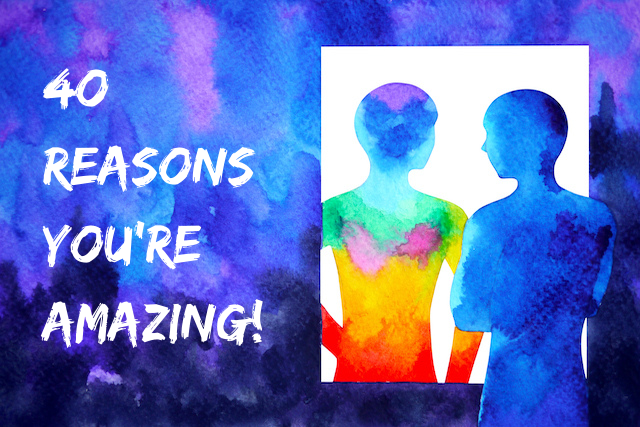
    40 Reasons You’re Amazing and Worth Appreciating

    I’m willing to bet that most of us spend far more time focusing on what we aren’t than appreciating who we are. We home in everything we think we lack and then feel bad about ourselves, when there’s actually a lot to celebrate if we take the time recognize it.

    It’s partly a byproduct of our time: We’re constantly inundated with pics and stories narrating everyone else’s lives, when really, they’re just highlight reels. They’re the filtered, photoshopped version of lives as messy and imperfect as ours.

    And regardless of where they pose, what they wear, or what they’re doing there, all those people, they’re just like you and me. They’re sometimes confident, sometimes insecure, and they often need to be reminded that they’re worth loving, and doing better than they think.

    So, if, like me, you’re a perfectionist, or you’re just hard on yourself sometimes, sit back, relax, and consider all these reasons you’re amazing and worth appreciating.

    Your Strength

    1. You’ve survived every challenge life has thrown at you, and there have been a lot.

    2. You’ve done your best in every situation, based on where you were at that time in your life, where you’ve come from, and the resources at your disposal.

    3. You’ve acknowledged and worked on weaknesses—maybe not always, and maybe not without some resistance. But you’ve made progress countless times when it would have been easier to stay stuck where you were.

    4. You’ve risen back up after failure and rejection. You could have given up when you were laid off, or passed up for the job, or told “It’s not you, it’s me…,” but you licked your wounds, got through it, and put yourself back out there instead.

    5. You’ve forgiven, the ultimate test of one’s strength. You may not be ready to forgive everyone who’s hurt you, but you have done it before, even though it was hard.

    6. You’ve apologized. It’s not always easy to admit mistakes, but you’ve done it. You’ve owned your part, acknowledged pain caused, and vowed to do better going forward.

    7. You’ve tried things outside your comfort zone, whether that means taking a new job overseas or saying hello when you would have preferred to stare at your feet.

    8. You’ve faced a fear at some point. It may have seemed small to you, but any time you do something that scares you, it’s huge!

    9. You’ve adapted to change, often without having chosen it, and have grown through the experience.

    10. You’ve solved problems that could have crippled you and have helped other people with their problems while grappling with your own.

    Your Kindness

    11. You have good intentions. You might think you sometimes do the wrong things, but your heart’s generally in the right place.

    12. You’ve made someone feel appreciated, and maybe many someones, by acknowledging their efforts and thanking them for what they’ve done.

    13. You’ve made someone’s day, probably without even realizing it, by listening, understanding, or simply being thoughtful and kind.

    14. You make people laugh—maybe even at your laugh, because you cackle or snort or sound like Beavis. (Too young for the reference? Google it!)

    15. You look out for the people you love. When you say you care, you mean it, and you back it up with actions.

    16. You smile at people. It might seem insignificant, but your smile has likely been someone’s lighthouse on a dark, scary day.

    17. You remember the important things—or at least some of them. That “Happy birthday” card or call or text? It was a simple acknowledgement that helped someone feel valued and loved.

    18. You ask people how they’re doing. You might not always get an honest response, but you’re willing to receive it.

    19. You treat people how you’d like to be treated more often than not. Sometimes you slip up—you’re only human, after all! But you do your best to be a decent human being who treats other people with respect.

    20. You’ve given second chances when you knew someone really needed it.

    Your You-ness

    21. You have many positive qualities, whether you realize it or not. Maybe you’re adventurous or brave or creative or dependable—or all of the above. You could probably go through the whole alphabet and list twenty-six amazing qualities for each letter that you possess. (Or at least twenty-five—X is tough!)

    22. You’re passionate about something, whether it’s your work, a hobby, a dream for the future, or your family, and that passion is both admirable and contagious.

    23. You have unique quirks that make you interesting, endearing, and fun to be around. Maybe you have a passion for Steampunk, or you talk to your plants, or you collect something weird, like umbrella sleeves.

    24. You have eclectic taste and have likely introduced other people to many things they’ve come to enjoy—bands, movies, books, restaurants, the list goes on and on.

    25. You’re beautifully messy, like all human beings, and your emotions give you empathy, depth, and many other gifts you may not even recognize.

    26. You’re creative in your own way—everyone is! Maybe you bake or write or make cool things out of wine corks or scrabble pieces or rocks.

    27. You have your own kind of smarts—book smarts, street smarts, emotional intelligence, maybe even all three.

    28. You have a voice that has soothed someone, even if it sounds like Sofia Vergara’s, simply because it’s yours.

    29. You are physically a work of art. Seriously. Our culture has long promoted a one-size-fits-all definition of beauty (though, thankfully, that seems to be changing), but there’s beauty to be found in every unique combination of body and facial features. Big noses, asymmetrical eyes, crooked smiles—every last of one of them, beautiful!

    30. You are mentally fascinating. Just think of all the outlandish, complex, crazy thoughts that go through your mind each day.

    Your Journey

    31. You’ve amassed a vast assortment of experiences that have given you insight and a unique perspective. No one else sees the world exactly like you!

    32. You’ve healed and grown through all your ups and downs, becoming stronger and wiser every day.

    33. You’ve done some interesting things in your time. If our lives really do flash before our eyes before we die, yours definitely won’t be boring!

    34. You’ve learned what matters to you throughout the years, and you’ve tried your best to honor those things.

    35. You’ve started over when it was hard, whether it was a new direction, a new job, a new location, or a new relationship.

    36. You’ve found and/or created opportunities for yourself, and possibly in fields that aren’t easy to break into.

    37. You’ve adulted: you’ve fed yourself, done laundry, cleaned your house, paid your bills, and done countless other responsible things—often when you would have preferred to lie under a blanket fort eating cereal from an oversized bowl.

    38. You’ve built a treasure chest of amazing memories through the years, and you recognize them for the gold they are.

    39. You’re the co-star in many other people’s favorite memories.

    40. You’ve made it to where you are right now. And here you are, strong, kind, uniquely you, and worth celebrating.

    So there you have it, all the reasons you are absolutely amazing, every last one of you. Have anything to add to the list?

  • 7 Morning Mindfulness Practices to Help You Have an Awesome Day

    7 Morning Mindfulness Practices to Help You Have an Awesome Day

    How often do you feel energized, grounded, and excited for the day when you finish your morning routine?

    And what is your morning routine?

    Are you one of those people who sleep as late as possible, pound some coffee and a processed breakfast, and then rush to get into work on time? (No judgment—I’ve been there! Gas station java and pop tarts for the win!)

    Or do you leave yourself a cushion of time so you can ease into your day feeling centered and invigorated, through some combination of self-care activities?

    In recent years I’ve leaned toward the latter because I know the way I spend my morning sets the tone for the rest of my day.

    Admittedly, it’s easier on some days than others. When things are going well, and I feel good about myself and my life, it’s not too hard to do things that are good for me, even if I only have a few minutes.

    But it’s when we’re not feeling our best that we need self-care the most. Especially in the morning, when our choices have immense power to shape the twenty-four hours ahead.

    For me, the most important choice is to practice mindfulness.

    Mindfulness is essentially non-judgmental present moment awareness. It’s simply being where you are. Grounding yourself in your body and choosing to let thoughts naturally pass instead of getting caught up in them.

    It’s a great practice any time of day, but particularly in the morning, since it enables you to create the kind of energy you want to take into the tasks and interactions ahead of you.

    There are limitless ways to practice mindfulness, but here are some of my favorites:

    1. Mindful check-in

    I imagine a lot of us hop out of bed and get into the morning without really checking in with ourselves to see how we’re feeling.

    Check in to see how your body feels—if you’re holding tension anywhere or if any part of your body needs a little extra love, whether that means stretching your legs or giving yourself a hand massage.

    Check in to see how you feel mentally and emotionally—if you feel anxious about anything that’s coming or you’re holding onto any thoughts or regrets about yesterday and could maybe work through them with a little journaling.

    And most importantly, ask yourself: What do I need? It might not be the same as what you needed yesterday. You might need to chug some water, or connect with someone you love, or listen to a song that always makes you smile. None of these things takes that long, but they can all make a huge difference.

    2. Mindful morning mantra

    Because I want my son to feel excited about his days, and to know that he’s a valuable human being, I’ve gotten into the habit of telling him, right after he wakes up, “Welcome to the day, the day is lucky to have you!” (I probably sound like the teacher from Peanuts right now, cause, you know, he’s one and a half, but in time he’ll understand!)

    Recently it occurred to me that I could just easily say this to myself, either looking in the mirror or just in my head when I first open my eyes. So I tell myself this, then take a few deep breaths and let these words marinate in my brain.

    It’s a much nicer greeting to the morning than a bright screen in my face. And it’s a way to proactively and mindfully nurture what I want to feel: excited, valued, and confident.

    3. Mindful shower

    Our morning shower is a perfect opportunity to engage with our senses, clear our mind, and visualize our worries washing away down the drain.

    Whenever we engage our senses we’re pulled into the present moment, and there’s no sense more powerful than the sense of smell. The part of the brain that processes smells is linked to the part of the brain associated with memory and emotion. Which means the right scent can provide comfort, calm, and healing. And lavender in particular isn’t just relaxing, it’s also scientifically proven to help with anxiety and a number of physical ailments.

    You might find a different scent appeals to you. You might prefer hot showers, or cold showers, or a combination. What’s important is that you allow yourself to be fully present with the experience—to feel the water cascading down your back, to tune into the sound of the drops hitting the floor, and to give yourself this time to simply be, in this moment of solitude.

    4. Intention-setting practice

    Many of us go into our days with lengthy to-do lists, and it can easily create a sense of overwhelm.

    I like to set a morning intention based on both something to do and something to be, because this reminds me of what’s truly important, and takes the focus off productivity.

    For example, you could set the intention to do an act of kindness and be gentle with yourself. Then you’ll feel a sense of accomplishment when you complete the act of kindness, and you’ll not only feel good about having done it, you’ll feel good about yourself no matter what else you do, because you’ll be honoring your intention to be gentle with yourself.

    5. Mindful breakfast

    Particularly in the morning, when we have a lot to do, and perhaps get into quickly, it’s easy to scarf down our food without even really tasting it. And it always occurs to me how silly this is. It’s not like savoring our food takes much time. It literally adds seconds to the experience—a few extra minutes at most.

    In my family we joke that we don’t chew our food, we just kind of gulp it down. So this is where I start. I chew more. I fully taste what I’m eating. I close my eyes as if it’s a super decadent chocolate.

    Choose to eat without multitasking—no phone or TV on in the background. And give yourself permission to just enjoy eating. Like when you were a kid and finally got an ice cream cone after begging for an hour. You took big, long licks, you let it drip down your hand, maybe you snarled when someone asked if they could try it because you were just that into it.

    You could also imagine this is the last time you will ever get to eat this particular meal. I find that always mindful eating far easier!

    6. Yoga or stretching

    If I could take an hour-long yoga class every morning, I would, because nothing feels as good for my mind and body as yoga. It’s like a mental cleanse and a really good full body yawn-stretch all at once. (Do you that too—yawn-stretch?) It releases tension both in the mind and body and creates a feeling of lightness all over.

    If, like me, you don’t have the time for a full class, you could instead do a few energizing poses, while focusing on your breath. Yoga Journal has a great list of recommendations here. Or you could simply stretch in whatever way feels good to you, breathing deeply as you move your body.

    7. Gratitude journaling

    You probably see this suggestion a lot, and for good reason: identifying our blessings boosts our mood, increases our overall life satisfaction, and makes us feel more optimistic. When you find things to appreciate, even when life feels hard or stressful, it’s like shining a spotlight on all the reasons life is worth living and deemphasizing everything that hurts.

    But you don’t need to put pen to paper to reap the benefits. You could write one thing down and put it in a gratitude jar so you can pull a random blessing out any time you need a pick-me-up. You could share a morning blessing on social media, to connect with other people in the process. Or you could try the email approach I recently adopted with my sister…

    Though we didn’t keep it going long, for a brief time we emailed each other daily one thing we were grateful for, one thing we were excited about, and one thing we were proud of ourselves for. I found it was a great way to help each other be our best selves and nurture positive emotions.

    Let’s face it: Every day is different, and some mornings are harder than others.

    Sometimes we wake up wishing yesterday was a dream and hoping today will be over fast.

    Sometimes we wake up feeling indifferent about the twenty-four hours ahead because we’re just not excited about our day.

    And other times we wake up feeling eager and motivated, thrilled about the upcoming day and ready to make the most of it.

    That’s life, for all of us. That’s the full range of human experience, all kinds of days mixed up together like white specks drifting around in a snow globe.

    We can’t control that our lives are always in flux, and that we won’t always wake up feeling happy or positive. But we can choose to do something every morning that enables us to be and do our best with what is, whatever it is.

    And it all starts with mindfulness. Coming home to our body. Giving ourselves permission to simply be. And then, when we feel a strong sense of stability within us, going out into the world to do. Whatever it is we do. Ready to find the joy in our day and knowing we can handle whatever’s coming.

  • What Helped Me the Most When I Thought My Life Was Over

    What Helped Me the Most When I Thought My Life Was Over

    “What I’m looking for is not out there, it is in me.” ~Helen Keller

    I used to think that life should be easy, and if it wasn’t easy, then I was doing it wrong.

    I’m older and wiser now, and I’ve learned that if it is hard, that means I am probably doing something right.

    I had a good childhood. I had a loving family, plenty of opportunity, and I excelled at whatever I put my mind to. But I was a high-anxiety kid, and a relentless perfectionist. As I grew older, that need to have everything flawless impeded my ability to be happy because I didn’t like myself very much.

    When I got married, I felt like I had added a notch to my self-worth belt. As someone who didn’t have a whole lot of self-esteem or love for herself, when someone else loved me, it was just what I needed to feel validated, or so I thought.

    But that wore off too.

    Then, I had kids, which was amazing—I love being a mom. But there was still something missing. I was happy enough, but I didn’t feel alive. There was this little whisper the whole time that said you are not where you’re supposed to be.  

    I felt this urgency to figure out how to be happy, but at the same time, I didn’t. I was happy enough, and there was that guilt. I should be happy. I was so blessed with two beautiful children, a husband, a gorgeous home—you know, the American dream. I’m a terrible, selfish person if I’m not thankful for everything I’ve been blessed with.

    And life was comfortable. It wasn’t what I had dreamed of, or as beautiful as I had thought it would be, but everything was “fine.” And the comfort of “fine” and certainty seemed better than the unknown.

    And then it happened.

    That whisper turned into a very hard and abrupt shove into another lane, as if I didn’t get the hint the first time.

    I could have taken it as a punishment for not being one hundred percent happy with where I was at, and, I suppose I did for a while. But now, I know it was the universe trying to tell me something, and it wasn’t whispering anymore.

    The universe was now yelling at me, loudly.

    The lane-changer happened the day I discovered my husband of seventeen years had been cheating on me with another man.

    The life I knew—the life that I was happy enough with—was gone in an instant on a hot, sweaty July day.

    I did not handle it gracefully. I was an utter hot mess for months and months. The better part of a couple of years, really.

    But I made it through the other side into my “new lane.” and I want to share a little bit about what helped me get here, and what helped me be truly happy here.

    The reason I was so devastated when I was thrust into my new lane is that I had been clinging to this vision of the life I thought that I should be living—the life that was “normal.”

    I was attached to so much—having a husband, having children, having a home, doing married-people-with-kids things. I could have never imagined my life a different way. In fact, it was scary to imagine my life differently.

    As I got older, my world shrunk. My comfort zone got bigger.

    When the crisis with my marriage happened, I tried to hold on tightly to everything that had just crumbled in front of me. But there was nothing left to hold on to –I was experiencing complete groundlessness.

    That attachment to the way things had been was all I had. I didn’t have a ton of self-love, or “I’m okay on my own” mentality. My identity was “we” with my partner for nearly twenty years, and I didn’t know how to function as a “me.”

    I had taken the little things, and the big things for granted.

    So what helped me survive this?

    Someone asked me this after I was feeling like my life was back on track, and after really thinking hard about it, three things came to me.

    Gratitude, mindfulness, and self-love.

    I’m often amazed at how succinctly I was able to boil down these lessons into a few things that were the tipping point for me to find myself, and my happiness again.

    Start with Gratitude

    Focusing on what we are grateful for is a super-simple and powerful tool that is often overlooked. We have access to gratitude at all times, and it is absolutely free. How’s that for a deal?

    Practicing gratitude on the regular has a ton of benefits. Focusing on what you’re grateful for has been shown to increase self-esteem, make us less self-centered, improves health, helps us sleep better, improves our relationships, and… gratitude makes us happier. Boom!

    Remember, gratitude is a practice. The more you cultivate it, the more you will feel it. Stick with it and try these simple ideas:

    1. Make the decision to be grateful. It all starts here.

    2. Keep a gratitude journal. Putting pen to paper (or a gratitude journal app if that’s more your speed) is a great way to get in the habit of focusing on the good things in your life, rather than the not-so-good things. Aim to write down at least 3 things you are grateful for every day.

    There are other neat ways to do this too, such as sharing something you’re grateful for at the dinner table each evening, or keeping a gratitude jar, in which you write what you’re thankful for on slips of paper and drop them in the jar.

    3. Create visual reminders of things you’re grateful for. Maybe a vision board? Or just a journal filled with images you love. If you’re an artist (or even if you’re not!), an art journal can be fun!

    4. Think of ways you can show your gratitude in everyday life, like doing something nice for a homeless person because you are grateful to have a roof over your head

    5. Think about how you can be grateful for the setbacks you’ve had—it’s hard, I know, but I promise you can find a silver lining in anything if you try! Journal about them.

    6. Think about how you’d feel without something. How would you feel if you had ZERO family or friends? Or if you hate your job, how would you feel if you didn’t have a paycheck?

    Next, Practice Mindfulness

    I know, I know. Everyone talks about how mindfulness will help you be happier.

    That’s because it works.

    The benefits of practicing mindfulness are many. Personally, in terms of the quest for happiness, I think the greatest thing that you can learn being mindful is how to observe your thoughts without judging them.

    Have you ever tried meditating, and found thoughts popping in and out of your head like a whack-a-mole game? And, if you’ve been in that space, have you been hard on yourself for not being able to meditate “properly”?

    There is not a right or wrong way to meditate. You will have thoughts that pop into your head and that’s the way it’s supposed to be. The point is to notice the thoughts and let them be there without any judgment (good or bad).

    Starting to pay attention and notice your thoughts is a huge step toward seeing which thoughts and patterns are getting in the way of your happiness. And then, once you begin to notice those thoughts and patterns, you can start to form new ones that will better serve you on your quest for happiness.

    Finally, Treat Yourself Like You’d Treat Someone You Love

    Once you’ve become more mindful of your thoughts, you might notice that your inner critic can be quite nasty sometimes, telling you you’re not _______ enough or not worthy enough.

    Chances are, you’d never speak that way to your children, best friend, or partner. So why on earth do we say such horrible things to ourselves?

    Think about it this way: Your inner critic has a lot of information that it has assimilated over the many years of your life. Some of it is helpful, and some of it just isn’t.

    I used to hate my body. I was not nice to myself at all.

    One day, it occurred to me that I would never say the things I said to myself to my daughter, and as someone who spent much of my adult life struggling with an eating disorder, I certainly did not want to pass that on to her.

    I committed that day to work on talking to myself like I would talk to my daughter. To caring for myself like I would care for my daughter.

    That started with telling myself I was worth self-love and self-care.

    The second step was noticing when my inner critic was telling me that I was not worth that love and care.  Once I was able to notice those thoughts, I was able to start replacing them with more helpful thoughts and words.

    Is any of this going to happen overnight?

    Nope.

    Happiness is something we all spend an awful lot of time looking for, and this feeling of peace and contentment that we all hunger for seems pretty elusive sometimes. But remember, it is in you. You already have everything you need inside of you. These three practices are some pretty simple things that you can do to start your journey toward happiness using what is already inside you.

    Everything is a process. You don’t get from point A to point B overnight. It’s the little things that you take the time to do every day that get you there. If you stare at a blade of grass, you can’t see it growing minute-by-minute, but when your lawn needs to be mowed, you can be pretty sure it grew a lot!

    The end result will come, but you must have patience. You must be grateful for the process to learn and grow. And during the process, you must treat yourself with love, kindness, and respect.

    When you can embrace this truth, you are sure to end up in a beautiful place, and one day, you too, will live from a place of happiness, purpose, and fulfillment.

  • What Helps Me Get Strong When Life Gets Hard

    What Helps Me Get Strong When Life Gets Hard

    “It’s time you realized that you have something in you more powerful and miraculous than the things that affect you and make you dance like a puppet.” ~Marcus Aurelius

    In 2016 I was about to graduate with high honors from a top university. I had mastered Mandarin. Eleven months before graduation, I had secured a job from a reputable accounting firm. I was in a stable relationship with one of the most gorgeous girls on campus. Life doesn’t get any better than this for an international student 1o,000 miles away from home.

    Slowly, things began to change. Three months before graduation all three members of my family fell gravely ill. When I wasn’t awake talking on the phone with them, I was awake worrying myself into insomnia, anxiety, and stress.

    Two months before my graduation, the recruiter who’d agreed to hire me wasn’t returning my calls nor replying to my emails. I started to entertain loads of self-deprecating thoughts. Little by little, I was descending into oblivion.

    Finally, the big day had arrived. It was my graduation day. Pretending that everything was fine, I put on a big smile and went to the ceremony. Needless to say, there was a fire of frustration and anxiety raging inside. Soon I wouldn’t be able to conceal it any longer.

    The atmosphere of the auditorium was filled with laughter and excitement from relatives, teachers, and students. Deservedly so. That day marked the end of countless sleepless nights, embarrassments, exams, and reports. To everyone, it was like the end of a forty-hour marathon in the Himalayas.

    Paradoxically, the smile, chatter, and exhilaration of my classmates and their loved ones only added to my woes. I became more and more anxious with each minute that passed.

    Suddenly, I was reminded of all the pains my mom had gone through to get me to where I was. When my dad left her because she didn’t agree to abort me, she took it upon herself to move forward with the pregnancy and raise me.

    Without a proper job nor a stable source of income, she did everything in her power to ensure that I had a solid education. I would have given anything to have her celebrate such a happy moment with me.

    Fearing that I may embarrass myself and spoil my classmates’ happy moments, I left in the middle of the ceremony and rushed back home. I locked myself in my room and cried my eyes out for hours on end.

    I came to a point when I couldn’t eat, sleep, or enjoy any activity. For the first time, I was experiencing what psychologists call “anhedonia.” No beautiful movies, social gatherings, or sports appealed to me. As I isolated myself, I became more and more lonely.

    On November 10, 2016, at 10pm, the only person that was around during those troubling times decided to put an end to our relationship. Normally, that would have been just another breakup. But to me, it was a breaking point!

    Given the grief and pain I was enduring at that time, I had no mental steam to cope with another rejection. The pain that was already eating my soul became even more unbearable. That night and the seventeen days that followed, all I could think of was to simply end it all.

    The Turning Point

    Eighteen days later, on November 28, 2016, I decided to open up to a pastor and her wife. For the first time, I counted all my pain and griefs to this couple who gave me their undivided attention for three hours non-stop.

    That night, I went home with a renewed sense of hope. It felt like a big weight had been lifted off my shoulders. For the first time in eighteen days, life seemed to have more potential for joy than it ever did.

    Back to my room in front of my computer, a video by Nick Vudijic on how to overcome hopelessness made its way through my screen as if by magic.

    Halfway through the video, a feeling of resentment and shame was washing all over me.

    How could someone without limbs have such a positive outlook on life? I understood that there must be more to happiness and peace of mind than the challenges of life.

    I was determined to find out what I needed to do to help me navigate life’s difficulties without losing any sense of pleasure or hope. In the subsequent months, I would discover what it takes to turn disappointment into achievement, desperation into inspiration.

    Focusing on Your Blessings

    I’ve heard it said that counting your blessings is an effective way to deal with challenges of life. It sounded too good to be true to me—and incredibly difficult. How can someone count their blessings when they’re obviously in a total mess?

    Still, I took a piece of paper and challenged myself to write ten things that I was grateful for. Within minutes I was all worked up writing positive aspects of my life that had previously eluded me. I may have been anxious, but I wasn’t hospitalized, I had a roof over my head, I had friends that cared for me. My mom may have been sick, but she was alive.

    It became clear to me that my attitude toward my problems was clouding my judgments and preventing me from seeing the beauty of life. I realized that no matter what you are going through there are always a thousand reasons to be happy.

    I’m not saying that feeling down or frustrated is unnatural, that you shouldn’t feel sad when you are going through hardships. Rather, regardless of how dark a situation is, there is always a silver lining. You simply have to search for it.

    I don’t expect you to agree with me. All I’m asking is that you put this claim to test and prove me wrong. You have nothing to lose but a world of peace and relief to gain the minute you put pen to paper counting your blessings.

    Put Your Problems in Perspective

    As I continued to write my blessings first thing in the morning and before retiring at night, the happiness and peace of mind I experienced became contagious to anyone I came in contact with.

    People from all walks of life became attracted to me in ways I never dreamed of before. They were looking for my advice on how to cope with their own life challenges.

    Gradually, it dawned on me that some of these people were going through troubles that were way bigger in magnitude than my problems.

    I will never forget how much pain one young student felt when she told me the story of her parents. At twenty-four, she found out that her parents had an open marriage and her mother was seeing another man aside from her father. Neither of her parents dared to tell her until she found out herself.

    People in Asia, where I live, are very conventional, and most families would not openly live this type of arrangement because of how it would be perceived by society. The shame and betrayal she felt were so disheartening that it affected her studies, her mood, and her sense of self. She was devastated!

    As she counted the story, I got overtaken by emotions, lost all professional composure, and began to cry right in front of her. After this incident, it became clear to me: No matter what problems you are going through there are people with similarly painful or even bigger problems out there.

    I decided to put my own realization to the test. In addition to counting my blessings, I began to experiment with two additional ways to put my problems in perspective.

    First, whenever I feel overwhelmed by a problem, I put the problem I’m facing at number ten on a piece of paper. I then strive to find nine worse problems that I could be facing right now.

    Similarly, when I’m facing a problem that feels insoluble, I put my problem at number ten on a piece of paper and strive to find nine others who are going through much bigger problems.

    Looking at my problems in this light provided me an excellent and effective way to build a strong sense of humility. Yes, it is absolutely important to see the light that shines through the darkness, but it’s equally important to acknowledge that the darkness may not be as dark as you imagine it to be.

    Putting your problems in perspective and realizing that you are not as unfortunate as your distorted thoughts make you believe, will be a valuable asset in helping you take constructive actions toward solving your problems.

    The Power Question

    As I developed a sense of gratitude and humility, I realized I needed to do more to come out stronger from those challenges. Counting blessings and putting problems in perspective may be effective in the mental plane, but they won’t make problems go away.

    As I continued my journey reading, reflecting, and finding means to solve my problems, I came across a famous quote by Epicurus: “Skillful pilots gain their reputation from storms and tempest.” The depth of the meaning of this quote made an immediate and profound impact on me.

    I became convinced that everyone must have a set of skills to respond to life’s challenges. I asked myself, “What inner strength do I have, or do I need to develop, in order to face this problem?”

    Oftentimes, when the going gets tough, we ask ourselves blame questions such as: “Why me?” “Why is this happening to me?”

    Or we may simply criticize ourselves by discounting our strengths. “I must be really stupid.” “I’m doomed.” “I’m never gonna make it…”

    By asking yourself this power question, you change your perspective and find what it takes to help you out of the rut. You don’t blame, whine, or criticize—you get going!

    Asking myself this simple question helped me understand that I could use my life stories to empower others, either in writing or through my speeches, workshops, and seminars.

    At the time of this writing, I’m proud to have impacted the life of thousands of young people throughout Asia. I’ve witnessed students, new hires, and even managers develop a positive outlook on life as a result of those stories.

    I never would have done any of this had I asked myself the power question.

    No matter what you may be going through, I challenge you to ask yourself: What inner strength do I have, or do I need to develop, in order to face this problem?

    Does this mean I’m problem-free right now? Absolutely not. Much like the clouds in the sky, problems come and go, but I’m no longer tossed around like a piece of wood on a stormy sea.

    I’ve developed the mental maturity that allows me to bend without cracking, and to adjust my sails with the whirling wind of anxiety, worry, and stress.

    Today, I’m living a life of meaning and boundless joy. I’ve regained my appetite for living. The most meaningful of all my gains is the utmost satisfaction I experience helping others awaken their inborn geniuses. Writing this article is a direct example of this commitment.

    It took me three years of applying these principles before I could see any tangible results. Beware of the get-happy-quick scheme. Anything valuable takes time. Your happiness is no different. A combination of a willing heart, a bias for action, and patience are all you need to live your life of happiness and meaning.

    If you count your blessings, put your problems in perspective, ask yourself the power question, and take consistent daily actions to strengthen your mind you will get results beyond your wildest imagination.

    Who knows? Maybe next time, we will enjoy an article from you!

  • How I Stopped Blaming My Ex for Our Painful Relationship

    How I Stopped Blaming My Ex for Our Painful Relationship

    “To forgive is to set a prisoner free and discover that the prisoner was you.” ~Lewis B. Smedes

    When it came to my ex-girlfriend, I had difficulty letting go.

    She was a girl I’d had a big crush on for a couple of years. Funnily enough, once my crush on her began to fade, she suddenly started taking a liking to me and made it known that she was into me through our mutual friends.

    I had my doubts about our compatibility from the start. We hardly shared any common interests, and I found it hard to connect with her in conversations. But my friend said things would be different once we started dating, as had been the case for him and his girlfriend, so I decided to give things a go.

    We broke up after a year of dating, yet we kept coming back to each other over the next two years. Like so many couples, we didn’t know how to be together, nor how to be without each other. We weren’t just incompatible; we were toxic together, and our relationship was full of drama.

    When our turbulent relationship came to an end, it wasn’t letting go of the relationship that I had trouble with; it was letting go of the negative thoughts and feelings that I held toward her. I blamed her for what she had put me through during our time together.

    Though I could go on blaming her, I knew that on a deeper level that the fault didn’t lie solely with her.

    I would get irritated with her for the littlest of things. And though I have always been an optimistic person, during the relationship, I was very negative.

    I was convinced that we couldn’t last even a week without fighting. And like a self-fulfilling prophecy, it always came to pass.

    We eventually parted ways once we each moved to different parts of the country.

    However, the feelings of blame and resentment I was holding from the relationship still bothered me long after it was over.

    Years ago I came across a quote from Buddha that went like this:

    “Holding on to anger is like grasping a hot coal with the intent of throwing it at someone else; you are the one who gets burned.” 

    I wanted to let go of these feelings since I knew holding on to them was doing me no good. Yet an intellectual realization alone is often not enough; to let go of negativity, we often need a practical step to take.

    And that’s exactly what I found in Rhonda Byrne’s book The Magic.

    Her book contained an exercise on healing relationships through gratitude. She said that focusing on what we are grateful about the other person could help heal and eliminate feelings of negativity.

    As I started looking for things to be grateful for, I noticed that there were indeed lots of things to appreciate—things that weren’t immediately apparent because my mind had been fixating on all the negatives.

    Like the times when she could be really sweet and caring, and the wonderful and thoughtful birthday gifts she gave me over the years. And most importantly, she never judged me and helped me accept parts of myself that I had trouble accepting.

    The relationship made me realize how judgmental I could be, something that wasn’t apparent to me earlier. It also taught me how powerful the thoughts and feelings we put into a relationship are, whether positive or negative.

    The feelings of resentment I held toward her did not magically go away overnight, possibly because I had stubbornly held on to them for so long.

    It took me a few times of writing them over the years before the blame and negativity started fading away. And I’m glad to say that those feelings are no longer present.

    As I see it now, it’s impossible to change what happened. The only thing I can change is the perspective with which I look back upon the relationship.

    True, we didn’t have the best of relationships, far from it. But I wouldn’t have learned the things I did if everything had been perfect. I guess relationships are like that. There are no failed relationships. The only failed relationships are the ones in which we fail to learn anything.

    Changing my perspective has brought me a lot of peace and helped me let go of the thoughts and feelings that were bothering me.

    I hope if you hold feelings of resentment toward anyone, you can let go too by shifting your perspective and finding some way you’ve learned, grown, or benefited from the relationship. In the end, we are doing ourselves the biggest favor by letting go.

  • How to Appreciate Your Body (During COVID-19 and Always)

    How to Appreciate Your Body (During COVID-19 and Always)

    EDITOR’S NOTE: You can find a number of helpful coronavirus resources and all related Tiny Buddha articles here.

    “Imagine if we obsessed about the things we loved about ourselves.” ~Unknown

    I used to have a plaque with this quote prominently displayed in my waiting room. Sadly, it’s somehow gotten misplaced over the years.

    What I remember most about the plaque was how it engaged, or disengaged, the people who noticed it. Did they mention the quote when they came into my office? Pointedly ignore it? Let me know that self-love is what they want for themselves? Or express skepticism that they would never get to that point in their relationships with their bodies (if they even had such a relationship)?

    It was the latter group, primarily made up of women in their forties and fifties that I most loved to challenge.

    “What’s your relationship with your body like?” or “When did you stop focusing on what you liked about your body,” I’d ask.

    The answers I heard were often things like “My body changed after my pregnancy,” or “I hate seeing pictures of myself with wrinkles.”

    As a woman who has surpassed the half century mark myself, I completely related—things aren’t quite the same as in my twenties.

    Of course, focusing on the perfect body spans gender. Many men I know joke about or bemoan their “man boobs,” and people who identify as non-binary sometimes hate gendered body parts, like hips or breasts.

    The world I know most intimately is my own, that of a mid-life woman. TV, magazines, and diet talk constantly remind me of the young, smooth, skinny ideal.

    You would think that with a worldwide pandemic happening, these pressures would disappear. Well, they haven’t. Who’s seen the Facebook meme entitled “When You Meet Your Friends After Quarantine,” which shows toddler girls baring their admittedly adorable bellies which they bonk together? My takeaway: bellies may be cute on toddlers, but not on me.

    Or what about the one that shows a much larger Little Debbie of snack cake fame now depicted as Big Deborah? The message: chubby cheeks and extra pounds are not attractive. Watch out. And then there’s talk of the dreaded quarantine fifteen and how to avoid it.

    The message that I should hate my body is alive and well.

    So how do I begin to combat these messages? The quote at the beginning reminds me to shift to my thinking to the positive. I’m working on it. I’ve started to ask myself hard questions. What’s positive about my body? What am I grateful for?

    While I’ve found it helpful to think about these things, a gratitude journaling and practices have spurred the most movement toward the positive. The positive present, that is, rather than the losses of the past (like that flat teenage stomach) or the anxiety of the future “quarantine fifteen.”

    Cultivating A Body Gratitude Practice

    I offer my body gratitude in many ways. Journaling is one. Gratitude journals can be simple, such as a bulleted list of how I am grateful to my body (e.g., for health, mobility, endurance).

    I can also answer questions more overarching questions like “How has my body been a friend through the years?”

    As I ask these questions, I tune in to the sensations in my body. How do I feel in my body when I offer this gratitude? It’s often a lightness in my chest or a fullness in my heart.

    It can be a challenge to keep a body gratitude journal, so I’d like to offer some examples.

    I am grateful to my body for having the endurance to take a walk each day. 

    I am grateful to my body for persevering through a difficult pregnancy. Yes, it’s not the perfect body, but it’s given me the gift of a talented, unique daughter.

    I also love to choose a daily card from Louis Hay’s “Healthy Body Deck.” It’s shifts my perspective when I read these gratitude affirmations and thank parts of my body I never considered.

    For instance, one card says “I love my feet. I walk upon this planet safe and secure, always moving forward toward my good.” I never thought of all the things my feet do for me.

    Some of the cards are funny, such as thanking my spleen for its role, but they help me to connect and laugh.

    I also try to notice opportunities for gratitude throughout my day. During a recent grocery trip I was talking to a cashier, who described her fears about COVID-19. Her teenage son had struggled with some past health issues and she was concerned about him becoming sick. It reminded me to thank my body for having a great immune system that keeps my fear levels low, and it provided the basis for my nightly journal entry.

    Finally, body gratitude practices can involve ritual. This is a work in progress for me, but I offer it to others as an alternative. Love baths? Fill a tub with warm water and bubbles, light some candles, and play some music. Take the time for a soak, letting your body have permission to relax and recharge and thanking yourself for getting through another day of keeping yourself and your family safe.

    You—and your body—are doing a wonderful job getting through this crisis. Appreciating yourself can help you stay healthy and enable you to use this time for growth and self-connection.

  • Why Journaling is the Best Thing to Do During a Crisis

    Why Journaling is the Best Thing to Do During a Crisis

    EDITOR’S NOTE: You can find a number of helpful coronavirus resources and all related Tiny Buddha articles here.

    “The difference between despair and hope is just a different way of telling stories from the same set of facts.” ~Alain de Botton

    When I was told that the man I loved had a terminal illness, I instinctively reached for my journal. When I was asked to evacuate my home ahead of a category-5 cyclone three short weeks after his funeral, the first thing I threw into the back of my car was a large box with my journals.

    That was nearly a decade ago.

    Last month, when I stood in front of the empty shelves at my local supermarket, I was surprised to be instantly back in the grip of the fear and panic I felt during the crisis I had braved almost a decade ago. So I did the most logical thing. I took a deep breath, located the stationary aisle—which thankfully was still fully-stocked—and I bought myself a large new notebook.

    The next day, as the world prepared to go into lock-down, I missed the chance to return to my partner and my home in Vietnam.

    Depression and anxiety promptly came to visit, threatening to turn my self-isolation into another painful chapter of my life. But I know that I am more resilient than I think I am, and I instantly turned to my number one coping strategy. I opened my new notebook and started writing my Covid-19 journal.

    This is a challenging time for all of us, and we are all affected in different ways by this global pandemic. I don’t know how my partner and I will cope with the challenge of having to conduct our relationship across closed borders, via Zoom and Messenger, with no certainty when we might see each other again.

    But I know that writing will be there for me, as it has been during every crisis I have been through. Regular journaling has trained me to be my own therapist. Writing things down is an act of self-care. It’s like opening the door to my heart to see what’s in there and allowing myself to sit with all of it.

    Writing through the grief of my husband’s death and the aftermath of a natural disaster, I learned that we can cultivate resilience by allowing ourselves to experience our feelings, both good and bad.

    As I learned the hard way, writing builds resilience because it allows us to process, release, and make meaning of challenging events and complex emotions.

    Writing things down during a crisis is not only helpful as a way of processing and releasing our emotions—it is also a way to document what is happening as it unfolds.

    This strange and unprecedented moment in time sometimes feels like the world is collectively writing a new chapter. There is the official narrative, there is an abundance of alternative narratives floating around the internet, and then there are our personal narratives and the ways we as individuals cope with this crisis.

    Our memories will fade —though we’ll probably always remember that toilet paper was the first thing that ran out during a pandemic—but by keeping a diary and writing things down as they happen, we create a record of this unique historical moment.

    Writing is also a way to enter the creative flow, which is a great antidote to feelings of stress and anxiety. When we become absorbed in the process of writing, we momentarily step out of the chaos and the grief around us and into a safe zone of calm and flow.

    For many of us, self-isolation brings loneliness. Writing can be a great companion in times of loneliness. My diary has always been my best friend during difficult times. Writing can also be a safe place to retreat to for those of us who are assailed by a sense of cabin fever as members of a household suddenly have to live in close proximity with each other 24/7.

    It’s easy for conflict and irritation to arise in confined living environments. I think of my diary as my sacred space where I can say things I don’t dare to say out loud, where I can vent, rage and reflect and most importantly, where I enter into a dialogue with myself.

    Here are some suggestions for starting your own Covid-19 journal:

    1. Write about how you feel right now.

    Allow yourself to give voice to feelings that you might be holding back for the sake of protecting others or because you feel ashamed.

    Write about what feels particularly hard about this crisis. Begin by brainstorming words that describe your emotional state right now. Think of it as making an inventory of the feelings in your heart. You might even find that you feel stronger and calmer than you thought you did.

    2. Write about a time when you overcame a crisis.

    Remembering a time when you were resilient and got through a difficult emotional turning point will help you to believe in your own strength.

    Bring to mind a significant difficult emotional experience. Make sure it’s something in the past that you can safely write about.

    Begin to write about the experience in the first person. Bring the experience alive by giving concrete sensory detail, i.e. what smells, sounds and tastes do you remember? Maybe you want to make reference to the weather or the color of the car you drove. Use word pictures to get back in touch with the feelings you had during that time.

    3. Write a diary.

    Writing a diary about the current pandemic can be as simple as writing about your day. You may write about the things you did and did not do, the people you interacted with, the things you ate, the words you read, the news you watched, the things you did to care for yourself or the ways you allowed the news to affect your anxiety levels…

    Write about anything you’d like to capture about this day. This could be a simple brain dump. Or you could focus on the quirky things that happened today. The things that only a month ago, you couldn’t have imagined doing right now – things like having virtual sundowner drinks or virtual cups of tea via Zoom with your best friends.

    If you’re writing first thing in the morning, you might write about your dreams, the quality of your sleep, or about the day before.

    Be sure to include sensory detail to bring your world alive, i.e. write about the flowers that are in bloom right now, the smells during your daily walk, the noises that you can hear through the thin walls of your apartment etc.

    You never know, your Covid-19 diary may become the foundation of a memoir or something to leave behind for the grandkids.

    4. Write to practice self-compassion.

    In times of crisis, when we experience suffering, fear, or anxiety, it is important to give our hearts shelter. Self-compassion can help us feel less vulnerable and disconnected during this time of self-isolation. It’s also a great way to silence the voice of the inner critic who will be quick to tell you that you are poor at home-schooling or that you are a bad partner.

    Think of self-compassion as being like a warm embrace. Or as expert Dr Kristin Neff says, like speaking to yourself with the same care and kindness you would use towards a good friend.

    Write for ten to fifteen minutes about what you need from yourself right now to feel less vulnerable, less cranky, less anxious… or whatever you may be feeling right now. Another great way to use writing as a self-compassion practice is to write a letter to yourself from the perspective of a good friend, assuring you that whatever happens you’re loved and cared for.

    5. Write a gratitude journal.

    Gratitude is a secret superpower that helps to build resilience and happiness. Too often we focus on what we lack—and right now we lack a lot of things that we used to take for granted only a short while ago. Gratitude is a way of looking at what is abundant and good in our lives, despite the current crisis.

    Writing a gratitude journal can be as simple as listing five things you are grateful for at the end of every day: your warm bed at night, access to drinking water, having a shelter etc.

    Try to be more specific than just saying “I am grateful for my bed.” Tell your diary why you are grateful for having a bed, why you are grateful for the job that sometimes overwhelms you, or the kids that drive you mad during this pandemic.

    A good way to get started with a daily writing practice is to do a short meditation to settle your mind and to get into stillness. Then set the timer on your phone for ten to fifteen minutes and simply write without stopping to think or edit, trusting the pen to lead the way.

    I’ve kept a journal from the age of eleven, which makes me a seasoned diarist, yet during the current global crisis I am often feeling unfocussed and unmotivated.

    I tell myself that that’s okay, it’s part of the process of adapting to our new normal. But I always try to capture my new normal, even if I only write a quick list of things that stood out for me on a given day. It’s a way to stay connected to my inner voice and to write this new chapter one page and one breath at a time.

  • Radical Gratitude: How to Turn Your Pain into Peace

    Radical Gratitude: How to Turn Your Pain into Peace

    My journey to living in gratitude began in 2010. And let me say that up until that time, until I was age forty-five, I was a complainer, griper, and a whiner, with absolutely no reason to complain!

    Luckily, I was saved from these very wasteful, counter-productive habits when I was given a blank journal one Thanksgiving season by a New Thought minister, who told us if we journaled five things we were grateful for forty days, our life would change exponentially for the better.

    I dutifully wrote my gratitude lists, and oh my god, my life did change. It worked! I let go of complaining and started focusing on all the good in my life, and there is plenty.

    Since then:

    1. I have written five or ten things to be grateful for almost every day for years and years. Each morning and each evening, I also reflect on what I am thankful for.

    2. I have realized (and I am thankful) that it is now my calling and passion to share the power of gratitude to inspire others.

    3, Because of my passion to share gratitude, I have written and published five books on gratitude!

    Nowadays, I keep my gratitude practice alive and well by sending out daily email gratitude reflections to a group, and I also write letters to the universe several times a week about what I am thankful for now, and in advance. I find that each year, my gratitude practice expands. Nowadays, I often write paragraphs rather than a short list about what I am grateful for.

    Did you know that scientific studies prove that being grateful helps to be more peaceful, more joyful, and healthier? It is said that you cannot be simultaneously mad or depressed while being grateful, and I’ve found this to be true.

    It is my belief that we can almost always find a reason to be grateful, even when confronted with tragedies, unexpected disasters, or even ill health—a practice known as “radical gratitude.” And this holds true for challenging people in our lives as well. Here are two disclaimers:

    • Forgiveness and acceptance can often be key to finding the gratitude in a situation, but these two concepts will not be discussed in this article. The article would be too long!
    • One more disclaimer: I realize there are some tragedies where a person cannot ever feel gratitude, such as losing a loved one or being sexually abused. It may not work for everybody and every situation.

    But more often than not, we can find the gratitude in negative situations in our life.

    My Personal Experience of Finding Gratitude in Tough Times

    In the summer of 2018, Oregon (where I live) had many devastating wildfires. We watched in horror and disbelief as it came closer and closer to our home. It became obvious we would probably be evacuated. The smoke was black, firefighters and National Guard were checking everyone’s IDs before letting them enter the street to our house.

    Neighbors and I got out of our cars to stop and watch it burning fields and trees so close to our homes. I tried to keep a positive attitude, but it got to be only a half-mile up the street from our house. Very, very scary! I love where we live, and the thought of losing our home was terrifying.

    On a Saturday afternoon, as I tried to take a nap to escape, our phones started ringing and texting that we were in Level 3, evacuation time. Get out now.

    We took our dogs and my cockatiels, computer, important papers, and some clothes and left the rest. We were evacuated for six days and got to come home—all houses and neighbors were thankfully safe and sound. Here are my gratitude takeaways:

    1. We were taken in by friends from the Center for Spiritual Living where I attend, and actually about eight other people had offered us refuge as well. I am very grateful for that, and for Alison and Gary who made us feel at home, helping me set my computer up at their house so I could work and putting up with us and our messy pets. We all became much closer friends through this experience, and we socialize with them regularly.

    2. I am now grateful for the firefighters and all personnel who helped—in my heart, not only in my head. They are amazing!

    3. I think the biggest gratitude I have for the wildfire experience is that I was able to surrender and let go of coming back to our home. This was the only way to stay sane, and that was a gift. After all, it is love, not possessions that matter, and I got clearer on that through the experience.

    When I was thirty-five, I lost my beautiful mother when she was only fifty-seven through cancer. This was a horrible time in my life. I remember waking up feeling good and then immediately feeling dread and sorrow, when I remembered that Mom would die soon.

    One of my gratitude takeaways from that grief-stricken time is that I was Mom’s main caregiver, and that brought me much closer to her in those last nine months. My sisters and I got closer because of that experience, and that was the first time I got introduced to A Course in Miracles, a spiritual set of lessons that changed my life for the better.

    My mother had what I called “Angels” helping her from The Center for Attitudinal Healing in Tiburon, CA and they studied A Course in Miracles, which prompted me to study it as well, because they were so giving and inspirational to me.

    Also, before she died, my mother spent time reflecting on her cancer and what could have caused it, and felt that being a people-pleaser and fearful all her life had prompted the disease. She left me with the message not to be like her, which I am very grateful for and have always remembered, and changed my codependent behavior because of it. Additionally, we had time to say goodbye, which cancer usually provides, and that was a big blessing too.

    One more example that changed my life incredibly in so many ways was going through a divorce after twenty-four years. This was a very difficult decision, I wasn’t sure if it was the right one, and my ex-husband ended up deciding for us. I was heartbroken. So heartbroken that I finally sought out the Center for Spiritual Living, in Santa Rosa, CA, which many people in my life had gently suggested I might attend because they felt I would love it too. And I did!

    From the moment I entered, I got tears in my eyes, seeing all the loving, warm people. As I listened to the talk, I realized even more that this would be my spiritual home the rest of my life, and it has been.

    I am eternally grateful for my divorce now. I took the spiritual classes voraciously; became a licensed practitioner, now serving in Oregon where I live. I am blessed to teach spiritual classes and workshops, and in 2019, I spoke at two Centers for Spiritual Living about the topics in this article.

    I eventually met my second husband, who I have been with for almost twenty years, and we are much more compatible. He asked me to move to Oregon and I did. And I am in love with the forest, rivers, and beauty. None of this would have happened had I stayed in my first marriage. Very thankful!

    In each of these cases, some gratitude was easily available, but more came later. It may take time, even many years to find the gratitude, but looking for it helps your healing.

    I want to mention several well-known people and how they found radical gratitude in their lives. Each is very inspiring to me!

    Viktor Frankl was a psychiatrist who ended up being put into a concentration camp during the Holocaust, and amazingly, found a way to stay positive. He ended up writing a very impactful book as a result of his experience—Man’s Search for Meaning—which has sold fifteen million copies and thus, impacted so many people’s lives.

    His premise is that we need to find meaning in life, and that will help carry us through even the hardest situations. He was a walking example. Here is a quote from his powerful book:

    “Everything can be taken…but one thing: the last of the human freedoms—to choose one’s attitude in any given set of circumstances, to choose one’s own way.”

    Will Pye who wrote a wonderful book on the subject of radical gratitude, The Gratitude Prescription, after he was diagnosed with a brain tumor and, through gratitude, healed himself completely.

    Here is a quote from his excellent book:

    “In looking at our self and our life story through the lens of gratitude, we can come into contact with the beauty and heroism inherent in every human alive. Gratitude for self supports a compassion encompassing all of us.”

    There are other examples too, of physical healing, where the person ends up being grateful for the illness. Anita Moorjani realized on a deep level that we are love after a near death experience, and could let go of her fear of cancer completely, and had a spontaneous remission. It is her calling to share her findings with others, and she wrote a beautiful book about her experience, Dying to Be Me, which has reached millions of people across the world.

    Helen Keller has always been one of my heroes. Even though she was deaf and blind at such a young age, she somehow always found reasons to express her gratitude. I share a very powerful quote from her:

    “The best and most beautiful things in the world cannot be seen or even touched—they must be felt with the heart. I thank God for my handicaps. So much has been given me, I have no time to ponder over that which has been denied.”

    In conclusion, I truly believe that we can almost always find gratitude in even the most challenging situations. It may take time, so be patient. Life is about how we respond to it, and we are always at choice, like Victor Frankl and Helen Keller so beautifully prove. I feel my own life examples also show this.

    Being radically grateful is not always easy but incredibly worthwhile. Our attitude truly affects our lives, and living with gratitude is powerful beyond measure.

  • The Skills You Need to Survive Stress When It Hits

    The Skills You Need to Survive Stress When It Hits

    “The greatest weapon against stress is our ability to choose one thought over another.” ~William James

    Have you ever been in a situation where you felt your world was ending? When the stress was overwhelming and you were so miserable, all you wanted to do was wallow in it and growl at the world from underneath the bed covers?

    Or maybe you worry about things that might happen in the future. Do you see a minor accident on the road and have those flashes of imagining that your partner or your child died in a car crash?

    Does your imagination crawl in horror over how you might survive such a terrible event?

    Or maybe your cousin has had a stroke, and you wonder if it runs in the family and you’re next.

    Do you wonder how you would cope if that were the real situation? Do you think that you have the resources and strategies you need to get yourself through the crisis?

    My coping mechanisms were severely tested recently. Here’s my story and what I learned about gratitude and coping with stress.

    Waking Up with Only Half My Face Working

    Three weeks ago, I woke up to find I was suffering from semi-facial paralysis. My right eye did not blink or close. My mouth could barely open on the affected side. And when I tried to smile, I could only manage a very crooked grin—the right side just didn’t move.

    The pain was bad, shooting up into my head like an electric shock landing in the center of my brain.

    I woke up my husband. The ambulance came, and I was rushed off to A&E, or ER, or, in my case in Portugal, the Sala da Emergência.

    I thought I’d had a stroke. I lay on the trolley, feeling sorry for myself and wondering what kind of life I might have by the end of the day.

    How Learning to Cope with Stress is Like Learning to Fish When Hungry

    Some people seem to cope effortlessly with whatever life throws at them—maybe it’s genetics, maybe it’s upbringing. But most of us struggle. We have to work hard to find peace amidst a storm of chaos.

    Sometimes it feels too overwhelming, and we sink into despair, anxiety, and depression. We turn to crutches such as comfort food, sleeping pills, or alcohol.

    But a crutch is a temporary fix to tide you over. Long-term crutches can mean you forget how to walk. We need to embody skills that work for the rest of our lives.

    It’s like teaching a man to fish. Show him how to use a fishing rod, and he has a means of getting food for the rest of his life. It’s the same for coping with stress. We need skills, strategies, and tools we can use on a daily basis so that when the blows strike, we’re ready and resilient.

    So where can we look for the skills and fishing rods that help us cope with overwhelming stress?

    Learning to Use 5 Fishing Rods That Hook You Away from Stress

    Here are basic skills that I drew on when I was waiting to hear the medical verdict in the hospital.

    Don’t get me wrong, I’m not an expert on any of these skills. But these are the ones that worked for me. There are others. But maybe you wouldn’t have thought of these basic things as skills or tools that actually work to cope with life-threatening events.

    1. Breathing is the simplest tool.

    Yeah, well, we all do that all the time, don’t we?

    Yes, we do. But stress tends to make us breathe more shallowly, so getting into the habit of regular deep breathing when you’re not stressed can help dissipate the crippling effects of stress when it strikes you hard.

    Deep breathing triggers your parasympathetic nervous system and quietens the fight or flight response. (I did deep breathing in the MRI machine.)

    2. Meditation is another.

    Down the millennia, learning to meditate has started with concentrating on breathing, but you can take it further. With practice comes peace and transforming happiness. It takes time and regular practice. Then meditation gives you a place to go to find the calm to cope with harrowing life events. (I used this as a means of getting through the pain to sleep.)

    3. Exercise.

    When you’re feeling that miserable, the last thing you may feel like doing is going out walking or running or going down to the gym. But exercise triggers endorphins in your brain, so it’s a great tool to help you cope with stressful events. It can be as effective as drugs in controlling pain and stress.

    See it as a tool you can use to lift a mood, even just a little bit, and soon you’ll see exercise as a great stress buster. (Actually, I didn’t use this tool, as I could barely walk because my balance was affected. But I’m starting to use it as I improve.)

    4. Talk to friends and family.

    Just telling people about a problem can help you. You’ll feel supported if you feel someone’s listening. Feeling acknowledged gives you strength to cope. Developing your social network is a vital life skill. (Can’t thank my friends, neighbors, and family enough for the support they’ve given me. They were wonderful!)

    5. Choose your reaction.

    You may have no choice about being flung into a stressful crisis, but you do have the choice of how you’re going to react. Our immediate reaction might be fight or flight followed by a large dose of panic. Much better to pause and engage the brain to give yourself mental space to concentrate on choosing how to react.

    Mastering the Skill of Choosing Your Reaction: The Power of Gratitude Journaling

    What I have found hardest is the skill of choosing your reaction.

    For the last year, I’ve grappled with the concepts and practice of gratitude journaling. It seemed such an alien practice to me, kind of false and insincere, merely going through the motions. In a half-hearted way, I’ve kept a gratitude journal.

    On the other hand, there is a lot of science as well as celebrities endorsing its effectiveness.

    It’s dead simple: All you do is write down three to five things for which you’re grateful or thankful or that brought you joy. You can do it every day or every few days—just do it regularly.

    According to the science, it opens your mind to looking for the positive in everything. It trains your mind not only to look for happiness but actually to be happy with what you already have. It stops you from taking what you have for granted. You learn to appreciate people, possessions, and events in new ways.

    Eventually, it alters the structure of your brain and even changes your personality to one more positive in outlook.

    It takes time, but the benefits abound—better sleep, better health, better social relationships, less pain, lower blood pressure, and more energy.

    So, does it really work? Let me take you back to the hospital where I was lying on the trolley feeling miserable.

    Not Dead Yet: The Tide of Gratitude Turns

    After I’d seen the triage nurse and been sent for blood tests, I started to realize I couldn’t just wallow in self-pity. Okay, I was sick, very sick, but not dead yet.

    I started to look around and see how the hospital system worked. I saw how the truly kind staff worked so hard to make everyone comfortable. I watched and marveled at their skill at changing beds with patients still in them. I saw the care they put into dealing with a fractious old lady. (No, it wasn’t me!).

    They sent me for a CAT scan. I marveled at the machines that helped find a diagnosis, at the pain relief from drugs. I could see the system working, for others and for me.

    Suddenly, I was able to rise above the misery of my own illness. It was a shift in perception. All these people and all these facilities surrounding me were devoted to helping me and the other patients. And help me they did!

    Boy was I grateful!

    I felt better, even though I couldn’t close my eye or blink, my sight in that eye had faded, I couldn’t hear in one ear, my speech was slurred, and sitting or standing up saw me in a tizzy of vertigo.

    I was so grateful for a health system that could deal with my emergency.

    The Flood of Well-Being from Gratitude

    As I was flooded with this powerful feeling of thanks, I learned that you have to dig deep into the emotions to reap the benefits of gratitude, to feel the benefits of optimism. But when I needed it, it came bubbling through.

    And that flood of well-being hasn’t left me. I’m slowly and cheerfully recovering.

    Yes, it will take time, but already my smile is returning as the paralysis recedes. Each day I’m grateful for my happy life in this lovely country I’ve recently moved to.

    I realized that all the effort I’d made trying to reap the elusive benefits of gratitude journaling did actually work. I chose to look at my own situation, to reject the self-pity, and see the positive. I chose my reaction to my crisis, and it pulled me into recovery.

    Stress Busting: Practice Makes Perfect

    So how about practicing the skills for when you need them?

    Take a few deep breaths every day so that when you start to feel stressed, it’s natural to start breathing that way.

    Put the effort into supporting your friends and family. Maybe try a bit of meditating.

    Take the time to keep your gratitude journal. Just write down a few things you’re really grateful for: the splash of cheerful color from that flower blooming in the garden, the chatty email you got from your friend, the delicious piece of cake your neighbor brought you.

    Then, the next time that disaster scenario leaps into your imagination, imagine how you’ll choose your reaction. You won’t go into panic mode. See yourself using the skills that you’ve been honing, dealing with the crisis in a positive way, or even preventing the crisis in the first place.

    Then imagine that it happens for real: You scarcely need to think of the skills you need, as your daily practice makes it natural for them to kick in straight away. That’s just the way you operate these days.

    Starting with a few words that recognize a benefit and pleasure that you’ve enjoyed, you’ll learn a skill that can, in the end, make a difference to your whole life.

    Get writing today.

  • 12 Habits to Adopt to Make This Your Best Year Yet

    12 Habits to Adopt to Make This Your Best Year Yet

    Many of us head into the New Year with big goals and ambitions. We think about everything that seems to be lacking in our lives and imagine ourselves far happier and more fulfilled on the other side of massive change.

    There’s no denying that certain accomplishments can amp up our life satisfaction, but I’ve found that our daily habits are the biggest contributor to our happiness.

    You can have a job that excites you, the best body of your life, and the perfect partner for you, but none of it will fully satisfy you if you don’t also prioritize the daily habits that nurture your overall well-being.

    If you want to feel good about yourself and your life, you need to regularly do the things that make you feel peaceful, joyful, and alive.

    With this in mind, I recently asked twelve Tiny Buddha contributors (all involved in our upcoming Best You, Best Life Bundle Sale) to share one habit worth adopting in the New Year. Here’s what they had to say:

     1. Start the day with positive intentions.

    “The moment I wake up, I do not move. I hold still for several minutes. I contemplate qualities I would like to offer for the day.

    Then I silently repeat the following affirmations:

    I offer this day peace.
    I offer this day joy.
    I offer this day enthusiasm.
    I offer this day kindness…
    (or whatever qualities I would like to offer on that day).

    And I keep going until I feel I am done.

    Some days are harder than others, especially if I wake up very early, still tired, with the prospect of a long day ahead.

    However, this simple, pithy practice sets the right tone. It fills me with gratitude and it firmly places me on the right track.

    From that point on, my day goes well, and everything aligns in the best and highest way possible, even if/as and when challenges arise.”

    ~Personal Growth Teacher Julie Hoyle (juliehoyle.org)

     2. Practice mindfulness.

     “For someone seeking a change in their life—to stop doing something destructive, to start doing something healthier, to become more confident, to step into the version of themselves they know they really are—the single best habit to cultivate is mindfulness.

    Mindfulness is the skill of paying attention on purpose to the present moment without judgment. This is the first step to change. It helps you recognize when you are doing the thing you want to change. It helps you understand when you are stuck. It helps you realize what you are really feeling and thinking.

    It gives you the starting point of your map. You can recognize what is really happening—’Oh look, I jumped to the worst-case scenario again. That made me feel afraid and uncomfortable. So that’s why I am looking for an excuse not to go to the party.’

    From here you are able to step outside those emotions of fear and discomfort and look at the situation objectively. From here, you can create change. You can challenge your thinking. You can reframe the situation. You can remind yourself of where you want to go. You can make a plan.

    We so easily live on autopilot. That’s not because we are lazy. It’s simply the more efficient way for our brains to operate.

    Create a habit, and you don’t have to think about what to do the next time that situation comes up. That frees up energy for your brain to do other things. But efficiency does not equal excellence. This autopilot way of living leads us to not notice what is really going on. Without mindful awareness, we get stuck in our feelings, we ruminate like a broken record, we keep making the same unhealthy choices over and over again.

    It’s a very simple skill—to be aware. But there hasn’t been a strong biological or evolutionary need to cultivate this skill in order to survive which is why most of us do not have this skill naturally. We need to work on it. We need to repeat it over and over until it becomes a habit. But it is so worthwhile.

    It’s actually a very subtle shift in your thinking, yet incredibly profound. Like standing under a waterfall, then taking one small step back out of the water and seeing the waterfall in front of you. Small step, big difference.”

    ~Stress and Anxiety Coach Sandra Wozniki (stressandanxietycoach.com)

    3. Adopt a meditation practice.

    “You know that feeling when you’ve been away from home for a while and then you finally walk in the door? It feels good, right? It’s hard to put into words, but something in your heart opens.

    Home is a place where we can open because we feel safe, warm, and held. It’s a place where we know we can always come back to, no matter how long we’ve been away. There’s a feeling of belonging.

    For me, meditation is like this. A returning home. As my mind begins to quiet, there’s an increasing sense of stillness that comes forward, and my heart responds. Stillness brings a sense of peace, clarity, stability, and a deep sense of connection and being held.

    As we move through this life, we all crave that feeling of home. A foundation. A sense of belonging somewhere.

    We often create a sense of home in the world, in a physical location, to recreate what’s fundamentally accessed through our heart.

    Returning to stillness is a returning home at its most essential level.

    In a world where we’re constantly bombarded by distractions, stimulation, dramas and conflict, it’s easy to forget what home feels like. Add to this a busy, emotionally reactive, and self-judging mind, and it’s easy to forget that a sense of home, peace, and warmth actually exists inside us.

    It does!

    Stillness is always there, in the background of our awareness, ready and waiting to support us, but our mind is usually too busy to notice it. And when there’s drama, turbulence or overwhelm in our life, stillness offers a very stable place to rest. But if we don’t train ourselves to know stillness, then when the drama and turbulence comes, stillness will be hard to find.

    Meditation helps us remember and build our relationship to stillness by getting us out of our head and into our heart. The more we visit stillness through meditation the more it permeates us, which means it’s more available for us in everyday life.

    So, when we’re in a stressful situation it’s a matter of letting stillness hold you.

    Does this mean it will work every time? Not necessarily. But with consistent practice you’ll change your relationship to the things that trigger and drain you, because you’ve chosen to cultivate a different, more important relationship. A relationship to stillness.

    And your heart is the bridge.”

    ~Meditation and Mindfulness Instructor Ben Fizell (peacekeeperproject.com)

    4. Use mantras as affirmations.

    “I’m a big fan of using mantras as affirmations. Sometimes life can feel as though it’s spinning out of control, and our minds can conjure up daunting scenarios that increase our stress levels and add to anxiety. A simple mantra can be super effective in helping to cut through the noise and bring us back to a single focal point.

    One of my favorite go-to mantras is ‘I am safe. I am loved. I am good enough.’ I say this at least three times, further affirming the words with each repetition.

    I recommend creating your own mantra using words that feel grounding for you. Keep it short—a sentence or two is plenty. Using affirming words (especially out loud) can create a healthy and empowering habit of self-awareness and self-care.”

    ~Author and Artist Skylar Liberty Rose (skylarlibertyrose.com)

    5. Play in nature.

    “How you play in nature is up to you. It might mean sitting in your yard, on a balcony, or even next to an open window and allowing yourself to revel in a tree’s stillness or a bird’s melody.

    It might mean adventuring to a new neck of the woods, or ambling down a familiar path while taking the time notice all the little things we usually miss in our hurry or preoccupation: the soft, green moss; the startling blue tail of a lizard half-hidden under a rock; or the curious expression of a wren that’s watching you from the bush next to the trail.

    Not only does playing in nature reduce stress and anxiety and improve overall health, but it can also help us find our way, both literally and figuratively.

    It’s like Rumi says: ‘Everyone has been made for some particular work, and the desire for that work has been put in every heart.’

    We have so few chances in our everyday life to practice following our hearts, however, that most of us have forgotten how to do it. Wandering freely under the open sky, following our curiosity and desire, we learn how to let go of trying to arrive somewhere and discover the joy of simply taking the next step on our own unique path.

    When I began to reconnect with the natural world, I couldn’t help but rediscover my own human nature: my true self, that is; the gifts I have to give the world and where I fit into the ecosystem of life.

    Walking through the woods, I began to realize that just like every other living being on this planet, I have an important contribution to make; that when my mind finally grows quiet, I can hear a soft voice of wisdom telling me what that might be; and that if I listen to that voice, I too can—to borrow Mary Oliver’s phrase—take my place in the family of things.”

    ~Certified Integral Coach Meredith Walters (meredithwalters.com)

    6. Try habit stacking.

     “I highly recommend a self-care practice I call ‘habit stacking.’ This is taking several small habits and putting them all together in one time slot, i.e. first thing when you wake up.

    For instance, you might begin by doing a short meditation, which would lead to drinking a quart of water, followed by ten minutes of stretches, and then maybe preparing a green drink. Habits are motivated by triggers, so each activity stimulates the desire in your body for the next one.

    Do these regularly at the same time for a few weeks, and they will become engrained. Your habit stacks can work at any time, day or night, depending on when you want to create your own self-care zone.”

    ~Author and Speaker Suzanne Falter (suzannefalter.com)

    7. Connect with your body daily.

    “One habit worth adopting in the New Year is to start taking a few minutes every day to connect with your body. Pay attention to how it feels, to how you feel. Consider how you want to feel and what you can do to bridge the gap between the two if there is any.

    This is super powerful because we get so caught up in obsessive thoughts about all the things we think we’re ‘supposed’ to be doing for our bodies (and usually end up not doing) that we never stop to just connect with and listen to what it actually needs.

    This also works for mental health. If you wake up feeling down, angry, stressed, overwhelmed, (etc.), ask yourself, what does my head/heart/soul need today? Often, you’ll notice that you really just need a break. Give yourself that. Or maybe you need to find something that feeds your soul and gets you feeling passionate about something in life.

    Too often we end up going through the motions of life living in survival mode simply because we’re so busy staying busy that we don’t stop long enough to figure out what we need to feel vibrant, joyful, and fulfilled.

    If you struggle with healthy eating, take this one step farther by applying it to food. Take a second before you eat to ask yourself, how is it going to make me feel if I eat this? Do I want to feel that way? Why? This is a super powerful tool because it provides space between an auto-pilot impulse and the action that follows, to make a conscious choice based on what’s best for your body in that moment.

    The other reason it’s super powerful is because it helps you to start noticing if/when you’re purposely punishing yourself with food.

    If you go through those few quick questions and decide to purposefully eat something knowing it’s going to make you sick or to continue eating when you’re already full and know that eating more will make you sick, (and you don’t care), you’re punishing yourself with food. Beginning to recognize when that’s happening is the first step to learning how to change it.”

    ~Cognitive Behavior Coach Roni Davis (ronidavis.com)

    8. Practice breathwork.

    “One habit that I think could benefit many people is to incorporate some form of breathwork into their routine. That could be simple mindfulness meditation, box breathing, or some of the more advanced pranayama work in yoga—whatever works for you. From my experience, just a few minutes a day can have a profound impact on stress levels and your quality of life.

    Whether you’re looking to be a stronger athlete, to support your mental health, to be a more present partner or friend, or be more productive at work, I can’t really think of any areas in life that aren’t improved by adopting a regular breathwork practice.”

    ~Movement Coach Luke Jones (heromovement.net)

    9. Be selective about the news sources you tune into.

    “It’s admirable to want to stay informed about current affairs, especially in an election year, but carefully choose news sources you trust and even then, limit your exposure. There’s no value in feeling indignant for half your day, having arguments on social media that you can never win, or getting angry over events or with people you have no control over. All that achieves is that you hand over your personal power to others who are more than happy to take it.”

    ~Certified Life Coach and NLP Master Practitioner Tim Brownson (adaringadventure.com)

    10. Add gratitude to your “sorry’s.”

    “I don’t just say, ‘I’m sorry.’ I also say, ‘Thank you.’ For example, instead of only saying, ‘I’m sorry I was late,’ I also say, ‘Thank you for waiting for me.’ And instead of merely saying, ‘I’m sorry I was sort of out of it the other day,’ I also say, ‘Thank you for being there for me both during good times—and my not so good times.’

    This subtle shift helps me to feel better about my human glitches. Plus, it also winds up improving my relationships—because I’m sharing my appreciation with people, and gratitude is a good heart connector.”

    ~Bestselling Author and Award-Winning Designer Karen Salmansohn (notsalmon.com)

    11. Talk to strangers.

    “One habit worth adopting in 2020 is talking to strangers. This is a habit I started picking up in 2010, and it has been the best change I’ve ever made in my life.

    Our relationships are probably the second most important determinant of our well-being, trailing only behind our health. All relationships and interactions—including the ones with strangers—play a massive impact on how much you enjoy each moment.

    By talking to strangers, you’ll improve your social skills, get better at connecting with people, and you’ll learn how to enjoy any moment with random people. When you’re able to go to a book club, a bar, or a work conference by yourself and have a good time, your life improves drastically.”

    ~Blogger Rob Riker (thesocialwinner.com)

    12. Get more and better sleep.

    “I have come to learn that the quality of our sleep dictates almost everything in our lives! It has an effect on our mental state, our physical health, our attitudes toward things, our relationships, and ultimately our success in each area of life.

    Sleep has taken a back seat in the world of healthy living with exercise and nutrition being in the spotlight. But all the evidence points to sleep being the foundation of our overall health.

    Science has shown that if we sleep poorly, we eat poorly and exercise poorly too. If we sleep well, we make better decisions, choose better foods, can exercise more effectively, and we can ultimately live a more rewarding, impact, and successful life. It has a domino effect.”

    ~Life and Performance Coach Brendan Baker (startofhappiness.com)

    Do you already practice any of these habits? And are there any habits you’d add to the list?
  • The Simple Tools That Have Saved My Mental Health

    The Simple Tools That Have Saved My Mental Health

    “Think of the world…you carry within yourself and set it above everything that you notice about you. Your inmost happening is worth your whole love, that is what you must somehow work at, and not lose too much time and too much courage in explaining your attitude to people.” ~Rainer Maria Rilke

    My twenties taught me many things about navigating the outside world as an adult. Ironically, the biggest lesson was learning to pay close attention to my inner world.

    I turned thirty years young this year. Being on the cusp of a new decade feels momentous.

    Over these last ten years, I have struggled with depression, anxiety, and a crippling lack of self-confidence. On more than one occasion, I have looked down the dark abyss that awaits anyone with mental health issues. I even underwent counseling and therapy, sought recourse in medication, opened up to friends, and plunged myself unapologetically into the “self-help” universe.

    As I share my own battle, this frankness and willingness to be vulnerable may come as a surprise to some. Even in the modern world, the stigma of mental health illness remains omnipresent. We are conditioned to just “deal with it as a passing phase,” “snap out of it,” or, “toughen up.”

    Men, especially, are forced into a unidimensional version of masculinity—any outward display of emotion is a weakness.

    We are indoctrinated with the notion that illnesses of the mind are illegitimate and unworthy of public discourse.

    Despite limiting beliefs around open conversation, very few are spared from mental illness in their private lives. Once others see a possibility for dialogue, they begin to share too.

    Showing your bleeding wounds to another human being requires courage. But authenticity is infectious. We might inspire others with our determination to remain vulnerable and ask for help. Over these last few months, several friends and acquaintances have shared their personal struggles with me.

    Every time another person tells me they feel overwhelmed by their brains, my heart breaks a little. Incessant dark thoughts and emotions have taken over their daily lives.

    The problem of mental ailments, like depression and anxiety, is that unshakeable feeling of helplessness and hopelessness. You feel that there is no way out and, no matter what happens, the bad feelings will never go away. This distorted version of the truth presented by our brains convinces us that we have no agency.

    I know that numbed, broken version of one’s self that emerges as a result of these illnesses. But things can get better and, sure, it is not instantaneous; recovery may require several approaches. Today, I want to share what I have learned through my own experience.

    Wisdom is nothing but the ability to offer a piece of yourself to another human being. I wish I could reach out to every person in the world who is suffering from a mental health problem. I want to tell you that there is hope, lurking even within the shadows. To summarize the common tools that have helped me feel better, I list three. And remember, none of these take time: they actually make time—better use of your time.

    1. Meditation

    A few years ago, I started meditating daily. It has changed my life. I started out with cynicism (like many people): How can I sit so still when I feel so empty and tired? How will I quieten my constant mental chatter? Don’t I first need to feel calm to even think about meditation? Does it even work?
    The response to all of the above questions and any others that are keeping you from meditation is: just do it and keep at it. Yes! You don’t need all the answers beforehand. You don’t need to be spiritual. You don’t need to join a retreat, become a yogi, or spend hours.

    You don’t need perfection, you need practice.

    Find a quiet place, close your eyes, put on earphones, and follow a guided meditation. Or if you prefer, do one yourself. And let go of the worry about doing it right, there is no such thing! It is time you take for yourself, and what can be better than making yourself a priority?

    Meditation helps refresh my mind-space amidst the darkest spells. It has brought me closer to my inner self. It has led me to observe my thoughts, not alter, judge, or arrest them—just observe them like traveling clouds. Meditation has taught me to look inward and enjoy the stillness in my core, despite all the worries and anxiety in the foreground.

    Honestly, just try it; you’ll find it addictive once you begin to build the muscle of meditation. Remember to stick with it though—meditating is a habit, a journey and not an intrinsic skill. No one is “made” for meditation, we all learn it. So be patient with yourself.

    2. Mindfulness

    Writer Eckhart Tolle talks about the tendency of our minds to forever escape the present moment. We are too much in the past or too much in the future. In his life-altering book The Power of Now, he says all our worries, fears, and anxieties stem from this predisposition. Mindfulness is the practice of grounding of one’s self in the now, in this moment: this breath, just as it is.

    Easier said than done? I agree! Also why I believe that, like meditation, mindful awareness is a practice, a discipline.

    That said, each one of us has experienced mindfulness presence without realizing it. Every time a sunset, a panorama, a movie, a song, or a loved one takes your breath away and you are suspended in bliss—you are mindfully present. You are nowhere else but in that moment of joy. Doing this even without the positive stimulus is the challenge.

    A key element in mindfulness is acceptance or surrender: not adding to the suffering of a moment by wishing it were otherwise.

    When we resist reality, our present life-situation, we unconsciously build up resistance to what is, the “is-ness” of this moment. And resistance isn’t bad—on the contrary, resistance is what we can use to become mindful and present! However, surrender does not mean inaction; it means accepting what exists as true before deciding if action is necessary. Reaction is impulsive, mindful action is deliberate and, in my case, wiser and calmer.

    Preventatively drawing my attention to the present, at regular intervals during the day, has helped me strengthen my awareness.

    Sometimes when I am walking, I quietly try to observe my physical body, my breath and my energy. My aliveness. Mindfulness means becoming the witness: noticing that you’re noticing. Thoughts will pop like bubble-wrap but if you don’t engage with them, don’t build a story or try to use words and labels, they will slide away.

    Focus on the sensations, the feelings you’re feeling; not the noise in your mind. The witness inside is the mindful, true Me. When I glimpse that dimension, free from mind and outer body, even for a split second, I know I am free and at peace.

    3. Self-love and gratitude

    Like many, I grew up with a brittle sense of self. Growing up I was the model student. Yet, in my teens and early twenties, I began to spiral into shame and self-hate. As I navigated different cultures, countries, languages, and expectations over the last decade, I often found myself feeling stuck. I felt inferior, unworthy, inadequate, different and “foreign.” Feeling like an outsider only reinforced my innate lack of self-esteem.

    I still struggle with those feelings of not being good enough, tall enough, smart enough, successful enough, handsome enough, rich enough, white enough, and the list goes on. I have to remind myself, consciously and repeatedly, that I am enough. No matter where I live, what I do or look like, I am complete and I am okay.

    Self-love might sound selfish and egotistic. But in fact, the most important person in your life is you! You need to be okay to help and love others. Self-love means being gentle to yourself, not insulting yourself when you fall or make mistakes.

    I had to learn to take care of myself as I would a close friend or loved one. It doesn’t come easy because we are raised in a culture where putting your own sense of self last is virtuous, a thing to be proud of.

    I believe we all need to learn to love ourselves, just the way we are. I would go so far as to say, that is the whole game. It’s a tricky one to win, but we ought to keep trying. Start simply: Check your thoughts when you pity yourself or put yourself down (yes, you know that negative self-talk where your brain tells you how slow/fat/ugly/poor/lonely/unloved/silly you are!).

    When we can look at ourselves in the mirror and feel genuine love for the person we see—true deep affection for our whole selves, with all the bad and good —that’s unconditional self-love. I told you, it won’t be easy, but it is rewarding. When you can be fully you, life is simpler.

    While self-care has taught me to appreciate myself, exactly as I am, daily gratitude has helped expand that compassion to a wider range of things. Every day I give thanks for being alive, healthy, able-bodied, young, loved, taken care of, with comforts (food, water, shelter, money), luxury, and freedom.

    Gratitude radically changes my perspective—from focusing on deprivation, on what’s missing, it throws light on what I do have. It can make us connected to reality in a more balanced and harmonious way. Gratitude, for myself or life, has helped me come unstuck when everything feels wretched and uphill.

    Growing up is a process, life a constant journey. Along the way, these practices are helping me understand that I can feel better and be better. Ultimately, we all wish to experience joy and be at peace with ourselves. This is a reminder for me and you—to reach out and proactively work towards our own well-being. Talk and share with others. Stay open.

    Next time things aren’t going well, try to meditate or maybe focus on the present moment. Or give thanks for all that you do have and be kind to yourself. Speak to a friend or a specialist. And if it helps, read this again.