Tag: Gratitude

  • Looking Back: The Silver Linings of the Pandemic and Why I’m Grateful

    Looking Back: The Silver Linings of the Pandemic and Why I’m Grateful

    “You gotta look for the good in the bad, the happy in the sad, the gain in your pain, and what makes you grateful, not hateful.” ~Karen Salmansohn

    The 2010 decade was difficult for me. Hardly a year went by without someone close to me passing away.

    When the tragic decade started, I was in the midst of my residency training and free time was a luxury I did not have. When I graduated and became an attending physician, I was too busy caring for patients on my own to take a break.

    In 2018, my world was shattered when one of my best friends died unexpectedly. The sudden shock of it left me feeling helpless. To counter my feeling of despair, I worked even harder to take care of patients in need.

    Shortly afterward, my father-in-law was diagnosed with a recurrence of his cancer. Over the next year, my husband and I spent whatever free time we had flying across the country to see him. We watched as he slowly deteriorated until he took his last breath in 2019.

    Instead of slowing down, I kept on. It seemed like the more I needed a mental health break to grieve, the harder I worked to suppress my grief.

    When the world stopped due to COVID-19, I too was forced to take a pause. With the whole world quarantined, I finally had the time to heal my broken heart.

    With more time at home, my husband and I found ourselves taking more walks, cooking more meals, and openly talking about our feelings. We visited with family over FaceTime and Zoom and shared stories about those who were now gone.

    We found joy in the small things: a sunrise, a bird’s song, and even just a cup of tea. With the past vastly different from what we were living through and the future feeling so uncertain, we were finally living in the present.

    Though the pandemic brought with it so much suffering and sadness, I found unexpected gratitude in the midst of it:

    Gratitude for the time that we had with our lost loved ones before COVID-19.

    Gratitude for the extra time to spend with one another now.

    Gratitude for the technology that allowed us to stay connected with our family and friends.

    Gratitude for the reminder that life is fragile and that “taking it slow” is sometimes necessary.

    Gratitude for the chance to take a step back and reflect on the important things in life.

    Surprisingly, I realized that I felt gratitude for COVID-19.

    It’s been the darkest of times. I’m devastated by all the lives lost and all the other losses people have experienced. The course of humanity has changed, and likely not for the better.

    But I’ve found solace in the silver linings that have emerged from the pandemic—things that will stay with me long after the virus has passed. I am far more grateful today than I have ever been and with it comes a sense of peace and a newfound strength to carry on.

    My father-in-law, for instance, died peacefully at home surrounded by his loved ones. For a year, we were able to join him at his medical appointments and also create new memories. We arranged for a family trip to Mexico so he could enjoy warmth in the wintertime with his sons and brothers.

    These otherwise normal events would not have been possible during the beginning of the pandemic. If he had passed away a year later, we wouldn’t have been able to say goodbye the way we did. I’m grateful for the quality time we had.

    During the pandemic, I finally grieved my best friend’s death. Instead of keeping myself busy to distract from it as I had done before, I now had time to truly process and feel his loss through the five stages of grief. I think about him at least once a day but instead of feeling sorrow, I’m usually thinking about how he would guide me through this new normal.

    While the pandemic is not something to celebrate, it has certainly opened my mind. I never would have thought that something so awful could bring about so much healing and hope.

    COVID-19 made it very clear that life is too short to worry about the little things. Life is too precious not to enjoy every moment, especially with our loved ones. When we choose to be grateful for all that we have, we open ourselves up to more joy, peace, and connection.

    While we may not be able to control our circumstances, we can control how we react to them. We can choose kindness, understanding, and empathy for ourselves and others.

    Did someone just cut me off in traffic? It’s okay, maybe they’re rushing to the hospital to see a loved one. I hope they make it there safely!

    Is the Wifi connection poor again? No worries, I can use this time to read a book.

    Did I make the wrong decision? It’s okay, I’ll learn from it and make a better choice next time.

    Reframing our thoughts to focus on the good, no matter how small, can have a powerful effect on our mood and outlook. Things that would otherwise be frustrating or upsetting are suddenly not so bad.

    For all of us, COVID-19 has taken away so much. But if we can find a way to look for the positive and cultivate gratitude then we can find happiness amid hardship. We can come out of this stronger, kinder, and more connected to the people and things that matter most.

    I’ve developed several good habits during the pandemic. I now journal every day writing about all the things that made me happy. Whenever I spend time with friends and family, I give them my undivided attention. I enjoy my work—I treat my patients as I would my family and consider it a privilege to be part of their care. I’ve also been taking more time for self-care and nurturing my creative pursuits.

    The world has changed and so have I. I am grateful for the life lessons and growth.

  • 3 Key Benefits to Forgiving and Why I Thanked My Imperfect Parents

    3 Key Benefits to Forgiving and Why I Thanked My Imperfect Parents

    TRIGGER WARNING: This post mentions physical abuse and may be triggered to some people.

    “Forgiveness is not always easy. At times, it feels more painful than the wound we suffered, to forgive the one that inflicted it. And yet, there is no peace without forgiveness.” ~Marianne Williamson

    The subject of forgiveness comes up often in conversation, but I find that when it comes to the details of what that truly entails, what that process feels like is not actually talked about.

    Over the years, I’ve heard the following statements most often from people when the subject of forgiving someone came up in discussions:

    1. “What they’ve done is just wrong! I can never forgive them for that.”

    2. “They haven’t earned my forgiveness. There’s no reason for me to forgive them.”

    3. “Oh, I already forgave them and let it go. I haven’t told them because we aren’t talking. Why should I be the one to reach out first?”

    In 2006, I attended a long weekend workshop with the late Dr. Lee Gibson, where he gifted us one of his brilliant Leeisms: “Forgiveness is erasing a debt you think someone owes you. That’s why forgiveness can feel like it’s costing you something.”

    I was blown away.

    Yes! I was beginning to understand why it was so hard for me to forgive my parents. I was stuck in the very same mentality of “Why should I?”, “They were clearly wrong!”, and “They haven’t earned it!”

    Late one night when I was nineteen, I was assaulted by my father, who lost his temper and self-control. I thought I was going to die that night, because it certainly felt like he was trying to kill me. My younger brother eventually pulled him off me and kept him away long enough for us all to calm down.

    I was terrified and didn’t sleep for three nights. I also told myself this was the last time I was going to allow this to happen. I started packing that night and moved out in three days. My parents and I didn’t have a relationship for the next ten years, as my mother stood by my father’s side.

    During Lee’s workshop, with a mere group of six attendees that long weekend, we dove into the subject of family dysfunctions and forgiveness. It immediately hit a pain point for me, right in the core.

    I fought with him for about forty minutes (I was told later by someone in the same class) in what felt to me like ten minutes—I was passionately immersed in that moment to prove my point and how wronged I was that time. I was at a standstill.

    I asked him what about fairness and justice, and why must I be the bigger person here when they are the parents? Lee calmly asked, “How does it feel for you to be the bigger person? Is that okay?” Well, I thought, I suppose it is, but why must I always be that person?

    Then he proposed an even more outlandish concept—thanking the people who had wronged us for all the things they’d done right.

    I was stirred up a little more, but for some reason was curious to hear more. I needed to understand why he thought it was a good idea, and how exactly it would help me be at peace.

    To be honest, I don’t remember all the deep wisdom he had shared as to why. All I remember is that it would create a shift within us if we were open and brave enough to try it, and he encouraged us to share our experience with him afterward.

    No way, I thought. Never. Not gonna happen. Forgiveness is one thing, but thanking them was way beyond what I was willing to consider.

    I was still stewing about all this a week after the workshop. But my adventurous heart wanted to know what it would feel like if I set aside all that my parents had done wrong and thanked them for all the things they had done right.

    I started making a list of some of the things I thought they did right, such as struggling through the hardships of being first-generation immigrants and working day and night to put food on the table and a roof over our heads.

    After much thought, with a racing heart and trembling voice, I did the unthinkable—I called my parents one night, out of the blue, to conduct this “social experiment.” I went down my list and thanked them for all the things they did right without mentioning anything that they’d done wrong. They reacted surprisingly well and acknowledged there was a lot they could have done better.

    I’ll admit, I tried not to have any expectations, but a part of me was hoping they’d apologize for what they’d done wrong, and they didn’t. I felt surprisingly okay about that after we hung up.

    I felt proud of myself for having done that. I felt bigger. I felt more grown up. I felt more empowered to be the bigger person. That was my first taste of offering compassion and gratitude from a place of empowerment rather than martyrdom.

    I definitely experienced a shift.

    It probably took another five years for me to fully understand and let go of the night of the assault and all the things I thought they could’ve done better. In hindsight, giving thanks was the first step to feeling more of an adult and less of a helpless child in their presence. Being able to give my own parents a pat on the back put me at the same level.

    I no longer feel the need to be hopeful that they will treat me a certain way, give me the attention I felt I needed, or make up for what they’d done wrong. I felt more in a position to see them as they are—other human beings also dealing with their own suffering.

    As each year goes by, I continue to get to know my parents as human beings and not just as my parents.

    I have gradually taken them out of the parental role, as I no longer need them to be, and treat them like any other adult. I have established boundaries with them and began to respect their boundaries too, once I got to know their limitations. And I disengage whenever I feel like our interactions start to redirect toward an unhealthy dynamic.

    I understood very well that, as an adult, it was my choice whether to have a relationship with my parents or not. And if I chose to, I would also be playing a part in what kind of relationship we would have. I wanted to have a good relationship with them, and the only way to do that was to forgive.

    At some point in my life, I realized forgiveness is truly for my own benefit. Here’s why:

    Good closure

    The best closure is always amicable. How many relationships have left us feeling abandoned, confused, heartbroken, and questioning our self-worth? We were often not given a choice in those types of endings. But what if we could actively choose a better way to end a relationship with someone? (Or, like with my parents, begin a new relationship with them.)

    While this is a two-way street, we have control over our side. This allows each of us to move on to better future relationships and the next chapter of our lives, without guilt or attachment. A bond with another formed by anger, guilt, or bitterness is an energetic constraint to our own heart and soul.

    Personal growth and transformation

    Whenever we hold onto the victim mentality, we keep ourselves small. When we refuse to forgive, we hold onto the fact that we have been wronged and that we are the victim in that scenario. It’s hard to grow beyond that mindset when we hold onto what hurts us and continue to hold that over those we feel have wronged us.

    It may not feel like it right now (I know I certainly struggled with it for a long time), but the first step to feeling empowered is recognizing that we are in the position to forgive, and that is big. Much like extending gratitude, extending forgiveness comes from a higher place. A place where we have the knowledge that we are in a leadership position to forgive and break through the cage we have built for ourselves.

    Soul freedom

    In a way, we’re helping their hearts and souls to move on. We’re here on earth for a short period of time. As cliché as it sounds, the only things that we’ll think of in our last hours are how much we gave, loved, and lived, and what will haunt us is how much we didn’t.

    I want to make sure I am free of such torment. And if I could free others of such torment in the process, then it would truly be a win-win, on a soul level.

    Forgiveness not only frees us from being permanently tied to those we feel have wronged us; it also releases them from a debt we feel they owe us—a karmic tie I do not wish to adhere to. Only then will we all feel a deep sigh of relief with a freedom to move on to whatever awaits our souls next.

    I sent my father a care package last year with a card attached, letting him know that I wish him happiness and health and he is loved and he is forgiven. And now I am at peace.

    **I am not suggesting anyone else should thank their abuser. I personally found this helpful and healing, but everyone needs to make their own choice based on what’s best for them.

  • How I’ve Redefined Success Since ‘Failing’ by Traditional Standards

    How I’ve Redefined Success Since ‘Failing’ by Traditional Standards

    “Once you choose hope, anything is possible.” ~Christopher Reeve

    When I was a child, I wanted to save the world. My mom found me crying in my bedroom one day. She asked what was wrong, and I said, “I haven’t done anything yet!” I couldn’t wait to grow up so I could try to make a difference.

    At fourteen, I joined a youth group that supported adults with disabilities. We hosted dances and ran a buddy program. I helped with projects at state institutions and left saddened by the conditions for the residents. I planned to work at a state institution.

    As a senior in high school, I was voted most likely to succeed. It was unexpected, like so many things in my life. I hoped to find meaningful work that helped others.

    My first year at Ohio State, I fell head over heels in love and married the boy next door. A month after my wedding, newly nineteen, I started my first full-time job as manager of a group home for men with developmental disabilities. I never finished college.

    At twenty-three, I was officially diagnosed with depression after my first baby, but the doctor didn’t tell me. I read the diagnosis in my medical record a few years later. I grew up in the sixties with negative stereotypes of mental illness. I didn’t understand it, and I thought depression meant being weak and ungrateful. I loved being a new mom, and I wanted the doctor to be wrong.

    I was a stay-at-home mom with three young children at the time of my ten-year high school reunion. The event booklet included bios. For mine, I wrote something a bit defensive about the value of being a mom since I didn’t feel successful in any traditional way.

    At thirty, I experienced daily headaches for the first time. I tried natural cures and refused all medication, even over-the-counter ones, while the headaches progressed to a constant mild level. I kept up with three busy kids, taught literacy to residents with multiple disabilities at a state institution, and barreled on. I thought I understood challenges.

    At forty, I went to a pain clinic at Ohio State and received another depression diagnosis. This time it made sense. The diagnosis still made me feel vaguely ashamed, weak. Still, I rationalized it away.

    Which came first, the depression or the headache? Maybe it was the headache’s fault. Anti-depressants were diagnosed for the first time, which managed my depression. Until…

    When I was forty-two, I fell asleep at the wheel with my youngest daughter Beth in the passenger seat. She sustained a spinal cord injury that left her paralyzed from the chest down. I quit my job at the institution to be her round-the-clock caregiver.

    Beth was only fourteen when she was injured. However, she carried me forward, since between the two of us, she was the emotionally stable one. She focused on regaining her independence, despite her quadriplegia. I let her make the decisions about her care and her future. Sometimes we need someone strong to lead the way.

    Every day, every hour, every minute of our new life felt impossibly uncertain. New guilt and anxiety merged with my old issues of chronic pain and depression. Increased doses of my anti-depressants did not prevent me from spiraling down. There was no light at the end of the tunnel. No hope of light.

    I put a tight lid on my feelings, which was a challenge by itself. I didn’t want to give the people I loved more to worry about. I also felt that if I gave in to my emotions, I wouldn’t be able to function. And I desperately needed to help Beth. That’s what mattered the most.

    I started counseling several months after the car accident. At the first session, I thought I would find a little peace, with more ahead. It wasn’t that simple. I felt like a failure, and thought I failed at counseling, too, since I didn’t improve for some time. I should have reached out for help right after Beth’s injury.

    Weekly counseling helped me, along with my husband always being there for me. However, Beth was the one who showed me how to choose hope. I watched her succeed after failing again and again, over and over, on her quest to be independent.

    Beth and I shared unexpected adventures, from our small town in Ohio to Harvard and around the world. She has had the most exciting life of anyone I know. She’s also the happiest person I know because she finds joy in ordinary life, and that’s the best kind of success.

    Since I was voted most likely to succeed in 1976, I learned that success encompasses so much more than I originally thought. Things like being married for forty-five years to my best friend. Raising three great kids. Working meaningful jobs and helping others. Volunteering and mentoring. And learning meditation to better cope with chronic pain.

    Today, my depression is mostly managed with prescriptions, which also feels like a kind of success. I’m no longer ashamed of my depression. It’s part of who I am, and I know for a fact that I’m not weak or ungrateful. There’s light at the end of the tunnel, a bright light.

    Hope is an incredibly powerful thing. And if you never give up? Hope wins.

  • The Best Way to Deal with Dissatisfaction (It’s Not What You Think)

    The Best Way to Deal with Dissatisfaction (It’s Not What You Think)

    “Trying to change ourselves does not work in the long run because we are resisting our own energy. Self-improvement can have temporary results, but lasting transformation occurs only when we honor ourselves as the source of wisdom and compassion.” ~Pema Chodron, The Places That Scare You

    In my late thirties, I was a yoga teacher and an avid practitioner. I lived by myself in a small but beautiful studio apartment in Tel Aviv, Israel, right next to the beach.

    Every morning I woke up in my large bed with a majestic white canopy and said a morning prayer. I meditated for an hour and practiced pranayama and yoga asana for another hour and a half.

    When I was done, I prepared myself a healthy breakfast and sat at the rectangular wooden dining table, facing a huge window and the row of ficus trees that kept me hidden from the world. I ate slowly and mindfully.

    Since then, my life has shifted. I found love, got married, had a child, started a new business, and moved to live in the US. I stopped having the luxury of a two-and-a-half-hour morning sadhana. But my morning prayer stayed with me all this time:

    I am grateful for everything that I have and for everything that I don’t have.

    I am grateful for the opportunity to live.

    I love myself the way I am.

    I love my life the way it is.

    I love all sentient beings the way they are.

    May all sentient beings be happy and peaceful, may they all be safe and protected, may everyone be healthy and strong, and know a deep sense of wellbeing.

    I created this prayer because I wanted to be grateful for life, but I was not. I wanted to love myself, but I did not. It was sort of “fake it till you make it.”

    I borrowed this principle from the metta bhavana practice. In this practice you send love and good wishes to yourself, then to someone you love, then to someone neutral and eventually to someone you have issues with.

    When you send love to someone you hate, you connect with your hatred and resentment. You can witness how hard it is for you to want this person to be happy and well. But the more you do it, the easier it becomes. The hatred dissolves and you become more authentic with your wishes.

    Similarly, I assumed that if I kept telling myself that I was grateful, I would eventually become grateful. If I told myself that I loved myself, I would eventually love myself.

    Today, I can say that I do love myself and I do love my life, a lot more than I used to when I created my morning prayer. But the more I am happy with what I have, the harder it is to say that I am happy for everything I don’t have.

    Right now, for example, I am dissatisfied with my business income.

    I could reason myself out of my dissatisfaction.

    I could tell myself that I only started my business three years ago, just before COVID. I am still not making enough money, but I am making money and my situation keeps improving.

    My husband makes enough money for both of us, so my life is pretty good as it is. I know I am fulfilling my purpose, and it gives me great satisfaction to serve and inspire others. I get many affirmations that I am on the right path.

    I could also count my blessings.

    I have an honest and deep, loving relationship. I have an out-of-this-world connection with my son. I have a charming old house in a city that, for me, is heaven on earth. I have great friends and a strong community of likeminded people.

    I could compare myself to many other people who do not have any of these gifts.

    This is what most of us do when we feel discontent or dissatisfied with our lives. We sweep our lack of satisfaction under the rug. We remind ourselves of all the reasons we should be content. We convince ourselves to stop complaining and be happy.

    But when we fake our gratitude, when we reason ourselves to be happy, or focus on our gifts rather than our sorrows, we do not increase our happiness, we get further away from it!

    Let me explain.

    Behind our dissatisfaction there is pain.

    There might be childhood wounds, there might be weaknesses. When we ignore our frustration, we miss a valuable opportunity to work with these themes.

    When I delved into my discontent, I realized a lot of it was rooted in my childhood. My father was a banker, and my mother was an artist. My mother loved art and different cultures. She wanted to travel to many places. She worked hard at raising three children, but she did not get to travel because my father thought traveling was a waste of time and money. My mother had no say, since she was not the one who made the money in our house.

    Because of this, as a child I promised myself that I would never be financially dependent on anyone. This decision motivated me to study accounting and economics, and to have a successful financial career. My work did not fulfill my purpose, but it brought me financial security.

    For me, not having a sustainable income equaled being weak, like my mother was.

    When I understood that, I could work with it. I could remind myself that I was not my mother. That I was a good businesswoman. That I’d made some good investments. That I was strong.

    We are afraid to experience dissatisfaction and pain because we fear they will bring us down. But in truth, depression comes from not dealing with the pain! You can only suppress your discontent for so long. At a certain point, everything you swept under the rug comes out, and you discover that in its dark hiding place it grew bigger and bigger.

    After my mother died, when I was eighteen, I decided to live life to the fullest. I was very grateful for being alive, and I thought my gratitude should be expressed with constant happiness. For few years, I forced myself to be happy, and pushed all the pain, hurt, and loneliness away.

    I lived like I was on top of the world, until one day I crashed to the ground. I got so depressed I could not get out of bed or stop crying for months.

    At first, I did not even understand why I was depressed while my life was so “perfect.” It took me years to open my eyes and see all the things I refused to acknowledge before.

    Since then, I’ve come a long way. I stopped running away from my pain. I turned around, looked it in the eyes, and said, “let’s be friends.”

    Even though I have so many reasons to be grateful, I am still allowed to be dissatisfied. I am not going to judge myself for that. I am not going to tell myself to stop whining and snap out of it. I am not going to deny this pain or try to modify it and shape it into gratitude.

    Befriending your pain and dissatisfaction is not an easy process.

    Our natural tendency is to fear these feelings, to avoid them, to deny them. It requires us to go against our instincts.

    On the first slope I ever skied, my instincts told me to lean back to prevent falling. But leaning back is exactly what makes you fall. You need to lean forward, into the downhill, in order to slow yourself down and ride the slope well.

    Leaning into your dissatisfaction works exactly the same. When you accept your dissatisfaction and allow yourself to be dissatisfied, you work with the situation. You make it your teacher. You appreciate the wisdom of it. Only then, transformation occurs, and you become content.

    So why do I keep saying the same morning prayer?

    In his book Infinite Life, Robert Thurman quotes Ram Dass, who once asked his guru “’What about the horrors in Bengal?’ His guru smiled to him and said, ‘Don’t you see, it’s all perfect!’ Ram Dass then said, ‘Yeah! It’s perfect—but it stinks!’”

    According to Thurman, there are two perceptions of reality that we must hold together. There is the enlightened perception in which everything is perfect, and the samsaric perception, in which we experience pain and dissatisfaction, which must be acknowledged and worked with.

    In my morning prayer I hold the enlightened perception. But when I start my day, I remember to lean into my true deep feelings, especially when I feel pain, frustration, and dissatisfactions. It makes me so much happier.

  • You Have Just Five Minutes Left to Live – What Are Your Deathbed Regrets?

    You Have Just Five Minutes Left to Live – What Are Your Deathbed Regrets?

    “Yesterday was heavy—put it down.” ~Unknown

    Death is still taboo in many parts of the world, yet I must confess that I’ve become fascinated with the art of dying well.

    I was thinking about the word “morbid” the other day, as I heard someone use it when berating her friend for his interest in better preparing for death. The word’s definition refers to “an unhealthy fixation on death and dying,” but who gets to define what’s healthy? And why are so many of us keen to avoid discussing the inevitable?

    We talk about death from time to time on our podcast, and it’s through this work that I’ve been contemplating the topic of regret.

    We all have a story, and they’re rarely fairy tales. As we doggedly plow through life’s box of chocolates, it’s not uncommon for us to say (or not say) and do (or not do) things that we later regret. However, if we motor on, never assessing or addressing the regretful moments from our past, could we hold onto remorse for years?

    In such cases, are we unconsciously retaining dis-ease in our bodies and minds? It’s a hefty weight, after all. Some of us spend our whole lives carrying shame and regret. Cumbersome, compounded emotions clouding our hearts and minds, we take these dark passengers to the end.

    So, there you are—about to die—still living in the past or an unattainable future. Even then, you’re incapable of forgiveness. Even then, you cannot let go or express your true feelings.

    Is this the ending you want for yourself? To spend the last moments of your life incapacitated, surrounded by loved ones (if you’re lucky), yet unable to be present, all thanks to the train of regrets chug-chugging through your failing, fearful mind? Now there’s a positively joy-filled thought.

    And what of my regrets and motivation to write these words? Well, now, there’s a question.

    Like you, my life to date was not without incident. I’ve lived with childhood abuse, high-functioning addiction, self-harm, depression, and emotional immaturity. There’s nothing particularly unique about my story of suffering; I’m just another Samsaric citizen doing the rounds.

    As is traditional, I bore the shame and regret of my actions for a long time, and the weight of my co-created drama nearly drove me to suicide. My rampage lasted almost two decades, and I made quite a mess during that time. However, after a fair whack of internal work, I’m grateful to report that I no longer feel like that. 

    In recent years, I discovered a new way to live—a life of sobriety, self-love, forgiveness, acceptance, awareness, gratitude, and presence.

    Through this beautiful transformation, I saw that to live a life within a life had already been a gift, but two was an outright miracle. One might say that I died before I died. This experience drove me to review, reinvent, and begin learning the art of living and dying well. And I’ll continue learning until my last day here at Earth School.

    So I now find myself in an incredible position. If you told me I only had five minutes left to live, I’d wave my goodbyes and then spend my last few minutes contemplating how unequivocally grateful I am for the lessons and gifts I’ve received during my stay.

    But this isn’t about me—far from it. You see, presently, I’m on a mission to understand how others feel about shame and regret. Do you long to let go of grudges? Do you wish you’d said “I love you more,” or that you spent less time at work and more with family and friends? Or are you deferring such inconsequential concerns until you’ve achieved this goal or that milestone?

    But what if you suddenly ran out of time?

    In her book On Death and Dying (what the dying have to teach doctors, nurses, clergy, and their own family), Elizabeth Kübler-Ross, MD, occasionally touches on the regrets of the dying. Some of the remorse described includes failures, lost opportunities, and sadness at being unable to provide more for those left behind.

    The book features excerpts from many interviews with folks with terminal illnesses and, to this day, remains an excellent guide for people working with those near death.

    A few ideas circulate about the many regrets of the dying. We might suppose that in the final transitional phase, folks often lament the lives they didn’t live, which culminates in a significant degree of regret. But there’s been very little research done to prove this idea.

    In The Top Five Regrets of the Dying, Bronnie Ware interweaves her memoirs with five deathbed regrets gleaned during her stint working as a palliative care worker. It would appear that there’s no science to support the anecdotal regrets listed in her book, but they’re interesting, not least because they feel entirely likely.

    Digging into the subject further, on top of Ware’s list, I found more information discussing the top deathbed regrets. My entirely unscientific internet search coughed up some common themes as follows:

    1. I wish I had taken better care of my body.
    2. I wish I’d dared to live more truthfully.
    3. I wish I’d had the courage to express my feelings.
    4. I should’ve said “I love you” more.
    5. I wish I’d let go of grudges.
    6. I wish I’d left work at work and made more time for family.
    7. I wish I had stayed in touch with friends.
    8. I wish I’d been the better person in conflicts.
    9. I wish I’d realized that happiness was a choice much sooner.
    10. I wish I’d pursued my dreams.

    Heartbreaking if true, right? 

    So while I found little to no research on deathbed regrets, I did find a 2005 American paper titled What We Regret Most… and Why by Neal J. Roese and Amy Summerville.

    The report collates and analyzes several studies surrounding the regret phenomenon. Nine of these papers were published between 1989 and 2003 and contain some highly insightful metadata on life regrets. That said, one wonders how attitudes have changed in all that time.

    The research required participants to review their lives and consider what three (from a list of eight) aspects they would change if they could reset the clock and start again. Other studies asked what parts of life they would alter, and another inquired about people’s most significant life regrets.

    Interestingly, the studies showed a correlation between advancing age, diminishing opportunity, and gradual regret reduction. As older individuals’ life opportunities faded, so did their most painful regrets. Perhaps this meant they simply gave up, feeling there’s no point in regretting something one no longer has the power to change.

    While not specific, there were clear categories for Americans’ biggest regrets as follows:

    • Education 32%
    • Career 22%
    • Romance 15%
    • Parenting 10%
    • Self 5.47%
    • Leisure 2.55%
    • Finance 2.52%
    • Family 2.25%
    • Health 1.47%
    • Friends 1.44%
    • Spirituality 1.33%
    • Community 0.95%

    The paper summarizes, “Based on these previous demonstrations, we suggest that the domains in life that contain people’s biggest regrets are marked by the greatest opportunity for corrective action.” Indeed, this makes perfect sense. Perhaps it is not surprising that people regret career and education decisions in adulthood (with time left to change their course).

    I suspect, however, that such thoughts change entirely the moment one comes face-to-face with their mortality. At this point, one surely cares less about education and a successful career—about the stuff one has or has not accrued.

    I imagine that when one reaches the inevitable moments before death, we consider the true beauty of life, love, experience, family, friends, and living in peace, free from hatred, envy, or resentment toward one another. But then, I’m a bit of a hippie like that, and perhaps I’ve got it all wrong. 

    So how about we create a study of our own? I invite you to grab a pen and paper (or keyboard) and spend a few minutes imagining that you’ve got five minutes left to live—not in the future, but right now at this point in your life. You have five minutes left.

    Consider your deathbed regrets. Close your eyes if it helps (you’re dying, after all). Take a little time to breathe into these reflections consciously. When finished, perhaps you might share some or all of your list in the comments section of this post. Regardless, maybe this offers a chance to address one’s would-be deathbed regrets by considering them now, with a little breathing room.

    Perhaps it’s a timely invitation to stop and take stock. By contemplating life and death in such a way, we are learning that the secret to the art of dying well is right under our noses in how we live our lives.

  • Why My Boyfriend and I Play Like Kids and Are Happier for It

    Why My Boyfriend and I Play Like Kids and Are Happier for It

    “Play is the foundation of learning, creativity, self-expression, and constructive problem-solving. It’s how children wrestle with life to make it meaningful.” ~Susan Linn, Psychiatrist

    We met at a job interview for a summer camp. At the time, I was twenty-two years old and pursuing a bachelor’s degree in English literature and psychology at UBC. On the other hand, H was attending college in the hopes of one day becoming a high school history teacher. He also “liked to promote and support the development of children.”

    During our first date, we grabbed coffee and spent some time at Indigo Books & Music. I was impressed. I had not only found a boy who was willing to tolerate my endless browsing, but genuinely seemed to enjoy it.

    H was funny, dressed nicely, and most importantly, didn’t know much about me. Later, he would learn that I’d grown up a perfectionist, that I became overwhelmed easily, and that I always took life too seriously. I valued the art of productivity and felt self-conscious when acting silly.

    In our early days, we enjoyed sunbathing at the beach and went “playground hopping,” a term coined after spending an entire afternoon going from playground to playground, sitting on the swings, flirting. We climbed the various structures and found out we could no longer get across the monkey bars.

    We had a typical “summer romance.” We sent each other flirty texts at work, and I chased him around the jungle gym during one of our outings with the kids. We played Connect 4 instead of strip poker and went to the candy store to buy samples of all our favorite childhood treats. He loved to make blanket forts and was always to blame for the ensuing pillow fight. We put on music and danced in our underwear in my bedroom late at night.

    He brought out my inner child. We played handshake games while waiting for the bus without caring about the other commuters’ glances. We painted cheap wooden frames from the dollar store and bought a puzzle at Toys R Us. We went to the kid’s arcade and had a playful Skee-Ball competition.

    After a few months of dating, and as a result of my interest into Acceptance and Commitment Therapy (ACT), H and I sat down and made a list of what would become our Common Core Values. Out of sixty values, we picked about a dozen. Then, we talked about them.

    Connecting with our values adds meaning to our lives, but clarifying values can be challenging, because most values are words that are vague. Take, for example, the value of respect. Most people I know value respect. But what does it look like? And what does respect look like specifically in a romantic relationship? We recorded our choices in our newly bought couple’s journal.

    Our values included words such as connection (physical, emotional), equality, boundaries, safety, teamwork, gratitude, humility, and kindness, as well as trust, courage, and vulnerability.

    The value that stood out to me the most, though, was play.

    Play has been one of the core tenets of our relationship. When we first met, he had no idea that I was heavily involved in the mental health community.

    I worked at the hospital where I did peer support work and supported children as well as their families navigate the (highly complex) mental health system. I heard devastating stories of families trying to access care.

    I sat on the board of a non-profit organization that held support groups for students every week and spent a lot of my time holding space for others, while at the same time admiring their resilience. Outside of that, I was busy taking classes, and trying my best to care for my own mental health.

    A few years ago, when I fell in love with Brené Brown’s The Gifts of Imperfection, the chapter that stood out the most to me was: “Wholehearted Living Guidepost 7: Cultivating Rest and Play.”

    In the chapter, she introduced Dr. Stuart Brown, a psychiatrist who has studied play. He explained that play is time spent without purpose and can include a variety of “frivolous activities.”

    As a young adult, overachiever, and university student, I spend most of my time working hard, trying to achieve the definition of “success” society has defined for me. At times, there are sleepless nights, two cups of coffee, and skipped breakfasts.

    When H and I play, we lose track of time. We become immersed in our decorating of gratitude jars, tickle fights, and me chasing him down with an ice cream cone.

    My relationship with H has given me one of the greatest gifts: the ability to lose myself in laughter, and permission to focus on leisure without feeling guilt or anxiety. In the words of Brené Brown, it is all about “letting go of exhaustion as a status symbol and productivity as self-worth.”

    I like to refer to H as “Mr. Fun” because it’s the part I love most about him. If it wasn’t for him, I would rarely allow myself to play. I often feel self-conscious and judge myself harshly whenever I feel the urge to do something “childish,” like coloring. I tell myself, “Don’t be ridiculous. Grow up. You’re not a child anymore.”

    At the time of our discovering our common core values, we had only been dating for three months. Since then, we’ve grown enormously as a couple. The wonderful thing about our common core values is that we now have a silent agreement. We have both committed to living by those values, so we refer to them as needed, especially during a conflict. When we make mistakes, we refer to the value of forgiveness. It lessens the guilt and shame while still holding us accountable.

    Essentially, play encourages self-enquiry, social connection, and being curious about the world.

    Play has allowed us to cultivate a relationship that is based on vulnerability and helps us cope with the uncertainty of the world. It has enhanced our intimacy and helped us relax during stressful times. After all, we are realistic, and understand that our relationship will encounter many obstacles in the future, including having to cope with economic and political instability.

    From an outsider perspective, I am described as responsible, punctual, and can be found balancing my budget with an Excel sheet, every month. You are more likely to find me writing professional emails than singing in the shower or expressing my creativity.

    Sometimes H and I argue about the pros and cons of having carpet in our future dream home and sometimes we make lists of supplies to buy, like Play-Doh, or Legos. Sometimes we discuss Canadian politics while drinking apple juice in plastic cups. We eat Kraft Dinner as a snack and calculate the cost of a one-bedroom apartment. We are both children at heart and young adults trying to navigate the world.

    And not too long ago, H surprised me with a heart shape made of colourful melted beads.

  • How Changing My Words Changed My Life for the Better

    How Changing My Words Changed My Life for the Better

    “Our words create our world.” ~Rich Litvin

    I remember when I was about seven years old, shouting spitefully at my mum, ‘’I wish you were dead, I hate you!” Her jaw dropped in disbelief, and I knew my words had hurt her, which made my young heart heavy.

    I remember being fourteen years old asking my first crush, “H-h-hey, do you fancy going to the cinema with me this weekend? To my surprise, she said yes, which taught me there’s never any harm in asking for what you want.

    Later this year, I’ll be standing proudly next to my beautiful almost-wife saying the words, “I do.” With those two simple little words, I’ll convey my love and commitment to her.

    Words are powerful.

    They have the potential to hurt and destroy and to enhance and create.

    Since embracing this truth a few years ago, I’ve become more mindful of the words I use. That is, the words I speak and the words I think.

    Here are four ways I’ve changed my words and as a result changed my life.

    1. Swapping “I’ll try” for “I can, and I will.”

    Back when I felt stuck in life, I was always trying.

    Trying to lose weight.

    Trying to get out of debt.

    Trying to get my life back together.

    It struck me that, in all the areas of my life I was trying to change, I wasn’t having much success.

    I then looked at an area of my life I felt fulfilled in: my social life.

    Partying all weekend every weekend was the perfect escapism I needed.

    Drinking and partying masked my anxiety, making me forget about my money woes temporarily, and gave me the self-confidence I lacked when sober.

    Interestingly, when friends asked me if I would be out at the weekend, I never replied, “I’ll try and make it.”

    No! It was always, “I’ll be there! See you in the club, the first round is on me!”

    Upon recognizing this pattern, I made a new rule for myself: to swap “I’ll try” with “I can or “I will.”

    To no surprise, I started seeing improvements in my life. By saying “I can, and I will,” I somehow felt stronger and in control of my destiny.

    My confidence grew too. I used to say to my gym buddy, “I’ll try to get to the gym on Thursday,” only to cancel last minute (having never really intended to go), and then beat myself up for it.

    Thinking in terms of “I can/I will” gently forced me to be more decisive. I would then say “I will see you there” or “I will let you know by Tuesday.” If Tuesday came around and another commitment was more of a priority, I could communicate this clearly and without feeling bad for cancelling last minute. Switching from “try” to “can/will” caused me to ask, “What do I want to be committed to?”

    The word “try” does still have a place in my vocabulary. I can call a restaurant on a Friday afternoon to try to get a reservation for the evening.

    My rule is simple: I’ll never try to do something that’s in my full control.

    It’s possible I could call the restaurant and they’re fully booked. The outcome is not in my control.

    For anything that is in my control—exercising, writing, waking up early—I now use “I can” or “I will.”

    2. Ask better questions.

    Why am I so stuck?

    When my anxiety, debt, and drinking were at their worst and I finally felt it was time for a change, this question stuck in my head for several days.

    The answers I got were less than helpful…

    Because you’re a loser.

    Because you’ve got no discipline.

    Because life is hard.

    After several days of soul-searching and fed up with my lousy answers, ironically, a better question came to me: What if I’m asking myself the wrong question?

    I closed my eyes and asked my mind to give me a better one.

    What can I do today to move forward a little?

    For the next few months, this became my question of choice. And each day, I moved forward just a little more, focusing on progress over perfection and solutions rather than the problem.

    As Tony Robbins says, “Quality questions create a quality life. Successful people ask better questions, and as a result, they get better answers.”

    3. Saying “I get to” instead of “I have to.”

    Two years ago, I was on a Skype call with a good friend from Canada.

    We connect every now and again and share what we’ve been working on, and it’s always very high-energy and inspiring!

    He shared with me the idea of “I have to” vs “I get to.”

    “Anytime you wish to feel grateful, change your ‘I have to’ statements into ‘I get to’,” he said.

    Like many new ideas I hear, it sounded good at the time but, to be honest, I soon forgot about it.

    A few days passed and I was leaving the house to go meet a student. At the time, I was teaching English to non-native speakers, and every Monday evening I would travel across town to where this guy lived.

    It was quite a hot day and leaving the house, I wasn’t looking forward to the sixty-minute walk. I became aware of the dialogue in my mind…

    “Urgh, I have to walk across town to go teach English.”

    Suddenly, the conversation with my friend came flooding back to me, so I decided to change my train of thought.

    “I get to walk across town to go and teach English.”

    Wow, gratitude hit me hard and in a way I’d never felt before.

    For the first time in a very long time, I felt gratitude for my legs, for the fact that I’m fit and healthy enough to walk!

    Not only that, I felt gratitude for my student, who I got to spend time with each week so I could help him improve his English—a privilege I had overlooked before.

    It’s always important to me to honor how I feel, meaning if I am feeling tired or unmotivated that’s okay. Often, though, changing my “have to” statements to “I get to” is the switch I need to change my perspective and my mood.

    4. Swapping the punisher for the cheerleader

    Perhaps the biggest change I’ve made is shifting my internal voice from a punisher to a cheerleader.

    Like a lot of people, I was painfully strict with myself and overly critical.

    I’d speak to myself harshly whenever I failed.

    When I felt weak I’d judge myself for feeling that way.

    I would beat myself up for always beating myself up!

    Self-compassion was at the heart of making this switch. Speaking to myself in a gentler, more supportive tone. Less dictator and more supportive grandparent.

    With some practice, I began to respond to failure with words of encouragement.

    When I felt weak, I’d offer myself understanding and empathy.

    If I beat myself up, I’d forgive myself and move on.

    I read somewhere that as important as what we say to ourselves inside our heads is how we speak to ourselves, the tone of voice we use. The author encouraged me to imagine the most understanding, compassionate, and gentle voice imaginable and talk to myself in this voice.

    This has been a real game-changer.

    Louise Hay said, “You’ve been criticizing yourself for years and it hasn’t worked. Try approving of yourself and see what happens.”

    I’ve been amazed by what’s happened. Since approving of myself, I’ve relied less on approval from others, which has been liberating, and I’ve given myself full permission to live how I want to live, since approving of myself also means approving of my wants and choices.

    Part of me wishes I had realized the power of my words long before I did.

    Part of me knows I discovered that our words create our world at exactly the right time I was supposed to.

    No matter what age we are or where we are on our journey, I believe, it’s never too late to change our words—and change our world.

  • 5 Ways to Start Valuing Your Time and Making the Most of It

    5 Ways to Start Valuing Your Time and Making the Most of It

    “It is the time you have wasted for your rose that makes your rose so important.” ~Antoine de Saint-Exupéry, The Little Prince

    Oh, how I loved sleeping when I was a teenager. I would sleep for twelve hours, just as babies do.

    And guess what else?

    Another favorite activity of mine was taking selfies until I finally had a perfect one, editing it, posting it on social media, and waiting for likes. And scrolling through the feed.

    Wow. So unusual nowadays.

    I didn’t care what I was doing with my life. I chose a university degree just for fun and finished it just because I started it. I don’t even like what I chose. I had no goals, no ambitions. I was just drifting through life.

    But then adult life got in the way. Suddenly, I was married and had a child.

    What a turn.

    Now I don’t even have Instagram.

    Do you know why? Because I started valuing my time.

    And I am here to tell you that you need to do it too if you want to live a fulfilling life.

    Why should you value every second of your life?

    When I became a mom, I barely had time to brush my teeth. I didn’t have time to do anything that wasn’t related to my son.

    I started regretting all the time I’d wasted before.

    But let’s be clear: It’s not about productivity. It’s about living your life to the fullest.

    You see, when you value your time, you start valuing your life. You set your priorities straight and start doing things that matter to you. And that’s when life gets really good.

    Although my situation might be different from yours, time is one thing we have in common. And you’ve heard it a million times, but time is our most precious commodity.

    It is non-negotiable. You can’t buy more time, no matter how rich you are. And you can’t save time either. You can only spend it.

    Time waits for no one. So the sooner you start valuing your time, the better.

    Here are a few things that have helped me start valuing my time and life more that might help you too.

    1. Set your priorities straight.

    Oh, priorities. They are so important, yet we often forget about them.

    If you want to start valuing your time, you need to set your priorities straight. Ask yourself what is really important to you and start making time for those things.

    Ask yourself:

    • What do I want to do, achieve, and experience in life?
    • Who and what matter most to me?
    • What makes me happy?
    • Where do I see myself in five years?

    For me, the answer to these questions was simple: I want to value time with my son more. And I want to find a way to balance work and life.

    What I don’t want is to be glued to my phone while my son is next to me, or to watch movies instead of making small steps toward having my own business.

    Self-care is on my list of priorities too. I make sure to have enough time for myself. Even if it’s just ten minutes a day (to have a cup of coffee in silence), it makes all the difference.

    Self-care keeps me sane and happy. And when I am happy, I can give my best to my family.

    2. Realize the importance of limited time.

    We all have limited time on this earth, and we need to make the most of it.

    The idea of limited time gives so much magic to this life. It makes things more precious. And when you start realizing life is precious, time becomes more valuable to you.

    On top of that, it makes you more aware of your mortality. It might sound depressing, but it’s not. It’s actually very liberating. Just think about it: If you knew you’re going to die soon, what would you do differently?

    Do it now so you don’t end up with regrets about how you spent your time.

    I think about death every day. I accept it. And I thank the universe for being mortal.

    We never know when we are going to die, so the best thing we can do is to live each day as if it’s our last.

    3. Notice what your distractions are and eliminate (or at least minimize) them.

    We all have our own distractions. It can be social media, Netflix, video games, or anything else.

    Here is how I deal with my distractions.

    • My main distraction was Instagram. I deleted it.
    • Then, movies. I decided to watch only one movie per week. No TV series (all they did was make me escape my reality).
    • Internet surfing is another one. I decided to use the internet only for work and research. No more browsing without a purpose.
    • I open the app only if I want to relax for twenty minutes and watch something. Otherwise, it’s a huge time waster (I used to open the app and scroll through it for five minutes with no purpose).

    Once I did that, I noticed that sometimes I even got bored. And I love that feeling of not picking up my phone every time I have a free minute. I just enjoy it.

    4. Consciously choose to do one thing despite countless other activities you could be doing.

    You know those moments when you’re about to do something, but then you wonder, “Should I really be doing this? I could be doing something else.”

    This is a common feeling. We often have so many options that it’s hard to choose just one. But simply do that. Choose one activity and stick to it.

    It doesn’t matter if it’s the “right” choice or not. There’s no such thing as “right” when it comes to how you spend your time.

    I recently listened to a podcast by Oliver Burkeman. He said that we don’t want to make choices. We don’t want to decide. We want to let all the options remain available to us. This is also why we love dreaming about the future. Because all the options are open.

    But we need to make a choice. It is so liberating to make a choice. It gives you a sense of control over your life and your time and it keeps you moving forward instead of standing still.

    So, choose one thing and do it. You will feel so much more in focus because you know where you are going.

    For instance, I am writing this article. I could be doing a million other things, but I choose to do this. And it feels great. I am all in. And I am focused because I am not thinking about other things that I could do.

    5. Know that failure is a sign you’re using your time well.

    When we start a project or an activity, we want to do it perfectly. We need to be the best. Otherwise, we think it’s a waste of time.

    In reality, it is life itself. You can’t prevent failure. You will fail. A lot.

    And that’s a good thing. Failure is a sign that you’re trying something new; that you’re pushing your limits, learning, and growing.

    How can we make the most of our failures?

    • First, accept them. Don’t try to bury your failures or pretend they never happened. Acknowledge them and learn from them.
    • Second, put things in perspective. This one opportunity didn’t work out, but it’s not the last you’ll get.
    • Finally, focus on the successes in your failure. Odds are something good came from it, even if you can’t see it just yet.

    Oh, I failed so many times. I lost years of my life in failure. But I am grateful for every single one of them because they made me grow and become better, maybe even wiser.

    My biggest failure is probably my university degree. It’s three years of my life. I was so naive thinking that I can succeed no matter what bachelor’s I choose. And I chose the easiest one.

    Turns out, there is nothing I can do with my bachelor’s degree. It’s useless.

    I could have spent those three years better, but I am not regretting it. Because if I didn’t fail, I wouldn’t be so motivated today to start my own business and to create something that has meaning.

    As I said in the introduction, I was once horrible at valuing my time. But I am glad to say that I have changed. It certainly wasn’t easy. And I am not an expert at this. I still must remind myself to value my time. To cherish every moment.

    But my alarm doesn’t annoy me when it wakes me up in the morning anymore. It’s a reminder that I get to wake up and enjoy my time on this earth.

    I am grateful to still be alive.

    The time that you took reading this article is valuable. I hope it will make you value your time even more.

    Remember that time waits for no one.

    Remember that it’s non-negotiable.

    Remember that you can’t save it.

    You can only spend it wisely.

  • How to Wake Up Smiling: 5 Daily Habits That Made Me a More Positive Person

    How to Wake Up Smiling: 5 Daily Habits That Made Me a More Positive Person

    “You create your future based on your energy in the present.” ~Unknown

    I’m usually a pretty happy person, but about a year ago—perhaps due to a lack of social connections and laughter—I experienced a few dark months. During those months, I spent most of my waking hours (and probably nights as well) consumed with negative thoughts.

    I woke up feeling angry in the morning, continued having negative thoughts most of the day, and went to bed in that same state of mind.

    Luckily, I didn’t have many opportunities to spread my negativity to others because we were in confinement.

    On one of those moody mornings, I played a video of a spiritual teacher that a friend had recommended listening to while getting ready for the day.

    Halfway through the video, he said, “Humanity is ascending into more loving and conscious states of being. You are becoming more of who you truly are, which is love.”

    At that moment, I caught my eyes in the mirror and stared at my unhappy face.

    “I’m not ascending. I’m descending further and further into the ‘hell’ in my own mind.”

    My negativity was eating me alive, but, strangely, it was so addictive.

    Since it had been escalating for some time (a few months by then) and had acquired a good bit of momentum, I really didn’t know if I’d be able to shift all that negativity into a more positive state of being. I knew that the longer I waited, though, the harder it would be.

    Still looking at my face in the mirror, I noticed the corners of my mouth pointing slightly downward.

    “If I continue like that, I’m going to get grumpy face wrinkles.”

    I made my bed and then went to the kitchen. As the coffee was brewing, I grabbed my laptop and Googled “how to be a more positive person,” and I scribbled down a few ideas that resonated with me.

    Later that day, after mixing and matching advice from different articles, I created what I called my “emotional hygiene routine.”

    It’s a series of simple habits that I committed to doing most days of the week for an entire month (and still continue to do today on most days) and that, over that month, took me out of my depressive state and made me wake up smiling in the morning again.

    I’d like to share them with you.

    1. Fall asleep in the “vortex.”

    One idea I came across in my research on being more positive came from Abraham Hicks:

    “If you go to sleep in the vortex, you wake up in the vortex. If you go to sleep not in the vortex, you wake up not in the vortex.”

    Being in the “vortex” refers to a state of pure positive energy. The idea in that quote is pretty straightforward: go to bed thinking positive thoughts and feeling happy feelings, and you’re more likely to wake up thinking and feeling positive in the morning.

    I knew this had to be true. I knew it because when I went to bed thinking angry thoughts, I usually dreamed that I was unhappy and then woke up grumpy (and exhausted) in the morning.

    So, I decided to try something. As I closed my eyes to sleep at night, I scanned the day from the moment I woke up until the present moment when I was lying in bed, and I tried to recall all the positive things (even tiny things) that had happened that day.

    I could have thought about the delicious mocha latte that I drank that morning, the fact there wasn’t snow on the ground and that I was able to run outside in the afternoon, or a nice comment someone left on one of my videos.

    I spent a few seconds remembering a happy moment before moving on to the next one. After scanning the entire day, I would do it again, trying to find even more subtle positive things, and I did this until I fell asleep.

    This exercise is probably the number one thing that helped me (and still continues to help me) wake up happier in the morning.

    2. Have something to look forward to on the following day.

    Something else that has helped me wake up happier is having something to look forward to every day, even if I have a busy day ahead and have minimal free time available.

    Still to this day, every evening, I schedule at least one activity that brings me joy for the following day. It can be going for a walk with a friend, baking cookies, or watching the sunset. It can also be as simple as wearing my favorite outfit.

    Scheduling one activity that brings me joy for the following day gives my mind something fun to anticipate and puts me in a good mood in the evening.

    And again, how the day ends is a good indicator of how the following day begins.

    3. Absorb uplifting ideas in the evening.

    We all know that what we feed our minds affects our mood. I don’t have a TV and don’t follow the news, but my Facebook feed is often enough to get me irritated. So, I decided to stop scrolling mindlessly on Facebook (or at least do so less often) and consume positive-only content instead.

    For the past few months, first thing in the morning and before going to bed, I’ve been reading a few pages of an inspiring book—usually something spiritual. I just finished reading the entire Earth Life book series by Sanaya Roman, and right now, I’m reading Wishes Fulfilled by Wayne Dyer.

    Reading those kinds of books brings me peace. I can notice a significant difference in my mood and stress level if I just take even fifteen minutes to consume uplifting content in the morning and evening.

    (If you have any book recommendations, you can share them in the comments.)

    4. Make a gratitude list—with a twist.

    After reading in the morning, I write down three to five things I’m grateful for—and why I appreciate each thing.

    I used to write gratitude lists of fifteen-plus items and do it very quickly—almost mindlessly—just to “get it done.” It made the practice sort of mechanical and not very effective.

    I’ve found that writing fewer items on my list and taking the time to dive into the reasons each thing makes me happy intensifies the feelings of gratitude and makes the exercise more profound. I try to do this daily, although I do forget sometimes. When I forget several days in a row, I can feel the difference in my general mood.

    Gratitude is perhaps the lowest-hanging fruit for cultivating a more positive attitude.

    5. Choose your state of being as you open your eyes.

    The last thing that has helped me is a piece of advice from Dr. Daniel Amen, one of the leading brain health experts. In an interview on The School of Greatness Podcast, he talked about the importance of setting a positive intention from the very start of the day to cultivate what he calls “a positivity bias.”

    An affirmation he uses himself and recommends using is: “Today is going to be a great day.”

    When we tell ourselves this in the morning, our unconscious mind then looks for things that are going right to prove that this is true. This isn’t toxic positivity—ignoring or denying the negative. It’s training our brains to see what’s positive instead of focusing on the negative by default.

    I’ve taken the habit of saying this affirmation (or a similar one) just after waking up and before opening my eyes in the morning. It’s a bit like choosing and declaring from the very start of the day what attitude you’ll adopt that day. It’s easy to do, and it sets the tone for the day.

    In the beginning, I didn’t always remember to declare my intention until later in the morning, but it didn’t take long before it became automatic. Now, just remembering to think about my intention (and then mentally saying it) makes me smile as I wake up.

    . . .

    Our lives don’t need to be perfect to wake up smiling in the morning; they just require a conscious effort to develop a positive attitude, which is what the five habits in this article have helped me accomplish.

    I hope they serve you well, too, if you choose to implement them.

  • How to Live an Extraordinary Life, Starting Right Where You Are

    How to Live an Extraordinary Life, Starting Right Where You Are

    “Let the beauty we love be what we do. There are hundreds of ways to kneel and kiss the ground.” ~Rumi

    “Isn’t this a miracle?” I asked myself in the milk aisle at Whole Foods.

    It was a Wednesday night after work, and I was buying a few staples to get us through the week. It was a completely ordinary moment in a completely ordinary day, and it was miraculous.

    Rewind a few years, same Whole Foods, same shopping list, and you’d find me absentmindedly wandering the aisles, lost in a head full of worries. I couldn’t tell you now what I was worried about then—the house, the kids, money, probably.

    My body would be tense, with a hint of tears right behind my eyes.

    “Isn’t this supposed to be a miracle?” I might have asked if I had the words to describe that feeling.

    For as long as I can remember, I wanted to be one of those interesting people who did interesting things like paint murals or write books. I wanted to see every continent and learn as many languages as my brain could hold. I wanted to feel excited by my life.

    As a child, I had no doubt that this is what growing up would be like.

    But, for just as long as I can remember, I also lived under the assumption that I had something to prove. My intelligence, my worth, my place in this world.

    Somehow, these two ideas became intertwined.

    That part of me that felt so certain that her life would be extraordinary started to have doubts.

    Could I really pull it off?

    Had I really earned it?

    Was I being completely delusional?

    Over time, that vision of an extraordinary life felt like a silly childhood dream, and I stopped myself from following it. I worked hard and earned a good reputation, but that excitement, that fulfillment was always just out of my reach.

    I would let it go saying, it’ll come later, but as I checked off the boxes of life’s to-do list—degree, job, marriage, kids—I wasn’t feeling anything like I thought I would.

    The feeling that something was off fueled a restlessness that I mistook for motivation. I poured myself into school and then work, but not necessarily out of excitement. I think a part of me still believed that if you weren’t happy, you just weren’t working hard enough at it.

    What confused me about it all was that my life was good. I had a beautiful, growing family, a stable job, and a safe, comfortable house. I mean, I was buying organic milk to pour on my cereal. That’s a privilege.

    So, if nothing was “wrong,” why didn’t it feel right?

    I’d scold myself for not being more grateful, but I couldn’t shake the feeling that I didn’t feel the way I wanted.

    Then, one ordinary day, while squeezing in another email during my lunch hour, a little thought snapped me out of it.

    “You’re missing the point, Leslie.”

    Time stopped just long enough for me to notice my racing heart.

    Maybe you’ve had these epiphanies, where you’re amazed by your own wisdom and you feel so incredibly clear and awake. Maybe it was during a life-changing event, or maybe, like me, it was during an everyday moment, like buying toothpaste or feeding the cats.

    The immediate effect wasn’t anything extreme. There was no out of body experience, no inexplicable knowledge of the universe. Just an ordinary little thought that led to another ordinary little thought.

    What if living an extraordinary life isn’t about the details?

    Every now and then, I’d pull out a list I made that day and add a thought or two to it.

    The point is…

    Overflowing.

    Seeing more magic.

    Doing what you love.

    Being happy.

    Being present.

    Feeling bright, brave, and brilliant.

    Waking up and appreciating the mountains.

    My children knowing how much they are loved.

    Gratefully receiving everything I have.

    Letting myself unfold.

    Alignment, not approval.

    Trusting the wisdom of my own heart.

    A hundred percent up to me.

    And in a gradual, ordinary kind of way, I figured it out. That feeling I wanted wasn’t an outcome. It wasn’t something that would happen “when.” It wasn’t in the details at all. It’s your feelings, moment to moment, that make your life extraordinary.

    There is no committee keeping score and waiting to grant permission to begin. There’s just us, the people we care about, our corner of the world, and those little moments. And we have a choice in what we do with them.

    That feeling that something was wrong wasn’t about my reputation or my checklist. It was about my awareness of the miracles right in front of me and my willingness to take conscious, meaningful steps that felt extraordinary to take.

    Since that day, my life has changed dramatically.

    We live in the same house, we shop at the same store, I have the same job, but now, I’m also one of those people who is curious about everything. Who loses themselves in creative projects just because. Who creates art, writes poetry, and self-publishes books. I’ve become one of those people who sees even the most ordinary moment at Whole Foods on a Wednesday afternoon as extraordinary.

    How did I do it? I simply let myself begin right where I was.

    You may have a completely different version of extraordinary, and that’s what’s so perfect. How to live an extraordinary life is entirely up to you—it’s your life, after all. The action itself isn’t as important as the intent behind it.

    As long as your intent is to make something in your world just a little better, to learn something just a little deeper, to try something you’re just a little curious about, it’s foolproof. You could institute pizza Saturdays or travel the world, saving endangered species. Both are extraordinary.

    If you’re not sure where to begin, here are a few things to try. They changed the world for me.

    1. Be tenacious in your appreciation and optimism.

    First, slow down and look around. Then, appreciate anything and everything you possibly can. Thank the sun, thank the water, thank the air you breathe. Look out for the funny thing that happened on your way to work, beautiful sunsets, and acts of human kindness. Even when everyone around you wants to complain about the boss, be the one who notices that it’s such a nice day.

    When I talked about my day, I used to begin with something that went wrong. Then, I gave myself one tiny challenge: lead with gratitude. I made a point of starting conversations with something positive as often as I could, which meant I had to start looking for those positive things and remembering to bring them up. I discovered so much beauty around me with this one simple switch.

    2. Define your extraordinary.

    What do you want to see in this lifetime? What do you want to learn? How do you want to feel while you’re living your life?

    I’d thought about these things before, of course, but they would quickly get taken over by something more serious. I didn’t want to waste time. My attitude changed when I decided that feeling curious, engaged, and alive was more important than being productive.

    I began setting intentions for the week. I’d write down an idea that excited me, a feeling I wanted to nurture, and something I wanted to learn or create. Then, I gave myself small, meaningful challenges that fit with those intentions. Carrying a composition book with me quickly led to filling that composition book, and then another and another.

    3. Make friends with your body.

    Your body was made for living, so live in it. Use it in a life-affirming way. Don’t just feed it, nourish it. Let it move, let it sweat, let it pump its blood, laugh, cry, and feel. Stretch into it and savor its senses. Rest it when it’s tired, heal it when it’s hurting, love it even when you want to change it, and thank it. And when it has something to tell you, lean in and really listen.

    I used to treat my body like it had no purpose. I didn’t nourish it, I overworked its muscles, and I constantly tried to remodel it.

    It wasn’t until I started paying attention to how I feel now that I asked myself, is this how you would treat a child or an animal in your care?

    My answer was an emphatic NO.

    4. Lose yourself in curiosity and creativity.

    Follow the fun and let yourself overflow. Take on a ridiculous project just because it lights you up, even if it’s silly, you’re “too old,” or it’s “wasting time.” Let it be messy. Let it change directions. And let it fail spectacularly. The outcome isn’t as important as the process of it.

    I practice this by painting with my children. They are experts at following curiosity and creativity. While I’m painstakingly sketching a dog or a flower, they’re creating imaginary animals in underwater kingdoms and then covering the entire thing in handprints when the inspiration strikes.

    Every time, I shake my head with a smile—this is supposed to be fun, remember?

    5. Be of service in a way that’s meaningful to you.

    Share something. Create something. Teach something. Go where you are masterful and add value to the world in any way that’s accessible to you. Feed the hummingbirds, pick up litter, volunteer in your community. Big or small, it doesn’t matter; it’s the meaning behind it that makes all the difference.

    I started by cultivating the kind of presence I wanted to have in my own life. I wanted to feel present at home, for one, so I reduced the expectations I put on myself. The house may be messier, but our weekend adventures at the park are nothing short of extraordinary.

    If you’ve ever wanted to feel differently in your life, take one little, ordinary step. And then another. Let your feelings guide you. Your extraordinary life is waiting for you on the other side.

  • The Power of Reframing: 3 Ways to Feel Better About Life

    The Power of Reframing: 3 Ways to Feel Better About Life

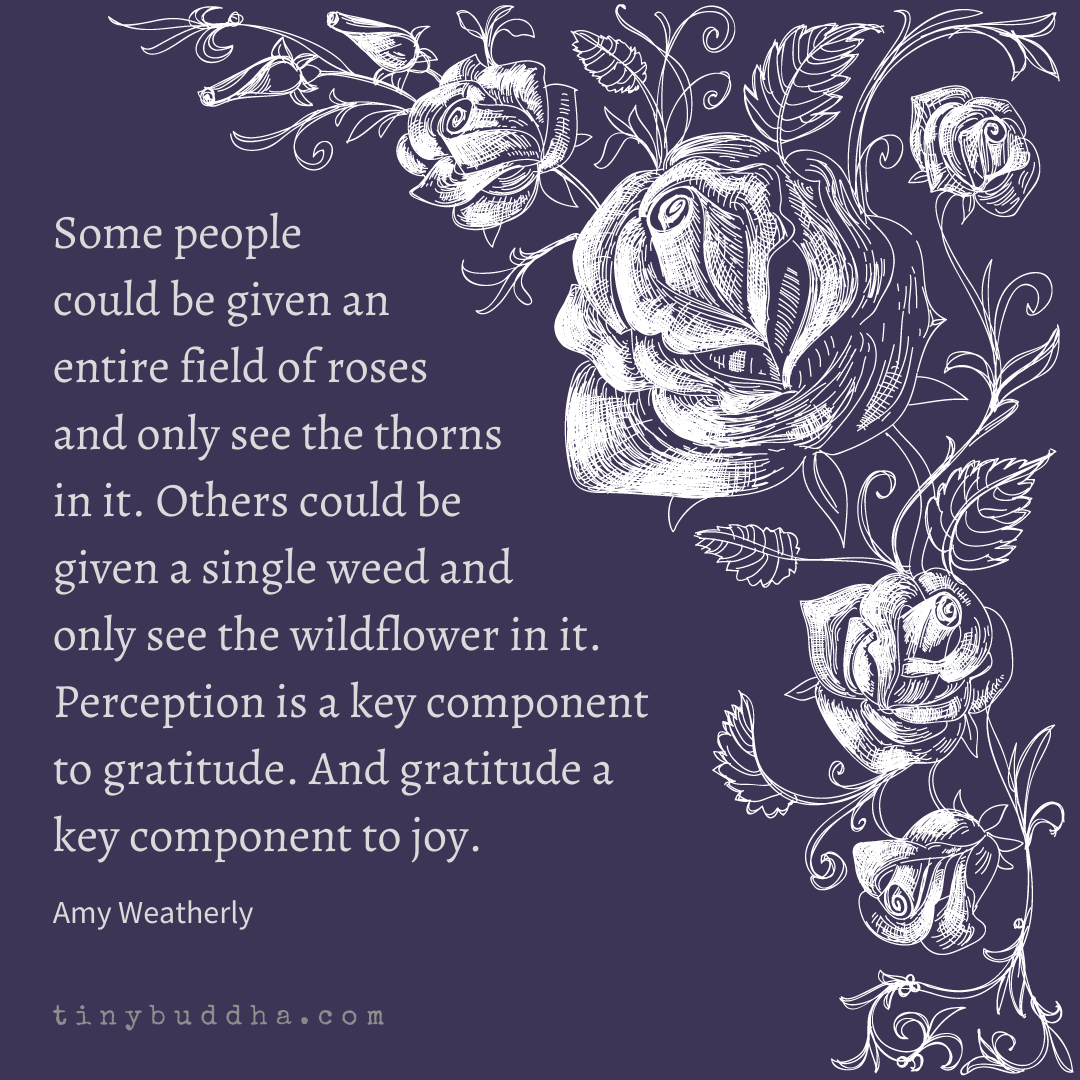
    “Some people could be given an entire field of roses and only see the thorns in it. Others could be given a single weed and only see the wildflower in it. Perception is a key component to gratitude. And gratitude a key component to joy.” ~Amy Weatherly

    I grew up in a deeply negative environment. My parents separated acrimoniously when I was seven, and they were a grim example of how not to do divorce.

    They brought out the worst in each other, and sadly, over time, they also brought out the worst in me. I was depressed as a teen, and had been conditioned to believe that my problems were an unfortunate family trait—one that I had simply to accept and live with.

    And I did, for many years. But of course, I was not happy. And yet I didn’t know enough about the world to understand that my environment and upbringing were very largely to blame.

    I now know that while genetics can account for up to around 40% of the happiness we experience, the rest is within our control.

    I’m aware of this because studies have shown it to be the case. But I know it because I’ve also lived it.

    Deciding to Change My Life

    Over the last ten years, I’ve dramatically changed my life, and I’m the most at peace I’ve ever been.

    When my eldest daughter was a baby, I finally had an important enough reason to want better. I was determined that she would grow up in a fun and positive home. And if I was going to make that a reality, I had to put in the work to make it happen.

    Plus, it had become especially vital at that time since my daughter’s difficult delivery had been traumatic and left me with extreme postnatal anxiety. I was in a very bad place, and I needed to get out of it; I needed, in fact, to get out of my own head. And I didn’t want to rely on medication for that.

    While my husband had already saved me in many ways, the rest was my responsibility—my state of mind, my outlook.

    Desperate but determined, I began an activity that, over time, changed my life.

    While I appreciate that sounds like an exaggeration, it’s really not. Because my life truly has changed. Although it also hasn’t. Allow me to explain…

    The Power of Reframing

    I inadvertently learned how to reframe, and it’s possibly the most profound skill there is for increasing happiness.

    It’s so incredibly powerful because it can change your experience of life—without changing your actual circumstances.

    Here are a few examples of how reframing helped me to feel more positive about my own life…

    A few weeks ago my dad moved, and I planned to visit with my girls during half term to take him a plant.

    We live in the UK, and while the weather is changeable, it’s usually fairly mild. But on the day it so happened to be spectacularly windy. I told my dad we’d make our way and I’d let him know if we couldn’t get there.

    We made it! And after dropping off my dad’s plant, we drove a short way to a restaurant.

    Before we’d even ordered drinks, the winds brought down a pylon and there was a power cut. The kitchen closed, and my young daughters ate crisps for lunch, and I still had to get us safely home.

    But, instead of being mad that the entire day turned into a farce (we encountered fallen trees on the way home!), I was glad I’d made the effort. Most importantly, we were safe, but also it reinforced to my dad that we cared enough to get there despite the challenges.

    Another example is that since Christmas we’ve had one illness after another in our home. First was COVID, and since then we’ve had viruses and two bouts of chicken pox.

    When my eldest succumbed to COVID, I was worried about her, but also on a practical level how I’d get my youngest daughter to school (until my husband also tested positive, at which point I was able to leave the house). The fear that had been silently there for two years had finally caught up with us, and it had the potential to be an enormous source of stress.

    But during the COVID episode—and later with chicken pox too—school mums stepped up without me even asking. I’d never really felt like I’d integrated with the school mum crowd, but as it turned out, I was wrong:

    They totally had my back.

    I felt and continue to feel so incredibly grateful not only for them, but also knowing that I have a support network I did not even realize was there.

    These are just a couple of recent examples which spring to mind, of situations that previously I probably would have experienced negatively and complained about—but I’m now able to reframe to find the silver living.

    So you see, my life is different in terms of how I experience the world, and yet it’s really the very same as it always was. But I feel vastly different.

    I feel at peace.

    And now I want to share my process so others can also learn how to do this for themselves, because it’s basically free therapy, available to everyone, that we can implement alone, and without guidance.

    But how did I do it, without professional help—and without medication?

    How to Tap Into the Benefits of Reframing

    For me, there were really three steps to my journey, which happen to work together in perfect harmony.

    1. Practicing gratitude

    First, I began writing gratitude lists.

    With no comprehension of their value—but with a deep desire to start appreciating the good things in my life, and a desperate hope it was a good starting point. Good enough to help me do better for my daughter.

    I started writing a list of the positive things that had happened each week. Not realizing that this is actually an effective therapeutic exercise, I wasn’t expecting very much to happen.

    But I knew that the fundamental change I wanted to see in my life was more positivity. So I figured the “fake it till you make it” approach might just be beneficial.

    Incredibly, it didn’t just help—it was the turning point of my life to such a degree that it now feels like before and after.

    Writing gratitude lists isn’t difficult. It can be as simple as jotting down three, or five, or ten things you’re thankful for. This can be done when you wake up, to start the day on a positive note, or at the end of each day if you prefer.

    If you have a hectic schedule and can’t find time to do this daily, just be sure to do it regularly.

    And if writing it down seems like too much effort at the end of the day, you could try saying your list of things for the day quietly and privately in your own mind.

    It doesn’t need to a formal practice; it just needs to something you do practice. Because over time, something magical happens…

    2. Positivity

    As time goes by and you continue to acknowledge the good in your life, your default mindset will begin to switch over to a more positive one.

    For me, it was like a spiritual awakening, and I like to use an analogy to describe my experience.

    The idea of rose-tinted glasses is a familiar one for most people. But sometimes they’re actually a blessing. After spending several months practicing gratitude regularly, I felt like I’d removed the only pair of glasses I’d ever known, and the world suddenly looked brighter.

    I also began to appreciate that positivity is often a self-fulfilling prophecy: the harder you look for it, the more you will find.

    And your mood tends to be reflected back to you by others, too. Just as negativity is draining, positive people energize those around them!

    I was recently waxing lyrical to somebody about the positive impacts of gratitude and reframing, but they insisted that offloading onto friends or family is necessary sometimes. I didn’t completely disagree, but I had something important to add:

    By default, increased positivity leads to a decrease in negative experiences, which in turn leads to less often feeling a need to offload. And that’s the magic of this whole concept.

    There’s one final step in my toolkit…

    3. Journaling

    Unfortunately, when you’ve grown up in a negative environment, it can be all too easy to slide back into ingrained behaviors—old habits die hard.

    For that reason, even though I feel very mentally robust these days, I know that if I stop practicing these new skills, it’s almost inevitable that I’ll return to the mindset I developed as a child. (I’ve learned this the hard way.)

    Journaling is my favorite way to stay on track and accountable, because it can easily incorporate each of the above ideas, plus so many more.

    Depending on my mood, I love journaling for its mindfulness, or state of flow, or as a creative outlet. Or all of the above!

    Essentially, these skills each feed into and reinforce one another. And together, they really are life-changing.


  • How the Deathbed Meditation Can Bring You Clarity, Purpose, and Joy

    How the Deathbed Meditation Can Bring You Clarity, Purpose, and Joy

    “Death may be the greatest of all human blessings.” ~Socrates

    There’s a lot of beauty and value in positive, light-and-love approaches to mental, emotional, and spiritual well-being.

    But I challenge you to go a little deeper and to face something we’re all going to experience eventually:

    Death.

    I know this may sound macabre, bizarre, or downright unappealing. But hear me out!

    There is a certain power and beauty in consciously visualizing and meditating on one’s death.

    What could be more awakening and more revealing than putting your current self into the perspective of your dying self—into your last few moments?

    Such a precious practice helps to bring a stunning clarity and crystalline focus to everything going on in your life.

    Indeed, what is referred to as the “deathbed meditation” helps you to:

    • Figure out what is most important to you
    • Let go of old pains and hurts
    • Focus on what brings you joy
    • Find your true life path
    • Uncover your hidden gifts

    As humans, we tend to live our lives as though they will never end. From one day to the next we live in a kind of autopilot mode where we take everything (and everyone) for granted.

    The deathbed meditation is a powerful practice you can incorporate into your life whenever you feel lost, stranded, stuck, out of focus, or simply aimless.

    My Experience With the Deathbed Meditation

    I’ve always been someone who desperately needs a strong purpose in life.

    But something happened last year that tossed me into a dark existential crisis where I questioned (1) what my place in the world really was, (2) why old wounds were rising to the surface, and (3) why I felt so lost—despite having a strong self-care and spiritual practice.

    With the advent of COVID-19 and the retriggering of old traumas, I felt empty inside.

    You know that feeling of falling and not having anything to catch you? That’s how I felt.

    Witnessing the suffering in the world and in my own circle of family members, I realized something major: “I could die tomorrow.”

    I realized this isn’t a groundbreaking thought; we all have it at some point (I know I have). But in that moment it felt like a lightbulb went off in my head—I suddenly realized that the key to finding the answers to life was to contemplate something so few people dare to approach: death.

    The answers I received from that subsequent deathbed meditation have guided my life, reawoken my purpose, and fuelled me with vision ever since.

    How to Practice the Deathbed Meditation

    Doing the deathbed meditation is an act of radical self-love. There, I said it!

    Why radical? The deathbed meditation is radical because it’s rarely mentioned or practiced by anyone (that I’m aware of) due to its intimidating nature.

    But let me assure you that the answers you can potentially find are so soul-nourishing, so meaningful, so profound, that you will be overjoyed that you courageously took this step.

    Before you embark on this inner journey, please ensure you have a neutral mind—we don’t want minds that are feeling down or frazzled or unhappy for any reason (that will bias your discoveries).

    When you’re ready, let’s begin:

    1. Focus on feeling safe and relaxed.

    Before you begin your deathbed meditation, find a space in your house that feels cozy. You might like to place a blanket over you and a pillow behind your head for extra comfort. Draw the blinds or curtains and ensure the atmosphere is dark.

    It’s important that you feel safe and relaxed so that your heart and mind can open up and gain the most from the meditation.

    Place a blindfold, sleep mask, or cloth over your eyes so that you can’t see anything. Then take some gentle, natural, grounding breaths and settle yourself.

    2. Find some funereal music (optional).

    Some people prefer their meditations to be totally silent, but if you’d like to set the mood, find some funereal music (or music that would be played at a funeral) to prepare your mind for the scene.

    Again, do whatever makes you feel most safe and comfortable. If you prefer total silence, that’s okay too.

    3. Visualize yourself on your deathbed, surrounded by loved ones.

    In your mind’s eye, imagine that you only have a few minutes (or hours) left to live. You feel comforted and at peace with your loved ones surrounding you.

    What kind of room are you in? What kind of bed or seat supports you? Focus on some kinesthetic details to help enrich the visualization.

    4. Ask yourself, “What was I most happy to have done in life?”

    Take some moments to reflect on this crucial question: What were you most happy to have done in your life? Let images and scenes play out in your mind for as long as needed.

    This powerful question will help you to hone in on what truly matters in your current life. If you’re struggling with making an important decision or finding a life direction, this simple question could be the key to unlocking deep truths residing within you.

    5. Ask yourself, “What did I regret not doing?”

    Regret is a natural part of life, yet many of us shy away from it, trying to sweep it under the rug. To avoid accumulating too much regret, ask this simple question within your deathbed meditation: What did you regret not doing?

    Let any thoughts, images, memories, or scenes run through your mind’s eye. Take special note of them.

    6. Ask yourself, “What is the most important thing in life to me, above all else?”

    Values are what guide our lives, and yet we are often totally unaware of them. By asking the question, “What is the most important thing in life to me, above all else?” we come to understand, truly understand, what we value deep down.

    Take a few moments in your deathbed meditation to contemplate this question, letting it sink into the recesses of your mind, heart, and soul. The answer you discover can have the potential of shifting, expanding, and empowering your entire life.

    7. Thank your loved ones and end the meditation.

    Once you’re done asking all or some of the above questions, smile warmly to your loved ones and thank them for their presence in your life. Then, when you’re ready, return to the room you’re in, get up very slowly, and do a big stretch.

    You might also like to drink some water to ‘emotionally digest’ your experience.

    The deathbed meditation has been one of the most powerful tools in my life for getting straight to the heart of what I most love, cherish, value, and need.

    After all, what else can put things in perspective other than our own mortality?

    If you’re feeling confused, lost, or in need of direction, I highly recommend that you try this unique meditation at least once. You might be surprised by how intensely transformational such a practice can be!

  • How I Stopped Feeling Sorry for Myself and Shifted from Victim to Survivor

    How I Stopped Feeling Sorry for Myself and Shifted from Victim to Survivor

    “When we deny our stories, they define us. When we own our stories, we get to write a brave new ending.” ~Brené Brown

    There was a time when I felt really sorry for myself. I had good reason to be. My life had been grim. There had been so much tragedy in my life from a young age. I had lost all my grandparents young, lived in a home with alcoholism and domestic abuse, and to top it all off, my dad killed himself.

    I could write you a long list of how life did me wrong. I threw myself a pity party daily in my thirties, with a load of food and wine. The story I was telling myself was that all this bad stuff had happened and I was unlucky in life and love. I told myself my life was doomed.

    I believed if there was a God, he must have hated me because everybody around me had a perfect-looking life compared to me.

    I felt like I was the only person who felt like this and couldn’t see any goodness in my life. I kept telling myself I was destined to be lonely and unfulfilled in my work life because I was just not good enough.

    I took care of others in my family to give myself purpose, but inside I loathed it. It made me bitter and resentful. I didn’t do these things because I wanted to. I did them because I felt like I had to.

    I thought this was who I was meant to be—the side act in everyone else’s story.

    My peers were moving on with their lives, getting married, having babies, and buying houses. I was stuck in my pity party, in the sadness of the past, unable to move on. I felt like I did as a child—powerless, out of control of my life, and sad.

    For as long as I could remember I felt anxiety and sadness. I would distract myself from these uncomfortable feelings with other people, TV, busyness, food, and later in life, alcohol.

    I was a victim in childhood and then I continued to live as a victim into my thirties, blaming everyone else and God for my poor start in life. I blamed myself as well. If only I was enough, then my life would better.

    There came a time when I couldn’t carry on the way I had been and had to take responsibility for my own life. My own story. It was time to get out of my own way. I was hitting rock bottom, and the time had come to either fight for my own happiness or follow the road my dad had taken.

    My life felt pointless, but I finally listened to a voice within me that told me there was a way forward and got out of my own way.

    This was the start of my spiritual and healing journey.

    It all started with a simple internet search on how to feel better—mind, body, and soul.

    Amongst the tips I found was the suggestion to practice daily gratitude. I started by writing down everything I had in that moment.

    For a long time, I focused on all I didn’t have rather than what I did. But I had so much—great friendships, travel, love, a well-paid job, a nice home, and so much more. I ignored all the good stuff and it robbed me of what I did have. The present moment. But now my eyes were opening to all the light in my life.

    I began to see and appreciate sunsets and sunrises. I looked for the good everywhere. Even in the darkness. I was searching for the light in every day. The more I looked the more I found.

    I practiced gratitude when I found new information and practices. Podcasts, books, teachers, healers, therapy, and so much more. The more I said thank you, the more good things I found.

    The story I was telling myself was changing.

    Then I added meditation and mindfulness to my daily routine and began hearing my intuition more.

    Before all I could hear was my fear, but this inner whisper was getting louder. Ideas would pop into my head like “I just don’t love myself,” and then I would see a quote from Louise Hay that resonated on social media. One led me to her book You Can Heal Your Life. I implemented the strategies in her book and then more tiny steps occurred to me in the quiet.

    I said thank you every single time. I felt more supported by myself and the universe and less like a victim in my story.

    The better I felt on the inside, the more opportunities I noticed.  I saw a job I liked advertised and rather than letting fear stop me, I listened to my intuition, which guided me “to just try.”

    In the past I would have ignored it and thought “I wish.” This time I just went for it. Just like that I left a toxic work environment for a job more aligned with my values, offering more money.

    I attracted better relationships and in time found love. After searching for more ways to feel good on the inside and change the way I saw my life and my world, I incorporated daily affirmations and walks in nature.

    My reality kept changing as I changed within.  

    Have you ever noticed how your body feels when you say, “My life is crap”? Your body contracts and you can almost feel the fear rising. But when you tell yourself, “There’s a lot of good in my life,” your body almost expands, and you can breathe.

    Our words have a profound impact on us. Changing that narrative we tell ourselves changes everything.

    The new information that I discovered through my personal quest helped me to understand my past. I found people like Gabor Maté who explained concepts such as intergenerational trauma and addiction. This information helped me change the story I told myself around my childhood. It helped me understand my trauma.

    I remember knowing from my intuition that my relationship with my dad needed my attention. Then I saw an advertisement for a new book, Father Therapy, by Doreen Virtue, which led me to inner child work. This helped me heal my younger self.

    As I continued my quest to heal and feel better, I found new healing modalities like breathwork, EFT (emotional freedom tapping technique), and eye movement techniques.

    I said thank you again and again and again.

    All those years I spent as a victim to my story kept me stuck and unable to move forward. But now I was ready to change and expressing gratitude for the process. More was always finding its way to me. I now had so many tools that I never knew existed in the depths of my pity party.

    It was not easy. I cried. Fear took over some days and I couldn’t access my intuition. But I would just start my quest again the next day, journaling to connect with myself and see what had happened the day before. What my feelings were and what I needed.

    I showed myself love and compassion for my bad days and celebrated the good ones. No longer was I a victim of childhood abuse but a powerful survivor.

    Yes, bad things happened to me. But they are not who I am; they are just part of my story. That story is what led me here, to this place where I’m now writing to you. I hope to inspire you and show you that it is possible to change your story, whatever it is; that there is so much guidance and support available to you when you are ready to find it. You really will see it everywhere when you start paying attention.

    You too will see you also have an inner voice guiding you and access to everything you need to heal. When you start recognizing all the tools available to you, you’ll feel less alone and supported on your journey.

    I no longer feel bitter about my experiences in my childhood, but proud. They made me who I am and have allowed me to help many others on their journey to heal from their past.

    I have found forgiveness, love, and compassion for the people that hurt me, like my dad, which helps me feel happier. I didn’t have to forgive him. He did awful things, but I understand now they came from his trauma. This has given me great inner peace.

    It takes courage and time to transform on the inside and become a trauma cycle breaker in your family. This means that your children will have a different experience. How amazing is that? What a great gift to give them.

    The information, tips, guidance, and light are waiting for you to discover them. You just need to take the first step and decide to become the hero of your story and find your own heart’s happiness.

  • 4 Simple, Heart-Opening Exercises to Fill You with Joy, Love, and Light

    4 Simple, Heart-Opening Exercises to Fill You with Joy, Love, and Light

    “Why are you so enchanted by this world, when a mine of gold lies within you?” ~Rumi

    Happiness, love, and joy—we spend our lives in search of them. We often look to external things to fulfill our desire to experience them. A relationship, a trip abroad, a career, or maybe that shiny new car. We can spend our lives chasing these desires and believing that once we check everything off our list of life accomplishments, we will experience them all.

    But what if I shared with you that all of this—happiness, love, and joy—exists in you right now? That you are the source, not the external items. What if I told you that living in a perpetual state of love and joy is your natural state of being?

    Would you think I’m full of BS? That I’m living in a hippie Never-Never Land?

    Please let me share with you a few simple exercises that showed me my true self.

    Exercise #1: The Love Wave

    Close your eyes and take a minute to connect in your heart with a person in your life that could use a little love. Feel yourself smiling into their eyes and embracing them in a giant, warm hug.

    Allow the love to flow. Sit in this love. Let it grow in strength and surround you both. Then send it out into the world, creating a wave of love. Know that you can come back to this place of flowing love at any time.

    Try this now and then read on.

    Hopefully, you just had a wonderful experience of love. Now I have a question for you. Where did the love originate from? The person you were thinking of, or you?

    It was from you. The person you pictured just helped you unlock the love. You are love. You can actually imagine many different things to unlock it. Try a smiling baby, or playtime with a pet, or a concept such as world peace. These things are just the keys that unlock the true love that is in your heart.

    You can access this love any time you want. You are just tapping into your true being. It is who you are.

    I like to start my day off with this exercise. I tend to do it in the peacefulness of the morning light, right after my morning meditation. Just open your front door or a window and feel the fresh air on your face, then close your eyes and start. It is a beautiful way to begin the day.

    Exercise #2: The Gift of Giving

    One day I was browsing in a bookstore when an old man approached me. He had snow white hair and was wearing a threadbare, beige sweater. He handed me a chocolate rose and said, “Have a beautiful day,” I was taken aback. Who was this man? Was he trying to poison me? Was he hitting on me? I reluctantly took the chocolate rose and said, “Thank you.”

    The clerk noticed my discomfort and told me that the man buys a dozen chocolate roses every day and hands them out to random strangers. I suddenly felt special.

    This incident happened many years ago. Even though my initial reaction was one of unease, I remember this man with fondness. When he finally passed away the entire town mourned. There was a glowing write up in the local newspaper about him. He had brightened the days of countless residents with his gift of a chocolate rose.

    I invite you to pick a day this week and give everyone you meet that day a gift. It doesn’t have to be a physical gift, though it can be. It could also be a compliment, your undivided attention, or a heartfelt smile.

    Don’t expect anything in return. Remember my reaction to the old man? You might not always be met with gratitude. Just practice the act of giving.

    At the end of the day, notice how you feel. You spent the day leaving heart prints everywhere you went. Did this bring you joy? Is the joy within you or did you take it from the people you met?

    Exercise #3: The Vulcan Mind Meld

    We all have goals and expectations. They are important. But what happens when we can’t fulfill them? If we don’t get that promotion or find our perfect mate? We can become disheartened and depressed. How do we prevent this?

    Close your eyes and imagine yourself ten years from now. Give your future self that thing you believe will bring you happiness. Maybe it’s kids, money, power, or something else entirely. Notice how you feel. You might feel confident and secure. Or perhaps loved and important. Whatever you feel, allow it to expand and grow. Sit in it. Enjoy it.

    Then, while keeping your attention on the way you feel, bring back the image of yourself today. Think about what you already have that fulfills you.

    Maybe you don’t have kids, but you have amazing friends. Maybe you wanted a better income, but you can afford things you enjoy already. Look for the abundance within you now. Keep going until your “present self” feels the same as your “future self.”

    It’s almost like a mind meld—make those two beings one. Again, sit in the wonderfulness of it all. When you are ready, open your eyes.

    Try this out before reading further.

    Do you feel happy?

    When we live our lives from a place of lack we experience suffering and discontentment. We are always searching for the external thing that will make us happy. Rather than focusing on the things you don’t have, try living from a place of fullness. You already have an abundance of things to enjoy and appreciate—you just have to change your perspective.

    All that security, love, confidence, happiness, and joy you saw in the vision of your “future self” is accessible right now. Everything you experienced is within you today. Recognizing the abundance or fullness of your life is the key to happiness. If you experience that abundance, not meeting a goal or expectation becomes a minor bump on the road.

    I refer to the belief that we need external things to be happy as “the big lie.” Because when we finally finish off our checklist of life’s “wants,” we often experience “the great disappointment.” The list doesn’t bring us the happiness we thought it would. It’s not the source. We are.

    This frequently happens when people become suddenly wealthy. They think that they will be happier. They are surprised when they aren’t. In fact, having a lot of money comes with its own set of problems.

    Exercise #4: A Gratitude Nap

    This exercise imprints you with the beauty of your life as it is now.

    Lie down and get comfortable. Use as many pillows and blankets as you like.

    Set a timer for three minutes.

    For those three minutes, state out loud things you are grateful for. It’s a bit difficult at first. Please know every item does not have to be deep. Be grateful for the couch you’re lying on, the length of your hair, sand on the beach. Anything goes.

    After the three minutes, set an intention to be open to whatever is there for you to receive. Surrender as much as you can.

    Rest for ten minutes. Notice at the end of the “nap” how you feel. I’m willing to bet you feel a lot lighter after basking in the glow of all your life’s goodness.

    We spend so much of our time dealing with the pressures of life that we forget to do the things that unlock our love and joy. Our true nature gets covered by layers of life experiences and traumas.

    There is an Ayurvedic concept that you can shine with so much light that the darkness has no place to take hold. That light is within you now. It is your true state of being. It just needs to be set free.

    Tips to help access the joy, love, and light of your true being:

    1. Start your day with the love wave exercise.
    2. Make it a priority to do one thing each day that unlocks your joy.
    3. Live life from a place of fullness and abundance rather than from a place of lack.
    4. Practice gratitude.

    I would like to thank all of my teachers who have shared these beautiful exercises with me. Please feel free to share them too.

    Namaste.

  • Mindfulness, Creativity, and Nature: A Healing Trifecta for Lasting Peace

    Mindfulness, Creativity, and Nature: A Healing Trifecta for Lasting Peace

    “It is the marriage of the soul with nature that gives birth to imagination.” ~Henry David Thoreau

    Before my accident, before we had kids, after we divorced, after my father died from Covid, before the pandemic…

    We tend to divide our lives into the before and afters that define our world, whether personally or on a grand scale. These divisions offer context, providing a kind of roadmap that supports us in reflecting on the beauty and darkness, the decisions we made, and who we might be if certain things had never occurred.

    I have always believed that the only reason to look back is to learn. Still, I can’t help but wonder: What if, when my marriage ended, I already had mindfulness skills in place? What if I had known the infinite ways nature could soothe my soul? Would my life have been different if I had consciously known that creativity was the safest place to process my emotions?

    Perhaps I would not have been paralyzed in grief and sorrow. Maybe my children would have been spared a terrible custody battle. I suppose there is a chance I would not have gone bankrupt. I wonder if I would have ever gotten divorced at all.

    Here’s the biggest question: Would I change any of it now?

    Not a chance.

    As difficult as it all was, I learned that every tool I needed to survive and thrive was right in front of me, and always will be.

    My journey led me to a path of sharing what I am most passionate about: helping others find their way, through what I called a “spiritual toolbox”—a personal supply of healthy actions and practices to choose from or combine when things become difficult.

    Your spiritual toolbox can hold things like creativity and gratitude practices, exercise, meditation, time in nature, and journaling; a hug, the love of a pet, a hot bath, and even an occasional glass of wine. It’s wonderful to open in the moment, and it’s even better to use as preventative medicine (the toolbox, not the wine).

    My “aha” spiritual-toolbox moment came when I accidently discovered the transformative power of combining three tools specifically, as a trifecta. These were: creativity, meditation, and time in nature. 

    This trifecta insight divided my life into two parts: asleep and awakened.

    The first part is quite literal: at age nineteen, I fell asleep while driving and didn’t walk for nearly a year afterward. My accident was the synopsis and ending of a carefree childhood and adolescence, where I suffered no hardship that would have “awakened” me to anything beyond plans for the next evening.

    However, while I physically woke up pinned under the tire of my car, I also woke up spiritually: I was alive, and my two best friends who were with me, were uninjured. I was officially “awake” on infinite levels, primarily to the deepest sense of gratitude. And, while I metaphorically “went to sleep” later in other areas of my life, the trifecta was always there to support my awakenings.

    From the time I could crawl, my preference was to do it outside. My imagination was my best friend, and my mother could more easily find me digging mud from the creek behind our house rather than playing next door. I made togas from my curtains, spoke in my own language, and told everyone I was “Elizabeth from another land.”

    Obviously, I had no way of knowing about the robust and ever-growing body of research indicating that artmaking and creativity have been shown to increase positive emotions, decrease depression and anxiety, reduce stress, and even boost the immune system. That art therapy could boost the memory of Alzheimer’s patients, or reduce the side-effects of chemotherapy.

    I didn’t know that indulging creatively literally creates a “cascade of endorphins, serotonin and dopamine, the brain chemicals that affect our well-being,” increasing feelings of joy and contentment.

    I hadn’t yet wrapped my head around the fact that everyone is creative, and the benefits have nothing to do with artistic skill. I simply knew that I was happiest when I was being creative, and that artmaking could pull me out of almost any funk.

    I was intuitively awakened to creativity.

    Then, at age forty, my marriage collapsed. I collapsed with it, down a slippery and medicated slope, into what was later diagnosed as “brief psychosis disorder.” I struggled with insomnia, bankruptcy, a custody battle, losing my home, and losing my business, all at once. 

    And, while I am a believer in whatever prescribed medications are necessary and helpful, mine were not properly prescribed, so my body and mind simply gave up.

    Thankfully, I had recently awakened to meditation.

    You can quote me that meditation and mindfulness are the most powerful tools you will ever discover on your path to well-being, in every single aspect of your life. The research on this topic goes back thousands of years.

    But here’s where it gets interesting: The brain responds to meditation and mindfulness in a similar way to how it responds to creativity—in both cases, external stimuli is blocked out, and the front of our brain, the prefrontal cortex, quiets down. The pre-frontal cortex, AKA the “gatekeeper,” is like a control center, and is very much involved in emotional regulation, decision making, planning and attention, and self-monitoring.

    In other words, dialing back the “gatekeeper” can free us up from planning, worry, projecting, and ruminating. Who wouldn’t feel happier as a result? 

    Armed with the foundations for my spiritual toolbox, I soldiered on, raising two boys on my own, supporting myself in various marketing and PR endeavors, discovering my inner advocate through non-profit work, writing two books, and facilitating creativity retreats. My love for the outdoors had evolved, and my first choice of exercise was hiking.

    I did not know that studies had linked time outside to reduced anxiety and depression, or even that nature inspired creativity. I had no context for nature therapy, where nature is literally characterized as a therapeutic environment.

    I hadn’t read the Time Magazine research about how spending time in nature can lower levels of cortisol, improve heart health, promote cancer-fighting cells, help with depression and anxiety, inspire awe, and increase overall well-being. All I knew was that for me, outside was better than inside.

    I had awakened to the healing powers of nature.

    I began meditating outside, tuning into the natural world. I practiced walking meditation and was awestruck by the beauty and felt sense of connectedness. I was present in a way I had never experienced.

    Before long, I began gathering materials from nature and making art with them. I realized that I was more at peace than I had ever been—and there was a definite “carry-over” of calm, peace, and joy into my overall functioning. 

    I can’t recall if I was on top of a rock in Nevada or in a California canyon, but then came the moment: It was the trifecta of nature, creativity, and mindfulness that was changing my life. When I used these tools together, my depression lifted and my fears dissolved. For the first time in a long time, I experienced hope.

    Slowly but surely, my spirit began to heal. I had a safe, accessible, and powerful way to safely process my experience, build resilience, and move forward, joyfully.

    Since that time, I have awakened to many other tools that go inside my spiritual toolbox. For now, as an emerging art therapist, meditation junkie, and nature lover, it is my honor to awaken you to simple practices that support you in the most powerful trifecta I know.

    Creating Peace on Earth

    The peace sign is a powerful symbol that is universally recognized. It connects us, consciously and unconsciously, in something positive. It’s also simple to make, right outside, on the earth, implementing the spiritual toolbox trifecta of creativity, mindfulness, and nature. Here’s how:

    Head outside alone or with a friend or loved one. Kids will also enjoy this practice!

    Breathe deeply and move more slowly than you normally would, taking in the sights, sounds, and sensations of nature. Pause and let this experience sink in.

    Let objects in nature call you: Begin gathering stones, branches, leaves, or wildflowers. Observe how each object looks, feels, and smells as you touch it with your hands. If you are with someone, share your observations with them.

    Find the right spot and create your peace symbol. This could be in your own yard or in a public place, like a park or beach, where other people can see and enjoy it.

    Have fun, indulge, and witness. No one is looking! Sink into your experiences and senses for this brief time. Take a few long, deep breaths, feeling and smelling the earth.

    Reflect on the peace symbol. What does it mean to you? What memories or sensations arise in your body as you reflect on this powerful symbol?

    Set an intention to bring forward any feelings of peace and wellness that you have experienced in this practice.

    Be patient and honor your journey. Wellness and healing are lifelong endeavors. Stepping into intentional self-care is an act of compassion, for yourself and the world.

    Be grateful. By creating “peace on earth,” you are implementing the healing trifecta while sharing a powerful message that others might see and experience on their own nature walk. You are also awakening to peace, within yourself.

  • The Two Sides of Gratitude: When It Helps Us and When It Hurts Us

    The Two Sides of Gratitude: When It Helps Us and When It Hurts Us

    “When life is sweet, say thank you and celebrate. When life is bitter, say thank you and grow.” ~Shauna Niequist

    Imagine if you had a tool that, with no effort or change on your part, could cast a glow around you, exposing hidden gems within your everyday life.

    You do! It’s called gratitude.

    It has the power to light your way through tough times. And it can multiply the good. Of the many tools I use daily, I love gratitude the most. It is so simple to implement and immediately effective. It’s a powerful way to change the world—through seeing, not doing.

    I’ve invested a lot of thought, time, and deliberate action into creating the life I want. But building a life is one thing; relishing it is another.

    Having gratitude allows me to squeeze every last bit of joy from what already exists around me and within me, creating more with no extra effort. Few things in life are simple, practical, and magical.

    Without gratitude, our tendency is to focus on what’s missing. Life is what we choose to see. Without gratitude, we might waste a lifetime searching instead of enjoying.

    Using this practice keeps me out of dark places. There are days when I find myself in an emotional fog for reasons I cannot explain. I used to dwell in those moments, or days, weighted down and powerless. Though I wanted to feel like myself again, I would retreat within rather than allow myself to engage with the world and resurface.

    Gratitude has forever changed that. I possess a knowing (stemming from a consistent gratitude practice) that gifts are all around me, and I use them like a ladder to climb out of my hole. Gratitude shows me I always have choice.

    I choose to want to feel better and then I ask for what I need—a hug, time, inspiration—and then I allow myself to move on. Spending so much time in awe and appreciation for life allows me to see beyond my temporary state. I no longer confuse my present state with my true state of being—joyful, grateful.

    Gratitude doesn’t eliminate all the icky feelings and thoughts, but it absolutely makes me more resilient. It is my springboard. Not only am I aware of my shifting mood, but I actually take the action I need to take in order to come back to my true self.

    Gratitude and I go way back. As a first generation South Asian, it was instilled in me to always see the blessings around me. My family worked hard to give me a leg-up in life: a life with love, education, and opportunity.

    Gratitude also complements my positive nature. But it took me years to realize gratitude also appealed to my younger self because I was a pleaser, a peacemaker, a don’t-rock-the-boater. It turns out gratitude was also a great tool to keep me small. I used it as a ceiling.

    As my dream job turned into a nightmare, I confused fear for gratitude. I could not bring myself to seek a solution because it felt ungrateful. I was so thankful for the opportunity that I endured a hostile work relationship with a superior that belittled and disrespected me. I am not a complainer, I told myself. This is the price I pay for my dream, I thought.

    Gratitude allowed me to settle for less.

    I have avoided conflict by exercising gratitude. In difficult situations, it gave me an out. Have you ever said or thought the following?

    “It could be worse.”

    “At least they didn’t …”

    “I’m so grateful for this job/partner/friend. Who am I to complain?”

    In all of these scenarios, I wasn’t wrong to see the upside. Things absolutely could’ve been worse. But they also could have been opportunities to practice enforcing boundaries, to see my own self-worth, and to imagine new possibilities.

    I wasn’t able to see it then, but it’s clear now. Gratefulness is a powerful tool, but it should never be a way of accepting less than we deserve. It should amplify us, not diminish us. It should be our springboard.

    Gratitude is a way for each of us to find joy, not a way to make excuses for others.

    Yes, I have a loving family, but that’s no excuse to allow or accept disrespectful behavior. Yes, I work for an amazing company, but no, I don’t have to accept a toxic work environment. Yes, I love my partner, but I am worthy of a healthy relationship and love.

    It can be so easy to slip into limiting beliefs, tricking ourselves into thinking we are grateful when we are actually unhappy. Many of us have more than we need and are aware of how many are in need in our communities, near and far. But we serve no one by making ourselves small.

    How do you know when gratitude is limiting or a springboard? Know this: More is never made from less. Putting yourself below someone won’t create lasting joy, love, peace, or happiness.

    Practicing true gratitude requires understanding that we are equals. No one is better. If you hold yourself to the same (not higher or lower) standards as someone else, then gratitude will be your springboard.

    Gratitude is also a way to find what you’re looking for within your current life. It often requires little to no change. When we’re unhappy or unfulfilled we often think we need to get rid of things, maybe start from scratch somehow.

    But the truth is, what we’re looking for is often already in our lives. We must simply possess (or practice) the ability to see it.

    Gratitude also slows things down for me which, in this day and age, is precious. Being able to identify the gifts I have means knowing what’s important to me and taking the time to cherish them. It’s the ability to find my why—why I work hard, why I sacrifice and give of myself… why I am here.

    That’s a lot to gain from one simple act of seeing. How grateful I am to gain so much from a simple practice.

  • The Science of Happiness: 9 Feel-Good Tools to Boost Your Mood

    The Science of Happiness: 9 Feel-Good Tools to Boost Your Mood

    “Remember, being happy doesn’t mean you have it all. It simply means you’re thankful for all you have.” ~Unknown

    I remember sitting on the New York City subway, tears streaming down my face, armed with valium and lithium along with other antidepressants that my psych had just prescribed.

    I was desperate, in that cave I had come to know as depression. Dark, hopeless, fearful depression. The cold metal seat of the subway made me feel raw and exposed. I couldn’t function. I couldn’t stop crying. I was panicked that I would be like this forever.

    That was an example of one time in my life. Yeah, I got over it. And there were other episodes of this beast. I gradually became sick and tired of being sick and tired.

    I remember the day. I had been in depression again, and from what seemed like nowhere I started to feel the light of gratitude. I was actually feeling grateful! And it felt so very good! I knew I could start to think and feel differently.

    Then and there I finally vowed to find out how to bring happiness into my life on a consistent basis. Sure, there would be the hard times, but my goal became to live my life in the most positive way I could. I discovered that happiness is an inside job and a process. There is a science to being happier. And I’m here to tell you, it can be done.

    Maybe you’ve never been that down. I hope not. But if you’re feeling low or blue, there is help for you.

    So let’s look at the science of happiness.

    Sonia Lyubormirsky and colleagues have discovered that we can actually raise our happiness levels. According to their research, 50% of our happiness is genetic, hardwired, we are born with a happiness set point. This might explain why your sister is always happy, while you struggle to make it through a day at times. Unfortunately, this set point cannot be changed.

    The next thing to consider: 10% of our happiness is due to life circumstances—our gender, our age, where we grew up, our occupation, significant events in our lives, whether we are married or single, etc.

    For instance, you might think that having more money or having that new car would make you happier, but it only would make you happier up to a point. Then the effect of “hedonic adaptation” takes over. That is the tendency we all have to get used to what we have, causing our happiness levels to go back to the way they were before we got that “new thing.”

    If you’re worried about survival, then having enough money would be critical. But studies show that the rich aren’t any happier than the rest of us. In fact, it’s been reported that they claim they have more headaches and worries. Again, happiness is an inside job.

    Now the good news: 40% of our happiness is left for intentional activity. This is where we have choice. We can change and manage our state of mind. This 40% is where we have control over our happiness levels. We may not be able to change our set point, but we can change our happiness levels! It’s up to us.

    There are many things we can do as intentional habits. We can practice acts of kindness, learn to forgive, connect with others, take care of our bodies (through both physical activity and meditation)—and these are just a few.

    One of the best places to start is with a daily gratitude practice. Write down three things that make you grateful daily. Choose different things each day. Write down why they make you grateful. The why is very important.

    Studies done in corporations like Google have shown this practice increases positivity levels. Make this a daily intentional practice. It may seem corny at first but, hey, science has shown that it works. Guaranteed to change your mindset.

    There is a whole science to happiness, and it consists of daily, (what I like to call), “happiness hygiene habits.” You do these things like you brush your teeth. They keep your happiness levels higher. You choose what works best for you and you make it a daily practice.

    For instance, Harvard Health Publishing has reported that moving your body, be it exercising, walking, dancing, or practicing yoga, has in most cases been as effective as an antidepressant. Low intensity exercise sustained over time spurs the release of proteins called neurotrophic or growth factors, which cause nerve cells to grow and make new connections. The improvement in brain function makes us feel better.

    Back when I was so down, I had an insight and realized that if I wanted to have better days I was going to have to do for myself. I was going to have to understand what helps me change my mindset from negative to positive.

    Happiness isn’t something you go after and then once you get it, you have it for good. It’s an ongoing process of daily maintenance using the tools that the science of happiness has uncovered. 

    Some of these tools:

    1. Setting realistic, achievable, and personally significant goals has given me a purpose.

    My goals become projects that inspire and excite me. I set intrinsic goals versus extrinsic goals. These pursuits make me happier and keep me young. I no longer set goals about money, ego, or power. I value and truly “own” my goals; they are not handed down by what society dictates or what my parents, neighbors, or anyone else externally thinks are worthy

    2. Savoring positive moments has become a real source of joy.

    When I find a sunrise with a glowing moon that is awesome, I hold onto that awe and revel in it. Catch the beauty, savor the positive.

    3. Connecting with people can make a huge difference.

    Reaching out to good friends, (even when I don’t want to) has helped me stay more connected and therefore more content.

    4. Sharing with a close friend what’s going on in my life helps to take the weight off my shoulders and I get to share my secrets.

    You’re only as sick as your secrets. Sharing is caring. Listening to good friends is just as healing.

    5. Practicing random acts of kindness (letting someone go first in a line or writing a “thank you” letter) has shown me compassion.

    These small acts get me thinking along the lines of being of service. Being of service takes the focus off of me and onto others. Where can I make a difference in someone else’s life?

    6. Increasing my spiritual connection has become a source of hope and strength.

    Through meditation, prayer, and contemplation, I have found a connection with the universal source which I tap into daily.

    7. Catching my negative self-talk has been huge in helping me to stay positive.

    Catching negative talk such as: catastrophizing (“This is terrible”), all or nothing thinking (“It always turns out like this”), negative predictions (“My finances will be in ruins”), labeling (“I’m so stupid”) and so on has been a big turnaround.

    Catching these thoughts is not always easy, but I’m on the lookout for them now. I immediately stop myself and switch the thought to a positive, more accurate statement. Our negative thoughts aren’t the truth of the situation; they’re lies and distortions the ego tells us. It’s all in how we perceive it.

    8. Paying attention to the little things helps me maintain a healthy mental space.

    Even something as simple as listening to my music and getting up and dancing will almost always lift my mood.

    9. Finally, living in the moment as much as I can, without bringing the past into it or dooming and glooming about the future has allowed me to be free of torment.

    The “now” is where true peace lies. Present moment awareness is simple but not always easy.

    So all of these actions and more can make up our 40% choice point. We can raise our state of well-being through practice of the happiness hygiene habits. Science has proven that practicing these habits has helped in raising low-level pessimists into low-level optimists.

    Hey, if I can do it, anyone can. And that means you!

  • Start Your Day Right with the Magic Morning Mindset

    Start Your Day Right with the Magic Morning Mindset

    “What nine months of attention does for an embryo forty early mornings alone will do for your gradually growing wholeness.” ~Rumi

    We would likely all agree that manicures, baths, and cozy movie nights on the couch all fall under the umbrella of self-care. But I believe that it’s time—actually, beyond time—to go deeper and re-claim what self-care truly means. It’s also time to see self-care as imperative, and to move it from the lonely bottom of our to-do list and plant it firmly at the very top.

    For me, self-care has become my fuel and my fire. When I claim time on my calendar on a regular basis for things like play, sister time, and self-reflection, I stay in connection with myself and the things I actually want to say yes and no to.

    Self-care is about clearing out the cobwebs in my mind with daily journaling and going to the gym. It’s about telling my husband, “I can’t make dinner for us tonight, my love; I need to go and have some time alone and take a bath after a long day.” And doing so without guilt.

    And the miraculous thing is, the more I claim time for myself, the more I overflow with generosity and patience for the people I love most. See how that works? The more I give to myself, the more I can give to others from a place of fullness.

    We would never dream of driving cross-country without stopping for fuel, snacks, and water—or trying to make the drive on an empty tank. Yet we seem to think that we can keep pushing through our own exhaustion without consequences.

    When I look back at my own journey from physically, emotionally, and spiritually falling apart, to reclaiming myself on all levels, I see it all began with a decision to stop caring so much about what others thought, and to make my own wellness, happiness, and voice priorities again.

    I began to notice that when I gave myself permission to speak up for myself in the moment, even as my voice was shaking, I left the conversation with a sense of wholeness, without any lingering emotions that were not honored.

    When I didn’t speak my mind, and held in my opinions and needs, I ended up at Best Buy yelling at the customer service manager because I had so much pent up sadness and anger from stuffing things down and being “nice.”

    The more I was honest with myself about my self-care needs, the more I could be myself with those around me.

    It all started over a decade ago. I had just dropped my son off at pre-school. As I sat in my car in front of the coffee shop where I had intended to work for a few hours, I found myself unable to get out of the car.

    I felt the tears start bubbling up, but they weren’t quite ready to flow yet. After all, I didn’t really have anything to cry about, did I? My son was healthy, my husband loved me, we had a steady income from his job, and I had the freedom to create a business.

    Our home was warm and furnished. We had friends and family to call on. Admittedly, my sister and mother were both thousands of miles away. And my best friends were on opposite coasts. But I’d thankfully found a few new friends to share the early motherhood journey with, and they were truly lifesavers for me. I’m sure I was that for them as well.

    Yet, there I sat in my car, stuck in a fog of confusion, unable to step inside the coffee shop. All I could think was, “Who the hell am I now? Where did the me that I knew so well go? And who the hell am I about to become?”

    That’s when the phone rang. It was my sister (i.e. divine intervention). She asked me how I was, and that’s all I needed to hear. The floodgates broke wide open and the waterfall of tears began.

    “What’s wrong??? Are you okay???” she asked.

    “Yes, no, yes… well, everyone is fine, I’m fine, it’s just…I don’t know what the hell I’m feeling… I’m just… sad.” There was some kind of relief in letting myself cry and saying it out loud. It felt like a valve that had been screwed on too tightly had suddenly been released.

    I realized during our conversation that part of me had been hiding for a while. This was the part of me that had been letting go of who I was little by little. As I became a wife, a mother, a resident of a new state, and a homeowner, the parts of me that were used to more freedom, more expression, and less constraint in speaking my truth, began to emerge. And this part of me was pissed, hurt, sad, and ready to run.

    But I knew that I couldn’t run back to who I was before I got married and became a mama. And I couldn’t run forward either because the ground in front of me had become uncertain; I didn’t know how I was going to step into all of these new roles while still maintaining a sense of myself. All of my attention was now focused on keeping another human alive, and being the wife of this man who was now my only family in this new place.

    Instead of running, I just imploded, but it happened slowly, over time, so that I hadn’t noticed.

    Over the last several years of hustling to build a business, raise a baby, and build a home, my body had taken a backseat to my brain and my to-do list. And now, at this very moment, after years of pain in my belly, and sheer exhaustion, my body was ready to be honored again.

    Back in the car, my sister asked me the one thing that would shift the trajectory of my life: She asked me if I felt like going to a yoga class. She said she remembered a time in our lives when I was shouting my enthusiasm for yoga from the rooftops. And admittedly, it had been years since I stood at the top of my mat and held my hands in front of my heart.

    After I stopped crying, I promised her I would get me to a class.

    The very next morning I was in this gorgeous azure blue and gold studio that would become my anchor over the next two years.

    I cried at some point during almost every yoga class for the next six months. And I slowly began to feel my body arrive in the moment again. I could feel the parts of myself that had been hiding begin to show up and talk to me on that mat. Each pose was slowly coaxing me back to myself, and molding me into the new self that I was becoming.

    About six months into my new yoga habit, Deborah, my powerhouse yoga teacher, offered a six-month yoga teacher training intensive. Even though I had no desire to teach yoga, I felt an instant yes in my heart and body.

    We met every other Saturday and every other Wednesday evening. This was the first time I committed to being away from my son on a regular basis. The guilt I spread on myself was thick, but I knew I had to do this. I knew it would be what I needed so that I could actually be present when I was home and give to my family in the way that they deserved.

    One of the aspects of the yoga teacher training was to commit to doing yoga every day. More specifically, every morning. As the mama of a young kiddo who was still not committing to a regular sleep schedule, my morning sleep time was not something I was willing to give up.

    But I trusted Deborah as my guide and mentor. She had taught me to connect with my body and emotions on a deeper level than I had ever considered before. Through movement, writing, and meditations, she showed me how to recognize my emotional triggers and to release my tension so that I did not hold it in my body for years to come (as I had been doing all of my life). So I begrudgingly decided that I was willing to try this morning yoga thing.

    I thought, “I could give up five minutes of sleep and start there.” And that is exactly how it all started. The magic was born in those first five minutes.

    I noticed something shifting for me during those first few days of my new morning commitment to be someone who wakes up a little earlier to move my body, meditate, and breathe.

    I noticed that my patience level with my son was expanding. I noticed that the things I had normally found frustrating became amusing. I was more peaceful during transitions, and my son began to notice as well. Even at three to four years old, he told me I looked happy. That was all the motivation I needed.

    Next, I committed to ten to fifteen minutes of this morning routine. And on days when my son woke up earlier, I began leaving out a little basket of toys and books that would occupy him while I finished. There were definitely mornings when he just needed me to hold him or cuddle. And that was just fine.

    I realized that this was truly an evolving practice and that he wouldn’t be four years old forever. There was no use in getting rigid about something that was meant to help me find more peace and joy.

    Over the next decade, my morning yoga turned into the Magic Morning Mindset because the more I practiced, the more I found that synchronicity, laughter, abundance, and much more began to arrive with ease and grace.

    I believe this is true for everyone. If you’re looking to take better care of yourself, mind, body, and spirit, the morning is where it starts.

    Whether your morning mindset practice is short or long, includes yoga or dance, includes writing for an hour or for just five minutes, there’s always a benefit beyond the morning hours.

    The way you start your day sets the tone for your day. Starting with the Magic Morning Mindset prepares you to be calmer, more joyful, more connected to yourself, and better able to voice your needs. By prioritizing self-care and putting it at the top of your to-do list, you’re telling yourself that your needs matter.

    What is My MAGIC Morning Mindset?

    M – Movement
    A – Alignment
    G – Gratitude
    I – Intuition (or Intention)
    C – Connection

    How Can You Start?

    1. First, set the intention that you want to create a three-step Magic Morning Mindset.

    2. If you have a hard time waking up, commit to going to bed a bit earlier (even fifteen to twenty minutes will make a difference)

    3. Decide what you want to do for your mind, body, and soul (you can find some ideas below).

    4. Set yourself up for success—lay out a yoga mat the night before, or have your journal and a few pens ready. (I can’t tell you how many pens I’ve gone through over the years.)

    5. Stay gentle by starting with five minutes.

    6. Notice how you feel throughout the day after doing the Magic Morning Mindset practice.

    Some Ideas To Get You Started

    Mind

    • Write down your dreams.
    • Just write without editing, even if it feels really weird and you’re writing nonsensical words. Just write.
    • Write ten to fifteen I AM statements: ex: I am committed, I am loved, I am happy, I am light.
    • Write any thoughts or ideas floating around in your mind until you feel lighter.
    • Journal about anything that comes up while doing these practices so that you can reflect on your journey as you go.

    Body

    • Put on your favorite song and dance.
    • Do three to five yoga sun salutations.
    • Stretch and move any way that feels good in your body.
    • Do some push-ups and jumping jacks until you feel warm in your body.
    • Journal about anything that comes up while doing these practices so that you can reflect on your journey as you go.

    Spirit

    • Sit quietly for three to five minutes just noticing your breath.
    • Choose a guided meditation.
    • Meditate any way that feels good to you (there are countless resources).
    • Start with even one minute of stillness and see how it feels.
    • Journal about anything that comes up while doing these practices so that you can reflect on your journey as you go.

    As with all new things in life, you may feel excited about starting your morning with some magic at first, but then find you have less time on some days than others. Over the last decade of practicing this Magic Morning Mindset, I’ve had long stretches where I’ve felt fired up and have woken up early enough to enjoy a luxurious sixty to ninety-minute morning practice. But on some days, I’ve only been able to squeeze in five to ten minutes.

    I can feel the difference in my day when I choose to invest more time in my morning. But I don’t give myself a hard time when it has to be shorter. The secret sauce is to stay open and flexible, and to take it one day at a time.

    As long as you are showing up for yourself in some meaningful way each morning, you are saying yes to your wellness and your joy, and staying connected with yourself.

    Make this practice your own and notice the changes in your day and in your life as you prioritize your own needs and get you back on the top of your to-do list.
  • How I Get Through Hard Times Using Curiosity, Compassion, and Challenge

    How I Get Through Hard Times Using Curiosity, Compassion, and Challenge

    “Sometimes the worst things that happen in our lives put us on the path to the best things that will ever happen to us.” ~Unknown

    Until I was thirty-seven, I thought I’d led a pretty charmed life: I had a supportive family and good friends, I’d done well academically, always got the jobs I’d applied for, and met and married the perfect man for me.

    In 2013, when I was thirty-five weeks pregnant with my second child, I was diagnosed with stage 3 breast cancer. My baby was induced at thirty-seven weeks, and my chemo started ten days later. In a funny way I was relieved; Okay, I thought, I’ve been seriously lucky up until now that no one has been ill in my life, so if I can survive this, then this is as bad as it gets.

    And that year was bad—moving home, caring for a toddler and a newborn, and going through aggressive cancer treatment was horrendous, but I hunkered down, tried not to think too much about it, and survived.

    In December 2014, literally as we were clinking champagne glasses to celebrate my all-clear results, my husband had a devastating call from his mum in New Zealand. She had just been diagnosed with a rare and incurable cancer. Early the following year my dad was diagnosed with stage 4 bowel cancer, and my mother-in-law died that spring.

    It was at this point I started to feel weighed down with a heaviness. This wasn’t the deal… I’d taken the cancer hit for the team, everyone else was supposed to stay well. I started to lose my trust in the world.

    My urge to control everything and everyone around me, which I now realize I have had since childhood, went into overdrive. I became fearful of change and made list upon list to organize and reorganize my life until I had anticipated everything that might go wrong and put things in place to deal with it.

    My brave dad endured a variety of invasive and aggressive treatments, but his health continued to decline. I could not control what was happening or the sense of loss and grief that at times I felt were swamping me.

    Something had to change: I started journaling, yoga, and meditation. Slowly I felt my anxiety and my panicked grip on my life begin to lessen. I looked inward and I started to notice familiar feelings and patterns, recognized myself responding to roles and labels that I no longer felt to be true.

    There were shifts; very, very small shifts, but with two small children, a husband working long hours, and a dad with rapidly declining health, even small shifts made a difference to my capacity to cope.

    Toward the middle of 2015 my husband started to get awful headaches, nausea, and dizzy spells. He was in a very stressful job, so decided to leave work at the beginning of 2016 to get his health back and decide what he really wanted to do with his life. However, in the spring of 2016 he was diagnosed with an incurable brain tumor. At that stage my children were three and five.

    The next couple of years were consumed by medical appointments for my dad and my husband, alongside the busyness that goes hand in hand with raising young children, but I continued my inner work. I examined my feelings. Was that really how I felt? Had I felt that way before? What helped then, what might help now? Is the story I’m telling myself about this true? What do I need right now?

    In spring 2018 my dad died, in spring 2019 my husband died, and in spring 2020 the UK went into its first lockdown due to Covid-19.

    Every year since 2014 I’ve said to myself, well surely the worst has happened, this year has to be better, and yet each year something else monumental and life-changing has happened. The past seven years have been relentless, and at times I have been overwhelmed by the responsibility of caring for the people I love most in the world.

    People used to hear my story open mouthed and ask, “How do you cope?” I would reply in a way designed to brush them off, remove their focus of attention, and minimize my pain by saying, “Oh well, you know, you just deal with what life throws at you.” I knew that this wasn’t true, but a flippant reply was easier than the truth. After years of continual inner work however, this is my honest reply:

    To boost your resilience, to heal, and to ultimately thrive you have to be prepared to turn over the picture-perfect patchwork quilt of your outer life that you present to the world and take a good look at the messy stiches on the underside.

    You need to be prepared to look at the messiest of those stiches and painstakingly unpick them so that you can find the knots, the tangles, and the imperfections. It’s only when you connect with your authentic self that you’re able to respond to your unique needs in times of crisis and learn what you need to do to foster your own resilience.

    The way of doing this will be different for everyone, but if I could boil it down to one pithy statement it would be to always keep in awareness the 3 C’s: curiosity, compassion, and challenge.

    Here are some ways I’ve applied this in the last seven years to help me, and perhaps these ideas might help you too.

    Allow your feelings.

    Other people are allowed to feel uncomfortable about this, but that is not your responsibility. Your responsibility is to embrace your emotions so you can process them and work through them instead of repressing, denying, or numbing them with substances and distractions.

    In my life this idea of numbing or distracting has taken shape in many ways. One is the compulsion to check my phone rather than sit with feelings of restlessness, boredom, or uncertainty. Sometimes I find myself opening my fridge or cupboard, not because I’m hungry, but because I’m anxious or agitated.

    Recently, I’ve needed to work on sitting with my feelings when I say “no” to someone and worry there will be painful repercussions if I don’t keep other people happy.

    These are all hugely uncomfortable realizations, but offer an opportunity to spot patterns—do I always reach for food after a specific event, do I always reach for my phone when I feel a certain way in my body?

    Once I’ve shown a curiosity about my choices, I can have understanding and compassion for why and challenge myself to do something else. Instead of food can I do some rounds of a breathing exercise? Instead of the phone can I practice some simple yoga poses? Can I pause before saying “yes” to something I know won’t serve me and think of the times I’ve said “no” and there haven’t been negative repercussions?

    Key questions here are: What do I really need, what am I afraid of, and how can I soothe my threat system in that moment before reacting?

    Put your needs first.
    I learned that however much I was needed by other people (and with a dying dad, a dying husband, and two small children I was needed a lot), I had to start the day knowing that at some point I was going to make time to put my needs first.
    Sometimes that was getting up early to enjoy a hot chocolate in peace, often it was taking some quiet time in nature. I joined a gym with a pool because swimming is something I find hugely supportive for my mental health, and I joined an online yoga site as I no longer had the lengthy chunks of time I needed to get to a class in person.
    Embrace ritual and routine.

    Decision fatigue contributes massively to how overwhelmed I can become; routines provide a secure framework for my family to feel supported and give me more energy for the unexpected things that life inevitably throws at me.

    My routine includes:

    • Planning my week ahead on a Sunday—I have a simple document with columns for appointments, reminders, to-do list, and well-being
    • Putting out school clothes and making lunches the night before
    • Having a grocery delivery booked in for the same day and time each week
    • Menu planning and pre-preparing simple meals for the nights of the week that I know will be busy or I am working late

    Put together a well-being toolkit.

    Explore ideas and suggestions that you might find supportive, but don’t feel beholden to it. You don’t need to use all of the tools all of the time. Learning to listen to what you need in the moment (and giving yourself permission to act on it!) is really empowering.

    My well-being toolkit includes…

    • Breathing exercises
    • Journaling
    • Yoga
    • Reading
    • Running
    • Meeting friends for tea
    • Trying out new recipes
    • Sitting still—either meditating, focusing on my breath, or just letting my mind wander

    Build a supportive team around you and know their individual strengths.

    No one person can deliver everything you need. Manage your expectations about what each treasured person can bring to your life and learn who to go to for what.

    Challenge the narratives, expectations, and labels in your life (my 3 C’s).

    Do they still serve you or feel true; where do they come from; what do you need in order to let some of them go

    There were ways I perceived myself and labels others had given me that only addressed the way I presented myself outwardly. By turning over the quilt and looking at the stiches that made up these labels with curiosity and compassion I was able to challenge them.

    For example, am I really “standoffish,” or is that just my defense against crippling social anxiety? Am I really “bossy,” or am I just frightened of how unsafe the world will feel if I lose control? Am I really “capable” or just terrified of asking for help and being rejected?

    I would never suggest this is a simple process, and reaching even a modicum of self-awareness is a daily and never-ending challenge for me. There are no black-and-white answers, so it’s important to become accepting of living in the grey area.

    Ultimately, I believe that approaching each day, every response, every feeling with curiosity invites compassion and understanding, which helps us challenge and address underlying insecurities and outdated narratives that keep us down and stuck.

    Supporting ourselves to see beyond the labels, roles, and responsibilities layered on through our lives allows for the possibility of the emergence of the authentic self.

    This is a work in progress, I am a work in progress, and always will be.

    Some days I am overwhelmed with sadness, a heavy heart, and a sense of loss; some days I awaken already infused with a sense of gratitude and joy. Every day, however, I wake up prepared to be curious and interested, to approach all interactions with myself and others with compassion, and to do what I can to challenge thoughts and beliefs that I don’t want to take into my future. I just know that next year will be a better year.