Tag: grateful

  • Being Grateful for the Ordinary: The Life We Have Is Enough

    Being Grateful for the Ordinary: The Life We Have Is Enough

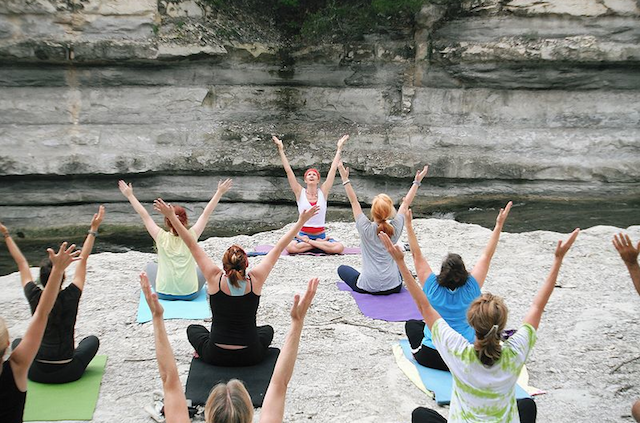
    Woman with Hands Raised

    “If we do not feel grateful for what we already have, what makes us think we’d be happy with more?” ~Unknown

    From time to time during my schooling years I’d be asked to identify my role models. I always chose someone who’d changed the world in a big way—Martin Luther King Jnr, Nelson Mandela, Mahatma Gandhi.

    I never looked within my own life for role models. I had lovely parents and great teachers, and still, I was always looking well beyond what was right in front of me. I was always striving for something more, out there, beyond my own life.

    As I reflect back, I see the dissatisfaction that this bred. I see how little I valued myself and by extension, my immediate surroundings. Somehow it all seemed… not good enough.

    People and experiences that were far away from my hometown seemed so much more important and exciting.

    It wasn’t until I started keeping a gratitude journal that this really began to change. I started the journal because I was depressed. Not sad—can’t-get-out-of-bed-or-even-talk-to-anyone depressed.

    It would hit me on and off over the years, and the only coping mechanism I had at the time was to hide in my bedroom and breathe through the long and agonizing hours, waiting for it to pass.

    A gratitude journal was the first tool I had to help me shift the fog. I would start very simply with the breath. I’d express gratitude that there was breath in my body (although at times I wasn’t even grateful for that).

    Then I’d be grateful that I had a home and a bed to rest in while I recovered. I would then build from there in an attempt to find at least five things I was grateful for that day.

    I wrote in that gratitude journal for a good couple of years before I started to see significant shifts in my perception of life. It was a slow and gradual process, but with each list I subtly turned my focus away from the world outside and toward my own life. Eventually, I turned my focus within.

    As I began to value myself and my life more deeply, I also valued those around me more. I stopped judging them or dismissing them as unimportant.

    I stopped thinking that there might be better people to be spending my time with or emulating, and I started appreciating the people who were right in front of me.

    Eventually, that brought me to appreciate my favorite role models of all time; a small handful of yoga students that I used to teach in an outdoor space by the ocean each Friday morning.

    The students were all women and they were all over the age of fifty.

    Although I’m sure they had very full lives and many reasons not to get out of their comfortable beds each Friday morning to do yoga, they would show up week after week, no matter the weather.

    Some had injuries, some were recovering from illness and some were simply not as strong as they once were. It was this fact that most impressed me. 

    When you’re young and ably bodied, it’s not overly challenging to do something like yoga. Your body is reasonably supple and your muscle tone hasn’t atrophied with the passing of time. As you age, it’s easier to find excuses—arthritis or a bad hip, the onset of an illness, or injuries in your back or knees.

    There’s a saying in yoga that the most difficult part of the practice is doing the practice. I’ve often found this to be true in my own life. It’s even more challenging when it’s dark outside and rainy and cold, and the alternative of staying in bed is right there in front of you.

    But here were these women—perfectly ordinary, everyday women—making choices that made them extraordinary.

    Every week they were the embodiment of the wisdom I’d learned through my gratitude journal; that with persistence and in small gentle steps, lives are transformed.

    Those beautiful students came every week on faith and on trust. They worked hard to build upper body strength and flexibility.

    I saw each of them giving it their all, and although I didn’t know them outside of the classroom, I knew that they understood the value of commitment, the value of continuing even when things are tough, and most of all, I knew that they were brave.

    After class I would watch them swim in the ocean (no matter the season).  They would swim and then they’d have breakfast together. Over breakfast they’d share stories about their lives.

    Watching them, I realized something else about these women. They were women who knew how to build community around them. They weren’t isolated and lonely; they were a part of something. 

    They’d found a place to come together, to connect with themselves, to connect with nature, and to connect with each other.

    In witnessing the simplicity and authenticity of this weekly ritual, I felt a deep gratitude that I’d been privileged enough to be both participant and witness.

    I realized too that my gratitude journaling days had come full circle. That gratitude was no longer something I needed to draw from the depths of my being as a means of abating depression, but was instead a living, breathing everyday experience.

    And in that moment there stopped being somewhere to go and someone to admire who was better, more accomplished, more intelligent, or more influential than me. There was, quite simply, the world and every living being within it.

    All teaching through their actions and all learning through their interactions. All role models to one another and for one another. In that moment there was no separation and no isolation. There was only oneness, and it was all home.

    Taking steps toward change can be so much simpler than we realize. We can start by noticing what’s around us and finding something to be grateful for in that.

    We can stop looking far away for role models in the recognition that we’re surrounded by teachers everyday, and they’re showing up as our friends, family members, colleagues, and neighbours.

    We can stop trying to force change to occur immediately and relax into the realization that change occurs through repetition and commitment—by continuing a practice (such as a gratitude journal) even when we’re not sure if it’s making a difference.

    And we can remind ourselves that we always have a choice. We can choose to be a victim of our life circumstances or we can choose to build on what we have right in front of us.

    My students could easily have stayed home, focusing on what their bodies could no longer do and what they felt they’d lost.

    Instead, they chose what they could do. They could show up. They could build community. And in so doing they declared in actions rather than words, “We are enough. This life is enough and we are grateful.”

    I couldn’t think of a more appropriate prayer to guide us each and every day.

    Woman with open arms image via Shutterstock
  • A Simple 5-Minute Habit That Can Make You Happier

    A Simple 5-Minute Habit That Can Make You Happier

    Smiling Woman

    “Gratitude creates joy—not vice versa.” ~Dr. Brené Brown

    To be blunt, my summer of 2013 sucked. In a matter of months, a tidal wave of stressful events happened and it completely shattered my sense of safety. I was on the verge of a serious depression.

    The summer began with a broken heart. The love of my life, the man I planned to marry, broke up with me and admitted he had wanted to leave for the past year.

    In a matter of minutes, my dreams of starting a family and living happily ever after were crushed. It caught me so off guard I could barely breathe. I quickly moved out of our New York City apartment, crashed on friends’ couches, and started hunting for a second job.

    After a month of couch surfing, I found a small studio to sublet in Brooklyn. Things were starting to look up until I severely sprained my foot two days before moving into the fifth floor walk-up building. In the city where you must walk and climb stairs to get anywhere, it royally sucked.

    The frustrations kept rolling in. My studio apartment had no air conditioning for a couple weeks, two of my credit cards were stolen, and my office job started delivering rounds of layoffs. I started having panic attacks at night and my eye was twitching non-stop.

    Things got worse when my dad got sick. He passed away in July.

    Hanging on by shreds, I turned thirty at the end of the summer. Part of me wanted to throw a tantrum, kick and scream, and give up on life. But I was so exhausted, I just felt numb. So, I busied myself with work and exercise. I’ve always been stubborn, and I refused to fall apart.

    Even though I felt lonely, broken, and disappointed, I had to wonder if the universe was up to something. As tough as it all was, I knew it was up to me to make it better, no matter how “unfair” the circumstances. If I learned one thing while living in NYC, it was 100% up to me to fix my life.

    In perfect timing, I saw a re-run of Oprah’s Lifeclass on TV in September. The episode featured a panel of experts discussing how practicing gratitude offers life-changing relief from emotional pain.

    As if someone dumped a cold glass of water over my head, the show gave me a major wake-up call. I realized I desperately needed to change my story.

    That afternoon I wrote my first daily gratitude list and promised to write ten things I was grateful for every single day moving forward.

    Each day I rode the subway to work and typed up gratitude lists on my smartphone. At first, it was difficult to force my brain to stop complaining and noticing everything that was wrong. So, I started off listing small and simple blessings like air-conditioned trains and a clean bed to sleep in every night.

    It didn’t take more than a few days to realize I was incredibly lucky. I was up to my ears in blessings.

    My gratitude practice deepened over time, with thanks for the loving support of friends, and appreciation for every single lesson I was forced to learn that summer.

    For every loss, I had a gain. I had my health, I was never hungry, and I felt stronger than ever. Those are blessings that millions of people in the world will never have.

    But here’s the part I didn’t expect. The moment I started making gratitude lists, life just got easier. As each day passed, I felt better and, dare I say, blissfully optimistic.

    It got easier to put my life back together because I knew I was surrounded by support. Instead of wallowing in what was wrong, I made the daily intention to focus on all the people who made me smile at work, to seek out new things to be grateful for, and to take comfort in simple pleasures like candles, hot baths, sunsets, healthy homemade food, and journaling.

    I started smiling and laughing again, and everyone around me noticed. The new me was grateful to be alive, unapologetic, and full of wonder about where my life was headed next.

    Bursting with positive energy, I encouraged friends to let go of their sob stories and give thanks for everything they already had. The joy I’ve experienced since starting this habit feels absolutely miraculous.

    Shawn Anchor, Research Psychologist and CEO of Good Think Inc., says that gratitude listing “rewire[s] your brain, allowing [it] to actually work more optimistically and more successfully…to retain a pattern of scanning the world, not for the negative, but for the positive first.” I couldn’t agree more.

    Our lives are typically full of expectations, but we often can’t predict how our weeks, months, or years will turn out. I’ve learned that no matter what your current circumstances are, you have the power to change your perspective.

    Gratitude listing is a simple five-minute habit anyone can adopt that has an enormous positive impact on how you view your life. It simply makes you a happier person, and happier people attract the best of everything life has to offer.

    Smiling woman image via Shutterstock

  • Creating Lasting Happiness and Filling the Void Within

    Creating Lasting Happiness and Filling the Void Within

    Happy Day

    “Happiness is not a goal. It’s a by-product of a life well lived.” ~Eleanor Roosevelt

    I don’t care what you do or what you become as long as you’re happy. Just be happy.

    This has been my mother’s well-intentioned maxim throughout my life. As much as it is an example of her unconditional love, it is also a pretty massive request if you think about it, and something I could not seem to be. Ultimately, I failed because I wasn’t happy.

    If she’d wanted me to be a brain surgeon, I could have given it a shot. I’d have known I had to study in particular subjects, gain qualifications, and be okay with looking at the insides of people’s heads. 

    There is no such clear-cut path to happiness. For me, “just being happy” was like trying to find a destination without a map or any idea of how long it was going to take. I was in a state of anxiety for years.

    I stumbled around, desperately chasing something that would make me happy. I wasn’t even sure what it was supposed to feel like. All I knew was that I felt pretty good when I took drugs, and I found passion in lots of boys.

    But nothing lasted, and I needed more and more to fill me up, forever chasing a high.

    I found complete oblivion in 2006, when I developed drug-induced psychosis. You know all those clichés about mad people who think they are Jesus reborn or that they can read your mind? Well, that was me. My mum said when they eventually found me, I smelled like cat food.

    So, after the episode subsided and the yearlong depression that followed lifted, I started researching what had happened to my brain and discovering what happiness means to me.

    For me, it’s not a buzz of excitement. That feeling is just getting what you think you want, and it never lasts. That’s not to say I now shy away from exciting experiences; I just appreciate that they are fleeting moments. And I’ve given up the obsessive chase. 

    Happiness as a By-product

    I am pretty sure happiness is a by-product of other things. Being kind, developing coping skills, persevering with the struggles of life, being grateful for what you have, being still, letting go of things out of your control, doing the next right thing.

    But the biggest discovery is that, for me, finding union with others is when I feel most spiritually awake, because we’re all alone in our heads. Emotionally identifying with another human being is when I feel happiest.

    Instead of chasing happiness in things and achievements, identify what choices make you feel good and good about yourself—and then commit to making those choices regularly.

    You Don’t Have to Renounce Material Things

    For a while I misunderstood the Buddhist idea of renunciation. I thought that in order to be free from suffering, I had to give up the superficial causes of suffering: spending money, sex, alcohol, and looking at myself in the mirror for too long.

    But the thing is, I am a sensory creature in a world full of beautiful things; why not enjoy it? These things in themselves are not bad; it’s the ideas we place on them and the attachments we have that cause the problems.

    If you expect that getting your dream job is going to fill the emptiness inside you, you’re going to run into problems sooner or later.

    Enjoy the material things, but remember that enduring happiness comes from those choices you identified before.

    Letting Go

    A lot of my discontent was due to my inability to let things go, whether that was feelings of rejection in my past or worrying about rejection happening in the future. I used to hate the phrase “let it go.” Okay, so how do you do that then? What do you do to let something go?

    What I’ve learned over the last few years is that letting go, more often than not, means doing nothing. And doing nothing is as much a choice as screaming and shouting.

    Doing nothing gives you space between how you feel and your next positive action. Living in that space means that I am no longer a slave to my emotions, or more accurately, I’m no longer scared to feel them.

    I can notice the feeling, label it, and see it for what it is—a dent to my pride, a knock to my self-esteem. And rather than immediately trying to get rid of it by blaming someone else, self-flagellating, seeking revenge, or anesthetizing with drugs, I have faith that it will go.

    No matter what we’re feeling, it always passes if we let it. So, enjoy happiness while it’s here, and know that if it’s not, so long as you’re making positive choices, it will be back again.

    Happy day image via Shutterstock

  • Wanting More Time: Have You Lived Enough?

    Wanting More Time: Have You Lived Enough?

    Woman with hourglass

    “When you arise in the morning, think of what a precious privilege it is to be alive—to breathe, to think, to enjoy, to love.” ~Marcus Aurelius

    I remember attending a lecture by the Tibetan monk Sogyam Rimpoche, author of The Tibetan Book of Living and Dying, in which, smiling all the while, he confessed, “So many people, they say, ‘I’m not afraid of death.’I tell you, they’re lying! Death? Very scary. Me? I’m very scared of death.”

    And I thought to myself, “Phew, if he’s scared, then it’s certainly okay that I’m scared too.”

    For many years after that, I carried a question around with me. “Have I lived enough yet?Without hesitation my answer was always, “No way! Not by a long shot!”

    And then I’d follow this up with all the reasons why I wasn’t yet satisfied—I hadn’t left a mark on the world, wasn’t married yet, didn’t have children, didn’t know who was going to win this season of whatever reality TV show I was following.

    Even after I had built a decent career for myself, published a book that I know helps others, got married, had two adorable sons, and found out who won that season (and many others) of various TV shows and sports, the question and its familiar response still remained. Had I lived enough yet? No!

    It suddenly dawned on me that, if I continued to think this way, I would never experience fulfillment. I’d never arrive at that mythical destination I’d set out for myself where I’d finally cease yearning for more. Especially now that I had kids, this became abundantly clear.

    I’d always want to see what came next in their lives, to witness each step upon their journey into and throughout adulthood.

    Then if they had kids, I’d want to share as much of their lives as possible too. Feeling so much love in my heart, I knew I’d never reach a place where I’d had enough. I’d always want more.

    Realizing that I was chasing what could never be caught, I stopped to pose myself a new question.

    I asked, “What do I want my last thought in this world to be?” And my answer came back as something like, “I’d want to be thinking, Ahhhhh, that was good… that was nice… that was enough…”

    This new question might not have helped me much, if I didn’t remember something else, namely, that how we live this moment is the best predictor of how we will live in the future.

    So, it then occurred to me that, if I wanted to be thinking I have lived enough in the future, then the best way to get there would be to live with that exact same thought right now.

    Immediately, I started asserting this new notion that, already, I had actually lived enough. After all, there are many humans that are not blessed with the experience of even a second day of life on earth. How greedy was I willing to be? How selfish and ungrateful?

    The deeper this pronouncement that I had lived enough sunk into me, the greater the shroud of fear surrounding death lifted.

    Whether I initially had believed this or not, I slowly grew to the place where I knew, beyond any doubt, that I had lived enough. Yes! I had already lived enough! And, just like that, all my fears vanished and I finally felt free, overflowing with a sense of appreciation and contentment.

    Ever since, I’ve been discussing this concept of “enough” with others in the throes of grief and loss.

    What I explain is that “enough” is always a value judgment, rather than something that can be quantified or measured. It’s about perspective, a determination on our part to choose gratitude for what we’ve been granted over regret for what we have lost or fears about what we might lose.

    This can be tremendously powerful, though admittedly very hard at times. Is it possible to view the death of a young child and understand that he or she lived enough?

    Can a parent suffering through such a loss perceive their abbreviated time with their son or daughter as enough?

    When a friend or parent or anyone else we care about passes away, can we experience the time we had with them as enough?

    The answer is yes. It is possible, if and when we choose to exercise our right to invoke this perspective.

    We can view whatever time we’ve been given through the continually available lens of gratitude, appreciation, celebration, and love. We can understand each moment as a gift, as “enough.”

    To be a human is little short of a miracle. In the limitlessly vast universe of atoms and particles and stars and planets, gases and quarks and molecules, stones and trees and bugs and platypuses, of all the possible manifestations of life that are possible, we have been given the rarest of privileges of experiencing what it is like to be human. That’s cool!

    Just by being here, we’ve already beaten the odds, no matter how many more minutes of this miracle we get to experience.

    We know when we lived enough by knowing this right now, during this and all future moments, even while we crave to drink in as much as life continues to offer us. We appreciate that no more is needed.

    We’re thankful and, from the wisdom of this thankfulness, we smile, at ourselves and all around us. We’ve already lived enough—and that’s a beautiful thing.

    Woman with hourglass image via Shutterstock

  • More Is Not Always Better: Being Grateful for What Is

    More Is Not Always Better: Being Grateful for What Is

    Gratitude

    “It is not joy that makes us grateful. It is gratitude that makes us joyful.” ~David Rast

    Every New Years Eve I make a list of resolutions that I never keep up with and it just makes me feel guilty every time I don’t. Lose ten pounds, get more involved, go to the gym, develop better relationships.

    Every year I aspire to be more, do more, get more, never living within the present moment.

    My stress to do more comes into play in every aspect of my life. The stress of joining more clubs comes from the competitive environment of school. I am in constant stream of uncertainty. How do I find the balance, solitude, and the calmness in life? 

    I traveled to Puerto Rico with my family for last Christmas. I found that I had been thinking about the semester that lied ahead and what I was going to do to rise above my peers, although I was already involved in four different student organizations and was doing great in school.

    As I sat on the beach, in paradise, on New Year’s Eve, I couldn’t help it. I was starting to form the list I had visited and revisited year after year.

    This was the first time I had spent New Year’s with my family in a while. 

    We enjoyed a fancy dinner of steak and wine and fine desserts, the conversation poured openly as the four of us enjoyed each other’s company. I had missed these times as I was away at college and these moments became few and far between.

    We decided to skip the fancy party the resort provided and went back to our room instead. We watched from our balcony all of the guests in fancy dresses, possibly pretending to have more fun then they actually were having.

    They snapped pictures for Facebook and Instagram, showing everyone at home what they were missing. I asked myself, “What is this all about?” 

    As the thought danced around my head, there came the countdown until the New Year. Ten… nine… eight… I looked around at my family and everything I needed was right there.

    Seven… six… five… I didn’t need to add more to my resume, I didn’t have to join more clubs, I didn’t need to stress about what the future may hold.

    Four… three… two… It finally hit me all I needed was one One thing on my list: to be grateful. 

    Fireworks started to go off over the water. As I looked around at my family and we wished each other a Happy New Year, colors collided and clashed in the sky, the crackles and booming shaking my light heart.

    We are told about appreciating the moment and being truly grateful, I have read countless books about it; however, I never fully grasped it until this very moment. It authenticated what it really meant.

    I was overcome with a sense of comfort and gratitude for everything I had been given in the past year. I had overcome a rough time and I had not allowed myself congratulations for that.

    I had not been able to see clearly all of the things I had been blessed with, like my wonderful family, my great friends I had made at school and the friendships I had kept from home, and especially my health, which had not been the greatest the previous year.

    That is when I made this promise to myself.

    As I watched the fireworks and looked at the loving faces around me, I remembered that in one the books that had changed my life the past summer, it was suggested to practice gratitude every day.

    Make a jar and put one thing you are grateful for in it every night before you go to sleep. That is what I did when I got home; I painted my gratitude jar, along with one for each member of my family.

    Every night I scribble down something I am most grateful for. Sometimes I am grateful for time spent with family, other times I am grateful for my extra ten minutes of sleep in the morning, and sometimes I am grateful for a night out with friends.

    We have so much to be grateful for and so much to honor within ourselves. We just need to take the time to do so.

    Photo by Yoga4Love

  • 60 Things to Be Grateful For In Life

    60 Things to Be Grateful For In Life

    “We often take for granted the very things that most deserve our gratitude.” ~Cynthia Ozick

    How often do you pause to appreciate what you have in life?

    When I was young, I took things for granted. I believe many other kids did so, as well. After all, we were young and we didn’t know what life could be like on the other side.

    One thing we took for granted was education. In my country, it’s compulsory for all kids to go to school, so it was a given. We never thought about how lucky we were to be educated.

    We also took our teachers for granted. We never thought about how lucky we were to have teachers who cared for our growth so much, and poured their heart and soul into their lessons.

    Then slowly as I grew up, I began to appreciate things around me more. As I saw more and more of the world out there, I realized all the things I’d been given are not rights, but privileges.

    I realized that being literate is a not a right, but a gift. I realized there is a lot of war and violence in the world, and I’m lucky to live in a country where it’s safe and peaceful. I realized there are people out there who don’t have their five senses, and to have mine is a gift. (more…)

  • How Gratitude Can Calm Your Nerves and Make You More Effective

    How Gratitude Can Calm Your Nerves and Make You More Effective

    Calm

    “Gratitude is not only the greatest of virtues, but the parent of all others.” ~Cicero

    Being grateful or practicing gratitude has many benefits, including improving our health, relationships, careers, sleep, and self-esteem, to name just a few.

    In recent years, these benefits have been confirmed in scientific studies showing how the brain is “rewired” by continuous grateful thoughts.

    However, I recently discovered (and experienced) another significant, and I believe mainly overlooked, benefit of being grateful—in the somewhat unusual setting of a major seniors championship tennis tournament I played in Palm Springs this past January. I learned that:

    Practicing Gratitude Calms the Nerves and Mind

    As an avid tennis player, I had struggled to play up to my ability in tournament match play. I was constantly over-thinking, too cautious, and too tight during matches.

    Before playing in the tournament I read about a mental strategy recommended by sports psychologist Jeff Greenwald in his insightful book The Best Tennis of Your Life:

    Play with gratitude.

    Feeling there was nothing to lose, I decided to give it a try. Before my first match, I thought to myself how grateful I was that:

    I was able to play without injuries.

    I could play in such a magnificent setting at the historical Palm Springs Tennis Club. 

    I could afford to take time off from work and treat myself to so much fun.

    I repeated these blessings throughout the match, was calm and focused, and won.

    My next match was against a player that had soundly defeated me the year before. I repeated the above blessings and added one more:

    I am grateful to have the opportunity to play the same person again to see if my game has improved.

    I played the best tennis of my life and won in two sets—and again was calm and focused throughout.

    Hmm, I’m now thinking there must be something to this “being grateful reduces-the nerves-and-calms-the-mind” thing. Next match: I played another (and seeded) player who also had soundly beat me the year before.

    I again won in two sets.

    I’m now in the semi-finals against the #1 seeded player, a former national champion. I’m not only grateful for this, but I have been playing at a whole new level and having the tennis time of my life.

    I lost in two hard fought sets, but not because I was nervous or uptight. To the contrary, I played extremely well. I lost because I played a more highly skilled and experienced player who, incidentally, shared with me after the match that he was grateful that he could still play so well in his seventies! (I think he was more grateful than me!)

    Upon reflection, it occurred to me that what applies to sports and performance, probably applies equally to most life arenas. Which is to say:

    There is a powerful synergy between being grateful and calmness and serenity.

    I soon had the opportunity to prove this to myself again, but in an entirely different setting—a courtroom. In April, I was in traffic court for a trial to fight a ticket that I felt I had wrongly received.

    While waiting in court, I was nervous as heck as I repeatedly went over in my mind what I would say, what the officer would likely say, and how the judge might rule.

    Then an amazing thing happened. I reminded myself to be grateful—yes, grateful. Specifically, I was grateful that I had the opportunity to be heard and present my case, something I was clearly unable to do at the time the officer issued the citation.

    I was also grateful that I lived in a country where I could seek justice without a lot of constraints. With those thoughts, my nerves immediately subsided and I became very calm and grounded.

    A short while later, my ticket was dismissed!

    The Non-Science of Why Gratitude Leads to Greater Calmness and Serenity

    I have no doubt that being grateful stimulates the brain’s neurons and in effect re-wires the brain to produce a more happier state of being. I believe, however, there are more basic reasons why gratitude bestows upon us a more calm and serene state of mind. For example, being grateful:

    • Redirects our focus from what is troubling or worrying us to what lifts our spirit. We shift from negative to positive thinking, and energy.
    • Provides us with a true perspective of what’s at stake (including “how important is it?”)
    • Reduces our anxiety creating fears.

    Test the Gratitude/Calmness Dynamic

    I encourage you to see if the gratitude/calmness dynamic works for you as it does for me. For example, consider trying it when:

    • You have to give an important talk or presentation
    • You have a job interview
    • You have to take an important test
    • You have to perform or go on stage
    • You have writer’s block

    • You keep procrastinating in completing an important task

    Bottom line, there is no shortage of opportunities where you can test this powerful dynamic!

    Please write and let me and others know how it worked for you. Were you less tense? More grounded? What was the final outcome?

    Photo by Giuseppe Chirico

  • 3 Things You Can Do To Feel Happier, Right Now

    3 Things You Can Do To Feel Happier, Right Now

    Happy Guy

    “The place to be happy is here. The time to be happy is now.” ~Robert G. Ingersoll

    In The Four Noble Truths, the Dalai Lama wrote, “It is a fact—a natural fact of life—that each one of us has an innate desire to seek happiness and to overcome suffering.”

    Regardless of religion or creed or upbringing, I think we can all agree on this most universal of statements. Underneath whatever personalities we project and whatever lives we lead lies a foundational truth that applies to all of us: We want to be happy; we don’t want to suffer.

    So what can we do now, today, to feel happier? Before I describe specific practices, let me explain how I view change and self-improvement. As the old saying goes, there are two sides to a coin, and this positive-negative duality applies just as much here.

    For example, “we want to be happy” is the positive side of the statement above, or what to do, and “we don’t want to suffer” is the negative, or what not to do.

    Any challenge, whether it’s becoming a happier you or dropping a bad habit, gets much easier and gives more lasting results if you focus on the positive aspect of the situation (what you should do) as opposed to the negative (what you shouldn’t do).

    Focusing on the positive creates a set of habits that ultimately lead to a better lifestyle, built by you and around your goals.

    The negative path enforces rules and boundaries that ultimately lead to internal mental resistance and a diminished self-esteem. This realization made all the difference in my pursuit of happiness.

    What You Can Do Today

    Before this insight, I would spend my days trying to figure out what situations to avoid, what habits to control, where to go or whom to see for happiness. After the shift in my thinking, I began asking myself what I should do specifically to live a happier life.

    Much trial and error, many years, and many books later, I uncovered three main conditions under which a person feels truly happy: appreciation of the present moment, hope of future achievement, and service to others.

    These conditions are quite different and imply, in my opinion, different forms of happiness. Some individuals will naturally gravitate toward one or two out of three, or even just one. That’s normal.

    If you can handle all three, go for it. If not, don’t worry. Alone or combined, they all make for a dramatic improvement in quality of life and awaken a happier you.

    1. Appreciation of the present moment

    At its highest level, this means to become intensely focused on the present and, in some cases, to suspend time entirely. If you can do this, great. But not all of us are masters at entering the now. For most of us, leading a lifestyle of gratitude is the best and most practical way to cultivate appreciation for the present moment.

    A fail-proof technique I found was to reflect at the end of each day and express written gratitude for one to three things, events, or whatever I felt grateful for.

    Doing this daily brings about a shift in mentality from “what’s lacking in my life?” to “what is here before me now?” until being grateful eventually becomes second nature. If on certain days you truly can’t find anything worth being grateful for, don’t force yourself.

    That said, there is no shortage of things for which we can be grateful. At the very least you can breathe, and you likely have somewhere to sleep, can see and read this article, and have food to sustain you. Those are all things to be grateful for. Imagine life without them.

    2. Hope of future achievement

    The second condition, hope for future achievement, implies a different, more worldly sort of happiness. This does not always mean monetary gain, although that is usually a product of achievements such as business expansion, securing a job, or earning a promotion. This type of success, within reason, is normal. Our biological need to survive compels us to pursue it.

    But achievement comes in many other forms. It can mean physical feats such as finishing a triathlon, or a personal journey of self-enlightenment, or even little things like becoming more organized and driven.

    All of these endeavors give us end goals to surpass and offer us the promise of due reward should we succeed. This promise is what instills us with a sense of happiness. That’s why dreamers and optimists are often happier than realists. They believe in the promise of a better future.

    I found that daily visualization is a great way to nurture hope for future achievement. Think about a goal you genuinely want to achieve and put it in writing. Then twice daily, visualize yourself experiencing the success associated with whatever achievement you’re focused on. You don’t have to know how you will arrive at the end destination. Just imagine the end destination.

    For me, that means visualizing the day I open my own holistic self-development studio, or the day I sign the contract for publication of my first novel.

    For a detailed look at how and why this technique works, I suggest reading Psycho-Cybernetics by Dr. Maxwell Maltz. But in short, visualization communicates your inner desire to your subconscious mind. Over time, you become what you consistently imagine yourself to be, and you achieve what you consistently imagine yourself achieving.

    3. Service to others

    The third condition, service to others, is what helped me the most. I always knew myself to be a talented and capable person. But time and experience showed me that talent and capacity alone aren’t enough for a happy life.

    I felt like my connection with others lacked strength and authenticity, almost as though I lived at an arm’s length from society. This, I believe, held me back more than anything.
    Service to others changed all of that. Make a conscious attempt each day, as I did, to do one kind thing for someone without telling anyone about it, ever. I highly recommend trying this for at least twenty-one days. It changes your perspective on the profound interconnectedness of all beings and all things.

    It teaches you first and foremost to give without expecting anything in return, to do for the sake of doing and not for the recognition.

    Not telling others about your acts of kindness also builds discipline and becomes a secret between you and yourself, something to be proud of. Third, it teaches you that bringing happiness to others does more for your own happiness than any worldly escape or distraction.

    Start Now

    Do not wait for happiness. Start now. It is within your grasp and you deserve it. It doesn’t have to be elusive. Look for it in the simpler things in life. Express gratitude for something. Visualize success and a better you. Render an act of kindness and keep it to yourself. Implement these practices in your life to feel happier, right now.

    Photo by David Robert Bilwas

  • Reclaim Your Power: Stop Waiting for Other People to Make You Happy

    Reclaim Your Power: Stop Waiting for Other People to Make You Happy

    Happy and Free

    “You alone are enough. You have nothing to prove to anyone.” ~Maya Angelou

    My knees hit the pavement, unable to hold me up as I watched my entire life purpose drive away.

    I had put my entire heart and soul into that relationship. I had sacrificed everything—my family, my friends, my career, my hobbies. And now I had nothing. What had gone wrong?

    I lay there for a while, quite convinced that the pain and unhappiness was going to be the end of me. I wallowed in the misery of it all.

    Then something touched my face. I brushed it away and opened my eyes.

    A breeze had shaken loose dozens of leaves from the autumn tree above me. Scarlet and gold and sunset orange leaves were drifting down to me. Beyond them was the periwinkle blue sky with gigantic fluffy white clouds floating about.

    I stared at the beauty around me. I had spent so long looking inward, criticizing myself, working to become better, to become enough for a person that had their own issues. And in doing so I had lost sight of just what a beautiful and amazing place the world could be.

    Putting my life on hold for others wasn’t getting me anywhere. I was miserable, I was broke, and I was alone. Enough was enough.

    Something was going to change, and in that moment I determined that what needed to change was me.

    I was no longer going to shut myself away from the world. I was no longer going to ignore all the good things that were out there. From now on I would live a life of open eyes, a life of appreciation, a life of simplicity, a life of happiness.

    In the following months I learned more about myself than I had in my entire lifetime, and in applying those lessons to my everyday life I became truly happy and deeply appreciative of the world around me. I also discovered the strength of the power within me.

    Here is what I have learned:

    No one will ever love you as much as you can love yourself.

    If all you want is to be loved, you need to understand that no one will ever fulfill that feeling as much as if you wholly and completely loved yourself. Many of us have grown up with movies like Jerry Maguire that promise a perfect person who will complete you.

    It may seem radical, but what if that person was you? What if you acted as your own true love? Choose love for yourself over the fear of being alone and realize your own power.

    No one is worth sacrificing your values for.

    We all sacrifice a certain part of ourselves for others, whether it’s deciding not to get a cat because your significant other is allergic, or getting up early every Saturday to drive your child to football practice. These sacrifices are a way of showing we care about another person’s happiness and well-being.

    But anyone who cares about your own happiness and well-being with never ever want you to sacrifice your values. Our values are what define us as human beings. To deny them is to deny our very essence. Stay true to them and to yourself.

    There is always something to be grateful for.

    Just as in my darkest moment I saw how truly beautiful this world could be, so can you find something to appreciate.

    Take time out every day to witness the wonders that exist not just around you but within you. From the way your body allows you to run and jump and dance and sing, to the sunshine and fresh fruit on a summer’s day.

    If you take the time to notice it, life is really very wonderful.

    Spending time alone doesn’t mean you have to be lonely or bored.

    When you spend time alone you learn more about yourself than you ever could in a crowded room.

    By being alone you can determine your own likes and needs without any external influences. You can discover passions you never knew existed, and when you don’t have to worry about what other people will think you are able to pursue them wholeheartedly.

    There is always something new waiting to be discovered. Seek it out and become your own best friend.

    When you say no, you open yourself up to more meaningful yeses.

    By being a people pleaser and saying yes to every opportunity that crossed your path, you may have thought you were doing yourself a favor—that people would appreciate you more. But without creating boundaries, you give people an opening to take advantage of your generous nature, and risk becoming burnt out and resentful.

    Instead, learn the power of no. Take time out for yourself so that when you do say yes, it’s sincere and meaningful.

    Change and grow a little each day.

    No matter how much you feel you’ve lost yourself, you can always instigate change and rediscover who you truly are. It’s okay to start small. Try a new hobby, go on a holiday, do something you’ve always wanted to try. Expand gradually. Learn a little more each day.

    By putting yourself first you can discover who you truly are and form an identity separate from any other person and unique to you.

    By forming a loving, happy, confident base to work with, you teach others to respect you as a person. When you become a whole and complete individual it doesn’t matter what storms appear in your horizon; you will have the strength to weather them.

    Photo by blob-fish

  • A Simple Way to Make the World a Little Better Every Day

    A Simple Way to Make the World a Little Better Every Day

    Giving

    “Too often we underestimate the power of a touch, a smile, a kind word, a listening ear, an honest compliment, or the smallest act of caring, all of which have the potential to turn a life around.” ~Leo Buscaglia

    When I was seventeen years old, I decided to make a change.

    Instead of keeping my opinions to myself, I was going to start sharing them.

    Every time I had a kind thought about someone, I was going to tell them. And anytime I heard a compliment about someone who wasn’t in the room, I would let them know.

    If I loved someone’s outfit in the grocery store, I was going to say so. When my sister did something brave, I would tell her. When I felt a rush of affection for my best friend, I’d voice it. And when someone called a colleague brilliant, I would shoot them a note.

    This was something new for me. For whatever reason, I usually kept my nice thoughts to myself. I wasn’t in the habit of doling out compliments.

    And, yet, when I got a random compliment, it changed the shape of my entire day, sometimes my entire week.

    And so, at seventeen, I decided to change.

    It sounds like a pretty simple change to make in your day-to-day life, but even simple changes can be hard. Because so much of what we do is habit. If we’ve been keeping our thoughts to ourselves for twenty or thirty or even just seventeen years, it can be tough to start speaking up.

    But when you do make a commitment to make a small change like that, it can have a massive ripple effect. It can change your relationships. It can change your perspective. It can change the course of a life.

    And boy did it.

    The first time I complimented a stranger, he fell in love with me. Other times, I earned smiles, thoughtful pauses, and quiet, sincere thank-yous.

    But the most powerful change I saw was in the ripple effect that my decision had on those around me. In particular: on two girls that I met on my trip to Costa Rica later that year.

    It was a volunteer trip for teenagers and I was what they called a MAG Leader—a sort of camp counselor who roomed with and took responsibility for the wellbeing of five girls.

    Two of my five girls did not get along. They barely spoke, and when they did it was to antagonize the other. One girl made physical threats. Both did a lot of talking behind each other’s backs—until I introduced my compliment commitment to the group.

    I sat the girls in a circle and handed out index cards. Each index card had one of our names written on the front. And I told the girls that we were going to take a few minutes to pass around these cards.

    On each card, they should write one thing they really admired about the person whose name was on the card. One sincere compliment.

    Afterward, each girl got the card with her name on it.

    At the end of the few minutes we spent with these index cards, the two teenaged enemies were shocked to discover that the other person had something really insightful to put on their card. One girl commented on the strength and confidence of the other. The second girl admired the poise of the first.

    Suddenly and without meaning to, these girls respected each other. Suddenly, they each had something positive to say about the other.

    They never became best friends. But the bad-mouthing and the threats and the antagonism just melted away. A grudging respect and even courtesy took their place.

    This is when I really understood the power of compliments. The power of saying the kind things we think.

    It doesn’t take that much effort. You don’t have to manufacture a compliment for every person that passes by. But by simply voicing the nice thoughts that go through all our heads on a daily basis—“I love your sweater,” “What a beautiful smile,” “You’re so brave,” “I’m so glad we’re friends”—we can make the world just a little bit better every day.

    Photo by Kate Ter Haar

  • Happiness Doesn’t Make Us Grateful; Gratitude Makes Us Happy

    Happiness Doesn’t Make Us Grateful; Gratitude Makes Us Happy

    Thankful

    “In daily life we must see that it is not happiness that makes us grateful, but gratefulness that makes us happy.” ~Brother David Steindl-Rast

    A few years ago, my life was chaotic. I drank too much, slept too little, and always went with the flow. I didn’t look out for myself emotionally and physically. I burned the candle at both ends and eventually wore myself out.

    I often felt depressed. After my parents’ divorce when I was 18, I lost the closeness I used to feel with my family. My entire focus was on what I didn’t have anymore.

    I was in a never ending loop of feeling depressed, turning to alcohol, disappointing the people closest to me, then feeling more depressed. I had envisioned that I would grow up and my parents would still be a part of my life, but instead I felt like everyone was going their separate ways.

    My dreams of my parents being there for my future wedding were dashed. Celebratory events in my life would never include both of my parents. I was frustrated. It was draining and costly to my soul.

    I wasn’t aware of it then, but I also carried around so many regrets and resentment from childhood. When I was 7 years old, a stranger abused me during a field trip with my ballet troupe.

    The shame and confusion I felt from this experience followed me like a dark cloud. I regretted being too scared to tell anyone. I think in some ways I resented the fact that no one was able to help me.

    When my parents divorced I felt abandoned and it brought back a lot of those terrible feelings. It was like I was slowly imploding. I thought about the past and talked about the past while completely missing the present.

    After years of letting this build up inside me, it finally hit a breaking point. The hurt I was causing myself and family had boiled over. Something had to change.

    I was diagnosed with breast cancer in 2011. The world as I knew it came crashing down.  When you’re told you have a life-threatening illness it’s interesting how quickly everything else falls to the side. Time stands still and the past disappears. All you have is now.

    Being thrust into the present I no longer had time for resentments or any negativity at all. I needed all of my energy to fight for my life. Everything I carried with me for so long seemed insignificant to the battle I was about to face.

    Treatment for cancer can have a way of de-humanizing you, at least at first. It strips you down to your basic core self. I felt like a child most of the time. I was completely dependent on my doctors.

    It was like I was scrambling around in the dark, reaching for a hand to pull me out. I was vulnerable and had zero control over the outcome.

    I think sometimes in life we walk around with the illusion we’re in control. To some degree we are, but when faced with an illness you can very quickly be brought to your knees.

    We have a tendency to take life for granted. We just assume we’ll wake up everyday and be healthy. I got so comfortable with the day to day of my life that I forgot what a gift it actually is. It took almost losing that gift for me to finally open my eyes.

    Toward the end of treatment I felt reborn. All of the negative feelings I had about my parents’ divorce faded away. I was finally able to just let it go. My spirit felt calm. I felt optimistic about life again. My spirituality was soaring at heights I had never experienced before.

    Through sickness I found myself. I discovered who I really am and what I’m really about.  I was flooded with forgiveness toward my parents and I was ready to ask for forgiveness for all my crazy behavior.

    During the course of cancer treatment I was able to mend and rebuild my relationship with my parents. I now have happiness that I only dreamed of before. I realize now how much time I wasted being unhappy and I’ll never do it again.

    I wake up every morning grateful to have another day, to have another chance at this wonderful experience called life.

    I make it a priority to eat well and exercise. I rarely drink. I have a disciplined sleep schedule. I go to great lengths to take care of myself on an emotional level, everyday. My body really held up for me during treatment and now I’m paying it forward!

    Recovery from cancer has not always been an easy road. I won’t pretend there aren’t any bumps. My new outlook on life doesn’t allow me to wallow in it; instead, I count all my blessings and keep pushing forward.

    I feel like I turned the most negative experience of my life into a positive experience by taking the lessons I learned while sick and really making the necessary changes in my life. I’m thankful to be given a second chance.

    And, the life I had envisioned for myself? This is what I figured out. I don’t have to hang on so tight for something that isn’t working.

    By letting go of the one that wasn’t working, I naturally created a new vision. This is one of the most freeing things I have ever done for myself. My new vision is attainable, my new vision is already happening. I’m living it now.

    Instead of focusing on what isn’t working in your life, give some love and attention to the things that are. Take a mental inventory each morning of all the things to be grateful for.

    You will soon notice the negative way of thinking will begin to shift and you’ll be able to experience the happiness that is waiting for you.

    Photo by Zaiq Ali

  • Love What’s Right Before You Instead of Hating What’s Missing

    Love What’s Right Before You Instead of Hating What’s Missing

    Friends Jumping

    “I have learned that to be with those I like is enough.” ~Walt Whitman

    I take stuff for granted. I suspect you take stuff for granted.

    It’s almost as if it can’t be helped. When things—family, friends, health, amenities, or money—occupy a place in our lives for years, we naturally begin to view them as commonplace; we assume they’ll forever be, just as they’ve always been.

    Yet this mindset—this “Oh, of course that’s there; that’s always been there” perspective—often seems to prevent us from realizing how much it would mean to us if that something wasn’t there anymore.

    Hello, Asia

    In August of 2013, I moved to Busan, South Korea to teach English for a year to a bunch of elementary school kids (lovable rascals, these kids). Three months later, I can tell you that this experience has been everything I imagined and about 10,000 things I didn’t.

    For a while it was similar to what I’d envisioned—like freefalling through some sort of mythical dreamscape. Everything new and interesting, bright and foreign, so much happening, so much to learn, so much to take in. It was experiential overload, at once intimidating and blissful.

    After a few weeks, though, the feelings of novelty and adventure began to wane slightly; a discord had been created.

    My romanticized visions of my new home were coming into conflict with a feeling I’m sure most of you know very well—the slog of routine, the all-too-familiar, the grind. 

    What happens is this: you begin to get used to the new country; it loses a certain sparkle. You start to notice its flaws, its funny odors, its unsexy idiosyncrasies. You realize that a full-time job in a foreign land is still a full-time job, except 95% of the people around you don’t speak your language.

    You realize, “Wow, I’m going to be gone for a while—a whole year! And I’m going to see exactly zero people I know. Nada. None. For 12 months. Oh.” In terms of culture shock, you’re experiencing the end of what’s known as “The Honeymoon Phase.”

    I had read about these things. I thought I understood that they were going to happen. I thought I knew how long a year was. I thought I knew what I was getting myself into.

    I didn’t. Not really, at least. Turns out it was near-impossible to know what an enormous decision it was to move to a foreign country until I was two months in and questioning what in God’s name I was doing here.

    Lonely? Me?

    As someone who usually enjoys solitude, I’ve been surprised at how lonely I’ve felt at times. You discover a special kind of alienation when you’re in a city of five million people and can’t communicate with anyone. It’s easy to dissociate yourself from your surroundings.

    You start talking to yourself. You feel like you don’t exist. You end up shouting to the music in your headphones (“People will know that I’m here!!”) while walking down the sidewalk as you’re drenched head-to-toe and getting wetter by the second because, as you just found out, there are typhoons here. (Okay, maybe that was just me).

    It’s during those periods that you realize you’d trade your big toe for a few days at home with the people you’ve known for years. To do nothing but laugh a few hours away with those irreplaceable personalities whom you know about as well as your own reflection.

    “Man, that’d be heaven,” you think.

    Sure, you can “connect” with loved ones via Facebook, Twitter, Snapchat, Gmail, and a trillion other online mediums. You can even indulge in a pretty convincing illusion of face-to-face conversation with Skype or a Google Hangout.

    But as you do, it becomes clear that these substitutes can never duplicate a sizable bear-hug, or an eye-contact-followed-by-uproarious-laughter moment, or the glorious interplay of energies when you’re actually in the same room with people.

    While living in Korea, I’ve realized what an invaluable gift I sacrificed to come abroad—namely, being a car ride away from most all of my favorite people in the world.

    Before coming here, I’d known that I loved my family and friends endlessly—that they meant everything to me—but I don’t think I quite realized the extent to which being near them and being able to see them were vital to my well-being (and sanity).

    I feel I’ve gained a renewed appreciation for those precious people who’ve been there for years and will continue to be.

    When I do return home, I’ll love them just the same as before, but I’ll truly cherish the time I get to spend with them. I’ll try to remember what it was like without them.

    Gratitude is Slippery

    Simply imagine for a few moments what it would be like if all of the people you loved were just gone, so far away that you couldn’t see them. It’s likely difficult to put yourself in my situation, but my hope is that you can sense it—how you would miss the familiar comfort of just being with them, of just sharing a space or a smile.

    One wouldn’t think that the good things in our lives need to disappear in order for us to understand their worth, yet so often this is the case.

    It seems a bit of a paradox, that what is nearest our hearts can be hardest to see. I humbly submit to you that we ought to be attentive to what lies just below our oblivious noses, lest we recognize the value of things only after they’ve left us.

    I’d be a fool (more so than I already am) if I didn’t understand that this don’t-take-things-for-granted spiel applies to me right this moment.

    In a few years, I’ll look back on my time in Korea and know what an incredible opportunity I was given and how much was here to love.

    If I overlook the wonders that surround me in this place and constantly pine for my home, I’ll set myself up to feel only a sort of wistful gratitude later on, when all that remains of my time abroad are patchwork memories.

    So while I now grasp more fully what I left behind to come to this country, I’m focusing on remembering that I came here for what I couldn’t find at home—a different environment, new friends, fresh perspectives. And those things are all around, plain to be seen, so long as I’m not looking through them, at what isn’t here.

    I’m reminded of a sentence Vonnegut once wrote: “A purpose of human life, no matter who is controlling it, is to love whoever is around to be loved.” I like the whoever especially, but I’d also add whatever, wherever, whichever. 

    In the end, it seems, loving what’s right before us does far more good than hating what’s missing.

    I’m not always keen at seeing what’s near to be loved (so it goes), but here’s to looking a bit closer. Here’s to noticing the important things, before they’re no longer there to be noticed.

    Photo by Antoine Gady

  • Developing Self-Compassion When You Don’t Think You’re Enough

    Developing Self-Compassion When You Don’t Think You’re Enough

    sad face

    “He who knows that enough is enough will always have enough.” ~Lao Tzu

    I’m at war with enoughness.

    My stomach isn’t flat enough; I’m not extroverted enough; I don’t have enough money in my wallet; I’m not creative enough; I’m not getting enough work done.

    There are times when the Jaws of Life cannot free me from my expectations and negative self-talk. The battle with enoughness is a vicious cycle. 

    Here’s an example: I’m both shy and introverted, so I’m afraid of being judged and I prefer quiet environments.

    I was easily overlooked in school because I was reluctant to participate verbally in class.

    During work meetings my ideas were mere whispers compared to the loud shouts from some of my extroverted coworkers.

    Because I prefer staying home on Friday nights, my peers often ask me, “What’s wrong?”

    I’ve convinced myself that something must be wrong with me, so when I have the opportunity to do something social, I either don’t go or I walk into the situation feeling self-conscious and inadequate. 

    Both of these choices fuel criticism. “See, I told you so,” my inner critic says. “You really aren’t enough!”

    The Merriam-Webster Dictionary defines enough as “occurring in such quantity, quality, or scope as to fully meet demands, needs, or expectations.”

    When I criticize myself for not being enough or having enough, whose expectations am I trying to meet?

    It’s too easy to point my finger at society—the society that favors those with the loudest voices; equates self-worth with “what I do for a living;” and glamorizes infidelity, drug abuse, and teenage pregnancy. We’re all affected by the society we live in, there’s no question about it.

    With that said, we have to take full responsibility for our lives, and that includes tending to our own impossible expectations. 

    In the words of Mary Oliver, “You must not ever stop being whimsical. And you must not, ever, give anyone else the responsibility for your life.”

    I have good news and I have bad news. Here’s the bad news: No one is coming to save you from your negative self-talk (addiction, abusive relationship, or draining job).

    And the good news? Facing the truth that you’re responsible for your life is incredibly liberating.

    This truth has motivated me to start treating myself better. If you’re anything like me, you’re your own worst enemy, so we could all use a bit more TLC.  Reclaim your self-compassion with the following three steps.

    1. Open your journal and draw a line down the center of the page. 

    For one day, record your self-talk in the left column. Then read over everything you wrote down.

    How many negative things did you tell yourself? How many positive things did you tell yourself? What issues were you especially negative about (for example, body image)?

    The point here is to become more aware of your thoughts. In the right column, write a positive thought next to each negative thought. When you read over the positive list, let the truth of how wonderful and lovable and beautiful you are sink in.

    2. Set realistic goals for yourself. 

    All too often, fueled by our impossible expectations, we set unattainable goals.

    For example, I worked for an English-language newspaper in Germany, and when I went to my first meeting I wanted everyone to like me.

    I had the same goal during the second meeting and all the meetings that followed, so I was hypersensitive to even the tiniest bit of criticism. I continued to be let down, which gave me more reason to criticize myself.

    Be my authentic self during the meetings—now this is a more realistic goal. That way, if my coworker said he didn’t like one of my ideas, for instance, I wouldn’t have taken it as a personal attack.

    3. Every day write down at least one thing (or five things!) you’re grateful for. 

    Remember the children’s book Alexander and the Terrible, Horrible, No Good, Very Bad Day? Just like Alexander, we’ll have days when everything goes wrong. And that’s okay.

    When you sleep through your alarm clock, your computer crashes and you lose your report, and your date cancels at the last minute, be mindful of the simple things: a hot shower, clean socks, or your dog greeting you at the door.

    Shifting your focus from what you don’t have to what you do have will boost your well-being.

    Changing the way we perceive ourselves will change the way we perceive others.

    If we tell ourselves we’re unlovable because we don’t have a significant other, what’s going to stop us from thinking our friend is worthless when she tells us that she is getting divorced?

    Recently during a yoga class, my teacher said something that made me catch my breath (literally):

    If someone says, “I love you,” it reflects the way she feels about herself; similarly, if someone says, “I hate you,” it reflects the way she feels about herself. I’ve never thought of it this way before, but it makes so much sense!

    Practicing self-compassion is not just for our own benefit; practicing self-compassion also benefits the people around us.

    Photo by Juanedc

  • The Greatest Lesson We Learn When Someone Is Unkind

    The Greatest Lesson We Learn When Someone Is Unkind

    Lonely Girl

    “I have learned silence from the talkative, toleration from the intolerant, and kindness from the unkind.” ~Khalil Gibran

    I recently travelled to Malaysia for a friend’s wedding where I spent four delicious days communing with wild monkeys and feasting on sticky rice. The people were kind and warm, the culture rich, the trip magical.

    On my last day in Kuala Lumpur, I was headed out to buy souvenirs for family and friends when I stumbled across the most beautiful temple—filled with ornate gold and red statues, air thick with sweet-smelling smoke.

    I wandered around, overcome with majesty, trying to breathe it all in. I was still under the temple’s spell when someone spoke to me.

    “Your dress is ugly.”

    I looked to my right where the voice had come from. A woman was sitting on a bench, not looking in my direction.

    “Sorry?”  I said, thinking I must have misheard. She waved me off.

    I stood there for a moment, trying to decide on a course of action. She was American, the first and only other American I’d met during my trip.

    Had she really just said my dress was ugly? It was a simple blue affair, uncomplicated and perfect for traveling. Maybe she said my dress was pretty, I thought. I must have misunderstood.

    The hurt and confusion was rising to a crescendo in my head. But if I’ve learned anything over the last few years, it’s that we all have a choice of how we choose to respond to what we are given. I chose to engage.

    “Did you just say my dress is ugly?” I asked.

    “Yeah,” she said. “I did.”

    I took a deep breath and replied, calmly, “Why would you say that to me?”

    “I’m entitled to my opinion,” she said. “Your dress is ugly; I can tell it’s not well made. Your purse is dirty. I am free to voice my thoughts and those are my thoughts about you.” 

    To say it felt like getting slapped in the face would be an understatement; it was more of a punch to the gut. My blood boiled, my heart raced, and still I kept my voice at an even keel.

    “You are entitled to your own opinion,” I said. “But we also live in congress with other human beings. Why would you say something so aggressive and unkind?”

    At which point she reiterated her insults. Her words sliced coolly into the way I looked and the clothes I wore. That’s when I said the one thing I regret saying.

    “I wish there were fewer Americans like you traveling abroad,” I told her. “You give the rest of us a bad name.”

    I turned and walked away, and she yelled one more barb at my back as I walked out of the temple. I didn’t turn around.

    My hands were shaking as I walked down the street. I felt a strange knot of emotions in my chest: hurt, anger, fear.

    I was irrationally terrified that I would run into her again, that she would be sitting in the seat next to me on my flight home and I would be subjected to seventeen hours of her cruelty, unable to escape.

    But most of all I felt baffled. Why did this woman choose to attack me? Why had she said what she said?

    I couldn’t call my boyfriend, who was back in our sunny home in California, or my best friend in DC—both of whom were sound asleep halfway across the world. So I was left to process what had happened on my own, in a foreign country, without my normal triumvirate of “healthy coping mechanisms”: yoga, conversation, tea.

    And here’s what it all came down to: kindness.

    I had just read the wonderful convocation address given by George Saunders to the Syracuse class of 2013. George talks about something he calls a “failure of kindness,” and those three words were very much on my mind.

    Yes, you could say I had suffered from a failure of kindness. But what I realized was that I, too, had been unkind.

    I wish I hadn’t said what I said to her. That came from a place of being wounded, of feeling the need to fight back. I wish I had said: “I hope the people you meet are kind.”

    Because I do hope that for her. I hope that she is bathed in loving-kindness, that she is inundated with so much that she cannot help but share it with the world.

    While it’s true that kindness engenders kindness, the lack of it can be a powerful teacher.

    For my remaining hours in Kuala Lumpur, I was abundantly kind to everyone I met. I complimented a girl on her joyful spirit, told shop owners how beautiful their merchandise was, smiled widely and genuinely. I made a point to be kind to these warm, generous people who had so kindly shared their country with me.

    And every time I was shown kindness, no matter how small, I felt immeasurably grateful.

    That woman gave me a great gift. She reminded me that we all have a choice to be kind, and we are presented with that choice many times a day.

    Say a kind word to someone you don’t know.

    It doesn’t have to be an eloquent oration—a simple compliment can make someone’s day. If you like a man’s tie or a woman’s necklace, tell them so. And if you are struck by someone’s personality or spirit, thank them for it.

    Write a note to someone you appreciate.

    Tell a co-worker, family member, or friend what you appreciate about them. Don’t hold back. These are the sorts of gifts people treasure, often keeping that little slip of paper (or Facebook post) for many years to come.

    Tip someone who doesn’t normally get tips.

    This was easy in Malaysia, where tipping is rare—one young woman was so happy she went dancing down the hall. Tipping can be a great way to show people you are grateful for their service. I still remember the night I gave $10 to a tired young man at a Taco Bell drive-thru. His eyes lit up like fireflies.

    We’ve all committed failures of kindness when we are hurt, angry, or tired. But each of us holds within us the power to achieve triumphs of kindness every day.

    Photo by Robert Vitulano

  • 10 Ways to Start Living and Loving Life Now

    10 Ways to Start Living and Loving Life Now

    Hands in the Air

    “I never want to arrive. I love the ride.” ~Coco J. Ginger

    This is what life should be, a wonderful journey of living and loving each moment.

    I was born in India to a loving, caring family. My mother and my grandparents gave me the world. They kept me hidden from the truths of life and, therefore, life was sweet, as I felt like the most loved child in the world. Now after 38 years of existing (not living) I reflect on where everything went wrong. Why have I felt so lost, broken, and regretful?

    I came from a successful business family. My father started his business at a young age and worked to make it a success.

    He involved his brothers so they’d have direction and goals in life. One day they went on a business trip to South of India from the North, and that was the last time my mother saw the love of her life.

    My father died of food poisoning at the age of 28. My father’s brothers threw my mother out of the property while she was pregnant with me, at the age of 25. One minute she had the world, and the next minute her world turned upside down.

    My mother was fortunate to have her parents to take care of her and support her during this traumatic time. Six months later, I arrived.

    My mother found a purpose to live, and her only focus in life was to give me the world. I always did well in school with studies and sports. My mother’s hard work, love, and dedication were paying off until the next phase in life.

    When I was 11 my mother and I moved to UK so I could further my education and be a success.

    The journey for both of us suddenly got tougher. My mother is highly educated, but due to lack of support and confidence the only jobs she was able to find were working in restaurants, cleaning dishes and cutting vegetables.

    It used to hurt me to see my mother work so hard, and I felt helpless that I could not do anything. I never saw my mother feel anger toward people and life, which I could never understand. She just got on with life, and her only focus was providing for and taking care of me.

    Schooling in the UK was tough because I didn’t have any friends and was seen as an outcast because I came from India. I was laughed at every time I opened my mouth because of my accent.

    I made a decision to keep quiet and stay hidden so the world would not see me. Anytime I had to face an issue, I ran to my mother and she took care of everything.

    I was growing up living a life of regret as I was indecisive, lacked confidence, and had no direction or goals. The only thing I wanted to do was to feel good from within and be happy.

    Even when it came to getting married I was not sure of the choice I was making. I married someone because her relatives sold me a story of how she was going to bring love into my family and take care of my mother when she’s old.

    My wife was exactly the opposite of the picture that was painted to me. She was abusive, aggressive, and made our lives hell. But I was never strong enough to make a decision to get out of this mess, as there was a child involved.

    Every time I thought about walking out of my marriage I felt guilty, thinking I may ruin my daughter’s life. My mother and I felt like prisoners in our own home, where we were shouted and dictated to for many years.

    After three and half years, one day my wife decided to walk out of our lives.

    Initially, it was a shock. But then I started seeing this as a blessing, as my mother seemed comfortable in the house, my daughter seemed happy, and I was able to sleep at nights without being verbally abused.

    This was the turning point in my life. I realized I needed to be tough. I needed to learn to make decisions by myself. I wanted to start living and loving life. 

    I realized as amazing as my mother is, I did not want to become a mirror image of her. I wanted to be strong and stand up for myself. Being passive and dismissive is not something I wanted to be.

    I now know what it means to live and love life. To me, it’s not traveling from one country to another and never facing reality. It’s about dealing with reality and holding the belief that no matter what happens, I can deal it.

    My living and loving life journey has just started. The lessons I’ve learned are:

    1. Let go of perfection.

    If each day you are running toward perfection, you are running toward failure. Instead, just try your best and feel good about it.

    2. Deal with it. 

    Don’t ignore it because it’s tough to deal with. Deal with the issue first, as the issues you find difficult are the most empowering when conquered.

    3. Realize that everything stems from your thinking. 

    Your thinking generates emotions. Emotions generate actions. Think positive and live positive.

    4. Do something fun each day. 

    Do something every day that will energize you, whether it’s dancing to music with no care in the world, running in the rain, or seeing friends and having a blast. Whatever it is, just do something that makes you feel alive.

    5. Don’t procrastinate.

    If you feel it, just go with it. The more you procrastinate, the more you are digging a hole of confusion.

    6. Make a list of things you want to achieve that will make you feel happy and alive.

    For me, the first thing was to share my story on Tiny Buddha. For years, I’ve read amazing stories from people who have inspired me, and I always wanted to share mine, but could not find anything positive to write. That has changed now, and here I am.

    7. Build a network of like-minded positive people.

    We are who we spend most of our time with. If we have a network of positive friends, that will help us to live with positivity.

    8. Just breathe.

    When things seem tough or confusing, take a few seconds out. Close your eyes, take a few deep breaths, and remember the powerful you who can deal with anything.

    9. Repeatedly ask yourself, “What is the worst that could happen?

    Put things in perspective when you’re paralyzing yourself with fear, and then you will realize you can handle whatever is coming.

    10. Be grateful.

    Stop thinking about what you don’t have. Instead, be grateful for what you have.

    This time will never come again, so live it and love it.

    Photo by Katelyn Fay

  • Bounce Back from Unexpected Challenges Stronger and Happier

    Bounce Back from Unexpected Challenges Stronger and Happier

    Jumping

    “True happiness means forging a strong spirit that is undefeated, no matter how trying our circumstances.” -Daisaku Ikeda

    Let’s face it, whether big or small, stressful or simple, we all face challenges every day, some easier to deal with than others. Unfortunately, life doesn’t come equipped with an instruction manual to handle these challenges.

    No matter how much we try to plan in advance, calculate our every move, or predict what the future will bring, we can never prepare enough for the unexpected.

    The past eight months of my life have been filled with more twists and turns than the most popular roller coaster at Six Flags. As a control freak, I was suddenly forced to surrender to circumstance, forced to take a back seat and reflect on what my life was becoming.

    Sometimes it takes physical pain to get to the root of a deeper wound that you are unconsciously inflicting on yourself.

    Ever since the age of three, my heart and soul has thrived on dance. For me, the ability to connect emotionally with others through movement is something that is indescribably fulfilling.

    In May of 2012 I graduated college with my B.F.A in Dance. It marked the closing of four of the most demanding, stimulating, and downright remarkable years of my life. I grew emotionally, physically, and spiritually, molding into my adult self through incredible and trying experiences. I was healthy, in shape, and injury free.

    After graduation, I set my sights high upon New York City, anxious to jumpstart my dance career. I moved in August and set out with a willing heart, determined to make my dreams come true. My approach was frantic, maybe even fanatical.

    I needed a job, I needed to succeed, and I needed to prove myself.

    That’s when life threw a curve ball that stopped me dead in my tracks.

    I was taking a dance class before an audition when… twist, slip, fall, crack… In a blur I was in the ER clutching a broken leg, flooded with fear, anger, and distress. 

    After the initial shock of what happened, it started to sink in that I would be out of dance for a while. Realizing this setback after just arriving to NYC was heartbreaking. In that moment, all I could think about was “Why me?”

    I worked so hard and pushed so much to get to the top of my game, but in a way that was harming my body, physically and emotionally. I had let the competitive nature of the dance and theater scene get the better of me.

    Suddenly, I found myself away from my NYC apartment and newfound life and back home with my parents, trying to heal. As a young dancer whose body is her career, having life abruptly stop was devastating.

    Four months later I was able to return to the city to start again. Slowly progressing, I felt as if everything would heal. Then, another wrench in the plan: a follow up with the doctor revealing the fracture was not healing.

    Just when things were looking up, they felt as if they were sinking down again. I would need surgery, screws to set the broken bone back into place, and another five months of recovery.

    We all face setbacks at some point along life’s journey, and learning to bounce back is what really gives our spirit strength.

    Sometimes accidents happen for very good reasons. In my case, the universe was trying to tell me to slow down, that I have my whole life ahead of me to work and dance and love. Rome wasn’t built in a day.

    Yoga played a huge role in my recovery process, enabling me to overcome the overwhelming sense of failure and depression that came with my injury.

    Unable to do the physical asanas, I discovered the benefits of meditation, learning how to calm my frantic mind, and practicing acceptance toward the cards I had been dealt.

    In college, I started practicing yoga as a way to cross train and escape my hectic class schedule. Since then, the practice has become an anchor for me, its emotional and mental benefits saving me from self-destructive thought patterns and allowing me the chance to release away from, and be at peace with, the pressures of the real world.

    Before my injury, I started working a desk job at Pure Yoga in Manhattan to continue practicing yoga and to further my teaching skills. It was fate getting the job at Pure, as I landed myself right in the middle of an amazing community of loving, caring, and truly remarkable people. 

    Throughout my injury and recovery my friends at Pure have kept my spirits lifted, encouraging me to keep moving forward.

    When I returned to work, yoga was there alongside my friends to help me build back strength. It is so important to have a support system. When things get tough, your friends and family can hold you up—and you shouldn’t be afraid to let them.

    My setback produced another positive, as it led me to complete a 100-hour teaching certification in yoga therapeutics. I quickly became more involved with how important a role yoga plays in healing the body, mind, and spirit.

    Still getting my strength back, I have learned:

    1. Letting go brings abundance.

    Sometimes letting go is the absolute hardest thing to do. But when we hold on too tight, we leave no room for the light to get through.

    It’s like catching a feather: you have to hold out your hand and allow the feather to fall into your reach. You can’t catch a feather by frantically flailing and grasping for it. Once you loosen your grip on a perceived outcome, things start to unfold organically.

    Learning not to force things opens up the possibility for the brilliant and the extraordinary to happen.

    2. Believing in love will lift your soul.

    Believe that there are people in your life who love and believe in you. Believe that you are love, and that your soul has a limitless capacity to give and receive love.

    How does the simple act of believing make you feel? Worthy. Infinite. Content. Express compassion and gentility toward yourself, and to others, and you will open up to the possibilities life has to offer.

    3. Gratitude will ignite a light in the darkest of places. 

    When I first came out of my leg cast, the simple act of being able to put weight on my own two feet made me realize how grateful I am for my health, and how much we all tend to take it for granted.

    Be grateful for running to catch the subway in the pouring rain, because you can feel that rain on your skin and you can feel your feet as they pound the pavement. Experiencing gratitude in simplicity changes everything.

    Each day our yoga is to embody positivity, in every situation. Let go of what does not serve you to let abundance in. Believe in your strength to overcome. Be grateful.

    And don’t forget to breathe.

    Photo by Zach Dischner