Tag: grateful

  • It Could Always Be Worse: The Power of Gratitude and Perspective

    It Could Always Be Worse: The Power of Gratitude and Perspective

    “When you arise in the morning, think of what a precious privilege it is to be alive—to breathe, to think, to enjoy, to love.” ~Marcus Aurelius

    So, yesterday wasn’t the best day. I backed up into my husband’s car in the dark, on my way to a meeting. I didn’t see it in the mirrors. It was dark. (Did I mention that?) Well, it left a healthy size dent in the front, and needless to say, the tension began.

    I felt bad. I honestly didn’t see it. Whenever I put my car into reverse, the mirrors automatically adjust and seem to point down, which makes it difficult to see out of them. Then, I have to look on this little screen when I back up, and in the dark, it’s hard to distinguish obstacles in the way. I just can’t get used to it.

    So I tried. I put the car in reverse, slowly backed up, and then… crunch. I heard it. Ouch.

    Afraid of the destruction I had caused, I reluctantly opened the door, looked back, and assessed the damage. Instantly, I knew he wouldn’t be happy.

    I imagined steam pouring out of his ears after I gently broke the news to him.

    Throughout the rest of the evening, a giant rift began forming between us. Worries about finding money for the deductible, battling higher insurance rates, and paying for repairs spiraled into distress. We went to bed without speaking, which sent me into a fit of self-pity accompanied by tears of guilt and sorrow.

    How much worse can things get? First the septic problems, then the furnace, then the electric problem, now the car. Wow, when it rains, it pours. Why can’t things just be easy for us for once? Is that too much to ask?

    Our thoughts are powerful things. They can instantly set off a chain reaction of overflowing, overwhelming emotions.

    And then this morning, I learned of a friend—a dear woman, wife, and mother in our community—whose young adult child had just passed away in a car accident.

    Rapidly, all my worries about denting the car seemed ridiculous.

    Perspective came rushing back to me in a moment’s notice, bringing me back to reality.

    I had been there. I had been that mom whose child died. I had made that dreaded phone call, as I lay helpless in our mangled and demolished car.

    It has been eight years now since she was flown from the accident scene to the trauma center, and I, transported in an ambulance, was rushed to a local hospital. The last day we had hugged, talked, and touched each other. Sometimes, it seems just like yesterday.

    My eyes welled up with tears, as I knew exactly how this newly bereaved mother was feeling. I swallowed that forming lump in my throat as memories of the accident with my children came surging back, bringing me back to that life-altering day.

    After a few moments, I caught myself holding my breath as I abruptly stopped in my tracks to say a prayer for her and her family.

    To be told your beloved child has died is the worst pain. It’s a paralyzing and debilitating state that leaves you feeling like you are suffocating, making you scream in terror and disbelief.

    And this can last for months, even years, as you desperately try to wake up from such a horrifying dream.

    My heart is heavy. It’s not fair, this arduous, frightening journey that was forced upon this mother this snowy winter morning.

    Today it was her child, tomorrow it will be someone else’s father, mother, brother, sister, son, or daughter.

    It knows no discrimination. No one is exempt. Loss. Grief. They will find us at some point in our lives when we least expect it, pulling us into an abyss of heartbreak and despair. And then what?

    My point: Among the daily stress, tension, and challenges of life, stop and search for gratitude. What a gift it is to even be alive.

    For that car that is broken, give thanks that you have a car to fix.

    For that necessary and expensive home repair, give thanks and realize what a gift it is to even have a home.

    For that taxing job, give thanks that it pays the bills.

    For that exhausting child, give thanks for their strong personality and recall how wonderful it was the day they were born.

    Find perspective. Embrace it. Look with eyes of wonder and hope for tomorrow.

    Take time to enjoy the rainbow of colors in that sunset; appreciate being able to hear those birds singing or see the wildlife out your window. Smile with joy when you’re able to build that snowman with your child.

    Unfortunately, many of us are clouded in our judgment until we experience a rock bottom tragedy. Our daily challenges can be upsetting, but we’re fortunate to not be standing where someone else is standing right now. Someone who is grieving, for they have lost a part of themselves and are struggling with a gaping hole deep in their soul. An unforgettable void that can never be filled, nor replaced.

    So try it with me.

    Stop what you’re doing. Take a step back and try to imagine walking in someone else’s shoes. Someone you may know who has suffered the loss of a loved one. While you may not understand, acknowledge their loss and the road of profound sorrow they must now travel. It’s not easy.

    Inhale deeply, absorb some sunshine, and remember, there are many others who would be incredibly thankful to be where you are today. Despite it all, you are blessed.

    Let us all find perspective when facing struggles that are minuscule in the grand scheme of things and recognize the gifts we have been given. Let’s not take this beautiful life for granted.

  • When Life Feels Hard and Unfair: 4 Lessons That Helped Me Cope

    When Life Feels Hard and Unfair: 4 Lessons That Helped Me Cope

    “Acceptance of what has happened is the first step to overcoming the consequences of any misfortune.” ~William James

    Two years ago, I gave birth to my second daughter via a planned C-section at thirty-seven weeks.

    My first daughter had been born via emergency C-section after seventeen hours of unmedicated labor. I had very much wanted a natural, intervention-free birth. Due to a number of issues, the surgery was so complicated that I was told it would be dangerous to ever go into labor, much less have a natural birth ever again.

    Of course, this was devastating for me.

    Still, I went into surgery on the morning of my daughter’s birth with hope and excitement. My second pregnancy had been extremely difficult and I was glad for it to be over. I was still heartbroken that I would never get the chance for a natural delivery, but at the same time there was a piece of me that was a bit relieved the decision had been taken away from me.

    My second C-section proved to be even more complicated than my first. The surgery went at a snail’s pace as the doctors tried to navigate the extensive scar tissue created by my first C-section. The spinal anesthesia made me unable to feel myself breathing even though I was breathing just fine, and I panicked and repeatedly questioned whether I was suffocating and going to die.

    Still, pictures of me and my daughter in the recovery room right after the birth show me smiling in a highly medicated but contented glow.

    It was a few minutes after those pictures were taken that the nurse noticed there was something wrong with my newborn’s breathing. It was labored and staggered. The medical team decided that they would take her to the NICU (neonatal intensive care unit) to make sure everything was okay.

    In my post-surgical stupor, I didn’t think much of it. I figured they would observe her for a few hours, and she would be back in my arms by the time I made it out of recovery.

    I was wrong.

    My daughter spent the next ten days in the NICU with a diagnosis of pulmonary hypertension secondary to transient tachypnea. She was kept alive by various tubes and machines, and I got a crash course in C-PAPs, oxygen monitor readings, and feeding tubes.

    I wasn’t allowed to hold her for the first five days because her situation was so precarious and unstable.

    I knew it was extremely serious when her NICU roommate, a baby born three months early, was wheeled to another room because my daughter was going into crisis every time someone turned on a light or spoke too closely to her.

    It killed me to watch her covered in tubes and machines, unable to hold her, much less breastfeed her. I stood by, helplessly pumping milk every three hours and putting her life in the hands of the NICU nurses, who were clearly angels sent directly from heaven.

    I struggled with massive guilt that my body had failed me in my first childbirth experience, leading to the mandatory early C-section and all of its complications for my second daughter. I also felt guilty every time I left the NICU to spend time with my older daughter and every time I left my older daughter to go to the NICU.

    I was angry. Angry that this happened. Angry with myself for not appreciating how much worse it could have been when I was surrounded by parents and babies who would be spending months, not days, within the NICU’s walls.

    Despite the severity of her condition, my daughter’s story was one of mighty strength and resilience, and she left the NICU with no lasting complications—a major blessing for any NICU baby.

    My story was one of lessons learned: how to forgive myself, how to let go of what I want to be and embrace what is, how to truly live in the moment, and how to practice unconditional gratitude. Most of all, I discovered new depths to the meaning of the word love.

    Though it took me spending ten days with my daughter in the NICU to learn these lessons, they are universal and certainly don’t require a crisis to integrate them into even the most mundane aspects of our lives.

    I share them with you in the hopes that if you’re dealing with pain in your life, you will bring to it the knowledge that while the pain may be unavoidable, the suffering is always optional.

    Here’s what ten days in the NICU taught me:

    Focus on the present.

    For several days, my daughter’s condition seemed to get progressively worse before it got better.

    This made it very easy for me to get lost in a never-ending maze of what ifs, each more terrifying than the next.

    And yet, when I forced myself to focus on the moment, somehow things were always manageable.

    Yes, she was hooked up to a lot of scary and unpleasant machines, but she was surrounded by a nest of soft blankets, and for all she knew, she was still in the womb.

    Yes, she turned blue when she cried, but the nurses and doctors always got things stable quickly, and with no drama. They knew what they were doing, and I knew I could trust them.

    I learned quickly that the future was a place where the worst loomed both possible and probable. The present was a place where my daughter was safe, loved, and receiving some of the best care the world had to offer.

    If you find yourself in the middle of a crisis, you probably feel like you’re trapped in a whirlwind that’s pulling you in so many different directions, you’re having a hard time figuring out which way is up.

    Instead of picturing yourself as powerless against the chaos of the situation, try thinking of yourself as the eye of a storm. While chaos may reign around you, the present moment is always manageable.

    Remember that while the future seems scary with all its unknowns and possibilities, the future also doesn’t exist yet. All we have is this moment. And in this moment, there can be peace.

    Gratitude is always an option.

    When you’re in a place like the NICU, it’s not difficult to embrace gratitude. Everywhere I looked were babies and their families in situations far more dire than ours. I met parents who would be in the NICU for months, who had years or possibly lifetimes of lasting effects of premature birth and other complications to deal with.

    And then there were the parents whose baby would never get home, whose entire life would take place within the NICU walls.

    Gratitude helped me process my guilt and anger. It’s impossible to be angry and grateful at the same time, and so I would spend hours sitting next to my daughter, writing lists of all the things to be grateful for in this situation and imagining that my positive energy was surrounding her and helping her heal.

    When you feel like you’re drowning in guilt and anger, take your sense of internal power back by sitting down somewhere quiet and making a list of every positive aspect and every reason to be grateful for the situation that you can find.

    You may find that it’s hard to get started, but once you do, I guarantee you’ll find a sense of peace that no one and no situation can take away.

    Wanting life to be fair is a major block to peace.

    I have never suffered from the delusion that life is fair, but even as an adult, I have occasionally suffered from the delusion that it should be.

    My daughter’s time in the NICU freed me of that childish fantasy.

    I quickly realized that as long as I believe the universe is doing something unfair to me, I am giving away my power. And when I give away my power, it’s not the universe that’s being unfair to me, it’s me that’s being unfair to myself.

    I couldn’t change the fact that I was a mom with a baby in the NICU. What I could change was the kind of mom I was going to be for my daughter when she needed my presence and my peace, and not my indignation and my anger at the world.

    Was I going to be a mom who fell apart when something happened that I felt was unfair? Or was I going to be a mom who felt her feelings but didn’t allow them to determine her ability to be her best self in any given moment?

    The choice was always mine.

    As easy as it would be to feel powerless and therefore become powerless, I knew that this time the stakes were too high to do that. My daughter needed me, and I needed me to be the best version of myself.

    Fairness is a fluid thing, and I came to realize that I had the power to stack the “fairness” greatly in my daughter’s favor by letting go of “unfair” and empowering myself with thoughts of love and gratitude.

    If you feel that something unfair has happened to you, ask yourself these questions: Do I want to use my limited energy resisting reality, causing myself pain in the process? How could I use that energy in a more constructive way?

    You may be surprised at what you come up with.

    We can’t always see the whole picture.

    As painful as it was to watch my daughter struggle physically and not be able to hold her or comfort her in any real way, I had to admit to myself that I couldn’t say for sure this experience wasn’t intentional from the perspective of her soul.

    Who was I to say that her soul didn’t pick a body that needed intensive care for the first ten days of its life on purpose because it had a larger plan that I had no capacity to understand?

    The truth, I realized, was that I couldn’t possibly understand how the universe works and why seemingly bad things happen to innocent people. I could say for sure that all of the difficult, challenging, and painful experiences in my life—this one included—had ultimately made me a stronger, wiser, and more peaceful person.

    So how could I see my daughter’s experience as all bad?

    If you’re struggling, consider the possibility that you don’t have all the information needed to make an accurate judgment of the situation. Realize that there might be more to it than meets the eye. This doesn’t require you to hold the same spiritual beliefs I hold; it just means considering that sometimes life’s hardest struggles end up being blessings in disguise.

    If you’re like me, doing this will help you to look at the situation with less interpretation and indignation, and less inflamed thinking and aversion. In other words, it will give you more peace, and with peace comes your ability to be present with the ones you love.

    Sometimes you have to let go of what you wanted so you can focus on doing what’s needed—and so the pain can let go of you.

    I wanted to love my newborn my way: by holding her in my arms, cuddling and kissing her, and feeding her from my breast.

    These were not the ways that she was able to receive love in her first days of life, and so I needed to let go of my desires and focus on the ways I could love her given the present circumstances: by pumping milk for her to receive through a feeding tube, touching her arm with my finger, praying for her, and giving her unconditional loving energy.

    Loving my daughter without boundaries, without my own preconceived notions of what that love should look like, required keeping my heart open at the exact moment I wanted to close it. I wanted to prepare for the worst, to problem-solve and plan. I wanted to control the situation in any way I possibly could.

    But I also realized that doing this would cause me to dissolve in a puddle of fear; to close myself off to the opportunities that existed right in front of me, in that moment, to love my daughter.

    And so, for her sake, I learned to surrender in order to keep my heart open and keep her surrounded by the presence of love.

    If you find yourself clinging to how you wanted things to be, ask yourself if this is limiting your ability to do what’s needed. Your current situation might not be what you wanted, but it’s more likely to improve if you accept what is, show up fully, and do what you need to do to be your best self regardless.

    As I write this today, my daughter’s second birthday, I share with you the lessons I believe she came into this world knowing: that love, truth, peace, and inner happiness are always available to us no matter what happens in our lives.

    What have the painful or traumatic events in your life taught you?

  • How Gratitude Shifts Your Perspective When Things Go Wrong

    How Gratitude Shifts Your Perspective When Things Go Wrong

    “Gratitude turns what we have into enough, and more. It turns denial into acceptance, chaos into order, confusion into clarity…it makes sense of our past, brings peace for today, and creates a vision for tomorrow.” ~Melody Beattie

    Yesterday, while praying in the Ganges River, my purse got stolen.

    Standing in The Holy River Ganges, praying up to my neck in her healing waters, the outside world felt as if it had stopped.

    The feeling of happiness to be back in Rishikesh was so strong it bordered on invincible. Instant immersion into the healing waters of Maa Ganga was the only thing on my mind.

    I had casually left my bag on the beach before going in the river. Since I had never had any problems here in previous trips, my guard was down.

    India, a magnified mind mirror, reflects back exactly what I think about at lightening speed. It also has a knack of teaching me exactly what I need to learn.

    Upon getting out of the river, I didn’t notice my purse was missing, because it had been piled under clothes and nothing seemed amiss.

    Sitting on the beach, absorbing the feelings of my post prayer bliss, a dodgy Indian man approached, asking me if the beach was safe.

    “That’s weird,” I thought. “Why is he asking me if the beach is safe?”

    My internal alarm bell started ringing and I took it as a sign to check my belongings. Sure enough, my purse was gone.

    Now what? Here is the real test. How do I respond?

    Well, first, I went after the dodgy guy, assuming he was the thief, and told him to give me back my purse. He denied up and down that he knew anything about it.

    After badgering him for a while to return the purse, I realized it was a lost cause.

    Now what?

    Searching the rocky beach, hoping maybe he had stashed it, seemed like a good idea, but there was no luck on that front either.

    Two other western girls, who were sitting farther down the beach, kindly helped me to look for it after hearing my story.

    No luck.

    Feeling as though I had exhausted all possible options at the scene of the crime, the next logical step was to return to my room, call the bank, and cancel my ATM card.

    In the purse was $100 worth of Indian Rupees, my ATM card, and both room keys. Amazingly, the rest of my cash and passport were still safe in my room.

    Listening to the little inner voice that told me to leave them there, just prior to the beach excursion, was proving to be a massive blessing.

    I had switched out the padlock on my room door with a lock I had brought, thinking it would be more secure, and both sets of keys were in my stolen purse.

    Upon hearing the lost key predicament, the Ashram manager, without blinking an eye, set out to help break into my room.

    It wasn’t an easy mission.

    It took him about an hour of trying to saw through the un-sawable lock, until finally he decided to saw through the hardware on the door, which worked. I was able to enter my room, while the manager quickly ran to the market to buy new hardware for the door.

    Meanwhile, I called my bank and cancelled my ATM card. The bank people were absolutely lovely, empathetic, and helpful.

    My neighbor in the Ashram offered to make me a cup of tea, and the neighbors on the other side offered us some of their beautiful meal they had just cooked.

    In the midst of my vulnerability, I felt supported on all sides!

    Immediately, I began searching for the lesson in my purse getting stolen.

    Acceptance, gratitude, humility, and letting go were the words that came.

    Instead of focusing on what I had done wrong and beating myself up about it, I chose to focus on what was actually good:

    • I still had my phone and money I had left in my room.
    • I had a spare ATM card and credit card in the room.
    • I still had my passport.
    • Coincidentally, I had run into a friend the day before who remembered he owed me money, and it was the exact amount I just lost.
    • My neighbors were generous and kind.
    • The Ashram manager was lovely and helpful and didn’t bat an eye at destroying the door hardware.
    • The bank people were helpful.
    • The kind girls at the beach helped me search for my purse.
    • I had everything I needed!

    After making this gratitude list, I realized how much I truly have, how blessed my life is, how many kind and generous people are in the world, and how I am always provided for.

    Sometimes the lowest times are what make us stronger.

    Coming to India always shakes me out of my comfort zone, and this was no exception. I am still absorbing the lessons, and they are powerful ones:

    • This experience has made me want to give more.
    • It has made me realize I only need to take with me what I need.
    • I felt the vulnerability of having nothing for a short period of time, and that made me want to help others.
    • It showed me my inner progress: I didn’t panic. I didn’t beat myself up. I don’t feel like a victim and am not blaming the person who stole my purse.
    • It snapped me back into respect—respect for all that I have and respect that there are people that have a lot less. It reminded me to treat all people as equal regardless of their financial status.
    • It reminded me to give others not only what I can monetarily, but also acknowledge the presence in others, by giving them my full attention.
    • It also reminded me that have a choice where I focus my thinking and attention; I can choose to accept the things I can’t change, and have the courage to change the things I can.

    What happened, happened. Now I have a choice to learn the lessons and receive the gold out of the situation.

    Today I went back to the same beach to do my prayers in the river. This time I didn’t take anything with me except my change of clothes, bringing only bare essentials. Keeping a close watch on my bag, I didn’t let yesterday’s event tarnish my heartfelt love for this place.

    Feeling blessed, grateful, and humbled to be in Mother India again, I feel love for the people here, and especially the ones who have nothing.

    The Power of Gratitude is Astonishing

    It’s amazing how gratitude can shift your perspective when things go wrong. The next time you face a challenging situation, hit your internal pause button, breathe, and survey the situation. Don’t panic.

    Ask yourself, what can I do right now? What is the number one priority?

    Accept that what has happened, happened. Don’t beat yourself up for what you didn’t do. Drop resistance and fighting what is and instead focus on what you can do now.

    Focus on what’s good in the situation. Ask yourself, what are the lessons to be learned from this? And make a gratitude list as fast as possible.

    Talk about the good that came from the event rather than constantly repeating a negative story to others. Integrate the lessons, let it go, and move on.

  • 12 Powerful Gratitude Practices That Will Make You a Lot Happier

    12 Powerful Gratitude Practices That Will Make You a Lot Happier

    “Piglet noticed that even though he had a Very Small Heart, it could hold a rather large amount of Gratitude.” ~A. A. Milne

    Gratitude didn’t always come naturally to me. If there had been a championship for complaining, for a long time, I would have been a serious contender.

    For years I felt entitled to everything, including the kindness of others. This didn’t make me very happy, since it was always easy to find something or someone to complain about. The more critical I grew, the less appealing life seemed and the worse I got on with others.

    The weather seemed awful, supermarket queues too slow, bosses too unappreciative, children too rowdy and messy, winters too cold, summers too hot, health too unsatisfactory, work too stressful, prices too high, quality too low, TV too boring, politicians too self-serving, traffic too slow, drivers too inconsiderate, and so on.

    If I had continued living like that, I might have ended up complaining that water was too wet and the sky too blue.

    Fortunately, I came across countless research studies about gratitude. How it reduced anxiety, depression, emotional exhaustion, and even suicidal thoughts, while boosting happiness and satisfaction with life. How it lowered blood pressure, boosted immunity, and encouraged healthy habits while improving sleep.

    Research even suggested that gratitude improved the quality of romance and marriage! Now that seemed like an irresistible offer.

    I started collecting practical tips for living in a more grateful way, and started trying them out. Warning: these ways of practicing gratitude could seriously damage your unhappiness!

    1. Tell your partner exactly how a recent episode made you love them even more.

    Be very specific and detailed. For example, “I love that you thought about what I would really like for our anniversary, and that you made all the bookings because you know it takes me ages to pick a hotel.”

    It doesn’t have to be in connection with an annual event, such as an anniversary. It could be something as small as the way they hug you to cheer you up when they see that you’ve had a hard day. But tell them exactly what it is you loved about that, and why.

    This detailed expression of gratitude signals your responsiveness to your partner. It tends to make them more responsive too. Romance thrives on mutual responsiveness.

    2. If your relationship is going through a rough patch, imagine the disappearance of your partner.

    This is counter-intuitive, but it makes you more grateful for all that is good in the relationship. People who suddenly lost their partner often tell of how relatively insignificant their petty disagreements now seem. They often say they would give anything to have their loved one back.

    If I even think about trying this, it immediately makes me way more grateful for my partner. It makes me realize how lucky I am.

    3. Look beyond a gift.

    Think consciously about the trouble that somebody took to bring something good into your life, often at some inconvenience and cost to themselves.

    We enjoy watching Grand Slam tennis tournaments on TV. We thought that we might one day get to watch a tournament in person, but tickets for the main courts sell out rapidly. Then our son surprised us with tickets for prime seats at a Grand Slam event.

    It was totally unexpected. We were so touched that he went to all the trouble and expense. The tennis and setting were magnificent, and the awareness of his love even better.

    4. Relish each good moment more consciously.

    Have you noticed, really consciously noticed, the many patterns that bubbles make in a warm bath? Or the bizarre shapes of white clouds in a blue sky? Or the quirky way that an eggshell starts to crack when you strike it? Or the comforting feel of your pillow when you go to bed after a long, hard day?

    Wonderful little delights await us, moment by moment. But we need to notice them consciously. Then gratitude starts flowing through each moment of life.

    I fill a pan with water every morning, to boil some eggs. I love watching the bubbles in the water as they dance for me. It helps to set the tone for my day.

    5. Shout for joy when something really good happens to you.

    I used to be an expert in misery.

    Did I gain admission to medical school? Keep it quiet, I don’t do happiness.

    Was I graduating and did my parents want to celebrate? Don’t bother coming, Mum and Dad, it’s just another day.

    What was I thinking? If I could go back and shake myself hard, I would.

    “Shout for joy!” I would urge my younger self. “Get up, put on your favorite song, jump around and dance like a wild child!”

    Whatever you celebrate becomes more real to your mind. And you become more grateful for it.

    6. Fast forward.

    When we got married, the photographer made us pose endlessly. We were relieved when it was over. In our relief, we leaned in for a kiss.

    The experienced photographer immediately clicked it.

    I remember thinking, “That photo’s going to make us so happy when we’re old.”

    That peek into the future made me feel even luckier in the moment.

    Use every opportunity to create memories that will delight you for years. You’ll feel grateful in the moment, and grateful again that you can look forward to good memories.

    7. Tell someone else when you’re particularly taken by something.

    We get to see some spectacular sunsets in the summer. I just have to go to our picture window and look out over rooftops. It’s as if a great artist has splashed colors across the sky.

    “Wow!” I’ll call out, spontaneously. “Come and look at this! Isn’t it stunning?”

    Sharing the appreciation with someone else makes you more grateful.

    8. Introduce a guest to your favorite places, people, music, food etc.

    There’s a reason why you love some things so much. Somebody else might not yet appreciate those delights. In opening their eyes, you open your own eyes again and become more grateful.

    I love it when visitors stay with us, partly because I get to show them around some favorite spots. There’s one place where a man-made canal crosses high over a river with an old mill, and green hillsides with sheep climb steeply skyward. I could spend hours there, just soaking it all in.

    Sometimes my guests will even notice details that I missed. Their delight multiplies my own.

    9. Build a bank of gratitude.

    Life won’t necessarily go your way forever. If adversity strikes, it can be difficult to recall a time when you were grateful.

    Build a bank of gratitude by storing notes, pictures, and other documents about what you were thankful for.

    Mine includes lots of pictures of sunsets, family, travels, and nature, and notes regarding some kindness shown to me, little improvements in my health and fitness, and things I achieved. I even store some notes about difficult times that made me wiser and stronger, and about unhelpful people whose behavior inadvertently helped me in some way.

    If you like to write on paper, you can choose a beautiful notebook and write in it each day. It shouldn’t be too difficult to find a few things you’re grateful for. If you get stuck, you can express thanks for being spared some undesirable things (life in a war zone, for example, or a disabling illness.)

    If you prefer to write on pieces of paper, you could collect these papers in a big gratitude jar. It will delight you more than a jar of sweets delights a little child.

    If life ever gets on top of you and your mind is filled with complaints, you can visit your bank of gratitude to regain a sense of perspective. Gratitude and joy need never be too far away.

    10. Invite someone to be your gratitude buddy.

    If your partner is a naturally grateful person, you don’t have to look far. You can encourage and coach one another in living more gratefully.

    Even then, you might like to invite a trusted confidante to join you in the conscious practice of gratitude. You can make a pact to practice one or more of these tips at least once a day, and encourage each other when you slip. Sharing your practice in this way helps to make gratitude a habit and a new way of living.

    I’m fortunate to have a naturally grateful partner, but I do enjoy sharing my gratitude practices with others. Then I have to live up to what I proclaim.

    11. Be aware of how gratitude feels in your body.

    When you regularly practice gratitude, you start to feel a kind of joy in your body. It’s like a homecoming, as if you’re relaxing into a warm bath after shivering outside in the freezing winter of complaints.

    Be conscious of how your limbs, your hands, your feet, your neck, your body, your face and your gut feel when you’re expressing gratitude. Take a couple of minutes to meditate on the sensations. Enjoy the glow of gratitude and add it to your list of things you’re grateful for.

    12. Widen your net of gratitude to include more people.

    Did you have a favorite teacher? What was it you loved about them? What effect did they have on your life?

    One of my big regrets in life is that my first music teacher died before I could properly thank him. He taught me a wonderful approach to musical composition. I use what he taught me almost every day, and music-making brings me so much joy in life.

    Think of all the people who contributed to your life. Thank them, one by one. Write to them, phone them, email them, visit them, do anything that works, but be sure to thank them.

    Be as detailed and as specific as you can. Show them how much you understand their good intentions and effort. Let them know exactly what their contribution means in your life.

    That will make them glow. And it will make you glow.

    Express gratitude to people at every opportunity. It strengthens the bonds of goodwill and connection on which we humans thrive. It allows us to be part of something bigger than ourselves, and to attempt good and important things as we join others in working for meaningful causes.

    Of course, gratitude is not always appropriate. Sometimes there are very good reasons for dissatisfaction and complaint, such as in abusive relationships. Even there, a habitually grateful person can sometimes more easily find solutions because they are more warmly connected to people who can help out.

    I like these simple practices because they’re relatively easy to do, yet they bring huge benefits. They’ve opened the door to a much more joyful way of living for me. I now experience much warmer relationships with my loved ones and others.

    We know from neuroscience that what we do habitually can change even our brains. I used to be a champion complainer. Now I’m steadily improving at practicing gratitude.

    If these practices work for me, a complainer by instinct, then they can work for anyone.

    I’d love to hear what gratitude practices you’ve found useful. Let’s add to the list of practices and spread the joy. Thanks for the privilege of writing for you.

  • Gratitude: The Antidote for Painful Feelings and Fuel for Happiness

    Gratitude: The Antidote for Painful Feelings and Fuel for Happiness

    “The struggle ends when the gratitude begins.” ~Neale Donald Walsch

    The longer I travel on my journey, the more I realize that gratitude is the universal antidote to painful feelings. In fact, it’s the quickest route I know to happiness, which makes it a good idea to be grateful all day long.

    However, when we are in a low mood or something knocks us off course, it can be easy to forget just how many amazing things there are in our lives to be grateful for, even just in one single day. It’s as if a setback erases our memories of all the good things and it feels like nothing has ever gone right for us.

    Like so many things in life, it takes daily practice to develop gratitude. As a wise anonymous person said, “Gratitude is not the result of things that happen to us; it is an attitude we cultivate by practice.” So just how can we practice being thankful and bring more of this into our lives?

    For me, my gratitude diary is the single most effective tool to date in my self-development.

    It’s not a chore, but a practice that is essential to my well-being, combined with meditation to relax and focus on the present moment. I want to share with you just how I approach this, in the hope that it might support and inspire you too.

    A few mornings ago, I woke up very early feeling low, worried, and anxious, and didn’t want to get out of bed. I had suffered a lack of sleep from worrying, and nothing seemed worthwhile.

    I was full of fear and doubt about the less conventional path I had chosen for my life. Shouldn’t I be following the nine-to-five work routine like everyone else?! What did I think I was doing trying to follow my dreams?!

    I had been used to a fixed structure or routine in my life, like a safety net or comfort zone (not that it had been that comfortable, which was part of the reason I chose something else!) Suddenly, I felt vulnerable without it and panicky. What was going to happen to me? My inner critic was working overtime, and I was momentarily in the grip of my fears.

    Luckily, I have established a daily routine of writing in my gratitude diary and doing twenty minutes of meditation first thing every morning for over a year now. I do it without fail, even when I can’t be bothered or it seems pointless. Even when my heart is not in it.

    It’s an important ritual that resets my day on a positive note from the very beginning. In the words of Buddha, “Every morning we are born again. What we do today is what matters most.”

    Within a few seconds of putting pen to paper, I am reminded of why I do it. Gratitude is a lifesaver. I can’t help but smile as the process of writing helps me remember just how many things I have experienced, even just in the past day, that I am grateful for.

    It’s not so much the words on the page, but the process of recalling the memories and writing them down.

    This also makes me feel, again, the enjoyable emotions that I felt at the time I experienced these things, so it reinforces the positive feelings and sets up a sort of loop of gratitude and of happiness.

    In the words of another anonymous speaker of wisdom, “When you smile about the life you live, you end up living a life worth smiling about.”

    So, here are my tips for how to establish and maintain an effective daily gratitude practice:

    Pick a time of day that suits you.

    The morning is without a doubt the best time for me to write my diary. It sets me up for the day. Not only do I have the chance to review all the wonderful experiences of the day before, but this programs my mind, right at the beginning of my day, to look for things to be thankful for in everything I do.

    I also know people who write such a diary in the evening so that they go to bed having reviewed and appreciated everything in that day.

    Try different times of day to see what works best for you as an individual rather than subscribe to how other people approach this.

    Fake it till you make it.

    Write things down even when it feels insincere. If you are feeling low, it is a great opportunity for this practice to help lift you mood. You would be surprised how quickly your mood can change for the better, even from the time you start writing to when you have finished.

    If you can’t think of anything to be grateful for, start with what seem like small things: the fact that you are alive today, you have a roof over your head, you have food in your belly, you have your breath—not only does it brings you oxygen, but it gives you access to calmness and the present moment. The list goes on, and writing one thing leads to another, until you realize just how much there really is.

    Do it every day.

    Make this part of your daily routine. Even if your mood doesn’t change immediately, persist with the practice. To me, it seems that, like meditation, it has a cumulative effect. So, even if you don’t notice the difference in your mood over the first few days or weeks, don’t give up. It builds a reserve of gratitude in you that will eventually affect every moment of your life.

    I know this might sound too good to be true, but this practice really does start to seep into every aspect of your life.

    Set aside the time to do this as a gift to yourself.

    It is easy to say that we don’t have time to do things. However, using that excuse means we often cheat ourselves out of practices that would really benefit our well-being.

    My diary writing takes me ten minutes before I get out of bed in the morning. I keep my diary next to my bed, and it’s the first thing I do after opening my eyes. To wake up to gratitude is the best way to start my day. Along with twenty minutes of meditation, once I am fully awake and feeling positive from my diary writing, my whole pre-breakfast routine takes me just thirty minutes.

    (Actually, sometimes I go for a run too, if I feel like it—another great way to start my morning.) I avoid the urge to check emails or social media. This is my sacred time that is set aside each morning for me. It’s a way of starting the day as I mean to go on, by taking care of myself.

    Try a format that works for you.

    I love writing, so that is a format that suits me. However, if that doesn’t work for you, try something else. What about drawing? A video diary is another option, or an audio version.

    Another option is to write something you are grateful for on a piece of paper and put it into a jar. After a year, you can open it—maybe on New Year’s Eve—and read all the wonderful things you were thankful for that year. Again, don’t be swayed by the way other people are doing it. If you don’t enjoy the process then you won’t keep up the practice. Do what appeals to you.

    Don’t put unnecessary pressure on yourself.

    If you set a target of two pages of gratitude diary every day, you are unlikely to keep the practice up for long. Set yourself a goal that is easily achievable and doesn’t feel like a chore.

    My commitment to myself (as part of a longer list of self-care promises) was to write just three things a day. Anyone can write just three things. You will be surprised, though, how easily three things can turn into a lot more.

    Because I know I only need to write three items, I am relaxed and not pressured. This means that I invariably end up writing a whole page, maybe more, just because I want to and because the gratitude flows easily. You would be surprised, once you get started, just how many things there are to be grateful for.

    Actively choose gratitude.

    Your mind is a powerful and adaptable tool. If you program it to be a certain way, including with the language you use to yourself, then it will learn to be that way. If you program it to look for and celebrate things to be grateful for, then it will learn to do that for you. As Buddha is quoted as saying, “The mind is everything. What you think, you become.”

    It’s our choice and it’s a simple question really: Do I want to spend the day being miserable, or do I want to choose to do something about it and shift my attitude? As Wayne Dyer said, “Be miserable. Or motivate yourself. Whatever has to be done, it’s always your choice.”

    See things to be grateful for in every occasion.

    If you can even identify and be grateful for the opportunities that come to you as a result of seemingly bad occurrences, then you are a master of gratitude and well on your way to a happy life! The ultimate example of this is perhaps famous Haiku poet, Basho, when he wrote;

    “Since my house burnt down,

    I now own a better view

    Of the rising moon.”

    Mine is just one approach to keeping a gratitude diary; maybe you do yours differently. Or maybe you have another gratitude practice that works for you. I would love to hear what you do to focus on an attitude of gratitude.

  • 30 Trillion Reasons to Be Grateful: An Ode to the Awesome Human Body

    30 Trillion Reasons to Be Grateful: An Ode to the Awesome Human Body

    neon-body

    “What spirit is so empty and blind, that it cannot recognize the fact that the foot is more noble than the shoe, and skin more beautiful than the garment with which it is clothed?” ~Michelangelo

    “Stop hunching! Stand up straight!” This is what I heard as a young child.

    A running commentary on my appearance continued throughout my childhood. It was well intended, but not entirely helpful.

    I grew self-conscious. If you’ve ever decided you’re too tall or too short or too fat or too thin, or that some parts of your body look unsatisfactory, you’ll understand.

    Then I went to medical school. For a couple of years we studied the normal structure and functions of the body.

    Over the next few years we studied tens of clinical subjects, peered down microscopes, learned about drugs and surgery, and examined thousands of patients. We were learning to diagnose and treat.

    Studying the human body was a revelation. The more detailed our study grew, the more awesome the body seemed.

    Most people take their bodies for granted. Only when a leg is broken or amputated, for example, do we start appreciating how amazing a normal leg is.

    We often use the word “awesome” for food or music or other delightful stuff. However, your body truly puts the awe into “awesome.”

    Think of a dazzling galaxy in space, or the most sophisticated machine you can imagine. Your body is even more awe-inspiring than either of those. And it constantly self-heals!

    I think the human body deserves a love letter. I’m grateful for all these parts of me, and more:

    1. Brain

    It allowed me, as a little baby, to take a tangled jumble of strange syllables and assemble them into a language. It keeps my body going whether I’m asleep or awake. It will allow me to recall a childhood friend’s face vividly, even when I’m old and beautifully wrinkled.

    Miraculously, it enables mere atoms and molecules to form opinions, have subjective experiences, make choices, fall in love, and forgive. I’ve fallen in love with many inanimate objects, from pianos to favorite chairs to gadgets to majestic mountains, but they’re unable to fall in love.

    My brain helps me to separate fact from fiction, to solve problems, to enthuse, to grieve, to empathize, to create fanciful things such as new musical compositions, and to keep learning throughout my life.

    Even when I’m asleep, it’s busy filing away memories, giving me vivid dreams, solving problems, and restoring me for the next day. It constantly heals and reforms itself, responding to my choices and habits.

    It allows me to keep defining myself in new ways, coping with setbacks, escaping from the prison of past mistakes, focusing on the present, finding meaning and purpose, and greeting the future with hope and optimism.

    I thank my brain by looking after my heart and blood vessels, which supply it with blood. I use a seatbelt when driving and a helmet when riding a bike to avoid damaging my brain. I also try to focus calmly on doing the next small step that is important and good in my life instead of anxiously trying to control whatever is unpredictable.

    2. Heart

    It started beating when I was less than six weeks in my mother’s womb. It will keep beating, lub-dup, lub-dup, lub-dup, for as long as it can. I fall asleep, wake up, feel happy, feel sad, succeed at some things, fail at other things, sometimes agree with people and sometimes disagree.

    Through everything, my heart keeps pumping life-giving blood to my toes, brain, fingertips, and every part of my body. It responds to every situation, from the extreme stress of battle or danger, to the calm glow of relaxed affection, or the complete rest of deep sleep.

    I can mistreat it easily, by eating or drinking sugary stuff or processed snacks, and neglecting my need for dietary fiber or physical activity. It still keeps working tirelessly. It will keep going until it’s forced to stop.

    Not even the most faithful dog can match my heart for devoted service. If I could see it, and it could hear me, I’d fall to my knees and thank my heart, probably with tears of gratitude streaming down my face.

    Meanwhile, I thank my heart by making time for nourishing meals, and by being physically active.

    3. Lungs and diaphragm

    They work non-stop to expel waste air and refuel my body with oxygen.

    Even if I mistreated them, by inhaling polluted air, or smoking stuff, or accumulating way too much body fat, they would keep doing their best. Only if I persistently sabotaged them with unhelpful habits would they start struggling.

    I thank them by consciously breathing deeply, several times a day, and by walking or cycling in nature, where the air is rich in negative ions.

    4. Cranial nerves

    These are the nerves that connect my eyes, ears, face, mouth, digestive system, voice, and internal organs to my brain. They allow me to hear, read, and sing Handel’s “Messiah,” to smell and taste delicious cuisine, to smile, to tell my loved ones how precious they are to me, to speak words of comfort and healing, to keep all my internal organs working day and night, and to use my breathing to calm myself when I’m upset.

    Without them, I would face significant challenges.

    I thank my cranial nerves by not subjecting them to overly loud sounds, by not looking directly at the sun, and by looking after my general health.

    5. Immune system

    This is my sophisticated defense system that recognizes and remembers every micro-enemy. It protects me against infections, cancers, foreign objects, toxins, and more.

    There was once no effective treatment for the human immune-deficiency virus (HIV). In those days, people infected by HIV would die.

    Without my immune system, microbes would invade me as easily as they invade a corpse, and cancers would flourish. I’m grateful for my immune system, despite the small risk of it getting confused and attacking me.

    I thank my immune system by staying calm, optimistic, and motivated despite the setbacks of life. When I focus fully on doing the next little step that is important and good in my life, I can more easily stay calm, optimistic and motivated.

    6. Liver

    This is the world’s most sophisticated “detox” machine and factory. It works quietly, removing harmful molecules or transforming them into harmless ones, and making molecules that are crucial for my survival.

    If I drink too much alcohol or take toxic drugs, my liver dies a bit. It keeps doing its best despite abuse, and even regenerates itself partly.

    I thank it by limiting my alcohol intake to no more than a small glass of red wine in a day, and avoiding drugs that my doctor considers unnecessary.

    7. Kidneys

    These are my body’s balancing stations. They extract unhelpful or excess molecules from my blood and expel them in my urine. However, they retain useful molecules in my blood.

    Without my kidneys, I would die. My blood pressure, blood acidity, salt levels, protein levels, and waste levels would be out of control. To survive, I would need a dialysis machine or a replacement kidney from a donor.

    I thank my kidneys by trying to prevent diabetes. I do this by eating nourishing meals instead of grazing on sugary and processed snacks, and by exercising regularly.

    I also make sure that any urinary infections are promptly treated, before the problem ascends to my kidneys.

    8. Muscles

    They enable me to breathe, move, keep a good posture, speak, sing, and achieve many things that I take for granted.

    If they grew too weak, I might start falling over and become confined to a wheelchair. Professor Stephen Hawking has a condition affecting the nerves that activate his muscles. He still makes spectacular contributions to the world. I hope to use my fully functional muscles to keep contributing to others.

    I show my gratitude to my muscles by doing exercises that strengthen them, by stretching them regularly, and by using a work chair that is kind to my lower back and neck. When my muscles get sore, I stretch them and allow them time to rest and recover.

    9. Circulatory system

    These blood vessels carry good stuff to every part of my body. They carry unwanted stuff, like carbon dioxide, to where it can be passed out of my body.

    If my blood vessels get blocked, parts of me will eventually die of starvation. Even my heart relies on these blood vessels to supply it with blood.

    I thank my blood vessels by avoiding smoking, by eating nourishing meals instead of sugary or processed snacks, by avoiding sitting continuously for long periods, and by exercising regularly.

    10. Endocrine glands

    These provide me with tiny, but indispensable, amounts of hormones. The hormones fine-tune the way I function and make me a sexual being.

    If my glands malfunctioned, my body would lapse into various illnesses.

    I thank my endocrine glands by eating nourishing meals, calming myself when distressed, and remaining physically active.

    11. Bones and joints

    These allow me to stand, move, and fulfil my chosen purposes. Without them, I’d be an immobile blob of jelly. My brain, heart, and lungs would have no protection. I’d soon bleed to death from internal or external wounds, because I’d lack the clot-forming platelets that my bones manufacture.

    My bones are also a factory for blood cells and some hormones. They help keep my mineral levels steady.

    I thank my bones and joints by walking and doing strengthening exercises for my muscles, and eating nourishing meals. I keep my weight within healthy limits to spare the cartilage in my knee joints. I always use a seatbelt in a car, and minimize the need to speed.

    12. Digestive system

    This is the astonishing system which takes what I eat and drink and turns part of it into me. Its associated glands produce enzymes that break the food and drink into smaller molecules. These small molecules pass through the wall of my digestive system into my blood.

    Whether I’m asleep or awake, my digestive system works to supply my body with nutrients, while moving waste along to where it can be expelled.

    There’s a huge variety of ingredients I can ingest. Some of them are harmless, some are healthy, and some are downright harmful. My digestive system copes with them all as best it can. It also hosts trillions of useful microbes.

    I thank my digestive system by avoiding polluted or toxic food and drink, by creating pleasant meal-times, and by eating healthy-sized portions of nourishing meals.

    13. Skin

    This is my amazing built-in, self-repairing raincoat and blanket, which responds to a lover’s touch as no other fabric can. It helps keep my body at just the right temperature, while keeping my insides in and the weather out.

    I thank my skin by protecting it from over-exposure to the sun’s ultra-violet rays. I keep it clean, but without using excessively hot water, which would wash away its natural oils. If it gets broken, I disinfect the wound quickly and seal it with a layer of petroleum jelly.

    14. Peripheral nerves

    These are the command system for my muscles, the nerve supply for my skin, and my protective warning system. Without them, I could accidentally hold my hand in a fire and not know it. I could be bitten by insects, or devoured by rats, and still feel nothing.

    Thanks to my peripheral nerves, my hand springs back automatically if I accidentally touch a candle flame or hot kettle. I have no choice in the matter. My nerves carry the pain to my spinal cord and then instantaneously carry the command back to my muscles: jump away from the source of pain!

    Once, a famous hand surgeon asked medical students to volunteer for a peripheral nerve to be anesthetized. Within hours, all the volunteers found wounds and blisters on their skin. They didn’t know how the wounds happened, since they were temporarily deprived of pain in the affected skin.

    I thank my peripheral nerves by eating nourishing meals instead of sugary or processed snacks, and by exercising regularly. I also avoid smoking and limit my alcohol intake to a small glass of red wine a day.

    15. Reproductive system

    This is the magical part of me that prompted and allowed me to seek a loving partner in life and make babies. I look at our grown children and marvel that half of each child originated in me.

    Imagine if you had a machine that would follow all the instructions of a super-delicious but complicated and fiddly recipe. You know, the kind of recipe that involves pre-cooking some ingredients, then adding others at the right time, then adding a dash of this followed by straining it all and keeping it at just the right temperature for a precise number of minutes. Well, your reproductive system does far more complex things for you.

    Your body self-regulates all the hormonal and other changes required for two half-cells to be formed, in a man and woman respectively. These can eventually come together and be nurtured until a baby is born—ready to be cherished, and apparently determined to keep its parents awake all night.

    I thank my reproductive system by avoiding infections, loving my partner, and making the time and space to be playful together.

    That just skims the surface of a few things we know about the human body. Each of the points could be expanded into several large libraries. The thirty trillion inter-related cells of the human body will keep scientific researchers busy for centuries to come.

    You and I are awesome, in the best sense of the word.

    Whenever you begin to criticize your body, pause to remember that your body is even more awesome than a galaxy. If you find the Milky Way awe-inspiring, then remember that your body is even more awe-inspiring.

    The more grateful I become for my body, the greater grows my respect for others. I will bow to an Olympic athlete, but also to the most impoverished or disabled or aged person you can imagine. Because our bodies are awesome temples, regardless of our appearance.

    Respect your body and tend it with love.

    I’ve signed up for organ donation after I die. These organs that have served me so well can continue their amazing service, but to others who need them. On my deathbed, I’ll be willing a message to my beloved organs: “Thank you, my faithful friends. Thirty trillion times over, thank you.”

  • 10 Creative Ways to Express Gratitude

    10 Creative Ways to Express Gratitude

    Thank you

    “Feeling gratitude and not expressing it is like wrapping a present and not giving it.” ~William Arthur Ward

    It’s probably no surprise to you that gratitude is one of the most effective ways to increase your own happiness—and the happiness of others. But did you know that practicing gratitude can also make you healthier, less stressed, and more optimistic? Plus, it’s even been shown to have positive effects on your career and relationships.

    Gratitude is clearly a worthwhile practice, and there are tons of wonderful resources online (even here on Tiny Buddha!) filled with insights, inspiration, and ideas for practicing thankfulness.

    Whether it’s writing in a gratitude journal, sending out a thankful note, or saying “thank you” to people you love, there are countless ways to express appreciation and thankfulness.

    Embracing gratitude might not be so difficult when things are going well, but over the past few years I’ve discovered just how powerful gratitude can be when going through a difficult time.

    After a lifetime of perfectly good health, last autumn I was unexpectedly faced with the challenge of having four surgeries. As someone who battles with extreme anxiety when it comes to anything medical (especially needles!), the prospect of surgery terrified me.

    During this difficult time, I was so fortunate to have friends, family members, and even strangers treat me with kindness, love, and compassion—something that I know wasn’t always easy, given my panicky state of mind!

    One of the ways I coped with my anxiety was transferring my attention from my apprehension to appreciation. Every time I found myself dwelling on my fears, I asked myself: What can I be thankful for? Who can I thank today?

    While I won’t deny that four surgeries (and tons of bed rest!) was an unpleasant experience, it did give me the opportunity to have a life-changing revelation: expressing gratitude can be a transformative experience.

    The more I focused on being thankful (and expressing that gratitude), the less time I had to ruminate on my worries.

    Being thankful not only helped me to better cope with my worries, but expressing my appreciation to others helped me to strengthen my relationships with my friends, family members, and even my surgeon!

    Whether you’re in the midst of one of life’s highs or one of it’s lows, you have a great deal to gain from taking your appreciation and sharing it with the world. Here are some of my favorite ideas for doing just that:

    1. Like every post on friends’ social media feeds

    Pressing a button to like a post might seem like a small thing, but in our digital age, this tiny act can be a great—and easy!—way to express gratitude.

    Silly as it might sound, those little notifications can mean a lot to some people and, unless you actively disagree with what’s being conveyed in the post, why not show your appreciation for the person who shared it by giving it a thumbs-up or a heart?

    2. Forgive someone who has hurt you

    Forgiveness might not sound directly connected to gratitude, but when you forgive someone who has hurt you (with or without an apology), what you’re essentially doing is expressing gratitude for the experience and for the opportunity to experience compassion for someone else.

    Forgiveness, mind you, does not condone the wrongdoing. It merely offers you a chance to free yourself from resentment and anger, which is a way to love yourself.

    3. Connect two friends who might like each other

    Friendships are one of life’s greatest gifts, and what better way to express gratitude for them than to help create more positive relationships?

    If you think two friends might hit it off (either romantically or platonically), introduce them to one another. This is a great way to not only express your gratitude for friendship in general, but also to show these two people that you love and value them.

    4. Donate clothing to your local homeless shelter

    How many articles of clothing to you have that you don’t actually wear? If you sort through your closet and drawers, you’ll probably find tons of items you no longer need to keep.

    Choosing to donate these items to those in need is not only a kind thing to do, but also a way of express gratitude for the time you were able to wear those clothes, for those who made the clothes, and for the opportunity to pass them along to someone in need.

    5. Make and share a list of someone’s good traits

    Do you ever have those moments when you look at a friend or loved one and think about how amazing they are? Don’t keep those thoughts to yourself!

    Every time you notice something wonderful about someone else, write it down. When you have a nice little list gathered, share it with him or her to express how thankful you are for his or her wonderful traits.

    6. Share your positive reviews with others

    More often than not, when people take time to speak to a manager at a shop or restaurant or write an online review, it’s because they’ve had a bad experience and want to vent about it. But imagine what it would be like if people shared every positive they had with a product or service!

    The next time someone is helpful or you enjoy a product, tell others about your experience. Leaving positive reviews and telling managers about positive employees is a fantastic way to express gratefulness.

    7. Put your phone away when you’re with people

    One of the absolute best ways to express your gratitude for others is by doing your best to be fully present in their presence.

    This is not always easy (especially with all of the digital distractions!), but try your hardest to put your phone away when you’re interacting with others. Doing so will allow you to be more appreciative of the experiences you have with them.

    8. Write a handwritten letter (not just a note!)

    You’re hopefully no stranger to the thank you note. A handwritten thank-you is one of the most impactful ways to express gratitude in an era when most people simply jot off an email or a text. But when was the last time you wrote a letter to express you gratitude?

    Break out that loose leaf paper, a pen, and take some time write a full-page letter to a loved one, expressing your gratitude for everything they’ve done for you.

    9. Pick up and throw away litter when you see it

    Big picture gratitude is something that’s often ignored when thankfulness is discussed, but if you’re not spending time appreciating, and caring for, the world around you, you’re missing out on a great gratitude opportunity.

    One simple and effective way to express appreciation for the world is to pick up and dispose of litter whenever you see it. It’s a small act, but if we all did it, the world would be a much better (and cleaner!) place.

    10. Teach someone about something new

    We all have unique skills and talents. Whether it’s something small (like mastering Snapchat) or big (like fully comprehending how quantum physics works), we all have knowledge we can share with others.

    Sharing what we know allows us not only to show appreciation for others (after all, we value them enough to teach them something), but it also is a chance for us to be grateful for our personal knowledge and skills (and for the ways we were able to learn them).

    Whether you choose to express gratitude using one of these creative gratitude tips or all ten, it’s my hope that they’ve inspired you in some way to think outside the box when it comes to showing appreciation for the people and experiences in your life.

    Gratitude is one of the greatest ways to make your world a happier place, and the more you practice it, the more things you’ll find to be grateful for.

    Editor’s Note: Dani has generously offered to give two sets of her two new books, Gratitude and Living in the Moment, to Tiny Buddha readers. To enter to win a free set, leave a comment below sharing something you’re grateful for. For an extra entry, share this post on one of your social media pages and include the link in your comment. You can enter until midnight, PST, on Friday, September 16th.

    Update: The winners for this giveaway are marleyposh and Siege Htrowsdloh.

  • 6 Ways Gratitude Can Improve Your Life and Make You Happier

    6 Ways Gratitude Can Improve Your Life and Make You Happier

    Girl with heart

    “I don’t have to chase extraordinary moments to find happiness—it’s right in front of me if I’m paying attention and practicing gratitude.” ~Brené Brown

    For the longest time I sought after happiness in the wrong place, and I wasn’t always leading with my heart to obtain joy.

    I used to picture myself living in a big house, with nice things to furnish and fill the fantasy home I dreamed of.

    I didn’t obtain this large dream home, and I’ve learned that it’s not important, nor is it what I want. I’ve been fortunate to live in a moderate home with exactly the things I need, and more—a happy, healthy, loving family.

    Prior to gaining the wisdom of wanting less, I spent a lot of money on material items, because, one, I thought I deserved it on a good day, because I was “celebrating,” or I worked too hard not to have it; two, I told myself I had to shop on a bad day, because I needed to cheer myself up; three, I shopped out of boredom; or four, I went shopping as a social activity.

    After collecting these possessions of “happiness,” I realized my life wasn’t totally fulfilling and satisfying.

    In fact, I eventually became short-tempered, overwhelmed, and stressed out. I was overwhelmed with the amount of maintenance these material things required, while caring for my family.

    My belongings took over my life, and, therefore, I lost myself underneath everything. I started to hate what I was becoming—someone who wasn’t consistently happy, and someone that lost track of what mattered most.

    My perspective on life changed when my daughter came into my world in 2014. A few months after her arrival, I made a change that has significantly changed me for the better and brought more happiness by

    Practicing Gratitude and Living Simply

    Being thankful for the essentials—appreciating what I already have—has allowed me to live more simply. It’s also revealed these benefits…

    1. You’re better able to be present.

    Being thankful reminds us of what we have to be grateful for in our current state, and that helps us be more present.

    I used to worry more about what I didn’t have and seemed to constantly strive for these things. That changed when I figured out how to be thankful for what I have and in the most important place—the present.

    There’s no better moment than the now. Practice gratitude to enable yourself to be entirely present.

    2. It boosts confidence.

    When you focus on appreciating what you have, you feel less concerned about what you lack, and that can help boost confidence.

    Now that I’m more accepting of myself and my life, I don’t compare myself to others and I take pride in paving my own path. It’s a great feeling to do things that are best for me and my family, without trying to please the rest of the world.

    3. Being thankful means less worry.

    Practicing gratitude helps lift away worry because you recognize and appreciate that you have enough.

    Knowing that I have the essentials brings me relaxation and eases my mind. I’m also more at peace because I don’t add things that aren’t valuable to my life in order to avoid the stress they carry.

    4. Gratitude improves your sleep.

    Recognizing our blessings and worrying less enables us to sleep better.

    It’s a rare event that I’m up tossing and turning because of stress or worry. If something is keeping you from falling asleep, think of a few thoughts that bring gratitude.

    5. It also improves relationships.

    Showing gratitude toward others goes a long way and creates better connections.

    I’m thankful for my family every day. They’re my favorite people and I love being with them. Prior to practicing daily gratitude, it was easiest to take frustrations out on them first. Why? Because I’m most comfortable expressing myself with them, and they put up with me and love me no matter what.

    Since I’m so thankful for my family, and because they love me without question, I’ve improved how I let anger out and make it a point to convey my love for them on a daily basis.

    I want to leave this world knowing that I tried to give people the best version of who I am, with the hope that they know how thankful I am for them. Being around inspirational and joyful souls is contagious, and I aspire to be this type of individual.

    6. Gratitude leads to generosity, which can be highly rewarding.

    Observing thankfulness helps us identify how fortunate we are, which naturally gives us the desire to give.

    I personally prefer not to give material things, as I don’t find it as rewarding as other forms of giving. Sure, it’s nice to give someone a gift they need, but I believe there is more value in giving time or helping a hand.

    Time is priceless, and these days it seems our schedules are packed to the max. People scurry from one place to another, and at the end of the day, they feel stressed and dissatisfied.

    I’ve discovered immense joy in donating my time or helping someone in need. It’s gratifying being able to help with something as small as holding a door open or as big as helping feed the hungry.

    Discover the benefits of giving by helping a friend, family, or the community.

    Practicing gratitude has led me to greater happiness and a better me. The same can happen for you.

    Allow yourself to live simply and make life less complex, in as many ways possible; remove unneeded possessions, stop doing unimportant tasks, or say “no, thank you” to an activity that doesn’t fit in the schedule.

    Start each day with gratitude. There is always something to be thankful for—family, watching spring bloom, your favorite song, or feeling the warm sun on your face. And don’t forget to smile when thinking about these things; it’s a quick and easy way to fill your heart with gratitude and live in those extraordinary moments.

  • 100 Reasons to be Grateful Today

    100 Reasons to be Grateful Today

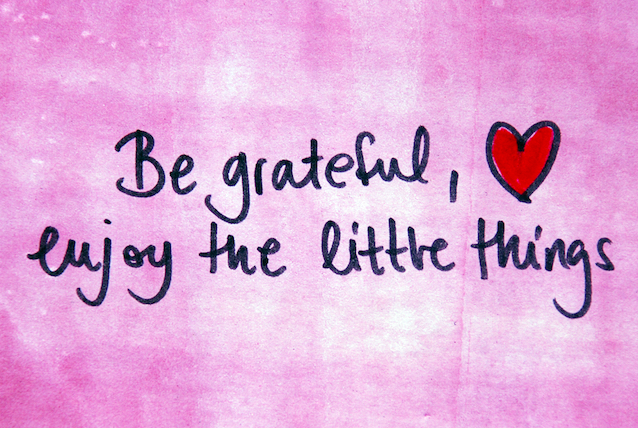
    Be grateful

    “Gratitude is a currency that we can mint for ourselves, and spend without fear of bankruptcy.” ~Fred De Witt Van Amburgh

    I began my gratitude practice at a time when I desperately needed help seeing the good in my life.

    Several failed relationships and a broken heart had left me blind to the incredible gifts the Universe had given me, and I was rutted in depression for three years. I couldn’t seem to focus on anything besides what I had lost. Happiness seemed like a cosmic joke.

    The more I focused on what I wasn’t grateful for, like the love I had lost, the less I focused on doing the things I loved.

    Depression is common, and it happens to many of us at some point. But the longer I chose to wallow in it, the more impossible happiness seemed. After my third year of depression I seriously considered whether life was even worth living.

    Then I came across Zig Ziglar’s empowering audiobook A View From the Top.

    I learned from Zig how giving to others can help us foster a deep sense of happiness, and how gratitude is the missing ingredient to most people’s success.

    Immediately, I began a gratitude practice, focusing on the important people in my life and the many gifts I had to share with others.

    It was a tough transition because there was so much negative momentum to reverse. Habits are like roads—the more you travel them, the easier they are to follow. But I stayed disciplined with my new habit and chose grateful thoughts even when I felt hopeless.

    Within two years my gratitude practice turned into a lifestyle, and today I’m enjoying the fruits.

    I make a living doing what I love as a writer, and I make a difference in the lives of thousands of people through my work—all because I shifted my focus from what I lacked to what I had.

    The amazing thing is that no matter how much or little I think I have, I always have more! And gratitude helps me see it.

    If you’ve felt gypped by the Universe, here are 100 reasons to be grateful today.

    1. The breath in your lungs

    2. Your hard-working heart

    3. The food that fuels your experience

    4. The ever-present opportunity to make better decisions than your last

    5. Your brain and memory that allow you to learn from mistakes

    6. The freedom to make unlimited mistakes on your road to self-improvement

    7. The endless supply of wisdom people and books provide

    8. The natural talents you were born to share

    9. The challenges that allow you to grow

    10. The accomplishments that have improved your life

    11. The mother and father who gave you life

    12. The Internet

    13. Humor

    14. Sweet doggy friends, or cats, if you’re that kind of person

    15. Warm sun on your skin

    16. The beauty and life in nature

    17. The senses that allow you to experience beauty

    18. Clean drinking water

    19. Health in any amount

    20. The arms, legs, feet, and hands that give you freedom of movement

    21. The favorite song that keeps you going when you feel like giving up

    22. The artists who struggle to create beauty for others

    23. The gift of language

    24. The ability to read

    25. The ability to learn from the mistakes and achievements of others

    26. The help that is always there when you ask for it

    27. The roof over your head

    28. Piercing stars in a clear night sky

    29. The inspiration that sweeps you out of your comfort zone

    30. The people who’ve dedicated their lives to inspiring others

    31. The kids who remind you to be playful and adventurous

    32. The ability to connect with family and friends anywhere in the world (Skype)

    33. Carrots (If you don’t know about carrots, click this link)

    34. Family farms that are committed to providing organic and sustainable foods

    35. The fresh start you’re given every day

    36. Rain

    37. Hope

    38. The pain that reminds you of the need to change

    39. Our dreams

    40. The people who pray for you every day, without you realizing it

    41. The hard times that made you who you are

    42. Automatic rice cookers, refrigerators, air conditioning, and every little convenience that saves you time

    43. Bare feet on grass

    44. All the organisms in the soil that support life on earth

    45. Electricity

    46. All of the amazing teachers who helped you reach your potential

    47. Each failure that led to your achievements, and everyone who encouraged you to keep going

    48. The “haters” who helped you build resilience by saying, “No, you can’t!”

    49. The fact that every bit of food you need to be happy and healthy is just a short drive away

    50. The garbage men who keep streets clean

    51. The random smile that got you through your last impossible day

    52. That one cashier who you can always count on to brighten your day

    53. Photosynthesis, and the fact that nature’s beauty works to keep you alive

    54. The one friend you’ve been able to count on through every stage in your life—even if that friend is you

    55. The new friends you’ve yet to meet, and the amazing times you haven’t yet experienced

    56. Your favorite spot to recharge when you’re overwhelmed

    57. Sunsets that make the sky explode with incandescent pinks, peaches, purples, oranges, and golds

    58. Your education

    59. Every single one of the trillions of cells in your body that work hard so that you can experience life

    60. That one mule of a person who challenges you to be kind when it’s most difficult

    61. Grandmas and Grandpas who helped make childhood so special

    62. The special people who filled spots where parents or grandparents were missing

    63. Bananas and peanut butter (or your favorite treat)

    64. Fresh baked baguettes that are crispy on the outside and chewy on the inside (and other delicious food)

    65. The spiritual growth you’ve accomplished (give yourself some credit!)

    66. The renewal of spring

    67. The relaxing sound of trickling water

    68. Gardens with fresh herbs, even if they’re just on your window sill

    69. YouTube, for whenever you need to troubleshoot your car or computer, and especially when you need a laugh.

    70. All the quotes that inspire you

    71. Good cheese, and underrated philosophers

    72. The doors that closed on opportunities you wanted but didn’t need

    73. The windows that opened when you almost gave up hope

    74. All the serendipitous occasions that remind you never to lose faith

    75. Everything coconut-related: oil, water, ice cream, flour, cream pie, etc.

    76. The hardships that transform us into more capable, understanding, giving, and forgiving people

    77. The impossible, for inspiring us to expand our limits

    78. The hot showers that completely change your perspective on life

    79. Gluten-free bread that doesn’t suck

    80. Hearing good news

    81. Making good news for others to hear

    82. The little depressions that remind you to fight hard for happiness

    83. The anxiety that reminds you to feel your emotions so you can learn from them and let them go

    84. The fact that you are unconditionally loved and accepted

    85. A really good cry

    86. Sex

    87. New life

    88. Beautiful men and women (look in the mirror)

    89. The rituals that give security and meaning to daily life

    90. Your favorite things

    91. The ridiculous people you can always count on for a belly laugh

    92. Little touches from people you love that make everything okay

    93. Little munchkins who you can never be with quite enough

    94. The good examples who’ve inspired you to be your best

    95. The bad examples who illuminated the paths you shouldn’t take

    96. The movies, music, art, celebrations, and people that remind you just how good it is to be human

    97. The you from yesterday you get to compete with today

    98. Refreshing walks that calm your mind and ease your spirit

    99. The ability to change your whole life with one good decision

    100. The option to be grateful no matter where you are or what you’re experiencing

    Gratitude is the most important choice in your day—and you can find things to be grateful for everywhere if you look hard enough. If you liked this list, try making your own at the end of each week and put it in a gratitude journal. Your life will effloresce, I promise.

  • 3 Ways to Cultivate Gratitude and Boost Your Happiness

    3 Ways to Cultivate Gratitude and Boost Your Happiness

    “Gratitude can turn common days into thanksgivings, turn routine jobs into joy, and change ordinary opportunities into blessings.” ~William Arthur Ward

    Living in India for more than two years now has been an eye opening experience for me, as I’ve realized how I used to take so many things for granted. While growing up and living in my home country (Bosnia and Herzegovina) in Europe, I was lacking gratitude for all the blessings that surrounded me.

    While sitting in our penthouse apartment in the New Delhi suburbs, in an air-conditioned room, still feeling the need to chill with a cool water or a mango shake due to the intense heat (which can reach up to 118° in the summer), I could observe the construction ground across from our building.

    Constructions workers would come in at 9am and work for twelve hours, with only a short lunch break, without proper safety equipment, chilled water, or any shaded cover to rest.

    While they’d wipe sweat from their face, I’d imagine how hot they must be feeling, as I was sweating even in an air-conditioned room.

    Some of them were working together with their wives, who would help them earn their daily wage (equal to $1).

    These women would carry piles of cement and bricks on big pots on their head, from one side of the construction site to another, sometimes climbing many stairs as well. In my home country, I never saw women working on construction grounds or carrying such heavy loads on their heads.

    Their children would play in front of the construction ground with sand and small rocks, as their parents could not afford to send them to school.

    I thought about how, in my home country, children often complain that they “have to” go to school and people complain about how tough their jobs are. These people in New Delhi could not even dream of sending their children to school or having an eight-hour job in an air-conditioned office.

    The wives who didn’t work on the construction ground would work in our building as maids. One of them cleaned our home. Every day she came in with a water bottle, which she’d cool in our refrigerator, as they did not have an electricity, not to mention a refrigerator, in the slum where she lived with her family.

    After cleaning our home, she’d run back to hers with a chilled water bottle in her hands, almost losing her breath, as if she was afraid the heat might warm that water before she would return. Then she wouldn’t be able to cool her small children, who were waiting in the heat in a slum without a fan.

    Since that day, I never look at the ice cubes in my drink the same way I once did. Ice cubes were just pieces of frozen water, until I saw that for some people, even chilled water is a luxury! Ice cubes are a symbol of wealth and abundance to me now.

    I suddenly became grateful for all the things I am blessed with in my life, even the small things, like ice cubes, chilled water, nutritious food, a fan, an air-conditioner, mosquito repellent in the night, clean running water in my home, electricity—not to mention the “big” things, like an opportunity to get educated, to grow up in a beautiful home, which was warm in winters and cool in summers, my job, the power to choose my own husband.

    I never thought I should be grateful for choosing my husband. Yet, in a place where arranged marriages are still tradition, I realized that it was a blessing that I was born and raised in an environment where I could fall in love with a man and choose to marry him.

    Although arranged marriages do work here, and I see people fall in love after marriage, or at least create a relationship based on kindness, mutual respect, and care, I feel so grateful every day that I had a chance to choose the man I thought was the right for me, with my parents’ blessing and best wishes.

    We often take the things we have for granted, yet in many other parts of the world, there are people who would feel blessed and happy if they could enjoy them on a daily basis.

    If we just take a look around us we could find so many things to be grateful for.

    Some of the practices that can help us to cultivate the feeling of gratitude in our life include:

    1. Gratitude journaling.

    Keeping a gratitude journal, where we note all the things (or at least three things) we feel grateful for every day, can be a powerful reminder of how blessed we are.

    Noting down even simple things—like a delicious dinner we enjoyed, a warm home, a cup of tea or coffee, time spent with our beloved—can be a powerful practice to keep us grounded in a positive mindset on a daily basis.

    2. Creating a list of possibilities and blessings.

    It helps to write a list of all the things we are blessed with, things we usually see as givens, that in other parts of the world are not available to many people.

    So many women around the world still do not have the right or the opportunity to get educated, and so many children cannot attend school or University due to lack of financial resources. According to WHO, 12.9% of the world’s population (over 1 billion people) is undernourished and will probably go to bed hungry tonight.

    Millions of people around the world do not have an access to clean, running water and electricity, which in Western countries we usually take for granted.

    Having a roof over our head, a warm room, a meal on our plate, a degree or opportunity to go to University, electricity lighting our home, and cool water in summers are all big reasons we can feel grateful every single day.

    3. Shifting our perception.

    Instead of feeling sad and frustrated about being single, we can look at this same circumstance from another perspective—as the freedom to be able to choose our partner and wait until we find the right one. This simple shift can help us move from a negative emotional state to a state of gratitude.

    In the same way, we can shift our perception of looking at other things, like the job that we don’t like or our living conditions.

    When we catch ourselves complaining about housework, we can see it as a blessing that we have our own home and, as a result, clean it with gratitude.

    Instead of feeling annoyed that we have to cook dinner, we can feel grateful that we’re able to afford groceries. We can also consider it a blessing that, in this modern era, we do not need to manually wash our dishes or clothes.

    When we catch ourselves complaining about the job we hate or feel bored with, we can feel grateful that we have a job and regular income that can pay our bills.

    We can also be grateful for small things, like air conditioning in our office, having weekends off, or the fact that we don’t need to be exposed to harsh weather conditions or safety threats every day, like so many people in other corners in the world.

    There’s nothing wrong with trying to achieve more and move ahead in life, but we can never be truly happy if we do not appreciate what we already have.

  • How to Stop Taking Things for Granted and Feel Blessed

    How to Stop Taking Things for Granted and Feel Blessed

    Happy Kids

    “I count my blessings every day, quite honestly, because I take nothing for granted.” ~Mario Andretti

    You know that feeling.

    When you feel bad about yourself for not being grateful enough. Maybe not often, but surely sometimes.

    You are busy working hard, trying to make things work. Busy at life.

    But then you see a nine-year-old painting a picture holding a brush with his toes. He has no hands.

    And it hits you: You’re so busy trying to make your life better, you forget that it is already beautiful. You feel guilty for not being happy enough.

    How I Found My Hidden Blessing in Life

    When I left for college it was the first time I went away from home to a different city. My parents were concerned about how I would adjust to life in New Delhi. But I was excited. I wanted to do this.

    As my college life began, I faced a problem: I was bad at managing my expenses. I had no idea how to spend money reasonably. Until then, my parents took care of everything.

    The unspoken message had been, “You focus on your studies, and we’ll take care of your needs.”

    Middle class families don’t lack in money, but the expenses are always modest. So when I ran out on my monthly share in ten days, I was horrified. Exploring the city with new friends, eating delicious meals in restaurants, buying a pair of Nike trousers all contributed to my downfall. Expecting a scolding, I told them what had happened.

    But there was no scolding, just a reassuring “I’ll put more money in account today.”

    A few weeks later, the same thing happened. I was sure this time they would get angry. But they didn’t. They simply poured in more money.

    And that is when I realized: My parents truly loved me, but I had been taking it for granted.

    They had always been there for me. Taking care of me. Loving me.

    I wasn’t a spoiled child, and I knew they cared about me. But now I felt blessed. Their presence was a gift I cherished. The fact that they loved me unconditionally brought my ignorance to light.

    Why Do We Take Things for Granted?

    Our minds run around unchecked all the time, either waiting for a better future or regretting the past.

    We’re always waiting for the perfect vacation, next promotion, more money, more whatever. We think, “Someday when X happens, I’ll be happy.”

    Or we regret the past, like the end of a relationship, a lost job, or financial setbacks. We think, “If only X hadn’t happened, my life wouldn’t be a mess.”

    But whether in the future or past, there is one place our minds are not.

    The present.

    And this is where our blessings reside.

    How to Stop Taking Things for Granted and Feel Blessed

    When I catch a cold, I realize how nice it feels to be healthy. When there are thunderstorms on the day I plan to go out, I realize the joy of a cheery, sunny day with a cool breeze blowing across my face.

    Because our minds are so used to running around uncontrollably, we don’t realize that our focus isn’t where we are. It is almost always somewhere else.

    But hidden blessings are available right now, if you can take a step back and notice where you are.

    Seriously, do this.

    Look at yourself reading this post. Notice the environment around you. I’ll give you a moment.

    ….

    This is your real life. Here are the blessings hidden from your incessant mind.

    Ask yourself: What good things have brought me where I am today?

    You can start with the fact that you can read. You’re smart enough to follow blogs like Tiny Buddha. What about your wonderful friends? Your pet? Your health?

    What else?

    Just like time, blessings are relative.

    Growing up, I went to a school with lots of children who came from rich families. It would have been easy to focus on what other students had that I lacked, such as new lunch boxes and fancy bags.

    However, I was nothing close to sad or miserable. In fact, I had fun at school. Why did I have fun, despite having less than others? I recognized how I was fortunate.

    My parents grew up in villages and received modest educations. And yet, they were smart enough to understand the importance of a good education, and made sure that my sister and I studied in the best English school of the city.

    Now, that is a blessing.

    I didn’t feel unlucky. I feel my parents did their part wonderfully.

    It’s time I do mine.

    Hidden in life challenges are some wonderful blessings. The difference lies in how you look at them.

    You can list all the things you don’t have and feel sad about it.

    Or you could put those very same things as your goals, chase them with passion, and build tremendous character.

    Time to Thank, Time to Love

    Yes, there will always be things you want to accomplish. There are goals yet to be realized. The future surely does promise better things.

    But you know what?

    The present, too, is a portal to hidden gifts.

    Underneath your routine life is a hidden treasure trove of countless blessings. Each of those blessings has helped you reach where you are today. They played a crucial role in molding your life into the masterpiece it is right now.

    So go right now.

    Tell your mother you love her.

    Pat you pet.

    Thank your friends for showing up.

    Celebrate life. Right here. Right now.

    Go live.

  • Something Good Can Come from Pain and Struggle

    Something Good Can Come from Pain and Struggle

    Girl in the Rain

    “How thankful I am today, to know that all my past struggles were necessary for me to be where I am now.” ~Unknown

    Ten years ago when I was diagnosed with anorexia nervosa, my first thought was “Why me?” and it was this thought that followed me throughout my journey. It wasn’t until I was well enough to look back that I realized how much of my life was shaped by my anorexia. But not in a bad way.

    Today, I am thankful for the struggles I endured, for the deepest lows I dragged myself through, and all the places my illness took me, good and bad. If not for this experience, I believe I would not be who I am or where I am today.

    Today I am happy. I am happy with the life I live and the people I surround myself with. I am happy about my body and my eating habits, and I am happy to have survived. I didn’t think I would.

    Being thankful for our past experiences, our struggles, and our demons can be a hard thing to do. We sometimes wish events in our past could be erased so we could start anew. But without these events, we wouldn’t grow, learn, and change. 

    The day I realized this I was sitting in a small church that I had just started attending with my boyfriend at the time (who I asked to join me).

    The preacher’s wife came up to me to see how I was and to meet my friend. She asked me how school was, and I said I didn’t like it that much. She then responded by saying, “Well, if you hadn’t gone, you wouldn’t have met him” and pointed at my boyfriend (who later became my husband).

    This really opened my eyes, and after I left I started seeing everything in my life through this perspective.

    If I hadn’t gone to that school, I would never have met my future husband. If I hadn’t worked at that job I disliked, I would have never met one of my best friends. If I hadn’t battled anorexia, I wouldn’t have found my true self.

    When we are caught up in the moment, sometimes it’s hard to take a step back and look at the full picture. We see ourselves as victims and find it hard to identify what we could learn.

    One of my favorite authors, Christine Hassler once wrote, “Instead of asking yourself why this is happening to you, ask why this is happening for you.”

    Of course this advice is nice and everything, but at times our struggles seem pointless and we fail to recognize what they are teaching us. We may even see them as burdens or setbacks in our lives, but the way we look at these challenges can change everything.

    At first I didn’t see how having anorexia could have ever been a blessing. But when I looked at it as an experience for me, rather than to me, I started to see that I had a lot to be thankful for.

    I grew closer to my mother while healing. I gained knowledge about myself that I could only have gained through struggle, and learned how to take care of my wants and needs in a way that made me happy.

    I found weightlifting, which allows me to confidently accept my body and move through my life with more vigor and strength (both physically and mentally). I also found my purpose, which is to help others in some way with their own struggle with food and weight.

    When we see our pain as just that, we tend to overlook the positives, or feel there are none. We also prevent ourselves from finding some way to leverage our pain for good. Some of the world’s most helpful resources and beautiful works of art likely wouldn’t exist if someone hadn’t endured immense pain and struggle.

    There is something from your pain or struggle that is now helpful to you, or could be helpful to you in the future. Whether it allowed you to see something from a new angle, find new friends you never thought you’d have, or create a new life purpose, there is always something to be thankful for.

    Challenge yourself to look for the light rather than the darkness. I promise, you can find it. And if not you can create it.

    Girl in the rain image via Shutterstock

  • Why We Should Always Be Kind to Strangers

    Why We Should Always Be Kind to Strangers

    Make Someone Smile

    “Carry out a random act of kindness, with no expectation of rewards, safe in the knowledge that one day someone might do the same for you.” ~Princess Diana
    Recently I was reminded of the importance of kindness, particularly kindness to strangers.

    I was given the opportunity to film the wedding of a family friend. As a videographer, I’m always looking for ways to build my client base and enhance my professional experience, so naturally, I agreed.

    Most of the guests at this wedding were friends of my parents, many of whom I hadn’t seen in years. Although I recognized a lot of the people, most did not recognize me, particularly with a camera in my hand and “on the other side of the fence,” so to speak.

    A few kind souls were extremely friendly, looked me in the eyes, sparked conversation, and spoke to me with dignity. But to my surprise, the vast majority of guests at this wedding pushed past me, bumped into me, or spoke down to me. Again, these were people that I knew!

    If we had been in any other situation—if perhaps, for example, my parents had been there with me—I’m certain these very same people would be giving me hugs and asking about my life with convincing interest.

    But instead, I was treated as I was seen, like just another person in the service industry. It was as if an invisible fence existed between “us” and “them.”
    What bothered me most was not the poor treatment I received, but this notion of separateness that was so pervasive in the once familiar atmosphere around me. Here I was amongst families with whom I grew up, and those who did not recognize me treated me as though I was not worth recognizing. As if I wasn’t even here.

    While the looks I received symbolized separateness, what they provided for me was an instantaneous sense of wholeness.

    Almost immediately, I’m reminded of the homeless man who holds a sign beside me as I wait for the stoplight to turn green and try to keep my eyes averted. Or the clerk at the McDonalds drive-thru, at whom I roll my eyes when I’m late for a meeting and she’s slow to deliver my vanilla iced coffee.

    In this moment, we are one. And that’s when it hits me.

    We’re each a part of a whole, and everything we do (every thought, word, and deed) affects the whole. My mind wanders to the countless individuals who are disregarded in some way, shape, or form, every minute of every day. We’ve all experienced it and we’ve all been a party to it.

    Why do we do this to each other? What is this invisible fence dividing us vs. them? Where did it come from? And why is it popping up across all areas of our lives?

    Safe in the confines of our car, we feel distant from those who stand on cold corners asking for our help. In our own bubble of a morning ritual, we forget that our coffee servers have morning rituals of their own. A false reality exists around us, and most often, without even giving it a second thought, we choose to live in it.

    Like a prison built on the delusional foundation that we are somehow separate from one another, we’re trapped. But what if we chose to live in truth instead? If we can recognize the intrinsic unity of humanity, perhaps we can finally be free.

    Much like disregard, kindness for others is cyclical by nature. Kindness begets further kindness. And you never know how a simple “thank you” or smile could affect someone on any given day.
    To be acknowledged and appreciated are among two of the greatest and most basic human needs. If we can fulfill this in one another with small acts of kindness that perpetuate themselves, why would we ever choose to do otherwise?

    It’s the simple, unexpected acts of generosity that change lives, and a culmination of these small acts can change the world.

    Let’s acknowledge the security guards and say, “thank you” to the janitors. Let’s start acting as if the conversation we have is the most important one we will have all day. Let’s look for the good in other people, and when we find it, let’s treat them as though that’s all we see.

    We don’t have to expect anything in return in order to be kind. With kindness, the giver benefits just as much, if not more, than the receiver.

    Let’s make it our goal to make at least one person’s day, every day, and see how our own lives are transformed in the process. After all, we’re all in this together…

    Make someone smile image via Shutterstock