Tag: goodness
-

10 Steps to Access Your Goodness and Change Your Life
“Goodness is the only investment that never fails.” ~Henry David Thoreau
A few years ago I found myself on the floor of my apartment with a bottle of Jack Daniel’s, feeling miserable.
In fact, I had felt that way for a while. My four-year relationship had collapsed, work was losing its meaning, and I felt deeply misunderstood, unloved, and lonely. Money was tight; I was overweight, lethargic, and confused; and my future seemed blurry.
But then, something changed.
I decided to shift my perspective and see what my life would be like if I stopped beating myself up over “not being good enough” and accepted who I was.
I made a decision that I am good and committed to testing this theory out. And it worked!
Since years of self-rejection didn’t do much for me, I had nothing to lose. My decision to accept my own goodness transformed the way I saw and lived life. People were no longer threatening and challenges became opportunities.
For example, when I didn’t get into the grad school of my choice, instead of thinking of myself as unworthy, I decided to view it as a sign that I was meant to do something slightly different. (Years later this proved to be true, and I am so glad that things did not pan out as expected.)
I also moved away from victimization to acceptance. I focused on taking care of myself. Instead of beating myself up over missed deadlines or unachieved goals, I intentionally paid attention to all that I did achieve every day.
I meditated and gave myself enough sleep, quality food, and exercise. I stopped watching a lot of TV and read more. I also expressed gratitude and shared company with people who enriched my life and reinforced my goodness.
Since then, my life has transformed and happiness has prevailed. As a result, I have become a better partner, friend, and leader, and a more thoughtful human being.
I also began wondering what the world would look like if we all had an opportunity to accept, embrace, and live out our own goodness. Can we all get there? The answer is a resounding yes! And here are some steps to do it.
1. Choose goodness.
Make a decision that you are fundamentally good, and commit to it. This sounds hard, especially if you spent most of your life feeing the opposite. Start by saying several times out loud “I am good.”
The voice inside your head may disagree, but remember: the voice you hear is not you; the being that hears the voice is you. So, quiet the voice by asking, “Why not?” Then, play a movie of your life and see if you can find a single example of your goodness.
Even if your emotions don’t agree, use your intellect and then practice this exercise daily. Your emotions will catch up. Just like with building muscles, it takes time, but this exercise does work.
2. Understand goodness.
Being fundamentally good does not mean we won’t make mistakes. I make plenty, all the time. Being good means that we deserve good things in life, and we deserve love. With self-love, anything is possible.
If you have a hard time with this, think of your younger, innocent self. Does that being deserve love? Or, think about yourself through the lens of someone who loves you. Why would they love you so if you weren’t worthy?
3. Practice, practice, practice.
Deciding that you are good is hard, but acting on that awareness is even harder. Commit to practice your goodness every single day. Catch yourself when you think negatively about yourself. Make a plan to get yourself out of unhealthy relationships or break bad habits. Treat yourself well, and demand that others do the same.
4. Develop rituals.
Take the time to journal, meditate, read inspirational books, pray, paint, volunteer, recite poetry, or regularly engage in any activity that will remind you and reinforce your goodness.
5. Set up reminders.
Soon after I made my decision, I changed my license plates to read “I AM GOOD.” I knew I would see it at least twice a day and be reminded of my newfound truth. Even on those extraordinarily busy days when you miss your rituals, these small reminders will keep you on track.
6. Talk to people.
Tell people about the concept of fundamental goodness. They will reaffirm its truth, or you will change their life too. In either case, the right people will support you in your quest for goodness.
7. Live boldly.
Give generously, love unconditionally, laugh loudly, and communicate openly. Whatever you do, give it your all. Living in such a way will reinforce your goodness.
The paradox is that you cannot really live fully unless you believe in your own goodness. If you don’t believe in your fundamental goodness, you will constantly question your decisions, your worthiness, the quality of your contribution, and other people too.
You are also likely to live with a lot of anxiety, which will consume you from time to time.
By actually doing more of giving, loving, laughing, communicating, and so on, you will be reinforcing your own goodness and growing your belief in it.
8. Dream big and dare greatly.
When we focus on our struggles, we lose sight of the truly important things in life. On the other hand, when we dream big and dare greatly, we have no choice but to trust our goodness as we find ways to achieve our dreams and take risks.
Now, keep in mind that taking risks and daring greatly does not mean we pursue things that might gain us approval of others; it means we seek out those things that matter the most to us.
A lot of traditionally successful people are miserable and full of self-loathing. On the other hand, a lot of obscure people are fully content and accomplished. Dreaming big means we dream our own dreams, not those imposed by the society, our family, or someone else.
9. Stop questioning and get busy.
I love asking a “why” question. But don’t ask a “why” that is harmful; ask a “why” that is helpful. Don’t ask, “Why would I be good?” Ask, “Why wouldn’t I be?” And if you can’t stop questioning, make a decision and move on. Stop revisiting it.
We’ve been conditioned to doubt ourselves. Doubt something else, but not your goodness.
10. Be mindful.
People often ask “How are you?” without waiting for a reply. Regardless, I love responding: “I am good!” It’s not so much for their benefit as it is for my own. The more I repeat it, the more I believe in it.
Additionally, how I respond to this question is a good indicator of how I feel that day. My response gives me a chance to catch myself. If I say, “I’m okay” or “Not too bad,” that’s a sign something isn’t quite right and I need to evaluate what’s really happening.
That said, being fundamentally good and accepting this goodness does not mean that we sometimes won’t feel bad, get annoyed or angry, or even lash out. Just today, I got into an argument with a good friend. We each said some hurtful things and I feel bad about it, but that doesn’t change the fact that we are both good.
—
Once upon a time, a Native American elder was telling his grandson a story of two wolves that live in each one of us and wage a daily struggle for dominance in our lives.
One wolf is filled with love, joy, hope, peace, gratitude, optimism, generosity, understanding, humility, kindness, truth, faith, and compassion. The other is a reflection of bitterness, envy, anger, sorrow, guilt, greed, arrogance, self-pity, inferiority, lies, ego, selfishness, and judgment.
Their struggle is constant, their determination to win unwavering.
“So, which wolf wins?” asked the grandson.
The grandfather responded, “The one you feed.”
We all have a choice to accept our own goodness and nurture it every day. We can all embrace the best within us and choose happiness over sadness. Which wolf will you feed today?
Joyous man image via Shutterstock
-
Believing in Our Goodness: Do You Have Faith in Humanity?
“Faith is taking the first step even when you don’t see the whole staircase.” ~Martin Luther King, Jr.
When we hear someone speak about faith, we usually expect to hear about some kind of subjective encounter with supernatural forces. In our skeptical age, we tend to look at faith as “believing in something you know not to be true,” as Mark Twain expressed.
Before we dismiss any talk of faith, however, we should remember that there are many ways to understand the word. You can have faith in a benevolent, loving deity guiding your every move. But you can also have faith that you’ll wake up in the morning. Or that the dollar in your pocket today will be worth as much tomorrow.
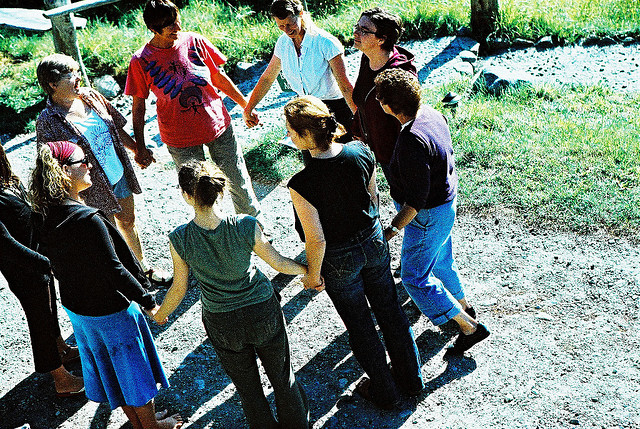
For me, a “revelation” of faith came while sitting around a table with a group people determined to respond to violence with love.
I didn’t realize it at the time, but this experience reaffirmed my faith that human beings are fundamentally loving and good, and will help and care for each other when given the chance.
I think that faith really is the right word here, because holding onto this viewpoint in light of so much evidence to the contrary does indeed requires a “leap,” to borrow Kierkegaard’s famous line.
This understanding emerged at a visioning process for the “Dawson Peace Center.” To its great credit, the Dawson College community has chosen to respond to the 2006 shooting not by putting bigger locks on the doors and stockpiling weapons, but by spearheading meaningful initiatives designed to cultivate peace.
For my part, at this meeting, I spoke about the contributions that meditation might make in addressing the roots of destructive behavior, and how we might be able to integrate it into the college’s culture.
During the meeting, I didn’t really feel like anything was out of the ordinary. Sure, I was inspired by many of the ideas that the other 20 people in the room put forth, but toward the end, my attitude began to shift as I realized that what was happening here was truly extraordinary.
Here, we had a group of committed people seeking, however imperfectly, to affirm that the power of love is stronger than fear.
Here, at least a few people understand that responding to violence in kind makes us no different than the perpetrator. Here, a group has resisted the temptation to let the violent imagination of a disturbed individual hijack our own.
It takes strength and courage to stand up and say, despite all the evidence to the contrary, that human beings are fundamentally decent, kind, and caring, and that we have the responsibility to nurture these attributes.
This audacious belief in basic goodness takes guts. It takes faith. And that’s what I saw around that table.
We’ve all seen how human imagination has the power to create scenes of terror and violence (just open up the newspaper). But it also has the possibility to respond to those who unleash the demons with compassion and understanding, which to me seems the greater power (and usually gets far less media attention).
This is the truth that every saint and sage has communicated: hatred never ceases through hatred. Only love has the power to heal. This is not really a “spiritual” or “religious” truth; even a jaded, secular humanist can see this at work.
It’s up to each and every person to develop the understanding that no matter how far removed someone might seem from this basic goodness, no one is beyond redemption.
Buddha and Jesus hung out with murderers, prostitutes, lepers, and other types of people who society had “thrown away” and given up on. What these marginalized people needed was compassion and understanding, not ostracization and judgment.
And when a teacher who had discovered his own “enlightened nature” spoke to them, they were able to discover that within themselves.
These people who had lead lives of violence and impropriety often went on to become exemplary disciples; the mistakes they had made in their lives were not sufficient to corrupt their essence and potential.
In the eastern traditions, this is expressed through the image of a gem covered with mud, or a lamp coated in dust. These images affirm that the treasure/light is always there, and has only temporarily become obscured.
But in order to sustain the commitment and diligence to undertake the “polishing” process, you must first have an inkling that there is something valuable waiting for you underneath.
Meeting an enlightened teacher can certainly arouse this faith, but coming into contact with the enlightenment that flows through us all when we seek to act with love and compassion is also a catalyst.
It’s by no means certain that we will uncover this treasure in ourselves, much less be able to help others discover it in themselves. But as I felt very deeply around that table, there is intrinsic value in the effort itself.
Everyone’s face communicated the determination to love, despite everything. We understand that the alternative of powerlessness and despair is not really an alternative at all.
Whatever we think about the world becomes a self-fulfilling prophecy, so if we really want to create a world of peace, then we truly have to believe that it’s possible. Even very optimistic people like myself occasionally need boosters of faith to maintain this truly revolutionary attitude.
Photo by kris krug
-
Book Giveaway – Random Acts of Kindness: Then and Now
Note: The winners for this giveaway have already been chosen. Subscribe to Tiny Buddha to receive free daily or weekly emails and to learn about future giveaways!
The Winners:
“Practice random acts of kindness and senseless acts of love.” ~Ann Herbert
An unsolicited financial donation right when you need it. Roadside assistance from a stranger after your car breaks down. An anonymous gift when you’re struggling and in desperate need of a smile.
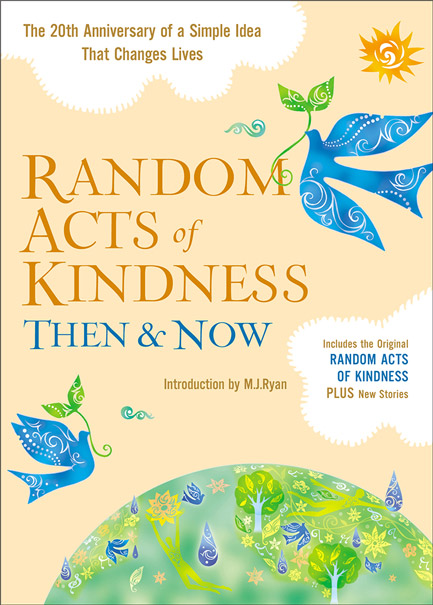
These are just a few random acts of kindness that can transform your day and renew your faith in people, and just a small sampling of the type of stories you’ll find in Random Acts of Kindness: Then and Now.
Twenty years back, Conari Press published the first Random Acts of Kindness book, highlighting stories of people looking out for one another in their daily lives.
As the book inspired a movement, Conari started the Random Acts of Kindness Foundation, which works with schools and communities to spread kindness.
Every February for the past two decades, the foundation has spearheaded Kindness week, which runs from the 11th through the 17th.
To celebrate the week and the book’s anniversary, Conari has offered five copies of the updated book for Tiny Buddha readers.
Including the original book and new stories sourced through social media, Random Acts of Kindness: Then and Now is an inspiring, feel-good compilation that encourages a more generous, caring, compassionate world.
The Giveaway
To enter to win 1 of 5 free copies of Random Acts of Kindness: Then And Now
- Leave a comment below, sharing an act of kindness you’ve recently offered or received
- For an extra entry, tweet: RT @tinybuddha Book Giveaway – Random Acts of Kindness: Then and Now http://bit.ly/Y7Oo9p
You can enter until midnight PST on Monday, February 18th.
Learn more about Random Acts of Kindness: Then and Now on Amazon.
-

The World Is a Kinder Place When You’re Kind
“Don’t wait for people to be friendly. Show them how.” ~Unknown
Sometimes I stop to think about how in the world I ended up where I have. I started off with very little, and somehow along the way I have ended up generally happy and on my own two feet.
My adolescence up to my early twenties had its share of dark days. Whether or not we are lucky enough to have a small handful of people that stick by us no matter what, more often than not we can find ourselves feeling incredibly lonely.
For a long time through my rough days, I held a sort of grudge against the rest of the world. I had convinced myself that everyone was only looking out for themselves, and I had lost faith in the idea that people were mostly good.
Where was that feeling of community? Or helping out your neighbors? What about equality and accepting others’ differences?
The world felt large, dark, and lonely. I felt very let down.
What I didn’t realize at the time was that as much as those close to me have influenced my growth and my life, those I consider strangers have made just as strong an impact. By closing out the rest of the world, I was really hindering my growth and happiness. Let me explain.
I had an accident a few years back, and unfortunately, I was far from home and by myself when the incident occurred.
Many strangers witnessed the accident and casually passed by. Two people who could have just as easily done the same, leaving the accident for someone else to take care of, chose to step in and come to my aide.
They had no obligation to help, and in fact, had places to be. Instead, they stopped to help me, waited until the paramedics arrived, helped to contact someone I knew, and confirmed that I would be okay.
I was shocked that people who didn’t even know my name were spending so much time taking precautions to ensure my safety.
My world was jolted—and I kind of liked it. (more…)