Tag: good

  • 3 Ways to Feel Good When Things Seem Bad

    3 Ways to Feel Good When Things Seem Bad

    “It isn’t what happens to us that causes us to suffer; it’s what we say to ourselves about what happens.” ~Pema Chodron

    Have you ever had something happen in your life that completely changed everything?

    Wham. Suddenly you haven’t left your bedroom in days, you can’t remember what it feels like to shower, and it’s clear the only friend you can really count on is your cat. 

    And whether it’s a major life-suck event or a minor one, the question is: How can I feel contented and calm when things don’t go to plan?

    That is what this post is about. Because a while back I had a M. A. J. O. R. Major event. It went like this:

    I’d just graduated from college. I had a Masters Degree. In science. Human nutrition science, in case you’re wondering. I was excited about life!

    Sure, I had a ridiculous door-to-door research job and my roommate was annoying, but I had plans—I’ll move in with my boyfriend, get a better job, travel, start a family, hang out with all my amazing friends, and live an awesome life.

    But then I got sick. The kind of sick where raising your arms above your head makes you want to take a nap. And instead of starting the amazing life I’d planned, I moved home with my parents.

    It was a shock, to say the least. Before that, I was tough. I hiked. My friends liked me. I stayed up late. I wasn’t a sick person.

    And while my parents are sweet and kind, living in their basement in small town New Zealand, watching daytime re-runs of Dr Quinn Medicine Woman, and hanging out with a fluffy cat called Whisky was not the plan.

    It wasn’t so bad at first. But months went by, then years, and it seemed no matter what I did, I was still sick.

    I thought, why did this happen to me?

    I cried. A lot. For seemingly no reason. And if someone asked why I was crying, I’d say, “I’m just so tired.” I cried so much some days that I’d go home and laugh with my sister on the phone over who I’d cried in front of that day. It was comical.

    That was a few years ago now. And, of course, the whole experience turned out to be a huge gift. They often are, in my experience, anyway, but that’s getting ahead of things.

    Here are three insights that helped during those “you’ve got to be freaking kidding me” times:

    1. There’s a healing side to pain.

    When a challenging event happens—a breakup, a sickness, or having your leopard pink car seat covers stolen—the human mind, being what it is, thinks this is why you feel badly.

    You hear it all the time: “Oh, you poor thing for losing your car seat covers.” Or, “She’s such a rat to do this to you.”

    The truth is, it’s your perception of the situation that makes you feel bad. This means that no matter how crumpled-in and dysfunctional you feel, you’re not. It’s just your thoughts that are a bit wonky. And actually, your thoughts on this were always wonky; the situation just exposed them.

    Take my situation. Everything I’d based my self-esteem on was gone: work, grades, friends, boyfriend, the ability to sit up straight for more than half an hour.

    I thought I was upset because I was sick, when the truth was, my situation had triggered every negative belief I had about myself. Things like:

    “I’m only lovable if people like me.” “I’m only worthwhile if I’m busy doing things.”

    I so strongly identified with all the things I did that when you took them away, I felt miserable. I’d been given the opportunity to see what I really thought about myself.

    Someone could have told me “you’re worthy and lovable,” and I might have intellectually known this, but I didn’t feel it.

    What I began to realize was that behind the pain, over time, my faulty beliefs were shifting. My sense of self-worth was beginning to heal by itself.

    The pain is the faulty belief system being ripped out by its roots. You feel like you’re losing something dear. The trick is to understand that it’s just a faulty belief going away. And beneath it lays a pocket of self-love that you haven’t previously been able to access.

    As poet Kahlil Gibran says, “Your pain is the breaking of the shell that encloses your understanding. Even as the stone of the fruit must break, that its heart may stand in the sun, so must you know pain.”

    2. Pain fades when we let go of expectations.

    Most of us live in an intellectual way. We make plans for our life and then we try and follow them through. We think we know the best way for our life to proceed.

    The truth is, a large part of our pain is caused by an attachment to our expectations.

    For example, one of the reasons I felt so bone achingly sorry for myself was because I had a plan for how to have a good life—and it didn’t include Dr. Quinn.

    I thought success came from going to college, getting a good job, and having a family. No one said anything about spending all this time in bed. But actually, it was the best thing for me.

    To illustrate you how powerful your expectations are, try this exercise:

    First, imagine you’re me.

    Now, imagine you’d grown up thinking the best way to have an awesome life was to spend five years in bed cross-stitching cushions. That it was something everyone did.

    “Oh yeah,” you’d say to your friend, “I’m just off to do my five-years-in-bed years.”

    And they’d be like, “Oh cool. I hear you learn such amazing things, like how to feel self-assured, and you get clarity on your life direction, and you start to feel that inner calm we’re always reading about.”

    Seriously.

    Now think about your current situation and imagine that for your whole life, you believed that what is happening to you was going to happen. And not only that, but it’s the absolute best thing to happen.

    So much of the pain we feel is because we can’t let go of how we think life should look. Your mind thinks it knows the best way for your life to work out—but simply put, it doesn’t; the plan it had was flawed in the first place.

    Your mind can only see your life as it’s showing up right now. There is a bigger picture.

    3. You’re doing fine.

    Learning about personal awareness and healing can be such a helpful thing, but remember, there’s no right or wrong way to feel.

    Feeling grateful and “being positive” and so on is perfectly fine, and sure, it can be helpful, but if you don’t feel like it all the time, don’t worry about it.

    Instead of attaching a judgment to how you’re feeling or what you’re thinking, try just noticing it.

    I believe the act of simply noticing and accepting how things are, right now—no matter how messy and dysfunctional they seem—is the most powerful, healing thing you can do.

    Photo by Dahl-Face Photography
  • Wanting to Feel Good and Look Good: Why Do We Do What We Do?

    Wanting to Feel Good and Look Good: Why Do We Do What We Do?

    Sun Goddess

    “Nothing is either good or bad, but thinking makes it so.” ~Shakespeare

    Have you ever stopped to question why you do what you do? Or how it looks to other people?

    I’ve done this pretty much all through my life. In fact, an outsider might say that I’ve spent more time analyzing my place in the world than experiencing it.

    In some ways, this is true, and not uncommon for someone who’s chosen to be a writer.

    As a young child I used to silently mouth the words of what I’d just said after every sentence I uttered.

    Even as a kid, I felt this need to rethink my thoughts after speaking them, and because I was too young to realize it looked strange, I did this while moving my lips.

    I wondered why I’d said what I’d said, and how others might have heard it.

    This followed me through life, and later manifested in a desire to not only say the “right” thing, but also to do it.

    Never was this more important to me than in my mid-twenties, after I’d spent the majority of my adolescent and young adult life self-destructing and unintentionally hurting others—something that, I feared, confirmed that I was a bad, selfish person (ironically, the same fears that led me to self-destruct).

    I wanted so badly to be good. To do good. To look good. I imagined and hoped that this was the key to feeling good.

    I didn’t want to be selfish—that was bad. So I concluded that I needed to be selfless.

    I didn’t want to crave so much attention—that was bad. So I concluded that I needed to be humble.

    I didn’t want to be or be seen as manipulative—that was bad. So I concluded that I needed to prove that I had good intentions.

    In retrospect, I can see that these realizations and conclusions sparked my initial interest in the personal development industry six years back, and they informed how I did what I did. (more…)

  • Waking Up and Forgetting a Bad Day

    Waking Up and Forgetting a Bad Day

    “Life is inherently risky. There is only one big risk you should avoid at all costs, and that is the risk of doing nothing.” ~Denis Waitley

    Yesterday was a bad day.

    My husband and I got really close to buying a car before we walked away—again. This time it was because it was above our budget (with taxes), because the current owners didn’t have the title (their bank did), and because our own car broke down on the way to trying to buy the new car (didn’t see that one coming).

    I was fine about the ordeal yesterday, seeing the whole thing as one big adventure toward the right car in the end. But this morning I woke up angry and fearful. Angry about the time we’ve invested so far without results and fearful that another almost there deal might fall through again.

    After three days negotiating on the last fall-through deal, it felt like the failure of failures and just wanted to stay in bed so I could avoid more of them.

    Of course I knew rationally that my feelings didn’t reflect reality, that yesterday’s annoyances are small change in the scheme of things, and that I’m fortunate to be even looking for a (second) car let alone have so many choices for which one to buy.

    The real problem was that my feelings weren’t staying within the boundaries of the car-shopping situation. They were infecting how I felt about everything from my business to my past choices, to my body image, to my mental health image.

    I was flooded within minutes of being awake, and I didn’t know how I was going to coax my mental strength back from cowering in the corner.

    So I did what every procrastinating person does these days: I went on Facebook. And after seeing a bunch of uninteresting stuff, my eye caught on the most courageous thing I’ve seen in a long time: a picture of my five-year-old nephew Caleb leaving home for his very first day of school. (more…)

  • Non-Dual Thinking: There Are Things We Don’t Know

    Non-Dual Thinking: There Are Things We Don’t Know

    “Nothing is either good or bad but thinking makes it so.” ~Shakespeare

    It is not possible to grasp the infinite from a position that is finite. Seems like a good place to start.

    “Dual” thinking, as I understand it, is the idea that something has to be “either/or.” That it’s either good or bad. Right or wrong.

    Here’s another way describing it: The concept of up and down seems to make sense from an earthly or gravitational perspective, but if you are somewhere out in space, it suddenly makes no sense at all. There is no up or down.

    The list of these polar opposites goes on and on, but they all have one thing in common—they are often laced with judgment, and the need for resolution.

    I find myself doing it all the time—making judgments or assumptions about the people I come into contact with on a daily basis.

    The waiter who doesn’t treat me as I deserve to be treated. The inconsiderate driver who cuts me off in traffic. The rude person on the phone that is completely unreasonable. My wife who has her own way of navigating through life.

    Why don’t they see things my way, the way they are?

    The fact is that dual thinking has become integrated in how I process things, and it is rooted in fear—fear of what I don’t know, fear of what I don’t understand, and fear of what I can’t control. A feeling of lack. Being right seems to quiet the screaming monkeys, at least temporarily.

    And when I think in black and white, I miss all the shades of grey in between. Someone has to be wrong for me to be right. My relationships have suffered because they are stuck in “defending a position” mode.

    I am so concerned about being right, of making sure that my viewpoint is heard, that I miss all the magic, learning, wisdom, and connection that are waiting to be discovered.

    And if my relationships are based in this “either/or” way of thinking, is it any wonder that I continue to feel separate and isolated, from myself and others?

    How can dual thinking represent “truth” when something can be right for one person, but wrong for another?

    Truth is simply a matter of perspective, and no one person can be the judge and jury on that.

    It is a very narrow, disrespectful, arrogant, and un-evolved way of thinking that I know does not serve me, or any of us.  (more…)

  • Life Isn’t Good or Bad; It Just Is

    Life Isn’t Good or Bad; It Just Is

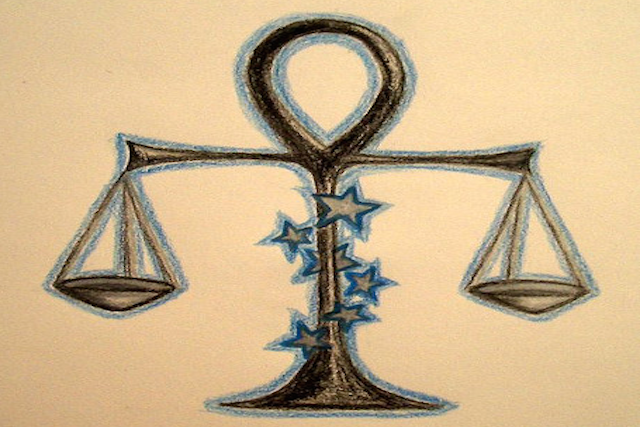
    Ankh scale

    “Freedom is instantaneous the moment we accept things as they are.” ~Karen Maezen Miller

    Seemingly for months now, upon learning anything new, my seven-year-old daughter has asked me, “Is it good or bad?”

    Not brushing at night—good or bad? One hundred degree temperatures—good or bad? Water leak in the furnace—good or bad?

    Some things are more obvious than others, but it’s the stuff in the middle that requires a more subtle explanation, especially as I go through life with the stress and anxiety of trying to both deal with uncertainty and figure out life in the “new normal” called chaos.

    I wrestled with trying to make her understand that sometimes life is neither good nor bad—it just is.

    But like any child trying to adjust the settings on her moral compass, she had difficulty in trying to understand that there can be some things that fall neither in the good nor the bad category.

    Recently something happened that tested this notion and, in some strangely profound way, might have helped me find a way to explain life (as I understand it) to my seven-year-old.

    My wife’s grandmother passed away.

    Having been raised by her grandmother for most of her young life in India, my wife was distraught and sad. Although my daughter had very little contact with her great-grandmother, given the vast ocean that separated them, she could tell that her passing affected her mom deeply.

    At first we didn’t know how to explain the passing to our chirpy and inquisitive child. So we didn’t, for a day. We avoided it. But then, as seven-year-olds do, she overheard me on the cell phone explaining to someone what had happened.

    Almost instantly, a happy-go-lucky child became eerily quiet upon hearing that her mom’s grandmother died. She didn’t have to ask if it was good or bad. It was bad.

    But is it? (more…)

  • 4 Lessons about Perfection Born from 1000 Failures

    4 Lessons about Perfection Born from 1000 Failures

    “Don’t let the perfect be the enemy of the good.” ~Voltaire

    This was just not working out. I had ended up in a failed attempt every single time. This was my 4th day of trying to fix everything.

    I had wanted to make a video for my blog—just a minute-long introduction. Not that I didn’t have one already.

    I had a video up and running. But that was from my first attempt, and everyone knows there is always room for improvement.

    After the video went up, I started to see how I could do better than that. I was not going to be satisfied with something just good enough.

    I wanted to emphasize the right words. I wanted the right amount of pause where it mattered. And just enough rise in the tempo of my voice where needed.

    The lighting had to be perfect. An overcast day would not help. I wanted to dress right, I wanted to look right.

    I wanted to sound enthusiastic, not pushy. I wanted to put my best out there.

    My husband offered help with setting up my precarious camera set up. But I politely refused. I wanted to do it all by myself.

    I didn’t need to lean on anyone to get the million settings just right. I was being self-reliant, or so I told myself.

    My camera stood on a tripod pulled to the maximum. My lap-top was perched on top of a step stool which stood on a cane foot rest, which in turn was balanced on a dining chair. This was needed in order to bring the tele-prompter software running in my lap-top level with my line of sight.

    Then there was the little matter of keeping my bouncy toddler from demolishing my rickety set up with a single sleight of his hand.

    If persistence was something that could be learned, I had got it down pat. (more…)

  • Project Happiness: Believing in the Good in People

    Project Happiness: Believing in the Good in People

    Project Happiness

    “Make finding the good in others a priority.” ~Zig Ziglar

    One of the most exciting parts of writing about happiness is getting the opportunity to connect with people who make sharing joy a priority.

    If you’re looking for it, you’ll find positive people everywhere—in your office, along your morning commute, on blogs you follow, and within your Twitter stream. They won’t be the only type of person you see; there are plenty of people out there who walk around holding onto a lot of pain, and knowingly or unknowingly spread it.

    But an uplifting person—someone who believes in the good in people—shines a light on the potential we all have inside us to hope, believe, and inspire. A light bright enough to offer a different perspective on those other people who seem so negative. Suddenly, judgment and fear melt into understanding and compassion.

    That’s what Project Happiness is all about: making happiness a real possibility for all.

    Their main purpose is to provide students with tools and wisdom, based on positive psychology and neuro-scientific research, to create authentic happiness. They work hands-on with kids of all ages, empowering them to feel good about themselves so they can handle life’s hurdles.

    When Rolando Sandor emailed me with an invitation to attend the Project Happiness Cirque de Happiness event this Saturday, I couldn’t have been more excited. Honestly, I didn’t know a thing about the non-profit; I just knew “Cirque de” anything had to be a fun, spectacular event. (more…)