Tag: giving

  • 3 Things I Realized When I Stopped People-Pleasing and Let Myself Receive

    3 Things I Realized When I Stopped People-Pleasing and Let Myself Receive

    “Until we can receive with an open heart, we are never really giving with an open heart.” ~Brene Brown

    The honest truth about needing to please is that we do it to make other people happy. We will sacrifice everything and anything to put a smile on another’s face and lighten their load, while ours keeps building.

    The only problem is that while helping others makes us feel good, it’s almost addictive until we are burnt out. And giving and pleasing others starts to come from a place of resentment.

    I’ve been there!

    There was a time when I used to come up with a thousand reasons why I couldn’t leave the house. I was desperate to get to a yoga class and claim an hour away from being a mum, wife, friend, and entrepreneur.

    But instead, I prioritized keeping my kids happy and did everything I could to avoid the onset of a tantrum and also made sure my husband sat down to a delicious, home-cooked meal each night. And when the kids were napping, I would use that time to do a little work.

    The routine started to get boring. I complained daily. I was grumpy and irritable.

    Yet the days kept coming and I started to drag my feet. The tasks were mundane and never-ending, and they started to get on my nerves. I’d lash out at the washing machine or slap together a half-assed attempt at dinner. And I wasn’t just overextended and resentful in my home life. My clients were taking advantage of me, and my friends sucked my energy dry.

    I kept showing up for everyone around me—striving to keep the peace, to keep them happy, while I was worried that I might let them down or wasn’t living up to their expectations. Yet with a whole lot of hindsight, I discovered that I had placed all this pressure on my shoulders myself.

    Denying myself a sixty-minute yin yoga class was the stupidest thing I had ever done. It still sounds ridiculous now. But at the time, I couldn’t see any solutions. I had tunnel vision and it didn’t revolve around me.

    I felt like I didn’t deserve the break.

    I felt responsible for everyone around me.

    I was unsure what would happen if I left our house for an hour and what I would walk back into after leaving my two young kids alone with my husband.

    Each afternoon, I was an emotional wreck by the time my husband came home. Being the problem solver that he is, he encouraged me to go and find a class—as if it was that simple. I thought, “What does he know anyway? He has no idea about all the things I still have to do.”

    But I eventually realized he was right. I needed a break, and I had to get out of my own way and take it.

    Finding a class was easier than I had imagined. There were loads to choose from and all kinds. I settled on a 4:30 p.m. class on a Friday, that was only a five-minute bike ride away.

    I remember walking through those yellow doors to find only me, two other people, and a smiley yoga teacher.

    Ahhh, I relaxed. I rolled out my mat and lay down because it was a yin restorative practice. We lay there for what seemed a lifetime. I spent it fighting with my mind to not think about what might be happening at home, my to-do list, my kids, the grocery list, my work… Thankfully, we finally got moving and I started to tune into the music.

    The class was literally six poses of deep stretching and rest, and it was a challenge to surrender instead of extending each pose.

    My mind focused on how to allow my limbs to soften even in a standing pose that we held for a good five minutes. Not collapsing took every ounce of concentration I had.

    I took big belly breaths, in to fill my lungs and out to gently soften.

    In the final fifteen minutes we had a deep meditation (savasana), with the yoga teacher coming around to us individually, massaging the back of our necks to the bottom of our skulls. She finished it off by pressing her two warm hands down on my shoulders as if she was pushing me back into the ground. Tears began streaming down my face as she walked away.

    I had fully surrendered and left my mind to be in the present moment, and her touch released the stress and burden I was carrying. It was an intense moment, and I felt joyful and at peace. I had literally forgotten that I had to return to my family only minutes later.

    That class changed me as a mother and a wife.

    I went back every week religiously after that. I saw the power of connecting with my breath and myself. Because that one hour reset each week was enough to fill up my cup and change how I was showing up for myself and others.

    My daily chores didn’t bother me anymore. I had more love to give my kids and partner. I had a renewed sense of energy. When someone asked for help, I had the capacity to give because I wanted to instead of seeing it just as another task I had to do.

    Once I learned to receive, which meant surrendering my responsibility and need to control and allowing myself a little love, I discovered that I often denied myself other things, like going out for walk or catching up with friends. And this is where I had to lean in deeper and question what it means to receive. Here is what I realized.

    Accepting Help

    It is not a sign of weakness to ask for help or receive it, and I don’t need to prove myself or my worth through giving.

    I really felt like I was doing life alone, taking on the responsibility of everyone around me and driving myself into the ground. People would make kind gestures to help, but I would often shut them down with an “I’ve got it covered, thanks.”

    The day my husband stepped in to wash the dishes after I shared that I had a looming deadline, he practically threw me out of the kitchen. I felt so guilty, like I should be the one doing them, not him.

    What I thought was a one-time deal has now lasted three years. It has lightened my load, and our relationship has been better because I no longer feel like I’m the one doing all the things.

    Accepting help is receiving an energetic exchange with someone that wants to offer support. So take it.

    Acknowledging Compliments

    Too often, I would deflect when someone would say something nice to me. I found it uncomfortable, and it made me question their ability to see what was really happening.

    I didn’t feel like I deserved a compliment because I didn’t see myself like others did. I didn’t feel worthy of being praised, so I brushed it off with, “No worries, it was nothing,” “I would do it for anyone,” or “This old thing? I bought it on sale five years ago.”

    Learning to receive a compliment showed me that I could be honored and celebrated for who I am and that there was nothing to be ashamed of. I thought that people who received compliments looked nothing like me and were doing more important work than little old me. But I learned that compliments are praise, and we all deserve to feel seen, heard, and acknowledged.

    Realizing I’m Not Responsible for Everything

    Here was my greatest lesson, which was letting go of my need to control all situations. The responsibility I carried, because I felt it was my job to make everyone happy, was costing me my physical and mental health along with my relationships.

    When I released the control, it created space for things to happen without my interference. It provided space for me to see how others could step up and take responsibility, for mutual needs and their own. It gave me permission to invest in my own well-being.

    Instead of over-giving, fixing, and manipulating, I stood back. From here I could see that life is a two-way street where we exchange our energy with one another. This allows us to give from a full, nourished heart, and this is much more satisfying than giving from a sense of fear and obligation.

    Opening our hearts to receive eliminates our tendency to over-give. When we give without our full presence, we are not showing up fully for ourselves or for other people.

    We all love to support the people we care about, but we need to receive just as much as we give, creating a balance that never leaves us feeling drained or that we “should” be doing something.

    Do you find it hard to receive? What helps you let go of control and fill your own cup?
  • HumanKind: The Inspiring, Uplifting Book We All Need to Read (Giveaway!)

    HumanKind: The Inspiring, Uplifting Book We All Need to Read (Giveaway!)

    A while back I shared a quote by an unknown author that reads:

    “You know who’s going through a lot right now? Literally everyone. Just be kind.”

    It got me thinking about all the struggles we assume other people don’t have—because we’d never guess from the looks of them.

    You’d never guess that your confident colleague struggles with PTSD from childhood abuse and neglect.

    You’d never guess that your boisterous brother-in-law beats himself up because he doesn’t earn enough to get his family out of debt.

    You’d never guess that your collected cousin cries in the bathroom every day because she’s overwhelmed by parenthood and scared she’s messing it up.

    You’d probably also never guess how many times you’ve been someone’s lifeline, simply by being kind.

    A hug, a hand, an ear, a compliment—small acts of support and encouragement like these can help someone believe in themselves and their future when they feel like giving up.

    And it’s not just the gesture itself that makes a difference, though a little bit of support can provide a massive amount of relief. It’s the reminder that there are good people out there who care and want to help.

    There’s little more powerful than reminding someone there’s more love in the world than hate. Give someone the gift of faith in humanity, and you’re literally giving them the world—a world of light to believe in, no matter how dark things may seem.

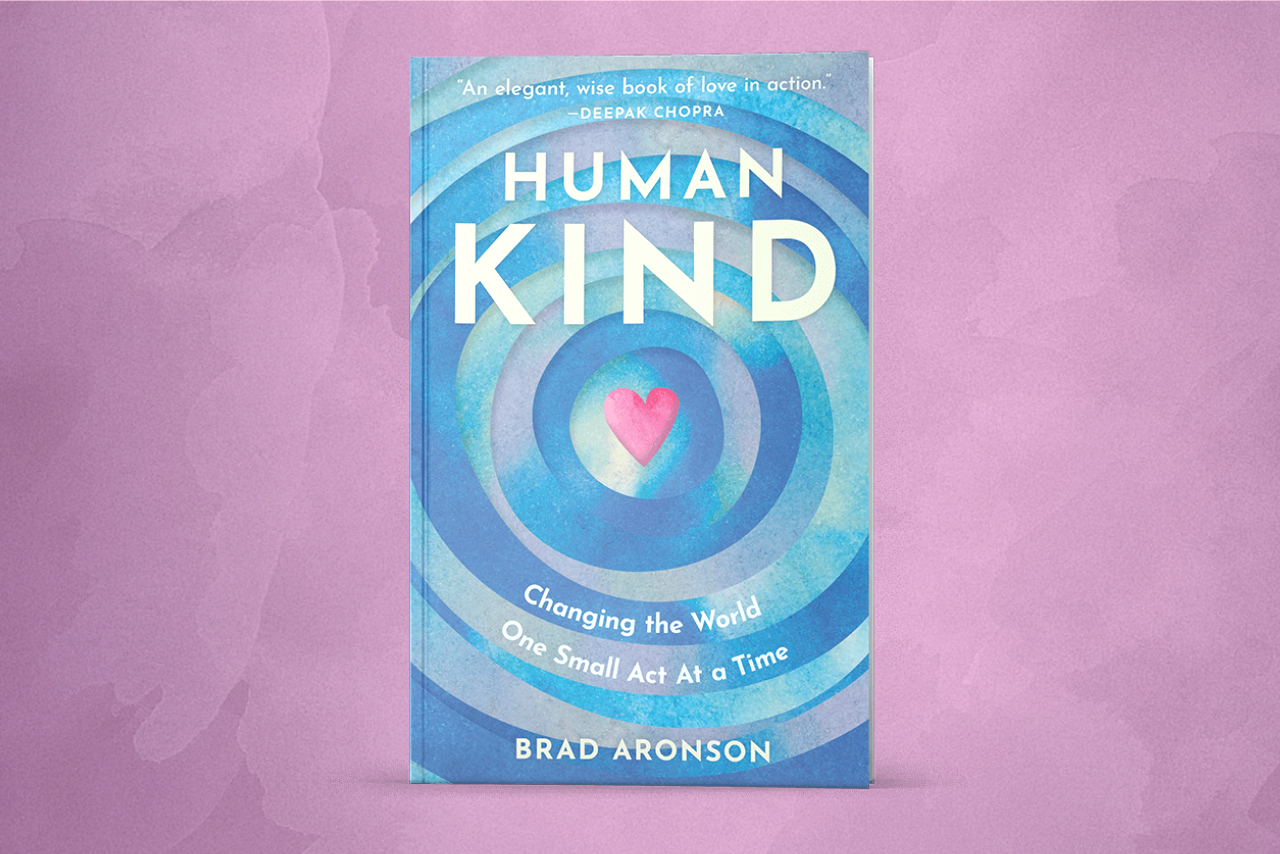
    This is why I keep re-reading and gifting Brad Aronson’s book HumanKind: Changing the World One Small Act a Time. The kindness stories are like a palate cleanser after a tough day has left a bad taste in my mouth. They touch me, restore me, and inspire me to be someone else’s reason to believe in people.

    And all the author’s royalties go to Big Brothers, Big Sisters, which means buying a copy is an act of kindness for both yourself and someone else.

    I’ve written about the book several times now, so it’s possible you’re already familiar with Brad’s story. You may already know he was inspired to write this book after his friends and family rallied around him and his wife Mia during her battle with leukemia. You may also know that the book offers both uplifting stories and practical tips to make a difference in the world.

    You might not know that someone in your life needs this book right now and will likely refer to it for years to come. That they may highlight passages and dog ear pages that give them a sense of peace and purpose, and maybe even pay it forward to someone else whose life will be better and brighter because of it. Someone who’s going through a lot right now, though no one would guess or believe it.

    That’s the thing about kindness: it ripples in ways you could never anticipate and will likely never know. But you can know you’re being the change you want to see, and that you’re changing the world even if you don’t see it.

    True to form, Brad has generously offered ten copes of HumanKind to Tiny Buddha readers, four of which I’ll giveaway here on the blog (the others on social media).

    To enter to win a copy, share an act of kindness you’ve recently received or witnessed in the comment section below.

    You can enter until midnight PST on Sunday, April 17th. I’ll update this post with the winners after I choose them and will also send a follow-up email next week.

    If you’d like to buy a copy for yourself or a friend now (which I highly recommend!), you can grab one on Amazon here.

  • 4 Simple, Heart-Opening Exercises to Fill You with Joy, Love, and Light

    4 Simple, Heart-Opening Exercises to Fill You with Joy, Love, and Light

    “Why are you so enchanted by this world, when a mine of gold lies within you?” ~Rumi

    Happiness, love, and joy—we spend our lives in search of them. We often look to external things to fulfill our desire to experience them. A relationship, a trip abroad, a career, or maybe that shiny new car. We can spend our lives chasing these desires and believing that once we check everything off our list of life accomplishments, we will experience them all.

    But what if I shared with you that all of this—happiness, love, and joy—exists in you right now? That you are the source, not the external items. What if I told you that living in a perpetual state of love and joy is your natural state of being?

    Would you think I’m full of BS? That I’m living in a hippie Never-Never Land?

    Please let me share with you a few simple exercises that showed me my true self.

    Exercise #1: The Love Wave

    Close your eyes and take a minute to connect in your heart with a person in your life that could use a little love. Feel yourself smiling into their eyes and embracing them in a giant, warm hug.

    Allow the love to flow. Sit in this love. Let it grow in strength and surround you both. Then send it out into the world, creating a wave of love. Know that you can come back to this place of flowing love at any time.

    Try this now and then read on.

    Hopefully, you just had a wonderful experience of love. Now I have a question for you. Where did the love originate from? The person you were thinking of, or you?

    It was from you. The person you pictured just helped you unlock the love. You are love. You can actually imagine many different things to unlock it. Try a smiling baby, or playtime with a pet, or a concept such as world peace. These things are just the keys that unlock the true love that is in your heart.

    You can access this love any time you want. You are just tapping into your true being. It is who you are.

    I like to start my day off with this exercise. I tend to do it in the peacefulness of the morning light, right after my morning meditation. Just open your front door or a window and feel the fresh air on your face, then close your eyes and start. It is a beautiful way to begin the day.

    Exercise #2: The Gift of Giving

    One day I was browsing in a bookstore when an old man approached me. He had snow white hair and was wearing a threadbare, beige sweater. He handed me a chocolate rose and said, “Have a beautiful day,” I was taken aback. Who was this man? Was he trying to poison me? Was he hitting on me? I reluctantly took the chocolate rose and said, “Thank you.”

    The clerk noticed my discomfort and told me that the man buys a dozen chocolate roses every day and hands them out to random strangers. I suddenly felt special.

    This incident happened many years ago. Even though my initial reaction was one of unease, I remember this man with fondness. When he finally passed away the entire town mourned. There was a glowing write up in the local newspaper about him. He had brightened the days of countless residents with his gift of a chocolate rose.

    I invite you to pick a day this week and give everyone you meet that day a gift. It doesn’t have to be a physical gift, though it can be. It could also be a compliment, your undivided attention, or a heartfelt smile.

    Don’t expect anything in return. Remember my reaction to the old man? You might not always be met with gratitude. Just practice the act of giving.

    At the end of the day, notice how you feel. You spent the day leaving heart prints everywhere you went. Did this bring you joy? Is the joy within you or did you take it from the people you met?

    Exercise #3: The Vulcan Mind Meld

    We all have goals and expectations. They are important. But what happens when we can’t fulfill them? If we don’t get that promotion or find our perfect mate? We can become disheartened and depressed. How do we prevent this?

    Close your eyes and imagine yourself ten years from now. Give your future self that thing you believe will bring you happiness. Maybe it’s kids, money, power, or something else entirely. Notice how you feel. You might feel confident and secure. Or perhaps loved and important. Whatever you feel, allow it to expand and grow. Sit in it. Enjoy it.

    Then, while keeping your attention on the way you feel, bring back the image of yourself today. Think about what you already have that fulfills you.

    Maybe you don’t have kids, but you have amazing friends. Maybe you wanted a better income, but you can afford things you enjoy already. Look for the abundance within you now. Keep going until your “present self” feels the same as your “future self.”

    It’s almost like a mind meld—make those two beings one. Again, sit in the wonderfulness of it all. When you are ready, open your eyes.

    Try this out before reading further.

    Do you feel happy?

    When we live our lives from a place of lack we experience suffering and discontentment. We are always searching for the external thing that will make us happy. Rather than focusing on the things you don’t have, try living from a place of fullness. You already have an abundance of things to enjoy and appreciate—you just have to change your perspective.

    All that security, love, confidence, happiness, and joy you saw in the vision of your “future self” is accessible right now. Everything you experienced is within you today. Recognizing the abundance or fullness of your life is the key to happiness. If you experience that abundance, not meeting a goal or expectation becomes a minor bump on the road.

    I refer to the belief that we need external things to be happy as “the big lie.” Because when we finally finish off our checklist of life’s “wants,” we often experience “the great disappointment.” The list doesn’t bring us the happiness we thought it would. It’s not the source. We are.

    This frequently happens when people become suddenly wealthy. They think that they will be happier. They are surprised when they aren’t. In fact, having a lot of money comes with its own set of problems.

    Exercise #4: A Gratitude Nap

    This exercise imprints you with the beauty of your life as it is now.

    Lie down and get comfortable. Use as many pillows and blankets as you like.

    Set a timer for three minutes.

    For those three minutes, state out loud things you are grateful for. It’s a bit difficult at first. Please know every item does not have to be deep. Be grateful for the couch you’re lying on, the length of your hair, sand on the beach. Anything goes.

    After the three minutes, set an intention to be open to whatever is there for you to receive. Surrender as much as you can.

    Rest for ten minutes. Notice at the end of the “nap” how you feel. I’m willing to bet you feel a lot lighter after basking in the glow of all your life’s goodness.

    We spend so much of our time dealing with the pressures of life that we forget to do the things that unlock our love and joy. Our true nature gets covered by layers of life experiences and traumas.

    There is an Ayurvedic concept that you can shine with so much light that the darkness has no place to take hold. That light is within you now. It is your true state of being. It just needs to be set free.

    Tips to help access the joy, love, and light of your true being:

    1. Start your day with the love wave exercise.
    2. Make it a priority to do one thing each day that unlocks your joy.
    3. Live life from a place of fullness and abundance rather than from a place of lack.
    4. Practice gratitude.

    I would like to thank all of my teachers who have shared these beautiful exercises with me. Please feel free to share them too.

    Namaste.

  • A Guide to Saying No Without Guilt: 7 Steps for People-Pleasers

    A Guide to Saying No Without Guilt: 7 Steps for People-Pleasers

    “You can be a good person with a kind heart and still say no.” ~Unknown

    Why is it so hard to say no? The uncomfortable buildup of emotion I felt while contemplating dropping the ‘n’ word used to have me rushing around town, home, and work for the people I loved in a heartbeat.

    I remember one day I was on the cusp of complete overwhelm with the responsibility of being a mother, wife, sister, daughter, friend, and business owner. Hanging up the phone with a potential new client who was keen to work with me, I was wired. I had jumped the gun and said yes, when I knew all too well that this was a bad idea.

    I jumped in my car to go pick up my kids from school, slightly perplexed at what had just unfolded in that thirty-minute conversation. It went from me asking questions to see if we were a good fit, to things being turned around when the potential client questioned my ability, to being locked in to meet in person a week later.

    Yet, something didn’t feel right. Still, the thought of landing them as a client was exciting, as it brought in a sizeable paycheck. And it gave me a sense of purpose knowing that I could help them, especially since they’d had bad luck in the past. My past track record of helping people is pretty expansive; I will do just about anything for anyone if I can.

    Sending over the invoice and contract with my two kids running around me wildly meant that a fifteen-minute task required an hour. Finally hitting send made my stomach drop. I questioned “How did this all happen?”

    Reality hit when one of my kids fell to the floor with a flood of tears—I now needed to get back to my day-to-day tasks.

    My life was busy, and I was desperate to get to my yin yoga class. My hubby was running late from work, the kids’ dinner was on the go, while my mate was on speaker phone.

    I shared with her how this new client wanted me to drive an hour for our sessions at no extra charge, and that somehow, I had agreed. I felt totally taken advantage of and my alarm bells were going off, but I wanted the extra income.

    She asked me, “How would you feel if you didn’t say yes?”

    I replied simply, “Bad, because I know I can help them.”

    Resting my head on my pillow that night, my mind whirled with thoughts about “what if?”. Is it too late to change my mind? What if they’re amazing people and I’m just scared because I felt a little resistance? I don’t really want to have to drive. Why did I agree to that? It’s my whole day out the window.

    The day before our meeting, I noticed that the invoice and contract still had not been paid or signed.

    Then my kids’ school decided they were throwing a last-minute sports day, which I really didn’t want to miss. My heart was loud and clear. My daughter won. I decided to call it. These people had not paid or signed, and it was twenty-four hours until their meeting.

    I emailed them to cancel our meeting and suggested they find someone else for the job. It took me a good hour to write that short, to-the-point email, and it took me another hour to hit send because I felt so guilty for letting them down. I wished I had just said no at the beginning. Instead, I took a week to stew.

    Within five minutes, our phone rang. I had forgotten that they had our number, which I never give out, but they’d insisted that we speak that way. I was completely caught off guard as a woman’s voice started questioning why I would do this at such late notice.

    Considering her tone, I felt under attack.

    I explained about the unpaid invoice and unsigned contract and then shared how I wanted to be there for my daughter’s unexpected sports day. She grilled me for ten minutes. The only thing I could say was “I apologize,” which I had to repeat over and over until she abruptly hung up the phone.

    Rattled, I sobbed while my body slowly stopped shaking. I realized that I had just asserted my boundaries by prioritizing my family first. Still, I felt guilty about what I had just done. But I also felt guilty for not wanting to say no in the first place.

    When we continually say yes to things we don’t really want, we are saying no to ourselves. We are confirming that other people matter more than we do.

    This is why it’s so important to embrace saying no and practice it with grace instead of guilt. If I had done that from the beginning, I would have saved myself—and my client—a lot of stress.

    Here’s how I now practice saying no without guilt, and how you can do it too.

    7 Practices to Embrace Saying No Without the Guilt

    1. Resist the urge to justify or overexplain yourself.

    The fear of saying no is just one part of the puzzle. The second is that we often feel we need a legitimate reason to say no, like we have to prove that our no is completely justifiable. Otherwise, of course we would help, right?

    Wrong. Overly explaining or justifying why we are saying no reinforces our need to please others—as if we need them to confirm that our reasoning is valid. That we’re still good people even if we can’t do what they’re requesting. A simple “no, I can’t” is actually enough, so get straight to the point.

    Try: Thanks, but I’ll have to pass. Or: I can’t today. Or simply: No, thank you.

    2. Give yourself more time to respond.

    Not all situations are created equally, but if you can buy yourself some extra time to respond it might save you from jumping right in with a big ole yes to save the day.

    Now this doesn’t mean giving yourself permission to ghost someone with an “I’ll see” or “I’m not sure” and then leaving them hanging. What you’re trying to do here is stop yourself from reacting impulsively so you have time to make an informed decision. Give yourself a little time to think it through and realize, for example, that staying at work for an extra couple of hours and missing your weekly yoga class is not worth the overtime in your pocket.

    Try: Can I let you know in {insert timeframe of choice}? Or: I’ll put some thought into it and get back to you.

    3. Refer them.

    The need to please often leaves us wanting to do all the things for everyone. We might not have the exact right skill but will throw ourselves into a task to help someone out.

    Over the years I’ve learned that I can only work with my skill set, and if I can’t do something, that doesn’t mean I’m letting someone else down. This simple way to say no is honestly my lifesaver. It doesn’t mean I’m palming off a task but redirecting where to find the right person for the job. I no longer need to be a jack of all trades

    If you’re broken down on the highway, you call roadside assistance; if you need your bathroom sorted, you call a plumber. Everyone has a skill set unique to them, so let’s all honor that.

    Try: Unfortunately, I can’t; however, you could try {insert person for them to contact}. Or: I know someone who would be perfect for this.

    4. Know your limitations.

    This is drawing a line in the sand according to our boundaries, and it requires us to learn more about who we are and what we value so we can understand our priorities around time, finances, relationships, home, family, and even our environment. Respecting our priorities means saying no when we realize we are not honoring our values. Each time we let one of our values drop, we are devaluing ourselves.

    These limitations can be simple, like not going out because you’ve got a big meeting the next day and want to be well-rested. Here, the importance of work outweighs socialization.

    Try: Unfortunately, I don’t have time for that today. Or: I’d like to help, but I can’t manage that at the moment.

    Negotiating solutions that work for both parties will help curb the pattern of always saying yes first. Here we already understand our limitations, so now it’s about supporting others in a way that feels good for us instead of just caving into what we’ve been asked.

    For example, perhaps a friend needs your help doing something on Saturday, but you have a full day planned out with your family. Instead of saying yes in a heartbeat and moving your family day, you could suggest that you can help on Sunday instead. Think of this as offering what you can do instead of what you can’t.

    Try: I can’t help you with that, but I can do *this* for you instead.

    6. Be persistent.

    If you’re anything like me, I bet the people around you think you’re superhuman. It’s almost like they expect you to help because you have never said no before.

    Here is an opportunity to get a little uncomfortable and stand your ground by practicing persistence with that one person who won’t take no for an answer, or keeps going and going until you break. It will bring up a lot of mixed feelings, especially if the other person doesn’t listen and  throws all kinds of accusations and emotional tidings your way.

    Reinforcing your response over and over again until they get it takes courage, and it might be tempting to start offering excuses if they keep it up. But hold on in there.

    Them: “Can you help me get to work?”

    You: “Unfortunately, I can’t.”

    Them: “You can pick me up whatever time suits you?”

    You: “I can’t today.”

    Them: “What if I give you gas money?”

    You: “Unfortunately, I still can’t.”

    Try: Holding your ground. Eventually they’ll get the message.

    7. Write yourself a permission slip.

    It’s okay to honor ourselves and respect our priorities. And if this is the permission slip you need today, then here it is: There is absolutely no need to do all things for everyone around you. It’s okay to say no. You are not responsible for anyone else but yourself. Remember that. It’s okay to turn down your best friend for a Friday night dinner when you’re exhausted. Or decline a work opportunity when there’s something you’d rather do. Or say no to anything when it’s not in your best interest.

    Try: I’m honored you’ve asked, but I can’t. Or: Thank you so much for thinking of me, but not today.

    Saying no was challenging at first, but it became easier with practice. I no longer feel like I have to be the one to save the day all the time—and this has saved my sanity.

    Do you find it hard to say no? And how are you tackling it?

  • All It Takes Is One Person to Start a Chain Reaction of Caring and Kindness

    All It Takes Is One Person to Start a Chain Reaction of Caring and Kindness

    “People will never know how far a little kindness can go. You just may start a chain reaction.” ~Rachel Joy Scott

    One afternoon a while back, after stepping onboard to a full train car with no available seats, I situated myself in the standing section.

    A couple of stops later, two passengers vacated their seats, allowing me the chance to sit. I embraced the opportunity to people-watch. The woman in front of me began chapter four of her book, titled How to Jump for Your Life. The girl next to her alternated between the Tinder app and a school report. A little dog ruffed from the black duffel bag on the lap of the woman across the aisle from me.

    One minute I was staring down at my iPhone screen—earphones in, listening to a podcast. The next I was looking up to a group of teenagers yelling at a middle-aged man. The man was seated next to his bike in the bike section. I didn’t see what he’d done to provoke them.

    Their voices grew louder. Removing my earphones, I watched as the man stood up, chest puffed out. Barely an inch of space separated his face from the younger man’s. His opponent bridged this distance by stepping closer and punching him square in the eye. The older man hit back.

    As the spat escalated into a physical altercation, each hit delivered with more force than the last, passengers (myself included) watched incredulously. Headlines broadcasting the recent senseless murder of Nia Wilson on BART (Bay Area Rapid Transit) flashed through my mind, and I wondered if one of these men would pull out a weapon.

    I wondered how long they would fight for, and I wondered what would put an end to it. Was there anything we witnesses could or should do (and if so, what?)—or were we just captive audiences to the violent scene occurring in front of us?

    Visibly shaken, and with tears in her eyes, a woman passenger with dark curly hair, who looked to be in her early thirties, got up from her seat. “Stop. STOP!” she yelled, her voice at once insistent and pleading.

    About twenty seconds later the train came to its next stop, and the teenage boy and his group of friends ran off. The older man with the bike stayed behind—left side of his face twitching, injured eye watering heavily (he seemed unable to keep it open).

    Though I’d witnessed violence like this on television, this was the first time I’d been so close to actual, real-life physical aggression. That the fight had occurred between real people rather than actors— powered by raw anger and heightened emotions—and that it hadn’t been manufactured for audiences to consume from behind a screen both jarred and disturbed me.

    Still, the initial collective response seemed no different than had we all just watched a scene from Orange is the New Black together.

    Some BART riders put their earphones back in. Others appeared minimally affected, yet still somewhat removed and distanced from the spectacle. Almost everyone remained seated.

    Everyone except for one woman—the one who had been noticeably shaken by the altercation. The one who had cried and pleaded with the two men to stop.

    This woman marched over to the intercom and reported the assault to the station agent, asking that he please send a person to attend to the injured man. She then sat with the man, allowing him to use her phone to provide his information to the police.

    Once he hung up and handed her phone back to her, I felt suddenly compelled to leave my seat. The woman’s actions had emboldened me to push past my apprehensions. After getting up, I approached and offered the man some water to wash out his eye with.

    And then I watched as other people followed suit.

    One woman handed him eye-drops. Another conjured towelettes with disinfectant from her bag. A third offered Ibuprofen.

    I observed, and felt calmed by, the prosocial Domino effect playing out in front of me. And the precipitator of it—that woman in her thirties with the dark curly hair—stayed in my mind for a long time after.

    Since then, I’ve reflected a lot on the initial collective response. I don’t think it’s specific to our time; our desensitization in the presence of large groups of strangers is nothing new, as much as we might like to blame it on the disconnection from one another that technology has engendered.

    What came to mind was the bystander effect, a social psychological phenomenon in which individuals are less likely to offer help to a victim when other people are present” (Wikipedia). In short, according to this theory, the more people there are, the less likely it is that any one of them will step forward to help in a given situation.

    One of the most famous examples of the bystander effect took place in 1964 Queens New York, when Kitty Genovese was brutally stabbed, sexually assaulted, and left to die while returning home from work on foot at 3 am. The New York Times reported that thirty-eight witnesses watched the stabbings and did not try to intervene. They did not call the police until the assailant was gone and Genovese had already passed away.

    It’s disconcerting to read what the worst-case scenario of bystander effect can lead to, but at the same time I think we can glean a hopeful message from it. I think we can use it as evidence that any one of us may take it upon ourselves to model responsible, prosocial behavior for one another.

    I think a lot of times people shut down and check out when they don’t see a way to be useful or help the situation. To me, it’s comforting to know that all it takes is one person to get the helping momentum going, though.

    One person can drag us out of this paralysis by leading by example, perhaps motivating others to be that initial precipitator in a future scenariothe one who steps up and steps in, encouraging others to follow their lead.

    Imagine what the world would be like if we all did just that?

  • The Many Shades of Support: Everyone Shows Up for Us in Different Ways

    The Many Shades of Support: Everyone Shows Up for Us in Different Ways

    “Empathy has no script. There is no right way or wrong way to do it. It’s simply listening, holding space, withholding judgment, emotionally connecting, and communicating that incredibly healing message of ‘You’re not alone.’” ~Brené Brown

    What do a pregnancy test, a wheelchair, and an Airbnb have in common? The answer is this story.

    In February 2019, one night before I was to get on a flight for my first ever trip to Paris, with my sister and best friend, I took a pregnancy test and it read… positive.

    Excited? Worried? Anxious? I was all of the above.

    You see, I have a history of early pregnancy loss, at least one of which has been an ectopic pregnancy. This means that for me, every positive pregnancy test is considered high risk because ectopic pregnancies can be fatal.

    Normally, I would have to notify my doctor about the positive pregnancy test. Then, they would test my blood for pregnancy hormones every two days to keep an eye on the trend. The direction of the numbers tells us whether we should expect a normal pregnancy or a miscarriage or suspect an ectopic pregnancy.

    Well, in this case, I wouldn’t be doing that… because, well, Paris.

    Another consequence of my history of recurrent miscarriage is that I never tell anyone, other than my husband, when I test positive for pregnancy. I usually lose the pregnancies so quickly that it’s not worth the shame and emotional rollercoaster to have other people involved.

    So, when I boarded that plane to Paris, my sister and best friend had no single idea that I was a ticking time bomb.

    The festivities commenced.

    One night near the end of our weeklong trip, I was standing in the kitchen of our Airbnb when all of a sudden, it felt like a dagger had been hurled through the right side of my groin.

    I dropped to my hands and knees.

    In between the stabs of pain and trying to catch my breath, the alarm bells started going off in my head.

    The girls immediately came running over. “What’s wrong? What happened?”

    I managed to get out the words “Call my husband. Tell him what’s going on.”

    They called him and he told them that I would need to get to a hospital immediately … in Paris … where none of us spoke French.

    Luckily, our Airbnb host, an American expat, lived in the same building and was an absolute angel. She responded when they called and then quickly escorted us to the nearest hospital and even stayed around to translate for me.

    We were in those waiting rooms for hours.

    At some point in the middle of all the ruckus, I had had to come clean to the girls. Sheepishly, I explained that I had had a positive pregnancy test and it was possible that I was having another ectopic pregnancy. (They knew about my first one and understood the gravity of this emergency).

    When the seriousness of the situation became clear, shock initially brought them all into silence.

    Soon after, my best friend sprung into action. She was offering encouragement and consolatory back rubs and updating my husband every few minutes. I can’t quite remember how many cups of water she offered me.

    My sister, on the other hand, my own flesh and blood, had no words. The few that she had, awkwardly dripped from her mouth—“Do you … need anything?” She had this shocked and frightened look stamped permanently across her face for the whole ordeal.

    There is one moment that I can’t forget, however.

    When they finally brought a wheelchair to wheel me down to the OB/GYN side of the hospital, someone else attempted to take hold of the wheelchair, and she quickly said “No” and rushed in.

    She planted her hands on those wheelchair handles and didn’t let go as we silently walked down the long, cold, concrete corridor to the other side of the hospital.

    Our Airbnb host eventually returned home to her son.

    But as for my sister and my best friend? They were there all night into the wee hours of the morning.
    In those uncomfortable waiting room chairs. While it was cold. Despite hunger. Without asking why I hadn’t told them ahead of time. And without once making me feel guilty about the obvious demise of the rest of our trip.

    We eventually went home and took flights back to our respective cities.

    A couple days after we had returned to the US, my sister called me to see how I was feeling.

    After giving her the updates, she offered an apology. She said that she was sorry if she hadn’t said or done the right things. She admitted that she didn’t know the right thing to say and felt bad that my best friend had been so much more proactive.

    I was happy to reassure her that she had done exactly what I needed at that time.

    You see, she was there. And she stayed there. Without complaint. Without exception. Without excuse. She was there. And that was all I needed from her at that time.

    My best friend also did exactly what she needed to do. She offered comfort and tried to advocate for me as much as she could. She gave me everything that was within her capacity in that moment.

    And I don’t take either response for granted.

    You see, when it comes to support, there is no one right way to do it. It means different things to different people in different situations.

    In any given moment, the support of a loved one can mean a word of encouragement or a pot of food. It can mean buying something from your friend’s new business at full price. It can mean connecting them to resources, driving them where they need to be, a hug, and it can mean just being there.

    Sometimes we underestimate the power of just holding space. Even though oftentimes, that is enough.

    And for those in the position to receive support, it’s important to remember that the people that love you all have different capacities for supporting you at any given time. Show them grace and be thankful for how much or how little they can offer you.

  • The You Matter Marathon: A Simple, FREE Way to Change Someone’s Life (No Running Required)

    The You Matter Marathon: A Simple, FREE Way to Change Someone’s Life (No Running Required)

    I care. I’m here. I’m sorry. You can.

    Two simple words can make a huge difference. They can soothe, heal, connect, and inspire.

    Perhaps the two most powerful words in the English language: You matter.

    Far too many people don’t believe this is true. Especially since the start of the pandemic, many have felt isolated, purposeless, and some even hopeless, wondering if they’ll ever feel connected and valuable again—if they ever even have.

    My new friend Cheryl Rice started this global kindness movement, the You Matter Marathon, for this very reason.

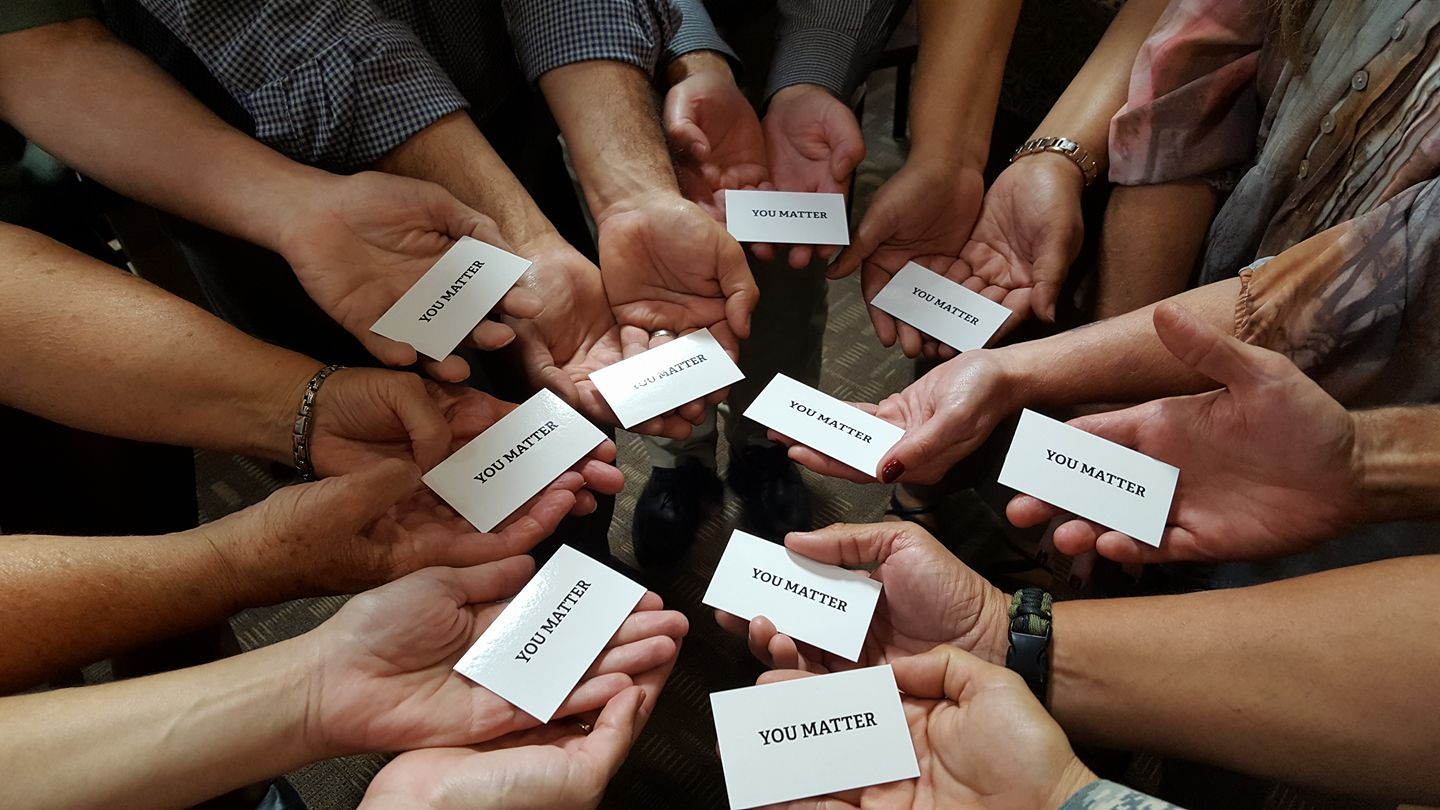
    It all began back in 2016 when a colleague handed her a business sized card with only those two powerful words on it—You matter.

    That gesture and those two words touched Cheryl deeply.

    Cheryl wanted to pay it forward, so she ordered her own You Matter cards and began sharing them with family and friends. From there, she began handing them out to people she appreciated in her community, like her dry cleaner and the man who sold her fruit at her local farmer’s market.

    Weeks later, she got confirmation that her simple mission had the capacity to completely transform someone’s day—and maybe even their life.

    She was standing behind a woman in the grocery store checkout line. The cashier asked the woman how she was doing. Instead of offering a painfully dishonest, knee-jerk “I’m fine,” she confessed that her husband had just lost his job, she was having issues with her son, and she didn’t know how she was going to get through the holidays. She then pulled out her food stamps.

    Cheryl’s heart ached for this woman, who she wished she could somehow help. She knew she couldn’t solve her problems or take away her pain, but she could give her one of the most powerful gifts anyone can receive from another human being—a moment of validation. And that’s exactly what she did when she approached the woman in the parking lot and handed her a You Matter card.

    The woman began to cry and said, “You have no idea how much this means to me.”

    Her response caught Cheryl off guard and cracked her heart open even further. She asked if she could give the woman a hug and then Cheryl went to her car and cried.

    So many people are starving for acknowledgment, walking through their days in a daze of pain, hoping someone will truly see them and care. Maybe you’re one of those people, or you were at one point in your life. I know I’ve been there before.

    We all want to believe that we matter and that our feelings matter, but we don’t always think to give this type of affirmation to the people we encounter. Maybe because we get wrapped up in our own problems or because we think it takes a lot of time or money to make a meaningful difference for someone else.

    But when we reach outside ourselves and make a heart-to-heart connection with someone who’s hurting, or who just yearns to be seen and valued as a human being, in that moment, we matter. We make a difference. And we inspire someone else to do the same, one life-affirming interaction at a time.

    That’s what the You Matter Marathon is about—creating positive connections within and between individuals and communities one card share at a time.

    To support their primary mission of sharing one million You Matter cards every November, they offer a free month’s supply of You Matter cards to anyone who signs up here.Since 2016, millions of cards have circulated through eighty-three countries, making a massive, stunningly positive impact. Join the movement and help heal the world, one day and one card at a time.

    To learn more, check out the one-minute You Matter Marathon highlight video and Cheryl’s ten-minute TEDx talk, You Matter—Changing the World with 2 Words.

  • Toxic Help: 3 Signs Your Support Is Doing More Harm Than Good

    Toxic Help: 3 Signs Your Support Is Doing More Harm Than Good

    “There is no exercise better for the heart than reaching down and lifting people up.” ~John Holmes

    As someone who people often come to seeking help or advice, I recently encountered a new situation for me: one in which I chose to stop helping someone and walk away entirely because I determined it wasn’t good—for the other person or myself.

    It felt like the wrong thing to do, but once I had some distance, I knew I had made the right decision. Throughout the helping, I soldiered on and helped and helped and helped until it no longer felt good, and sometime after that I determined it was no longer help at all—it was enablement.

    My good friend—let’s call him Jack—has had a series of extremely toxic relationships. Infidelity, dramatic and very public confrontations, drug abuse, police involvement…. Jack has always played the role of victim in these cases, and in the three relationships I saw him in during the time of our friendship, he was cheated on, dumped, thrown out of the house, and physically abused. He can’t seem to help himself in this regard.

    Last year, he entered a relationship that was problematic before it even began. The very first official date with Henry, the guy who later became his partner, Henry stormed out of a dinner with a group of people, got extremely intoxicated, and got into a fist fight (with a legally blind person no less) and thrown out of another establishment later. This was all on the first date mind you!

    In a sense, this was very lucky. When someone shows you their worst selves, that is often after years together, a shared home, or maybe even a marriage. At that point, it’s usually emotionally and perhaps even logistically very difficult to walk away. On date #1, not so much!

    And yet, Jack persisted.

    Over the course of the next few weeks, Henry, who was already living paycheck to paycheck, was fired from his new job (for which he relocated internationally) for having a shouting match with the boss, and had a dramatic fight with his older sister, who was his only acquaintance in this new country and perhaps his only source of financial support.

    It also became clear the guy was an alcoholic and drug addict. Without a job or the help of his sister, who do you think he immediately turned to for money? Yup, Jack.

    Before too long, Henry’s temper tantrums were directed at Jack’s friends, including myself. The first day I met him, Henry screamed and yelled at me over dinner. In short order, the temper tantrums were turned on Jack, and soon the words became closed fists. He beat up Jack a few times—once leaving Jack with a pair of black eyes—and yet, it was Henry who dumped Jack. Jack kept coming back for more!

    This all unfolded over the course of about six months. During this time, Jack frequently sought my advice. Whenever we talked, I of course let him know how unacceptable Henry’s behavior was, but also tried to get Jack to accept the deeper reality of the situation—that no one who was okay with themselves would tolerate this type of behavior from someone else and that Jack needed to really work on himself.

    As the situation became more threatening and then violent, I counseled Jack in no uncertain terms that it was time to get the hell out of there. Had I been aware shortly after the physically violent episodes (Jack only told me weeks after the fact), I very likely would have become directly involved and called the police.

    After each of these conversations, Jack’s mood brightened from despondent to anywhere from determined to energized. He was going to take action. He was going to see a therapist. He was going to stop giving Henry money and leave him. He was going to make sure not to speak with him alone. And each time… nothing. Same story each time. Each time I saw Jack, Henry was there, often belligerent, and always intoxicated with something.

    However, as incomprehensible as Jack’s behavior and decision-making seemed, it’s not uncommon for victims of abuse, who often suffer from past traumas and therefore have underlying emotional and psychological issues that require professional attention. In fact, it has a name: trauma bonding. I was aware of that, so beyond trying to help protect Jack’s physical safety, I was patient in nudging him toward seeing someone.

    What finally did it for me—the last straw—was after the second or third incident of physical abuse. Jack’s friends, some of whom I knew, were very happy to gossip and complain about the situation behind Jack’s back, especially insofar as it affected their social plans. However, they didn’t intervene or offer him help in any way that I could see.

    Likewise, Jack lived at home with his parents and siblings. Even after coming home black and blue and bleeding, they took no action and never discussed the situation.

    A week later, there were social media postings of Jack and Henry back together again, all smiles. The friends who knew of the abuse? They awarded those posts with smiley faces, hearts, and thumbs up.

    At that point, I realized that I just couldn’t fight this battle alone. It’s difficult enough to try and help someone who is not able to help themselves and indeed seems intent on hurting themselves, but when such a person’s self-destructive behavior is supported and enabled by a whole community of people surrounding them? That is an impossible situation, so I took myself out of it and broke contact. I was out of the country at the time, so it was easier to do this at that point.

    I thought about why I did this. It wasn’t because Jack was so intent on his self-destructive behavior—that just made it difficult, and it’s hardly a unique circumstance. It wasn’t because it was unpleasant—helping someone who really needs it often isn’t pleasant or glamorous, however good it might feel after the fact. And it also wasn’t that I felt in danger from Henry—he was a classic bully, beating up on people weaker than he was, but I didn’t have to see him.

    No, this was something else entirely. This was “toxic help,” and I thought about it and figured out three ways to identify it as such. With these conditions, it’s difficult for me to imagine any help actually being helpful, in which case it’s better for you and indeed everyone else if you extricate yourself.

    3 Ways to Identify Toxic Help

    1. You check yourself and don’t like what you find.

    Whenever you help someone, you should always check yourself first to ensure that this help is coming from a good place, from the standpoint of both your mind and emotions.

    The ego often plays a critical role in instances of toxic help. If you delve deep, you may find that you are actually pushing some agenda or subconscious ulterior motive on the other person.

    For example, you may be helping in part because you are re-enacting some past trauma or mistake you made and trying to fix your past self. Or, you may be trying to impress the person or make yourself feel superior. There are a lot of ways your ego could be manipulating the situation.

    In my case, I didn’t find any evidence of a subconscious ulterior motive. However, what I did find was that I had developed a lot of negative emotions around the whole situation.

    I was frustrated with Jack for making the same error over and over and over again. I was angry with Jack for constantly disregarding my advice—my advice… and that is where my ego started showing through.

    I was furious with his friends and family for allowing and even encouraging the situation to continue and tired of seemingly being the lone voice of care, concern, and sanity. If I was at a more evolved state, that negativity would not have arisen, so that’s probably something I should work on myself. But that was the best I could do at that time.

    Help can never come from a place of anger, any more than it can frustration, resentment, or greed. Negative emotions are part of life, but acting on them pollutes the world with that negativity. I realized that my efforts to “help” were becoming increasingly hostile in nature, and at that point nothing I would do was likely to be successful, because it was no longer coming from a place of love.

    Moreover, negativity transfers, as life is not compartmentalized. My anger, frustration, and other negative emotions were surely spilling over into other facets of my life—my work, friendships, and causal interactions. At that point, even if I was still in a position to help Jack, I’m not sure if it would have been a net positive for the world if, while doing that, I was not honoring the other people and responsibilities in my life.

    2. Your help is causing the other person to stagnate.

    Jack, as I mentioned, normally seemed to brighten a bit after each of our little talks. He would come away feeling more determined, agreeing with my analysis, and sure he was going to do something about it. Walking away from each of those interactions, his back seemed a little straighter and his head held higher. And yet, nothing changed in the situation.

    However, that’s normal with intractable problems and deep-seated behavioral patterns—they’re difficult to change! I realized that my help was not merely failing to have a positive impact, it was making things worse.

    It became clear that each time Jack spoke to me, he mentally tagged that as “doing something.” He felt better that he’d talked through the issues, apparently made some decisions, and probably because he got a lot off his chest—all healthy things. Yet, in his mind, that represented action and progress. When he spoke to me after the fact about what concrete decisions and steps he’d taken, he would offer up our last talk as an example.

    In this way, our talks became like a drug—a little pick-me-up that provided a brief high but did nothing to actually move Jack forward.

    Our talks were counter-productive in this way because they made him feel better, when in fact it is discomfort that typically spurs people to take difficult action. Our talks made him feel more comfortable, when what he needed was to feel less comfortable with the situation. The result was that Jack was avoiding taking the positive steps he needed, such as seeking professional help.

    3. You start role playing “savior” and “person in distress.”

    Any truly close relationship with someone must be authentic. It doesn’t involve role-playing or people doing what they’re “supposed to do” just because it’s something they’re “supposed to do.” It is an exchange, a give-and-take, an open dialogue, and a two-way street.

    Surely, in a long-term relationship, there will inevitably be periods in which one party is the needy one and the other is the helper. Yet, when those roles calcify into giver and taker, and every interaction is one of helping and being helped, that’s no longer a friendship—it’s a co-dependence.

    In my case, Jack had become stagnant. He was not moving forward. If ever he was looking for just some social interaction or “chill time,” he would call Henry or one of his other friends, and this often involved substance abuse. My role just became the helper and advisor, and in truth, our “sessions” had just morphed into pick-me-ups for Jack, so it was no longer even helpful for him.

    So, our relationship became boxed in this way with no clear way forward. Jack got fulfilment of his complex and unhealthy emotional needs from Henry, he got his social needs fulfilled by his enabling friends, and he got his help from me. We all had our parts to play, and indeed the other parties in his life encouraged this system to continue by enabling his behavior.

    The only way I saw to break the mold was for me to change the dynamic, and so I did.

    Not surprisingly, after Henry left the picture, Jack stopped calling for help. He didn’t notice that I wasn’t at his birthday party because I was out of the country, but then again, he didn’t even know that I was out of the country. He hadn’t needed help for a few weeks, so the calls stopped. as my role was temporarily written out of the script… until his next toxic relationship, when he’ll need to find a new helper.

    None of this was easy for me, and it didn’t feel good or natural. I am not one to turn my back on anyone in need, especially not a friend. But I learned and came to accept that I can’t do everything and should not take responsibility to fix what is beyond my ability.

    I really wish the best for Jack, and it would be nice to one day re-establish a relationship, but I needed to create distance in order to restore my own well-being, break the co-dependence that had developed, and banish the helper/person in distress roles that had hardened. In this way, I could be my best self, which ultimately is what’s most helpful to the world.

  • Why “Find Your Purpose” is Bad Advice and What to Do Instead

    Why “Find Your Purpose” is Bad Advice and What to Do Instead

    “The meaning of life is to find your gift. The purpose of life is to give it away.” ~Pablo Picasso

    I was fifty-two when I found my purpose. I wasn’t even looking. It literally just smacked me upside the head. That’s a funny thing about life. It throws things your way, and you either grab them and run with them or you turn a blind eye and walk on by.

    I used to turn a blind eye. I don’t anymore. These days I’m taking in all that life tosses my way. The good, the bad, and the ugly.

    How My Purpose Found Me

    I had just left an abusive relationship and declared bankruptcy. You could say my life was a complete mess. I had also just hit rock bottom and was starting the grueling climb out. It was frustrating and exhausting.

    During my healing and self-discovery journey I did something that changed the entire course of my life. I started volunteering at a homeless shelter.

    I’ll be honest with you, I did that for two reasons. One was selfish. The other, humanitarian (and sincere).

    I desperately needed to take my mind off all my problems, and I figured the only way to do that was to surround myself with people whose problems were way bigger than mine. And it worked. But something else happened.

    I fell in love with the homeless people I met and found a deep sense of purpose. Phew! I sure didn’t see that coming.

    I then made it my mission to do more of that. Help people, all people, even animals. I just wanted to help everyone and everything anyway I could, as often as I could.

    I had found my purpose, and that was to do my part to make the world a better place.

    I Never Understood the Meaning of “Find Your Purpose”

    I honestly thought that phrase was overrated and overused.

    It seems to suggest purpose is something outside ourselves that we miraculously stumble upon someday. “Oh, did you hear? Mary found her purpose today.”

    And it also creates a lot of stress and pressure to hurry up and figure it out. “I’m still looking for my purpose, and I’m frustrated that I’m having such a hard time with this.”

    I couldn’t understand why everyone was desperately seeking their purpose. I was just trying to navigate life the best way I knew how in order to have inner peace and be happy, while others were searching for this holy grail.

    I questioned myself. Should I be looking for this too? Do I need to find it before I die? Will my life be incomplete if I don’t? Will I die with regret then?

    I was confused. What’s the big deal about finding your purpose? It was starting to freak me out.

    My Aha Moment

    After my first night at the homeless shelter, I knew without a shadow of a doubt that I wanted to do that for the rest of my life. Just give and serve and make people happy. I wanted to turn frowns upside down and get hugs and make people’s lives better, any way I could.

    Did I finally discover my purpose without even realizing it? Was this what everyone was talking about?

    I assumed it was. I assumed that this was it! I’d found my purpose and now my life was complete. Or was it?

    I was puzzled by something.

    Isn’t This Everyone’s Purpose?

    I couldn’t understand why me serving homeless people and helping humans and critters in any way I could was some special purpose.

    Shouldn’t we all be doing that? As humans sharing the same planet in the galaxy, shouldn’t we all be doing our part to help other human beings (and critters)?

    It’s more than that, though. It’s so much bigger than that. It’s about finding joy and peace in knowing you did your part to make the world a better place.

    That’s what the definition of purpose should be.

    Stop Looking for Your Purpose

    Maybe we should just ditch the word purpose and replace it with something that doesn’t sound so foreboding. Maybe instead of saying, “I’m trying to find my purpose in life” we should try saying, “I’m doing my part to make the world a better place.”

    It just has a nicer ring to it.

    There’s so much anger, hurt, hatred, and frustration in the world today. The world needs more love. People need more love. When we see things and people through the eyes of love and compassion something magical happens.

    We understand, we don’t judge, we feel for each other, and it brings us all one step closer to having inner peace and joy.

    So how can you make the world a better place?

    What special gift, talent, or skill do you have that you can offer the world?

    It doesn’t have to be what you do for a living, though that’s clearly the ideal, since we spend so much time at our jobs. Maybe it starts as something you do on the side and grows over time. Or maybe it doesn’t, but maybe having something that fills you up will help make your 9-5 more tolerable.

    The important thing is that you find some way to help people that leverages your unique passions and interests. Then even if you don’t love your job, you’ll feel a sense of meaning, and you’ll feel good about yourself and the difference you’re making.

    Maybe you love animals and can volunteer at a shelter.

    Maybe you make people feel good about themselves by simply sharing kind words to strangers.

    Or maybe you’re passionate about  knitting or sewing or singing and you can find ways to use those talents to brighten other people’s lives. I mean, the possibilities are endless.

    We need to do more things that spread joy, hope, and love to the people around us, even if it’s something small. Sometimes it’s the smallest acts that have the biggest impact.

    If you’re stressing about the fact that you are getting older and haven’t found your purpose yet, stop. It’s overrated. Instead, find ways to serve and in turn, inspire others to serve.

    It’s not about finding your purpose. It’s about living your life to the fullest and knowing at the end of the day that you did your very best to make someone else’s day brighter and better. It’s about doing that every day until you die. That’s a life well-lived. And if you want to call that your purpose, so be it.

  • I Was Addicted to Helping People – Here’s Why It Made Me Miserable

    I Was Addicted to Helping People – Here’s Why It Made Me Miserable

    “As you grow older, you will discover that you have two hands, one for helping yourself, the other for helping others.” ~Maya Angelou

    Growing up in Africa, I was told that the virtue and worth of a woman lies in her ability to take care of everyone around her; that a woman was considered good or worthy when everyone around her was happy and pleased with her. I took this advice to heart, especially since I watched my mother meet this standard to a T. Putting everyone else, including strangers, above herself.

    Most of the Things We Learn as Kids Shape Us

    As a kid, I was taught how to cook, clean, and care for others. As a teenager, I got a lot of practice caring for my younger siblings; at first, it was great, being a caregiver, being the one who everyone went to when they needed something. I loved being needed, and I relished in the label I was given as dependable.

    Family, friends, and even strangers knew that I was the go-to girl for whatever they wanted. If I couldn’t help them with whatever they needed, I would find someone who could. I was determined to never leave anyone high and dry. I loved being needed, and if anyone needed me, I believed that I was their last resort.

    The Joy of Giving

    You see, one thing about giving is that it feels good… until it doesn’t. The moment you get to a place where giving doesn’t feel good anymore, it means that you need to turn the giving around and start giving to yourself. But how does someone who is addicted to being needed realize this?

    When helping people started feeling more exhausting than exhilarating, my first instinct was to give more because I believed that the more I gave to others, the more I would receive from them. But that was not the case. The more I gave, the less I received, and this prompted me to label most of my friends as bad friends because I wasn’t getting as much as I was giving to them.

    When I became isolated from cutting friends off because they were “bad” to me, I realized the problem wasn’t that I was not getting as much as I was giving; the problem was that I was giving to everyone but myself. I had put myself in the back burner and abandoned myself. How can I abandon myself and not expect others to abandon me?

    The Guilt That Comes with Giving to Yourself

    Realizing my deep-seated issues was easy, but addressing them was a whole other thing. Because I was conditioned to believe that my worth was in pleasing others, I always said yes to everyone who needed my help; saying no was extremely difficult.

    This was because I was suppressed by intense guilt and ended up caving in to finding help for the person at my own expense. Everything changed for me when a former classmate said to me out of the blue: “You are nobody’s last resort.”

    You are nobody’s last resort, no matter how bad it is. If you cannot help someone with their problem, another person will. And more importantly, it’s not your responsibility to ensure they get the help they need—it’s theirs.

    This was a turning point in my life because now I knew that telling someone no because I needed the time to invest in my own needs did not mean that they were never going to get help.

    The guilt was still there, but little by little, I persevered in choosing myself over and over again. I started with little things, like saying no to helping a friend walk their dog to stay at home, to take a long bath and read a book (I enjoy reading). And over time I was able to get better at saying no to larger requests that would have been draining and would have negatively impacted my mental health.

    Give to Yourself and You Won’t Expect Too Much From Others

    Slowly but surely, I learned that my worth is determined by me and me alone—by how much love and care I direct toward myself. Guilt still visits me sometimes, but it is not as intense as it used to be.

    I know now it is better to feel guilty for taking care of yourself than to expect others to anticipate your needs and take care of you. News flash: if you don’t take care of yourself from the inside out, no one will.

    Don’t get me wrong, I still take care of my loved ones and help others as well as I can, but I now do it from a complete place, a place of wholeness, knowing that I will be fine whether they invest in me or not.

    I don’t expect much from people, and I don’t get disappointed much because I have learned to prioritize myself. Frankly speaking, I have noticed that the people around me enjoy me more now that I am not a self-righteous person who resents her giving and selflessness.

    “I give and give and give, and what do I get? Nothing.” If you have heard yourself say or think these words, then you are expecting people to make you happy just because you are bending over backwards to make them happy. If you keep bending backwards to make others happy, one day you will break your back. A broken back is very painful to bear, take note.

    Life’s a Journey, Not a Race

    This is not an overnight process; it will take time and patience. I have learned that part of taking care of myself is being nice to myself, whether I’m making progress or not. I’m done talking down to myself. Everything I wouldn’t do or say to another person, I’ve vowed never to do or say to myself.

    There is no glory in stomping all over yourself to please the world, there is no glory in self-deprecation and self-hate. It is not humble to call yourself terrible names or to live in suffering because you don’t want to hurt some else’s feeling or because you want to be called a nice/polite person.

    Our feelings and needs matter as much as anyone else’s, but we can only honor them if we recognize this and prioritize them.

  • Why People-Pleasers Don’t Get the Love and Respect They Desire

    Why People-Pleasers Don’t Get the Love and Respect They Desire

    “Niceness is the psychological armor of the people-pleaser.” ~Harriet B. Braiker

    I used to think that being kind, gentle, and agreeable was guaranteed to win me love and acceptance from others. I’d tiptoe around destructive people’s behaviors, no matter how uncomfortable I felt about it, believing to my core that if only I could be nice enough to them, they would one day lead a better life.

    I lived my life constantly avoiding anything that might make me look like a bad, imperfect, antagonistic, or unlikeable person. Because as every people-pleaser knows, being disliked or disapproved of feels worse than ignoring your own feelings—at least at first.

    Some people were easy to please; a kind gesture or smile was all it would take. Getting their approval so effortlessly made me happier than a kid at Disney World. But with other people, it seemed the more I tried to please them, the more likely they were to treat me like an old dish rag; and the more this happened, the less I liked myself.

    Eventually, my efforts to please others left me feeling disrespected, violated, and disconnected—from life, from other people, and from myself.

    For many years, I silently endured the ongoing, relentless invalidation of who I was based on how others treated me. When someone close to me was feeling unsatisfied, negative, or in search of someone to blame, there I was, ready to take it.

    But no matter how unhappy I was, I still wanted to make them feel better. I wanted to see them happy, even at my own expense.

    At the core of these one-sided relationships I maintained with some of the perpetually dissatisfied people in my life was an enduring belief that if only I could solve their problems and make them happy, I’d finally receive the love and acceptance I desired all my life.

    I never stopped to think, “But what about me? What will become of me if I keep trying to satisfy people with an unquenchable thirst?” I couldn’t see that no matter what I did, it would never be enough. In fact, it wasn’t about me at all. I didn’t realize that no matter how good I am at solving problems, or how perfectly I can handle things, if someone wants to find fault with me, they will.

    Instead of seeing other people’s dissatisfaction as an issue for them to resolve on their own, I internalized it and interpreted it to mean I wasn’t good enough.

    But one day, I finally started asking myself some important questions: “What will become of me and my self-worth if I keep basing it on unhappy people’s perceptions? Who will love and respect me if I’m not even taking a stand for myself?”

    My conception of who I needed to be in order to gain love and acceptance was slapping me in the face over and over again like a flat tire driving on uneven pavement. But still, I wondered why my formula wasn’t working. I truly believed that living selflessly was a surefire way to get love, appreciation, respect, and lots of hugs in return.

    It took me a while to realize that living this way was actually having the opposite effect. My constant selfless giving and kindness didn’t automatically earn me a pass on the eternal acceptance subway. It actually seemed to be an invitation for people to take advantage of my generosity, allowing them to feel less anxious about their own lives.

    I set myself up to be other people’s emotional dumpster, personal life fixer, and convenient source of blame for their misfortunes.

    What I came to learn the hard way is that pleasing others isn’t the way to win their love and respect. I finally realized that if I kept taking on other people’s anxiety as my own, they would never change. And why would they, after all? They got lots of relief from me stepping in and resolving things. But at what cost?

    All this pleasing had left me feeling inadequate and stressed out as I watched the recipients of my pleasing play out the same problems and drama, over and over again.

    Love At All Costs

    One night I had a dream that I was standing in a field with nothing but the clothes on my back. I felt weak and tired, like I needed someone to come lift me up and ask me how I was doing.

    Slowly, my family and friends started to join me in the field. But they weren’t there to rescue me; they were there to bring me their troubles.

    One by one, they started pulling me in different directions. They wanted me to solve their lives for them, even though I was alone, tired, defeated, and left with nothing.

    The dream was showing me the truth about how I was living. When my life and health started to collapse around me like a burning building, I had to take a hard look at my perspective and decisions. I started to question my beliefs about what it meant to be a truly good person, and what it took to receive the love and respect I so desired.

    That dream helped me understand that my people-pleasing behaviors weren’t getting me what I desired; they were getting me the very experiences I spent my life trying to avoid.

    Back then, it would have been easier for me to blame others for their ungratefulness and neediness; but deep down, I knew that blaming would have been another way to avoid taking a look at myself.

    I was sick of exhausting myself trying to help and change other people, only to find that it didn’t work. I knew I had to change myself and, as cheesy as it may sound, give myself the love and respect I so desired. Because the truth is, no one can give you what you should be giving yourself from within—especially not those people who need the pleasing you so easily offer.

    After much reflection, I came to see that my pleasing behaviors were a way for me to get the validation from others that I wasn’t giving myself. Of course my efforts backfired, because I alone was responsible for my happiness; other people’s happiness wasn’t my responsibility, and just because I was overly nice to someone didn’t mean they had to treat me the same way.

    I was trying to please other people so I could feel worthy of love. In reality, my kindness wasn’t coming from a place of vulnerability, honesty, or acceptance; it was rooted in anxiety and fear.

    In my attempts to make everyone else happy, I lost control of my own identity, and they lost their ability to solve their own problems. By changing myself to become who everyone wanted me to be, I made myself less desirable and implicitly invited people to take me for granted.

    Pleasing Yourself

    Do you find yourself people-pleasing and wonder how you can get the love and respect you desire? Well, the answer is pretty simple, but the actions it takes aren’t quite as simple. The first step involves changing your perceptions. Once that’s done, changing your behaviors will follow naturally. Here are some things to remember:

    1. You aren’t treating yourself with love and respect when you regularly do things for others that they’re avoiding doing for themselves.

    2. You aren’t treating yourself with love and respect when people violate your boundaries, and you don’t speak up about it.

    3. You aren’t treating yourself with love and respect when you say yes to something but really want to say no.

    4. You aren’t treating yourself with love and respect when you internalize others’ dissatisfaction and take it on as your own problem.

    5. You aren’t treating yourself with love and respect when you hurt yourself in order to make others happy.

    Over time, I came to understand that my efforts to make other people happy were like deposits made in a piggy bank with a giant hole at the bottom.

    If you’re stuck in a people-pleasing cycle, chances are you’re subconsciously attaching to people who need you to soothe their discomfort, because they can’t do it for themselves. Since they don’t know how to manage their own emotions, they’ll continue to reach out to you whenever they’re in crisis—and, on the occasions when your pleasing behaviors aren’t sufficient for them, they’ll blame you for their discomfort.

    If you want to make changes in your life, it’s time for you to see this pattern clearly and stop basing your sense of worthiness on other people’s approval of you.

    Change your perceptions, beliefs, and behaviors. Make contributions to a bank that pays interest. Receive the love and respect you so desire by celebrating your freedom from the longing to be accepted by others.

    Editor’s note: Ilene has generously offered to give away two free copies of her latest book, When It’s Never About You: The People-Pleaser’s Guide to Reclaiming Your Health, Happiness and Personal FreedomTo enter to win one of two free copies, leave a comment below. You don’t have to write anything specific—”Count me in” is sufficient! You can enter until midnight PST on Sunday, November 5th.

    UPDATE: The winners for this giveaway have already been chosen. They are Emma Andmark Shishkin and Mari Toni.

  • Are You Being Too Supportive? (Yes, There is Such a Thing)

    Are You Being Too Supportive? (Yes, There is Such a Thing)

    “We cripple people who are capable of walking because we choose to carry them.” ~Christie Williams

    Years ago, I had a dear friend who needed a lot of support for various reasons. She was working hard to find her way out of a dark period. She had suffered traumas and tragedies—things I wouldn’t wish on anyone.

    Her life really did resemble a roller coaster ride. It was heartbreaking to watch her struggle, exciting when things would be on the upswing, and upsetting again when things would spiral downhill.

    Because I had known her almost my whole life and because I loved her dearly, I tried my best to always be there when she needed me. I am someone who knows and appreciates how important it is to have supportive people around you, offering love and kindness, especially during times of struggle.

    Sometimes being there for her simply meant picking up her call in the middle of the night and talking with her.

    Sometimes it meant dropping what I was doing and driving to meet her to make sure she was okay.

    There were talks, tears, and through that, hard truths were often revealed.

    Of course, it wasn’t all dark and dreary. There were bright moments and memories too. There were movie marathons and game nights. There was laughter to the point of tears. Many a meal was shared and many a bowl of ice cream was devoured.

    What I got in return wasn’t the same type of support. She was not the person I would turn to in a crisis, however minor or major. She just couldn’t handle it. But in turn, this friend showed me gratitude and genuine love.

    I never thought much about the dynamics of our relationship until another crisis erupted in her life, shaking things up once again.

    The downward cycle began and with it came hysterical phone calls, late night drives, drama after drama. And through it all I did what I always did which was listen, help, care, and show love.

    But one day my boyfriend at the time looked at me and said, “You need to stop doing this.”

    I was confused. The idea had never even crossed my mind. Stop? Why?
    He explained more and his perspective was eye opening. He saw her as less of a victim to outside circumstances and more of an adrenaline junkie—addicted to drama and things going wrong. As proof, he listed off several disastrous choices that were just that: her choices.

    He asked how I could help someone who didn’t really want help at all.

    But mostly he felt this friendship was interfering with my own life, well-being, and happiness.

    I had never thought about it like that before. And while a part of me was mad at him—he just didn’t understand, I thought—there was a tiny part of me that agreed with him.

    What was I doing?

    The truth was these late night calls and drives were interfering with my early morning job.

    The truth was the time spent trying to support and help her was taking away from things in my personal life that also needed my attention.

    The truth was I cared so much that I carried her stresses with me much more than I should have. I felt sad and worried, more than I needed to.

    The truth was her out of control life was making me feel out of control in mine.

    Because the thing was this: in being so busy with always checking in on her, I forgot to check in with myself.

    It was the first time I really understood that in order to support others we must remember to support ourselves first.

    After this realization hit me, I spent a great deal of time thinking about our friendship and I started to see things in a different light.

    Yes, this friend had a lot on her plate, but maybe the way she was reacting and handling these situations could be better. Maybe she needed help beyond what I could give her. Maybe she needed to start by wanting to change and help herself.

    I started to see that no matter what I had done for her all those years, how many phone calls I answered or help I offered, nothing had really changed in her life.

    She was having the same type of emergencies and she rated them all at least a nine on her personal-crisis-Richter-scale.

    Once this truth was apparent, I knew a shift needed to take place.

    I started to do only what I felt comfortable doing. I wasn’t there every single time she needed me, but I was still there a great deal.

    This wasn’t enough. Naturally, my friend was upset and hurt. She couldn’t understand why I was withdrawing, even though I did my best to explain. The more I explained, the more hostile she became. The more hostile she became, the more I withdrew.

    Eventually the crack between us turned into a massive fault line, one that couldn’t be repaired.

    Do we have an obligation to do our best by the people we love? Well, yes—to an extent.

    But we have to remember we have an obligation to ourselves first—for our happiness, our health, and our spiritual well-being. If we are not respecting our time, feelings, and energy, no one else will either.

    I hope that friend of mine has figured that out. I hope she’s living life with more highs than lows, more laughter than tears, and more joy than she ever thought possible.

    And I hope she feels it when I send her a blast of love from my little corner in the Universe to hers.

    I hope she understands that’s the best I can do now… the best for both of us.

  • 25 Powerful Acts of Love and Kindness

    25 Powerful Acts of Love and Kindness

    The holiday season has the potential to bring out the best in us. Though the days get shorter and colder, somehow our hearts get bigger and warmer.

    Maybe it’s the thoughtfulness handwritten on Christmas cards, maybe it’s the focus on giving over receiving, or maybe it’s the anticipation of celebration with people we love.

    For many, it’s the reminder of what’s important in life—not what we do, what we earn, or what we buy, but how we treat each other, how we help each other, and how we use our gifts to make the world a better place.

    Yes, the season inspires us not just to believe in magic, but also to create it.

    It’s for this reason I created a series of “holiday love challenges” (some taken from Tiny Buddha’s 365 Tiny Love Challenges), to inspire more acts of love and kindness.

    Some focus on giving, others on appreciation, and others on giving ourselves the same compassion we strive to offer others.

    I hope some of these inspire you to create a little magic in your world, one tiny act of love at a time!

    Holiday Love Challenge #1

    Tiny Buddha's Holiday Love Challenge #2

    Tiny Buddha's Holiday Love Challenge #3

    Tiny Buddha's Holiday Love Challenge #4

    Tiny Buddhas Holiday Love Challenge #5

    Tiny Buddhas Holiday Love Challenge #6

    Tiny Buddhas Holiday Love Challenge #7

    Holiday Love Challenge #8

    Holiday Love Challenge #9

    Love Challenge #10

    Holiday Love Challenge #11

    Holiday Love Challenge #12

    Holiday Love Challenge #13

    Holiday Love Challenge #14

    Love Challenge #15

    Holiday Love Challenge #16

    Holiday Love Challenge #17

    Holiday Love Challenge #18

    Holiday Love Challenge #19

    Holiday Love Challenge #20

    Holiday Love Challenge #21

     Holiday Love Challenge #22

    Holiday Love Challenge #23

    Holiday Love Challenge #24

    Holiday Love Challenge #25

  • The Other Christmas Gift

    The Other Christmas Gift

    When faced with a tough decision, will these kids pick a Christmas gift for themselves or give it up for a gift for their family? This touching video brought tears to my eyes. What amazing kids!

  • The Key to Creating More Joy in Your Work

    The Key to Creating More Joy in Your Work

    Love My Job

    “Life engenders life. Energy creates energy. It is by spending oneself that one becomes rich.” ~Sarah Bernhardt                      

    Ten years ago, when I first moved to China, I came as an English teacher at a university. I hadn’t the faintest clue as to how I would teach and I only had one year of experience as a teaching assistant in graduate school.

    At the beginning, I was completely out of my element. In fact, I woke up the following morning after arrival in my new apartment only to realize that I had no food, couldn’t say anything in Chinese, and had no idea where to get something to eat.

    For me, everything was uncharted territory, especially my new career.

    After settling in, I tried to do a good job of teaching, and I truly did care for my students. However, having hundreds of different students and seeing each group for less than an hour per week, I did not see how I could make much difference.

    Because of this, I lost my motivation and never really gave it my all. I could find no reason to excel at what I was doing because I couldn’t see how I could have any impact.

    I became apathetic about what could have been a wonderful occupation. I dreaded waking up in the morning and dragging myself to class. When making a lesson plan, I would just throw something together that I thought might be sufficient.

    In class, I just wanted to get it over with and move on with my day. I rarely stuck around to converse with my students and I often complained about my work.

    I did what was necessary just to get by. I gave very little of myself and got very little in return. My profession became a job to trudge through.

    You Get What You Give

    Years later I began to work on improving myself. Naturally, this included my own job and I began to search for a way to transform my work into something better, something more meaningful. And I found the answer.

    Fast-forward a few years, and everything changed. When preparing classes, I would construct course plans with meticulous care and would repeatedly practice how best to deliver them.

    I would wake up each morning at 5:00am to make sure that I was physically and mentally wide awake and ready to give it my all, every single day. Before each class, I would talk to myself and whip myself up into a state of excitement, determined to make every class a masterpiece.

    I started to feel genuinely excited on my way to class and felt great joy upon entering the classroom. I would stay afterward and speak with students, who were always full of questions for me.

    Increasingly, I was able to see through the eyes of the learner. And, by being able to put myself in their shoes, I knew what needed to be done and how to execute it.

    I improved as a person as well. I became more confident, learned how to hold the attention of a crowd, gained a much clearer understanding of the process of learning, and felt much more joy. I learned how to lead and to provoke curiosity.

    I was getting significant, measurable results and I realized how huge of an impact I could have on my students’ lives.

    It was true that I was devoting more time to my work, but what I soon learned was that I received much more in return. I could feel and see such love from my students. They were more cooperative than before, I gained their trust, and they showered me with kindness and friendship.

    I was greeted each morning with enthusiastic smiles, and at the end of the school year thoughtful gifts poured in that brought tears of joy to my eyes.

    I had completely transformed, and so too had the experience of my students. And it was all because of a shift that I chose to make.

    The Key to Creating Joy in Your Work

    What had happened? What did I do to create this incredibly positive change?

    I made a simple decision: I was going to give more than anyone else expected of me.

    This decision happened in an instant.

    Back when I was still trudging through my work, one afternoon, I was walking through the halls of the school. I was struck by the fact that every classroom was full of silent, bored student who were playing on their phones or sleeping. At the front of every single classroom was a teacher speaking monotonously or reading from a slide on the overhead.

    I felt pity for my students and was angry at the laziness that I saw. The system was a total sham and nobody was receiving anything of value. And in that moment I had a revelation: I was part of it.

    I too had become lazy and was contributing to this horrible state of affairs. I felt a conviction rise within me: I would no longer be a part of the sham anymore.

    Upon returning home, I did something that forever changed how I work: I thought very carefully about what my students needed.

    I was struck by inspiration and spent hours putting together a new lesson plan. When I delivered the plan, everyone in the classroom, including myself, was shocked. The students were completely inspired and the entire atmosphere of the room changed.

    Afterward, numerous students told me how much they had enjoyed the class. They requested more like it. Overwhelmed with excitement, I set to work constructing more lesson plans that would truly have an impact.

    From there, it blossomed into a virtuous circle: the more I gave to my students, the more joy I received in return. And this made me want to give even more. Happiness flowed to me in avalanches of joy.

    I never imagined the beautiful changes that would take place. My classrooms were utterly transformed.

    Watching the enormous impact I was having on hundreds of lives, I realized something: all of this happened because of a single decision that I had made.

    I created this change. And so can you.

    And it starts with a decision: to give more of yourself.

    How to Give More

    The giving of service is the master key that will unlock joy and success in any profession. So, if you are not a teacher like me, how can you apply this to your own work?

    What, for example, would it look like for someone with clients or customers? If you are a waiter or waitress, a secretary, a nurse or doctor, in sales, or customer service you would want to be attentive to your customers above all else.

    Listen for and focus in on understanding what they need and find a way to deliver it to them. There is no better way to ensure repeat business.

    If you are a cashier, be the cashier who everyone remembers. Make every person feel important by looking them in the eyes and greeting them with a smile. This will bring more joy to both of you than if you mindlessly wished you were somewhere else.

    If you are a laborer, cleaner, or prepare food and may not interact with many people, focus on excelling at your task. Know who you are serving, what they need, and do it in the best way you know how.

    And even if nobody appreciates or recognizes your work or you don’t get the results you expect, you will go to bed with much greater satisfaction and contentment knowing that you gave it your all.

    If you dislike your work, the key to making it more enjoyable is to give more of yourself. When you focus on giving, you stop thinking about yourself and what you don’t like.

    It is as simple as it is profound. In the end, the person this will help the most is you.

    If ever you are uncertain as to how you can excel at your work, you only need to find the answer to these four questions:

    1. Who am I serving?
    2. What do they need?
    3. How can I give them what they need?
    4. What can I do to exceed their expectations?

    Once you have the answers, you have developed a plan to excel at your work. And, by doing so, you have created the master key to making your job a labor of love and a source of joy for yourself and for those around you.

    Love my job image via Shutterstock

  • When Helping Someone Becomes Unhealthy: Why You Can’t Always Say Yes

    When Helping Someone Becomes Unhealthy: Why You Can’t Always Say Yes

    Helping Hand

    “When you ask for what you need and receive what people and the world have to give, you reduce stress and gain energy.” ~Amanda Owen

    It started out innocently enough. The guy I was dating (let’s call him Eric) was applying to jobs, and I, a writer, could help him with cover letters and applications. I offered to help and thought nothing of it. It seemed like a simple thing to do for someone I cared about.

    A few weeks later, Eric had some car trouble and I lent him my car. He drove it around for a week and returned it with less than a quarter tank of gas. Not really awesome of him, but not worth getting angry over. After all, he just had to pay for car repairs and I knew that money was tight for him.

    Then one night, Eric and I had plans to hang out. I texted him when I was leaving my house to say he could expect me in twenty minutes.

    He replied asking if I could bring two rolls of paper towels with me. Kind of a weird request, but okay…I obliged. When I got to Eric’s apartment and asked why he had me bring paper towels, he shrugged and said that he had run out.

    At this point in the story it is probably worth mentioning that Eric lived across the street from a convenience store, where they sell (wait for it…) paper towels.

    I wish I could say I ended things there, but this pattern continued until Eric had moved into my house, taken over two spare rooms, parked himself permanently in front of the TV playing video games, and relied on me to cook, clean, and buy all food and supplies for the household.

    Eric kept saying he’d pay rent, but never seemed to have the funds, and I knew he made less money than I did so I didn’t press the issue.

    He rarely paid when we went out for dinner or drinks; I usually picked up the tab for both of us because I just wanted to get out of the house. I was frustrated, but trying to be supportive and “help” someone through a hard time.

    Then after a year and a half I finally started to see (and feel) how damaging this relationship dynamic was.

    Eric not only mooched off of me for material things, but he was also draining all of my emotional energy. I’m not sure he was even aware of what he was doing. He was just so bad at managing his own life, coping with hardships, and being an adult that my earnest effort to help him positioned me as his crutch. 

    This situation is not uncommon; I think we all sincerely want to help when our loved ones are struggling. But there has to be a limit. You simply can’t get caught up in giving so much that your own need for support and caring is squeezed out of the relationship entirely.

    The lessons I learned from my experience with Eric can be summed up in four ways:

    1. Don’t brush off the “little” things.

    It’s easy to make excuses for someone, especially if they’re charming and you genuinely care about them. But be aware of how much laxity you’re granting.

    Small things you may be tempted to ignore for the sake of being nice or keeping the peace do have a cumulative effect. If you’re constantly talking yourself into feeling better about someone’s behaviors, it’s time to speak up.

    2. Set boundaries and hold the other person accountable.

    Just because you can help in a situation doesn’t mean you have to. When you let someone take advantage of your kindness or generosity, you’re setting a dangerous precedent. When someone goes too far in asking something of you, tell them how their request makes you feel and explain why you are choosing not to grant it.

    3. Ask for stuff.

    Don’t forget that it is important for the other person to understand and respond to your needs, too. If asking for what you want is difficult, start small. Ask them to change the radio station if you don’t like the song, or ask them to hold your hand in public if you need more affection.

    Practicing with low-stakes requests will help build confidence for when you need to ask someone to meet your larger needs and desires.

    4. Check in with yourself often.

    Avoid the pitfall of making the other person the star of the relationship while you play supporting cast. Make a habit of taking time for yourself, reflecting on how the relationship makes you feel, and noting areas of imbalance you need to address. If being with someone is draining you financially or emotionally, it’s time to make changes.

    Being in the constant role of caregiver is not just a disservice to you, but a detriment to the relationship itself.

    When two people are not on equal footing there’s no room for a real connection to flourish. It’s always a wonderful thing to show kindness and support to a loved one—just be sure to keep a portion of yourself that’s just for you.

    Help vector illustration via Shutterstock

  • Giving in Relationships Without Losing Yourself or Sacrificing Your Needs

    Giving in Relationships Without Losing Yourself or Sacrificing Your Needs

    Disappearing Woman

    “Relationships are about two individuals who maintain their own lives and create another one together.” ~Unknown

    When I am in relationship, I put all of myself into it and can sometimes neglect my own needs as a result.

    I’ve recognized that I’m doing this in my current relationship, and I’ve realized that while it is wonderful to be truly committed, it is important not to lose oneself. This is where healthy boundaries come into play.

    A healing practitioner recently reminded me that relationships are excellent opportunities for personal growth.

    As someone who was single for almost a decade and has been in a committed relationship for the past year, I realize I’ve had a big opportunity to learn about myself and to grow as a person. My fiancé is my biggest mirror, and through our connection, I have been better able to understand my patterns.

    I have observed that I have a strong desire to merge with my partner because it feels blissful to be connected. I crave union, being one with the person who means most to me.

    This desire for union and oneness often leads me to a place where my boundaries begin to disappear. I forget to check in with myself about what I need or want before I say yes to my partner’s requests.

    For example, there are times when my partner wants to go out on a Friday night to have fun, when I feel that I need a quiet evening at home to rest, relax, and nurture myself.

    While I love those moments of union and oneness, and I believe that it is important to be giving and to be of service to my partner, this can become excessive.

    I have realized that when I seek to fully merge with my beloved, I can lose my deep connection to my core and what I want as an individual. If I continually do this, I can end up feeling tired, burned out, and grumpy.

    My core self is the “me” that has needs, desires, wishes, and dreams as an individual.

    When I disconnect from my core self, I find it hard to stay focused on my goals, such as growing my business and doing my own spiritual development work.

    My body lets me know that I am disconnecting from myself through physical discomfort and pain. Many times, my whole spine and pelvis will mirror my lack of internal alignment, and I will feel the need to go to the chiropractor because of this.

    Relationships require a delicate balance between having clear boundaries and yet not becoming too closed off from the other person.

    When we completely merge with our partner, we can actually lose the person that our partner fell in love with. But if we have too many boundaries and are too self-focused, we lose the opportunity to be deeply connected, share greater intimacy, and give to our partner and the relationship.

    So how do we navigate this delicate balance? How do we set boundaries without setting up too many walls? I believe that this is a continual process and evolution.

    For me, it takes practice and mindfulness. I need to consistently check in with myself to recognize how I am showing up in the relationship, how I am giving of myself, and whether I am losing myself.

    I also have to recognize when I am creating walls between my fiancé and myself, perhaps due to past wounds or fears related to deep intimacy.

    In its simplest form, it requires checking in on a daily basis with my core self. What is it that I need for myself today? How do I stay connected to who I am as an individual?

    If you find it difficult to say no to others, remember that it takes practice. Practice saying “no” to small things that might feel easier and then build up to the bigger things.

    If the person receiving the “no” doesn’t want to listen, remember that it is okay to hold firm to your decision and express your own needs and desires.

    And if you’re afraid to hold firm because you don’t want to rock the boat, ask yourself if you really want to be in a relationship where you can’t communicate and honor your own needs.

    I have started a new practice each morning. When I first get up, I spend a few minutes standing quietly and connecting to my deeper core self.

    I remind myself that I am still Lyn before I am someone’s fiancé and that I do not want to completely lose myself by merging with my partner.

    I find that starting each day with this intention reminds me to stay connected to my core self throughout the day as I make my choices.

    Remembering this commitment to myself when my partner requests something and I decide whether to agree helps me know I won’t have to sacrifice my needs to do it. I am honoring the strong and independent woman he fell in love with.

    Some other ways that I’ve found to stay open in my relationship without losing myself are taking quiet time each day to meditate, breathe, or otherwise just connect with myself.

    It also helps to make sure I’m not only doing activities with my partner while neglecting my own individual interests or my girlfriends. When I remember to fill my own cup up and listen to my inner knowing, it helps me to be a better partner too.

    If you struggle with balancing being open to your partner while not losing yourself, know that you are not alone and that it is a continual practice for many of us. With consistent focus on the balance of honoring your partner and relationship while also honoring yourself, it does become easier.

    Disappearing woman image via Shutterstock

  • We All Deserve to Receive What We Need (and It’s Not Selfish)

    We All Deserve to Receive What We Need (and It’s Not Selfish)

    Woman with Open Arms

    “We think that we have to learn how to give, but we forget about accepting things, which can be much harder than giving…Accepting another person’s gift is allowing him to express his feelings for you.” ~Alexander McCall Smith

    We all know the importance of giving. In fact, it feels rather nice to give to others; we have all experienced that warm glow in the stomach when we do something thoughtful for another person or exchange kind words. To make someone smile is one of the best feelings in the world.

    But sometimes, do we get so caught up in the giving that we forget to receive? And in doing so, do we give too much?

    I have always been a people pleaser.

    My parents were divorced when I was five years old. It was a complicated situation, one that I didn’t fully understand as a child.

    My sister and I grew up with our grandparents, having contact with our dad during holidays, while the contact with our mum dwindled down to nothing.

    I hadn’t realized until recently that my five-year-old self felt completely abandoned by my parents. We never talked about the situation as a family; feelings were not something you shared, so they stayed bottled up.

    I grew up with the belief, deep down, that my parents left me because I wasn’t good enough.

    As a consequence, I tried my best to be as agreeable as I could to everyone around me. This meant having no opinion, going along with what others wanted all the time, not communicating my needs, and trying my best not to upset anyone.

    Then maybe, I would be good enough to love. This was pretty exhausting.

    I developed OCD for a period of time, frequently staying in the bathroom for hours, performing hand-washing rituals until my hands were raw and brushing my teeth until my gums bled.

    If I performed these rituals, bad things wouldn’t happen anymore. My granddad, who developed terminal cancer, eventually gave up his battle to the disease after a long period of suffering, and the rituals stopped.

    Instead, I sunk further into depression.

    As a result of my negative thinking patterns and my deeply held beliefs, I fell into a series of damaging relationships.

    Just wanting to be loved, by them, by anyone, I desperately tried to make things work with guys who were either not right for me or, more often than not, emotionally unavailable. I was replicating the relationships that I had known from my childhood.

    Relationships are equal give and take, not the constant giving that I had developed in the hope of making people love me back. Instead, ironically, this pushed people away.

    The thing was, I was desperately looking for love, when deep down, I didn’t like let alone love myself. Secretly, I believed I didn’t deserve to be loved. I wasn’t good enough for anyone; what could I offer to anyone?

    I would sleep with men early on in the relationship, figuring that giving my body was the only thing of worth that I could offer.

    It all came to a head when yet another relationship failed. Each time, the other person ended the relationship, which dealt a blow to my already fragile sense of self-esteem.

    I’d slide into depressive episodes with scary frequency, when I would cry constantly, finding it a mammoth task to even just get out of bed, having no interest in life and isolating myself from people.

    Then one day, I had serious thoughts of ending my life. It was then that I knew it was time to change.

    Reaching out and receiving the help I needed was the best decision of my life. I spoke to my GP who referred me on to a Cognitive Behavioral Therapy counsellor.

    This time, I was completely honest about what I was feeling; I told them about the suicidal thoughts, about not wanting to be here anymore so I wouldn’t feel the constant pain.

    It felt like a weight had been lifted. I was able to tell them everything. I have had counselling before, but it hadn’t been right for me. Like most things, you need to keep trying until you find what speaks to you.

    CBT, which challenges negative thoughts, helped me to realize that I was automatically thinking negatively. It showed me that my thoughts were not fact. I started to understand about my deeply held beliefs, which colored everything I thought.

    Above all, it showed me that I actually had needs and wants; there were things that I wanted to do with my time and not just go along passively with other peoples’ decisions.

    In giving all my time and attention to others and not taking the time to receive back from them, I was hiding from the fact that I didn’t feel I was worth other peoples’ efforts.

    I was hiding from myself that I had deep-rooted issues that needed to be dealt with—and that I needed people to help me to do this.

    There are a few things that I have learned through therapy:

    1. Show yourself that you are worth caring for by starting to care for yourself.

    A tendency of people pleasers is to give relentlessly without a thought for themselves. Take time for yourself, pamper yourself—do something kind for yourself each day.

    2. Allow others to help you when it is needed, and don’t be scared to reach out.

    You can start with small things, like asking a friend to pick up a parcel for you when they are passing the shop.

    3. Surround yourself with people who help make you feel good about yourself.

    I’m so lucky to have an incredibly supportive and loving sister who listens to me and helps when times are tough as well as good. Spend as much time as possible with people who reinforce your self-worth, not bring it down.

    4. Say “no” occasionally.

    It’s important to assess what your needs and wants are and communicate these with people. Saying “no” sometimes does not make you selfish; it means you are taking care of yourself, and you will attract more respect from others as a result.

    5. Keep a positive journal.

    Note anything that happens that makes you feel good—positive feedback from a boss, a kind word from your friend, a compliment from a stranger—and remember to accept these, not dismiss them.

    6. Think about what you want from life.

    Think about what makes you tick and therefore a more contented person, able to receive from others.

    I’ve discovered my passion for photography, which has built up my confidence and therefore lessened my need to please people all the time.

    7. Don’t be scared to have an opinion.

    Occasionally, we really don’t mind either way. But if you do genuinely have an opinion on something, don’t be scared to speak up. People want to know the real you, not someone you think they want.

    I am working through this journey of self-discovery, and no doubt, always will be.

    I am learning to accept the good things that people do for me and the kind words they say. I’ve realized that you don’t have to be perfect for people to love you. You don’t have to constantly give for people to want to spend time with you.

    I am enough.

    For the first time in my life, I’m devoting the time and attention I normally would reserve solely for other people to myself. You don’t want to forget about others, but you also don’t want to forget about yourself.

    In doing so, I’m building up my sense of self-worth and becoming more able to accept love from others. And just maybe, I’m also letting that other person feel a warm glow in their stomach too.

    Woman with open arms image via Shutterstock