Tag: giving

  • How to Find the Gold When Everything Falls Away

    How to Find the Gold When Everything Falls Away

    “To stay with that shakiness—to stay with a broken heart, with a rumbling stomach, with the feeling of hopelessness—that is the path of true awakening. Sticking with that uncertainty, getting the knack of relaxing in the midst of chaos, learning not to panic—that is the spiritual path.” ~Pema Chödrön

    Sixteen years ago, when everything familiar fell away, I felt desperate for spiritual answers. I bartered with a woman who called herself a quantum healer. When I explained I didn’t have enough money to cover rent, bills, and food, she scoffed, “Well, you have to have money to be spiritual.”

    Say what, now?

    In our culture, this myth is pervasive, yet we only have to look at the life of the Buddha (or Jesus or Muhammad) to see that’s untrue. The Buddha left a life of wealth and privilege in order to awaken.

    What this woman probably meant was that people need money to attend retreats in exotic locales, or to purchase expensive courses on manifestation, or to hire coaches who promise them seven-figure incomes.

    To awaken to our true nature requires nothing. It doesn’t even require a teacher, because life is the teacher.

    For many of us, spiritual growth is propelled by a falling away of everything familiar, including income. Admittedly, it’s difficult to focus on spiritual growth when we’re hungry or facing other survival challenges. The paradox is that these can be a crash course in awakening if we allow them to be.

    In my experience, these challenges are designed to humble our egos and show us that all our doing and egoic effort aren’t going to work; only surrender can. Begging and taking a victim stance (historically, one of my areas of specialty) doesn’t work either.

    The Jedi trick is to find peace despite all this, to discover the freedom of emptiness, or, as it’s called in Christianity, “the peace that surpasses all understanding.”

    Prioritize Inner Peace

    “If you get the inside right, the outside will fall into place.” ~Eckhart Tolle

    One year, despite sending 200+ emails, I couldn’t find work. If I hadn’t felt so frustrated, the sheer volume would have made it comical.

    Then, after listening to many, many hours of Eckhart Tolle’s talks, I decided to stop trying so hard. I began practicing a fierce form of presence, staying only on the razor’s edge of this very moment, because to consider anything other than the present moment brought panic.

    I prayed and meditated near-constantly, which helped me become aware of even the smallest signs of grace: seeing the first cherry blossom on a tree, making eye contact with a starling, or receiving a free baguette from a local baker. Each of those moments—and thousands more—brought inexplicable joy.

    In those moments, I felt deeply connected to the network of life. I’d believed I needed a baseline of money to feel inner peace, yet without money, I’d found inner peace anyway.

    The moments that brought up immense fear in our relative world became expansive in the absolute. When I fully accepted and inhabited each moment, life showed me the next step. And the next.

    Life isn’t quid pro quo. Capitalism is. Whatever we put out always comes back, though not always in the same form.

    How to Find the Gold When Everything Falls Away

    Cultivate joy with a giving practice.

    In 2014, amidst a round of financial challenges, I heard about the 29-day Giving Challenge, based on Cami Walker’s book 29 Gifts: How a Month of Giving Can Change Your Life. The book is based on instructions she received from a medicine woman named Mbali Creazzo. The idea is to give something away freely every day for 29 days—and also to pay attention to what flows in.

    These gifts don’t have to be material, though it helps to give what you would like to receive. Because I was hungry and behind on rent and bills, for me, that was money.

    One day, I was able to purchase a $10 gift card for the local grocery store, and I gave it to a woman I saw frequently on the street. Other times, when I was down to less than $5, I left a dollar coin on a wall where children love to climb.

    Being broke had made me feel less than human. Recognizing that I could help someone feel seen and valued again, even briefly, was a revelation. Knowing that a child would find that dollar made me smile all day.

    Giving became, and remains, the most euphoric practice I’ve ever had. This isn’t virtue-signaling or bragging; it completely transformed my life, or rather, the way I experience life.

    We all need something, and we all have something others need. That’s the definition of interdependence.

    Many times, I gave patience, directions, or thanks. Other times, when I could afford it—and this is still one of my favorites—I would leave a chocolate bar on a public bench with a note that read, “Please accept this random act of chocolate.”

    Other times, I wrote notes on Post-its with words I needed to hear and placed them in public areas. Things like “You are loved” or “You make a difference in the world.” Writing each of these gave me a hit of dopamine and helped me feel more like a part of the world rather than forgotten.

    Try community giving.

    For several years, I bartered with an independent coffee shop to be able to eat one meal a day.

    Inspired by an Italian trend called caffé sospeso, we created a practice of “suspended coffee.” If a customer was financially able, they could pay ahead for someone else’s coffee. If someone wanted a coffee but couldn’t afford it, they could request a “suspended coffee.”

    Being able to co-create a giving practice that benefited everyone in the community made me giddy.

    At the same coffee shop, baked goods were typically thrown out after two days. I began taking bags of leftover muffins, scones, and banana bread to a local soup kitchen, where they were a treat for guests more often served soup and stale bread.

    On holiday weekends, instead of throwing out food, we gave whatever pre-made salads remained, as well as day-old baked goods, to people in transitional housing.

    I was flat broke and trying to pay off a five-figure debt, $10 at a time. These giving practices evoked such joy in me that my anxiety about money all but disappeared (okay, mostly). And when that happened, life stepped in to support me.

    Be open to receiving.

    What does it mean to be open to receiving? A complete lack of resistance to what is. Many people feel resistant to receiving financial help because there’s a myth in the dominant culture that accumulated wealth equals an individual’s value, and not having money makes someone ‘less than.’ Those are both false human constructs.

    It’s important not to give in order to receive, nor to give because you believe you have to. Those cancel out the energy of giving. If you can give freely, though, miracles unfold.

    For me, these ranged from a neighbor who spontaneously offered me money to cover rent to an acquaintance who gave me the cash back from her credit card so I could pay down more of the five-figure debt. I saw clearly that flow is always at work in the world. And I stopped feeling ashamed about receiving.

    Giving helps me see what I do have: people who care about me, a roof over my head, a meal that day. It gets me out of my head and my ‘poor me’ stories.

    To my delight, giving helped me rediscover the feeling of oneness, emptiness, or “the peace that passes all understanding.” Because I felt so peaceful, I felt less resistant to my own situation, and that allowed the situation to change.

    We think of items and money as “ours,” but really, we’re just stewards. Indigenous cultures have known for millennia what we settler-descendants need to learn: What we have is to be shared with others, not hoarded.

    Money Can Make Us Forget

    Once income began flowing in, I was mortified to discover how easily I slid back into wanting to keep what I had (after all, I rationalized, it wasn’t much). I began grasping again and believing in the collective delusion of stability. Awareness—access to the experience of emptiness, oneness, or the “kingdom of heaven”—shrank.

    My ego had been so thoroughly humbled, even fractured, during the broke times that it grasped at anything that could help it rebuild a sense of identity—which is antithetical to emptiness and peace.

    It’s not just me. Sociologist Paul Piff, Ph.D., of the University of California, Irvine, ran a game-based experiment in which he found that “rich” players hoarded their fake wealth far more than “poor” players, who tended to be more generous. This aligns with research that demonstrates that, on average, wealthier people donate less than their less-affluent counterparts.

    By maintaining a giving practice, I can reconnect with that expansive feeling of joy at being able to meet someone else’s need, whether that’s a friend, a stranger, or some random child walking along a wall who finds a dollar coin.

    It’s a Process and a Practice

    The gold in the title of this post refers to awareness. That is the experience that all spiritual teachings point toward (and which no words can capture).

    When things fall away, life is inviting us to awaken. As long as we resist what is, the doorway remains closed. When we prioritize inner peace and then generosity, miracles can happen.

    After nearly three years of bartering with the coffee shop, I was offered a contract—out of the blue—that helped me pay off the five-figure debt within six months. This was unusual, though not unheard of.

    More typically for me, and probably for many, when we give from what we have, smaller amounts begin to come in that enable small payments or a few days of groceries. It doesn’t always come back as money. Receiving food by bartering with the coffee shop was a complete gift to me. Be open to different ways of receiving.

    It’s not easy when things fall away, but it is an opening. If we can learn to prioritize inner peace, let go of our egos, and become part of the flow, we can find peace and even happiness greater than we ever imagined.

    If you’re hungry and broke, the apps Too Good to Go (US/Canada), FlashFood (US/Canada), and OLIO (global) may be able to help.
  • The Simple, Old-School Acts of Kindness Our World Badly Needs

    The Simple, Old-School Acts of Kindness Our World Badly Needs

    “Whatever is in memory is also in soul.” ~Saint Augustine, Confessions

    Memories of my father are etched deeply in me—not for what he accomplished as a surgeon, a pilot, and an outdoorsman, but for what he was about, a truly gentle and generous man. Ironically, one of the most important lessons I learned from and about him came from a stranger.

    I was alone in my family’s large Victorian-style house in the heart of the Midwest on a muggy Saturday afternoon. My mother had taken my siblings to a summer reading program at the public library, and my dad had been called to the emergency room of the local hospital. But I was not alone for long.

    While watching The Game of the Week with Dizzy Dean and Pee Wee Reese, I heard a thunderous noise at the front door. The power and volume of repeated pounding frightened me. I scampered to the front entry way but was too afraid to show my face from behind the beveled glass panels of the door.

    But I managed to peek outside and saw a giant of a man, dressed in mud-stained overalls, a sweaty blue long-sleeved work shirt, and a beat-up old hat—the kind that train engineers once wore. He was now wiping his hands and neck with a wadded-up red bandana, as though taking a time out before assaulting the front door again.

    I froze in place, for surely this monster-man was a stranger to me. His rough features and seeming impatience made me wonder if I should answer the door at all. But soon, garnering what courage I could as a shy ten-year-old boy, I slowly pulled the heavy walnut door open just a crack, and nearly whispered, “Yes, can I help you?”

    Without pause, the man bellowed with an unmistakable country drawl, “Hey, boy! Is the Docta home? I got somethin’ for him.”

    Still wondering who he was or what he wanted, I meagerly replied, “No, and my mom isn’t here either.” I realized in a flash that I had violated my parents’ warning to never let anyone in the house when no one else was home. Now it was just me, a man that might be some kind of deranged mental case, and an open door between us.

    “Well, son. I bet your dad is out fishin’ or somethin’. It’s a Saturday and hope he’s not workin’ cause he does too much as it is. Two months ago, my missus had to drive me to the ‘horspital’ on a Sunday because my appendix was killing me. Oh, Lord did it hurt!

    “Your dad come down there in his work clothes. Before I know’d it, I was wakin’ up in a horspital room. And there was your dad standin’ at the foot of my bed tellin’ me I was gonna be fine.

    “I come to his office a couple of weeks later to get a checkup. I told him I wanted to pay my bill, but things were a little thin, as the flood had ruined the corn crop that spring.

    “Well, sir. He just told me not to worry about the bill at all—that he knew all about floods and droughts, and what it was like to grow up on a farm, especially in bad times. I’m tellin’ you son, that dad of yours is somethin’ special. I’ll never forget it.

    “Well … now I got somethin’ here—you give it to your mom, but you tell your dad that Ole Jim from Wever dropped by. My place is down by Highway 61 near the Skunk River. He’ll know—he likes to duck hunt there in the fall.”

    Before I could say a word, he bent over and slid a huge bushel basket through the front door to my feet. It was brimming with ears of Iowa sweet corn, clusters of ripe tomatoes, bunches of carrots and beets with their green tops, several large cantaloupe melons, a head of cabbage, and a large bag of green beans. And a small sunflower was tucked in the middle of this cornucopia—a perfect touch that no doubt came from Ole Jim’s wife.

    Without another word, he swiveled and quickly made it to his rusted GM pickup truck and backed it down the driveway and set course out of our private lane. With the grinding of gears and belches of exhaust from the tailpipe of his pickup, he was gone. But he waved goodbye to me, as only farmers can do, with the subtle lift of his right index finger in my direction, his eyes staring straight ahead.

    I was relieved he was gone and felt embarrassed by how out of place I felt with him, as our home was expensive and sat across the lane from the country club. I could tell he didn’t have much money and from the location of his farm, I knew it was “bottomland,” which was sandy soil in a flood plain—not worth all that much. But I could tell he was a proud man and had enormous respect for my dad.

    Over the years I have replayed this moment with Ole Jim many times, and I’ve come to realize how much the generosity of my dad and the old farmer down by the Skunk River have affected me.

    Bartering goods for services was an accepted way of doing business in an era gone by. But in today’s world of corporate medicine and mandatory co-pays, it is difficult to imagine how millions in our country get medical treatment without cash or a credit card, let alone have a costly treatment given as a gift, simply because it was the right thing to do.

    I was blessed to live on my grandparents’ farm during summers, and many times I watched simple acts of kindness and home-grown goods exchanged with neighbors and townspeople. This struck me then simply as their way of life; but now I see more clearly these exchanges were also transactions of the heart. But you would never know it, as generosity was given without fanfare or notice—simply bestowed as subtly as a single index figure raised to say hello or goodbye.

    My dad was like that. He never lectured me about the responsibility to treat others equally, and with respect and dignity. Nor did he draw attention to his many gestures of charity or a quiet helping hand to friends, patients, and complete strangers. But I caught him in the act many times, and often heard stories about his generosity and gentle way in dealing with others.

    He simply acted with kindness and good faith to everyone he met. I am sure he was that way because it was how he was raised, not formally taught how to be his best self, but modeled in that way by my grandparents: humble, charitable, and understated—old school.

    Maybe that’s the only way we can learn about what is most important in life—by example, not by books or lectures. The ineffable qualities of goodness and kindness may stream to us from our ancestors if we are lucky to have had such men and women come before us. We are doubly lucky when those qualities quietly stream through us to our children.

    I am a psychotherapist and I have a set fee policy on my website. But when I can tell that a prospective client cannot pay $150/hour, I make it clear I am not in the therapy business just to make a buck. I often let the client set the fee they can afford, even if they cannot pay a dime, and then quickly move on to the work. No fuss.

    In those moments, I can feel their gratitude, as well as their surprise. I often flash back to Ole Jim’s best way to express his gratitude and pay what he could afford. As for my dad, he never talked of such things, even though every now and then, a string of fish would be sitting in an old ice-chest on the back porch, or a gift certificate to the downtown rod and gun store would arrive in the mail without a name.

    Such memories and lessons speak to my soul. I see more clearly today that these simple acts of kindness and generosity—so badly needed in today’s world—were indeed acts of grace. Pure, simple, and subtle, like the farmer’s wave. Old school.

  • 30 Ways to Be Kind: Simple Ways to Spread a Little Love

    30 Ways to Be Kind: Simple Ways to Spread a Little Love

    Can you remember the last time someone was unexpectedly kind to you?

    I’m guessing at least some of the people in your life are kind to you on a regular basis. Or at least I hope they are! But maybe their kindness feels commonplace because it’s made up of lots of little things that they do often… like asking if you want a cup of coffee when they’re getting their own, or saying, “I love you” in that rote way we do before hanging up the phone.

    Small gestures like this are always valuable and worth appreciating and acknowledging. But there’s something about an unexpected act of kindness that can jolt us awake from the trance of daily living and make us feel seen, valued, and loved.

    I’ve been reflecting on kindness a lot lately since revisiting Brad Aronson’s book HumanKind (which is in itself an act of kindness, since all author royalties support the non-profit Big Brothers Big Sisters).

    The book shares some truly inspiring stories about kindness and its impacts, and it’s full of simple but powerful ideas to make a positive impact in someone’s life.

    It’s the kind of book that makes you want to stop whatever you’re doing and find some way to help someone else, whether that means encouraging them, supporting them, or simply believing in them when they’re struggling to believe in themselves.

    So, in that spirit of giving, I decided to make a list of kindness ideas and do one a day for the next thirty days.

    If you’d like to join me in spreading a little love, take this list and make it your own! Do one, do some, or do all; adapt them as you please; expand them if you feel inclined to do more, or scale some back if you want to do a little less. Any act of kindness, no matter how small, can have a massive ripple effect.

    Since we can’t give from an empty cup, I started with ways we can be kind to ourselves. I then thought of some simple ways we can be kind to our loved ones, strangers (or friends we’ve yet to get to know), people online, and people who serve us.

    I hope something in this list inspires you to share a little extra love today and in the days ahead!

    Kindness to Yourself

    1. Look in the mirror and compliment yourself on how much you’ve grown and how far you’ve come. So often we think of what we want to be and where we want to go, or what we think we’re doing wrong, and we don’t take the time to think about and appreciate all the progress we’ve already made.

    2. Make a list of things you appreciate about yourself or, if this is hard, reasons someone else might appreciate you.

    3. Let yourself enjoy something you usually rush or multitask—for example, savor a meal, drink your coffee in a peaceful spot, or take a mindful shower.

    4. Make time for a passion today instead of putting joy on the bottom of your to-do list (if you ever add it to your list at all).

    5. Validate your feelings instead of judging or shaming yourself for being angry, frustrated, overwhelmed, or anything else that doesn’t seem “positive.”

    6. Check in with yourself every hour or two and ask yourself, “What do I need right now?” Then do what you can to meet that need, whether that means moving your body, taking deep breaths, or writing your thoughts and feelings in a journal. (And remember, it’s okay if you have to say no to someone else to say yes to yourself in this way!)

    Kindness to Your Loved Ones

    7. Think of someone who’s going through a hard time and offer to do something specific to lighten their load. It doesn’t need to be anything big or perfect. Just knowing you care enough to offer will make them feel seen and supported.

    8. Write a hand-written note of appreciation to someone who’s made a big difference in your life.

    9. Put your phone down when someone is talking and practice active listening—making eye contact, repeating what they’ve told you to show you understand them, and empathizing with what they’re saying.

    10. See the wounded child in someone who’s lashing out emotionally and offer them an ear or a hug. (Note: by “lashing out emotionally,” I mean being testy, not abusive.)

    11. Pause before you lash out emotionally to take a few deep breaths, reflect on why you’re really upset, and consciously choose how you want to respond.

    12. Ask someone what their love language is—words of affirmation, acts of service, receiving gifts, quality time, and physical touch—so you can do something that’s likely to make them feel loved and appreciated.

    Kindness to Strangers

    13. Compliment a stranger on something non-physical—for example, compliment a mother on her patience or tell someone you love their laugh.

    14. Give someone on the road or the street the benefit of the doubt. Consider that the driver who cut you off might be rushing home to deal with a crisis, or that the surly man who didn’t hold the door for you is grieving the loss of someone they love. This is also an act of self-kindness, because it keeps us from getting frustrated!

    15. Help a stranger with something they’re struggling with—for example, guide them into a tough parking spot, make silly faces to help entertain a fidgety baby, and offer to take a pic when they’re trying to get a group selfie.

    16. Give something you don’t use or need to a homeless person that will help them get through the winter—for example, an old coat or warm socks.

    17. Leave a book that helped or inspired you in your local Little Free Library, with an encouraging note to the next reader.

    18. Write a letter to an isolated elderly person to make them feel less alone or send a card to a sick child.

    Kindness Online

    19. Write something kind to someone who’s struggling online, whether they’ve directly shared what they’re going through or they seem emotionally reactive (which is often a sign of deep pain).

    20. Disagree respectfully instead of getting annoyed or defensive or telling someone they’re wrong. For example, you could write, “Though I see things differently, I understand why you’d hold that perspective.”

    21. Share a helpful resource with someone who needs it. For example, email a link to a relevant article or podcast with someone who’s seeking help or advice.

    22. Leave a positive review for a product or service you’ve enjoyed—and even better, be someone’s first review to reassure them they’re making a difference, even if it doesn’t feel that way.

    23. Support an online fundraiser with a small donation or contribute to a gift for a child who might not otherwise receive a holiday present, through One Simple Wish. If you can’t afford to donate, share a fundraiser for a cause that matters to you with your friends and family on social media.

    24. Congratulate someone on an accomplishment they’ve shared publicly—a degree, a month sober, or even just a mental health day for someone who usually pushes themselves too hard—and include something specific about why you’re proud of them or inspired by them.

    Kindness to People Who Serve You

    25. Be patient with someone who’s serving you, like a barista or cashier, and tell them to take their time.

    26. Put a sticky note with the words “thank you” on your mailbox to thank your mail carrier for a job well-done. If you can afford it, leave a $5 gift card to a local coffee shop.

    27. Compliment someone who serves you in some way on how well they do their job, with a specific example.

    28. Start a call with a customer service rep by saying, “I imagine this isn’t an easy job, so first things first, thank you for what you do and for helping me today.”

    29. Note something you appreciated about a service worker’s efforts—perhaps a retail associate, flight attendant, or bank teller—and email their manager to commend their work.

    30. Add a “Thank you” with a smiley face when you sign your next credit card receipt. (I usually put two exclamation points after “thank you” and make the dots the eyes for the smiley.)

    If you enjoyed this list and you’re feeling all jazzed up about spreading a little extra love, I highly recommend you check out HumanKind by Brad Aronson!

    He has a special stocking stuffer deal going on right now, offering the book for only $8.50 when you buy five or more, and a single copy is currently 25% off on Amazon. He’s also offering the eBook for only $.99 for a limited time.

    Treat yourself to an uplifting afternoon read and keep the kindness chain going by gifting a copy to someone who could use a little light. You never know what could grow from a simple seed of kindness and love.

  • Why I Give Without Expectations (and Don’t Think It’s a “Toxic Trait”)

    Why I Give Without Expectations (and Don’t Think It’s a “Toxic Trait”)

    “Some of the kindest souls I know have lived in a world that was not so kind to them. Some of the best human beings I know have been through so much at the hands of others, and they still love deeply, they still care. Sometimes, it’s the people who have been hurt the most who refuse to be hardened in this world, because they would never want to make another person feel the same way they have felt. If that isn’t something to be in awe of, I don’t know what is.” ~Bianca Sparacino  

    I recently came across a meme that implied that helping someone who would not do the same for you is a “toxic trait.”

    I’ve been thinking a lot about this meme.

    At first, I could totally relate to this; it doesn’t seem fair to give of yourself, your valuable time and resources, to individuals who wouldn’t be bothered to ever do the same in return.

    But then I dove a little deeper into that thought.

    Friends and family in my own life have accused me of having this “toxic trait,” especially regarding how I help people who have been unkind to me; people who have cheated on or wronged me.

    While it’s certainly true, on the surface, and a lot of us are probably “guilty” of giving more than we receive or giving to people who, as illustrated, “wouldn’t do the same” for us, I don’t consider this to be a toxic trait, in the worst sense.

    Let me tell you why…

    When my ex-husband, a man who has arguably caused the most pain and upheaval in my life and in the lives of my children and family, comes to me with a need, most everyone around me encourages me to dismiss it out of spite or “karmic balance.”

    But when I don’t, and instead help when I can, they get angry with me or seem disappointed, as though I have wasted myself and my time on someone unworthy of it.

    I used to have this little cross-stitch hanging on my wall that read “People who need love the most deserve it the least.” That’s always stuck with me. Best $1.50 I ever spent at a thrift shop for home décor.

    All of us, at some point in time (maybe once, maybe on more than one occasion), have been the person “who would not do the same,” the unworthy one.

    Let’s be honest, even the most philanthropic of us can be choosy sometimes with who we give our time, attention, money, and energy to. That’s not necessarily a bad thing, to be considerate of where you spend those treasures.

    But my guess is that we all have benefitted from the kindness of someone we wouldn’t necessarily return the kindness to. But maybe we paid it forward to someone else.

    If we’re living a decent life, the number of those instances will be small.

    But they’re still not zero.

    So when we give of ourselves, maybe unknowingly—but even better, with the knowledge that it will not come back to us—we are making a choice to give purely.

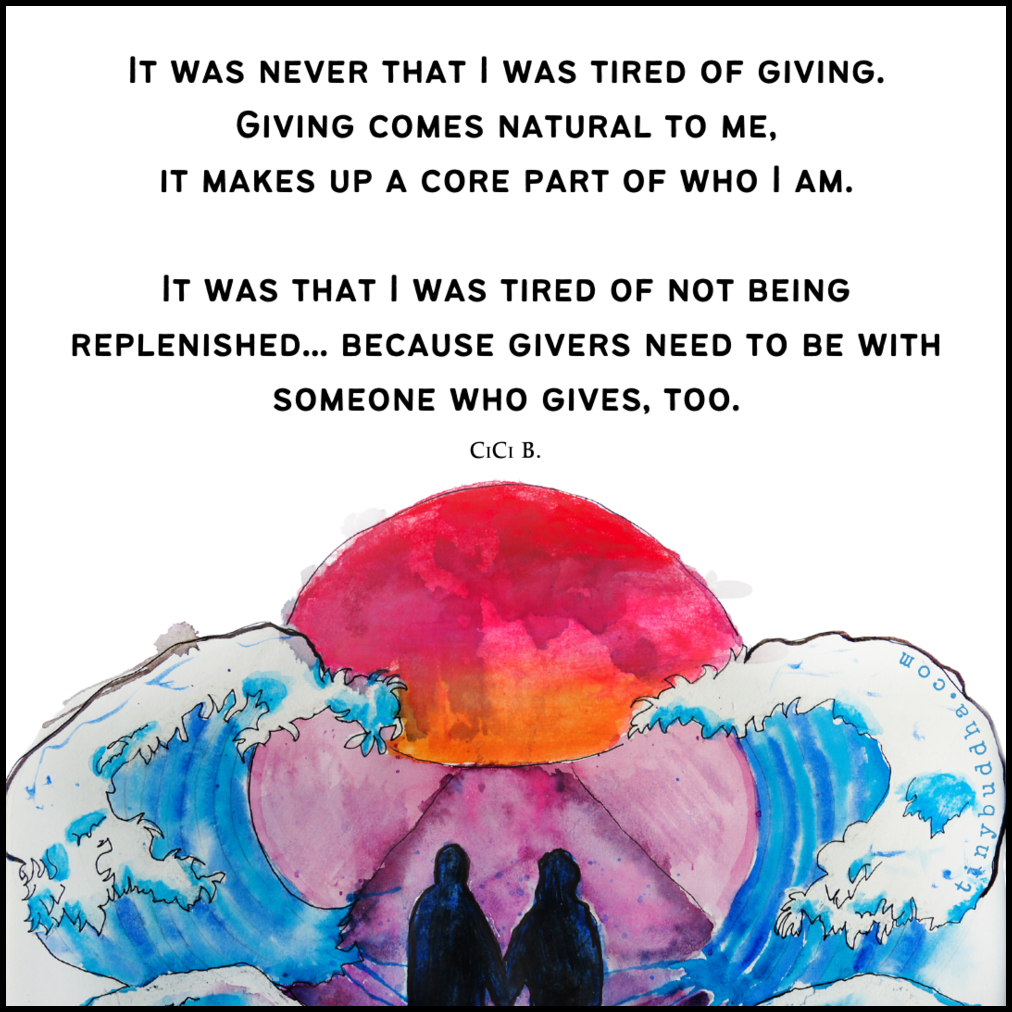
    Does it sometimes drain us? Yes. And that’s certainly an aspect that needs attention; to replenish oneself in order to give is important.

    But is it a toxic trait to be good to someone without the expectation of getting anything in return?

    Some of history’s greatest and most outstanding human beings have done just that. Mother Theresa comes to mind, for instance.

    I don’t buy into the narrative that giving is toxic, nor is giving to someone who wouldn’t do the same for you.

    Genuine, truthful, selfless kindness, that’s what this world needs a little more of—with the understanding that those who are giving need to take time to replenish themselves when necessary. To help without conditions, but rather in love and compassion; that’s the type of person I am trying to make a conscious effort to be.

    We should definitely take time to reboot and fill our cups back up when we need to, absolutely. But no one should be faulted for trying to do better, to be bigger, for taking the high road.

    We should all be encouraged to do so.

  • Why Relationships Matter Most: We’re All Just Walking Each Other Home

    Why Relationships Matter Most: We’re All Just Walking Each Other Home

    “We’re all just walking each other home.” ~Ram Dass

    Living in the hyper-individualist society that we do, it’s easy to forget our obligation to those around us. Often in the West, we are taught to prioritize ourselves in the unhealthiest ways, to ‘grind’ as hard as we can to achieve wealth and status.

    We are taught, between the lines, that our first responsibility is to create a ‘perfected‘ version of ourselves to such an extreme that it is alright to forsake our relationships with others to accomplish it.

    From day one, it is embedded in us that it is our individual selves against the world. Like many others, I’d like to challenge this notion. Because what is the purpose of wealth and status if not to share it with the ones you love and who love you the most?

    What is the meaning of life itself if not companionship, community, and love?

    I want to disclaim, of course, that this is by no means attacking the notion of having personal external goals. Career success, physique aspirations, and other tangible objectives can absolutely be noble in pursuit and attainment.

    What I would like to say is that none of those external goals will fulfill you the way that genuine human connection can—and that those goals should not be completed by abandoning your healthy relationships and support systems. And if you are thinking, “who actually does that?” this introduction is not for you.

    To put it simply, life is a series of circumstances, situations, and experiences that we get reluctantly swept into (and sometimes, foolishly, sweep ourselves into). It’s just one adventure after the next, for better or worse. That sounds gloomy, but it is what makes life so beautiful—the human ability to feel a vast range of emotions within an hour and find charm in the worst circumstances.

    A little over a year ago, my aunt passed. Through a blur of tears, I remember thinking about how beautiful the flowers people had sent were and how vibrantly green the grass of the cemetery was. And amidst all the despair, I remember looking around and seeing my friends.

    When I think back to all the times in my life when it felt like the roof would cave in, that I had nothing left, that I didn’t know if I would be strong enough to move forward and continue on, I remember what exactly it was that pushed me forward. It was always my friends, my people. Those who almost daily not only told me that they would be there for me but showed up when I needed them the most.

    Would I have survived my hardships alone? Yes. Would I prefer to do it alone? Never.

    I am infinitely grateful for the community I have created for myself—the network of friends that have become family and mentors that help guide me when things seem too chaotic to untangle.

    Through the gentle counsel of my loved ones, I have come to realize that there is no nobility in solitary living. There is no wisdom or bravery in taking on hardship or challenges alone when I don’t need to. Every time I forsook my loved ones to be (my distorted idea of) independent, it seemed almost like I was just adding gasoline to already growing flames. There was no more profound message beneath suffering in silence, only suffering.

    And I think most of us can agree that attempting to handle problems alone feels infinitely more difficult to manage than with support. It’s part of why people seek romantic partnerships, to have someone always there to walk through the flames alongside. It’s why people invest so strongly in their loved ones in general. It is to feel heard and be seen, to hear and to see.

    Part of the purpose of life, I have come to learn, is within the attempt to know someone else, to recognize yourself in another person deeply. Connection is everything we have in this world. It’s the mirror that holds itself up to us in the face of conflict with another person. It makes us think twice before buying from a brand that uses slave labor, and it’s what makes us recoil at the thought of abused animals or children.

    Connection with all living beings is the deeper understanding that we are all somehow joined by our humanity. And in that, understanding that one of our primary purposes is to know and be known. To know my friends and their joys and fears and draw parallels to how they reflect my own. To walk alongside them through the difficult times and the blissful times. I recognize now that it is in the attempt to know others that I now know myself.

    We are all just walking each other home. Life, at its core, is that simple.

    I am walking, hand in hand, side by side, sometimes a little bit ahead or a little bit behind, with the people around me. Some of those people may walk too quickly for me to keep up, and some may move too slowly. That is when I thank them for walking me as far as they could and continue on without them, as they will continue on without me.

    If the journey of life is a path we walk, then the purpose of our travel buddies is to help us navigate the storms on the road and to make the journey as funny, exciting, and comfortable as possible. If life is a journey, then the whole point of friendship, companionship, and mentorship is to just be with each other.

    If I am walking you home, is my purpose not to try my best to protect, guide, and love you throughout that journey? We are all walking each other and ourselves home. And the least we can do is do our best to make that journey as beautiful, warm, and light as possible.

    So many of us are falling into a spiritual trap of sorts and being wholly sucked into the hyper-consumerist and individualist mentality of the West. Some of us are actively fighting the true nature of our being, which yearns for deep and genuine connection above all else.

    As you age and the world around you changes, your values begin to change. When you’re nearing your final days, when all you want is your family and friends surrounding you, will you have planted those seeds? Will you have spent time cultivating and nourishing your relationships with those around you? Will you have walked your loved ones down their path and done your best to create joy in your (and others’) journey?

    The message I am trying desperately to convey here is that we need one another. We need love, and we need companionship. We need forgiveness, and we need grace. We need to be open to giving our hearts away and open to the risk of being hurt. And in that same breath, we need to do everything possible in our power to avoid hurting those around us. We need to use the path to grasp the importance of being tender with each other.

    The journey of life is not easy. Take a moment and reflect on all those who have walked you in the past and all those who continue to walk you home.

    Think about the connections you have made, the empathy and love you have nourished in the lives of those you care about.

    And remember that at the end of the day, despite all of the problems and chaos around us, we are all just walking each other home, and we are all just trying to be better companions, one day at a time.

    Dedicated to my travel companions, you know who you are.

  • How I’m Overcoming Codependency and the Need to Prove My Worth

    How I’m Overcoming Codependency and the Need to Prove My Worth

    Everywhere you go, there you are.” ~Unknown

    I have heard this quote many times throughout life, but that was it. I heard it, thought hmm, and moved on. Well, here I am at the age of thirty-nine, and I am really starting to see and understand it.

    I first started noticing this idea showing up over and over again recently, at a time of a change in my career. I went from an ER nurse to an RN in the transfer center. So bedside nursing to office work.

    I noticed one day, as I was sitting in my new, quiet office area looking at the board of the ER in epic (which shows how many patients are currently in the emergency room), there were about ninety-eight patients in a forty-four-bed unit. I felt as if I was actually in the ER. I felt horrible on the inside, and felt sorry for the patients, nurses, doctors, etc.

    Then I thought, What the hell am I doing? I am in an office; I am not down in the ER. If I am going to experience the same feelings in this office as I would have in the ER, then why did I change jobs?

    It was at that moment that I was like Katie, you got to heal this wound. Whatever it is, you got to heal it.

    I took a deep breath and consciously chose not to feel that way. I decided to acknowledge that there were long wait times, that workers were overwhelmed, and that patients may not get the care they needed due to the hospital being saturated.

    In that moment I chose to be thankful that I was not one of them. I chose to feel better. I chose to celebrate that I had stepped out of an environment that was unhealthy for me.

    Another time it happened was when we were working on a stroke transfer. Everyone was rush, rush, rush.

    I felt my face get flushed; my chest tightened. The fear and worry were taking over. I thought to myself, What the hell, Katie. You are doing it again. You are feeling as if you are in an emergency room at the bedside. Calm down. Remember, if you are going to feel the feelings you felt in the ER, you should have just stayed in the ER.

    Once again, I took a deep breath. I reminded myself that I am only one person. I was doing all that I could do, as fast as I could, and that was enough. I reminded myself that I don’t have a magic wand and can’t teleport anyone in an instant. I felt better but was really starting to have an awareness of “Everywhere you go, there you are.”

    This happened again on a day of consistent work in the transfer center. I did try to be creative, do some swapping of patients, but, ultimately, all my work led nowhere.

    As I was sending out my email that shows transfers that were complete, it read “zero.” I had thoughts like Omg, they are going to think I did not do anything today. I did not help the ER at all. They have thirty-three admits, and I got no one moved from the hospital.

    The truth is I did my best. There were things out of my control that inhibited the movement.

    At that moment of frustration, I heard in my head, once again, “Everywhere you go, there you are.”

    I started talking about how I was feeling with one of my friends and coworkers. He asked me if I was familiar with codependency, I’m guessing because he could see the signs in me.

    It made me laugh because codependency is definitely something I am working on overcoming. Everywhere I go, there you are, codependency. It does not just show up in relationships; it shows up in all areas of my life.

    In my work, it showed in how I looked to validate my importance by the number of transfers out of the hospital I made, even though there are so many factors involved in transfers, most of them out of my control.

    In my personal relationships, it showed in how I aimed to please everyone but myself, ultimately to feel worthy based on their approval.

    According to Psychology Today, codependency is “a dysfunctional relationship dynamic where one person assumes the role of the giver, sacrificing their own needs for the sake of others.”

    This, in my opinion, is what’s happening in healthcare. So many healthcare providers give, give, give but only receive a paycheck. That is not sustainable, not satisfying to the individual or their spirit.

    Do you find that you often feel responsible and overly invested in the lives of others, abandoning your feelings, thoughts, and identity; feel guilty for asking for a break or just sitting for a minute; have poor boundaries or no boundaries with your friends, family, coworkers, and clients? If so, it might be a good idea to take the time to reflect and see if you are codependent.

    Self-awareness and understanding what role you play in feeling burned out or dissatisfied can lead to a much more fulfilling life and career.

    Pay attention to your thoughts, emotions, and feelings. They are powerful messengers. Take the time to be curious about your reactions and your triggers. When you replace judgment with curiosity, you create space in your brain to learn.

    As I reflect on my nursing career, I have a feeling that many people, especially in healthcare, struggle with codependency. I think perhaps we create most of our problems from unhealthy patterns developed in childhood.  For example, I learned young to neglect my needs, please other people instead of speaking up for myself, and suppress and deny how I felt.

    So, what was I really feeling in that moment—the moment when I felt guilty that there were no transfers? I was feeling like a letdown. I was feeling like I wasn’t good enough, and why? Old habits are hard to break, but I am thankful now because I have awareness. With awareness I can do better, create new habits, and break old patterns. I can pay attention to what follows me everywhere I go.

    Tomorrow is my last day as an RN. I am stepping out on faith and wanting to create a new life and career for myself.

    I am not expecting all rainbows and sunshine. I am aware now that as I embark on this journey there are going to be thoughts, feelings, and emotions that are going to follow me everywhere I go.

    I am going to have to remind myself not to make choices based on the need for validation. I might get insecure when I get just one like on something I posted on social media, or I might worry that my son won’t like me if I don’t buy him everything he wants.

    But I have to remind myself not to allow views and likes to determine my worth, and I also have to remember it’s more important to set a good example for my kid than to win his approval.

    It all starts with questioning my thoughts and trying to get to the root of my behavior.

    With awareness I can grow, heal, and become the person I am destined to be. Perfectly imperfect.

  • Unbecoming the Old Me: How I’m Finally Discovering That Life Can Be Fun

    Unbecoming the Old Me: How I’m Finally Discovering That Life Can Be Fun

    “The definition of insanity is doing the same thing over and over again expecting different results.” ~Albert Einstein

    I woke up one morning and realized that I had no idea who I was. I realized that over the past thirty-something years I had been everyone but myself.

    I was like a chameleon molding into the people that surrounded me. Not wanting to make noise or cause disturbance to others or trigger my own inner wounds.

    My goal was being whoever I thought the person around me wanted me to be. To be accepted, loved, and liked by others. I realize now that I was searching for something external to validate what I needed to give myself. I needed to learn who I was. I needed to like, love, and get to know myself.

    Once you discover that you do not like yourself and that you don’t even know who you are or what you like, change starts to happen. You start to identify areas where you were using people and things to fill a void that only you can fill. Alcohol to numb the pain, sex to feel less alone, to feel valuable. Helping others and fixing external problems so you don’t have to look at yourself.

    I had no clue this is what I was doing. Honestly, I thought I just wanted to help people. Turns out I was projecting externally what I needed to be doing internally. We tend to do this without any awareness. If you find yourself constantly nurturing or encouraging other people but, on the inside, you feel alone, sad, or wondering if this is all life has to offer, you may be doing this as well.

    Pay attention to what you constantly give to others. It’s likely that’s what you need to give yourself. Pay attention to what you say to others because you likely need to say that to yourself. 

    The journey to discovering myself has been a long one. It has been a fun one and a difficult one. I have explored different activities and hobbies—reflecting back on activities that I enjoyed as a child and bringing those back into my life; trying new things that I have always been curious about or wanted to try. I have kept the ones that bring me joy and peace and eliminated the ones that lower my energy.

    I have also done this with people, jobs, and my own thoughts. The voices in my head have been the most challenging to discard. But after years of consistently working with them, my inner dialogue is finally much nicer.

    Yes, the criticism does still arrive, but I see it for what it is and get curious about it. I ask if what my negative inner voice says is true. Ninety-nine percent of the time it is not. I see what it is trying to teach me.

    I often will ask myself: Who said that to you and when? Oddly enough, my thirty-year-old self’s belief system was one I built as a kid, when I concluded that I wasn’t good enough and I was only valuable when I had something to give someone. It’s really funny when you realize you are an adult body carrying around beliefs you developed as a child, with zero awareness. 

    I also had to take the time to reflect on how my actions and thoughts were playing a role in my life. I had to make the decision to basically do the opposite of what I had been doing to get different results.

    For example, instead of waiting for the people around me to start respecting and prioritizing me, I had to start respecting and prioritizing myself. I had to identify my wants, honor my needs, and set boundaries in relationships.

    Instead of sleeping in, I had to start getting up early before my son so we could have a pleasant morning versus running out the door. I had to nurture myself at the beginning of the day before the world had a chance to pull at me.

    Instead of holding my truth in, I had to muster up the courage to speak it. To share my feelings, rock the boat if I had to, and trust I wasn’t “being crazy.”

    Instead of tiptoeing around everyone and trying to please them, I had to understand that this is not even possible.

    Instead of hating myself, I had to start loving myself.

    Instead of being closed off, I had to open my heart—to myself, others, and the world.

    Instead of remaining stuck, I had to start taking baby steps to discover who I am and who I want to be. Like spending time in silence in nature so I could hear my inner voice, making art, saying positive words to myself in the mirror while brushing my teeth, and meditating for just three minutes a day.

    Before I started doing the opposite of what I had been doing, I had no clue that life could be fun. I am here to tell you that life really can be fun, you’re not alone, and by taking one small step you can begin to transform your life into something you didn’t even know was possible for yourself.

    It does take courage, compassion, consistency, and commitment, but if you start today, when you look back in a few years you will not even recognize yourself or your life.

    If you start to believe bigger than your beliefs about yourself and this world, magic will start to happen.

  • I’m Kelly and I’m a Heroine Addict: Why I Get My Fix from Fixing People

    I’m Kelly and I’m a Heroine Addict: Why I Get My Fix from Fixing People

    “Self-will means believing that you alone have all the answers. Letting go of self-will means becoming willing to hold still, be open, and wait for guidance for yourself.”―Robin Norwood, Author of Women Who Love Too Much

    My drug of choice is not the kind of heroin one shoots in their veins. My drug is the kind of heroine that ends with an e—the feminine version of hero.

    When I help someone, and they are grateful for the gifts I offer, my brain fizzes with a cocktail of oxytocin, serotonin, and dopamine, resulting in a “helper’s high” I ride through town like a homecoming queen on a float, waving a gloved hand, blowing air kisses at admiring fans.

    There is no accident these two words, heroin and heroine, look and sound so much alike because they strangely have more in common than you might think: They are both highly addictive, both more destructive than the user realizes, and both leave a trail of collateral damage.

    According to the twelve steps, we stand a chance at recovery only if we can admit we are powerless over our addiction and that our lives have thus become unmanageable… so this is my coming out party. I figure by making this public declaration, I won’t be as tempted to sneak back to my old ways.

    My painful revelation was delivered to me on a cinematic silver platter, while driving with someone incredibly close to me—let’s call her Chloe. She was desperate to find a place to live… that is until I’d swooped in on my noble steed, found her a hidden gem of an apartment, vouched for her, and landed her the deal of the century.

    Instead of being met with the gratitude I expected (and secretly craved), I was devastated by her volcanic rage. She spewed, causing me to nearly drive off the road.

    What crime did I commit, you ask? The week earlier, she had called me, and I had the audacity not to hear my phone ring. In fury, she screamed about how I had set her up to need me, depend on me, and think of me as her savior. And then, when she needed me most, my phone’s ringer was off, leaving her alone to flail in pain, cursing the water I once walked upon.

    In my defense, I never (consciously) promised Chloe I’d be her forever rescuer. Little acts of service became the gateway drug to more elaborate feats that took immense effort and a toll on my own life. I somehow imagined one day I’d receive a smiling postcard from her, telling me my services were no longer required because of how brilliantly her life turned out (thanks to me)… but that hasn’t happened (yet).

    How did I co-create such an epic fail?

    Hitting rock bottom with my “disease to please” sent me on a search-and-rescue mission of my past to discover the genesis of my addiction. My detective work led me, surprise, back to childhood.

    As the eldest of five, I was awarded points from my well-meaning parents for doing big-sisterly things, such as treating my siblings like they were my babies, teaching them to tie their shoes, showing them how to swing a softball bat, and how to combat bullies.

    I was raised believing it was my job to take care of them, and I proudly accepted that mantle. It empowered me; it made me feel important.

    But what I didn’t realize was that while I was getting puffed up like the Goodyear blimp with praise, soaring higher with every pat on my back, some of the victims of my heroism were becoming progressively weakened. It was as if my efforts sent the unconscious message that they were broken and crippled and, without me, incompetent.

    As I struggled to more deeply understand my heroine addiction, I sought the counsel of a friend who said, “Your struggle is a microcosm of a global issue. For example, the US has funneled over 500 billion dollars to Sub-Saharan Africa (to mitigate starvation and famine), only to make the situation worse when they pulled out.” He continued, “In spite of good intentions, if the giving is a handout, not a hand up (giving fish instead of teaching how to fish), it’s unsustainable, exacerbating—not curing—the problem it set out to fix.”

    Even though I extended my support without conscious strategy or agenda, I hurt people more than I helped.

    So, what is the solution?

    It isn’t as simple as no longer helping people. It’s like being an overeater who can’t just swear off food. If I had an actual heroin addiction, my job would be to cease injecting the drug in my arm. But even Abraham Maslow taught that service is near the top of his hierarchy of needs, and I’ve certainly been a grateful receiver of people’s kindnesses.

    This is clearly one of life’s “can’t live with it, can’t live without it” conundrums. Perhaps I just have to figure out how to do “service” differently.

    So, as a newly sober heroine addict (an energy vampire cloaked behind a superhero cape), convulsing in withdrawals as I seek to live on the razor’s edge between serving and savior-ing, here are my marching orders, thus far. Just for today (and hopefully every day after), I will:

    1. Fire myself from the job I unwittingly accepted (too enthusiastically) as a little girl: to be everyone’s big sister.

    2. Admit I have a problem and that I am powerless over saving, fixing, and controlling people.

    3. Give up the belief that I know best on how others should live their lives.

    4. Refrain from getting my fix by fixing people, searching for God in all the wrong places.

    5. Make ruthless compassion my replacement addiction, in the way heroin addicts safely detox using methadone or suboxone.

    Ruthless compassion, by the way, is the unwillingness to see another as broken or inadequate, but instead as innately whole and complete, regardless of what they’ve been through or what they believe to be true about themselves.

    6. Practice “For Fun and For Free”—this twelve-step motto is about only giving to others from surplus bandwidth (time, money, and energy) unless it’s a true emergency.

    7. Tattoo my brain with my new personal prayer (a mashup of The Serenity Prayer and the lyrics to Kenny Roger’s “The Gambler”):

    God grant me the serenity…
    to know when to hold ‘em,
    when to fold ‘em,
    when to walk away
    and when to run.

    If you relate to my story, I hope this will help you with your hero or heroine addiction. But if it doesn’t, that’s okay. Because, through the lens of my new Ruthless Compassion sunglasses, I see you are more than capable of finding your own answers, thankfully without any excess do-gooding from me.

  • If You Really Want to Change the World: 4 Ways to Be Kind

    If You Really Want to Change the World: 4 Ways to Be Kind

    “I’ve learned that people will forget what you said, people will forget what you did, but people will never forget how you made them feel.” ~Maya Angelou

    I’ve now reached the age in my life when every so often, I get an email or text informing me that someone I know has died. Some of the people who have passed away have been former supervisors or teachers from high school. Others have been the parents of friends or elderly members of my church.

    At one time, the news that someone had died was shocking to me. Now it’s nearly a monthly occurrence, and I’ve become accustomed to it.

    Whenever I receive one of these texts or emails, I always go in search of the obituary. This may sound macabre, but I love a good obituary. I like to learn what people chose to do with this one life that they were given. I particularly like the obituaries in which you get a sense of who the person was. Aside from their accomplishments, what was that person really like?

    Because the reality is that your accomplishments aren’t what will have mattered most about your life.  Instead, what matters about your life is how you made people feel, as so aptly put by Maya Angelou. Another way of putting it is this: Were you kind to others?

    Why does kindness matter so much? Because kindness is the only real way to change the world for the better. For example, I can give you $20, and you can use that to buy one meal. Certainly, that is a nice gesture.

    But what if I encourage you? What if I take the time to specifically identify your gifts and talents? What if I explain to you that you have the ability to do great things with your life? Then my kindness potentially has changed your life.

    Kindness is powerful. In fact, being kind is the most important thing that we do in life.

    Below are ways to start incorporating kindness into your daily life. If you make kind acts part of your daily routine, you’ll end up being someone who changes the world in the most beautiful way.

    To Be Kind, Be an Encourager

    We live in a very critical world. Sadly, people are quick to criticize, and they are reluctant to offer praise. Given the harshness of our world, it’s no small wonder that so many people lack confidence in themselves.

    Kind people are our only hope to fight the world’s negativity. That is because kind people encourage others. They are the type of people who go out of their way to comment when someone does something well. And they readily point out others’ gifts and talents.

    But realize that encouraging others is something that we have to intentionally choose to do. For example, often a complimentary thought will float through my head. “Her hair looks great today.” Or “That was a terrific presentation.” But unless I catch myself, that idea will float out of my head just as quickly as it floated in! As a result, I try to make an effort to say those complimentary thoughts out loud whenever I can.

    Realize that being an encourager has to be a conscious choice. Otherwise, those complimentary thoughts will just stay inside our brains. And the other person won’t benefit from those precious words of encouragement.

    So choose to be kind by choosing complimenting over criticizing. Build others up instead of tearing them down. If you do, you’ll make the world a far more pleasant place to be for everyone.

    Be Helpful in the “Right” Way

    Most of us strive to be helpful. After all, that is what good people do—we help others! But the problem is that so often we help others in the wrong way.

    For example, I learned many years ago that to be a good mother, I had to help my daughter in the ways that she wanted help.

    The issue came to the fore one day when her room was messy. I thought I would help her out by tidying it up. Later that day, she returned home from school and wanted help with her homework. However, by that point, I felt worn out because I’d already cleaned up her room. She then said to me, “But Mom, I can clean up my own room. I didn’t ask you to do that for me. What I need help with is my homework.”

    She was right. That moment was a turning point for me. I tend to think that I know what is best for everyone! But after that experience, I came to realize that even if I think I know best, I need to help others in the ways that they want help.
    Because if you help people in the way that you think is best for them, you aren’t respecting them. You effectively are saying, “I know better than you what you really need.” And that attitude diminishes people.

    So part of being kind to others is helping them in a respectful manner. If you want to want to help someone (or give them a gift), find out what that person wants. You aren’t being truly kind and helpful if you simply help them in a paternalistic fashion in which you convey that you know best. Instead, be kind by helping others in the right way.

    To be Kind, Choose Compassion Over Judgment

    Unfortunately, it’s human nature to judge others. After all, how often do we walk by a homeless person and think, “That person needs to get a job!” Or we may have a family member with an alcohol addiction, and we’ll say, “For heaven’s sake, just stop drinking! Pull your life together.” Or we may have a child who is failing math, and we’ll tell the child, “These bad grades are your fault. You need to study more and stop goofing off.”

    But being kind means offering compassion, even when it is oh so easy to judge. I find that the best way to avoid the “judgment trap” is to say this to myself on a regular basis: “But for the grace of God go I.”

    What that means is that some of us get lucky in life. We may have been blessed with a stable upbringing, or with good genetics. Or we may have been born with a gender, skin color, or nationality (or all three!) that simply makes our lives a lot easier than other people’s lives.

    Given that some folks are just dealt a better hand in life than others, it makes sense that we should interact with people who are struggling by coming to them from a place of compassion rather than judgment. Our attitude should be “I’m so sorry that you are suffering. Let’s figure out a way to fix this situation.”

    I’ll concede that it is frustrating when people make big mistakes that negatively affect our lives and the lives of others. Nevertheless, be kind. Remember that to be kind means to be compassionate, even when it is so much easier to judge.

    Value Kindness Over Being Right

    Years ago, I hosted a family gathering in which there was a heated argument about politics. Angry words were said. People insulted each other. And everyone left the gathering feeling terrible.

    What was particularly stupid about the whole thing was that the argument was pointless. Not one of us worked in politics. And not one of us had any sway over politics outside of our one vote in each election. So we didn’t change the world by arguing. We simply damaged our relationships with each other.

    I’ve had a similar experience when it comes to discussions about other hot button topics, like religion. For instance, I happen to go to church. Now, I never try to inflict my religious views on anyone. Rather, I consider religion to be a deeply personal matter.

    Yet, every so often, I’ll receive a snide, insulting remark about my religious faith from people who are atheists or agnostics. I choose not to argue back when I hear those remarks, but I always think to myself, “What was the point of that remark? How did that remark make the world a better place?”

    Realize that problems arise when we are more concerned about being right than we are about being kind. Of course, there are times when we need to voice our concerns. For instance, we should always speak up when we see someone being treated unjustly. But that is different from demanding that others see the world in the exactly same way that we do.

    To treat others with kindness, we have to be willing to agree to disagree. We can’t bully others into our point of view. Instead, we have to value being kind over being right.

    If you really want to change the world, the simplest thing you can do is be kind. Be kind consistently. Strive to be kind, even when you don’t feel like it. Be kind because it is the easiest thing that you can do to make the world a better place.

  • It’s Amazing How a Little Kindness Can Open Someone’s Heart

    It’s Amazing How a Little Kindness Can Open Someone’s Heart

    “We cannot tell the precise moment when friendship is formed. As in filling a vessel drop by drop, there is at last a drop which makes it run over; so in a series of kindnesses there is at last one which makes the heart run over.” ~Ray Bradbury

    I have a weekly ritual of stopping by a small Vietnamese market close to our home. Thursday is delivery day for Lady Finger bananas, which are sweet little bananas from Mexico.

    When I first frequented the shop, the small, dark-haired owner behind the counter would comment rather sternly, “Only bananas, that it!” She would weigh them and stretch out her hand, and I’d dutifully pay, hoping my small purchase would not continue to irritate her.

    After a few months, I asked her name. “Maria,” she answered abruptly. I decided it best not to burden her with mine.

    As the months continued, I always made sure I said, “Hi Maria!” and “Bye Maria!”

    One day there was a younger man behind the counter, and since it was a family-owned business, I assumed it might be one of her sons. When I asked about where his mom might be, he explained she was taking a few days off.

    As we started chatting, he shared how stressful the grocery business can be for her. “But I always tell her, Mom, you have to be nicer to the customers. You can’t yell at them!”

    I decided to continue my quest to make friends with Maria. One day I brought her banana bread made with my little bananas. I handed the small loaf across the counter. She tilted her head and asked, “What this for?” I explained I just wanted to thank her for selling me so many bananas. I think she thanked me but maybe not.

    One cold morning in December, she seemed unusually subdued. When I asked how her day was going, she answered quietly, “My eldest son die.”

    I let her know how very sorry I was, and on my next visit I brought her a card and another loaf of bread. This time she thanked me with a hint of a smile.

    I often felt she didn’t know what to do with my gestures of gratitude and concern, but as the months wore on, she no longer reprimanded me for only buying bananas. One day she made my purchase that much sweeter, when she asked, “Your name?” “Priscilla,” I answered proudly carrying my sack toward the door.

    Winter passed and spring arrived bringing relief to our small Colorado town. As I approached the shop, a sign on the door read, “We will close early today and stay close over weekend.” Her younger son was behind the counter, and I politely asked why they were closing.

    “My dad passed on yesterday.” Once again, I offered my condolences.

    Soon Maria was back, looking thin and tired. As I handed her my bananas to weigh, I said how very sorry I was to hear about her husband. I pulled my credit card from my wallet and saw a green and white Starbucks gift card nestled behind it. I reached across the counter and offered Maria the small gift.

    “Would you buy yourself a big cup of warm tea and know it is from me?” As I turned to leave, I heard her say quietly, “Wait.” She came around the counter and held out her arms for us to hug. We held each other close. After a few years I had made a new friend.

    It’s amazing how a little kindness can open someone’s heart.

  • The Circle of Love: How I Paid It Forward After My Mom’s Death

    The Circle of Love: How I Paid It Forward After My Mom’s Death

    “If you feel like you’re losing everything, remember that trees lose their leaves every year and they still stand tall and wait for better days to come.” ~Unknown

    Years ago, I was a young housewife, raising two children, and still practically a child myself. When my mother fell ill, we realized it was chronic and I felt the blow.

    Mom had been my closest friend and supporter throughout my entire life. I was still her baby, even though I had babies of my own. And it was a point of pride with me.

    As Mom gradually diminished into a shell of her former self, I tried to help take care of her. There were months of dialysis, hospitalizations, home health care, and finally, both of her legs were amputated.

    To say this was devastating is an understatement. Mom had always been active, a go-getter, and a great tennis player. And how she did love wearing her pretty shoes!

    My dad, brothers, and I grieved with Mom, along with everyone else who loved her. The core of our family was heavily damaged. We did not know which way to turn.

    As time passed, the wonderful nurses of East 3 showed us how to care for Mom. We brushed her teeth, fixed her hair, tempted her with treats, and whatever else we could do to make her happy.

    Nothing worked. As Mom grew sicker, we finally realized what was coming. The overwhelming sense of loss when she passed was indescribable.

    It was a double loss for me. Not only did I lose my mother, but also my best friend. How would I survive without her?

    Would my babies remember her? Would I forget her? What would happen to our family?

    However, the loss pulled my family together and we planned a funeral, burial, and dealt with the onslaught of family and friends.

    On the day of her funeral, I informed my dad I wanted to go to nursing school. He was not encouraging. In fact, he informed me how much he hated to hear it because he had seen how hard nurses worked and the way they were treated.

    I was adamant. Even though I was not known for my science knowledge or my people skills, I went to school.

    Along the way, I experienced another pregnancy and the birth of a daughter. The following day, I was back in class to take an Anatomy and Physiology test.

    My test score was 86. I discovered I was an extremely determined individual. Nothing was going to stop me from getting that nursing diploma!

    After four years of classes and clinical rotations, I graduated as co-salutatorian of my class. Thank heavens for my husband, who kept the home fires burning while I studied!

    Upon graduating, I went to work on South 10, in Oncology, the treatment of cancer patients. We had a lot of patient overflow from other floors. So the clinical experience during my time there was amazing!

    However, the challenges of being short-staffed, overwhelmed with too many patients and insufficient support, did not help my anxiety level! As a result, I did not feel that I handled my job very well.

    I was nervous around others in the workplace, even though I wanted to help them. It was terrifying to think I could make a mistake and end up harming someone or lose the nursing license for which I worked so hard.

    And I did make some mistakes. Thankfully, none that resulted in significant harm. Of course, this did nothing for my fledgling confidence and anxiety.

    I thought about quitting. I hated feeling trapped. In the mornings before work, I would throw up from nervousness.

    I was outside my comfort zone. But I kept returning to work. After the schooling, hours spent studying, and monetary investment involved, how could I throw it all away?

    Undoubtedly, I was scared. It was horrifying to feel so frightened in such a noble profession. The anxiety almost crippled me. I became fatigued. Irritable. My self-esteem, which had been a struggle my entire life, was at an all-time low.

    Then came a very busy day when I was nearing the end of my shift. I was mentally and physically exhausted and looking forward to going home soon.

    When the charge nurse informed me that I was getting an end of shift transfer, I wanted to cry. In this particular case, I needed to perform end-of-life care. And would also have to complete a ton of paperwork.

    The patient was an elderly man coming from MICU (Medical Intensive Care Unit). His end was near, and he was coming to me to die.

    Obviously, I was not thrilled to be dealing with such a patient at the end of the day. Notably, my attitude was not good.

    Yet I had made an oath to care for others and I was committed to that oath.

    So I did not show my bad attitude to anyone and instead hid it inside my heart.

    Shortly afterward, the patient was transported to his new room on South 10. He had a nasogastric tube going into his nose, down his esophagus, and into his stomach. It was to suck out the toxins and poisons building up in his system.

    Also present was a catheter, which drained the urine from his bladder.

    As the man’s family wanted to continue feeding him, IV nutrition was still in place. This meant blood sugar checks were to be performed four time a day. These checks measured the sugar content in his bloodstream to see if it was a healthy level.

    In other words, my new patient required a lot of care.

    The man’s wife and daughter were with him and not quite ready to let him go. But the patient had been made a DNR. (Do Not Resuscitate). This meant no life saving measures were to be used.

    It was simply his time to go.

    The patient was unresponsive, and the daughter convinced her weary mother to leave for a while and get some rest.

    Meanwhile, I monitored the patient, kept him comfortable, and answered his daughter’s many questions carefully and thoughtfully.

    Unbidden, this was a reminder of a painful situation years earlier when it was my mother in that bed. At that time, it was me depending upon the nurse to take care of my dying mother.

    Those nurses had offered comfort. They had helped me cope with Mom’s pain and end of life. Now, it was my turn to do the same thing for someone else.

    I was with another patient when my new patient’s emergency alarm went off. I walked out into the hallway where the charge nurse met me and instructed me to go into his room. Sure enough, my new patient was gone.

    His daughter was beside him when he left his tired body behind. She looked so forlorn and alone. My instinct was to reach out and give her a hug.

    She hugged me back and kept holding onto me as if I were her lifeline. I suppose I was in that moment.

    So for a long time, I sat and listened to her while she talked. She told me about her dad and how much she loved him

    When I eventually rose to leave the room, the daughter said to me, “God brought my dad to this floor to die because he was bringing us to you.” Then she added, “Thank you.”

    Her words filled me with pride. Sometimes, you just instinctively know the right words to say in a situation and when to listen. I learned that I have this skill in the very darkest moments of life.

    And it is a skill of which I am very proud.

    With my self-confidence restored, I, once again, was proud of myself and of my profession. I had eased one of the most painful times in a daughter’s life and brought her comfort.

    I had come full circle.

  • How to Live Your Dharma (True Purpose): The Path to Soul-Level Fulfillment

    How to Live Your Dharma (True Purpose): The Path to Soul-Level Fulfillment

    “Dharma actually means the life you should be living—in other words, an ideal life awaits you if you are aligned with your Dharma. What is the ideal life? It consists of living as your true self.” ~Deepak Chopra

    From the moment I finished high school until my late twenties, I had “purpose anxiety.”

    I wasn’t just confused and missing a sense of direction in life; my lack of purpose also made me feel inadequate, uninteresting, and lesser than other people.

    I secretly envied those who had cool hobbies, worked jobs they loved, and talked passionately about topics I often didn’t know much about.

    I even resented them for living “the good life” and kept wondering, “Why not me?”

    Until it was my turn.

    What it took to begin embracing my purpose—or dharma, as I prefer to call it—was one thing: love.

    Let me explain.

    The 4 Keys to Living Our Dharma (Purpose)

    The Sanskrit word “dharma” has many meanings and most commonly translates to “life purpose” and “the life we’re meant to live.” I believe there are four main keys to living our dharma.

    1. Cultivating self-worth: the essential first step.

    I was bullied in high school, and as a result, I had very low self-esteem for many years. Looking back, I realize that feeling that low self-worth prevented me from embracing my dharma.

    Why?

    It was because I was too focused on trying to be liked and too worried about what other people thought of me to be in touch with my authentic self. I put all my energy into doing everything I could to look “cool” and be accepted by others rather than what my soul wanted to do, explore, and experience.

    The essential idea is that embracing our dharma requires living authentically. As Deepak Chopra says, “[dharma] consists of living as your true self.”

    The issue is that it can be difficult to express and live your truth when you feel inadequate, unworthy, and perhaps even unlovable. The risk of being rejected seems too high, and it feels unsafe.

    So the first step to living our purpose, I believe, is cultivating radical self-love. It’s a bit of a “chicken and the egg” situation because having a strong sense of purpose increases self-esteem, but low self-esteem makes it hard to embrace our purpose. It’s best to develop both simultaneously.

    Here are a few ideas to cultivate self-love that have helped me:

    The first one is meditation.

    Part of meditation is about allowing ourselves to become aware of and observe our own thinking. When we meditate, we disidentify from our thoughts and get to experience glimpses of who we truly are—of our essence—which is loving and infinitely worthy. As a result, we naturally start loving and accepting ourselves more. Meditation has undoubtedly been the number one thing that has improved my self-esteem.

    Another thing that has helped me is self-care.

    As I said, I didn’t have many friends in high school and spent much of my time alone. So I started going to the gym after school to do something with my time and be around people (even if I didn’t talk to them). Exercising regularly led to eating healthier and taking better care of myself in several other ways.

    I find that self-care is a practical way to cultivate self-love. When you take care of yourself, you show that you care about yourself. Over time, you start genuinely feeling the self-love you are showing yourself and believing it.

    The last (effective but cringy) thing that helped improve my self-esteem is an exercise that a therapist recommended.

    Here’s how it goes: In the evening, stand in front of the mirror and—looking at yourself in the eyes—say, “I love you, [say your name]. I love [say three things you like about yourself], and you deserve all the good things life has to offer.” Try it for thirty days; it may change your life.

    2. Being in touch with and following your inner compass.

    Jack Canfield says, “We are all born with an inner compass that tells us whether or not we’re on the right path to finding our true purpose. That compass is our joy.”

    Often, we seek purpose outside of ourselves, as if it’s some hidden treasure we need to find. But, as Mel Robbins puts it, “You don’t ‘find’ your purpose; you feel it.” What feels good—expansive, joyful, intriguing, exciting, or inspiring—to you?

    That’s an important question because, according to numerous spiritual books I’ve read, those things we enjoy are clues guiding us to our dharma.

    The main difficulty is usually differentiating our true desires from the ego’s “wants” and the desires that come from conditioning. The ego wants to feel important. It’s afraid of not being “good enough,” so it feels the need to prove its worth.

    The “wants” that come from conditioning consist of what our parents and society have told us we “should” do. If we follow those “shoulds,” even though they don’t align with our authentic selves, we risk waking up one day and realizing that we’ve climbed the wrong ladder and lived our life for others instead of ourselves.

    Here’s something that helps me differentiate those desires.

    Make a list of all the things you want to have, do, experience, and become in the next few years.

    For each item on your list, ask yourself why you want it. Is it because you feel the need to prove something or want to feel important or perhaps even superior to others? That’s the ego. Is it because you think that’s what you “should” do? That’s likely conditioning. Is it because it makes you feel alive? That’s your heart.

    To live our dharma, we must follow our heart’s desires—the things we genuinely love. This requires authenticity and courage.

    3. Savoring the experience of being alive.

    Another aspect of dharma is loving life—living with presence and appreciating the experience of being alive. There are a few things I find helpful here:

    The first idea is to keep a “Book of Appreciation,” as Esther Hicks calls it. Every day, take five minutes to journal about what you appreciate about someone, a situation, or something else in your life.

    To savor life, we must also be present. In A New Earth, Eckhart Tolle states that true enjoyment does not depend on the nature of the task but on our state of being—we must aim for a state of deep presence.

    He recommends being mindful when attending to even our most mundane tasks. I also like to go on long walks and observe (with presence) the natural elements around me—like the clouds passing in the sky, the smell of trees after the rain, and the sensation of the sun’s rays on my face.

    And, of course, having a daily gratitude practice is always a winner!

    4. Extending love through joyful service.

    Dharma is also about sharing—extending love. One of the best ways to contribute to the collective is to share our gifts in a way that’s enjoyable to us.

    We all have natural gifts—things that come easier to us than to others. Some people are good at writing, while others are great leaders or excel at analyzing data. Perhaps you like to create, manage, nurture, delight, support, empower, listen, guide, or organize.

    There’s also another, more profound aspect of contribution that comes from being rather than doing. I remember a passage from a book I read many years ago (I can’t remember what book it was) that went something like this:

    “Your contribution [to the collective] is your level of consciousness.”

    A higher consciousness radiates greater love, and one of the best ways to uplift others is by being a loving presence.

    Dharma: The Bottom Line

    Bob Schwartz, the author of Your Soul’s Plan and Your Soul’s Gift, says, “We are here to learn to receive and give love. That’s the bottom line.”

    This involves loving ourselves, others, and life in general, and also following our heart—doing things we genuinely love.

    I don’t know about you, but this perspective on dharma feels good to me. It has freed me from my “purpose anxiety.”

    I hope it can serve you too.

  • 5 Simple Yet Essential Self-Care Tips That Can Change Your Life

    5 Simple Yet Essential Self-Care Tips That Can Change Your Life

    “Never be ashamed to say, ‘I’m worn out. I’ve had enough. I need some time for myself.’ That isn’t being selfish. That isn’t being weak. That’s being human.” ~Topher Kearby

    Years ago, my extended family, who I am very close with, migrated from Vietnam to America as permanent residents. Four separate families had a couple of kids in each family. They are nice, kind, and loving people, and their kids were super cute and respectful.

    My relationship with my extended family has taught me a lot of lessons throughout my life so far, but this was one of the most impactful ones to date.

    Throughout the first few years of their residency here in the USA, they struggled with the language barrier and navigating an unfamiliar setting. As with most people who choose to migrate to another country, it was challenging for them to learn how to adapt to their new normal here in the United States.

    I couldn’t bear seeing them struggle, so I decided to step in to help them through this huge transition they were facing. I took them to most of their doctor’s appointments, brought them to work on time, helped them out with school conferences for their kids, and supported them in the completion of other tasks that they weren’t able to do on their own.

    I didn’t see this as a burden at all. In fact, I was having fun helping them because I love them so much.

    If you’re like me, you will understand this. When I am helping people that I care about, I tend to forget about taking care of myself. Slowly, this began to be the case.      

    The love I have for my family fueled my energy, which made me overlook the importance of caring for myself. Sure enough, after a while of supporting and caring for my family through their transition, I started to feel emotionally depressed and physically drained.

    I couldn’t find an explanation for why I was feeling this way, so I decided to check in with my doctor. My doctor explained that I had nothing to worry about regarding my physical health.

    After determining that I was healthy, I realized that there must have been a deeper explanation for why I was feeling that way. That’s when I knew my exhaustion was coming from overly helping and caring for my family. After all, I was taking on responsibility for everything in their lives from the little things to the important things.

    At this point, there was a little voice inside my head saying that it was time to sit down with myself and re-evaluate how I was spending my time and energy. Deep down I knew that this would be the only way for me to feel healthier and happier.

    For the sake of my well-being, I decided to implement positive change in my life, Once I did, I was amazed at how my physical and emotional well-being began to improve.

    I didn’t want to leave my family hanging, so I made sure that I took the time to show their kids what they needed to know so that they could help their parents and themselves. I knew that they had other family members that were willing to step in when they needed assistance with tasks.

    It took me a while to make this decision because I didn’t want to leave them without ensuring that they would be cared for. Thankfully, their children were confident taking over some of the tasks and helping their parents and their own families with the transitions that they were making.

    Sometimes, setting healthy boundaries with the people you care about also comes with setting a boundary with yourself.

    You cannot control how other people will react to your choices, no matter how badly you would like to be able to. With that said, it will bring you comfort knowing that you are doing what is best for you.

    In my case, I knew I needed to take better care of myself. I also took comfort in knowing that the choices I made for myself wouldn’t bring harm to anyone else. In time, I hope that my family will come to understand; but if they don’t, that’s okay too.

    I will always be wishing the best for them and sending them the brightest blessings in their life, regardless of if it is from a distance or up close.

    It was through this experience that I learned that the best way to care for others is to begin with caring for yourself. This may seem selfish or unnatural at first. However, with time, you will find that you are more capable of adequately caring for others when you are well cared for yourself.

    Once you master the art of self-care, you will find that you have more time and positive energy to put toward caring for those around you. Here are a few tips on where to begin on your journey toward self-care.

    1. Stay in touch with your feelings.

    If you’re honest with yourself about how you feel, you’ll be better able to meet your needs. It can be a challenge to be truthful with yourself and others about your feelings, but if you don’t, you’ll end up burnt out and resentful. This was my first step toward taking care of myself: telling my family I was feeling depleted.

    Ask yourself: How do I feel about how I currently spend my time? Am I honoring my needs and priorities? How do I feel about how much I give in my relationships? Am I overextending myself or giving more than I receive?

    2. Spend time with others.

    You can’t spend all of your time alone and remain emotionally healthy. Part of self-care is surrounding yourself with people who uplift, encourage, and support you.

    The ideal amount of human contact varies greatly from one person to another. No matter how much of a loner you might be, though, spending time with others matters because human connection brings happiness, joy, and belonging.

    When I realized I needed more time for reciprocal relationships, I set out a schedule to hang out with some of my closest friends.

    Call some of your friend or relatives to catch up, and ask them to get together. You’ll feel more connected, and if you open up about what’s going on in your life, you’ll be able to receive support instead of always being the one who gives it.

    3. Spend quality time alone.

    When you spend time alone, you’re able to get in touch with yourself on a deeper level. You get to reflect, introspect, and make a plan for anything that needs to change in your life. This will help you accomplish your goals, and you’ll feel more grounded as a person.

    Again, how much time you need to spend alone is an individual preference. It can be hard to refuse requests or say no to gatherings, but if you find the right balance for you, you can stay connected to other people while keeping up with your personal goals.

    4. Exercise regularly.

    When I decided to prioritize myself, I committed to keeping myself active and in shape. I personally enjoy weight training, pilates, dancing, and taking long walks by the lake. Not only do I feel physically stronger, I have more energy and get a boost of feel-good chemicals every time I exercise.

    Any physical activity is better than nothing, but you’ll feel a lot better if you can devote thirty minutes each day to movement, whether you play a sport, dance, or participate in a group exercise class. Your body is designed to move, so when it’s not using its potential, it creates stagnation.

    5. Manage stress.

    Take frequent breaks throughout the day to relieve tension and restore your energy before tackling your next task. Check in with yourself regularly to look for signs of stress, including physical exhaustion, getting irritated easily, having a lack of focus, and mindlessly eating junk food.

    When you notice your stress level rising, practice deep breathing or utilize any other relaxation methods that work for you.

    I generally like to get a massage, go for a walk, meditate, and journal. I like to write out all the stress on paper and burn it away.

    Another stress relief practice that I often do is chanting. It’s a healing method to help you clear any worries, stress, fears. When I chant for a period of time, my energy always shifts, bringing me back to a more grounded state.

    If you take on other people’s energy, you may want to practice energy cord cutting. This can be as simple as visualizing yourself detaching a cord connecting you to someone who drains you.

    Practicing forgiveness for yourself and others is also a powerful stress-release method. I highly recommend the Ho’opononopo practice; if you’re not familiar with it, you can go on YouTube and look it up.

    The quality of your self-care is a great barometer of your overall well-being, and it can keep you firing on all cylinders. If you’re feeling down and out, give extra attention to your self-care. You deserve the time and attention. A regular self-care practice also demonstrates that you truly recognize your own worth.

  • How to Enjoy Life Without Buying Lots of Stuff

    How to Enjoy Life Without Buying Lots of Stuff

    “Minimalism isn’t about removing the things you love. It’s about removing the things that distract you from the things you love.” ~Joshua Becker

    Over the recent few years of being a digital nomad, I got a chance to live in Spain, Sri Lanka, Mexico, and Canada for a month or longer. As I didn’t have a home base and only had one medium-sized suitcase with me (still do), I couldn’t really afford to buy new things.

    I mean, I would need to put them somewhere, and my suitcase is already over forty-five pounds while most airlines only allow up to fifty.

    Even when I had to go back to my home country and stay there for almost a year because of the pandemic, I knew I’d be on the road again as soon as possible. So I continued to not buy anything other than essential things.

    I was never a shopaholic before, but I still felt miserable wearing the same few-year-old clothes and watching my friends (not even mentioning social media influencers I follow) regularly enjoy new things.

    I didn’t realize that more often than not we only buy things to fill a void or to relieve stress, not necessarily because we actually need or even want them. As soon as I figured that out, I started looking for alternative ways to fill my days with joy that didn’t involve buying new stuff.

    Today I want to share four things that I’m buying now when I want to feel better, which don’t occupy any space in my suitcase!

    1. Online courses

    Maybe it’s just me, but courses that teach me new skills are my favorite things ever! Even my husband knows that giving me a course as a gift will always make me happy.

    I have a ton of hobbies and things that I’m interested in, and each of them could become a full-time thing if I wanted it to. So there is no lack of information to keep learning.

    For example, last year I was into photography and took a bunch of courses on the subject. I learned mobile photography, then normal photography, and even some videography. I studied lots of related things including photo and video editing and even dipped my toes into stock photography.

    This year I’m learning digital illustration. YouTube and Skillshare are my two best friends right now and would probably be the most visited websites in my free time if I were to track my web activity. It just makes me so happy to ace a new thing I couldn’t imagine creating before!

    Honestly, I could never understand people who get bored staying alone at home and don’t know what to do. I wish I had another twenty-four hours in my day just to fit in all the things I want to learn!

    Besides, investing in yourself is never a bad idea. You never know where your new skills might appear useful on your life journey.

    2. Experiences

    You might say that it’s easy to find new experiences when you are traveling, and that’s true. I often go on walking tours, participate in cooking classes, and find other interesting things that my next country has to offer.

    But if you think I didn’t invest in experiences when I wasn’t a nomad, you are wrong.

    My favorite kind was always visiting an escape room. If you aren’t familiar with the concept, it’s a quest where you go into a room full of hints and puzzles, solving which leads you to the next one, and so on until the final thing gives you a key or something to escape the room. Usually, there is a specific theme for the room, you have one hour to escape, and there can be more than one actual room involved.

    Over the years, with my friends and coworkers, I went to almost every room that existed in my city at the time (which is a lot). Some were very easy; some were so hard that we didn’t get out on time. I remember the one which was absolutely dark and another one where they put chains around your ankles and wrists at the beginning, which you have to get out of.

    The feeling of nailing another quest room can hardly compare to anything else; it’s like actually being in an adventurous book for an hour. If you happen to be a nerd and avid reader like me, you know what I mean.

    Meaningful experiences strengthen your relationships and create memories for years to come. Do you remember every shirt you buy or reminisce about it with friends? I doubt that!

    3. Little gifts for friends

    This one is a bit of a cheat, as you might actually get to buy a physical thing.

    But, instead of it piling up in your closet, you give it away and feel good about it. Your friend is happy, you are happy, and your home doesn’t get cluttered. Not bad, huh?

    Just make sure to only buy things your loved ones actually want so they don’t start hating you for cluttering their home. Especially if your friend happens to be a minimalist.

    Wanna know my approach to always giving really good gifts? I swear by wishlists!

    I have had one for many years, and I made each of my friends and family members make one. Not everyone likes the idea at first, but I promise you, everyone loves getting specific things they want as presents! And don’t worry, it can still be a surprise, especially if their wishlist is long enough.

    To support the idea of having less stuff, encourage your friends to add items to their wishlists that aren’t physical things. About two-thirds of my own wishlist consists of specific online courses I’d love to take, new experiences I wish to try one day, and gift cards for fun things like massages and yoga classes.

    When it comes to hobbies and lifestyle choices, people usually know exactly what they want, and you can never go wrong with a wishlist. Without it, unless you know for sure all the details, it’s easy to gift someone a book they already have or a course that is too beginner-oriented (or too advanced) for their level. If you have doubts, better buy them a gift card to their favorite store or learning platform, so they can choose a specific item themselves.

    If you think you need to wait for a holiday or a birthday to give someone a gift, think again!

    The best presents are unexpected ones. Try surprising your friend with something they want for no particular reason, and just see how excited they get! They will feel loved and valued, which is something we can all benefit from.

    And as for you, the process of finding a perfect gift and seeing your friend genuinely enjoying it releases dopamine and endorphins, which basically make you feel happier. Win-win!

    4. eBooks

    The last thing on the list of things I still buy is eBooks.

    I am the person who used to read 100+ books per year and had a full bookcase at home. Now I travel with my tiny Kindle and am more mindful about what I’m reading.

    With that said, I still love the smell of real books and the feeling of actually turning pages! I still have a few of my favorite bookmarks. But I only buy digital books as it would be impossible to travel with “real” ones. I wish I had Hermione’s handbag with an extension charm on it, but sadly I don’t.

    I know many people these days don’t read books. With so many kinds of easily digestible visual content options we have online now, books became something of an old era. However, the process of reading still has a ton of health benefits: from improving your concentration skills and vocabulary to releasing stress and anxiety that is a constant problem in most of our lives.

    Nothing else can take your mind off your routines and worries quite as an interesting book can. It may only weigh a few kilobytes, but it has a whole world inside.

    These were my four things to buy that won’t ever clutter your life! They might, however, make a big impact on your self-development, make you smarter, improve your skills and mental health, and make you happier. Not a bad deal, is it? Especially for things that don’t take up any space.

    I hope you can agree with me now that it’s possible to live happily without buying new stuff all the time. I am not exactly a minimalist, but I like the idea of surrounding yourself with things that bring you joy instead of cluttering your life with things that only bring you instant gratification and then get forgotten.

    Try to fill your days with fun experiences and learning new skills, as your memories and abilities are things you can always take with you, wherever you go.

  • The Joy of Unexpected Kindness and 3 Reasons It’s Hard to Be Kind

    The Joy of Unexpected Kindness and 3 Reasons It’s Hard to Be Kind

    “Small acts, when multiplied by millions of people, can transform the world.” ~Howard Zinn 

    Have you ever experienced an unexpected act of kindness that completely changed your day?

    I have, and I sincerely hope you have too.

    Please pause for a moment and try to remember the last time that happened. How were you feeling before? What happened? And how did the act of kindness impact you?

    If I look back on my own life, I can find countless moments where the suddenness, the unexpectedness of an act of kindness, shook me awake.

    It might sound strange, but this seems to have been especially so when it came from a stranger.

    That’s not to say that the kindness of those close to us isn’t important, because it is. The kindness of our friends, family, and colleagues can keep us going when life throws challenges in our way, and their joy in our happiness makes the good moments radiate even stronger.

    But there is something about an act of kindness from an unexpected source that causes its healing ripples to be especially powerful.

    And most of the time this isn’t some great or inspiring act but just a very small gesture: a smile, a friendly greeting, a sincere question, a few words from someone who genuinely seems to wish you a good day.

    I remember the first time I went backpacking, feeling lost in a city, staring at my map, when a random stranger offered me his help in pointing out the way.

    I remember feeling tired and lost in thought after a long drive, stopping for gas and a quick bite, and the man working behind the counter at the restaurant clearing my mind with the pleasure he took in his work, smiling with a disarming friendliness.

    I remember sitting in a train in Thailand for fourteen hours, anxiously moving toward my first month-long meditation retreat, and suddenly getting a few genuine words of encouragement and advice from a pair sitting across the aisle.

    I remember a woman sitting in her car, rolling down her window to share her joy in seeing my son race down a hill on his bike.

    I remember yesterday, when the cook at our canteen advised me on what to choose, doing her best to prepare my dish with full attention and then sincerely wishing me a good day.

    In all these situations I was not only left with a feeling of joy, but also a sense of connection.

    Kindness can bring a short moment of relaxation in an otherwise busy day, or a complete change from feeling stressed and chagrined to feeling elated, open, and interconnected with the world.

    Kindness is just that powerful.

    And the beautiful thing is that we all have the chance, every single day, to contribute to this kindness in the world.

    So, again, pause for a moment and this time think about the last time when you were the kind stranger. When was that? How did it make you feel?

    To start with the second question, my guess would be that it made you feel good. The first question might be more difficult to answer. Looking at myself, although I would love to say “today,” that just isn’t true.

    Interesting, isn’t it.

    So, kindness is very powerful and important, it helps us and others, it doesn’t cost us anything, yet it still is difficult to give every day.

    I can think of many reasons why it is difficult, but to keep it simple I’ll list three:

    1. You can only give what you have.

    If you want to give somebody money, you must first have money in your bank account. If you want to give kindness, you must first practice being kind to yourself.

    That is why, for example, Buddhist meditation on loving-kindness (mettā) begins by giving loving-kindness to yourself, and only then to others.

    But don’t worry, you don’t have to spend hours each day meditating; just start with a few minutes every morning (or any other time that fits your schedule) by wishing yourself and those close to you happiness and health. Then try to act on this throughout the day by honoring your needs and prioritizing things that bring you peace and joy.

    It’s okay to wish yourself happiness; it’s not selfish. If you are happy you will be able to radiate that happiness outward, making spontaneous acts of kindness easier to do.

    As your ability to do so strengthens, you can always add a few minutes to wish the same to people you know but about whom you do not have a specific feeling, or a neutral feeling. If that gets easier and easier you can even start adding people you dislike, strengthening the power of your kindness further and further.

    2. You have to see the other person.

    If you are anything like me, then you probably live most of your life in a form of zombie state. Moving from place to place, working, talking, acting on what’s happening, checking your smartphone way too often, all without any form of true consciousness or mindfulness.

    You can do the following test to check this for yourself.

    At the end of the day, look into the mirror and ask yourself how often that day you truly noticed how and what you were doing. That’s all.

    Chances are the honest conclusion will be that you just rushed through the day (again).

    If you don’t notice how you are during the day, if you are not mindful of your own state of mind, if you do not see yourself, then how can you truly see another person?

    It all comes down to how much conscious space we have—how open our mind is toward ourselves and those around us.

    Consciousness tends to expand when we harbor wholesome qualities such as patience, energy, calm, and so on, and it tends to narrow when we harbor unwholesome qualities such as anger, desire, envy, and so on.

    Fundamentally, these mental qualities depend strongly on mindfulness, on our ability to see our mind for what it is.

    If you let a goat loose in a field of grass it will just do whatever it pleases and eat wherever it pleases. If you tie the goat to a pole, the goat will only eat the grass within the circumference of the rope and pole.

    Mindfulness is like the rope that binds our mind to ourselves, keeping it within. Keeping the mind within prevents it from creating all kinds of illusions and personal realities that cause the unwholesome aspects of your mind to arise.

    Keeping the mind within helps bring calm and contentment.

    To strengthen your mindfulness, you do not necessarily have to sit down on a meditation cushion as is often suggested. Mindfulness is something you can practice every day, whatever you are doing.

    Just pick a few routines you do every day and cultivate the intention to do them as mindfully as possible. Do only what you are doing, with all your attention, and if you find your mind drifting off bring it back to your task.

    The more you practice this, the more it will become an ingrained aspect of your mind, bringing with it the experience of calm and openness—and the better you’ll be able to really see other people and recognize opportunities for kindness,

    3. You have to practice regularly and be patient with yourself.

    In the end, kindness isn’t different from other skills. Every human possesses the potential to be kind, but you have to practice it in order to bring that potential to fruition.

    Research by the University of Wisconsin showed that compassion can be learned. Just like a muscle can be trained by weightlifting, people can build up their compassion.

    The most direct route I know of is training through meditation—by practicing loving-kindness meditation and the practice of being mindful, as mentioned about, even if it is only for a few minutes every day.

    But don’t go at it with the businessman’s approach most of us grew up with. A businessman’s approach means expecting results relative to the time you invest. Developing the mind, developing kindness, doesn’t work that way.

    We all have our own personal qualities and hindrances, and just as with other skills, to some it comes natural, while others need more time and effort.

    Don’t worry too much about the results; getting on the path to becoming a kinder person is the most important thing. If you keep practicing patiently you will develop the power of kindness within yourself sooner or later. And it will become second nature to offer those small gestures of support, appreciation, and encouragement that can completely change someone’s day.

  • How to Reclaim Your Joy After the Pandemic: 3 Things That Helped Me

    How to Reclaim Your Joy After the Pandemic: 3 Things That Helped Me

    DISCLAIMER: Though vaccines have allowed many of us to return to more normal activities, the pandemic isn’t over, and it’s still crucial that we all follow the evolving CDC guidelines to keep both ourselves and others safe.

    “Perfect happiness is a beautiful sunset, the giggle of a grandchild, the first snowfall. It’s the little things that make happy moments, not the grand events. Joy comes in sips, not gulps.” ~Sharon Draper

    It was a rainy, late Sunday afternoon. The sun was already going down, and it was getting dark outside.

    “How are you?”

    “Oh, good. Nothing special. It’s quiet,” my mom responded when I called her a couple of months ago.

    “It’s quiet” had been her response for the past two years, possibly before that. My mom is retired. Since the pandemic, her life became even more “quiet” than before—fewer friends, fewer activities, less fun.

    I’m not retired, but I work from home, and the same happened to me. To some degree, I let it happen.

    I got used to not seeing people, not laughing, and not dancing. I got used to being alone, and it became more comfortable to stay home on Saturdays than going out for social activities. Was I developing a mild form of social anxiety? Maybe.

    Two things were for certain: my social skills had atrophied, and I had forgotten how to have fun. What was joy like?

    “I feel like this must be what it’s like for the elderly; when no one visits them and they don’t have many friends and activities, they sort of start dying inside.”

    “That’s how I feel right now,” my mom responded.

    Have you experienced that too at some point? Not feeling like doing anything and seeing people because you forgot how to connect with them and what you even enjoy doing?

    “I think it’s a slippery slope. We should do something about it. We should make an effort to break the pattern and start socializing and doing activities again before we die inside,” I told my mom.

    After hanging up the phone, I reflected upon what I had just said. I knew that “shoulds” wouldn’t make the situation better; I had to be proactive and do something about it. I took out a pen and a notebook and started writing an action plan.

    Here are the three things I wrote down that day that have most helped me to reclaim a sense of joy in my life.

    1. Do one thing on your list of “joys.”

    A piece of advice that was very helpful came from a friend who lost his partner to cancer a couple of years ago, just a few months after she was diagnosed.

    It was a shock to him. They had projects together, like buying a campervan, traveling around North America, and building a house off-grid. Suddenly, those plans were gone, and my friend had to learn to live alone again while coping with grief.

    One thing that helped him get out of depression and slowly regain his spark for life was to make a list of things that made him happy (even just a little). Every day for the next three months, he did as many things on his list as he could.

    I took that advice and created my list of fifteen “little joys.”

    They’re not complicated. They include things like watching the sunset, reading a book while drinking a mocha latte in the morning, walking in nature, wearing my favorite outfit, dancing to progressive trance music in my living room, and watching funny dog videos.

    Every day, I picked at least three things on my list to do that day; if I could do more, great! But I did at least three. Over a few days, this simple practice started making me feel happier.

    Of course, you’ll first have to create your own list of “joys,” but once you have it, it’s a wonderful tool to bring more joy into your daily life.

    2. Do one thing to trigger the “helper’s high.”

    Another thing that significantly impacted my mood and energy was to do one act of kindness every day.

    I had read articles about the science of altruism and happiness, and I knew that helping or being kind to others makes us happy. There’s even a specific term for it: the “helper’s high.”

    I began asking myself every morning, “What’s one act of kindness I will do today?”

    Since I don’t always feel creative first thing in the morning, I made a list of fifteen acts of kindness ideas that I could choose from. Like my list of “joys,” they aren’t complicated. They include writing a nice comment on someone’s Tik Tok video, posting an uplifting quote on Facebook, and complimenting someone.

    Just doing this one thing, intentionally, every day made me feel more alive. But in case you don’t feel inspired to do one act of kindness a day, here’s another idea.

    Another thing I started doing recently, which I learned from Tim Ferriss’s book Tools of Titans, is a ten-second loving-kindness exercise created by Chade-Meng Tan, the man behind the popular mindfulness-based emotional intelligence course for employees at Google called Search Inside Yourself.

    The exercise is very simple: A few times a day, randomly choose two people you see and secretly wish for each of them to be happy. You don’t have to do or say anything—just think, “I wish you to be happy,” with a sincere intention from your heart.

    I find both the ten-second loving-kindness exercise and doing one act of kindness a day therapeutic. They take our focus away from our problems and increase our sense of connection to others, even when the act of kindness is anonymous, and we don’t physically interact with the person.

    3. Do one thing every day to nurture your social circle.

    It took me some time to realize that my mental health was being affected by a sense of isolation. I’m an introvert and enjoy my own company. It wasn’t obvious that my desire to eat more ice cream than usual and my lack of motivation to get out of bed in the morning had something to do with spending too much time alone.

    Some weeks during the height of the pandemic, I talked to no one except my clients on Zoom and the cashier at the grocery store. And the more time I spent alone, the less I wanted to see people. The idea of socializing began to feel daunting, and I chose to stay home (alone) more and more often.

    But it was killing me inside. I had to break the solitude pattern before the hole I was digging and putting myself in became too deep.

    I started small but did something every day to revive my social life.

    One day, I commented on an acquaintance’s Facebook post. Another day, I messaged a friend on Messenger. The following week, that friend suggested we go for lunch, and I went.

    Friendships must be nurtured to grow stronger and thrive; otherwise, they atrophy.

    So, perhaps you can ask yourself every day, “What’s one thing I can do today to nurture and expand my social circle?”

    Start small.

    I did a few other things to bring more joy into my life in the past few months as well, like taking on a new hobby (learning to play the djembe) and attending social events every other week. But the three actions I mentioned in this article are the ones that made the most significant difference in my well-being in the long run.

    What do you do to feel alive and inspired? Share with us in the comments so we can all benefit from each other’s wisdom.

  • 3 Painful Consequences to Overgiving and People-Pleasing

    3 Painful Consequences to Overgiving and People-Pleasing

    People-pleasing, overhelping, overgiving—we can give it lots of different names, but the consequences of putting yourself last all the time are generally the same.

    You may have been raised to see giving and helping as virtuous things. And hear me say, they are. I believe wholeheartedly that it’s a beautiful thing to serve, support, and help others. However, people-pleasers don’t always know when to draw the line; they give and give almost as if they have an endless supply of time, energy, and resources.

    Surprisingly, people-pleasing is often about control. It’s rooted in your need to try and boost your own self-esteem, avoid conflict, and manipulate the environment into what you need it to be to feel at ease.

    But I can assure you, there are vast and detrimental consequences to working so hard to please and appease others. I know firsthand. My overgiving, overhelping ways were rooted in my deep need to be seen, supported, and cared for. I’ve experienced fried adrenal glands not once, but twice from pushing so hard to say yes to everything but me.

    Let me share with you some of the costs of overgiving and people-pleasing now.

    Deep Resentment

    The more you try to please those around you, the less time you have for yourself and the things you need and desire, which then leads to feeling resentful.

    If your needs aren’t being met by those around you (because, let’s face it, most people-pleasers aren’t being honest and telling our people what we need), it can cause deep hurt and anger.

    It’s not other people’s job to read our minds. It’s our job to speak our truth and be honest, but often, we fail to do so. So when they don’t intuit or “just know” our needs, we start becoming resentful toward them too. “Arghhh, how can they be so uncaring?”

    Anger then takes hold. Resentment is what happens when we stuff or suppress that anger (common for the people-pleaser—remember, we need to keep the harmony at all costs, so speaking on behalf of our anger is major a taboo!).

    And once resentment kicks in, that’s when the illness of bitterness seeps in and festers. Resentment is what leads to long marriages and relationships of contempt, rolling eyes, and “staying together for the kids.” It leaks out as criticism, defensiveness, and snarky side comments. It explodes in the kitchen at a random comment (that actually isn’t random—it simply pressed on the already existing wound).

    Loss of Identity

    People-pleasers spend a great deal of time editing themselves—so much so that they lose sight of who they really are.

    When you’re always trying to please other people, you often hide yourself or morph into behaving like other people to get what you want. You’re a master chameleon, an expert at being anyone… other than you.

    This was my ammo 100%. I didn’t know who I was because I had spent decades trying to be what I thought others wanted me to be. It was the only way I knew how to keep myself safe. I had spent years feeling like I was unlikable, didn’t fit in, or that I wasn’t smart enough. So I simply bought into the notion that I had to go along to get along.

    This led me straight down a path to never understanding what I enjoyed, liked, disliked, or needed because I rarely made any choices for myself. I didn’t put aside time for myself and explore new things because I had no idea what those things might be. So I just didn’t. I continued in my pattern of pleasing and appeasing to my own detriment.

    Loss of Intimacy/Loss of Relationships

    For a typical people-pleaser, their relationships often look one-sided.

    Let me guess, you’re the one that:

    • Plans outings
    • Is the listening ear
    • Is the shoulder to cry on
    • Everyone calls when they need something
    • Is always “holding space for others”

    This makes you feel needed, wanted, valued, and important. But when you stop to think about it, you realize you’re not getting the same in return.

    It’s not hard to see how this leads to short-lived relationships following a set pattern:

    Joy and fun at first, then you start to feel exhausted, then resentment creeps in, followed by mild confrontation and the inevitable parting of the ways. (And I know because this is a pattern I followed more times than I care to confess).

    There came a point where I had to get honest about the depth of my friendships. Yes, many were fun. But they lacked the support and intimacy that I longed for. No one ever asked about me and what I had going on. No one ever held space for my hurts and frustrations in life. I often felt emptier when I came home from spending an evening together than I did when I left.

    Fear kept me in those relationships long past their expiration dates. I didn’t walk away sooner because I was too scared to be alone.

    I noticed that I held back from being honest and sharing myself with them. I didn’t think I could be intimate or vulnerable, so at some point, the relationship simply expired. Just like a carton of yogurt that gets pushed to the back of the refrigerator, it saw its final date.

    As I was growing and healing, I began to see that the people I had chosen to be in relationships with were no longer healthy for me. My soul was healing, and I was learning to align with relationships that felt honest and authentic.

    Speaking your truth and asking for what you need doesn’t make you a selfish person. It makes you a real person with real needs, and real relationships are only formed when we are willing to be… you guessed it, real.

    It’s okay to want to help and support people. I’m not telling anyone to be a jerk and to never lend a helping hand. However, you need to know where to draw the line; you need to find a balance of helping them and you.

    We all matter. We all have needs that matter. And the only way to get our needs met is to be honest about them—and to set healthy boundaries that honor them.

    Boundaries are not about saying no all the time and demanding things of other people. Boundaries are about knowing where the line is for you and communicating that line in a way that is firm and compassionate so you can flourish and thrive.

    When set correctly, boundaries give both people a choice as to what happens next in the relationship. It’s okay sometimes to walk away. But it’s also okay to stay in the relationship and practice honesty and intimacy if that feels right. When you start to become familiar with boundary-setting, your intuition will guide your next steps.

    Trust yourself. I know from being a recovering people-pleaser that this step alone can be so challenging, as we don’t really know who we are, so how do we trust ourselves? But that small, still voice within has always been there, guiding and leading. The difference is, now you’re listening.

  • Why You Should Stop Looking for Your Purpose and What to Do Instead

    Why You Should Stop Looking for Your Purpose and What to Do Instead

    “The meaning of life is to find your gift. The purpose of life is to give it away.” ~Pablo Picasso

    Twenty years is a long time when you know you’re meant to be doing something, but you don’t quite know what it is or how to go about doing it.

    To cut a two-decade story very short, I found the seeds of my purpose when volunteering in a hospital playroom with pediatric cancer patients in Romania one summer when I was twenty years old. And, though I have made many an attempt over the years, I am only now beginning to truly live the purpose I’ve felt a fire for these past two decades.

    Purpose anxiety is a common twenty-first century affliction. 

    So many of us today seem to struggle with this quest of finding our purpose. And then there’s the other side of that search; when you actually find what it is you’re here to do, how do you go about living it? And if you feel called to do something that feels so much bigger than yourself, how do you go about living up to that vision?

    I have struggled with both the before and after of finding my purpose. In the end, it took one small change to terminate my two-decade to-and-fro, and to finally start living my purpose  Though it might seem such an insignificant detail, what kept me stuck for so long was the word purpose.

    Purpose is just a seven-letter word, but it has a huge emotional charge.

    Purpose conjures up so many ideas, ideals, shoulds, and fantasies before you even start to consider what yours is. The pressure is on from the get-go. And this pressure isn’t conducive to finding it.

    The other thing about the word purpose is that it seems to live outside oneself—like something lost that you have to find. Another commonly used word for purpose is calling. It has the exact same effect. It’s like something is out there somewhere, guiding you to it, and you have to go on a search to find it.

    What finally set me free was changing the word purpose to another.

    I clearly remember the moment when I made this change in vocabulary and it all just clicked. I was, maybe quite cliché, looking out onto the horizon while walking along the beach and at the same time wrestling with my purpose-related demons.

    That day I seemed to see deeper than ever before into my patterns of self-sabotage and self-doubt, my fear of failure, and what failing would mean to my self-worth. And I remembered something I had heard recently about coming at life from the perspective of what we can give instead of what we can get from it.

    I realized that the dark clouds of fear and doubt had made me lose sight of the reason I was on this path in the first place. And I knew I had to get back to my purpose roots—to get back to just giving.

    The simple word swap was from purpose to gift.

    From that very moment I stopped chasing my purpose and started focusing on giving my gift.  With such a profound change in my attitude and action from such a simple change in terminology, I started reflecting on how powerful each word was and what shifts in perspective came from the switch.

    Here are three lessons I have learned from replacing the word purpose with gift.

    1. You finally end that external treasure hunt.

    When you change “What’s my purpose?” to “What’s my gift to share with others?”, the magnitude of the question diminishes. Your gifts live within you. You don’t have to look elsewhere to find them.

    So it no longer feels like a treasure hunt with no tools; instead, it becomes a realization that a purpose isn’t a mystical calling that visits us one day in a beam of light. It is quite simply a path of giving our gifts to the world.

    2. You realize that you don’t need to live just one true purpose.

    The trap of looking for our purpose is that we assume it’s just one big treasure chest that we are on a voyage for.

    When I made this subtle change in vocabulary, I suddenly saw that not only did I know what my gift was, but I realized that I had multiple gifts that I wanted to share (including writing). When we look at it as sharing our gifts, we realize that there are so many ways we can live purposefully, and that it can all be part of our purposeful journey through life. So the anxiety of “but is this my true calling?” diminishes.

    3. Those feelings of self-doubt or fear around doing something bigger than yourself break away.

    Over those twenty years my purpose had taken on a life of its own. If fact, you could say that living my purpose had become my purpose! I had built it up so much in my mind that, in the end, it felt an almost impossibility to make come true. I can’t tell you the number of times I froze at the first hurdle for fear of not living up to the 4D vision I had in my head. I felt incapable of bringing my purpose to life.

    But the day I flipped purpose on its head and started seeing it as merely sharing my gift with others, I instantly knew that I was so very capable of that. And the fear, self-doubt, cold feet, and self-sabotaging all just seemed to fade.

    So for anyone reading this who identifies as a purpose-seeker, I invite you to try being a gift-giver instead.

    Because after all, the point of purpose is to live it, not look for it.

    What gifts do you have to share with the world?

  • If You’re Afraid to Ask for Help Because You Don’t Trust People

    If You’re Afraid to Ask for Help Because You Don’t Trust People

    “Ask for help. Not because you are weak. But because you want to remain strong.” ~Les Brown
    I sat in the doctor’s office, waiting—linen gown hanging off me, half exposed—while going through the checklist in my mind of what I needed help with. I felt my breathing go shallow as I mentally sorted through the aches and pains I couldn’t seem to control.

    Fierce independence and learning to not rely on others are two of the side effects of my particular trauma wounds, stemming from early childhood neglect and abandonment. During times of heightened stress, my default state is one of significant distrust.

    Letting people in and asking for help has never been my strong suit.

    Not only did it prove painful at times, asking for help has also proven to be unsafe. I’ve been given poor and damaging advice from people I assumed knew more than me. I’ve emotionally attached to people who disappeared when I least expected it. I’ve been lied to, betrayed, and left behind when my help was no longer useful.

    I’ve been injured both physically and emotionally when relying on others to care for me and have been let down more times than I can possibly recall.

    I have plenty of reasons to convince myself that no one can help me. That I’m in this life all alone. Some days I feel just that.

    Other days, I sit in my doctor’s office ready to make myself vulnerable one more time looking for support that I’ve been unable to give myself. Hoping, fingers crossed, that maybe this time I’ll be seen, heard, and cared for.

    When the doctor walked in, I was writing a note on the depression screening form justifying why I feel sad some days. I know it’s normal to feel sad doing the work I do as a mental health therapist. Working with people’s sad can be sad. I wanted to be upfront.

    And also, I’ve been focusing on healing the trauma in my body that injured my nervous system starting in infancy. Actively inviting my body to retrieve its pain to set it free and regulate my system to a state that is considered normal. Except I don’t know what normal feels like.

    Her very first questions to me: “Are you getting back what you put into your work? Is it worth it?”

    I blink, unsure if I heard her correctly.

    “Are you asking me if the work I’m doing is more depleting than rewarding? Am I receiving as much as I’m giving?” I ask.

    “Yes,” she responds assuredly.

    I exhale.

    She sees me. She actually sees me. I ask myself this very question every day.

    This one question cracks me wide open. I know I can trust her.

    I hear words pouring out of my mouth explaining the work I’ve been doing with myself. My intention to heal my nervous system and my body, how hard it’s been to feel all the emotional pain that’s come up and the subsequent physical pain that comes and goes to remind me just how deep all this stuff runs.

    I shared with her my most recent discovery—my earliest known physical trauma at nine months old, when my mother gagged me to make me throw up to “protect” me.

    When her behavior was discovered, she was admitted to a hospital for psychiatric services for over a month. My brother and I were placed in the care of anyone who was available to watch us.

    At the most important time for healthy attachment and trust to form, I was taught that survival meant staying clear of those who are assigned to protect you. They can hurt you. And the world was not a safe place.

    This was the first of many experiences in my life that would drill in the same belief. My body spent years trying to protect me by tensing up, shaking, or wanting to flee when I sensed any kind of danger—being trapped, pressured, controlled, or trusting authority figures was high on my list of subconscious nos.

    To me, there was no logic to the way my body reacted to what seemed the smallest threat, so I shamed myself for it.

    I couldn’t understand why driving on the highway put me in an instant state of hypervigilance. Why I would wake up in the middle of the night unable to breathe. Why the bright lights and enormous amount of stimuli in the grocery store made me freeze the moment I walked in. Why perceived conflict made me want to curl up into myself or attack and bail.

    All I knew was I was not “normal,” and I felt like I had no control over it.

    I recall the first infomercial that serendipitously came across the screen during a sleepless night while I was traveling in my early twenties. At the time I always slept with the television on to drown out the noise of my thoughts in the silence of night. A woman talked about her struggle with anxiety and the way it internally took over her life. I immediately tuned in.

    She was talking about me. She was talking about so many of us. I couldn’t believe someone understood what I desperately tried to hide and despised about myself.

    It was the first of many books, programs, methodologies, and practices I would try. It was the first time I felt seen and sought help.
    It wasn’t that I didn’t want help. I just didn’t trust it, nor was I comfortable with being vulnerable enough to ask for it. Particularly because I had proof that when I did rely on people, they could turn on me, or even worse, leave.
    And then there was the cultural push to just “suck it up” or accept that “it is what it is.” Key words to encourage us to abandon ourselves.

    Sucking it up is exhausting, and it doesn’t help. It doesn’t change what’s hard, and from what I can tell, years of sucking it up never made me stronger. Just more certain I was stuck in this mess of myself alone.

    Even though I help people for a living, and fully understand that I am the help I encourage people to seek, I forgot that I, too, was able to ask for help.

    This meant I had to have the courage to let my guard down. To let go of the feeling of burden I was afraid to put on another. To remember that every single one of us has our hardships, and we actually want to be needed and helpful to another when we have the space.

    It’s why we are here as humans. To give love and receive it. When I give someone the opportunity to love or support me, it gives them the chance to feel the fullness of my gratitude. To receive love back from me in return and feel needed and wanted as well. It is also the most solid reminder for both of us that we are never actually alone.

    We need each other.

    It is a practice for me to remember this. It’s also a practice to remind myself that I have been cared for far more often than I’ve been hurt. That those who have harmed me or left me had their own burdens to bear that I was not meant to be a part of. And that every time I do ask for help, like in my doctor’s office, and receive it wholeheartedly, I am able to keep myself filled and balanced to be able to help the people I care about even more.

    I exhaled when my doctor acknowledged me. I knew it was safe to let her in, yet I still swallowed tears while I did so. Her validation of my challenge felt comforting; her support, the extra oxygen I needed. Knowing the value of support has never made it easy for me to ask, but it has made it easier.

    As humans we are regularly encouraged to give, yet it is equally important to learn to receive. We need both to keep ourselves balanced and in flow so we can be the love we want to feel. To give is a powerful feeling, while receiving can make us feel a little vulnerable. That’s okay. The more courage we use to ask for help, the more strength we have to give out in return.

    If you are feeling resistance to seeking help, ask yourself where your fear lies. Is it a current concern or is it one from the past? Does vulnerability make you uneasy or bring up insecurities you have around being judged or feeling like a burden? Or do you feel it’s hard for you to let your guard down and trust another?

    When resistance lingers, choose people who’ve been loyal and consistently supportive in the past. If you don’t have any relationships like that, or if involving your personal relationships feels too uncomfortable, consider professional support. There are affordable and even free resources available, if money is an issue.

    The key is to remember that you, too, deserve a place to be you and invite in the help that everyone needs at times. To release your burdens so you can stand back up and move forward with more ease and a lighter load. So you have the strength to be a support for others and also for yourself.

    When feeling weighed down, ask for help—whatever that looks or feels like for you. The past may have taught you what you don’t want, but you have the power to choose what you do want in the present. There are people out there who you can rely on and who want to be there for you. They are simply waiting for you to ask.

    So go ahead and let someone in. No one needs to or is expected to navigate this wild life alone. Not even you.