Tag: giveaway

  • Clear Your Emotional Clutter and Open Up to Joy (Interview and Giveaway)

    Clear Your Emotional Clutter and Open Up to Joy (Interview and Giveaway)

    Woman Jumping

    UPDATE – The winners for this giveaway are:

    • C
    • Lori Pacheco

    When I was in my early twenties, I spent three months in a residential treatment center in a last-ditch effort to heal from depression and bulimia. Among many different treatment modalities, I participated in an experiential therapy that involved a ropes course and other adventure activities.

    One day, along with a dozen other frail women, I strapped a backpack full of tennis balls on my back and climbed to the top of a rock wall. It was hard enough to walk on some days; getting to the top with what felt like ten cats clinging to my back took everything I had in me.

    It was only when I completed the task, exhausted, that I understood the point of this draining exercise.

    Our therapist then instructed us, one by one, to open our backpacks and toss each ball down to the ground, naming each an emotion that had caused us pain.

    “This is my shame,” I yelled. “This is my anger. And this is my self-loathing.”

    This metaphorical emotional unloading, combined with the energetic release that often follows extreme exertion, brought me a lightness of being that I’d never before experienced.

    I had lived my life like the climb up that wall—weighed down by my emotions—and I had a glimpse of what it felt like to be free of them.

    Still, while the exercise was liberating, I didn’t know how to recreate that feeling of emotional freedom in my everyday life.

    Years later, I learned that mindfulness could provide the peace I desperately craved. I learned that I could fully embody the present moment, and see the people and things right in front of me without filtering them through my fickle emotions. I learned that I no longer had to live trapped inside a mind that constantly bombarded me with disempowering stories about my painful past.

    No one has to live that way. And the good news is, clearing that “emotional clutter” doesn’t require a daily trip up a rock wall.

    We can all overcome our toxic patterns and find freedom from the old pains and traumas that have weighed us down. Mindfulness is the key, and anyone, at any age, in any circumstances, can learn to practice it and reap the benefits.

    In his new book Clearing Emotional Clutter: Mindfulness Practices for Letting Go of What’s Blocking Your Fulfillment and Transformation, author Donald Altman combines modern neuroscience with ancient practices to show how habits and patterns can be modified with only a few minutes of attention daily.

    It’s a powerful book that can hep anyone release their emotional pain to find happiness, fulfillment, and peace.

    I wish I’d found this book, and these practices, years ago, as they truly are life-changing.

    I’m grateful that Donald took the time to answer some questions about his work and his book, and that he’s offered two free copies for Tiny Buddha readers.
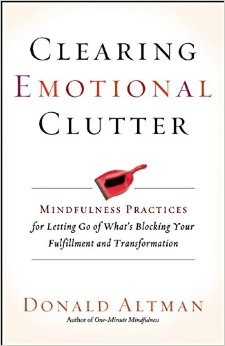
    Clearing Emotional ClutterTHE GIVEAWAY

    To enter to win one of two free copies of Clearing Emotional Clutter:

    • Leave a comment below
    • For an extra entry, tweet: Enter the @tinybuddha giveaway to win a free copy of Clearing Emotional Clutter http://bit.ly/1SLXcyB

    *US winners will receive a physical book in the mail; winners outside the US will receive an eBook.

    THE INTERVIEW

     1. Tell us a little about yourself and what inspired you to write this book.

    Mindfulness has helped me immensely in my life. I got on this path when I was going through a difficult life transition and found myself repeating an old, toxic pattern. It’s that idea that wherever you go, your problems always follow you. That is, unless you do something about it!

    Around that time I met a Burmese Buddhist monk—the Venerable U. Silananda—who had been teaching mindfulness in the U.S. since the 1970s. He possessed a palpable sense of compassion and availability that made me ask the question: How does someone become like that?

    When I had the opportunity to ordain with him as the head of the monastery, I jumped at it. Although I was in the monastery for a short period of time, it was an experience that changed my life direction because I was primed and ripe for the experience of looking inward.

    I wrote my first spiritual book while at the monastery, and continued to train with one of the monks afterward. I’m very grateful for the transformative experience the monks provided for me, which helped me nurture greater compassion and connect with my purpose. Now, my writing is focused on helping others find joy and fulfillment.

    Clearing Emotional Clutter is an important book for me because it integrates cutting edge brain science and research with the ancient practice of mindfulness. It shows that you don’t have to go into a monastery to transform your life, overcome past negative clutter, and rewire your brain.

    2. How do we accumulate “emotional clutter,” and why do we need to clear it out?

    No one can control what happens in life. There are losses, aging, and challenges throughout every stage of life, not to mention the daily wear and tear of stress. What we can do is to respond skillfully by not letting the emotional clutter pull us into states of dis-ease and unhappiness.

    By clearing out clutter, we can transform even difficult moments and respond to life in a way that helps us find the inherent joy that is present.

    3. You talk about getting off the emotional elevator. What do you mean by that?

    You can think of your emotions like an elevator that takes you up and down. What moves the elevator? What old programs are running in your head that push the buttons on your elevator to that it moves you up and down? Something good happens in your life and the elevator goes up. Something bad—even a perception of something being bad—and the elevator shoots down. But what if you could control that yourself?

    This book helps you decide who and what you are going to let push your emotional elevator buttons. Letting others push our mood elevator buttons can be exhausting. We’re not in control of our own elevator. Clearing away clutter means you get free from old emotional clutter programming and ways of thinking.

    4. In Chapter Two, you introduced a tool called “Inner-Facebooking.” Can you elaborate a little on this and share an example of how it’s helped you personally?

    Facebook is a wonderful way to post and put up for others what’s happening in our lives. In the same way, we are constantly putting up mental posts in our minds—through our thoughts and beliefs—that represent a kind of second Facebook: An Inner-Facebook, which shapes how we experience the world, ourselves, and others.

    If your Inner-Facebook posts are unhappy and unflattering, no wonder you feel bad and depressed. I have a whole chapter about noticing your Inner-Facebook posts so you can be more aware. Inner-Facebooking is a skill that helps you to emotionally regulate. Then you can change your Inner-Facebook posts to be more positive and accurate.

    Personally, I’ve gotten better at noticing my own inner-Facebooking posts. For example, my luggage was lost when traveling recently. But rather than respond to the highly reactive and anxious thoughts that my mind posted in that moment, I was able to step back and make a new, more realistic and helpful post that said, “My luggage is going to be found. Besides, in the big scope of things, losing my luggage isn’t that big a deal.”

    5. In Chapter Four, you wrote, “Much of the clutter of discomfort, discontent, and conflict that we experience in life comes from our unwillingness to accept things as they are.” I think we often equate acceptance with giving up. How can we simultaneously reduce the clutter of resistance while working to make positive changes in our lives?

    Acceptance is about realistically viewing your situation. It’s about surrendering to the truth that you may not have control over the situation. You recognize that it is what it is. That does not mean you are giving up. Submission, on the other hand, is about giving up.

    Acceptance allows us to surrender to the truth of our situation. So, if you’re frustrated at being caught in a traffic jam on the freeway, for example, you can have acceptance of what you’re experiencing instead of fighting with it. This means that you can then move forward in a more realistic and effective way instead of getting all stressed out and carrying the experience with you throughout your day.

    6. You devoted an entire chapter to “family emotional clutter.” How do we accumulate this type of clutter, and how does it negatively impact our lives?

    In my workshops I always ask, “Does anyone here have a difficult person in your life?” Everyone raises their hands.

    Family emotional clutter can negatively impact our future relationships and how safe we feel around others. If you’ve had negative relationship issues that have been a pattern in your life, that’s a sign you need to work on that clutter. Repairing this will lead to more loving, healthy, fulfilling, and secure relationships.

    7. What’s one thing we can do to begin releasing “family emotional clutter” to avoid these negative consequences?

    First, we can recognize that all people have suffered, even that person in your family who may have mistreated you. In fact, your family’s suffering may go back centuries. So, rather than feeling permanently victimized, it’s important not to pass on the wave of suffering in your family, and to know that you can heal.

    I believe that we can get a new brain download by finding benefactors in our lives. We can learn how to attune and alter our brain’s social and emotional rewiring. It’s a helpful process that I describe in one of the Lifestyle Tools found in Clearing Emotional Clutter.

    8. You talk about friendships as a tool to release emotional clutter. How and why can our relationships help with this, and how can we help other people release their emotional clutter as well?

    Research shows that having friends is the key to a happier life. The three seeds that make friendship grow and mature are the seeds of trust, acceptance, and empathy.

    Trust is essential, and that takes time to develop, so you need patience and real mutuality in a relationship.

    Acceptance means not being so demanding. It means accepting that everyone has flaws. Sometimes you need to let things to as a foundation for friendship.

    Lastly is empathy. Empathy is what lets you really feel connected to a friend. Develop these and you’ll develop friendship.

    9. In the chapter devoted to listening, you shared an acronym, HEAR, that can help us keep our emotional clutter out of conversations and “enter a more spacious and less defensive awareness.” Can you tell us a little about that and how it helps?

    Talking can be clutter that sometimes blocks understanding and deeper meaning. If we are to remove clutter in the moment, we need to be present with all our senses, especially listening. This acronym is designed to help us when we’ve stopped listening—like during an argument, or when we’re feeling defensive or caught up in our own opinion. It goes as follows:

    H- Hold all assumptions. Empty your ego and get curious. Set your personal beliefs and assumptions aside for a few minutes and take a more objective perspective as you listen.

    E- Empathy to engage, not enrage. With empathy, you can enter the emotional world of the other person so you can understand them better rather than try to deny or devalue what they are feeling.

    A- Absorb and accept. Understanding, with openness. Let in the ideas of the other person. Acceptance doesn’t mean you have to agree, but that you can accept this is the other’s belief.

    R- Reflect, then respect. Take time to pause before you respond. Take a step back so that you can think about what you’ve heard. Then, respond respectfully and with kindness.

    10. In Part 3 of the book, you explore ways to prevent new emotional clutter. What’s one practical thing we can all do daily to de-clutter?

    I especially like the idea of being faithful to this moment. You can be 100% committed to whatever you are doing. Uni-task, so you are fully present with this moment. This means fidelity to the breath, to walking, to eating, to working. Whatever you are doing, you can do so fully, without your mind being one place and your body being someplace else.

    That means that when you walk, walk. When you eat, eat. When you drive your car, drive. Cut down on the distractions and do one thing fully. In this way you can appreciate and savor even the most ordinary moments and that “in-between” time that is an important part of our days and lives.

    You can read more about Clearing Emotional Clutter on Amazon here.

    FTC Disclosure: I receive complimentary books for reviews and interviews on tinybuddha.com, but I am not compensated for writing or obligated to write anything specific. I am an Amazon affiliate, meaning I earn a percentage of all books purchased through the links I provide on this site. 

    Woman jumping image via Shutterstock
  • Discover Your Emotional Age: Heal Yourself & Change Your Life (Interview & Book Giveaway)

    Discover Your Emotional Age: Heal Yourself & Change Your Life (Interview & Book Giveaway)

    The Emotional Edge

    Update – The winners for this giveaway are:

    • Toni Nash
    • Katherine Poff

    When I first discovered Crystal Andrus Morissette’s new book The Emotional Edge, I was intrigued. I knew the book would offer a process for discovering our “Emotional Age,” a term that was new to me, but I didn’t realize it would provide a powerful roadmap for healing the wounded parts of our psyche and growing into our most empowered, authentic self.

    From the Amazon page:

    The Emotional Edge empowers you to stop reacting in knee-jerk ways that hurt and instead start expanding your life to become the greatest expression of you possible. Once you know your Emotional Age, you can take any needed steps to become an authentic adult so you stop giving your power away.

    You’ll learn:

    • Whether you’re a Parent, Child, or Adult ‘archetype’—take the Emotional Age Quiz and find out
    • When you’re inadvertently sabotaging yourself and why
    • How to channel fear and anger into courage and willingness
    • How to change your communication scale and style from passive or aggressive to assertive, accepting, and ultimately peaceful
    • Methods for fine-tuning into your unique needs mentally, emotionally, and physically
    • Ways to live your best life without guilt, shame, or blame
    • And lastly, how to rewrite and re-route your relationship, work, and bliss paths

    Never feel like a victim of circumstance, genetics, or your past again. Instead of letting your emotions get the best of you, now it’s time to get the best of them!

    Fascinating and insightful, The Emotional Edge brings you on a journey of self-discovery and offers the tools to help you break your unhealthy patterns and show up differently in the world.

    Since Crystal provided incredibly detailed responses to my interview questions about her work and her book, I’m going to keep this introduction brief and get right to them. But first…

    The Giveaway

    To enter to win one of two free copies of The Emotional Edge:

    • Leave a comment below
    • For an extra entry, tweet: Enter the @tinybuddha giveaway to win a free copy of The Emotional Edge http://bit.ly/1RDtEa2

    You can enter until midnight PST on Monday, April 11th.

    The Interview

    Trigger warning: this section mentions sexual abuse, which may be triggering to some people.

    1. Tell us a little about yourself and what inspired you to write this book.

    I’m a happily married Canadian woman with two spectacular daughters (who are now nineteen and twenty-one), a wonderful husband, and a thriving business as the founder of an international coaching institute, exclusively for women.

    I’ve written four books and I live a blessed life out in the country. But things weren’t always this peaceful, happy, and successful . . .

    I left home at fifteen after experiencing a series of devastating events: my parents’ turbulent divorce, when I was twelve, when my stay-at-home ‘Christian’ mother became a promiscuous party girl and fitness competitor who invited far too many men home. My father moved away to a new city and never seemed to worry or wonder where I was anymore.

    This is when my life turned upside down: I was sexually abused almost immediately by my mother’s new twenty-four-year-old boyfriend; stranger-raped at fourteen at my first high school party; and then raped nightly by the father of the children I was sent to take care of (to be ‘the nanny’) at age fifteen. I only stuck around for a few months before heading out on my own.

    By seventeen, I’d found out I had the early signs of cervical cancer and the HPV virus. It would take two years for the cells of my cervix to stop turning against me.

    The bad luck, so to speak, followed me into my twenties, where I experienced a traumatic head injury at age twenty-one that fractured my skull, ocular, and cheekbone and damaged the nerves in the right side of my face. This injury would later cause abnormal activity on my left temporal lobe, which left me with seizures.

    But it wasn’t until I had my own daughters in my mid-twenties and I gained over 100 pounds that I knew I had to look at myself, my life, and my inability to properly protect myself.

    I had to heal myself and my legacy to make sure my daughters didn’t go through the suffering that I did. (We know now that ‘epigenetic programming’ messes up the DNA of children of wounded mothers.)

    I needed to be the mother I needed in order to give my daughters a great start in their own lives.

    It was then I began looking at the concept of Emotional Age (EA) and how I was showing up in the world.

    2. What does “Emotional Age” mean, and why is it important that we each discover our own?

    Emotional age is a similar concept to biological age. But rather than predicting how young or old our physical bodies are, emotional age helps us understand how empowered or disempowered we are emotionally. It helps explain how we’ve been communicating, compromising, socializing, and interacting with others.

    Discovering your own emotional age is the most important step in improving your relationship with yourself, your life (health, wealth, etc.), and your relationships.

    When I was heading in my late twenties (now nearly twenty years ago), I began working exclusively with women.

    As I mentioned, I had gained over 100 pounds during my pregnancies, which was very hard coming from a ‘body beautiful’ background. (I’d previously competed in fitness shows such as the Miss Galaxy and was a Registered Holistic Nutritionist and Fitness Specialist.)

    It was then that I started doing a lot of work around the idea of ‘weight gain as protection’ rather than focusing on food/calories, which led me to the concept of emotional age.

    I began to pay close attention to patterns in the way people treated themselves and others. I noticed how their emotions and level of empowerment dictated their choices rather than their intelligence quotient (IQ) or emotional intelligence (EI).

    I noticed how some young adults seemed to carry the weight of the world (almost literally) on their shoulders in a more parenting persona.

    Regardless of their age, or if they even had children, these folks were so selfless, so protective of others but not of themselves, and so extremely giving to the point of self-abnegation that I began to refer to these people as having too much “mother or father energy”—or being in a Parent archetype.

    At the same time, I noticed others who seemed to have an almost opposing dominant emotional archetype that I called The Child—“daughter or son energy.” These people tended to be more selfish, frenetic, extremely emotional, and often more charming or coy than the parent archetypes.

    As I worked with my clients, I began really working on myself too—looking at my own patterns and my own emotional age. It was then that I not only lost my excess weight, I made peace with myself.

    I knew my weight wasn’t about calories; it was reflective of the energy or level of empowerment that I was embodying. The same is true about our finances, relationships, health, etc.

    Once I shifted into this emotional place, I noticed other successful, joyful, grounded people who also showed up in the world in what I call “woman or man energy”—the adult archetype; the fully integrated and empowered person. I knew it was time to write a book and teach others about their emotional age!

    3. Can you tell us a little about the “Empowerment Scale,” and how we can use this tool to better understand ourselves and improve our communication style?

    The Empowerment Spectrum is the tool I created to help determine emotional age. It is composed of two primary concepts.

    The first is that we each embody three dominant archetypes—the Parent, The Child, and The Adult. And the second is that we each have a style we use to engage with all those with whom we have a relationship that varies from passive to peaceful. I call this the Communication Scale. It runs up through the center of the Empowerment Spectrum.

    Our level of communication reveals how we are showing up in the world; it is the easiest indicator of our emotional age. But communicating our true needs can be incredibly difficult, and many of us fall into unhealthy and self-limiting patterns and behaviors.

    The great news is that once you become mindful of where you are resonating on the Empowerment Spectrum, you can climb the scale and show up as an Adult rather than a Parent or Child—in any and all areas of your life. Remember, emotional age has nothing to do with chronological age.

    4. In Chapter Three, you wrote, “Unhealed experiences keep triggering us into disempowering emotional places.” Can you expand on this?

    Over the course of our lives, we have trajectory changing moments that cause us to feel guilt and shame. In these painful moments, we disown parts of our self and bury them in our proverbial basement—our unconscious mind. Shame, shame, shame on me!

    We bury our Warrior. We bury our Princess. We bury our Charmer. We bury our Perfectionist. And so on. We just keep burying parts of ourselves so that we don’t have to feel badly. Who wants to feel badly about themself? No one does! 

    I never want to feel that again, so I will disown that part of me.

    Eventually, we have all these compartmentalized aspects of our lives and of ourselves. We are no longer whole. Complete. Expansive. We are little tiny fragments. Frozen. Shards of glass. Shards of light.

    We are wounded, looking out at the world trying to figure out who or what will help us feel whole, safe, and loved again. In fact, we need others to heal us because they become the mirror for us to see where we are still wounded.

    People who trigger us remind us of when we were shamed in the past. They trigger our wounds—neuro-associations to a past pain—something we haven’t yet healed and something we never want to feel again.

    In other words, something within them elicits the wounds within us. We feel a prick of that pain again in the here and now (and sometimes it’s a lot more than a prick); all the old unhealed ‘stuff’ comes flying out. This is why we have to clean up our own yards before we expect anyone else to.

    5. In your “communication scale,” you’ve shown passive and peaceful communication as opposite ends of the spectrum. I think many of us mistakenly assume these are the same things. What, exactly, differentiates the two?

    Peace isn’t about everyone being the same, thinking the same, or feeling the same. It isn’t even about everyone liking you or agreeing with you.

    Peace is agreeing to disagree. It is honoring our differences and doing our best to find common ground. Peace is acceptance expanded. But you can’t have peace if you’re afraid to speak. You can’t have peace if you’re afraid to listen.

    Passivity, on the other hand, depends upon your fear of speaking up or disagreeing, while avoiding any kind of confrontation becomes your primary concern.

    Many people think they are peaceful when, in fact, they aren’t. They’ve turned the other cheek, bit their tongue until it bleeds, while continuing to accept unhealthy behavior—often from those who claimed to love them the most!

    6. In explaining the fourth step of the WOMAN acronym—your cue for assertiveness—you wrote, “…passive people ask disempowered questions, while empowered people ask empowered questions.” Can you give us an example of a disempowered and empowered question we might ask ourselves, and share how the latter could help us be more assertive?

    The brain is a search engine. When you ask it a question, it searches through its databanks, so to speak, for the answer.

    We know that when we ask ourselves a disempowered question, our brain will find disempowered answers. The same applies to asking empowered questions. In fact, scientists from the seventies discovered that the way we speak to ourselves about ourselves changes everything!

    As an example, if you were to ask yourself: “Why am I such a loser?” or “Why am I so fat?” your brain wouldn’t say, “Sweetheart, you’re not a loser!’ or “You’re beautiful, don’t talk like that about yourself!” Nope! Your brain would search for all the reasons why you are a loser or a fatso!

    Alternatively, if you were to ask yourself: “What could I do to lose weight and feel great about myself?” Your brain would give you a list of choices that would help you. For example: exercise and drink more water, eat a salad, meditate, etc. The brain literally searches for answers to our questions without any conscience or kindness.

    Once you learn how to ask yourself more empowered questions, your life begins to shift into a more empowered place. And by focusing on your desires rather than on past letdowns, you redirect your thoughts toward possibilities rather than problems.

    7. As the last two steps in your four-step boundary setting formula, you recommend asking, “Would you be willing to ___________?” and then stating, “If you can’t do this for me, I will _____________.” Do you have any advice for people pleasers who find it difficult to share and honor their needs in this way, for fear of rocking the boat?

    When someone is afraid to set a boundary, it simply means they are still disempowered. They simply don’t (or can’t) say what they really mean and they don’t mean what they say, which is why it is very challenging to have an honest and fulfilling relationship with a people pleaser.

    Truth be told, people pleasers don’t always realize how indirect and roundabout their communication style is. They may not even realize how little self-advocacy they are doing.

    They’ve spent a lifetime being let down, abused, or ignored, so they swing between trying to be what you want them to be and wanting you to try to figure out who they really are. There is a lot of fear in this communication zone!

    The people pleaser needs to establish trust that their ideas are valid and will be heard. In other words, trust that you deserve to be listened to, protected, and respected.

    If you’re in an environment where this is not the case—where you do not feel safe—it is not your fault, whether or not you allowed it! Self-shaming and living with guilt will not empower you to make the changes you need to make. Instead, you need to find a safe place to learn how to begin expressing yourself, your feelings, and your needs. But it all begins with you.

    You have to give yourself permission to matter! Believe it or not, the most dynamic, successful, happy people have mastered self-advocacy.

    8. In Chapter Seven, you wrote, “Your relationship can only be as healthy as the unhealthiest part of you.” I imagine the same is true of our partners. What would you recommend to someone who is doing this work, whose partner will not?

    Keep doing your own work, period! Focus on making yourself and your own life happier. One of the best things that we can do is to let the atmosphere in our relationships lift and lighten.

    I know it may feel counterproductive, but stop talking about your problems with the person who seems to be at the root of them; you’re angry and need to express yourself! But let’s not kid ourselves: there is nothing new to be gained by arguing.

    Focus on radical self-love and watch every aspect of your life—including your relationship—improve. Once your partner feels this subtle yet significant change, he or she will be open and willing to help more, show you more affection, and yes, have those long talks that you desire.

    Striving to grow and to heal can be a lifelong process. But as you turn toward your partner, think about how you can provide the kind of loving support that you yourself crave.

    9. What is the main message you hope readers take from your book?  

    Whatever is repressed will find a way to be expressed. Patterns continue until they are broken. You have to face yourself and your stuff. You have to dig it up and deal with it: You have to move through it. There is no other way. You can’t go over it, under it, around it, or behind it.

    We can keep pointing the finger out there, but healing is an inside job! In fact, ninety-nine percent of our problems really have little to do with what is happening in the here and now.

    They’re all old wounds—old stories! Neuroassociations. You can even just chalk it up to ‘karma’ because that’s all it is: old toxic crap that needs to be cleaned out. Neutralized. Recontextualized. Healed. Cleared. Crystal-cleared. 😉

    You can learn more about The Emotional Edge on Amazon here.

    FTC Disclosure: I receive complimentary books for reviews and interviews on tinybuddha.com, but I am not compensated for writing or obligated to write anything specific. I am an Amazon affiliate, meaning I earn a percentage of all books purchased through the links I provide on this site. 

  • Take the Love Pledge (You Could Win a Copy of Tiny Buddha’s New Love Book)

    Take the Love Pledge (You Could Win a Copy of Tiny Buddha’s New Love Book)

    Happy Thanksgiving to those of you who celebrate it! Today is a perfect day to take the Tiny Buddha love pledge if you haven’t already. Over 1,200 people have taken it over the last ten days.

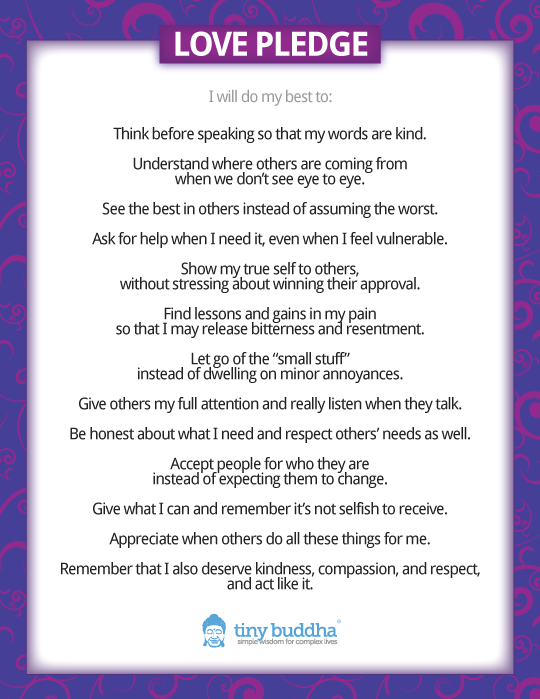
    I created this pledge to help us all be more loving, to others and ourselves. After you take the pledge by entering your email address here, you’ll be entered to win one of three free copies of Tiny Buddha’s 365 Tiny Love Challenges, which includes stories and daily activities to help us all give and receive more love.

    Tiny efforts can make a huge difference. And a tiny bit of love from each of us can make the world a far better place!

    If, like me, you value your relationships, take the Tiny Buddha love pledge here.

    tb-love-pledge540

    You can take the pledge until Monday, November 30th. The giveaway winners will be notified then.

    “What a terrific resource! This book provides so many thought-provoking ideas for simple, fun ‘challenges’ to help us live happier, more loving lives.” — Gretchen Rubin, author of The Happiness Project

    Want the book now? Grab a copy of Tiny Buddha’s 365 Tiny Love Challenges here.

  • A Life-Changing Guide for Emotionally Sensitive People (and a Giveaway!)

    A Life-Changing Guide for Emotionally Sensitive People (and a Giveaway!)

    Sad Girl Illustration

    Update: The winners for this giveaway have been chosen:

    You’re too sensitive. You’re making a big deal out of nothing. Why are you letting that bother you? Why can’t you just let it go? Really, you’re crying? What’s wrong with you? 

    If you’re an emotionally sensitive person, like me, you may have heard some of these phrases throughout your life. And, like me, you may have concluded that your emotions made you tragically flawed.

    For the longest time, I felt a deep sense of shame about my sensitivity. And I found it difficult to deal with everyday life—not just because I felt everything so deeply and often reacted irrationally, but also because I absorbed other people’s feelings as if they were my own.

    I remember in elementary school when most of my peers had to get shots from the school nurse. I’d already gotten one at my pediatrician’s office, so I sat in the hallway as, one by one, they approached her office to meet certain doom.

    I could recall the fear and dread I’d felt in the moments before the needle pierced my skin, and I relived it, over and over again, as each student approached the door. In fact, my vicarious anxiety was so intense that I threw up, right there in the hallway.

    I didn’t just empathize with their pain—I felt it. Deeply. And repeatedly.

    I constantly felt emotionally overwhelmed, and often confused about the root of my feelings. All I knew was that I hurt—a lot—and I wanted to make it stop.

    When I first realized I wasn’t alone with my emotional sensitivity, it was like someone rubbed a soothing balm on the achy heart I wore on my sleeve.

    And it was even more liberating to realize I could leverage my sensitivity for good, as I have through Tiny Buddha.

    Suddenly, it wasn’t something I had to hide; it was something I could openly acknowledge and harness in a positive way.

    Still, I’ve had to work at managing my emotions, and I’ve had to learn to challenge destructive thoughts and behaviors that only exacerbate my pain.

    If you too experience intense emotions, you don’t need to feel bad about yourself, or powerless to your heightened sensitivity.

    Psychologist Karyn D. Hall has written a life-changing book that can help you manage your emotions so they don’t take over your life.

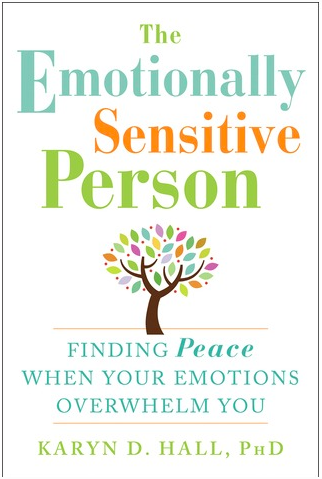
    The Emotionally Sensitive Person: Finding Peace When Your Emotions Overwhelm You offers proven strategies to identify emotional triggers, challenge negative thought patterns, and recover from emotions more quickly.

    I wish I’d read this book years ago. It’s insightful, practical, and chock-full of effective strategies to transform your sensitivity from a burden to a gift.

    I’m grateful that Karyn took the time to provide some incredibly detailed answers to my questions about emotional sensitivity, and that she’s provided two free copies of The Emotionally Sensitive Person for Tiny Buddha readers.

    Sensitive CoverThe Giveaway

    To enter to win one of two free copies of The Emotionally Sensitive Person:

    • Leave a comment below
    • For an extra entry, tweet: Enter the @tinybuddha giveaway to win a copy of The Emotionally Sensitive Person http://bit.ly/1KZGNnL

    You can enter until midnight PST on Friday, May 22nd.

    The Interview

    1. Tell us a little bit about yourself and what inspired you to write this book.

    I’m a therapist who works with emotionally sensitive people and I’m an emotionally sensitive person too.

    I noticed that many people were suffering because they felt different, rejected, and flawed because of their emotional sensitivity. Many of them had heard statements like, “You’re just overreacting,” and “Stop being so dramatic,” for most of their lives.

    In my work I found that if emotionally sensitive people could understand and accept their sensitivity, and not judge themselves because of it, that could ease some of the suffering they experience. I also believe that learning to manage intense emotions is part of decreasing their suffering.

    Being emotionally sensitive is not an illness, but it does mean you are more vulnerable to anxiety and depression and other disorders. Judging and hating yourself for being sensitive is part of the pain and suffering that happens.

    I wanted to write a book that could help emotionally sensitive people accept their sensitivity and learn to manage their intense emotions to help them live the life they want to live.

    2. What causes emotional sensitivity?

    Emotional sensitivity is biological. Research shows that some individuals are born with more intense emotions, meaning you react faster to emotional situations, your emotions are more intense, and your emotions take longer to fade. Events in a person’s life could also influence that emotional sensitivity.

    3. Emotionally sensitive people, like myself, often feel shame for being this way. What can help people like me feel less ashamed, more accepting, and perhaps even proud of their emotional sensitivity?

    First of all, ask yourself if the shame you experience is based on facts. All emotions have a purpose, and the role of shame is to keep you from behaving in ways that would get you kicked out of groups that are critical to your survival.

    Most likely being an emotionally sensitive adult will not get you kicked out of important groups. Is the shame from being judged by others as flawed? Perhaps as a child? Maybe from people who didn’t understand? Perhaps give some thought as to what specifically the shame is about and how it came to be.

    So if shame is not justified, that being emotionally sensitive is not something that warrants shame, then consider that the way to overcome shame is to do the opposite behavior to that which shame urges you to do.

    Shame urges you to hide. So the opposite behavior is to not hide. To do the opposite is to look people in the eye, and stand up proud of your sensitivity. When people say, “You’re overreacting,” respond with pride, “Actually, this is exactly how I feel—I feel emotions intensely.”

    Many times it is the discomfort that other people have with emotions that leads them to criticize your emotional reactions.

    Our culture tends to value logical, analytical thinking. That doesn’t make their way better. In fact, emotionally sensitive people are the ones who become passionate about causes and make changes in the world. They are artists and caregivers and those who contribute to humanity.

    The positives of being emotionally sensitive are often overlooked. If you consider it very carefully, what could or are you proud of about your emotional sensitivity? Make a list and review it often. Keep the positives in your mind to help you keep a balanced view of your emotional sensitivity.

    Let yourself really see what your sensitivity is about—check out reality and let go of myths you might have accepted along the way about the “wrongness” of emotional sensitivity. Do you care intensely about others? Do you express yourself authentically?

    Another idea is to practice self-compassion in place of judging yourself. Respond to yourself as you would a friend who feels emotions strongly.

    If your emotional sensitivity leads to depression or anxiety or to behaviors that you know are not effective or helpful, then focus on changing the behaviors and learning ways to manage your emotional sensitivity that work for you rather than judging your sensitivity.

    It’s not wrong, it’s just different. Judging your sensitivity is like judging yourself for how short or tall you are. It just is. It’s not helpful to continually berate yourself for your height, and in the same way seeing your sensitivity as wrong or yourself as flawed only adds to your distress and suffering.

    4. What are the two different types of emotional sensitivity, and how do they manifest?

    The two types I’ve identified are reactive and avoidant. People who are reactive act on feelings without thinking and are very quick to respond to emotional triggers. They have strong impulses that come with their emotions. They can be spontaneous and fun and also may act in ways that cause difficulties for themselves.

    The avoidant type attempts to push away or avoid uncomfortable emotions and/or situations. The avoidant type might not attend gatherings if someone at the event was upset with her and would avoid other situations that might involve difficult feelings, such as confronting someone who owed her money or saying no to someone who asked for a favor.

    5. What are some things we can do to improve our ability to manage our emotions?

    There are many options to improve your ability to manage your emotions. One area is prevention.

    This means that you make sure that you get sufficient sleep, eat a nutritious diet, take prescribed medications, take care of your physical health, exercise, and create positive experiences to build your resiliency. Work to develop safe and emotionally intimate relationships so you have a support network.

    Let go of judging, stop avoiding your emotions, learn ways to change your emotions, and stop feeding or building difficult emotions. The book discusses the specifics of these ideas. In addition, I have a subscription website opening soon called DBTCoaching.com that focuses on coping skills.

    6. You wrote that emotionally sensitive people tend to “catch” other people’s emotions. Can you tell us a little about this, and how we can stop doing it?

    Emotionally sensitive people are often tuned in to the emotional experiences of other people, so much so that they may experience the emotion that someone else is having. If you are with someone who is sad, you may feel sadness too, for example.

    Awareness that you are experiencing an emotion that actually belongs to someone else is helpful in letting go of it.

    If someone is relating an experience that made them sad, then you can say to yourself, “Not my experience, her experience,” to help maintain the boundary.

    If you experience emotions that you imagine others might have, such as “She must be so sad,” then remind yourself that someone else’s experience is not necessarily the same as yours. For example, if someone is moving, he might be excited and happy instead of sad or scared or vice versa.

    7. In reading the “Identifying Your Emotions” section of the book, I realized I’ve mislabeled many thoughts as feelings, compromising my ability to cope with my actual emotions effectively. Can you share a few examples of mislabeling thoughts as feelings, and how we can identify what we really feel?

    Some examples of mislabeling thoughts as feelings can be as simple as, “I feel like I’ll never succeed,” “I feel like I don’t fit in anywhere,” and “I feel like I’m different from anyone else.”

    Those expressions are actually thoughts. To be more accurate your would say, “I think I don’t fit in anywhere and that makes me sad,” and “I think I’m different from anyone else and that makes me sad.” Then you either challenge the thoughts or find ways to cope with the feelings that come with the thought.

    It’s difficult to challenge statements when you express them as feelings. “I am scared because I think I’ll never succeed” gives you the information about both the feeling you are having and the thought.

    You recognize that as a negative thought and you can challenge it. Is that statement true? In what situation do you think it is true? Do the facts back it up? If so, what do you need to do differently? The emotion of sadness would indicate coping skills to help you deal with that specific emotion.

    8. In Chapter 6, you wrote, “Judgments hide primary feelings.” What did you mean by this—and how can we challenge our judgments?

    We often judge when we are emotionally upset. “He is a complete jerk,” is a judgment. What led to that thought and emotion? Maybe you were embarrassed because you spilled wine all over yourself and your date didn’t offer to help clean up. You use the judgment of him to cover the embarrassment.

    “I spilled wine all over myself and I felt hurt that he didn’t help me clean it up,” might be more accurate.

    9. The chapter that was most helpful to me personally was the one on decision-making—particularly the part about separating the decision from the emotion and accepting emotional consequences. Can you expand on this?

    I’ve found that many emotionally sensitive people believe they can’t make decisions but they actually avoid decisions because of the emotional consequences of those decisions.

    There are few choices that don’t have emotional consequences. Even picking a restaurant for a group dinner means someone will likely not agree with the choice and may be disappointed or critical. You know which restaurant you want, but you struggle with the decision because of the emotional consequences of the decision. You don’t want anyone upset.

    If you can separate the two, the choice of restaurant and the emotional consequences of the choice, then you can be clear about what the issue is and how you want to manage it.

    10. What do you think is the most important thing an emotionally sensitive person can do for their well-being?

    Accept themselves as they are, completely and totally, and also work on changing behaviors that are keeping them from being effective in building the life they want to live.

    You can find The Emotionally Sensitive Person on Amazon here.

    FTC Disclosure: I receive complimentary books for reviews and interviews on tinybuddha.com, but I am not compensated for writing or obligated to write anything specific. I am an Amazon affiliate, meaning I earn a percentage of all books purchased through the links I provide on this site. 

    Girl under rain clouds image via Shutterstock

  • Enter to Win $500 at Thrive Market (A New Online Health Food Store)

    Enter to Win $500 at Thrive Market (A New Online Health Food Store)

    Thrive_FB_Banner

    Have you ever noticed that unhealthy food is a lot cheaper and easier to get than healthy food? You can zip through a drive thru and get an entire meal off the dollar menu without losing more than five minutes or five bucks.

    Because I was busy and on a budget, I formerly ate a steady diet of processed, packaged food, which did very little for my energy level.

    I didn’t realize at the time how poorly I was meeting my nutritional needs, or how I was poisoning my body with artificial ingredients and chemicals, but I knew I frequently felt sick.

    Still, I didn’t love the idea of stocking up at “Whole Paycheck,” as my friends called a well-known health food store.

    Since I now know that I can only function well if I eat well, I was thrilled to discover Thrive Market, a recently launched online store that sells health food at wholesale prices everyone can afford.

    About Thrive Market

    Thrive Market’s merchandising team works directly with brands to purchase natural, healthy foods and products at wholesale prices—which are 25−50% lower than the products sell for in physical stores.

    They don’t sell generic products you won’t recognize. They sell the same products you’d find at your local health food store, only cheaper.

    You can stock up on everything you need, including GMO-free food, snacks, vitamins, supplements, personal care products, cleaning supplies, beauty products, kitchen staples, pantry essentials, baby food and products, and more.

    Thrive Market doesn’t earn money by marking up prices; instead, they charge a low annual fee of $59.95 (less than $5 per month). I was pleased to see that I saved more than this on my first order.

    Since they offer a free one-month membership, you can give it a try yourself—at no cost—and see if your savings are equally substantial. And if, like me, you spend over $49, the shipping is free.

    For every paid membership, Thrive Market donates a membership to a low-income family, supporting their mission to make healthy food accessible to all.

    Equally notable, they make all packaging, boxes, and inserts using recyclable paper.

    I don’t promote a lot of products on Tiny Buddha because I would never recommend anything I didn’t personally utilize and enjoy. But I feel good about shopping at Thrive Market, and I’m excited to partner with them for an exclusive giveaway for Tiny Buddha readers.

    The Giveaway

    From now through Sunday, April 12th, you can enter to win $500 at Thrive Market by entering your email address here. Fifteen second-place winners will receive a free annual membership.

    After entering, you’ll receive a confirmation email offering you 15% off your first order. You’ll also see an option to share the giveaway on Facebook for an extra entry.

    I hope you enjoy shopping at Thrive Market as much as I have!

  • Interview with Dani DiPirro and Book Giveaway: The Positively Present Guide to Life

    Interview with Dani DiPirro and Book Giveaway: The Positively Present Guide to Life

    Positively Present Guide to Life

    Update: The winners for this giveaway are:

    If you’re a fan of uplifting, action-oriented blog posts, you may have stumbled upon Positively Present at some point in time.

    I “met” the site’s founder, Dani DiPirro, around the time I started Tiny Buddha. Over time, I grew to admire her dedication, both to personal development and her blog.

    Since 2009, she’s shared countless helpful, inspiring posts, empowering readers to live mindfully and positively in the face of life’s inevitable challenges.

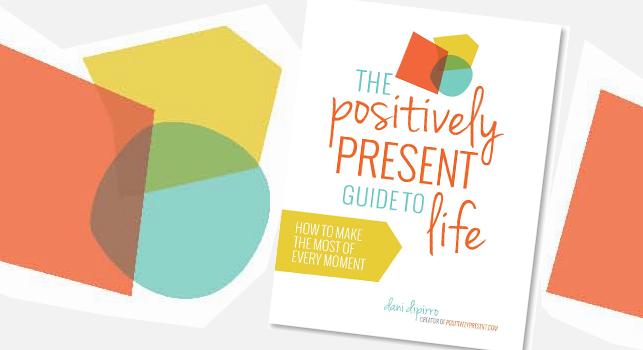
    Now she’s preparing to launch a new book, The Positively Present Guide to Life, which offers practical ideas to enhance our home life, work, and relationships for an all-around happier, more fulfilled life.

    I’m grateful that Dani took the time to answer some questions about herself and her book, and that she’s provided two copies for Tiny Buddha readers.

    The Giveaway

    To enter to win one of two free copies:

    • Leave a comment sharing one thing that always helps you stay positive.
    • For an extra entry, tweet: Enter the @tinybuddha giveaway to win a free copy of The Positively Present Guide to Life http://bit.ly/17oIQDY

    You can enter until midnight PST on Friday, February 27th.

    The Interview

     1. Tell us a little bit about yourself and your blog, Positively Present. 

    I’m an author, blogger, and designer living in a suburb of Washington, DC. In 2009, when I was at a particularly low point in my life—I didn’t love my job, my relationship status wasn’t ideal, and I was struggling a lot to feel happy—I launched PositivelyPresent.com with the intention of documenting my journey toward a more positive and present life.

    In 2012, I left my full-time job in Marketing to pursue a career as a blogger and writer. While working to create a beautiful online space for my readers, I discovered how much I loved illustrating and graphic design.

    Last year, I launched my design studio, Twenty3, where I work with individuals and business to create modern, uplifting design. My love of design and my desire to help myself and others live more positive, present lives comes together in my latest book, The Positively Present Guide to Life, which pairs inspiring illustrations with action-oriented advice for living a more positive, more present life.

     2. What inspired you to write The Positively Present Guide to Life, and how does it differ from your blog?

    Books have been my greatest teachers, and I love the tangibility of them of in our digital world. I’ve learned so much about life—and about myself—from books, and writing The Positively Present Guide to Life was the best way I could think of to take the lessons I’ve learned from PositivelyPresent.com and explore them at a deeper level.

    And my blog has inspired this book in another way: all my advice here is presented in easy-to-follow lists, to make sure this guide is as simple to use and as practical as possible.

    3. What have you found to be the biggest obstacles to being positive and present—and how have you overcome them?

    One of the biggest obstacles for being positive and present can be other people. Just because you’re trying to live a more positive, present life, that doesn’t mean that those around you are striving for the same thing, and the negativity of others can be draining.

    Overcoming this can be difficult if it’s not possible to avoid negative people. If possible, I’ve found it helps to limit your interactions with them. If that’s not an option, I recommend reminding yourself that you do not have to be ruled by others’ moods or attitudes. Even when others are negative, you can choose to focus on the positive and to stay in the moment.

    4. I think there’s a misconception that “be positive” means “don’t ever feel bad.” What are your thoughts on this?

    This is definitely a huge misconception when it comes to positivity. It’s for this reason, in fact, that I focus on positivity rather than happiness.

    When you are happy, you are in a state where you don’t feel bad and when even the not-so-great things seem bearable. Positivity, on the other hand, is not about putting on rose-colored glasses and pretending that everything is okay. It’s about accepting whatever’s happening in your current situation and trying to make the most of it.

    No matter how difficult the situation, it’s possible to find something of value—even if the value is only that you’re getting stronger by going through difficulties.

    5. In Chapter One of your book, you talk about creating a positive home. What advice would you give to someone who wants to create a positive home but lives with people who are often negative?

    Living with negative people can really challenge efforts to live a more positive, present life, but there are things you can do to make the most of the situation.

    I’ve dedicated an entire section of my book to this topic because I believe it’s something many people encounter. Even if people at home are generally positive, we all have our bad days (or weeks!). When dealing with negativity at home, I recommend trying your best to speak with love, and not to mirror the tone or attitude of those who are in a negative state of mind.

    This can be difficult (we tend to react in a way that mirrors others), but choosing loving words and tone can make a huge difference.

    Also, it’s important to try not to take others’ negativity personally. Often, stress and negativity between cohabitants is a result of issues that take place outside of the home (such as work), and it can be helpful to consider that another’s negative reaction or snippy tone might be related to something that has nothing to do with you.

    6. In the next chapter, you talk about being positively present at work. What do you think is the most important thing someone can do to stay positive and present when they’re not happy at their job?

    Even if you don’t love your job, you can learn from it. Any job offers the opportunity to learn how to cooperate with and overcome challenges.

    Being around others—some you like, some you don’t—teaches important people skills, from how to collaborate, negotiate, and compromise with those who view things differently, to how to get a job done with someone who would rather chat away the day.

    Processing so many viewpoints and opinions from coworkers opens our eyes to new ways of thinking. If you like your industry but not your position, you can also learn a lot by talking to those you admire or who hold positions you aspire to.

    7. In the chapter on relationships, you talk about learning to say no. Why is this so important to staying positive and present?

    There are many reasons why saying no, negative as it sounds, can be a more positive response. For example, it might save you from having to spend time with people who bring negativity into your life, or it might ensure that you don’t overload your schedule.

    It can also strengthen relationships because it lets other people know you have boundaries and will enforce them. It helps others know where they stand—and if they don’t cross the line, your relationship is all the more positive for it.

    Keep in mind: when you say no to one thing, you’re really saying yes to something more worthy of your time and energy.

     8. What do you think is the most essential habit for staying positive and present?

    One of the most essential habits for living a positive, present life is to cultivate gratitude. No matter how difficult a situation, there is always something to be grateful for. It’s very difficult to be negative or distracted from the moment when you’re focusing on what you have to be thankful for.

     9. What’s the main message you hope people take from your book?

    When people read my book, I hope they’ll realize how important a shift in attitude can be. It can transform all aspects of your life, from home to work to relationships to love to how you cope with change.

    I hope readers will see that, even if positivity and mindfulness doesn’t come easily to them, with the right tactics and inspiration, it’s possible to cultivate a positive attitude and stay in the moment more often.

    I’m not a naturally positive person and I work hard at staying positive and present. If I can do it, anyone can—and I hope this book will inspire readers to see that they, too, can live more positive, present lives.

    You can learn more about The Positively Present Guide to Life (and pre-order a copy) on Amazon.

    FTC Disclosure: I receive complimentary books for reviews and interviews on tinybuddha.com, but I am not compensated for writing or obligated to write anything specific. I am an Amazon affiliate, meaning I earn a percentage of all books purchased through the links I provide on this site. 

  • Review and Giveaway: In the Garden of Happiness

    Review and Giveaway: In the Garden of Happiness

    In the Garden of Happiness

    Update: The winners for this giveaway have already been chosen:

    Ken Golden

    Sandy

    Be inspired. Be strong. Be happy.

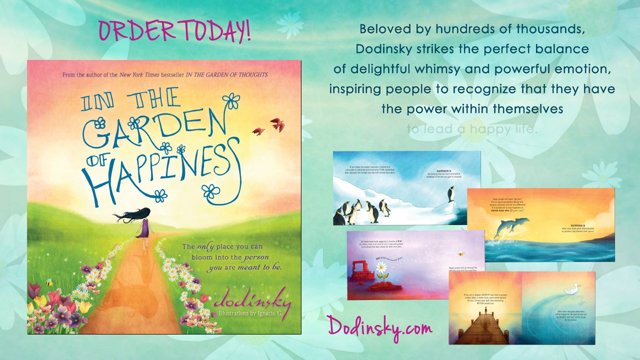
    These words pop from the peaceful imagery on the back cover of Dodinsky’s In the Garden of Happiness, nicely summarizing the benefits of perusing this uplifting illustrated book.

    If you’ve read his first book, In the Garden of Thoughts, you know what to expect from this bestselling author: whimsical imagery and powerful wisdom in a deceptively tiny package.

    His work provides encouragement when you’re feeling hopeless or helpless; reassurance when you’re feeling insecure or insignificant; and comfort when you’re feeling regretful or remorseful.

    Some of my favorite passages include:

    Whenever you manage to smile in spite of the hardships you’re facing, it means your soul is refusing to be a prisoner of your sorrows.

    To find the star that sparkles the most, you need to look inward—because not all stars are settled in the sky.

    It is sometimes the uphill struggles that will give you the best view of life’s most forgotten and beautiful landscapes.

    Colorful, insightful, soothing, and empowering, In the Garden of Happiness is the perfect gift for anyone—of any age—who appreciates vibrant art and bite-size pieces of inspiration.

    I’ve left my copy where I can easily access it for an instant pick-me-up. Simultaneously simple and profound, it never fails to comfort and uplift me.

    As a huge fan of Dodinsky, I couldn’t be more thrilled to share In the Garden of Happiness with you, and I’m grateful he’s offered two free copies for Tiny Buddha readers.

    To Enter the Giveaway

    • Leave a comment below
    • For an extra entry, tweet or post on Facebook: Enter the giveaway on Tiny Buddha to win a free copy of In the Garden of Happiness, by Dodinsky: http://bit.ly/14orN3W

    You can enter until midnight PST on Friday, January 9th. The book launches tomorrow, and is available for pre-order on Amazon now.

    FTC Disclosure: I receive complimentary books for reviews and interviews on tinybuddha.com, but I am not compensated for writing or obligated to write anything specific. I am an Amazon affiliate, meaning I earn a percentage of all books purchased through the links I provide on this site. 

  • Win a Free Copy of Tiny Buddha’s Guide to Loving Yourself

    Win a Free Copy of Tiny Buddha’s Guide to Loving Yourself

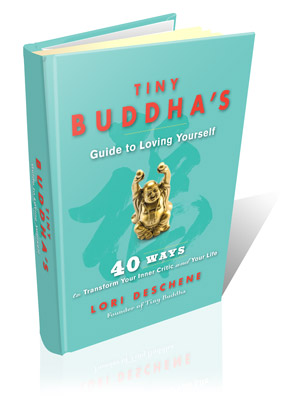
    Tiny Buddhas Guide Cover 3D

    UPDATE: The winners for this giveaway have already been chosen. 

    The winners:
    • Antwanette Miller
    • Rebecca

    This may seem like Déjà vu, because I published an almost identical post last Friday. It’s now a new week (soon to be weekend) and a new chance to win a copy of Tiny Buddha’s Guide to Loving Yourself!

    For those of you who already bought a copy, I hope you’re enjoying it!

    And I have a special request for you: Since it’s brand new, there are currently only four reviews on Amazon. (Thank you so much to those of you who responded to my request last week and wrote one!)

    Those reviews go a long way in influencing people who may benefit from the book.

    If you’ve found the site and the book helpful, I would be so grateful if you would take five or ten minutes out of your day to support me and the site by reviewing Tiny Buddha’s Guide to Loving Yourself

    Whether you write two words, two sentences, or more, it will make a tremendous difference.

    Now on to today’s giveaway!

    This one’s a little different, in that you won’t be entering to win a copy for yourself; instead, its an opportunity to have a copy mailed to someone you love, directly from my publisher, with a special note from you. 

    About Tiny Buddha’s Guide to Loving Yourself

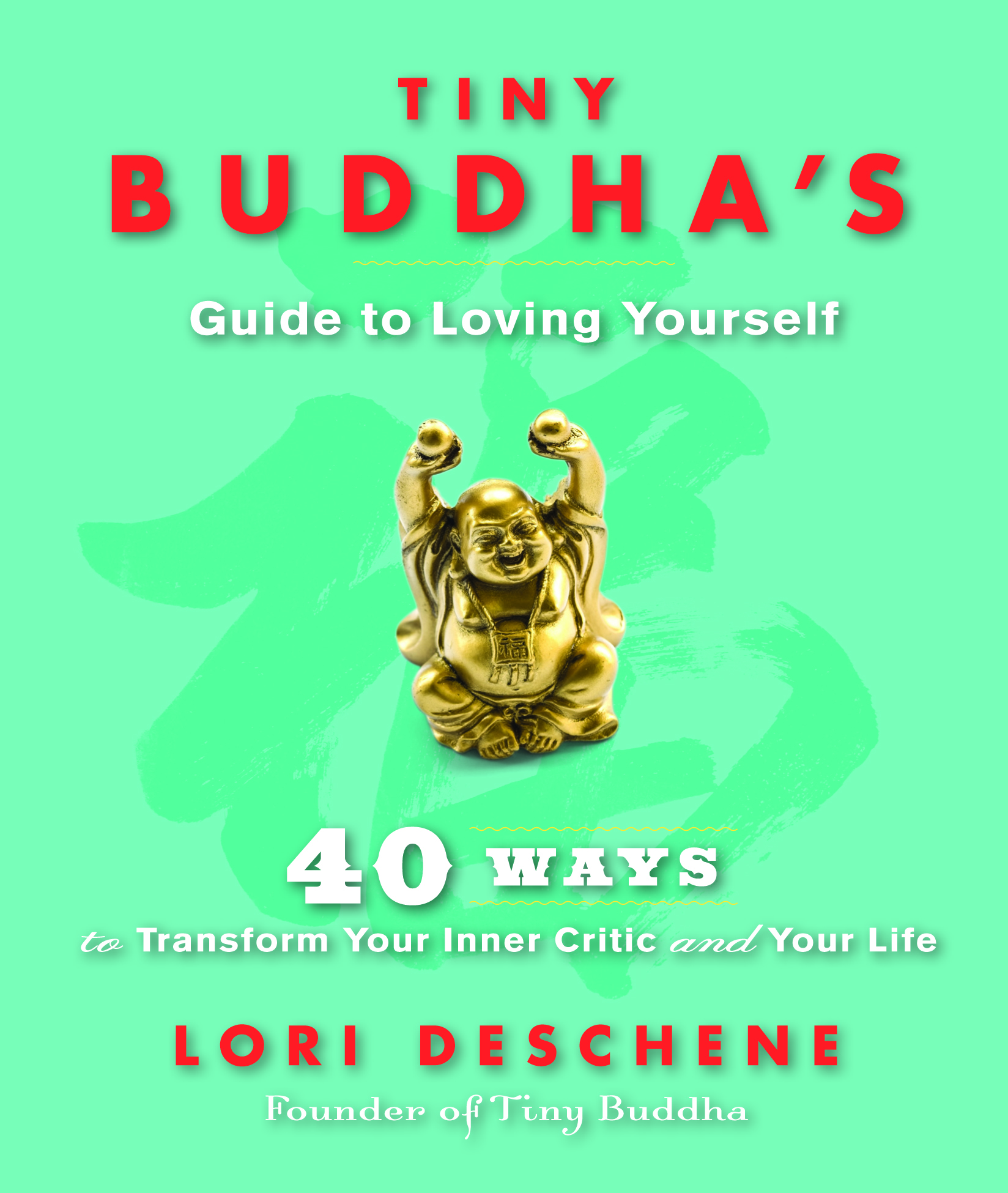
    Tiny Buddha’s Guide to Loving Yourself is a collaborative book featuring a collection of stories from Tiny Buddha contributors, along with tips to help you feel good about yourself and your life.

    The book shares 40 unique perspectives and insights on topics related to loving yourself. It will help you:

    • Release shame about your past and the limiting beliefs that keep you stuck
    • See yourself as beautiful and valuable, with all your flaws and weaknesses
    • Accept yourself more and judge yourself less
    • Forgive yourself for your mistakes and stop being hard on yourself
    • Minimize the need for approval to feel more confident
    • Let go of the comparisons that keep you feeling inferior
    • Feel complete so that you no longer look to others to fill a void within yourself
    • Find the courage to share your authentic self for deeper connections with others
    • Learn to take care of yourself instead of putting everyone else’s needs first
    • Believe that you’re valuable so you can start creating a life you love

    I started Tiny Buddha and created this book because I believe there is a healing power in recognizing that we are never alone with our challenges.

    And there’s nothing wrong with us for what we’ve been through or what we’re going through.

    No matter how we’ve struggled, no matter what our flaws or weaknesses, we are worthy of being fully seen—and we can make a difference in the world by doing it.

    I hope this books helps you remember, in times of doubt, that you are beautiful, imperfections and all, and you can thrive not in spite of them, but because of them.

    The Giveaway

    To enter to win one of two free copies of Tiny Buddha’s Guide to Loving Yourself, to be mailed to someone you love with a special note from you:

    • Leave a comment on the post sharing one thing you think other people appreciate about you
    • Tweet: RT @tinybuddha Enter to win a free copy of Tiny Buddha’s Guide to Loving Yourself! http://bit.ly/16yY2ru

    If you don’t have a Twitter account, you can still enter by completing the first step.

    You can enter until midnight PST on Monday, October 28th. Have a great weekend everyone!

  • Book Giveaway: Tiny Buddha’s Guide to Loving Yourself

    Book Giveaway: Tiny Buddha’s Guide to Loving Yourself

    Tiny Buddhas Guide Cover 3DUPDATE: The winners for this giveaway have already been chosen. They are:

    • Sunny Kharbanda
    • UnicaPoet

    It’s been 10 days since the launch of Tiny Buddha’s Guide to Loving Yourself, and I’m excited to share that the book has been a bestseller in Amazon’s self-esteem category since then.

    For those of you who already bought a copy, I hope you’re enjoying it!

    And I have a special request for you: Since it’s brand new, there’s currently only one review on Amazon. Those reviews go a long way in influencing people who may benefit from the book.

    If you’ve found the site and the book helpful, I would be so grateful if you would take five or ten minutes out of your day to support me and the site by reviewing Tiny Buddha’s Guide to Loving Yourself

    Whether you write two words, two sentences, or more, it will make a tremendous difference.

    Now on to today’s giveaway!

    This one’s a little different, in that you won’t be entering to win a copy for yourself; instead, its an opportunity to have a copy mailed to someone you love, directly from my publisher, with a special note from you. 

    About Tiny Buddha’s Guide to Loving Yourself

    Tiny Buddha’s Guide to Loving Yourself is a collaborative book featuring a collection of stories from Tiny Buddha contributors, along with tips to help you feel good about yourself and your life.

    The book shares 40 unique perspectives and insights on topics related to loving yourself. It will help you:

    • Release shame about your past and the limiting beliefs that keep you stuck
    • See yourself as beautiful and valuable, with all your flaws and weaknesses
    • Accept yourself more and judge yourself less
    • Forgive yourself for your mistakes and stop being hard on yourself
    • Minimize the need for approval to feel more confident
    • Let go of the comparisons that keep you feeling inferior
    • Feel complete so that you no longer look to others to fill a void within yourself
    • Find the courage to share your authentic self for deeper connections with others
    • Learn to take care of yourself instead of putting everyone else’s needs first
    • Believe that you’re valuable so you can start creating a life you love

    I started Tiny Buddha and created this book because I believe there is a healing power in recognizing that we are never alone with our challenges.

    And there’s nothing wrong with us for what we’ve been through or what we’re going through.

    No matter how we’ve struggled, no matter what our flaws or weaknesses, we are worthy of being fully seen—and we can make a difference in the world by doing it.

    I hope this books helps you remember, in times of doubt, that you are beautiful, imperfections and all, and you can thrive not in spite of them, but because of them.

    The Giveaway

    To enter to win one of two free copies of Tiny Buddha’s Guide to Loving Yourself, to be mailed to someone you love with a special note from you:

    • Leave a comment on the post sharing one thing you love about yourself
    • Tweet: RT @tinybuddha Enter to win a free copy of Tiny Buddha’s Guide to Loving Yourself! http://bit.ly/GTjqRC

    If you don’t have a Twitter account, you can still enter by completing the first step.

    You can enter until midnight PST on Monday, October 21st. Have a great weekend everyone!

  • Book Giveaway: Guide to Loving Yourself and In the Garden of Thoughts

    Book Giveaway: Guide to Loving Yourself and In the Garden of Thoughts

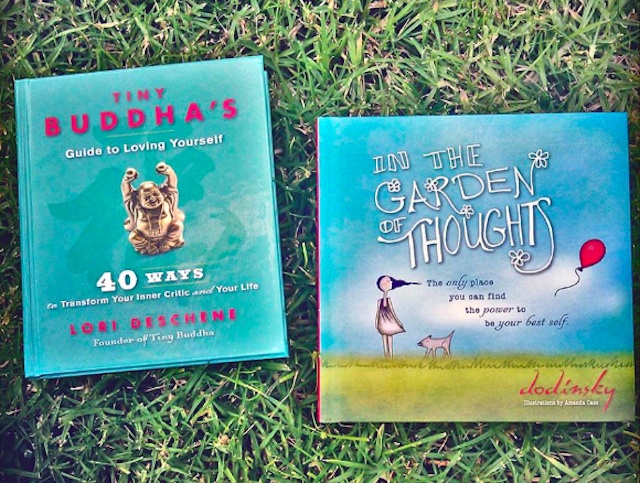
    Tiny Buddha. In the Garden of Thoughts

    UPDATE: The winners for this giveaway have already been chosen. They are:

    • Vanessa Fisher
    • ljchern
    • kbennett10486
    • Jon

    Today I’m excited to run a giveaway for two books that I believe complement each other nicely—the site’s latest collaborative project, Tiny Buddha’s Guide to Loving Yourself and In the Garden of Thoughts, a New York Times bestselling inspirational book, written by my new friend Dodinsky.

    About In the Garden of Thoughts

    I was fortunate to connect with Dodinsky on Facebook, where he runs a popular page called “Positive Outlooks” that’s followed by over two million people.

    Though his heartening images and quotes were what originally caught my eye, I’m most inspired by his charisma, kindness, and…well, positive outlook!

    Through countless email exchanges he’s revealed a joyful, uplifting presence that never fails to incite a smile.

    His book, In the Garden of Thoughts, is quite similar. It’s tiny but powerful, with beautiful illustrations and positive messages for reflection and inspiration.

    Offering some insight into the book’s title, Dodinsky has written, “I truly believe that within us, there is a Garden of Thought in which we can find solace whenever we are going through a storm. The response to my work shows that there are many on the same path. Each of us needs words that bring comfort, and an understanding that one is not alone when facing adversity.”

    About Tiny Buddha’s Guide to Loving Yourself

    Launched earlier this week on October 8th, Tiny Buddha’s Guide to Loving Yourself is a collaborative book featuring a collection of stories from Tiny Buddha contributors, along with tips to help you feel good about yourself and your life.

    The book shares 40 unique perspectives and insights on topics related to loving yourself, including: realizing you’re not broken, accepting your flaws, releasing the need for approval, forgiving yourself, letting go of comparisons, and learning to be authentic.

    Much like Dodinsky, I started Tiny Buddha and created this book because I believe there is a healing power in recognizing that we are never alone with our challenges.

    And there’s nothing wrong with us for what we’ve been through or what we’re going through.

    No matter how we’ve struggled, no matter what our flaws or weaknesses, we are worthy of being fully seen—and we can make a difference in the world by doing it.

    I hope this books helps you remember, in times of doubt, that you are beautiful, imperfections and all, and you can thrive not in spite of them, but because of them.

    The Giveaway

    Up for grabs are two copies of Tiny Buddha’s Guide to Loving Yourself and two copies of In the Garden of Thoughts (to go to a total of four winners).

    If you’ve already purchased a copy of Tiny Buddha’s Guide to Loving Yourself, you can still enter the giveaway, because I’d like to send a copy to someone you love with a special note from you.

    To enter:

    • Leave a comment on the post sharing the most inspiring thing you’ve seen or heard lately.
    • Tweet: RT @tinybuddha Book Giveaway: Tiny Buddha’s Guide to Loving Yourself & In the Garden of Thoughts http://bit.ly/16AifAx

    If you don’t have a Twitter account, you can still enter by completing the first step.

    You can enter until midnight PST on Monday, October 14th. Have a great weekend everyone!

  • Book Giveaway: Chicken Soup for the Soul 20th Anniversary Edition

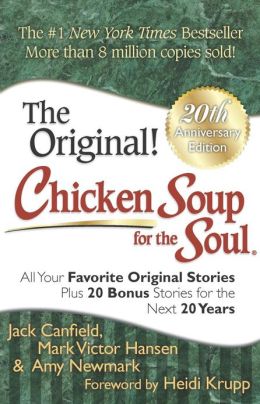
    Book Giveaway: Chicken Soup for the Soul 20th Anniversary Edition

    Chicken Soup for the SoulUpdate: The winners for this giveaway have already been chosen. The winners:
    If you enjoy touching, uplifting stories, you’ve likely stumbled upon the Chicken Soup for the Soul series at one time or another.

    What started with one book two decades ago has expanded to more than 200 titles, providing motivation and inspiration to millions of people of all ages, from all over the world.

    The newly released 20th anniversary edition includes all of the original stories from the first book and 20 new ones from writers including Deepak Chopra, Dr. Mehmet Oz, don Miguel Ruiz—and me!

    When publisher Heidi Krupp-Lisiten contacted me with this opportunity, I was honored and beyond excited. And now I’m excited to share it with you.

    The Giveaway

    To enter to win 1 of 5 free books:

    • Leave a comment on this post sharing the most inspiring thing you’ve heard lately. It can be a quote, something a loved one said to you, something you saw on TV or heard in a song—anything you found inspiring.
    • For an extra chance to win, tweet: Giveaway: Chicken Soup for the Soul 20th Anniversary Edition – RT & comment on the @tinybuddha post to win! http://bit.ly/18GFU0F

    You can enter until midnight PST on Friday, August 23rd.

    Learn more about Chicken Soup for the Soul, the 20th Anniversary Edition, on Amazon.

  • Book Giveaway and Author Interview: 52-Week Life Passion Project

    Book Giveaway and Author Interview: 52-Week Life Passion Project

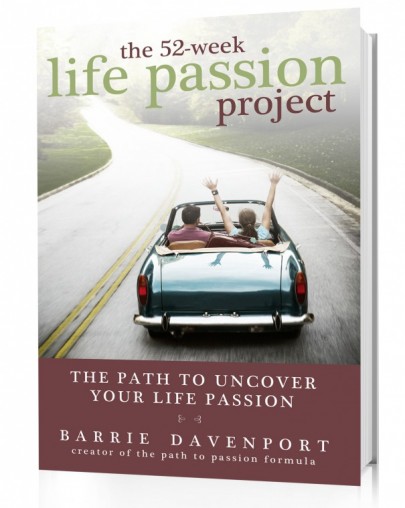
    52-Week Life Passion Project

    Note: The winners for this giveaway have already been chosen. Subscribe to Tiny Buddha for free daily or weekly emails and to learn about future giveaways!

    The Winners:

    It’s not easy to do something you’re passionate about for work—and not only because it’s hard to discover your passion or find a job to leverage it.

    Once we know what we love to do, we then need to work through all kinds of limiting thoughts, beliefs, and fears that may prevent us from taking action. Then we need to decide what that action should be—how and where to start, and how to stay motivated.

    It’s with this in mind that coach and blogger Barrie Davenport wrote the 52-Week Life Passion Project, an insightful, comprehensive guide to identifying what you really want to do and building your life around it.

    I’m excited to share an interview with Barrie, and grateful that she offered to give away 5 books for Tiny Buddha readers!

    The Giveaway

    To enter to win one of five free copies of 52-Week Life Passion Project:

    • Leave a comment on this post sharing something you’re passionate about. (If there’s nothing you’re passionate about yet, then just leave a comment saying hello!)
    • For an extra entry, tweet: RT @tinybuddha Book Giveaway: The 52-Week Life Passion Project: Comment and RT to win! http://bit.ly/W8WUUz

    You can enter until midnight PST on Monday, January 7th.

    The Interview

    1. What inspired you to write the 52-Week Life Passion Project? (more…)
  • Giveaway and Interview: Turning Dead Ends into Doorways by Staci Boden

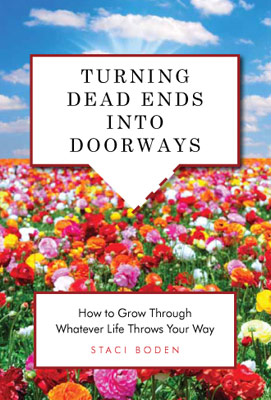
    Giveaway and Interview: Turning Dead Ends into Doorways by Staci Boden

    Editor’s Note:

    The winners for this giveaway have already been chosen:

    Subscribe to Tiny Buddha for free emails once weekly or on weekdays and to learn about future giveaways!

    Especially when we’re going through challenging times, it can feel tempting to try to control the future—but this doesn’t change that much lies beyond our control. Try as we may to avoid the unknown, the future remains uncertain.

    How do we navigate change knowing that nothing is guaranteed? How can we develop inner strength to grow, heal, and evolve?

    Healer practitioner Staci Boden answers these questions in her new book, Turning Dead Ends into Doorways: How to Grow Through Whatever Life Throws Your Way.

    From the book flap:

    “With compassionate honesty and a practical sense of humor, healing practitioner Staci Boden shows her readers how to navigate change without clinging to false notions that if they just do this or think that they can determine what happens next. How to let go of false expectations and still make excellent choices. How to grow and heal no matter what life throws their way.”

    I’m grateful that Staci has offered two free copies of Turning Dead Ends into Doorways for Tiny Buddha readers!

    The Giveaway

    To enter to win one of two free copies of Turning Dead Ends into Doorways by Staci Boden:

    • Leave a comment on this post. (If you’re reading in your inbox, click here to do that.)
    • Tweet: RT @tinybuddha GIVEAWAY: Turning Dead Ends into Doorways http://bit.ly/SBYrFX comment and RT to enter!

    You can enter until midnight PST on Monday, November 5th. If you don’t have a Twitter account, you can still participate by completing only the first step. (more…)

  • Winners for Tiny Buddha Book Giveaways

    Winners for Tiny Buddha Book Giveaways

    As you may have noticed, this was the first week I did not publish a blog post featuring two poll questions for my next book.
    Previously, I published 10 of these posts, each with a giveaway for an autographed copy of my first book, Tiny Buddha: Simple Wisdom for Life’s Hard Questions.

    I’m pleased to announce I’ve chosen 10 winners:

    I emailed the winners last night. If you are on this list and did not receive that email, please contact me at email(AT)tinybuddha(DOT)com.

    Although the giveaways have ended, you can still share your thoughts for my next book!

    In short, it’s going to be a book about what it means to win and lose in life—a guide for living life purposefully and joyfully, on our own terms, in a world that often promotes a one-size-fits-all version of success.

    There is no official deadline to share your thoughts (though I will likely choose the insights I’ll include in my book some time at the end of June).

    If you’d like to offer your insights, please leave them on the appropriate blog posts below. *Please note: each post contains two questions; however, each title contains only one of them.

    Thank you for being part of Tiny Buddha!

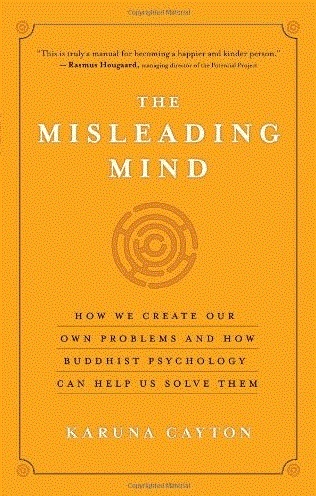
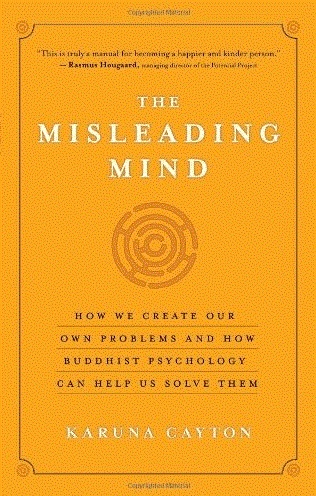
  • Giveaway and Author Interview: The Misleading Mind

    Giveaway and Author Interview: The Misleading Mind

    Note: The winners for this giveaway have already been chosen. Subscribe to Tiny Buddha for free daily or weekly emails and to learn about future giveaways!

    The Winners:

    Have you ever felt like your mind was controlling you, dragging you along for a persistently bumpy ride?

    Research shows the majority of us feel this way, but the good news is that we can do something about—and Karuna Cayton’s book The Misleading Mind teaches us how.

    A psychotherapist and practicing Buddhist, Karuna has written an easily digestible book that offers solutions to the mental anguish we often perpetuate through misguided thinking.

    Its full title is The Misleading Mind: How We Create Our Own Problems and How Buddhist Psychology Can Help Us Solve Them, and it delivers on that promise.

    I’m thrilled to share this long but illuminating interview and offer two free copies as a giveaway!

    The Giveaway

    To enter to win 1 of 2 free copies of The Misleading Mind:

    • Leave a comment below.
    • Tweet: RT @tinybuddha Book GIVEAWAY & Interview: The Misleading Mind http://bit.ly/K8UDcj

    If you don’t have a Twitter account, you can still enter by completing the first step. You can enter until midnight PST on Friday, June 1st. (more…)

  • Giveaway and Interview: Hike Your Own Hike by Francis Tapon

    Giveaway and Interview: Hike Your Own Hike by Francis Tapon

    Note: The winners for this giveaway have already been chosen. Subscribe to Tiny Buddha to receive free daily or weekly emails and to learn about future giveaways!

    The Winners:

    If you’ve spent any time traveling, you likely know the amazing sense of freedom and possibility that comes from exploring the world.

    My boyfriend likes to note the distinction between vacationing and traveling.

    Vacations often entail relaxation, rejuvenation, and recreation, and we usually plan them well in advance. Travel, on the other hand, tends to involve more spontaneity, uncertainty, and adventure, whether that means spending hours taking trains or hiking, or sightseeing without a clear sense of where you’ll stay for the night.

    The closest I’ve gotten to this type of travel experience was back in college, when I spent a semester in Europe.

    I remember thinking that I’d later regret it if I didn’t do it then, because never is international travel more convenient than it is during college. In fact, travel in general seems a lot easier when you don’t yet have responsibilities.

    This is partly why I was fascinated to read Hike Your Own Hike: 7 Life Lessons from Backpacking across America: The author, Francis Tapon, has made travel a priority and a way of life, and has fostered an adventurous spirit and a contagious passion as a result.

    But his book isn’t just about seeing the world; it’s about living life on your own terms, and taking time to evaluate whether you’re following fear or following your bliss.

    Francis has generously offered to give away three copies of Hike Your Own Hike: one hard-copy book, one eBook, and one audio book.

    The Giveaway

    To win one of three copies of Hike Your Own Hike:

    • Leave a comment on this post. (You must be a subscriber to win–it’s free to join the list!)
    • Tweet: RT @tinybuddha Giveaway and Interview: Hike Your Own Hike by Francis Tapon http://bit.ly/GAV261

    You can enter until midnight PST on Sunday, March 25th. If you don’t have a Twitter account, you can still enter by completing the first step. (more…)

  • Living Fully Book Giveaway and Interview with Shyalpa Tenzin Rinpoche

    Living Fully Book Giveaway and Interview with Shyalpa Tenzin Rinpoche

    Update: The winners for this giveaway have already been chosen. Subscribe to Tiny Buddha to receive free daily or weekly emails and to learn about future giveaways!

    The Winners:

    Have you ever felt like the present moment is passing you by while you’re caught up worrying, analyzing, planning, and trying to protect yourself from pain and loss?

    It’s one the pitfalls of the human condition: we often paralyze ourselves in the pursuit of happiness and abundance, and in the process, miss out on the joy right in front of us.

    Shyalpa Tenzin Rinpoche has devoted his life to helping people live joyful, mindful lives, free from the burdens of their minds.

    In his new book, Living Fully, Finding Joy in Every Breath, Rinpoche summarizes his teachings in succinct, easily digestible sections. The result is a guide for living in the moment, peacefully, connected to the people and the world around us.

    The Giveaway

    To enter to win 1 of 2 free copies of Living Fully:

    • Leave a comment below
    • Tweet: RT @tinybuddha Book GIVEAWAY & Interview: Living Fully (comment on the blog to win!) http://bit.ly/ydAMit

    If you don’t have a Twitter account, you can still enter by completing the first step. You can enter until midnight PST on Sunday, March 11th.

    The Interview

    1. You were trained to be a Lama from the age of four. Did you always feel certain you wanted to be a spiritual teacher?

    Even though I was trained in the most ancient Tibetan Buddhist spiritual tradition from a very young age, I personally never intended to become a spiritual leader. (more…)

  • Book Giveaway and Interview: Rewire Your Brain for Love

    Book Giveaway and Interview: Rewire Your Brain for Love

    Update: The winners for this giveaway have already been chosen. Subscribe to Tiny Buddha for free daily or weekly emails and to learn about future giveaways!

    The winners:

    An old friend once told me that women frequently say all the men they’ve dated have been jerks; and men frequently say all the women they’ve dated have been crazy.

    You could chalk this up to gender differences, men being from Mars, women being from Venus and all that. But maybe there’s more to it. Maybe it’s actually our biology that influences how we act and interact—and why we often repeat unhealthy patterns with our romantic partners.

    In her book, Rewire Your Brain for Love: Creating Vibrant Relationships Using the Science of Mindfulness, Marsha Lucas explains how our inner workings can sabotage our relationships, and how we can change that through meditation.

    According to Rick Hanson, PhD, reading Rewire Your Brain for Love is “like having a best friend who is both savvy about the brain and a world-class therapist.”

    I haven’t yet finished this book; I’m publishing this interview today because this is the official launch date. Based on what I’ve read so far, I can say with absolute certainty this is the most fascinating, helpful relationship book I have ever read.

    Both educational and insightful, Rewire Your Brain for Love explains why we struggle in matters of the heart, and exactly what we need to do for healthier, happier relationships.

    The Giveaway:

    To enter to win 1 of 2 free copies of Rewire Your Brain for Love:

    1. Leave a comment below.

    2. Tweet: RT @tinybuddha Book Giveaway and Interview: Rewire Your Brain for Love http://bit.ly/yCvNBJ

    If you don’t have a Twitter account, you can still enter by completing the first step. You can enter until midnight PST on Sunday February 5th.

    The Interview:

    1. What inspired you to write this book?

    The inspiration came from seeing the changes in my psychotherapy patients when mindfulness practice was added to the mix. It was sometimes a challenge to get past the resistance some people had to meditation—my psychotherapy office is just a half-dozen blocks from the White House, so I see a lot of people who are very intellectually-driven, “show me the evidence” folks with no room for any “woo” stuff.

    It was a whole lot easier when we talked about the neurological bases of relationships, the peer-reviewed research coming out of neuroscience labs at universities they respected, and about this simple, well-documented practice that they could use to create actual changes in the brain—and that those changes support healthier, more successful relationships. Approaching it this way made it a much more empowering choice for them.

    Writing the book came out of my wish to share this with more than just the people I could see in my psychotherapy office. On the micro level, I want more people to have the healing experience that healthy relationships offer. At the macro level, my wish is to be a part of helping create a world that’s driven more by empathy than by fear.

    2. Why do we need to rewire our brains for love?

    Unfortunately, lots of us didn’t have an optimal experience of healthy, attuned attachment in that early, critical time when our “relationship brains” develop (mostly before age 2).

    By the way, it’s not necessarily about really bad experiences—it can be subtle, passed along by well-meaning parents who may not have had that optimal experience themselves.

    And because of the way our brains develop, those very early experiences aren’t readily accessible through memory or insight, so it’s difficult to get any traction just by trying to think or “will” our way through.

    If you can change that wiring, though—and mindfulness practice seems to help a great deal with that—then you can have a brain with better neural pathways that creates and supports better relationships.

    3. Your book focuses on making improvements in our relationships with other people. Can we also rewire our brains for greater self-love?

    Absolutely! I’d go farther to say that improving your relationship within yourself is the first step to being able to have better connections with others. I think of the practice of mindfulness as a way of cultivating more loving, compassionate relationships with everyone, and that includes you.

    4. Is traditional meditation necessary to rewire our brains for love, or are other mindfulness practices equally effective?

    The mindfulness practices that I’ve used to the best effect in my work (and that are in my book) are from the insight-meditation tradition. That approach has (in my view) the most compelling neuroscience research to date supporting the types of changes that I talk about and see in my work.

    Other forms of contemplative practice are also being studied. They all definitely have benefits—and I’m very interested in seeing more about their benefits to the brain.

    5. Can you talk a little about the seven “high-voltage” benefits of practicing mindfulness?

    The “high-voltage” relationships benefits get me really excited, so much so that they form the framework of my book.

    First thing to know: there are essential characteristics seen in people who had healthy, attuned childhood relationships—characteristics that bode incredibly well for their ability to have healthy relationships as adults.

    Now, add to that: Those same characteristics are seen in people who practice mindfulness.

    Then, to top it all off: the latest scientific research has increasingly been showing that these characteristics are associated with areas of the brain that change as a result of mindfulness practice.

    I’ve found that the most helpful way to think about these characteristics is to group them into a list of seven acquirable skills. (Yep: acquirable.)

    • Better management of your body’s reactions
    • Improved regulation of fear
    • Greater emotional resilience
    • Increased response flexibility
    • Improved insight (self-knowing)
    • Deeper and clearer empathy and attunement—within yourself and with others
    • Perspective shift from “me” to “we”

    Daniel Siegel, MD, a Harvard-trained psychiatrist and an expert on childhood attachment was the person who first made me aware of the connection between these documented and compelling characteristics of well-being, seen in people who grew up with healthy, attuned attachments, and the brain structures and pathways shown to change with mindfulness practice.

    I’ve been seeing the results confirmed through my psychology practice, in myself, and in the lives of my friends and colleagues. Very, very cool.

    6. I know a lot of people who stay in unhealthy relationships, constantly looking for ways to “fix” them. How can one recognize when the problem is faulty wiring and when it’s best to walk away?

    My first response is to share an anecdote from a friend of mine, Gay Hendricks, who’s also a psychologist: A middle-aged man came to his first therapy session, and talked about how lousy women were—he presented a long list of women in his life who’d just used him. Close to the end of the session he leaned in and quietly said, “But y’know… I’m beginning to wonder if it might have something to do with me.”

    We all have our relationship wiring issues—our own styles of attachment that developed early on. In part, mindfulness practice helps you increase your capacity to look at your relationship patterns with honesty and self-compassion (not excuses or blame). That’s necessary whether you’re going to stay in the relationship or end it. Otherwise, you end up staging the same play with the same script over and over again, whether it’s with the same actors or new ones.

    7. In Chapter 8, you explore empathy and how you misunderstood it when you were younger. I saw myself in your words, as I had the same experience! Can you tell us a little about what empathy is and what it isn’t—and why it’s important to our relationships to understand the difference?

    Healthy, balanced empathy is a tough one for a lot of people, especially those whose role in life leans heavily toward helping others. It’s easy to get lost in the feelings and needs of the other person, and end up not holding on to any empathy for yourself—and that often leads to feelings of burnout, resentment, depression, all kinds of un-fun stuff.

    My take on empathy is heavily influenced by the way that Frans de Waal, PhD talks about it—he’s a world-renowned primatologist and director of the Yerkes Living Links Center at Emory University, and he looks at empathy as an evolutionary advancement. As you go “up” in evolutionary terms, there are increasingly developed levels of empathic abilities, starting with the kind of “emotional contagion” that you might see in a herd of zebras, on up to through being able to take someone else’s perspective (though as Frans points out, psychopaths are good at this, too).

    Where many of us get off track is taking it to the next level, empathic perspective taking—what is s/he feeling and why might that be? And what am I feeling in response, and why might that be? If you lose sight of either one, you’re more likely to react out of old, unhealthy relationships habits—what can be called “autopilot.”

    Empathy’s not just about insight, and not just about feeling—it’s about an integration of those, happening in the space between you and your partner. Or, between you and more people in your community, however large that community may be—we’re all in this together, after all.

    Choosing to cultivate more empathy doesn’t mean losing your own integrity or point of view—it just means that you’re no longer governed by lower-order, fear-based reactivity. Now that’s empowering!


    Learn more about Rewire Your Brain for Love on Amazon.

    FTC Disclosure: I receive complimentary books for reviews and interviews on tinybuddha.com, but I am not compensated for writing or obligated to write anything specific. I am an Amazon affiliate, meaning I earn a percentage of all books purchased through the links I provide on this site.

  • Giveaway and Interview: Uncertainty by Jonathan Fields

    Giveaway and Interview: Uncertainty by Jonathan Fields

    Editor’s Note: The winners for this giveaway have already been chosen. They are:

    Several years ago, when I lived in New York City, I developed a love for yoga that started in a studio previously owned by Jonathan Fields. I didn’t know it then, but I would eventually look to Jonathan as a role model, mentor, and friend.

    Author of Career Renegade: How to Make a Great Living Doing What You Love, Jonathan Fields is (in his own words) a dad, husband, New Yorker, author and speaker, serial wellness-industry entrepreneur, recovering S.E.C./mega-firm hedge-fund lawyer, slightly-warped, unusually-stretchy, spiritually-inclined, obsessed with creation, marketing and innovation consultant, venture partner and book-marketing educator.

    In his new book Uncertainty: Turning Fear and Doubt into Fuel for Brilliance, Jonathan helps readers leverage fear and uncertainty for creation and innovation. If you’ve ever felt frustrated, overwhelmed, or paralyzed by risk or the potential for failure, this book is for you.

    The Giveaway

    To win one of three free autographed copies:

    • Leave a comment on this post.
    • Tweet: RT @tinybuddha Giveaway and Interview: Uncertainty by Jonathan Fields http://bit.ly/qMrfQy

    You can enter until midnight PST on Sunday, October 2nd. If you don’t have a Twitter account, you can still enter by completing the first step. (more…)

  • Giveaway and Interview: Spirit Junkie by Gabrielle Bernstein

    Giveaway and Interview: Spirit Junkie by Gabrielle Bernstein

    Update: The winners have already been chosen for this giveaway. They are:

    Have you ever met someone, and then instantly felt a sense of rapport and respect? That’s how I felt earlier this year when I met best-selling author and speaker Gabrielle Bernstein.

    After a stellar introduction from a mutual friend, I felt intrigued to meet this woman, known as a “happiness guru” in the mainstream media. Much to my dismay, I woke up that day feeling slightly under the weather and far less, well, happy, than usual.

    It was just one of those days. And for better or worse, I am someone who acknowledges what I’m really feeling. So I told her when we met, “I’m feeling less than 100%, with incredibly low energy today, but please know I am truly thrilled to connect with you!” (Except without the exclamation point—really low energy, remember?)

    Despite meeting a shadow of my bubbliest self, Gabrielle exuded non-judgmental kindness and love, and engaged with me in an insightful conversation about living an empowered life. I didn’t yet know much about her writing or speaking, but I knew there was something beautiful motivating them.

    Earlier this year, I received a copy of Gabrielle’s latest book, Spirit Junkie: A Radical Road to Self-Love and Miracles. Part memoir and part self-help guide, Spirit Junkie offers a modern twist on the teachings of A Course in Miracles.

    Touted as a role model for Gen-Y women, Gabrielle writes in a casual, down-to-earth tone, almost like a loving sister imparting wisdom for inner peace and joy. Throughout the book, she takes readers on a journey through her former drug abuse and romance-addiction, exploring the spiritual path that has helped her transform her perceptions and her life.

    With unflinching honesty and self-awareness, Gabrielle inspires us to all to challenge our egos and live joyful, authentic lives.

    Though she explores some weighty topics, the book has a light-hearted tone and empowering message–that we can choose to cower in fear or create miracles through love. (more…)