Tag: future
-
You Don’t Need to Fix the Past in Order to Have a New Future
Note: The winners for this giveaway have been chosen! They are:
- Dianna
- Michael Maher
- Kathleen B
- Yusuf Stoptagginmeanyhow Sulei
- Aparna
“The future is completely open, and we are writing it moment to moment.” ~Pema Chodron
My family recently drove from Michigan to North Carolina—twenty hours roundtrip. To entertain themselves, my five-year-old daughter Willow taught my three-year-old son Miller to play rock-paper-scissors in the backseat.
Miller learned the hand signals and got the overall concept pretty quickly, but he had a hard time with the fast speed of the game. Willow narrated, “Rock-paper-scissors…go! Okay, next round!” But Miller wanted to linger.
When he chose paper and Willow chose scissors, he’d see her scissors and quickly try to change to rock so that he could win the round.
Or if he chose rock and she chose scissors, he’d want to stop and hang out in his win for a while. He’d celebrate, gloat, and become frustrated when she was already on to the next round.
My husband and I tried to explain to Miller that it was a quick game with no time to hold on to what was already done. There’s also no need to hold on—each round brings a brand new chance to win or lose.
While we tried to teach him that it made more sense to leave the past behind and look toward the next round, his let-it-go-and-move-on wasn’t up to par compared to his older sister’s.
Miller turned rock-paper-scissors into a slow, thought-heavy emotional roller coaster, where every move felt important and meaningful. What could have been a fun and easy game was not very fun for him.
It was clear to see how Miller was getting in his own way. And then it hit me that I—and most people I know—do the same thing in our adult lives. We innocently get in our own way as we focus on what we don’t like and try to make it better when it would be far easier to leave the past behind and look toward the “next round.”
Life is always moving through us—nothing is permanent. New thought and emotion flow through us constantly, creating our rotating and fluid experience of life.
Sometimes we stay out of the way and let our experience flow. Willow was staying out of the way as she played rock-paper-scissors (and she was having a great time, I might add). And sometimes we’re more like Miller, innocently blocking the easy flow of life with our opinions, judgments, and disapproval. We don’t pick up and move on as much as we focus on righting what is already over.
In hindsight, I can see how I’ve dammed up my own flow of experience at times in my life, especially when I was struggling with things I wanted to change.
When I was facing a confusing and uncontrollable binge eating habit, for example, I thought what I was supposed to do was to examine it, analyze it, talk about it, and focus on it with a whole lot of emotion and energy until I made it go away.
But more often than not, that created more suffering. It left me even more convinced that my habit was a serious problem that I needed to solve, and it left me feeling hopeless because I didn’t know how to solve it.
Of course, there’s a lot to be said for understanding ourselves and our experiences in a new way and taking action where action is needed. Those are absolutely necessary. But keeping our “problem” under a constant microscope, trying to use our intellect to solve it as if it’s a crossword puzzle, is not the way to freedom.
If new thought, emotion, and insight are always flowing through us like a river, doesn’t it make sense to look upstream at what’s coming next, especially when we’re experiencing something we don’t like? It’s just like we told Miller in rock-paper-scissors: if you don’t like what happened in this round, let it go and look toward the next round.
But we forget this when it comes to the big things in life, don’t we? It seems responsible, necessary, or adult-like to hold the problem tightly until we fix it.
If our moment-to-moment experience of life is like a river rushing through us, our “fix-it” attempts are the equivalent of standing in the middle of the river, filling a bucket with the water that has already flowed past and carrying that bucket with us everywhere we go.
We obstruct the momentum of the river and analyze that old, familiar “problem” water to death, not realizing that if we only turned and looked upstream we’d have an excellent chance of seeing something new and different.
Looking upstream we might see with fresh eyes—looking downstream, we’re just looking at more of what we already know.
With regard to my binge eating habit, I realized that my best chance for change would come from letting go of everything I thought I knew and being open to fresh, new insights and ideas. Not carrying around the past or analyzing the problem; instead, being open and unencumbered.
As I began to see my habit-related thoughts and behaviors as things flowing by me that I didn’t need to grab ahold of, they passed by more easily. Each and every day I found myself less in the way, realizing that I was very separate from those unwanted thoughts and urges.
When my habit-related experience looked more like leaves floating on the surface of the river than like gigantic boulders, life took on a new feeling of ease. I saw that I could gently dodge some of what was coming down the river rather than stop and fight with or fix it. The healthy “me” was more visible than ever.
Not staring at your problems is not ignoring or denying the issue any more than Willow was ignoring or denying the previous rock-paper-scissors round when she easily moved on. Take note of how your experience feels. When life—which really is very game-like—feels like a difficult, not fun, emotional rollercoaster, you’re holding on to something, innocently getting in your own way.
Maybe even the bigger issues in life really aren’t so different than rock-paper-scissors—you get what you get, but you don’t have to stay there and try to change the last round. Let life flow and as you do, the healthy, clear, peaceful version of yourself will be more visible than ever too.
NOTE: Amy has generously offered to give five copies of her new book, The Little Book of Big Change: The No-Willpower Approach to Breaking Any Habit. Leave a comment on the post for a chance to win! You can enter until midnight, PST, on Friday, February 5th.
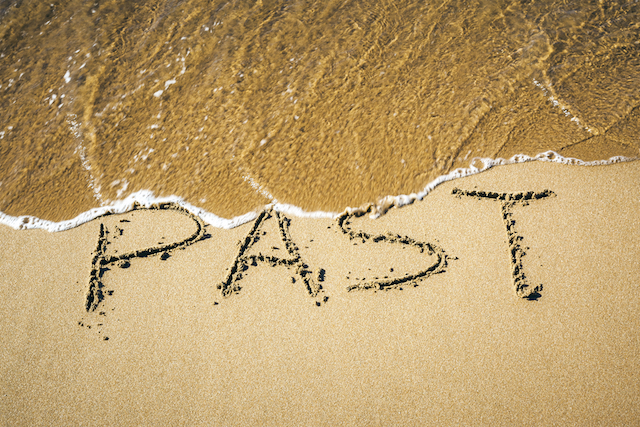
Past in the sand image via Shutterstock
-

You Have a Choice: Your Future Can Be Better Than Your Past
“Someone I loved once gave me a box full of darkness. It took me years to understand that this, too, was a gift.” ~Mary Oliver
On the January 17, 2000, I was in a car crash. I was living in France at the time. I don’t remember much about the crash. I know that we all walked out of the car relatively unscathed. Shocked, scared, and confused, yes. Injured, no.
I remember thinking that I should probably call my mum and dad back in England. Tell them what happened. What I didn’t know in that moment was that back in the UK, I didn’t have a mum to call anymore.
That same afternoon, on the 17th January 2000, was also the day my mum had decided to take her own life.
I found out about my mum’s death standing in the reception of the hotel we had walked into after the crash.
“Liz, she’s gone.”
That’s all I heard at the other end of the phone. It’s all I had to hear. I knew. It was my sister’s voice. She’d managed to track me down in the hotel.
It’s weird because I remember thinking in that moment, “Okay, my mum has just died and I now have to tell some people I don’t know that my mum has died, and I don’t want to put them out or get them all upset, so I’ll just be matter of fact and straight up and not cry.”
Matter of fact. Straight up. I won’t cry. And that’s how I chose to deal with the aftermath of my mum’s death.
While everyone fell apart around me, or grieved, I was the one who was totally okay. I was so together and dealing with it quietly, like I was totally fine.
I remember one day, standing at the checkout of a supermarket, I stood next to my dad as he fell apart while we were packing cans of baked beans into the carrier bag.
I looked at him, the giant pillar of a man I had always known—wracked with the most intense grief for his wife—and thought, “I am alone in this. I’ve got to be strong because no-one else will be.”
I returned to France three weeks after my mum’s death. I couldn’t wait. I spoke to no one of her death. People knew, of course, but death is weird, isn’t it? It shuts people down. Especially suicide.
“How did your mum die?”
“She killed herself.”
Oh. No more questions.
Back in France, I got drunk a lot. I was the first person at the party and the last one to leave. If there was something stupid to do, I was there, the life and soul, but if anyone got too close I’d push them away.
I was the master pretender. The chameleon. Always fun and happy and having the best time, yet on the inside it was ugly and dark and I was wracked with grief that was so painful, the only way I could cope with it was to numb it out. To not allow myself to feel anything.
I started developing strange behaviors about seven years after my mum died. The grief that had been locked in the box in my head for so long finally exploded, and it manifested itself not by crying and grieving, but in horrific anxiety and OCD and really weird thoughts that freaked me out.
I also started to wonder what it would be like to not be alive anymore. To not have to walk around and be the girl whose mum killed herself and deal with all the crap that came along with it.
I remember walking past a huge wall one day and wondering what it would be like to climb to the top and jump off it. I wondered whether the impact would kill me.
It was in that moment, staring up at that wall, that I actually felt something for the first time. And that feeling was relief. Relief that I had a choice. A choice of whether I lived or died. A choice in my future.
As numb and as twisted as I felt right there in that moment, I remember smiling. Because it was up to me what happened next. I chose to walk away from that wall. To start living again even if I didn’t know what that meant exactly at the time.
I decided to not let my mum’s death, which had dogged me for some many years, become a reason to end my life too.
And I don’t just mean end my life by suicide, but to end my life emotionally, to shut down, to numb out, to allow what happened to become my story—the story of someone who shirked away from her own life because her mum killed herself and the world now owed her something for taking her away.
But guess what? The world didn’t owe me anything, and the world doesn’t owe you anything either.
We are all victims of something that has happened in our lives. We ruminate and torture ourselves with things that were said or not said, and about what happened or didn’t happen or things that haven’t even happened yet.
We react to things like a tightly coiled spring, red raw from experiences and situations that lie well in the past. And yet most of us allow our past to build our future.
It’s the reason why you can’t commit to men, because your dad walked out when you were five, or you don’t make friends easily because of that one moment in the playground, aged eleven, when the popular girls made fun of your glasses.
It’s the reason you go to work to a job you hate every day, because you decided early on in life that you weren’t good enough and that you’d just settle for less than.
It’s the reason we make so much meaning out of things. You receive a text message and they don’t end it with a kiss, or someone signs off their email with “regards,” and your immediate thought is, “What did I do?”
You see your boss walking toward you in the corridor at work and you say hello to him, but he keeps his head down and doesn’t respond. “Oh my god, why did he not say hello? Maybe I’m one of the ones who’ll be made redundant?”
We attach so much meaning to everything, don’t we? And yet here’s the thing. There’s what happened and our story about what happened, and assuming the two things to be the same is the source of much pain and unnecessary self-suffering.
Some people just don’t like leaving kisses at the end of text messages, and your boss just found out his wife has cancer and didn’t notice you walking toward him in the corridor, and Barry in accounts doesn’t think that “regards” at the end of an email sounds rude because Barry is more interested in getting the email written and sent so he can leave at 5pm, and fifteen years ago my mum died.
You’re not five anymore. You’re not eleven and I am not the eighteen-year-old girl whose mum blew out the candle without saying goodbye.
You have a choice. Today, right here, right now, you have a choice in how you’re going to show up, not just while you’re reading this, but right here in your life.
You only have one life. And yet you always have lots of choices. About how you respond to what has happened to you in your life and what you do with it as a result.
We can become wrapped up in darkness and negativity, blaming everyone and everything, or we can take from what has happened and learn something about ourselves.
My favorite poet, Mary Oliver, wrote in her Thirst collection, “Someone I loved once gave me a box full of darkness. It took me years to understand that this, too, was a gift.”
And now, writing this, fifteen years after my mum’s death, I feel grateful, not that she died, but that amidst the heartache and the grief and the intense loss, I found out who I was.
And I did so because I made a choice. To show up. To live the life that I wanted to. To take responsibility. To rewrite my story. To not just be the girl whose mum killed herself. But to be the woman who chose to decide that my future is bigger and better than my past.
And I invite you to do the same.
Change image via Shutterstock
-
The Power of Presence : A Few Simple Ways to Enjoy Life More Now
“All that is important is this one moment in movement. Make the moment important, vital, and worth living. Do not let it slip away unnoticed and unused.” ~Martha Graham
I am someone who is always focusing on the next step rather than the step I am currently taking. I am always longing for the next thing in life.
Looking forward to the future isn’t a bad thing, but when it consumes 90% of your daily thoughts, it becomes a bit exhausting.
My energy has always been restless. I get bored easily, crave change constantly, and yearn for immediate fulfillment. At one point, I realized I was letting a good life pass me by.
I have been working full-time and have been a student year-round for over five years. Life has been repetitive for a long time, lots and lots of work with very little playtime.
This began to leave my mind in a constant state of restlessness, and there was no turning it off.
I craved more meaning out of life, richer experiences, and deep soul-searching. I had big ideas of what I wanted to do, so many ideas that it began to overtake me and make me feel angry about the life I was living.
I became impatient and intolerant of my own life. I was in a rut. I felt completely out of control and stuck.
I had always admired people who were able to be present and live in the moment. I had never been that type of person, and I really wanted to be.
I realized the only thing I could control was the present moment; I could not control the future because it hadn’t happened yet. So I decided to focus my restless energy on things I could change that would help me live a happier life right now.
In the brief moments when I wasn’t working, or at class, or doing homework, I decided to try turning off that multi-tasking motor in my brain. I began to focus on one thing, and one thing only. It could be something as simple as brushing my teeth or doing the dishes.
You’d be amazed at how enjoyable simple activities can be if you enter them with a positive and uncluttered mind.
I also decided to pick up a hobby and learn something new; I dabbled in a bit of photography and taught myself basic functions of the camera and different tricks and techniques. While school and work are stimulating, I often do things because I am told to do them, not because I want to.
This was a refreshing perspective and a great outlet for that restless energy.
I also started saying “no” less, and “yes” more. This forced me out of my comfort zone and enriched me with those new experiences I had been craving, even if they were small and simple. There’s nothing better than finding comfort in chaos and testing your boundaries.
Once I began to practice these things daily, I started seeing benefits. I felt happier, more secure, and full of life again. My heart began to open and the weight that had been pulling me down began to lift.
If you find yourself rushing through the present, focusing on the future, and not enjoying your daily life, it might help to try these small changes for yourself: fully immerse yourself in what you’re doing instead of multitasking, try a new hobby to create more moments where you’re engaged in something fun, and practice saying “yes” to things that you normally wouldn’t.
This will push you out of your comfort zone and allow you to discover new things about yourself. It’s a lot easier to live in the now when you feel blissfully alive in the now.
There will be times when you find your mind shifting somewhere that you don’t want it to go. Don’t judge it. Acknowledge it, and then mindfully transition yourself back to the present moment. With a little practice you will be amazed by how in control of your thoughts you really are.
While I still have goals and dreams for the future, I am now focusing on what I can work on to be fulfilled in the present. These are the moments that matter; these are the moments that will soon be the past. We are not promised tomorrow, but we are promised right now.
Live in it. Breathe it. Take in as much of this moment as you can.
You are capable of being your best self, and you are capable of doing it right now. I challenge you to challenge yourself, to live in this moment, to break through your limits, and to find the very best, most present you.
-

Stop Fearing Uncertainty & Get Excited About Possibilities
“When you become comfortable with uncertainty, infinite possibilities open up in your life.” ~Osho
Once, during an AmeriCorps leadership retreat, I was asked to create a motto for my life, a mission statement for my future. I was handed a blank piece of paper and I was terrified.
At the time, my life was filled with uncertainty. My year of national community service was coming to an end. I didn’t know what my next job would be, let alone what my life’s mission statement should be.
As I sat, panic stricken, staring into my uncertain future and an empty page, I began to think of all the futures I could have.
It began negatively, but slowly my dreamer mentality kicked in. I imagined hundreds of possible futures for myself, as an artist, a writer, a teacher, a missionary, a mother, and a million other things.
That was the point when I realized that my uncertainty was my greatest asset. I had infinite paths available to me, not just one. So I wrote the following on that scary blank piece of paper: I vow to live a life of infinite possibility.
That sounds like a fairly lofty goal, but what it means for my everyday life is that I refuse to allow fear, failure, or insecurities to limit my future.
That doesn’t mean I don’t feel all of those things all the time. It just means that when I look at a possible future for myself, I don’t automatically turn one down because I am afraid I won’t succeed.
It’s a hard thing to embrace uncertainty. Sometimes all we can see is the cloud of doubt and question marks. But when the future isn’t set, when we aren’t destined to become just one thing, we can become anything.
In my life this means that when I face starting over, whether that is looking for a new job, a new apartment, or a new town, I try to ignore the limits that fear and stress want to put on my life.
In the years since I stared down that blank piece of paper, I have learned a few tricks to see the possible on the other side of a blank page.
I try to use my imagination and visualization as much as possible.
Our creative thinking is often the only thing that can help us see through that pesky cloud of question marks. Whether it is creating a story about my awesome future as a best-selling author, or just imagining what I might look like with a new haircut, imagination and visualization help us see beyond what is to what could be.
I also find it helpful not to rule any future out initially.
I don’t think I will ever go to medical school and become a doctor, but I don’t want to limit myself too soon. If I tell myself that certain futures are off limits, I don’t ease uncertainty, I simply limit my possibilities.
I still have trouble at times spinning the uncertainty of life into possibility. No matter how many stories I tell children about my amazing life as a superhero, I haven’t actually managed to become one…yet. I still feel the panic rise when uncertainty starts to loom.
Recently, as I tried to imagine my life beyond my current graduate program, I hit a wall of questions. More accurately, when presented with a cloud of questions, I created a wall of doubt. I questioned my skill set and I doubted the existence of any future prospects.
I stopped seeing the possibilities and only saw catastrophe. I would never find a “real” career; I would never be successful. I felt myself descending into a spiral of negativity. I could only imagine one terrible possible outcome—complete failure.
In the end, none of my hard-learned lessons about possibility could help me. The weight of the uncertain future was too much; it pulled me down. It took the words of a dear friend to pull me out of the limited and terrible future I created for myself.
As I was lamenting my terrible uncertainty, and the horrible future that would befall me since I still didn’t know what I wanted to be when I grew up, my wise friend said, “I am so jealous, you can go anywhere.” Just like that it clicked. My friend was jealous of the uncertain future that lay ahead of me.
Suddenly, I remembered the mission statement I wrote on that paper so long ago. I vow to live a life of infinite possibility. Not an easy life, not a certain life, but a life of possibility.
Many of my possibilities come from being mobile, but most lives of infinite possibility are lived much closer to home.
My friend, who has a mortgage and a baby, finds her possibilities in online courses that give her new skills and inspirations. We all have a whole host of possibilities available to us, if we can think creatively and positively.
Still, these infinite possibilities can become their own source of worry and struggle. Ultimately, I had to pick a path for my life post-graduate school. No matter how many choices we are offered, we all have to pick one direction and just start going.
As I attempted to whittle down the choices that had made my friend so jealous, I found it was helpful to look at areas of past success.
I often seek the counsel of those nearest and dearest to me, but when I tried to talk to others about all of these overwhelming choices, everyone became overwhelmed. So instead of discussing the multitude of options, we discussed me. I shared my passions; they shared what they saw as my strengths. A pattern began to emerge.
I began to see places where my strengths, my passions, and my possibilities overlapped. Then I was able to narrow down my list enough to make a decision.
I decided to apply to yet another graduate school, but this time one that would allow me to live near my family instead of thousands of miles away. I had taken the unknown, turned it into infinite possibilities, and then chosen the possibility that fit me best.
Maybe for you, possibility lies in the set of paints that you forgot you loved.
Maybe finding possibilities means letting go of the pressure to find the right possibility, and enjoying whichever one comes your way for now.
Maybe you embrace possibility by writing your own life motto and seeing where it takes you.
Happy man jumping image via Shutterstock
-
5 Things to Remember When You Start Worrying
“Do not anticipate trouble, or worry about what may never happen. Keep in the sunlight.” ~Benjamin Franklin
Have you every worried yourself to the point of emotional, even physical exhaustion?
Do you often feel stuck, anxious, or mistrustful of the world around you?
I know what it’s like to feel trapped by worry—in fact, I have always been a chronic worrier.
I worried and obsessed mostly about the hypothetical, the imaginary, the infinite variety of “what-if” scenarios. Eventually, I convinced myself that if I worried about every conceivable thing that could go wrong in my life, I would either avoid them altogether or numb myself of their effects.
As time went on and responsibilities increased, the worries intensified. I became anxious about raising my children well. I worried about money, career, and what people thought of me.
Then one day, I experienced a mild panic attack. Feeling overwhelmed with all I needed to get done that day, I began to experience dizziness and intense feelings of fear.
For a moment, I felt like I was living in an altered reality as my legs wobbled beneath me, and my heart pounded in my chest. I quickly found a private place to sit until the feelings passed.
I knew this was a wake-up call. I needed to find ways to manage my worry and anxiety before it got worse.
Over the years, I’ve found that embracing the following five truths stops worry from spiraling out of control:
1. You are not your worry.
For a long time, I did what most people who worry do—I tried to make it stop. I quickly learned that trying to block thoughts of worry was like trying to stop a river from flowing.
I eventually learned a simple but profound truth that changed everything for me:
You are not your emotions.
This is the power of detachment. Not the detachment that tries to be stoic but the one that allows you to feel your emotions without identifying with them.
I began to apply this by observing myself non-judgmentally as I worried. As I continued to observe myself, I learned to be at peace with my inability to stop worrisome thoughts. But I also learned that I could change my response to those worrying thoughts for the better. The same can be true for you.
2. Worry cannot exist in the present.
We rarely worry about problems we presently face. Worrying is a future-oriented activity fueled by uncertainty and anticipation.
The truth of this realization was another game changer for me. As I reflected, I could see that all of my worries were about a future I could not control. What about the past? The only past events I worried about were the ones I feared would adversely affect my future.
Want to avoid worry altogether? Stay in the now. I learned to do this through mindfulness meditation. A simple mindfulness technique is to focus on your breath when you begin to drift away from the present. Let each inhalation and exhalation ground you right where you are.
3. Worry can be confined.
If you’ve ever struggled with worry, you know that it can easily consume your entire day. This happened to me regularly. Once I learned to accept my worry, I decided to confine it rather than allow it free reign over my life. I would set aside a limited amount of time to allow my mind to worry intensely on its latest subject. At the end of that period, I would let it go.
Want to confine your worry? Try scheduling ten to thirty minutes a day for worry. Use this time to visualize your anxious feelings, write them down, and come up with an action plan for dealing with the root causes of your worry. If the worry reappears outside this scheduled time, postpone it until the next worry period.
4. You can give away your worry.
Have you ever noticed that your worry intensifies the more you focus on yourself? In the past, I used my worry to draw myself inward. I focused on my own needs and ignored the needs of others. It rarely helped to reduce my worry.
One of the things I learned by observing myself was my tendency to forget about my worries when I worried about other people and helped them with their needs. I let the onset of worry be a signal to call a lonely friend or spend time with a loved one. I learned to give my worry away.
5. You are human.
The greatest source of my worry was my attempt to be superhuman. I was trying to be all things to all people. I worried incessantly about what they thought of me. Instead of beating myself up for not living up to everyone’s expectations, I decided to embrace my limitedness. I cannot please everyone, and I am at peace with this truth.
It’s Time to Take a Stand
I know it might seem hard for you to integrate these tips, especially if, like most of us, you’ve struggled with a long-standing habit of coddling worry rather than openly challenging it.
But you can break down this habit one step at a time. Imagine a life without the controlling effects of worry. A life where worry itself is controlled and confined. Imagine no longer being emotionally drained by worry so that you can be truly present to those you love.
Stand up to worry. Today.
Separate yourself from it. Confine it. And let it go.
-

How To Calm Your Worries by Admitting What You Don’t Know
“Most things I worry about never happen anyway.” ~Tom Petty
There was once a wise farmer who had tended his farm for many years. One day his horse unexpectedly ran away into the mountains. Upon hearing the news, the farmer’s neighbors came to visit.
“How terrible,” they told him.
“We’ll see,” the wise farmer replied.
The next morning, to the farmer’s surprise, the horse returned, bringing with it three wild horses.
“How wonderful. You are very lucky,” the neighbors exclaimed.
“We’ll see,” replied the farmer.
The following day, the farmer’s son tried to ride one of the wild horses. The horse was untamed and the boy was thrown and fell hard, breaking his leg.
“How sad,” the neighbors said, offering sympathy for the farmer’s misfortune.
“We’ll see,” answered the farmer.
The next day, military officials came to the village to draft young men into the army. Seeing that the son’s leg was broken, they passed him by. The neighbors congratulated the farmer on how well things had turned out.
“We’ll see,” the farmer said.
This Zen story demonstrates the wisdom of not jumping to conclusions. Have you ever worried about something, only to later discover that your worry was unfounded and untrue? The ego is afraid of the unknown, so it jumps to conclusions in order to feel a sense of certainty.
In our ego’s need for certainty, we make assumptions. And when we make assumptions, we make mistakes.
We can never know how the future will unfold. Yet fear convinces us to believe in present circumstances and future outcomes that are totally untrue. This is the origin of worry. Worry is the ego’s way of satisfying itself with an answer—any answer, no matter how irrational it is.
I worry about many things, big and small. I worry about getting stuck in my career, being rejected in my relationships, not having enough money, and whether or not I will miss the next subway into Manhattan.
But worry is dangerous. When we worry, we make mistakes. For example, I might make an assumption about you, such as thinking you are angry with me. Then I act on this assumption.
The false premise of my actions causes me to become defensive. My actions then cause you to make an assumption about me. Since you are unable to see that I am trying to protect myself, you assume I am angry with you.
Soon we are engaged in mutual anger based on a false assumption caused by worry.
The truth is, I will never know fully what is in your head, and you will never know fully what is in mine. Therefore, acting under the ignorance of assumption creates a ripple effect of mistakes.
Imagination + Fear = Worry
It is common in our society to believe that more thinking is always better. This is not always so. Intelligence is an incredible tool, but over-thinking can be just as harmful as under-thinking. Over-thinking is a sickness that creates paranoia and worry.
When we over-think, we make up scenarios in our mind and convince ourselves that these scenarios are true.
Without enough data to make a proper assessment of a situation, our ego hijacks our imagination and jumps to fear-based assumptions. Imagination is usually a powerful creative force, but when imagination is applied with fear, it becomes worry.
The Universe works in mysterious ways. Embracing the mystery of life gives us a calm within the storm of uncertainty.
Instead of over-thinking and jumping to false conclusions, learn to relax your thoughts and say, “I don’t know.”
Trusting uncertainty gives us peace and confidence; and when we wait in stillness without the need for an answer, the truth will reveal itself. The end of fearing the unknown is the end of worry.
Worry is wishing for what you don’t want.
Thoughts are magnets that attract our reality. Peaceful thoughts create a peaceful reality. Fearful thoughts create a fearful reality.
A thought repeated on a regular basis becomes a habit. When a thought becomes a habit, it forms a belief. When a thought forms a belief, it attracts external events that align with your internal state.
Energy flows where attention goes. When you focus on what you want, it is more likely to come to pass. When you focus on what you do not want, it is more likely to come to pass. When you worry, you send a signal into the Universe that attracts your worry. Your focus over time forms your future.
Will a single thought of worry cause your worry to come true? Probably not. Will sustaining your worry with attention and focus over a long period of time attract the worry into your life? The more you focus, the more likely it becomes.
Because focus forms your future, it is important to only concentrate on thoughts you want to actualize.
Your reality grows from the seeds you plant. The seeds of your beliefs grow into your thoughts. The seeds of your thoughts grow into your actions. The seeds of your actions grow into your karma.
You are responsible for the seeds you plant, not the results. When you place your attention on the present moment, without attachment to the past or worry about the future, and plant seeds according to your highest intentions, the results will fall into place.
Worry is an irrational attachment to, or fear of, a specific result. While it sounds counterintuitive, the only way you can achieve a desired result is by not focusing on the result; you must focus on your effort—here and now.
You cannot change what is already growing. Instead, start planting different seeds.
We’ll see.
I still worry. But now, whenever my ego gives me something to worry about, I take a deep breath and meditate in silence for a moment.
I sit in stillness and reassure myself. “I don’t have enough data to understand how this event will impact my future,” I say. “Perhaps there is a plan in place that I cannot see. I don’t know what will happen next and that is perfectly okay. I will not jump to conclusions. Let’s wait and see what happens.”
Woman and the sky image via Shutterstock
-

Overcome Limiting Thoughts: 5 Ways to Be Happier and More Present
“The past exists only in our memories, the future only in our plans. The present is our only reality.” ~Robert Pirsig
Do you sometimes feel overwhelmed by unpleasant thoughts and feelings? Do they show up like an uninvited guest when you’re least expecting them?
About eight months ago, I quit a lucrative corporate job in finance to follow my passion, writing.
Like most things in life, this decision came with a cost.
And all the angst that comes with it.
A few months into my venture, I noticed my angst had become a large part of my mental world. I worried I’d run out of money, that my dream of being a well-paid writer wouldn’t materialize.
I’d admonish myself for leaving a perfectly secure job to chase a pipe dream. “What were you thinking?” I’d say to myself, “I mean, how stupid could you be?
Eventually, I noticed something interesting.
All the obstacles to my happiness were about imagined future scenarios (i.e.: I will never earn a living again), or doubts about past choices (i.e.: Did I make the right choice by leaving a lucrative corporate job behind?).
None of them were rooted in the present moment.
In fact, they stole my present moments like thieves in the night.
Eventually, I realized that if I didn’t deal with these feelings, I’d snap. I had to find a way to deal with these obstacles to my happiness that kept me from taking positive action in the present.
So I did what anyone would do: I turned to Google.
I researched various approaches of dealing with my feelings that held me back from acting in the present.
I discovered meditation and daily mindfulness practice as a powerful solution, and subscribed to various mindfulness blogs.
A few months down the track, I came across this post by Lori Deschene.
Lori’s words around letting go of emotions (dealing with the mental demons once and for all) struck a chord with me:
“Feel it fully. If you stifle your feelings, they may leak out and affect everyone around you—not just the person who inspired your anger. Before you can let go of any emotion, you have to feel it fully.”
The truth is, you can only let go of feelings after immersing yourself in them.
Sounds counterintuitive, doesn’t it?
But that’s the one thing that always works.
The following are five great ways to overcome the obstacles to happiness and feelings that keep you from living fully in the present.
1. Fully embrace your feelings with openness, even the negative ones.
That’s right.
Embrace your feelings fully in each present moment and let them pass when they’ve run their course.
So, if you’re feeling fear, feel it fully in the now. Without reacting to it.
Watch the fear as it manifests in your body. Fear manifests as butterflies in my stomach and tingling in my forearms.
How does it manifest in yours?
Remember, the only way to truly let go of feelings is to allow them to run their natural course with conscious awareness.
2. Use journaling to create mental spaciousness and increase your ability to let go.
This is quite effective in slowing the mind down.
Most writers would agree that seeing your thoughts appear on a page before you is therapeutic.
Writing also increases your ability to detach from the immediacy of painful thoughts and feelings.
Journaling is a great way to bring awareness to your destructive thought patterns, so you can change them.
At the end of each day, write down what you learned from the day. What upset you and what made you feel fantastic? If something upset you, how much of that was based on your interpretation of the situation, which arose from your assumptions about it?
How often do you journal?
3. Use your breath to bring your attention back to the present moment.
Mark Twain famously said, “I’ve had a lot of worries in my life, most of which never happened.”
So many of our fears (future projections) never actually come to pass.
And anyway, the past and the future live only in our imagination—in this present moment.
When your mind is fully in the present, you can’t engage in fearful thoughts about the future or regretful thoughts about the past.
So, focus on your breath in this present moment.
The benefits of doing this are as follows:
- It brings your attention back to this moment.
- It engages your mind in something non-conceptual.
What’s your breathing like right now? Is it deep? Shallow?
4. Recognize that your reaction to events dictates your life experience, not the event itself.
In his book called Your Erroneous Zones, Wayne Dyer explains the importance of separating our reactions to thoughts from the thoughts themselves.
Imagine this.
Cal agonizes over the idea that his boss thinks he’s stupid. He loses sleep over it. It’s the bane of his existence.
Now, let’s say Cal had no idea that his boss thought he was stupid.
Then he wouldn’t be unhappy, right? How could Cal be unhappy about something he didn’t know?
The point: Cal’s boss’ opinion isn’t making Cal unhappy. It’s Cal’s reaction to his boss’ opinion that’s making Cal unhappy.
By taking ownership of his reaction of his own thoughts, Cal can take charge of his mental world.
He can choose to react differently to his boss’ (low) opinion of him. Cal can choose to give his boss’ opinion less importance by recognizing that it’s one person’s opinion among many.
Paradoxically, this would actually enable Cal to see it as constructive criticism and better himself as a result.
Think about the last time you were upset. What were you telling yourself about the event that upset you? Were you upset because of your reaction to the event or because of the event itself?
5. Discover how your underlying assumptions are secretly affecting your life.
Our underlying assumptions, of which we are often completely unaware, are responsible for a lot of self blame and distress.
Let’s go back to my example at the start of this post.
My feelings of fear, anxiety, and worry were all based on an implicit assumption that my writing career should have taken off within six months. My assumption just wasn’t valid. Getting traction as a writer often takes years.
My underlying assumptions were wrongly implying that I had failed without me realizing it.
Once I recognized the absurdity of the underlying assumption, the feelings of fear around never being able to launch a successful blog dissipated immediately.
What are the underlying assumptions that have you judging yourself harshly?
—
Conquering your demons isn’t easy, but nothing worthwhile is.
Sure, it’s often uncomfortable to embrace your feelings fully, or to be mindful of how your underlying assumptions are sabotaging your life. But each of us has the capacity to do it.
The question isn’t, “Can I do it?” but rather, “Will I do it?”
If you want to live a full life, resolve to set yourself on the path this very moment. Right now. Don’t put it off for another second.
You have to realize that this life is yours to be lived to the fullest. And only you can determine your attitude toward letting go of self-defeating thoughts and behaviors.
So take a deep breath. Breathe in this moment. And give it your best.
Right now!
Happy yoga woman image via Shutterstock
-
How to Turn Worries About the Future Into Action Right Now
“Every day brings a choice: to practice stress or to practice peace.” ~Joan Borysenko
After years and years of living with anxiety, I can’t tell you exactly what I have been anxious about.
Is it a pervasive thought about how my life will end? Is it a constant worry about my financial security? Is it simply that I’m nervous to give a speech in front of people? Or a combination of all of them?
Even thinking about anxiety causes more anxiety. Ahhh!
Anxiety is also really hard to define. It’s so subjective.
I don’t think my anxiety will ever truly go away. I still have thoughts about the future, and the “what ifs” still run through my mind.
I’m not some blissful angel walking around in a constant state of Zen. At least, this is how I imagine how I would be anxiety-free. There doesn’t seem to be a cure for anxiety that works for everyone. If you find one, please let me know.
However, I know that I am no longer miserable. It’s different now than before. There are some positive things that have worked for me.
One of the worst parts of my anxiety was that nobody could tell I had it. When I told people, they responded, “Wow, you always seem so calm and put together.”
That is not how I felt on the inside. Why was what I felt on the inside so different than how others perceived me? I wanted to change this, and I wanted to be comfortable.
I have found some ways to cope with and significantly reduce my anxiety about the future. Because that is what anxiety is all about—the future. Yet, I experience anxiety in the moment, not in the future.
Rationally, this does not make any sense. How is feeling anxious in this moment going to fix or solve any problem in the future? It can’t. Oh, how I wish it were that cut and dry.
However, telling myself this simple fact somehow helps a little. Anxiety isn’t logical. The more I treat it that way, the less I struggle with it. Still, even if it isn’t logical, it is very real.
I’ve found that small action steps can turn some of these thoughts into real positive change, which helps me be a little more comfortable. The best part is the more you do them, the easier it becomes. It’s like a muscle you need to keep working out.
Here is a breakdown of action steps to take when you’re worrying about the future.
First, acknowledge what you’re worried about.
Let’s say I have constant anxiety about an upcoming work conference where I know I will have to interact with important people. When I acknowledge that I’m feeling anxious, and why, I can then begin to take action.
Next, ask yourself, what I am actually afraid of, and why?
Write it out if you’d like. In the above situation for me, it would have been the fear of passing out or throwing up as someone important approaches me or asks me a question. Why? Because I get uncomfortable in social situations and don’t want to embarrass myself.
Imagine the worst-case scenario.
My worst-case scenario is sweating profusely and having a room full of people laughing and pointing at me because of it. Oh, and then I’d have a heart attack. Sound crazy? Think about something unusual you have convinced yourself to be absolutely true.
Move from fear to action.
Ask yourself, how can I take this fear and turn it into something I can do today—something that will most likely not cause the absolute worst-case scenario to happen?
We want to increase our odds here.
How can I break this down into an action that will help?
In my case, I could approach some friends at work and make conversation; nothing serious, just more than I usually do.
Or, maybe I could go home tonight and research one of the speakers at the conference to get to know them a little better.
If I’m feeling really brave, I could volunteer to present something small to a couple of coworkers or even to an all staff meeting.
Maybe I could sign up for an improv class to get comfortable in front of people.
Maybe I could just talk to someone I trust about how I’m really feeling.
The more I take action toward that future moment, the less pervasive my thoughts.
Think about the desire to become an expert at something. You can ruminate over and over again how you wish you could play the piano, but it won’t make a difference if you never take action and sign up for just one lesson.
If you can do something of value at your best today, there isn’t anything about the future you need to worry about.
You see, every single moment becomes another moment, and then becomes another.
I’ve found that if I can do one action today toward something I am anxious about, and do it my best, that is good enough for me.
If you take many small actions over time, when the big moment actually becomes the moment (no longer in the future), not only will it become easier to handle, but you’ll most like realize that it wasn’t worth all the stress.
I like to think of life in this way: I don’t know how it will all end, nor do I want to. I know that I can’t control my fate. I’m not perfect and I make mistakes. And that’s okay.
One thing I do know for sure, if I do my best today I can look forward to a future that’s much better than my worst fears about it.
-

Find Happiness Now Instead of Chasing It in the Future
“You can only grow if you’re willing to feel awkward and uncomfortable when you try something new.” ~Brian Tracy
I found myself at a crossroads last year. I had reached the end of my time in college, and I had no post-graduation commitments.
I was working at the time on my applications to medical school, as I have wanted to become a doctor for a long time. However, I knew that medical schools are inundated with qualified applicants every year, but only have a few seats to offer. Thus, my vision of myself as a doctor still seemed to be only a dream, and I didn’t see myself on the path toward becoming a doctor yet.
Paradoxically, during this commitment-free time, my realization that an infinite number of paths were available paralyzed me. What if I made a wrong turn?
I searched for clues as to which path might be best for me.
I first observed the doctors I had met as an example of what my life could become. Fear and anxiety manifested as a “negativity lens” that altered my field of vision. I found fault with every doctor I encountered, even the ones who were happy with their career—so many more were burnt-out, insisting that I still had time to change my mind.
I was scared of becoming like them. I decided to mentally let go of my commitment to this career path as I imagined other possibilities. Perhaps I could be a stay-at-home mom instead, or maybe a chef, as I had always loved to cook.
I looked to each of the two aforementioned types of people for inspiration again. Unsurprisingly, I hated everything I saw. My blue-tinted binoculars were in full effect as I looked ahead on the path to becoming a full-time family woman, leading a life plagued by a lack of fulfillment and resentment.
I explored the path to becoming a chef and saw myself dealing with ungrateful customers and having no freedom to be creative in what I cooked.
None of the paths had a surefire destination of happiness. As I noticed myself judging everything so harshly and reflected on why I was doing so, I realized that I had convinced myself that the path I chose could lead me to a state of mind that I didn’t already have.
My paranoia over becoming unhappy in the future had become my way of avoiding my present unhappiness.
Once I became aware of this unhappiness, my first reaction was to judge myself. Self-judgment for me was a persistent, angry voice in my head that screamed and berated me for wallowing and being pathetic.
When I explored why I judge myself, it seemed to stem from a discomfort with who I am as a person. I didn’t like myself.
This led me to deny and change my every quality in a quest for perfection.
For instance, I tend to be introverted in nature. I recognized this in myself, called myself (and listened when others called me) words like a loner and a recluse, and alternated between pushing myself so far out of my comfort zone in social situations that I felt inauthentic and fake, and withdrawing deeply within to a place of self-loathing.
I couldn’t see that being introverted is just a personality trait that is associated both with positives and negatives, and that if I embraced it and stopped trying to twist it, I would feel natural.
Once I recognized how deeply the negative self-talk went, I was able to start changing. Since it seemed to stem from not knowing who I am, I started by identifying my core traits.
The first time I attempted to explore this, I was so confused and uncertain that I couldn’t come up with a single trait. Self-judgment had made me fearful of being anything at all.
I talked to friends and family who know me well, and sifted through things I had written both recently and further into the past, to remind myself of who I am at my core. I wrote them down, acknowledging both the good and the bad associated with them.
Every morning, I practiced saying the things that I am to myself. It felt awkward at first, but eventually became natural as I practiced it more and more.
I also became aware of the messages I directed at myself throughout the day. Many were cruel, full of blame for how I wasn’t “enough.” Especially in the aftermath of a situation that I wished had gone differently, my inner voice yelled and put me down.
I was unsure of how to change until I thought of how I would speak to someone I love. If I had a friend who was in my position, would I have blamed her for her feelings and screamed until she “surrendered” to happiness? Absolutely not.
I started cultivating a new voice in my mind, one that didn’t shout but was gentle and caring the way a good friend is. I feared that I would let myself go entirely and spiral into laziness if I “coddled” myself.
As I continued to develop this new voice, I began to realize the difference between coddling and being kind. I am still allowed to have expectations for myself, but instead of beating myself down when I don’t meet an expectation, I explore it by listening to my inner kind-but-firm voice.
With this practice, too, I notice that I judge others less. It seems that practicing self-compassion is allowing me to be truly empathetic toward others, instead of outwardly compassionate while silently judging as I once was.
Nonetheless, judgments about others still arise in my mind on occasion, but I am better able to notice them, examine where they might be coming from, and then dismiss them.
Through this practice of being kind to myself, I now see that happiness is available to me right now instead of waiting at the end of some path.
With this newfound positivity, I choose to continue moving toward realizing my goal of becoming a doctor. After I submitted my applications and found a few moments of stillness while I waited for responses, I reflected and questioned again if I felt right on this path.
In truth, now that I have a positive state of mind and am experiencing joy much more readily, I could choose any path and be happy. However, I still arrived at the same conclusion: I not only want, but I feel called to become a doctor.
This time, that answer is enough for me to move forward with confidence because practicing kindness is helping me develop trust in myself.
I recognize that the road to becoming an MD will present many challenges, many of which cannot be predicted from where I stand now, and that’s okay. I feel confident in my ability to handle those challenges because now, I can recognize when fear is starting to ensnare me.
Instead of blaming myself for feeling fear, I have the strongest tools available—love and kindness—to free me from that grip, examine myself and my circumstances, and consciously move forward.
To anyone who can relate to any aspect of my story, I encourage you to hit “pause” throughout the day. Notice your actions and your feelings. Always allow yourself the opportunity to ask, “Why? Why am I acting or feeling this way?”
I invite you also to notice the tone in which you address yourself. If you find that the tone in which you ask yourself “why?” carries disgust or judgment, the way I did, do not lose hope. You can cultivate self-compassion and self-kindness.
In moments where you regress to old habits, of which I have had many, try not to dwell on how you have “failed.” Instead, allow yourself to learn from the setback, remember the progress you have made, and approach your practice of self-compassion with renewed energy.
Photo by Mustafa Khayat
-
Letting Go of Yesterday and Using the Gift of the Present
“Yesterday is history, tomorrow is a mystery, and today is a gift. That’s why we call it the present.” ~Alice Morse Earle
Did you make a mistake yesterday? Or did something bad happen to you a few weeks ago? Are you still dwelling on it, doing all you can to move on? Then this post is for you.
Why? Because I want you to know that you’re not alone.
Just like you, my past wasn’t all rainbows and unicorns. No one in this world has a past that is sparkling clean and error-free. We’ve all made mistakes. That’s life. And that’s what makes us human.
About eight weeks ago I received an offer to study for my diploma in fitness in Melbourne. Having lived in Sydney for ten years, receiving the offer was a dream come true, but not because I got accepted for the course. It’s because I’ve always wanted to live in Melbourne ever since I was a teenager.
I accepted the offer thinking it was a great opportunity. I did not consult anyone; I merely did it for myself. I didn’t even have the slightest clue of what the course was about, where I was going to stay, and if it made sense financially.
This turned out to be one of the biggest mistakes of my life.
A day after I accepted the offer, I told my parents. They’ve never tried to talk me out of doing anything I wanted to, but this time Mum was a little hesitant.
She wondered why it was last minute and stressed how I hadn’t even arranged anything. I, on the other hand, justified my decisions by telling her and everyone else around me that it was a good opportunity, although I knew I probably couldn’t afford the move.
A week later, with a few hundred dollars in savings and slight credit card debt, I made the trip down to Melbourne with my selfless parents, who decided to help me find an apartment and settle in.
Things went well. I found a nice place and generally liked Melbourne, but something felt off. As hours turned to days, I felt more and more restless and knew something wasn’t right. My finances backfired on me and soon enough, everything went down.
After living a few days in denial, I allowed myself to let go of anger about what I’d done and replace it with self-compassion.
I then did something I should’ve done even before I decided to move—I spoke to my mother and told her I wasn’t in a great financial position and it wasn’t the right decision for me at that point in time.
A day after, I turned the apartment down, rejected the offer, and drove 540 miles home, with an added financial stress that was completely unnecessary.
You may have experienced something similar. Perhaps you were as silly as I was to do things without thinking. Or perhaps things were worse for you. We make mistakes. Everyone does, and I want you to know that it is okay.
The clock ticks forward, and soon enough the mistake that you made a second ago is history. It might take days, months, or years to learn and address the consequences of the mistake, but every day forward is an opportunity to make things right.
Worrying about it does not get you anywhere. Thinking about how to learn from the experience and make things better is a good start. But actually doing things to learn from the mistake is the fundamental part of really moving forward.
If you’re having a hard time letting go of yesterday and seizing today, remember:
Yesterday is History
Yesterday is history.
It’s done. Record it into your history book and close it.
Yesterday could have been the best day of your life.
Your long-term partner proposed, or you landed a raise at work. Maybe you met someone who you feel is good for you. Remember it fondly but don’t live in the past. Instead, let your happy memories push you forward when times get tough.
Yesterday could have been the worst day of your life.
You might’ve lost your savings or someone you held close to your heart. Although it might take some time to move on from any tragedies you faced yesterday, every day forward will get better.
Yesterday you made decisions; they may now seem good, they may seem bad.
But that was yesterday. If you stay positive, you can choose to make the best of your decision today.
Yesterday cannot be changed.
It is indeed too late to change the things you did in the past, but it’s not too late to change the things you’re planning to do today. Learn from your mistakes and act on what you’ve learned.
Tomorrow is a Mystery
Tomorrow is a mystery.
It hasn’t happened yet, so don’t sweat the small things. Be kind to yourself; it has the power to make you happy.
Tomorrow depends on the choices you make today.
Dream and start doing things to work toward that dream right now.
Tomorrow is not certain.
Life can make a 180-degree change in less than a day, and we cannot control them. We can make plans, but plans change. Anticipate and remember that.
Tomorrow is an opportunity.
If you did something great today, you have the opportunity tomorrow to create something better. If you did something that seems bad, you have the opportunity tomorrow to make it good. It’s your choice.
Tomorrow isn’t guaranteed.
So don’t waste today worrying about what will happen then. Life’s too short to dwell on things that are uncertain.
Today is a Gift
Today is a certain opportunity.
You can use it to decide where you want to go in life. If you don’t love what you’re doing, use this opportunity to change something.
Today can be the first day of the rest of your life.
Create new habits, surprise yourself, and put a smile on your own face by doing things you love.
Today you can be better than you were yesterday.
And you know you can be better than you were yesterday.
Today you have the power to make great choices for your health, body and mind.
You are strong enough today to say no to that can of soda. You are strong enough today to remove yourself from negative people. You are strong enough, period.
Today is your only chance to experience this present moment.
It will never come again
Don’t beat yourself up for what has happened in the past. We’ve all made mistakes; failure is imperative to leading a successful life. Learn from yesterday by doing things today that have the power to make tomorrow great. I know you can.
What are you doing today to make full use of the gift given to you?
Photo by Eddi van W
-
Go Do: Let Go of the Past and Future and Live in the Present
“Life is like riding a bicycle. To keep your balance you must keep moving.” ~Einstein
“Go do, you’ll learn to just let yourself fall into landslide. Go do, you’ll learn to just let yourself give into low tide. Go do!”~Jonsi
I recently heard from a friend whom I had not heard from in over two years. He sent me an email just to check in and see how I was doing, congratulate me on my recent marriage, which he had heard about, and let me know that he had faced some hardship over the past couple of years.
He had been, simply put, stuck. To my surprise, he also mentioned that some words I had sent him in an email, many moons ago, had stayed with him and encouraged him over the years.
What were those words? “Don’t even talk about dreams. Think of it as actually the moment, the doing.”
At the time, my friend was facing a very common fear: what to do with his life. He had dreams like we all do. He had goals he wanted to accomplish.
This is something we all face at some point in our adulthood and with my friend, that fear of what’s to come, what may be, was holding him back from simply doing anything. In that way, he found himself feeling so stagnant that depression was taking hold.
Funny, I had not remembered ever saying that. Nor did I recall our correspondence, but upon reading the words, I thought, Wow, I still say that to myself now! Keep doing… cause it’s all about the journey.
These are all things we’ve heard before. I had said nothing new.
The thing is, we all have dreams and goals. But when we get caught up in the small things around us, we forget the big things. At the same time, when there are so many big things to potentially bog us down, we forget to enjoy the small things in life.
So how do we find the balance and keep moving? How do we have big dreams, and still obtain them? How do we experience the day to day? How do we go do?
In my early twenties I was briefly married to a man who was one person before marriage and another person after. During our marriage he was extremely abusive, dangerous, and to be frank, downright selfish and mean.
During that time, despite everything else going on in my life—the day-to-day stresses, hopes, demands, and needs—I was still in fear for my very own life, whether it was at stake in reality or not.
At the time, I didn’t realize this fear.
I spent three dreadful years married to this person and trying to do anything and everything I could to avoid being exactly where I was.
I would come up with excuses to be out of the house or out of town. I was telling myself I would leave or that I could change my husband, and in the worst way, I was not allowing myself to emotionally recognize the true danger of the situation I was in.
Why? Because I was terrified. Terrified my marriage would fall apart, terrified to tell my friends or family, terrified I would be looked at as the ‘poor victimized wife,’ and even more so, terrified to confront my husband for fear of what he might do.
Had I known then how important living in the present was, I likely would not have stuck around in that marriage for so long.
When we are in crisis situations, even stressful situations at work or school or at home, our bodies tell us to fight or fly. Mine did both while I was being abused. But more importantly, and on a conscious level, I was denying myself the one thing I needed most—to see where I was and accept it.
I would not allow myself to see the danger and weight of the situation I was in. I feared the abuse and would not allow myself to face it because of my fear.
Now, let’s take this example and move it into something perhaps a bit more relatable.
Consider the stresses of a demanding job. Consider monetary problems—too many bills and too little cash. Consider a fight with a loved one or confusion on where to go in life or what to choose for your career.
In any stressful situation, of the many and hundreds of situations that abound our lives, there is truly only one answer that I’m aware of that applies to all these open ended questions. That is: go and do.
When times are tough it is easy to get caught up in the toughness and remain there.
Whether that means you stick to your guns in an argument or ponder your dreams rather than take action, either way you’re stuck. You’re stagnant. But, if you remind yourself to go and do, then you move.
I won’t say forward because I don’t know if we are ever moving forward; perhaps we are just swarming around in an eternal grain of sand. Perhaps life is just a string of present moments, neither past nor future. In any case, the movement, the doing, is the living.
Had I allowed myself to be in the dangerous moments of my marriage, mentally accepted that my life was in a situation of abuse, and at stake lay my happiness, my well-being, my peace of mind, I would have not stayed stagnant in that marriage for so long. I would have made a change. I would have gone.
Had my friend not spent so many years questioning what he should be doing, he would have just done.
The key is to recognize every moment and keep moving.
It is an oxymoron to be in the moment and always moving from the moment, but such is life and it is a truth that cannot be denied if we are in search of peace.
The world is ever moving. Ever changing.
Living in the moment means doing or feeling or seeing or recognizing what’s right in front of you. The important thing is to let yourself experience everything—the good and the bad—and once you experience it, then you let it pass.
We get caught up in our pasts because we did not allow ourselves to live those pasts when they were present.
Take my example. After finally extraditing myself from an abusive environment, I lived with PTSD for the following six years, reliving over and over everything that had happened to me once before.
Take my friend; had he been doing and changing and living rather than pondering what’s to come, he would have done what he is finally doing now.
Now he is just, simply put, exploring life. He is not setting ultimatums saying, “I must be here and have xyz by this point.” Rather, he is in the moment and recently took some time for himself, volunteering at a Buddhist retreat in California.
Instead of worrying so much about where he would be, he is taking time to be now, living and relishing in his current situation.
You have to live in the moment so that it can pass. You have to face your fears, so they too can pass. And since it must pass, we must feel its presence, good or bad, while it actually is present, for it too will haunt us, for better or for worse.
Whether you are fighting abuse, fearing your future, worried about school or a test or a meeting at work, stressed about money, losing sleep over love, no matter what is on your mind at any given moment, the point is to be aware of what you’re feeling, what’s around you, and in all cases, to continue to go do.
We so often get caught up in the stress, the worry, and in some cases, so caught up in avoiding the danger or real fear in front of us, that we forget to just live. So try to balance and stay on your bike. Remember to live each moment, let it pass, but keep moving and enjoy the next. As Jonsi said, just “go do.”