Tag: frustration

  • How to Reconnect with Your Higher Self for Clarity and Direction

    How to Reconnect with Your Higher Self for Clarity and Direction

    “Listen to the wind, it talks. Listen to the silence, it speaks. Listen to the heart, it knows.” ~Native American Wisdom

    Have you ever felt stuck? Stuck in a business you’ve lost passion for, a job you no longer enjoy, a relationship that no longer fulfills you, or simply stuck in indecision about how to move forward in life?

    That feeling of “stuck-ness” often leads to anxiety, fear, and even shame. I understand these feelings well.

    When the pandemic hit in 2020, my life turned upside down—as it did for many. I was the founder and executive director of a national arts organization, something I had built from the ground up and led for eighteen years.

    Suddenly, overnight, I felt like I could lose it all. My funding partners and sponsors pulled out, I was sinking deeper into my line of credit, and I was responsible for a staff spread across the country.

    The stress was overwhelming. I couldn’t sleep, I became irritable and edgy with my family, snapping at them over the smallest things, and some days it took a tremendous amount of willpower to just get out of bed and face the day. I had never felt so lost, uncertain, or fearful.

    It wasn’t just the fear of losing a business and my paycheck—although that certainly caused a lot of anxiety. The bigger fear was losing my sense of identity. Who was I if I wasn’t the executive director and founder of this organization? Before starting this non-profit, I felt insignificant, like a nobody. I didn’t want to go back to that place. I didn’t want to lose what I had built.

    This fear consumed me, and I asked everyone I knew, “What am I supposed to do?”

    One day, I brought this question to my business coach. She responded with a single question of her own: “What do you typically do when you feel stressed and anxious?”

    “Well, I usually go for a walk in the woods,” I replied.

    “Perfect,” she said. “Here’s what you’re going to do: Every day for the next thirty days, you’re going to go for a walk in the woods and simply look and listen.”

    “What? I can’t do that. I don’t have time for that,” I stammered. In my head, I thought, What kind of business coach tells her clients to go for a walk in the woods? I needed business advice, not nature therapy.

    Somehow, she got a commitment out of me. Every morning at dawn, as this was the only time I felt I could make this daily walk work, I was out the door into the forest behind my house. And every day, I demanded answers from God, the squirrels, and the universe: “What am I supposed to do?”

    Slowly—ever so slowly—something shifted. A sense of calm settled over me. I began to notice the beauty around me: the varying shades of green, the way light filtered through the canopy of leaves, the chorus of birdsong, the creek’s melody as it rushed over rocks, the silky texture of moss-covered bark, the intoxicating scent of spring blossoms—you could almost taste the air.

    And then, I started to feel gratitude. Gratitude for the trees, the air, the stillness. Gratitude for my business coach, who had nudged me toward this practice. This gratitude felt like a swelling of love in my chest for everything that is in this moment.

    And in this calmer state of mind with gratitude in my heart, I asked the question again: “What am I supposed to do?”

    This time, I got an answer.

    “What do you want to do?” a voice bubbled up from within.

    It was my own voice—but like an older, wiser version of me.

    I didn’t miss a beat. “What do you mean, what do I want to do? What am I supposed to do?”

    “No, Anita,” came the steady response. “What do you want to do?”

    “I don’t know. I don’t know.”

    “Yes, you do.”

    That stumped me.

    Later that day, I found myself wandering the spirituality section of a bookstore. A book caught my eye: Conversations with God by Neale Donald Walsch. I picked it up, flipped it open, and one line jumped off the page:

    Frustration and anxiety come from not listening to the soul.”

    My breath caught. I read the words again, letting them sink in. In that moment, I realized a profound truth—I wasn’t listening to my soul.

    I had been here before. This wasn’t the first time I’d been reminded to slow down, go inward, and reconnect with my inner wisdom. But I had gotten so busy, so caught up in my business, my family, and all my responsibilities, that I had forgotten. Not only did I lose my connection to that part of myself, but in many ways, I had lost sight of who I really was and what I truly wanted.

    For nearly five years now, I’ve devoted myself to the study of remembering—of reconnecting with my higher self, God, Source, the Universe (whatever name feels right to you—they are all the same to me). When we connect with our higher self and consistently listen to our soul voice, three truths are revealed:

    • The truth about who we are.
    • The truth about what we really want.
    • And the truth about why it matters.

    When we stop listening to our inner wisdom, we become drowned out by external noise—the voices of others telling us who we should be, the media convincing us we’re not enough, the fearmongering that keeps us feeling small and powerless.

    But when we reconnect with our higher self:

    • Clarity of purpose and direction emerges.
    • Fear and self-doubt loosen their grip.
    • An inner harmony steadies us, no matter how chaotic the world seems.
    • Our capacity for self-love deepens.

    And with that, we become un-stuck. We step into our greatest potential. We create a life filled with meaning, well-being, and joy.

    How Do We Reconnect with Our Higher Self?

    When I first realized I was asking the wrong question and switched to asking, What do I want?”, I skipped an essential step—the inner work that allows you to connect with your higher self and find the answers you seek. Eventually, I figured it out. And it’s really quite simple.

    At its core, reconnecting with your higher self is about slowing down and giving yourself the time and space to cultivate that relationship.

    Here are three key steps to help you do that.

    Step away from the busyness of life.

    Block out time each day to unplug from work, responsibilities, and distractions. Make this a daily non-negotiable. My favorite way to unplug is by walking in nature, which has additional health benefits. I recommend at least twenty minutes of mindful walking daily. Mindful walking is a form of meditation, but simply sitting in meditation is also a great option.

    Speak your gratitude.

    Science has shown that practicing gratitude reduces stress, elevates mood, and improves overall well-being. More importantly, it opens the heart—making it easier to hear the whispers of your soul.

    Engage all your senses in the present moment.

    What do you see, hear, smell, feel, and even taste? When you fully engage with your environment using all your senses, you become present. And presence is the gateway to connecting with your higher self.

    Once you’re grounded in the here and now, that’s when you ask yourself one simple question: “What do I want?” Then, listen.

    Listen with your whole body. Pay attention to ideas that surface, images that appear in your mind’s eye, sensations that arise. Don’t judge any of it. Just be open and curious.

    Nothing may come at first. But keep returning to this practice—getting present, going inward, and asking, What do I want? Soon, you’ll hear the whispers of your soul. And if you learn to listen and act on those whispers, you too will get unstuck and be guided to a most remarkable life.

    Are You Ready to Listen to Your Soul?

    I invite you to embark on your own thirty-day nature challenge. Each day, step outside, breathe deeply, and simply observe. Let nature be your guide as you reconnect with your inner wisdom. Notice what shifts within you—how clarity emerges, how gratitude deepens, how your soul whispers its quiet truths.

    Will you take the challenge? Let me know how your journey unfolds—I’d love to hear what insights arise for you.

    PS: In case you’re wondering what happened next—when I finally tuned in and listened to the whispers of my soul, my life radically changed. I realized that what I truly wanted was to close my business, as I had lost my passion for it years ago, but fear had kept me stuck. The whispers of my soul then guided me to let go of most of my possessions and embrace a nomadic lifestyle.

    This decision has led my husband and me on an extraordinary journey, experiencing many incredible corners of the world. Along the way, I recreated myself as a life and leadership coach, guiding others on their journey to their highest selves. As I continue to listen, life unfolds in the most beautiful and unexpected ways.

  • Easily Annoyed by Your Partner? A Relationship-Saving Approach

    Easily Annoyed by Your Partner? A Relationship-Saving Approach

    “You are not your feelings. You just experience them. Anger, sadness, hate, depression, fear. This is the rain you walk in. But you don’t become the rain. You know the rain will pass. You walk on. And you remember the soft glow of the sun that will come again.” ~Matt Haig

    Being a relationship-oriented person all my life, I’ve found it fascinating and frustrating how easy it is to feel annoyed with one’s spouse—the person we are supposed to feel most happy to be around.

    I used to feel quite annoyed with my husband on a nearly daily basis. But with a bit of effort, annoyance has now become only an occasional companion who I feel pretty much at peace with.

    But boy, it was no fun back in the day. Little things that probably wouldn’t bother others really rubbed me the wrong way: How he hums sometimes when he chews. The slightest aggravation in his tone when speaking to our sons. The way he’d ask me to move when he was putting the dishes away and I was chopping veggies for dinner.

    When I learned I was a highly sensitive person (HSP)—one of the 25% of people who have a genetic trait that leads to processing all stimuli, including emotions, more deeply than others—it put things in perspective. And it helped me begin learning how to go from feeling overwhelmed by annoyance to it being a very occasional and mostly mellow experience.

    HSPs have a stronger tendency to feel easily annoyed or irritated by our significant others, as our systems are sensitive, and we tend to notice every little thing about others—so even small imperfections can loom large and get irritatingly under our skin.

    But you don’t have to be highly sensitive to feel frequently annoyed in your intimate relationship! I know plenty of non-HSPs who are also often accompanied by that old annoyance monster.

    Whether you are an HSP or not (here are some positive clues that you may be!), annoyance and irritation are much more likely to crop up when you are already in a state of stress or overstimulation, which happens more quickly for HSPs than it does for others.

    The frantic pace of the holiday season a few years back brought this into sharp focus. And it wasn’t just me. Many friends and fellow HSPs around me expressed sentiments like “I’m so irritated lately,” “My husband is so annoying,” “He’s just driving me crazy,” and “I’m worried that I’m annoyed with my partner so often.”

    Several women even confessed that their annoyance had led them to question the foundation of their relationships, fearing that something was fundamentally wrong and that perhaps it meant they shouldn’t be with their spouse anymore.

    I heard this more often from the HSPs I know. This is because HSPs tend to be highly aware and conscientious, and so we recognize this tendency to be more irritable than others, and we worry about its impact on our relationships and ourselves.

    Although I never personally feel that worry anymore, I remember it well, and I wouldn’t wish it on anyone. I had started to feel a resurgence of that annoyance toward my dear hubby during those holiday weeks. So I know how uncomfortable these feelings can be, and how hard they can be on our partner as well.

    Because when we feel annoyed, we act—dare I say it—annoying, or at least difficult. And that can be hard for everyone—kids, our partner, and others—to be around.

    So, let’s delve deeper into why we can be prone to annoyance in our intimate relationships, why HSPs are particularly susceptible to strong feelings of irritation, and how I successfully stopped letting these feelings damage my marriage—and how you can stop feeling so bad about your annoyed feelings and allowing them to be a problem in your relationship.

    Why Do We Get Easily Annoyed by Minor Issues?

    The human brain is more focused on things that go wrong (about two-thirds of the time) or things that are lacking than those that are going well (about one-third of the time). This is called the negativity bias of the brain, and it’s a survival thing: If it’s really zoned in on what’s wrong or missing, its primal logic goes, it will keep us alive longer! So it judges things as bad or wrong at the drop of a hat, always keeping a vigilant lookout for all that is not right. In more truly threatening situations, this tendency gives rise to such emotions as fear and anger.

    But in times of less actual threat, such as a hectic holiday season with loved ones, the emotions this part of our brain generates are less intense. Say hello to annoyance, aggravation, and irritation!

    Pair that with all the time we spend living and navigating choices and chores with one particular person who may do things differently than we would—our intimate partner—and we are bound to have lots of opportunities for annoyance to crop up regularly.

    And since HSPs experience all stimuli with greater intensity, for us, even the most subtle or minor irritants, which might not faze others, can become quite aggravating.

    That holiday season I mentioned was particularly hectic for me. Juggling three kids’ needs, running my own business, and managing a large extended family, I anticipated that these few weeks would test my patience. Therefore, when I found myself persistently irritated, it wasn’t unexpected.

    When I began to get aggravated by every small thing my husband did (such as retelling the same story over and over) or didn’t do (like failing—again!—to light the wood stove first thing in the morning as I’d requested regularly), I didn’t let myself spiral into despair about my marriage.

    Instead, here’s what I did to gracefully get myself through those days of annoyance.

    How to Handle Your Annoyance with Your Partner

    1. Own your feelings as your own.

    The first thing I did was to remind myself that my frustration wasn’t a result of my husband’s actions. I realized that he hadn’t changed or become any more bothersome than usual. He was just doing things as he usually does them. My feelings were entirely about what was happening within me.

    2. Acknowledge what your feelings feel like in your body.

    Next, instead of simply being in those feelings, I examined them, like a scientist might examine a cell through a microscope—with real curiosity—specifically, about what they felt like in my body. I noticed the heat they created, especially in my arms, and the almost prickly sensation in my head and chest.

    As I stayed with these sensations, I noticed they were not comfortable, but not really so bad, either. And that the feelings seemed to fade as I simply acknowledged and sat with them like a good friend. I learned that this was a great way to ease my annoyance and stop letting it erupt out of me at my husband.

    3. Delve into what is fueling these emotions.

    With continued curiosity, I examined what could be driving these feelings, again, knowing it had everything to do with me.

    I recognized that physical factors were contributing to my irritation: fluctuating hormones, stress, the endless gray skies, and the long, dark nights—all contributing to a sense of cabin fever.

    I also noticed that I was fixating on what was wrong, slipping into a critical mindset, rather than acknowledging what was going well. My thoughts were very fixated on the ways my husband wasn’t being who I wanted him to be or doing what I wanted him to do. They were quite engaged in a big old game of judge, judge, judge (hello, negativity bias)!

    Seeing this freed me up to deliberately shift my focus to the positive aspects of my partner and our current situation—of which there were plenty. This change in perspective helped ease my irritation a bit.

    4. Notice the stories your mind is weaving about what these feelings mean—and disbelieve them.

    Most of us, especially HSPs, take our thoughts about our feelings really seriously. As in, “If I feel irritated, something must be wrong with my husband, or with me, or with US!”

    How do you feel when you think like that? Likely worried. And pretty upset. I know I did when I used to buy into that kind of thinking.

    Although I no longer believed my thoughts about what this upsurge of annoyance “meant,” they still came up, such as:

    Could something be wrong with me and my ability to love? Does this annoyance mean I’ll never feel good with my husband again? Does it mean he’s an annoying person and I made a mistake marrying him?

    I knew those thoughts were normal, and I didn’t give them much stock. Truly, thinking such anxious thoughts and analyzing their implications through a fear-based lens is typical for the human mind—like a habit (especially, once again, for the sensitive human mind). It doesn’t mean they have any truth.

    I realized more than ever that these emotions, rather than being an indication of a problem in our relationship, were signaling that something was off for ME, about ME. In and of themselves, they mean nothing about my husband’s character, whether I love him or not, or how compatible we are.

    So, when any “meaning making” thoughts came up about my annoyance toward him, I’d just let them drift on by like passing clouds. I reminded myself I am human, and humans feel annoyed around other humans sometimes, no matter who the other person is. And it’s just no biggy.

    The ironic thing about this was, as the annoyance stopped feeling like a threat and I felt less stress around it, it actually stopped rearing its head so much.

    5. Look at what you’re doing to annoy yourself.

    My biggest realization was that I was the one annoying myself. Because I had not been supporting myself well during the chaos of the season.

    For highly sensitive people, a lifestyle full of genuine self-care and quiet moments is essential. Without it, we easily become overstimulated, which naturally leads to irritability. Actually, anyone who is overstimulated or stressed is easily irritated—and in our modern world, most of us are chronically stressed.

    By neglecting to schedule adequate downtime, skipping my walks, staying up later and later each night, and cramming every available minute with work to finish everything before my vacation, I had been putting myself in a chronically over-aroused state and therefore annoying myself.

    Often, the amount of annoyance we feel is in direct proportion to the amount of nervous system-regulating self-care that we practice. In other words, if you feel annoyed, try adding some self-care—specifically things that regulate your nervous system.

    So I did just that when I could make time for it during the holiday bustle. Once the festivities ended, I dedicated even more time to quiet and relaxation and got back to a much more peaceful place inside myself.

    The result of doing these five things?

    My annoyance was completely replaced by natural and strong feelings of affection and appreciation for my husband. I started feeling so much love for him and being more loving, so he, too, became more loving, and our time together became fun once again.

    That’s because it’s easy to love and enjoy someone who is so obviously loving and enjoying you.

    You can follow the same approach I did to alleviate the annoyance you might be experiencing.

    We all want to feel relaxed and content, truly enjoying the company of our chosen partner—and to feel that love reciprocated! Sometimes, it requires a bit more intentional effort to achieve this. It’s simply part of being a person, highly sensitive or not, navigating a hectic modern world.

  • How I Calm and Release Intense Emotions of Anger, Sadness, and Frustration

    How I Calm and Release Intense Emotions of Anger, Sadness, and Frustration

    “You don’t have to be positive all the time. It’s perfectly okay to feel sad, angry, annoyed, frustrated, scared, or anxious. Having feelings doesn’t make you a ‘negative person.’ It makes you human.” ~Lori Deschene

    In November, I was on an emotional roller coaster full of sudden, unexplainable fits of anger—hysterically crying for no reason, barely sleeping, feeling urges to physically kick, hit, and scream.

    One of the main triggers was when my partner would go out without me.

    He’d go out with his friends to play pool, and I would immediately shut down, shut him out, and turn inward.

    Lying in bed, my thoughts would spiral out of control.

    What if he gets hurt?
    He’s a grown man playing pool; he’s not going to get hurt.

    Is he picking up other women?
    No. He loves me.

    Why didn’t he invite me?
    Having time to ourselves is something I value.

    We’re in a loving, committed relationship and have been together for four years, so why hasn’t he proposed?
    Wait, do I actually want to get married? Or has society just told me I want to get married?

    Why hasn’t he texted me?
    He’s being present with his friends. That is a good thing.

    What is wrong with me? Why am I being petulant, controlling, and jealous? Why can’t I support his time with friends like he does for me? On and on and on…

    Then the physical sensations would take over my body.

    I’d feel hot, my heart would beat quickly, and I wanted to escape my body. I’d have the urge to kick and scream and punch. I could not relax.

    I tried to quell my emotions and rely on the quiet, calm part of me to remedy the situation with my go-to tactics of meditating, focusing on breathing, and reading, but all of those failed miserably.

    I could not figure out why my usual calm, optimistic self, who is able to quickly pinpoint negative thoughts and change them, was not doing her job.

    My inability to understand what the hell was happening made me feel even more angry, frustrated, and helpless.

    So, through talk therapy, coaching, and journaling, I turned to my inner child, who I know wants to be seen, heard, and loved but who has erected walls to protect her heart.

    Communing with my inner child offered me a giant release and a few discoveries:

    In my relationship (and in my new business), I had a deep fear of abandonment and fear of the unknown.

    My fear of abandonment was being activated because my partner and I had just finished eighteen months of travel during which we were together most of the time. I grew comfortable in our little refuge, secluded from the rest of the world.

    And now, we were back in the real world, hanging out with people, adjusting to a new city and new jobs.

    I felt like we didn’t spend any time together anymore. I had expected him to propose during our year of travel, but he didn’t. I thought he was pulling away from me.

    The truth is, all of these were made-up stories in my head.

    In reality, we still spent a lot of time together, and we had gotten to know each other even more intimately and deeply during our year of travel. (And a proposal was right around the corner!) We were simply adjusting to a new way of living.

    I also started to realize that I was desiring to express a part of me that I had never expressed.

    The tears and physical discomfort were a sign that a part of me was being suppressed. Those parts that I was suppressing were the parts of me that I had been told were too much… too emotional, too loud, too big.

    I was taught that being stoic and quiet is a virtue.

    I was taught that showing emotions is a sign of weakness.

    I was taught that women are meant to be seen, not heard.

    I started to realize that it is actually a strength to express emotions and that I am worthy of taking up space.

    And I realized that my anger, frustration, and sadness could not be quelled and calmed through breathing and meditation; rather, I needed to become fortified in these intense emotions and express them in a healthy way.

    Three tactics I use to be fortified in the difficult emotions of anger, frustration, and sadness are:

    1. Shake it out. I bring my whole body into this and shake and stomp. It offers an instant release of tension.

    2. Yell it out. I go in my car, turn up some music, and yell until my vocal cords feel tired. Afterward, I always think, “Wow, that felt good.”

    3. Run it out. I never feel worse after a run, especially a run in the rain.

    Each of these tactics is of a physical nature, because sometimes, our emotions are simply energy that needs to be moved through the body. (I suggest pairing these three somatic practices with mindset work to understand and move through your beliefs, doubts, and fears. In other words, get into the body and the mind!)

    So, if you’re feeling intense emotions that you are unable to quell and calm, I invite you to match that emotional intensity with a healthy physical release.

    And please know that fear of abandonment in our relationships is totally normal (it’s a survival instinct, which might also be exacerbated by childhood trauma), so release the self-judgment and give yourself a little grace.

    (Also, I am happy to report that, at the time of writing, my fiancé is at his bachelor party, and I am one hundred percent not freaking out. Which is a result of therapy, mindset work, and somatic practice!)

    We get to explore what is going on and transmute that fear into a deeper love, more pleasure, and expanded intimacy.

    So here’s to getting to know and expressing your full, perfectly imperfect self!

  • The Best Way to Deal with Dissatisfaction (It’s Not What You Think)

    The Best Way to Deal with Dissatisfaction (It’s Not What You Think)

    “Trying to change ourselves does not work in the long run because we are resisting our own energy. Self-improvement can have temporary results, but lasting transformation occurs only when we honor ourselves as the source of wisdom and compassion.” ~Pema Chodron, The Places That Scare You

    In my late thirties, I was a yoga teacher and an avid practitioner. I lived by myself in a small but beautiful studio apartment in Tel Aviv, Israel, right next to the beach.

    Every morning I woke up in my large bed with a majestic white canopy and said a morning prayer. I meditated for an hour and practiced pranayama and yoga asana for another hour and a half.

    When I was done, I prepared myself a healthy breakfast and sat at the rectangular wooden dining table, facing a huge window and the row of ficus trees that kept me hidden from the world. I ate slowly and mindfully.

    Since then, my life has shifted. I found love, got married, had a child, started a new business, and moved to live in the US. I stopped having the luxury of a two-and-a-half-hour morning sadhana. But my morning prayer stayed with me all this time:

    I am grateful for everything that I have and for everything that I don’t have.

    I am grateful for the opportunity to live.

    I love myself the way I am.

    I love my life the way it is.

    I love all sentient beings the way they are.

    May all sentient beings be happy and peaceful, may they all be safe and protected, may everyone be healthy and strong, and know a deep sense of wellbeing.

    I created this prayer because I wanted to be grateful for life, but I was not. I wanted to love myself, but I did not. It was sort of “fake it till you make it.”

    I borrowed this principle from the metta bhavana practice. In this practice you send love and good wishes to yourself, then to someone you love, then to someone neutral and eventually to someone you have issues with.

    When you send love to someone you hate, you connect with your hatred and resentment. You can witness how hard it is for you to want this person to be happy and well. But the more you do it, the easier it becomes. The hatred dissolves and you become more authentic with your wishes.

    Similarly, I assumed that if I kept telling myself that I was grateful, I would eventually become grateful. If I told myself that I loved myself, I would eventually love myself.

    Today, I can say that I do love myself and I do love my life, a lot more than I used to when I created my morning prayer. But the more I am happy with what I have, the harder it is to say that I am happy for everything I don’t have.

    Right now, for example, I am dissatisfied with my business income.

    I could reason myself out of my dissatisfaction.

    I could tell myself that I only started my business three years ago, just before COVID. I am still not making enough money, but I am making money and my situation keeps improving.

    My husband makes enough money for both of us, so my life is pretty good as it is. I know I am fulfilling my purpose, and it gives me great satisfaction to serve and inspire others. I get many affirmations that I am on the right path.

    I could also count my blessings.

    I have an honest and deep, loving relationship. I have an out-of-this-world connection with my son. I have a charming old house in a city that, for me, is heaven on earth. I have great friends and a strong community of likeminded people.

    I could compare myself to many other people who do not have any of these gifts.

    This is what most of us do when we feel discontent or dissatisfied with our lives. We sweep our lack of satisfaction under the rug. We remind ourselves of all the reasons we should be content. We convince ourselves to stop complaining and be happy.

    But when we fake our gratitude, when we reason ourselves to be happy, or focus on our gifts rather than our sorrows, we do not increase our happiness, we get further away from it!

    Let me explain.

    Behind our dissatisfaction there is pain.

    There might be childhood wounds, there might be weaknesses. When we ignore our frustration, we miss a valuable opportunity to work with these themes.

    When I delved into my discontent, I realized a lot of it was rooted in my childhood. My father was a banker, and my mother was an artist. My mother loved art and different cultures. She wanted to travel to many places. She worked hard at raising three children, but she did not get to travel because my father thought traveling was a waste of time and money. My mother had no say, since she was not the one who made the money in our house.

    Because of this, as a child I promised myself that I would never be financially dependent on anyone. This decision motivated me to study accounting and economics, and to have a successful financial career. My work did not fulfill my purpose, but it brought me financial security.

    For me, not having a sustainable income equaled being weak, like my mother was.

    When I understood that, I could work with it. I could remind myself that I was not my mother. That I was a good businesswoman. That I’d made some good investments. That I was strong.

    We are afraid to experience dissatisfaction and pain because we fear they will bring us down. But in truth, depression comes from not dealing with the pain! You can only suppress your discontent for so long. At a certain point, everything you swept under the rug comes out, and you discover that in its dark hiding place it grew bigger and bigger.

    After my mother died, when I was eighteen, I decided to live life to the fullest. I was very grateful for being alive, and I thought my gratitude should be expressed with constant happiness. For few years, I forced myself to be happy, and pushed all the pain, hurt, and loneliness away.

    I lived like I was on top of the world, until one day I crashed to the ground. I got so depressed I could not get out of bed or stop crying for months.

    At first, I did not even understand why I was depressed while my life was so “perfect.” It took me years to open my eyes and see all the things I refused to acknowledge before.

    Since then, I’ve come a long way. I stopped running away from my pain. I turned around, looked it in the eyes, and said, “let’s be friends.”

    Even though I have so many reasons to be grateful, I am still allowed to be dissatisfied. I am not going to judge myself for that. I am not going to tell myself to stop whining and snap out of it. I am not going to deny this pain or try to modify it and shape it into gratitude.

    Befriending your pain and dissatisfaction is not an easy process.

    Our natural tendency is to fear these feelings, to avoid them, to deny them. It requires us to go against our instincts.

    On the first slope I ever skied, my instincts told me to lean back to prevent falling. But leaning back is exactly what makes you fall. You need to lean forward, into the downhill, in order to slow yourself down and ride the slope well.

    Leaning into your dissatisfaction works exactly the same. When you accept your dissatisfaction and allow yourself to be dissatisfied, you work with the situation. You make it your teacher. You appreciate the wisdom of it. Only then, transformation occurs, and you become content.

    So why do I keep saying the same morning prayer?

    In his book Infinite Life, Robert Thurman quotes Ram Dass, who once asked his guru “’What about the horrors in Bengal?’ His guru smiled to him and said, ‘Don’t you see, it’s all perfect!’ Ram Dass then said, ‘Yeah! It’s perfect—but it stinks!’”

    According to Thurman, there are two perceptions of reality that we must hold together. There is the enlightened perception in which everything is perfect, and the samsaric perception, in which we experience pain and dissatisfaction, which must be acknowledged and worked with.

    In my morning prayer I hold the enlightened perception. But when I start my day, I remember to lean into my true deep feelings, especially when I feel pain, frustration, and dissatisfactions. It makes me so much happier.

  • Where My Depression Really Came From and What Helped Me Heal

    Where My Depression Really Came From and What Helped Me Heal

    “How you do one thing is how you do everything.” ~Unknown

    One afternoon, during a particularly low slump, I was getting out of the shower. Quickly reaching for something on the sink, I knocked an old glass off the counter, shattering it onto the floor.

    In most cases, one might experience stress, frustration, or sadness upon accidentally breaking an object that belongs to them. They might feel agitation on top of their already poor mood. But in the moment the glass shattered, I felt instant relief.

    It was an old item I’d gotten at a thrift store, and the image on the glass was all but worn off. In the back of my mind, I’d wanted to get rid of the whole glass set, and the shattering of one of its pieces served as a firm confirmation it was time to let go.

    In that unexpected moment of relief, I realized I was holding on to the glasses out of some strange obligation and a fear that I wouldn’t have the money to replace things if I gave them away.

    I marveled at this interesting aspect of my consciousness I had not noticed before, wondering, “What else am I doing this with? How many things in my life are subtle burdens that I tolerate out of some vague sense of obligation? Does it really make me a “good person” to tolerate so much, to hold on to so much unwanted baggage from the past?

    Suddenly, I remembered something I had recently learned from one of my mentors about depression: We must stop clinging to people, places, and things that no longer deliver the joy they once did. Even more importantly, release things that never delivered joy, even when we thought they would.

    This sacred practice is all too underrated. We must cut the dead weight in our lives, even if it is unnerving. Whether it is a negative relationship, a job in which you are disrespected, a habit that is draining your health, or even some unwanted items in your home that are taking up too much space.

    It is our stubborn unwillingness, our fear of letting go, that keeps us in low spirits, day after day. In these instances, we are waiting for the impossible. We are waiting for things to miraculously improve without us having to do anything different.

    Even though I was in a bad mood, I thanked the glass and the sudden shattering for its lesson. The humbling realization was that I was a clinger—someone who stuck with people, places, and things long after they’d proven they were not right for me.

    As the saying goes, “How you do one thing is how you do everything.” The glasses that I didn’t really want any more were a small symbol of how I was an energetic hoarder. I kept things until life forcefully yanked them out of my hands.

    Often, I clung to subpar situations out of fear. I was afraid of being left alone, with nothing, so I’d gotten myself into the habit of anxiously settling. And as we all know, settling is no way to live a satisfying, dignified life.

    When we settle, the parts of us that aspire to grow are denied respect. We subconsciously tell ourselves it is not worth it—we are not worth it.

    My habit of settling had gotten me into more binds than I could count—low-paying jobs, incompatible relationships, boring days, and restless nights wondering what I was supposed to be doing. Why weren’t things better?

    The simple answer was, I didn’t choose anything better. I didn’t know how.

    When we don’t know ourselves, we don’t know what we want and need. And when we doubt our worth or our ability to make things happen, we hold ourselves back from what would make us happy. This is where depression breeds, along with burnout, stress, and apathy.

    So how can this painful spiral be prevented? And if you already find yourself in this predicament, how can you climb out of the hole?

    1. Assess everything in your life.

    What just isn’t working, no matter how hard you try, in work, your relationships, your habits? These are the areas where you need to make a decision. Either let something go or make a change that is significant enough to transform how you feel about the situation.

    2. Find the hope.

    Hopelessness is a huge aspect of lingering depression. The problem is, people often try to talk themselves into being hopeful about something that actually isn’t going to work (e.g.: a relationship that was meant to end). Instead of clinging, let go and seek out new things that feel truly hopeful instead.

    It’s not always easy to let go, especially when it pertains to relationships, and particularly when you’re not hopeful there’s anything better out there for you. Start by asking yourself, “Why do I believe this is the best I can do, or what I deserve?” And then, “What would I need to believe in order to let go of this thing that isn’t good for me and open myself up to something better?”

    3. Change anything.

    When we are stuck in a rut, it usually means things have been the same way for too long. Routine and consistency can be a poison or a cure, depending on the situation. If you’re feeling stuck, look for how doing the same thing every day isn’t working. Sometimes, making any random change is enough to shake you out of that rut.

    This could mean taking a new route to work or doing something creative when you usually binge watch Netflix. Sometimes little changes can give us a surprising level of new insight and self-understanding.

    4. Lastly, admit to what you really want.

    If you won’t risk being hopeful and taking action toward what you really want, you will default to a life of tragic safety. You will shy away from the truth, clinging to all the things that don’t really resonate with you. Ironically, you have to be willing to risk loss to in order to acquire valuable things in life.

    So start by being brave enough to admit what you really want in all aspects of your life, and perhaps more importantly, what you need. What would make you feel fulfilled and excited about life again?

    We often think of depression as a vengeful disease that robs us of our joy and vitality. But when we begin to look at our lives with more honesty, we can see depression for what it really is: a messenger.

    I like to think of depression as the first phase of enlightenment—a reckoning we must endure to come out the other side with clarity. When we stop pushing negative feelings away, we can discover why they exist and what steps will resolve them.

    For me, this meant letting go of how I thought my life should be and embracing how it was. Rather than lamenting about the past or obsessing about the future, I started taking practical steps to improve the present. This included cleaning up my diet, giving up a job that no longer worked for me, and digging into attachment styles to learn how to improve my relationships. The more action I took, the more hopeful and empowered I felt.

    The road to happiness isn’t nearly as direct as we would like it to be, but this gives us the opportunity to access what we truly wanted all along: self-understanding, self-acceptance, and self-empowerment. Depression isn’t a problem, but a road-sign. The question is, will we ignore it, or let ourselves be guided?

  • You Are Not Responsible for Anyone Else’s Emotions

    You Are Not Responsible for Anyone Else’s Emotions

    Fix your feelings

    “Rather than being your thoughts and emotions, be the awareness behind them.” ~Eckhart Tolle

    “I don’t believe you,” I jutted out my chin like a petulant toddler. Collapsing back into the tufted leather loveseat, I conceded, “I want to believe you, but I can’t.”

    My therapist had just explained to me that I am not responsible for regulating other people’s emotions. My mind couldn’t process this truth.

    There were too many decades of owning the moods of those around me.

    In my younger years, if a parent was stressed, I felt it was up to me to calm them down. I prided myself on acting as a mediator between my siblings.

    In high school, I drove my boyfriend crazy trying to cheer him up when he was in pain from frequent sports injuries. Later, I would allow other boyfriends to dictate how I was feeling each day, according to their mood.

    And here my therapist was pointing out that it wasn’t up to me to help other people regulate their emotions. I had been doing it wrong all these years.

    Undoing “Good Daughter” Habits

    If you struggle with this, like me, chances are there was some chaos in your early years. I’m not necessarily talking about major trauma (although that may have occurred), but as a child you found yourself trying to compensate for the emotions of those around you.

    The good news is that you can break free from this habit.

    Trust me. It’s necessary for your mental health and for the well-being of your relationship to let this go.

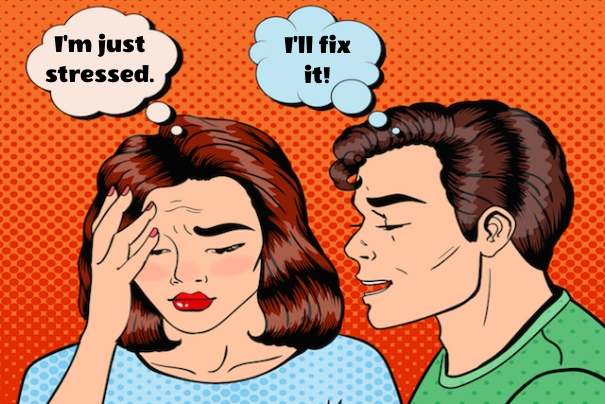
    As my therapist would say, even within a marriage it’s not my job to regulate the emotions of my spouse. I’m responsible for my own emotions. And it turns out that I’m not very good at helping “fix” my husband when he is stressed.

    Changing the Dynamic

    My first chance to change this pattern came in the form of a Saturday breakfast at a local coffee shop.

    You know that feeling you get when you place your order with a trainee, and you have zero confidence that you are going to get what you ordered? It was one of those situations.

    Thirty minutes later, our order still hadn’t arrived. My husband was getting agitated, and I could feel my blood pressure rising in response. It suddenly occurred to me that this was my big opportunity to approach things differently.

    Step 1: Observe.

    I noticed my husband was grumpy. I watched his scowl and listened to him mutter.

    I noticed my heart race. I noticed that I wanted to say something to make it better.

    I also noticed that I wasn’t upset about our food order. I had my coffee. I was okay to wait.

    It was my husband who was upset, not me.

    Step 2: Own your emotions.

    If I am feeling stressed, I know how to calm myself down: pay attention to my breathing, reframe, and refocus.

    But in this situation, if I were by myself I would have been fine. So there was nothing that I needed to do at that moment to deal with my own emotions.

    I just needed to fight my urge to take on my husband’s frustration.

    Step 3: Give the other person space to regulate themselves.

    “Are you mad?” I timidly asked my husband.

    “Nope,” he said, “just hungry.”

    “Okay. I’m gonna just sip my coffee and read.”

    “Thank you for not trying to fix me. I will be better after I eat,” my husband mumbled as he scrolled on his phone.

    Ouch. I actually got thanked for leaving him alone. Further reinforcement that I would have been making it worse by taking on his frustration.

    Step 4: Relax.

    The world is not going to end if my husband is “hangry.”

    My brain was trying to tell me that I was in danger, but sometimes our brains give us the wrong information.

    My husband is a mild-mannered man. We’ve fought less than five times in fifteen years together—and it was me doing the yelling. I was definitely not in danger.

    I was okay. He was going to be okay.

    I just needed to let go of my fear that something would go horribly wrong if I didn’t intervene.

    And guess what?

    Everything was okay.

    An Exercise in Humility

    It’s hard to let go.

    But the key insight in this process is that, even within a committed relationship, each person is responsible for themselves. We must give each other the opportunity to manage our own emotions.

    If you are with somebody who doesn’t have the skills to regulate themselves, that’s a separate conversation. Do they want to learn those skills? How would they prefer to learn: a therapist, a book, or a trusted coach? Even so, it’s not your job to force them to acquire those skills.

    We can only own our behavior. The world does not rest on our shoulders.

    And the irony is, when we step back and let go of control, the fear starts to go away. We feel freer to relax.

    Practice Makes Perfect

    I encourage you to think of the last time that you tried to compensate for your partner’s frustration or stress. Think about what you could have done differently, now that you are more aware.

    Even if you don’t manage to navigate all four steps smoothly, reflect afterward what went wrong and decide what you will do differently next time.

    You’ve got this.

  • 5 Emotions We Try to Numb with Food (and How to Stop)

    5 Emotions We Try to Numb with Food (and How to Stop)

    “If music be the food of love, play on.” ~William Shakespeare

    This quote holds a very special place in my heart.

    Growing up, I was always surrounded by classical music. My grandfather loved the arts, and the first song I ever sang was “Edelweiss” from The Sound of Music.

    I remember recognizing what it felt like to have a big voice come out of a tiny body, how powerful and scary that was.

    Years passed, along with plenty of practicing and an expanded repertoire, and I found myself going to college to study vocal performance. This was where the power of my voice and what could come from it started to emotionally affect me.

    I felt a lot of pressure to maintain my scholarship and pass classes like music theory, with which I deeply struggled, and the experience of being away from home for the first time was difficult for me. So I started to overeat, using food as a way to comfort myself.

    At the time, I had no idea that I was using food to combat my emotions, and how that response was not only unhealthy for my body, but was a temporary Band-Aid to ease the current stressors in my life.

    Instead of going out to parties every weekend, I felt comfort in ordering a pizza and watching a movie.

    I eventually realized that in order to reach my healthiest potential I had to develop ways to identify and manage my emotions.

    Emotions themselves aren’t “good” or “bad”; in fact, our emotions can be useful tools that let us know where we need to make changes in our lives. But they can become toxic based on how we respond to them.

    I want to share with you five potentially toxic emotions that can lead to overeating and some ways I discovered to deal with them.

    Frustration

    If you find that you’re constantly frustrated in your life, be it with school, work, or relationships, it can be easy to turn to food as a way to distract yourself from those feelings instead of dealing with the source of the feeling itself.

    There is a reason the term “comfort food” exists, after all! Food is comforting, and in that moment it may help you mask those stresses and resentments, but then what?

    A simple, and all too often overlooked method for dealing with frustration is just to breathe. Try to allow yourself just ten minutes at the end of your day to sit alone with yourself in silence, focusing on nothing but your breathing.

    Taking some time to breathe will help you identify proactive things you can do to address your frustrations, and let go of things you can’t control. It’s an exercise that anyone can do; all it requires is that you give yourself permission to try.

    Boredom

    I noticed that I would feel incredibly bored at night, after completing a day full of tasks.

    Before I was aware of mindfulness and meditation, I would often sit alone and become overwhelmed with a sense of extreme boredom. This uneasy feeling was very easily resolved by ordering something yummy.

    The key is to have something to focus on that is outside the scope of our daily responsibilities. Something that is entertaining or educational that can help us to relax in a productive or healthy way.

    I highly recommend a coloring book. Yes, you heard me—coloring isn’t just for the little ones anymore. There are a number of fantastic options online, from downloadable templates to good old-fashioned books. It’s a sublime way to spend a little free time after a long day, and you have something beautiful to show for it afterward.

    You might prefer a different hobby, like baking, crafting, photography, yoga, or playing an instrument. The goal is to choose something that’s engaging, and as an added bonus, it will likely be stress relieving, as well.

    Fear

    When I was struggling with eating emotionally, fear played a huge part. Fear of all of the things I had to do, fear of not being good enough, fear of messing up a note in front of 300 people.

    Fear was also easily combatted by a familiar snack, but once that snack was done those feelings would come creeping back in again.

    Instead, I found that writing was a more effective way to mute the angst. By journaling about my fears, I started to gain strength to face them. Writing helps you work through them, and also visualize ways of confronting them.

    Loneliness

    If you recall in the beginning of this article, I talked about how I would much rather sit at home and watch a movie with a pizza instead of going out to a party.

    I don’t think there’s anything wrong with not being a party animal, but staying in as much as I did and using food as a friend was unhealthy.

    I changed this habit by setting weekly hiking adventures or going to the movies, simple activities that I enjoyed, and loved to share with friends.

    If you recognize that you’re feeling lonely, be proactive to address that. Call someone. Meet up with a friend to catch up. Go to a free local event to meet new people.

    Shame

    Shame for me would always rear its ugly head after I decided to eat a meal as a way of dealing with the other four feelings mentioned above. Shame would start creeping up as I was taking the last few bites.

    “Why did you do that? You didn’t need all of that food,” I would think to myself. This continued until I acknowledged that it was my overeating magnifying the negative emotion I was trying to escape.

    Learning to eat mindfully was truly eye opening, and I didn’t feel that crushing sense of shame anymore because I ate to feel satisfied, not to numb my feelings.

    It also had the added benefit of teaching me to approach food with love again, and not as something sinful.

    You might overeat in response to shame related to other events, for example, something hurtful you said or did.

    Instead of turning to food, sit with the feeling, recognize what happened as a learning experience, and forgive yourself for being imperfect. We all make mistakes. That uncomfortable feeling won’t go away by stuffing the feeling down with food. It will only go away when you embrace it and cut yourself some slack.

    What I learned through all of this is that being healthy and mindful is a life-long journey. Life isn’t always going to be easy, and there will be times when we will overeat or turn to things like food for an escape.

    Perfection isn’t the goal here—the key is in the willingness to keep trying. That is one of the main things I hope you take from this. Love yourself enough to keep trying. Every emotion is an opportunity.

  • Letting Go of Difficult Emotions eBook (Name Your Own Price!)

    Letting Go of Difficult Emotions eBook (Name Your Own Price!)

    Letting Go of Difficult Emotions

    “If you let go a little, you will have a little peace. If you let go a lot, you will have a lot of peace.” ~Ajahn Chah

    Growing up, I often felt emotionally overwhelmed, causing others to call me “too sensitive.”

    It was very clear to me from a young age that emotion was a sign of weakness, but try as I may, I couldn’t escape mine.

    I believed there was something wrong with me for feeling so deeply—that I was fundamentally bad because of it—then I felt bad about my inability to change.

    As the years went on and life got harder and more complex, I struggled with severe anxiety and depression. I wasn’t equipped with the tools to manage the natural emotions I felt after others mistreated me, so instead, I learned to numb them.

    I numbed them with food, alcohol, and men, to name a few crutches, but my efforts often backfired.

    With so much pain repressed under layers of fear and shame, I often exploded in hysterics after one drink too many, unleashing on some defenseless friend or boyfriend a dramatic story of anguish and an eruption of despair.

    Coupled with the aftermath of bullying, this tendency to lose control of my emotions led me to fear social situations.

    Even if I didn’t drink—which I often did, to ease my anxiety—I couldn’t be certain something wouldn’t trigger painful feelings and I wouldn’t embarrass myself with my response.

    What if I obsessed and looked neurotic? What if I attacked and looked combative? What if I cried and looked unstable?

    Judgment seemed inevitable—from others and myself—but even worse I’d have to hear three seemingly patronizing words: let it go.

    As if it were that easy. As if I could just roll all my feelings into a neat little snowball and toss it out into the distance.

    I felt this was incredibly insensitive—that someone who clearly didn’t understand the depth of my pain would suggest that moving beyond it was as simple as “letting it go.”

    As if “letting it go” was an easy, one-time decision, like pulling off a Band-Aid.

    “Let it go” seemed like advice from the disinterested and lazy. At least, that’s what I thought back then.

    After spending years of my life trapped in a maze of disempowering stories, I’ve realized dwelling, complaining, and analyzing my life does very little to help my emotional state.

    I now know I don’t need to be a prisoner inside my own mind.

    I can’t help that I’m emotionally sensitive—and having leveraged my sensitivity to create this site, I now know I wouldn’t want to change that—but I can choose not to keep myself miserable and stuck.

    It turns out “let it go” is pretty helpful advice. But it’s such an abstract concept. What I wished someone told me back then was how.

    How do you let go of anger when your first thought in the morning, the last one at night, and the majority of the ones in between revolve around how you were hurt?

    How do you let go of resentment when it feels like you’ll never be able to change the things that you resent?

    How do you let go of frustration when you feel stuck, stagnant, and completely powerless to change it?

    How do you let go of worries when even the thought of letting them go fills you with worry?

    And how do you let go of your disappointment with yourself when you try your best to “just let it go” and continually struggle to do it?

    I’ve devoted much of the last decade to studying the art of letting go—a skill that’s helpful to all of us, not just those of us who are highly sensitive people.

    In this time, I’ve learned a few things that help with all disempowering emotions and a few things to address some of the specific ones that are the most difficult to release.

    In my new 54-page eBook, Letting Go of Difficult Emotions, I’ve tackled them one by one, addressing how to let go of:

    • Anger
    • Resentment
    • Frustration
    • Anxiety
    • Self-Judgment

    Each section offers a few simple things you can do to release the feelings, come back to the present moment, and find a sense of peace.

    And best of all, I’ve decided to release this eBook with a “name your price” model. The suggested payment is $10; however, you can pay as little as $1 or give more than that, if you’ve gotten a lot from Tiny Buddha and would like to give more back.

    [gravityform id=”10″ title=”false” description=”false”]

    I hope you find this eBook helpful, and I welcome any feedback at email(AT)tinybuddha.com.

  • When Life Doesn’t Meet Our Hopes and Expectations

    When Life Doesn’t Meet Our Hopes and Expectations

    Disappointed

    “Anger always comes from frustrated expectations.” ~Elliott Larson

    I was recently watching my younger son play in a golf tournament. We had extensively prepared for this tournament over a period of several days. His technique was finely tuned. The game plan for attacking the course was in place.

    The first two holes went wonderfully.

    We arrived at the third hole, a medium length par three with water to the left.

    In the middle of his swing, a golf cart carrying bags of ice drove right in front of him at a distance of about fifteen feet. This broke his concentration and he stopped his swing. He attempted to gather himself and he proceeded to hit the shot.

    The ball went into the water.

    This was the beginning of a number of curious “breaks” that happened on almost every single hole until the final one.

    The result was a disaster. The tournament was ruined. The game plan was shattered.

    There were so many wounds inflicted that day. And I, perhaps more than him, suffered every one.

    I learned much from that day. One of them is the idea of a thin layer of space.

    What do I mean?

    The organs inside the human body sit next to one another, but they do not touch one another. They sit within body cavities but they do not touch the cavity. 

    Rather, they are separated from their surroundings by a membrane of space.

    Perhaps we can apply this ingenuity to the way in which we live our lives.

    As we experience the various emotions and events that we encounter in a given day, we feel jolts and grates and frictional rubs. We are affected by each one.

    Why?

    Because unlike the organs in our body, we live directly apposed to the events of our lives. As such, the slightest shudder feels like an earthquake. Every scratch feels like a flesh wound.

    What if we could learn to live our lives with a thin layer of space between us and the events that we experience?

    What if there was a thin layer of space between what we hope to receive and what we actually receive?

    A thin layer of space between our expectations of what should be and what actually comes to be.

    Perhaps this space would act as a shock absorber. Perhaps it would allow us to experience jolts as jolts. And scratches as just scratches.

    Perhaps this space would serve as a gutter in which the excesses of our demands and our hopes would collect and flow away, leaving us content with what is.

    Perhaps this is the only way that our lives can be enjoyed.

    Perhaps it provides us a dose of wisdom. Teaching us that life flows according to its own rhythms, rather than according to our whims.

    Perhaps it can teach us that our miseries come from seeing life through the prism of our own expectations. And that to see life in this way is to not see it at all.

    Perhaps a bump will seem more like a ride than a jolt. Perhaps thunder will seem more like a sound rather than an impending storm.

    It is our interpretation of events that gives rise to the parallel universe in which we live. As few of us truly live within the world. Rather, we live inside the mind.

    The mind sticks to everything that it experiences and we feel the reverberations of each and every one of these experiences.

    But with this thin layer of space, we can perhaps keep the tempest that surrounds us in perspective. And at arm’s length.

    This thin layer of space affords a thin window of time. Time that allows for a measured response. Time that allows for action borne of wisdom, rather than emotion.

    It is not the words, but the space between them that makes communication possible.

    Perhaps it is a thin layer of space between us and our lives that makes living possible.

    In understanding this thin layer of space, perhaps I can begin to appreciate that the events that happened on that day did not happen to my son. And that they did not happen to me.

    They just happened.

    Disappointed woman image via Shutterstock

  • How to Release Disappointment and Thrive When Life Isn’t Fair

    How to Release Disappointment and Thrive When Life Isn’t Fair

    “When you learn to accept instead of expect, you’ll have fewer disappointments.” ~Unknown

    At thirty-six weeks pregnant, I was in the fetal position on my bathroom floor, screaming with pain. It was excruciating, the worst pain I had ever experienced, and I had experienced lots.

    As the ambulance officer supported me out the front door and into the back of the ambulance, all I could think was, “How is this going to affect my baby?”

    After two ambulances, two hospitals, and a barrage of tests, I was sitting on the hospital bed, absolutely exhausted—physically, emotionally, and spiritually.

    My thoughts started to go down the same well-worn path: “Why me? Why do I have to deal with this? Life isn’t supposed to be like this. It isn’t fair!”

    It had been a common theme for me. I knew how life was supposed to turn out, and mine wasn’t it! It seemed like I had challenges to deal with that others didn’t have—that my lot was harder.

    I felt like all my energy and potential was being sucked up in dealing with adverse circumstances, leaving me no resources to do the things I really wanted to do in life.

    For the last twenty-three years, I had battled Crohn’s disease, a debilitating and incurable illness that had resulted in increasing pain, illness, and limitation—until then. Four weeks before the birth of my second child, I had ended up in hospital with massive pain.

    My doctors didn’t know how to deal with a woman having a Crohn’s flare up who was also pregnant and wanted to induce labor to deliver the baby prematurely. I was faced with making choices about medical treatments that could have serious impacts on me and my unborn child.

    As I sat there, I could feel the familiar frustration, dissatisfaction, and discontentment flooding over me.

    And in that unlikely place, I had an epiphany.

    Life is not the problem; expectations are.

    I finally realized, looking back at my life, that every time I’d struggled to deal with the hand I’d been dealt, it was because my expectations were clashing with reality. I had created a picture in my head of how life should be, and when things didn’t turn out, I didn’t cope.

    It wasn’t life that was the problem; it was my unrealistic expectations. I had thought that being idealistic and striving for a goal was a good thing, but it wasn’t leading to a contented and fulfilled life.

    If you are feeling hardly done by and frustrated about your circumstances, ask yourself if there is a mismatch between the reality of your situation and what you expected. If there is, you have inadvertently set yourself up for frustration, disappointment, and even anger.

    While these emotions are natural when we experience adversity, they are not helpful to live with long term.

    The only way to resolve them is to face up to the situation you are actually in and accept it. This does not mean we should not have any expectations, but if we want to be content, we need to accept what is during hard times while trusting for something better in the future.

    Instead of trying to change the world, change your focus.

    While I was in the hospital, I talked to other mothers who had been there for the whole of their pregnancy or whose babies would need surgery as soon as they were born. It made me realize that while I was in a hard place, things could have been so much worse.

    I realized that I was only seeing one side of my life. I was very good at seeing what was not there (that I thought should have been) but was ignoring what was there that was good.

    In thinking about my illness, I was focusing on the pain and how it was stopping me from earning an income, and how my energy was limited, and how the whole situation was negatively affecting my family.

    But I wasn’t embracing and being grateful for how other people, particularly my husband, cared for me, how I was growing in wisdom and compassion, and how the experience was teaching me more about myself.

    If you seem to be coping with more than your fair share of frustration and disappointment, check your focus for a minute. Are you only seeing the gaps, where reality isn’t meeting your expectations, or are you also acknowledging the good that is coming your way?

    It may be helpful to create a list with two columns where you can explore what you are feeling about your circumstances.

    On the right side, write down where your expectations aren’t aligning with reality: where the gaps are, what sucks, and what you think shouldn’t be happening.

    On the other side, write down what is positive: where the divine is in the situation and what is great about this. This is not about being falsely positive. This is about finding the moments of genuine joy and connection in the midst of pain.

    Pay attention to how you feel when making each list. Having refocused the situation for yourself, you can now choose which emotions to take into the future about that experience.

    The great thing about this exercise is that it frees you from striving to change the world to match your own expectations. Instead, all you need to feel happier is a little shift in your focus.

    Embrace the pain and then take control.

    I learned that I needed to embrace the whole experience, both the good parts and the gaps, and that gave me the ability to choose a more empowering set of beliefs and meaning for what was happening to me. This in turn helped me discover new possibilities that I couldn’t see before.

    Having refocused myself, I was able to sort through a lot of complex information and options regarding medical treatment, define what outcomes I wanted, and make a constructive action plan that put me in charge of my health.

    And the end result? That time round, beginning with circumstances that weren’t promising at all, I got all the outcomes I wanted, including a healthy baby and a natural birth.

    The irony about accepting the situations we find ourselves in is that once we have, we are able to make decisions and take action that moves us toward the place we truly want to be. We stop feeling like a victim of circumstance and more like the captain of our own ship.

    That doesn’t mean that we will get what we want every time. Life doesn’t work like that. However, coming to a place of acceptance gives us the strength and peace to deal with whatever outcome we receive, whether desired or not, and the ability to move forward rather than getting stuck in adversity.

    Empowering questions we can ask ourselves include:

    • What outcomes do I want? Write down every result that is important to you in the situation.
    • What beliefs can I choose that will support me right now? Give yourself an empowering set of beliefs that help you feel hopeful in the situation.
    • What action can I take? Outline actions you can take today, this week, and in the next month that will move you toward your outcomes.

    You can soar above adversity.

    These days, I still have Crohn’s disease but have largely given up my unrealistic expectations, and not living with that frustration has taken a lot of stress away from my life. I am in better health than I have been for years and achieving more.

    It took a while for me to let go of my idealism and find the good in adversity, but by practicing it over a number of years, I have gotten better at it.

    We all live with circumstances that are not ideal. Life is too short to live in frustration that things are not the way we want them to be.

    Why you? Because there are important jewels you can discover in the midst of adversity that will reward you for the rest of your life. You are strong enough to embrace reality and perform the alchemy that will transform frustration into contentment and positive outcomes.

    We’re all here rooting for you.

    Go and make it happen.

  • Life is Happening FOR Us: All Things Are Gifts

    Life is Happening FOR Us: All Things Are Gifts

    “Your task is not to seek love, but merely to seek and find all the barriers within yourself that you have built against it.” ~Rumi

    Up to a certain point in my life, I was always seeking approval and validation from everything outside of me. All I ever wanted was to feel loved. I longed for this feeling and wondered how the world could be so cruel as to reject me when I was so loving and available.

    I have since learned that I was not as available as I thought.

    It has been my experience that everyone that crosses our path is a mirror. They have come because we have called them into our lives to show us something—to teach us how to be more of who we truly are.

    Our higher selves crave these experiences and relationships, because ultimately, this journey we call life is all about finding everything we want within us rather than without. It’s about waking up.

    I have learned this over many years of things not turning out the way I wanted them to, feeling as though I was a victim and life was just not fair. I felt this way until I finally got it—I finally understood that life is happening for us. Yes, for us. (more…)

  • How to Get Past a Setback Today to Create a Better Tomorrow

    How to Get Past a Setback Today to Create a Better Tomorrow

    “What does not kill me, makes me stronger” ~Friedrich Nietzsche

    If you knew me, you’d think that I float through life without a care, that nothing fazes me, and that I don’t get stressed.  For the most part this is true, but every now and then something happens that really gets to me.

    We have been trying to sell our house so that we can emigrate to Australia. The house has been on the market for about two years, and we’ve had three sales fall through already. So a few weeks ago, when we had agreed on a sale price with a buyer, I felt mixed emotions.

    I was excited and optimistic but I also felt stressed, hoping that this time the sale would go through but fearing that it wouldn’t.

    I tried not to build my hopes up, but I also spent the week looking on the internet for jobs in Australia and checking out house rentals.

    The buyers were so enthusiastic. They had worked out where their furniture would go and who would have which bedroom. The father had grown up in the village and wanted to move to be close to his mother. It was all looking good.

    A week or so later, my wife texted me letting me know we received “bad news about the house.” Another sale had fallen through.

    I felt low and fed up. I had absolutely no motivation. But after a few days, I decided to pull myself together and get over it.

    Lately I’ve been learning to become aware of my emotions and how they can affect my actions.  Knowing how I am feeling helps me to be measured in my decision making.  I’ve been developing this self-awareness by reflecting on past experiences and examining my emotions and choices.

    As I sit here now, looking at the “For sale” sign outside my house, I can honestly say that I am glad that another sale fell through.

    It was unpleasant and it inspired all kinds of negative emotions. But it also enabled me to examine my own behavior, to become more aware of how I act when I’m stressed or feeling low, to practice being strong in tough situations, and to grow as a person. (more…)

  • Let Go of Negative Feelings: 3 Ways to Watch Them Disappear

    Let Go of Negative Feelings: 3 Ways to Watch Them Disappear

    “Some people think it’s holding that makes one strong–sometimes it’s letting go.” ~Unknown

    I’m the divorced mother of two teenage girls. Holidays are split; the girls have Thanksgiving with their dad and Christmas with me on even-numbered years, and vice versa on odd number years. It’s hard on all of us, but it has been especially hard on me this year.

    This year I had Thanksgiving with my girls the weekend before Thanksgiving and asked if they wanted come over on Black Friday to set up the Christmas tree, as was the tradition before. They said sure.

    I called them about ten that morning to find out when they’d be ready for me to pick them up. Well, they forgot and made plans with their grandmother to go shopping. I was devastated and in tears. So many emotions were ripping my heart apart. (more…)