Tag: freedom

  • Encourage, Don’t Criticize; Help Instead of Trying to Fix

    Encourage, Don’t Criticize; Help Instead of Trying to Fix

    “You must love in such a way that the person you love feels free.” ~Thich Nhat Hahn

    When you think you’re an evolved and conscious woman and your partner tells you in no unclear terms that you’re “hard to be with,” it does a number on you.

    Those words landed like a well-aimed boulder, smashing the immaculate vision I’d created of evolving myself: an exemplary girlfriend who was “doing the work” to grow, to become generously loving, spiritually awake, and to wholeheartedly support and encourage her beautiful partner to open to his fullest potential.

    We met under messy circumstances. Both just weeks out of intense breakups and deeply embroiled in “processing” our respective experiences, I had a laundry list of emotional baggage to shed, patterns to break, and new nonnegotiable standards for anything and anyone I’d allow into my intimate space.

    I pinned the badges of Emotional Consciousness and the Evolved Feminine on my heart. I journaled, meditated, and prayed to the Goddesses: Quan Yin. Kali. Durga. Sati.

    And as I learned, dove deeper, sailed higher, I held fiercely to his hand. I wanted to do this together. I begged him: join me. Rise. Dig. Excavate your stagnant places.

    It’s the only way forward.

    I believed it. And I think, to a certain end, so did he.

    Then encouragement, collaborative growth, and tough love turned to jagged criticism. Instead of holding one another in our struggles, we sat on opposing sides of some false fence. I saw only his flaws and I believed I needed him to fix them.

    I saw his potential. He was brilliant, deeply spiritual, an intuitive outdoorsman and incredible teacher. He had promise, gifts to bring to the world. I wanted him to reach for it—without fear.

    And when he didn’t, when he paused to rest, when he stumbled, I saw failure. I saw an unwillingness to try. I saw a man gripped by fear, clinging to safety.

    I used those words.

    Why couldn’t he just work as hard as me?

    It’s easy to say this now. To see where my ardent desires for his evolution—to shed the excess weight and step into his highest self—so quickly became toxic. How it clouded my vision of who he was, in the moment, without the changes I thought necessary.

    Wrapped up in my own work and redefining of what it meant for me to rise, I transposed my journey onto his.

    All I saw was his shining potential, his shadowed present, and the moments he wasn’t up to the challenge. When the stones the universe hurled at his foundation bested him.

    And I ignored the brilliant light already standing in front of me, showing up in his wholeness, wounds and all. So he learned to try and hide it, for fear that I would criticize the tenderest parts I saw to be flawed.

    Nobody is perfect.

    The funny part is that I’m a coach and a yoga teacher. I write about every angle of perfectionism, I preach about loving your tender and dark parts, I read endlessly about the divinity of this eternal growing process.

    Stretching is uncomfortable. Peeling off the layers hurts. It’s a messy, messy adventure, this evolution. Blah blah blah. My brain knew all that. But that’s different from living it—and dammit if I wasn’t a full-on hypocrite.

    So… nobody is perfect. Right?

    His imperfections became my teachers. And as I crumbled, defeated in my epic pursuit of New Age Girlfriend Perfection, he taught me what it is to hold someone you love to their highest potential, with grace, love, and honor.

    Your journey is not their journey. It seems straightforward, but it requires a humble and gracious heart to resist imposing your own standards of evolution on another.

    Just because you’re in love with transcendental meditation and it has blown your ego to pieces doesn’t mean your partner will find it moving in the least. And while you’re deeply questioning the meaning of “self,” the qualities of nonattachment, or the truth of your suffering, your partner might be doing battle with self-acceptance. Or body image. Or what it means to be masculine.

    And that’s all perfect.

    See the potential. Celebrate the present. That’s where I went wrong; I missed the second step. And he gently, kindly told me that he wasn’t feeling seen. Really seen—in his work, in his accomplishments, in the steps he’d already taken.

    Spend more time celebrating the positive elements of how far your partner has already come—and then encourage them to keep going, because you see such beautiful potential and brightness within.

    Let go of perfect. You know from your own excavations that the work never ends. There is always growth, always evolving, always new spiritual/emotional/soulful expanses to be explored.

    When we think “highest self,” it sometimes feels like an end point—a “point a to point b” kind of goal. It’s not, and living from that mentality makes the experience of evolution feel hurried and time-sensitive.

    As Osho says so simply, “Slowly, slowly.” Let that be your mantra, and honor each slow step your partner takes. Even more so, honor the pauses. The deep breaths. They’re part of the work, too.

    It is not yours to push. You’re not his life coach. You’re not her personal trainer. You’re not Mom. Position yourself on the same team—encouraging, supporting, celebrating, yes. Demanding? No. That creates a power dynamic that eventually becomes toxic and corrodes the integrity of your relationship.

    When you find yourself becoming the teacher, check your motivations and rephrase. How can you encourage with tenderness and love?

    Your love will become freedom. You have this one role in your partner’s evolution: to hold the space, to fill it with love and safety and, simultaneously, the encouragement to expand—and your love will become their freedom.

    Freedom to be exactly where they are on the path and to take the journey that is right at that moment and in that time. Freedom to fall. To screw up. And to try again, with unflinching faith in their own potential.

    And that freedom, ultimately, is the only path to the highest self.
  • Say Goodbye to Your “I” and Hello to Freedom

    Say Goodbye to Your “I” and Hello to Freedom

    “More important than the quest for certainty is the quest for clarity.” ~Francois Gautier

    It’s the last place in a million years I ever thought I would find myself.

    Stuck in a day job I had originally taken to fund my art and still feed my family when times were lean. It all sounded so logical back then.

    Except that after several years, this “I” that was showing up to work had zero passion, was totally unmotivated, and not exactly someone I was too proud of.

    Which was very strange since I was always so committed with my dedication to my artistic endeavors, prior to this particular career move. “Who was this guy?” I thought.

    But hey, it was all to keep the music train rolling along while I worked on my art and building up our fan base.

    Then the band broke up.

    Suddenly without the vehicle to deliver my artistic message I was like a ship without a rudder. The job felt like I was still living the joke but couldn’t remember the punch line anymore.

    But then I was in a bit of a conundrum.

    There was this other “I” who, during this same period, had rediscovered the storyteller I had always been since childhood.

    This “I” started blogging, writing posts to inspire others to unearth their own unique story and live their passion. A first eBook was near completion. People were commenting and signing up regularly to my list.

    This “I” felt totally alive. Totally confident. Like I was doing some good in the world.

    Likewise, when I was playing guitar or producing other musical artists. People were consistently saying thank you whenever I was engaged in this work.

    Hmmm.

    So then who exactly was this “I” who was showing up to that day job? This self that was feeling so stuck? The one with all these self-limiting beliefs?

    It was almost like I had a different “I” for different situations in my life. It was really confusing.

    Did you ever have that feeling?

    I finally found the clarity I was seeking after attending a Buddhist lecture series recently.

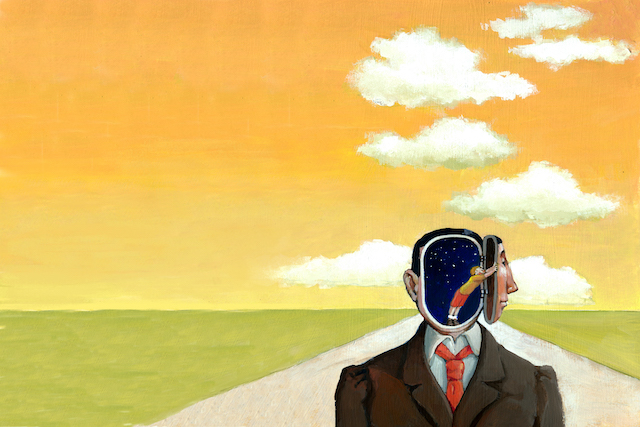
    The Buddha says that since beginningless time, we have been grasping at a self that doesn’t really exist—a self that changes like clouds passing overhead.

    According to Buddha, this self-grasping is the root cause of all human suffering, because we’re clinging to the delusion that this self and our own happiness is more important than anyone else’s.

    I know, that sounds scary, right? Clinging to someone who’s not really there?

    Now this might be a good time to ask an obvious question you might be wondering.

    If our “I” doesn’t really exist then who’s driving the bus, right? Who decides we’re going to wear that blue shirt today? Who tells us to take a shower and get ready for work?

    That’s a fair question. (I was thinking the very same thing when this was first presented to me)

    But I learned that if you really believe there’s this independently existing fixed self called “you” then you should be able to point to it, right? Like your refrigerator over in the corner. “Yes, there ‘I’ am.”

    So to see if this was true we went through the following exercise.

    You get to a centered place in your meditation (or just a quiet place, if that’s not your thing) and you contemplate a version of a self you’re very familiar with. Preferably one that feels stuck in some aspect of your life. (Bingo! The guy at work. That was easy)

    Then you just try to observe this self in action, as though in your mind’s eye, you’re looking over their shoulder and they don’t know you’re there. Then you ask yourself, “Is this really the person I always wanted to be?”

    Well, it was quite obvious to me the answer was no. So then you set out to locate this self to test the theory.

    Now if you just use common sense and look in the mirror you basically have only two choices where you might find this self. Either your “I” is located within your body or it’s in your mind, right? Where else could it be?

    So for example, when “you” decide to go shopping do you say, “My body is going shopping now?” No, you say, “I’m going shopping now,” right? As though this “I” is some entity other than your body.

    So this self is not located inside your body, would you agree?

    Okay, so then is your “I” located inside your mind?

    Well, think about it. You wouldn’t say, “I’m taking my mind shopping” either, would you? As though your thoughts are off to the mall? I’ll just leave my body home since that’s not me. No, you wouldn’t say that either.

    And something else: don’t you say, “These are my  thoughts” as though your “I” is in possession of them? Logic dictates that the possessor (your “I”) can’t also be the possessed (your thoughts) at the same time.

    So if this self can’t be located in your mind either, then where is it? What are we to conclude?

    It doesn’t really exist. It’s an idea, a name you ascribe to this collection of changing thoughts you call “me.” An insinuation.

    But fear not. You do exist.

    Just not in the fixed reality you thought you resided. You cannot point to this self because it’s nowhere to be found. Really, try to point to it right now.

    So if your “I” is really just an “I”dea, then what would you do if you came up with a bad idea? Like say, a self that believed they were stuck in a day job?

    You’d drop it right?

    What’s the opposite of self-limiting beliefs?

    Unlimited possibility.

    Why not identify with that instead?

    When I walked out of that class and began meditating on this concept over the following weeks and months, something eventually happened.

    I didn’t view this job in the same way anymore. It’s not that I had any renewed passion for it. I didn’t. But I realized that all the years I’ve been in this field have not been for naught. It served my creativity in a way I never saw before.

    I’ve been working in high end audio visual technologies with some of the wealthiest New Yorkers, living in these amazing spaces most only get to see on TV. Some are characters I could never invent in my wildest imagination. So the job has become the muse for a book I’ve been writing over the last few years now.

    Writing has opened up a door and shown me new possibilities with my career. Suddenly people are asking to pay me for my writing.

    An audience is building. A tiny voice says, “Keep going.” It’s the voice of a different self. One who knows it’s all going to work out.

    There’s another premise in Buddhism called patient acceptance. You can’t force life to change. You create the conditions for change to come about. Then you accept that it will come when its time has ripened. Not before.

    Maybe you can’t always change a situation by just snapping your fingers and making it go away. But you can change your perception of it.

    Change your perception and you change the world.

    Literally.

    If you’re free to realize that this self is just an idea, then you’re also free to let go of those selves that don’t serve you because they don’t produce a positive perception of events.

    You can learn to recognize them when they crop up. You can even have some fun and give them names. When they show up you can just say, “Take a hike, Larry (or Mary)!”

    You’re free to see a seemingly difficult situation as a challenge instead—an opportunity to transform it into something positive.

    And you’re free to watch with wonder what happens when you view each moment of your life in this way.

    Freedom is yours when you let go of “you.”

    Here’s to your freedom!

  • Freeing Yourself When You Feel Limited or Stuck

    Freeing Yourself When You Feel Limited or Stuck

    The secret of happiness is freedom. The secret of freedom is courage.” ~Thucydides

    The society I was born in—urban, rich, conservative India—did not encourage women to make life choices for themselves. I was not given a vote in my own education, or in the choice of a husband when I turned twenty years old. These decisions were left to the family elders.

    And yet, my heart was always a bit of a free bird.

    Despite being “expected” to be a homemaker after marriage, there was always a yearning in me to be somewhere else, doing something else. I could not cook, and as a wealthy man’s wife, I had no household chores.

    All I had to pass the time were lunches with other young homemakers. And I found those boring—all that talk of mothers-in-law and school admissions. I yearned for intellectual stimulation, which neither my then husband nor these women could provide.

    Within a few years, I had two kids, no income of my own, a dysfunctional marriage, a sickly constitution, and no way out. The free bird inside me almost choked and died—until it asserted itself.

    I began writing after a hiatus of eight years. They were anguished poems, which I posted on a poetry website. The owner of the volunteer-driven portal invited me to edit the site, which I accepted, as I had nothing else to do.

    Soon, he decided to compile those poems into books and I found myself in a part-time book-editing job. Of course, the walls of my tenuous marriage began to show signs of strain.

    Then one day, out of the blue, one of the world’s biggest publishing houses offered me a full-time job—in a real office, with real colleagues, with my own seat and computer, reading books all day. It was mind-blowing. How could I resist?

    As expected, the family did not take it well. My marriage deteriorated into shouting fests and suicide attempts.

    My in-laws complained to my parents about their wayward daughter who wanted to work in a petty job despite having all the money in the world. Why couldn’t I just be happy with all that I had, everyone wondered.

    Within a few months, though, something happened. A colleague at work introduced me to Buddhism. That, and the idea of having my own paycheck and designation, gave me an identity, an inner strength, and an opening of the eyes. I felt like I had just been born.

    Around me, things were falling apart; inside me, they were falling together for the first time in my life. (more…)

  • How to Forgive When You Don’t Really Want To

    How to Forgive When You Don’t Really Want To

    “Freedom is what you do with what’s been done to you.” ~Jean Paul Sartre

    Like so many other women, I had a complicated, often fractious relationship with my mother. I had moved thousands of miles away, but an email or a phone call was enough to irritate me.

    Visits were tense, nail-biting experiences, where I couldn’t help but analyze each thing that she said to see if it contained a passive-aggressive double meaning, at which point an argument would brew.

    For years it had not mattered what anyone told me about how to forgive, and they had told me a lot:

    • Resentment is the poison you feed yourself, hoping someone else will die.
    • Forgiveness is a choice.
    • Refusing to forgive is living in the past.

    I thought I wanted to forgive her. I knew what it was costing me to carry around the resentment, the replaying of old arguments and the anticipation of future conflict.

    Yet something in me didn’t want to forgive, and this was the truth that I had resisted owning for so very long.

    We don’t like admitting to the fact that some petty part of ourselves doesn’t want to forgive people. We say we “don’t know how,” and that might be true, but the other truth is that some part of us often doesn’t want to forgive.

    We don’t want to admit that this part exists, because of all the stories it piles on top of us—stories that we’re mean, petty, judgmental people.

    Of course, we’re expressing mean, petty, judgmental behaviors when we refuse to forgive.

    It’s not intentional. It’s just that we’ve been hurt, and forgiveness feels like letting someone off the hook, or pretending that it was okay that they did what they did.

    The irrational fear is that if we forgive, someone else will do “it” again. But the truth is, whether or not we forgive has nothing to do with controlling another person’s behavior.

    People do what they do. The only person to let off the hook is ourselves, by not concerning ourselves with monitoring someone else’s behavior, or replaying the past.

    So, how can you move through the process of forgiving others?

    These aren’t “easy steps” by any means, especially because many of them are worked in tandem, but nonetheless they are pieces that make up the whole.

    First, acknowledge the parts of you that don’t want to forgive.

    The parts that want to punish by not forgiving, that derive some artificial source of power from withholding forgiveness.

    It’s a sign of health that we become aware of those places rather than pushing them away, pretending that they don’t exist.

    Secondly, if you’re aware already of the fact that you don’t want to forgive, consider the stories that go along with that.

    I’ve already mentioned a few. Perhaps the most common is that forgiveness will mean that someone is absolved from responsibility for their behavior.

    Here is what I know: When someone wrongs another, they always suffer. They might not tell you about it, or they might put on a bravado. They might not even be aware that their behavior is at the root of their suffering.

    But trust me, they suffer. If someone is unkind, they suffer from either the conscious belief that they were unkind, or they suffer from the unconscious fallout of their behavior. (“I don’t understand why people leave/I always get fired/I feel so isolated and alone.”)

    Third, find the common ground.

    Where are you just like this person that you don’t want to forgive? This is the part that people resist most.

    Perhaps your partner cheated on you, and you know for certain that you would never cheat on your partner. But, if cheating is a form of deception, can you see places in your life where you have deceived someone else? Are you 100% honest on your taxes? Did you ever shoplift as a teenager? Do you tell “little white lies” at work?

    No, I would never suggest that a cheating partner is equally as painful as stuffing a t-shirt into your purse when you were a young, reckless teenager.

    What I’m suggesting is that the two are borne of the same places. Deceit has its roots in fear—fear of being honest, fear of not getting something needed.

    When we see that we are equally as capable of acting out as the next person, and especially when we compassionately see the fear that drove them to behave the way they did, there’s the potential for release.

    Finally—and this is the big one—realize that lack of forgiveness is rooted in a lack of boundaries.

    This goes back to the fear that if forgiveness were granted, “it” might happen again because the person thought that they could “get away with” it.

    The person you know you need to forgive in your life might not even be alive anymore, but if they’re alive and real in your head, that’s enough.

    This is the moment of choice: Are you going to decide that you won’t tolerate XYZ behavior, dynamics, and beliefs in your life?

    The moment that you decide that you won’t tolerate the behaviors that led you not to forgive is the moment that things shift.

    Caution: In movies the hero or heroine “gets back” at someone and then walks off into a happy ending.

    That’s not what we’re talking about here. If your boss routinely puts you down, you don’t tell her off and that’s your “power.”

    Rather, you decide that you won’t tolerate the put-downs, you come up with a plan for how you’re going to handle it when they arise, and then you actually assert that boundary, while looking at her with pure love because you know that her put downs are causing her immense suffering (even if you can’t see the suffering).

    What happens in moments like these is that the put downs become about as believable as a drunk, homeless man who is shouting obscenities on the street. He’s clearly not altogether there, and you can have compassion for him because his suffering is so visible and his words so illogical.

    Here’s the big secret: When humans are unkind to one another, they’re not so very different than that guy. Many of us are just using different language and wearing nicer clothes.

    When you decide what boundaries to put in to place, and what you will and won’t stand for, you release the fear that “it” will happen again. What “it” can touch you when you’ve already decided that you aren’t going to let it penetrate?

    The moment came—and it was a completely innocuous moment for me, sitting in six lanes of backed up traffic, my thoughts discursive—when I realized that when it concerned forgiving my mother, I get to decide who I am.

    My life was what I said it was, and a painful relationship with her need not be a part of it any longer, if I decided that it was so. I knew that all I wanted to do was simply love this woman who had given me life and who had taught me so much about who I wanted to be.

    There was nothing but gratitude in my heart.

    Before my own experience of deep forgiveness, as I waded through years bouncing from one therapist’s couch to the next trying to “figure out” how to forgive, I would have thought this moment impossible. I would have doubted the elegance of its simplicity.

    But it really is true: “Freedom is what we do with what’s been done to us.”

    It is not the circumstances of our lives that matter. It is what we choose to do with them.

  • Live Every Day Like You Travel: 4 Lessons from the Road

    Live Every Day Like You Travel: 4 Lessons from the Road

    “Our greatness lies not so much in being able to remake the world as being able to remake ourselves.” ~ Gandhi

    What if we lived the way we travel?

    It’s been my experience that we let go of many things when we travel. I’d like to propose that those things—the things we loosen our grip on while travelling—are things that don’t need to be held quite so firmly.

    1. Notice. Slow down. Reflect.

    San Miguel de Allende is one of my favorite places on earth. I’ve visited nine or ten times. If asked to describe heaven, I’d say that it was a long weekend in San Miguel.

    After a gorgeous night’s sleep in Room number eight, I’d start to see things differently. I’d become absorbed by the way the golden light fell across our bed. I’d notice the specks of dust in the light shaft, like tiny astronauts travelling between the earth and the sun.

    In the town, I’d observe the dogs walking on the shaded side of the street and follow their example. Everything in my path seemed beautiful and noteworthy: the way that rain drops hit the cobblestone streets, the crayola-colors of folk art in store windows, and the markets that smelled like cheese and chicken feet.

    We sit at a cafe, content to drink limonada, and people-watch for hours.

    We rarely do this at home because we believe there are very important things that must be accomplished, and that we can’t waste time at cafes. Vacations help us understand that we’re not quite as essential to our workplace as we thought. They’re getting by just fine without us.

    Noticing leads to slowing down which allows us to reflect. We spend time observing the shape of things. Life exhales and rolls out ahead of us. We dream. (more…)

  • Decluttering Made Easy: How I Lightened My Load from the Inside Out

    Decluttering Made Easy: How I Lightened My Load from the Inside Out

    “Letting go isn’t the end of the world; it’s the beginning of a new life.” ~Unknown

    Last December I found myself sitting on my floor, having just left my job and a ten-year relationship. As a result, I was about to leave my home too. In front of me was a mountain of possessions that I somehow had to take with me to wherever I was going next.

    Clothes, bedding, books, notebooks, electronic bits and pieces, boxes of ornaments, and sentimental “things,” handbags within handbags, flocks of high heels, tsunamis of paperwork…

    And then there was little me.

    I felt overwhelmed by my possessions. It seemed unnatural to have accumulated more than I could carry alone, or at least fit into my car.

    Outside, it was the run up to the holidays in the middle of a recession. Half the country was unable to afford their heating bills, let alone presents. So to distract myself I brought a handful of things to a children’s charity shop down the road: teddies, pictures, a wicker basket that would be perfect for a child to keep toys in.

    And that unleashed the floodgates.

    I felt good—for me, because my burden of possessions had shrunk, and for the children, who might receive these things at Christmas.

    While the basket was hard to give away—it had been mine since I was a baby—giving it away made me see that I was better able to mentally cope with getting rid of things, than physically cope with trying to take it all with me.

    And so an epic spring clean began in the middle of my winter. Three weeks of rifling through boxes and shipping stuff out to charity shops, friends, family, the trash, and eBay.

    Some things were easy to give away. Others were not. Certain things I had no use for—yet something made me hesitate to let them go. I came to know these hesitations as emotional speed bumps. (more…)

  • 4 Simple Ways to Experience Great Happiness and True Freedom

    4 Simple Ways to Experience Great Happiness and True Freedom

    “It takes courage to grow up and turn out to be who you really are.”  ~E.E. Cummings

    I love to write. For years I wrote in journals and kept them stacked in piles on my shelves.

    One rainy winter evening when I was 25, I walked into the Bourgeois Pig bookshop on Franklin Boulevard in Los Angeles and saw a book next to the cash register written by Natalie Goldberg called Wild Mind. I bought it and my life change forever.

    Natalie’s book was about writing practice. A Zen monk practitioner, she brings the fundamentals of Zen to the creative writing process. There were some simple rules she suggested. Some of them are:

    • Set a timer and write without stopping your pen—without crossing out or editing. Follow your mind without interruption and see where it leads you.
    • Be specific. Not tree, but cypress. Not a street, but Utica Avenue in Tulsa, Oklahoma. Not a fruit, but a ripe slice of juicy pineapple.
    • Go for the jugular—toward what might scare you. Meet your insides. Dive all the way in.

    Writing in personal journals was my sacred time just for myself, to have permission to go wild, reach my depths, and be truly free.

    As fate would have it, I ended up taking a workshop with Natalie in Taos, New Mexico and we become friends. At a time of major transition in my life she invited to move to New Mexico and immerse myself in a writing life with her.

    Looking back at the many journals I collected, I see the writing met me for that moment in time, but that once it came out of me onto the paper, it was no longer a part of “me.”

    It came through me but was not of me. It was an expression that had passed no longer fitting the current moment.

    Although the writings still hold energy, the person who wrote them seems unfamiliar. That Lynn is gone, in the past, over.

    If you write in journals and go back to re-read them are you surprised, perhaps interested, sometimes astonished by the person who wrote them?

    Discovering who we are is an ever-evolving process, always changing, expanding, and growing.

    We may think we have arrived, we think we can say that we know who we are now, and then in a snap of the fingers that moment is gone and something new arises—a new insight, a new awareness, a new interest or endeavor.

    This is why we humans are a creative process. And why perceiving ourselves as a process can bring great happiness and true freedom.

    Giving myself permission to just write without trying to be something, become something, make something out of it that defines me gives me incredible freedom.

    Letting go of the need to be labeled by a “noun,” I become more interested in the “verb.” For example, I am not a writer. I write. Now, I am free.

    Then, I have permission to revel in every moment my words move across the page for absolutely no reason except for the great happiness I receive from it. (more…)

  • Set Yourself Free: 3 Ideas to Become More Conscious

    Set Yourself Free: 3 Ideas to Become More Conscious

    “I know but one freedom and that is the freedom of the mind.” ~Antoine de Saint-Exupery

    I’m sitting on a straw bail at an unplugged rock concert that’s being held in Barrydale, South Africa, my current home and sanctuary. It’s a big deal for this small town, because nothing much ever really happens here.

    Everyone from the area has arrived dressed to the hilt and ready to rumba—except me, that is. I’m sitting to the side (in an outfit that will scare away most normal people) staring forlornly off into the distance.

    My buddy Sean sits next to me with a smile the size of the bread roll he’s holding in his hand. He jokes around and chats away like today might be his last day on earth, while I try hard to flash some teeth at least once every twenty minutes, just so I don’t ruin the party for everyone else.

    I probably won’t remember this concert at all in a couple of years’ time. It will become an unidentifiable part of the gray mass of other lost memories that make up most of my life.

    I guess I’m somewhere in my head, sorting through what I perceive to be the missing pieces of my life. I’m here, but I’m not really here at all. I’m so absorbed in dissecting the future and the past and my perception of my life that I’m completely missing what’s happening around me. I can’t see it at all.

    If I could manage to let go of my own expectations of life—just for a second—and zoom out a little bit, I would probably see that in the context of the bigger picture, my worries do not warrant this behavior, not in the least. It takes some doing, but in the end I finally get there.

    Most of us spend our lives living in a kind of insular trance. We are essentially asleep to the world.

    The older we get, the more our lives become like the predictive text on our cell phones: we have a fairly good idea of our day, the route we’ll take, the things that will come up and the people we will see, and our minds just kind of fill in the blanks. (more…)

  • 10 Simple Tips to Live Happy, Wild, and Free

    10 Simple Tips to Live Happy, Wild, and Free

    Happy vacation woman

    “If you spend your whole life waiting for the storm, you’ll never enjoy the sunshine.” -Morris West

    In the past I was not known as a happy, wild, and free person. (Okay, maybe wild. I had my moments…) In stuck phases peppered with depression, darkness, and hopelessness, I often wondered what it would be like to feel happy, wild, and free.

    I fantasized about living in Europe, writing in cafes like Hemingway, having wild crazy affairs with sexy men, or even moving to Hawaii and wearing nothing but sarongs and flip flops all day. But in truth, these fantasies were empty.

    I knew in my gut that fantasies of escape would not bring authentic happiness or true freedom. Maybe at the onset, but in the end trying to create happiness, wild moments, and freedom outside of myself is only temporary. I’m left with facing whatever is still present within me.

    Funny enough, I am most happy and free when attending my yearly meditation retreats. Yeah, I know, sitting in a dark room for hours at a time without moving doesn’t seem like the world’s wildest party.

    But when I relax, let go, juice up my heart, and get concentrated on the guarding point, my meditation practice takes me to unlimited expansion. There is nothing more that I need.

    While meditating I am content, sometimes wildly ecstatic and blissed-out, but most importantly, I am free. I realize then that my inner-crazy chick’s happiness and freedom exists in the simplest things.

    When I attune to the simple things that give me joy, my body and spirit ignites! I feel truly alive and wildly happy. I feel free of the heavier burdens, beliefs, and complicated constructs that kept me stuck by focusing only on the “storms” within me. (more…)

  • Freedom in a Life Full of Problems

    Freedom in a Life Full of Problems

    “Freedom is what you do with what’s been done to you.” ~Jean-Paul Sartre

    Sometimes it seems like life is conspiring against you.

    This often happens just after a moment of pure joy. You’re walking down the street thinking, “Wow, I am so unbelievably lucky to be alive.” A few hours later, you get an email saying you’ve lost your job. Or you’re in danger of getting deported. Or your cat’s been run over.

    For many people, these situations seem to be completely out of their hands.

    The thing is, every problem has a solution, and usually more than one. We can spend so much time despairing over an issue that we forget that each challenge can be addressed in a thousand different ways—some good, some bad.

    I recently left my home country to study abroad in the United Kingdom. I didn’t think that it would be difficult before I left, but have since found that my imagination was severely lacking.

    The language is the same, but that’s about the extent of it. Since I’ve been here, I’ve had to question everything about myself. Can I do well in my classes? Am I brave enough to be here? Can I handle this?

    In the last week, I’ve had to drop courses, I’ve been unable to open a bank account, and I discovered that I am in danger of being deported. All of these things are terrifying, numbing even. (more…)

  • Tiny Wisdom: On Being Vulnerable

    Tiny Wisdom: On Being Vulnerable

    “What makes you vulnerable makes you beautiful.” ~Brené Brown

    To be vulnerable is to be free.

    It gives you a break from trying to pretend you’re always right and you don’t have any flaws. It gives you permission to show your authentic self and stop taking responsibility for the way other people perceive you. It allows you to try new things and take the risk of feeling awkward or uncomfortable.

    It also opens you up to the possibility of pain. We never know when we let our guard down that other people won’t hurt us, unintentionally or otherwise.

    We can know, however, that the pain of closing ourselves off to people and possibilities is far more dangerous than the potential risks of opening up. We’re just not meant to be isolated. We need to really connect with each other.

    Today, if you feel tempted to shut down and retreat into yourself, ask yourself : What’s the best thing that could happen today if I decided instead to move outside this place that feels safe?

    Photo by Thomas Euler

  • How to Regain Control of Your Time & Your Life

    How to Regain Control of Your Time & Your Life

    “Life is a choice.” ~Unknown

    I’m virtually broke, but I’m still enjoying life. How is this possible, you ask?

    True happiness comes from having much less than you think you need. Growing up, I wouldn’t say that I had an abundance of toys. By normal standards, my family was just getting by with what we had. The bills weren’t just going to disappear, and there were three other young mouths to feed. It was either use my imagination to escape my reality or die of boredom. Which choice do you think I made?

    When You Separate from Your Stuff

    In escaping my reality, I found myself taking on a whole new one.

    No longer was the day boring because the toys I had were old and worn. Suddenly, the little apartment we lived in turned into a massive playground where my siblings and I could play hide and seek. We could build forts. We had water fights using plastic cups and the kitchen sink. Through this I learned that life didn’t have to involve boredom, and it didn’t have to include suffering.

    It could be exactly how I wanted it to be. (more…)

  • LOVE Versus Fear

    LOVE Versus Fear

    LOVE IS UNCONDITIONAL (fear is conditional)

    LOVE IS STRONG (fear is weak)

    LOVE RELEASES (fear obligates)

    LOVE SURRENDERS (fear binds)

    LOVE IS HONEST (fear is deceitful)

    LOVE TRUSTS (fear suspects)

    LOVE ALLOWS (fear dictates)

    LOVE GIVES (fear resists)

    LOVE FORGIVES (fear blames)

    LOVE IS COMPASSIONATE (fear pities) (more…)

  • How to Experience True Freedom to Live a Life with Fewer Limits

    How to Experience True Freedom to Live a Life with Fewer Limits

    “I know but one freedom and that is the freedom of the mind.” ~Antoine de Saint-Exupery

    I don’t know about anyone else, but sometimes I can be a prisoner to my own thoughts and forget that I have the freedom to choose. Choose a different thought. Choose a different experience. Choose a different interpretation.

    I remember having a coach that used to listen to me rant. I would be sure I was the victim of something that was happening to me, and I would tell her all about it expecting sympathy.

    She would listen patiently and then say, “Yeah? And what’s another way you could look at it?” I would pause to come up with some different interpretation. And then she would say, “Good. And what’s another way you could look at it?”

    I would really have to stretch, because I was sure that the first way I told her was the only way it happened.

    Her point, of course, was that there are a number of ways you can interpret things. And we have to watch our stores—the stories we tell ourselves. (more…)