Tag: free
-

Breaking Free from Manipulative, Narcissistic Parents
“Authenticity is the daily practice of letting go of who we think we’re supposed to be and embracing who we are.” ~Brené Brown
I happened to catch the last scene of the movie Moonstruck on TV a few nights ago. The scene marks the happy resolution of various plot threads, and yet I felt as if I was witnessing the sinking of the Titanic.
It was like watching a demonstration of what I have come to understand as the two ways of being in this world: dominating vs. accepting, narcissism or bullying vs. kindness.
Having come from a narcissistic family myself, it felt as if the movie was peering straight into my soul.
In the movie, Loretta Castorini is engaged to Johnny Cammareri, an aging mama’s boy who never married, out of ‘consideration’ for his ailing mother in Sicily.
In this scene, he bursts in, announcing that he can’t marry Loretta because it would kill his mother, and asks for his engagement ring back. In the next moment, Johnny’s brother, Ronny, promptly proposes to Loretta, borrowing Johnny’s ring to seal the deal.
The movie centers on Ronny and Loretta, yet seeing the last scene isolated from the rest of the movie drew me to Johnny’s experience.
There he was, controlled by his mother long-distance from Sicily, giving up his marriage in deference to his mother’s script about who he needed to be in order to support her needs.
The confusion on Johnny’s face as his brother claims the prize of Loretta’s hand in marriage is heartbreaking. Johnny isn’t quite sure what is happening, and yet he dare not question his mother’s love, nor break free of his supporting role in his mother’s drama.
His life has been spent, and, unless he wakes up, will continue to be spent, in service to her, at a great cost to him.
I see myself in Johnny. I was well into middle age before I was able to break free of my father’s domination of my life, and I suspect that, like me, many people delay the beginning of their own lives out of misplaced fealty to the stories their parents scripted for them.
For years, whether rebelling against my dad’s criticisms or craving approval from outside myself, I had, on a deep level, ceded the central role in my life to my dad.
Whether we were close or miles apart, communicating or no contact, he was the sun, and I was orbiting his solar system. This is exactly how he wanted it, and I fell into place within the structures and systems of his universe.
There is so much truth in humor. Johnny’s mother’s threats are played for laughs, and yet they are more than mere melodramatic manipulation.
An acquaintance of mine energetically supported her narcissistic mother for decades. When she became aware of the family dynamic, she chose to withdraw her energetic support of her mother, and for the first time in her life, focus on herself as an individual.
The potentially intimidating part is that her mother actually became ill.
This is not to imply that my acquaintance should have continued to support her mother, it is simply to say that the energetic connection is real, and removing it, as necessary as it may be, is like removing a crutch someone has grown dependent upon.
It sparks an enormous upheaval and rebalancing for both parties, and yet it must be done in order to achieve greater health and freedom on both sides.
The saddest part for children of narcissistic parents, and also for partners of narcissists, is losing confidence in our own authentic feelings, hopes, and dreams. The narcissist’s insistence upon pretense, and the demand to suppress authentic experience can be very painful.
The younger brother, Ronny, was lucky to have been the black sheep of the family; at least he was distanced from his mother’s demands. Nonetheless, he, too, was damaged.
When we first encounter him in the basement of his bakery, he looks like a hurt animal hiding in his lair. He has a wooden prosthetic hand, as Loretta says, “like a wolf that has chewed off his own paw to escape a trap.”
To narcissistic parents, a child is not a full-fledged individual, but rather a character in their story, and the roles they offer their offspring are severely limited.
Whether a “golden child” who can do no wrong, or the “failure” who can do no right, in either role the child will feel that he must perform in order to try to keep or win the parent’s love.
This is not love at all, but rather a form of abuse, which is worse for being invisible to all but those directly involved. The child is asked to give up her own feelings, thoughts, and needs in order to support the parents’ version of reality.
The child, meanwhile, resists facing the direness of the situation—the truth of a manipulative or even an unloving parent—for she intuits that she needs her parents’ love in order to survive.
At the same time, she may feel excruciatingly uncomfortable living inside the parents’ stories. Like Johnny, she may end up not knowing who she really is and what she really wants, having given up her own thoughts, emotions, and needs for so long.
In the movie, neither brother escapes unscathed: Johnny, the golden child, was hobbled, tied to his mother’s apron strings, and Ronny, the black sheep, was also wounded and cut off from the rest of humanity.
Like so many rebels among us, Ronny finds solace in the arts, in his case, opera. As a child, my passion for dance sustained me. It was an outlet for self-expression, and an opening for the magic I needed in order to survive.
Funny to speak of all this in the context of a romantic comedy, yet perhaps the power of the story stems from its basis in profound truth.
At the end of the final scene, Johnny sits alone as the family excitedly gathers to toast the new couple. He looks stunned, isolated, and lost amid the celebration. Then the grandfather approaches Johnny and extends a glass of champagne, offering the last line in the movie: “You’re part of the family.”
And with that, Johnny is embraced in the warmth of the family, and I burst into tears. How different is this warm embrace compared to the demands of the narcissistic parent.
Johnny is played as a buffoonish character, and the audience is fully rooting for Ronny and Loretta. Yet even clownish Johnny is embraced.
This is love. This is real acceptance.
This is the tenderness of the movie. This is its big heart, which is depicted, not just in the romantic passion of Ronny and Loretta, but more importantly, in the inclusion of Johnny in the celebration. As the credits begin to roll a toast is raised: “La famiglia!” To family!
This is the archetypical image of the loving family. And yet many of us did not experience that. And many of us hide a secret shame that our families aren’t like that. I know that I was deeply ashamed for a long time that my story wasn’t pretty like that, until one day I realized that it was not my fault.
On the day that I accepted my family as it was, and realized that I wasn’t responsible, and rejected the stories they told. On that day I reclaimed my right to my truth about what happened, what I felt, what I thought, and what I experienced.
Reclaiming our stories—our truth—is how we take our power back.
If any of this speaks to you, go watch Moonstruck. Johnny hasn’t woken up yet from the spell his mother cast over him. Ronny, with the help of Loretta’s love, breaks out of his hurt isolation and reclaims his life.
Wake up and face your truth. Sometimes facing the ugliness is the route we must take in order to reclaim our own beauty and power.
-
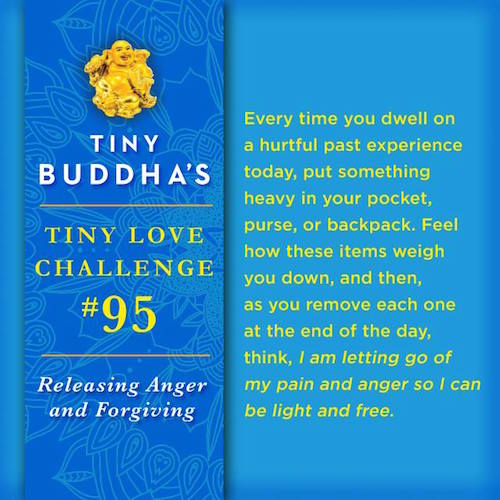
Love Challenge #95: Don’t Dwell, Let Go
What are you carrying around that’s weighing you down?
(This challenge comes from the upcoming book Tiny Buddha’s 365 Tiny Love Challenges. Pre-order before October 6th and get $300+ in free bonus gifts!)
-
40 Ways to Let Go of Anger Right Now
“You will not be punished for your anger, you will be punished by your anger.” ~Buddha
Anger is merciless.
It leaves you feeling torn up inside.
Your head pounds. Your jaw locks. And your muscles scream. Every inch reels in pain with the electric shock that shoots through you.
You can’t eat, or sleep, or function like a rational human being.
You’ve good reason to be afraid of unleashing that screaming monster of rage lurking inside you. You’ll likely lose control, lash out, and retaliate.
Even though you have been wronged, you’ll end up feeling guilty, ashamed, even horrified by your reaction. That’s one more regret your peace of mind wouldn’t stand.
But sometimes the person you’re enraged with is yourself. That’s a doubly painful blow of anger and self-disgust.
Being angry is exhausting . . . and yet you’ve found the energy to keep it alive for months, even years.
I have too. Oh sure.
I devoted the first half of my life to being angry, silently seething, and ever resentful. I’d periodically explode in rage and then be consumed with shame for losing control and screaming words I could never retract.
I lived on nerves that felt like they were constantly fried with 40,000 volts. That was a hideous way to be.
And for the longest time, that burning fury that raged inside me seemed totally justified. All that bitter resentment, well, “what else should I feel?” my thoughts screamed. No chance to be a kid, no carefree years, blissfully unaware of some of the bad things that could happen in life. They were right there, every day. They stole my childhood.
Growing up in an unpredictable, unhappy environment was the pits. I hated it, hated not being able to escape, and hated everyone involved because they were old enough to know better. They denied me my childhood.
My anger was borne out of having had no control of those events; my resentment grew out of a sense of loss. Oh boy, bitterness is so corrosive.
All that anger, all that resentment had to go for me to have any chance of happiness.
So with a newfound rationality, I learned to listen to my angry thoughts. I heard the pain and sadness wrapped in every one. I recognized the self-harm my anger was inflicting. I realized I’d been the one keeping alive those events and people that had hurt me, and I alone had the power to decide their time was over.
And that feels incredible.
I very much want that for you too. To be free. To let go of all that resentment, anger, and rage.
How? With one small anger-conquering action at a time.
40 Ways to Let Go of Anger
1. Look at your rulebook.
If you never explained your rules to the person who angered you, how can you be upset that they broke them? Maybe their rules are different.
2. Use aromatherapy to create a calm environment.
Candles and diffusers alleviate stress and anxiety. Or try a couple of calming drops of essential lavender oil on your pillow.
3. Buy a recordable alarm clock.
Wake up to a soothing self-recorded message. Alternatively, use an app.
4. Recognize that others say and do harsh things out of jealousy.
Change your anger to compassion because they are obviously struggling with their own negative emotions.
5. Personalize a keep-calm mug.
Choose some anger-defeating text for your mug. Use it at work or home.
6. Let your anger fizzle out with a bath-bomb.
Relax in a warm bath as you watch the bath-bomb and your anger fizzle away.
7. Quiet your anger.
If you’re likely to fall into a rage when speaking up, say nothing at all. “Silence is sometimes the best answer.” ~Dalai Lama
8. Visualize your anger as a drop of water.
Close your eyes and see your mind as a crystal-blue ocean of calm. See your anger as a single drop of water falling into your calm ocean, barely causing a ripple before being absorbed.
9. Create a universe of peace in your bedroom.
Make a night sky with luminous stars and planets. Lie on your bed with the lights off, and pick a star to project your anger onto. Now re-focus to see the whole galaxy with your anger as a tiny dot among a universe of peace.
10. Put your anger to bed.
Anxiety and irritability are instigated by lack of sleep. More sleep can be as effective as conscious meditation. “Sleep is the best meditation.” ~Dalai Lama
11. Take responsibility for your anger.
Someone can influence your anger response, but only you control it.
12. See your anger as a boiling kettle.
Flick the switch to off as if you were turning off your anger. Let your temper cool down like the kettle.
13. Look at who you’ve become.
See how letting go will allow you to be true to yourself and finally at peace.
14. Paint an angry mouth on an hourglass egg timer.
Now paint a happy mouth on the other half. Turn your angry mouth upside down and watch the happy mouth fill.
15. Understand that you are only hurting yourself.
“Holding onto anger is like taking poison and waiting for the other person to die.” ~Unknown
16. Recognize their inner angst.
This is the real reason they acted like they did. Heal your anger by setting out to help them feel better about themselves.
17. Blow up a dozen balloons.
Write an angry thought on each one and step on them until they pop, leaving only the shredded remnants of your deflated anger.
18. See your anger as a runaway horse.
Imagine it trying to break out of your “mind paddock.” Rein it in.
19. Use wise words to halt angry words.
In confrontational situations, remember: “Speak in anger and you will have made the best speech you will regret.” ~Dr. Laurence J. Peter
20. Wear a calming color.
Avoid confrontational colors like red and black. Instead wear calming blue or soothing green.
21. Have a calming message engraved on a ring.
Avoid anger by playing with your ring and thinking of those soothing words.
22. Use a mirror for self-reflection.
Look in the mirror and let your anger out. “The more you hide your feelings, the more they show. The more you deny your feelings, the more they grow.” ~Unknown
23. Shred a physical representation of your anger.
Take those hurtful letters, print off those emails, or write out your angry thoughts. Push the pages through a shredder, and reduce your anger to tatters.
24. Record yourself describing your anger.
Capture your angry thoughts on your phone or computer. Listen back to this as if it were a good friend telling you theirs. Offer yourself the empathetic advice you would give a friend.
25. Repeat a happy mantra.
Regain control of your emotions by repeating, “I’m a happy person who does not see the benefit of staying angry.”
26. Choose a positive, healthy outlet.
Use feel-good endorphins to dispel anger by going for a run or singing loudly and dancing energetically.
27. Express your anger to a friend.
A supportive environment can be hugely beneficial in getting your emotions out safely.
28. Use a self-hypnosis video.
Hypnosis can help you get your anger under control. Alternatively, try a registered hypnotherapist.
29. Shift your perspective.
If you cannot change the events that have made you angry, change your perspective for the sake of your peace of mind.
30. Take a soothing shower.
Wash away your anger with calming ylang ylang or chamomile shower gel.
31. Personify your anger.
Imagine it as a fiery-tempered troll in your path. Push it away.
32. Remind yourself that you have a choice.
“Between stimulus and response there is a space. In that space is our power to choose our response.” ~Viktor E. Frankl. Decide that your response will not be anger.
33. Keep this quote on you at all times:
“He who angers you, conquers you.” ~Elizabeth Kenny. Repeat it to yourself when you feel anger rising, or pull it out and read if possible.
34. Take a step back.
In a confrontational situation, physically take a step back.
35. Be honest with yourself.
What are you achieving by holding on to anger? Is it a case of injured pride that you would really love to swap for forgiveness?
36. Picture angry thoughts as bitter, poisonous seeds.
Stop these from taking root in your mind. Instead, raise a happy, forgiving “mind garden” by populating your thoughts with anger-defeating quotes.
37. Plant a garden of compassion.
Take the idea above a step further with a flower border or window box. For your own well-being, plant a flower for anyone who has angered you to signify your wish to forgive them.
38. Weed out your anger.
When you tend your Garden of Compassion, picture each weed you root out as further uprooting your anger.
39. Seek help to defeat your anger.
If you feel stuck in a cycle of resentment and anger, consider taking a course.
40. Laugh at your anger.
“People are too serious. All the time, too serious.” ~Dalai Lama. Anger is sometimes just injured self-pride. It’s not easy, but try not taking yourself so seriously.
Beat Your Inner Anger Monster for Good
Being angry has stolen your happiness for too long.
It’s eaten you up from the inside and shattered your peace of mind.
It’s even affected your health.
But worse still, it’s allowed the person or events that caused your anger to have power over you.
Just imagine getting through a whole day without losing your temper.
Imagine that seething resentment disappearing, leaving you feeling liberated of all those toxic thoughts.
Imagine being able to react with forgiveness instead of rage and being able to respond by letting go rather than clinging on to old hurts and wrongs.
By taking small, simple actions, you can take great leaps in beating your anger monster for good.
Try to be open-minded in letting these ideas speak to you. Pick the ones that shout loudest.
Put yourself back in charge of your emotions, your life, and your happiness.
Happy woman image via Shutterstock
-
How To Reclaim Your True Identity and Live Beyond Your Labels
“When I discover who I am, I’ll be free.” ~Ralph Ellison
Who are you? Yes, you! No, not what the world has tried to make you. Not what your past tells you. Not what your worries tell you about your future. Who are you?
If you’ve ever felt like your identity has been completely shattered, then I have news for you…
Good! You’re on the right path. Give me a second, because I’m sure you’re wondering where I’m going with this.
Well, how do I begin reclaiming my identity once it’s lost? First, in realizing what your identity is. What is an “identity?” Were you born with one? No. Did you suddenly become your “identity”? No.
You created it. We are merely the creators of our identity.
When I was in college I used to define myself as a singer. I was at the best university in the country for musical theater and singing was all I did. In fact, it was the only thing I really cared about.
People would always ask, “What do you do?”
“I sing.”
“Oh, cool! What else!?”
“Uh, I sing.” But it was more than what I did—it was who I was. WARNING: This is very dangerous.
Why? Because what happens when you lose the very thing that “makes you” who you are? Well, I’ll tell you…
My senior year of college I lost my voice completely to a cancer diagnosis. Yeah, pretty dramatic, even for a kid studying the dramatics.
For two years, my booming baritone turned in to a whisper. I no longer knew who I was. If I wasn’t a singer then who was I? Am I a cancer patient now? How will the world know how to define me?
After months of wrestling with this concept of who I was, I finally got some clarity. My best friend and I were speaking one day and I brought it up, “Now that I can’t sing, I don’t know who I am anymore.”
She looked me square in the face and said, “Alex, do you think I’m your best friend because you can sing?” I honestly didn’t know.
“Do you think people only admire you because you sing well?” Again, clueless. “Your talents don’t define you. You are none of those things. You are a loving, generous man, and that has nothing to do with your singing.” Light bulb to my inner light!
Maybe this is all obvious to you, but for me it was a huge revelation. Hopefully you’re not suffering from my label syndrome. Our identity is not our labels!
For the first time I started waking up to the fact that we are only what we say we are. We limit our potential by trying to box ourselves in to descriptions that the world can understand.
The soul does not understand labels. We’re not meant to be barcodes that run through an assembly line like products in a factory. Our identity has nothing to do with our labels and everything to do with our qualities.
We were created so that we can create from our inner qualities. That is our identity.
So let’s shift the bloggersation.
Knowing and having a sense of identity is still important as long as it’s not about your occupation, achievements, or external gains.
So what is your true identity? Your true identity knows nothing of fear or labels. Your true identities are reflections of love. How the heck do we uncover that?
I’ll tell you!
Here’s an eight-step process to help you uncover your true identity (I’ll be the guinea pig):
1. What are the labels you’ve created for yourself?
Easy: Singer. I’ll throw in actor just for fun.
2. What qualities do those labels have in common?
Approval seeking. Giving. Passionate. Loving. Serving.
3. What qualities do you identity as limiting?
Approval seeking.
4. How can you challenge that limiting identity?
By doing something completely embarrassing and/or failing on purpose in front of people. Perhaps making some typos in this bloggesthofihgjh post (that was fun.)
5. Was there a key decision that gave you this limiting identity?
When I saw how much my dad loved me after a performance I gave. I thought the only way to get that love would be by performing. Essentially, seeking approval/applause = love. (Anyone else relate?)
6. What are the consequences of this limiting identity?
Thinking that the only way I can get love is by performing and getting the approval of others. Not showing my true self in fear that I might not be “approved.”
7. What is your life like without this limiting identity?
I’m fulfilled because I’m communicating from a place of authenticity instead of trying to impress. I realize in order to have true love I must love myself first. I know that my true artistry will come when I’m creating from my place of purpose not what I think others want to hear.
8. What action can you take to prove your limiting identity wrong?
Finish this blog, send it off to Tiny Buddha, and not care whether or not it’s accepted (although I hope you’re now reading this, Tiny Buddha readers. So meta).
So there you go! That didn’t take long and you can do that for any limiting quality you might have. My only hope for you is that you become your true self so you can create beauty for others.
Oh, and FYI, if you were wondering, I’m cancer free and my voice is back! I now know more than ever that my true indentify is how I show up in the world, not what the world would like to call me.
Let me know in the comments: What’s your true identity look like? How do you plan on claiming it?
Claim your purpose, live your love, and spread your light!
-

Feeling Trapped? Step into the Unknown and Set Yourself Free
“Don’t call it uncertainty—call it wonder. Don’t call it insecurity—call it freedom.” ~Osho
My daughter loves birds. So, as a treat, we all went to a Bird of Prey center near to where we live. Here in the UK, there is a long tradition of keeping these birds. As stated on one hawking site, falconry is “the noble sporting art of flying trained birds of prey.”
Noble or not, I have an issue with keeping birds captive. I had hoped that, in the center we would be visiting, these would be rescue birds.
They weren’t.
They were raised in captivity, slightly better than being caught in the wild, but only slightly. There was one area I referred to as Prisoner’s Row. Big, powerful and noble birds like falcons and kestrel chained to a post. A long row of them stuck there for visitors to gawk at.
Yes, they are beautiful, and amazing to see up close, but they are much more beautiful to see flying up there in the wild expanse of sky.
In any case, we were there for the Owl Experience. One by one, they brought out owls, starting with the smallest burrowing owls and getting bigger until the huge and majestic European eagle owl was brought out.
The birds were coaxed over to the leather gauntlet our kids were given to wear. They were stunning and tolerant of us, but it was clear they were doing something against their nature. Owls are not meant to perch on human arms. These owls have been trained to do so, but trained against all natural inclinations.
Then we went out to the flying arena where our children fed them. Chopped up bits of baby chick feet were dangled temptingly in the air then placed on a gauntlet, and eventually and very reluctantly the owl swooped down and picked up the morsel.
They weren’t good flyers, these birds. They knew how to fly but their muscles were weak. They flew short distances and preferred to hop.
It all left me feeling uncomfortable. It was a privilege to see these beautiful creatures up close, but at what cost?
Perhaps it makes me uncomfortable because it is uncomfortably close to our own limited experience of life.
As I watched the owls soar within the flying arena, I wondered why they didn’t simply soar off to freedom. They weren’t chained. Their wings were not clipped. They could do it, if they chose to.
But they stayed. They hopped and half-flew to each wiggly bit of chick foot and hop-flew back to their post, with thinly veiled resentment. But they stayed. And then, after the show, they allowed themselves to be carried back to their cage.
Why?
Perhaps the birds are as susceptible to the lure of certainty as we are.
There is the certain provision of chick feet if they fly to their keeper’s arms and back to a post within a small outdoor arena. After all, having been raised in captivity, that’s all they’ve known.
And then there is the great, wild uncertainty that exists beyond the arena. Will there be food there? Will they be able to catch it? Are there unknown dangers lurking in that great blue expanse of sky?
And here’s the clunky metaphor. My husband and I are in our own sort of flying arena at the moment. We’re both in regular jobs, jobs that more often frustrate than inspire, getting regular paychecks.
We’re eating with these paychecks. It may be our own version of chick feet, but, hey, we’re eating. We are testing our wings, though. Flying a bit further. But, for the moment, we are returning to our keeper’s arms.
We gaze out at that broad blue expanse. We know we’re capable of more. We know we haven’t really tested ourselves; we haven’t really indulged our deeper passions. It seems to me that we’ve all been trained to do things against our true nature, and have grown up in this limited, but safe, way.
The few times I’ve flown into uncertain territory have been terrifying but thrilling.
As it has been said, uncertainty is the only certainly. To resist it is to resist our true nature. To resist it is to stay trapped, to accept the cage, the gauntlet, the chick foot for supper. To embrace the uncertain is to fly beyond the arena into that beautiful blue expanse of freedom.
We know beyond a shadow of a doubt that the owls can do it. Not just can, we all intuitively know that they should do it. To live in the freedom of uncertainty is infinitely better than to live in the security of captivity.
We know this and wish this better life for the owls. Why, then, can’t we know it and create it for ourselves?
So this is my challenge, to myself, and to you, should you choose to accept it: try something you’ve never done before. Taste something you’ve never tasted before. Read someone you’ve never read before. Say something you’ve never said before. Write something you’ve never written before and then share it.
Step into the unknown and feel it—that ground dropping away, breath-catching feeling. That’s the feeling of the limitless expanse of creative potential. That’s life as it’s meant to be lived.
Man and birds image via Shutterstock
-
Why We Get Attached to Our Struggles and Who We Could Be Without Them
“Stop seeking out the storms and enjoy more fully the sunlight.” ~Gordon B. Hinckley
I have been interested in personal development for as long as I can remember.
I devour books about increasing confidence, happiness, self-worth, and intuition. I‘m inspired by articles about self-care, living intentionally, and aligning with your purpose in life. I have read many fabulous books over the last decade, all with their own nuggets of wisdom and insight.
Recently, I was reading the book, Supercoach, 10 Secrets to Transform Anyone’s Life by Michael Neill. In his book, Michael describes how many of his clients go through a phase where they feel unsettled as they begin to make positive changes in their lives.
Michael talks about how his clients literally begin “worrying about not being worried.” They feel that something is missing from their lives when they no longer have the struggles and challenges they once faced.
The idea that on some level, we are attached to our struggles and fear losing them (or who we might become when we lose them) struck me. Why would we want to hold on to what causes us pain?
I started to think about my own life. Who would I be without my struggles, challenges, and problems?
Who would I be if I didn’t have to worry about money or how to pay my mortgage?
Who would I be if I didn’t have to agonize over decisions about my children, but instead completely trusted my inner wisdom?
Who would I be if I had full confidence in myself and cared for my personal needs without guilt?
And maybe more importantly, who would be able to relate to me if I didn’t struggle? What kind of conversations would I have with friends and family if I had nothing to complain about? Would we have anything left to talk about at all?
The truth is, as I examined these questions, I realized that the answers were mostly tied to my ego: I wanted to have a purpose (which solving problems permitted) and I wanted to be liked (by people who could relate to my problems).
The more I thought about the answers to these questions, the more I realized that this was not the kind of person that I wanted to be.
I didn’t want my purpose to be about putting out fires or worrying about the future, and I definitely didn’t want people to feel connected to me only because we shared the same struggles.
I want to be someone who lives with intention and makes a difference in the lives of the people around me. I want to be someone who enjoys life and who inspires others by living this way. Most importantly, I want to be an example for my children.
For me, this was an eye opening insight. Ever since, when I notice myself getting worried or stressed out, or when I find myself complaining, I stop and ask myself how I might be attached to my current situation and why. I question whether I can make a different choice or react in a different way.
I may not be able to change the situation in that moment, but I can change my thoughts about it and my approach going forward.
Life isn’t always going to be a piece of cake. We’re here to learn, grow, and experience the full spectrum of life. We’ll have good experiences and not-so-good experiences. For some reason, it seems easier to get caught up in the not-so-good ones.
We can dwell on the challenges because it seems to give us that automatic bond to others who are experiencing the same crisis. We instantly connect with the other sleep-deprived moms, or the co-workers complaining about the boss in the lunch room. As humans, we crave that connection.
But what if we connected over the joys in life, not just the pains? What if we connected by lifting each other up and supporting each other instead of tearing each other down? What if we talked more about the beauty in life than about the ugliness?
There will always be times in life where we need support. I can’t promise to never complain again, or stress out, or need to vent to a girlfriend. But I’m working on it. Will you join me?
-

Letting Go of the Attachments That Keep You Unhappy
“Letting go gives us freedom and freedom is the only condition for happiness.” ~Thich Nhat Hanh
My father died when I was fifteen, so I learned right away that life was too short. At the time, the only meaning I could grasp from his death was that my life needs to mean something.
I vowed to make something great out of myself.
I went to college determined to become a police officer. I had a strange gut feeling going in, something telling me that it was wrong, but I just assumed it was because I had a hearing loss, and I wasn’t going to let that stop me.
I graduated with a degree in Applied Arts and Science. To this day, I’m not sure how I went down that path.
I know it was mostly due to confusion and self-doubt. I still had to be an officer though; I had to do something with my life. I spent more than a year unemployed, hating myself more and more with each failed interview, each rejected resume.
In my spare time, apart from moping, I wrote. Growing up I always had a small dream to be a writer, but I always pushed it aside, for too many reasons to list.
One day, after I failed a physical to enter the police academy by two seconds, I drove home and it hit me.
I didn’t want to be a police officer. I wanted to be a writer.
What was I doing?
I mentally beat myself up. I was so desperate, so attached to the idea that I had to be great, go somewhere no hard of hearing person ever went, that I failed to truly live.
How could I miss all the things around me that I enjoyed, that made me happy and at peace?
I had an amazing husband who always nudged me to write. I had great friends who loved me for who I was, not who I was set out to be. I had a family who supported me no matter what.
I lived in Colorado with beautiful mountains and scenery.
I failed to realize what I really learned from my father’s death: life is too short. Embrace the moments.
How often have we attached ourselves to an idea that if I accomplish this, then I’ll be happy? The thing about dreams and goals is that they have to change with us. We can’t expect things out of life. We have to enjoy the ride, learn from our sufferings, and take each day as it comes.
Letting go of a dream, especially one I’d held since childhood, was a very hard thing for me to do. But once I did, I’d never felt so free. Everything in my life fell into place.
Attachment makes us suffer; it forces us into self-doubt and misery. We are tied down and locked in the prison of our own minds.
Once you let go, you are free. It’s so liberating. It starts to become a little bit easier, day by day, to let go of other things. It’s not easy, though. Old habits tend to pull us back in, but if we learn to recognize this, we can continue to soar.
How can you let go? Here’s what I learned that helped me.
1. Don’t expect things out of life.
This applies to everything. When you’re nice to someone, you expect them to be nice back. When you do someone a favor, you expect something in return. When you have a dream, you expect that it has to happen or you’re a failure.
I expected to be a police officer. I ended up being a writer and working in a bookstore. And I’m so happy with where I ended up. You can’t force life to happen. Letting go helps you to embrace life and the path you are on, not the path you expected to be on. And sometimes you end up where you need to be.
2. Accept things the way they are.
Again, apply this to every aspect of your life. Accept people for who they are and how they behave. Accept who you are. Accept the world for what it is. Once you accept things, you can look deeper and see things for what they really are.
3. Meditate or sit quietly.
Sometimes just sitting still and quietly can help us look deep within ourselves and see what we really want. If I had done this long ago, I would’ve realized that being a police officer wasn’t what I truly wanted.
When you meditate or just sit with your thoughts, you’ll find that the answer you want will come to you. and it’ll always be the one you’ll least expect.
4. Recognize your feelings.
When you find yourself attached to an emotion or idea, recognize the feelings and reasons behind it. What emotion is locking you to your attachment?
For example, my attachment to being an officer was due to an old childhood emotion of wanting to prove to everyone that I can do something most people can’t.
5. Forgive.
This is one of the hardest. We have to look deep within us and forgive ourselves for everything. We have to see that we’re humans, and no human is perfect. We all make mistakes, and it’s okay to have made mistakes.
Forgive yourself for everything. Once you do, you can let go of the attachments that keep you trapped, whether it’s to anger, a false self, or fear.
It’s only until we let go are we truly free. And it’s only then can we really embrace the present moments and life itself.
-

4 Simple Steps to Freedom
“I know but one freedom and that is the freedom of the mind.” ~Antoine de Saint-Exupery
Once upon a time my mind was filled with negative talk and self-doubt. Those thoughts were so loud I could not hear my authentic self shine through. On a deeper level I knew she existed, but I didn’t how to connect with her.
I believed I would have to work at it, change myself, somehow be good enough so I could be free to be myself. I believed the key to happiness was figuring out how to fix everything that was wrong with me (and oh, was there a lot to fix).
If I fixed myself, then I could enjoy life and be that free woman I always envisioned myself to be. Little did I know the key to this freedom wasn’t fixing myself at all, but realizing that the little voice coming up with all those things to fix was a big, fat liar!
The most profound and important realization I’ve ever had came from reading a little book called A New Earth by Eckhart Tolle. It was that I am not my thoughts, but the awareness behind them.
Wow. My true self is the awareness behind my thoughts, and she is always here! I have the power right now to choose from which place I act—what a magical concept! (more…)
-

5 Ways to Let Go of Worries So You Can Be Light and Free
“I vow to let go of all worries and anxiety in order to be light and free.” ~Thich Nhat Hanh
Our daughter is seeing a counselor to help her deal with anxiety. She’s only ten. Cue mother guilt.
There are a whole lot of (mostly crazy) worries running around her little head, some that even I can’t wrap my head around. So I wrap my arms around her and reassure her that things will be okay.
I give her permission to be anxious, but try to instill resilience so she won’t worry so much. I try to teach her mindfulness and meditation and positive thinking. And I worry, about her and too many things—some role model I am!
Mostly, my daughter worries about something happening to her dad or me.
Separation anxiety is the crux of her problem. She’d been avoiding sleepovers with friends and even her grandparents, and it all came to a head when her school camp loomed large.
The good news is she got through camp, thanks to her resilience, mindfulness, her first counseling session, and our pep talks—and despite my worry, which was wasted, as it always is!
Getting through camp was a big achievement for our daughter in her journey to overcoming anxiety, but she has a road ahead as she deals with her fears about losing us, embedded as they are in processing her feelings about being adopted and the loss of her birthparents in her life.
She has a lot to deal with, yet she is brave, strong, resilient.
She’s only ten, but she’s already demonstrating ways to take worry out of her life. I’m beyond proud.
I gained my own painful insights into the futility of worry through a long journey of infertility and an equally long wait for adoption. Loss of control was the only certainty. Yet, I’ve gained the most clarity through my children’s eyes.
Children teach us lessons every day, if we are open to learning them. And they open our closed minds to lessons we learned as kids but have forgotten.
There was a time when worry didn’t exist, as hard as it is for us adults to imagine. It was all about the present; the future wasn’t to be feared.
The key to taking worry out of life, I think, is to reconnect with that sense of child-like wonder, while bringing to each moment the adult wisdom of knowing that worry will never change what happens. That “this too shall pass.”
Here are five ways to overcome worry that I’ve learned and assimilated from what my daughter has so courageously demonstrated.
1. Accept that some worry is good for you.
This sounds counterintuitive, but if you stop worrying about worrying, it’s a really great place to start!
For starters, you need to have some fear in your life for when you are being chased by a lion and need adrenaline to kick in in order to flee (great idea), or when you are confronted and the only choice is to fight.
A bit of worry is normal—good news for anxious people who worry even more about being abnormal. Some stress about consequences keeps us motivated. It keeps us alert to possibilities and shows that we care.
A little bit of worry is natural, normal, and human. Use it wisely.
2. Move through worry.
Can you imagine dancing and being worried at the same time?
Of course, even a prima donna ballerina will have at least a hint of stage nerves (for adrenaline, and because she cares). But the dancers we admire so much, who hold us in thrall, they go to a place where worry cannot exist.
It’s a magical place where their bodies meld with the music and become one, and there’s no time, only rhythm and movement and wonder that we humans are even capable of such beauty.
I’ve watched my ten-year-old dance like this, and I watch her all the time, flipping, cartwheeling, hand standing and doing walkovers, pirouettes etcetera, over and over. She quite literally moves through her anxiety.
She’s not worried at all about dance (other than a few stage nerves), and she loses all other anxious thoughts when she’s lost in the beauty of it.
Movement—be it dance, yoga, running, walking, swimming, or whatever sport or exercise—provides the opportunity to distract yourself from worry, to be lost in the wonder of being able to move your body for its own sake. Little by little, anxiety fades.
3. Sit with worry.
When we stop physical activity, we make room for more thoughts, and that can be scary.
This is when we need mindfulness to simply witness those thoughts—not to judge them, not to feed them so they multiply, but to simply observe them as waves rolling in and out.
If you can separate yourself from your worries and focus on your breath, then you can breathe in fresh air and calm and exhale worry. You create both a physical and mental means of release.
You can open the space for stillness, a place where peace replaces worry.
4. Talk back to worry.
Anxious thoughts are as persistent as they usually are irrational. When they take over our self-talk, it can feel like we can’t change the script. But they’re just lines in a script we run through our heads—a fiction.
Children, with their abundance of imagination, find it harder to separate fact from fiction, and one of the skills my daughter is learning is to think rationally about her anxieties.
For example, I tell her that it’s no more likely something bad will happen to her father and me when she isn’t with us than when she’s tucked up in bed in the next room. She sees the logic.
She worries about us being older parents and not being around for her, and while I can’t change the facts, I can point out that if she does the math her fears of our imminent deaths are unfounded if you look rationally at the figures (we are not that old).
Anxiety cowers in the face of rationality. Arguing back with forceful reason is a way to change your self-talk over time, literally starving your worries of oxygen.
5. Cultivate resilience.
Resilience, along with empathy, is the key quality we are trying to instill in our children. If they never have to cope with failure or disappointment, today’s mollycoddled generation risks falling apart in the face of a crisis.
Resilience is your armor against anxiety. When you cultivate resilience, you have a ready reminder of what you’ve already survived (and often thrived through) in the past. You are shielded by the strength you’ve built up and safe in the knowledge that you can prevail, that things will get better.
Resilience is so much more powerful than blind faith that things will be okay, because with resilience you will be okay regardless.
Worry can’t triumph against such resolve.
—
I wish I could say that getting over anxiety is easy because even a child can do it, but it’s not. It’s hard for our daughter, but we want to try stop anxiety becoming a painful pattern she takes into adulthood.
For us adults, I think we can only work with and through worry—put it in its place, put ourselves in control. Take the lead in this universal dance through life.
-

We Need to Give People the Freedom to Choose What’s Right for Them
“You must love in such a way that the other person feels free.” ~Thich Nhat Hanh
I’ve read a lot of articles about loving without attachment and respecting other people’s choices, but it wasn’t until one day that I truly got it. And I will tell you what happened to me that day.
My boss and I have a very special relationship. He’s the boss everyone would want to have. He appreciates me for my work and for everything I do. He thinks that I’m a great kid. Every time he has the chance, he praises my results and he shows his confidence in me and my work.
One day, I decided to go to a job interview at another company. I wasn’t planning to leave; I only wanted to see what other companies have to offer. And I told him about it.
His reaction was a complete surprise for me: instead of thinking of himself and offering me everything just so that I wouldn’t leave, he told me, “Andrei, go to the interview, and if you think that’s better for you, then go.”
It was obvious for me that he wasn’t okay with me leaving. He loved my work and he wanted me to stay, but he understood something: the most important thing is for me to be happy. And that made the difference.
He was thinking of me instead of thinking of himself. It was a breakthrough. Instead of forcing me to stay and granting everything so that I don’t leave, he offered me a choice. And choice means freedom.
It meant that I got to compare. I got to see what others have to offer and then choose what is right for me. And of course, when I get to choose, I choose what makes me happy. So I went to the interview, realized that my current project was better than the new one, and returned to work with new forces.
A few days after this I was at home, remembering the whole scene when my girlfriend called and told me that she was thinking of going on a trip for the weekend.
We hadn’t seen each other for a while, and I had made some plans for us for the weekend. But she was thinking of leaving and she wanted to know what I thought about it.
The first thing that popped into my mind when she told me this was: “No! Tell her not to go! We have plans!” But then I remembered how my boss had reacted. I wanted her to be happy.
I wanted her to be able to choose what was right for her. I wanted her to have a choice, as I had, because I understood that choice means freedom. So I told her to go despite the fact that I was a little sad that I wouldn’t be able to be with her.
There are two things that I learned from these experiences.
Letting go gives people a choice.
My boss taught me an important lesson: think about what other people want and need instead of only thinking about yourself.
When someone wants a thing that is in contrast with what you want, there are two choices of action. The first is convincing the other to do the thing you want. This path empowers you. You will be satisfied, but the other will not necessarily be happy with it. By following this path, you take a risk by thinking that you know what is right for the other one. And you might fail.
But there is another path: presenting your choice, but supporting the other’s choice. This path is more beautiful and more powerful because it empowers the other. You may or may not get what you want, but either way there is no way to failing.
Choice means freedom.
Freedom is a thing that we all desire because ultimately freedom brings happiness. Freedom means being able to compare the situations—the benefits and the drawbacks—and choosing what is best for you.
As much as we all want to be free, we have to understand that others have the right to be free, as well.
They say birds are a symbol of freedom. If you look at the sky and watch their flight, you will understand why. I’ve never seen a bird dragging another one around the sky. Yes, they might fly one near the other, they might eat and sleep near each other, but that’s it. If they choose to drag one another, neither of them will be able to fly and they will both fall down to the ground.
It can sometimes be difficult to respect other people’s choices because it conflicts with our ego. But we all want the freedom to choose what is right for us. And everyone benefits when we all choose to give it to each other.
Photo by Cornelia Kopp
-

What to Do When You Feel Caged: The Key to Lasting Freedom
“Wherever you go, there you are.” ~Confucius
Everything I do is about living and sharing freedom. But what is freedom anyway?
To understand freedom, it’s helpful to understand its opposite. The opposite of freedom is feeling caged, constricted, and ruled by guidelines you don’t believe in.
For many people, their job feels like jail. For some people, their community feels like jail. For others, school feels like jail.
I’ve been in all those jails. And for the most part, I was in those jails because I didn’t know there was an alternative. Now that I know the alternative, I have consciously created a life of freedom, but it wasn’t always this way.
I grew up in very religious schools, which felt like a jail, mentally and physically. There were strict rules governing what you could wear and eat and what was expected from you. Living in that jail mentality was stifling, and my need for freedom was bursting at the seams of my soul.
For several years I was curiously obsessed with social justice and the prison system. I now recognize that my fascination stemmed from my feelings about living in a jail of sorts during my youth.
At seventeen I left my hometown and embarked upon finding freedom and discovering who I was.
When you live in a jail-mentality for the bulk of your life, you get out into the big wide world and feel utterly lost. That was me—lost, and essentially going from one jail to another.
From the strict schools of my youth, I went straight to University, not knowing about the other options that were out there. And once again I felt caged. I felt jailed by the confines of my schedule and limited resources.
I was desperate to break free, so I found a summer job in New Hampshire that would give me room, board, pay, and a new experience.
I was taken by New Hampshire the moment I read the state’s license plate: Live Free Or Die. I knew I had landed in the right place. There, I met people from all over the world who had a similar freedom-travel-spirit mentality.
Coincidentally, I met someone there who shared my intrigue with the prison system and social justice, and informed me that I could talk to prisoners on death row.
While communicating with one inmate through letters, I learned that true freedom is in the mind.
That shook me.
I had heard that phrase before, but it wasn’t until I heard it from somebody who was really locked up that it hit home and touched my soul.
Imagine being constrained to solitary confinement. Imagine being thrown into the prison “hole,” a place of pure darkness, without the freedom to see. Imagine having your every move watched, being told when you can eat, shower, and sleep. And imagine even after all that, recognizing that you can still have freedom because it is in the mind. That’s a powerful awareness.
I knew that I was the only one putting the shackles on me. Although this message penetrated, it would take me several years to fully understand it.
After I left New Hampshire, I had a string of adventures and travels that allowed me freedom, possibility, and a life outside the status quo.
For several years all the outward travel fed my need for freedom. But there came a point where it was no longer freeing. I was starting to fall back into feeling jailed, despite making free and adventurous choices.
I knew I had to start moving inward if I was to find true freedom. So began my inner journey.
I started seeking out spiritual books from Deepak Chopra and Louise Hay, and reading the words from John Kabat Zinn, which resonated with me more than anything else. His book Wherever You Go, There You Are was like lightning hitting my heart.
That line was exactly what I had experienced—despite all my travels, where I searched for freedom on the outside, wherever I went, I was still there. I still had to deal with my own limitations and the blocks that I was creating within my own mind.
These limitations pertained to my self-confidence and self-worth—how I thought about myself, and what I believed about my ability to go after what I wanted and succeed. In perpetually thinking I couldn’t do things I wanted to do and that I wasn’t worthy of them, I paralyzed myself with fear.
You need to believe you can do something before you can find the motivation to take action on it. And my beliefs were limiting my actions. Although I was traveling from place to place, my internal limitations came with me.
It’s been a decade since I got that book, which focused heavily on meditation. I have since found the practice of pure presence to be one of the most powerful gateways to freedom. Meditation has this uncanny ability to break away the false self—the self-sabotaging thoughts and limiting beliefs.
So where is freedom? Is it inside us? Is it about our outside choices?
For many years the outward journey did the trick for me. It had an effect on my soul, although I did not have the understanding to recognize it at the time. However, the outward journey only took me so far.
I have found that ultimately it’s the inner journey that leads to lasting freedom.
I still enjoy “getting away” and having adventures. But I have come to recognize that in the confines of the outward journey I can still feel caged. It is only through going inward, specifically through practices of meditation and being present, that I can access long lasting freedom that endures, regardless of my outward circumstances.
If you are looking to enhance the freedom in your life, take some time to pause from your day and practice being fully present with the moment as it is.
Ironically, this is likely why travel is such a great way to feel free. When we travel, we’re more present by virtue of the newness around us—the change of culture or scenery. Everything is so new, so we are like babies enthralled by our surroundings and naturally we get out of our head and are deeply connected to the moment. It is, in effect, living a meditation.
The magic of a meditation practice (and yes, five minutes will do the trick!) is that you can train yourself to strengthen the muscle of presence in your everyday life, so that you can have access to that freedom no matter where you are.
Although five minutes may sound simple, it can still be challenging, so I recommend committing to a specific time, such as first thing in the morning, to ensure you do it.
Then, any time that you feel constricted, scared, stifled, or confused, you can tap into the practice of meditation to help you reconnect with yourself, and reconnect with an inner sense of freedom. This won’t change physical circumstances that may feel constricting, but when you free yourself of mental limitations, it’s a lot easier to find solutions to physical ones.
Meditation is a vehicle to freedom because it often gives us clarity, and allows us to free our mind from our blocks and limitations. Meditation helps us access our intuition, which can guide us to the things that will help us live a more purposeful, freedom-filled life.
Freedom truly is in the mind. If you feel caged in yours, remember, presence is the key.
Photo by Kamil Porembiński
-
A Place to Release Your Secrets and Shame: Share Your Truth in the Forums
Ten months ago when I launched the Tiny Buddha community forums, I hoped they would better enable us all to connect with and support each other.
Since then, I’ve been amazed and inspired to see the love and compassion people extend there, without any agenda beyond helping others feel less alone and more at ease in our uncertain, often confusing world.
There are now over 10,000 active forum members, and there have been more than 1,600 conversations on a wide range of topics related to spirituality, self-esteem, relationships, purpose, parenting, health and fitness, and more.
Whether you’re an active member or just discovering the forums for the first time, I’d like to draw your attention to a new forum category that I hope will be helpful and inspiring.
I launched it last week after receiving a number of blog submissions with a similar message: We can set ourselves free by sharing the stories we may otherwise be tempted to hide.
One of these posts came from a woman who’d given birth secretly in a convent at age sixteen and then given her child up for adoption.
Another came from a brave woman named Sonia Friedrich, who graciously agreed to be the first poster in this new category, with her story about coming out after years of hiding her sexuality.
All the stories had one thing in common: a secret that, when kept, hardened into shame, and when released, softened into peace.
The new section is called “Share Your Truth,” and I launched it with this introductory post:
We all do it to some degree—look at our experiences with a critical eye and decide which ones feel unsafe to share.
We don’t want to be judged, or ridiculed, or misunderstood; we all hope to be loved, supported, and accepted.
But ironically, in hiding pieces of ourselves or our past, we limit our ability to receive unconditional love and acceptance. How can anyone offer us those things if they don’t know who we really are?
And even if they do know who we are, how can we accept their love if we don’t fully believe we deserve it?
That’s what we’re telling ourselves when we choose to hide—that we’re not beautiful, loveable, and worthy, just as we are, and we better hold tight to all the evidence, lest others see it and confirm our fears.
So I say we challenge that scared voice inside that tells us there’s something wrong with us. I say we fight the instinct to cower in shame instead of showing up fully and letting ourselves be seen. I say we own it all—the light, the dark, the highs, the lows—and instead of fearing that others will not accept us, we show them what it looks like to do it.
My name is Lori. I spent more than a decade struggling with low self-esteem, depression, and bulimia. I then spent several more years drinking, smoking, and hiding from the world because I was afraid you wouldn’t like me.
Though I’ve come a long way, due, in large part, to years of therapy and a commitment to personal development, I still struggle with people-pleasing instincts at times, and I still go through phases when I feel insecure. I don’t know if that will ever go away fully, but I am okay with that.
I am proud that I keep going and growing. I am proud that I keep showing up, despite my struggles and imperfections. And I am proud to share my truth.
Is there a truth you’ve been hiding? Are you ready to set yourself free by sharing it?
Start a new thread by scrolling to the bottom of this page: http://dev.tinybuddha.com/forum/share-your-truth/
Feel free to write as little or as much as you’d like—a word, a sentence, a paragraph, or more. This isn’t about getting advice, though you’re free to ask for it, if you’d like. It’s about sharing yourself authentically, knowing there’s beauty in who you’ve been, who you are, and who you will be.
It’s also about letting those who read this know they’re not alone in whatever they’re going through. Whatever it is you’ve been hiding, you can rest assured there are countless others out there, just waiting for someone else to say they can relate.
Just to let you know, before you even share, I admire you for doing this. And knowing this community like I do, I think I can speak for the other members when I say: we value and accept you, just as you are.
—
If you’re not yet a forum member, you can create a free account here. You can then share your truth—whatever it may be—here.
Thank you for being part of the Tiny Buddha community. You make a difference, and you’re appreciated!
-

6 Tips to Help You Free Yourself from Your Fearful Thoughts
“Whatever the present moment contains, accept it as if you had chosen it. Always work with it, not against it.” ~Eckhart Tolle
Here I am, huddled up close to the wood burner, my only source of heat, sitting on an old recliner chair that was given to me, in a rented apartment with windows soaked with condensation. Outside it is cold, wet, and dreary, a typical English winter’s day.
My business folded in July with substantial personal debt and I turned forty-four in August.
Perhaps not the most heart-warming start to a post, but rather some raw facts of how my life is now, not x number of years ago before I turned my life around, but now! I’m pretty sure I am not alone in this situation I find myself.
In July when I folded my never very successful business resulting in substantial personal debt, the first thing I did was completely freak out—panic attacks, endless anxiety, depressive thoughts, the whole nine yards.
I went to my doctor who gave me anti-anxiety medication without a second thought. I tried them for a couple of months, but I had been down that route before and this time I felt that it was not the solution to my problems. So after consulting with the doc I carefully weaned myself off of them.
What I needed was answers as to what was causing me so much pain inside rather than a Band-Aid to cover it. I needed to find out why I seemed to have spent my entire life under a shadow, a shadow from which I never felt comfortable emerging to engage fully with the world for fear of being seen.
Enter Tiny Buddha. I found Tiny Buddha by chance while endlessly searching for answers as to what was broken in me. What I discovered after reading hundreds of posts was a revelation: I am not broken.
After digging deeper, I began to realize that I was locked in a trance most of the time, a trance created by my egoic mind. A trance shaped by fear during my formative years. My psyche was trying to protect me from the fear and lack of safety I felt when growing up; it was trying to keep me safe.
My childhood interpretation of the events I experienced, combined with non-compassionate and non-understanding authority figures, led my psyche to decide that the best way to deal with life was to retreat to a place of safety and hide, to not get involved or be exposed in any way.
It met any situation or event that it interpreted as fearful with vigorous resistance.
As most things in life contain some element of fear and anticipation, especially new things, my egoic mind trance was active most of the time, constantly in the background, ready to come to my rescue at the slightest whiff of perceived danger.
The irony is that my mind’s way of “rescuing” me was to paralyze me with feelings of dread, worry, and anxiety, coupled with the physical feelings associated with panic.
It’s not easy when your egoic mind has spent the greater part of your life trying to convince you that it is the only place where you are safe.
Over the years the egoic mind has plenty of time to really go to town building a devilishly intricate trance machine that becomes deeply entrenched in the psyche. Mine was so entrenched that I thought it was me. Until recently, that is.
What I am learning from reading many posts on Tiny Buddha, which led me to books, podcasts, and other resources on the subject of the being, is this:
1. We need to realize that we truly are not our thoughts.
Our thoughts come from the egoic mind. We are the awareness that hears the thoughts.
When you talk to yourself inside your mind, to whom are you actually talking? It is your awareness, and that is who you are, that is your being. Not the thoughts.
Your thoughts are just constructs of your egoic mind. You can actually choose to let them float on by without believing or engaging them, should you choose to.
2. Understand it is not your fault that your mind is causing you such pain; it’s a product of evolution.
Back in the days of caves and things with sharp pointy teeth, you were more likely to survive if you were ever vigilant of danger—meaning the genes that favored this behavior were more likely to get passed down… to you.
The egoic mind thinks it is helping you by keeping you safe and trapped inside a trance. It is not its fault, and you have to face your trance thoughts with compassion and love, and be able to forgive yourself. It really isn’t your fault.
3. Use meditation and mindfulness throughout the day; learn to see the space between the real you—which is awareness—and the egoic mind, as its thoughts race by.
Observe thoughts for what they are: just thoughts. Try not to allow yourself to become absorbed in your thoughts and go into trance, but do not punish yourself if you do.
Be kind and compassionate to yourself when you recognize you have drifted away and start fresh in the moment, returning to a state of mindful awareness whenever you can.
4. Identify the trance thoughts and emotions as they arise and name them.
For example, “Oh, this is fear I am feeling, just fear,” or “I feel you dread and worry; it’s okay,” or “Hello shame and unworthiness; I see you.”
This technique of compassionate recognition will reduce the power they have over you, as you have exposed them for what they really are: just thoughts.
5. Remember that it takes perseverance and practice, lots of it.
Another fun thing we inherited from our ancestors is that the fear of something can become embedded in our long-term memory even after a single, brief exposure to it. Conversely, it takes much longer and repeated exposure to positive stimuli before they are committed to long-term memory.
6. Each time you notice yourself in a state of negativity, use it as an opportunity to practice, to mindfully observe your thoughts with acceptance and compassion.
This will allow them to flow through and out of you rather than be kept inside to be constantly recycled.
Do not beat yourself up if you find it difficult to let go of thinking. Be patient and compassionate with yourself. It took you more than a few days to learn to read and write. It will take a little time for you to calm your egoic mind and let your awareness shine through.
This is the path I have begun to walk. I’ve begun to let go of expectations about others and myself; to learn to be compassionate and to love myself; to accept who I am, and where I am in this moment; to try not to judge others or myself. To know that in this moment everything is okay.
And now that my cat is lying on my lap, I guess that means it is time to finish this. Life is all about these moments.
Photo by D.Ph
-

The Power of Surrendering: Let Go of Control to Be Peaceful and Free
“The reality is that tomorrow is most certainly uncertain and no matter how many expectations we form, tomorrow will come, tomorrow will go, and it will be what it will be.” ~Lori Deschene
I have never known how to surrender to just about anything. Surrendering is giving up control, and this is something I have never been good at doing.
From an early age I coped with tension and negativity by trying to will things to be different. This caused me a great deal of anxiety because trying to will anything to go your way is not only exhausting, but also impossible.
My efforts always wound up seeming fruitless, and I often felt that many things were out of my control, starting with my home life.
I am the second of five children, so money was always tight. My mom worked two jobs as a nurse, and my dad had his own struggles. The financial strain at home was bad, but the emotional one was much worse.
I wanted so badly for my parents to get along, and yet it seemed to always be out of my control. No matter how much effort I put into not creating waves, nothing helped. I never learned to relax. I felt like if I was constantly on some sort of emotional alert, somehow the blows wouldn’t hurt so much.
That was never the case. Soon it seemed I was anxious even in peaceful moments because I always expected those quiet and happy times to be the calm before the storm.
School did nothing to help my anxiety. I had a close knit group of friends beginning in junior high, most of whom I am still very close to now; however, I never truly felt comfortable in my own skin as an adolescent.
I was a beanpole growing up, but then suddenly my body changed in my early teens, and not in a way that I liked. I noticed how much wider my hips were than my friends’, and how I had to wear a size fourteen when everyone else was wearing a size four.
During this time I made a promise to myself that I would grow up to be much different. One day my life would be mine, and I would be able to control it to be just how I wanted. I would finally surrender to the palpable joy of my wonderful life.
This mindset did nothing to cultivate a healthy young adulthood, though. Instead, it led to bad relationships (the “I can change him” mentality) and an eating disorder (I thought I could control my body, if nothing else).
Time did heal some old wounds, and eventually I stepped away from the bad body image and found myself in a happy, healthy marriage. Yet I found that my anxiety had stuck around. I really thought that once I had a wonderful husband and a great job, all of my worries would be over, that suddenly the anxiety I had growing up would cease to exist.
Why wouldn’t it? Clearly I would have nothing to worry about—except I still find so many things to worry about: My parents getting older, my own finances, my dogs’ health, and even my marriage.
It doesn’t help that I’m a fixer. You have a problem? Give me a few minutes and I can solve it. Can’t find a job? I am your woman. Need psychological help? I will forward you my counselor’s information.
The trouble is, most of the time this is unsolicited, and I find myself trying to fix issues I have absolutely no business fixing. These aren’t my problems and, quite frankly, it is exhausting trying to fix other people’s lives while also finding time for my own issues.
I have a hard time understanding that not involving myself doesn’t mean I don’t care. It means I care enough to believe someone else can solve their problems without me.
I have never enjoyed trying to control things. I truly want nothing more in life than to just let go, let things happen for what they are. I have just never been able to loosen my grasp.
The closest I ever came to surrendering myself, mentally and physically, was when I went skydiving. I put my trust and faith (and life) in both the pilot and tandem jumper. I remember the guy I jumped with giving me instructions as we ascended into the sky.
The instruction I remember the most was that under no circumstance should I try and grab onto any part of the plane on my jump out, especially the wing. If I did, not only would I risk getting hurt, but also would risk the lives of everyone in the plane, including my eventual husband.
For a split second I panicked: “What if my inner control freak rears its ugly head and tries to grab ahold of something during the jump?”
But the more I thought about it, the more I realized I would not grab onto anything. I didn’t want to get hurt, and I certainly didn’t want to be responsible for hurting anyone else.
And so I jumped. I went free falling out of a plane from 10,000 feet in the air, probably plummeting at about 100 miles per hour.
It was amazing. It was freeing. It was surreal. It was eye opening.
There I was, falling from the sky without the ability of manipulating anything in my favor. For once, I had absolutely no control of an outcome. I had to accept that, put my faith in someone else for a brief moment, and just let the chips fall where they may.
It took jumping out of a plane for me to get it, but at that moment I finally felt how freeing it is to let go and surrender control.
I used to hate people telling me things would be okay. At my lowest and saddest points it seemed like things wouldn’t be okay because I was unable to control any outcome.
I once had a boyfriend who told me this, even as I sobbed on his porch about how horrible my life was. I asked him how he knew that things would be okay. He didn’t have an answer. I was angry that he would tell me things would turn out all right when he could make no guarantee that they would.
Looking back on that day, I realize now how unrealistic it is to expect any guarantee you that your future turns out all right. Life makes no promises and is not obligated to guarantee anything. The way things are doesn’t always follow what we want.
I have spent many of my happiest days clouded by anxiety because I’ve been simultaneously waiting for the other shoe to drop. I need to re-learn the simplest things, like how to just enjoy a moment for what it is without worrying about some impending doom.
I need to allow myself to trust more instead of panicking about everything that could go wrong. It won’t be easy, and it will probably make jumping out of a plane seem like a piece of cake. But just like with the wing of the plane, I need to allow myself the freedom from constantly grabbing for safety.
I once sang The Beatles’ “Let it Be” to audition for a high school play. I read that Paul McCartney wrote it after having a dream in which his late mother came to him during a difficult time in his life. She told him to let things be and that they would all turn out okay in the end.
A simple song has helped me scratch the surface and realize profound beauty in just letting things be what they are.
It is through letting go that I can finally bid farewell to my anxiety and learn to see this life in a new light, one that isn’t controlled. It will be a life in which I allow things to happen as they do and land just where they are meant to land. It will be a life in which I finally learn to surrender.
It’s only in surrendering that we can be peaceful and free.
Photo by Lachian Rogers
-
Tiny Buddha’s Recreate Your Life Story eCourse Launches Today!

If you’re new to the site, you may be wondering who I am. Hi there! I’m Lori, and I’m the founder of Tiny Buddha.
If you’re not new to the site, you may be wondering where I’ve been, since I haven’t written much lately.
There are a few reasons for that. For one, I’ve focused a lot more on curating and editing blog posts from other community members. Secondly, I’ve been traveling, as I mentioned in a post in April.
But aside from that, I’ve spent the last several months working on my first ever eCourse, Recreate Your Life Story: Change the Script and Be the Hero, with my partner Ehren Prudhel.
The last time I remember feeling this excited was September 9, 2009. It was the day tinybuddha.com first appeared on the web—then a site with just a few pages, a handful of quotes, and only two other blog contributors.
After spending more than a decade depressed, isolated, and anxious, and several more years in a process of self-discovery, I felt that unique blend of exhilaration and fear that comes from finally trying something new and putting yourself out there.
Now, nearly four years later, the site has grown into a community of more than 650 writers and millions of readers—all connected by a common intention to embrace wisdom and growth.
I believe this course I’m presenting to you today can be a powerful tool to support those intentions.
It’s a fun, creative course blending self-help and film that can help you let go of the past so you can feel free, happy, and unlimited in the present—and confident about creating the future.
There’s a whole lot more about the course at recreateyourlifestory.com, including the brand new trailer:
Interested in learning more? Visit me at recreateyourlifestory.com! -
Flash Mob of Cancer Survivors: Closer to Free
I’m a huge fan of flash mobs. There’s something about a seemingly random, slow-building display of mass creativity and joy that never fails to make me smile. This one, featuring a group of cancer survivors and a children’s choir, gave me goosebumps. Beautiful voices. Beautiful spirit. Beautiful message of hope.