Tag: fix

  • When Love Isn’t Enough: How I Found Healing After Emotional Abuse

    When Love Isn’t Enough: How I Found Healing After Emotional Abuse

    “You can’t save someone who isn’t willing to participate in their own rescue.” ~Unknown

    You and I have been doing the work. Talking. Writing. Processing.

    Everything I’m focused on right now—in my healing, in my spirit, in my writing—is love. Becoming love. Living in love. Returning to love.

    And yet, there’s a chapter of my life that continues to whisper to me: Why wasn’t love enough?

    I spent nine years in a relationship that left me anxious, confused, and small. I was always on edge. Walking on eggshells, never knowing whether I’d be met with affection or fury. He could be charming one moment and cruel the next. A Jekyll-and-Hyde personality I came to normalize.

    I stayed longer than I like to admit because I believed, deep down, that my love could heal him. If I just loved harder, more purely, more selflessly, maybe I could soften his edges. Diminish the rage. Make him whole.

    But no matter how hard I tried, it didn’t work.

    He still raged. He still criticized. He still looked at me like I was the problem.

    Eventually, I had to face a truth I never wanted to admit: Love, at least mine alone, wasn’t enough to change him.

    The Lie We’re Told About Love

    So many of us are raised on the idea that love conquers all. That it’s our job to be patient, forgiving, and understanding. That if we just hold space long enough, people will change. Heal. Transform.

    But here’s what I’ve learned the hard way:

    • Love only transforms when both people are willing participants in healing.
    • Love cannot live where there is no safety.
    • It cannot grow in an environment ruled by control or fear.
    • And it cannot thrive when one person is constantly shrinking just to survive.

    The Roadblocks to Leaving

    Leaving was complicated. We didn’t live in a bubble. There were family, friends, colleagues, and the church, each with strong opinions.

    “God hates divorce.” That was the message drilled into me. Sometimes in whispers. Sometimes in shouts.

    In the church, women are told to submit. But submission, to me, always meant a mutual dance. A respectful exchange of give and take, compromise, and safety. Not suppression. Years later, I finally heard the words “submission without suppression,” and something clicked.

    Another moment of clarity came when I heard: God cares more about the human in the relationship than He does about the institution of marriage. That truth was liberating. It helped me accept that even if I wasn’t being physically abused, I was still being harmed in ways that mattered.

    At the time, I thought I was in a crisis of faith. But my soul knew better: it wasn’t faith that was broken. It was people. My spirit whispered that the path forward wasn’t in saving the marriage.

    It was in saving myself.

    The Cost of Leaving

    Leaving wasn’t just about walking away from one man. It meant losing entire circles of connection.

    My ex’s family had been part of my daily rhythm with shared meals, holiday gatherings, and weekend adventures. That familiar pattern disappeared overnight.

    Even friendships I thought were my own slipped away. Some didn’t understand my choice. Others quietly withdrew, perhaps uncomfortable with divorce itself, or perhaps with me choosing a new path. I’ll never know for sure.

    The losses were painful. I had to sit with the ache, mourn the empty spaces, grieve the old circle. But slowly I began to see: some people are only meant to walk with us for a season. Growth means outgrowing certain spaces and opening to new ones.

    Healing came with the release of those no longer meant for me, so I could make room for the ones who were.

    What I Know Now

    It took years—and therapy, journaling, truth-telling, and self-forgiveness—to admit that I wasn’t weak for staying. I was loving. I was loyal. I was trying.

    But the love I gave wasn’t being received. It wasn’t reciprocated. And it wasn’t respected.

    Here’s the radical truth I finally embraced:

    My love was never the problem. It was real. It was whole. It was enough.

    But it could never replace the work someone else refused to do.

    Leaving Comes in Bursts and Choices

    Leaving doesn’t happen all at once. It comes in bursts and choices.

    There was the physical leaving, which involved moving out of our home and subletting a college apartment that no thirty-six-year-old should have to reside in.

    And then came the months of separation and eventually divorce—difficult conversations, compromises, and grief. Along the way, a new friendship was strengthening and shifting.

    From the day I met Jim, I was drawn in by his smile, his laugh, his kindness. Over time, a deep trust and mutual respect developed. As the distance between my ex and me grew, Jim and I grew closer. We came to a crossroads, another choice.

    The New Love I Choose

    When I first left, I clung to the idea of remaining friends with my ex. Coffee together. Kind words. Civility. But I quickly realized two things: first, that wasn’t in his nature. And second, it wasn’t fair to Jim.

    Jim listened patiently as my ex talked about “winning me back.” Then, with kindness and clarity, Jim said, “You need to choose, because I’m not going to stay in limbo while you figure things out.”

    It wasn’t an ultimatum meant to control me. It was a boundary meant to protect his heart. And in that moment, I felt the difference between destructive love and healthy love.

    Healthy love stands firm without hostility. It respects both people. It asks for clarity, not chaos.

    Today, my life looks radically different. I’m in a partnership built on respect, kindness, trust, and healing.
    A relationship where I feel safe, seen, and loved without having to earn it.

    And yet, sometimes I still look back. Not with longing but with tenderness for the woman who stayed.

    The woman who tried. Who hoped. Who believed love could fix what was broken.

    To her, I say:

    You were doing your best with what you knew at the time. It’s okay that you thought love could be enough. It’s okay that you tried. And it’s beautiful that you eventually walked away.

    If You’re There Now

    If you’re in a relationship where love feels like walking on eggshells, where you’re exhausted from trying to be “enough,” hear this:

    • You don’t have to fix anyone.
    • You don’t have to stay to prove your love.
    • You are not the reason they’re angry, critical, or cruel.

    You are allowed to leave in the name of love. Especially the love you owe yourself.

    And if you’re in the messy middle, give yourself grace. Know this: it’s okay to love again and still feel trauma. To still get triggered. To mourn, rage, regret.

    It’s okay to cry, even when you’ve moved on and built a healthier life. Tears are part of release, part of healing, part of love finding its way back to you.

  • How to Get Out of Your Own Way and Bring Your Dreams to Life

    How to Get Out of Your Own Way and Bring Your Dreams to Life

    We cannot solve our problems with the same thinking we used when we created them.” ~Albert Einstein

    For a long time, I lived under the illusion that I was solving the problems standing between me and my desires.

    Whether it was love, success, or the kind of life I dreamed of, I believed I was taking the necessary steps to create what I wanted. But what I was really doing (without realizing it) was keeping those things forever at arm’s length.

    I was trying to create something from the same conditioning I’d adopted to navigate a difficult childhood, and all it did was reinforce the self-concept I’d walked away with (low self-worth and feeling “unreal” and inferior) and create more circumstances that reflected that self-concept back to me.

    This happened across the board.

    Early on in my business, I’d pour everything into creating an offer—a course, a program, something I deeply believed in.

    I’d work tirelessly, build a sales page, send out an email, and if the response wasn’t immediate, if people didn’t sign up right away, I wouldn’t send another email (or ten) or look at the data and refine accordingly.

    Instead, I would assume that something was wrong with me. That I needed to be better, work harder, explain myself more, train more, throw it all away, and start over.

    What I wasn’t seeing was the most basic thing every successful entrepreneur knows: sales take time, and people need multiple touch points before they buy.

    I couldn’t see that. So I’d abandon ship too soon, leaving money on the table and keeping myself stuck in a cycle of proving, perfecting, and starting from scratch. This lasted YEARS.

    The very same pattern shaped my love life in my twenties.

    I wanted deep, healthy, genuine love more than anything, but…

    I gravitated toward men who were emotionally unavailable and mirrored the same early-life relationships that affirmed my low self-worth.

    And when a relationship was killing me, when they didn’t commit or were inconsistent, withholding, or dismissive, I didn’t think, “Hmmm, maybe they aren’t the right fit for the deep, healthy, genuine love I want, and it’s time to let this go and look for what I want.”

    Instead, I thought, it must be me.

    I was sure if I was better—more lovable, cooler, thinner, more normal, less broken, more aligned with their wants, beliefs, and perspectives—things would change.

    But they didn’t. And I’d leave these relationships with a reinforced sense that I was not enough, and the problem was me, not the kind of men I was picking. Which kept me attracted to men who reflected that back to me.

    It was an unconscious feedback loop.

    The same thing happened with one of my biggest life decisions—moving to Tuscany.

    For years, I knew I wanted this life. I pictured myself in the Italian countryside, building a life that felt expansive, rich, and connected to nature. But I kept telling myself I wasn’t ready. That I hadn’t accomplished enough. That I’d allow myself this when I was somehow “good enough” to deserve doing what I knew I wanted to do.

    But this time I interrupted my pattern.

    I asked myself, “What if I stop trying to make myself good enough for whats already in my heart and just take the steps to make it happen?”

    I’ve been living on this Tuscan hilltop for two and a half years.

    That moment showed me something big:

    The conditioning that tells you to keep fixing yourself, that tells you anything thats not working the way you want it to boils down to a deficit in YOU, stems from deep childhood wounding and is the very thing keeping your desires out of reach.

    The problem isn’t you. When you think you’re the problem, you focus on fixing yourself, which robs you of your power to address the real issue and create the life, love, friendships, business, and bank account you’re already worthy of.

    Back then I wasn’t really finding the right business strategy—I was trying to make myself good enough and hoping my business would do that for me. It didn’t.

    I wasn’t really creating healthy relationships—I was trying to be chosen by men who were incapable of real intimacy. Never lasted more than a couple of years.

    I wasn’t really building the life I wanted—I was trying to become the kind of person I believed was worthy” of it.

    None of this actually moved me forward. It was just a feedback loop that kept me stuck in the same cycle.

    But when I started separating my present desires from my emotional baggage and past distortions of how to get from A to B, everything changed. Life started happening instead of me waiting to be given permission for it to happen. You know what I mean?

    If you find yourself spiraling inside your own feedback loop, I invite you to ask yourself:

    • Am I treating every setback as proof of my inadequacy instead of seeing it as data and feedback that lets me know what I need to adjust to get to where I want to be?
    • Am I trying to be “better” for people who are fundamentally incapable of giving me what I want?
    • Am I waiting to feel “good enough” before I allow myself to take the steps that would get me there?

    Because the problem was never you. And the moment you stop trying to fix yourself for what you want—and start taking the steps to claim it—you’ll finally see just how much was always available to you.
  • What I Do Now Instead of Trying to Rescue People

    What I Do Now Instead of Trying to Rescue People

    “A leader leads by example whether he intends to or not.” ~Unknown

    This past year has been a journey—one that cracked me open in ways I never expected.

    It began with life-changing news: I was pregnant with my third child. In August, I welcomed my baby, and as I held that tiny, precious life in my arms, the weight of reality crashed over me. Something had to give. I could not keep moving at the same relentless pace, endlessly pouring myself into others, holding their pain as if it were my own, and giving until there was nothing left. If I continued like this, I would become a shell of myself—a zombie mom, moving through life on vibrate mode, disconnected, exhausted, and lost.

    For years, I had been the person everyone leaned on. The healer, the fixer, the one who never said no. As a therapist, it felt natural to care deeply, to hold space, and to offer whatever I had to those in need. I became so adept at giving that I forgot how to hold anything back for myself.

    I thought that was love. I thought that was worthiness—being the person who could carry it all. But with another baby on the way, I finally saw the truth: If I didn’t change, I would be consumed. I couldn’t keep running on empty, sacrificing myself at every turn, and still be the mother my children deserved. I couldn’t be lost to burnout and depletion.

    So, I made a promise to myself. I would protect my energy. I would honor my own needs. I would stop trying to be a savior.

    “I am not a savior; I am a leader.” This became my mantra, my anchor in moments of doubt and old patterns.

    It reminded me that my worth wasn’t tied to how much I gave or how many burdens I carried. Real healing wasn’t about sacrificing myself; it was about guiding and empowering others—without losing who I was in the process.

    But breaking free of old habits isn’t easy. The reflex to jump in, to rescue, to absorb others’ pain is deeply ingrained. It’s part of who I’ve been for so long that choosing differently feels unnatural, even selfish at times.

    Recently, a friend reached out in distress. Every instinct screamed at me to drop everything and save her. That’s what I always did—rush in, fix it, try to make everything better, even if it meant leaving myself drained and overwhelmed.

    But this time, I paused. I took a breath. I reminded myself: “I am not a savior.” So, instead of absorbing her crisis, I encouraged her to lean on other supports and tap into her own resources. I stayed present, but I didn’t make myself the solution.

    And let me tell you, it was hard. Guilt clawed at me. Doubt whispered that I was abandoning her, that I was failing her. I felt my inner child—the one who learned love was earned through fixing—screaming that I was making a mistake.

    There were moments when it felt like I might break. Watching her struggle triggered every fear and insecurity I carried. But then something remarkable happened—she found her way. She leaned on others, drew on her own resilience, and overcame the challenge.

    By stepping back, I hadn’t let her down—I had lifted her up. I had given her the space to find her strength, to be her own hero. And in doing so, I had freed myself from carrying a burden that was never truly mine to hold.

    The realization left me breathless. By not being the rescuer, I had broken a cycle—a cycle that kept me drained and others dependent. I had shown up in a different way, and it felt terrifyingly unfamiliar but profoundly right.

    I felt pride, relief, and a deep, aching grief. I grieved for all the times I had sacrificed myself, believing it was the only way to be worthy. I grieved for the younger me who thought love could only be earned through self-sacrifice. But I also felt hope—hope that I could lead with compassion and strength without losing myself.

    This journey isn’t easy. The pull to rescue, to absorb, to fix is always there, whispering that I need to be more, to do more. But I’m learning to listen to a different voice—the one that tells me my needs matter too. That I am worthy of care and boundaries. That I can lead without sacrificing myself.

    As I hold my new baby and navigate life with three children, I know there will be times when I slip. Times when I fall back into old patterns, when guilt gnaws at me, and when I feel the weight of everyone else’s needs pressing down. But I’m committed to choosing differently. I refuse to become the zombie mom, lost in everyone else’s expectations and needs. I deserve more. My children deserve more.

    When I protect my energy and honor my needs, I become the mother I want to be. I show up with love, patience, and presence. I am not a savior. I am a leader. And when I choose to break these cycles, I give others permission to do the same. I create space for those around me to find their strength. I lead by example—not by sacrificing myself, but by showing what it means to love deeply without losing who you are.

    So, I keep going. I choose myself, even when it feels hard. I break old patterns, even when it hurts. Because I deserve to be whole. I deserve to be honored. And those I care for deserve a version of me who leads with strength, compassion, and presence—not a shadow of who I used to be. I am not a savior. I am a leader. And that, for the first time in a long time, feels like more than enough.

  • The Friend I Couldn’t Fix: A Story of Love, Loss and Letting Go

    The Friend I Couldn’t Fix: A Story of Love, Loss and Letting Go

    TRIGGER WARNING: This post deals with an account of domestic violence and may be triggering to some.

    “You can’t heal the people you love. You can’t make choices for them. You can’t rescue them.” ~Unknown

    Every story starts at the beginning. But how far back should I go? Birth?

    I was born at Our Lady of Lourdes Hospital in Camden, New Jersey, in May of 1972…just after three in the morning.

    No, wait. That’s not morning. It’s still dark outside.

    Forgive me. That’s an inside joke.

    You see, just a few years ago a friend of thirty years came to live with me. A down-on-his-luck, unemployed alcoholic that recently battled Stage four cirrhosis, we agreed he could stay with me, rent-free, for six to eight weeks as he sorted himself out.

    Just typing that sentence makes me cringe. How did I ever think he’d sort himself out?

    I believed that with enough love and support people could overcome their troubles. However, it never occurred to me that they had to WANT to overcome their troubles.

    Within a few days of moving into my apartment, he blew the job opportunity that he (and I) counted on by insulting his future boss. Six to eight weeks evolved into eleven and a half months. Sorting himself out morphed into sleeping all day, drinking all night and abusing me in the time in between.

    Which brings me back to the inside joke.

    Don’t Engage

    I woke one day before dawn. “Good morning,” I yawned as I flipped the coffee on.

    Fortified behind a barricade of empties, he launched his daily verbal assault. “Are you really that stupid? It’s not morning; it’s still dark. F*cking moron.”

    “Don’t engage,” I said to myself. Not engaging pissed him off because he wanted to fight, but engaging was so much worse.

    Engaging led to things being slammed. Thrown. Shattered. Time spent searching for every shard of glass and worrying about the eight tiny paws that scampered around my apartment. I didn’t have it in me to see any more of my belongings broken. Any more of my spirit broken.

    His attacks began months prior and consisted of only words at first—a slew of insults he hurled at me as though playing a game of merciless Mad Libs. I was stupid, a moron, a fat blob, ugly, pathetic.

    Then began the screaming, throwing, slamming, backing me into corners, pushing me into walls, grabbing my throat, and finally punching me in the face.

    It’s Not That Simple

    Prior to living with him, I never thought too much about domestic violence. I’d never witnessed it, and to be honest, it never occurred to me that domestic violence could exist in this type of relationship. You see, he wasn’t my father, my husband, or my boyfriend. He was a friend.

    Moreover, and I’m ashamed to admit it, I unfairly thought people in abusive relationships were weak. And I am not weak. I’m strong and independent. I realize now abuse is not that simple.

    It began so slowly I didn’t see it for what it was, nor did I want to. I wanted to see the best in him. Only with the gift of hindsight do I clearly see the picture three decades of brushstrokes formed. For thirty years I loved his potential, not who he really was. Looking back, I see that he had been narcissistic, manipulative, and emotionally abusive since day one.

    The Perfect Storm

    When he first came to live with me, I was his “angel” and could do no wrong. I won’t lie to you—being an “angel” felt wonderful.

    You see, as far back as I can remember I have felt useless and unworthy—the ugliest girl in the room that no one wanted. It’s a paralyzing state of mind that led me to a place of constant giving at my own expense. Of people-pleasing. Doing anything and everything to make those around me happy so they wouldn’t abandon me. So they’d need me. So they’d love me.

    And here was my friend who needed help as desperately as I desired to offer it. My friend whose spiral of mental illness and alcoholism was as destructive as my non-existent boundaries and acute need for acknowledgement. We were a perfect storm.

    The Last Day

    The last morning we ever spoke, he was in the midst of what I can only describe as a reality break. He spewed such nonsense that I secretly recorded his rage on my smartphone in case I needed proof of what was happening. He verbally berated me and threw a heavy pair of headphones across the room, missing my head by inches. The straw finally broke the proverbial camel’s back.

    I kicked him out of my home…out of my life. This man who for so long I loved and admired. This man who in reality lived his life like a forty-six-year-old toddler. Choosing to kick him out was more difficult than living with him. I loved him. But I chose me.

    I had to choose me.

    The Path to Recovery

    Not long after kicking him out, I found myself standing in front of a wall full of light bulbs in Home Depot—with no idea how I got there. I was sinking fast.

    I reached out to my primary care physician, as I realized I was in a situation I was ill equipped to handle. I was diagnosed with compounded trauma, placed on medication for depression, and instructed to seek talk therapy.

    Talk therapy enabled me to unpack the root of the issue of why I’d “allowed” this situation to carry on as long as I did.

    I peeled back the layers of an onion that revealed that I had such a deep-seated fear of abandonment and self-loathing that I was willing to sacrifice myself for breadcrumbs of love, affection, and validation. Only by identifying and facing my core wound head on was I able to make significant progress.

    Additionally, I explored eye movement desensitization and reprocessing (EMDR) therapy, which lifted a weight off of me I wasn’t aware I carried. Reprocessing distressing memories using this technique fundamentally changed my relationship with my trauma.

    I devoured books, podcasts, and internet tutorials on emotional abuse, CPTSD, attachment styles, and so much more. I began eating cleaner, exercising consistently, and prioritizing sleep.

    He tore me to my foundation, but as the architect of my future self, I undertook the painstaking process of building myself into who I chose to be. I chose warrior. Well, that’s who I am on my good days. I also have days when I’m a little scared mouse, and that’s okay too.

    Lessons Learned

    It’s been three years since that final day in my apartment. In that time, I’ve accepted there is a difference between showing someone grace and sacrificing oneself for someone who cares only for themselves.

    I’ve made peace with the realization that I can’t heal or change anyone—that they need to do that work on their own.

    Can I provide love? Yes. Will I hold space? Absolutely. Am I capable of fixing anyone? No. Will I forfeit my sanity and safety? Never again.

    My love could not help my friend. I could not fix him. At the end of the day, only he had the ability to fix his problems, and he was either unwilling or incapable of doing the work.

    The Actual Last Day

    I kept tabs on him in the weeks following him leaving my place. He bounced from friend to friend, to various seedy motels and finally to emergency rooms for psych evaluations and vomiting copious amounts of blood.

    And then the inevitable.

    Every story also has an end.

    My friend of thirty years died at Our Lady of Lourdes Hospital in Camden, New Jersey, in September of 2020 at 7:13 a.m.

    A time I think even he would consider morning.

  • How I Stopped Carrying the Weight of the World and Started Enjoying Life

    How I Stopped Carrying the Weight of the World and Started Enjoying Life

    “These mountains that you are carrying, you were only supposed to climb.” ~Najwa Zebian

    During a personal development course, one of my first assignments was to reach out to three friends and ask them to list my top three qualities. It was to help me see myself the way others saw me.

    At the time, my confidence was low and I couldn’t truly see myself. I didn’t remember who I was or what I wanted. The assignment was a way to rebuild my self-esteem and see myself from a broader perspective.

    As I vulnerably asked and then received the responses, I immediately felt disappointed. All three lists shared commonalties, specifically around responsibility. The problem was, I didn’t see responsibility as a positive trait. In fact, I didn’t want to be responsible; I wanted to be light, fun, and joyful.

    Though I understood that my loved ones shared this trait in a positive light—as in I was trustworthy and caring—intuitively, I knew responsibility was my armor. I used it to protect and control while, deep down, I wanted to be free and true to myself.

    I didn’t trust life. I found myself unable to let go out of fear of what may or may not happen to myself and others. I let my imagination run loose in dark places and believed if I thought my way out of every bad scenario or was on guard, I could somehow be prepared to meet the challenges that arose.

    I thought that if I oversaw everything, it would get taken care of correctly and then I’d be safe from the pain of life. The pain in life was not only my own, but my family’s, the local community’s, and the world’s. I wanted to plan and plot a way to fix everything so that everything would be perfect.

    I saw myself as a doer—a person that takes actions and makes stuff happen. I relied heavily on pushing myself and coming up with solutions and, at times, took pride in my ability to work hard, multi-task, and be clever. With time, however, I felt resentful and exhausted.

    Over the years it became too heavy a burden. My shoulders could no longer carry the weight of the world, and I was incapable of juggling so many balls. I had to let go.

    There were so many things that were out of my control, including situations that had nothing to do with me, and yet there were so many people I loved and so many dangerous possibilities.

    Living in a state of constant responsibility meant I had to be alert; I had to be on guard. I was never present and thus unable to have fun. I didn’t understand how to enjoy life while being responsible. I saw these as competing desires and ended up avoiding joy totally.

    I believed I could save joy for a vacation or that wedding coming up next month. I always postponed joy until later so that I could resume being responsible.

    However, being a doer and taking responsibility for things that were not in my direct control had consequences. I was unhappy and drained, constantly wondering why I couldn’t just relax and enjoy life.

    Even when I went away on a vacation, I was unable to calm my mind and have fun. I told myself once x,y,z was taken care of, then I’d feel calm, but then something new would come up and I’d be thinking about that instead of enjoying my trip.

    This left me with a powerful realization: I felt safer feeling anxious and tense than I did feeling happy.

    In some twisted way, it served me. At the time, being happy was too vulnerable, while being on guard for the next catastrophe felt safer. This was not how I wanted to continue living life.

    I wanted to remove the armor. I wanted to trust and enjoy life, and I wanted to believe that whether or not I was on top of everything, things would work out.

    I knew that I could be responsible without carrying the weight of the world on my shoulders. That I could be dependable and caring without being stressed or serious. Those were expectations I had falsely placed on myself, and it was up to me to remove them.

    Once I realized that solving the world’s problems was harming my health and that I was choosing fear over joy out of a false sense of security, I decided to give myself permission to feel the discomfort and vulnerability of happiness. In doing so I found the courage to let go, trust, play, and love life.

    I began setting boundaries with myself. The person that had placed the badge of responsibility on my shoulders was me, and I had chosen to do it out of fear, not love. I had to let go of knowing everything that was going on in other people’s lives and the world and take space from social media, friends, and family to make space for me.

    I began to cultivate joy by practicing presence daily and taking the time to do things I enjoyed doing.

    I took yoga classes, watched comedy shows, went to the beach, and continued personal development courses.

    I learned that although I was great at multi-tasking and pushing through, it wasn’t what I wanted. I wanted to courageously follow my dreams and enjoy my precious life.

    That meant that I had to feel the uncertainty, sadness, and danger of life’s circumstances without jumping in to fix anything. I had to take a step back and bring awareness to my thoughts so I wouldn’t unconsciously join the merry-go-round of solving problems.

    I was a beginner at all these things, but the more I practiced, the more joy I experienced, and this spread onto others. Surprisingly, friends would tell me how I inspired and helped them—not by solving their problems but by being bold enough to enjoy my life.

    If you want to enjoy your life but stress yourself out trying to save everyone from pain, begin to set boundaries with yourself. Stay in your lane and focus on the areas you have direct control over—your attitude, your daily activities, and your perspectives.

    Try slowing down, investing time and energy into activities that light you up. You can’t protect anyone from what’s coming in the future, but you can enjoy your present by letting go and opening up to joy.

  • How to Stop Rescuing Other People to Feel Good About Yourself

    How to Stop Rescuing Other People to Feel Good About Yourself

    “If your compassion does not include yourself, it is incomplete.” ~Jack Kornfield

    It seemed like the natural thing to do.

    A middle-aged man had dropped his keys near me. I jumped up, hopped over, picked the keys up, and gave them back to him.

    Not so unusual, except I had a badly twisted ankle after slipping on a walking holiday and needed to rest it while the pain and swelling went down. I struggled back to my seat, wincing.

    It was a small incident but symbolic of my rescuing, codependent, instinctive habits at the time. If something needed doing, I would be the one to do it. If there were a problem around, I’d jump to fix it.

    Of course, I could have just called out to the man and pointed at his keys from where I was sitting. But I felt like I had to do it myself.

    I thought that’s what ‘being good’ was. And the harder something was for me, the more ‘good’ I thought I was being.

    When Trying Harder Makes It Worse

    It was part of a whole guilt-driven people-pleasing pattern. Other people’s appreciation gave me brief relief from feeling bad about myself. It was a temporary pass into being okay.

    Over the years came relationship breakdowns, career misfires, and increasing anxiety and insecurity.

    Whenever there was a problem in a relationship, I considered it my job to fix it. Though my intentions were good, this actually created a sense of separation. Instead of being in the relationship, I became more like a mechanic looking at it from the outside.

    As for work, I took on so much that it left me stressed and created a distance from my colleagues. I thought they were acting coolly toward me because I wasn’t doing enough, but the opposite was actually true—I was doing too much.

    I didn’t recognize at the time how my actions were affecting the balance of my relationships. I couldn’t understand why I kept failing.

    I’d always been taught that if I wasn’t succeeding, the answer was to try harder, but the harder I tried, the worse it got.

    So I tried therapy. Naturally I tried to be the best therapy client.

    I did all my homework, read all the books, and often turned up with ‘helpful’ notes for the therapist. Of course that didn’t work either.

    Learning about what I was doing wrong made it worse. Now I had a whole new set of things to beat myself up about. I was even failing at therapy!

    I was pointing in the wrong direction, so going further just got me more lost.

    Seeing Through New Eyes

    “The real difficulty is to overcome how you think about yourself.” ~Maya Angelou

    The turning point was realizing my cruelty. My kindness to others had blinded me to how cruel I was being to myself. Trying harder and beating myself up for where I was failing was just more cruelty.

    However much I did, no gold star was ever going to come from outside to officially certify I was “enough.” If I was to become a truly kind person, I needed to start learning to be kind to myself.

    It was hard. I had to stop constantly being the most helpful person around. But in my mind, at least, that’s who I was. My profession, my relationships, and my identity were all based on that. If I wasn’t that, what was left?

    I was like an addict in withdrawal. Without the regular feel-good boosts of appreciation from others, I had to face all the difficult feelings I’d had about myself for as long as I could remember—the guilt, fear, and insecurity I’d developed when I was a sensitive kid who felt like he didn’t belong and always thought he had something to compensate for, atone for, or prove.

    But at least I was now pointing in the right direction, so every step was progress.

    Each week was a little better than the last. Spotting when I was being too self-critical and learning to be kinder. Holding back from fixing a problem someone could easily fix for themselves.

    For example, unless my partner specifically asked me to help solve a problem for her, I learned to empathize, encourage, and support her so she could work it out for herself.

    Stepping back meant some things didn’t get done, took longer, or went wrong. But sometimes they went better than if I’d tried to fix them. Who knew? And sometimes the person asking decided it wasn’t important after all.

    More importantly, though, by learning to hold back, I was allowing others the space to develop while weaning myself off the quick, feel-good boosts I got from helping others.

    Of course, this didn’t happen overnight. Changing deep patterns takes time. But each small change sets you up for the next one. It’s a gradual positive, self-reinforcing cycle.

    So what did I learn?

    Be Your Own Best Friend

    If people tell you that you are your own worst enemy, how about becoming your own best friend?

    Many of us are better friends to others than we are to ourselves. We’re kinder, more supportive, and more willing to stand up for their needs.

    You’ve heard the “golden rule”: “Treat others how you would like to be treated.” That holds true the other way too. Treat yourself how you would treat a good friend.

    If you wouldn’t say something to a good friend, don’t say it to yourself.

    If you wouldn’t ask a friend to put up with something, don’t put up with it yourself.

    You’re as much a part of nature as they are and just as important. Plus, looking after yourself is your job!

    Make Friends With Your Flaws

    You’re not perfect.

    Big news: No one else is either.

    Even bigger news: You don’t have to be. Thinking you have to be perfect is part of the problem.

    You don’t have to make up for simply existing. You don’t have to be gooder than good.

    No one can give you the gold star that certifies you as “enough.” And you can’t get it through your accomplishments, how good you have been, or how many people you have helped today. You have to learn to give it to yourself. It’s your basic pass for being part of nature.

    This doesn’t mean you’re perfect. You’re not. It means making friends with your flaws.

    Support Yourself

    There’s a humorous office sign that reads, “The beatings will continue until morale improves!” We laugh at the sign, but many of us carry an idea that the harsher we are to ourselves, the more likely we are to change.

    The opposite is true. Research shows that people who are compassionate toward themselves are better able to take on feedback, grow, and change. They find it easier to adapt because they’re already comfortable with themselves.

    They’re less fragile because their whole sense of identity isn’t on the line. They know that what they did isn’t who they are. They can open up, connect, and learn.

    Self-compassion doesn’t mean glossing over your failures or challenges. It means supporting yourself while you’re putting them right.

    Stop Putting Yourself Last

    You’re not so special that you need to be last.

    This isn’t about becoming selfish. It’s about balance. You’re as deserving of love and good things as anyone else. Not more. Not less.

    You might need to learn how to be more assertive. That could be difficult at first. Support yourself while you’re learning.

    Be Patient

    It isn’t always easy. It takes time. But once you’re pointing in the right direction, you’ll start feeling better each week. And as you feel better about yourself, you’ll feel less of a need to be everyone else’s hero in order to receive their appreciation and validation. And you’ll become as good a friend to yourself as you are to everyone else.

    **This post was originally published in December, 2018.

  • A Life-Changing Insight: You Are Not a Problem to Be Fixed

    A Life-Changing Insight: You Are Not a Problem to Be Fixed

    “I decided that the single most subversive, revolutionary thing I could do was to show up for my life and not be ashamed.” ~Anne Lamott

    I remember one particular clear, cold winter morning as I returned home from a walk. I suddenly realized that I had missed the whole experience.

    The blue, clear sky.

    The lake opening up before me.

    The whisper of the trees that I love so much.

    I was there in body but not embodied. I was totally, completely wrapped up in the thoughts running rampant in my mind. The worries about others, work, the future; about everything I thought I should be doing better and wanted to change about myself… it was exhausting.

    Alive, but not present to my life. Breathing, but my life force was suffocated.

    This was not new. In fact, up until that point I had mostly approached life as something to figure out, tackle, and wrestle to the ground. This included my body, my career, and the people around me. 

    My tentacles of control, far-reaching in pursuit of a better place, said loudly, “What is here now is not acceptable. You are not acceptable.”

    “You can improve. You can figure it out. You can always make it better.”

    But this time, rather than indulging in the content of this particular struggle, I observed the process I was in and realized profoundly that even though the issues of the day changed regularly, the experience of struggle never did.

    And I would continue struggling until I stopped resisting and judging everything and started accepting myself and my life.

    This wasn’t the first time I’d had thoughts like these, but this time there was no “but I still need to change this…” or “I can accept everything except for this thing.” I knew it was 100% or nothing.

    I knew then I only had two choices:

    I could continue to resist reality, which now seemed impossible and exhausting (because it was). Or I could accept myself and the moment and make the best of it.

    “What if there is actually nothing to struggle against? What if I let go of the tug-of-war that I called my life?”

    The choice was before me. The one that comes to people when they have suffered enough and are tired: to put down the arms.

    This doesn’t have to mean accepting unhealthy relationships or situations. It just means we stop living in a constant state of needing things to change in order to accept ourselves and our lives. It means we learn to let things be—and even harder, to let ourselves be.

    Whenever I have a conversation with people who are struggling, I’ve recognized that they have this innate feeling of I should be doing better than this. Or, I should not be feeling like this.

    It might seem obvious that “shoulds” keep us in a contracted position of never-being-enough.

    But I have found that letting them go is not as simple as a quick change of thought.

    It seems like denying ourselves has become the generally accepted and encouraged modus operandi of our culture.

    Denying our feelings.

    Minimizing our pain.

    Hating our body parts.

    This leads to disconnection from the life that is here, the life that is us.

    Self-loathing has become the biggest dis-ease of our time.

    When we are disconnected from who we are in this moment, there is a tension between right here and the idealized self/state.

    This disconnection or gap is a rupture in our life force that presents itself as a physical contraction, a shortness of breath, an inner critic that lashes out harshly and creates a war within. This war contributes to pain, illness, and I’d guess 80% of visits to a medical doctor.

    Even some of the best self-help books promote this gap…

    Don’t think those thoughts.

    Don’t feel those negative feelings.

    Don’t just sit there—you should be doing something to improve yourself and your life

    All of the statements above might seem like wise advice. But we’ve missed the biggest step of all—mending the gap between who we are and who we think we should be so that we don’t feel so disconnected from ourselves.

    Disconnection is the shame that tells you that you’ve got it wrong, that it is not okay to feel or think the way you do in this moment. That you have to beat yourself up so you can improve, be more than you are now, be better.

    That you are a problem to fix.  

    This is the catch-22 of self-help when taken too much like boot camp. Self-help can be helpful, but it can create an antagonistic relationship with our true selves if it doesn’t include a full acceptance of who we are in this moment.

    The belief of “not-enoughness” is at the root of so much physical and emotional pain, and I, for one, have had enough of it.

    What if we allowed ourselves to be, or do, in the knowing that we are okay, that we are doing the best we can, given what we know at this point in time?

    Do you feel the fear-gremlins coming out that tell you that you will lie down on the couch and never get up again? Or perhaps you will never amount to anything or be good enough?

    This is the biggest secret of all: It’s all a lie to keep the consumer culture alive. 

    People who are scared and in scarcity need to consume something outside of themselves to gain fulfillment. But it never really comes because there’s always something new to change or attain.

    It can be so difficult for us humans to accept not only ourselves, but that everything just might be okay in this moment.

    That this feeling is just right. Even if it hurts.

    It’s okay to be right here, right now. Pain is here, and I don’t have to fight it.

    Our relationship with ourselves is the most important relationship we will ever have.

    Because we are truly sacred, no matter how we feel.

    Maybe the only question to ask today is not “What do I need to do to change?” but “How can I love myself, just as I am?”

    Maybe the act of loving ourselves is as simple as taking a breath to regulate our nervous system and come back to the present moment.

    Maybe healing involves not so much changing ourselves but allowing ourselves to be who we are.

    Which is exactly what I did that day when I realized I had missed my whole walk because I was caught up in my mind, worrying about everything I wanted to change. I shifted my focus from the thoughts I was thinking to the feelings in my body. I realized that I was enough in this step, in this breath, and that’s all there is.

    I promise the results of moving into acceptance will feel far better than the shame, disconnection, and cruelty that come from the constant pursuit of self-improvement.

    The truth is…

    You are not a problem to fix.

    You are a human to be held.

    To be held in your own arms and loved into wholeness.

    Take care of your human.

  • Why I’ve Decided to Accept Myself Instead of Trying to ‘Fix’ Myself

    Why I’ve Decided to Accept Myself Instead of Trying to ‘Fix’ Myself

    “No amount of self-improvement can make up for any lack of self-acceptance.” ~Robert Holden

    In our culture, we are constantly bombarded with the newest and best things to improve ourselves and/or our quality of life. Unfortunately, this leads to the belief that we need to obtain some sort of thing before we could accept ourselves as we are.

    When I was a child, I constantly battled with my weight. By the age of fourteen, I was 225 pounds (mind you, I am 5’2,” on a good day).

    Fortunately for me, a doctor pointed out the concern of childhood obesity. She kindly let me know that I was at the perfect time to lose weight before it began to have significant health complications. I was able to quickly learn how to eat better and engage in physical activity. I dropped about eighty pounds within a year, and the attention I received was overwhelming.

    I quickly developed a conditioned response of self-improvement, attention, and ultimately, love—meaning I began to see that altering myself would gain me recognition. But come on, who doesn’t want to be loved and accepted by others? Well, this attention introduced a whole different concept.

    I realized I was not receiving that positive attention before, as people usually chose to pick me apart for my weight. Therefore, as I grew older, I became addicted to this notion of self-improvement because it brought upon the positive attention and affirmation I had lacked. Furthermore, I had a hard time just being me without trying to change something about myself.

    For me, self-acceptance is hard to conceptualize on a good day. On a bad day, it can be in shards of glass on the floor. Through my trials and errors, I have learned that self-acceptance is a skill we can practice. It is not an innate trait that we either have or don’t. It is something that can be nourished and nurtured.

    With practice, I began feeling at peace with who I am—with all my strengths and my weaknesses. However, this didn’t just happen overnight.

    I had struggled with a lack of self-acceptance for many years. I felt like I needed to be a certain way or look a certain way to be accepted. Immediate access to media and social media fed right into this concept. I fell into the comparison trap, and I fixated on what I didn’t have by putting my attention on what everyone else seemed to have.

    I’d think, “Well, she looks a lot better than me,” “Man, their family seems perfect,” or “My career doesn’t seem to be that successful.” These thoughts would consume me, and have a negative impact on my mood and self-esteem.

    Let me be clear, I have to be mindful of this trap every single day, multiple times a day, as self-acceptance, love, and compassion issues are deeply ingrained.

    When I was a little girl, I consistently received the message that I needed to change parts of who I was to fit the mold of society. Peers would consistently comment on my weight and appearance. Teachers would constantly criticize my work. Coaches would often compare to the “better, more capable” players. I am sure some of these messages came with good intention, but they had a destructive impact on my self-worth and value.

    As I have gotten older, I have learned that having a good relationship with myself is one of the most important things I will achieve in my life. However, because I didn’t want others to see my bad stuff, I tended to project an outward image of having it together, or striving to get it together.

    I was not as open about my consistent struggle with depression, anxiety, and body image. I would deny some of those internal battles, and in doing so was never being who I truly was. More so, I struggled in knowing who I was and I developed a conditional relationship with myself.

    For a long time, I also struggled with self-forgiveness, which was a huge barrier to self-acceptance. I struggled because I was ashamed of my choices and wished I had done things differently. By twenty-six years old, I had a failed marriage, filed for bankruptcy, and was facing some legal consequences due to my irresponsible behaviors.

    I began trying to perfect myself in any way possible. I was constantly looking for a new health fad to follow. I purchased several self-help books, always looking for what was wrong with me and finding a way to fix it. Clearly, I had no concept of self-acceptance. I just believed who I was at my core was bad and I needed to change it. I was never comfortable with just being with me; I needed to be improving something.

    Soon I began to see that true self-acceptance has absolutely nothing to do with self-improvement. I was always trying to achieve things, which may have helped temporarily, but it was a poor substitute for true intimacy with myself, which is what I needed.

    When I set out to improve myself, I attempted to fix something about myself. I couldn’t possibly feel secure or good enough if my worth depended on constantly bettering myself.

    I struggled with what I like to call the “destination happiness” illness. It implies “I’ll be okay when…” or “as soon as I accomplish this one thing, I’ll be happy…” With that mindset, I was never happy because I was always looking forward to the future, missing the present. I was also just checking off the boxes in life, never fully embracing the moment.

    A turning point in my life was when a friend of mine said, “I feel you are always looking for something wrong with you. What would it take to just accept yourself for who you are?” This was a true epiphany for me. I was always finding fault in myself. So, I began to reflect on this statement and started to make some active changes toward self-acceptance.
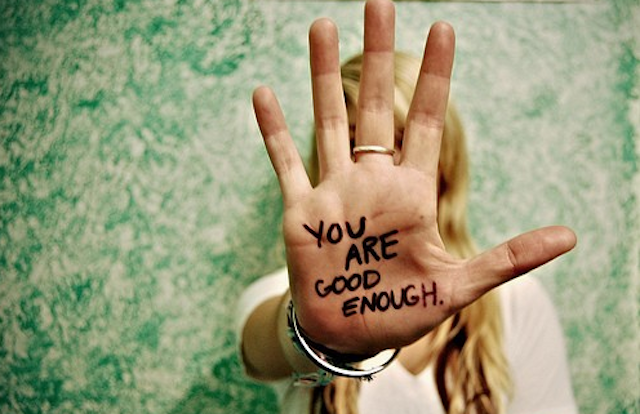
    I began to celebrate my many strengths.

    I started to make time to honor what I brought to the table.

    I worked hard to take in praise from others without doubting their statements.

    I cultivated a positive support system. I knew I naturally become similar to the people I chose to be around. So, I built a support system that is inspiring and fulfilling, not discouraging and depleting.

    I made a commitment to stop comparing myself to others. I could acknowledge others’ strengths without disregarding or belittling my own.

    I began to understand and quiet the inner-critic. I didn’t shut this voice out completely, but I worked on it being constructive as opposed to hurtful.

    I made a conscious effort to forgive myself. I let go of the regret and began to learn from my past.

    Finally, I began to practice self-compassion and kindness. If I wouldn’t say it to someone I love, I didn’t say it to myself.

    With all of these steps, I began to understand who I am and know what I want, while being comfortable in my own skin. I value myself and have gained respect from others. I am able to face challenges in my life head-on. I embrace all parts of who I am, not just the good stuff. I recognize my limitations and weaknesses.

    I must say, though, that it is possible to accept and love ourselves and still be committed to personal growth. Accepting ourselves as we are does not mean we won’t have the motivation to change or improve. It implies that self-acceptance is not correlated with alterations of who we are at our core.

    Nathaniel Branden stated, “Self-acceptance is my refusal to be in an adversarial relationship with myself.” Many of us live our lives resisting ourselves—comparing ourselves to others, pushing ourselves to be perfect, and trying to fit a certain mold of who we think we are supposed to be. I hope that by shedding some light on the notion of acceptance, I have helped you find courage to let that all go.

    We will never know who we are unless we discard who we pretend to be. And it would be a shame not to find out, because we are beautiful and worth knowing, just as we are.

  • Why I Stopped Trying to Fix Myself and How I Healed by Doing Nothing

    Why I Stopped Trying to Fix Myself and How I Healed by Doing Nothing

    “Everything in the universe is within you.” ~Rumi

    When I was twenty-three, I lost my job through chronic illness. I thought my life had ended, and I spent the next few years an anxious, panicky mess—often hysterical. Eventually, I took off to scour the globe for well-being techniques, and searched far and wide for the meaning of life and how to become well again.

    If you’re chronically ill, like I was, whether physically or emotionally, you’ve probably experienced the same misunderstanding, the same crazy-making “well, you look okay to me” comments, the same isolation, depression, and frustration that I felt.

    You’ve probably been on a bit of a quest for self-recovery. And so, you’ve probably also felt the same exasperation when trying to figure out which self-help theories actually work. It can be overwhelming, right? I thought so, too, but I came to find it was actually really simple!

    Searching the Globe for Self-Help Techniques

    So many people are full of advice: “Try CBT/ tai chi/ astrology/ vitamins/ rest more/ exercise more/ zap yourself with electricity/ eat better/ stop being lazy (always helpful!)/ do affirmations/ yoga/ meditation/ wear purple socks…” Okay, so no one ever actually recommended trying purple socks, but there were so many weird and wonderful recommendations that I found myself lost, which might explain why I went away to find myself!

    I traveled far and wide with my illness, training in every holistic therapy there was (which I loved; I’m curious, and well-being is my passion). But I was always searching for a ‘cure’ for my brokenness. I connected with yoga, meditation, and mindfulness on my journey, and I heard the very familiar Rumi quote: “Everything in the universe is within you.” This served only to confuse me even more as I struggled to analyze what it meant!

    In Bali, though, I felt I had found home in yoga, meditation, and mindfulness. I felt connected to myself. I felt like I understood that all I needed was within. My anxiety had gone, my panic had gone—and my chronic illness had gone, too! Then, I came home to the UK, and it immediately returned.

    I was disheartened. I still lived yoga and mindfulness—I loved it and I taught it at home—but the joy had gone from what I had once thought of as the answer. So, how was I absolutely okay in Bali and not at home? Was I a fraud? What was going on? There was so much thinking…

    What I Learned About Being Human

    It wasn’t until a year later that I discovered why, when I heard something differently. A colleague introduced me to a mentor who shared some profound insights about how the world really works.

    She explained the basic underlying reality of humanity: that underneath all of our thinking about “how to be happier” is a healthy wholeness and perfection that is already innate—without having to do anything. You see, the reason that I had felt any anxiety or panic at all was because I had just forgotten the truth of what it is to be human.

    The Power of Thought: All You Need Really Is Within

    Our human reality operates entirely through thought in the moment. Everything we feel is a result of our thinking. If we feel anxious, it’s because we are experiencing anxious thinking. If we feel happy, it’s because we are experiencing happy thinking. Our entire reality, therefore, really does come from within! It is an inside-out world.

    When we were born, we were perfect and whole, and not anxious. Then, when we gained the beautiful power of thought, we learned that the external comfort blanket was super comforting, because “it made us feel better,” right? Wrong. The blanket is an object, with no capacity to make us feel anything. One hundred percent of the comforted feeling came from our own thinking about the blanket. It’s the same with all of life.

    So, when I was in Bali, I thought I was okay because I was enjoying yoga and meditation, which I loved with all my heart. Thinking that the external could impact me, I felt 100% whole. I returned from Bali and my thinking about the external changed; it felt like I wasn’t happy, because I thought that I needed to be back in Bali. But the thinking came from me: the happiness or unhappiness was all dependent on my thinking in each moment.

    I didn’t remember this, so I attributed my happiness to the external. But it wasn’t, because we are always living in the feeling of our thinking in any moment. Everything comes from within.

    The Innate Wisdom Under Our Thinking

    The funny thing is that as much as this seemed profound to me when I heard it, it was also as if I already knew. It is innate wisdom that we just forget to tap into as we bustle through what feels a hectic pace of life.

    As I began to remember this wisdom, I found that I would start to notice my thinking; I’d become an observer of it, almost in a mindful, meditative kind of way, but I no longer needed to sit and meditate to be happy.

    New insights would come up as I stayed in the conversation about life, and more and more would drop away: the absolute reliance on meditation and affirmations in particular (though the joy returned for meditation when I realized there was less pressure to love it and just followed it because it was in my heart).

    Because under my thinking—under your thinking—is an innate wholeness that is always accessible to you in any moment, if you just see that your reality is entirely experienced through thought in each moment.

    Analysis Paralysis

    We spend hours of our lives analyzing how to be happy, how to stop being negative, how to meditate, how to be less attached, how to be more empowered, how to be more creative, how to be more whole. Don’t get me wrong, this can be interesting, if (like me) you have your own small self-help library! But it’s more important to drop out of your head and into your heart—like I did in Bali, and like I did when I allowed my thinking to just flow and stopped analyzing it.

    I still love yoga and meditation—I teach both and connect with them—but it’s to follow my heart, and I don’t need it. I’ve observed with clients, though, that sometimes it’s easy to misunderstand these concepts and get wrapped up in over-complication, analysis paralysis, denying true feelings, and forcing, trying to be ‘positive.’ This is why I ditched affirmations completely.

    Don’t Miss the Point: Clarity Through Trusting and Flowing, Not Forcing

    Some people miss the truthful essence of this beautiful wisdom. I’m a believer that we often try and force happiness and positivity through techniques like affirmations—and even in some meditation practices that suggest people need to “let go of thinking.”

    We can’t let go of thinking; it’s part of being human. And affirmations serve only to suppress our true feelings, which is dangerous. When we allow our thoughts to just flow through us instead, dancing with them through life, we create space where we would once have analyzed how to solve them; and it’s in this space where clarity can arise and we can see the truth.

    The truth is, we humans are a vessel of energy, and, I believe, part of something greater that has a plan for us—and through this human life, we are blessed with the amazingly abundant, creative power of thought. All we really need to do is let go and flow.

    All we really need to do is allow the feelings that arise from our thinking, conscious of the fact that our reality is constructed through thought. We just have to observe what comes up, embracing pleasant feelings and allowing the darkness without paying it much attention. Like an uninvited guest, it will eventually pass through, without you needing to do anything to get rid of it.

    These days, I laugh at the thoughts that come up and watch them with curiosity, marvelling at the creative capacity of beautiful brain, and knowing that underneath all of my thinking is the real truth: that I am entirely whole, perfect, and complete. Just like you. And you know what? I’ve not been anxious, panicked, or chronically ill ever since I remembered this truth of being a human living life through thought.
    I’m not suggesting that our illnesses are “all in our head” and that we can think (or stop thinking) our way to health. Everyone is different, and there are many different causes for the illnesses we experience, chronic or otherwise. But for me, everything changed when I allowed my thoughts to just flow.

  • You Can’t Change or Fix People, So Listen Instead

    You Can’t Change or Fix People, So Listen Instead

    “When people talk, listen completely. Most people never listen.” ~Ernest Hemingway

    The chances are good that at some point in your life you had to deal with a loved one who consistently frustrated you. They were caught in a destructive pattern of behavior that made life difficult for them and everyone around them. How do you cope when this happens?

    Perhaps you start avoiding them. And when that’s not possible, you choose to check out of any difficult conversation or interaction you’re having with them. You resign yourself to the belief that your loved one cannot and will not change their behavior.

    Or perhaps you attempt a more active approach to the situation. You try to analyze your loved one the way a therapist might. You develop what you believe are perfect solutions for their problems and present them in the most convincing way you know how. Then you get frustrated when they reject your sage advice out of hand.

    Here’s the thing: It’s not about changing or fixing them; they are your parents, siblings, or partners, after all—not broken machines in need of repair. And the best thing you can do in these situations is to give your loved one the space to expand their capacity for change.

    I learned this the hard way with my mother. She’s struggled throughout her life with unchecked anxiety. She’s caught in a pattern of pessimism, which she frames as “realism.”

    There’s rarely a day that goes by when she’s not consumed by one worry or another. And once she latches on to a concern, she can’t seem to let it go. It has to run its course. She’ll vent endlessly about her latest worry to any family member who happens to be available.

    As a problem solver by nature, I’ve tried to offer advice and suggestions that I believe will help her to deal with her anxiety more effectively. Unfortunately, it’s an approach that has often backfired. My mother can get extremely defensive and lash out in ugly ways when confronted with the negative consequences of her behavior.

    I remember a time when I suggested she’d benefit from the support of a counselor or therapist. Her memorable—and intensely hurtful—response was, “Therapy? Look at you! Ten years of talking to a shrink, and you’re still a crazy bipolar!”

    After a number of these unpleasant interactions, I decided enough was enough. I had to step back, if only to preserve my sanity and well-being. I avoided getting into anything but the most mundane conversations with my mother. I didn’t talk about politics, religion, or other potentially divisive issues. And when she chose to rant about the way the world was conspiring against her, I’d tersely say, “Okay, Mom” or “Whatever” before recusing myself from the discussion.

    But this coping mechanism was only viable for a limited time and had diminishing returns. I certainly didn’t want to see my mother in a near-constant state of emotional distress, trying to swim against an overwhelming tide of anxiety.

    I had to do something different than what I’d done in the past. So instead of jumping back into the fray, I paused. I used the time to examine how my behavior in our past interactions contributed to the problem. I took ownership of the part I’d been playing.

    I realized that a lot of it came down to the way I’d been listening to my mother. Or, more accurately, the fact that I wasn’t listening to her. Here’s what I needed to learn: sound listening skills can give a loved one the room to change destructive behaviors that adversely impact their lives—and yours.

    Are you listening?

    Do you think of yourself as a good listener? I certainly did. Unfortunately, if you’re anything like me, odds are that you overestimate how much listening you do during a conversation.

    Here’s a test. The next time you find yourself in a difficult conversation with a loved one, approach it mindfully. When they are speaking, are you really paying attention? Or are you formulating your response before they’ve even finished their sentence?

    If you catch yourself doing this, don’t be too hard on yourself. It’s natural to want to share insights and suggestions that we believe will help loved ones in emotional distress. Unfortunately, our caring and concern can become impediments to the best, and often only, help we can offer them—our ability to listen.

    When my mother would pour out a tale about her latest worry, I’d too often be preoccupied with crafting solutions for her problems.

    Sometimes I’d interrupt in an attempt to keep her from dwelling on negative thoughts. I thought I could save her from getting caught in a downward spiral by offering suggestions for better managing her anxiety; for example, “Hey Mom, instead of fixating on the inevitability of worst-case scenarios, why not concentrate on what’s happening right now?”

    I couldn’t understand why my advice was often met by resistance (“That will never work, I know it”) or even defiance (“That’s easy for you to say! You’re not the one dealing with this terrible situation.”).

    But here’s what I had failed to understand in that interaction and many others: My mother wasn’t asking for advice. She just wanted me to listen. And she absolutely did not want to be lectured about managing her emotional reactions to anxiety.

    I learned some important lessons when I took the time to examine my actions, and I knew that my behavior had to change if I expected my mother to embrace change as well. And I needed to start by listening more effectively.

    Message Received, Loud and Clear

    When my mother is in the grip of anxiety and reaches out to me, I’ve learned to remind myself that in many cases, the less said, the better. It’s about being present, being mindful; this is what listening is all about.

    Here are just a few ways to improve your ability to listen to a loved one:

    1. Acknowledge and validate.

    Sometimes a simple nod of the head can be a powerful and validating signal of support for your loved one. The same goes for a well-placed “Mm-hmm.” These seemingly small acts show that you’re focusing on what they are saying. They also indicate that, at least for the moment, you are prioritizing their feelings over your own. And they are subtle enough expressions to avoid interrupting their train of thought.

    I’ve found it helpful to remember that validation does not equal approval. I’ve learned that I don’t have to agree with my mother or approve of her behavior to effectively acknowledge her feelings.

    2. Take a breath.

    Notice your breath as you interact with your loved one. Are you holding it in as you anxiously await your turn to speak? If you’re out of breath when you respond, it can change your tone and perceived meaning. There’s a good chance you’ll sound harsher or more impatient than you intend to be.

    In the past, I’ve noticed myself running out of oxygen in the middle of challenging conversations with my mother. I’ve since learned to take it as a sign that I need to take a step back and bring myself into the present.

    3. Sometimes the best advice is none at all.

    It’s not easy to resist the temptation to dispense advice to a loved one who we perceive as needing the benefit of our counsel. But the danger of offering unsolicited advice to a loved one is this: it shows a lack of faith in them. And the more advice you dispense, the more you are suggesting that your ideas and solutions are better than any they can come up with themselves. You also risk condescension, no matter how noble your intentions may be.

    My well-intentioned but untimely suggestions for my mother came across as directives and judgments. My mother interpreted them as challenges to her competency and doubts in her ability to manage her life. I was indirectly telling her that I didn’t believe in her capacity to change.

    As I learned, our faith or lack thereof in our loved ones changes our behavior, often in significant yet subtle ways. And a change in our behavior can lead to a corresponding change in our loved one. When they know we are in their corner, they begin to develop a belief in their ability to grow.

    Seeing is Believing

    I’ve seen some encouraging signs of growth in my mother since I decided to examine and adapt my behavior. While she still struggles with anxiety, she’s taken some big steps toward better managing it. She’s taken up meditation. She has a yoga practice. And yes, she’s even been willing to talk to a therapist.

    I certainly can’t claim credit for her decision to take her emotional and mental health more seriously. But I don’t think it’s a coincidence that these developments have come during a period in which I’ve given her the room to change.

    So pause. Take a breath. Relax. And the next time a loved one is about to drive you out the door, give them some space to speak and express their emotions. Listen and be present. Trust your loved one to do the best they can at that moment. Embrace the notion that just like anyone else, they can change, and yes, they even have a right to do so. Just like you.
  • Addicted to Helping: Why We Need to Stop Trying to Fix People

    Addicted to Helping: Why We Need to Stop Trying to Fix People

    Caregiver

    “Compassion is not a relationship between the healer and the wounded. It’s a relationship between equals.” ~Pema Chodron

    After college, I was hustling hard to get a work visa so that I could stay in the US.

    But then my mom got caught up in a political scandal, and without much reflection on how much this would alter my life’s plans, I dropped my dream of staying in America, drove 1,000 miles, and flew another 500 to be by her side.

    Would she have crumbled without me there? My mama is a tough chick, so I highly doubt it.

    But at the time, I (subconsciously) believed that when the ones we love are hurting, their pain trumps everything. Their pain gets top priority, and whatever goals and dreams we’ve been working toward now pale in comparison.

    At the time, I thought that love meant tending to the other person’s needs first, always.

    And this form of self-sacrifice came naturally to me (I’d behaved this way even as a young child), so I was lucky, right? Having inherent caregiver qualities is a beautiful gift, right?

    Yes. And maybe not.

    Are You a Natural Caregiver?

    You’ll know if you have this trait too, because people will often tell you their secrets mere minutes after meeting you.

    When someone has just been in a car accident or broken up with their boyfriend, you wrap your arms around them and for the first time that day, their body fully relaxes.

    People tell you they feel at home in your presence. Safe. Heard. Cared for.

    There’s so much beauty in having a trait like this. Without much effort, you nurture and care for those around you. It is a gift you give us all.

    But there’s another side to the caregiver coin.

    Helping other people can become addictive. It can begin to feel like the only way to show your love is to prostrate yourself at the needs of others.

    Oh, you’re hurting? Lemme swoop in and save the day.

    Oh, you’re broke? Lemme dump my savings into your bank account and all will be well.

    Oh, you’re single again? Lemme set you up with my neighbor’s son.

    Whatever your ailment, I’ve got a fix for you!

    And the gratitude from the people we’re supposedly ‘fixing’ tends to flow so steadily that we become convinced of the healthiness of our stance.

    We’re confident that healing every sore spot we see is not only natural and enjoyable, but it’s the main reason we were put on this planet.

    When you carry the Nurturer Gene, fixing other people can easily become a destructive self-identity. 

    You will martyr yourself over and over again in order to meet the invisible quota of Lives Helped that floats above your head.

    You will obsessively analyze how every choice you make might impact those around you.

    You will assess every meal, every dollar spent, every vacation taken (or not taken) based on how it will impact the people you feel a responsibility to care for.

    Because, in this unhealthy version of caregiving, our understanding of love has become warped. Love now looks like a relentless string of sacrifice.

    Your thoughts might go something like this:

    If I don’t love her with my constant presence, she will feel sad and lonely.

    If I don’t love him with my attentive eye observing everything, he’ll get sick again, or maybe even die.

    If I don’t love them with my efficiencies managing everything, someone will get hurt. Things will go very wrong if I’m not here to take care of them all.

    Sometimes, love calls on us to invest our energy and time in tending to someone else’s pain.

    But not 100% of the time. And not with the nurturing going down a one-way street, pouring out of the same person, over and over again.

    If you see this pattern in any of your relationships, consider what it would take to expand your definition of what it means to nurture, to love, to care for.

    A healthy caregiver not only nourishes the needs of others, but also nourishes her own.

    Holistic nourishment. Nourishment of the whole of us, for all of us—which includes you.

    Self-nourishment might look like hiring a babysitter so you can have a romantic getaway with your hubby.

    Self-care might mean taking the job on the other side of the country, even though it means you’ll only see your parents twice a year.

    Self-love might be quietly soaking in a bubble bath instead of probing everyone for a detailed account of their day.

    You are not responsible for the world’s pain.

    Share your talents and resources. Generously give your time and attention. But you cannot pour a magical tonic on the wounds of every person walking the planet. It’s not your job. And if it were, it’d be a sucky job because you’d fail at it every single day.

    Especially when we identify as being “spiritual,” we can lift up words like “compassion,” “generosity,” and “kindness” to such a degree that we forget that even “compassion” sometimes must say no.

    Even “generosity” has to allocate some of her resources for herself.

    And even “kindness” must muster the nerve to walk away sometimes.

    If you are the person in your relationship or family or company that defaults to caregiver and wound-tender, give thanks for the ease with which you dish out your love.

    But be careful about inhaling that caregiver role to such a degree that your identity becomes dependent on having someone nearby to nurture.

    Give your love. Freely and deeply.

    And trust that even if you’re not there to ‘fix’ them, everyone will be just fine.

    Photo by Valerie Everett

  • Why No One Needs “Fixing” or Wants Unsolicited Advice

    Why No One Needs “Fixing” or Wants Unsolicited Advice

    Woman chatting

    “People take different roads seeking fulfillment and happiness. Just because they’re not on your road doesn’t mean they’re lost.” ~Dalai Lama

    Have you ever felt the urge to fix someone? And by fix I mean observe their circumstances and tell them what you think they’re doing wrong and exactly how you think they should fix it?

    We’ve all done it. We’re all guilty.

    Especially with close friends or family.

    “If he would only listen to me and do what I say then everything would work out just fine!”

    Sound familiar?

    I was having tea with a good friend the other week (let’s call her Sally), and she was relating with much exasperation the story of how her sister was wasting her life in her corporate job when she was SO creative and should be working for herself in a creative role. And then she would be happy (according to Sally). Which apparently she’s not (according to Sally).

    Sally went on further to say (with as much exasperation) that she had called her and conveyed this opinion to her sister. Because Sally felt she was right and that her sister needed saving. Not surprisingly, it was not very well received. In fact, Sally’s sister was pretty miffed. And didn’t take the advice. Or speak to her for ages.

    I’m willing to bet Sally’s sister didn’t even consider the advice. Not for a minute. And not because she disagrees but more likely because she’s offended at being told what to do. After all, she didn’t ask Sally for an opinion.

    And there’s the first problem.

    If someone doesn’t ask for your opinion, they’re likely not open to it hearing it.

    It’s quite simple really.

    When you ask a question it’s because you’re interested in hearing the answer.

    Which means you’re interested in the topic being discussed.

    Which further means you’re going to consider the answer with interest and (hopefully) decide from an unemotional stance as to whether you agree with it or not.

    The opposite applies when an opinion—however well intended—is provided without your consent.

    Had Sally’s sister called and asked for advice, the outcome may have been quite different.

    In my early twenties I remember having tea with my mom and enthusing excitedly about a new business idea I’d had. Now, my mom was from the “old school” where job security was your first priority, and in her world it was safest to find a “nice” job in a “nice” company and stay there until you retire or die (whichever comes first).

    Unsurprisingly, her response to my idea was one of complete skepticism and doubt. Which she verbalized immediately. Very loudly. And critically.

    In those days I didn’t have the awareness I have now. I didn’t see that this was simply her own fears being transferred onto me and had absolutely nothing to do with me. Nope, I reacted. Badly. And took it personally.

    After all, I hadn’t asked her for her opinion. I was just sharing an idea.

    I had expected her to be enthusiastic about my enthusiasm. To be supportive. To trust my judgment.

    Instead, I felt incredibly crushed. And I started doubting myself.

    And I felt a lot of anger toward her.

    But most importantly, I stopped sharing my dreams with her. And over the years I told her less and less. Because I knew she’d give me her (fearful) opinion. For which I had never asked.

    The second problem is, you’re assuming the person needs fixing, that what they’re doing is “wrong.”

    Our journey in this lifetime is our own. We’re the only ones who know what is best for us. And only we have a full perspective of all the elements of our lives and how they serve us.

    Even when we’re facing challenges, they are ours to face down. Our way. And when we see fit.

    Yes, we need to take responsibility for any fall-out, but isn’t that where our growth lies? Making choices and then dealing with the consequences? Good or bad?

    Maybe Sally’s sister is comfortable in her current corporate position. Maybe she feels secure with her stable income. And maybe she uses her creativity in a different way within her current position.

    Maybe from her perspective she doesn’t have a problem.

    My parents had a terrible relationship. At least that’s what I always told myself.

    They argued. Constantly.

    There was little or no affection. Ever.

    I always wondered why they stayed together. Surely they would both be happier apart? This relationship was simply wrong.

    In my view it epitomized the very essence of all the things you shouldn’t do or be in any relationship. And I told my mom this. Even though she hadn’t asked.

    Shortly after they both retired they moved to the coast to be closer to their grandchild. My dad had always been a workaholic and in his career he had travelled a lot. Not surprisingly, this really suited my mom. She loved her own company. Now in retirement he was home. All the time. And followed her around like a puppy.

    She was unhappy. Incredibly so. And would vent this to me at any opportunity.

    From my perspective, the answer was obvious. It was time to end this sham of a union. And I told her just that. With abundant justification and a healthy dose of righteousness.

    It was simple. If she would just Do. As. I. Say.

    But she didn’t. I don’t even think she really heard me. She did what we all do when we get uninvited “solutions” to our perceived problems: She got defensive. Really defensive. About her marriage and my dad.

    And we argued quite aggressively and loudly. And then we didn’t speak for many weeks as we both simmered in quiet indignation. I absolutely believed I was right.

    And yet, now that I’m older and wiser, I can look back and see that in my parents’ world it was right.

    For them.

    It worked.

    For her. And him.

    We can never know how someone else’s circumstances (however bad they seem) will serve them in the bigger picture of their life’s journey.

    We can never know what someone else’s perspective is around an event that we may judge as bad. Or wrong.

    Maybe in their world it’s right. Or good.

    It’s hard (really hard) to watch people we love go through hardship. Our instinct is to help. Or fix.

    But remember.

    In any relationship our only obligation is to show up and bear witness. Unconditionally. That’s all. We only ever want to fix someone because ultimately it’ll make us feel better.

    Why do we feel uncomfortable when someone close is facing challenges? Maybe that’s the question we need to ask ourselves.

    Sometimes feeling discomfort is what provides the momentum that’s needed for that person to make some changes. In their own time. Not ours.

    Trust that their judgment will serve them irrespective of whether we agree with it or not.

    Respect their journey.

    Try it next time you feel the urge to fix.

    That’s your growth right there.

  • Why We Should Stop Trying to “Fix” Other People’s Pain

    Why We Should Stop Trying to “Fix” Other People’s Pain

    Depressed young crying woman - victim

    “There is such a deeply rooted belief that we must do something with intense surges of feeling and emotion as they wash through: understand them, determine their cause, link them to some life circumstance or person, transform them, transmute them, or even ‘heal’ them.” ~Matt Licata

    A few years ago, when I first started working for my current organization, one of my colleagues asked me what role I would most enjoy on the team.

    I quickly said, “I like making things happen.”

    That was so clear to meI’m a natural do-er, organizer, and planner. It’s easy for me to take action on manifesting things in the world.

    While that has been useful for creating a sense of security in the material world, it has been less helpful for navigating the inner world.

    My same orientation toward the outside world, I brought to my emotions and how I met other people’s feelings.

    “You always try to fix the situation,” my husband said on the car ride home as grief was arising from visiting his ill mom. “Like, you know a process that works for you, and it feels as if you try to draft me into it.”

    That was hard to hear. I was defensive at first, “What? No I’m not. I really care about you, and am trying to help you…”

    As I sat with what he said and reflected on our conversation from a moment earlier, I realized that I was asking him over and over about how he was feeling, giving him suggestions and tools that have worked for me, that I thought might work for him too.

    When I peeled back another layer of my intention, I recognized it was mostly out of my own angst—the discomfort of just sitting there with him in presence, listening, with uncertainty. This nagging feeling of “needing to know” and “needing to make better” kept tugging at me.

    And so, finally, I gave in and asked several questions back to back that he was not yet ready to answer, followed by several uninvited suggestions.

    Over the next day, I continued to reflect on how to be with others and found there was a lot for me to learn from this situation with my husband.

    It’s true, when things are hard my mind perks up and goes into doing mode. I think, “What can I do? How do we make this better? What can be done to fix this situation and make it a bit more pleasant?”

    Anything to not linger in uncertainty and the discomfort of “unresolved” emotion.

    In that layer beneath the really good intention to help and make better, there is a more subtle motivation that says, “To stay with the vulnerability of this pain is really hard. It’s scary to be with the unknown. What can we do to make it go away and begin moving forward from this?”

    To sit with difficult emotions and not try to fix or make something better has been a huge learning curve for me over the past years, especially with emotional pain—both for myself and with those who are closest to me.

    Recently, when I see someone else in pain, I’ve been practicing “being with” and “witnessing,” and just deeply listening. It’s not an easy practice, as I’ve had thirty-three years of a conditioned, habitual impulse to “fix” and “move on” and “make better.”

    And yet, I see that the longer that I can stay with difficult emotions (my own and others’), the more I experience moments of deep peace, held with compassion.

    In fact, I often find that nothing needed fixing or to be “done.” Presence and being with is enough.

    Here are three lessons I’ve learned on how to be with others when faced with difficult emotions:

    1. Be with.

    This has been my mantra for the past six months. In fact, I even wear a bracelet daily with that phrase engraved.

    “Be with” reminds me to show up in a way that fully meets the present moment. Usually, that translates into deeply listening the best I can, remembering to breathe, coming back to the body, and not getting caught up in my mind.

    It reminds me to witness and not go down that path of fixing and making better.

    2. Do nothing.

    “This ‘doing nothing’ is not a cold, passive resignation, but is an alive, sacred activity, infused with the light of awareness and a wild, relentless sort of compassion. To do nothing in this way is a radical act of kindness and love, filled with qualities of earth and warmth, and a holy gift that you can offer yourself and others.” ~Matt Licata

    A friend of mine shared that when she was in psychology school, many of the therapists often asked, “But what I can I do to help my client?” Because doing nothing didn’t feel like enough.

    Each time this question came up, the teacher would always say the same thing: “Just be with his/her process. As that’s the only thing that creates lasting change.”

    There is a difference between powerlessness and helplessness. To surrender, which is to be powerlessness and to do nothing, does not equate to being helpless. When we are able to surrender and accept our powerlessness over others’ emotional pain and circumstance, we can wake up to deeper wisdom.

    Simply being present for the other exactly as he/she is—doing nothing—can be the most loving, powerful gift.

    3. Loving-kindness.

    During the moments when being with or doing nothing is too challenging, a loving-kindness mantra has always been helpful for me. It can bring a momentary peace during difficult situations when the mind might otherwise run along with thinking, planning, or engaging in fear-based stories to distract from the present moment.

    It goes like this: You say the below quietly inside, with an open heart.

    “May I be safe. May I be free from fear. May I be free from suffering.“ And, “May you be safe. May you be free from fear. May you be free from suffering.”

    What do you find helpful when those close to you are in emotional pain or in challenging situations? How do you meet yourself during difficult emotions?

  • Why We Don’t Need to Try So Hard to Be Better

    Why We Don’t Need to Try So Hard to Be Better

    Relax

    “To heal a wound, you need to stop touching it.” ~Unknown

    I’ve always been an overachiever. In sixth grade, I spent weeks memorizing over five pages of the poem “Horatius at the Bridge” for extra credit, even though I already had an A in the class.

    When I started therapy in my mid-twenties to deal with depression and panic attacks, I turned my overachieving tactics to self-improvement. I spent hours journaling, going to meetings, talking to mentors, reading books, and beating myself up when I fell into old habits.

    I always worried: Was I doing it right? Was I making enough progress? Would I feel better, find enlightenment, or be a better person in the end?

    That’s when I began to notice a pattern that surprised me.

    I found that when I first had an insight, discovered a tool, or began a new practice, I got very excited. It worked wonders for me and I could feel a sense of growth and expansion.

    I’d begin to try harder to generate more insights and discover more tools. But as I redoubled my efforts and worked harder at healing, I’d begin to feel anxious, self-critical, and depleted. The harder I tried, the less enlightened I felt.

    At some point I’d give up. I’d let go of trying to become the next Buddha and accept the fact that I was just going to be neurotic and flawed the rest of my life.

    And that’s when the insights and growth would start again. That’s when I would suddenly experience the most healing and notice the biggest changes in my life.

    Why was this? I wondered.

    And then one day it hit me: When we get injured, our body knows what to do and mends itself automatically—we don’t have to try. We’re designed to self-heal physiologically. It occurred to me then that perhaps we’re designed to self-heal mentally, emotionally, and spiritually as well.

    Why We Don’t Need to Try So Hard

    Once I recognized our capacity to self-heal, I began to see evidence of it everywhere. Here are three common ways I’ve seen it work:

    1. The insight, answers, and wisdom we need are always within us and emerge in their own time.

    One of the things I’ve learned through years of struggling with depression is that no matter how miserable, confused, and hopeless I feel, clarity always returns at some point and I know exactly what to do.

    For instance, a few months ago I was feeling depressed for a few days and couldn’t for the life of me figure out why.

    Then suddenly one night I woke up and it was clear: I was trying to do too much. I was overcommitted. I was doing too much to please other people.

    What I really needed was space for rest and relaxation. I cut back on a couple of commitments and took some time to rejuvenate. The depression lifted and things started to go a lot better for me.

    I get off-track a lot, but the wisdom is in there, and it always comes out when I allow space for it to emerge.

    2. When we miss a lesson, we’ll get new opportunities to learn it until we get it.

    Growing up, I struggled with my sister because when we fought, she would judge or blame me. I didn’t know how not to internalize that criticism and feel unworthy because of it.

    Then, years later, I fell in love with a man who did the same thing. He helped me realize that when he got angry and blamed me, he was actually feeling vulnerable or hurt himself. I learned how to use his judgment to help me connect to compassion and love—for him and myself—rather than guilt and shame.

    I didn’t consciously seek someone out who reminded me of my sister, but something within me drew me toward him, allowing me to work out a new way of dealing with blame.

    3. Our pain won’t let us stay off course for long.

    I was shocked when I learned that a runny nose and fever are more than mere byproducts of having a cold; they’re actually the body’s way of healing itself by flushing or burning out those mischievous germs.

    Similarly, our pain and neuroses are often our spirit’s way of getting our attention and guiding us so we can heal.

    Case in point: several years ago I began to have trouble sleeping. Falling asleep became more difficult and before long I was sleeping only three to six hours a night, if at all. I was exhausted, cranky, and miserable much of the time.

    It took a long time, but eventually I noticed patterns in what kept me from sleeping. Some nights I would lie in bed wide awake until I finally allowed myself to feel an emotional response (i.e.: fear, anger, disappointment, etc.) that I was pushing away or avoiding. Once I felt the feeling, sleep came quite easily.

    Other times I couldn’t sleep because I was being particularly hard on myself that day. I struggle with a very active inner critic and high expectations for myself, and on these nights sleep wouldn’t come until I dropped my critic’s attack and directed some compassion and love towards myself.

    I had tried ignoring the problem, powering through, or finding quick fixes, but they didn’t work. The insomnia forced me to address what was at the heart of the issue. Far from being an unlucky curse, the pain of not sleeping actually helped me to take the next step on my path to healing and wholeness.

    The Key to Allowing Self-Healing to Happen

    The reason so many of us spend so much time in pain and misery (myself included) lies in the difference between our egos and our true selves.

    Our true selves—who we are beneath the fears, the defense mechanisms, and the limiting beliefs—are wise, whole, and deeply connected to the larger world.

    Our egos, on the other hand, feel separate and alone and rigidly hold onto a particular set of habits and identities in an effort to feel okay in the world. We all have access to both.

    When I’m trying to grow and develop, I’m often caught in ego. I want something—peace, enlightenment, the respect of my peers, or an image of myself as an evolved person. I feel like I need to change something about myself in order to be worthy or good enough.

    When I’m coming from ego, I obsess. I strive. I effort. I compare myself to others and become convinced that I’m the least enlightened creature on the planet.

    All this striving and comparing is the mud that gums up the works of my self-healing process. That’s why it sometimes takes so long to work: I get in the way.

    To allow my self-healing process to unfold with its full power, all I need to do is relax.

    When I stop trying so hard, I reconnect with my true self. I have access to the fundamental wisdom and strength we all share. When I trust my inner workings to do their thing and simply observe what’s happening without trying to change it, my ego relaxes and healing happens naturally.

    To that end, I’ve found a few questions that help me heal and grow with less interference:

    Where am I striving with the intention of fixing myself or becoming more perfect? What would I do if I were to fully accept that I’m good enough as I am and that I’m exactly where I should be?

    What would nourish and nurture me right now? What would help me relax and feel safe enough to let go of old patterns?

    What is my inner wisdom trying to tell me right now? And if I’m not sure, how could I create enough space in my head and my life to hear what it has to say?

    We don’t always receive satisfying answers right away. That’s okay—in my experience, if we keep asking the question long enough, eventually we’ll get more clarity. It just may take a little longer than we expected.

    The process of relaxing into the process of change isn’t an easy one; knowing that I’m self-healing doesn’t mean my ego never gets stirred up or I don’t fall back into striving and obsessing. In fact, I believe that getting in our own way is an inevitable and enlightening part of the process, and I like to think that my inner wisdom is strong enough that it can handle whatever my inner foolishness throws at it.

    At some point I always become aware that I’m efforting again, and that’s when I can chuckle, pat my ego on the head, and remind it that it doesn’t need to try so hard. I can return to the questions, listen for answers, and then pray for the willingness to let go once again.

    Relax image via Shutterstock

  • Look for the Good and You Will Find It

    Look for the Good and You Will Find It

    Rose Colored Glasses

    “What we see depends mainly on what we look for.” ~John Lubbock

    Have you ever noticed how as human beings, we tend to go negative?

    Looking out into the world, we see the crumpled fast food bag in the street and the torn curtain in the window.

    Looking into the mirror, we see the pores and dark circles under our eyes. We see the freckles and miss the dimple, or we hate the dimple and miss the smile.

    Our eyes focus in on what’s wrong.

    I’ve noticed it’s hard to undo this tendency in myself, though sometimes the veil drops suddenly, and I can see the beauty of the world around me.

    Many years ago, a friend and I made a three-day visit to the Polish city where we were to live for a year while we taught English.

    Arriving on the train, I was struck by the torn metal siding in the station and the crumbling rust of the ancient stair railings; as we walked along the sidewalk, how the entire city seemed one blocky stamped-out Soviet-era apartment building after the next.

    Neither of us spoke, but I felt sure my roommate’s thoughts mirrored my own: This was where we were going to live? This worn foot sole of a town was going to be our home for a year?

    Just as my mind headed in the direction of I don’t think I can live here, a tiny bird flew down a foot or so in front of my shoes, hopping a few inches here and there to nibble the tops of a tuft of grass poking out of the broken concrete.

    I let my suitcase bump to a stop and watched. The bright saturated green of the grass, the pale orange stripe on the bird’s beak, the angle of sunlight against the cracked sidewalk… it was beautiful. And at that moment my heart gave a hopeful thump. There was beauty here, too. I only needed to look for it.

    As humans, we have a built-in bias to see what’s not working, what needs fixing, what doesn’t measure up. In general, it’s not bad to see the negative… we avoid falling into pits by looking out for potholes. But seeing only the negative results in what I call “paper towel tube vision.”

    When you look through the empty cardboard paper towel tube, you only see whatever shows through the little circle at the end of it, and nothing else. This is what we’re seeing when we see only the flaws on our cheeks and only the crumpled coffee cups on the curbs of life. We see whatever appears in that little circle and lose all perspective.

    Seeing the good doesn’t mean we don’t see the bad, too. It means we throw away the paper towel tube and let our eyes take in what we don’t like and invite ourselves to see what’s good there, too. We let ourselves see it all, the big panoramic view that acknowledges that we are more than any mistake or flaw or misdeed.

    Imagine letting your mind unfold like a vast, exquisite map laid out on a table. Seeing the bigger picture can be an awesome way to see yourself with more love.

    Make a habit of looking for the good. Catch yourself looking at the world—or at yourself—with a narrow, negative view. Then step back mentally and spread out your awareness.

    See with the eyes of your heart. Look for something that’s working, something sweet, something lovely, something that opens you up.

    Look for the good in people, even people you wouldn’t want to sit over dinner with.

    Look for the good in the mirror.

    Let looking for the good become a new default for you, and give yourself credit when you’re able to hold whatever’s happening with that big perspective and big heart.

    Woman with rose-colored glasses image via Shutterstock

  • Relinquishing Control of Others: 5 Ways It Serves You

    Relinquishing Control of Others: 5 Ways It Serves You

    Letting Go

    “Selfishness is not living your life as you wish to live it. Selfishness is wanting others to live their lives as you wish them to.” ~Oscar Wilde

    My mother is a huge control freak. I am told she got it from my grandmother, who basically ran everyone’s life.

    Regardless, growing up, I noticed that she really struggled with relinquishing control of what we were all doing with our lives.

    It was partly out of love because she just wanted what was best for us, and partly because she feels a sense of panic when she doesn’t know what’s going to happen if the person chooses to go in a different direction than she envisions as the “right” one.

    I inherited my own need to be in control of everything and everyone from her. It took me a long time to learn how to surrender to what was and let go. Not just of the things happening in my own life, but what others close to me were doing.

    I know that when I am outside of somebody else’s personal situation I have much more perspective because I’m not emotionally invested in their drama the way they are. At least, I think I’m not.

    See, that’s the big fallacy! I have come to realize that I do actually get emotionally invested, and I hold onto an expectation that the person will take my advice and do what I so clearly think is the right thing for them.

    Let’s be real—do we really know what the right thing to do is for another person?

    I recently had a great conversation with a close friend of mine who is incredibly advanced on his spiritual path. We were discussing a mutual friend of ours who is currently in a relationship with a woman we know is absolutely wrong for him.

    We have pointed out all the warning signs we see. He has also admitted that he sees them himself and senses them, but still he cannot walk away from the relationship.

    I was expressing my sadness and frustration over my friend not taking my advice or hearing me. I said, “What else can I say to him so he gets that this is a huge mistake?”

    My friend calmly replied, “You’ve said everything you need to. Now you need to relinquish control over the situation and allow his soul to have the experience it wants to have. Maybe his soul needs to have a horrible, destructive relationship to get him to the next level of his learning.”

    Wow. Why hadn’t I seen that?

    It is true that we don’t know the journey that each person is on. And we need to allow the people in our lives to make choices that feel right to them—because what is right for us may not be right for another person.

    When I started to relinquish control over what everyone in my life was doing, I started to feel a huge shift in my energy.

    I realized that by just “holding space” for people, which, according to Heather Plett, means “being willing to walk alongside another person in whatever journey they’re on without judging them or trying to impact the outcome,” I was able to be of better service to them, and in turn allow them to follow their own path.

    Letting go of others’ decisions and any expectations we have of them has a number other benefits. Some of the ones I found were great motivators for me.

    1. You have more energy to focus on yourself.

    What a difference I felt when I stopped obsessing and worrying over every single friend’s problem and trying to figure out how to fix it for them.

    I didn’t realize how draining it was for me to take on everyone else’s “stuff.” When I started to let go of what other people were doing to fix their own problems, I found I had way more energy to focus on me.

    2. It can be more empowering to just listen rather than “fix.”

    People don’t always need us to “fix” things. What they need when they come to talk to us is to feel heard. Nobody likes to be told what to do.

    Releasing control of what the people in my own life decided to do enabled me to be a better listener since I was spending less time thinking of ways to “fix” their problem.

    3. We develop trust.

    When we can surrender to what is, allow things to unfold, and realize that every experience serves a purpose, we start to trust that whatever happens may really be for the best.

    Relinquishing control and allowing things to play out without our interference can reveal some surprising outcomes that we never could have planned and ultimately be the best for everyone involved.

    4. It strengthens our relationships with others.

    When my mother started to release her tight grip on everything I did, we became closer. I understood how difficult this was for her to do, and I had a lot of respect for her.

    By not telling people what to do all the time, we are essentially saying to them, “I trust you to make the best decision for you.” This really strengthens our relationships with them when they believe there is a mutual trust and respect for their judgment and choices.

    5. We learn something new when we watch how others do things.

    I always thought I had all the answers. Clearly not since my life has been in shambles many times over. There is so much we can learn from others when we observe the way they do things. The next time we find ourselves in a similar situation, we may find that their way was the better way.

    When we reflect on all of the reasons it serves us to let go of controlling others, it’s a great excuse to allow the people in our live to follow their own path. Whether it’s the right path or the wrong path is not for us to decide. It’s simply their path.

    Letting go image via Shutterstock

  • You Are Broken, Let Me Fix You

    You Are Broken, Let Me Fix You

    Mosaic Face

    “To wish you were someone else is to waste the person you are.” ~Sven Goran Erikkson

    Let me fix you.

    You really should try not to be so sensitive, Leah. The world is sometimes a difficult and upsetting place, but you shouldn’t let it affect you so much.

    Let me fix you.

    You know, you really ought to spend more time with people, Leah. It’s not good for you to be alone so much.

    Let me fix you.

    You know, you really shouldn’t make such quick, spur-of-the-moment decisions, Leah. It’s not good to do that in life and you’ll end up regretting them.

    Let me fix you.

    You’re so young, Leah. You should be out dancing and dating and having fun, not sitting home alone with another book.

    Let me fix you.

    You need to be more realistic, Leah. I know you have big dreams for your business and life, but it’s not secure. We all have to do work we don’t enjoy, it’s just the way things are.

    Let me fix you.

    Thank you for trying to fix me. Now let me tell you this…

    Let me tell you…

    My greatest strength is empathy. I feel others’ feelings as if they were my own. Their pain is my pain. Their joy is my joy. I cannot help but cry sometimes and I cannot hold the tears in, as you would like me to, nor wait for a more convenient moment.

    Please don’t try to fix me. My sensitivity is my gift.

    Let me tell you…

    I am an introvert and a thinker. Introspection is in my blood. Long periods of time alone are a joy to me. Where others might feel lonely, I feel replenished.

    I ponder, I reflect, and I muse over the thousands of dreams and ideas that are always in my head. I’m filtering, planning, connecting the dots and making sense of the world around me

    Please don’t try to fix me. My thinking is my gift.

    Let me tell you…

    I am a woman of action and I do not like to wait. Once my mind is made up there is no turning back. Where others might be stuck in indecision, I have moved ten steps ahead. My life is in motion and I am creating in the real world the dreams I have in my head.

    Please don’t try to fix me. My ability to act is my gift.

    Let me tell you…

    The future is beautiful to me. I see all that is possible and all that I want to create. In vivid colour and in high definition it appears to me. Whilst others see all that is wrong and the reasons why not, I see all that is right and all that could be.

    Please don’t try to fix me. My dreaming is my gift.

    You Are Not Broken

    For the longest time, I thought I was broken. I thought I had to change myself. I thought I had to behave differently. I thought that my way of being wasn’t the way of being. I wished I were someone else.

    At school my reports went like this:

    “Leah is a wonderful student but she’s too quiet and needs to speak up more in class.”

    In my nine-to-five office jobs it went like this:

    “Try not to be so sensitive, Leah. It’s not good to let people see you cry at work.”

    And when I handed in my notice, it went like this:

    You can’t go through life making rash decisions like this, Leah,”

    And even now, almost three years into my journey of creating my dream life and business, it goes like this:

    “We believe in you, Leah, we really do, but don’t you think it’s time to look for a more secure job?”

    Everyone, everywhere, throughout my life has been ready with advice for me on how I should be.

    Over the years, not knowing any better, I tried to bend myself to their suggestions.

    I tried to be less sensitive. I tried to hold my tears in. I tried to be less impulsive and less impatient. I tried to spend more time around people. I tried to tame my dreams.

    But when I tried to do all these things, all I felt was pain and it didn’t make anything in my life work better the way people told me it would.

    Finally, thankfully, today, I see the truth.

    There isn’t and never was anything to fix.

    The very things that others told me were my faults turned out to be my greatest strengths and my most beautiful gifts.

    When I finally saw and embraced them as such, I was able to begin creating a life that encapsulated everything that I am instead of constantly struggling and trying to be something that I was not.

    It’s true for you too. There is nothing to fix.

    If you find yourself surrounded by people telling you should or need to be different, I hope these three short notes will help you let go of what they’re telling you and to embrace instead what is truly special about you.

    1. You are not broken, faulty, or defective.

    There is no right or wrong way to be. Each and every one of us makes sense of the world differently. The way you are may be different to those around you, but that does not make your way of being wrong.

    Instead of trying to bend yourself to their suggestions, take note of what the people around you say you should be like. There is a very good chance that they are pointing the way to your most special gifts and the things that make you uniquely you.

    2. Use your unique gifts to create a life you love.

    When you recognize, understand, and accept your personal strengths, you have the opportunity to consciously and thoughtfully craft a life that is in alignment with those strengths, instead of trying to squeeze yourself into a mould you won’t ever fit into.

    I didn’t see it at the time, but the pain I experienced in my office jobs were clear signs that I wasn’t where I was meant to be. The roles I was in didn’t value my biggest strengths and work often felt like a battle against my very nature.

    By seeing, understanding, and accepting my own personal strengths and gifts, I have been able to create a business and life that allows me to freely be all that I am. You can do the same.

    3. Forgive those who try to fix you.

    Remember that those who are telling you to be more like this or less like that—it’s not their fault. They, too, are filtering everything through their own set of unique gifts. Go easy on them; they’re just doing their best, like the rest of us.

    Listen to what they have to say, take anything that feels useful but go ahead and drop the rest without a second thought.

    Let me tell you this, my friend…

    There is nothing to fix and nothing to change.

    It is in those qualities that others might find difficult to accept that you will find your power.

    It is in the acceptance of those qualities that you will have the opportunity to not only create a life that feels right for you, but to have the greatest positive impact on the people and world around you in this short and precious life.

    You are a gift to the world. Just as you are.

    Mosaic face image via Shutterstock

  • Stop Attracting Unhealthy Relationships: 3 Promises to Make to Yourself

    Stop Attracting Unhealthy Relationships: 3 Promises to Make to Yourself

    “When you stop trying to change others and work on changing yourself, your world changes for the better.”  ~Unknown

    For years, I was entering relationships with men where I saw their potential to be a good match for me, if only they would completely change who they were.

    For twelve years, it was the same pattern until one day I finally realized something was broken.

    After my last unsuccessful relationship, where I was just holding on, hoping he would change and be the person I wanted him to be, I had had enough. So, I took a much-needed hiatus to regroup, reprogram, and refocus.

    The Problem

    My sorority sister used to say, “If you always do what you always done, you’ll always get what you already got.” So, what was I doing that constantly attracted me to men who were not a good fit for me? What was so compelling to me about that?

    Here’s what I discovered: The tape that continued to play in my mind said, “I am not able to attract a man with a steady, regular job who’ll make time for me, and is emotionally available.” So, I constantly attracted men who were emotionally damaged, who cheated on and ignored me.

    The Analysis

    Now that I knew what attracted me, I wanted to figure out what made me stay in so many loveless relationships.

    I’m almost ashamed to admit it but I stayed in relationships I should have never started because I thought I could change save them. They were hurt and I could treat them better than their previous lover because, let’s face it, I’m better than everyone.

    I was going to swoop in and save the day and show “him” how much better I was than “she” was to “him.” And “he” will not cheat on me like “he” did “her.”

    But, guess what?  “He” always did. Always.

    And I always took it as a personal failure. As if I had failed “him” somehow, because I wasn’t even good enough, much less better. It never occurred to me that “he” might have been just a jerk to begin with.

    The Solution

    After finally learning my lesson, I’m now ready to re-enter the dating arena, and I’ve made three promises to myself. If you’ve also attracted unhealthy relationships, perhaps these could help you, too.

    1. I will trust myself.

    Many times in the past, I can remember thinking this relationship was not a good idea, or something wasn’t right. But I didn’t listen. And as my grandmother used to say, “If you don’t hear, you feel.”

    When you feel something is off, make the determination of whether you are just nervous because you’re afraid of making another mistake, or if something really feels off. When your intuition tells you something is wrong, move on.

    Trust that you know what is best for your happiness. You are the only one who does.

    2. I will value myself.

    Moving on is much easier to do now that I’ve raised, expanded, and updated my standards. Looking back, it seems that my only requirements were that he be breathing and he liked me.

    For you, it may be time to reevaluate your standards and decide that you deserve to have a happy, healthy relationship with someone who meets your needs.

    Create a list of your top three non-negotiables, and even when you get slack from your friends and family, who mean well, telling you your standards are high or you’re being too picky, don’t waver.

    Not listening to your intuition is what most likely got you in this dating predicament in the first place, so value yourself and stop ignoring your inner voice.

    3. I will focus on myself.

    Worrying about whether the other person was happy or not in my past relationships was emotionally draining, and never created a happy ending for me. So I’m bringing the focus back on me. I’m no longer looking to fix, change, or save anyone, nor restore their faith in relationships, and neither should you.

    If this has been an issue for you, read these next words carefully: It’s not your job to make the other person happy. It’s theirs.

    Believe me, you will save yourself a lot of wasted years, tears, and time by following this one rule.

    If you’re ready to take responsibility for your dating life, consider taking a break to reevaluate your previous relationships, update and expand your standards, and work on your own happiness first. You’ll be a happier, more whole and joyful person—which can ultimately lead you to the relationship you want.

  • Realizing You’re Enough Instead of Trying to Fix Yourself

    Realizing You’re Enough Instead of Trying to Fix Yourself

    You Are Good Enough

    “If you concentrate on what you don’t have, you will never, ever have enough.” ~Oprah Winfrey

    Seven years ago I discovered a world of healing, energy, and spirituality. It came at a particularly hard time in my life. Everything that could go wrong seemed to have.

    First, I picked up a bug while travelling, which left me unable to hold down food for over eight weeks, and doctors told me there was nothing more they could do.

    Then, there were secondary infections, which I learned I might have to live with for life.

    I was being bullied at work and then walked away from my friends. Both of these experiences were extremely stressful and a great source of pain. Then, two weeks after moving to a new country to start afresh, one of my best friends died suddenly.

    The first twenty-five carefree years of my life exploded in my face, and confusion set in.

    In a desperate quest to find answers, happiness, and peace again I went searching, and what an awesome world I found!

    It started with discovering kinesiology and developed into a learning of healing foods, chakras, and energy healing. Yoga and meditation followed, along with personal development seminars and stacks of self-development books.

    And all for a good reason—each of these disciplines was quite literally changing my life.

    One by one, they helped me unravel subconscious layers from the past and release old stagnant energy, emotions, and beliefs that were no longer needed.

    For example, if I felt angry and frustrated from work, I would pop in for a kinesiology session and walk away upbeat and happy. If I got upset after an argument with my husband, I’d run off to heal the part of me that was causing this to arise, and skip home loving and free.

    To say these quick fixes became addictive would be an understatement.

    Then, over the last year I kept getting the same lines repeated to me over and over again. Healers telling me my work with them “was done,” my kinesiologist telling me I’d “got it” a while ago now, and friends reflecting left, right, and center that “I’m there.”

    The problem was that I could not see it. Surely there is no final destination, and besides, there were still so many things to fix. I didn’t feel “there.”

    My addiction to fixing myself had kicked in. Even though I know we are all human and will never be perfect, I felt the need to keep on clearing as much of the imperfect away until I got “there.”

    But “there” was not coming, at least not in my eyes, and frustration started building. I believe this addiction formed due to a deeply hidden belief that I was not fundamentally good enough.

    I thought that if I healed enough, sooner or later I would be “fixed.” I would be good enough—but I was missing the truth, the truth that we are always good enough exactly as we are.

    We will all encounter lessons as we walk through life and, of course, healing can help us move through these, but fundamentally, we are always already good enough. This part I was slow to grasp.

    Along this journey I had walked away from a career in advertising to follow my passion for nutrition, leveraging all I had learned to become a coach. What I didn’t see coming was the second cousin to “healing” and the old pattern formed under the guise of “business development.”

    All of a sudden I would never be a success unless I had mastered a zillion courses on marketing, sales, coaching, webinars, and list building.

    No matter what I did I couldn’t hold on to the money I was making—so I looped back into the healing world looking for answers to my money blocks.

    Then came the clincher: My income dramatically increased—and, you guessed it, I still spent every cent each month on the next skill I needed to learn or block I needed to clear.

    At the same time I noticed I was getting angry with healers and “experts,” as they repeatedly told me what I already knew.

    Something wasn’t adding up any longer. Luckily, the person I turned to for advice supported me to process the most amazing realization for myself:

    I discovered that I had been through an intense period of learning, that over the last seven years I had been absorbing “universe lessons.”

    It was time to step out of the Universe-ity classroom and start truly living all that I had learned. And with so much knowledge under my belt, it was also time to pass it on to others.

    It’s not that we will ever stop learning—it’s just that we have to start using the tools in our everyday lives, as opposed to conducting an ongoing search to fix ourselves.

    Through my journey, I have learned that it is common for us to get these lessons in the spiritual realm, but not bring them to life in the physical world.

    At some stage along the path I had started focusing on what was still “broken” instead of how amazing things had become.

    I was so blinded by this thought pattern that I was unable to receive the joy and pleasure already surrounding me.

    By shifting from the energy of “not enough yet” to realizing I already am, I’ve found the peace to step forward and apply all that I’ve learned, and inspire others to do the same.

    I now know that I am already so much more than “enough,” and it’s now time to graduate from Universe-ity!

    So I invite you to check in on your own motive for healing. Are you desperately trying to fix a part of you that you deem wrong, shameful, or bad? Or, can you accept that you are already perfect exactly as you are now, shadow and all, even if you still have room to grow?

    Are you ready to relax and let your journey unfold exactly as it is supposed to?

    Photo here

  • You Don’t Need to Fix Yourself to Be Healed

    You Don’t Need to Fix Yourself to Be Healed

    Calm Acceptance

    “Growth begins when we begin to accept our weaknesses.” -Jean Vanier

    I used to believe the word “healed” had a very specific meaning. In my mind, it described a state of perfection that always looked very different from the chronic health challenges I endured.

    Being born with VACTERL Association, a birth disorder that causes malformations in six of the body’s systems, meant that I entered the world needing a lot of fixes. There were surgeries, hospitalizations, treatments, and medications aimed at perfecting something inherently imperfect.

    The Search

    I grew up searching. To be like everyone else. For a cure. For Peace. Clarity. Happiness. Always searching for a technique or philosophy that could mold me into the ideal woman I imagined I should be.

    My search was fueled by a very narrow view of “normal,” “beautiful,” and “successful.” Images perpetuated on magazine covers and a myriad of self-help manifestos told me that life was good only if you could figure out how to become flawless, inside and out.

    I read hundreds of books, attended seminars, journaled, meditated, said affirmations, communed with my inner child, prayed, eventually begged, finally groveled. And nothing.

    Well, there was something. I found out that I was going to need a kidney transplant.

    I assumed this prognosis meant that I wasn’t being “spiritual” enough. I needed to try harder. I saw the decline in my kidney function as a manifestation of negativity in my emotions. Maybe the damage was subconscious?

    I saw healers and hypnotherapists. I listened to subliminal message tapes. I reviewed my memories, and looked, and looked, and looked for the cause of my current predicament. And still nothing.

    All that came out of my search was restlessness and desire to search more.

    I was operating under the assumption that if I meditated masterfully, became enlightened, or at least healed old emotional wounds than life would bend toward my will. It followed that since life was not yet how I wanted it, something must be wrong with me. I needed to find the fix.

    As I stewed in my own spiritual turmoil, my kidney function continued to decline. The pressure I had placed on myself to not just find the cure, but to become the cure was making things worse.

    Life is Suffering

    I thought “healed” meant that life became the way you wanted it to be. I could not have been further from the truth. I had missed the most basic of Buddhist principles: life is suffering.

    Becoming spiritual does not mean that we are no longer human. It doesn’t take away the pain, illness, and stress; it only reframes it. Suffering tells us that we are inherently human. Coping with human challenges does not mean that we are less-than or that we are damaged; it only means that we are experiencing things all human beings experience.

    The trick is not to bend life’s will to our personal desires. It is the other way around. We must find the flexibility to bend to Life. That is what I had been missing.

    There Was Nothing to Find

    All of that searching took me to the most basic of places: exactly right where I was. Nothing to fix. Nothing to do. Nothing to become.

    I no longer see “healed” as some form of perfection. It isn’t a certain health status, lab value, or lack of a diagnosis. Healed isn’t remission or cure. It isn’t any specific thing.

    Healed is the willingness to unconditionally accept whatever life is at this exact moment.

    My kidney is now flirting with the edge of kidney failure. Transplant plans are in the works. Sometimes I feel scared or worried. Sometimes I cry. Those are things I accept too. I no longer need to always be positive. I don’t force myself to be anything other than exactly what I am.

    I’m learning to yield. It is a practice. I still have latent urges to “figure this out” or to be the miracle doctors cannot explain, and those tendencies get welcomed into my experience as well.

    That’s the thing about acceptance: it doesn’t require searching. It is always available. Simply knowing that these rough edges are part of being here in a body, on earth, lifted a huge weight off of me.

    I am healed. Even as I face surgery and a lifetime of medication, I am healed. At peace. With clarity. Content. Happy.

    Photo by Cornelia Kopp