Tag: feel

  • The Song That Surprisingly Brought Me Back to Life

    The Song That Surprisingly Brought Me Back to Life

    “Music was my refuge. I could crawl into the space between the notes and curl my back to loneliness.” ~Maya Angelou

    I used to believe that healing and personal transformation required a lot of effort—writing page after page in a journal or getting up at the crack of dawn to carry out a morning routine, to name a couple.

    When I moved through a phase of numbness—or the tunnel of darkness, as I now call it—it was frightening, and there seemed to be no end in sight. But one song found me at the right moment and changed everything.

    In under five minutes, it achieved what all the tools and knowledge I had couldn’t: it made me feel something.

    That moment reminded me that healing and moving forward don’t always need rituals or words—sometimes, all it takes is the right sound at the right time.

    Before that moment of awakening, my life felt like a loop. Day in and day out, everything was the same. My being was on mute—nothing resonated, and I walked through life hollow, flat, and disengaged.
    Each day felt like the one before. I was disconnected but longing to feel something. I put pressure on myself to fix whatever this was. And when it didn’t work, I pushed harder and harder.

    I tried all the things I had learned over the years: deep breathing, meditation that only amplified the noise in my head, journaling until my hand ached, lighting salt candles, and still, I couldn’t seem to connect with myself.

    There was only stillness, but it didn’t feel peaceful. It felt strange and disorienting—a kind of stuckness. A sense of being that portrayed me not as a person anymore, but just a body moving through the motions.

    Yet nothing changed. None of the knowledge I had made a difference. The tunnel seemed to cave in on me, leaving me feeling like I was nothing—like I’d never get anywhere again.

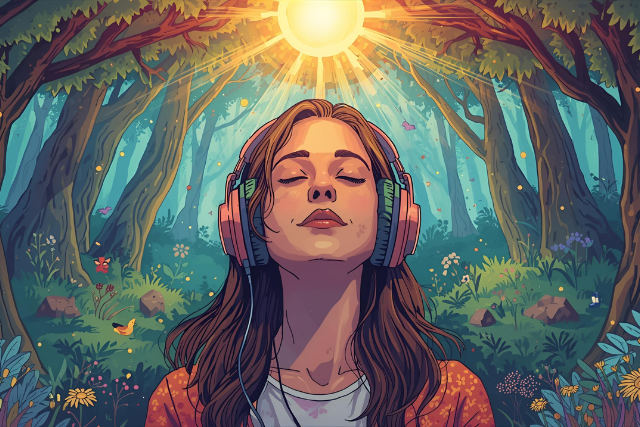
    Then, one day, I pressed play on “Wild Flower” by RM of BTS. I can’t remember exactly how I found it, but I do remember being alone, just trying to de-stress.

    It was one of those moments where you click on something without really knowing why—just a quiet, inner nudge. BTS had come into my life a few months earlier, and I was most drawn to RM. That day, something in me—the part that still carried hope—asked me to click on this song, this video. And within seconds, everything shifted.

    In an instant, my body stopped and took notice. From the opening that hit me like a firework to the first notes and spoken words (in Korean, which I didn’t understand), I felt something again. I couldn’t believe it.

    I went from numbness—from nothing—to goosebumps, tears streaming down my face, and tension leaving my body.

    The emotion in RM’s voice, the chorus sung by Youjeen, and the sound of the music itself—it was the reminder I needed that I was still alive. Still here.

    That song became the catalyst for me to open up, to feel again, and to realize there was a way out—a way back to myself.

    At first, I didn’t understand the lyrics, and I didn’t even try, because it didn’t matter. What mattered was the rawness in the delivery, his voice full of emotion that anyone could understand. The longing, the ache, the release—all of it was enough.

    Later, when I looked up the words, it only deepened the meaning. Sentences like “When your own heart underestimates you” and “Grounded on my own two feet” felt like direct messages to my soul. Like someone finally saw me—not for who I was pretending to be, but who I was beneath all the effort.

    In that moment, I realized I didn’t need to do more. It was about opening up just a little more and receiving what this song was giving me.

    I didn’t need to journal, dive deeper into personal development, fix myself, or hustle. That moment reminded me: just being with the music was enough.

    While journaling gives me insight into myself and my life, music gives me the emotion I need to feel in order to start healing.

    And then a quiet question rose up in me: “What if healing doesn’t have to be earned or hustled for?”

    What if we don’t need to constantly work on ourselves to be okay? What if some parts of healing are actually about stopping, softening, and letting something bigger hold us, even just for a moment?

    That one song became that moment for me. It cracked something open. And once it did, I didn’t fall apart. I began to come alive again, slowly, quietly, but surely.

    I still love journaling—it’s a consistent part of my life—but now I know that healing can begin in silence, in sound, and in surrender.

    Since then, I’ve had many other moments where music became the medicine I didn’t know I needed.

    Sometimes it’s a gentle white noise—a crackling fire mixed with rain. Other times, it’s a beat that makes me move, cry, or sing.

    But “Wild Flower” was the beginning, the song that reminded me feeling is possible again. That numbness isn’t permanent. And that sometimes, we don’t need to search for the right words. We just need to listen.

    I encourage you to notice what songs find you and how they make you feel. Because maybe today, your healing begins with listening.

  • The Lie of Packaged Healing and the Truth About Feeling

    The Lie of Packaged Healing and the Truth About Feeling

    “Emotions are not problems to be solved. They are signals to be felt.” ~Vironika Tugaleva

    We’ve been taught to package our emotions like fast food—served quick, tidy, and with a smile. Americanized feelings. Digestible. Non-threatening. Always paired with productivity.

    If you’re sad, journal it. If you’re angry, regulate it. If you’re overwhelmed, fix it with a three-step plan and a green juice. And if that doesn’t work? Try again. You probably missed a step.

    This is how we sell emotional healing in the West—marketed like a self-improvement product. Seven-minute abs. Seven habits. Five love languages. Follow the formula. Find the peace.

    But what if the formula is the lie?

    As a mental health therapist, I’ve lived it on both sides. I’ve sat in the client chair, feeling broken because my sadness didn’t resolve after enough gratitude lists. And I’ve sat across from clients who whisper their grief like a confession, wondering what they did wrong because they still feel something.

    They aren’t doing it wrong. They’re just human.

    Healing isn’t about “doing” our feelings. It’s about learning how to actually feel them—without the compulsion to justify them or translate them into something useful.

    You owe no explanation for your feelings.

    And still, even knowing that, I get caught in it too.

    I, too, am a product of this culture—a place where feelings are only tolerated when packaged properly. Not too loud. Not too long. Preferably resolved by morning.

    Because of that, there are days I feel a deep aloneness. But I’ve come to realize the aloneness isn’t a flaw—it’s a longing. A longing to be witnessed in the fullness of my humanity. Not fixed. Not analyzed. Just seen.

    I don’t need validation. I don’t want to defend how I feel. I just want space. Presence. Room to let the feeling pass through me.

    The loneliness reminds me how deeply I’ve been shaped by a culture that fears emotions unless they come with an action plan.

    So I’ve learned to hide mine from most people—not because I’m ashamed, but because they’re afraid. People are afraid of their own feelings, so of course they’ll fear the vulnerability of mine. Most people in this country don’t know what to do with real feelings. And the doing has become the problem.

    That fear of being too much or too messy is rooted deep not only in American culture but also me.

    That part inside me judges the part of me that feels sadness at times. She calls it weakness. Not out of cruelty, but out of fear. She believes that if she can shame that part, a much younger, more authentic part that lives inside me, she won’t risk being shamed by others.

    I’m sure many other Americans have this exact same part inside them as well.

    We have to be tough, suck it up—whatever that even means.

    The part of me that gets sad. The part that gets afraid. The part that feels lonely. These are parts I exiled long ago. But I am beginning to bring them home to me. The parts that are terrified of taking up space. They don’t know yet how precious they are.

    They’re not just tender. They’re wise. They’re the intuitive, empathetic, deeply alive parts of me. The parts our culture has spent countless centuries trying to forget.

    But I won’t forget those parts. Not anymore.

    I speak to them now, with clarity and compassion. I tell them: You are allowed to feel without defending it. You are allowed to take up space without apologizing for the weight of your truth. Expand. Don’t shrink.

    The sad one. The scared one. The one who wants to hide. The one who’s learning to stay. Even the critic. They can all exist inside me—side by side—without contradiction. Without shame. Without needing to explain themselves to anyone.

    I will no longer betray them because others betray their own parts and project their self-betrayal onto me.

    There’s a whole galaxy inside me, and there’s a whole galaxy inside of you. Of course no one else will fully understand it.

    What matters is that I do.

    And I’m learning… I’m not here to be understood. I’m here to simply be me—and to allow all that resides in me to be, too.

    And maybe you are, too.

  • Think Less, Sense More: How to Get Out of Your Own Way

    Think Less, Sense More: How to Get Out of Your Own Way

    “I believe in intuitions and inspirations…I sometimes FEEL that I am right. I do not KNOW that I am.” ~Albert Einstein

    I’ve been thinking a lot. Maybe you have too?

    There’s a lot to think about these days.

    I’m taking in information, processing new ideas, adapting the conditions of my life to the current circumstances, and establishing new behaviors. Maybe this sounds familiar to you?

    All of this reasoning is primarily a frontal cortex function. When we understand and organize information, that function occurs at the front of the brain. This part of the brain creates order out of chaos. Structure from disarray.

    The threads of sensory and experiential input are woven together into an integrated fabric that turns disparate threads of information into something cohesive and comprehensible. Logic and language step in to further clarify and solidify the process. Our experience with the world around us becomes something that has meaning. It’s a handy tool. It’s a good part of our consciousness.

    An interesting and often overlooked fact is that our brain does much more than this. When we refer to someone as brainy, we are often referring to their intelligence. And by intelligence, we are often referring to fact-driven logical prowess. Our language reveals much about how we interpret our capacities.

    Even if we only take into account physical evidence, we possess a capacity for so much more. Our brains are more than brainy. Our intelligence is more than intelligent. We aren’t here only to make linear sense of things. Our existence suggests there’s more to it than that. Our purpose is bigger.

    Which brings me to this pandemic happening in tandem with a flailing economy, massive dysregulation of most systems that govern the rhythms of our lives, and a social awakening rippling through the core of our society. Which brings me to why I’ve been thinking a lot. I’ve been thinking because survival and purposeful existence in this world demands it.

    And.

    There’s always an “and.”

    Purposeful existence demands more than just thinking.

    The brainstem is located at the back of the skull, where the brain meets the spine. The brainstem regulates breathing and heart rate. It governs basic movement and sensory experiences by serving as a conduit for input from the spinal cord to the rest of the brain and vice versa. It’s the center of your most essential involuntary survival processes.

    This is the place of your most basic presence as a human. It’s your sign of life. There is no logic, no language, no sense or order here. The brainstem is a portal from the nervous system to the brain. Nothing in the portal is interpreted or coherent. It’s just nerve firings and stimuli, electrical currents and rhythms. A jumble of input with no meaning or filter. The brainstem connects your body to consciousness.

    This meeting place is potent. It’s the threshold between having a functioning, sensing, present body and the awareness to observe, understand, and trust into it. The brainstem is a liminal container, a transitory passageway of uncensored, unrefined experience.

    Meaning making is necessary, of course. The stories we weave from our conclusions about the world are essential (though they can also be dangerous if we get caught up in negative stories about everything that could go wrong).

    But, first, there is the elemental material of existence, the origins of presence. This is the fodder that transforms our presence into energy. Our existence into a resolute force.

    I’ve been offering myself permission to think less and sense more. I get out of the front of my brain and sink into the back of my skull, right where the skull curves away from my neck. That place behind my throat. Sometimes I take a deep breath into that space, unhinge my jaw, relax my tongue, and open my mouth to breathe out.

    Life has been unbelievably messy. No job. New job. New learning curve. No childcare. New living situation. Every habit I had a few months ago has been entirely reinvented. Most assumptions I had about how the world functions from day to day have been decimated. I’ve had to get creative. I can’t think my way through this.

    When I sidestep my intellect, something else emerges. When I breathe into the back of my skull another kind of intelligence informs me.

    Rather than thinking through or mulling over, I feel into something. I receive a nudge, a pull, an instinctive reflex to start in a particular direction, regardless of whether there is a path present or not. I’m nudged and so I go. It’s often messy, circular, and wayward. But I go, nonetheless. There is usually something there. The going is always worthwhile. And it is absolutely never what I expect.

    This place does much more than govern my heartbeat and my breath. It’s the place I write from. It’s the place I tap into while I’m teaching yoga, when I seek to nurture myself and those practicing with me. It’s the place I sink into when I feel uncertain and unmoored. I don’t get answers here, but I do get clear. It’s where I go for the essentials. The dwelling of my instincts. The gathering place of my sensitivity. The sparking nerve fibers of survival, function, and purpose.

    I’m getting out of the way. I’m diving into an ancient, intuitive, simple part of myself. I’m feeling and seeing in the most essential way I know how. The brainstem is a portal, connecting simplicity to intentionality. It’s a different kind of intelligence. I’m linking consciousness to my body, awareness to my experience. It’s as simple as that. And it’s so much more.

    Want to try it out? I find this practice is most visceral for me when I lie down, so if you can, find a good spot to recline and rest. If you can’t lie down right now, it’s okay. Just sit and get relaxed.

    Take a few breaths and sink into the place where you are. Let your body settle downward and feel present within your space. Become aware of your breath. Now, start to send your breath back to the base of your skull. Feel it swirl in that space where the back of your head meets your neck.

    Unhinge your jaw, get space between your teeth, and relax the tongue. Let your mouth drop open and sigh out from that space at the very back of the throat. Repeat a few times.

    Observe what it feels like to sink your awareness to the back of the skull. Also, get curious about what emerges when you lean into this space. What feelings, thoughts, images, ideas, or sensations come forward? What happens when you intentionally sidestep your reasoning mind and sink into a different part of your consciousness? What wonderful things could happen if you were to trust the most essential parts of you?

  • How I Know I’m Strong (and You Are Too)

    How I Know I’m Strong (and You Are Too)

    “If there’s ever a tomorrow when we’re not together, there’s something you should remember: You’re braver than you believe, and stronger than you seem, and smarter than you think. But the most important thing is, even if we’re apart, I’ll always be with you.” ~A.A. Milne

    Two years ago, I was anticipating a monumental shift. I couldn’t tell you what had changed around that time, but my mindset was moving away from the brasher side of my natural, projected extroversion and seeking solace in the comforts of solitude.

    It felt like the waves drawing back before a tsunami, and over the following two years, I certainly felt I was drowning more than once.

    My dad was diagnosed with cancer; I went through breakups, work challenges, struggles with family and friendships; I was diagnosed with depression and had my first real experience of debilitating stress and panic attacks; then, last month, my dad (now, thankfully, cancer-free) had a heart attack, weeks after a very brave friend lost her own father to one.

    I felt I had made peace with my version of bravery, understanding that sometimes the mere act of survival is itself a brave middle finger up to life’s relentlessness.

    But alongside “brave,” another adjective I’ve struggled with over the past two years has been “strong.” I certainly feel like my strength has been tested.

    When you are often described as “strong,” it can become a millstone around your neck. How do you live up to your duty of being strong for others when you’re struggling to be strong yourself?

    In my darker moments, I perceive myself as very weak. When I sat down to journal about my dad’s heart attack, I was surprised that I wrote down how I felt too weak to withstand what could have happened to my dad, how I felt too weak to support my family at this time, how I felt too weak for life in general.

    There have been many similar moments over the past two years where I have felt anything but strong. And yet, many beloved friends and mentors have described me as such. Sometimes I want to tell them I’m a fraud, projecting cheery strength, when some days, inside I’m just mustering up all I can to get by.

    And then, as I was journaling, it hit me. This is strength. If we are still here, we are strong. We are Darwin’s fittest. If we are living through personal struggle, if we are coping with this anxiety-inducing pandemic, if we are still capable of doling out however small a portion of love to ourselves, our family, our friends, our neighbors, our community, our strangers, then surely we must be strong?

    Strength is not always an action. Strength is daily bravery; strength is allowing yourself to feel; strength is choosing to love.

    Strength is my mum carrying on and stroking my hair as I slept in her bed; strength is my dad allowing me the space to cry when he has his own pain. To be strong is to be “able to withstand force, pressure, or wear.” What are we doing as a species right now if not choosing to withstand?

    So in the midst of my much-needed mope, I realized I had two choices: to buckle under the force of my fears of this pandemic and what it could do to the more vulnerable members of my family, the pressure of all that has occurred over the past two years, the wear of my reserves, or, inevitably, to choose to withstand.

    And, as the word implies, that requires standing with others. Letting my loved ones see my tears, sharing my sadness with them, giving them the space and the safety to share their own, allowing moments for hope and positivity to emerge from our shared anxiety. Choosing, in other words, to stand as the lighthouse in the storm.

    The world is going to present you with a lot of fear and reason for panic at the moment. Withstand the depressing onslaught of the media; withstand the urge to clear the shelves of penne; withstand the mental self-isolation that these times could bring.

    Stand with your community (even if you’re two meters apart): if you are well, reach out to people who may need your assistance; if you’re not, share messages letting people know they’re not alone. There’s strength in numbers.

    Notwithstanding, there will always be moments when we feel our strength and our capacity to withstand is just not enough. In those moments, I turn to the immortal words of A.A. Milne. If even Winnie the Pooh needed reminding of this sometimes, then it’s more than okay that we do too:

    “If there’s ever a tomorrow when we’re not together, there’s something you should remember: You’re braver than you believe, and stronger than you seem, and smarter than you think. But the most important thing is, even if we’re apart, I’ll always be with you.”

  • The Negative Impact of Not Feeling Your Feelings

    The Negative Impact of Not Feeling Your Feelings

    “If the only thing people learned was not to be afraid of their experience, that alone would change the world.” ~Sidney Banks

    I spent most of my life scared of my feelings. Having feelings and expressing them made me mentally ill—or so I was led to believe by a large number of mental health professionals. When I felt sad, they labeled me as depressed. When I showed any signs of anxiety, they gave me another list of mental health disorders I needed medication for. And if I was angry? Oh well, that was the absolute worst. That clearly proved how insane and utterly out of control I was!

    I didn’t understand how they couldn’t see what was really going on for me. I couldn’t understand how everyone saw me as the problem when what was happening to me was the actual problem. But that’s a story for another time.

    I was brought up to be a good girl, which meant that any angry expressions were forbidden, shamed, and punished.

    I wasn’t allowed to express disappointment because that made me ungrateful.

    I couldn’t ask for what I wanted because that made me greedy.

    I wasn’t allowed to disagree with anyone because that made me difficult.

    I couldn’t express frustration because that meant I was out of control and needed to be left alone to think about my shameful behavior.

    I didn’t ask for help because good girls don’t inconvenience other people.

    I couldn’t be happy either because that made me attention-seeking and annoying.

    I felt all the feelings, but I was taught that they were wrong, forbidden, and shameful, so it didn’t feel safe to feel them. And so I tried to suppress them. I inhibited them, pushed them away, avoided them, shamed them, and feared them.

    Every time I felt something, I saw it as more evidence for how bad I was. Later on, I saw it as evidence for how broken and mentally insane I was. It drove me crazy. But it was thinking that having feelings made me insane that actually drove me insane.

    I believed that what I was experiencing was wrong. I saw my feelings as problems, so I tried to hide them and not feel them. So much so that I don’t even recall feeling very happy or excited about anything. All I remember is feeling tired, lethargic, and bored. I wasn’t even fifteen years old at that time …

    I continued like this for a very long time. My life felt lifeless and bleak. I don’t recall having any fun, adventures, or exciting experiences. Everything just seemed so hard. Life was something to endure, not enjoy. Enjoyment seemed to be reserved for a lucky few, and I most certainly wasn’t one of them.

    It wasn’t until I was in my thirties that I learned that my feelings weren’t problems, and that they didn’t make me insane. My feelings only made me one thing—human.

    Feelings Lesson 1: Feelings aren’t evidence that we are broken or insane. They are evidence that we are human.

    I know now that I had always been perfectly healthy, but others taught me to believe that being a little human with feelings was somehow wrong and shameful.

    My feelings were a problem for others. They were inconvenient to them. And as a result of them not dealing with their own feelings—their own irritation, intolerance, and impatience—they tried to control and eliminate mine.

    But what happens when we try to control or eliminate our feelings is that we deprive ourselves from experiencing the richness of life. We numb them all because we cannot selectively numb. We feel it all or nothing at all.

    So if I am unwilling to feel my anger, I will eradicate other feelings with it—apart from maybe one or two that will be expressed more strongly than they would if we only let ourselves feel whatever it is that we actually need to feel.

    Feelings Lesson 2: We are meant to feel all our feelings and can’t selectively numb them.

    In my professional work, I have noticed that sad people usually suppress their anger and angry people usually suppress their sadness. It’s a simplistic generalization, but it is largely true. The problem is that the displaced feeling will be way more powerful and destructive than it would be if we didn’t try to control or avoid it. We avoid a feeling when it is shame-bound, when every time it arises we feel shame for feeling it.

    If we feel something excessively and intensely, it’s a sign that we have shame-bound another feeling, which means that this feeling was not tolerated in our childhood, and every time it arises, our anxiety level rises. We then try to push it down to stop ourselves from feeling it, but then the energy of that feeling gets displaced and added to a feeling we believe to be more acceptable to feel and express.

    The ‘more acceptable’ feeling then takes on a bigger form, and we end up having panic attacks instead of expressing our frustrations about someone. Or we get depressed instead of setting boundaries with people who treat us in disrespectful ways. Or we explode in a rage because we don’t allow ourselves to admit to feeling hurt, alone, and unsupported.

    There are thousands of examples like the above. Sadly, we always believe that our misdirected expression like rage or depression is the problem we need to fix, and so we focus on the result of the problem and not on its actual cause, which means that we cannot solve it.

    If we want to work through our issues, we need to identify which of our feelings are shame-bound and then reconnect with them in healthy and compassionate ways. This is a process. We are going against a lifetime of conditioning, so we need to be gentle with ourselves while persevering and getting honest with ourselves.

    But it is possible. We can remove the shame-binding from all of our feelings by reminding ourselves that our feelings aren’t problems, and that feeling our feelings is what makes our human experience special.

    Feelings Lesson 3: Shame-bound feelings express themselves in different and destructive ways, meaning we simply can’t not feel.

    When we inhibit what we are meant to express to protect others from our feelings, because we perceive that they’re a problem for them, we reinforce the message that our feelings are problems and that we are wrong to feel them. Believing this will negatively impact our mental health and enjoyment of other people and life in general, because feelings exist for our benefit.

    Our feelings exist to guide us through life. They show us what we want and what we don’t want so we can create more of the former and move away from the latter. When someone shames our feelings and encourages us to disconnect from them, they encourage us to disconnect from our emotional guidance system, which serves to help us create a great life for ourselves in which we can grow and thrive. This inevitably leads to creating an inauthentic, unfulfilling life, and stunted development.

    Our feelings also show us when we believe something harmful that isn’t true: a lie of the mind.

    If I believe that my anger is a sign that I am an inherently flawed human being, I feel distressed because this isn’t true. My guidance system is trying to tell me that I’m on the wrong track.

    Because just like the physical pain we experience when touching something painfully hot, emotional pain tells us to move away and let go of a harmful thought. And so, our emotions highlight our state of mind. They encourage us to let go, drop, and move away from anything that doesn’t serve us or promote our personal growth.

    Feelings Lesson 4: Our feelings tell us when we engage in harmful thinking.

    Once we understand the purpose of our feelings, we begin to see the beauty in them. We are made to have feelings—all the feelings! We are meant to feel our feelings. Our feelings aren’t problems. They are just here to give us the full human experience. And there is absolutely nothing wrong with that! We have the potential to experience it all. It is a once-in-a-lifetime opportunity!

    But we cannot make the most of this opportunity if we go in blind. Being cut off from our feelings is just that. It’s like trying to sail the oceans without a compass, hoping to find paradise to live in. It’s navigating life without any sense of what we want or what is good and healthy for us. As a consequence, we make many wrong choices and keep believing all the wrong things.

    Our attention then goes into fixing our mistakes instead of creating a life that is most suited to who we really are. Because we simply don’t know what’s good for us and what isn’t because we don’t know what we are feeling. We are emotionally disconnected.

    We have feelings that try to move us toward what’s good for us, but because we don’t like how some of them feel, we disregard them all. We try to create a successful life without any sense of what successful actually looks like for us.

    Let me outline this with an example:

    What was my anger during my childhood trying to tell me?

    It definitely wasn’t that I was a bad and ungrateful child who was inherently flawed and devoid of any tender human qualities. My anger didn’t mean that I was disrespectful or manipulative and deserved to be hit, shouted at, shamed, and punished. My anger was trying to get me to act, to stand up for myself, to protect myself. Only I was too little.

    Then.

    Not now.

    But I lived by those shame-bound rules for most of my life. I hated my anger. I avoided conflict. I didn’t stand up for myself when it mattered and then got myself into situations that were abusive, full of conflict, draining, and traumatic—but also unnecessary.

    If I had been attuned to my anger, if I had responded to it immediately, nothing would have ever needed to escalate. I would have stood up for myself and moved away from whoever and whatever wasn’t healthy for me and didn’t contribute positively toward my growth.

    I would have made very different choices and I would have lived a very different life.

    Being cut off from my feelings and disconnected from my internal guidance system deprived me of the experience of life I wish I’d had.

    I was doing it the hard way. I was trying to succeed going in blind. It doesn’t work. I know you know that too.

    Feelings Lesson 5: Our feelings ask us to act in ways that are good for us.

    So why am I going on about feeling our feelings? Because it’s the solution to many of our problems.

    Instead of putting all our energy into avoiding, controlling, and eliminating our feelings, we have to become attuned to them. We have to reconnect with them so we can make better and healthier choices for ourselves. We need them. We are meant to have them. And the more we let ourselves feel them, the more easily we learn to respond to them in healthy and life-enhancing ways.

    Because our feelings aren’t problems. They are not inconvenient. They are trying to move us into the direction of health and well-being on a physical, emotional, and mental level.

    And in that way, they help us create a life we can actually enjoy. But only if we allow ourselves to feel them.

  • How to Embrace Your Sensitive Superpower and Stop Feeling Overwhelmed

    How to Embrace Your Sensitive Superpower and Stop Feeling Overwhelmed

    “With realization of one’s own potential and self-confidence in one’s ability, one can build a better world.” – Dalai Lama

    Sensitivity can feel like a gift or a burden, depending on our relationship to it.

    If you often feel completely overwhelmed by an overload of stimulation, then your sensitivity probably doesn’t feel like an asset. Maybe more like a liability. But it doesn’t have to be this way.

    As an introvert and sensitive person, I’ve navigated these waters my whole life, and I’ve come to realize that sensitivity is more than a gift—it’s a superpower! But first we need to understand what sensitivity is and what it’s not.

    What is Sensitivity (the Superpower)?

    To keep it fairly simple, sensitivity is essentially the ability to feel. The more sensitive we are, the more we feel.

    Sensitivity allows us to be more aware of what’s happening around us—people, conversations, traffic, nature, how a place feels. It also makes us more aware of and in touch with what’s happening inside us—our thoughts, emotions, sensations, and how we react to external things.

    I see sensitivity as a foundation for self-awareness. Without the ability to feel, we could never discern what’s really happening and break through the limits of our personality and fears.

    Sensitivity is also an aspect of empathy. Because we can feel what others are feeling, it allows us to understand them and connect with them more deeply. Without some degree of sensitivity, we’d be disconnected from people.

    On the other side, it can be extremely overwhelming. Too much sensory information coming in all at once can leave us feeling agitated, overwhelmed, and drained. When sensitivity becomes overwhelming, we often pull away from people and retreat to time on our own—a typical trait of an introvert or HSP.

    When I was young, wherever my parents took me, I’d be very aware of the spaces around me and how they made me feel. I either liked a place because I felt good there, or I didn’t like it because I felt uncomfortable.

    At that time, I didn’t comprehend much more than that—I didn’t know how to—and it’s very clear to me now that I didn’t have a context for it back then. There was too much sensory information passing through me, so when a place felt unpleasant it was just an overwhelming sense of feeling unsettled and unsafe.

    I was also very sensitive to people. I would instantly have a sense of the state, or mood, of them as soon as I met them, or even just saw them. When I was young, I didn’t understand what they were feeling, but whatever it was, I’d feel it in myself. Depending on their emotion, this could be very uncomfortable.

    I’d find myself feeling frustrated and emotional for no reason when around certain people, but it wasn’t my emotion. Again, at that time, I couldn’t tell the difference because I’d feel it in me and assume it was me, but I didn’t understand why I felt like that. Very confusing.

    Later I learned to know the difference between my own emotions and someone else’s, as I was much clearer on what was happening inside me.

    This is when I started recognizing the gift, or superpower, that sensitivity brought into my life. In sensing what others were feeling, I experienced a sense of connection to them, which helped me understand them.

    This awakened a sense of caring in me. I could feel when people were upset, sad, or hurt, and I found myself wanting to help. If someone was angry, I started to feel beyond the anger and to understand why they felt that way. Diffusing an argument or conflict was easy because I could feel where they were coming from.

    It’s so easy to judge people, retaliate, or disconnect when we don’t understand them. The moment we understand, there is opening, heart, and compassion.

    Sensitivity, our ability to feel, is a superpower that allows us to understand, connect, and have deep insights about ourselves and the nature of humanity. And the world needs more of this.

    What’s Not a Superpower

    If we say someone is emotionally sensitive, it could mean they’re sensitive to their own emotions, or it could mean they react emotionally to others’ words, actions, and emotions.

    Being sensitive to what’s happening inside ourselves is the basis for self-awareness, and an essential ingredient if we want to grow. A superpower.

    If someone says something and we’re hurt by it, we might call it being sensitive, but it’s more an emotional reaction than a superpower. Yes, we may feel the intention behind their words, but feeling it and being hurt by it are not the same thing. If their words have triggered something in us, then it’s more about the stability of our sense of self.

    Another example: You’re in a crowded room and you become overwhelmed and drained by the noise and stimulation.

    Here your sensitivity gives you the ability to feel everything that’s happening around you. I think this is an amazing gift. It may be a lot of stimulation, but I’d still call this a superpower.

    However, when we feel overwhelmed or drained, it’s not solely because we’re sensitive. It’s because we don’t feel grounded or stable internally, as I mentioned in my previous post about how I preserve my energy in groups as an introvert. The good news is, we can proactively foster internal stability.

    When we feel overwhelmed and drained in crowds, we often just want to remove ourselves from the situation and be alone. There’s no right or wrong, what we should or shouldn’t do, but when we acknowledge what’s happening inside us, then we have a choice.

    Learning Not to Let Sensitivity Control Us

    When I was young my sensitivity was too much for me. I would feel the good, the bad, and everything in between. It felt like the world around me was not around me but passing through me; and because I didn’t have a context for what was happening, the world felt unsafe, so the only way for me to function was to shut down.

    It wasn’t something I did consciously, as I didn’t understand what was happening. It was something I did on a subconscious level.

    It wasn’t until many years later, after doing a lot of work on myself, that I was able to realize what I’d done. I’m now able to reconnect with my sensitivity and wield it while feeling safe.

    Sensitivity is a gift, but if we don’t have a stable center within us, then our ability to feel becomes stressful and overwhelming, and ultimately begins to control us. In a sense, we become a victim to the power of our own sensitivity, as if it’s wielding us.

    To embrace our superpower—to be able to feel for and connect with others deeply without feeling overwhelmed or easily hurt and reacting emotionally—we need to find stillness inside ourselves. A stable center.

    If we can’t find stillness and quiet amidst the noise of our own mind, we’ll never be able to find peace and quiet amidst the noise of the world.

    Our thoughts amplify how we react to the overstimulation of our sensitivity. We pick up on what’s happening around us, it creates a space inside us—a landscape of emotions and feelings—and this triggers thoughts. The thoughts then reinforce the emotions, anchoring them further. The emotions continue triggering more thoughts, in a vicious cycle that goes on and on.

    For example, if we’re in a loud, crowded room we may feel anxious as a result of all the sensory input—the noise, people’s energy, and the energy of the place. We may start thinking thoughts like “Why did I come here? I knew this would be a bad idea.” Then we start feeling trapped and overwhelmed, triggering more thoughts of perhaps how you blame your friend for inviting you, or “How am I going to just disappear?” This all amplifies the anxiety.

    Or, if someone says something that triggers us emotionally, we may feel insecure, then start thinking about how we always say the wrong things, and then feel more insecure.

    After starting a meditation practice, I realized that when I’m more still and quiet inside myself, I react less and less to external stimulation. I’m no longer at the mercy of my superpower. In fact, the stiller I become, the more I feel, but without it becoming chaotic or overwhelming.

    The Problem Isn’t Our Sensitivity; It’s Our Lack of Stability

    I still value time on my own. I always have and always will. But I now have a more stable center, so I’m able to use my sensitivity as a superpower.

    You can do the same by prioritizing activities that help you create a sense of internal stability, such as:

    After meditation, I particularly like spending time in nature. We can walk outside and let our mind run, and there will still be a calming effect. But when we consciously tune into our surroundings as we walk—using the superpower of our sensitivity to feel nature’s stillness—our own stillness becomes more tangible and stable.

    When we feel stable inside ourselves, we have a solid foundation to feel deeply, so the outside world has less power to control us. The stillness inside is unwavering, regardless of what’s happening outside of us.

    Our sensitivity is a gift in that it opens the door to a more connected world, but we need to proactively foster internal stability so we’re not at the mercy of the chaos around us. The more we embrace our superpower and live in it from a space of stillness and stability, the more at peace we will be inside ourselves—creating a greater capacity to help others, and in turn creating a more connected humanity.

    Find stillness. Find your superpower.

  • Moving Through Grief: I’m Strong Because I Feel It All

    Moving Through Grief: I’m Strong Because I Feel It All

    “Grief is the last act of love we have to give to those we loved. Where there is deep grief, there was great love.” ~Unknown

    It’s been almost six months now. Half of a year without my brother and the grief still visits. I’m pretty sure grief doesn’t actually go away; its visits just get further and further apart.

    People continue to ask me how I am so “strong” through all of this, mistaking my happy moments as the full picture.

    I continue to tell them strength comes because I feel it all.

    The story in itself is my therapy, my chance to relive the amazing memories, my chance to show you the waves of grief I ride.

    The last thing I told my conscious brother was “But I believe in miracles, I really do.”

    To be fair, the last thing I really told him was a travel story about me using a Squatty Potty in Thailand, in hopes that humor would bring him back to responsiveness.

    The thing is, I really did believe a miracle was possible, or at least I wanted to believe. Surely it wasn’t his time to go. The all-divine higher power wouldn’t take away my big brother, my role model, my mom’s baby boy. It simply wasn’t time.

    The tumor on his spine seemed to disagree with me, though.

    My brother is gone now, and there is a human-sized hole in the universe that I am living in, and yet I survive; in fact, I am thriving in this life that I have now.

    But let’s back up a little, because I can’t just tell you about how I move through this season of grief without totally and completely honoring the human my brother was. He called me his little buddy, and though my oldest brother was the babysitter, Kirk always whispered into my ear that he was the real one in charge.

    He liked Dungeon and Dragons, donuts, finishing a great book, and writing and doodling in a brown journal probably made of suede or something cool like that. He loved to flip me upside-down or hold me down and tickle me until I was completely sure I would pee my pants. He would say things that didn’t make any sense to me until later when I would sit and contemplate in stillness.

    Something about Kirk’s soul was so playful but inspired me to be still and live in the presence that I have. He did things like build houses out of mud for sustainability and turn medians into produce farms. He took killer photos and made clay statues that I used to think would move in the night and haunt me.

    Kirk told me to “try everything once, unless that one thing will kill you, then skip that one.” Which is why you can catch me building a business that makes zero sense to who I am, traveling to foreign countries when I should probably be building a 401K or something else adults do. But when there’s a human-size hole in your universe, you do things for joy. Maybe it’s to honor them; maybe it’s because you live life to the fullest possible amount there can ever be. Either way, I’ll keep moving only for things that light my soul on fire.

    And then there was the cancer.

    You know how if you endure something just the right amount, it kind of becomes your normal? Repetitive chaos in your life has a way of doing that. And after watching my grandma battle cancer and win, my mom battle cancer and win, and Kirk beating it over and over again, it felt like the norm. Like it was just a thing that plagued my family, but we always moved out of it.

    Everyone handles something like this differently; personally, I’m that “ray of sunshine, glass half full and hey, I’ll help you with your glass too” kind of girl. Sunshine and cancer don’t blend well together. I got really good at smiling, cheering people up, and ignoring the invader in our lives.

    When I opened my phone and received the text that read, “He took a turn for the worse,” my soul didn’t believe it. I hopped on a plane, believing my sunshine would be enough to stop this spiral.

    My sunshine was not enough to bring him back to life.

    My sunshine was dimmed to its darkest.

    My glass was tipped over.

    Grief overwhelmed my soul. Gut wrenching, unexplainable, dynamic grief.

    It has been almost six months now since this hole was created in my universe, and every day someone asks me how I am so “strong” or “positive.” I will tell you exactly how.

    When I’m mad, I get mad. I allow myself to hear why I am mad because I know answers are on the other side of that. I don’t place my anger on anyone or anything. I just let it out as it is, even if it doesn’t make any sense.

    When I’m sad, I get sad. Even if that means I cry in my car because I walked past someone eating a flavor of ice cream that he enjoyed. Even if that means crying on my birthday because I realized it was the first year I wouldn’t hear from him. Even if that means I cry for no other reason besides missing my brother. I let it flow because I am alive and I can feel.

    And when I’m happy, you best believe I’m happier than a three-year-old in between meltdowns. Because of all the human emotions that I get to endure, the one he would want me to amplify the most is wild, epic, unleashed happiness.

    They say grief is like waves, and I honestly couldn’t explain it any more eloquently than that. As a professional beachgoer, the thing I can tell you about waves is that they have two extremes: If you work with the waves, they are flowing and forgiving; if you fight against them, they will pull you under to the depths.

    This is how you move with grace through grief. The fight creates a deep abyss of suffering; the flow creates a space for forgiveness. I’m not saying there won’t be pain; there will be deafening pain to endure on this ride. And on the other side of that pain is forgiving and wild happiness that I like to think our lost pieces are sending to us. This is how I am strong through my grief.

    I am mad, sad, and happy sometimes all in one day. I feel pain and yet I live so passionately, exactly the way my brother would want me to. I am not strong because I am positive; I am strong because I feel it all. Strength hides in the depth of every emotion. Tap into each flow.

  • How to Feel Your Feelings and What That Will Do for Your Life (Everything!)

    How to Feel Your Feelings and What That Will Do for Your Life (Everything!)

    Colors of Mood

    “You care so much you feel as though you will bleed to death with the pain of it.” ~JK Rowling

    Sometimes the last thing we want to do is feel our feelings. Because feeling can hurt.

    Feeling can make you cry in the laundromat.

    Feeling can make your face unattractively red in the frozen food aisle.

    Feeling can make you think this whole being human racket is not the best way to spend your time.

    If you’ve been stuffing your feelings back into your rib cage whenever they try to break for the light, this is especially true. I know, because this is exactly what I did with my feelings for thirty-three long years.

    Oh, those crafty feelings would make the occasional jailbreak, and then I’d vibrate with a nameless rage that ended in cell phone destruction when technology met brick wall. Or I’d start screaming and yanking at my clothes—yes, actual rending of garments—because the rush of pain was too intense to contain within my frame.

    My mom is fond of saying that, for the first few years of my life, she thought she was raising a monster. As an empath in a house where emotion was treated like a ticking bomb, I was feeling emotions for the entire family, and all those feelings were processing through my eyeballs and via my vocal cords.

    So I learned to stifle my sensitivity and emotion in a well-meaning but mistaken effort to protect those around me. Many of us do.

    We learn that emotions aren’t safe.

    We learn that crying is not appreciated.

    We learn that life runs more smoothly when we pack our emotions into our spleen and forget about them.

    It wasn’t until my father landed in the hospital thirty years later that my personal emotional apocalypse began.

    Trapped in a hospital bed, unable to move, all the feeling and empathy my father had successfully stifled for seventy years—with work, wine, and science fiction novels—rose up to claim him. He couldn’t bear to be in his body any more, so he stopped eating until he didn’t have to be.

    Pressing play on his favorite John Coltrane track or reading his favorite passages, not sure what he could hear through the morphine haze, the solidity of my emotions began to crack.

    As we waited for my father to die, I roamed the hospital halls and spilled coffee on the pristine floors, feeling like I would jump out of my skin. Since writing was the only means I had of processing emotion at the time, I began to record my experiences on Twitter. Never before had I experienced such a rush of love and support.

    The cracks began to widen.

    After his death, my tenuous yet carefully clutched emotional control completely unraveled.

    As I began to lean into the cleansing rush of feeling, rather than running determinedly in the opposite direction, life began sending me the experiences I needed to learn how to surf the wave of the emotional onslaught.

    I learned how to greet my feelings as friends rather than as a nameless beast out to destroy my life—or at least my morning.

    I learned where emotions would hide in my body, lurking between my ribs or huddled in my belly.

    I learned how to allow the literal physical feeling of my emotions to burn itself out by simply feeling the sensation instead of judging it or making it mean something.

    I learned how crucial it was to feel my way through my emotions so that I could connect with my inner wisdom.

    Devoting myself to processing my feelings, rather than letting them build up until they drained me, began to shift and transform my life.

    Depression became a distant memory. I stopped feeling the need to drink, heavily or at all. Quitting sugar became easy, unless I was in the first throes of grief.

    (Any necessary grieving process buys me a few months of sugar, low energy, and crankiness. When I’m grieving, I won’t have energy or optimism anyway, so I may as well eat red velvet cupcakes.)

    When I try to pin down exactly how I learned to shift and flow with my feelings, rather than strapping them into concrete shoes and tossing them into my stomach, this is what shows up:

    Every feeling has a message.

    Maybe that message is simply to allow yourself to feel the emotion until it dissipates. Maybe the feeling is guiding you toward some action.

    Once, when a boyfriend and I were talking about moving in together, fear and anxiety began flying through my body like cocaine-addled pinballs for no apparent reason. In other words, I started flipping out, which didn’t make any sense, given that this was something I’d been wanting.

    When I began to explore the onslaught, I realized that there were deeper issues we needed to delve into before taking that step.

    If something persists—anger, fear, anxiety—simply ask it what it wants to tell you. Sit quietly and allow the answer to appear. When you feel peaceful, you have your answer, whether or not you like what that answer says.

    Processing your feelings gives you access to your own inner wisdom and innate creativity. 

    If I sit down to write and nothing comes, I hunt down any feelings that I’ve been avoiding. Sometimes I’ll need to abandon work to roam the beach and cry. Sometimes I’ll give the feeling five minutes of attention and get back to work.

    You already have all the answers you will ever need inside of you—and your emotions are a primary vehicle for those answers. Learning the language of your feelings will give you your own personal Sherpa through life.

    All this feeling you’re carrying around may not be yours.  

    Sensitive, empathic people are the proud recipients of a double whammy. You’re not just carrying around your emotions; you’re also carrying the emotions of people you walked past in the grocery store, the homeless woman you spoke with on the corner two years ago, the friend who vented last week.

    Your own emotions may be crowded by the emotions of others that you absorbed unconsciously, sometimes by simply walking past them in the street.

    Learn how to clear the emotions of others from your field. One way to do this is to imagine roots extending from your feet into the center of the earth. Send all the emotion and energy that doesn’t belong to you down those roots and into the earth. Feel it draining out of your field and into a place where it can be transformed. Do it daily.

    Feeling your emotions brightens your life, both internally and externally.  

    You already have every answer you will ever need inside of you; you just need to learn how to access that information. Answers about your relationships, your life direction, how to take care of your health, how to move toward what you want. Translating what your feelings are trying to tell you provides a direct conduit to your own higher wisdom.

    It may take time and sustained attention to clear out what you were in the habit of stuffing down, but the more you lean into whatever is asking to be seen, the more your life will open and expand.

    Brain gremlins won’t have as much sticky emotion to latch onto and they’ll become easier to gently set aside. What once felt heavy and overwhelming will feel light.

    And everything will change.

    Colors of mood image via Shutterstock

  • Your Feelings Have Messages for You (So Stop Ignoring Them)

    Your Feelings Have Messages for You (So Stop Ignoring Them)

    Emotions Talking

    “But feelings can’t be ignored, no matter how unjust or ungrateful they seem.” ~Anne Frank

    As a sensitive person, I have a complicated relationship with my feelings. They are the sensors I extend out into the world, to pull it in. They are the guides that help me decide what works or doesn’t work for me. But there are also times when my feelings rise with such force that I am left gasping for breath.

    Then, I am tempted by the thought that not feeling so much would have definitely made things easier.

    And yet, I don’t feel all my feelings. Parts of my emotional life feel numb. For a long time, like many people, expressing anger was extremely difficult for me.

    We’re all like this, whether we think of ourselves as sensitive and emotional or logical and rational. Our emotional lives are a patchwork made up of beliefs we have internalized and things that we have seen modeled.

    We are never taught how to relate to our emotions, and so, we must make our own way through.

    Here are some things I have learned that might help you:

    There is no such thing as a negative emotion.

    We are trained to think of emotions as positive and negative. But in truth, every emotion serves an important function. What would we be without anger to protect our boundaries? Where would we be without fear that tells us that something is wrong? How can we let go of things if we never allow ourselves to feel sad?

    We confuse a negative or destructive expression of a feeling with the feeling itself. Yes, unhealthy expressions can be harmful. But if we banish some feelings and don’t allow them to move through us, we get stuck in places that we belonged to a long time ago.

    These are no longer our reality, but we go on living as if they are.

    Giving up the belief that certain emotions are okay to feel and certain emotions are not okay is the first step to help us process our emotions.

    But many of us don’t even know what is it that we are feeling. How are we supposed to channel something that we can’t even name?

    Expanding our emotional vocabulary can tell us where we are in our emotional lives.

    Think about what happened when you first started learning new words. You had access to a whole new universe. You had a way of naming your experience more precisely than you had before.

    Cognitive psychologists are now finding that a more precise vocabulary (for example, having specific names for light blues and dark blues, as Russian speakers do) helps make people quicker at identifying subtle differences.

    In a similar way, if we can name our emotions precisely, we can identify subtle nuances and hone into what exactly we are feeling. That can help us take the most effective emotional action.

    Karla McLaren, the author of the wonderful The Language of Emotions talks eloquently about the different forms in which one single emotion can show up. Did you know that indifference can be a form of anger? So can coldness, resentment, and impatience.

    In its mood state, anger can show up as sarcasm and arrogance. And of course, we know anger when it erupts in rage and violence. But bitterness is also an intense form of anger, albeit a hardened, calcified form.

    Seeing that anger shows up in different degrees and forms can help us get straight to the heart of the problem.

    McLaren tells us that the question anger poses is: What must be protected? What must be restored? If we are feeling resentful or cold, where have we given too much of ourselves away? What can we do to enforce limits that will make us feel protected?

    If we do this, we catch anger before it morphs into an even stronger form and becomes harder to deal with. We also stay on course instead of getting lost and disoriented about the direction of our lives. For me, the belief that “Nice people don’t get angry” meant that I stayed in an exploitative work situation for several years.

    As soon as anger came up for me, I dropped it. I would work harder, be better till someone noticed me. But what I didn’t realize was that the increasing fear and shakiness that I was feeling was a direct result of rejecting my anger.

    How can you not feel scared and insecure when you have opened yourself up to harm?

    The fear had risen because I had banished the protective energies of anger. I was, indeed, in undefended psychic territory.

    So, fear, another so-called “negative” emotion comes bearing its own important messages.

    My fear took the form of confusion and disorientation. Your fear might take some other form, depending on what the situation is.

    In its diffuse form, McLaren tells us, fear can be experienced as our caution, uneasiness, or instinct. You might feel disconcerted, doubtful, or concerned that something is off. You might feel jumpy, nervous, or suspicious.

    At the root is the same feeling. It’s showing up in different ways, and asking you to probe for answers.

    Is the fear natural? Is it tied to something that is happening around you? What can you do about it?

    But what if you get stuck in one feeling? What if you have repetitive fearful thoughts that don’t track back to real dangers? Then, it’s likely that your feeling response is locked in place.

    This often happens when we have experienced trauma in the past. We remain hyper-vigilant long after the traumatic event is over. If this is the case, we need professional help to release the traumatic material.

    But in the normal course of our days, feelings naturally ebb and flow. They direct our attention to what is happening in our lives. They urge us to take action.

    Venting and repressing feelings are not the only choices we have.

    But what action should we take? Isn’t that the trickiest part of dealing with feelings?

    One of the reasons that I didn’t allow myself to feel anger in my work situation was because I was not sure what I could do with it. Expressing it felt dangerous, because I had stored up so much emotion. Repressing it felt like the only other thing to do.

    Many of us get stuck in this tricky space.

    We keep hearing that the only way out is through the feeling, but doing that doesn’t seem viable without expressing it and hurting someone or harming something in the process.

    One of the ways that I am learning to work with my feelings is to first consciously experience the feeling myself. One way to safely release anger, for example, is to beat pillows for ten minutes or so. That lessens the intensity of the rising emotion.

    Another practice that McLaren suggests is called “conscious complaining.” You sit all by yourself and complain loudly about all the things that are going wrong in your life. Again, we are attempting to use up some of the energy of the feeling, and move it out of our systems.

    For fear, we can put on some music and imitate the shaky energy of the feeling, and lessen the burden that it is putting on us physically.

    Remember that emotions, by their very definition, are energies that move us to take some action. So, a physical release is important.

    Something is rising, and we are letting it move us. We are now just choosing that movement consciously.

    Once we have released some of the energy of the emotion, we can then think of what action we can take to address the issue that it has brought up. For example, if we are angry, how can we restore the boundary?

    One important realization I had about anger was after reading Harriet Lerner’s book The Dance of Anger. In it, she tells us that venting anger is often ineffective. We are trying to convert someone else to our point of view. If they don’t agree to what we are saying, we often get stuck in the space of trying to get them to agree.

    Believing that we need agreement is what keeps us stuck. We are, in effect, maintaining the status quo.

    If it’s something important to us, a limit we are choosing to place, then we don’t need permission. What we need is the clarity and courage to enforce this limit and to deal with the anxiety that rocking the boat often brings.

    This emotional process has been a learning curve for me. It is not easy and I often falter. But whenever I can experience my feelings and move through them, I feel a sense of ease.

    I guess it’s because I am not invalidating my experiences. I am owning them, letting them speak their truth.

    What about you? What will opening to all your own feelings do for you?

    People talking image via Shutterstock

  • You Don’t Need Other People to Validate Your Feelings

    You Don’t Need Other People to Validate Your Feelings

    “When you give another person the power to define you, then you also give them the power to control you.” ~Leslie Vernick

    It’s coming up on the anniversary of when I left a relationship that was both my unhealthiest and my greatest catalyst for growth.

    While I’m able to see that he was a spiritual assignment I needed in order to evolve, I can’t help but feel resentful. But what surprises me isn’t my anger at him; it’s my anger at myself. Let me explain.

    Disastrous relationships are nothing new for me. My past is riddled with complicated, codependent, and crazy encounters. To cope, I’ve blamed my partners, I’ve blamed myself, and for a brief period of time, I thought I found the answer in couples therapy. Never before have I been more wrong.

    Like any self-help junkie, I made it my business to learn everything I could about the philosophy behind what I hoped would save my relationship. I attended a lecture by Harville Hendrix, founder of Imago Therapy. He spoke on how we can change the world by changing our relationships.

    That sounded interesting, so I kept listening.

    He went on to explain how we strive to connect with others in order to experience a taste of the joy and love we once received from our primary caregivers. This connection is our deepest desire and losing it is our greatest fear.

    And then it hit me. It’s counter-intuitive to look to relationships to fix wounds from our past. Did I really want to continue that pattern?

    The belief that I might find joy in a relationship because it might temporarily quell a deeper abandonment issue is the exact reason I remained codependent for most of my life. I’d been searching for a Band-Aid to cover a hemorrhage.

    Like most people, I crave the feeling of safety. Whether through touch or through words, validation that I’m worthy was like a drug. And boy, was I an addict!

    So it was no surprise in couples therapy, when our therapist explained to my then boyfriend that he needed to say that he “heard” me and that my feelings were “legitimate” and “made sense” that I felt like I had finally won.

    But that victory was brief. In fact, it depressed me even more. Because none of it was real.

    Why? Because in the midst of a heated battle about whether he was actually going to follow through on a promise he made, a light bulb went off:

    I really don’t need him to validate that my feelings are okay. The fact that I need him to tell me I have a right to feel this way is exactly what’s keeping me in a relationship that’s wrong for both of us. Whether or not another person sees it, I have a right to feel the way I feel.

    It turns out there is a fine line between wanting your partner to understand you and wanting your partner to validate your feelings. For years, I wanted others to confirm that my feelings were okay to have.

    And ultimately, the belief that feelings need to be validated to be valid was the cause of my codependency.

    Here’s what it comes down to: If you don’t believe your feelings are genuine, real, and legitimate, nothing your partner says will make a difference. Whether or not your partner gets you is secondary to honoring your own feelings.

    And while I loved pathologizing what was wrong with my ex, what you give your attention to only grows.

    Taking inventory and focusing on your partner’s inability to understand you will only create a deeper void to fill. All that negativity creates anxiety, blocking your inner guidance, strength, and resilience.

    After all, your partner isn’t going to fix your old wounds. You are.

    For the record, I’m not saying couples therapy is bad or that it wasn’t helpful for me. One just needs a strong sense of self and a clear picture of what they want to achieve.

    So here’s the solution: Give it to yourself. Heal your core fears and wounds and stop thinking that someone else will fix it for you. You can spend the rest of your life craving a connection with others when what you’re really searching for is a connection with yourself.

  • Why You Feel Alone with Your Feelings and Why You Never Are

    Why You Feel Alone with Your Feelings and Why You Never Are

    Man Alone

    “Life is actually really simple, but we insist on making it complicated.” ~Confucius

    There were times when I felt that my thoughts had complete control over my life. I could convince myself of anything, really. My thoughts would rarely lift me up and, instead, convince me I would fail.

    I would fail at relationships. I would fail at my job. I told myself I was a failure.

    I honestly believed that I was the only one who experienced this level of personal rejection. Of course, I knew that it wasn’t unique to me because I knew other people struggled with self-confidence.

    Yet, the people in my life never talked about their lives in this way.

    After years of feeling like this, I began to convince myself that I was indeed alone—nobody else could possibly have these crazy thoughts and feelings. As an introvert, even I wasn’t always comfortable talking about it.

    I wanted to know why my stomach always hurt before I talked in front of people, why I always sweat when I was nervous, and why I pushed people away, even though I desperately wanted to feel connected.

    As I discovered more about myself, I realized that I interpreted my emotions rather than actually experiencing them.

    For instance, I continue to get nervous before I formally speak in front of people. I don’t know if this will ever go away. As an introvert, it’s just not something I’m 100% comfortable with. In the past, I would turn this fear into a story.

    “I shouldn’t be nervous. I am better than this. I hate when I get this nervous because everyone will notice. I will look like a fool.” You tell yourself this often enough and you start to believe these stories. It becomes your identity.

    Now, I accept that I am fearful before giving a speech. That’s okay. It’s a human experience and it’s uncomfortable for people like me.

    I notice it and experience it for what it is. I don’t allow myself to make it something it’s not, and the nerves no longer snowball into the sweats, the stomach pain, the anxiety.

    I did this for so long because I couldn’t accept who I was. I wanted to be something I wasn’t. I marveled at people who appeared to be so confident and put together all the time. I wanted to be someone else, and I beat myself up whenever I didn’t meet those standards.

    The mind is a powerful thing—we all know this—so powerful it starts to analyze our basic human feelings, emotions, and experiences.

    Over time, this can cause debilitating anxiety or depression.

    After years of feeling this way, I got to a point where I was just exhausted. It was my own rock bottom.

    As an introverted guy, the biggest lesson I had to learn was that it is okay to feel emotions. That was the first step.

    At a deeper level though, it is also human to feel anything. This is just as natural as breathing, swallowing, chewing, and sneezing.


    I had to stop trying to control it all.

    It doesn’t mean I go around crying, laughing, and yelling at the world around me. I am just aware of my emotions, simply for what they are. Not intellectually aware, experientially aware.

    When we become aware of our feelings, thoughts no longer have the power to interpret them into something they’re not.

    I now understand that this is what connects all of us as people—our innate ability to experience life rather than analyze it.

    We are all capable of this.

    Despite this, why do we default to analyzing rather than experiencing our emotions? For one, I don’t believe we are taught and encouraged to talk about emotions. As a guy, this especially rings true. We are told from a young age to just buck up and figure it out.

    To the best of our ability at the time, we also try and protect ourselves from the world around us. Perhaps it was something we learned to cope as a child or young adult. The emotions were there but for whatever reason, we didn’t allow ourselves or were unable to experience them.

    But those emotions don’t just go away. So we busy ourselves to take our minds off of it. We rationalize how we feel (yet don’t actually feel). We overeat to mask how we are really feeling. Our stomachs continue to churn. We don’t sleep as well. We joke about our situation to make us feel better.
    We consciously or unconsciously build layer upon layer of protection, which only covers up what’s really going on.

    Only when we begin to peel away these layers and experience the pain we’ve covered up for so long can we begin to heal. The intellectual mind cannot do this because it continues to want to control and interpret how we feel.

    The more I peeled away these layers, the more I was able to let go of who I thought I should be and to experience the pain I’d held on to for so long.

    I thought I should be more successful. I thought I should be more driven. I thought I should be a better son, athlete, student, friend, and boyfriend. It was never enough.

    Only when I experienced the pain of the shame I felt as a younger guy, who made mistakes but did the best he could at the time, was I able to let go of that pain.

    The fascinating thing is after I experienced that pain, it no longer ate away at me. There was nothing to hide or cover up anymore. It was so simple. All of that pain was simply gone after years of it buried beneath protective layers of security.

    I let go of what should have been and experienced what was.

    The more you let go of control, the more you are able to experience an abundant life. The good, the bad, the beautiful, the ugly, the happy, the sad—they’re all part of the human experience. When we allow ourselves to experience all of it, we can then set ourselves free.

    We no longer act from a place of fear but rather a place of awareness.

    Start by allowing yourself to sit with your thoughts. As a thought arises, observe it for what it is—a thought, something this is not a part of your identity. Detach yourself from thoughts and, as you begin to separate thought from experience, you will see the two are vastly different.

    So, there really isn’t anything important in life to we need to make sense of, intellectually. Life is what it is and how we experience it. We need to remind ourselves of this:

    It’s perfectly okay to be human.

    Remember there are many other people out there struggling with some of the same things you are. After all, we are all human.

    We are not alone.

    Man sitting alone image via Shutterstock

  • How to Change What You Feel and Believe About Yourself

    How to Change What You Feel and Believe About Yourself

    “Wisdom is nothing more than healed pain.” ~Robert Gary Lee

    A year ago, I began to accept that I was depressed, and had been for a long time. It was scary. I broke up with my live-in boyfriend of almost three years, quit my job, and though I didn’t want to, I moved halfway across the country to move back in with my parents.

    I was a wreck; all of the feelings that I had been suppressing for years, some literally since childhood, came flooding back. My only defense in the past had been to ignore these feelings, though I did so quite poorly and ended up being an emotional basket case most of the time anyway.

    After months of talking to my therapist and anyone who would listen, I finally began to heal. I started to find strength in myself, in my own thoughts, and was able to stop denying the truth that has always been inside of me. Now, when I get upset, I am able to accept it as a feeling, not as a truth; and I no longer have to run from my feelings.

    This is a process that I wrote out, but came from a combination of help from good friends, said former boyfriend, and of course, my wonderful therapist.

    1. Identify your feelings.

    Where in your body do you feel it? What does it feel like? What thoughts come up?

    These thoughts are what your mind is defining as your “truth.” You can redefine your truth. You may be thinking, “I’m not good enough,” “I’m weak,” “I’m broken,” or something similar.

    These are not feelings; these do not describe how you feel. They describe what you think you are, your false “truth.”

    Change “I am” to “I feel” when these “truths” come up.

    When you hear, “I’m broken,” replace it with, “I feel broken.”

    My personal false “truth” was, and sometimes still is, “I am incapable.” When changed to “I feel incapable,” I really notice the difference in emphasis.

    I used to truly believe that I was incapable of a lot of things, usually relating to work or school. “I feel incapable” is a statement of the negativity that my mind was stuck in, a false belief, not a “truth” about myself.

    Now that you’ve recognized you aren’t this thing—you only feel this way—dig deeper. Ask yourself why you feel this way; what’s behind the feelings?

    2. Accept your feelings.

    Repeat them to yourself. Don’t judge them; just feel them.

    If you feel like crying, let yourself cry. If you have tension, sit with that tension; breathe it in and breathe it out.

    I felt incapable because I had performed poorly in jobs before, and I used this as evidence that I truly was incapable of doing better.

    This acceptance hurts, but it ultimately brings us peace by releasing the negativity that we are holding onto.

    3. Replace your old truths with new ones. Back them up with reasoning, and trust that this is the real truth.

    For example, you might change “I feel that I’m not good enough” to “I am good enough. I am having a hard time because… and I accept that. I am working on these issues to become even stronger.”

    By accepting that I felt incapable because of the past, I could now remember the good things that happened at work—the projects I was proud of, the people who I had helped, the difference I made.

    4. Repeat the new “truth” back to yourself.

    Notice what feelings come up and compare them to the feelings that came up from step two.

    Which feels better to you? Which sounds more true to you now?

    The intent of going through these steps is to examine these “truths.” In your gut, you know the real truth.

    You may feel a sense of relief after doing this once. You may not feel much different at all. But if you trust your intuition, the new “truth” will become the new voice in your head, after going through the steps more times.

    I knew on a deeper level that I was actually capable of doing a good job at work, a job I could be proud of. The negative “truth” hid what I really know I am capable of.

    5. Do something constructive with these good thoughts.

    Write. Make art. Make music. Dance. Exercise; do something physical.

    Do something that expresses how you feel now, that solidifies in your body as well as your mind what your “truth” really is, and how good you deserve to feel about yourself, no matter what unpleasant circumstances you may be going through.

    Our bodies contain memories that we don’t consciously know of. Doing something active with these new ideas and feelings will bring positive body associations.

    I find journaling and yoga to be very healing. I sit and give myself time to really think and feel instead of never questioning the false “truth” that I sometimes carry around with me. I write that out. And I reinforce the new truth when I am going through the movements in yoga poses. My body remembers that feeling.

    Each time the old “truth” comes up, go through these steps. Your brain currently has a habit of jumping from a negative feeling to a false truth in your consciousness as a single thought. Sometimes these thoughts are also subconscious, as they were for me, because you’ve ignored them for so long as your mind tried to shield you from the pain of admitting negative feelings.

    “I am incapable” actually led me to feel so poorly about myself that I really did perform inconsistently at work. Once I started to dismantle it, I was able to start fresh and not let the subconscious “truth” fester and keep me from being productive.

    Even better than waiting for these thoughts to come up, practice this daily. Soon, you’ll change the habit of clinging to false truths so to the positive, real truth becomes your first thought.

    Instead of the old thoughts festering, these new thoughts are mindful, and they creative positive energy, which will continue to build.

    If you still can’t get yourself to really feel that this new truth is reality, just try to trust it. Trusting it is trusting yourself. And once the habit forms, it starts to feel like the truth.

  • What Happens When We Don’t Say What We Think and Feel

    What Happens When We Don’t Say What We Think and Feel

    Talking

    “The single biggest problem in communication is the illusion that it has taken place.” ~George Bernard Shaw

    Can we just talk?

    Those words can be a buzzkill on dates, and yet talking is the most profound interaction we will ever have with another human being.

    A while back, my husband walked into the kitchen where I was reading an article on my phone and asked me if I had a chance to get a Father’s Day card for his dad (who lives in Canada). I said no I didn’t, and, since it was eight in the evening, I’d get it tomorrow.

    He put on his shoes, got the keys, and said, “I’m just going to get it,” then slammed the door.

    Now, this seems like an appropriate conversation; however, what I can’t relate through the computer is the tone of it. You know, that tone where you know there’s more to it then what was just uttered. Plus, the door slam was like a slap in the face.

    Immediately, my mind started accumulating thoughts about how I had messed up. How I place more emphasis on my own family, and he must feel I don’t do enough for his. I was spiraling into negativity and, within minutes, I was in that dark place of “I’m not good enough.”

    Usually I sit with this for hours and days; however, tonight, I couldn’t take it, and what I needed to say was busting through. We talked as soon as I took a few breaths and re-centered myself.

    I asked him if he was upset. He responded no, but he felt the need to go get the card that instant. I brought up slamming the door, and that it made me feel like there was more to the story.

    He agreed that he was upset because I didn’t look up from my phone to answer the question. AHHH relief! He just wanted my full attention during a conversation. He doesn’t think I’m the daughter-in-law or wife from hell.

    Me: Why didn’t you just ask me?

    Him: I feel like you should’ve known.

    Me: I’m not a mind reader and you aren’t a kid. Tell me what you need.

    There are so many miscommunications like this between us, like the time when our outside bar fell over in the wind and the glass top broke. He came outside and I said, “Oh it’s broken,” and he said, “Tell me the truth. What happened? Did you break it?”

    I was horrified. Where’s the innocent until proven guilty? I felt disrespected and like a liar. After talking about it I realized this happened because our past communication had been like this. Out of fear, I may have told a white lie or left out details.

    I further re-centered to realize that I had allowed us to talk this way to each other most of the time. I would get upset and then let it go. I didn’t state what I really thought or felt; not only did this not allow us to grow, but this allowed him to think everything was okay.

    I finally found the courage to state my boundary for communication in our marriage, starting with: can we talk.

    I would need more openness in our conversations. More direct communication about what you really mean to say rather than expecting that I “should just know.”

    I would need you to just say, “Hey, can your put down your phone so I can ask you a question?” Even simply saying, “I’m not sure what to say right now” is better than the silence, the hesitation, the pause, which gives my ego a meaning, a reason to put me down and spiral me into that dark corner.

    If you are telling me exactly what you need from me, and I from you, there is no interference, no misinformation, no blame, shame, or guilt in either one of us.

    This simple interaction of just talking completely transformed the communication in our marriage. It also gave me the power and strength to express what I will and won’t stand for in our marriage, or in any relationship in my life.

    Simply by talking. The energy around us becomes light, and we are able to accept the love that is between us. In honoring our words and our voice, we stand for the greatest human characteristic we have.

    Other animals mate, cuddle, and kiss, but talking, that’s only a human trait, and it’s the key to all human interaction, since it’s the only way anyone can know what we’re thinking and feeling.

    So talk, be vulnerable, say exactly what’s on your mind. Truth is, the other person may be thinking the same thing, and you could be the link that reopens communication and makes them feel human again. So let’s just talk…

     Couple talking image via Shutterstock

  • Why Your Problems Are Not Nearly as Permanent as They Seem

    Why Your Problems Are Not Nearly as Permanent as They Seem

    Liberated

    “When we…go back into the past and rake up all the troubles we’ve had, we end up reeling and staggering through life. Stability and peace of mind come by living in the moment.” ~Pam Vredevelt

    There is a way in which we tend to view issues in our lives that makes it seem like the issue is a big, scary monster that chases us around everywhere we go.

    We have commitment issues. Or we are bad with money. Or we have an eating disorder, we drink too much, or we follow-through too seldom.

    We view ourselves and our lives as if they are stable, consistent entities that probably can change, but rarely do. We surely never change without considerable time, money, or effort.

    At one point in my own life, I definitely felt like I had weaknesses and issues, particularly around food. It felt as if they were mine, like I had ownership of them. They were part of who I was.

    It felt as if my “disorder” was a living, breathing monster that I would never fully shake.

    And that’s the way it goes. It begins to feel like the issue is always there, following you around.

    The monster might be right on your heels some days and further away other days, but it’s always there in some capacity. The monster might take naps or even hibernate, but there is the sense that it could wake up at any moment.

    If you’re too loud or not careful enough, the monster will wake up and be right at your back again. So there’s no resting, really. You never get too comfortable. I know I certainly never got too comfortable; always looking over my shoulder for the next time the monster would catch up with me.

    (It’s easy to see how we came to view it this way, between traditional, past-focused psychotherapy and popular addiction recovery movements that say things like “You’re an addict for life” and “One more drink and you’ll be exactly where you left off.”)

    So, guess what happens when it feels like fully resting is out of the question?

    You guessed it—you don’t rest. You’re on guard.

    You hold in the back of your mind the image of that monster waking up and beginning to run after you again.

    You never quite manage to let that thought go because you believe—you’ve been led to believe by well-meaning but misinformed professionals—that the issue is a part of you. Of course it would never occur to you to let go of something you believe you can never let go of.

    Each time the thought of your monster passes through your head, it feels ominous and meaningful. When something feels ominous and meaningful, you naturally pay it some attention.

    If you believe you are bad with money and you go a little overboard at Nordstrom one day, it’s very serious.

    If you believe you have commitment issues and the thought occurs to you to run from your relationship, you might actually act on that thought because it seems real. That thought appears as your reality, not as the fleeting, habitual but arbitrary thought it truly is.

    For me, because I was told I “had” a diagnosis and that diagnosis signified a real and stable thing, anything I ate became a very big deal in my mind. The very common and meaningless act of eating a meal began to mean a whole lot about who I was as a person and it said something—in my biased thinking—about my future.

    You Can Only Feel What You Think

    Aside from the fact that monsters are scary, the other problem with the monster-chasing-you metaphor is that it is completely, factually inaccurate. It is quite far from the truth of how your “issues” and experiences of life work.

    Your actual issues are nothing like a monster chasing you.

    A closer approximation of how it works is something like this:

    Your moment-to-moment experience is a reflection of your moment-to-moment thinking. Said another way, what you feel is only and always what you happen to be (consciously and unconsciously) thinking.

    Sometimes you think a lot about your issue. When you’re thinking about it— especially to the extent that your thinking seems real and true, as if it directly reflects reality—it appears as if you have the problem you are holding in your mind.

    When the thoughts you are experiencing seem like stable truth, you’re naturally locked into them. You elaborate on them, take them seriously, and inevitably act on them.

    But here’s the cool part: Your thinking changes. Often. It’s always changing in obvious and subtle ways. When your thinking changes, your experience changes.

    And, the thoughts in your head are not an accurate snapshot of outside reality. They are quite subjective and personal, actually. No two people see the same thing in the same way, so what you think is only what you think, much more than the way it is.

    The points above work together because the more you see that your thinking is very subjective and personally biased, the less you rely on and respect it as truth. The less you rely on and respect it as truth, the more frequently and naturally your thoughts change because you’re not holding them in place, identifying with them, and owning them as “yours.”

    There Is No Monster

    Since your experience in any given moment is exactly equal to what you are thinking in that very moment, that means that when you’re thinking about your monster, you feel your monster.

    And when you’re not thinking about your monster, your monster does not exist.

    When you’re thinking about your commitment phobia, how your parents damaged you for life, how you’re an incurable alcoholic, or how horrible you’ve always been with money, those issues (monsters) are alive for you in that moment.

    My eating issues were alive for me most of the time in those years solely because I was always thinking about them.

    But when you’re thinking about your cat, or pondering hard wood versus tile in your kitchen, those issues are not alive for you.

    It’s not that the monster is asleep, waiting to strike. It’s that the monster literally does not exist.

    You see, each moment of your life, you start anew. The inner slate of your mind is wiped clear.

    Because we tend to give some thoughts a lot of respect, and because we believe they reflect outside truth, those thoughts tend to come back often.

    In that way, it doesn’t always feel like the slate wipes clear. It feels like the monster is right on your heels.

    But actually, we have infinite potential for brand new thought, which equals infinite potential for brand new experience. We tend to get more new thought when we know that.

    In other words, when you think of your issue as the monster on your heels, that’s what you get. But only because that’s the way you’re thinking about it.

    When you see it more accurately, understanding that you’re only feeling what you’re thinking in any moment and that when your thoughts shift—as they inevitably will—you get limitless new thought which brings limitless new experience, it all changes.

    You see that you’re creating your life anew in each moment. There is no monster, unless you create him right now by thinking about him right now.

    Nothing is actually carried over from the past. Rather you might think right now about the past, but that’s just where your thoughts wandered.

    I’m happy to report that I have had no issues with food for many years. Eating when I’m hungry is a complete non-issue. This is not what my therapists told me would be the case. I was told that because I “had” the issue at one time, I would most likely always have it in varying degrees.

    I was told that I could learn to manage it, and that it may lie dormant if I was lucky, but that in times of stress it would most likely flare up again.

    Nothing could be further from the truth today.

    There is no monster. There never was. There’s only what we think, now. And then now. And then now.

    Of course, thoughts of our “problems” will drift into our mind. We’re only human.

    But because we see that they will also drift right out, there’s no reason to keep constantly looking over our shoulder.

    Photo by Jesus Solana

  • How to Know What You’re Really Feeling So You Can Feel Better

    How to Know What You’re Really Feeling So You Can Feel Better

    Thinking Woman

    “The more you hide your feelings, the more they show. The more you deny your feelings, the more they grow.” ~Unknown

    Throughout my life, I thought of myself as someone who felt too much. I was very gregarious and could easily be consumed by moments of joy and celebration. But when I was alone, I could be overtaken by angry, self-destructive voices that would dominate my mind.

    By senior year of high school, I was spending many hours of the day crying, and had taken to pinching and punching myself until I was black and blue.

    I felt I needed to gain more control over my emotional state, be more rational, have more perspective. Those were the kinds of things I was looking for when I first called my therapist, Marc Bregman, who invented a unique method of Archetypal Dreamwork.

    Instead of learning how to manage my feelings, though, Marc taught me something totally different: how to feel them at all.

    Normally, it’s taken for granted that we feel our feelings and know how we feel. We even believe we know how others are feeling. And yet, we can accept that how we actually feel in any given moment is often extremely complex, confusing, and difficult to communicate.

    In fact, I would contend that we are usually in an avoidance reaction to our feelings rather than truly feeling them.

    Why? Namely because feeling our feelings means allowing states of experience that are truly difficult: pain, fear, despair, or vulnerability. So we cling to our assumptions about our feelings and often confuse these ideas with how we truly feel.

    We can spend our whole life cycling on this level of feeling, never letting ourselves be conscious of what is driving our emotional states underneath.

    Yet, just as matter cannot be created or destroyed, the energy carried by these deeper feeling states do not leave our psyche simply because we want to deny they are there.

    Instead, they fuel the myriad of negative behaviors that we are often trying to fix—totally numbing out, projecting our feelings onto others, blaming others for our feelings, or engaging in compulsive and self-destructive behaviors.

    Furthermore, by keeping our deepest pains at bay, we also lose access to the sweetest and most joyful aspects of our hearts. 

    More than where you are from, how much money you have, what your family is like, or what knowledge you’ve gained, I believe that it is what you feel, what stirs you, what you love and what causes you pain that makes you you.

    I believe that every human is connected to an eternal, infinite source, and it is our deepest feelings that connect us to this source. Through seeking the deepest parts of our hearts, we can learn what it means to manifest our true selves into the world.

    To begin the journey of feeling of your feelings, try these steps:

    Be open, be humble, and allow.

    We often rely on our mind to interpret our inner feelings. Understand that our ideas about our feelings aren’t usually the whole story. Be curious and ask, what could be underneath this current emotional state?

    Center your emotional experience in your body.

    At the core, your feeling state is a physical experience happening in your body. Bringing your attention to where in your body you’re experiencing a feeling is a great way to deepen your visceral experience of it.

    Don’t think about it too much.

    It’s easy to get tangled trying to figure out what we feel by weighing various judgments, ideas, and experiences to determine what we should be feeling. What you feel doesn’t need any supporting evidence. It just is. Let it be.

    Pay attention to your dreams.

    Dreams, on a fundamental level, are felt experiences. They can be a tremendous help in mapping out your internal emotional landscape, especially the places we’d rather avoid. Try writing down your dreams and feeling into them rather than interpreting them. You may be surprised by what you uncover.

    When I began following these steps, I had a number of dreams that showed me immersed in guilt for things, like being late to a meeting. By closing my eyes and concentrating on the image in the dream, I was able to attach the word guilt to a sinking, constricting feeling in my stomach.

    This allowed me to become more aware of when I was feeling guilt in waking life. I didn’t realize it, but it was almost all the time. When I brought curiosity to those moments of guilt and understood there was probably a deeper feeling underneath, I began to feel fear, and eventually, desire.

    In the past, being late to meet someone was my worst nightmare. The idea that someone might be agitated by something I did was excruciating.

    I realized that all of this pressure I put on myself to please others was really driven by the deeper fear I had of truly being myself, regardless of what others thought of me. Once I was able to feel this fear, the guilt did not have as strong of a hold. 

    When I let myself feel how scary it would be to not be concerned with what others thought of me, I also began to feel how much I wanted this for myself. I’ve learned that feelings of desire, excitement, and exhilaration are often intertwined with feelings of fear.

    Perhaps it sounds counterintuitive, but it is that same combination of feelings that prompts us to ride life-threatening rollercoasters or write soul-bearing love letters to the ones who have stolen our hearts.

    We fear what we desire because we know how vulnerable we’d be if we actually got it. But until we let ourselves access the fear, we don’t have the opportunity to be courageous.

    Now when I feel guilt come up I don’t get stuck there for hours but am instead able to access my fear much more quickly. I can let the fear run through my body and let it take the time it needs to transform into feelings of excitement or desire.

    Through letting myself feel these things, it’s become much easier for me to decide what I want to do. Instead of making decisions based on what I think others may or may not like, I’m able to choose the things that scare me, and thus exhilarate me.

    This is just a single example of a myriad of surface feelings I have learned to relate to deeper feelings within me. While I am very far from living out these lessons all the time, just knowing what these deeper states feel like has made a tremendous difference in my life.

    I wake up everyday with curiosity as to what aspects of my felt experienced could be revealed next, and gratitude at the amazing journey that is exploring my inner self.

    And it can all start with a simple exploration—what does it truly feel like to be you, in your body, in this place, right now?

    Photo by Clay Junell

  • How to Get Out of Your Own Way and Let Your Life Shine

    How to Get Out of Your Own Way and Let Your Life Shine

    Shining Heart

    “I wish I could show you, when you are lonely or in darkness, the astonishing light of your own being.” ~Hafiz of Shiraz

    I have been on a quest to be happy for as long as I can remember.

    I thought I had looked everywhere. I tried relationships, work, adventure travels, and a life filled with friends and activity, but still I felt anxious. I was disenchanted with life. Years of therapy attempting to work out my problems didn’t give me the sense of peace I somehow thought was possible.

    I knew there had to be more, and I am delighted to tell you that I found it when I learned to get out of the way.

    The Power of Habits

    Without my realizing it, I had been caught up in habitual ways of thinking and feeling that dominated my everyday life. My mind went on endlessly with judgments, expectations, worries, resentments, and stories about what should and shouldn’t happen.

    And I had overlooked the feelings of fear and uneasiness that were running beneath the surface almost nonstop.

    Life was happening, but with a constant inner commentary about how things weren’t quite right. No wonder I wasn’t happy.

    Fast forward to now, and things are very different. No more useless worrying, regret, or getting caught in mental stories about other people or myself. Even my body has relaxed without that lurking agitation. Everything is so open, so fresh!

    And here’s what I discovered.

    Finding Freedom

    Getting out of the way means becoming very familiar with your inner world. You discover what you do that makes you suffer so you can choose peace instead.

    Amazingly, you realize that you can press pause in any moment and step back from the momentum of old, recycled habits.

    When you do, you see what is actually happening: the pain of being stuck in an old resentment that has been dragging you down, the constricting effect of believing your thoughts, and the chaos that comes from letting your feelings rule.

    With your eyes wide open, you are primed to live in ways that are intelligent, affirming, and aligned with your deepest desires. Finally, clarity arrives.

    Getting out of the way looks like this:

    Ask yourself, “In this moment, what do I really want to feel?”

    The answer connects you with your true intention to be happy, peaceful, and clear. Already, you are halfway to being free.

    Notice the thoughts and feelings that grab your attention.

    See how you get in the way of happiness. Do you live in a belief that you are inadequate? Do you tell yourself you are a victim of your past? Do you define yourself by sadness or fear? This is why you suffer.

    Befriend your experience by noting what is present, but know that it doesn’t have to control you.

    Just for now, don’t hold onto your stressful stories. Let your feelings be without acting on them. This is the most loving way you can be with yourself.

    Experience the space that remains when you are no longer hooked by thoughts and feelings.

    Even if only for a moment, you’ve discovered what it’s like to get out of the way. Here you are—whole and relaxed, ripe to enjoy yourself, to make wise decisions that come from love, not fear and limitation. You see that life can be so beautifully simple. You touch into the living possibility of happiness for you.

    There is no need to change your thoughts or get rid of any emotions to get out of the way. Just become aware of your inner experience. Realize how defining yourself by it constrains you.

    Notice that you can make the choice to live fully now, beyond any self-imposed boundaries, with a clear mind and open heart.

    It is the effortless, practical way to happiness available in each moment.

    How to Do It: An Example

    Let’s take worry as an example. I used to worry about everything; I was full of “what if’s”—what if my plans didn’t pan out, what if I made the wrong decision, what if I didn’t fit in, what if I couldn’t cope. It was endless.

    I remember worrying years ago about whether or not I should attend a work-related social function. By that time, I knew that I could actually get out of the way, so I stopped and felt a moment of gratitude—this was my golden opportunity for freedom. I tapped into what I really wanted, which was to be peaceful, present, and clear.

    Rather than being consumed by worry, I chose to be curious instead.

    I noticed that my attention was completely taken up by negative projections about what might happen in the future. What if I don’t know anyone? What if I feel uneasy there? What if it’s a waste of time?

    My mind was flooded with these anxious thoughts. And when I stepped back to observe them, I saw that they squashed my enthusiasm, closed me down to opportunities, and inhibited me from going outside my comfort zone (which wasn’t so comfortable, anyway).

    Bringing attention to my feelings, I realized I was locked up in fear, with tension everywhere in my body. It was a light bulb moment when I saw how powerful these feelings were, even though they hadn’t been conscious to me before.

    As I noticed these anxious thoughts and feelings, I took a breath. I shifted my attention away from them and returned to simply being present and aware. There was an immediate sense of relief.

    No longer feeding worrying thoughts, the tension subsided, and I found the clarity to make a sane, calm decision about whether or not to go. I saw that the unfolding of life right now was just fine. It was amazing to realize that worry was optional.

    It took some time, but as I became more aware whenever worry started to grip, I began to see the opening of possibility. Instead of needing to figure everything out, I could relax and trust. Instead of being limited by fear, there was space for wonder, creativity, appreciation, and ease of living.

    I was shocked to realize how profoundly this pattern of worry had infiltrated my life.

    At first, only a tiny crack in the tsunami of worry appeared, but eventually, the whole thing collapsed. It just didn’t make sense anymore.

    Things didn’t change overnight, but with care and diligence to worrying—and every other confused habit—it became obvious that they were not serving happiness. Suffering was the tap on the shoulder that brought me back to peace.

    When I saw that the habits were in my way, my interest in them waned until it disappeared entirely. Why? I am happy without them.

    Finally Fully Living

    When you get out of the way, you stop resisting life. The focus shifts from what you don’t have to what is here and available. No longer doubting everything, you receive what life offers you.

    And rather than living in the mind-created past or future, you are available to the simplicity of this now moment.

    Unclouded by mental noise, you become crystal clear about what to do next. You tell the truth about what is and isn’t working. And you take practical steps to begin truly living.

    As I became aware of habits that were hijacking my happiness, I discovered why my relationships weren’t lasting and began making different choices. I realized how fear had been keeping me from living fully. I began seeing everything through the eyes of love.

    Really, it’s true. When you get out of the way, your life will shine…endlessly.

    Photo here

  • Feel. Focus. Flow.

    Feel. Focus. Flow.

    “This being human is a guest house. Every morning a new arrival” ~Rumi

    Not more than half an hour ago, I was, in a very typical fashion, struggling and getting frustrated trying to gather my thoughts for this post. I could even feel the tension in my shoulders clawing its way up to my neck (over a blog?).

    Even as I took a shower, I was scrubbing the shampoo into my hair so hard because I was in a rush and had so many other thoughts whizzing round in my head! I was well and truly unconscious, going through the motions.

    I’ve noticed recently that I do that a lot. I exist, rather than live. I do, rather than experience.

    Going through the motions is such a mammoth waste. As a human being, I have a vast amount of potential, ability, and creativity that I don’t even know about yet.

    I can even do something “basic” like choose to take a feeling of stress, and transmute it into love, humility or peace in the blink of an eye if I so choose. I can perform alchemy at any given moment, yet so often I unconsciously choose to get caught up managing my own life. I am, and always have been at my core, an alchemist.

    Thinking about it in that way puts a whole new perspective on my life. So often I spend so much time thinking about the past or the future. I worry, think, and try to focus first before forgetting about my most powerful, awe-inspiring organ: my heart. (more…)