Tag: Fear

  • Don’t Try to Get Over Your Fear; Go Through It Instead

    Don’t Try to Get Over Your Fear; Go Through It Instead

    Woman with lantern

    “I must not fear. Fear is the mind-killer. Fear is the little death that brings total obliteration. I will face my fear. I will permit it to pass over me and through me. And when it has gone past I will turn the inner eye to see its path. Where the fear has gone there will be nothing. Only I will remain.” ~Frank Herbert, The Bene Gesserit “Litany Against Fear,” from the novel Dune

    When I was very small, my grandmother would watch me while my parents were at work. Nana often wanted a break, and her house held very little to stimulate a pre-schooler, so she’d put a VHS tape in and sit me down in front of the TV.

    The movie she put in most? La Bamba.

    Maybe you’ve seen it, maybe not. I’ll give you a bit of history. It’s the life of Ritchie Valens, leading up to that fateful night he, Buddy Holly, and the Big Bopper all died in a fiery plane crash in Iowa.

    So that was my introduction to air travel.

    I probably watched that movie twice a day for months at a time. I can still vividly picture the opening scene’s fiery mid-air collision.

    I haven’t seen La Bamba since I was seven or eight, but the deep, primal fear of flying it instilled in me lived on until I was almost thirty.

    Now slide forward to my teenage years, and the first time I gave up a free trip to New York City, and then a class trip to Australia, because I was afraid. Then to my early twenties, when I passed up vacations and travel outside the country. I limited the colleges I wanted to apply to based on whether or not they were in driving distance.

    And then, somehow, when I ended up moving all the way from Georgia to upstate New York for school, I drove that distance in a U-Haul, and didn’t see my family for years because it was too far to drive again. When I finally did see them, three years later, I drove the fifteen-plus hours (one way), most of it in snow.

    Not everyone needs to fly to have a happy life, but I think I did. I wanted to travel all over the world, but most of all, I hated that something so mundane was holding me back from anything. I needed to get over it, but I didn’t know how.

    I tried self-hypnosis and guided hypnosis. I tried just “sucking it up.” I tried learning the mechanics of flight so I’d understand, rationally, that it was safe. I considered drugging myself with tranquilizers and having my family haul me onto an airplane while I couldn’t think about it. But the fear lingered on for fifteen years after I decided I wanted to end it.

    The One Thing That Finally Helped Me Move Past My Fear

    I first bought the book Dune, by Frank Herbert, when I was in high school. I first read it about eight years later, when I could find interest in more than the cover art. Since then, it’s become my favorite book. My husband and I are reading it together now, me for the second time and him for the first.

    It’s a huge book. Epic, engrossing, transcendental—just like my fear of flying. If you haven’t read it, do. I can’t recommend any other book as highly, and not just for the literary value or entertainment, but also for the lessons it teaches—not overtly, not preachy.

    Dune teaches environmentalism, politics, race and gender issues, religion, and philosophy without saying it. When you read it, you internalize all of those issues without even realizing it.

    And that’s where I found the beginning of the ending to my fear.

    There is a mantra repeated several times, taught to the Bene Gesserit, a sect of women who are highly trained in physical and mental arts that skim the border between possible and impossible in our world. That mantra is the Litany Against Fear, quoted at the top of this essay. The Bene Gesserit, and the son of one, our hero in Dune, use the mantra to remind themselves not to bother with fear.

    It goes beyond looking in a mirror and telling yourself “you’re good enough, you’re smart enough, and doggone it, people like you,” as Stuart Smalley said on SNL.

    In Dune, the Litany Against Fear can change the entire mental space of the character reciting it. Its value is that it allows a person to defeat the chaos fear brings to our minds. If they defeat that chaos, Dune’s heroes can get through suicidal situations, or mentally slow their life processes down so they don’t need air for half an hour. While that kind of physiological control is probably outside of our human abilities, the value is still apparent:

    We can alter our response to fear.

    How Fear Causes Chaos

    Fear is a natural response, but it brings chaos with it. Our heads fill up with black, chaotic thoughts, and depending on how strong the fear is, we’re left stuck, unable to act. This is what happened to me with my fear of flying. I was stuck, constantly, in a state of indecision: I wanted to go places. I wanted to accept invitations. I couldn’t.

    Maybe if I wait a day or two, I could, I would think. But I never did.

    What Dune teaches us with the Litany is that humanity can overcome fear where animals can’t. Our primal urge when confronted with fear is to run, hide, escape. But as humans, we don’t have to do that. We don’t have to react just because fear acts.

    The second half of the Litany reads:

    I will face my fear.
    I will permit it to pass over me and through me.
    And when it has gone past I will turn the inner eye to see its path.
    Where the fear has gone there will be nothing. Only I will remain.

    There is the answer to the chaos fear causes.

    There is no inherent problem with fear. The problem comes when the fear remains because then that chaos lives on, affecting our minds and bodies with its insidious, chronic destruction.

    When I first read the passage containing the full Litany, I got chills. I realized I was facing this fear of flying over and over, day after day, without resolution, when I could just face it once, let it pass over me and through me, and once I’d landed, I could look back and there would be nothing.

    “Just face your fear” is way easier said than done. We all know that. But what if you looked at it differently? What if you didn’t tell yourself it would be okay, that it’s not actually as scary as it seems, that everything would be fine?

    I’ve heard that fear kills you over and over, when instead you could die just once at the end of a good life.

    What if you told yourself: I know I’m afraid. This is really scary. But, I’m doing this anyway because every time I fear this thing, it kills me over and over—just as much as if the plane really did go down. I may have to face the fear again in the future, but each time I do, I’ll be better at it and stronger than it.

    Because you can’t go through life letting fear stop you, or you’ll never start anything. And you’ve got a life for a reason. You’re meant to start something amazing with it. But you’ve got to accept your fear first.

    Don’t try to get over fear. Go through it instead.

    Let yourself be afraid the first time you do something that scares you. Let yourself feel the fear for a moment, and then acknowledge it and let it flow past you.

    Destroying the Chaos and Moving Past Fear

    When I fully internalized that realization, I knew I would never let fear dominate me again. I was afraid of flying, but so what?

    I got a single line from the Litany tattooed on myself, where few people would see it, and written backwards so that whenever I stood in front of a mirror, I’d see it, read it, and remember it.

    The day I first stepped onto an airplane, I stood in front of the mirror for a long time, staring at that tattoo. I told myself I was afraid. I told myself we might crash. And then I got on the plane.

    Now I look back and there’s nothing there.

  • Do What Excites You: How to Push Through Fear & Make Bold Choices

    Do What Excites You: How to Push Through Fear & Make Bold Choices

    Woman traveling in Milan

    “You’ve got to do things that feel unnatural if you want to grow.” ~Jon Morrow

    “You’re leaving, aren’t you?” my boss said.

    “Yes,” I nodded.

    “What do I have to pay you to make you stay?” he asked.

    I just stared at him. No words would come.

    “There’s nothing I can do, is there?” he said.

    More silence. But my inner voice was anything but silent. I was consumed with doubt and deafened by the bloody battle raging inside my head.

    On one side was caution, armed with the strong, fight-to-the-death breed of soldier. Her battalion was fuelled by countless victories over the dozens of glorious ideas that had fallen on their swords before.

    On the other side was courage, armed with nothing but hope and crazy determination. There was no battalion. Only a thin veneer of pluck.

    Courage won. Only just.

    I could have balked at any moment, backed down from my insane plan and taken the easy way out. I could have taken the lucrative job at one of London’s top investment banks that was being offered to me on a silver platter.

    But my gut screamed, “No, you’ve got to go! You’ll never find what you’re searching for if you stay.”

    Days later, as the plane touched down in the Russian capital, my breath caught in my throat.

    A lone, skinny, baby-faced blonde with a crazy notion to catch the train across Siberia.

    What the hell was I doing? Caution had stowed away in the recesses of my mind and now screamed in my ear.

    Was I mad? Probably. Was I terrified? Definitely. Was I excited? Out of my skin.

    Looking back, I believe courage won the battle that day because it was backed by my overwhelming desire for discovery. I wanted to discover the world and my rightful place in it.

    And the reason it won? Because I listened to my subconscious mind.

    The subconscious mind is the feeling mind. Its ancient roots are primitive, and it’s the home of emotions such as fear, anger, and desire. The subconscious is powerful and tireless. Within it, both my fears and desires became formidable forces. But desire was stronger.

    The subconscious’s nemesis, the conscious mind, driven by logic, reason, and foresight, showed its face in the battle that day as caution and attempted to derail my desire.

    But it’s a fundamental truth that whenever the two minds are in conflict, the subconscious always wins. Deep emotional feelings overpower reasoned thought every time.

    Deep inside my subconscious mind, I knew I was searching for something I could only find by pushing myself to my limits.

    I knew I’d never find it if I continued with my dreary job. I knew that if I’d not found it in my current life already, it wasn’t there. I knew I needed to look someplace else.

    I knew I had no choice but to go.

    So I went. Here’s what I discovered on my journey.

    Discovery #1: Fear works in two ways: it will make you run or it will paralyze you.

    Fear is a curious beast. It manifests itself differently in everybody, but the result is always the same – you fight like heck or you run as fast as you can. But you can’t run or escape a mental threat, so escape becomes paralysis. You escape through inaction. By avoiding the decision itself.

    I experienced both impulses, avoiding and fighting, that day. Terrified by what lay ahead, I nearly caved and said “yes, I’ll stay,” as it was the easiest way to flee my crazy idea. But my fight response kicked in, fuelling my swift and steadfast decision to go.

    Discovery #2: For every decision you make, caution will present hundreds of safer alternatives.

    Successful life decisions are all born as “what ifs.”

    It’s easy to be confused by the volume of possibility and the memories of past choices, and miss the best decision.

    Sure, I could have decided to take the banking job and make lots of money. I could have decided to build a great career with the help of a strong advocate. I could have decided to remain in the U.K. long enough to secure citizenship that would open doors in my future.

    But the strongest and best decision for me was to leave. Because when I fought through the waves of fear and listened to my deepest desires, going on this journey felt right. The prospect filled me with the most glorious excitement out of all the possible outcomes.

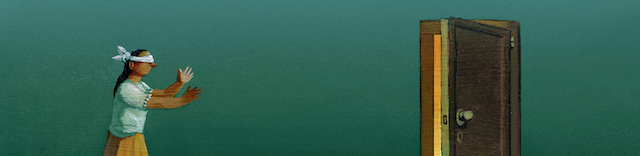
    Discovery #3: You’re sharply aware of every door you close but blind to all the doors you could open.

    It’s true. Hindsight is a beautiful thing. The trouble is that it shadows our foresight. I could clearly see every door I was closing that day. Each opportunity reared its stubborn head as I slammed the door in its face.

    But when it came to my future, I was blindfolded.

    None of us have a script for what lies ahead, but we all have a critical role to play in casting the characters and choosing the scenes.

    I chose to be a bold, fearless character that day. I wrote the opening scene and stepped through the door.

    Discovery #4: Every fear conquered today makes tomorrow easier.

    Life isn’t always easy. In fact, it’s damned brutal sometimes. But every battle you face makes you stronger. You’re better equipped to deal with the next inevitable blow you face.

    I faced my fear that day, and in the days that followed. The moment I stepped onto the airport tarmac with my heart in my throat, I wanted to run. The moment I arrived at the crowded train station, feeling confused by the language and scared by the strange faces, I wanted to run. The moment the train shuddered to life and began its fourteen-day journey across Siberia, I wanted to pull the emergency break and run.

    But I stayed. My resolve had been fortified by my hard-won battles of yesterday.

    Discovery #5: The only wrong decision is the one you don’t learn from.

    Everybody’s afraid of making the wrong decision. We’re all afraid of consequences we might not foresee.

    So how do you know if you’re making the right decision? You don’t. I believe no decision is the wrong one unless you fail to learn from it, whatever the outcome.

    If you’re stuck and can’t make a decision, change your view. Take yourself somewhere quiet and think through your options, taking note of how you feel during each moment. The answers are there.

    Why my triumphs can be yours too.

    My decisions, fears, and triumphs aren’t so unique. Everyone experiences them. You experience them.

    Sure, I took the train across Siberia on my own. Not everyone does that. But you can catch your own train.

    Your train can go to a safe, predictable destination. And that’s just fine if it’s what makes you feel good deep down.

    But your train can also go somewhere uncharted.

    It can go through the door to life-changing self-discovery.

    Self-discovery that can only be fast-tracked with a bold, insane-feeling decision.

    A decision that will sit high atop a mountain of arguments and alternatives.

    A decision that will wear the scars of the fight it had with caution, fear, and desire.

    But if you think about it long enough, and listen to your subconscious mind, its power will win the fight.

    And you’ll be the one writing your life script.

    That’s what I chose. Will you?

  • How to Stop Worrying: 5 Things to Try When Nothing Else Works

    How to Stop Worrying: 5 Things to Try When Nothing Else Works

    Calm woman

    “I’ve been through some terrible things in my life, some of which actually happened.” ~Mark Twain

    If you’re like me—a worry prodigy from a young age—you hate when people say, “Don’t worry about it.” As if it were so easy, as if I hadn’t already tried.

    I’ve used many of the tips and tricks out there. Some of them helped for a while, but few did much for long.

    The trouble is, most of the advice out there only addresses the symptoms of worry. It’s like taking cherry-flavored cough syrup when you have bronchitis: tempting, and probably the most palatable option, but not likely to do any lasting good since it doesn’t address the real issue.

    I’ve been a worrier ever since I was seven years old and slept with my covers over my head because I was afraid that foxes and burglars would attack me at night.

    What I’ve learned over the years of working with worry—a nice way to phrase it, though it could also be described as obsessively thinking, planning, and catastrophizing, forgetting to breathe, and grinding my teeth—is that resisting it only makes it grow stronger. In order to find freedom from apprehension, you have to get to its root.

    So here are five things you can try if you’ve meditated, said your positive affirmations, and smelled your grapefruit (yes, it’s a thing) and your worries still haven’t gone away:

    1. Get curious about why you worry.

    As I got older, I began to notice what a big drain worry was on my time and energy. I saw how it never helped me feel stronger, more innovative, or more able to respond. I also began to read about all the negative impacts it has on our health and well-being. So naturally I started to worry about being worried.

    A much better response would have been to get curious about why I did it. Because we all get something out of worrying or we wouldn’t do it.

    In my case, I realized that I do it most when I feel powerless. The act of worrying helps me feel like I’m doing something, like I have some sort of control over an uncontrollable situation.

    Worry can also distract us from even scarier parts of our lives, or from our own intense emotions. And it can help us feel like we’re protecting ourselves and what’s important to us just by thinking about them. Though worrying can’t actually change anything in reality, it can promise to help us feel more empowered and secure.

    We worry because we think it helps. When we see what worry promises, we can also see clearly what it fails to deliver. Without this clarity, letting go of worries can feel too scary for most of us to attempt. With it, we can find new, more effective ways of dealing with uncertainty in a world where so much is out of our control.

    2. Feel your fear.

    In some ways, worrying is an attempt to avoid what you fear, which is really an effort to avoid fear itself. Feel the fear, and the worry becomes unnecessary.

    I experienced this recently when I had the idea for a novel. For the first couple of months, everything was great. I kept getting ideas, writing them down, and feeling more and more excited about the project.

    And then when I decided to actually start writing the novel, I had a breakdown. Suddenly I couldn’t stop thinking about the story line, going over and over it in my head, worrying that something was wrong with it, and trying to get it right.

    Every spare moment I had, I was in my head trying to solve this imaginary problem. I couldn’t relax, I could barely sleep, and I certainly couldn’t write.

    Finally it occurred to me that the reason I was worrying so much was because I was terrified. I experienced what felt like a huge rejection of my writing when I was young, and it devastated me. This was the first major project I had attempted since then, and part of me was scared that the same thing would happen all over again.

    Once I became aware of it, I felt a tidal wave of fear waiting to wash over me. And though part of me wanted desperately to avoid it, I knew I needed to let it in. So I did.

    It wasn’t pleasant. Fear can be very uncomfortable, and we avoid it for a reason.

    But similar to storm clouds that look dark and sinister on the horizon, once the feeling actually arrived on my shores, it washed over me like rain. I was reminded that fear is really just a bundle of uncomfortable sensations that I can handle. And then it’s gone.

    When you let yourself feel your fear of whatever outcome you’re trying to avoid, it loses its power over you.

    The best way I know to do this is to name your fear, exactly what it is that frightens you. Then you can let yourself feel it, by sitting quietly, or dancing it out, or moving and noticing where you feel it in your body. If you can let it be there, knowing that it’s temporary and can’t harm you, you can free yourself from the need to distract yourself from it with worry.

    3. Do what you can.

    Too often we try to get rid of our worries without truly understanding them. The problem is, worries are kind of like toddlers: when they aren’t listened to, they get louder. When they aren’t listened to for long enough, they throw a tantrum.

    Our worries are really just trying to help us. They can usually point us towards something worth paying attention to, so it’s worth listening to them.

    You can do this by asking yourself:

    • What feels like it’s at stake here, and why is this important to me?
    • What does this worry want from me?
    • How can I address this concern in a way that feels good to me?

    In the case of my fears about writing a novel, I realized that the worry was trying to make sure that I wasn’t hurt or disappointed again. It wanted to protect me from possible rejection. It felt like my entire self-worth was at stake, that if I failed, I would know with certainty that I had nothing of value to offer the world.

    The worry wanted me to protect myself. It wanted me to make sure that what I did was so good that it couldn’t possibly be unappreciated.

    These realizations led me to do two things: first, I reminded the part of myself that was scared that though there will be people out there who don’t like what I write, there are a lot of others who will. Nothing appeals to everyone, and though disappointment hurts, it’s also temporary. Regardless, there’s always value in what I create from the heart, and my worthiness doesn’t depend on the result of one project.

    And secondly, I committed to going slowly. Part of myself felt very scared, so rather than push myself out of my comfort zone all at once, I resolved to take baby steps and give my vulnerable self time to feel it out and adjust.

    I also promised myself that I would only share it when I was ready, and would start with the people and communities who were most likely to appreciate it. When I did this, I no longer felt the need to obsess about the story.

    Sometimes listening to worry’s hidden wisdom and taking action on its behalf is enough to convince it to lay down its arms.

    4. Accept the worst.

    This is easier said than done, but it’s one of the most powerful ways to undercut worry.

    I had to do this big time when I made the decision to get married.

    At the time, I was so worried about making a mistake that I could barely think about anything else. (And just to be clear, this had nothing to do with my lovely husband-to-be. I was so scared of committing at the time that I could have been dating Prince Charming and I still would have had doubts.)

    It was only when I came to terms with the fact that our relationship might not last forever that I was able to stop worrying and take the plunge. Don’t get me wrong—I sincerely hope that we’re happy together ever after, but I also know that we may not be. And that’s fine. Splitting up would be painful, difficult, and sad—and I also know I would survive and ultimately be okay.

    Many of the things we worry about (failure, rejection, embarrassment, inconvenience) are pretty much just temporary challenges when you get down to it.

    But even for those things that are more painful or permanent, there is a way to accept them and know you’ll be okay. No matter what happens, you’ll have options for moving forward. Other people will always be there to help. And regardless of what goes wrong, you can count on all the incredible internal resources you have (compassion, loving-kindness, wisdom, strength, intelligence, resilience, humor, joy) being there to support you.

    Being willing to accept anything isn’t easy, but it’s an incredibly powerful way to find more equanimity and peace.

    5. Practice trust.

    The idea of trusting the universe used to give me a rash.

    It seemed to me that it was hard work, foresight, and copious amounts of worry that held everything together in my life. I believed that if I relaxed at all, things would fall apart.

    But eventually it dawned on me that as capable and amazing as I am, I do not single-handedly hold the world together. I began to notice how other people grow my food, trees create the oxygen I breathe, and the sun provides me with lots of light and warmth everyday, all without my involvement.

    What’s more, I realized that if I’m being honest with myself, most of the good things in my life didn’t happen solely because of my own foresight or effort. Sure, I contributed to many of them, but they also required a lot of luck, happy accidents and coincidences, and forces outside of my control.

    Recognizing this, I began to be willing to experiment with turning my troubles over to a force larger than myself. When held thrall in the throes of worry, I would remind myself that it wasn’t all up to me to make something happen.

    I would recall all the help I’d ever gotten over the years and all the things that turned out well. I would think of all the things I was grateful for, most of which were out of my control, and then I would visualize placing my problem in the hands of a universe that had supported me so well up to that point.

    And then I would do my best to let go and think about something else. (This is when meditation and other calming techniques worked really well.)

    Much to my surprise, the world didn’t fall apart when I did this. In fact, the outcomes were often much better when I turned things over than when I tried to fix everything myself. Even better, the more I turned over, the calmer and freer I felt, and the more I began to trust.

    Trust, it turns out, is the ultimate antidote to worry. And we don’t have to be born with it to use it—it’s possible to build trust in ourselves and the universe through practice, one worry at a time.

  • When Fear and Panic Win: How to Deal with Anxiety

    When Fear and Panic Win: How to Deal with Anxiety

    Panicked man

    “Anxiety happens when you think you have to figure out everything all at once. Breathe. You’re strong. You got this. Take it day by day.” ~Karen Salmansohn

    As much as I believe that you can move through fear to do whatever it is that you want to do, sometimes fear wins.

    Sometimes, try as you might, you can’t push yourself forward. You retreat, worn, battle scarred, banged up, and with your tail between your legs.

    You wave your white flag. You surrender.

    Fear wins.

    But it is in this moment of loss that you can learn some very important things.

    Let me explain.

    Earlier this year, a friend invited me to a play. Looking forward to it, I got dressed, ate lunch, and headed out to take the train.

    On the train to the show I had a panic attack.

    Sometime along my teen years, I developed a phobia called emetophobia (the fear of throwing up). It manifests itself most often as panic attacks, usually in confined spaces like trains. It had been better for years, and that day on the train the panic came back.

    Through sheer grit, distraction, and tears I made it to the theater, pulled myself together. and tried to pretend that I was okay (to my friend and to myself).

    We made it to our seats in the top row in the corner and panic began again. About five minutes into the show, the panic returned, and all I could do was hop out of my seat and book it down the steps and out into the hallway.

    I tried to wait it out. I went to the bathroom, paced in the hallway, went downstairs, but I couldn’t go back inside. I sent a text to my friend to tell him that I wasn’t feeling well and needed to go home, and then I left, absolutely defeated.

    Still feeling too anxious to get in a moving vehicle, I decided to walk, or rather I just started walking. I walked almost 1.5 miles (or 2.4 kilometers) home wearing heels. About halfway home, I called my mother to tell her what happened and began to cry hysterically.

    What a sight. Fear had won. I had lost.

    Shame, disappointment, and self-hatred poured into my psyche from all angles.

    “What’s wrong with you? You’re defective. You’re unlovable like this. You’re a failure. How can you write about fear when you can’t even master your own?”

    My mind hurled insults faster than I could catch them, and by the time I got home I was so exhausted that all I could do was go to sleep.

    After I woke the next day and in the weeks after, I began to journal about my experience and speak to people about what happened.

    I learned some things that have made a profound difference in how I experience and deal with anxiety now and I’d like to share them with you.

    1. You are not alone.

    The National Institute of Mental Health estimates that 18% of adults in the United States experience an anxiety disorder. That’s at least 50 million people! And when you add in what’s likely to be similar rates around the world, that figure grows even more.

    When you’re struggling with fear, it’s easy to feel like you’re alone and no one else goes through what you go through. Anxiety is way more common than you think, and while it’s sad that it affects so many people, you can use that knowledge to lighten up on any judgment you make of yourself.

    2. With that said, there is nothing to be ashamed of.

    Fear, anxiety, and panic don’t make you defective or broken; they make you human. When I experienced a panic attack, I would find myself feeling ashamed. Like I was wearing a scarlet letter, branding me as a worthless person.

    Ever notice how people who suffer from a physical challenge like arthritis or poor vision or a broken leg don’t often feel ashamed about their condition? It’s just something they’re dealing with. They are not lesser people because of it. It’s the same with fear-related struggles.

    There is nothing wrong with you if you struggle with fear, anxiety, or panic attacks. It’s just something that you’re dealing with.

    3. Sometimes fear wins, but it’s how you bounce back that matters.

    If I’ve learned one thing thus far in this journey of life, it’s that there’s always something to work through. This means that while you might be accomplished in dealing with fear in one area (for example, I’ve developed the ability to go to social events by myself, in spite of fear), you might come across other areas that you want to work on, and that’s just life.

    The power comes in recognizing this, acknowledging that you’ve had a setback and then picking yourself up, dusting yourself off, and trying again some other time. In that way, fear may win a small skirmish, but not the long-term battle.

    4. Sometimes fear wins, but it’s what you learn that matters.

    Again, fear doesn’t win for long or at all if you learn something about yourself or life through the process.

    When I panicked on the train and at the theatre and immediately went into self-hatred and judgment, I realized just how much I was loving myself with conditions. When things went well, I felt pretty good about myself, but as soon as I felt anxious, I snatched that love away.

    True self-love comes from accepting yourself as you are, not from waiting until you are perfect. It’s about loving yourself in spite of what you feel might be wrong, and not because nothing is wrong. Let those things that you find lacking in your life make you love yourself more.

    Learning to use the panic attack as a signal to love myself more has made me feel safe in my own body to experience whatever it is that happens to come up.

    5. And in addition to self-love, learn to treat yourself with extreme care and kindness.

    Pretend you’re dealing with a small child who is terrified. What would you do? Probably not yell, judge, or berate the child. You would likely give the child a hug, offer to buy them a treat, play with them, or try to make them laugh.

    Pretend you are that child. Give yourself what you would give that child. In many ways we all carry around our child self, even when we become adults.

    6. Who you have in your corner outside of yourself also makes a difference.

    Fear can be so isolating. It’s easier to retreat to the safety of your own known thoughts than it is to chance being exposed or judged by another. At least that’s what I used to believe.

    I now believe that fighting fear completely alone can be so much harder. Having at least one person in your corner who you can talk to about your fears and your bouts with anxiety can help you keep moving forward. Someone who can say to you the things that you have a hard time saying to yourself. Someone who is kind and caring and can help you learn how to be kind and caring to yourself by internalizing their words.

    7. And finally, panic feeds on running.

    It’s the running that makes things worse, so find ways to stay with what’s happening.

    I’ve been learning more about what happens in our bodies when we have a panic attack, and it’s essentially a fear-symptoms-fear cycle.

    You feel or think a scary thought. Your body responds with the fight-or-flight response, causing your heart to race, your breathing to quicken, your hands to shake, your stomach to feel weak. You interpret those physical symptoms as something being wrong and then you get more afraid, furthering the cycle, until you’re in a big panicky mess.

    The most effective way to deal with these feelings is to understand what is happening in your body, know that it’s not dangerous, accept that you feel those things without trying to push them away (being fully able to admit how much the feelings are uncomfortable), and then just wait and let them pass. In time, they inevitably will.

    As much as I resist this, I’ve since tried this approach many times, and while uncomfortable, I’ve seen it work enough that I’m convinced that there’s something to it.

    The more you can view your panic attacks as an opportunity to learn about yourself and practice unconditional self-love, the less you will feel like a victim in your life. And when you feel empowered to know that you can trust yourself to move through any scary situation that comes your way, in the end you will have won.

    I’d love to hear what you do to support your journey when fear and panic win. Please share your tips (or questions) in the comments below so we can all support each other!

  • What You Need to Know When You’re Considering a Big, Scary Change

    What You Need to Know When You’re Considering a Big, Scary Change

    “May your choices reflect your hopes, not your fears.” ~Nelson Mandela

    Ten months ago I found myself floating on my back in an outdoor pool somewhere in California. Overhead was a clear blue sky, leaves dancing in the breeze, and birds singing their morning song.

    I felt more alive in that moment than I had in years. And so I made a promise to myself, right there and then, not to forget this feeling. I made a promise that I’d follow it. I made a promise that this feeling wouldn’t just be a three-month trip to a new country, but that I’d make it my entire life.

    And that’s how I came to be selling the flat I’ve lived in in London, the UK’s capital, for the last eight years.

    That’s how I came to be standing on the edge of something entirely new and uncertain and unknown.

    That’s how I came to be on the verge of yet another adventure. By noticing something that made me feel alive and promising myself I’d do whatever it took to bring more of that feeling into my life, until that feeling was my life.

    So here I am, sitting at my kitchen table, tapping out these words surrounded by the beginnings of packed up boxes, bags for the local charity shops, and the promise of a new life. The promise of a life made up of “that” feeling.

    For me, “that” feeling is about nature, wide-open spaces and a large majority of my time spent outdoors.

    And I’m excited, I am. There’s real excitement there. But layered up over that excitement?

    Fear.

    Here’s why:

    Travel’s so exciting, right? It’s adventure and freedom and play and sun and ocean. It’s the romantic idea of exploring new places, meeting new people, and tasting new cultures.

    Except, I don’t want to travel. I have no desire to travel the world. No desire to move from place to place. No desire to live out of a suitcase or a backpack. No desire to jump on the Bali bandwagon.

    I want a home. A community. A base. I want to be around friends. I want some continuity. And I want a partner to share my life with.

    And I have all of that. Right here in London I have it all. (Except the partner, that is.)

    But what I also have is an environment that’s suffocating me. I feel hemmed in, limited, detached from my true nature. And I know it’s time to leave.

    But leave for what? For where? I’m packing up my life and I don’t even know!

    I’m afraid I’ll never find another place that feels like home. Afraid I’ll become a lonely drifter, never quite finding the place I fit in.

    I’m afraid I’ll never meet my life partner because I’m unable to settle anywhere.

    I’m afraid I’ll wake up one morning and find myself old and alone. I can’t tell you how afraid I am of being alone.

    But you know what I know, amongst all that fear?

    That without this next step I cannot pass Go, cannot collect $200, and cannot create the most beautiful vision I hold for my life.

    The reason I wanted to share this story with you is this:

    The beauty of your life is that you get to create it in any way you want. You can create the sort of life that feels truly fulfilling and deeply aligned in every way, but life will always require you to let go of something before the next thing is in sight.

    If you find yourself stepping out onto that cliff edge right now, or making a decision to take that step, not knowing what the outcome will be or where you’ll end up, these are things I hope will help:

    Sometimes you have to close a door before another will open.

    I remember back in 2012 when I left my job to “figure out what I wanted to do with my life,” there was some confusion amongst the people I knew at how I could leave a well-paid, respectable job behind without any real idea of what I wanted to do next.

    I didn’t have an answer for them.

    The only thing I knew at the time was, “this isn’t it.”

    Stepping into that uncertainty paid off. I wound up starting my own business, which I’m grateful for each and every day. And I know, without a shred of doubt, I wouldn’t be here today, doing work I love on my own terms, if I hadn’t made that leap.

    And as much as I’m afraid right now, I know this is the same.

    Sometimes there are ways to build a bridge between the life you have now and the life you want in the future. But even when that’s possible, at some point, you’re always going to have to make a final leap. And it’s that leap and the final letting go of what was, that opens the way for what will be.

    To be reborn, you first have to die. To rise from the ashes, you first have to burn.

    Closing doors is scary, yes. But I comfort myself with the knowledge that there are few doors in life that can’t be re-opened in some way, shape, or form. And the likelihood is you’ll never actually want to do that when you see all the new ones that open to you.

    Other people’s fear is just that, theirs. Don’t take it with you.

    To many people, selling property in London is equivalent to murdering your own child. It’s just not something any sane person does. Alongside my own natural worries and fears about my decision, I’ve had to cope with other people’s fear too.

    I’ve had to untangle myself from other people’s thoughts about my life. I’ve had to step aside from the fear other people hold on my behalf.

    After nearly four years out in the world carving my own path, this is something I know to be true:

    Other people’s fear has nothing to do with you. Do not take it with you. People see life through the lens of their own experience and sometimes they find it difficult to see that their experience might not be the same as yours.

    Don’t let other people’s fear hold you back.

    Have courage and trust.

    Like most people, I’ve lived through some significant, and often tough, life events in my thirty-three years on the planet.

    In each of those moments it’s felt like I might not come through. Like the world might end, even. Heartbreak, most recently.

    But every time I’ve come through, and I’m beginning to realize I can always handle it. That no matter what life brings, I will, in fact, always be okay.

    As you leave the comfort of what you know, whether that’s a relationship, a job, a place or something else, know that you have the strength inside you to cope with every situation life might conjure up.

    What happens if you remain where you are?

    At the end of the day, I ask myself, what happens if I stay?

    My own answer to this question right now is stagnation. And since I believe my ultimate purpose is to grow, I don’t really have much of a choice.

    When faced with the fear of stepping into an unknown future, ask yourself, what happens if I don’t? And is that something I’m willing to accept?

    Your answer might just give you that final little nudge you need to step into the void and find out what life has in store for you next.

    And if all that fails? Well, just remember Oprah, who said there are no wrong paths in life. And Oprah never gets it wrong, right?

  • Why Self-Help Shouldn’t Be About Trying to “Fix” Yourself

    Why Self-Help Shouldn’t Be About Trying to “Fix” Yourself

    “Stop trying to ‘fix’ yourself; you’re not broken! You are perfectly imperfect and powerful beyond measure.” ~Steve Maraboli

    The other day I had some time to kill before a meeting, so I decided to go to one of my favorite places, Chapters Bookstore. When I walked in, I immediately headed toward the self-help section to pick up Brene Brown’s Rising Strong (great read, by the way).

    As I was searching for her book, I noticed an unusual number of people browsing the same shelves, searching for their self-help book of choice.

    Of course, there is nothing wrong with this. The desire to learn, grow, and be the best version of yourself is something that takes commitment, which I applaud.

    But, there was a time when going to the self-help section of the bookstore was done discreetly, not wanting others to think you needed that kind of help.

    There was this silent insinuation that something was wrong with you; you needed to be fixed because you were “working on yourself.”

    Now, with the personal growth movement in full effect, it’s widely accepted, with sales in self-help books soaring! Yet that silent insinuation has not quite fully left.

    Some who seek help increasing their confidence or decreasing self-doubt, or doing anything else for their own personal growth, believe that:

    • “I need fixing,”
    • “There really is something wrong with me,” or
    • “If I loved myself enough I would/would not (fill in the blank).”

    If you connect with what I’m saying, then I’m here to tell you that none of that is true! How do I know? I used to carry those same beliefs.

    So I ask you, why do you seek personal growth? Your answer will determine your outcome.

    I believe there are two motivators as to why people seek personal growth: love and fear.

    When you seek personal growth from a place of love, your relationship with yourself changes. No matter how many mistakes or wrong turns you feel you have made, you are willing to use those as learning opportunities, not as a reason to judge, criticize, or blame yourself.

    You acknowledge that you are doing the best you can with whatever life throws at you. You are there for yourself with acceptance, understanding, and forgiveness. As a result, true growth happens.

    When you approach self-help from a place of fear, you believe that you or your life is lacking in some way. You hang on to the hope that if you just get the right self-help book, or sign up for that life-changing workshop, retreat, or program, that uncomfortable feeling will go away and all will be well again.

    If you hang on to this belief, that is not personal growth.

    This is looking outside of yourself for happiness, self-acceptance, or inner peace, or to bring security, guarantees, or the love you desire.

    It’s a temporary fix. It will continually leave you feeling unfilled and in a cycle of looking for the next best thing to fill you up, creating more fear within you because you are not getting the long-lasting results you want.

    I was in that cycle about six years ago. The end of a promising relationship left me heartbroken.

    I was about to turn forty, I wasn’t happy with where I was in my career, and I was struggling financially. Although grateful for my supportive family and friends, I knew it was all on me to do things differently. But I was feeling lost, empty inside, and unsure of myself, and I had no idea of my next steps.

    What I had envisioned for my life up until that point was definitely not where I had landed. This scared me. I felt alone most of the time. I felt like everything was falling down around me, and it jolted me to my core.

    It opened up insecurities I was unknowingly carrying, or thought I had resolved. My self-doubt was high, and I constantly second-guessed myself. But you would have never known it, because I was very good at putting on a mask to get through the day.

    I shed many tears. I prayed for help. I blamed. I was angry. I felt cheated.

    I didn’t realize it at the time, but this was the best place for me to be in. This emotional time in my life pushed me to challenge and redefine the type of relationship I had with myself, which ultimately impacted my relationship with life.

    A self-awareness journey had begun like never before in the midst of believing I needed fixing.

    My whole life I had always dabbled in personal growth, always having a curiosity about life, the purpose of it, wanting answers on how to find fulfillment. So I felt I was pretty well versed in spiritually and well-being.

    I would soon find out that this time would be different.

    I began to soak up all the information I could on the “how to’s” of personal growth and development, to help me get to a better place in relationship with myself.

    And it did help me—to a certain point.

    While I learned a lot from books, retreats, and online courses, my subconscious intention was to fill that void within me. So nothing really stuck long term.

    All the happiness, love, and peace I felt lasted as long as my boyfriend approved of me, or people only had nice things to say about me, or I was the perfect friend, daughter, employee, or boss.

    I was still operating from a place of inner emptiness and a lack of self-love, so I didn’t fully see my own beauty. As I went deeper within, unraveling layers of myself that I had never tapped into before, some I didn’t even know existed within me, my fear started to evolve into self-love.

    I realized that we are taught how to love others, how to get love, how to be lovable, but we’re never taught how to truly love ourselves—at all, let alone unconditionally. Why? Because on some level, our society believes that it’s egotistical, not important, or narcissistic.

    What I now know for sure is that each time we depend on others or things to give us happiness, approval, to make us feel loved, important, successful, to receive guarantees, peace, or security, we give a piece of ourselves away.

    We give what is happening outside of ourselves permission to dictate our level of happiness and self-love.

    For me, that evolved into people pleasing, because I allowed others to be my lifeline to feeling good. I didn’t realize that I didn’t need fixing; I just needed to be re-introduced to who I truly was and I have always been. Whole and complete.

    Once I stopped giving away my power to everyone but myself, my relationship with myself changed, and so did my life.

    When you meet yourself with love, you allow the process of personal growth to be about fulfillment rather than filling in. You begin to be kinder to yourself, more understanding, compassionate, and supportive of your journey. The love for yourself expands.

    Self-love is not about the ego or selfishness; it’s a pure, positive, compassionate attitude toward yourself. So when we hear that voice within saying, How dare you love yourself? I ask, How dare you not?

    Personal growth is a lifelong process that is not about getting to a destination, but the journey itself. There is no right or wrong way of going through this process.

    Each of our life journeys is unpredictable. The only thing you truly have control over is yourself—your actions, your effort, your words, your fun and play, your ideas, your mistakes, or your behavior. You have the power to decide how you will continue along your journey. So ask yourself…

    Will my decisions come from a place of love or a place of fear?

    Build a solid foundation from within by tapping into your beauty, confidence, strength, resilience, and all the other good stuff that may be buried away and forgotten, so that you don’t lose yourself during life’s ups and downs.

    Know that nothing or no one can validate you, because you are already valid.

    There is no “fixing” that needs to be done, nor are you “flawed” for seeking help and guidance. It just means that you are ready to experience yourself and your life in a new way, because what you’re doing is no longer working.

    The next time you pick up a self-help book, go to a spiritual healer, hire a life coach, see a counselor, or attend a personal development workshop, let these resources be a means to support. Let them help and guide you toward true fulfillment rather than inviting them to be a substitute for your true happiness.

    You are perfect, whole, and complete exactly as you are!

  • How to Prevent Fear and Insecurity from Ruining Your Relationship

    How to Prevent Fear and Insecurity from Ruining Your Relationship

    “Everything you want is on the other side of fear.” ~Jack Canfield

    Buried deep within the broken heart of every great loss is a nugget of wisdom. I experienced the greatest grief of my life just a few months ago, and with it came an opportunity to uncover ugly truths about myself I’d been hiding from.

    In facing my pain, I have discovered that underneath the conscious, big-hearted, beautiful person that I am lives a small girl who is terrified of being misunderstood and abandoned by those she loves most.

    The surface signs alerting me to these fears looked something like this:

    My boyfriend and I are lying in bed reading one night. His mind is lit up in fiction while my soul is on fire with a spiritual book. We have often shared these evenings with one another, smiling and supportive.

    This night I want more. I want him to be as excited about this chakra healing book as I am. I want him to crawl into my body and feel everything I’m feeling and see everything the way I’m seeing it.

    I think he can feel me wanting more, and it freaks him out. He energetically hides in the bushes, further away than I’ve ever felt him go, and I panic.

    The warning signs that go off in my body read: IF HE DOESN’T GET THIS HE IS GOING TO LEAVE YOU. DO YOU HEAR ME?! YOU ARE GOING TO END UP ALONE.

    I don’t actually hear those words, I just feel a need to push my feelings onto him and basically tell him he’s wrong for not feeling the way I do. He looks at me with big, helpless eyes and responds:

    “I think it’s okay that we’re different.”

    I stare blankly back at him while an inner struggle ensues. I can feel my ego fighting. It wants to win. It wants him to see things my way. It wants to be right. It wants him to be just like me.

    But I know better.

    I move from my head to my heart, and I know it’s okay that we are different. What is important is that we love each other, respect each other, and support each other. So I melt into his arms with a smile, an apology, and a “You’re right.”

    But I don’t let him be right. That night I do, but every incident after that I don’t. And he never says it again. He never reminds me that it’s okay that we’re different.

    So the other times, later on, when he doesn’t see things the same way as me, the warning signals go off, and no one reminds me that it’s okay. So I panic, and I spin the fear into all kinds of stories that justify me bullying him into being like me. All because I’m afraid he is going to leave me.

    And he did leave me.

    There are many ways I could tell the Leaving Me story, but the truth is that it’s as complicated as human beings are. One part of it, the part I take responsibility for and the part I’m focusing on here, is that I fought his perspectives that were different from my own, leading him to feel like he couldn’t be himself with me.

    I did this because I was afraid to lose him. I was afraid that if we were different in some big ways maybe we wouldn’t make it. I felt safe when we were agreeable and felt unsafe when his thoughts differed from mine.

    But I was safe. I am always safe. A part of me knows this, but the part of me that comes to life when the fear arises is the part of me that needs a reminder. I didn’t know I needed to be reminded at the time. I didn’t even know I was doing it at the time.

    But now I know. I just needed those simple words, “It’s okay.”

    It’s okay that we’re different.

    He is someone who doesn’t know how to fight for himself. It’s not something I understood about him at the time, but I see it now.

    I am strong in my conviction. I am forthright. I speak my feelings decisively and with ease. He sweats and stutters, but mostly he shuts down.

    I suspect he shuts down because he is afraid. He is afraid of losing himself, but really he is afraid that I won’t love him for who he truly is. He doesn’t trust that he can speak up, that he can challenge me, that he can tell me it’s okay and that I’ll believe him.

    The tragedy is that I don’t know it. Neither of us knows it, really. We’re blind to our shadows, only seeing our own reflections after we’re over.

    I don’t know he is shutting down because he’s scared, and I don’t know I am trying to make him see things my way because I’m afraid. It’s all this delicate dance that happens backstage, until one day he tells me he doesn’t feel like he can be himself with me, and everything comes crumbling down.

    You might be thinking that we were too different, and maybe the truth is that I should be with someone who can share my excitement about chakras. I don’t know.

    I do know I loved him more deeply than I’ve ever loved.

    I know that our relationship was the healthiest, most beautiful relationship I’ve ever experienced.

    I know that I messed up by not letting him be him completely, and I know that he messed up by not sharing his true feelings with me.

    That is a lesson, yes. But there is a deeper lesson, and it’s a lesson about fear.

    I acted controlling because his differences triggered my fear of abandonment, a nerve that runs all the way through my heart and back into my childhood. The irony isn’t wasted on me that my reaction to my fear inevitably created the very thing I was attempting to avoid. And that is the lesson.

    When we act from fear we begin our journey to the guillotine.

    Fear hides behind many guises, ruining plenty of love lives.

    We’re afraid we’re unworthy of love, so we push our partner away when things get too intimate. We’re afraid to be abandoned, so we try to control the relationship or smother our partner. We’re afraid we won’t be accepted as we are, so we don’t show our true selves. 

    We act from fear when we’re too busy to pay attention, when we’re too stressed to slow down, when we make assumptions instead of asking questions. The very thing we are afraid of often becomes our reality when we live from our fears. It’s an act of self-sabotage.

    Relationships are a beautiful opportunity to see ourselves more clearly, but we each have to be looking. You have to be willing to see you, and your partner must be willing to see them. And this all needs to move very slowly, very delicately, and very lovingly. It’s the way we make it through.

    Fear has a million different faces, but your soul always knows the way. When you feel your body tense, when your voice rises, when you begin to shut down, when you begin to explode, when you run away, when you shake with anxiety, your body is telling you.

    Slow down in those moments. Breathe. Let your breath open you up into the vulnerable space of love, and let it cocoon you until you can step out from that place.

    Tell your partner all about it. Tell them about your fears, your discovery of your fears, and how they can help you through it. But don’t put it all on them. This is your work, and this is a practice, one that you have to keep coming back to over and over again.

    You might need some gentle nudges along the way. It’s okay to be different. But if you keep showing up, and if you continue to be willing to see the truth about yourself you will break through the boundary of fear and into the heart of love.

  • 4 Things You Need to Know When Pursuing An Ambitious Dream

    4 Things You Need to Know When Pursuing An Ambitious Dream

    Dreamer

    “So many of our dreams at first seem impossible, then they seem improbable, and then, when we summon the will, they soon become inevitable.” ~Christopher Reeve

    Have you ever decided to pursue something that excited you, that seemed really hard to do, and then had your will tested and almost crushed? I have, many times, most recently this year.

    As you may recall, I shared a blog post in January about the newly formed Tiny Buddha Productions, a film company I started with my fiancé, fellow screenwriter Ehren Prudhel.

    If you haven’t read that post yet, you may want to read that now. Go ahead—it’s here. I’ll wait.

    Welcome back! A lot has happened in the six months since we decided to make a short film about loneliness and connection.

    We’ve faced delays, and drama, and disappointment. We’ve questioned ourselves, our idea, and our potential. And we even considered scrapping the whole thing when it all seemed far harder, and success far less likely, than we once imagined it would be.

    But we’ve pushed forward, in spite of the fears and the discomfort. We’ve waded through the guck of insecurity and uncertainty. And here we are, about to start filming our first short film tomorrow.

    As I sit here with a goofy perma-grin on my face, I’d like to share a little of what I’ve learned over the past six months.

    If you’re pursuing a dream, and feeling overwhelmed, uncertain, self-doubting, and scared, perhaps some of my lessons will help.

    1. There’s no shame in being green.

    I knew going into this there was a ton I didn’t know. Although I’d studied acting and writing in college, I didn’t study screenwriting, and I had no experience producing a film or working on a set.

    In addition to what I didn’t know, there was a lot I didn’t know I didn’t know—stuff about permits, and insurance, and securing locations. Every part of this has been a learning process for me, and that can feel incredibly vulnerable.

    It’s easy to feel insecure and embarrassed when you’re working with experienced people and you feel a little ignorant.

    But when I took my ego out of the equation and stopped worrying about what other people might think of me, I realized how fun it is to be at the beginning of a journey.

    It reminds me of when I was in college, and I felt excited about everything—being on campus in Boston, meeting new people, learning from them, getting to share my work, and imagining possibilities for the future.

    Would I feel more confident if I were an expert? Sure. But there’s nothing like the enthusiasm you feel when you’re just starting out. Some day I will be an expert, and I can only hope I’ll maintain this electric passion I feel right now.

    If you too are at the beginning, remember: This feeling won’t last forever, so soak up the best and don’t worry about the worst. No one loses respect for someone just because they’re new. If anything, they highly esteem people who are embarking on an exciting but challenging new journey—especially if they’re not just out of college.

    More importantly, your experience is worth far more than their perception, so enjoy every part of this new path. This is what life’s all about—trying things that excite you and feeling giddy, nervous, and passionately alive. Let yourself bask in it.

    2. Setbacks are part of the process.

    As I mentioned, it’s been almost six months since we decided to do this short film. We originally planned to shoot in in the spring, after speaking to lots of people and hiring a director, who was going to bring his own crew onboard and edit.

    With the most important hire in place, I ran a T-shirt campaign to raise money to fund the film. And then the setbacks began.

    The director—who, I should add, is a wonderful person, who we’d be fortunate to work with—said there were too many locations. So we re-wrote the script.

    Then he told us the budget was still too small, so we increased it, to much more than we originally expected we’d spend.

    Then, after much back and forth, with all our eggs in his basket, he had to back out due to personal reasons.

    As the months went on, I began to feel like the girl who cried film. I’d already publicly announced the project on the blog. I’d run a fundraiser. And there we were, seemingly back at square one.

    For a while I got myself worked up and discouraged. I had no idea how to move things forward with our first project, and I also knew it would be just a small step on a much larger path. But then Ehren and I regrouped and decided that the setbacks weren’t failures; they were part of the journey—to be expected.

    We didn’t need to feel bad about them. We had to view them as par for the course—simply part of the process of doing something new and difficult.

    So often we get down on ourselves when things don’t go as planned. But it’s nearly impossible to make a smart plan when you’re learning as you go because you have no idea what each step will entail. The only thing you can reasonably expect when you’re doing something new is the unexpected.

    The good news is, the unexpected isn’t always bad. It’s usually in putting out mini fires that we learn and grow the most. Every step of a new journey is a classroom—and remember, people pay good money for an education.

    So don’t let the setbacks get you down. See them as signs you’re moving up, because they are, in fact, a part of the process.

    3. It helps to hold yourself accountable.

    I wrote that blog post introducing Tiny Buddha Productions for a reason: I knew that this would be hard. But once it was out there in writing, and because we also told our friends and family, it felt nearly impossible not to follow through.

    I could lie to myself and say I didn’t really want this that bad, but I’d already made it abundantly clear, very publicly, that I did.

    Reading that post has kept me motivated when I’ve felt like giving up. It’s reminded me that this means something to me, and it’s worth pushing through my discomfort to make it happen.

    Tell people what you aspire to do, and not just casually, in passing, like it’s not that important to you. You want this. You dream about this. If you’re like me, you lie awake thinking about it, and it pops into your head first thing in the morning and when you wake in the middle of the night.

    You care—a lot. And it feels vulnerable to admit that, especially since everyone will know if things don’t work out as you hoped they would. Don’t let that deter you.

    Not only does sharing your intentions keep you on track, it also inspires others to do something about the faint murmur they hear in bed at night and when they open their eyes.

    Everyone has something that blows their hair back. Remind them what it looks and feels like to go for it. As the saying goes, “Enthusiasm is contagious. You can start an epidemic.”

    4. An experience can be worth so much more than it costs.

    We raised quite a bit for this project, because filmmaking is incredibly expensive. (In fact, I was shocked to learn how much it costs to make five minutes of film.)

    When I shared with a loved one how much we raised, she questioned if perhaps we should pocket the cash or spend it on something else. “Why spend that money on something that might go nowhere when you could just keep it?” she asked.

    Well, I’d positioned the T-shirt campaign as a fundraiser, so that’s one thing. But more importantly, I knew this experience would be far more valuable than what it would cost.

    Ehren and I each have our own reasons for wanting to do this, and wanting to do it together. His reasons are his to tell. For me, this is more than a project; it’s the beginning of an exciting new life.

    It’s a way to connect with who I was before healing consumed me; an opportunity to create something that will hopefully make an impact; and a chance to do something collaborative instead of spending so much time working on my own, from my computer.

    That’s why I’m doing this film, and I hope many more after it: it’s something I need to do for myself, and want to do with Ehren. If that’s not worth the cost, what is?

    I realize I’m incredibly fortunate to have a means to raise money, and that not everyone has that same advantage. But we all have the ability to invest in ourselves—whether that means a portion of our savings or a portion of our time.

    We all have the potential to put some of what we have toward what we want to create. I know, it can be scary to do it. You can think of a million and one reasons not to use your limited resources.

    There are no guarantees. It might not work out as you hoped it would. People might say, “I told you so.”

    Yes, those things are true. But things could actually turn out better than you’d hoped. And if they don’t, this could be the first step on a different journey you don’t yet know you want to take.

    You don’t need a guarantee to know that taking a risk—stretching yourself and coming alive—is worth it, no matter where it leads.

    Having a dream is a lot like being that little man on the moon, in the picture on top. You know you can fall, but it doesn’t matter, because you’re lost in the music and the view. I’m lost in mine right now. What’s yours?

  • How to Reconnect with the Inner Light Below Your Pain

    How to Reconnect with the Inner Light Below Your Pain

    Carefree woman

    TRIGGER WARNING: This post deals with an account of physical abuse and may be triggering to some people.

    “What hurts you blesses you, darkness is your candle.” ~Rumi

    We are all born with it. The beautiful bright light in our soul, filled with love and happiness.

    I remember having that feeling of being so alive and free and untouched by fear or worry.

    This is who we are at the core of our being. This is our true authentic self, from before the world told us who we needed to be and negative outside circumstances started to tear down our self-worth and self-esteem.

    I can tell you exactly what age I was when the light inside of me started to fade. I was seven years old and there was physical abuse at home with belts and hangers.

    From the very first moment it happened, I remember being in my bed and hugging my Snoopy doll, questioning what love and trust really meant.

    Worst of all, I started to believe that I was not worthy of safety and security, and decided I must be a really unlovable girl.

    Having this negative belief about myself, I could no longer hear anything positive from anyone. No matter what compliment someone offered or how much someone would try to show me love, I would go back to this now instilled belief: “You are not worth it. No one will love you. You are supposed to feel pain if love is involved.”

    This false self-perception led me down many dark paths into self-destruction and self-sabotage, and my world in my mind became very small.

    I was attracting circumstances and people in my life that would reaffirm my low self-worth so that I could tell myself, each and every time I was abandoned, rejected, or broken up with, “See, what you think is true—you are not worth it.”

    This eventually turned into a huge black abyss in my soul, and there was no light in sight.

    I tried to fill it with alcohol, drugs, relationships, sleeping pills, and whatever I thought might help me escape this deep darkness that was now my everyday existence, but nothing helped.

    After many years of struggling, running, and numbing, I saw a quote by the great poet Rumi that read, “What hurts you blesses you. Darkness is your candle.” That was it!

    I realized that my pain was not a punishment, and that I could see all this pain as a candle, a guide to bring me back to who I was before I decided I wasn’t worthy or lovable.

    My journey into spirituality began, and I was able to come up with a process that allowed me to heal from each painful incident, no matter how bad it was.

    Here are the steps that I have taken to heal some of my deepest wounds:

    Identify what, exactly, is causing the pain.

    I needed to go back to the beginning, before fear took the place of love in my heart, and remember the specific events that I allowed to negatively affect me. I created a timeline and wrote down everything that had ever hurt me up until my current age.

    Take a quiet moment and sit in a place where you won’t be interrupted. Take out your journal or a piece of paper, and then sit with your eyes closed.

    Bring yourself back to your past and try to recall a time when you felt hurt, scared, or fearful. Write down what happened and how you felt. This process is not an easy one, but the only way we can heal it is to reveal it.

    Acknowledge the pain in the present.

    After allowing myself to get clear about what had hurt me and caused me great suffering, I needed to fully acknowledge how each incident was affecting me in the present.

    Once you retrieve the memory of what caused you this pain, sit with it and visualize yourself saying, “Okay, I am in fear/distress/pain/extreme sadness, and I am going to be okay.”

    You are now acknowledging your feelings in this moment because you felt very alone and helpless before. This allows you to comfort yourself, which will bring you a feeling of peace.

    Accept the pain.

    What I was resisting, numbing, and avoiding was causing my suffering. My detour away from my light happened because I refused to accept that these incidents had so much power over me. I didn’t realize then that acceptance can set you free. I didn’t have to condone or like what happened; I just needed to accept it. 

    It will be a freeing exercise for you to now write, “I fully accept this situation as being exactly how it was supposed to be. I am a stronger person because of this.”

    This will alleviate the hold the pain has on you because you’ll be shifting your belief about what you experienced. Instead of feeling victimized, and consequently hurt or ashamed, you’ll feel empowered for having gained strength and wisdom through your experience. You can do this any time you feel you are holding on to something that is upsetting you.

    Release, forgive, and let go of the pain.

    Before I acknowledged the pain and brought it to consciousness, I didn’t think I had a choice, so the pain became part of my identity. Now I can release it. If I decide to visit it again and identify with it, I know that will be choosing to suffer.

    Now is the time when you can release the situation and the hold it has had on you. In order to do this, you need to forgive yourself for carrying around the dark and heavy emotions.

    You also need to forgive anyone who hurt you. It might help to consider that they, too, were hurting, and that’s why they did what they did. Recognizing that hurt people cause others pain, you now have an even stronger motivation to do this work to heal your own.

    Envision yourself in the situation(s) you revisited with a beautiful white light surrounding you, protecting you, and allowing you to see that you are safe.

    Picture yourself telling the fearful you that it’s okay to let this go because you are not there anymore. You are free from what you hurt you in the past, and it doesn’t mean anything about you or your worth. What happened wasn’t your fault, and you don’t deserve to live a life defined by that pain and shame.

    This is where you detach from your story and choose not to identify with the painful situations.

    You can now write out, “Universe, I am now fully releasing this situation and forgiving (whoever was involved) and myself. I am free from this pain. Thank you for taking this from me.”

    The good news is that once we make the courageous decision to bring these painful memories and emotions into the open, and decide we need to confront the pain head on, we can start this healing process.

    This is not a process that you will only do one time. This is something you will do over and over again until you feel the heaviness lifted from your heart and a sense of inner peace wash over you.

    By shining light on our deepest and darkest wounds, we allow them to come to the surface so we can go through the necessary steps to turn our greatest pain into our greatest power and strength.

    If your goal is to reconnect with your inner light and realign with who you truly are, I invite you on this healing journey that has forever changed my life.

  • Follow Your Heart, Not Your Fear: How to Make Choices That Are Right for You

    Follow Your Heart, Not Your Fear: How to Make Choices That Are Right for You

    “Unnecessary fear of a bad decision is a major stumbling block to good decisions.” ~Jim Camp

    Twenty years ago, my wife and I decided to move from Montréal, where we had lived for the first thirty-five years of our lives, to Nova Scotia, 800 miles away, where we had no connections whatsoever. Neither a small decision nor undertaking, since this involved our four kids and the entire contents of our house (not to mention a dog and two cats).

    Why were we moving? We were not moving because of a job opportunity; we enjoyed the life we had in Montréal. And there was nothing, as far as we knew, waiting for us in Nova Scotia. Nothing, except our future, the next stage of our lives.

    But we both had a strong, clear feeling—a felt sense—that it was time to leave. And we both had a strong, clear feeling that Nova Scotia was the right place to move to. Simple as that.

    There were lots of reasons to think that we shouldn’t make this move and take all the risks involved. In the year before we moved, every attempt I made at getting work there fell through. Every attempt I made at finding a house to rent fell through. It was literally only three weeks before we moved that we finally had a place to move to!

    There was plenty of worry, stress, and anxiety, plenty of thoughts saying that this was a bad decision.

    By this point in my life, though, I had learned to listen to my intuition and to the signals of my heart to guide me in my life choices.

    I had learned not to let my thoughts (that is to say, my worries, doubts, fears, anxieties, and apprehensions) paralyze me in my decision-making. I had learned to have more confidence in what my body felt than in what my mind said.

    There was a time when I would have wasted a lot of time and energy debating back and forth and then made a choice I was neither sure was the right one nor fully happy with.

    For the first three decades or more of my life, I was a person who struggled intensely with making choices and decisions.

    I was usually afraid of making the wrong choice and unsure of how to know whether I was making the right choice. Aside from any question about “right versus wrong” choices, I worried about what others would think or how others would feel if I made this or that choice.

    This indecision, this self-doubt, resulted in significant stress and anxiety, sometimes, to the point of feeling too paralyzed to act at all, as well as resulting in wasted time, lost opportunities, and regrets.

    Over the years, I worked in therapy on overcoming anxiety and other issues and learned and practiced meditation, mindfulness, and yoga. Over time, and with consistent practice, I gradually learned how to find a calm center in the midst of those conflicted thoughts.

    I also learned how to tune into my heart with heart-focused meditations.

    I discovered that my heart would always tell me what I really needed. There was always one clear answer from the heart about what was right for me in any given situation. And when I experimented with acting on those choices, the outcomes were always good, and I never felt doubt or regret. There was a consistent sense of acting in alignment with my true self, my true purpose… my truth.

    The fundamental basis for this approach to making decisions is mindfulness. Being mindful means being able to “sink down” below the turbulent surface of thoughts, projections, fears, and perceptions that all clamor for my attention when I have a decision to make. It means having a still center from which I can then be aware of the quieter and subtler signals in my body, my heart.

    When you mindfully tune into your heart, when you separate from your thoughts and emotional reactions, you discover that the heart has a very clear, although sometimes a very subtle, way of saying “yes” and “no.”

    A sensation or feeling of opening, relaxing, warmth, moving toward is a “yes.” A feeling or sensation of closing, hardening, pulling back, tensing is a “no.”

    I have learned to trust that this response from the heart tells me what is best for my overall, integral being, for my physical health, my mental health, my social relationships, my family relationships, and the unfolding of my life purpose.

    Mindfulness is the basis from which this approach to decision-making stems, but making decisions this way as a practice also enhances my ability to be mindful in everyday life.

    It’s an exercise in letting go of attachment—attachment to desires and fears; attachment to expectations of myself, of others, or of the future; attachment to thoughts about what I “should” do; attachment to what other people might think and feel.

    Most of our stress, anxiety, indecision, and doubt around making decisions is rooted in fear. We fear unknown outcomes, or we fear negative outcomes that we project might happen.

    Fear reactions always serve to dissociate us from our true and integral self in the moment.

    In his book The Biology of Belief, Bruce Lipton talks about how a cell is either in defense mode or in growth mode; it cannot be in both at once. The same is true psychologically.

    If we are engaged in fear, even just in our thoughts, and trying to defend ourselves from negative outcomes, then the choices we make will be based on trying to protect ourselves from whatever it is we fear. They will not be grounded in hope, confidence, and faith; they will not be conducive to growth and thriving.

    It isn’t necessarily easy to resist the fear and to listen to your heart. Our brains are wired to prioritize safety; this means that the brain will pay attention to fear and let it guide our thinking. It takes practice and perseverance to find a calm center beneath and within the fear; it’s the work of mindfulness, applied to actions.

    Mindfulness is fundamental as it trains you to detach from the narrative of the fear-based thoughts. But making decisions to act in ways that challenge those fears takes the challenge up a notch.

    Part of the solution is reminding yourself of what has always happened in the past when you acted according to these fears. You will find that there is always some kind of dissatisfaction or disappointment, if not outright frustration, that resulted.

    Part of the solution is working on reducing those fears (try energy psychology techniques or, my favorite, logosynthesis); and part of the solution is in “feeling the fear and doing it anyway”—pushing through the fear and experiencing the positive outcomes.

    I have come to make all my decisions in this heart-centered way, and I have never been disappointed. On the one hand, I can say that I have never been disappointed because the outcome has always been good.

    On the other hand, there is a feeling that comes simply from making a decision this way, based on a felt response in the body, where I physically experience my body saying yes or no, that allows me to detach from expectations about the outcome altogether, and to feel good and confident about my decision, regardless of the outcome.

    I feel good and strong simply because I am making the decision that I know is right for me.

    The outcomes we wish for are not always the outcomes we need or that will be best for us. The outcomes we wish for are often based in a sense of lack, longing, or insufficiency. In my emotional heart I may fear, I may want to avoid something, or I may long for something, desire it.

    In my energetic heart, the response will not be based on any sense of fear, avoidance, lack, or insufficiency. It’s based in a consistent, integral sense of self, in relationship to others, to the world, and to life itself.

    I used to be afraid of confrontation, or even of risking a confrontation by displeasing people. So when it became clear that the dynamics of my birth family’s gatherings were too stressful for my wife and detrimental to her well-being, I was forced to look at it more closely and acknowledge that I felt uncomfortable in those situations, as well.

    I had the usual reaction: “But it’s my family! I can’t just decide not to go for Christmas!” But in my heart I felt clearly that the right choice was to stop attending. Having to take this action and tell them caused me a lot of anxiety.

    I was afraid of the anger and rejection I felt certain would come of it. I delayed and avoided.

    When I did tell them, I was met with confusion, anger, and blame. The response I feared did happen. What didn’t happen is what I really feared—that I would not be okay if they were unhappy with me.

    I was okay. We were okay. It made my relationship stronger because my wife knew I would take her needs seriously and act on them, even though it was uncomfortable for me. It made me stronger because it helped me to realize that even if I made other people unhappy, I could still be okay.

    Knowing I was making the right choice for myself, there was a clear distinction between what other people might think was “right” or “wrong” and what I knew in my heart.

    Letting go of fear opened me up to growth.

    The more you practice decision-making in this way, the more you develop an incredible sense of freedom, an ability to move in this world in a way that is true to yourself and to your life purpose. It helps to cultivate the “courageous self-acceptance” and the “fearless heart” described in Buddhist teachings.

    And when making your decisions becomes clearer, less stressful, and less conflicted, it makes your relationships with others a lot easier. You let go of people-pleasing, of guilt, of feeling like you have to explain yourself or compromise yourself and make decisions that aren’t right for you.

    You may be afraid that if you act according to your heart, you will make people angry. And that may be exactly what happens. But your great fears of the consequences of people being angry with you never happen. You realize that even if you have to deal with loss, you have regained something of yourself.

    Relationships become simpler as you feel a sense of wholeness, of integrity. You know you are acting with integrity, and so you feel comfortable affirming your choices. You feel less defensive when people disagree with you. This is a freedom we should all wish for each other, and grant each other.

    And, in case you were wondering, nineteen years later, we still love living in Nova Scotia. It is home now, and we would never think of leaving. Within a couple of months of moving here, I was working full time. It has been a great place to live, to work, and to raise our children, and we would never think of leaving.

    Our hearts drew us to a place that became home in a way that the place we grew up and began our adult lives in could never quite be. Our hearts drew us to our destinies.

  • 5 Common Regrets and How to Avoid Them

    5 Common Regrets and How to Avoid Them

    “I don’t regret the things I’ve done, I regret the things I didn’t do when I had the chance.” ~Unknown

    If you had a second chance at life, what would you resolve to do differently? What would you regret from your past if you had the power to change it in your future?

    In 2011, Bronnie Ware wrote a wonderful book called Top 5 Regrets Of The Dying.

    As a palliative care nurse, Bronnie spent several years working with patients during their final weeks of life. She documented the dying epiphanies of her patients and began to notice some similarities—five in particular (hence, the title of her book).

    It’s a beautiful reminder not to take life for granted and to live a life you would be proud of.

    Regret Is a Terrible Thing to Witness

    For many years I have witnessed the regret of the living—my fellow patients, in over five different hospitals, both interstate and internationally. I’ve been a patient in many ward types (intensive care, cardiac, vascular, orthopedic, infection control, plastics, emergency, and rehabilitation, just to name some). But palliative care has not been one of them.

    I spent over a year in hospital. The first time, and the majority of that time, was in rehabilitation. Over the years I’ve returned for more surgery, and again I would pass through rehabilitation wards for several days or weeks.

    In regab at 25, learning to walk again.
    Above: In rehab, learning to walk again.

    Where the purpose of a palliative care ward is to provide care at the end of life, the purpose of a rehabilitation ward is, as the name suggests, to rehabilitate people and teach them to live again.

    There’s always an eclectic mix of people in a rehab ward. Some were stroke patients, like me. Some were learning to stand with a new prosthetic leg following amputation, like me. Others were adjusting to new methods of movement without using their arms after open-heart surgery. Also like me.

    Regardless of the reason we were all in the hospital, one thing we all had in common was that, unlike Bronnie’s palliative care patients, eventually we were going to go home to start living again.

    The hospital can be a very lonely place, and many patients, despite their wounds and ailments, were simply craving conversation.

    I’d frequently chat with my fellow patients. It was a good way to pass the time and distract ourselves from the monotony of repetitive (but important) rehabilitative movements.

    My fellow patients, all strangers, would often open up to me in a way that I would not experience had I started talking to that same stranger in the outside world.

    Similar to Bronnie’s experiences, I heard a lot about regret. But following the confession of regret would come resolutions to do things differently “this time around.”

    I’ve paraphrased these most common responses that I’ve heard over the years in rehab—the top five regrets of the living.

    1. I wish I’d experienced more.

    Upon reflection, many of my fellow rehab patients regretted not having experienced more, and vowed to do so once they “got out.” The experiences ranged from various things to do, see, or hear, but the most common was the regret at having not traveled more.

    The sad irony was that many patients, like me, would be leaving the hospital in a wheelchair or with restricted movement. So experiencing more travel would not be an option.

    Resolution: From now on I’m going to experience more.

    2. I wish I’d listened more.

    Many patients regretted not listening more to the advice of their doctor, family members, or well-meaning friends. I remember one larger woman who recalled her doctor advising her to lose weight. At the time, she believed he was “fat shaming” her and had not listened, until she had a resulting stroke.

    One man regretted not having listened to his “nagging” family who had warned him against frequently poor diet choices. Diabetes took his leg and left him with regret.

    Resolution: From now on I’m going to listen more.

    3. I wish I hadn’t been so afraid to fail.

    With their second chance at life, many patients were prepared to step out of their comfort zones in the future. Some patients had been so close to death (arguably the ultimate failure) that they no longer feared so many little failures in their day, such as failing to live up to other people’s expectations.

    Resolution: From now on I won’t fear failure.

    4. I wish I’d stood up for myself more.

    Patients regretted not having voiced their opinions more frequently and stood up for themselves and their values or beliefs. Some had spent years in unhappy relationships or unfulfilling work, and it was only their hospitalization that had been their catalyst for change.

    Resolution: From now on I’ll stand up for myself more.

    5. I wish I hadn’t waited so long to…

    The regret of procrastination was also common, and something that resonated with me. Patients said that they wished they’d done a certain something sooner—pick up the phone, seen the doctor, reunite with a friend… The list went on.

    Resolution: From now on I’m going to stop waiting and start doing!

    There were many similarities between the regrets of the dying and the regrets of the living.

    However, the key difference was that my fellow patients and I all had an opportunity to take action on our regrets of the past and ensure they would not be regrets of the future.

    What This Means for You

    Going back to my question at the beginning of this post: If you had a second chance at life, what would you do differently?

    It’s normal to have regrets. If you’ve ever had menu envy, you’ll regret not ordering X instead of Y.

    I have regrets, but I make a point of not dwelling on them. Sure, I have relationships, jobs, or situations that I regret not leaving sooner, but those failures have helped make me who I am today.

    So don’t be afraid to experience more. Step outside your comfort zone and live life on your terms, free from regret. Listen more to those who only have your best interests at heart. Stand up for yourself, embrace failure, and stop waiting for someone else to live your life for you.

    Take it from my fellow rehab patients who have been there before. Those who have regrets but also have the opportunity to reflect on this regret and resolve to make changes.

    Take the blinkers off and stop procrastinating. Take responsibility for your own life and your own happiness. We all have challenges, but we all have choices.

  • How to Transform Your Body by Coming from Love Instead of Fear

    How to Transform Your Body by Coming from Love Instead of Fear

    “Fear is the opposite of everything you are, and so has an effect of opposition to your mental and physical health.” ~Neale Donald Walsch

    My initial foray into health and fitness started from a deep place of fear.

    I feared my weight and my appearance, always wondering what new trend I’d encounter in a magazine or on social media that would point out the latest way I was inadequate.

    I feared the big health scares that we’re told could kill us at any moment if we aren’t careful. Diabetes. High blood pressure. Cancer.

    Many of us have all been on some part of this same path. But when we let fear sit in the driver’s seat, it actually pushes us in the opposite direction of true health and happiness. We’re driven to make exercise or diet choices that never seem to satisfy, and the body we see in the mirror never seems to be what we want.

    And so like many of us, I hopped from one exercise plan to another. I jumped from one eat-this-but-not-that diet to another. Meanwhile, I never arrived at a place of feeling healthy, whole, and happy.

    This feeling I was seeking—this thing I was trying to get out of my body and my physical pursuits—was a teaching moment for me.

    As each so-called “healthy” lifestyle change led to dead ends, and as I saw friends struggle with weight despite their strongest efforts, I slowly realized that our health is only as good as our mindset.

    See, fear is completely unsustainable as a motivation for our health journey. We don’t like to dwell on all the ways our mortal bodies are threatened. Information alone isn’t heart knowledge, which is why so many of us intellectually know we shouldn’t smoke or eat so much fried food, but maybe we eat French fries for lunch anyway.

    Fear of our own bodies doesn’t work either. Our unhappiness might make us go on a diet, but for every action there’s an equal and opposite reaction, so we inevitably get off of that diet. Then we feel the pang of guilt and more fear, and the fear-driven cycle repeats itself.

    To break this cycle, we have to talk about not just our gym habits or our eating habits or our favorite green juice, but also our mind habits.

    If we change our minds, we change our bodies. The body is the physical incarnation or manifestation of our internal beliefs and thoughts. While so-called “body problems,” like extra weight where we don’t want it, may bubble to the surface on the body level, the answer isn’t solely on the body level but also on the level of our mindset.

    My health path switched lanes dramatically when A Course in Miracles reminded me that nothing real could be threatened.

    The book teaches that our real, inner self is already whole, perfect, and securely loved. That’s real, but we’ve bought into the illusions that Hollywood, magazines, social media, and the world sells to us.

    When we accept that we’re already whole and that this truth cannot be threatened, we can finally release the fear we feel when we perceive a threat to our body. Body image threats—“I’m less if I don’t weigh less” or “I lack if I don’t have more muscles”—lose all of their power and dissolve the moment we hug this truth close to our hearts.

    To paraphrase it in non-religious psychological and philosophical terms, everything that we see around us is simply our minds’ projection—our world, our “reality,” reflecting back to us our own internal beliefs and mindsets.

    This is true when it comes to the types of careers we chase, or the types of friendships we create, or how we relate to money or sex or love. It’s especially true for how we perceive what we see in the mirror and how we care for our body.

    If fear is an unsustainable motivator for weight loss or staying healthy, and if fear actually makes us make unhealthy choices, then we must return to a core place of love.

    We must release the illusion and accept that our real self is whole. Similar to how darkness is just an absence of light, the fear we’re feeling is not an actual thing, but rather an absence of love for our true selves.

    Approach exercise, diet, and physical health with a love-focused mindset, and suddenly we change how we treat our bodies and we begin to see the physical results we’re looking for.

    Remember, when we get healthy on the mind level, the body manifests this new mindset through our subconscious choices.

    There are a few ways that we can each start to center our diet, weight loss, and fitness on a spirit of love instead of a spirit of fear:

    1. Remember who you really are.

    In A Course of Miracles, we’re told that we’re already whole, divine, and full of light, but we’ve just forgotten that and need to be reminded of it.

    Unfortunately, so much of the messaging that we’ve internalized tells us we need a certain waistline or a specific number of abs to be good, whole, and lovable.

    Begin to remember who you really are, and remember that your real you is not threatened. You are divine, and therefore you’re wholly love, wholly lovable, and wholly loving—no matter your physical appearance!

    2. Identify and let go of your triggers.

    So many of our dietary choices are driven by subconscious, fear-based emotions like anxiety and stress. For example, researchers have found that stress—which is really fear of a situation that we can’t control—causes us to crave unhealthy, sugary snacks.

    Fear also causes our body to release cortisol, a hormone that boosts appetite and makes us store extra abdominal fat.

    Every diet we’ve ever tried and failed at focused solely on the physical symptoms, like stopping late-night snacking. But remember, a problem like late-night munchies isn’t just on the body level but on the mind level.

    Take a step back and observe the situation for any underlying triggers—a problem in the office, or maybe a toxic friend—that may be provoking fear.

    Self-care is having the courage to heal by identifying and creating boundaries between you and any toxic situations present, carving out time to relax and de-stress, and saying no whenever appropriate.

    3. Build an abundance mentality.

    It’s time to exercise your mindset muscle just like you exercise your physical muscles. As a certified personal trainer, I have reviewed dozens of psychological studies that show how positive self-talk and a positive mindset motivate us to stick to our health goals. It’s one of the big differences between people who stick to their New Year resolutions and those of us who don’t.

    In our health journey, an abundance mentality means we choose to exercise and bless our physical bodies because we want to add more positivity to our already abundant lives, not because we’re trying to fill some sort of inner emptiness.

    For me, when I walk into the gym with a mindset of abundant success (“I love myself, so I want to sweat a little”) instead of a lack mentality (“I can’t believe I ate that, I need to burn it off now”), it changes everything about my workout endurance and the physical results I see.

    4. Drop the fear-based language.

    When I talk to people, they often refer to their diet struggle. Or they see health as a battle between their mind and their body. “No pain, no gain,” is something athletes yell at themselves as they complete one last mile or one last burpee.

    Struggles, battles, and pain are no way to refer to the physical temple within which our divine love lives. All it does is reinforce the false idea of separation between our spiritual and physical manifestations.

    Your body is not something you need to battle and beat into submission. As we drop fear-based language, we empower ourselves and the people around us to view each of our bodies with more love.

    5. Create love-based diet, exercise, and wellness goals.

    The health stool has three legs: Our internal mindset, scientific research on proven exercise and diet techniques, and actual action. Research may say, “Do XYZ to get stronger,” and we take action. But the mindset aspect is a game changer.

    An action done in fear has a different outcome than the same action done in love. As a personal trainer, I know that it’s our thoughts and beliefs systems that actually transform our bodies.

    For example, every summer, people tell me they want to look ripped or toned for the pool season and that they’re worried about abs or love handles. This is a fear-based wellness goal.

    A love-based wellness goal might look like this: “I want to be more flexible so I can play with my grandchildren.” Or, “I want stronger legs so I can go hiking more.” Goals built around love connect us to positive, abundant life experiences.

    Instead of eating or not eating something because we’re terrified or our body, we can replace this fear with love. If we love our body, because it houses our divine nature, how does that change what we do?

    Love looks like a little bit of sweat at the right time, enough sleep every night, and nourishing, yummy meals that make you feel good.

    The more we stay connected to love instead of fear, the more we’ll see this same love reflecting back to us when we look in the mirror and when we glance down at the bathroom scale.

    Ask yourself right now, “If I am whole, healed, and loved, what changes would I make to feel more of that love in my own body today?”

  • Now Is the Time to Do the Things That Make You Happy

    Now Is the Time to Do the Things That Make You Happy

    Woman riding bike

    “The trouble is you think you have time.” ~Buddha

    When I first read this quote after graduating from college, I fell headfirst into a tailspin of “do it now, do it now, do it now.”

    I had to travel the world, while doing yoga, and learning Spanish, and hiking the PCT, and living in different cities, and building my resume, and reading every book ever written.

    With every check I put next to an item on my bucket list, I found ten new things that pulled me different directions. I tried to do it all and ironically, felt like I got nowhere. I was so frantically searching for my place and planning my next step that I often neglected where I was.

    I was trying to protect myself from feeling regret for not having experienced life to its fullest, but I was so busy doing this that I missed a lot on the way.

    The reality is that in the present moment there is nothing to protect myself from; it is the safest place to be.

    I began to look at the quote from a different perspective.

    There are things that I can put on my to do list—take voice lessons, read that book, bake that cake, run more, practice more. There will always be more to do. However, there are also things I can do to live the life I want to live right now: love, let go, be a good friend, take care of myself.

    I do not have time to be paralyzed by the thought of everything I want to do. Now is the time to take baby steps to achieve small goals and put big goals into action.

    Now is the time to go on an adventure. It doesn’t have to be traveling around the world; just something that makes your heart sing.

    Now is the moment to be grateful and step outside and listen to the birds chirping.

    Now is the time to let go of fear and allow ourselves to be free.

    Now is the time to love.

    There is no arrival point. There is no point in the future where there will be more time for self-love, for compassion, or for service.

    Now is the time to make decisions not based on what I feel I should be doing, but rather what makes me happy, because when I am happiest, I am able to best love and support the people around me.

    And I am happiest when I slow down to appreciate the little things, because in the end it is the little things that create a beautiful life.

    I strive to check things off my to-do list, but in slowing down I allow myself to appreciate the space in between.

    In yoga, the space in between postures is just as important as the postures themselves, but it often gets neglected. So it is in life; I focus so much on my next step that I forget to enjoy the journey and admire the beauty of where I am.

    There is never going to be a perfect time to do everything I want, but by working little goals into my day-to-day life, I can focus on the little things and be patient and trust the big things will come.

    I can celebrate achievements on a big scale (“I lived in Peru for four months!”) and on a small scale (“I didn’t eat added sugar for a week!” “I taught my first yoga class!”)

    My newest goal is to be patient, grateful, and open to taking each day as it comes. I will not throw my time away, but I will not fear its passing.

    Is it possible I won’t get to do all the big things I want to do? Sure, that’s possible for all of us. But if we do the little things that bring us joy each day, and choose to be fully present and engaged in each moment, there will be nothing to regret.

    Woman riding bike image via Shutterstock

  • When Something Has to Change: How to Push Yourself to Take Action

    When Something Has to Change: How to Push Yourself to Take Action

    Stressed woman

    “The truth you believe in and cling to makes you unavailable to hear anything new.” ~Pema Chodron

    At some point, there comes a defining moment when you know beyond a shadow of a doubt that you just can’t keep living the way you’ve been living.

    You know that something has got to give and realize that you only have two options—either change or stay the same.

    The idea of having to choose either one of those options feels absolutely unbearable, so you find yourself trapped between the two, in this awful purgatory of indecision.

    That’s exactly where I was trapped: unable to stay in an unhappy marriage, and unable to leave it.

    The prospect of changing required the long journey inward, having to look at myself honestly and courageously and do the things I was afraid to do.

    To change meant that I had to leap into uncharted waters, not knowing if I’d sink or swim. And in the face of that, I was easily lured back to the comfort of the familiar.

    I was quick to reassure myself that even in my unhappy situation, with all of its heartache and suffering, at least I knew what to expect. And that thought was comforting.

    In precise tandem with that thought was the awareness that if I couldn’t bring myself to leap off the cliff to change, I would be stuck living life in this state of unhappiness and dysfunction. And that thought was terrifying.

    I couldn’t stay where I was, but I was too afraid to move forward.

    This purgatory of indecision was an awful place to be. It was filled with its own unique despair. It was fraught with doubt, shame, anger, and huge amounts of fear. But in spite of that, it still wasn’t enough to propel me in any one direction.

    I was stuck in this purgatory for years. Eventually, I came to understand that my thoughts and beliefs didn’t actually come from me. They came from the very loud and dictatorial voice of my codependent mind.

    It had become so loud and powerful that it had all but drowned out my own voice. One of its most potent functions was to convince me that every terrible thing I told myself about myself was the gospel truth.

    I’ve learned to think of my codependency as a seed—and the same analogy applies for addiction, depression, and other struggles.

    There sits the seed of it, buried deep in our brain. And in some of us, at some point, something will happen to trigger it.

    That event acts as the water it needs to grow. If it’s allowed to set its roots down, it continues to grow stronger and stronger. The voice of that dysfunction slowly and steadfastly takes over and begins to drown out you.

    Eventually, this dysfunctional voice is the only one you hear, and so you recognize it as you, but it’s not.

    I think of it as two minds—my mind and the codependent mind. My co-dependent mind had grown so big, and its roots so deep, that it was calling all the shots.

    The mind of any dysfunction, regardless of where it originated, has its own unique sets of toolboxes. In my case, my codependent mind was a master at using fear and self-doubt to create confusion.

    Fear, along with self-doubt, whispers “you’re not good enough” or “you are not worthy,” and insists, “you can’t trust what you feel or what you think,” thereby creating all kinds of space for confusion to reign.

    There was a constant tug of war going on inside of me. I was convinced that what I wanted and needed was wrong if it wasn’t in alignment with what others wanted and needed from me.

    Daily, my codependent mind reminded me that I was inadequate, unlovable, unworthy, and incapable. And as the codependent voice got louder and louder, it eventually became the only voice I recognized and heard.

    But here’s the thing: The secret to silencing that voice of dysfunction is to challenge it. We must disbelieve what it’s saying.

    The problem was that any attempt at disagreeing with what my codependent mind created huge amounts of anxiety and fear.

    So you can see the predicament: To silence it, we have to disbelieve it. And to disbelieve it creates tremendous anxiety.

    The thing you need to know is that anxiety is the superpower of any dysfunction. It uses our disdain and discomfort for feeling anxious as a way of staying in control. This is what makes it so clever and difficult to outwit.

    And it was this desperate need to avoid feeling anxious that kept me from challenging my codependent thinking.

    As tough as it may seem, to be able to change your beliefs about yourself, you need to disbelieve what that voice of dysfunction is telling you, and do the very thing you think you can’t do.

    As you challenge it, you will experience anxiety and fear. But no one has ever died from feeling anxious or afraid. Ever.

    Feeling anxious or afraid will not kill you. But it will free you from the life you are trapped in, and from the incessant voice of your dysfunctional mind.

    I began by deciding to actively disbelieve any negative or unkind thoughts I had about myself.

    If they didn’t lift me up, I disbelieved them. Martha Beck, author and monthly columnist for O, The Oprah Magazine says: “All thoughts that separate you from genuine happiness are lies.” That became my daily mantra.

    As I practiced this new way of being—refusing to believe those negative thoughts as gospel truth—slowly but surely, my thoughts and beliefs about myself began to change.

    When my codependent thinking said I wasn’t capable, I chose to trust my capabilities were enough for that moment. When my codependent thinking said I wasn’t good enough, I chose to believe that I was enough.

    The more I decided I was lovable and worthy of love, the more confident, assured, and certain I became of who I was, and the more clearly I could hear my own voice.

    You must decide that you will no longer trust the voice of dysfunction. And once you do, I promise you, it will begin to retreat, and your voice—the voice of self-love, truth, and wisdom—will become loud and clear.

    Stressed image via Shutterstock

  • How to Beat Anxiety So You Can Live Life to the Fullest

    How to Beat Anxiety So You Can Live Life to the Fullest

    Meditation Silhouette

    “Everything you want is on the other side of fear.” ~Jack Canfield

    When I was in my twenties, I was confident and fearless, and I lived life to the fullest.

    I remember going on vacation, and one of my friends was terrified to get on the plane. We had a four-hour flight ahead of us, and I thought her anxiety and fear of flying were ridiculous.

    I thought she was being pathetic and selfish, and spoiling it for everyone else. I remember having a ‘quiet word’ with her and berating her for talking absolute nonsense. I had no empathy or compassion for her feelings. In hindsight, I wasn’t being a very good friend.

    It’s funny how things can change. In June 2006, life as I knew it collapsed around me because a business I’d put my heart and soul into didn’t work out. I began to feel panicky, disconnected, scared, lost, weak, vulnerable, utterly ashamed, and broken.

    Simple daily tasks I once found easy became a chore. Even more disturbing was the realization that everything I previously enjoyed had become a source of fear and dread, such as going away, meeting friends, driving, and ironically, getting on a plane.

    Every minute of every day was filled with fearful thoughts; I overflowed with insecurities, self-doubt, and self-loathing.

    Physically, I felt nauseous, shaky, and dizzy. Day after day, my anxiety was relentless and exhausting. I was trapped on a never-ending emotional rollercoaster, and I couldn’t find any peace.

    Inappropriate anxiety makes you believe that there is something wrong when there isn’t; it eats away at your confidence and affects every part of your life.

    I was scared of my own thoughts and bodily sensations, constantly on red alert for the next attack. I spent my days trying to gain back some control by constantly monitoring my feelings and avoiding situations in which I felt anxious.

    I went on like this for ten years and spent a fortune on trying to ‘fix’ myself.

    I realize now that there was nothing to fix. I was the source of my own pain and suffering.

    The painful truth was that no amount of books, therapy, or money could get me out of the living nightmare. They would help me along the way, but true recovery came from within—the only way out was through.

    The Turning Point

    My turning point came one day when I had a panic attack in my car. I chose to sit with it and observe it. I didn’t add any more fear to it; I simply welcomed it and tried to understand it.

    I experienced my body calming down on its own, without any intervention from me. I then consciously decided that I wouldn’t revisit the experience in my head by worrying about it, analyzing it, or telling other people about it.

    The more I did this in various situations, the more my anxiety lost its substance.

    I acknowledged that my anxiety was like a dear friend, working for me and not against me. It had my back, warning me about pending fearful situations like an overprotective mother would. The only problem was, there was nothing to fear.

    I recovered by allowing myself to feel the anxiety without trying to suppress it, ignore it, or get rid of it. I learned how to accept it as my protector, and to be comfortable with anxiety being part of my life until my mind found other non-anxious ways.

    I gave up analyzing it, researching it, and looking for quick fixes. I stopped talking about it with others. I undermined its power by learning how to stay in the present moment and remain strong in the knowledge that it was just a feeling that would eventually pass.

    The more I did this, the more my confidence grew. It took time and patience, and there were many blips along the way, but by changing my relationship with anxiety, I eventually found my peace.

    I showed myself compassion, just like I should have showed it to my friend all those years ago on the plane.

    How You Can Help Yourself

    Anxiety is the body’s way of telling us we need to address something about ourselves.

    For me, my anxiety manifested because I’m a perfectionist; I’m also ambitious, but didn’t feel fulfilled in my work; and I generally take on too much, which puts extra stress on my body and mind. Throw in the fact that I’m a people pleaser, and  anxiety is sure to thrive.

    Anxiety can be messy, but it’s possible to fully recover.

    Here are the things that helped me.

    1. Tackle your stinking thinking and anxious behavior. 

    Recognize your anxious, negative thinking patterns, and be bold enough to challenge and change them. It takes time, but it works. It’s a huge breakthrough when you realize that you are not your thoughts.

    Before, I constantly feared the worst, dreading upcoming situations in case I felt unwell and anxious. This is called catastrophizing, when you think the worst will happen even though you have no concrete evidence that it will.

    Other unhelpful thinking patterns include:

    Over-generalizing – assuming that something will happen again just because it happened before. “I’ll mess up again, because I remember that last time I did.”

    Mind reading – assuming you know what others are thinking of you and situations. “She ignored me because she doesn’t like me.”

    Fortune telling – thinking you know what will happen in the future. “It won’t work, so I won’t try.”

    Critical mind chatter – negative thinking about yourself. “I’m such an idiot.”

    Black and white thinking – where you can’t see any middle ground, such as “my job is awful and I hate it” rather than “I don’t enjoy my job right now, but it could be worse and I’m going the make the best of it.”

    Here’s some helpful ways to deal with negative thoughts:

    • Recognize and label the unhelpful thinking pattern.
    • Challenge your thoughts; for example, if you think, “I’m not good enough,” think of some scenarios of times when you were good enough, which will dilute your initial negative thought.
    • Recognize extreme words you might use such as “I always fail,” and change them to “I sometimes fail, but that’s okay because I’m only human, and failure is simply feedback of how I can do better.”
    • Write down negative thoughts and journal next to them a more helpful way of thinking.
    •  A negative feeling such as low mood generally starts with a negative thought process, so try to link the two. If you’re feeling low, ask yourself what you’ve been thinking that led you to that low feeling.

    When I listened to my own thoughts, I realized how negative my mind was most of the time. No wonder I felt anxious!

    If you continue challenging your thoughts, eventually, more balanced thoughts will become second nature. You will become more skilled at it as time goes on, but do remember to pay attention to your thoughts and do the work needed to change them.

    2. Practice acceptance. 

    Accept that you have anxiety. Don’t suppress; instead, try to understand it, and see it as your friend and protector. Your body is working perfectly fine. Yes, anxiety makes you feel scared, but it’s meant to; that’s its job, right (fight or flight)?

    My anticipation anxiety was truly horrendous. The thoughts and feelings I experienced before going away even for one night were so strong that I often cancelled my plans. Once I saw anxiety as my overbearing protector, I could calmly tell it that I no longer needed its protection, and slowly it learned to back off.

    This requires you to be bold and strong, and to go against your natural instincts. It feels weird and scary at first, but keep going and you will find the anxiety eventually retreats.

    Acceptance means understanding that, for this moment in time, you are dealing with anxiety, and will still feel anxious while you’re going through the recovery process. There will be a period of time when negative thoughts keep popping up; this is only natural. Just learn to accept it as an anxious thought and move on.

    3. Look after yourself.

    Good nutrition, good sleep, and exercise set great foundations for tackling anxiety head on. Give yourself the best chance possible to beat this.

    Do as many things as you can to help you to relax, connect with your inner being, and make you laugh. Surround yourself with positive things and people. Be kind to yourself and make it your number one priority to fully recover.

    4. Look at your lifestyle.

    Are you in a bad relationship? Do you feel unfulfilled? Are you trying to please people? Ask yourself what anxiety is telling you to address in your life.

    What got you anxious in the first place? Is this something you are still continuing to do, and what could you do change this?

    5. Don’t avoid. 

    Don’t avoid the things you previously enjoyed and were able to do comfortably pre-anxiety. No matter how bad you feel, just keep on pressing through, knowing that anxiety cannot hurt you and will eventually pass.

    What helped me was to see every fearful situation as a challenge. I got excited about impending anxiety because it was an opportunity to face and overcome.

    I know all too well how it feels when every bone in your body tells you to avoid a fearful situation. In these instances, it’s beneficial to not engage in the negative thinking. Simply float through the feelings and know they will naturally pass.

    All avoidance does is teach your brain that there is something to fear, when there isn’t—that’s what keeps the anxiety alive!

    6. Don’t engage.

    Don’t feed the anxiety by monitoring it, engaging in conversations about it (even with yourself), or trying to fix it, suppress it, or wish it away. Allow it to be present for as long as it needs to be, and it will naturally diminish.

    See anxiety as your old habit. Like any habit, it will take time to heal, but by constantly engaging with it and worrying about it, you’re making it important and keeping it alive. Make your day structured, and fill it with fulfilling activities that keep your mind focused on something other than anxiety.

    7. Never give up!

    Never lose faith in yourself. Know that you are strong and resilient, and you can recover from this like many others have before you. Anxiety is, in fact, an easy thing to cure once we know how.

    Finally, if you’re suffering with anxiety, please know that you can and will recover. I now see my anxiety as a blessing because I’m a much stronger, more positive and compassionate person. Anxiety has taught me to live my life to the fullest and love every moment.

    Meditating silhouette via Shutterstock

  • How to Overcome Fear and Live Your Dream by Changing Your Brain

    How to Overcome Fear and Live Your Dream by Changing Your Brain

    “Too many of us are not living our dreams because we are living our fears.” ~Les Brown

    Fear used to be the driving force in my life.

    I didn’t even know that I was living in fear at the time. I hid behind labels like “stress” and “anxiety,” but those are just clinical terms for fear.

    Truthfully, my dreams terrified me because they seemed way too big to achieve. At the time, I wanted to excel in my new career, get into the best shape of my life, and create meaningful relationships—and I felt like I had a long way to go.

    So naturally, I got really stressed out.

    And why, oh why, did it feel okay?

    It seems like stress is such commonplace now that we think we’re slackers if we don’t feel tense all the time. But that’s just our fear finding excuses to stick around.

    Once I finally realized that stress was just an option, I started looking for a way through it. And I found the answers in a simple Japanese philosophy called Kaizen, which is the practice of continuous improvement through small, consistent steps.

    I learned that whenever we’re scared about making change it’s because the steps we’re taking are too big, and these leaps of faith will trigger a life-saving biological response: fear.

    But luckily, there’s a way to turn that fear off, and it all starts with your brain, specifically your amygdala.

    Shut Down Your Amygdala by Asking Tiny Questions

    Your amygdala plays a heavy role in your fight-or-flight response, a physiological reaction to something threatening (like those big dreams of yours).

    When you come across a scary thought or situation, your brain will enter flight mode and your amygdala will literally stop your brain from producing new thoughts. Most artists know this as creative block, but it’s really just fear.

    So your big dreams aren’t the problem—your amygdala is. And you can turn your amygdala off by asking tiny questions.

    When I decided that I wanted to excel in my career, I didn’t start out with a question like “How can I help my company revolutionize the world?” No. That question would terrify even the most capable person.

    Instead, I took a step back and asked tiny questions. I thought about things like “What one benefit do I hope to deliver to our audience?” Or, “What can I do for ten minutes today that will bring me closer to completing this project?”

    Tiny questions like that aren’t intimidating at all.

    In fact, they’re quite doable.

    Eradicate Fear by Taking Small, Relentless Steps

    Once you start asking tiny questions, then you can start taking tiny actions.

    The key is to pick things that are small enough to keep your amygdala from getting in the way.

    And that’s why New Year’s Resolutions never work. For example, on January 1st we decide that we want to lose twenty pounds and completely give up chocolate; so we restrict our calories and give up our vice all at the same time.

    When you put yourself up against a mountain, the big steps you’re forced to take will trigger your flight response and ultimately lead to stress and burnout.

    If you want to achieve a big goal, you have to break it up into tiny steps.

    I used this tiny-step tactic when I started focusing on becoming healthier. I didn’t do anything radical—although that’s how it started out, and I had to fail over and over until I realized radical wouldn’t work.

    Instead, I took the slow and steady route, and it was brutally slow. It took me about two years to really gain momentum, but it trained me to reject instant gratification and just go slow.

    First, I started avoiding processed foods, and I focused on that until I mastered it. Then, I started focusing on only eating until I’m full, and I focused on that until I mastered it.

    Then I started going to the gym two days a week and I kept it up until I gained the momentum I needed to go four days a week.

    I didn’t realize what I was doing at the time, but I proved to myself (and hopefully to you) that small steps are much more successful at making big change.

    And I’ve become the healthiest version of myself because of it.

    Get Excited—It’s a Fearless Emotion

    But what about the people who don’t do tiny things? What about the people who do really big things and do them exceptionally well?

    These people have a very special talent: They know how to get really excited about their goals, and excitement is another way to keep your flight response off.

    So if you want to successfully achieve your dreams, you need to get excited about them! It will help you avoid fear and take projects on with enthusiasm.

    For example, my boss just gave me approval to write a book, which is something I’ve always wanted to do, and I was absolutely thrilled!

    Instead of letting myself become overwhelmed by the size of this project, I chose to get over-the-moon excited about it, which helps me stay focused and creative.

    Have you ever felt so fired up about an idea that you can’t wait to start working on it? If so, don’t ever let that feeling go. It will propel your dreams faster than anything.

    But if you can’t make the excitement last (and that’s okay—fear likes to creep in any chance it gets), then try using visualization.

    Train Your Brain with Visualization

    To get yourself to do something that scares you, you need to visualize yourself doing it first. And you need to visualize it over and over because repetition is how your brain masters new skills.

    And if you consistently visualize it every day (and all you really need is just thirty seconds daily), you’ll start to mentally master the action. Then all your body has to do is follow through.

    The key to effective visualization is to involve excruciating detail.

    You need to visualize what it’s going to look like just as much as what it’s going to sound, feel, and emote like. You also need to imagine how you’ll react to different possible scenarios, including the worst possible outcome.

    What will you do if you fail? What will the alternative actions be? How will you feel?

    When you mentally train yourself to deal with potential failure, you won’t give up when that bump in the road actually happens.

    Apply These Concepts to Big and Small Goals

    You can use visualization to accomplish anything and everything, even the super small stuff, which is where everyone should start.

    One of the best ways I’ve used visualization was to mentally train myself to say hello to strangers. It’s such a small thing, but that’s how I knew it could make a profound difference in my life.

    Saying hello to strangers was always something that I wanted to feel comfortable with, but I felt this unshakable resistance to it. And it all boiled down to being scared of rejection—something we people pleasers fear most.

    Ah yes, I was terrified of how I would feel if people didn’t say hello back. It’s so silly and almost petty, but that’s how my mind was programmed at the time.

    So I started visualizing myself doing this super simple task that I was afraid of. I would visualize myself saying hello to strangers in the supermarket while smiling and feeling whole (i.e. not seeking their approval).

    I would also visualize the worst possible outcome, which is that they ignore me (sooo scary, I know), and I would visualize how I felt when that happened: still smiling and still whole.

    Then I took this visualization into the real world.

    I started smiling and saying hello to strangers, and I felt genuinely happy while doing it. Sometimes it would turn into engaging conversation, other times it would turn into absolutely nothing. But no matter what the outcome was, I was always smiling.

    Using visualization this way helped me gain the momentum I needed to create meaningful relationships in my life. Today some of the most amazing people I know were once strangers that I simply said hello to.

    Sometimes we resist small changes and small habits because they seem too easy to make a profound difference in our lives. But I challenge you to reject that notion.

    Every mental, physical, or spiritual block you’re facing can be softened with the Kaizen mentality. Life will become a beautiful opportunity to create something meaningful, and you can do it with confidence and ease.

    What passion project have you been putting off?

    And what tiny action can you make today that will get you one step closer?

  • What Causes Panic Attacks and How to Stop Them for Good

    What Causes Panic Attacks and How to Stop Them for Good

    Calm Man

    “You empower what you fight. You withdraw power from what you release.” ~Alan Cohen

    Panic attacks can seem to come out of nowhere, without any warning. There is no obvious logical connection between a panic attack and what is happening around us at the time they arise.

    Is it really possible to be free of them, without medication? In my personal experience, the answer is yes. I used cognitive, emotional, and physical methods that eradicated my panic attacks.

    What Causes Panic Attacks?

    The short version of my story is that I experienced a less than peaceful upbringing and had a fair amount of anxiety and panic attacks as a result.

    A trusted therapist explained to me that panic attacks develop out of a psyche that is overloaded with repressed feelings. Panic attacks are like the psyche’s release valve.

    My earliest memories were comprised of the adults in my life walking out the door, seemingly for good. Sometimes they threatened to leave unless I promised to behave. As a toddler, I believed they were absolutely leaving and never coming back. There were many such incidents, leaving me with a lack of security or trust in my environment.

    In addition, there was no room for my emotions in my highly charged toxic environment. Even quiet times held no respite because I knew they were only the eye of a storm that would soon roar to life again.

    As a result, I automatically developed a stance much like a soldier in battle. When in a storm or bracing for the next one, I remained locked in survival mode, shutting down the expression of authentic emotions.

    As my high school days were coming to an end, I finally managed to move away from my family and find a place of my own. It was small, I had no money, and I was working all the time, but I had finally found a drama-free environment where I could learn to let my guard down.

    Retrain Your Brain

    Even after a long battle is over, many of us continue operating as if we are still in it.

    We remain in survival mode, automatically repressing emotions without even realizing it. So, panic attacks can continue after the stress that caused them in the first place is long gone.

    It isn’t the original stressful event that caused the attacks anyway—it was the lack of processing the fearful feelings surrounding the stressful event.

    You can actually retrain your brain to realize it is safe in the present moment, and that the past trauma is vastly skewing your perception, which is why you are panicking.

    A really effective exercise is to write down all the fears that are voiced during a panic attack. Then, write down as many reasonable responses as possible that refute those fears.

    This exercise actually trains your brain to form new neural pathways based in reality rather than in the skewed unprocessed feelings and beliefs that come from trauma. A terrific detailed guide for these cognitive exercises is in the book Feeling Good, by Dr. David Burns.

    As a teenager I worked with a trusted therapist on this. It takes time, but it really does change your perception of things. Each time a reality check proved my fearful thoughts false, I felt stronger and more positive in my interpretation of any situation.

    Feel It To Heal It

    If you’ve had panic attacks for a while, you’re probably sick of them. You may even tell that panicked voice of yours to just shut up and quit bothering me! However, if unprocessed feelings are what caused the panic attacks in the first place, then expressing and processing them is what will eventually cause them to disappear.

    Once I realized that my panic attacks were rooted in consistent abandonment by the adults around me, I could allow that very wise and mature part of myself to listen closely and compassionately to the scared toddler inside, who got spooked anytime something resembling abandonment would arise in my life.

    Instead of telling that panicked voice to be quiet, I learned to ask, “What are you afraid of? What do you need? How can I help?” Listening to that scared part of your younger self without judgment finally gives her a voice—no matter how crazy, stupid, or immature that voice may seem.

    Only then can the adult part of ourselves provide the comfort to that toddler that should have been provided, many years ago. We could double check to make sure no one is leaving us or being taken from us—or that if they are, knowing that we are going to be just fine.

    Act as you would want a parent to act when their children come to them, insisting there is a monster under their bed. It is comforting when parents indulge their children in checking that there are no monsters there rather than insisting that their children be quiet and go back to sleep.

    You can be the comforting adult now that you really needed back then.

    It is also helpful to remind the scared younger version of ourselves of all of the support and resources we now have as adults.

    Adults can get jobs, earn money, drive cars, decide where to live, educate ourselves, form relationships, and break off relationships. These are all tools adults have to provide themselves with the safety and security they need, so, no matter what is happening in the present, we will never feel as helpless as we felt as a child.

    Giving my inner toddler a voice finally allowed her to grieve the loss of a safe and stable environment—something I never had space to do before.

    Every now and then I would make a point to sit down, pop in a sad movie, and have a good cry for the sole purpose of listening to and comforting the toddler who needed to grieve the absence of a secure place in which to grow up.

    Employing these methods on a regular basis gives the scared, younger version of yourself the opportunity to express fears and needs regularly. Responding to that child in a compassionate way ensures that he or she will not have to scream to be heard in the form of a panic attack.

    Reprogram Your Body

    I had always assumed that one had to have calm thoughts and emotions in order to feel calm physically. It turns out that calming the body is a path to calming thoughts and emotions. As someone who is generally stuck in my head, this was a very foreign concept to me, but one I was willing to explore.

    I started doing bodywork with a therapist, getting a massage occasionally, and taking yoga. The point of the bodywork was to reverse my body’s bracing reaction to stress. Intellectually, I could understand that concept, but once I put it into practice, over time, I fully realized this concept.

    Being in a physically relaxed state connects every part of us to what is real rather than what we fear. The more often we can bring ourselves back to a physical place of relaxation, the more connected we are to the peaceful perspective instead of the skewed fearful perspective that fosters panic attacks.

    Keep At It

    Eradicating panic attacks does not happen overnight. Not even close. I found it impossible to picture a panic-free life when I was in the midst of my process, but it did happen after about two years of all of these efforts.

    It’s important to be compassionate with yourself and the process for taking so long. It’s also important to engage in extreme self-care during all of it so you don’t get exhausted.

    Remember that as strong as your fearful thoughts may seem, they are not your intuition. They are the reaction of your psyche to feelings that have been silenced. As painful as this process is, it is nevertheless an opportunity for healing a wound that has been buried for too long.

    Give yourself and your body all the tools possible, cognitive, emotional, and physical, to support your healing.

    Have you overcome panic attacks without medication, and if so, what methods did you use?

    Calm man image via Shutterstock

  • Why We Need to Stop Hiding and Let People See Who We Are

    Why We Need to Stop Hiding and Let People See Who We Are

    Woman Hiding Face

    “To help yourself, you must be yourself.” ~Dave Pelzer

    I spent a lot of my life being someone else. Playing the part of someone I didn’t fully recognize.

    Looking back, there were lots of reasons why I avoided being me, my mum’s suicide being one of them.

    Her death shaped me, like a rock in a tumbler, and my life, as I knew it, bore no resemblance to the one I once knew.

    I was ashamed of being the girl whose mum left her in such a violent way. What would people think? Maybe that she didn’t love me enough to stay? That I didn’t do enough to help her? That I wasn’t enough of a daughter to her?

    I started to believe that maybe I just wasn’t enough, period. That I was a bad person somehow. Because if you’re a bad person, people don’t want to be near you. They just up and leave. And that’s what she did.

    When you don’t feel enough, there’s anywhere and everywhere you’d rather be than right there, with yourself.

    I became a master at escaping myself and putting on an act in order to feel accepted. Accepted by people I believed would think things about me that I didn’t want them to think. I was too scared to let people see the real me because I believed the real me was so obviously fundamentally flawed.

    My escape artist act was compounded aged twenty-one, when I realized that I was gay.

    I wanted to hide. I didn’t want people to know. I felt different from other people, the people I already felt different from because their mums were still alive and kicking, and most definitely hadn’t killed themselves.

    And so I pretended, again.

    It’s hard, pretending to not be gay.

    People ask questions and get curious. About why you don’t have a boyfriend. Or why you spend so much time with your friend, “You sure do see each other a lot. You’re practically joined at the hip, aren’t you?”

    I spent a lot of time deflecting questions. My answers, which were always lies, became a shield that I hid behind.

    And as my lies got bigger, I became smaller, crouching behind the shield until I couldn’t see over or around it anymore.

    I had completely lost sight of who I was.

    And losing sight of me was the emptiest, most isolating feeling I have ever experienced. It felt like I was living my life behind a glass screen, like I wasn’t quite there, unable to take anything in.

    I was massively unsure of what I liked or didn’t like, and was scared to say what I thought. I mean, who was I to say? What did I know anyway? My thoughts and opinions felt lukewarm and grey. Not enough to add heat or a splash of color to a conversation.

    I didn’t dare try new things. I stuck to the same routine. I avoided anything that challenged me, for being challenged would mean crawling out from behind the shield, and I would be too exposed—and this might mean that people would see the me I didn’t want them to see.

    And we all do it, don’t we? In some part of your life right now is an area you’re avoiding. A place tucked away, deep down—a part of you that you don’t want other people to know about or see.

    So you don’t talk about it, you draw attention away. By being the life and soul of the party, even though you’re not really laughing on the inside.

    Or in your shiny, flash car that you drive faster than you should, because it’s the only way you ever feel truly alive.

    Or in your relationships with others—where you spend so much time caring for them so you don’t have to care for yourself, and yet you feel the quiet resentment creeping up when they don’t empty the dishwasher or thank you for the dinner you made.

    We avoid being exposed for who we really are while, at the same time, not knowing who we really are.

    And yet the reason we so often don’t know who we are is because we’re not being who we are.

    Over ten years later, I know this. And I see now how, bit-by-bit, and without realizing it at the time, I slowly came out from behind the shield that had protected me for so long.

    The shield that had protected me from me.

    “Figure out what you want from your life,” A friend advised. “Just get to know yourself.”

    “How the hell do I do that, though?” I asked.

    “Just do things. Anything!”

    And so I did. There were no huge, adventurous leaps, nothing particular to write home about. I just allowed my curiosity, even if it was just a smidgen of curiosity, to lead me.

    First up, I started to do things I’d never done before, like going to the cinema alone, or for lunch, with just a book for company. I read, vicariously, and mostly in the bath, mountains of self-development books.

    I wanted to understand myself better; to know why I did the things that I did and thought the things that I thought.

    In later months, I joined a barbershop harmony chorus (it didn’t last very long) and signed up for a five-kilometer race and started a blog which eventually became a website—a place where I could write openly about life, and being human.

    And slowly, very slowly, my life started to show signs of color again, and I didn’t use the shield so much. All of the things that I was doing, the “Just doing things!” were where I discovered who I was.

    We spend so much time looking outside of ourselves to find who we are, because it’s easier that way.

    When we don’t have to put ourselves on the line, when we don’t have to say how we really feel, we get to avoid the things we, as humans, don’t find very comfortable. Things like conflict, having a hard conversation, asking for what we need or offending someone.

    We get to avoid failing and messing up and risk. We get to avoid people not agreeing with us and our opinion, being different, being ‘weird.’ Being truly who we are.

    And yet, we cannot truly know who we are without being who we are.

    Only by being who we are can we experience connection—to life, to other people, and most importantly, to ourselves.

    Woman hiding face image via Shutterstock