Tag: family
-

How to Have a Peaceful Mother’s Day with a Difficult Mother
“I’d rather be honest and authentic and disappoint some people than to exhaust myself trying to keep up the facade of perfection.” ~Crystal Paine
“You’re the Best Mom Ever!”
Nope.
“You’ve always listened, loved, and let me lean on you.”
Not really.
For most of my adult life, every year before Mother’s Day I stood in front of a beautiful display of cards fairly bursting with love, and tried to find one that my authentic self would allow me to give my mother, and that my mother would be pleased enough with that the day would be calm and pleasant.
Out of the corner of my eye, I saw other people browsing, smiling, choosing, and leaving, while I stood there desperately trying to find a verse that would honor my personal integrity.
Eventually, I would find one that was close enough—usually one that expressed what a wonderful woman I thought she was. Because I did. Then I’d head to the checkout counter with a knot in my stomach.
My mother was a narcissist, and most likely had borderline personality disorder.
She was extremely intelligent, attractive, sometimes funny, and a real go-getter. Her creative output was truly amazing. But our relationship was fraught with competition from day one—a push/pull of my trying to satisfy her limitless needs while holding on to whatever threads of my inner self that I could.
There wasn’t much room in her life for me, other than as an extension of herself.
Over the years, I investigated and experimented with innumerable maneuvers to try and please her. But either she did not want to be pleased, or she did not care to grant me the satisfaction of having made her happy. I never knew which it was; I only knew that I never pleased her.
Mother’s Day was one of the most difficult holidays in our family, because no matter what happened or how much attention we gave my mother, her bottomless need for attention remained unfulfilled at the end of the day.
I finally learned that the only way to maintain my sense of self was to give what I comfortably could and let the result roll off my back. Of course, it took a few decades of off-and-on therapy before I could separate myself enough from the enmeshment with my mother that I could keep my own point of view in the forefront of my mind while I interacted with her.
I’d like to share some things I learned in the hopes of helping others whose relationships are similarly entangled. This same advice could apply to your father, should you need this come June.
1. Remember that in the real world, your needs are just as important as your mother’s.
It may only look like hers are massively more important because that’s how she behaves. Do something nice for yourself on Mother’s Day if you can—especially if you’re a mother or father yourself.
2. Try to hold on to your own point of view even while you’re interacting with your mother.
For decades, I just dissociated and became the “Good Little Girl” whenever I was with my mother, but in doing that I caused myself several weeks’ worth of plummeting self-esteem after each visit.
Even if you don’t speak your mind, you can hold on to your own beliefs and feelings about the relationship so you don’t totally lose yourself.
3. Choose not to add fuel the fire.
If your mother gets upset or tries to initiate a struggle, say something like, “This is your special day, Mom. Let’s not fight.”
4. If you need space, take it.
Use the bathroom, go for a walk, offer to get her a cup of coffee or a sweater so you can move to another room. If it works for you, ask a friend a few days before the event to give you a call at a certain time, then say, “Sorry, I have to take this,” and move into another room or outside.
5. Photos can defuse a difficult situation.
Have some photos of your kids, pets, friends, or landscapes on your phone, and whip it out if needed: “Hey, did I show you the new photo of Rover?” Also, this tactic turns your attention and hers from each other to a device.
6. Refrain from mentioning any great news you have until a few days after Mother’s Day, unless it includes your mother.
Some mothers are pleased to share the spotlight; some are not.
7. Remember that you’re probably doing a great job of supporting and encouraging your mother, and you’re most likely an intelligent, talented, and worthy person.
Don’t buy into whatever criticisms your mother might throw at you. Some people get a lift from criticizing—even when they’re just making something up.
8. When you leave, leave it behind you.
Move your thoughts to something you’re excited or happy about. Don’t run over the conversations in your head. They’re in the past, and you can accomplish so much more without bad movies replaying over and over in your mind.
—
In spite of my lifelong difficulties with my mother, there were many things I loved about her. You might say I loved her soul—it was her personality that caused the difficulty.
If you can remain aware of what you love about your mother, it may make your time together easier. And since what you focus on expands, it might even bring those qualities out in her behavior over time.
I know on a very deep level how difficult it can be to move forward in life when a parent seems to do everything possible to hold you back. But it’s imperative to keep going, to build a life that fulfills you. One day your mother will be gone, and there will be much more space in your life for you and your needs and desires. Don’t let her “timing” dictate when you get to start living your life.
In fact, I think there should be a “Celebrate Self Day” to go with all the other holidays. It may be what we all most need.
-
5 Ways to Cope with Family Bullies
“When we can no longer change a situation, we are challenged to change ourselves.” ~Viktor Frankl
Bullies are everywhere. One of the most insidious and destructive forms of bullying is family bullying, because it’s often done in the name of love.
As someone who was bullied by family members for more years than I care to count, I spent a lot of time learning that most of the bullying going on was not about me or my failings—it was more about what other people needed to unload.
Family bullies often pretend to (or believe they can) help by offering criticism. But a majority of the criticism is usually designed to make the bully feel better rather than to help the victim.
In my family, bullying was the way my parents got rid of their feelings. After years of paying close attention to what was going on under the surface, I finally realized that the more emotions my parents were trying to deny in themselves, the more they put me down.
I also learned that there are ways to minimize the effects of relating to dysfunctional family members, and I’d like to share them with you.
1. Plan your responses ahead of time.
If you know what kinds of comments push your buttons, prepare responses ahead of time that allow you to hold on to your self-esteem.
For instance, if someone always comments on your parenting style, you can say, “I parent my kids according to my own values. I’m sorry if you don’t like it, but that’s what I will continue to do.”
Use “I” messages rather than “you” messages, which means saying “I think” or “I feel” rather than “You always” or “You shouldn’t.” “I” messages keep the focus on what you’re trying to communicate, and are less likely to instigate an argument.
Practice your responses several times when you’re alone so they become automatic. When you’re in the midst of a heated situation, sometimes it’s hard to come up with a response that’s not habitual, so if you practice beforehand, standing up for yourself will begin to become a positive habit.
2. Stand up to the bully without hostility.
One tactic that often works to defuse criticism is to take a strong stance, look the person right in the eye, pause for a moment, and then say, “Excuse me?”
With this phrase, you’re letting the person know that you’re aware they’re putting you down or dumping on you, and you’re not going to take it. But the beauty of this phrase is that it’s not hostile; you’re not adding fuel to the fire or throwing your anger back at the other person.
You do need to take a strong stance, however, maintain eye contact, and say the words very clearly and distinctly. Sometimes this statement will stop the criticizer in his tracks as he steps back in his mind and hears what he actually said.
3. Remove yourself from the situation.
If you find yourself getting sucked into what the person says, take a break and go somewhere private. I used to go in the bathroom and scream silently, shake my hands, and shake my head. It helped to let the tension out of my body. Remind yourself that you don’t have to get caught up in the drama.
It can take some practice over time to remember to take a break, but when you step out of the situation over and over, you’re reminding yourself of your separateness and your awareness of the dysfunction, and validating your desire to stay out of the traps and become mentally healthier.
If you feel a need to leave the situation altogether, you do have the power to do that. People may get upset or yell or threaten you, but you’re not responsible for their feelings—you’re not responsible for calming them down, for solving their problems, or for ignoring your own needs in order to make them happy.
They’ll try to get you under their control again, but the more you pay attention to your own needs and act on them, the more respect you’ll develop for yourself.
4. Set boundaries.
Setting boundaries ahead of time can help you feel more in control of a situation. Tell everyone ahead of time that you can only stay for two hours at a family party, or that instead of cooking the holiday ham for the tenth year in a row, this time you’ll bring a salad.
You’ll need to be prepared for a backlash of “No! You can’t change! We liked you better when you let us control you!” But each time you stick to your guns, you’ll be growing stronger. Pay attention to your own needs and desires—they’re absolutely just as important as anyone else’s.
5. When you leave, leave it all behind you.
When you’ve just left a difficult situation, instead of rolling it around and around in your mind, set yourself a mental task of figuring out how to make it easier for yourself next time.
What would need to change? How could you respond in a way that helps you feel more centered and grounded? What kinds of boundaries could you set up before the next time you see them?
Ruminating over who said what and how awful it all felt for days afterward is a negative habit that reinforces old emotional patterns. Instead, remind yourself that the situation is over, and allow it to turn into a fading memory rather than constantly pulling it back into the front of your mind to relive over and over again.
People who are regularly criticized by others tend to be very critical of themselves, as well. Have compassion for yourself, and treat yourself with kindness. Most of us are actually doing a better job at everything than we think we are—no matter what anyone else believes or says.
-

Be Fully Present with Your Loved Ones While You Have the Chance
“Before someone’s tomorrow has been taken away, cherish those you love, appreciate them today.” ~Michelle C. Ustaszeski
One day after being on a spiritual path for many years, I stood in my art studio, happy to be creating a new painting. Content in my life, I was married to a great guy and raising two young boys that brought me so much joy.
My life was perfect. Well, not exactly, but I definitely had moments of thinking it was, and this happened to be one of those moments.
I had come a long way. Gone were the constant “what if’s” and the fear that I was going to get that phone call that someone got hurt, or worse. I could now put things into a larger framework. I was no longer stuck in my own jail with my fear and self-limiting thoughts. I had risen above all of that.
Dusk no longer brought me down, even Sunday nights were fine. I used to get melancholy every Sunday evening. I had figured out that I was the problem. I learned to allow more good into my life, and had many revelations that changed my energy into a more positive one. I reinvented myself.
A few years prior, my dad had a heart attack, and he vowed to take better care of himself so he would be here for many more years with his family. The doctor gave him twelve years with his new valves, and we like to think all our prayers gave him five more.
Those five extra years were truly a gift, as he and my mom moved to Henderson and spent time with my brother and sisters who lived nearby with their families. My twin sister and I would drive from Los Angeles at least once a month with our families, and he enjoyed his grandchildren and loved that we all saw each other as often as we did.
He especially loved Christmas. Every Christmas Eve we would make our traditional fish and pasta dinner. I always looked forward to spending the day together shopping for the food and then preparing it for that very special evening.
Hands down the most important day of the year was Christmas Eve, and when the whole family came together, it was magical.
My Dad had a pretty tough exterior. His nickname was Muggy, and boy did he live up to it. He was a handsome man with Italian dark skin and beautiful green eyes, a flash of white teeth, when he threw you that half smile. He was a pretty tough guy with a quick to anger demeanor.
I was one of four girls that were all of dating age, and he made any boys who would come to pick us up really uneasy. I always felt uncomfortable introducing them, as there would be some sort of Godfather music playing in my mind through the awkward moments till I could flee the house to freedom and breathe again.
A friend of mine referred to him as Al Capone and I had to give him that, as I would watch him drive down the street, his fedora tilted the way he always wore it, a cigarette dangling off his lower lip.
I, however, was not intimidated by him, because I knew the real man, the interior that was kind and gentle and as soft as a teddy bear.
As I became a young adult, and went out on my own, our relationship stayed strong.
My father was one of my best friends. He was on speed-dial, and my go-to person when I needed someone to talk to. He was there for me financially when things weren’t that great. He was my rock and my safety net and I would share everything with him, the good news and the bad.
He would yell for my mom to pick up the other line if it was important (and then get annoyed that he couldn’t hear me, because she talked over him). He would ask me are you gonna make me laugh, or are you gonna make me cry? I guess I was always calling to either complain or share a funny story.
My father called me every morning, and no matter what I was doing I picked up and spoke to him. I cherished our morning talks and worried about one day losing him.
A horrible divorce from my first husband led me to a new life path that would take me on a journey that, well, I’m still on.
I read The Language of Letting Go, by Melody Beattie, then I read every spiritual book I could get my hands on. A New Earth by Eckhart Tolle, and The Power of Now blew me away, as it was all I needed to finally escape my dark fears about death and the worry about my dad.
When I married again, my dad was there to support me along with my beautiful mom, and they were there for the birth of both of my sons.
So, back to the moment in the art studio…
After hanging up from my morning call from my dad, I reflected on the idea that with all I read, and all that I now understand, I would be okay if something happened to him. That my spiritual journey had guided me to this very moment in time.
I repeated the sentence in my head: I would be okay if something happened to him.
As I stood there in that sunlit room, I could hear the words ringing in my head, ringing with the power of truth that this truly was the gift.
The gift of emotional and spiritual maturity to handle what was soon to be my dad’s last Christmas with us.
A few weeks later, on Christmas night, after we all had dinner together. My dad wasn’t feeling well and went home earlier than usual.
That’s the night we got the phone call, the call that I spent my whole adult life worrying about. My last Christmas with Dad, my last morning call from my best friend.
The loss of my father was beyond words for me, but if we can live in each moment, we can stay strong and realize that we are okay when loved ones leave this earth.
I was gifted precious years with him and enjoyed every phone call, every visit, and celebrated all of the time I shared with him.
Of course I grieved, and I still miss him every day, but what I realized was that we do have the strength needed to carry on with our happy lives. That we were blessed to have them while they were here and that we are better for having known them, for their memories live forever in our hearts.
We never know when we will lose someone so dear to us; it’s easier to accept the inevitability of loss when we can look back without regrets. Be fully present with your loved ones while you have the chance. Not everyone gets the gift of five more years, even if you pray for them.
Happy people image via Shutterstock
-

A Simple Way to Really See Each Other and Be Seen
“Compassion is not a relationship between the healer and the wounded. It’s a relationship between equals.” ~Pema Chodron
Growing up, my family ate dinner together nearly every night. It was a given. My mom also created a tradition called “go around the table,” in which everyone in my family would take turns sharing the details of our day.
I often think back on this memory with awe at the impact this simple yet profound activity has had on my life.
While I do not yet have a family, I have introduced “go around the table” to friends at dinner parties and colleagues at work events, and have experienced the benefits of this practice in the classroom, support groups, and spiritual groups.
Sitting around a table with others and sharing is an experience that allows you to see and be seen, and if you have not done it lately, I suspect it could change your life.
With the guidelines below, you can introduce this activity to your family, colleagues, or any other trusted group that seeks to nurture and improve communication, confidence, leadership skills, and community.
1. The table is for sharing, not discussing.
In my family, going around the table meant sharing about the events of our day. Sometimes this meant also sharing how these events made us feel, but we never used this time to plan a family vacation, talk about chores, or discuss “business” of any kind. This is especially important if your table exists in the workplace.
2. Talk about your day (or week, depending on how often your table meets).
You will find yourself wanting to pose specific questions or otherwise shape the way your table shares, but it’s important to keep it very simple.
The focus of the activity is for each person at the table to tell his or her story in this moment in time. Why? Mostly because my mom said so, but also because having an audience to witness our stories as we tell them is extremely validating and empowering. It also gives us the power to own our stories.
“Go around the table” also begs us to learn the art of storytelling—as a kid, my siblings and I quickly learned how to engage each other as we went around the table.
When it was my turn to share, I always began, “I woke up,” and everyone would kind of grumble but also smile. I was funny (and a total hack). I was also learning that I like to make people laugh and humor is a good way to get my message across.
As you share, you will find what type of communication works best for you.
3. Just listen.
When it’s not your turn to talk, you don’t talk. Period. When it is your turn to talk, you do not respond to another person’s story; you simply tell your story.
Once you learn how to not interrupt others with your speech, you can begin to learn how to not interrupt others with your thoughts. When someone else is speaking, try not to plan what you are going to say. Just listen.
Learning to really listen to what others have to say makes us better family members, friends, employees, managers, and people.
4. No one is in charge.
You will need someone to facilitate the sharing, but this does not make them the boss. The facilitator simply calls on someone to share first, and then rejoins the group as you “go around the table.”
The table is a group of peers offering compassionate listening to each other. Avoid viewing one another through hierarchical dichotomies like teacher/student, counselor/patient, healer/wounded, or even parent/child. These relationships have purpose in other settings, but in this exercise, everyone is equal.
If people begin to speak out of turn or abuse the sharing time in any way, each member of the group is equally responsible for maintaining decorum.
When there are very few rules, you may be surprised at how steadfastly your table members adhere to them, even if they are very small children.
5. Allow yourself to be heard.
Talking out loud in a group setting is really scary. It is not something that comes easily or naturally to most people, and cultivating this ability to be heard is one of the best ways to live in a more awakened state.
When you are talking, and people are listening, you are yanked into the present moment.
When you learn to share in this way, you will have terrifying yet beautiful moments when you notice that everyone is listening to you. Breathe and continue your story in this moment, and eventually you may enjoy it. This is true for introverts and extroverts alike.
Learning to be heard will grow your confidence and give you power.
6. Be vulnerable.
Sometimes you will come to the table carrying a heavy burden. One benefit of this practice is that talking about your fears, anxieties, or challenges will lighten your load.
Be vulnerable and share and you will find peace as you allow yourself to be supported by the others at your table.
7. If you don’t want to share, don’t.
You may come to the table feeling something that can’t be articulated. When it’s your turn to talk, you can always pass.
Don’t ever feel pressured to talk about something that you don’t feel ready to talk about and don’t make something up just so you have something to say. This activity demands authenticity or it doesn’t work.
Additionally, the more you put into the exercise, the more you get out, so even if you decide not to share, don’t check out. Be present and listen to what others say.
8. The table is free.
There are a lot of groups out there that offer this type of experience to members, and most of them are wonderful, healing places. If you decide to join a new group or meet-up, do your research and trust your intuition.
Everyone at your table should feel free to come and go as they please. If someone at your table wants you to offer something that does not feel right to you, whether financially, sexually, emotionally, energetically, or otherwise, walk away and find a new table.
If you feel scared to leave or do not know how, find someone outside of the group to talk to. You should never be asked to give more than you are willing or able to give, and you should never be made to feel guilty for walking away from the group for any reason. This is true even if the others at your table are your family.
My mom is a really incredible woman who taught her children compassion from a young age and above all else. Going around the table is an exercise in compassion, and my hope in sharing this practice is that her wisdom will continue to affect positive growth in others.
Happy kids cartoon via Shutterstock
-
Breaking Free from Your Family’s Expectations
“Stop worrying about pleasing others so much. Do more of what makes you happy.” ~Unknown
There comes a time in everyone’s life when you break away from your family. Right? We are all familiar with this. It happens when you turn eighteen, go off to college, and move out the house—and out of the state or country for some.
This is the expectation of society on the whole. Then what keeps us so bound to our families that we sometimes feel paralyzed, afraid of making the “wrong” decisions for our career, relationships, or simply how we choose to live?
Despite each of us eventually breaking through the normal cycle of leaving home and starting our own life, many of us still feel obligated to our family, more specifically our parents.
We feel like we have to choose a specific career path or be with a specific type of person for marriage and beyond. It’s like this unspoken obligation to please our parents, except we know that it can’t last forever and there’s got to be another way.
There is another way. And I know because I’ve been living through it over the past several years.
I was a rebellious child, mostly because my father was so strict and I wasn’t allowed to do anything—well, not much. (I’ll give him some credit, while other credit goes to my mother for allowing friends to come over on occasion.)
But rebellion doesn’t serve healthy relationships and is bound to transform into healthy independence and respect at some point. For some, it’s much later in life than others; I’ve spoken with several people in their late fifties who still feel obligated to their parents yet wildly rebellious and, thereby, resentful.
For me, it started with realizing that I value family. There’s no getting around that. I love my family. Period.
I also love myself, which means that there’s no way I’m going to give up my heart’s desires and dreams to acquiesce to what they think is best for my life, like I had to all throughout my childhood.
Yes, I’m a passionate woman who has a strong desire to break free of the practical way of living. And that’s exactly what I’ve done.
At the same time, I demanded and knew in my heart that true love, especially love between family members, ought to stand up to tests like this.
No doubt, it came with its price. There were several moments when I had to share my desires while lovingly holding space for my family to simply be. I came to them on several occasions over the last years (or they came to me and I opened up) with conscious decisions I made for my life.
Now, let me reiterate this: conscious decisions. If they weren’t conscious, there was no way I could have done this. So, I shared with them my conscious decision while I stood in the fire of their adverse opinions and reactions.
Standing in the fire means I held on to my desire and my love for family while I faced down their criticism. This was challenging. And it burned.
I could feel it all throughout my body. But because I had consciously decided with a strong intention of love and a knowing that it came from my heart, I was able to hold on to my center—no matter what.
I was able to stand there and let their criticism and opinions wash over me while remaining in a loving space. This would not be possible without that conscious choice.
Since then, even though it’s been a process and there are still many fires to stand in, it has been increasingly easier to simply be me and share my “unpractical path” with them. Their expectations are beginning to subside, as they realize that my life may be a bit unorthodox.
I love them anyway. Yes, you heard that right: I love them no matter how unorthodox my life is; therefore, I can influence them to drop their defenses and decide whether they’ll love or hate me because of the life I choose.
By standing up for myself in this way, I let go of any power they had over me and hand it back to them, giving them the option to continue loving me or not. Because I know that no matter what they choose, I’ll always love them.
Standing up for yourself isn’t an easy process. It’s especially hard when you’re trying to build a life for yourself that you actually love, because that’s the time when you most need support.
Holding on to the earnest vision that only good can come from standing in your heart’s desires, you’ll realize what true love really is, and it will completely reframe how you approach life and relationships.
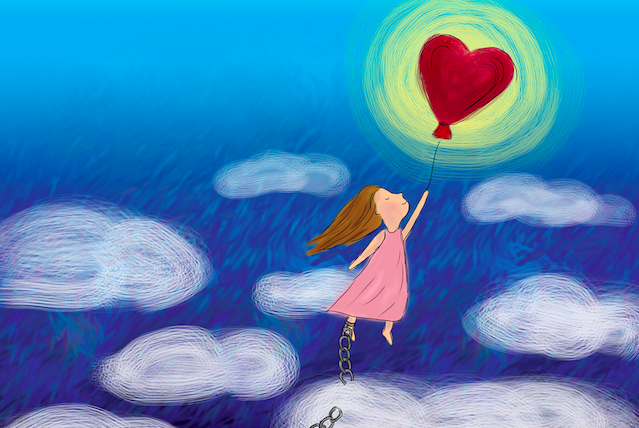
Family often has no clue of the ties and chains they’ve placed on you; therefore, it’s important to come from a loving place when standing your ground and claiming your life.
They don’t know what they’re doing. Would you punish them for that? I wouldn’t. I didn’t. I chose to love them anyways, no matter what, the same way I desire to be love, no matter what.
Break free image via Shutterstock
-

Family Isn’t Always Forever: When It’s Time to Say Goodbye
“Friends are the family we choose for ourselves.” ~Edna Buchanan
A few years ago I ended all contact with my parents, and I have not seen or spoken to them since then.
The truth is I am actually okay with that. Initially, I thought I was going to lose my mind. I had been brought up to believe that family comes first. Children should respect and take care of their parents. Family should—and will—always be there for each other.
Those beliefs were based on love, and I cherished them.
I wanted so much to feel that connection—that unconditional love those beliefs promised. It was never there.
Our lives were filled with so much fear, pain, hurt, betrayal, and lies. Manipulation and deceit were at the core of our home.
I told myself that all families have degrees of dysfunction, and our family was no different. I could not allow myself to believe that our family was different. I believed that one day my parents would realize what they were doing and change. I desperately wanted their love and approval.
On the night when my husband and I ended up inside a police station explaining why I thought my father was about to come to my home and hurt me, while my two grown sons waited in the car, I realized I had to wake up.
My fantasy was over. I could no longer go on pretending our family was just like everyone else. That night I said my last goodbye to my mother as she lied to protect my father. The next day I spoke the last words to my father as he screamed into the phone repeating the lies from my childhood. It was over.
Giving up the hope that things would get better was the hardest part. I was terrified that I was doing the wrong thing. I thought I was being a bad daughter. I was going against every cherished belief about family.
It broke my heart to know that my life had been based on an illusion. The picture I had created of my parents was shattered. They had never been there for me, and they never would be.
I had lied to myself to protect my fantasy and keep them in my life. Now I could no longer do it.
Over time I began to understand why I had fought so hard to live out the lie, and I began to forgive myself for not being brave enough to stand up earlier.
One of the problems was my belief that family were always there for each other. That was the cause of my pain and my guilt. The fact that I no longer had them in my life meant that I was going against a code I held close to my heart.
I had to modify that belief. I had to change my definition of family. It was no longer those to whom I was linked by blood. My family now became the friends who had been there the whole time. People who I knew I could count on when things went wrong. That was never my parents.
I also realized that I was afraid I was not lovable. In my mind if my own parents could not love me, there had to be something wrong with me.
I did everything I could to minimize disagreements between us, keeping quiet just to keep the peace. I knew that if I spoke up we would argue, they would get mad at me, and they would not love me. I failed to realize that this was something I only experienced with them.
It was hard work just to be around them. I was always on edge, cautious, and scared. That was not a loving relationship. I came to accept that if they could not love me, it didn’t change anything about me. I had created other loving relationships around me, and they were the scaffolding holding me up.
My first Christmas after was hard. I had always gone to my parents’ house to live the fairy tale of being surrounded by love.
It was always hard to ready myself for those days. We would act out the roles of happy family, hoping in some way that was our truth. It wasn’t. I had no idea how tense I was at these interactions until I no longer had to do it.
Part of the hurt was that I now had no tradition, so I decided to start a new one. Christmas is no longer a day of obligation. I now spend it with the people who are my true family.
I’ve come to realize that the love I had for my parents was based on a childhood need for safety and security. I had to see them as the parents who loved me, despite the things they did. I could not accept that the people responsible for my well-being were also responsible for my suffering.
So much of the world I had created around my parents was simply not real. I have had to accept that truth and move on with my life.
One of my fears was that by breaking contact with my parents, I was setting an example that my sons could repeat with me. I’d like to think this won’t happen because of my parents.
The pain of my childhood taught me how important it is for a child to truly feel loved, safe, and cherished. I’ve tried to live that truth with my boys. I don’t know what the future holds for us. I can only hope that the love I’ve shown them will have created a space in their hearts where I will always be thought of with love.
I try to imagine how I’ll feel when I find out that my parents have died. I honestly don’t know. I’m sure that part of me will be sad that we did not have a better ending. However, I know in my heart of hearts that I tried for over forty years to make it work. In the end, it just wasn’t enough.
My parents were never who I thought them to be. I have had to let it all go. The fantasy of the perfect ending with them is over. I am setting out on a new horizon where I have redefined my world.
As abused children, we may feel that it is somehow our responsibility to fix the broken parts of our family. It’s not. Sometimes there is no fairy tale ending where our parents realize how truly wonderful we are.
The hard part is recognizing that and moving on. Sometimes it’s the only way to find real peace. It’s heartbreaking. It’s not easy. Finding and surrounding yourself with people who truly care for you is your gift to yourself. You deserve that. You will be okay.
I no longer believe that I have lost my family. I have only now finally recognized who they truly are.
-

The Secret to Getting Along With Your Parents
“My experience is that the teachers we need most are the people we’re living with right now.” ~Byron Katie
Nothing hurts like being misunderstood, and there is no place that this feeling runs rampant quite like it does with family.
I used to think I was the only one.
For years after I moved out, each visit back home would be preceded by careful, specific preparation. I would try to brace myself for whatever would be coming my way.
I would spend the entire two-hour bus ride turning all of the possible criticisms and probable arguments over and over in my head. I would rehearse ways I could react to various imagined scenarios.
I thought preparing myself would soften the blows. It didn’t.
Ram Dass once said, “If you think you are enlightened, go and spend a week with your parents.”
Imagine my embarrassment and hopelessness at thinking I’d finally cracked the secrets of peace and happiness, only to find myself welling up with the same old anger and resentment each time I faced my closest relatives.
Even after I began a journey of personal and spiritual growth, visits back home were toxic.
I would prepare. I’d show up. They would judge me. I’d react. Then, I would judge myself for letting their judgment get to me. Then, they’d judge me for letting it get to me. Then, I’d judge them for judging me. It would be a giant, exhausting mess.
Each time I returned home, I would be exhausted and wondering how I’d ever lived with these people in the first place.
One day, in the midst of recovering from such a visit, I found myself in an intimate conversation with a friend about beauty. She shared with me how she sometimes felt so disgusted by her reflection that she could hardly function.
I empathized, letting her know that I had suffered with that severity of self-hatred for close to ten years.
I said, “You know what I’ve learned? It wasn’t my reflection that was hurting me. It was my expectation that, every time I looked in the mirror, I would discover someone else, some other person who wasn’t me. Jennifer Aniston maybe? But Jennifer Aniston never showed up. It was always just same, old me. That was what really hurt—the expectation that was never met.”
Immediately after the words poured out of my mouth, my mind lit on fire.
I realized, with stark clarity, that the same relationship I used to have with my reflection, I was having with my parents. I kept showing up, time after time, expecting different people to magically appear.
I kept expecting that they would change.
When I told my partner about my epiphany later that evening, he looked amused. I asked him why he was smiling like that.
He told me, “This is what I’ve been trying to tell you. I’ve definitely said this to you. Many times! You’ve said it to me too!”
I was surprised, but not for long. I thought about my relationship with myself and how I’d heard messages of self-love, self-acceptance, and self-forgiveness, but it took me years to truly internalize them. Maybe that’s how it was with my parents. It wasn’t that I didn’t know the answer. I just had to be ready to experience it.
The next time I went home, it was like a whole new world. I didn’t brace myself for criticism, nor did I plan my words. I just showed up with the assumption that, maybe, they would never change.
This simple belief completely transformed my relationship with them. Suddenly, I could see them for who they were. They were, and always will be, flawed and beautiful, just like me.
I could suddenly smile at their criticism and laugh at their judgment. I could embrace them even if they didn’t feel like embracing me. I could understand them even if they misunderstood me.
I used to think that people who had good relationships with their parents had perfect parents.
That’s just not true.
People who get along with their parents have just as many family conflicts as anyone else. They just choose to accept those conflicts as part of life, and love their kin anyway.
For me, learning to accept my family, just as they are, opened up new doors of opportunity.
Right after I started practicing understanding and acceptance toward them, I got the inspiration to work on a book. I got the passion to start my own business. I got the courage to speak my message loudly.
All these things happened within a few months of my epiphany, and I can’t pretend that the timing was a coincidence.
I honestly believe that our expectations of our families, our own judgments about them, hold us back in ways we can’t even imagine. I honestly believe that, if you can learn to love your parents, just as they are, you’ll unlock boundless potential within you. I truly believe that this is the one missing piece that most people don’t realize is missing.
Of course, it’s not easy. Nothing worth having is easy, but it’s always simple.
And this is my simple message, today and forever: accept and allow. That is the path toward peace, love, and serenity.
Photo by pilostic
-

Love What’s Right Before You Instead of Hating What’s Missing
“I have learned that to be with those I like is enough.” ~Walt Whitman
I take stuff for granted. I suspect you take stuff for granted.
It’s almost as if it can’t be helped. When things—family, friends, health, amenities, or money—occupy a place in our lives for years, we naturally begin to view them as commonplace; we assume they’ll forever be, just as they’ve always been.
Yet this mindset—this “Oh, of course that’s there; that’s always been there” perspective—often seems to prevent us from realizing how much it would mean to us if that something wasn’t there anymore.
Hello, Asia
In August of 2013, I moved to Busan, South Korea to teach English for a year to a bunch of elementary school kids (lovable rascals, these kids). Three months later, I can tell you that this experience has been everything I imagined and about 10,000 things I didn’t.
For a while it was similar to what I’d envisioned—like freefalling through some sort of mythical dreamscape. Everything new and interesting, bright and foreign, so much happening, so much to learn, so much to take in. It was experiential overload, at once intimidating and blissful.
After a few weeks, though, the feelings of novelty and adventure began to wane slightly; a discord had been created.
My romanticized visions of my new home were coming into conflict with a feeling I’m sure most of you know very well—the slog of routine, the all-too-familiar, the grind.
What happens is this: you begin to get used to the new country; it loses a certain sparkle. You start to notice its flaws, its funny odors, its unsexy idiosyncrasies. You realize that a full-time job in a foreign land is still a full-time job, except 95% of the people around you don’t speak your language.
You realize, “Wow, I’m going to be gone for a while—a whole year! And I’m going to see exactly zero people I know. Nada. None. For 12 months. Oh.” In terms of culture shock, you’re experiencing the end of what’s known as “The Honeymoon Phase.”
I had read about these things. I thought I understood that they were going to happen. I thought I knew how long a year was. I thought I knew what I was getting myself into.
I didn’t. Not really, at least. Turns out it was near-impossible to know what an enormous decision it was to move to a foreign country until I was two months in and questioning what in God’s name I was doing here.
Lonely? Me?
As someone who usually enjoys solitude, I’ve been surprised at how lonely I’ve felt at times. You discover a special kind of alienation when you’re in a city of five million people and can’t communicate with anyone. It’s easy to dissociate yourself from your surroundings.
You start talking to yourself. You feel like you don’t exist. You end up shouting to the music in your headphones (“People will know that I’m here!!”) while walking down the sidewalk as you’re drenched head-to-toe and getting wetter by the second because, as you just found out, there are typhoons here. (Okay, maybe that was just me).
It’s during those periods that you realize you’d trade your big toe for a few days at home with the people you’ve known for years. To do nothing but laugh a few hours away with those irreplaceable personalities whom you know about as well as your own reflection.
“Man, that’d be heaven,” you think.
Sure, you can “connect” with loved ones via Facebook, Twitter, Snapchat, Gmail, and a trillion other online mediums. You can even indulge in a pretty convincing illusion of face-to-face conversation with Skype or a Google Hangout.
But as you do, it becomes clear that these substitutes can never duplicate a sizable bear-hug, or an eye-contact-followed-by-uproarious-laughter moment, or the glorious interplay of energies when you’re actually in the same room with people.
While living in Korea, I’ve realized what an invaluable gift I sacrificed to come abroad—namely, being a car ride away from most all of my favorite people in the world.
Before coming here, I’d known that I loved my family and friends endlessly—that they meant everything to me—but I don’t think I quite realized the extent to which being near them and being able to see them were vital to my well-being (and sanity).
I feel I’ve gained a renewed appreciation for those precious people who’ve been there for years and will continue to be.
When I do return home, I’ll love them just the same as before, but I’ll truly cherish the time I get to spend with them. I’ll try to remember what it was like without them.
Gratitude is Slippery
Simply imagine for a few moments what it would be like if all of the people you loved were just gone, so far away that you couldn’t see them. It’s likely difficult to put yourself in my situation, but my hope is that you can sense it—how you would miss the familiar comfort of just being with them, of just sharing a space or a smile.
One wouldn’t think that the good things in our lives need to disappear in order for us to understand their worth, yet so often this is the case.
It seems a bit of a paradox, that what is nearest our hearts can be hardest to see. I humbly submit to you that we ought to be attentive to what lies just below our oblivious noses, lest we recognize the value of things only after they’ve left us.
I’d be a fool (more so than I already am) if I didn’t understand that this don’t-take-things-for-granted spiel applies to me right this moment.
In a few years, I’ll look back on my time in Korea and know what an incredible opportunity I was given and how much was here to love.
If I overlook the wonders that surround me in this place and constantly pine for my home, I’ll set myself up to feel only a sort of wistful gratitude later on, when all that remains of my time abroad are patchwork memories.
So while I now grasp more fully what I left behind to come to this country, I’m focusing on remembering that I came here for what I couldn’t find at home—a different environment, new friends, fresh perspectives. And those things are all around, plain to be seen, so long as I’m not looking through them, at what isn’t here.
I’m reminded of a sentence Vonnegut once wrote: “A purpose of human life, no matter who is controlling it, is to love whoever is around to be loved.” I like the whoever especially, but I’d also add whatever, wherever, whichever.
In the end, it seems, loving what’s right before us does far more good than hating what’s missing.
I’m not always keen at seeing what’s near to be loved (so it goes), but here’s to looking a bit closer. Here’s to noticing the important things, before they’re no longer there to be noticed.
Photo by Antoine Gady
-
Making Changes When the People Around You Resist Your Plan
“The greatest step toward a life of simplicity is to learn to let go.” ~Steve Maraboli
So I took the plunge. I stated out loud that I wanted to simplify my life.
I wanted to have a life where what I did for a living and how I lived were more in balance with the person I am and aspired to be. The waterfall effect of that verbal declaration catapulted my life into a stratosphere of change that I am still learning to just “go with.”
Three weeks after that declaration, I got “downsized” at work. Okay, I thought, the universe is listening, so no turning back now.
I started with putting my house up for sale. Up went the “for sale” sign.
Next came the purge. Closets were emptied, for-sale ads were posted, and stuff began to clear out. I donated and sold what seemed to be the physical barrier to my new life of “less is more.”
Finally came the decision: What did I want to be when I grow up? Who we are and what we do always seemed to melt into one for me, so now I had a clean slate, and the “life worth creating” journey began.
I scoured the career guides, took all the personality tests, hired a life coach. All the while, my external search for career satisfaction was in misalignment with my new values and the journey I had begun.
So, I finally decided: No more suits, no more cubicle life, and no more aspiring to climb a ladder that I did not even care about.
I read a great quote: “Better to be at the bottom of the ladder you want than the top of the ladder you don’t.”
I decided that I was not searching for a new job; I was creating a life. I wanted to write and share my adventures and experiences along the way. I had a dream of inspiring people to dare to dream and achieve what they once thought was impossible. So the new life career began.
In all my newness and transformation the one thing I had not counted on was the resistance I would receive from those in my inner circle.
I guess I had assumed that people would be genuinely happy for me if I were happy.
Unfortunately, that was not the case. They questioned why I wanted to sell my house and belongings, and worse yet, even give my stuff away. People asked me daily where I was going to live.
A friend runs a charity that enables physically challenged people to experience outdoor adventure. Fantastic, I thought!
This was exactly in alignment with what I believed to be an essential part of my journey. A donation of gear to the charity enabled additional people to get out and adventure where they had never before.
This brought about a series of objections and questions from multiple parties about why I wasn’t selling my stuff rather than donating. I was really starting to think that people were missing the point.
The largest objection of all came in regards to my career, or lack of a career pursuit. A declaration of not wanting to go back to an office, sit all day under fluorescent lights, and climb the invisible ladder to misery seemed to stun family and friends alike.
I frequently heard, “But you went to university and have all this experience,” especially from family members who helped fund the academic letters behind my name. No amount of explaining seemed to dull the sound of objections.
So in all of this, I have managed to stay on course, even if it has been a bumpy road, by learning a few lessons and following a few guiding principles to keep the wolves at bay.
If you’re also making a life change and experiencing resistance from the people around you, these ideas may help:
1. Realize that other people’s objections often have more to do with the noise in their heads than the words you say.
Safety, security, and a certain amount of life predictability cloak the people in my life like Linus’ security blanket.
As they watched me doing the proverbial running naked down the street thing, throwing caution to the wind after acknowledging that there was no security net, no new career prospects, and that I wanted to create a life based upon writing and adventuring, there came about an incessant need to throw their blankets over my shoulders to keep me safe from my goal of living a life of simplicity.
Objections are often about other people, not us.
2. Those closest to you may believe they’re an expert on your life.
If I had received a dollar every time I heard, “If I were you, I would…” I would already have a steady stream of income coming in. Remembering that I am the expert of my own life and know why I am on the path I am has helped dull the volume of platitudes I heard on a regular basis.
Trust that you know what’s best for you.
3. Prove to yourself this you’re making the right choice.
Some days it felt like I was the weak animal waiting to get preyed on during my transformation into a new life, because as soon as I would show doubt, insecurity, or even waffle a tiny bit on whether I was doing the right thing for me, the people closest to me pounced.
The best defense to these challenges was proof. As time went by and I stayed on course, their challenges began to decrease in volume. Anyone with doubt became less resistant and some even became satisfied as I became happier and in balance with my new life choices.
When you stay the course, people start to accept it.
4. Have a plan.
I have learned in my new journey that without a plan, I am just a leaf blowing in the wind. It is not enough that I say that I want to make a change. That does not make a parent feel confident in their child’s quest for a new life or allow a partner to have faith that an income will be generated.
So I have made an actionable plan, with milestones and tangible goals that, when achieved, help reinforce my adventurous journey of a new life.
Making a plan helps you and reassures the people who are trying to look out for you.
5. Be patient.
I’ve learned to have patience with others and myself. Recognizing where people come from, the stories in their own heads, and the story in mine assists in keeping me on track.
Keeping perspective and learning to let go of other people’s fears and objections enables you to continue on, one step at a time.
I am by no means an expert on self-help, making life changes, or living a life of simplicity. What I have learned, though, is that other people’s objections can fuel the flame and reinforce our decision to create a new life.
Photo by Alcino
-

Finding What We’re Missing: Our Lives Are Already Complete
“Each day is a journey, and the journey itself is home.” ~Basho
What does family mean? Is it the people whose genes you share? Is it the people that you grew up with? Is it the people who love you unconditionally in spite of your faults and flaws?
Family for me has been an evolving idea. I was adopted from Seoul, Korea when I was four months old. After a few months in an orphanage, family started off simply as the people I grew up with.
Raised in South Central Pennsylvania with a Caucasian family in an area where diversity was lacking, to say the least, I remember receiving looks from some people when my older sister introduced me as her baby sister. They would tilt their heads to the side and say, “Are you sure?”
Adding insult to injury, my adopted mother passed away when I was thirteen after years of complicated health issues. She was the most vocal about how much she loved me, wanted me, and protected me when she caught anyone directing their fearful insecurities my way.
Losing her was one of the most difficult experiences I’ve ever had to deal with. Losing my best friend after a cliff diving accident in college was the next. The two people who embodied family and home for me were gone.
I spent many years angry, bitter, and confused as to why my biological family gave me away only for me to land in a family where I would experience a death nearly every other year from the time I was five years old, along with many other traumas and heartbreaks. (more…)
-

Recovering from a Difficult Childhood: How to Reclaim Yourself
“Our greatness lies not so much in being able to remake the world as being able to remake ourselves.” ~Mahatma Gandhi
Recently, I had one of those flashes of insight that burn away the illusions I learned as a child in a dysfunctional family and help me see myself in a new light. I saw through an invisible belief that I’ve held for a very long time—the belief that I am not in control of my life.
Standing in line in the grocery store and twiddling my thumbs, my monkey mind ran through the list of what I could be accomplishing if I didn’t have to wait in line doing nothing. And like a bright gift from above, an idea flew into my mind: If our thoughts create our reality, then I could be creating my next experience of reality right then, while I waited.
In that moment, I realized that even when I feel like I’m not in control of a situation, by letting go of resistance and choosing to create the next situation with my thoughts, I can be more in command of what happens in my life.
I grew up with no understanding whatsoever that I could create my life the way I wanted it to be. My father was very rigid in his beliefs and actions, and my mother was very impulsive. Consequently, my world swung back and forth between needing to follow rules and regulations, and suddenly having the rules change mid-stride so that I had no idea what to do next.
I carried the assurance that life could fall into chaos at any time into adulthood, and though I have consistently moved forward in my life, I have never felt truly in control, because of the way I grew up. (more…)
-

Being Grateful for the Imperfect Present
“If you concentrate on what you don’t have, you will never, ever have enough.” ~Oprah Winfrey
I live in an old house.
It is 212 years old this year, to be exact.
We’ve added onto it over the years so it presents itself as more youthful than its age. The old bones remain, though, as well as many of the quirks. Those “quirks” give it character, right? It’s much like my emerging crow’s feet give my face character.
That’s the positive spin on crow’s feet, at least.
We have uneven floors, to the point where most of our furniture is shimmed, and shimmed-like-crazy. Without it, our mantle would tip to such a degree that it would seem that we are on the sinking Titanic.
When our kids were young, they could sit on a wee scooter, lift their legs, and coast backward through two rooms. (Insta-fun!)
We have asymmetrical moldings and strange gaps. When we first moved into our home, I was attempting to fill a gap in the wood on the stairs with caulk; it shot straight through the stair and into the basement.
I think I unloaded about half the tube before it started to fill. Probably should have just gone with a new piece of wood.
We joke that ours is the “House That Caulk Built.”
We have different varieties of wood for floors, and those floors creak to the point that, when our cat walks upstairs, it sounds like a human instead. There are gaps around the doors because nothing is level, and the rooms don’t have overhead lights in most cases (save for the kitchen, dining room. and bathrooms). Floor lamps and table lamps illuminate our indoor world.
But the kitchen. The kitchen. The heart of the home.
It is the size of most people’s walk-in closets. There is a lack of counter space, not enough outlets (I mentioned that already, didn’t I?) and it’s just too small, small, small.
The unfortunate thing is that I love to cook. I spend the majority of my days in the kitchen and go there for play (so to speak), as well. (more…)
-
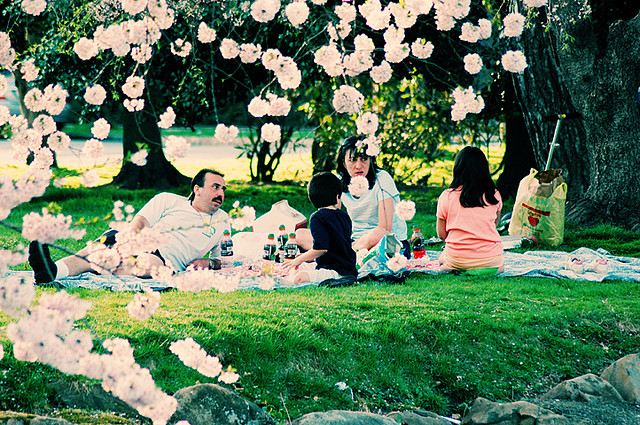
A Simple Choice to Celebrate What Matters
“There are exactly as many special occasions in life as we choose to celebrate.” ~Robert Brault
A few years ago it happened, and it couldn’t have come at a better moment.
At the time I was involved in a monthly get together with my cousins. We were a group of eight cousins getting together to talk about family and life in general.
It had started off when my sister was going through a nasty divorce, and one of the cousins came up with the idea of getting together to celebrate my sister’s birthday to bring some cheer into her life.
Once the celebration was under way, we all agreed on how great it would be to make it a once a month gathering of all cousins. And so it began: the once a month ritual of getting together in one of the cousins’ houses for dinner.
We would take turns hosting the event, so that we would each have a turn at being an amazing hostess for a dinner.
We all had different financial situations, so we would go from a very fancy dinner at a very fancy house, to a simple dinner in a simple home where I would find more love and peace than in most.
You could say I was one of the cousins with the middle class lifestyle, yet I opened up my home with the best of intentions, always hoping to give my cousins the best I could.
The first dinner that took place at my home was exciting but also full of anxiety, for I had to prepare my home for the dinner gathering.
I remember making a list of things I wanted to buy. I felt like I was having the president over for dinner—like I had to make my home seem fancy, when in reality it wasn’t. (more…)
-
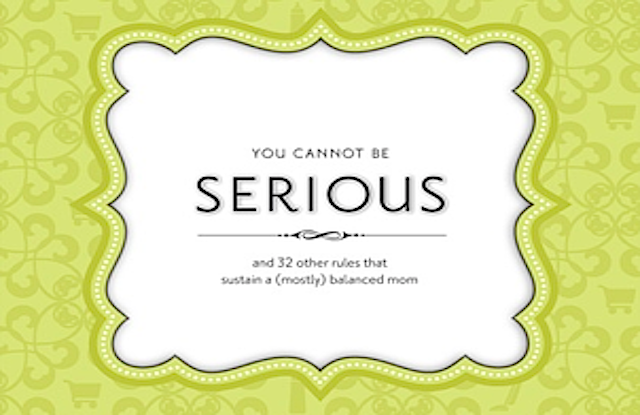
Book Review & Giveaway: You Cannot Be Serious (Tips for Balance)
 Update: The winners for this giveaway have already been chosen:
- Laurie from Cuddle Hugs
- Cyndi from So Much More Than a Mom
I have the utmost respect for mothers.
Their daily lives require an aptitude for all the qualities that make us good people: love, kindness, patience, generosity, and, perhaps most importantly, a sense of balance. If anyone knows chaos, it’s a mom.
With this in mind, I was thrilled to read Elizabeth Lyons’ book You Cannot Be Serious and 32 Other Rules That Sustain a (Mostly) Balanced Mom.
Make no mistake: I don’t have any children. Or friends with children. Or even access to children—there appear to be none in a fifteen-mile radius.
What I do have is a need for balance in a world that is never predictable and rarely calm.
Elizabeth’s book provides just the right anecdote, and it was so easy to relate to her reading it.
She’s not the high-waisted jeans kind of mom who fills her days with baking and gardening (through she does both). She’s the mom who runs her own business, writes her own rules, and still manages to run a household without any hired help. (more…)