Tag: fall

  • Don’t Let Your Bruised Ego Keep You Down When You Fall

    Don’t Let Your Bruised Ego Keep You Down When You Fall

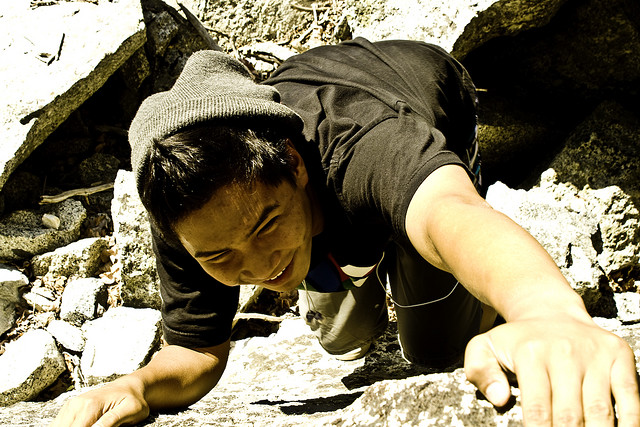
    Man Climbing Up

    “If you get up one more time than you fall, you will make it through.” ~Chinese Proverb

    My niece is three years old. I get to video chat with her daily. During our interactions, she loves to show me, with tremendous happiness and pride, her new toys, her new dresses, and the various sounds her scooter is capable of making.

    One day, a few months ago, as she was enthusiastically getting her scooter near the screen, she tripped and fell, albeit with no serious consequences. What I learned from this event has been gratifying.

    After she fell, she sat there on the floor for about a second or two without knowing what to do.

    She then looked up, squirmed a little, and was about to start crying (just because my sister had seen her fall), when my sister told her reassuringly, “Nothing happened, get up!”

    And there the little child was, up on her happy feet again, flaunting her scooter with a big smile on her face.

    I realized then that many times, we too, as adults, trip and fall. We are left dazed and shaken. We sometimes force ourselves into a haze of self-pity, dejection, and depression. It can seem worse when other people see us fall. The pain is so much greater when it comes with a bruised ego!

    We start thinking we are the only ones struggling so much. We fail to understand what’s happening in our life and what to do about it. In short, we feel like losers.

    One such similar incident happened with me.

    I landed a job at a startup firm soon after my graduation, and it meant a lot to me. Obviously! It was my first job and I was so excited about it—about moving out on my own and getting to live the life I had been waiting for.

    Then, within weeks, I realized I was at the wrong place. I initially tried to ward off my apprehensions as mere jitters. But then the frustration, stress, and pressure reduced me to a bag of sick emotions. My self-confidence took a tremendous beating, and I started crying myself to sleep every single night.

    It was then that I realized something important about myself as a person: There is nothing in this world that can make me sit glued in front of a computer screen for hours, from morning to night. That just isn’t me.

    I realized I wasn’t excited about the work I was doing. My value system wanted me to do something that felt more meaningful to me (like teaching, or working in an NGO, or even taking up public interest lawyering).

    As I saw it then and as I see it now, we get to live just once, and I can’t spend all my time in making a living, forgetting to make a life!

    I realized I wanted to follow my passions, my deepest yearnings, and the deepest desires of my soul.

    In those two months, I hadn’t written a word for myself (writing is something close to my heart), I hadn’t pursued music (which I desperately wanted to do), and moreover, I hadn’t made time for reading (another passion of mine). This pushed me even deeper into the abyss.

    Because of these incongruences between my personal value system and my life and work, I lost self-respect, lost trust in my professional abilities, lost faith in my own skills, and above all, lost faith in myself.

    I was shattered. I knew that I had to quit that job as soon as possible. Friends and family advised me to stay for a year so that it would augur well on my CV. But my sanity was at stake. I had fallen, and terribly at that, and I had to pick myself up by hook or crook. Of course, there was a catch.

    I didn’t quit the job right away because I felt even more miserable thinking about what my relatives, friends, and lecturers would think about me if I left within two months of starting.

    I imagined people gossiping about me in hushed voices, and I worried about what my juniors—many of whom idolized me—would think about me.

    I was worn out, until I decided to follow my heart and not my head. I had tripped and fallen, and it was time that I picked my spirits up and moved on.

    It was time I told myself, “Nothing happened, get up!” And, thank goodness, at last I did.

    Months after this incident, I feel stronger, more self-aware, and more humble.

    I have come to strongly believe that with any difficulty—be it a break-up, rejection, or mid-life crisis—we can choose how we think about it and what we do in response.

    We can choose to stop for a while, analyze the situation, and to accept it completely, without trying to reject or blame ourselves or our circumstances. And by doing this, we can be a lot more peaceful within ourselves.

    It is during such challenging times that we need to awaken that voice inside us that reassuringly prompts us to accept and get up, so we don’t find ourselves sobbing even longer, just because we fell down and everyone saw.

    I’ve thus realized that a happy life is not a problem-free, perfect life. Instead, a happy life is that which we aren’t afraid to face, knowing that every time it knocks us down, we can and will get back up.

    Man climbing image via Shutterstock
  • Seasonal Sadness: 7 Tips to Make the Colder Months Better

    Seasonal Sadness: 7 Tips to Make the Colder Months Better

    “There are two primary choices in life: to accept conditions as they exist, or accept responsibility for changing them” ~Denis Waitley

    It’s still summer, and the last thing I want to be thinking about are the cold months ahead. There are still bike rides to take and gardens to enjoy, and I still haven’t taken that kayak ride that I wanted! But in the back of my mind I am already beginning to panic.

    Many people in the more northern latitudes feel down in the winter—less energetic, less engaged, less motivated—and those people may start feeling apprehensive as winter approaches.

    Other people slip into a bona fide depression, either because they suffer from Seasonal Affective Disorder or perhaps a predisposition to depression that simply worsens in winter, and those people are the ones who truly panic. I know, because I am one of them.

    A few years ago I declared that I was through with suffering through every winter. I was ready to take control of my situation instead of letting the situation control me. That simple decision made all the difference because it changed my attitude.

    The first thing I did was to address the biological basis for winter depression.

    As the days become shorter and the light becomes less direct, we absorb fewer rays through our eyes. In some people, this leads to a reduction in serotonin (one of the important chemicals in our brain) and thus a reduction in mood and energy.

    To combat the lack of sunshine, I purchased and began to use a light box. This is a specially designed light, packing in 10,000 lux. As a point of comparison, the average office is lit to 320 to 500 lux, while the sun provides approximately 10,000 to 25,000 lux in full daylight (more in direct sunlight).

    Once I started sitting in front of my light box for 20−30 minutes every morning, I began to feel much more alert and in control. But it was not quite enough. I still felt out of sorts and foggy, like there was a roll of cotton between me and the rest of the world.

    Over the next year or two, I learned that to truly cope with my winter funk I had to change the way I responded to not only the season, but the inevitable vagaries of life.  (more…)

  • How Mistakes Can Set You Free

    How Mistakes Can Set You Free

    “If you have made mistakes, there is always another chance for you. You may have a fresh start any moment you choose for this thing we call ‘failure’ is not the falling down but the staying down.” ~Mary Pickford

    Well, the little blue line was undeniable, and the circumstances unforgettable.

    It was Black Friday 2007, after a full day of work during which my nausea rendered me so useless that my coworkers insisted I buy a pregnancy test on my way home.

    And there was a line.

    But no spouse. No ring. No house. Just a freshly-issued Master’s Degree and the gamut of emotions that come with an unexpected pregnancy.

    Surprisingly, I felt excited to be a mother.

    But I feared what others would think. I was not convinced I could manage on my own. And I questioned how this choice would impact my child for the rest of his life.

    Two potential life paths loomed in my mind’s eye, possibilities for my future after this momentous event:

    Path A projected a life of pain and struggle, feeling ostracized from society and working tirelessly to make ends meet while my child fended for himself and fell in with the wrong crowd as a substitute for his overwhelmed and unavailable mother.

    Path B presented the option of a life where “mistakes” are blessings, and my son and I could grow close together with the support of a village of loving friends and family while I focused on our bond and our health, using all of the resources available to me and constantly bettering our lives.

    Clearly, “Path A” came from a place of fear and shame. Until this event, I didn’t make mistakes. I was always the one who was steadfast and predictable, cautious and planned.

    So this rocked my world.

    Thankfully.

    Because that vision of Path A had haunted me and inhibited me for my entire life, in different ways. Path A was always the worst-case scenario of what might happen if I veered off the beaten path, whether intentionally or by “mistake.” The possibility of Path A prevented me from actually living my life. (more…)

  • Getting Back Up After You Fall

    Getting Back Up After You Fall

    “If you get up one more time than you fall, you will make it through.” ~Chinese Proverb

    Last year I had emergency open heart surgery. Shortly after the procedure, two nurses entered my room and gave me terrible news: I had to walk.

    That may not sound like a big deal, but open heart surgery is brutal. Simple things like being able to sit up or change position once my backside became sore were agony. Getting to the walker, a mere several steps away from my bed, was an extreme effort.

    My goal was to walk around the nurse’s station, and I might as well have been told to walk to the moon.

    Despite a punctured lung (a surgical accident), I concentrated on regular deep breaths and slow deliberate steps. I was so focused on these two things that the pain, while still significant, slipped away.

    By the time I made it back to my bed, I wanted to cry and laugh—I had made it!

    The next day was very different, as I’d been having a difficult time. I couldn’t seem to muster the strength to get out of bed; finally, out of desperation, I cried and gasped out that I couldn’t do it. One of the nurses very firmly but compassionately told me I could.

    With her help, I somehow managed to stand on both feet and stagger to the walker. As I made my tour of the station, the deep breathing and deliberate walking allowed me to calm down enough to cope with the pain and the severe depression I’d been battling.

    It had hurt so much to move that morning, but once I stood up and took that first step, things started to get better.

    From that moment on, I knew that I had the strength to conquer this physical challenge. I walked every day, right up until I was released. By far it was the greatest and most painful thing I had ever accomplished.

    The stumbles and falls we suffer in life can be very much like physical ones. Have you ever actually fallen? Aside from the embarrassment, what thoughts ran through your mind?

    Did you: (more…)