Tag: fake

  • Why People-Pleasers Lie and What We Gain When We Share Our Truth

    Why People-Pleasers Lie and What We Gain When We Share Our Truth

    “You’re a liar. People-pleasers are liars,” a friend said to me. I felt like I was punched in the gut. “You say yes when you mean no. You say it’s okay when it’s not okay.” My friend challenged me, “In your gentle way, begin to be more honest.”

    I believed the lie that pleasing people would make my relationships better. It didn’t.

    I decided to take my friend’s challenge to tell the truth. People didn’t have a relationship with me; they had a relationship with another version of someone else. They didn’t know me.

    People-pleasing was safe; it was how I hid and protected myself so I could belong. Besides wanting to belong, pleasing-people is a bargain for love. If I kept people happy, I believed I would be loved. If I took care of others, I believed I would be loved.

    Showing up differently in relationships is like learning a new dance. You may feel clumsy and awkward at first, but the old dance, while comfortable, is unhealthy. The old dance creates overwhelm, frustration, and resentment.

    I am now a recovering people-pleaser. My journey started when I faced the truth that I was a liar. The first step in change begins with self-awareness. Once you are aware, you can learn new dance steps. The new dance looked like saying no, tolerating less, and telling my truth.

    As I told the truth, here’s what I noticed in my relationships:

    First, I experienced true intimacy.

    As I was more engaged in being honest, others began to know me, not a fake version of me.

    In his book, Seven Levels of Intimacy, Matthew Kelly describes intimacy as “In-to-me-see.” I started saying things I’d never felt comfortable saying before—like “I see things differently” and “that doesn’t work for me.” Secret-keeping was killing my soul, so I also started opening up about the pain and brokenness I felt regarding my former spouse’s addiction and how I’d protected him at a cost to myself.

    When we share more of who we are with others, then we are known and loved, which is a powerful need in humans. I was not broken as a people-pleaser but broken open. I allowed myself to receive the love of others as I allowed them to see me. As a result, I experienced intimacy in a new way.

    Secondly, when we stop lying to others and ourselves, it builds trust.

    It is hard to love someone when you don’t trust them. Trust is the foundation of all relationships. When we are real, others trust our words and actions, and we become more trustworthy. We are no longer chameleons, adapting and saying what others want to hear when interacting with us, and trust grows.

    Lastly, when we pay attention to being more real, we are more fully engaged in our relationships.

    We are wired for connection. When we are engaged in bringing a greater depth to our relationships, the investment pays off. It’s like we are making a deposit in the relationship when we allow others to “see us,” and they in turn feel closer to us. As I began to share more in my relationships, it helped others to open up. One friend said, “Keep sharing; it helps us too!”

    Being more honest in our relationships is a dance worth learning. It improves intimacy, trust, and closeness in our relationships. After all, the alternative is being called a liar!

  • What I Really Mean When I Say I’m Fine (Spoiler: I’m Not)

    What I Really Mean When I Say I’m Fine (Spoiler: I’m Not)

    “Tears are words that need to be written.” ~Paulo Coelho

    It was lovely to see you today. I haven’t seen you in such a long time. So much has happened since the last time we saw each other.

    You asked me how I was. I politely replied, “I’m fine” and forced a smile that I hoped would be believable. It must have worked. You smiled back and said, “I’m so glad to hear that. You look great.”

    But I’m not really fine. I haven’t been fine for a very long time, and I wonder if I will ever know what “fine” actually feels like again.

    Some days are good, some not so good. I’m doing my best to stay optimistic and to keep faith that tomorrow will be better. Sometimes it is, sometimes it’s worse. I’m never prepared for either outcome.

    I’m doing my best to pretend I’m fine.

    The mask I wear hides my pain very well. I’ve been wearing it for so long now that no one can see through it anymore. It’s my new face, and it smiles on demand.

    Some days I wish I didn’t have to pretend to smile. I long for the day when it will come naturally, sincerely, and genuinely.

    When I say I’m fine this is what I really mean…

    I’m sad. I’m really having a hard time right now. I wish I could tell you. I’d like to think that you might even care. And maybe you do truly care. But I don’t want to tell you. I don’t want to bother or burden anyone with my troubles.

    My troubles are big and ugly. I can’t burden you with them. You are facing demons of your own. You don’t need to be exposed to mine. That would be so selfish of me. To think that your demons are not as important or debilitating as mine.

    So I just tell you I’m fine. I’m protecting you when I say I’m fine. Because I’m afraid my pain is just more toxicity.

    I want to tell you my troubles. I want you to take them away. I wish someone could fix everything that hurts, though I no one else can do that for me. Still, I wonder, does anyone have all the answers to these questions that are pounding in my head and causing me grief and anxiety?

    Anyone?

    There’s a tightness in my chest that won’t go away. There’s a darkness in the pit of my stomach that makes me nauseous. My shoulders feel weighted and my arms long for human touch. A body to wrap around tightly to comfort me and ensure me that everything will be okay.

    My troubles have completely consumed my life.

    Inside, I’m crying all the time. My soul is crushed, and my heart is full of holes that I’m desperately trying to patch up as best I can.

    I’m full of anxiety inside, and no matter how hard I try to find peace, it eludes me. I feel there are a million demons inside of me, and I don’t know which one needs my attention the most.

    So I ignore them all. It’s too much for me to bear most days.

    When I say I’m fine I really wish you could hear my inner voice screaming, “I’m not fine, and I need help. Please stay and talk to me, comfort me, help make this overwhelming pain stop.” I want to say this to you. But I open my mouth, and “I’m fine” comes out instead.

    I’m not really fine. I’m not sure how to handle today, and I fear what tomorrow may bring. It’s constant anxiety. I wish it would go away if only for a day.

    I want to be fine, honest I do.

    One day I would love to sincerely tell you how fine I am. That all my anxieties, worries, and fears are gone, or at least less overpowering. That I walk with a skip in my step and a song in my heart. I want to feel that. I may have felt this once before a long time ago, but I don’t really remember it.

    Every day I’m doing my best to smile and make the day better. I’m thinking positively, I’m taking big deep breaths when I need to. I’m reading inspirational blogs and quotes. I’m even listening to guided meditations.

    Today I went shopping and bought myself something nice. I know, a temporary fix. But it worked.

    It all works. For the moment. And then the moment is gone, and it all comes flooding back. All the turmoil, the anguish, the anxiety, the pain. I breathe deeply again. And I’m okay for a few more minutes.

    But for now, I’m doing my best. I know that everything in life is temporary. The good, the bad. Even life. It’s all temporary. If I can just get through today, I’ll be fine.

    I’m doing my best to see the bright side. I can see it some days. But it doesn’t take away the turmoil brewing inside of me. It only masks it with a Band-Aid. A temporary fix.

    Everything is just a temporary fix until I finally become brave enough to get to the bottom of my demons. I need to face them one at a time. I need to bring them to the surface, dust them off, address them, heal from them, and then let them go.

    This I know. But it’s such a daunting task. Just thinking about doing that is overwhelming and causes me a great deal of anxiety. I know it’s up to me to be able to say, “I’m fine” and really mean it.

    One day I will. When I feel strong enough to do so. Until then, I may say I’m fine when I’m really not. But I will try to find the courage to say, “Actually, I’m sad,” even though I know you don’t have a magic wand to take all my troubles away.

    Maybe just opening up and letting you support me will help. Maybe if I stop painting a smile on my face and telling you “I’m fine, really I am,” one day soon I will be.

  • You Are Not A Fraud and You Deserve the Praise You Receive

    You Are Not A Fraud and You Deserve the Praise You Receive

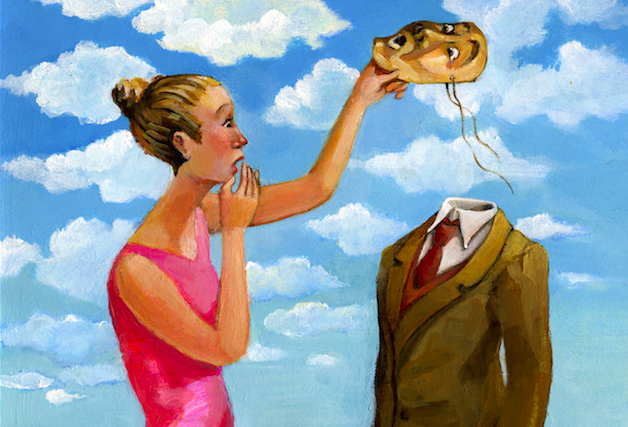
    Woman Taking Off a Man's Mask

    “If you are what you should be you will set the whole world ablaze.” ~St. Catherine of Siena

    My usual morning routine consists of arriving at work, making a cup of tea, reading a daily inspirational quote, and then getting started with the days’ assignments.

    Every thirty minutes or so, my brain snaps away from the task at hand into a deep craving for advice. It’s the reason I read a daily quote and the reason I get my daily Tiny Buddha articles. It’s what I spend the majority of my free time exploring.

    So, every thirty minutes or so I pull up the Internet browser and type in the search bar something along the lines of “practicing positivity,” “overcoming self-doubt,” “finding forgiveness,” or “letting go of the past.”

    The war I am fighting with the negative tendencies of my brain is never-ending and largely supported by the online communities of people who feel much like I do.

    The most important and influential people in my life are the ones who aren’t afraid to show me their vulnerability. I like to hear their stories and learn from their experiences.

    Now, that seems to go against my own goal to be absolutely perfect. I don’t admire anyone who is “perfect.” Only those who are quite imperfect and willing to admit it.

    Still, I have a hard time trusting that someone would enjoy being in my company for more than an afternoon. I’ve pushed away the people who love me because I don’t feel like I deserve their affection. Any admiration received is for some woman I cannot identify with.

    If they stick around long enough, they’ll realize just how wrong they’ve been and sprint off in the other direction, leaving me here alone and utterly inadequate.

    I am very much aware that I need to approve of myself before anyone else can. All of my free time is dedicated to cultivating self-love. My inner critic makes this journey a long and difficult one, though.

    Today’s Internet search on self-love brought me to a new diagnosis, if you will.

    Imposter Syndrome.

    Now, I’ve never heard of this, so I read an article or two to catch up. Basically, it’s the idea that what other people are seeing when you accomplish great things is not actually you. It is an imposter or fraud.

    Someday they’ll discover it and realize that you are just average…or even less than that. You are not worthy of the attention, awards, or affection. When they wake up and see the real you, you will be cast aside.

    This is particularly common among high achieving women. We feel so unworthy of our accomplishments that we refuse to accept the praise. We push it off saying that others just don’t really know us.

    We refuse to accept compliments.

    Sound familiar?

    Many successful women in our society have been shown to exhibit these feelings of inadequacy. Maya Angelou, Tina Fey, and Marilyn Monroe, among many others, have all admitted to feeling as though they don’t deserve the positive reactions to their work at some point or another.

    And what about me? From the outside looking in, I’m not the unlovable failure that I so often believe myself to be.

    I graduated from a major university with outstanding grades.

    I moved across the country without a job or a clue and still managed to support myself.

    I have won the appreciation from my boss and am regarded as an asset in my company.

    I was recently invited to serve in the Peace Corps and plan on moving to Africa in August.

    I volunteer with the Red Cross and teach English to immigrants.

    I am beautiful and strong and intelligent and kind.

    Still, I manage to attribute my accomplishments to a little bit of luck and a lot of misinterpretation.  

    These positive things aren’t happening to me because I went out and followed my dreams. It’s because a scared little girl has been dog-paddling her way through life, head barely above water, and has managed to portray herself in a way that is pleasing to others.

    I think this does come from the constant need to impress others.

    We start to project a version of ourselves that doesn’t feel natural simply because we think that’s who we have to be. We may end up being motivated solely by praise and approval, not from the wisdom and longing of our hearts.

    If we don’t open up to the vulnerability of being real, the feeling of falseness will linger over all that we accomplish.

    Many people don’t know themselves well enough to even recognize if they are following their heart.

    Being comfortable in your own skin requires you to dig deep and take the time to learn what makes you joyful.

    We have to be serious about getting to know ourselves if we want to love who we are.

    In the case of Imposter Syndrome, who is right? Me or the rest of the world?

    My opinion about myself is my only truth. It doesn’t matter how many truckloads of affection can be dumped onto my lap. If I can’t see it, it does not exist.

    How are we supposed to change our perceptions? We can start with the human folly of comparison.

    We judge ourselves compared to perfection, not other people. We imagine Oprah and Mother Teresa to be shining beacons of perfection, but they aren’t. They are human.

    We don’t have to be perfect to bring something meaningful to the world. In fact, perfection is an indescribable state because it does not even exist. We should take a stand to delete that devilish word from our vocabulary.

    What human, animal, or plant exists in flawlessness?

    Even the most beautiful flower may have a single petal that is misshapen or browned, but does that make it unworthy of praise? Should it go unnoticed?

    In contrast, have you ever know anything to be 100% bad? You can find fatherly love in a dictator if you are willing to look for it.

    When humanity can wake up and realize that we are as much the good as we are the embarrassing and painful mistakes, maybe we won’t worry if people are only seeing one side of us. We cannot accept parts of ourselves and deny others without becoming only half of a person.

    Usually, I move forward with the idea that as long as I am alive, there is time to learn more. As long as I am curious about something, anything, that is one thing more important than feeling sorry for myself.

    Luckily for me, curiosity burns strong in my heart. Today, I’m curious about self-love and confidence mixed together with wonder about our Universe and scientific discoveries.

    The more I focus on the things that I have, the less I worry about the things I am missing. That is what practicing gratitude is all about and why it is recommended almost anywhere in the self-help community.

    Upon closing, I find it relevant to say that writing this has been therapeutic for me, especially when I took the time to list some of my accomplishments. It really felt like I was writing about someone else. I’m not an imposter, though.

    Somewhere along the lines we were told it is sinful to feel pride. However, it is only when you allow yourself to feel the pride that comes with accomplishing mighty works that you can start to see the inner beauty shining through.

    Now it is your turn. Identify five or more things you have accomplished and for which you have received some sort of recognition. Write out what compliments were given and then sit with it. Try to relax into the feeling.

    Maybe you are a single mother working hard to provide for your family when you have no idea how.

    Maybe you are a musician or artist unsure if your style will make it out there in the critical world.

    Maybe you’re a young writer submitting your first piece, oblivious if your words will have meaning to another.

    None of us know. That’s part of the beauty that connects us. Your bravery is admirable, even when you feel like a failure.

    Be open to the possibility that even though you are not perfect, you can still be remarkable. And you are.
  • Getting Real in a World of Fake

    Getting Real in a World of Fake

    Selfie Image

    “Nobody wants to be lonely. Everybody wants to belong to a group. The crowd is essential for the false self to exist. The moment it is lonely you start freaking out. Particularly in the West they have not discovered a methodology to uncover the real. To be an individual is the greatest courage. It does not matter that the whole world is against me. What matters is that my experience is valid. Don’t die before realizing your authentic self.” ~ Osho

    Authenticity. Courage. Vulnerability. We hear these words so often they’ve become a part of our daily language. But how often do we stop to investigate what they actually mean?

    I grew up within the gates of a fundamentalist religion that didn’t just discourage conformity, it taught us daily to demonstrate our opposition to the status quo. We were trained to speak about the awkward and practice the uncomfortable, sometimes in the face of hostile reactions.

    And so it was that, as a child, I learned the skill of both living boldly and sticking my foot into a person’s door so they would listen to what I had to say.

    Over the years, my vantage point became one of lone observation, both within my own “tribe” and when I was at school.

    I organized most people’s behavior into some variation of a desire for acceptance by their group. They wanted to follow a leader, or less often, to be one, all out of fear that if one is not accepted, one is somehow less worthy.

    At the time, I didn’t understand the great sacrifice people made for acceptance, stuffing away their uniqueness and covering it with a superficiality that was pleasing and likeable.

    Eventually, I left my own cloistered tribe after concluding that true radicalism is one’s ability to be courageously real—not in a bid to be different and unique, and therefore, somehow superior, but only to live according to what one believes.

    If you are on a path of seeking the real and avoiding the fake:

    1. Keep connected with the opposite of your tribe.

    We selected our friends because they make us feel good and they share similar tastes and desires. But with no challenge to our status quo, we risk losing out on vital learning.

    Our brain schemas are designed to accept familiar information and discard what doesn’t fit with our versions of reality. This makes for groupthink that ranges from boring to dangerous.

    Akin to the Facebook feed that caters to more of what we already like and know and creates homogenization, our tribe, bless them, are also prone to unconditionally support us, even when we are being unwise or thoughtless.

    While their support may feel good, it is also a disservice when they reinforce our faulty thinking and don’t question our actions.

    I have come to see a good friend as someone who can hold me kindly but boldly in the space of our relationship and ask, “What on earth are you thinking?”

    So don’t ditch all your old friends (unless you need to), but do challenge your viewpoints by talking and listening to the person you think is weird, reading the book that makes you shift uncomfortably, and exploring the activity that evokes a bit of fear.

    Instead of rejecting new ideas outright, play with them, think them through critically, and then keep or discard them.

     2. Start being real with people.

    The greatest challenge here is that we first have to be real with ourselves. This means becoming unmasked and accepting our strengths and foibles without shame.

    Only then can we begin to be real with others, because there will be nothing of us to hide.

    If we can accept our full, awkward humanity, then we can learn how to extend ourselves openly into what aligns with us and feels right, our purpose.

    We will know when to say “no” and when to say “hell yes.” We will speak our minds and take scary steps not because we have lost all sense of fear, but because we know we can be afraid and do it anyways.

    And we can meet conflict directly, without the misalignments that grow from avoidance, denial, and gossip.

    Speaking of gossip, when we are being real, we won’t do it.

    When we hear it, we will state that if a person has a problem with someone else, they should speak to them directly. And we will have no part in cliques that exclude others. Instead, we will seek other intrepid explorers, who also embrace life with the exclamation, “let’s be free of all of that.”

    3. Be in life instead of capturing it for Facebook, Instagram, or Twitter.

    I don’t know about you, but I reject the idea of capturing all of our sacred moments for social media instead of living them. And I battle with this personally, because I’m a documenter, but I favor tipping the scales toward real.

    In the movie The Secret Life of Walter Mitty, the famous and elusive photographer Sean O’Connell, played by Sean Penn, travels to the Himalayas for a shot of a rare snow leopard. Mitty tracks him down, and the two of them, perched out on a mountaintop, wait for the cat, who finally makes an appearance.

    Instead of taking the shot, O’Connell moves from the camera and watches. When Mitty asks him when he’ll take the photo, O’Connell replies, “Sometimes I don’t. If I like a moment. I mean me, personally, I don’t like to have the distraction of the camera. I just wanna stay… in it… right there. Right here.”

    You likely already know why this moment is valuable: it’s the only thing that’s real.

    You know exactly what you are losing. The tender touch your lover just gave you that you absentmindedly ignored. Lost. The book that lays on your lap unread, your son having placed it there long ago until he tired of waiting. Lost.

    Real time, with all its tastes, smells, and sensations, is irreplaceable. You have a choice each moment about who, and where, you want to be.

    4. Be in nature.

    If where you want to be is real, then immerse yourself in the greatest antidote for fake that we have in a social media obsessed, email-, text-, and like-checking society. Leave your phone alone when you are with the mountains, trees, or by the lake, with your beloved, your friends, or your little ones. It is rude and dismissive of their essence and humanity.

    Besides, at the end you lose out. Because there is no amount of screen time that can rival the pleasure of just one kiss, blowing all the wishes off a dandelion, or a deep breath of mountain pine.

    Selfie image via Shutterstock

  • Take Off the Mask: 6 Tips to Be More Authentic

    Take Off the Mask: 6 Tips to Be More Authentic

    “Being who you are is another way of accepting yourself.” ~Unknown

    Years ago I struggled to be authentic. I was a consultant who worked with senior people in big organizations. As a black female fresh out of graduate school, I was frequently the youngest, the only woman, and the only minority in the room.

    Because I was so different from those around me, at least on the surface, I was concerned about how other might perceive me. So I put a lot of effort into portraying myself in ways that I thought would increase the odds of others accepting me.

    To make sure others wouldn’t underestimate me, I led with my intelligence, saying things to let them know how smart and knowledgeable I was and downplaying my fun-loving side.

    To make sure I wasn’t seen as militant or overly sensitive, I stayed quiet in response to comments that ranged from a little over the line to blatantly offensive.

    To make sure others felt at ease, whenever I was asked to talk about myself, I stuck with the most innocuous and middle-of-the-road stories that I knew were most similar to the other person’s life experiences.

    And here is a small, but classic example: Even though I had been yearning to own a snazzy smartphone case for years, I stayed with a neutral black one so I would be seen as suitably conservative instead of too girly or flamboyant. (Yes, I had it bad!)

    The irony of all of this was that, although this approach caused me to be seen as someone who was bright, competent, and capable, it didn’t exactly help me forge deep connections with other people.

    After all, how could it? The person they were connecting with was only a tiny fragment of who I was and, in some cases, a completely inaccurate portrayal.

    When I reflected on it, I realized that, while it was convenient to be able to say that I was behaving that way due to the demands of being in an unwelcoming corporate environment, the truth is, I did it in other places as well.

    Every time I agreed to do something I didn’t really want to do out of a sense of obligation, I was being inauthentic.

    Every time I didn’t ask for what I needed in a relationship, I was betraying myself.

    Every time I put on an aura of having it all together when in reality, I was feeling vulnerable and scared, I was putting on a mask.

    One day, after biting my tongue for the nth time at work regarding an innovative idea I had that I thought others wouldn’t agree with, I decided enough was enough. At that moment I committed to stop hiding “this little light of mine” under a bushel.

    Instead, I was going to unleash my true self into the world.

    Okay, perhaps unleash is a little inaccurate—it’s not like I became Sasha Fierce over night. But what I did do was take what felt like little risks in displaying my authentic self.

    I experimented by being more assertive and sharing my true opinions.

    I let my humorous side come out and told funny stories about my family and my life when I was at work.

    I said no to things I didn’t feel like doing—even a party that was going to be thrown in my honor that I didn’t really want to attend.

    I put a hot pink rhinestone case on my smartphone.

    So, what happened? Honestly, not much on the negative side of things. There might have been the odd person who felt a bit of discomfort in the moment when I disagreed with him, but it certainly wasn’t anything long-lasting or life-shattering.

    Instead, the results have been overwhelmingly positive.

    I feel lighter and more true to myself. I have deeper relationships, because it’s as if a veil has been lifted, and the people around me get to see who I really am. I’m more likely to get my needs met because I’m not relying on the other person having ESP to figure them out.

    And at work, instead of making others uncomfortable, being more authentic allowed me to build deeper connections. Instead of just seeing me as a brain in a jar, others began to see me as a whole person, a thought leader from whom they could learn, who had interesting things to talk about.

    It has made all the difference in my life and created a richer, happier, more fulfilling existence.

    If you are struggling to let your authentic self shine, here are some tips you might find useful.

    1. Imagine your older self sharing life lessons with you.

    Imagine your older self having a conversation with your present self. Perhaps this older version of yourself is on his or her deathbed, and s/he is giving you advice about how to live a fulfilling life.

    What would s/he say to you? Would s/he suggest that you spend the rest of your life dulling your shine, or would s/he tell you to be true to yourself?

    2. Check in with yourself.

    If you have been behaving inauthentically for a long time, you might feel out of touch with your true feelings and desires. Journal and meditate to get back in touch with yourself.

    Allow yourself to feel your emotions, and be curious about them. What are they telling you that you need to do? How can you become more of your true self?

    3. Start small.

    Commit to taking small steps toward being more authentic. Speak up about things you normally wouldn’t. Assert yourself. Ask for something you want. You don’t have to transform yourself overnight. Recognize that it’s a process.

    4. Be prepared for others’ reactions.

    Remember that others are likely unaware of the extent to which you might be stifling yourself. So, as you behave differently, recognize that they may need to adjust to the new you. While the responses I got were overwhelmingly positive, sometimes others didn’t quite know what to make of it. That’s okay.

    5. Don’t use authenticity as an excuse for bad behavior.

    I have worked with some clients who have been rude or disrespectful to others, and explained it away, saying, “I’m just being honest” or “I have to be authentic.” You can be authentic and kind at the same time. Be respectful.

    6. Recognize you can tolerate discomfort.

    Research shows we tend to overestimate how long and intense our unpleasant feelings will be in response to a negative event. So, even if others don’t respond positively to everything you do, know that it probably won’t be as bad as you are anticipating.

    Finally, keep in mind this wonderful quote by Oscar Wilde, “Be yourself; everyone else is taken.”

  • Why Self-Compassion Is the Key to Being Our Authentic Selves

    Why Self-Compassion Is the Key to Being Our Authentic Selves

    Arms Outstretched

    “To be beautiful means to be yourself. You don’t need to be accepted by others. You need to accept yourself.” ~Thich Nhat Hanh

    I was raised in a family where outward appearance and reputation were important. Standing out was only encouraged if it was within the bounds of what was considered “normal.”

    No one ever explicitly told me, “What other people think of you is more important than being your true self,” yet that’s what I learned to believe. It became my mission to be accepted by others, because I thought that only then would I be worthy of love.

    I spent most of my middle school and high school years pretending to be somebody that I wasn’t. I would “chameleon” to blend in with people around me.

    I suspect that due to my less-than-stellar acting skills, a lot of people could tell that I was being phony and didn’t want to hang out with me. This only increased my hunger for external validation and acceptance.

    At the age of thirteen, I attended my first personal development seminar.

    It was an incredible experience for me, and when I was in the seminar room, something inside of me came alive. Being in that space awakened my passion for personal development, a passion that has only grown over the last fifteen years.

    In the next decade that followed, I’d spent more than 350 hours participating in personal development seminars, and in July 2009, I finally received the honest feedback that would change my life forever:

    I showed up as arrogant, selfish, self-righteous, superior, and judgmental.

    The feedback hit me like a ton of bricks. I was simultaneously composed and totally shocked.

    I was composed because I knew that people experienced me in those ways: I was a condescending know-it-all with judgment by the boatload, and little tolerance for people “doing it the wrong way” (not my way). My demeanor was often cold and closed off, and I could easily insult people where I knew it would hurt.

    I was shocked, because when I received that feedback from somebody that I’d met less than six hours earlier, I felt completely vulnerable. I didn’t know what to do with myself in that moment of being completely exposed.

    The walls that I’d created to “protect” my authentic self were only pushing (or rather, shoving) everyone else away. I finally decided to make a change. And thus began my journey of rediscovering my true self.

    To say that it was a battle would be a grave understatement. The little voice inside my head had gotten really good at convincing me of “truths” that were actually just thoughts based in my false beliefs about reputation and acceptance.

    Lying to myself had become such a subconscious process for me that bringing it into my consciousness on a daily basis was a struggle.

    Right after receiving the feedback, I’d keep “be authentic” on the forefront of my mind for a few days at a time. But more often than not, my commitment to being authentic would slowly fade behind my decades of pretending to be somebody else, and I often wouldn’t even notice the shift.

    When I’d realize that I wasn’t being perfectly authentic, every moment of every day, I’d go into beat-up mode and would berate myself for being a failure.

    My new awareness seemed like a game of lose-lose: if I ventured out into authentic living and slipped back into my old ways, I’d go into beat-up mode; if I acted like I was okay with being my pretending old self, I’d feel sick to my stomach about who I was pretending to be. I didn’t know how to win that game.

    I spent a couple of years on the rollercoaster ride of stepping out and being authentic, slipping back into my old ways, and beating myself up about it; it was exhausting. But then I learned that personal development isn’t a switch, it’s a journey.

    I couldn’t just turn off my old behaviors and turn on some new authentic behaviors.

    Creating lasting change would take commitment, practice, and most importantly self-compassion.

    Commitment meant truly committing myself to being authentic, and doing it for nobody else but me. And practice meant making conscious choices to set my authentic self free instead of staying in the box I’d built for myself.

    The self-compassion piece was the most important because it determined whether or not I wanted to pick myself back up, dust myself off, and give it another go.

    If making a mistake was only going to end in me beating myself up about it, then I’d rather not have even attempted it. But if making a mistake was met with a desire to learn, and then re-approach my ways of being in a new way, it was a much easier choice to make.

    Throughout my journey of discovering and living as my authentic self, I have experienced moments of immense joy and freedom, which have encouraged me to continue moving forward.

    One of my most impactful experiences of letting my authentic self shine took place at the end of November 2013, when I shaved half my head.

    One of my friends shaved part of her head in mid-2013, and I loved how it looked. I thought it was a perfect combination of sexy and tough. I immediately wanted to shave my own head, but hesitated…for six months.

    I thought, “What are other people going to think when they see you? Everyone is going to judge you. People are going to think that you’re weird.”

    The little voice in my head was going crazy. My head and my heart weren’t coming to an agreement because that little voice was repeating phrases I’d heard my entire life.

    But one day—and I can’t remember exactly when it happened—I just decided to do it. I knew that deep down in my heart I wanted to, so I refused to let that little voice stop me anymore. If people were going to think that being my authentic self was “weird” then so be it!

    I wish I could say “and then I shut the little voice up forevermore and lived happily ever after,” but that wouldn’t be true. My little voice was screaming when I finally sat down to get my head shaved. But I just chose to acknowledge the screaming and shave it anyways.

    After it was all done and I looked in the mirror, I fell in love. I fell in love with me! For the first time in my life, I felt completely aligned in my outward appearance and my inner authentic self. I felt free.

    Sure, people stare at me in public. But I just smile and walk on by. Everyone has an opinion about my hairstyle, but there’s only one opinion that matters—mine. And I love it!

    That was one of the biggest and most tangible steps that I’ve taken toward letting my authentic self truly shine. Now, if I start letting to the voice inside my head get to me, I can just look in the mirror or touch the shaved part of my head to remind myself of who I really am.

    One of my biggest lessons throughout my head-shaving experience was this: when I limit myself because of my fear of what others might think of me, I’m limiting what I think of me. When I truly embrace my authentic self, I am free.

    Abraham Maslow said, “What is life for? It is for you.” I’m finally living my life for me, and I’ve never felt more empowered, joyful, or authentic.

    How are you holding yourself back?

    Would you be making different choices in your life if you weren’t worried about the acceptance of others?

    How different do you think your life would be if you stepped outside of your comfort zone one time every day?

    I encourage you to get uncomfortable and to let your authentic self shine. You might be surprised at how freeing it can be.

    I certainly was.

    Photo by AJ Leon

  • 4 Tips to Help You Keep Going When You’re Filled with Doubt

    4 Tips to Help You Keep Going When You’re Filled with Doubt

    “Begin doing what you want to do now. We are not living in eternity. We have only this moment, sparkling like a star in our hand-and melting like a snowflake.” ~Francis Bacon Sr.

    “Just research, research, research. That’s what grad school is.”

    It seemed as though that was all I was hearing from my professors, and it wasn’t helpful.

    Since returning to school to get my master’s degree, I had maintained a 4.0 average, but I also hadn’t taken more than two classes at a time. Until now.

    When I enrolled for the fall semester, I chose to take twelve hours, or one full class more than the nine maximum hours recommended. I did this against the advice of my advisor, and I did this knowing that I also had three jobs and three children.

    I told myself then that it was only sixteen weeks, and anyone could get through sixteen weeks. I told myself that my kids were older (sophomore, junior, and out of school) and didn’t need me like they used to. I told myself that I was unstoppable.

    And I did feel unstoppable. Until I actually started the semester. Suddenly, juggling fifty hours of work, ten hours of commute, and twelve hours of school seemed like the dumbest thing I could do to myself. I had no days off. I had to budget my time down to each hour. I rarely saw my kids.

    My husband travels for work and he was on a long job in Canada, so that helped as far as my guilt over not being around for him, but he was due to come back soon, and I was going to be too busy to spend quality time with him.

    So it was, upon hearing the seminar speaker recommend researching exhaustively, that I felt dangerously close to tears.

    What am I doing? I thought to myself. Why am I even here? There’s no guarantee I’ll find a job after graduation. A master’s degree doesn’t equal a guarantee. Why am I doing this and missing all this time with my kids? Why am I doing this at my age? I have no right to be here. I’m too old. I’m not smart enough. Everyone else seems so with it. How much longer can I fake my way through this?

    If I hadn’t already paid (and that was another thing, why did I waste this money that could have gone toward something worthier, like my children?), I would have dropped out. I continued to go to every class, feeling like I was losing my grip a little more week by week, growing ever closer to complete panic.

    Then one day I walked into my International Communication class, and a fellow student asked if she could share a video. The professor agreed, and so it was that I watched something that changed my thinking.

    The video was called “Your Body Language Shapes Who You Are,” and it was a beautiful speech by Amy Cuddy about learning to understand your own abilities. It was very motivational, dealing with power poses and teaching yourself confidence.

    The video itself put me in my place. But it was one line in particular that really struck me.

    “Fake it until you make it,” Cuddy said, “and if you don’t, fake it until you become it.”

    She was speaking of her own journey returning to school after a debilitating brain injury, but she was also speaking of a student she had advised who had come into her office ready to drop out because she just wasn’t smart enough to keep going in her program.

    Seeing this woman, who had once been told her head injury was so great that college would no longer be an option for her, who had been told that she would be lucky to hold a job, speaking about her long battle to return to school, really hit me.

    Here was someone who had fought a real battle. She had struggled for years to be able to return to school, and here I was whining about sixteen weeks? I didn’t even have a disability to overcome—except the power of my own negative thinking.

    From that point forth, I decided that I did have a right to be sitting in that classroom. I did have a right to be enrolled in the graduate program, and I did have what it took to graduate. So I made myself a little list of motivators.

    1. Give up attachment.

    In my case, it was crippling fear, but in generalization, it’s attachment to any negative self-talk you have.

    I attached fear to my enrollment in the graduate program, and it had been overriding everything and holding me down.

    By giving up my attachment to that abusive inner dialogue, I was able to release some of that fear and anxiety I associated with school. I was able to look at it objectively by removing myself from it emotionally. I have to remind myself every day to hold onto that objectivity and release the fear, but so far it’s working.

    2. Fake it until you make it.

    This is obviously right out of Cuddy’s playbook, but she was right. When I started to pretend like I was just as smart as everyone else in my classes, I felt a little ridiculous. But after a couple of weeks, I started to realize that I had just as much to contribute as anyone else.

    We’re all different people, so wouldn’t it make sense that we approached the class differently? Once I realized that different didn’t mean smarter, I was able to relax and actually absorb some knowledge.

    3. Remember that nothing lasts forever.

    If I had dropped out of the program, I obviously wouldn’t graduate. This stress is only temporary. When it’s over, I’ll have a master’s degree, and nobody can take that away from me. It will be worth it in the end, and I’ll be a stronger person for it.

    4. Take it one day at a time.

    There is no use holding onto stress and misery over something in the future. Do what you can today. Then repeat it the next day. But this moment is all we have. Seize it.

    Am I magically a more well-adjusted, intelligent, and super-fun person as a result of all of this? Absolutely not. I still struggle almost daily, but it’s different now.

    I know what I have to do, and I broke it all down into manageable pieces. I tell myself, “This is all you have to do today.” It truly makes a difference.

    If you’re struggling over an obstacle in your life, remind yourself that all you can do is live in the moment you’re in right now. Don’t believe everything that you think. And you are good enough. We all have anxiety and we all have stumbling blocks. Think of them as inner strength boosters.

    As for me, well, I’m halfway through. But that doesn’t matter. The only thing that matters is today. And it’s a pretty good day.