Tag: failure

  • Afraid to Say No Because You Might Miss Out on a Big Opportunity?

    Afraid to Say No Because You Might Miss Out on a Big Opportunity?

    “What you do today is important because you are exchanging a day of your life for it.” ~Unknown

    Are you afraid of saying no in your professional life because you think you’ll miss out on a big opportunity? I’ve learned that a quick yes can sink a lot of ships. God only knows I’ve taken on too much at times because I feared I’d miss out on something life changing.

    We view opportunities as golden nuggets that are few and far between, so we snatch them up before someone else does, even if they don’t really excite us. But many of them are nothing more than fool’s gold—a superficial resemblance to what we actually want.

    It’s just so damn hard to pass on something that sounds promising like a new role at work, a chance to join an exciting new project, or an invitation to pitch your business idea (even if it’s hats for cats). And we’d be stupid to say anything but yes because it’s now or never, right?

    This is a sh*t storm brewing up a triple threat of overcommitted, overwhelmed, and overloaded, when all those exciting opportunities start feeling more like burdens.

    Grace Bonney is an author, blogger, and entrepreneur who knows a thing or two about this struggle. Bonney wrote The New York Times bestseller In the Company of Women, a book featuring more than 100 stories about women entrepreneurs who overcame adversity.

    Bonney had this to share on saying no:

    “The biggest fear most of us have with learning to say no is that we will miss an opportunity. An opportunity that would have catapulted us to success, or that will never come again. And most of the time, that simply isn’t true. I’ve found that the first part of learning to say no is learning to accept that offers and opportunities are merely an indication that you’re on the right path—not that you’ve arrived at a final destination you can never find again. If someone is choosing you, it means you’re doing something right. And that is the biggest opportunity you can receive—the chance to recognize that your hard work is paying off. And if you continue to do good work, those opportunities will continue—and improve—over time.”

    I know what she’s talking about because I used to put myself in this situation at least once a year. I would ignore this lesson and believe that this time would be different (and it never is).

    I remember one time I was sitting on the edge of my bed feeling like I had been kicked out of an airplane without a parachute. I could hear a violent whoosh sound in my ears as my boss picked up. “I don’t think I’m going to be able to come in today, I’m…”

    It was too late. I was already freefalling. I was experiencing my first panic attack. I couldn’t finish the sentence. The tears started coming as I blurted out, “I’m sorry, I’ve taken on too much and it’s hitting me all at once.”

    I was in a full-time job I loved, I had returned to school to become a certified coach, and I was attempting to start a business. As if all of that wasn’t enough, I’d also accepted an invitation to kick off a new innovation team because I thought it would look good on my resume and I was afraid I might never get an opportunity like that again.

    It’s sad to say, but my partner was left with a burned-out, easily agitated shadow of support. In an attempt to give us a better life, I had made life miserable.

    I sucked all the fun out of these exciting opportunities by pushing myself to a limit that clearly wasn’t sustainable.

    But then I did something magical. I started to say no.

    From then onward, I used three questions to help me filter possible opportunities in order to gain clarity.

    What does this opportunity mean to me?

    Why is this opportunity important to me?

    What does this opportunity give me?

    Answering these questions helped me see that I’d put zero thought into a lot of stuff I was saying yes to because I was trying to create a “successful” life.

    But I knew what I wanted my days to look like and what “success” actually meant to me. And more importantly, I understood that success without fulfillment is the ultimate failure.

    My north star of success is freedom. Having the freedom to invest my focus in the things that matter to me. Which means I need to do less so I can enjoy more.

    Now I’m not willing to accept an opportunity unless it truly excites me and I take something else off my plate. I’m unwilling to sacrifice my values. I trust that bigger and better opportunities will continue to come my way (if I keep improving and honing my craft).

    This gives me a measuring stick I can reference before I take on any new opportunities. Because a big part of saying no is the power it gives you to go all-in on something awesome when it comes across your plate (without being overcommitted, overloaded, and overwhelmed by sh*t you don’t care about).

    Bonney shifted my thinking of how I view opportunities. Rather than see an offer as a one-off that I need to jump on, it’s a sign that I’m on the right path. If someone wants to partner with me, it means I’m doing something right. As long as I continue to do what got me noticed in the first place, the opportunities will continue and improve in the future.

    Life is too damn short to be overcommitted, overloaded, and overwhelmed by a schedule of projects and people that bring you no joy. In the words of philosopher Ralph Waldo Emerson, “Nothing great was ever achieved without enthusiasm.”

    Don’t see saying no as letting people down. You’re actually letting people down when you say yes, but don’t have the capacity or the enthusiasm to knock it out of the park. If you won’t say no for yourself, say it for the rest of us, because the world is a better place when you’re working on things you love.

  • How to Stop Sabotaging Yourself and Feel Like a Success Even If You Fail

    How to Stop Sabotaging Yourself and Feel Like a Success Even If You Fail

    “If you love yourself it doesn’t matter if other people don’t like you because you don’t need their approval to feel good about yourself.” ~Lori Deschene

    In 2010, after a surge of post-ten-day-meditation-course inspiration, I publicly announced to the world that I was going to make a film about me winning the kayak world championships.

    A very bad idea in retrospect. But at the time I felt invincible and inspired.

    I had super high expectations of myself and of the film and thought it was all possible.

    Coming out of a four-year competition retirement meant a rigorous six-hour-a-day training schedule, while simultaneously documenting the journey, alone.

    I put an insane amount of self-imposed pressure on myself not only to be the best in the entire world, but also make an award-winning documentary at the same time, without a coach.

    To make a long story short, it was a disaster.

    Three days before the competition, my back went into spasm. I was so stressed out I couldn’t move.

    Jessie, a good kayaking friend, knocked on the door of my Bavarian hotel room.

    “Polly, take this, it’s ibuprofen and will help your back relax. Remember why you are here, you can do this,” she said.

    The morning of the competition I felt okay. I did my normal warm up and had good practice rides. “Okay. Maybe I can do this,” I thought.

    My first ride was okay, but not great. All I had to do was the same thing again and my score would be enough to make it through the preliminary cut to the quarter finals.

    Someone in the crowd shouted at me, “Smile, Polly!”

    I lost my focus, had a disastrous second ride, and made a mistake that I wasn’t able to recover from.

    The worst thing happened, and it all went wrong.

    Humiliated, embarrassed, and disappointed, I went on a long walk and cried.

    My lifelong dream of being a world champion athlete just vanished, and my heartbreak was compounded even more by the public humiliation I’d created for myself.

    I pulled it together and continued to film the rest of the competition and felt some protection by hiding behind my camera.

    “So, what’s next Polly? Are you going to keep training for the next World Championships?” Claire, the woman who won, asked me at the end of the event.

    “No,” I replied without even thinking. “I need to go to India.”

    India had been calling me for years, like a little voice that connected a string to my heart.

    “Being the world champion isn’t going to give me what I thought I wanted. There is more for me to learn. I want to approve of myself whether I win or lose. I want my thoughts to support me rather than sabotage me. I want to feel connected to something bigger than myself,” I told her.

    A year later, I went to the equivalent of the world championships of yoga.

    Three months of intensive Ashtanga yoga study with R. Sharath Jois, in the bustling city of Mysore, India.

    Practicing at 4:15 am every day on my little space of yoga mat, surrounded by sixty other people, with nowhere to run and nowhere to hide, I began the journey of facing my internal world.

    The toxic energy emitting from my mind, in the form of constant internal commentary of judgment and drama, looked and felt like an actual smokestack.

    I felt like a dog chasing its tail and was in a total creative block with editing my film.

    A yoga friend said, “Polly, even if your film helps only one person it is worth finishing it.”

    This was not what my ego wanted to hear.

    My ego wanted to inspire the world and had visions of, if not the Academy Awards, well then at least getting into the Sundance Film Festival.

    It took three years, and I finished the film. However, releasing it to the world brought up all of my insecurities. I felt exposed and like a huge fraud.

    How could I have made such a bold statement, failed, and then remind everyone about my failure three years later?

    I released the film and ran to North India, high in the Himalayas where there was no internet.

    Like leaving your baby on the doorstep of a stranger’s house, I birthed it and bolted.

    Even though Outside Magazine did a great article about the film, in my eyes it was a failure.

    It didn’t get into the big festivals I wanted it to get into and I didn’t bother submitting it to the kayaking film festivals it would have done well in.

    In 2019 I left India and returned to Montana to teach kayaking for the summer.

    It was the twenty-year anniversary of the kayak school where I spent over ten years teaching.

    The school had hired a young woman paddler named Darby.

    She told me, “You know, Polly, I watched your film about training for the Worlds, and it inspired me to train too. I made the USA Junior team and came second at the 2015 Junior World Championships. Thank you for making that film.”

    Humble tears of disbelief welled in my eyes.

    My film helped one person, and I was meeting her.

    The takeaway was that my ego and perfectionism got in the way of possibly helping even more people.

    I shot myself and my film in the foot so that my ego could continue to tell me I was not worthy.

    But this simply is not true.

    Hiding and running to keep my ego feeling safe no longer cuts it.

    The world is in a deep spiritual crisis right now.

    My ego would love to be in a cave in the Himalayas meditating away from it all.

    However, that is not what I have been called to do.

    Putting myself out there still feels uncomfortable, but I know that hiding is not going to help people. I have decided that good is good enough and am now taking small steps in the direction of my discomfort.

    I have learned a huge, humble lesson in self-acceptance, self-love, and self-compassion.

    The top fourteen lessons I now live by:

    1. Listen to the inner voice that whispers and tugs at your heart. If you’re passionate about something, don’t let anyone or anything convince you not to give it a go.

    2. Do the thing first. Enlist support from someone you trust but share about it publicly after you have done it so that you don’t create unnecessary pressure and feel like a failure if you struggle.

    3. Do things one small step at a time so you don’t feel overwhelmed and tempted to quit.

    4. Helping one person is a massive win.

    5. Drop all expectations—the outcome doesn’t have to be anything specific for the experience to be valuable.

    6. Do your best and let go of the results. If you’ve done your best, you’ve succeeded.

    7. Celebrate every small success along the way to boost your confidence and motivate yourself to keep going.

    8. Be proud of yourself every day for these small successes.

    9. Approve of yourself without needing the ego-stroking that comes with massive success and know that the results of this one undertaking don’t define you.

    10. True success is inner fulfillment. If you’ve followed your dream and done your best, give yourself permission to feel good about that.

    11. Do not compare yourself to other people. Set your own goals/intentions that feel achievable for you.

    12. Every “fail” is actually a step in the right direction. It redirects your compass and helps you learn what you need to do or change to get where you want to go.

    13. Growth means getting out of the comfort zone, but you don’t need to push yourself too far. Go to the edge of discomfort, but where it still feels manageable.

    14. If you freak out or feel resistance, take it down a notch. Move forward but in smaller steps.

  • When the Pursuit of Happiness Makes You Unhappy: Why I Stopped Chasing My Dream

    When the Pursuit of Happiness Makes You Unhappy: Why I Stopped Chasing My Dream

    “We must be willing to let go of the life we planned so as to have the life that is waiting for us.” ~Joseph Campbell

    From as far back as I can remember, I was enchanted with music. One of my earliest memories is of circling a record player while listening to a 45 rpm of Simon & Garfunkel’s “Mrs. Robinson.” I made my public singing debut in the third grade, performing Kenny Rogers’ mega-hit “The Gambler.” I sang it a cappella at a school assembly, even though I technically didn’t know all the words.

    At home, I devoured my dad’s records and tapes (pop, show tunes, classical, “oldies”), and started building my own collection at the age of nine (early ‘80s Top 40, and hard rock). For fun, I made up my own bits and pieces of songs and wrote the lyrics down in a notebook.

    After much begging, I finally got my hands on a guitar at the age of thirteen and began lessons. Having discovered The Beatles a year or so before, music became nothing short of an all-out obsession. I practiced relentlessly, paying for my lessons with a job I took at a local record store at the ripe young age of fourteen (I was in there so often they eventually hired me), and within a couple of years began my first serious attempts at songwriting.

    My musical heroes provided such joy, comfort, catharsis, and inspiration during my teenage years that it was only natural for me to emulate them and develop an overwhelming desire to have a music career of my own. Performing for my peers in social situations tended to generate lots of positive attention, which fed my already ravenous appetite to succeed that much more.

    Music also became, for me, a way to mitigate the typical insecurities that come with being a young person.

    In college, I would habitually wander around the dorm with my guitar and offer spontaneous concerts for anyone who would listen. It was a great way to test out new material and connect with others, and few things in life gave me as much pleasure as singing and playing.

    I recall a coffeehouse gig I played on campus that received such a positive response, there was simply no turning back. Being so appreciated for doing something I already loved to do was a euphoric high, so I sought out performing opportunities—formal and informal—even more compulsively.

    Somewhere along the line, music and entertaining became not just my passion, but the thing that made me feel worthwhile. The guitar was like a superpower—with it, I could be wonderful. Without it, I was insignificant.

    After college, I moved to Nashville—a mecca for songwriters of all stripes—and dove headfirst into the music scene. I lived frugally, worked whatever day jobs I needed to, and spent the bulk of my energy on making music and attempting to get a career off the ground.

    I wrote new songs, performed at writer’s nights all over town, and befriended and sometimes shared living quarters with like-minded musicians.

    I recorded a studio demo that was rejected or ignored by seventy-five different record companies. But to me, these rejections were simply part of the dues-paying process and made me feel a spiritual kinship with my heroes, all of whom endured similar trials on their way to eventual success.

    My closest songwriter friends and I became our own mutual-admiration-and-inspiration society, and helped each other endure the slings and arrows that are par for the course pursuing a career within something as notoriously difficult and fickle as the music industry.

    One Sunday morning, I received a call from a DJ who hosted a show on my favorite local radio station, Lightning 100. “What are you doing this evening?” he asked.

    Apparently, he liked the demo I had sent him.

    To my amazement, that same day I found myself on the 30th floor of the L&C Tower in downtown Nashville with a king-of-the-world view of the city, being interviewed live on the air. The DJ played two of the three songs on my demo over the airwaves during my visit. I shouted gleefully in the car afterward and headed straight over to my closest friends’ apartment (they had been listening from home) to share my giddy excitement with them.

    Without record company backing or interest, I ended up financing and overseeing the recording and production of a full-blown studio album myself, while working full-time.

    Once the album was complete, I started my own small label to release it, and quit my day job so I could focus full-time on working feverishly to get it heard. I became a one-man record company (and manager and booking agent, to boot), operating out of my bedroom and sending copies of my finished CD (this was the ‘90s) to radio stations, newspapers, and colleges nationwide. I followed up with them by phone (this was still the ‘90s) in the hopes of securing airplay, reviews, and gigs.

    I contacted hundreds of colleges and universities—mostly on the east coast where the concentration was highest—to book my own tour.

    The idea was to play as many gigs as humanly possible at schools large and small, driving myself from one to the next, selling CDs, and building up a mailing list along the way. This would allow me to eke out a living doing what I loved, in the hopes of gaining greater exposure, building a fan base, and ultimately establishing a bona fide career as a musician/performer.

    It was an incredibly exciting time, but also stressful and intense. I did get some airplay on radio stations around the country, and received some reviews of the CD, but not many. I was racking up debt, working obsessively, and putting everything on the line to make my dream a reality. On the practical side, I figured that whatever attention the CD did or did not attract, I would experience life on the road and most likely at least break even, financially speaking.

    After months of relentlessly following up with the 182 schools that gave me the green light to send my promotional materials, things were looking increasingly bleak. My points of contact frequently changed hands (and were often students in unpaid roles), and promising deals fell apart.

    When all was said and done, I ended up with a single, solitary booking to show for all my efforts. One. This would be the extent of my “tour.”

    What I had not anticipated, aside from such dismal results, was the toll this would take on me. I was exhausted in every way imaginable: physically, financially, emotionally, creatively. Most significant, though, was the toll on my spirit. I had believed that if I just worked hard enough, I would succeed, on at least a modest level. These results suggested otherwise.

    I never expected, regardless of the rejections I had accumulated, to ever stop trying, as this was the only thing I wanted to do with my life. But now it seemed I had no choice. I could barely get out of bed.

    I soon learned that even though I had dutifully kept up with my share of the rent, the housemate I was renting from had apparently not been paying the landlord! A notice I found showed that we were many months delinquent and faced potential eviction at any moment. I needed to find a new place to live. And a new job. All of which would have been a nuisance but doable, had I been my normal self. Alas, I was not. I was a wreck.

    On a phone call with my mom, she said, “Why don’t you just come home?”

    In what was perhaps the biggest testament to my desperate state, I could not come up with a better option. I moved back into my childhood home—for me, the ultimate concession of defeat.

    I had completely lost my way, my direction, my purpose, my drive. A huge part of my self-worth had been tied up in my success—both artistically and commercially—as a musician. I had defined myself by this identity and pursuit. What was I, who was I, without it?

    Though I struggled greatly with accepting it, I found that I had no more energy, zero, to invest in my dream. The immediate task at hand was climbing out of depression. And debt.

    It took a couple of years before I felt the urge to re-engage with life in ways that reflected my natural enthusiasm. Even then, the desire to resume the pursuit of a music career was gone. But once I started to regain a degree of emotional and financial stability (a boring office job helped this cause tremendously), I took some tentative steps in new directions. I enrolled in a few adult education classes, including an acting class that was quite fun and led to trying my hand at some community theater.

    Hiking had been a key factor in my recovery, so I joined the Delaware Valley Chapter of the Appalachian Mountain Club and began hiking with groups of other folks rather than just going out in nature by myself. This led to being invited on my first-ever backpacking trip, which proved to be life-changing and sparked an even greater love of the outdoors.

    Feeling better, and finally regaining a sense of possibility for myself, I moved out to California and did a lot more exploring, both inwardly and outwardly.

    In the twenty-plus years since, I have done things I never imagined I would do, broadening my palette of interests and life experiences in ways that no doubt would have completely surprised my younger self. I also met an incredible partner and got married.

    In other words: I made a life for myself, and became a much happier person, despite never having realized my dream of being a professional musician, nor of even having achieved any notable career success in some other domain.

    Though I abandoned my pursuit of music as a livelihood, I never stopped loving music.

    Over the years I have performed in a variety of settings, sometimes for pay but more often just for the love of it.

    I have shared my passion for music with numerous guitar students, played for hospital patients as a music volunteer, been an enthusiastic small venue concertgoer and fan of ever more artists and styles, continued developing my own skills on guitar and even began taking classical piano lessons.

    I will never stop loving music. The difference is that I finally learned to love myself, regardless of any success in the outer world of the music business or lack thereof.

    We all, to varying degrees, seek external approval, appreciation, recognition, and validation from others, and it can be momentarily pleasurable to receive these things. Being dependent upon them, however, (not to mention addicted to them!) is a recipe for persistent unhappiness.

    The Buddha teaches that all our suffering stems from attachment. While it is perfectly normal and human to desire things, our desires are endless and never satiated for long.

    If we make our own happiness or sense of self-worth dependent upon things going a certain way, then we are signing up for misery. The more tightly we cling to our notions of what should be, it seems, the more profound the misery.

    The good news, as I have learned, is that life is so large that it does not need to conform to our meager ideas about what can make us contented, happy, or fulfilled. It is large enough to contain our most crushing disappointments and still make room for us to experience meaningful and satisfying lives, often via things we never would have expected nor could have anticipated.

    My twenty-something self would likely not have believed it, but I lovingly send this message to him anyway through space and time: It is possible to be happy and live a fulfilling life even if your biggest dream fails to come true. Hang in there! I love you.

  • How I Created Opportunities in a World Full of Obstacles

    How I Created Opportunities in a World Full of Obstacles

    “I really want to, but I can’t because [add semi-valid reason here].”

    That’s a template sentence to let yourself off the hook.

    It’s not copyrighted, so feel free to use it any time you want to let go of your dreams and not feel bad about it.

    Honestly, it hurts me every time I hear someone say it. I see it for what it is—an excuse.

    Every single one of us has ambitions, hopes, dreams, and goals. We fantasize about them on our commutes to work and before we sleep. We talk about how we will one day achieve them, but when it comes time to put them to action, we use that template sentence.

    I had every reason to use the template sentence. I live in a third-world country in the Middle East. We suffer from a lack of water, electricity, security, and opportunities—especially for girls.

    In the Western world, if you want to learn a new skill, you sign up for a training course, get a book, find articles online, or join a club. It’s different here. Here, we don’t have training courses, libraries, or clubs, and the internet is slower than a snail crawling through peanut butter.

    During my teen years, I felt stuck in my life. I wanted to learn so many things and achieve my wildest dreams, yet I couldn’t. How was I supposed to impact people when I would only leave the house to go to school on the weekdays and grocery shopping on the weekends?

    I read stories of kids my age winning science fairs and inventing devices to solve the world’s leading issues. Yet, there I was, wasting my time at home, waiting five minutes for a single webpage to load.

    I had always imagined what my life would be like, and this is not what I had pictured. Time was passing me by, and my talents and ambitions were going to waste.

    I wanted to have an impact, but I couldn’t because I didn’t have the opportunities to learn and gain experience and feedback. (Notice the template sentence.)

    This way of thinking was eating away at my soul. Day after day, I found myself sinking into a pit of misery. I would spend my days lying in bed, staring at the ceiling. There was nothing I could do to change my life, so why try?

    One day, I had had enough. I had been lying in bed for days. It had been years since anything amazing had happened to me. I couldn’t take it anymore. I couldn’t accept the fact that this would be my life. There was an itch under my skin to make my life worth living.

    “Life is too short to waste it moping about the hand of cards life had served me,” I thought. I didn’t care what it would take. I would do whatever I could to get myself out of the hole I was in.

    I decided to use the resources I had to create the future I dreamed. “Bloom where you are planted” became my life motto. What I had access to at the time was the internet.

    In order to get out of the country I was in, I concluded that I’d need a scholarship. I set my mind on getting the Japanese Monbusho Scholarship. I found blogs, articles, and books online to become fluent in Japanese. I practiced day in and day out. I tried a plethora of different methods to learn new words and perfect my grammar. In a few months, I was able to hold a simple conversation in Japanese.

    I also realized that I would need money. I wasn’t allowed to go out and get a job. This was an obstacle I had trouble accepting. I tried to convince my parents to let me work, but they refused for my safety. My mother introduced me to the concept of passive income and showed me blogs that were making six figures every month!

    I set out to build a hedgehog care website. Every day, after school, I would research hedgehogs and write detailed articles about how to feed them, groom them, play with them, and anything else one would need to know. I went on like this for 3 years, studying Japanese and writing about hedgehogs.

    I’m sure you’re expecting a spirit-lifting ending where I travel to Japan and live off my flourishing website. That’s not how this story ends.

    I didn’t get the scholarship. The fact is, I didn’t even get the chance to apply. I ended up studying in my third-world country. I was crushed. I didn’t want to, but it was either study here or not study at all. Unwilling to accept the facts, I started an online university the next year. I now study at two universities simultaneously.

    As for the hedgehog website, it made me a total of $60 for the three years of work I put into it.

    I can stand here and tell you that I tried, but it didn’t work out. That’d be a lie. It did work out—just not the way I expected.

    I’m not in Japan, but I know how to speak Japanese and have met many interesting people along the way. I learned from them and gained experience just as I hoped I one day would. And instead of one major, I now have two, both of which I enjoy learning about.

    My hedgehog website didn’t succeed, but I created a new one that’s even better with the expertise I gained. I interact with my readers often, helping them find ways they can live their dreams. I love hearing their stories and learning how I helped them build better habits or make their goals a reality.

    I still live in the same country I did before. I still have to wait five minutes for a webpage to load. However, I know that even though the obstacles are always there—and always will be—they have nothing to do with happiness, fulfillment, success, peace, and satisfaction. Some people have it better than others, and some have it worse, but every single person, regardless of circumstance, can control their mindset.

    I didn’t let my obstacles stand in my way, and I created my own opportunities when I found none. In an instant, anyone can decide to embrace the cards they’ve been dealt and create their own unique way to shuffle, redistribute, alter, or mold them into a winning hand.

  • Why We Often Fail When We Set Big Goals and What Actually Works

    Why We Often Fail When We Set Big Goals and What Actually Works

    “You do not rise to the level of your goals, you fall to the level of your systems.” ~James Clear

    If you pull up any popular motivational video today, you’ll probably hear things like “Set big goals!” and “Aim high and don’t stop until you get there!”

    After watching a video like this, you may get inspired and start mapping out your plan to leave the 99% in the dust.

    And typically, because you’re riding a wave of motivation, you’ll write out these monstrous, Mount-Everest-like goals. These goals paint a picture of your life that is so exciting that you can’t wait to wake up and get to work the next morning. But when you roll out of bed and take a look at the goals you set the day before, reality hits you like a truck.

    Instead of being motivated to take action, you feel a massive wall of internal resistance. You want to take action. You know you need to take action. But for some reason you just can’t force yourself to muster up the discipline necessary to make progress.

    So instead, you choose the path of least resistance. You retreat to the comfortable and the familiar, and then decide that you’re going to wait “just one more day.” One day turns into two, two days turn into weeks, and weeks turn into months.

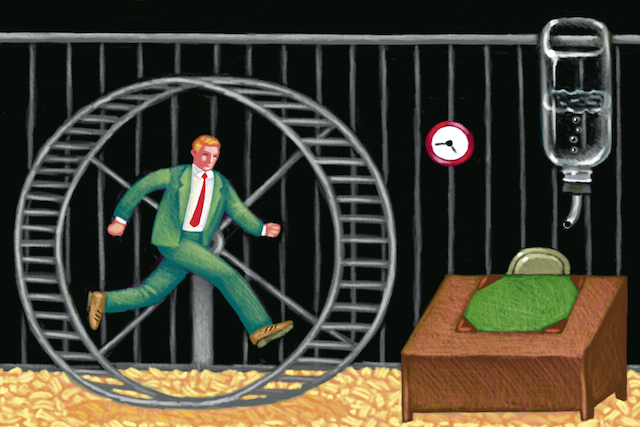
    But luckily, time heals all wounds, and six months later you get another surge of motivation and try it all over again. This is where most people find themselves in life—stuck on the self-improvement hamster wheel.

    How do you stop this vicious cycle? What’s the best way to facilitate lifestyle changes that you actually stick to?

    How Big Goals Ruined My Life

    When I was a sophomore in high school, I had ambitions to become an NBA basketball player. Despite the fact that I was 5 feet 6 inches tall, had below average quickness, and could barely jump over a stack of books, I was determined to prove everyone wrong.

    At this point, I didn’t have my driver’s license yet, so my wonderful mother would get up at 4:30 a.m. and drive me to my school gym early enough to get up shots before class. To make a long story short, I was cut from the team a few months into my sophomore year, and my NBA aspirations died right then and there.

    When I was a freshman in college, my focus had shifted to day trading the stock market. Once again, I had complete confidence that I was going to turn day trading into a full-time income. And once again, I was wrong. The $1,000 I had deposited into my Robinhood account disappeared in about two months, leaving me with no financial flexibility to invest into my dream of becoming a full-time day trader.

    During my sophomore year of college, I made the biggest decision I had ever made in my life up to that point. Despite having good grades, I decided to drop out of school and start my own marketing agency. Let me tell you, that phone call with my parents is undoubtedly the most emotional conversation I’ve ever had in my life.

    I even distinctly remember my own cousin telling me, “I think that you’re going to regret this decision for the rest of your life.” Still, I was unbothered, because I knew in my heart that I needed to give this a shot. A month after telling my parents I wanted to drop out of school, I was on a flight back home to California.

    Yet again, I found myself in a familiar spot—just a kid following his heart with some colossal goals.

    Filled with passion and drive, I set myself a goal to build the agency to $50,000/month in revenue by the following year. To reach that goal, I committed to at least two hours per day of prospecting, and another two hours of educating myself on the real estate marketing industry.

    By now, I think you can see where this is going. For fifteen months, I worked at trying to achieve my goals, but the highest monthly revenue target I was able to achieve was a measly $6,000/month. Despite desperately wanting to taste wealth and success, I had failed yet again.

    It was at this point in my life where I really took a step back and engaged in deep reflection. After all, I had just been following the wisdom that successful people had been preaching for decades—set big goals and don’t stop working until you accomplish them.

    Was it me that was a failure or was it my system? Why is it that so many people including me continually set big goals that they never accomplish? Pondering these questions drove me to explore the world of self-development.

    The Power of Identity

    I had always been passionate about self-improvement, but I had never really delved into the science and research behind what actually facilitates true behavior change. My research eventually led me to reach two life-changing conclusions:

    • Setting big goals does more harm than good for people who want to change their lives.
    • True behavior change occurs when you commit to small, seemingly insignificant shifts in your daily behavior.

    After spending hundreds of hours combing through research on habits, behavior change, and neuroscience, I finally had the “aha” moment that shifted my entire perspective on life. The fatal problem with setting big goals is that they focus on the outcomes we want to achieve as opposed to the type of person we want to become.

    The most powerful force in the human body is the desire to be consistent with who we’ve been in the past. Behavior that is incongruent with the self will not last, which is why big goals are often so hard to accomplish.

    You may have a goal to build a million-dollar business, but if your identity is that of someone who procrastinates on important work, it’s unlikely you’re ever going to hit that goal. You may have a goal to lose weight, but if your identity is consistent with someone who eats fast food regularly and lives a sedentary lifestyle, you’ll continue to be pulled toward actions that sabotage your weight-loss goals.

    You may have some new goals, but you still haven’t changed who you are. I wanted to build a marketing agency even though I was the type of person who procrastinated and refused to get out of my comfort zone. It was the inability to change those underlying beliefs that ultimately led to my failure.

    How to Achieve Your Biggest Goals by Thinking Small

    If big goals aren’t the answer, then what is? The key is to focus on who you want to be as opposed to the outcomes you want to achieve. You need to become the type of person who can reach the standards you have set for yourself.

    Your identity emerges out of your daily habits. You don’t come out of the womb with a preset identity. Whoever you are right now is a direct result of the daily habits that you’ve developed up to this point.

    In order to start forming new beliefs about yourself, you need to start building new habits. The formula for changing your identity is a simple two-step process:

    • Figure out the type of person that you want to become
    • Commit to small changes that align with your ideal self

    First off, you have to decide what kind of person you want to be. When setting goals, most people are guided by the question “What do I want to achieve?” Instead, try asking yourself, “Who is the type of person that can get the kind of outcomes I want?”

    Instead of setting a goal to lose fifty pounds, ask yourself, “Who is the type of person that can lose fifty pounds?” Instead of setting a goal to build a million-dollar business, ask yourself, “Who is the type of person that can build a million-dollar business?”

    The beauty of focusing on identity change is that your success is no longer tied to arbitrary targets. Let’s say that you set a goal to lose fifty pounds in six months. As you pursue this goal, you start walking every day and improve your diet. At the end of six months, you step on the scale and you’ve lost thirty-seven pounds.

    Did you achieve your goal? Nope, you’re thirteen pounds short. However, what if your goal was simply to become a healthy individual? Did you achieve that goal? Absolutely!

    Once you’ve figured out what kind of person you want to become, the next step is to commit to small shifts in your daily behavior. Too often we convince ourselves that massive success requires massive action. This is the principle that guided my life for nineteen years.

    Through constant trial and error, I’ve realized that true behavior change is the product of small, incremental changes compounded over time. We tend to dismiss the effectiveness of small actions because they don’t make an immediate impact.

    If you walk for two minutes per day for a week, you’re not going to see the number on the scale move much. If you meditate for sixty seconds for a few days in a row, you’re not going to turn into the Dalai Lama. However, what you will do is to give your brain concrete evidence that you’re a different person.

    James Clear puts this beautifully when he says, “Every action you take is a vote for the type of person you want to become. No single instance will transform your beliefs, but as the votes build up, so does evidence of your new identity.”

    Once you’ve nailed down your desired identity, come up with a daily habit that you can perform no matter how you feel. When you set big goals, your brain tricks you into thinking that the present level of motivation you feel will carry over to when it’s time to take action. By focusing on shrinking your daily targets, you’re taking motivation and willpower out of the equation.

    Here’s a few practical examples of this concept in action:

    • Meditating for ten minutes per day becomes meditating for sixty seconds per day
    • Walking for thirty minutes per day becomes walking for two minutes per day
    • Reading for thirty minutes per day becomes reading one page
    • Journaling for fifteen minutes every night becomes writing one sentence
    • Writing 1,000 words per day becomes writing fifty words per day

    It really doesn’t matter how successful you are right now, all that matters is that you’re on the right path. Once these small habits are solidified into your daily life, you’ll have mastered the art of showing up and acting in alignment with your desired identity.

    Since your brain now has some new evidence, you’ll be able to stretch yourself and gradually aim higher. That’s the true power of small habits. The same way that money multiplies through compound interest, the positive effects of your habits multiply as they become a part of who you are.

    So, the next time you get motivated to change your life, forget setting huge goals. If you do this, the power of your identity will loom large over you and prevent you from taking action. Harness the power of small, incremental change.

    Have the courage to set the bar low enough and aim at targets that you can actually hit on a daily basis. Solidify this small habit into your life, and then do the same thing with another habit. And then another. And then another.

    Soon enough, you’ll become someone unrecognizable.

  • If You’re Trapped Under a Pile of “Should” and Tired of Feeling Unhappy

    If You’re Trapped Under a Pile of “Should” and Tired of Feeling Unhappy

    “Stop shoulding on yourself.” ~Albert Ellis

    I was buried under a pile of shoulds for the first thirty-two years of my life. Some of those shoulds were put on me by the adults in my life, some were heaped on because I am a middle child, but most were self-imposed thanks to cultural and peer influence.

    “You should get straight A’s, Jill.”

    “You shouldn’t worry so much, Jill.”

    “You should be married by now, Jill.”

    “You should get your Master’s degree.”

    I could go on forever. The pile was high, and I was slowly suffocating from the crushing weight on my soul.

    What’s so significant about age thirty-two? It’s when I decided to divorce my husband of eighteen months (after a big ole Catholic wedding) and ask my parents for money to pay the attorney’s retainer. This is a gal with a great childhood, MBA, and a darned good catch for a husband.

    From the outside, our life looked charmed and full of potential. We’d just purchased our first home, were trying to start a family (despite suffering two miscarriages) and were building our careers. What no one else saw was the debilitating mountain of consumer debt, manipulative behavior, and my intuition’s activated alarm system… sounding off in reaction to the life I’d built and was, for all intents and purposes, stuck in.

    My intuition was done with the low-level warnings. She was sick and tired of being ignored, so she sounded the big one—an alarm that demanded action instead of lip service. I still tried challenging her; what she had presented me with was asinine.

    “But I can’t divorce him. We just got married. What will everyone think? I’m so embarrassed. I should have made better choices. How did I end up here? I did everything right, right? I should suck it up and stick it out; that’s what good Catholics do. This is kind of what life is, I guess… kinda sad, but it seems to work for most everyone else. Ugh, I wanted this… now I’m, what, changing my mind?”

    The alarm was not going to shut off until I sat long enough with those notions to yield honest answers. That was some tough sh*t to sit in. And even tougher to plod through. But it was better than being buried under it.

    This was my first lesson in “There’s only one way out of this mess.” There’s no express lane, no backroad, no direct flight. This ride resembled the covered wagon kind. Bumpy, hot, dirty, and uncomfortable as hell.

    I relented, listened, and tapped into the hidden reserve of courage I didn’t know existed within me.

    The time had come to quit living according to the “should standard” everyone else around me had subscribed to. The time had come to accept this curated life was not the one that would yield happiness for me. The time had come to turn up the volume on this newfound voice and assert to myself (and everyone else) that I was cutting my losses and trusting my inner compass.  

    The time had come to stop shoulding myself.

    Shoulds were my grocery list, my roadmap for life. How was I going to do this adult thing without my instructions???

    I’d already managed to clear a huge should—hello, divorce—and after that, with every should I challenged, another paradigm crumbled. I began to notice shoulds all over the place. After that, my awareness of intention got keener, and I could sniff out the subtle shoulds like a bloodhound.

    SHOULD: When are you having kids?

    CHOICE:  I do not want to have children. (Remember I miscarried twice with my first husband. I was checking boxes on my adulting grocery list. Honesty yielded clarity.)

    SHOULD: He’s too old for you and he has four boys of his own.

    CHOICE:  He is my person. His sons deserve to see their father in a healthy, happy relationship. I can show them love in a new, different way.

    SHOULD: You’re making great money in your job. Why walk away from your amazing 401(k) and great benefits to risk starting your own business?

    CHOICE:  I want to build a life I’m not desperate to take a vacation from. I want to live, serve others, and know when I’m at the end of my life that I chose it and made the most of it.

    Deleting the word “should” is a big first leap in taking ownership of your life. By altering your vocabulary in a simple way, you naturally become mindful of the words you put in its place. Instead of “I should….” substitute with “I choose to….” Instead of “You should…” try “Have you considered…?”

    Keep track of every time you say or hear “should” in a day. Then spend time with each one and get toddler with yourself. Ask why. Ask it again.

    Who says you have to get married or have kids or work a job you hate that looks good on paper? Who says you have to look a certain way or do certain things with your free time that don’t appeal to you? Why are you restless in your life? What idea keeps popping up, begging for your attention? Are you living your truth? What’s in the way? What pile of shoulds are you buried under?

    I get it. We’ve been programmed by our culture and our family traditions to follow the path, stay on course, climb the ladder to success! It’s the only way to be happy, they say. It’s the only way we’ll be proud of you, they insinuate.

    We’ve been indoctrinated with this thought pattern and belief system, and it seems impossible that we have the power to choose otherwise. We have the opportunity, the autonomy, the choice to rewire our iOS and make it what is ideal for ourselves.

    Overwhelm is natural; the antidote is to start small. Find one piece of low-hanging fruit, take a bite, and taste how sweet it is. For example, say no to an invite if you’d rather spend your time doing something else. Allow yourself to do nothing instead of telling yourself you should be doing something productive. Or let yourself feel whatever you feel instead of telling yourself you should be positive.

    Feel how nourishing it is to choose yourself. Experience satiety in your soul. Release restlessness and replace it with intention guided by your intuition.

    Do that and you’ll never should again. Or maybe you will—who says you should be perfect? At the very least you’ll think twice before letting should control you, and you’ll be a lot happier as a result!

  • Why It No Longer Matters to Me If My Job Impresses People

    Why It No Longer Matters to Me If My Job Impresses People

    “Do not let the roles you play in life make you forget who you are.” ~Roy T. Bennett

    Wherever I go and meet new people, they ask me, “What do you do?”

    I love talking about what I do because I love what I do, but It’s not what I’ve always done, and it certainly isn’t all of who I am. It’s part of who I am, but there is so much more.

    When we’re young, we’re asked to decide on a career. You know, the question, “What do you want to be when you grow up?” The problem is, does anyone in high school truly know what they want to do for the rest of their lives? I’d venture to say that many high school kids don’t even know who they really are yet.

    When I was growing up, I was a straight-A student, a star athlete, a perfectionist, and an overachiever. I learned at a young age that performing well was my ticket to feeling good about myself. My accomplishments garnered the praise and admiration of many and gave me what I needed to feel good.

    Validation.

    As a senior in high school, it was natural that I chose to go to college for aerospace engineering. I was interested in aviation, but more importantly, when I told other people what I had decided on, they nodded their heads in approval. A smart girl should choose a “smart career,” right?

    Validation and approval drove me forward.

    When I got out of college with a BS in aerospace engineering from the University of Minnesota, I went to work for The Boeing Company in Seattle, Washington. I didn’t love it. Part of it may have been homesickness, or the dreary Seattle weather, but a huge part of it was that the corporate cubicle life was not for me.

    I thought there was something wrong with me. After all, I had worked so hard to reach this point in my life. I should love it, right? Hadn’t I finally arrived?

    I struggled with it so much because on one hand, I dreaded going to work. On the other hand, when I told people what I did for a living, they leaned in and listened a little harder. Even my own father was proud to talk about my engineering career and the fact that I worked for one of the top aerospace companies in the world, but I’ve since moved to less impressive pursuits, he has never once asked me about those endeavors.

    My career looked awesome and interesting and impressive on paper, but I was quietly dying inside.

    My husband and I ended up moving all the way across the country to Savannah, Georgia, where I worked for another top aerospace company—Gulfstream Aerospace. I didn’t really feel any different about my position there, until I transferred into a group called Sales Engineering.

    In this area, I was able to interact and collaborate with sales and marketing to create the technical data they would use to pitch Gulfstream’s fleet to potential customers. I enjoyed the challenge, but I really enjoyed the collaboration with other people that weren’t buried in their computers all day. It was here that I first got a glimpse that I loved connecting with other people.

    When my first child was born, I left the aerospace industry. We had just moved cross-country again to Los Angeles, and it made more sense for me to be a full-time mom since I wasn’t the family breadwinner, and we didn’t absolutely need a second income. Plus, I wasn’t enamored with the whole engineering gig either, so in a sense, it was a way out.

    Quitting the career that I didn’t love was, on one hand, so freeing. But on the other hand, without that thick layer of validation that kept getting piled on every time someone asked me “What do you do for a living?”, I felt naked. I felt inferior. I felt like I was a failure who couldn’t hack it in the real world.

    My identity was wrapped up in my career that looked so good on paper but didn’t feel good in my soul.

    My ex-husband is an attorney, and we’d attend events with lots of other attorneys and highly educated people. At these events, I dreaded the question “So, Kortney, what do you do?”

    My response was always a little timid, almost apologetic.

    “I stay at home with our son.”

    There was typically a slow nod, with a bit of feigned interest, as if they weren’t really sure what more to say about the occupation stay-at-home mom.

    Because I also had a side-gig photography business, I’d quickly add, “and I’m also a photographer.”

    That tended to garner a bit more interest.

    “But I used to be an aerospace engineer,” I’d tack on, in a final effort to gain the nod of approval I so desperately sought.

    Bingo. Alarm bells sounded. The crowd cheered. People were reeled back into something more exciting.

    That good, old familiar friend, validation was back.

    I struggled for a long time to find my identity without all the “stuff” on the outside. It wasn’t until I got divorced and had to figure out how I would financially support myself after my spousal support ran out that I even scratched the surface of “Who am I, really?”

    Who am I without my career, the accomplishments, the external validation?

    All those years, I lived with one foot in the world of wanting to love myself for who I am rather than what I did and one foot in the world of doing more, doing better, doing it ALL.

    I lived in between the worlds of self-validation and external validation. 

    I knew I wanted the former, yet I craved the latter.

    In doing the work of figuring out who I really am, learning to love myself fully, and being able to validate myself without any help from the outside, I realized that I was asking myself the wrong questions all along.

    As a society, we ask the wrong questions.

    Instead of asking our kids, “What do you want to be when you grow up?”, I think we should be asking them, “Who do you want to be?

    I asked my eleven-year-old daughter this, and she looked at me in her quizzical mom-why-are-you-asking-me-such-a-weird-question way and said, “Umm, I just want to be me?”

    Yes!

    Shouldn’t we all just want to be who we are? 

    Instead of pursuing goals that are impressive because they bring us accolades and attention, what if we were to pursue our goals because they lit us up and we were truly passionate about them?

    What if we started asking our kids questions about what lights them up? How do they want to feel? What things do they like to do that make them feel that way?

    Even as adults, we can ask ourselves these questions.

    If you’re in a job that doesn’t feel right, you can ask yourself, “How do I want to feel?

    What’s authentic to you? How do you want to show up in the world? What jobs or careers would allow you to show up that way?

    This is the work I did after my divorce. I’m in a completely different career now, and believe me, as much as I fought going back to a job in the engineering industry, I had to do a lot of work on my thinking about not having a “smart job” like being an engineer. The validation I craved and was so used to was like a drug.

    Through this work, I learned how I want to feel in my life and that guides everything.

    I discovered that I want to feel freedom, ease, joy, and meaning in my life. 

    Going to a cubicle every day didn’t allow me to create those feelings. I want to show up in the world authentically—I want to be able to be a human being who makes mistakes and can share myself with other people. Corporate life didn’t allow me to be that authentic person that I now so deeply love.

    Some of you reading this may have corporate jobs and love them. You may be able to create the feelings you want to feel and show up authentically with that type of career. That’s awesome!

    The goal is to be able to feel the way you want to feel. The goal is to be able to show up in the world in a way that is true to who you are. 

    Because how you show up to do the things you do in the world is what really matters.

  • How I Saved Myself by Surrendering When Everything Fell Apart

    How I Saved Myself by Surrendering When Everything Fell Apart

    “And here you are, living despite it all.” ~Rupi Kaur

    “I surrender!” I said this mantra out loud as my life was spiraling out of control.

    I had spent a summer in college as a camp counselor separated from my fiancé. He sent me no letters and did not keep in touch. Still, I held on. By the time I came back home, we were broken. I had also realized he was emotionally abusing me. It took that separation to make me see it.

    I realized I had been truly alone in the relationship. I was never lonelier than being with someone who refused to listen to me. A summer of independence brought me a new love of solitude, but it also made me realize I didn’t have a soulmate in him after all.

    I was forced to face that this life wasn’t perfect. I wasn’t perfect. But… I was enough. I needed to believe that to keep moving.

    When I said my mantra of surrendering, I was on a rollercoaster of emotions. I didn’t know where my life was going. The wedding planning ended. He called it off through text. I was left emotional and without closure. I didn’t know what would happen next. I just decided to be curious rather than try to control it.

    I woke up to the fact that I didn’t have to know everything. I had to just trust. This both terrified me and propelled me forward. I didn’t know if things were going to be okay, but I knew I would make meaning out of whatever would happen.

    I wanted to teach youth how to surrender too. I figured that would be my legacy since it had healed me of so much in life.

    I had already applied to graduate school, and I would start at Brandeis very soon. I was worried about being on top of it all while going through this heartbreak. I was a Type A student, president of four clubs and an honors student. I didn’t exactly have time for love back then, but I didn’t realize I had a choice to let my ex go if I wasn’t satisfied. I put too much effort into trying to make it work when it wouldn’t.

    I didn’t see that my effort to make everything work was actually blocking better things from coming my way. In other words, I had to stop holding on so tightly to life. I had to let go. I had to surrender to survive. I had to go with the flow to find my flow. I had to learn how to be happy for no reason other than to simply be.

    When I did that, my whole life opened up for me. I practiced radical acceptance and realized my place in this world mattered. I stopped white-knuckling through my problems and pain. I stopped waiting for love and decided to love myself. I started to see myself as capable and good no matter how others mistreated me. I decided by letting go, I would not give up. I made a promise to myself to always be authentic.

    Life didn’t go as planned. I left Brandeis MAT program for teaching because I realized I didn’t want to be a high school English teacher anymore. It was the hardest decision of my life because I also did not have a backup plan.

    So, I surrendered again. And again and again through it all.

    I surrendered when I found other ways to help youth. I surrendered through a bipolar breakdown and a relapse to the hospital years later. I surrendered when I went on disability and all expectations of my life were changed. I surrendered through bad side effects to meds and awful doctors. I surrendered all through my life because I knew despite how hard things could be, I was still doing good. I was still helping others. I was still waking up each morning appreciating being alive.

    It came down to the simple things. I didn’t need certain labels or popularity. I needed to rest, to do nothing sometimes. To breathe. To just live.

    I saw myself as rising in my own ways.

    I realized I couldn’t look back. Here’s what I held onto instead:

    1. Finding Purpose

    When I let go of my need to control, I became more mindful. I started to think about how I wanted to spend my time. Was it for achievements or authenticity?

    I had nothing, so I had nothing to lose when I left Brandeis. Serendipitously, I had a branding internship the same time a brand manager of a large TV personality discovered me. The internship taught me how to manage my own image and ideas while the manager wanted to simply own me like a puppet master.

    I had a choice. I could live on my own terms or have someone take over my life. I turned down advances from this man. I wasn’t going to fall for the same red flags as I did with my ex-fiancé. I let go; I surrendered.

    I decided to make my own way and live authentically as a person, not a brand, sharing my story along the way. I used my mental health journey to help end stigma and my writing for sharing insights on life.

    I did not let walking away from the brand manager stop my story. Instead, I redefined it for myself. I was enough as I was. I didn’t need anyone to discover who I was meant to be. I would live my life for me.

    My purpose became in proving him wrong, that I could make it on my own. Then, it became for me, to show myself I was worth it. I focused on living in the moment and just following my passions without a plan. That’s what saved me. But it wasn’t the only thing.

    Purpose dawned on me one day while I was simply walking my dog through the woods in my backyard. I listened to birds chirping. I grounded myself by looking up at the blue sky. I touched the bark on the trees. I felt my inner voice beckoning me to love this life as it was, not as I wanted it to be. I didn’t have to do anything. I just had to be in this moment. That’s all life was asking of me.

    It took simplicity to make me realize my purpose wasn’t just a to-do list. It wasn’t fixing everything. It wasn’t mastering every skill. It wasn’t making things work when they wouldn’t.

    I had to separate myself from the “shoulds.” I had to find the gift in what I was going through. In taking the time to do nothing but think, far away from a stressful schedule, I realized that my purpose was to be happy without needing a reason to be. That took a different kind of bravery.

    2. Forgiveness

    I wasn’t able to move on from the injustices of my life very easily. I had anger in me from living under others’ control and abuse. I had loss, which I felt every day, etched into my skin. I knew what it was to be alone. I had settled too often and always saw the best in people.

    I grew up walking on eggshells surrounded by abusers. It was an endless pattern I stopped in my twenties. After my ex-fiancé left me, I found a new type of strength. I realized the only power anyone could ever have over me was the one I consented. No one could steal the core of who I was. No one could take certain things away. No one could define me but me.

    I took my power back through forgiveness. It didn’t happen right away. I meant “I love you” to my ex, but then I realized it was governed in fear. Fear of doing this life on my own.

    Sometimes life makes you continually face the very thing you’ve been avoiding. You keep getting redirected to it even as you resist. You find yourself with the same lessons you needed to learn before.

    There’s a quote that reads “You repeat what you don’t repair.” Well, I was there. I was back there constantly in my anger and hate of those who I thought stole something from me.

    But when I decided to forgive them, I released it. I gave it back to the universe and pulled my heart from the chaos. They didn’t deserve it. It wasn’t for them. It was for me. I had to let them go and surrender so I could heal myself. I forgave myself in the process, too, for not knowing enough, for not seeing the truth.

    My heart wanted to hold onto the anger so that I could do something with it. I soothed it, though, with self-compassion. I made meaning of the events of my life by helping others through similar things.

    That meant I had to say goodbye. Goodbye to those who didn’t know me enough to love me right. Goodbye to the me that was in survival mode and didn’t know I could just let go and live. Goodbye to the dark nights of the soul where I felt like giving up and suicidal ideations crossed my mind. Goodbye to the past. Goodbye to the insecurities. Goodbye to the pain. Goodbye to the worst of it all.

    And then I said it. “I forgive you.” I salvaged myself from the wreckage of the storms I had suffered. I pulled myself out of the ruins of an old life. I realized I was the one who decided my fate. I was the captain of my soul. I was finally free.

    3. The Reason

    I found my way by allowing myself to go on the detour. I realized that I was meant to go down the wrong road so I would be sure of the right one. My road was brilliant, one of authenticity, that uplifted me above all that I had gone through. I was able to look at my life and see what really mattered. I suddenly knew what I was here to do.

    I was here to share my gift. Any insight I could. To love.

    I started volunteering, writing, speaking to youth, and advocating for mental health awareness.

    I stopped living in the stigma of struggling and became open about my story.

    I surrendered to what was happening.

    I stopped fighting every little thing that came my way.

    I didn’t need to know what would happen with the lives I touched and the good things I did along the way. I just had to follow my path hoping others would follow it too, making it a little easier for someone else.

    All I had to do was surrender—be still, quiet my mind, allow rather than resist, let go, and find myself even when losing it all.

    Surrendering isn’t easy. In fact, it’s one of the hardest things we can do. That’s because we want control. But sometimes, surrendering is seeing uncertainty as beautiful. We don’t have to know what lies ahead in order to move forward.

    What will you do when you surrender, stop fighting reality, and allow yourself to live in your life as it is?

    Can you improve a situation, share a kindness, give to a greater cause, become a better you, and build a better world? Can you dream of doing such things? That is the first step to resilience. Focus on the beauty found in the broken situation and in you. Focus on the light you can bring into the darkness.

    It doesn’t take away from the horror of any hardship to believe in yourself and your ability to make change from it. That takes its own grieving time. But during that time, you can’t let it consume you. The tragedy that befell you, the heartbreak that happened, the hurt inside that you can’t let go… they are indeed senseless. Hence, it is imperative you don’t get stuck on asking why, as many do.

    Instead of viewing yourself as a victim, it’s time to be a victor. Overcome the odds. Let what hurts and irks you be the fuel to your fire.

    Hardships do not define us.

    What you have been through, your circumstances, do not define you.

    There will be days where you need to prioritize self-care and forgiveness for who you had to be to get to this point. Maybe you were white-knuckling through the pain in your self-care journey, maybe you did what you did in order to survive, but the good news is that today is a new day for you.

    Hold space for the sacred gift of simply being alive on those days.

    It works like a cycle. You will feel all the emotions on the spectrum, which means you will feel anger and sadness and doubt, but you will also feel joy and love and hope again the longer you hold on, the more patience you practice with yourself.

    A reason not for why this happened but why to go on will come to you.

    That reason is everything.

    When you want to give up, that’s when you say, “I surrender,” which isn’t the same thing. Giving up is shutting down. Surrendering is letting go.

    When you surrender, you don’t need things to work out a certain way. You accept life as it comes, which leads to a breakthrough. When you give up, you breakdown. Surrendering is the sacred step to realizing your full potential. It’s realizing you are your own hero, and you must not stop now.

    When you let go, you realize everything could change tomorrow. All it takes is choosing this very moment and living it. Mindfully surrendering is about releasing your fears and doubts so you can see clearly and letting the light come through.

    Don’t wait for life to change to create peace, joy, and purpose. Choose to make the best of what you have in your life, right now as it is. Surrender. Say the words, and it will change your life.

  • Why We Need to Be Present to Enjoy Our Lives, Not Just Productive

    Why We Need to Be Present to Enjoy Our Lives, Not Just Productive

    “Presence is far more intricate and rewarding an art than productivity. Ours is a culture that measures our worth as human beings by our efficiency, our earnings, our ability to perform this or that. The cult of productivity has its place, but worshipping at its altar daily robs us of the very capacity for joy and wonder that makes life worth living.” ~Maria Popova

    I was high on productivity. I had one full-time job, two part-time jobs, and a side hustle. I was getting everything done. Sounds perfect, right?

    Then I started hating my life.

    I had read enough books and articles to tell me how I was not doing enough. Enough self-help gurus had told me that what I needed to do was max out every single hour I had to be minutely close to being “successful.”

    My co-workers often got intimidated by my jam-packed calendar. I don’t exaggerate when I say that every minute of my life was scheduled. Sheldon-level scheduled, with dedicated “bathroom breaks” and everything.

    I ran three to-do lists: daily, weekly, monthly. This was my way of setting out for maximum efficiency. I said “yes” to my boss so often I had become his favorite. Work-life balance, what’s that?

    Tasks were flying off my list like never before—so many horizontal breakthroughs! I wore this as my badge of honor for a while, this art of getting it all done. And why not? I was rewarded for it in money, praise, promotions, awe.

    But then it didn’t feel so great. Instead, I became downright miserable.

    Why Busyness-Productivity Is A Mirage

    I don’t claim that productivity is bad. Doing fulfilling work by minimizing distractions and getting deep focus is truly rewarding.

    But it is crucial to stop and question why you’re doing what you’re doing. It is necessary to pause and reflect on the value of your tasks and actions. Otherwise, productivity translates to useless busyness.

    When I became this productivity freak, I never stopped to ask if any of the things I was doing were giving my life meaning. I was doing a demanding full-time job that didn’t provide me any purpose. My days became a blur of mindless task completions. My mind, heart, and soul were absent from my work. Any given Monday didn’t look so different from a Tuesday three weeks prior.

    And it wasn’t even like I was happy.

    I was meeting all my deadlines, but I was spending no time with my family. There were enough accolades to prove all my achievements but not enough art to fulfill my soul. I answered every email I received within twenty-four hours, but I hardly focused on long-term self-growth.

    On the outside, my life never looked better. But on the inside, I was worse than I had ever been. Distraction, schedules, irritability, and deadlines were the monsters that ruled my life.

    After a month-long burnout, I hit the problem nail in the head. I knew I needed to move on. But how? I resolved to take a calculated leap of faith. I found a client willing to pay me for my freelancing services for at least two to three months and made a thick emergency fund by cutting out on expenses. Then, I quit the unfulfilling full-time job and gave my heart to work that I truly found meaning in. I stopped making productivity my goal. I opted to choose presence instead.

    Presence > Productivity

    I read Annie Dillard’s, The Writing Life, in which she memorably wrote, “how we spend our days, is of course, how we spend our lives.”

    After reading this book, I realized that productivity would only be fruitful when coupled with presence. I knew then that presence was what would make my rewards meaningful.

    What is presence? Presence is the art of being in the moment, the luxury of pausing, the virtue of stillness. It is being alert, aware, and alive to this moment.

    There’s a reason why our culture runs for productivity instead of presence. Productivity helps us shut away from reality. It keeps us “busy” into a future that is yet to manifest.

    It is so much easier and convenient to take the shield of productivity against the beautiful, buoyant, and sometimes disruptively painful present.

    Performing one task after next gives us an excuse to not fully live, not completely concentrate, not unbiasedly accept.

    I used to be that way—trying to avoid the truth that I was not finding my work meaningful. I wouldn’t accept that this job was emptying me slowly, living in denial of a reality I was living. Was I not getting things done? I was, more than ever before. But was I happy? I had never been more unhappy with my own choices.

    Being productive every minute of every day meant I could avoid the fact that many of my friendships were depleting, toxic, and unhealthy. I was lying to myself that it was all to have a good social life. In reality, I would go out of my way to avoid being alone, to avoid answering the big questions pertaining to my life that can only be answered in solitude.

    But coupling our actions with productivity and presence can have an astounding effect on our lives. It can make every task we do driven with intention, purpose, and meaning. Presence is what helps us reap the internal rewards that come with doing fulfilling work.

    Choosing Presence

    If you are anything like me, choosing presence over productivity can take some practice. Productivity was my normal mode of operation. It was easy; it came naturally. But opting for presence in my actions wasn’t so simple.

    The art of being present and intentional in all my tasks was like writing with my non-dominant left hand. I searched for help and stumbled upon Tim Ferris. He often says to think of your epitaph to cut through all the noise and maze of productivity. It is a way to find out what truly matters to you by getting a super-zoomed out version of your life.

    As morbid as it sounds, that is what I did. I imagined what I would like to carve on my epitaph, and the important stuff came into a laser-sharp focus:

    I needed to write. I needed to make time for solitude, for serendipity, for hobbies. I wanted to create more memories with my family. I wanted to let go of draining friendships and put all my energy into relationships that filled me with fulfillment, meaning, and growth. Taking it one step at a time, I decided to hand in my resignation. I landed my first writing gig in under two weeks.

    And hey, it’s not like I don’t struggle to write with my left hand anymore. But I am growing each day. It takes some practice and effort to make room in your calendar to “be present.” I am learning to be uncomfortable by turning the volume down of “getting things done.”

    I have noticed that it is the minor changes that count. It is taking a little more time to craft that email mindfully. It is that courageous “no” to a project that can help you surpass your quarterly KPIs but take away from your family time. It is choosing to take a soothing fifteen-minute walk break over checking off another mindless to-do list task.

    Presence is a process. It requires the discipline to focus on the present moment when productivity pushes you to see a non-existent future. Presence is your un-busy existence of utterly unadulterated joy. It is your creativity’s cradle. It is your time to just be.

    So do it. Make the hard choice. Live your life with presence to help you find joy in the now instead of pushing toward some destination in the future. None of us really know where the future will bring us, but we can all choose to enjoy the scenery along the way.

  • One Question for Anyone Who’s Stuck in a Rut: What Do You Believe?

    One Question for Anyone Who’s Stuck in a Rut: What Do You Believe?

    “You become what you believe, not what you think or what you want.” ~Oprah Winfrey

    What do you believe? During the forced stillness of the pandemic environment we’re all living in, this is a question I’ve been faced with more intensely than ever. In particular, I’ve come to question what I believe about myself, and how that impacts every element of my life.

    Coming out of years of self-help for social and general anxiety, a long-standing eating disorder, and several dissatisfying personal relationships, I had to come to question what these external realities reflected back to me. For what you believe about not only your life, but more importantly, yourself, will show up again and again, and yes, again, until you’ve finally addressed the root of the problem.

    In my case, my lack of self-value resulted in many dysfunctions and setbacks in my personal and professional world.

    My deteriorating self-image led to my eating obsessions, a lack of confidence exacerbated anxieties, and the low value I placed on myself was most likely written all over me, judging by the way others showed disrespect toward me in personal relationships.

    Not only was I devaluing who I was, but I also operated from a place of being closed off to others, afraid that if I showed my true self I wouldn’t measure up to their expectations.

    This all came to a head when COVID-19 emerged and led to a global lockdown. Going off of numerous negative relationship experiences, I visited a doctor to discover I had a pelvic floor condition called vaginismus, which results in involuntary vaginal muscle tightening that makes sex and physical exams like pap smears either impossible or extremely painful.

    I spent the next four months going through physical therapy to heal my body from this condition, breaking off a new relationship to focus completely on my own journey. It amazed me how the mind and body go hand-in-hand; my muscle tightening felt like a total embodiment of years of being closed off to others and remaining safely isolated from sharing my true self.

    As I mentioned previously, prior to being diagnosed with vaginismus I’d spent years healing my mental health problems and gaining strength in my career experience.

    After high school, I was lost in my career path for a solid period of time, making lukewarm attempts at artistic endeavors such as acting and modeling, never fully prepared to take a leap and fully immerse myself in any one field.

    Again, this would require a bearing of my true self that would frighten me just to think about. Not only that, it would mean that I had the nerve to believe I was worthy of attempting a profession that’s reserved for an elite group of “special” people, a group I never considered myself to be a part of.

    I did muster up enough courage to move to Los Angeles, however, where I felt I could start a new identity. My Northern California roots felt outdated, and along with some family I sought to better myself with a fresh start.

    One of my first steps toward positive changes was a hostessing gig at a bowling alley, which forced me to get out of my shell and be more social for a change. I still felt very self-conscious, but the more I worked on interacting with customers and coworkers, the more I learned how much I loved people.

    This further developed when, following a chance Intro to Journalism course I took at Pasadena City College in Southern California, I found a new joy that I wasn’t expecting.

    I began to love writing, and not only that, my favorite element of this new career path was interviewing—something I never thought I’d be able to conquer with the severity of my social anxiety, which prevented me from going into grocery stores at its peak

    Deep down, I started to believe that something different could be possible for me. Maybe I could break out of my old mindset and turn into the person I’d always felt I was inside: someone who loved people, longed for and accomplished successful interpersonal relationships, and stood in her power, unapologetically.

    By January of 2020, I had gained a local job news writing in my home base of Burbank and felt optimistic about the future. After the pandemic hit, however, I went through a time of feeling down during isolation. This paired with the vaginismus diagnosis made me become initially quite frustrated.

    “Why is this happening to me?” I wondered. I had done a lot to overcome other personal issues, but now having to do months of diligent, and sometimes extremely painful, physical therapy felt like a punishment that I didn’t deserve.

    After a short bit of contemplation, however, I had a real and sudden shift in perspective. I simply thought, “I’ve been through more than this in the past. I’ll get through it.” I believed I could, and from that moment on dedicated myself to healing not only physically, but emotionally as well.

    Within four months I made enough progress to end in-person physical therapy appointments, I started blog writing and continued with news writing in Burbank, earned a journalism scholarship over the summer, which I contributed toward my studies, and now have just started my own independent journalism writing website.

    The more I believed that I could accomplish my goals, and the more I felt I was worthy of such things, the more I saw everything in the universe work for me, and not against me.

    Today I continue to improve my self-image, and I have a long way to go. But overall, I feel healed from where I once was.

    I’m pursuing my passions, now unashamed to show and share who I truly am.

    I demonstrate a great deal of self-respect in personal relationships, no longer tolerating poor treatment from others who don’t consider my worth.

    My diet and exercise habits are healthier, my vaginismus treatment is complete, and, although I still have to maintain physical therapy exercises, I feel grateful for where I’m at in that regard and in every aspect of my life.

    If you had asked me five years ago, prior to all of this self-improvement, what I believed about myself and my life, I probably would have said I had a promising future ahead, although my actions and interactions continuously showed otherwise.

    This is why I feel I’m at a much more positive place in life at this moment.

    Not only do I propose that I believe positive things about myself, but I now show it through my actions.

    I no longer want respect, I demand it.

    I no longer want to pursue my goals wholeheartedly, I now do it as much as I can every day.

    And not only do I dream of expressing the truth of who I am, I embody it.

    So, if you too feel like you’re stuck in a rut in your life, if you feel that the world isn’t treating you fairly, and if you don’t like what the universe is showing you, then I urge you to ask yourself:

    What do you believe? About yourself? Your worth? Your life? Your potential?

    What do you believe about what you deserve, in relationships and in your career, and what you can accomplish if you try?

    How do those beliefs affect how you show up in the world—the decisions you make, the chances you take, the things you tolerate, and the habits you follow each day?

    What would you do differently if you challenged your beliefs and recognized they’re not facts?

    And what can you do differently today to create a different outcome for tomorrow?

    These are the questions that shape our lives because our beliefs drive our choices, which ultimately determine who we become.

  • How I Overcame the Stress of Perfectionism by Learning to Play Again

    How I Overcame the Stress of Perfectionism by Learning to Play Again

    “What, then, is the right way of living? Life must be lived as play…” ~Plato

    I am a recovering perfectionist, and learning to play again saved me.

    Like many children, I remember playing a lot when I was younger and being filled with a sense of openness, curiosity, and joy toward life.

    I was fortunate to grow up in Oregon with a large extended family with a lot of cousins with whom I got to play regularly. We spent hours, playing hide-and-seek, climbing trees, drawing, and building forts.

    I also attended a wonderful public school that encouraged play. We had regular recess, and had all sorts of fun equipment like stilts, unicycles, monkey bars, and roller skates to play with. In class, our teachers did a lot of imaginative and artistic activities with us that connected academics with a sense of playfulness.

    I viewed every day as an exciting opportunity and remember thinking, “You just never know what is going to happen.” My natural state was to be present with myself, enjoying the process of play

    Unfortunately, my attitude began shifting from playfulness to perfectionism early on. Instead of being present and enjoying process, I started focusing on performance (mainly impressing people) and product (doing everything right). The more I did this, the less open, curious, and joyful I was.

    Instead, I grew anxious, critical, and discouraged.

    I first remember developing perfectionist tendencies when I was in elementary school and taking piano lessons. For some reason, I got the idea that I had to perform songs perfectly, or else I was a failure.

    Eventually I became so anxious, I would freeze up while playing in recitals. I started hating piano, which I once had loved, and eventually quit.

    My perfectionism spread into other areas of my life, too. In school, I pushed myself to get straight A’s, and if I earned anything less, I felt like a failure. I often missed out on the joy of learning because I was so worried about getting things right.

    My perfectionism also negatively impacted my relationship with myself. I believed I had to look perfect all the time. As a result, I often hated the way I looked, rather than learning to appreciate my own unique appearance and beauty. I also remembering turning play into exercise at this time of my life and using it to pursue the “perfect” body.

    Movement, which I loved when I was a child, began to feel exhausting and punishing.

    Perfectionism also hurt my relationships with other people. I felt like I had to be smooth and put together and that I always had to put everyone else’s needs above my own. Not surprisingly, I often felt unconfident, anxious, and exhausted around other people.

    At this time in my life, I believed that if I tried and worked hard enough, I could do everything right, look perfect, and make everyone happy.

    My perfectionism increased in young adulthood until eventually it became unsustainable. In my early thirties, I became the principal of a small, private middle school where I had taught for eight years. I loved the school and was devoted to it.

    In many ways, I was the ideal person to do the job. But I was also young and inexperienced, and I made some big mistakes early on. I also made some decisions that were good and reasonable decisions that, for various reasons, angered a lot of people.

    To complicate matters, the year I became middle school principal, the school underwent a massive change in our school’s overall leadership, and we suffered a tragic death in the community. I worked as hard as I could to help my school through this difficult time, but things felt apart.

    My school, which had largely been a happy and joyful place, suddenly became filled with fighting, suspicion, and stress. These events were largely beyond my control and were not the fault of any one person, but I blamed myself. For someone who had believed her whole life that if she worked hard enough, she could avoid making mistakes and could make people happy, my job stress felt devastating.

    I felt like my life was spinning out of control and that all the rules that once worked no longer applied. I crashed emotionally, and I remember telling my husband at this time, “I will never be happy again.”

    That was one of the darkest times of my life.

    It took me several years to find happiness again. One of the major things that helped me to do so was recovering a sense of playfulness.

    After my emotional crash, I decided I was done with perfectionism. I understood clearly that focusing so much on avoiding mistakes and pleasing-people was the source of much of my suffering. 

    I realized I needed a different way to approach life.

    About this time, my friend Amy and I started taking fencing lessons together. I was quite bad at it, but it didn’t matter. Because I had given up perfectionism, I didn’t care anymore about impressing people at fencing class or performing perfect fencing moves.

    Instead, I cared about being present with myself in the process and staying open and curious, and focusing on joy.

    I had a blast. I felt free and alive, and something flickered to life inside me that had felt dormant for many years. I felt playful again. And I realized that I had been missing playfulness for many years, and that it was part of what had caused me to become so perfectionistic.

    Playfulness is the attitude we take toward life when we focus on presence and process with attitudes of openness, curiosity, and joy. Perfectionism, on the other hand, makes us focus on performance and product and encourages anxiety, criticalness, and discouragement.

    Fencing helped me rediscover play and leave perfectionism behind.

    I fully embraced my newfound playful attitude. It touched every area of my life, and I hungered for new adventures. I began reconnecting with dreams I had put on hold for a while. Eventually I decided to leave my job as a middle school principal and return to graduate school to earn my PhD in philosophy, a goal I’d had since seventh grade.

    Earning a PhD in philosophy may not seem like a very playful thing to do, but it was for me. For six years, I immersed myself in the ideas of great thinkers like Plato, Aristotle, Kant, Hegel, Rousseau, Herbert Marcuse, and Paulo Freire.

    It felt like I was playing on a big, philosophical playground. But I also faced some significant challenges.

    I was thirty-seven when I returned to grad school and was a good ten to fifteen years older than most of my colleagues. Most of them had a B.A. and even an M.A. in philosophy, while I had only taken one philosophy course in college. I had a lot of catching up to do, and I faced some major challenges.

    One of the biggest challenges I faced early on was our program’s comprehensive exams. We had two major exams over thousands of pages of some of the hardest philosophical works ever written. The exams were so difficult that at one point, they had over a fifty percent fail rate. If students didn’t pass them by the third time, the graduate school kicked them out of the program.

    I was determined to pass these comps and spent all my Christmas and summer breaks studying for them for the first several years of graduate school. But I still failed both exams the first time I took them, and I failed my second exam twice.

    It isn’t surprising I failed them, given the high fail rate for the exams and the fact that I was still learning philosophy. But it was painful. I had worked so hard, and I was afraid of getting kicked out of the program.

    I was tempted to revert to my old perfectionist habits because they had once given me a sense of control. But I knew that would lead me down a dead-end road. So, I began applying all the lessons I had learned about playfulness to the comprehensive exams.  

    Rather than focusing on performance and the product, I focused on presence and process. I also focused on practicing habits of openness, curiosity, and joy. Mentally, I compared the comps to shooting an arrow into the bull’s eye of a target. Every test, even if I failed it, was a chance to check my progress, readjust, and get closer to the bull’s eye.

    This turned the comprehensive exams into a game, and it lessened the pain of failing them. It helped me accept failure as a normal part of the process and to congratulate myself every time I made progress, no matter how small it was. This attitude also helped me focus on proactive, constructive steps I could take to do better, like meeting with faculty members or getting tutoring in areas I found especially challenging. (Aristotle’s metaphysics, anyone?)

    I also taught myself to juggle during this time. Juggling not only relieved stress, it was also a playful bodily reminder to me that progress takes time. Nobody juggles perfectly the first time they try. Juggling takes time and patience, and the more we focus on openness, curiosity, and the joy of juggling, the more juggling practice feels like a fun game. 

    I began thinking of passing my comps like juggling, and it helped me be more patient with the process. I eventually mastered the material and passed both my comps.

    Studying for the comps taught me to bring playfulness into all my work in graduate school.

    Whenever I felt stressed out in my program, I reminded myself that perfectionism was a dead-end road, and that playfulness was a much better approach. Doing this helped me relax, be kind to myself, accept failures as part of the learning process, and to take small consistent steps to improve.

    This playful attitude kept me sane and helped me make it to the finish line.

    Playfulness was so helpful for me in graduate school that I have tried to adopt this spirit of playfulness in all areas of my life, including the college classrooms in which I teach. I have noticed that whenever I help students switch from perfectionism to playfulness, they immediately relax, are kinder to themselves, and increase their ability to ask for help.

    I am dedicated now to practicing playfulness every day of my life and to help others do the same. Playfulness isn’t something we must leave behind in childhood. It is an attitude we can bring with us our whole life. When we do so, life becomes an adventure, even during difficult times, and there is always something more to learn, explore, and savor.

  • How I Found My Place in the World When I Felt Beaten Down by Life

    How I Found My Place in the World When I Felt Beaten Down by Life

    “Some people are going to reject you simply because you shine too bright for them. That’s okay. Keep shining.” ~Mandy Hale

    After I finished school, I was excited about moving forward with life.

    I thought about the career that I hoped to have, where I hoped to live, and the things that I wanted to accomplish.

    After starting off as a secondary high school English teacher and becoming disappointed with the ongoing changes in the public school system, I went to graduate school for law. I thought it would open up a lot of possibilities, but it did not.

    I never had any dream of being an attorney in a courtroom. Instead, I always wanted to work in Europe or South America with people from different cultures, nationalities, and backgrounds. I wanted to make a positive difference in a humanitarian way by working with people personally to implement change and improve their lives.

    Life had something different in store for me, though. I ended up being rejected endlessly, well over a thousand times for every application that I sent out over a period of years.

    Disillusionment set in. There was the feeling of “why even continue to try anymore?” As the rejections piled up, friends that I had known for years began leaving as well. Their calls and visits became less frequent. They moved on with their lives, careers, marriages, and kids.

    I felt left behind and rejected not just by jobs, but by life in general. The hurts and betrayals were leading me to lose my passion and enthusiasm. Then there were the callous remarks from friends, people in the local community, when I asked if they knew of a position, former professors who couldn’t assist in any way now that I’d graduated, college career center advisors, and even extended family members.

    It took time, but I finally came to the realization that those who were endlessly rejecting me weren’t the ones who really mattered. I would keep shining brightly with or without them.

    Here are the four things that helped me to finally “reject” the non-acceptance and rejection that I was experiencing from others.

    1. Realize that “there is no box.”

    Our background, degrees, friends, teachers, families, and the larger culture as a whole try to get us to conform to a narrow set of parameters. If you went to school to be a teacher, you have to be a teacher.  If you studied to be an auto mechanic, you have to be an auto mechanic. And you have to live in this place or this country, because that’s where your family have always lived.

    Someone once told me, “there is no box.” Society tries to “box” us in and to restrict us to defining ourselves within certain narrow limits. However, I realized that there really is “no box,” and that I could apply my skills and talents in other ways and in other places.

    I didn’t have to conform to where I was or seek acceptance from those who were currently around me.

    I started meeting new people and looking at other places and countries, and I stopped trying to seek the acceptance of those who had already decided that they weren’t going to accept me for who I was. The employers, institutions, and agencies told me I was  “overqualified” or that that there were “many qualified candidates” and I hadn’t been considered, or they’d keep my resume on file.

    It was as though no matter what I accomplished and no matter how hard I worked, it was never “the right skill set” or “enough” for the particular place or person that I was submitting to.

    In a way, I came to accept their rejection, because I knew that the answer was getting out of my box and realizing that someone else would be more than happy to accept me for who I was.

    2. Let go of the need for approval by others.

    Letting go of the need for approval opens up exciting new doors. We are finally free to be who we really are.

    I wanted to live up to the expectations of family and society. I think that’s why it hurt so much to receive so many rejections over such a long period of time. I wanted to be “successful” according to society’s expectations. I wanted to follow the path of what everyone told me was a “regular” and “secure” life.

    I’ve since realized that I get to define success for myself.

    Success, for me, means doing what I love—teaching, reading, traveling, meeting and working with people from throughout the world, studying languages, and experiencing different cultures.

    Everything changed for me when I decided to live my life on my terms now rather than looking for a company, agency, government institution, or some other entity to provide me with the chance or opportunity. I wasn’t going to wait for permission from someone or something else.

    I also realized I can use my skills in the world outside of the narrow and limited context of the jobs and people who were rejecting me.

    For example, I can teach, and I can work to help others, but it doesn’t have to be within the rigid structure of the public education system.

    I can use the skills that I’ve acquired to be a global citizen and to learn and grow every day without confining myself to the parameters of one place, country, or culture. I can be an amalgamation of all of them, as I continue to grow as a person, both personally and professionally, but on my own terms, not those that are dictated to be by someone or something else.

    As I let go of the need for others to approve of me, my world expanded, because now I could go after those things in life that I was passionate about rather than just trying to conform and satisfy others.

    3. Start journaling.

    Journaling and connecting with our true selves, and what really brings us joy, can make us value ourselves again in spite of any opposition and rejection that we experience from the world.

    It can also help us reconnect with the things we used to love when we were younger—the passions we lost after going through years of school and trying to do what we thought we had to do in order to be successful in the eyes of society.

    Journaling helped me get back to my uniqueness as a person and was what really motivated and inspired me. It helped me pay attention to what made me happy again and those things that I’d really like to do or accomplish.

    I was inspired by my experiences in the world that were outside of my comfort zone and by the rich and varied cultures and experiences that were waiting out there. As I continued journaling, I also realized I’d always been inspired by the possibility of teaching and helping others, but in an international capacity.

    As a result, I’ve had the opportunity to help students with autism, to teach English to students and adults internationally, and to write for a variety of places abroad that did accept and value my work. However, I would never have explored these aspects of myself if I had been accepted by those who were rejecting me. Which means really, their rejections were blessings in disguise.

    4. Support those who support you.

    “Your circle should want to see you win.  Your circle should clap the loudest when you have good news.  If they don’t, get a new circle.” ~Wesley Snipes

    We can reject rejection by supporting those who support us through both the good and the more difficult times in our lives. Why support those who are only there for you when life is good?

    The hard times made me realize who really was on my side. The people who stayed with me and continued to believe in me supported me through both the victories and the disappointments. There was a tremendous difference between those individuals and others who no longer answered calls or emails, except when I was “successful.”

    Now, I may not have as many friends as I once did, but those that I do have are an important part of my circle and people that I can rely on.

    Someone once told me, “Now I know who the true believers are.” I feel that way about those who have proudly celebrated my successes and have also been there for me during my darkest moments.

    I hope you’re fortunate enough to have people in your life who genuinely support you, even if it’s only one person. If you don’t, try to open yourself up to new people, and stop giving your energy to people who accept you conditionally or regularly disappoint you. Creating a supportive circle begins with that first step of making a little room.

    It wasn’t easy for me to overcome rejection and non-acceptance, and I still struggle with it at times. No one wants to feel left out or like a failure. But I’ve realized I can only fail by society’s terms if I accept them—and I don’t.

    Instead, I’ve rejected the “box” other people tried to impose on me, gotten outside my comfort zone, let go of the need for approval, started rediscovering what excites me, and shifted my focus to those people who have always supported me, regardless of what I’ve achieved. And I’m far happier for it.

  • How I Live My Life Purpose Without Doing Anything Big

    How I Live My Life Purpose Without Doing Anything Big

    “You know how every once in a while you do something and the little voice inside says, ‘There. That’s it. That’s why you’re here’ …and you get a warm glow in your heart because you know it’s true? Do more of that.” ~Jacob Nordby

    Mornings running the busy roads with the echo of what this one or that one said, lying in my bed in the middle of sunlit days staring at a bamboo plant on my dresser, seasonal jobs, getting all dressed up for waste-of-time employment fairs, scribbling in my notebook when my spirit demanded I fight back—at the rejection letters, at the no responses, at the feeling that I simply wasn’t good enough—this is what a lot of my twenties was made up of, but that’s not all.

    I had moments in those seasonal jobs that lit my unique spirit and showed me exactly what I loved and cared about.

    In everything I took action on there were hints of a young woman crying out: “This is a puzzle piece of who you are right here. This is important. Take notice!”

    The rejection letters led to setting myself free through concerts, unforgettable trips, and quality time with those closest to me, and they gave me more writing inspiration.

    The time alone, not feeling that I fit in with any of my peers and that my life wasn’t progressing along the traditional trajectory I was witnessing, pushed me to dive into my emotions and think about what I truly value.

    I wrote it all down. It turns out that all the tears and isolated fears pushed me into creating stories and poetry that are all about love and are essentially a quest to understand and care for each other more.

    In spending so much time alone with my feelings and knowing deep down that there must be others who feel this way too, I developed an even more empathetic nature that caused me to want to reach out to others more than ever before.

    But it took me a while to focus less on the destination and recognize the value in the journey.

    The moment I graduated I felt this compulsion and desire, which I believe stemmed from my past imprinted insecurities, to define myself immediately. I needed to figure out right away who I was going to be, lock it all in.

    No one tells you when you’re setting out on your life that no one’s story works that way.

    I thought life would just tick along like checking off items on a to-do list, especially through witnessing the social media highlight reel of my peers. I didn’t make the connection that it was, in fact, their highlights.

    I only saw a part of the character in these peers of mine, and honestly, who would tune into that show? Who would want to see a perfect life played out day after day with no one being challenged to see how they rise to the occasion and come out an even more beautiful form of their unique self?

    I had watched so many soap operas and TV dramas by that time, and yet, I did not understand that this was clearly not the full picture, just as I was only showing my highlight reel. I wasn’t going around telling everyone about the pain and loneliness I felt. I wasn’t posting about the dozens of rejections I had received.

    Maybe if we did post all of these things we would be more mentally at peace, but at the same time, I think that would also cause us to stagnate as we communicated all our troubles and injustices constantly.

    What we want isn’t always what is best for us. If we were able to be so open, I don’t believe we would be propelled into action through having to sit in those feelings and figure out how we’re personally going to step up and out of a situation to create our own unique story.

    I basically played the victim many times when I would see what I thought was my peers so effortlessly checking off milestones on their personal to-do lists. So, what did I do?

    In some indignant notion that I would be missed, I went on and off Facebook more times than I could ever count, thinking when I came back on, things would be different, and I would be validated when joining my community once again. That’s not what I received, and that’s not what I truly needed.

    I believe this loneliness and question of ones’ life purpose can come at any time. This just happened to occur for me in my twenties, and I’m glad I’m beginning to understand why I felt all that I did.

    I believe we are all unique. None of us are replaceable, and we all have the capacity to fulfill many purposes in our lifetimes, through different stages, as our priorities, interests, and values change.

    I am a very different person than the confused young woman of my twenties because I no longer search for my purpose, as if it’s this one big thing I need to figure out. Instead, I follow what I love and fixate on all the good I have in my life.

    I constantly focus in on all that I am grateful for. I keep a record of my achievements. I read my favorite books over and over again. I watch my favorite TV shows, which are still teen dramas, I must confess. I look at art and listen to music that ignites my spirit.

    When I’m feeling stuck, movement is key, whether it’s running or doing household chores.

    I know that I am following my purpose as long as my heart feels that I am being true to myself.

    I still get insecure. I don’t think that will ever go away, and maybe it’s one of those things you don’t want that is in fact good for you. Without my insecurities, I wouldn’t have to keep reaffirming what I am passionate about, and without reaffirming, there’s a chance I could lose myself.

    I found through searching for my purpose in what I refer to as my “crossroads period” in my twenties that it’s not one thing to be achieved, one path to be fulfilled. My purpose is a continuous journey of loving those closest to me and deeply following what my heart tells me.

    I believe in the search for my purpose I was also able to identify the kind of people I want on my team, the kind of people I want in my life. These people are few and rare but as true as can be.

    I know that the overriding purpose of everyone’s life is to discover your people and keep them close. They will be your guideposts and your encouragement to fulfill the passionate enormity your life is meant to embody.

    This family of mine is what keeps me moving forward and holding the belief that I am living a life of purpose simply by loving and being loved by them, regardless of what else I do with the time I’ve been given.

  • The Joy and Power of Realizing I Am More Than My Job

    The Joy and Power of Realizing I Am More Than My Job

    “Authenticity is a collection of choices that we have to make every day. It’s about the choice to show up and be real. The choice to be honest. The choice to let our true selves be seen.” ~Brené Brown

    “What do you want to be when you grow up?”

    “It’s so nice to meet you. What do you do?”

    These are the questions we are asked our entire life. When we’re children, everyone always asks about the future. They excitedly ask, “What will you do?” The subtext of this questions is:

    “How will you be productive in society? How will you contribute?”

    Being asked those questions all the time as children turned us into the adults that ask them. We are in the same cycle and do not seem to know to ask instead, “Who are you?”

    For a long time, my focus and self-identity was tied up in what I did. I would tell people, “I am a filmmaker.” When I was young, I knew I wanted to make films. I loved to tell stories. “I want to be a movie director!”

    When I grew up and actually got jobs in Hollywood, I realized that most people are not movie directors. Most people are not even filmmakers. They work in film. It takes many people to make one, but only a handful of people get any recognition or able to consider themselves filmmakers.

    “What do you do?” people would ask. I would struggle to figure out how to explain that I was a production assistant who worked on films. I was basically a glorified secretary, a personal assistant. But I was not a filmmaker.

    I worked on other filmmaker’s films. I personally had not made any art or films for over six years. I was so busy and tired of trying to work in the industry I wanted to work in that I forgot about myself.

    When I could no longer define myself as a filmmaker, I became disillusioned. If I wasn’t one, then what was I? People always got excited when I said I worked on movies. Their eyes would light up, and they would pester me with questions about the famous people I knew or inside secrets.

    They never wanted to know how much sleep I missed or how many friends and family events I sacrificed for the bragging rights of Hollywood. They didn’t want to know what excited me about life or who I was. They only wanted to know “what I did.”

    This discontentment grew. I became angrier and angrier at the film industry as a whole. I felt used. Worthless. The world was nothing but egos and money. I would never be them unless I sold myself and played their game.

    I wasn’t willing to play the game, find the back doors, penny pinch, or be downright cruel. I was beginning to see that the industry was soulless. The art and stories were being dictated by companies that wanted to earn as much as possible.

    The stories were not chosen for their value and need in the world, but by which would make the most money. They profited on these stories and off the handwork and sacrifices of the below-the-line workers that were seen as disposable.

    Celebrities made millions, and I made minimum wage, but I didn’t have the luxury of a free jet ride back home and an apartment for my girlfriend. I was reprimanded for refusing to work on a Saturday after only five hours off.

    Slowly, I began to question if this was who I was. If this “works in the film industry” was really. me. And I felt guilty! I felt like I was being ungrateful. I was working on big movies! How could I not be happy? I had “made it.”

    I could only go up from here. I could get to be the next Stephen Spielberg, the next Tarantino, the next Lucas? Then I worked for one of these types of famous guys. He was just a human. He wasn’t the god I held him up to be. He was flawed.

    Sure, he got the adrenaline rush of making art, but at my expense. I was lucky to have my name in the credits. I wasn’t part of the golden ones, the actors and producers who were the “real” movie.

    If I didn’t want to play the “Hollywood” game I could go independent. But I felt guilty that I called myself a filmmaker when I hadn’t made a film in years! I didn’t even have any desire to even come up with one.

    I had friends who were making films on the weekends. They dedicated every free second to it. All I did was sleep. Then drag myself for dinner or a date and pretend I had a social life before I had to be back at work. I felt guilty and afraid that if left the industry I would be seen as a failure.

    I was afraid that I would be seen as weak or people would think that I couldn’t hack it. The more angst I felt, the more I turned to my unhelpful habit of Googling advice.  There is nothing helpful about hours of reddit and self-help blogs. They are all contradictory.

    This Googling, however, led to some articles with actual facts. This is when I started to read about Americans’ tendency to identify with our jobs. Our self-worth and identity are wrapped up in what we do.

    We say things like, “I am a lawyer.” “I am a physicist.” “I am a teacher.” We don’t say, “I practice law.” “I study physics. “I teach.” We put the emphasis on the job and not the I.

    I started the long, tedious process of separating myself, the me, from the filmmaker and the woman who worked in film. I realized that I was uncomfortable calling myself a filmmaker because I wasn’t one.

    I struggled to define my title to other because I didn’t really believe that it was who I was. I am a woman who enjoys movies and stories. More importantly, I am energized by stories.

    Filmmaking was just a job. The intense zealotry aspect of the film industry had always sat wrong with me. Now I know why. I am not a job. I am more than the work I do.

    Through this process I came to slowly accept that I wasn’t happy with the work I was doing. There was a disconnect between it and the way I saw myself in life. I needed to walk away for a bit and allow myself to heal from the harm I and the toxic industry had infected upon my soul.

    It is not just the film industry that is toxic. American work culture is. We have created an environment where work has to be our passion. Confucius said, “Choose a job you love, and you’ll never have to work a day in your life.” I disagree. Work is work.

    You might enjoy it, but as long as you are giving your time for money you are participating in a business transaction, and it is work. Just accept it as work and accept that you can be a whole person outside of your job. Your job is only a small sliver of the much larger person.

    Our work culture throws around the phrase “We are like a family.” It is encouraged and suggested that your team members and colleagues are family. They aren’t.

    You can get along with them, be friends with them, but by labeling them as family there is a pressure to feel loyal and not let them down. Our alliances are manipulated to be given first and foremost to work. Any time spend doing something for yourself or your actual family is seen as selfish.

    A year after my last film job I still struggle to see myself outside these identities. I am now enrolled in grad school and I want to label myself as a student. But I am not. I am Dia. I study mythology.

    Sometimes I am a storyteller, but that title does not and cannot encompass the whole and vastness that I am as a person.

    Identifying ourselves by our work is like trying to fill a mug with the ocean. At some point the ocean will overpower the mug, and we will be left wet and feeling bad about ourselves.

    The next time you are at a party, after the pandemic, and you meet someone new, maybe don’t ask, “What do you do?” Instead ask, “Who are you?” Create the space to meet the real, whole person; the person who is vast, deep, and full of wonder for the world.

  • How to Motivate Yourself with Kindness Instead of Criticism

    How to Motivate Yourself with Kindness Instead of Criticism

    I don’t always make the best choices, but today I choose compassion over intolerance, sympathy over hatred, and love over fear.” ~LJ Vanier

    It’s crazy to me now, to look back and realize how freaking hard I was on myself for decades.

    Had I ever talked to anyone else the way I talked to myself, it would surely have left me friendless and jobless, and I definitely would have been kicked out of school.

    Basically, I was a bully. Just to myself.

    If I said something awkward, I called myself an idiot.

    When I couldn’t find the motivation to clean my house, I called myself a lazy slob.

    If I wasn’t invited to a party, I told myself it’s because no one liked me.

    When work projects were hard, and I had to make it up as I went, I told myself that I was going to get fired as soon as my boss figured out that I had no idea what I was doing.

    My parents set high expectations of me. A’s were rewarded and B’s were questioned: “Why didn’t you get an A?”

    They are successful, intelligent people (who somehow also are able to keep a clean house, like all the time), so if I did anything that didn’t meet what I assumed were their expectations, I told myself, “I’m not good enough, I’ll never be good enough.”

    At a certain point, I realized this “strategy” wasn’t working out for me.

    It wasn’t making me any smarter or more successful.

    It wasn’t making people like me more.

    It wasn’t getting my house any cleaner.

    What it was doing was making me feel like crap. Every day. And it got old.

    Looking back, I realize now my catalyst for change was when I finally pushed past my social anxiety and found the courage to take classes at the gym.

    I found that I performed better when in a group because of the positive energy of people cheering me on.

    After a while I noticed I didn’t cheer people on quite as much as they cheered me on, and since it felt good for me to hear it, I busted through my fears and started cheering on everyone else in the class.

    It felt really good.

    It felt even better when it dawned on me that I could talk to myself that way too.

    And that is what self-compassion really is.

    What is Self-Compassion, Anyway?

    Self-compassion is speaking to yourself as kindly and empathetically as you would a friend.

    It involves consciously directing kindness inward.

    Self-compassionate people recognize that being imperfect, failing, and experiencing challenges are all inevitable parts of life, so they’re gentle with themselves when confronted with painful experiences rather than getting angry when life falls short of their expectations.

    Therefore, they speak in kind words—intentionally—to themselves.

    It is recognizing the shared humanity in our suffering and difficult experiences.

    When we’re being compassionate toward someone who is going through a hard time or has made a mistake, we say things like:

    • “You’re not alone.”
    • “Everyone makes mistakes.”
    • “You’re only human.”
    • “I’ve been there too.”

    Because there is comfort in recognizing that pain and making mistakes is part of life, it’s part of the process, it’s how we grow, and we all do it—literally every human.

    When we don’t take the time to say that to ourselves when we misstep, we feel isolated, and isolation breeds shame and separation and makes us feel worthless.

    Why We Are So Darn Hard on Ourselves

    We live in a success-driven, “no pain no gain,” “win at all costs,” “if you have time to lean you have time to clean,” “failure isn’t an option” kind of culture.

    There is nothing wrong with pushing ourselves and driving success.

    The problem is, we are a mimicking species, and when all we see are examples of people being hard on themselves and few or no examples of people being kind to themselves, we don’t know what that looks like.

    So the idea of self-compassion is foreign to most people. As such, we have these misconceptions that keep us from being self-compassionate.

    Myth #1: I need high self-esteem to feel good about myself.

    One of the biggest misconceptions about self-compassion is that it is the same as self-esteem.

    We grow up believing that high self-esteem is the key to feeling good about ourselves.

    The problem is, in our culture, to have high self-esteem, we have to be above average or special in some way.

    It’s almost an insult to be considered “average.” If someone were to say, “There’s nothing special about her” that would make a person feel especially bad.

    So, by this measure, self-esteem is conditional to everyone else’s status in comparison to ours. Our self-esteem (and therefore self-worth) go up and down as those around us go up and down.

    That’s why there are so many bullies in our society—because putting others down is one way to make your self-esteem go up.

    (There are literally studies showing an increase in bullies and narcissism in our society in the past several years, and many psychologists point to the “self-esteem” movement as a big factor.)

    Myth #2: I need to be hard on myself, or I’ll let myself get away with anything.

    A lot of people have the misconception that self-compassion is self-indulgence.

    They worry that they could be too self-compassionate and too soft on themselves, that they need to be hard on themselves in order to keep on track.

    But self-compassion enhances motivation, it doesn’t hinder it.

    Let’s say your friend is upset that she texted someone, and they haven’t texted her back.

    Do you say to her, “That’s probably because you did something wrong. I bet she doesn’t like you anymore, or maybe she never really did. You should apologize even though you don’t know what you did wrong, since she is most likely mad at you for something.”

    Absolutely not!

    Not only is it a mean thing to say, you know objectively that this is almost certainly not true.

    You would likely say, “I know that feeling too. I get disappointed when I don’t get a response from someone. But she likely forgot or is busy, just like a lot of people. Her not replying isn’t a reflection of you, it’s an inaction by her. Don’t worry, she still might message you back, or you can message her again later!”

    Which one of those feels more motivating? Which one feels more stressful?

    Which way do you talk to yourself when you slip up?

    The motivational power of your inner bully comes from fear, whereas the motivational power of self-compassion comes from love.

    How to Practice Self-Compassion

    1. Mindfully recognize when you hear your inner critic talking.

    We get so used to using negative self-talk that we don’t even notice it. We just run with the critical stories we’re telling ourselves.

    But you can’t change anything unless you recognize when you’re doing it by mindfully bringing attention to your thoughts, without judgment.

    First, notice how you feel. Because self-criticism feels crappy. That’s your sign that you need to do a little mindful digging.

    Now, the best tool you can use when you get that sign is to ask, “What is the story I’m telling myself?”

    • The story I’m telling myself is that people at work think I’m a fraud because I’m making everything up as I go, and I’m not giving myself any credit for all that I do know and have achieved.
    • The story I’m telling myself is that I’m not a good mom because I let my house get messy, and I’m not thinking about how happy and healthy my kids actually are.
    • The story I’m telling myself is that I’ll never lose weight because I ate those cookies, and I’m not giving myself permission to make a mistake.

    What is the story you’re telling yourself, and what language are you using to tell it?

    2. Understand the positive intent behind your negative self-talk.

    This is going to help you reframe your negative self-talk into self-compassion.

    Let’s say you’ve been wanting to lose weight, but you look down and realize you just ate an entire box of cookies.

    And now your harsh inner critic is saying, “You’re disgusting, you’ll never be able to lose weight, you have no self-control, this is why you’re so fat.”

    Again, words we would never say to someone else.

    What is the positive intent, what is that self-critic voice trying to achieve?

    • It wants me to be more conscious of when I’m eating and what I’m eating.
    • It wants me to be a little stronger when I have these cravings so I can lose weight.
    • It wants me to make a better choice in the future.

    Right? It’s not trying to beat you up for the sake of beating you up. That voice has a purpose, it’s just using the wrong words.

    3. Reframe that positive intent with self-compassion.

    Restate what your self-critic is saying with the voice of self-compassion by talking to yourself as you would a friend or loved one, recognizing the shared humanity in the experience, and consoling in the fact that this too shall pass.

    Can you look inward and say, “I see what you’re doing here. Thanks, subconscious, for the reminder, I know you’re just looking out for me. Now that we’ve heard what you have to say through the self-critic voice, let’s hear what the self-compassion voice has to say…”

    What would that sound like?

    “I get it, I’ve had a stressful day, I skipped lunch, and I’m tired, so I just fell back on an old habit—I made a mistake. Now that I know why I ate all those cookies, I can make a better decision tomorrow. All is not lost.”

    Which one of these feels better? Which one would motivate you to do better tomorrow?

    4. If you think you can’t be self-compassionate…

    If and when during this growth process, you find yourself thinking, “I just can’t stop talking to myself in that negative way, it doesn’t feel natural to speak positively to myself,” I want you to understand two things…

    First, self-compassion is a habit.

    That negative self-talk you’ve been doing for years has simply become a habit.

    It’s become your habitual reaction to stress, adversity, and failure. And that’s what we’re doing here: breaking old habits and creating new ones.

    It will be a challenge at first, as are all new habits. But with some practice, this is going to get easier and easier. It’s making self-compassion your new default mode.

    It will feel weird and unnatural at first. Don’t let that make you think it isn’t working. The more you practice this, the more you are training your brain to focus on compassionate self-talk instead of criticism, meaning you’ll spend less and less time with that critical language and more time with the compassionate language. In time, this will become your new, natural response.

    Eventually, you’ll reach a point where you say, “Hm, if I did that a year ago, I would have beat myself up for days. Good for me!”

    Second, you have a natural negativity bias that is working hard right now.

    When you feel like you can’t be self-compassionate, understand our natural negativity bias.

    We all have a negativity bias. It’s there with the intention to keep us safe. Your ancestors who were on the lookout for mountain lions lived longer than those who sniffed flowers all day.

    But we are centuries beyond the point in our evolution where we need to be on guard in order to keep safe at all times. When you’re living with chronic stress and anxiety, your negativity bias is sticking in the on position.

    Meaning, all you can see are threats. What could go wrong. What is wrong. What might be wrong. If you get a ninety on a test, you look at that ten that you missed and not the ninety that you achieved.

    Know that you have blinders on to positivity, that your negativity bias is making you focus solely on challenges instead of achievements.

    It’s what I call wearing poop-colored glasses instead of rose-colored glasses. Mindfully notice when you’re wearing them. Then take the glasses off! (They smell and they aren’t helping anything, anyway!)
  • My Secret to Overcoming the Painful Trap of Perfectionism

    My Secret to Overcoming the Painful Trap of Perfectionism

    “A meaningful life is not being rich, being popular, or being perfect. It’s about being real, being humble, being able to share ourselves and touch the lives of others.” ~Unknown

    Hello, I’m Kortney, and I’m a recovering perfectionist.

    Like so many of us, I spent the greater part of my life believing that unless something was perfect, it wasn’t good at all. There was really no in-between. If it wasn’t perfect, it was a failure.

    One of the problems with perfectionism is that it’s common to believe it’s a positive thing. In our society, people tend to value it. If you’re someone that aims for perfection, you must be accomplished. Driven. Smart.

    Have you ever had a sense of pride over being called a perfectionist?

    I have.

    Have you ever thought about why?

    Speaking for my own experience, when someone called me a perfectionist, I felt like even though I didn’t believe I was perfect, it meant that they were perceiving me as being perfect. They saw me as being one of the best, or as someone who was talented. It was validation that I was seen as someone who was good at things.

    My rabid thirst for this sort of validation fed the perfectionist machine for years.

    If you’re wondering what it means to be a perfectionist, here are a few traits:

    • Perfectionists obsess over mistakes, even when it’s not likely that anyone else even noticed.
    • Their self-confidence depends on being perfect.
    • They think in black and white—things are either good or bad. Perfect or failure.
    • They have unrealistic expectations and crazy-high standards for themselves and beat themselves up when they don’t meet them.
    • They put up a front that everything is perfect, even when it’s not, because the thought of someone else seeing their imperfection is unbearable.
    • Despite their quest for perfection, they don’t feel anywhere close to perfect.
    • They can’t accept being second-best at something. That’s failure.
    • They spend excessive time on projects because they’re always perfecting one last thing.
    • They spend a lot of time searching for external approval.
    • No matter what they do, they don’t feel good enough.

    At one point in my life, all of those bullet points described me well. I wasted so much time worrying about approval and validation so that I could feel like I was awesome. But I never felt even close to awesome. I never felt good enough at anything.

    Sure, there were times when I felt like I was good at something, but then I had to raise the bar. Just being good at something wasn’t enough. There was always another level to reach. The bar kept getting higher and higher, which isn’t necessarily a bad thing for people who are striving to make improvements in a healthy way, but for a perfectionist whose self-worth hinges on reaching the bar every time it’s raised, it’s not a positive.

    It was exhausting.

    After a lot of struggle in my life, I knew I needed to explore my perfectionist ways and find a way to be more compassionate toward myself. Perfectionism was holding me back from loving my life. And to be honest, I don’t think I intentionally set out to rid myself of the perfectionist mentality specifically. It came as a byproduct of a great deal of other personal work.

    I began to realize that I had many beliefs that were etched into my brain that weren’t helpful. Beliefs that I never thought to question. These beliefs also severely hindered my ability to be happy and to live the life I wanted to live.

    We all have belief systems that we don’t really think to question. We’ve grown up with them. We’ve learned them from the media, culture and society. But if we actually take a step back to notice that these thought patterns that inhibit our ability to grow and progress are there, we can start to question them.

    Some common limiting beliefs that keep people stuck in perfectionism are:

    • People reward me for having high standards. They are impressed and I gain approval.
    • The only time I get positive attention is when I am striving for big things or achieving.
    • If I make a mistake, I’m a failure.
    • If only I can make so-and-so proud with my achievements, he/she will love me, and I’ll be happy.
    • If I fail, I am worthless. Failing is not okay.
    • If I don’t check over everything multiple times, I’ll miss something and look like an idiot.
    • My accomplishments are worthless if they’re not perfect (i.e.: receiving a “B” instead of an “A” in a class is a failure),
    • If others see my flaws, I won’t be accepted. They won’t like me.

    The good news is that thoughts like these are examples of faulty thinking—faulty belief systems that keep you stuck in perfectionism. By identifying the specific thoughts and beliefs that keep you stuck in perfectionism, you can start to build new, more helpful thought patterns and belief systems.

    I also stumbled upon another secret for overcoming perfectionism.

    The secret is that I became okay with being average. I worked to embrace average.

    If you’re a perfectionist, you know that being called average feels like the end of the world. It’s a terrible word to hear. My inner critic was not having it. “How dare you even think average is okay?” it hissed.

    As a teenager, a twenty-something, and even a thirty-something, my world would have come to an end if I had accepted being average.

    But sometimes life has a way of making you better.

    Life has a way of putting things into your path and it presents opportunities for you to grow. Everyone has these opportunities at one point or another, but you have to notice them and choose to take advantage of them.

    There was a time not too long ago when I went through a really difficult time and had to rebuild my life.

    Looking back, I can see that the situation was an abrupt “lane-changer”—a push in a new direction to make a change. I was not living my best life and I wasn’t meant to stay stuck in that lane. I struggled with depression and anxiety, much of which was triggered by perfectionism.

    By working on thoughts like the ones I listed above, and working to accept lowering my standards—the ones that told me that achievement and success were the only way I would be worth anything—I gradually learned to replace my old standards with this one:

    Just be happy.

    Learning to make this my standard led me to a place where I am okay with being average. Eek! I said it. Average.

    Today, I can honestly say that I’m pretty happy with being average. Do I like to do well? Sure. But it doesn’t define my self-worth. While it’s created more space for me to fail, at the same time it’s created the space for me to succeed.

    The difference is that my self-worth isn’t tied to whether I succeed or fail.

    Here’s how I look at it:

    I’m really good at some things, but I’m not very good at other things. You are really good at some things.  And you aren’t very good at other things too. The good and the not-so-good all average out.

    At the end of the day, we are all just average humans. We are all the same. We’re humans trying to live the best life we can. We are more similar than we are different.

    Don’t you think that if we all ditched our quest to be perfect, or better than everyone else, we’d feel a little happier? Don’t you feel like we’d all be a little more connected?

    If you struggle with perfectionism, I invite you to take a look at the list of limiting beliefs above and see what resonates for you. What evidence can you find that can disprove these limiting beliefs? What would you like to believe instead? Try on those new beliefs and build them up with new evidence to support them.

    And along the way, work on accepting that you are enough, even if you’re average.

  • How to Stop Procrastinating When Things Feel Hard or Scary

    How to Stop Procrastinating When Things Feel Hard or Scary

    “You’ve been criticizing yourself for years and it hasn’t worked. Try approving of yourself and see what happens.” ~Louise L. Hay

    I dreamed of starting my own business for years. Ten years, exactly.

    While there are a few reasons it took so long to take the plunge, procrastination is at the top of the list.

    It’s hard work to change careers, uncomfortable to leave a steady paycheck, and nerve-wracking to think of failure.

    Even after spending months and years learning, studying, and getting certified, when it was no longer a matter of having the skills, the uncertainty of success was enough for me to keep kicking the can down the road to start marketing myself.

    I was afraid of failing. I was afraid of not being perfect. I was afraid that people would think I was a joke. And I was afraid that I wasn’t going to be capable of all the work it entailed.

    So I dragged my feet and kept passing my work off to “Future Me.”

    I did this for everything, though.

    “Tomorrow Sandy” can do the dishes. She’ll take care of scheduling that doctor’s appointment. Oh, and sign her up for that tough conversation I need to have with my mom too.

    At one point I recognized that I often procrastinated because I needed everything to be perfect.

    • I wouldn’t work on a craft project or cook a new recipe unless I knew it would come out flawless.
    • Or I would keep tweaking projects at work up to the last second and beyond, at the sacrifice of getting more work done.
    • Or I would agonize over every text and email I sent, often opting not to send any message unless I knew exactly what to say.

    But, as you can see, I’ve come a long way from that version of me.

    I’ve since started my own business (and I’m loving it!), and I’ve pulled my best tools together on paper for how to stop procrastinating—even though I actually procrastinated on writing this post (ironic, I know!).

    Today, I didn’t let my fear of “good enough” hold me back from sharing actual, helpful advice and mindset shifts to get moving and stop staying stuck.

    Because when we’re stuck, we start telling ourselves stories. So that’s where we’ll start, with this story we tell ourselves about why we procrastinate.

    What We Think Procrastination Is

    We have this misconception that procrastination is laziness.

    But procrastination is an active process. You choose to do something else instead of the task that you know you should be doing.

    In contrast, laziness is not caring. It’s apathy, inactivity, and an unwillingness to act. It’s an “I could, I just don’t wanna” kind of attitude.

    But when you’re procrastinating, you feel even more stressed because you do care about getting the task done. You’re just avoiding stress and having difficulty with motivation.

    Because that is why we procrastinate.

    What Procrastination Really Is and Why We Do It

    Procrastination is a stress-avoidance technique. It is an active process to temporarily avoid discomfort.

    We subconsciously are saying, “Present Me is not willing to experience this discomfort, so I will pass it on to Future Me.”

    (We do this as though we’re asking a stranger to do the work for us. Researchers have seen on fMRI that when we think about our future selves, it lights up the same part of the brain as when we think about strangers.)

    The really cool news is that by working toward overcoming your procrastination habit, you’re building your overall resilience to distress.

    That is how I define resilience: a willingness to experience discomfort.

    Examples of Procrastination

    Procrastination is tricky. Sometimes it’s obvious that we’re doing it. Sometimes we don’t quite realize it (like when I had to water the plants right then and there instead of writing this blog post).

    So here are some examples:

    • Scrolling through Instagram instead of getting started on important tasks
    • Putting off work assignments until the last minute
    • Wanting to start a new positive habit (dieting, exercising, or saving money), but repeatedly delaying it while telling yourself that “I’ll start soon
    • Wanting to start a business but wasting time in “research mode” instead of taking action
    • Doing an easy, less important task that “needs to be done” before getting started
    • Waiting until you’re “in the mood” to do the task

    5 Steps to Stop Procrastinating

    Now that we know what it is and why we do it, let’s look at how to stop.

    1. Motivate yourself with kindness instead of criticism.

    What really holds us back from moving forward is the language we use when talking to ourselves.

    Thoughts like:

    • I don’t want to.
    • It will be hard.
    • I don’t know how to do it.
    • It might not come out as good as I want it to.
    • I’ll probably fail.
    • This will be so boring.

    This is what we think that drives us to procrastinate. I mean, really, when you read those thoughts, they just feel so demotivating, right?

    This negative self-talk has a good intent. It is trying to save us from discomfort.

    Unfortunately, it’s achieving the opposite because it adds to the stress by making us feel bad.

    If you speak to yourself with kindness, just as you would a friend, it will feel so much more motivating.

    So think about what you would say to that friend. It might sound like:

    • I get it, it will be uncomfortable, but you’ll be done soon and then you can relax.
    • Once you get started, it will be easier.
    • You can do it!!
    • If it doesn’t come out perfect, at least you’ll have practiced more.
    • If you fail, you’ll have learned so much.

    2. Create a pattern interrupter.

    That negative self-talk has simply become part of your procrastination habit.

    Because that is what procrastination becomes—a habit—and habits are comprised of a cue, a routine, and a reward.

    • The cue is thinking about a task that needs to be done.
    • The routine is to speak that negative self-talk that leads to procrastination.
    • The reward is less stress. (Not no stress, because avoiding the task is still somewhat stressful because we know it eventually needs to be done.)

    In order to break the habit and create a new one, you need to introduce a pattern interrupter.

    Mel Robbins has a great one she calls the 5 Second Rule. When you think “I should do this,” before the negative self-talk starts in, count backwards, “5-4-3-2-1-GO” and move.

    I find this helpful when I’m having a hard time getting out of bed in the morning.

    If I’m having trouble getting motivated to do something difficult like write a post about procrastination, my pattern interrupter is “I can do hard things.” Not only am I interrupting the pattern, I’m motivating myself positively as well.

    If I’m having trouble doing a boring and tedious task like my taxes, I use something like “I’m willing to be uncomfortable now so that Future Me can be at peace.”

    3. Break down the task.

    One of the big drivers of procrastination is overwhelm. Overwhelm happens when we’re looking at a project in full scope, either not knowing where to start or feeling like all the work involved will be too much.

    If the next task at hand is too big, or if you don’t know where to start, your first task really is to either 1) make a list, or 2) figure out the smallest thing you can do first.

    The whole house is a mess? I bet you know where that one sock goes!

    Another example, I had social anxiety and going to the gym was overwhelming to me.

    So I broke it down into:

    • I just need to put gym clothes in my car, that’s it.
    • I just need to drive to the gym. I can turn around if I want once I get there.
    • I just need to walk in the door. I can always leave.
    • I just need to get changed in the locker room I can do that.

    Honestly, I never turned around and went home. Because once I’d taken the small, easy step, the next small easy step was doable.

    Which leads me to the next step…

    4. Just commit to five minutes.

    Studies show that if we commit to five minutes only, 80% of us are likely to continue with the task.

    Five minutes is nothing. You can do anything for five minutes.

    There is an 80% chance you’ll continue working once you put in those five minutes, but even if you don’t, you’re still five minutes closer to your goal.

    And, you’ve taken one more step to breaking the old habit of not starting.

    It’s a big win-win!

    5. Reward yourself or make the task more enjoyable.

    Another problem with looking at a big task in scope instead of the next five minutes is that the reward is too far away or not satisfying enough.

    When you’re trying to lose weight, twenty pounds is weeks and months away.

    Or, when you’re putting off your taxes, if you aren’t expecting a return then the reward is “not going to jail.”

    So bringing in more rewards sooner will fast track creating the new habit of getting started.

    But also, making the task itself more pleasant will make it a less monotonous task.

    • To write this post, I put on my softest bathrobe and grabbed my baby’s tub from when he was an infant to make an Epsom salt foot bath under my desk while I write.
    • I’ll be starting my taxes in the next few weeks, and I already plan to have a glass of wine and super fancy cheese and crackers while I sit down to do them.
    • I save listening to super nostalgic nineties music for when I’m exercising just so that it makes that time extra special and fun.

    What Would Open Up for You If You Stopped Procrastinating?

    We spend so much more time avoiding the discomfort of a task than we do stepping into what it will be like once the task is complete.

    If you were to stop procrastinating, what would open up in your life?

    • Would you start your business because you’re no longer afraid of experiencing any discomfort if you “fail”?
    • Would you simply enjoy life more if you weren’t in a perpetual state of stress because there is a list of things you’re putting off?
    • Would you finally lose weight or get in shape and feel good once you push through being able to get started?

    The Bottom Line

    Procrastination is an active process to temporarily avoid discomfort (it is not laziness!)

    By overcoming your procrastination habit, you are building your emotional resilience.

    Notice the negative, demotivating self-talk and motivate yourself with kindness over criticism.

    Create a pattern interrupter before the negative self-talk starts weighing you down.

    Commit to just five minutes and you’ll either keep going to do more, or you’ll at least be five minutes closer to done.

    Reward yourself or make the task more enjoyable so there is less discomfort to avoid.

  • Why I Ignored Morgan Freeman’s Advice on How to Live My Best Life

    Why I Ignored Morgan Freeman’s Advice on How to Live My Best Life

    “Don’t be pushed around by the fears in your mind. Be led by the dreams in your heart.” ~Roy T. Bennett

    When I was a college senior, God, or the voice of God (aka Morgan Freeman) came to my campus to give a talk. At the end of the talk, I beelined toward the mic set up in the aisle of the auditorium, excited to ask my question and for him to share his wisdom with me.
    “Hi, thanks so much for being with us today! As a college senior trying to figure out what to do next, I was wondering if you have words of advice for me and other people in my shoes?”

    “Follow your heart.”

    I’d be lying if I said that I wasn’t disappointed by his answer. “Follow your heart” sounded trite, and I felt like my next-door neighbor could’ve told me that. There was definitely a feeling of, “Tell me something I don’t know.” I was expecting a lot more, especially from a man who has played God!

    That was almost a decade ago. Now, with hindsight, I can see that those three words were packed with complexities, and though a seemingly simple ask, people have trouble following through. Why is that?

    Based on my experiences and what I’ve witnessed in others around me, the main reason is as follows: Despite knowing what it is that we truly want, we let our fears get in the way. Whenever fear crops up, our mind, which is evolutionarily designed to protect us from any form of perceived danger, kicks into high gear, drowns out the inner voice that stems from our heart and rationalizes going down a different path instead.

    For most of us, we abandon our dreams and end up following a path of “certainty”—one that usually comes with some sort of financial stability.

    Case in point: When I was a college senior, what I really wanted to do was apply to law school so that I could become a public interest lawyer.

    I had taken (and enjoyed) several law classes and interned at the Legal Aid Society, helping clients fight eviction cases against their landlords. I found the work to be incredibly meaningful and wanted to continue doing it. However, as a first-generation low-income college student, I didn’t know how to reconcile the cost of law school with a public interest lawyer salary, in addition to the expectation that I was going to come out and make “good” money because I went to a “good” school.

    This is when my brain kicked in and convinced me to go into consulting instead. I rationalized this decision by telling myself that consulting would expose me to different industries and enable me to learn, and that after two years, if I wanted to, I could still apply to law school. (In case you were wondering, I ended up hating consulting and never applied to law school, though for several years, I wondered what life would’ve been like had I went down that path.)

    Having gone through this experience and reflecting on Morgan Freeman’s response to my question, I’d like to share some steps that you can take to make it easier for you to follow your heart:

    1. Determine your values and live your life accordingly.

    When you know what your values are, any time you make a decision, you’ll know it’s the right one if it aligns with your values. Take a moment to reflect on the following questions:

    What are three to five values that are important to you? You can find a list of core values here.

    How can you incorporate your values into your day-to-day life?

    For example: One of my core values is personal growth. There have been times when I’ve been scared to take on new opportunities (e.g.: pursue a consulting gig in Zimbabwe). In those situations, in deciding what to do, my guiding question was, “Which decision will allow me to grow?”

    I said yes to Zimbabwe, despite the fears of traveling solo and staying for an extended period of time in a developing country with which I had zero familiarity. However, in choosing to take on the opportunity, I discovered how I had hyped up the fears in my mind and my experience in Zimbabwe instilled in me the courage to buy a one-way ticket to India a few years later.

    2. Do the things that make you happy.

    This seems like a no-brainer; however, it’s actually very easy for us to skip out on the things that bring us joy because other things in life get in the way (working too much, taking care of other people around us, etc.)

    When you actively carve out the time to do the things that make you happy, you are then able to access a different state of mind where new ideas and ways of thinking (that are authentic to you) will pop up because in your happy state, you’re not bogged down by your day-to-day anxieties and worries that stem from the mind.

    Some of the things that make me happy include taking long walks, handwriting letters, and playing with dogs. When I do these things, I’m not only happier, I also get flashes of inspiration for work. New ideas come to me when I let myself do the things that I enjoy—this phenomenon is akin to having shower thoughts.

    3. Pursue your interests and take it step-by-step.

    Maybe you’re considering taking that writing class? Perhaps you’re not sure because you don’t consider yourself a writer and are worried that everyone else in the class will be better than you. Ignore the voice of judgment and follow your intuition—sign up for that class!

    It’s easy to feel discouraged when we look at other people around us who are fifty steps ahead of us at the thing that we’re interested in pursuing and think, “Why bother?” However, the reality is that everyone starts somewhere. If you don’t start today, time will pass anyway and a year from now, you’ll be exactly where you are today if you don’t try.

    The more steps you take toward what speaks to you, the more likely they’ll add up and lay the path for you to follow your calling.

    As an example, in 2017, I rediscovered yoga, something I had first tried several years ago, but didn’t enjoy. Slowly, I built up my yoga practice—I was going to yoga classes, which then turned into yoga retreats and festivals. Before long, I had a strong desire to go to India to complete Yoga Teacher Training (YTT).

    I had no idea what would result from YTT—I wasn’t even sure if I wanted to be a yoga instructor. However, I knew that, at the very least, I wanted to complete YTT for myself because that’s how much I valued yoga! Through the process of YTT, I discovered that I do, in fact, want to teach yoga to others.

    “Follow your heart” is a short and simple phrase, yet it may seem like a tall order for many. May these three steps help guide you to pursue the dreams in your heart.

  • The Art of Self-Soothing: How to Make Resilience More Sustainable

    The Art of Self-Soothing: How to Make Resilience More Sustainable

    “I’ve missed more than 9,000 shots in my career. I’ve lost almost 300 games. Twenty-six times I’ve been trusted to take the game-winning shot and missed. I’ve failed over and over and over again in my life. And that is why I succeed.” ~Micheal Jordan 

    I believe that self-soothing is the key to accessing all happiness and success. All things being equal, when someone is able to self-soothe, they are more resourceful and more powerful than those who haven’t learned that skill yet. Here’s why.  

    Great success (whether professional or personal) comes with a great deal of responsibility. That responsibility can potentially lead to stress and is often accompanied by failures along the way. Most of us are familiar with that famous Michael Jordan quote—it was even in a ’90s commercial.

    Resilience is a great skill. In fact, that path is clearly recognizable to anyone who has achieved a lot. But it’s perspective that shows you that those failures aren’t “this is the end of everything and we’re all going to die” failures. Instead, they’re just medium or even small-sized stumbling blocks. 

    When you’re not yet at the end of your career or life, how do you know? Well, you don’t. So how can you function when things don’t go your way? How do you stay calm and grounded when something unexpected and shocking happens?

    The more “monodimensional” action-oriented side of resilience is to “power through” the hard times, sharpening your blade with your teeth. And while this might work sometimes, it takes a toll on your emotional well-being—can you feel that cortisol going through the roof?

    It’s easy to miss that monodimensional, action-based resilience is actually very weak, and ultimately unsustainable, if it’s not supported by a strong and playful mind. And I believe that Jordan had such a mind and demonstrated it throughout his career. 

    It’s not just persisting despite failures; it’s also how you feel every day, about your failures and in general. It’s about not allowing all the negative experiences to poison your daily well-being. 

    So how do you make resilience more sustainable? There is a softer way to deal with stumbling blocks, one that hopefully doesn’t lead to too much stress or burnout. One that, when mastered, will keep the emotional well-being floodgates open.

    One that you will want to teach to your friends, your kids, your parents, and your enemies too. This second dimension of resilience is self-soothing.

    I was raised in the household of Ms. and Mr. Stress. Growing up, I watched them take deep dives into (probably unnecessary) pools of stress. There was always something that wasn’t okay, something that needed to be fixed, not enough money or not enough time.

    Here’s a classic scene from my youth: When a piece of equipment, like the washing machine, would break, our whole family had to be part of the sorrow, anger, and anxiety associated with such an unfortunate event. But it wouldn’t be fixed right away (because it mightheal by itself, no?) When it would be absolutely clear that there was no hope for the poor washer, the focus would switch to panicking about the money needed to replace it.

    Once the washing machine was replaced, the problem became that perhaps it won’t be as good as the previous one, or it might take up more space, or it’s louder. It was never possible to relax, for fear that everything wasn’t perfect. It was obligatory to look for potential problems, scanning every single detail with “Terminator vision.”

    When we could finally be certain that everything was okay, we could then move onto the next thing that needed to be fixed.

    I was exposed to chronic stress for most of my childhood and teenage years. I didn’t enjoy the environment, but I didn’t know why. I didn’t have words for it, and I didn’t have the concepts to understand it. I didn’t know that I could live differently. Or better yet, I knew other parents were more relaxed, but I just thought they were luckier individuals. 

    When I moved out, aged twenty-two, I left the country and moved to Holland, to a tiny student city whose pretty canals were filled with swans and ducks, and where most family houses had cute and well-groomed front yards. I watched kids on tiny bikes ride with their parents to school, and people of all ages sit for coffee in wooden decorated cafes. It was nothing like the stress-filled metropolis I was used to, and people seemed to me to be so calm. 

    I loved it instantly, and I felt the well-being flood me, but I didn’t know why. Over the course of the following years, I lived in other places too. For some segments of my life, I even went back to my childhood home.

    It wasn’t until ten years after I first moved out that I was able to finally learn the names and the concepts that defined the emotional dichotomy I kept experiencing when I would go back and forth.

    The understanding came in two steps. During my masters, when studying the brain, I learned how the pre-frontal cortex works as a simulator of experiences. We all, as humans, are capable of imagining in great detail something that hasn’t yet happened and make it just as real as something that happened the day before.

    From psychologist Dan Gilbert, I learned that the brain is also capable of synthesizing happiness (or the cocktail of chemicals that we interpret as happiness). And a functioning brain will return you to a state of happiness withinmonths or within a year even after very traumatic events.

    In a fascinating TED talk (The Surprising Science of Happiness), Gilbert presents data from two groups of people: people who won the lottery and people who lost the use of their legs. One year after the event, the level of happiness of the two groups is identical.

    Very often, we hear people (or even our own selves) say how, with hindsight, some terrible event has revealed itself to be a kind of bliss. The bottom line is that it doesn’t matter what the cause of happiness was; if it feels like happiness, it is happiness.

    The brain is capable of synthesizing happiness (or sadness, or stress, or panic, or even anger, for that matter) independently of the external conditions. This is not surprising. If you think about it, what we attempt to achieve through meditation is nothing but a firmer hold on the steadiness of the brain, which will then lead us (or keep us) in homeostasis, a state of physical balance. This is why meditation feels good, and also why it can be so hard to start meditating when your mind is all over the place if you don’t let yourself ease into it.

    Once I grasped these concepts, I made my first leap into understanding emotional well-being. I saw people like my parents constantly training their minds to see faults and problems, rehearsing negative feelings, and therefore leaving completely to chance their effectiveness at reacting to more significant issues.

    The second leap happened a few years later. I was done with my studies and was anxiously juggling the various areas of my life. 

    Over the course of less than a year, I lost my job in academia. I didn’t manage to get a new one (failure one). I got kicked out of a house where I loved to live (failure two) by a person whom I considered a friend (failure three). The man I had a relationship with left to be someone else (failure four), and I injured myself in such a way that was unable to use my right arm for months (failure five). Forget typing—how was I going to apply to new jobs?

    As soon as I could, I packed my stuff, moved back with my parents to be taken care of, and got the final part of the treatment for my arm.

    This setback happened when I was thirty-three to thirty-four. After the first months feeling loss and mourning for my previous life, I realized I wasn’t making it easy for myself. I was lingering in anger, obsessing over every small thing that wasn’t just right, and being devastated by all the big ones that weren’t right at all.

    Then it clicked. My situation was no different than worrying about broken domestic appliances, stressing over taxes, feeling insulted by bad books or movies, getting annoyed by politicians and by lost socks. 

    I had to make it easier for myself. I had to find the irony in everything and spend more time thinking about what was working. 

    I wanted to “detox” from the victim mentality. I started looking at my life as the blankest of slates. And felt exhilarated.

    In fact, my life was even better than a blank slate. I had all my skills, my knowledge, and my health. I had no ties, no debt, no contracts, and no furniture stored somewhere. Ultimately, I had a very supportive family and a place to stay temporarily in Rome, one of the most beautiful cities in the world.

    Today, this list of positives is easy to make and I could go on. Now it’s easy for me to see how previously I had made myself more miserable, focusing on all that was going wrong. But I can still vividly remember how overwhelming it all felt and how it seemed impossible to stop that snowball from rolling down and becoming more bitter.

    From my new place of clarity, balance, and bliss, I decided I’d devise tricks to prevent myself from ever tumbling down into deep negativity again. If I took care of how I felt every day and developed practical techniques to deflect my attention from the small daily problems, maybe I’d develop enough of a muscle that I could use if and when big problems occurred.

    So I took a “masterclass in myself.” I learned what it is that makes me laugh, what grabs my attention, what relaxes me. Knowing these things will help anyone to stop that negative snowball before it hijacks your thoughts completely. 

    I have a great passion for comedy, and I figured out that, regardless of my mental state, listening to my favorite comedian will reset my mood 100% of the time. I know that nature documentaries (especially those about Space) will hypnotize me and make me slightly detached from my body, so when I’m sick or in pain, these are my go-to’s. I know that when I feel flustered or my mind feels scattered, walking and listening to certain music will bring me closer to calm.

    Coming up with a list of ready-to-use resources like these ones, but tailored for you, is one of the greatest resources a person can have. And the more these resources are on autopilot, the easier juggling your life will become. For me, today, listening to comedy when I’m annoyed is as natural as drinking water if I’m thirsty. And every day, I’m still adding new practices to my arsenal.

    There are two caveats to all this: Be aware of the cause of what makes you feel bad and watch out for escapism.

    If you’re chronically depressed, I would never recommend watching comedy from morning until bed. If you have recurring anger issues, I wouldn’t recommend pumping them away at the gym. You need to seek professional help. Similarly, finding things that cheer you up is great, yet spending your whole day seeking ways to entertain yourself might not be the most constructive way to go about your life.

    Self-regulation is one of those responsibilities that adults have, and it’s a great one to embrace. A rule of thumb is: If you’re still enjoying whatever it is you are self-soothing with, then great. If you’re neutral about it, it’s time to move on. And if you realize you’re not enjoying other things that you could have been enjoying, then your self-soothing has gotten out of hand. Don’t beat yourself up though; next time you’ll do better.

    Generally, though, all it takes is to distract yourself sufficiently from the negative thought/memory of the event. Some other time you might want to consolidate some positivity to that memory. There are many ways (from NLP techniques to meditation techniques to hypnosis, and more), but for simple daily life, what I found works well for me is this three-step process:

     1) Allowing some time for my immediate reaction to express itself. I don’t want to suppress anything, but I don’t want that state of reaction to be the place where I now reside.

     2) I’ll go ahead with my self-soothing technique of choice and try to reduce the amount of time that my mind broadcasts thoughts about the problem.

     3) After a little time has passed, I’ll pick up the topic and briefly discuss it with a trusted friend. Someone who doesn’t have any stake in it, who won’t be triggered by it, and who can provide both constructive and positive comments.

    If you master a basic self-soothing practice, you’ll notice an immediate improvement in how you can handle the small daily hiccups. And with a little time (really not much time at all), you’ll be able to handle bigger and more complex problems with a lot less effort. 

    What’s wonderful about this skill is that it will continue to grow with you. As you add more pieces from your personal growth journey, they’ll strengthen this new skill as well.

    A strong self-soothing practice will enable you to help and be compassionate with the people around you. It will also trickle down to your kids, providing them with one of the greatest resources they can receive from you.

  • How to Keep Going When Doubts and Fears are Holding You Back

    How to Keep Going When Doubts and Fears are Holding You Back

    “If you hear a voice within you say you cannot paint, then by all means paint and that voice will be silenced.” ~Vincent Van Gogh

    I don’t think there is anything more liberating.

    At least nothing I’ve experienced at this point in my life.

    I’m sure it’s happened to some of you. Probably more times than you can count.

    The freedom I’m alluding to here is the moment when you do something that a part of your mind didn’t believe was possible.

    Interestingly, the word ecstasy comes from the Greek ekastis, meaning “to step outside of oneself.”

    And when you are able to rise above your doubts and fears, it can be absolutely ecstatic.

    But the process of getting there is not without mixed feelings. You may have a kind of Stockholm syndrome with the parts of your mind that are holding you captive. These doubts and fears are yours; they have been whispering in your ear, dictating your actions; and they’re hard to let go of.

    Last year I went through a period of being heavily influenced by my own doubts and fears. I was juggling some health issues and had recently started a Masters degree, all the while working full-time.

    I was soon exhausted and began to fear that I had taken on too much. This was compounded by a number of setbacks I had at work. The launch of a product that I had been working on for six months fell flat when sales were drastically less than I expected.

    Maybe it would be fair to say that they weren’t just setbacks. Actually, I’m going to call them failures. Because although when I take a step back, I can be diplomatic enough to call them setbacks, at the time, when I was completely involved in the outcome, they felt like nothing less than absolute defeats.

    But I didn’t quit on the project. I kept going forward, whether by my own hard-fought persistence, faith in something greater than myself, or even just a conditioned habit. Probably a bit of a mix of all three.

    And now, this year, things are starting to pay off. But the fruits of my labor are somewhat bitter-sweet, as I realize just how indoctrinated I was by my own doubts and fears.

    So I’ve done some reflecting, and I’ve identified the mental shifts that have helped me keep going and step outside of myself in times of need.

    Here are four ways to keep going when your doubts and fears are holding you back.

    Recognize that everyone has doubts and fears.

    When we are gripped by doubt and fears, they can feel strong, overwhelming, and completely unique to us. We feel we have to believe them because we don’t realize everyone feels these things—even incredibly successful people—and we can actually choose not to give in to them.

    For example, I recently told a friend that I often feel tired when things in my business don’t work out the way I expect. I was momentarily humbled when he replied, “You know that happens to everyone, right?”

    The human brain is wired to invest energy in things that are novel. When we recognize that our fears and doubts are common, we learn to give them less attention when they arise, which slowly drains their magnetic pull. And over time we get better and better at feeling the fear and doing it anyway, whatever it may be.

    What stands in the way, becomes the way.

    This phrase comes from the Roman Emperor and philosopher Marcus Aurelius. It’s a powerful reminder to that we can always work with what’s in front of us, and even use it to our advantage.

    Our brains have the tendency to see the world in terms of objects. We roughly sort these objects into “tools” and “obstacles.” If you look at obstacles as part of the path going forward, they transform into tools. However, if you only see potential tools as obstacles, you’ll quickly become overwhelmed by everything in your life that may stand in your way.

    Over the last few years, I’ve dealt with a chronic back injury, which has meant that I have to take frequent breaks from sitting down in order to manage the pain.

    Initially, I was frustrated that I couldn’t simply work for eight hours straight, without interruption. Fortunately, I’ve come to see the way I work as, well, just that—the way I work. It may be unconventional, but it’s still a tool that gets me to where I need to go, and not an obstacle that stands in my way. In fact, the breaks allow me a mental rest and help me to be just as productive as if I was able to work all day, maybe even more so.

    Come back from the future.

    Perspective is everything. We often feel doubt and fear when we’re fixated on our current situation. The longer we focus on our concerns, the more intense they appear.

    Our thoughts and feelings often change over time, and we can use that to our advantage. One way to do that is by realizing things have often turned out better than we once feared they would. We can take this a step further by coming back from an imaginary future and looking at the present moment through the same lens.

    I do this in my own life by visualising my future self looking back at any worrying situation. Sometimes I like to write down the question “What would the ninety-year-old me think about this situation?”

    For example, three months ago I decided to invest in a course to improve my marketing skills. The price didn’t break the bank, but it did create some anxiety about when money would come in and pay it off. When I asked the question of my future self, I immediately felt relieved, because I realized the anxiety was caused by a story about one month of income, and a lifetime of potential earnings was quick to put the concern into perspective.

    Collect wins somewhere else.

    Whether or not they recognize it or admit it, everybody has thousands of small successes and failures in their life. However, our minds can hone in on the failures and cause fear and doubts to run rampant. If you’ve begun to neglect the part of yourself that is successful, it’s incredibly useful to remind yourself that this part still exists.

    You can do this by intentionally doing something you know you’re good at and know will elicit positive feedback. For example, if you’re a talented artist, but you’re not feeling so confident at work, create something that you know will make you feel proud.

    This works because winning causes a dopamine spike in the brain, which leads to an increase in motivation and risk-taking behavior. The positive feedback loop can start from something as trivial as a board game, and creates the perfect antidote to fear and doubts: momentum and confidence.

    When the product I created fell flat, I spent a couple of weeks meditating for longer periods of time and pushing myself in the gym. This helped remind me that even though something I had invested time and energy in had failed—and I was very disappointed—I was still psychologically and physically strong, and my strength was the only tool I needed to try and try again.

    These four ideas are relatively simple, but that doesn’t mean they aren’t incredibly effective. If you can put them into practice whenever you’re feeling held back by doubts or fears, you’ll begin to have more insights into what you are truly capable of—and you’ll begin to actually reach your potential.

    Doing something you previously didn’t believe possible is truly liberating, and the more you embrace these shifts in perspective, the better you’ll be able to tackle these worries in the future!