Tag: expression

  • How to Start Speaking Up: Find Your Voice and Be Heard

    How to Start Speaking Up: Find Your Voice and Be Heard

    “Your voice is the most potent magic in existence.” ~Michael Bassey Johnson

    In a noisy, crowded world, in a culture that promotes service to others and putting others’ needs before our own, how do we find the courage to share our own voice?

    I’ll admit, I’m still navigating this journey. There are times when a writer can write from a place of knowing. A place where they feel like they have something figured out and want to share it with the world. This is not one of those times.

    This is a sharing of information from a place where I am still figuring it out. What I do know is that this is an important topic, and I don’t want to shy away from it just because I don’t have it all figured out.

    Despite the guilt, selfishness, and fear of disharmony speaking out may cause, the fact is that getting our needs met is fundamental to our well-being, and we can’t get them met without using our voice.

    The Quiet One

    “It took me quite a long time to develop a voice, and now that I have it, I am not going to be silent.” ~Madeleine K. Albright

    Growing up, I was often the quiet one, content to let others speak for me. My mom likes to tell a story of when I was little and my brother would act as my voice, asking for what I (supposedly) wanted or needed, which more often than not was a cookie or some sort of sweet. I’m not sure if I did actually want the cookie or if he did (it was probably both), but nevertheless, he would be my voice.

    As I moved into my teen years, I recall that expressing my desires was sometimes met with skepticism and criticism. My dreams of playing softball were at times dismissed, reinforcing the notion that my aspirations were inconsequential.

    While people were well-intentioned and coming from a place of care for my future, my teenage brain heard that what I wanted didn’t matter and that I should question my wants and needs (especially when, years later, my softball dreams ended up fizzling out).

    These experiences instilled a belief that questioning my own desires was necessary, and self-expression came with the risk of rejection. It’s a mindset I’m still working to overcome. 

    Why Speaking Up Is Essential

    “Self-actualization is realizing personal potential, self-fulfillment, seeking personal growth and peak experiences. It is a desire to become everything one is capable of becoming.” ~Abraham Maslow

    According to Maslow’s hierarchy of needs, physiological and safety needs come first, followed by psychological needs. This includes intimate relationships, friendships, and esteem needs (esteem for oneself and the desire for reputation or respect from others).

    As we get these needs met, we keep moving up the pyramid toward what is known as self-actualization, or becoming who we are meant to become. However, one of the big stumbling blocks in our relationships and in getting our esteem needs met is our hesitancy to use our voice to express what we truly need or want.

    We hold back. We justify all the reasons why we should not speak up. We feel guilty or selfish. We want to maintain harmony. We don’t think we’re deserving of it. Or we expect others to know what we need and for them to just give it to us. This can lead to exhaustion, resentment, and unhappiness.

    Most of us feel comfortable expressing our needs when it comes to our physical health—I need food, sleep, a walk outside. However, expressing our emotional and spiritual needs feels vulnerable. What if the person in front of us says no, laughs, or dismisses us in any other way?

    The struggle and complexity of this is real, and it goes deep. But, on the other hand, how else can you make your needs and wants known? How else can you truly show up as your most authentic self?

    As the author Edith Layton said, “No one else in the wide world, since the dawn of time, has ever seen the world as you do, or can explain it as you can. This is what you have to offer that no one else can.”

    How to Find Your Voice

    “Stand before the people you fear and speak your mind—even if your voice shakes.” ~Maggie Kuhn

    Maslow outlined several behaviors that lead to self-actualization. Two of these behaviors include listening to your own feelings in evaluating experiences instead of the voice of tradition, authority, or the majority and being prepared to be unpopular if your views do not coincide with those of the majority.

    Taking this into account, I have outlined four steps below that I feel are important in finding our voice.

    Step 1: Get clear on what you want and need.

    You can do this through meditation, contemplation, journaling, and pausing each day to ask yourself: “What do I need right now—physically, mentally, and/or emotionally?” Check in with yourself without judging yourself, knowing that whatever you need is valid. This will help get you in touch with your needs and access that wisdom on a regular basis. 

    Step 2: Reflect on where in your life you can start asking for what you need.

    This might mean asking for assistance when getting the kids ready for school, asking for more focus time at work, or asking a friend for help. Think of one small thing and start asking for it on a regular basis.

    Step 3: Question what holds you back from asking for what you need.

    Reflect on childhood or adult experiences where you didn’t think your voice was heard or acknowledged, and how that impacts your voice now. I know feeling ignored is a huge trigger for me, but I’m starting to learn how triggers point to those places within us that still need healing. Take that information and use it to grow.

    Step 4: Practice.

    Sometimes people will comply with our requests, but sometimes they won’t. Sometimes people will agree with our opinions, and sometimes they won’t. Understand that people don’t have to give you anything and learn how to be okay with that. Ask for what you need, but don’t expect anything. Create a self-love practice that you can fall back on so that, no matter what, you can support yourself.

    And if someone regularly deprioritizes and disregards your needs, consider whether it’s in your best interest to maintain a relationship with them. Although no one has to give you anything, people who truly care will want to step up when they can. 

    Let Your Truth Be Heard

    “Find your voice and inspire others to find theirs.” ~Stephen Covey

    In a world where the volume of voices can drown out our own, finding the courage to speak our truth is a revolutionary act. Each of us holds within us a unique perspective, a story waiting to be told. Embracing our voice is not just an act of self-expression; it’s a declaration of our worthiness, our authenticity, and our right to be heard.

    As you navigate your own journey toward self-expression, remember that your voice matters. Your thoughts, your feelings, your desires—they are valid and deserving of acknowledgment. So dare to speak up, even when your voice shakes. Dare to share your truth, for it is in the sharing that we find connection, understanding, and growth.

    Let your truth be heard. Let your voice resonate with the world. For in doing so, you not only honor your own journey but also inspire others to find the courage to do the same.
  • It’s Okay to Feel Scared: How to Stand Up to Fear by Standing Down

    It’s Okay to Feel Scared: How to Stand Up to Fear by Standing Down

    “It’s okay to be scared. Being scared means you’re about to do something really, really brave.” ~Mandy Hale

    When it comes to plane travel, I frequently quip: “I’m not a nervous flier, but my bladder is.”

    In a way, this is true. Aside from brief freak-out moments when there’s a patch of turbulence or when a flash from my catalog of gruesome “what-if” scenarios forces its way into my mind’s eye, I remain blissfully disconnected from my fear. Meanwhile, my bladder takes the brunt of it, with hourly pit-stops to the lavatory alongside a persistent, dull ache.

    While this is physically annoying, my strategy has its utility: it conveniently shifts the blame and shame for my irrational fear onto my bladder so that I don’t have to face up to it. (Otherwise known as somatizing my emotions, if you or my therapist want to get technical.)

    So, as you might imagine, when I recently boarded my first plane flight in two years amidst a still-very-present Covid pandemic, my bladder felt even twitchier than usual. Especially at the abrupt jolt of going from socializing at a distance to being packed like sardines into a confined space with a bunch of breathing, coughing, possibly infectious humans.

    At least, that is, until a little boy said something heart-stopping.

    A Cry for Help

    No more than six years old, the slender boy with a mop of golden-blonde hair had just clambered into the window seat of the empty row in front of me, trailing his white satin-trimmed fleece pillow and blanket.

    While the boy fiddled with his seat belt, I noticed that his mother and grandmother—each equally youngish-looking with lemony hair and tanned skin—were still lingering in the aisle, conversing in hushed tones. As I casually eavesdropped, I learned that they were debating which of them would sit with the boy versus with the rest of the family located several rows up.

    At first, I cursed my luck to be seated right behind a kid too young to be vaccinated or keep his mask up. Thanks a lot, universe, I grumbled internally.

    But as his mother began walking away to sit with her younger child (presumably expecting that her older son was in good hands with his grandmother), the boy wriggled upward in his seat, shoulders tensed, assessing the situation. Then, he called out quite loudly, without a hint of self-consciousness or shame: “Mom, I want you to sit here with me, because I’m scared and I need you.”

    Instantly, the radius of chatter around Row ten fell mute.

    Like a silent lightening strike, the boy’s words charged the atmosphere with an almost electric energy. For two long seconds, they hung there in the air above us, almost too sacred to desecrate with sound. During that time, I swear, you could practically feel our collective hearts opening. Then, a sincere chorus of “Awww”s and “Bless his heart”s rang out, cushioning the silence.

    A Permission Slip

    As I marveled at what had just transpired, I realized that, in one simple sentence, this young boy had done something remarkable: he’d given us permission to be human.

    After all, how many times had many of us felt just as fearful in life yet pretended we didn’t? How many times had we wanted to cry in the midst of overwhelm (if not wail like hell for our mommies), yet told ourselves to “buck up” or “be an adult”? And how many times had we rushed to the side of a friend in need yet readily denied ourselves this small grace?

    Perhaps the reason the little boy’s words stirred us so deeply, it struck me, was that he reminded us of what we already knew yet stubbornly denied: Of the power in vulnerability. Of the courage in asking for support. Of the importance of honoring our feelings, especially our fear—meeting it with acceptance, rather than my preferred method of hastily swatting it away like a poisonous wasp.

    Meeting Fear with Acceptance

    Fortunately, the boy’s mother was much more adept at dealing with fear than me.

    Making a beeline back to her son’s side, she enveloped him in a warm embrace, murmuring, “I’m so sorry, honey. It’s okay, I’m here for you,” (a relational repair that was powerful in itself).

    Spying through the narrow slat between our seats, I watched as the boy’s shoulders immediately unknotted. Seconds later, he began chattering to his mother about the character on his video game player—his fear a seemingly distant memory.

    It was then that I realized something even more remarkable: to the boy, the preceding moment was likely just an ordinary moment.

    Too young to be fully conditioned by our cultural garbage around fear or gender “norms,” he had no idea that he’d done anything profound, much less impacted a plane full of people much older and “wiser” than him. He was simply acknowledging his fear and taking care of himself.

    Okay, Lisa, I told myself. If that little boy can unabashedly proclaim for all to hear that he’s scared, then the least I can do is acknowledge my own fear to myself.

    Especially considering that, the very day before, a beloved teacher of mine had providentially reminded me about the power of acknowledgement. How, oftentimes, just acknowledging our feelings can considerably ease our unease. And sometimes, she claimed, it’s the only thing we need to do.

    Huh, I realized with a wink to the universe. You’re giving me an opportunity to practice this right now, aren’t you?

    And so, I did. Closing my eyes as the plane taxied down the runway, I felt into my fear and whispered: Okay, fear. I see you. I hear you. And it’s okay that you’re here. In fact, it would probably be abnormal not to feel you on my first post-pandemic plane ride after two years of semi-hermitude.

    From there, I stayed quiet and present in my body. I didn’t try to do anything with the fear, other than “stand down” so that its stifled energy could move through me.

    A minute or so later, wouldn’t you know it, the tight ball of yarn that was my bladder muscle magically slackened. Even my abdomen, I noted, no longer bloated out like I was carrying a small fetus. My entire body felt lighter too, as if I’d released a leaden weight I didn’t know I was carrying. Holy moly! I boggled, gazing down at my body in both awe and glee.

    “Alrighty, folks,” the captain’s disembodied voice announced over the PA system just then. “We’re about to head out, so sit back, relax, and enjoy the flight.”

    Grinning to myself, I silently replied in my head: You know what? I think I will.

    *A Magical Postscript*

    Incredibly, the story doesn’t end there.

    Toward the end of the flight, I tentatively caught the attention of the boy’s grandmother, whose name I’d soon learn was Beverly.

    “Um, pardon me,” I started, “but I’m a writer, and I was so inspired by what your grandson said before the flight that I actually just wrote an article about it!”

    “Oh, really?” Beverly replied in surprise, my unanticipated admission taking a few seconds to sink in. Then, her surprise gave way to delight, as her eyes crinkled into a smile above her mask and she added, “Wow, that’s so wonderful!”

    “I’m happy to email it to you if you like,” I continued, “but I really just wanted to thank your family. For providing such a powerful moment for me—as I’m sure it was for many others.”

    “Well, let me tell you something,” Beverly responded, leaning toward me with an unanticipated admission of her own. “That moment was a bigger deal than you know. You see, my grandson has autism, and for him it was a very big deal to express his feelings like that.”

    Straightaway, goosebumps traveled up and down my arms. Of course, the writer in me couldn’t help but be tickled by the added significance to the story. But the real eye-opener for me was the extent of my own ignorance. That I assumed the moment was important to everyone but the boy. That I assumed there was only one “giver” and one “receiver” in the equation. As if the universe ever worked that way.

    When the plane touched down soon after, tears sprang to my eyes as the full-circle nature of the experience hit me.

    Thank you, universe, I humbly mouthed—this time meaning it.

  • Forbidden Emotions: The Feelings We Suppress and Why They’re Not Bad

    Forbidden Emotions: The Feelings We Suppress and Why They’re Not Bad

    “The truth is that there is no such thing as a negative emotion. Emotions only become ‘bad’ and have a negative effect on us when they are suppressed, denied, or unexpressed.” ~Colin Tipping

    Emotions are constantly and powerfully guiding our lives, even when we are not aware of them, even when we do not feel them or are convinced that we can exclude them from our experiences.

    Emotions give us precious, sometimes indispensable information about what is best for us, about the best choices we can make, about how to behave. They give us information that we often do not listen to because we devalue them or simply because we have not learned to identify or understand them.

    In many families, however, some emotions are forbidden.

    Without even realizing it, some parents naturally teach their children not to feel certain emotions. Growing up, were you told “Don’t be angry!”, “Don’t cry!”, or “You are just a child, you shouldn’t feel sad”? Or you were criticized after expressing a certain emotion?

    If so, you learned from your childhood that the specific emotion—the forbidden emotion—was dangerous, inappropriate, and disapproved of.

    As you grew up, you perfected the art of excluding it from your emotional repertoire to the extent that today you might be referred to, for example, as someone who never gets angry or never cries, and so on. Parents can massively influence their children’s mindset, and if trauma from childhood is not healed, we carry it with us into adulthood. We are like children wearing adult suits.

    If you think about how you feel when you get triggered, do you recognize that your reactions might be similar to how you used to react when you were a child? I recognized it in myself, especially since making the decision to finally listen to my emotions years ago.

    I grew up having my emotions dismissed on a daily basis. Feeling sad, anxious, or angry was forbidden in my family life. But those feelings didn’t go away, they kept piling up until I couldn’t take it anymore.

    I remember one time when I was a child, I had a difficult day at school because my usual bully was mean to me. When I went home, I wanted to vent about what had happened to my parents, as I was feeling sad and anxious. I wanted to be heard and understood, but most of all I wanted to be able to express my feelings freely so that I could find some level of comfort.

    The words I was told in that very moment were “Don’t worry about it, it’s not that bad,” “Stop feeling anxious,” and ‘You will be fine.” Not being heard as a child, especially on that occasion, instilled the belief in me that I wasn’t worthy of being listened to, and unfortunately the feeling of anxiety stayed with me over the years that followed.

    As I got older, I felt guilty every time I felt sad or anxious and tried to suppress those feelings, like I was taught. For example, in my early twenties, one of my dearest friends decided to end her life. She was young, and there had been no apparent signs of her deep unhappiness and the desire to not be in this world anymore.

    When I heard the news, I was in shock. Sadness and anxiety came up, but I had this paralyzing feeling telling me that I couldn’t be sad, I couldn’t be anxious, I couldn’t cry, I had to let it go straight away because it was the ‘right’ thing to do. Unfortunately, as a result, I didn’t grieve her death, and it took me many years before I finally accepted her loss.

    It was only after I made the decision to consciously embrace and face my emotions and improve my life that I started to feel better.

    My parents are lovely people, but they were (and still are) hurt from their own childhood trauma, and they instilled in me their own beliefs, emotions, and behavior, whether it was positive or negative. Whether they did it intentionally or unintentionally, they did the best they could.

    I spent years being angry at them until I made the decision to forgive them, also readying myself for when I have children, so that they’ll learn to embrace and manage the forbidden emotions I mentioned earlier.

    There is nothing we can do about how our parents raised us, but our well-being is our responsibility to sort out.

    Just as there are forbidden emotions or categories of emotions in every family, there are also encouraged ones. Having learned to suppress awareness of certain emotions, a child will find compensation in expressing what has been allowed instead.

    In one family, for example, anger might be forbidden but sadness is allowed and encouraged. The child in this family will learn that sadness will receive attention, whereas anger will be punished, criticized, or ignored.

    Over time, the child may replace sadness with anger and manifest it indiscriminately, for example, when following a loss, when it is natural to feel sad.

    Regaining possession of the forbidden emotions then becomes a necessity. One can finally make sense of confused and apparently inappropriate and misplaced feelings. And they can start making better decisions, since authentic emotions guide authentic choices, providing a sense of fulfilment and reducing the possibility of feeling empty, frustrated, and insecure.

    Being free to feel means being free to choose how to act, rather than feeling overwhelmed by others and events and powerless in situations in our work, love, and family lives.

    Identify Your Forbidden Emotions

    Were you not allowed to experience a certain emotion as a child? What is your forbidden emotion?

    I will leave you with two hints that may help you identify it:

    What emotion do you struggle to understand or embrace when you see it in others?

    What emotion do you tend to criticize or minimize when someone else expresses it?

    Reflecting on this can be complicated, but it can also help you make sense of a discomfort that probably depends on a prohibition that you made your own and believed to be true and legitimate for a long time.

    A prohibition that you can now, if you wish, transform into permission.

  • What I Really Mean When I Say I’m Fine (Spoiler: I’m Not)

    What I Really Mean When I Say I’m Fine (Spoiler: I’m Not)

    “Tears are words that need to be written.” ~Paulo Coelho

    It was lovely to see you today. I haven’t seen you in such a long time. So much has happened since the last time we saw each other.

    You asked me how I was. I politely replied, “I’m fine” and forced a smile that I hoped would be believable. It must have worked. You smiled back and said, “I’m so glad to hear that. You look great.”

    But I’m not really fine. I haven’t been fine for a very long time, and I wonder if I will ever know what “fine” actually feels like again.

    Some days are good, some not so good. I’m doing my best to stay optimistic and to keep faith that tomorrow will be better. Sometimes it is, sometimes it’s worse. I’m never prepared for either outcome.

    I’m doing my best to pretend I’m fine.

    The mask I wear hides my pain very well. I’ve been wearing it for so long now that no one can see through it anymore. It’s my new face, and it smiles on demand.

    Some days I wish I didn’t have to pretend to smile. I long for the day when it will come naturally, sincerely, and genuinely.

    When I say I’m fine this is what I really mean…

    I’m sad. I’m really having a hard time right now. I wish I could tell you. I’d like to think that you might even care. And maybe you do truly care. But I don’t want to tell you. I don’t want to bother or burden anyone with my troubles.

    My troubles are big and ugly. I can’t burden you with them. You are facing demons of your own. You don’t need to be exposed to mine. That would be so selfish of me. To think that your demons are not as important or debilitating as mine.

    So I just tell you I’m fine. I’m protecting you when I say I’m fine. Because I’m afraid my pain is just more toxicity.

    I want to tell you my troubles. I want you to take them away. I wish someone could fix everything that hurts, though I no one else can do that for me. Still, I wonder, does anyone have all the answers to these questions that are pounding in my head and causing me grief and anxiety?

    Anyone?

    There’s a tightness in my chest that won’t go away. There’s a darkness in the pit of my stomach that makes me nauseous. My shoulders feel weighted and my arms long for human touch. A body to wrap around tightly to comfort me and ensure me that everything will be okay.

    My troubles have completely consumed my life.

    Inside, I’m crying all the time. My soul is crushed, and my heart is full of holes that I’m desperately trying to patch up as best I can.

    I’m full of anxiety inside, and no matter how hard I try to find peace, it eludes me. I feel there are a million demons inside of me, and I don’t know which one needs my attention the most.

    So I ignore them all. It’s too much for me to bear most days.

    When I say I’m fine I really wish you could hear my inner voice screaming, “I’m not fine, and I need help. Please stay and talk to me, comfort me, help make this overwhelming pain stop.” I want to say this to you. But I open my mouth, and “I’m fine” comes out instead.

    I’m not really fine. I’m not sure how to handle today, and I fear what tomorrow may bring. It’s constant anxiety. I wish it would go away if only for a day.

    I want to be fine, honest I do.

    One day I would love to sincerely tell you how fine I am. That all my anxieties, worries, and fears are gone, or at least less overpowering. That I walk with a skip in my step and a song in my heart. I want to feel that. I may have felt this once before a long time ago, but I don’t really remember it.

    Every day I’m doing my best to smile and make the day better. I’m thinking positively, I’m taking big deep breaths when I need to. I’m reading inspirational blogs and quotes. I’m even listening to guided meditations.

    Today I went shopping and bought myself something nice. I know, a temporary fix. But it worked.

    It all works. For the moment. And then the moment is gone, and it all comes flooding back. All the turmoil, the anguish, the anxiety, the pain. I breathe deeply again. And I’m okay for a few more minutes.

    But for now, I’m doing my best. I know that everything in life is temporary. The good, the bad. Even life. It’s all temporary. If I can just get through today, I’ll be fine.

    I’m doing my best to see the bright side. I can see it some days. But it doesn’t take away the turmoil brewing inside of me. It only masks it with a Band-Aid. A temporary fix.

    Everything is just a temporary fix until I finally become brave enough to get to the bottom of my demons. I need to face them one at a time. I need to bring them to the surface, dust them off, address them, heal from them, and then let them go.

    This I know. But it’s such a daunting task. Just thinking about doing that is overwhelming and causes me a great deal of anxiety. I know it’s up to me to be able to say, “I’m fine” and really mean it.

    One day I will. When I feel strong enough to do so. Until then, I may say I’m fine when I’m really not. But I will try to find the courage to say, “Actually, I’m sad,” even though I know you don’t have a magic wand to take all my troubles away.

    Maybe just opening up and letting you support me will help. Maybe if I stop painting a smile on my face and telling you “I’m fine, really I am,” one day soon I will be.

  • How a Numb, Phony Zombie Started Singing Her Own Song

    How a Numb, Phony Zombie Started Singing Her Own Song

    “Alas for those that never sing, but die with all their music in them!” ~Oliver Wendell Holmes

    Six years ago, I came across a line from an old poem that punctured my present moment so profoundly it seemed to stop time.

    On an average Tuesday, there I was, sitting at my desk, ignoring the stack of papers I was responsible for inputting into a spreadsheet and procrastinating as usual on the Internet instead.

    At this particular time, Pinterest was my drug of choice—anyone else?

    As I was aimlessly scrolling through wacky theme party ideas and spicy margarita recipes, suddenly, here came this old-school poet Oliver Wendell Holmes with these words that leapt off of my laptop screen and stung me like fourteen different bee stings to the heart:

    “Alas for those that never sing, but die with all their music in them!”

    I was floored. It was as if Oliver’s invisible hand had reached into my day and popped the protective bubble of my well-established comfort zone, sending me crashing down to the ground of an uncertain reality that I had so expertly managed to hover above for years.

    When I landed inside of the truth of my life for the first time in a long time, here’s what I saw:

    A recent college grad whose dad had died in the first few weeks of her “adulthood,” who took a job in the marketing department of a reputable company because it “looked good,” who spent her time outrunning looming fears of growing up and grief by seeking refuge in extraneous purchases, greasy slices of pizza, late nights under laser lights, and the bottoms of bottles of wine.

    A numb, phony zombie in red lipstick who had forgotten her own song.

    As a little girl, effortless music oozed from my pores. I could laugh, cry, dream, question, create, and believe in magic, and other people, and myself, with such abandon; it was like I was a tiny conductor leading a spontaneous orchestra of full self-expression, always unrehearsed and totally freestyle.

    And I didn’t just speak, I SANG! And I didn’t just walk, I DANCED!

    Had I put no soundproof walls up around my being then? I could recall what it was like to feel that free. But the memory of my smaller, wilder self marching proudly to the beat of her own drum felt so distant from where and how I was living.

    So instead of continuing on with the endless spreadsheet that I was responsible for completing that afternoon, I decided to take a break. A long break. I found a sunny bench outside of my building where I could go to sit and think.

    Then suddenly, The Little Mermaid swam right into my stream of thought. I closed my eyes and saw the scene where Ariel trades in her powerful voice to the evil sea witch, Ursula, for a pair of legs. She is so certain that becoming a part of the human world is more important to her than speaking her own truth and singing her own song. And I wondered…

    In what ways am I living at the expense of my own inner music? 

    I began to examine the situations in my life where I found myself exchanging an authentic piece of who I was out of fear, in order to achieve a particular outcome in the world. Here are just a few places in my life where I discovered this was so:

    I’d sacrificed my passion, by accepting a job I merely tolerated, because I was afraid of failing and wanted to give the appearance of being successful.

    I’d pushed down my grief, numbing it with shopping, food, and alcohol, because I was afraid of breaking down and wanted to give the appearance of being “fine.”

    I’d sacrificed authentic connection for toxic friendships because I was afraid of being lonely while I found the right friends and wanted to give the appearance of being liked.

    I’d sacrificed my authenticity and ended up living a small life because I was afraid of vulnerability and wanted to give the appearance of being in control.

    That was the moment when I decided I was ready to ditch the legs—everything that was just about appearances—and dive deeply into my own true passion, grief, and longings for connection and authenticity.

    I quit my job and enrolled in a spiritual studies certification and celebrant ordination program.

    I hired a therapist to help me heal and a coach to help me dream; these two women would become some of the fiercest advocates for me and my inner music that I’d ever meet.

    I started taking courses in personal development, joined a business mastermind, and got myself into as many meditation circles and yoga classes as I could.

    I began to play around with my expression again, belting my favorite songs from my childhood, wearing colors that sparked aliveness in me, scribbling lines of poetry till I fell in love with my own heart’s language again, and dipping my fingers in rainbows of paint without a plan.

    It felt so good to seek for the sake of seeking, and to create for the sake of creating!

    I finally started to let some of the people that I loved and trusted in enough to really see, hear, and hold me.

    And I got present, like really, really present, slowing down for long enough to fully inhabit whatever moment I was in. From that place, it became so natural to tap into the very real magic that had always existed within and around me.

    I recognized the miraculousness of my two feet on the ground, the blessing of my breath, and the rhythm of my heartbeat. I started to notice the sound and sensation of my full-body NO and YES. This new level of awareness polished my lens of perception, allowing me to see my life through my child self’s eyes once again—from a place of curiosity, excitement, imagination, and hope!

    My dive has brought me to terrifying places where I’ve wanted to sell myself out to the sea-witch over and over again, but still, I keep on swimming.

    For my song cannot be silenced, and neither can yours, though both of us will spend months, if not years living in fear of what it will take to truly sing.

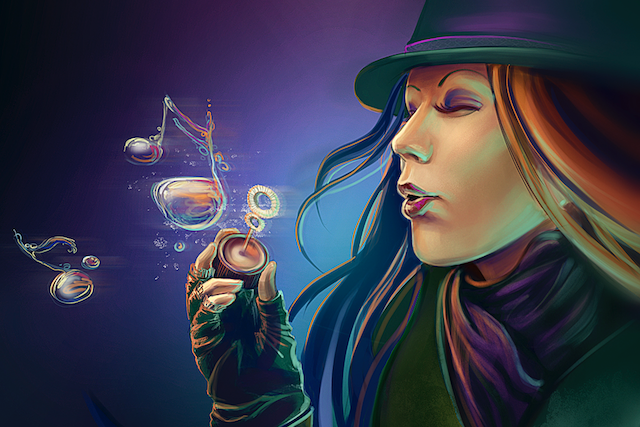
    There is so much music inside of you and me. And to be the highest expression of who we are here to be, we’ve gotta sing our songs and sing em’ loud! But to live like that, we’re going to have to give ourselves permission to feel, say, and do what’s true.

    So, maybe owning your truth doesn’t look like finally quitting a job or grieving the loss of a loved one. But I challenge you to really take some time to stop and scan through your life with no judgment, just wide-open eyes and a loving heart, and ask yourself:

    What do I desire? What fear arises in the face of my desire? Where am I selling myself out to run/hide from my fear? And what must I do to express the full potential and possibility of achieving my desire?

    Do you remember the fierce and fearless drive that you had as a child to learn and grow? Can you imagine how many times the little you tried and failed and tried again at mastering the skills you needed to really engage with life—walking, reading, writing, using your words to ask for what you want, feeding yourself, tying your shoes, wiping your own bum, etc.? Where does that invincible tenacity go?

    The answer is: YOU’VE STILL GOT IT!

    It has been and always will be within you. You and I have the capacity to thrive in any and all areas of our lives. How? By becoming brave enough to stop and listen to our own music, then allowing ourselves to be truly guided by it as we go!

    Belt out your song like your life and the lives of future generations depend on it, because they do. And if you miss a beat or sing a note or two out of tune, don’t be afraid to own it. It’s all just a part of the dance. 

    If you’re looking for me, I’ll be here, diving deep into the depths of my being, tuning into my own music, swimming through fear, and daring myself to sing. Over and over and over again until my very last breath.

    And you? It is my hope that you will have the courage and the willingness to go deep and begin unleashing the divine music that only you were born to sing.