Tag: expectation

  • Feeling Burnt Out? How to Slow Down and Reclaim Your Peace

    Feeling Burnt Out? How to Slow Down and Reclaim Your Peace

    “Burnout is a sign that something needs to change.” ~Sarah Forgrave

    Fifteen years ago, my doctor informed me I was in the early stages of adrenal exhaustion. In no uncertain terms, she warned that if I failed to address the stress I was under, my adrenals might not recover. This was hard to hear, but it forced me to face the fact that eating well, exercising religiously, and keeping up with the latest research on wellness was not enough.

    I had to ask myself a defining question that day: Am I ready to go down with the ship?

    At the time, I was teaching an average of fourteen classes a week at my wellness studio. I had been exceeding my threshold for so long that I had pain in every joint and muscle in my body. I was completely exhausted, physically, mentally, and emotionally, but slowing down or cutting back was just not an option.

    Or so I believed.

    The problem was that every time I would even begin to consider addressing the reality of my situation, my head would instantly fill with all the reasons I couldn’t possibly stop.

    There was the dream for a business I couldn’t imagine giving up. The huge amounts of time and money I had invested in realizing that dream. And most of all, there were the clients I was serving, a community of amazing women I loved working with and didn’t want to let go.

    Meanwhile, my thirty-year marriage to a man struggling with an opioid addiction was falling apart. My kids were distressed. My body was completely breaking down, and my life had become a tangled mess of fears, conflicted feelings, and obligations I just didn’t have the heart for anymore.

    As the growing pressure to do something about my situation increased, my anxiety increased right along with it. Talk about a pressure cooker!

    I couldn’t even imagine the courage I would need to tell my husband I wanted a divorce. And whenever I got anywhere close to that courage, my mind would flood with anxiety over the uncertainty.

    How would he react?

    How would it affect my children?

    Where would I live?

    How would I ever rebuild my life?

    It felt as if I was being buried alive under a growing mountain of complexity with no way out. So, the pain continued to get worse, and I kept trudging forward, blindly hoping against hope that somehow it would all work itself out (without changing anything about the way I was living).

    Growing up, I had learned to take the offensive and power through obstacles. I had always seen myself as someone who could do anything she put her mind to. Now I found myself stuck between the person who thought she was responsible for everyone’s experience but her own and the person I might actually become if I started making self-valuing, authentic choices.

    Then one morning, the dam broke.

    I was walking up to the door of my studio to teach the 6:00 a.m. class, asking myself (like I did every morning) how I was going to get through the day with all the pain I was in.

    As I turned the key in the lock of the business I had dreamed of creating for over a decade—the business I had built out of everything I believed in and everything I knew I wanted to offer to the world—I could see the consequences of my resistance to change about to swallow me whole. I could see that my fear of change was completely blocking my ability to see anything past that.

    And suddenly… everything went quiet. All the reasons for not stopping that typically flooded my mind just fell away.

    The only thought I had in that moment was, The way you stop… is you stop.

    I didn’t just hear these words; I felt an absolute acceptance of them. One minute it was impossible to stop; the next, it felt like the simplest thing in the world.

    In the quiet of this moment, I became so aware of my own breath that I felt it everywhere in my body. For the first time in as long as I could remember, I stopped. And when I did, I found the courage to listen to my aching heart.

    I felt a depth of longing for peace I had never allowed myself to experience before. I stood there breathing and felt an acceptance of the reality of everything that was happening wash over me. The pressure to control it all was gone!

    My mind was clear, and my body felt relaxed even as I faced the same facts of my situation, but without all the usual stories and justifications overwhelming me. It felt like a miracle.

    Suddenly the door to my studio, which I had been walking through for years, felt like the door to an entirely new way. Standing there with my key in my hand, in the profound quiet of that moment, I was flooded with a new sense of possibility.

    As I set up for the 6:00 a.m. class, I stayed focused on my breathing and continued to listen to my body. It became clear to me that when I wasn’t being honest with myself, my body responded by restricting my breath. And I was able to see how all the years of unaddressed tension were expressing themselves as escalating physical pain.

    A New Direction

    That morning, I didn’t just take a first step toward interrupting the old way. I began heading in a new direction.

    But it still took me a year and a half to wind down my commitments and extricate myself from the studio. This was a massive transformation involving every aspect of my life, but it began with just one step—accepting that the old way was broken. Once I accepted this wholeheartedly, I moved to the next step.

    I had a friend who had moved back to town to take care of her aging mother. She was looking for a place to establish her yoga school and had already been teaching a couple of classes a week at my studio while she looked for a more permanent place. On that pivotal morning, after I taught the 6:00 a.m. class, I called my friend and told her that I was stepping down and that she could hold all her classes there.

    I continued to pull back, one step at a time, constantly asking myself, “What can I let go of today?” (One day, the answer to this question was “my hair”!) Eventually my friend bought out my lease and took over completely.

    This is not to say I did not continue to wrestle with self-doubt. But my intention to slow down and to stop ignoring my tension became my guiding compass point.

    In the years that followed, I relied on this compass to dive more deeply into the mind-body connection and what it truly means to take care of myself and be happy. My primary tool was the simple mindfulness practice of paying attention to my posture (whether it was tense or at ease) and my breath (restricted or free). I found strong community for this priority in the study and practice of Qigong, Tai Chi, and Continuum.

    In the process, it became clear to me that to access the wisdom within, the first thing I had to do was slow down and calm down. This priority allowed me to be honest about the pressure I was putting on myself to keep doing things I no longer had the heart for and to recognize the emotional reasons I was hanging onto them.

    We all come to thresholds in our lives, times when we’re faced with tremendous pressure to change (or go down with the ship). When we refuse to change, the only other option is to increase our tolerance for suffering while convincing ourselves that it’s not affecting us as much as it really is. In this fantasy we tell ourselves we’ll make it (somehow) if we just keep powering through.

    I’ve come to realize that it’s not about avoiding stress. It’s about increasing your ability to remain present and functional while stressful events are happening. The calmer you can be in the face of stress, the more resilient you’ll be and the less likely you’ll be to end up teetering on the edge of complete burnout like I was.

    When we practice being present, we’re able to make more accurate moment-to-moment choices. We’re able to slow down and take an honest look at what needs to change. Which isn’t to say that it’s going to change in a minute, or a day, or a week, or even a year. The truth is that lasting change can often be a very gradual process.

    How to Stop

    I was able to stop by establishing new priorities. I made it a point to slow down, calm down, and really be honest about what I could eliminate. My process was essentially as follows:

    1. Stop. (For the moment, anyway.) Acknowledge that before a new way can show itself, you have to find a way to stop the old way.

    2. Acknowledge the pain you are in—emotional and physical.

    3. Ask what you can let go of now and in the near future. (If the answer is “nothing,” then ask again.)

    4. With “something has to give” as your mantra, what can you let go of next?

    • Consider what you are physically and mentally capable of doing right now. (If the answer is “everything, if I push myself,” then ask again.)
    • Consider your life priorities and what you need to make room for.
    • Consider what you no longer have a heart for.
    • Consider that what you are holding on to tightest might be what really needs to go. Letting go of smaller things first often helps to relax your grip on even your strongest (and often unhealthy) attachments.

    5. When the “yes, but…” voice shows up, be aware of it and do your best not to listen or take action based on what this voice says. This is the voice of your attachment to keeping an unsustainable system on life support. It’s fueled by your fear of uncertainty because if you stop what you’re doing, you’re not sure what will happen (and your “yes, but…” voice is certain it will be awful!).

    6. Gather tools to help yourself detach enough from this voice to move toward accepting reality and make the changes needed to live a more authentic and satisfying life. (The Serenity Prayer is a good one.)

    7. Remember that change is a process, not a single event. Start small, then graduate to bigger things that need to go.

    I hope you’ll continue to play with the concept of stopping (the old way) to start (a better way). Every meaningful change hinges on your ability to interrupt the old pattern. You’ll learn to rely on this ability the more you practice using it.

    Also keep in mind that you won’t necessarily know anything about the new way when you stop the old one. Change usually happens very slowly, and patience can be the hardest thing.

    Good luck, and feel free to reach out with questions or comments!

  • Searching for Purpose? 5 Ways to Embrace Not Knowing What You Want

    Searching for Purpose? 5 Ways to Embrace Not Knowing What You Want

    “Omnipotence is not knowing how everything is done; it’s just doing it.” ~Alan Watts

    We sometimes hear of remarkable people who just knew what they wanted to become from a young age. I, however, was not one of them.

    When I was about eight years old, I told my cousin that I wanted to become a scientist. Looking back, I find that pronouncement baffling since I wasn’t particularly interested in science at the time. What I did love doing, though, was making art.

    My interest in art eventually led me to study graphic design. I thought that design would be a perfect fit since I’m creative and logical. But at a certain point, I realized that while design made some sense logically, it didn’t feel right to me.

    I wondered, how could I have put so much time and effort into something I didn’t enjoy doing? It was only much later that I recognized my error: I believed that I had to have everything figured out completely.

    Embracing Not-Knowing

    What do you do when you realize what you worked so hard to attain isn’t what you want anymore? In this situation, many feelings may come up. I felt despair, fear, anger, resentment, sadness, hopelessness, and desperation.

    These powerful emotions can overwhelm us and bring us into a state of paralysis. I remember wanting to pivot, but seeing numerous obstacles before me. If I make a drastic change now, I will have to start from zero, I thought.

    I believe those thoughts and emotions stem from putting too much emphasis on the need to know. In the book The Overweight Brain, Lois Holzman, Ph.D., describes how our obsession with knowing “constrains creativity and risk-taking, keeps us and our dreams and ideas small, and stops us from continuing to grow and learn new things.”

    As Holzman explains, infants don’t know much of anything. However, they grow tremendously in a relatively short period. They can develop this way by “not-knowing growing,” which one does through play.

    Learning to Play Again

    Let’s think for a moment. When you play a game, do you want to know what will happen next? If you did, then the game wouldn’t be any fun—there would be no point in playing it.

    After working for seven years in my full-time job, I ended up quitting with nothing lined up and no idea of what to do next. Leaving your day job like this isn’t something I would suggest to everyone. But for me, it felt like the best thing to do at the time.

    Taking a risk like that was exhilarating. I felt like a newborn child, free to explore the world and its possibilities again.

    Before I made that decision, I used to sit in my office thinking, once I figure out what I want to do, I’ll be able to take some action. But I didn’t need to figure anything out. I just needed to begin by exploring.

    As I tried many new things, I gained insight into who I was becoming. By interacting with the world with openness and curiosity, I found the clarity I needed to create my life with purpose.

    Five Ways to Embrace Not-Knowing

    So, how do you start embracing not-knowing to realize your true potential? Here are five ways for you to consider.

    1. Question your situation.

    Notice the assumptions you’re making about what is and isn’t possible. Like a child, be curious about what opportunities are already available at this moment. Instead of thinking, “Things can’t change because (some reason),” ask yourself: “I wonder what would happen if I said this… looked that way… went over there… tried this and that…?”

    2. Take tiny risks.

    You don’t have to quit your job to find a sense of purpose. Once you’ve identified the possibilities by questioning your situation, see what would happen if you did something different.

    For example, if you’re passionate about diversity, inclusion, and belonging, how can you contribute to supporting that in your current role, or even outside your job? Perhaps you can spark a conversation about it with a few people. Because the risk is low, you may feel a rush of excitement from breaking your regular pattern.

    3. Alchemize the experiences you’ve gained.

    If you lose interest in something you worked hard for, realize that it wasn’t all for naught. Think instead, “Okay, so this is how I feel about it right now. How can I transmute this thing by combining it with other elements to produce something new and life-affirming?”

    For example, I already had design and writing skills. I also had an interest in anthropology, psychology, learning, and human development. So, I tried to combine my existing skills with my interest in learning and human development to become an instructional designer. That pivot eventually led me to join a team in designing an online course that teaches intercultural skills to internationally trained professionals.

    4. Give an improv performance.

    If you’re a person who feels the need to plan everything, see if you can give an improv performance of a different version of yourself. For example, you can perform the version of yourself that finds the unknown exciting. Go out and walk like that version of you, speak like that version of you, listen like that version of you, eat like that version of you.

    If it helps, imagine that you are an actor in a movie scene.

    5. Do something unexpected.

    Do you have a routine that you follow? What if you broke out of that routine for one day? Choose a day when you have no plans and do something that would surprise people who know you well. Maybe you will end up having a conversation with a total stranger and make a new friend.

    Final Thoughts

    From my journey, I’ve learned that not knowing what we want isn’t a sign that something’s wrong. It’s an invitation to walk the path of self-discovery. The journey is not a straight line—there are twists and turns, and sometimes we find ourselves at crossroads.

    Remember that we are constantly in a state of becoming. We can shape each instance of our life by choosing to stay open, be curious, and explore the world with a sense of child-like wonder, which releases us from the confines of the mind.

    Living this way, we give ourselves the space to grow into our true potential.

  • Overcoming Disappointment in Work, Love, and Life (Book Giveaway)

    Overcoming Disappointment in Work, Love, and Life (Book Giveaway)

    Disappointed

    Update – The winners for this giveaway are:

    • simpleshoes
    • twylapopcorn

    When life doesn’t meet our expectations, it can devastate our sense of security, threaten our self-esteem, and leave us feeling lost, scared, and out of control. I know—I’ve been there quite a few times before.

    Like the time I moved across the country to live with a man I’d met online just a month prior, only to recognize nine months later that we were two broken people who were toxic together.

    Or the time I got involved with a multi-level marketing company, thinking I’d be a huge success, only to realize six months later I’d invested myself (and my savings) in a pyramid scheme.

    Or when I left LA with my fiancé, thinking we’d be able to live on two coasts near both of our families, only to realize after three years in limbo that we couldn’t make it work.

    When things don’t go to plan, we feel out of control, angry with ourselves, and possibly with others. We wonder what we could have done differently and if we’ll ever be happy, now that the thing we pinned all our hopes to hasn’t worked out.

    Author Christine Hassler knows a thing or two about dealing with these kinds of life-shattering disappointments.

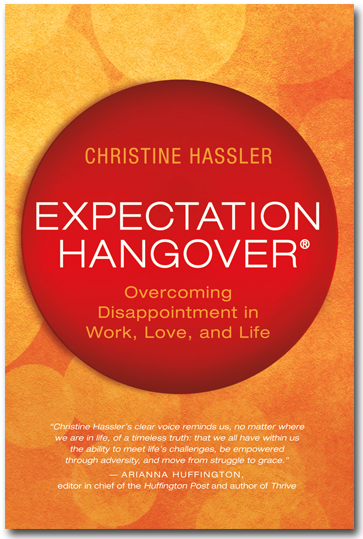
    In her new book Expectation Hangover: Overcoming Disappointment in Work, Love, and Life Christine addresses how to deal with disappointment on the emotional, mental, physical, and spiritual level.

    If you’re disappointed, maybe even devastated, by unmet expectations in your personal or professional life, you’ll likely appreciate the insight, wisdom, and practical exercises that pepper her book.

    It will help you reframe what’s happened and empower yourself to thrive, not in spite of your struggles, but because of them.

    I’m grateful that Christine took the time to answer some questions about her book, and that she’s offered two free copies of Expectation Hangover to Tiny Buddha readers.

    Expectation HangoverTHE GIVEAWAY

    To enter to win one of two free copies of Expectation Hangover:

    • Leave a comment below
    • For an extra entry, share this interview on Twitter or Facebook, and post a second comment with the link

    You can enter until midnight PST on Monday, May 2nd.

    *US winners will receive a physical book in the mail; winners outside the US will receive an eBook.

    THE INTERVIEW

     1. Tell us a little about yourself and what inspired you to write this book.

    My own expectation hangovers and work as a life coach, spiritual counselor, author, and teacher inspired me to write the book.

    I noticed people’s greatest suffering happens when their realities don’t match up with their expectations and/or when life throws them an unwanted curveball that leaves them with what I call an “expectation hangover.”

    Most of us want to get over disappointment ASAP, but we often miss a big opportunity for positive change with that approach. What expectation hangovers offer us is a way to become more responsible for our own lives.

    Disappointment isn’t a bad thing, or even something to be avoided. In fact, my greatest disappointments have lead to my greatest successes.

    Today I am grateful for all my expectation hangovers, from leaving my successful career as a Hollywood agent at twenty-five to being in debt to health issues to my divorce, and inspired to teach people how to leverage their expectation hangovers!

    2. How do you define an expectation hangover?

    An expectation hangover is the myriad of undesirable feelings or thoughts present when one or a combination of the following things occurs:

    • A desired outcome does not occur.
    • A desired outcome does occur, but does not produce the feelings or results we expected.
    • Our personal and/or professional expectations are unmet by ourselves or another.
    • An undesired, unexpected event occurs that is in conflict with what we want or planned.

    Some examples:

    • A career path that was planned and executed with precision becomes tainted with doubt and lackluster.
    • A relationship with “the one” suddenly becomes the one thing we can’t get right.
    • A salary or promotion that was counted on is not a reality.
    • A home that was dreamed about still remains a fantasy.
    • A pregnancy that is wished for isn’t happening.
    • A parent who we could always lean on suddenly isn’t there anymore.
    • A lover or spouse leaves.
    • An illness interrupts our life.
    • A job and the financial security that came with it is gone.

    And then there are expectation hangovers that are more spiritual in nature that happen when we have checked off everything on our life checklist and still experience a lack of fulfillment.

    The symptoms are similar, but far more miserable and lasting, to those caused by a hangover from alcohol: lethargy, depression, lack of motivation, confusion, denial, anger, poor work performance, diminished creativity, strained relationships, social withdrawal, low self-esteem, regret, and a disconnection from a higher power.

    While suffering from an expectation hangover, we are typically caught up in regretting the past or latching on to something we think will make us feel better. We’d do anything to end our suffering—the problem is we just don’t know what that is.

    Expectation hangovers usually fall into one of the following three categories:

    Situational Expectation Hangovers 

    These occur when something does not turn out the way we wanted or we do not get the anticipated satisfaction from achieving a result.

    Interpersonal Expectation Hangovers

    This kind of expectation hangover occurs when we are let down by someone else or unpleasantly surprised by the actions of another.

    Self-Imposed Expectation Hangovers

    These occur when we do not live up to the standards or goals we have set for ourselves. In other words, we are disappointed in ourselves and the results we’ve achieved or failed to achieve.

    3. What are some of the most common unhealthy ways we cope with expectation hangovers, and what are healthy ways we can begin to treat an expectation hangover?

    It takes a lot more than two aspirin, some greasy food, and staying inside with the lights low to treat an expectation hangover! Because we don’t like feeling bad, we look for an external way to ease the discomfort.

    Rebound relationships; abrupt career changes; miscalculated risks; “over-ing” in the form of drinking, gambling, sex, drugs, work, or shopping so much so that it becomes an addiction; and numbing oneself with something like television are common.

    The first step to treating your expectation hangover is to get yourself out of any kind of victim thinking.

    “Why is this happening to me” is the wrong question to ask. Ask instead, “What am I learning? and “How is this happening for me?” That simple shift in questioning will rescue you from sinking into the quick sand of victimhood and hopelessness.

    Next, keep your mind out of judgment, regret, and shoulda/coulda/woulda thinking. Remember, you did the best you could. You didn’t do anything wrong. Your worth and value are not attached to anything or anyone external.

    Security from any outside source is an illusion—your ultimate “safety” is in love. Surrender is much sweeter than being addicted to control. And again, you didn’t do anything wrong. Really, you didn’t, and neither did anyone else.

    Which brings us to the next step—to forgive. Forgiveness does not mean you condone or agree with what happened or didn’t happen. It means you are in acceptance and letting go of judgments you are holding toward yourself or anyone else.

    4. You talk about “spiritual bypasses” in Chapter Two—immediately jumping to the blessings of a disappointing situation. How can this be harmful? 

    It can be harmful because we may miss an opportunity for healing and change on the emotional, mental, and behavioral levels.

    Yes, every situation has a blessing, and a lot of time that blessing can come in the form of a lesson. If we do not pause to ask, “What am I learning?” and immediately skip to finding the silver lining, we miss out on a deeper opportunity.

    Spiritual bypass also skips the emotional level. We are humans and we feel. It is natural to feel sadness or anger in response to an incredibly challenging situation. Not allowing ourselves to feel can lead to suppression in the disguise of being spiritual.

    To me, part of being spiritual is also welcoming and having deep compassion for the human experience. Spirituality is not just about being positive; it’s about being raw, real, and vulnerable with what we are authentically experiencing.

    5. How, exactly, can we leverage our expectation hangovers for growth and fulfillment?

    Instead of continuing to feel emotionally hungover, you can break the cycle and use those tough times as a catalyst for change.

    That’s not to say you can’t grieve over a loss or express disappointment: Allow yourself to be human, don’t judge yourself, and don’t feel like you need to “fix” things right away. But when life throws you a curveball, you can learn from it and ultimately grow from it.

    Here are three common scenarios that I have seen—and have experienced myself—and how to cope with each.

    A Relationship Ends

    First of all, realize that no one else can be the source of your happiness. The post-breakup period is an important time to work on yourself rather than outsource that responsibility to someone else.

    Second, take off the rose-colored glasses. A lot of people put their past relationships on a pedestal. But if a person breaks up with you, you don’t want to be with that person. And we know it’s tough, but you should stop all contact with your ex (unless you have children together).

    Relationships have expiration dates, just like the yogurt in your fridge. Women tend to have these expectations that we are meant to meet someone, be chosen, be proposed to, and when that doesn’t happen, we feel like a failure. But that’s not true—you learned what you were supposed to learn from that person, you didn’t do anything wrong; it was just meant to end.

    And remember: A breakup is always a transformational door that opens to improve yourself and nurture your spirit.

    A New Job Isn’t All It’s Cracked Up to Be

    At twenty-five, I had climbed the ranks in LA’s entertainment industry, ending up in a big job with a big office, an assistant, an expense account, and power lunches. But I was miserable every day, and finally I quit, and eventually discovered my passion as a life coach.

    Ask yourself: If I don’t feel like my work is meaningful or it’s not making me feel the way I want to, how can I change it? It’s in your power to redirect your thoughts and action.

    Take someone who works at Starbucks: They could hate the drudgery of it and the early hours, or they could appreciate the aroma of coffee and the fact they get to connect with people all day long. It’s all in the way you look at that, and you need to be proactive about it.

    You’re Not Reaching Your Health Goals

    If you’re trying to lose weight, you know how frustrating it can be when the scale doesn’t budge, or you skipped your workout (again). To overcome this pessimistic mindset, be mindful of the “story” that you’re telling yourself.

    When people try to lose weight, they tend to have a negative self-image. They’re eating right and working out, but their negative self-talk is still weighing them down. Plus, a big part of losing weight isn’t only physical—you have to heal your heartache or emotional baggage before you can make other physical changes, she notes.

    There is also an entire section in the book called “Quick-fixes that work” in terms of preventing disappointment, so I’ll share my two favorites:

    Don’t go to a Chinese restaurant when you are craving nachos.

    In other words, be realistic about your expectations of others. Too often we expect people to act the way we desire or the way we would in a situation, when they are just not capable or willing. Period. End of story. You can’t change them. When we understand we cannot change people, and accept them rather than expect something from them, we prevent expectation hangovers.

    Gorge on gratitude.

    Expectation hangovers happen when we pay too much attention to what is either not happening at all or not happening in the way we’d like it to.

    When we shift our focus to the amazing things in our lives—people, health, a place to live, and all the unexpected wonderful surprises the Universe delivers on a daily basis—we move out of a lack-mentality and into an abundant view of the world

    6. Can you elaborate a little on how disappointments can actually be blessings in disguise?

    Often life has to throw us a curveball (or several) so that we look in a different direction. The problem becomes when we desperately try to dodge the curveball, attempting to get out of feeling uncomfortable, and we miss the lessons that are available to us.

    If things are not turning out like you had planned or want them to, that is actually really good news. The Universe has a better idea in store. But first you have to let go of the plan you have been attached to so that your Higher Self and the Universe can conspire for you.

    Instead of thinking about how to treat an expectation hangover, consider how you can leverage it. This goes back to what I mentioned before—ask yourself, “What am I learning?” rather than “Why is this happening?”

    Think about some of the most inspirational people you know. I guarantee you that part of what makes them so inspirational are the expectation hangovers they have been through. They leveraged their hangovers for their growth and learning. Instead of trying to snooze through the alarm of disappointment, they woke up!

    Your expectation hangovers are gifts. Each one has been an opportunity to let go of something external that you have clung to for worth, safety, or love.

    I really get that disappointment is not at the top of your wish list. However, if you learn how to respond to expectation hangovers from the perspective of a student rather than a sufferer, I 100% guarantee you will walk through doorways of transformation that will lead you to more love.

    FTC Disclosure: I receive complimentary books for reviews and interviews on tinybuddha.com, but I am not compensated for writing or obligated to write anything specific. I am an Amazon affiliate, meaning I earn a percentage of all books purchased through the links I provide on this site. 

    You can learn more about Expectation Hangover or grab a copy on Amazon here.

  • How Losing All Hope Can Be Freedom

    How Losing All Hope Can Be Freedom

    Kneeling Silhouette

    “Losing all hope was freedom.” ~Edward Norton in Fight Club

    We naturally think of hope as a positive thing, as we do freedom, but this quote says that losing hope brings freedom. It may seem contradictory, but losing hope has been my most unexpected lifesaver.

    My Mental Breakdown

    I struggled with severe anxiety four years ago. The onset was abrupt.

    Until I was twenty-five, I was the healthiest person I knew. I never got sick, would play basketball six hours straight, and always felt great. That changed suddenly in 2011.

    I woke up one morning with an itchy spot on my chest; I looked down and saw two small fang marks. A spider bite. After a few more minutes, the toxins set in and I started convulsing a little bit, so my dad took me to the ER.

    At the ER, they gave me a steroid shot in the butt and antibiotics to prevent infection (such wonderful memories).

    Long story short, the whole experience shook me, and I developed severe health anxiety, constantly worrying about what would happen next. I feared going asleep because I couldn’t protect myself. I could be seen visibly shaking upright in my bed.

    Spider bites are rare, right? I shouldn’t have worried about it, right? I thought so too until another spider bit me a few days after the first one did! Luckily, my body didn’t react so… emphatically to the second bite, but it still made me even more paranoid.

    In this short period of time, I went from being calm to only knowing how to be really anxious. It was a strange and unexpected slippery slope of worrying, not getting enough sleep, being scared to sleep, and freaking out because I was freaking out. Meanwhile, I hoped for it all to go back to the way it was. I had never hoped for something so much in my life.

    Hope’s Dark Side

    Hope has a dark side in the way that it impacts the mind.

    It’s an intense yearning for something to happen: You hope to conquer anxiety or depression. You hope to get into your favorite college. You hope to find love one day. You hope to overcome the pesky problem that’s weighing you down. You hope the Detroit Lions will (please) just win one Super Bowl.

    Hope can become an ironic mental prison by its mere intensity and dominance of your thoughts.

    “Letting Go”

    I’ve studied the self-help book market quite a bit, and one of the most popular, best-selling topics I’ve noticed is that of “letting go.” Last I checked, several of the top 20 self-help books were about letting go of one thing or another.

    Letting go of whatever dominates your mind (including hope) instantly frees it to think of other things such as warm breezes, the beauty of friendship, and the simplicity of enjoying a meal. We lose out on these small joys of life when our big problems take more than their deserved mindshare.

    But there’s still the issue of hope. Why would letting go of hope—something seen as positive—bring freedom and not darkness?

    How Is Losing Hope Helpful?

    I beat my downward spiral because I lost hope. Nothing else worked.

    When I was in the worst part of the struggle, I hoped so much for things to just go back to normal. The worse it got, the more I hoped. Why can’t this nightmare end? I hoped that my next breath would be drawn out and deep and relaxing, but it never was. I hoped to go back in time and punch that spider’s fangs out. I hoped and tried to change without success.

    Hoping is like a weaker form of expecting something. When you expect something, you’re almost sure it will happen. When you hope for something, you don’t know it will happen, but you’d like it to happen.

    Hope is dangerous when it compels you fight a battle you can’t win. 

    For example, in my situation, I could theoretically relax and “beat this,” so I did what people instinctively do: I threw the gauntlet at the problem. For example, I tried adjusting my breathing, but it backfired because I became hyperconscious about it; it made things worse.

    My hope kept me fighting so hard. But fighting is not what I needed to do.

    In life, like in war, we must know when to attack, and equally important, when to retreat. Not all enemies can be defeated in a straightforward conventional way.

    I remember the very day I purposefully lost hope and “gave up.” I was in the kitchen, being really anxious for no reason, and I was fed up with this fight, so I decided to quit. I gave up hope in winning this fight. I was surprised when, over time, the enemy walked away!

    Here’s specifically how I changed my behavior when I lost hope: I stopped trying (and hoping) to not get butterflies in my stomach for no reason. I stopped caring about my breathing frequency and depth. I even began to be playful with my problem, showing that I didn’t care: “Only five butterflies this time? That’s it? Give me a few more!”

    Losing hope meant I stopped trying to fight the battles. And that’s how I won the war and regained my mental freedom!

    I know, it’s a story as inspiring as Braveheart. But did you know this concept has been shown elsewhere?

    One day, novelist Leo Tolstoy’s brother told him to sit in a corner until he stopped thinking about a white bear. Much later that day, Tolstoy remained in the corner, his mind fixated on the white bear he needed to stop thinking about. He was finally able to stop thinking about the white bear when his brother gave him permission to think about it.

    This experiment has been replicated, and the result is always the same: when people forbid themselves or attempt to rid their mind of something, it boomerangs back to them with alarming consistency and persistency.

    “Studies show that the more you try to suppress negative thoughts, the more likely you are to become depressed.” ~Kelly McGonigal, PhD. (The Willpower Instinct)

    Hope drives persistence, which is why losing hope in an area that requires retreat is so often freedom. 

    More effort does not always bring greater results. Smarter strategies always bring greater results.

    Think of an area in your life in which you are trying, fighting, and hoping without making progress. What would losing hope and letting go look like?

    This is most helpful with areas like anxiety, worry, fear, and depression. When you accept them and stop hoping they go away, they lose a considerable amount of their power over you.

    For me, losing hope was freedom. Maybe it will be for you too.

    Kneeling silhouette via Shutterstock

  • 20 Ways to Give Without Expectations

    20 Ways to Give Without Expectations

    Gift

    “The true measure of a man is how he treats someone who can do him absolutely no good.” ~Samuel Johnson

    Some people say there’s no such thing as a selfless act—that any time we do something to help another person, we get something in return, even if it’s just a warm fuzzy feeling.

    I’ve spent a lot of time playing with this idea in my head. It doesn’t really bother me to know it feels good to help someone else. That, to me, is a completely acceptable type of selfishness. What give me cause for concern are the underlying expectations we often have when we give “selflessly.”

    We’ve all been there. You cover for your coworker because you know you’ll need her assistance next month. You give your sister $20, and then silently look for ways she can pay you back, even if not monetarily. You help your friend get leads for a job, and then feel angry when she isn’t as proactive in offering you support.

    I’ve found that these expectations cause more stress than joy. They mar the act of giving, which makes me feel slightly guilty; they lead to disappointment if the person I helped doesn’t return the kindness; and they tie my intentions to an internal score card, which places a wedge in my relationships.

    Recently I’ve been asking myself, “What is my expectation?” before I do something for another person. The answer I find most acceptable, cheesy as it may sound, is to feel good and show love. Strangely, when I release the need to control what I get for giving, I get enough, somehow.

    I’ve made a list of twenty things you can do to show you care, without needing the recipient to return the kindness—twenty ways giving is its own reward. Maybe some of these will resonate with you. Or perhaps you’ll want to write your own list to spur the spirit of giving without expectations. (Although I’ve written you, these are things I try to do.) (more…)