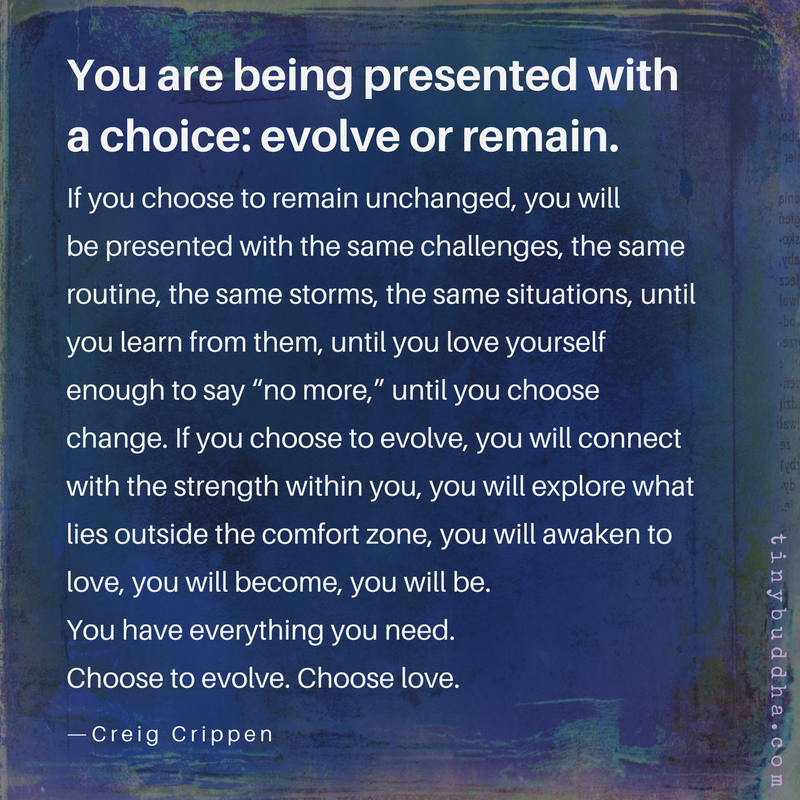
Tag: evolve

  • How to Let Go of Your Dream When It’s Time to Move On

    How to Let Go of Your Dream When It’s Time to Move On

    “We must be willing to let go of the life we planned so as to have the life that is waiting for us.” ~Joseph Campbell

    There’s something I find rarely talked about in discussions about letting go, but I notice all the time. It’s not the release from letting go of outdated stuff. It’s not grieving the loss of loved ones. It’s not healing from trauma. All of these precious topics are talked about and should be more so.

    What I find rarely discussed is the letting go of past versions of oneself—often versions you’ve worked tirelessly to become. This is really the crux of clutter clearing work. It gives us back our birthright to reinvent ourselves throughout our life—to experience birth and death cycles to their fullest.

    Last week in yoga class the teacher said, “We shed our skin more than snakes do.” Ain’t that the truth! Whether we notice or not, we’re constantly evolving. Struggle can arise when we resist this universal truth. When we forget that the only constant in life is change, then change sucks. Then life can get stagnant, full of internal resistance, which is often reflected in our homes and workspaces.

    As I’ve gained more and more years of observing people of all ages in my line of work, I’ve recognized it’s letting go of past versions of ourselves that trips us up.

    There’s one version of myself that comes to mind, which was excruciating to let go. It was being a ballerina.

    I remember being around six years old, kneeling in my bedroom, praying, “Dear God, please let me be a soloist with the Boston Ballet.”

    Fast-forward twelve years, and I’ve sacrificed my entire childhood and adolescence to the art form. Elite gymnast-level training is very similar to what kids do in the ballet world. From age eight, my teachers let me (and my mother) know I had talent and promise. I was hooked, and it became my identity.

    All the countless hours of raw hard work in the studio and on stage didn’t come close to what it took to let that identity go.

    People receive beautiful support in attaining their dreams. But what about letting go of their dreams? When one knows it’s time to lay a part of themselves down, unconditional consolation and support is arguably needed even more than when one is building something.

    Loss hurts. Death hurts. Whether the dream was realized or not, grieving is most efficient and least painful when one is witnessed and held. That’s just the way we and, more specifically, our nervous systems work. And that’s why I love being there with someone who’s letting something go, reminding them that it’s okay and I’ll be right there with them through this transition.

    The leading authority on the intersection of women, wealth, and power, Barbara Huson, shares, “Clinging to the security of the familiar prevents us from discovering what awaits us in the future. The ledges of our lives offer the illusion of safety, but in truth their only value is to keep us hanging. These ledges take many forms, both concrete and intangible. They can look like unfulfilling jobs, unpleasant relationships, inappropriate goals, untrue beliefs, unhealthy habits, or bottled-up emotions.”

    When it comes to laying down a version of ourselves, we are terrified. The amount of anxiety, depression, and paralysis experienced—I’ve come to learn that not all of it is necessary. We can’t blame ourselves for how we deal (or don’t deal) with transitions these days.

    In mainstream culture this fact of life is essentially swept under the rug. “Move on” is the dominant message we receive. But how? Here’s what I recommend in a nutshell:

    1. Acknowledge and articulate what you are letting go.
    2. Process it. Grieve it.
    3. Treat yourself like you would a very dear friend (self-compassion).

    Acknowledge and articulate what you are letting go.

    Speaking it out loud to a trusted loved one, in your own words, can be liberating. Writing it out in your journal can be a potent dose of clarity. This is particularly helpful with letting go of versions of ourselves, which are innately not as concrete or easy to articulate.

    Process it. Grieve it. 

    Step one above actually carries you right into step two. Have you heard the phrase “To heal you must feel?” Designate some time to slow down. Carve out time and space to just be and feel the uncomfortable emotions. There is no one-size-fits-all timeline for this.

    A friend who’s a therapist recently told me, “The way one figures out how to process [emotions/trauma/loss] is as unique as their fingerprint.” I responded, “Yes, and it’s figuring out what it will look like for you that is part of the healing process.” Some excellent resources as a starting point are:

    • Transitions by William Bridges, PhD
    • The Grief Recovery Handbook by John W. James and Russell Friedman
    • Seeing a certified therapist or mental health counselor. I personally recommend someone who specializes in inner child work or EMDR (Eye Movement Desensitization & Reprocessing)

    Treat yourself like you would a very dear friend (with self-compassion).

    Throughout this shedding of an outdated version of yourself, the softer, kinder, and gentler you are, the less painful it will be!

    Snakes don’t rip their dying scales off; they accept the gentle sloughing off of what cells no longer serve them. If one branch of a tree is struggling, the tree slowly lets it wither and die, in order to become stronger and able to grow in new directions.

    When it comes down to the biophysical level, you are more like a snake or a tree than you may have considered. Let the unaffected ease of nature and the human ability for self-compassion be your guideposts.

    In the grand scheme of things, this is what we’ve lost—the healthy relationship between consuming and releasing, growing and decomposing, acquiring and letting go, on the physical, emotional, and spiritual level.

    But if we unlock this innate knowing once again inside ourselves, there’s no stopping how strong, wise, and fulfilled we can become.

    What are the versions of yourself that have been the hardest to let go of so far in your life? Maybe who you were in a particular career? Going from single to married with kids? Being a people-pleaser? I would love to hear your story. Please feel free to reach out.
  • When You’re Ready for Change: You Need to Believe in Your Future Self

    When You’re Ready for Change: You Need to Believe in Your Future Self

    “Growth is uncomfortable because you’ve never been here before. You’ve never seen this version of you. So give yourself a little grace and breathe through it.” ~Kristin Lohr

    I was kinda sorta showing up.

    To the outside world, it looked like I was doing all of the things. I was smiling. I was talking about exercise and eating well. I was posting happy, positive vibe quotes, but I wasn’t really showing up for myself.

    I had experienced a miscarriage at thirteen weeks. This was supposed to be the safe zone. I had told family and friends. My husband and I even had names ready to go. This was baby number four, so I thought I was a pro.

    I was in a toxic work environment, but I kept going. Even after my miscarriage, I felt I had to be back there quickly so others didn’t need to deal with my responsibilities.

    After experiencing this loss, I spent quite a long time kinda sorta being serious about my well-being. But let’s be honest, I pretended for years. I was hearing “Take care of YOU!” on repeat. It was well intentioned, but I had absolutely no clue how to do that. Nobody told me how to take care of myself.

    I knew all of the shoulds and suppose-tos. But I was overwhelmed by those concepts as I added them all to my to-do list. I knew I should eat healthy and move my body, but what was I going to do about these negative thoughts of not being good enough floating through my brain every single day? The guilt was overflowing, but I just smiled.

    I took on more responsibility and wore so many different hats that it looked like I was able to do it all. In reality, I was so stressed that it was coming out physically through an annoying eye tick.

    I made an excuse of being tired when people noticed it. I defended that excuse because I needed to believe it. I wasn’t sleeping well. I was eating junk in between the occasional healthy meals kick. I was moving, but not on a regular basis. I continued to smile, make excuses, and pretend all was good.

    One morning, I realized that I couldn’t keep doing this. I opened my eyes and accepted that I was only kinda sorta showing up for myself and that I couldn’t keep sustaining this lifestyle without causing irreversible damage to those I loved and to myself. So I said the scariest words: “No, sorry. I can’t.”

    Admittedly, I only whispered these words to myself at first. Then something powerful happened: I started to say them out loud to other people.

    First, it was only to my inner circle, and then it started spilling out everywhere. I was talking about taking my power back. I was talking about an exit strategy from my toxic work environment. I was talking about how my miscarriage did, in fact, hit me hard. It rocked me to my core.

    I was open about my feelings. I was letting myself experience all of my emotions. I was shifting. I was becoming a new woman—a similar version to the happy and healthy woman I once was. I was emotional. It was scary. It was worth it. It took a lot of work and guidance. It’s still evolving. In many ways, I expect to always be growing and shifting.

    I told myself: Believe in your future self. That sounds like it should be easy to do, but it’s tough for most people. Chances are you are afraid of change. We all are. And it might be hard on your ego to admit you need to do something different.

    As humans, we want to be right. We don’t want to admit a choice we made was the wrong one. We may have second thoughts and see lots of red flags going up all over the place, but we still hate to admit we made the wrong decision. So we stick with what we’re doing even if it feels wrong.

    I have a little secret to tell you: The most successful people are the ones who push through the fear of change and do it anyway—even if it’s hard on their pride. It can be done. It will be messy in the middle, but you’ll get through it. When self-doubt creeps in, you need to follow two steps to make a change.

    1. A mindset shift

    You absolutely must believe that you can and will be successful to become successful. No matter what the goal is, you must believe in yourself and see the success as a real possibility.

    For example, if you want to move your muscles more through exercise, start your morning off with the mantra of “I am making my health a priority. I will move my muscles today.” Start acting like someone who exercises. Make decisions like a person who moves on a regular basis. Schedule it in. Talk about it.

    If you want to be happier and healthier, use these I am statements to help get you there: “I am enough.” “I am worthy of happiness every day!” Many people say they want to feel happier but don’t believe they deserve it, so they end up sabotaging themselves. Say those statements out loud. Write them down. Get to the root of any traumas or past conditioning that prevent you from believing them.

    Once you shift your mindset, your choices and path will align with the new you. You will reach your goals, or at least make progress toward them. You may experience imposter syndrome along the way. Keep going. That is a part of the mindset shift process. Talk back. If you believe you can do the things you want to do, you will.

    2. A strategy

    The second part of your success journey is the roadmap to move you forward. You cannot just wish and hope for things to happen. You must do the work.

    If you’ve shifted your mindset, now you need to travel the miles to get where you want to go. How do you do this? Set realistic goals. Make a plan. Follow the plan and stay consistent. You’ll need guidance along the way. Surround yourself with people who are doing what you’d like to do. Listen to the advice of those who have traveled this road before you. Ask for help to stay accountable.

    Do not assume that this will be an easy path to travel. Most things worth having require a good bit of work. Expect roadblocks and push past them.

    Know that not everyone in your current circle will be ready for you to shift. Change is scary on a personal level. When others change around you, it’s frightening if you aren’t shifting alongside them. In some cases, your change will create positive ripple effects for those closest to you, but it will happen for them once the timing is correct.

    Your future self is waiting to meet you—you just need to get moving. The path will not be all sunshine and rainbows, but you can travel it. You can make a change, even a great big one.

    Once you are on the other side, you’ll wonder why it took you so long to get there. You’ll be happier. You’ll be healthier. Other people will ask you how you did it! Take that first step and keep going. I promise you it’s better on the other side.

  • Letting Go of Our Past Identities: When It’s Time to Move On and Evolve

    Letting Go of Our Past Identities: When It’s Time to Move On and Evolve

    “Life is the dancer and you are the dance.” ~Eckhardt Tolle

    The day I decided to leave acting felt like being exorcised from my own body.

    I was twenty-nine and had been dreaming of being an actor from the time I first saw a regional production of Cats around the age of eight.

    I spent the next twenty-one years with laser focus on making that dream a reality—voice lessons, dance classes, summer theater intensives, constant late night college rehearsals, and finally, top conservatory training.

    Even my mother, who was initially highly uncomfortable with the idea, tossed up her hands when she saw me perform and when she witnessed my resolve.

    “You have just always known,” she would say with a sideways smile. “You were meant to do this.”

    Acting brought me closer to the divine. I get that now. And though it took me a while, I now say that unapologetically.

    What I felt when I was onstage was nothing short of connection to the divine self, to a self I could trust to fly, to do her thing without apology, my deepest self-expression, a high-vibrating force. Perhaps that was why I was so addicted to it, why I felt I needed it to feel alive.

    My actor self was a mask, a costume I wore for many years. I believed I needed it to feel seen, to be admired, to become powerful. My talent and successes were proof of my worthiness to live and to be loved. The idea of taking them off instilled mortal fear.

    The day I left acting, I had just finished one of my most achingly fulfilling runs. I played a meth addict named Janelle who was struggling for sobriety and love. At the end of the show, I knew the time had come to let go. I knew it was time to move on, that I was meant for work beyond it. Though I knew, it didn’t stop me from sobbing on my bed in the fetal position.

    The day I left New York City, I felt like I was being exorcised from my own body.

    Silent tears streamed down my face as we drove through Brooklyn en route to Virginia. My heart railed against my rib cage and my intestines temper tantrumed in rebellion.

    New York City was where I found myself as an adult, as a professional.

    It was where I found my people, my tribe who believed in me, my message, who called me the “white witch.” It is where I became a business woman, developed my own programs, retreats, where I started writing, where I honed my self-expression and channeled it into impact. It is where I started to feel like an independent bad-ass, who could do anything, who could dream things into reality.

    I realize now that much like acting, coaching brought me closer to divine. It took me a while to say that, but I say it unapologetically now.

    There was an energy that would flow through my veins, crackling with electricity. My focus would narrow and I would feel suspended in time with another human. I didn’t “think.” Information was just there for me. I was relying on a deeper intelligence, and the kicker was that it was the same energy I felt onstage.

    Perhaps that is why I became addicted to my professional roles in NYC. Part of me still believed I needed them to feel close to that divine source, to feel powerful, to be worthy of love and of being alive.

    When I was left in a new city without my tribe, without that admiration, without the same roles as before, without the ability to easily look into someone’s soul, for a while, I felt lost. I questioned my worth.

    The day I became a mother, I felt like I was being exorcised from my own body… quite literally.

    Emotionally, I was letting go of all the child selves I had been and bidding farewell to unbridled freedom. Physically, the contraction and pain left me unable to fight, and in a strange way, left me completely open to presence.

    On that day, pulling my son from between my legs and onto my chest, I felt intensely connected to the divine. In the months and years following, despite the challenges, the exhaustion, and the constant couts in my ability, I feel the connection to something larger than myself growing and growing, and when I think it can’t get bigger, it just keeps on going.

    And though I’m still in my early years, I can already feel myself becoming addicted to the role of mother. 

    Part of me still believes I need it to feel those feelings of transcendent connection, of deep intimacy, connection with my children, of deep feminine power. I can feel how much I am already attaching, and how one day, letting go of being needed, letting my children make their own decisions, simply letting them go, will feel like being exorcised from my own body.

    One day, I also know I will have to let go of the identity of a daughter, of a wife, of me.

    And perhaps that is the dance of letting go of our identities, our roles, our masks and our costumes. They become second skins, and even when they become painful and frayed, we feel we need them to be safe. We feel we need them to experience love, and breaking free may always feel like we are being exorcised from our bodies.

    But life never stops moving and never stops demanding our internal growth. We outgrow each phase, and each role with time. Each one eventually falls away as we become larger and more expansive. 

    Life never promised to keep us safe. It wasn’t designed that way.

    Life, however, will continue to hand us opportunities to become who we really are, to understand ourselves on a deep level, to experience the full breadth of human emotion.

    Some of these opportunities will strip us of our false selves and our superficial attachments. Others will invite us and inspire us to play bigger in our own lives. They all serve the same purpose, however, to understand love, and ourselves, with more nuance, with more wisdom.

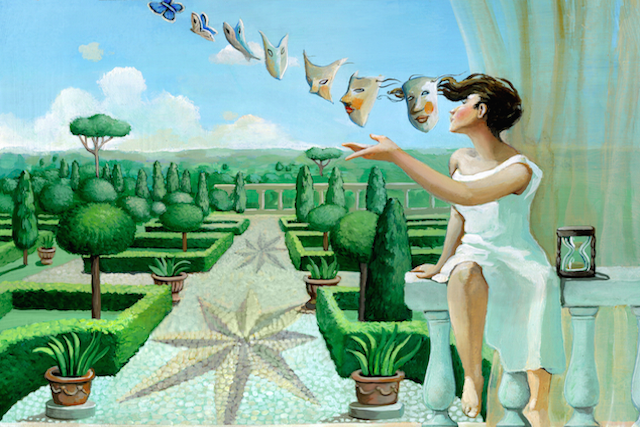
    Life hands us the masks and the costumes until we grow into them fully, then asks us to take them off.

    It will hand us the closing of the show, the chapter, and the opportunities to take them off. In doing so, life gives us the option to expand who we are underneath the costumes, to get closer to the divine, the feelings of big love, transcendence and connection in a new way that we have before.

    When we attach to the identity costume we are wearing in the moment, it’s like pouring cement over our deepest selves. We are missing the point of the purpose of it, and in doing so, we are refusing our own evolution. The result is that we wind up feeling limited, stuck, and chained.

    The identity may be the temporary vehicle of the deeper self, but the guidance of our soul doesn’t care much about them, which is why it may whisper to us to change paths or urge us toward something surprising to us, and scary to our identities.

    We always have the self underneath who is trying on the costumes, who is constantly growing bigger and more powerful (if we are listening and feeding it). We never lose it. It is our point of consciousness. It is the life energy that is neither created nor destroyed.

    Perhaps the next time life confronts me with an opportunity to take off the costume, to dance naked for a while, or to put on a new coat, I can try to hand it over with a little more grace and trust.

    And the truth is, I love trying on the costumes, the masks. I love dancing around in them. Some songs are dark and melancholy. Others are full of joy. Sometimes there is silence and all I can do is lie on the floor.

    I recognize, however, that each coat will eventually come off, and it is the self underneath that I am left with, and she is the source of all everything; of deep feminine power, of love, of connection, of presence, of flow, of trust, of belonging. She is who I have always been.

    She just needed to see herself mirrored back in all of those costumes to see truly see that.

  • How to Find Yourself By Losing Yourself

    How to Find Yourself By Losing Yourself

    “Our lives improve only when we take chances and the first and most difficult risk we can take is to be honest with ourselves.” ~Walter Anderson

    Growing up in a small town in Western Canada, I was known as the kid who accomplished things.

    I was the well-mannered and conscientious child who skipped grade two, was at the top of her class, played three musical instruments, took ballet lessons, French lessons, swimming lessons, and any other lesson in which I expressed an interest.

    While this might sound like the calendar of an over-scheduled kid, it actually never felt that way. I had a real love of learning, and appreciated the opportunity to be exposed to so many things.

    While I was grateful for all the privileges afforded to me by my parents, the unintended side effect of being the kid who accomplished a lot was that it set a very high bar in terms of others’ expectations of me.  

    I knew my classmates and teachers expected that I would go on to great things, and so, I continued to achieve. I was educated at some pretty prestigious schools and got a Masters’ degree, and then a PhD. I embarked on a career as a corporate psychologist in which I consulted to high-powered senior leaders, lived a jet-setting lifestyle, and made a healthy income.

    And, if I’m being perfectly honest, it wasn’t just others’ expectations that drove me—I savored the response I got from people when they wrongly sized me up based on my appearance, and then found out about what I did. I enjoyed getting upgraded on airplanes and having access to V.I.P. areas of hotels.

    Being an achiever was an integral part of my identity. Yet, after a while, it started to become confining.

    As you can see from my childhood experiences, I am the sort of person who has varied interests, and a lot of them are creative. So, as you might expect, there eventually came a point in my career in which the artistic-dreamer aspects of my personality felt like they were being trampled by the pragmatic, results-driven, goal-oriented parts of me. I knew I needed to make a change.

    I talked with friends about my dilemma and got advice akin to some of the backlash many others who have been lucky enough to have some degree of privilege receive. People unsympathetically dismissed the stirrings of my soul as being in the realm of self-indulgent “first world problems.”

    “Do you know how many people would want your job with the money you’re making? You can’t mess that up!” a well-meaning friend said.

    “Are you kidding me?” chimed in another, “You sound like one of those spoiled self-absorbed celebrity types who has lost touch with how things really are and don’t realize how good they have it.”

    So, what did I do? Nothing. I put my nose to the grindstone, continued business-as-usual, and tried to revel in the identity that looked like gleaming gold to others, but was beginning to look painfully tarnished from the inside.

    Then, in 2013, my husband and I had a son. Each night, as I rocked him to sleep, I did what so many parents do: I shared my hopes with him regarding how he would live his life.

    I whispered to him that he could do anything he desired. I encouraged him to go after his dreams and live out his passions. I told him he was uniquely talented, and that he needed to use his gifts to the best of his ability. In other words, I told him to do everything I wasn’t doing.

    As someone with a newborn, I was a rush of emotions, novel experiences, and sleep-deprivation. I had quite a bit of time in the wee hours of the morning to introspect and contemplate the meaning of life. And when I reflected on it, I knew that the reason why I wasn’t practicing what I preached was because I was scared.

    What if I tried something that I was truly invested in and failed? How would others respond? Perhaps I would have to listen to sincere concern from loved ones questioning why I was making reckless choices.

    Maybe I would get expressions of disappointment from certain friends as I fell from the pedestal on which they had placed me (against my will). And, it certainly wasn’t inconceivable that I might be on the receiving end of some gleeful schadenfreude from others behind my back.

    Plus, there was that pesky issue of my identity. I liked being known in my circles as the one who could be counted on to achieve. Who would I be without that identity?

    After numerous quiet meditations during 3:00AM feedings, I realized that who I would be was someone who was a whole lot happier.

    I would be able pursue my heart’s desires unencumbered by apprehension about how others might respond. I would no longer have to stifle the voice deep inside trying to get me to embrace all sides of me. I would be free.

    So, to honor my creative side, I finished a book I had started writing a few years prior. I dealt with the feelings of uncertainty and nakedness that I felt in response to putting something about which I was truly passionate outside of my reach for others to judge.

    I have approached my work differently, drawing on my penchant for asking life’s deep questions and a desire to help others have professional lives that provide them with a sense of purpose.

    I have allowed myself to delight in the journey, without worrying too much about how others might perceive whether or not I am living my life in the way they think I should.

    And, the invisible weight that I have been carrying around has disappeared. I can just be myself—whoever that happens to be at the time.

    If you, like me, have let your view of yourself hold you hostage, here are some suggestions for breaking free:

    1. Think about your various identities.

    Which ones work for you? Which ones constrain you? While some identities might be obvious in terms of how they hold you back (i.e.: “I am not smart.”), be aware of others that might seem positive, but actually can work against you (i.e.: “I must do everything well.”)

    2. Recognize that other people, though well-meaning, can box you in.

    While listening to others’ feedback can be a helpful way to develop, be aware that they bring their preconceived notions to the table. Trust your gut, and be comfortable with the fact that others may not always agree with your choices.

    3. Be aware that identities change.

    Just because you have been known as “The person who…” for as long as you can remember, doesn’t mean you have to own that persona for the rest of your life. Who do you want to be? What feels right for you right now?

    4. Give yourself permission to grow.

    Instead of needing to be exceptional right away, arming yourself with the knowledge that you can always develop in an area through effort can help to deal with some of the fears that might come up when trying something new. Be compassionate with yourself.

    5. Keep in mind the words of the late, great Maya Angelou, “There is no greater agony than bearing an untold story inside you.”

    Do you want to look back on your life with regrets? If not, be true to yourself, and you will be rewarded with greater life fulfillment and meaning.

  • Embracing Change When It Challenges Your Identity

    Embracing Change When It Challenges Your Identity

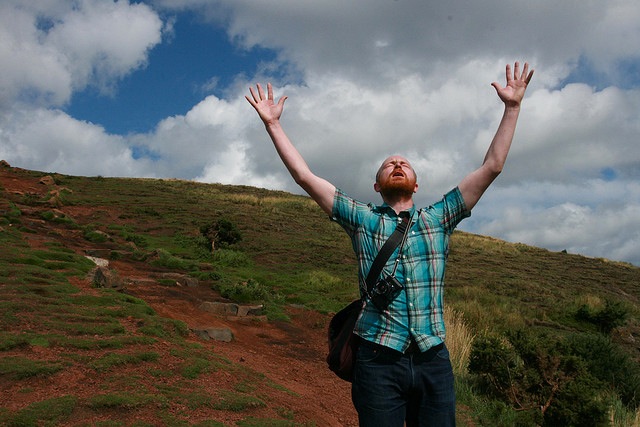
    Arms Up

    “The obstacles of your past can become the gateways that lead to new beginnings.” ~Ralph Blum

    During the worst years of my life, yoga saved me.

    My life was a wreck. I was working seventy to eighty hours a week at a job that took everything from me and made me a monster. My relationship was disintegrating. I was hopped up on espresso shots and sugar. I paraded myself as the self-appointed queen of happy hour.

    But the hour a week I spent on my mat put it all into perspective.

    That single hour turned into several, and somewhere, somehow, I found myself again. I learned to quiet my mind and really listen to what I wanted and needed. I connected with my body in a way I never had before. I learned to slow down and identify what was truly important to me.

    My yoga practice gave me the strength to quit not just a job, but a career that was destroying my life. I felt strong and powerful—like nothing could stand in my way.

    I enrolled in a year-long yoga teacher training program, with the intention of sharing the gift of yoga and everything it had taught me with others.

    That year I learned about asanas, pranayama, and the history of the eight-fold path, but more importantly, I learned about myself.

    For the next three years, I stayed fiercely dedicated to my practice. I taught here and there, but mostly, I was a student. That just felt right.

    But something in me started to change.

    I began to feel disconnected from my practice. I was bored, just going through the motions. There was no heart, no fire, no excitement.

    Yoga had been a good counterbalance for my Type-A go-getter attitude, but perhaps it was just too much of a good thing or maybe I just needed to shake things up.

    My yoga practice had left me passive and stagnant, with a little too much of that “go with the flow” energy and not quite enough of that “get up and go” stuff.

    At the same time, I was feeling stagnant in my life. I’d recently made (another) career change; I took a gap job, one I’d intended to be in for six months, max. But seven months in, I was no closer to leaving than the day I started. I needed passion, purpose, and drive. I needed a real change.

    A yoga studio where I was a sub was looking to partner with the Crossfit gym across the street to offer yoga classes.

    Crossfit? I’d never heard of it, but a quick Google search revealed that these Crossfit people were clearly insane. Totally not my bag. I was a calm, collected yogi, but…

    My interest was piqued. I started paying attention to what went in on the “box” across the street. I’d walk by on my way to yoga and hear grunting, yelling, and the clang of metal hitting the ground. I’d parade by with my husband, “Look at this—isn’t this nuts?”

    I was fascinated, excited, and terrified.

    It took six months, but we signed up for our first class. I conveniently masked it as wanting to do something to support my husband in getting back in shape, but when he went out with an injury, it was clear that I was in it with or without him.

    On the surface, Crossfit is nothing like yoga. It’s brutally physical and it has a reputation for being competitive.

    But in other ways, my yoga experience prepared me well for the transition. Sure, I wasn’t “strong” and I wasn’t particularly fast, but I had awesome body awareness, I was able to focus on my breath when lifting, and each day I learned to focus on just that: how I’d do today.

    Crossfit provided a new outlet for me. For so long, I’d felt like pushing myself was bad, but Crossfit showed me that pushing myself could be good and healthy, if done with awareness and control.

    I’m still learning all the lessons Crossfit has to teach me and I’m sure I’ll never be done learning all the lessons yoga has for me, but here’s what leaning in and letting go of yoga has taught me so far:

    1. It’s okay to focus on yourself.

    As a woman, I was always taught that focusing on myself was bad. But I’ve learned there is nothing wrong with taking time to nourish myself, however that looks. In fact, it has made me a better woman, wife, coach, and friend.

    When I graduated from my yoga teacher training program, I had grown so attached to my own practice that it was hard to share it. I tried teaching classes, but it pulled me away from myself. So I decided to focus on me.

    It was hard for other people to understand, but it really didn’t matter what they thought. I quickly learned to disregard the comments and do what I needed to do for me.

    It’s okay if no one agrees with you. If it feels good to you and it doesn’t harm others, it’s okay to do it.

    2. Be open to the person you’ll become.

    If you’d asked me two years ago if I’d be a crossfitter, my answer would have been an emphatic “No!” But, life has changed in ways I could never have imagined and my needs changed, too. I’m grateful that yoga taught me to embrace changes.

    It’s important to be open to the possibilities that exist for us, whether it’s yoga or Crossfit, vegan or cheeseburger, corporate exec or stay-at-home mom. There’s no right or wrong answer to where our paths will lead us; the important thing is to make the right choice for ourselves right now.

    3. Act on the signals for change.

    I’ve come to recognize there are two types of people: the ones who wait for change to happen to them and the ones who seek change. In my experience, seeking change is where the real growth happens and where true happiness starts.

    Yoga taught me to laser in on how I was feeling and how it manifested in my body. When my practice didn’t feel right, I was prepared to find something to fill the gap, something that gave me exactly what I needed.

    4. Yoga is a way of life.

    When I say I quit my yoga practice, that’s not really true. I stopped attending classes and I stopped practicing poses (asana), but through my years of studying yoga, it was ingrained in me as a way of life.

    For me, yoga is about opening my heart fully to each new experience, wholeheartedly embracing change, connecting to nature, to people, to a higher power, and to my true self, and slowing down to listen and appreciate everything around me.

    Without yoga, I wouldn’t be the person I am today. Above all, yoga has taught me to embrace all that I am—the expected and the unexpected—and all that I might be.

    What change do you need to embrace in your life?

    Photo by Nikola F

  • 3 Little Questions to Help You Deal with Life’s Big Changes

    3 Little Questions to Help You Deal with Life’s Big Changes

    “Life is change. Growth is optional. Choose wisely.” ~Karen Kaiser Clark

    Change happens.

    It’s often unnoticed, or it may simply be a slight nuisance. It’s sometimes uncomfortable, or excruciatingly painful. Once in a while, it’s life-changing. But it’s also transforming.

    Sometimes I awake in the morning or I simply look out the window into the woods, and I realize I’m not the person I was the day before, or even a moment ago.

    That realization brings me such pleasure, to know that I am becoming a better version of me than I was. The newness, the now-ness, the opportunities to continuously morph into who I want to be is, at moments, mind-blowing. I appreciate this sort of change.

    Everything changes. But we forget this, constantly. That’s because it’s sometimes downright scary to think about change.

    Sure, we like the good changes—we appreciate the little ones and celebrate the big ones. But the bad ones, none of us likes those, however small they may be or even how much we may wish them away.

    We become irritated when a construction zone causes us to take another route to work. We get angry when people don’t do what they said they would do. We are deeply pained when people decide they no longer want us in their lives. We grieve uncontrollably and inconsolably, and understandably so.

    When I think about it, I realize I am very attached to specific expectations, certain ways of being, and the people I love most dearly.

    This attachment, while often pleasurable and a source of such happiness, also causes me to feel discomfort and pain, to act simply out of habit or from fear, and to worry and grieve.

    Some changes are big. (more…)

  • We Have to Let Go of Who We Are to Discover Who We Can Become

    We Have to Let Go of Who We Are to Discover Who We Can Become

    “When I let go of who I am, I become what I might be.” ~Lau Tzu

    In the spring of last year, a number of events challenged my sense of self and my sense of direction.

    In March I realized my tax liability would be much larger than I’d anticipated, effectively depleting my entire savings account. The next month I had my first major surgery, something that terrified me and further burdened me financially.

    Less than a month later, while my boyfriend was on a vacation I had to miss because I was recovering, a burglar broke into my apartment and stole everything of significant financial value that I owned.

    One month later my grandmother passed away, surrounded by her closest family members. I’d missed the majority of the last decade of her life, but still, I was there.

    Never before in my life had I experienced so much loss in one season. It was an overwhelming, emotionally challenging time.

    And then, without really understanding my intentions, I tossed another loss onto the heap: I stopped writing every day for this blog, as I’d done previously for almost three years.

    A part of me felt this urge to write about the same things over and over. So many times I started blog posts about how I felt uncertain, scared, lost, and sometimes, empty.

    I’d write about my inner conflict over living 3,000 miles away from my family, with my boyfriend who’s from California, and how badly I wanted to move home after my grandmother’s death.

    I’d write about how directionless I felt, with no desire to make any of the professional choices other bloggers often make—mentoring, coaching, or leading workshops.

    I’d write about how ironic it was that so many people emailed me for advice about their lives, when in that moment in time, I had so little clarity about my own.

    And then I’d stop. Three or four paragraphs in, I’d shut my computer, realizing I had no endings for those posts, and considering that maybe that was okay. (more…)

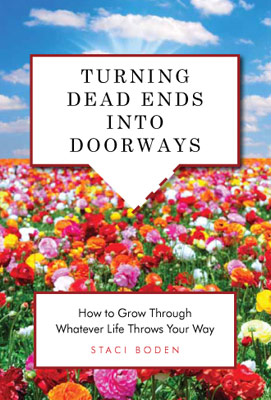
  • Giveaway and Interview: Turning Dead Ends into Doorways by Staci Boden

    Giveaway and Interview: Turning Dead Ends into Doorways by Staci Boden

    Editor’s Note:

    The winners for this giveaway have already been chosen:

    Subscribe to Tiny Buddha for free emails once weekly or on weekdays and to learn about future giveaways!

    Especially when we’re going through challenging times, it can feel tempting to try to control the future—but this doesn’t change that much lies beyond our control. Try as we may to avoid the unknown, the future remains uncertain.

    How do we navigate change knowing that nothing is guaranteed? How can we develop inner strength to grow, heal, and evolve?

    Healer practitioner Staci Boden answers these questions in her new book, Turning Dead Ends into Doorways: How to Grow Through Whatever Life Throws Your Way.

    From the book flap:

    “With compassionate honesty and a practical sense of humor, healing practitioner Staci Boden shows her readers how to navigate change without clinging to false notions that if they just do this or think that they can determine what happens next. How to let go of false expectations and still make excellent choices. How to grow and heal no matter what life throws their way.”

    I’m grateful that Staci has offered two free copies of Turning Dead Ends into Doorways for Tiny Buddha readers!

    The Giveaway

    To enter to win one of two free copies of Turning Dead Ends into Doorways by Staci Boden:

    • Leave a comment on this post. (If you’re reading in your inbox, click here to do that.)
    • Tweet: RT @tinybuddha GIVEAWAY: Turning Dead Ends into Doorways http://bit.ly/SBYrFX comment and RT to enter!

    You can enter until midnight PST on Monday, November 5th. If you don’t have a Twitter account, you can still participate by completing only the first step. (more…)

  • Changing Roles and Allowing Yourself to Evolve

    Changing Roles and Allowing Yourself to Evolve

    “Your mind will answer most questions if you learn to relax and wait for the answer. “ –William S. Burroughs

    I have worked for many years as a shelter and spay neuter veterinary technician. Earlier this year, I had the misfortune of losing the job at the shelter where I had worked for many years.

    I found myself adrift. I had spent all these years caring for animals that had no one else to care for them. If I no longer had that job, I asked myself, who was I?

    Who are you? It’s the most elemental question in the world, but one that is not always easy to answer. Like most folks, I tend to answer this question by naming roles that I fulfill. Writer, boyfriend, son, veterinary technician, yogi, and entrepreneur—these are the things that first come to mind.

    It makes sense, because these are the roles that others see us fulfilling every day. In the world we operate in, we need to market ourselves as this or that role so that others know how to relate to us. But these are actually things that we do rather than what we are.

    Most religions and spiritual belief systems teach that we are not our bodies, though we inhabit them and identify with them through the course of a lifetime. Nor are we our minds, though we use our minds and intelligence to guide us in our daily interactions.

    When we identify with these things we cannot accept their loss through physical illness, injury, or death.

    Whether you believe that some part of us survives our physical death or not, it’s easy to see that when we identify with the roles that we fulfill, it becomes very difficult to accept it when those roles must change.

    When we lose our job or must change careers, when we go through a divorce or when someone who helps define a role goes away or dies, who are we then?

    There’s no single answer to this question. For some, there may be a realization that you exist outside of the body and self that you think of as “you” and that you will continue to “be” no matter what roles you shed or even when you shed your physical body. (more…)

  • Finding the Flow: Growing into Your Whole, Authentic Self

    Finding the Flow: Growing into Your Whole, Authentic Self

    “When I let go of what I am, I become what I might be.” ~Lao Tzu

    I was around twelve years old as I sat in the career day presentation. I can’t remember one word that was said. It might as well have been the teacher in the Charlie Brown cartoons speaking in that esoteric adult language.

    It was the day I made my first practical life decision. In seventh grade, I boldly decided I would be a dentist—for absolutely no meaningful reason. I chose because society was insisting upon it.

    I held onto this idea for a decade before entering dental school. I did exceptionally well, but two years in, I realized that something wasn’t right. Turns out, I hated general dentistry.

    However, it was the path I had chosen, so I stuck with it.

    I completed school and decided to pursue the challenging path of oral and maxillofacial surgery. It was exciting, and exhausting, and…empty.

    Two years in, I realized something wasn’t right.

    I didn’t hate it, but it didn’t quite resonate with me in a way I felt it should. Nonetheless, I stuck with it because it was the path I had chosen. I declared I was to be an oral surgeon and come hell or high water that was what I would be.

    I finished my residency and started my professional career. After thirteen years of education, you would think there would be a sense of accomplishment and relief. There was, but unfortunately, it was short-lived.

    Two years later, I realized something wasn’t right. Again.

    That was around the time I started exploring my creative self again—the self I had put on on hold for twenty years while pursuing a career path that I mistakenly believed defined me. I finally understood that I had to give myself permission to be a work in progress – to evolve beyond a definition of self that didn’t quite fit. (more…)