Tag: enough

  • The Truth About Self-Worth: We Don’t Need to Earn It

    The Truth About Self-Worth: We Don’t Need to Earn It

    “Success isn’t about what you do; it’s about who you are. Just existing—waking up, breathing, being present—is enough.” ~Unknown

    On my third trip to the emergency room, I lay in a hospital bed, ten weeks pregnant and nine kilograms lighter. I had just vomited for the forty-seventh time that day. My body felt empty, but the nausea never stopped. An IV dripped fluids into my arm, and I didn’t swallow anything for the next five days.

    Hyperemesis—a rare and severe condition that affects about 1% of pregnancies—typically subsides by twelve weeks. For me, it lasted my entire pregnancy.

    For fifteen years, I measured my worth by what I did. If I exercised, ate well, showed up for my friends and family, and worked hard—then I could go to bed knowing I was a good person. That was my framework. My safety net.

    Now, I couldn’t do any of it. I could barely move.

    And for the first time in my life, I asked myself: Who am I if I can’t do anything at all?

    Six months of pregnancy, living in survival mode—failing to meet a single requirement on my self-made checklist for being a good person—I hated the person I had become.

    The Framework That Held Me Together (Until It Didn’t)

    For years, my sense of worth was built on a framework—one I had carefully constructed to keep myself on the right path. If I could tick off all the boxes, I could go to bed knowing I was enough. It gave me structure, a sense of control, and a way to measure whether I was living up to the person I believed I should be.

    This checklist was my identity. It was how I knew who I was and that I was good.

    At first, this framework served me well. When I left the structure of school, this checklist gave me direction.

    It kept me disciplined, motivated, and focused on self-improvement. But beneath it all, there was fear—that if I didn’t check every box, I would somehow fail at being a good person.

    The voice in my head wasn’t encouraging; it was demanding. Slowing down felt like slipping. No matter how much I did, there was always more to prove. Nothing was good enough, fast enough, or impressive enough.

    Then, when Hyperemesis stripped me down to a barely functioning shell of myself, the framework collapsed. I wasn’t showing up for anyone. I wasn’t achieving anything. And without those measures of success, I felt like I had lost myself. My identity. My sense of worth. If my worth had always been something I had to earn, what happened when I could no longer earn it?

    That’s when I realized the flaw in my system: it was built on conditional self-worth. As long as I kept up, I was safe. But the moment life forced me to stop, the framework didn’t hold me—it crushed me. Life was only going to get more complicated with kids, and I didn’t want it to feel this hard forever. More than that, I didn’t want them inheriting this checklist as a way of living.

    Rebuilding From the Bottom Up: A Shift in Perspective

    Hitting rock bottom can be an incredible gift. With nowhere lower to go, it becomes a chance to rebuild in a simpler, more aligned way—letting go of what doesn’t serve you.

    A framework can be useful—until it becomes a cage. When discipline is fueled by fear, it exhausts us. True growth doesn’t come from relentless self-monitoring, but from knowing you are already enough. It comes from showing up, doing your best, and trusting that’s enough.

    Talking things through with a psychologist, it became obvious: the checklist that once gave me security had become a restrictive system holding me back.

    I decided to trust the extensive research that shows leading with self-compassion drives success and happiness by turning setbacks into growth, reducing stress, and helping us become more present people.

    The hard part was learning to believe it—not just in my head, but in my gut. That kind of shift takes time, patience, and a steady mindfulness to gently bring yourself back when you drift.

    Doing Things Out of Joy, Not Obligation

    When I used to run, it was with a fierce determination to get to the finish. Quickly. And it was never fast enough. I didn’t use a social fitness tracker because no run I ever did was perfect enough to represent who I thought I should be.

    When I started to exercise again after surviving the pregnancy and transitioning from a place of self-judgment to self-compassion, my mind was blown.

    The voice in my head was kind and understanding and came from a place of love. When pushing for another lap, my thoughts would wander to words of encouragement. “Okay, do another lap, but stop if you need—you’ve already come so far!” I felt complete gratitude.

    The rules I had followed for years didn’t disappear; they transformed from needs to wants—and never musts.

    I still love to move my body, but I do it because I can and because I want to, not because I have to.

    I still care for the people around me, but not at the expense of myself.

    The things that once felt like obligations became absolute pleasures. And the best part? There are no repercussions if I don’t do those things. I either let it go without thought or reflect and learn from my actions. Without judgment.

    You Are Enough, Always

    Your worth isn’t something to prove—you are enough just by existing.

    It doesn’t need to take a crisis to realize this. Checklists, measuring, self-checking, the relentless need to keep up—they are never what make you worthy. Letting go of that weight doesn’t mean losing yourself; it means freeing yourself.

    Start noticing the voice in your head. Is it pushing you out of fear, or guiding you with love? Self-compassion isn’t about doing less—it’s about doing things from a place of kindness, not criticism. You can still strive, grow, and show up—but now, it’s because you want to, not because you have to. And that changes everything.

    Shift the script. You don’t have to do more. You don’t have to be more. You already are enough—always.
  • How to Finally Believe That You Are Enough

    How to Finally Believe That You Are Enough

    “We often block our own blessings because we don’t feel inherently good enough, smart enough, pretty enough, or worthy enough. But you’re worthy because you are born and because you are here. Your being alive makes worthiness your birthright. You alone are enough.” ~Oprah Winfrey

    When I was a little girl, I loved making cute drawings at school and gifting them to friends and family. I’d pour my heart into them, and at the end of the day, I’d rush home, all excited to give my treasured creations. I was such a happy kid! Always running and jumping up and down the street, noticing quirky details on the road and picking flowers to bring home.

    This one, I made my mom a drawing. When I got home, I stood beside her, my eyes sparkling with anticipation, only to see her looking at it with disdain. She harshly criticized what she thought was badly drawn on paper and then tossed it in the trash. I looked at her, shocked and hurt, as she said: “What do you want me to say, that this drawing is beautiful? It isn’t.”

    I wish I could say it was the first time I had an interaction like that, but the reality is that it happened again and again. So much so that I gave it a name: “not enough notes to the self.”

    These are the moments when something happens that makes you start questioning your worth, and you begin internalizing that somehow, your being and whatever you do is not and will never be enough. If you have a few moments like these in your life, it may not leave so deep of a scar, but when the notes pile up, you start feeling differently about who you are.

    You go from being purely and authentically you to shrinking into a mold of what’s expected of you, even if the mold keeps changing and becoming more demanding each time. You realize you’re damned if you do but also damned if you don’t, and without the right tools to escape the conundrum, you feel like you have no other option but to keep going in the hopes of someone seeing you and telling you that you are enough.

    That’s what happened to me.

    Too many events, people, and circumstances told me I wasn’t enough. And I believed it. So, I spent most of my life trying to prove I was.

    I attempted to be the best at everything, with no room for error, because maybe if I were perfect, I would finally be enough. But no matter how hard I tried, the goalpost just kept moving.

    Then, after years of healing from past traumas, I heard a voice inside me that said, “To the eyes of the Universe, you are enough.” And it clicked! It does not matter what the world says, I am enough, so there is no need to prove it! I always was.

    I wish I could tell you I instantly embraced that thought. But by then, I had spent my whole life trying to prove myself, hiding behind a perfectionist facade, weighed down by anxiety and the need to please others, so it wasn’t easy to suddenly believe I was enough without all the trying and the masking.

    I had to reflect deeply and ‘do the work’ to get my mind, body, and soul to align with this newfound truth. It was such a beautiful journey of self-love and acceptance, and I cannot wait to share it with you today so you too can realize the undeniable truth that you are enough, and always were, and free yourself to bask in the happiness of knowing. And achieve your goals and wildest dreams along the way without having ‘not-enough notes to the self’ blocking you from the life you’re meant to live.

    Ready?

    The first step I took was to dig deep into my mind to find all the ‘not enough notes to the self’ I had on repeat all these years. I looked back into my past and screened for the moments that made me believe I was not enough. I had many, and from time to time, new ones pop up in my head, but I softly smile at them, like when you encounter an old friend you still care about, but the friendship is over. No hate, only love from a distance.

    Reflecting on these moments, I started to grasp why I felt so worthless. While you may know why you’re haunted by feelings of not being enough, seeing these moments reflected on paper or flying through your mind during meditation makes something click inside you. You just get it.

    And I did. But getting it is one thing, and deprogramming years, decades of not-enoughness is another. That’s where step number two enters the chat: changing the belief that you are not enough.

    Convincing myself I am enough was all about lovingly and repeatedly reminding myself of my enoughness as a birthright and showing it through actions as if parenting my inner child and undoing the parenting I received as a little girl. For that, I used daily affirmations and meditations where I would sit in the present moment and just be.

    That allowed me to constantly get back to myself and the truth of who I am: a loving and lovable individual, no perfection needed.

    I started asking powerful questions and practicing self-love. Notice I didn’t say, “I started loving myself.” Back then, I had no idea how to do that, so I just started practicing. I’d ask myself what I’d do if I loved myself. If I knew at my core that I was enough, who would I be? How would I behave?

    This shift was life-changing, and it naturally led me to the next and sort of final step of the journey: to look at my surroundings and reevaluate my relationships. As I began to treat myself with more love and respect, I inevitably started noticing how other people treated me through a different lens.

    As one should expect, when you believe that you are not enough, you tolerate certain situations and behaviors that are detrimental to your health and well-being. Embracing your enoughness leaves little room for that.

    So, I went through a painful period of reevaluating, transforming, and even ending some unhealthy relationships. But in the process, I ended up creating space for true, loving, and respectful relationships that make me feel safe, worthy, and enough.

    My list of ‘not enough notes to the self’ grew smaller. And as it did, my life expanded in ways I could’ve never imagined. But let’s get real: This is a lifelong journey, which is why there’s no definitive last step, just a powerful sort-of-last step.

    The beauty of this process is that you can revisit it time and time again to reconnect with the undeniable truth that you are enough and create the beautiful life you deserve. One thing I can tell you for sure: It gets easier and more natural every time.

    Remember, you are enough because you always were. Time to start walking and talking like it!

  • We Are Enough and We Don’t Need to Be Perfect

    We Are Enough and We Don’t Need to Be Perfect

    Imperfection Is Beauty

    “You alone are enough. You have nothing to prove to anybody.” ~Maya Angelou

    Every day on TV, the media tells us how we should be and how we should look.

    In mainstream society we are taught to identify with our physical body and our possessions.

    We are led to believe that if we look a certain way, we will be happier, loved more, and accepted by others. I used to believe this. I bought into it hook, line, and sinker.

    I came across a photo of myself taken about twelve years ago, and I looked radiant. The sun lit up behind me, my skin looked porcelain, and I had this amazing red hair.

    I looked at myself and thought how beautiful I was. At the same time I looked at that girl in the photo and she was a stranger. The girl felt anything but beautiful.

    She hated herself, felt unworthy of love, and thought she didn’t belong because she wasn’t thin enough or pretty enough.

    Growing up I was a victim of child abuse and bullying. It played a large role in my thinking in later years.

    My father used to call me his ugly little girl, and he also used to be cruel to my mother, who was overweight at the time. So I knew that when I grew up, I would have to be thin and pretty to be loved.

    I also had thick glasses as a child, and kids often screamed the nickname “fish eyes” across the school bus during middle school years. At that time in my life, my peers excluded me, my father ostracized me, and the physical abuse I endured weighed heavily on my chest.

    Fast forward to college. I was a theatre major.

    My voice teacher got me my first professional gig, and she believed in me. My talent got me leading roles many times, and I felt confident. Then the time came to sit down with an agent to be represented.

    It wasn’t about talent anymore. I was told how my physical appearance didn’t stack up to the competition. I could easily give you the list of all the things that were “wrong” with me. What was right with me?

    I wasn’t pretty enough, which subconsciously meant “not good enough.” I wasn’t asked to sing, or read a scene, or even do the one-minute monologue that I had prepared.

    This was my past, not my present, and definitely not my future. I now know I am enough. And if someone else doesn’t see my worth, it’s okay. I am enough! It’s even written on my yoga mat.

    As a yoga teacher it took me some time to get over the search for the perfect posture. Even yoga magazines post photos of the extremely limber, handstand steady, beautify poised, and lean types. So many think that’s how it’s supposed to be.

    Yoga magazines teach us to identify to our physical body because our eyes take it all in and we believe that’s what yoga is about. The words in the magazines say differently, but our eyes take in the images of yoga models and our brains perceive them as perfectly poised, inferring that this is what yoga is.

    For some, this may be a reason not to practice. There is still this belief that yoga is meant for the thin, agile, and bendy. This isn’t what the practice is about.

    I began my yoga practice to gain self-improvement, and I got self-acceptance. Self-improvement came along for the ride.

    I began to see my worth as a human being. Instead of “thin,” I think “healthy.” Instead of looking for beauty in the mirror, I found it inside of me, and it was there all along.

    Losing five pounds won’t make me any happier. If I do a perfect forearm stand, my life doesn’t change. It doesn’t mean I stop trying or working toward goals, but I stop identifying my body and physical practice with who I am.

    I stop identifying my physical appearance with self-worth. I am not my tight muscles. I am not my weight, or my jean size, or even my yoga practice. I am enough. I am me.

    Some of you may be thinking, “How does a yoga practice do all that?” Time and patience.

    I began my journey unable to touch my toes. The day I did there was no fanfare, no choir of angels singing, no fireworks, and no party. There was room and if felt good.

    The day I was finally able to stand on my head without a wall, something amazing happened. Nothing. If I fell on my face in an arm balance (and I have), the same thing happened. Nothing. No one would stop and stare, laugh, or point, because everyone was in their own practice.

    Over time we begin to put our fears and ego aside. Over time we begin to listen to our body and become more aware, judging it less and loving it more.

    We figure out the lessons we learn on our mat translate to the real world. The world doesn’t change, but our perception of it does.

    Stress doesn’t go away, but the way we deal with it changes. When we are kinder to ourselves, we become kinder to others. When we love ourselves, become compassionate and patient with ourselves, we are able to give it away freely to others.

    I have learned over the years I am not my past. I am not what happened to me, and I am not my physical body. My body is a vehicle that takes me through this world. Yoga is a tool to help me take care of that vehicle while I honor my entire being.

    I am so much more, I have so much to give, and I am perfect just the way I am. As I go through life there will always be someone who will criticize and judge. Let them. It speaks more about them than it does about me.

    I want you to know that you are amazing and perfect just the way you are. Criticize yourself less, love yourself more, and you will be happier.

    True beauty is found within. Almost every class I teach, I will say, “Practice makes…” and wait for an answer. Someone usually shouts, “…perfect!” I reply with, “…progress, because you already are perfect.”

    We have been brainwashed to think that perfection is outside of ourselves. The perfect house, car, family, and life. The perfect body. The perfect pose.

    We have been brainwashed to strive for perfection. All this striving makes us miserable. We can have goals, work toward them, and become better at things, but when we identify them with who we are, it steals our joy.

    A dear friend and teacher says, “Never give up. Always let go.” So keep moving forward, and never give up. You are precious and priceless.

    When we find our true nature, this is where happiness lies. Joy cannot be found outside of ourselves.

    If there is something you don’t like, change it, but don’t identify with it. Every day be the best you that you can be by loving yourself.

    Look in the mirror every morning and pick something nice to say to yourself.

    You may think that this is ridiculous and obvious, but we spend more time looking in the mirror criticizing than honoring ourselves. Make this a daily habit. You can even use a favorite quote or affirmation to set the tone for the day.

    Journal—write down all the things that make you wonderful and read them. Even tougher, read them out loud.

    Another tip toward self-love is meditation. This is scientifically proven to change the chemistry in the brain, reduce depression, and change negative thought pattern among other things.

    The path to love and joy isn’t difficult; however, the tough part is letting go of all the brainwashing from our past and the media. Invest time in you, and the rewards will be great!

    Imperfection is beauty image via Shutterstock

  • When Nothing Feels Like Enough: Filling the Void of Spiritual Need

    When Nothing Feels Like Enough: Filling the Void of Spiritual Need

    Spirituality

    “When you arise in the morning, think of what a precious privilege it is to be alive—to breathe, to think, to enjoy, to love.” ~Marcus Aurelius

    I recently met a woman at a friend’s dinner party. She was tall and attractive, yet had a glowing, inviting energy about her. I liked her nearly immediately even though I had no concrete reason to. In my myopic mind, attractive and genuinely inviting energy do not combine, and I was naturally drawn to her for this combination.

    Just as the Universe would have it, the woman and I were seated next to each other for the duration of the evening. With a warm smile, she introduced herself and we engaged in courteous, commonplace “what do you do for work?” and “where did you grow up?” dialogue.

    Quickly, because we are the unique kind of soul-breed that we are (and perhaps due to many glasses of wine), we began divulging stories about our pasts, laughing together, and identifying with similarities. She manifested the three S’s I strive to embody; she was smart, sassy, and successful.

    The conversation eventually made its way to spirituality, as they always seem to do in my case. I sensed we had a deep knowing that we were both cut from the same cloth in terms of our spiritual energy.

    She began sharing with me about her spiritual healer and the work that they do together. Since I am a spiritual person and curious to learn from others’ experiences, I inquired more about it and came to find that she works with the same spiritual healer as Madonna.

    As in Madonna Madonna. Eighties. Multi-Grammy Award winner. Sold over 300 million records worldwide.

    That one.

    Instantaneously, I was struck with great surprise upon hearing that this prolific performer, the most successful woman in the music industry to date, has a spiritual healer, which indicates that she must need spiritual healing.

    Why in the world would the woman who has everything need that? What could she possibly be lacking?!

    I looked at my new friend and said, “Pardon if this question comes across as uncouth, but why would a woman who has everything have a healer?”

    She smiled.

    “When you have everything you could possibly want, and have accomplished everything you’ve ever dreamed, and it’s not enough to fulfill you, you realize you need something else developed deeper inside of yourself.”

    I was caught in my judgment. It makes sense in my mind once I focus on it, but my automatic assumption, my internal belief, is that people with money and celebrity don’t suffer or experience true hardship. I don’t have significant wealth or fame; therefore, I am an appropriate candidate for spiritual work. I am the one who needs it because I have nothing else to hold onto. Woe is me.

    This is a scapegoat for my ego. As long as I try to find wholeness and happiness outside of myself, I am off of the hook and don’t have the responsibility of working for it.

    How often I get caught in the belief that fulfillment is out there instead of within me.

    As real as my spiritual practice is, perspective proves to be a real challenge. My humanity is often at war with my divinity.

    I wish I could say I am evolved or enlightened enough not to worry. Worry about what other people think, worry about wearing the right fashion for the present season of the year, worry about my level of attraction, appearance of financial income, and career importance. But I am not.

    As quickly as one click on a photo on social media, with one passing of the magazine section at the grocery store, with a few minutes of window-shopping, or with one drive through a wealthy neighborhood, I find myself riddled with fantasy and victimization.

    I separate myself from what I perceive to be the Good, Rich, and Beautiful Life, putting things out there on a pedestal.

    Despite my “successes” in over three decades of life—traveling the globe, teaching in developing countries, earning two Masters degrees, being published, praised for beauty and brains—I still have to work on my spiritual landscape.

    I have to address that chasm deep in my chest that cannot be filled and that ebbs with fear; that part of me that says it’s never enough. Just like Madonna, the need is there for me, too.

    Moments after my new friend at the dinner party responded to me so graciously, I thought to myself, “Oh, Sarah. You still believe that there is a difference between people, that some have spiritual need and some do not. We all are in need. We are all the same at our core.”

    We are just people, spirits with bodies as our casing, and we are all in need of something more, even Madonna. After all, money and fame cannot buy personal healing, happiness, or wholeness.

    What I get to observe about myself in this situation is that I still all too easily fall prey to idolization of others and grandiose ideas of perfectionism. If only ___________, then I would be fulfilled and life would be good all the time.

    However, when I am engaged in my daily spiritual practice, I am not as concerned about external matters.

    When I am meditating, praying, sharing with others, being true to myself, and responding to life from a perspective of gratitude, I don’t take things personally. I enjoy the present moment. I notice the various ways laughter dances, the color of my barista’s eyes, and the flowers poking up from cracks in the sidewalk.

    Those practices provide perspective for me and allow me to appreciate the art of living. I do not experience lack when I am aware that each moment is a gift along with everything that moment offers—that is truly my spiritual practice. When I am tuned in to that spiritual frequency, which requires effort and discipline, I experience life with abundance.

    Often times we compare other people’s outsides to our insides, and it’s simply not fair to us or to them. When we compare at all we are robbing ourselves of the present moment, the most spiritual moment to be in, and we miss out on the beauty that is ours to cherish.

    No one is better or worse than another person yet we cling to labels, social status, and mainstream media to tell us who we should be and how we should appear.

    When we are connected to ourselves and we are actively engaging our spiritual work, we care little about out there. We learn how to define our own fulfillment and exist in a state of contentedness. We find we are enough for ourselves just as we are.

    In the words of Madonna herself, “Poor is the man whose pleasures depend on the permission of another.”

    Meditating man image via Shutterstock

  • Wanting More Time: Have You Lived Enough?

    Wanting More Time: Have You Lived Enough?

    Woman with hourglass

    “When you arise in the morning, think of what a precious privilege it is to be alive—to breathe, to think, to enjoy, to love.” ~Marcus Aurelius

    I remember attending a lecture by the Tibetan monk Sogyam Rimpoche, author of The Tibetan Book of Living and Dying, in which, smiling all the while, he confessed, “So many people, they say, ‘I’m not afraid of death.’I tell you, they’re lying! Death? Very scary. Me? I’m very scared of death.”

    And I thought to myself, “Phew, if he’s scared, then it’s certainly okay that I’m scared too.”

    For many years after that, I carried a question around with me. “Have I lived enough yet?Without hesitation my answer was always, “No way! Not by a long shot!”

    And then I’d follow this up with all the reasons why I wasn’t yet satisfied—I hadn’t left a mark on the world, wasn’t married yet, didn’t have children, didn’t know who was going to win this season of whatever reality TV show I was following.

    Even after I had built a decent career for myself, published a book that I know helps others, got married, had two adorable sons, and found out who won that season (and many others) of various TV shows and sports, the question and its familiar response still remained. Had I lived enough yet? No!

    It suddenly dawned on me that, if I continued to think this way, I would never experience fulfillment. I’d never arrive at that mythical destination I’d set out for myself where I’d finally cease yearning for more. Especially now that I had kids, this became abundantly clear.

    I’d always want to see what came next in their lives, to witness each step upon their journey into and throughout adulthood.

    Then if they had kids, I’d want to share as much of their lives as possible too. Feeling so much love in my heart, I knew I’d never reach a place where I’d had enough. I’d always want more.

    Realizing that I was chasing what could never be caught, I stopped to pose myself a new question.

    I asked, “What do I want my last thought in this world to be?” And my answer came back as something like, “I’d want to be thinking, Ahhhhh, that was good… that was nice… that was enough…”

    This new question might not have helped me much, if I didn’t remember something else, namely, that how we live this moment is the best predictor of how we will live in the future.

    So, it then occurred to me that, if I wanted to be thinking I have lived enough in the future, then the best way to get there would be to live with that exact same thought right now.

    Immediately, I started asserting this new notion that, already, I had actually lived enough. After all, there are many humans that are not blessed with the experience of even a second day of life on earth. How greedy was I willing to be? How selfish and ungrateful?

    The deeper this pronouncement that I had lived enough sunk into me, the greater the shroud of fear surrounding death lifted.

    Whether I initially had believed this or not, I slowly grew to the place where I knew, beyond any doubt, that I had lived enough. Yes! I had already lived enough! And, just like that, all my fears vanished and I finally felt free, overflowing with a sense of appreciation and contentment.

    Ever since, I’ve been discussing this concept of “enough” with others in the throes of grief and loss.

    What I explain is that “enough” is always a value judgment, rather than something that can be quantified or measured. It’s about perspective, a determination on our part to choose gratitude for what we’ve been granted over regret for what we have lost or fears about what we might lose.

    This can be tremendously powerful, though admittedly very hard at times. Is it possible to view the death of a young child and understand that he or she lived enough?

    Can a parent suffering through such a loss perceive their abbreviated time with their son or daughter as enough?

    When a friend or parent or anyone else we care about passes away, can we experience the time we had with them as enough?

    The answer is yes. It is possible, if and when we choose to exercise our right to invoke this perspective.

    We can view whatever time we’ve been given through the continually available lens of gratitude, appreciation, celebration, and love. We can understand each moment as a gift, as “enough.”

    To be a human is little short of a miracle. In the limitlessly vast universe of atoms and particles and stars and planets, gases and quarks and molecules, stones and trees and bugs and platypuses, of all the possible manifestations of life that are possible, we have been given the rarest of privileges of experiencing what it is like to be human. That’s cool!

    Just by being here, we’ve already beaten the odds, no matter how many more minutes of this miracle we get to experience.

    We know when we lived enough by knowing this right now, during this and all future moments, even while we crave to drink in as much as life continues to offer us. We appreciate that no more is needed.

    We’re thankful and, from the wisdom of this thankfulness, we smile, at ourselves and all around us. We’ve already lived enough—and that’s a beautiful thing.

    Woman with hourglass image via Shutterstock

  • Getting More Out of Life When You Have Less Money

    Getting More Out of Life When You Have Less Money

    Couple Walking

    “The real measure of your wealth is how much you’d be worth if you lost all your money.” ~Unknown

    When we find ourselves not having “enough,” times may be rough; however, this is only our first glance, our perceived perception.

    Not all who have little are poor. None who live simply fit into the status quo. And none of us deserves to be judged for what we do or do not own.

    Poverty lines are a general measure of separating the classes, but they fail to feel emotions, see our genuine qualities, or tell the stories of our lives.

    They quantify our income, encourage us to strive for more, but more of what? More money to engage in better opportunities? More cash to buy more stuff?

    Numbers have a tendency to lose their meaning when they don’t add up—a well-paying job with no time for family is no better or worse than barely scraping by without savings, yet having no debt.

    There are many lessons to be learned from being poor. If you have ever been on your last coin, or more than once, chances are good that you may have experienced an enlightened state of being.

    Voluntarily choosing to live with less is quite different than being born into poverty, yet the paths overlap and intersect on so many levels.

    Searching for the silver lining of a free fall into a greatly reduced income, of which my husband and I caught the winds of almost a decade ago, we discovered the concepts of minimalism and simplicity.

    At first I was terrified at the aspect of living off of so little money, coming from a consumer culture that defines worth in terms of income. However, rationality quickly stepped in after that initial panic, and feelings of being lost without monetary stability were replaced by a desire to live well within our means.

    There was no denying the change of mindset that was rapidly taking place.

    We made a tiny handful of money (way below poverty measures) that allowed us to go to the grocery store a couple of times a month for food; the rest we had to acquire for ourselves in other ways—learning to forage, trading, growing…

    Every coin we made went toward nourishing our bodies, because good health is the most important aspect of survival.

    When we couldn’t afford electricity for eight months, we lit the kitchen with a few beeswax candles. When they burnt out we went to bed early, only to wake up with the sun.

    Employment was nowhere to be found in the countryside. We had no Internet connection and it seemed that life was on standby. Months and years went by, and it was hard. We didn’t buy anything we couldn’t afford, we didn’t want what we couldn’t attain, and all the while we didn’t complain.

    The last part confused a lot of people. We didn’t complain because we accepted the situation we were in, and rather than fight it, we decided to learn from it.

    It is possible to live well, well below the poverty line. Much of it depends on your state of mind, part of it comes from where you enter the phase of living with less; but wherever life takes you, lessons are waiting to be found:

    1. You may already have enough.

    In our past we had acquired all the things we needed for survival, and then some. Clothes “out of fashion,” but definitely not out of use. Pots, pans, dishes, music, games. Though we didn’t have the ability to buy things anew, we certainly did not go without. 

    When you have little, you may still have more than you realize at first glance. Set possessions aside and focus on life that surrounds you. Friends, family, your health—foster those intangible, yet all important connections.

    Most importantly, make peace with patience. Slowly moves the world without flowing cash or access to the Internet, and it still remains a beautiful place to be.

    2. Less time with electronic gadgets leaves you more room for people.

    Physical relationships are the ones that foster real laughter, genuine love, and lasting memories. Conversations flourish in the absence of technology.

    We can relearn to have meaningful discussions without a cell phone on the table; they only serve as a distraction at the dinner table and attest to our shortening attention spans.

    3. Solitude gives you time to delve into your emotions.

    It gives you time to think about life. Inner reflection is hard to focus on when we are busy day and night, so get un-busy and make more time for dreaming, questioning, and contemplating. Find quiet activities to let your mind expand to new horizons; you have the time.

    4. Nature provides us with much beauty, energy, and inspiration.

    No money for a concert? Great! Go listen to the night song of crickets in summertime, listen to frogs bellow, listen to birds or running water. Hike, walk, bike—get out of your four corners and find freedom in the “wild.” 

    5. Self-reliance will foster an unending sense of independence.

    Spend time reading books; volunteer your time to learn and teach new skills, meeting new people and creating opportunities for advancement as you go about daily life. See the connections, and feel what is important for your personal growth.

    Rather than feel guilty that we couldn’t afford to eat out, we chose to develop our cooking skills and embrace the art of slow food. We grew vegetables in the garden to preserve for winter, we baked our own pies and pastries, we relished in our growing confidence of all matters related to providing for oneself.

    In eight years one can acquire immense knowledge, and our wealth grows with our ever-increasing set of useful skills (from knitting to felting to cobbing to shoe making) that we can apply over many aspects of life.

    6. Happiness cannot be bought.

    It can be grown, cultivated, tended, nurtured, but you won’t find it on a store shelf or a screen. Happiness comes when you are at peace with who you are, right in this moment—with your job or lack of it, with your salary or lack of it, with your friends or lack of them, with your wants fulfilled or lack of that.

    Struggles can bring out the worst or the best in us! Living with less money than “ideal” is certainly a challenge and if we haven’t been there ourselves, we certainly know someone who has been financially in need. You can be rich and poor or poor and rich, depending on where you place your values.

    Wanting less speaks volumes about your personality. It has nothing to do with charts and graphs that society creates, but it has everything to do with you—the way you treat yourself and the much-deserved attention you give to others around you.

    The next time you take a pay cut, voluntarily or not, remember the advantages of more time, more meaningful experiences, and a whole lot less stuff to store along the way. You are not defined by your past; you and your thoughts are the future. Learn, let go, and move on.

    You can live with much less than you ever thought possible and find many uplifting winds to carry you on your way.

    Photo by Tony Alter

  • How to Start Feeling Confident, Worthy, and “Enough”

    How to Start Feeling Confident, Worthy, and “Enough”

    Confident

    “The outer conditions of a person’s life will always be found to reflect their inner beliefs.” ~James Allen

    Low self-esteem is like a garden weed. Uproot it while it’s small, or face the consequences of an unruly mess down the road.

    Its true, I have gone to extreme lengths to supplement my low self-esteem. Hair colors, tattoos, new hobbies, new jobs, moving in, moving out. I was always waiting for there to be “enough.”

    Enough what? Enough things where I could rest, feel satisfied, and be “equal” to everyone else. However, even though I often got what I wanted, the rewards were either brief or nonexistent.

    None of the fillers ever provided what I needed, and like a fool I’d move onto the next thing thinking, “Ok, this is really what I need!”

    “Your family is supportive, you have enough money, you’re attractive, you’re talented,” a good friend once told me candidly. “I can’t for the life of me figure out why you’re so insecure.”

    It was strange to stop and contemplate what he had said. I’d never thought of myself as the normal person with a complex that didn’t make sense. I’d known others with my problem, but usually their reasons were evident, like demanding parents or school bullies.

    “Why on earth am I like this? My life is so bland and…regular,” I thought.

    Eventually, after much wasted time, money, objects, friends, and opportunities, I stopped accumulating.

    I realized I was never going to reach my long-awaited mecca of “enough” and I had only accumulated junk anyway. The wheels had been spinning, but the car hadn’t gone anywhere.

    I noticed that a lot of other people didn’t need anything in particular. It was as if they were “born whole.” The reassurance simply couldn’t come from outside sources or people, because I’d tried that. It did no good.

    This led me to the tough truth. Real progress comes from helping yourself and doing what’s hard. Real progress certainly does not come from avoidance and shallow reassurances.

    What I had been doing the whole time prior to this discovery was irresponsible.

    The problem with a negative self-image is that it feels like a fact. Imagine trying to convince someone that water isn’t really water, it’s soda. Yea. Not gonna get many quick believers on that bandwagon.

    Another thing is that maintaining a negative opinion of yourself is extremely easy. A lot of us self-haters are lazy-boned veterans, sitting atop a throne of self-pity. In a sad sense, it’s the only thing we’re sure we know how to do.

    However, there are some things you can do to quell this horrible habit.

    For one, every time you find yourself hesitating to act because you’re afraid or you don’t believe you are “worthy,” rationalize it.

    For example, “My idea is just like everyone else’s at this board meeting. In reality, no one is going to think much about it. Even Bob from accounting gave his input, and his was a bit silly.”

    Now I’m not saying to knock others down, but making light of the situation often makes you realize the triviality of the thing you are worrying about.

    Another thing that’s important is risk-taking. No, I don’t mean driving backward on the highway is going to heighten your self-esteem. Those are the kind of superficial risks I would take to try to prove something to myself.

    But the really difficult and meaningful risks to take are emotional risks.

    Letting others in on how you feel, telling someone your fears, or reaching out to an acquaintance you don’t know too well. These are all noble risks, and often people with low self-esteem miss out on the growth opportunities that come with them.

    A psychologist once said self-esteem = achievements/expectations. So if you have ten expectations of yourself and you’ve only achieved one of them, your self-esteem won’t be so great.

    On the other hand, if you have five and you are achieving all five of them, you’ll likely feel at peace with yourself.

    So to simplify, determine what your goals are, and then do them! Make sure they’re attainable and your expectations aren’t extreme.

    If you’ve always wanted to be something and you’re not working at it, you’ll never be proud of yourself—because you’re not even being yourself.

    Maybe self-help tapes aren’t your cup of tea. And maybe you shudder at the thought of standing in front of your bathroom mirror chanting, “I love myself.” But you really are going to have to do things that are a bit outside of your comfort zone.

    Never underestimate the power of waking up and putting on real pants. (I know I used to.) Moping around in pajamas all day is not an option. Think, “What would confident me be doing right now?”

    You might feel like you’re faking it at first, but over time, the “real you” and the ideal “confident you” will slowly morph into the same person.

    Photo by LadyReddevil

  • Reclaim Your Power: Stop Waiting for Other People to Make You Happy

    Reclaim Your Power: Stop Waiting for Other People to Make You Happy

    Happy and Free

    “You alone are enough. You have nothing to prove to anyone.” ~Maya Angelou

    My knees hit the pavement, unable to hold me up as I watched my entire life purpose drive away.

    I had put my entire heart and soul into that relationship. I had sacrificed everything—my family, my friends, my career, my hobbies. And now I had nothing. What had gone wrong?

    I lay there for a while, quite convinced that the pain and unhappiness was going to be the end of me. I wallowed in the misery of it all.

    Then something touched my face. I brushed it away and opened my eyes.

    A breeze had shaken loose dozens of leaves from the autumn tree above me. Scarlet and gold and sunset orange leaves were drifting down to me. Beyond them was the periwinkle blue sky with gigantic fluffy white clouds floating about.

    I stared at the beauty around me. I had spent so long looking inward, criticizing myself, working to become better, to become enough for a person that had their own issues. And in doing so I had lost sight of just what a beautiful and amazing place the world could be.

    Putting my life on hold for others wasn’t getting me anywhere. I was miserable, I was broke, and I was alone. Enough was enough.

    Something was going to change, and in that moment I determined that what needed to change was me.

    I was no longer going to shut myself away from the world. I was no longer going to ignore all the good things that were out there. From now on I would live a life of open eyes, a life of appreciation, a life of simplicity, a life of happiness.

    In the following months I learned more about myself than I had in my entire lifetime, and in applying those lessons to my everyday life I became truly happy and deeply appreciative of the world around me. I also discovered the strength of the power within me.

    Here is what I have learned:

    No one will ever love you as much as you can love yourself.

    If all you want is to be loved, you need to understand that no one will ever fulfill that feeling as much as if you wholly and completely loved yourself. Many of us have grown up with movies like Jerry Maguire that promise a perfect person who will complete you.

    It may seem radical, but what if that person was you? What if you acted as your own true love? Choose love for yourself over the fear of being alone and realize your own power.

    No one is worth sacrificing your values for.

    We all sacrifice a certain part of ourselves for others, whether it’s deciding not to get a cat because your significant other is allergic, or getting up early every Saturday to drive your child to football practice. These sacrifices are a way of showing we care about another person’s happiness and well-being.

    But anyone who cares about your own happiness and well-being with never ever want you to sacrifice your values. Our values are what define us as human beings. To deny them is to deny our very essence. Stay true to them and to yourself.

    There is always something to be grateful for.

    Just as in my darkest moment I saw how truly beautiful this world could be, so can you find something to appreciate.

    Take time out every day to witness the wonders that exist not just around you but within you. From the way your body allows you to run and jump and dance and sing, to the sunshine and fresh fruit on a summer’s day.

    If you take the time to notice it, life is really very wonderful.

    Spending time alone doesn’t mean you have to be lonely or bored.

    When you spend time alone you learn more about yourself than you ever could in a crowded room.

    By being alone you can determine your own likes and needs without any external influences. You can discover passions you never knew existed, and when you don’t have to worry about what other people will think you are able to pursue them wholeheartedly.

    There is always something new waiting to be discovered. Seek it out and become your own best friend.

    When you say no, you open yourself up to more meaningful yeses.

    By being a people pleaser and saying yes to every opportunity that crossed your path, you may have thought you were doing yourself a favor—that people would appreciate you more. But without creating boundaries, you give people an opening to take advantage of your generous nature, and risk becoming burnt out and resentful.

    Instead, learn the power of no. Take time out for yourself so that when you do say yes, it’s sincere and meaningful.

    Change and grow a little each day.

    No matter how much you feel you’ve lost yourself, you can always instigate change and rediscover who you truly are. It’s okay to start small. Try a new hobby, go on a holiday, do something you’ve always wanted to try. Expand gradually. Learn a little more each day.

    By putting yourself first you can discover who you truly are and form an identity separate from any other person and unique to you.

    By forming a loving, happy, confident base to work with, you teach others to respect you as a person. When you become a whole and complete individual it doesn’t matter what storms appear in your horizon; you will have the strength to weather them.

    Photo by blob-fish

  • Realizing You’re Enough Instead of Trying to Fix Yourself

    Realizing You’re Enough Instead of Trying to Fix Yourself

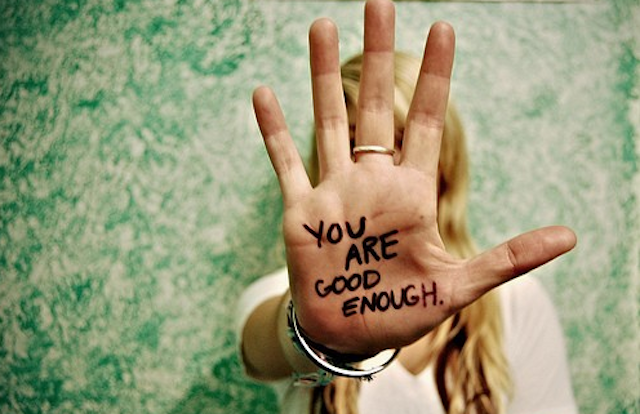
    You Are Good Enough

    “If you concentrate on what you don’t have, you will never, ever have enough.” ~Oprah Winfrey

    Seven years ago I discovered a world of healing, energy, and spirituality. It came at a particularly hard time in my life. Everything that could go wrong seemed to have.

    First, I picked up a bug while travelling, which left me unable to hold down food for over eight weeks, and doctors told me there was nothing more they could do.

    Then, there were secondary infections, which I learned I might have to live with for life.

    I was being bullied at work and then walked away from my friends. Both of these experiences were extremely stressful and a great source of pain. Then, two weeks after moving to a new country to start afresh, one of my best friends died suddenly.

    The first twenty-five carefree years of my life exploded in my face, and confusion set in.

    In a desperate quest to find answers, happiness, and peace again I went searching, and what an awesome world I found!

    It started with discovering kinesiology and developed into a learning of healing foods, chakras, and energy healing. Yoga and meditation followed, along with personal development seminars and stacks of self-development books.

    And all for a good reason—each of these disciplines was quite literally changing my life.

    One by one, they helped me unravel subconscious layers from the past and release old stagnant energy, emotions, and beliefs that were no longer needed.

    For example, if I felt angry and frustrated from work, I would pop in for a kinesiology session and walk away upbeat and happy. If I got upset after an argument with my husband, I’d run off to heal the part of me that was causing this to arise, and skip home loving and free.

    To say these quick fixes became addictive would be an understatement.

    Then, over the last year I kept getting the same lines repeated to me over and over again. Healers telling me my work with them “was done,” my kinesiologist telling me I’d “got it” a while ago now, and friends reflecting left, right, and center that “I’m there.”

    The problem was that I could not see it. Surely there is no final destination, and besides, there were still so many things to fix. I didn’t feel “there.”

    My addiction to fixing myself had kicked in. Even though I know we are all human and will never be perfect, I felt the need to keep on clearing as much of the imperfect away until I got “there.”

    But “there” was not coming, at least not in my eyes, and frustration started building. I believe this addiction formed due to a deeply hidden belief that I was not fundamentally good enough.

    I thought that if I healed enough, sooner or later I would be “fixed.” I would be good enough—but I was missing the truth, the truth that we are always good enough exactly as we are.

    We will all encounter lessons as we walk through life and, of course, healing can help us move through these, but fundamentally, we are always already good enough. This part I was slow to grasp.

    Along this journey I had walked away from a career in advertising to follow my passion for nutrition, leveraging all I had learned to become a coach. What I didn’t see coming was the second cousin to “healing” and the old pattern formed under the guise of “business development.”

    All of a sudden I would never be a success unless I had mastered a zillion courses on marketing, sales, coaching, webinars, and list building.

    No matter what I did I couldn’t hold on to the money I was making—so I looped back into the healing world looking for answers to my money blocks.

    Then came the clincher: My income dramatically increased—and, you guessed it, I still spent every cent each month on the next skill I needed to learn or block I needed to clear.

    At the same time I noticed I was getting angry with healers and “experts,” as they repeatedly told me what I already knew.

    Something wasn’t adding up any longer. Luckily, the person I turned to for advice supported me to process the most amazing realization for myself:

    I discovered that I had been through an intense period of learning, that over the last seven years I had been absorbing “universe lessons.”

    It was time to step out of the Universe-ity classroom and start truly living all that I had learned. And with so much knowledge under my belt, it was also time to pass it on to others.

    It’s not that we will ever stop learning—it’s just that we have to start using the tools in our everyday lives, as opposed to conducting an ongoing search to fix ourselves.

    Through my journey, I have learned that it is common for us to get these lessons in the spiritual realm, but not bring them to life in the physical world.

    At some stage along the path I had started focusing on what was still “broken” instead of how amazing things had become.

    I was so blinded by this thought pattern that I was unable to receive the joy and pleasure already surrounding me.

    By shifting from the energy of “not enough yet” to realizing I already am, I’ve found the peace to step forward and apply all that I’ve learned, and inspire others to do the same.

    I now know that I am already so much more than “enough,” and it’s now time to graduate from Universe-ity!

    So I invite you to check in on your own motive for healing. Are you desperately trying to fix a part of you that you deem wrong, shameful, or bad? Or, can you accept that you are already perfect exactly as you are now, shadow and all, even if you still have room to grow?

    Are you ready to relax and let your journey unfold exactly as it is supposed to?

    Photo here

  • Developing Self-Compassion When You Don’t Think You’re Enough

    Developing Self-Compassion When You Don’t Think You’re Enough

    sad face

    “He who knows that enough is enough will always have enough.” ~Lao Tzu

    I’m at war with enoughness.

    My stomach isn’t flat enough; I’m not extroverted enough; I don’t have enough money in my wallet; I’m not creative enough; I’m not getting enough work done.

    There are times when the Jaws of Life cannot free me from my expectations and negative self-talk. The battle with enoughness is a vicious cycle. 

    Here’s an example: I’m both shy and introverted, so I’m afraid of being judged and I prefer quiet environments.

    I was easily overlooked in school because I was reluctant to participate verbally in class.

    During work meetings my ideas were mere whispers compared to the loud shouts from some of my extroverted coworkers.

    Because I prefer staying home on Friday nights, my peers often ask me, “What’s wrong?”

    I’ve convinced myself that something must be wrong with me, so when I have the opportunity to do something social, I either don’t go or I walk into the situation feeling self-conscious and inadequate. 

    Both of these choices fuel criticism. “See, I told you so,” my inner critic says. “You really aren’t enough!”

    The Merriam-Webster Dictionary defines enough as “occurring in such quantity, quality, or scope as to fully meet demands, needs, or expectations.”

    When I criticize myself for not being enough or having enough, whose expectations am I trying to meet?

    It’s too easy to point my finger at society—the society that favors those with the loudest voices; equates self-worth with “what I do for a living;” and glamorizes infidelity, drug abuse, and teenage pregnancy. We’re all affected by the society we live in, there’s no question about it.

    With that said, we have to take full responsibility for our lives, and that includes tending to our own impossible expectations. 

    In the words of Mary Oliver, “You must not ever stop being whimsical. And you must not, ever, give anyone else the responsibility for your life.”

    I have good news and I have bad news. Here’s the bad news: No one is coming to save you from your negative self-talk (addiction, abusive relationship, or draining job).

    And the good news? Facing the truth that you’re responsible for your life is incredibly liberating.

    This truth has motivated me to start treating myself better. If you’re anything like me, you’re your own worst enemy, so we could all use a bit more TLC.  Reclaim your self-compassion with the following three steps.

    1. Open your journal and draw a line down the center of the page. 

    For one day, record your self-talk in the left column. Then read over everything you wrote down.

    How many negative things did you tell yourself? How many positive things did you tell yourself? What issues were you especially negative about (for example, body image)?

    The point here is to become more aware of your thoughts. In the right column, write a positive thought next to each negative thought. When you read over the positive list, let the truth of how wonderful and lovable and beautiful you are sink in.

    2. Set realistic goals for yourself. 

    All too often, fueled by our impossible expectations, we set unattainable goals.

    For example, I worked for an English-language newspaper in Germany, and when I went to my first meeting I wanted everyone to like me.

    I had the same goal during the second meeting and all the meetings that followed, so I was hypersensitive to even the tiniest bit of criticism. I continued to be let down, which gave me more reason to criticize myself.

    Be my authentic self during the meetings—now this is a more realistic goal. That way, if my coworker said he didn’t like one of my ideas, for instance, I wouldn’t have taken it as a personal attack.

    3. Every day write down at least one thing (or five things!) you’re grateful for. 

    Remember the children’s book Alexander and the Terrible, Horrible, No Good, Very Bad Day? Just like Alexander, we’ll have days when everything goes wrong. And that’s okay.

    When you sleep through your alarm clock, your computer crashes and you lose your report, and your date cancels at the last minute, be mindful of the simple things: a hot shower, clean socks, or your dog greeting you at the door.

    Shifting your focus from what you don’t have to what you do have will boost your well-being.

    Changing the way we perceive ourselves will change the way we perceive others.

    If we tell ourselves we’re unlovable because we don’t have a significant other, what’s going to stop us from thinking our friend is worthless when she tells us that she is getting divorced?

    Recently during a yoga class, my teacher said something that made me catch my breath (literally):

    If someone says, “I love you,” it reflects the way she feels about herself; similarly, if someone says, “I hate you,” it reflects the way she feels about herself. I’ve never thought of it this way before, but it makes so much sense!

    Practicing self-compassion is not just for our own benefit; practicing self-compassion also benefits the people around us.

    Photo by Juanedc

  • You are Enough: A Tiny Manual for Being Your True Self

    You Are Enough

    “Waking up to who you are requires letting go of who you imagine yourself to be.” ~Alan Watts

    When I was in third grade, I loved to hang upside down on the monkey bars on the playground of my all-girls school in Philadelphia.

    I would lock my little pale knees over the gray steel rods and then carefully let my hands go to swing upside down, like a pendulum in a pleated skirt.

    This meant I had to bravely trust that my normally feeble strength would be sufficient to suspend me.

    It was always a victorious feeling when the backs of my knees started to burn. This meant it was time to carefully return to earth on own my terms.

    Alix – 1, Gravity – 0!

    One day, a clump of dead grass attached itself to the sole of my Stride Rite. As I was flipping off the bars, it dropped into my mouth. I hit the ground gagging and spewing, completely grossed out.

    Doubled-over and hacking out the grass was not a little noisy. I made quite the scene; however, it failed to attract the attention of my teachers.

    They didn’t rush to my side to see why I was, for all intents and purposes, throwing up.

    “Throwing up” was a golden ticket to go home from school and I wanted to cash in.

    This is because I spent the first third of my life believing that in order to be validated, something needed to be physically wrong with me.

    The only attention I felt worthy of was sympathy. I thought ailments made me interesting.

    I was the kid who wanted a sprained ankle so I could get crutches. Do you know what the attention-getting street value of crutches is in kid world? It’s like friggin’ crack!

    And a broken leg? Think of the signatures!

    I wanted poison ivy so I could have bandages, “to keep from scratching.”

    The concerned questions were like gold: “Oh no! Are you okay?”

    I wasn’t going to let the fact that I am not allergic to poison ivy stop me from tapping into this potential cache of boo-boo love.

    One summer evening with the aid of red and orange magic markers, I drew a mock rash on my arm.

    Then I test-drove it with my family, who didn’t buy it. Thankfully, this ridiculous bit never made it out of R&D.

    To be clear, I got plenty of positive reinforcement at home. I was supported from dawn ‘til dusk by my loving family, for which I am intensely grateful. But I never felt like it really counted. In my kid’s mind, I reasoned that they had signed on to love me, and were biased.

    Plus, I was just one of those souls who required validation from the outside world.

    I felt that once I left the confines of my nest, that unless I was limping or retching, I was otherwise invisible. I needed to be a victim of something in order to matter.

    That day on the playground when my teachers ignored my blatant—and legitimate!—dead grass upset, I felt even more unseen which I didn’t even think was possible.

    Aren’t these paid-professional grown-ups supposed to acknowledge me when I’m in distress?

    Since I no doubt possessed a Chicken Little-esque flair for drama, they had probably grown immune to my antics by this juncture.

    I would cling to any and all ideas of pain in order to get the symp-attention that I craved.

    When I look back at this period in my childhood I just have to laugh at myself. Not only was I highly theatrical, but my level of insecurity was semie-staggering.

    Clearly, I did not think I was enough. In fact, it’s taken me the better part of three decades to make peace with the idea that I am not only enough, but that I am exactly who I am supposed to be.

    Growing up in the seventies and eighties I had all of these notions, largely fed by TV, pop culture, and my peers, about who I was supposed to be:

    The Breck Girl, a Charlie’s Angel, Wonder Woman (but I’d be happy to be Lynda Carter), and a career-bound (not a stay-at-home) Barbie.

    As I matured into my teens, I began to shed this billboard perception about life.

    My head was turned less by action-hero ladies with perfect hair and more by, well, if I’m being completely honest, cute boys who listened to the “right” music and wore Polo cologne.

    Now eager for their approval, I shaped myself into who I thought they wanted me to be: The girl in The Smiths’ “How Soon Is Now?” video.

    This only got me so far.

    When I graduated from high school, I moved to New York to model for a large agency. This was a dream come true.

    Before long, I was trying to figure out who the modeling industry wanted me to be: Edgy? Sexy? Wholesome? Commercial? Editorial? There were so many options and would never be a clear answer.

    Having looked at my life from the outside in for so many years was a hard habit to break.

    I was like a junkie for other people’s approval, permission, information, and maps.

    I thought everyone except me was issued a handbook about life.

    They seemed to “get it” while I was constantly scrambling to find my place in their world.

    Of course, I was laboring under a massive illusion that I was the only one who felt this way.

    Again, I have to look back and laugh.

    One day during my early twenties, the universe let me look under the hood and I was let in on a cosmic secret: tons of other people feel like they’re living without a manual. Lots of us are winging it, and being a little lost is how we actually come to find ourselves.

    This epiphany was such a relief that I stopped trying to be what I thought others wanted and started getting really good at being me.

    I would love to say that this powerful shift happened overnight, but no.

    The “just being me” remained a nuanced confidence-building process for a few more years (ten?) until I was able fully step into who I am in the world today.

    The wonder of it all—and another cosmic gut-buster—is that the more I align with my whole self, the more the world rushes into to meet me where I am.

    I venture that if there actually were a handbook issued at birth, it might go a little like this:

    1. You are a miracle. Never forget this fact. Just the science alone is mind blowing.

    2. You are unique. No one will ever be as good at being you as you are. Seriously.

    3. You are enough. Always. Never doubt this. There is nothing to add, but feel free to expand.

    4. There is always more to learn, but that is not failure; it’s a gift. It can be fun too.

    5. Every obstacle is an opportunity to fall further into the miracle that is you.

    6. Commit to being the best version of you every day. Recalibrate definition of “best” as needed.

    7. Leave room for others when they fall off the wagon of their own miracle.

    8. Forgive. Forgive. Forgive. Forgive every which way. Forgive him. Forgive her. Forgive you.

    9. Compassion is the key to forgiveness. Compassion means you feel the humanity in others.

    10.The more you forgive, the more you’ll enjoy being you, because the lighter your load will be.

    11. In the end, as in the beginning: You. Are. Amazing.

    Photo by Emilian Robert Vicol

  • Imperfection Is Lovable and You Are Enough

    Imperfection Is Lovable and You Are Enough

    “You’re imperfect, and you’re wired for struggle, but you are worthy of love and belonging.” ~Brene Brown

    We are all perfectly imperfect just as we are.

    Yes, it’s true. Sometimes hard to believe, but always the truth. Believe me.

    I’ve always recognized that I am a perfectionist.

    I was the little girl who wanted to know how to play the piano at my first lesson, how to roller blade the first time I tried, how to do the splits at my first gymnastics class.

    I’ve always wanted to do it right the first time.

    On the one hand, I appreciate my intention to do and be my best at whatever I do, but on the other hand, I see how this mentality has often paralyzed my efforts and prevented me from daring and learning to be brilliant.

    The one practice I’ve committed to in my life, where I’ve been willing to be less than perfect and continue to embrace each day, is yoga.

    The meditative quality, the healing breath, the invigorating movement all resonate with me and remind me to just be where and who I am, in each moment.

    It’s been fifteen years now since I began my yoga practice in an effort to release the tension in my neck that was triggering chronic headaches during my first year studying at UCLA.

    I felt transformed after my very first yoga class and just knew that I would grow and expand with my practice.

    In the beginning, most of my transformation was physical—feeling more relaxed, open, energized, and flexible. In recent years, my practice has guided me to expand my perspective, and I find myself open to understanding life anew.

    I’m discovering new ways of being and of seeing the world.

    Just two months ago I had a revelation.

    I was communicating with a life coach who is an incredible listener, endeavoring to understand why I was constantly feeling challenged in my relationship with my husband. Together, we realized that I was creating the same expectations of perfection for him as I had carried for myself since childhood.

    A memory surfaced: me, around twelve years old, sharing my report card with my father.

    “Why are they not all As?” he questioned unapologetically.

    I glanced at my grades, noticing that I’d earned six A’s and one B+, and said, “I did my best.”

    “I expect all A’s next time,” he firmly instructed.

    “I’ll do better,” I submissively acquiesced.

    And this stuck. The need to do better than my best. The desire to be better than myself. I wanted my father’s approval. I wanted my father’s love. I wanted my father’s attention. And so, I worked even harder and earned a 4.0 GPA each semester.

    But you know what? It was never enough.

    I never felt enough. I never could earn the love and attention that I desperately craved from him. 

    I needed to look within myself.

    Now, some twenty years later, I’m still struggling with my tendency toward perfectionism.

    This insight is life changing: A chance to understand myself better. A reflection of how and why I choose to think and act the way I do. An opportunity to acknowledge that I’ve associated being perfect with being lovable.

    Now, without judgment or criticism for myself or my father, I have the choice to change.

    I can choose to shift my perspective and tell a new story. I choose to embrace a new truth…

    Imperfection is lovable.

    With this knowledge, I see my relationship with myself and with my husband, my children, my family, my friends—with life itself—in a new light.

    We are all imperfect.

    But who wants to be perfect anyway? How boring that would be!

    The most fun is in the growing, in the expansion, in the learning and becoming ever more who we are.

    I release the compulsion to be perfect, to constantly achieve, do more, handle every task on my to-do list immediately.

    I allow myself to be more present, to be in the moment, to remember what matters most: love.

    I can let go of always doing and instead let myself be. I can stop rushing around handling tasks, and allow myself to stop and smell the roses with my daughters, kiss my husband, call a friend, stare in wonder at the beauty of our universe.

    I am worthy of love, I know I belong, I recognize my life has meaning, and I give myself permission to take it easy and just be me.

    I embrace this truth:

    I am good enough. I do enough. I have enough. I work enough. I love enough. I am beautiful enough. I am smart enough.

    I am enough.

    Can you say this to yourself and really mean it? Practice. Notice how it feels.

    With this new perspective, everything blossoms.

    I allow myself to make mistakes without being judgmental.

    I give others space to be imperfect without being critical.

    I allow myself to be me.

    I allow myself to love myself just as I am.

    I allow myself to love others just as they are.

    Whenever I begin to lose focus of this reassuring truth, when I start to feel overwhelmed by all the “shoulds” and judgments in my mind, I sit in stillness in my meditation space.

    I read the words I’ve etched on my chalkboard wall:

    I am enough. Surrender. Live and let live. Imperfection is lovable. Be human.

    Immersed in the sensation of my breath, I choose to focus my mind on these powerful truths. Soon, I relax into the comfort of knowing that all is well. And I begin again the journey of self-love and acceptance.

    I am grateful for being where I am, for all the wisdom and love so many gracious and kind people have shared, and for the powerful practice of yoga that encourages self-awareness and growth.

    I am grateful for the opportunity to recognize the perfection in our imperfection and to use this wisdom to infinitely improve my interactions with the people I love the most.

    Our minds are powerful. Our thoughts are powerful. Our love is powerful.

    Let us choose to focus on the good, appreciate who we are, share our love unconditionally.

    Let us remember that we are enough.

    Let us embrace our value and know we belong.

    Let us always remember that our imperfections are lovable.

    Can you practice loving yourself and others unconditionally today?

    Every beautiful journey and inspiring transformation begins with an intention and moving in the direction of where you hope to be.

    Wishing you ease in loving and freedom to be just who you are.

    Be human. Be perfectly imperfect. Be you. Just be.