Tag: encouragement

  • Tiny Buddha’s 2025 Day-to-Day Calendar Is Now Available for Purchase

    Tiny Buddha’s 2025 Day-to-Day Calendar Is Now Available for Purchase

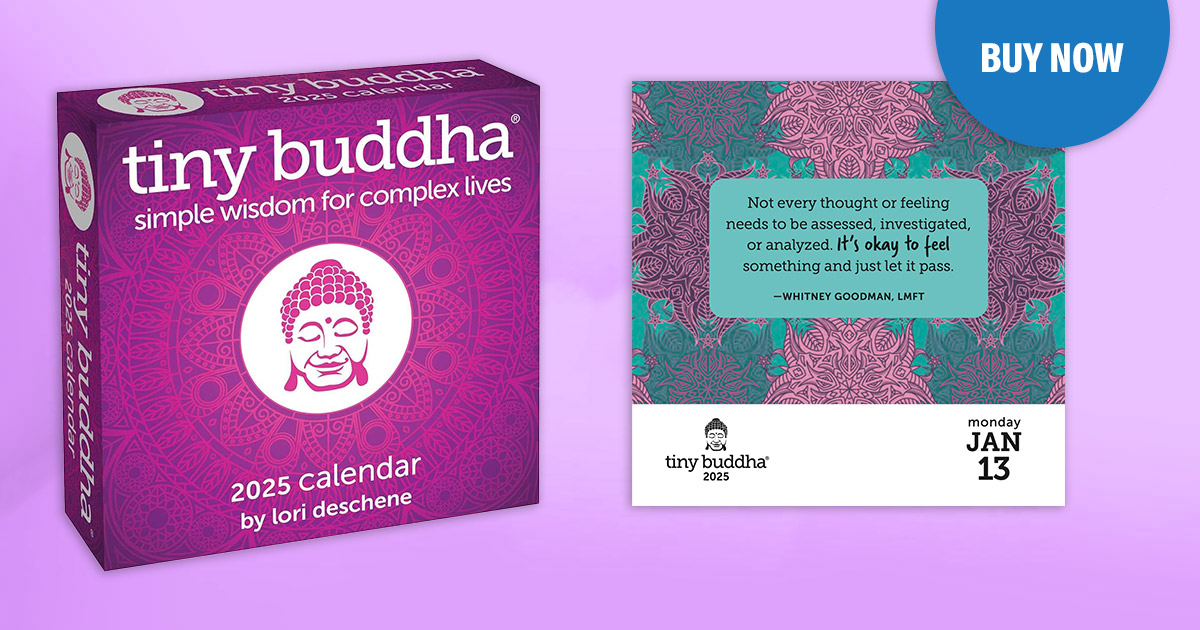
    Hi friends! I’m excited to share that the 2025 Tiny Buddha Day-to-Day Calendar is now available for purchase!

    Uplifting and healing, this calendar offers daily reflections from me, Tiny Buddha contributors, and other authors whose quotes have inspired and encouraged me.

    Featuring colorful, patterned tear-off pages, the calendar is printed on FSC certified paper with soy-based ink. Topics include happiness, love, relationships, change, meaning, mindfulness, self-care, letting go, and more.

    Here’s what Amazon reviewers had to say about the 2024 calendar:

    “I love how the quotes are diverse and relevant, offering something for everyone regardless of where they are on their personal journey. It’s a wonderful way to start each day with a positive mindset and a reminder to live in the present moment.”

    “I used the 2023 calendar and absolutely loved it! The 2024 is turning out to be just as great! So many wonderful quotes, and the decorative paper makes them easy to cut off the date and save for display or give to people the quotes make me think of. Wonderful daily calendar!”

    “I have been buying these calendars for years. I buy one for each of my siblings. The calendar has a lot of great quotes and encouraging messages. I have been going through some difficult times and I look forward to reading this every day and finding ways to apply the message to my life.”

    “Every single day is something that inspires me and helps me along my journey of healthier living. I will buy again and again—absolutely a wonderful addition to my day!!”

    “This is one of the very best page-a-day calendars that I have ever purchased. Each day offers a meaningful paragraph that really provokes some deep thought. I totally love this purchase and would definitely recommend it.”

    Stay inspired, motivated, and encouraged through the year ahead—grab your copy here!

  • If You Really Want to Change the World: 4 Ways to Be Kind

    If You Really Want to Change the World: 4 Ways to Be Kind

    “I’ve learned that people will forget what you said, people will forget what you did, but people will never forget how you made them feel.” ~Maya Angelou

    I’ve now reached the age in my life when every so often, I get an email or text informing me that someone I know has died. Some of the people who have passed away have been former supervisors or teachers from high school. Others have been the parents of friends or elderly members of my church.

    At one time, the news that someone had died was shocking to me. Now it’s nearly a monthly occurrence, and I’ve become accustomed to it.

    Whenever I receive one of these texts or emails, I always go in search of the obituary. This may sound macabre, but I love a good obituary. I like to learn what people chose to do with this one life that they were given. I particularly like the obituaries in which you get a sense of who the person was. Aside from their accomplishments, what was that person really like?

    Because the reality is that your accomplishments aren’t what will have mattered most about your life.  Instead, what matters about your life is how you made people feel, as so aptly put by Maya Angelou. Another way of putting it is this: Were you kind to others?

    Why does kindness matter so much? Because kindness is the only real way to change the world for the better. For example, I can give you $20, and you can use that to buy one meal. Certainly, that is a nice gesture.

    But what if I encourage you? What if I take the time to specifically identify your gifts and talents? What if I explain to you that you have the ability to do great things with your life? Then my kindness potentially has changed your life.

    Kindness is powerful. In fact, being kind is the most important thing that we do in life.

    Below are ways to start incorporating kindness into your daily life. If you make kind acts part of your daily routine, you’ll end up being someone who changes the world in the most beautiful way.

    To Be Kind, Be an Encourager

    We live in a very critical world. Sadly, people are quick to criticize, and they are reluctant to offer praise. Given the harshness of our world, it’s no small wonder that so many people lack confidence in themselves.

    Kind people are our only hope to fight the world’s negativity. That is because kind people encourage others. They are the type of people who go out of their way to comment when someone does something well. And they readily point out others’ gifts and talents.

    But realize that encouraging others is something that we have to intentionally choose to do. For example, often a complimentary thought will float through my head. “Her hair looks great today.” Or “That was a terrific presentation.” But unless I catch myself, that idea will float out of my head just as quickly as it floated in! As a result, I try to make an effort to say those complimentary thoughts out loud whenever I can.

    Realize that being an encourager has to be a conscious choice. Otherwise, those complimentary thoughts will just stay inside our brains. And the other person won’t benefit from those precious words of encouragement.

    So choose to be kind by choosing complimenting over criticizing. Build others up instead of tearing them down. If you do, you’ll make the world a far more pleasant place to be for everyone.

    Be Helpful in the “Right” Way

    Most of us strive to be helpful. After all, that is what good people do—we help others! But the problem is that so often we help others in the wrong way.

    For example, I learned many years ago that to be a good mother, I had to help my daughter in the ways that she wanted help.

    The issue came to the fore one day when her room was messy. I thought I would help her out by tidying it up. Later that day, she returned home from school and wanted help with her homework. However, by that point, I felt worn out because I’d already cleaned up her room. She then said to me, “But Mom, I can clean up my own room. I didn’t ask you to do that for me. What I need help with is my homework.”

    She was right. That moment was a turning point for me. I tend to think that I know what is best for everyone! But after that experience, I came to realize that even if I think I know best, I need to help others in the ways that they want help.

    Because if you help people in the way that you think is best for them, you aren’t respecting them. You effectively are saying, “I know better than you what you really need.” And that attitude diminishes people.

    So part of being kind to others is helping them in a respectful manner. If you want to want to help someone (or give them a gift), find out what that person wants. You aren’t being truly kind and helpful if you simply help them in a paternalistic fashion in which you convey that you know best. Instead, be kind by helping others in the right way.

    To be Kind, Choose Compassion Over Judgment

    Unfortunately, it’s human nature to judge others. After all, how often do we walk by a homeless person and think, “That person needs to get a job!” Or we may have a family member with an alcohol addiction, and we’ll say, “For heaven’s sake, just stop drinking! Pull your life together.” Or we may have a child who is failing math, and we’ll tell the child, “These bad grades are your fault. You need to study more and stop goofing off.”

    But being kind means offering compassion, even when it is oh so easy to judge. I find that the best way to avoid the “judgment trap” is to say this to myself on a regular basis: “But for the grace of God go I.”

    What that means is that some of us get lucky in life. We may have been blessed with a stable upbringing, or with good genetics. Or we may have been born with a gender, skin color, or nationality (or all three!) that simply makes our lives a lot easier than other people’s lives.

    Given that some folks are just dealt a better hand in life than others, it makes sense that we should interact with people who are struggling by coming to them from a place of compassion rather than judgment. Our attitude should be “I’m so sorry that you are suffering. Let’s figure out a way to fix this situation.”

    I’ll concede that it is frustrating when people make big mistakes that negatively affect our lives and the lives of others. Nevertheless, be kind. Remember that to be kind means to be compassionate, even when it is so much easier to judge.

    Value Kindness Over Being Right

    Years ago, I hosted a family gathering in which there was a heated argument about politics. Angry words were said. People insulted each other. And everyone left the gathering feeling terrible.

    What was particularly stupid about the whole thing was that the argument was pointless. Not one of us worked in politics. And not one of us had any sway over politics outside of our one vote in each election. So we didn’t change the world by arguing. We simply damaged our relationships with each other.

    I’ve had a similar experience when it comes to discussions about other hot button topics, like religion. For instance, I happen to go to church. Now, I never try to inflict my religious views on anyone. Rather, I consider religion to be a deeply personal matter.

    Yet, every so often, I’ll receive a snide, insulting remark about my religious faith from people who are atheists or agnostics. I choose not to argue back when I hear those remarks, but I always think to myself, “What was the point of that remark? How did that remark make the world a better place?”

    Realize that problems arise when we are more concerned about being right than we are about being kind. Of course, there are times when we need to voice our concerns. For instance, we should always speak up when we see someone being treated unjustly. But that is different from demanding that others see the world in the exactly same way that we do.

    To treat others with kindness, we have to be willing to agree to disagree. We can’t bully others into our point of view. Instead, we have to value being kind over being right.

    If you really want to change the world, the simplest thing you can do is be kind. Be kind consistently. Strive to be kind, even when you don’t feel like it. Be kind because it is the easiest thing that you can do to make the world a better place.

  • My Second Mother: When Someone Steps Up Like Family Never Did

    My Second Mother: When Someone Steps Up Like Family Never Did

    We are all blessed with two birth parents, and if we are lucky one or two of those are positive role models and on board for at least some portion of our lives. If we are really lucky, we may have the good fortune to score another mom or dad figure, someone who appears virtually out of nowhere, as fate or serendipity might have it, and takes us under their propitious wing.

    Such a thing happened to me in the form of a bright, spunky, and emotionally generous woman named Joanie Arnesty, who helped me through the veil of darkness that infiltrated every corner of my being.

    As a child of a German-Jewish Holocaust survivor, my mother’s past of suffering and trauma filled my own life with perpetual sadness, which I found difficult to eviscerate.

    There was scant laughter in our house and constant retellings of what my maternal family had gone through in World War II and how many of them had perished in the Shoah. I yearned for the happy childhood I intuitively felt was my birthright but which evaded me because the spectre of war filled up our entire home.

    Although grateful for my parents, I felt the emotional burden of my mother’s scarred and tattered life to ultimately be too much, and I fled at age nineteen to a coastal California town to begin a college life. I was excited by the prospect of sand and sea at my doorstep and new stories and events that had nothing to do with the Holocaust, which had stolen so much from us.

    Throughout my adulthood I wondered why I had not been given a happy family and a childhood that was punctuated with cheery memories.

    In every photo that was taken of me by my Polish father—who had hoped to become a photographer but instead found himself bitterly working in low-paying factory jobs, never with anyone who appreciated his creative intelligence—I look depressed and off-kilter, as if the vagaries of life have already turned me to the dark side.

    My mother has piled my auburn-colored ringlets high atop my head, in some vague European-influenced do, and I am wearing clothes that are old beyond my years, somber and unflattering, out of step with the fashion of the day.

    In those pictures it looks as if I am always on the brink of tears, under the impress of her reminders that I should not be pouting, or acting “beleidig” (the German word for angry), and should be grateful for my very life when so many had died during World War II. 

    When I was finally able to leave the house of despair that was my family, I felt I had been given a second chance at life, although throwing off the yoke of depression would be a battle I’d fight my entire existence. It still pulls at me with its relentless and intractable force, not stayed or mitigated by a battery of allegedly efficacious anti-anxiety/anti-depressant meds in conjunction with weekly psychotherapy.

    When I look back the years often blur, although I seem to remember with some affection those when I lived in the world of academia.

    I made my way through undergraduate school, a year of graduate school, and finally three years of law school. Not in any of those venues did I ever meet anyone whose parents were Holocaust survivors or who seemed to live daily with the scourge of the remembrances attached to that horrific event.

    I had long ago learned to blend in, to shed the apparent manifestations of an inherited life where pain, not pleasure, always predominated. I chose as my companions those who laughed easily and often, who absorbed the impostor that I always felt I was without any real resistance.

    In my thirties, then settled in Berkeley, California, and working in the legal field, I met someone who would change the architectonics of my life and the notions of family, from the fragmented moorings of a biological one to a new definition of what benefits an intentional family might confer.  

    Joanie Arnesty entered my life, encountered at some now forgotten community event, and became the mother I had always hoped for, full of effusion and contagious laughter and shining hopes.

    The first time we met I recall her saying “Such a beautiful girl you are! That hair! People would die to have that glorious mane of hair. And a law degree? Beautiful and smart! Well, that’s the icing on the cake!”

    Compliments were not the tender my parents traded in, and I yearned inveterately to hear a good word thrown in my direction. With my own son, I have emphasized the importance of being around what I call “encouragers”—those who not only give you emotional support but do it with a fiery and unrelenting vengeance. These are the folks who throw fairy dust on any situation, and you emerge wiser and better.

    Joanie, who was my mom’s age, was the physical embodiment of the epiphany I needed and became the female parent who helped me navigate the sudden storms and vicissitudes of life and celebrate the good times. 

    The turbulences of her own life seemed to have borne no apparent adverse impacts upon her. The product of an out-of-wedlock pregnancy, she lost her own mother, a Jewish woman who worked as a nurse and got involved with a married Irish Catholic man named John Brown, around five years old.

    Raised by her mother’s sister, she inherited her father’s red hair and storied charm and wit but never met or even saw a photo of him.

    After high school, she married a man who, in quick succession, gave her three brilliant daughters, but there were black eyes and beatings, which finally caused her to run with just the clothes on her back and the three children in tow.

    When I think of Joanie, I remember the name of a film, The Unsinkable Molly Brown, which turned out to be a perfect descriptor of her. A single parent, she raised three girls, with never a male in the picture, all embodying her own unshakeable confidence and optimism.

    She watched them eventually attain professional identities, as an optometrist, pediatrician, and university professor. During their childhood she held numerous jobs and worked as a seamstress, baker, cook, and babysitter and lived a lean but happy life, never dwelling on her own misfortunes, which were incontrovertibly substantial.

    As our friendship grew from a chance meeting, I grew comfortable in sharing insecurities and what it meant to have never felt comfortable in the family I was born into.

    When I told my own mother one day that I wanted to be a writer, she yelled at me in German that this was “a stupid idea” and added “you have a lot of those.” I never forgave her for that outburst, and I still feel the sting of what it means to be deeply and disinterestedly misunderstood. 

    I shared my mother’s words one time with Joanie, and this woman, who admittedly was not book-smart and tutored, said energetically to me, “The meaning of life is to find your gift. The purpose of life is to give it away. Pablo Picasso said that. I saw it in a magazine and I cut the words out and put them on the refrigerator.”

    And there they were on her old General Electric fridge, with magnets on each end, their wisdom illuminated in the midst of Safeway coupons and doctors’ business cards.

    “You need to have faith in yourself and to follow your dream. You are a great writer, but you need to first and foremost believe that yourself.”

    I have many failings but do not number among them the inability to listen closely.

    The reality is that we may not have parents that are a good or appropriate match for us, but it is within our power to seek out those who can fulfill these roles. I consciously chose Joanie as a second mother, who encouraged me to feel that I was good and able enough and deserved the fruits of a celebratory life.

    In time she introduced me to my husband, saw me through a difficult pregnancy, and threw a large and amazing baby shower, replete with a ton of baked dishes and desserts, scratch-made by her.

    She seemed able to put her unique and affectionate brand on everything. She loved and worried over my son, who was born with congestive heart failure and an array of other medical conditions.

    She once said to me “you’re my fourth daughter,” and my eyes filled with tears. She was always at my side, bouncy and ebullient, helping to lift me emotionally when I so often foundered.

    My own mother, 800 miles away in Los Angeles, issued regular rebukes and continued her criticism, saying that I had ruined my life, remaining emotionally distant and mired in depression after my father’s passing.

    She could never see my life because hers was always in the way. It was as if she had no happiness to give anyone, including herself, and the role of a biological parent disappeared into the background.

    What I have taken from my own story is this: We don’t all have parents who can offer us the love and encouragement we need, but we can all search for a parent or a mentor to fill in the spaces where support is lacking. It’s not always easy to find a person who can fill that role, but there are lots of good people out there with love to give. We just need to open our eyes and hearts to find them.

    In my case, I required encouragement and someone who was willing to listen closely. I needed laughter because there seemed so little of it in my own familial background.

    I remember seeing another quote on Joanie’s refrigerator that stood out, remarkable because it really captured the essence of who she was. I wrote it down on a yellow post-it and have it to this day:

    “Nothing is worth more than laughter. It is a strength to laugh and to abandon oneself, to be light.”

    The author was Frida Kahlo, a Mexican artist who I was not familiar with at that time. Joanie taught me the importance of rising above what could be the oppressive weight of life, of laughing often and out loud, and embracing a path of positivity.

    The photo of my son and I on her desk shows us both smiling, seemingly recovered from our battles— mine of a life filled with emotional turbulence and his of a successful fight with a life-endangering condition.

    Years later, when I moved to central California, I wrote her a letter and told her that I was writing again, that I had returned to what I characterized as being a “wordsmith.” A week later I received a beautiful card and opened it to see the words imprinted in a careful and deliberate hand: “Always be yourself.  And be grateful for your gift and the ability to share it.”

    I do not know that I am a good writer or that any critical commentary will make such a determination.  But I do know that having a second mother, who stepped in time with me like some ineffable Mary Poppins character, made a difference. Her enthusiasm and encouragement restored to me the idea of what a family who embraces you really feels like.

    In the end it is not the biological bonds that necessarily provide succor and strength and understanding—there are other mothers and fathers to be found, intentionally or not, that can provide those qualities as well.   

    Here is to all the Joanie Arnestys in the world that have rescued the people whose families were emotionally missing in action and gave us the hope to soldier on and create new networks of families to lean into.

    Anf if you haven’t found your own Joanie yet, here’s to you for moving through this sometimes challenging life without the love and support you’ve always deserved.

  • The Joy of Unexpected Kindness and 3 Reasons It’s Hard to Be Kind

    The Joy of Unexpected Kindness and 3 Reasons It’s Hard to Be Kind

    “Small acts, when multiplied by millions of people, can transform the world.” ~Howard Zinn 

    Have you ever experienced an unexpected act of kindness that completely changed your day?

    I have, and I sincerely hope you have too.

    Please pause for a moment and try to remember the last time that happened. How were you feeling before? What happened? And how did the act of kindness impact you?

    If I look back on my own life, I can find countless moments where the suddenness, the unexpectedness of an act of kindness, shook me awake.

    It might sound strange, but this seems to have been especially so when it came from a stranger.

    That’s not to say that the kindness of those close to us isn’t important, because it is. The kindness of our friends, family, and colleagues can keep us going when life throws challenges in our way, and their joy in our happiness makes the good moments radiate even stronger.

    But there is something about an act of kindness from an unexpected source that causes its healing ripples to be especially powerful.

    And most of the time this isn’t some great or inspiring act but just a very small gesture: a smile, a friendly greeting, a sincere question, a few words from someone who genuinely seems to wish you a good day.

    I remember the first time I went backpacking, feeling lost in a city, staring at my map, when a random stranger offered me his help in pointing out the way.

    I remember feeling tired and lost in thought after a long drive, stopping for gas and a quick bite, and the man working behind the counter at the restaurant clearing my mind with the pleasure he took in his work, smiling with a disarming friendliness.

    I remember sitting in a train in Thailand for fourteen hours, anxiously moving toward my first month-long meditation retreat, and suddenly getting a few genuine words of encouragement and advice from a pair sitting across the aisle.

    I remember a woman sitting in her car, rolling down her window to share her joy in seeing my son race down a hill on his bike.

    I remember yesterday, when the cook at our canteen advised me on what to choose, doing her best to prepare my dish with full attention and then sincerely wishing me a good day.

    In all these situations I was not only left with a feeling of joy, but also a sense of connection.

    Kindness can bring a short moment of relaxation in an otherwise busy day, or a complete change from feeling stressed and chagrined to feeling elated, open, and interconnected with the world.

    Kindness is just that powerful.

    And the beautiful thing is that we all have the chance, every single day, to contribute to this kindness in the world.

    So, again, pause for a moment and this time think about the last time when you were the kind stranger. When was that? How did it make you feel?

    To start with the second question, my guess would be that it made you feel good. The first question might be more difficult to answer. Looking at myself, although I would love to say “today,” that just isn’t true.

    Interesting, isn’t it.

    So, kindness is very powerful and important, it helps us and others, it doesn’t cost us anything, yet it still is difficult to give every day.

    I can think of many reasons why it is difficult, but to keep it simple I’ll list three:

    1. You can only give what you have.

    If you want to give somebody money, you must first have money in your bank account. If you want to give kindness, you must first practice being kind to yourself.

    That is why, for example, Buddhist meditation on loving-kindness (mettā) begins by giving loving-kindness to yourself, and only then to others.

    But don’t worry, you don’t have to spend hours each day meditating; just start with a few minutes every morning (or any other time that fits your schedule) by wishing yourself and those close to you happiness and health. Then try to act on this throughout the day by honoring your needs and prioritizing things that bring you peace and joy.

    It’s okay to wish yourself happiness; it’s not selfish. If you are happy you will be able to radiate that happiness outward, making spontaneous acts of kindness easier to do.

    As your ability to do so strengthens, you can always add a few minutes to wish the same to people you know but about whom you do not have a specific feeling, or a neutral feeling. If that gets easier and easier you can even start adding people you dislike, strengthening the power of your kindness further and further.

    2. You have to see the other person.

    If you are anything like me, then you probably live most of your life in a form of zombie state. Moving from place to place, working, talking, acting on what’s happening, checking your smartphone way too often, all without any form of true consciousness or mindfulness.

    You can do the following test to check this for yourself.

    At the end of the day, look into the mirror and ask yourself how often that day you truly noticed how and what you were doing. That’s all.

    Chances are the honest conclusion will be that you just rushed through the day (again).

    If you don’t notice how you are during the day, if you are not mindful of your own state of mind, if you do not see yourself, then how can you truly see another person?

    It all comes down to how much conscious space we have—how open our mind is toward ourselves and those around us.

    Consciousness tends to expand when we harbor wholesome qualities such as patience, energy, calm, and so on, and it tends to narrow when we harbor unwholesome qualities such as anger, desire, envy, and so on.

    Fundamentally, these mental qualities depend strongly on mindfulness, on our ability to see our mind for what it is.

    If you let a goat loose in a field of grass it will just do whatever it pleases and eat wherever it pleases. If you tie the goat to a pole, the goat will only eat the grass within the circumference of the rope and pole.

    Mindfulness is like the rope that binds our mind to ourselves, keeping it within. Keeping the mind within prevents it from creating all kinds of illusions and personal realities that cause the unwholesome aspects of your mind to arise.

    Keeping the mind within helps bring calm and contentment.

    To strengthen your mindfulness, you do not necessarily have to sit down on a meditation cushion as is often suggested. Mindfulness is something you can practice every day, whatever you are doing.

    Just pick a few routines you do every day and cultivate the intention to do them as mindfully as possible. Do only what you are doing, with all your attention, and if you find your mind drifting off bring it back to your task.

    The more you practice this, the more it will become an ingrained aspect of your mind, bringing with it the experience of calm and openness—and the better you’ll be able to really see other people and recognize opportunities for kindness,

    3. You have to practice regularly and be patient with yourself.

    In the end, kindness isn’t different from other skills. Every human possesses the potential to be kind, but you have to practice it in order to bring that potential to fruition.

    Research by the University of Wisconsin showed that compassion can be learned. Just like a muscle can be trained by weightlifting, people can build up their compassion.

    The most direct route I know of is training through meditation—by practicing loving-kindness meditation and the practice of being mindful, as mentioned about, even if it is only for a few minutes every day.

    But don’t go at it with the businessman’s approach most of us grew up with. A businessman’s approach means expecting results relative to the time you invest. Developing the mind, developing kindness, doesn’t work that way.

    We all have our own personal qualities and hindrances, and just as with other skills, to some it comes natural, while others need more time and effort.

    Don’t worry too much about the results; getting on the path to becoming a kinder person is the most important thing. If you keep practicing patiently you will develop the power of kindness within yourself sooner or later. And it will become second nature to offer those small gestures of support, appreciation, and encouragement that can completely change someone’s day.

  • How I Stopped Dismissing Praise and Started Believing Compliments

    How I Stopped Dismissing Praise and Started Believing Compliments

    “I’ve met people who are embattled and dismissive, but when you get to know them, you find that they’re vulnerable—that hauteur or standoffishness is because they’re pedaling furiously underneath.” ~Matthew Macfadyen

    It was impossible to miss the dismissive hand gesture and distasteful look on her face in response to my comment.

    “You ooze empathy,” I had said in all sincerity to my therapist.

    “And what’s it like if I blow off or disregard that compliment?” she countered. Then, as usual, she waited.

    “Ah, it feels terrible,” I sputtered as the lights of insight began to flicker. I was acutely aware of an unpleasant feeling spreading throughout my chest and stomach. I sensed I had just deeply hurt someone’s feelings.

    That experience hung in the air for several moments, providing plenty of time to push the boundaries of awareness.

    Was I really so unaware and quick to disregard compliments? Was that the terrible feeling others experienced when I didn’t acknowledge or subconsciously snubbed what they offered in the way of a compliment or kind word? Was that what it felt like to be on the receiving end of dismissiveness?

    Leaving that session, I began the usual reflection of mulling over all that had transpired and the feedback I’d received. Growing up with minimal encouragement, I was beginning to see it was taking an enormous amount of time for me to recognize that compliments from others were genuine. I tended to be skeptical and often did not actually hear them.

    I hadn’t realized compliments could be accepted at face value and didn’t always come laden with hidden agendas and ulterior motives. I hadn’t thought that compliments were given as a result of merely wanting to offer appreciation. Something great was noticed—something great was acknowledged. Period.

    So where did such a suspicious nature come from?

    As a kid, I didn’t readily trust the motive behind a well-spoken piece of praise, as it often was a double-edged sword for me. I’d receive a compliment from my mom, but it quickly turned into a way for her to talk about how wonderful she was and how the great parts of her trumped mine by leaps and bounds.

    I recall an experience when I was feeling great about interacting with student leaders. I started to share my feeling of pride with my mom and got out a few sentences before she interrupted.  The topic changed to the ways she worked with her students and influenced them. The message I had internalized: sharing doesn’t mean you will receive validation or compliments for what you share.

    After excelling academically, my dad dismissed my master’s degree as “Mickey Mouse garbage.” He rarely acknowledged positive experiences with more than a, “Hmmmmm” or “Oh.” The message I had internalized: sharing doesn’t mean there’s and understanding or appreciation for what you share.

    Without a lot of experiences that offered encouragement, acceptance, or recognition, I lacked a backdrop on which to deal with compliments. My strengths and talents were unacknowledged, and I hadn’t learn to appreciate them. I tended to mistrust sincerity and downplayed positive input.

    With the assistance of an attuned therapist, I started on a journey of learning to trust what was offered to me rather than dismissing it. With a delicate offering of insight, I was able to repair my automatic deflect button and understand others were genuinely recognizing and affirming my strengths when they offered compliments.

    Here are several ways that helped me repair dismissiveness after I became much more aware of my tendency to deflect positivity.

    1. Pay attention to the positive.

    I started to observe anything good around me, challenging myself to see and focus on what was positive instead of indulging our natural negativity bias (the tendency to focus more on the negative, even when the good outweighs the bad).

    I looked for examples of encouraging feedback and genuine compliments that came my way or that were given to others. I kept a gratitude journal, reminding myself of what I appreciated each day. I was training and rewiring my brain to truly see and focus on positivity.

    2. Recognize when my old conditioning is resurfacing and how this may affect someone offering a compliment.

    I consciously challenged myself to believe other people had only good intentions instead of projecting feelings from my childhood experiences with my parents. I challenged any inner suspicious dialogue that came along. And I remembered how good it would make others feel if I allowed myself to feel good when they praised me instead of dismissing what they’d said.

    3. Receive and acknowledge compliments.

    I practiced listening more carefully when I received compliments and risked absorbing and feeling delighted by them, allowing warmth, pride, and happiness to settle internally. I watched for them and I became less inclined to snub what I heard.  I practiced offering an appreciative and gracious “Thank you” instead of allowing my mind to doubt, dispute, deflect, or dismiss the positive feedback.

    A wonderful by-product of working against dismissiveness is that I am more naturally positive and appreciative of others. I spontaneously offer more heartfelt and earnest appreciation, thanks, and compliments to others. I actively look for ways to do that in my everyday interactions and work to express empathy.

    Just recently, having watched a mom interact positively with her young boys in the local park, I risked offering a compliment. “Excuse me. I just wanted to let you know I noticed how wonderfully you interacted with your sons and how happy they seem.”

    The woman was delighted to receive the feedback said how pleasant it was that someone noticed. She then turned to her boys and shared with them what had happened. All four of us felt encouraged!

    I am grateful that I am now much more able to hear, believe, and absorb positive feedback. I make a deliberate effort to relish positivity, and I feel a lot more appreciative of myself and life as a result.

  • 9 Lessons from my 9-Month-Old Nephew, Who’s Taught Me How to Live

    9 Lessons from my 9-Month-Old Nephew, Who’s Taught Me How to Live

    “The mediocre teacher tells. The good teacher explains. The superior teacher demonstrates. The great teacher inspires.” ~William Arthur Ward

    Oliver.

    Ahh, my heart skips a beat at just the sound of his name.

    In 2018, a tiny human being arrived on the planet, one who would change my life. In the short nine months my nephew Oliver has been in my life, I’ve learned a lot. I’m not talking about changing nappies and bottle-feeding, although I’m getting to grips with these essentials too. No, Oliver has taught me valuable lessons about life itself. Here are nine of the biggest.

    1. Love and be loved.

    Those who meet Oli can’t help but love him. He has big, beautiful, blue eyes and a smile that you can’t help but reciprocate.

    Although he’s beautiful on the outside, it’s his spirit I love most. He’s gentle, innocent, and curious. I see the good in him, and even though I know he’ll make mistakes as he grows up, I also know it won’t change my unconditional love for him.

    Loving Oli in this way has taught me to be more loving and less judgmental of others because I recognize that in every adult there’s an innocent child who’s just trying to do their best.

    This has also helped me better open up and receive love. I feel how deeply I want to help Oli, and how much it means to me when I can, which makes me more receptive when others want to help me.

    2. Make time to play.

    Oliver’s social schedule is impressive, better than most adults! He goes to birthday parties, visits family, has trips out, not to mention the numerous baby classes he attends. Regardless of where he is, whether it’s a class with friends or a rainy day spent at home, I can count on one thing—he’s playing!

    One morning, while watching Oli play, I asked myself, “Do I make enough time to play?” Adulting can be a serious matter at times, but that’s not to say we can’t pass time in a way that lights us up. Maybe I’m a little old to play with toy cars (or maybe not). Still, it’s important I make time for fun.

    So I now make time to play piano and watch movies instead of telling myself these things are unimportant, and I try to infuse a spirit of play into everything I do instead of taking it all so seriously.

    3. Praise ourselves.

    Recently, my sister taught Oli the song “If You’re Happy and You Know It Clap Your Hands.” He’s always a little out of time, but he’s mastered clapping itself. It melts my heart to see him clapping away with his mini hands.

    I hope when he’s a little older, he’ll clap for himself after all his accomplishments and learn to praise himself for a job well done. Children are usually great at this. Sadly, when we become adults, we become more critical of ourselves, and words of praise become words of criticism. We become our own worst enemies, which makes it hard to ever feel happy, proud, or successful.

    I formed a habit at the end of last year, to praise myself for three achievements at the each of day. Big or small, it doesn’t matter. I simply praise myself. I’m a lot less critical of myself since starting this ritual—and a lot happier as a result!

    4. Give encouragement.

    “C’mon, you can do it.” This seems to be my catchphrase when I’m spending quality time with my nephew. He’s forever on the move, grabbing on to the side of the sofa and pulling himself up slowly.

    Rather than helping him directly, I sit back, smile, and encourage because I want to support his growth instead of just doing things for him. If my family are in the room, they’ll join in and it begins to feel like we’re a group of cheerleaders rooting for our favorite sports team.

    Oli loves encouragement. Don’t we all? Life can be challenging sometimes, and hearing someone say, “I believe in you” can help us push through when we’re tempted to give up.

    I now put more energy into encouraging my loved ones—and myself. Replacing my inner dialogue from negative, doubtful messages to pure encouragement has been life changing. Our thoughts determine our feelings, which influence our actions. For this reason, even a little self-encouragement can dramatically transform our lives.

    5. Express how you feel.

    Another important lesson Oliver has taught me, and taught me well, is to express how you feel. When Oli is hungry or tired you know about it! He doesn’t hold back. And he always gets his needs met as a result.

    For a long time when I was living with anxiety, I wore a mask and hid my real feelings, putting on a “brave face.” I was afraid of being judged and I falsely believed that “real men” shouldn’t show weakness or ask for help.

    I’ve gotten better at expressing how I feel, though there’s still room for improvement. As a result, I’m also better able to move past my challenges and get what I need.

    6. Be determined.

    One of Oliver’s cutest idiosyncrasies is his growl. He’s one determined little man, and his determined actions are always backed by a “GRRRR.” He’s advanced for his age, and I bet it’s because of his determination. If he fails the first time around, he tries again.

    As adults, we’re sometimes too quick to form conclusions about what’s possible and what we’re capable of doing. Babies don’t have this kind of internal monologue—they just keep going when they have a goal in their sights!

    Watching Oli has inspired me during recent challenges to really dig deep, get determined, and keep on going.

    7. Know when to rest.

    As playful and determined as he is, Oliver knows when it’s time for a nap.

    In the past I’ve been guilty of pushing too hard, working too long, and not resting enough. I sometimes think I’ll get more done if I work harder and longer—probably because I often heard growing up “You can be successful if you work hard.” But I’m actually more effective if I allow myself to stop working and rest when I’m tired, since I can then come back stronger and recharged later or the next day.

    I may not require as much sleep as a baby, but I do need to listen to when my mind and body is saying “enough.” It’s not about working harder, but smarter.

    8. Try new things.

    The last time I saw Oliver, my family and I took him to the English seaside for the first ever time. It was a cold and windy day, but we didn’t let the weather prevent us from having a great time. We walked for hours along the coastline, breathing in the salty sea air and listening to the sound of the waves crashing against the shore.

    Having a baby in the family is the perfect reason to go and experience all the world has to offer, to show them its wonders for the first time.

    As adults, our lives can get routine. We drive to work the same way, eat the same foods, and see the same people day to day. According to Tony Robbins, one of our six core needs is the need for uncertainty—or variety. Without new experiences, life starts to get boring.

    There’s so much joy to be had when we enter the realm of the new with a curious pair of eyes. Trying new things also helps us discover new things about ourselves—new interests or strengths, or traits we didn’t know we had.

    After this outing with my family, I made a list of new things I’d like to experience, from foods to devour to countries to explore. I may be far beyond Oil’s age, but we’re never too old to try new things.

    9. Live in the present.

    Perhaps the biggest lesson my nephew has taught me is to live in the present moment. He has no concept of time. The past and the future don’t exist in Oli’s world; he lives completely in and for the present, which ultimately, is the only time we can ever live in.

    Oliver hasn’t yet learned how to remember. He hasn’t learned how to worry. He is pure. Like we all were at one time. If he falls down, he forgets it quickly and goes right back to playing, completely connected to the joy of what he’s doing.

    It’s never too late, I believe, to return to living life in the present. Although over the years, thoughts may have pulled our focus like a tug of war rope, back and forth, between the past and future, we can always return to the now, right now.

  • Kid President Pep Talk

    Kid President thinks we were made to be awesome, and he has a few words of encouragement for anyone who needs  a kick in the right direction.

  • 7 Things to Remember When People Don’t Support You

    7 Things to Remember When People Don’t Support You

    “I care not what others think of what I do, but I care very much about what I think of what I do! That is character!” ~Theodore Roosevelt

    I’m currently doing the whole “quit my job to pursue a dream” thing. I left the security and stability of having a salary along with a supposed career.

    Back then, I didn’t really know what I was doing. I had no experience in blogging, plus I didn’t exactly have the confidence to market and start running a business.

    Sounds crazy, right?

    You can imagine the reaction I got from my friends and family. The support was next to nothing, and people generally never understood what I was doing—what I was trying to do.

    Does this sound familiar?

    You may not have done something huge, like make a career shift, but perhaps you’ve offered a different opinion and everyone just disagreed.

    You would have expected more from your loved ones. I know how disheartening that can be.

    You expect support and encouragement from people you consider close to you only to be completely rejected, criticized, or worse, laughed at.

    It can be really hard to swallow all the “noise” around you.

    I was taken by surprise by some of the things I heard from friends; some of the comments were particularly hurtful.

    I think it boils down to learning how to not care so much about what others think, and also, conversely, understanding what goes on in their minds.

    I’ve come up with a little guide of reminders that I hope can help you keep going if you feel alone.

    1. Your passion is a priority.

    A lot of people go through the motions in life, not doing what they love. They end up constantly looking back, asking themselves, “What if?”

    Whether people support you or not, do you really want to look back in regret one day down the line? To not know what could have happened if you tried to do what you really wanted to do? (more…)