Tag: empathetic

  • How I Stopped Absorbing Other People’s Energy and Emotions

    How I Stopped Absorbing Other People’s Energy and Emotions

    “And then the day came when the risk to remain tight in a bud was more painful than the risk it took to blossom.” ~Anaïs Nin

    I used to think something was wrong with me.

    I cried at the wrong moments. I felt anxious before a phone call, only to find out the other person was deeply upset. I could walk into a room and instantly sense who was grieving, who was fighting—even if no one said a word.

    People called me empathic. Intuitive. But mostly, I felt weird. Overwhelmed. Other. Too much.

    I tried everything to make it stop. Therapy helped a little, but only on the surface. I learned the language of trauma, boundaries, and projection—but still, I felt like I was carrying more than just my own stuff.

    After about a year with one therapist, she finally said, “It’s not that you anxiously imagine things—you’re honestly always right. That’s a big difference. And I don’t know how to help you.”

    The truth was: I wasn’t broken. I was energetically wide open. And no one had ever taught me how to close.

    The Moment Everything Clicked

    It was years into my wild, seemingly never-ending personal growth journey, and I was sitting on a date.

    I wasn’t looking up, but I responded to what I thought was a question the man across from me had asked. When I looked up, his face had gone pale.

    “I thought that,” he said. “But I didn’t say it out loud.”

    I had done so much inner work. And yet there I was again—caught in a situation I didn’t fully understand. Feeling as though I had done something wrong.

    When someone in the same room spoke about grief, it felt like I’d been punched in the stomach. Not metaphorically—my body literally responded. I had no idea where I ended and other people began.

    In a moment of late-night desperation, I Googled something like “how to stop reading people’s thoughts.”

    I ended up on the phone with a woman I’d found online. She greeted me with, “Whoa, you are wide open, aren’t you?” And then she said the words I didn’t know I’d been waiting for:

    “You need to turn this down.”

    Turns out, I wasn’t just sensitive. I had no energetic boundaries.

    My body, my emotions, my intuition—none of it was contained. I had spent my life walking around like an open door, receiving every gust of feeling and energy that came my way.

    It wasn’t empathy. It wasn’t anxiety. It was a lack of containment.

    The Difference Between Love and Enmeshment

    Growing up, I thought being a good friend, daughter, or partner meant feeling everything other people felt. I was prized for silently predicting the emotions of others in a way that often protected me from harm behind closed doors. If someone I loved was sad, I needed to be sad with them. If they were anxious, I would absorb it and try to fix it. If I thought they could hurt me, I stayed and soothed them—not just to protect myself, but to protect everyone else too.

    This orientation toward helping emotionally volatile people didn’t serve me.

    When I was young, I thought it was compassion. Later, I thought it was codependence. But it was actually energetic enmeshment.

    Over time, I lost track of my own inner compass.

    My attraction was confused. My decisions were reactive. My body was tired.

    I couldn’t tell what I needed because I was constantly responding to so many streams of information.

    The cost wasn’t just emotional exhaustion—it was disconnection from myself.

    The Practice That Saved Me

    The almost funny thing is the solution was simple.

    There are grounding practices intuitive people have used for centuries. I just didn’t have anyone in my life to tell me, “Honey, you can turn that stuff off and use it when you want.”

    I often imagine a parallel timeline where I had elders who taught me to close skillfully, rather than using my intuition to tether myself to people who needed to face their own karma—without my intervention.

    It began with a simple image.

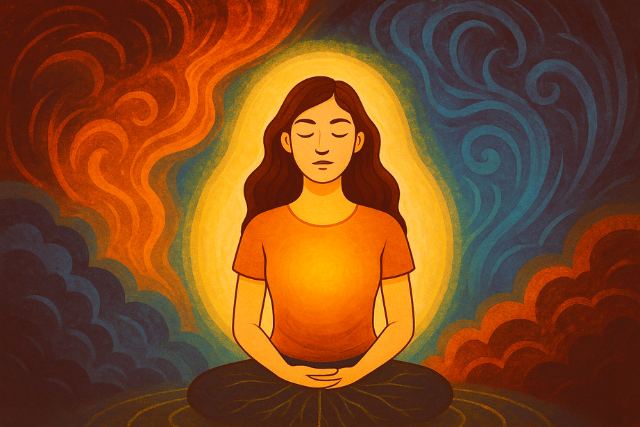
    I imagined a grounding cord from the base of my spine, anchoring me deep into the earth. With every exhale, I released anything that wasn’t mine down into the soil.

    Then I called my energy back. I imagined it returning from all the places I had left it—washed through sunlight—like golden threads being rewoven.

    Next, I zipped myself up. Literally.

    I visualized a golden zipper running up the front of my body, sealing in my energy field. I imagined a soft dome of light around me—just my size. Nothing could come in unless I invited it.

    I was still loving, still intuitive, still me.

    But now I was also separate. Not shut down—just held.

    Grounding and Choosing

    Grounding, closure, and choosing when to open and when to put my “closed” sign up are now part of my everyday life. If something feels even slightly off, I know I’m pulling in information that likely isn’t mine to hold.

    The truth is, without a container, an agreement, and consent, diving into someone’s emotions, fears, or thoughts isn’t good for me or for them.

    Today, using my gifts is something I save for my work.

    The world needs sensitive, intuitive people—but not ones who are depleted and lost in other people’s pain.

    The most powerful thing you can do for others is stay in your own energy and listen with integrity.

    I still feel things deeply. But now I know how to feel from within myself—not from inside someone else’s story.

    And that has made all the difference.

  • How Embracing Your Sensitivity Can Benefit Your Relationship

    How Embracing Your Sensitivity Can Benefit Your Relationship

    “Today I want you to think about all that you are instead of all that you are not.” ~Unknown

    If you are a sensitive person like me, you may think being sensitive is problematic. Especially when it comes to love and relationships.

    Maybe you’ve been called “too sensitive” by your partner or a parent. Maybe you feel overly emotional or have strong reactions to things or take things personally that don’t bother your partner, or you are easily irritated or get cranky all too often, or you feel the urge to be alone a lot more than you think you should in a healthy relationship.

    If so, you may believe you really are too sensitive.

    Now, sensitivity can cause problems in our relationships when we’re operating unconsciously and feel at its mercy. That tends to bring out the harder aspects of sensitivity.

    I know this all too well. Not knowing I was a highly sensitive person and not understanding how to work with my sensitivity was the biggest reason my first marriage ended in divorce.

    And even before that, for most of my life, I thought something was wrong with me because of what I now recognize is my genetic trait of high sensitivity.

    I hear the same from so many sensitive women I speak with.

    But I’d like to flip that perception on its head. Because high sensitivity is often misunderstood and totally undervalued. Particularly when it comes to marriage and intimate relationships.

    Think about it: What do most women want more of in their relationship?

    They want their partner to be more attentive to them. To have more understanding of what’s going on for them. To be more responsive to their words and gestures. To be more tender with them. To be more conscious of them.

    I always wanted my first husband to be deeper with me. More caring and empathetic. More in touch with himself and his feelings…

    If you, too, would like more of any of the above in your relationship, then what you want is more sensitivity. All those things are what “sensitive” means.

    Sensitive is defined as: attuned to, aware of subtleties, caring, sympathetic, empathetic, compassionate, understanding, perceptive, conscious of, responsive to, alive to…

    Sensitivity is, in fact, exactly what we need more of in our relationships, not less. It’s an asset in love. 

    And if you are also a sensitive person, you were built to embody it. To bring all of those juicy delights to your relationship.

    If you were born an HSP, it’s a cause for celebration. We are made for love.

    Once we’ve done our own work to develop the best aspects and manage the challenging parts of the trait, we gain access to what we need to have the depth, connection, understanding, love, and passion we want most with our partner.

    In other words, we develop into the best possible role model for being in a loving relationship—one non-sensitive people should aspire toward.

    Of course, there are unhealthy ways our trait can be expressed. Ways that do lead to more hurt and struggle than harmony and love in relationships. These more “negative” aspects (like “touchiness”) are really only expressed when we have not learned how to consciously work with our sensitivity.

    Once we do, the “negative” aspects fall away, leaving us with all the good parts that are most needed for the healing and thriving of relationships—and even the healing of our world!

    Many things keep us playing out the negative aspects, but I’ve found that the biggest thing is believing old, outdated (and frankly wrong) judgments about sensitivity being a bad thing. Because it leads us to being self-critical and feeling bad about who we are.

    When we berate and look down on ourselves for our sensitivity, we feel ashamed, we close off, and we become more negative.

    If we are at war with ourselves like this, we can’t open up our hearts to others or life. We are likely to feel like others are at war with us, so we take things personally and feel gripped by negativity and inner turmoil. We can’t come from sensitivity toward ourselves or toward others because we’re too bogged down.

    I know this because I judged myself for my sensitivity plenty in the past, and it only forced me into a hole, hiding my light under self-judgment and anger at myself. That anger poked out left and right and spilled over onto my husband, hurting our marriage and leaving us miserable with each other.

    After our divorce, I learned about HSPs and that I was one. What an aha moment! I stopped trying to squash my sensitive nature as I learned to accept and even love it. I felt safe to honor it, and much happier and more relaxed in my skin (finally!).

    Then, the best parts of my sensitivity were able to shine through naturally. And I was able to powerfully guide my second marriage into one that is now, by my definition, amazing.

    How to Tap into the Healing Power of Your Sensitivity in Your Relationship

    I bet many things you’ve been self-critical about are actually aspects of your sensitivity! That was the case for me. So consider and answer this question:

    How might the things you’ve judged about your sensitivity be the things most needed to take your relationship to the depth and health you long for?

    Take time to recognize the brilliance of your sensitivity, the healing it can bring to your world. You are naturally wise, so go to your own mind and heart to come up with your answers.

    Here are some hints from my experience and ponderings to get you going:

    Could your emotionality be the antidote to the numbness and disconnection that are so often the kiss of death in an intimate relationship?

    Could your capacity to feel big feelings be the deepest, most sustainable source of love in your partnership, carrying your partner in its tide?

    Could the moments when you are flooded with overwhelming feelings in your relationship be an internal request to pause so you can process deeply—and reap the wise insights that arise from that pause that will take your love and understanding of each other to the next deep level?

    Could your natural tendency to see the little things in yourself and others as flaws or problems help you diagnose the areas that need to be healed or developed in your partner—and inside yourself—so you can thrive together as a couple? Could it be the call to become the most conscious, empowered, loving version of yourself, able to navigate both the joys and challenges of love with grace?

    Could that same tendency to be bothered by little things and get easily irritated because of your subtle attunement to detail also be the very thing that helps you really know and be deeply attuned to your partner, and help him feel really known and loved?

    (My sensitivity helps me know my husband’s inner world without a word from him and allows me to understand what he’s going through. He’s told me many times some version of these words: I feel so supported, seen, and loved for who I am. I feel you really get me. I’m in awe of how in tune we can feel.” Hearing that feels like music to MY ears.)

    Could your people-pleasing tendencies and over-concern about making sure your partner and others in your life aren’t upset be the compassion and conscientiousness we need to survive and thrive as a species? The very thing that inspires others to look out for each other with fierce care and kindness—once you’ve learned to bestow the same grace on yourself?

    Could your need for quiet and space alone to decompress be just the example other humans need in order to put an end to this toxic, fast-paced culture that robs us of actually enjoying life—and is even robbing the planet of life itself? Could it be just the thing our society needs to learn to slow down and de-stress so each of us can access the love, insight, and creative problem-solving we need to thrive in our partnerships and on this planet for generations more?

    When I recognized the asset my sensitivity is, I was able to climb out of the hole of self-rejection and shame and change how I showed up in my relationship.

    I could suddenly pay deeper attention to my partner, offer a little support here, a little insight there, say just the right thing at just the right time because I’m so sensitively aware, come up with creative solutions to navigate those inevitable sticky moments couples have, let my big wide heart out, and be all those things that I want my partner to be for me: loving, reassuring, aware, understanding, and respectful.

    I started living out the kind of love I’d only dreamed of before. And it caught on. My husband has learned to be way more empathetic with me, more caring, and more attuned to me. Way more… sensitive.

    We can pass on our gift of sensitivity to our partners by modeling it, by leading the way.

    Do you see how your sensitivity is an underutilized healing resource in your love life? The highly responsive superpower of sensitivity that you embody enables you to lead your relationship in a much healthier and more loving direction if you honor it.

    It should be a goal to not only feel great about your sensitivity but also to become more sensitive. In a healthy way.

    The lack of tenderness, the instinct to shut down and disconnect, the lack of empathy and compassion and understanding that is so destructive in our marriages and in our world—it can end here with you. Now. Your sensitivity is the remedy!

    We sensitives are the particular variation of human needed to sway our relationships into healing, if only we give ourselves the sensitivity, care, tenderness, and encouragement we need by believing in ourselves instead of berating ourselves.

    We are the ones to lead ourselves and others back to our hearts, back to compassion, care, and being in tune with others. Back to sensitivity.

    Start by telling yourself the truth:

    You are different from the “norm.” But different in just the way that’s most needed for love to thrive in your home and community.

    If you really believed that, would you finally start appreciating the qualities that make you, you? Would you do all it took to cultivate them instead of squashing them? I would. I am. Let’s do so together.

  • 3 Practices That Help Ease the Pain of Being Highly Empathetic

    3 Practices That Help Ease the Pain of Being Highly Empathetic

    “I do not ask the wounded person how he feels, I myself become the wounded person.” ~Walt Whitman

    Empathy is the ability to put yourself in another’s experience and understand with depth the gravity of their situation. In general, I believe the world needs more empathy.

    But I’ve learned over the course of my twenty-nine years that sometimes being a highly empathetic person is incredibly painful. And sometimes too much of a good thing is a bad thing.

    Hearing stories of the pain that people experience can be extra painful when your mind tries to carry their pain around with you. Empathy is healthy when it’s useful and helps a wounded person feel understood and validated and release their pain. But it’s unhealthy when you carry it with you as if it is your own.

    Feeling sorrow for someone who is suffering is part of our humanity and connection to each other. Carrying the sorrow as if it belongs to you ends up feeling traumatizing and can cause you to disconnect from others.

    I’ve always struggled with holding on to the pain of others. From the stories of suffering I hear on the news to the people I run across in my everyday life, I’ve found it difficult not to get lost in their pain and end up holding on to it. When that problem hit even closer to home, I reached a breaking point that ended up teaching me how to stop it.

    My sister is a nurse who was working on a trauma unit floor the day she was assaulted by a patient. Seeing the bruises covering her face and her eyes swollen shut was a gut wrenching experience. For months after that my mind turned over and over again how she must have felt.

    I’d see the surprise and fear on her face in my mind’s eye. I’d feel the terror and the pain. And the overwhelming relief when he was finally off of her. Followed by the sense of humiliation and vulnerability at being alone on the floor.

    She was wounded. My overly empathetic brain created me as the second wounded one.

    I am a highly sensitive woman who struggles with both ADHD and Anxiety. These three challenges come together into the perfect storm to torture me with too much empathy sometimes.

    High sensitivity makes me more attuned to others. ADHD makes it extra difficult to control my runaway thoughts. Anxiety creates a sense of ongoing vulnerability that keeps the wound open. This perfect storm has required a strong internal set of resources to combat it. In the traumatic aftermath of my sister’s assault, I finally found the recipe for that resource.

    These three things have helped me reduce the internal wounding of being too empathetic.

    Mindful Attention to Words without Pictures

    I was on the phone with my mom as she was processing what happened to my sister, and I noticed that the most painful part of it all was the movie reel playing in my head as my mind interpreted her story in pictures.

    I couldn’t bear the emotional onslaught that I could feel coming and somewhat intuitively picked up on a mindfulness tool that I now swear by. As she continued, I made a conscious effort to hear only her words. To only focus on her words.

    When my mind started to create the overwhelming pictures, I would return my focus to the sound of the words themselves. I tried to hear the words and only understand them to the extent of their definition—devoid of the extra meaning and emotional context I had been attaching to them.

    Even though this practice was difficult to do, I was able to leave that conversation without feeling re-wounded. And that was a first.

    A Mindful Mantra

    It wasn’t just the conversations and specific triggers that created the wounded feeling. My anxious ADHD brain would recreate the story on its own. It would play that movie of what my sister experienced start to finish. In those moments, there were no words to attend to. There was only me and my sometimes-torturous brain.

    It was out of that experience that I developed what I’ll call my mindful mantra. It starts with the recognition that my thoughts have run away from me. When I see that, I imagine that it was all playing out on a picture book that I can see myself firmly shut. I even imagine the sound of a book being forcefully shut.

    Then the mantra. Every time I catch myself in this place I use the same mantra, and over time it has become helpful in its own right. This could be anything, but for me, my mantra goes like this:

    “Nothing good goes down this path.”

    It serves as a reminder that there is nothing useful to me or to the wounded person (in this case my sister) in fixating on their painful (now past) experience. It’s also a subtle reminder that choosing to stop the internal battle isn’t hurtful to the person who’s been wounded.

    With that, I find that I can practice the next skill before re-engaging myself in something else.

    A New Visual for Letting Go

    Sometimes the mind tries to hold on as if it’s not quite ready to let go. My ADHD mind has extra trouble with this. It’s in those moments that I practice this mindful visual exercise. I sometimes need to practice it several times before my brain is ready to transition on to something more helpful.

    But like any mindfulness practice, I find that the more I bring my mind back to the exercise, the better it gets at using the exercise for letting go.

    I see my thoughts (or sometimes the book in which I closed them up) floating down a river. I grew up in an area with a ton of amazing waterfalls that debut in this visual exercise. I visualize a powerful, tall waterfall like the ones I grew up with and I see my thoughts fall over the edge.

    Then I stand and watch them flow on the river beneath until they are completely out of my sight.

    After this, I’ve found that it can be helpful to engage myself in another activity to help my brain transition. Sometimes that looks like a good movie or a walk with my husband. Other times, it’s a hobby or project I’m interested in that helps grab my attention.

    If the movie reel starts to play again, I send it back over the waterfall.

    With these strategies, I’ve been able to finally find some peace with my mind. Even though they are challenging strategies that sometimes take practice, I’ve found them to be well worth the effort.

  • How I Learned to Stop Absorbing Other People’s Emotions

    How I Learned to Stop Absorbing Other People’s Emotions

    “Sometimes I think I need a spare heart to feel all the things I feel.” ~Sanober Khan

    I felt her agony and loneliness as if it were my own. Even as I write that sentence, my eyes well up and heaviness fills my heart. Then, I’m reminded to apply the advice I give others.

    My mom was a special person, a sensitive soul just like me. Actually, I’m so much like she was, yet so different. One of the differences between us is that I had an opportunity to observe her life’s challenges. I saw her challenges reflected within myself and made a conscious choice to find healthy ways to cope.

    You see, my mom was a deep feeler and felt the emotions of people near and far. I imagine it was her strong empathy and personal challenges that led her to want to help others, as a wounded healer in a sense.

    But as a helper and healer, she struggled with her mental and emotional health over the years. Witnessing her life moved me to learn how to regulate my own sensitive emotions and set healthy boundaries.

    Sometimes I wonder if not knowing how to manage her empathy is what made her sick.

    There are many ways to understand the challenges my mom battled before her death in 2007. From her perspective, she had a rare, unknown physical illness. Some who knew her may have thought she was manipulative and attention-seeking. Some would see an addiction to pain medication. Psychologists would diagnose her with psychosomatic disorder, borderline personality disorder, and bipolar disorder.

    Maybe all and none of those explanations are true. But perhaps she didn’t have any “disorder” at all. I’m not really asserting that to be true, but merely posing a curious question. What if she was just a sensitive, empathic person who lacked the skills to manage the pain around and within her? What if one unhelpful coping mechanism led a to slew of other ailments?

    I believe my mom felt real physical and emotional pain. I struggled to fully understand her over the years. But after many years of reflection, I now trust her experience because of what I know about my own sensitive nature.

    As sensitive people, we may present with high emotion and feel easily overwhelmed by our senses. We’re often told by the world that there’s something wrong with us. And when we think there’s something inherently wrong with us, we tend to tuck these traits away into our “shadow” or unconscious mind.

    Well, now we’ve not only tucked away our core nature, but possibly the empathic depth that goes along with being a sensitive person as well. There may be a part of us that knows that we’re emotional sponges. Yet, we may choose to ignore our nature without really learning how to manage our empathy in such a way that prevents “dis-ease” and fosters well-being.

    This was me for a long time.

    Not only am I prone to feeling depleted and drained in situations with certain people, but emotional pain of others tends to show up in my physical body. When I over-feel, my throat feels like it’s closing and as my chest constricts, my chronic back pain flares up.

    My boyfriend was complaining of one of those small, painful pimples inside his nose recently. I got one as well. We joked about sympathy pains, but I do wonder sometimes.

    I’ve felt the emotional pain of my family, friends, clients, and strangers. It’s not a simple, “Oh, I feel bad for him.” It’s feeling the despair and rejection of that teenager whose parents didn’t pick him up when he was released from the behavioral hospital where I worked. It’s the deep anguish of being that relative who feels no one believes her and she’s all alone.

    I feel challenged to find the right language to express it all because the deep heartache and heavy burden is a feeling not a word.

    The thing is that no matter how painful it is to feel the weight of the world in my body, I wouldn’t trade my depth and ability to feel for anything. The empathy that comes with high sensitivity is a true gift if we know how to use it.

    We need more kind, compassionate souls if we want to heal the world. Sensitive people have a natural capacity to show kindness because of our profound empathy.

    Deep empathy gives us a special strength in relating and connecting to others. When we genuinely care, we’re more apt to be able to understand another person in a way not that all people can. Our sincerity can help us to develop meaningful, fulfilling relationships.

    Relationships offer us a chance to not only grow a deep sense of connection with another human being, but also an opportunity to learn about ourselves. Both of these are integral to the human experience.

    And as sensitive people, we not only feel the intensity of pain, but also the intensity of joy.

    Yet, regulating our empathy is key to stopping the flood of emotion from overwhelming our ability to cope and care for our well-being.

    If we want to stop absorbing emotional baggage from others, it all starts with taking care of our physical, social, mental, emotional, and spiritual needs. I know it sounds like the whole world is harping on the idea of self-care, but there’s a reason for this.

    When our own immune system or energy is depleted, we become a perfect sponge for sopping up emotions. We must take care of ourselves to avoid absorption in the first place.

    1. When you notice heavy emotion, start by labeling what you’re feeling.

    Labeling helps to bring us into a state of pause, which can help us to gain a little distance from the emotional experience for a moment.

    2. Ask yourself whether what you’re feeling is yours, someone else’s, or a mix of the two.

    It can be difficult to discern the difference sometimes. One approach I like to take is if I think I might be feeling a particular person’s “stuff,” I’ll imagine the person as completely whole, content, and full of light. Then I’ll revisit my own experience and see if I still feel the same way.

    This played out in a recent loss in my life. While I was experiencing my own grief, when my relative who was closest to this person seemed to start to heal, I realized that much of my sadness released as well.

    3. The moment you catch yourself feeling emotions that aren’t yours, raise your awareness of what’s happening within you.

    It can help to say the word “compassion” to yourself as a way of intentionally focusing on what you can do to be supportive rather than allowing yourself to be overpowered by emotion.

    4. Take a deep breath and notice where in your body you feel the most calm, grounded, or neutral.

    It might be as simple as your toe or finger. Bring your attention to that place in your body and allow it to be a centering force to keep you grounded while you process and release any feelings you may have absorbed. Sometimes just having one calm place in our body can serve as a resource when the rest of you is feeling overwhelmed.

    5. Return the other person’s emotions to them.

    It is not your responsibility to carry other people’s emotional distress, and equally important, it helps absolutely no one. Try saying to yourself, “I’m letting this emotional pain that is not mine go now.” Remember that other people have to go through their own processes in order to grow.

    6. Use visualization to fully release the emotions.

    I find that it helps me to visualize a waterfall flowing through my body as a final release of any residual emotional gunk I might be carrying.

    At the center of all of the above steps is building the awareness to know when we’re allowing ourselves to absorb and and adopting tools to reduce this propensity. As a sensitive person, your empathy is a gift that the world needs. It’s up to each of us to channel our empathy into greater compassion so that we can remain strong and well.

  • How to Overcome Emotional Overload When You’re Highly Empathetic

    How to Overcome Emotional Overload When You’re Highly Empathetic

    “When someone throws you a stone, throw back a flower.” ~Gandhi

    “Ouch,” I cried out instinctively as my husband, Barry, and I walked through the beach parking lot, barefoot. It was only when Barry turned to me and asked me why I yelled out that I realized it was him who stubbed his toe, and not me.

    “Because it hurts,” I answered him. He looked at me curiously and said, “But it didn’t hurt you. It hurt me. I’m the one who stubbed my toe.”

    It hadn’t dawned on me that feeling other people’s pain wasn’t a “normal” reaction.

    All my life I have been extremely empathic, but for the first half of my life I didn’t even realize that this was a unique character trait, that not everyone shares.

    When I was in close contact with people who were yelling, I would literally shake. When those around me were sad or scared, I would drink in those feelings like a sponge, not realizing that these feelings weren’t my own.

    As a result, I felt on edge a lot of the time, as I was carrying not only my own feelings but also the emotions of many people around me. However, I was not in touch with this anxiety—I didn’t even know it was there. It was unconscious.

    Because I was empathic, I was often sympathetic to the plights and concerns of friends and family.

    Even as a child, people turned to me for guidance in resolving their problems. At the time, I didn’t mind because I was happy to offer whatever support I could.

    However, as I entered my teen years, the burden of other people’s emotions, on top of my own unresolved feelings, became too heavy to bear. But I didn’t know that consciously. I wasn’t even aware of what was happening for me.

    I turned to food, alcohol, and other substances to numb the intensity of what I felt.

    I felt a strong need to withdraw and I could no longer be in the same room or the same house with people who carried intense, often unconscious, emotions.

    I had to learn ways to manage the emotional energy—both my own feelings as well as the energy of others—that I was absorbing.

    This was a major key for me in breaking free from food and all other addiction. There were many bumps along the road as I learned to do this. Over time, I discovered four powerful ways to help manage emotional energy.

    1. Practice awareness.

    I noticed that if I wasn’t aware of what I was feeling, either in response to an internal shift, such as a hormonal or mood change, or a reaction to another person’s strong emotion, I was much more likely to be reactive and act out in a way that wouldn’t feel good to me.

    With awareness, I could consciously choose a response and an action that I could feel good about.

    2. Understand the nature of energy.

    A big key to healing for me has been the understanding that my response to my environment also feeds the energy. Therefore, if someone throws me a stone and I throw another stone back, or worse, a rock, I am going to exacerbate the problem.

    Not only will I add fuel to the fire and cause pain for the other, but I will be increasing my own suffering. Energy feeds on energy.

    If my daughter comes home from a long day at school expressing negativity, if I feed on that, consciously or unconsciously, by being in any way critical, negative, or judgmental myself, I will only increase the dark energy that is now in the kitchen.

    Instead, if I can give her love and sweetness, most likely that will be healing to her and the energy will shift to something that’s supportive and healing for both of us. That’s because love is all the soul seeks and when we can come back to a loving place, everything else in life becomes manageable.

    When we drift from a place of love, kindness, wholeness, and forgiveness, we feel “out of sorts” and often express bad energy (anger, fear, complaining, etc.).

    3. Don’t take anything personally.

    One of the main reasons I came to see that I absorbed and hung on to other people’s dramas and intense energies is because I bought into their suffering at some level. But over time I realized that nothing means what I think it does.

    I don’t have to force open the caterpillar’s cocoon to help it become a butterfly. I realized that the same power within me that has turned every difficulty and challenge I have faced into an ultimate lesson and blessing is in everyone else, too.

    I have learned to trust that other people, even those I love the most, need to learn life’s lessons through their own experiences and insights.

    I’m not responsible for fixing the energy or the situation. My only responsibility was and is how am I managing my own energy: am I adding goodness, love, and warmth to the space and people around me, or am I contributing to the creation of a frenetic and fearful environment?

    4. Balance yourself.

    The key to staying balanced for me is to continuously stay connected to my heart—my deeper, spiritual self—and when I stray from there by getting caught up in the voices in my head or the drama unfolding around me, to know the short-cut back to center.

    For me, the most powerful way to do this is with a form of meditation that I call self-hypnosis.

    This method helped me to heal so many aspects of my life, including my health, which had deteriorated at a young age, my weight, and food addiction issues as well as my relationships. Any type of meditation—and even just a few minutes of deep breathing—can help us center ourselves.

    Being empathic and super sensitive to energy is not something that I can just decide to change, but I can become more aware of how it affects me.

    The empowering thing is the realization that I can change my reactions and my own behaviors, no matter how overwhelming the emotions, my own and others’, feel to me, in the moment.

    Because 90% of the behaviors we do are habitual—meaning we are only doing them because we did them yesterday—we can literally re-train the brain to respond in a new way to the exact same stimuli.

    I used to think my only two choices were to react to negative energy with negativity or to withdraw and detach. Neither option was conducive to building strong, supportive relationships or to my own happiness.

    I now know that when someone throws me a stone, I can throw back a flower (as a wise spiritual teacher once recommended), and I can feel great about it!

    I wouldn’t change my empathic nature even if I could because, on a positive note, it has helped me to understand people and open my heart to them—to realize that we are all on the same human journey together, seeking compassion and love, even if we’re not going about it in the most effective way.

    Every cloud has a silver lining, and the blessing of empathy and feeling emotions strongly is the opportunity to connect to our deepest strength and transmit something greater that can bring healing to our self and others.