Tag: empath

  • How I Stopped Absorbing Other People’s Energy and Emotions

    How I Stopped Absorbing Other People’s Energy and Emotions

    “And then the day came when the risk to remain tight in a bud was more painful than the risk it took to blossom.” ~Anaïs Nin

    I used to think something was wrong with me.

    I cried at the wrong moments. I felt anxious before a phone call, only to find out the other person was deeply upset. I could walk into a room and instantly sense who was grieving, who was fighting—even if no one said a word.

    People called me empathic. Intuitive. But mostly, I felt weird. Overwhelmed. Other. Too much.

    I tried everything to make it stop. Therapy helped a little, but only on the surface. I learned the language of trauma, boundaries, and projection—but still, I felt like I was carrying more than just my own stuff.

    After about a year with one therapist, she finally said, “It’s not that you anxiously imagine things—you’re honestly always right. That’s a big difference. And I don’t know how to help you.”

    The truth was: I wasn’t broken. I was energetically wide open. And no one had ever taught me how to close.

    The Moment Everything Clicked

    It was years into my wild, seemingly never-ending personal growth journey, and I was sitting on a date.

    I wasn’t looking up, but I responded to what I thought was a question the man across from me had asked. When I looked up, his face had gone pale.

    “I thought that,” he said. “But I didn’t say it out loud.”

    I had done so much inner work. And yet there I was again—caught in a situation I didn’t fully understand. Feeling as though I had done something wrong.

    When someone in the same room spoke about grief, it felt like I’d been punched in the stomach. Not metaphorically—my body literally responded. I had no idea where I ended and other people began.

    In a moment of late-night desperation, I Googled something like “how to stop reading people’s thoughts.”

    I ended up on the phone with a woman I’d found online. She greeted me with, “Whoa, you are wide open, aren’t you?” And then she said the words I didn’t know I’d been waiting for:

    “You need to turn this down.”

    Turns out, I wasn’t just sensitive. I had no energetic boundaries.

    My body, my emotions, my intuition—none of it was contained. I had spent my life walking around like an open door, receiving every gust of feeling and energy that came my way.

    It wasn’t empathy. It wasn’t anxiety. It was a lack of containment.

    The Difference Between Love and Enmeshment

    Growing up, I thought being a good friend, daughter, or partner meant feeling everything other people felt. I was prized for silently predicting the emotions of others in a way that often protected me from harm behind closed doors. If someone I loved was sad, I needed to be sad with them. If they were anxious, I would absorb it and try to fix it. If I thought they could hurt me, I stayed and soothed them—not just to protect myself, but to protect everyone else too.

    This orientation toward helping emotionally volatile people didn’t serve me.

    When I was young, I thought it was compassion. Later, I thought it was codependence. But it was actually energetic enmeshment.

    Over time, I lost track of my own inner compass.

    My attraction was confused. My decisions were reactive. My body was tired.

    I couldn’t tell what I needed because I was constantly responding to so many streams of information.

    The cost wasn’t just emotional exhaustion—it was disconnection from myself.

    The Practice That Saved Me

    The almost funny thing is the solution was simple.

    There are grounding practices intuitive people have used for centuries. I just didn’t have anyone in my life to tell me, “Honey, you can turn that stuff off and use it when you want.”

    I often imagine a parallel timeline where I had elders who taught me to close skillfully, rather than using my intuition to tether myself to people who needed to face their own karma—without my intervention.

    It began with a simple image.

    I imagined a grounding cord from the base of my spine, anchoring me deep into the earth. With every exhale, I released anything that wasn’t mine down into the soil.

    Then I called my energy back. I imagined it returning from all the places I had left it—washed through sunlight—like golden threads being rewoven.

    Next, I zipped myself up. Literally.

    I visualized a golden zipper running up the front of my body, sealing in my energy field. I imagined a soft dome of light around me—just my size. Nothing could come in unless I invited it.

    I was still loving, still intuitive, still me.

    But now I was also separate. Not shut down—just held.

    Grounding and Choosing

    Grounding, closure, and choosing when to open and when to put my “closed” sign up are now part of my everyday life. If something feels even slightly off, I know I’m pulling in information that likely isn’t mine to hold.

    The truth is, without a container, an agreement, and consent, diving into someone’s emotions, fears, or thoughts isn’t good for me or for them.

    Today, using my gifts is something I save for my work.

    The world needs sensitive, intuitive people—but not ones who are depleted and lost in other people’s pain.

    The most powerful thing you can do for others is stay in your own energy and listen with integrity.

    I still feel things deeply. But now I know how to feel from within myself—not from inside someone else’s story.

    And that has made all the difference.

  • Miraculous Empath Breakthrough: My Mother’s Cancer Gift

    Miraculous Empath Breakthrough: My Mother’s Cancer Gift

    “Humbleness, forgiveness, clarity, and love are the dynamics of freedom. They are the foundations of authentic power.” ~Gary Zukav

    Last July, my mother was diagnosed with stage 4 cancer and began chemotherapy. She asked if I could stay and help her through the treatments.

    Our relationship had always been strained—she was judgmental of my nomadic lifestyle and often spoke in a way that left me feeling demoralized and degraded. As an empath, this criticism was particularly hard to bear. I would feel an instant shock, like an infusion of toxic poison flowing through my veins, triggering a strong desire to hop on the next flight out of America.

    However, this time, something changed. I found the courage to tell her how her judgmental tone affected me. To my surprise, she listened, apologized, and asked for my help in changing. She even expressed regret for not understanding sooner how her words hurt me. This was the beginning of a miraculous transformation, not only in our relationship but in her health as well.

    A few months into chemotherapy, my mother had a severe reaction and decided to stop all medications. Instead, she turned to a healthier lifestyle. She adopted a nutritious diet, started swimming every morning at 6 a.m., and lost fifty pounds. Most importantly, she began to forgive her past, which allowed her to fully embrace the present.

    At eighty-three, my mother is changing in ways I never thought possible.

    We recently returned from a two-week scuba and snorkeling trip in the Maldives, where she swam with whale sharks and eagle rays, danced, and marveled at the stunning aqua waters. She had the time of her life, and I could see from the sparkle in her eyes the life-changing impact of the sea.

    Throughout the trip, she didn’t watch any TV and instead thanked me for sharing my love of the ocean with her. Her newfound appreciation for life was a beautiful, miraculous gift. She was happy, alive, and looked twenty years younger, and for the first time in my life, she expressed her respect and appreciation for my life choices.

    During this time, I maintained my equanimity, a testament to the spiritual practices I’ve cultivated as an empath. I stayed grounded and clear, which allowed me to support her without losing myself in the process.

    This experience has taught me invaluable lessons about healing, not only for my mother but for our relationship as well. Reflecting on this journey, I realize how much we have both grown. My mother once said that I came back to help her die, but instead, she has learned how to truly live. This transformation is a powerful reminder of the resilience and strength we all possess, especially when we embrace our sensitivities and learn how to speak our truths.

    Lessons Learned on My Path

    Honest communication can transform relationships.

    I have learned to never assume it’s pointless to share my honest feelings because you never know how they’ll be received.

    Open and genuine communication was the key to transforming my relationship with my mother. When I finally expressed how her words affected me, it opened the door to healing and understanding.

    Change is always possible.

    Know that it’s never too late to change or to create change in a relationship.

    My mother’s transformation at eighty-three is a testament to the fact that we are never too old to grow, heal, and embrace a new way of living. Her journey has shown me that change is always possible, no matter where we are in life.

    Our energy can have a profound effect on our interactions.

    Recognizing that the energy I bring to an interaction affects how the other person will engage with me has been another game changer. By maintaining a calm and grounded presence, I was able to support my mother without losing myself in the process. This shift in energy made our interactions more positive and constructive.

    One practice that helps me with this is Ho’oponopono (Hawaiian forgiveness prayer), which includes four parts: I’m sorry, please forgive me, thank you, and I love you.

    Ho’oponopono operates on the basis that any energies I experience can, in some way, be a mirror of energies I have in myself. My focus is to actively take responsibility for my part (whether I am conscious of it or not).

    This helps me to take active ownership of my part in the situation and to clear my side of the street. It helps me to come from a place of humility and empowerment by taking responsibility for what I have brought to the table. It is a powerful practice and can totally shift dynamics in relationships and situations.

    It’s crucial for empaths to discern which energy is our own.

    One of the most critical lessons I learned was how to distinguish between my energy and the energy of others. As an empath, it’s easy to absorb emotions, thoughts, and energies from those around you, often confusing them with your own. This can be overwhelming and disorienting.

    It was especially challenging around my mother, who is an anxious person. In the past, I would feel her anxiety as if it were my own, which was particularly triggering. Through my spiritual practices and studies, I developed a heightened awareness of my internal state.

    I started by paying close attention to my feelings and sensations, learning to recognize what was inherently mine. Meditation played a significant role in this process. By sitting in stillness and observing my thoughts and emotions without attachment, I could identify the subtle differences between my energy and external influences. I also practiced grounding exercises, which helped me stay connected to my body and the present moment, making it easier to discern external energies.

    Energy clearing is a game-changer.

    Clearing my energy has become essential to maintaining my well-being. I have discovered several techniques that prove invaluable in releasing unwanted energies and restoring my natural state.

    I use intention and release energy that I may have absorbed that is not mine, replacing it with high-frequency energy. I then call back into my body all my energy after I intend that it is cleared and cleansed.

    I clear myself and my space with the sacred sound of a Tibetan bowl and smudge with sage or palo santo, which leaves me feeling refreshed and renewed.

    I think of clearing energy like brushing my teeth. I do it several times daily, and it only takes a few minutes.

    Another effective method is using visualization. I visualize a bright light surrounding me, washing away any negative or foreign energies. Outside of the light, I visualize a disco ball with mirrors, reflecting the energy from others.

    Breathwork has also become a life-changing and powerful tool. Through deep, conscious, connected breathing, I release tension, trauma, and stagnant energy from my body. Each inhale brings in fresh, revitalizing energy, while each exhale expels anything that is not serving me.

    Having a spiritual routine can keep us centered.

    Developing a daily spiritual routine has been the cornerstone of maintaining a high vibration and a clear mind. This routine involves a combination of practices that nurture my body, mind, and spirit, ensuring I start each day grounded and aligned.

    My routine includes:

    • Morning Meditation: I begin each day with a twenty-minute meditation session. This sets a peaceful tone for the day and helps me connect with my inner self before engaging with the outside world.
    • Yoga Practice: Incorporating yoga into my morning routine helps me stay physically flexible and mentally focused. The combination of movement and breathwork balances my energy and enhances my mindfulness.
    • Journaling: After meditation, I spend time journaling. This practice allows me to process my thoughts and emotions, gain insights, and set intentions for the day. It’s a way to clear my mind and focus on what truly matters.
    • Affirmations, Intentions, and Gratitude: Positive affirmations, intentions, and gratitude exercises uplift my spirit and reinforce a positive mindset. By acknowledging what I’m grateful for and affirming my strengths, I cultivate a sense of abundance and joy. I set the intention to remain in equanimity on the trip with my mother and it worked!
    • Nature Connection: Spending time in nature, even if it’s just a short walk, helps ground me.

    These practices, woven into my daily life, create a framework that supports living an empowered life as an empath. They help me stay centered, clear, and resilient, allowing me to embrace my sensitivity as a gift rather than a burden.

    Reflecting back on my journey with my mother, I am reminded of how far we’ve come. Our relationship, once strained and filled with misunderstanding, has transformed into a beautiful, supportive bond.

    The courage to share my honest feelings and the willingness to engage with a calm, grounded energy were pivotal in this transformation. My mother’s ability to change and embrace a new way of living at eighty-three has shown me that it’s never too late for growth and healing.

    By sharing these lessons, I hope to inspire fellow empaths to embrace their sensitivity and develop practices that nurture their unique gifts. Sensitivity, when understood and managed well, can be a profound source of strength and connection to the people around us.

  • To All the Highly Sensitive Souls Out There – The World Needs You

    To All the Highly Sensitive Souls Out There – The World Needs You

    “Highly sensitive beings suffer more but they also love harder, dream wider and experience deeper horizons and bliss. When you’re sensitive, you’re alive in every sense of this word in this wildly beautiful world. Sensitivity is your strength. Keep soaking in the light and spreading it to others.” ~Victoria Erickson

    I am lying next to my son in his bed before turning the light off one night, in that relaxed space between awake and asleep where he allows himself to feel and share. He tells me that he feels very lonely at school.

    He shares his loneliness in the middle of kids that are not seeing him for who he is, and that are not being nice to him. He shares his feelings of being invisible, always a bit different and unable to create deep friendships. He discloses that the mockery of others calling him names causes him a great deal of pain.

    I immediately relate to the sadness he feels and feel this deep tightness in my heart. A profound sadness and grief as I listen to him. A need to stop his pain immediately and protect him forever from all the cruelty of the world. A deep mother’s pain. A screaming motherly protective instinct.

    In addition to feeling his pain, I feel my own shadows and fear of being rejected. I feel my wounded younger self being isolated, mocked, and lonely as well. I don’t want that for him. I numb the feelings and go in “fixing mode,” telling him what he has to do—stand up for himself and put his foot down.

    Obviously, fixing mode is not what he needs right now, and he just retracts … and indignantly says, “I don’t get it.” I pause and thankfully get that this is not what he needs right now. He needs me to hold space with empathy. I breathe. I allow the next essential step to unfold.

    I let myself feel his pain, I let myself feel my own pain, and we both cry. Wounded son. Wounded mother. No separation.

    After a while, when the energy has moved, I tell him:

    “My son, it can feel lonely out there. It can feel lonely in there” (showing him my head). “Especially for highly sensitive souls like you and me. I have been there. I feel your pain. I feel my own pain as a mother, and my wounded child feels it too. You are not alone.”

    My son and I are quite alike. We are highly sensitive beings. It is a bit of a cliché these days, but I am not sure how else to describe our uniqueness.

    We have food, sensory, and emotional sensitivities. We are both highly sensitive to loud noises. We had to leave a theater twenty seconds after the start of a kids’ play, as it was too loud for him, when he was three years old. I am highly sensitive to any type of noise, small or big, and I can hear things that other people can’t, like electricity, and other faint noise that would bother no one but me.

    We both get migraines with aura from artificial lightings or certain screens. He is highly sensitive to the texture of clothes and food. We both get highly affected by what is happening in the world or injustices in the communities—to the point that some days I can’t even function if I listen or watch atrocities or sad stories on the news, and I have to take a day off to nurture myself and realign.

    We are both highly empathetic and can feel what others can feel. We are both highly in tune with what others can’t see, on a human level and in the energetical and spirit realms.

    It almost feels like we come from a different planet; like we’re trying on a human space suit and visiting a place we don’t fully understand, finding it hard to adjust here amongst other humans, amidst the noise.

    So that makes life hard to bear some days. We have many triggers, and we feel the whole and wide spectrum of emotions… on a daily basis.

    We are highly reflective and constantly observing, analyzing, in our heads, so we are prone to self-doubts, leading to paralysis and procrastination.

    We have social anxiety when we are in bigger groups and tend to feel uncomfortable, invisible, awkward, and easily exhausted in such a setting

    But our sensitivity also makes life majestic when we are living in alignment with what makes our hearts sing. Theo loves nature, exploring, mountain biking, playing the piano, and being with and learning about animals; and he can get lost in all of that—utterly joyful, captivated, and happy.

    I love playing music and singing, yoga, hiking, and spending time in nature, and it’s all equally magical for me.

    We are also super creative when we get into a state of flow.

    We don’t go with the status quo, and we can make our own way, being a seed of change in a family, organization, or the world.

    Above all, being highly sensitive enables us to connect with others on a deep level, knowing what is going on emotionally for them, having observed humans for a while and being highly intuitive.

    So, to all of you highly sensitive people out there, you are needed. Don’t ever think that you are not good enough because you don’t fit nicely in the world around. You are uniquely positioned to be a seed of light to the world around you.

    You have a gift for understanding and empathizing with people. Your creative talents can bring joy to others and help solve some of the world’s biggest problems. And your passion for the things you enjoy can inspire other people to stop merely surviving and start getting the most from their days.

    Use your strength, be yourself, and release the limiting belief that you are not good enough. This is simply not true; you are more than good enough. So get out there, do scary things like being visible, and shine your light.

    Because you are highly sensitive, it takes a bit more work to effectively take care of yourself—your body, your mind, your emotions, and your energy. Eat nourishing foods that are good for your gut, sleep at least eight hours, exercise, spend time in nature, meditate, set boundaries with other people. And above all, do the things that light you up daily: create, sing, write, journal, paint, play music, dance… whatever it is for you!

    I was lucky to find yoga and neuro-linguistic programming early enough in my life, and they saved me in the moments of hardship and loss, when I met the darkness of my soul.

    I had ways to approach life, manage my emotions, and see the bigger picture and the world in a different way. I had approaches to relax my nervous system and move my blocked energies. I am hoping my son will find his path and healing approaches that work for him. Of course, I will do my best to guide him along the way, but I know he will be the one to find his path and do the work.

    To all the sensitive souls out there. I hear you. I feel you. I understand you.

    Share your light with the world. You are truly needed.

  • The Exhausted Extrovert: How I Stopped Worrying About How People See Me

    The Exhausted Extrovert: How I Stopped Worrying About How People See Me

    “When we allow ourselves to be vulnerable, we are not pretending, we are not hiding—we are simply present with whatever is going on inside us. Ironically, it is this very feeling of authenticity that draws people to us, not the brittle effort of perfectionism.”  ~Maureen Cooper

    Most people in my life would call me an extrovert, and I often refer to myself with that label as well. On the surface, I appear friendly, talkative, and enthusiastic, and those characteristics became part of my identity at an early age. I enjoy being around other people and value my interpersonal relationships.

    I also participate in a variety of social groups and remain connected to friends near and far despite our busy schedules. I have often attributed my love of people to the fact that I am an only child who always wanted to spend more time with kids my own age.

    Despite my friendly nature, I usually felt drained after social interactions, especially when they involved large groups of people. I dreaded small talk, mingling at parties, and attending events where I was the only new person in the group.

    For example, my anxiety was sky high when I met my husband’s large group of close friends for the first time. I felt intimidated because they had all known each other since preschool, which automatically made me feel like an outsider. As a child and young adult, I tended to avoid situations where I felt uncomfortable, preferring to focus on the environments and people that I already knew.

    Even in familiar social situations, I still often came home feeling depleted. I enjoyed myself during these events but required a lot of downtime to fully recover and feel like myself again. This reaction confused me because I thought extroverts craved and felt energized by social interactions. 

    I struggled to classify myself because neither introvert nor extrovert truly matched my personal experience. I often felt torn between wanting to attend social events and worrying that I would feel exhausted afterward. These conflicting desires prompted me to explore the reasons why being social fed and depleted my soul at the same time.

    This journey would hopefully allow me to develop a deeper level of self-awareness and learn how to take better care of myself. As I paid more attention to my thoughts, feelings, and behavior at social events, I noticed that I was hyper focused on how I came across to others. I wanted to be liked, make a good impression, and be viewed as fun.

    I frequently wondered what people genuinely thought of me, including friends that I had known for years. I also worried a great deal about others’ feelings and wanted to make sure that everyone was having a good time. As the host of parties or gatherings, I went out of my way to ensure that the house was spotless, the food options were plentiful, and the environment was comfortable.

    I avoided choosing group activities out of fear that people would not like my decisions and from a desire to be known as the “easy-going, chill friend.” Even when I wasn’t the host, I found myself studying everyone’s reactions to see if they were happy and had their needs met fully. I made it my responsibility to take care of everyone even though no one asked me to be the superhero.

    If someone wasn’t in a good mood or a conflict arose, I immediately intervened to be the peacemaker or crack a joke to lighten the mood. I also did my best to keep the focus and attention away from me. I acted like an interviewer, asking other people endless questions and rarely sharing about my own life.

    I hated any silence within the conversation and would quickly fill it by bringing up a new topic or giving compliments. I began to realize that even my closest friends didn’t know much about me because I was so guarded with them. My fear of boring others, seeming conceited, or talking too much prevented me from being honest and authentic.

    For most of my life, I thought these behaviors were typical and even smart ways to be a good friend. I wanted others to accept me and enjoy being around me, but my ways of accomplishing these goals left me exhausted at the end of the day. Upon realizing how I navigated social interactions, I chose to examine why I needed these techniques and how they affected my view of interpersonal relationships.

    Up until this point, I believed that my behaviors were simply proof of my strong social skills, compassion, and emotional intelligence. I also assumed that most people thought and acted similarly to me because it was so natural and automatic in my life. In reality, my behavior involved coping strategies that I had developed from an early age due to an intense fear of being left out, disliked, and alone.  

    I came to learn that as an empath, I needed to set emotional boundaries to prevent myself from becoming depleted. A healthy empath holds space for another person’s emotions and experiences without making it their responsibility to fix, save, or protect the person. In order to be accepted and liked, I became a chameleon who adapted to any environment, didn’t speak up, and focused on pleasing everyone else at my own expense.

    In doing so, I didn’t allow people to get close or learn about the real me. My outward focus on how everyone else was thinking, feeling, and acting left me exhausted and overwhelmed because I took on their problems as my own. I remained fearful to share my true opinions, make any decisions, or take up space in social settings.

    Fading into the background felt safer, easier, and more comfortable to me, but it didn’t allow me to relax and be fully present. I constantly scanned the environment for any issues, working to please others and control what people thought of me. On top of that, I made it a priority to appear easy, effortless, and relaxed so that no one would see my internal struggles.

    I didn’t want to appear stressed, tired, or unhappy because I could possibly be viewed as “needy” or “too much.” My hypervigilance only intensified when I was around new people because I desperately wanted to make a good first impression and earn their validation. After a social gathering lasting only a few hours, it was no wonder that I felt so drained and needed to recharge.

    I began to realize that while I do love people and enjoy interacting with others, these situations would be more fun if I slowed down, checked in with myself, and focused on being truly present. I needed to practice turning the spotlight on myself for the first time, making choices and doing activities that worked for me. 

    When I allowed other people to manage their own feelings rather than jumping in to fix, save, and protect them, it freed up more time and energy for me. I also allowed myself to open up and engage fully in conversations, sharing small details at first and allowing other people to carry the conversation. These behaviors showed me that it was safe to take up space and let people get to know me.

    Instead of blending in and always going with the flow, I could practice offering my opinion, choosing a restaurant or a movie for the group, and turning down social opportunities when I was tired or uninterested in the outing.

    I knew that I needed to take these steps slowly because they would require courage, and I didn’t want to give up out of overwhelm. I also begin learning to trust that people wouldn’t abandon or reject me for speaking up and setting boundaries.

    And if I did lose friendships or people didn’t love everything about me, I could handle that reality and survive. My mantra became “I am not for everyone, and that is okay.”  

    Since that time, I have made strides toward relaxing, being present, and releasing control, allowing myself to “just be.” Some days and situations are easier than others to practice this new mindset. But now that I have self-awareness and understanding, I can more easily catch myself when I engage in people pleasing behaviors to earn love, praise, and acceptance.

    I pause, take a deep breath, and remember that I am allowed to take up space, that I deserve to have fun and be myself, and that my needs, feelings, and opinions matter. In doing so, I enjoy social interactions, even with new people, more than I ever did. And that has made all the difference for a social butterfly like me.

  • Please Don’t Fix Me: What True Empathy Is (And Isn’t)

    Please Don’t Fix Me: What True Empathy Is (And Isn’t)

    “No one mentioned until I was in late middle age that—horribly!—my good, helpful ideas for other grown-ups were not helpful. That my help was in fact sometimes toxic. That people needed to defend themselves from my passionate belief that I had good ideas for other people’s lives. I did not know that help is the sunny side of control.”  ~Anne Lamott

    I’m a well-meaning empath.

    If you share your problems with me, I’ll quickly make them my own. I’ll listen intently, feel deeply, and want to help. I’ll give you advice and solutions you didn’t ask for, then be annoyed when you don’t do what I suggest.

    I used to think this was being helpful.

    When my partner told me his joints were aching, I thought he wanted me to teach him yoga poses to ease the pain. When my friend told me how much she hated her job, I thought she wanted me to tell her how to find a career she’s passionate about. When my colleague told me about his breakup, I thought he wanted me to encourage him to get back out there.

    Now I know better.

    We Don’t Want Advice (Unless We Ask for It)

    Most people who call themselves “empaths” also suffer from this affliction.

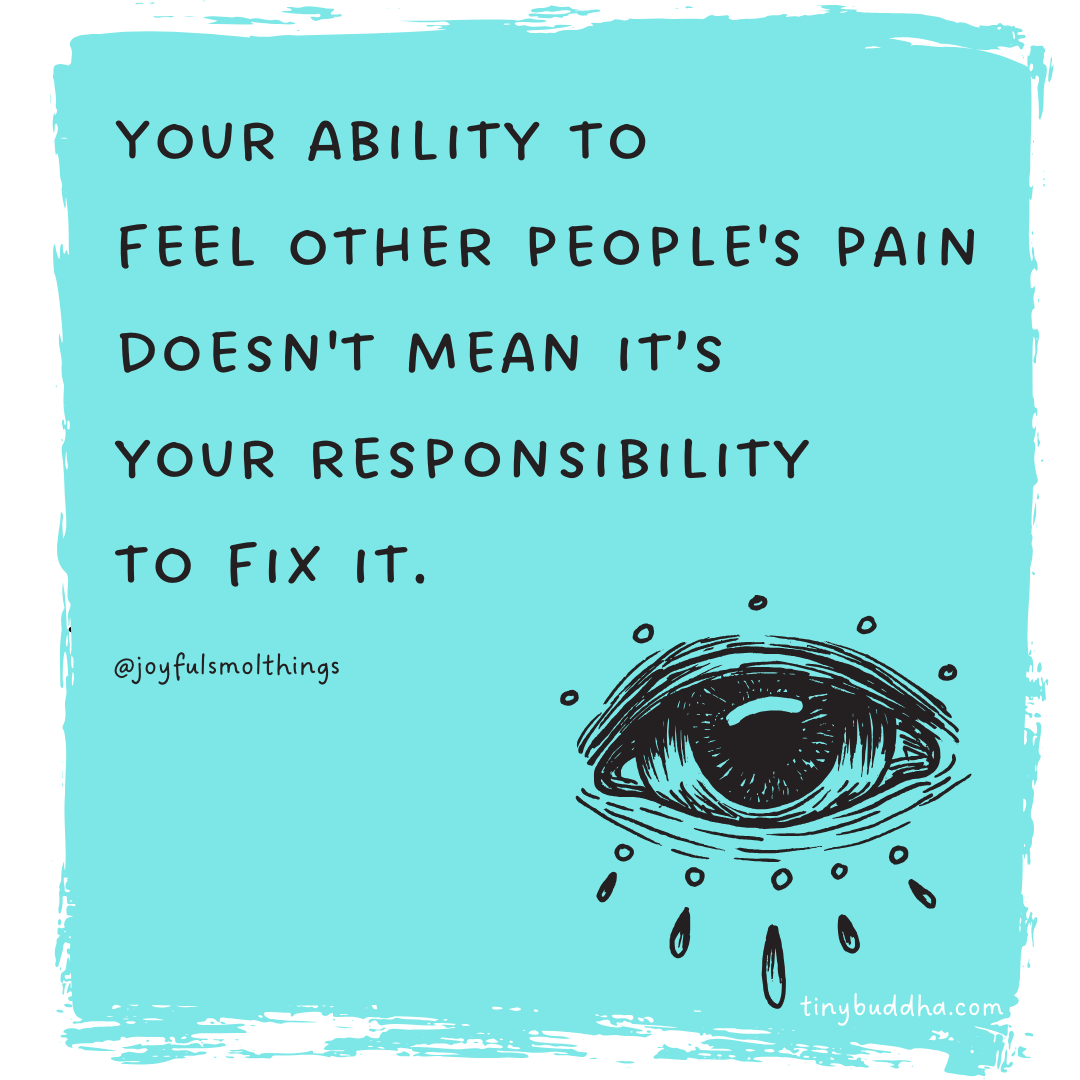
    We think because we feel another’s pain as if it were our own—and find it easy to put ourselves in other people’s shoes—that it’s our responsibility to fix that pain. We believe we need to offer a solution because sitting with the pain is uncomfortable for us and for them. We want to rescue them. We think advice is what they need.

    Turns out, this isn’t true. I learned this lesson when my sister told me about a big argument she was having with her best friend.

    As we sat eating noodles over dinner, she shared how hurt she felt and how unsure she was about whether their friendship would recover. I offered a few suggestions: “Have you tried calling her instead of texting? Could you ask her to meet for coffee so you can talk it out? Maybe when you do, you should take it in turns to speak to each other, while the other listens without interrupting?”

    She looked at me with a flash of annoyance.

    “Becki, I don’t need you to fix this for me. Please don’t give me advice about it. I just want you to listen.”

    Admittedly, this took me aback. She just wants me to listen? As in, sit there and say… nothing?

    “Yes, that’s exactly what I want,” she said. “Maybe you can tell me what you heard so I know you’ve been listening. But I don’t want any tips. Thanks.”

    Honestly, this was a total revelation. Since my sister is pretty direct, she has no problem asking for what she wants and needs from me (or anyone else). But most of us are too polite—or too scared—to ask for what we really want.

    When I thought about it, I realized that when I share my inner world with someone, I don’t want a solution, unless I explicitly ask for one.

    What I actually want is to be heard.

    Wait, so just listening is enough?

    We don’t share parts of ourselves with others in an effort to receive tips and tricks. When that’s what we want, Google has us covered.

    Personally, I share with people because I want to receive support. That support can be as simple as someone looking me in the eye and saying, “I get it.” Letting my pain exist between us and letting it be okay that it’s there. Making me feel less alone.

    The need to be seen, heard, and understood—the need to matter—is universal.

    Ironically, when we try to help others by rescuing them, we don’t meet this need at all. In fact, what we’re saying is, “I don’t believe you have the resources you need to find your own solution to this. Here’s what I know, so do this instead.”

    We’re saying their pain isn’t okay. That it needs fixing.

    I’m also ashamed to say that, more often than not, I make someone else’s problems about me. If they tell me what’s on their mind, I might share my experience of a similar situation (and how I dealt with it) or emotionally react to what they’ve said (so they end up taking care of me instead of the other way around).

    Recently, my partner said he’s having an issue with our relationship.

    “I want to tell you this, but it would be great if I could talk without you reacting to it,” he said. “If you could just listen—without sharing your thoughts—and give me space to be open about this with you. Then we can have a dialogue afterwards. Is that okay?”

    Now, let me be clear. It’s been years since my sister taught me to quit giving advice and calling it “empathy.” I thought I’d become so much better at listening. As it turns out, I’m better at not trying to fix people. But I still have a tendency to react to people’s stories with my own thoughts and opinions, instead of showing that I’m actually hearing them.

    “He knows I’m an emotional creature, though,” I said to myself. “What the hell does he expect?!”

    On some level, this is true. We empaths are emotional creatures. It’s how we’re wired.

    But I decided not to use this as an excuse. If I wanted to experience the kind of love, intimacy, and connection I really craved, I needed to learn how to be there for people—without inserting myself into their problems.

    What True Empathy Is—and Isn’t

    In my studies, ranging from the work of Marshall Rosenberg and Nonviolent Communication to everything by Brené Brown, here’s what I’ve learned about empathy so far.

    First of all, empathy is something we do. Not something we are.

    Yes, some of us are more naturally empathic and find it easier to relate to others. But true empathy is a skill. It’s something we can learn and improve at. Plus, many of us who call ourselves “empaths”—myself included—think we don’t need to work on these skills. Trust me, we do. We all have blind spots.

    Let’s say a friend comes to us and says they’re having a hard time right now. They’re in piles of credit card debt and feel like they’re drowning. They’re working extra hours and even started a side hustle to pay it off, but they still feel stressed, overwhelmed, and burnt out.

    Feeling the urge to offer advice already? Yeah, me too.

    Instead, let’s pause and think about what our friend wants. They might be feeling ashamed, so it’s vulnerable for them to share this with us. Since they’re already actively working to solve the problem, they probably don’t need our best debt-clearing tips, either.

    Here’s what true empathy might look like in this situation:

    • Consciously staying centered, grounded, and present with our friend
    • Paying attention to what they’re saying and reminding ourselves it’s about them, not about us
    • Maintaining eye contact, nodding, and offering non-verbal cues so they know we’re listening (“mmm”)
    • Reflecting what they’ve told us (“I’m hearing you feel really stressed about this and you’re worried about paying your rent next month”)
    • Using this magic question: “Is there more you want to say about that?”
    • Asking before offering advice and being okay with hearing a “no” (“I have an idea that might help. Do you want to hear it?”)
    • Asking before jumping in with our thoughts (“I’d like to share my perspective on this with you. Are you open to hearing it?”)

    And here’s what it wouldn’t look like:

    • Offering judgments, analyses, or opinions on what they could—or should—be doing differently (“You should read this great personal finance book.”)
    • Dismissing their feelings and therefore invalidating them (“It will be fine.” Or “Yes, but at least you have enough money to get by; some people don’t even have that.”)
    • One-upping them by sharing a personal experience which seems worse (“I know what you mean, I got myself into twice that amount of debt a few years ago…”)
    • Explaining why we think it’s happening and trying to pinpoint the reasons (“Your parents never taught you how to manage your money.”)
    • Sympathizing with them (“Oh, you poor thing, what a mess you’re in.”)
    • Educating them about what we’ve learned and how this can be applied to their situation (“I started by saving 20% of my paycheck; that might work for you.”)
    • Sneakily “coaching” or interrogating them—especially if we’re qualified coaches (“How are you getting in your own way here? How has been in debt kept you feeling safe in some way?”)

    Looking at these two lists, it’s clear what I’d like to receive from another human in response to the debt situation. The first list feels far more intimate, affirming, and nourishing. Despite this, I still find myself doing things on the second list all the time.

    Luckily, I get tons of practice to develop my empathy skills.

    I get daily practice with my partner, my family, and my friends. I even get it with the elderly woman who sits next to me on the bus, the friendly barista at my local coffee shop, and the cashier at my nearest supermarket. I don’t always do it perfectly, and that’s alright.

    I’m just trying to remember that people don’t need me to fix them. They’re not broken.

    What they need is for me to present with them. To be with them—to listen—without the need to do anything. For us to dance in the pain, together. And maybe, just maybe, that’s more than enough.

  • How to Embrace Your Sensitivity and See It as a Strength

    How to Embrace Your Sensitivity and See It as a Strength

    “Sensitive people feel so deeply they often have to retreat from the world, in order to dig beneath the layers of pain to find their faith and courage.” ~Shannon L. Alder

    Being a highly sensitive person can be rough in a world full of agendas, processes, rules, and numbers. Feelings and senses, being intangible and invisible, are often dismissed because not everyone experiences them in the same way. The intensity of those experiences varies, as well, depending on the individual, which makes it all the more confusing.

    Living in a society all about speed and efficiency, feelings can often be perceived as a hindrance to productivity. They are not seen as what they truly are—internal signs and guidance of what needs attention in the present moment.

    I came into this world a sensitive empath with a keen intuition. I would pick up energy from my environment, as well as other people, quickly and easily.

    Even as a fun-loving and carefree child, I noticed tiny details no one else did and felt things toward them no one else felt. I could be laughing one minute, then at the sight of an injured, struggling bee, stop in my tracks and start to panic because I didn’t want to see it in pain.

    I dreaded being sensitive as an adult, especially when I worked in the corporate world. I felt so out of place and different from others, who seemed to just let things roll off their backs and focused on their own goals.

    I would sense someone was having personal problems before anyone else knew, or that something was going terribly wrong about a project before it happened, and then I’d want to change direction. I felt those things were more important than the minute detail of who was bringing bagels for the next meeting.

    People often saw me as irrational, paranoid, or even difficult because there was no concrete evidence that what I was saying was true. It would take days, weeks, sometimes years for things to surface and prove me right. I often felt frustrated.

    For many years, I wished I was less sensitive, that I wasn’t so easily affected by others’ words, expressions, moods, and intentions. I felt my sensitivity had caused me nothing but pain and frustration.

    Life would be far easier and less complicated if I wasn’t so sensitive. I could just be blissfully unaware and truck along like everyone else.

    The many personal praises I’d received for being kind and compassionate became meaningless because, in my mind, I’d gained nothing in return. I continued to feel overlooked and unappreciated, doubting I had any deeper value to offer the world besides my productivity.

    I tried to suppress my feelings for a long time, then went on to read books, join workshops, and acquire self-improvement tools in an attempt to lessen my sensitivity.

    Ironically, through that journey, I learned that I had it backwards. I’ve come to not only accept my sensitivity as is, but also see it as a gift and use it every day to my advantage. Now I actually want to strengthen my sensitivity and encourage my feelings to speak louder.

    5 Advantages to Being Highly Sensitive

    If you see your sensitivity as a liability, as I once did, take a minute to reflect on the many advantages to being highly sensitive…

    1. You are self-aware.

    You are good at putting yourself in others’ shoes and sensing their feelings. That makes you conscious of your words and actions and how they may affect others.

    Having this solid foundation of self-awareness enables you to constantly learn about yourself and how your environment responds to you so you can adjust accordingly if needed. Not everyone has the capacity to respond with sensitivity to others and adapt to unique personalities and situations, but you do, and that helps you along the journey to happiness and personal fulfillment.

    2. You are intuitive.

    You pick up the abstract and invisible, and you have an ability to detect hidden information. This gives you insights into issues that have not yet surfaced and enables you to identify solutions that benefit you and the people around you.

    For example, I was recently put on a call by a client with a web designer I’ve never met. She reacted angrily toward my tardiness (my previous meeting had run late) and the fact I was talking to her in my car and not at my desk.

    Even though I’d never spoken with or met her, something told me this wasn’t about me being late. I waited until she was finished and asked her if my client had told her about the design changes I was going to make. She responded immediately: “No, actually this all came as a shock!” I then explained my position and filled in the blanks for her, and she changed her tone right away. She even apologized for her earlier reaction and said that she was having a bad day on top of that.

    It was a situation that could have gone very differently if I had taken it at surface value and reacted with annoyance instead of listening to my senses and being empathetic.

    3. You have a deep capacity for compassion.

    You are compassionate toward others because you feel more deeply and intensely than most. Compassion is one of the most underrated strengths in modern society. While it does not come across as an obvious trait for monetary success, it contributes greatly to anyone’s long-term personal success. It is a required component for love, forgiveness, overcoming setbacks, and sustaining personal and professional relationships.

    4. You have higher EQ (emotional intelligence).

    You are most likely good at reading others and recognizing what they’re feeling and are better at relationships, whether personal or professional, as a result. Being sensitive to others’ feelings makes you caring and understanding, with a knack for sorting out complicated emotions.

    5. You let your heart guide you.

    You are soulful and in tune with the essence of who you truly are. Your feelings are the driving force of your desires, needs, and choices in life, which means you don’t simply go through the motions. You are sensitive to subtle internal signs that help you make choices that feel right for you.

    5 Steps to Harness Your Sensitivity and Turn it into a Strength

    So now that you’ve changed how you perceive your sensitivity, how can you leverage it to help yourself and others?

    1. Do not judge yourself.

    It’s easy to tell yourself “Stop being so sensitive” or “I have no reason to feel this way” when you hear these things often from others. It’s important to change your internal dialogue and stop shaming yourself for your feelings. They come up for valid reasons and they deserve your attention.

    2. Practice gratitude.

    Thank the universe for your sharp senses and live as if you consciously chose to have them. The more gratitude you show toward your gift of sensitivity, and all its advantages, the more you will embrace and understand it.

    3. Trust the energy or messages you pick up.

    You feel what you feel for a reason. Your job is to figure out what that reason is. Regardless of how nonsensical your feelings may seem, respect them, honor them, and explore them further.

    Your feelings could be a reaction to someone who triggered something inside you, or they could indicate something that needs to be resolved so you can move forward in life. Trust that your feelings are guiding you toward the next steps in your journey. Don’t react until you have an understanding of the message or lesson to be learned.

    4. Establish an emotional (or energetic) boundary.

    You likely pick up other people’s feelings and moods so readily and easily it can become confusing or even overwhelming at times. Pay close attention to the way you feel or react. Are your feelings your own, or is your energy being swayed by someone else’s? Whenever your energy is affected by your environment, take a deep breath in through your nose, exhale from your mouth completely. And recenter yourself.

    It will also help to practice mindfulness, perhaps by developing a consistent yoga or meditation practice, so you can more easily recognize when you’re being affected by someone else’s energy.

    Remember, there will always be people who seem to clash with you. Expect it and let it be okay while maintaining your own emotional space by consciously choosing the energy you want around. If you feel the energy of anger, frustration, or doubt reentering your space, close your eyes, take a deep breath, and choose again.

    5. Help others.

    Highly sensitive empaths are likely in this world for the purpose of spreading kindness or healing others. Because you have been through so much internally, you have a soft spot for others who are going through painful experiences. Whether you choose to do so as a career or just by being there for someone who crosses your path, you have the ability to touch someone on a deeper level and help release their hurt. Don’t let that talent go to waste!

    I hope this has helped you see what a gift sensitivity really is. As you understand your sensitivity and gain more trust and confidence toward it, you will feel more empowered to use it every day to your advantage, just as I have.

  • Surviving as an Empath During the Time of Coronavirus

    Surviving as an Empath During the Time of Coronavirus

    EDITOR’S NOTE: You can find a number of helpful coronavirus resources and all related Tiny Buddha articles here.

    “When we can talk about our feelings, they become less overwhelming, less upsetting and less scary.” ~Fred Rogers

    If you are a human on earth at the moment, you’re likely feeling the uncertainty and anxiety of living in the time of a pandemic. It’s not something we have seen before in our lifetime, so every step is a new one, and the end is unknown and nowhere in sight.

    Everyone is coping in their own way. Some are fearful and anxious right now. Others insist on staying on the positive side. Still others are in denial and perhaps will feel the emotional effects later or when it hits their area. Or, more commonly it seems, we have some combination of all three at various times throughout the same day.

    It’s all normal.

    I have come to realize there is no right or wrong way to feel emotionally. Everyone is doing the best they can based on their own coping style.

    As a recovering people-pleaser, I used to try to talk people out of their feelings, make them feel better by taking over responsibility for their emotions. Essentially, I had to fix them to make myself feel better.

    This was my stress response. I picked up on the emotional energy in a room and tried to stabilize it. I am so glad I recognized this in myself, or I’m not sure how I would survive this time.

    I realized the damage this did to me, and to my relationships. If I feared anger, I would walk on eggshells to prevent people from getting angry. If I took on someone’s anxiety, I had to do everything I could to help them so I could relax.

    People have a right to be angry.

    Everyone has the right to feel anxious.

    It is not my job to judge how anyone reacts to life. It’s theirs.

    It is my job to be a compassionate witness to their suffering and to my own suffering.

    This is a hard lesson to learn when it almost cost me my health and my life. But during this time of the Coronavirus I am so grateful I learned it when I cracked the empath code.

    If you find yourself taking on other people’s emotional energy to the point of depletion, and exhaustion and perhaps chronic health issues, read on.

    Life as an empath can sometimes feel you are being tossed around in a tiny boat in an open ocean, with no solid ground. It’s a terrible feeling. So we struggle, we fight, we gasp for air, and occasionally come up to breathe for long enough to see the sun setting on the horizon.

    That is what living as an empath can be like. Only the waves are crashing waves of emotion, sometimes ours, sometimes those of others. It’s unpredictable when the hurricane will come, so we hang on to the oars tightly most of the time… just in case.

    We wonder how other people seem to live easier, to ride the waves smoother and leave storms behind as they head for calmer waters. Until we find out that we see and feel things differently, more acutely, and have to learn the skills to row efficiently, with the wind, and in the preferred direction.

    Then life becomes smooth sailing. We can feel the wind in our hair, smell the ocean, and taste the sea salt on our lips.

    Life as an empath can be hell. Or it can be a deeply sensory experience.

    Before I cracked the code, I was in a lifeboat without a life jacket. I was going down fast.

    Until one day I came across a test “Are you an empath?” Out of curiosity I took it and scored 100%.  I found another test.  Yup. 100% emotional empath.

    I had never stopped to learn what the term “empath’ meant until that moment, even though I had been in the field of counselling for over two decades.

    Now I knew why I used overthinking as a way to protect myself. Why I preferred being alone a lot of the time.  Why I found some people overwhelming and took on everybody else’s emotions. Why I felt responsible for everyone and fell head-first into people-pleasing just so I could feel better.  Why I suffered with so much anxiety and worry for others.

    I felt like I had cracked the code to my life.

    Now I could get in, understand why I was how I was, and set clear boundaries around myself.

    I didn’t need new tools. I didn’t need to change. I was not a problem to fix. I was a human to hold and I needed to carefully guard who I was.

    During this time when the world can feel overwhelming and too, too much, take time to understand yourself and your nervous system’s response to stress a bit better.

    • Notice when you feel anxious… where do you feel it in your body?
    • Notice where you are, who you are with, and what you are doing.
    • Breathe into the tight areas and imagine breathing out your compassion into the world.
    • If someone you are with is anxious, can you stay present and breathe? If not, take a break and find compassion for yourself.
    • Notice what you are consuming—news, stressful or needy people, violence in movies or TV; decrease and take lots of nature breaks.

    When you learn to guard your own health and well-being above everything else, you give yourself a soft place to land in what can be a harsh world to live in. And you give others the same gift of a soft place in your compassion.

  • How Empaths Can Stop Sacrificing Their Needs for Other People

    How Empaths Can Stop Sacrificing Their Needs for Other People

    “Sometimes you don’t realize you’re actually drowning when you’re trying to be everyone else’s anchor.” ~Unknown

    Have you ever felt trapped?

    No, actually, have you ever felt absolutely paralyzed? Like you’re fearful of making any choices at all? It feels like any step you take could end in utter catastrophe.

    Five years ago, that was me.

    I was living in a small, run-down house in Peru, in a city that I didn’t want to be in, far away from family and friends, and I was in a relationship that wasn’t working.

    At the time I worried that any decision I made would determine not only my fate, but also my ex-partner’s fate, and that of our housemates, who happened to be family members.

    My monkey mind was telling me that if I left, it would mean everyone would have to go back to their respective cities and it would be the end of the house, a business, and the world (they did and it wasn’t).

    As an empath, I lived on the assumption that it was important for me to make sure everyone else was okay. I let myself get trapped in a thick forest of stories about other people’s emotions and well-being.

    It was torture, and ultimately, at the end of the day, I was wrong. There was no way I could know the future. I needed to do what I believed was best for me. My obsessive man-management was not my job to take on. On some level, I was simply trying to be the hero.

    My intentions, for the most part, came from the right place. But I had taken on a role that wasn’t mine in the first place, and truthfully the perceived burden made me frustrated, resentful, and all in all, a less enjoyable person to be around.

    If you are an empath and you’ve found yourself stuck in a situation where you are sacrificing your needs and mental health for other people, then it’s time to stop doing so. When you are free from the weight of trying to save others from potential pain and discomfort you will have the energy to be present for them.

    Here are five ways that you can stop sacrificing your needs for other people.

    1. Recognize that you don’t know what’s going on in their head.

    A lot of the time when we try to help others, we paint detailed images in our mind about the past, present, and future. This may include what they’re thinking, what they once thought, what they’re feeling, how they once felt, how they acted in the past, and how they will act in the future. The problem with all of these mental images is, we can never truly know!

    I thought, for example, that if I left the situation, my roommate was going to be mad at me. When I finally left so did he, and in reality he was very happy to move on. My imaginary story about how he would act was completely off the mark.

    2. See where it’s making you secretly resent people.

    Try and notice when you are starting to resent people because of your obsession with helping them. If you feel agitated, frustrated, or annoyed by the burden of managing their feelings and needs, this is usually a clear indication that you, as an empath, need to take a step back.

    When we build these ideas and storylines about the way things are, they inevitably clash with reality. Why? Because the map is not the territory.

    If we can be mature enough to drop our attachment to stories about ourselves and others, then our frustrations over how a situation is playing out can be seen for what they are—just ideas.

    My feeling of being trapped was entirely self-imposed, but when I was smack bang in the middle of it, the story was that it was everyone else’s fault—as if they were reaching inside my mind and making me prioritize (what I perceived to be) their best interests over my own.

    3. In the case of an emergency, put on your own safety mask first.

    You can’t help anyone if you can’t help yourself. When you notice that your health is starting to suffer as a result of your attempt to help other people, you need to take some guilt-free time for yourself. When your batteries are recharged, then maybe you can try and lend a helping hand again, but until then, focus on self-care. You have a limited amount of energy; use it wisely.

    4. Realize that it’s not your job.

    Empathetic people tend to look around at the difficulties in the world and think, “If I don’t help them, who will?” I know I’ve done this, time and time again.

    We do this because we project our feelings onto someone else’s situation, making it seem worse than it is. We think, “If I were in their shoes, I’d feel…” But they’re not us, and we can’t possibly know what they feel and what they need unless they tell us. And even then, we’re not responsible for managing their feelings or meeting their needs.

    It’s hard to realize, but it’s not your job to save the world, and oftentimes people don’t actually need saving.

    I thought that my leaving the relationship would ruin everyone’s life, but truthfully I was only fearful that it would ruin mine. My ideas about the world made me see everyone else as vulnerable, but they were going to be just fine.

    5. Trust other people to solve their own problems.

    At times throughout my life, I have had an unnecessary need to control situations. When I was in a fearful mind-state, this habit tended to amplify.

    We don’t realize that we can control a lot less than we think, and that’s okay. You can never control what another person does, or thinks, or how their life ends up. To do so will only make you tired, and them frustrated. Give them some space to breathe and let them take the wheel. Trust that they can handle themselves. Things will work themselves out.

    Since I left that situation I’ve learned that it’s not my job to be the hero. Most of my attempts at controlling other people, and trying to make sure they don’t suffer, have stemmed from my fears. People tend to be stronger than we think, and our mental projections about the world are always less reliable than we take them to be.

    Remember, in the case of an emergency, put your own safety mask on first.

    Have you ever felt that as an empath your mental health has suffered?