Tag: ego

  • Can You Live a Meaningful Life Without Being Exceptional?

    Can You Live a Meaningful Life Without Being Exceptional?

    “The meaning of life is just to be alive. It is so plain and so obvious and so simple. And yet, everybody rushes around in a great panic as if it were necessary to achieve something beyond themselves.” ~Alan Watts

    As I enter the later stage of life, I find myself asking questions that are less about accomplishment and more about meaning. What matters now, when the need to prove myself has softened, but the old voices of expectation still echo in my mind?

    In a world that prizes novelty, speed, and success, I wonder what happens when we’re no longer chasing those things. What happens when our energy shifts from striving to listening? Can a life still be meaningful without the spotlight? Can we stop trying to be exceptional—and still feel like we belong?

    These questions have taken root in me—not just as passing thoughts, but as deep inquiries that color my mornings, my quiet moments, even my dreams. I don’t think they’re just my questions. I believe they reflect something many of us face as we grow older and begin to see life through a different lens—not the lens of ambition, but of attention.

    Some mornings, I wake up unsure of what I am going to do. There’s no urgent project at this time, no one needing my leadership, no schedule pulling me into motion. So I sit. I breathe. I try to listen—not to the noise of the world, but to something quieter: my own breath, my heartbeat, the faint hum of presence beneath it all.

    I’ve had a life full of meaningful work. I’ve been a filmmaker, a teacher, a musician, a writer, a nonprofit director. I’ve worked across cultures and disciplines, often off the beaten path. It was never glamorous, but it was sincere. Still, despite all of that, a voice used to whisper: not enough.

    I wasn’t the last one picked, but I was rarely the first. I wasn’t overlooked, but I wasn’t the standout. I didn’t collect awards or titles. I walked a different road—and somewhere along the way, I absorbed the belief that being “enough” meant being exceptional: chosen, praised, visible.

    Even when I claimed not to care about recognition, part of me still wanted it. And when it didn’t come, I quietly began to doubt the value of the path I’d chosen.

    Looking back, I see how early that need took hold. As a child, I often felt peripheral—not excluded, but not essential either. I had ideas, dreams, questions, but I can’t recall anyone asking what they were. The absence of real listening—from teachers, adults, systems—left a subtle wound. It taught me to measure worth by response. If no one asked, maybe it didn’t matter. Maybe I didn’t matter.

    That kind of message burrows deep. It doesn’t shout—it whispers. It tells you to prove yourself. To strive. To reach for validation instead of grounding in your own presence. And so, like many, I spent decades chasing a sense of meaning, hoping it would be confirmed by the world around me.

    When that confirmation didn’t come, I mistook my quiet path for failure. But now I see it more clearly: I was never failing—I was living. I just didn’t have the cultural mirror to see myself clearly.

    Because this isn’t just personal—it’s cultural.

    In American life, we talk about honoring our elders, but we rarely do. We celebrate youth, disruption, and innovation but forget continuity, reflection, and memory. Aging is framed as decline, rather than depth. Invisibility becomes a quiet fate.

    The workplace retires you. The culture tunes you out. Even family structures shift, often unintentionally, to prioritize the new.

    It’s not just individuals who feel this. It’s the society itself losing its anchor.

    In other cultures, aging is seen differently. The Stoics called wisdom the highest virtue. Indigenous communities treat elders as keepers of knowledge, not as relics. The Vikings entrusted decision-making to their gray-haired assemblies. The Clan Mothers of the Haudenosaunee and Queen Mothers of West Africa held respected leadership roles rooted in time-earned insight, not in youth.

    These cultures understand something we’ve forgotten: that perspective takes time. That wisdom isn’t the product of speed but of stillness. That life becomes more valuable—not less—when it’s been deeply lived.

    So the question shifts for me. It’s not just What’s the point of my life now? It becomes What kind of culture no longer sees the point of lives like mine? If we measure human value only by productivity, we end up discarding not just people—but the wisdom they carry.

    Still, I don’t want to just critique the culture. I want to live differently. If the world has lost its memory of how to honor elders, perhaps the first step is to remember myself—and live into that role, even if no one names it for me.

    In recent years, I’ve found grounding in Buddhist teachings—not as belief, but as a way to walk. The Four Noble Truths speak directly to my experience.

    Suffering exists. And one of its roots is tanhā—the craving for things to be other than they are.

    That craving once took the form of ambition, of perfectionism, of seeking approval. But now I see it more clearly. I suffered not because I lacked meaning—but because I believed meaning had to look a certain way.

    The Third Noble Truth offers something radical: the possibility of release. Not through accomplishment, but through letting go. And the Eightfold Path—Right View, Right Intention, Right Action, Right Livelihood, and so on—doesn’t prescribe a goal—it offers a rhythm. A way to return to the present.

    Letting go doesn’t mean retreat. It means softening the grip. Not grasping for certainty, but sitting with what is real. Not proving anything, but living with care.

    Carl Jung advised his patients to break a sweat and keep a journal. I try to do both.

    Writing is how I make sense of what I feel. It slows me down. It draws me into presence. I don’t write to be known. I write to know myself. Even if the words remain unseen, the process itself feels holy—because it is honest.

    I’ve stopped waiting for someone to give me a platform or role. I’ve begun to live as if what I offer matters, even if no one applauds.

    And on the best days, that feels like freedom.

    There are still mornings when doubt returns: Did I do enough? Did I miss my moment? But I come back to this:

    It matters because it’s true. Not because it’s remarkable. Not because it changed the world. But because I lived it sincerely. I stayed close to what mattered to me. I didn’t look away.

    That’s what trust feels like to me now—not certainty or success, but a quiet willingness to keep walking, to keep showing up, to keep listening. To live this final chapter not as a decline, but as a deepening.

    Maybe the point isn’t to be exceptional. Maybe it’s to be present, to be real, to be kind. Maybe it’s to pass on something quieter than legacy but more lasting than ego: attention, care, perspective.

    Maybe that’s what elders were always meant to do.

  • How to Prevent Your Ego from Running Your Life

    How to Prevent Your Ego from Running Your Life

    “The ego is not master in its own house.” ~Sigmund Freud

    What does that mean? If the ego is not in charge, who is?

    Before diving deeper, let me tell you this story.

    That Little Voice Again

    My jaw tightened, and I couldn’t sit still. Anyone could see that the conversation was heading south. As I was fiddling with my car keys, a little distracted, a very distinct, persistent little voice pushed me to interrupt my sister.

    Go ahead. Say it! Make her stop talking!

    Like a broken cassette, the words you are wrong kept looping in my head. Honestly, I wasn’t even listening to her anymore. Her ideas were absurd, and I just wanted her to stop talking.

    Unable to bite my tongue any longer, I slapped my hand on the table and said, “You are wrong!”

    Moments later, we were at each other’s throats, and the inevitable He Said, She Said happened.

    Little did I know that that was my ego talking.

    In today’s spiritual circles, many wars have been waged against the ego. Any problem you have, they tell you to blame it on the ego and destroy it.

    The monster under the bed. The stuff of nightmares. Right?

    But what is the ego? Is it really the evil it’s made out to be? Was Freud right?

    The Ego is the House of the Self

    I like to think of the ego as the House of the Self, much like the distinct Houses of Stark, Lannister, and Targaryen in Game of Thrones.

    And the self is your identity, or all the things you identify with.

    From thoughts to things, it’s basically anything you’ve labeled me, my, and mine.

    As the distinguished spiritual teacher Eckhart Tolle put it:

    “Ego is no more than this: identification with form, which primarily means thought forms.”

    When you identify with any thought, for example, “my name,” “my things,” “my feelings,” or “my ideas,” you give birth to the ego.

    Why Does the Ego Exist?

    Without the ego or a sense of self, you cannot survive.

    If you can’t tell “what’s you” and “what’s not you,” everything blends together like one big mess. You wouldn’t be able to separate yourself from a tree, a car, another person, or a gun.

    Without a sense of self, you can easily walk into traffic, run into a knife, get chased by an animal, touch a live wire, or find yourself in all kinds of danger.

    So, yeah, the ego has one job—to keep you alive.

    It will always protect you from what it perceives as a threat, just as a scorpion will always sting when provoked. You could say that the ego is doing you a service by preserving the individual ‘you’ at all costs.

    Like a dragon guarding its treasure, it will always defend what you identify with and reject anything that threatens your identity.

    Why do you think my ego kept nudging me to interrupt my sister during our chat?

    Same reason.

    Hence the expressions I am right or you are wrong.

    Why Does the Ego Have a Bad Reputation?

    Like everything else, the ego is a neutral tool. It becomes “good” or “bad” based on how it is used.

    There are two possible reasons for its not-so-bright reputation.

    The first reason is duality.

    In the words of author and New Thought leader Teal Swan:

    “The ego wants to distinguish itself. It wants to be things like good, right, better, superior, and more. There is nothing inherently wrong with this drive.”

    By distinguishing “you” from “not you,” you create duality or separation.

    Separation between spirit and matter, seen and unseen, man and fellow man.

    This is not a bad thing. But staying in duality without seeing the bigger picture (of oneness and interconnectedness) can lead to judgment, fear, and suffering.

    For example, when you look at life through the lenses of “good/bad,” “right/wrong,” “acceptable/unacceptable,” “clean/dirty,” etc., you experience separation and cut yourself off from the vast oneness of life.

    Or when you judge people as “bad,” “wrong,” “sinful,” or “evil,” you let the ego take the upper hand and control you. This is literally the root cause of all division in the world—separations based on color, economic status, race, and religion.

    Even when you judge parts of yourself as “bad,” “ugly,” “wrong,” or “sinful,” you reject big chunks of yourself. In fact, you disconnect from your shadow self and become more and more dysfunctional as a person.

    The second reason is attachment.

    The Buddha nailed the hammer on the head when he said that attachment is the root of all suffering. This piece of wisdom goes back thousands of years and is the heart of the hydra.

    This is what happens.

    When you cling too tightly to your identity without chipping away at the parts that no longer serve you or without sculpting the pieces that need adjustment, you experience suffering.

    When you stay in your comfort zone and refuse to engage in this (spiritual or psychological) never-ending cycle of death and rebirth, you experience suffering.

    Or when you get attached to your thoughts and resist being open to change, again, you experience suffering.

    In other words, as long as you identify with any of the contents of the House of Ego to the point where they drive you, you will experience needless suffering.

    How Can You Work with the Ego?

    This line of thinking has worked for me. It may help you too.

    I am not the clothes I wear.

    If something happens to them, say my boots get worn out or I no longer want them, I won’t have a problem discarding them and getting new ones because I am not my boots.

    I found that the key is not to tear down or ‘transcend’ my ego, but to be detached from it.

    Had I identified with the boots, I would’ve held onto them out of attachment, rejecting the idea of change, which would have caused me suffering in the long run.

    But from this detached point of awareness, I gave myself the freedom to transform what needed transforming and experience positive change.

    To be even more honest with you, I used to think that detachment meant carelessness or a lack of commitment to something or someone. Now I see it as acceptance in its highest form—acceptance of all things foreign, different, or unfamiliar.

    So, when you detach from your identity, you become more accepting of things. This allows you to act from a place of empathy and create space for you, me, and everybody else to exist harmoniously.

    Final Thoughts

    You are not the ego. You have one. Everybody does.

    Whatever you put in the House of Ego, from thoughts to things, shapes you as an individual and contributes to the development of the self. This is what makes up your human experience.

    The best part is that the real you—the consciousness, or the immortal being that is really you—houses the ego, not the other way around.

    So yes, Freud was right. The ego is not master in its own house. You are. And you can always keep the House of Ego in order by living a judgment-free life.

    The more you welcome change from a place of loving awareness and recognize how everything is connected, the friendlier your relationship with the ego gets.

    But hey, as the saying goes, your house, your rules.

  • Making Big Decisions: What Would Your Higher Self Do?

    Making Big Decisions: What Would Your Higher Self Do?

    “Sometimes the bad things that happen in our lives put us on the path to the best things that will ever happen to us.” ~Paul Millsap

    The personal growth journey is easy when everything is going to plan. But when you’re presented with a difficult situation, that’s when the real test begins.

    In 2018, I embarked on a nomadic journey to do some soul-searching. I faced my fair share of challenges during this trip, but for the most part, life was good.

    I led a good life and coached people to do the same. But then I was given a reality check.

    Suddenly, I was back in Australia living with my mum. I had no money, no car, no job, and it felt like my life had come crashing down.

    This is where the true test began, as I was forced to confront a fear I had dedicated my life to avoiding: the fear of regressing.

    Revisiting Home: Unresolved Tensions and Turmoil

    After five years on the road, it was great seeing my family and old friends again. But once the initial romanticism of being back home wore off, that joy was short-lived.

    That’s when I began reverting into old patterns.

    I picked up a job working in a restaurant and felt more out of place than ever. My self-worth took a heavy beating, and all these dense feelings from my childhood began to resurface.

    But the icing on the cake was my relationship with my mother. We had some pretty deep issues that were never resolved. Those issues never had to be addressed, but now we could no longer avoid them.

    Returning into this situation as a grown man was not ideal for either of us. There was an endless loop of turmoil that neither of us wanted, but neither of us could break.

    I felt like I was constantly under attack and that she treated me like a child who had to live under a strict set of rules; otherwise, all hell would break loose.

    She felt like her space was being intruded. In her eyes, I didn’t respect how she wanted to live and took advantage of her hospitality.

    And around in circles we went, unable to see eye-to-eye, getting triggered by one another over stupid things.

    No matter how much wisdom I had gained, nor how much healing I had done, this seemed like an uphill battle that I couldn’t overcome.

    Separating Egoic Decisions from Higher Perspectives

    After a particularly painful argument, I had a moment of clarity.

    I saw myself quitting my job, packing my bags, and catching the next flight out of the country. I saw my mother resenting herself for pushing me away.

    For a moment, my ego rejoiced.

    “I sure showed her! Now she will finally see the errors of her way and the consequences they have! And I’ll be free, just the way I like.”

    But then there was regret.

    A higher part of me kicked in.

    “This isn’t a solution. You’re just escaping again and hurting everyone in the process, including yourself. Nothing has been healed. This is your chance to repair this relationship. Don’t take the coward’s way out.”

    It’s easy to run away. Believe me, I’ve crafted an entire life around it.

    But the higher self weeps when the ego succeeds, and I recognized that this was an ego-driven decision: to escape a painful situation rather than heal the root cause.

    As if I was catapulted out of my ego, suddenly I felt compassion rather than pain. A part of me that genuinely wanted to heal this wound for both of us shined through.

    Because I was now in my heart space, the energy changed. I saw that my mother had given me a place to stay and a bed to sleep in. I was overcome with gratitude and compassion, and I saw the situation for what it is.

    When you’re at a crossroads, ask yourself:

    What is the path of the egoic self, and what is the path of the higher self?

    The path of the higher self is always the route to take, and that’s the one that will provide genuine joy rather than momentary satisfaction.

    Identifying Your Higher Self

    Imagine your higher self as the best possible version of yourself: the beacon of light that you strive to become.

    When I visualize my higher self, I see a healed man who only wants the best for everyone. He is completely in his heart space, and he doesn’t act from a place of ego.

    He wouldn’t feel victimized. He wouldn’t argue back, knowing that ill-fitted behavior is a manifestation of a wound. Therefore, he would only demonstrate compassion because he genuinely feels it.

    This version of myself knows that there is no better joy than feelings of compassion, gratitude, and love. So he’s the embodiment of these emotions, regardless of what the situation entails.

    My higher self sees the situation from the higher perspective and responds to that.

    It helps to visualize your higher self when you’re at a crossroads.

    Try to understand what they are thinking.

    How do they see the situation?

    What do they feel?

    When you’ve created this vivid image, don’t just model after them. Think like them, see like them, feel like them, embody them. 

    Modeling After Someone You Respect

    If you’re struggling to see your higher self in these situations, try modeling after someone that you highly respect.

    When I was living in Ecuador, I worked closely with an Ayahuasca Shaman for half a year and saw this man as a mentor of sorts.

    To me, he’s a symbol of wisdom, compassion, and understanding.

    During some of my most challenging moments, I would ask myself what he would do. Would he argue back when he feels he is being attacked? Would he drag his feet and play the victim?

    Somehow, I couldn’t see it.

    I imagine that if he was in my situation, he would milk every moment of being back home. He would work on the wounds with his mother and cherish their time together, knowing that it’s limited.

    When you’re not sure what your higher self would do in any given situation, imagine a role model in your situation, and take after them.

    Can’t think of someone you would want to model after? What about influential figures? Historic figures? Religious icons?

    Visualize this person in your shoes and press play.

    Now, do the same thing.

    Separating Intuition from Impulse for Higher Decisions

    Most of the time, we instinctively know what decision is the right one. But our egos coerce us into taking a course of action that really isn’t in anyone’s best interest.

    One thing I’ve learned is that your intuition won’t lead you astray. But first you need to separate intuition from impulse.

    Impulse is an emotion-based, momentary decision. Your intuition is a deeper wisdom that shines through when you tap into your higher self.

    You know what to do; you just need to trust in it.

    Either you don’t want to accept the course of action because it’s difficult, or you haven’t really listened.

    Learn to lean on the wisdom of your heart, not your mind.

    What makes your heart feel heavy when you think about it? Avoid that course of action.

    What makes your heart feel light when you think about it? Follow that course of action.

    Always follow what makes your heart feel lighter, because it knows better than your mind.

    View the Situation from a Higher Perspective

    It was easy to feel like I was doing well when I could avoid my family wounds. I never had to confront those wounds when I was living overseas, so I was under the impression that they were healed.

    Sure, things were fine on the surface level, but that doesn’t mean the deeper underlying issues weren’t still there.

    Without moving back to Australia and getting into a situation where I had to confront those wounds, I would have never created the incentive to heal them.

    Looking back, I’m thankful that the universe gave me this opportunity, because in the five months I’ve been back, a whole lot of progress has been made for a healthier, happier relationship with my mother.

    Instead of getting triggered, I’ve learned to look at the wound.

    Rather than being caught in my ego, I’ve learned to look at the situation through her perspective.

    I am happy to be able to look back at this time in Australia and smile, knowing that I’m now running toward my dreams, and not away from my wounds.

  • I’m Kelly and I’m a Heroine Addict: Why I Get My Fix from Fixing People

    I’m Kelly and I’m a Heroine Addict: Why I Get My Fix from Fixing People

    “Self-will means believing that you alone have all the answers. Letting go of self-will means becoming willing to hold still, be open, and wait for guidance for yourself.”―Robin Norwood, Author of Women Who Love Too Much

    My drug of choice is not the kind of heroin one shoots in their veins. My drug is the kind of heroine that ends with an e—the feminine version of hero.

    When I help someone, and they are grateful for the gifts I offer, my brain fizzes with a cocktail of oxytocin, serotonin, and dopamine, resulting in a “helper’s high” I ride through town like a homecoming queen on a float, waving a gloved hand, blowing air kisses at admiring fans.

    There is no accident these two words, heroin and heroine, look and sound so much alike because they strangely have more in common than you might think: They are both highly addictive, both more destructive than the user realizes, and both leave a trail of collateral damage.

    According to the twelve steps, we stand a chance at recovery only if we can admit we are powerless over our addiction and that our lives have thus become unmanageable… so this is my coming out party. I figure by making this public declaration, I won’t be as tempted to sneak back to my old ways.

    My painful revelation was delivered to me on a cinematic silver platter, while driving with someone incredibly close to me—let’s call her Chloe. She was desperate to find a place to live… that is until I’d swooped in on my noble steed, found her a hidden gem of an apartment, vouched for her, and landed her the deal of the century.

    Instead of being met with the gratitude I expected (and secretly craved), I was devastated by her volcanic rage. She spewed, causing me to nearly drive off the road.

    What crime did I commit, you ask? The week earlier, she had called me, and I had the audacity not to hear my phone ring. In fury, she screamed about how I had set her up to need me, depend on me, and think of me as her savior. And then, when she needed me most, my phone’s ringer was off, leaving her alone to flail in pain, cursing the water I once walked upon.

    In my defense, I never (consciously) promised Chloe I’d be her forever rescuer. Little acts of service became the gateway drug to more elaborate feats that took immense effort and a toll on my own life. I somehow imagined one day I’d receive a smiling postcard from her, telling me my services were no longer required because of how brilliantly her life turned out (thanks to me)… but that hasn’t happened (yet).

    How did I co-create such an epic fail?

    Hitting rock bottom with my “disease to please” sent me on a search-and-rescue mission of my past to discover the genesis of my addiction. My detective work led me, surprise, back to childhood.

    As the eldest of five, I was awarded points from my well-meaning parents for doing big-sisterly things, such as treating my siblings like they were my babies, teaching them to tie their shoes, showing them how to swing a softball bat, and how to combat bullies.

    I was raised believing it was my job to take care of them, and I proudly accepted that mantle. It empowered me; it made me feel important.

    But what I didn’t realize was that while I was getting puffed up like the Goodyear blimp with praise, soaring higher with every pat on my back, some of the victims of my heroism were becoming progressively weakened. It was as if my efforts sent the unconscious message that they were broken and crippled and, without me, incompetent.

    As I struggled to more deeply understand my heroine addiction, I sought the counsel of a friend who said, “Your struggle is a microcosm of a global issue. For example, the US has funneled over 500 billion dollars to Sub-Saharan Africa (to mitigate starvation and famine), only to make the situation worse when they pulled out.” He continued, “In spite of good intentions, if the giving is a handout, not a hand up (giving fish instead of teaching how to fish), it’s unsustainable, exacerbating—not curing—the problem it set out to fix.”

    Even though I extended my support without conscious strategy or agenda, I hurt people more than I helped.

    So, what is the solution?

    It isn’t as simple as no longer helping people. It’s like being an overeater who can’t just swear off food. If I had an actual heroin addiction, my job would be to cease injecting the drug in my arm. But even Abraham Maslow taught that service is near the top of his hierarchy of needs, and I’ve certainly been a grateful receiver of people’s kindnesses.

    This is clearly one of life’s “can’t live with it, can’t live without it” conundrums. Perhaps I just have to figure out how to do “service” differently.

    So, as a newly sober heroine addict (an energy vampire cloaked behind a superhero cape), convulsing in withdrawals as I seek to live on the razor’s edge between serving and savior-ing, here are my marching orders, thus far. Just for today (and hopefully every day after), I will:

    1. Fire myself from the job I unwittingly accepted (too enthusiastically) as a little girl: to be everyone’s big sister.

    2. Admit I have a problem and that I am powerless over saving, fixing, and controlling people.

    3. Give up the belief that I know best on how others should live their lives.

    4. Refrain from getting my fix by fixing people, searching for God in all the wrong places.

    5. Make ruthless compassion my replacement addiction, in the way heroin addicts safely detox using methadone or suboxone.

    Ruthless compassion, by the way, is the unwillingness to see another as broken or inadequate, but instead as innately whole and complete, regardless of what they’ve been through or what they believe to be true about themselves.

    6. Practice “For Fun and For Free”—this twelve-step motto is about only giving to others from surplus bandwidth (time, money, and energy) unless it’s a true emergency.

    7. Tattoo my brain with my new personal prayer (a mashup of The Serenity Prayer and the lyrics to Kenny Roger’s “The Gambler”):

    God grant me the serenity…
    to know when to hold ‘em,
    when to fold ‘em,
    when to walk away
    and when to run.

    If you relate to my story, I hope this will help you with your hero or heroine addiction. But if it doesn’t, that’s okay. Because, through the lens of my new Ruthless Compassion sunglasses, I see you are more than capable of finding your own answers, thankfully without any excess do-gooding from me.

  • How to Live Your Dharma (True Purpose): The Path to Soul-Level Fulfillment

    How to Live Your Dharma (True Purpose): The Path to Soul-Level Fulfillment

    “Dharma actually means the life you should be living—in other words, an ideal life awaits you if you are aligned with your Dharma. What is the ideal life? It consists of living as your true self.” ~Deepak Chopra

    From the moment I finished high school until my late twenties, I had “purpose anxiety.”

    I wasn’t just confused and missing a sense of direction in life; my lack of purpose also made me feel inadequate, uninteresting, and lesser than other people.

    I secretly envied those who had cool hobbies, worked jobs they loved, and talked passionately about topics I often didn’t know much about.

    I even resented them for living “the good life” and kept wondering, “Why not me?”

    Until it was my turn.

    What it took to begin embracing my purpose—or dharma, as I prefer to call it—was one thing: love.

    Let me explain.

    The 4 Keys to Living Our Dharma (Purpose)

    The Sanskrit word “dharma” has many meanings and most commonly translates to “life purpose” and “the life we’re meant to live.” I believe there are four main keys to living our dharma.

    1. Cultivating self-worth: the essential first step.

    I was bullied in high school, and as a result, I had very low self-esteem for many years. Looking back, I realize that feeling that low self-worth prevented me from embracing my dharma.

    Why?

    It was because I was too focused on trying to be liked and too worried about what other people thought of me to be in touch with my authentic self. I put all my energy into doing everything I could to look “cool” and be accepted by others rather than what my soul wanted to do, explore, and experience.

    The essential idea is that embracing our dharma requires living authentically. As Deepak Chopra says, “[dharma] consists of living as your true self.”

    The issue is that it can be difficult to express and live your truth when you feel inadequate, unworthy, and perhaps even unlovable. The risk of being rejected seems too high, and it feels unsafe.

    So the first step to living our purpose, I believe, is cultivating radical self-love. It’s a bit of a “chicken and the egg” situation because having a strong sense of purpose increases self-esteem, but low self-esteem makes it hard to embrace our purpose. It’s best to develop both simultaneously.

    Here are a few ideas to cultivate self-love that have helped me:

    The first one is meditation.

    Part of meditation is about allowing ourselves to become aware of and observe our own thinking. When we meditate, we disidentify from our thoughts and get to experience glimpses of who we truly are—of our essence—which is loving and infinitely worthy. As a result, we naturally start loving and accepting ourselves more. Meditation has undoubtedly been the number one thing that has improved my self-esteem.

    Another thing that has helped me is self-care.

    As I said, I didn’t have many friends in high school and spent much of my time alone. So I started going to the gym after school to do something with my time and be around people (even if I didn’t talk to them). Exercising regularly led to eating healthier and taking better care of myself in several other ways.

    I find that self-care is a practical way to cultivate self-love. When you take care of yourself, you show that you care about yourself. Over time, you start genuinely feeling the self-love you are showing yourself and believing it.

    The last (effective but cringy) thing that helped improve my self-esteem is an exercise that a therapist recommended.

    Here’s how it goes: In the evening, stand in front of the mirror and—looking at yourself in the eyes—say, “I love you, [say your name]. I love [say three things you like about yourself], and you deserve all the good things life has to offer.” Try it for thirty days; it may change your life.

    2. Being in touch with and following your inner compass.

    Jack Canfield says, “We are all born with an inner compass that tells us whether or not we’re on the right path to finding our true purpose. That compass is our joy.”

    Often, we seek purpose outside of ourselves, as if it’s some hidden treasure we need to find. But, as Mel Robbins puts it, “You don’t ‘find’ your purpose; you feel it.” What feels good—expansive, joyful, intriguing, exciting, or inspiring—to you?

    That’s an important question because, according to numerous spiritual books I’ve read, those things we enjoy are clues guiding us to our dharma.

    The main difficulty is usually differentiating our true desires from the ego’s “wants” and the desires that come from conditioning. The ego wants to feel important. It’s afraid of not being “good enough,” so it feels the need to prove its worth.

    The “wants” that come from conditioning consist of what our parents and society have told us we “should” do. If we follow those “shoulds,” even though they don’t align with our authentic selves, we risk waking up one day and realizing that we’ve climbed the wrong ladder and lived our life for others instead of ourselves.

    Here’s something that helps me differentiate those desires.

    Make a list of all the things you want to have, do, experience, and become in the next few years.

    For each item on your list, ask yourself why you want it. Is it because you feel the need to prove something or want to feel important or perhaps even superior to others? That’s the ego. Is it because you think that’s what you “should” do? That’s likely conditioning. Is it because it makes you feel alive? That’s your heart.

    To live our dharma, we must follow our heart’s desires—the things we genuinely love. This requires authenticity and courage.

    3. Savoring the experience of being alive.

    Another aspect of dharma is loving life—living with presence and appreciating the experience of being alive. There are a few things I find helpful here:

    The first idea is to keep a “Book of Appreciation,” as Esther Hicks calls it. Every day, take five minutes to journal about what you appreciate about someone, a situation, or something else in your life.

    To savor life, we must also be present. In A New Earth, Eckhart Tolle states that true enjoyment does not depend on the nature of the task but on our state of being—we must aim for a state of deep presence.

    He recommends being mindful when attending to even our most mundane tasks. I also like to go on long walks and observe (with presence) the natural elements around me—like the clouds passing in the sky, the smell of trees after the rain, and the sensation of the sun’s rays on my face.

    And, of course, having a daily gratitude practice is always a winner!

    4. Extending love through joyful service.

    Dharma is also about sharing—extending love. One of the best ways to contribute to the collective is to share our gifts in a way that’s enjoyable to us.

    We all have natural gifts—things that come easier to us than to others. Some people are good at writing, while others are great leaders or excel at analyzing data. Perhaps you like to create, manage, nurture, delight, support, empower, listen, guide, or organize.

    There’s also another, more profound aspect of contribution that comes from being rather than doing. I remember a passage from a book I read many years ago (I can’t remember what book it was) that went something like this:

    “Your contribution [to the collective] is your level of consciousness.”

    A higher consciousness radiates greater love, and one of the best ways to uplift others is by being a loving presence.

    Dharma: The Bottom Line

    Bob Schwartz, the author of Your Soul’s Plan and Your Soul’s Gift, says, “We are here to learn to receive and give love. That’s the bottom line.”

    This involves loving ourselves, others, and life in general, and also following our heart—doing things we genuinely love.

    I don’t know about you, but this perspective on dharma feels good to me. It has freed me from my “purpose anxiety.”

    I hope it can serve you too.

  • Why I’d Rather Be Vulnerable with People Than Pretend I’m Perfect

    Why I’d Rather Be Vulnerable with People Than Pretend I’m Perfect

    “Give up being perfect, for being authentic. Give up the need to be perfect, for the opportunity to be authentic. Be who you are. Love who you are. Others will too.” ~Hal Elrod

    I’m not perfect. Not that this would come as any kind of surprise to anyone who knows me. But I often feel pushed in the direction of trying to represent myself as someone who has it all together. Especially because of the nature of my work as a coach and facilitator. What about you? Do you ever feel like you’re putting on a show for others?

    The more I find myself trying to represent a perfectly put-together person, the less confident I feel in who I am because I know I am being inauthentic. It’s a big part of what took me off social media a few years ago.

    I don’t like that social media has the ability to mold what you think about yourself by way of comparison and encourage posturing. It’s a slippery slope, as we’re hardwired to yearn for love and connection as part of our survival. For me, it didn’t feel like the kinda place I wanted my love and connection to come from.

    Having the ability to talk about our flaws, what’s going wrong in our lives and where we’re getting stuck, is a huge part of human evolution that we often forget about. If we don’t have an environment to talk about our vulnerabilities, the wounds never get a chance to heal.

    Before getting into therapy, my life was a bloody mess because I pretended like these wounds didn’t exist.

    I don’t remember a period in my life without depression. Even as a teen it followed me around like a shadow.

    I believed the world would be better without me. I felt worthless—like I shouldn’t even have a seat at the table with other humans. I should have been in an alley eating scraps of food with sewer rats. No matter what I did or how hard I tried, the shadow mocked me for dreaming of a better future. My unwillingness to unpack those thoughts meant the infection spread to all areas of my life.

    I grew up in the nineties, when no one was talking about mental health. You struggled in silence.

    I battled demons in high school. I only lasted till eleventh grade before dropping out. I couldn’t stand the thought of spending another day being somewhere that made my life hell—but really, hell was inside me.

    The voice inside my head was (and still is at times) vicious. Every day it was like the Vikings raided and settled into my thoughts to destroy my existence. Those thoughts have left scars that would look like battle wounds of lobbed-off arms if you could see them.

    The voice inside my head was a reminder that I sure as hell would never do anything my parents would be proud of. It was easier to do nothing so that nothing was expected of me. I didn’t feel stupid if I didn’t try, so it made my reality an easier pill to swallow.

    I did graduate and made my way to university, but my life became increasingly dysfunctional. My love for being black-out drunk on Sailor Jerry rum became the perfect way to cope with a chaotic mind I didn’t understand.

    This comes back to not treating open wounds. Everything I resisted continue to persist.

    I had next to no insight into what I was going through because I wasn’t willing to share that I was struggling.

    At the time, my problems took on the weight of the world because I didn’t let people stand by my side to support me. I burned through relationships like a brushfire. I had no idea how to be in an open and communicative relationship because I barely had a relationship with myself.

    Once the wounds became visible through therapy, I could stop the infection from poisoning my ability to think and function. Vulnerability saved my life. I have no doubt that if I didn’t get that support, I would not be here today.

    We forget that our survival depends on being vulnerable. Author Brad Stulberg talks about this in his book, The Practice of Groundedness. He writes, “Our ancestors who survived weren’t those who were the strongest by traditional measures, but those who were most effectively able to share their weaknesses with one another and work together to overcome them.”

    If I didn’t share what I’ve been through, would you still be reading this? Probably not. It would be just another fluff piece on embracing your vulnerability.

    Without openness, there is no love and connection.

    Without openness, you and I wouldn’t be sharing this moment.

    Without openness, you and I can’t heal and grow together.

    The idea of being vulnerable scares the sh*t out of most of us. No one wants to be perceived as weak or admit they have flaws. We’re afraid that the lions of the world will sense our weaknesses and pick us off one by one.

    Except I’ve never actually been mauled by a wild animal when I’ve asked for help, or taken responsibility for a mistake. It’s actually had the opposite effect. Through my writing and vulnerability, I’ve connected with people on every continent of earth.

    It becomes impossible for me to pretend my vulnerabilities are mine alone if people from all over the world have said I’ve captured what they’re struggling with.

    This idea is backed up by research from The University of Mannheim, in Germany, that Stulberg references in his book.

    He writes, “They repeatedly found that the individual doing the sharing felt that their vulnerability would be perceived as weak, as a negative. But the person on the other end of the conversation, the listener, felt the exact opposite: the more vulnerable the sharer was, the more courageous they perceived him or her to be. The listener viewed vulnerability as an unambiguously positive trait.”

    And I think this is why a lot of us continue to feel stuck. We’re so damn wrapped up in worrying about what others will think of us when we open up that we miss the chance to connect.

    When we feel we need to be perfect, it becomes impossible to grow because we’re not being honest with ourselves about how we’re struggling and what would help. My life couldn’t move forward if I refused to see the reality that partying, substance abuse, and pleasure chasing was an attempt to escape depression.

    When you choose the illusion of perfection over vulnerability, you become a stunted version of who you’re capable of becoming.

    The first place you get to take the armor off is when you’re staring at the reflection you see in the mirror.

    Are you willing to be vulnerable with the person staring back at you?

    Are you willing to admit that life is not going the way you want it to?

    Are you willing to put aside judgment so you can get the help and support you need?

    We all want changes, but are we willing to make the choices that give us that change?

    These questions have the potential to shake the core of your foundation free from all the bullsh*t that accumulates over the years. It’s bloody liberating to let go of stories that no longer serve you—stories about who you need to be and what you need to do or have in order to be happy and loved.

    I didn’t need to achieve a promotion or drive a sports car to receive love from my parents. I didn’t have to do anything to show the world that I mattered. I needed to ground myself in vulnerability, rather than an image of perfection, so I could show up as my authentic self and make a difference for other people by being the real, imperfect me.

    Pretending to be somebody you’re not is exhausting work. Not to mention it does the complete opposite of what you want it to do. If vulnerability gives you the power to connect, lead, and grow, that means the inverse is also true. A lack of vulnerability means you end up feeling disconnected, a fraud, forever stuck with a fragile version of what you’re capable of because your ego is afraid of getting hurt.

    Putting a name to what you’re facing puts the power back in your hands. So recognize that you too may be pretending to be perfect to avoid admitting you’re struggling and feeling vulnerable. That single choice to embrace vulnerability could be the most important decision you ever make in your life. And it just may give you the confidence to know you can face anything and rise above it.

  • Why I Stopped Measuring My Self-Worth and Trying to Prove Myself

    Why I Stopped Measuring My Self-Worth and Trying to Prove Myself

    “You alone are enough. You have nothing to prove to anyone.” ~Maya Angelou

    How do you measure your self-worth? By the salary you make each year? By the length of your resume? By the number of people who follow you on social media?

    Now what if you never had to measure your self-worth again? That is what I want to do.
    I grew up as a gifted kid with high expectations to boot, always pushing myself to meet them. I earned the best grades I could, secured a full-ride scholarship to a local university, and soon enough ended up at one of the top law schools in the country.

    Thanks to all the achievements, my self-worth was high. I believed I was outshining my peers, boosting my ego. I felt safe in this comfort zone I’d created. 

    Law school drastically changed my perspective of the world. My peer group became some of the smartest and most talented people in the country. I tried competing against them to prove myself, but I struggled more than ever to stand out and feel accomplished.

    In just a few months, my ego began crumbling apart, taking my once lofty feelings of worth down with it. I was out of my comfort zone and felt invisible.

    I turned to strangers online in an attempt to put the pieces back together and resurrect my worth. I relied heavily on social media to put myself out there for superficial likes and comments. I turned lifelong hobbies into side hustles, trading content I cared about for bits of validation here and there.

    I was desperate to find some new measure of success on which I could rely. But I never noticed the damage that desperation was doing to my psyche until it had already taken its toll.

    My ego had protected me for so long from doubt that as soon as it was gone, I never felt good enough. Once I believed I was a failure, I only kept confirming my demoralizing feelings by pushing myself to excel immediately in new areas. I compared myself to the best of the best and treated myself like the worst of the worst.

    I was trapped in a downward spiral leading to worthlessness. It was only when I slowed down to reflect on my mental health that I realized my life looked like an endless rat race to find some proverbial cheese. I strained to earn my worth and ended up empty-handed.

    If you always chase after self-worth, you never stop to see if you have found any.  

    How is it so many of us believe our worth is conditional? I believe it is a long, grueling process.

    Many of us learned growing up to associate self-worth with achievement of some kind. As we discovered authority figures gave us the most positive feedback and attention when we were doing a great job, we linked our worth to excelling. Without that encouragement, we were lost.

    The world around us exploits this correlation on a daily basis. To some extent, it makes the world go round.

    Western culture, in particular, thrives on permanently tying worth to achievement: the more people pursue success in what they do, the more productive they are and the more money that flows. Accordingly, society constantly tries to push the idea that hard work is sacred and will ultimately lead us to a life of achievement, ergo worth.

    Western culture does not reward those happy to just be. Instead, we are expected to keep laboring away until we can do something well. Even then, some types of work are highly valued over others, so we have to find the right work to do just to get by. 

    So, if you do not feel happy and fulfilled, do you not just have to work harder?

    Yet, not all hard workers reap the benefits. After all, achievement requires meeting a certain standard, inevitably doing better than someone else. Only significant time and effort may lead to a worthy triumph.

    There will inevitably be haves and have-nots because the system at play rewards a limited number of people who play the system best, who achieve the most success. The more limited the rewards, the more everyone forces themselves to try harder day in and day out.

    Unfortunately for us, the reward is merely the validation we apparently need to go about our lives. If our worth is dependent solely on our achievements, we have no choice but to compete with one another over a limited, essential resource. Achievements are only as valuable as they are rare.

    But this competition cannot be won. There will always be more to do. And someone will always do more.

    External validation never makes you content. It only keeps you hungry for more.

    In my struggles, I have had a difficult time understanding how to view my worth.

    How much worth do I have? How does it compare to other people’s worth? Does it go up and down?

    When am I finally worthy once and for all?

    To answer these questions, I vehemently tried to attach a number to my worth whenever possible. After all, a number is a concrete, self-explanatory concept. I could tell when I had more or less than someone.

    Thus, using numbers allowed me to measure my worth and other people’s worth with ease. This gave me a way to understand my place in the world.

    Using numbers also allowed me to gauge how my worth was changing. For example, if I received more likes than usual, I was happier than usual since I must have been doing something right. If I received less, I was in need of quick improvement.

    Except numbers are hollow. They have no value unless we agree to give them value, but our obsessive nature often gives extraordinary value to the benign.

    We use shortcuts like numbers to explain concepts we have a hard time comprehending. Self-worth certainly seems to be one of those trying concepts, always just out of reach like an elusive fruit hanging above us or a receding pool of water.

    Breaking away from society’s expectations provided me the room to realize self-worth is only as complicated as I make it.

    If self-worth need not exist conditionally, it can exist inherently. In fact, it exists now without exception.

    Your worth cannot be assigned a value. It simply is. 

    By virtue of the fact that you are alive, you are just as worthy as anyone else who has lived before, lives now, or will live after.

    We all come into the world the same, and we all leave the same way. Our lives may differ widely in content, but not in value. Nothing separates us at the most fundamental level.

    And none of us start out deficient in worth. We need not go on a lifelong journey to earn our worth by moving up in the world. Our worth remains steadfast regardless of how our lives take shape.

    Work does not shape our worth. No matter how you decide to share your skills and talents, the world will be better off, even if you alone trust the value in what you do and who you are.

    Society may try to tell us how we should view and feel about ourselves, but we are not obligated to listen. Fighting those ingrained ideas of what others think we should do is never an easy battle, but it is worth the independence.

    No matter how one does or does not measure worth, it does not vary, and it does not waver.

    We are all enough as is, right now.

    There exist millions of ways to compare ourselves to others, but we owe it to ourselves to make light of differences and revel in our shared humanity.

    So how do we move forward knowing that we cannot improve or reduce our worth?

    Well, the possibilities are endless. The doors open up to a life where you can be you unabashedly. And more importantly, you can be a part of something bigger than yourself without feeling small.

    Waiting for others to prove you are worthy is time better spent sharing your true self. 

    After spending the last few years of my life trying to prove myself without ever reaching the level of success I wanted, I realized my definition of success kept changing until I made it impossible to feel fulfilled. I stopped myself from being happy unless I was universally revered.

    I lived thoughtlessly, spending what free time I had attempting to make myself look accomplished rather than enjoying the time. I conformed to what I thought people would like rather than let myself flourish.

    My true self was suffocated. Receiving even the most primitive criticism felt like being stabbed in the chest. I was more distanced from others than ever before because I did not feel like I deserved to be liked anymore.

    But I do deserve to be me, to take up space, to contribute to the world in my own way. And you do too.  

    Knowing that what you do cannot change who you are promotes freedom in how you want to live, freedom not just from others, but also from expectations and doubt.

    Knowing you always have worth allows you to connect with the people around you more deeply, empathize with them, and support their journeys through life.

    It is with this knowledge you can find and share true joy.

    You can pursue what you love instead of what you feel you ought to do. You can work at your pace to be the person you want to be. You can stay present knowing neither praise nor disapproval affects your worth.

    Many will struggle to agree with you, though, that you can exist in peace without having to fight to prove your value. Even I still struggle to keep not just naysayers, but also my inner, learned uncertainties at bay in regard to whether I offer anything worthwhile.

    Learning more about your inherent worth means unlearning those harsh, ingrained principles of life as we have known it. These principles will never fade away completely, but we can make a choice every day to drown them out.

    Take it from me, your life will not immediately change in discovering your own worth, but it can improve a little day after day the more you take your discovery to heart. As is the case with any transition, there will be ups and downs. I still have doubts creeping in when I least expect them.

    But the more you live openly and share yourself with others, the more those principles will take hold and the stronger you will be in challenging what life throws your way. Instead of seeking achievement and improvement, you will be content, one with the universe.

    You will be free.

  • Why I Relied on My Ego to Survive but Now Need My Soul to Thrive

    Why I Relied on My Ego to Survive but Now Need My Soul to Thrive

    “Create a life that feels good on the inside, not one that just looks good on the outside.” ~ Unknown

    Since childhood I have been a high achiever. As a kid I was a perfectionist, driven to succeed, to be the best at what I did. I wanted to do well so that both my parents would be proud of me and love me, especially after they divorced.

    At school and college I worked hard to get straight A’s. Anything less seemed like a failure to me. I was always top of my class, and I won awards. However, this didn’t do me any favors with my classmates. They teased me for being a teacher’s pet and bullied me to bring me down a peg or two. I found it difficult to make friends, and I was often left out.

    I spent a lot of my time alone reading, drawing, and painting. These things helped me escape into different world. However, my real passion was dance and my dream was to be a dancer, but I knew how difficult it was to be successful enough to make a career at it.

    My egos job was to protect me and make sure my needs for survival, safety, and security were met.

    It told me I needed to be practical, to go to university and get a degree that would help me get a job with good career prospects and income. However, I found my studies difficult, I struggled, and the voice of my ego, my inner critic, told me that I wasn’t clever enough.

    After university, I didn’t have a gap year to go off traveling or to find myself, like a lot of people did. I did what was expected of me—use my degree to get a good job straight away to start earning my way.

    I wanted to do well in my new job and impress people. However, when I was given feedback in an appraisal, if nine things were positive and only one was negative, I only remembered the one negative. My ego did not handle criticism well. I took everything personally and would get upset.

    I continued to progress in my career, but I felt insecure, and my ego needed praise and recognition from others that I was doing a good job.

    I lived by the saying “Dress for the job you want, not for the job you have.” The managers dressed in smart, expensive clothes, which put mine to shame, and I felt inferior and not good enough.

    I wanted to look the part so I’d have the confidence to apply for promotions and new jobs, so I started to dress like them too, even though I couldn’t afford it.

    When I started a new job, I wore my new clothes as armor, to make a good impression, so that I looked like I could do the job, even though on the inside I was worried that I would fail.

    Society and the media judge success on beauty, thinness, qualifications, wealth, status, and popularity. I compared myself to others and felt I was lacking.

    My self-esteem was tied up in external and material things—getting the highest marks, awards, the best career; how many promotions I got, how much money I earned, weight loss, my appearance, romance, what type of car and house I had… I falsely believed that if I had more, I was worth more.

    By listening to the voice of my ego, I had made my life all about being a successful career woman; however, that came at a price. It was very stressful, and the higher up the ladder I went, the less I liked my job. I didn’t have any friends at work to socialize with, so I used to go shopping at lunchtime and buy things to make myself feel better, although that feeling didn’t last long.

    As I reached middle age, younger people were biting at my heels for my job and started to get the promotions I wanted. They ended up overtaking me and became my boss, even though I felt I was better qualified and more experienced for the role, which was humiliating. I got overlooked and became invisible, excluded, ignored, and bullied. I felt devalued, unappreciated, and worthless. This led to anxiety and depression, and I was let go.

    The rug had been pulled out from under me: I suddenly found myself out of a job. Life events had beaten me down, and my ego was bruised. I went into a downward spiral, I lost my self-esteem and self-confidence, and I wasn’t in a good place mentally to be able to look for another job.

    I felt that I had lost my identity, as it had been built around my career. My ego had always presented my best self and best life to others, so that they could see how well I had done and would be impressed.

    Now that I had no job, my ego told me I was a failure, I was useless, I had no value. My life felt meaningless. I was suffering from depression and anxiety and believed everything my inner critic said.

    As I now spent most of my time at home, I knew I needed to use this time wisely, to take stock of my life, to find out what I truly wanted deep down inside—what would make me happy—but I also needed to start looking after myself.

    I now listen to relaxing music and do guided meditations. I enjoy swimming, as it helps me switch off. I take long walks with my dog in nature or along the beach. While walking, I often talk to myself about what’s on my mind or what’s worrying me, and I pay attention to what’s around me.

    The answers to my problems or ideas just pop into my head, or I see a sign that means something to me, or I have a dream that gives me a message or shows me what I should do next. I realize that this is my intuition talking to me.

    Intuition is an innate sense that we are all born with, but often we dont know how to connect with it. It is an ability to understand or know something immediately based on our feelings rather than facts.

    It is the voice of our heart and soul, the voice of truth and love. Since it is quiet, calm, and peaceful, I didn’t used to hear it. I only heard my ego’s loud, dominant, critical voice and believed everything it said. We can often feel our intuition in our stomach area as a “gut instinct.”

    My soul told me I was loveable. I didn’t need to be perfect or prove myself to others, I was valuable and good enough just as I was, and I was necessary to this life. I could never be worthless, because worth is part of my true self, and no one can take that away from me. I just had to start believing in myself.

    I am a logical, analytical person and good at solving problems and coming up with rational solutions, which made me very successful in my career. I never used to pay attention to my intuition, as it didn’t make sense logically.

    So many times, when going for a new job or buying a house or a new car, I have had a gut instinct that this was not right for me, but my ego has ignored that and done it anyway. My ego’s decision was based on what would look most impressive to others and not what was best for me. Most of the time I later regretted it and wished I’d gone with my gut instinct.

    Problems begin when our soul and our ego are in conflict or out of balance. We feel one thing but do another; we self-sabotage. Our actions are not in line with our true values. We need to align our inner and outer selves to lead an authentic life. Knowing the difference between our soul talk and our ego talk can be the key to finding fulfillment. 

    Our soul knows our true needs before we do. It can clarify what we really want and improve our life. It can point us in the right direction when we don’t know what to do. If we feel off about something, most often that’s our soul telling us it’s not something we should do.

    All we have to do is listen to our intuition and trust it enough to go where it leads. When we are on the right path everything feels effortless and starts to fall into place. The right people, places, and circumstances often turn up just when we need them because we’re putting ourselves in the path of what’s best for us.

    When I first met my husband, he wasn’t my usual type, but I had a good feeling about him. My intuition told me to give him a chance, and I’m so glad I listened to it. He loves me and wants what’s best for me. He is my greatest supporter and is there for me through difficult times, as I am for him.

    Now I just need to work out the other areas of my life.

    I have learned that it’s important when making a decision to base it on logic and facts, but also to listen to my intuition. What is my gut instinct telling me? If all three are aligned, then this is the right decision for me.

    I now recognize when my ego is talking to me, as it is loud, negative, critical, and the voice of doom and gloom, and I try not to pay attention to it. The more I slow down, quiet my mind, and hear and trust my intuition, the stronger and more noticeable it becomes. 

    My intuition told me to start writing as a way to get in touch with my inner most thoughts and feelings, understand myself better, learn from my experiences, and try to make sense of my life, something I hadn’t done before.

    Once I started writing, I couldn’t stop. Words started pouring out of me and triggered strong emotions. I realized that I had unresolved issues from my childhood—fear of abandonment, low self-esteem, and other insecurities—which I had buried and now needed to work on to heal myself.

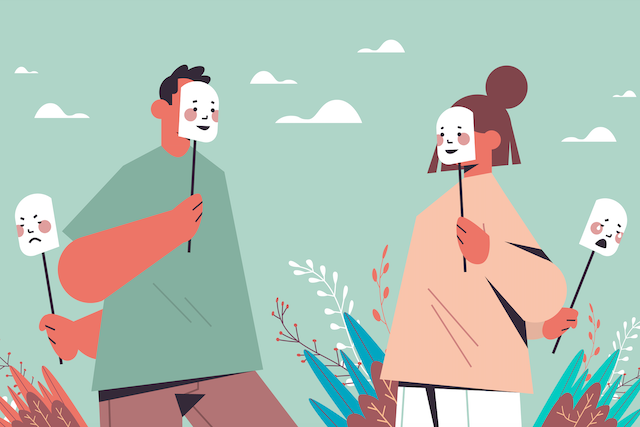
    I know now that my ego is just my outer self, it is not who I really am. It’s the mask I wear to face the world, to hide my imperfections from others. It’s my position in society, all my titles and roles.

    My soul is my inner self, who I really am behind all of that. It’s my true self. It is something we are all born with; it doesn’t change and it will be with us forever.

    Our soul knows what’s best for us. It is always there for us, to love, protect, and support us, to give us answers and guide us onto the right path, once we learn how to hear and trust it.

    In the first half of my life my ego was in the driver’ seat, and I focused on my outer self. However, it was not a wasted journey, as I learned valuable lessons along the way, and it brought me to where I am today.

    I have now reached a crossroad. It’s time for my ego to take a back seat and for my soul to take over so I can focus on my inner self and begin the journey of finding more meaning in my life.

    I hope whatever journey you are on, you can follow your soul’s wisdom too.

  • How to Stop Sabotaging Yourself and Feel Like a Success Even If You Fail

    How to Stop Sabotaging Yourself and Feel Like a Success Even If You Fail

    “If you love yourself it doesn’t matter if other people don’t like you because you don’t need their approval to feel good about yourself.” ~Lori Deschene

    In 2010, after a surge of post-ten-day-meditation-course inspiration, I publicly announced to the world that I was going to make a film about me winning the kayak world championships.

    A very bad idea in retrospect. But at the time I felt invincible and inspired.

    I had super high expectations of myself and of the film and thought it was all possible.

    Coming out of a four-year competition retirement meant a rigorous six-hour-a-day training schedule, while simultaneously documenting the journey, alone.

    I put an insane amount of self-imposed pressure on myself not only to be the best in the entire world, but also make an award-winning documentary at the same time, without a coach.

    To make a long story short, it was a disaster.

    Three days before the competition, my back went into spasm. I was so stressed out I couldn’t move.

    Jessie, a good kayaking friend, knocked on the door of my Bavarian hotel room.

    “Polly, take this, it’s ibuprofen and will help your back relax. Remember why you are here, you can do this,” she said.

    The morning of the competition I felt okay. I did my normal warm up and had good practice rides. “Okay. Maybe I can do this,” I thought.

    My first ride was okay, but not great. All I had to do was the same thing again and my score would be enough to make it through the preliminary cut to the quarter finals.

    Someone in the crowd shouted at me, “Smile, Polly!”

    I lost my focus, had a disastrous second ride, and made a mistake that I wasn’t able to recover from.

    The worst thing happened, and it all went wrong.

    Humiliated, embarrassed, and disappointed, I went on a long walk and cried.

    My lifelong dream of being a world champion athlete just vanished, and my heartbreak was compounded even more by the public humiliation I’d created for myself.

    I pulled it together and continued to film the rest of the competition and felt some protection by hiding behind my camera.

    “So, what’s next Polly? Are you going to keep training for the next World Championships?” Claire, the woman who won, asked me at the end of the event.

    “No,” I replied without even thinking. “I need to go to India.”

    India had been calling me for years, like a little voice that connected a string to my heart.

    “Being the world champion isn’t going to give me what I thought I wanted. There is more for me to learn. I want to approve of myself whether I win or lose. I want my thoughts to support me rather than sabotage me. I want to feel connected to something bigger than myself,” I told her.

    A year later, I went to the equivalent of the world championships of yoga.

    Three months of intensive Ashtanga yoga study with R. Sharath Jois, in the bustling city of Mysore, India.

    Practicing at 4:15 am every day on my little space of yoga mat, surrounded by sixty other people, with nowhere to run and nowhere to hide, I began the journey of facing my internal world.

    The toxic energy emitting from my mind, in the form of constant internal commentary of judgment and drama, looked and felt like an actual smokestack.

    I felt like a dog chasing its tail and was in a total creative block with editing my film.

    A yoga friend said, “Polly, even if your film helps only one person it is worth finishing it.”

    This was not what my ego wanted to hear.

    My ego wanted to inspire the world and had visions of, if not the Academy Awards, well then at least getting into the Sundance Film Festival.

    It took three years, and I finished the film. However, releasing it to the world brought up all of my insecurities. I felt exposed and like a huge fraud.

    How could I have made such a bold statement, failed, and then remind everyone about my failure three years later?

    I released the film and ran to North India, high in the Himalayas where there was no internet.

    Like leaving your baby on the doorstep of a stranger’s house, I birthed it and bolted.

    Even though Outside Magazine did a great article about the film, in my eyes it was a failure.

    It didn’t get into the big festivals I wanted it to get into and I didn’t bother submitting it to the kayaking film festivals it would have done well in.

    In 2019 I left India and returned to Montana to teach kayaking for the summer.

    It was the twenty-year anniversary of the kayak school where I spent over ten years teaching.

    The school had hired a young woman paddler named Darby.

    She told me, “You know, Polly, I watched your film about training for the Worlds, and it inspired me to train too. I made the USA Junior team and came second at the 2015 Junior World Championships. Thank you for making that film.”

    Humble tears of disbelief welled in my eyes.

    My film helped one person, and I was meeting her.

    The takeaway was that my ego and perfectionism got in the way of possibly helping even more people.

    I shot myself and my film in the foot so that my ego could continue to tell me I was not worthy.

    But this simply is not true.

    Hiding and running to keep my ego feeling safe no longer cuts it.

    The world is in a deep spiritual crisis right now.

    My ego would love to be in a cave in the Himalayas meditating away from it all.

    However, that is not what I have been called to do.
    Putting myself out there still feels uncomfortable, but I know that hiding is not going to help people. I have decided that good is good enough and am now taking small steps in the direction of my discomfort.

    I have learned a huge, humble lesson in self-acceptance, self-love, and self-compassion.

    The top fourteen lessons I now live by:

    1. Listen to the inner voice that whispers and tugs at your heart. If you’re passionate about something, don’t let anyone or anything convince you not to give it a go.

    2. Do the thing first. Enlist support from someone you trust but share about it publicly after you have done it so that you don’t create unnecessary pressure and feel like a failure if you struggle.

    3. Do things one small step at a time so you don’t feel overwhelmed and tempted to quit.

    4. Helping one person is a massive win.

    5. Drop all expectations—the outcome doesn’t have to be anything specific for the experience to be valuable.

    6. Do your best and let go of the results. If you’ve done your best, you’ve succeeded.

    7. Celebrate every small success along the way to boost your confidence and motivate yourself to keep going.

    8. Be proud of yourself every day for these small successes.

    9. Approve of yourself without needing the ego-stroking that comes with massive success and know that the results of this one undertaking don’t define you.

    10. True success is inner fulfillment. If you’ve followed your dream and done your best, give yourself permission to feel good about that.

    11. Do not compare yourself to other people. Set your own goals/intentions that feel achievable for you.

    12. Every “fail” is actually a step in the right direction. It redirects your compass and helps you learn what you need to do or change to get where you want to go.

    13. Growth means getting out of the comfort zone, but you don’t need to push yourself too far. Go to the edge of discomfort, but where it still feels manageable.

    14. If you freak out or feel resistance, take it down a notch. Move forward but in smaller steps.

  • The Joy and Power of Realizing I Am More Than My Job

    The Joy and Power of Realizing I Am More Than My Job

    “Authenticity is a collection of choices that we have to make every day. It’s about the choice to show up and be real. The choice to be honest. The choice to let our true selves be seen.” ~Brené Brown

    “What do you want to be when you grow up?”

    “It’s so nice to meet you. What do you do?”

    These are the questions we are asked our entire life. When we’re children, everyone always asks about the future. They excitedly ask, “What will you do?” The subtext of this questions is:

    “How will you be productive in society? How will you contribute?”

    Being asked those questions all the time as children turned us into the adults that ask them. We are in the same cycle and do not seem to know to ask instead, “Who are you?”

    For a long time, my focus and self-identity was tied up in what I did. I would tell people, “I am a filmmaker.” When I was young, I knew I wanted to make films. I loved to tell stories. “I want to be a movie director!”

    When I grew up and actually got jobs in Hollywood, I realized that most people are not movie directors. Most people are not even filmmakers. They work in film. It takes many people to make one, but only a handful of people get any recognition or able to consider themselves filmmakers.

    “What do you do?” people would ask. I would struggle to figure out how to explain that I was a production assistant who worked on films. I was basically a glorified secretary, a personal assistant. But I was not a filmmaker.

    I worked on other filmmaker’s films. I personally had not made any art or films for over six years. I was so busy and tired of trying to work in the industry I wanted to work in that I forgot about myself.

    When I could no longer define myself as a filmmaker, I became disillusioned. If I wasn’t one, then what was I? People always got excited when I said I worked on movies. Their eyes would light up, and they would pester me with questions about the famous people I knew or inside secrets.

    They never wanted to know how much sleep I missed or how many friends and family events I sacrificed for the bragging rights of Hollywood. They didn’t want to know what excited me about life or who I was. They only wanted to know “what I did.”

    This discontentment grew. I became angrier and angrier at the film industry as a whole. I felt used. Worthless. The world was nothing but egos and money. I would never be them unless I sold myself and played their game.

    I wasn’t willing to play the game, find the back doors, penny pinch, or be downright cruel. I was beginning to see that the industry was soulless. The art and stories were being dictated by companies that wanted to earn as much as possible.

    The stories were not chosen for their value and need in the world, but by which would make the most money. They profited on these stories and off the handwork and sacrifices of the below-the-line workers that were seen as disposable.

    Celebrities made millions, and I made minimum wage, but I didn’t have the luxury of a free jet ride back home and an apartment for my girlfriend. I was reprimanded for refusing to work on a Saturday after only five hours off.

    Slowly, I began to question if this was who I was. If this “works in the film industry” was really. me. And I felt guilty! I felt like I was being ungrateful. I was working on big movies! How could I not be happy? I had “made it.”

    I could only go up from here. I could get to be the next Stephen Spielberg, the next Tarantino, the next Lucas? Then I worked for one of these types of famous guys. He was just a human. He wasn’t the god I held him up to be. He was flawed.

    Sure, he got the adrenaline rush of making art, but at my expense. I was lucky to have my name in the credits. I wasn’t part of the golden ones, the actors and producers who were the “real” movie.

    If I didn’t want to play the “Hollywood” game I could go independent. But I felt guilty that I called myself a filmmaker when I hadn’t made a film in years! I didn’t even have any desire to even come up with one.

    I had friends who were making films on the weekends. They dedicated every free second to it. All I did was sleep. Then drag myself for dinner or a date and pretend I had a social life before I had to be back at work. I felt guilty and afraid that if left the industry I would be seen as a failure.

    I was afraid that I would be seen as weak or people would think that I couldn’t hack it. The more angst I felt, the more I turned to my unhelpful habit of Googling advice.  There is nothing helpful about hours of reddit and self-help blogs. They are all contradictory.

    This Googling, however, led to some articles with actual facts. This is when I started to read about Americans’ tendency to identify with our jobs. Our self-worth and identity are wrapped up in what we do.

    We say things like, “I am a lawyer.” “I am a physicist.” “I am a teacher.” We don’t say, “I practice law.” “I study physics. “I teach.” We put the emphasis on the job and not the I.

    I started the long, tedious process of separating myself, the me, from the filmmaker and the woman who worked in film. I realized that I was uncomfortable calling myself a filmmaker because I wasn’t one.

    I struggled to define my title to other because I didn’t really believe that it was who I was. I am a woman who enjoys movies and stories. More importantly, I am energized by stories.

    Filmmaking was just a job. The intense zealotry aspect of the film industry had always sat wrong with me. Now I know why. I am not a job. I am more than the work I do.

    Through this process I came to slowly accept that I wasn’t happy with the work I was doing. There was a disconnect between it and the way I saw myself in life. I needed to walk away for a bit and allow myself to heal from the harm I and the toxic industry had infected upon my soul.

    It is not just the film industry that is toxic. American work culture is. We have created an environment where work has to be our passion. Confucius said, “Choose a job you love, and you’ll never have to work a day in your life.” I disagree. Work is work.

    You might enjoy it, but as long as you are giving your time for money you are participating in a business transaction, and it is work. Just accept it as work and accept that you can be a whole person outside of your job. Your job is only a small sliver of the much larger person.

    Our work culture throws around the phrase “We are like a family.” It is encouraged and suggested that your team members and colleagues are family. They aren’t.

    You can get along with them, be friends with them, but by labeling them as family there is a pressure to feel loyal and not let them down. Our alliances are manipulated to be given first and foremost to work. Any time spend doing something for yourself or your actual family is seen as selfish.

    A year after my last film job I still struggle to see myself outside these identities. I am now enrolled in grad school and I want to label myself as a student. But I am not. I am Dia. I study mythology.

    Sometimes I am a storyteller, but that title does not and cannot encompass the whole and vastness that I am as a person.

    Identifying ourselves by our work is like trying to fill a mug with the ocean. At some point the ocean will overpower the mug, and we will be left wet and feeling bad about ourselves.

    The next time you are at a party, after the pandemic, and you meet someone new, maybe don’t ask, “What do you do?” Instead ask, “Who are you?” Create the space to meet the real, whole person; the person who is vast, deep, and full of wonder for the world.

  • If You Expect a Lot and You’re Tired of Being Disappointed

    If You Expect a Lot and You’re Tired of Being Disappointed

    “Letting go gives us freedom, and freedom is the only condition for happiness. If, in our heart, we still cling to anything—anger, anxiety, or possessions—we cannot be free.” ~Thich Nhat Hanh

    Almost universally, many of the problems we face in life are tied to our own expectations.  Expectations of ourselves. Expectations of others. Expectations of situations. Expectations of the world at large.

    We may expect ourselves to be perfect and successful in all our pursuits. We may expect to feel constantly happy with our lives. We may expect others to think and react like we do. We may expect life to always go to plan, and the world to be uncompromisingly fair.

    To be clear, some expectations are perfectly healthy and reasonable. For example, it’s reasonable to expect that the people we love will not intentionally hurt us, or that they’ll care when we share our feelings. On the flipside, it might not be reasonable to expect they will show their care in a specific way, since we are all different.

    Holding onto expectations can cause us much harm internally.

    It can eat us up, from inside out. It can lead us to frustration, anger, and resentment. We may blame others and ourselves for the way things are. Or perhaps we feel so hurt that we retreat into a shell to try to protect ourselves, withdrawing from those that care about us and the world at large.

    We can then become indifferent to all that life has to offer. Flat, uninspired, and deeply unhappy. At their worst, these festering emotions can lead us to some very dark places.

    To avoid falling into depression and improve our quality of life, we have to look for ways to let go of our unreasonably high expectations.

    This isn’t easy to do, old habits die hard. Letting go of anything can be tough. We grow attached to objects, habits, people, behavior, and everything in between. But it is possible if we practice self-awareness, continually work at letting go, and have patience with ourselves when it’s hard.

    Personal Experiences: Expectations of Others That Have Only Hurt Me

    Over the years, my expectations of others have brought me much frustration, and some degree of hurt. I’ve left myself open to disappointment when others haven’t seemed to give something that’s important to me equal priority, as I perceive it. As I type this, I realize how trite it sounds. I understand this is entirely about my perspective and expectations, but it’s also something I have had to fight hard against at times.

    This outlook has not been reserved purely for those closest to me, either. A former manager (and something of a mentor in a work setting) once said to me, “Carl, you know your problem is you expect too much out of people.”

    And in that succinct sentence is a very large element of truth. Something I have had to wrestle with.

    I’ve recognized that I hold expectations of others in various circumstances, and it always leads to disappointment. It could be frustration with a good friend for pulling out of plans last minute (even if they had a good reason). It could be a work colleague missing a deadline, that I believe they should have taken more seriously. It could even be related to a stranger not acknowledging the fact that I just held the door open for them.

    Any disappointment I feel in any of these cases is entirely about my own expectations. What I expect others to do, or how I expect them to react. Nevertheless, emotions don’t always make perfect sense, so I’ve had to be mindful of when I’m falling into this harmful pattern.

    Bizarrely, I can also get frustrated at my own frustration—because I expect myself to be better. I’m someone who values calm in my life and sees himself as being pretty rational and reasonably emotionally intelligent. When I let any perceived ‘infringements’ shake this calm, I inevitably reflect on how far I still have to come.

    Self-Examination Without Judgment

    Experiences like these, and how I react to them, have made me confront myself.

    Why did I feel slighted or hurt? Is it all ego, or is something deeper at play? If there is something deeper, what can I do to address the bigger issue instead of stewing in my feelings?

    What good did it do me to carry this energy for any length of time? What good would it do my relationships if I voiced my frustrations?

    Was I guilty of not walking my talk and acting in an adult fashion? Is this the person I want to be? Can I do better?

    Do I expect so much of other people because I expect so much of myself? Would cutting myself some slack enable me to do the same for others?

    This self-inventory is an important step for all of us if we wish to develop ourselves in any way.

    We all have our strengths, and we all have areas that need attention. Without beating ourselves up, we need to ask some tough questions of ourselves at times. If we want to avoid negative reactions in the future and get better at handling expectations and emotions, we also need to have an understanding of them.

    In my case, I’ve realized what a waste of precious life it is to hold onto negative energy. I don’t want to be the person that holds a grudge. I don’t want to carry any anger or resentment with me. I don’t want to be the person that becomes bitter. So now I learn a lesson, if there is one to learn, but then release the negative energy so it doesn’t weight me down.

    I’ve realized that some of my frustrations indicate areas of my life that may need attention.

    If it’s related to a friend who keeps breaking promises, maybe we just need to broach the subject directly, have an open chat, and clear the air. Or maybe, that’s just not the friend for me. We can grow in and out of relationships, as much as we may attach ourselves to them.

    I’ve also realized my ego is often at play in these scenarios. I feel slighted because I take things personally—that someone is cancelling on me, or not honoring something important to me, and therefore, they must not value our time as much as I do. But often, when people disappoint me it has little to do with me and everything to do with their own life circumstances.

    This is something I need to watch and work on. I’m far from perfect, but I am getting better, and now less of my behavior is ego-led.

    I have also made peace with the fact that I may not always be as Zen as I’d like to be, but that’s okay.  My journey is my journey. The important thing is for me to recognize what I am and work on being the best version of me I can be.

    Besides, I’m sure even the Zenist of monks are not immune to the odd expectation and frustration, creeping into their day.

    I have also tried to develop a practice and habit of gratitude in my life to offset the pain of unmet expectations.

    When we feel gratitude, true appreciation and joy for something, it’s hard to stay in a negative space.

    Gratitude enables us to celebrate others for who they are instead of vilifying them for not being who we want them to be. We can embrace the fact that we are all different, we are all fallible. We all have our own little weird and wonderful ways. This is what it is to be human. We can choose to judge less. We can choose to accept and move on.

    We can choose to let go.

    Letting Go Is a Journey

    Expectations are a natural part of life. Not all are necessarily negative, but they often need balancing. If our expectations are causing us pain or making us a person we do not wish to be, we must learn to let them go.

    It doesn’t happen overnight. It’s a journey. It means taking the time to ingrain new habits—like self-reflection, ego-challenging, and gratitude—that will support new ways

    And paradoxically, sometimes our unmet expectations signal something else we need to let go—like friendships that are consistently draining or a career path that is persistently unfulfilling. This means we need to check in with ourselves occasionally to make sure we’re on the right path for us. And we need to be brutally honest with ourselves about what it is we truly hold dear in our lives.

    Letting go not only means confronting ourselves and making challenging choices, it also involves facing down some of our biggest internal fears and perceptions. What we thought we needed may not be what we actually need to nourish ourselves fully. For example, we may realize we need to validate ourselves instead of looking to other people for validation and interpreting every perceived slight as proof of our own unworthiness.

    Learning to let go of our expectations is hard, no doubt, but it’s also necessary to maintain our relationships, our peace, and our sanity and become the best versions of ourselves.

    Are you ready to let go?

  • The Wounded Child Who’s Scared and Running Your Life

    The Wounded Child Who’s Scared and Running Your Life

    “The cry we hear from deep in our hearts comes from the wounded child within. Healing this inner child’s pain is the key to transforming anger, sadness, and fear.” ~Thich Nhat Hanh

    We all have a wounded inner child. Recently, my wounded child was hurt that my sister hadn’t called or texted me for several weeks. It seems like I’m always the one who has to reach out to her, and my wounded child feels like she doesn’t really care about me.

    My wounded child was also scared the other day, because I didn’t have a lot of work in the coming week, and I was afraid that I wouldn’t have enough money. The wounded child inside me felt frightened and alone in a big, scary world.

    And then my wounded child was angry, but I really know it was about fear and hurt again. You see, my ex-husband is refusing to send the spousal support he’s supposed to give me, and he won’t answer my emails. Feeling helpless and victimized, my wounded child wants to yell and scream and get even with him!

    The wounded child is another, and more accurate, way to think about your ego.

    This wounded child isn’t “wrong” or “bad.” It’s really just a child trying to take care of its needs in the best way it can. The problem starts when we let the child run our reactions and our lives without seeing it for what it is.

    The fact that you and I have wounded children inside doesn’t necessarily mean that we were neglected or physically abused as children—there are plenty of emotional wounds that we all experience growing up. The tender little child that you once were lives on in your adult body, experiencing the world as a place of danger and fear, always ready to defend or attack in order to “survive.”

    Your wounded child probably doesn’t show itself much when life is going well and you feel in control, but when something important to you is threatened, or you feel left out or disrespected or taken advantage of, that small child inside can make itself felt in a big way!

    The surge of negative emotions you feel in these situations is your cue that the wounded child is taking over. Typically, the emotions are fear, hurt, or shame, but each of these can also masquerade as anger. In fact, you can almost always count on anger to be a cover for a deeper, scarier emotion.

    This is because the child inside feels stronger and safer putting on a show of anger than actually admitting to the fear, hurt, and shame underneath.

    To make matters worse, consider the domino effect that takes place when my wounded child’s instinctive reactions trigger your own wounded child!

    We respond to our outsized emotions of fear and hurt, often with an equally outsized reaction of anger—which leads directly to another round of fear and hurt in you, and another, probably even greater, display of anger in response. And this happens all day, every day, in homes, businesses, and even governments around the world.

    But what can we do about it? The first and most important thing is simply to become aware of your wounded child and when it has been triggered. When you feel an outsized emotion, or one that lingers inexplicably, tune in to it rather than accepting it without question. If the emotion is anger, look deeper.

    Does it feel as if someone is threatening you in some way? Do you feel unseen, overlooked, taken advantage of? Just as with real children, these are all situations that trigger the wounded child inside.

    Do you feel lonely, scared, ashamed or embarrassed? Children often feel inherently powerless and alone in a large and bewildering world.

    Remembering your own childhood, or thinking of the children in your life today, is the key to learning how to care for your own inner child. If there was a sad, frightened two-year-old in front of you right now, or even a very angry two-year-old, would you ignore or berate them? Would that help?

    The wounded child inside of you is exactly the same. He or she is trying very hard to make it in that large and bewildering world. When you take this perspective, it’s easy to see how our reactions are ruled by emotions that seem out of proportion to the events that triggered them. We aren’t reacting as the adults that we are, but as the powerless children we once were.

    When that happens, the best thing you can do to soothe your inner child is to have compassion for yourself. Recognize that you feel angry, hurt, or scared, and that your initial reactions are probably coming from your wounded child. Take a step back, take a deep breath, even put your hands over your heart.

    As with actual children, although we may not be able to solve the problem for them, compassion and recognition from an adult go a long way toward making it easier to bear.

    You can be that adult for your inner child, once you become aware of their needs. Often the emotions that felt so overwhelming in the moment will simply melt away once you understand their true cause. And, when you’ve acknowledged and cared for your inner child, you’ll be able to choose a reaction rather than letting it choose you!

    The process works in reverse as well:

    When you see that it is really a wounded child driving the actions of others, you can have compassion for them and cut off the cycle of action and reaction even before you’re triggered.

    This is (usually) what happens for me around my ex-husband now. I recognize that he’s actually feeling scared and ashamed, which leads directly to his anger and unkindness. It’s much easier to forgive him when I remember that he is also a wounded child! Nothing is served when I let my wounded child react in turn. At the very least, I suffer. At worst, the situation blows up even further.

    Any social arena you fear can also be made easier by remembering that other people, no matter how successful and confident they may appear, are harboring a wounded child who is every bit as scared and vulnerable as yours. This is especially true of people who appear aggressive and intimidating.

    Becoming aware of your own and others’ wounded children will transform your relationships and your experience of life. It is the key to self-compassion, which in turn leads to compassion for everyone else.

  • Why I’m Done Fishing for ‘Likes’ on Social Media

    Why I’m Done Fishing for ‘Likes’ on Social Media

    “There is nothing noble in being superior to your fellow man; true nobility is being superior to your former self.” ~Ernest Hemingway

    Recently I was invited to listen to a recorded presentation about humility, and it literally rocked my world.

    As I listened intently, the words “complete and whole” popped into my head. And then came the light bulb moment: “Yes!” I thought. “When one feels whole and complete, they’re more humble.”

    As the presenter talked about the “look at me” culture of selfies and social media I felt my toes begin to curl and my stomach tighten.

    Oh look, there’s you posting with your plate of food. And the next day, there’s you posting a picture of you on the beach. And then the next day, there’s you posting a picture of you and someone you just met. Has your face changed from one day to the next? Because if not, I promise I haven’t forgotten what you look like.”

    Those examples were funny at first, until I realized I haven’t always been that humble, whole person that I’ve aspired to be. The most recent example of my own “look at me” behavior, the one posted to all of my social media apps, paraded itself in front of me: a before and after side-by-side of me now and forty-five pounds heavier.

    Now, don’t get me wrong; I’m not trying to diminish that accomplishment in any way, or suggest it’s wrong to share our successes. I’m super proud, but the issue is why I took to social media:

    I needed that external validation that I’d done some good work. I needed that external “stuff” to help me feel whole and complete. I wanted those “thumbs up” and the “You look amazing!” comments to make me feel good.

    Did it?

    For a moment it did, but it wasn’t long lasting. What I was looking for needed to come from something and somewhere much deeper and more important than the number of likes or comments received.

    The Lesson in My “Look at Me” Behavior

    As I replayed the presenter’s words days later it all started to make sense. The lack of humility, for me, equated to the lack of wholeness and completeness I’ve sometimes felt.

    But here was the real lesson…

    If I can’t be my own cake (whole and complete), compliments and likes, which are really just icing, don’t have anywhere to sit. Which means their impact is going to be fleeting and short-lived.

    And whether the comments are good, bad, or indifferent, not being whole and complete within myself is most likely going to lead to more “look at me” behavior. It has the potential of becoming a perpetually draining loop that I want no part of.

    Using Humility to Be the Best Version of Me

    Humility has now become my gauge and my trigger. If I’m not being humble, that’s my “nod” that I need to do some inner “tweaking.”

    So, to leverage my own humility, here is what I’ve been doing. As a result of these changes, I’ve compared myself to others less, I’ve felt more grounded, and the best result, I’ve felt more whole and complete with who I am and what I do.

    Feeling my worth, not proving it

    I don’t have to prove my worth to anyone, ever! I have to own it by being proud of the things I do and the person I am and sitting with those feelings and enjoying them.

    As an example, if I give to a person in need, I can sit with the awesome feelings that giving produces without taking to social media and posting about it. (e.g.: Today, I gave money to this homeless man in the picture so he could buy some lunch.)

    Humbly celebrating success

    I’m a big fan of celebrating successes because a) it feels good and b) it builds up “I can do it” evidence for future projects and goals. When it comes to celebrating success, however, I’m reminded of this quote from Criss Jami, “The biggest challenge after success is shutting up about it.”

    So, I take to my journal and write down my successes instead of posting about them. That way I can re-read them any time I need a little boost.

    Some of the coolest people I know are the ones who own their successes without flaunting them. And they use their successes not as a “look at me” device but to inspire others and help them succeed as well.

    Reining in the old ego

    I’ve turned the word “ego” into an acronym that stands for:

    E = Edging

    G = Goodness

    O = Out

    Basically, when I’m disconnected from whatever grounds me, makes me feel good, and keeps me centered I’m more prone to lack, fear, and “look at me” behavior, which all come from the ego. So, anytime I am depleted, that is when I’m more apt to look outward, like to social media, for ways to make me feel good about myself.

    One of the best ways to rein in the old ego is to do something self-care related. For example, I’ll meditate, take some deep breaths, or soak in a hot bath. This always recharges me, leaving me less susceptible to “look at me” behavior.

    Now It’s Your Turn

    At the end of the day, humility is awesome! It enables us to create a sense of wholeness from within instead of constantly seeking validation from other people. It helps us create a connection with ourselves and others. And it prevents us from draining ourselves and the people we care about with attention-seeking behavior..

    So, my friends, I just have one simple question to ask you: How are you going to engage your own humility to feel more whole and complete?

  • How Our Egos Create Drama in Our Relationships (And How to Avoid It)

    How Our Egos Create Drama in Our Relationships (And How to Avoid It)

    “The ego is the false self-born out of fear and defensiveness.” ~John O’Donohue

    I started a new relationship in December 2015, then moved countries to be with my Swedish partner in August, 2016.

    The last year has been life changing in the best possible ways. I’ve learned so much about myself, things I didn’t have the courage to acknowledge before.

    But it hasn’t all been a bed of roses—some of the insights I’ve gleaned haven’t been that comfortable to see.

    We met on an intensive spiritual retreat in India. We’ve both spent many years working on ourselves and our issues, so it’s fair to say we’re both awake and aware. But this has not guaranteed an easy ride or a challenge-free relationship.

    We both still have to work hard on the problems that come up, affecting us both individually and as a couple.

    When our disagreements or arguments erupt, it is often over the smallest things, which seem so important at the time. A prime example is when my partner asks me to do something without saying “please” (something that’s common in Sweden.)

    Such a minor failing has the power to seriously irritate me, causing our argument to blow up out of all proportion—sending one or either of us into fits of temper tantrums that can end with one or both of us brooding and not speaking to the other.

    Although we’re both aware how childishly we’re behaving and can see our over-reactions, we are nevertheless at a loss to stop or change this process. Why? Because of our egos!

    For the first time in my life I am seeing, experiencing, and understanding the ego play that takes place in every conflict I have. These insights are allowing me to unravel the true nature of my ego and its workings.

    If I were to describe my ego, I would compare it to an irritable, barely containable caged monster on the one hand and an irate, screaming five-year-old on the other. And just like a child that doesn’t get her own way, she’s constantly throwing tantrums.

    These tantrums take the form of anger, hurt, fear, defensiveness, exaggeration, frustration, self-preservation, insecurity, self-pity, and tears—all mixed with large quantities of drama.

    In the heat of an argument, my five-year-old ego is very quick to feel hurt, so she reacts by jumping, stamping her feet, cursing, and defending herself. Then, just as quickly, the caged monster surfaces, rearing up like an angry giant, sword and shield in hand, ready to inflict hurt in return.

    I literally see my ego self rising up like a dark shadowy character, looming menacingly above my head.

    Of course I know this ego play doesn’t solve anything—it only serves to trigger my partner’s own ego defense games. Suddenly we’re both wounded five-year-olds, shouting and throwing ugly insults back and forth at each other.

    Then, invariably, we have to argue about who started it and which one of us is right.

    As you can imagine, these ego battles take up a lot of energy and are very stressful, not to mention emotionally draining.

    I notice that when I’m in this heightened state of drama, my ability for logical thinking goes out of the window. I lose all connection to my grown-up self and I feel the adult receding, regressing me back to an insecure child.

    I see myself adopting the same body language and survival strategies I used when I got into disputes with my mother during childhood.

    Looking back, it’s obvious to me that my current over-reactions have a lot to do with how I was brought up. My mother was a strict matriarch with black and white views—grey areas didn’t exist in her world. She was always right and everyone else wrong, and there was no room for argument.

    If I ever dared to argue, I would be quickly silenced with a barrage of cutting words or physical blows that would leave me hurt, feeling powerless and seething for hours. My voice was quashed, my will controlled, and I felt small and stifled.

    As a child, I didn’t have the awareness to recognize the surge of my ego during these altercations with my mother, when my very existence felt under threat. But of course, every part of me screamed silently in protest, including my ego.

    Now, as a so-called mature fifty-year-old adult, it’s quite disconcerting to visibly witness my conditioned responses popping to the surface during heated conflicts, especially when some part of me feels threatened.

    These responses haven’t altered or evolved at all since my childhood. Sometimes it feels like I’ve never really grown up.

    I still discover myself seething in the same helpless way to emotional triggers and feeling the same powerlessness when my will is challenged or when I feel controlled, as I often do during conflicts with my partner.

    My ego rears up in anger and defense in exactly the way it did when I was a child.

    And yet, even in the most extreme spells of ego drama, I’m sometimes able to take a step back from my hurt, stealing a momentary pause from the heat of my frustration.

    These short breaks allow my anger to calm, giving space for my ego to stand down. Then I’m able to recognize the reasons for my exaggerated reactions, understanding that a part of me was feeling threatened.

    I’ve observed that my biggest over-reactions occur when my partner threatens what I deem important; for example, the time and money I spend on my spiritual activities.

    In these brief moments of lucidity, the ego is fully exposed with technicolor clarity. In this instant, the cause of our argument, which seemed so important just a few minutes before, completely loses its power and dissolves, rendering the whole situation funny and somewhat ridiculous.

    My ego’s true nature is laid bare during these points of pure seeing.

    It’s utterly clear to me that my ego simply functions to protect the parts of myself I feel I must defend, secure, or guard, like my will, my way of expression, my beliefs and moral values.

    My ego jumps up in defense of these values because of the importance I’ve given them, effectively giving my ego permission to react whenever these values feel challenged.

    Amazingly, the truth is, these morals can only exert power over me if I allow them to. I can equally decide not to give them any power at all, which should gradually stop my ego’s need to defend them.

    I know it will take time to break this pattern of over-reactions to emotional triggers, since my conditioned responses are almost automatic now. However, in conflict situations, if in one time out of ten I don’t react, it will certainly make a difference to my life and relationships, won’t it?

    What a liberation that will be!

    For years I’ve unknowingly been trapped in the same ego cycle of trigger/reaction, trigger/reaction that developed when I was a child.

    Now, with the benefit of being able to witness my ego play in action, I no longer feel a prisoner of its games. For the first time in life, I am learning to choose whether or not to react.

    These other insights around my ego are helping to improve my partner relationship, as well as the relationships with family and friends.

    The ego wants to blame others.

    We have all become so accustomed to blaming other people and circumstances that we are often not even conscious that we’re doing it.

    On the surface, it’s much easier to blame others, because it removes the burden of accountability from us and places it firmly at the feet of the other. However, although blaming others appears to be a quick-fix solution, in all honesty, it isn’t.

    Believe it or not, blaming others takes away our control of the situation and passes it onto the other. It prevents us from seeing the whole truth of the issue and blocks us from fully understanding ourselves, which can keep us stuck in the same obstructive patterns of behavior.

    For years I blamed my mother for everything that was wrong in my life. I blamed her for not being there for me, for not supporting my dreams, and for not being the parent I expected her to be. Spending so much time and energy blaming her, I wasn’t able to see my own part in the situation.

    When I finally had the courage to stop blaming my mother, it came as quite a shock to me to realize that I was equally responsible for the things I was unhappy with.

    It’s clear to me that my ego’s fear of admitting culpability kept me in blame mode.

    I naturally progressed onto blaming my partner, because my ego makes it difficult for me to accept my part in a conflict that I am at least partly responsible for. So it’s no surprise our arguments escalate as they do.

    Ultimately, we must all strive to accept responsibility for every action we take, even the ones we’re ashamed of. The more we’re able to do this, the stronger we become and the weaker our egos will be, gradually loosening the grip they have on us.

    The ego covers up.

    Another thing I can say about the ego is that it will do anything to cover up its mistakes, especially when it sees it’s wrong. Its attempts to cover up increase when caught red-handed, behaving just like a child caught with his hand in the cookie jar.

    I remember when I was a child, even when I was caught in the act, I would do everything I could to cover up my mistake, trying my best to deny the blatant truth.

    Maybe my actions as a child could be excused, but sadly, my behavior as an adult hasn’t improved—I still find myself fighting to deny the truth when I’m unexpectedly caught off guard. Like when my partner surprises me, by correctly guessing the trivial cause of my upset.

    My ego hates being so easily called out, so it must cover up and defend.

    One of the hardest things for any of us to do is to admit we are wrong, because when we own up to being wrong, it automatically makes the other right.

    And being wrong is something our egos cannot bear. As a result, we find it difficult to say sorry or to ask for forgiveness, which exacerbates our conflicts.

    I’m also recognizing that our inability to admit our wrongdoing keeps us stuck in our defensive positions, which allows our egos to fool us into fighting, justifying, and defending every point of view—a complete drain of our energy.

    I’ve noticed, however, that when I see the truth and can openly admit it to my partner, surprisingly, rather than separating us, the admission brings us closer together, healing some of the hurt we created during our conflict.

    So admitting that we are wrong need not be a negative experience, but can instead empower us, lessening some of the control our egos have on us.

    The ego wants to hurt back.

    For me, one of the worst things in the world is the pain of feeling hurt, as I imagine is true for most of us.

    Sometimes, the hurt we feel paralyzes us and we’re unable to fight back, but at other times, the only thing we can think of is how we can hurt the other person back.

    Our egos trick us into believing that hurting the other will alleviate the pain we’re feeling.

    I’ve realized that in all conflict situations, it is actually our egos that feel hurt. Again because some value or aspect of the image we have internally built up of ourselves is being challenged, threatened, or undermined in one way or another.

    I’m ashamed to say that on many occasions, both in my childhood and adulthood, my ego has wanted nothing more than to inflict as much pain on others as possible, as a way of lessening some of the hurt it was feeling.

    But retaliation is not the answer; it only adds more fuel to the fires of our egos.

    Maybe I can be forgiven for saying that in my childhood, hurting others was an unconscious reaction to my own feelings of hurt. And in the recent past when I was still unawake, hurting someone who hurt me was my natural course of action. But now, with my increasing awareness, knowingly hurting another is not something I can condone.

    In the heat of ego fights between me and my partner, when my ego rears up ready to defend itself, it’s hard, but I am becoming more and more able to check myself before I go over the line with insults I know will cause my partner pain. Even when I feel he has crossed the line with me, I can still consciously stop myself from going too far.

    I consider this a huge triumph over my ego, and something I’m proud of.

    Every time I can stop myself from blindly over-reacting to a perceived threat to my values and can become an observer of my ego and its games, I know I’m taking a step in the right direction.

    The more conscious we can all become of our ego play in action, the more freedom we will gain from our egos. Then, over time and with consistent effort, positive changes to our life journeys and relationships are inevitable.

    Artwork by artbymanjiri, CC 2.0

  • How Your Ego Thrives on Fear and Keeps You Panicked

    How Your Ego Thrives on Fear and Keeps You Panicked

    “The ego is the false self—born out of fear and defensiveness.” ~John O’Donohue

    “The soul is like a wild animal—tough, resilient, savvy, self-sufficient, and yet exceedingly shy.” ~Parker Palmer

    Does it sometimes seem like the world is just a little too much for you? Do you feel that you need to protect yourself from the slings and arrows of outrageous fortune? (Thank you, Hamlet.) Are you a fragile flower being buffeted by life’s storms?

    Then I think you’ve been listening to your ego too much. I understand all of those feelings very well, but I’ve recently discovered something life-changing: It’s only the ego, or small self, that’s fragile.

    The soul—your authentic self—is a honey badger.

    You know those honey badger videos on YouTube, where the little guy gets bitten by a cobra or stung by a whole swarm of African killer bees, but just keeps on going? That’s what your soul’s like. “Honey badger don’t care…”

    We always have access to these two different perspectives, but most of the time we’re so identified with the small self that we forget about our honey badger souls.

    The ego is a prickly little thing, with a hair trigger reaction, ready to go off at a moment’s notice. The soul is incredibly calm and resilient—not touchy and reactive, and yet capable of taking effective action when needed with a minimum of fuss.

    The ego’s self-appointed function is to help you get what you think you need from the world and prevent you from losing what you have. It’s fueled by fear, and sees threats everywhere. This fear leads inevitably to feelings of separation, lack, competition, judgment, grasping, and deep loneliness—in other words, suffering.

    The soul, in contrast, is rooted in love and a deep-seated well-being. Things that put the small self in a tizzy often bounce right off it.

    Recently, I had two experiences within days that gave me a brilliant chance to practice switching focus from ego to soul and seeing what a difference that could make. Neither one was really a “big deal,” and yet both had my poor little ego off and running. What a drama queen the ego is!

    In both cases, a person I loved and trusted hurt my feelings, probably unintentionally. Misunderstandings happen; we’re all human. The real issue was my ego’s reaction, which was to immediately shut down in an effort to protect myself from being hurt again.

    It went something like this: “Well, I’m certainly going to have to stop being around those people, because I never want that to happen again, and they obviously can’t be trusted anymore.”

    The problem is, both of these people are part of a wellness community that I love. This community is all about personal growth—about learning to overcome the illusion of ego and live from the authentic self, or soul.

    Pondering my instinctive response to protect myself, I had to ask: Just exactly what needs protecting here? The only answer I could come up with was my ego.

    My ego felt hurt and vulnerable when these two people seemed to not understand or value me. My ego didn’t think it could handle that happening again, but when I checked in with my soul, it was like: “Honey badger don’t care…”

    I had to laugh when I realized how unperturbed my soul was by what my ego saw as a huge affront and threat. Stonewall Jackson once said, “Never take counsel of your fears,” and yet that is exactly what we do when we put the touchy ego in charge of our reactions.

    Ego is like the boy in the fable who raises the alarm at every passing shadow. Ironically, though, crying wolf like this only makes it harder to perceive a true threat when it comes along. The soul doesn’t waste time on false alarms, but when there’s a real need for action, it will roll on that just as fearlessly.

    Here’s what my fragile ego thought it needed in order to be okay in the situations I mentioned: first and foremost, an apology to salve my hurt pride (ego is always big on pride); assurances that I really am loved and valued (more pride, with a touch of emotional neediness); and finally, an ironclad guarantee that something like this would never happen again (is that even possible, given that we are all human?).

    Now, all of those things would be lovely to have, I’m not kidding. But do I actually need them? Not really. When I drop down to soul level, I find a sense of well-being and security that far transcends my ego’s desperate grasping for reassurance and amends.

    Soul knows that I already have everything I need to be okay. Not that it’s a pushover by any means, but things like wounded pride, which are all-important to ego, don’t really faze the honey badger much. He’s got a much tougher hide and a bigger heart by far. Honey badgers do care, but not about the things ego finds important.

    So this is how my soul dealt with these situations: First, because I felt genuinely hurt, I let myself feel that pain with compassion. I didn’t dismiss the hurt. Next, I looked carefully at my own part in what happened, to find out if there was anything I needed to clarify or apologize for. Then I reached out and expressed my feelings as kindly and truthfully as possible. And then I stopped.

    This part is the trickiest of all. The ego hates uncertainty with a passion (at least, mine does). My ego wanted things resolved, pronto, and it was screaming at me to take action.

    Maybe I should try to garner support and sympathy for myself by telling other people about what happened? That always feels good. Or else I could apologize profusely—for what, I’m not sure—and get everything patched up and smoothed over as quickly as possible. Or….

    So once again I consulted my honey badger soul, who said: Sit tight. Everything is just fine. No worries at all, mate. As long as I was clear about my own role in the disagreements, my soul was content with that. No need to escalate, but also no need to overly justify or explain or “make nice.”

    Unlike the ego, my soul knows that it’s only responsible for its own reactions, not everyone else’s. Gotta love that.

    And so I waited. In one case, things have already ended up sorting themselves out very well—I’m sure far better than they would have had I listened to my ego. In the other, I’m still waiting (and that’s okay).

    I’ve decided that, even in the face of this uncertainty, I don’t need to take extraordinary measures to “protect” myself, at least not yet. There might come a time for that, and I trust my soul to recognize it if it does.

    When something like this happens to you—when your small self feels threatened and is telling you to attack or pull up the drawbridge—stop for a moment first and check in with your soul. Take some deep breaths and sink down under that surface panic.

    What do you really need to do, if anything? Is there truly a threat, or is it just your fragile ego crying wolf again? Chances are slim that you’ll find your honey badger soul in a panic. Whether there’s action to be taken or you just need to sit tight for a while, the calm, resilient, and loving energy of your soul is always there to draw on.

  • Freedom Is Knowing We Don’t Need to Be the Best

    Freedom Is Knowing We Don’t Need to Be the Best

    Happy Woman

    “Whenever I climb I am followed by a dog called ‘Ego.’” ~Frierich Nietzsche

    At a young age, the bar for the rest of my life was set very high. I was a natural at anything I tried to do, and I was lucky enough to have my friends and family support me in just about every venture, so I became incredibly confident in my abilities and hopeful that life would always be easy and painless.

    Eventually, I solidified the expectation for myself to always be number one because that is what my identity was based upon.

    To give you a couple examples of my pre-adolescent stretch of glory: I was an all star swimmer (better than even the boys on my swim team); no one dared challenge me in verbal warfare due to my incredibly intellectual argumentative skills; I was “popular” for a pre-teen and had close friends; and I was very good at school.

    Then I was humbled by reality.

    I transferred from my safe 100-student private school to a public school of over 400 students in sixth grade, and my world was literally flipped upside down.

    I lost my identity in a sea of kids who went toe to toe with my vivacious personality, and my ego took a big hit.

    I was not the best at anything anymore, so who I was and my contribution to the world, in my young mind, was compromised, because those things that I attached my value to as a human being were challenged.

    This identity (ego) I refused to let go of ate me up inside, as I internalized it to mean that I was somehow not valuable as a person. My intrinsic value was somehow diminished because I was not the best at everything anymore.

    And that is where my mind failed me, because that pattern of thinking is not true. Problems arise when we believe our value comes from our accomplishments and achievements.

    The world makes it very hard to avoid attaching our value to our success because success is defined, measured, and standardized in many cultures by what we do, who we do it for, what we have (materialistic things and money), and how far we get.

    What I came to realize was that these things can’t even begin to explain the person you are on the inside. What matters is your intention, the worth and depth of your relationships, and your values. These qualities make you who you are.

    Let me back up a bit. Before I came to this conclusion, I was hurting badly for a number of years. Not only did my life get considerably harder after entering the sixth grade, but I also stopped asking for help and maintaining the close relationships I had made when I was at my “peak,” because I felt unworthy.

    To protect my precious ego, I started blaming and judging everyone to keep them at a distance so they wouldn’t see my self-perceived faults. And that, my friends, is the ugly nature of the ego. Call it competitive, stubborn, or hardheaded—it is an insatiable monster that will eat you up inside if you let it.

    I would like to say that I grew up and had an awakening of sorts, but to tell you the truth, I am still very much in the process of accepting and loving the true me. Here are some tips on how I manage the monster that you may want to try:

    Identify any beliefs regarding achievement and access that cause you to suffer.

    Can you let these go? Why or why not? Oftentimes, we hold on to beliefs for our survival and comfort even when they make us unhappy. We also hold onto beliefs because we are afraid to discover our true selves, which would mean big changes for everything around us.

    Ask yourself what you genuinely value in others that has nothing to do with success, appearance, or other “worldly” objects.

    Can you see these qualities in yourself? What would it feel like to acknowledge, grow, and love these values/qualities in yourself? Think of qualities in others that make you feel safe, respected, and cared for. Usually the good qualities we see in others are direct reflections of what we do not see in ourselves but possess deep down.

    Honestly ask yourself what you need, and seek help.

    Oftentimes, people like me try to prove they have it all together but end up overwhelmed because they wind up juggling too many balls, saying, “No, it’s okay, I got it.”

    I realized I stopped asking for help because I needed to maintain the illusion (primarily for myself) that I knew everything so I wouldn’t feel incompetent.

    Being vulnerable enough to admit you can’t do everything and need help actually brings people closer to you because it opens the door for the most basic of human needs—empathy, validation, and most importantly, the need to feel like you are not alone in your experiences.

    Be gentle and patient with yourself. Allow yourself some room for error and be humble enough to seek other perspectives to issues that arise. It can be extremely freeing to learn that you do not, in fact, have all the answers.

    It is a process to let go of the unrelenting demands created by past experiences and accomplishments. Life has a funny way of showing what you need to relinquish in order to be at peace and congruent with your inner values.

    Be aware of what causes you to suffer on a regular basis and try to make a habit of acknowledging your core inner qualities that give your life meaning and value. When you start living in congruence with the values and truths you discover inside yourself, everything else naturally falls into place.

    “Perhaps middle-age is, or should be, a period of shedding shells; the shell of ambition, the shell of material accumulations and possessions, the shell of the ego.” ~Anne Morrow Lindbergh

    Happy woman image via Shutterstock

  • Why Being the Best Is Not the Key to Happiness (And What Is)

    Why Being the Best Is Not the Key to Happiness (And What Is)

    Happy Man

    “A bad day for your ego is a great day for your soul.” ~Jillian Michaels

    A few weeks ago, when I was feeling a bit down on life, I was surfing through Facebook and found myself getting more and more upset.

    There were weddings and vacation photos and posts about promotions and new purchases and all the great things that happen in people’s lives.

    These were my friends, and I couldn’t understand why I felt so unhappy. Why did I feel a pit in my stomach that I wasn’t good enough when I heard about someone getting the job of their dreams? Why was I so thrown by other people’s lives going well?

    That’s when an idea that has been bumbling around my mind for a few months hit me like a ton of bricks. I realized something I’ve always known but never had words for.

    I realized the evil of my own ego.

    Ever since I was young, I was that kid in school who needed to be the best, who needed all the awards.

    I took something I was good at (academic achievement) and created an identity around it, visualizing myself as the Best. And I succeeded. I was valedictorian. I graduated Summa Cum Laude.

    I got the awards, the grades, the standardized test scores, the recognition, all of which was meant make me happier. It never did. 

    With an identity centered around being the top dog in my field, I became obsessed with the people who were better.

    There was always someone who achieved more than me, or someone else who got an award I wanted. Even if I was number one in the class, there were always those points that I missed or the looming fear that I couldn’t do as well on the next test.

    I made myself miserable trying to placate the beast inside me, a beast that was never content, could never relax in the glory of what I had accomplished. It always wanted more, more, more.

    I walked away from that academic life almost a year ago and started writing books. Right away, I realized I had to fight that ego, suppress the beast inside me that still wanted to be the best.

    Writing has always been my joy in life and I didn’t want to do it for money, fame, or success. I wanted to do it because it was something I’d always wanted to do. 

    For months I fought down my ego and tried to focus on the simple joy of creating stories and playing with characters.

    I certainly slipped up a number of times and I still compare myself to others on bad days (like the one described above), especially other writers my age. But on the days I can put that self-image aside and just be, those are times of true bliss, the days I’m happier than I’ve been since I got my first A.

    Perhaps you won’t agree, but I’m starting to believe that a significant portion of the bad things in life stem from our own gluttonous egos.

    We want to be the best, be recognized, be validated and put on a pedestal, but years of research and eons of evidence tell us that those are not the things that make human beings happy.

    Ironically, it’s selflessness that tends to make us most content.

    Doing work for no other reason than because you love it; giving time to your family or a cause that matters to you; luxuriating in the simple pleasures of a good meal, exercise, a book you love, or a beautiful view—these are the things that matter, the things that make our experience on Earth worthwhile.

    Money, fame, glory, accolades, recognition are like heroin to the human brain. Some deep and intrinsic part of our nature wants them, and when we get them it sure is a rush to the system.

    But the rush is fleeting, empty, and immediately requires more.

    Focusing on these material, external things and structuring our lives around them can be just as unhealthy as destructive drugs.

    The trap of vanity can capture a soul and mutilate it beyond recognition. Relationships fail, passions are lost, and years later we find ourselves wondering how we spiraled down to such a point.

    I know because I’ve been there.

    I compared myself to my peers in school. I’ve compared myself to my friends on Facebook. I let competition run my life for years. And never once did it make me happy.

    I’m not perfect and I still fall into the trap of wanting to impress everyone. But I’m fighting that instinct day by day, trying to do what all the sages and wise men advise: Don’t give an owl’s hoot about what others think of you. 

    So kill your ego. Don’t compare yourself to others (a truthful cliché) and do things just because you enjoy them.

    Create work you love. Spend time with people who make you happy, make you better. Enjoy the views, climb the mountains, swim in the oceans, and do all the things you’ll be happy to remember when you’re old.

    I can personally guarantee fighting to “win” the game of life isn’t going to be one of them.

    Happy man silhouette via Shutterstock

  • Don’t Let Your Bruised Ego Keep You Down When You Fall

    Don’t Let Your Bruised Ego Keep You Down When You Fall

    Man Climbing Up

    “If you get up one more time than you fall, you will make it through.” ~Chinese Proverb

    My niece is three years old. I get to video chat with her daily. During our interactions, she loves to show me, with tremendous happiness and pride, her new toys, her new dresses, and the various sounds her scooter is capable of making.

    One day, a few months ago, as she was enthusiastically getting her scooter near the screen, she tripped and fell, albeit with no serious consequences. What I learned from this event has been gratifying.

    After she fell, she sat there on the floor for about a second or two without knowing what to do.
    She then looked up, squirmed a little, and was about to start crying (just because my sister had seen her fall), when my sister told her reassuringly, “Nothing happened, get up!”

    And there the little child was, up on her happy feet again, flaunting her scooter with a big smile on her face.

    I realized then that many times, we too, as adults, trip and fall. We are left dazed and shaken. We sometimes force ourselves into a haze of self-pity, dejection, and depression. It can seem worse when other people see us fall. The pain is so much greater when it comes with a bruised ego!

    We start thinking we are the only ones struggling so much. We fail to understand what’s happening in our life and what to do about it. In short, we feel like losers.

    One such similar incident happened with me.

    I landed a job at a startup firm soon after my graduation, and it meant a lot to me. Obviously! It was my first job and I was so excited about it—about moving out on my own and getting to live the life I had been waiting for.

    Then, within weeks, I realized I was at the wrong place. I initially tried to ward off my apprehensions as mere jitters. But then the frustration, stress, and pressure reduced me to a bag of sick emotions. My self-confidence took a tremendous beating, and I started crying myself to sleep every single night.

    It was then that I realized something important about myself as a person: There is nothing in this world that can make me sit glued in front of a computer screen for hours, from morning to night. That just isn’t me.

    I realized I wasn’t excited about the work I was doing. My value system wanted me to do something that felt more meaningful to me (like teaching, or working in an NGO, or even taking up public interest lawyering).

    As I saw it then and as I see it now, we get to live just once, and I can’t spend all my time in making a living, forgetting to make a life!

    I realized I wanted to follow my passions, my deepest yearnings, and the deepest desires of my soul.

    In those two months, I hadn’t written a word for myself (writing is something close to my heart), I hadn’t pursued music (which I desperately wanted to do), and moreover, I hadn’t made time for reading (another passion of mine). This pushed me even deeper into the abyss.

    Because of these incongruences between my personal value system and my life and work, I lost self-respect, lost trust in my professional abilities, lost faith in my own skills, and above all, lost faith in myself.

    I was shattered. I knew that I had to quit that job as soon as possible. Friends and family advised me to stay for a year so that it would augur well on my CV. But my sanity was at stake. I had fallen, and terribly at that, and I had to pick myself up by hook or crook. Of course, there was a catch.

    I didn’t quit the job right away because I felt even more miserable thinking about what my relatives, friends, and lecturers would think about me if I left within two months of starting.

    I imagined people gossiping about me in hushed voices, and I worried about what my juniors—many of whom idolized me—would think about me.

    I was worn out, until I decided to follow my heart and not my head. I had tripped and fallen, and it was time that I picked my spirits up and moved on.

    It was time I told myself, “Nothing happened, get up!” And, thank goodness, at last I did.

    Months after this incident, I feel stronger, more self-aware, and more humble.

    I have come to strongly believe that with any difficulty—be it a break-up, rejection, or mid-life crisis—we can choose how we think about it and what we do in response.

    We can choose to stop for a while, analyze the situation, and to accept it completely, without trying to reject or blame ourselves or our circumstances. And by doing this, we can be a lot more peaceful within ourselves.

    It is during such challenging times that we need to awaken that voice inside us that reassuringly prompts us to accept and get up, so we don’t find ourselves sobbing even longer, just because we fell down and everyone saw.

    I’ve thus realized that a happy life is not a problem-free, perfect life. Instead, a happy life is that which we aren’t afraid to face, knowing that every time it knocks us down, we can and will get back up.

    Man climbing image via Shutterstock

  • From Conflict to Compassion: Put Love Above Winning

    From Conflict to Compassion: Put Love Above Winning

    Angry Couple

    “Let go of your attachment to being right and suddenly your mind is more open.” ~Ralph Marston

    When we face a conflict we face an opportunity to learn from pain. It’s like putting your hand against a hot burner on the stove. The burn warns that you have to do something differently.

    You pull your hand back reflexively and you don’t touch the stove again. You’ve learned. As with the hot stove, if we get the lesson that is in front of us, we don’t need to keep repeating that particular pain.

    Inconveniently, our natural inclination when we feel the sting of conflict is to outsource the blame, making it impossible to get the lesson and move on.

    This is such a strong tendency that many of us live in a constant or re-occurring experience with conflict. We have conflicts with our co-workers, our boss, our neighbors, the guy in front of us in line at the coffee shop, our partners, children, and parents.

    It’s the same story running over and over. In its most basic form, the story is:

    I have been wronged by someone who does not see my value. They are self-centered and are not considering my point of view

    Oddly enough, that is also the story we are acting out. We are refusing to see the others’ point of view; maybe because it puts our own sense of self at risk.

    Who am I if I let go of my passionate perspective and wholly understand the others’ point of view? Will the world walk all over me if I don’t stand up for my rights?

    Fundamentally, this fear is about a loss of ego. My outrage at my neighbor because he continually lets his dog out at 5:30AM to bark is rooted in a desire to be right: to have my experience in the world validated.

    Of course, the pre-dawn barking disturbs my sleep. I don’t want to discount that impact. But if this were an event that I chose or knew I couldn’t control, I would accept it.

    For example, if I opted to live somewhere beautiful knowing that there would be a 5:30 siren every day, I would manage that in my life with earplugs or a different sleep pattern and not feel indignant about it. But when I feel disregarded by the neighbor, I experience the pain of conflict.

    When I am upset with my partner because he doesn’t do enough housework, it’s not because I’m in pain from doing too much housework. I’m in pain because I’m afraid he won’t see my value; that he will take me for granted and not recognize my worth. That is a fear of losing ego.

    What can we do with this need to win in order to be seen? This very need is central to our primary drivers and yet runs contrary to our best interests.

    As Leo Tolstoy wrote to Gandhi in 1908 in A Letter to a Hindu:

    “On the one side there is the consciousness of the beneficence of the law of love, and on the other the existing order of life which has for centuries occasioned an empty, anxious, restless, and troubled mode of life, conflicting as it does with the law of love and built on the use of violence. This contradiction must be faced.”

    It seems as though our very civilization is built on this tension between winning and loving.

    Tolstoy, optimistic about the resolution of this tension, believed love would rule eventually, if humans just got to the business of recognizing it and putting it at the forefront.

    I’m certainly not going to disagree with that lovely thought, but working with people in interpersonal conflict for many years has taught me that this is no small request.

    It’s all well and good to point a finger at terrorists or fundamentalists or the target du jour. It’s easy to see they need to lay down their arms and love one another.

    But when it comes to the feud with the neighbor, the lack of recognition from the boss, the unjust lawsuit, the cheating spouse, or any of the other truly personal forms of conflict in our day-to-day lives, we take umbrage.

    For those matters, it seems critical that we receive acknowledgement of our unique experience.

    I’m learning that transcending this desire for rightness requires that we build a pathway out and that we cultivate that pathway, tend it, and keep it free of stumbling blocks.

    Here are four not-so-simple steps to tend that path:

    Grow compassion.

    Let go of your perspective long enough to feel another person’s pain. Practice this every day with small matters like the person cutting in front of you in line, and increase to your miserable neighbor or needy mother. When you are annoyed by the screaming child on the plane, imagine what that parent must be feeling.

    Release the need to be right.

    Consider the notion that there is no right in this situation, just two perspectives. We tend to think that our perspective is the truth, but recognizing that our “rightness” is tied to our biased perspective helps get us past our ego.

    Take responsibility for yourself.

    Keep an eye out for what you bring to the situation that adds to the chaos. Overextending or having unclear expectations or boundaries can be as damaging as blaming or digging in your heals.

    Accept what is.

    When you’re in conflict with a person whose behaviors are unacceptable to you, you need to take care of yourself and let go of the desire for the other person to be different. You can’t change that person, but you can change your relationship. Staying engaged and wanting them to be better is like putting a hand back on the stove and wanting it to be cool.

    The opportunity to grow in conflict comes when we accept the other person’s limitations and take care of ourselves without feeling indignant, bitter, or self-righteous. If we can do that, we can broaden that path through the pain toward compassion.

    This post has been updated since it was first published. Angry couple image via Shutterstock