Tag: drama

  • How to Break the Cycle of Painful, Dramatic Relationships

    How to Break the Cycle of Painful, Dramatic Relationships

    “No matter how far we come, our parents are always in us.” ~Brad Meltzer

    Had you asked me five years ago, before my healing and personal growth journey began, if my upbringing and childhood wounds were shaping the choices I was making in relationships, I would have scoffed at you and said, “No way. Are you kidding?”

    Somehow, I had normalized the dysfunction I grew up in: the absentee father, the mother with mental illness, the lack of stability and safety, the enmeshment and codependency, the attachment wounds that left me spending a lifetime searching for someone or something to fill the void.

    Somehow, I had overlooked the fact that I had chosen a partner who reflected back to me what had been familiar in my past: the power struggles, the imbalances, the passiveness and emotional disconnection, the unhealthy conflict resolution, the gaslighting and volatility.

    This is not to say that my former partner was all bad, because he wasn’t. No one is. It’s just that together, we became toxic and dysfunctional, unintentionally recreating the patterns we had both witnessed growing up.

    We were so entangled in our patterns and unconscious behaviors that we didn’t see how it was all playing out. I wrote off our unhealthy relationship dynamics as “normal,” something all marriages experience, because I had not yet spent any time diving into my childhood wounds to know any better. I lacked the awareness of what a healthy partnership looked like, because I had never known a healthy relationship—not with my mom, not with my dad, nor in observation of anyone in my extended family.

    Dysfunction in my family (and my former partner’s family), appeared to be the norm. Therefore, I convinced myself that what I was experiencing was normal. Little did I know that I would eventually be the one to break the mold, to become the reasonable and sane one in a sea of insanity.

    This is how I woke up:

    1. The level of dissatisfaction and dysfunction in my marriage reached a breaking point that inadvertently led me to fall for another man.

    2. This started me down a long road of healing, introspection, psychological work, and therapy.

    3. Therapy taught me that my spouse was reflecting back to me the characteristics of both my mother and my father.

    4. My relationship patterns were brought to my conscious awareness.

    5. The knowledge of where my patterns and behaviors originated allowed me to make the changes needed to heal.

    I remember the precise moment the light bulb turned on. It was like the heavens parted and a bolt of lightning came crashing down from the sky, illuminating what had previously been hidden in the dark. I was walking out of my therapist’s office one afternoon when I stopped abruptly in the middle of the parking lot and said aloud to myself, “Oh my God, April! You have married your mother and fallen in love with your father. How in the hell did this happen?”

    During that session, she had pointed out, or rather helped me see, how my partner’s anger issues and harsh disciplinary measures resembled those I had seen in my mother, while his passivity and lack of accountability resembled traits of my father.

    Unbeknownst to me, I had entered that relationship with a sort of subconscious recognition of both of my parents, even though some of these traits didn’t present themselves until later in our relationship. This realization in itself was enough to get me to wake up to the reality I had been living in and decide it was time to end the marriage.

    The knowing is what helped me break the cycle. The knowing is what liberated me.

    Through the painful and bitter process of uncoupling, I was finally able to free myself from the unhealthy and dysfunctional patterns that relationship was mirroring from my childhood. In a strange way, I was grateful for the unhappiness and dysfunction that partnership had created, because it provided me with the stark contrast I needed to experience in order to know what a healthy relationship is NOT.

    Looking back, I couldn’t have seen it coming any sooner. I couldn’t have known what I didn’t know, even though I beat myself up for months after the divorce thinking it was all my fault. Even though my former partner tried to do the same… blaming, shaming, and avoiding any responsibility for his part in the toxicity and dysfunction. Skirting the fact that he was the other factor in the equation.

    Then, I realized, “You know what? No. It takes two to tango.” Both parties need to clean up their side of the street, unpack their childhoods, and take accountability for their own wounding. Relationships are never a one-way street.

    For anyone who has suffered through these types of unhealthy romantic relationships (the ones full of pain, drama, and conflict), please allow what I have learned to save you a little time and a little heartbreak. I’ll cut right to the chase.

    1. We are all longing.

    Deep down, we all have the desire to be loved intensely and wholeheartedly. We desire someone to help us feel seen and adored and to wrap us up in a soft, comfy blanket of protection. We long for the parents we never had, for the love we wished we had received, and for the chance to be loved just once in the most breathtaking, unimaginable way. Sometimes, we are lucky enough to experience this. And other times, we think we have found it, only later to realize that it was just a memento of the past coming to pay us a visit.

    2. We unconsciously choose partners who remind us of our parents, usually the opposite-sex parent.

    This does not have to be tied to gender, but rather whoever embodies the masculine/feminine energy in the relationship.

    As much as we’d like to say that things with our partner “just didn’t work out” or that the problem was all on them, we must learn to admit to ourselves how our upbringing impacts our romantic lives. More often than not, the partners we choose have some obvious, and some not-so-obvious, things in common with our parent of the opposite sex.

    For example, if your dad was a workaholic and was rarely present for you as a child, you may tend to (unknowingly) seek male partners who are also career-driven and perhaps distant or detached. If you are a male, and you grew up with a mother who was meek and submissive and rarely stood up for herself, you may find yourself with female partners who are the same.

    3. We unconsciously seek partners who we think will give us what our parents could not.

    On another level, it can be that we are subconsciously trying to recreate scenarios from our childhood that didn’t meet our needs. We are attracted to people who show us what it could feel like to have the parent we wished we’d had.

    For example, we may seek a partner who is kind and nurturing, because we didn’t receive nurturing as a child. Or we might be enamored by a partner who makes us feel safe and protected, because we didn’t feel safe and protected as a child.

    If you go back to your childhood and think about what you were lacking, and then look closely at your last few relationships, or even situationships, you may come to discover that the person you were dating possessed certain qualities that filled a gap inside. What attracted you to them is that they filled a hole in your heart that was left by one of your parents.

    Keep in mind these dynamics usually play out on a subconscious level. You are often not consciously aware of your choices, because you have not yet done the work to reveal what it is that is driving your behavior and causing you to make these relationship choices.

    This is why it is so crucial to get to know yourself and to dive deep into your past, your wounding, and your patterns and behaviors. Until the underlying nuances are brought into your awareness, you will continue to repeat the same patterns, choosing similar kinds of partners who show up wearing different suits.

    If we truly want to free ourselves from the relationship patterns that we inherited from our caregivers, we must begin by focusing our attention inward. Rather than seeking love outside of ourselves, or looking to another to repair our wounds or mend our broken hearts, we must give ourselves the love we seek. This means healing our childhood wounds and traumas, re-parenting ourselves and our inner child, and cultivating a deeply compassionate self-concept.

    Some of the reparenting methods that helped me the most include:

    • Inner child healing and reprogramming exercises
    • Eye movement desensitization and reprocessing (EMDR)
    • Brainspotting
    • Journaling
    • Visualization

    Be patient with yourself during this process of healing, uncovering, and repairing. It can be difficult to come to new realizations about your past and some of the ways that you didn’t get what you needed as a child. It can stir up feelings of sadness, anger, or grief, so you must hold yourself gently and do the inner work as you feel ready and as you have the necessary support to guide you through it.

    Realizing that we made poor choices in relationships can cause enough shame. We need not strengthen the blow by beating up on ourselves further for something that we were not aware of at the time. However, being in a healthy relationship means that we are willing to own our side of the street, take accountability for our choices, and make the necessary changes to show up better the next time. As the saying goes, “Once you know better, do better.”

    Our parents did the best they could with the tools and awareness they had at the time, as did we. But now, it is time to pave a new path. You get to be the one to rewrite the script. You get to be the person in your family who, despite being surrounded with dysfunction and unhealthy relationship models, breaks the cycle for good. You get to prove to yourself, and to your future children someday, that just as dysfunction can be passed down through your lineage, so can healing.

    You… yes, you.

    Whoever gets to hold your heart will be infinitely blessed because of your courage. Love you. ♥

  • The Allure of Unhealthy, One-Sided Friendships and How I’ve Let Them Go

    The Allure of Unhealthy, One-Sided Friendships and How I’ve Let Them Go

    “The real test of friendship is can you literally do nothing with the other person? Can you enjoy those moments of life that are utterly simple?” ~Eugene Kennedy 

    I could not. When I was with them, we had to be doing something. That is why I didn’t see it. I kept myself too busy to see or feel what was happening.

    It was the panic attack during a long-distance drive home that should have been the sign that something was very wrong.

    I didn’t see or expect that my choice of friendships was ruining my mental health and, in turn, my business.

    It was so much fun, you see. To be with them both.

    We’d stay up late into the early hours drinking, eating yummy food, or watching our favorite TV series. In the thick of a global pandemic, when you could only meet with limited people and had nowhere to go, this felt like the perfect escape. We also did healthy things like yoga and meditations together.

    How lucky I was.

    Or was I?

    I’ve since come to learn about trauma bonds through inner child work, and I’ve recognized there was something seriously wrong with my seemingly perfect and fun life.

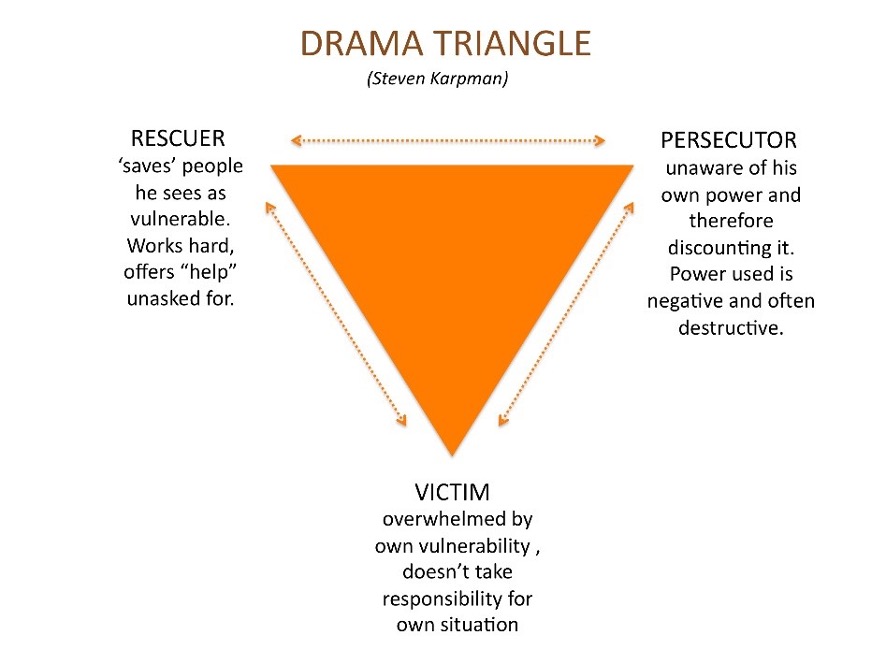
    The Drama Triangle

    From a young age I took on the role of rescuer within my family. My mother suffered from severe depression following my birth, and she needed her children’s love and care.

    Fast forward to 2020, during a global lockdown, I was playing the role of rescuer with my friends, completely unaware of the inauthenticity I was creating within myself and how I was neglecting my own needs.

    What does the rescuer look like?

    Warning Sign Number 1: People-Pleasing

    I was constantly people-pleasing and offering solutions to anyone around me, even though they never asked for help.

    I never considered how my friendships would be if I were not ‘useful’ or ‘fun.’

    I could see the red flags—for example, not speaking up when I felt something wasn’t right and instead working even harder to justify or understand one of my friend’s behaviors, and trying to help and save her even more by doing household chores.

    When we’re people-pleasing to gain someone else’s approval, we chose behaviors that are not true to ourselves. And we act in ways that negatively impair ourselves because in rescuing others, we’re neglecting ourselves.

    Warning Sign Number 2: Numbing Through Binge-Drinking and/or Eating  

    I was constantly binge-drinking with my friends, and it was damaging to my health. As a result, I experienced:

    • Sleep deprivation from the late nights
    • A dysregulated nervous system due to hangovers
    • Weight gain due to eating junk food

    And like a catch-22, the bad feelings I had after these episodes made me want to do it all over again to feel better, leaving me in a vicious cycle.

    I wanted to be with these women, like an obsession or craving, but I was using substances to numb the fact I didn’t feel safe with them. Eventually, this set off my internal radar telling me this wasn’t right.

    If you are in a cycle of unhealthy behavior with certain people and you’re developing self-destructive habits, it could very well be a way to cope/numb deeper feelings that you don’t want to face.

    Warning Sign Number 3: They Are Unavailable

    I began seeing our meet-ups as booty calls, enjoying the thrill and drama of rushing to meet them.

    I would drop everything to be in one friend’s last-minute plan, or I would try to make future plans if I saw her and I didn’t want it to end.

    These friendships felt like a drug—I felt addicted to seeing them, despite knowing it wasn’t good for me or my health. I would eagerly wait for one of my friends to tell me when she was available.

    The thing is, she wasn’t available. She didn’t want to make plans in advance or prioritize us on weekends when she had other plans. So I made myself more available. I’d drop things if she was free and wanted to meet.

    Being someone’s last resort and being okay with that are clear signs that a relationship isn’t healthy.

    I’ve come to realize that I’ve carried a mother/daughter wound my whole life—because my mother wasn’t available due to her mental health challenges—and I was desperate to be seen, wanted, and accepted by people who weren’t available as a result. It was all I knew. It’s how I became programmed.

    I was seeking out women who replicated the relationship I had with my mother as a child. I was befriending those who seemed confident, unattached, and unavailable.

    However, the issue wasn’t what they were doing. The real work was asking myself why I was making the choice to be around people who made me feel unsafe. So unsafe that I was numbing myself with food and alcohol when I was around them.

    Due to my mother’s depression when I was growing up, I didn’t know what it felt like to be in a safe relationship. Since drama and dysfunction were all I knew, that’s all I was seeking out.

    Through trauma coaching I learned how to listen to my physical body and then connect to my inner child. To find and heal that little Rav who was looking for love by people-pleasing.

    Here’s how I connect to my younger self:

    1. I take a moment to pause and feel. I close my eyes and breathe calmly. I scan my body for any aches/tension or obvious pains. After locating the pain, I ask myself when I felt like this as a child, and I explore that.

    2. I FEEL the feeling in all its depth. This might mean crying, shouting into a pillow, or even punching a pillow for the hurt I felt as a child during a specific incident, or for the pain I’m feeling now.

    3. I journal it all out of my mind and ‘re-parent’ my inner Rav: “It’s okay—I got you. That wasn’t very nice. You’re safe now. You don’t need to speak to mum right now. You can play with your toys or cuddle your teddy. Let’s help you feel better.” It can be in the form of an imagined conversation or even acting it out in the now after writing it out.

    The power of this process and being able to recognize those wounds is immense. You really start to understand and sense your own sense of self and your worth. And your current patterns and issues become so much clearer to see.

    The questions I went on to ask myself:

    • Were my friends asking me to rescue them?
    • Did they know I was withholding my honest feelings, too scared to tell them how I really felt?
    • Was it my choice to stay with them when I felt unsafe or to drink and stay up late?

    After I took an honest look at what was really going on, those friendships came to an end, and I still find myself grieving them but far less than when it first happened. It’s not easy. It hurts. However, I now have the tools to feel safe and to come back to my true self.

    Throughout the day I take my right palm to my heart, close my eyes, and remind myself “you are safe.” I repeat this as many times as necessary as I slow my breathing and connect to the present moment.

    It is so worth the struggle and the commitment to healing in order to break free. It’s actually created space for me to welcome more aligned friends into my life.

    It’s a process to adjust to a less dramatic, chaotic life than I had with them, but I am much more content within myself. I don’t need to hustle or the drama. It’s okay to be safe.

  • 20 Powerful Quotes to Help Minimize Conflict and Drama

    20 Powerful Quotes to Help Minimize Conflict and Drama

    The holidays can be a lot of fun, but let’s face it, they can sometimes be stressful, particularly if you spend them with family. Surrounded by multiple generations of people, many with different perspectives and beliefs, it’s easy to feel triggered or annoyed.

    Then there are the challenges associated with going home, whether that means visiting a physical location or returning to the (possibly unhealthy) mental space you occupied as a kid.

    And if you do fall into old landmines, it’s all the more frustrating because holidays come but once a year, and they’re supposed to be joyful, right?

    If you anticipate today might be fraught with conflict or drama, take a few minutes to reflect on the following quotes (including a couple of my own). Perhaps something here might help you create a little peace—for yourself and the people around you.

    20 Quotes for a Drama-Free Holiday

    1. “The people who trigger us to feel negative emotions are messengers. They are messengers for the unhealed parts of ourselves.” ~Teal Swan

    2. “No one can make you feel inferior without your consent.” ~Eleanor Roosevelt

    3. “Be selective with your battles. Sometimes peace is better than being right.” ~Unknown

    4. “Be kind to unkind people. They need it the most.” ~Unknown

    5. ““10% conflict is due to difference in opinion and 90% is due to wrong tone of voice.” ~Frank Viscuso

    6. “Practice the pause. Pause before judging. Pause before assuming. Pause before accusing. Pause whenever you’re about to react harshly and you’ll avoid doing and saying things you’ll later regret.” ~Lori Deschene

    7. “No response is a response. And a powerful one. Remember that.” ~Unknown

    8. “When you can’t control what’s happening, challenge yourself to control how you respond to what’s happening. That’s where your power lies.” ~Unknown

    9. “Don’t make assumptions. Find the courage to ask questions and to express what you really want. Communicate with others as clearly as you can to avoid misunderstandings, sadness, and drama. With just this one agreement, you can completely transform your life.” ~Don Miguel Ruiz

    10. “Give people the benefit of the doubt, over and over again, and do the same for yourself. Believe that you’re trying and that they’re trying. See the good in others, so it brings out the best in you.” ~Liz Newman

    11. “We don’t have to agree on everything to be kind to one another.” ~Unknown

    12. “Be the person who breaks the cycle. If you were judged, choose understanding. If you were rejected, choose acceptance. If you were shamed, choose compassion. Be the person you needed when you were hurting, not the person who hurt you. Vow to be better than what broke you—to heal instead of becoming bitter so you can act from your heart, not your pain.” ~Lori Deschene

    13. “Life becomes easier when you let go of the little things that bother you and focus on what makes you feel good.” ~Unknown

    14. “You don’t need anyone’s affection or approval in order to be good enough. When someone rejects or abandons or judges you, it isn’t actually about you. It’s about them and their own insecurities, limitations, and needs, and you don’t have to internalize that.” ~Daniell Koepke

    15. “Think before you speak, and don’t say everything you think.” ~Alexander Lebed

    16. “Most disagreements are caused by different perceptions that created different realities.” ~Unknown

    17. “The true mark of maturity is when someone hurts you and you try to understand their situation instead of hurting them back.” ~Unknown

    18. “Never waste your time trying to explain who you are to people who are committed to misunderstanding you.” ~Dream Hampton

    19. “There can be disagreement without disrespect.” ~Dean Jackson

    20. “Instead of getting defensive, just say thanks for letting me know your thoughts. I’ll consider them.” ~Henry Cloud

    Which of these quotes speaks to you the most? And do you have any to add to the list?

  • How to Free Yourself from Your Spiritual Drama

    How to Free Yourself from Your Spiritual Drama

    “You have no friends. You have no enemies. You only have teachers.” ~Ancient Proverb

    My very wise aunt, a talented psychotherapist and one of my spiritual teachers, has told me many times that the people, places, and things that trigger us are just “props in our spiritual drama.”

    This phrase has stuck with me for years because it’s catchy and it rings so true to me. If we are struggling, it’s not a matter of the external force, it’s about what it provokes in us.

    We don’t heal by trying to change others. We heal through breaking cycles; through knowing and honoring ourselves by creating healthy boundaries, processing the past, and living presently to make different choices.

    We don’t grow by staying in the same circumstances and hoping they will be different, or by leaving one set of circumstances only to repeat the same patterns with new people and places. We grow by stepping out of our inner default programming and into discomfort, and by consciously shifting away from the patterns we know and choosing different environments and dynamics.

    The people, places, and things that come into our lives are there for our spiritual journey, learning, and evolution. We can use these ‘props’ for good, we can use them to stay stuck, or we can use them to spiral down. As adults, the choice is ours.

    The props in our spiritual drama are what trigger us the most. They may be people, situations, or even certain qualities we notice in strangers.  

    My most challenging relationship is with my father, and while I could get stuck in that hardship story, I believe that he was placed in that role to assist me in the lessons I needed to learn while growing up and into young adulthood.

    The guy that I just dated, who I fell hard and quick for, was a prop in my relationship practice and process in continuing to clearly define what I want in a partner and what healthy boundaries I need to set.

    When I feel pain in my heart and want to stand up for the child who is being yelled at by a stressed mother on the subway, it shows me my own emotional hurt and the ways I haven’t expressed my truth about how my young inner child was treated poorly.

    When I feel anger when confronted with economic inequality, inconsideration/lack of caring, and other injustices in this world, it teaches me that I am not doing enough to feel satisfied and proud of the ways in which I contribute positively to society.

    Anything that I have not made peace with, found forgiveness around, or worked out within me yet continues to be a prop that encourages my spiritual growth.

    As I’ve contemplated the props in my spiritual drama, I trust they are there to assist me on my path.

    Challenging people and situations can be very difficult to live with and through, but I believe they serve an important purpose. If we are conscious and choose to move toward growth, freedom, and love, we can take this adversity and turn it into empowerment so we are more capable of being our best selves.

    Two main points have stuck out to me as I try to evolve through my spiritual drama.

    1. Situations repeat themselves until we learn the lessons.

    The lesson is ours to be learned, so if we don’t learn it the first or the tenth time, the pattern will continue in a vicious cycle until we finally get the message and choose a different way.

    Sometimes if we examine where or by whom we are triggered, the lesson is clear right away. Other times we need some guidance because we recognize something doesn’t feel right, yet we can’t get out of our own way enough to see it clearly.

    Friends, mentors, and family members we have healthy relationships with can be great at helping us understand our cycles and patterns so we can break free. Other times, we need to go within.

    When confronted with a low point, we have the opportunity to acknowledge what isn’t working and figure out in what direction our gut wisdom is guiding us.

    Personally, I had a habit of choosing men who were very passionate about their career or a serious hobby, and they would prioritize this passion over me, which led me to feeling hurt and uncared about.

    When I held up the mirror to examine myself deeply, I was able to see that as long as I wasn’t prioritizing myself and showing up to fully love for myself, I would attract partners who would partially reject me in the same way.

    A second layer of this was that I was subconsciously living vicariously through my partners’ aliveness and passion because I was missing that in my own life. Once I developed my own passions and started doing work I love, the need to feel this joy vicariously faded away and I started desiring partners who are more balanced and can have multiple priorities.

    The change may be uncomfortable, but usually quite rewarding in the end. And the discomfort we feel moving into the unknown is better than the despair we feel when repeating the same pattern over and over and staying miserable in the ‘known.’

    2. Our triggers can help us discover unmet needs, and meet them.

    Oftentimes we feel triggered by certain people, qualities, or situations because they represent ways we feel consciously or subconsciously uncared for, attacked, neglected, and rejected.

    For example, let’s say your boss gives you some constructive feedback regarding your work, and you feel like it’s a personal attack or a criticism instead of feedback intended to support you to help you succeed.

    In this scenario, instead of feeling attacked or rejected by your boss, you could ask yourself why you’re feeling such intense emotion. Is it because you’re hypercritical of yourself? Or do you feel shamed for not getting praise or approval because that’s a pattern you were taught growing up? In this instance, the trigger might teach you that you need your own approval.

    The more we can meet our own needs and lovingly re-parent ourselves, the more these triggers will fall away. So the inquiry becomes the key to moving through this spiritual drama.

    We need to ask why to understand our triggers more deeply, shift the immediate emotional response to curiosity, and eventually release the trigger by clearing past baggage and learning the lesson to show up for ourselves differently.

    Whenever, I’m feeling particularly triggered by a person or behavior, I take a few minutes to sit quietly, go within, and ask myself what it’s about and what I need to do to take care of myself.

    Maybe my inner child needs some reassurance that she is safe and loved.

    Maybe my body needs some relaxation because my nervous system is over-stimulated or stressed.

    Maybe I need to play, dance, and move energy through my body because I’ve been too much in do/go/on mode.

    Once I take care of my own needs, I’m not focused on the other, the prop, the trigger anymore. I am peaceful and present.

    This realization has served as a helpful reminder as I’ve moved through my life and felt the range of emotions that have come up. It’s never all about the other person; on some level, it’s about me. It serves me well to keep the focus on myself, what’s going on for me when the triggers come up, and what I can learn and process so that those triggers no longer live inside my body, mind, and soul.

    As we own and clear what is within us, the props in our spiritual drama fall away and we become lighter and can live more peacefully.

    May this serve you and may you be free.

  • Why I Got Caught Up in the Drama of an On-and-Off Relationship

    Why I Got Caught Up in the Drama of an On-and-Off Relationship

    “One reason people resist change is because they focus on what they have to give up instead of what they have to gain.” ~Rick Godwin

    Dave and I met earlier this January. I was immediately attracted to his aquamarine eyes and his tattoos. I met him on the eve of my twenty-sixth birthday and, based on our interaction, I assumed we’d have a casual fling. Things didn’t end that simply, to my surprise.

    When we were lying in bed together that first night, holding hands, he turned to me and asked if there was any chance we could get to know one another without sleeping with other people.

    This was strange to hear, but as a single woman in Los Angeles, I felt as though I had stumbled across some sort of rare species of man who was actually interested in pursuing a commitment without me having to do much.

    A part of me felt caught off guard and suspicious, considering I’d made it clear that this was just supposed to be a hook up. On the other hand, it was kind of nice that someone who I was incredibly attracted to wanted to get to know me exclusively. In retrospect, I realized that it filled me with this feeling of warmth that I’d been deprived of before I’d met him.

    Within five days, Dave asked me to be his girlfriend. Although I found his eagerness to jump into a relationship to be a bit off, I agreed because I liked him and wanted to go with the flow.

    The first few weeks were amazing, as we shared intimate conversations, romantic outings in Los Angeles, amazing sex, gifts, and the beginning of what felt like something that could blossom into a true partnership. However, the passion was intense, and we hadn’t had much time to develop authentic trust. It became increasingly evident to me that this relationship would be a ticking time bomb.

    Within a month and a half, I was overwhelmed with Dave’s jealousy, suspiciousness, and paranoia. He was becoming increasingly controlling and accusatory toward me.

    I was incredibly loyal to him and began to resent feeling like I was always doing something wrong when I was trying my best to be a good girlfriend. His gifts started to seem like a farce—like he had simply gotten me them to possess me instead of genuinely liking me for who I was.

    I broke up with him a few times because I couldn’t tolerate his jealousy and the way he degraded me. However, I would go back to him because I’d remember the good times and was becoming addicted to the kind of intensity he provided for me.

    I would question myself and think perhaps I was being too critical; after all, no one was perfect, and I should be flattered that someone was evidently so invested in me. I was in it too deep to see things clearly and make the right decision.

    When he and I would split, I’d attempt to get out there and date others, but no one was able to elicit the same warmth and stimulation I’d felt from him. So I’d go back to him. Just three months into this, we’d already established an on-and-off relationship that began to deteriorate my mental, emotional, and physical health.

    The fourth and final time we broke up ended with him yelling at me in public. I had wanted to leave a particular bar because I’d had an anxiety attack, and he accused me of wanting to exit because of “some guy” there. He was totally delusional. There was no guy in the bar I was trying to hide from him.

    I remembered chasing Dave after he’d stormed out from the bar and thrown money at me, demanding I take a bus back to my house. I was actually crying on the street chasing him while he yelled at me! I hated myself and the woman I’d regressed to.

    For comedic relief, there were two women watching us fight, standing outside a movie theater eating popcorn.

    “Don’t chase him, girl,” they told me. “He’s mean. Look at how he’s yelling at you. You deserve better.” Dave cussed at the girls before running off. I stopped chasing him. I came to my senses. It was brutal, but I realized that this relationship just wasn’t worth all the pain anymore.

    Part of me hates myself for letting myself get involved in such a clearly self-destructive relationship. I would like to say that this is my first on-and-off relationship, but it isn’t. Based off my experiences and observations, it seems like once you’ve been in one on-and-off relationship, you’re prone to more.

    Why couldn’t I just walk away the first time I broke up with this guy? Why do we get hooked on the drama of on-and-off relationships? Here are some theories I’ve formed.

    1. Life wasn’t much better before.

    Looking back, I recognize that I wasn’t in a solid place in my life before I met Dave. I was bored and at a crossroads with my career. I was highly susceptible to getting caught up in something like this because I was unhappy with my life and the drama provided both stimulation and a nice distraction.

    2. Pain felt familiar and comfortable to me.

    Even though Dave had shown me his mean streak within a month of dating, I stuck with it thinking I deserved it and that I should endure it for the greater good. My parents often shamed, invalidated, and criticized me when I was growing up, and as an adult I’ve been attracted to partners who do the same.

    3. I wasn’t clear on my deal breakers.

    I knew I was turned off by extreme jealousy, but I didn’t know it was a deal breaker for me at the time. Now, looking back, the deal breaker I’ve settled on is being degraded or humiliated for someone else’s uncontrollable jealousy.

    4. I developed an addiction to him and the drama.

    I’d become addicted to Dave, the sex, and the whole act of reconciling. There’s something intoxicating about the highs that follow the lows. It’s a cycle many are familiar with, and I am one of the lucky ones that got out of this relationship before it became even more destructive.

    Now that I’m armed with this knowledge, I’m going to focus on understanding and working on my masochistic behavior. I’m going to get more clarity on what my deal breakers are and make sure to end things once I feel someone isn’t respecting them.

    I’m sure there are some on-and-off relationships that end up working out, but in my experience, the whole act of repeatedly getting back together and breaking up undermines trust. I’d love to hear any experiences you’ve had with on-and-off relationships and any insights you’ve formed.

  • Why I’ve Upgraded to a Drama-Free Relationship

    Why I’ve Upgraded to a Drama-Free Relationship

    “Love is not what you say. Love is what you do.” ~Unknown

    I used to think that true love should be passionate and intense. When someone broke up with me or treated me poorly, I’d imagine that he really didn’t mean it. Surely he was really a good person and truly loved me, but was just “going through something” or “needed space.” Eventually he’d be back with tears, apologies, and flowers.

    I’d like to say I outgrew this tendency by the age of, well, maybe forty, but the fact is I didn’t.

    Instead, I carried a torch for a recently divorced man, who couldn’t stick around for more than eight weeks at a time, for more than a year. Each time he returned, he’d tell me how much he missed me and how much I meant to him, and I loved to hear it.

    Before him, I took well over a year off from dating anyone seriously because my ex-boyfriend might decide he wanted me back, and he called every month or so to check in. When he did this, I’d get thrown straight back into the drama of it all and second-guess my decision to end our relationship. After all, he said he loved me.

    And the man before that, well, you get the idea.

    This was all very exciting compared to my life at the office. It was very distracting as well. I’d spend hours googling self-help blogs and texting my girlfriends with the latest updates on “the guy” instead of doing my work.

    Let’s face it, relationship drama can pull you right in. It demands your attention immediately. It’s so intense to get a text in the middle of the night or to navigate the ups and downs of a stormy relationship. On again, off again, always waiting for a call or text. Will he or won’t he? Will you or won’t you?

    We modern humans no longer live in caves or have life and death struggles on a regular basis. Most of us live fairly routine lives in comfortable homes and have our physical needs met. Sometimes, you can get addicted to drama because it gives you a buzz of excitement that a regular old nine-to-five lifestyle just can’t.

    A shot of adrenaline can help us wake up to life and get motivated. Things like climbing a mountain, signing up for a triathlon, or a tight deadline help us get fired up.

    Taking on a new challenge from time to time can help us feel like we’re going somewhere in life. If we don’t do this, regular doses of relationship drama can provide a distraction. An unstable relationship may be exciting at first, but it can eventually become draining.

    A turbulent relationship can sap your energy and your confidence. You never quite know where you stand with this person, and it wears down your sense of stability and security. It can bleed into the rest of your life and damage your other relationships, your career, or even your health.

    If you’re involved in a troubled relationship, it can be all-encompassing. It’s also very tempting to adopt the role of the savior because you get to be the “together” person, the responsible one.

    If you’ve been living on a steady diet of relationship drama, it’s time for a reality check. Ask yourself how this situation is serving you. Blaming the other person and hoping that they will change isn’t helpful, because you’re the one who’s tolerating these circumstances in your life.

    Being willing to accept responsibility for the situation you’re in is the first step to a more fulfilling love life.

    Ask yourself what kind of relationship you want to have. Take some time and journal about it. How do you want to feel? What is your day-to-day experience like? Is that kind of relationship possible with the person you’re with (or considering) now? Not when or if they finally change. Now.

    When I asked myself these questions, I saw that I wanted to be loved and to feel safe. I wanted to know that my significant other was “all in” with me, not halfway out the door. I came to recognize that I wasn’t choosing men who were willing to have this kind of relationship with me.

    I also realized that once I discovered that this was the case with a particular person, I was very reluctant to let him go. Instead, I’d hang on for far too long in the hopes that things would get better, which they never did.

    Once you’ve considered these questions for yourself, consider what changes you’ll need to make in order to have the kind of relationship you want.

    I came to understand that I’d have to give up the idea that drama was an indicator of true love. The kinds of relationships that I previously would have considered “boring” were, in fact, desirable. I found more healthy ways of adding excitement to my life.

    The man I married is dependable and reliable. I can always count on him to keep his promises and I know he adores me. I couldn’t be happier.

    From our very first conversation on, I never had any doubts or had to wait for him to change or “come around”. He made his feelings for me very clear from the get-go and I always knew where I stood with him.

    I always feel safe with him and we go hiking and mountain climbing instead of breaking up every few weeks.

    If you really want to have a fulfilling relationship, then it’s time to make choices that are consistent with your desire. This can be difficult, because people often consider drama an indicator of love or passion, but it doesn’t have to be that way.

    You can choose to see drama for what it is, an indicator of an unstable relationship. Once you do this, commit to dating people who are capable of having a healthy relationship.

    Doing these things will drastically increase your chances of having a fulfilling relationship.

  • Why I Was Addicted to Attention, Lies, and Drama

    Why I Was Addicted to Attention, Lies, and Drama

    I’ve done a lot of things for attention that I’m not proud of. I’ve created drama. I’ve bragged. I’ve exaggerated. I’ve hurt people. I’ve hurt myself. I’ve lied and lied and lied.

    No one wants to be labeled as an “attention seeker.” When people say, “She’s just doing it for attention,” they don’t mean it as a compliment. I knew this. And I knew that people said these things about me.

    And still, I couldn’t stop.

    I spend a lot of time around animals, especially cats. It’s easy to see which ones have experienced starvation. They have constant anxiety about food. They meow and meow when it’s feeding time. They scarf their portions down without breathing. If the bowl is left full, they’ll eat whatever’s there—even if it’s a week’s worth of food!

    I was that cat with attention. I could never get enough.

    But compulsive behaviors aren’t about what we’re consuming. Attention seeking isn’t about attention. Food addiction isn’t about food. Really, it’s about control.

    When you’ve been starved of something, you develop a fear of losing it. You begin to cling to every morsel of what you’re desperately afraid to live without. Survival mode.

    That’s what it was like for me: constant survival mode. I felt like, at any moment, I was going to be abandoned, left alone, forgotten. I fought to be noticed. Fought to be heard. Fought to be “loved.”

    But despite my constant attention-seeking efforts, I never got what I truly wanted. I never felt loved for exactly who I was because I never showed her to anyone! I showed the world the person I thought it wanted to see, and I used other people as characters in my personal drama.

    So that is the biggest irony: because I was so desperately hungry for love, I couldn’t have it. Because I so deeply craved attention, I repelled people away from me. Then, these experiences reaffirmed my biggest fear: there wasn’t enough. I wasn’t enough. So I’d grasp more, cling more, lie more.

    Too often, people talk about attention seeking like it’s a character flaw. I see it as an addiction.

    When we’re trying to fill a love-sized hole, it doesn’t matter what we’re trying to stuff into it: drugs, money, alcohol, approval, sex. If it’s not love, it won’t truly satisfy us. We’ll keep wanting more and more.

    My journey of healing my attention-seeking patterns has been long and painful. One of the most painful things has been realizing that most people weren’t reacting to me the way I thought they were.

    I used to brag loudly in public, imagining people around me admiring and envying me. Now, I realize that most of them were either ignoring me or annoyed by my antics.

    I used to stretch every accomplishment, imagining people respecting me. If it was two, I’d say five. If it was 100, I’d say 300. If it was one minute, I’d say an hour. Now, I realize that most people either didn’t believe me or used my lies to reinforce their own insecurities.

    I used to make a tragedy out of every pain and a drama out of every inconvenience, imagining people pitying me. Now, I know that most people either felt stuck in the cloud of toxicity that surrounded me (because of their own unhealed traumas), or they avoided that cloud like the plague.

    The world, I’ve discovered, isn’t quite the place I thought it was.

    I was so busy talking and talking, lying and lying, that I never sat down just to listen. And that is what helped me heal: looking within myself, looking around me, and embracing reality.

    Attention seeking, for me, was a kind of self-protection. On my journey of healing myself, I’ve found that self-love and self-protection aren’t the same thing. I had to remove my armor and my mask. I had to face the truth.

    Beneath my defense mechanisms, I found a fragile, wounded part of me that was traumatized by childhood experiences—by emotional starvation. But this part of me wasn’t fragile because of the wounds I incurred as a kid. It was fragile because I tried to protect it.

    After I got hurt, I tried to hide myself away. I tried to create an elaborate fantasy world to protect myself from rejection and abandonment. I piled layers and layers of bandages on top of my wounds, but wounds need air to heal. I tried to keep myself safe, but I ended up suffocating myself instead.

    I wasn’t lying and creating drama “just for attention.” I was doing it to survive. I was grasping for scraps of approval to replace my desperate hunger for real love, for authenticity, for happiness.

    On the outside, it seemed like I wanted other people’s attention. That’s what I thought I needed too. But what I really needed was to pay attention—to be able to just exist in each moment without struggling. To be able to look at myself without running away. To look at people without being afraid of them. To have peace of mind.

    Maybe you know someone who’s stuck in these patterns. Maybe that someone is you. However this applies to you, I hope to communicate one important thing: attention seeking is a symptom of a bigger cause.

    It’s not something to be dismissed. It’s also not something to be judged and criticized. It’s something to be accepted, understood, unraveled, and forgiven.

    Healing these patterns takes time. Every step along the way, it’s been difficult for me to invite reality to replace my delusions. It’s been hard to allow myself to be raw and open instead of trying to protect myself from pain.

    But this healing journey has also allowed me to enjoy real affection: from myself and from others. And that has been worth all the hard work.

  • How Our Egos Create Drama in Our Relationships (And How to Avoid It)

    How Our Egos Create Drama in Our Relationships (And How to Avoid It)

    “The ego is the false self-born out of fear and defensiveness.” ~John O’Donohue

    I started a new relationship in December 2015, then moved countries to be with my Swedish partner in August, 2016.

    The last year has been life changing in the best possible ways. I’ve learned so much about myself, things I didn’t have the courage to acknowledge before.

    But it hasn’t all been a bed of roses—some of the insights I’ve gleaned haven’t been that comfortable to see.

    We met on an intensive spiritual retreat in India. We’ve both spent many years working on ourselves and our issues, so it’s fair to say we’re both awake and aware. But this has not guaranteed an easy ride or a challenge-free relationship.

    We both still have to work hard on the problems that come up, affecting us both individually and as a couple.

    When our disagreements or arguments erupt, it is often over the smallest things, which seem so important at the time. A prime example is when my partner asks me to do something without saying “please” (something that’s common in Sweden.)

    Such a minor failing has the power to seriously irritate me, causing our argument to blow up out of all proportion—sending one or either of us into fits of temper tantrums that can end with one or both of us brooding and not speaking to the other.

    Although we’re both aware how childishly we’re behaving and can see our over-reactions, we are nevertheless at a loss to stop or change this process. Why? Because of our egos!

    For the first time in my life I am seeing, experiencing, and understanding the ego play that takes place in every conflict I have. These insights are allowing me to unravel the true nature of my ego and its workings.

    If I were to describe my ego, I would compare it to an irritable, barely containable caged monster on the one hand and an irate, screaming five-year-old on the other. And just like a child that doesn’t get her own way, she’s constantly throwing tantrums.

    These tantrums take the form of anger, hurt, fear, defensiveness, exaggeration, frustration, self-preservation, insecurity, self-pity, and tears—all mixed with large quantities of drama.

    In the heat of an argument, my five-year-old ego is very quick to feel hurt, so she reacts by jumping, stamping her feet, cursing, and defending herself. Then, just as quickly, the caged monster surfaces, rearing up like an angry giant, sword and shield in hand, ready to inflict hurt in return.

    I literally see my ego self rising up like a dark shadowy character, looming menacingly above my head.

    Of course I know this ego play doesn’t solve anything—it only serves to trigger my partner’s own ego defense games. Suddenly we’re both wounded five-year-olds, shouting and throwing ugly insults back and forth at each other.

    Then, invariably, we have to argue about who started it and which one of us is right.

    As you can imagine, these ego battles take up a lot of energy and are very stressful, not to mention emotionally draining.

    I notice that when I’m in this heightened state of drama, my ability for logical thinking goes out of the window. I lose all connection to my grown-up self and I feel the adult receding, regressing me back to an insecure child.

    I see myself adopting the same body language and survival strategies I used when I got into disputes with my mother during childhood.

    Looking back, it’s obvious to me that my current over-reactions have a lot to do with how I was brought up. My mother was a strict matriarch with black and white views—grey areas didn’t exist in her world. She was always right and everyone else wrong, and there was no room for argument.

    If I ever dared to argue, I would be quickly silenced with a barrage of cutting words or physical blows that would leave me hurt, feeling powerless and seething for hours. My voice was quashed, my will controlled, and I felt small and stifled.

    As a child, I didn’t have the awareness to recognize the surge of my ego during these altercations with my mother, when my very existence felt under threat. But of course, every part of me screamed silently in protest, including my ego.

    Now, as a so-called mature fifty-year-old adult, it’s quite disconcerting to visibly witness my conditioned responses popping to the surface during heated conflicts, especially when some part of me feels threatened.

    These responses haven’t altered or evolved at all since my childhood. Sometimes it feels like I’ve never really grown up.

    I still discover myself seething in the same helpless way to emotional triggers and feeling the same powerlessness when my will is challenged or when I feel controlled, as I often do during conflicts with my partner.

    My ego rears up in anger and defense in exactly the way it did when I was a child.

    And yet, even in the most extreme spells of ego drama, I’m sometimes able to take a step back from my hurt, stealing a momentary pause from the heat of my frustration.

    These short breaks allow my anger to calm, giving space for my ego to stand down. Then I’m able to recognize the reasons for my exaggerated reactions, understanding that a part of me was feeling threatened.

    I’ve observed that my biggest over-reactions occur when my partner threatens what I deem important; for example, the time and money I spend on my spiritual activities.

    In these brief moments of lucidity, the ego is fully exposed with technicolor clarity. In this instant, the cause of our argument, which seemed so important just a few minutes before, completely loses its power and dissolves, rendering the whole situation funny and somewhat ridiculous.

    My ego’s true nature is laid bare during these points of pure seeing.

    It’s utterly clear to me that my ego simply functions to protect the parts of myself I feel I must defend, secure, or guard, like my will, my way of expression, my beliefs and moral values.

    My ego jumps up in defense of these values because of the importance I’ve given them, effectively giving my ego permission to react whenever these values feel challenged.

    Amazingly, the truth is, these morals can only exert power over me if I allow them to. I can equally decide not to give them any power at all, which should gradually stop my ego’s need to defend them.

    I know it will take time to break this pattern of over-reactions to emotional triggers, since my conditioned responses are almost automatic now. However, in conflict situations, if in one time out of ten I don’t react, it will certainly make a difference to my life and relationships, won’t it?

    What a liberation that will be!

    For years I’ve unknowingly been trapped in the same ego cycle of trigger/reaction, trigger/reaction that developed when I was a child.

    Now, with the benefit of being able to witness my ego play in action, I no longer feel a prisoner of its games. For the first time in life, I am learning to choose whether or not to react.

    These other insights around my ego are helping to improve my partner relationship, as well as the relationships with family and friends.

    The ego wants to blame others.

    We have all become so accustomed to blaming other people and circumstances that we are often not even conscious that we’re doing it.

    On the surface, it’s much easier to blame others, because it removes the burden of accountability from us and places it firmly at the feet of the other. However, although blaming others appears to be a quick-fix solution, in all honesty, it isn’t.

    Believe it or not, blaming others takes away our control of the situation and passes it onto the other. It prevents us from seeing the whole truth of the issue and blocks us from fully understanding ourselves, which can keep us stuck in the same obstructive patterns of behavior.

    For years I blamed my mother for everything that was wrong in my life. I blamed her for not being there for me, for not supporting my dreams, and for not being the parent I expected her to be. Spending so much time and energy blaming her, I wasn’t able to see my own part in the situation.

    When I finally had the courage to stop blaming my mother, it came as quite a shock to me to realize that I was equally responsible for the things I was unhappy with.

    It’s clear to me that my ego’s fear of admitting culpability kept me in blame mode.

    I naturally progressed onto blaming my partner, because my ego makes it difficult for me to accept my part in a conflict that I am at least partly responsible for. So it’s no surprise our arguments escalate as they do.

    Ultimately, we must all strive to accept responsibility for every action we take, even the ones we’re ashamed of. The more we’re able to do this, the stronger we become and the weaker our egos will be, gradually loosening the grip they have on us.

    The ego covers up.

    Another thing I can say about the ego is that it will do anything to cover up its mistakes, especially when it sees it’s wrong. Its attempts to cover up increase when caught red-handed, behaving just like a child caught with his hand in the cookie jar.

    I remember when I was a child, even when I was caught in the act, I would do everything I could to cover up my mistake, trying my best to deny the blatant truth.

    Maybe my actions as a child could be excused, but sadly, my behavior as an adult hasn’t improved—I still find myself fighting to deny the truth when I’m unexpectedly caught off guard. Like when my partner surprises me, by correctly guessing the trivial cause of my upset.

    My ego hates being so easily called out, so it must cover up and defend.

    One of the hardest things for any of us to do is to admit we are wrong, because when we own up to being wrong, it automatically makes the other right.

    And being wrong is something our egos cannot bear. As a result, we find it difficult to say sorry or to ask for forgiveness, which exacerbates our conflicts.

    I’m also recognizing that our inability to admit our wrongdoing keeps us stuck in our defensive positions, which allows our egos to fool us into fighting, justifying, and defending every point of view—a complete drain of our energy.

    I’ve noticed, however, that when I see the truth and can openly admit it to my partner, surprisingly, rather than separating us, the admission brings us closer together, healing some of the hurt we created during our conflict.

    So admitting that we are wrong need not be a negative experience, but can instead empower us, lessening some of the control our egos have on us.

    The ego wants to hurt back.

    For me, one of the worst things in the world is the pain of feeling hurt, as I imagine is true for most of us.

    Sometimes, the hurt we feel paralyzes us and we’re unable to fight back, but at other times, the only thing we can think of is how we can hurt the other person back.

    Our egos trick us into believing that hurting the other will alleviate the pain we’re feeling.

    I’ve realized that in all conflict situations, it is actually our egos that feel hurt. Again because some value or aspect of the image we have internally built up of ourselves is being challenged, threatened, or undermined in one way or another.

    I’m ashamed to say that on many occasions, both in my childhood and adulthood, my ego has wanted nothing more than to inflict as much pain on others as possible, as a way of lessening some of the hurt it was feeling.

    But retaliation is not the answer; it only adds more fuel to the fires of our egos.

    Maybe I can be forgiven for saying that in my childhood, hurting others was an unconscious reaction to my own feelings of hurt. And in the recent past when I was still unawake, hurting someone who hurt me was my natural course of action. But now, with my increasing awareness, knowingly hurting another is not something I can condone.

    In the heat of ego fights between me and my partner, when my ego rears up ready to defend itself, it’s hard, but I am becoming more and more able to check myself before I go over the line with insults I know will cause my partner pain. Even when I feel he has crossed the line with me, I can still consciously stop myself from going too far.

    I consider this a huge triumph over my ego, and something I’m proud of.

    Every time I can stop myself from blindly over-reacting to a perceived threat to my values and can become an observer of my ego and its games, I know I’m taking a step in the right direction.

    The more conscious we can all become of our ego play in action, the more freedom we will gain from our egos. Then, over time and with consistent effort, positive changes to our life journeys and relationships are inevitable.

    Artwork by artbymanjiri, CC 2.0

  • 7 Crucial Steps to Minimize Drama in Your Life

    7 Crucial Steps to Minimize Drama in Your Life

    “When you are not honoring the present moment by allowing it to be, you are creating drama.” ~Eckhart Tolle

    Well into my twenties, all of my friendships with women looked a lot like junior high.

    One day, we’d be codependent and attached at the hip, sending incessant play-by-play emails throughout the workday like one too many notes in class.

    The next day, we’d be dragging each other by the hair into a heap of combined emotional issues, complete with nasty suspicions, unfounded accusations, and a dramatic reconciliation that would inevitably be short-lived.

    Shortly after one toxic friendship eroded, I found a new one, like a mythological creature that regenerates its head immediately after it’s cut off. Things weren’t much different with the men I dated.

    For a long time, I lamented all the damaging relationships I’d been in, as if I was some kind of victim who always got the short end of the stick.

    Then one day I realized there was a reason I always found myself in dramatic relationships: I was attracted to drama like a moth to a flame.

    Chaos was the status quo for the majority of my life, and when it wasn’t there, I panicked. I didn’t feel comfortable unless I was fighting someone or, at the very least, fighting myself.

    The things I said and did contradicted each other because it was easier to blame the world and stay the same than it would be to really see myself and make a change.

    You might not be a recovering drama queen like me, but you’ve probably encountered your share of relationship histrionics.

    Maybe your close friend has as many catastrophes as there are days of the week. Maybe you’re the person everyone calls with their problems. Or maybe you unknowingly turn small issues into major crises, and you’d like to stop feeling so overwhelmed.

    Whatever the case, you probably have at least a little drama in your life that you’d like to minimize.

    With this in mind, I recently asked on the Tiny Buddha Facebook page: How do you minimize drama in your life? I took a sampling of the 183 responses and formulated this guide to defusing drama: (more…)

  • Let Go of Your Unhelpful Story: Accept, Surrender, and Move On

    Let Go of Your Unhelpful Story: Accept, Surrender, and Move On

    Man in Lotus Position

    “The primary cause of unhappiness is never the situation but your thoughts about it.” ~Eckhart Tolle

    I recently discovered just how powerful our thoughts can be. I learned that it doesn’t take time for us to accept our current situation; it simply takes a shift in our perceptions and a change in the stories we tell ourselves.

    The catalyst for this realization was sent to me, in a small envelope placed under the windscreen wipers of my car. Yes, it came in the form of a parking ticket.

    At first I was shocked and quite disappointed in myself for getting a parking ticket.

    As I drove home, I found myself building a story in my head: It’s so unfair. I didn’t realize it was rear-to-curb parking only. Other people were parked the same way and they didn’t have tickets. Why me?

    I saw the parking ticket as an attack against me personally, as an indicator that I wasn’t good enough. I was beating myself up and couldn’t understand why I had been fined.

    But then I stopped. I dug a little deeper and tried to unravel why I was feeling so upset. I realized I was making something insignificant into a really big deal.

    I was building a story that did not serve me at all. I was too attached to the current situation.

    The parking attendant didn’t know me personally; he was just doing his job. There was no one else that I could blame for the ticket; I had parked incorrectly and it was only fair that I received a ticket for doing so.

    Once I realized this, I was able to take a step back, and I thought to myself, You know what? It doesn’t matter what story I create. I’m still going to have to pay this fine. I may as well accept it and move on.

    There was no need for me to be so upset, and the only way to move past how unhappy I felt was to change my thoughts.

    In the last few years, as I’ve delved into self-study and spiritual enquiry, I’ve read a lot about the power of non-attachment and our ability to create our reality through our thoughts.

    Hundreds of articles, books, presentations, and videos all encouraged me to become aware of my thoughts, and to watch whether the stories in my mind serve me or take me further away from where I want to be.

    But I had never really put it into practice. At least not until the day I received my first parking ticket.

    As I drove home, I paid very little attention to the road in front of me because I was so caught up in my story about how unfair the whole situation was. Then suddenly a switch flicked inside my mind.

    It was probably the first time that I have truly been aware of my thoughts. I felt like an observer, watching my mind race and witnessing the birth of a new story.

    This sense of awareness made me realize how frequently I create stories in my head and how often I take something insignificant and turn it into something huge. I’ve learned how frequently I create drama and complications in my life.

    It’s certainly true that we can’t always control the situations we find ourselves in and we definitely can’t always control what happens to us. But it’s also true that we can control how we react. 

    When I realized just how petty my reaction was, I was able to shift my train of thought completely.

    I learned that we don’t have to waste twenty minutes or a whole day (or longer) creating stories that get us nowhere. We don’t have to turn a minor annoyance into a huge drama.

    Things can be so much simpler. We can accept what happens, even if we don’t like it.

    We can just watch as something happens, without making it into a personal problem that needs to be solved.

    We can be humbled by our errors rather than trying to shift the blame and pass off any consequences.

    We can accept, surrender, and move on. We don’t have to attach our happiness or sense of self to everything that happens in our lives. 

    The next time (and I know there will be a next time) something I don’t like happens, I will do my best to not take it personally.

    I will bring awareness to my thoughts and I will stop myself from creating a useless and unhelpful story. I will accept the situation, as it is, and I will try to keep my reaction cool, calm, and collected.

    I will react in a way that doesn’t cause undue stress or unhappiness.

    You too have the power to control how you react to the situations that unfold around you. You can bring awareness to your thoughts and to the stories your mind creates. And you can uncover a new sense of awareness and non-attachment without first needing to pay a fine.

    Man in lotus position image via Shutterstock

  • Improve Your Communication: How to Address Big Issues in Your Relationship

    Improve Your Communication: How to Address Big Issues in Your Relationship

    Couple Looking at Each Other

    “Communication works for those who work at it.” ~John Powell

    I’ve been with my boyfriend for three years now. He’s a great guy. We get along well, we complement each other, and we have a lot of fun when we’re together.

    Still, despite our mutual desire for a great relationship, we occasionally run into roadblocks, otherwise known as growth points.

    Recently we’ve been going through a bit of a rough patch while revisiting unresolved dramas. What enables us to handle these dramas well is our willingness to show up and communicate.

    Through our three years together, I’ve learned a few things about effective communication. If you’ve found it difficult to share your thoughts and feelings and work through issues in your relationship, this may help.

    1. Schedule a time to talk.

    This is most important when it comes to discussing the heavier subject matter of your relationship.

    Even though I know this and I follow this rule regularly, an impulsive side of me failed to abide by this rule in one of my most recent discussions with my boyfriend. And I paid the price.

    We were lying in bed one night and the topic of concern came up. My heart leaped into my throat and I felt like I just had to say something. I decided to open the can of worms right then and there. He did not like that.

    He felt ambushed, which is understandable, right? I didn’t give him the opportunity to prepare. He had no idea what was coming!

    He got angry. He closed down. And, in turn, I didn’t feel heard and thought he didn’t care about my feelings.

    In reality, I didn’t do what I know is best to do: schedule a time to have a conversation. So, even though I let myself get upset and hurt about it, it was my responsibility to broach the conversation from a different angle. I had to let go of my hurt feelings and honestly examine where I dropped the ball.

    If I had scheduled a time to talk, then he would have been more willing to communicate with me. Honoring other people and their feelings allows both parties to fully show up, be heard, and hash things out collaboratively.

    2. Know your desires and intentions.

    Returning to the same scenario as above: I eventually decided to ask him for an appropriate time to talk. We agreed on dinnertime the next night.

    As we sat down and the conversation opened up, I decided to share with him my intention and desire for the conversation, beyond the topic for discussion.

    My true intention was to have open, clear, loving, positive, and collaborative communication with him. It’s important for me to be in a relationship in which conscious communication is the mainframe.

    I used the analogy that if either of us were unhappy about something and the other person or both of us were unwilling to communicate about it, then that would be like sticking a thorn in our relationship and choosing to allow it to deteriorate. It’s sweeping matters under the rug instead of dealing with them straight on.

    By sharing this, he immediately opened up because he knew where I was coming from and that my intention was positive and for the good of our relationship. He could relate to that because he desires and intends the same thing.

    3. Be prepared to lead the conversation.

    If you plan a time to talk with your partner about an issue in your relationship, be prepared to lead the way.

    My boyfriend and I have had several deep conversations over the last few months. So, at this point, I knew it was best for me to be prepared.

    In the past, when I failed to gather my thoughts in advance, I fumbled over my words and wasn’t quite sure what to say. I knew what the topic of conversation was, but I failed to produce anything productive, at least, not right off the bat.

    And finally…

    4. Take responsibility for, honor, and share your feelings.

    It wasn’t until I started sharing my feelings, without blaming (i.e. “I feel angry…”), that I started to feel heard and the conversation felt worthwhile.

    If I had continued to hide how I felt and just talked about how to solve the problem, then I would have continued to feel like something was wrong. And when that occurs, the first thing that comes to mind is that this communication thing just doesn’t work. I eventually want to withdraw.

    Facilitating communication with another goes both ways. I had to learn what works to open me up, as well as what will allow him to feel safe to open up as well.

    Communication is crucial for healthy relationships. We develop intimacy as we learn to navigate each other’s rocky inner terrain, continually allowing the other to feel deeply loved and safer in our presence.

    Following these simple and practical steps can make communication much easier—and much more effective.

    Couple looking at each other image via Shutterstock

  • How Our Addiction to Struggle Holds Us Back

    How Our Addiction to Struggle Holds Us Back

    Held Back

    “Happiness is the absence of striving for happiness.” ~Chuang Tzu

    Do you feel, on some level, that your life is hard work? That you need to struggle in order to improve things in your world? Do you feel that you even need to struggle to reach a desired goal, to overcome adversity before achieving something worthy?

    Our addiction to struggle is an impediment to us feeling the joy of quiet and the now, the place from which subtle and natural development can occur.

    This addiction to struggling—the addiction to striving, always trying to achieve—used to hold me back from experiencing the whole of life.

    My awareness dawned slowly. Once an over-achieving lawyer working sixty-hour weeks (and then ducking off to volunteer my time for another cause), I am now much more relaxed, and able to give from a place of increased abundance and energy. But hey, it’s taken time, and it’s still a work in progress.

    I’ve dabbled in meditation for years and had a daily practice for three years. But it’s not just all about the cushion—getting out and having fun, dancing, enjoying life is what helped me see that I was actually trapped in a pattern of thinking that I had to work hard and reach (and overcome) a crisis point to be successful.

    The more I meditate, the more present I am, even off the cushion. I can even catch the moment at which I start being run by my own subconscious beliefs that life involves struggle.

    Some mornings, in the liminal state between sleeping and waking, I can catch an almost imperceptible shift, where my mind switches from the ease of a sweet dream to a battle with consciousness and being awake.

    Oh really, do I have to get up now?

    (And the deeper revelation: how subtly and consistently I struggle with reality itself.)

    The point at which I am able to accept my current reality is the point at which I surrender to that experience.

    Funnily enough, this is usually the point at which life becomes easier. Not because I have won a battle against my mind, but because I have allowed myself to stop resisting what just is.

    I get up. I go about my day. No big deal; in fact, I enjoy it.

    So, how is this addiction to struggle holding us back? After all, I’ll be the first to put my hand up to say how much I’ve learned from those with the strength of character, creativity, and resilience to overcome the most trying of times. Survivors inspire us and bring us hope when we can only see darkness.

    Yet, it seems that overcoming adversity has become the primary narrative arc in some corners of the spirituality and personal development online worlds.

    Our relationship with mind and ego are often phrased in ‘battle’ terms, and having a gruelling experience has become the necessary precondition to success.

    This is so subtle. But this preoccupation with overcoming struggle holds us back in many ways. It conceals other paths to growth. It even may cause us to devalue presence and surrender.

    Overcoming struggle is only one way to grow and to learn.

    Some of my most significant advancements in my thinking and changes in my life have been the result of product of gentle, consistent effort. In this way, old holding patterns have dissolved quite naturally.

    My decision not to drink alcohol is one example. Upon finding out that I’m a teetotaller, people often assume that my self-destruction precipitated a crisis with booze, followed by hard-won sobriety.

    Of course, I celebrate those who have overcome alcoholism, but I don’t have a victory-over-struggle story with alcohol. Once upon a time, I enjoyed a drink. Years of enjoyable meditation changed my brain, and I now happily don’t drink alcohol because I don’t feel a desire to drink. (And as it turns out, the benefits are innumerable!)

    Accepting that it’s possible to be ripe when you are ripe, that you may not be following a familiar path of overcoming adversity, doesn’t make a riveting story in the manner to which we’ve become accustomed.

    Perhaps we can track the predominance of the struggle trope back to the popularity of the hero’s journey: the tale of the swashbuckling hero confronting and triumphing over symbolic dragons and ogres on the transformational journey.

    To be clear: the hero’s journey is, of course, inspirational. We all have periods of darkness. We all love to win our battles. We all love to be inspired by others who can lead the way.

    My point is that only some journeys are punctuated by ordeals. On other paths, there is no dragon. There may just be a path to walk—even a playground in which to frolic!

    Moreover, we definitely do not need to manufacture a challenging transformation if there was no such ordeal. Our experience is not less worthy or true as a result.

    Noticing my own addiction to struggle has been humbling and revealing. Releasing my own tendency to slip into struggle means that I am more present. (And I have more fun!)

    Our addiction to struggle can lead us to devalue the gentle and humble evolution that can accompany development without drama. It can lead us to miss the happiness that can be found in the here and now, regardless of the circumstances.

    My question for you is: where in your life are you struggling? How are you playing out this subconscious script yourself?

    And what would your life be like if you were able to notice and celebrate your consistent and gentle evolution?

    Would this, in fact, be a quiet liberation?

    Photo by Daniel Lee

  • What All Great Relationships Have in Common

    What All Great Relationships Have in Common

    “Remember, we all stumble, every one of us. That’s why it’s a comfort to go hand in hand.” ~Emily Kimbrough

    My husband and I have been married for almost ten years.

    And before those ten years, we were college sweethearts and had been dating for over six.

    When you know someone for that long, someone whom you are deeply and madly in love with, something funny happens:

    Your collective thoughts, actions, and words become so tightly intertwined that you walk around believing you are one person.

    As a result, you feel ten times taller. Like you can do anything. You feel as though you’ve discovered the purpose for breathing on this planet.

    But something else happens, too. 

    When you really know someone, intimately and with all the deepest parts of yourself, you also hit bumps in the road.

    Times when you argue. Times when you take each other for granted. Times when you’re completely challenged.

    My husband and I have been through it all, especially as college graduates moving out to Hollywood with big dreams in our hearts.

    We were changing so much, like shapeshifters, rapidly taking on new forms and discovering who we really were in the process.

    The truth is, that period could’ve easily destroyed us.

    Not only that, but: Sometimes we felt like we didn’t know each other. Sometimes our matchbox-sized apartment in West Hollywood got under our skin. Sometimes we fought.

    Sometimes we were broke. Sometimes we weren’t intimate. Sometimes our car broke down.

    Sometimes exes popped up out of nowhere, determined to tear us apart.

    We’ve weathered all of these storms, and more. And we will weather them, still.

    Things will happen. Shadowy forms will come out to dance. Life will hurt sometimes. And be hard. But also worth it.

    My husband and I have a beautiful life. I truly couldn’t ask for more. We have a deep, eternal bond, embodied in the form of a brilliant and loving toddler who brings us a deep joy we once never knew existed.

    We also do things that light us up from the inside out. We make films together. We write together.

    We share a love for the arts, books, meditation, politics, quantum physics, and vegan food. We take walks together. Talk about anything and everything.

    Together, alone, we make the stupidest and most politically incorrect jokes you can imagine.

    We challenge one another to leap out of our comfort zones. We make big decisions and set off on bold adventures.

    My point is this:

    If you have true love in your life, don’t let the down, dark, doomy, disappointing, messed-up times fool you into thinking that you. Just. Can’t. Do. This. Anymore.

    Embrace the fact that love—the real, infinite, take-your-breath-away kind of love—will be filled with ups and downs.

    Embrace your every moment together. All of it—the romance, the laughter, the tears, the disagreements, the adventures, the infinite unknowns. 

    ‘Cause if, along the way, no matter how deep the trenches, you each have somebody who cherishes you, supports you, uplifts you, respects you, and thinks the world of you, then you must thank your lucky stars for that gift.

    And throughout the mystifying journey, remember this:

    If the bad times suck hard, then the good times must be really special. That’s why the bad times make us suffer so much—because the good times are something we can’t bear to lose.

    Accordingly, we struggle. We work at it. We fight for our blessings.

    No relationship is perfect. But the ones worth having are always worth fighting for.

  • How to Avoid Drama: Stop Taking Things Personally and Needing to Be Right

    How to Avoid Drama: Stop Taking Things Personally and Needing to Be Right

    “Concern yourself not with what is right and what is wrong but with what is important.” ~Unknown

    I remember quite distinctly the point where my rational self, less invested in the discussion, took a step back and pointed out that I was descending down the path of needing to prove that I was right.

    It was precisely when I started seeing the other commenter as needling my position and attacking the ideas as mine.

    What started out as an appeal to respect cultures that celebrate death as a normal part of life, turned into a mud-slinging event the moment I ceased to educate and instead went down the road of righteous anger.

    Even if we were to keep our social network to the closest friends and family members, there will inevitably come the time when, as we scroll through our Facebook feed, we encounter something that we disagree with.

    If we are not careful about the way we react or respond to these kinds of things, drama will arise.

    And oh, such drama it was! Despite not participating any further once some ganging up occurred and outright insults were being flung, I came away from the debacle more furious with myself than anyone else.

    In hindsight, it really was hilarious the way it quickly descended into a playground squabble where the crux of the matter was “I’m right, you’re wrong!”

    But unlike childhood fights where it is rare that full-blown grudges develop (notice how children make up and play together easily?), the issues that adults tend to have petty fights over are a bit more complicated, simply because we are way more invested in it.

    It isn’t over a fire truck belonging to us that can be easily shared with another child. It is occasionally belief systems and ideologies that we think define us, and so we do not take too easily to them being challenged.

    I later received a long message from the other person that was essentially an attempt at civility after the earlier descent into childishness. But while the absence of trolling was a nice welcome, here too was another invitation to engage further in another bout of drama.

    Ignoring the comments about my character and only clarifying issues I felt were relevant to the earlier discussion, I refused to bite.

    What I’m slowly learning, and I am quite a slow learner when it comes to social interactions, is that personal affronts are key to the development of drama, and how we choose to respond to what the other person doles out will determine our state of being.

    This isn’t something solely confined to social media interactions, either; Facebook, Twitter, and other sites like them are all just platforms where our interactions take place. Unnecessary drama and squabbles did not appear after the Internet but are simply magnified by it.

    If you decide earlier on that personal attacks will not hurt you and that you will not yourself fling insults, you’ll be much more likely to have a discussion that’s conducive for education and sharing of ideas.

    These attacks often come out innocuously enough. An adept practitioner of shade can fling one at you with much subtlety, so control is necessary in ensuring that you are always on the right road.

    Unfortunately, I have yet to be gracious enough to not throw shade myself, and thus the initial eruption of drama stemmed from my lack of control. We cannot control will perceive or retaliate with, but we can choose how we respond to them.

    The moment we choose to take the issues personally, we cease to participate in civil discourse as we insist upon the particular details that we feel attack our characters.

    We feel the need to yell that we are right rather than strive to seek and communicate truth.

    With that said, I am certainly not excusing those who choose to create conflict rather than communicate peacefully. Once you see things heading down that awful road, it’s best to simply disengage and leave because nothing fruitful will come out of it.

    What matters at this point, I feel, is how you resolve your position, and it isn’t about how you appear to other people who may be watching (or reading the thread), but how you now feel about your beliefs and ideas.

    Are ad hominem attacks ever conducive to the truth? The moment we associate ego and pride with our various ideologies, we miss the mark. 

    In a world of multivariate opinions, beliefs, and philosophies, friction is bound to occur when these ideas inevitably collide.

    There are certain fields more volatile than others, like politics and religion, and they require careful treading. When in the thick of drama, especially with drama-hungry spectators egging us on, we lose the point and indulge, instead, in a battle of wits over who can yell the loudest in being right.

    To keep drama at bay, it is necessary to maintain that, while ideas form much of what we think we are, they are merely constructs that only help us make sense of life and do not essentially form who we are.

    If someone attacks what we believe, they’re not attacking us. They’re disagreeing with our opinion because they hold a different point of view. And if they choose to attack us personally, it’s likely not about us, but rather reflective of their fear-based attachment to their beliefs.

    It is perhaps worth bearing this in mind whenever we feel the urge to take something personally.

  • Don’t Respond to Drama and Drama Won’t Come Back Around

    Don’t Respond to Drama and Drama Won’t Come Back Around

    “When you are not honoring the present moment by allowing it to be, you are creating drama.” – Eckhart Tolle

    One day several years ago, I was fraught with anxiety over with how to handle an uncomfortable personnel situation at work. I had an employee that was borderline explosive and insubordinate. I was a wreck over how to best handle the situation because before I was this employee’s manager, I was her friend.

    I found myself wanting to fix the problem by delving deeper into her drama, wanting to know why she felt a certain way, what I had done to contribute to it, and how we could work it out.

    Don’t get me wrong, I am all for conflict resolution and open communication. However, in this case, my employee was demonstrating signs of intense emotions that had the whirlwind energy of a cyclone.

    Her behavior and outbursts were unpredictable and inappropriate for the workplace.

    Her complaints, when listened to with close attention and discernment, were emotionally charged from unresolved personal wounds from the past. The drama— the whirlwind frenzy—was playing itself out in our present time employer/employee relationship, but it had nothing to do with me.

    I knew I needed to step back from this situation to calm my own reaction and fear. I too was becoming overly emotionally charged because of my own insecurities and unmet needs as a new manager.

    I was about to try to resolve her personal pain by bringing in my own whirlwind frenzy of emotions. Not a good idea.

    I needed to practice mindfulness and step into a space of neutrality. A space where my drama and baggage had a zero electrical charge. A space where her pain could not feed off of my pain.

    Was I successful? No.

    However, I did learn a big life lesson that I have been successful with practicing since this encounter: Don’t respond to drama and the drama won’t come back around.

    Drama loves more drama. Pain loves more pain. Negativity loves more negativity.

    With the practice of mindfulness it is possible to not respond to drama. If drama comes into contact with neutrality, it fizzles.

    How is it possible to not respond to drama? The first step is to recognize drama when it is in front of you. It is also critical to recognize if you are bringing the drama.

    Here are three ways to recognize signs of drama:

    You feel passion.

    Passion can be a wonderful experience. It can also fuel dysfunctional behavior and cause you to react without thinking.

    Signs that you are feeling passion include feeling a rush of energy pass through your body, a red face, an increased heart rate, butterflies in your stomach, flared nostrils, or shaky hands.

    Passion can also show up as emotionally charged thoughts and judgments. These include strong feelings of right or wrong, disbelief, blame, sadness, or a vehement desire for justice.

    The words spoken and behavior demonstrated don’t match.

    If someone is saying one thing and doing another, this is a sign of drama. Do not be fooled. What you see is exactly what it is.

    Be the witness of your experience and observe this discrepancy. If someone is telling you they do not mean to be rude, but proceed to offer a berating or condescending comment, trouble is in front of you.

    It feels urgent.

    Very few things in life are really urgent. Urgent qualifies as escaping from a burning building or swerving to miss an oncoming vehicle.

    Many times drama presents itself in the form of pressure that feels urgent. A false sense of urgency can be imprinted on you from another person’s frenzy of charged emotions. Urgency can also emerge from feelings that you are responsible for someone else’s situation.

    If something is not life threatening and you are told it needs to be done right now and you feel a sense of compression or fear, chances are, drama is in front of you.

    Once you practice recognizing drama, you are better equipped to not respond to it which in turn, allows drama to dissolve and stop in its tracks.

    Try these three practices to not respond to drama:

    Observe your body sensations, thoughts, and emotions.

    Mindfulness meditation teaches us to be the witness of our experience. It teaches us that we are not our bodies, not our thoughts, and not our emotions. It teaches us to develop a witness consciousness and be the third party observer of our experience.

    The more you are able to be the witness of your experience instead of identifying with the experience, the more easily you are able to discern the truth and make better choices.

    If you notice your heart rate increasing or your face flushing, let that be your cue to physically step away from the situation. Be present with your sensations and use your breath and mindfulness skills to bring you to a state of physical and emotional homeostasis where your muscles are relaxed and your breath is slow and even.

    Once the body, thoughts, and emotions are back to neutral, re-approach the situation from a grounded and centered place.

    Create a sense of spaciousness.

    Many times being around drama feels like compression, buzzing, or a whirlwind.

    You may notice you holding your breath as lots of people talk at once. You may notice drama feeding off of itself as voice speed, volume, and tone increase.

    Create space in these situations by softening your facial muscles, letting the jaw slightly part, gazing downward, and breathing slowly. Pay attention to the abdomen as your breath in and out to bring space to the body.

    By bringing space to the body, you bring more space to your thoughts and less opportunity to react. Your spaciousness also serves as an orientation point so the drama around you can loosen its grip. By loosening its grip, there is more opportunity for change.

    Sit with the discomfort.

    Not responding to drama is a practice. Not responding to drama means silence. It means not asking questions that take you deeper into the scenario. It means not agreeing or disagreeing, either with words or body language. Not responding means neutrality and not lending energy to the person or situation.

    This is a challenging practice. It feels uncomfortable.

    The most powerful thing you can do to remove drama from your life is sit with the discomfort of not responding.

    What you practice strengthens and gets easier with time.

    If drama comes into contact with neutrality, it fizzles.

    By not lending energy to something you do not want, you immediately create a closer connection to what you do want.

    If you want less drama in your life, drop your drama at the door. If you want more peace, be more peace.

    And remember…don’t respond to drama and drama won’t come back around.

    Peace to everyone and enjoy this practice!

  • Choose Your Battles: Fighting Less in Relationships

    Choose Your Battles: Fighting Less in Relationships

    “A more peaceful way to live is to decide consciously which battles are worth fighting and which are better left alone.” ~Richard Carlson

    Have you ever been in a relationship that seemed more like work than fun? Where every day you seemed to have a new issue to discuss?

    Maybe it had to do with little miscommunications, or an ongoing dispute, or a difference of opinion that regularly complicated your daily interactions.

    Whatever it was, you always found yourself wanting to hash things out to get everything back to normal.

    Except that was normal—conflict, friction, and disagreement; you just held out hope that maybe it could change.

    I had a friendship like this a few years back. We really got each other, and that’s a big part of why we grew close.

    But we also got on each other’s nerves on a near-daily basis. In retrospect, I see that our two personalities came together to create something toxic.

    It was like the perfect storm of insecurities and and egos colliding; our collapse may have always been a matter of time. But I also realize we both created drama where it didn’t need to be.

    We made everything an issue.

    I’ve since learned that healthy relationships require a little discernment as to what’s a problem and what’s just small stuff; and that sometimes, the instinct to sweat all that small stuff is a sign of a bigger problem—that the relationship may just not be right.

    Not sure why so much annoys you? There could be any number of reasons. One of these problems may seem familiar, and one of these solutions may help.

    Problem 1:

    You’re harboring resentment or anger, but instead of expressing what you really feel, you pick at the little things.

    The Solution:

    Take some time to get to the root of your feelings. What’s really bothering you? Sure, those unwashed dishes and slow email responses are annoying, but what’s the bigger issue? (more…)

  • How to Stop Gossiping and Creating Drama

    How to Stop Gossiping and Creating Drama

    “If you propose to speak, always ask yourself, is it true, is it necessary, is it kind” –Buddha

    Last week my twenty-year-old friend, Dustin, called me out when I was talking negatively about someone to a group of people.

    We were sitting around a dinner table at what should have been a really good planning meeting for an upcoming yoga workshop our group was holding.

    While we were excited about the out-of-town teachers who were coming to share their incredible knowledge with us for a week, we were stuck on a topic that was both irrelevant and unproductive. That topic even had a name.

    For the purpose of this piece I will call her “Jessica.” She practiced with us from time to time, and in spite of the fact that she wasn’t a regular, when she did come her practice brought drama and disruption to the harmony we were trying to create.

    When she didn’t show up for a class, no one seemed to mind all that much or try to get her back in the fold.

    Yet somehow on this night when we had so much coming up in less than two weeks, there was Jessica, invading our conversation. I can’t remember who first brought her up, but I have to admit, I think I was the one belly-aching the most about her and what she may or may not have done.

    Finally Dustin quietly piped up. “Can I say something?” he asked the group.

    All eyes turned to Dustin with shock because he so rarely spoke and was never, ever, ever confrontational. (more…)