Tag: disappointment

  • 5 Ways Failure Can Be a Blessing in Disguise

    5 Ways Failure Can Be a Blessing in Disguise

    “Remember that sometimes not getting what you want is a wonderful stroke of luck.” ~ Dalai Lama

    Recently I received some “bad” news: After years of studying and a nerve-wracking exams procedure, I didn’t make it to the list of the lucky few selected for the upper level public administration job posts.

    Having always tried to keep up with a job that made good use of my law degree, while at the same time pursuing my career as a writer, there were times when I questioned whether a law-related job was actually my true calling.

    At the time, trying for the public administration exams had seemed like a “best of both worlds” scenario. So, having finally made the difficult decision to take a leap of faith and change my career path, the outcome was certainly not what I had hoped for.

    Thus, I was faced with two options: either shrivel up in a corner by the heater, bawling my eyes out for one more shattered dream, or finally establish these new neural pathways I’ve been striving to build this past year of awakening and see the situation for what it really was.

    The expected, rather self-pitying reaction was looking at me with tearful puppy eyes, begging me to indulge in it. But this time I chose the new way.

    After the initial disappointment, I took a deep breath and tried to focus on the truth of things—that I had done my best for this job opening, and the outcome I was about to fret over was out of my control. I recognized then that I could not change what had happened and I had to accept it. Not surrender, but accept.

    As I’ve navigated my recent setback, I’ve pinpointed five ways failure can actually be beneficial.

    1. You come to terms with what you can control and what you cannot.

    In short, you get to have a first-class, one-on-one encounter with your ego. Because it is your ego, not your true self, that demands to control every single outcome of every single plan and effort you make.

    According to Jungian psychology, the ego is made of our own beliefs and ideas about ourselves, whether true or false. That’s why the ego’s very existence depends upon keeping these beliefs intact; it cannot allow them to come crumbling down.

    For example, you might think of yourself as the best at your job; so when you end up fretting for days over a mistake you might have made at work, this is your ego trying to control something that is out of its power.

    In my recent exams’ case, I too could have barricaded myself behind my belief that I normally perform well at academics, and allowed my ego to keep nagging me about my not attaining my goal—but this time I chose perspective, not ego.

    Preparing for a job interview or exam? You can minimize your potential errors by studying thoroughly and keeping yourself in good shape, both physically and mentally. This is what lies within your control: your own choices and attitude.

    Beyond that, there’s only the realm of unforeseen, uncontrollable external variables. Things may not turn out as you hoped they would, and there’s nothing you can do to guarantee they do. You can save yourself a lot of heartache by acting but not expecting.

    By being aware of what lies within your power and what does not and accepting that certain things are out of your control, you also end the self-pitying, self-victimizing cycles. You stop blaming others, the Universe, external variables, and yourself. Which brings us to my next point.

    2. You boost your self-knowledge.

    Take a relationship gone bad, for example. Mourning a bit is, of course, part of the equation, but after a while you’ll find it far more rewarding to focus on what you learned about yourself, thanks to this experience.

    What are your real needs, your true nature even? What can you stand and what can you not? Once you get clear on the lesson, you’ll be able to make wiser decisions going forward.

    When reflecting on my recent professional setback, the major thing I learned about myself was how easily un-grounded and un-mindful I could get whenever the going got tough.

    Trying to discover why this was so, I recognized my second lesson: I had to work on my need to control the outcome of my efforts, in all areas of my life.

    By choosing to focus on the bigger picture when coping with my “failure,” I was able to move on from it more quickly. I even found myself working on my next novel sooner than I would have, had I remained stuck there, crying over spilled milk that might have even proved not to be my cup of tea.

    The greater the impact of a failure, the greater the opportunity to learn about yourself—if you get past the disappointment and, instead of wallowing, spend your time more productively, confronting your weaknesses.

    By that I mean taking responsibility for any choices that contributed to your failure and identifying why you might get so worked up each time things don’t go according to your plans. Is it low self-esteem? That fragile ego again, that has learned to exist and breathe only depending on external milestones of success? If yes, then give it a nice goodbye pat on the back and reclaim your true self.

    3. You have an opportunity to practice living in the moment.

    When you fail at something, you’re reminded that there are no guarantees in the future, and that all that really matters is what you choose to do in the present.

    In this way, failure reinforces the importance of mindfulness, the act of being completely present in whatever you’re experiencing here and now.

    My career choice “gone bad” also taught me that it can make a plan’s failure sting even more if you put all your energy and hopes on it, at the expense of other plans or areas of your life.

    Putting socializing with friends or family on hold, for example, for the sake of devoting yourself to a certain career goal actually deprives you of a very important part of your present. Life happens simultaneously, in all these areas, and we miss out when we focus too intensely on any one specific goal.

    Mindfulness isn’t just about appreciating what is; it also enables us to better accept what will be. When we make the conscious choice to take life moment by moment, we become more grounded, and that helps us better adapt when things don’t go according to plan.

    4. Failure reminds you to focus on the journey.

    I might have sacrificed infinite hours studying Macroeconomics and other subjects entirely outside my area of expertise, in pursuit of the career change I ultimately didn’t manage to achieve; but this arduous procedure has left me with precious and detailed knowledge on subject matters I would have otherwise never acquired. My newly obtained knowledge on economics even helped me with the novel I’m currently writing!

    Also, on this difficult journey I met many co-travelers who shared the same goal and the same struggles, and whom I now regard as my best of friends.

    Do you really regret meeting all the people you met, learning the things you learned, and growing through your journey, even though it didn’t get you where you wanted? Nothing is a waste of time and energy if you gain through the experience.

    5. You open yourself up to something even better down the road.

    Some years ago, I had the unfortunate experience of growing close to someone suffering from covert narcissistic personality disorder. Before then, I knew nothing about this condition and only began learning about it after I’d been gaslighted by this person’s inconsistent behavior long enough.

    The thing is, until that moment of revelation, I’d been beating myself over why I couldn’t make this relationship work, and had considered the whole thing my failure. After that, I realized how this “failure” had protected me from getting deeper involved in something that wasn’t healthy for me, and how it opened me up to a better relationship in the future.

    From this experience, I learned that we shouldn’t spend so much time getting depressed in front of a closed door that we miss the window that has opened for us a few blocks down the road.

    Have you ever spent nights crying over unfulfilled dreams, only to recognize later that, if they had been granted to you when you wanted them, you wouldn’t have set out on the amazing journeys you ended up taking because those dreams didn’t come true?

    Yes, I know you have. And if you’re going through the aftermath of one more “failure” right now, know that amazing journeys are ahead for you now too.

    The good old adage “everything happens for a reason” is good and old for a reason.
  • How High Expectations Can Lead to Disappointment, Depression, and Anxiety

    How High Expectations Can Lead to Disappointment, Depression, and Anxiety

    “Blessed is he who expects nothing, for he shall never be disappointed.” ~Alexander Pope

    I was sitting on the couch in my bedroom, at sunset, looking at the trees outside my window. I felt a profound sadness, frustration, disappointment, and desperation taking me over.

    While I was staring into oblivion, all my expectations came flashing to my mind.

    “No, this is not what my life was supposed to be. I was supposed to be successful. I was supposed to have my own house. I was supposed to be happy. What happened?”

    What happened was that I am part of the majority, not the exception.

    My entire life I expected to be the exception. I assumed that if I worked hard enough, I would succeed; if I did well in university, I would succeed; if I poured my heart and soul into something, I would succeed; my dreams could come true.

    I had become a slave to my expectations, and they were ruining my life.

    In my mind, things were supposed to be different. My great expectations were robbing me of happiness, because I wasn’t where I wanted to be, I didn’t have what I expected to have, and I wasn’t who I expected I should be.

    The truth of the matter is that there are few people out there who are lucky enough to be living their dreams.

    Most of us survive on crumbs of our expectations. We have a job, even if it’s a job we don’t like. We work from nine to five every day to pay the bills. If you’re lucky, you get to go on a vacation once a year, and for the very lucky, two of them.

    Statistics show depression and anxiety are on the rise. I am part of those statistics, along with 350 million other people who suffer from the same hell I do.

    How could depression and anxiety not be on the rise when we are constantly bombarded by repetitive messages that tell us about all the great things we can accomplish?

    Of course giving people high expectations is what sells. If beauty creams advertised their products by saying, “It will moisturize your skin and that’s pretty much it,” not too many people would buy the product.

    Marketing survives by raising people’s expectations. When the product doesn’t meet up with their expectation, disappointment follows. And so it goes with most things in our lives.

    Don’t get me wrong; I truly believe that dreams can come true. The point is that we shouldn’t expect it to happen. If it does happen, it will be a nice surprise. But if it doesn’t and we’re expecting it, we are likely doomed for disappointment and frustration.

    Of course it would be amazing if we could all live our great expectations, but we shouldn’t base our happiness and personal satisfaction on them, because there is no rule that says that we will all live to fulfill them. I know this might sound pessimistic, simply because it goes against everything we’ve heard.

    We read great stories of people who defied the odds and became a success, but we never read about the people who did their best and failed. Their stories never become motivational quotes and bestselling books, because they didn’t make it.

    We never hear their stories about how they put their heart and soul into something and failed, because that doesn’t sell books; that doesn’t sell conferences.

    Many motivational books and personal coaches survive by raising people’s expectations instead of focusing on finding happiness with what they already have.

    Of course meeting our expectations could bring happiness, but if we’re waiting to be happy for that to happen, we might be waiting a long time.

    Maybe you’re not Anna Wintour or Mark Zuckerberg, and you don’t have a million dollars in the bank.

    Maybe you’re feeling frustrated because parenthood didn’t turn out to be what you had expected (it’s tiring and demanding).

    Maybe your job is not fulfilling, and at one point you expected you’d grow up to be somewhere completely different from where you are today.

    I could sit here and write that you can change everything and you should fight to meet your expectation. I think you should, but you shouldn’t base you personal satisfaction and happiness on that.

    I’m here to tell you that it’s all right if you didn’t meet your expectations.

    Sometimes life throws curve balls at us, and for some reason or another life doesn’t go to plan. It doesn’t mean we have to stop working toward our goals; it just means that we can be happy regardless.

    Instead of focusing on what we don’t have, we need to focus on what we do have.

    Capitalism shoves down our throats to strive for more, and we obediently follow, only to meet a brick wall and realize how frustrated we are for not being everything the system promised we could be.

    Millennials in particular are battling this problem harshly.

    We were sold the idea that if we went to college, got great marks, and did tons of unpaid internships we’d be destined for the stars. Instead, millions of millennials have a huge amount of debt from student loans and are finding it hard to find a job. I’m not even talking about their dream job—just a job.

    Did you know that millennials have the highest statistics on depression and anxiety ever recorded in history? That’s mainly because we expected to at least have the quality of life our parents had. But things have changed, and now we are not even close to what they had at our age.

    Our expectations were too high, and we live in a world where it’s harder to meet those expectations.

    It would have been a lot better to break things down to millennials in a realistic way, and if some of them got to meet their expectations, then good for them. But for the rest, we’d know that not all expectations need to be met for us to be happy.

    I know you might be reading this and thinking of all the expectations that you had that you didn’t get to live up to. Maybe you’re feeling frustrated and sad.

    The best and easiest way to be happy is to work toward our goals but never expect for them to become a reality. It’s a paradox. It’s the duality of existence.

    We need a goal and a dream to keep us motivated, but at the same time we need to not expect anything from life. That way, regardless of the outcome, we don’t become disappointed.

    I know it kind of goes against the motivational quotes we read, and it especially goes against the greedy perception that has been incrusted in our minds. We are taught to never be content with what we have and to always strive for more. But this greedy mindset is what has many feeling frustrated with their lives.

    I’m not saying that it’s good to get comfortable in mediocrity, but to push ourselves to be the best person we can be without expecting a great outcome. To do things because we love doing them, not because we’re expecting something.

    It’s like doing a good deed expecting a “thank you.” If the “thank you” doesn’t come, you become disappointed. If you do it regardless of the gratitude, you still feel content.

    It’s about being happy while working to be better, not by placing happiness on a goal. You find that happiness in your progress, in your daily life, in feeling grateful for the small things—for having food on your plate, a roof over your head, health, and loved ones to share your life with.

    It is about coming to terms with the idea that your dreams might not come true. Making peace with life—that even if it doesn’t allow you to fulfill your dreams, it has given you life, and life itself is a treasure.

    As the saying goes, happy people are not those who have the best of everything but the ones who make the best of everything they have.

  • Overcoming Disappointment in Work, Love, and Life (Book Giveaway)

    Overcoming Disappointment in Work, Love, and Life (Book Giveaway)

    Disappointed

    Update – The winners for this giveaway are:

    • simpleshoes
    • twylapopcorn

    When life doesn’t meet our expectations, it can devastate our sense of security, threaten our self-esteem, and leave us feeling lost, scared, and out of control. I know—I’ve been there quite a few times before.

    Like the time I moved across the country to live with a man I’d met online just a month prior, only to recognize nine months later that we were two broken people who were toxic together.

    Or the time I got involved with a multi-level marketing company, thinking I’d be a huge success, only to realize six months later I’d invested myself (and my savings) in a pyramid scheme.

    Or when I left LA with my fiancé, thinking we’d be able to live on two coasts near both of our families, only to realize after three years in limbo that we couldn’t make it work.

    When things don’t go to plan, we feel out of control, angry with ourselves, and possibly with others. We wonder what we could have done differently and if we’ll ever be happy, now that the thing we pinned all our hopes to hasn’t worked out.

    Author Christine Hassler knows a thing or two about dealing with these kinds of life-shattering disappointments.

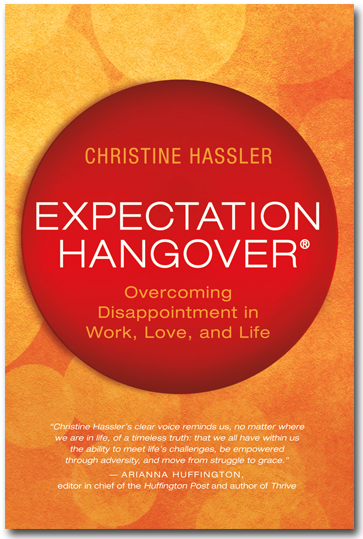
    In her new book Expectation Hangover: Overcoming Disappointment in Work, Love, and Life Christine addresses how to deal with disappointment on the emotional, mental, physical, and spiritual level.

    If you’re disappointed, maybe even devastated, by unmet expectations in your personal or professional life, you’ll likely appreciate the insight, wisdom, and practical exercises that pepper her book.

    It will help you reframe what’s happened and empower yourself to thrive, not in spite of your struggles, but because of them.

    I’m grateful that Christine took the time to answer some questions about her book, and that she’s offered two free copies of Expectation Hangover to Tiny Buddha readers.

    Expectation HangoverTHE GIVEAWAY

    To enter to win one of two free copies of Expectation Hangover:

    • Leave a comment below
    • For an extra entry, share this interview on Twitter or Facebook, and post a second comment with the link

    You can enter until midnight PST on Monday, May 2nd.

    *US winners will receive a physical book in the mail; winners outside the US will receive an eBook.

    THE INTERVIEW

     1. Tell us a little about yourself and what inspired you to write this book.

    My own expectation hangovers and work as a life coach, spiritual counselor, author, and teacher inspired me to write the book.

    I noticed people’s greatest suffering happens when their realities don’t match up with their expectations and/or when life throws them an unwanted curveball that leaves them with what I call an “expectation hangover.”

    Most of us want to get over disappointment ASAP, but we often miss a big opportunity for positive change with that approach. What expectation hangovers offer us is a way to become more responsible for our own lives.

    Disappointment isn’t a bad thing, or even something to be avoided. In fact, my greatest disappointments have lead to my greatest successes.

    Today I am grateful for all my expectation hangovers, from leaving my successful career as a Hollywood agent at twenty-five to being in debt to health issues to my divorce, and inspired to teach people how to leverage their expectation hangovers!

    2. How do you define an expectation hangover?

    An expectation hangover is the myriad of undesirable feelings or thoughts present when one or a combination of the following things occurs:

    • A desired outcome does not occur.
    • A desired outcome does occur, but does not produce the feelings or results we expected.
    • Our personal and/or professional expectations are unmet by ourselves or another.
    • An undesired, unexpected event occurs that is in conflict with what we want or planned.

    Some examples:

    • A career path that was planned and executed with precision becomes tainted with doubt and lackluster.
    • A relationship with “the one” suddenly becomes the one thing we can’t get right.
    • A salary or promotion that was counted on is not a reality.
    • A home that was dreamed about still remains a fantasy.
    • A pregnancy that is wished for isn’t happening.
    • A parent who we could always lean on suddenly isn’t there anymore.
    • A lover or spouse leaves.
    • An illness interrupts our life.
    • A job and the financial security that came with it is gone.

    And then there are expectation hangovers that are more spiritual in nature that happen when we have checked off everything on our life checklist and still experience a lack of fulfillment.

    The symptoms are similar, but far more miserable and lasting, to those caused by a hangover from alcohol: lethargy, depression, lack of motivation, confusion, denial, anger, poor work performance, diminished creativity, strained relationships, social withdrawal, low self-esteem, regret, and a disconnection from a higher power.

    While suffering from an expectation hangover, we are typically caught up in regretting the past or latching on to something we think will make us feel better. We’d do anything to end our suffering—the problem is we just don’t know what that is.

    Expectation hangovers usually fall into one of the following three categories:

    Situational Expectation Hangovers 

    These occur when something does not turn out the way we wanted or we do not get the anticipated satisfaction from achieving a result.

    Interpersonal Expectation Hangovers

    This kind of expectation hangover occurs when we are let down by someone else or unpleasantly surprised by the actions of another.

    Self-Imposed Expectation Hangovers

    These occur when we do not live up to the standards or goals we have set for ourselves. In other words, we are disappointed in ourselves and the results we’ve achieved or failed to achieve.

    3. What are some of the most common unhealthy ways we cope with expectation hangovers, and what are healthy ways we can begin to treat an expectation hangover?

    It takes a lot more than two aspirin, some greasy food, and staying inside with the lights low to treat an expectation hangover! Because we don’t like feeling bad, we look for an external way to ease the discomfort.

    Rebound relationships; abrupt career changes; miscalculated risks; “over-ing” in the form of drinking, gambling, sex, drugs, work, or shopping so much so that it becomes an addiction; and numbing oneself with something like television are common.

    The first step to treating your expectation hangover is to get yourself out of any kind of victim thinking.

    “Why is this happening to me” is the wrong question to ask. Ask instead, “What am I learning? and “How is this happening for me?” That simple shift in questioning will rescue you from sinking into the quick sand of victimhood and hopelessness.

    Next, keep your mind out of judgment, regret, and shoulda/coulda/woulda thinking. Remember, you did the best you could. You didn’t do anything wrong. Your worth and value are not attached to anything or anyone external.

    Security from any outside source is an illusion—your ultimate “safety” is in love. Surrender is much sweeter than being addicted to control. And again, you didn’t do anything wrong. Really, you didn’t, and neither did anyone else.

    Which brings us to the next step—to forgive. Forgiveness does not mean you condone or agree with what happened or didn’t happen. It means you are in acceptance and letting go of judgments you are holding toward yourself or anyone else.

    4. You talk about “spiritual bypasses” in Chapter Two—immediately jumping to the blessings of a disappointing situation. How can this be harmful? 

    It can be harmful because we may miss an opportunity for healing and change on the emotional, mental, and behavioral levels.

    Yes, every situation has a blessing, and a lot of time that blessing can come in the form of a lesson. If we do not pause to ask, “What am I learning?” and immediately skip to finding the silver lining, we miss out on a deeper opportunity.

    Spiritual bypass also skips the emotional level. We are humans and we feel. It is natural to feel sadness or anger in response to an incredibly challenging situation. Not allowing ourselves to feel can lead to suppression in the disguise of being spiritual.

    To me, part of being spiritual is also welcoming and having deep compassion for the human experience. Spirituality is not just about being positive; it’s about being raw, real, and vulnerable with what we are authentically experiencing.

    5. How, exactly, can we leverage our expectation hangovers for growth and fulfillment?

    Instead of continuing to feel emotionally hungover, you can break the cycle and use those tough times as a catalyst for change.

    That’s not to say you can’t grieve over a loss or express disappointment: Allow yourself to be human, don’t judge yourself, and don’t feel like you need to “fix” things right away. But when life throws you a curveball, you can learn from it and ultimately grow from it.

    Here are three common scenarios that I have seen—and have experienced myself—and how to cope with each.

    A Relationship Ends

    First of all, realize that no one else can be the source of your happiness. The post-breakup period is an important time to work on yourself rather than outsource that responsibility to someone else.

    Second, take off the rose-colored glasses. A lot of people put their past relationships on a pedestal. But if a person breaks up with you, you don’t want to be with that person. And we know it’s tough, but you should stop all contact with your ex (unless you have children together).

    Relationships have expiration dates, just like the yogurt in your fridge. Women tend to have these expectations that we are meant to meet someone, be chosen, be proposed to, and when that doesn’t happen, we feel like a failure. But that’s not true—you learned what you were supposed to learn from that person, you didn’t do anything wrong; it was just meant to end.

    And remember: A breakup is always a transformational door that opens to improve yourself and nurture your spirit.

    A New Job Isn’t All It’s Cracked Up to Be

    At twenty-five, I had climbed the ranks in LA’s entertainment industry, ending up in a big job with a big office, an assistant, an expense account, and power lunches. But I was miserable every day, and finally I quit, and eventually discovered my passion as a life coach.

    Ask yourself: If I don’t feel like my work is meaningful or it’s not making me feel the way I want to, how can I change it? It’s in your power to redirect your thoughts and action.

    Take someone who works at Starbucks: They could hate the drudgery of it and the early hours, or they could appreciate the aroma of coffee and the fact they get to connect with people all day long. It’s all in the way you look at that, and you need to be proactive about it.

    You’re Not Reaching Your Health Goals

    If you’re trying to lose weight, you know how frustrating it can be when the scale doesn’t budge, or you skipped your workout (again). To overcome this pessimistic mindset, be mindful of the “story” that you’re telling yourself.

    When people try to lose weight, they tend to have a negative self-image. They’re eating right and working out, but their negative self-talk is still weighing them down. Plus, a big part of losing weight isn’t only physical—you have to heal your heartache or emotional baggage before you can make other physical changes, she notes.

    There is also an entire section in the book called “Quick-fixes that work” in terms of preventing disappointment, so I’ll share my two favorites:

    Don’t go to a Chinese restaurant when you are craving nachos.

    In other words, be realistic about your expectations of others. Too often we expect people to act the way we desire or the way we would in a situation, when they are just not capable or willing. Period. End of story. You can’t change them. When we understand we cannot change people, and accept them rather than expect something from them, we prevent expectation hangovers.

    Gorge on gratitude.

    Expectation hangovers happen when we pay too much attention to what is either not happening at all or not happening in the way we’d like it to.

    When we shift our focus to the amazing things in our lives—people, health, a place to live, and all the unexpected wonderful surprises the Universe delivers on a daily basis—we move out of a lack-mentality and into an abundant view of the world

    6. Can you elaborate a little on how disappointments can actually be blessings in disguise?

    Often life has to throw us a curveball (or several) so that we look in a different direction. The problem becomes when we desperately try to dodge the curveball, attempting to get out of feeling uncomfortable, and we miss the lessons that are available to us.

    If things are not turning out like you had planned or want them to, that is actually really good news. The Universe has a better idea in store. But first you have to let go of the plan you have been attached to so that your Higher Self and the Universe can conspire for you.

    Instead of thinking about how to treat an expectation hangover, consider how you can leverage it. This goes back to what I mentioned before—ask yourself, “What am I learning?” rather than “Why is this happening?”

    Think about some of the most inspirational people you know. I guarantee you that part of what makes them so inspirational are the expectation hangovers they have been through. They leveraged their hangovers for their growth and learning. Instead of trying to snooze through the alarm of disappointment, they woke up!

    Your expectation hangovers are gifts. Each one has been an opportunity to let go of something external that you have clung to for worth, safety, or love.

    I really get that disappointment is not at the top of your wish list. However, if you learn how to respond to expectation hangovers from the perspective of a student rather than a sufferer, I 100% guarantee you will walk through doorways of transformation that will lead you to more love.

    FTC Disclosure: I receive complimentary books for reviews and interviews on tinybuddha.com, but I am not compensated for writing or obligated to write anything specific. I am an Amazon affiliate, meaning I earn a percentage of all books purchased through the links I provide on this site. 

    You can learn more about Expectation Hangover or grab a copy on Amazon here.

  • When Following Your Dreams Results in Failure After Failure

    When Following Your Dreams Results in Failure After Failure

    Our greatest glory is not in never failing, but in rising up every time we fail.” ~Ralph Waldo Emerson

    Everyone tells you to chase your dreams and follow your passion. At some point, you’re brave and full of hope and decide to do it—quit your job, become an artist, apply for that dream job, and change your lifestyle.

    It’s wonderful and empowering and exciting and all those things that make living worthwhile.

    But what happens when you fail? When quitting your job left you broke, no one wants to publish your work, and your dream job turns you down? You are left feeling utterly defeated and a little bitter toward all those people who told you to go for it. It didn’t work. What then?

    I’m no stranger to failure. I’ve tried so many times and had nothing concrete to show for my efforts. I’ve had to tell people, “No, I didn’t get it.”

    Most recently, I’ve been hustling as hard as I can to get a job that will send me overseas in the development field to work for women’s human rights. Unpaid internships and grad school and applications and cold emailing have so far led to nothing.

    It can be incredibly frustrating and leave me feeling hopeless, sometimes questioning if it’s worth following these dreams when I’m feeling so defeated. Like I said, I have nothing concrete to show for any of my efforts yet.

    But a while back something happened that changed everything. And no, I didn’t get the dream job.

    What happened was internal. I was sitting outside with a mug of hot coffee cuddled between my hands, a soft jacket pulled around my shoulders to combat the cool, autumn morning. Red, yellow, and orange leaves were raining down from the trees, spiraling to the ground. Painted clouds streaked the deep, brilliantly blue sky.

    I could feel the sun on my face. And as I sat there, with none of my dreams coming true, I realized that it doesn’t matter if they never do.

    I am alive, healthy, and free. I have people who love me. And I have the capacity to be grateful for this life and the ability to even contemplate following my dreams, let alone throw everything I’ve got into the fray.

    I realized that even if my dreams never come true, I will be okay. It was so liberating. I will keep trying; I actually had a second wind after this realization. Because now I know that my life is full and worthwhile and beautiful even if I’m just sitting outside with coffee in the sunshine.

    If you allow yourself to love everything, as simple and small as it may be, even if not all of your dreams are unfolding around you, there may come a day when your dreams do come true and it will be icing on an already magnificent cake.

    The defeated feelings from failure come from letting all your hopes and happiness ride on the dreams coming true. If you allow yourself to appreciate the freedom and aliveness in just having the opportunity to try, the failing will be so much less painful.

    You should keep chasing your dreams and following your passion. At the same time, you shouldn’t let yourself feel so bad if you’re failing.

    Check with yourself and see—would it really be so awful if you just kept trying and things never quite worked out the way it does in your dreams?

    Really think about it. How wonderful and fun and exciting is it that you can go off and chase those dreams? And how much more concrete and valuable is love in your life, joy in the simple things, and appreciating what you have?

    If all your dreams come true but you neglected your relationships and forgot how to be grateful and happy with the little things, it won’t matter.

    Let living fully be your passion. Chasing your dreams is a byproduct of that. Finding a way to make them come true is not the end all, be all.

    Be fully immersed in your own life—your relationships with others and yourself, tasting good food, comfort and peace, enjoying a quiet morning with the sun on your face, laughter.

    Failure isn’t so bad when you realize that taking the steps to make your dreams come true is a dream coming true in itself.

  • How Expectations Undermine Our Relationships and Happiness

    How Expectations Undermine Our Relationships and Happiness

    “I’m not in this world to live up to your expectations and you’re not in this world to live up to mine.” ~Bruce Lee

    A few years ago, my husband was away from me for a few weeks, working in another town. It was summer, and we were living close to the beach at the time, so I often spent my Saturday nights walking along the ocean at sunset, enjoying the colors and sounds.

    One Saturday night I was in a simply glorious mood. The beach was filled with happy families and couples, the Atlantic was a particularly lovely shade of aquamarine, and life felt just about perfect.

    When I got back to my car I looked at my cell phone and saw that I had missed a call from my husband. I called him back and quickly realized his mood was not nearly as buoyant as my own: He wasn’t particularly chatty, and seemed pretty negative about the work he was doing.

    I took this extremely personally and turned cold and quiet almost immediately, eventually taking the very juvenile step of hanging up on him. How dare he ruin my perfect summer evening!?

    About ten minutes later, in the parking lot of a grocery store, I had a huge epiphany: He hadn’t ruined anything. It was all me, as my negative feelings were entirely created by my expectations of how he should have behaved.

    I had been anticipating that he would be in the same great mood I was, and when he wasn’t, I took it personally. I became upset that he wasn’t acting as I expected. I became angry because he wasn’t meeting the standards I had set.

    In other words, I was completely responsible for my deflated mood.

    This was the very first time I realized how having expectations of how other people should act was causing unnecessary pain and suffering in my life. Once I started looking around, though, I saw many other examples.

    For instance, I once had the expectation that a new acquaintance would quickly respond to my text and agree that she, too, had a nice time hanging out with me.

    When she didn’t, I ended up spending more than twenty-four hours wondering if she liked me, feeling pretty bad about myself. (She did eventually respond with a very nice text; she’s just a busy person who doesn’t respond to texts immediately!)

    I expected an automatic response, and not getting one undermined my happiness.

    Another example is the time I was seventeen and gave my dad a Father’s Day card I thought he’d find really funny, and he barely even responded to it at all.

    I had built up a vision of him having a really warm and amused reception to this card, and when there was almost zero reaction, I was crushed. Again, my expectations, and the beliefs about what it meant if they weren’t met, were causing pain.

    Before you think that I’m suggesting you lower your expectations of other people and never, ask anything of anyone, let me clarify a bit.

    Telling a friend about a tough situation at home and expecting you’ll get some words of wisdom is wonderful. Hoping the guy whose eye you’ve been trying to catch will smile at you today can be fun and rewarding.

    Hoping for the outcome you desire is one thing, trying to force it and being overrun with negative thoughts and feelings when it doesn’t work out is another.

    You can’t control the way people think, feel, or react. Ever. You may try to, you may want to, but ultimately, how they act is up to them.

    And when you base your feelings of happiness, worth, or confidence on the actions or reactions of other people, you’re setting yourself up for many moments (or days or even years) of avoidable misery.

    There are a few ways to keep hoping for positive interactions with other people, but not get sucked down into the mud and muck when they don’t go as you expect.

    1. Stop expecting other people to act exactly as you would like them to—it’s a game you’re guaranteed to lose. Instead, try being open to any and all reactions from others.

    If, on that gorgeous night back in 2012, I had opened my mind and heart to my husband with no preconceived notions of what his mood should be, my evening could have remained joyful and I may have even improved his evening, too.

    Back when I was seventeen, if I had realized that my dad’s lack of reaction had nothing to do with me, but was about his own problems with expressing emotions, I would have felt far less hurt. I couldn’t make him react the way I wanted, and assuming he would do what would make me happy led to a sad experience for me.

    2. Start building up your own happiness and confidence on something you do have power over: your thoughts and beliefs.

    When someone does the unexpected and it disappoints you, it’s always because you had a belief about what they were supposed to do.

    You believe that your mother should have been proud when you won the essay contest, and when she wasn’t, you were sad. If, on the other hand, you lean in to the truth that your mother can react however she wants to, but still believe you are a wonderful writer anyway, your pain won’t be so great.

    You believe your son should have gotten better grades, but when he brings home a poor report card, you feel angry and guilty. When you stop believing that your son’s grades are a reflection on you as a parent, and start believing that you’re doing the best you can and letting go of guilt, you suffer less.

    3. Stay in the moment as often as you can.

    Stay present with your thoughts, and see if you’re holding onto expectations of how other people should behave.

    It’s when you slip out of being in the now that you are truly disappointed. When this happens, you’re letting your thoughts and stories about what the other person should have done, or what will happen now because of this perceived slight, or why you deserve to be angry, take you out of the now and down a path that is full of rejection and fear.

    The bottom line is that you will not find peace if you’re always expecting other people to give it to you with their actions or words or even love. The only way to find it is to drop your expectations of others, let go of what you think they should or shouldn’t do, and allow yourself to create your own happiness.

  • How to Cope When People Disappoint You

    How to Cope When People Disappoint You

    Disappointed Woman

    “Blessed is he who expects nothing, for he shall never be disappointed.” ~Alexander Pope

    Growing up, I had a wonderful relationship with my mother. We did all the usual mother-daughter things together—went shopping, had brunch—and we supported each other when my father left.

    In 2011, I was happily pregnant. I felt supported by my family and ready to take on motherhood. My husband and I were elated by the birth of our little boy.

    It’s fair to say that I may have been a little naïve about what was to come. I knew it would be hard work, but I didn’t quite realize how hard.

    The other expectation I had was ongoing support from my family. You know, the kind of situation where family (both parents and siblings) rally around you to welcome a new little person into the world. The kind of situation where there are regular visits and an influx of babysitting offers.

    In particular, I expected the bond with my mother to strengthen—because in my mind, having your first child is the time when you are deeply supported by your mother. What happened next fell entirely short of what I had imagined life to be like post-baby. I was utterly disappointed.

    I felt blessed for the birth of my little boy but resentful for the lack of support from my family.

    You see, although my little boy was healthy in the most important ways, he was a screamer. He was diagnosed with severe acid reflux, and we endured an extremely unsettled baby (and toddler) for the first eighteen months.

    My husband and I didn’t sleep for more than two hours per night (on shifts) for the first four months, and it improved only marginally from there. There were feelings of despair, helplessness, and confusion as we paced the floors trying to help our little boy.

    At first, my mother stayed with us in our house and helped us tirelessly. But at month four she relocated overseas. By this time, I felt disillusioned by the experience of having an unsettled baby, and disappointed that what was supposed to be a beautiful time had become somewhat negative and relentless.

    Looking back, I realize expectations played a huge part in my disappointment.

    I had expected a blissful experience—picnics in the park with my (sleeping) newborn! My disappointment was closely linked to my expectations of how it would be, with my baby, and with support from my family.

    Had I not expected a certain outcome, I would not have felt so low about what occurred. Had I been more open-minded about what may eventuate, I may not have felt abandoned and resentful at a time when I needed the most help.

    My little boy is now healthy, happy, and three. Granny has moved back to this side of the world, and she visits weekly. There is still minimal involvement in comparison to the vision in my head, but I have come to terms with it. Acceptance is liberating sometimes.

    The following philosophies have helped me to be more at peace with my own feelings, and you may find them helpful when facing disappointments in your world too.

    You have the right to feel what you feel.

    So don’t ignore your feelings of disappointment. But try to obtain a renewed sense of the other person’s perspective.

    We all have different expectations.

    Most people are inherently good. They are on their own journey, and although disappointment can feel personal, it’s often not. The other person’s expectations are simply different to yours.

    Disappointments aren’t always all bad.

    What may seem like a challenge may be a blessing in disguise—or a blessing in waiting; it may only be a matter of time before you recognize that your disappointment is actually the universe working its magic for you. For example, my challenging start with my first born has led me to support other mothers through their own hard times.

    It helps to shift your focus.

    Resolve to do things that bring you joy. Focus on what is new and good, start manifesting, and leave those disappointing thoughts behind.

    It will pass.

    No matter how deeply you are disappointed, in time you will move through the feeling.

    Weed out the people who consistently disappoint you.

    Be mindful of people who regularly disappoint you or let you down, and make more time for those who don’t. Maintain a positive sense of yourself through happy relationships with people who are uplifting and energizing.

    We’re all on our own paths (even grannies). We have our own lives to live, our own choices to make, our own wishes and wants, and our own free will.

    Our closest connections can’t be expected to live on our terms, or to live inside the box we have created for them in our minds. So release your disappointment and get ready for the next adventure the universe will send your way.

    Disappointed woman image via Shutterstock

  • Releasing Expectations: It’s Okay to Be Right Where You Are

    Releasing Expectations: It’s Okay to Be Right Where You Are

    “The most important point is to accept yourself and stand on your two feet.” ~Shunryu Suzuki

    When I was younger, I am sure I was a little bit arrogant. I had high expectations for my life. They haven’t come to pass. I haven’t achieved whatever I thought I would achieve. It turns out that I’m an ordinary human being struggling with ordinary things.

    Now that I’m in my forties, I have experienced disappointment, failure, and confusion. Many times I have lost sight of the path, and sometimes it’s felt like there never was one.

    I expected I would be a writer. I did not expect to be a secretary. Not that there is anything wrong with that, it just wasn’t what I dreamed of.

    I didn’t expect to have periods of unemployment, loneliness, or despair. I didn’t expect to be just like everyone else. Maybe I thought I was special, different, exempt. Maybe we all think that when we’re younger.

    It’s not like I had it easy in my early life, but by my twenties I’m sure I thought it would all go to plan. It never went to plan. I’m not sure there ever was a plan.

    And yet, maybe it has gone to plan, just not my plan. If some higher power is running the show, maybe this is part of the plan.

    If I want to express the highs and lows of being human, then I need to have lived them. That’s what being a writer is. It’s not just being bulletproof and full of ideals. It’s making the dream right there in the gritty groundedness of everyday life.

    I also realize that what I have achieved is not that important. What’s more important is what I’ve learned, and much of that didn’t come from success. Often my lessons came from the struggle of being human—wanting, trying, failing, and wanting and trying some more.

    So at this stage, with my dreams still tugging at my heart and a lot of struggle behind me, I finally understand something about self-acceptance.

    Here I am, right now. This is where I am and it’s okay.

    Right here, right now.

    I am where I am right now. That’s my starting point. I might wish I were further along, but I am where I am. I have to accept where I am or I can’t move anywhere, let alone forward.

    Where are you now? Why is that okay?

    This is my life and it’s good.

    When I come back to gratitude, everything gets better. My expectations may be higher than my reality, but really, I have so much. Many people lack the basics: good food, clean water, access to healthcare, literacy. Even at the simplest level, my life is blessed.

    What do you give thanks for?

    A divine plan.

    It does seem that life isn’t running according to my plan. Maybe there is a bigger plan. I may not always like it, but maybe it’s perfect after all. I don’t know what the Universe has in mind. It would be very arrogant to think I did.

    How could this be part of a higher plan?

    Being very human.

    Experiencing disappointment, struggle, and failure is part of being human. It helps us feel for each other. I am fairly idealistic, but at this age I know that I am pretty human. I am full of faults and mistakes, and a few brilliant moments too.

    How do you feel most human in your challenges? Why is that good?

    No better or worse.

    In my twenties I went to acting school. When you act, you explore the potential to be many different selves. We all have the potential to be an angel or a devil. Most of us are in between, but it might have worked out differently.

    Why are you no better or worse than anyone else?

    Favorite faults.

    Honestly, sometimes our faults are simply our characteristics. Maybe you’re bossy but a great organizer, or a natural leader. Maybe you are a rebel who challenges the way we think and act. Maybe you channel your anger and make others laugh at your daring. Great comedians do that.

    What is your favorite fault? How could you use it?

    How it looks to the world.

    We are often much harder on ourselves than anyone else would ever be. You may think you’ve achieved nothing while, to the next person, you have everything. It’s all relative and it’s all perspective. None of us have an unbiased lens.

    There is no point wishing you were more than you are. It may all be happening this way for a reason. Even if there is no reason, the meaning you choose will make the difference.

    At the end of our lives, it won’t really matter how many toys we have or even what we have achieved. It will matter that we appreciated this one precious life. It will matter that we enjoyed and explored being human. Love and experience; that’s it.

    Let’s not give up on our dreams. Let’s keep moving toward them. Just play the game lightly with little attention to the score.

  • When Life Doesn’t Meet Our Hopes and Expectations

    When Life Doesn’t Meet Our Hopes and Expectations

    Disappointed

    “Anger always comes from frustrated expectations.” ~Elliott Larson

    I was recently watching my younger son play in a golf tournament. We had extensively prepared for this tournament over a period of several days. His technique was finely tuned. The game plan for attacking the course was in place.

    The first two holes went wonderfully.

    We arrived at the third hole, a medium length par three with water to the left.

    In the middle of his swing, a golf cart carrying bags of ice drove right in front of him at a distance of about fifteen feet. This broke his concentration and he stopped his swing. He attempted to gather himself and he proceeded to hit the shot.

    The ball went into the water.

    This was the beginning of a number of curious “breaks” that happened on almost every single hole until the final one.

    The result was a disaster. The tournament was ruined. The game plan was shattered.

    There were so many wounds inflicted that day. And I, perhaps more than him, suffered every one.

    I learned much from that day. One of them is the idea of a thin layer of space.

    What do I mean?

    The organs inside the human body sit next to one another, but they do not touch one another. They sit within body cavities but they do not touch the cavity. 

    Rather, they are separated from their surroundings by a membrane of space.

    Perhaps we can apply this ingenuity to the way in which we live our lives.

    As we experience the various emotions and events that we encounter in a given day, we feel jolts and grates and frictional rubs. We are affected by each one.

    Why?

    Because unlike the organs in our body, we live directly apposed to the events of our lives. As such, the slightest shudder feels like an earthquake. Every scratch feels like a flesh wound.

    What if we could learn to live our lives with a thin layer of space between us and the events that we experience?

    What if there was a thin layer of space between what we hope to receive and what we actually receive?

    A thin layer of space between our expectations of what should be and what actually comes to be.

    Perhaps this space would act as a shock absorber. Perhaps it would allow us to experience jolts as jolts. And scratches as just scratches.

    Perhaps this space would serve as a gutter in which the excesses of our demands and our hopes would collect and flow away, leaving us content with what is.

    Perhaps this is the only way that our lives can be enjoyed.

    Perhaps it provides us a dose of wisdom. Teaching us that life flows according to its own rhythms, rather than according to our whims.

    Perhaps it can teach us that our miseries come from seeing life through the prism of our own expectations. And that to see life in this way is to not see it at all.

    Perhaps a bump will seem more like a ride than a jolt. Perhaps thunder will seem more like a sound rather than an impending storm.

    It is our interpretation of events that gives rise to the parallel universe in which we live. As few of us truly live within the world. Rather, we live inside the mind.

    The mind sticks to everything that it experiences and we feel the reverberations of each and every one of these experiences.

    But with this thin layer of space, we can perhaps keep the tempest that surrounds us in perspective. And at arm’s length.

    This thin layer of space affords a thin window of time. Time that allows for a measured response. Time that allows for action borne of wisdom, rather than emotion.

    It is not the words, but the space between them that makes communication possible.

    Perhaps it is a thin layer of space between us and our lives that makes living possible.

    In understanding this thin layer of space, perhaps I can begin to appreciate that the events that happened on that day did not happen to my son. And that they did not happen to me.

    They just happened.

    Disappointed woman image via Shutterstock

  • How to Release Disappointment and Thrive When Life Isn’t Fair

    How to Release Disappointment and Thrive When Life Isn’t Fair

    “When you learn to accept instead of expect, you’ll have fewer disappointments.” ~Unknown

    At thirty-six weeks pregnant, I was in the fetal position on my bathroom floor, screaming with pain. It was excruciating, the worst pain I had ever experienced, and I had experienced lots.

    As the ambulance officer supported me out the front door and into the back of the ambulance, all I could think was, “How is this going to affect my baby?”

    After two ambulances, two hospitals, and a barrage of tests, I was sitting on the hospital bed, absolutely exhausted—physically, emotionally, and spiritually.

    My thoughts started to go down the same well-worn path: “Why me? Why do I have to deal with this? Life isn’t supposed to be like this. It isn’t fair!”

    It had been a common theme for me. I knew how life was supposed to turn out, and mine wasn’t it! It seemed like I had challenges to deal with that others didn’t have—that my lot was harder.

    I felt like all my energy and potential was being sucked up in dealing with adverse circumstances, leaving me no resources to do the things I really wanted to do in life.

    For the last twenty-three years, I had battled Crohn’s disease, a debilitating and incurable illness that had resulted in increasing pain, illness, and limitation—until then. Four weeks before the birth of my second child, I had ended up in hospital with massive pain.

    My doctors didn’t know how to deal with a woman having a Crohn’s flare up who was also pregnant and wanted to induce labor to deliver the baby prematurely. I was faced with making choices about medical treatments that could have serious impacts on me and my unborn child.

    As I sat there, I could feel the familiar frustration, dissatisfaction, and discontentment flooding over me.

    And in that unlikely place, I had an epiphany.

    Life is not the problem; expectations are.

    I finally realized, looking back at my life, that every time I’d struggled to deal with the hand I’d been dealt, it was because my expectations were clashing with reality. I had created a picture in my head of how life should be, and when things didn’t turn out, I didn’t cope.

    It wasn’t life that was the problem; it was my unrealistic expectations. I had thought that being idealistic and striving for a goal was a good thing, but it wasn’t leading to a contented and fulfilled life.

    If you are feeling hardly done by and frustrated about your circumstances, ask yourself if there is a mismatch between the reality of your situation and what you expected. If there is, you have inadvertently set yourself up for frustration, disappointment, and even anger.

    While these emotions are natural when we experience adversity, they are not helpful to live with long term.

    The only way to resolve them is to face up to the situation you are actually in and accept it. This does not mean we should not have any expectations, but if we want to be content, we need to accept what is during hard times while trusting for something better in the future.

    Instead of trying to change the world, change your focus.

    While I was in the hospital, I talked to other mothers who had been there for the whole of their pregnancy or whose babies would need surgery as soon as they were born. It made me realize that while I was in a hard place, things could have been so much worse.

    I realized that I was only seeing one side of my life. I was very good at seeing what was not there (that I thought should have been) but was ignoring what was there that was good.

    In thinking about my illness, I was focusing on the pain and how it was stopping me from earning an income, and how my energy was limited, and how the whole situation was negatively affecting my family.

    But I wasn’t embracing and being grateful for how other people, particularly my husband, cared for me, how I was growing in wisdom and compassion, and how the experience was teaching me more about myself.

    If you seem to be coping with more than your fair share of frustration and disappointment, check your focus for a minute. Are you only seeing the gaps, where reality isn’t meeting your expectations, or are you also acknowledging the good that is coming your way?

    It may be helpful to create a list with two columns where you can explore what you are feeling about your circumstances.

    On the right side, write down where your expectations aren’t aligning with reality: where the gaps are, what sucks, and what you think shouldn’t be happening.

    On the other side, write down what is positive: where the divine is in the situation and what is great about this. This is not about being falsely positive. This is about finding the moments of genuine joy and connection in the midst of pain.

    Pay attention to how you feel when making each list. Having refocused the situation for yourself, you can now choose which emotions to take into the future about that experience.

    The great thing about this exercise is that it frees you from striving to change the world to match your own expectations. Instead, all you need to feel happier is a little shift in your focus.

    Embrace the pain and then take control.

    I learned that I needed to embrace the whole experience, both the good parts and the gaps, and that gave me the ability to choose a more empowering set of beliefs and meaning for what was happening to me. This in turn helped me discover new possibilities that I couldn’t see before.

    Having refocused myself, I was able to sort through a lot of complex information and options regarding medical treatment, define what outcomes I wanted, and make a constructive action plan that put me in charge of my health.

    And the end result? That time round, beginning with circumstances that weren’t promising at all, I got all the outcomes I wanted, including a healthy baby and a natural birth.

    The irony about accepting the situations we find ourselves in is that once we have, we are able to make decisions and take action that moves us toward the place we truly want to be. We stop feeling like a victim of circumstance and more like the captain of our own ship.

    That doesn’t mean that we will get what we want every time. Life doesn’t work like that. However, coming to a place of acceptance gives us the strength and peace to deal with whatever outcome we receive, whether desired or not, and the ability to move forward rather than getting stuck in adversity.

    Empowering questions we can ask ourselves include:

    • What outcomes do I want? Write down every result that is important to you in the situation.
    • What beliefs can I choose that will support me right now? Give yourself an empowering set of beliefs that help you feel hopeful in the situation.
    • What action can I take? Outline actions you can take today, this week, and in the next month that will move you toward your outcomes.

    You can soar above adversity.

    These days, I still have Crohn’s disease but have largely given up my unrealistic expectations, and not living with that frustration has taken a lot of stress away from my life. I am in better health than I have been for years and achieving more.

    It took a while for me to let go of my idealism and find the good in adversity, but by practicing it over a number of years, I have gotten better at it.

    We all live with circumstances that are not ideal. Life is too short to live in frustration that things are not the way we want them to be.

    Why you? Because there are important jewels you can discover in the midst of adversity that will reward you for the rest of your life. You are strong enough to embrace reality and perform the alchemy that will transform frustration into contentment and positive outcomes.

    We’re all here rooting for you.

    Go and make it happen.

  • Dealing with Disappointing Relationships: Change Your Expectations

    Dealing with Disappointing Relationships: Change Your Expectations

    Disappointed

    “If you can’t change the circumstances, change your perspective.” ~Unknown

    Sometimes it feels as if you are completely in control of your life, but when it comes to relationships there’s always the other person.

    In a relationship, you can’t be the puppeteer. People have their own emotions, behaviors, actions, beliefs, scars, wounds, fears, dreams, and perspectives. They are their own person.

    How often have you wanted a relationship to be something that it was not?

    How many times have you said a certain word or phrase in order to spark a specific reaction?

    How much do you expect from this person? Do they fail you each and every time?

    In healthy relationships there are certain expectations, like being treated well or being respected. Yet sometimes we find ourselves in relationships that don’t mirror what we anticipate to happen. We may feel hurt or used.

    We cannot expect other people to treat us as we would treat them. We cannot assume anything or force change upon someone who clearly demonstrates he or she is stuck in his or her own way.

    With eyes full of clarity, I am capable of changing the relationships in my life by adjusting my point of view.

    I call my father a sperm donor. He gave me life but never showed up in my life.

    My friends at school never knew I had a father because they never saw him. He missed all of the concerts and sports games. For the majority of my life, we didn’t talk. He didn’t acknowledge me—no birthday calls. I had no idea where my dad lived. Some days I was not sure he was still alive.

    In high school, my dad limped back into my life. I could stop by his apartment and visit him when I wanted to. If I called him, he would pick up the phone. Things were changing between us.

    Blindingly bright, his true colors revealed themselves the night before my high school graduation when I called to make sure he was coming. He said he couldn’t attend because he had to drive a friend to the airport. Cabs exist. His friend could have used one. I was angry, sad, and most of all, hurt.

    Rejection from my father has been the hardest thing for me to accept. It is not easy to grasp the idea that someone who once loved me, adored me, gave life to me could turn his back and walk away so easily.

    I could no longer take the feelings of disappointment.

    These feelings were a direct result of what I was expecting from him:

    • Assuming he would respond to things as I would.
    • Assuming he would care like I do.
    • Assuming he thinks in a similar way as I do.

    I was living in a fantasyland of my hopes, dreams, ideas, beliefs, expectations, and assumptions.

    I was hurting myself most.

    For the protection of my emotional body, I changed my perception from what I hoped would happen to being open to experience whatever actually happens.

    This shift didn’t occur immediately, but by following the five steps listed below I was able to come to peace with the type of relationship I have with my father.

    1. Be aware of reality.

    Acknowledge the other person’s behaviors. Look at patterns and how they regularly treat you. Remember the feelings you had in the past. Don’t be fooled into believing things are different from how they are.

    2. Stop manipulating situations.

    Many times we yearn for specific responses, like validation and approval. When we do not receive what we want, we may speak or behave in certain ways to try to elicit the desired reaction.

    This type of behavior leaves us feeling empty when the other person does not react the way we hope they would. Remember, you cannot change anyone; it is up to them to change.

    3. Let go.

    Throw expectations and assumptions out the door. Release the hopes, wishes, and dreams that things will change by detaching from the ideas.

    Get out of the fantasy world by not hooking into the thoughts of what could be. Keep your mind from running into the future. Remain open to all possibilities by staying in the present moment.

    4. Focus on those who love you.

    It will be easier to follow the third step if you remind yourself of those who are there for you. They continue to be there because they care about you. Focus on people who make you feel loved, connected, cared for, and worthy. Reach out to them and reconnect.

    5. Learn to love yourself.

    Provide yourself with what you are yearning for (compliments, compassion, or encouragement). Only you know what you truly need.

    Realize each moment you are being the best you at that time. Build self-confidence and strive to eliminate any doubts you have about yourself. When you feel shaky or alone, look in your eyes in the mirror and say, “I love you.” Nurture yourself. Feel the love you have inside of yourself.

    Let go of your expectations of people and see how your relationships change. And if you don’t feel differently about it or if it’s not benefiting you, you can always walk away. Your emotional state matters most. You cannot control other people, but you can make yourself happy.

    Photo by Don

  • When Things Don’t Go As Planned: Transform Disappointment into Action

    When Things Don’t Go As Planned: Transform Disappointment into Action

    Deep Thought

    “A man’s errors are his portals of discovery.” ~James Joyce

    I’ve had a bit of experience with disappointment. I got very motivated to change my relationship with it when I was in my twenties and starting my acupuncture practice.

    I knew it would take time to build my client base; what I didn’t realize, or more likely was in denial about, was that a very effective way of doing that was by arranging public speaking gigs. I absolutely hated public speaking. Big disappointment.

    I also didn’t consider how much work running a business really was. I had to talk to supplement vendors, deal with the landlord, make sure the copy machine was working, learn new computer programs, do the laundry, and on and on.

    I wanted to do acupuncture! I didn’t want to vacuum the floors and call about the errors on the phone bill! I realized pretty quickly I had to learn how to reassess my feelings of disappointment or I wouldn’t have the gumption and energy to continue on my quest.

    Having the tenacity to overcome disappointment is a necessary skill. Some disappointing experiences are unavoidable. Sometimes that engaging person we meet at the coffee shop doesn’t call, or the job we were a great fit for is offered to someone else.

    These things happen, and generally we can roll with it.

    However, with larger scale disappointments, or recurring disappointments, it’s great to have a strategy to transform that “down” feeling into motivated action.

    When we feel disappointed, it’s easy for us to slow down, to say, “Why bother?” and to allow ourselves to get knocked off our trajectory. The following steps can help shift our viewpoint and revamp those feelings into action.

    1. Explore your original expectations surrounding the goal.

    If there is disappointment, then there was expectation. So what was our initial expectation? The answer to this is sometimes surprising…

    Once that’s fleshed out, we can ask ourselves, was this expectation realistic? Was it well thought out? What was motivating the desired outcome to begin with? Did we do the steps that one might reasonably expect to do to experience this desired outcome?

    These can be hard questions. At times we’ll find our expectations are very reasonable. Other times, not so much. It can be tough to break down our desires, which are largely driven by emotions, in this logical manner.

    However, it’s a great practice that can help us to explore our expectations more deeply. It helped me to recognize that my initial expectations about having my own business were idealistic vs. real world.

    2. Make a decision.

    Armed with the information we’ve gathered from the previous set of explorations, it’s time to decide how we want to proceed.

    Our decision will fall into one of three categories:

    We can continue on in the same vein after the desired outcome.

    This would be a great route if we’ve decided that while, yes, it was disappointing that our favorite boutique doesn’t want to carry our new jewelry line, there are other cool shops in town we can approach as well.

    We can change the route we will take to reach the desired outcome.

    This can be the most complicated decision, depending on the outcome. We may realize we don’t have the training required to get the job we’d like, hence it being offered to someone else.

    We still want the job, so it may be time to look into continuing education or an unpaid internship to gain more experience. The outcome will remain the same, there’s just a bit of recalculating required to get there.

    We can change the desired outcome altogether.

    This is not about experiencing defeat or throwing in the towel. Rather, sometimes this type of deeper exploration will help us to further refine what our desires are.

    For example, I have a friend who wanted to go back to school for a degree in childhood education. After applying to several programs and being turned down, despite a great application and transcripts, her disappointment was pretty evident.

    I suggested these steps to her, and through personal question-asking she came to realize she didn’t want to go back to school at all. The key was that she wanted to work with children, so she decided to change the focus of her current profession, physical therapy, so that she specialized in working with kids.

    3. Install some new expectations.

    While the second step may have seemed like the last, don’t skip this third one!

    Regardless of which of the three types of decision we make, we want to make sure we toss out the old expectations and replace them with new, updated, and perhaps more informed (or more realistic) versions.

    If we have never jogged for exercise but want to start, setting a goal to run a 5k in six months time is more prudent then planning on a marathon. Making dinner for a friend when we are first learning to cook is more sensible then attempting a five-course dinner for 12.

    Keeping our incremental goals levelheaded while we dream big is a great way to reach those dreams.

    It’s common for successful people to describe their journey as a long series of minor and major obstacles, infused with a few glorious moments of achievement. Their ability to withstand disappointment, reassess their route, and continue on their road is an incredibly important part of their success.

    What disappointments have you overcome in your life and how did you grow from them?

    Photo by Shayan USA

  • A Simple Process to Deal with a Hypercritical Mind

    A Simple Process to Deal with a Hypercritical Mind

    Head Hurts

    “We must accept finite disappointment, but never lose infinite hope.” ~Martin Luther King, Jr.

    “I can’t believe I screwed this up again!”

    “Why did I do that?”

    “This is all my fault!”

    The third grader ruminated as he walked away from the soccer field where his team had tied, two to two. It was their sixth tie in seven games.

    The lone game that was not a tie was a loss. According to this young man, his team’s record was a direct reflection of his worth; therefore, verbal self-deprecation was the only response one should have after such failure.

    His mother waited for him in the parking lot, hoping her ultra-competitive son would cool off from this perceived-to-be-colossal failure before heading home, but she knew how he was and was bracing herself for the usual tirade of self-deprecation.

    The third grader opened the passenger door, felt the synthetic coolness of the air conditioner, and plopped down into his seat.

    “Hi honey. How are you doing?” she asked, trying to gauge her son’s emotions.

    “Bad. We tied again,” he stated.

    “You played well, though,” she remained kind and supportive.

    “No I didn’t. We tied,” he reiterated.

    “You can’t be so hard on yourself. You have another game next week,” she said with concern.

    “Mom! Please just stop! We tied…again! I’m sick of it! I’d rather just lose, but we find a way to tie everyone! We tie the best team in the league, the average team, and then today we tie this crappy team! I’m sick of it!” he shouted, nearing tears, and then explained:

    “I’m sorry, Mom. I’m mad at myself, not at you. I just don’t want to talk about it. I’m a jerk.”

    That third grader was me—still is to a certain extent.

    This third person account was my first memory of being “hyper self-critical,” as my internship supervisor accurately wrote in her evaluation of me a year ago.

    At first I wrote this story in the first person, and I felt the same emotions as I did back in third grade.

    When I wrote it in the third person, I was able to gain distance from the experience, and objectively see how ridiculous I behaved, and how sad it is to see a third grader put that much pressure on himself for something that’s supposed to be fun.

    I am still “hyper self-critical.” Although I may not be throwing a tantrum, yelling at my mom, dad, and teammates, I still have this screaming critic telling me the things I have, am, and will screw up.

    When I was younger, I took great pride in my inner critic.

    I liked that I was hard on myself, that I expected perfection, and when I wasn’t perfect I cursed myself, punched a wall, yelled at a concerned friend or family member, and then isolated myself, promising that I would never screw up again.

    Then, I’d screw up again. The cycle continued.

    I continued this cycle all the way through college. I would start off the semester doing great, and then one missed assignment or one poor quiz score, and I’d berate myself for being stupid and lazy.

    Luckily for everyone around me, I learned to keep my disappointment to myself, so no more self-deprecating rants.

    It wasn’t until I took a class in conflict resolution that I began to question my perfectionist tendencies. In this class we learned a lot about communicating empathetically with co-workers, friends, family members, and significant others.

    However, the internal conflicts, more specifically, the section on self-forgiveness, stuck with me.

    This topic was not a monumental moment that forever changed my life; I don’t really believe in such moments. Rather, it was the first time I pondered the usefulness of being so critical of myself.

    Is it really useful to dwell on mistakes and feel terrible about them constantly?

    No. It was not helpful, but it did not change the content of my thoughts because of this realization, nor did it make me feel any better. Instead I felt frustrated with myself.

    I always looked at mistakes as learning opportunities; however, I never thought of them as acceptable in my mind. I understood that I inevitably would make mistakes, but this understanding conveniently disappeared when I would fall short of my expectations.

    A few months after this class, I started seeing a therapist.

    I justified going to therapy as an educational experience to further my understanding of my major, psychology; however, the truth was I wanted to understand my past and how it has shaped me.

    From therapy, I learned to view past versions of myself from a third person perspective, which allowed me to empathize with the younger me.

    I saw how hard this young boy worked, how much he achieved, and how frequently he felt inadequate and berated himself for everything that could have gone better, either within his control or outside of his control.

    It did not matter to this boy. Coming up short was the result of his effort, no one else. No excuses.

    Eventually, I was able to see some of my failures were not simply a lack of drive and/or intelligence; they were the result of my environment, so naturally I began to blame people, places, and things.

    Mainly I blamed my dad, and my family’s history of bipolar disorder and depression, for my hypercritical mind.

    Seeing things this way allowed me to forgive myself a bit more, but then I was angry with my dad for instilling his hypercritical mind in me.

    A new cycle had started and I felt worse than ever before. As soon as I was by myself, which was often, I would break down thinking about my history, feeling sorry for myself and finally crying.

    Gradually, the blaming dissipated and gave way to acceptance, and I began to actually like the person I am, appreciate my upbringing, and accept but not buy into the hypercritical part of my mind.

    Instead of getting wrapped up in my thoughts and emotions, I learned to see that I am a person having particular thoughts and particular emotions. I am not the thoughts and emotions. I am the action I take.

    I’m all right with the thoughts and emotions that I experience. I’m actually grateful for my mind’s criticism.

    Without the ridiculous criticism my mind concocts, I wouldn’t have my dry sense of humor, my drive to improve, nor would I experience the triumph of realizing that I can have doubts, worries, and negative thoughts, yet still act in accordance with my values.

    I definitely by no means would say, “I’ve figured it out” or anything near that, but maybe I’m just being too critical?

    It’d be unrealistic to expect my mind to think I have perfected anything, but through my experience, I have found the following process useful when dealing with my hypercritical mind:

    • Take a nice, slow breath in through your nose and out through your mouth.
    • Ask yourself, “Is this thought useful?”
    • If it is not, thank your mind for the input and…
    • Act in accordance with your values, not your hypercritical mind.

    You don’t have to feel a certain way or have particular thoughts to act in accordance with your values.

    Photo by threephin

  • Get Past Disappointment: Release Expectations and Live Your Own Life

    Get Past Disappointment: Release Expectations and Live Your Own Life

    Free Man

    “Serenity comes when you trade expectations for acceptance.” ~Unknown

    Several years ago, I decided I had issues with surrender. I was often angry or resentful believing my life was not playing out as it should have been.

    I found a great measure of peace by performing a wonderful exercise I first learned of in Abraham-Hicks material.

    I took a large rectangular piece of paper and drew a vertical line, top to bottom, down the middle. On the left side, I listed things I felt responsible for and on the right side, I listed what needed to be turned over to a higher power (universal intelligence).

    It was an odd take on the idea of a job description, but it worked for me. I considered what types of things I had power over and surrendered much of the rest. When I did this, life became much easier.

    I did not let go of my tendency for disappointment, though, and I started looking at types of situations where I became disappointed.

    I found that my thinking fell into five main traps. My core issue seemed to revolve around having expectations for how other people should behave.

    1. I’d think, “Please be happy (sad, proud, indignant…) with me so I can feel justified having my feelings.”

    I recognized that I had a tendency to look to other people to validate my own feelings. When I would go to the movies with a friend, I would direct my glance away from the screen frequently to see if my friend was enjoying the same parts of the movie I liked.

    When I achieved a professional or financial goal, I remembered wanting my family to be proud “for me” and to congratulate me on things that made me feel proud.

    I wanted other people to mirror my emotional state, and I had to remind myself that they own their emotions and expressions, and I own mine.

    I learned that I cannot depend on other people to validate my feelings. I also understood that my feelings cannot be expressed by anyone except myself.

    Now, rather than look for others to validate my emotions, I realize I should simply experience them more fully.

    It’s good to laugh or cry or smile to ourselves whether someone else can see us or not.

    2. I’d think, “If I support you emotionally, you should support me.”

    If Emotional Intelligence were a highly regarded requirement for college entrance, I would have gone to an Ivy League institution, for sure. I have a knack for soothing ruffled feelings and for getting people to talk about things they want to talk about but can’t seem to express directly.

    I have often wished others could do this for me.

    But I have learned that we can’t expect this. We have to remember that we own our feelings, expressions, and abilities, and other people own theirs. Not everyone has the ability to make people feel better by attentive listening.

    Instead of being disappointed with giving more than I get, I try to look at how I can apply my sensitivity to mitigate my own hurts.

    3. I’d think, “People should act kindly toward others because I want everyone to get along.”

    Sometimes, I’ve observed myself recoiling if I witness a restaurant patron acting unkindly to a waitress or a driver cutting off another driver a hundred feet ahead of me. Again, I have to remind myself that I am responsible for my feelings, actions, and expressions, and other people are responsible for theirs.

    We are not personally responsible for making up the shortfall in simple acts of kindness someone else might experience. We can only aim to be examples of compassion, humor, patience, and any quality we would like to see more of in the world.

    4. I’d tell myself, “I am not ‘judging’ anything or anyone. I am simply refining a preference.”

    I rather not think of myself as judgmental. Yet, judgments flow through my mind constantly.

    I’ll tell myself that I need to make some judgments in order to make satisfying choices. I’ll tell myself that I’m not making judgments. I’m just refining preferences.

    I have to acknowledge, though, that I don’t always confine my thoughts about what is good or bad, what is “preferable” or not, to me and my life. I’ll think this person should lose weight, or that person should drink less alcohol, or this person should treat his children better.

    When the judgment first forms in my mind, I will feel a natural sort of entitlement to the opinion. After all, I have good values, maybe an enlightened perspective in some matters. But the judgments will still lead to disappointment and suffering.

    Why should I feel entitled to have any expectations on how someone else should live? This, too, is a practice of remembrance. I have to remember I own my feelings, emotions, and expressions, and other people own theirs.

    If I believe in moderation, I can give attention to not over-eating or drinking. If I believe in kindness, I can form an intention to ask after people or respectfully offer help.

    5. I’ll tell myself that I’m entitled to feel my feelings and use this as an excuse to spend extra energy holding on to an experience.

    There is often an interesting line to navigate between allowing myself to grieve a possibility not coming to fruition and romanticizing the loss. Truly, the loss is real, but it’s temporal.

    While acknowledging that it’s okay to feel sad, I do not want to give the feeling extra energy either.

    For me, holding on to an experience, or feelings about an experience, is fueling an expectation. I’ll get to thinking that things will always be a certain way or that I will always have the same feelings about something.

    But situations and moods are temporary, and an expectation that they’re permanent or probable can inhibit us from living life and enjoying the present.

    I’ve learned that getting beyond disappointments often involves moving beyond expectations and taking responsibility for living our own lives; owning our actions and emotions and letting others own theirs.

    Photo by yimmy149

  • When You Don’t Get What You Want Something Better May Be Coming

    When You Don’t Get What You Want Something Better May Be Coming

    “Remember that sometimes not getting what you want is a wonderful stroke of luck.” ~Dalai Lama

    While every adoption story is different, they all start with a loss. Our loss turned out to be the best thing that ever happened to us.

    I’ve had two migraines in my life. Both were when I was battling infertility and in a war with my body. My brain had had enough apparently.

    The first migraine was on my way to work one day (different story), and the second was before a dinner party. My friend was inviting her close friends over to make an announcement. I knew what the announcement was.

    She was going to tell us she was pregnant. I was as happy for her as an infertile friend can be, which is not very.

    My migraine saved me that night. I didn’t have to go and pretend. Instead, I was alone in a dark room crying, which is where I would have ended up anyway. Now I know I was grieving the loss of my non-existent biological child.

    In what turned out to be an oddly not-difficult decision to adopt, my husband and I were on the way to the adoption agency for the first informational meeting when we had the biggest fight we had ever had. Uncharacteristically, I was so emotional I told him to turn the car around. I knew this was not the time to begin our adoption journey.

    About a month later we tried again. We were in the car, having just merged onto the highway on the way to the adoption agency, when we were sandwiched between two other cars in a three-way wreck. We were fine, but missed the meeting.

    Our third try turned out to be a charm as we showed up at the agency relatively emotionally stable and in one piece.

    Those who have adopted can confirm that timing is everything, especially in foreign adoptions when often the two files on the top of the pile get matched and a family is formed.

    Was something cosmic happening so that we would show up at the right time to receive the right baby?

    Once the adoption was underway and we were awaiting our sweet baby to be approved for release to us, I would talk to her. We even had a song, Coldplay’s “Yellow.”

    I would sing, “Look at the stars; look how they shine for you,” because I thought we could see the same stars. I felt closer to her, knowing we were thousands of miles apart, but could see the same sky.

    “You were all yellllllooo,” I would sing alone in my car, again and again.

    I don’t know what it is like to give birth, but I cannot imagine it is any more terrifying or exciting than meeting your adopted child for the first time. We, along with the families we were traveling with, had taken over a hotel floor when the babies started arriving from the orphanage.

    “Swenson” we heard our interpreter yell as he held out a baby, our baby. I don’t remember stumbling forward, but my husband has it on video. When I watch it I see myself holding our daughter and instinctively cupping her head and holding her to me.

    She was dressed in head to toe yellow. Shirt, shorts, even yellow jelly sandals. This. was. my. daughter.

    She was all yellllllooo.

    I did not get what I wanted. I wanted to have a dinner party and announce that I was pregnant. I wanted to carry a child in my belly. I wanted to discover how the baby looked like me and how it looked like my husband.

    I didn’t have a dinner party. I didn’t carry her in my own belly. She doesn’t look a damn thing like us.

    But what I got? What I got was even better. I got a child that was meant to be ours.

    This baby was so meant to be ours that we couldn’t make it to the adoption agency until the third try because it wasn’t time yet. This baby was so meant to be ours she was wearing head-to-toe yellow when we met after I’d been singing “Yellow” to her for months.

    So yes, sometimes not getting what you want is a wonderful stroke of luck.

    I daresay when you don’t get what you want it is because there is something better on its way to you.

    Photo by egor.gribanov

  • Embracing Pain: Life’s Gifts Often Come Wrapped in Sandpaper

    Embracing Pain: Life’s Gifts Often Come Wrapped in Sandpaper

    “The pain you feel today will be the strength you feel tomorrow.” ~Unknown

    “How did you get so wise?” My friend’s voice on the other end of the telephone line was genuinely curious.

    I took a moment to think, wanting to be just as sincere in my response as she was in her inquiry. I felt the words climb up from the depths of my heart and ride a breath of truth as they passed through my lips.

    “I cry a lot,” I finally responded.

    Believe me, I wish there was another way. On my personal journey—and there are surely others who walk a similar path—life at times sweeps me up in a wave of utter brokenness, and washes me onto new shores of beautiful transformation, grounded wisdom, and unconditional love.

    There is a longstanding slogan in Alcoholics Anonymous that pain is the touch point of all spiritual progress.

    Somehow our moments of deep despair and gut-wrenching desperation serve as evolutionary portals to a higher level of grace and resolve. The breakdown itself is the gateway to the breakthrough.

    Don’t get me wrong. I do not go chasing after anguish like an adrenaline junkie with a death wish. Just because turmoil shows up as an unexpected guest at my front door that doesn’t mean I graciously invite it in for tea and cookies.

    I avoid pain—internal and external—whenever possible. I’ve given birth to two beautiful children and both times I asked for the labor-numbing drugs. If I so much as stub my toe on the bedside table or get into an spat with my husband, I reach for my favorite quilt and a pint of Ben & Jerry’s for comfort.

    I have heard there are two types of pain in the world—welcomed and unwelcomed.

    Suffering is defined as unwelcomed pain. I am beginning to understand that, like enduring labor, the more I am able to stop resisting pain’s vice-like grip and breathe through the ark—noticing its build, peak, and subsiding—the less of a hold it has on me.

    Just like birthing my babies, on the other side of the pain is the promise. Some of life’s greatest gifts come wrapped in sandpaper.

    Here are a few of the treasured insights I have received on the other side life’s tribulations. I hope they renew your strength, affirm that you are not alone, and shed a hopeful light on your dark moments.

    Pain strengthens you. 

    In order to build a muscle we lift the weight. But first there is a breaking and bleeding of the capillaries. The healing of the wound is what develops the muscle; injury precedes strength.

    Pain refines you.

    It takes pressure to make a diamond and fire to purify gold. Nothing cleanses the soul like a good cry. Tears wash away the impurities of fear and attachment and clear the channels for love to freely flow.

    Pain lightens the load.

    Growing up my mother would often say, “When you are down to nothing, life is up to something.”

    Navigating painful moments can feel like squeezing yourself through a tight corridor. There is no room for excess baggage. At the peak of agony I have learned to let go of the “stuff” in my hands—my stories, my fears, my judgments—in order to hold on for dear life.

    Pain qualifies you. 

    Nothing qualifies a person to step up to a big vision for their life like pain. When I count the cost of the rejection and disappointments endured on the journey to living my dreams, it creates a worthiness and grounded resolve that my toughest critics cannot chip away.

    Pain connects you.

    One tragedy unites people in a far deeper way than a thousand moments of laughter. Falling apart independently and collectively healing has launched powerful, life-changing movements like Mothers Against Drunk Driving (M.A.D.D.). Pain becomes purpose when it is shared.

    Like the peaks and falls on a heart monitor, the valley low moments are just as much a confirmation of life as the mountain highs. Lean into pain’s sting. Allow yourself to be placed on its potter’s wheel and transformed into all you can ever hope to be and more.

    Remember, life is never happening to you, it is always happening for you. Always.

    Photo by sue jan

  • Are Your Expectations Setting You Up for Disappointment?

    Are Your Expectations Setting You Up for Disappointment?

    “Waking up to who you are requires letting go of who you imagine yourself to be.” ~Alan Watts

    For a long time, I felt like I was standing on a riverbank just watching the water of life go by, too scared to jump in and play. I was waiting for the perfect current to come along that I could ride all the way to the completion of my intensely detailed life goals.

    I didn’t want to move until I felt like success was guaranteed and I was certain it was the “right” thing. Life was flowing, and I wasn’t doing anything. You can never be certain about the future.

    Around this time, I graduated engineering school, and instead of feeling excited and free, I felt like a large weight was dropped on my shoulders. I had a lot of expectations to meet, all of which were self-imposed.

    After all, I had an engineering degree. By the world’s standards, I was bound to be successful, get a great job, and make money.

    The thing is, I couldn’t shake the feeling that the path of engineering in the traditional sense was not right for me. I also couldn’t seem to function with the weight of these expectations. I got depressed, frustrated, and disappointed with myself for not pursuing engineering right way.

    I expected myself to be successful, which eventually escalated into expectations of perfection in all the areas of my life.

    One day, I was on a walk with my dad and he said to me, “Amanda, you just have to jump in the river and swim! You might wash up on the shore of the riverbank a little ways down, but at least you’re moving. Plus, you never know who or what will be there on the shore waiting for you. Just jump in and stop trying to set expectations for the future. Jump in and ride whatever current looks good now.

    That’s exactly what I did. Instead of focusing on what to do, where to go, and how I was going to accomplish everything I thought I wanted in life, I focused on releasing the expectations I had about it all.

    I focused on what I wanted to and could do now. I finally jumped in. 

    The following are some tips and lessons I learned while making the transition from expectation overload to the lightness of exploration.  (more…)

  • 5 Principles to Live by When Life Doesn’t Go Your Way

    5 Principles to Live by When Life Doesn’t Go Your Way

    “You may not control all the events that happen to you, but you can decide not to be reduced by them.” ~ Maya Angelou

    We all have our stories, don’t we?

    Some stories merely create a ripple in our lives, while others go deeper. So much so that they can change the course of our lives. Dramatically.

    Mine is such a story. It’s no sadder or deeper than anyone else’s. It’s just life, and how I choose to respond to it, I have realized, is what really matters.

    My story was (and still is) big enough to change the course of my life, though.

    I chose to respond to it holistically, and by letting go of control and trusting what the universe has in store for me.

    It wasn’t as easy as that, however. It never is. And I certainly didn’t decide to respond in such a way overnight.

    What is my life-changing story?

    My story is of endometriosis and infertility. With the pain that visited me every month, I had always suspected I had endometriosis. It’s not usually something a person really investigates, however—unless, of course, she’s trying to start a family, without any success.

    Which is exactly what happened in my case when my husband and I decided it was time to grow the clan from two to three.

    After a year of trying, it was time to take a look at what was going on. What followed in the next year was a mixture of failure, heartbreak, frustration, anger, and disappointment.

    In all my adulthood, I had been in control of the key events in my life and was very successful. I did well in my studies, held great jobs, bought myself a home, traveled to destinations I wanted to see, and married the person I love.

    Now, for the first time, something that is considered so integral to life wasn’t going to come so easily into mine.

    And I was soon to learn that infertility has more consequences than the obvious one of not being able to have a child.

    I had to question everything I thought I knew about life: (more…)

  • Reframing Rejection: Getting Rejected Doesn’t Always Have to Hurt

    Reframing Rejection: Getting Rejected Doesn’t Always Have to Hurt

    Rejected

    “Remember that sometimes not getting what you want is a wonderful stroke of luck.” ~Dalai Lama

    When I entered college, I knew exactly what I wanted to do with my life. I was going to be an actuary, just like my sister.

    Judy had just graduated, and she loved her job. My sister and I are very similar (both of us are math nerds, for example), so I knew I would love it too.

    While my school didn’t have an Actuarial Science major or any formal preparation for the career, I was able to get ahead, passing the qualifying exams at a rapid clip. And just as I was supposed to, I got a prestigious internship at a big consulting firm the summer after my junior year.

    Life was good. I loved my internship. I was being paid handsomely. And I was doing well, as indicated by my performance review.

    When the summer was over, all I had to do was wait for the call, the job offer, and I’d be set for life.

    That was the plan, at least.

    Of course, things never quite work out as planned. So when the phone call eventually came, it wasn’t with a job offer, but rather the only rejection out of our six-person internship class.

    While it was disappointing, I knew that with my great qualifications I would get an offer from another big company. In fact, I had connections at some competing firms, which I was sure would lead to another comparable job.

    I did everything I had to do. I interviewed perfectly, and no one else who was interviewing for the same positions had passed as many exams as I had.

    Yet somehow, it wasn’t good enough. By Christmas, I had gotten rejected from every single company I had applied to.

    I wasn’t sure how to feel. Of course, I felt pretty bad. But then, I kind of didn’t.

    You see, I was never able to study abroad in college. My roommate spent five months living in Jerusalem, and I was jealous. Suddenly, I was presented with the opportunity to remedy my #1 regret.

    And now, nearly a year later, I am living in Netanya, Israel, teaching English and having a great time. Out of rejection came a wonderful opportunity for me.

    Perhaps I’m just lucky. I certainly am grateful for the way things turned out. That being said, there is a mindset behind turning rejection into good fortune, and that mindset can be developed. (more…)

  • Go Ahead and Care—It Won’t Break You

    Go Ahead and Care—It Won’t Break You

    “What you do have control over is how you react to what happens in your life.” ~Oprah

    How vulnerable it is to care deeply.

    Because, oh God—the white-hot shame of caring, and having your caring exposed when it doesn’t happen despite your best efforts?

    Humbling.

    The thing I wanted most since I was a little girl was to be a published writer. Published, as in bound book in hand, “by Kate Swoboda” on the cover. 

    As a child, I spent hours writing books—real books, from beginning to end, sometimes illustrating them with pictures.

    I majored in English with a writing concentration in college. I went to graduate school for writing. I continued to write full-length books.

    Finally, when I was 24 years old, I thought I had my chance.

    I had entered my novel to a fiction contest and received an honorable mention. At the awards dinner, the judge told me that I had almost won the first-place award.

    The best-selling author who financially backed the contest said, “I want to read your manuscript.” Another writer at the dinner—a legit writer who has had her books turned into movies—said, “I’ll put you in touch with my agent.”

    I don’t think I drove home. I think I flew home, light as air, high on the possibilities.

    The writer gave me the information, and I overnighted my manuscript, a complete novel, to that agent. Then I spent the next month—every day—thinking about this agent calling, and how this was it, the big break.

    Three months later, I finally got a polite rejection email. I was crushed.

    “I Don’t Care”

    I often wonder if there’s some mechanism that modern-day society is missing when it comes to disappointment.

    Were generations prior better equipped to handle disappointment because they lived in a time when they didn’t get constant, recurring instant gratification? Is that what it takes to learn how to deal with disappointment better?

    (more…)