
Tag: disappointed

  • The Big Little Secret to Rejection: How to Get Past It Quickly

    The Big Little Secret to Rejection: How to Get Past It Quickly

    “I am good at walking away. Rejection teaches you how to reject.” ~Jeanette Winterson

    Rejection is something that can impact all the big parts of our lives—friends and loved ones, education, jobs, and romantic relationships. It can change how we see ourselves, paralyze us into not taking chances, and even make us give up on pursuing our dreams.

    There’s a lot of wonderful advice out there about rejection, but I wanted to share a bit of a different perspective. It’s a simple perspective I was lucky enough to hear a long time ago but have only just begun to truly believe and practice. And wow, is it a revelation.

    I was a short-term contract worker for a very large, very popular media company for ten years. Through time it became obvious that no matter how hard I worked, I couldn’t seem to get up the ladder.

    Many of my colleagues were progressing and getting hired as permanent staff, whereas it would take me months to even land a contract. When I asked for extra training to shoot and edit or offered to write scripts, I was refused. My ideas either fell by the wayside or were given to others to work on.

    As time went on, they inexplicably put less and less trust in me. So I worked harder and harder to try and prove myself and spent all my spare time teaching myself skills and making the content that I so desperately want to do at work. I was exhausted and demoralized, and I eventually began taking anti-anxiety medication.

    It was a bewildering experience because I did a great job and was conscientious. Why was this happening to me? What was I doing wrong?  

    It all came to a head after a particular campaign for kids that I was hired to steer from behind the scenes, given my insider experience and knowledge about the campaign topic. Nine months later, when the campaign was extended, my job was just given to someone else less suitable.

    When an email went around to the department announcing the new appointment, my co-workers were as confused as I was. I heard, “Why aren’t you heading this up, Amanda?” at least nine or ten times that day. I had no answer.

    In a fog, I got up from my desk, left the building, and walked into the courtyard. And just then, something clicked in my head. I finally got it. They simply didn’t want me.

    They had been telling me this for ten years. And I had been ignoring it.

    I looked back at the building—at all the people in the windows, happily busy doing their thing—and suddenly it was like there was a flashing neon light saying, “YOU DON’T BELONG HERE!” I burst out laughing. How could I have missed this the whole time?

    We do this type of thing a lot, don’t we? How many times have we refused to see we’re being rejected, no matter how obvious?

    It’s so easy to react to rejection with our egos. We think, “How dare you!” or “I’ll show you I’m right for you.” We need to be right. We need that validation at the expense of that part of us that knows our worth and is powerful enough to walk away.

    Consider this situation that most, if not all, of us have experienced: We date someone, really enjoy it, and see a lot of potential with them. But after a few weeks or months, we begin to feel a noticeable shift on their part.

    Maybe they start texting less often, or they aren’t as excited to see us, or they are less available, or they close themselves off a bit. It throws us for a loop, doesn’t it? We may even panic a bit. So we react by assessing the situation, reading between the lines, trying a bit harder, asking friends for advice, and Googling articles that make us feel better about what’s going on.

    We give this person all of our headspace while we try and figure things out when, deep down, we know exactly what the problem is. They just aren’t feeling us. But we try to convince ourselves that if they just give us a little more time, take a chance on us, they will come to the magical conclusion that we are actually perfect for one another.

    Is this strategy in any way healthy? Does it work? Does it make us feel better? Of course not.

    So here’s the big little secret about every rejection we’ve ever had in our lives. Once we realize and accept it, it can change the way we feel about every past rejection and change the way we see rejection in the future. Ready?

    When someone rejects you, for whatever reason, it’s because you two aren’t a good fit—they just saw it first. Eventually, you would have seen it as well. The fact that they acted on this early realization is actually a blessing because they are saving both of you from wasting time.

    It doesn’t matter why they are rejecting you. Often it is purely about themselves and their issues. So why spend the time worrying about the reason?

    Of course, not every rejector is honest and upfront about their feelings. In fact, many are afraid of confrontation, so they reject in an indirect way. But even when this happens, if we are honest with ourselves, we can admit that we ignored the signs in the single-minded pursuit of what we wanted.

    But if we can understand and appreciate the secret of rejection, we can better recognize the signs when we see ourselves in the same situation in the future. Think of the time, effort, and energy we can save with acceptance!

    So what happened with that media job crisis? After I stopped laughing and went back into the building, I gave them my notice. While I worked that last month, my eyes were opened, and I began to understand that the company was right all along.

    I didn’t belong there because my life perspective and the things I valued did not align with them. That’s why I had struggled there for so long.

    They saw it first, and I saw it eventually.

    After I left the company, I was free to do all the things I really wanted to do, in my own voice. I’m finally a television writer who has begun making short films about mindfulness to help others. This never would have happened if I had stayed at that company and worked trying to fix their constant rejection.

    If only I had done it sooner rather than spend ten years hoping to be accepted by someone who didn’t appreciate me!

    So the next time you are rejected, instead of immediately reacting, consider the situation. Accept your rejector’s judgment that you don’t fit, because they are right.

    Of course, it may still hurt a bit. In fact, it may hurt a lot. But if you keep reminding yourself that you would have eventually come to the exact same conclusion, and if you allow yourself to be grateful for the time and further hurt you have just been saved, you will be much better equipped to negotiate where you go from this point.

    And best of all, you’ll be free to find a place—be it a job, a friendship, or a romantic relationship—that honors who you really are and allows you to thrive, grow, and make the most of your unique gifts and perspective.

  • Overcoming Disappointment in Work, Love, and Life (Book Giveaway)

    Overcoming Disappointment in Work, Love, and Life (Book Giveaway)

    Disappointed

    Update – The winners for this giveaway are:

    • simpleshoes
    • twylapopcorn

    When life doesn’t meet our expectations, it can devastate our sense of security, threaten our self-esteem, and leave us feeling lost, scared, and out of control. I know—I’ve been there quite a few times before.

    Like the time I moved across the country to live with a man I’d met online just a month prior, only to recognize nine months later that we were two broken people who were toxic together.

    Or the time I got involved with a multi-level marketing company, thinking I’d be a huge success, only to realize six months later I’d invested myself (and my savings) in a pyramid scheme.

    Or when I left LA with my fiancé, thinking we’d be able to live on two coasts near both of our families, only to realize after three years in limbo that we couldn’t make it work.

    When things don’t go to plan, we feel out of control, angry with ourselves, and possibly with others. We wonder what we could have done differently and if we’ll ever be happy, now that the thing we pinned all our hopes to hasn’t worked out.

    Author Christine Hassler knows a thing or two about dealing with these kinds of life-shattering disappointments.

    In her new book Expectation Hangover: Overcoming Disappointment in Work, Love, and Life Christine addresses how to deal with disappointment on the emotional, mental, physical, and spiritual level.

    If you’re disappointed, maybe even devastated, by unmet expectations in your personal or professional life, you’ll likely appreciate the insight, wisdom, and practical exercises that pepper her book.

    It will help you reframe what’s happened and empower yourself to thrive, not in spite of your struggles, but because of them.

    I’m grateful that Christine took the time to answer some questions about her book, and that she’s offered two free copies of Expectation Hangover to Tiny Buddha readers.
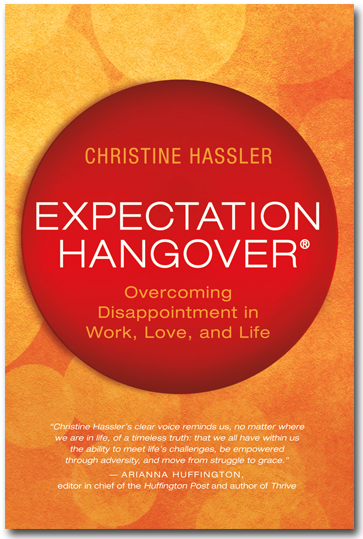
    Expectation HangoverTHE GIVEAWAY

    To enter to win one of two free copies of Expectation Hangover:

    • Leave a comment below
    • For an extra entry, share this interview on Twitter or Facebook, and post a second comment with the link

    You can enter until midnight PST on Monday, May 2nd.

    *US winners will receive a physical book in the mail; winners outside the US will receive an eBook.

    THE INTERVIEW

     1. Tell us a little about yourself and what inspired you to write this book.

    My own expectation hangovers and work as a life coach, spiritual counselor, author, and teacher inspired me to write the book.

    I noticed people’s greatest suffering happens when their realities don’t match up with their expectations and/or when life throws them an unwanted curveball that leaves them with what I call an “expectation hangover.”

    Most of us want to get over disappointment ASAP, but we often miss a big opportunity for positive change with that approach. What expectation hangovers offer us is a way to become more responsible for our own lives.

    Disappointment isn’t a bad thing, or even something to be avoided. In fact, my greatest disappointments have lead to my greatest successes.

    Today I am grateful for all my expectation hangovers, from leaving my successful career as a Hollywood agent at twenty-five to being in debt to health issues to my divorce, and inspired to teach people how to leverage their expectation hangovers!

    2. How do you define an expectation hangover?

    An expectation hangover is the myriad of undesirable feelings or thoughts present when one or a combination of the following things occurs:

    • A desired outcome does not occur.
    • A desired outcome does occur, but does not produce the feelings or results we expected.
    • Our personal and/or professional expectations are unmet by ourselves or another.
    • An undesired, unexpected event occurs that is in conflict with what we want or planned.

    Some examples:

    • A career path that was planned and executed with precision becomes tainted with doubt and lackluster.
    • A relationship with “the one” suddenly becomes the one thing we can’t get right.
    • A salary or promotion that was counted on is not a reality.
    • A home that was dreamed about still remains a fantasy.
    • A pregnancy that is wished for isn’t happening.
    • A parent who we could always lean on suddenly isn’t there anymore.
    • A lover or spouse leaves.
    • An illness interrupts our life.
    • A job and the financial security that came with it is gone.

    And then there are expectation hangovers that are more spiritual in nature that happen when we have checked off everything on our life checklist and still experience a lack of fulfillment.

    The symptoms are similar, but far more miserable and lasting, to those caused by a hangover from alcohol: lethargy, depression, lack of motivation, confusion, denial, anger, poor work performance, diminished creativity, strained relationships, social withdrawal, low self-esteem, regret, and a disconnection from a higher power.

    While suffering from an expectation hangover, we are typically caught up in regretting the past or latching on to something we think will make us feel better. We’d do anything to end our suffering—the problem is we just don’t know what that is.

    Expectation hangovers usually fall into one of the following three categories:

    Situational Expectation Hangovers 

    These occur when something does not turn out the way we wanted or we do not get the anticipated satisfaction from achieving a result.

    Interpersonal Expectation Hangovers

    This kind of expectation hangover occurs when we are let down by someone else or unpleasantly surprised by the actions of another.

    Self-Imposed Expectation Hangovers

    These occur when we do not live up to the standards or goals we have set for ourselves. In other words, we are disappointed in ourselves and the results we’ve achieved or failed to achieve.

    3. What are some of the most common unhealthy ways we cope with expectation hangovers, and what are healthy ways we can begin to treat an expectation hangover?

    It takes a lot more than two aspirin, some greasy food, and staying inside with the lights low to treat an expectation hangover! Because we don’t like feeling bad, we look for an external way to ease the discomfort.

    Rebound relationships; abrupt career changes; miscalculated risks; “over-ing” in the form of drinking, gambling, sex, drugs, work, or shopping so much so that it becomes an addiction; and numbing oneself with something like television are common.

    The first step to treating your expectation hangover is to get yourself out of any kind of victim thinking.

    “Why is this happening to me” is the wrong question to ask. Ask instead, “What am I learning? and “How is this happening for me?” That simple shift in questioning will rescue you from sinking into the quick sand of victimhood and hopelessness.

    Next, keep your mind out of judgment, regret, and shoulda/coulda/woulda thinking. Remember, you did the best you could. You didn’t do anything wrong. Your worth and value are not attached to anything or anyone external.

    Security from any outside source is an illusion—your ultimate “safety” is in love. Surrender is much sweeter than being addicted to control. And again, you didn’t do anything wrong. Really, you didn’t, and neither did anyone else.

    Which brings us to the next step—to forgive. Forgiveness does not mean you condone or agree with what happened or didn’t happen. It means you are in acceptance and letting go of judgments you are holding toward yourself or anyone else.

    4. You talk about “spiritual bypasses” in Chapter Two—immediately jumping to the blessings of a disappointing situation. How can this be harmful? 

    It can be harmful because we may miss an opportunity for healing and change on the emotional, mental, and behavioral levels.

    Yes, every situation has a blessing, and a lot of time that blessing can come in the form of a lesson. If we do not pause to ask, “What am I learning?” and immediately skip to finding the silver lining, we miss out on a deeper opportunity.

    Spiritual bypass also skips the emotional level. We are humans and we feel. It is natural to feel sadness or anger in response to an incredibly challenging situation. Not allowing ourselves to feel can lead to suppression in the disguise of being spiritual.

    To me, part of being spiritual is also welcoming and having deep compassion for the human experience. Spirituality is not just about being positive; it’s about being raw, real, and vulnerable with what we are authentically experiencing.

    5. How, exactly, can we leverage our expectation hangovers for growth and fulfillment?

    Instead of continuing to feel emotionally hungover, you can break the cycle and use those tough times as a catalyst for change.

    That’s not to say you can’t grieve over a loss or express disappointment: Allow yourself to be human, don’t judge yourself, and don’t feel like you need to “fix” things right away. But when life throws you a curveball, you can learn from it and ultimately grow from it.

    Here are three common scenarios that I have seen—and have experienced myself—and how to cope with each.

    A Relationship Ends

    First of all, realize that no one else can be the source of your happiness. The post-breakup period is an important time to work on yourself rather than outsource that responsibility to someone else.

    Second, take off the rose-colored glasses. A lot of people put their past relationships on a pedestal. But if a person breaks up with you, you don’t want to be with that person. And we know it’s tough, but you should stop all contact with your ex (unless you have children together).

    Relationships have expiration dates, just like the yogurt in your fridge. Women tend to have these expectations that we are meant to meet someone, be chosen, be proposed to, and when that doesn’t happen, we feel like a failure. But that’s not true—you learned what you were supposed to learn from that person, you didn’t do anything wrong; it was just meant to end.

    And remember: A breakup is always a transformational door that opens to improve yourself and nurture your spirit.

    A New Job Isn’t All It’s Cracked Up to Be

    At twenty-five, I had climbed the ranks in LA’s entertainment industry, ending up in a big job with a big office, an assistant, an expense account, and power lunches. But I was miserable every day, and finally I quit, and eventually discovered my passion as a life coach.

    Ask yourself: If I don’t feel like my work is meaningful or it’s not making me feel the way I want to, how can I change it? It’s in your power to redirect your thoughts and action.

    Take someone who works at Starbucks: They could hate the drudgery of it and the early hours, or they could appreciate the aroma of coffee and the fact they get to connect with people all day long. It’s all in the way you look at that, and you need to be proactive about it.

    You’re Not Reaching Your Health Goals

    If you’re trying to lose weight, you know how frustrating it can be when the scale doesn’t budge, or you skipped your workout (again). To overcome this pessimistic mindset, be mindful of the “story” that you’re telling yourself.

    When people try to lose weight, they tend to have a negative self-image. They’re eating right and working out, but their negative self-talk is still weighing them down. Plus, a big part of losing weight isn’t only physical—you have to heal your heartache or emotional baggage before you can make other physical changes, she notes.

    There is also an entire section in the book called “Quick-fixes that work” in terms of preventing disappointment, so I’ll share my two favorites:

    Don’t go to a Chinese restaurant when you are craving nachos.

    In other words, be realistic about your expectations of others. Too often we expect people to act the way we desire or the way we would in a situation, when they are just not capable or willing. Period. End of story. You can’t change them. When we understand we cannot change people, and accept them rather than expect something from them, we prevent expectation hangovers.

    Gorge on gratitude.

    Expectation hangovers happen when we pay too much attention to what is either not happening at all or not happening in the way we’d like it to.

    When we shift our focus to the amazing things in our lives—people, health, a place to live, and all the unexpected wonderful surprises the Universe delivers on a daily basis—we move out of a lack-mentality and into an abundant view of the world

    6. Can you elaborate a little on how disappointments can actually be blessings in disguise?

    Often life has to throw us a curveball (or several) so that we look in a different direction. The problem becomes when we desperately try to dodge the curveball, attempting to get out of feeling uncomfortable, and we miss the lessons that are available to us.

    If things are not turning out like you had planned or want them to, that is actually really good news. The Universe has a better idea in store. But first you have to let go of the plan you have been attached to so that your Higher Self and the Universe can conspire for you.

    Instead of thinking about how to treat an expectation hangover, consider how you can leverage it. This goes back to what I mentioned before—ask yourself, “What am I learning?” rather than “Why is this happening?”

    Think about some of the most inspirational people you know. I guarantee you that part of what makes them so inspirational are the expectation hangovers they have been through. They leveraged their hangovers for their growth and learning. Instead of trying to snooze through the alarm of disappointment, they woke up!

    Your expectation hangovers are gifts. Each one has been an opportunity to let go of something external that you have clung to for worth, safety, or love.

    I really get that disappointment is not at the top of your wish list. However, if you learn how to respond to expectation hangovers from the perspective of a student rather than a sufferer, I 100% guarantee you will walk through doorways of transformation that will lead you to more love.

    FTC Disclosure: I receive complimentary books for reviews and interviews on tinybuddha.com, but I am not compensated for writing or obligated to write anything specific. I am an Amazon affiliate, meaning I earn a percentage of all books purchased through the links I provide on this site. 

    You can learn more about Expectation Hangover or grab a copy on Amazon here.

  • How to Free Yourself from the Pain of High Expectations

    How to Free Yourself from the Pain of High Expectations

    Imprisoned

    “Suffering is traumatic and awful and we get angry and we shake our fists at the heavens and we vent and rage and weep. But in the process we discover a new tomorrow, one we never would have imagined otherwise.”  ~Rob Bell

    During my pregnancy, I was the poster child for prenatal health. From taking my supplements and participating in birthing and breastfeeding classes to doing downward dogs up until three days before my birth, postpartum depression never crossed my mind.

    I am married and financially and professionally successful.

    I hungered to be a mom.

    I have a robust community of friends.

    I do not fit the stereotype of who is at risk for postpartum depression.

    And yet, less than six weeks after giving birth to my daughter, I found myself sobbing and shaking on my bedroom floor in the middle of the night—incapable of getting up, incapable of taking care of myself or of my daughter.

    To understand how I found myself in this position, it’s important to understand what happened leading up to my birth.

    From the moment I found out I was pregnant, I began designing the vision for how I wanted to bring my child into the world.

    This was going to be my greatest creative act.

    I would labor at home as long as possible so that I could take baths and walk in my meditation garden.

    When I finally arrived at the hospital, I had an iTunes playlist (think Yanni, Jack Johnson, and Snatam Kaur) that was to play while my husband rubbed lavender and frankincense essential oils over my body.

    I did not want any pain medication. After all, my husband and I trained in hypnobirthing so that he could help me manage my pain.

    I created a lengthy document listing my desires as well as what I most definitely did not want. I posted it in multiple spots in my hospital room and provided a copy to my obstetrician and each nurse who attended to me.

    As you have probably guessed, my birth did not go according to plan.

    From the moment I was told that I needed to be induced because my daughter was in fetal distress, I watched myself move from protagonist to bit player in my birth story.

    Cervical ripening. Pitocin. Ruptured membranes. Epidural. Each of these medical interventions I abhorred the thought of I found myself submitting to as my labor stalled and my daughter’s breathing become more erratic.

    Twenty-seven hours after my induction, I gave birth. Only, I did not feel bliss or even gratitude. I was emotionally exhausted, disappointed, and anxious about what would come next.

    Within a day of my beautiful and healthy daughter entering the world, my cat of thirteen years exited it. As I grieved his passing, I found it difficult to bond with my daughter, particularly as she struggled to latch and my attempts at breastfeeding became futile.

    My fragile emotional health ultimately compromised my physical health. After a lengthy upper respiratory infection and weeks of postpartum insomnia, I began to feel like a dark, unfamiliar force had taken over my body. And I had no will to do anything about it.

    Fortunately, my mother and husband rallied to my rescue. They ensured I received the multiple forms of treatment needed to get back to me while my daughter was provided the nurturing that I could not give her at that time.

    By five months postpartum, I felt whole again. I felt connected to my daughter. Fortunately, she felt connected to me.

    I felt excited about my own and my family’s future.

    Postpartum depression forced me to question everything I thought I believed about what makes me happy, what I want my life and work to look like, and what makes me feel worthy to receive love and happiness.

    I am grateful for these lessons, even though the process to them was painful.

    While I now know that I was unconsciously equating my success and self-worth with my birth experience, strangling one’s self with an unrealistic benchmark for success is most definitely not just a woman’s issue.

    I do not want to allow myself to become prisoner to my expectations ever again.

    And I do not want you to become a prisoner to yours.

    Most of us struggle with how to create an ambitious and achievable vision for what we want for ourselves without getting our identities wrapped up in achieving them.

    Whether we strive to scale a business, negotiate a salary increase, payoff debt, buy a house, or take a family vacation, the key to having aspirations that fuel us, that make us feel good, is shifting our expectations about the outcome.

    First, we want to create goals for how we want to feel as we pursue what we are seeking to achieve.

    Prior to postpartum depression, I had never realized that in both my personal and professional life my goal setting always revolved around achieving something I could check off a list. And unfortunately, whether or not I checked off that thing on my list, was in large part not in my control.

    As a result, my feelings often operated by default rather than by design, and they were directly connected to my outward achievement.

    If we want to set ourselves to do well and feel good, we have an opportunity to set expectations for how we want to feel going through the process of achieving our vision.

    Had I done this during my pregnancy, I would have been lauding myself along the way for feeling healthy, creative, present, and so forth rather than pinning all of my success on the ultimate destination, the childbirth.

    We know from neuroscience that our beliefs shape our thoughts, and our thoughts give rise to our feelings. We have an opportunity to decide we are ready to feel a particular way—i.e., grateful, inspired, or accomplished—and align our beliefs and thoughts accordingly.

    Of course when we are triggered from something unexpected, upsetting, or downright devastating we are entitled to whatever emotional response is evoked. In these moments, we can observe our emotions moving through us without becoming them, or getting stuck in them, until we are back on the path we want to be on.

    When we put our awareness on believing that the feelings we desire can and will happen, it empowers us to have moment-to-moment thoughts (even if there are some occasional interruptions) that support the realization of the feelings we are striving for.

    This, ultimately, gives us a more solid base for realizing our expectations.

    Second, we want to find a way to measure success that goes beyond yes and no.

    To me, a successful childbirth was delivering my child without what I deemed were “unnatural” forms of medical intervention. I now realize how silly this goal was, given that it did not even address my daughter’s health.

    Yet if I were to time travel back or at some point have another child, I likely would still strive to minimize many of the medications and procedures I experienced.

    The key is the word “minimize.”

    I would focus on minimizing medical interventions that were not needed for the emotional, physical, and spiritual health of my child and me.

    That is very different, yes?

    How can you create goals that allow success to be lived in the gray, very important space, between black and white?

    Third, we must surrender in the wake of surprises and setbacks.

    When we surrender, we make peace with what is, and we use our newfound awareness to expand our conscious capacity for how to move forward with grace and ease.

    Note: This is not giving up.

    When we have an expectation that clearly cannot be met, we may grieve the shedding or the reframing of the expectation, but we do not adopt embarrassment, shame, or guilt about what has happened.

    We give ourselves space to awaken to the lesson, and then we incorporate it in how we move forward.

    To recap, if we want to consistently preserve our self-worth and ensure our identity does not become enmeshed in our results, we begin by shaping expectations that set us up to be successful in multiple and holistic ways.

    Then, we pause and pivot when expectations are challenged or outright dashed. We forgive ourselves for whatever role we played in the situation. And no matter what, we remember we are the protagonists in the story we choose to create about our lives.

    Prisoner image via Shutterstock

  • Get Past Disappointment: Release Expectations and Live Your Own Life

    Get Past Disappointment: Release Expectations and Live Your Own Life

    Free Man

    “Serenity comes when you trade expectations for acceptance.” ~Unknown

    Several years ago, I decided I had issues with surrender. I was often angry or resentful believing my life was not playing out as it should have been.

    I found a great measure of peace by performing a wonderful exercise I first learned of in Abraham-Hicks material.

    I took a large rectangular piece of paper and drew a vertical line, top to bottom, down the middle. On the left side, I listed things I felt responsible for and on the right side, I listed what needed to be turned over to a higher power (universal intelligence).

    It was an odd take on the idea of a job description, but it worked for me. I considered what types of things I had power over and surrendered much of the rest. When I did this, life became much easier.

    I did not let go of my tendency for disappointment, though, and I started looking at types of situations where I became disappointed.

    I found that my thinking fell into five main traps. My core issue seemed to revolve around having expectations for how other people should behave.

    1. I’d think, “Please be happy (sad, proud, indignant…) with me so I can feel justified having my feelings.”

    I recognized that I had a tendency to look to other people to validate my own feelings. When I would go to the movies with a friend, I would direct my glance away from the screen frequently to see if my friend was enjoying the same parts of the movie I liked.

    When I achieved a professional or financial goal, I remembered wanting my family to be proud “for me” and to congratulate me on things that made me feel proud.

    I wanted other people to mirror my emotional state, and I had to remind myself that they own their emotions and expressions, and I own mine.

    I learned that I cannot depend on other people to validate my feelings. I also understood that my feelings cannot be expressed by anyone except myself.

    Now, rather than look for others to validate my emotions, I realize I should simply experience them more fully.

    It’s good to laugh or cry or smile to ourselves whether someone else can see us or not.

    2. I’d think, “If I support you emotionally, you should support me.”

    If Emotional Intelligence were a highly regarded requirement for college entrance, I would have gone to an Ivy League institution, for sure. I have a knack for soothing ruffled feelings and for getting people to talk about things they want to talk about but can’t seem to express directly.

    I have often wished others could do this for me.

    But I have learned that we can’t expect this. We have to remember that we own our feelings, expressions, and abilities, and other people own theirs. Not everyone has the ability to make people feel better by attentive listening.

    Instead of being disappointed with giving more than I get, I try to look at how I can apply my sensitivity to mitigate my own hurts.

    3. I’d think, “People should act kindly toward others because I want everyone to get along.”

    Sometimes, I’ve observed myself recoiling if I witness a restaurant patron acting unkindly to a waitress or a driver cutting off another driver a hundred feet ahead of me. Again, I have to remind myself that I am responsible for my feelings, actions, and expressions, and other people are responsible for theirs.

    We are not personally responsible for making up the shortfall in simple acts of kindness someone else might experience. We can only aim to be examples of compassion, humor, patience, and any quality we would like to see more of in the world.

    4. I’d tell myself, “I am not ‘judging’ anything or anyone. I am simply refining a preference.”

    I rather not think of myself as judgmental. Yet, judgments flow through my mind constantly.

    I’ll tell myself that I need to make some judgments in order to make satisfying choices. I’ll tell myself that I’m not making judgments. I’m just refining preferences.

    I have to acknowledge, though, that I don’t always confine my thoughts about what is good or bad, what is “preferable” or not, to me and my life. I’ll think this person should lose weight, or that person should drink less alcohol, or this person should treat his children better.

    When the judgment first forms in my mind, I will feel a natural sort of entitlement to the opinion. After all, I have good values, maybe an enlightened perspective in some matters. But the judgments will still lead to disappointment and suffering.

    Why should I feel entitled to have any expectations on how someone else should live? This, too, is a practice of remembrance. I have to remember I own my feelings, emotions, and expressions, and other people own theirs.

    If I believe in moderation, I can give attention to not over-eating or drinking. If I believe in kindness, I can form an intention to ask after people or respectfully offer help.

    5. I’ll tell myself that I’m entitled to feel my feelings and use this as an excuse to spend extra energy holding on to an experience.

    There is often an interesting line to navigate between allowing myself to grieve a possibility not coming to fruition and romanticizing the loss. Truly, the loss is real, but it’s temporal.

    While acknowledging that it’s okay to feel sad, I do not want to give the feeling extra energy either.

    For me, holding on to an experience, or feelings about an experience, is fueling an expectation. I’ll get to thinking that things will always be a certain way or that I will always have the same feelings about something.

    But situations and moods are temporary, and an expectation that they’re permanent or probable can inhibit us from living life and enjoying the present.

    I’ve learned that getting beyond disappointments often involves moving beyond expectations and taking responsibility for living our own lives; owning our actions and emotions and letting others own theirs.

    Photo by yimmy149

  • Are Your Expectations Setting You Up for Disappointment?

    Are Your Expectations Setting You Up for Disappointment?

    “Waking up to who you are requires letting go of who you imagine yourself to be.” ~Alan Watts

    For a long time, I felt like I was standing on a riverbank just watching the water of life go by, too scared to jump in and play. I was waiting for the perfect current to come along that I could ride all the way to the completion of my intensely detailed life goals.

    I didn’t want to move until I felt like success was guaranteed and I was certain it was the “right” thing. Life was flowing, and I wasn’t doing anything. You can never be certain about the future.

    Around this time, I graduated engineering school, and instead of feeling excited and free, I felt like a large weight was dropped on my shoulders. I had a lot of expectations to meet, all of which were self-imposed.

    After all, I had an engineering degree. By the world’s standards, I was bound to be successful, get a great job, and make money.

    The thing is, I couldn’t shake the feeling that the path of engineering in the traditional sense was not right for me. I also couldn’t seem to function with the weight of these expectations. I got depressed, frustrated, and disappointed with myself for not pursuing engineering right way.

    I expected myself to be successful, which eventually escalated into expectations of perfection in all the areas of my life.

    One day, I was on a walk with my dad and he said to me, “Amanda, you just have to jump in the river and swim! You might wash up on the shore of the riverbank a little ways down, but at least you’re moving. Plus, you never know who or what will be there on the shore waiting for you. Just jump in and stop trying to set expectations for the future. Jump in and ride whatever current looks good now.

    That’s exactly what I did. Instead of focusing on what to do, where to go, and how I was going to accomplish everything I thought I wanted in life, I focused on releasing the expectations I had about it all.

    I focused on what I wanted to and could do now. I finally jumped in. 

    The following are some tips and lessons I learned while making the transition from expectation overload to the lightness of exploration.  (more…)

  • Reframing Rejection: Getting Rejected Doesn’t Always Have to Hurt

    Reframing Rejection: Getting Rejected Doesn’t Always Have to Hurt

    Rejected

    “Remember that sometimes not getting what you want is a wonderful stroke of luck.” ~Dalai Lama

    When I entered college, I knew exactly what I wanted to do with my life. I was going to be an actuary, just like my sister.

    Judy had just graduated, and she loved her job. My sister and I are very similar (both of us are math nerds, for example), so I knew I would love it too.

    While my school didn’t have an Actuarial Science major or any formal preparation for the career, I was able to get ahead, passing the qualifying exams at a rapid clip. And just as I was supposed to, I got a prestigious internship at a big consulting firm the summer after my junior year.

    Life was good. I loved my internship. I was being paid handsomely. And I was doing well, as indicated by my performance review.

    When the summer was over, all I had to do was wait for the call, the job offer, and I’d be set for life.

    That was the plan, at least.

    Of course, things never quite work out as planned. So when the phone call eventually came, it wasn’t with a job offer, but rather the only rejection out of our six-person internship class.

    While it was disappointing, I knew that with my great qualifications I would get an offer from another big company. In fact, I had connections at some competing firms, which I was sure would lead to another comparable job.

    I did everything I had to do. I interviewed perfectly, and no one else who was interviewing for the same positions had passed as many exams as I had.

    Yet somehow, it wasn’t good enough. By Christmas, I had gotten rejected from every single company I had applied to.

    I wasn’t sure how to feel. Of course, I felt pretty bad. But then, I kind of didn’t.

    You see, I was never able to study abroad in college. My roommate spent five months living in Jerusalem, and I was jealous. Suddenly, I was presented with the opportunity to remedy my #1 regret.

    And now, nearly a year later, I am living in Netanya, Israel, teaching English and having a great time. Out of rejection came a wonderful opportunity for me.

    Perhaps I’m just lucky. I certainly am grateful for the way things turned out. That being said, there is a mindset behind turning rejection into good fortune, and that mindset can be developed. (more…)

  • Go Ahead and Care—It Won’t Break You

    Go Ahead and Care—It Won’t Break You

    “What you do have control over is how you react to what happens in your life.” ~Oprah

    How vulnerable it is to care deeply.

    Because, oh God—the white-hot shame of caring, and having your caring exposed when it doesn’t happen despite your best efforts?

    Humbling.

    The thing I wanted most since I was a little girl was to be a published writer. Published, as in bound book in hand, “by Kate Swoboda” on the cover. 

    As a child, I spent hours writing books—real books, from beginning to end, sometimes illustrating them with pictures.

    I majored in English with a writing concentration in college. I went to graduate school for writing. I continued to write full-length books.

    Finally, when I was 24 years old, I thought I had my chance.

    I had entered my novel to a fiction contest and received an honorable mention. At the awards dinner, the judge told me that I had almost won the first-place award.

    The best-selling author who financially backed the contest said, “I want to read your manuscript.” Another writer at the dinner—a legit writer who has had her books turned into movies—said, “I’ll put you in touch with my agent.”

    I don’t think I drove home. I think I flew home, light as air, high on the possibilities.

    The writer gave me the information, and I overnighted my manuscript, a complete novel, to that agent. Then I spent the next month—every day—thinking about this agent calling, and how this was it, the big break.

    Three months later, I finally got a polite rejection email. I was crushed.

    “I Don’t Care”

    I often wonder if there’s some mechanism that modern-day society is missing when it comes to disappointment.

    Were generations prior better equipped to handle disappointment because they lived in a time when they didn’t get constant, recurring instant gratification? Is that what it takes to learn how to deal with disappointment better?

    (more…)

  • 4 Steps to Deal with Disappointment

    4 Steps to Deal with Disappointment

    “Don’t let today’s disappointments cast a shadow on tomorrow’s dreams.” ~Unknown

    For me, disappointment is one of life’s most uncomfortable feelings. It’s complex, containing a subset of other emotions like anger, hurt, sadness, and probably many others too subtle to identify.

    Sometimes, those emotions by themselves are easier to deal with, but disappointment can leave me at a loose end.

    I might not be sure whether I should feel angry, or just impatiently wish that I would hurry up and get over it. Disappointment can hover at the front of your mind and niggle at the back, bringing you a grey perspective on life, even if you’re trying to forget about it. (more…)