Tag: different

  • Brilliant, Not Broken: A Powerful Reframe for Neurodivergence

    Brilliant, Not Broken: A Powerful Reframe for Neurodivergence

    “It is not our differences that divide us. It is our inability to recognize, accept, and celebrate those differences.” ~Audre Lorde

    For most of my life, I asked myself a quiet question:

    What’s wrong with me?

    I didn’t say it out loud. I didn’t have to. It was stitched into how I moved through the world — hyperaware, self-correcting, and always just a little out of step. I knew how to “pass” in the right settings, but never without effort. Underneath it all, I was exhausted by the daily performance of normal.

    Looking back, it’s clear where it started.

    I grew up in a home marked by emotional chaos and unpredictability. Like many kids with developmental trauma, I became hypervigilant before I even had words for it. I learned to track mood shifts, tones of voice, the silences between the words. While other kids were absorbing math lessons, I was reading the room.

    In elementary school, I wasn’t the loud kid or the front-row overachiever. I was the quiet one in the middle row—not bold enough to be in front where people might see me, and not defiant enough to risk the back, where the “bad kids” got called out, punished, or ignored. I learned early that safety meant staying in the middle: visible enough to avoid trouble, invisible enough not to stand out.

    I didn’t know what the lesson was. But I knew who the teacher favored and who she didn’t. Who had a rough night at home. Who was trying too hard. Who had checked out. And who was silently hurting the way I was.

    I was always paying attention—even if they said I was unfocused—just not in the way the teacher wanted me to.

    I also daydreamed. Constantly. I lived in fantasy worlds that I made up in my head, complete with characters, backstories, and dialogue. I wasn’t trying to avoid reality—I was trying to survive it. And those imagined worlds were often kinder than the one I was stuck in.

    So when people say things like, “That child is so distractible,” I want to pause them.

    Sometimes, what you’re seeing isn’t a disorder. Sometimes, it’s a child adapting to a world that feels unsafe.

    What We Call Disordered Might Just Be a Different Kind of Wisdom

    As I got older, I started to realize how many of the things we pathologize—especially in women, neurodivergent folks, and trauma survivors—are actually adaptive or even gifted traits. But because they don’t fit the dominant mold of what “healthy” looks like, we call them broken.

    Let me say this clearly: Different doesn’t mean disordered. And even when support is needed, that doesn’t mean the person is lacking.

    Take ADHD. It’s often reduced to disorganization or forgetfulness, but for many people, it reflects fast-paced, pattern-jumping brains that crave stimulation and thrive in high-innovation spaces. That same brain might struggle in school but light up in entrepreneurship, the arts, crisis work, or tech.

    Take anxiety. Yes, it can be overwhelming. But beneath it is usually a sensitive nervous system attuned to energy, risk, nuance. In trauma survivors, it often reflects the ability to read between the lines—to sense what’s not being said, to prepare for every possible outcome. They keep themselves and others safe by seeing the risks before the bad thing happens.

    Take autism, especially in girls and women. What gets labeled as rigidity or social awkwardness might actually be deep authenticity, truth-telling, and sensory brilliance in a world full of noise and social masking.

    Even depression can be a form of wisdom—a body demanding rest, a soul refusing to keep performing, a nervous system finally saying “enough.”

    What Neurodivergence Really Means

    Neurodivergence isn’t one thing. It’s a big umbrella. It includes conditions like:

    • ADHD
    • Autism
    • Learning differences (like dyslexia or dyscalculia)
    • Sensory processing differences
    • Mood disorders (sometimes)
    • PTSD and C-PTSD (especially when they cause long-term brain changes)

    For some, it’s hardwired. For others, it’s trauma-shaped. And for many of us, it’s both.

    In my own family, neurodivergence runs deep.

    My mother lived with bipolar disorder and schizophrenia. My oldest son has ADD and anxiety. My youngest is autistic, has an intellectual disability, and also lives with ADHD. I’ve carried complex PTSD, anxiety, depression—and honestly, probably undiagnosed ADD too.

    We are not broken. We are not less.

    We are a line of deeply sensitive, differently wired humans trying to survive in a world that doesn’t always recognize our kind of brilliance.

    I know what it is to be the outcast.

    I watched my mom become one—judged and misunderstood by her own family, dismissed by society because her bipolar and schizophrenia made people uncomfortable. I’ve watched my youngest son become one too. He’s autistic, has an intellectual disability, and ADHD. And I know—deeply know—that if I hadn’t chosen to value his wiring, the world might have crushed him. For a little while, it did.

    But this kid plays the drums like nobody’s business.

    He is fiercely protective, wildly loyal, and more emotionally intuitive than anyone I’ve ever met.
    And every once in a while, he’ll say something so specific, so strange, so piercingly true, I swear he’s reading my mind — or someone else’s.

    We don’t talk about this kind of intelligence enough. The kind that doesn’t show up on standardized tests or IQ charts, but lives in the bones. In the music. In the knowing.

    Neurodivergence simply means your brain functions in a way that diverges from the norm. That’s not bad. That’s essential—because the “norm” was never built with all of us in mind.

    The Bigger Picture

    We live in a culture that rewards sameness: attention that stays linear, emotions that stay tidy, learning that happens on schedule.

    But real life is messier than that. And real people are more complex.

    Some of the most powerful thinkers, healers, leaders, and artists I know live with labels that would’ve sidelined them if they hadn’t learned to translate their differences into power.

    Different doesn’t take away from the conversation. It adds to it.

    And the next time you wonder if something is “wrong” with you,  pause.

    What if that part of you isn’t broken?

    What if it’s just misunderstood?

    What if it’s trying to show you something the world forgot how to hear?
  • How I Stopped Feeling Like There Was Something Wrong with Me

    How I Stopped Feeling Like There Was Something Wrong with Me

    “A flower does not think of competing with the flower next to it. It just blooms.” – Zen Shin

    In the past, I often felt like I didn’t belong in groups of women.

    Sometimes I felt like something was wrong with me, like I was othered in one way or another: too sporty, too quiet, too serious, too emotional, too dumb, too smart, too wild, too normal, too sexual, too prude.

    Other times, I felt like something was wrong with all of them. Girls’ nights and bachelorette parties? The screeching voices, the loud laughs, the mundane conversations about makeup, skin care routines, and lip injections? No thank you.

    I wanted so badly to belong but didn’t see a place for myself. I felt like I wasn’t doing the whole woman thing the right way. I found it easier to hang with the guys.

    But now? I have learned that nothing is wrong with me (or you), and hanging out with a group of women makes me feel all warm and fuzzy inside. 🙂

    What shifted?

    First, I stopped comparing myself to others.

    Those “toos” I mentioned above, and that so many of us feel, are usually a product of that ever so insidious trap of comparison. It’s a trap because we get stuck in a negative thought loop, smothered by jealousy, anxiety, and self-criticism, which ultimately causes a fissure of separation, between ourselves and others.

    If we use other people and external standards as a barometer, we will always find ourselves being “too” something, which makes for a very disruptive and tumultuous internal experience. For me, it means that I have spent many years feeling insecure and ungrounded in who I am. It means I often acted as a chameleon and changed my energy based on who I was around, so I could “fit in.”

    But now, I don’t do that. (Okay, I still do it sometimes, but way less often.) I have learned that there is no “right” way to be a woman, or a human. We are each unique individuals with our own personalities, desires, fears, and preferences, and the uniqueness of all of us makes the world so much more interesting and beautiful.

    Second, I shifted away from judgment and toward curiosity.

    During my young adult years, I was very judgmental. I went from thinking that something was wrong with me to thinking that I was better than all the other women. I thought women talked too much about surface level things and people. My ego started to create stories of separateness: me over here wanting to ponder existential questions and talk about emotions, and them over there who wanted to gossip, laugh too loudly, and talk about makeup and boys.

    Now, instead of judging the “surface level” conversations (which still occur), I am curious about them.

    Why do women spend so much time discussing our weight, clothing, waxing habits, and skin care rituals? Because we have been force-fed the belief that we are inadequate the way we are. We are told that we have to buy this or that product if we want to be beautiful. We are told we have to be thin if we want to be loved. So it’s no wonder we spend so much time thinking and talking about matters of physical appearance.

    By switching from judgment to curiosity, I have realized that such discussions are actually not surface level at all. They are reflective of deep desires to belong, to be loved, and to be accepted.

    Third, I demoted my ego.

    My ego told me that I was the only woman that felt othered. That I was unique in my feeling like I didn’t belong. That I was special in some way because I wanted to have “deeper” conversations. That is such BS!

    I have now learned that I was in no way unique in feeling like I didn’t belong. Most women, and people, yearn to peel back the layers and connect with one another in a  deep, rich way, but we find ourselves stuck in a performative role, trying to show up how society has told us to.

    Many of us have erected walls around our hearts, minds, and bodies to protect the vulnerable, raw, sensitive parts of us. To protect the parts of us that we learned weren’t safe to express or were unlikeable. But we want to let others in.

    Lastly, I also started listening to the sage advice from philosophers, religious leaders, and laypeople across centuries.

    I started heeding their wisdom, which can be summed up as: you have everything you need within you.

    I started to deepen my connection to myself, knowing that the problem I was experiencing, namely the feeling of being othered and not belonging, could only be solved by first turning inward. I’ve deepened my connection to myself through dance, breathwork, journaling, meditating, and playing. I have started to uncover who I am and who I want to be, versus trying to fit into a mold of what I think a woman, or a human, is supposed to be.

    In my journey of releasing comparison, igniting curiosity, demoting my ego, and turning inward, I have also learned that:

    You are not too anything.

    This does not mean that you are perfect, or that you have no opportunities to grow and expand. But it does mean that there is no “right” way to be, except the way that is true and safe for you.

    Often when people say you are “too ___,” it is a reflection of their own insecurities.

    “You are too emotional” might mean, “I have not learned to express my emotions, and your vulnerability makes me uncomfortable.” “You are too loud” might mean, “I am not fully expressing myself, and I am jealous of your ability to express yourself confidently.”

    You are not alone in your desire to belong.

    It is likely that what you are feeling, others have felt at some point. When you remember this, you are reminded that you are not alone. The journey of self-discovery eventually leads to a feeling of oneness, because we absolve the illusion of self and separateness and begin to see our connectedness, our shared fears and desires. You know how it goes, we’re all made of stardust, baby!

    When you start to express the truest parts of yourself, it’s an act of leadership.

    Because in doing so, you provide a permission slip for others to do the same. This doesn’t mean you expect everyone to express themselves in the same way as you, but rather that we all start to express the weird, unique, quirky, true parts of ourselves. And that is what the world needs more of.

    So, here’s to less judgment, more curiosity; less separateness, more connectedness; less fear, more love.

  • I Cheated on Him with My Higher Self (and We’re Still Going Strong)

    I Cheated on Him with My Higher Self (and We’re Still Going Strong)

    “It’s okay to let go of those who couldn’t love you. Those who didn’t know how to. Those who failed to even try. It’s okay to outgrow them, because that means you filled the empty space in you with self-love instead. You’re outgrowing them because you’re growing into you. And that’s more than okay, that’s something to celebrate.” ~Angelica Moone

    “How could you do this to me? It’s obvious you’re with someone else.”

    That was the third and final message I received from my partner of nearly three years, several weeks after we had finally decided to break up. I say “we” because initially it seemed that the decision was mutual, although it would later be revealed that it was me who wanted out.

    He was right, by the way. I had left him for someone else.

    No, not the lover that he had conjured up for me in his own mind. In fact, what had pulled me away was much more powerful and seductive than that. I had cheated on him with my higher self. And she had been trying to win me over for quite some time.

    My higher self: AKA my intuition, AKA my inner badass that will never be ignored. Yep, she’s the one I had left him for.

    Much like when I was nearing the end of my marriage, she had started off with a gentle nudge, a tap on the shoulder every now and again. I’ve noticed throughout my life that if I don’t stop what I’m doing, these attempts to get my attention will become more consistent, until what was once a whisper finally becomes a roar.

    Such was the case three years ago when she decided that I should shave my head. At that point, I had invested a lot of money turning my naturally dark brown hair into a platinum blond mane. This was before the pandemic, when I couldn’t imagine anything coming between me and my monthly visits to the salon.

    As with most suggestions that come from my higher self, my ego was not impressed.

    If the two of them had been sitting across from one another, the conversation would have gone something like . .

    “You want to do whaaaat??”

    “Shave it.”

    “Excuse me?”

    “Take it all off.”

    “All of it?”

    “All. Of. It.”

    So I attempted a compromise by shaving a bit off the side. I knew I was kidding myself when I thought that would be the end, but at least it was a start. Over the course of the next twelve months, I felt equal parts admiration and jealousy whenever I caught a glimpse of someone with a shaved head. This peculiar mix was familiar to me, and it signaled what was destined to happen next.

    When I had finally made the decision, it was a random Tuesday morning, and it made absolutely no sense to my logical mind. Unlike the ego that thrives on being booked and busy, the higher self loves white space. When we give ourselves the opportunity to tune out and tune in, our deepest desires have a funny way of being revealed.

    That fateful day I had decided to take an extra long walk with my dog through one of the parks here in Barcelona. There’s nothing like nature, movement, and a bit of solitude to help you cut through the noise and get to the heart of what you really want. Instead of returning to my apartment, we headed to the salon.

    As I took a seat at my hairdresser’s station and looked at myself in the mirror, my ego had a full-blown tantrum while my higher self popped open the proverbial champagne.

    In those moments of feeling the clippers pass over my scalp, watching my shoulder-length hair fall to the floor, I finally felt free. Whether it’s our hair, our jobs, or a relationship we’ve long outgrown, the higher self seeks our liberation, no matter what the cost.

    That day when I told my then partner what I had done, the conversation didn’t go as I had hoped but exactly like I had imagined.

    “You’re bald.”

    While this was indeed a fact, the tone made it feel like a personal attack. He asked me why someone so beautiful would intentionally make herself so ugly. For once in my life, being “pretty” hadn’t been the deciding factor. I wasn’t so concerned with how I wanted to look but rather how I wanted to feel. As I’ve come to learn since, life really changes when this perspective starts to shift.

    If his thoughts and feelings were any indication, I was no longer much to look at when it came to the male gaze. Ironically, all he could see was “a weirdo” while the person I saw with my own eyes was a queen. 

    While my ex couldn’t get past my shaved head, I couldn’t get over the luminosity and the brilliance that could fully shine through. As he continued to fixate on what I had lost, I knew the truth of what I had gained: freedom, courage, and beauty on my own terms.

    Perhaps I always knew that he would leave me over a haircut. No one likes to think that the future of their relationship comes down to the length of their hair, but he had told me from the beginning that shaving my head was the one thing I should never do. Funny the rules we’ll follow in an attempt to belong to other people while we strategically abandon ourselves.

    I had spent nearly four decades of my life searching for safety in the fulfillment of everyone’s expectations. I used to be an expert at figuring out what they wanted and becoming exactly that. Until one cold, cloudy morning in February 2021, when I decided I was done. Done with the pretending. Done with the pleasing. Done with the denial of what I knew to be true.

    I was finally ready for a different kind of love. And this time it was all my own.

    You could say that I cheated on my ex with my higher self, or maybe she was the one I was meant for all along. Either way, I’ve chosen to be faithful to my inner wisdom. And from what I can tell, we’re still going strong.

  • How I Found My Place in the World When I Felt Beaten Down by Life

    How I Found My Place in the World When I Felt Beaten Down by Life

    “Some people are going to reject you simply because you shine too bright for them. That’s okay. Keep shining.” ~Mandy Hale

    After I finished school, I was excited about moving forward with life.

    I thought about the career that I hoped to have, where I hoped to live, and the things that I wanted to accomplish.

    After starting off as a secondary high school English teacher and becoming disappointed with the ongoing changes in the public school system, I went to graduate school for law. I thought it would open up a lot of possibilities, but it did not.

    I never had any dream of being an attorney in a courtroom. Instead, I always wanted to work in Europe or South America with people from different cultures, nationalities, and backgrounds. I wanted to make a positive difference in a humanitarian way by working with people personally to implement change and improve their lives.

    Life had something different in store for me, though. I ended up being rejected endlessly, well over a thousand times for every application that I sent out over a period of years.

    Disillusionment set in. There was the feeling of “why even continue to try anymore?” As the rejections piled up, friends that I had known for years began leaving as well. Their calls and visits became less frequent. They moved on with their lives, careers, marriages, and kids.

    I felt left behind and rejected not just by jobs, but by life in general. The hurts and betrayals were leading me to lose my passion and enthusiasm. Then there were the callous remarks from friends, people in the local community, when I asked if they knew of a position, former professors who couldn’t assist in any way now that I’d graduated, college career center advisors, and even extended family members.

    It took time, but I finally came to the realization that those who were endlessly rejecting me weren’t the ones who really mattered. I would keep shining brightly with or without them.

    Here are the four things that helped me to finally “reject” the non-acceptance and rejection that I was experiencing from others.

    1. Realize that “there is no box.”

    Our background, degrees, friends, teachers, families, and the larger culture as a whole try to get us to conform to a narrow set of parameters. If you went to school to be a teacher, you have to be a teacher.  If you studied to be an auto mechanic, you have to be an auto mechanic. And you have to live in this place or this country, because that’s where your family have always lived.

    Someone once told me, “there is no box.” Society tries to “box” us in and to restrict us to defining ourselves within certain narrow limits. However, I realized that there really is “no box,” and that I could apply my skills and talents in other ways and in other places.

    I didn’t have to conform to where I was or seek acceptance from those who were currently around me.

    I started meeting new people and looking at other places and countries, and I stopped trying to seek the acceptance of those who had already decided that they weren’t going to accept me for who I was. The employers, institutions, and agencies told me I was  “overqualified” or that that there were “many qualified candidates” and I hadn’t been considered, or they’d keep my resume on file.

    It was as though no matter what I accomplished and no matter how hard I worked, it was never “the right skill set” or “enough” for the particular place or person that I was submitting to.

    In a way, I came to accept their rejection, because I knew that the answer was getting out of my box and realizing that someone else would be more than happy to accept me for who I was.

    2. Let go of the need for approval by others.

    Letting go of the need for approval opens up exciting new doors. We are finally free to be who we really are.

    I wanted to live up to the expectations of family and society. I think that’s why it hurt so much to receive so many rejections over such a long period of time. I wanted to be “successful” according to society’s expectations. I wanted to follow the path of what everyone told me was a “regular” and “secure” life.

    I’ve since realized that I get to define success for myself.

    Success, for me, means doing what I love—teaching, reading, traveling, meeting and working with people from throughout the world, studying languages, and experiencing different cultures.

    Everything changed for me when I decided to live my life on my terms now rather than looking for a company, agency, government institution, or some other entity to provide me with the chance or opportunity. I wasn’t going to wait for permission from someone or something else.

    I also realized I can use my skills in the world outside of the narrow and limited context of the jobs and people who were rejecting me.

    For example, I can teach, and I can work to help others, but it doesn’t have to be within the rigid structure of the public education system.

    I can use the skills that I’ve acquired to be a global citizen and to learn and grow every day without confining myself to the parameters of one place, country, or culture. I can be an amalgamation of all of them, as I continue to grow as a person, both personally and professionally, but on my own terms, not those that are dictated to be by someone or something else.

    As I let go of the need for others to approve of me, my world expanded, because now I could go after those things in life that I was passionate about rather than just trying to conform and satisfy others.

    3. Start journaling.

    Journaling and connecting with our true selves, and what really brings us joy, can make us value ourselves again in spite of any opposition and rejection that we experience from the world.

    It can also help us reconnect with the things we used to love when we were younger—the passions we lost after going through years of school and trying to do what we thought we had to do in order to be successful in the eyes of society.

    Journaling helped me get back to my uniqueness as a person and was what really motivated and inspired me. It helped me pay attention to what made me happy again and those things that I’d really like to do or accomplish.

    I was inspired by my experiences in the world that were outside of my comfort zone and by the rich and varied cultures and experiences that were waiting out there. As I continued journaling, I also realized I’d always been inspired by the possibility of teaching and helping others, but in an international capacity.

    As a result, I’ve had the opportunity to help students with autism, to teach English to students and adults internationally, and to write for a variety of places abroad that did accept and value my work. However, I would never have explored these aspects of myself if I had been accepted by those who were rejecting me. Which means really, their rejections were blessings in disguise.

    4. Support those who support you.

    “Your circle should want to see you win.  Your circle should clap the loudest when you have good news.  If they don’t, get a new circle.” ~Wesley Snipes

    We can reject rejection by supporting those who support us through both the good and the more difficult times in our lives. Why support those who are only there for you when life is good?

    The hard times made me realize who really was on my side. The people who stayed with me and continued to believe in me supported me through both the victories and the disappointments. There was a tremendous difference between those individuals and others who no longer answered calls or emails, except when I was “successful.”

    Now, I may not have as many friends as I once did, but those that I do have are an important part of my circle and people that I can rely on.

    Someone once told me, “Now I know who the true believers are.” I feel that way about those who have proudly celebrated my successes and have also been there for me during my darkest moments.

    I hope you’re fortunate enough to have people in your life who genuinely support you, even if it’s only one person. If you don’t, try to open yourself up to new people, and stop giving your energy to people who accept you conditionally or regularly disappoint you. Creating a supportive circle begins with that first step of making a little room.

    It wasn’t easy for me to overcome rejection and non-acceptance, and I still struggle with it at times. No one wants to feel left out or like a failure. But I’ve realized I can only fail by society’s terms if I accept them—and I don’t.

    Instead, I’ve rejected the “box” other people tried to impose on me, gotten outside my comfort zone, let go of the need for approval, started rediscovering what excites me, and shifted my focus to those people who have always supported me, regardless of what I’ve achieved. And I’m far happier for it.

  • Why I Now Love That I’m Different After Hating It for Years

    Why I Now Love That I’m Different After Hating It for Years

    “Only recently have I realized that being different is not something you want to hide or squelch or suppress.” ~Amy Gerstler

    I grew up during the traditional times of the sixties and seventies. Dad went out to work and earned the family income, while Mom worked at home raising their children. We were a family of seven. My brother was the first-born and he was followed by four sisters. I was the middle child.

    I did not quite know where I belonged. I oscillated between my older two and younger two siblings, feeling like the third wheel no matter where I was.

    I was the one in my family that was “different.” I was uncomfortable in groups, emotionally sensitive, intolerant of loud noises, and did not find most jokes funny. Especially when the jokes were at the expense of someone else. Oftentimes that someone else was me.

    Yes, I was the proverbial black sheep. I stood on the fringes of my own family, a microcosm of the bigger world.

    Life felt hard and lonely. I felt isolated and misunderstood. Too frequently I wondered what was wrong with me and why I did not quite fit. Others appeared to be content with the status quo. I never was.  Others didn’t questions the inequities I saw in life. I did. Others did not seem to notice the suffering of others. I epitomized it.

    Being different did not exactly make me the popular one. In fact, quite the opposite. Who knew what to do with my awkwardness? I sure didn’t.

    As a result, I was depressed a good part of my life. That was not something that was identified or talked about then. Too often it still isn’t. A disconnected life and feelings of loneliness and isolation will lead to depression, among other things. 

    I hit my teens and did what too many do: I looked for ways to be comfortably numb. My choice was alcohol. It gave me an opportunity to “fit in” or at the very least, not care about the fact that I did not. I rebelled. I self-destructed. For years.

    As life will have it, I grew up, feeling my way in the dark, wondering when the lights would go on. I turned inward looking for the comfort I could not find from the world. I hid my pain and lostness. At times, I prayed that I would get cancer and die.

    A heroic exit was not to be my path.

    Do you know what I am talking about?

    Maybe you feel what I have felt. Maybe you know the pain of chronic isolation and what it means to be different in a culture that prefers sameness. Do you wonder if you will ever be okay? Do you wonder if you will ever fit?

    Well, let me tell you:

    First of all, you fit. You have always fit. You belong. You have always belonged. You are needed—more than you know. These are truisms.

    Others do not have to think you belong in order for you to know you do. Others do not have to treat you as insider in order for you to know you are.

    Knowing, intellectually, that you belong is one thing. Feeling like you belong, now that is an entirely different thing. That is an inside job. In other words, that is your work to do.

    So, I did what I had to do to bring change, in order to get the life I wanted. I stepped up to the challenges in my life, which came through my work world and my personal relationships.

    I often ran into conflict with authority figures, changing jobs frequently. I didn’t know how to let others close to me. I was afraid of being rejected, so I used anger and avoidance to distance those that mattered to me the most. I was not happy, content, or at peace. I felt that more often than not.

    So, I faced my pain and hurt instead of numbing it.

    As I got more honest with myself, I began to consider that maybe there was nothing wrong with me.  Maybe there was something wrong with the world or the system that wants to tell me there is something wrong with me.

    So, I began to view myself through different eyes. I began to make some noise. I got out of the bleachers and stepped into the ring. I chose to participate in life as I was, not as others thought I should be. I started to push up against the boundaries that others had set.

    Yes, I faced rejection. I dealt with disapproval. It was hard. Really hard. It hurt. I cried. I stomped my feet. I cried again. I gave myself permission to feel angry.

    In spite of the internal chaos, in spite of the hurt, in spite of my turmoil, I would do it all again.

    When we are trying to make changes, when we are owning our own lives, when we bump up against the expectations of others, it frequently gets messy before it gets better.

    DO IT ANYWAY! Because it does get better. For every person who rejects you, another will embrace you. But you can only meet those people if you first embrace yourself. Because you need to accept yourself to be able to put yourself out there.

    When you feel afraid to move forward, move anyway.

    When you want to quit because it feels too hard, rest. Do something nice for yourself. Then get back up and keep moving.

    There is light. Even when you can’t yet see it.

    There is hope. Even when you can’t find it.

    There is love. Even when you can’t feel it.

    Work at finding your voice by getting quiet and paying attention to your feelings and inner nudges. Learn to trust yourself by acknowledging that only you know what is true and best for you. Know your worth by recognizing your intrinsic value as a unique person with an abundance of admirable qualities.

    Start caring more about approving of yourself than waiting for others to approve of you. Own your life and take responsibility for your well-being and happiness. No one can do that for you.

    Figure out how to forgive yourself for the mistakes you will inevitably make. Learn how to love yourself more than anyone could ever love you.

    Accept yourself—the good, the bad, and the ugly. Then get about changing the ugly as best you can.

    This is what I have done. This is the hard work that brings transformation.

    In the process of all of this I made a phenomenal discovery…

    ME!!

    What a discovery! I have gifts to bring to the world. Gifts that will leave this world better than I found it.

    When I was younger, I didn’t like how sensitive I was to the energies around me, how I felt things to the core of my being, and how I hurt when I saw someone else hurting.

    Those around me seemed playful and fun, though, I could see the hurt in them. Life did not feel playful and fun to me. It felt serious. People were hurting. Why didn’t anyone other than me notice?

    I was hurting. Why didn’t anyone notice?

    I gravitated to the heavier side of life, fully identified with the suffering around me.

    I wanted to be anything other than what I was.

    I now understand these qualities to be empathy and intuition. Two things the world greatly needs.

    I learned to trust those qualities. They led me down a road I could never have imagined. I now have a thriving counseling practice, helping others to heal. I get to watch them discover their gifts. Better than that, I get to watch them go from hating who they are to loving and embracing who they are.

    Then they go out and find ways to help others do the same.

    But this story is not just about me. It is also about you.

    There is nothing wrong with you. You are amazing and beautiful, just as you are. Flaws and imperfections included.

    Don’t change yourself for a world that wants to tell you who you are.

    You tell the world who you are. Let’s change this place together and allow difference to be the norm, because our beauty is in our diversity.

    I invite you to take the journey inward to self-discovery. Then bring what you’ve learned and share it.

    Bring who you are and let’s change this world, one person at a time.

  • We Can Choose Different Ways Without One of Us Being Wrong

    We Can Choose Different Ways Without One of Us Being Wrong

    “You have your way. I have my way. As for the right way, the correct way, and the only way, it does not exist.” ~Friedrich Wilhelm Nietzsche

    Many of us are committed to a journey of change and personal growth. While these are traits to be admired and celebrated, they can also have a darker side. We can become a little militant and dogmatic when we’re on our journeys.

    As we focus on our attempts to make changes in our own lives, our views can start to narrow and become very black and white. We become so tuned into what we are doing that we forget there’s more than one way to do just about anything.

    We seek out others that agree with us to back up ‘our views.’ This may be part of our primal wiring to be part of a collective. We seek a tribe.

    Being part of a tribe can be intoxicating. Being with people that share our passion is exciting. It’s great to have a common goal or view and be able to talk about our passions with others that really get it. We’re all in this together.

    Being in a tribe can also distort our perspective. Only seeing and hearing a biased view. Ironically, we can lose objectivity as we seek clarity. Becoming more rigid as we search for methods and hacks.

    Or maybe we enjoy citing this study or that to ‘prove’ our point. Using science (bad science oftentimes) as our weapon of choice to make ourselves feel and sound knowledgeable.

    Both these traits can lead to us becoming dogmatic, thinking our way is the only way.

    A Personal Example or Two

    I notice this habit of falling back on dogma for a good reason—I do it myself.

    An example would be my approach to exercise.

    I choose to keep myself strong with my own bodyweight (calisthenics). The ability to use one’s own body through space is impressive to me and I feel it’s the ultimate expression of strength. Not everyone shares this view of course. Many others enjoy hoisting large amounts of iron or swinging a kettlebell.

    As I have deepened my own practice of bodyweight training and enjoyed the benefits it brings, I have also found myself judging the way others exercise at times. Shaking my head at people in the gym I perceive to be doing something silly or dangerous.

    Another favorite, quoting from a famous fitness authority or studies to hammer home a point, perhaps how repeated loading of the spine with weights can have negative connotations. Or how balancing on a bosu ball has little carryover to anything other than balancing on a bosu ball.

    Why do I do this? I’ve chosen my route, why do I feel the need to judge the way others choose to exercise? I’m certainly no expert.

    Another example would be my journey into simplicity and applying 80/20 principles to my life. Several years ago I realized I was accumulating more in my life. More things that didn’t really matter to me or speak to me on a spiritual level. Life felt more complicated than I wanted it to be.

    In response, I started to make some changes. It’s a journey I’ve documented previously on Tiny Buddha. The upshot of these changes has been that the quality of my own life has improved significantly. There is more focus and clarity in my life.

    Along the way, as I’ve traveled further down the rabbit hole of simplicity, I find myself casting a weary eye at others oftentimes. Judging them for complicating things, or not grasping the power in simple, or for not saying no to commitments they have no capacity to keep.

    None of this is useful to them, none of it is useful for my internal energy. Yet, still I have to fight this pull to judge. Justifying it somehow as me now knowing better. How arrogant and self-righteous this all sounds as I write the words, and for good reason—it is.

    Your Journey is Your Journey

    No need to complicate things. Personal journeys should be personal. Let’s be clear, we’re not in competition and even if we are, it’s with ourselves.

    You can call yourself a minimalist if you like, but owning less than your neighbor doesn’t automatically make you a better person.

    You can call yourself a mindfulness advocate and commit to daily meditation, but not everyone needs a formal meditative practice to be mindful. Equally, not everyone with a daily meditative practice is mindful.

    You can choose to strengthen your body by lifting your own body if you like, but it’s fine if someone else chooses to push weights or rocks instead.

    You can choose to follow a Paleo diet without bashing vegans, or vice versa. People can, and do, thrive on many diets as the Blue Zones around the world already prove.

    You can choose to follow a religion that calls to you, but you can do that without damning someone else who follows a different faith.

    You can choose to do all of this quietly in your own way. Or you can choose to share what you are doing with others in the hope of inspiring them to join you, or support you on your journey. If you share, let’s drop any degree of superiority or smugness. No need to hide behind dogma or use it as a weapon to fire at others.

    Follow your passions in life, embrace them, and really enjoy them, but be aware that others are just as passionate about their passions. Leave the dogma behind and remember, there are many routes to the top of any mountain.

    Note: This post is as much a reminder to myself as it is to you. I hope to rid myself of this affliction to hide behind dogma at times. If you notice me doing it, please feel free to remind me of these words. 😉

  • Fitting In Is Overrated: Embrace Your Uniqueness to Find Meaning in Life

    Fitting In Is Overrated: Embrace Your Uniqueness to Find Meaning in Life

    Be Different

    “To be yourself in a world that is constantly trying to make you something else is the greatest accomplishment.” ~Ralph Waldo Emerson

    Have you ever felt different—like you don’t fit in at all?

    Do certain things captivate other people but leave you struggling to find meaning?

    What about the big picture? Maybe you feel you chose the wrong career, or you wonder if you were born into the right family—no one else seems to think the way you do.

    Feeling different can be unsettling in a world that values sameness. You can derail your confidence and your progress by demeaning yourself for your differences.

    I felt uncomfortably different most of my life—out of place, misunderstood, and alone. I always worked hard to fit in, fighting a constant, frustrating inner struggle with no tools to help me cope.

    I always got top grades, but didn’t seem to think the way everyone else did, perhaps because my family was poor but I attended an upper-middle-class school.

    I was extremely introverted and shy in an extroverted world. I kept to myself, hiding so no one would know I was different. This broke my heart because I wanted to fit in so badly.

    My desire to fit in continued through college and beyond. I finally realized I was wasting a lot of time and energy by struggling to fit in. I was denying my uniqueness and my chance to create a truly meaningful life.

    By hiding my differences, I short-changed the very reason I was born.

    Most of us don’t realize that hiding our true nature is devastating to ourselves and to the world.

    How We Get Steered Off Course

    Subconsciously, we’re all searching for true meaning in life. We think of it as trying to find happiness.

    Society teaches us we’ll be happy by following norms that make us the same as others. We are encouraged to seek outside of ourselves rather than connecting inward and being fulfilled by the things we love.

    For instance, we learn to:

    • Compete with each other to get into the best schools and to land and keep the best jobs.
    • Look for partners to give us self-worth and complete us.
    • Strive to make money to buy things to make us happy.
    • Do everything to stay young-looking, valuing youth more highly than age and wisdom.

    With these goals, we are constantly doing rather than being. Time disappears because we aren’t embracing life by connecting with our inner being.

    We forget who we are. We are not living. We are grasping for an elusive happiness on the outside.

    We feel like we’ve found happiness repeatedly, only to realize it is temporary. Each time we find it slipping away again, we search to find happiness in some other way.

    Embracing our uniqueness and finding true meaning in life will break the pattern.

    Take the first steps toward freedom.

    Changing direction requires some upheaval. But this is your life. If temporary discomfort results in discovering your meaning and purpose in life—which leaves you feeling fulfilled, balanced, and happy—isn’t change worthwhile?

    Assess your life to see if you abandoned your own uniqueness just to fit the mold.

    Review the five bullets above. Are you following someone else’s path instead of your own? If so, what would you prefer to do instead? It’s never too late to change.

    If you’re seeking approval or self-worth from others, learn how to find these qualities within yourself. If you’re in a career that doesn’t satisfy you, acquire the skills you need to follow your passion.

    What are you doing just to fit in? What daily activities feel like drudgery? What responsibilities or tasks do you often put off or even avoid?

    A long list is a sure clue that you’re not following your passion. Seeking further can help you find true meaning.

    Determine what makes you unique.

    We all have a passion—something that makes us light up inside, something we want to do more than anything else. We bring our own uniqueness to our passion. Following it will help us find true meaning in life.

    Assessing your uniqueness takes careful thought. Set aside an hour at a time. Longer blocks of time are even better. The key is to feel free to brainstorm because nothing else requires your attention.

    Schedule time on your calendar and hold to it.

    When it’s time, go to a quiet place with purpose. Take a notepad or something to capture your ideas. Don’t judge any of your thoughts. Brainstorming means all ideas are of equal value.

    You can be selective later. Judging in advance blocks your creativity and you’ll likely miss something you are suppressing or something new.

    Some questions to ask to uncover your uniqueness are:

    • Which activities cause me to completely lose track of time?
    • What am I always trying to find time to do even when I only have a few free moments?
    • What makes me really happy?
    • What matters most to me personally?

    Once you have thought through and listed all your answers to these questions, list each answer on a separate line. Ask yourself what parts of your life feel most and least aligned with your favorite activities, passions and values.

    Record and study this information closely to find clarity.

    Leverage what you’ve discovered.

    It’s time to follow your heart, honor your uniqueness, and discover your true meaning. Gather your answers and decide how to incorporate this newfound knowledge into your life.

    Maybe you uncovered a passion you’ve always suppressed. For example, I always loved writing, but I only pursued it indirectly in the form of business writing because that was a practical way to earn a living.

    Business writing is not my favorite form of writing, and it never satisfied my desire to write. But now that I have my own business, I’m writing the way I’ve always wanted to.

    I’ve combined writing with my other passion of pursuing better ways to live. Now I’m excited when I write, I’m fulfilling my purpose, and I’m helping others.

    Seek further if your passion still eludes you.

    Maybe you’ve squelched your uniqueness for so long that you can’t find your truth. If you have more questions than answers, that’s great! That’s when it’s time to experiment.

    Answers can come from many different sources, so cover a lot of ground. When you find clues, you can piece them together to form your plan of action.

    Ask others what they do, find books and other resources to read, seek professionals to help you, join a group of like-minded individuals, take a class, or ask the universe. Use your creativity to reach out broadly. The answers will come.

    Start exploring one area that calls to you. Try something creative such as art, theater, or science. Begin looking for solutions to your biggest problem, or reach out to help someone else. Life holds many right answers. Seeking and finding them is the fun part.

    When I began my search for happiness, I looked everywhere. I even opened my mind to things I thought were illogical, like aura balancing. I was surprised when I discovered that I could actually feel negative energy being pulled out of my body by someone using a crystal.

    That incident sent me to seek spiritual answers. Ultimately, I found my answers through the teachings of yoga. I was so motivated by these teachings that I moved into a meditation center for a year to pursue them.

    This brought me around full circle, proving that I really am different—and because I found my passion, I learned that being different is completely okay. This changed my life radically.

    Don’t be afraid to go out on a limb with your search. You never know where it might lead you. It is far better to follow your heart and be different than to struggle to try to be the same.

    We all have differences in a world that values similarity. When fitting in means suppressing who you are and what you love the most, you miss your opportunity to connect deeply with yourself—to live, shine, find true meaning in life, and offer your unique talents to the world.

    By opening your heart and mind and being completely free to explore what matters to you, you will learn who you are. Next time you find yourself holding back to avoid standing out, realize that you add value to the world.

    Never be afraid to follow your passion and blaze new trails. It’s important to have faith in the process of life. The trick is to realize and embrace your uniqueness. By doing so, you will be led in the direction you were meant to go.

    Be Different image via Shutterstock

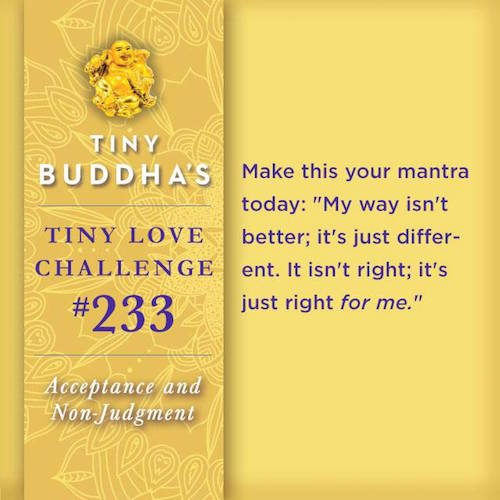
  • Love Challenge #233: My Way Isn’t Right

    Love Challenge #233: My Way Isn’t Right

    Love Challenge #233

    We’d all be so much happier, and we’d get along a lot better, if we accepted that everyone does things differently!

    (This challenge comes from the upcoming book Tiny Buddha’s 365 Tiny Love Challenges. Pre-order before October 6th and get $300+ in free bonus gifts!)

  • The Beauty of Being Different

    The Beauty of Being Different

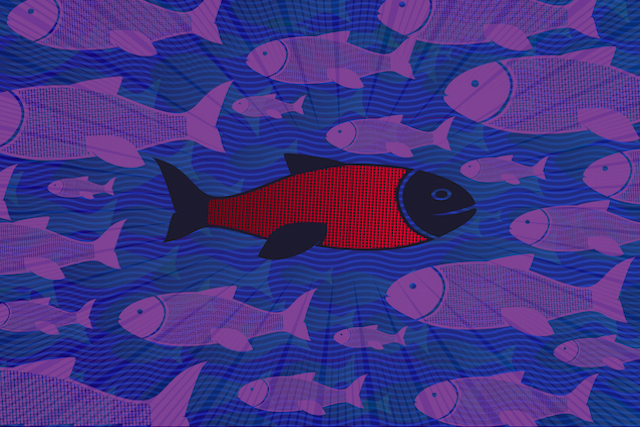
    Fish Swimming Against the Stream

    “We must never be afraid to be a sign of contradiction for the world.” ~Mother Teresa

    I’ve felt like I was different ever since I was in elementary school, when my personality started to settle and I came to realize I didn’t look, think, feel, learn, or act like my peers.

    Back in the eighties and early nineties it seemed that there weren’t many labels to catalog people by, but still I knew I was different, and teachers and classmates made sure I knew it. “Freak” or “weirdo” were two of their favorite names.

    In current times there would be many labels to identify me with: ADD, ADHD, dyslexic, depressive, and antisocial, among other medical terms. Socially, there are many other labels to box me in: problematic, troublemaker, weird, crazy, and dramatic, among others.

    Labels seemed to be used to put me into boxes so shrinks, teachers, and the world could try to understand me.

    The world tends to see what is different as something ugly and wrong, as if anything “abnormal” is something needing to be fixed.

    If I were to see myself through the eyes of the world, I’d be frightened to look at myself in the mirror.

    As the years went by the bullying didn’t stop. Everyone knew me by a thousand different names, except the one my mother had given me. I didn’t mind; I actually preferred for them not to use my name. I didn’t want them to taint it with their harsh voices.

    In high school, I wanted to have friends and be a part of something; I wanted to feel like I wasn’t a freak. I tried really hard to fit in, but trying to be something I wasn’t became emotionally draining.

    My father could see this and told me, “Ducks fly in flocks and eagles fly alone.”

    I didn’t want to be an eagle. I wanted to be a duck, because they had company.

    I started smoking to fit in with the “cool” group, dating boys I wasn’t even interested in (it was what girls my age did), and I learned to laugh and keep my mouth shut when I saw any injustice being done.

    I once screamed and burst into tears when I saw one of my “friends” kill a bee out of fun. I couldn’t understand how someone could take away the life of such an innocent being intentionally.

    After being bullied for my reaction, they started calling me “crazy” and so… what did I do? I started killing bees.

    I loathed myself. I had turned into this person I didn’t like for the sole purpose of “fitting in.” But at the same time I hated what I was, I hated being oversensitive, stupid, a daydreamer, rebellious, and sad.

    I wasn’t happy with my physical appearance either. The body I had at twelve years old remained the body I would have for the rest of my life—extremely skinny and no curves.

    People, assuming I had an eating disorder, would thoughtlessly say, “Eat something. Skinny girls are not pretty.” It was just my anatomy, different to that of the voluptuous Mexican bodies women have in this part of the world.

    Then, a boy came my way. We became good friends, and because he didn’t want to hurt my feelings and lead me on, he asked if I could pretend to be his girlfriend.

    Marcus was gay. He couldn’t stand the idea of being different and showing it to the world. He needed a fake girlfriend to take home to his parents, to brag about to his friends, and to walk around town with, showing he was “normal.”

    We were teenagers, and our self-esteem was determined by the acceptance of society.

    He knew how I felt for being different and not being able to fit in. I had a different mindset and he had a different sexual orientation. It was in our differences where we found a unity that forged a beautiful friendship.

    A few years later Marcus found the courage to “come out.” His parents supported him. He lost many friends but made new ones and could be entirely himself around them.

    There was no more pretending. He found acceptance within his heart, even if the world around him shamed him. He became comfortable within his own skin, and that to him was happiness.

    I came to understand that the criticism came, not because we were wrong (we weren’t horrible human beings), but because we were different to them (society). In their mind, their way of thinking and acting was right, so anything that navigated away from that was wrong.

    It was their limited mindset that created in them an inability to accept other people’s differences. But that wasn’t our problem; we weren’t what they saw.

    Our problem came from the fact that we had given them the power to control our self-esteem instead of finding that acceptance and love within ourselves.

    As more years passed, experience taught me a deeper understanding about my place in this world.

    I came to forgive and love myself because I was never ugly, stupid, antisocial, or psychotic, as the world saw me. I felt like that because I was looking at myself through their eyes instead of my own.

    Even through university I had to deal with the stigma of being considered stupid by my peers, for having bad grammar and spelling mistakes. To them my intellectual capacity was determined by my writing skills instead of the content of my writing.

    Fortunately, professors admired the intellectual content of my papers and the different perspective I had for connecting the dots and analyzing issues. I graduated top of my class, because dyslexia is not a disability; it’s a different perspective to what ordinary learning offers.

    ADD or ADHD have never existed in my mind. I simply block out lame and boring lectures I’m not interested in, and when I find myself in an environment I dislike, my mind travels away to the beautiful world of my imagination.

    I am selective with my friends, not antisocial. I don’t wish to surround myself with people that undervalue me or with whom I don’t feel comfortable.

    I am not a troublemaker, but I refuse to stand by while I see any injustice being done. I am not rebellious; I just refuse to follow rules that go against my values. I’m not dramatic, I am passionate.

    Yes, I cry a lot. I was born crying and I’ve never stopped. However, it is not because I have chronic depression (I have battled depression and it is a term I wouldn’t use lightly).

    It is because I am oversensitive, and even as a child I could see what people rarely saw or simply didn’t care about: corruption, poverty, injustice, and cruelty, among other issues. This affected me profoundly, and still does. I am empathetic toward others’ suffering.

    I wasn’t a duck, and even if being an eagle can be lonely, the view from the top gives life a wider perspective and a deeper understanding. Although my journey hasn’t been entirely lonely, it is definitely a less traveled one.

    I’ve met wonderful people with whom I can be myself, and even if I don´t have thousands of friends, I have a few who are worth the world.

    Different is what I’ll always be, because I don’t match with the preferred educational, economic, religious, and social systems that want to shape me into a predesigned mold that I can’t fit into.

    Everyone wants you to be what is best for them, not what is best for you. Wanting to please everyone and be what is socially acceptable stole my personality away.

    However, by accepting myself, I came to realize that I am absolutely beautiful. Not because I am better or worse than anyone else, but because I am exactly what I am supposed to be.

    Everyone is different in some way or another, but only a few dare to show it to the world. The majority try to fit into a mold that is too tight to feel free in.

    Marcus is feeling incredibly comfortable in his amazing homosexual being. He has a wonderful partner and they have recently adopted a beautiful baby girl.

    Once I asked him, “What would you like her to be when she grows up?

    He replied: beautifully different.

    Fish swimming against the stream image via Shutterstock

  • 3 Surefire Ways to Embrace Being Different

    3 Surefire Ways to Embrace Being Different

    Different

    “To be nobody but yourself in a world doing its best to make you everybody else means to fight the hardest battle any human can ever fight and never stop fighting.” ~e.e. cummings

    I’m gay. I’m married to a woman and we have a beautiful daughter together. I also have an ex–boyfriend that I was with for quite a significant time. Most of my friends are straight, and I thought I was too until about five years ago when I fell in love with my now-wife.

    It was a crazy time, and I suddenly had to deal with being different than most of my friends.

    I was extremely lucky because I had a huge support network of people who loved me no matter the gender of the person I loved. There were many that didn’t get it and treated me differently or completely cut off contact.

    That was hard, and it took me a little while to deal with it. I would get upset easily and then seriously wonder what the hell I was doing. I almost considered walking away from it all.

    Thank goodness I came to my senses and realized that love is love, and I was going to spend the rest of my life with this person no matter what. I learned to deal with the negative people and discovered three sure-fire ways to make sure I didn’t let them get to me.

    I worked at it, and at times it was difficult. I found that by remembering these three things I was able to get through it to where I am now perfectly fine and happy being different than most people I know.

    1. Stay hell bent in your belief of yourself.

    I knew that no matter what happened I was a good person in love with an amazing woman. We weren’t hurting anyone, and I came to realize that if she can put up with me all the time, then I’m going to keep her around!

    I knew that we were seriously in love and no one was going to keep me from being happy. As long as we had each other, we were okay. I really believed in the love we have, and still have to this day.

    Believe in yourself and who you are deep down. Know that you are a great person with so much to give to this world. If you have self-belief, then no one can ever bring you down unless you let them. Own it.

    2. See it as an opportunity to teach others.

    Like I mentioned, many of my friends are straight, and they were under the impression that I was too until I surprised them one day. So along come the awkward questions: “Did you always know you were into women?” and “Does this mean that you don’t like guys anymore?”

    Instead of getting frustrated, I decided to use this opportunity to teach others about being in a same-sex relationship. This was vital once our daughter came along too, and we are so open with anyone that asks about her conception and any other questions they might have about her existence.

    We use it as an opportunity to teach that families come in all shapes and sizes, and that a child can thrive with two mums or two dads as much as they would having both a mum and a dad.

    Use whatever is different (or, as I like to call it, rocking) about you to teach others.

    Sometimes people just don’t realize, or are ignorant to things they don’t know much about. Once people know, they tend to change their tune. They become supportive because they have more of an understanding. People are just scared of what they don’t know, so inform them.

    3. Surround yourself with your cheer squad.

    You know those people, the ones that always have your back no matter what situation you get yourself into. Those people are always going to support you and give you sound advice.

    Use them to your advantage whenever you need. Call them, hang out with them, and make sure they are around you to keep that resolve that you have burning strong. You need them. Guaranteed they don’t think that there is anything different about you anyway.

    On the flip side, don’t give your time to negative people. You don’t need to be around them. Let them slowly drift from your life. In their space bring in the positive people. They will lift you up.

    Not everyone has access to this cheer squad. Sometimes you’re out there on your own, and that’s perfectly okay. You have a few options here to maintain your strength and self-belief.

    One is to write affirmations to yourself and put them in places that you will see often. They should include the traits that are awesome about you. When you read these you’ll remember that you absolutely rock. They’ll help pick you up if you ever get down.

    Another thing along the same lines is to put alarms in your phone throughout the day saying the same positive affirmations.

    At noon, I get a message from my phone that reads “You are a gem. You are caring and thoughtful and beautiful just as you are. Stay true to you.” Thank you phone, you are so lovely!

    If you need a bit more connection than you would get from your phone, head online. There are so many forums, support networks, and websites that you can access to talk to people going through the same thing as you.

    These people will become your tribe and your online cheer squad. The beauty of the Internet is that you can use an alias and not your real name. You can remain anonymous and still get access to beautiful people in a similar situation to you.

    We wouldn’t be here today if it wasn’t for the unbelievable supportive people that we have in our lives. We don’t feel different, and although our situation isn’t normal, all the people in our cheer squad make us feel like it’s a non-issue.

    It doesn’t define us as people. It is what it is and all our people are totally cool with it. They make it so much easier for us. We are very lucky.

    These three things helped me deal with the shame and embarrassment I felt initially when I told people about what was going on. I didn’t really “come out,” as they say. I just told everyone that I was seeing someone and she was a woman. That was it—although at the time it was one of the scariest things I have ever done.

    In the end I had no reason to feel ashamed or embarrassed. It was crazy to think that everyone would have an issue with it, and although it wasn’t smooth sailing all the time, it was easier than I expected. It can be for you too. I promise.

    Give people the benefit of the doubt. You’re not doing anything wrong, and these days the majority of people are more open about sexuality than in previous generations. This is the same no matter what’s rocking about you. There is a lot more understanding in our world about uniqueness and differences.

    Embrace your differences. That’s what makes this world of ours so magical and interesting. Don’t change to be like anyone else. You are unique and beautiful just the way you are.

    Different image via Shutterstock

  • When You Don’t Fit In: The Value of Being Different

    When You Don’t Fit In: The Value of Being Different

    Accept Yourself

    “No one can make you feel inferior without your consent.” ~Eleanor Roosevelt

    When I was ten, my blonde, blue-eyed best friend gave me a label.

    “I never thought I’d make friends with anyone brown,” she said. She was clearly embarrassed by her revelation and had summoned the courage to own up.

    I was dumbstruck for a moment. I never really thought of myself as brown, or indeed, as anything. I was just me.

    Then, wanting to get us both out of this awkward situation, and thinking of how my Sri Lankan mother would compliment my beautiful golden brown skin, I blurted out, “Well, I’m not really brown, I’m golden.”

    Immediately my friend collapsed into laughter, as she imagined me with bright orange skin. I suspect she was glad to divert the shame away from herself.

    And I did feel ashamed. Ashamed of being labelled as something I didn’t particularly identify with, but also ashamed of denying my brown skin, of unwittingly playing along with this casual racism.

    Over the years I have discovered that it’s not unusual to be judged as different.

    I still encounter many situations where people make incorrect assessments of me based on my looks.

    The question “where are you from” is sadly very common, as if the origin of my ancestors will give people the most important clues about who I am.

    My kids and I have picked up some Sri Lankan characteristics (age four, my third generation daughter called her little brother “darling” with a decidedly Asian lilt), but on the two occasions I have travelled to Sri Lanka, I was definitely a foreign tourist.

    Of course, my family history does partly define me, but mostly not in the way that those people think.

    Instead, it defines me as different.

    Being mixed-race is only one of the factors that make me different. I tend to be more outspoken than my peers, less religious, more bookish, more alternative… Apart from being married with two kids and a mortgage, there are plenty of things about me that are not “normal.” 

    Being different is a self-definition I struggled with for years, which I now deeply appreciate.

    Although it is not always an easy path, I hold my differences as precious. Conformity would be stifling. I want to be me, not some mythical “normal” that only exists in my imagination.

    Being different has tremendous value. Here is how.

    1. Being different is a source of connection and belonging.

    I find shared experiences when I speak with people who know what it is like to feel different—people with disabilities, migrants, creative people, gay people, introverts, recovering addicts, and many others.

    Though we don’t share those particular characteristics, our mutual understanding of what it is like to be different connects us, powerfully.

    We know what it is like to be judged because of who we are. We know what it is like to feel like outsiders or freaks. We know what it is like to try and hide our differences to fit in.

    But fitting in is the opposite of being yourself. It leaves you sick inside.

    What we really crave is to belong. When we are accepted despite or even because of our differences, we have found true belonging.

    2. What we have in common easily trumps our differences.

    We have empathy built into our brains. Mirror neurons mean that when we hear someone tell a moving story, we feel what they feel.

    Heck, Tiny Buddha is built on our ability to care, learn from and identify with the experiences of others!

    We all want to be understood. And science has proven what we instinctively know: we are more alike than different.

    So, take the risk of hearing and being heard. By telling your story you invite others to understand you, and to understand themselves better, too.

    3. My differences are a source of motivation.

    Looking back on the life choices I have made, I can see how my desire to help others feel they belong and are valued has influenced my career and relationships.

    One of my favorite jobs involved providing careers and business guidance to refugees, amongst the most stigmatized and stereotyped people in our society.

    These were often highly qualified and had been doctors, lawyers, and businessmen and women in their country of origin. Having left that behind, they found themselves without the respect, financial security, and social standing they had previously known.

    They were portrayed as scroungers, while being excluded from working by regulation, discrimination, and lack of confidence. I found a vocation helping them navigate these obstacles.

    Many of my colleagues were refugees themselves, who, having found their own way, wanted to pass on the learning to the next generation. Our differences motivated us to help others in the same boat.

    4. Being different is intensely creative.

    As I began to take more pride in what made me different, I began to research other people who went against the social norms.

    I discovered that artists, entrepreneurs, innovators, and other world-changers were always different from the people that surrounded them. Like me, they had often felt excluded from the “popular” kids group at school.

    They thought differently. They made connections (with other people, or between ideas) that others had not previously made.

    And they had the courage and resilience to put those ideas out into the world—the courage to take the risk of being judged, and the resilience to try again when they were.

    In the process, their ideas were tested and improved and tested again.

    Some made it big (think Steve Jobs, Lady Gaga, Barack Obama) appealing to a mass audience with their new ways of seeing; others appealed to a niche with similar tastes. In every case their creativity was rooted in their differences.

    You, too, have value hidden in your differences.

    Though we may never escape all judgment and discrimination, we can learn to value our own unique perspective.

    Then at least we can stop judging ourselves.

    Photo by Hamad Al-Mohanna

  • Live Your Life for You: 5 Benefits of Embracing Who You Really Are

    Live Your Life for You: 5 Benefits of Embracing Who You Really Are

    “Live your life for you, not for anyone else. Don’t let the fear of being judged, rejected or disliked stop you from being yourself.” ~Sonya Parker

    I have struggled with my different-ness since I was young. I grew up trying to change the things that made me different in order to fit in. At home, my parents were doing their best to raise three young children, which I can imagine would’ve been very hard.

    I can still remember the first time I asked myself, “What is wrong with me?” I loved to take my time and have everything neat and tidy; my family, on the other hand, was the complete opposite.

    Being neat and tidy reflected in the way I would dress myself. One morning, when I was getting ready for my first day of school, my parents gave me socks to wear that didn’t match. I got very upset, and although they tried to understand what the problem was, they couldn’t help but be frustrated with me, as I was making the morning more difficult.

    We were also running late. I wanted to take my time and not be hurried. This caused us to run even later and made my parents even more stressed. I felt so guilty to have made them feel like this. 

    I wanted to belong and feel loved by them, so I tried my hardest to change the things about me that seemed to cause them stress.

    Trying to change these things that were a big part of who I was created inner conflict, and I would have big tantrums as a result. This would cause my parents stress as well, so eventually I stopped expressing my feelings.

    I became ashamed of the things that made me different. I was shy. I loved lots of time on my own. I had dark skin.

    I wanted to be accepted to avoid judgment and rejection. During school, other kids teased me for not having many friends. I felt so hurt and alone that I started a constant battle within myself to change my different-ness.

    I forced myself to be more social. I searched for ways to change the color of my skin. I stopped giving myself the alone time I wanted. I stopped expressing how I was feeling.

    This went on for the next twenty years. Since I spent my whole life trying to fit in, I never really got to know my true self. It was incredibly exhausting and I was very unhappy.

    It took having kids to wake me up. The love I had for my two boys gave me the drive to search for another way to live.

    I wanted my boys to love and accept themselves for who they were, differences and all, but how was I to teach them if I didn’t even know how? I needed to be the example.

    I finally discovered some things that empowered me to embrace my differences. I was amazed at the life changing effect it had on me. 

    When you embrace who you are:

    1. You stop living in fear.

    The choices I make in life are no longer dependent on what other people will think and whether I will be judged, disliked, or rejected. I just focus on being me.

    In the past, I feared what people would think of me for choosing to have a few close friends instead of a huge social circle and spending a lot of time on my own. Now that I accept that this is me, I feel a sense of freedom.

    Trying to be someone you’re not is exhausting. Being your true self is a courageous thing to do in a world that is constantly trying to change you. When you realize that living the life you want is more important than pleasing other people, suddenly you feel free.

    2. You form deeper, more connected relationships.

    In the past, I’ve had my fair share of not-so-good relationships. People would connect to the fake me, so they were never genuine relationships.

    I was able to sift through my relationships by loving my differences and being myself. This allowed the right people to come into my life who loved the real me. My relationships are now all fulfilling and genuine.

    If you want people to accept you for who you are, you first have to show them who that is.

    3. You treat yourself more kindly.

    I saw myself as weird so I would constantly put myself down and beat myself up. The negative self-talk was painful.

    In accepting my “weirdness,” I went from telling myself, “Because of my differences, I’m worthless and no one will ever love me,” to “I have to be true to myself. The people who really matter will accept me for who I am.”

    It was so liberating, I started to feel the happiest I’ve ever felt.

    4. You’re better able to find your passion.

    When hiding my true self, I could never know my strengths. I’m a compassionate person, which makes me good at helping people. I found that this is what I love to do and it’s my passion.

    After learning this about myself, I was able to offer my friends and family advice when they needed help. I also branched out and started my own blog, which is my main creative outlet where I can combine my passion for writing and helping people.

    Once you allow yourself to be who you are, you’re free to find what you’re good at and what you love to do.

    5. You start appreciating yourself.

    When you truly embrace your differences, you begin to find reasons to appreciate them. I’ve always been ashamed of my introverted nature, thinking it was a weakness. Only recently have I started to embrace it. I now appreciate that it allows me to enjoy time on my own, which is where I’m the most creative.

    I’ve finally discovered my strengths and weaknesses. I own them and I am grateful for them both because they make me who I am.

    When you start seeing your “weaknesses” as potential strengths, you develop a whole new sense of appreciation for yourself.

    I hope these lessons can help you learn to embrace your differences without having to become a parent to do it—and if you are already a parent, then I hope this can inspire you so you too can pass on self-acceptance to your children.

  • Dare to Stand Out: 3 Ways to Let Your Unique Self Shine

    Dare to Stand Out: 3 Ways to Let Your Unique Self Shine

    Dancing Silhouette

    “If your number one goal is to make sure that everyone likes and approves of you, then you risk sacrificing your uniqueness, and, therefore, your excellence.” ~Unknown

    I can remember many times in my life when I was afraid to stand out.

    When listening to a lecture or panel discussion at school, I always had questions to ask, but the moment I finally raised my hand, my heart would start palpitating and gravity would force my arm down.

    The same thing happened in business meetings. I struggled to articulate my ideas, although I was sure they could have brought some new impulses. In the end, I felt miserable, as I’d missed another chance to join the debate.

    Why was it so difficult to speak out on the topics I was interested in? I’d missed so many opportunities to contribute and make my voice heard; to crack jokes or wear the clothes I wanted to wear; to try crazy things or be the only one on the dance floor.

    I missed out on being me, but I couldn’t manage to overcome my fear of standing out.

    What would others think of me?
    What if I said something stupid?
    What if they laughed?
    What if everybody stared at me?

    Why don’t we dare to stand out more often?

    Starting at a very early age, we learn that standing out is not desirable. When children speak their mind or they’re loud, playing wild games, adults tell them to calm down and be quiet. Many parents fear their offspring standing out in a way that might not be flattering, whereas when it comes to competing with others, kids are absolutely encouraged to stand out.

    In school, when articulating an opinion or questioning what they’ve learned, students are often labeled rebellious. Few teachers manage to appreciate uniqueness, because it means work.

    In adolescence, we’re torn between the desire to express our individuality and the urge to be accepted. Many times, we prefer to fit in because we’ve learned that we’re only going to belong to a group if we are like others expect us to be. But deep inside, we feel that something is missing.

    Showing Your True Colors

    Daring to stand out means being your true self, speaking your mind, dressing the way you want, or laughing out loud, even if you’re the only one who finds something funny.

    It means being different, following your dreams when no one believes in you, speaking up when no one else does, and making a difference in your life or the life of others by being who you are.

    Standing out implies being in the limelight, even if your audience consists of only one person.

    Whether it’s changing your life for good, getting a style makeover, asking uncomfortable questions and touching on sensitive subjects, joining a charity or keeping your lonely neighbor company, taking part in a local theatre play or quitting your banking job to buy your own food truck—that’s what makes you stand out, because you dare and care.

    All Magic Comes at A Price

    We all have talents and aspirations, some small, some big. Some might not be mainstream. This is when things start getting complicated and uncomfortable: in one way or another, we might rub someone the wrong way.

    We will never be able to please everyone.

    When standing out, we show the world that we’re here, and that we’re part of it; that we have something to say that might inspire others or even brighten their day.

    Take a deep breath, step out of your comfort zone, and reveal the person you really are.

    What’s to Lose?

    If others don’t want you to stand out, it’s because they don’t want you to grow. If you started to live the life you wanted, it might make them feel uncomfortable about themselves. Don’t let that hold you back.

    You might lose some acquaintances or false friends, but true friends will encourage and support you. And a lot of people will admire you for your courage. Even better, you will be loved for who you are. Isn’t this one of our deepest longings?

    3 Daring Steps to Let Your Unique Inner Self Shine

    It requires some courage to tackle the fear of standing out. You can always start small and take it one step at a time. But, if you feel adventurous, you might want to try one of these three daring steps to let your unique inner self shine.

    1. Go against the flow.

    If you don’t enjoy what everybody likes, stand by it. If you have another opinion, say it. If you don’t want to join your friends for the hottest event of the year, don’t go.

    What matters is that you feel good about yourself. It might mean not being part of the majority. So what? Dare to be a splash of color in a society of uniformity. You will always find like-minded people you can connect with.

    2. Dare to be unpopular.

    If the only way to popularity is by compromising your true self, then turn down the offer. Let others know what you want and what your boundaries are.

    Accept that you can’t be loved by everyone, and choose not to make your well-being dependent on others. The less glamorous but sustainable kind of popularity comes with authenticity.

    3. Embarrass yourself.

    A moment of embarrassment by choice can be very liberating. You’ll learn that you’re not going to die, and the ground won’t swallow you up (even if you wished for it).

    Quite often, others don’t even notice whatever you’re feeling embarrassed about. It’s mostly in your head. So next time you’re invited to a karaoke bar, grab the microphone and sing your heart out.

    In school and in business meetings, whenever I was anxious to take part in the discussion, the majority of other participants didn’t raise their hands, either, and remained silent like me.

    I wasn’t the only one but didn’t realize it. Instead, I was focused on the chance of embarrassing myself. The fear of standing out is rampant.

    Yes, standing out means being vulnerable, and it opens us up to the risk of being ridiculed, but it also gives us the possibility of letting our uniqueness shine and showing others who we really are. Does this feel so bad after all?

    Photo by D. Sharon Pruitt

  • Dare to be Different: Why It’s Okay to Break the Mold

    Dare to be Different: Why It’s Okay to Break the Mold

    Be Different

    “Criticism is something you can easily avoid by saying nothing, doing nothing, and being nothing.” ~Aristotle

    Who am I? This is a question that haunts us all at some point, especially when the people around us are trying to constantly answer this question for us.

    How do we remain true to ourselves in a world that is constantly trying to make us something else?

    I can tell you that it isn’t easy.

    I work as a full-time police officer in a busy department. In police work, everything is supposed to fit in its right place, and there is an established value system in place. In my experience the police system is founded on one major theme, and everyone is expected to conform to this mold:

    Command is valued over communication.

    This is an area where I have done a great job making myself an outcast.

    You see, I chose to join a career where the belief system of the work is contradictory to my own.

    I genuinely care for people, and I value communication above all else in my work. I prefer to talk instead of yell, and ask instead of tell.

    My way of doing the job greatly differs from almost everyone else in my profession.

    I have also noticed that I tend to get a lot further when I am dealing with people, and get in a lot less confrontational situations than my co-workers. Coincidence?

    The truth is that people will do everything they can to make you conform to their “rules.” Because the police world is such a strong subculture, there is a lot of pressure to conform and breaking the established “rules” is even more taboo.

    It can be exhausting sometimes to remain true to yourself in an environment where everyone expects you to be something else.

    We have established that it is difficult and uncomfortable to be different, so why not just conform? The mold is there for a reason, right?

    I can’t answer that question for you, but I can tell you that the mold didn’t work for me.

    Let me explain why.

    The reason I do things the way I do is because there are people that need and depend on me to be true to myself. The last thing the world needs is one more stereotypical burnt out cop.

    Don’t be so afraid to color outside of the lines that you never pick up your crayon!

    You have a unique perspective to offer that no one else does, so share it!

    I can’t tell you how many thank you’s and phone calls I have received for my openness and helpfulness at work. All because I choose to do things differently.

    I have helped to change people’s lives simply by being true to myself. I have gotten through to people that other officers haven’t been able to by because I don’t fit the mold. I promise you, nothing feels better than following the path in your heart.

    Realize I am not saying that my way is better than any other way. I am simply sharing that the different approach that I bring to work has proven to be invaluable to others.

    Also it is important to realize that being true to yourself means you might bump heads with other people. That is okay!

    If there isn’t any conflict in human interaction it usually means one person is compromising their beliefs in some way. A little bit of conflict is natural; accept it and learn from it.

    There is a sort of catch that comes with breaking the mold though.

    It definitely isn’t the easy road and you are going to face some difficulties. At least I know that I have.

    What can you expect if you choose to break the mold?

    Will you be mocked? You bet

    Misunderstood? Count on it.

    Outcasted? Most likely

    And all of it will be worth it. To the people you help and to your happiness in life, there is no alternative. You have to be true to yourself, against all odds.

    I have had insulting posters made about me and posted up at work and I have been openly mocked for my way of doing things by other officers. I have been told on multiple different occasions walking up to a scene with violent individuals “Why don’t you just go give them a hug”… as if I don’t understand that the world isn’t that simple.

    This is the price I pay for staying true to myself, and I grin and bear it. Because every time someone tells me I was the only person on the scene who really listened to them, and that I made a difference in their life, it makes it all worth it.

    My way of living has been difficult, but also equally rewarding for me. I chose not to compromise my beliefs just to fit in, and I would gladly do it again.

    The choice of who you will be is ultimately up to you.

    If you choose to break the mold, I offer some advice to help you find your way:

    1. Intimately get to know who you are and what you represent.

    Without a crystal clear view of your identity, it will be difficult to survive the pressure and ridicule. Get to know yourself more. Spend time meditating, writing out your feelings, and organizing your thoughts before you make any big decisions.

    2. Try not to take things personally.

    What you need to realize is that humans attack what they don’t understand. It isn’t that they dislike or disapprove of you; it is that they don’t understand what you represent.

    Realize that the attacks are not personal, no matter how they sound. The people attacking you are really just protecting their own ideals, because what you represent makes them question their values.

    3. Realize that you are unique and important, despite what the people around you may say.

    Your opinion and approach matters just as much as everyone else’s!

    Once you start walking your own path, never turn back. Walk through life with your head held high knowing that you never comprised what is in your heart.

    Being true to yourself will eventually earn you respect among many of your peers. I have had this happen to me, and I have more than a few co-workers who understand my approach and respect it. Coincidentally, these co-workers are the officers I always looked up to. We handle situations differently, but we respect each other’s methods. This type of support will go a long way to keeping you on course.

    Even a few of the officers who initially gave me the hardest time have started to be more respectful. It takes time, but it does get easier.

    If you ever feel alone on your path, realize that you are in good company. Almost all the great people in history chose to break the mold and to walk their own path.

    Starting right now, I challenge you walk your own path and don’t compromise your beliefs for anyone.

    Take the first step and never turn back.

    Photo here

  • 5 Lessons on Bringing Your Dream to Life

    5 Lessons on Bringing Your Dream to Life

    “The future belongs to those who believe in the beauty of their dreams.” ~Eleanor Roosevelt

    I grew up with a stepdad who was a dreamer. He lived in a world where positive affirmations created a positive life. He believed that going after your heart’s desire was as important as anything else. He lived in the clouds and in his designs and in his visions.

    I used to wake up and find that he had left post-it notes on my bathroom mirror with quotes about reaching my dreams such as, “You can if you think you can,” and “Quitters never win, and winners never quit.”

    He bought me a pillow speaker when I was seven, so every night I could listen to a subliminal tape repeating how I would succeed beautifully in life.

    He held a vision for himself to create his own business. He invented a product to put on every street sweeper and set out to make this dream come true. He worked tirelessly at it for many years, and eventually it took off. He had done it. He was living his dream.

    I would love to say that this is where the story ends. I would love to say that he lived happily ever after embracing his dream. But that just wouldn’t be the truth.

    What actually happened is that my stepdad’s dream—this life that he created—began to unravel almost as quickly as it had been created. And eventually, he lost everything: his dream, his family, and his life.

    (He was never the same after his business folded; his zest for life left him, and he ended up dying at fifty-six from unknown causes. I think that his spirit was broken and his will to live was no longer there.)

    But, even though it ended so badly and sadly, he happened to pass on the dreaming torch to me. And I carry it proudly and almost defiantly.

    Dreamers aren’t always revered in our society. Sometimes they are seen as flaky or irresponsible. (more…)