Tag: depression

  • How My Son Taught Me That Crying Can Boost My Mental Health

    How My Son Taught Me That Crying Can Boost My Mental Health

    “And some days life is just hard. And some days are just rough. And some days you just gotta cry before you move forward. And all of that is okay.” ~Unknown

    Over the years I’ve built myself a bit of a reputation as “the emotional one.”

    I was always the first to cry at weddings, and that included my own. At that one I barely stopped throughout the ceremony! And as soon as I’m beyond the half-way point of any good holiday, it’s inevitable that a pretty epic sob is waiting in the wings.

    At this point I should probably mention that I’m a forty-three-year-old male. I also live in the UK, a country that’s proud of its “Bulldog spirit” and “stiff upper lip.” What this really means is that we’re a country where many people are uncomfortable with their own emotions, and shockingly bad at processing them.

    That brings me on to the point of this post—and it’s a happy post. I’m delighted to report that in the past few years I’ve come to see the true value in being able to cry, and being unashamed to do so.

    This doesn’t mean I’m somebody who has frequent public meltdowns that make people uncomfortable! In fact, it’s quite the opposite. I’ve reached the point where I’ve learned to recognize my own internal pressure valve. I know when it needs releasing, and know how to do it in a private, dignified, and healthy way.

    Human beings are the only animals with the ability to cry. It clearly has a purpose, and it doesn’t take much research to discover it has serious benefits, both mentally and physiologically. Crying is thought to reduces stress hormones and relax the nervous system.

    There are alternatives to crying, and we see them all the time: unhealthy behaviors, addictions, outbursts of anger and violence, and patterns of arguments and disharmony.

    That takes me back to the whole “stiff upper lip” thing. Emotions have to come out somewhere, and in my experience it’s the people who are fixated on being “strong” and “manly” who live lives cluttered with arguments and hangovers.

    On balance, I’d much rather have the ability to cry, and no shame in doing so. Recently, I feel I’ve learned to take it further than that to the point that I can use crying as an extremely useful tool in my mental health armoury.

    So, what got me to that point? The answer is simple: fatherhood.

    My oldest son has just turned seven years old. And he’s very much like me. It’s a much-misused word, but he’s a “sensitive” lad. He’s hugely empathetic, and a wonderful gentle soul. He’s also very sentimental and—again like me—as likely to be touched by joy as by sadness.

    Like everyone else in the world, we’ve had a challenging time since the pandemic began. One of the hardest parts has been navigating the children through it. This means dealing with their lockdown loneliness, but also constantly working out what to tell them so they’re as protected as possible without us insulting their intelligence.

    Another part of this is recognizing when it’s all getting a bit much for them.

    I can pretty accurately predict when a “meltdown” is incoming for my son. And I always ensure that I’m there ready for him when he wants to let the tears out. I encourage him to take as long as he needs. I cringe when I see parents saying, “that’s enough now,” or worse.

    None of this means I’m trying to raise a child who’s constantly in tears! But I am trying to raise a child who knows that having a good howl is a wiser and more evolved way of releasing emotion than punching somebody in the playground or having an undignified argument.

    While I’ve been teaching him this, I’ve been learning myself. Just as I’ve learned to predict when he may soon need to “let it all out,” I’ve become much more attuned to when I need to too.

    I have some mental health issues. Anxiety is the main one, with a generous scattering of OCD and some periodic depression as the cherries on top.

    One thing that indicates my mental health is in trouble is when I can’t cry. Depression is often misunderstood. For me, when it’s at its worst, it manifests as being emotionally empty and numb.

    In fact, “the big cry” often marks the turning point in a spell of depression. It means I’ve started to feel again. I’ve learned the pattern over many years, and it’s now got to the point where I can say “I need to cry.”

    And that’s a really powerful thing. I know what I need to do, so that empowers me to consciously try to do it nowadays.

    As we’ve already established, crying can release stress hormones and calm the nervous system. Who wouldn’t want to do that, especially during a spell of poor mental health?

    The trouble is, far too many people are conditioned to feel ashamed of showing emotion. But it’s not like I phone all my mates and say, “I’ve been feeling a bit low, so I’m setting aside an hour today to go in the bedroom with a bunch of sad songs and some tissues.”

    This last happened just a few days ago, and I did tell my wife my intentions. That in itself involved a little embarrassment and vulnerability. But when I re-emerged a little later, she said that I looked like a different person—with a bounce in my step and colour back in my cheeks.

    That’s why I’ve written this. It is deeply personal, because nobody’s ever proud of having a good cry. I can’t help wondering whether that should change.

    I am proud that my children don’t have to live in a house where there are needless arguments. A home where we process emotions in a healthy way—a way that humans alone have access to.

    So get that “crying tunes” playlist ready. Learn which old photos set you off, or which films are certain to “hit you in the feels.” And don’t be afraid to tuck yourself away for a while and use the power of emotion to enhance your mental health.

    To be clear, this isn’t a weapon I have to deploy frequently or publicly, but it’s one I’ve come to love having at my disposal. It’s there for you too, so don’t be scared or embarrassed to make use of it. The alternatives may be more popular with the “stiff upper lip” crowd, but they don’t benefit them, or the people around them.

    Let it out.

  • What I Really Mean When I Say I’m Fine (Spoiler: I’m Not)

    What I Really Mean When I Say I’m Fine (Spoiler: I’m Not)

    “Tears are words that need to be written.” ~Paulo Coelho

    It was lovely to see you today. I haven’t seen you in such a long time. So much has happened since the last time we saw each other.

    You asked me how I was. I politely replied, “I’m fine” and forced a smile that I hoped would be believable. It must have worked. You smiled back and said, “I’m so glad to hear that. You look great.”

    But I’m not really fine. I haven’t been fine for a very long time, and I wonder if I will ever know what “fine” actually feels like again.

    Some days are good, some not so good. I’m doing my best to stay optimistic and to keep faith that tomorrow will be better. Sometimes it is, sometimes it’s worse. I’m never prepared for either outcome.

    I’m doing my best to pretend I’m fine.

    The mask I wear hides my pain very well. I’ve been wearing it for so long now that no one can see through it anymore. It’s my new face, and it smiles on demand.

    Some days I wish I didn’t have to pretend to smile. I long for the day when it will come naturally, sincerely, and genuinely.

    When I say I’m fine this is what I really mean…

    I’m sad. I’m really having a hard time right now. I wish I could tell you. I’d like to think that you might even care. And maybe you do truly care. But I don’t want to tell you. I don’t want to bother or burden anyone with my troubles.

    My troubles are big and ugly. I can’t burden you with them. You are facing demons of your own. You don’t need to be exposed to mine. That would be so selfish of me. To think that your demons are not as important or debilitating as mine.

    So I just tell you I’m fine. I’m protecting you when I say I’m fine. Because I’m afraid my pain is just more toxicity.

    I want to tell you my troubles. I want you to take them away. I wish someone could fix everything that hurts, though I no one else can do that for me. Still, I wonder, does anyone have all the answers to these questions that are pounding in my head and causing me grief and anxiety?

    Anyone?

    There’s a tightness in my chest that won’t go away. There’s a darkness in the pit of my stomach that makes me nauseous. My shoulders feel weighted and my arms long for human touch. A body to wrap around tightly to comfort me and ensure me that everything will be okay.

    My troubles have completely consumed my life.

    Inside, I’m crying all the time. My soul is crushed, and my heart is full of holes that I’m desperately trying to patch up as best I can.

    I’m full of anxiety inside, and no matter how hard I try to find peace, it eludes me. I feel there are a million demons inside of me, and I don’t know which one needs my attention the most.

    So I ignore them all. It’s too much for me to bear most days.

    When I say I’m fine I really wish you could hear my inner voice screaming, “I’m not fine, and I need help. Please stay and talk to me, comfort me, help make this overwhelming pain stop.” I want to say this to you. But I open my mouth, and “I’m fine” comes out instead.

    I’m not really fine. I’m not sure how to handle today, and I fear what tomorrow may bring. It’s constant anxiety. I wish it would go away if only for a day.

    I want to be fine, honest I do.

    One day I would love to sincerely tell you how fine I am. That all my anxieties, worries, and fears are gone, or at least less overpowering. That I walk with a skip in my step and a song in my heart. I want to feel that. I may have felt this once before a long time ago, but I don’t really remember it.

    Every day I’m doing my best to smile and make the day better. I’m thinking positively, I’m taking big deep breaths when I need to. I’m reading inspirational blogs and quotes. I’m even listening to guided meditations.

    Today I went shopping and bought myself something nice. I know, a temporary fix. But it worked.

    It all works. For the moment. And then the moment is gone, and it all comes flooding back. All the turmoil, the anguish, the anxiety, the pain. I breathe deeply again. And I’m okay for a few more minutes.

    But for now, I’m doing my best. I know that everything in life is temporary. The good, the bad. Even life. It’s all temporary. If I can just get through today, I’ll be fine.

    I’m doing my best to see the bright side. I can see it some days. But it doesn’t take away the turmoil brewing inside of me. It only masks it with a Band-Aid. A temporary fix.

    Everything is just a temporary fix until I finally become brave enough to get to the bottom of my demons. I need to face them one at a time. I need to bring them to the surface, dust them off, address them, heal from them, and then let them go.

    This I know. But it’s such a daunting task. Just thinking about doing that is overwhelming and causes me a great deal of anxiety. I know it’s up to me to be able to say, “I’m fine” and really mean it.

    One day I will. When I feel strong enough to do so. Until then, I may say I’m fine when I’m really not. But I will try to find the courage to say, “Actually, I’m sad,” even though I know you don’t have a magic wand to take all my troubles away.

    Maybe just opening up and letting you support me will help. Maybe if I stop painting a smile on my face and telling you “I’m fine, really I am,” one day soon I will be.

  • Why I Never Fit in Anywhere and the One Realization That’s Changed Everything

    Why I Never Fit in Anywhere and the One Realization That’s Changed Everything

    “Don’t force yourself to fit where you don’t belong.” ~Unknown

    When I was young, I was a real daddy’s girl. He was so proud of me and took me everywhere with him.

    When my parents got divorced and my dad moved away to start a new life with a new family, I didn’t understand why he left, as I was still a child. I thought that he didn’t love me anymore. I felt abandoned and rejected. Perhaps if I’d been better behaved, prettier, cleverer then he wouldn’t have left me?

    Until recently, I didn’t realize the impact that this has had on my adult relationships.

    Because I fear abandonment and rejection, I’ve struggled to fit in and make friends.

    I had a relationship with an older man who was very similar to my dad. I hoped that he would provide me with the love and affection that I didn’t get from my father and would heal my wounds. However, while things started off great and I thought I had found the one, since the relationship felt like home and was so familiar, he was actually emotionally unavailable, just like my dad, and unable to commit.

    When he started to pull away, this triggered my insecurity. This caused me to pursue him more, as I desperately wanted this relationship work.

    I tried to change myself into what I thought he wanted. I became clingy and jealous, which only drove him further away. When the relationship finally ended and he found someone else, I couldn’t understand why he could love her but not me. What was wrong with me? It confirmed my greatest fear, that I was unlovable and unwanted.

    This pattern continued to follow me in my relationships, which left me feeling more unloved and rejected.

    So I threw myself into my career. I had done well academically, however, I struggled to fit in and make friends there too.

    I was good at my job, but I didn’t feel valued or appreciated and I was often ignored, excluded, and ostracized by my fellow team members. My workplace became a toxic environment. I was bullied, which led to anxiety and depression, and I couldn’t face going into work. Eventually I was let go, as they said I could no longer do my job.

    Since my identity was tied up with being a successful career woman, when I no longer had a career, I didn’t know who I was. What was my purpose in life now? I was at the halfway stage of my life with no family of my own and no job. I took everything that other people had said and done to me very personally.

    I shut myself away at home. I didn’t go out or socialize. I was on medication for anxiety and depression, and I just wanted to stay in bed. What was the point of getting up? I was worthless, I had no value, no one wanted me, I didn’t fit in anywhere. I couldn’t love myself, as others didn’t love me. I had no self-esteem and no confidence to try to start again.

    I had therapy, read lots of self-help books and articles, and did guided meditations. Although I could relate to everything, I struggled to apply the things I had learned to myself.

    As I spent time alone, listening to relaxing music, I had a lightbulb moment. I couldn’t see straight before then because I was so emotional. However, I am naturally a very logical and analytical person, and good at solving problems, which is why I was good at my job.

    The idea came to me that if I took the emotions out of my issues, then I could see them in a logical and rational way and try to solve them like any other puzzle.

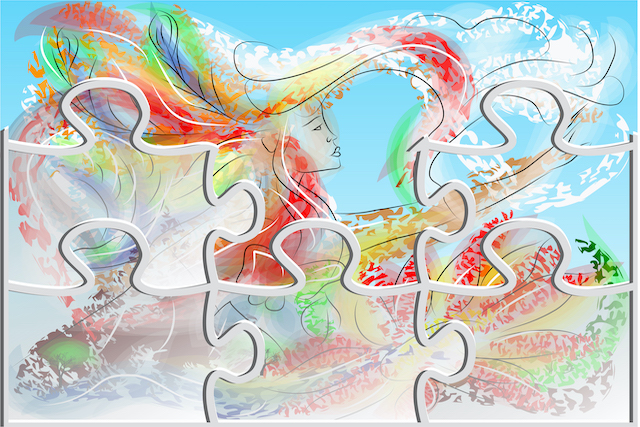
    And then I thought, what if I saw my whole life as a jigsaw puzzle? It’s a perfect analogy, really, since my lifelong struggle has been fitting in.

    Visualizing Our Lives as Jigsaw Puzzles

    Each of us start with just one piece—ourselves.

    When we start the puzzle at birth, it is easiest to join the first two pieces together—ourselves and our family.

    As we grow up, we try to find other pieces that fit—friends, romantic relationships, jobs. We may be lucky and find other pieces that fit perfectly straight away, but more often than not we struggle to find the right pieces, and in our frustration, we may even try to force two pieces together that don’t actually fit. However, if we do this, we find over time that none of the other pieces seem to work together.

    No matter how much time we have already invested in this ill-fitting piece—be it an unhealthy relationship or a job that doesn’t align with our purpose and values—we will eventually realize that we have to accept reality and remove the piece that we tried to force to work. This is the only way to make room for a new piece that will fit perfectly into place. A piece we won’t even try to find if we’re too attached to the one that doesn’t fit.

    This doesn’t mean there’s something wrong with us, or the other piece we tried to force to fit, which means we don’t need to blame ourselves or them. We simply need to recognize we don’t fit together, and then learn the lessons we need to learn to stop repeating the same patterns.

    This also doesn’t mean that we made a mistake with the ill-fitting piece. Every time we try to make the “wrong” things fit, we learn the value of taking our time to find the right piece.

    Sometimes we learn that we need to focus on another area of the puzzle first—if, for example, we realize we need to take a break from relationships so we can build up our self-esteem and learn to love ourselves first.

    And sometimes when we’re having difficulty with one section of the puzzle, like love, we recognize that we need to focus on a different area instead, where it might be easier to find the right pieces—like our career or social life, for example.

    When we connect with like-minded people who have similar hobbies or interests and enjoy our company, we feel better about ourselves and start to realize how great we truly are.

    If we change jobs to something we love, that shows off our strengths and enables us to succeed, this improves our confidence and helps us realize that we’re good enough and we do add value.

    Once we become happier with ourselves and other areas of our life, we’ll send out more positive vibes into the world and attract the right kind of people. And we’ll have enough self-worth to recognize people who are not right for us and not waste our time.

    If we don’t do these things, we may complete the puzzle, with all the elements of our life neatly in place and find that we have a piece left over. That piece is you or me, and it doesn’t fit because it was in the wrong box and never meant for this puzzle.

    That was why we struggled to fit in—we chose things in all areas of our lives that were never right for us. So the problem wasn’t us, it was where we trying to force ourselves to fit.

    It may feel daunting to start over, but when we find the right puzzle we belong to, everything stops feeling like a struggle because we slot easily into place. We will end up with a different picture than we originally imagined, but it will feel much better, because our piece will finally fit.

    Where Am I Now?

    After spending half my life struggling to fit in and complete my jigsaw puzzle, I have realized that I am the piece left over, and it’s now time to start again and find the right puzzle that I belong to. This time, I’m starting with the most foundational pieces first—self-love, self-confidence, self-worth.

    There was never anything wrong with me. I just needed to recognize my patterns so I could stop trying to force things that weren’t right. I know my pieces are out there. And so long as I let go of the wrong ones, I know, in time, I’ll find them.

  • Where My Depression Really Came From and What Helped Me Heal

    Where My Depression Really Came From and What Helped Me Heal

    “How you do one thing is how you do everything.” ~Unknown

    One afternoon, during a particularly low slump, I was getting out of the shower. Quickly reaching for something on the sink, I knocked an old glass off the counter, shattering it onto the floor.

    In most cases, one might experience stress, frustration, or sadness upon accidentally breaking an object that belongs to them. They might feel agitation on top of their already poor mood. But in the moment the glass shattered, I felt instant relief.

    It was an old item I’d gotten at a thrift store, and the image on the glass was all but worn off. In the back of my mind, I’d wanted to get rid of the whole glass set, and the shattering of one of its pieces served as a firm confirmation it was time to let go.

    In that unexpected moment of relief, I realized I was holding on to the glasses out of some strange obligation and a fear that I wouldn’t have the money to replace things if I gave them away.

    I marveled at this interesting aspect of my consciousness I had not noticed before, wondering, “What else am I doing this with? How many things in my life are subtle burdens that I tolerate out of some vague sense of obligation? Does it really make me a “good person” to tolerate so much, to hold on to so much unwanted baggage from the past?

    Suddenly, I remembered something I had recently learned from one of my mentors about depression: We must stop clinging to people, places, and things that no longer deliver the joy they once did. Even more importantly, release things that never delivered joy, even when we thought they would.

    This sacred practice is all too underrated. We must cut the dead weight in our lives, even if it is unnerving. Whether it is a negative relationship, a job in which you are disrespected, a habit that is draining your health, or even some unwanted items in your home that are taking up too much space.

    It is our stubborn unwillingness, our fear of letting go, that keeps us in low spirits, day after day. In these instances, we are waiting for the impossible. We are waiting for things to miraculously improve without us having to do anything different.

    Even though I was in a bad mood, I thanked the glass and the sudden shattering for its lesson. The humbling realization was that I was a clinger—someone who stuck with people, places, and things long after they’d proven they were not right for me.

    As the saying goes, “How you do one thing is how you do everything.” The glasses that I didn’t really want any more were a small symbol of how I was an energetic hoarder. I kept things until life forcefully yanked them out of my hands.

    Often, I clung to subpar situations out of fear. I was afraid of being left alone, with nothing, so I’d gotten myself into the habit of anxiously settling. And as we all know, settling is no way to live a satisfying, dignified life.

    When we settle, the parts of us that aspire to grow are denied respect. We subconsciously tell ourselves it is not worth it—we are not worth it.

    My habit of settling had gotten me into more binds than I could count—low-paying jobs, incompatible relationships, boring days, and restless nights wondering what I was supposed to be doing. Why weren’t things better?

    The simple answer was, I didn’t choose anything better. I didn’t know how.

    When we don’t know ourselves, we don’t know what we want and need. And when we doubt our worth or our ability to make things happen, we hold ourselves back from what would make us happy. This is where depression breeds, along with burnout, stress, and apathy.

    So how can this painful spiral be prevented? And if you already find yourself in this predicament, how can you climb out of the hole?

    1. Assess everything in your life.

    What just isn’t working, no matter how hard you try, in work, your relationships, your habits? These are the areas where you need to make a decision. Either let something go or make a change that is significant enough to transform how you feel about the situation.

    2. Find the hope.

    Hopelessness is a huge aspect of lingering depression. The problem is, people often try to talk themselves into being hopeful about something that actually isn’t going to work (e.g.: a relationship that was meant to end). Instead of clinging, let go and seek out new things that feel truly hopeful instead.

    It’s not always easy to let go, especially when it pertains to relationships, and particularly when you’re not hopeful there’s anything better out there for you. Start by asking yourself, “Why do I believe this is the best I can do, or what I deserve?” And then, “What would I need to believe in order to let go of this thing that isn’t good for me and open myself up to something better?”

    3. Change anything.

    When we are stuck in a rut, it usually means things have been the same way for too long. Routine and consistency can be a poison or a cure, depending on the situation. If you’re feeling stuck, look for how doing the same thing every day isn’t working. Sometimes, making any random change is enough to shake you out of that rut.

    This could mean taking a new route to work or doing something creative when you usually binge watch Netflix. Sometimes little changes can give us a surprising level of new insight and self-understanding.

    4. Lastly, admit to what you really want.

    If you won’t risk being hopeful and taking action toward what you really want, you will default to a life of tragic safety. You will shy away from the truth, clinging to all the things that don’t really resonate with you. Ironically, you have to be willing to risk loss to in order to acquire valuable things in life.

    So start by being brave enough to admit what you really want in all aspects of your life, and perhaps more importantly, what you need. What would make you feel fulfilled and excited about life again?

    We often think of depression as a vengeful disease that robs us of our joy and vitality. But when we begin to look at our lives with more honesty, we can see depression for what it really is: a messenger.

    I like to think of depression as the first phase of enlightenment—a reckoning we must endure to come out the other side with clarity. When we stop pushing negative feelings away, we can discover why they exist and what steps will resolve them.

    For me, this meant letting go of how I thought my life should be and embracing how it was. Rather than lamenting about the past or obsessing about the future, I started taking practical steps to improve the present. This included cleaning up my diet, giving up a job that no longer worked for me, and digging into attachment styles to learn how to improve my relationships. The more action I took, the more hopeful and empowered I felt.

    The road to happiness isn’t nearly as direct as we would like it to be, but this gives us the opportunity to access what we truly wanted all along: self-understanding, self-acceptance, and self-empowerment. Depression isn’t a problem, but a road-sign. The question is, will we ignore it, or let ourselves be guided?

  • On Those Hard Days When You Feel Like Nothing You Do Matters

    On Those Hard Days When You Feel Like Nothing You Do Matters

    “Just a reminder in case your mind is playing tricks on you today: You matter. You’re important. You’re loved. Your presence on this earth makes a difference whether you see it or not.” ~Unknown

    Today I woke up feeling like nothing I do matters. I didn’t want to wake up feeling like this, but I did.

    I got myself out of bed, brushed my teeth, and went through the motions until things inside my mind started to feel unbearable.

    The first thing I did was try to reason with myself, tell myself that, of course I matter. I tell everyone else in my life that they matter and they’re enough just as they are. But there is a tiny voice in my mind that feels loud. Just chanting, “You know you’re trash, people are lying to you. You know you do terrible things and have hurt other people. Just give up.”

    It reminds me of every mistake I’ve ever made. It attacks me with memories of my hurting someone with how I worded something or reminds me of someone who blocked me on social media, or just said, “I don’t like her because of xyz.”

    This feels immobilizing. By the time I am done with this thought process I cannot leave the living room chair I am sitting in. I pull a blanket up to my chin, curl up into a small ball, and start crying. “You’re right,” I say to myself. “You win. I should just give up.”

    My mind is spiraling with everything I have ever done that went unnoticed, that no one cared about. The essays I wrote that only a few people read. The points I made that were later recycled and went on to be successful once someone else made those same points that didn’t seem to matter when they came from me. And I have the overwhelming feeling that I deserved the bad reception, because I, too, am bad.

    Never mind that there are dozens of things that I’ve done that were greatly appreciated. That made a difference. That moved someone else enough to say, “This helped me.”

    Never mind that sometimes we can’t control algorithms, SEO, and the like.

    Never mind that sometimes you make a stupid spelling mistake even though you re-read your piece fourteen times. You just didn’t notice it, but people were turned off from the piece because of it.

    That’s the thing, being a mental health advocate, I feel like my whole purpose on some days as I struggle to get by is to hear someone say, “This helped me.” And if I helped no one, then why did I do it?

    But while I was busy worrying about who I have helped and if my helping got noticed, I may have forgotten to help myself.

    All the clichés, the putting on my own oxygen mask first, filling my own cup to fill others, they are reminders that I need on a daily basis, or I risk becoming my own victim.

    And honestly, to me, there is nothing worse than someone who is helping other people just to be a martyr. They continue toiling to help others but neglect themselves so that they can say, “I almost died doing things for other people.”

    Who are you useful to once dead, or even just burned out? The fight for mental health awareness and to end the stigma is long arduous. And if my goal really is to help others, to be there for the long haul, then I must find a reason to also do it for myself.

    That mean voice feels so loud, but suddenly an argument erupts in my mind.

    The other side finally feels empowered to speak because I kept pushing, although mentally exhausted, against the part of me that was convinced I deserve nothing. I told the quieter voice that it was okay if I messed up. That this doesn’t negate everything I have done that has helped someone, and yes, even if that was just one person. Even if it just helped me to get it out there into the universe.

    And really, the main thing is this: Everything we do doesn’t have to matter on a grand scale. It doesn’t have to leave others speechless. It doesn’t have to change the world. Just doing it is something to be proud of.

    Suddenly I feel a small sense of ease. I am tired from arguing with myself. I am tense from sitting in a tight ball with my jaw clenched this whole time. I unravel myself. I release my jaw. I inhale deeply and release more tension as I exhale. I choose to open up my laptop and write about what went on in my mind just now.

    If you’ve ever felt this way, like nothing you do matters and it’s never good enough—like you have to do more or be more so people will notice that you matter and you’re good enough—here’s what I’d like you to know:

    You are allowed to simply live. You are allowed to just be you. You are allowed to just exist and for that to be enough. You are allowed to be content with just breathing on some days. And you are allowed to be proud of yourself for wanting to help others, even if on some days it seems you’ve helped no one but yourself. It’s enough. You’re enough.

  • 10 Things to Do When You Feel Sad, Hopeless, and Defeated

    10 Things to Do When You Feel Sad, Hopeless, and Defeated

    “Rock bottom became the solid foundation on which I rebuilt my life.” ~J.K. Rowling

    I’m no stranger to feeling hopeless and defeated. After many failed relationships, physical, sexual and emotional abuse my entire life, two bankruptcies, and the recent loss of my online business (October 2020), you could say I’ve been through enough to last two lifetimes.

    I’ll admit, there were many times I wanted it all to end. There were many days I just didn’t know how much more I could handle. My recent loss has devastated me beyond words. Everything I’ve worked so hard for in the last three years has completely been obliterated. I’m numb and feel defeated almost every day.

    At fifty-eight years old, starting over doesn’t interest me, but I have no choice. I know what to expect. I’ve been here before. It’s ugly, messy, frustrating, stressful, and exhausting. Every day I wake up I don’t really feel like getting to the computer to work.

    I don’t really feel like doing anything, to be honest, but lay in bed and cry. I go through serious waves of anxiety throughout the day. They hit me fast, hard, and without warning. I want to throw up. I want to curl up in a ball and die. I want someone to tell me this is all a bad dream and tomorrow things will be back to normal.

    None of that happens. And I force myself to get to work and start a new day.

    Your Struggles and Pain Are Real

    Pain is pain, chaos is chaos. No matter what it looks like to you. Never let anyone tell you your feelings are ridiculous. Don’t ever think that you’re overreacting. What your feeling is real, and you need to honor your emotions, feel all the feels. Just don’t stay there. The longer you stay down, the harder it is to get back up.

    Here are ten things to do when you are feeling defeated, hopeless, helpless, and sad—all things that have helped me, that I hope help you too.

    1. Cry your eyes out.

    Too many of us hold back our tears because we think it’s a sign of weakness. It is absolutely not, and it’s almost mandatory to get those tears out. Go back to the last time you had a good cry fest and try to remember how you felt afterward. I’m guessing you felt like a ton of bricks was just lifted off your shoulders.

    Crying is very therapeutic. Do it. As often as you have to. Scream and cry into a pillow if you have to but get those tears out.

    2. Call a friend.

    While this almost sounds too simple, most don’t even think about doing this either because they don’t want to burden their friends, or because they’re too stuck on their problems to consider talking about something else.

    Pick one person you absolutely love talking to and just chat your cute little face off. You can talk about your problem if you think it will help, or you can use this as an opportunity to get your mind off of things. Just talk!! About anything, everything, silly things and nothing.

    I remember the day my business crashed, and I was so angry and upset but also embarrassed because I didn’t want anyone to know what happened to me and that my business was gone. After a week I decided to call one of my dear friends, and not only was he great at comforting me but also reassuring me that things were going to be okay. It was such a huge relief to get this confirmation from a friend.

    Sometimes we need to hear comforting words!

    3. Volunteer.

    I tell everyone this. If you’re sad, go volunteer. Like right now. You can’t even imagine the power behind helping someone or something (aka furry critters) in need. Your heart fills up and then explodes, you cry happy tears, and it honestly just gives you so much joy.

    Find an organization that resonates with you and call them. Go spend an hour a week there. This will soon become your happy place and something you will look forward to every week.

    4. Write yourself a love letter.

    I’ll be honest, I haven’t written one in a while, but I think it’s time.

    A love letter to yourself is so powerful and therapeutic. In this letter you tell yourself all the amazing and awesome things about yourself. You list all the reasons you shouldn’t feel like a loser. You tell yourself to brush off your bum and pick yourself back up again.

    You can go on and on about how wonderfully amazing you are. Write out all the things you love about yourself and all your radiant and redeeming qualities.

    Now before you say, “Oh, I don’t love anything about myself,” stop right there.

    Go look in the mirror right now. I bet you have the most beautiful eyes and the most sweet smile ever. Or maybe you are a feisty, determined person. Or maybe you have a heart of gold! I bet there are a million awesome things about you. Find them and write about them.

    5. Put on some loud music and sing and dance.

    Oh yeah. Choose the loudest, thrashiest music you have (and love) and crank up the stereo. Or maybe you love country or jazz or whatever! Turn it up and rip off the knob. Dance, sing, jump around your house like a silly fool.

    Sometimes when I’m feeling down, I put on the saddest music with the hardest hitting lyrics, sing loud, cry my heart out, and remarkably afterward I feel a million times better!!

    Let loose and lose all your cares and woes in your favorite music. You’re gonna feel amazing, you’ll even get a little workout in, and your adrenaline will be pumped up a wee bit, so you’ll maybe even feel unstoppable! Go you!

    6. Go for a walk.

    Another simple thing to do that we often overlook. For many of us, when we’re feeling really sad, we don’t want to get dressed and go out. We want to stay inside and cry and eat junk food (more on that later), but you can’t stay there forever.

    You have to get yourself out of your dark place. You have to take action steps (pardon the pun) to move forward and be happy again.

    Get your shoes on and get outside. You never know who you’re going to run into or what kind of super cool things can happen to you. Be open to surprises and chance meetings. Or maybe you’ll just find and see little things that bring a smile to your face.

    7. Watch funny movies and eat junk food.

    Yes, I said it. Eat junk food, aka comfort food. They call it comfort food for a reason. Because that’s exactly what it does. And yes, I get that we may have a teeny sore belly in the morning, all depending on how much comfort food you consumed the night before, but really, chocolate and chips and donuts and cake really do the soul good.

    A small word of warning here, though: Only do this if you can let yourself enjoy eating and aren’t mindlessly binging to numb your feelings, and please don’t make this a daily habit. We all know eating junk food is bad for us. It’s a nice quick fix on a really sad day but not something you should do all the time. Remember, life is all about balance too. That includes your eating habits.

    So find your fave movies—I usually opt for funny ones or super action thrillers—and lose yourself in it. Forget your cares and woes even if only for two hours or so and let yourself indulge a little.

    8. Write a truth letter.

    Yes, I love writing letters. It’s the best therapy out there, I swear! Much like a love letter to yourself, a truth letter is a letter you will write to someone or something that is causing you grief and sorrow.

    This is where you get to write out all your anger, all your hurt; every damn emotion you feel about this person/thing, get it all out! I know some people who have written truth letters that were thirty pages long. You write until you can’t write anymore!

    This is something you can do every time you have hateful or angry thoughts about this person or thing. Eventually the thoughts won’t show up so often.

    9. Set a timer.

    We already know we can’t stay in this sad dark place for too long, or it will consume us. After a few weeks of feeling like this set a timer for fifteen minutes, twice a day. In this time slot, feel angry, sad, cry, scream, or do whatever else you have to do, but when the timer is up try to compose yourself and shift your attention elsewhere—on your work, a hobby, helping a friend, anything other than your own problems.

    Negative thoughts will arise outside of your time slot. But remember, you can choose whether or not to engage with them. You always have a choice to let your thoughts pass without getting caught up in your mental stories. That’s up to you to do.

    Yes, this is hard to do, but the benefit is that you are allowing yourself time to grieve without allowing your grief to totally consume you and dominate your days.

    10. Have a ‘me’ day.

    Even if you can’t take the whole day, try to take at least a few hours to pamper yourself. Get a manicure or pedicure or do one for yourself at home. Get your hair done, take yourself out on a date. Do something you enjoy, something that gets you into a state of flow.

    Whatever it is that you do, do it in honor of yourself and how amazing you are. Take this time to love yourself, as hard as that may be, and just be present with you and only you.

    As I go through my difficult time, I keep telling myself that this is temporary, I’m gonna be okay, and to keep the faith. I believe everything always works out in the end, exactly the way it’s supposed to, whether we understand it or not, and this brings me comfort.

    But don’t deny your emotions.

    I think the most important thing to remember is that you must honor and feel your feelings, but you can’t stay there. It’s important to take steps to get back to your ‘normal,’ whatever that looks like for you, or to accept that it’s time to create a new normal.

    Baby steps are better than no steps at all. Do one or two little things every day and before you know it, you’ll be smiling and feeling better about yourself and life again.

    You got this, babe!

  • The Fascinating Reason We Sabotage Ourselves and Hold Ourselves Back

    The Fascinating Reason We Sabotage Ourselves and Hold Ourselves Back

    Sometimes we self-sabotage just when things seem to be going smoothly. Perhaps this is a way to express our fear about whether it is okay for us to have a better life.” ~Maureen Brady

    Have you ever decided to try something new—like getting into a new relationship or doing something that would help you experience success in your career/mission or offer you more vibrant health and well-being—and you were able to follow through for a bit, but then you stopped? Was this self-sabotage? Was it procrastination?

    Did you know that self-sabotage and procrastination can be survival mechanisms, and they’re actually our friends? They’re meeting some type of need, and it happens to all of us to a certain degree.

    Every behavior we do serves us in one way or another. We self-sabotage and procrastinate for many reasons, and it’s different for everybody; most often it’s coming from a part of us that just wants to feel safe.

    The key is working with these parts, not against them, and not trying to get rid of them. When we work with them and integrate them, we experience more energy, and they become a source of great strength and wisdom.

    The “symptoms” of self-sabotage and procrastination carry important messages; most often they’re a cry out from our inner child.

    Sometimes what we think we want isn’t what we truly want. Self-sabotage and procrastination may be our inner guidance saying, “Hey, I have another way.”

    Sometimes we’ve had many disappointments in the past, so our subconscious puts the brakes on and says, “What’s the use? I never win; I always lose.”

    If we’re overindulging in alcohol and food, using distracting activities, and not doing what we say we want to do, then there’s a reason. The key to healing and shifting that energy patterning is discovering the reasons and what that part of us needs.

    We often experience self-sabotage and procrastination when our unconscious needs aren’t being acknowledged or met.

    Trying to change the outer and/or push through with positive thinking takes a lot of efforting, and it often wears us out. Why? Because we’re fighting against our own biology, which creates self-doubt, self-judgment, inner conflict, fear, and insecurity. They all play together “on the same team” in that same energy.

    Most of our programming was created before we turned seven. This was when we formed our beliefs about who we are, what we deserve and don’t deserve, and how life works.

    When we want to experience something new, our subconscious goes into its “memory files” to see if what we want is “safe.” Safety can mean many things—maybe familiarity, or not speaking our truth or sharing our creativity, or using substances, like food, cigarettes, drugs, or alcohol, to numb our feelings and/or keep pain away.

    If we’ve had painful experiences in the past that were similar to what we want now, that may be the reason a part of us is procrastinating and/or self-sabotaging. Why? We have a built-in survival system, and when we’ve had a negative/painful experience, our protector part will keep that from happening again.

    We learn through the law of association, and this gets stored in our subconscious. If, as a child, we put our hand on the stove and got burned, our brain then created neurons that associated a stove with pain, so the next time we got close to a stove, we’d remember that pain and we’d be more careful.

    Our brain operates the same with physical or emotional pain. The problem is the brain may misinterpret the amount of danger we’re really in by operating on a neuro pattern that’s outdated.

    If the experience we want brought us pain in the past or we don’t feel good enough to experience it, we’ll either sabotage it or our brain will provide us with a list of reasons why it won’t happen. (But keep in mind it may not be in your best interest anyway.)

    If we found a way to soothe ourselves or find relief through addictions in the past, then we’ll automatically go back to those substances when things seem challenging if we haven’t learned how to comfort ourselves and feel, process, and express our emotions in healthy ways.

    When I was a child, my dad constantly told me, “If you don’t do it right, don’t do it at all.” The problem was, in his eyes, I never did anything right. He also told me that I wasn’t good enough or smart enough, I would never amount to anything, and I was a selfish human being.

    He blamed me for everything that happened, even if it wasn’t my fault, and if I “talked back” or shared how I felt, he either punished me or gave me the silent treatment.

    These experiences became my blueprint; I became fearful of myself, everyone, and everything, and this affected me greatly. I ended up disconnecting from my authenticity, and I became a very lost and confused being.

    The fear became so strong that if I had a thought about buying myself anything, asking for what I wanted or needed, expressing what I was thinking or feeling, or doing anything self-loving or self-nurturing, I’d self-sabotage, procrastinate, and feel anxiety and a sick feeling in my stomach.

    I wasn’t doing this consciously; my subconscious was signaling to me that wanting anything wasn’t safe because I may be punished, abandoned, or even hurt if I did any of these things I mentioned.

    As a child, I used food for my comfort and safety until age thirteen, when I was told to go on a diet and lose weight. At age fifteen I became a full-blown anorexic. Then my new comfort and safety became starving myself and exercising all day.

    From that point on, whenever I was faced with new choices or ways of being, I would push them away. I thought I was dealing with the fear of failure or not doing it right, but it went even deeper; I recognized it was really the fear of being punished, rejected, not loved, and abandoned, and to a child that’s the worst experience.

    I was stuck in an internal prison, thinking, “What’s the use of living? If I can’t be me or do anything, why even be in this reality?” This led to almost twenty-three years of self-abuse, suppression, anorexia, anxiety, and depression.

    My mom used to say to me, “Debra, you always climb halfway up the mountain, then you stop and climb back down.”

    This is what many people do: They stop before they even start, or they start something new and don’t continue to follow through, and this is because of our “emotional glue.” What’s emotional glue? Unresolved issues “buried” in us; it’s where our energy patterning is frozen in time, and it’s from where we’re filtering and dictating our lives. 

    Most often we don’t even know it’s there; we’re just living in the energy of “I can’t,” “beware,” or “it’s just not fair.” And/or we become judgmental of ourselves because we’re not able to do what we say we want to do.

    None of our symptoms are bad or wrong, and neither are we if we’re having them. In fact, “creating them” makes us pretty damn smart human beings; it’s our inner guidance asking for our attention, to notice what’s really going on inside that’s asking for compassion, love, healing, understanding, resolving, integrating, and revising.

    When I was struggling with anorexia, self-harming, depression, and anxiety, going to traditional therapy and spending time in numerous hospitals and treatment centers, nothing changed. Why? They were more focused on symptom relief than understanding what was going on inside of me.

    I was afraid, I was hurting, I didn’t feel safe in my body, and I didn’t feel safe in this reality. I didn’t need to be forced to eat and put on weight; that only triggered my traumas of being teased for being fat and unlovable when I was a child.

    I would gain weight in treatment centers and then lose it when I left; some may have called it self-sabotage; I call it survival.

    My deep-rooted fear about gaining weight, which meant “If I’m fat, I’ll be abandoned, and no one will love me,” was the driver for most of my life journey. All my focus was on controlling my food and weight.

    I was numbing and suppressing; I was existing but not living; I was depressed and anxious. I was running away from life and myself. I didn’t want to feel hurt by those negative things that were said to me, so I stayed away from other human beings.

    I didn’t want to face the hurt and pain I was feeling internally, especially the fear of being punished and abandoned again; but really, I was doing this to myself. I was punishing and abandoning myself, but I couldn’t stop the cycle with my conscious thinking.

    Self-sabotaging, procrastination, and the anorexia, anxiety, and depression, well, they were my friends; they were keeping me from being punished and abandoned. They were keeping me safe in kind of a backwards way.

    I wish I knew then what I know now—that in order to help someone, we can’t force them to change their unhealthy behaviors; we need to be kind and gentle and notice how the symptoms of self-sabotage, procrastination, eating disorders, anxiety, addictions, and depression are serving them. 

    What’s the underlying cause that’s creating them?

    What needs healing/loving, resolving, and revising?

    What do we need that we never got from our parents when we were little beings? How can we give this to ourselves today?

    When we see our symptoms as catalysts to understanding ourselves better and we integrate internally by giving ourselves what we truly need, we’re able to heal and overcome self-sabotage.

    All parts of us are valuable and need to be heard, seen, loved, and accepted unconditionally. Each part has an important message for us.

    If you’re experiencing any of the symptoms I mentioned, please be kind and gentle with yourself. Instead of feeling down on yourself for sabotaging yourself, dig below the surface to understand what you’re really afraid of and how your behavior may feel like safety. When you understand why you’re hurting yourself and holding yourself back, you’ll finally be able to let go of what doesn’t serve you and get what you want and need.

  • Free 7-Day Sleep Challenge: Meditations, Tips, and Tools for a Restful Night

    Free 7-Day Sleep Challenge: Meditations, Tips, and Tools for a Restful Night

    Does stress cause sleepless nights, or does a lack of sleep cause stress?

    Both have been true for me, especially since becoming a parent, and I’m guessing for you too.

    When life gets challenging, it’s hard to shut your brain off at night.

    You know it’s important to get a good night’s sleep. You know you feel better in the day when you’re well-rested. But it’s hard to relax, physically and mentally, when you have a lot on your mind. It’s like there’s a tornado inside your head, and all the sheep-counting in the world couldn’t pull you out.

    And when you haven’t gotten adequate rest, it’s hard to function and deal with, well, anything. You feel on edge, easily irritated, and perhaps both foggy and jittery—like you can’t think clearly, and yet you can’t stop thinking… because you have a lot to do and figure out, and you can’t afford to stop just because you’re tired.

    If you’ve experienced your share of restless nights and exhausted days, and you’d like to improve your sleep routine, I highly recommend the 7-Day Sleep Challenge, from Mindfulness.com.

    This challenge was designed to help you make good sleep a lasting habit so you can become a healthier, happier you.

    Led by mindfulness teacher and international speaker Cory Muscara, the challenge provides daily emails with practical advice to quickly improve your sleep, nightly audio coaching sessions, and a corresponding meditation for each, to guide your mind and body toward better rest.

    This FREE 7-Day Sleep Challenge is for you if:

    • You can’t go to sleep at night, and you wake up tired
    • You wake up in the middle of the night and lie there for hours trying to get back to sleep
    • You feel reactive throughout the day and small things set you off
    • You don’t have the energy to do the things you enjoy
    • You frequently complain about lack of focus and poor memory
    • You are ready to make good sleep a habit

    Benefits of Better Sleep

    When we get the recommended seven-plus hours of sleep, we enjoy a wide range of benefits:

    • Increased focus and productivity
    • Strengthened immune system
    • Lower risk of heart disease and stroke
    • Decreased risk of diabetes
    • Improved memory
    • Decreased stress, anxiety, and depression
    • Balances excessive weight fluctuations
    • Decreased risk of chronic diseases

    Life is just plain better when you’re well-rested.

    You feel calmer, more energized, and better able to focus and enjoy your day, and you’re far less likely to say and do things you’ll  later regret. Which means good sleep not only boosts your physical and mental health, it can also improve your relationships.

    And odds are you’ll also feel better about yourself when you’re showing up as the person you want to be—not an easily irritated zombie who can’t wait to collapse into bed (only to toss, turn, and stress about how few hours you have left to sleep before another draining day).

    Ready to sleep your way to a healthier, happier you? Click here to take the FREE 7-Day Sleep Challenge and get the tools you need to wind down and fall asleep more easily and get the restorative rest you need to be your best!

  • Learning to Honor My Grief When the World Has Become Desensitized to Loss

    Learning to Honor My Grief When the World Has Become Desensitized to Loss

    “The answer to the pain of grief is not how to get yourself out of it, but how to support yourself inside it.” ~Unknown 

    Since losing my husband Matt over eight months ago to cancer at the age of just thirty-nine, I have noticed so many changes happening within me, and one of those changes is a fierce sense of protectiveness that I have over my grief.

    We are living in a unique time in history. The world has turned upside down due to the coronavirus pandemic, and at the time of writing this the UK had just passed 100,000 Covid-related deaths with many more not involving Covid.

    That is an obscene amount of grieving people, and when I also consider the fact that not all loss is related to death, I suspect that everyone in the country is experiencing grief on some level right now.

    But I worry that this universal loss has become so entrenched within our daily lives that it is now considered the norm to be traumatized.

    The news of more deaths no longer seems to shock us. We’ve become detached from each other in order to survive and preserve ourselves, and this is being reinforced daily with messages of staying home and socially distancing.

    Our human need for closeness and connection has become secondary to the very real threat to life we are facing, and so we willingly obey to these new rules—we wear masks and keep away from each other, we retreat, and we don’t complain about the psychological wounds we are facing as a result of this because the alternative is even worse.

    There is a collective sense of numbness, which is a well-known coping mechanism for extreme levels of stress, and I cannot help but tune into this from my own fear response.

    I also feel numb sometimes, and I can certainly see the rationale for adopting this defense mechanism, but this is why my grief feels like a gift to me now: I am thankful that I can connect with and embrace my feelings of pain and anguish. This is my healing; this is me moving through life as I know I was intended to do.

    We weren’t made to deny or repress our emotions, we were made to learn and grow through them, because emotions are energy and energy needs to move. When I refuse to allow my emotions space to be present within me, they become trapped inside. 

    I know this because it has happened to me before. Grief is strange, it is the most painful and intense experience I have ever had, and yet it is also recognizable to me. I know that I have felt it before but in a different form and at a different time.

    Deep down I also have an inner knowing that I am meant to feel it. In the past, I was scared of the enormity and intensity of my emotions, and so was everyone I was close to. They would recoil when I expressed them, so I would repress them instead and do everything I could to push them down.

    The result? Years of suffering with anxiety, depression, and unexplained physical illness and ailments, which I now understand to be a manifestation of my trapped trauma.

    Bessel Van der Kolk defines trauma as “not being seen or known.” To be truly seen is to risk vulnerability, but we are continuously shamed for being truly vulnerable in our society, a society which rewards busyness and productivity above our human needs.

    Unfortunately, this mutual denial can prevent us from healing. In our culture there is a lack of tolerance for the emotional vulnerability that traumatized people experience. Little time is allotted for the working through of emotional events. We are routinely pressured into adjusting too quickly in the aftermath of an overwhelming situation.

    So, we have a problem. At a time when more of us than ever need to embrace vulnerability to avoid retraumatizing ourselves with a lack of connection to others, we are simultaneously battling with a sense of internalized capitalism. Which do we choose? Authenticity or attachment?

    I believe that we need both, but I also believe that it must start with authenticity, and here’s why.

    My grief feels sacred to me, like it’s the last bit of my love for Matt that I have left, and for that reason I refuse to let it pass me by without really experiencing and cherishing it.

    I recognize that the authentic, broken me is just as important as the joyful, whole me, and that I cannot expect to experience one without the other.

    I do not wish to drift into a false identity where I am always “okay” or “fine” or “not too bad” when anybody asks because really that is all I am permitted to say in those moments. I cannot speak the truth because the truth is unspeakable. There is an unspoken rule that we must never expose our pain in too much depth, we must keep it contained within a quick text message or a five-minute chat in order to help keep up the illusion that we have time for compassion within our culture.

    But we all know that’s not the truth if you live as we are subliminally told to live—with a full-time, demanding, and challenging career and a mortgage to pay, with a family to look after and a social life to uphold, with a strict routine that includes time for exercise, meal planning, and keeping your appearance aligned with what is currently deemed socially attractive, and with just enough spare time to mindlessly consume the latest Netflix drama.

    It really leaves little to no time or the emotional energy it would take to fully witness another person’s pain. So, we turn away from it instead, because we know that if we dare to look a grieving person in the eye, we can locate the universal phenomenon of grief within ourselves and find some affinity to it. And that throws up all sorts of questions that go against our busy lifestyles we are grappling to keep hold of.

    When I have too many superficial exchanges, however well-meaning they are, I end up feeling more disconnected and lonelier than if I hadn’t had an exchange at all, so I choose solitude instead. 

    Some pain cannot be spoken of, it can only be felt, and for me, that can only happen when I have the space and time to intentionally tune into the feelings, without having to cognitively bypass them at every opportunity. However, without a witness to my pain, I never truly feel seen or known either.

    The more time that passes, the harder it is to bring Matt up in the brief conversations I am still able to have or to express my true feelings.

    I’m aware that with time my grief becomes less relevant as more and more people are experiencing their own losses. But I have barely even begun to process Matt’s death. He died during the pandemic, and I am still living in that same pandemic eight months on. I have been locked away for my own safety and for the safety of others, so the true effects of my loss and the trauma attached to it won’t be fully felt until the threat has lifted.

    My brain has been wired for survival for almost a year now—what must the effects be of that?

    I am afraid that the rawness of my pain has a time limit to it, and if I do not fit into the cultural narrative of grief, then I will be rejected, and it’s that fear of rejection that continues to pull me away from sitting with my pain. I have become hypersensitive to other people’s reactions, and I can sense when my pain is too raw and uncomfortable for them, so I avoid the loudest and most consuming part of me to enter the conversation in order to make them more comfortable

    But… I’ve noticed a pattern happening when I prioritize others’ comfort over my authenticity.

    I begin to suffer. I experience emotions like fear, anger, and guilt, and these pull me away from the pure-ness that is my grief. Pain and suffering are not the same thing. Pain is a necessary component to healing and growth, but suffering is a bypassing of the raw pain underneath.

    I believe that the key to healing is to embrace the sorrow of loss throughout life. Loss happens continuously, but we often forget to experience it because we glorify the illusion of always being strong, mentally healthy, and resilient. 

    Fear is a block to healing. It activates our survival brain and keeps us there. Never feeling safe enough to process our emotions, we continue to suffer instead.

    Alice Miller, the renowned swiss psychologist, coined the phrase “enlightened witness” to refer to somebody who is able to recognize and hold your pain, and this becomes a cycle. Once you have had your authentic pain validated and witnessed, this frees up space for you to become an enlightened witness to another.

    That is why I believe there are so many people needlessly suffering right now. We are all afraid to confront the human condition of pain because we are afraid to lose our attachments to others, so we mask it and avoid it and deny it at any cost.

    I am terrified of losing my attachments to others too. I am terrified of ending up alone, and I am terrified of never being loved again. But I am more terrified of having to sacrifice my true self in order to gain that love.

    So, I vow not to put my grief on hold, and I welcome you to join me. However deep the pain becomes, I encourage you to sit with it and honor it as being a true reflection of the magnificent intensity of being human.

  • Why I Now Love That I’m Different After Hating It for Years

    Why I Now Love That I’m Different After Hating It for Years

    “Only recently have I realized that being different is not something you want to hide or squelch or suppress.” ~Amy Gerstler

    I grew up during the traditional times of the sixties and seventies. Dad went out to work and earned the family income, while Mom worked at home raising their children. We were a family of seven. My brother was the first-born and he was followed by four sisters. I was the middle child.

    I did not quite know where I belonged. I oscillated between my older two and younger two siblings, feeling like the third wheel no matter where I was.

    I was the one in my family that was “different.” I was uncomfortable in groups, emotionally sensitive, intolerant of loud noises, and did not find most jokes funny. Especially when the jokes were at the expense of someone else. Oftentimes that someone else was me.

    Yes, I was the proverbial black sheep. I stood on the fringes of my own family, a microcosm of the bigger world.

    Life felt hard and lonely. I felt isolated and misunderstood. Too frequently I wondered what was wrong with me and why I did not quite fit. Others appeared to be content with the status quo. I never was.  Others didn’t questions the inequities I saw in life. I did. Others did not seem to notice the suffering of others. I epitomized it.

    Being different did not exactly make me the popular one. In fact, quite the opposite. Who knew what to do with my awkwardness? I sure didn’t.

    As a result, I was depressed a good part of my life. That was not something that was identified or talked about then. Too often it still isn’t. A disconnected life and feelings of loneliness and isolation will lead to depression, among other things. 

    I hit my teens and did what too many do: I looked for ways to be comfortably numb. My choice was alcohol. It gave me an opportunity to “fit in” or at the very least, not care about the fact that I did not. I rebelled. I self-destructed. For years.

    As life will have it, I grew up, feeling my way in the dark, wondering when the lights would go on. I turned inward looking for the comfort I could not find from the world. I hid my pain and lostness. At times, I prayed that I would get cancer and die.

    A heroic exit was not to be my path.

    Do you know what I am talking about?

    Maybe you feel what I have felt. Maybe you know the pain of chronic isolation and what it means to be different in a culture that prefers sameness. Do you wonder if you will ever be okay? Do you wonder if you will ever fit?

    Well, let me tell you:

    First of all, you fit. You have always fit. You belong. You have always belonged. You are needed—more than you know. These are truisms.

    Others do not have to think you belong in order for you to know you do. Others do not have to treat you as insider in order for you to know you are.

    Knowing, intellectually, that you belong is one thing. Feeling like you belong, now that is an entirely different thing. That is an inside job. In other words, that is your work to do.

    So, I did what I had to do to bring change, in order to get the life I wanted. I stepped up to the challenges in my life, which came through my work world and my personal relationships.

    I often ran into conflict with authority figures, changing jobs frequently. I didn’t know how to let others close to me. I was afraid of being rejected, so I used anger and avoidance to distance those that mattered to me the most. I was not happy, content, or at peace. I felt that more often than not.

    So, I faced my pain and hurt instead of numbing it.

    As I got more honest with myself, I began to consider that maybe there was nothing wrong with me.  Maybe there was something wrong with the world or the system that wants to tell me there is something wrong with me.

    So, I began to view myself through different eyes. I began to make some noise. I got out of the bleachers and stepped into the ring. I chose to participate in life as I was, not as others thought I should be. I started to push up against the boundaries that others had set.

    Yes, I faced rejection. I dealt with disapproval. It was hard. Really hard. It hurt. I cried. I stomped my feet. I cried again. I gave myself permission to feel angry.

    In spite of the internal chaos, in spite of the hurt, in spite of my turmoil, I would do it all again.

    When we are trying to make changes, when we are owning our own lives, when we bump up against the expectations of others, it frequently gets messy before it gets better.

    DO IT ANYWAY! Because it does get better. For every person who rejects you, another will embrace you. But you can only meet those people if you first embrace yourself. Because you need to accept yourself to be able to put yourself out there.

    When you feel afraid to move forward, move anyway.

    When you want to quit because it feels too hard, rest. Do something nice for yourself. Then get back up and keep moving.

    There is light. Even when you can’t yet see it.

    There is hope. Even when you can’t find it.

    There is love. Even when you can’t feel it.

    Work at finding your voice by getting quiet and paying attention to your feelings and inner nudges. Learn to trust yourself by acknowledging that only you know what is true and best for you. Know your worth by recognizing your intrinsic value as a unique person with an abundance of admirable qualities.

    Start caring more about approving of yourself than waiting for others to approve of you. Own your life and take responsibility for your well-being and happiness. No one can do that for you.

    Figure out how to forgive yourself for the mistakes you will inevitably make. Learn how to love yourself more than anyone could ever love you.

    Accept yourself—the good, the bad, and the ugly. Then get about changing the ugly as best you can.

    This is what I have done. This is the hard work that brings transformation.

    In the process of all of this I made a phenomenal discovery…

    ME!!

    What a discovery! I have gifts to bring to the world. Gifts that will leave this world better than I found it.

    When I was younger, I didn’t like how sensitive I was to the energies around me, how I felt things to the core of my being, and how I hurt when I saw someone else hurting.

    Those around me seemed playful and fun, though, I could see the hurt in them. Life did not feel playful and fun to me. It felt serious. People were hurting. Why didn’t anyone other than me notice?

    I was hurting. Why didn’t anyone notice?

    I gravitated to the heavier side of life, fully identified with the suffering around me.

    I wanted to be anything other than what I was.

    I now understand these qualities to be empathy and intuition. Two things the world greatly needs.

    I learned to trust those qualities. They led me down a road I could never have imagined. I now have a thriving counseling practice, helping others to heal. I get to watch them discover their gifts. Better than that, I get to watch them go from hating who they are to loving and embracing who they are.

    Then they go out and find ways to help others do the same.

    But this story is not just about me. It is also about you.

    There is nothing wrong with you. You are amazing and beautiful, just as you are. Flaws and imperfections included.

    Don’t change yourself for a world that wants to tell you who you are.

    You tell the world who you are. Let’s change this place together and allow difference to be the norm, because our beauty is in our diversity.

    I invite you to take the journey inward to self-discovery. Then bring what you’ve learned and share it.

    Bring who you are and let’s change this world, one person at a time.

  • Congruent Depression: What It Is and How to Overcome It

    Congruent Depression: What It Is and How to Overcome It

    “Not all of the depression that people experience is an illness… Unlike clinical depression, congruent depression is actually appropriate to your situation.” ~Dr. K

    ​Every day is the same. Every day I’m stiff. Every day I’m tired. These are the two main things that people with fibromyalgia deal with. It’s been like that for a couple of years now. Six to be exact.

    I’ve faced so much hardship all at one time: no job, no income, no friends, dealing with an emotionally immature/narcissistic mother, and not living where I want to live. All of this is making me sleep poorly.

    It’s all been chaotic and stressful and hasn’t helped my fibro or been helpful since discovering my highly sensitive personality trait a year and a half ago.

    I read that when you have fibro, you’re often depressed. However, anyone would feel mentally down in the dumps if they experienced these painful sensations all the time. Then for a little while, I started to believe that maybe I ​was​ truly depressed. I met all the criteria, after all.

    So I hopped onto the free listener service, 7 Cups. I’ve been using it for almost two months, and it’s helped me somewhat. It‘s good to have somewhere safe to vent, to feel heard and validated. It’s also nice to know someone is actively listening to what you’re saying. Still, despite this intervention I’ve had days where I’ve felt down.

    However, today, the clouds parted.

    I watched a video on YouTube by Dr. K on congruent depression.

    It’s a type of affective depression that occurs​:

    -When you’re in circumstances that you can’t control or have little control over

    -When you have no fulfilling purpose

    -When something is lacking from your life

    This type of depression is actually normal. You’re experiencing a very human reaction to a slew of negative situations that you feel you have no power over. It is your body telling you that something needs to change.

    It can also happen if you feel you have no direction, or the paths you’ve taken have always led to bad outcomes.

    ​Congruent depression can be remedied if one does the following​:

    1. Find purpose of some kind.

    Life purpose is complex nowadays, and our brains haven’t caught up. There’s very little physical labor needed to survive. Most of us don’t have to chop wood, work in fields, or trudge back and forth to a well, and I’m pretty sure no one rides horses on dirt roads. It’s harder to find true purpose when you don’t really need to do anything because everything is done by a machine.

    But we can still find purpose by working on something that matters to us personally, fighting for causes that we believe in, finding ways to help other people, and pursuing our interests and passions.

    2. Connect with people (to deflect loneliness).

    As humans, we are wired to be social/connect, but our modern digital world doesn’t help with this. We’re the most connected we could have ever possibly imagined, yet we are very disconnected. I believe this, aside from social media, is also another factor in the increasing rates of suicide.

    We need to connect with friends and family—face to face. And we need to really be present with them, honest with them, and open to their honest feelings so we can connect on a deeper level. When we can’t connect face to face, virtual connecting works just fine, so long as physical distance doesn’t turn into emotional distance. This is why I’m trying to post more to social media—so I can genuinely connect with people and feel less alienated.

    3. Find some way to deal with mind-numbing boredom (that doesn’t involve gaming, binge watching, social media, etc.).

    Our leisure activities in the hyper-digital age are all about consumption, not creation. There’s less painting, playing instruments, working with our hands—the kind of things that bring pleasure and joy to the person and society at large.

    Find a hobby that you can immerse yourself in, something physically engaging and maybe even creative—something that will get you out of your head and into a state of flow.

    4. Address the issues that contribute to your feeling of helplessness.

    Re-locate, find another job, or break off toxic relationships, if these things are contributing to your depression. None of these things are easy, but just taking steps to create positive change can help you feel empowered and more in control of your life.

    I’m actually considering moving at some point, pending COVID updates and my health, because I know this would go a long way toward improving my state of mind.

    5. Focus on self-discovery/self-help.

    Uncover your past traumas and commit yourself to healing. Work on identifying and overcoming limiting beliefs. Discover how you’re sabotaging yourself or holding yourself back so you can get past the blocks that keep you stuck.

    It’s only by learning about oneself, without the input of others prejudices or judgments, that one can find peace and happiness.

    *Self-help resources are free and plentiful nowadays. There are eBooks, podcasts, YouTube channels, blogs, websites, and Facebook groups to help with your personal development. You can also use astrology, the Myers-Briggs Type Indicator, and the enneagram to get a better look at yourself on an individual level. I personally have been using astrology and tarot to understand myself and have found both very helpful, and I’m loving the book Becoming Bulletproof by Evy Poumpouras.

    You can take all the prescriptions you want, do all the therapy there is out there, but for many, these are costly, time-consuming Band-Aids. They are not fixing what’s actually wrong—the drudgery of working a dead-end job you hate, the pain of staying with an abusive spouse, etc.

    That’s not to say taking medication or doing therapy is wrong. However, if you’re doing therapy and taking medication and nothing seems to improve, then you need to do more. You have to make actual changes in relationships, jobs, and lifestyles, to really feel different.

    Medication and therapies are simply aids to help you regain a better footing in the physiological and psychological sense. The rest is truly up to you.

  • I Got Fired for Struggling with Depression, and It’s Not Okay

    I Got Fired for Struggling with Depression, and It’s Not Okay

    About all you can do in life is be who you are. Some people will love you for you. Most will love you for what you can do for them, and some won’t like you at all.” ~Rita Mae Brown

    The stigma associated with mental illness has improved in recent years, but there is still work to be done.

    I am a certified life coach and a certified personal trainer. As an employee of a major global fitness studio chain, I was once discriminated against for my mental health issues.

    I have always been an athlete, and I love sports. Before deciding to go to college for engineering, I thought I’d take the medical school route with the goal of becoming an orthopedic surgeon—I was always fascinated with the body’s structure and how all of the muscles, ligaments, and tendons worked together. But I chose the engineering path and kept my athletic pursuits and fascination with body mechanics and such as hobbies.

    When I was going through my divorce, I decided to get my personal trainer certificate. I had been a stay-at-home mom and part-time photographer since my first child was born, and divorcing meant I would need to go back to work. However, I was not interested in a corporate cubicle job.

    I studied hard, took the exam, and quickly landed my first training job as a coach for a global fitness studio chain. The classes at this particular chain were basically high-intensity interval based, combining treadmill running, rowing, and strength training. The classes of up to thirty-something athletes were coached by one trainer who timed the intervals and explained the workouts.

    It was a very high-energy workout and atmosphere with loud, pumping music and drill-sergeant-like yellings of encouragement.

    The training for this position was an intense week-long ordeal. I worked my butt off during that week with no guarantee of a job (which they neglected to tell us until the week of training was almost over).

    When I was ready to teach my first class, I was excited and nervous, but I ended up loving coaching the classes. There were many unfit individuals who barely knew how to do a squat, and I loved not only teaching them but encouraging them and helping them believe that they could master these exercises and become good at them.

    I helped many people see themselves as athletes when they went from barely being able to walk for three minutes straight to actually running for three minutes straight.

    We had member challenges, including a weight loss challenge. I loved it, and given my background battling an eating disorder, this was my chance to come at weight loss from a place of healthy living—not losing weight to measure up to some ridiculous standard.

    After each class, members of my team would stay after to ask questions about nutrition, exercise, and recovery. I loved sharing my knowledge with them as well as cheering them on. I knew they could reach their goals, and they did. My team won the challenge.

    During this period of time working for this company, I was struggling with my own personal hell. I would show up to class to coach and put on my high-energy, happy face, blast the music, and yell those firm, but loving words of encouragement for my athletes to give it everything they had during each interval. But inside, I felt like I was dying.

    I lived with a sinking, sick pit in my stomach. I’d often leave the studio and cry in my car before going back to the lonely home that once housed a family.

    During my tenure at the studio, I was hospitalized for severe depression twice. Both times required me to take a short leave of absence—a few days the first time, and nearly a week the second time.

    I also took a last-minute trip on Christmas Day back home to see my family so I would have some family support for that first Christmas without my kids (they were with their dad that year). I got someone else to cover the class I was scheduled to teach.

    When I returned from my trip, I came back to work and taught my scheduled classes. As I was leaving, the head trainer and one of the main investors of all Maryland franchises made me stay so they could fire me.

    They told me that my performance wasn’t up to par and that they had to let me go.  

    Funny, I had never had anyone give me any indication that I needed to improve anything to keep my job. Not even in my evaluation with the head trainer—she gave me some constructive feedback but also indicated that I was doing a good job. There had been zero warning signs.

    After my departure, a large number of my students reached out to me asking where I was and why I wasn’t teaching anymore. When I told them the reason, they were appalled and angry. One or two even canceled their membership.

    They loved my classes and would come because they liked my style of teaching. I asked to see member surveys for my classes, but management refused to show them to me stating that “surveys don’t tell the whole story.”

    Other trainers, including another head trainer who had been with the Maryland franchises since the first location opened, thought the whole thing was absurd and offered that I could come back and teach at his location. As much as I loved coaching, I was still too upset at the way the company had handled my dismissal to take him up on his offer.

    I tell this story because what happened to me was cruel and heartless and should never happen to anyone who is genuinely giving their best effort in a job. It should never happen to anyone without proper warning.

    I was struggling on a level I doubt either the twenty-something head trainer or bougie investor ever had to endure, and they let me go for some made-up reason that, below the surface, really came back to my mental health struggle.

    Authenticity is a topic that is near and dear to my heart, and I feel that authenticity in the workplace is sorely lacking.

    All too often, we feel like we can’t show up as our authentic selves for fear of looking weak or incompetent. We need to be competitive and not show any sign that we aren’t anything but perfect for fear someone else might get ahead because of an incorrect perception (one that is wrongly distorted by mental health struggles) that others have of our ability to get the job done.

    I did my job as a coach and trainer, and I did it well. Ask any of my students. But on some level, management sensed my weakness and decided I didn’t fit the “brand image” of this very popular and trendy international fitness studio chain because I was struggling with mental illness.

    If you asked them, I am quite certain that they would argue their reasoning had to do with other factors, but the facts just don’t add up.

    I had never been let go from a job in my life. This added to my depression and anxiety. I understand that if I had not been able to perform my duties, that would have been grounds for dismissal. But I gave it my all and never received any negative feedback indicative of my job being in jeopardy.

    My struggle with depression at that time was no different than someone struggling with a physical illness.

    If I was undergoing treatment for cancer, I am quite certain this scenario would have gone quite differently. I am certain there would have at least been a conversation about the situation, rather than just flat-out making up an excuse that my performance wasn’t up to par and firing a single mom without another job to go to.

    We have to remove the stigma mental illness has in the workplace. We have to make it okay for people to show up and say, “Hey, I’m struggling right now. I am doing my best, but I’m having a hard time.” That shouldn’t be a weakness. If anything, it’s a strength to admit when you’re struggling and need some help.

    Are strides being made? Yes. But the disparity between the perception of physical illness and mental illness is still too great. This needs to change.

    How could my former employer have handled this differently?

    First of all, if they didn’t think my performance was good enough, they should have given me a chance to improve. They should have told me that I needed to change something, because I’m the type of person that, when given feedback, will do everything possible to nail it. At that point in my life, I was still firmly rooted in perfectionist mode, and the very thought of someone thinking I’m not perfect would have been enough to send me into a frenzied mission to correct that perception.

    If they were not thrilled with the time I had to take off for my hospitalizations and my last-minute trip where I had someone else cover one class, the head trainer should have communicated to me that it was unacceptable and given me a warning. That would have given me a chance to have an honest conversation about the struggles I was having.

    In even a minimally caring environment, it makes more sense to help employees succeed rather than throw them away the moment you don’t like them. It’s much more expensive to go through training a new employee than to try to improve one you already have.

    In the fitness industry in particular, I feel that there is little room for perceived imperfection, and there is even less room for a flawed trainer or coach. The fitness industry perpetuates the lie that trainers and coaches have their sh*t together—that’s why they’re the ones training you. That’s why you can’t get these results yourself—because you’re not perfect and you don’t know how to be perfect.

    Authenticity in any workplace is so important. When we are afraid to show up as ourselves with not only our flaws but also our gifts and talents, that’s where creativity ends. When we aren’t able to exercise our creativity, innovation is thwarted. And when innovation stops, that’s where everyone gets stuck.

    Looking back, I now know that I never want to be employed by such shallow and uncompassionate people, but I also know that just wasn’t the place for me. There is no place I want to be where I can’t show up as my true self and say, “Hey, I can bring a lot to the table, but I’m also flawed and I’m okay with that.”

    The reaction should be “Yeah, me too. Welcome to the club,”

    Because we are all imperfect. And that’s a fact.

  • How to Make Everything Easier by Accepting the Present Moment

    How to Make Everything Easier by Accepting the Present Moment

    “The power of now can only be realized now. It requires no time and effort. Effort means you’re trying hard to get somewhere and so you are not present, welcoming this moment as it is.” ~Eckhart Tolle

    Eight years ago, I was very depressed. I wanted nothing more than to stop feeling this way and dreamed of escaping my body. I had struggled with depression for many years, and I was terrified that I might feel that way forever.

    Someone recommended I do a mindfulness-based course. This turned out to be the one of the most helpful parts of my journey. The therapist suggested I needed to learn to sit with my feelings instead of resisting them, but this terrified me. I was afraid of my feelings, and I thought that accepting them meant accepting they would be there forever.

    But as I practiced the skills of mindfulness and distress tolerance, I noticed that when I accepted my emotions they often shifted more easily. Or at least I didn’t make them worse by worrying about them. I realized that I had been making the depression and anxiety worse by resisting my feelings.

    Connect to the Present Moment

    I’m guessing this is a common struggle, and the solution can feel counter-intuitive. Many people fear that if they let themselves feel their emotions they will be taken over by them. However, when I make space for my emotions without acting on them, sometimes there is pain and I might cry, but it is a clean pain rather than a mental anguish, and it doesn’t last as long.

    I also find that connecting to the present moment helps me create a little space in my mind when my thoughts start stressing me out.

    It’s easy to get caught up thinking about the past, worrying about the future, or wishing the future would hurry up and arrive. When I notice this happening now, I ground myself in the present moment by listening to the sounds around me, noticing my feet touching the ground and my breath flowing in and out, and I feel calmer.

    Observe Your Thoughts and Emotions

    I’ve learned to observe my thoughts instead of attaching a story to them. Emotions can’t last forever on their own. I heard that the natural lifespan of an emotion is about ninety seconds. But we can keep them alive for longer by thinking about them, being afraid of them, and resisting them. Emotions, like everything else in life, come and go.

    Once I had the ability to create distance from my thoughts and not be consumed by my emotions, I was able to take action to make my life better, even when I didn’t feel like it. I did my best to embrace life as it was instead of focusing on how I would like it to be.

    This doesn’t mean I didn’t still struggle at times, but embracing the present moment helps me get through these times more constructively. I don’t think my relationship with my partner would have worked if I hadn’t already started learning these skills before we met.

    Stop Resisting the Present

    Fast forward a few years and I am in Colombia, South America, where my partner is from. I was visiting his family when Covid-19 hit.

    Like many people, I no longer had the freedom and independence that I was used to. Instead of living in the city like we had expected, we were staying in his parents’ town, and my partner was working from home. I didn’t have the option to join a Spanish class or get a job like I had planned, and at times I felt lost. After six months of this I was getting desperate, but I couldn’t travel home to Australia even if I wanted to.

    During a tearful conversation, my partner suggested that maybe I was resisting the situation too much. There was nothing we could do about it, and I was just making it worse for myself by resisting reality.

    The next day my sister suggested I read The Power of Now, by Eckhart Tolle. It totally changed my perspective. I was reminded that in the present moment in front of me everything was actually okay. It was when I thought about the future that I got into a dark place.

    Stop the Mental Time Traveling

    Just like when I was depressed, I thought, “I can’t take this anymore! How long is this going to go on?” And just like then, when I accepted the current situation it didn’t seem as bad. I started to enjoy the free time and relish my time there knowing that nothing lasts forever, good or bad.

    I read books, did yoga, lay in the hammock, and studied Spanish. These were all the things that I was doing before, but it felt different. I wasn’t resisting being in Colombia anymore, I was just there. I stopped wishing to be back home or worrying how long it would be. And that allowed me to enjoy the beautiful, unique things about that season.

    I slowed down and let myself stare up at the trees and listen to the birds. I enjoyed the chance to get to know my in-laws and my fiancé’s culture. Sometimes now, when I stop and listen to the silence, I feel a deep sense of peace and joy.
    Take Action When You Can

    Now, if there had been something that I could have done to change things, of course I would have done it. I’m not advocating for passive submission or fatalism. Sometimes we need to take action, set boundaries, and be proactive. In fact, when you stop resisting the present it allows you to see things as they truly are. This can empower you to focus on the actions you can take right now rather than focusing on the future.
    But when there is nothing we can do, accepting this present moment is often more powerful than worrying about all the moments to come. You’ll know what to do when the time to act arrives.
    Surrendering Saves Energy

    If you are struggling with a situation that you can’t control, can you come back to your body and what is around you here and now? Can you make space for any emotions that are present and allow them to move through you? Focus on the one breath you are taking right now. What can you feel, see, smell, taste, and hear?

    Surrendering to the present is like floating on your back instead of thrashing around in the water trying to get out. Trust that eventually you will drift safely to shore. This not only saves energy, it allows you to enjoy any positives in your current situation, because just like the difficult things the good things won’t last forever either. The present moment is all we have, and in a way it’s all that is real.

    It’s a Practice

    I’m not naive enough to think that I won’t have any more bad days. That’s part of being human, especially when we’re tired, hormonal, or stressed. I may forget this lesson and need to learn it again in a new context. I suspect it’s something I will be practicing for the rest of my life, and that’s okay. But I hope that next time I will be able to catch myself a little sooner when I am resisting instead of simply being in the present moment—where I inevitably find peace.

  • Healing from the Conflicting Loss of a Difficult Parent

    Healing from the Conflicting Loss of a Difficult Parent

    “Deep grief sometimes is almost like a specific location, a coordinate on a map of time. When you are standing in that forest of sorrow, you cannot imagine that you could ever find your way to a better place. But if someone can assure you that they themselves have stood in that same place, and now have moved on, sometimes this will bring hope.” ~Elizabeth Gilbert, Eat, Pray, Love

    I had a tumultuous and interesting relationship with my father. He was a strong, proud man in his spirit as well as in his physical appearance. In my younger years, I knew my father as the final disciplinarian, the breadwinner, and the patriarch of the family. Even at a young age, I felt disconnected from him and did not agree with his harsh parenting choices.

    While I do not want to speak too much ill of my deceased father, to put it lightly, he was not always the most sensitive individual regarding other people’s emotions or thoughts.

    Perhaps it was my father’s past filled with deep hurt from abuse and alcoholism in childhood. Maybe it was the manipulation techniques he learned being a psychologist to control people. Either way, abuse, particularly emotional abuse, ran rampant in my home.

    During my senior year of high school, he was diagnosed with a serious, life-changing illness. When his job laid him off due to his failing health, his decline became even steeper. My father, the man who was the epitome of control and strength in my family, lost control of all bodily functions and became very frail and fragile.

    Tasks considered elementary or simple became very hard due to his disease. Activities such as unbuttoning buttons, writing a letter, or eating became very difficult. He started to have severe, deep hallucinations, and his weight started to drop rapidly. These are just a few of the many symptoms his disease caused.

    The year before he died, I took a gap year between high school and college to help my mom take care of him. Due to this, I experienced his journey through sickness and death very closely. That year was the “year from hell.”

    Not only was I helping taking care of a dying parent, but we had an enormous bedbug infestation in our home, as well as a flood that wiped out our entire downstairs. It was one of those years that brought me to my knees. My mother, being the only person who went through the experience with me, often wonders how we got through that year alive and/or sane. It was that bad.

    I saw things that truly broke my heart and diminished my spirit. I picked up my bleeding father when he fell. I witnessed his severe hallucinations. One night, he got a scary look in his eye and screamed that there were people with guns in the house that were going to kill us. I hid in my room with the door locked, afraid of him.

    My most painful memory was seeing him right before his death when he was going in between consciousness and unconsciousness. I have never seen anything like that before. The memory still haunts me.

    When he died during my freshman year of college, I thought I would be fine. I had spent a year watching him decline, so I could just move on, life as normal, right? The grief would not hit me. I had already worked through all of that. BOY, I was in for a wild ride.

    I had spent the last year going through an incredibly difficult experience and because of what I had been through, my maturity was way beyond the normal eighteen-to-twenty-year-old. I struggled to fit into a party school college environment. The things college kids cared about at this point seemed so trivial to me. I was busy thinking about the impermanence of life and funeral plans; my friends were thinking about rush week.

    I fell into the deepest depression of my life. I was in so much pain that I felt the only way out was to not be present on this earth. I would pray that when I went to sleep, whatever existed “up there” would take me and I would never wake up. Getting through the day felt like running a triathlon. The only time I felt solace was when I was asleep.

    So how did I get here? How did I go from being the most depressed I have ever experienced to sitting here at a coffee shop peacefully typing away?

    I want to share some of the most important tools that helped me through my grief journey and helped me through my depression. While they all may not work for you, I am hoping that at least one of them will help you find peace. Most importantly I want to stress, over and over again, you are not alone. There is a light to the end of the tunnel, as cliché as it sounds.

    Be gentle with yourself.

    When I was working through deep trauma and grief, I was surprised how my body reacted. I did not realize that while I was processing what had happened on a surface level, my subconscious was processing the experience as well. Due to this, I was incredibly tired and emotional all the time. I needed so much sleep and time to decompress.

    Giving my body and mind the time I needed to process what I had been through was incredibly important. Working through difficult experiences mentally and emotionally is not a sprint. It takes time. Being gentle with myself and not rushing my healing journey was very helpful in the long run.

    Find a skilled mental health professional ASAP.

    My partner recently asked me what was the best thing that has happened to me in the past ten years. I told them it was my mom getting me a skilled and powerful therapist at sixteen.

    I know there is therapy shaming that goes on in a lot of circles. I have witnessed people who are in the mental health field who refuse to get therapy. While they believe in mental health for other people, they believe they do not need anyone to help them even though they are struggling deeply.

    Speaking as someone who has spent her entire life researching mental health and intends to make it my livelihood, let me just say this once and for all: Everyone, no matter how healthy or “woke” you are, can benefit from seeing a skilled mental health professional.

    Being able to share your problems with a trusted individual, who is educated and trained to handle trauma and difficult situations, is incredibly healing. Therapists will give you techniques and tools to move through your difficult situations and will be a non-judgmental place to hold space for you when processing painful life circumstances.

    That being said, I often tell my friends that finding a therapist is like finding the perfect sweater. Not everyone is going to fit. People have different techniques, energy, and listening styles. Let yourself explore and what is best for you and do not be discouraged if it takes a few people to find a positive fit.

    Share your story.

    The power of sharing your story is profound. The opportunity to claim something that has happened to you and express it to people who will hold space for you is an incredibly healing and cathartic process. When I was able to express what I was feeling, I felt like those feelings did not have power over me anymore. I felt liberated.

    As a caveat, I learned that it was important to carefully consider whom I chose to share my story with. I chose people who I was confident had earned the right to hear my story. So if I knew that Aunt Sally was going to brush my story aside or tell me that my feelings weren’t valid, I didn’t share my story with her. She had not earned the right to be a witness my experience.

    My life journey and experiences are beautiful and valuable. It is an honor for me to share them.

    Depending on your environment and support group, you may want to get creative with who you choose. I know that not everyone has a group of supportive friends or family members. If you fall into this category, I strongly suggest you look for other avenues such as grief support groups, national helplines, group counseling, talking with a mentor, and/or reaching out to a counselor. No matter your situation, you are never alone. There are people out there trained and ready to help.

    Gratitude, gratitude, gratitude.

    When I was in my deepest pit of grief and depression, feeling gratitude seemed impossible. I truly felt there was nothing to be thankful for in my life. My friend recommended that I start writing down ten things I was grateful for everyday when she heard how much I was struggling.

    I did not write down huge things. I wrote about the little joys in life. No matter how sucky things were, there was something that made my life easier every day. Sometimes it was the fuzzy blanket that was draped over me to keep me warm. Or the trashy T.V. show I was binging that made me laugh. Or even though I declined, the invitation that my friend sent to ask if I wanted to get coffee with her.

    The other thing I started making myself to do in the morning was writing the three things I was looking forward to each day. When I was at my deepest point of depression, sometimes the things were incredibly small. However, writing down what I was looking forward to pushed me forward even when I felt overwhelmed. This may seem like a small thing; however, practicing gratitude daily is still one of my most helpful tools to stabilize my mood.

    Be open to receiving alternative forms of help.

    I have always been resistant to taking anxiety/depression medication. This was due to some uneducated biases in my past that I have worked through at this point in my life. However, processing my father’s death and the grief that followed while at college was incredibly painful. I remember being so depressed in the mornings, I would stare at my dorm room ceiling and pray that I would just die. Getting myself out of bed was even harder.

    My therapist suggested I get on depression medication, but I was resistant. Finally, one day my mother said to me, “Angela if your best friend was in this much pain and medication may help her, would you shame her into not taking it?”

    “Of course not,” I thought. “I would absolutely encourage her to take it. Who knows, maybe it could help?” Once I said those words, I knew what I had to do.

    I went to a psychiatrist and he set me with a low dosage of depression medication to make me feel comfortable. You know what? It tremendously helped. In fact, if I hadn’t taken this medication, I do not know if I would be writing this article for you today.

    I write this not to try to push anyone to take a certain kind of medication or to try certain forms of healing. However, I do encourage people to try new ways of healing from your experience. If you have gone through an extraordinary painful experience, sometimes it is going to take more intense measures to get back to a new normal.

    Find a sense of community.

    If this experience, or even 2020, has taught me anything it is that we are not meant to live these human lives alone. It is incredibly important when we are going through difficult times to surround ourselves with people and environments we can lean on and that can support us.

    For me it meant dragging myself to a grief support group every Wednesday, even though I was drowning in homework and had so many things going on in my life.

    It meant pushing myself to go out with my friends who loved me, even when I didn’t really feel like it or felt too sluggish.

    Community for me was making me go to the Unitarian Universalist Church on Sunday. Sure, I did not know anyone and I sat alone; however, I felt deep comfort in a room where people were just focused on spreading love.

    If I needed alone time, I by all means took it. However, making intentional time to spend time with people who made me feel comforted and loved was incredibly important.

    Remember that this is a season, and your pain will lessen over time.

    I remember when I was at my worst point with depression, I truly did not believe it was going to get better. I was in such a dark place that I literally could not even fathom that I would feel like myself again. People would tell me I would be happy again and I would roll my eyes. They didn’t understand how much pain I was experiencing.

    The pain was telling me there was no way I would get through this experience. I would feel this unhappy forever. I was permanently changed. I felt like I had dropped down so low into the pits of it, that there was no way out. I felt helpless, stuck, and alone.

    However, fast forward four years to now, I want to say that those people who told me it was going to get better were absolutely correct.

    Sometimes when working through deep depression or deep trauma the brain can play little mind games with you and tell you things will never get better. I promise with all I have and all I am that at some point you will see the light again. You will be so glad you stuck through the pain and appeared on the other side.

    A Note on Grieving a Toxic Person in Your Life

    Sometimes when we experience the death of a toxic or abusive person in our lives, we have mixed emotions. This is something that is not talked about, and something I really struggled with in my healing journey.

    Let me be clear, I did not want my father to die, and I did not want him to feel pain. I would never wish that on anyone. However, he did cause a tremendous amount of pain in my life, and this, in turn, has caused sometimes conflicting emotions for me when processing his death.

    Sometimes when I miss him, the memory of him slapping me across the face would pop up in my mind. Or when he would emotionally manipulate me over and over again to get what he wanted, and I would finally concede exhausted from the games. It is still hard for me to process and talk about these experiences.

    I want to stress that if you have a similar experience of someone dying who was a painful person in your life and you feel mixed emotions, you are not alone. You are not a bad person. Or evil. Or sick. You have received trauma from an abuser, and it is natural to be angry with them, whether they are dead or alive.

    The emotions and feelings you are processing are valid, and most importantly, they are okay. I am not going to sit here and pretend that I have all of this figured out. To be honest, the complex grief stuff, I am still working through. However, what I can do is hold witness to your feelings and remind you that whatever you are feeling is not strange or a reason to be ashamed.

    With closing this article, I want to express that all these suggestions above, I still implement them into my life even though I am not depressed or feel much grief anymore. The things I learned to help me through the journey of grief, trauma, and depression help me be a happier individual now.

    Maybe I had to go through that experience to learn that, or maybe I would have figured it out eventually without it. One will never know. However, I do know that I have never felt more liberated in my life, and I am truly thankful for those painful years. They led me to my beautiful life today.

  • The Key to Helping a Person Who Is Depressed

    The Key to Helping a Person Who Is Depressed

    “Don’t look for someone who will solve all your problems. Look for someone who won’t let you face them alone.” ~Unknown

    Depression for me is like constantly walking up a hill.

    Most of the time the hill has only a one percent gradient. You can hardly even tell it’s a hill. I walk, run, jump, skip along, doing cartwheels and stopping to smell pretty flowers and listen to bird-calls; it’s sunny and warm, with clear blue skies.

    Even though I have to put in a little bit of effort to walk up, times are good.

    And then something happens in my life, like I lose my job, I have to move, or I’m having ongoing arguments with my partner, and my hill starts to get a bit steeper.

    It’s still reasonably easy climbing, but it takes a little more effort. It gets a bit darker around me, like the sun has just gone behind the clouds. But it’s fine. I can do it.

    And then some other things happen, like I’m feeling stressed out because it’s exam time, and I call my friend to hang out but she doesn’t have the time, and I injure myself and can’t do my usual activities anymore—and my hill gets even steeper.

    And then all of a sudden, almost without me realizing it, I’m on hands and knees, crawling up this really steep hill.

    It gets kind of dark around me, and pretty windy, like a storm is brewing. The temperature drops, I get goosebumps. But I don’t look at the darkness around and behind me. I am still aiming for the spot of brightness at the top. I know I’ll get there soon.

    I struggle to make eye contact with people, go out to social events, or call friends back, because I’m so focused on just making it up the hill.

    And then some other things happen, like I get a virus, or someone I love dies. And then my hill is so steep it’s like climbing a ladder, but slippery and made of grass and dirt and rocks.

    I freak out a little bit now, because it’s really hard! I’m scared of falling, but I still keep trying, to keep going up. Even though I’m barely moving.

    I can’t talk to you. It’s like I retreat right into the depths of my mind, and I can’t connect with anyone. I really need all my concentration not to fall.

    And then it starts raining. Really heavily. It’s become pitch black, like the middle of a moonless night. It’s still crazy windy. I try to grab a tuft of grass, to hold on to something, anything. But it’s slippery and wet, it slides through my grasping fingers, and I fall.

    And I fall, down the hill; sometimes not so far, sometimes a long way before I can grab a hold of something and stop myself. And I’m scared. Because that far down the hill, it’s dark, it’s rainy and stormy, and I feel so alone.

    And at that point, people around me—my friends, my family—get frustrated with me. Because I’m crying all the time, at this point. (Wouldn’t you, stuck in a storm in the dark?).

    People think they need to, or they think I want or expect them to, fly down on a helicopter, throw me a rope, and haul me straight back up to daylight. Fix me. Save me.

    I can understand people wanting to do that, because you know, I would like it to be that easy. It would be nice. But no one can do that for me. It’s my hill. I have to climb it—myself.

    And what is so comforting, at this point, is someone to just climb next to me. That’s all I want.

    Just someone to sit it out with me, dry my tears and hold my hand, and give me words of encouragement and feed me occasionally, while I start to make the trek back up from so far down.

    Because it’s a whole hill I have to walk up! It’s really steep that far down! It’s going to take me a little while. It’s hard for me to even remember what it feels like to be near the top.

    But I’m trying, I’m forever climbing, and eventually I do get back up to the daylight, where it levels out and it’s not so steep and hard at all.

    Though it can be tough climbing next to me, because when I’m down I’m inclined to do things like cry or ignore you or get angry with you over nothing, its worth it! Because when I get back up and I’m skipping along in the sunshine, I’m a really great person.

    If you have someone in your life that’s struggling up their own hill in the dark, could you not worry about fixing them and instead just offer to be there with them? Sometimes that’s the most meaningful thing.

    Depressed woman image via Shutterstock

  • Beating the Odds: Why I Survived and My Brother Did Not

    Beating the Odds: Why I Survived and My Brother Did Not

    My brother, Marc-Emile, sparkled brilliantly. At sixteen years old, he could expound on physics or Plato, calculus, or car mechanics, Stravinsky or Steppenwolf. At seventeen, he began reading the Great Books series, starting with Homer and Aeschylus and moving forward through the Greeks. I don’t know how many of those Great Books he read. He didn’t have that long.

    My brother had everything going for him. He was kind, ethical, and handsome. He graduated high school a year early, at the top of his class, with virtually perfect SATs. He started at MIT as a physics major. He ended at MIT too, one year later. At the age of nineteen, he flung himself to his death from the tallest campus building.

    Then there was me, Marc’s little sister. Everyone knew me too, but not because I was brilliant. I was exceptional in a less appealing way, having been severely burned in a fire when I was four years old. I barely survived this injury, which left me with no lower lip, no chin, no neck and my upper arms fused to my torso. Bright purple raised scars traveled the length of my small body.

    I spent month after month in the hospital alone, undergoing one terrifying reconstructive surgery after the next. When I was home, I was bullied and taunted, kids running past me, screaming “Yuck!” as they fled, laughing. The children’s hospital ward was my playground. Wheelchair races were my soccer. I couldn’t take ballet because I couldn’t lift my arms above my head.

    So why is it that I am now living a contented, fulfilling life, happily married and surrounded by friends? And why is it that my exceptional, gifted brother took his own life forty years ago? No one would have bet on this outcome.

    Perhaps a clue lay in our baby photos. As toddlers, each of us had been brought to a professional photographer’s studio. In his photos, my brother sits cooperatively on a wooden stool, holding a ball with stars on it. He looks at the camera with pensive eyes, half-smiling. In another photo, he gamely holds a toy train. Again, he peers into the camera, observing and reticent.

    The page turns in the photo album and there I am. I laugh, mouth stretched as wide as possible. I point, tiny eyebrows comically raised. I hold my head coquettishly. I am probably nine months old and clearly having the time of my life. I don’t even need a toy. I’m a party all by myself.

    My basic temperament was different from Marc’s. I was friendly; he was introverted. I was optimistic; he tended toward depression. I was gleeful; he was sad. From the start, we displayed these differences, differences, which turn out to be vital factors in our survival.

    I have spent my lifetime trying to figure out why I am still here when my brother is not. It feels wrong, even four decades later. I feel his absence as an ache in my chest, a slight stabbing on the left side, like a slender silver knife slipping into my heart. His absence has been present within me, every day of my life.

    A day I have grown to loather is National Siblings Day, a reoccurring nightmare of a day, which happens every April 10. My friends post loving photos of themselves, arms around their brother or sister. Sometimes they share old photos taken decades ago and pose cleverly in new photos to recreate the original picture. They stand, embracing each other in an identical pose, but now with gray hair and glasses. They smile, grinning at the years that have passed, sharing the joke together.

    I don’t know how National Siblings Day started, or whose bright idea it was. I never used to have to endure this day. My only comfort, and this is cold comfort indeed, is the comradery of my friend’s daughter, who lost her only sibling four years ago. Every year, for the past four years, I have texted dear Laura on April 10th.

    “Happy F-g National Siblings Day. I love you.”

    Within seconds, Laura responds. “I know. It’s awful. I love you too.”

    I am here, Marc is not. I am resilient, despite the odds against me. He was not resilient, despite the odds in his favor. It turns out that being naturally cheerful might be more important than acing the SATs.

    Perhaps in this year of COVID-19 and other assorted disasters, the capacity to be cheerful is the most crucial gift of all.

    I am upbeat and optimistic, despite being burned, abandoned, neglected, bullied, and despite losing my favorite person in the world. I don’t necessarily mean to be cheerful; it just happens. I’m like the red and white plastic bobber on the end of a fishing line. I go under and then just pop back up again, for no real reason other than that’s just what I do. It’s my temperament; I don’t choose it.

    Marc didn’t choose his temperament either; none of us do. Our genes are what they are. But luckily, genetics are not the only factor in resilience. Life experience matters too, and so does social support.

    Optimism can be encouraged. Gratitude can be worked on. We can teach people the skills to cope, in our homes, our schools, or our psychotherapy offices.

    We can impart the importance of physical, mental, and emotional self-care so they develop a strong foundation of well-being. We can give them tools to handle life’s challenges—like reframing struggles as opportunities, focusing on things they can control, finding strength in all they’ve overcome, and letting other people in. And we can teach them to recognize stress before it escalates so they can calm and soothe themselves.

    Resilience is like intelligence: some people are born naturally smarter, but everyone can learn. Some people are born more resilient, but everyone can be helped.

    We need to keep our collective eyes out for those who are sad, who seem hopeless, who don’t smile for the camera. We really need to keep our eyes peeled now, during this time of quarantine and social isolation, because emotional distress is on the rise.

    Science tells us resilience can be improved. However, offering help will be more complicated, time-consuming, and expensive than simply exhorting, “Be more resilient!” Demanding resilience does not make it happen. Some people need to be taught how.

    Let’s not pretend we all begin at the same starting line. And, speaking from a lifetime of missing my brother… let’s not leave anyone behind.

  • Healing from Abuse and Reclaiming My Dreams

    Healing from Abuse and Reclaiming My Dreams

    TRIGGER WARNING: This post mentions sexual abuse and may be triggering to some people.

    “Along the way I stopped into a coffee shop. All around me normal, everyday city types were going about their normal, everyday affairs…In spite of which—or, rather, all the more because— here I was, sitting in this coffee shop, drinking my coffee, feeling a desperate loneliness. I alone was the outsider. I had no place here… Here I had no ties to anyone. Fact is, I’d come to reclaim myself.” ~Haruki Murakami

    “You don’t have any goals.”

    “I wondered why someone your age and with your qualifications hasn’t done more.”

    Easy statements to make for those who have not led my life. Twelve years of childhood sexual abuse, being silenced, struggling to stop it, people I trusted denying it had happened. Thirty-three long years of battling depression, failing, and constantly taking the easy way out by giving up on myself, my dreams, and my life.

    And yet I kept on moving on, pushing through the bouts of depression. I had lost all sense of a childhood, as I had experienced something traumatic at a very young age.

    I forced myself to have crushes on boys at school so as to feel normal, but I didn’t really feel anything. I couldn’t fall in love like my friends did at university; I tried to like men, but I withdrew from a mere touch.

    In my late thirties when I woke up to a life I had managed to carve out for myself, I dated erratically, thinking I had found love in a six-month relationship. Ten years later I am still alone, and all I can hear is little girl crying as she tries to find her childhood and her lost youth. A woman who hopes to find love but has been held back by self-doubt.

    Some days are better than others, when I think of how much I have achieved in my career despite my handicap, but on other days there is only the loneliness. Even with therapy, Buddhism, a PhD, a well-rounded career, and a family that loves me, sans admittance of the biggest truth in my life.

    Some say there is not much to complain about, and that it’s cultural and generational that my family doesn’t understand. Others get worried when I am in one of my “low moods” and ask me to get help.

    It’s not help I seek, nor attention nor approval—all of which I’ve sought for before. All I want is to have a life in which I can find love. But I think love wants me to find myself first.

    If you, like me, are searching for yourself and/or for love, perhaps what I’ve shared below might help.

    Don’t shy away from your feelings.

    They will come in waves, and they will leave you weak and crying. Let yourself cry. Your tears are precious, as they express what you feel without words, without judgment. Your pain, your grief, is yours; don’t turn your back on it. Hear it, listen to it.

    I have spent, and still do spend, countless hours crying, as the anger, the disbelief that this was my life, and now the grief of having had a tough childhood, makes me weep. I cry for my five-year-old self—the little girl with eyes that said a lot, but which no one paid attention to; the kid whose feelings were labelled as a tantrum and ignored.

    Don’t ignore your tears, or anyone else’s.

    Never silence your thoughts.

    Your thoughts can be both your strength and your weakness. Just like your feelings, don’t judge them. Find a way to express yourself.

    I write, as a researcher and as a means of expressing myself. It was my writing that helped me past a crippling stage of depression in my life. My words written on paper brought many hidden, silenced aspects of my abuse to light for me. I was able to write down things I couldn’t talk about, which helped me make peace with them.

    Get it all out, whether you share it with someone else or keep it to yourself. Release the shame by sharing your story.

    Many people have patronized me or felt sorry for me when I’ve told them about my past. I appreciate them hearing me out, but I don’t open up because I want pity. I do it for me—because talking about my past gives me strength.

    Don’t give up hope.

    I sit here crying while writing this, and I don’t feel that I have any hope in me, but life, our breath, is resilient. And even though my mind tries to convince me that I’m without hope, I know that as long as I’m still breathing, there is always hope. The same is true for you.

    Turn your gratitude inward.

    There is a higher sense of gratitude beyond what we feel for our friends, family, having a good stable job or a house: a sense of gratitude toward ourselves, for having come so far in our life journey, for having pushed through so much pain that we are able to look ourselves in the eye in the mirror and say, “I deserve love.”

    Reaffirm that you deserve love and so much more.

    I have compared my life to others and gone through phases of feeling like I was short-changed in life and others have it all. We all know that we should not compare ourselves to others, but it’s not the comparison that hurts; it’s the fear that we can’t get what other people have.

    We lack faith and trust because years of abuse led to low self-worth and self-doubt. The best way out and back to ourselves is accepting ourselves just as we are, irrespective and inclusive of our past, our grief, the years we have lost, our tears. It all forms who we are, and it’s built us into strong people who deserve love and respect.

    Have dreams.

    I am not giving up on finding love. My abuse took from me the typical trajectory of life, but over the last ten years I have been reconnecting with different parts and sides of myself—for example, my teenage self, the young, depressed girl who wanted to fall in love, but was scared to trust.

    My career took precedent during my twenties and most of my thirties, as work was a safe place. But I now realize love doesn’t have to be unsafe, so I daydream about finding love someday—of having a family and a dog.

    It’s not just my youth that was taken away, but also my dreams, since I didn’t believe I was worthy of love, or that I could ever find it. For everyone who feels as I do, I have only one thing to say: reach out and reclaim those dreams.

    Get your life back because it’s precious and you deserve to live a life full of hopes and dreams.

  • The Simple Tools That Have Saved My Mental Health

    The Simple Tools That Have Saved My Mental Health

    “Think of the world…you carry within yourself and set it above everything that you notice about you. Your inmost happening is worth your whole love, that is what you must somehow work at, and not lose too much time and too much courage in explaining your attitude to people.” ~Rainer Maria Rilke

    My twenties taught me many things about navigating the outside world as an adult. Ironically, the biggest lesson was learning to pay close attention to my inner world.

    I turned thirty years young this year. Being on the cusp of a new decade feels momentous.

    Over these last ten years, I have struggled with depression, anxiety, and a crippling lack of self-confidence. On more than one occasion, I have looked down the dark abyss that awaits anyone with mental health issues. I even underwent counseling and therapy, sought recourse in medication, opened up to friends, and plunged myself unapologetically into the “self-help” universe.

    As I share my own battle, this frankness and willingness to be vulnerable may come as a surprise to some. Even in the modern world, the stigma of mental health illness remains omnipresent. We are conditioned to just “deal with it as a passing phase,” “snap out of it,” or, “toughen up.”

    Men, especially, are forced into a unidimensional version of masculinity—any outward display of emotion is a weakness.

    We are indoctrinated with the notion that illnesses of the mind are illegitimate and unworthy of public discourse.

    Despite limiting beliefs around open conversation, very few are spared from mental illness in their private lives. Once others see a possibility for dialogue, they begin to share too.

    Showing your bleeding wounds to another human being requires courage. But authenticity is infectious. We might inspire others with our determination to remain vulnerable and ask for help. Over these last few months, several friends and acquaintances have shared their personal struggles with me.

    Every time another person tells me they feel overwhelmed by their brains, my heart breaks a little. Incessant dark thoughts and emotions have taken over their daily lives.

    The problem of mental ailments, like depression and anxiety, is that unshakeable feeling of helplessness and hopelessness. You feel that there is no way out and, no matter what happens, the bad feelings will never go away. This distorted version of the truth presented by our brains convinces us that we have no agency.

    I know that numbed, broken version of one’s self that emerges as a result of these illnesses. But things can get better and, sure, it is not instantaneous; recovery may require several approaches. Today, I want to share what I have learned through my own experience.

    Wisdom is nothing but the ability to offer a piece of yourself to another human being. I wish I could reach out to every person in the world who is suffering from a mental health problem. I want to tell you that there is hope, lurking even within the shadows. To summarize the common tools that have helped me feel better, I list three. And remember, none of these take time: they actually make time—better use of your time.

    1. Meditation

    A few years ago, I started meditating daily. It has changed my life. I started out with cynicism (like many people): How can I sit so still when I feel so empty and tired? How will I quieten my constant mental chatter? Don’t I first need to feel calm to even think about meditation? Does it even work?

    The response to all of the above questions and any others that are keeping you from meditation is: just do it and keep at it. Yes! You don’t need all the answers beforehand. You don’t need to be spiritual. You don’t need to join a retreat, become a yogi, or spend hours.

    You don’t need perfection, you need practice.

    Find a quiet place, close your eyes, put on earphones, and follow a guided meditation. Or if you prefer, do one yourself. And let go of the worry about doing it right, there is no such thing! It is time you take for yourself, and what can be better than making yourself a priority?

    Meditation helps refresh my mind-space amidst the darkest spells. It has brought me closer to my inner self. It has led me to observe my thoughts, not alter, judge, or arrest them—just observe them like traveling clouds. Meditation has taught me to look inward and enjoy the stillness in my core, despite all the worries and anxiety in the foreground.

    Honestly, just try it; you’ll find it addictive once you begin to build the muscle of meditation. Remember to stick with it though—meditating is a habit, a journey and not an intrinsic skill. No one is “made” for meditation, we all learn it. So be patient with yourself.

    2. Mindfulness

    Writer Eckhart Tolle talks about the tendency of our minds to forever escape the present moment. We are too much in the past or too much in the future. In his life-altering book The Power of Now, he says all our worries, fears, and anxieties stem from this predisposition. Mindfulness is the practice of grounding of one’s self in the now, in this moment: this breath, just as it is.

    Easier said than done? I agree! Also why I believe that, like meditation, mindful awareness is a practice, a discipline.

    That said, each one of us has experienced mindfulness presence without realizing it. Every time a sunset, a panorama, a movie, a song, or a loved one takes your breath away and you are suspended in bliss—you are mindfully present. You are nowhere else but in that moment of joy. Doing this even without the positive stimulus is the challenge.

    A key element in mindfulness is acceptance or surrender: not adding to the suffering of a moment by wishing it were otherwise.

    When we resist reality, our present life-situation, we unconsciously build up resistance to what is, the “is-ness” of this moment. And resistance isn’t bad—on the contrary, resistance is what we can use to become mindful and present! However, surrender does not mean inaction; it means accepting what exists as true before deciding if action is necessary. Reaction is impulsive, mindful action is deliberate and, in my case, wiser and calmer.

    Preventatively drawing my attention to the present, at regular intervals during the day, has helped me strengthen my awareness.

    Sometimes when I am walking, I quietly try to observe my physical body, my breath and my energy. My aliveness. Mindfulness means becoming the witness: noticing that you’re noticing. Thoughts will pop like bubble-wrap but if you don’t engage with them, don’t build a story or try to use words and labels, they will slide away.

    Focus on the sensations, the feelings you’re feeling; not the noise in your mind. The witness inside is the mindful, true Me. When I glimpse that dimension, free from mind and outer body, even for a split second, I know I am free and at peace.

    3. Self-love and gratitude

    Like many, I grew up with a brittle sense of self. Growing up I was the model student. Yet, in my teens and early twenties, I began to spiral into shame and self-hate. As I navigated different cultures, countries, languages, and expectations over the last decade, I often found myself feeling stuck. I felt inferior, unworthy, inadequate, different and “foreign.” Feeling like an outsider only reinforced my innate lack of self-esteem.

    I still struggle with those feelings of not being good enough, tall enough, smart enough, successful enough, handsome enough, rich enough, white enough, and the list goes on. I have to remind myself, consciously and repeatedly, that I am enough. No matter where I live, what I do or look like, I am complete and I am okay.

    Self-love might sound selfish and egotistic. But in fact, the most important person in your life is you! You need to be okay to help and love others. Self-love means being gentle to yourself, not insulting yourself when you fall or make mistakes.

    I had to learn to take care of myself as I would a close friend or loved one. It doesn’t come easy because we are raised in a culture where putting your own sense of self last is virtuous, a thing to be proud of.

    I believe we all need to learn to love ourselves, just the way we are. I would go so far as to say, that is the whole game. It’s a tricky one to win, but we ought to keep trying. Start simply: Check your thoughts when you pity yourself or put yourself down (yes, you know that negative self-talk where your brain tells you how slow/fat/ugly/poor/lonely/unloved/silly you are!).

    When we can look at ourselves in the mirror and feel genuine love for the person we see—true deep affection for our whole selves, with all the bad and good —that’s unconditional self-love. I told you, it won’t be easy, but it is rewarding. When you can be fully you, life is simpler.

    While self-care has taught me to appreciate myself, exactly as I am, daily gratitude has helped expand that compassion to a wider range of things. Every day I give thanks for being alive, healthy, able-bodied, young, loved, taken care of, with comforts (food, water, shelter, money), luxury, and freedom.

    Gratitude radically changes my perspective—from focusing on deprivation, on what’s missing, it throws light on what I do have. It can make us connected to reality in a more balanced and harmonious way. Gratitude, for myself or life, has helped me come unstuck when everything feels wretched and uphill.

    Growing up is a process, life a constant journey. Along the way, these practices are helping me understand that I can feel better and be better. Ultimately, we all wish to experience joy and be at peace with ourselves. This is a reminder for me and you—to reach out and proactively work towards our own well-being. Talk and share with others. Stay open.

    Next time things aren’t going well, try to meditate or maybe focus on the present moment. Or give thanks for all that you do have and be kind to yourself. Speak to a friend or a specialist. And if it helps, read this again.

  • How Mother Nature and I Manage My Depression

    How Mother Nature and I Manage My Depression

    “I go to nature to be soothed and healed, and to have my senses put in order.” ~John Burroughs

    I sat on the front stoop sobbing, unable to move. Hunched over like a heaving dog hugging my knees and clutching a wad of decomposing tissues. About fifteen minutes before, I’d managed to get myself off the couch where I’d been parked, withered and absent, for the fourth consecutive day, and had made it through the front door.

    Once there, I tried to stay upright, but like cool syrup I slid down the side of the wrought iron railing and down onto the steps. Now all I had to do was get up and walk to the mailbox and back and maybe I’d feel better. But I couldn’t do it. It was too much.

    I hoisted my ladened head from my knees and stared out the driveway to the mailbox about seven hundred feet away. It may as well have been ten miles… or fifteen feet. It didn’t matter, it was too far.

    “Please just help me get up,” I pleaded to a somber sky. The help didn’t come and so there I sat crying, searching for the energy or the wherewithal to make myself move. Fifteen minutes, twenty minutes, twenty-five… the time oozed by thick and distorted.

    It had happened before, more than once, and had overtaken me at varying speeds and intensity.  Sometimes it leached in with the change of seasons; like an inflatable pool toy left floating past the end of summer, sad and wilted, the air having seeped out in infinitesimal degrees. Sometimes I could fight it off, catch it before things got too grim. Not this time. I’d felt myself spiraling down, hot wind escaping me until I was in a deflated heap, slack and flaccid on the sofa.

    It had happened a few years ago, although not this bad, and a chirpy classmate had suggested that I just “snap out of it!”

    “Just… ‘snap out of it?’” I repeated.

    “Yeah!! Snap out of it!”

    “It’s not that simple,” I said.

    “Sure, it is! Like the song says, ‘Put on a happy face!’”

    “Are you kidding me right now?”

    “No, I’m not kidding,” she said. “It’s mind over matter. Just distract yourself by doing something that makes you happy. Stop thinking about it… you know, snap out of it!”

    I looked at the woman through a haze of disbelief and deadpanned, “Just snap out of it. Gee. Why didn’t I think of that?”

    Another friend enquired, “Why don’t you just ask for help when things get bad?”

    “Because you can’t,” I said

    “What do you mean you can’t? You just pick up the phone and ask for help. It takes two seconds!”

    “I mean you can’t; not when you’re in the depths of it. That’s the insidiousness of it. When you need help the most is when you’re least able to ask for it.”

    “That doesn’t make any sense,” the friend replied. “If you’re sick you call the doctor. If your car breaks down you get it to a mechanic. If you have a drinking problem you go to AA. When you need help, you ask for help!”

    “That’s like telling someone who is trapped under a piano to walk over to the phone and call the movers,” I scoffed. “You simply can’t”

    “Of course, you can! You’re not actually trapped under a piano and you’re not paralyzed, are you?”

    “Well, no, obviously it’s a metaphor. But in a way you are… paralyzed, I mean.”

    “Oh, come on… I think you’re being a little dramatic.”

    “And I think you’re being dismissive and oversimplifying it.”

    “Because it’s pretty simple. You just ask for help.”

    “I don’t think there’s anything I can say to help you to understand how it feels. I just don’t know how to explain it if you’ve never experienced it.”

    “Well, I think if someone needs help, they should just ask for it.”

    I sighed and said “Maybe the name says it all. It’s a good name for how you feel. ‘Depression.’ There’s the word depression like a hole in the ground and you definitely feel like you’re stuck down in a hole. And there’s depression in the sense that something is pressing down on you. It absolutely feels like there is a physical weight holding you down. It’s inexplicably heavy. It’s heavy in your mind. It’s heavy in your lungs. It’s heavy in your body. Sometimes, when it’s really bad, it’s nearly impossible to move.”

    Nearly impossible… but not impossible,” my friend said. “You could still get to the phone.”

    Okay… Whatever…

    But that was then and now I was alone. No nonbelievers to convert nor pep talks to deflect.

    Medication had worked to a degree and only for a while. The struggle to find the right prescription and dosage combined with the ever-growing list of side effects had proven too much. I also swore I could feel the drugs in my system, and they made me feel toxic, for lack of a better term, and I couldn’t stand it.  So, under my doctor’s guidance I’d titrated off my meds.

    I’d discovered that, for me, the best way to loosen the grip of despair and keep it at bay was intense, intentional, physical exercise. As I slowly increased the time I spent walking, then running, my doctor kept close tabs on my progress. It had worked. It was my magic pill and like any prescription, I had to take it without fail or face a relapse.

    I’d found that he more/less I exercised the more/less I wanted to, and the better/worse I felt; it was self-perpetuating in both directions, and over the past couple of months I had gotten lazy; my laziness turned into malaise, the malaise had become despondence, and despondence had gotten me here. Sitting languid and bleak between a spitting gray sky and the gravel drive.

    It was late September in Mid-Coast Maine. The days were growing shorter and winter would not be long behind. The hibernal season was always a struggle and it was harder to manage my mood. The window of opportunity was closing. If I didn’t get ahead of it straightaway there’d be no escaping without medical intervention. I had to move my body so my mind could follow, it was the only way out and would happen right now or not at all.

    I had to dig down deep, excavate some minuscule untapped reserve, the survival instinct maybe, and use it to push back against the darkness with everything I had left.

    Okay. On the count of one… two… three… I took a deep breath in and with the exhale, slowly rolled forward off the step onto my hands and knees into the small dusty stones. I looked out to the end of the drive, toward the empty road and the stand of pines beyond, then hooked my eyes onto the mailbox. Just get thereCrawl if you have to, but go.

    I crept a few feet forward on all fours, the sharp pebbles jabbing into my knees and palms “I think you’re being a little dramatic…” I rolled my eyes and set my jaw. Sitting back on my heels, I pushed with my hands and came up into a four-point squat. I sat there for a minute keep moving keep moving then, fingers splayed on the ground, I stuck my fanny in the air, grabbed hold of my thighs one at a time, and hauled myself up.

    Arms crossed over my stomach and chest, stooped and shivering, I hugged myself. Move. Move your feet Taking tiny steps, increments of half a foot-length, I shuffled forward; right, left, pause… right, left, pause…  “God it’s so hard.” Keep going keep going…

    Over the past couple of years I’d become an athlete, a trail runner. I ran twenty-five or thirty miles a week, up and down ski slopes in the summertime, yet right then I could barely move. There was nothing physically wrong with me, but depression is an autocrat and I’d fallen under its totalitarian rule. It forbade me from moving with my normal grace and ease and instead had me shackled and chained… but I kept going.

    “You should die from this,” I breathed out loud. “If there was a true, proportionate cause and effect, feeling this bad should, in all fairness, kill a person.” Keep going keep going. 

    But it doesn’t. It squeezes the life out of you but doesn’t actually kill you.”

    I was halfway to the mailbox.  I didn’t pick up my feet, just sort of slid them along, rocking back and forth like a sickly penguin leaving drag marks behind. It hurt to move, it hurt to breathe.

    “Please help me,” I turned my face upward and beseeched the misting sky. “Please give me a sign. I need something, anything, so I know this will be worth it. If you do, I promise I’ll believe it and I won’t give up.  I promise I’ll keep going.” Right, left, right, left. I was closing in on the letterbox, tears flowing. My body ached.

    I got no sign, no random flash of light nor clap of thunder, just the sound of the breeze in the pines and my feet scratching in the pebbles.

    When I was about ten feet away, I extended an arm, right, left, right, left, almost there… reaching…  fingertips touching the cold damp metal. “I did it,” I feebly cried. Maybe there’s something in the mail today… maybe that will be my sign. I opened the box and peered inside. Nothing. Just a flyer from the market with its weekly specials—not even real mail, just more junk.

    But with or without a sign, I’d made it.

    Oh… God… I turned around and, clamping my Kleenex and the stupid flyer to my chest, stared blankly back down the driveway to the house. Now I have to do it again. It was so far. “Just get it over with and then you can be done.”

    I breathed in and started back… right, left, right, left, right, left, I resumed my melancholy march. My gaze was fixed yet something moving high in a tree caught in my periphery… a bird; a crow or raven maybe.

    I paused and looked up, and there he was flapping his wings just a bit, arranging himself on his perch. The huge chocolate-colored body and glorious white crown were unmistakable, even at this distance.

    Bald Eagles were common up here, but this was no ordinary creature and I knew it.  Strength, pride, power, Mother Nature to the rescue again. Yes, this was my eagle and I understood the message he brought. I sniffled, dragged my damp sleeve across my nose and cheek, and nodded. “Okay,” I whispered. “Thank you. This is good. I can do this”

    I regained momentum. Right, left, right, left. I’m a runner, I’m an athlete, I eat hills for breakfast, Goddammit. Keep going. Hand outstretched, I grabbed hold of the railing and climbed the three steps to the house. I made it back, albeit barely, and let myself inside.

    I got out of my wet clothes and wrapped myself up in my accomplishment and a fluffy robe. I would get a little something to eat, I thought, take a hot shower, go to bed, and watch TV.  I still felt like hell, but I did it. I would get some sleep tonight and first thing tomorrow morning, I told myself, I would go to the mailbox again… and maybe just a little bit farther.

    * * * *

    When a person releases any type of toxicity from their lives or stops accepting their drug of choice, in whatever form it takes, after years of abuse, they discover all sorts of things about themselves that may have been masked by, or mistaken for, their addiction.

    One of the things I unearthed when I got sober was a history of severe depression that I’d attributed to alcoholism; I was wrong, they weren’t one and the same. They were, however, mutually parasitic, two separate entities that fed off one another.

    Which came first, the depression or the alcoholism, I have no idea and, frankly, it didn’t really matter to me. My substance abuse certainly exacerbated my despondency, but cessation didn’t cure it; I was left with chronic, sometimes debilitating bouts of despair.

    My first twelve-step sponsor suggested we meet for weekly walks at the town reservoir, a three thousand-acre forested reserve dotted with pristine watershed lakes. It was to become a transformative practice.

    Once a week, we walked and talked our way around a popular three-mile loop where I learned, among many other things, a quote that I believe helped save my life: “Move a muscle, change a thought.”

    This quote introduced me to the theory that physically moving the body helps dislodge negativity and facilitates a healthy thought process. It also reintroduced me to my love of the woods, something I’d forfeited long ago to alcoholism.

    The activity became so enjoyable that I began to seek out my new like-minded friends for a “walk at the Res,” building healthy relationships in a tranquil setting, eventually heading out on my own as well.

    I’d walk the loop after work as the days grew long and hike for hours on sunny weekend mornings. I’d often catch glimpses of deer, even a doe with her fawn. It relaxed me and made me smile, which may not sound like much but for me, as sick as I’d been, it was a big deal.

    Surrounded by the soft shapes and sounds of the forest, the whispers of the breeze rustling the leaves, the sound of water moving over rocks in the creeks and the birdsong in the trees, and the rich smell and feel of earth under my feet, I found the magical world I’d claimed as a girl and then left behind.

    Being alone in nature I found peace and my very first feelings of joy as an adult. I’d forgotten that joy existed, let alone that it was something that might be available to me. Not to be understated, it also kept me occupied, away from dangerous environments and temptation.

    As the happiness in my heart grew and my healthful body returned, I began going for short runs. It wasn’t easy, but I kept at it, physically challenging myself gradually, mindfully, and without impunity. The endorphins, already being released on walks and hikes, increased proportionately with the pace, the distance, and demand of the terrain.

    I was feeling strong, happy, empowered; literally and intentionally changing the chemical balance in my brain. With the blessing and guidance of my therapist, I slowly replaced my antidepressants with scheduled, purposeful exercise, proud to be scaling my active participation in my recovery under the watchful eye of my doctor.

    After several years, I traded regular visits with my shrink for the occasional tune-up with a sports physician.   Nature was at the center of my spiritual healing and running and hiking had become my medicine.  And like any medicine, if I kept taking it, it kept working and, well, if I didn’t…

    ****

    Day by day, I had allowed one excuse after another to erode my commitment to exercise and disrupt my healthy routine, but I’d just sloughed it off. “No big deal,” I told myself. “I’ll get back to it tomorrow.”

    But my “tomorrows” were adding up and before I knew it, momentum was lost and the pendulum had swung. Then, my relationship fell apart. My conditioned response would have been to run it off; take my anger and pain into the woods and leave it there rather than turn it inward. But it was too late. My depression had already taken hold and gotten ahead of me, so instead of hitting the trail I’d spiraled down and hit the couch… and I stayed there for days. It was a very difficult lesson, but I learned it. I have yet to make that mistake again.

    Today, nearly twenty years after my long journey to the mailbox, I have a million things to do. But first, I went for a run.

    I know I need to make intentional exercise a priority, and to celebrate the small victories when all I can manage is a short walk. When you’re depressed it can be hard to see this, but small wins are wins, nonetheless.

    If you’re struggling right now, I get it.  I know you can’t just snap out of it. I know it’s hard to ask for help. I know you might need medication, and there’s nothing wrong with that. But perhaps, like me, you’ll find it helpful to get out of your head, get outside, and get moving.

    If there’s one thing I’ve learned it’s to never underestimate the healing power of physical exercise and mother nature.