Tag: conflict

  • Dear Everyone Who Tells Me I Should Reconcile with My Parents

    Dear Everyone Who Tells Me I Should Reconcile with My Parents

    “You are allowed to terminate your relationship with toxic family members. You are allowed to walk away from people who hurt you. You don’t owe anyone an explanation for taking care of yourself.” ~Unknown

    You might think I’m a monster because I don’t have a relationship with my parents. I don’t spend holidays with them; I don’t call them and reminisce; they don’t know pertinent details about my life, my friends, my family, my work, or even the person I have become. Do these facts shock you?

    It is possible that you have only known loving, supportive parents. Parents who were open to discussing and negotiating your relationship, respecting your boundaries, and truly being a part of your life. That’s probably why you can’t understand how I don’t feel the same way about my parents.

    When you learn that I don’t have a relationship with my parents your instinct is to deny my reality. You try to tell me that my parents love me unconditionally, that my mother still cares about me, and that my parents acted out of love for me. You assert that I should try and reconcile with my family, and tell me over and over that I will regret it if I don’t.

    I don’t agree that they love me unconditionally, that they still care about me, that their actions are based on good intentions, or that they abused me in order to make me a better person. I am sorry if this upsets you or challenges your understanding of what a family looks like.

    You become aggressive telling me that I should try harder, that I should adapt and be accommodating and compassionate toward my parents. You tell me that I should forgive them for the things I claim they have done to me and tell me over and over that forgiveness will lead to peace and healing.

    But you don’t get it; I have already healed by not having them in my life, by accepting my painful reality.

    You think that I should call my parents and have a reasonable conversation that would magically lead to a Hollywood ending filled with apologies, validation, love, and reconciliation. You believe that if I do this, I will have the family I have always wanted, and our relationship will be stronger, healthier, and more supportive.

    I need to stop you and be firm. Your lack of understanding about my situation is re-traumatizing me. I cannot contact my parents and reconcile with them. Do you think I didn’t try to have the conversations that you’re suggesting? Don’t you realize that I tried so hard to adapt, to do what they wanted, to apologize and accommodate my parents, yet nothing ever changed? I was never enough!

    Each interaction affirmed how much they despised me, how little they thought of me, and how reluctant they were to listen to me, get to know me more, or even to take the time to understand where I am coming from. Over and over, I tried harder and harder, my heart breaking each time. The picture of the perfect family shattering off the wall and the reality of my family becoming clearer and clearer.

    These were not parents who loved me unconditionally the way parents should love their child. These were parents that might love me if I was better at school, did more for them around the house, and accomplished something they could brag about to elevate their own social position.

    These were not parents who could be bothered to get to know the person I had become, because they believed they knew the flawed, evil monster they had conjured up in their minds. Yet I was not the evil monster; I was an adult child desperate to have a healthy relationship with my parents. I was a teenager who made a few mistakes, and finally I was an adult who saw and understood the family dynamics clearly and accurately.

    Cutting contact with my parents was one of the hardest choices I have ever had to make in my life. Contrary to what you may think, I did not wake up one morning and decide that I did not want to have a family anymore. Rather, I woke up one morning and realized that if I didn’t end the relationship, I would continue to get hurt by my parents for the rest of my life.

    Cutting contact with my parents, formally known as estrangement, allowed me to accept the reality of my situation and build a life that led to self-validation and healing.

    This path has been painful, and there are times when I question whether I did the right thing. However, there are also times when I realize how much better my life is without my parents’ lack of compassion, respect for my boundaries, or willingness to work with me to have a healthy relationship.

    Each time you cling to the Hollywood notion of reconciliation, you traumatize me. I know that I can’t have a relationship with my parents because this relationship will never be healthy. Yet each time you suggest I reconcile you cause me to question myself.

    Questioning myself is something I have grown good at over the years because society does not affirm my choice as socially acceptable, nor does it condone the reasons I chose to cut contact in the first place.

    Questioning myself and my own self-worth is something my parents helped me to become very good at over the years. You see, I couldn’t be doing what was best for me because to them, I was wrong, I was a bad person, and I never remembered situations and events accurately.

    Maybe you don’t mean to cause me to question myself, but each time you bring up reconciliation and the notion that the relationship with my family could be fixed it takes me back into that space. I’m forced to remind myself of all the reasons why I had to cut contact. I’m forced to relive the painful conversations and the intense, overwhelming longing for apologies, validation, and love I know I will never get from my parents.

    Before you tell me I need to see things differently and that most relationships can be fixed, I’m going to stop you. I’m going to remind you that it is hard for people to change. It is much easier for people to say that they have changed in order to save face or absolve themselves of any feelings of guilt and anguish.

    People don’t change for others; they change for themselves because they realize that there are benefits to adjusting their behavior. An uncaring, disconnected parent is not likely to change for a child they never really could love.

    I know that my choices make you feel uncomfortable. I took your family picture and I broke it into a million pieces, pieces that can never be put back together. I challenged your notions of the loving, supportive, forgiving family because that is not my reality, although for your sake, I am glad if that is yours.

    Don’t tell me that time can heal all wounds or that time fixes relationships. Time has taught me that I made the right choice.

    Incredible longing still washes over me when I see some of you interacting with your parents. You have support, love, and mentorship from your family that I will never know. Instead, I will look through the window at the seemingly perfect family, at your family, longing to know what it feels like to be loved and supported the way that you are.

    I will always feel the pain of not having that picture as my own. Part of me will always question why I was not worthy enough to have it in the first place. A piece of my heart will ache with pangs of longing, longing I have learned and accepted is a natural part of life when you don’t have parents who are loving and supportive.

    Don’t downplay my pain or deny my lived experiences. Don’t tell me that how I feel now will not be the same way I feel six months or six years from now. I don’t mean to be harsh, but you have not lived my life or walked in my shoes, and I am relieved for you.

    Don’t remind me that my siblings have a great relationship with my parents, so therefore, I might be able to improve my relationship with them.

    Let me remind you that in families like mine, not all children are treated the same way

    Some children are the golden children, showered with love and support, while others are the neglected children who are barely noticed yet continue to maintain contact in the hopes that one day the relationship will improve. Other children within the toxic family system are scapegoats. Scapegoats are not really loved, and are blamed for things beyond their control.

    In adulthood, some children in these families choose to deny the reality of the dysfunction because society teaches us that everyone needs a family. They choose to hang on and stay in touch with uncaring parents because the alternative choice is so stigmatizing and painful.

    Stop! Don’t remind me of the way my mother acted when you were over at my house growing up. Don’t tell me that she treated you well over the years and was very interested/invested in your life. Please don’t tell me she asks about me every time she sees you or that she has no idea why I cut contact with her.

    I don’t want to hear about how kind my father was. I don’t want to relive backyard barbecues where my parents acted kind and hospitable. You see, they acted.

    Toxic parents can often be kind, compassionate, and caring to everyone else except for their own children. Behind closed doors, when you and the rest of the world were not watching, they were very different people.

    You may have seen them treating me with kindness or pretending that they cared. This was all an act. I don’t want to show you who they really were behind closed doors because I doubt that you will believe me. I know this makes it harder to understand my perspective, but I don’t want to live in the pain of the past. I want to dwell in the present and look to the future with an open heart and an optimistic mind.

    Let me reiterate this: the choice not to have family is both stigmatizing and painful. The pain and stigma flow from not being understood. From assumptions that there must be something wrong with me for cutting contact, that I must be inherently bad or have done something catastrophic to deserve to be cast out of the family.

    Let me shatter that picture again. The only thing I did wrong is challenge your understanding of a loving supportive family.

    Let me ask you something: If your friend criticized and judged everything you did and did not accept you as a person, would you stay friends with that person?

    What if I told you that after interactions with that friend you were anxious, your entire body hurt, you felt like you did something wrong, you couldn’t sleep, and you questioned your judgment? You replayed the interaction over and over in your head each time, remembering more of the abusive comments, the judgmental actions, and the dismissive words you had endured during your visit.

    Could you really stay friends with that person? No, you couldn’t. So why are you encouraging me to reconcile and stay in contact with my parents given that this is how they make me feel? Is it so hard for you to grasp that an unhealthy relationship can occur between family members?

    Hold on tight to your family picture, but don’t ask me to repair mine. Instead, understand and accept my shattered picture.

    Don’t ask me to cut myself with the shards of glass through forgiveness, reconciliation, and false hopes of unconditional love and acceptance. I’m sorry if what I’ve said makes you feel uncomfortable. Society makes me feel uncomfortable each time I am asked to deny my reality, pick up a piece of glass, and expose my family wound that you could easily help me heal by accepting it.

  • How to Mindfully Temper Road Rage and Make Driving Less Stressful

    How to Mindfully Temper Road Rage and Make Driving Less Stressful

    “Smile, breathe, and go slowly.” ~Thich Nhat Hanh

    As a Lyft driver, I once spent significant time out on the road—a setting rife with provocations and stressors.

    Driving can feel like a constant challenge to employ mindfulness instead of giving way to destructive emotions like impatience and frustration. Meditation can be difficult to practice when you’re navigating a vehicle (demanding as both activities are of your full attention)—try channeling all your senses into it, and you’ll likely plow over a pedestrian or end with your car in a ditch.

    Navigating the road mindfully, though, doesn’t have to mean closing your eyes or adopting any of the other classic “meditative” stances. I think it involves something simpler: momentary detachment—both from everything that’s happening around you and from your own internal reactions as you watch from an ever so slight distance while they ebb and flow.

    Here’s some of what I’ve learned about maintaining equanimity when out there on the stress-inducing road.

    The importance of keeping in mind that sometimes there’s something we’re not seeing.

    Driving down Market Street through downtown SF, I once noticed a number of pedestrians stopped inside the crosswalk in the middle of the street. They didn’t have the right of way; the light was red for them and green for us drivers who were trying to get through. Cars were honking.

    For maybe a second my impulse was to add to the honk melee. Then I took a closer look and saw what was actually going on: a lady had dropped her bags, causing their contents to spill to the pavement. The people in the street were passersby who had run to help her pick them up.

    Once they were finished, I noticed how they stood and raised their hands in apologetic gestures [to the perturbed honkers] that seemed to say both “Just wait one minute please” and “Sorry, sorry, sorry.”

    Witnessing this got me thinking about how often in this fast-paced world we jump to reactivity before even understanding what’s going on first. We’re especially primed to do this out on the road, I think.

    As Shankar Vedantam said on his podcast Hidden Brain, “This woman didn’t bump into you maliciously; she’s blind. This soldier standing in formation didn’t pass out because he doesn’t have what it takes; he’s diabetic and needs his insulin. This woman isn’t heartless because she didn’t help the elderly person who had fallen; she’s paralyzed from a spinal cord injury.”

    Often in life, crucial pieces of a larger whole are unavailable to us—yet sometimes we act or respond as if under the assumption that we have access to all of them.

    Particularly when a driver in front of me is moving very slowly, or randomly stops, I sometimes feel the impulse to honk. I wonder why they’re being “so inconsiderate.” I ask them, in my head, if they’ve forgotten where the gas pedal is located. My immediate instinct is to cast blame on whoever’s holding me up.

    Yet I have to remind myself that I’m missing information. Maybe the driver in front of me is stopping to let someone cross the street. Maybe there’s a red light in front of us that I can’t see. Maybe… [insert any other number of possibilities here].

    I can’t see any of that though.

    I’ve also been on the receiving end; for instance when I stop to let a baby animal cross the road. Unable to see the road-obstructing animal, the cars behind me get annoyed and honk their disapproval.

    Willingness to admit when I am wrong (similar to the point above).

    Once when driving home across the Richmond Bridge, I thought there were only two lanes, which led me to assume that the guy next to me was cheating by driving along the shoulder.

    In response, my mind wove an entire narrative involving an entitled driver that does whatever he wants—weaves in and out, causing near collisions; uses the shoulder as his own lane, so that he can accelerate past the mass of stopped cars before cheating his way back into the pack once he’s gained a clear edge.

    To the driver he has endangered [through this behavior], who has responded by honking, he says, “Why don’t they just chill out?”

    I pictured the people out there who engage in similar behavior when not in their cars. The ones with blinders on to their own actions, who maybe call out others for “being too sensitive” while refusing to acknowledge their contribution to eliciting this supposedly sensitive response from them.

    Outraged, I honked at the driver—yet he kept driving along the “shoulder.” I shot him a look of disbelief; he didn’t look back. He seemed to not have even registered that my honk was directed toward him.

    That’s when I realized why: the “shoulder” was actually a legitimate lane.

    Remembering I’ve been wrong in the past helps me practice equanimity when I’m tempted to get outraged on the road.

    Practice forgiving mistakes.

    I think about those cars that get stranded in the middle of the intersection during high-traffic hours—usually because the light turned red when they were halfway through it. I think about how the cars around them often unleash an ambush of honks to signal their disapproval.

    I say this to myself when I’m about to become an angry honker: The trapped driver made a mistake. He or she is probably already aware. Your honk won’t teach him something he doesn’t already know.

    I realize that all my honk would have added was more noise to an already overly raucous road, compounding the driver’s shame while maintaining my own stress and self-righteousness.

    On somewhat of a side note, I’ve noticed how at times the most reckless drivers can also be some of the most intolerant of other drivers’ mistakes. One time a man who’d been driving eighty on a commercial street seemed very disgruntled when I changed into his lane (even though my doing this wouldn’t have been a “near miss” to someone who’d been following the speed limit).

    First he slammed the brakes. Then he wove theatrically around me into the lane next to us. From there he proceeded to change lanes three more times in the course of one block, dodging cars like they were opponents in a high-speed chase video game.

    If we can remember we all make mistakes, it will be easier to offer other drivers grace.

    Practice gratitude. When you do have a smooth ride, acknowledge it to yourself. Hold onto that moment and remember how it felt.

    A metaphor comes to mind each time I drive over a trafficless bay bridge (which happens very rarely but when it does, feels magical). Cruising over the smooth pavement without a car in sight conjures a wintery, white Christmas feeling.

    This calming and cleansing sight contrasts starkly with the default state of the freeway: normally a long stretch of cars, constant reminders of overpopulation and limited resources. It feels similar to gliding down a ski slope when the snow is fresh, pristine, newly plowed, and un-scuffed by other skiers.

    I made a note to be grateful for it.

    Even machines like Siri can be recipient to your gratitude. When traffic clogs the freeway, for example, I appreciate how she escorts me onto an alternative route. On one, we drove down bucolic side roads past fields of sunflowers while country music played from my car speakers (and bugs splattered against the windshield). On another, a river gushed a few feet away from us, providing a peaceful backdrop both visually and auditorily.

    Don’t force it, but when a moment that might be worthy of some gratitude does present itself, register it (even if it’s extended toward an inanimate object). Acknowledge it, if only to yourself.

    Humanize the other drivers around you.

    I think part of what exacerbates and heightens road rage is the ease with which we’re able to dehumanize the drivers we’re sharing the road with because we see cars first, people second. Attuning to certain visual cues, though, can reinstate a human component.

    I’ve found that making eye contact with another driver can at times quell any road rage that’s starting to bubble on my end. Other little things, like keeping my corgi stuffed animal visible, also help (when drivers get mad, the sight may calm them).

    One time when driving, I came upon a car stopped in the middle of the road. Just as I was about to get annoyed at the hindrance, a little Latino boy eating an apricot stuck his head out the car window. Juice dribbled down his chin while he waited for his dad to fix their car (which was why they were stopped). The innocent sight instantly calmed me. It was almost Hallmark-card level of sweet and centering.

    Another “tempering” visual cue: when a dog sticks its head out the window to feel the breeze against its face. Irritation was beginning to mount one day when I saw them: those big, brown eyes—opened wide, earnest, and slightly damp—shining above a golden snout in the back window.

    Once again I was calmed, my anxiety diffused by our eye contact—reminded that we’re are all flesh and bone, even when stress pushes us to reduce each other to the metal contraptions we cart ourselves around inside of.

    Take your time, Sir. I’m just going to have a moment with your sweet fur baby in the meantime, if that’s okay…

    In the absence of visual cues, use your imagination.

    Whenever I start to feel impatient with the slow driver in front of me, but I can’t see their face (or no other visual cues are present to temper the impatience), I take a deep breath. Then I gently counsel myself to envision the human inside the car.

    The specifics of whichever person pops into my head don’t really matter. What matters is that I recognize their humanity and extend patience toward whoever does.

    If that doesn’t work, try picturing one of your family members. What if the driver was your uncle, or your kind elderly neighbor, or your mom? Use your imagination to see inside the 2,000 pound metal machine that’s obstructing your path. Draw features onto the faceless foe inside it. De-objectify its operator.

    Driving and traffic can be stressful and draining. During the times when it feels like the surrounding cars and I are basically just crawling to our destination, I feel like I might as well be outside the car, pulling it with a rope—at least that way I’d get some exercise and Vitamin D.

    Sometimes I wish someone would invent a car feature that would allow the driver to switch to “pedal mode.” It’d be a great way to release endorphins through exercise (thereby reducing stress levels) during these inherently stressful situations.

    Until those innovations get brought into existence, though, we can work on controlling our own internal responses to whatever external road frustrations come our way.

  • Why Other People’s Comments Hurt Us and How to Let Them Go

    Why Other People’s Comments Hurt Us and How to Let Them Go

    “It’s not the events of our lives that shape us, but our beliefs as to what those events mean.” ~Tony Robbins

    Sticks and stones may break my bones, but words will never hurt me.

    Wow. That one takes me waaay back. All the way to the elementary school playground. A place where I attempted to use it as a shield. As juvenile as this saying is, I would search for comfort in its words for years to come.

    In the end, it doesn’t matter how old we get. It’s good to feel a part of something, to be understood, and to be accepted, and it hurts when we feel we’re not good enough to belong.

    Whether it’s due to the words of a schoolyard bully (with a flat-chested joke), a passing remark from a stranger (“your arms are hairy”), or an observation by a loved one (“you’re too shy), we begin to transform into a guarded version of ourselves.

    Daily interactions with others thicken our skin a bit, allowing some words to roll off our backs. But the ones that stick around change our inner landscape.

    For many of us, the physical pain we suffer come from accidents, adventures, or clumsiness. They are unpredictable events that originate from nowhere in particular. They don’t feel personal.

    Words, on the other hand, always stem from people. And they almost always feel personal. For a species that thrives on connection, acceptance, and love, words are a primary source of information about where we stand within our tribe.

    With words, we define ourselves, find our people, and take a stand. Words reinforce who we are. Words inspire. Words make us giants. With words, we feel pain, loneliness, or betrayal. Words cut us down. Words keep us small. Words plant seeds of doubt. Words deflate.

    Words are powerful. Choose them wisely.

    When it comes to delivering a message, how we say things matters.

    Words can be positive, negative, or neutral. Imagine how using the very same word creates different outcomes.

    “Quiet!”

    Spoken at a surprise birthday party, this gets everyone excited. The guest of honor is coming!

    Spoken to a questioning child, this makes her feel small, unimportant, hurt.

    Even an adult can suffer at this word. Imagine a man watching a football game. His wife runs in to share an exciting piece of news. He shouts “quiet,” and just like that she feels diminished and robbed of joy.

    Words are powerful. But is all the power reserved for the speaker?

    When it comes to receiving a message, we can feel powerless. Just as a spider’s web catches much more than dinner, our minds become cluttered with a lot of word debris. I have spent years unpacking my pain and my past, and the ickier parts are born from comments, passing phrases, and direct attacks.

    So, here’s my question: Why do some things go in one ear and out the other, while others have a way of following us around? Why do some words so profoundly affect us that we give up our joy and opt not to dance, sing, or speak?

    Here’s my revelation. Those who know me have heard me say it before: What we believe matters.

    It seems that words can become seeds planted in my brain. The ones that stick around begin to grow into something messy that tangle with my very being.

    After a lot (and I mean a lot) of soul searching, I have found my common denominator—two actually. My hurt is born from the truth or from my fear of what might be the truth. The pain is my feelings of lack that get amplified.

    Whew. That’s a bitter pill to swallow. None of us want to believe that we think we’re not smart, beautiful, fun, cool, lovable, or funny. But I’ll say it again. Almost all the remarks that have hurt me are ones I thought were true. Or ones I feared might be true. That’s it.

    When our truth is revealed or challenged it is painful. Our truth is often a part of us that we cannot or feel we cannot change. Whether it’s our laugh, our bodies, or our dreams, we are exposed.

    What do we do with this? The only thing we can—accept ourselves. Just. The. Way. We. Are.

    This doesn’t mean we cannot continue to grow and evolve as humans. It means that we are always being and becoming.

    Most of us go out into the world as ourselves and slowly withdraw into our shells as we feel less and less safe to be who we are. We become a watered-down version of our colorful selves to avoid vulnerability.

    But I’m here to challenge the idea that vulnerability has to be painful. Uncomfortable, yes, but maybe not painful. Our best defense is knowing and embracing who we really are so that when someone questions our character or motive it is either true or not true—and if it is true, being okay with that.

    If I find myself ruminating on a comment, it’s an opportunity, a chance for me to know myself better.

    Now, when a word stings, I approach the discomfort differently. I ask myself: Why am I hurt? Is this true? Is this something I can change? Do I want it to be true? If it is me, can I do more than accept it—can I love this part of me?

    I used to think my problem was that I wasn’t enough ‘this’ or needed to be more of ‘that.’ I used to think that if I could just take the best parts of other people and become those things, I would feel secure, confident, and untouchable.

    But it was exhausting, and I would inevitably fall short of my goal. My life was like a house of cards, ready to crash at any moment. Living in fear is draining. I also began to feel like I couldn’t make any forward progress. It was like treading water when I could be swimming.

    It wasn’t until I took a break and developed faith in myself that I found my full energy, optimism, and confidence return. Because in the end, we can never be great at being anything but ourselves. There is no trying anymore, only being. And the knowing that I don’t need to be all things. Just myself. Regardless of what other people have to say about that.

    And you know what? The strangest things have begun to happen. I have found new strengths, new joys, and new opportunities. When I let go of mimicking others’ successes, I have found more of my own. The kind that I’m not afraid to lose. The kind that doesn’t make me feel like a fraud.

    Sharing my voice has gone from scary and nerve-wracking to a way to create connection and joy. The transition feels like nothing short of miraculous. If you would’ve told me all this several years ago, I would never have believed that I could achieve this kind of peace and confidence. But I have come to believe in believing. And I highly recommend it.

  • How to Feel Comfortable Setting Boundaries and Why We Need Them

    How to Feel Comfortable Setting Boundaries and Why We Need Them

    “Avoiding certain people to protect your emotional health is not weakness. It is wisdom.” ~Unknown

    The word “boundary” often conjures up negative thoughts. After all, it’s usually an indication of something being restricted.

    However, deciding to set boundaries is one of the most empowering things you can do for your mental well-being.

    Growing up I always put the needs of others before my own, and not much has changed in my adult life.

    While I enjoy the idea of being a mediator in some ways, or the person that other people come to in times of need, it gets exhausting and emotionally draining.

    You see, the more you engage in these sorts of dynamics the more difficult it becomes to set boundaries to protect your emotional energy, especially when you’re a people-pleaser, like me.

    Where My Poor Boundaries Came From

    I grew up in a hostile environment where the norm was my parents arguing and me deciding whether to use fight or flight.

    Younger-me tried to intervene many times, but they just got angry with me or blamed me when the issue had nothing to do with me.

    I quickly learned that the best way to deal with things was to go with the flight response. I would keep myself in my room until the arguing or chaos had ended, and then, when it felt safe to return, I’d tip-toe around the house while my parents served each other the silent treatment—sometimes for days on end.

    I became accustomed to not expressing my feelings, since they weren’t available to receive them, but they often dumped theirs on me. I would often be unwillingly involved in their arguments as one parent would come to me and try and coerce me into taking their side and agreeing with their point.

    I knew this was a horrible tactic, but it was impossible not to be involved in their relationship to some degree.

    So, I grew up not knowing where I was to position myself. I learned to keep silent but other times agree with others all for keeping the peace, and I lost touch with my own emotions, growing to believe people didn’t care about my needs and it was best not to trust others.

    Boundaries became non-existent in my world. Until recently, they always have been. Thankfully, I’m now able to see that boundaries are healthy and important.

    Feeling Comfortable Setting Boundaries

    When I first explored the idea of boundary-setting, when I was twenty-two, I approached it in an unhealthy way and cut off all contact with my mum for almost a year.

    After setting this boundary, that I didn’t even communicate, I did not feel empowered. In hindsight, I’d say I was trying to escape my emotions rather than face them.

    The ongoing pattern of my parents’ dysfunctional relationship continues to this day; however, I now choose not to be involved.

    I’m far more mindful of how I set boundaries now, and I try to do so in a compassionate way. I’m often met with resistance, anger, or blame when I set them, but I know that they’re paramount to my healing.

    If you also struggle with boundary-setting, here are some suggestions to get comfortable with it.

    1. Get curious about your struggles.

    Think about which emotions you struggle to express. Is there a reason why (like my story above) you learned to minimize said feelings? Once you have insight into where your struggles began, you might find it easier to speak up and share your feelings and needs.

    2. Accept that boundaries are good.

    Think of how other people in your life assert their boundaries. If nobody comes to mind or you don’t have great examples, think about how you’d feel if a friend were to set a boundary. By doing this and accepting that it is normal and okay for others to set boundaries, you’ll come to accept that it is good to set your own.

    3. Journal about the boundaries you want to set.

    Perhaps you have a certain friend who texts you with problems around the clock, or your mum constantly gossips with you and pushes you to offer personal information you don’t want to share. Journal about why the situation makes you uncomfortable, what you’ll gain if you set a boundary, and why you have every right to do it.

    4. Visualize how much lighter you’ll feel with boundaries in place.

    Oftentimes poor boundaries result in feeling exhausted emotionally, not aligned with our true selves, and constantly anxious about other people’s lives.

    5. Use affirmations to reassure yourself that boundaries are okay.

    If you grew up without good examples of how boundaries can protect and serve you emotionally, you will struggle with boundary-setting. Affirmations can help especially when repeated each day aloud. Here are some examples:

    • I set boundaries with others to protect my energy.
    • Boundaries are not selfish.
    • I choose to put myself first with boundaries.
    • My needs matter, and that’s why I use boundaries.

    How To Set Boundaries Honestly and Compassionately

    Many people confuse boundary-setting with not caring, but this is far from true.

    When you set a boundary, you’re demonstrating that you care about yourself enough to honor your emotional needs. And when you communicate your need for a boundary, you’re conveying that you care about the other person enough to be honest about what your relationship needs to survive.

    You don’t need to give in-depth reasons as to why you are setting a boundary. In fact, you’ll likely find that people who aren’t used to you asserting boundaries with them will resist your decision. You may be met with all sorts of mixed emotions—including your own.

    Here’s how I communicate boundaries in an open, honest, and compassionate way:

    1. Choose a peaceful setting and a good time to have the discussion.

    If you have the conversation while the other person is driving in rush hour traffic, or right when they walk in the door after a stressful day at work, odds are they’ll be agitated and unreceptive.

    2. Show the person you care about them.

    Ask how they’re doing and have a normal conversation before bringing up the topic of boundaries. This may disarm them and make them more receptive to your feelings and needs.

    3. Approach the subject of boundaries gently.

    Bring up the subject in a compassionate way, owning your own feelings instead of blaming them. Perhaps start with “I’ve been feeling really emotionally drained recently because I haven’t been clear about my needs.”

    4. Talk about why you wish to set a boundary.

    Keep it short and to the point, e.g.: I can’t be in the middle of your arguments anymore because it’s not good for my mental health. Don’t allow the other person to emotionally manipulate you or diminish your reasoning or needs. Oftentimes, this will happen, and you have to be prepared to assert yourself again.

    5. Reassure the person, but put your needs first.

    If the person is insulted or shows negative emotion, you can say something reassuring, like “I understand this may feel uncomfortable, but this doesn’t mean I don’t value our relationship. I just need some space in our connection to honor my own needs.”

    If you take one thing from this article, let it be this: boundaries are healthy and a way of showing love for yourself.

    Today, I feel more empowered than ever knowing that I put boundaries in place to protect my energy and to maintain my inner peace. My relationships are far more balanced now, and I no longer feel like I’m neglecting my own needs just to keep other people happy.

    I hope that you too can grow to be comfortable with setting boundaries so you can reap the benefits as well.

  • Why Judging People Hurt Me and 5 Things That Helped Me Stop

    Why Judging People Hurt Me and 5 Things That Helped Me Stop

    “It’s very easy to judge. It’s much more difficult to understand. Understanding requires compassion, patience and a willingness to believe that good hearts sometimes choose poor methods.” ~Doe Zantamata

    In the past, judgments kept me safe. They reassured me that I had worth. That I was right. That I was good. I believed I knew the “right” way to live.

    I felt I could clearly see the truth of matters. I didn’t understand why others weren’t always able to grasp the truth that I saw. However, the real truth was that my inner world was full of turmoil.

    Since adolescence, I went about my day with a certain level of tension in my chest. It was almost imperceptible, but always there. I felt I was constantly fighting the world, the universe. I tried to control it, to mold it to the way I saw things. I judged anyone who didn’t follow my vision of right and wrong.

    I spent a lot of time arguing and judging. Politics, religion, even school board meetings—they all elicited strong judgments from me. Judging others felt OH SO GOOD for a minute. That’s the kicker. Inevitably, though, the negative energy of the judgments left me feeling irritated or angry.

    Why was I judging so much? Because I believed that missteps should be punished. My judgments were just that. I thought punishments were critical to learning. To growing.

    The reality was that the person I was judging was mostly unaware of my judgy thoughts. My judgments weren’t resulting in positive change. When I sat down and actually thought about what punishments accomplish, I realized that no one needs to be punished in order to change. I saw that I was operating from a false “truth.”

    What I hadn’t understood was that the only person I was punishing when I judged was myself. I was poisoning my body, my mind, even my soul, with anger.

    What is clear to me now is that when I judge, I create division. When I judge someone, I am saying “I’m here and you’re over there.” I’m thinking, “I’m right and you’re wrong.” The problem is—they are thinking the same thing!

    I experienced the wisdom of the introductory quote in what turned out to be a pivotal moment in my spiritual journey.

    I was a witness to an unpleasant argument about vaccines between two friends. I started to feel the tension in my chest increase. I began to judge and felt the need to jump in and share my “right view” with them.

    Then I centered. I became still. And I saw two moms who were scared. Two moms who loved their children. Two moms who were just trying to do their best. The tension fell away. I stopped judging and felt compassion for my two friends instead.

    My inner world changed. The tension was replaced with expansion. I felt peaceful. I felt love.

    There is a concept in Buddhism called “the right view.” The “right view” is often described as the perspective that doesn’t cause suffering. I’ve also heard it described as “all views, or none at all.”

    I’ve learned that we filter all external information through our own personal experiences, knowledge, and traumas before coming to a conclusion. Our inner world and patterns determine our reactions. This is why we can all receive the same information and still come to different conclusions. None are right, and none are wrong. They are just different paths.

    In the past, I would have tried to convince you that my path was right. I wouldn’t allow you to be who you were. I wanted you to be who I wished you to be. I would have judged you.

    I don’t know about you, but when someone judges or shames me, I don’t change. I dig my feet in. It’s not a very effective communication technique.

    Instead of judging, if we try to understand each other and allow each other to be who we are, we foster acceptance rather than division. We have compassion rather than judgment and our inner world changes. We feel an inner peace within.

    It’s important to note that not judging someone doesn’t mean you condone what they’re doing. It also doesn’t change the consequences of their actions. It just allows you to keep your inner world peaceful.

    So, how did I get here?

    First, I learned to meditate and find that place of stillness within me.

    Second, I learned how to find that place of stillness with my eyes open. These first two steps allowed me to create a space between an event and my emotions. This moment (or space) allowed me to respond rather than react. In this moment, the truth will often become clear.

    Third, I practiced catching myself judging. I would take a moment and hold the person in compassion instead. I would try to understand them. I would allow them to be who they are rather than who I wished.

    Fourth, I saw that punishments don’t work. Judging others or ourselves doesn’t facilitate growth. It creates tension and division.

    Finally, I discovered that judging ties you to the past. To past patterns, reactions, and impressions. I’m judging based on my personal past experiences. I learned to let go and to forgive things in my past. I knew if I didn’t, nothing would change.

    The result was inner peace. My chest doesn’t feel tight anymore. In fact, it feels like there is an open, shiny jewel in place of the tension. Love flows through me daily. I see the bliss of the present moment. I spend less and less time in the past.

    When someone says something hurtful to me now, I try to pause and center. I bless them. I know when people are suffering that suffering often spills out onto others. I hold them in compassion. I understand that they are doing the best they can.

    I’m also not perfect. I do still catch myself judging. I am also doing the best that I can.

    I challenge you to try leading with compassion. First, compassion for yourself. We are all learning and growing. Then compassion for each other. See what happens to your inner world.

    It is easy to judge; it’s much harder to try and understand.

  • What Your Anger Is Trying to Tell You and How to Hear It

    What Your Anger Is Trying to Tell You and How to Hear It

    “When we embrace anger and take good care of our anger, we obtain relief. We can look deeply into it and gain many insights.” ~Thich Nhat Hanh

    It just took a few words from my husband before I felt my body move from calm to a boiling cauldron of rage. My whole being was alight, in flames. Energy felt like it was moving through me and shattering everything inside me.

    I hated it. Anger is so intense, and so big, that most of us can’t bear to feel it in our bodies.

    I wanted to do a lot of things—shout at him, throw things, scream the house down, offer rageful thoughts to anyone who would listen.

    I wanted this anger out of my body. NOW.

    In the past I have reacted to these inner sensations and launched arguments that could last hours or even days. I would rarely get anything other than anger back from my husband, and a continuous wrangling over who was wrong and why.

    It was painful and corroding to our relationship, feeling like a bomb would go off and we would spend days dealing with the damage.

    Until I learned that the source of my anger wasn’t my husband. Or my kids, or that person on Facebook, or politicians or corrupt business people.

    The source of my anger wasn’t outside of me, but within. And it was situations that were activating this anger. Until I learned how to deal with the anger, it would keep coming up over and over again, in ways that felt too overwhelming and painful for me.

    I was suppressing anger most of the time because I didn’t feel safe letting it out, but when it did come out it felt too strong and too damaging. It felt repulsive, overwhelming, dominating.

    Boiling rage. Painful flames of righteous anger tearing through my body. A sensation that the anger was smashing bits inside me.

    Anger is a hard emotion for most of us to feel. It’s got so much energy, so much force, so much intensity to it. And as an emotion, if we express anger, we usually get the most negative response back.

    Anger is frightening. It’s unbearable to hear, it sends shivers through us if we walk past someone angry and fuming.

    But when we suppress anger, when we don’t allow it to come up it gets trapped in our bodies, the energy of it creating havoc inside. For me it felt like it was trapped in my jaw, which was so often sore from clenching and squeezing my muscles.

    I didn’t want to feel overwhelmed by anger anymore. I wanted to be a woman who could be with it, feel it, and not explode or fall apart or trap its tension in my body.

    I started to become intimate and friendly with my anger. I started to recognize when it was coming up in my body—in small doses sometimes, activating minor annoyances in my life.

    “Oh, anger! There you are, I see you lurking there in the shadows.”

    And the times when I would feel a huge surge of it in my body, when my kids would say something, or I’d receive an unpleasant email or read something on Facebook.

    “Oh, lots of anger here now! Okay, I see your anger. You’re here, I understand.”

    And by noticing when it came up inside of me, I began to see how often it was a thread in my life. And by noticing it I started, in a small way, to provide some relief for myself.

    The thing that I would then do, which made such a beautiful and healing difference, especially when huge surges of anger came my way—like when my husband said that thing and I wanted to shout shout shout at him—is to give myself time, space, love and support

    I stay with myself and don’t react externally.

    I don’t blame what I see as the source of my anger, but really isn’t.

    I tend to myself with a loving touch of my heart. (When touch on the body lasts over twenty seconds it releases oxytocin, the love hormone.)

    I give myself loving words—Di, I see this anger is really painful. It’s so big, so overwhelming.

    I ask myself, where is this in my body, how is it feeling?

    All of this attention on myself, at my reactions and how I am feeling, gives my body the signal that I am being deeply and lovingly cared for. I am safe to feel this feeling.

    I might do some relaxing breathing, giving a short inhale, followed by a long exhale which activates the rest-and-relax mode.

    I stay with myself as long as the emotion is there. “I’ve got you, Di! I can be with you through this feeling. I love you, Di.”

    And if I need to move and do something to help the energy pass through me, I do. I go for a walk, smash some rocks, squeeze or punch a pillow.

    Why this is so very important, why this makes so much of a difference in how we handle our emotions, is that it gives us the chance to let the energy of the emotion pass through. And when we do this repeatedly, we teach our system that emotions like anger are safe to be experienced, that we can hold and support ourselves through what life brings us.

    It also doesn’t make the situation worse by exploding at the person who may or may not have said or done something you didn’t like.

    If this is a situation that needs to be sorted out, if what was said or done needs discussion, it is infinitely more effective to wait for your anger to move through you until you are out the other side, than to talk to someone when you are in a rage.

    That’s because you are highly likely to activate their anger, as anger in others can feel like an attack on ourselves.

    And when we are deeply emotional, we can’t truly hear and empathize with other people, so we are just giving a speech, which the other person can’t hear if they’re also emotional!

    We risk escalating the situation further by saying and doing things we deeply regret. And, of course, we can also put ourselves in danger.

    If we want to be truly heard by someone, and if we want to create change, we have to wait until the emotion has passed. Then we have the best possible chance of coming to a positive agreement with someone else about what we didn’t like or want.

    Anger, like all emotions, can give us a unique understanding of what needs we have that aren’t being met. When we see the roots of what has activated the anger, we can see that there are often unmet needs to explore.

    For me, after that big rageful explosion, after I moved through the flames of anger and out the other side, I saw that I wanted more private space for myself to work uninterrupted so I could fully concentrate.

    It was a need I had been thinking about on and off for a while, but that I hadn’t really realized that it was upsetting me. It gave me the sense that I was last on the priority list as everyone else in the family had a space for private time.

    And so seeing that, I could then work on meeting that need, and reducing the chances of anger being activated around that subject again.

    Anger, what are you trying to tell me? I asked, and it told me.

  • Why Your Anger Is the Key to Maintaining Your Boundaries

    Why Your Anger Is the Key to Maintaining Your Boundaries

    “Boundaries define us. They define what is me and what is not me. A boundary shows me where I end and someone else begins, leading me to a sense of ownership. Knowing what I am to own and take responsibility for gives me freedom.” ~Henry Cloud

    Late last night, I once again found myself unable to sleep, and boy was I angry. So, in order not to disturb my other half, who is always asleep the moment his head touches the pillow, I dragged myself off to the sofa. Once there, sat seething in the dark, I listened to my emotion and asked it to speak to me, and guess what it screamed?! Boundaries!

    Now please bear in mind that I have been on this journey for a while and had also been discussing boundaries earlier in the day, so my inner knowing came out loud and clear. For you this may not be the case, and that’s okay.

    Practical Tip 1: When you feel angry, take yourself away and write down all those racing thoughts. No judgment, just get pen to scrap piece of paper and write it all down. Do not, I repeat DO NOT, take it out on the person you feel has caused this anger.

    So, where was I? Oh yes, boundaries! Those joyful and challenging rules. That is what they are after all, rules.

    If you think back to being a child, when you broke a rule, an adult got cross. Therefore, it’s hardly surprising that anger is a messenger for when you have overstepped your boundaries, or you have let someone else break a boundary you consciously or unconsciously set.

    This is probably where I should explain the difference between internal and external boundaries.

    Internal boundaries are the rules and limits that you set for yourself. They don’t have to be shared with anyone else, but they are for you to follow. They may sound like:

    • When I finish work for the day I will take ten minutes to meditate/for myself.
    • I respect my body, so today is a non-chocolate or non-alcohol day.
    • To protect my time and mental health, I will limit time scrolling through social media to one hour a day.
    • Because I value my family, I will not take on any projects that require me to work nights or weekends.
    • To help myself let go and move on, I will do something healthy for myself every time I start dwelling on my ex and our breakup.

    External boundaries are the ones you set with the outside world. These do need to be shared, unfortunately, and can be challenging in that respect. They outline how you will allow others to treat you. They may sound like:

    • I would love to help you with this project; however, I can only give you one hour a week.
    • Please give me ten minutes when I get in from work for me to settle before we start chatting or planning dinner.
    • I enjoy seeing you, but it’s important to me that you call before coming over.
    • This topic is upsetting to me, so I would rather not discuss it with you.
    • I hate to see you two fighting, but I can no longer be the middleman in your arguments.

    Practical Tip 2: Take that page of anger thoughts and identify any boundaries, internal or external, that have been messed with.

    Have you let yourself down in some way? Or did you let someone break a boundary without gently reminding them it was there?

    Strong boundaries help us protect our time, our energy, and our physical and mental health, so it makes sense we’d feel angry when they’re violated. But oftentimes our boundaries are unclear or fuzzy, or we negotiate them without conscious awareness because we’re tempted to give in to our impulses or we don’t want to make other people feel uncomfortable.

    This is why we need to practice self-awareness and recognize which boundaries we’ve allowed to be crossed and why.

    Seething on the sofa, there I was, scolding myself for breaking a boundary that I have set and reset many times over the past few years—allowing myself at least thirty minutes of quiet wind down time before bed, with no distractions, no talk of work or anything that might get my highly sensitive nature all stimulated, making it hard to sleep.

    Practical Tip 3: Once you understand the boundaries that were crossed, the first step is forgiveness. You are a human being doing the best you can right now, and it’s okay that at times you forget to uphold boundaries with others or yourself.

    Thank the anger for drawing it to your attention, forgive yourself and resolve to do a little better each time. If you are alone, I recommend doing this out loud a few times.

    This first stage is powerful and really calmed me down, enough that I could crawl back into bed with a snoring partner and finally drift off. However, that is not the end of this lesson, dear reader. In the morning light, sat at my desk, I reviewed the boundary I’d crossed and asked myself a few questions, just like the ones in the next tip.

    Practical Tip 4: Time to review your boundaries and ask yourself:

    • Is this an internal or external boundary? Did I let myself down, or did I not uphold a boundary with someone else?
    • Why did I not maintain this boundary? How did neglecting it negatively impact me?
    • Is this a boundary I want to have? Is it time to set a different boundary? Or is there something I need to change or address to better maintain this boundary?
    • If internal, what is the purpose for this boundary? Is it in alignment with who I want to be?
    • If external, have I communicated my boundaries clearly to this person? What kind things can I say to remind them of my boundaries when they start to cross the line?

    The results of my review were that I want a balance around this boundary, as I love staying up late into the night chatting with my partner or watching TV, yet sleep is crucial to my well-being. Therefore, I have resolved that Monday to Thursday I will uphold my boundary, and the weekend is the time to relax the boundary a little.

    Over dinner I will discuss this with my partner and get his buy-in and most importantly ask for his support in helping me to uphold the boundary during the week, just until it becomes a new habit!

    Remember:

    Boundaries are just rules we set ourselves.

    Boundaries are yours to uphold regardless of if they are external or internal.

    Anger is a great messenger for boundaries you have allowed to be crossed.

    Communicate why you have a boundary with others and ask for their support.

    It is all within your control.

  • How I Stopped Arguing with People in My Head and Cultivated Calm

    How I Stopped Arguing with People in My Head and Cultivated Calm

    “Thoughts fuel emotions. If you don’t like what you’re feeling, step back and examine what you’re thinking. Pain is inevitable, but you’ll suffer a lot less if you disengage from your thoughts.” ~Lori Deschene

    The warm droplets from the shower are bouncing off my skin. I could be relishing in the warmth. I could be exhilarated by the cleansing power of this precious water.

    Instead, I am entranced by an argument.

    I’m animated and tense. Gesticulating wildly and frowning.

    In the shower.

    There’s no one else there. I’m not shouting or even speaking out loud. This is all happening in my mind.

    Over and over, I rehash my position. Imagining my opponent’s rebuttal and conjuring up another defense. Each time I hone my argument feeling more certain that this is the winning strategy.

    Finally, I realize I’ve been in the shower for far too long. So I step out and start my day, barely noticing what had just happened.

    I’m driving to the shops. I could be singing along to my favorite tunes or discovering a new idea via a podcast.

    Instead, I am arguing in my head again.

    Yes, I’m paying attention to the road. Driving safely. Yet in the back of my mind the wheels are turning in constant mental warfare.

    I’m cozy in my bed, lying next to my beloved partner. I could be enjoying his reassuring presence. I could be calmly drifting off to sleep.

    Instead, I am resisting rest by mentally rehearsing conflict. Lost for minutes, hours perhaps? Time slipping away in a fog of hostility.

    In these quiet moments that I could be relishing, I’m filled with stress and tension.

    Who am I fighting? It doesn’t matter. It could be anyone.

    These arguments could be with family members, friends, or even strangers on the internet. If someone, somewhere has said something I disagree with, the mental argument is on!

    It took me years to realize how much my mental energy I wasted this way. And once you’ve seen it, you can’t unsee it.

    When I realized that these subconscious arguments were occurring, I began to see how frequent they were.

    Endless opportunities for calm and clarity were stolen by arguing with people in my head.

    Why I Would Mentally Argue with People

    In my quieter moments—showering or drifting to sleep—my subconscious thoughts were becoming conscious.

    Feeling like my nervous system was on high alert was not a new feeling to me. But realizing how much stress I was creating in my body and mind during these argumentative moments was confronting.

    It took so much effort for me to be a calm person, and I had been practicing for years. I thought I was making progress. I thought I was calmer than I had ever been.

    But witnessing this internal mental conflict was disheartening. My mind was a merry-go-round of malevolence.

    In her seminal book, How Emotions Are Made, neuroscientist Lisa Feldman Barrett outlines a new theory of how emotions work.

    Emotions are not a reaction to a stimulus. Emotions are stories that we construct from the internal and external sensory information presented to our brain from moment to moment.

    As Lisa says, “An emotion is your brain’s creation of what your bodily sensations mean, in relation to what is going on around you in the world.”

    I was constructing arguments to deal with stress I felt on a regular basis.

    And that stress? It was from complex trauma.

    How My Trauma Gave Rise to Mental Arguments

    It’s common to think of trauma as big things. War, violence, abuse, or neglect. But trauma isn’t about the event itself: it’s about how your body processed it.

    Trauma is a fundamental feeling of threat. A perceived lack of safety. It is anything that overwhelms your ability to cope. And there’s a lot that can overwhelm a child.

    And in the face of overwhelm, without consistent soothing from a calm caregiver, a child will grow up with a model of the world that is unsafe, inconsistent, and uncertain.

    Growing up as a highly sensitive person in an insensitive world, coupled with intergenerational trauma, led to a lot of overwhelm, anxiety, and depression for me.

    And as a traumatized highly sensitive person, my felt sense of safety was lacking.

    So I thought my mental arguments were a way for me to feel safe with other people. If I could get people to agree with me, and think like I did, then I knew they wouldn’t be a threat. We would all get along because we would all agree.

    But I misunderstood the purpose of these arguments. I thought I was dress rehearsing conflict in order to create safety.

    In reality, I was conflating existing stress with the need to argue.

    My body was feeling stress from unresolved trauma, and my brain was constructing stories of similar times I felt stress. During arguments.

    I wasn’t stressed because I was arguing, I was arguing because I was stressed.

    How I Stopped Arguing with People in My Head

    You’ve probably heard the term “safety first.” I couldn’t get to a place of mental calm without first developing a felt sense of safety in my mind and body.

    And even though I had been practicing meditation for years, there were a few very specific tools that helped me to find that safe feeling.

    1. EMDR

    EMDR stands for Eye Movement Desensitization & Reprocessing. It’s an incredible somatic therapy that is at the cutting edge of trauma treatment.

    Finding an EMDR therapist was a game changer. She helped me release many traumatic memories and start to feel safer overall.

    2. Cultivating calm

    The mind-body connection is well established. So, in order to have calm thoughts, I realized I also needed a calm body. In meditation I would practice embodying calm as much as possible.

    How much deeper could I make my calm? How much more could I sink into the bed or chair? How much more could I let go?

    3. Self-regulation

    A well-regulated nervous system can easily shift from stress to calm. And activating calm is a learned skill, called self-regulation.

    Learning to self-regulate as an adult was a difficult practice. First, I needed to pay attention to when dysregulation or stress was occurring.

    For me, signs I’m becoming dysregulated are talking more loudly, biting my nails, or constant movement like playing with my hair or jiggling my legs.

    Learning to recognize my increasing stress and breathe deeply or practice being still helped me to embody calm outside of my meditation practice.

    4. Calm relationships

    We are hardwired to need each other. And I think this gets overlooked a lot in the self-help world.

    Self-regulation is a vital skill. And there’s lots of ways you can learn to self-soothe. But we also need calm relationships. Calm families. Calm communities.

    In fact, regulation can happen through relationships. This is called co-regulation. Ideally, it begins in childhood being consistently soothed by our caregivers.

    But co-regulation also continues in adulthood. And it happens through secure attachments with our friends and intimate partners. Co-regulation can even exist in a relationship with a trusted therapist.

    Having a few close people that I could co-regulate with was vital for helping me to feel safe and calm.

    5. Letting go

    The final piece of the puzzle was realizing I didn’t need people to agree with me in order to feel safe. I can have strong values and disagree with people and still be okay.

    Letting go of the need to be right… of the need to change someone else’s mind… of the need to create safety through validation… was liberating.

    I’m no longer as triggered by differences of opinions. I’ve freed up so much mental energy. My creative output has skyrocketed. And I regularly feel a sense of calm clarity.

    Takeaway

    Becoming a calm person isn’t easy. We are buffeted by chaos and suffering all around us. But learning to feel safe in my body, to let go of mental conflict, and embodying calm has been life changing for me. I hope that by sharing my story, you can find a greater sense of calm in your life too.

  • Why It’s Not Your Fault You’re in a Toxic Relationship

    Why It’s Not Your Fault You’re in a Toxic Relationship

    I remember the first time it dawned on me that I was in an unhealthy relationship. Not just one that was difficult and annoying but one that could actually be described as “toxic.”

    It was at a training event for a sexual abuse charity I worked for. I immediately felt like a fraud!

    How could I be working there, helping other women get out of their unhealthy relationships and process their pain and trauma, but not realize how unhealthy my own relationship was?

    How did I not know?

    Typically, as I had always done, I beat myself up over it.

    I should have known, I’m a professional. How could I even call myself that now?’

    Shame.

    It was always there lurking in the background.

    Maybe deep down I had known … consciously, most definitely not.

    And so, while someone talked us through the “cycle of abuse,” I sat there seeing my relationship described to perfection.

    We had a nice time until something felt off. The atmosphere changed, and I could sense the tension building. No matter what I tried, no matter how hard I went into people-pleasing mode, I couldn’t stop it from escalating.

    There was always a huge argument of some sort, and we’d end up talking for hours, going round in circles, never finding any kind of solution.

    Just more distance and disconnection.

    I never felt heard. Just blamed. It didn’t even matter what for. Somehow everything was always my fault. And most of that time, that ‘everything’ was nothing at all. Just made up problems that seemed to serve as an excuse to let off some steam, some difficult feelings.

    We never resolved anything. We just argued for days … and nights. It was exhausting.

    Then came the silence. I knew it well, had experienced it throughout my childhood too.

    “If you don’t give me exactly what I want or say exactly what I need you to say, I’ll take all my ‘love’ away and treat you like you don’t exist or matter to me.”

    Looking back now, that may have been the most honest stage in our relationship because that’s how I felt constantly— insignificant, unloved, and like I didn’t matter.

    But somehow, out of the blue, we made up. We swiped it under the invisible rug that became a breeding ground for chronic disappointment and resentment. It was a very fertile rug.

    I guess it also helped us move into the next stage of the cycle: the calm before the storm … until it all started up again.

    So how come I didn’t realize that I was (and had been!) in an unhealthy relationship?

    Was I stupid? Naive? Uneducated?

    None of those things. I was successful, competent, and a high achiever.

    I was highly educated, had amazing friendships, and made it look like I had the perfect life.

    Because it’s what I wanted to believe. It’s what I needed to believe.

    But most of all, it’s all I knew.

    The relationship I was in was like all the others that had come before.

    I never felt loved or wanted, sometimes not even liked, but that’s just how it was for me. Somehow, my partners would always find something wrong with me.

    My mother too.

    According to them, I was too sensitive, took things too personally, and couldn’t take a joke.

    I said the wrong things, set them off in strange ways, or didn’t really understand them, and was too selfish or stubborn to care deeply enough for them.

    Which is funny because all I did was care.

    I cared too much, did too much, and loved too much, just not myself.

    And so, I stayed. Because it felt normal.

    It’s all I’d ever known.

    I didn’t get hit, well, not in the way that police photos show. And pushing and shoving doesn’t count, right?

    (Neither does that one time I got strangled. My partner at the time was highly stressed at work, and I said the wrong thing, so it definitely didn’t count …).

    Being shouted and sworn at was also not real abuse. It was just “his way.” I knew that and still stayed, so how could I complain?

    See, I paid attention to different signs, the ones portrayed in the media. Not the everyday ones that insidiously feel so very normal when you’ve grown up in a household in which you didn’t matter either.

    The point is that we repeat what we know.

    We accept what feels familiar whether it hurts us or not. It’s like we were trained for this, and now we run the marathon of toxic love every day of our lives completely on autopilot.

    Most of the time we don’t even question it. It just feels so familiar and normal.

    The problem with this is that we stay far too long in situations that hurt us. And so, the first part of leaving is all about educating yourself on what is healthy and what isn’t so that you know.

    Because once you know, you can’t unknow, and you’ll have to start doing something about it.

    And that’s what I did.

    I learned all about unhealthy relationships and how to have healthy ones. This required me to heal my own wounds, let go of beliefs and habits that kept me choosing people that just weren’t good for me, and learn the skills I needed to know to have healthy relationships such as being connected to my feelings, needs, and wants or setting boundaries effectively.

    Relationships are difficult and painful when no one has taught you how to connect in healthy ways that leave you feeling liked, respected, and good about yourself.

    And so, it’s not really our fault when our adult relationships fail or feel like they’re breaking us.

    But we need to put ourselves back in charge and take responsibility for learning how to create the relationships we actually want to be in.

    So let me reassure you and tell you that that is possible.

    I did it, and so I know that you can do it too.

    But it all starts with deciding that you’re done with the painful relationship experiences you are having and that you’re committed to making EPIC LOVE happen.

    A love that leaves you feeling appreciated and satisfied.

    A love that feels safe.

    A love that lets you rise and thrive.

    A love in which you feel better than “good enough.”

    Decide, choose that kind of love and say yes to yourself.

    That’s the first act of real love.

  • What No One Tells You About Setting Boundaries: The Good, Bad, and Ugly

    What No One Tells You About Setting Boundaries: The Good, Bad, and Ugly

    “Yesterday I was clever, so I wanted to change the world. Today I am wise, so I am changing myself.” ~Rumi

    Three years back was the first time I dared to set a boundary and be assertive in a friendship, and guess what? She blocked me on her phone, and we stopped being friends.

    It came as a rude shock because I was quite invested in the friendship. Not only did we have good times together, but I had helped her search for and find a job and even babysat her kid for a long while free of charge. I felt betrayed and hurt. It made me feel like I was the one in the wrong, the bad person, and like I had no right to say what felt right to me.

    I admit that I was early in my journey of being assertive and learning how to set boundaries, so my skill set wasn’t the best. But despite the mayhem and chaos it caused, it was a good thing for me.

    We were similar in many ways, and I knew she was a lovely person. Still, I didn’t particularly appreciate that she always wanted to be in charge, acted as though she knew it all, only wanted her way, and behaved as though she had the world’s worst problems.

    I empathized with her because she shared her struggles with me. But I didn’t share mine back partly because I wasn’t comfortable and partly because I felt there was no place for me; it was only about her. So, one day, when I’d had enough, I exploded and said what I had to say, rudely, and that ended the relationship.

    Three years later, when the dust settled, we started talking. We are cordial, civilized, and respectful now. We share laughs and anecdotes, but it’ll never be the same because we’ve both changed, and our relationship has changed as well.

    After taking this journey, I’ve concluded that being assertive and setting boundaries is not as easy as it sounds. But it’s the only way to regain your sense of self, sanity, and self-love.

    What are the Benefits of Maintaining Boundaries?

    Boundaries are limits between us and other people that enable us to honor our feelings, wants, and needs and take good care of ourselves. We need to set boundaries because:

    • Boundaries offer protection against people who habitually do things that leave us feeling uncomfortable.
    • Correcting troublesome behavior and letting other people know what’s acceptable or not, where we stand, and what we are willing to tolerate drastically improves our sense of self.
    • Setting boundaries helps us trust ourselves and, in turn, trust others.
    • It helps us treat ourselves and others as equal with respect and dignity.
    • It teaches us what’s essential for us and gives us the courage to stand up for it.
    • It builds our confidence as we work on our assertiveness muscle.
    • Boundary-setting is generous to others because it allows them to grow and take responsibility for themselves, their actions, and their issues.

    So, if boundary-setting is such a good thing, what’s the problem?

    The problem is that it’s hard, especially for people who are not used to setting boundaries. It can make you question yourself and your intentions and turn your world topsy-turvy.

    Why Is Boundary-Setting So Difficult?

    Most people with weak boundaries:

    • Are not aware of their needs, and this takes lots of time and practice.
    • Are afraid to stand up for themselves.
    • Don’t believe that they deserve to have their boundaries recognized and honored.
    • Are afraid that people will think they are selfish.
    • Think it is wrong to think about themselves because of various cultural or religious influences.
    • Believe that what they want is unreasonable.

    How Do You Start Setting Boundaries?

    1. Take inventory.

    Have you ever been in a situation where you felt like you were being taken advantage of, taken for granted, or treated disrespectfully? When you feel any of these things, you need to ask yourself:

    • What are you feeling? Is it anger, hurt, betrayal?
    • What brought about those feelings? What did the other person do? Did they disregard your feelings or act dismissive? Did they cross a line you’d rather no one cross?
    • How did you react to the situation? Did you ignore it, make an excuse for them, or get angry and resentful but fake a smile?
    • Why did you tolerate this behavior and respond this way? What were you afraid of?

    So, the first step is being conscious of what happened and what you’re feeling.

    This is essential because it helps you become aware of your needs, wants, and limits; notice when someone is neglecting or violating them; and reflect on how you usually respond—and why.

    2. Be honest and courageous.

    The second step is being honest about what you would like to do in the situation and reflecting so you can find the fairest and healthiest way to respond.

    Then comes the hardest part: finding the courage to act even if it may displease, anger, or irritate the other person.

    Everything inside you might scream that this is a mistake. You may feel scared, anxious, and even unsafe speaking up. But remember that ignoring the issue is not a solution because you will just end up feeling resentful if you continually avoid saying what you really want to say.

     What No One Tells You About Setting Boundaries

    1. You may feel guilty.

    Somewhere down the line, you may have learned that your needs, feelings, and wants are less important than others’. When you start making changes, it may feel like you are embarking on a journey of selfishness and betraying the very core of your being.

    2. You will likely make mistakes.

    You are learning a new skill, and mistakes are bound to happen. You may overreact to minor issues or fail to communicate your feelings and needs accurately or clearly. There’s no right or wrong here, only a learning curve. You can always change your decision or apologize later if you realize that your decision wasn’t the best.

    3. It sometimes feels like you are at war with yourself.

    To some extent, that’s what this is. A war with what you once believed to be true but isn’t anymore, a war against your default responses.

    4.  It is not easy.

    It will sometimes mean wrong turns, slip-ups, and lost relationships. But if you’re honest with yourself, you may realize that those relationships were already dead to begin with; you were trying to nurture doomed relationships because you were afraid to let them go.

    5. It makes you confront demons you didn’t know you had.

    Your insecurity, your feelings of low self-worth, your fear of being rejected or alone—all this and more bubbles to the surface when you get honest about why you’ve struggled with boundary-setting and start pushing past your blocks.

    6. It takes all you have, tears you up, and breaks you down.

    But when it’s all done and over, you build strength, wisdom, and trust in yourself. You learn to give your feelings more credence, knowing they’re an internal signal that something is off and you need to investigate them further so you can decide what’s really best for you.

    So yes, boundaries can be life-changing, but the emotional upheaval that often accompanies them isn’t for the fainthearted. Changing yourself, getting out of your comfort zone, and doing what is right for you can trigger your reptilian brain, which craves safety, making you feel like you are doing something wrong. Arnold Bennett rightly says that all change, even for the better, is accompanied by discomfort.

    Deepak Chopra said that “All great changes are preceded by chaos.” I believe the benefits of maintaining boundaries make the chaos worth it.

  • Hurt by Negative People? How to Stop Taking Things Personally

    Hurt by Negative People? How to Stop Taking Things Personally

    “Some people are in such utter darkness that they will burn you just to see a light. Try not to take it personally.” ~Kamand Kojouri

    The saying goes that money makes the world go round, but of course that’s not true.

    It’s our relationships.

    How we relate to other people and how they relate to us keeps our world turning. When things go well, all’s right with our world. When things go badly, it can feel as though our world has ground to a halt.

    This is exactly how I felt whenever I had a difficult experience with a loved one or friend.

    Whenever they lashed out at me for no real reason, it felt as if I couldn’t move on again until their negativity or bad temper had blown over. Until that happened, I replayed the scenarios in my mind, trying to work out where I was to blame for their behavior, and feeling awful in the meantime.

    That’s why our relationships will always be the most important thing in our lives—they have such a strong impact on us, both good and bad.

    That is also why it serves us well to try to have the best possible relationship with others, as well as ourselves. That includes improving the connections we have with the difficult and less-than-positive people in our lives and strengthening our boundaries in the process.

    We probably all have several negative people in our lives—those who criticize, complain, belittle us and other people, and say or do cruel things. They can be the closest to us, people we have known all our lives, and that makes their negativity harder to escape and endure.

    I had a family member who was very negative about pretty much everything. Spending time in their company was usually a draining and disheartening experience due to their complaining and sniping comments.

    This person made it very clear whenever I met them that they had little time or affection for me, which of course made family get-togethers less than enjoyable.

    I was also puzzled as to why they were like that: we’d never argued, and I had never, to my knowledge, done or said anything mean to them. Yet, they still acted in a negative way toward me, especially if I mentioned affirmative life experiences such as a great holiday or a new exciting project.

    Unsurprisingly, I responded to their negativity with a sense of apprehension, frustration, and confusion, which stopped me from enjoying the company of my other relatives. It also made me wary about fully expressing myself or talking about my life. And my uneasiness undoubtedly made the atmosphere between my family member and me even more negative.

    We all Have Emotional Scars from the Past

    I eventually recognized that I was hurt by my relative’s treatment in large part because I took it personally and allowed it to affect my self-image and self-esteem—as if I somehow deserved it. Then I realized something that changed everything for me.

    We all have a self-image shaped in large part by other people. Family, friends, and partners, who’ve likely scarred us through anger, resentment, jealousy, judgment, neglect, or even outright abuse. And this affects how we show up in the world.

    Everyone, including the people who have wronged you or been negative toward you in some way, has scars from their past too.

    Maybe your critical mother doesn’t know any better because her mother was critical. Maybe your absent father never knew his father either. Maybe your backstabbing friend was jealous of you for reasons only known to them. Perhaps your cheating partner had abusive parents, and your partner sabotages relationships because they don’t believe anyone can love them.

    Each and every one of us carries around our scars, going out into the world to meet other people who have scars, and when we connect, these combined scars can sometimes tear open.

    We all See Ourselves Through Others’ Eyes

    We all tend to see ourselves through our loved ones’ eyes—starting with our parents when we’re young—because we assume their perceptions of us are accurate and blame ourselves if they’re not flattering. Our self-image can alter based on their comments, emotions, and actions—positive and negative.

    This is a classic case of our relationships shaping our sense of self, an ongoing shaping that begins even before we can fully understand the meanings of what other people say or do to us.

    We are each the result of our experiences within our multiple relationships and interactions. How other people relate to us affects our image of ourselves, but that doesn’t mean we are helpless in the face of other people’s behavior toward us.

    We may not have had much of a choice as a child, but it’s a different matter once we’re adults. With awareness, we’re now able to protect ourselves far better from others’ negativity toward us and set necessary boundaries.

    Learning to Connect in a Different Way

    If you’re dealing with a negative or painful relationship that leaves you feeling bad about yourself, you can of course choose to distance yourself from the person and limit contact. Sometimes, however, this isn’t possible, so you have to learn how to connect in a different way while safeguarding yourself from their negative impact on you.

    I decided I had to respond differently to my family member and their negativity for the sake of my well-being. I began to look beyond their behavior and actions, and in doing so I started to piece together an idea of what might be the real cause of their pain and unhappiness.

    I recalled they had often moaned about how much they hated their job, how they disliked the town they lived in and their neighbors, and they also often complained of tiredness and physical aches and pains.

    I began to see that this person’s negativity—even if it was aimed at me, maybe due to their feelings of envy—wasn’t really about me. They were unhappy with their life in general. Negative people are often unhappy on many levels.

    It also helped me to remember we all have emotional scars, as mentioned before. When you approach people from a place of understanding, compassion, and empathy, you no longer see them as cheats, liars, betrayers, or “bad” people out to get you—even though they might cheat, lie, or betray you. You instead begin to see beyond their behavior and recognize that they’re in pain.

    When you do that a lot of their power over you starts to fade. You begin to see them as vulnerable, like everyone else. You start to realize that their negative actions toward you reflect far more on them than they do on you.

    People often hurt each other because of their own deep pain and because they don’t know any other way to act. This is often a painful lesson to learn.

    But when you finally grasp this difficult truth, you become more accepting of what happened, more forgiving, and ready to let go and move on. You realize you do not need to take on their negativity, brood about it, or feel you are the cause of it.

    That doesn’t mean you have to condone or accept mistreatment. And that’s not to say people’s negativity toward you won’t bother or hurt you ever again, but the effect won’t be so intense. You’ll realize that the situation isn’t really about you at all. Any pain they try to inflict on you is simply a reflection of what they feel inside; it no longer feels so personal.

    When I stopped taking my relative’s negativity personally, I was able to interact with them in a different way. I was much more relaxed in their company and able to enjoy family gatherings much more.

    When you stop taking other people’s negativity personally, you cease to be so susceptible to creating your self-image through their eyes. In fact, you start to focus far more on how you view them.

    Then you’re also free to focus less on their negativity and bad behavior and more on how you respond to it. That might mean setting boundaries and limiting your contact with them, and that’s okay. Sometimes you have to understand and empathize from afar to take good care of yourself.

    We’re All in the Same “Life” Boat

    Essentially, we’re all in the same “life” boat, bobbing up and down on the vast ocean of existence.

    We are all fallible. We all inflict hurt on others, intentionally and unintentionally.

    We all experience negative situations and inevitable suffering, and we simply have to accept this. Without pain and suffering we might not value joy or experience spiritual growth. If we never experienced adversity, we might not appreciate our strength.

    And without negative people we might not be truly grateful for or cherish the loving, supportive people we have in our lives.

  • Surviving a Dysfunctional Relationship: What I Wish I Knew and Did Sooner

    Surviving a Dysfunctional Relationship: What I Wish I Knew and Did Sooner

    “No person is your friend who demands your silence or denies your right to grow.” ~Alice Walker

    When I was a child and in my early teenage years, I was a free bird. I laughed easily, loved life, never worried, and dreamed big. I thought the best of others, the glass was always full. I never dreamed others would hurt me, and I had a joyful and playful attitude toward life.

    That was a long time ago.

    My breakdown started gradually and slowly with judgments from a very close and trusted family member I dare not name. This person, though probably well-intentioned, thought that you make someone stronger by criticizing them. They believed in knocking me down, throwing verbal punches to make me “resilient.”

    They believed in “hard love.” They watched while I faltered and sometimes suffered. They stood back and watched from the cheap seats, then critiqued my performance. Their assessment of me was rarely, if ever, encouraging and was full of arrogance and judgment.

    Well into my adult life, this trusted person threatened me after an ugly incident where they made a terrible judgment call. Instead of admitting their error, they threatened me and made it my fault by saying, “If you ever tell anyone about this, I will disown you.”

    Shuddering under the weight of those words, I decided to sever ties with this person once and for all.

    Those words, “If you ever tell anyone about this, I will disown you…” said so much about this person who I have struggled to understand my entire life.

    For me, it was about as close to the admittance of wrongdoing I would ever get from them. And as always, there was the signature and ever-present judgmental spin. “I will disown you” because, after all, this is your fault, and you deserve punishment.

    I try to come to terms with the aftermath of the ugly side effects that this person has brought to my life.  Someone so blatantly flawed showed me my own weaknesses because I allowed them to erode my confidence and well-being.

    I regret not cutting ties sooner—like twenty years ago.

    As I sat in the aftermath of this situation, I wondered what good can possibly come from such a disappointing relationship? A lifetime of misunderstanding, jarring actions, harmful words, and hurt feelings—all from a person so close to me—someone I should trust, love and respect.

    Perhaps the answer lies in the decisive way I ended it after so many years of abuse. The final decision for me to end this relationship was my first real stand to protect myself. The first time I valued myself more than another person.

    The dysfunction of this relationship would not have come this far if I knew how to establish healthy boundaries early on and knew how to deal appropriately with a difficult person. I am nearly sixty years old and have learned my lessons the hard way.

    I like to share with you some easy strategies you can employ if you are struggling with a dysfunctional person in your life.

    1. Nothing you say or do will ever change them.

    Save yourself a lot of time and energy and come to terms with this reality. The only person you can change is yourself, which is the best place to focus your energy. You can control your reactions to this person, your opinions, and how you deal with them, but you can’t control them.

    They have to accept you for who you are, and likewise, you have to accept them for who they are.

    If you don’t like them or their behavior, you have to decide how you will deal with it. Maybe you only visit once a year or not at all. Perhaps you only call on the phone. Explore all the options that you feel will work for you and keep you safe, and try not to feel guilty about your decision.

    2. Set healthy personal boundaries.

    Healthy boundaries are essential not only for you in this relationship but within all relationships. Setting healthy boundaries with friends, your boss, your wife or husband, your children, with anyone is key to having healthy and fulfilling relationships.

    When you set healthy boundaries, you also allow the other people in your life to know what you expect and what you will or will not tolerate.  They will appreciate you for that.

    Setting healthy boundaries starts with knowing what irritates you, what pushes your buttons, what compromises you might make, if any.  Healthy boundaries have a lot to do with knowing your core values. Start with a shortlist of core values important to you. Know them and stick by them, and when someone challenges those values, be ready to protect them because they are there to protect you.

    Also, choose your words carefully when setting clear boundaries. For example, saying, “You insulted me, so I am out of here,” is not as effective as saying, “Your words (specify the words you find insulting) are insulting to me, and if you continue to talk to me like that I will have to leave.”

    Everyone deserves a chance to change their behavior for the better. However, act decisively and immediately if your boundary is crossed.

    3. Whether it is a friend or family member, people who constantly cross your boundaries and challenge your values don’t deserve your energy.

    Being decisive like this is called standing up for yourself. You can walk away and come back another day—or not.

    If you don’t stand up for yourself early, people will chip away at your inner confidence and make you resentful and even potentially volatile. Don’t let things get that bad.

    Make yourself strong from the inside out, rely on your judgments. Don’t listen to other people who persuade you to ignore your guidance. Only you can know whether someone is violating your inner self.

    4. You are not a bad person for deciding to step back or even end the relationship.

    Tell yourself that you are not a bad daughter, son, wife, husband, mother, whatever. You are not bad for deciding to end a volatile relationship that has left you drained, eroded, and empty.

    Maybe you could have done things differently or better or sooner, but you didn’t and couldn’t, and you did your best. You had good reasons to step away or even leave the relationship; accept that and don’t beat yourself up over it. Self-preservation will always make you a better person in a relationship, and indeed, it will make you a better person out of it as well.

    There is a great deal of wisdom that can be learned from years of perseverance and working your way through challenging lessons. It was my choice to stay in a dysfunctional relationship, perhaps too long, in a place that clipped my wings.

    I now know the true value of standing strong in who I am, and not basing my self-acceptance on the way others treat or view me.  That wisdom is profoundly liberating and once again I can be free, like a bird with newly feathered wings.

  • Avoid Feeling Bad: How to Stop Taking Things Personally

    Avoid Feeling Bad: How to Stop Taking Things Personally

    “There is a huge amount of freedom that comes when you take nothing personally.” ~Don Miguel Ruiz

    Oh man, if I had a dollar for every time I took something personally…

    I’d be rich by now.

    When I quit my corporate job in Paris and took a year off traveling people would often ask me, “So, what’s your plan now?” A normal question to ask, I know. But back then, I usually got offended by that question and other follow-up ones. It made me think that others were judging my decision and questioning my ability to change career paths.

    Or when I was single and people would ask, “So, are you seeing anyone right now?” Again, I’d often assume that they thought less of me if I didn’t have an interesting single life or wasn’t dating someone special.

    Or in the early days of dating my boyfriend, when he wouldn’t have time to talk or see me at times, I’d take it personally and assume the worst. Maybe I had done something to mess everything up. Maybe he didn’t think I was that interesting after all.

    Taking things personally is emotionally draining. It often makes you assume the worst and puts you into the victim corner. Sometimes, of course, it’s worth reflecting on our own behavior, which can help us develop and grow as individuals. But taking things personally, when many times they’re not, just tears down our self-esteem and makes us question ourselves.

    Here are a few ways to stop taking things personally:

    1. Question your negative beliefs.

    When we take things personally, it’s often because we hold a negative belief that is fueling our perception of a situation. For example, if you say “hello” to an acquaintance on the street and get upset because they don’t reply back, you might believe that people who don’t acknowledge you are rude or that they have something against you.

    Look at the limiting belief behind the situation and question it. Maybe they didn’t actually see you. Maybe they didn’t have time to perceive that it was you who passed by. Or maybe they were simply too occupied in their own mind to engage with anyone else.

    Many times, our beliefs make us misinterpret situations negatively and turn them against ourselves. We form negative assumptions and inevitably feel hurt if we don’t take the time to question our thoughts and beliefs.

    2. Don’t assume you know everything.

    When I left my job to travel for a year and get clear on what business to start, I was scared of what others, especially colleagues I respected, would think of me. I simply assumed that they would think I was irresponsible for leaving a good career for… well, I didn’t know yet.

    There was one colleague in particular, who I really looked up to, that I already had assumed judged me for my decision. Whenever she mentioned something about her career, I turned that against myself as a way of confirming “I knew it, she thinks I’ve made a terrible mistake.

    Then one day, when we were talking about my journey and the choices I had made, she said, “You know Maria, I think you’re so brave. I wish I had the courage to also quit and pursue my own business.” This proved to me that we don’t know what others are thinking about us, even if we think we do. So don’t assume you know everything.

    3. Know that it’s not about you.

    When someone seems harsh or insensitive it’s easy to assume it’s personal. But often, it’s really not. Someone who’s rude to you in traffic might have had a terrible morning. Someone who makes a condescending comment might struggle with their own self-esteem and self-confidence. Someone who’s cold and short in their communication might be really stressed.

    It’s worth reflecting on what we can learn when it comes to things we take personally. In my experience, there’s always a lesson. Try to extract it and then leave the rest.

    For example, when I started a podcast, a friend sent me a picture over Instagram with the message “Women doing podcasts just found a substitute for therapy.” It was supposed to be funny, but it wasn’t to me.

    My learning in that situation was to care more about what I wanted to do instead of one other person’s opinion (or joke). (And I’m happy I’ve continued because, since then, we’ve received so much positive feedback on the podcast!)

    4. Create a counter-story.

    Often, when we take something personally, it’s because it confirms a negative story we have running in the back of our mind. For example, if someone in your family makes a joke or comment about you being messy or having limited cooking skills—and you regularly tell yourself that you’re somehow inferior to others because of these things—you might get offended.

    So, what should you do? Create an empowering counter story. Maybe you’re a bit messy, but so what? You might also be really creative. And maybe you’re not so great at cooking, but you have other skills—for example, you’re the one who always sorts out conflicts between people.

    In short, tell a story that benefits you and remember that we all have flaws, quirks, imperfections, and weaknesses. Needless to say, if you don’t like your behavior, then of course, you have the power to change it. But sometimes you simply need to accept that you are who you are, and there’s nothing wrong with that.

    5. Accept that we’re all different (and not everyone needs to like you).

    You might be taking something personally because this gives you a greater chance of getting someone’s approval. If it’s about you, then there’s something you can do about it. If it’s about them, then it’s truly out of your hands, and all you can do is accept that, for whatever reason, they don’t like you or won’t let you in.

    No single person on this planet is liked by everyone. That’s just part of life, for all of us. Instead of trying to change yourself to be liked by someone, shift your focus and ask yourself why you need this person’s approval. Is it that you’re uncomfortable with disapproval in general, or do you want them to like you for other reasons, such as they are a friend of a friend?

    When you identify the root cause of your discomfort with their disapproval, you’ll be able to tell yourself what you need to hear to let it go—for example, that their opinion doesn’t mean anything about you as a person.

    6. Create space between an “offense” and your reaction.

    When we take something personally, it’s easy to lash out in anger, frustration, or pain, which only makes things worse. Before you step into action, try creating some space between the situation and your reaction. Breathe, step away, and allow yourself to calm down before acting out.

    Maybe you interpreted the situation in a negative way. Maybe this person wasn’t judging or being condescending toward you. Maybe there’s something you don’t know about the situation. Try not to react to the situation, but to respond once you have calmed down. Perhaps with a little time and space you’ll recognize your initial conclusions were wrong.

    7. Ask for clarification.

    If you know the person who said or did something that made you feel bad, ask for clarification. What did he or she really mean? What was his or her intention? Many times, we interpret situations negatively. But in my experience, after asking for clarification, we realize the other person didn’t intend to hurt us.

    So instead of letting your thoughts spin off in a negative direction, ask the person to spell out what he or she really meant. You may be surprised by the number of times you learn that you completely misread a situation.

    8. Practice self-compassion.

    This is what it all comes down to, isn’t it? Practicing self-compassion when we’re being hard on ourselves. Because even though someone else might say or do something to offend us, we’re the ones who decide how we let their behavior affect us. We can always choose not to take negative comments to heart or get down on ourselves just because someone else was rude or insensitive.

    Practice saying, “I’m not letting that in” to draw a clear line when you’ve decided not to take something personally.

    Whether you misinterpreted a situation or someone actually was rude to you, you decide whether to invite it in or not. So stand guard to the door of your mind. Keep a high standard and make sure to let in words, thoughts, and beliefs that empower and strengthen you.

  • Feel Hurt in Your Relationship? How to Get Your Needs Met and Feel Closer

    Feel Hurt in Your Relationship? How to Get Your Needs Met and Feel Closer

    “The less you open your heart to others, the more your heart suffers.” ~Deepak Chopra

    I used to handle hurtful situations in relationships the same way. I’d get angry, shut down, get irritated, or just give my partner the silent treatment. This just led to more of what I didn’t want—separation, loneliness, and frustration.

    So one day I made up my mind. I was going to change my approach and try something different. Cause we’ve all heard that famous saying from Albert Einstein: “The definition of insanity is doing the same thing over and over again and expecting different results.”

    I was tired of not getting the level of intimacy in my relationships that I longed for. I was tired of feeling alone, frustrated, and separated from my partner, especially during the moments when I felt most hurt.

    It all turned around in one single moment.

    People think that change happens incrementally over time, but in my experience it’s often a defining moment in time where you make a new decision that changes everything.

    Turning Separation into Intimacy

    Let me take you back to this moment… I was upset, lying in bed next to my partner. Earlier that evening we had attended a birthday party, and my partner’s ex was there. Truth to be told, it made me jealous.

    Looking back, I had no real reason to be jealous, but that’s the innate nature of jealousy—it’s never rational, it’s emotional. On instinct, I handled the situation as I always did when I felt jealous, inferior, or threatened. I shut down, got irritated and cold, and gave him the silent treatment.

    “What’s the matter?” my boyfriend asked for probably the hundredth time that evening. (Have you ever been in a situation where your partner asks you the same question over and over again, and you repeat the same answer over and over again, secretly wishing that he’d read your mind?)

    “It’s nothing,” I replied with a cold tone, and turned my back on him. That’s where I started to ask myself what was really going on. What I realized was this: At the core, I was not really angry, upset, or irritated. I was hurt and afraid. I felt exposed and rejected.

    So I made a new choice there and then. I told him what the situation was really about: me not feeling pretty enough, not lovable enough, scared that he would choose someone else and leave me. And believe me, it was extremely scary to be vulnerable and expose myself in that way. I was way outside of my comfort zone, but it was truly worth it.

    When I dared to communicate honestly from my heart, I received what I needed: love, connection, and confirmation. This shift that I made during the conflict changed everything and made us, as a couple, closer than ever before. It opened up the door to a new level of communication and intimacy.

    Today, instead of pointing fingers at each other, we always try to take responsibility for our own thoughts, actions, and emotions. To stay honest and vulnerable, even when the stormy weather of negative emotions desperately tries to separate us and impose conflict.

    Assuming you’re in a healthy relationship with someone who would never intentionally hurt you, you too can turn conflict into deeper intimacy and not only feel closer to your partner, but also better meet your needs. Here’s the process that I follow to turn hurtful situations into intimacy:

    1. Stop and notice your emotions.

    The first step is to become aware of your emotions. Just stop and catch yourself when you feel hurt, angry, disappointed, jealous, irritated, lonely, etc. Don’t beat yourself up for having those emotions. To become aware of them is the first vital step in the process.

    For me, it was feelings of jealousy, irritation, anger, and separation that came over me.

    2. Ask yourself what story you’re telling yourself about the situation.

    What thoughts and beliefs do you have? It’s often very helpful to write down your story. The story in your head generates the emotions in your body, and it’s therefore crucial to become aware of your specific story.

    In my case, the story was the following: “My boyfriend still has feelings for his ex. He’s mean and doesn’t respect me. I don’t want to be close to him. I want to punish him and make him suffer. Also, I knew it; I can’t trust people, they always leave and hurt me.”

    3. Scrutinize your story.

    The stories that we play in our minds are often influenced by past memories and experiences. And they tend to trigger strong emotions, which makes us blindfolded; we aren’t capable of acting or thinking rationally.

    So, what we need to do is to scrutinize and question our story. Is this really true? Do I know for sure that this is the way it is? What are guesses, assumptions, and projections, and what are the actual facts?

    In my case, I had very few facts. My boyfriend had not left me, nor had he said or done anything that implied that he had feelings for his ex. When I scrutinized my negative and destructive story, I realized that there was little evidence to support it.

    4. Identify the root cause.

    Ask yourself what it’s really about. What are you not willing to see or feel that needs to be seen or felt?

    In my case, the root cause was me not feeling pretty enough, not lovable enough, and scared that he would choose someone else and leave me.

    This can be a tough one, but give yourself some love and credit for being brave enough to acknowledge your shadow. It’s key to be kind toward yourself, because this stage requires vulnerability. Trust me, the reward of doing so is immense!

    5. Reveal your true needs.

    When you know the root cause, ask yourself: “What is the underlying need that is not being met right now?” Is it to be loved? To feel connection? To feel special and significant? To feel safe? To tell what your heart is experiencing?

    Also, separate the needs that stem from fear and the needs that stem from love.

    Instinctively, I would have answered that I needed space and some time alone to think and reflect. That may sound rational and sound, but that was only my ego trying to avoid facing the real issue and pain. That only increased the distance and separation between me and my partner. To help you navigate this and to find the real, underlying need, ask yourself, “Is this need based on love or fear?”

    For me, the underlying needs were love and connection. I needed to feel my boyfriend’s love and presence. What I desperately longed for was a hug from him. A sincere hug that made me feel safe and seen. A loving hug that ultimately made me feel loved, significant. and special.

    6. Dare to be vulnerable with the other person.

    “Vulnerability is not winning or losing; it’s having the courage to show up and be seen when we have no control over the outcome. Vulnerability is not weakness; it’s our greatest measure of courage.” ~Brené Brown

    If this is a person that you truly want in your life, that you like a lot or love, then you have to take the risk of being vulnerable. You have to open up and tell the other person what you really feel. But really take time and contemplate this one. Not everyone deserves your vulnerable communication.

    I know that this can be very scary. The first time I did it, I stumbled on my words and I wasn’t able to look my partner in the eye. That’s how scared I was. But I did it anyway. And the reward was huge.

    So take a deep breath and speak your truth, tell the other person how you’re experiencing the situation right now, and dare to express your real underlying need(s).

    7. Take responsibility and own your thoughts and feelings.

    See the situation as an opportunity to acknowledge what you need to work on in life. See it as an opportunity to get closer to yourself and other people. Most importantly, don’t expect others to fix you.

    On my side, I realized that I have a hard time loving myself. But that was not my partner’s problem to fix. At the end of the day, I had to find a way to love myself, with or without his love.

    Next time you are in a situation where you feel hurt, stop and reflect. Use the steps outlined above to move from separation to intimacy with the people you love.

    And remember to be loving and kind to yourself while you do it. No one is perfect, and you show courage by even wanting to look at the situation from a new angle. So stay curious and compassionate toward yourself and others. You got this!

  • If You’re in a Painful Relationship and Considering Estrangement…

    If You’re in a Painful Relationship and Considering Estrangement…

    “I understand the life around me better, not from love, which everyone acknowledges to be a great teacher, but from estrangement, to which nobody has attributed the power of reinforcing insight.” ~Nirad C. Chaudhuri

    I was brought up to understand that family is family.  So I have naturally given great weight to the importance of family bonds. However, what happens when a familial bond breaks? Do you commit yourself to holding on despite the cost, or do you acknowledge the damage and take the necessary steps to sever the tie?

    Personally, I sit somewhere in the middle. Any important relationship deserves an extended amount of effort, patience, understanding, and forgiveness in rebuilding. However, you can only do so much, and there comes a point when it could be in everyone’s best interests to walk away.

    I speak from personal experience. I’ve been estranged twice in my lifetime. Once from my father, which was my choice, and the other time from my sibling, who ultimately made the decision to walk away; I guess I just dotted the i’s and crossed the t’s on it.

    Let me be clear, neither estrangement was a wonderful experience. The process of severing ties is heartbreaking, regardless of the situation that led to the estrangement. It hurts when you feel you’ve been rejected, and it hurts when you know you’re rejecting someone.

    But when it’s the right decision for you, and once the hurt abates somewhat, there is a sense of relief. Although you may never feel happy about it, you’ll feel happier overall for the steps you took in protecting yourself and your well-being.

    As with all life events there is opportunity to learn and reflect…

    In hindsight, there are certain actions I should have taken before the relationships ended, especially when it came to my sibling. Perhaps taking these actions could have prevented the outcome? Who knows? Regardless, these behaviors would certainly have helped me heal quicker even if the end was inevitable.

    If you find yourself struggling in a relationship with a family member—or any type of relationship for that matter—these five suggested actions can help.

    1. Be yourself.

    This is what I kick myself the most about when I think about my estrangement from my sibling. I was never myself. I was always trying to impress them and seek their approval.

    You see, my sibling was a lot older than me; by the time I was two they had already left home. Visits were few and far between, and when my sibling married, there were tensions between my family and their spouse.

    Everything had to be done to keep them happy. We had to tread on eggshells around them to maintain the relationship, and that stuck with me well into adulthood. I believed If I stepped out of line then the relationship would end. So I said what I thought they wanted to hear and acted in the way I felt I needed to act.

    This led to a lot of resentment on my part. No matter how hard I tried, I never felt fully accepted.

    As I saw this would soon impact my own children, I knew things had to change.

    I stopped kowtowing, and within a year they had broken away, communication basically stopped. The hardest thing was knowing that all those years I had presented an unauthentic version of me. I felt I had let myself down. What might have happened if I had just been myself?

    It can be challenging to be yourself when it’s a family member you want to please, but you can’t let the labels they place on you define you. Be who you really are. Yes, you might be rejected, but being someone you’re not is exhausting and likely to lead to more unhappiness. You’re the one who has to live with yourself after all—it’s better to love the person you are!

    If I had my time again, I would just be me, and I encourage everyone to adopt this approach too.

    2. Communicate.

    Relationships all too easily break down when there is a lack of communication. Good communication builds your connection, helps you deal with potential issues early, and allows both parties to have their needs met.

    Too often, we end up shouting, judging, criticizing, or not communicating at all. This isn’t a recipe for a healthy relationship.

    In his book Non-violent Communication, Marshall Rosenberg sets out a framework he created which allows people to express their needs and make requests without any negative behaviors. Using this method can make it easier to ask for what you want, and it also gives you a better chance of actually getting it. It’s a technique I wish I had known a lot earlier, but one that I use now to great effect.
    It’s a four-step process:

    Convert judgements to observations.

    So rather than saying, “You never listen to me” (quite an emotionally charged statement), you would say, “I see you checking your phone when I try to talk to you,” which is more factual and less likely to trigger a defensive response.

    Say how you feel.

    Express how you’re feeling without blame or judgment. Instead of saying, “I really needed you and you weren’t there,” express your feelings like this: “I was feeling really alone.” This is a powerful way of expressing ourselves and taking ownership of our feelings.

    State your needs as they relate to you and your values.

    So rather than saying, “You need to change how you treat me,” you would say, “I have a need to be respected as a human being.”

    Ask for what you want.

    Start with “Would you be willing/like to…?” For example, “Would you be willing to put your phone down when we have a conversation?” Framing your request in this way gives the other person the freedom to say no, meaning they don’t feel forced or pressured and in turn more likely to say yes.

    Here’s an example of the four-step process all put together:

    I see you checking your phone when I try to talk to you. I feel frustrated. I value being listened to. Would you be willing to put down your phone when we have a conversation?”

    3. Stand strong (even when you’re scared).

    As a recovering people-pleaser, I used to shy away from standing up for myself. I would choose to agree rather than confront. Life was more peaceful when I just smiled and nodded. But this is not a healthy strategy.

    With my father, I needed him to acknowledge and take responsibility for his actions. With each attempt to broach the subject of his behavior toward my mother and me, there would be denial, false accusations, and even aggression. Fear would make me back down.

    But you have to stand strong, even when you’re scared. If an issue is important to you, don’t allow for it to be brushed under the carpet to fester. Facing issues head on allows you the opportunity to resolve them. It provides you (and them) with clear boundaries and makes repeat behaviors less likely.

    4. Accept your part.

    Nobody is perfect. Relationships are two-person territory. It would be so easy for me to look back and put everything on my sibling or on my father, but that would be inaccurate. I have to accept my share of accountability too. We all do.

    I should have spoken up. I should have acted differently in certain circumstances. I should have been honest about how I was feeling. People aren’t mind readers after all. This isn’t about accepting all of the blame; it’s just about acknowledging your part. It helps you grow as a person.

    5. Forgive and let go.

    Firstly, you need to forgive yourself. You’re a human being after all, we all make mistakes. Show yourself the same compassion you readily show to others.

    Secondly, when you’ve had time (which may include therapy) and feel capable, start to forgive the person, even if you’re now estranged. This doesn’t mean you have to forget what happened but more allow the anger, resentment, or any other emotions that don’t serve you to be lifted from your heart.

    I find writing a gratitude letter (listing what you found good about them and your time together, plus anything you’re grateful to them for) really helpful in the process of forgiving and letting go. It helps to refocus on the good side of the person (and your relationship) rather than the negative.

    Remember, we feel hurt because we loved and cared deeply, two important components of a happy life. Letting go allows us to move forward to what is right for us. Use what happened to personally grow and build a better life.

    Every life event, good or bad, has something to teach us…

    I’ve grown so much from my own experiences and use those learnings to positively affect all the other relationships in my life. There is always hope for reconciliation, but for now, I’m at peace with where I’m at, and I hope you will be too.

  • Calling Out Bullies: Why You Need to Stand Up for Yourself

    Calling Out Bullies: Why You Need to Stand Up for Yourself

    “Standing up for yourself doesn’t make you argumentative. Sharing your feelings doesn’t make you overly sensitive. And saying no doesn’t make you uncaring or selfish. If someone won’t respect your feelings, needs, and boundaries, the problem isn’t you; it’s them.” ~Lori Deschene

    In Harper Lee’s To Kill a Mockingbird, the main character Atticus Finch says, “I wanted you to see what real courage is, instead of getting the idea that courage is a man with a gun in his hand. It’s when you know you’re licked before you begin, but you begin anyway and see it through no matter what.”

    What real courage is. 

    The message Atticus Finch provides is simple yet poignant and so often overlooked in our homes, communities, businesses, and society today.

    A quick search on Merriam-Webster reveals their definition of courage to be “mental or moral strength to venture, persevere, and withstand danger, fear, or difficulty.”

    That definition fully supports the message Atticus Finch has been sharing with readers and viewers since the early 1960s.

    However, what it doesn’t support is our society’s narrow-minded view that courage is about being tough, domineering, combative, uncompassionate, and even violent.

    These stereotypes are continuously portrayed in movies and television shows, tolerated in our workplaces, prevalent in politics, and sadly, instilled in our children.

    What real courage means to me is the ability to go against the grain—to stand up for what may not be popular, for what may even get you ostracized, for the betterment of others and yourself.

    I would say a good representation of real courage are those who make the difficult decision to speak out against the bullies on the playground, who grow up and become bullies in the workplace. Something I sadly know a few things about.

    I’ve spent much of my life battling personal insecurities. While professional help has certainly aided in my continual journey to lessen their presence, as anyone who’s struggled with insecurities very well knows, you’re never completely rid of them. You just find ways to manage through and around them.

    My insecurities—like a loyal though unwelcome companion—rendered me timid, non-confrontational, unworthy, fearful, and quiet. When compounded with the reality that I was never athletic—a stereotypical and seemingly necessary characteristic when measuring manliness in society—I was often branded as an easy target for bullies.

    My grandparents, who were always there to offer a compassionate ear without judgment, offered the following advice when I was being bullied at school: “Just walk away and they’ll leave you alone.”

    While my grandparents undoubtedly meant well, their advice didn’t build my self-esteem as much as extinguish what little I had. While their advice did in fact pause the bullying for a short duration, the cycle would continue not long after.

    As I got older, married, and matured naturally with age, my insecurities subsided in many areas, and my days of being bullied seemed like another place and time in an existence now void of such challenges.

    But it wasn’t long before I started to realize that bullies don’t just exist on the playground.

    Sadly, I’ve experienced workplace bullying throughout my career to varying degrees. Through it all, I continually adopted my grandparents’ advice to “just walk away.”

    With workplace bullies often influential and powerful in organizations, it seemed like sound advice, especially given that the ultimate purpose for Human Resources is to protect the company, not its employees.

    But all that changed recently when I volunteered to take some professional development courses on communication, in order to better interact with my peers, as I’m currently a remote employee.

    While we’re taught reading, writing, and arithmetic during our undergraduate education, we’re rarely taught the skills to be an effective communicator.

    Oftentimes what we learn comes from witnessing an exchange of dialogue between those around us—in our homes, our schools, our communities, on television and in the movies, and yes, at our places of employment.

    However, not all the traits we absorb for being an effective communicator are rational or authentic.

    The online platform I’m utilizing suggests other courses to take after completion—one of which was “Bullying in the Workplace.” At first, I was going to bypass the suggestion altogether, but thought maybe there was something I needed to read.

    As it turns out, purposely isolating someone, making it known that you refuse to work with them even though the relationship is warranted, is in fact a bullying technique often referred to as “social bullying through intimidation.”

    Society believes that bullying fits into a neat little compartment. That it has to be aggressive and physically or verbally abusive in nature in order to be branded as such.

    But the reality is that bullying takes on many forms in schools, in businesses, and even in our homes. It’s so much more than just the violent behaviors we see popularized in news headlines and on TV shows, and therefore is often dismissed as nothing more than “personality conflicts.”

    While many consider being bullied as a test of one’s courage, I personally believe the measure of one’s real courage comes after you’ve accused the attacker.

    Sadly, many organizations fail to see bullying as a legitimate complaint, and often show little compassion toward those who bring bullying to their attention. My situation was no different.

    When I finally got up enough courage to make an official accusation that this refusal to work with me was, in fact, bullying, my superiors implied I was being paranoid and overly sensitive, fabricating observations in my head, as though my feelings weren’t warranted at all.

    With the exception of my direct manager, everyone implied I was wasting the companies’ time on a complaint that I suspect they already rendered baseless before a single in-person interview was conducted.

    They never asked me how I was feeling throughout the process. They never told me how courageous it was to bring such a difficult matter to the forefront of the company’s attention in the hopes of making things better for everyone.

    I never felt the company applied empathy to my circumstance, dismissing the consensus from cited research which was meant to provide credibility to my accusation, by claiming they simply couldn’t find any evidence supporting what I was talking about.

    I wish I could say that my workplace bullying complaint was taken seriously, but it wasn’t. It was quickly swept back under the rug after it was brought to management’s attention, leaving me to question if anything positive actually came from the experience.

    Admittedly, my bullying experiences have never reached the incredible magnitude others have been forced to endure, and truthfully, they are more of a shining example of courage than I can ever proclaim myself to be. But I do understand how it feels and that connectedness helps us realize we’re not alone in our plight.

    It’s important to remember that courage doesn’t mean you emerge victorious. It doesn’t mean that the so-called winner in our competitive hierarchy has really won much of anything.

    Courage is standing up for yourself when the risks are many and the possible rewards are few.

    I now know firsthand why so many cases of bullying in the workplace go unreported—why so many wonderful people choose to remain silent and instead leave organizations they truly love rather than stand up for themselves.

    It’s because the organizations they work for have shamefully failed them during times when it mattered most.

    What’s important is that you never give up on yourself, that even when you know you’re licked before you begin, you begin anyway and keep trying to do the right thing, while holding on and moving forward.

    But I want to be clear that unburdening yourself from the suffering of bullying is what real courage is. To risk alienation and retaliation to not only benefit your own life, but the lives of others this person may bully in the future. That’s truly selfless and shows incredible bravery, which often goes unnoticed.

    Those who are bullied and choose to come forward are often blamed and demoralized rather than acknowledged and applauded. What does that say about society when we dismiss these courageous individuals while supporting and promoting the bullies of the world?

    I wish I had the answer, but I don’t. All I can say with certainty is that anyone who comes forward with a claim of bullying is a crowning example of what real courage is. They deserve our trust, compassion, praise, and support, not our judgment.

    Fred Rogers once said, “It’s not the honors and the prizes and the fancy outsides of life which ultimately nourish our souls. It’s the knowing that we can be trusted, that we never have to fear the truth, that the bedrock of our very being is good stuff.”

    I stand behind my truth, regardless of the fact that the organization has denied it. And the truth, whether believed or not, is now out there subliminally haunting the accuser and hopefully forcing necessary changes to benefit everyone in the organization.

    Be proud of your truth and firmly stand beside it. Take solace in the fact that even if others do their best to try to discredit what you’re saying and how you’re feeling, at the end of the day the truth is still the truth.
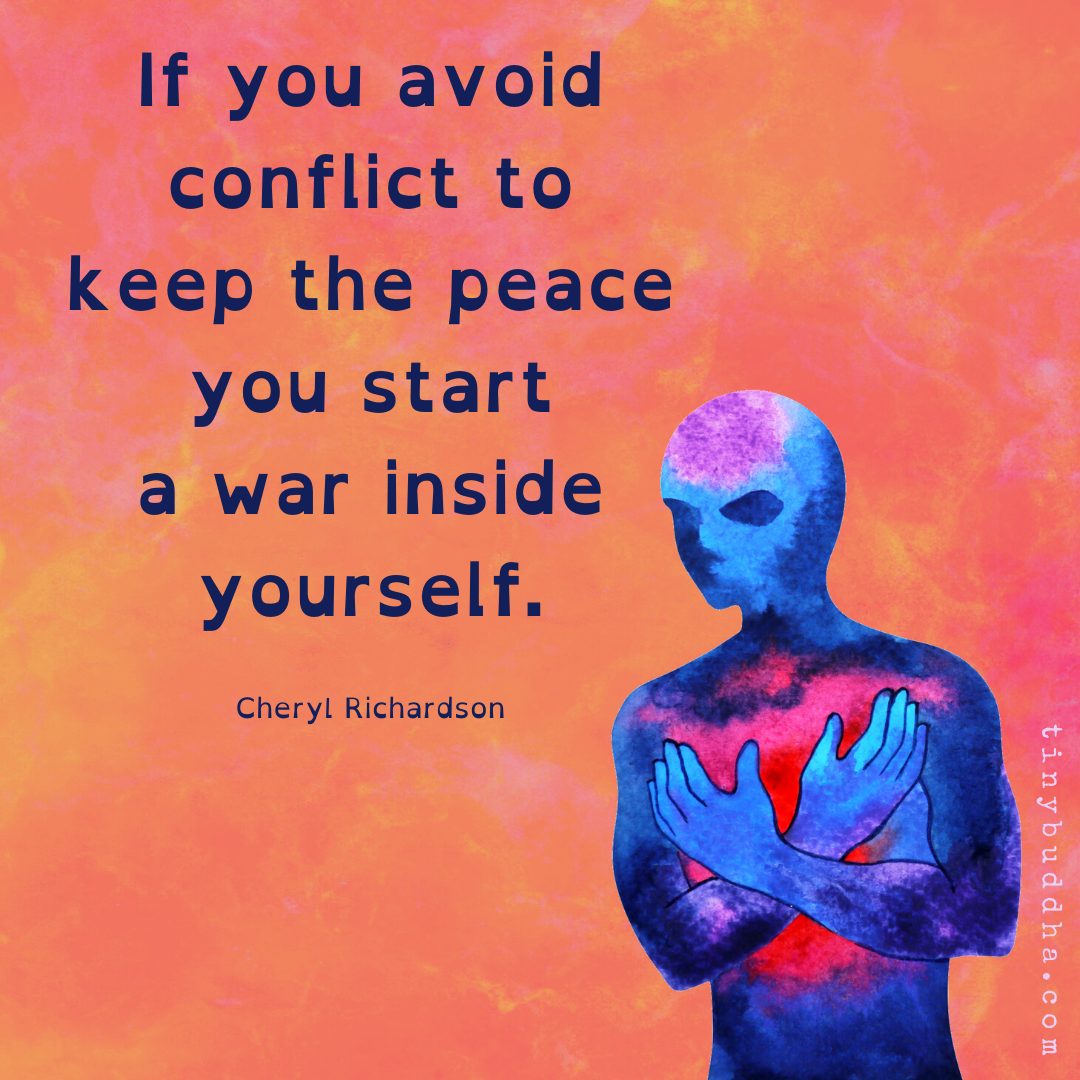
  • How Conflict in Relationships Can Be a Catalyst for Growth

    How Conflict in Relationships Can Be a Catalyst for Growth

    “The mind is the place the soul goes to hide from the heart.” ~Michael Singer

    “You think you’re so much better than me!!”

    As this phrase—laced with contempt—exited my mouth, I recognized the familiar words. I had grown up hearing this phrase often. The “rich people,” the girl who won the competition, the inconsiderate neighbors, the rude supervisor… “They think they’re so much better than us.”

    So, I diligently spent my childhood trying to prove them all wrong.

    I wore myself out trying to be the smartest, the best, the prettiest… you name it. I wasn’t going to let all those losers be better than me, or my family. No way!
    But who was I really fighting against?

    The answer is no one.

    In truth, I was fighting against my parents’ belief system, which came from their own childhoods. I was fighting their ghosts from the past. But I didn’t know that at the time.

    I had no idea I had carried this belief system into my own adult life. After exhausting myself trying to prove I was worthy as a child, I then spent decades working on self-improvement and personal growth. I had moved beyond all that silly limited thinking.

    Or so I thought.

    Until that day in the kitchen with my husband…

    In my mid-forties…

    When he politely declined to eat the meat I had prepared for dinner.

    Suddenly an uncontrollable rage welled up inside me, and I screamed at him, with tears streaming down my face…

    “YOU THINK YOU’RE SO MUCH BETTER THAN ME!”

    My mind immediately starting playing endless clips of all the times my husband had demonstrated his assumed superiority over me. I was completely triggered and unhinged, so I bought into it.

    As I continued on with my ridiculous fit, another part of me, a more detached part, asked this simple question: “Where is all this coming from?”

    Immediately, I recognized the familiar phrase. I knew exactly where it came from. I stopped my raging in an instant and excused myself to the bedroom.

    Once there, I took the energy away from the mind and into the heart. There was no need to analyze it. No need to further engage the mind in its joyous rebuke of my innocent husband.

    Michael Singer has a quote that I love. “The mind is the place the soul goes to hide from the heart.” We don’t want to feel those painful feelings, so we rationalize them endlessly in the mind. But, there’s another option. I placed my attention in the heart, disengaged from the continuing chaos in my mind, and allowed the energy to release.

    Minutes later, I went back to the kitchen, feeling much calmer, and apologized to my husband. Peace was restored. I had also progressed spiritually by releasing some of the stored garbage that had been hiding in my heart for decades.

    I’m now to the point where I can be grateful when my husband hits a nerve, presses my buttons, triggers me, or whatever you prefer to call it. I’m only able to release that old stuff when it gets hit and brought to the surface. Otherwise, it just lays there, dormant, silently waiting for the perfect opportunity to erupt. Like a volcano.

    We all know the feeling of that volcano when it erupts without notice. Those closest to us are the most adept at causing an eruption. They can so skillfully and predictably hit our stuff.

    We eventually realize that an intimate relationship is like a mirror. Our partner has an uncanny ability to reflect back to us the parts of ourselves that need the most healing. If we understand this, we can learn to use the conflict in our relationship as a catalyst for spiritual growth.

    We can stop the blame and anger. Instead, we feel immense gratitude when we find yet another old wound in need of healing. This is how we grow spiritually together. And, in the process, we create great connection and intimacy.

    In an intimate relationship, we are like two rough pieces of sandpaper, constantly rubbing up against each other. Over time, if we use this process to our benefit, we become smoother. Then, our relationship reflects back to us this smoother, gentler, happier version of ourselves.

    We don’t get so triggered anymore. We chill out. We are able to enjoy life and each other. Peacefully. Joyously.

  • 20 Powerful Quotes to Help Minimize Conflict and Drama

    20 Powerful Quotes to Help Minimize Conflict and Drama

    The holidays can be a lot of fun, but let’s face it, they can sometimes be stressful, particularly if you spend them with family. Surrounded by multiple generations of people, many with different perspectives and beliefs, it’s easy to feel triggered or annoyed.

    Then there are the challenges associated with going home, whether that means visiting a physical location or returning to the (possibly unhealthy) mental space you occupied as a kid.

    And if you do fall into old landmines, it’s all the more frustrating because holidays come but once a year, and they’re supposed to be joyful, right?

    If you anticipate today might be fraught with conflict or drama, take a few minutes to reflect on the following quotes (including a couple of my own). Perhaps something here might help you create a little peace—for yourself and the people around you.

    20 Quotes for a Drama-Free Holiday

    1. “The people who trigger us to feel negative emotions are messengers. They are messengers for the unhealed parts of ourselves.” ~Teal Swan

    2. “No one can make you feel inferior without your consent.” ~Eleanor Roosevelt

    3. “Be selective with your battles. Sometimes peace is better than being right.” ~Unknown

    4. “Be kind to unkind people. They need it the most.” ~Unknown

    5. ““10% conflict is due to difference in opinion and 90% is due to wrong tone of voice.” ~Frank Viscuso

    6. “Practice the pause. Pause before judging. Pause before assuming. Pause before accusing. Pause whenever you’re about to react harshly and you’ll avoid doing and saying things you’ll later regret.” ~Lori Deschene

    7. “No response is a response. And a powerful one. Remember that.” ~Unknown

    8. “When you can’t control what’s happening, challenge yourself to control how you respond to what’s happening. That’s where your power lies.” ~Unknown

    9. “Don’t make assumptions. Find the courage to ask questions and to express what you really want. Communicate with others as clearly as you can to avoid misunderstandings, sadness, and drama. With just this one agreement, you can completely transform your life.” ~Don Miguel Ruiz

    10. “Give people the benefit of the doubt, over and over again, and do the same for yourself. Believe that you’re trying and that they’re trying. See the good in others, so it brings out the best in you.” ~Liz Newman

    11. “We don’t have to agree on everything to be kind to one another.” ~Unknown

    12. “Be the person who breaks the cycle. If you were judged, choose understanding. If you were rejected, choose acceptance. If you were shamed, choose compassion. Be the person you needed when you were hurting, not the person who hurt you. Vow to be better than what broke you—to heal instead of becoming bitter so you can act from your heart, not your pain.” ~Lori Deschene

    13. “Life becomes easier when you let go of the little things that bother you and focus on what makes you feel good.” ~Unknown

    14. “You don’t need anyone’s affection or approval in order to be good enough. When someone rejects or abandons or judges you, it isn’t actually about you. It’s about them and their own insecurities, limitations, and needs, and you don’t have to internalize that.” ~Daniell Koepke

    15. “Think before you speak, and don’t say everything you think.” ~Alexander Lebed

    16. “Most disagreements are caused by different perceptions that created different realities.” ~Unknown

    17. “The true mark of maturity is when someone hurts you and you try to understand their situation instead of hurting them back.” ~Unknown

    18. “Never waste your time trying to explain who you are to people who are committed to misunderstanding you.” ~Dream Hampton

    19. “There can be disagreement without disrespect.” ~Dean Jackson

    20. “Instead of getting defensive, just say thanks for letting me know your thoughts. I’ll consider them.” ~Henry Cloud

    Which of these quotes speaks to you the most? And do you have any to add to the list?