Tag: Confidence

  • Beyond the Yips: How to Reclaim Your Creative Confidence

    Beyond the Yips: How to Reclaim Your Creative Confidence

    “You gain strength, courage and confidence by every experience in which you really stop to look fear in the face.” ~Eleanor Roosevelt

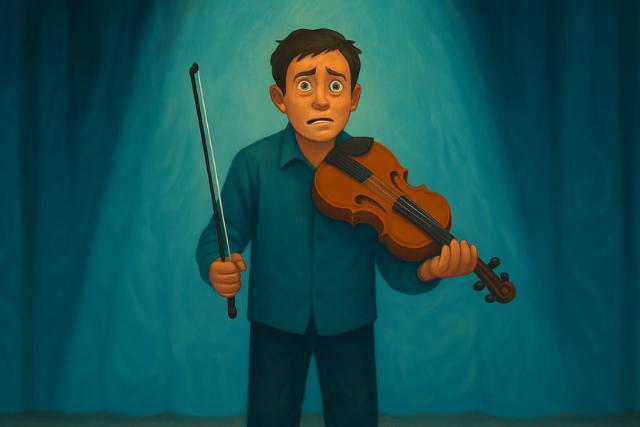
    There’s a quiet moment before the spotlight hits when everything in your body wants to run.

    Your hands tremble. Your voice tightens. Your breath shortens, even though the room is still. You love what you do—you’ve trained, practiced, prepared—but suddenly, it’s like someone else is in your body. Your skills vanish. Your confidence implodes.

    That’s the yips.

    And if you’re an artist, musician, writer, teacher—anyone whose work lives in public view—you’ve probably met them too.

    The First Collapse

    For me, the first time the yips showed up, I was about ten years old, standing on a Little League pitcher’s mound. I had a strong arm and a real love for the game, so they made me the pitcher.

    It felt like an honor—until it became a nightmare.

    I couldn’t throw a strike. Not one. I walked batter after batter. The harder I tried, the worse it got. My coaches shouted. My teammates rolled their eyes. And worst of all, I didn’t know why it was happening. I knew how to pitch. I wanted to pitch. But my body wouldn’t cooperate.

    My confidence didn’t just erode—it imploded.

    That experience carved something into me, and years later, it returned in a different form—on stage, with a viola in my hands.

    But I eventually learned the yips aren’t just nerves. They’re the clash between who we believe we are and what’s happening in the moment.

    The Yips in Music

    I had taken up guitar earlier and played in public a few times. A little nerves, sure, but nothing overwhelming. But the viola was different.

    The viola wasn’t just an instrument—it was a commitment. I loved the sound, the subtlety, the range. But the moment I sat down to play chamber music or solo pieces—especially in front of discerning classical audiences—I froze.

    My bow hand would shake uncontrollably. My tone would collapse. My breath shortened. My fingers, steady in rehearsal, betrayed me under pressure. It wasn’t just a little stage fright. It was full-body paralysis. And I wasn’t just nervous—I was ashamed.

    I could feel the others around me adjusting their playing, trying to stay in sync, politely pretending not to notice the scraping sound of my trembling bow. I wasn’t just failing myself—I felt like I was slowly unraveling something beautiful we had built together.

    That shame lasted longer than any applause ever could.

    Eventually, I stopped performing. It hurt too much.

    But Then, a Different Tune

    What’s strange is that I can still play old-time fiddle music in public. Ozark waltzes, hoedowns, reels—I can play those in front of a crowd with energy and joy.

    Why?

    Because people are moving. They’re dancing. They’re smiling. There’s an exchange happening—call and response, energy to energy. No one’s looking to critique every phrase. They just want to feel alive.

    That shift—from judgment to participation—made all the difference.

    It was my first clue that the problem wasn’t just about nerves. It was about dissonance.

    When Belief and Experience Clash

    What I didn’t understand as a kid—but see now in myself, my students, and even my own children—is that the yips aren’t just performance anxiety. They’re the outward symptoms of cognitive dissonance: the mental and emotional strain that happens when who we believe we are doesn’t match what we’re experiencing.

    This dissonance doesn’t just trip us up. It can make us doubt the very core of our identity. And in creative work, that doubt can be devastating.

    Common Creative Cognitive Dissonances

    Over the years—as a filmmaker, teacher, and musician—I’ve seen these patterns again and again:

    1. “I’m passionate and skilled” vs. “I just froze in front of everyone.”

    You know you’re good. But in that crucial moment, something inside shuts down. The disconnect feels like failure, even if it’s just fear.
    2. “I believe in creative freedom” vs. “I censor myself when others are watching.”

    We crave authenticity. But the moment we feel observed, we retreat into safe ideas and bland choices.

    3. “I want to create something meaningful” vs. “No one will care about this.”

    You believe in the work, but a voice in your head tells you it’s not important. That voice keeps you from finishing—or from starting at all.

    4. “I value growth” vs. “I should already be good at this.”

    Even lifelong learners fall into this trap. Especially those of us with experience. We forget how to be beginners again.

    5. “I’m a creative person” vs. “I can’t seem to finish anything.”

    The inner identity and the outer reality don’t match. That gap becomes shame—and shame leads to silence.

    How to Work with the Yips, Not Against Them

    Here’s what I’ve learned after a lifetime of living with this pattern: You don’t conquer the yips by trying harder. You heal them by listening deeper.

    That means meeting the fear—not with force, but with care.

    Here’s how I begin again, every time:

    1. Lead with compassion.

    That part of you that’s scared? It’s also the part that loves what you’re doing. Be gentle. Speak kindly to yourself.

    2. Accept the body’s message.

    Trembling hands, dry mouth, racing thoughts—these are just signs that you care. Breathe through them. Don’t resist them. Let them pass like weather.

    3. Reframe the story.

    Not: “I choked.”
    But: “I hit a growth edge.” Or: “I’m learning to stay present when it matters.” That shift matters.

    4. Find reciprocal environments.

    Play for dancers. Share writing with friends. Teach in spaces where people reflect, nod, laugh, respond. It’s hard to heal in front of a wall of silence.

    5. Focus on presence, not perfection.

    When I play fiddle now, I don’t aim to impress. I aim to connect. That intention rewires everything.

    6. Return to joy.

    What first drew you to your work? The sound? The rhythm? The curiosity? The spark? Go back there. That’s where your real voice lives.

    A Life Beyond the Yips

    These days, I still feel the yips. Sometimes when I teach. Sometimes when I perform. Sometimes when I write something that matters to me.

    But now, I recognize them for what they are: a signal that I’m doing something vulnerable and real.

    If you’re an artist, musician, teacher, maker—and you’ve gotten stuck—you’re not alone. And you’re not broken.

    You’re simply standing at the edge of the gap between who you were and who you’re becoming.

    The work is to stay in the room. Gently. Bravely. Again and again.

    And little by little, you’ll find your way back—not to where you started, but to something deeper.

    To a self that trusts its voice again. To a body that remembers how to move. To a joy that doesn’t depend on perfection.

    To the quiet truth that you were never really lost at all.

    The yips may still show up—but so will your music, your words, and your true self.

  • How to Develop True Self-Confidence Amid Life’s Uncertainty

    How to Develop True Self-Confidence Amid Life’s Uncertainty

    “Confidence comes not from always being right but from not fearing to be wrong.” ~Peter T. McIntyre

    I used to think of confidence as something external, something that people exuded in their body language, in the way they spoke, or in the certainty of their decisions.

    To me, a confident person had a poker face and a strong, grounded posture. I thought confidence was something you cultivated through endless practice—training yourself to speak with assertiveness and decisiveness, to project certainty even when you didn’t feel it inside.

    But I’ve come to understand that true self-confidence is something that comes from within, and I fully embrace Stephen Batchelor’s definition: “Self-confidence is trust in our capacity to awaken. It is both the courage to face whatever life throws at us without losing our sense of calm and the humility to treat every situation we encounter as one from which we can learn.”

    It is not arrogance or blind faith in one’s abilities; it is a quiet trust in our inner wisdom, an unwavering belief that we can navigate whatever life presents, even when the path ahead is unclear.
    I did not arrive at this understanding easily. It took one of the most difficult periods of my life to uncover the strength that had always been within me, hidden beneath layers of conditioning, fear, and uncertainty.

    In the midst of heartbreak, loss, and what felt like complete falling apart, I learned to sit with my emotions, to hold space for them, and to trust that they were not my enemy but my guide.

    When Everything Falls Apart

    There was a time when everything I thought was certain suddenly crumbled. The foundation I had built my life upon—the plans, the expectations, the identity I had crafted—was gone. I found myself with nothing solid to hold onto except my own ability to endure. And even that felt fragile at times.

    During those days, self-confidence was not something I actively sought. In truth, I was just trying to get through each moment. I took things hour by hour, day by day. I sought support in those around me, who held space for me with compassion. I turned inward, searching for any glimmer of light in the darkness. Sometimes I found it. Other times, it felt like I was shoveling more soil over it, burying it deeper.
    It wasn’t a linear process. Healing never is. Some days, I felt strong and capable; others, I was overwhelmed by grief, sadness, and doubt. But slowly, without realizing it at first, I was building something. I was learning to trust myself. I was learning that even in the most painful moments, I could survive them. And not just survive; I could learn from them, grow through them, and emerge stronger on the other side.
    Sitting with Discomfort: The Pathway to Confidence

    I had been meditating, reading, and reflecting for years, but during this time, my practice took on a different meaning. It was no longer about finding peace, clarity, or becoming a better person; it was about learning to sit with discomfort without trying to fix it. There were times (most!) when my meditation felt anything but calming. Instead of feeling still or at ease, I felt restless, agitated, even more lost.

    But what I didn’t realize then was that I was doing the work. Meditation wasn’t about achieving a state of bliss—it was about cultivating the capacity to be with whatever arose, without running from it or pushing it away. The more I practiced this, the more I realized that the self-confidence I sought wasn’t about having all the answers. It was about trusting that I could handle the unknown.

    I came to understand that uncertainty is the only certainty in life. As Susan Jeffers wrote in Embracing Uncertainty, “The only way to get rid of the fear of doing something is to go out and do it.” What I needed was not certainty about the future, but trust in my ability to meet it with openness and resilience.

    The Confidence That Emerges After Pain

    With time, I realized that confidence isn’t about knowing exactly what will happen next. It’s about knowing that whatever happens, we have the strength and inner resources to face it. And more than that—we have the ability to thrive through it.

    For me, true self-confidence came from understanding impermanence, from recognizing that everything changes, and from knowing that I, too, have the ability to adapt and respond. It came from experiencing suffering and emerging on the other side with greater compassion—for myself and for others. It came from realizing that I didn’t need to have everything figured out to trust myself completely.

    This kind of confidence isn’t loud or showy. It doesn’t seek validation or prove itself to others. It is quiet, deep, and unshakable. It is the trust that we have our own backs, that we can meet life with open arms, and that even in uncertainty, we are always enough.

    Your Inner Light Is Always There

    If you are in the midst of struggle right now, feeling like the ground beneath you is shifting, I want you to know this: There is a powerful light within you. It may feel dim at times (maybe most of the time!), but it is there. It carries the wisdom, strength, and love you need—not only to survive but to live fully, with depth and meaning.

    Concepts like confidence or inner strength may sound foreign now, yet they form, accumulate, and grow in the quiet, unseen ways you keep going, in the small moments you show up for yourself, in the hidden effort you make every day, in the part of you that still hopes.

    True self-confidence is not about never feeling fear or doubt. If anything, these emotions are an essential part of being human. It is only because of fear and doubt that we can truly recognize freedom and inner strength—for what is darkness but the absence of light? By sitting with these emotions, allowing them, and creating space for them as best as you can, you begin to embrace your humanity.

    Self-confidence is about walking forward, holding space for it all, and trusting that your human nature has what it takes to navigate whatever comes, even if you’ve struggled with this in the past. It is about knowing, deep in your bones, that no matter what life brings, there is a light within you that is always lit—you simply need to allow it to shine through.

    And that is how your quiet, inner confidence carries you forward. Every experience is a gift—an opportunity to expand your wisdom, to grow in ways you may not always notice, but that always carry you forward.

  • How I Found Confidence and a New Path When I Felt Inadequate

    How I Found Confidence and a New Path When I Felt Inadequate

    “Start where you are. Use what you have. Do what you can.” ~Arthur Ashe

    It was a quiet evening at Boat Quay. The sun was setting, casting warm golden hues over the water, and the air smelled faintly of salt and street food. I was sitting on the riverbank with a close friend, my head heavy with thoughts that refused to settle.

    “I’m thirty,” I said, breaking the silence. My voice quivered with frustration. “I haven’t achieved anything. Look at Joseph Schooling—he’s younger than me and a gold medalist! My other friend started his own business. And me? I’m just… here.”

    The words tumbled out of me, raw and unfiltered. My friend looked at me with a mixture of concern and helplessness. I knew I was being hard on myself, but the feeling of inadequacy clung to me like a second skin.

    Deep down, I believed that being hard on myself was necessary, a way to spur myself into action. “If I don’t push myself, who will?” I thought. But no matter how much I pushed, nothing seemed to click. I felt like I was flailing, desperate for traction but stuck in the same spot.

    Biting the Elephant

    For a long time, I obsessed over big achievements. I wanted to make a splash, to prove that I was capable and worthy. But every time I set my sights on something monumental, I froze. The sheer size of my goals overwhelmed me.

    One day, I stumbled across an old adage: How do you eat an elephant? One bite at a time.

    It hit me like a lightning bolt. Maybe I didn’t need to tackle enormous goals all at once. Maybe I could start small—just one bite at a time.

    I decided to test this theory. My first “bite” was a simple commitment: wake up thirty minutes earlier each day and spend that time reading a book on personal development. It wasn’t groundbreaking, but it was manageable.

    To my surprise, this small step gave me a tiny boost of confidence. I was keeping a promise to myself, however small. That feeling of accomplishment, no matter how minor, was something I could build on.

    From there, I started layering on more small commitments. I took on one short online course, then another. I applied what I learned in small ways at work. Slowly but surely, these small actions began to stack up.

    Fixing Everything and Going Nowhere

    For years, I believed that the key to success lay in fixing my weaknesses. I spent countless hours analyzing my flaws and trying to “fix” them. I wasn’t assertive enough, so I took assertiveness training. I wasn’t organized enough, so I read books on productivity.

    But no matter how much I tried to improve, I felt like I was running in place. The more I focused on my shortcomings, the more they seemed to define me.

    Then, one day, a mentor said something that shifted my perspective: “What if you leaned into your strengths instead?”

    It was such a simple idea, yet it felt revolutionary. I realized I’d been so focused on what I lacked that I hadn’t stopped to consider what I already had

    I started asking myself: What am I good at? What comes naturally to me?

    One of the answers that surfaced was communication. I’ve always been good at connecting with people, whether through conversation or storytelling. So, I decided to lean into that. I volunteered to give presentations at work and started reaching out to potential mentors for advice.

    As I leaned into my strengths, something incredible happened: momentum. The more I focused on what I was good at, the more opportunities seemed to appear. I wasn’t just fixing flaws anymore; I was building something meaningful.

    Walking the Unbeaten Path

    As I began to gain momentum, I realized that part of my frustration stemmed from comparing myself to others. I was measuring my progress against the paths others had taken, but those paths didn’t belong to me.

    I was forging my own path, one that was unfamiliar and full of uncertainty. There were no roadmaps or guarantees—just a lot of trial and error.

    Walking this path required me to confront self-doubt daily. “What if I fail? What if I’m not good enough?” Those thoughts still visited me, but I learned to greet them like old acquaintances. “Ah, there you are again,” I’d say to my doubts. “Thanks for your input, but I’m moving forward anyway.”

    Each step forward brought new challenges, but it also brought growth. The unknown, which once terrified me, became a space for discovery and creativity.

    The Overarching Theme: Seeking Validation

    When I look back on those years of self-doubt and striving, I see a common thread: I was chasing validation.

    I wanted to prove my worth—to myself, to my family, to society. I thought that achieving something big would finally make me feel whole. But the truth is, no external achievement could fill that void.

    The turning point came when I began to let go of the need for validation. I realized that my worth wasn’t tied to what I achieved or how others saw me. It was inherent, unchanging.

    This wasn’t a switch I flipped overnight. It was a slow process, one small step at a time—just like eating an elephant. But as I released the need for external approval, I felt freer and more grounded than ever before.

    Becoming a Teacher

    Today, I’m a teacher. It’s not the flashiest career, but it’s one that feels deeply aligned with who I am. Teaching allows me to use my strengths—communication, empathy, and a knack for seeing the big picture—to help others navigate their own paths.

    I didn’t get here by chasing big, flashy goals. I got here by starting small, focusing on my strengths, and trusting the process.

    Lessons Learned

    If you’re feeling stuck or overwhelmed, here are a few things I’ve learned that might help.

    1. Start small: Big changes don’t happen overnight. Focus on small, manageable steps that you can build on.

    2. Lean into your strengths: Instead of fixating on your weaknesses, identify what you’re naturally good at and find ways to use those strengths.

    3. Let go of comparisons: Your path is your own. It doesn’t have to look like anyone else’s.

    4. Trust the process: Growth isn’t always linear, and that’s okay. Have faith that each step forward, no matter how small, is bringing you closer to where you want to be.

    5. Release the need for validation: Your worth isn’t tied to your achievements or how others see you. It’s inherent, just as you are.

    Closing Thoughts

    As I sit here reflecting on my journey, I realize that I’m still a work in progress. And that’s okay. Life isn’t about reaching some final destination; it’s about learning, growing, and finding joy in the process.

    If you’re feeling stuck or overwhelmed, know that you’re not alone. Start where you are. Use what you have. Do what you can. One small step at a time, you’ll get there.

  • 5 Ways to Stay Mentally Strong, No Matter What

    5 Ways to Stay Mentally Strong, No Matter What

    “Have a little faith in your ability to handle whatever’s coming down the road. Believe that you have the strength and resourcefulness required to tackle whatever challenges come your way.” ~Lori Deschene

    My life is unpredictable.

    These days, it feels like I wake up not knowing what obstacles I’m going to be facing or how to manage it all. Is the world getting more challenging, or is it just me?

    There doesn’t seem to be a magic carpet ride to rescue me, or any of us for that matter, ready to whisk us off into the sunset for a rendition of Aladdin’s “Whole New World,” with “shining, shimmering splendor.”

    Do you, like me, wonder, “How is everyone else navigating life these days?”

    Attempting to put my mind into a semblance of order the other day, I pulled out my self-development toolbox. I began digging around to see what I had on hand from all the self-development books and blog posts I’ve read, therapists I’ve seen, and workshops I’ve taken.

    I came up with the usual suspects: Embrace change! Practice mindfulness! Find your purpose! Reclaim your power! While these fab four sound like a great tried-and-true collection, it felt like I was trying to use the rules of Candyland to navigate the fire-breathing dragons in Game of Thrones.

    Help.

    Like so many others I interact with, such as family, clients, and friends, I sense uncertainty building up on a consistent basis. The hardest part is not having the luxury to curl up and shut the shades and hide under the blankets because there are bills to pay, jobs and careers to sit up straight for, and families to attend to.

    So where do I draw confidence in my ability to handle life?

    I think back to my childhood as a Gen X kid. Growing up in a small town on a dead-end street with ten siblings, I had to figure out how to fend for myself from a very young age. Food went quickly, and I had to forage and make sure I got my share. If there was a school project, I had to find odds and ends in the house to paste together and create an appropriate report to present to the class on my own.

    My parents didn’t get down with glue and popsicle sticks. Ever.

    Using the words “I’m bored” got you a broom and baby handed to you, so I kept myself busy and out of sight of the adults. Anytime I needed a ride anywhere, it was up to me to figure out how to get there and home, and I got stranded many times.

    The superpower I developed as a kid so I could survive was resourcefulness.

    This was, by definition, the ability to find quick and clever ways to overcome difficulties and make use of that which others would normally overlook or discard. If I didn’t have what I wanted or needed, I would have to create possibilities using limited or no resources.

    I developed curiosity, an ability to take care of myself, and the determination to find solutions in the face of any adversity and solve problems for myself and my younger siblings. I put together costumes, learned to sew my own clothes, cooked meals, and became an expert storyteller and little-white-lie fabricator.

    Hypervigilance developed so I could figure out how to read the emotional state of the adults, who were consumed with their responsibilities and their own unfulfilled dreams. Keeping out of harm’s way, such as avoiding my father’s wrath or the teacher’s punishment, became my expertise. Friends were everything, and they, along with the outdoors, helped me have a pretty incredible childhood with lots of fun memories.

    What I learned from my childhood is this: It’s not always a lack of resources that is the problem; it’s a lack of resourcefulness that causes failure.

    There are resources that we think we need, such as money, the right technology, the right contacts, enough time, the best lawyer, etc., and while there’s truth to that, we struggle because we lack the ultimate resource—which is emotional resourcefulness, something we could all access. When you dig deep and utilize your emotional resources,you can get almost any other resource on earth.

    It’s Time to Develop Emotional and Practical Resourcefulness

    Here are my five tips to stay mentally strong and navigate anything that comes your way in life.

    1. Use what you have.

    When I was a kid, no one went to the store to buy me supplies, trendy trinkets, or even necessities like pajamas, pencils, and enough socks. We used and reused what we had around.

    Even when I can afford things I need, I like to take a look at my Amazon cart and double check to see if I have anything at home that I could makeshift or ask a neighborhood WhatsApp group for. You’d be surprised at what people offer up for free, both goods and services. You just have to ask.

    Bartering works as well. I have gotten vacations paid for, kids’ school tuition in exchange for marketing services, and plane tickets for use of my home for a night or two.

    2. Develop your hustle.

    If I wanted the latest thing the other kids had or wanted to go for pizza with my friends, I babysat, raked leaves, and hustled my grandmother for money. I found that if I played her a song on the piano and told her I was the best and prettiest in my class, she would give me $5. It made us both happy!

    Obtain invitations by befriending people you admire and want to be like. Worm your way into communities of your choice by shopping in those neighborhood grocery and coffee shops and talk to people there. Sign up for training and meetings in the town-run parks and recreation centers in those neighborhoods as well. Don’t stop the hustle mindsetwherever you go.

     3. Practice self-talk.

    All through my childhood, I used to constantly tell myself, from the top bunk bed in a crowded bedroom with my sisters, that one day I would be a writer like I read about in my favorite book, Anne of Green Gables. I knew I would one day sell my stories and have the money I wanted. I do that today!

    When I would see things around me that I didn’t like, and there were many, I reminded myself that I would one day be like the well-dressed women in my mother’s magazines: colorful clothes, big white smiles. Seek outside inspiration for this and speak positive, goal-oriented dialogue to yourself.

    When something is not as you would like, tell yourself, “I don’t like it, it’s an inconvenience, and it’s temporary.” Not BUT it’s temporary; say and, or furthermore. “And it’s temporary.” That’s how you talk to yourself, according to former prisoner of war Edith Eger, author of The Choice. “No matter what happens, it’s temporary and I can survive it.”

    4. Trust your intuition.

    Trust that you have the intuition to figure it out. We made it home from school, found our friends outside to hang out with, kept ourselves alive, and sensed when to avoid dangerous adults (most of the time).

    Trust that your instincts will kick in at the precise moment needed, and it may be last-minute, but you’ll always figure it out.

    5. Know that you have a unique purpose.

    I knew my purpose was to be a writer, and I did a good job on my writing assignments in grade school. Never underestimate your power to make a difference with your talent or your purpose, and believe that you have something to offer the world—and offer it.

    I used to volunteer for just an hour a week at a recovery center when I was at my lowest, just to feel purposeful, and I reaped magical rewards from that experience.

    Bonus Tip: Build a Support System

    No one can navigate life’s challenges alone, and building a strong support system is crucial for mental strength. As a Gen X kid, we had our friends on the street to hang out with all the time; we were always there for each other.

    Surround yourself with people who uplift and inspire you. Share your thoughts and feelings with friends or family members (and/or professionals) that you trust, who can provide valuable perspectives along with emotional support. Having a support system not only lightens the load but can also reinforce your much-needed mental fortitude to develop a strong mind.

    While life is unpredictable, by incorporating these five practices into your life, you can build a foundation of mental strength that will serve you well in any circumstance.

    Remember, staying mentally strong is not about avoiding challenges but about facing them head-on with resourcefulness, courage, resilience, and a positive attitude. With these tools in your arsenal, you’ll be better equipped to navigate the unpredictable journey of life and emerge stronger on the other side.

    “Know that you always have the capacity to make the best of anything. Even if you didn’t want it or ask for it, even if it seems scary or hard or unfair, you can make something good out of any loss or hardship. You can learn from it, grow from it, help others through it, and maybe even thrive because of it. The future is unknown, but you can know this for sure: Whatever’s coming, you got this.” ~Lori Deschene

  • 5 Hidden Fears That May Be Secretly Sabotaging Your Life

    5 Hidden Fears That May Be Secretly Sabotaging Your Life

    “Sometimes what you’re most afraid of doing is the very thing that will set you free.” ~Robert Tew

    I like to say I don’t regret much in life, because I know I’ve always done the best I could and have learned from every experience. But I’d be lying if I said I haven’t considered what my life might be like now if I’d overcome certain fears sooner.

    For years I shut people out because I feared I might ruin relationships if I opened myself up to them. And there was a good reason for that—I’d damaged many relationships in the past by acting in response to my trauma.

    I’d driven people away, sometimes with unnecessary drama that stemmed from insecurity and other times with dangerous behavior, like binge drinking, that required them to take care of me.

    The binge drinking was particularly terrifying to me because I couldn’t seem to stop once I started, and I often blacked out, which meant I didn’t trust myself.

    I didn’t trust myself to drink responsibly. I didn’t trust myself not to humiliate myself when alcohol lowered my inhibitions and opened the floodgates to my deepest pains. But most importantly, I didn’t trust myself not to confirm what I suspected everyone thought of me: that I was a mess. Unlovable. And not worth having around.

    I remember a time when I was working on a marketing tour, when I was twenty-three, taking a mobile appliance showroom from state to state. My boss and I would often get drunk together at bars, along with my one female coworker, after we powered down the showroom for the night.

    A few shots in and I’d be all over him on the dance floor, with him all too happy to accept the attention.

    At one stop, my coworker, who was also my hotel roommate, met a guy who stayed in our room for several nights. This meant I moved to my boss’s room, where we finally took things to the next level.

    In hindsight I see it had “bad idea” written all over it—and not just because it was clearly a crossed boundary, but also because I was an emotional mess back then. But that’s exactly why I didn’t see it at the time.

    I convinced myself that he loved me and I’d finally found “the one.” Something I feared would never happen after my college boyfriend left me, after three years of my self-destruction. Which made it all the more devastating when he told me we had to keep things professional once we hit the next city.

    On the final night of the tour, in NYC, where it had originated, we met up at a bar with several people who were going to be my boss’s new coworkers. I got black-out drunk and—as I’ve been told—cried hysterically in front of all of them, screaming at him, “You used me!”

    I don’t think I’ve ever felt shame like I did in the days that followed, and I’ve felt some pretty deep shame in my life. It wasn’t just that I’d lost control and humiliated myself, though that obviously stung. And it wasn’t because I’d hurt someone I claimed to care about, though, once again, realizing this was brutal.

    It was also that I’d revealed my darkness and my damage to people who I assumed were better than me, much like I had as a bullied kid. I had publicly exposed the most fragile, broken parts of myself.

    This wasn’t the first time, but it was the first time “relationships” and “work” overlapped in the Venn diagram of my fears. And that terrified me. Because now I wasn’t just afraid that I’d mess up my relationships with my emotional issues but my professional life as well.

    We don’t always talk about these kinds of things because no one wants to broadcast the experiences and fears that make them feel most ashamed and vulnerable.

    But when we don’t process these kinds of experiences, they fester inside us, growing into toxic blocks that prevent us from pursuing the things that would bring us love, joy, and fulfillment.

    They keep us hiding, playing small, depriving ourselves of the connections and experiences we deeply want to embrace—if only we weren’t so scared.

    Scared of what we can’t do. Scared of what we might do. Scared of what people will see. Scared of what they might think.

    We barricade ourselves into a corner of our minds, somewhere down the hall from all our fantasies about the life we really want—filled with people and passion and pleasure.

    Because it feels safer there. Because less can hurt us if we don’t put ourselves out there.

    But life is out there. Love is out there. Passion and purpose and contribution—all the things that make life worth living—are out there. Beyond the fears that many of us don’t even realize we’re holding.

    Not sure what fears are holding you back? Maybe one of these will sound familiar.

    5 Hidden Fears That May Be Secretly Sabotaging Your Life

    1. If I get into a good situation, I might mess it up.

    Maybe, like my former self, you fear ruining relationships. Or perhaps for you, this fear pertains to your work and taking on more responsibility. Maybe you’ve cracked in pressure-filled situations before and worry you will again. Or maybe you fear having kids because you’re afraid you’ll mess them up, even if you try your best to be a cycle-breaker (a fear I know all too well).

    I believe this a three-pronged fear, born from equal parts shame, mistrust, and perfectionism.

    We’re ashamed of things we feel we’ve ruined in the past, and we don’t want to relive that pain. We don’t trust that we can do better than we’ve done, or that we can handle it if the past repeats itself. But most importantly, we don’t realize that the goal isn’t to never again make mistakes but to know that we can repair and bounce back when we do.

    I’ve often felt I’ve messed up as a parent to young kids because I’ve had moments when I’ve failed to meet my high standards of calmness and gentleness. And maybe this is why I waited until thirty-nine to have my first son.

    But in those moments when I disappoint myself, I remind myself that what matters most is how I respond to my mistakes—because my sons are human and fallible too. Even if I could do everything perfectly, which I obviously can’t, it’s far more valuable for me to show them how to repair, learn, and grow when I inevitably fall short.

    When I look back, I recognize that every I’ve time I’ve messed something up—in parenting or other parts of life—I’ve learned something that’s helped me do better going forward. Which has enabled me to slowly become more confident in my relationships and my work.

    The key to overcoming this fear, I’ve realized, is diving in, accepting that the worst might happen, and knowing that getting through your worst moments is the key to getting closer to your best.

    2. If I put myself out there, people might find out I’m a fraud.

    If, like me, you’ve struggled with low self-worth, you might find it challenging to overcome the fear of being seen as inferior, incompetent, inadequate, unworthy, or somehow less than others. And this might compel you to sabotage opportunities to make a difference in the world.

    It feels a lot safer in a shadow than a spotlight because people can’t criticize what they don’t see. And you don’t have to worry about being exposed as a fraud if you’re never in a position to be scrutinized.

    But I’ve come to believe that most of us feel like we’re really just winging it. Most of us worry that someday people will find out we have no idea what we’re doing. That despite the degrees and credentials and filters and followers, we’re all just wounded kids underneath it all, trying to outgrow the limitations that our trauma and other people have imposed on us.

    This is partly why authentic sharing has been so compelling to me. When I put my cards on the table, no one can question if maybe I’m bluffing. Because here you go, I’m showing you! I don’t have the best hand. But I’m playing it the best I know how. We all are. And there’s something empowering about letting that be enough.

    3. If I don’t push myself, I might never prove my worth.

    This is the other side of the last fear, but instead of creating a sense of paralysis, it keeps us in a perpetual state of busyness—depriving ourselves of rest, connection, and fun so we can hurry up and matter.

    It’s the fear that tells us to keep working. Or networking. Trying to build the right thing or meet the right person so we can finally make a name for ourselves. And make the kind of difference that proves we’re valuable.

    It’s the ticking time bomb of pressure and productivity that eventually explodes in a breakdown or burnout, ironically pausing all our efforts to do something big and significant.

    When we’re driven by the fear of dying unimportant, we’re never truly able to devote ourselves to the things that are important to us. Both because we’re too busy to find the time for them and because our minds are too busy when we finally do.

    And what a shame that is—because the people we’re most important to don’t care what we do or what we earn. They just want us. Our presence. Our attention. But we can only offer those things if we fully accept that they’re just as valuable as anything we could accomplish or create.

    4. If I’m honest and authentic, people might judge, reject, or abandon me.

    Maybe you’re afraid to set boundaries or speak up about your needs. Or perhaps you’re afraid of sharing your trauma because you worry that people might look down on you, or worse, doubt or blame you.

    When we suppress our needs and deepest truths, we not only withhold our authentic selves in our relationships but also reinforce to ourselves that we need to hide. That what we have to say is wrong or shameful.

    This means we simultaneously sabotage our relationships with others while fracturing our relationships with ourselves.

    Looking back, I now realize my binge drinking was partly my authenticity trying to survive. It was the liquid courage that enabled me to release my social anxiety and say the things I wanted to say.

    But the irony was that lots of people rejected me when I was a sloppy, emotional drunk.

    It took me years to recognize that my binge drinking wasn’t just rooted in the fear of rejection. I drank to excess in social situations because I wanted to numb the voice in my head that told me it might happen. And that maybe I deserved it because I was fundamentally flawed.

    So really, the key to overcoming the fear of being rejected was to stop rejecting myself. To recognize that it was okay if some people didn’t like me, and it didn’t have to mean anything about me. It didn’t have to mean there was something wrong with me—just that we were wrong for each other.

    5. If I don’t settle for what’s right in front of me, I might end up with nothing.

    Every fear on this list stems from low confidence in ourselves and our worth, and this is a sad but common belief many of us with low self-esteem subconsciously hold—that we probably can’t get anything better than what we have right now.

    So we settle for unfulfilling jobs and dysfunctional relationships that leave us feeling drained and empty.

    We hold onto people and things that hurt us, thinking it’s better than having nothing at all.

    And we do it because we believe we need those people and things to feel happy and whole—without realizing they’re actually keeping us stuck in feelings of unhappiness and brokenness.

    They probably didn’t cause those feelings, though. Or at least they’re not the root cause. They’re just the most recent iteration of familiar dissatisfaction—a new level in a pattern we’ve been repeating for years because we don’t realize we’re playing out the past over and over, recreating the initial pain that led to our low self-worth.

    No one is born believing they deserve the bare minimum. We learn it when that’s when we’re given.

    Then many of us go through life without ever questioning why we accept so little, from others and ourselves. We hurt but don’t know why, and try to drink it away, smoke it away, eat it away, or love it away—all to avoid facing ourselves and our deepest wounds and fears.

    We may even convince ourselves those fears are just parts of our personality. I’m just quiet. I’m an overachiever. I’m a cautious person.

    But that’s not the real truth, or not the whole truth. The truth is that we’re living behind a wall of our fears, yearning for life on the other side while taking comfort in the perceived safety of not exploring it.

    And I get it. I really do. I want to feel safe. Safe with other people and, most importantly, safe with myself. I now know that starts with trusting myself.

    Trusting that I can do hard things—and bounce back if I fail.

    Trusting that I can put myself out there—and handle it if someone doesn’t like me.

    Trusting that I can face the pain that comes with a life unnumbed—and grow through every uncomfortable moment.

    And maybe that’s it—trust. Maybe that’s the antidote to fear.

    I’m not sure if it’s the result of boosting our self-worth or the path to doing it. But I know that trust is the reward for trying. Because we can never guarantee that we’ll do everything perfectly or that other people won’t judge or reject us. But we can trust that with every step we take in spite of our fears, we are growing a little further beyond them. And that the more we grow, the less our fears can limit us.

  • Embracing Equality: How to Stop Putting People on Pedestals

    Embracing Equality: How to Stop Putting People on Pedestals

    “The most common ego identifications have to do with possessions, the work you do, social status and recognition, knowledge and education, physical appearance, special abilities, relationships, personal and family history, belief systems, and often also political, nationalistic, racial, religious, and other collective identifications. None of these is you.” ~Eckhart Tolle

    Growing up in a patriarchal and hierarchical society, I learned to see certain people as superior to me and therefore placed them on pedestals: teachers, authority figures, managers… This behavior transformed me into a quite reserved, almost submissive version of myself, in contrast to my outspoken feminist persona outside of those circles.

    I noticed a shift even in interactions with peers who had previously been of “equal rank.” Once they assumed higher positions, I would adopt a quiet, subordinate demeanor. This left me feeling frustrated with myself and diminished, unable to express myself freely in their presence.

    Sadly, this tendency to idolize some people isn’t unique to me. It’s a societal phenomenon I’ve observed not only within myself but also among clients and peers. Especially women. We often elevate individuals, attributing to them qualities we admire or perceive as superior to our own.

    This hierarchical mindset is deeply entrenched in our society’s values, which prioritize certain external things such as wealth, success, gender, ethnicity, fame, and appearance. Hierarchies rank individuals according to certain criteria, perpetuating inequality and often leading to abuse and trauma.

    We see echoes of this in racial and gender discrimination, religious abuse scandals, and instances of power abuse in various fields like the field I love and teach, yoga.

    It’s imperative to dismantle this hierarchical ranking of human worth. Every individual, regardless of title, gender, race, or ability, is inherently deserving of love and respect simply by virtue of being human. This seems obvious and a bit silly to write really, but we’ve yet to truly understand and embody this as a collective. And until we internalize this truth on an individual level, systemic change will remain elusive.

    Today, I rarely feel invisible or submissive in front of anyone. I don’t see anyone as better or worse than me. We’re all just humans living different life experiences. And if I find myself going back to feeling inadequate or superior to someone, I am able to observe my bias and release that judgment. This is an empowering, loving way to live.

    It took a bit of effort, studying and applying neuro-linguistic programming (NLP), and practicing yoga not just as an exercise but as a way of living, but I now know it is possible, with patience, awareness, and practice.

    Here are some key steps to start unlearning this hierarchical model and embrace the truth of your inherent worthiness.

    1. Recognize hierarchical thinking and be curious.

    Begin by identifying any limiting beliefs or assumptions related to hierarchy or judgment of others. These beliefs may include ideas such as “some people are inherently better or worse than others.” Ask yourself with radical honesty: Who do I see as better or worse than me?

    When you catch yourself judging others negatively, replace it with curiosity. Explore why you perceive their behaviors as unacceptable, where this belief of yours is coming from, and consider their perspective.

    When you catch yourself putting others on a pedestal, be curious. Explore why you perceive them as “better” than you. What about what they have or do makes them better? Where is this belief of yours coming from? What is the limiting belief you hold about yourself?

    Recognize that both ends of judgment come from a place of hurt or insecurity within yourself.

    In my formative years, I put on a pedestal individuals who held roles as educators and those who belonged to families with greater financial means than my own. Subconsciously, there was also a strong tendency to put men on that pedestal.

    As I transitioned into adulthood, this pattern persisted in the workplace, where I found myself placing male superiors on pedestals, and in my early relationships, where I did the same with romantic partners and forgot myself in the process. It required a significant amount of introspection and self-awareness to recognize and address these deeply ingrained hierarchical biases, particularly those operating at an unconscious level.

    To bring awareness to your own beliefs, simply observe those moments when you feel small, invisible, or incapable of speaking out or being authentically yourself because you are in front of a specific person or group of persons. Those are the people you put on pedestal.

    2. Explore and address unconscious bias.

    It’s important to investigate our unconscious biases, especially those toward specific races, genders, disabilities, ages, and other identities. These biases often lurk beneath the surface, making them challenging to identify.

    Engage in discussions with friends from diverse backgrounds to gain insight into their experiences and perspectives. Listen attentively to their stories of bias, discrimination, and the barriers they face.

    For example, challenge your assumptions by questioning who you perceive as capable professionals or leaders. If your mental image primarily consists of tall white men, it’s a sign of an unconscious bias that needs addressing. Similarly, if your workplace lacks diversity at the top and claims to be unbiased, it’s essential to recognize the discrepancy. Approach this exploration with curiosity and kindness toward yourself. Don’t hesitate to seek assistance along the way.

    After becoming aware of my biases, I felt compelled to engage in difficult conversations, particularly with the men in my life. I vividly recall a discomforting dialogue with a high-ranking manager at a large corporation, during which I highlighted the noticeable lack of diversity in the upper echelons, consisting predominantly of tall white men. I confronted the inherent bias within the company’s structure, particularly its disposition toward women.

    These are the hard but necessary conversations you can have when you reestablish your connection to yourself and a non-hierarchical mindset. These conversations can be uncomfortable, especially when you are in front of people who have not uncovered their unconscious bias, but they are seeds of change. Choose discomfort over staying small.

    3. Humanize those on pedestals.

    If you find yourself placing someone on a pedestal, remind yourself that they are human too, prone to mistakes and vulnerabilities. Reflect on the qualities you admire in them and recognize that you possess those qualities too.

    Perhaps you find yourself admiring someone for their confidence and outspokenness, their beautiful home, or the loving family they’ve built. Consider this a message to introspect: why do these aspects hold value for you? It could be a learned belief that no longer serves you, which you can reframe or release. Alternatively, it might represent a genuine longing within your heart. In that case, view it as an intention—something to nurture within yourself, such as confidence—rather than a cause for feeling inferior.

    Or, if you’ve always seen authority figures as infallible, challenge this notion by recalling instances of their fallibility or unjust actions. Similarly, if you tend to idealise a partner or someone else in your life, reflect on whether this pattern echoes a past relationship dynamic, possibly with a parental figure. Question the reasons behind this pedestal and consider releasing any outdated beliefs associated with it.

    Keep in mind that liberating someone from the burden of unrealistic expectations can be empowering for both parties. Embrace their humanity, allowing room for growth and imperfection within the relationship.

    However, be prepared for the possibility that a shift in your belief might alter or even end the relationship—and that’s okay. Relationships evolve, and sometimes letting go is necessary for personal and mutual growth.

    Moreover, if you encounter inappropriate behaviour from someone in authority, refuse to normalize such conduct.

    Lastly, challenge any notions of superiority based on personality types, such as extroversion over introversion. Remind yourself that everyone experiences moments of insecurity and doubt. Whether you’re an extrovert or introvert, recognize your inherent worth and value as a unique individual.

    4. Reconnect with self-love.

    Once you find within yourself a place of love and acceptance, despite your differences, quirks, and the challenges you face, you will be able to be loving and accepting of others’ differences.

    Many mindfulness or somatic practices have supported my journey to acknowledge my innate worth and lovability.

    Here is one of my favorite ones: place one hand on your heart and the other on your belly, breathe deeply, and remember the warmth and love you experienced in your mother’s womb. Acknowledge the truth that you are deserving of love and respect, regardless of external measures of success or worth.

    If this is hard for you because you have been lost in the trance of unworthiness for a long time, it is okay. Maybe start modeling the behavior of someone who embodies equality, empowerment, and self-love. Spend time in nature; nature is healing and non-judgmental.

    I know from personal and coaching experience that this is not the easiest step. It is a daily practice. It is a daily remembrance. This is how I found true liberation. And some days are easier than others. On the hard days, I come back to my heart space, to my center, reminding myself that I am loved, with conviction, sincerity, and compassion.

    Once you truly embody that knowing, not much can shake you to the core and make you feel invisible. You can see yourself for who you are, and you can see people where they are, at their level of consciousness. No more getting lost in the trance of unworthiness when certain people show up.

    5. Rewire your mind. 

    Choose a new set of beliefs regarding yourself and others. Like the belief that everyone is worthy of love, respect, and compassion. Visualize yourself interacting confidently and assertively with others in situations where hierarchical thinking may have previously held you back.

    One potent technique from NLP that I frequently practice myself and with my clients involves creating positive anchors associated with certain states of being or feelings—for this specific example, feelings of equality, empowerment, and self-worth.

    An anchor can be as simple as taking a deep breath, adopting an empowering posture such as standing tall with hands on hips, using a discreet point on your body (like pressing a point on your hand or using a finger) while remembering or imagining and feeling the sensation in your body of a time with you felt loved and empowered. Amplify that feeling as much as you can while you activate that posture, breath, point in your body.

    Since the body retains these associations, whenever hierarchical thinking creeps in, triggering these anchors can serve as a powerful reminder of your inherent value and equality with others.

    You can also use a mantra in combination to those anchors (an affirmation you repeat to yourself). A few examples: I am worthy of love, I deserve to be here, I am loved….

    Let’s envision a new system of horizontal hierarchy—one where each individual’s unique gifts and strengths are celebrated, and differences are embraced. By dismantling hierarchical systems and embracing equality, we can create a more just, fulfilling world for all.

  • How I’m Learning to Feel Confident Without Approval

    How I’m Learning to Feel Confident Without Approval

    “Children need to feel seen. Adults do, too.” ~Unknown

    As a teenager, I played the flute for about nine years. I never practiced—apart from that guilt-ridden last half hour prior to my weekly lessons. It was important for my parents that their children learned a musical instrument, and so I was given the flute, while my brother played the clarinet (bizarrely, because our grandmother had wanted someone to play Mozart’s clarinet concerto at her funeral).

    Truth be told, I think my brother would have much rather learned the guitar, while I was very envious of his clarinet (he got around playing Mozart at my grandmother’s funeral, by the way).

    Inevitably, we both ditched our instruments as soon as we hit adulthood—except for a few years at university where I played second flute in an amateur orchestra. I had a great time, simply because there is nothing like playing Mussorgsky’s Night on a Bare Mountain as part of an orchestra. It was pure magic.

    When I turned forty, I decided that if I ever did want to learn the clarinet, I ought to do it now, rather than wait until retirement.

    High Expectations

    My clarinet teacher turned out to be a softly spoken man in his fifties, always friendly, ever so polite, someone who had spent his entire career at our local music school and a grammar school for musically gifted children. A fair number of them have been regular (and successful) contestants at the Jugend musiziert competition—a prestigious award for aspiring young musicians here in Germany.

    That aside, I knew nothing about my clarinet teacher, so I googled his name (as one does) and stumbled upon an old newspaper article.

    In it, he was quoted saying that untalented students gave him no real joy.

    Crikey! I was not untalented, I knew that. However, I was quite old to pick up the clarinet, so I reckoned I’d be one of those students he’d rather not teach. Not a nice feeling!

    To be fair to him, I have no idea if those lines were his actual words or something the journalist had concluded from what he had said. I never brought up the subject with him. Either way, right from the start, our lessons weren’t quite going the way I’d expected them to go.

    For instance, we never covered any basic technique. He obviously expected me to figure this out myself. In the beginning, we focused on simple tunes for children. It felt like he wasn’t even trying to teach me anything. By Christmas, I was so bored that I brought along a clarinet concerto that I had nicked from my brother’s stash of sheet music—just to make a statement.

    I will never forget that lesson. The look on his face was priceless. Danzi’s Concerto in C-Major was a million times harder than anything he had ever played with me. Suddenly, I felt like he was treating me a bit more seriously.

    Yes, I admit, a part of me felt very smug at his realization that he had underestimated me. Mainly, though, I still felt awful. I sensed I had climbed his approval ranking purely based on my abilities. It was a shaky victory that could be taken away from me just as soon as I made a mistake.

    Somehow, it reminded me of something from my childhood. I just wasn’t sure what it was.

    Life without Feedback

    I practiced harder than I had ever done before. Frustratingly, I never got any feedback from him. No criticism, no praise, nothing. He remained completely indifferent to me. Every lesson was the same: He’d bring along sheet music, and we’d play together. He’d lecture me about the composer or the piece’s musical merits, but no word regarding my ability or the obvious problems I was having with my clarinet.

    After a while I felt silly, like a frantic child jumping up and down in front of an adult shouting, “Notice me, notice me, please, please notice me!” I had no idea if I was doing well, or if I was a hopeless case. I had no idea where I measured up in comparison to the rest of the world. I was in limbo.

    “I am not learning anything from him,” I kept complaining to my partner, who also happens to be a professional musician. “Well, then talk to him about it or change teachers,” was his pragmatic solution. I didn’t do either, of course.

    A Million Miles Just to Feel Seen

    Instead, I went on a summer course designed for adults who just play music as a hobby. That’ll show my teacher I am serious about the clarinet, I thought.

    I couldn’t find anything suitable in Germany, so I had to go all the way to the UK for that. Even though I don’t regret going (the course was amazing!), I find travel stressful and was already shattered before the course had even started. More than once I asked myself why I was putting myself through all this hassle.

    Was I really doing it because I loved the clarinet and wanted to learn how to play? Or was there another reason, one that I perhaps would not like to admit to myself?

    I remember pondering this while waiting for the course to start. We’d been asked not to turn up before 6 p.m., so I’d spent the day in Cambridge. It wasn’t university term time, but the streets were crowded anyway with tourists and noise and bustle. It was too hectic for me, plus I was lugging around a heavy backpack and a clarinet case. So I fled to Parker’s Piece, a public park between the train station and ancient colleges of Cambridge University.

    As I sat in the grass and watched a local cricket match, it occurred to me that I had literally traveled a thousand miles just to be noticed by someone whose opinion shouldn’t really matter to me. It made no sense to me.

    I thought back to my childhood and why I had stuck to playing the flute, an instrument that I had never cared for to begin with. Suddenly it all became very obvious.

    Ghosts from the Past: Childhood Strategies to Feel Worthy

    Music had been my ticket to recognition. Except that now, apparently, the ticket had expired.

    My parents (and indeed our teachers) had always given my brother and me the impression that we were musically gifted. Consequently, a large proportion of my motivation to play the flute stemmed from the fact that I received a pat on the back for it. My grandparents would attend every single concert, no matter how small my part would be. My parents would be there right next to them, beaming with pride. In those moments, I felt loved.

    I suppose I played my part well to please my parents, who in turn used my achievements to impress theirs. It’s funny how my parents never ceased to be my grandparents’ children.

    Afterward, they would compare my performance to others. Inevitably, my parents concluded that nobody could compete with me. This judgment was seldom correct and entirely unnecessary to boot. It left me with a weird mixture of pride and unease, which I later recognized as my rebellion against the idea that the most important thing in music—or indeed life as a whole—was to be better than everybody else.

    What is more, making your self-worth dependent on achievements is a fragile house of cards, because the very moment somebody better than you shows up, your confidence is in tatters.

    Yet that was what I had grown up with: The expectation to excel and to be better than the rest. In fact, my mother once admitted to me at point-blank she would have had trouble loving me if I had not been intelligent. In her eyes, only achievements made me a worthy person.

    For a child, there is nothing more precious than your parents’ approval. So of course I played the flute, and luckily, I played it well without having to work hard for it.

    Dishing out Achievement, Expecting Love in Return

    They say that if a childhood issue remains unresolved, it will continue to raise its ugly head in adulthood. You will keep rehashing the same old battles—not necessarily with your parents, but other significant people in your life acting as stand-ins for them. In other words, while the people and scenarios may be different, the underlying psychological mechanisms remain the same. You encounter the same difficulties and resort to the same coping strategies that you used as a child.

    My childhood issue was that my parents would only notice their children if we achieved something. Love was not unconditional. It was earned by merit.

    My clarinet teacher was not my father, of course, but it struck me that I was jumping through hoops once again to impress somebody, to gain approval. In fact, not long before I had had a similar situation with my horse-riding instructor, a woman who reminded me of my mother in more ways than I care to admit. She was always a little dismissive of me, and I kept doing the same metaphorical jumping jacks in front of her that I was now doing for my clarinet teacher.

    She proved a hard nut to crack. When I realized I was never going to get her attention with my riding skills, I reverted to an area where I thought I could impress: photography.

    I took photos of her horse-riding events and the horses, hoping she’d like them. She never took much notice, nor did she thank me. When a little while later somebody else started taking photos of her horses, she published them on her website and boasted about them everywhere. I was hurt and jealous.

    It was only in hindsight that I understood it had never really been about the photos or my instructor.

    I was simply treading old grounds, dishing out achievement and expecting attention in return. To my chagrin, neither my horse-riding instructor nor my clarinet teacher were clued in on the rules of this game that I had played so well with my parents.

    I still hadn’t grasped that achievement is no safe route to connecting with others. It was so contrary to anything I had experienced in my childhood.

    You Are Enough

    I wish I could claim that spotting this pattern in my behavior was enough to magically discard my desire to prove myself. That’s not what happened. I still want to feel seen. I still cherish praise. To some extent, that need is quite normal—acceptance by our peers is, after all, a basic need we all share.

    It ceases to be normal, though, when your self-worth is damaged by somebody’s unwillingness or inability to care about you.

    Now, whenever I catch myself frantically playing tricks to get somebody’s attention, whenever I feel the need to justify or defend myself, when I do more than is needed, I take a moment to breathe in and say, “Stop. You know your value. It is enough. You are enough.”

    What is more, when I realize my issue or coping strategy is really a ghost from my past, I try to protect others from becoming part of a problem that is not theirs. My parents’ attitude toward success is not my clarinet teacher’s fault. It is not fair to drag him into this. It is my issue—not his.

    Confidence in the Absence of Approval

    Ironically, ever since giving up waiting for a sign of approval from him, I find I can relax in his lessons a lot more. When things go pear-shaped, I remind myself that mistakes are a part of life. I praise myself for the progress I make. I try to be loving and kind with myself.

    Will I keep him as a teacher? Probably not. I don’t see myself improving if he fails to give advice on how to play the clarinet. But if and when I do change teachers, I want to be sure that it is for the right reasons, and not because I have self-worth issues. For now, I see my teacher as a great sparring partner to practise confidence in the absence of approval.

    In my childhood, I may have felt invisible unless I came home with good grades. However, there is no reason why I should treat myself the same way as an adult. My sense of self-worth is not dependent on achievement or the recognition by others. Or in the words of the wise Buddha:

    Peace comes from within. Do not seek it without.

  • How I Found My Worth in Spite of My Father’s Abandonment

    How I Found My Worth in Spite of My Father’s Abandonment

    “Because if I myself saw my worth, I wouldn’t base my worthiness on someone else’s seeing it.” ~Unknown

    I can’t be sure which title I would have preferred. Daddy, Poppa, Pa, Dad. Aren’t these the endearing titles one earns when they live up to all that it means in the role of the first and most important man in a little girl’s life?

    The one who she can count on for love, guidance, comfort, and safety. The one who she adores. The one who teaches her how to play soccer or baseball because she is a tomboy through and through. The one who allows her to put makeup on his face or to have tea parties with him at a table entirely too small for his stature. The one who tells her the best bedtime stories that leave her feeling safe from the boogeyman living under her bed.

    The one who sets the standard when she finds the love of her life.

    From all that I have heard, they are the ones who are something special and to be treasured.

    Mine, on the other hand, not so much. Let us then call him the sperm donor. Fitting since it’s the only role he’s played in my life. When one walks out on his wife and two little girls, the older, age three and the younger, age one (that’s me), offering no support, financial, emotional, or otherwise, he’s earned that title.

    Bless your black little heart.

    Maybe this all makes me sound harsh or bitter. That’s because I was, for a really long time.

    And with that came all the issues: abandonment, people-pleasing, anxiety, lack of confidence and self-esteem. Choosing partners who didn’t respect me because I didn’t respect myself. Drinking and feeling regret over things I may have said or done that could have hurt other people. Always second-guessing myself and my choices because I didn’t trust myself to make my own decisions.

    I became my own worst enemy, consistently and constantly beating myself up for anything and everything, and I filled my head with toxic thoughts about my worth that I believed were truths. Truths I lacked any ability to refute.

    I needed constant validation and approval, and a steady stream of input from others dictating my life. I did not know who the heck I was or how to be true to myself. I spent many years trying to make sense of it all, and the more I tried, the more I suffered.

    I hated the fact that I grew up without a father. I hated everything about it. And for so long, I let it define who I was.

    Fast-forward to the second half of my life. After a series of difficult events, including a devastating breakup around my fiftieth birthday and the more recent unexpected death of my mother, the only parent I had ever known (with whom I shared a tumultuous, roller coaster relationship), I became sick of myself and who I had allowed myself to become.

    How could I expect my own kids to grow into confident, kind, respectful adults if I was not setting the example? “Get it together, Charlene. Do it for them, and once and for all, do it for yourself!”

    That was the pivotal time in my life that triggered the light switch for me. It was as if I was given a second chance and an opportunity to gain the clarity I needed to become exactly who I wanted to be as a person and as a mom.

    I knew three things: it would take work, it would not happen overnight, and it would not feel good. It didn’t matter. I had made up my mind. I knew, first and foremost, I needed to find a way to forgive myself—for allowing my past to define my life, for my holding so much resentment toward my mother, and my own struggles as a mother after my divorce.

    I spent time initially with my three amigos. Me, myself, and I. We got to know each other very well before shortly meeting up with my baggage. We all sat together most days in our group therapy sessions, and we went back. Way back. We rehashed our lives and all the unpleasant and unflattering times. We sat often, in silence and in our stench. We did this for as long as it took until we could look in the mirror and see the person we could love and be proud of. 

    It was not pleasant. It was not easy. And it was most definitely not fun. But it was worth it.

    We, the four amigos (baggage included), were worth it.

    I slowly allowed myself some grace and became kinder and gentler to myself.

    Each day, I drove the short distance home from work on my lunch hour, hopping on my bike and looking for something, anything, to be grateful for… a bird or a butterfly in flight, the sunlight glistening on the water, a stone on the pavement in the shape of a heart, the sound of children laughing in the playground.

    I flooded my email inbox and social media feeds with daily happiness reminders (Tiny Buddha being one of them), and I devoured anything resembling positivity. I committed myself to healing my broken heart and rewiring my broken brain. Rather than focusing on my flaws and perceived imperfections, I uncovered everything wonderful and unique about myself—my courage, my passion, my honesty, my empathy, and my own role as a mother.

    I took my days minute by minute and inched my way forward.

    Baby steps.

    I will turn fifty-nine this year. Far closer to sixty than I am to fifty, back when the “you know what” started hitting the fan for me. When I think back to what my life looked like back then and all the worries and fears I had about what direction I was heading, I feel a sense of sadness.

    Time is this funny thing when you are in the second half of the game (of life). While I don’t dwell too much on regrets, my age, or how much time I have left, I would be lying if I said I have not thought about the time I wasted anguishing over my bruised ego and the hell I put myself through for so long.

    It is time I cannot get back.

    But today, I can say that I am proud of myself, and I give myself some credit…

    For overcoming my feelings of inadequacy and not being enough.

    For realizing that I am not lesser because of my flaws and imperfections, or because I grew up fatherless, in a trailer park, and do not have a four-year college degree.

    For having the courage and strength to walk my own path, even when the steps were terrifying and uncertain.

    Today, I am good.

    Good as in I can wake up and look in the mirror and like who I see. I could use a few less lines on my face, but I continue to learn how to embrace the whole package that is me. I can beat myself up and throw a good pity party once in a while, but I usually catch myself in the process.

    Sometimes it takes a few minutes, sometimes a day or two. Just depends.

    Either way, I have to sit the little girl inside me down and give her a reminder… to relax her shoulders, close her eyes, take a few deep breaths, and remember who the hell she is and just how far she has come.

    Today, I am still under construction, and I have been single and on my own for eight years. I was broken for a very long time, and I knew I needed to work on my inability to love and respect myself and rebuild the shattered parts of myself before I could entertain a relationship again. But I believe there are no mistakes. I think the stars aligned exactly as they needed to for me.

    If you can relate to any part of my story, I hope you find the strength and courage to dig deep and recognize where your lack of self-worth originated and discover all that is so wonderful and valuable about you.

    Regardless of your circumstances or how anyone might have treated you in the past, you are worthy of your own love, just as I am.

  • How I Stopped Worrying About What Others Think of Me

    How I Stopped Worrying About What Others Think of Me

    “Live your life for you not for anyone else. Don’t let the fear of being judged, rejected or disliked stop you from being yourself.” ~Sonya Parker

    On August 4, 2022, I buzzed off my long, thick, luscious hair.

    I marched up Sandy Boulevard in Portland, Oregon, walked into Take Pride Barbershop, and sat in the chair with the most badass barber. She quelled my last-minute fears and boldly took the clippers to my never-shorter-than-shoulder-length hair.

    It was instant liberation.

    I had finally worked up the courage to do so after four years of internal debate and worry, which went something like: What will people think? Will people think I’m a man? Will people treat me differently? What if I’m actually ugly and my ugliness will be revealed? What if my head is oddly shaped? Will I have to wear a bunch of makeup?

    My worries and thoughts were clearly steeped deep in societal conditioning about beauty and femininity. We are told that long hair is feminine and beautiful. We are told that young women aren’t supposed to have short hair. We are told that if you are a woman with short hair, be sure to wear makeup and jewelry so you look feminine.

    But I finally stopped all the thinking, broke free from those norms, and I just did it. I said, “Off with the hair!”

    And now I feel free-er, sexier, and prettier.

    I feel more like me.

    It’s as if I shed layers that were actually hiding my true essence. My true essence as an adventurous, empathic, sensual being who sometimes feels soft and tender, and other times feels bold and badass. My true essence as someone who is wary of rules and authority.

    It’s also as if I shed layers of my ego. Because whether I like to admit it or not, my hair was a significant piece of my identity as a woman. Hair is an expert communicator, with the ability to send so many messages through a single glance. Hair communicates gender, sexuality, wealth, age, health, and parts of our personality.

    Now that I have shed my long hair, I think the only part of me that is still communicated via my hair is my personality. For one can no longer look at me and quickly deduce my gender, sexuality, wealth, age, or health. (I do have very toned muscles and glowing skin, so people should be able to make an assumption about my health, but some people only see the short hair and assume I have cancer).

    What is communicated boldly is that I create and live by my own rules. And if people know one thing about me, THAT is exactly what I want them to know. 

    My buzzed hair also lends an air of mystery, as people wonder about all of those other little check boxes (gender, wealth, age, etc.) that are usually communicated via hair.

    While I did shed some layers of my ego, my buzzed head also makes a pretty strong statement, and in full transparency, I get a lot of attention. This attention comes in all forms.

    Sometimes it’s “Excuse me sir…oh! I mean ma’am.”

    Sometimes it’s “You need to wear lipstick to look more feminine.” (Who said I wanted to look more feminine?!)

    Other times it’s “Omg, you’re so beautiful” or “I LOVE your hair.”

    Sometimes I get free guac.

    I get a lot of smiles from passersby on the sidewalk.

    I get a lot of lingering looks at the post office, the coffee shop, and the dance floor.

    And while I do love to be called beautiful (who doesn’t?!), I don’t attach myself to the praise or the criticism because I have decided for myself that I am strong, radiant, and beautiful, from the inside out. I no longer care if people think I look masculine or feminine, ugly, or beautiful. I don’t care if people in Idaho think I have cancer. I don’t care if people think I look like a skinny boy without makeup on. (What’s wrong with looking like a skinny boy?!)

    This level of not caring, of being so confident in who I am, is the ultimate freedom. 

    Plus, I know that when people react one way or the other, it is not really about me and my hair. Their reaction means that I activated something within them. I activated their desire to be free and to stop following the rules that someone else laid out for them.

    In the best cases, I offer others a little permission slip to step into their own boldness. Which is one of my favorite parts of buzzed life—when women tell me I’ve inspired them to buzz their long hair! That they were so worried about what people would think, but after seeing me do it, they now have the courage too. That is powerful.

    So while the hairstyle of one woman may seem like a simple and insignificant thing, it actually plays a small but important role in the liberation and empowerment of women.

    For when a woman has the courage to push back against beauty standards, that courage is ignited, and she also develops the courage to choose freedom in other facets of her life as well. 

    For me, that has looked like more sexual freedom—making me more playful in bed and bolder in sharing my desires—and more confidence in all areas of my life.

    Buzzing my hair has also created more time in my life, as I spend less time getting ready. It’s created more mental space, as I no longer spend inordinate amounts of time thinking about how to style my hair, when to wash it, and whether or not to get it highlighted.

    It has also freed up more money because I no longer spend hundreds of dollars on highlights and cuts. My fiancé buzzes my hair at home and, occasionally, I bleach it myself.

    It’s also led to freedom in how I dress. Sometimes I like to dress to express my femininity. Other times, I dress to express my masculinity. As someone who used to be deeply insecure about her tomboy-ish-ness and lack of desire to wear makeup, I have reclaimed the masculine parts of me with pride, which has been an integral part of my healing and expansion journey.

    It has also deepened my sensuality. In the shower, the water massages my head more intimately. On a summer day, the sun kisses me deeply. On a breezy morning, the wind and I dance a graceful dance. On the dance floor, the softness of my fiancé’s lips activates my crown chakra. I feel less separation between the world and me. I am more integrated. I am more aware of my oneness with the natural world.

    Yes, all of this because of my buzzed hair!

    So I’ll leave you with a few parting words of wisdom:

    1. People are going to talk and have an opinion about you no matter what, so you might as well do what you want and be who you want.

    2. Others’ opinions of you really have more to do with them than they do with you, so don’t take stuff too personally and concern yourself first and foremost with your opinion of yourself.

    3. If you want to buzz your head, do it. If you don’t like it, it’ll grow back. But I bet you will like it!

    So here’s to taking action to live as a more free, wild, and confident you!

  • Thinner is Not Better – Healthy, Connected, and Happy Is

    Thinner is Not Better – Healthy, Connected, and Happy Is

    “Standards of beauty are arbitrary. Body shame exists only to the extent that our physiques don’t match our own beliefs about how we should look.” ~Martha Beck

    I have so many women around me right now—friends, mothers, clients that are on a diet—constantly talking about their weight and how their bodies look, struggling with body image.

    I am profoundly sad about the frequency and theme of those discussions.

    At the same time, I deeply get it; it is hard to detach from our conditioning.

    I too struggled with body image at one point in my life, and for a very long time. I suffered from anorexia in my late teens and early twenties. I was skinny as a rail and thought I was not thin enough. I hated the way I looked. I was never perfect enough.

    I controlled my food intake as a way to regain control over my life, as a way to maybe one day be perfect enough that I might feel loved. I almost ended up in the hospital, as my weight impacted my health, physically and mentally. I had no period, no healthy bowel movement. I was so unhappy and depressed. I had no energy.

    The messed-up thing is that the skinnier I looked, the more compliments I received from a lot of people, from family to friends: “You are so slim and gorgeous.” To me, this just validated the way I treated my body—and myself—with control, self-criticism, and harshness.

    Then there were the magazines, showing skinny models, getting so much positive attention. I was obsessed. The more my body looked like those magazine pictures, the better; though I could never quite get to a point where I looked at myself in the mirror and liked what I saw. It was an endless circle of judgment, control, and unhappiness. 

    It took me many years to change the way I saw my body and debunk the standards created by “society” for women.

    For many years I bit my tongue each time I would hear other women around me comparing and judging their body size and shape, repeating the same narrative of needing to lose weight. These conversations felt like an unbearable ringing in my ears, a knot in my stomach, the story in my head of “I am not good enough.”

    I was in the process of creating a new set of standards for myself, of what it was to be a woman in this world, but the old stories were hard to escape and easier to follow because they were the gold standard. I did not have any role models of women out there, younger or older, loving their body just the way it was.

    There was a point, though, when it was just too draining. I noticed that it was not the striving to get to a perfect body that brought me love. What brought me love was being vulnerable, authentic, sharing my inner life, supporting others, having deep talks, being kind with myself and others, and doing the things I loved.

    From then on, I started to soften and release all those standards that had been gifted to me. I allowed myself to be okay with how my body looked, to enjoy food, to enjoy movement, to enjoy my body. I learned to truly love my body, and with that came a different type of respect: I learned to rest when my body was tired. I learned to eat really nourishing food. I learned to move every day in a way that was respectful to my body and that I enjoyed.

    Thinner is not better. Healthy, connected, and happy is.

    Practicing yoga helped me so much in embodying this new belief, and studying neuro-linguistic programming as well.

    The truth is we are “society”—all of us, women and men—which means we are the agents of change. So let’s pause, reflect, and choose new standards. Is this constant need to lose weight healthy or serving anyone?

    There are a few different things to separate and highlight here.

    If your weight negatively impacts your health or your life, if you feel heavy in an unhealthy way and can’t do the activities you’d like to do, that is a different story; and yes, please, take care of your body, through what you think will work best for you: exercise, nutrition, mindset, support.

    Your body is your vessel to experience life, so finding your way to a healthy body is a worthwhile investment. And daily movement and good nutrition will have such a positive impact on your vitality and health, physical and mental, so yes, go for it, with love, softness and kindness—no control, judgment, or harshness.

    But if you feel that your body is strong and healthy, but you don’t like the way it looks… I feel you. I was there. I felt the shame, the discomfort, the sadness, the feeling of not being good enough. Allow yourself to feel this pain. It is okay, and human nature, to feel concerned about your appearance. We all want to be part of the tribe, to be loved and admired.

    But then, ask yourself, is it me that does not like the way my body looks, or is it because of society’s beauty standards? Is it because of all the noise from my friends, constantly talking about weight and looks? Do I want to transmit those standards to the next generation? To my sons? To my daughters? Is it really the most important thing for us women, to look thin and good? Is this story serving us all? Is it love?

    No, it is not love, and it serves no one. Not the women suffering in silence because they believe their body is not slim enough. Not the partners of those women who can’t appreciate their true beauty and fullness. Not the daughters that will believe the same messages and suffer as well. Not the sons that will not know how to recognize beauty in its diverse shapes and forms. Not society as a whole, which will be robbed of having a happy, compassionate, loving, self-confident population.

    So let’s choose differently. Let’s celebrate our different body shapes and weights and strength. Let’s feel good and enjoy life, movement, and food without counting and restricting and denying love to our bodies and selves.

    Let’s stop talking about our weight constantly and find other ways to connect.

    Some might say that I am too slim to really speak about this subject, that I have it easy. This is not quite true. My body has changed so much throughout the years. I went from an ultra-skinny teenager and twenty-year-old with anorexia, to a healthy weight in my thirties, to ups and downs with weight throughout my two pregnancies and breastfeeding journeys. I have seen my body change quite a lot and have been judged for how I looked oh so many times. I have been judged for being skinny, or envied for being slim, and I have been judged for gaining weight.

    Today I am forty-three. My body is not as slim as it used to be. I have a bit of fat around my belly, and my breasts are not as round and firm as they once were, but I feel strong and healthy. And I am SO grateful for my body for enabling me to experience life so far, and for creating life and feeding life, that I don’t want to ever criticize or shame my body again.

    I have learned to love every scar, my stretch marks, my extra skin, because they are the witness of my life, my loves, my years.

    So thank you, body, for everything you allow me to experience.

    The alternative to loving my body—the constant internal criticism and self-doubt—is too draining.

    We, as humans, are society, so let’s change this conditioning. Let’s never transmit this idea of what a woman’s body should look like to our daughters, to our sons. Let’s invent a world where it does not matter what you weigh as long as you feel healthy and good within. Let’s change the chattering from what diet we are on to how our heart is feeling.

    Let’s celebrate bodies, in their diverse beauty and forms.

  • An Unexpected Place to Find Kindness: What Made Me Feel Like I Belong

    An Unexpected Place to Find Kindness: What Made Me Feel Like I Belong

    “Not all of us can do great things. But we can do small things with great love.” ~Mother Teresa

    Routines are important to me. I rely on certain things to bring me back home to myself; to feel clear and open in my mind, body, and heart.

    One of the activities that bring steadiness to my life is swimming. It’s one of my greatest pleasures. There is something magical to me about the feeling of water on my skin, the repetition of the arm strokes that calm my mind, the sound of my breath that relaxes my body, and the rays of sunlight that reflect off the water.

    I rely on swimming three mornings a week. I like to say it gets me back in my lane or it keeps me out of the others’ lanes.

    I showed up to my local pool several weeks ago—pool closed due to mechanical issues.

    It was just supposed to be for a few days. I told myself that it was a gift to give my body a rest from swimming. Over the next few days, I told myself that this time allowed me to help a loved one who needed extra care. But as more time passed, I couldn’t find a reason to find peace without swimming. I missed it.

    I found another pool a bit farther away from my home. Though I felt irritated that I had to go to another pool and create a new routine, I chose my love for swimming over any of the inconveniences.

    After my first swim, an employee ran over to me and said, “I’d like to introduce myself and welcome you to our pool. It’s wonderful to have more lap swimmers here.” We connected over our love for swimming.

    I left feeling a little more cheerful than I usually do after a swim, and I am already pretty cheerful after swimming.

    I came back the following week, and after finishing my swim was greeted by the water aerobics women. As I got out of the pool, they chatted with me about swimming and how they want to learn to do laps.

    Over the next few weeks, I began to notice that every time I left swimming, I was a bit more cheerful.

    One morning, as the aerobics women came into the pool, I noticed that they greeted each other with hugs and kisses (yes, in the pool at 9:00 a.m.).  I asked the lifeguard, “Does this always happen?” 

    He replied, “Sure does.”

    In the locker room women hum songs, tell me to have a blessed day, and chat with me about all sorts of things as I shower. I don’t know anyone personally, and yet they are undeniably kind and warm to me.

    Just this past week a woman belted out in the locker room I AM BEAUTIFUL. I couldn’t help but feel completely overjoyed at this women’s confidence and radiance.

    I have been noticing how I’ve been feeling after swimming, and I have become curious about what’s contributed to the fact I haven’t checked if my pool has reopened.

    It’s the women. It’s the kindness. It’s the singing. It’s the joyful greetings. It’s the curiosity.

    While I only know two women by name, they know even less about me and how the things they have been doing for many years have been bringing an extra dose of cheer into my life.

    It has not been easy for me living in a neighborhood that is known for intergenerational legacies of families living here. I didn’t come from this neighborhood. Even though I have been here for eighteen years, feeling like I fit in has been a private struggle that I don’t often share with others.

    In this pool, a short drive from my home, in another neighborhood, I have found a place that I need more of in my life. 

    We all want to find our people; we all want to belong.

    Sometimes we don’t actually know how much pain we hold until we are blessed with the one thing that has been missing—kindness.

    And with that kindness, the protection starts to soften and the hurts come to the surface. We realize that’s just what our heart was holding all of these years.

    In my mind, I’ve known the story of the past eighteen years of living in a place I don’t really feel like I fit.

    I’ve worked with the beliefs. I’ve taken responsibility for what is mine to learn, heal, and grow from. I’ve also come to accept that this was what life gave me and that even in not feeling like I belong, there have been tremendous gifts and blessings these past years.

    But it is also true that we need to give words to our truth. I want to belong. It is a human birthright to belong. We are designed to belong to groups of human beings.

    We see people through our own lens and make up stories about them that aren’t necessarily true. I am grateful that these women at the pool didn’t make up a story about me and instead treated me with kindness.

    They could have easily made up a story about me. They are black, and I am white. They know I am not from their neighborhood, but instead, they saw past what I looked like and opened their hearts to me. They sang to me in the shower, blessed my day with prayers, and wished me well for the rest of my day.

    None of us know the story of someone’s insides. None of us know how simple acts of kindness and inclusion can make someone feel like they belong.

    Sometimes the people that we least expect to make a difference in our lives do. We are all capable of this.

    We all live with a protected heart in some ways; none of us are free from hurts. If I hadn’t sat with the pain of not belonging and feeling disappointed in past relationships, my heart may have been impenetrable. I had to learn to be there for myself with kindness before I could allow others to be there for me. I think this is true for all of us.

    Sometimes the simple gesture of placing your hand on your heart and saying to yourself, “I am here for you” is a great act of kindness and allows the unexpected joys of life to be felt when you least expect them.

  • How I Stopped Feeling Embarrassed and Ashamed of Being Single

    How I Stopped Feeling Embarrassed and Ashamed of Being Single

    “Be proud of who you are, not ashamed of how someone else sees you.” ~Unknown

    “When was your last relationship?” my hairdresser asked as she twisted the curling wand into my freshly blow-dried hair.

    “Erm, around two years ago.” I lied.

    “Why did you break up?” she asked.

    “Oh, he had a lot of issues. It wasn’t really working out.” I lied again.

    I had gotten quite good at this, lying to hide my shame over being in my early thirties and never having been in a serious relationship. I had learned to think on my feet; that way, no one would ever call me out. The last thing I needed was people’s pity and judgment.

    I sat in my chair thinking about what she might say. Should I have told her that I have never been in a serious relationship? Would she be compassionate or judgmental? Would she feel sorry for me and think there was something wrong with me? That was a risk I was not willing to take.

    I felt so much shame and embarrassment around my relationship status that I would avoid discussions about it at all costs. Or I’d lie or get defensive with family and friends who would bring it up, to the point that they noticed it was a sore subject and would avoid asking about my love life.

    I learned to recognize how shame manifested in my physical body—the anxiety I felt when someone would ignorantly ask when I would be having children, the rapid heartbeat when asked if I would be bringing a plus-one to gatherings, and the knots in my stomach when I would be invited places that would consist of mainly couples.

    The shame I felt around my relationship status had always prevented me from speaking my truth because I was afraid I would be judged harshly.

    I felt like someone with an addiction who was in denial. I was so ashamed that I couldn’t bring myself to say the words “I’ve never had a serious relationship” to anyone, not even my closest friends and family, despite them knowing deep down.

    The Quest to Find Love

    I felt aggrieved that I had gotten to my early thirties without ever being in a serious relationship. The creator didn’t love me; it had forgotten about me. I desperately wanted a loving relationship, as I was tired of being alone, and I wanted to experience true love.

    I had a warped belief that being in love meant that I would feel happier, content, and life would genuinely be easier. After all, this is what we are told in fairy tales—the princess gets her knight in shining armor and they live happily ever after!

    Over the years, I delved into the dating scene, trying dating apps, and keeping an active social life so I could meet people. Time went by, and I dated multiple unavailable men who ran when they sensed I wanted something serious.

    This eventually got tiresome, and it took a toll on my self-esteem and confidence. I felt undesirable and not good enough.

    I couldn’t understand what I was doing wrong! Was I being punished? I was well-educated, with a good career and prospects, and I wasn’t bad looking at all. And more importantly, I was considered kind, outgoing, and friendly by those who knew me.

    Enough Is Enough

    I was exhausted and frustrated and had no more energy left in me to keep looking for a good match.

    I was so fed up with being met with disappointment and feeling bad about myself that I slowly began to give up on love.

    I convinced myself that I would never find the right partner, that I wouldn’t experience the over-glamorized idea of love I had conjured up in my head from early childhood.

    This only heightened my feelings of shame. It told me that not only was I not good enough to have a partner, I wasn’t capable of seeing something through until the end, and I didn’t possess the courage to ‘tough it out.’ Shame told me I was a bad person, unworthy of love.

    Sulking into my pillow on a Sunday afternoon, I had a sudden thought: Maybe it’s not them, maybe it’s you. I got angry at this thought. How could I possibly be to blame? I’ve done nothing wrong. The only thing I am guilty of is wanting to be loved.

    Another thought came: Maybe you can do something to change your experiences. This thought didn’t get me as angry, and after reflecting on it for a day or two, I concluded that I had to take some responsibility for the kind of men I was attracting.

    I took a step back from finding ‘the one’ and put my energy and focus on working on myself. I concluded that most of the qualities I wanted in a man I didn’t even have in myself—for example, confidence and assertiveness.

    Compassion Over Everything

    I learned that shame can be ‘killed’ when it’s met with compassion, so I started being kinder and less critical of myself. I made a conscious effort to avoid negative thoughts, praised myself as often as I could, and tried not to be too hard on myself.

    I confided in my close friends about the shame I felt around my single status, despite it taking much courage to do so. The more I admitted to people that I had never been in a serious relationship, the better I felt and the more I began to accept it.

    Being vulnerable with those I loved was like a weight being lifted off my shoulders. What’s even better was that I wasn’t judged harshly or pitied as I anticipated, and instead, I was shown love and compassion.

    I remember telling a new colleague that I hadn’t been in a serious relationship, and she said, “Me too.” My fear of how she would react quickly turned to relief that there were people just like me, that I had nothing to be ashamed of.

    I was, however, choosy about whom I told my story to, as not everyone is deserving of seeing me at my most vulnerable. I knew I had to be careful because if I was not met with compassion and was judged and ridiculed, this could have exacerbated the shame I already felt.

    Love is Love, No Matter Where It Comes From

    I began to realize that love is love, and regardless of my relationship status, I had plenty of it. I didn’t need a partner to feel loved, and love isn’t less valuable because it doesn’t come from a relationship.

    We can be shown love by our friends, family, colleagues, ourselves, and even strangers. This love is just as special and meaningful as the love you experience in a relationship.

    With this in mind, I began to cultivate more self-love in order to boost my confidence and self-esteem. After all, the best relationship I’ll ever have is the one I have with myself.

    I started being kind to myself and saying nice things about myself through daily affirmations. I also accepted compliments when I was given them, took time out for self-care, and put boundaries in place where needed.

    As a result, my confidence and self-esteem grew, and I started to understand my worth and value.

    Letting Go of the Need to Find Love

    Over time, I began to let go of the need to find love. I hadn’t noticed that it had completely taken over every part of my being. I wasn’t closed off to finding love; in fact, I was very open about finding a potential partner. Only this time, I was okay with it if it didn’t happen.

    I let go of the idea that someone would be coming to rescue me, and I concluded that I could be my own hero and best friend.

    I let go of the idea that I needed to be in a relationship to be happy and made a conscious decision to be happy at that very moment. As a result, I began to feel free, liberated, and completely content with where I was in life.

    When I let go, I noticed that the shame I felt around my relationship status had stemmed from fear. I was scared of what people would think of me because I wasn’t meeting the status quo. I was scared that I wouldn’t be able to start a family.

    Where I Am Now

    I still haven’t met ‘the one,’ and I’m okay with this. I am now at peace, joyful, and enjoying my life as it is in this present moment.

    I no longer feel the shame I once felt around my relationship status or the fear that I have been left behind. I understand that I don’t have to be ashamed, as there are plenty of others just like me.

    I choose to see my single status as my superpower. I get to use this time to learn and grow. I embrace and appreciate every moment of being single, as I know that when I do get into a relationship (which I will), I will miss moments of being single and having no one to answer to.

    There are, of course, times when negative thoughts and behaviors try to rear their ugly head, but I simply remember who I am and ask myself, “Does this thought or behavior align with what I want or who I want to be?” If it doesn’t, I simply let it go.

    For anyone reading this who’s experiencing feelings of shame and fear because they do not have a partner, remember you’re still worthy single, and you deserve your own compassion and love. Once you give these things to yourself, you set yourself free.

  • How I Learned to Love My Body Instead of Hating Her

    How I Learned to Love My Body Instead of Hating Her

    “Your body does not need to be fixed, because your body is not a problem. Your body is a person.” ~Jamie Lee Finch

    I was thirty years old when I realized that I was completely dissociated from my body.

    I grew up in the height of the purity culture movement in American Evangelicalism. Purity culture was based on one primary concept: abstain from sex until marriage. But the messaging went further than this.

    I sat next to my peers in youth group while the male pastor stood on stage and told us young women to always cover our bodies. For example, two-piece bathing suits were completely out of the question for summer activities. Why?

    Our female bodies cause the young men to “stumble” and have impure thoughts. So out of love for the young men in our group, we must cover up and never do anything “suggestive.”

    The message was clear: My body caused others to sin. My body is bad.

    It would be impossible for me to accurately detail how many times and in how many different ways I received this message growing up.

    I didn’t know it was happening, but over time, I learned to dissociate from my body. My body was bad, and I was trying to be good, so I must distance myself from her.

    Thankfully, I listened to my body when she told me to leave this religious group and find my own way in the world. Yes, my body talks to me. More on that later.

    Recently, society has seen more acceptance of bodies. We see variety in body shapes represented in the media. While that’s a great sign that we are moving in a new direction, simply saying that we love our bodies isn’t enough.

    That feeling of positivity toward our body when we say that is momentary. We must take consistent action in order to make meaningful and lasting change.

    Here are the ways I was able to radically change my relationship with my body and learned to see her as my greatest ally and most prized possession.

    See Your Body as a Person

    A concept introduced to me by Jamie Lee Finch, seeing my body as a person changed everything.

    It allowed me to do one key thing: cultivate a relationship.

    Once I started referring to my body as “her,” I understood how far from her I really was. I didn’t know my own intuitive “yes” and “no.” I didn’t know what I really wanted in life.

    When was I safe? When was I in danger? These are questions that our bodies are designed to answer.

    So I learned to listen to her. And I talked back.

    A number of years ago, I noticed that I was constantly pushing people away. I really beat myself up about this, seeing myself as a cold, unloving person.

    Eventually I realized that this behavior started after a traumatic body violation that I had experienced. I understood that my body was resisting vulnerability and closeness in relationships as a way to protect me from further harm.

    I could see that my body had not been working against me, but for me. And I had the opportunity to say to her, “Thank you so much for trying to keep me safe, but I’m going to start trusting people again. I have learned from the experience and will trust my gut to alert me to danger.”

    I realized that things I thought of as “wrong with me” were in fact genius protective and defense mechanisms that my body wisely developed in order to keep me safe in my environment.

    I started talking lovingly to her, full of gratitude for all the ways she worked to keep me safe over the years. I started seeing past experiences through a different lens.

    About ten years ago, I was in a relationship with a man who wanted to marry me. I was in constant turmoil inside about the relationship, plagued with doubt and uncertainty, unsure if I should stay or go.

    I was so mad at myself for not having a clear “yes” or “no” about the situation. I didn’t realize this at the time, but I can see so clearly now that the anxious feeling in my gut was my body trying to tell me that this man was not my person.

    In truth, my body was always working for my best interests. No one looks out for me the way my body does. She has always been my most fierce protector.

    So I talk to my body and she talks to me. It’s the most important relationship I have.

    Write a Thank You Letter to Your Body

    There is a reason that gratitude practices have become so popular: they work.

    One I started to understand just how hard my body had been working to protect me, I wanted to show my gratitude.

    Writing a thank you letter can be the catalyst for a powerful mindset shift. It’s so easy to see all the things we hate about ourselves and our bodies.

    Write a letter to your body. Think about all the millions of ways your body has worked to keep you safe.

    How your body has alerted you when there’s danger, enabled you to speak truth by giving you gut feelings, and allowed you to experience the greatest pleasure.

    We can never know all the ways that our bodies tirelessly work for us. Gratitude allowed me to further cultivate a positive relationship with my body and work in partnership with her instead of against her.

    Gaze into Your Own Eyes

    If you’ve done eye gazing with another person, you know how powerful and bonding it can be. This is true when you eye gaze with yourself.

    I practice this by sitting on the floor in front of my closet doors that are large mirrors. I feel my body rooted into the ground before looking deeply into my own eyes.

    As a woman, I often look into my left eye, which is generally considered to be the feminine side. The masculine is the right side.

    This practice can bring intense emotions, so start with only a few minutes. You can grow your practice to twenty minutes or longer should you wish.

    See yourself. Really see. And feel the feelings that arise.

    It’s not uncommon for me to cry during this practice, reflecting on all the ways I’ve spoken negatively about my body and remembering how truly spectacular she is. She is beautiful, wise, and strong.

    Eye gazing will allow you to see and experience these truths. And when you embrace those truths, your relationship to your body will change.

    Try Mirror Work

    Remember when you were younger and a parent told you to say one nice thing about your sibling or friend that you were fighting with? There’s something about acknowledging the good in another person that regulates emotions and stirs positive feelings. The same can be said about your body.

    Mirror work is standing in front of the mirror and pointing out things you love about your body. This can be done clothed or unclothed depending on your comfort level.

    The thing you love can be as small as an eyebrow or as large as your torso. As you start to focus on one thing you love and sit with the positive emotions that arise, you will start to consistently feel more positive about your body.

    You’ll notice things you never saw before. Or see things as beautiful instead of ordinary.

    The sexy curve of your left thigh, the strong shape of your ankles, the color of that freckle on your shoulder. You are uniquely you and that is inherently valuable.

    Mirror work can be a ten-second practice or ten-minute practice. You can focus on the same part of your body every day or something different each time.

    I incorporate mirror work into my morning routine when I’m brushing my teeth. As I brush, I look at myself in the mirror and pick one thing I love about my body that morning. This way, it doesn’t feel like I’ve added another self-help practice, but rather I’m taking advantage of opportunities to multitask.

    When we take the time to see ourselves, what we really like about ourselves, we will learn to love what we see.

    Commit One Loving Action

    Similar to saying something nice about someone, doing a kind and loving action can also foster feelings of fondness and compassion.

    For a week, do one focused, loving action to your body. If you can’t think of anything, ask this question: What’s something I have been wanting to incorporate into my daily self-care or hygiene routine, but haven’t done?

    For me, this was moisturizing my feet. When I first did this practice, I had just moved to a new city with a much drier climate. My feet were so dry, but I wasn’t taking the time to moisturize them.

    So I committed to do this once a day for a week. It wasn’t long before I started seeing my feet in a new way.

    I was intentional when I sat on my bed and did this. I took my time rubbing the lotion in, observing new things about my feet I had never noticed before. Thinking about how hard my feet work and all the places they’ve stepped over my lifetime.

    After doing this for a week or so, moisturizing became a natural part of my daily routine. In fact, I consistently moisturize all of my skin now, something I’ve wanted to do for a long time.

    Some extra tender loving care will naturally grow your love for your body and cause you to care for them better.

  • How I Stopped Carrying the Weight of the World and Started Enjoying Life

    How I Stopped Carrying the Weight of the World and Started Enjoying Life

    “These mountains that you are carrying, you were only supposed to climb.” ~Najwa Zebian

    During a personal development course, one of my first assignments was to reach out to three friends and ask them to list my top three qualities. It was to help me see myself the way others saw me.

    At the time, my confidence was low and I couldn’t truly see myself. I didn’t remember who I was or what I wanted. The assignment was a way to rebuild my self-esteem and see myself from a broader perspective.

    As I vulnerably asked and then received the responses, I immediately felt disappointed. All three lists shared commonalties, specifically around responsibility. The problem was, I didn’t see responsibility as a positive trait. In fact, I didn’t want to be responsible; I wanted to be light, fun, and joyful.

    Though I understood that my loved ones shared this trait in a positive light—as in I was trustworthy and caring—intuitively, I knew responsibility was my armor. I used it to protect and control while, deep down, I wanted to be free and true to myself.

    I didn’t trust life. I found myself unable to let go out of fear of what may or may not happen to myself and others. I let my imagination run loose in dark places and believed if I thought my way out of every bad scenario or was on guard, I could somehow be prepared to meet the challenges that arose.

    I thought that if I oversaw everything, it would get taken care of correctly and then I’d be safe from the pain of life. The pain in life was not only my own, but my family’s, the local community’s, and the world’s. I wanted to plan and plot a way to fix everything so that everything would be perfect.

    I saw myself as a doer—a person that takes actions and makes stuff happen. I relied heavily on pushing myself and coming up with solutions and, at times, took pride in my ability to work hard, multi-task, and be clever. With time, however, I felt resentful and exhausted.

    Over the years it became too heavy a burden. My shoulders could no longer carry the weight of the world, and I was incapable of juggling so many balls. I had to let go.

    There were so many things that were out of my control, including situations that had nothing to do with me, and yet there were so many people I loved and so many dangerous possibilities.

    Living in a state of constant responsibility meant I had to be alert; I had to be on guard. I was never present and thus unable to have fun. I didn’t understand how to enjoy life while being responsible. I saw these as competing desires and ended up avoiding joy totally.

    I believed I could save joy for a vacation or that wedding coming up next month. I always postponed joy until later so that I could resume being responsible.

    However, being a doer and taking responsibility for things that were not in my direct control had consequences. I was unhappy and drained, constantly wondering why I couldn’t just relax and enjoy life.

    Even when I went away on a vacation, I was unable to calm my mind and have fun. I told myself once x,y,z was taken care of, then I’d feel calm, but then something new would come up and I’d be thinking about that instead of enjoying my trip.

    This left me with a powerful realization: I felt safer feeling anxious and tense than I did feeling happy.

    In some twisted way, it served me. At the time, being happy was too vulnerable, while being on guard for the next catastrophe felt safer. This was not how I wanted to continue living life.

    I wanted to remove the armor. I wanted to trust and enjoy life, and I wanted to believe that whether or not I was on top of everything, things would work out.

    I knew that I could be responsible without carrying the weight of the world on my shoulders. That I could be dependable and caring without being stressed or serious. Those were expectations I had falsely placed on myself, and it was up to me to remove them.

    Once I realized that solving the world’s problems was harming my health and that I was choosing fear over joy out of a false sense of security, I decided to give myself permission to feel the discomfort and vulnerability of happiness. In doing so I found the courage to let go, trust, play, and love life.

    I began setting boundaries with myself. The person that had placed the badge of responsibility on my shoulders was me, and I had chosen to do it out of fear, not love. I had to let go of knowing everything that was going on in other people’s lives and the world and take space from social media, friends, and family to make space for me.

    I began to cultivate joy by practicing presence daily and taking the time to do things I enjoyed doing.

    I took yoga classes, watched comedy shows, went to the beach, and continued personal development courses.

    I learned that although I was great at multi-tasking and pushing through, it wasn’t what I wanted. I wanted to courageously follow my dreams and enjoy my precious life.

    That meant that I had to feel the uncertainty, sadness, and danger of life’s circumstances without jumping in to fix anything. I had to take a step back and bring awareness to my thoughts so I wouldn’t unconsciously join the merry-go-round of solving problems.

    I was a beginner at all these things, but the more I practiced, the more joy I experienced, and this spread onto others. Surprisingly, friends would tell me how I inspired and helped them—not by solving their problems but by being bold enough to enjoy my life.

    If you want to enjoy your life but stress yourself out trying to save everyone from pain, begin to set boundaries with yourself. Stay in your lane and focus on the areas you have direct control over—your attitude, your daily activities, and your perspectives.

    Try slowing down, investing time and energy into activities that light you up. You can’t protect anyone from what’s coming in the future, but you can enjoy your present by letting go and opening up to joy.

  • We Are Allowed to Age: Why I Don’t Care That I Look Old

    We Are Allowed to Age: Why I Don’t Care That I Look Old

    “When there is no enemy within, the enemies outside cannot hurt you.” ~African Proverb

    It is just past ten in the morning on a Tuesday.

    My wet boardshorts and blue tank top are drying at lightning speed in the sweltering South Indian sun.

    I am feeling alive and exhilarated after my surf session in the surreal blue, bathtub-warm Arabian Sea.

    Surfing waves consistently has been my goal for the past two years, and I’m doing it. Which is pretty awesome considering that I never thought I would surf again.

    The trauma and fear from a surfing accident ten years ago, that nearly knocked my teeth out, was still lodged in my body for years, and my life’s focus had shifted from sports to yoga.

    When I landed in Kerala, India, my intention was to do an intensive period of study with my Ashtanga yoga teacher for ten weeks and then return to Rishikesh in Northern India, where I had been basing myself.

    A chance invitation brought me to the coastal town I have been living in for the past two-plus years because of the pandemic.

    And it just so happens there is good surf here.

    My reentry into surfing has been slow and steady.

    For my fiftieth birthday present I gave myself ten surf lessons.

    I decided I needed to start off as a beginner and took basic lessons to ease myself back into things and get comfortable back on a surfboard.

    An Indian man in his mid-thirties who was in my surf class asked, “How old are you?”

    “Fifty,” I replied.

    “I hope I am still surfing at your age,” he said back.

    I think he maybe meant this as a compliment, but I took it self-consciously and wondered why it mattered what my age was.

    It is now two years later.

    I have slowly gone from a beginner to an intermediate surfer.

    As I sipped a hot chai out of a dixie cup on the side of a busy fishing village road, after my morning surf, an older Indian gentleman with grey hair asked me, “What is your age?”

    “Fifty-two,” I replied.

    His jaw dropped and he said, “I thought you were seventy. You have really bad skin.”

    Yes, this really happened.

    And it has happened more than once.

    Every time it’s happened, I have allowed it to knock the wind out of my sails.

    Wow, I think, how is it even possible that I look seventy years old when I feel better than when I was twenty-one?

    In all honesty, good skin genetics are not in my favor. Coupled with my love of the sun and spending most of my life outside, it has left me with the skin of an alligator.

    I lied about my age up until my mid-forties.

    On my forty-sixth birthday, I told a woman who asked about my age that I was forty. She laughed and asked if I was sixty.

    But this chai-guy encounter sparked me to lie in the other direction.

    What if I start telling these men I am eighty-five? I thought to myself as I drove my Mahindra scooter away from the chai shop. This idea made me smile, and I immediately felt more empowered.

    Instead of feeling ashamed of my skin, I decided to hand it right back to them.

    I no longer care what they or you think about how I look, and I put zero energy into my appearance.

    It doesn’t matter to me because inside I feel amazing.

    I practice the whole of Ashtanga yoga’s challenging intermediate series six days a week, which is something I never in my wildest dreams thought would be possible in my forties, and I surf every day.

    The young twenty-something Indian surf guys are now giving me fist pumps and saying, “You are really surfing and catching some big waves now!”

    And they have stopped asking about my age.

    I felt called to share this story because it made me wonder: Why are we not allowed to age?

    Why is it an embarrassment to have old-looking skin?

    Why can’t I have wrinkles and grey hair and own it?

    This is what the body does.

    It ages.

    So then why are we not meant to look our age? Or in my case even older!

    I have decided to take a stand and turn the tides.

    I am claiming my age and my place in the surf line and voicing my truth.

    We are allowed to age.

  • How Mindfulness Made Me an Empowered Introvert (and How It Can Help You)

    How Mindfulness Made Me an Empowered Introvert (and How It Can Help You)

    “Introverts live in two worlds: We visit the world of people, but solitude and the inner world will always be our home.” ~Jenn Granneman, The Secret Lives of Introverts: Inside Our Hidden World

    Never at any point in my life did I think I was an introvert. I always thought I was just a regular kid flowing with life’s experiences just like everyone else, and there was nothing strange about me.

    That was until I started being told I was too quiet, serious-faced, shy, and a nerd. I liked, and still do like, my own space and doing things by myself or with a very close friend. Spending time at home surfing the web, learning new things, and obsessing over the latest technology has always been my thing.

    I never liked the idea of being around groups of people, attending parties, and socializing for long periods of time because I felt weighed down and lacked energy for such activities.

    I would always feel anxious and self-conscious walking outside, and whenever someone approached and started talking to me, things would end up being awkward no matter how hard I tried to keep a steady conversation going.

    Such was my life. As I kept growing, it became so much of a bother that it started affecting how I perceived myself.

    I became more anxious—stressed about socializing and being outside, making friends, and even expressing myself in serious situations like job interviews.

    I also had a bad temper back then, and whenever I got angry, I turned into this ugly and angry bear that could not be calmed down by anyone. After my moments of anger, regret would slowly creep in, and I would chew myself up for all the mean things I’d said and done to others.

    “This is not the kind of life I want to live to my old age,” I thought to myself. Being the introverted nerd I was, I decided to do deep research and look for permanent solutions to change the situation for the better.

    In the research phase I stumbled upon the practice of mindfulness. The idea of training your mind to remain in the present moment and being aware of your thoughts, feelings, and sensations was kind of interesting to me, and I felt it could work for me.

    So, I took up the responsibility of learning about mindfulness and how I could get started and use it to improve upon myself.

    A few years down the line, after immersing myself in the practice and doing it daily, I have seen much improvement in my life and how I do things, and I couldn’t be prouder of myself.

    I have become more empowered and equipped to handle the aspects of my life that I had problems with before, and I’ve seen good results with them.

    5 Ways Mindfulness Empowered Me as an Introvert

    Here are the five ways mindfulness changed and improved my life for the better.

    1. Mindfulness made me feel comfortable in my introvert skin.

    Initially, I thought the only way my life was going to improve was by training myself to be extroverted.

    I had even created a strategy of how I would slowly become more talkative and vulnerable—how I would force myself to attend more social events, talk to as many people as I could, and tell them everything about my life. Then they would feel I’m being open with them and in turn open up to me, and life would become amazing.

    Looking back, that strategy was designed to help me live a lie. It was supposed to teach me to be everything besides myself, and I’m glad I didn’t get to execute the plan because I discovered mindfulness shortly after considering it.

    After practicing mindfulness for a while, I became aware of my nature as an introvert and how I did things in my life. I noticed that while there were many drawbacks to introversion, there were also many advantages.

    And extroverts face problems that spring from their extroversion just as introverts get criticized for their introversion.

    As an introvert, I often appeared to be boring and quiet, so many people disliked me, but a friend told me that because he was an extrovert, he had many fake friends who hurt him.

    That’s when I discovered no side is better than the other. Introversion and extroversion both had advantages and disadvantages.

    With that realization, I became comfortable being the introvert I was, and I thought to myself, “I’m going to hold onto my nature as an introvert. It may not be perfect, but at least I won’t be living a lie by pretending to be someone I’m not.”

    2. Mindfulness made me more confident.

    Self-acceptance is perhaps the best thing I got from mindfulness because it helped me feel comfortable with who I was, and as a result, my confidence increased.

    I no longer believed that it was bad to be an introvert and instead, focused more on the positive side of it. I also came to learn that extroverts envied me just as I envied them.

    While I thought being an extrovert was cool, I remembered that extroverted friends had once told me they wished they were like me. They thought my quietness gave me a mysterious personality, and being comfortable staying alone for long periods also made me powerful and independent. Remembering this added to my overall confidence and self-acceptance.

    I went from “Man, I wish I was more social and talkative!” to “Man, I love how I’m quiet and comfortable being alone!”

    Also, being aware of the anxious and stressful thoughts and feelings I had when I was among people helped me realize that they were baseless, and they were just that—thoughts and feelings. Things that would keep coming and going.

    They were neither the reality nor the truth.

    I had created exaggerated scenarios in my mind, which made me feel anxious and awkward around people. By simply being aware of them, without doing anything, they became powerless and the social anxiety slowly disappeared from my life.

    3. Mindfulness gave me mental clarity and focus.

    By learning to be aware of my thoughts, sensations, and feelings in the present moment, I had fewer thoughts and was also able to have more control over my feelings. Fewer thoughts, especially the anxiety-inducing thoughts, translated to more mental clarity and focus.

    Instead of having negative thoughts about how other people perceived me when I was interacting with them, or about how awkward I felt talking to them, I became more open and aware of the experience of speaking with people, and began going out more without overthinking it.

    That slight change of approach made it possible for me to look people in the eye when talking to them and keep a normal and steady conversation without someone realizing I was once a “socially disabled” introvert.

    On top of that, the reduction of distracting thoughts and the emotional control I got from the practice helped me improve my level of productivity in my education and work.

    It turns out when you have fewer thoughts to explore, your mind can maintain focus for a long period and your attention span increases.

    4. Mindfulness increased my self-awareness.

    By being constantly mindful throughout the day, I was able to understand myself better. I discovered the specific areas in my life I was good at as well as those I needed to work on.

    For instance, I noticed that when speaking to people, I would think before I spoke. This helped me avoid the embarrassment of saying thoughtless words that would make me look like a fool or hurt the person I was conversing with.

    I also realized that while I was strong with my communication, I lacked when it came to taking action. I took many thoughtless actions, which got me into trouble.

    With the tiny observations I made, and through the reflection of better approaches combined with determined and disciplined effort, I was able to improve and became a better person.

    5. Mindfulness brought me peace and inner harmony.

    Within a couple of years, I went from a socially awkward, constantly anxious, self-loathing person to a self-loving, more confident, mentally and emotionally stable person, which helped me feel more peaceful and in sync with myself.

    I didn’t have to pretend or think and do things from an extrovert’s point of view so that I would be accepted. I accepted myself as I was and discovered how other people love my introverted traits, and this brought me a feeling of satisfaction with myself.

    Moreover, I was free to think and act according to my nature, and that has made everything in my life work in harmony.

    How I Made Mindfulness Work in My Life (And How You Can Too)

    After researching and reading articles, watching videos, and listening to podcasts and teachings on mindfulness, I decided to take action.

    I began with mindfulness meditation because it is the easiest and most rewarding first step to mindfulness. It not only helps you learn how mindfulness feels and how to cultivate it but also trains you to be mindful without much effort.

    It is even more rewarding when you use guided meditations for mindfulness meditation. I worked with guided meditations for a couple of months before I could begin meditating on my own, and I saw good results.

    A guided mindfulness meditation will walk you through your whole experience, with the help of an expert who’ll explain how to relax your mind and body so you can have a fulfilling session.

    It’s simply the best place to start building mindfulness in your life.

    I began meditating for one or two minutes and increased the duration to five minutes, then ten, and then twenty as I felt more at ease with the practice.

    After I got comfortable with meditating, I started incorporating mindfulness into my daily life, practicing while eating, listening and speaking, showering, walking, and working.

    These techniques really improved my level of mindfulness and helped me be more aware of myself. The best approach is to begin incorporating these techniques into your life one by one. Begin with the one you feel is easiest to work with and stick to it for a few weeks. Then take up another technique and do the same until you find it natural to do all of them throughout the day.

    The goal is to do the regular activities more mindfully, and as a result, increase your moments of mindfulness through the day.

    I have seen mindfulness turn my life around as an introvert, and if I was able to become that empowered through it, I believe you can too. I invite you to work closely with mindfulness and see how it can spice up your life.

  • For More Love in Your Relationship, Love Yourself More (5 Tips)

    For More Love in Your Relationship, Love Yourself More (5 Tips)

    “If you don’t love yourself, you’ll always be looking for someone else to fill the void inside you, but no one will ever be able to do it.” ~Lori Deschene

    Two years ago, I sat in my basement with tears streaming down my face. I had just found a copy of an old letter I’d written to an old boyfriend years before. In it, I was practically begging for his love, and also complaining and even shaming him for not loving me well.

    As I read, I was overcome by three insights, all of which brought up big emotions:

    The first was that for well over the first half of my life, I had been so hungry for love, so needy for it, that in this and subsequent relationships, including my first marriage, I created a lot of pain and discord.

    I was so desperate to feel loved that I constantly focused on how I wasn’t being cared for enough, how my current romantic partner was not loving me right.

    Then I’d try to get him to do better by complaining, criticizing, having multiple-hour long talks explaining what I wanted, and crying to him so he’d see how deeply I needed his love and he’d finally change and give me the adoration I so wanted–which inevitably led to conflict, disconnection, and feeling less loved and connected!

    The second insight was that I did all of this because I simply didn’t love myself well. So the only way I could feel the love I needed (because we all need love) was from outside—which made it my partner’s job to fill that emptiness inside me. (I have since learned this is not a job anyone wants to do for too long, as it becomes burdensome, exhausting, and restricting, nor are many people well-equipped to do it!)

    My big tears really came from this second insight. And such deep compassion for that old me. Tears of forgiveness, tears of remembering the pain I was in for many years, tears of joy, too, that I no longer suffer the way my old self did.

    Because I now have such true love for this woman that I am, with all my human imperfections. 

    The third insight was that I was now so happy—years into my second marriage—not because my husband was the most adoring of men, but because I loved myself enough that I was able to recognize and receive his love in the natural way he gave it!

    In other words, I was able to feel it, to take in his love deeply, because I knew myself to be so lovable. Because I love myself so much. So I was no longer pushing away the love I love. I just enjoyed it deeply!

    After I processed all this, and the tears of recognition and forgiveness and love were complete, I walked out of that basement with such a sense of accomplishment. Really in triumph.

    Because I had chosen to do the work it takes to learn how to really love myself. And it had paid off in such beautiful ways.

    The thing is, we humans don’t come naturally wired to love ourselves. We don’t come into this world feeling all warm and cozy about ourselves. To naturally feel great about who we are, it takes a kind of nurturing in the early days of our lives by caregivers—and then a consistent modeling of self-love as we grow—that is rare in this world.

    Many of us don’t get that. And we are never taught how to love and deeply admire ourselves (in large part because our caregivers were not modeled that, themselves!).

    It is even harder for highly sensitive people, like myself.

    As youngin’s we often get the signal from the world around us that we’re a little weird, a little abnormal—that something’s a bit wrong with us—and this makes it even harder for us to feel good about ourselves.

    So, as adults, we need to actually learn how to have deep fondness for the humans that we are.

    I am happy to say that loving myself now feels natural to me.

    To be clear, this doesn’t mean I smittenly stare at myself in the mirror, or that I think I’m better than anyone. But I truly enjoy who I am. I know I can rely on myself for a sense of security. And I feel truly lovable whether others find me so or not.

    This makes it so much easier to love and feel loved in my marriage: to do the work and take the risks it takes to have one of the most ever-evolving, deeply loving, fun, joyful, passionate marriages I know of.

    I spend a lot of time simply enjoying the love I feel from my husband, and the love I am easily able to feel for him, because I am so rooted in love for myself.

    I want the same for you in your relationship!

    I notice that many highly sensitive people know they should love themselves more, but many say they don’t know how.

    If you feel the same, I want to help take the mystery out of it for you.

    Here are five pieces of the process I used to develop real love for myself.

    1. Understand where self-love comes from.

    Loving or not loving yourself starts in the thoughts you have about who you are, what you believe about your goodness and worthiness (or lack of it), and ideas you have about what makes a person lovable or not.

    Of course, most of the non-loving thoughts you currently think about yourself come from what you were taught to believe about yourself by caregivers, teachers, friends, and acquaintances—even magazines and movies!

    As young, impressionable beings, we unconsciously take on other people’s ideas about us, and messages we receive from our society—many of which are simply misperceptions and misunderstandings—and these ideas harden into who we think we are.

    For example, many highly sensitive people think they’re “too sensitive” or “too emotional.” We got that message from others! But when we think that about ourselves, we feel self-aversion, not self-love.

    The amazing news is that your thoughts, ideas, and beliefs are not fixed, and they are not fact. Even though we all have a natural negativity bias (meaning it’s easy for our brains to find fault with ourselves) we do not need to believe what our brains tell us. Nor do we need to continue to regurgitate other people’s critical, judgmental—and frankly wrong—ideas about ourselves, now that we are grown adults.

    You can decide what you want to believe about yourself—no matter what others have implied about you, and no matter what you have believed about yourself up until today. The choice is truly yours.

    2. Supervise your old thinking.

    Start by disbelieving all the crappy things your brain tells you about yourself, like: ”You’re too anti-social, too grouchy, etc.,” or the sneakier first-person version, like: “I’m not smart enough. I’m too reactive. Something’s wrong with me.

    To start “disbelieving” such things, take some time to question the negative beliefs you’ve adopted about yourself that came from others, as well as the ones that come from the flaw-seeking part of your brain.

    For example, my parents told me I was the “artistic one” while my brother was the “intellectual one.” Though they didn’t intend any harm, I took that to mean I wasn’t smart. That was something I told myself for thirty-five more years of my life, until I took the time to investigate how true that was. Turns out, I’m both artistic and intellectually smart.

    Your turn: Ask yourself, “Whose negative thoughts about me am I believing without questioning?” And “How were they wrong about me?” (I promise, they were wrong! Remember, they had flaw-seeking brains, too, that overlooked so much of your amazingness.)

    When those negative thoughts about yourself come up again (and they will, because they’ve been programmed in there), gently keep de-programming them by telling yourself some version of this: “There goes my flaw-seeking brain again in judgment-mode.” Or “That’s an old, outdated, painful thought. But it’s just a thought, not a truth.”

    3. Create a “soft landing” inside yourself for the moments when hard feelings flare.

    Think of this as a friendly zone in your own head and heart reserved for meeting yourself with the warmth you would give a dear friend when she’s upset or hurting. A metaphoric place you can retreat to comfort yourself. As if you had the coziest snuggly blanket inside your heart you could wrap yourself in when needed.

    So then, even when you’ve made a mistake, like we all do, or said something you regret, failed at a goal, been judged by someone—or even yourself!—or you’ve done something you don’t feel good about, you can turn toward yourself and be met with kindness and warmth from within.

    To begin to create that for yourself, answer these questions: How would I be there for my best friend or child if they were hurting? What would my attitude be toward them? What would I say? How would I be with them?

    Then do and say these exact things to yourself when something’s gone “wrong.” This will help you build a loving relationship with yourself even when you aren’t living up to any of your higher standards. This is the beginning of unconditional self-love.

    4. Choose to focus on what you appreciate and enjoy about yourself.

    It can be as simple as asking yourself, “In what ways am I likable (or lovable)—to me?” Let your brain go looking for lots of little answers. Nothing is too small.

    As you find things to admire about yourself, you will feel more good feelings toward yourself, since emotion follows thought.

    You’ll need to be intentional about all this for many weeks or months. Over time, this will rewire your brain so you naturally and effortlessly see your goodness and feel really good about who you are. If you are an HSP like me, this article will give you some great starting places.

    5. Set small, achievable goals for yourself that prove it’s possible to become someone you love and admire more and more.

    Keep in mind, you do not need to improve yourself to love yourself. You are lovable exactly who and how you are right now.

    But, not only is it a gesture of self-love to follow through on your goals for yourself, becoming more of who you want to be grows your confidence and pride in yourself by leaps and bounds, and naturally inspires more self-love.

    For example, if you’d feel great about being a more patient person with your loved ones, purposefully grow your patience, perhaps by putting yourself in some situations that gently test and strengthen your patience muscles. (i.e., playing a board game with a four-year-old). I’ve had three of them, so lots of patience-strengthening-practice and now more reason to feel good about myself!

    Has learning how to love myself made it so that I never worry or feel awkward? Or that my husband and I never have conflict? Or that we have a perfect sense of love and joy all the time?

    Of course not.

    But I love myself through all of it. I know I always have my own safe, gentle arms to turn back to for absolute support and love through the good times and the bad.

    And I can give my husband love way more freely because I have so much of it inside myself, and I’m not needing to get it from him all the time (like that hurting younger me did.)

    I can focus on being the person I want to be, and on loving him as he is fully. So he feels free and safe and happy around me (no shaming criticisms landing on him), which ironically has him loving me all the more obviously day in and day out!

    Learning how to love myself has also made a major impact on other areas that deeply matter to me in my life. I can do courageous things in the world that I used to back away from—like hosting my own podcast and helping people in way bigger ways than I ever would have before.

    I’ve also genuinely healed relationships with some of the more challenging people in my life, like my father, and old lovers who for so long I’d thought had done me wrong. And instead of feeling sadness, hurt, or longing when I think of these people, I feel love. Which feels so fulfilling and good.

    All because I chose to learn self-love, and keep choosing it every day.

    This is all possible for you, too, when you put in the intentional effort to learn to love yourself.

  • The Lies We Tell Ourselves About Our Worth and How I’ve Let Them Go

    The Lies We Tell Ourselves About Our Worth and How I’ve Let Them Go

    “You either walk inside your story and own it or you stand outside and hustle for your worthiness.” Brene Brown

    I was shaking and sweating with fear as I stood in front of my graduate professor for the final test of the semester. I was twenty-two years old at the time and felt like a fish out of water in my graduate program. I dreamed of being a professor, studying, and writing, but deep down I thought, “I’m not smart enough. I don’t fit in here.  No one likes me.”

    When my religion professor announced that the final wasn’t a sit-down, bubble-in quiz, but a one-on-one translation, and I’d need to answer questions aloud, I knew I’d fail it epically, and I did. To add oil to the fire, I ran out of the room in tears.

    I failed it before I even started because my fear was so great. My hands were shaking, and soon my teacher would know the truth: I didn’t belong there.

    My professor was incredibly intelligent, and I was intimidated from our first meeting. The way I thought he spoke down to others, probably because his tone, diction, and vocabulary were academic (whether intentional or not), triggered a deep wound.

    Since childhood I had developed a limiting belief: “I am not intelligent.” This followed me wherever I went.

    In school, at work, and in relationships, I constantly trusted others to make decisions and discounted my own opinion. I looked to others for the answers and then compared myself to them. This left me feeling insecure and dependent on others. Not at all the leader I envisioned for myself.

    It was the root of the shame I felt, and I allowed it to mean that I was stupid, I wasn’t worthy, and I would never succeed. My inner critic was loud and eager to prove to me why I was less-than.

    There are a few memories I have from childhood that I can recognize as the start of this limiting belief.

    I remember my first-grade teacher passing back a math worksheet. I received a zero at the top in red letters. I still remember that red marker, the questions, and feeling unworthy. I didn’t understand the questions or why my classmates got ten out of ten, and I was too shy to ask or listen to the answer.

    This happened throughout my schooling. It took me more time than my classmates to understand concepts. I wanted to ask questions but was afraid I would look stupid or that I still wouldn’t understand, so I just avoided traditional learning all together.

    I always looked around and thought, “If they understand it, so should I.” In other words, there is something wrong with me.

    Growing up in the nineties, I was teased for being blonde and ditzy. I was friendly, silly, and loved to laugh, so I was labeled as a stereotype blonde airhead. It hurt my feelings more than I ever let on.

    Even when the teasing was lighthearted and done by friends who loved me, it reinforced my belief that I wasn’t smart or good enough. This belief made me feel small and kept me locked in a cage because no matter what I achieved and how much love I received, I still felt like a failure.

    This limiting belief even made its way into my friendships because I held this insecurity about myself and felt that I could not be my truest self in front of others. I wanted to please my friends by listening, supporting, and championing their dreams rather than risk showing my leadership abilities and the intellectual pursuits I yearned for deep within me.

    Looking back now, I see that I was capable of excelling at school and in relationships, but due to my misconceptions about my worth, it felt safer not to stand out. Drawing attention to myself was too dangerous for my nervous system, which was always in survival mode.

    I preferred to fly under the radar and pass classes without anyone noticing me. I preferred to focus on my friends’ problems and dreams because it felt safer than vulnerably sharing my own.

    I never attended my graduate school graduation, nor did I complete all my finals. I still passed, but I didn’t celebrate my accomplishment.

    In fact, I wanted to write a thesis, but my guidance counselor (a different professor) discouraged me. She told me how much work it would be and that it wasn’t necessary to pass instead of motivating me to challenge myself. Since writing was always important to me, I actually wanted to do it but never spoke up or believed in myself enough to tell her.

    I have heard from many people like me and know that I am one of many sensitive souls that have been discouraged by a teacher. I mistakenly thought my differences made me less capable than others, but I am happy to say that none of these experiences stopped me from moving forward.

    With time and building awareness I took steps to heal these wounds and to change my limiting beliefs about myself.

    Learning about shame is the biggest step you can take to change this for yourself. Whether the shame you carry is from childhood, a traumatic event, struggles with addiction, coming out with your sexuality, or anything else, there is healing to be done here, and you are not alone.

    At the present moment, I don’t allow this feeling of shame to run my life. I am aware of it when it arises and no longer value its protection. I have done the inner work to heal.

    The first step I took was talking to someone about it. Letting it out. Shining a light down upon it. If we want to heal or change anything in our lives, we have to be honest about what we want and what we’re afraid of.

    Once I did that I realized many other people had the same fear and that it wasn’t true.

    It wasn’t true that I wasn’t smart enough. I had evidence that proved this. I’d been accepted to programs; I’d passed classes; I understood challenging ideas. I liked research and writing and was open to feedback in order to improve. I even had a graduate degree.

    I was able to learn new skills in environments that felt safe and supportive to me and my sensitive nervous system. I realized I did better in small groups and with one-on-one support.

    Knowing that didn’t mean the wound was no longer triggered, but it meant that I had the awareness to soothe myself when it was.

    It meant that it hurt, but I didn’t allow it to stop me from moving forward. Instead, I let myself feel the pain while supporting myself and reminding myself of the truth: that I am unlimited and worthy of love, acceptance, and approval.

    Whenever we believe a lie about ourselves it creates major internal pain for us. That pain is an invitation to dig deeper, expose the lie, challenge it, and adopt a new belief that makes us feel proud instead of ashamed.

    The person that I most longed for approval from was myself. I had to be the one that finally accepted my differences without labeling myself as unworthy. I had to love myself even if I felt unsafe or unsure. Once I did that, it was reflected back to me tenfold.

    We all have fears and limiting beliefs and carry the burden of shame within us. These are human qualities, meaning this is a natural challenge shared by all healthy people.

    Instead of hiding them, numbing them, and burying them deep within, share them in a safe space, shine a light on them so the truth can emerge, and take your power back by feeling the emotions while knowing the truth: No matter what lies you’ve told yourself, you are good enough and worthy of love.

  • Why Other People’s Comments Hurt Us and How to Let Them Go

    Why Other People’s Comments Hurt Us and How to Let Them Go

    “It’s not the events of our lives that shape us, but our beliefs as to what those events mean.” ~Tony Robbins

    Sticks and stones may break my bones, but words will never hurt me.

    Wow. That one takes me waaay back. All the way to the elementary school playground. A place where I attempted to use it as a shield. As juvenile as this saying is, I would search for comfort in its words for years to come.

    In the end, it doesn’t matter how old we get. It’s good to feel a part of something, to be understood, and to be accepted, and it hurts when we feel we’re not good enough to belong.

    Whether it’s due to the words of a schoolyard bully (with a flat-chested joke), a passing remark from a stranger (“your arms are hairy”), or an observation by a loved one (“you’re too shy), we begin to transform into a guarded version of ourselves.

    Daily interactions with others thicken our skin a bit, allowing some words to roll off our backs. But the ones that stick around change our inner landscape.

    For many of us, the physical pain we suffer come from accidents, adventures, or clumsiness. They are unpredictable events that originate from nowhere in particular. They don’t feel personal.

    Words, on the other hand, always stem from people. And they almost always feel personal. For a species that thrives on connection, acceptance, and love, words are a primary source of information about where we stand within our tribe.

    With words, we define ourselves, find our people, and take a stand. Words reinforce who we are. Words inspire. Words make us giants. With words, we feel pain, loneliness, or betrayal. Words cut us down. Words keep us small. Words plant seeds of doubt. Words deflate.

    Words are powerful. Choose them wisely.

    When it comes to delivering a message, how we say things matters.

    Words can be positive, negative, or neutral. Imagine how using the very same word creates different outcomes.

    “Quiet!”

    Spoken at a surprise birthday party, this gets everyone excited. The guest of honor is coming!

    Spoken to a questioning child, this makes her feel small, unimportant, hurt.

    Even an adult can suffer at this word. Imagine a man watching a football game. His wife runs in to share an exciting piece of news. He shouts “quiet,” and just like that she feels diminished and robbed of joy.

    Words are powerful. But is all the power reserved for the speaker?

    When it comes to receiving a message, we can feel powerless. Just as a spider’s web catches much more than dinner, our minds become cluttered with a lot of word debris. I have spent years unpacking my pain and my past, and the ickier parts are born from comments, passing phrases, and direct attacks.

    So, here’s my question: Why do some things go in one ear and out the other, while others have a way of following us around? Why do some words so profoundly affect us that we give up our joy and opt not to dance, sing, or speak?

    Here’s my revelation. Those who know me have heard me say it before: What we believe matters.

    It seems that words can become seeds planted in my brain. The ones that stick around begin to grow into something messy that tangle with my very being.

    After a lot (and I mean a lot) of soul searching, I have found my common denominator—two actually. My hurt is born from the truth or from my fear of what might be the truth. The pain is my feelings of lack that get amplified.

    Whew. That’s a bitter pill to swallow. None of us want to believe that we think we’re not smart, beautiful, fun, cool, lovable, or funny. But I’ll say it again. Almost all the remarks that have hurt me are ones I thought were true. Or ones I feared might be true. That’s it.

    When our truth is revealed or challenged it is painful. Our truth is often a part of us that we cannot or feel we cannot change. Whether it’s our laugh, our bodies, or our dreams, we are exposed.

    What do we do with this? The only thing we can—accept ourselves. Just. The. Way. We. Are.

    This doesn’t mean we cannot continue to grow and evolve as humans. It means that we are always being and becoming.

    Most of us go out into the world as ourselves and slowly withdraw into our shells as we feel less and less safe to be who we are. We become a watered-down version of our colorful selves to avoid vulnerability.

    But I’m here to challenge the idea that vulnerability has to be painful. Uncomfortable, yes, but maybe not painful. Our best defense is knowing and embracing who we really are so that when someone questions our character or motive it is either true or not true—and if it is true, being okay with that.

    If I find myself ruminating on a comment, it’s an opportunity, a chance for me to know myself better.

    Now, when a word stings, I approach the discomfort differently. I ask myself: Why am I hurt? Is this true? Is this something I can change? Do I want it to be true? If it is me, can I do more than accept it—can I love this part of me?

    I used to think my problem was that I wasn’t enough ‘this’ or needed to be more of ‘that.’ I used to think that if I could just take the best parts of other people and become those things, I would feel secure, confident, and untouchable.

    But it was exhausting, and I would inevitably fall short of my goal. My life was like a house of cards, ready to crash at any moment. Living in fear is draining. I also began to feel like I couldn’t make any forward progress. It was like treading water when I could be swimming.

    It wasn’t until I took a break and developed faith in myself that I found my full energy, optimism, and confidence return. Because in the end, we can never be great at being anything but ourselves. There is no trying anymore, only being. And the knowing that I don’t need to be all things. Just myself. Regardless of what other people have to say about that.

    And you know what? The strangest things have begun to happen. I have found new strengths, new joys, and new opportunities. When I let go of mimicking others’ successes, I have found more of my own. The kind that I’m not afraid to lose. The kind that doesn’t make me feel like a fraud.

    Sharing my voice has gone from scary and nerve-wracking to a way to create connection and joy. The transition feels like nothing short of miraculous. If you would’ve told me all this several years ago, I would never have believed that I could achieve this kind of peace and confidence. But I have come to believe in believing. And I highly recommend it.

  • No, You Don’t Have to Work Harder: The Truth About Finding Success

    No, You Don’t Have to Work Harder: The Truth About Finding Success

    “Ease is the sign of grace in everything.” ~Marty Rubin

    Work harder. Never give up. Believe in yourself. Get out of bed earlier. Shout self-affirmations in the mirror. Adapt the habits of “highly successful” people…

    How many times have we heard those things? In award speeches, articles, self-help books… All those who have made it seem to imply this: If you just work hard enough, long enough and believe in yourself, you will be successful.

    But, like…will you though?

    I can’t disagree entirely. It’s not that these things don’t contribute to success. They can. But they get way more credit than they should, overshadowing some just as, if not more, valuable ingredients.

    You see, all these golden nuggets have one major flaw: sample bias. A lot of successful people might subscribe to the idea that hard work equals success because they like to believe that they are where they are because they earned their place.

    It’s nice to think that everyone gets what they deserve, after all. But that does mean all this well-meant wisdom completely ignores the part of the Venn diagram containing those who are just as good and worked just as hard but aren’t successful. What are their thoughts? Obviously, we don’t know, because we don’t hear much from those who don’t make it.

    But you’re in luck! Because I have experienced spectacular failure in one career path as well as found some success in another. I know people that have made it as well as people that haven’t gotten to where they hoped they would. And after spending decades on this planet overthinking, overanalyzing, philosophizing, and most of all failing epically I have discerned that, in the end, there’s one real tip for success that lies at the foundation of it all…

    Ease.

    What?

    Yes. Ease. In perhaps a cruel trick of the universe, I’ve found that the things that come easier to us are the things we can find most success in.

    I have seen it with actor, writer, make-up artist, and filmmaking friends. I have seen it with different friends pursuing the same thing where one found success and the other less so. I have experienced—and dear Lord felt—it in my own life.

    The cruelest of it all is that we can’t fake ease. We can tell ourselves that we’re cool and we’re chill and it’s all easy, but if we don’t deep down also believe—nay, know—this to be true, it still won’t work. Perhaps cruel is not the right word. It just is.

    However, there are some things you can do. Things that not only help you find success but perhaps most importantly help you pursue it in a healthier, saner way. Things that help keep you a happy person.

    So, here goes…

    Find Something You’re Actually Great At

    Stupidly obvious yet deceivingly hard: Pick something you’re actually really good at. It’s hard because the things we’re good at and the things we want to pursue aren’t always aligned. On top of that it’s not always easy to be honest with yourself about what you’re naturally good at. But there are clear signs when you’ve found your talent:

    People will tell you. People other than friends or family will compliment your skills or tell you to pursue it professionally. And you just know; you have that feeling you understand something implicitly. Like it’s your thing.

    And when you first start to endeavor things, you get all these encouraging signals. This is something that’s beautifully described in Paolo Coelho’s The Alchemist, but I’ll give you a more down-to-Earth tale: my own humble life experience.

    Once upon a time I wanted to be an actress and spent over ten years seriously pursuing an acting career. But it was always a struggle. There was always a lot of negative energy around it. Nobody ever said, “Wow, you were so good!” after a play. No acting teacher ever said, “You’ve got talent.” I never felt like I had a deep, intrinsic connection to acting.

    I wasn’t bad, I was just average. Sometimes less than that. Sometimes more. But acting was tangled up with my true, eternal love for film so it was hard to cast it aside. And as I was fully into the “never quit” and “just work harder” mindset I continued on…

    And on…

    And on…

    In contrast, my writing and specifically my directing career started off disgustingly easy. Not just in contrast with my own flailing attempts at an acting career but in contrast as well to peers in my new field.

    Now I’m not saying I didn’t work hard, or I didn’t encounter obstacles.

    I spent countless late nights and weekends writing and developing and learning on top of working a full-time job and have wanted to curl up in bed and cry all day on plenty of occasions. But the difference is that these obstacles, rejections, and heartbreaks were balanced with wins. The work paid off every once in a while. It flowed naturally. I just had to keep swimming. In a wild, rocky river, yes. But not upstream.

    I know this is a tough sell as a “tip” because it’s not really something you can do too much about.

    In this world of life-is-what-you-make-it and you-can-do-anything-you-set-your-mind-to thinking we have trouble accepting that sometimes, some things are inalienable truths. Such as that we may not be that amazing at the thing we want to do.

    But it’s better to accept it and find something you are good at, because yes, you can put in those 10,000 hours, and yes, hard work does beat talent. But having to outwork others with talent puts a lot of strain on something—which is the antithesis of ease. And things that are strained or surrounded by negative energy have a hard time taking off, unless they’re coupled with confidence, which brings us to the next tip:

    Find Something You’re Confident in

    Confidence breathes ease into all things. If you’re confident, you might not even have to be that good at the thing you’re pursuing. Confidence helps you relax and focus on the task. Confidence helps you enjoy the task. And confidence can convince people you’re the person for the job—whether that’s justified or not.

    Okay, it does depend somewhat on what you’re pursuing of course: convincing someone you’re the best abstract sculptor is perhaps easier than convincing someone you’re the best at, say, Olympic sprinting. However, most things aren’t—or can’t—be measured as precisely as Olympic runs. Consequently, even a decent but confident theoretical physicist might still be more successful at securing research grants than an amazing but insecure one.

    It’s a bit of an Emperor’s new clothes thing. In this world of constant change, grey areas, and uncertainties, we like to believe those who claim to have answers. Those who can give us a sense of security in this chaotic world. And confident people implicitly promise us those things.

    Confidence plus great skill is the best combination of course, but not a necessary one. You see, among the confident people are another overshadowed part of the aforementioned Venn diagram. Opposite those talented, hard workers who haven’t found success is a group of not-that-talented, not-that-hard-working folks who have found success.

    Of course, confidence does need to be backed up by something. Something like a bare minimum of skill, a ton of privilege, or both… Confidence can make up for a lot but not for everything, not long-term. See Exhibit A: Elizabeth Holmes. (Google her if you don’t know her story!)

    Find Something That Sparks Joy

    In the words of the great philosopher Marie Kondo: find something that sparks joy.

    This is important for various reasons. Pursuing something for reals—no matter how good or confident you are—is going to lead to moments of rejection and failure. Of self-doubt and heartbreak. The only way you’re going to get through all that and persist, until the end, is if the thing you’re doing brings you such joy that you can’t let go of it. That you’d keep doing it even if you didn’t find success in it.

    Joy enables you to enjoy the journey instead of only being focused on the results, and consequently creates lightness and ease. Joy is infectious and attracts people, which helps create more opportunities. And perhaps most importantly, joy makes you happier.

    Don’t get me wrong, I know many people are willing to put up with and tolerate lots of heartbreak and rejection without much joy or encouragement in between, all in the hopes of making it one day—a day that will make all that pain and suffering worthwhile. I was one of these people for years. It’s the whole #thehustle and #thegrind mindset.

    But here’s the thing: First of all, it squeezes all the ease and flow out of things, making the chance of success slim regardless. But most of all, if basically you’re willing to let something in your life treat you like an abusive partner, you have to wonder if perhaps there’s something more going on. Something more than passion, perseverance, and ambition.

    Which ties into the following…

    Disentangle Your Goals from Your Identity

    I consider my passion for writing and directing a huge part of who I am and a huge part of my life. It occupies most of my waking hours, my imagination, and a lot of my conversations. It’s how I spend my days and pay for my rent. It’s how I built character. How I grew as a human being. However, don’t bring yourself down or build yourself up by equating your value with the culmination of your accomplishments. Don’t make your dreams your entire identity.

    If you’re the aforementioned type who just goes and goes and goes no matter the heartbreak and absence of joy and happiness, there might be some identity entanglement. Some veiled other reason you’re pursuing your goal. Something unconscious igniting your admirable persistence. A need for validation perhaps. Or healing. Or the belief that achieving your goals will solve all life’s other problems.

    I’ve seen this with a lot of aspiring (and successful!) artists and experienced it myself as well. It’s almost always caused by something rooted in childhood trauma and therefore is absolutely not something you should chastise yourself for. But it is a good idea to check in with yourself. Who are you without your ambitions? There’s so much more. Your creativity, your humor, your empathy, your karaoke skills, your gorgeous hair, or I don’t know: your knowledge of Mesolithic birds.

    Your goals and dreams are way too fragile to be the foundation of your identity and way too out of your control. Even if you do find success while all entangled, it will only turn out to be a heartbreaking disillusion, and rather than solving your underlying issues they will instead grow at the same rate of your success. So, while you may feel as though your raison d’être is your dream, as though your goals are you, try to put it in perspective. It can be BIG. But it can’t be everything.

    Create a Full Life

    While the first few tips were perhaps of the harder kind—the ones genetics and deeply-rooted cognitions partially dictate for you—there is one easier thing you can do to create, well, ease (one shot for every time I mention “ease!”): Create a full life.

    By “full” I don’t mean clog up your schedule 24/7. I mean make your life fun, whatever “fun” means to you. Live. Sign up for pastry chef courses, hang with friends, build furniture, make love, learn Jiu jitsu, draw, join a sports team, read all the Proust volumes, meet new people, travel, love-live-laugh, etc.

    Dreams get more space to breathe and become less strained when they become less important in our head. Not unimportant, but less important. Because we’re busy with being a parent or competing in a grill-master competition or whatever. Other interests and pursuits take off the pressure, make us realize we’re more than our goals, and help us enjoy the task at hand.

    Define Success for Yourself

    Last but definitely not least. I was once told this by an actress who had been told it by a teacher: Before you do anything, define what success means to you. Is making a living off of creating fairy jewelry on Etsy enough, or do you need to become the world’s biggest supplier of fairy jewelry and have three mansions on three continents? One is not better than the other, though it might take longer.

    It’s important to think about what success looks like to you because if you don’t, you may always continue reaching for that next bar. You may lie on your deathbed alone clamoring for the things yet to be achieved, completely blind to those you have. Okay, dramatic, but you get the point.

    You may forget to realize and congratulate yourself on the success you already accomplished. On the wins along the way. You may forget to relax and find some feeling of contentedness. And if that’s not the ultimate goal of success, what is?

    All About Ease

    So I’ve been rambling about how it seems a degree of ease is key to finding success, but what is it about ease? What is this cruel trick of the universe that somehow lets us find more success in things that come easier—whether by function of our confidence, talent, joy or by them simply being less important to us? I don’t claim to know why this is. I’m a mere mortal who after two years of the pandemic still can’t remember to bring a face mask everywhere. But I do have some theories.

    I believe the role of ease in success is a little bit like our relationships with people. Wanting and needing a lot from people (even if they want to give it) suffocates them. It surrounds all our interactions with a tense and negative energy that leaves the other person little space to give and please us on their own terms. The weight of our expectations crush their freedom and spontaneous generosity and eventually their willingness to be in a relationship with us at all. Even if we give everything we have.

    Especially if we give everything we have.

    Healthy relationships are give and take. Constant unprompted giving without anything in return alerts people that there’s a disconnect from reality. That perhaps you’re not engaged with the actual person in the relationship but only with what they mean to you. What you want them to be. They’ll escape either because the burden of carrying everything is too big or treat us increasingly worse in the hopes we’ll do the escaping ourselves. The latter was the case with my acting “career.”

    I think it’s the same with goals and dreams. When we cling to our goals and desperately need things from them, we strangle them.

    A clogged fountain cannot flow. Finding ease lessens the strain, injects positive energy, and gives whatever you’re pursuing room to breathe. And goals need positive energy and room to breathe to be successful. They need room to breathe to find different ways—including unexpected ones—to help us succeed and need positive energy to attract people to create these ways.

    I know all this all sounds very spiritual and vague for someone who opened with science and sample bias. But hey, all science once started out as esoteric endeavors that were considered philosophy at best, so… In absence of proper science to describe these things we should be able to freely theorize in perhaps more mystical terms.

    What is your take on all this? Have I forgotten an important tip? Do you have experiences that affirm my hypotheses? Or ones that debunk it? I’d love to hear.