Tag: compliment

  • 4 Simple, Heart-Opening Exercises to Fill You with Joy, Love, and Light

    4 Simple, Heart-Opening Exercises to Fill You with Joy, Love, and Light

    “Why are you so enchanted by this world, when a mine of gold lies within you?” ~Rumi

    Happiness, love, and joy—we spend our lives in search of them. We often look to external things to fulfill our desire to experience them. A relationship, a trip abroad, a career, or maybe that shiny new car. We can spend our lives chasing these desires and believing that once we check everything off our list of life accomplishments, we will experience them all.

    But what if I shared with you that all of this—happiness, love, and joy—exists in you right now? That you are the source, not the external items. What if I told you that living in a perpetual state of love and joy is your natural state of being?

    Would you think I’m full of BS? That I’m living in a hippie Never-Never Land?

    Please let me share with you a few simple exercises that showed me my true self.

    Exercise #1: The Love Wave

    Close your eyes and take a minute to connect in your heart with a person in your life that could use a little love. Feel yourself smiling into their eyes and embracing them in a giant, warm hug.

    Allow the love to flow. Sit in this love. Let it grow in strength and surround you both. Then send it out into the world, creating a wave of love. Know that you can come back to this place of flowing love at any time.

    Try this now and then read on.

    Hopefully, you just had a wonderful experience of love. Now I have a question for you. Where did the love originate from? The person you were thinking of, or you?

    It was from you. The person you pictured just helped you unlock the love. You are love. You can actually imagine many different things to unlock it. Try a smiling baby, or playtime with a pet, or a concept such as world peace. These things are just the keys that unlock the true love that is in your heart.

    You can access this love any time you want. You are just tapping into your true being. It is who you are.

    I like to start my day off with this exercise. I tend to do it in the peacefulness of the morning light, right after my morning meditation. Just open your front door or a window and feel the fresh air on your face, then close your eyes and start. It is a beautiful way to begin the day.

    Exercise #2: The Gift of Giving

    One day I was browsing in a bookstore when an old man approached me. He had snow white hair and was wearing a threadbare, beige sweater. He handed me a chocolate rose and said, “Have a beautiful day,” I was taken aback. Who was this man? Was he trying to poison me? Was he hitting on me? I reluctantly took the chocolate rose and said, “Thank you.”

    The clerk noticed my discomfort and told me that the man buys a dozen chocolate roses every day and hands them out to random strangers. I suddenly felt special.

    This incident happened many years ago. Even though my initial reaction was one of unease, I remember this man with fondness. When he finally passed away the entire town mourned. There was a glowing write up in the local newspaper about him. He had brightened the days of countless residents with his gift of a chocolate rose.

    I invite you to pick a day this week and give everyone you meet that day a gift. It doesn’t have to be a physical gift, though it can be. It could also be a compliment, your undivided attention, or a heartfelt smile.

    Don’t expect anything in return. Remember my reaction to the old man? You might not always be met with gratitude. Just practice the act of giving.

    At the end of the day, notice how you feel. You spent the day leaving heart prints everywhere you went. Did this bring you joy? Is the joy within you or did you take it from the people you met?

    Exercise #3: The Vulcan Mind Meld

    We all have goals and expectations. They are important. But what happens when we can’t fulfill them? If we don’t get that promotion or find our perfect mate? We can become disheartened and depressed. How do we prevent this?

    Close your eyes and imagine yourself ten years from now. Give your future self that thing you believe will bring you happiness. Maybe it’s kids, money, power, or something else entirely. Notice how you feel. You might feel confident and secure. Or perhaps loved and important. Whatever you feel, allow it to expand and grow. Sit in it. Enjoy it.

    Then, while keeping your attention on the way you feel, bring back the image of yourself today. Think about what you already have that fulfills you.

    Maybe you don’t have kids, but you have amazing friends. Maybe you wanted a better income, but you can afford things you enjoy already. Look for the abundance within you now. Keep going until your “present self” feels the same as your “future self.”

    It’s almost like a mind meld—make those two beings one. Again, sit in the wonderfulness of it all. When you are ready, open your eyes.

    Try this out before reading further.

    Do you feel happy?

    When we live our lives from a place of lack we experience suffering and discontentment. We are always searching for the external thing that will make us happy. Rather than focusing on the things you don’t have, try living from a place of fullness. You already have an abundance of things to enjoy and appreciate—you just have to change your perspective.

    All that security, love, confidence, happiness, and joy you saw in the vision of your “future self” is accessible right now. Everything you experienced is within you today. Recognizing the abundance or fullness of your life is the key to happiness. If you experience that abundance, not meeting a goal or expectation becomes a minor bump on the road.

    I refer to the belief that we need external things to be happy as “the big lie.” Because when we finally finish off our checklist of life’s “wants,” we often experience “the great disappointment.” The list doesn’t bring us the happiness we thought it would. It’s not the source. We are.

    This frequently happens when people become suddenly wealthy. They think that they will be happier. They are surprised when they aren’t. In fact, having a lot of money comes with its own set of problems.

    Exercise #4: A Gratitude Nap

    This exercise imprints you with the beauty of your life as it is now.

    Lie down and get comfortable. Use as many pillows and blankets as you like.

    Set a timer for three minutes.

    For those three minutes, state out loud things you are grateful for. It’s a bit difficult at first. Please know every item does not have to be deep. Be grateful for the couch you’re lying on, the length of your hair, sand on the beach. Anything goes.

    After the three minutes, set an intention to be open to whatever is there for you to receive. Surrender as much as you can.

    Rest for ten minutes. Notice at the end of the “nap” how you feel. I’m willing to bet you feel a lot lighter after basking in the glow of all your life’s goodness.

    We spend so much of our time dealing with the pressures of life that we forget to do the things that unlock our love and joy. Our true nature gets covered by layers of life experiences and traumas.

    There is an Ayurvedic concept that you can shine with so much light that the darkness has no place to take hold. That light is within you now. It is your true state of being. It just needs to be set free.

    Tips to help access the joy, love, and light of your true being:

    1. Start your day with the love wave exercise.
    2. Make it a priority to do one thing each day that unlocks your joy.
    3. Live life from a place of fullness and abundance rather than from a place of lack.
    4. Practice gratitude.

    I would like to thank all of my teachers who have shared these beautiful exercises with me. Please feel free to share them too.

    Namaste.

  • How I Stopped Dismissing Praise and Started Believing Compliments

    How I Stopped Dismissing Praise and Started Believing Compliments

    “I’ve met people who are embattled and dismissive, but when you get to know them, you find that they’re vulnerable—that hauteur or standoffishness is because they’re pedaling furiously underneath.” ~Matthew Macfadyen

    It was impossible to miss the dismissive hand gesture and distasteful look on her face in response to my comment.

    “You ooze empathy,” I had said in all sincerity to my therapist.

    “And what’s it like if I blow off or disregard that compliment?” she countered. Then, as usual, she waited.

    “Ah, it feels terrible,” I sputtered as the lights of insight began to flicker. I was acutely aware of an unpleasant feeling spreading throughout my chest and stomach. I sensed I had just deeply hurt someone’s feelings.

    That experience hung in the air for several moments, providing plenty of time to push the boundaries of awareness.

    Was I really so unaware and quick to disregard compliments? Was that the terrible feeling others experienced when I didn’t acknowledge or subconsciously snubbed what they offered in the way of a compliment or kind word? Was that what it felt like to be on the receiving end of dismissiveness?

    Leaving that session, I began the usual reflection of mulling over all that had transpired and the feedback I’d received. Growing up with minimal encouragement, I was beginning to see it was taking an enormous amount of time for me to recognize that compliments from others were genuine. I tended to be skeptical and often did not actually hear them.

    I hadn’t realized compliments could be accepted at face value and didn’t always come laden with hidden agendas and ulterior motives. I hadn’t thought that compliments were given as a result of merely wanting to offer appreciation. Something great was noticed—something great was acknowledged. Period.

    So where did such a suspicious nature come from?

    As a kid, I didn’t readily trust the motive behind a well-spoken piece of praise, as it often was a double-edged sword for me. I’d receive a compliment from my mom, but it quickly turned into a way for her to talk about how wonderful she was and how the great parts of her trumped mine by leaps and bounds.

    I recall an experience when I was feeling great about interacting with student leaders. I started to share my feeling of pride with my mom and got out a few sentences before she interrupted.  The topic changed to the ways she worked with her students and influenced them. The message I had internalized: sharing doesn’t mean you will receive validation or compliments for what you share.

    After excelling academically, my dad dismissed my master’s degree as “Mickey Mouse garbage.” He rarely acknowledged positive experiences with more than a, “Hmmmmm” or “Oh.” The message I had internalized: sharing doesn’t mean there’s and understanding or appreciation for what you share.

    Without a lot of experiences that offered encouragement, acceptance, or recognition, I lacked a backdrop on which to deal with compliments. My strengths and talents were unacknowledged, and I hadn’t learn to appreciate them. I tended to mistrust sincerity and downplayed positive input.

    With the assistance of an attuned therapist, I started on a journey of learning to trust what was offered to me rather than dismissing it. With a delicate offering of insight, I was able to repair my automatic deflect button and understand others were genuinely recognizing and affirming my strengths when they offered compliments.

    Here are several ways that helped me repair dismissiveness after I became much more aware of my tendency to deflect positivity.

    1. Pay attention to the positive.

    I started to observe anything good around me, challenging myself to see and focus on what was positive instead of indulging our natural negativity bias (the tendency to focus more on the negative, even when the good outweighs the bad).

    I looked for examples of encouraging feedback and genuine compliments that came my way or that were given to others. I kept a gratitude journal, reminding myself of what I appreciated each day. I was training and rewiring my brain to truly see and focus on positivity.

    2. Recognize when my old conditioning is resurfacing and how this may affect someone offering a compliment.

    I consciously challenged myself to believe other people had only good intentions instead of projecting feelings from my childhood experiences with my parents. I challenged any inner suspicious dialogue that came along. And I remembered how good it would make others feel if I allowed myself to feel good when they praised me instead of dismissing what they’d said.

    3. Receive and acknowledge compliments.

    I practiced listening more carefully when I received compliments and risked absorbing and feeling delighted by them, allowing warmth, pride, and happiness to settle internally. I watched for them and I became less inclined to snub what I heard.  I practiced offering an appreciative and gracious “Thank you” instead of allowing my mind to doubt, dispute, deflect, or dismiss the positive feedback.

    A wonderful by-product of working against dismissiveness is that I am more naturally positive and appreciative of others. I spontaneously offer more heartfelt and earnest appreciation, thanks, and compliments to others. I actively look for ways to do that in my everyday interactions and work to express empathy.

    Just recently, having watched a mom interact positively with her young boys in the local park, I risked offering a compliment. “Excuse me. I just wanted to let you know I noticed how wonderfully you interacted with your sons and how happy they seem.”

    The woman was delighted to receive the feedback said how pleasant it was that someone noticed. She then turned to her boys and shared with them what had happened. All four of us felt encouraged!

    I am grateful that I am now much more able to hear, believe, and absorb positive feedback. I make a deliberate effort to relish positivity, and I feel a lot more appreciative of myself and life as a result.

  • 10 Ways to Make the World a Nicer Place

    10 Ways to Make the World a Nicer Place

    Kind Kid

    “There are two primary choices in life: to accept conditions as they exist, or accept responsibility for changing them.” ~Denis Waitley  

    I was spending some time with my nephews not too long ago. This is one of my favorite things to do because we have a lot of fun together. They’re silly and loving and inquisitive, and it’s easy to make them laugh.

    Spending time with them reminds me that fun and laughter should be a part of my everyday life, and also makes me feel like a kid again.

    When we were together that day, I asked them what they want to be when they grow up. My five-year-old nephew said, “I want to be a police so I can make the world a nicer place for everyone.”

    I thought that was just about the sweetest and cutest thing he could possibly say, even though the thought of him becoming a police officer made me nervous. Why couldn’t he choose something safer?

    Over the next few days, I couldn’t get that conversation out of my head because I realized that I don’t want him, as a five-year-old, taking on the responsibility of making the world a nicer place.

    I want him to be focused on having fun and making friends and learning new things in school. I don’t think any child should have to worry about that.

    I started thinking about the actions I could take to make the world a nicer place so that he can experience that right now. Many of us are already doing things that have a positive impact on the world, but we don’t always recognize or acknowledge them.

    We can all make a difference by doing these simple actions more frequently and accepting the responsibility for a nicer world as our own.

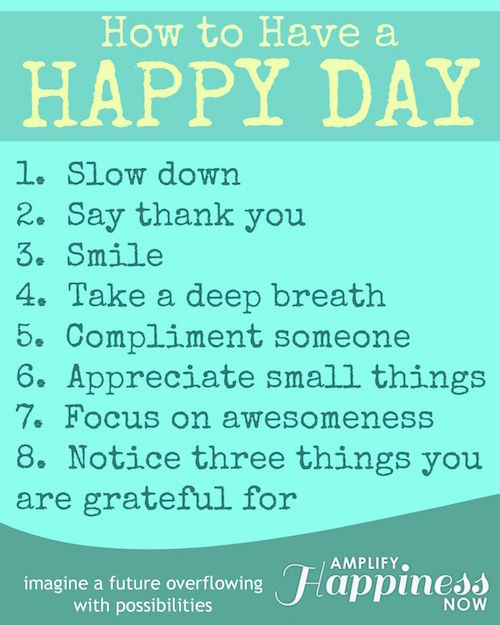
    1. Smile at others.

    Smiling makes others feel good when they see us doing it and it makes us feel good, too. It allows us to feel connected to other people, and this improves all of our moods. When I smile at people in the store and I get smiles in return, I notice that I get an immediate mood boost.

    2. Make eye contact with people.

    Many times we look at the ground or our phones instead of acknowledging the people around us. We avoid talking to people in line with us at the grocery store, and we act like we don’t see other people when we pass by them on the street. When we make eye contact instead of ignoring people, we make them feel seen and worthy of our attention—something we all want and appreciate.

    3. Take care of our environment.

    We all want to live in a clean and beautiful environment. The first step is to recycle and take care of our resources instead of being wasteful. Doing this ensures we leave our children a world they can take pride in and enjoy comfortably.

    4. Compliment other people.

    It’s important that we tell others how they make a difference in our lives and that we see all the amazing things they do. We can make a tremendous difference in their lives by sharing our gratitude instead of just thinking about it. I make an effort to compliment others about their work and let them know how important they are to me because I know that everyone wants to know that they matter.

    5. Be positive.

    Everyone benefits when we stop complaining and find the positive instead of focusing on the negative. We can make life easier for ourselves, and the people around us, if we stop worrying about the worst-case scenarios and try to make the best of our situations. When we cultivate a positive mindset, we not only feel more positive, we’re also more likely to create more positive circumstances.

    6. Help others.

    We often help others expecting something in return, but this can lead to disappointment and resentment. The alternative is to help others, especially those who are struggling, simply because we want to live in a world where people look out for each other.

    7. Be kinder to ourselves.

    Forgiving ourselves for any mistakes we make is much kinder than always mentally beating ourselves up, and being kind to ourselves is crucial if we want the world to be a nicer place. When we’re kind and caring to ourselves, we’re more open to kindness from others and more likely to treat others well.

    8. Stay mindful in the present moment.

    If we stop dwelling on things that have happened in the past and worrying about what might happen in the future, we’ll be able to experience all of the wonderful things that are happening in the present. When my mind wanders, I bring myself back to the now with three deep breaths. Mindfulness is a powerful way to increase our happiness, and that can have a massive ripple effect on the world around us.

    9. Express gratitude daily.

    Acknowledging all of the amazing things that we have happened to us puts us in a positive mindset, and it also provides us with the opportunity to thank others for all they’ve done. I practice gratitude daily by recording at least three things that I’m grateful for at the end of the night, and I’ve noticed it makes a tremendous difference in my mood and my relationships.

    10. Have fun!

    A lot of times we make situations out to be more much more serious than they need to be and we forget to actually let go and have fun. Let’s make sure that enjoying life is a priority so that we can actually take advantage of living in a nicer world!

    Photo by Juhan Sonin

  • 3 Ways to Be Kind and Make Someone’s Day

    3 Ways to Be Kind and Make Someone’s Day

    Smiling Together

    “The smallest act of kindness is worth more than the grandest intention.” ~Oscar Wilde

    It’s the small, everyday things that can make or break a day for us.

    While we celebrate the role models who inspire thousands (in person or on Facebook!), for most of us everyday moments—a stranger jostling us in the shops, a driver cutting us up at a light, someone pushing in front of us in line at the post office—can upset us out of all proportion.

    But the flip side is that we can also be disproportionately pleased by the small actions of a stranger.

    On a bad day recently, rushing down the road in Chiang Mai, Thailand, late for an appointment, I dropped my bag and things spilled all over the road. I looked at my possessions spread out in the dust beneath me and held back tears.

    As I stood there, a Thai woman, tending a food cart at the side of the road, walked over and carefully helped me pick everything up. Then she smiled at me, patted my hand, and walked back to her stall.

    This small act of kindness from a stranger reminded me to be kind to myself, and I took a breath before continuing with my day, lighter in heart and mind.

    Be that stranger. Here are three small acts of kindness you can carry out today.

    Offer your help.

    Last year I met someone who challenged himself to offer his help to one person every day.

    One day, I was really ill, in a foreign country, alone. I had no way of getting to the shops. He offered his help and brought me groceries. It was a small thing for him. But I was hugely grateful, and it made a real impact on me, this almost-stranger providing practical help.

    Now I try and offer my help more often.

    At first I used to think no one would be interested in my help, or they’d be suspicious, or dozens of other reasons that stopped me from offering. But even when people don’t need it, they appreciate being offered help.

    I offered someone help with something they were carrying yesterday, and while he turned me down, we exchanged a joke and a few words, and both of us went on our way happier.

    And when people do need the help, you’ll be amazed at the long-lasting impact it can have.

    Be of service. Offer assistance.

    Say thank you.

    You might say thank you 100 times a day. It’s a politeness, a courtesy. But how many times do you actually mean it? How many times are you still engaged in the conversation when you say it, and not turning away toward the next thing?

    I have a friend who doesn’t just write the usual “To Sarah, Happy Birthday, Love Mary,” on birthday cards but instead takes the time to write a more heartfelt message. She includes some of the things she appreciates her friend for doing for her that year.

    Getting a card from her doesn’t feel like a formality, it feels like a true connection. And her cards are the ones I remember.

    Today, say thank you like you mean it. Catch the other person’s eye and say it firmly. “Thank you. I really appreciate your help.” It could be to the girl who serves you your caramel macchiato in Starbucks, or your dad for helping you out by putting that shelf up for you.

    Or, if it feels too personal or intimate to say it face-to-face, write a letter or a card to a friend thanking them for something specific they contributed to the friendship last year—their joy, their lightness of touch, the great presents they always buy you, their sense of humor.

    Be grateful, and share that gratitude with the other person.

    Compliment someone.

    We judge others in our head all the time, just as we judge ourselves all the time. I hate that dress she’s wearing. I look fat in that mirror. I can’t believe she just said that. That nail  polish is awful. He really can’t do that yoga pose… It’s a constant narrative.

    But we also think positive things in the same way: I love that skirt. I wish my hair was that color. Those shoes are great. He does a great downward dog; I wish I was that confident.

    In my last job, particularly when I was feeling negative (and knew it might leak out), I used to push myself to articulate the compliments I usually just said in my head. Sometimes the person I was complimenting was a little taken aback, but they were always pleased.

    Put your focus on the positive by expressing it. Tell someone what you like, admire, and appreciate. Share the love.

    These actions might seem small, but not only do they make others’ lives better, they are also directly nourishing for you. Being kind is good is not only good for your heart, it’s good for your health.

  • A Simple Way to Make the World a Little Better Every Day

    A Simple Way to Make the World a Little Better Every Day

    Giving

    “Too often we underestimate the power of a touch, a smile, a kind word, a listening ear, an honest compliment, or the smallest act of caring, all of which have the potential to turn a life around.” ~Leo Buscaglia

    When I was seventeen years old, I decided to make a change.

    Instead of keeping my opinions to myself, I was going to start sharing them.

    Every time I had a kind thought about someone, I was going to tell them. And anytime I heard a compliment about someone who wasn’t in the room, I would let them know.

    If I loved someone’s outfit in the grocery store, I was going to say so. When my sister did something brave, I would tell her. When I felt a rush of affection for my best friend, I’d voice it. And when someone called a colleague brilliant, I would shoot them a note.

    This was something new for me. For whatever reason, I usually kept my nice thoughts to myself. I wasn’t in the habit of doling out compliments.

    And, yet, when I got a random compliment, it changed the shape of my entire day, sometimes my entire week.

    And so, at seventeen, I decided to change.

    It sounds like a pretty simple change to make in your day-to-day life, but even simple changes can be hard. Because so much of what we do is habit. If we’ve been keeping our thoughts to ourselves for twenty or thirty or even just seventeen years, it can be tough to start speaking up.

    But when you do make a commitment to make a small change like that, it can have a massive ripple effect. It can change your relationships. It can change your perspective. It can change the course of a life.

    And boy did it.

    The first time I complimented a stranger, he fell in love with me. Other times, I earned smiles, thoughtful pauses, and quiet, sincere thank-yous.

    But the most powerful change I saw was in the ripple effect that my decision had on those around me. In particular: on two girls that I met on my trip to Costa Rica later that year.

    It was a volunteer trip for teenagers and I was what they called a MAG Leader—a sort of camp counselor who roomed with and took responsibility for the wellbeing of five girls.

    Two of my five girls did not get along. They barely spoke, and when they did it was to antagonize the other. One girl made physical threats. Both did a lot of talking behind each other’s backs—until I introduced my compliment commitment to the group.

    I sat the girls in a circle and handed out index cards. Each index card had one of our names written on the front. And I told the girls that we were going to take a few minutes to pass around these cards.

    On each card, they should write one thing they really admired about the person whose name was on the card. One sincere compliment.

    Afterward, each girl got the card with her name on it.

    At the end of the few minutes we spent with these index cards, the two teenaged enemies were shocked to discover that the other person had something really insightful to put on their card. One girl commented on the strength and confidence of the other. The second girl admired the poise of the first.

    Suddenly and without meaning to, these girls respected each other. Suddenly, they each had something positive to say about the other.

    They never became best friends. But the bad-mouthing and the threats and the antagonism just melted away. A grudging respect and even courtesy took their place.

    This is when I really understood the power of compliments. The power of saying the kind things we think.

    It doesn’t take that much effort. You don’t have to manufacture a compliment for every person that passes by. But by simply voicing the nice thoughts that go through all our heads on a daily basis—“I love your sweater,” “What a beautiful smile,” “You’re so brave,” “I’m so glad we’re friends”—we can make the world just a little bit better every day.

    Photo by Kate Ter Haar