Tag: competing

  • Remembering What Truly Matters in a World Chasing Success

    Remembering What Truly Matters in a World Chasing Success

    Strive not to be a success, but rather to be of value. ~Albert Einstein, adapted

    I often feel like I was born into the wrong story.

    I grew up in a time when success meant something quieter. My father was a public school music teacher. We didn’t have much, but there was a dignity in how he carried himself. He believed in doing good work—not for recognition or wealth, but because it mattered.

    That belief shaped me. I became a teacher, filmmaker, and musician. And for decades, I’ve followed a similar path: one rooted in meaning, not money.

    But somewhere along the way, the story changed.

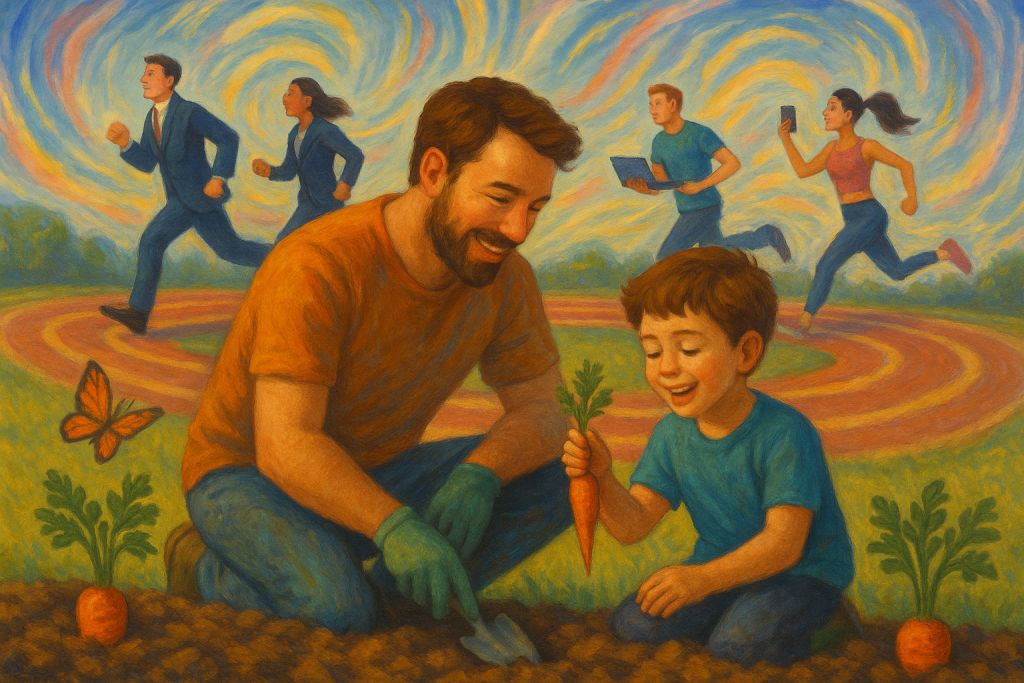
    All around me—especially in places like Los Angeles, where I’ve lived and worked—I see people running. Hustling. Branding. Monetizing. It’s not enough to be good anymore. You have to be seen. Promoted. Scaled. Life itself has become something to market.

    And in that shift, I’ve felt something sacred go missing.

    The False Promise

    I’m not against success. I want to be able to pay my bills, support my family, and feel valued. But the version of success we’re fed—fame, visibility, endless productivity—is a lie. It promises meaning but often delivers emptiness.

    We’ve replaced presence with performance. Care with clicks. Integrity with optimization. And the result? A society where exhaustion is normal and enough is never enough.

    Psychologists call it extrinsic motivation—doing something for a reward, like money or applause. It’s not inherently bad. But when it dominates our lives, we lose touch with intrinsic motivation: the joy of doing something just because it matters to us.

    When everything becomes a transaction, even joy starts to feel like a product.

    The Scarcity Game

    Sometimes I feel like we’re all scrambling for crumbs. Competing for attention, clients, gigs, or algorithms. Everyone trying to survive, to be seen, to matter.

    It’s primal—like a twisted version of the hunter-gatherer instinct. But where ancient humans balanced competition with community, we’ve kept the fight and lost the tribe.

    Now, even collaboration often feels strategic—a means to climb, not to connect. “Networking” replaces friendship. “Partnerships” become performance. We’re told to “collaborate” so we can get ahead—not because it nourishes our souls.

    That scarcity mindset doesn’t just shape how we work. It distorts how we see ourselves. If someone else is thriving, we feel like we’re falling behind. If we’re not being noticed, we start to doubt our worth.

    This isn’t just economics. It’s spiritual erosion.

    Capitalism and What It Forgot

    I’ve been thinking about capitalism—not as a political slogan, but as a cultural story. Adam Smith imagined markets built on freedom and mutual benefit. But today’s version often rewards extraction over contribution, performance over presence, and individual gain over shared good.

    Even education and healthcare—things meant to uplift—are judged by efficiency, growth, and return on investment. I’ve seen schools cut arts programs in the name of data. I’ve watched care become content.

    And I’ve felt it in myself—this pressure to prove my value with numbers, even when the most meaningful things I do can’t be measured.

    Another Way of Living

    I’ve spent time filming in remote indigenous communities in the southern Philippines, where life moves at a different pace. There, people didn’t ask how to monetize their purpose. They lived it. Storytelling was teaching. Planting was prayer. Taking care of elders wasn’t a chore—it was an honor.

    Nobody was branding themselves.

    But even in these places, that way of life is vanishing. Global markets, smartphones, and social media have arrived. The younger generation is pulled toward modern success. And who can blame them? Visibility promises power. But what’s quietly lost is the rootedness of belonging.

    And it’s not just them. It’s all of us.

    Do We Have to Disappear?

    Sometimes people say, “If you don’t like the rat race, go live in a monastery.”

    But I don’t want to disappear. I love music, conversation, cities, teaching. I want to live in the world—not retreat from it.

    So the real question becomes: Can we live meaningfully within this world, without being consumed by it?

    I believe we can. In fact, I think we must.

    There are people everywhere doing quiet, vital work: teachers who never go viral, gardeners who share food, coders who write open-source tools, volunteers who show up without posting about it. They aren’t trending—but they are tending to something real.

    Choosing What’s Real

    I don’t have a formula. I still worry about money. I still wonder if what I do matters. But I keep coming back to this:

    I’d rather make something honest that reaches ten people than fake something that reaches ten thousand.

    I’d rather be present than polished. I’d rather care than compete.

    If you feel this too—this ache, this fatigue, this quiet grief that something essential is being lost—you’re not alone.

    And you’re not broken. You may be one of the ones who remembers.

    Remembers what it feels like to listen deeply. To give without scoring points. To live from the inside out, not the outside in.

    That remembering isn’t weakness. It’s your compass. And even in a monetized world, it still points you home.

    The Truth Beneath the Lie

    Here’s what I’ve learned: Success, as we’re taught to define it, is a moving target. You can chase it for decades and still feel empty.

    But meaning—real, soul-deep meaning—is something we can return to at any moment. It’s in how we love. How we show up. How we make others feel. It’s in the work we do when no one is watching.

    We may not be able to change the whole system. But we can tell a truer story.

    One where value isn’t based on performance. One where success isn’t a finish line. One where we belong—not because we’re impressive, but because we’re human.

    That story is still possible. And it’s worth telling.

  • When I Stopped Competing, I Set Myself Free

    When I Stopped Competing, I Set Myself Free

    “With nothing to compare yourself to, aren’t you perfect?” ~Byron Katie

    I have never liked competition. Every time I compete, I feel pressured and disconnected from others. I love harmony, peace, collaboration, and win-win situations, kind of like “me happy, you happy.” I don’t need to watch another person lose the game to feel good about myself. I don’t need to dominate or put someone else down in order to feel superior and worthy.

    In some cultures, competing is perceived as a sign of ambition, power, and strength. Most of us grew up hearing constant comparisons, which turned into a habit during our adult lives:

    “Do I look better than her? I want to be slimmer.”

    “How much is he earning? I want more.”

    “Where does she live? I want a house at least that size.”

    And so on…

    In my home country, Romania, like in many other places, the schooling system was a fierce competition to get the best grades and be the first in the class. As a child, I remember spending an average of ten hours a day studying and doing homework during weekdays. I hardly had any time to play and relax.

    Teachers were always making comparisons between students, parents would compare their children to their friends’ or neighbors’ kids, and no one truly encouraged individual talents.

    As a result of this conditioning, I ended up struggling with serious self-esteem issues for many years. As a young woman, I didn’t see myself as good enough, beautiful enough, smart enough, or successful enough, and I desperately tried to be perfect.

    When I wasn’t competing with other people, I was competing with myself. I was always striving to be the best friend I could be, the best daughter, or the best employee at work. Pleasing others was addictive because I felt validated whenever I heard “well done!” And then I wanted to do even better.

    I am not here to blame. I am not a victim. My parents did the best they could at the time, and society did the best it knew, so I am not blaming but instead looking for hidden and limiting beliefs that have worked against me. Here’s what I have realized I need to do:

    1. Stop competing with other people.

    “Comparing yourself to others is an act of violence against your authentic self.” ~Iyanla Vanzant

    Our society often encourages competition. There are some circumstances when we have no choice but to compete—when applying for a new position at work or attending job interviews, for example. However, there are situations when we make the rules, and the choice is entirely up to us. We can live our own lives and mind our own journey, or we can choose to compete with others over who’s more attractive, wealthier, happier, or more successful.

    During my single years, I often compared myself to other women. Most of them seemed settled; they were married and had the house, the men, the kids, and the dog. I used to feel like a failure, as if something were wrong with me. I met my husband when I was thirty-six. We were two Romanians working in Asia, for the same company. Small world, indeed. We’ve been happily married for four years now.

    So here what I’ve learned: Everyone is on their own path, and we all do what’s right for ourselves, in our own time. I believe we live in a supportive Universe where everything unfolds perfectly—at the right time, in the right place. Comparing ourselves to others is an infinite source of stress and frustration, and it doesn’t serve us well.

    2. Stop competing against myself.

    “Doing your best is more important than being the best.” ~Zig Ziglar

    Perfection is nothing but pure fiction, an illusion created by our minds. It’s also a learned practice. Most of us were raised to constantly strive to become better people—to focus on our flaws and perceived limitations—and we either take our strengths for granted or aren’t even aware of them.

    While we are all learning from our experiences and mistakes, we also need to be aware of our gifts and talents. We need to celebrate our uniqueness and detach ourselves from the toxic habit of comparing ourselves to others.

    Yet here I am, in my forties, still reading about infinite ways to become a better human. With so much focus on the need for improvement, particularly in the personal development industry, I wonder when I am ever supposed to turn into the best version of myself and find peace.

    So I’ve stopped competing with myself. I refuse to fight against myself so that I can reach the end of the tunnel, and I am no longer waiting for the magical day when I will become perfect and faultless.

    Why turn my life into a never-ending competition? True friendship is not about competing against each other. It’s about support and collaboration. Why act as my competitor when I can be my own best friend?

    As the Chinese proverb says, “Tension is who you think you should be. Relaxation is who you are.”

    If I am to spend my precious time waiting to grow into the best of myself, there will always be something to change, add, fix, or transform so that I can finally feel whole and complete.

    Life doesn’t have to be such a daily struggle. I don’t have to fix myself because I am not broken.

    I embrace the entire repertoire of my humanity with self-love and compassion. I choose not to be a “work in progress.” My desire for growth is about taking each day as an opportunity to learn more about life and myself.

    That’s how I discover who I really am and what brings me genuine happiness and fulfillment. By releasing old patterns and limiting beliefs that don’t serve me well, I get closer to my real human essence. My life is all about experiencing things as they come. It is a journey of self-discovery, not self-improvement.

    Since I changed my perspective, I’ve stopped beating myself up. I now talk to myself kindly. I treat myself with dignity and respect. I know I am worthy of the best things life has to offer, and it is my birthright to be happy. My happiness is nothing to compete or fight for.

    I also choose to see myself as perfectly beautiful and beautifully imperfect. I celebrate my mistakes as much-needed opportunities for growth. I celebrate both success and failure because this is what makes me wiser. I treat every life experience as an opportunity to learn new things about myself and other people.

    Furthermore, I’ve learned to forgive myself for my mistakes in the same way I forgive others, knowing I am also human. As a student at the school of life, I will sometimes rise and sometimes fall, and that is okay. I no longer strive to become the best version of myself. Instead, I always do the best I can. When I know I’ve done the best I could, there’s no room for regrets. Whenever I know better, I do better.

    I am enough and worthy, so I don’t need to prove myself to anyone. Not even to myself. Newborns and babies do not compete against each other. They love and approve of themselves as they are. In our competition-oriented society, we need to remind ourselves more of our true nature, which is balanced, loving, and peaceful.

    I believe the world needs fewer fighters and competitors. The world needs more givers, peacemakers, and soul nurturers, and it also needs more compassion.

    The day I stopped competing against myself and others, I set myself free.

    Artwork by Rebecca Freeman

  • Why Sometimes It’s Good to Be a Loser

    Why Sometimes It’s Good to Be a Loser

    I love the word loser. I enjoy playing with it, feeling into it, and feeling my own gut reaction to the idea of allowing myself to be one. Some of the time.

    Our culture is obsessed with winning.

    At school we learn that we have to compete to get what we want. Many of us grow up internalizing this idea and subtly infusing it into our relationships, friendships, career, and even spiritual path.

    If this is strong in us, there can be a pervading sense of alienation, disconnectedness, or even mistrust that we carry around.

    In my early days as a Buddhist monk, I remember being almost shocked when I began to see that in the quietude of my mind, in this harmless, benevolent environment, I was secretly measuring myself and others according to how “spiritual” we were.

    And I was trying to be the best. I was doing many things, some of them ridiculous in hindsight, to be seen as “better than.”

    The flip-side of this was that I never felt good enough. Our fixation with winning is an attempt to cover up this feeling of being somehow deficient.

    A couple of years ago, I met an old friend, who asked me what I was doing these days. I replied, somewhat mischievously, “Being a bit of a loser.”

    His expression was telling. He looked confused. Then he looked sad for me. Then he asked, “You’re joking right?” (more…)