Tag: clarity

  • How Two Simple Lists Completely Transformed My Life

    How Two Simple Lists Completely Transformed My Life

    “Happiness turned to me and said, ‘It is time. It is time to forgive yourself for all of the things you did not become… Above all else, it is time to believe, with reckless abandon, that you are worthy of me, for I have been waiting for years.” ~Bianca Sparacino

    I didn’t know who I was.

    That realization hit me like a punch to the chest after I ended a decade-long relationship and canceled my wedding six weeks before it was supposed to happen.

    I remember standing in my kitchen one morning, staring at the floor, and thinking, I have no idea what kind of music I actually like.

    That might sound small, but it was the beginning of everything unraveling.

    Because when you don’t know what kind of music you like… you probably don’t know what your values are. Or your opinions. Or your boundaries. Or your identity.

    And in my case, I didn’t.

    My identity had been shaped entirely by other people. I had become an expert in sensing what people wanted me to be—and then being it.

    I did it with romantic partners, with friends, with coworkers. It was like I had this superpower: I could walk into a room, assess the energy, and morph myself into whoever I thought would be the most likable version of me in that context.

    Great for my acting career. Not so great for real life.

    When the relationship ended and I finally found myself alone, I didn’t just feel lost. I felt hollow. I didn’t have a self to come home to. And the loneliness? It was unbearable.

    I entered what I now call my “summer of sadness.”

    At the time, I called it freedom. I drank more than usual. Partied more than usual. I told myself I was finally living. But behind all of it was a deep, silent ache. A confusion. An emotional fog that wouldn’t lift.

    Eventually, the fog turned into something darker: I spiraled into a rock-bottom moment I never saw coming. It was like my soul said, Enough.

    And somewhere in that mess, I grabbed a pen.

    I didn’t know what else to do. I had so much swirling inside me, and nothing made sense. So I sat down with my journal and wrote two lists.

    List One: Who I Am

    This list was hard to write. It wasn’t self-love-y or positive. It was honest.

    I wrote things like:

    • I’m anxious and overthinking constantly.
    • I say yes when I want to say no.
    • I try to be what I think others want me to be.
    • I interrupt people when they are speaking because I want to feel relatable.
    • I feel guilty all the time, and I don’t know why.
    • I don’t trust myself.

    There was no sugarcoating. No judgment either. Just observation.

    I looked at the page and thought, Okay. This is where I’m at.

    Then I flipped the page.

    List Two: Who I Want to Be

    This list felt different. Not dreamy or abstract, but clear.

    I wrote things like:

    • I want to be grounded and calm.
    • I want to be kind, patient, and generous.
    • I want to listen more than I speak.
    • I want to say no without guilt.
    • I want to show up more in love and less in fear.
    • I want to move through the world not feeling like I always need to prove myself.

    Reading them back, I could feel how wildly different those two versions of me were—not just in how I showed up for the world, but in how I treated myself.

    One list was full of fear, defensiveness, and guilt. The other was rooted in confidence, calm, and choice.

    It wasn’t about becoming a brand-new person. It was about becoming more me—the version of me that had been buried under layers of people-pleasing, perfectionism, and performance for years.

    You can’t become who you want to be if you’re not honest about who you are right now. That’s exactly what those two lists gave me—an unfiltered look at both sides of the mirror.

    As I looked at both lists side by side, I didn’t feel shame. I felt clarity.

    The gap between them wasn’t a flaw. It was a direction.

    And I had a choice to make. Keep going as I was—or finally do the work to change.

    Not just for a month. Not just until I felt better. But for real this time.

    The kind of change that’s uncomfortable. The kind that reworks your patterns, rewires your reflexes,
    and asks you to let go of everything that no longer fits.

    That moment became the foundation of my healing journey.

    Awareness First, Then Change

    Let me be clear: I didn’t wake up the next day and magically become that second list.

    What I did was start noticing. I’d walk away from conversations and think, Ah… I interrupted people a lot again. I tried to be funny instead of real. I said yes when I meant no.

    At first, that awareness was frustrating. I wanted to be further along. But eventually, I realized the win is in noticing.

    What helped me most in this part of the process was journaling.

    I began tracking my thoughts, my actions—even entire conversations. I’d ask myself: Was I present today? Or was I in my head? Did I try to prove something? Where did that pattern show up?

    Sometimes I’d set one small focus, like “interrupt less,” and observe that for weeks. I started noticing who I felt the need to impress, when I lost presence, and what kind of people triggered those old habits. I wasn’t trying to fix it all at once—I was learning myself in real time. That awareness, day by day, became the bridge.

    That’s the starting point for every real shift.

    Over time, those small moments of noticing turned into different choices. I started speaking up. Setting boundaries. Sitting with my emotions instead of numbing them. Choosing presence over performance.

    And little by little, I began becoming the person on the second list.

    Not perfectly. Not quickly. But honestly.

    What I Learned from Writing Two Lists

    1. Change starts with radical honesty. You can’t grow if you’re not willing to name where you are.

    2. Self-awareness is a skill, not a switch. It builds slowly. Be patient.

    3. You don’t need to know the whole path. Just the direction is enough.

    4. The goal isn’t perfection. It’s alignment. It’s feeling proud of who you are becoming.

    If you’re in a season of unraveling, I see you. It’s disorienting. It’s uncomfortable. But it might also be the doorway to everything real.

    So grab a pen. Write your lists.

    Not to shame yourself, but to meet yourself.

    That moment of truth might just be the moment that changes everything.

    You don’t have to write your lists perfectly. You don’t even have to know what to do with them right away. Just be honest. Start where you are. Let clarity come before change—and let that be enough for now.
  • Feeling Stuck? Maybe You Don’t Need to ‘Fix’ It Right Now

    Feeling Stuck? Maybe You Don’t Need to ‘Fix’ It Right Now

    “Growth is painful. Change is painful. But nothing is as painful as staying stuck where you do not belong.” ~N. R. Narayana Murthy

    Anyone who had a Stretch Armstrong as a kid remembers that moment when you and a friend would test the limits of what good ol’ Armstrong could handle. You’d each grab an arm and slowly walk backward, waiting for that pivotal moment when either your strength would give out or Armstrong’s limbs would tear apart like a medieval torture device.

    If you reached your strength limit, an older sibling would eagerly join in—nothing brought them more joy than watching your excitement dissolve into tears as Armstrong’s newly limbless body crossed the point of no return.

    Why do we get stuck? We fail to define stuckness for what it is.

    Feeling stuck does not mean your feet are superglued to the floor.

    Being stuck is an active state that pulls you in opposite directions—just like Armstrong. One part says, “Don’t give up,” while another says, “This isn’t working.” No wonder it’s impossible to move forward. But what if, just for a moment, you didn’t have to choose?

    What if you could just be with this stuckness without needing to solve it right now?

    Maybe even acknowledging it, like, “I’m stuck, and it makes total sense considering all the shit going on in my life.”

    I’m currently dealing with existential angst about my career. While there are so many advantages to working for yourself—no one telling you where to be or what to do and having freedom over your time—the downside is flipping that world upside down: with no one checking in, it’s painfully isolating. There’s no one to lean into or pick up the slack on hard days, and there’s no sense that you’re working toward a common goal. You own everything.

    Warren Buffett’s right-hand man, Charlie Munger, famously stated, “Life is all about making wise choices and dealing with trade-offs. In business and elsewhere, I’ve yet to see a good example of something that’s totally free—there’s always a catch, always a cost.”

    Being happy does not come from avoiding trade-offs but from being clear-eyed about which ones you’re willing to accept.

    This is where I’m stuck. I’m not sure those trade-offs are worth it anymore. After eight-plus years of working solo, I’m hearing the siren call of a life I long for, being a part of a cause bigger than myself.

    But how do you distinguish between times when you should sit with uncertainty and times when you need to take decisive action and stop overthinking?

    Powerful question, eh?

    There’s a real balance between giving something space and taking action; it can be hard to know what is needed.

    This is the clarity that awareness can give us.

    It’s an opportunity to notice the energy behind your desire to act.

    Does action feel like it’s coming from urgency, fear, or the need to escape discomfort?

    That’s a damn good sign action is not the answer.

    Or do you have a sense of clarity, even if it’s not total certainty?

    If the action feels like relief rather than running, that might be a sign it’s time to move.

    When you think about taking action right now, does it feel like relief and alignment? Or does it feel more like panic and pressure?

    I don’t have clarity. I don’t know what I want. I’m flooded with emotions.

    My energy is pulsing with urgency, fear, and a need to escape the discomfort.

    What does that tell me? I’m trying to make a decision from a place that’s not grounded.

    That doesn’t mean I won’t take action—it just means my system needs more space, so I’m not making decisions from a place of fear.

    In a culture that sees action as the only solution, it’s easy to be swept away by thinking movement is how we solve stuckness, but this comes back to failing to see it for what it is: You’re being pulled in opposite directions.

    The faster you race toward answers, the more answers race away.

    I’m no further ahead than you on this adventure. Life is unfolding for both of us, one day at a time.

    Know that I see you.

    Instead of taking action, would it feel supportive to take a small step toward grounding?

    Maybe a deep breath, placing a hand on your heart, or even reminding yourself, “I don’t have to figure this all out right now.”

    Would it feel okay to just acknowledge that for a moment? Letting all parts of you know, “I see the pain, I see the urgency, and I’m not ignoring you. I just want to move from a place of clarity, not fear.”

    You don’t have to rush—just allow yourself to settle before deciding what’s next.

    How does that feel?

    Finding that starting point—where you feel grounded instead of just reacting—is everything.

  • How to Reconnect with Your Higher Self for Clarity and Direction

    How to Reconnect with Your Higher Self for Clarity and Direction

    “Listen to the wind, it talks. Listen to the silence, it speaks. Listen to the heart, it knows.” ~Native American Wisdom

    Have you ever felt stuck? Stuck in a business you’ve lost passion for, a job you no longer enjoy, a relationship that no longer fulfills you, or simply stuck in indecision about how to move forward in life?

    That feeling of “stuck-ness” often leads to anxiety, fear, and even shame. I understand these feelings well.

    When the pandemic hit in 2020, my life turned upside down—as it did for many. I was the founder and executive director of a national arts organization, something I had built from the ground up and led for eighteen years.

    Suddenly, overnight, I felt like I could lose it all. My funding partners and sponsors pulled out, I was sinking deeper into my line of credit, and I was responsible for a staff spread across the country.

    The stress was overwhelming. I couldn’t sleep, I became irritable and edgy with my family, snapping at them over the smallest things, and some days it took a tremendous amount of willpower to just get out of bed and face the day. I had never felt so lost, uncertain, or fearful.

    It wasn’t just the fear of losing a business and my paycheck—although that certainly caused a lot of anxiety. The bigger fear was losing my sense of identity. Who was I if I wasn’t the executive director and founder of this organization? Before starting this non-profit, I felt insignificant, like a nobody. I didn’t want to go back to that place. I didn’t want to lose what I had built.

    This fear consumed me, and I asked everyone I knew, “What am I supposed to do?”

    One day, I brought this question to my business coach. She responded with a single question of her own: “What do you typically do when you feel stressed and anxious?”

    “Well, I usually go for a walk in the woods,” I replied.

    “Perfect,” she said. “Here’s what you’re going to do: Every day for the next thirty days, you’re going to go for a walk in the woods and simply look and listen.”

    “What? I can’t do that. I don’t have time for that,” I stammered. In my head, I thought, What kind of business coach tells her clients to go for a walk in the woods? I needed business advice, not nature therapy.

    Somehow, she got a commitment out of me. Every morning at dawn, as this was the only time I felt I could make this daily walk work, I was out the door into the forest behind my house. And every day, I demanded answers from God, the squirrels, and the universe: “What am I supposed to do?”

    Slowly—ever so slowly—something shifted. A sense of calm settled over me. I began to notice the beauty around me: the varying shades of green, the way light filtered through the canopy of leaves, the chorus of birdsong, the creek’s melody as it rushed over rocks, the silky texture of moss-covered bark, the intoxicating scent of spring blossoms—you could almost taste the air.

    And then, I started to feel gratitude. Gratitude for the trees, the air, the stillness. Gratitude for my business coach, who had nudged me toward this practice. This gratitude felt like a swelling of love in my chest for everything that is in this moment.

    And in this calmer state of mind with gratitude in my heart, I asked the question again: “What am I supposed to do?”

    This time, I got an answer.

    “What do you want to do?” a voice bubbled up from within.

    It was my own voice—but like an older, wiser version of me.

    I didn’t miss a beat. “What do you mean, what do I want to do? What am I supposed to do?”

    “No, Anita,” came the steady response. “What do you want to do?”

    “I don’t know. I don’t know.”

    “Yes, you do.”

    That stumped me.

    Later that day, I found myself wandering the spirituality section of a bookstore. A book caught my eye: Conversations with God by Neale Donald Walsch. I picked it up, flipped it open, and one line jumped off the page:

    Frustration and anxiety come from not listening to the soul.”

    My breath caught. I read the words again, letting them sink in. In that moment, I realized a profound truth—I wasn’t listening to my soul.

    I had been here before. This wasn’t the first time I’d been reminded to slow down, go inward, and reconnect with my inner wisdom. But I had gotten so busy, so caught up in my business, my family, and all my responsibilities, that I had forgotten. Not only did I lose my connection to that part of myself, but in many ways, I had lost sight of who I really was and what I truly wanted.

    For nearly five years now, I’ve devoted myself to the study of remembering—of reconnecting with my higher self, God, Source, the Universe (whatever name feels right to you—they are all the same to me). When we connect with our higher self and consistently listen to our soul voice, three truths are revealed:

    • The truth about who we are.
    • The truth about what we really want.
    • And the truth about why it matters.

    When we stop listening to our inner wisdom, we become drowned out by external noise—the voices of others telling us who we should be, the media convincing us we’re not enough, the fearmongering that keeps us feeling small and powerless.

    But when we reconnect with our higher self:

    • Clarity of purpose and direction emerges.
    • Fear and self-doubt loosen their grip.
    • An inner harmony steadies us, no matter how chaotic the world seems.
    • Our capacity for self-love deepens.

    And with that, we become un-stuck. We step into our greatest potential. We create a life filled with meaning, well-being, and joy.

    How Do We Reconnect with Our Higher Self?

    When I first realized I was asking the wrong question and switched to asking, What do I want?”, I skipped an essential step—the inner work that allows you to connect with your higher self and find the answers you seek. Eventually, I figured it out. And it’s really quite simple.

    At its core, reconnecting with your higher self is about slowing down and giving yourself the time and space to cultivate that relationship.

    Here are three key steps to help you do that.

    Step away from the busyness of life.

    Block out time each day to unplug from work, responsibilities, and distractions. Make this a daily non-negotiable. My favorite way to unplug is by walking in nature, which has additional health benefits. I recommend at least twenty minutes of mindful walking daily. Mindful walking is a form of meditation, but simply sitting in meditation is also a great option.

    Speak your gratitude.

    Science has shown that practicing gratitude reduces stress, elevates mood, and improves overall well-being. More importantly, it opens the heart—making it easier to hear the whispers of your soul.

    Engage all your senses in the present moment.

    What do you see, hear, smell, feel, and even taste? When you fully engage with your environment using all your senses, you become present. And presence is the gateway to connecting with your higher self.

    Once you’re grounded in the here and now, that’s when you ask yourself one simple question: “What do I want?” Then, listen.

    Listen with your whole body. Pay attention to ideas that surface, images that appear in your mind’s eye, sensations that arise. Don’t judge any of it. Just be open and curious.

    Nothing may come at first. But keep returning to this practice—getting present, going inward, and asking, What do I want? Soon, you’ll hear the whispers of your soul. And if you learn to listen and act on those whispers, you too will get unstuck and be guided to a most remarkable life.

    Are You Ready to Listen to Your Soul?

    I invite you to embark on your own thirty-day nature challenge. Each day, step outside, breathe deeply, and simply observe. Let nature be your guide as you reconnect with your inner wisdom. Notice what shifts within you—how clarity emerges, how gratitude deepens, how your soul whispers its quiet truths.

    Will you take the challenge? Let me know how your journey unfolds—I’d love to hear what insights arise for you.

    PS: In case you’re wondering what happened next—when I finally tuned in and listened to the whispers of my soul, my life radically changed. I realized that what I truly wanted was to close my business, as I had lost my passion for it years ago, but fear had kept me stuck. The whispers of my soul then guided me to let go of most of my possessions and embrace a nomadic lifestyle.

    This decision has led my husband and me on an extraordinary journey, experiencing many incredible corners of the world. Along the way, I recreated myself as a life and leadership coach, guiding others on their journey to their highest selves. As I continue to listen, life unfolds in the most beautiful and unexpected ways.

  • What You Need to Know If Decisions Stress You Out

    What You Need to Know If Decisions Stress You Out

    “There are no right or wrong decisions, only choices.” ~Sanhita Baruah

    When I was younger, everything felt simple. Not necessarily easy, but simple in the sense that there was always a next step. A clear direction. A right way to do things.

    If I studied, I’d pass the test. If I practiced, I’d get better at my sport. If I followed the rules, I’d stay on track. Life moved forward in a straight line, like climbing the rungs of a ladder—one foot after the other, up and up and up.

    I didn’t question this structure because it was all I knew. And honestly? It was comforting. The certainty of it all. The feeling that as long as I did what I was supposed to, things would work out. Teachers handed out syllabi at the start of the year, neatly mapping out what was coming. Coaches had game plans. Parents had advice. Even when things got hard, there was always a framework. A way forward.

    I think about how movies portray childhood memories—colors cranked up to impossible brightness, the world rich and saturated, full of warmth. Because when you’re a kid, things feel solid. The rules make sense. The paths are laid out. You don’t realize how much of your life is being decided for you, and in a strange way, that makes things feel safe.

    Then, at some point, it all disappears. The structure. The guideposts. The sense of certainty. And suddenly, life stretches out in front of you like a blank map, and you’re holding the pen, unsure of what to draw.

    That moment—the moment you realize no one is handing you the next step anymore—is terrifying. Because if there’s no clear “right” choice, what’s stopping you from making the wrong one?

    There wasn’t a single moment when it all changed. It happened gradually, like the end of a song fading out until you realize there’s no music playing anymore.

    At first, I kept waiting for the structure to return. I thought maybe adulthood had its own version of lesson plans and progress reports, that someone—anyone—would step in and hand me a checklist of what to do next. But that never happened. Instead, I was met with an unsettling quiet.

    No more automatic next steps. No more guarantees.

    And with that silence came an unexpected weight.

    I started second-guessing everything. Not just the big, obvious life decisions, but the small, everyday ones too.

    Was I supposed to stay where I was or move? Take this job or hold out for something better? Was I wasting time? Making the wrong choices? Shouldn’t I know what to do?

    I realized then that I had spent years assuming every decision had a right answer. That life was a series of multiple-choice questions, and if I just looked hard enough, I’d find the correct one. But now, it felt like I was staring at a blank page, trying to write in pen, afraid of messing it up.

    No one told me how heavy uncertainty could be.

    And the worst part? I started believing that not knowing meant I was failing. That if I wasn’t moving in a clear direction, I must be doing something wrong. I looked around at other people—some who seemed so sure of their path—and wondered why I couldn’t feel that same clarity.

    But then I asked myself: What if they’re just as unsure as I am?

    What if we’re all just making it up as we go?

    For so long, I thought the goal was to figure out the right path. To make the right choices. To avoid the wrong ones at all costs. But lately, I’ve started wondering: What if there isn’t a right choice? What if there’s just… a choice?

    That question should feel freeing, but for a long time, it paralyzed me.

    I became so obsessed with making the “right” move that I stopped moving altogether. Every option felt like a risk. If I picked wrong, I’d waste time, waste effort, maybe even waste years. What if I chased the wrong career? Moved to the wrong city? Invested in something that wouldn’t pay off? Every path had its unknowns, and instead of picking one, I stood still, overthinking every possibility.

    And the longer I stood still, the harder it became to take any action at all.

    I convinced myself that not deciding was better than making the wrong decision. That staying in place was safer than stepping in the wrong direction. But that’s the thing about waiting—nothing changes. The fear doesn’t go away. The answers don’t magically appear. You just sit in the same uncertainty, hoping for clarity that never fully comes.

    At some point, I had to ask myself: What if the only way forward is to move, even if I’m not sure? What if the worst outcome isn’t choosing wrong, but never choosing at all?

    So maybe the next thing isn’t the “right” thing. Maybe it’s just something. A step. A choice. A movement.

    And maybe that’s enough.

    At some point, I realized that life wasn’t black and white—but it also wasn’t gray. Gray implies balance, a predictable mix of extremes. Something stable. But that’s not what life feels like. Life is more like an off-white—uncertain, shifting, something that looks different depending on the light.

    I used to think uncertainty was something to fix. A problem to solve. But what if uncertainty isn’t the enemy? What if it’s just part of being alive?

    The truth is, I don’t know if I’ll ever feel 100% certain about anything. And maybe that’s okay. Maybe I don’t need to know. Maybe the point isn’t to eliminate doubt but to learn how to exist alongside it. To accept that I can move forward without having every answer.

    Some days, that’s easier said than done. On those days, I remind myself:

    • Not knowing doesn’t mean I’m lost. Just because I don’t see the full path doesn’t mean I’m not on one.
    • No decision is final. Even if something doesn’t work out, I can pivot. I can start over. I can change my mind.
    • Other people don’t have it all figured out either. Some just got better at pretending.
    • Waiting for clarity won’t bring clarity. The only way to figure out what works is to try something. Anything.

    I used to think confidence meant being sure of everything. Now, I think it means being okay with uncertainty.

    Life is never going to be neat or obvious. It’s never going to fit into clear categories of right and wrong. But maybe that’s the beauty of it—maybe life is meant to be lived in the off-white.

    I think back to all the times I agonized over a decision, convinced that one wrong move would ruin everything. I stressed, I overanalyzed, I played out every worst-case scenario in my head. And yet, when I look back now, most of those choices—whether they turned out “right” or not—don’t carry the same weight they once did.

    Some of the things I worried about didn’t matter at all. Other things didn’t go how I expected, but they still led me somewhere meaningful. And the most surprising part? Some of my so-called “mistakes” ended up being the best things that ever happened to me.

    At the time, I didn’t see it that way. At the time, I was convinced I had taken a wrong turn. But looking back, I can see that every decision—good, bad, uncertain—shaped me.

    The job I took because I thought I had to? It taught me what I didn’t want.

    The opportunity I turned down out of fear? It made me realize I needed to be braver.

    What I once saw as missteps were actually just steps—part of the path, part of the process.

    I wonder what choices I’m agonizing over right now that, in a few years, I’ll see differently. I wonder if I’ll laugh at how much I overthought things, how I was so afraid of getting it wrong when, in the end, everything was just unfolding the way it needed to.

    It makes me think: If I’m going to look back someday and see that everything worked out one way or another, then why not trust that now? Why not let go of some of the pressure?

    Maybe I don’t need to know if I’m making the perfect decision. Maybe I just need to make a decision and trust that I’ll figure the rest out along the way.

    I used to believe that one day, I’d wake up and just know. That clarity would arrive like a neatly wrapped package—here’s your answer, here’s your direction, here’s the certainty you’ve been waiting for.

    But that day never came.

    And I don’t think it ever will.

    Because life doesn’t work like that. There’s no singular moment where everything clicks into place. No guarantee that the path we’re on is the one we were “meant” to take. No cosmic confirmation that we’re doing this whole life thing correctly.

    And maybe that’s not a bad thing.

    Maybe the goal isn’t to have everything figured out. Maybe the goal is to get comfortable not knowing. To make peace with the ambiguity instead of fighting it. To stop treating life like a problem to solve and start seeing it as something to experience.

    So what if I don’t know what’s next? So what if I don’t have a perfect plan? I’m still here. I’m still moving. I’m still learning.

    And maybe that’s enough. Maybe I’m enough. Right now. In the middle of the uncertainty. In the middle of the mess. In the middle of the off-white.

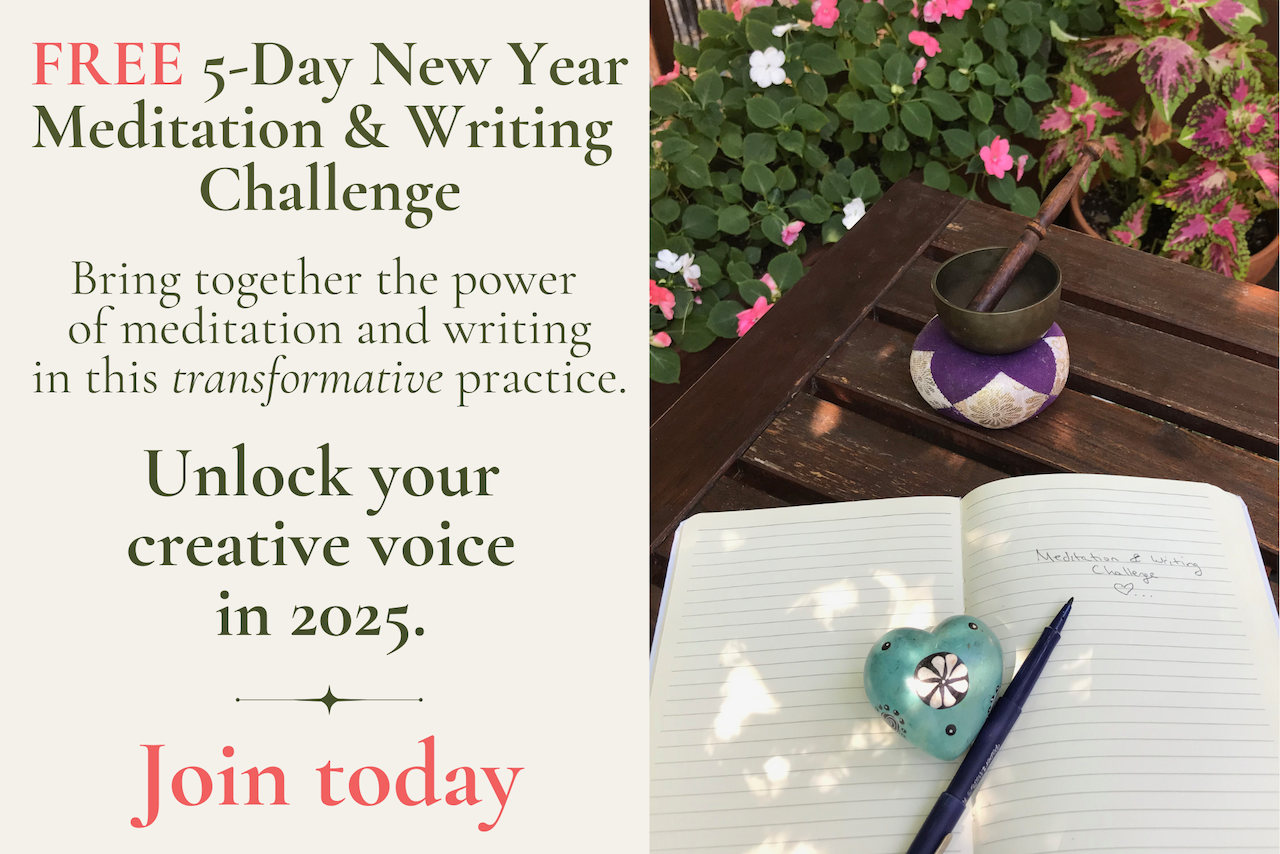
  • Free New Year Meditation & Writing Challenge

    Free New Year Meditation & Writing Challenge

    Hi friend! As you might recall, last fall I shared an empowering five-day meditation and writing challenge from Tiny Buddha contributor Nadia Colburn. This month, she’s back with another free meditation and writing challenge, designed for the new year, focused on transformation, and I can’t recommend it enough!

    Founder of the online creative writing school Align Your Story, Nadia is a poet, memoirist, and yogi who has a talent for helping people create inner calm and access their most authentic voice.

    That’s what I love about her challenges—they allow us to turn down the mental noise that creates stress and confusion and tune into the gold of our intuition and creative genius.

    Each day’s fifteen-minute recording includes a short meditation, an evocative poem, and a prompt-based writing exercise inspired by that day’s piece.

    Though the meditation practices all vary, they all gave me quick access to increased calm and focus. And the poems and prompts are all perfect for this season of transformation, when so many of us are looking to get unstuck and create positive change.

    Like last time, I recognized common themes in my writing—blocks I need to address, fears I need to face, beliefs I need to challenge, and truths I need to accept.

    Life has been particularly overwhelming in recent months, due to significant challenges in every area of my life, and I’ve often felt lost in the haze of my own mind. Each day’s challenge elicited a new aha moment for me, giving me hope that greater clarity is coming.

    You don’t need to even think of yourself as a writer to enjoy and get something out of this challenge. It’s for anyone who wants to connect with themselves more deeply and perhaps find some of the answers they’ve been seeking externally within the quiet of their own mind.

    Some of Nadia’s past participants have noted how easily their writing flowed after meditation and how the prompts brought them unexpected insights.

    If you decide to give this challenge a try, I have a feeling it could do the same for you. You can access it for free here.

    Happy writing!

  • How the Deathbed Meditation Can Bring You Clarity, Purpose, and Joy

    How the Deathbed Meditation Can Bring You Clarity, Purpose, and Joy

    “Death may be the greatest of all human blessings.” ~Socrates

    There’s a lot of beauty and value in positive, light-and-love approaches to mental, emotional, and spiritual well-being.

    But I challenge you to go a little deeper and to face something we’re all going to experience eventually:

    Death.

    I know this may sound macabre, bizarre, or downright unappealing. But hear me out!

    There is a certain power and beauty in consciously visualizing and meditating on one’s death.

    What could be more awakening and more revealing than putting your current self into the perspective of your dying self—into your last few moments?

    Such a precious practice helps to bring a stunning clarity and crystalline focus to everything going on in your life.

    Indeed, what is referred to as the “deathbed meditation” helps you to:

    • Figure out what is most important to you
    • Let go of old pains and hurts
    • Focus on what brings you joy
    • Find your true life path
    • Uncover your hidden gifts

    As humans, we tend to live our lives as though they will never end. From one day to the next we live in a kind of autopilot mode where we take everything (and everyone) for granted.

    The deathbed meditation is a powerful practice you can incorporate into your life whenever you feel lost, stranded, stuck, out of focus, or simply aimless.

    My Experience With the Deathbed Meditation

    I’ve always been someone who desperately needs a strong purpose in life.

    But something happened last year that tossed me into a dark existential crisis where I questioned (1) what my place in the world really was, (2) why old wounds were rising to the surface, and (3) why I felt so lost—despite having a strong self-care and spiritual practice.

    With the advent of COVID-19 and the retriggering of old traumas, I felt empty inside.

    You know that feeling of falling and not having anything to catch you? That’s how I felt.

    Witnessing the suffering in the world and in my own circle of family members, I realized something major: “I could die tomorrow.”

    I realized this isn’t a groundbreaking thought; we all have it at some point (I know I have). But in that moment it felt like a lightbulb went off in my head—I suddenly realized that the key to finding the answers to life was to contemplate something so few people dare to approach: death.

    The answers I received from that subsequent deathbed meditation have guided my life, reawoken my purpose, and fuelled me with vision ever since.

    How to Practice the Deathbed Meditation

    Doing the deathbed meditation is an act of radical self-love. There, I said it!

    Why radical? The deathbed meditation is radical because it’s rarely mentioned or practiced by anyone (that I’m aware of) due to its intimidating nature.

    But let me assure you that the answers you can potentially find are so soul-nourishing, so meaningful, so profound, that you will be overjoyed that you courageously took this step.

    Before you embark on this inner journey, please ensure you have a neutral mind—we don’t want minds that are feeling down or frazzled or unhappy for any reason (that will bias your discoveries).

    When you’re ready, let’s begin:

    1. Focus on feeling safe and relaxed.

    Before you begin your deathbed meditation, find a space in your house that feels cozy. You might like to place a blanket over you and a pillow behind your head for extra comfort. Draw the blinds or curtains and ensure the atmosphere is dark.

    It’s important that you feel safe and relaxed so that your heart and mind can open up and gain the most from the meditation.

    Place a blindfold, sleep mask, or cloth over your eyes so that you can’t see anything. Then take some gentle, natural, grounding breaths and settle yourself.

    2. Find some funereal music (optional).

    Some people prefer their meditations to be totally silent, but if you’d like to set the mood, find some funereal music (or music that would be played at a funeral) to prepare your mind for the scene.

    Again, do whatever makes you feel most safe and comfortable. If you prefer total silence, that’s okay too.

    3. Visualize yourself on your deathbed, surrounded by loved ones.

    In your mind’s eye, imagine that you only have a few minutes (or hours) left to live. You feel comforted and at peace with your loved ones surrounding you.

    What kind of room are you in? What kind of bed or seat supports you? Focus on some kinesthetic details to help enrich the visualization.

    4. Ask yourself, “What was I most happy to have done in life?”

    Take some moments to reflect on this crucial question: What were you most happy to have done in your life? Let images and scenes play out in your mind for as long as needed.

    This powerful question will help you to hone in on what truly matters in your current life. If you’re struggling with making an important decision or finding a life direction, this simple question could be the key to unlocking deep truths residing within you.

    5. Ask yourself, “What did I regret not doing?”

    Regret is a natural part of life, yet many of us shy away from it, trying to sweep it under the rug. To avoid accumulating too much regret, ask this simple question within your deathbed meditation: What did you regret not doing?

    Let any thoughts, images, memories, or scenes run through your mind’s eye. Take special note of them.

    6. Ask yourself, “What is the most important thing in life to me, above all else?”

    Values are what guide our lives, and yet we are often totally unaware of them. By asking the question, “What is the most important thing in life to me, above all else?” we come to understand, truly understand, what we value deep down.

    Take a few moments in your deathbed meditation to contemplate this question, letting it sink into the recesses of your mind, heart, and soul. The answer you discover can have the potential of shifting, expanding, and empowering your entire life.

    7. Thank your loved ones and end the meditation.

    Once you’re done asking all or some of the above questions, smile warmly to your loved ones and thank them for their presence in your life. Then, when you’re ready, return to the room you’re in, get up very slowly, and do a big stretch.

    You might also like to drink some water to ‘emotionally digest’ your experience.

    The deathbed meditation has been one of the most powerful tools in my life for getting straight to the heart of what I most love, cherish, value, and need.

    After all, what else can put things in perspective other than our own mortality?

    If you’re feeling confused, lost, or in need of direction, I highly recommend that you try this unique meditation at least once. You might be surprised by how intensely transformational such a practice can be!

  • How a Simple Action Word Can Guide You Through Even the Hardest Days

    How a Simple Action Word Can Guide You Through Even the Hardest Days

     “Our intention creates our reality.” ~Wayne Dyer

    What if you only had one thing you needed to accomplish today? One over-arching objective that encapsulates the multiple items on your to-do list or the meetings on your calendar? One word that you set in the morning and carry throughout the day to stay in focus and on purpose?

    Actors know that in order to convey a story well, they have to play an action versus an emotion. There has to be a verb involved in order to act. This might include something like provoke, seduce, destroy, or flatter, versus trying to portray an adjective such as humble, confident, or sad, which read neither truthful nor clear on stage or film.

    Simple action words, kept at the forefront of thought, can be powerful allies in keeping our thoughts, intentions, and actions clear as we move throughout the day.

    If you have a morning meditation, study, or stillness practice, the action word can come out of inspiration gained there and can be targeted to what the need of the day is calling for. Words might include focus, bless, or harmonize to name a few.

    What matters is that the word sits as an overlay atop the to-dos and the schedule for the day so that it infuses all of those seemingly disparate actions with a unified purpose, intent, and energy.

    If you hold a verb like harmonize at the top of your mind as you go about the activities of your day, you’ll see how the action of that verb seeps through in your tone, what you say, and how you treat people.

    I have seen action words come in handy when working with public speakers and executives giving presentations because they help to focus the energy, the intention, and the message.

    Most people don’t get up in front of others just to hear themselves speak. Most have an objective that is often obscured by data or too many slides. Identifying an action word at the outset of content creation, and keeping it top of mind as the story develops, is a simple and powerful way to keep a talk on track and achieve the objective the talk wants to achieve.

    Examples might include: motivate them to make their number, inspire them to serve in their community, or educate them on the hazards of too much sitting.

    I remember a time pre-Covid, where holding one word simply helped me to breathe through a perfect storm week of overwhelm and over-scheduling.

    I was in the middle of a tight-turnaround project with a grueling Fortune 10 client that demanded late nights. I was in tech week for a play opening in Silicon Valley. I was preparing a talk for an L.A. entertainment company, which required air travel, and I was trying to be present for a much-needed (and non-refundable) workshop getaway with my husband.

    While all of these commitments were of my choosing and were essentially positive when viewed separately, they were crashing and colliding in my mind. I couldn’t find the hours or the space that each seemed to need.

    My habitual physical reaction to such overwhelm is to lie awake in bed consecutive nights ruminating, catastrophizing, and fixing. And we all know that fixing anything in the middle of the night or during a day following a night of no sleep is about as effective as pouring hot water into a chocolate teapot.

    The word I leaned on? Surrender. I had to surrender the outcomes I wanted, or believed I needed, in order to relax and breathe.

    A wise mentor once used a golfing analogy to say that all we can do is execute the perfect swing and let the ball go where it will. By surrendering, I was allowing the balls to go where they would. I would show up and do the best I could do with each piece one by one as the demands arose and release the outcomes. The word surrender is also a powerful antidote to cortisol surges of stress. And it’s a great word to hold before bed if sleep stress is an issue.

    Holding an action word in mind can be applied to problems and demands as they crop up during the day. Try applying a word like release to traffic jams, cranky customers, or impatient bosses. Calling up the word to the forefront of thought can re-focus how you want to show up in the world. Or the moment. Scribble it on a post-it note and stick it to your monitor, workspace, or dashboard where you can prominently see it to be reminded throughout the day.

    In our distracted, hyper-connected world, sometimes the simplicity of one little word can help to cut through the mental static.

    Be.

    Serve.

    Listen.

    Simple in form, powerful in practice. Choose a word and lean on it for a full month. Or pick three verbs that define your year. Or change your mind at lunchtime and come up with a new verb for the second half of your day. The only rules are to choose something, keep it alive in your thinking, and ensure it is a verb so that it’s actionable.

    My favorite three verbs right now? Connect. Release. Love.

    What are yours?

  • When You’re Confused About What to Do: How to Find Clarity

    When You’re Confused About What to Do: How to Find Clarity

    “Nothing in the world can bother you as much as your own mind, I tell you. In fact, others seem to be bothering you, but it is not others, it is your own mind.” ~Sri Sri Ravi Shankar

    Do you ever feel confused about what to do and unsure about how to find clarity?

    Maybe an unforeseen event, like a layoff or breakup, knocked you into a mental spin. Or perhaps you’re muddling along, with no clue where you’re going.

    Confusion can leave you helpless, indecisive, and afraid. And not knowing what to do only adds to your mental chaos.

    I’ve been there, lost, irresolute, and undecided in life. But, amid my mid-life confusion, life-changing trauma blasted all that mental mess aside and made way for a greater worry—leukemia.

    Yet, surprisingly, cancer guided me toward mental clarity and calm.

    But don’t despair. You don’t need a tragedy to create inner lucidity. Because here’s the three-step method that I discovered to transform confusion into mental clarity.

    Slow Down for Mental Clarity

    Your first step is time.

    A few months before my leukemia diagnosis, I anguished over a career shift. Well into my forties, I heard an invisible clock ticking and pressured myself to make the perfect decision.

    Instead, I only stressed myself. The confusion never left me, and I never arrived at any conclusions.

    Then leukemia halted me physically, forcing me to slow down. Self-isolated, with a weakened immune system, I found myself with an abundance of time. And I used that time to sort out the mess in my head, a mess that suddenly seemed futile.

    I learned that important decisions require contemplation, and contemplation requires time. Only the space to reflect will sort out your mental ramblings.

    So, be kind to yourself and give yourself the time to get clear on what’s clouding your head.

    Depending on your situation, you might need a full day in a relaxed setting to analyze your options and weigh the pros and cons. You could take a week or two alone in a meditative, spiritual, or agnostic retreat vacation. Or you can take a sabbatical.

    The greater your decision, the more time you’ll need.

    Be an Observer

    When you distance yourself from your thoughts, you can better decipher your mind’s turbulence.

    Because physical space isn’t enough. You need more mental space, too.

    Often, as you multitask your hours and days away, you fill your mind with busyness. And a monkey mind only tightens your mental bind.

    So, your second step to mental clarity is to begin noting and observing your thoughts without judgement. How? With mindfulness, which is excellent for both mental and emotional clarity.

    To prevent my mind from wandering to dark places during my frequent hospitalizations, I practiced deep breathing exercises, focusing only on my breath. And that breathing technique forced me to stay present.

    I made fast progress into mindfulness and spotted repeated thought patterns. I realized my confusion didn’t stem from my indecisiveness over a career change. Instead, it masked a profound dissatisfaction with how I was living life. I lacked direction and purpose. So even if I had changed jobs, it wouldn’t have eliminated my mental chaos.

    When you observe your thoughts, the key to clarity is to note them for what they are without criticizing yourself. I noted my thoughts as “fear” or “worry” or “dissatisfaction,” which helped me to understand and accept them.

    Once you let go of your internal critic and accept your present mindset, you cut through your haziness to reveal your true mental and emotional states.

    Trust Yourself, Not Your Confusion

    “You are not your mind.~Eckhart Tolle

    Once you step away from thoughts, you realize you and your mind are two separate entities, and you don’t have to believe it.

    When this realization sinks in, you can untether yourself from the thoughts that hold you back.

    You’re not confused because you don’t know what to do; you’re confused because you’re telling yourself limiting stories about what you can do. Deep down you know what you want, but limiting fears, beliefs, and assumptions are making you question yourself. And many have no basis in reality.

    For example, you might strive for perfection because you fear making mistakes. And perhaps you fear making mistakes because you’re convinced others can love you only if you’re perfect.

    The ultimate step is to challenge your beliefs to achieve both mental and emotional clarity.

    When considering a career change, I dismissed writing as a possibility. I kept pushing that solution away. And I never questioned myself.

    Yet my battle with leukemia gave me time and presence of mind to challenge myself.

    And what did I discover?

    I never considered writing as a career change because I didn’t believe in my capabilities.

    Because I didn’t believe in myself.

    Only then did I understand my confusion: the lack of self-examination created all of my mental and emotional upheaval.

    With no judgment and no shame, I accepted that limiting belief, hidden in the corners of my mind for ages. And I realized it wasn’t true.

    So, I let it go.

    Are you telling yourself you’re a failure or that you’re not good enough? You won’t know until you begin with some thoughtful questions.

    To help you challenge yourself, try this 4-question technique from Byron Katie:

    • “Is it true?”
    • “Can you absolutely know it’s true?”
    • “What happens when you believe that thought?” (what are your reactions or emotions?)
    • “Without the thought, who would you be?”

    Your answers will most likely surprise you, but also free you from stagnating beliefs.

    When you create space, live in the present, and question your confusion, you will discover mental clarity.

    Conquer Confusion with Mental Clarity

    These three sure-fire steps will lead you on a path to more clarity.

    And, over time, you will be more adept at preventing confusion as you stay present and aware of the mental traps. And each time you get snagged on confusion, you’ll know how to free yourself from it.

    So, take back your power, make better decisions, and live a more courageous life thanks to your newfound mental clarity.

  • How to Push Through Phases of Uncertainty

    How to Push Through Phases of Uncertainty

    “I beg you, to have patience with everything unresolved in your heart and to try to love the questions themselves as if they were locked rooms or books written in a very foreign language. Don’t search for the answers, which could not be given to you now, because you would not be able to live them. And the point is to live everything. Live the questions now. Perhaps then, someday far in the future, you will gradually, without even noticing it, live your way into the answer.” ~Rainer Maria Rilke
    I once trekked on my own along the Salkantay Trail in Peru between the town of Mollepata and the magnificent Machu Picchu. The journey in total was fifty miles, and it took me four days. I had never backpacked before, let alone on my own, let alone in a foreign country, but the opportunity was appealing.

    Along the way, I learned four important lessons that have helped me accept and make sense of phases of uncertainty. But before I share those, a little backstory:

    The year prior, I experienced many internal challenges. In a short time, I transitioned from having clear direction in my life and knowing what was important to me to having no grasp of what I wanted and feeling lost. The feeling was unfamiliar to me. I had spent much of my life plowing forward, knowing exactly what I wanted, why, and how to get there.

    Almost two years before my trip to Peru, I had just finished working breathlessly on a local political campaign for the 2016 election. The candidate lost, and the outcome of the presidential election left me feeling even more defeated.

    Shortly after, I traveled to Thailand for three weeks with a friend. When I returned to the states, I was unsure of where I wanted to place my next step. I was still feeling politically fired up, and with that energy, I decided to start a nonprofit organization in my state to encourage women to run for office.

    I worked day in and day out putting together statistics, a website, a business plan, and coffee dates with important people in the community. It didn’t take long for the organization to gain momentum because it attracted the support of people who were also intensely moved by the election.

    Meanwhile, I entered into a tumultuous and emotionally exhausting relationship, I moved to a different town after living in my parents’ basement, and I was seeking full-time work to pay bills that I barely had the money to cover. I felt split between two worlds: one of chaos and one of professionalism. In my naive mind, I believed those two worlds existed separately, and I couldn’t find my place in either one.

    When I jumped on the opportunity to start an organization in my community, I wasn’t fully aware of how demanding it would be. Just as it started to gain momentum, I secretly knew I didn’t want to be part of it long-term.

    I knew I was capable of building the organization, but I was also young and inexperienced, insecure, and distracted by the ambiguity of being a fresh college graduate. I chased after a shiny object that I, as I got closer, discovered wasn’t something I was as interested in as I initially thought.

    A year after the organization started, I resigned from the Board of Directors. We then decided to dissolve the organization altogether, and I breathed a major sigh of relief.

    Around the same time, my boyfriend and I split for the second or third time. I was left in a state of confusion and felt defeated again, but it was a different type of defeat. It was a feeling of intense vulnerability. I felt exposed and lost—two feelings I’ve always been good at avoiding.

    When I decided to trek fifty miles through the Andes Mountains, it was an attempt to find clarity. I hoped that hiking by myself in nature would bring sudden insight into what I had just experienced and what I needed to do next.

    I instead learned that clarity doesn’t arrive just because we demand it. Rather, clarity comes in its own time, typically after one has endured the uncomfortable but often necessary road of uncertainty.

    If you’re currently facing uncertainty in your career, relationships, or any other area of your life, perhaps some of my other lessons will be helpful to you.

    1. It will be painful—keep going anyway.

    On the third day of my hike, I grew nasty blisters on the heels and toes of my feet. I also felt a throbbing pain on the inside of my calves. Halfway through the day, simply putting weight on my foot became the most painful task.

    I was walking by myself on a dirt road, and I had no idea how much further I had to walk before reaching my campsite. I wasn’t even confident I was headed in the right direction.

    Okay, just walk to that point, I’d tell myself, looking about 100 meters ahead where the road curved or changed in some way. Maybe the view will change once you get there, I thought.

    A different view meant that I might suddenly see my campsite in the near distance. Not knowing kept me going because there was always the possibility that I was meters away from resting.

    Breaking the hike down into smaller chunks also helped me to stay motivated. If I imagined the total distance I had left to go, it was overwhelming.

    A journey of uncertainty guarantees pain. It’s uncomfortable. It’s vulnerable. It’s frustrating. Sometimes we want to lie down in the middle of the road and give up. It feels easier to stay in the same place than to walk toward something that’s unknown.

    But with uncertainty, there is no way out but through. Try to break it down into more manageable parts—can you make it through the day? The week? The next month?

    With uncertainty, you never know when you might turn the corner and suddenly see answers in sight. Tomorrow might offer insight, so why stop now?

    2. Distractions don’t solve uncertainty.

    The beauties of traveling alone are many, but they always come with a degree of loneliness. In Peru, it was difficult to wake up cold and alone in a tent, knowing I only had myself to talk with. I would’ve much rather reached my arm across to pull a warm body close.

    I was jealous of the couples I had encountered on the same trail who were hiking together. I was frustrated with my loneliness and annoyed with myself for being alone.

    Really, what I wanted was love to distract me from the uncertainty I was facing in my life. But I knew that if I wallowed in what I wanted instead of what I had to do, which was to pack my tent and all my other belongings into my backpack and move forward, I would stay stuck in the same place and wouldn’t get any closer to my destination.

    When we’re caught in a phase of uncertainty, it’s tempting to attach to distractions that’ll keep us from focusing on the discomfort we feel. The most appealing distraction when confused about life is to chase after opportunities that aren’t necessarily best for us. The panic we feel when we lack direction is so strong that we would rather seek mediocre, senseless options than stay in the uneasiness as we wait for clearer direction.

    Ultimately, waiting for direction leads us to our greater purpose. But we can’t follow the direction if we’ve already made a decision based on fear.

    3. Trust that there will be guides.

    The first time I went the wrong way along the trail was on day one. I had just walked through some sort of political event. Interested citizens sat along a ledge while they listened to a well-dressed man speak in a confident tone.

    After I passed, I took a left turn at a crossroads. I heard a voice behind me and turned around. It was one of the men from the group, pointing in the opposite direction. He had followed me a few steps up the trail, making an effort to redirect me. “Salkantay?” I said. He nodded.

    On the third day, I arrived at a small village where a family of three lived. After hiking a steep hill, I sat on a wooden stump by their home to rest. I bought and devoured two passion fruits from their garden.

    On my way out, I turned right on a dirt road. A boy about two years old saw me and pointed left. “Salkantay?” I said. He cocked his head. “La Playa?” I said the town where I was headed. He nodded and pointed left again. I turned around and continued to hike along the dirt road.

    On the last day, I passed a turn I needed to take. My senses stopped me. I had just passed a few hikers, and they weren’t behind me any longer. I pulled out a book of directions (which I’m never good at understanding), walked back, and found the small path that led me into the mountains.

    Without unfamiliar faces along the way to guide me, I would’ve easily wound up lost in the Andes Mountains. Maps and written directions aren’t always helpful when standing in a specific place.

    Sometimes, finding the way requires trust. If you haven’t found a sign to help guide you on your path of uncertainty, have faith that it’ll arrive in the right moment. The only way to find the signs is to keep walking—keep taking action and trying new things. The signs and guides are waiting for you to arrive.

    4. Take good care of yourself.

    Near the end of the trek, when my feet were blistered and my legs swollen, it was important that I had enough time to rest before the next day. I knew that in order to push forward, I had to take care of my body.

    I spent the evenings stretching, massaging my muscles, and wrapping tape around my blisters. Though the pain would still be there the next morning, it was a little more manageable than the night before. The pain had subdued just enough that I knew I could continue hiking.

    Since we’re never sure when a phase of uncertainty will end, it’s critical that we take care of ourselves throughout it. Creating time to rest and take care of ourselves—which for me is getting enough sleep, exercising, and journaling—ensures that we will have enough energy to push through the discomfort we feel.

    It’s when we lose our energy that we cling to distractions, miss important signs along the way, or give up. Trust that no matter how difficult a single day is, there is always space to pause and take a deep breath. Sometimes that’s all you might have energy for, and that’s okay. Without rest, there is no journey.

    On my flight out of Peru, I peered out the window at the many trails that marked the earth’s skin like scars. I thought about the trek I had just experienced. I wondered, what did the trail look like from the sky?

    I imagine a life’s journey looks similar. It curves and zigzags through different terrain, some parts uphill, some downhill. It’s never a straight line.

    Uncertainty is a natural and guaranteed part of life. A journey isn’t intended to be seen from a bird’s-eye view. It’s rather meant to be lived in the moment through our own experiences. We don’t need to know what lies beyond what’s right in front of us. We’ll reach it eventually, in the right time.

    There are moments when we reach a lookout point and can make sense of the larger picture of our lives. From that perspective, we can look back at the journey we just accomplished. We can understand the connection between the series of events that have created our lives up to that point.

    But more often than not, we don’t have the ability to see our journeys from the lookout point. We instead see what it looks like right in front of us: a steep hill, thick trees blocking the view, and no signs in sight. We have doubts about what lies ahead.

    When we trust that there’s a grander view of the trail we see directly in front of us, we can muster the energy we need to carry us to a day when, finally, we reach a lookout point. From that view, everything makes sense. Trust that, regardless of what it looks like now, the lookout points are waiting for you along your path.

  • Life Is a Cycle of Happiness, Sadness, Clarity, and Confusion

    Life Is a Cycle of Happiness, Sadness, Clarity, and Confusion

    Woman Looking Up to the Sky

    “Life is a cycle, always in motion. If good times have moved on, so will times of trouble.” ~Indian Proverb

    Two years ago I went on a volunteer trip to Vietnam, where I had hoped to find both myself and my purpose (ambitious), but instead found a rocky adventure that continues to teach me things to this day.

    I was in the middle of a difficult time that was secretly a rebirth. It’s always hard to see that when it’s happening, isn’t it?

    For a few amazing months, everything made crystal clear sense, and I felt like I could see through all realms of existence to the truth. I started listening to my body and my spirit rather than my brain. Life opened up to me.

    I uncovered a deep interest in the healing power of art, especially dance and movement. I realized said interest was embedded in who I’ve been all along, I just had to take a minute to listen and let it show itself.

    I have been a dancer all of my life, and somewhere along the way forgot that the reason I started dancing was because it allowed for joyful, authentic expression.

    Three-year-old Laura knew that. I got older and forgot—I got wrapped up in doing, in trying to be the best, in comparing myself to others, in pushing myself and my body beyond what was loving.

    I believe art is essentially a spiritual practice—any art. But, being humans (oh, humans), it’s easy to get wrapped up in the more worldly aspects of art. I’m talking recognition, fame, money, perfection, applause, all that.

    That’s cool, it happens. But what my soul really wanted to do was dance and sing around my apartment and figure out how my body wanted to move when it wasn’t being told what was “good” and what was “bad.”

    I could go on forever about this. I’ll spare you. But I implore you, make your art. Just make it, simply because it allows you to express who you are.

    You don’t have to make a big stink out of it with performances and shows. You can if that feels right. But if you don’t want to show your art to anyone and want to just create for the sake of creating, that has enormous value and is, indeed, enough.

    I started doing dance improvisations in my apartment regularly. I began going to auditions less and going to Central Park to be with nature and read about healing arts more.

    I have practiced Pilates for years to take care of dance-related injuries, and a little voice inside said, “Hey, what about teaching Pilates?”

    I said, “Alright, what the heck, let’s see.”

    I started my certification off with a full scholarship to a mat training program at a studio that welcomed me with open arms. If that’s not a nudge toward something, I don’t know what is.

    I met an amazing man approximately five days after declaring, “Okay, Laura! We are not worrying about men anymore! I am going to focus on what I am doing, and worry about that later.”

    Before meeting him, I told him flat out, “I’m not looking for a boyfriend right now,” and of course, that’s when your person waltzes right into your life. Our first year together flew by.

    I felt my heart opening up. I felt like I was expanding and moving into a different time of my life, a more authentic expression of who I am. I honored my intuition as best as I could, and it served me well. I was crazy happy. Like, hard to sleep happy.

    I remembered that I had options and choices—what an incredible blessing. I did not have to keep doing the same thing I had been pursuing for years. I was free to let other, unexplored parts of myself out into the world. This was exciting and relieving.

    I simultaneously felt like I had control and that, in fact, I didn’t need to have control, because reality was showing me the way.

    I even went to Vietnam a second time and visited the same village I taught in the year before. This time I had a cute and supportive travel companion, as well as a heck of a lot of perspective. I felt like a different version of myself, although essentially the same. (I still got hangry and coped pretty badly with jet lag…)

    And then, you know what happened? I got kind of confused again. A few months after the clarity burst, I started questioning again: “What am I doing? What should I do?” And then things were clear again. And then I was confused. And on and on. Sometimes life felt magical and sometimes it didn’t,

    Sometimes things make sense and then they don’t make sense again. It’s a spiral.

    We circle around to similar lessons, feelings, and challenges, but we experience them at different levels of awareness. And we keep hitting the same challenges until we learn the lessons we need to in order to let go and grow. At least, that’s how it seems to me.

    And it also seems that we can learn a lesson, let something go, and then later on forget we learned the lesson and need to do it again. You know what I mean?

    For my twenty-seventh birthday in June, I went out of my comfort zone to a hippie farm up in the Berkshires. I’m talking barefoot, vegan, everyone dancing all the time in the grass. It was pretty amazing, but for this city girl, at first it was a lot.

    I spent the week on retreat working through Anna Halprin’s life/art healing process. A year before, I read (more like devoured) her book Dance as a Healing Art during my daily trips to Central Park.

    The book was one of the first I read during my period of magic. It was very cool to be in the mountains a year later doing the work myself. We danced, wrote, sang, drew, cried, laughed, and supported each other through our individual journeys of self-discovery and healing.

    I met some amazing people that I felt deep connections with very quickly. I was skeptical at first, but I did my best to trust the process, and the results were pretty astounding.

    One of the last days of the workshop was my actual birthday. I gathered the resources I had created over the week—my writing, drawings, notes, and dances—and saw a message in all of them.

    Ultimately, what my heart was saying was “Go deep into yourself and just be.” That was an interesting message, because I came there looking for answers about what to do.

    For a week after that workshop was over, I felt like I had expanded, just as I had felt the year before when all the magic was happening, but this time on a deeper level. I felt like I was high. (I wasn’t, I swear).

    I felt so secure, so calm, so content just to be—happy sipping tea with my man across from me, happy walking through trees in the rain, happy watching the sky. It was one of the most profound experiences I have ever had, and it all came from being.

    Since I’ve been back, I’ve settled back into my humanity, meaning, sometimes I feel grounded and free and other times I feel confused and irritable. I’m getting the impression that this cycle is kind of the way it is, and part of the human experience. Perhaps the cycle is the human experience.

    We are in constant motion and everything changes, but this doesn’t have to be scary (even though it is).

    Actually, it can be amazingly freeing, because in moments of loneliness or confusion, you can trust that there will also be moments of deep love, connection, and clarity.

    Dance the dance, sing the song, write the story, draw the shapes, and embody who you are.

    One of my all time favorite quotes is “Joy is the other side of sadness,” which I heard Sharon Salzberg say at Tibet House in NYC almost ten years ago, when I first discovered meditation.

    I say this frequently to people who feel guilty or worried about not feeling happy. Joy is not just feeling happy and clear. Joy is also feeling sad and confused with an open heart.

    Perhaps the universe lines things up for you in lightening moments of clarity as encouragement, a gesture of unconditional love. But then it pulls away and leaves you to navigate on your own, to wrestle with the uncertainties and take leaps of faith into unchartered territory.

    Discovery isn’t nearly as rewarding, beautiful, and profound if you know the exact path to getting there. Up and down, round and round, we keep going, getting closer and closer to who we are.

  • What to Do When You’re Panicking Because You Can’t Make a Decision

    What to Do When You’re Panicking Because You Can’t Make a Decision

    “No one saves us but ourselves. We alone must walk the path.” ~Buddha

    I got a frantic message from a friend last night.

    Everything was going wrong—her job, her relationship, her life—and she didn’t know what to do.

    “Help me, please,” she kept saying. “I don’t know what to do.”

    I tried hard to stifle a giggle. I know, completely inappropriate. But I found it really funny.

    Why? Because I’m the last person anyone should be asking for advice. If I knew what to do, if I knew how to help her, I’d have:

    1. implemented this a long time ago in my own life to solve issues that I, myself, have been grappling with
    2. created a website and published a book and video tutorials with the answer
    3. bought my own island in the Caribbean just from the proceeds of the book sales (I’d give the money from my website ad sales and video to charity, obvs)

    I’d be rich, because this is what every human being confronts at some point in their lives—what should I do?!

    We all hate the unexpected. We all hate uncertainty. These situations usually mean we haven’t gotten what we want or things aren’t going as we wanted them to go. We know we need to make a decision. We know we need to do something. But making a decision is hard, especially when things are uncertain.

    In moments like this, we become frantic, we flail, we panic. I know because I’ve done all three. Several times.

    And then we become obsessed with our problems. We think about them.

    All. The. Time.

    And then we think about them some more.

    Sometimes my brain actually starts to ache from all this thinking and analyzing. We get exhausted, mentally, physically, and emotionally. And when we realize we are no closer to solving our problems or making a decision, we start becoming more frantic and we flail and panic even more.

    So of course, it makes sense that we turn to others for answers at times likes this. Because in this moment, we are in no state to save ourselves. My friend is not an exception. Most of us have turned to others at some point or another.

    I couldn’t give my friend any answers that night. I knew she wanted a specific solution to address her issues. But I didn’t have any. And here’s the scary news: no one does.

    You are the only one who can save yourself. You are the only one who can solve your problem.

    Hearing that probably wants to make you hide under your duvet and never come out.

    I don’t know what to do, remember? How am I supposed to save myself?? I don’t even trust myself to change a light bulb!!

    I hear you. And you can stop hiding now and jump out of bed, because here are three simple things you can do in times like this.

    (Note: These three ideas aren’t solutions to your problem. But they help you, they help the situation, and they allow you to get to a place where you are better able to pin down the right decision.)

    I know they might not seem like much, and it’s easy to dismiss them. It might even seem like I’m not taking your problem seriously. All I can say is that I’ve gone through these situations time and time again, and doing the things below has definitely helped me.

    It stopped me from being completely consumed with my problem. It helped me create much-needed space and clarity.

    Also, if you are being put out of balance by one part of you life, your best hope is to bring in some balance from another end.

    What’s the alternative? Thinking more about the problem at hand?

    We both know how that usually works out.

    1. Be frantic, flail, panic … then get it out.

    Whine to your amazing friends who listen to you patiently with nothing but love and empathy, even though you’ve been putting them through this time and time again.

    Then go jogging, go to the gym, go for a swim. Write in a journal. Do something to get all that anger, resentment, fear, and pity out of you.

    You’re in over-active child mode right now—tire yourself out.

    2. Go spend some time outdoors.

    Go for a meander in the woods, walk along the ocean. Observe the birds in action, pay attention to the trees, watch the clouds in the sky. Basically spend some time in nature.

    I’m not sure what it is, but there’s something calming about nature. It slows us down. It tires us out (see point 1). It gives us perspective. It shows us that there is more to life than our problems and worries. Mary Oliver’s beautiful poem, The Shore comes to mind;

    I go down to the shore in the morning
    and depending on the hour
    the waves are rolling in or moving out,
    and I say, oh, I am miserable, what shall—
    what should I do?
    And the sea says in its lovely voice:
    Excuse me, I have work to do.

    3. Do something else.

    Worried about whether you should end a relationship? Go learn to play a new musical instrument.

    Worried about how you are going to make your mortgage at the end of the month? Go volunteer at your local charity. Or:

    • Read something uplifting every morning, afternoon and right before going to bed
    • Watch YouTube clips that crack you up
    • Meditate
    • Write five things you are grateful for every morning
    • Start a new habit (i.e.: get up an hour earlier, drink more water)
    • Learn origami
    • Spend some time cleaning your closet
    • Offer to babysit for your friends (kids are amazing distracters!! It’s hard to focus on your problems when you are constantly trying to keep them from falling over or hurting themselves.)

    As humans who lead very human lives, mud gets thrown at us at some point or another. And when you stop flailing and panicking, when you calm down, when you focus on something else, you give the mud a chance to slide off and settle down; you allow the waters to get less murky. And things get clearer.

    Maybe in this clarity you’ll know what to do. Or maybe you will have made your peace with what’s happened.

    More likely, you’ll probably have moved on to something else and forgotten what was winding you up in the first place. Or something else might have happened to completely transform the initial situation.

    That’s the other thing about life. It’s full of surprises.

  • 10 Ways To Declutter Your Mind For Clarity, Focus, Peace, and Balance

    10 Ways To Declutter Your Mind For Clarity, Focus, Peace, and Balance

    Man Meditating

    “Life is as simple or complicated as we make it.” Donna Smallin

    The dreaded “C” word. Clutter.

    We all deal with it. In some part of our world, we face it: be it in our closets, in our offices, or even in our bodies. But the most distracting and debilitating cluttered space is in our heads.

    You know the feeling. Driving on autopilot to work. Forgetting important dates. Leaving the water running or the stove on. Stumbling over words, unable to make a point.

    When we’re caught up in our heads, distracted by worry or fear, we’re not present or clear-headed. And when we’re not clear-headed, we lose the connection to ourselves, our environment, and our lives.

    Mental clutter pulls us off center, disrupting our balance. It can get so jumbled and disorderly up there that we end up lost in la la land.

    Clearing Clutter At The Root

    Fortunately for me, I grew up in a big, loving family. However, a big family tends to hold all sorts of clutter. Raised with four siblings sharing one bathroom, one TV, and one telephone, let’s just say it got ugly. Probably didn’t help that Mom was a shopaholic and Dad was a packrat.

    The claustrophobia of my childhood left me wanting to live clutter-free.

    It wasn’t until my college years away from home that I started noticing how my mind was the cause of any clutter I carried with me; nothing and no one else was to blame.

    After a huge quarter-life crisis, I saw how I was compromising my own clarity and life balance with my own head-trash—the junk I kept upstairs.

    I then made a conscious choice to declutter my life, starting at the root of it all—my mind.

    But how do you begin to clear away the clutter you can’t see?

    Decluttering the mind requires us to become intentional on where we place our attention and how we spend our time and energy.

    Here are some tips to help you do that.

    1. Keep a gratitude log.

    Gratitude is appreciating what you have. It’s saying that what you have is enough. Taking time every day to consider your blessings will help bring balance to your life. It’s hard to be grateful and angry at the same time.

    Spend five minutes every day to note at least five things you’re grateful for. Some ideas: time with a friend, an award at school, your seatbelt, your breath, the colors in the park, and even the nourishing beauty of a rainy day.

    2. Journal.

    Whether digitally or with paper, journaling is a wonderful release of pent-up thought. By writing down your thoughts, worries, hopes, and experiences, you are finding respite from the chatter inside your head.

    Even though you’re still thinking of these things as you write, it’s like you’re observing the situation from ten feet away, no longer completely absorbed in the emotionality of it.

    Try to journal every day for however long it takes to feel peace on a topic. The more you do it, the faster the peace comes. Like in therapy, simply letting it out is healing because we’re relieved of the burden of keeping it all inside.

    3. Laugh.

    Laughter has been proven to be the best medicine for relieving stress. It eases defensiveness, lightens your emotional load, and lifts stress off your shoulders. It brings balance to your psyche because laughter is presence.

    Practice not taking yourself so seriously and laugh more often. Really laugh. A deep, hearty, Santa laugh. Watch comedies, hang out with funny friends, go to a comedy club, read the Sunday comic strips, or play with your kids or your dog. With so many options, stress doesn’t stand a chance.

    4. Zone out.

    Take time to rest your mind every day. Let your mind shut off from having to process, apply, or interpret information. This means no TV, no conversation, no reading, and no problem solving.

    Take a break from the chores, from the duties of the day. Let the breath come and go naturally, and the eyes roam wherever they want.

    Look at the trees sway, the clouds float, the stars shimmer. Afterward, when it comes time to work, you’ll find focus more easily than before your mini-retreat.

    5. Control your media intake.

    Watching or listening to anything and everything just because it’s on doesn’t bode well for your psyche. Subtle opinions, biases, and judgments creep into your mind and embed thought structures. Oblivious, you then form opinions that aren’t your own, simply because you heard it on the radio.

    Start really paying attention to the noise that you let seep into your eyes and ears. Ask, Is this benefitting my life in any way?

    6. Get creative.

    As often as possible, connect with your inner child by exploring your imagination. Let curiosity lead. When it comes to opportunities to get creative, there are plenty! A few of my faves: puzzles, coloring, drawing, singing, dancing, and even making a meal from scratch.

    The point is to get lost in awe and wonder like you did at five years old. When you achieve that feeling from a certain activity, keep doing it!

    7. Exercise.

    Move. Sweat. Stretch. Get active and get your endorphins going! Exercise helps control your weight, prevent illness, boost energy, and improve your mood. It helps you sleep better, feel better, and focus better.

    Find an activity that inspires you to raise your heart rate—dance, yoga, martial arts, running, walking, whatever. If maintain some level of frequent activity, it will serve your health and well-being for years to come.

    8. Get clear on your priorities.

    To figure out your top priorities, list your goals, your motivations, and those relationships that matter most to you. Then rank them in order of importance to your well-being. These are the things, respectively, that you’ll want to spend the most time on.

    Evaluate anything that comes between you and your priorities—is it worth you compromising on what matters most?

    9. Do something kind for another person.

    The late Zig Ziglar said, “You’ll get everything you want if you help others get what they want.” Whatever we feel is lacking in a situation is something we’re not giving. And anytime we feel lack or longing, we’re out of balance.

    Sounds counterintuitive, but if you want to see more of something in your life, start giving that thing away—be it love, money, or attention.

    Make it a point every day to be kind with your actions, your words, and especially your thoughts.

    If you don’t feel genuinely moved to lend a helping hand or pass along a compliment, simply smile instead. That act alone is enough to improve your mood and clear the mental blockage between you and compassion.

    10. Let go.

    Since when does worrying get you anywhere? Release those useless, negative thoughts of worry. When we do this regularly, we drastically reduce the amount of “stuff” that needs our attention and depletes our energy.

    Drawers and cabinets are not the only areas that need tidying. Our minds are full of thoughts in the form of judgments, expectations, and fears that blind us from the truth. Try monitoring your mind and replacing negative thoughts with positive ones. You’ll soon notice a change in your entire outlook on life.

    Maintaining A Balanced Life

    Life’s full of surprises. We control how we respond to them, and the best way to strike a balance is to roll with the punches and go with the flow. Life’s unpredictable course is our opportunity to meet surprises with acceptance and grace.

    It helps to have an open mind.

    Your turn: What are some ways you find clarity, focus, and balance in life?

    Meditating man image via Shutterstock

  • When You Feel Purposeless and Fear You’re Wasting Time

    When You Feel Purposeless and Fear You’re Wasting Time

    “Life isn’t about finding yourself. Life is about creating yourself.” ~George Bernard Shaw

    I wanted a guarantee.

    I wanted to know for sure that if I tried to do something, I would like it; if I devoted my limited time to it, I’d end up somewhere good.

    I had no idea what I wanted to do with my life, and I felt certain this was a phenomenal failing—because if you don’t know right now what you need to do to make your life count, life will pass you by before you’ve ever had a chance to do something meaningful or valuable. At least, that’s what I thought back then.

    So I sat around thinking, analyzing, trying to identify something big enough or good enough, terrified that maybe I’d spend the rest of my days feeling purposeless, useless, on the fringe; doing the same thing in my professional life as I’d always done in my personal life: feeling like I was on the outside looking in.

    When you’re sitting amid a vast expanse of possibilities, in the pressure cooker of expectations and impatience, it can feel almost paralyzing.

    What step do you take when you have a hunch but no solid sense of direction? If it’s only a hunch, then maybe it’s the wrong direction.

    And what if you go in the wrong direction? Then you will have wasted time, and time is finite. And everyone else is so far ahead. Everyone else seems happy and successful. Everyone else is climbing the ladder, earning more money, making a difference, mattering.

    What if you never matter? What if you never do anything important? And worst of all, what if you never have more than a hunch about what’s important to you?

    What if you never feel a spark, a purpose, that elusive “why” that so many people write about?

    What if you never care about anything so strongly that it becomes the bliss you have to follow?

    Sitting in the Times Square Internet café over a decade ago, searching Craigslist for jobs and gigs, I felt a sense of panic and urgency. I needed to figure it out, and fast.

    I was blinded by the fear of never finding what I was looking for, and that made the looking awfully ineffective.

    I thought there was something wrong with me for being so uncertain, so resistant, so unable to identify and commit to any path.

    In retrospect, I see there was nothing wrong with me, or where I was in life. And there was nothing wrong with living in the maybe, looking for new possibilities.

    I wasn’t ineffective because I didn’t yet feel a strong internal pull. I was ineffective because I consistently marinated my brain in anxious, self-judging thoughts.

    My biggest obstacle wasn’t that I felt lost; it was that I felt I shouldn’t be. I felt I should have known, right then, not only what I wanted to do but also how I was going to do it.

    Because without knowing those two things, I felt adrift and incredibly out of control. How can you let yourself ease into the moment if you can’t be sure it’s leading to a better one?

    If I were to walk into that Internet café and approach my younger self, she would probably ignore me, immersed as she was in her frantic searching.

    But if I somehow had the power to command her attention, I’d tell her a few things that maybe, just maybe, could relieve her constant worrying and provide both peace of mind and focus.

    You’ll never be effective if you’re convinced tomorrow needs to be better than today, because this belief stems from resistance to the present—and the present is where your power lies.

    If you’re looking for purpose from a place of inadequacy, you will likely be too overwhelmed by the need to do something big, that matters to the world at large, to identify what matters to you personally and start taking tiny steps toward it.

    Instead of looking for a guarantee that tomorrow will be valuable, know that today is valuable—that you’re not wasting time because you don’t yet feel a sense of purpose. You’re using time well by starting (or continuing) the process of discovering it.

    There’s simply no shortcut to “figuring things out”—for anyone. Instead of being hard on yourself for not having clarity, be proud of yourself for moving forward on a foggy road when you could easily find a cloudless, well-beaten path to follow…to certain dissatisfaction.

    There’s no set timeframe for doing anything.

    You truly can do things in your own time without having to worry about being “behind.” Sometimes it’s the things we do that feel like “stalling” or “getting off track” that end up being the most helpful for our growth.

    And besides, what story will be more interesting to flash before your eyes in the end: one that unfolded in ways you never expected, with unique twists and turns; or, one that followed a specific, predetermined timeline with predictable steps from milestone to milestone?

    The best way to find direction is to trust your instincts instead of forcing yourself to do things because you think you “should.”

    Your intuition is a powerful compass, and even if you think you aren’t making progress, if you’re following your instincts, you are.

    There are always going to be opportunities that look good on paper, and that little, scared voice within may tell you that your life will only matter if you take them.

    Other people may also tell you this, if not directly, indirectly; or, you may assume they’re thinking this, when really, they’re too immersed in their own confusing journey to pass judgment on yours for long.

    But sometimes the best opportunities are the ones you don’t take, leaving yourself open for choices that better align with your own values and priorities.

    I know this may sound as impossible as growing another lung, but try not to worry so much about what other people might think. They may have expectations, but they aren’t living inside your mind, or feeling your instincts.

    The only one who can make wise decisions for you is you. And even if it makes you feel anxious at times, you will eventually thank yourself for being brave enough to follow your heart, not someone else’s head.

    When it comes to creating purpose, there truly is no “wrong” decision.

    You may think you only have one purpose and that you need to push yourself to find it. And you can continue thinking this, if you’re okay with feeling chronically pressured and scared.

    Or, instead of aiming to discover the one thing you’re supposed to do with your life, you could focus on discovering the one thing you want to try right now, knowing that you can change direction any time. And that changing direction won’t be something to be ashamed of; it won’t mean you failed at discovering your purpose before. It will mean you had one purpose then, and now your purpose has evolved.

    It will mean you’re brave enough to let yourself evolve, repeatedly undertaking the sometimes terrifying process of discovering what else you can do.

    Maybe that in itself can be a purpose—to live life in that vulnerable, uncertain place where you’re not boxed into one way of being; unencumbered by the need to define yourself and your place in the world; free to roam when it would feel much safer to tether yourself to one role.

    Ten years ago I thought I was a failure because I hadn’t done anything that felt important. I now know it was all important, and not just because it brought me to this site.

    All those steps were important because those steps were my life. And my life is valuable and worth enjoying regardless of what I do professionally.

    Ironically, adopting this mindset makes it so much easier to create meaning in life, because suddenly it’s not about what you have to do. It’s about what you want to do. It’s about where your heart’s pulling you in this moment.

    And that’s what it means to find direction—to follow those pulls, without a guarantee, knowing that the goal isn’t to end up somewhere good but to learn to recognize the good in this very moment.

    This moment isn’t merely the bridge to where you want to be. This moment—this crucial part of the process—is a destination in itself, and now is your only opportunity to appreciate it, and appreciate yourself for living it.

    Photo by h. koppdelaney

  • How to Find Your Path When Life Suddenly Changes

    How to Find Your Path When Life Suddenly Changes

    “Never fear shadows. They simply mean there’s a light shining somewhere nearby.” ~Ruth E. Renkel

    As an ocean lover, I frequently visit the shore, even during the winter. Encouraged by a day with blue skies and forecasted temperatures above freezing, I hopped in the car and headed for the coast.

    The beautiful view of the ocean is the best part of the six-mile walk I intended to do. However, as I neared the coast, I noticed a thickening layer of fog. By the time I parked, the fog had completely blocked my view of the sun and everything at a distance beyond fifty feet.

    Because of the thick fog, the ocean appeared to be a backyard pool. I told myself that maybe the fog would burn off, and I started moving in the usual direction through this low-lying cloud.

    The beginning of my walk was freezing, and my steps, uncertain. I was eager to see where I was going, but couldn’t.

    That’s when I remembered the last time I had felt something similar, but I hadn’t been at the beach then. I was at the lawyer’s office signing the papers that officially declared the end of my marriage. Back then, my future had been covered in a fog of uncertainty.

    I didn’t know what to do then, but now, I know. And because I’m aware that you might be facing or will face a dramatic life change, I’d like to share what I learned as I came out of the fog.

    Everyone deals with life changes.

    We might get laid off during employee appreciation week, hear our romantic partner proclaim out of the blue that he or she is leaving us, or be diagnosed with a disease we thought happened to “other people.”

    Regardless of the nature of the change, we must feel comforted in the realization that we are not alone. Human existence can be described as a continuous stream of changes. 

    When life suddenly changes, it’s a normal reaction to feel confused and disoriented.

    After the shock has worn off, we might feel as though we don’t know where to go or even who we are. All we might be able to see is our current unfortunate life situation.

    The fog might take a while to dissipate.

    When we go through a challenge, we might not see what options are available to us for days, weeks, months, and even years. Sometimes the uncertainty, or the anger, or the pain seems to last forever.

    We can choose to keep moving even if clarity hasn’t arrived yet.

    Instead of being paralyzed by the uncertainty, we can decide to continue being the best we can be, connecting with people and taking care of ourselves while the answers come to us.

    Even when everything seems confusing and scary, happiness is still within reach.

    It might be hard to see ourselves being successful, loved, or healthy again, but if we trust that happiness is there, waiting for us, we’ll be able to gather the strength we need to keep going.

    Clarity arrives gradually.

    We must keep in mind that each step we take is leading us out of the fog and closer to what is supposed to enter our life so we can reach our ultimate goal. We must be patient with ourselves and with the unfolding of events as we go on. 

    Once we reach clarity, everything makes sense.

    All the pieces of the puzzle fall into place to tell us that there was a meaning in what happened to us. We understand that we wouldn’t be where we are had we not gone through the change or challenge.

    That day at the beach, the fog eventually lifted. The blue skies and puffy white clouds I had seen when I left home were in full view, the shining sun felt warm on my face, and there, clearly defined, was the majestic, beautiful ocean landscape I had intended to see.

    I climbed on a large boulder and stared at the ocean, knowing I had made the right decision by not giving up on this walk, and also by not giving up on my life when my efforts to save my marriage didn’t pan out.

    The road to clarity and purpose was arduous and longer than I expected. When I thought I had reached my final destination, another change or another challenge would pop up.

    I wasn’t consciously aware that I was creating a new life, and I didn’t realize that the process of creation includes multiple tests, adjustments, and setbacks.

    But I continued listening to my intuition and reaching out to help others who were in a similar situation. I continued spending time in nature, consuming healthful foods, and being active. I continued my labor of creation through writing and art.

    By engaging in activities that added meaning to my life, I connected with my purpose, and now this purpose is as clear as a cloudless sky: I intend to help people realize their magnificence. Clarity allowed me to regain control of my destiny.

    When clarity arrives in your life, you too will feel empowered.

    You’ll feel confident.

    You’ll understand the lesson.

    You’ll be home.

    And best of all, next time life throws you a curve ball, you’ll know what to do. You’ll know that the fog will eventually lift, and that all you need to do is to keep going.

  • Finding the Strength to Leave: Run Toward, Not Away

    Finding the Strength to Leave: Run Toward, Not Away

    Running Toward

    “You don’t need strength to let go of something. What you really need is understanding.” ~Guy Finley

    It was 11pm on a Monday night and yet again I was chatting online with my friend about the woes of my failing marriage. “I just need a knight in shining armor to take me away from all of this,” I said.

    “Not real life,” she said, “but you’re bright and strong, and you’ll be fine.”

    I didn’t feel strong. All I could see was a mountain of practical reasons why I had to stay in this relationship: our two-year-old twins, the expensive rented house with ten months remaining on the lease, marital obligation, family expectation…

    The fact that I was no longer in love with him, very unhappy, and at times even scared of him didn’t seem to register as important in the face of money worries and how I would cope as a single parent. My weakness was finding ways of keeping me stuck. I was hiding from the inevitable.

    I wanted the knight to bring me money and emotional support so that I didn’t have to be strong. I could bypass my own lack of strength if I could rely on someone else’s.

    Every day I felt the acute pain of ignoring my inner voice and carrying on with a marriage, and a life, that was sucking the energy and what little strength I had left out of me.

    I looked for reasons to stay. For reasons I could hold up as fact and persuade myself that staying was the best thing to do. Anything but face up to the huge upheaval that leaving would cause.

    No matter how bad his behavior got, and how many times I considered I’d hit rock bottom, I convinced myself that happiness wasn’t for everyone. And I stayed.

    My inner voice continued to scream at me that this was all wrong. I went round and round in circles. I found problems and obstacles to leaving him everywhere I looked. And I stayed.

    I found reasons to leave too, good reasons. But I couldn’t summon up the strength to act on them.

    Then I started writing. Every day. Pages and pages about how I felt and what I wanted out of life and in a partner.

    Some days I wrote fiction—short stories featuring protagonists remarkably similar to me. Other days I wrote non-fiction, describing my hopes and dreams in detail. Like a diary entry from a life I didn’t really have.

    Fiction or fact, the themes were the same. Ideas recurred. My real desires became clearer to me.

    I wanted a happy family. A husband who was present more than he was absent. Someone who preferred spending time with our children and me to his friends and work colleagues.

    Yet I had no intention of doing anything about it. They were just words—dreams, wishes, unattainable nonsense. That took the pressure off finding the strength to make any of it happen.

    But now I understood what I was looking for out of life and in a partner. I longed for a man who loved and respected me, and the realization that wasn’t what I currently had started gnawing away at me.

    All the bad things that had happened, and which were still happening, were not enough to make me leave him. But seeing a glimpse of how my life could be if I left him was starting to give me the strength I had been missing up until then.

    I couldn’t run away, but I could run toward.

    It took time. But my inner voice became less desperate and more encouraging. I found myself using my writing to run through real practical options about where I would live and what work I could realistically do instead of focusing purely on the unlikely and improbable.

    At some point I found the strength to talk to him. I told him I wanted to leave. He took it well; he seemed to understand what I was saying. He too was unhappy with the way things were.

    But he still tried to talk me out of it. All my steps forward and I had to take some back now. It knocked me for a while, but I kept focusing on what I could have.

    I kept writing about it every day.

    It actually didn’t matter that some of what I wanted might never happen. Meeting someone else—particularly someone resembling a knight in shining armor—could happen, but probably wouldn’t.

    But that didn’t matter. All I needed was the possibility. The vision of what my life could be. A dream to hold onto.

    For the first time in years I could see what I wanted and was able to make a rational decision to go in search of it. It didn’t really boil down to strength after all—more an unshakeable conviction that there was something better out there, and an unwillingness to ignore that knowledge.

    All that took months. The ten months remaining of our joint lease ran out and with it so did I, taking our children with me.

    No knight has since turned up with money or emotional support. One day he might, and he’d find that I didn’t really need him after all. In the end I managed just fine on my own.

    I found the strength to leave my marriage by writing every day until I understood what I wanted in a partner. In the end it turned out to be quite simply someone who will love and respect me, and be a caring father to my children. I haven’t found him yet, but I’m happier now that I’ve left the person who definitely wasn’t him.

    You might find your strength to leave another situation—your job, a toxic friendship—by writing as well. It’s about finding clarity on what you want instead. Giving you something to go toward rather than run away from.

    And I hope when you find your clarity, you’ll find your strength, like I did.

    Photo by geralt

  • How to Find Clarity When You’re Confused About What to Do

    How to Find Clarity When You’re Confused About What to Do

    “Nobody can give you wiser advice than yourself.” ~Cicero 

    You know that state of confusion where you feel really unsure about what to do—you’re talking about it with all of your friends, making lists, weighing options, lying awake all night?

    As confused and unsure as you may feel in those moments, you’re not. You have much more clarity than you think.

    Re-read that last line again. You have a lot more clarity than you think. You see, clarity is what you are. It’s what you’re born with, it’s your true nature, and it’s what is always there underneath the mess of confusing thought that sometimes dances on the surface.

    Confusing thought is there in spades. Being lost in your own personal thought is what produces the feeling of confusion.

    But are “you” actually confused? Nope, not in the least.

    If I Am Clarity, Why Do I Feel Confused?

    The feeling you call confusion is a big to-do that’s created in your mind when you have all kinds of conflicting thoughts (for example, do it, don’t do it, take a chance, why fix what’s not broken?) and you seriously entertain each of those as if they are helpful or important.

    You innocently treat those thoughts as if they are each deserving of consideration just because they happen to be there, forgetting that thoughts are just blips of energy—they don’t possess qualities like “deserving.”

    When you’re in a big thought storm and you grab onto each disagreeing thought that wizzes by, it feels like serious brain muddle.

    Real as it seems, the confusion is an illusion. You nearly always know what you want to do—but you have too much thinking about it all to just go with what you deep-down know.

    For example, I have a ton of thinking about leaving my kids for a few days. I mean a ton.  My separation anxiety is unenlighted to epic proportions.

    I can very easily rattle off a dozen or more reasons to not travel without them, even for very short trips. If I were to make a decision based on my emotions or on the availability of solid “reasons,” I would surely never go.

    So when an opportunity for me to learn from some incredible people next month—for four and a half days, thousands of miles away (the kids will go to bed without me tucking them in for five nights; it literally makes me nauseous to type that)—I knew I couldn’t do it.

    But just a tiny bit more than that, I knew I had to do it.

    And so I told my husband about the opportunity. That was a huge step because, although it’s ultimately my choice, he rarely lets me bow out of things I truly want because of something as minor as insecure, wavering thinking.

    I was right. As soon as I told him, he told me to stop being ridiculous and book the trip. Even though it means he’d be alone with two toddlers for four-and-a-half days, he said “It’s a no-brainer, book the trip.”

    I can’t. I can. I can? Can I really? I couldn’t. I went on and on like that for the better part of an hour, while he lovingly said, “You’re a basket case; just book the trip already.”

    That basket case state where you are honestly entertaining the flurry of competing thought and you’re completely unaware of the calm and clarity beneath the thought—that’s confusion.

    Clarity

    Although it still seems wrong on many levels, I booked the trip because something deeper and calmer tells me that the wrongness is narrow and subjective. Not just because my husband tells me it’s crazy, but because the wiser part of me sort of knew it was all along.

    Why I feel conflicted couldn’t be less important.

    I’m sure I felt abandoned as a kid and don’t want my kids to feel that way, or something along those lines. But it couldn’t matter less because what happened in the past is not the reason I feel the way I feel now. My current, in this moment thinking—and nothing else—is why I feel the way I feel now.

    When I jump on the “Can I? I can’t. I can?” merry-go-round, I get whipped all over the place in a grand gesture of confusion and uncertainty.

    But here’s the magical thing I found: when I stepped away from that merry-go-round, something else was there.

    I want to be very clear about how that something else looked, felt, and sounded. It did not speak loudly—in fact, it was very easily drowned out by the “I can…I couldn’t” tug-of-war.

    It was not an overwhelming feeling of conviction, and it certainly did not erase all my doubts and fears. The doubts and fears were—and are—still spinning.

    Here’s the best way I can think to describe it:

    If I were to pit the knowing voice that arose from the confusion against the confused voice, the knowing voice would be like me after eight hours of sleep and a good breakfast, and the confused voice would be like me with no sleep and a shot of tequila.

    The former just feels a little more trustworthy, a little sounder, and a little more grounded. The latter is louder, more repetitive, and maybe even a little more passionate, but it lacks substance. I get the very clear sense that I might be better served by the former.

    That’s how I know that the knowing voice was clarity.

    Well, that and the fact that I know enough to recognize insecure, personal thinking by now.

    I recognize the merry-go-round. I’m quite familiar with the feeling of jumping on board with flip-flopping, fast-moving, fear-rooted thoughts. And I definitely recognize the fast-talking, passionate-sounding voice that feels like me with no sleep and a little mind-altering substance.

    I’m familiar enough to remember that when I stay grounded and off the merry-go-round, the thoughts eventually die down. They sometimes come back and rev back up, but then they simply die down again.

    And when they finally die down enough—which tends to happen faster the more I stand back and let them do their thing—that knowing voice is still there. That voice is constant while the others aren’t.

    Yet another sign that it’s my always-there clarity.

    Multiple Versions of Reality

    Since I’ve committed to going on the trip, it’s been really fascinating.

    There are ways I can think about it that make me break out in a rash. When my mind creates images of my kids feeling abandoned, or when it creates feelings of those four-and-a-half days being the slowest….days….ever, I suffer.

    But those images and feelings always fade at some point and I stop suffering.

    There are also moments when my mind creates totally different images and feelings, and I feel enthusiastic and eager to go on the trip.

    What has become very clear is that there are multiple versions of reality available to me at any given time.

    Luckily, I know that. I know that even in the middle of an anxiety-provoked rash, I’m only experiencing my own very biased perception of events, not events themselves. This is especially obvious when I consider that I haven’t even gone on the trip yet. I haven’t been away from my kids, and yet I’ve suffered over being away from them. How crazy is that?

    So, knowing that my suffering is only due to my current-moment version of reality helps a lot. It also helps a lot to remember that nearly every time I’ve been totally positive something will be a horrible experience—yet that tiny knowing voice suggests I do it anyway—it ends up not being so bad.

    You can remember these things too, because I’d bet anything they are also true for you.

    The more you learn to recognize your own knowing voice and distinguish it from the loud, repetitive, flip-flopping doubts, the more you naturally cut through what looks like confusion and simply do what you already know to do.

  • On Tough Choices: How to Make Peace with Your Decision

    On Tough Choices: How to Make Peace with Your Decision

    “To get something you never had, you have to do something you never did.” ~Unknown

    After four years, four months and seven days of a long distance relationship with a mountain guide (between my NYC apartment and Maine, northern New Hampshire, Jackson Hole, WY, and various other parts of mountainous America), I was at the end of my rope, so to speak.

    Being slightly older than him, and much less capable of handling the gaps of two to five weeks between seeing each other, I suddenly felt a strong urge to move on. I was craving the next part of my life, whether with him, or without.

    For months leading up to September 21st, 2011, I was constantly wanting more from him and blaming him when he couldn’t or wouldn’t give it. To me, “more” meant traveling more to see me, spending more time and arguing less when we were together (despite the immense amount of pressure I put on every visit), and communicating with me more often when we were apart.

    Constantly terrified I would lose him, I was hanging on to something I wasn’t sure I wanted, or perhaps wanted for the wrong reasons. In my over-analysis of it all, I was becoming lonely, desperate, and depressed.

    I was barely surviving the relationship, let alone thriving, which is what I really wanted. I couldn’t force the result I wanted, and I felt powerless. I figured it wasn’t meant to be.

    But when we were together, it felt like we were.

    Then I felt the crazy creeping in. (Yes, more than it already had.) At some point in the fog, it became clear to me that I was completely attached to a single outcome—that he would change his life to fit mine.

    For years I felt like I had fit into his life (we started dating just a few weeks before I got laid off of my dream job). But what needed to happen was to create one life together. And in order to do that, I needed to get clear on what I wanted for my life, and for our future, because until I did, he would never be good enough. I later learned that acceptance is the first step to thriving with someone.

    I started to look at the situation with objective eyes and realized what didn’t work for me and what did.

    What didn’t work was seeing each other a total of three months out of the year. What worked was that he had chosen an adventurous and inspiring career, and I accepted that. What didn’t work was to be far away from a major city, specifically New York or Los Angeles, while still developing my music career. What did work was to live in the country only an hour and a half away from New York.

    With this new self-awareness and clarity, I was able to pack up my car to go visit him in New Hampshire, and be okay with the fact it could be the last visit. I was ready to let him know my terms, where I was willing to be flexible, and where I knew I had to take care of myself. I was open to the fact that it may not work out. And in that openness, there was room to choose.

    So besides packing up my things for the four-day visit, I packed up his things, from shirts to boxers to a pair of shoes to his rollerblades. (Yes, folks, the boy can rollerblade. He grew up on a river in Maine and ice skated all his life. It’s quite sexy actually.)

    When I arrived in New Hampshire, we dove into a deep conversation about our future. For the first time, I was not telling him what I thought he wanted to hear. I was clear, I was powerful, and all the while, I was not making him wrong or blaming him for anything.

    My communication came across clearly. We were able to create what a “day in the life of us” really looked like. After creating that, I cried. I had been so focused on how it wasn’t ever going to work that I wasn’t able to imagine the wonderful ways it could. (more…)