Tag: choices

  • Follow Your Heart, Not Your Fear: How to Make Choices That Are Right for You

    Follow Your Heart, Not Your Fear: How to Make Choices That Are Right for You

    “Unnecessary fear of a bad decision is a major stumbling block to good decisions.” ~Jim Camp

    Twenty years ago, my wife and I decided to move from Montréal, where we had lived for the first thirty-five years of our lives, to Nova Scotia, 800 miles away, where we had no connections whatsoever. Neither a small decision nor undertaking, since this involved our four kids and the entire contents of our house (not to mention a dog and two cats).

    Why were we moving? We were not moving because of a job opportunity; we enjoyed the life we had in Montréal. And there was nothing, as far as we knew, waiting for us in Nova Scotia. Nothing, except our future, the next stage of our lives.

    But we both had a strong, clear feeling—a felt sense—that it was time to leave. And we both had a strong, clear feeling that Nova Scotia was the right place to move to. Simple as that.

    There were lots of reasons to think that we shouldn’t make this move and take all the risks involved. In the year before we moved, every attempt I made at getting work there fell through. Every attempt I made at finding a house to rent fell through. It was literally only three weeks before we moved that we finally had a place to move to!

    There was plenty of worry, stress, and anxiety, plenty of thoughts saying that this was a bad decision.

    By this point in my life, though, I had learned to listen to my intuition and to the signals of my heart to guide me in my life choices.

    I had learned not to let my thoughts (that is to say, my worries, doubts, fears, anxieties, and apprehensions) paralyze me in my decision-making. I had learned to have more confidence in what my body felt than in what my mind said.

    There was a time when I would have wasted a lot of time and energy debating back and forth and then made a choice I was neither sure was the right one nor fully happy with.

    For the first three decades or more of my life, I was a person who struggled intensely with making choices and decisions.

    I was usually afraid of making the wrong choice and unsure of how to know whether I was making the right choice. Aside from any question about “right versus wrong” choices, I worried about what others would think or how others would feel if I made this or that choice.

    This indecision, this self-doubt, resulted in significant stress and anxiety, sometimes, to the point of feeling too paralyzed to act at all, as well as resulting in wasted time, lost opportunities, and regrets.

    Over the years, I worked in therapy on overcoming anxiety and other issues and learned and practiced meditation, mindfulness, and yoga. Over time, and with consistent practice, I gradually learned how to find a calm center in the midst of those conflicted thoughts.

    I also learned how to tune into my heart with heart-focused meditations.

    I discovered that my heart would always tell me what I really needed. There was always one clear answer from the heart about what was right for me in any given situation. And when I experimented with acting on those choices, the outcomes were always good, and I never felt doubt or regret. There was a consistent sense of acting in alignment with my true self, my true purpose… my truth.

    The fundamental basis for this approach to making decisions is mindfulness. Being mindful means being able to “sink down” below the turbulent surface of thoughts, projections, fears, and perceptions that all clamor for my attention when I have a decision to make. It means having a still center from which I can then be aware of the quieter and subtler signals in my body, my heart.

    When you mindfully tune into your heart, when you separate from your thoughts and emotional reactions, you discover that the heart has a very clear, although sometimes a very subtle, way of saying “yes” and “no.”

    A sensation or feeling of opening, relaxing, warmth, moving toward is a “yes.” A feeling or sensation of closing, hardening, pulling back, tensing is a “no.”

    I have learned to trust that this response from the heart tells me what is best for my overall, integral being, for my physical health, my mental health, my social relationships, my family relationships, and the unfolding of my life purpose.

    Mindfulness is the basis from which this approach to decision-making stems, but making decisions this way as a practice also enhances my ability to be mindful in everyday life.

    It’s an exercise in letting go of attachment—attachment to desires and fears; attachment to expectations of myself, of others, or of the future; attachment to thoughts about what I “should” do; attachment to what other people might think and feel.

    Most of our stress, anxiety, indecision, and doubt around making decisions is rooted in fear. We fear unknown outcomes, or we fear negative outcomes that we project might happen.

    Fear reactions always serve to dissociate us from our true and integral self in the moment.

    In his book The Biology of Belief, Bruce Lipton talks about how a cell is either in defense mode or in growth mode; it cannot be in both at once. The same is true psychologically.

    If we are engaged in fear, even just in our thoughts, and trying to defend ourselves from negative outcomes, then the choices we make will be based on trying to protect ourselves from whatever it is we fear. They will not be grounded in hope, confidence, and faith; they will not be conducive to growth and thriving.

    It isn’t necessarily easy to resist the fear and to listen to your heart. Our brains are wired to prioritize safety; this means that the brain will pay attention to fear and let it guide our thinking. It takes practice and perseverance to find a calm center beneath and within the fear; it’s the work of mindfulness, applied to actions.

    Mindfulness is fundamental as it trains you to detach from the narrative of the fear-based thoughts. But making decisions to act in ways that challenge those fears takes the challenge up a notch.

    Part of the solution is reminding yourself of what has always happened in the past when you acted according to these fears. You will find that there is always some kind of dissatisfaction or disappointment, if not outright frustration, that resulted.

    Part of the solution is working on reducing those fears (try energy psychology techniques or, my favorite, logosynthesis); and part of the solution is in “feeling the fear and doing it anyway”—pushing through the fear and experiencing the positive outcomes.

    I have come to make all my decisions in this heart-centered way, and I have never been disappointed. On the one hand, I can say that I have never been disappointed because the outcome has always been good.

    On the other hand, there is a feeling that comes simply from making a decision this way, based on a felt response in the body, where I physically experience my body saying yes or no, that allows me to detach from expectations about the outcome altogether, and to feel good and confident about my decision, regardless of the outcome.

    I feel good and strong simply because I am making the decision that I know is right for me.

    The outcomes we wish for are not always the outcomes we need or that will be best for us. The outcomes we wish for are often based in a sense of lack, longing, or insufficiency. In my emotional heart I may fear, I may want to avoid something, or I may long for something, desire it.

    In my energetic heart, the response will not be based on any sense of fear, avoidance, lack, or insufficiency. It’s based in a consistent, integral sense of self, in relationship to others, to the world, and to life itself.

    I used to be afraid of confrontation, or even of risking a confrontation by displeasing people. So when it became clear that the dynamics of my birth family’s gatherings were too stressful for my wife and detrimental to her well-being, I was forced to look at it more closely and acknowledge that I felt uncomfortable in those situations, as well.

    I had the usual reaction: “But it’s my family! I can’t just decide not to go for Christmas!” But in my heart I felt clearly that the right choice was to stop attending. Having to take this action and tell them caused me a lot of anxiety.

    I was afraid of the anger and rejection I felt certain would come of it. I delayed and avoided.

    When I did tell them, I was met with confusion, anger, and blame. The response I feared did happen. What didn’t happen is what I really feared—that I would not be okay if they were unhappy with me.

    I was okay. We were okay. It made my relationship stronger because my wife knew I would take her needs seriously and act on them, even though it was uncomfortable for me. It made me stronger because it helped me to realize that even if I made other people unhappy, I could still be okay.

    Knowing I was making the right choice for myself, there was a clear distinction between what other people might think was “right” or “wrong” and what I knew in my heart.

    Letting go of fear opened me up to growth.

    The more you practice decision-making in this way, the more you develop an incredible sense of freedom, an ability to move in this world in a way that is true to yourself and to your life purpose. It helps to cultivate the “courageous self-acceptance” and the “fearless heart” described in Buddhist teachings.

    And when making your decisions becomes clearer, less stressful, and less conflicted, it makes your relationships with others a lot easier. You let go of people-pleasing, of guilt, of feeling like you have to explain yourself or compromise yourself and make decisions that aren’t right for you.

    You may be afraid that if you act according to your heart, you will make people angry. And that may be exactly what happens. But your great fears of the consequences of people being angry with you never happen. You realize that even if you have to deal with loss, you have regained something of yourself.

    Relationships become simpler as you feel a sense of wholeness, of integrity. You know you are acting with integrity, and so you feel comfortable affirming your choices. You feel less defensive when people disagree with you. This is a freedom we should all wish for each other, and grant each other.

    And, in case you were wondering, nineteen years later, we still love living in Nova Scotia. It is home now, and we would never think of leaving. Within a couple of months of moving here, I was working full time. It has been a great place to live, to work, and to raise our children, and we would never think of leaving.

    Our hearts drew us to a place that became home in a way that the place we grew up and began our adult lives in could never quite be. Our hearts drew us to our destinies.
  • 5 Common Regrets and How to Avoid Them

    5 Common Regrets and How to Avoid Them

    “I don’t regret the things I’ve done, I regret the things I didn’t do when I had the chance.” ~Unknown

    If you had a second chance at life, what would you resolve to do differently? What would you regret from your past if you had the power to change it in your future?

    In 2011, Bronnie Ware wrote a wonderful book called Top 5 Regrets Of The Dying.

    As a palliative care nurse, Bronnie spent several years working with patients during their final weeks of life. She documented the dying epiphanies of her patients and began to notice some similarities—five in particular (hence, the title of her book).

    It’s a beautiful reminder not to take life for granted and to live a life you would be proud of.

    Regret Is a Terrible Thing to Witness

    For many years I have witnessed the regret of the living—my fellow patients, in over five different hospitals, both interstate and internationally. I’ve been a patient in many ward types (intensive care, cardiac, vascular, orthopedic, infection control, plastics, emergency, and rehabilitation, just to name some). But palliative care has not been one of them.

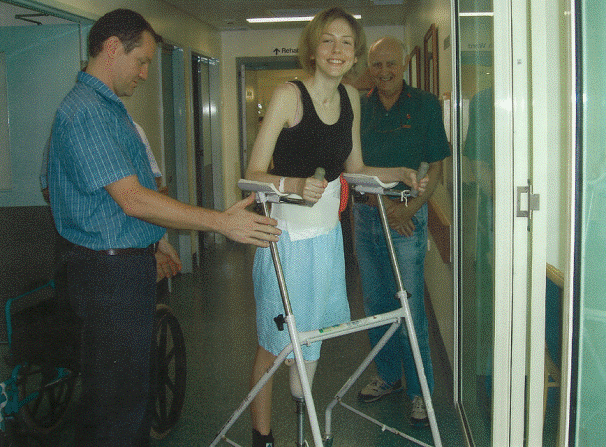
    I spent over a year in hospital. The first time, and the majority of that time, was in rehabilitation. Over the years I’ve returned for more surgery, and again I would pass through rehabilitation wards for several days or weeks.

    In regab at 25, learning to walk again.
    Above: In rehab, learning to walk again.

    Where the purpose of a palliative care ward is to provide care at the end of life, the purpose of a rehabilitation ward is, as the name suggests, to rehabilitate people and teach them to live again.

    There’s always an eclectic mix of people in a rehab ward. Some were stroke patients, like me. Some were learning to stand with a new prosthetic leg following amputation, like me. Others were adjusting to new methods of movement without using their arms after open-heart surgery. Also like me.

    Regardless of the reason we were all in the hospital, one thing we all had in common was that, unlike Bronnie’s palliative care patients, eventually we were going to go home to start living again.

    The hospital can be a very lonely place, and many patients, despite their wounds and ailments, were simply craving conversation.

    I’d frequently chat with my fellow patients. It was a good way to pass the time and distract ourselves from the monotony of repetitive (but important) rehabilitative movements.

    My fellow patients, all strangers, would often open up to me in a way that I would not experience had I started talking to that same stranger in the outside world.

    Similar to Bronnie’s experiences, I heard a lot about regret. But following the confession of regret would come resolutions to do things differently “this time around.”

    I’ve paraphrased these most common responses that I’ve heard over the years in rehab—the top five regrets of the living.

    1. I wish I’d experienced more.

    Upon reflection, many of my fellow rehab patients regretted not having experienced more, and vowed to do so once they “got out.” The experiences ranged from various things to do, see, or hear, but the most common was the regret at having not traveled more.

    The sad irony was that many patients, like me, would be leaving the hospital in a wheelchair or with restricted movement. So experiencing more travel would not be an option.

    Resolution: From now on I’m going to experience more.

    2. I wish I’d listened more.

    Many patients regretted not listening more to the advice of their doctor, family members, or well-meaning friends. I remember one larger woman who recalled her doctor advising her to lose weight. At the time, she believed he was “fat shaming” her and had not listened, until she had a resulting stroke.

    One man regretted not having listened to his “nagging” family who had warned him against frequently poor diet choices. Diabetes took his leg and left him with regret.

    Resolution: From now on I’m going to listen more.

    3. I wish I hadn’t been so afraid to fail.

    With their second chance at life, many patients were prepared to step out of their comfort zones in the future. Some patients had been so close to death (arguably the ultimate failure) that they no longer feared so many little failures in their day, such as failing to live up to other people’s expectations.

    Resolution: From now on I won’t fear failure.

    4. I wish I’d stood up for myself more.

    Patients regretted not having voiced their opinions more frequently and stood up for themselves and their values or beliefs. Some had spent years in unhappy relationships or unfulfilling work, and it was only their hospitalization that had been their catalyst for change.

    Resolution: From now on I’ll stand up for myself more.

    5. I wish I hadn’t waited so long to…

    The regret of procrastination was also common, and something that resonated with me. Patients said that they wished they’d done a certain something sooner—pick up the phone, seen the doctor, reunite with a friend… The list went on.

    Resolution: From now on I’m going to stop waiting and start doing!

    There were many similarities between the regrets of the dying and the regrets of the living.

    However, the key difference was that my fellow patients and I all had an opportunity to take action on our regrets of the past and ensure they would not be regrets of the future.

    What This Means for You

    Going back to my question at the beginning of this post: If you had a second chance at life, what would you do differently?

    It’s normal to have regrets. If you’ve ever had menu envy, you’ll regret not ordering X instead of Y.

    I have regrets, but I make a point of not dwelling on them. Sure, I have relationships, jobs, or situations that I regret not leaving sooner, but those failures have helped make me who I am today.

    So don’t be afraid to experience more. Step outside your comfort zone and live life on your terms, free from regret. Listen more to those who only have your best interests at heart. Stand up for yourself, embrace failure, and stop waiting for someone else to live your life for you.

    Take it from my fellow rehab patients who have been there before. Those who have regrets but also have the opportunity to reflect on this regret and resolve to make changes.

    Take the blinkers off and stop procrastinating. Take responsibility for your own life and your own happiness. We all have challenges, but we all have choices.

  • Stop Looking for Signs and Trust Yourself

    Stop Looking for Signs and Trust Yourself

    Stargazing woman

    “Always try to remember that most of the things that happen in this world aren’t signs. They happen because they happen, and their only real significance lies in normal cause and effect. You’ll drive yourself crazy if you start trying to pry the meaning out of every gust of wind or rainsquall. I’m not denying that there might actually be a few signs that you won’t want to miss. Knowing the difference is the tricky part.” ~David Eddings

    A few years ago I took the Buddhist precepts at a Zen monastery in northern California. At the end of the ceremony we were all given the symbolic Kesa to wear around our necks while we meditated.

    Afterward, on the drive home, I hit a torrential Sierra snowstorm and pulled into a gas station to fill my tank and make sure everything was running well before I headed into the mountains. When I got home, I realized I had lost my Kesa.

    I called the gas station, the only place I had stopped, but they hadn’t seen it. I continued to call them every day for a week certain that dropping my Kesa on the snow-covered ground was akin to spitting in holy water at a Catholic church.

    I told myself it was a sign that I’m really a flake. My knowledge of Buddhism was superficial at best.

    What right did I have to take the precepts? I obviously wasn’t ready for them. I should have studied harder, meditated longer, been more serious about the whole practice.

    About a year later at another retreat I was talking with one of the monks and she said, “I noticed you never wear your Kesa when you come up here. I was just wondering about that.”

    I hesitated. Lying to a monk would surely be worse than losing my Kesa, so I told her the story as well as my long litany of reasons as to why I didn’t deserve another Kesa.

    When I finished she smiled and said, “All this means is you lost your Kesa.”

    She walked with me over to a closet, reached into a box, and handed me another one. “Maybe it means you were a little absentminded, but that’s it. It’s no big deal and it certainly doesn’t mean you are not worthy of being Buddhist.”

    I have to admit I’ve spent a disproportionate amount of time looking for signs, when in fact, I was really looking for validation.

    Maybe it was to justify a bad decision. And if the signs were negative, like in the case of the Kesa, it just confirmed my feelings of low self-esteem. It was a sign I was really as hopeless as I secretly believed.

    Signs and symbols can be powerful tools for exploring our unconscious, but they aren’t going to tell us what to do or who we are. We have to decide that.

    I have a friend who told me whenever she sees a blue cornflower it’s a sign her deceased mother is saying hello. That seems to me a very sweet and appropriate way to use signs and symbols.

    Of course, she doesn’t literally believe her mother is communicating, but blue flowers have become a symbolic way to remember her love, pause for a moment and appreciate their relationship.

    The symbols we dream can be profound and may be a sign of something we need to look at in our lives. And we can find signs in nature that serve as tools of transformation. But we shouldn’t let them rule our lives. Carl Jung said, “Until you make the unconscious conscious, it will direct your life and you will call it fate.”

    Do you find yourself looking for signs in nature or the heavens? Here are some thoughts for keeping signs and symbols in perspective.

    Even if the universe does send us signs, how we interpret them is purely subjective.

    The universe and consciousness are mysterious. For all we know, beings from other dimensions could be sending us signs all the time, but our capacity to understand is still limited by the physical world and the bodies we inhabit. It’s probably best to focus on dimensions we know and understand.

    Anything can be a sign if we want it badly enough.

    Once I found an arrowhead near my house and convinced myself it was a sign it would be okay to have an affair with the married, albeit separated, medicine man who had been pursuing me ever since I’d gone to his sweat lodge as a guest.

    In this case common sense rather than signs won out and I pointed him and his buffalo drum back to his wife. If you find yourself pulled in a direction that you know is probably not good for you, trust your good sense and don’t let signs lead you astray.

    Believing too strongly in signs can be disempowering.

    As a woman with a history of abuse and bad decision-making, I feel strongly about the rights of empowerment and dignity for all humans of all ages. Allowing yourself to be ruled by signs and portents not only takes away your power of choice, it excuses you from responsibility.

    Stepping up to the plate and taking responsibility for your part in things is incredibly empowering.

    Focusing too much on signs takes us out of experiencing the moment.

    We usually look for signs either as justification of something we’ve done or as portents about what to do in the future. Often, we already know what we should do deep inside and looking for signs can lead to obsession.

    Instead, next time you have to make a hard decision, sit quietly for a while. Get practical advice, look at the situation rationally, and then decide. It will probably work out just as well as waiting for a feather to float down and point you in a certain direction.

    None of this means you have to give up astrology, runes, or the Tarot, but use them as tools for unlocking what’s already inside you. They are not signals from the universe that you should do one thing or another. You already have all the answers inside. Trust yourself.

    Stargazing woman image via Shutterstock

  • Changing Directions: 6 Tips to Help You Do What’s Right for You

    Changing Directions: 6 Tips to Help You Do What’s Right for You

    Man at a Crossroads

    “If you do not change direction, you may end up where you are heading.” ~Lao Tzu

    One month before my girlfriend, Sara, gave birth to our first child, we decided to move back to my small hometown to be close to my family.

    This was a great moment for my family, especially for my mom and dad, who had given up hope of me moving back a decade ago.

    I sold my apartment and we signed a rental lease in my hometown. Everything was set and good to go. Sara and I were happy, and we had a plan to follow once the baby was born.

    However, the joy lasted no longer than a long Norwegian summer month.

    When our daughter, Luna, entered the world on the first of June, Sara and I had big doubts about our move.

    Sara didn’t have a job in my hometown, and there aren’t many jobs available. She’d probably have to commute to a larger city, Stavanger. That would result in her spending three-plus hours commuting, losing time with our newborn daughter and me.

    We were aware of this situation before. However, after Sara gave birth, she realized that she didn’t want to spend more time away from Luna and me than absolutely necessary.

    Also, we couldn’t get a bank loan since Sara didn’t have a job and I’d just started my business. And the monthly cost of renting is a lot more expensive than owning an apartment.

    Lastly, we did not have the same network of people in my hometown as we do in nearby Oslo (the capital of Norway).

    Even though we both had a gut feeling that it was wrong, it was still a hard choice to make.

    First of all, we had nowhere to live. I’d already sold my apartment and I didn’t want to cancel the deal, since it would cost me about $10,200 in expenses.

    It was even more expensive to rent in nearby Oslo than in my hometown, which would make it an even worse deal.

    And I didn’t actually want to rent, since I’d previously owned an apartment. I thought it would feel like taking several steps back.

    I talked to the real estate agent who sold my apartment, and he said that the prices on property would continue to rise, regardless of the media saying that the prices would soon have to reach their peak. So buying an apartment would be the best move for us.

    Since I’m normally a calculated guy who is good when it comes to planning and making strategic decisions, I was embarrassed that we were having a change of heart.

    My mind was probably clouded by knowing that I was going to become a father for the first time.

    I didn’t want to hurt my dear family’s feelings, but we had to follow our gut instinct.

    After several evenings of the same discussion and a feeling of uneasiness that made it hard for us to sleep, relax, be happy, and enjoy our time with our newborn daughter, it was time to do what was right, regardless of how difficult it was.

    I’ve been through a lot of challenges and changes in my life; however, this is by far most challenging choice I’ve had to make.

    Why? Because it involved hurting the feelings of the people who I love the most—my dear family.

    Still, we made the decision that we knew was right for us, and it was time for some massive action.

    We cancelled the rental lease in my hometown, searched online for apartments (both for rent and for sale), and chose three for sale that we would take a closer look at the next day.

    After seeing those apartments, I told my family that we weren’t moving, due to our lack of secure income, and explained our situation. They were, of course, sad but they understood the situation.

    Fortunately, we won the bidding war and were able to buy the apartment we liked the best. When I told my family the good news, they were happy for us, despite their disappointment (which is one of the reasons why they mean so much to me).

    We did all this in a period of three days. None of this would have happened if Sara and I didn’t have a strategy and take massive action.

    Throughout this process, I learned six lessons about changing directions.

    1. Accept the change.

    Your life situation can change in a split second, and you have to adapt.

    It’s not always easy to change your mind in life, but even if it’s hard, it’s worth the effort in the short-term to avoid feeling unhappy and regretful in the long-term.

    Sara and I would have been unhappy if we moved, since every single fiber in our body told us that it was the wrong decision.

    2. Don’t procrastinate.

    Procrastinating on big decisions only makes it worse, and they will weigh you down and can make you become depressed.

    3. Face the fear.

    It’s natural to feel afraid of making a hard decision when you fear upsetting other people. However, the most important thing is that you are happy. The people who love you likely understand this and realize that you need to do what’s best for you.

    4. Explain the situation.

    You might fear that people will judge you for your decisions. I was afraid of this too, but they understood when I explained why we needed to make this choice. In addition, the explanation took a bit of the sting out of the bad news.

    5. Follow your gut feeling.

    Tune into your intuition. It will tell you what the right decision is.

    You might feel physically sick when you think about the choice that isn’t actually right for you. You might find yourself asking people for advice and hoping they’ll give you a specific answer, which means that it’s likely the answer your intuition is telling you is right.

    6. Decide to act—and then do it.

    The same recipe for achieving your goals also applies to making a change.

    • You have to identify what you want to change in your life.
    • You have to find out the price of the change. What do you have to sacrifice?
    • You have to have a strong why. Why should you be willing to go outside your comfort zone and complete challenging activities in order to create change?
    • Then you have to decide. Are you willing to pay the price in order to successfully implement the change in your life?
    • If you decide that you will make the change, you have to commit to completing all the necessary tasks whether you feel like it or not.

    Remember that you can’t make everyone happy. The most important thing is to think about your own needs. Only by taking care of your needs can you be there for other people.

    Now you have the recipe for how to handle big changes.

    Go out there, follow your gut, and face your fears!

    At the end of the day you are the one who have to live with the consequences of your choices. You will thank yourself in the long run when the storm has settled.

    Man at crossroad image via Shutterstock

  • When You Feel Pressured and Overwhelmed by Possibilities

    When You Feel Pressured and Overwhelmed by Possibilities

    Stressed Man

    “Ego says, ‘Once everything falls into place, I’ll feel peace.’ Spirit says, ‘Find your peace, and then everything will fall into place.’” ~Marianne Williamson

    I have exhausted myself with my own expectations. The pressure I have put on myself to be a certain person is consuming my thoughts and eating away at my soul.

    I imagine a point in my life when I’ll have it all together, and I feel a sting in my chest that this has not happened yet.

    I think about the milestones that might get me there and the things that have led me astray. I think about degrees, jobs, relationships—the things that I have been conditioned to believe will guarantee my happiness—and wonder why it hasn’t turned out that way.

    There are so many ways to live, and I feel overwhelmed by all of them, confounded by the endless possibilities.
    Do I want to take this path or that one? Job? Travel? Another degree? Buy a car? Settle down?

    I feel like I’m trying to decorate myself with achievements and using stuff that indicates, somewhat frantically, to the world “Don’t worry, I’m alright! Look at what I’m doing!”

    People tell me what I should be doing, predetermining the best path to a life that is full and whole. It’s like there are certain checkpoints I need to pass to ‘get there,’ presumably to be at peace and content.

    If I take this career path or have this relationship, I’m told, everything will be okay. I take these on and feel like I’m reading someone else’s lines, no longer in my own story, and I can’t hear myself think.

    There was a nagging voice telling me I needed to get out of my comfort zone and have an adventure. I needed to explore the impractical and indulgent part of myself that wanted to write, meet new people, and gain new insights.

    I’m learning to filter out the white noise and listen to myself. So I decided to fulfill my fantasy of living in France, and to later intern in Italy. Now, away from the familiarity of people I know and their ever-consistent opinions (however well meaning), I’m forced to confront the aspects of myself that are uncomfortable.

    On the other side of the world, in a place where no one will tell me what is right or what I should do, I have let all my insecurities surface.

    I’m filtering out what the world has been telling me and deciphering and reconstructing the elements that constitute the sort of life that I—not others—want to live.

    I chastised myself for deviating from ‘the plan’—more study that would currently be just for the sake of studying—even though I felt it was the right thing for me to do.

    Now, I am aware that I compare myself to others who are on their own journey, and instead of berating myself unproductively, I accept my own experience and remind myself there is no such thing as the “right” way.

    How can one route possibly be suitable for everyone? How can I compare myself to others, with different hopes, dreams, experiences, talents, and instincts? I can’t. There is no right way, there is just this way—now—which I can amend or shift if or when I need to.

    If you’re going through something similar, feeling pressured and overwhelmed by possibilities:

    Allow yourself to feel what you need to feel.

    We spend a lot of time fighting our emotions instead of sitting with them and recognizing them for what they are.

    The world is now blissfully quiet, and I allow myself to feel the doubt, confusion, and other uncomfortable feelings that are perhaps residual effects of such a big change. Only then do the feelings settle.

    Stop focusing on what could or should happen.

    I’m re-training my brain to relinquish control over what might happen or what could be a future possibility, and instead focus on what is currently happening in my life.

    I notice that if I focus on current experiences, on being more accepting of myself and the moment, my entire mentality and experience shifts.

    Remember that self-worth starts with you.

    We often rely on external things to fuel our self-worth; we use material goods, careers, or relationships to feel good about ourselves.
    What we don’t always realize is that nothing will fulfill us if we don’t first develop self-love. When we look to ourselves with compassion, understanding, and kindness, we see our experiences in a whole new light.

    As a wise person once reminded me: “If I took away everything—your house, your job, the people you know—all you’re left with is you.” 

    Let go.

    Once we relinquish control over the future and stop believing we will be happy if or when something occurs, we allow ourselves to enjoy the present without frantically grasping at external things to validate our self-worth—be they relationships, career achievements, or other milestones we have set for ourselves.

    The shift is enjoying these should they occur (if that is what you, not others, truly desire), without being dependent on them for happiness.

    If we remember that there is no rulebook for living our life and accept that we are on our own journey, we will be liberated.

    Stressed man image via Shutterstock

  • Why You Shouldn’t Wait For Others to Validate Your Decisions

    Why You Shouldn’t Wait For Others to Validate Your Decisions

    Decisions

    “Do not let another day go by where your dedication to other people’s opinions is greater than your dedication to your own emotions!” ~ Steve Maraboli

    One thing I’m great at is procrastinating. Another thing, overanalyzing every decision I make.

    I can even question and try to reason which route I should take to walk the dog. It is truly outrageous, when I think about it.

    This leads to paralysis through analysis, and inevitably a fear to commit to change. This is how I got stuck.

    A few years ago I was feeling immobile and underwhelmed in my life. I had a good career, a house, and a car that I purchased all on my own, and I’d traveled the world. Still, I felt stuck to the life I was living and thought something needed to change, but I couldn’t quite figure out what I wanted to do.

    So I did what every successful and independent women would do: I broke it down, made lists, and asked my friends and family what they thought I should do. Smart, right? Wrong.

    The problem was, I was turning to others to validate my feelings and my intuition. How could I ask other people to validate how I was feeling? As a savvy businesswoman who makes smart decisions all the time, I sure missed the boat on that one.

    It’s like asking a stranger what they think you want for lunch.

    That was one of the biggest life lessons that I learned during my life transition. Stop waiting for others to validate my decisions.

    As much as they loved and cared for me, they didn’t know me. I mean, of course they knew me, but they didn’t truly know what was at the core of my decision. They weren’t in my head and my thoughts, and they couldn’t feel my soul and my longing. Besides that, they couldn’t understand it.

    Why would they understand it, and more importantly, why should they?

    I am speaking about my parents, whose generation was all about dedication, loyalty, and of course, security. To give up a secure, high paying career that I had worked so hard for was completely incomprehensible to them.

    Some of my friends had settled down into a contented family life and were enjoying motherhood. To them, having a family was their true calling, so they couldn’t understand why I would start to focus my energy on starting my own business as opposed to finding a spouse.

    My other friends were at ease working nine to five and had never thought about the possibility of questioning or changing it. They would be fine to continue on that path, without making a change. Why mess with a good thing?

    After having these conversations for more than a few years, I realized that I no longer needed to wait for others to validate my decisions. Not only that, but I may never get their validation, and I wasn’t about to wait another minute to live my life for me.

    I was looking for their approval not because it was something I truly needed to move forward, but because I feared failure and hoped that I could hear that someone believed in me.

    I concluded that it didn’t matter if they did because I believed in me, and that’s worth so much more.

    I realized that no one else needed to understand what I wanted or where I was going because no two people are on the same path in this life.

    I was living the life that that everyone else wanted for me and no longer doing what I wanted nor what I was passionate about. I was getting deeper and deeper down the rabbit hole, and I needed to dig myself out once and for all and be true to myself.

    So I did it. I took the first step and enrolled in my first course, I spoke to my boss at work to explain what I was doing, and changed my position and reduced my hours (and my salary) in order to pursue my passion.

    I was terrified, but I did it anyway. Nothing was going to change in my life until I decided to change it.

    And then the most interesting thing happened. I finally got the validation that I was seeking for all those years and confirmation from the people around me that I was making the right choice.

    At the end of the day, though, I realized that it was more important to ask myself what I was projecting in those moments.

    Those people, the naysayers, they were showing up for me for a specific reason and triggering a specific pain point for me. That was my true challenge. That was what I needed to work through.

    There will always be naysayers, those that think your choices are unrealistic, ridiculous, or won’t ever work. They are most likely projecting some of their own fears and doubts.

    I like to think of them as challengers to test your true commitment.

    When they show up for you, ask yourself why you need their validation. What are you missing in your own confidence to move forward?

    And I’ll also add, the naysayers are probably going to be the first to congratulate you at the finish line. Since I found the courage to move forward, mine are my biggest cheerleaders.

    The more you believe in your own decisions, the less you need others to. Go out and live the life you dreamed of. You’re so worth it!

    Yes or no image via Shutterstock

  • Rethinking Mistakes and Recognizing the Good in “Bad” Choices

    Rethinking Mistakes and Recognizing the Good in “Bad” Choices

    Thinking Woman

    “Sometimes the wrong choices bring us to the right places.” ~Unknown

    For most of my life, I’ve seen the world in black and white, and I’ve felt constricted and pained as a result.

    When I was a young girl, I believed there were good people and bad people, and I believed I was bad.

    When I was an adolescent, I believed there was good food and bad food, and because everything tasty fell into the latter category, I channeled the shame from feeling bad into bulimia.

    And when I grew into adulthood, I believed there were good decisions and bad decisions, which may sound like a healthy belief system, but this created extreme anxiety about the potential to make the “wrong” choice.

    When you see life as a giant chess game, with the possibility of winning or losing, it’s easy to get caught up in your head, analyzing, strategizing, and putting all your energy into coming out victorious.

    Back then, I thought for sure that if I made a misstep, I’d end up unhappy and unfulfilled, not to mention unworthy and unlovable—because there was a right path and a wrong path, and it was disgraceful to not know the difference.

    One pointed toward success and bliss (which I desperately wanted to follow), and one led to certain doom.

    With this in mind, I thought long and hard before moving to Spokane, Washington, at twenty-two. To live with a stranger I’d met on the Internet. And had only known for two months and met in person once.

    Okay, so I didn’t really think long and hard. But I felt in my gut, when we first connected, that this was the right choice for me.

    In fact, I felt certain, something I rarely felt about anything (except my innate bad-ness).

    He told me we were soul mates, which was exactly what I wanted to hear, especially after spending six months bouncing from hospital to hospital, trying find the worth and substance locked somewhere within my cage of bones.

    It made sense to me that, if I had a soul mate, he wouldn’t live right next door.

    Disney may tell us it’s a small world, but it’s not; and I thought for sure there was something big awaiting me 3,000 miles from my hometown near Boston.

    People told me I was making a mistake when I shared the details of my plan.

    Some said I was too fragile to move out of my parents’ house, even if I’d planned to move close to home.

    Some said I was a fool to think this man was my soul mate, or that I had one at all.

    Some said I’d one day regret this choice and that they’d have to say “I told you so.”

    But I felt absolutely confident in my decision—until he came to Massachusetts, two weeks before I was scheduled to move, to meet me for the first time.

    I knew right then it was wrong, somewhere in my gut. I didn’t feel even the slightest spark, but my “soul mate” and I had already planned a new life together. Before we’d even met.

    And I didn’t want to admit I’d made the wrong choice—not to him, who I was sure would be devastated, and not to the others, who I feared would be smug and self-righteous.

    So I moved across the country anyway, thinking that maybe I’d feel differently after getting to know him better.

    If you’ve ever seen a movie, you know exactly how things didn’t pan out. Since life isn’t a romantic comedy, I didn’t eventually realize he was my soul mate and fall madly in love.

    Instead, our individual demons battled with each other, we fought for the better part of six months, and we eventually broke each other’s spirits, broke down, and then broke up.

    You could say, after reading this, that I had made the wrong choice—especially knowing that I knew, the day I met him, that he wasn’t the man for me.

    You could say I’d chosen a bad path, running away from home in a misguided attempt to outrun who I had been.

    These are things I assumed I’d think if I ever decided it was time to leave.

    And yet I didn’t think these things at all. In fact, this was the very first time I broadened my vision to see not just shades of grey, but a whole rainbow of vibrant colors.

    Yes, I’d made an impulsive choice, largely driven by fear and fantasy. Yes, I’d acted against my instincts. And yet I knew, beyond a shadow of a doubt, that it had not been the “wrong” choice.

    Because right then, I realized that, despite things not working out as I planned, I’d learned and grown through the experience, and it had served a purpose, even if not the one I originally envisioned.

    Our demons colliding was a blessing, not a curse, because it forced us both to more closely examine how our issues affected our relationships—mine being toxic shame and destructive tendencies, and his being his business, and not for public consumption.

    Moving so far away was valuable, not shameful, because it taught me the difference between running away from what I didn’t want and running toward what I did—a lesson I struggled to apply for many more years, but, nonetheless, now understood.

    And acting against my instinct was a good thing, not a bad thing, because it taught me to listen to my intuition in the future, even if I might disappoint someone else—a lesson I may never have fully embraced without having had this experience.

    That’s the thing about “wrong” choices; they usually teach us things we need to know to make the right choices for ourselves going forward, things we can only learn in this way.

    Notice that I wrote “the right choices for ourselves”—not the “right choices.” Because the thing is, there are no right choices.

    There isn’t one single way that we should live our lives, or else we’ll be unhappy. There isn’t one path that will lead us to success, bliss, and fulfillment.

    There isn’t a straight ladder we’re meant to climb, hitting milestone after milestone until we emerge at the top, victorious, with the view to show for it.

    There’s just a long, winding road of possibilities, each with lessons contained within it—lessons that can help us heal the broken parts of ourselves and find beautiful pieces we never knew existed. Pieces we couldn’t know existed until we made choices and saw how we felt.

    If there’s one thing I’ve learned since that very first move, over a decade ago, it’s that life never offers any guarantees. And it can also be incredibly ironic.

    Sometimes the people who seem to make all the right choices are the least happy with the people they’re being and the lives they’re leading.

    We could spend our whole lives looking for external validation that we’re following a path that’s “good”—living in a narrow, black-and-white world, feeling terrified of making mistakes.

    Or, we could commit to finding something good in every step along the way, knowing that the only real mistake is the choice not to grow.

    I don’t know if this is right for everyone. But I know this is right for me.

    On this Technicolor journey of unknown destination, I am not good nor bad, not right nor wrong, but most importantly, not restricted. In this world of infinite possibility, at all turns, I am free.

    Thinking woman image via Shutterstock

  • How to Hear Your Intuition When You Don’t Know What to Do

    How to Hear Your Intuition When You Don’t Know What to Do

    Confused Man

    “Your mind will answer most questions if you learn to relax and wait for the answer.” ~William S. Burroughs

    Sitting in my office, I stared at the email in front of me.

    My heart sank.

    All energy and joy left me, to be replaced with confusion, anxiety, and a deep sense of frustration.

    As adrenalin rushed through my veins, one question engulfed my mind leaving little room for the answer.

    What should I do? What should I do? What should I do?

    I just didn’t know.

    The email was from a client. Someone who I had worked with for a long time. Someone who wasn’t listening to me. Someone who was causing me unhappiness.

    And as I re-read the email, I knew I had to make a decision.

    Could I deal with this any longer? The demands, the lack of control, the sharp tone that always seemed so unnecessary.

    Or did I have to stick it out? Put up with those feelings, just get on with the work and do the best I could? I needed the money, after all. Cash was tight—could I survive without this client?

    What should I do? What should I do? What should I do? 

    And then, in that one moment in time, it became clear exactly what I needed to do. I needed to step away from the computer. I needed to get outside. And I needed to breathe.

    So that’s exactly what I did.

    Twenty-four hours later, I was on the phone explaining to my client that I didn’t feel we were right for each other anymore. That we needed to bring things to a close. That it was time for me to move on.

    And move on I certainly did.

    That day when I stepped outside and went for a walk, I found peace and quiet, a sense of calm understanding, and most importantly, a moment of absolute pure clarity.

    My intuition spoke. And I listened to her.

    I realized that I had to remove myself from the situation that was causing me so much distress. Forcing myself to continue was no longer an option; it was not what my body and soul needed. Instead, I needed to follow my heart.

    And so, I let go of that client along with all those negative feelings. And I created space.

    Space for new people. New places. And new experiences.

    And do you know what? Once I made that decision, it was like an enormous weight had been lifted from my shoulders.

    My energy and joy returned to me in abundance, and I knew with absolute certainty that I had made the right decision.

    Once again, my intuition had guided me. And she hadn’t let me down.

    Tuning into your intuition during troubled times can be difficult. With so much noise, information, and clutter within the world, our thoughts can often be clouded with distractions.

    However, there are lots of ways that you can help your intuitive voice find its way to you. Just follow the tips below.

    Step away from the situation.

    I’ve found that during these times the best thing you can do is allow yourself some breathing space.

    Stand up and go for a long walk, head out into the wilderness, browse some antique shops, meditate, sit with a coffee and watch the world go by. Whatever you love doing, whatever calms you, now is the time to do it.

    Find some quiet space to let your mind wander, and your intuitive voice will have a far greater chance of being heard.

    Be honest with yourself.

    It can sometimes be very easy to ignore your feelings and push them away.

    We might push those gut feelings aside and take what may seem like the easier option because we’re afraid of failure, changing direction, and saying no.

    However, ultimately this is about your happiness. And if something doesn’t feel right, then maybe it’s time for a change.

    Be honest with yourself and acknowledge those unsettled feelings; they are there to guide and support you. Listen to them.

    Turn to your journal.

    I have found writing in a journal to be an incredible method for tuning into my intuition.

    Acting as a safe space to release emotions, work through problems, and process my thoughts, it can allow for greater self-discovery and understanding.

    Next time you are having difficulty making a decision, pick up a pen and some paper and let the words flow out of you. Reflect on the situation, explore those feelings, and consider the bigger picture.

    This free-flowing use of personal writing can be a wonderful catalyst for removing blocks and letting your intuitive voice lead the way. Just let the words pour out of you.


    The intuitive voice is a powerful one, but it often needs a quiet, calm, reflective environment to find its way.

    Learn where you can find some peace, go there when times are hard, and listen with all your might to what your heart and soul are telling you.

    Your intuition wants to guide and support you. So give it the space to be heard.

    Confused man image via Shutterstock

  • Releasing the Need for Certainty and Trusting Our Decisions

    Releasing the Need for Certainty and Trusting Our Decisions

    Peaceful Woman

    If you worry about what might be, and wonder what might have been, you will ignore what is.” ~Unknown

    If you’re like me, you’re hard on yourself—and I mean hard.

    You analyze your decisions and try to somehow calculate the results of your actions to feel a sense of certainty. Little did you know that searching for the certainty causes all of your insides to do flips and only causes more uneasiness.

    What I always wonder is where did the need to know come from? I remember being a free spirit with no worries as a child (as I’m sure most of us were—the beauty of naivety), but never did I have the need to just know first so I could be happy second.

    Where does this need to know come from? 

    I’ve recently been reading a few books by Don Miguel Ruiz, the most current being The Voice of Knowledge.

    A chapter in the book talks about our personal stories we have in our heads—the truths we tell ourselves based on our past experiences and overall beliefs about ourselves. We all have them, and we all utilize them to interpret the world in our own way. 

    These stories have become so ingrained within us that we almost don’t notice we’re still holding onto the things that no longer serve us.

    They teach us “because this happened in the past, this will happen again.” Even though the situation could be entirely different, we hold on to these “truths” for some surefire way to predict an outcome before we even know what it will be.

    We no longer trust ourselves to make the right choice because we want the certainty that it will work out the way we want it to, so we can avoid any hurt or disappointment. I’ve learned that this is actually the quickest way to disappointment, hurt, and unhappiness.

    We put so much of our energy and tie so much of our happiness into the outcome of this one decision, and we then beat ourselves up when it doesn’t turn out “right.”

    I’ve been there many times before, and I have to say, it’s still a work in progress toward fully understanding this concept and practicing its lessons. This has been most apparent as it pertains to my relationships.

    For a long time I was torn from a past relationship. I analyzed every bit of it until I had no clue what I was looking at. (Haven’t we all been there?) I closed myself off in fear because a part of me wanted to avoid making a wrong decision and ending up in a similar predicament where I had allowed myself to be hurt.

    Now that I’ve moved on, I’ve found that at times I still carry that fear of uncertainty with me, the fear that trusting myself isn’t enough to know what is right. And that is why I say I’m still a work in progress. I’ve had to learn to let go of these “truths” and stories in order to see things fresh.

    Realizations don’t always lead to immediate changes, but recognizing is the first step.

    I’ve gone a little bit easier on myself over time, but I’ve tried to remember that happiness doesn’t come from knowing; it comes from living through what life gives us.

    It can’t be about figuring out some correct equation to all, because one equation can never fit any and every situation.

    At the end of the day, the best thing you can do for yourself is trust in what feels good to your soul, but first open the space within yourself to receiving these feelings. If you close yourself off emotionally and get caught in your head, you won’t know how to feel anymore.

    So as a reminder to me and as a reminder to you, go easy on yourself. Respect the space within you that desires the freedom to live, without the need to know right at this moment.

    There is never a true state of knowing because we are constantly learning; there is just a state of trusting and accepting the choices we make and knowing every outcome is a lesson—even if we’re still opening ourselves to receive it.

    Photo by Giuseppe Chirico

  • Let Go of Regret by Making a Promise to Yourself

    Let Go of Regret by Making a Promise to Yourself

    Let Go

    “Sometimes the wrong choices bring us to the right places.” ~Unknown

    Regret can be such a paralyzing emotion, yet it is also universal. At some point in our lives, in one way or another, we each wrestle with regret.

    Regret seems to rear its ugly head most when it comes to relationships. It happens when a relationship ends and we feel as if we could have done something more. This feeling intensifies when the other person decides that a second chance is not worth the fight. Most of all, we face with regret once it sets in that the past is just that—the past.

    Almost one year ago to the day, I lost the man that I thought I would spend the rest of my life with.

    At age twenty-eight, after two years of living together, I watched him slam the door on our apartment. My own anxiety and depression led me to keep things inside, secrets, and this slowly built a wall in between us, so thick that we could no longer see each other.

    My own anxiety and need for reassurance or praise clouded my head so badly that I could not even notice that he saw right though me. And anytime he tried to get me to open up, I would convince myself that he was the enemy.

    We were no longer a team working together; we had become opponents working against each other.

    I had created my own nightmare, and now that it was over, all I was left with was regret.

    No matter what, I thought that we would find a way through the darkness. But once he walked out that door, he never looked back.

    In many ways, I still struggle with the regret following the end of my relationship.

    At first, I would enter periods of self-loathing: I could have eaten more so he didn’t have to sleep next to a hollow body made of skin and bones, I could have spent that fourth of July with him instead of choosing to leave him behind for a rock concert, and I could have made him feel like my top priority.

    But the truth is, I was so focused on my distorted self-image that I was blinded to the fact that I was pulling away, physically and emotionally.

    Yet in the last year, I have also come to realize (through ebbs and flows) that the universe has a way of showing you what rock bottom really looks like in order to demonstrate that you are capable of picking yourself up again.

    It is when you are truly alone and forced to face yourself that new opportunities will open up and you force yourself to let love in again.

    In the face of regret, the best thing you can do for yourself is not look back, but to make a promise to yourself that you can learn from the experience and do the right thing going forward.

    My promises to myself include ensuring that I never take anyone for granted again, and act only with love and compassion for myself and for others. The endings we experience in life are the world’s way of showing you that expansion is imminent.

    And if you can’t see through the fog of regret today, know that one day you will. Start making that promise to yourself today that you will no longer sit in your regret, but move forward with integrity, dignity, and self-respect.

    Photo by Conny G.

  • Trusting Yourself to Make Decisions Instead of Always Seeking Advice

    Trusting Yourself to Make Decisions Instead of Always Seeking Advice

    “To thine own self be true.” ~William Shakespeare

    No one knows the real you but you. Sometimes it is true that we don’t know ourselves. That’s because we’ve lost ourselves, or maybe because we never knew ourselves to begin with.

    I grew up a long time ago on a hill on Bentley road in Puyallup, Washington. I was a very quiet, shy, and reserved little girl. Today, I am a forty-two-year-old woman. I am still introverted, but I am learning to be more assertive.

    As a co-dependent people pleaser, I grew up with a lot of self-doubt and shame. I didn’t have a sense of self at all. I was like a leaf that the wind blows away, and I needed to be more of a tree with deep roots, grounded and rooted in love.

    Growing up, I received a lot of conflicting and negative messages from my family, such as “you are loved but you are flawed.” I was hungry for the approval of others.

    I learned not to trust my ability to make a good decision because the people in my life did not validate my view of reality. My brother used to tease me a lot. I tried speaking up about the mistreatment, but my parents didn’t take my complaints seriously.

    They did little to address the situation because of their high levels of shame. It just got swept under the rug, and so I got the message that it wouldn’t matter if I spoke up, because those in authority would not protect me.

    It took me a long time to see that I could have a different opinion than other people and still be loved and accepted.

    When I did make a decision, I got the impression that people are in your life to change your mind, and guilt and shame were good tactics to achieve that.

    This has made it extremely difficult for me to make and stick to decisions.

    If you think you aren’t qualified to make a good choice then you’re going to be afraid to make any choice.

    I have often run around asking multiple people, “What should I do? What should I do?” I invited them to give me input. But then I was angry with them for “telling me what to do.”

    What I was really telling myself is that my opinion didn’t matter. I valued other people’s opinions far above my own. I disowned myself. Somewhere in my mind I thought that they must have known better. After all, what in the world could I know? I grew up believing that if you think you know something then you are very proud.

    But there is no shame in speaking from a place of truth.

    You do know something and that is not a bad thing. In fact, you probably know more than you think you know. But thinking you don’t know anything keeps you from taking the good advice you would give yourself. And it keeps you dependent on other people.

    People seem to lose respect for people who are wishy-washy and can’t make their own decisions. In other words, people who can’t think for themselves are also people who don’t respect themselves because they don’t respect their own opinions.

    It takes a lot of courage to stand up and take personal responsibility for your life and actually “own” your decisions.

    I have let others play the scapegoat by allowing them to be my decision makers. For example, because of my lack of assertiveness in my marriage, I was handing over my brain and responsibilities to my husband.

    I think it was because of fear but also laziness on my part. But no one can really be happy this way. You won’t be happy, and the other people won’t be either when they hear you blame them for your choices.

    Ask for advice if you feel you need it, but take it with a grain of salt. In the end, you are the one who needs to live with your decision. The gurus won’t be the one with the consequences of your choice.

    Don’t be so afraid of making mistakes. Fear of the choice being “bad” keeps you stuck. Accept that you are human. As far as I know, all humans make mistakes. The only ones that won’t give you grace are the ones that have no grace for themselves. So lighten up a bit.

    I know some truths that I need to stop denying and start accepting. That unsettled feeling in my gut is there for a reason.

    It’s time for me to stop sweeping things under the rug and start having the courage to speak up. I need to tell myself that I am relevant and my opinions matter, and that by standing my ground I can be a positive force for change, because I have something to say that someone out there may need to hear.

    I have come to the conclusion that I need to trust my best judgment, stick to my decision, follow through, and let the cards fall where they may.

    I think the important thing to realize is that life has a way of working out. Even if we make the worst possible choice, we still have the freedom to make adjustments.

    So let yourself try what feels right for you, and don’t worry about making the “wrong” decision. One of the best things I have learned is that the world is a place to explore, and it will embrace you if you embrace it.

  • How to Hear Your Inner Wisdom When Making Tough Choices

    How to Hear Your Inner Wisdom When Making Tough Choices

    “Everyone who wills can hear their inner voice. It is within everyone.” ~Mahatma Gandhi

    Do you struggle with listening to your inner voice? Do you doubt yourself and every inner signal you get? You’re not alone.

    A decade ago, I didn’t know that I could follow my heart. I’d never heard of the concept of inner wisdom or inner voice.

    I started following my interests and doing what made me feel good, and this is the essence of doing what you love and listening to that subtle voice inside of you.

    The problems start when we listen too much to outside sources.

    We start to think that we’re doing it wrong. I went through one of these periods myself. Looking back, I see that while it was a period of struggle, it also helped me go deeper into what worked for me.

    What is Inner Wisdom, Anyway?

    You may get nudges from your soul by getting inspirational thoughts. It may be an unexplainable feeling that gets you into action. Or you may see an image in your mind.

    My inner wisdom is a blend of all of the above. But more often than not, it communicates through feeling.

    I like to say that it’s like I have cat whiskers all over my body. I feel my way through life.

    I still misinterpret the messages I get. Sometimes I follow fear. Sometimes I give in to resistance. I’ve learned to be okay with that.

    This doesn’t have to be serious. You can play and experiment; see what messages you get.

    How to Listen to Your Inner Wisdom

    With that said, let’s look at how to connect to your inner wisdom.

    1. Calm down.

    When my mind is calm, the connection to my inner wisdom is the strongest.

    When my mind is in turmoil, I try not to make any decisions because I don’t have access to my cat whiskers.

    If I’m in a negative state, I might go for a walk, wash the dishes, or meditate. I don’t necessarily try to get rid of the negativity, but I simply stop what I’m doing and take a break.

    When you take a time out, gradually your calm will return along with the connection to your wisdom.

    2. Stop trying so hard.

    I’m good at bullying life into place. I want to figure it all out. I want to force results, and I want to have achieved my goals last year.

    But I’ve noticed that the more I try to push, the more slowly things go. It’s like getting stuck in quicksand. If I try to dig my way out, I only sink in deeper. Instead, I have to let myself be pulled out.

    This doesn’t mean I become complacent. It means I notice what I have control over and what I don’t.

    And it goes back to calming down. When you’re worried about what might go wrong in life and you’re trying to fix an imaginary problem, the connection to your heart is severed.

    But once you let go and become aware that you don’t know where life is going, you can relax and peace can return.

    3. Be patient.

    My inner wisdom shines through when I’m patient. When my partner and I were looking for a house, we knew approximately what we wanted, but we didn’t try to push it.

    We were patient. We looked at different options and listened to our hearts. I let days pass because I noticed that the more distance I got, the clearer the signal from my inner wisdom.

    The realtor would try to pressure us, but we took our time. We weren’t going to rush into a big decision like buying a house.

    One day, we saw a house come on the market. It didn’t look impressive online. We almost dismissed it. Then we went to have a look, and the moment I stepped in the door, my inner voice said yes.

    We still didn’t jump on it. We waited a few days to see if the feeling would change. It didn’t. We ended up buying the house, and I’m sitting in a room right now writing this article.

    So when you want to get feedback from your inner wisdom, get the feedback over a couple of days or more. Don’t put pressure on yourself to get an answer right now, right here.

    Mistake to Avoid

    The biggest pitfall I fall into over and over is stressing about whether or not I’m on the right path.

    I still worry, but less than before. I’ve come to accept that life will take me where I need to go. I can only do my best with what I have.

    I don’t have to force myself to do anything. All I can do is listen to the quiet voice within me and see where it takes me.

    I don’t know if the struggles I’m going through today are what will help me get to where I need to be.

    When you’re honest with yourself, truly honest, you realize that you don’t know what’s going on in life. You don’t have control over it. All you can do is live life to the best of your ability.

    What You Need to Remember

    When I started reading about living a heart-based life, I thought that if I could just tap into my inner wisdom, my life would be filled with euphoria.

    But I’ve since realized that life is filled with life, which means both ups and downs. We see individual events as bad because we isolate them.

    However, we don’t know where we’re going or what our path looks like.

    I’ve discovered that the more fun I have in life, the smoother the ride goes. I don’t take life too seriously. Meaning, I don’t have to panic when something happens.

    In the end, your inner wisdom is always there, just like the sun is behind the clouds on a rainy day, waiting for you to relax.

    All you have to do is calm down and pay attention.

    Don’t be in a rush. Don’t try too hard.

    But have fun, and notice how your inner voice works.

  • Honoring Our Inner Voices to Make the Right Choices for Us

    Honoring Our Inner Voices to Make the Right Choices for Us

    Open Arms

    “Our lives improve only when we take chances and the first and most difficult risk we can take is to be honest with ourselves.” ~Walter Anderson

    After high school I moved to the northern tip of Vancouver Island to live with my aunt and uncle and work at their fishing resort. It was a busy tourist destination at the time. Every summer the town filled with young people, home from university and eager to earn money.

    I loved my time up there. I met many interesting, colorful people from around the world who came to fish, whale watch, kayak, or merely experience the exquisite natural beauty this area has to offer.

    My aunt and uncle were incredible mentors, and I developed a strong work ethic from my time with them. I normally juggled three to four jobs, so most of my waking time was spent working in the service industry.

    I stayed there for a couple of winters and went to the community college, while also working at my various jobs. I worked hard to save up money to do a bit of traveling and to go toward my education.

    I went on an amazing adventure to Australia and New Zealand with my best friend from childhood. Afterward, I returned to my life with my aunt and uncle to work and save more money to go to school in the city, which was closer to where I was from.

    During that time I met a young man who had grown up in this small town. He had a nice family and was a good person, and for the sake of this story, we’ll call him Bill.

    While I was working and busy, my life was very unbalanced and there was no time for a social life (outside of traveling). I enjoyed having Bill in my life for companionship and to have some resemblance of a social life that most nineteen-year-olds surround themselves with.

    Naturally, my aunt and uncle weren’t pleased about my relationship with Bill. While I didn’t see it at all at the time, I realize now that they saw something in me I didn’t see in myself. I had big dreams for my life and spent hours talking to my aunt about travel, education, and plans for my future.

    Bill didn’t have these same aspirations for his life. His looked much different than mine. By different, I don’t me better or worse; we just didn’t have the same passions or much in common other than where we lived at the time.

    Nevertheless, Bill and I were convinced it was a good idea for him to move and go to school with me, even though he was most comfortable and happy where he was.

    During this time together, it became clear to me, and him too I’m sure, that we weren’t actually a great fit and didn’t really bring out the best things in each other. However, we were young and didn’t have a lot else to compare our relationship to. We had become a security blanket to each other during this transitional time of life.  

    We separated for a short time and instead of parting ways, which would have been the most natural and reasonable thing to do, we got back together and got engaged!

    Looking back, I so clearly see how lost and stuck I was. My inner voice was screaming at me to take chances, be bold, and chase my dreams, but my lack of confidence and fear of pretty much everything made it so much easier to play it safe with Bill.

    By safe I don’t mean comfortable and content. I mean it was a good distraction and reason to not be true to who I was.

    I was so stuck and suffocated by my fear of being seen and dreaming big that it was much easier to put my blinders on and hide away with someone who didn’t at all want the same things that I truly did.

    I remember our wedding day so clearly. I was twenty-three at the time, and the overwhelming sense of fear and dread was paralyzing, I felt like a fraud in my own life. I was in tears and couldn’t articulate my feelings of regret to my bridesmaids and grandfather, all eager to walk me down to Bill.

    We chalked it up to nerves, and once again I stuffed down my inner voice that was screaming to me to wake up. Besides, at the time I would have never in a million years risked disappointing the people who had come that day to wish us well, even though I knew in my heart it was not right.

    I was so lost that I didn’t want to admit my mistake to myself or to wake up and begin living the life I yearned to live. I am pretty sure I may have carried on unhappily and lost forever after.

    I was so deep in the muck of denial that I don’t know if I ever would have made the brave choice to let Bill know we had made a mistake.

    Instead, we stayed together, he living on one end of the island working, me on the other going to university. After a year of this, it was Bill who mustered up the courage to admit we weren’t a good fit and that he didn’t want the same things I did.

    I’m sure there were many people waiting to see me crumble after being ‘dumped’ by Bill. I was just so relieved that I couldn’t bear to spend time giving thought to anything other than the fact I felt like I could breathe again.

    While it did take a bit of time to get on my feet and back onto my path, I was finally starting to listen and honor my inner voice.

    I made a pact with myself to start trusting myself and begin doing things that were uncomfortable and out of my reach to stretch and grow. I didn’t ever want to return to that place where I allowed myself to lose faith in myself. 

    I use this failed relationship story as an example because it had a huge impact on my life and learning. For me, the lesson isn’t just about what a happy, healthy relationship looks like vs. an unhappy, unhealthy relationship.

    It’s so much more about the importance of allowing our inner voice to be heard and honored, not just in relationships but in everything we do in life.

    Trusting myself has been a huge life lesson and one I continue to practice and learn from.

    Life looks different for me now. I have been very happily married for eight years and am on the path that feels right and natural. We bring out the best in each other and are supportive of each other’s hopes and dreams. I now listen and give my inner voice the respect it deserves.

    Of course, life still presents challenges, but when I find myself feeling unsettled or staying in the place of self-doubt for longer than necessary, I do what I can to get clear and be honest with myself, instead of hiding or stuffing away my true feelings.   

    Writing is an excellent tool that I use to help me gain clarity in situations, or when I need to make big decisions. I also find it helpful to go for a run or exercise to clear busy thoughts and create the necessary space to be able to tap into what feels right.

    I believe that when we allow ourselves to find the space to hear our own truth, more often than not our inner self will have the answers and wisdom that will steer us in the direction we most need at the time.

    Photo by Graeme Law

  • How to Find Clarity When You’re Confused About What to Do

    How to Find Clarity When You’re Confused About What to Do

    “Nobody can give you wiser advice than yourself.” ~Cicero 

    You know that state of confusion where you feel really unsure about what to do—you’re talking about it with all of your friends, making lists, weighing options, lying awake all night?

    As confused and unsure as you may feel in those moments, you’re not. You have much more clarity than you think.

    Re-read that last line again. You have a lot more clarity than you think. You see, clarity is what you are. It’s what you’re born with, it’s your true nature, and it’s what is always there underneath the mess of confusing thought that sometimes dances on the surface.

    Confusing thought is there in spades. Being lost in your own personal thought is what produces the feeling of confusion.

    But are “you” actually confused? Nope, not in the least.

    If I Am Clarity, Why Do I Feel Confused?

    The feeling you call confusion is a big to-do that’s created in your mind when you have all kinds of conflicting thoughts (for example, do it, don’t do it, take a chance, why fix what’s not broken?) and you seriously entertain each of those as if they are helpful or important.

    You innocently treat those thoughts as if they are each deserving of consideration just because they happen to be there, forgetting that thoughts are just blips of energy—they don’t possess qualities like “deserving.”

    When you’re in a big thought storm and you grab onto each disagreeing thought that wizzes by, it feels like serious brain muddle.

    Real as it seems, the confusion is an illusion. You nearly always know what you want to do—but you have too much thinking about it all to just go with what you deep-down know.

    For example, I have a ton of thinking about leaving my kids for a few days. I mean a ton.  My separation anxiety is unenlighted to epic proportions.

    I can very easily rattle off a dozen or more reasons to not travel without them, even for very short trips. If I were to make a decision based on my emotions or on the availability of solid “reasons,” I would surely never go.

    So when an opportunity for me to learn from some incredible people next month—for four and a half days, thousands of miles away (the kids will go to bed without me tucking them in for five nights; it literally makes me nauseous to type that)—I knew I couldn’t do it.

    But just a tiny bit more than that, I knew I had to do it.

    And so I told my husband about the opportunity. That was a huge step because, although it’s ultimately my choice, he rarely lets me bow out of things I truly want because of something as minor as insecure, wavering thinking.

    I was right. As soon as I told him, he told me to stop being ridiculous and book the trip. Even though it means he’d be alone with two toddlers for four-and-a-half days, he said “It’s a no-brainer, book the trip.”

    I can’t. I can. I can? Can I really? I couldn’t. I went on and on like that for the better part of an hour, while he lovingly said, “You’re a basket case; just book the trip already.”

    That basket case state where you are honestly entertaining the flurry of competing thought and you’re completely unaware of the calm and clarity beneath the thought—that’s confusion.

    Clarity

    Although it still seems wrong on many levels, I booked the trip because something deeper and calmer tells me that the wrongness is narrow and subjective. Not just because my husband tells me it’s crazy, but because the wiser part of me sort of knew it was all along.

    Why I feel conflicted couldn’t be less important.

    I’m sure I felt abandoned as a kid and don’t want my kids to feel that way, or something along those lines. But it couldn’t matter less because what happened in the past is not the reason I feel the way I feel now. My current, in this moment thinking—and nothing else—is why I feel the way I feel now.

    When I jump on the “Can I? I can’t. I can?” merry-go-round, I get whipped all over the place in a grand gesture of confusion and uncertainty.

    But here’s the magical thing I found: when I stepped away from that merry-go-round, something else was there.

    I want to be very clear about how that something else looked, felt, and sounded. It did not speak loudly—in fact, it was very easily drowned out by the “I can…I couldn’t” tug-of-war.

    It was not an overwhelming feeling of conviction, and it certainly did not erase all my doubts and fears. The doubts and fears were—and are—still spinning.

    Here’s the best way I can think to describe it:

    If I were to pit the knowing voice that arose from the confusion against the confused voice, the knowing voice would be like me after eight hours of sleep and a good breakfast, and the confused voice would be like me with no sleep and a shot of tequila.

    The former just feels a little more trustworthy, a little sounder, and a little more grounded. The latter is louder, more repetitive, and maybe even a little more passionate, but it lacks substance. I get the very clear sense that I might be better served by the former.

    That’s how I know that the knowing voice was clarity.

    Well, that and the fact that I know enough to recognize insecure, personal thinking by now.

    I recognize the merry-go-round. I’m quite familiar with the feeling of jumping on board with flip-flopping, fast-moving, fear-rooted thoughts. And I definitely recognize the fast-talking, passionate-sounding voice that feels like me with no sleep and a little mind-altering substance.

    I’m familiar enough to remember that when I stay grounded and off the merry-go-round, the thoughts eventually die down. They sometimes come back and rev back up, but then they simply die down again.

    And when they finally die down enough—which tends to happen faster the more I stand back and let them do their thing—that knowing voice is still there. That voice is constant while the others aren’t.

    Yet another sign that it’s my always-there clarity.

    Multiple Versions of Reality

    Since I’ve committed to going on the trip, it’s been really fascinating.

    There are ways I can think about it that make me break out in a rash. When my mind creates images of my kids feeling abandoned, or when it creates feelings of those four-and-a-half days being the slowest….days….ever, I suffer.

    But those images and feelings always fade at some point and I stop suffering.

    There are also moments when my mind creates totally different images and feelings, and I feel enthusiastic and eager to go on the trip.

    What has become very clear is that there are multiple versions of reality available to me at any given time.

    Luckily, I know that. I know that even in the middle of an anxiety-provoked rash, I’m only experiencing my own very biased perception of events, not events themselves. This is especially obvious when I consider that I haven’t even gone on the trip yet. I haven’t been away from my kids, and yet I’ve suffered over being away from them. How crazy is that?

    So, knowing that my suffering is only due to my current-moment version of reality helps a lot. It also helps a lot to remember that nearly every time I’ve been totally positive something will be a horrible experience—yet that tiny knowing voice suggests I do it anyway—it ends up not being so bad.

    You can remember these things too, because I’d bet anything they are also true for you.

    The more you learn to recognize your own knowing voice and distinguish it from the loud, repetitive, flip-flopping doubts, the more you naturally cut through what looks like confusion and simply do what you already know to do.

  • Change Your Life: Be Honest with Yourself and Make Conscious Choices

    Change Your Life: Be Honest with Yourself and Make Conscious Choices

    Standing in the Sun

    “If you do nothing unexpected, nothing unexpected happens.” ~Fay Weldon

    During the last year I have made significant changes. I have changed my habits, values, thoughts, and perception of life. It has been an amazing journey and I have learned some valuable lessons that I want to share with you about happiness, motivation, and standing up for decisions you believe in.

    I have always loved attention and I have always loved to party. In Denmark, it is not unusual that students drink two to three times a week, and I used to do that, as well.

    Last year I went to Australia for six months to study and travel. I continued this insane habit of drinking, and sometimes we ended up drinking five to six times a week.

    I started to realize the profound negative effects of drinking excessively.

    Concentration became a challenge sometimes and I could feel my brain was slowing down. That made it harder to speak English (as a non-native speaker), and I was never motivated to work hard on anything. Furthermore, I sometimes felt stuck in an endless cycle of emptiness.

    On October 31, 2012, I made a conscious decision that would change my life. I had been drinking for six days in a row and I decided to go for a walk one morning. I walked twenty kilometers in the most beautiful rain forest in Australia, thinking about what I wanted to do with my life.

    I once read a quote that read, “Set a goal so big that if you achieved it, it would blow your mind.” I was trying to figure out what that goal was for me.

    When I read that quote again I realized that I had the potential to live a far more dedicated and purposeful life. I wanted to realize my potential and become proud of who I was.

    I decided that I would stop drinking alcohol for a year and I would do Ironman Copenhagen in 2013. I had never been on a road bike before, I did not know how to swim, and I had bad knees.

    Despite the tiny chances of success, I had a desire to begin this adventure to become more and prove that I was capable of anything.

    Making a conscious decision had a powerful impact on me and I was convinced that I could do it. After that, I started looking for ways to accomplish my goal and people that could help me.

    I went to the swimming pool the following morning and approached the most experienced swimmer there.

    I asked him for the best advice for a beginner, and after three months of intense training, I could swim. I sought advice everywhere and learned new lessons all the time. I was developing and my habits were changing for the better.

    I was training six days a week, sometimes several times a day. When my friends were out partying, I was either training or resting. When my friends were running ten miles, I ran twenty. Everything I did was a reflection of my priority to reach my goal. Nothing was more important to me.

    Even though I felt like snoozing in the morning, I refused and said “no.” Voices kept telling me to stay in bed but I didn’t ask their opinion anymore. Instead, I listened to the voice saying there was a reason I’d set my alarm in the first place.

    I was out running ten miles on New Years Eve at three in the morning, and I felt a motivation that I had never felt before because I was moving toward a goal so challenging, and at the same time running away from the old me. I had a desire to become a better version of me.

    On August 18, 2013, I crossed the finish line of Ironman Copenhagen in eleven hours and twenty-two minutes, finishing forty-three in my age group. I had been sober for ten months and I had never been in a better shape.

    I experienced an increase in focus during those ten months, and I had never experienced that level of happiness before. The feeling of staying true to the decision I made felt amazing.

    Twelve months ago I was capable of drinking a case of beer in eleven hours. Now, I was capable of swimming 3.8 kilometers, biking 180 kilometers, and running a marathon in the same period of time.

    I developed from being a boy, depending on approval and attention from other people, to an Ironman, staying true to the decisions I made and being comfortable about taking my own path.

    I have learned several important things about life over the past twelve months. Today I want to share the three most important lessons I learned:

    1. Others will respect you for making your own choice—and you will respect yourself.

    Going from drinking six times a week to training for an Ironman is a radical change. I had to give up some of the things I used to do. In addition to giving up alcohol, I had to decrease the number of social activities I attended.

    In the beginning, I was scared that people wouldn’t accept my choice and would talk me out of it.

    Some tried to do this, but most of my close friends supported me because they could see that I became happier pursuing this dream.

    Others may accept you if you choose the usual way of life. However, people will respect you even more for making your own choices and sticking to them. More importantly, you will start to respect yourself more, as well.

    2. Success is a choice.

    I was nowhere near the shape of an Ironman when I decided to compete in one. I had never tried to ride a road bike before and I couldn’t swim. How did I accomplish this anyway?

    I made a commitment to myself that no matter what I had to overcome in order to complete an Ironman, I would overcome it. I made sure that success was a choice and not a wish.

    If you commit to seeing something through, you accept no excuses but only results. When people start giving up, you keep going!

    Always remind yourself that with one step comes the decision to take another. Believe the voice that says you can run a little faster and work a little harder.

    When we commit to do this, success is no longer a wish but a choice. Keep in mind that success is not equal to winning or being the best. You are the one who defines what it means. Regardless of what you achieve, waking up every morning and doing what you said you’d do can equal success.

    3. Be honest with yourself.

    After completing an Ironman I was convinced that every success starts with a conscious, honest decision. I made a conscious decision about doing it because I had an honest, deep desire to show myself that I was capable of anything.

    Don’t fool yourself into pursuing goals that do not make sense to you. Chasing goals that align with your values and priorities is what brings happiness.

    I always aim to keep in mind that motivation is like a fire within. If someone else tries to light that fire in you, chances are that it will burn briefly. When we are the ones to ignite that fire inside, we will experience more happiness and increased motivation.

    You can only ignite that fire by being honest with yourself about what needs to change and which choices supports your values.

    I experienced that something temporary can become permanent because we love our new situation more than the previous.

    What I thought would be a year without alcohol is now becoming a more and more permanent choice. I did something unexpected and something unexpected happened. I changed from a boy to an Ironman.

    Living a happy life is about taking responsibility and making conscious decisions. When are you going to change for the better? When are you going to experience more happiness? Start today.

    Photo by fromthevalleys-

  • Following Your Internal Compass and Making Your Own Decisions

    Following Your Internal Compass and Making Your Own Decisions

    “Believe nothing no matter where you read it, or who said it, no matter if I have said it, unless it agrees with your own reason and common sense.” ~Buddha

    Dad, who at the time was a fighter pilot in the United States Marine Corps, taught me how to navigate using a compass. The family was on a vacation in the Rocky Mountains of Colorado. I was nine.

    He got me up that morning before dawn. Mom made us a huge breakfast. I was so excited because I knew that day, I would climb my first mountain.

    No, it wasn’t Mount Everest or even a huge mountain in Colorado, but for a kid who had spent most of his life in the flat lands of the eastern seaboard, the small mountain within eye-shot of the cabin was a monument of great proportions. I was pumped (even though that phrase didn’t exist in the sixties).

    Once outside the cabin and on our way, Dad stopped for a moment. He looked down at me from above and handed me his engineering compass, which he had used during his Survival School Training. It was like being handed a bar of gold because before that day I was not allowed to touch it.

    “Son, we are going to climb to the top of that mountain and you are going to get us there using this compass,” spoke Dad with a seriousness not to be ignored.

    “But Dad…I don’t know how,” whined I to a smiling father.

    Other than the fact that we made the climb safely, including an encounter with a black bear, I remember few things about that day, and I wish Dad was still alive so that I could refresh my cloudy mind. What I do know is this: I never feel lost, even to this day.

    Sure, from time to time in life I feel confused about where I am or where I am going, but I never feel like I will not get where I am supposed to go. 

    With a compass—any compass—one can always pause for a moment in time and figure out where you are so that you can continue. All of us must change course from time to time because what is surrounding us is constantly changing.

    To not flow with change will only invite disaster. Sure, you may not notice a difference at first, but if you fight that which does not wish to be fought, you will suffer in the end.

    “What the heck are you talking about, dude?” you ask.

    Beyond the obvious, what Dad was teaching me at the time did not take on meaning for many years. On the surface, knowing how to navigate with a compass at sea or on land will only come in handy if you are in a situation where most people would declare, “I am lost and my GPS is out of battery power.”

    Beneath the obvious is an enormous lesson about independence and the ability to travel along one’s own path of life—a path which will never be a straight line, a path with many bends, hills, valleys, oceans of fog, storms, and dark forests. 

    The cool thing is this: you have a compass within your being. All of us do. Call it whatever you wish; this is your choice as a human. I have chosen and I call it my inner voice.

    “Again, Frucci…huh?  Please bring this home.” 

    Become immune to other people’s judgment. Their thoughts of you do not matter—this is truth. In fact, some will say that everyone is afraid of you, which is why they will lash out with negativity first.

    Your internal compass is truth. The physical compass my father handed me that day when I was nine was truth.

    The directions of a compass cannot be denied, and when you have faith that what direction you take based on what you see on the compass face is the correct one, you will arrive at the destination you are working toward. Even if you have to change course from time to time in order to go around an obstruction. 

    Your internal compass is the same, but you must listen to that voice and you must have faith in what you already have—an internal guidance system.

    “How do you know this to be true?”

    I cannot prove it anymore than anyone can prove the existence of anything unseen beyond a shadow of doubt. Only the individual can do that. I only know what I know, and what I know is this…

    When I was in high school, my guidance counselor advised me to not apply to a certain university because I was a “C” student, and the only ones who were allowed to go there were much smarter than me.

    He said with the smile of one who professes supreme knowledge, “Don’t waste your time and your money applying there because you will not get accepted.”

    I heard his words, thought about them, and decided that I was not going to allow another person to dictate my future. My parents drove me to the campus of Carnegie Mellon University for a portfolio showing/interview with the Head of the Department of Architecture.

    I took an exam and a few months later they accepted me, and not the straight “A” valedictorian of my high school class.

    After graduating with honors in 1984 I went on to get my architecture license, working as an architect for over twenty years. The guidance counselor was flat out wrong. 

    How many people listen to the words of others who profess supreme knowledge? How many fellow humans allow their hopes and dreams to be squelched by people who do not know what is inside of them?

    My internal compass was screaming at me from within—and I listened.

    Choice. Yours is speaking to you now as you read these words. Sure, there have been times when I caved and listened to others—many times. And I can think of the disasters that followed from not listening to my voice. 

    Quiet your mind now for a moment and listen. What do you hear?

    Remaining in the present moment, which flows with time, knowing the moment is not static, this is how one is able to hear clearly the voice within. What is your greatest challenge? Do something about it beginning now.

    Of course we all can take the advice and counsel of others. I will always listen to the words of ones whom I respect. But the final say, the composite of all the words spoken, will be finally judged by that which is inside of me and on the terms of my personal compass.

    Only you know you completely. No other human will ever come close. So why would you ever let another human decide anything for you?

    It was my personal compass that guided me—the same compass that I still reference in the present moment of time, which flows, the same compass that will always guide me home.

  • You’re Not Behind; You’re Just on Your Own Path

    You’re Not Behind; You’re Just on Your Own Path

    Man on a Path

    “To wish you were someone else is to waste the person you are.” ~Sven Goran Eriksson

    Endlessly comparing ourselves to others and idealizing their best qualities while underestimating our own are self-defeating behaviors, and they hurt our self-esteem. Yet in the competitive nature of our world, many of us do this.

    As a result of my own self-defeating thoughts, throughout my life, I’ve repeatedly felt like I was five years behind where I “should” be.

    After high school graduation, many of my peers went away to school and into a new wave of social experiences.

    I stayed home, worked, and went to see a lot of bands play, and when I started gaining more life experience of my own, I felt like I was in catch-up mode and ashamed that I hadn’t gotten some of these experiences out of the way earlier.

    I had a rocky college career, bouncing between, in, and out of schools, finally completing my English degree when I was twenty-five and feeling absolutely no further toward a career than I had before I’d started.

    Attracted to web development because it offered the possibility of working remotely, I learned on the side and eventually landed a job at a small web shop. I was twenty-eight, but felt behind compared to those who had their career paths charted early on, and stacked resumes.

    I decided to start freelancing with only one solid client and hoped that I’d be able to sustain myself enough to stay location independent.

    After a few years of this, though I still loved the flexibility freelancing offered, I started feeling the need for my work to not only provide for myself, but to also contribute something positive to the world. Now in my mid thirties, I feel like I need to reevaluate again, but compared to others whom are solidifying relationships and buying property, I feel behind.

    In the examples above, I’m comparing my path to others that aren’t my own.

    If you can relate, try reframing these thoughts as a more accurate reflection of yourself and celebration of your own personal journey.

    What did you want? Often when we compare ourselves to others, we are comparing ourselves to an ideal that might appear to be favored by society, media, or whatever, but it’s really not that interesting to us.

    After high school, I remember distinctly not wanting to go away to school and thinking dorm life was a manufactured environment that didn’t represent real life. I wanted to hang out with my best friend and go see live music.

    As I’ve become more self-aware, I’ve realized my anti-dorming position probably reflected my high levels of social anxiety and that the experience, though difficult at times, would have had a positive impact, though I would have probably missed a lot of awesome shows.

    What you wanted from life then might not be what you want now, and that’s okay because throughout life, we change and gain insight. The decisions you made likely reflected where you were in life at that point. Maybe it was the “right” decision or maybe it wasn’t, but celebrate yourself either way.

    Look at the positive side of your life path. Read between the lines and don’t focus on the negatives of what you didn’t do.

    When I was fourteen, my father took me to England for a couple weeks and it left me with a lasting desire to enjoy traveling beyond the confines of the “paid time off” policies at many jobs in the United States.

    I wasn’t sure what I wanted out of school, so it’s probably no surprise that while I bounced between academic institutions, I also spent some of that time period traveling abroad and hence, nurturing and developing a huge part of who I am.

    Choices made to appease what you perceive others think you should be doing, rather than what nurtures you, are self-negating. And though they may seem like shortcuts, they will often not bring you any closer to fulfillment.

    Focus on what your unique cocktail of nurture and nature enabled you to accomplish.

    While others found their career path early, I was sweating inside the back of a 3,000-cubic-foot truck, working 5am merchandising shifts at a major retailer with a group of people that ended up feeling like a family, and I know I will stay in touch with some of them for the rest of my life.

    The work felt honest and the people even better, and those are two of the most valuable things in life to me.

    While others were sculpting their career, networking, and building relationships, spurred on by my earlier travels, I started to freelance and accomplished a lifelong dream of working remotely abroad.

    I took an extended trip to Europe and two years later, did the same thing in South America. While my career development suffered most likely, accomplishing this goal was a priority, and I created memories that I will always cherish.

    Take a moment and you can probably think about when you took a less traveled road and accomplished something beautiful.

    Celebrate what you love about your personality and how those qualities have contributed to your life experience.

    It’s easy to confuse what you want to work on with those qualities that you’re quite happy with.

    If I go to a large social gathering, the introvert in me will spend time processing, observing, and taking everything in. I can be pretty quiet initially, but I’m okay with this because the attributes that make me identify as an introvert also have enabled me to form deep friendships, be sensitive to others and the world around me, and to feel on a very deep level.

    At that same social gathering, I might be hanging out in a small group listening when I think of a relevant story that I’d love to share, but social anxiety renders me quiet because I’m afraid my storytelling will not hold their attention.

    Introversion and social anxiety can sometimes be confused, but they are different concepts. Being introverted has enabled me to experience life in a unique way, but only social anxiety has held me back at times from participating in life like I want to.

    Sometimes, two aspects of yourself produce similar symptoms. When you make the decision to work on a behavior, make sure that you’re targeting the right one.

    I still catch my mind comparing myself to the ideals we are constantly subjected to by society and feeling like I will never catch up. But then I center myself and realize I’m comparing myself to an ideal that is not necessarily applicable to me, and that I need to stay true to my own path. Life is much more personal, complex, and nuanced.

    Perhaps there are times when you feel five years behind. But really, you’re constantly learning about yourself and sculpting a life that is a reflection of that, and that’s exactly where you need to be.

    Celebrate the path of others but most importantly, celebrate your own, because you’ve likely been living a pretty honest existence all along.

    Photo by h.koppdelaney