Tag: chances

  • 4 Powerful Ways to Master the Art of Living with Uncertainty

    4 Powerful Ways to Master the Art of Living with Uncertainty

    “Uncertainty is the only certainty there is, and knowing how to live with insecurity is the only security.” ~John Allen Paulos

    Uncertainty has always been a fact of life, but I think we can all agree that its looming presence seems to be more potent than ever.

    As if the uncertainties of personal matters—finding love, holding down a job, raising healthy kids—weren’t challenging enough, now we’re facing political, environmental, and technological uncertainties on a scale not previously known.

    Polarizing figures are running for office and winning.

    Heat domes and super blizzards are disrupting our quality of life.

    Artificial intelligence might single-handedly upend entire sectors of jobs.

    Suffice it to say that uncertainty isn’t going away.

    It’s raised a lot of questions in my own life. How can I secure my future? Am I prepared to give up certain comforts? Should I be stocking up on more emergency food and water?

    I’ve come to realize that it’s in my best interest to learn how to live with uncertainty—not simply to make it less intolerable, but to awaken the personal power that comes through dancing with the unknown.

    Several years ago, I experienced a wake-up call in the face of new uncertainties, and I was in no way prepared for it.

    I sustained work-related injuries that completely upended my life. While living in a state of intense physical and emotional pain for almost a year, I was unable to work or take care of myself. Brushing my hair and putting on skinny jeans was a struggle.

    Long after my injuries healed, my doctor told me the lingering chronic pain was likely going to be permanent. Suddenly, I had to consider a future where I would be unemployable, completely reliant upon others, and in constant pain. But after months of mental suffering, I finally found the silver lining.

    My true power lies in my ability to embrace the unknown.

    From that moment forward, I began taking risks to create the life I actually wanted. I left the career that led to my injury, and I started over, even though I had no shred of evidence to prove that I would be successful. I chose to believe I could reshape my future and thrive.

    Your power isn’t measured by how well you perform when the temperature is just right, everyone agrees with you, and the outcomes are guaranteed. It’s easy to be kind and feel confident when life flows smoothly and predictably.

    But when your kid is having a meltdown two minutes before your job interview?

    Or your landlord decides not to renew your lease?

    Or your spouse is diagnosed with a chronic disease?

    These are the moments when you have an opportunity to stop old habits—catastrophizing, finger-pointing, or coming apart at the seams—and to start trusting yourself to grow into an expanded, more resilient version of you.

    Everything has a degree of uncertainty. I believe that mastering the art of living with unknowns is the secret to being successful at anything you put your mind to—whether it’s building a business or reentering the dating world.

    Because your relationship with uncertainty is a choice.

    What if you could be a master sorcerer at responding to, playing with, and leveraging the unplanned circumstances of your life?

    What if it felt empowering or even magical to be with the unfolding unknown?

    This isn’t to say that feeling afraid or grieving change is wrong. When everything that once felt secure is now on the chopping board, it’s normal to be upset. But endless suffering isn’t necessary, healthy, or empowering.

    If you let your survival brain steer the wheel, you’ll easily get stuck in indecision and doubt, which will obscure what’s possible.

    Power comes through experiencing your unrealized self-agency precisely when everything seems out of control—to remember that you have choice in every moment.

    To be fair, very real, very harmful changes are happening in the world. When your rights are being taken away, global warming is destroying the earth, and no one can agree on what’s the “truth” anymore, we need to mobilize to create the change that’s desperately needed. You can’t make a difference when you’re busy complaining, floundering, or hiding from the problem.

    Expanding your capacity to embrace uncertainty is an inevitable journey that life will keep inviting you to participate in until you finally say yes.

    Here are a few ways to start building a new relationship with uncertainty.

    4 Ways to Master the Art of Living with Uncertainty

     1. Reduce anxiety and turn up the curiosity. 

    Anxiety is the result of your internal threat sensors getting activated, and this is natural, but it can easily become a self-perpetuating cycle.

    Intercepting anxiety is a superpower you want to have. It allows you to problem-solve like a wizard from a place of curiosity. Curiosity is neutral, unbiased, and open to possibilities. It doesn’t care about failure; it only cares about learning. It doesn’t listen to your ego; it only draws insight from your deeper wisdom. Curiosity will help you spark ideas and take action. Anxiety will crush innovation and paralyze you.

    There are countless tools that can help you turn off the stress signals in your brain. Anytime you feel anxiety rearing its ugly head, try this breathing technique. Pause what you’re doing to inhale for four, hold for four, and exhale for four. Repeat a few times. Small interventions like breathing have a powerful cumulative effect in building resilience in your nervous system.

    2. Consult your three centers of intelligence.

    They say there are three brains—one in your head, one in your heart, and one in your gut. There are actually thousands of neurons in your heart, and we all know that gut-instinct feeling in our belly.

    Each of these wisdom centers gives you messages that are each meaningful in their own way if you pause to listen. All you need to do is ask your mind, heart, and gut what they each know to be true about a situation you’re facing.

    To get the most out of this practice, go to a quiet, uninterrupted space. Center yourself, step into your curiosity, and go inward for some wisdom. “What does my heart, gut, and mind know about this situation that’s important for me to know?”

    When I took a leap of faith in quitting my nine-to-five job to become a healer, my heart and gut were in full agreement about this decision. I was excited and relieved to realize what I truly wanted to do. But my mind was initially full of questions like, “How do I start taking steps to make this happen?” and “How can I afford this risk?”

    Sometimes your centers of intelligence might not be in alignment, which creates that feeling of inner conflict. That is completely normal. Consulting your three centers is about gathering information.

    In my case, the practicality of my mind wasn’t ready to shake hands with my feelings and intuition. So I knew I needed to listen carefully to my inner wisdom, which said loud and clear, “You need to plan this out carefully and not make any naive decisions!”

    3. When in doubt, remember you always have two options.

    When you’re struggling to embrace change or uncertainty, remember that you always have one of two options: gracefully surrender or rise up and play a part. In other words, you can change your thoughts about the situation, or you can change the situation.

    Making decisions can feel taxing. Isn’t it easier to choose between one of two options, as opposed to endlessly resisting, lamenting, or overthinking it?

    Whether you decide to surrender or take action, all you need to ask yourself is, “What’s the next smallest step I need to take?” Focus on one small step at a time.

    4. Plant new seeds.

    How often do you doubt yourself or assume the worst? How likely are you to label your experience as “hard,” “impossible,” or “unfair”? If you allow limiting beliefs to run amok, you’re giving up a lot of rent-free space in your mind to thoughts that do not serve you. Fixating on despair and hopelessness creates a self-fulfilling prophecy. Don’t do that.

    You were made to rise up to something greater—believing and embodying this truth is perhaps your greatest unrealized power. Choosing to believe that you have free will, are inherently worthy, and have infinite creativity is a game-changing strategy that very few people take advantage of.

    You get to create the narrative of your life. What beliefs do you want to have about yourself and what you can achieve? Get specific, write them down, and make a regular practice of rooting into these beliefs and embodying them.

    Embodying a belief means that it feels congruent inside when you think it. A belief is just an empty thought if you don’t emotionally embody it. If a new belief feels like too big of a jump, start really small. Remind yourself, “Even though I feel this way, I am learning to feel differently.”

    When I first started putting myself in front of people to talk about my work as a healer, I was not used to the visibility and vulnerability it required. Despite being over-the-moon excited to help people, I was surprised to learn that it was also frightening.

    I knew I needed to build more capacity to feel safe being seen and taking up space. So I started to gently remind myself that “I am safe when I’m visible” as I embodied the feeling of inner security. This is not an overnight trick. This is a dedicated practice that takes time and tenacity to commit to.

    Planting seeds is a long-term investment in yourself—treat it like a non-negotiable part of your health routine and a sacred remembering of who you’re becoming and where you’re going.

    Strengthening your relationship with uncertainty is going to set you up for unimaginable success in your relationships, career, and creative endeavors because it will enable you to take chances you might otherwise be afraid to take. And it will also help you better cope with the varied challenges of our time.

    If you waver on a big decision because you’re scared of the unknown, simply ask yourself what would make you proud of yourself in the long run. Treat every obstacle or mishap as a learning opportunity, where your only job is to stay curious and get better at pivoting. This will build your self-trust muscle and your confidence. Eventually you’ll realize how much more comfortable you are with uncertainty. Last but not least, be sure to celebrate this momentous win!
  • Taking Big Chances and Knowing If It’s Worth the Risk

    Taking Big Chances and Knowing If It’s Worth the Risk

    Leap of faith (by Tracie).

    “Life is inherently risky. There is only one big risk you should avoid at all costs, and that is the risk of doing nothing.” ~Denis Waitley

    Taking risks isn’t the secret to life, but taking risks does mean we are never at risk of doing nothing.

    Nine months ago, almost to the day, I stepped off a plane onto German soil. I left behind everything I knew, and almost everyone I knew. I moved to a place where I couldn’t understand anyone to live with someone I had never lived with before.

    But let’s back up. What exactly made me take the risk of moving to a totally foreign country, without a job, a plan, or any knowledge of the local area or language? The short answer is love. 

    My significant other had been offered a job in Germany, the land of his mother’s birth, and asked if I wanted to come with him. But that is just the short version.

    Lots of people would consider a partner taking a job in a foreign country a deal breaker. A big part of the reason I was willing to take the risk and move across an ocean was love, but the other part is perhaps more important: I weighed the risk of moving to Germany against the risk of doing nothing—and Germany won.

    I was in a life situation that lent itself to my taking this kind of risk. I had just finished my second year of national service with AmeriCorps, and I didn’t have any full time job offers. I didn’t like the city I was living in, I didn’t have any debt or dependents, and my parents and siblings were in excellent health, but lived far away.

    I weighed the risk of moving to a strange land against losing my significant other by staying where I was, with no job, and no family nearby.

    It seemed like an easy answer, although I still went through a risk-evaluating process I had honed through years of previous experiences. In the end, I decided that the risk of doing nothing was far greater than the risk of moving continents.

    Of course, I couldn’t have come to that decision or even developed a risk-evaluating process without experiences in not taking risks.

    During my undergraduate studies, I was offered an exciting opportunity to study in Thailand. Thailand has nothing to do with my studies, and the opportunity would have taken me away from everyone I knew and thrust me into a very foreign country.

    I was afraid of the culture shock, the possibility of extending my studies, the language barrier, and just about everything else. I thought it sounded much more sensible to stay where I was, with my friends, and to continue my studies the way I had planned.

    Later, when I heard the stories from the students who had recently returned from Thailand, I knew I had made the wrong choice. I had blindly let fear be the only deciding factor of my decision, and I promised myself I wouldn’t let that happen again.

    So when I was again faced with an opportunity to move somewhere totally foreign, I knew I had to take the risk.

    Sometimes my hands shook as I packed my three boxes of stuff, which was all I could afford to ship across an ocean. Looking into the unknown was terrifying, but I had weighed the risk, and so I nervously walked onto a plane and moved to Germany.

    To most people, I looked like a total idiot, or at least, I looked like someone who had risked way too much. The fact was I had calculated the risk for myself, based on factors most people couldn’t see or didn’t know, and I knew that emotionally, mentally, and physically I could handle the risk I was taking.

    Nine months after I took what seemed like a crazy risk, but was actually a very calculated one, I am still living in Germany. I speak decent German, I have a part-time job, and I am attending graduate school for free.

    My risk paid off, in part because I was able to think about what I was risking and what I would have risked by doing nothing.

    When you are faced with a decision and are wondering if it is worth the risk, it may help to ask yourself these questions:

    • Am I risking more than I am able, physically, mentally, or emotionally, at this time?
    • Will I be able to take this opportunity again at some other point?
    • Are my fears based on real danger, or just on the fear of the unknown?
    • What other possible opportunities do I risk by taking/not taking this opportunity?
    • Is the risk of doing nothing greater than what I risk by taking this opportunity?

    If we think about risks with these questions and process the risk of doing nothing, we are likely to make choices that seem risky, even crazy, to others, but make sense for each of us in our own lives.

    The truth is that no matter how much we try to avoid risk and hide from pain, it will still find us, even if it is just in the form of regret. It’s far better to weigh each risk for ourselves and decide which risks are right for us to take than to always let the fear of risks force us to take the risk of doing nothing.

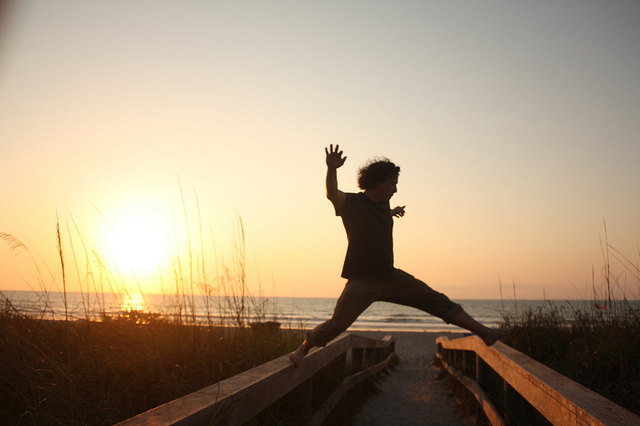
    Photo by John Nakamura Remy

  • Break Free from Fear: The World’s a Kinder Place Than You May Imagine

    Break Free from Fear: The World’s a Kinder Place Than You May Imagine

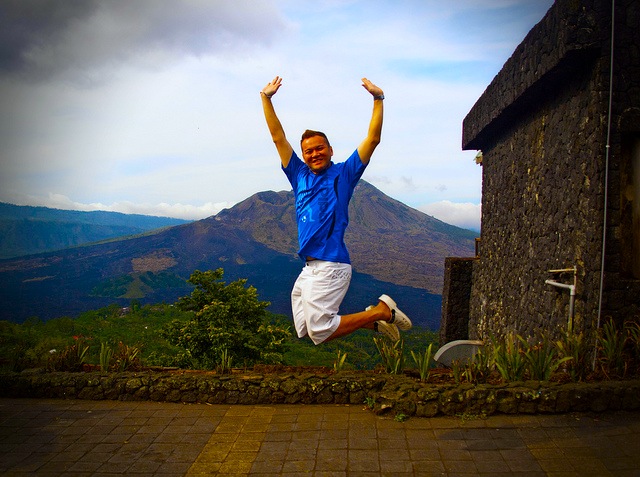
    Happy Jumping

    “A man who fears suffering is already suffering from what he fears.” ~Michel de Montaigne

    When I was an undergraduate in college I signed up to learn the Fundamentals of Modern Dance. My parents were less than thrilled.

    While many of my classmates likely took such a course for an easy A or a chance to revisit their leotard-clad youths, I picked my dance courses with an unannounced and secret ambition to be an instantly amazing dancer.

    This, I felt certain, was a sound place to rest my future livelihood upon.

    At the beginning of each class we were told to travel around the room in as many different ways as we could to warm up. We could roll or leap. A slow walk, a sprint, or a cartwheel were all acceptable.

    One day the teacher commented during this free form warm-up, “You can tell a lot about a person by watching the way they move.”

    I immediately imagined what I must look like to this grad student.

    Tall. Coordinated. Cautious.

    I would drop to the ground for a roll across my bottom ever so carefully, bracing myself so as to avoid any sudden, jarring impact.

    In the world of dance it is aggression and abandon that interest us. It occurred to me in class that day that I had a tendency to tiptoe. This realization began the slow and inevitable sinking of my dreams of being a yet to be discovered dance prodigy.

    And, just as my dance instructor’s words implied, my tendency to be overly cautious as a dancer was representative of how I engaged in other parts of my life.

    During my whole freshman year of college I visited only four places on campus—my classrooms, the gym, the cafeteria, and my dorm.

    Looking back, this seems like exceedingly strange behavior.

    I must have been trying to mimic the life I knew at my parent’s house, where my orbit was similarly contained within home, school, and sports practice.

    In high school the furthest I strayed from this well-monitored agenda was to covertly buy junk food from the convenience store near my house or to stay home from swim practice to watch Oprah.

    I clearly was not a big risk taker.

    At one point in the second semester of my freshman year of college I discovered I was quite bored with this predictable and caged existence.

    I remember sitting at my brightly lit desk in the corner of my dorm room, with my feet pulled up under me, and inspirational quotes on many tiny slips of paper all around me.

    I’d just spent the last hour or more journaling, and I’d run out of things to write about.

    My head felt dull and empty.

    I stared into space and thought of a pin that an elementary school friend had given me that read, “Life begins when you get one.”

    I’d always wondered if that pin had been a jab at my life skills as a fourth grader or if it had simply been a random trinket she’d passed on to me.

    I felt frustrated and cooped up, perhaps in a way I had felt for many years.

    It seemed as though I had much bigger wings than my little quadrant of a life on campus had room for. It was uncomfortable keeping them all bent and crumpled in that small space.

    That night I had the idea to try something new. To break free. To soar.

    It dawned on me that there wasn’t anything truly keeping me in those cramped quarters other than my habits, remnants of overprotective parents’ admonitions, and my own fears.

    Soon after this revelation I went to sleep.

    The next day my courage dawned anew. I would see the world, even if it killed me.

    I did the riskiest thing I could think of: I decided to take the metro into the city.

    I was pretty sure that by leaving the school grounds I was walking into treacherous terrain. My fear drew pictures of knife wielding, dementor-like beings who lived out at the fringes of my known world. If they didn’t get me I was pretty sure that my father would, when he found out I hadn’t listened to his directions to stay put on campus.

    A little before noon I gathered my courage, an apple, and a water bottle and put them into my backpack. I noticed the day was overcast as I walked to the train.

    Once on board I sat with the lumpy forms of my prized possessions clutched to my chest.

    My heart raced. My hands were perpetually sweaty. I was sure I would be found out, but still, I held my ground.

    It surprised me that I survived the metro ride without any harm befalling me. I got off at the Smithsonian stop on the National Mall. I was still frightened as I walked over to a nearby bench and sat down, gathering my wits about me.

    Here’s what I saw. People eating their lunch. People jogging. At one point my breath caught. It dawned on me that the world outside of campus was just regular people doing regular things. I ate my apple under a gray sky that has forever been etched in my heart.

    There really were not any monsters under the bed.

    I sat for a while longer and then turned around and got back on the train. Heading home to campus I felt a wave of pride and relief wash over me. I’d done it. The real world was laughably more benign than the world I’d concocted in my imagination.

    This heady success made me curious and determined to try more scary things. I began speaking up in class. I tried stand-up. I reached out to new people. I quit a job. I started a business. I’ve fallen on my butt in ways that I never would have previously allowed myself to in that dance class years ago. Through it all I’ve not only survived, but thrived.

    What I’ve ultimately learned is this: my fears of the unknown are usually big fat liars.

    Time after time I have tested these fears and found the world to be a much lovelier place than I would have guessed.

    So go ahead and do the one thing that scares you. You just may find that the world is a kinder place than your imagination.

    Photo by Kevin Poh