Tag: Challenges

  • The Power of Staying Put When You Feel Like Running Away

    The Power of Staying Put When You Feel Like Running Away

    “You cannot keep running away from your fears. At some point in life you will have to build up the courage to face and overcome them.” ~Unknown

    Last year my family and I relocated overseas from Australia to Singapore, which meant new jobs, new schools, new relationships—an entirely new way of living.

    My husband was busy with his work, and I had two wide-eyed children looking up at mummy for direction. A part of me was excited for the challenge, but another part of me, of equal measure, was feeling overwhelmed by the prospect and struggling to let my feelings go. I also knew that the only way out of this emotional prison was through.

    This chapter in my own zigzag journey has reconfirmed to me that we never have everything figured out. You think you’ve got it (eureka!), then life throws a curve ball and you take a temporary step backward. And that’s okay.

    I would say I’m more of an introvert; give me a good book and I’m happy. Reflecting, writing, and analyzing come naturally to me, whereas extroverting is more of an acquired skill. So the hardest part of our new life, for me, was the social aspect.

    Singapore has a large and diverse expat community, and we were welcomed with open arms—lunches, school events, BBQs. Yet being an introvert all of these well-intentioned invitations sent my ego into overdrive. For me, this was social overload, and it felt hard.

    Being the new kid in town, I felt pressure to go to everything and be my best, shiny self (whoever that is). Yet, a few weeks into this I hit the pause button and jumped off the social escalator. I needed to recalibrate and find some healthy ways to support myself and my family through the change and adjustment.

    To keep with the theme of new challenges, I took up Ashtanga yoga. I’d heard it was a powerful practice that helps us learn to be present with difficulty, and it sounded like exactly what I needed.

    I picked up my yoga mat and took myself down to a local studio to thrash it out, Claire vs. ego.

    The first morning I entered the studio, the teacher was supporting someone in a back bend while saying “trust yourself, let go.” The Mysore style of yoga is teacher supported as opposed to led, so you take yourself through the postures at your own pace.

    He pointed to an empty space to roll out my mat, and his first words to me were “no one’s going to rescue you, so lets get to it.” (I’ll add here, for the record, that this yoga teacher is a former US National Gymnastics coach, so he doesn’t do light and easy!) My ego was well and truly confronted. This studio was not going to be a place to hide.

    Yoga has a reputation for being about super hard, impressive postures and showing off your best active wear. Yoga is also about soul work. What I have found is a practice that challenges, confronts, and supports me.

    The yoga mat became my metaphor for life and for my insecurities. I took my struggles to the studio; they spilled out on the mat, I worked with them, and then repeated the practice the next day. And as my body strengthened and my posture straightened, I felt stronger and straighter inside.

    Some days were easier than others. On my better days, the dopamine was pumping and I took to my mat with a relaxed determination; on the not so good days, I sweated and strained and my mind was off planning what to cook for dinner that night. Such is life. We still show up and do what we can with what we have in that moment.

    There were times (frequent times!) when I wanted to give up. My mind would say, “Claire, this is so hard and painful. Why are you putting yourself through this? Can you honestly be bothered? Just roll up your mat and let’s hot foot it home for a cup of tea. That’d make life so much easier.”

    Similarly off the mat, at times it was tempting to hide away from new people for fear.

    The community in Singapore is diverse, and the diversity and newness scared me. What if I couldn’t find anything in common with my new community that consisted of people from all over the world—India, Burma, Denmark, Norway, Germany and so on? What would we talk about? Would they like me? Would I like them?

    A large part of me was crying out for the familiarity and security that my old life and friendships contained. I wanted to go to that BBQ with a garden full of familiar faces and be able to pick up a conversation (or sit in comfortable silence) with all the ease and intimacy that is earned over time.

    In life, how often do we allow ourselves to side step new experiences because of our pain, discomfort, and fear? Fear of rejection, of failure, of success? But embracing life’s inevitable pain is the only way to grow and to live fully.

    As my yoga teacher shared, “Claire, don’t mistake an opening for an injury, because they’re different. When you face your pain, be it a tight hip or an emotional wound, it’s going to hurt, but go through it, release the energy tied up there, and push through to the other side. This is where your freedom lies.”

    My new tool, yoga, has helped me to release old tied up energy and better utilize my present day energy too.

    Yoga has taught me to navigate the world with the language of feeling my body sensations, rather than solely thinking about them.

    I can feel if my body is getting unnecessarily tense and tied up or if I’m losing energy ruminating or stressing about something, and that gives me a choice—I can stay in that state, even feed that state, which doesn’t feel too good; or I can chose to let the tension go, get my energy flow back on track, and handle my present day moment differently.

    Familiarizing with my body in this way has brought a new level of awareness, or friendship toward myself, and helped me make better choices.

    At one of the early community events I went to I put so much pressure on myself to be pleasing to everyone that I became somebody else—a nodding, smiling, frozen person. Who I was being felt unnatural and uncomfortable, so it wasn’t long before my little friend anxiety appeared.

    With my new body awareness it clicked a lot sooner that I wasn’t being real and that I didn’t feel at home in myself. This new information gave me back my power and I was able to breathe and relax my way gradually back into myself.

    These little emotional detours have been more frequent in Singapore, but I also know that they don’t have to mean anything. We don’t need to think about them, ascribe some complex theory to them, worry about them, and generally just fuel the fire.

    These days I feel more able to normalize these uncomfortable body sensations and feelings with understanding. “I’m human, and this is a human experience. I’m okay.” Cue self-compassion.

    So I guess I have let go of perfectionism.

    What if life is about showing up, regardless of what happens, and having the courage to be seen? What if I allow myself to fail and to make mistakes? What if I accept and embrace that there is never going to be a perfect?

    It really hasn’t all been as bad as my ego tried to claim it would be, either! In my yoga practice I’d had a strong aversion to doing a headstand. My teacher knew this, and every session he would make a beeline for me at headstand time and teach me to fall—over and over again, week after week. And I got good at falling.

    Paradoxically, I also got better at my headstand. I found both the fall and the headstand actually weren’t as hard or as punishing as I had created them to be in my mind.

    Similarly, over time and with practice, building new relationships with such a diverse range of people has become less daunting and actually incredibly fascinating.

    Last week, I met with some other class parents for coffee and listening to the sharing of experiences from people from all over the globe was pretty amazing.

    I’m pleased I’ve pushed through fear; otherwise, I wouldn’t have reaped the benefits or gained the life experience that I have from being part of this diverse community. And I’m pleased to say I’ve met some incredible people who have started to become firm friends.

    Essentially, the pain and the fears (of falling from a head stand or making faux pas with potential new friends), while challenging, haven’t been as bad when I have actually faced them.

    A move overseas aside, everyday life contains pain and discomfort. Fact. Being human we experience a continuous ebb and flow of pleasure and pain, joy and sadness, praise and blame, gain and loss, and so on.

    Experiencing pain does not mean that there’s something wrong with you. Another fact. If we can keep learning to accept life, warts and all, and to “stay put on our mats” whatever we’re dealt, we gain more and more emotional freedom.

    Pain, when faced, offers us the chance to grow and emerge some more—so for all it’s challenges, it’s actually a good thing. With the learning it provides comes the opportunity to make better choices for ourselves and to show up more fully for our lives.

    Many of us, as children, never learned how to handle the inevitable pain of life, and there’s no shame in that. But it’s never too late to get curious and start working with our pain (wherever you are on the path) using supportive tools, people, and techniques. As we learn to let it go, we create the space where the magic happens.

  • How to Maintain a Sense of Peace No Matter What Life Throws At You

    How to Maintain a Sense of Peace No Matter What Life Throws At You

    “Ships don’t sink because of the water around them; ships sink because of the water that gets in them. Don’t let what’s happening around you get inside you and weigh you down.” ~Unknown

    Do you ever feel like your life is a rollercoaster?

    One second, you’re on top of the world. The next, you’re down in the dumps.

    For me, this feeling of going up and down began back in high school.

    Before then, everything in life seemed like a test run. Sure, there were exams, extracurricular activities, and the usual social pressures. But now that university was only a few years away, things suddenly turned serious.

    “These are the most important years of your life,” people would say. “Make the best use of them.”

    And so, every single thing, no matter how big or small, seemed to have an amplified effect. If I didn’t do something right, my life was over. But if I did achieve a step in the right direction, my life was set.

    When I applied for a leadership position that I thought was a good fit, I convinced myself that I absolutely had to get it. I read the leadership responsibilities diligently, practiced the same speech over and over, and thought about what I would do when I got the position.

    The result? I didn’t get it. My life, as I knew it, was over.

    Fast-forward a few years to university: I had decided by this time that I wanted to go to business school. My friends and I would talk about the application process and how to improve our chances of acceptance. With bated breath, I finalized my application and submitted it.

    The result? I was accepted. Since the school had strong internship and job prospects, my life was set.

    While I had fun, school was also incredibly stressful. Classmates and I would beam with excitement when we were invited to interviews, only to be disheartened a few days later when an offer didn’t come.

    Later, I received an offer to work in a role that seemed perfect for what I was looking for. I was elated.

    As you can probably guess by now, that feeling didn’t last.

    It began to feel like no matter what I did or how much effort I put in, life was never a smooth path. Seemingly promising opportunities would lead me to obstacles in the way. Even when I did get something I wanted, it would lead to another stressful problem that needed solving. And so on it went.

    After dealing with these emotions and thoughts for years, I felt exhausted. It felt as if there was no end to the tunnel. No point in time when I could just put down everything, sit, and enjoy the scenery for a while.

    Eventually, I figured that it wasn’t simply the swirl of events surrounding me that caused my ups and downs. It was my perspective. I consistently attached myself to specific outcomes, as if my life depended on them, and felt devastated when things didn’t work out.

    Sure, some of the things I experienced could easily make anyone feel the same way. Had I taken a different view, however, I wouldn’t have constantly psyched myself up and created these unhealthy emotions.

    When I look back at what I thought were huge victories and setbacks at the time, they seem insignificant now. My life wasn’t over, as I believed it to be, nor was it set in stone. And truthfully, I wouldn’t want either.

    I learned that no matter what happens, life goes on. Celebrations and challenges are a part of everyone’s life, not the be-all and end-all. With practice, I’ve started incorporating a sense of peace into my life by using some practices that anyone can apply.

    4 Practices to Help You Maintain Peace and Perspective

    1. Expect twists and turns.

    Recently, I went on a long-awaited vacation. Soon after landing, I stepped off the plane relieved and excited to begin my holiday.

    Unfortunately, my new luggage case arrived less than intact.

    “Why me?” I thought. This was the first time in years that I had used the airport check-in, and my luggage was the only one that was damaged.

    I realized then that I had two choices: I could let this ruin my vacation, or I could enjoy my holiday regardless.

    I admit, I did grumble about it initially. But later I took the contents out and put the case out of view so that I wouldn’t spend my holiday thinking about it.

    Unexpected events happen to everyone. It’s important to acknowledge them as a part of life and plan for them when possible. Even though I felt upset about possibly tossing out my new favorite luggage, I reminded myself how fortunate I was that I got to use it in the first place.

    Thankfully, the airline ended up offering to get my luggage case repaired.

    I realize some twists and turns are more emotionally trying than damaged luggage, and far more difficult to accept. But if we learn to expect the unexpected, we’ll spend less time resisting life’s inevitable curveballs and more time proactively dealing with them.

    2. Look at the big picture.

    Painful events and experiences happen to everyone. Sometimes, they’re so painful that it feels like nothing will ever take away the feeling of sorrow or hurt. But everything heals in time, and sometimes good can come from even the most traumatic situations.

    A few years ago, a relative of mine lost her husband to cancer. It was devastating for everyone, especially for her family. At the time, it felt almost unimaginable that someone so close and well loved could leave so soon.

    While he is still missed and thought of every day, good things have happened since then:

    • A marriage and the addition of a new family member
    • A stronger bond between the family
    • The realization that it’s crucial to laugh and enjoy life while we can

    So no matter how terrible something feels at the time, know that you have the strength to get through it. There will be many moments in the future, both blissful and difficult. And if you can survive one painful experience, you can survive the next one.

    It also helps to remember that some of life’s greatest challenges end up being our greatest teachers. You may not be able to control what happens, but you can decide what lessons you choose to learn from them.

    3. Practice self-care.

    When was the last time you did something nice for yourself?

    Most of us spend our time running errands or doing work for other people, but rarely do we pause and enjoy a moment simply for the sake of it.

    By constantly putting ourselves in stressful situations, we end up damaging our health in the long run.

    Make time for yourself. Sit and listen to your favorite music, pursue your hobby, or meditate. Some of my favorite ways to de-stress include taking a walk outside and curling up with a good book.

    When you take care of yourself, you feel more centered, more peaceful, and better able to handle whatever life throws at you.

    We all need time for ourselves to relax and reflect on our day. Besides, I’ve found that taking breaks helps me to approach tasks with greater clarity and calmness than working all the time.

    4. Practice patience.

    Sometimes it feels like life is a constantly unraveling story. The only problem is, we want to jump straight to the end and see what happens.
    For instance, sometimes I think to myself: In five years, will I still be in the same place that I’m in right now? If I choose to spend time working on this endeavor, will it eventually give me the results I want? Will the person I just messaged reply back?

    We feel anxious when something in our life is unresolved—an “open loop,” they call it. It makes our heart rate go up and creates tension within ourselves, both of which are unhealthy.

    It’s been difficult, but I’ve been trying to be more patient. To do this, I direct my thoughts and attention to things that are productive, such as focusing on the actions rather than the result.

    When I’m patient, it becomes easier to deal with both celebrations and setbacks. Knowing that sometimes only time can resolve a situation gives me the ability to let go and be present. And it’s always easier to be peaceful when you’re living in the moment.

    Feel At Peace With a Change in Mindset

    We all experience disappointments and serendipitous moments. But if you’re exhausted from constantly reacting to the ups and downs in your life, it’s time to step back and reflect on how you respond to things.

    Inner peace comes from appreciating life, with all its quirks and bumps. It’s about doing what you can, knowing that sometimes the path you choose will take unexpected turns.

    The process of growing and learning can be challenging. It can be downright scary. But if you manage to weather the storms that come your way, you’ll come out stronger than before.

  • How to Rock Your Scars (Because They Mean You’re Strong)

    How to Rock Your Scars (Because They Mean You’re Strong)

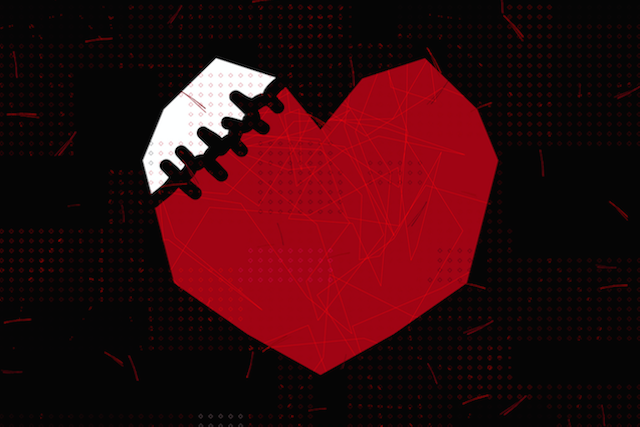
    Scarred heart

    “Never be ashamed of a scar. It simply means you were stronger than whatever tried to hurt you.” ~Unknown

    “It’s such an ugly scar, I really don’t want anyone to see it.” This is what I told my daughter about a scar on my leg from an accident I’d experienced a year earlier.

    I can remember the day so clearly when I slipped and fell, while skating, breaking my ankle and tearing a ligament. It was a painful experience with a long recovery. But I also felt embarrassed because I got injured during such a simple and fun activity.

    I often wondered why this happened to me. One minute I was out enjoying quality time with my daughter and after the next minute I couldn’t walk for twelve weeks. I wanted to be present for her. I wanted to be active. I wanted to be involved. I wanted to be a good mother. I wondered if maybe I was overcompensating for the time I was busy keeping up with my work.

    I became so entangled in my thoughts, wondering where I went wrong and why this was happening now.

    After all was healed, I had a long scar from two surgeries. While I was happy to be up and on the move again, I was self-conscious about the five-inch mark on my ankle and leg area, along with the indentations in my skin from where the medal plate and screws were underneath.

    I thought this scar was unattractive, and it was an awful reminder of my journey to healing. I knew with the warmer weather quickly approaching that I’d want to hide it.

    I had it all planned out: I’d wear super long dresses, skirts, and pants. No one would need to stare my scar or ask me what happened. I wouldn’t have to wonder if anyone was looking at it, because I’d already taken care of that with my clothing.

    One day my eleven-year-old daughter and I were discussing summer fashion and girl talk in general. I shared my well mapped out plan to hide my scar with my clothes. Before I could finish, she quickly replied, “Why don’t you want to wear your dresses, Mommy? Why are you hiding your scar?”

    I pondered for a moment, then offered a simple response that I just didn’t like the way it looked. What she said next caught me off guard and made me teary eyed.

    She said, with conviction, “Mommy, your scar shows that you made it! It shows that you are no longer in that same place as you were before, that you overcame it. You should be proud to show that scar, Mommy, because you bounced back! That’s your ‘I made it scar.’ ”

    I was so blown away by her response and her unknowing insight into resilience.

    As parents we share much of what we know with our children to help guide them through their everyday experiences. But there are those unscripted moments when our children’s perspectives provide us with insight into how to move forward.

    Here are the lessons of self-acceptance and resilience my daughter taught me that can help you:

    Don’t Hide Your Scars

    We’ve all been through challenging situations, setbacks, disappointments, or heartbreak, and these experiences can leave a painful residue based on how we allow ourselves to heal.

    Once you make it through the healing process, sharing the lessons with others will provide a sense of empowerment for you and to those you share it with. Your “scars” or challenging experiences have a unique story of resilience, and to tell it sends a continuous chain of healing to all you interact with.

    Keeping it hidden reinforces a stigma of non-acceptance of all parts of your journey in life. If you reject these experiences, you’ll feel compelled to bottle these emotions within. That’s what I did after I left a job that, at the time, caused a great amount of stress and wasn’t beneficial for me as a parent.

    At first, I felt embarrassed to share with others, because I always saw myself as competent, fitting in anywhere and always able to get the job done. I felt defeated because I was unable to meet the demands of my role. I felt bad that I somehow couldn’t “cut it” and didn’t measure up.

    It was hurtful since I’d given everything I had, even at times pushing aside my priorities as a parent, and it still didn’t work out. So, I wanted to keep this “failure” quiet and move right along.

    However, when I began sharing my experience of trying to balance the unrealistic expectations of a big corporate organization and being a present parent, I heard stories from other women who could relate.

    This was when I realized the power of sharing my story. In talking about it I felt less ashamed, and that’s when the healing began, along with gaining a sense of empowerment.

    Try to put a spin on those tough challenges so they don’t hinder your growth and progress. Share your feelings and story with a close friend, and if you’re comfortable enough, with others as well.

    If you’re uncomfortable speaking about it, then write it down in a journal. Getting your feelings out will help purge your mind of overwhelming thoughts and cleanse your heart of the pain.

    Your Challenges Can Propel You Forward 

    This challenging experience may have been rough, but it can also be the thing you need to get you moving outside of your comfort zone and into a new direction. Sometimes those unexpected setbacks build up the “muscles” that were once hidden within us due to fear or complacency. Now you’ve experienced your fears and you see that you’ve made it.

    For example, maybe one of your worst fears is to lose your job and not being financially secure. If you’ve been laid off or fired, while this is hurtful to your self-esteem and brings about uncertainty, it may be an opportunity in disguise.

    Perhaps this is your chance to go full throttle in starting the business you’ve always wanted, or maybe this is the push you need to get you to go back to school, or into the true field you desire to work in. It might even be a much-needed opportunity to take it easy and take better care of yourself.

    Take time to process the lessons you’ve learned from this situation. Use them to help you regroup, refocus, and move ahead. What you were once afraid of is now a thing of the past.

    Use your setback as a stepping stone to a new transformation in your life.

    Be Gentle and Less Critical of Yourself and Your Journey

    You may have gone through or are currently going through a tough time and you’re having thoughts about feeling “dumb,” feeling less than or not being able to cut it.  While these thoughts are normal, spending time dwelling on them will never help you feel better and learn the lessons.

    Stop beating yourself up. Offer yourself and your past forgiveness in order to set yourself free from the pain.

    Giving so much life and emphasis to what those things mean about you is taking away from living out this one life of yours. Recognize the lessons and be kind to yourself so you can begin the next chapter of your life.

    Surround Yourself with Resilient People 

    We spend so much time in our own heads pondering questions like “Why did this happened to me?” “What did I do wrong?” Indulging the “what if” questions will cause intense overwhelm and keep you stuck in your thoughts.

    Surround yourself with resilient people who will listen to you, offer you encouragement, and help you find that spark you need to move forward. My daughter was a calming peace to my anxiety around my scars. While she shared a dose of encouragement, she unknowingly provided me with enough space to think about what she said, which gave me the ability to identify my next step for moving ahead.

    A gentle spirit with words of wisdom was the catalyst for me to think differently about my situation.

    Life is not meant to be lived hidden. The entire fabric of who you are is what makes your story unique and rich with wisdom. I once was afraid and ashamed to share those lessons of setbacks and hurt, fearing judgment and rejection. But I’ve found even more strength and humanness in sharing those stories, as they are part of who I am and it’s not necessary to hide that anymore.

  • We Can Get Through It, Even If We Think We Can’t

    We Can Get Through It, Even If We Think We Can’t

    Man in the Mountains

    “I am not what happened to me. I am what I choose to become.” ~Carl Gustav

    It used to be my favorite guided meditation. You know the one about the mountain, where you imagine yourself as the mountain? Strong, tall, standing firm in the face of all that comes at it—rain, hail, shine. Letting it all wash off without getting rattled by it.

    One of the reasons I used to love that particular guided meditation was because I could relate to it. I could relate to it because I love mountains. I love trekking and I love mountains. Big mountains. Immovable. Stable. Reliable. Regardless of what was thrown at them.

    Then the mountains moved. I found myself in Nepal at over 4000m above sea level, scrambling to stop my body from sliding down the side of the mighty Himalayas as a 7.8 magnitude earthquake cracked open these mighty mountains and shook them from 18km beneath the ground.

    I can’t even bring myself to listen to that meditation any more.

    I heard it before I felt it. It sounded like a deep guttural scream, the earth itself crying out in pain. No other sounds, no animals, no people, just this sound unlike any sound I’d ever heard before.

    Stillness and quiet followed—for what was probably only seconds—before my life was fundamentally redefined.

    Before boulders the size of cars came hurtling down the mountain, before the narrow path on the steep ridge I was trekking started to literally disappear beneath my feet, before I could hear someone screaming for me to run.

    I remember every detail. Every little detail. I wish I didn’t.

    Sleep was a luxury not afforded to me as aftershocks continued through that first night, forcing the group of us sheltering in what was left of a Tea House out into the snow and below freezing temperatures time and time again.

    Surviving the actual earthquake was only the beginning and it was a challenging and emotional journey as I made my way, through devastated villages, down the mountain. The aftershocks continued for several days, with one in particular carrying almost as much force as the actual earthquake.

    Patchy reports of what had occurred in Kathmandu, Everest Base Camp (where I had been two days before) and other villages were coming through. I was devastated and bewildered.

    As the days went by I continued to make my way down the mountains. The Australian Embassy was advising that until I got myself back to Kathmandu they couldn’t help me. The Australian Defence Force was being deployed to assist. The reports of casualties and devastation became clearer.

    In all, over 9,000 people lost their lives. I personally knew one of those people, but every day I pray for all of them.

    The trauma, destruction, and death I was experiencing and witnessing every day for five days altered my sense of being entirely.

    Visions that would normally bring me to my knees were becoming commonplace.

    Stepping over the bodies of beautiful souls, crudely wrapped in blue tarpaulins far too small for the job, became just something I had to do to get to safety.

    Watching as a fellow trekker’s body burned in a traditional Buddhist cremation, out in the open on the side of a hill. Watching as his friends gathered his ashes in a bucket to take home to his loving family. Watching, but not really seeing… it was like I was outside of my body, looking on.

    Days went by before I found myself standing outside the Australian Embassy in Kathmandu. You would think I could start to feel safe, but Kathmandu was badly damaged, and mourning the massive loss of lives. There continued to be aftershocks. It was not safe.

    Still, the welcome sound of the Aussie accent and the welcome sight of fresh water, food rations, and tents in the Embassy grounds were extremely comforting. More comforting was the next night, taking my seat on a plane to Malaysia, before a plane to Sydney. However the comfort, the relief, was mixed with bewilderment and much sadness. There was a part of me that didn’t want to leave.

    Coming home was bittersweet. I was, of course, extremely joyful to be hugging my family and friends, but the event had taken its toll and I wasn’t remotely who I was when I had left Australia only a month before.

    Shock and trauma had settled in me now that I was out of immediate danger, my body shut down, and my mind shut down. I was a mess.

    A few months on, and I’ve been able to look back at this time. I learned some things through this experience, mostly about myself, and I’d like to share these:

    Without any warning, things can change. You can change.

    I used to see natural disasters in foreign countries on the news and watch as travelers were urged to get to their Embassy and governments rallied to evacuate their citizens. I never thought it would happen to me though, because these things happen to other people. Right? Wrong.

    Things can change regardless of how well you plan. Things changed, and well, I changed—in that split second where I fought for my own life, and the times in the days to follow where I felt it was likely my end, I changed.

    This experience will forever be a part of who I am, and has irreversibly redefined me and my values. I have learned that as much as we like to think we have it all under control, we don’t, and we need to be prepared to change.

    Embrace surrender and acceptance.

    I now have a better understanding of what it means to accept and surrender. It doesn’t mean that I won’t have goals and I won’t plan, but I now understand what I can control and what I can’t control. Consequently, I know now that there really is very little in this life I can control. I’m not perfect at this, but I am getting better, day by day.

    When life does what it does, we can embrace each situation and accept it as it is, or we can demand that life be some other way. In the words of Eckhart Tolle in The Power of Now, “Whenever you are not honoring the present moment by allowing it to be, you are creating drama.” When we have no control of the situation, demanding it be some other way is a drama.

    Your best, at each moment, has to be good enough.

    The trauma and constant stress of living one minute to the next for five days, along with the situations I found myself in, and witnessed, not knowing if I would live that day or die, took its toll on me.

    Everything came back to basics—safety from landslides and aftershocks, a supply of clean water and some shelter and warmth were the key priorities. My ability to think straight, my ability to comprehend what was happening, my capacity to fathom the extent of the destruction and death—all of these were compromised and this affected my thoughts and my behaviors.

    We all just have to do our best, in every moment, because it’s all we have and that has to be good enough. Let’s be gentle on ourselves.

    That which you think you can’t possibly get through, you can.

    If you had asked me if I could get through the experience I went through, before I went through it, I likely would have said no.

    I have learned that we are capable of so much more than we give ourselves credit for. Not only capable of surviving traumatic experiences, but showing compassion, love, and nurturing along the way; taking the gifts, however disguised they may seem at the time; and allowing change and growth to occur within ourselves. Walking right up to it, leaning in to it.

    We can get through it, even when we think we can’t.

    It’s okay to not be okay.

    I hope to listen to the mountain meditation again one day, just as I hope to trek mountains again one day. The mighty Himalayas are still there. In parts, they look a little different and some are even a bit broken. But they remain, standing strong, in the face of the devastation they have had to witness.

    I aspire again to be like that mountain. I’m a bit broken too, but I stand up again and face this life with a gratefulness that I wouldn’t have, had it not been for this experience. At the sound of a helicopter you will find me under the nearest table, and sudden loud noises bring me to my knees.

    I struggle to hold a conversation about my experience without tears streaming down my face. I’ve learned that even though we might not be okay right now, and we might be a bit broken in places, we can keep getting back up, every day. Every single day.

    I recognize the pull in my heart to return to Nepal; I accept that yearning and commit to returning when the time is right. I breathe in my life every second and I endeavor to practice acceptance in a much more authentic way than ever before.

    I have changed—I’m not who I once was. That thing I thought I would never be able to get through, I did, and it has redefined my entire being.

    I tentatively welcome the gifts from this experience each day, while never forgetting to honor my fellow adventurers who didn’t make it home and the beautiful people of Nepal, who lost their lives that day when the mountains moved.

    A beautiful and wise friend who shared this journey with me has always told me that there are gifts in everything if only we look closely enough.

    Whatever it is you’re going through, have faith that you will get to the other side, and when you do, remember to look closely enough to recognize the gifts from your experience, and welcome the personal growth and change in yourself.

    Man in the mountains image via Shutterstock

  • 25 Powerful Acts of Love and Kindness

    25 Powerful Acts of Love and Kindness

    The holiday season has the potential to bring out the best in us. Though the days get shorter and colder, somehow our hearts get bigger and warmer.

    Maybe it’s the thoughtfulness handwritten on Christmas cards, maybe it’s the focus on giving over receiving, or maybe it’s the anticipation of celebration with people we love.

    For many, it’s the reminder of what’s important in life—not what we do, what we earn, or what we buy, but how we treat each other, how we help each other, and how we use our gifts to make the world a better place.

    Yes, the season inspires us not just to believe in magic, but also to create it.

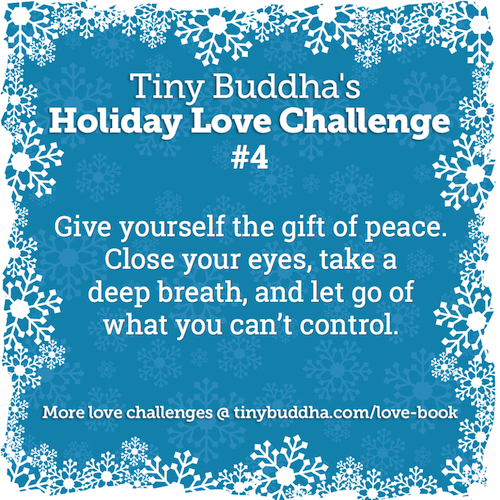
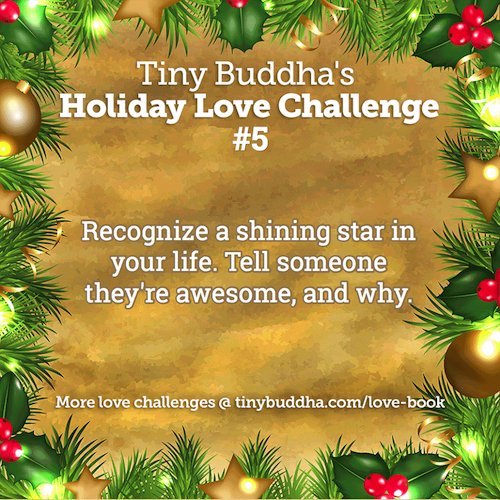
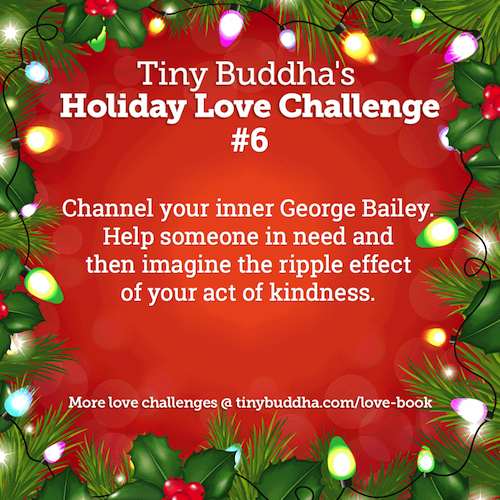
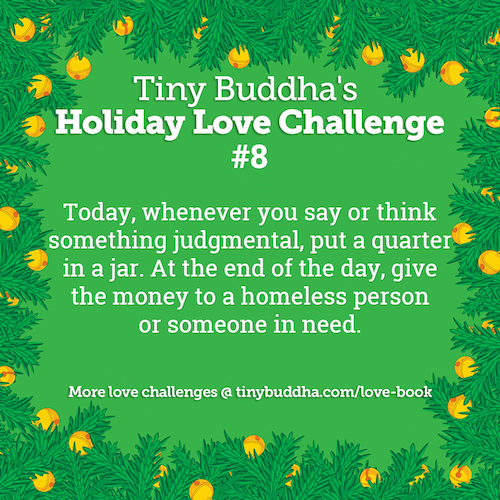
    It’s for this reason I created a series of “holiday love challenges” (some taken from Tiny Buddha’s 365 Tiny Love Challenges), to inspire more acts of love and kindness.

    Some focus on giving, others on appreciation, and others on giving ourselves the same compassion we strive to offer others.

    I hope some of these inspire you to create a little magic in your world, one tiny act of love at a time!

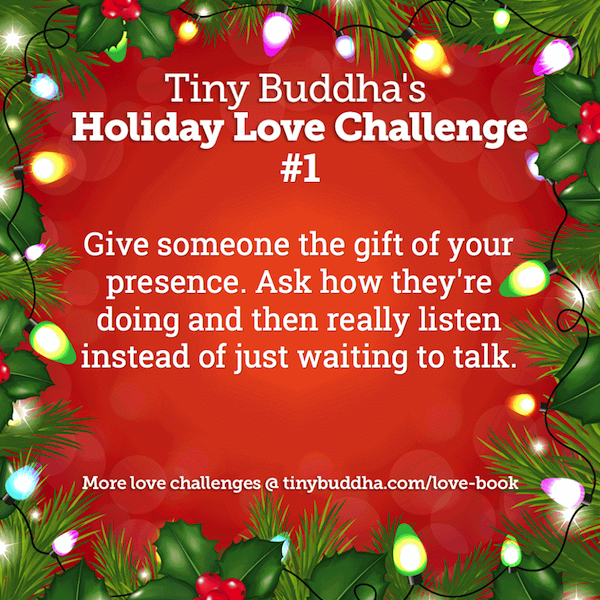
    Holiday Love Challenge #1

    Tiny Buddha's Holiday Love Challenge #2

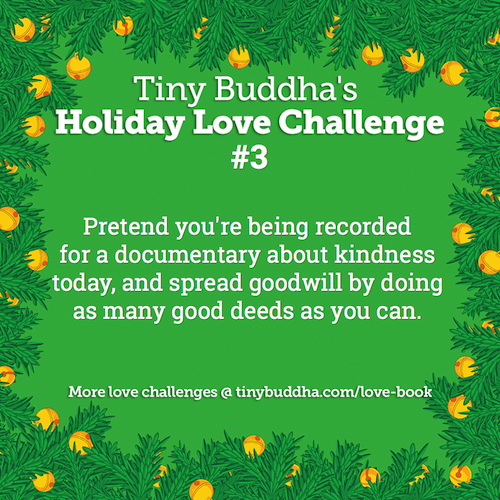
    Tiny Buddha's Holiday Love Challenge #3

    Tiny Buddha's Holiday Love Challenge #4

    Tiny Buddhas Holiday Love Challenge #5

    Tiny Buddhas Holiday Love Challenge #6

    Tiny Buddhas Holiday Love Challenge #7

    Holiday Love Challenge #8

    Holiday Love Challenge #9

    Love Challenge #10

    Holiday Love Challenge #11

    Holiday Love Challenge #12

    Holiday Love Challenge #13

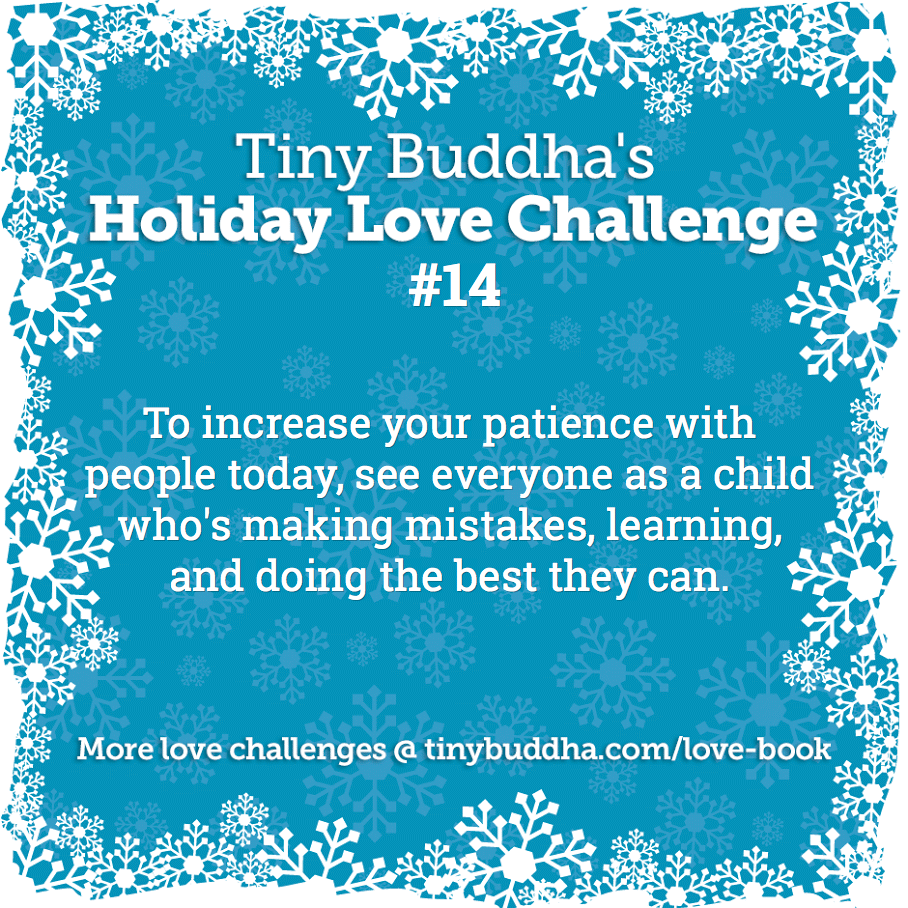
    Holiday Love Challenge #14

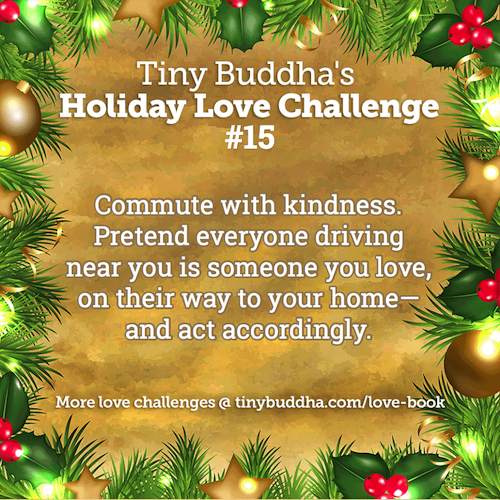
    Love Challenge #15

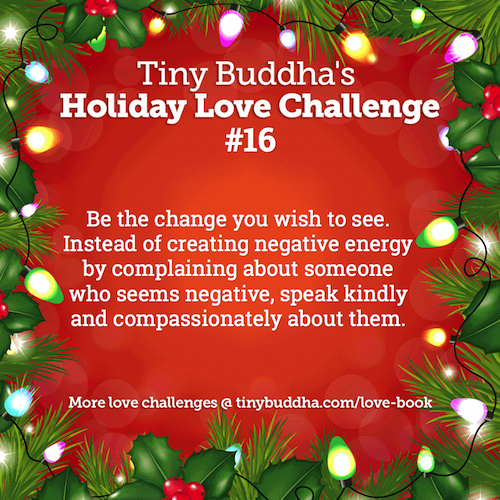
    Holiday Love Challenge #16

    Holiday Love Challenge #17

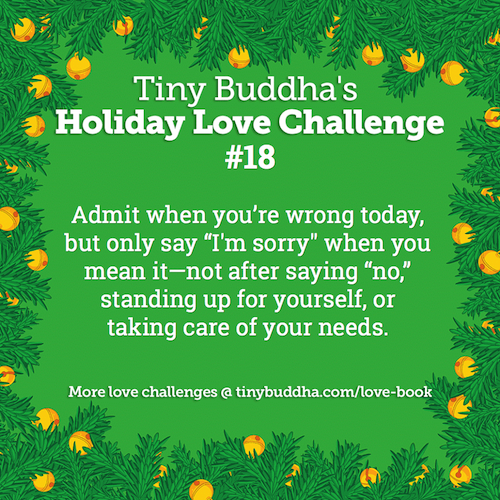
    Holiday Love Challenge #18

    Holiday Love Challenge #19

    Holiday Love Challenge #20

    Holiday Love Challenge #21

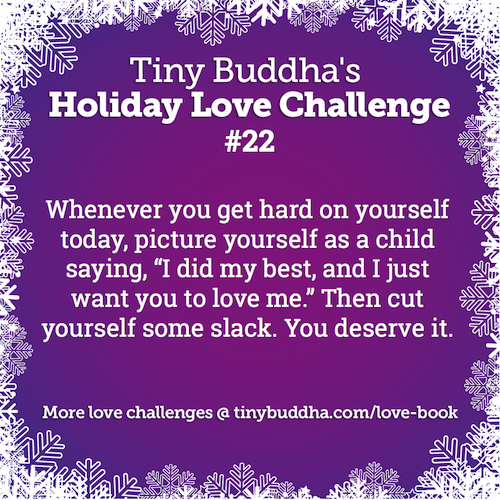
     Holiday Love Challenge #22

    Holiday Love Challenge #23

    Holiday Love Challenge #24

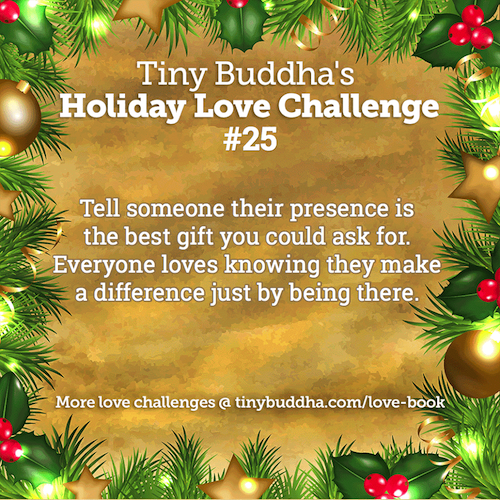
    Holiday Love Challenge #25

  • 5 Things That Stop You from Achieving Your Goals and How to Overcome Them

    5 Things That Stop You from Achieving Your Goals and How to Overcome Them

    “Do the one thing you think you cannot do. Fail at it. Try again. Do better the second time. The only people who never tumble are those who never mount the high wire. This is your moment. Own it.” ~Oprah Winfrey

    I’ll never forget being filled with utter disappointment as I watched my mum cross the finish line at the Paris marathon. I should have been celebrating her achievement. Instead, all I felt was regret for not crossing the finish line alongside her.

    I had set myself the goal of running a marathon and invited my mum along for the challenge. Unfortunately, I have still yet to reach my goal.

    After returning home from Paris I did a lot of soul-searching to see why I had been unable to complete a goal I’d had for three years.

    Although a personal crisis had contributed to the situation, I realized a number of things within my control had held me back. If you struggle to reach your goals, these five things could be standing in your way.

    1. Your core beliefs are holding you back.

    We all have a set of core beliefs around what we believe is possible for our lives. I had set myself a challenge to run a marathon, but in fact my core belief was that I couldn’t, because I had failed to stick to my fitness goals in the past.

    We can never achieve anything that contradicts our core beliefs, but we can change our core beliefs. By having small wins each day we can prove that what we believe about ourselves isn’t necessarily true.

    2. You don’t have a schedule (or you’re not sticking to it).

    It’s not what you do every now and then that counts, it’s what you do on a daily basis. I created a training schedule, but I didn’t commit to making progress on a daily basis. It was easy to talk myself out of runs and before I knew it, it was one month before the marathon and my fitness levels were nowhere near where they needed to be.

    Create a schedule and make sure you are sticking to it each day. Commit to doing everything in your control to make progress and you’ll be surprised how far it will take you.

    3. You don’t have an accountability partner.

    It’s one thing to set yourself a goal, but it’s another to be held accountable to it. Having another person hold you accountable will make it that much harder to quit when the going gets hard.

    Although I had signed up to do the marathon with my mum, she was in New Zealand and I was living in England. Finding someone to train with on a weekly basis would have helped to hold me accountable to my schedule.

    To achieve your goals you have to be self-motivated, but it also helps if someone else is also on your case. Pick an accountability partner who can relate to what you’re trying to achieve and will make sure you stick to your plan.

    4. You want it for the wrong reasons.

    When I was studying at university I told a friend that I wanted to run a marathon one day. “You’ll never do it,” he replied. It made me angry that he had no faith in me, and so I set out to prove him wrong.

    Do you want to achieve a goal because you want to prove someone else wrong? Are you working toward a goal because someone else decided you should? Find out what you really want, don’t be motivated by the opinions of others. Aim for a goal because it’s the right thing to do for you.

    Although I was partly driven to run a marathon because I was told I couldn’t, I did have other positive motivations. Overcoming a massive challenge, getting fitter, and achieving a personal goal were just a few of the positive reasons why I wanted to complete a marathon. I should have focused on these motivations, not wanted it because another person had no faith in my abilities.

    5. You let your past experiences define you.

    Just because you failed to reach a goal in the past, that doesn’t mean you will always fail. Even though I have yet to run a marathon, I’m proud of myself for setting the challenge and I know I will eventually reach my goal.

    Many people have goals, but never attempt them. While leading up to the marathon I significantly improved my fitness levels and took part in a half marathon. Something I may never have done without the goal of running a marathon.

    When you fail, don’t start calling yourself a failure. If you have failed in the past it shows that you have attempted to take risks. Be proud of yourself for stepping out of your comfort zone, learn from the mistakes you made, and help them propel you forward to achieving your goals in the future.

    There will be times in life when we fail, but what we learn from our failures is extremely important. Those who achieve their goals also face failures, but they grow from their mistakes, get up when they stumble, and make progress each day in the direction of their dreams.

    Remember, you are just a few small adjustments away from achieving your goals.

  • How to Make Life’s Challenges Count for Something Good

    How to Make Life’s Challenges Count for Something Good

    No Regrets

    “Life shrinks and expands in proportion to one’s courage.” ~Anais Nin

    Many people have told me that I am a brave person. Mostly though, I think I just play the cards I’m dealt.

    When I was twenty-one years old, I had a stroke. In a single moment, everything I had ever taken for granted about my health and about my youth flew right out the window. I felt truly vulnerable for the first time in my young life and it scared the bejesus out of me.

    Following a full recovery, that fear quickly turned into intense bitterness and anger that stayed with me for months afterward. I felt an incessant need to regain control of even the smallest and most inconsequential things in my life, almost as if to prove to myself I was still there.

    I was miserable and I made everyone else in my life who cared about me miserable with me. It was a rough time.

    By hook or by crook, though, I finally realized that constantly punishing myself and those around me wouldn’t change the fact that my body had failed or that the failure had left deep scars. The only thing I could change was me, in the face of it all.

    My stroke had affected me negatively, I knew that. A year after it happened, I decided that I needed to make it count for something positive too. I needed to learn something good from it all. Otherwise, what was the point?

    So I did.

    I learned that life is full of things I can’t control and that believe it or not, this is okay.

    I learned that “bad things” don’t “only happen to bad people.”

    I learned to accept help when I need it and not to isolate myself in pain.

    I learned to genuinely respect and empathize with the personal struggles of others.

    I learned to never to give up on myself.

    I carried these lessons with me through my twenties, all the while aware of how much bigger of a person I felt I had become as a result of them. I ended up carrying them all the way to the infertility clinic eight years later.

    If you don’t know, infertility and miscarriage are awful. Together, they are crippling.

    You have no idea how many times my hands cradled my head in despair as I leaned against bathroom countertops, physician’s desks, exam tables, the steering wheel of my car, pre-op room gurneys. I barely have an idea. It was too many to count, too many to even remember.

    My stellar husband, David, and I just wanted a family. We couldn’t fathom why it was all so hard.

    In the span of six years, he and I supported one another through three intrauterine inseminations, two in-vitro fertilization cycles, two frozen embryo transfer cycles, four pregnancies, and three miscarriages. It was a long, difficult journey.

    However, one very special little one, our daughter Molly, made it into the world and into our arms. We were amazed and overjoyed at her safe arrival then and are so grateful now for all the love and joy she has brought to our family ever since.

    Our second child, Molly’s future baby brother or sister, is out there somewhere too. But he/she won’t be joining our family through the same means that we were gifted Molly. We are most definitely done with fertility treatments.

    David and I have chosen Open Adoption to complete our family and we couldn’t be more excited.

    We have yet to find the birth parent(s) with whom we will share our family and whose incredible child we will love and cherish with our whole hearts. But already, the tenderness and gratitude we feel in anticipation of this little one and his/her birth family is limitless and has no bounds.

    Our experience of infertility and miscarriage was devastatingly difficult, but it was also good. I made it count. Again. We achieved Molly and discovered the beauty of Open Adoption. I also learned. A lot.

    I’ve learned to be honest with myself. Always.

    I’ve learned to honor the desires of my heart with no apology.

    I’ve learned how empowered I feel when I take care of myself.

    I’ve learned to make space in my life for my direction to change in ways I can’t anticipate.

    And last, but not least, I’ve learned that the best things in life are worth waiting for.

    I am a better person for all I’ve learned. I definitely know it’s made me a better mom, a more patient mom, a more connected mom. I will always be grateful for that.

    We’ve all been through a lot, no doubt about it. But it’s what we do with our feelings and challenges that define us, not the experiences themselves.

    I encourage you to find some time today or tomorrow when you can be completely alone with your thoughts. It can be while taking a walk or a run, lying in bed at night right before sleep, or sitting somewhere beautiful that deeply resonates with you. It doesn’t matter.

    Look at your hands in front of you. Imagine that they gently hold each of the problems you are faced with, the worries, and the fears of the day. Accept them.

    Then ask yourself:

    Has this experience taught me anything about what makes me a strong person?

    Has it taught me anything about my weak spots and how I can make them stronger?

    Have I learned anything new about what I want or need to be happy and fulfilled?

    Have I learned anything valuable about the people in my life and how I can make those relationships better?

    Did I learn anything about life that will help and inspire me going forward?

    How can I begin to apply these lessons starting now?

    How can I help others with the lessons I’ve learned?

    Dare to be honest with yourself. You’ll be amazed at what you come up with.

    No regrets image via Shutterstock

  • 5 Steps to Change Your Perspective and Overcome Your Challenges

    5 Steps to Change Your Perspective and Overcome Your Challenges

    Astronaut in Space

    “Look again at that dot. That’s here. That’s home. That’s us. On it everyone you love, everyone you know, everyone you ever heard of, every human being who ever was, lived out their lives.” ~Carl Sagan

    I’m there with a hundred other people. The lights fade to a whisper then vanish, leaving us in darkness. Stars appear. Thousands of them, projected onto the dome screen above.

    In the center of the screen is Earth with its emerald and amber lands and sapphire oceans frosted by clouds. We watch the planet’s rotation, and then we’re flying backward through space, and the Earth becomes small, tiny, nothing more than Carl Sagan’s pale blue dot…

    It’s only a planetarium show. One of many that lays the whole universe bare at this museum. By this time, I’ve seen it almost a hundred times.

    I was the guy in back who ran the shows. A couple touches on the screen and you sent the audience to space. Easy. For now.

    My job at the museum was nearly stress free. I was finishing up my undergrad, and it worked well with my schedule.

    Then I graduated and got promoted. My position completely changed to involve heavier guest relations. I didn’t think I would enjoy it, but I let the money, benefits, and coworkers sway me to it.

    The next six months were some of the most stressful in my life.

    Every day I left work exhausted, overwhelmed by the amount of guests I helped on a daily basis—on one particularly busy day the computer told me I had helped over 1,000 guests in an eight-hour period.

    I was meditating and exercising regularly, and couldn’t keep up with the stress. I rarely had enough energy to go out after work, and I stopped seeing friends; I was too tired to be around anyone but my girlfriend.

    I looked for ways to change the situation: I made suggestions to try and improve the positions, spoke to supervisors about what I could do to use my strengths in more effective ways, and even brought up the idea of creating a new position for me.

    Between personnel departures and red tape, it didn’t go anywhere. I became more and more frustrated, and worse, just pulling up to the building in the morning or checking my email from home called up waves of anxiety.

    I didn’t know what to do.

    I was stuck in my thinking. I just didn’t realize it.

    My anxiety and stress levels got so high, I almost got into a fistfight with a guest over a misunderstanding while on a break.

    I’ve never punched at anyone outside of a martial arts class, and I was about to snap and throw the first one. With my whole body shaking like an airport massage chair, I walked away and left for the day.

    What I should’ve done instead was walked into the planetarium for some new perspective.

    There’s something called the “Overview Effect.” This happens to astronauts when they go into space, all the way out to the moon, and see the pale blue dot that is Earth in all of its entirety.

    No borders. No conflicts. Just the beautiful rock hurtling through space that we all live on.

    Anousheh Ansari, a space tourist who went to the international space station said, “If people can see Earth from up here, see it without those borders, see it without any differences in race or religion, they would have a completely different perspective. Because when you see it from that angle, you cannot think of your home or your country. All you can see is one Earth….”

    If you’re anything like me, you probably can’t afford to be a space tourist, and you’re probably not working on a homemade rocket in your backyard to shoot yourself into orbit (always a bad idea!)

    So how can we use this experience to get new perspective and relieve stress? Like Mr. Rogers helped me do as a kid, we can imagine it (or visualize it, for all the adults out there).

    1. What challenge are you facing?

    As much as we sometimes want to skip to the end, we have to start somewhere.

    What’s the situation that’s challenging you? Was it a stressful event earlier in the day? Maybe it’s something that happened in the past that still upset you. Or maybe it’s something you’re in the thick of, like my stressful museum job.

    Picture yourself in the situation. Don’t just see it, but hear it and feel it as well. Bring in all the details you can to make it more real.

    2. Blast off.

    The problem with our own perspective is that it’s limited. Time to expand it.

    Imagine yourself leaving your body. Your homemade rocket could be taking off, or maybe you’re gently floating out of yourself into the air.

    Before leaving the atmosphere, look down with a bird’s-eye view. See yourself all the way down there. See everyone else involved, and see the challenge or situation in its entirety.

    What do you see that you didn’t before? How does your perspective change from way up here?

    Feel free to see how your perspective changes in relation to yourself, each person, and the challenge as a whole.

    3. Leave Earth behind.

    When you’re ready, it’s time to continue on your journey. Leave Earth behind, and head out into space until you can see the whole thing.

    Ask yourself the same questions from #2 and any other that come to mind.

    From way out here, what do you notice that’s new about your situation? What changes do you notice in your stress level?

    4. Come on back.

    If you need to, you can always go farther out, until Earth is just that tiny blue dot. But just like astronauts we can’t (yet) stay out there forever. If you’re ready, time to come on back.

    But don’t float back into your own body. Instead, with your new, all-encompassing viewpoint, imagine yourself floating into the bodies of the other people first. See the situation with their viewpoint as well.

    What do you learn?

    This may be tough, especially if you’re feeling ill-will toward them. But often, the larger, total-Earth view helps with that.

    When you’re ready, come on back to yourself. From your own eyes, check one more time. What do you see that you didn’t before? How has the situation changed for you?

    5. Take action.

    So you have a newfound perspective. What do you want to do with it?

    What action can you take to improve the situation or do things differently? We usually can’t change other people, but we can change what we do and how we react to others.

    Sometimes it might be something big—for me, since I couldn’t change my job, I left it. It took me awhile, and took a shift in my stuck thinking.

    If I had used this exercise at the time, I might’ve left much earlier. Instead, it came down to my girlfriend seeing me stressed out, day after day, and telling me, “It’s not worth it.”

    Picturing it now from high above, I can see how right she was. My work meant me no harm; in fact, the people there wanted the best for me.

    I committed to a job and outgrew it. It was time to move on to bigger and better things, but I kept myself stuck out of fear of what would happen if I left.

    From out here in space, the fear seems a little bit funny, but there are no harsh judgments. I see why I did it, so there’s compassion for both myself and for my managers and coworkers stuck in the same situation.

    Up here, there’s no borders, no conflict. Just feeling present in the moment with love for a pale blue dot and its people hurtling through the universe.

    Astronaut in space image via Shutterstock

  • Bounce Back and Thrive: The Secret to Turning Adversity into Opportunity

    Bounce Back and Thrive: The Secret to Turning Adversity into Opportunity

    Man with Arms Up

    “Sweet are the uses of adversity which, like the toad, ugly and venomous, wears yet a precious jewel in his head.” ~William Shakespeare                                                                        

    It’s hard for me to write about this. I suppose it stems from being a mutt of Italian and Irish ancestry, two cultures famous for intense pride and keeping personal things “in the family.”

    I wonder if my parents ever loved each other.

    By the time I was eight years old, it was clear they did not get along. I never witnessed them getting along, or even being affectionate toward one another. But I always felt loved.

    My parents told my younger brother and me that they loved us every day, most days multiple times. We never struggled for anything.

    My father had sold his garage door business years earlier, but that money seemed to be drying up. We lived in a 3,000 square foot house that my father had built six years prior. Six years later, it was in foreclosure.

    I’m sure the pressure was tough on them. My mother was not herself either. She was acting erratically. Inconsistent.

    One minute she was playful and full of life, the other she was angry and depressed. We soon found out that she was battling bipolar disorder, and she was forced to spend time in the hospital for evaluation and recovery.

    Shortly thereafter, my parents officially separated, we lost the house, and my brother and I split time between my grandparents’ house (where my dad was crashing) and the apartment where my mom was placed after her treatment.

    Memories of the apartment are vivid. Maybe it was because of the impact it had on me, or maybe it was because, at eight years old, I was beginning to have a strong sense for my environment. Maybe it was both.

    The house was daunting from the street. It was big and blue with white trim. It looked like an old New England colonial that was turned into an apartment building. At the time, it had about eight or nine units.

    Our unit was one room, about 400 square feet, with one bed. When my brother and I stayed with Mom, we didn’t have enough room for all of us to sleep on the bed. I would volunteer to sleep on the floor, so that my mom and Jesse could get a comfortable night sleep.

    There was no kitchen in any of the units. The kitchen was downstairs on the first floor, in a common area, of which all the tenants would share. At dinnertime, it would become crowded, noisy, and often overwhelming for our family…and I am willing to guess most of the other families, too.

    I remember, at eight years old, thinking to myself, “This can’t be all we deserve. There must be something more to our lives than this.”

    It was an intense time, and it would turn out to be one of the key moments of impact in my life. A moment in time that would serve as a reminder, and beacon, for the person I strive to become every day.

    I don’t share this story to gain pity. Nor do I share it as something to compare to your life, and the situations you’ve encountered. I share it to demonstrate how this moment in time is one of a series of moments that I choose to use to my advantage. Without it, I would argue that I would be less full as a human being.

    My adversity is my advantage. The story I tell myself about the adversity I face is that advantage.

    Why? Perspective and practice.

    Think about the first time you tried to hit a baseball. You didn’t know what to expect. You hadn’t developed any muscle memory. No hand/eye coordination. The first pitch you tried to hit was most likely a miss. You failed.

    However, there was something that came along with that miss. You began to get perspective. You tried out skills that you never used before, like self-awareness. Did you swing too late? How about rotating your hips?

    Next time, you made an adjustment. You may have failed again, but each time you did, you were gaining experience that, with the right mental skillset and approach, would better prepare you for the next pitch.

    The same approach applies to adversity. I was able to get early “at bats” with adversity.

    Those early “at bats” were failures, but I was beginning to develop the right mindset to deal with the next pitch. We never become perfect at this, but what you must control is taking advantage of as many “at bats” with adversity as it reveals itself.

    Why Adversity is Critical To Growth

    “In this world nothing can be said to be certain, except death and taxes.” ~Benjamin Franklin

    Benjamin Franklin was wrong. There is one other certainty: adversity.

    We all face adversity in our lives. Adversity does not just show itself in dramatic ways, like cancer and car accidents. It also shows itself each day, in small ways, through highway traffic or arguments with our significant others.

    Each adversity moment is a learning moment in its own right. We miss countless opportunities to grow because we don’t know how to appreciate and identify these moments.

    Call it what you want: adversity, failure, struggle, obstacles, or barriers. Many of us are taught, at a young age, to avoid these things. Why? Because they are hard. Because our parents, and people who care about us, are hardwired to protect us from harm.

    However, by avoiding these situations we are being harmed in other ways.

    A multiyear study, published in the Journal of Personality and Social Psychology, surveyed 2,400 subjects who experienced negative life events.

    These events included serious illness, violence, natural disasters, and other major moments. The study found that “those who experienced negative life events reported better mental and overall well-being than those who did not.” This is significant.

    There is also a downside to adversity. Without the right supports or mental skillsets, adversity can cause stress, affecting decision-making and physical health.

    Dr. Nadine Harris, founder of the Center for Youth Wellness in San Francisco, found that adults who were exposed to high levels of stress as children had higher rates of cancer, heart disease, emphysema, and significantly higher suicide rates.

    We can control our response to adverse situations. We can turn them into opportunities. We just need the right set of principles to turn adversity into opportunity.

    Building a Growth Mindset

    Mindset is the cornerstone—the keystone habit—to using adversity to your advantage. Mindset allows you the mental flexibility to find the seeds of growth within the (badly packaged) fruit.

    Mindset is the first step—and the most important one—in getting everything right. Your mind sets you up for action. The right mindset is the infrastructure for sustainable growth through adversity. Without it, we are approaching struggle like a house of cards: Success can happen, but over time, it won’t last.

    One can find the best case for mindset in Carol Dweck’s research. Dweck, a professor of psychology at Stanford University, had a simple question: Why did some kids crash and burn in response to failure when others embraced it and thrived?

    Her evidence suggested that students who responded negatively to failure believed they just weren’t meant to succeed at the challenge. Students who responded positively believed that the failure was a learning moment: an opportunity to understand what caused the failure and how to improve for the next try.

    Consequently, it was the beliefs that the students held about their intelligence that informed how well they actually did—more so than their intelligence alone. Some students felt that their intelligence was a fixed constant. Others rightfully believed that their intelligence had room to grow.

    What Dweck carefully clarified was that there were two distinct mindsets that set students apart—a fixed mindset and a growth mindset—and the research was conclusive: A growth mindset was seminal in facilitating personal growth, while a fixed mindset hindered potential.

    The students with a fixed mindset didn’t believe they could do better. Each failure was devastating and demoralizing. And for learners, this becomes a problem.

    On the other hand, a growth mindset actively encourages students to enjoy challenges and seek improvement.

    This research reveals an amazing opportunity for us as human beings. In the face of failure, challenge, and adversity, a growth mindset gives us the ability to build and act on resilience. We can build mental strength to break through walls in pursuit of what excites us.

    How to Take Action

    Right now, you may be saying to yourself, “Sounds great Nick, but I don’t know the first thing about how to apply this in my life.”

    I understand. Application is often the most important, but most difficult aspect to skill development.

    Let’s focus on the power of “small wins,” thanks to Charles Duhigg in the The Power of Habit. This theory can help us reduce overwhelm and improve our confidence one step at a time. Here is one action step you could take today to start building or strengthening your growth mindset:

    Finding Your Fixed Mindset “Voice”

    What does a fixed mindset thought sound like? Thoughts such as “What if I fail?”, “I’ll be a failure,” and “It’s not my fault; it’s someone else’s” are fixed mindset questions and statements.

    The goal is to achieve consistency. With time, you’ll be able to develop the ability to catch yourself during a fixed mindset thought, reset, and apply a growth mindset perspective. Here is an exercise to identify your fixed mindset voice: record yourself for a day.

    This may sound extreme. However, think about if you were trying to improve your finances. Your accountant or financial advisor would tell you to record your expenses over the course of a day, week, or even a month.

    By performing this exercise, you are providing an unbiased record of all activities—some that you would remember anecdotally and others you wouldn’t believe you spent money on. Doing this inventory with your self-talk provides a sometimes scary but accurate look at how you respond to events during a day in the life.

    Steps:

    • Every hour, put together a minute-long recording of the events of that hour and your feelings. NOTE: For iPhone users, you can use the “voice memo” app on the device. For Android users, you can download Smart Voice Recorder right from the Google Play store. Here is the link.
    • Work to be honest with yourself. Some hours may not include anything exceptional, but building the habit consists of doing the task consistently.
    • When you have a moment at the end of the day or in the morning, listen to your recordings. Try to identify fixed mind-set and growth mind-set “voices.”
    • Then, ask yourself, “How can I improve this reaction?”
    • Write it down.

    Even if you do this exercise for a day, the goal is to start to develop an awareness of what your “voice” is. This provides us the opportunity to revise this inner voice with growth mindset thoughts, which then turn into positive actions.

    Over time, you’ll hone this muscle, which becomes the foundation of approaching adversity when it shows itself.

    No one’s perfect. I still struggle every day with applying the right principles. I try to remind myself that each day, and each step in our journey, is a chance to get a little better.

    Best of luck with the next step in your journey!

    Man with arms up image via Shutterstock

  • 5 Lessons from a Dog on Overcoming Life’s Hardest Challenges

    5 Lessons from a Dog on Overcoming Life’s Hardest Challenges

    Golden Retriever

    “A challenge only becomes an obstacle when you bow to it.” ~Ray Davis

    I remember very clearly the first moment I saw our dog, Carmichael, or Carmy, as we called her for short.

    One tiny pup in a litter of eight Golden Retrievers, it was love at first sight, and I knew she was “the one.” As the years progressed, she became my best friend, confidante, and companion. We were inseparable.

    Opening the front door when returning from school, she would be there waiting, wagging her tail, with the biggest grin on her face.

    She would patiently wait for me to finish my homework, and then we would head out for her turn to play. At night I even wanted her to sleep in my bed; however, Carmy had other ideas and liked sleeping on the floor. It was clear for all to see that we had a bond that could never be broken.

    Our lives together were filled with fun, frolic, and sharing; and as I grew older, so did she.

    As she entered her early senior years, she began to develop hip problems and started to go blind. But devastating as this may have been to us humans, Carmy handled it with grace and love.

    She refused to let the situation bother her, and instead, always insisted on living each moment to the fullest, residing completely in the here and now, with me.

    We enjoyed thirteen precious years together. Through it all, Carmy was my hero and my champion. She overcame every obstacle thrown her way, and always met challenge with a big smile.

    5 Life Lessons Courtesy of Carmy

    1. Always find something to be happy about.

    As Carmy got older, we discovered that she had diabetes, which meant we had to give her two shots each day. However, she always showed determination to be positive.

    Instead of getting depressed after the painful jabs, she simply romped off, as only a Golden Retriever can, looking for food and living for the moment once more.

    Indeed, dinner was one of her favorite events of the day, and she was always the first at the table with an exalted expression of delight if she discovered a fallen crumb.

    When I lost my career and livelihood due to a series of self-inflicted crises, I became depressed and went through the grieving process. When I fell into those moments of feeling sorry for myself, I looked to Carmy as inspiration and tried to find something that brought me joy. In my case, it turned out to be cooking.

    My sister and I made a pact. We agreed to get together every weekend to rustle up a new dish. For those few fantastic hours, we would craft, create, slice, and dice. During those times I experienced complete happiness.

    I realized now how Carmy had felt and appreciated the sheer wonder of living completely in the moment.

    Whatever you’re going through, you can find something that will bring you joy. You just have to be open to it.

    2. Enjoy the ride.

    As you already know, diabetes required us to give Carmy two shots every day. Her partial blindness made it difficult for her to see, and toward the end of her life, her joints started to bother her. Yet you would never find Carmy worried about the future, or depressed about the loss of her youth or mobility.

    She just continued to reside firmly in the present, relishing every scratch of her ears. She thrived on wagging her tail whenever visitors arrived, and made it her purpose in life to be “master-cleaner,” licking every floor in the house!

    When I discovered that my dad had been diagnosed with terminal cancer, I thought my world would end.

    My mind was a flurry of “what ifs” and “whys.” During that time, I found great inspiration in thinking of Carmy. It reminded me to focus on what was in front of me—my dad. We had fourteen spectacular months together, and I am very grateful that I was with him during that time.

    It may seem like your world is ending, but you’re still here—and there are still things to appreciate and enjoy.

    3. Adapt to change.

    Carmy and I had always lived out lives inseparably, and as a result, she always used to travel with me in the car. However, when her joints made hopping into the car too painful, I found a portable step stool, which enabled her to clamber in carefully and gently.

    It was all that she needed. She continued to sit in the back, and I could see her usual grin from the rear view mirror.

    After my dad passed away, I knew my life would never be the same again. That painful period could have easily sent me into spiraling depression. However, the thought of Carmy and her incredible ability to adapt led me to understand that, although there’s not one day that I don’t miss my dad, my relationship with him did not have to stop.

    I learned to develop a new one, based on spirituality, and focused on carrying on his legacy. Carmy taught me that when we are patient, we can adapt to new life changes.

    4. Same routine, different methods.

    Even when Carmy was suffering badly with her illnesses, she tried to stick to her usual routines. She continued to go outside, though of course, couldn’t walk as far. On those walks, she still focused on sniffing the grass, examining the trees, and occasionally bringing her favorite stick inside.

    Her life was based on a specific regime, and she even took her naps around the same time. Carmy didn’t allow any of her challenges to overtake her life.

    It took me a long time to emerge from the violent storm of emotion that submerged me when my dad passed away. And again, remembering Carmy, I continued my routines until I began to appreciate how they offered me renewed stability and comfort while navigating my new reality.

    Your life may be changing, but you can create some consistency, and that can bring you great comfort.

    5. Live the moment, and make the most of it.

    You already know that Carmy was something of a foodie. Her favorite food was her weekend bagel.

    Every weekend, we would buy bagels; and every weekend, Carmy would seize hers, then rush out to the backyard to bury it. She would take the time to find the perfect spot to hide it, then proceed with her particular burying process.

    As she grew older, her beloved habit of romping off into the yard with her bagel also changed. Her age brought about something quite curious, because although she couldn’t run off and bury them, she did develop a new habit.

    She would take her bagels and bury them inside. I would discover bagels under rugs, in the trashcan, and even under the carpet.

    It was during the time that I had made bad decisions in my career that I felt myself on the brink of falling apart. Once again, I found myself looking at the lessons Carmy had taught me.

    When a friend suggested a job that I wasn’t really interested in, I decided to take it, in order to give me the chance to re-examine my life, focus on my passion, and figure out how I might contribute in the world.

    Be open to different possibilities. Trying new things just may enable you to make the best of your new reality.

    Carmy, in her inimitable ways, provided a wonderful example of how I wanted to approach life. She taught me lessons about bravery and helped me understand how to overcome challenges. Those lessons will stay with me forever. I hope they’ll stick with you too.

    Golden retriever image via Shutterstock

  • We Can Find Reasons to Be Happy and Grateful Every Day

    We Can Find Reasons to Be Happy and Grateful Every Day

    Couple Playing in the Snow

    “A day without laughter is a day wasted.” ~Charlie Chaplin

    Many people have told me throughout my life that I sound just like my mother when I laugh. I lost her to cancer when I was sixteen, over twenty years ago. I learned from her to laugh and laugh often, even through the toughest of times. “Happiness is a choice,” she always said.

    Life has thrown a few curveballs my way over the past five years and tried to test my ability to choose happiness and laughter. My husband, Eric, and I had just started talking about having children when the first wild pitch came our way.

    Early in 2010, Eric was diagnosed with cancer. I remember how I refused to cry in front of him or in front of anyone really. I remember how overwhelmingly sad, scared, and angry I felt. I also remember the first time we laughed after we found out.

    We were sitting on our couch watching TV, and something very funny came on and we both laughed. I can’t remember what it was. I just remember looking at him and feeling a bit surprised.

    I realized that it was going to be really important for us to keep laughing, and we did, often at times when most people would think we were nuts.

    We laughed at the crazy sound Eric made when he got sick (to put it politely) after chemotherapy. We laughed when I blew into his ostomy bag to make sure it was attached correctly (a very risky maneuver considering what could have come out of there.)

    We laughed hysterically when a nurse very inappropriately commented that our sex life would probably be a lot better once he had the surgery to get rid of the ostomy.

    Fast-forward a few years. Eric was healthy and we were ready to move forward in starting a family. We knew there could be some complications, but they turned out to be worse than we thought. Cancer treatments had made Eric sterile and it turns out that I had some issues too.

    We decided to try IVF with samples Eric had frozen prior to treatment and failed multiple times. Again, we ended up laughing when most people would think we were crazy.

    We laughed when my first embryo transfer turned into a show for about six interns (thank you teaching hospital).

    We laughed when we got a box full of hormones and needles that would make some people faint.

    We laughed ourselves to tears when an employee at CVS very inappropriately asked me if I was pregnant yet because she’d seen me buy so many tests.

    We decided after two rounds of IVF and one frozen embryo transfer that we were not going to do any more fertility treatments. We had discussed adoption before, and we both agreed that we wanted to become parents this way.

    We took a good bit of time to research and discuss our options and eventually agreed that open adoption was the path for us.

    Fast-forward about a year to today and to the event that inspired me to write this post. We are in “the wait” to be chosen by an expectant mother to become parents through open adoption.

    This is something that could take months or years. Every day we are hoping that this woman, who we already love, will find us through our agency and want to place her child, who we already love, with us.

    We bought a separate phone for our toll free number to make sure we never miss a call. Today, I heard it ringing in my office and a million thoughts ran through my head instantly. Could this be her, already, we’ve only been live for a month, how should I answer, will I sound stupid…

    I ran like the wind to my office and as I was picking it up to answer, my husband jumped out from under my desk and yelled, “It was me!”

    I could have been irritated that he scared me half to death. I could have been angry that he got my hopes up that we were getting “the call.” Instead, I chose happiness and we laughed—a lot!

    Laughter has kept us sane and grounded through very trying times. I’m so thankful that my mother taught me to choose happiness and that I married my best friend who makes this choice with me every day.

    Yes, there have been sad, scary and angry moments, but we have always been able to find our way to happy and hopeful, which will make “the wait” much easier.

    We are so thankful that my husband is healthy.

    We are so thankful that we have the ability and opportunity to become parents through this amazing and loving way to create a family.

    We are so thankful that we choose to be happy. We can’t wait to share our lives, love, and laughter with our child and to teach him or her to choose happiness.

    Just as my mother encouraged me, I will now encourage all who are reading this to find at least one moment during the day to really focus on what you are thankful for.

    Taking these moments to be grateful—especially on the days when being happy may seem impossible—can be just what you need to get through them.

    Through all of life’s up and downs, at the end of the day, it is simply amazing that we are here, and we need to appreciate and enjoy it!

    Couple playing in the snow image via Shutterstock

  • How to Get Through Hard Times by Throwing Yourself into a Hobby

    How to Get Through Hard Times by Throwing Yourself into a Hobby

    “Almost everything comes from nothing.” ~Henri F. Amiel

    There are uncountable ways to deal with difficult times in life. Some people turn to prayer or meditation, others open their hearts in therapy or to friends, and many choose to hide from the pain by eating their weight in chocolate or purchasing expensive bags; to each their own. I have a different approach: crafting.

    When I’ve gone through difficult times in life—depression, unemployment, relationship problems—I have often turned to craft projects. For a long time, I didn’t think much about it, but eventually I realized how much it has honestly helped me.

    When I went through a serious bout of depression, combined with unemployment, I started to participate in craft swaps on an Internet forum.

    Part of what helped was certainly the communication and fellowship with my swap partners. Isolation breeds unhappiness, and making things to another person’s tastes requires getting to know them, which is an effective antidote to isolation.

    But a lot of what helped was the crafting itself—making things with my own two hands, planning projects, and so on.

    When I was at my lowest and most frustrated, when I was writing yet another cover letter for a job I wasn’t quite sure I even wanted, the promise and plans of creation got me out of bed and into my day. It was something to look forward to when I did not have much else going for me.

    But honestly, that’s something I could have gotten from almost any hobby or activity. Hell, a television show with eight seasons on Netflix can give me something to look forward to. Crafting gave me something more: healing.

    How the heck did crafting heal me?

    It gave me something else to think about. Rather than focusing on my own feelings and situation, I focused on picking patterns, selecting supplies from my stash, and then making things.

    It was productive. There is something healing about creating something from raw materials—wool into felt, yarn into crochet, fabric into quilted bags.

    It brought a confidence boost. When I felt like crap, it was easy to feel like I had no control over anything, but making something proves that, at the very least, I have control over craft supplies. It may not sound like much, but it’s a start.

    It’s a sort of movement meditation. The repetitive actions of certain crafts can bring about a sort of clarity and calm, which is certainly helpful under any stressful circumstances.

    It got creativity going again. When I was going through a crappy patch, I needed out of the box thinking in order to get through it. That means creativity, and crocheting vampires and embroidering pumpkins can be the first step to loosening the neural pathways.

    So how can this help you?

    Is there anything you enjoy doing with your hands? Whether it’s painting, sewing, crochet, embroidery, fishing, origami, woodworking, painting miniatures, or any other handicraft, it’s worth re-introducing it into your life.

    If you’ve never had a hands-on hobby like that, pick something interesting and try it out. Wander around a craft store until you see something you like, or search for how-to kits on Etsy. Ask that friend who’s obsessed with Robin Hood to take you with next time he goes to the archery range, or see if your local community center offers a shop class.

    Learning something new can be even more absorbing than doing something you already know. The only limit I suggest is that you find something with a physical component. While I adore cerebral activities like writing, they have a different set of benefits.

    Let yourself be absorbed by it. It’s okay to become obsessed, to spend your lunch breaks and your after-work time pondering and planning for the next time you can pick up your project. In fact, that is part of the point.

    If you’re fixated on making a sweater or tying a fishing lure, then you are not obsessing over everything that is wrong with your life.

    Chasing those same thoughts around in circles will not help you solve anything, but breaking out of them to do something else can provide a much needed change of perspective. That change of perspective may well show you the way out (and even if it doesn’t, it’s less time that you’ve spent being miserable).

    As coping mechanisms go, hobbies are a healthy one. They are inherently creative, never destructive (even fishing creates something: dinner). When you’re in a tough spot, you need to build a new life, not tear yourself down.

  • Things Change When You Do (and Small Changes Add Up)

    Things Change When You Do (and Small Changes Add Up)

    Man breathing deeply

    Even the darkest night will end and the sun will rise.” ~Victor Hugo

    A year-and-a-half ago, I was diagnosed with a severe anxiety disorder and obsessive-compulsive disorder. Every day, I felt like I was travelling through an endless tunnel. The only way I could fall asleep was by pretending that I was dying.

    My life felt pointless. I felt like I was on the wrong path. The combination of my two mental illnesses made me feel like I was a prisoner in my own body, like I could not control my brain.

    Since this point in time, a lot has changed. My surroundings have changed, my friends have changed, and, most importantly, I have changed.

    It is important for me to mention that these things did not change because someone else forced my life in a different direction. These things did not change because I read a self-help book that inspired me to turn everything around.

    These things changed because, every day, for the past year-and-a-half, I have gotten out of bed with the intention to make small changes in my life.

    These small changes, like microscopic pieces of dirt, added up. They became a mountain of positivity. I would like to share the changes that I have made, with the hope that they will inspire you to be your own hero or heroine, to make your own destiny.

    Take care of yourself first.

    Take a moment to think about how much technology influences your life. How often do you reach for your phone? Are you ever woken up by your phone’s pings and vibrations? Is your computer always on?

    For a long time, I would wake up and reach for my phone or computer. I would anxiously check my messages before I had even washed my face or brushed my teeth.

    Technology prevents us from living in the moment, in the here and now. It prevents us from taking care of ourselves first, especially if you are programmed to instantly respond to the sound of a phone call or text message (like I was).

    Before I go to bed, I turn my laptop off and put my phone on airplane mode. If I wake up in the middle of the night and cannot go back to sleep, I avoid all electronic devices. Instead, I grab a book or meditate.

    In the morning, I wake up. I make myself a cup of tea, eat a healthy breakfast, wash my face, brush my teeth, and do whatever else I need to do to feel ready to face the day.

    Yes, it is hard at first and, yes, avoiding my phone does make me anxious sometimes. But, practice makes perfect. The more we focus on taking care of ourselves, the better able we are to handle the ups and downs of everyday life.

    Start going outside.

    This morning I sat on my front porch with a cup of tea and my dog by my side. I sat there and admired my surroundings, watching cars go by. I even wrote some poetry and doodled away on index cards.

    Spending more time outside reminded me that there is so much to be grateful for. It reminded me that I am a part of something bigger, that I matter.

    The combination of fresh air and sunlight on your skin can work wonders. Feeling the fragrant grass beneath you makes you feel present. Allowing the wind to blow your hair in all directions reminds you that there is something magical about the world that we live in.

    When I am outside, I can let go and let nature take control. I can become a part of the world. In other words, I can let go of my anxiety and just be.

    Pave your own path.

    Growing up, people would always tell me, “Anna, sometimes you have to do things that you don’t want to do.” The problem with this saying is that I had interpreted it all wrong. I had interpreted it as, “Anna, sometimes you have to be unhappy.”

    Yes, there are days when we have to go out of our way to set things in motion. There are days when we have to pay bills, clean our car, and walk our dog even though we are tired.

    But it is important to remember that we should never live our lives in a manner that makes us continually unhappy. We should never work in an office that makes us miserable. We should never do what other people tell us to do because it will “make us money” or “be the right thing.”

    If painting makes you happy, paint. If writing makes you happy, write. If getting up on a stage and dancing makes you happy, do that.

    So what if everyone else is doing something different? So what if people say that you will never make it? At least you will be happy.

    Once you start writing your own story, you will realize that what everyone else is doing does not matter. You will realize that, yes, some days are hard, but, overall, you would not have it any other way.

    Laugh it off.

    For a long time, I cared a lot about what others thought. I dressed a certain way, acted a certain way, and did certain things because I wanted others to think that I was perfect.

    The funny thing is, I succeeded. People thought that I was perfect. That is when I learned that “perfect” does not mean “happy.”

    Slowly, but surely, I adjusted my idea of perfection. Instead of thinking of perfection as this robotic, unflawed form of living, I started to think of perfection as simply living my life: making mistakes, laughing, acting weird, and being myself.

    As someone that used to rely on other people’s opinions, this was hard for me. Over time, I had to learn a hard lesson: not everyone is going to like you and that is okay.

    Replacing my feelings of insecurity with feelings of humor helped a lot. Every time I felt insecure and needy, I laughed. I laughed at the fact that I am weird, goofy, and a little bit crazy. I laughed at the fact that life can be a bumpy ride.

    They say that “laughter is medicine,” and they are right. Laughter can heal even the deepest wounds of insecurity.

    If all else fails, ask for help.

    Going to therapy was scary. Telling a stranger about my problems was difficult. Describing the way that I felt was exhausting.

    But, you want to know something? It all worked out in the end. Therapy made me feel better, it made me feel refreshed and as if I had released all of the negativity from my being.

    Asking for help does not make you weak. As someone who used to be afraid to leave the house, I can say that asking for help took a lot of strength. It can be just as hard as getting up in the morning to face the day.

    The thing about asking for help is that it is a way of saying, “I am not giving up on myself.” To me, that is one the bravest statement of them all.

    I would like to leave you with my favorite quote:

    “Success is not final, failure is not fatal: it is the courage to continue that counts.” ~Winston Churchill

    Man breathing deeply image via Shutterstock

  • 5 Helpful Things to Do When You Think Life Sucks

    5 Helpful Things to Do When You Think Life Sucks

    “It isn’t what happens to us that causes us to suffer; it’s what we say to ourselves about what happens.” ~Pema Chodron

    You know that foreboding fear we all have—that something will go terribly wrong and life will never be the same again?

    Mine is that something will happen to our daughter. She is our only child. We battled infertility for years before conceiving her. I keep telling myself that it’s just an irrational fear and that every parent probably has it to some extent, but it’s a constant companion that stealthily follows me around everywhere I go.

    So, on a Saturday evening, when we returned from an evening out to pick her up from the playcare and were greeted by the sight of blood on her face and the sound of inconsolable weeping, my heart just stopped.

    She had fallen off a playscape headfirst. It had happened minutes before we arrived. All the caretakers could tell us was that a tooth was knocked off. We rushed her to the emergency room.

    After what seemed like hours, they gave the all-clear—no head trauma or fractures—and sent us home with a prescription of painkillers and instructions to rest.

    She spent the next twenty-four hours in pain and throwing up. She couldn’t even hold water down.

    I tortured myself with fears that it must be a devastating head injury that the emergency room staff had failed to catch. She felt better the next day, so I brushed my fears away.

    The next week was a whirlwind of visits to the dentist to extract fragmented and loose teeth. During one of the visits, the dentist noticed that her jaw was misaligned. We rushed to an oral surgeon.

    The emergency room staff had failed to catch it—her jaw had broken. And now it was too late. The bone had already started to set in a crooked manner.

    She’d need major surgery to reverse it. She was too young to do the surgery yet, but by the time she turns eighteen the misaligned jaw will likely bother her so much that surgery will be unavoidable.

    A couple of weeks later, as the dust started to settle, I took her to the park to let some steam off. As luck would have it, she had another fall, and this time she broke her arm.

    We hadn’t had any major trauma in her entire life. And now we had two sets of broken bones in as many weeks.

    Waiting for the orthopedic to put the cast on, I couldn’t help but think, “Right now, our life sucks.”

    And this wasn’t the first time I’d thought that.

    A few years back, I’d felt much worse when my husband was in the emergency room, I waited outside with her, and the doctors had no answers for us.

    And before that at work when a colleague was bent on making my life a living hell.

    And when my best friend was lost to depression and wouldn’t take my calls.

    And when I broke up with my first boyfriend.

    And a million other times.

    Every single one of us has these moments. It’s just the way life is. It’s what we do in those moments that matters.

    For the better part of my life, I’ve felt flustered and incapable of handling these moments. Over time, I feel like I’ve figured out a few things that I can start doing to bounce back.

    I’m sharing these with the hopes that some of you will find them as useful as I do.

    1. Replace “Why me?” with “What next?”

    It’s natural; when things go wrong, one of our first thoughts is likely to be “Why me?”

    Here’s the thing though: “Why me?” is a weakening phrase. It only serves to increase our feeling of victimhood and makes us feel incapable of dealing with the situation.

    By intentionally catching ourselves thinking “Why me?” and replacing it with “What next?” we not only gain back a feeling of control, but also figure out what we can actually do.

    Anytime my daughter had a mini accident after that, she would panic. I’d put on my calmest voice, even when I felt like screaming “Why us? Can we please catch a break?” and say, “Aww, poor baby. Are you hurt? Accidents happen. Do you think a boo-boo pad might help?” And yes, a boo-boo pad always helped.

    Ever so slowly, we were back to being resilient in the face of mini accidents again.

    2. Force yourself to practice gratitude.

    It is hard to feel grateful when you are dealt a blow, no matter how big or small it is.

    I was devastated by my daughter’s jaw fracture verdict. I had to practically force myself to practice gratitude.

    Every time I talked to someone, I’d say, “Well, we’re lucky it wasn’t a head injury.” After repeating it a few times, I actually started to believe it and started to feel the gratitude. And that eventually helped deal with the news of the misaligned jaw.

    No matter what you are dealing with, there is always, always something to be grateful for. Force yourself to say it out loud a few times. Your heart and your mind will soon catch up.

    3. Quit blaming.

    When you’re hurt, it is equally natural to look for someone to blame.

    In my case, I was tempted to blame myself, the caregivers at the playcare, the doctors at the emergency room, and so on.

    But blame only serves to prolong the hurt. It makes it harder to let things go. It makes us angry and corrodes us from the inside. It brings negativity into our life.

    So just stop.

    If something is meant to be, it will happen. That’s it. Deal with it and move on.

    4. Don’t give in to fear and despair.

    This is a tough one. It’s so much easier to just give in and surrender to the fear and grief. But we need to stand tall, even when we feel two feet too short.

    It was very hard for me to mask my worries from my daughter and project confidence. But I’m so glad I did.

    Back then, for a while, I’d actually started to wonder if something was wrong. The foreboding fear that was my constant companion kept telling me that something bad was going on.

    But slowly, she gained from my projected confidence and grew more confident herself. And got back to her monkey business. And didn’t having any more accidents.

    And my worries started to fizzle.

    When it comes to fear and despair, you have to fake it till you make it. And, sooner or later, you will make it.

    5. Never give up.

    We didn’t like the jaw surgery verdict. We sought out another opinion even though it seemed pointless.

    The new oral surgeon was old school. She suggested physical therapy. We set alarms on the phone, and my daughter diligently did her exercises (bless her soul, she’s just a wee little kid, but such a sport).

    After a month, the jaw was starting to get aligned again. Things are beginning to look good. Maybe we won’t need that surgery after all. We can only hope for the best.

    No matter where you’re at or what you’re going through, don’t give up. Try just one more thing; maybe it’s just the thing that will resolve it for you.

    It ain’t over, until it’s over.

    As I type this article, I hear my daughter biking around the house.

    And then I hear a loud thud. I catch my breath and wait. And there it comes: “I’m okay,” she calls out.

    Yes. I think we’re indeed okay.

  • How to Get Life to Finally Start Going Your Way

    How to Get Life to Finally Start Going Your Way

    Excited Man

    “Whatever the present moment contains, accept it as if you had chosen it. Always work with it, not against it. Make it your friend and ally, not your enemy.” ~Eckhart Tolle

    Have you ever had a big financial expense knock you down?

    I had one of those situations hit me many years ago. I had just gone through a tough breakup, was experiencing regrets about my career choice, and was also struggling to get on my feet financially.

    I was feeling beat down and decided to try to lift myself up by getting my finances in better shape. I was able to cut some expenses and, over the next few months, was able to tuck away some extra money in a savings account.

    I was starting to feel a little giddy about my newfound ability to save.

    Then, my car broke down.

    No! I can’t afford a major expense right now. Why can’t I catch a break?

    I stood up on shaky legs, and that mean old universe kicked me right back down again, like I belonged there or something.

    I started evaluating my options.

    Could I fix my car myself? No.

    Did I have a friend or family member that could help me fix it? No.

    Could I leave the car broken? Yes, but this was not a great option given the distance I lived from work.

    It looked like my best option was to pay a repair shop to fix it for me. I was sad and disappointed, as I saw my savings account balance plummet back down to almost nothing after paying for the repair.

    I was struggling to get enthusiastic about continuing with my savings plan after the setback. Why bother?

    Then, I happened to see a reference to a quote attributed to Albert Einstein, “The most important decision we make is whether we live in a friendly or hostile universe.”

    The universe sure seemed hostile to me at the time. The quote sparked my curiosity. Can we really make a decision about what type of universe we live in?

    What if the universe wasn’t being mean but was being friendly?

    I decided to test out this new way of thinking.

    Instead of acting like everything was happening to hurt me, I shifted my attitude. What if this situation was happening for my benefit?

    I started digging around in my mind, looking for any thoughts about what could be of benefit to me in the situation.

    I was grateful that my car was working again and that I could travel to my job. I was grateful for the job, which was allowing me to pay for my living expenses. I was grateful that I had developed the ability to save.

    I didn’t have to let this one financial setback define my future.

    All of these new thoughts helped me go from thinking that the situation was unfair to something more empowering.

    I now knew, without a doubt, from experience, that it was a good idea to save for a rainy day. This created a burning desire in me to keep saving for future unexpected expenses.

    I resolved to overcome the situation with my depleted savings and try again.

    I started all over with my savings plan. This time was a little different because I also stopped entertaining tempting thoughts about spending my emergency savings on something unnecessary like a wild shopping spree or an expensive trip.

    Looking back, I notice how my view of the situation changed even though the situation itself didn’t change. No one arrived on the scene to rescue me. I still needed to drain my savings account to pay for the car repair.

    What changed was my attitude about the situation.

    Thinking about the universe being friendly helped me stop beating myself up and start treating myself like a friend with my thoughts.       

    The next time you feel like things are happening against you in your life, try the following:

    1. Make friends with the situation.

    My initial negative thoughts about my car repair situation were only serving to cause me to suffer.

    Shifting my attitude and searching for more positive thoughts changed the meaning of the situation.

    Instead of feeling stuck and hopeless, I started seeing opportunities to improve my situation that were within my control. This allowed me to become more optimistic about the permanence of the current situation and also about my future.

    2. Explore gratitude.

    Is there anything about the experience that you can be grateful for?

    Exploring gratitude made me more aware of the things that were beneficial in my life that I was taking for granted. Appreciating what I had in my life helped me to feel more positive about my circumstances.

    3. Look for the lesson.

    When difficult things happen, look for the lesson you are learning and how you might be growing from the experience.

    It has been many years since my experience with my car and savings account, and I realize now that I may have needed that little kick from the universe to help me grow and learn about the benefits of having funds set aside for emergencies.

    One of the best lessons to learn is that it is possible to choose your attitude and shift your thoughts to a more positive track.

    While it may not always be easy, if you treat the universe like it is your friend, you may just find that the universe mirrors your friendship right back to you.

    Happy man image via Shutterstock

  • Blake Leeper: Inspiring Double Amputee Runner

    Blake Leeper: Inspiring Double Amputee Runner

    A double amputee since he was nine years old, Blake Leeper has an inspiring message to share about facing challenges, giving it your all, and getting up after you fall.

    “A true champion is that person that when they do fall down, when they get back up they come back stronger. And they show the world that this is not the end of me. And that I have so much more left.”

  • How to Rise Above Difficult Circumstances and Be Happy

    How to Rise Above Difficult Circumstances and Be Happy

    Rise Up

    “Everything can be taken from a man but one thing: the last of the human freedoms—to choose one’s attitude in any given set of circumstances, to choose one’s own way.” ~Viktor Frankl

    I first got wind of this transformative concept when I was a teenager reading Man’s Search For Meaning.

    It has played beautifully into what has become my life theme: how people transcend their adversities. I’ve forever been inspired by how (some) people can go through so much and yet be able to rise above and live well. I call it living well despite…

    It seems to boil down to something beyond circumstance and external situations. Because, as we all know, there are so many people who have gone through terrible situations and yet manage to be upbeat and strong, and push forward in their lives; and yet others who sink into perpetual disappointment and despair. It seems to be a natural tendency to go one way or the other.

    When I went through some of my darkest times—having a child born with disabilities and having the same child go through a year-long near-fatal medical crisis, whose outcome was nothing short of miraculous—it was Viktor Frankl’s concept of “man’s inner strength raising him above his outward fate” that I kept going back to, and that definitely helped me stay afloat and cope well.

    With my former dark time, I fell pretty deep into despair, and only with the intense help of a gifted therapist was I able to get through the initial grief and grow into my new reality.

    With the latter situation, I incorporated specific actions and thought patterns to help me along the terrifying year of my daughter’s life-threatening illness.

    What makes some become better and some bitter?

    I now have a new piece of fascinating information that ties in to my life theme.

    I recently completed a certificate program in positive psychology. There is much proven research on just how much we can do to give ourselves that meaningful and joyful life we all naturally want; or I should say, that happiness we are all after.

    Sonja Lyubomirsky, psychologist and researcher in the field of happiness and well-being, came up with a pie chart representation showing the three determinants of happiness. Lo and behold, circumstance is the smallest piece of the pie, at only a 10% contributor to our happiness.

    Our genes make up 50%. And here’s the most powerful and influential piece of the pie: our behavior, our intentional activities, make up 40% of our happiness. This can really be the make-or-break part.

    This means there’s a lot we can do to increase our life satisfaction, above and beyond our circumstances, negative as they may be.

    So yes, we can rise above our difficult situations and we can become better, by first and foremost recognizing and acknowledging that we are not victims but rather active players and creators of our playing field, and then by intentionally reconstructing our views.

    Purpose

    As Nietzsche wrote, “He who has why to live can bear almost any how.” We always need a reason to go on, especially when the road is slippery under our feet. It’s all too easy to fall and succumb. But just having this stick to hold onto to guide us can keep us on the path.

    When my daughter was in a rehab hospital for nine months, what got me up each and every morning was the explicit purpose of being by her side as a cheerleader, encouraging her on her tough fight and climb up the mountain of human functions—from lifting her finger to walking again. It was a very steep ascent, one that entailed lots of grueling work.

    Benefit-Finder

    It seems to be human nature to have a slant toward the negative. It’s very easy to spot the faults and issues in things. The good news is that even if we weren’t born a glass-half-full person, we can train ourselves to see more of the positive.

    It’s about what we focus on. What do you hone in on—the rose or the thorn? When we take in the beauty of the rose, we start to notice other beauty around us. More comes into our purview.

    Positive psychology professor, Tal Ben-Shahar states, “When you appreciate the good, the good appreciates.”

    Permission to be Human

    This means allowing ourselves to feel the gamut of emotions—the unpleasant ones that sometimes drive us to suppress them by numbing means, and the good ones.

    Restricting the flow of painful feelings impedes the flow of the positive ones, for human emotions all flow through the same pipeline. We are blessed with a rich emotional make-up. We need to give ourselves permission to feel. This helps create a rich, authentic life.

    Once we are aware of our feelings, we can then choose how we act and respond.

    Choose to Choose

    At every moment we have a choice. Are we even aware of this? We can choose to take things for granted or appreciate the good; we can choose to view failure as a catastrophe or as a learning opportunity; we can choose to succumb or make the best of what happens.
    We can walk in the street with our head down (in our phones) or look up and smile at people, which sends in and out positivity.

    “Things don’t necessarily happen for the best, but some people are able to make the best of things that happen.” ~Tal Ben-Shahar

    So, when the rough times come or the bad things happen, are we able to find or make some good? Can we find the silver lining? Can we look to make lemonade out of lemons?

    When adversity hits, we can become better; we can rise above; we can even grow beyond and do things we never thought we could. We now know it’s more in our power than we may like to believe.

    It may sometimes feel easier to be a victim, but it’s certainly not a role that leads to a fulfilling, satisfying, and meaningful life.

    Our choices, both concrete and attitudinal, make up this 40% of the pie, and this can make us better above and beyond the other half.

    Photo by Llima Orosa

  • 4 Lessons from the Forest on Dealing with Difficult Times

    4 Lessons from the Forest on Dealing with Difficult Times

    Woman in a Forest

    “Change your opinions, keep to your principles; change your leaves, keep intact your roots.” ~Victor Hugo

    This week I revisited a favorite national park, some fourteen years after my last visit. Despite the long hiatus, the reason for both trips was the same.

    When I last visited in 2000, my goal was to seek out the solitude and beauty of the rainforest, the creeks rushing headlong through shade-dappled gorges, and the vast rocky cliffs overlooking the distant ocean.

    I had suffered a recent breakup and wanted to spend some time in nature, in solitude, in a place where I could find and heal my emotional scars.

    This time I returned to the same place to spend hours in walking meditation in the forest, trying to understand what had gone wrong with my latest, and longest lasting, relationship.

    After the first trip, I then went to spend a week at music festival, where I met a wonderful man, on New Year’s Eve of all times. We shared thirteen years of friendship, love, and companionship, and enjoyed similar activities, such as hiking, camping, and travelling.

    We also shared similar values and a similar outlook on life. He’s a hard-working, wise man, and together we raised a blended family of four boys and one girl. We loved nothing better than to sit around a campfire in some national park, sharing a glass of wine and resting after a long hike over a mountain.

    But something happened in the last year, and he changed. We went from the couple that everyone thought had the perfect relationship to two people who could not spend five minutes together without arguing.

    To this day, I cannot understand what happened. Why had the man I loved gone away and been replaced by this stranger?

    It’s been a long and difficult twelve months, and I’ve learned a lot of hard lessons. Perhaps he never did change. Perhaps I was the one who changed him, and he had just gone back to how he was before he met me. Perhaps I will never know.
    I don’t know what is going to happen in our future, whether we will ever end up back together again, even though I desperately hope we can rekindle our friendship and love. And of course, most relationship breakdowns cannot be blamed on only one person, and everyone can try and improve themselves, if not to fix their past, then to fix their future.

    These are some of the valuable lessons I learned in the forest. I hope they can help others deal with difficult times in their lives.
    1. Slow down. Life is not a race.

    Despite the fourteen years that had passed, the forest looked exactly the same. Of course it had changed, but imperceptibly, slowly, and incrementally.

    On my first walk, I found myself hurrying to get to my destination, getting impatient when I caught up with slower walkers. I would mumble “excuse me” and hurry past with a quick hello, then walk on at an even faster pace so that I would not hear them talking.

    I kept looking at my mobile phone, worried that I had no reception and couldn’t check my email or upload a picture to my Facebook page.

    After an hour of this, I said to myself, “Stop it!” I was in the forest to learn, to experience, to think. I had no destination and no deadline. I was there for the journey, and for the lesson.

    I turned off my mobile phone and slowed down. I stopped whenever I wanted to, whenever I need to rest. I looked at tiny, beautiful flowers and watched a brilliant blue spiny lobster wave his claws at me, furious that I wanted to walk past his territory.

    I saw fungi of all shapes and colors, breathed deep the leaf-mold compost fresh-rain smell, and listened to the call of the whip-bird echoing amongst the trees. I walked eight hours a day and was never tired.

    I realized that I had spent much of my life planning for some deadline or other, never enjoying the moment, always looking to the finish line. No wonder we had drifted apart. We were both Type A personalities, always impatient, always rushing, always stressed, and always tired.

    2. Have a strong foundation.

    In the forest the trees grow so tall and wide, some over 50 feet wide and 300 feet tall. But the forest soil is thin and has few nutrients, especially in mountainous areas. How can such huge trees grow so tall?

    They grow so huge because they have built strong foundations, vast thick trunks, networks of stilt roots, and wide buttressed roots. They are also part of a system, of the forest itself. In the suburbs, carved out from where forests once grew wild, solitary trees often fall, toppled by the smallest wind, for they have no support from other trees, and their foundation has gone.

    If you are going through troubled times, for whatever reason, you need to have a strong foundation. This foundation could be a network of trusted friends and family, a valued work colleague and confidante, a counselor or spiritual teacher, a strong faith in a higher power, a supportive local community, even a loyal pet.

    Just as in the forest, we are all part of one human community, and we depend on one another. If you have a strong foundation, you can weather the strongest storms. Branches might break and fall, fires might rage, but you will survive.

    3. Disturbance is not bad.

    But the forest also needs disturbances. In the forest, disturbances are an integral part of the system, to bring in new life. In a mature forest, the taller trees absorb nearly all the sunlight, so the forest floor is permanently shaded.

    Nothing new can grow until something happens, perhaps a lightning strike, or a flash flood, and then one tree falls or drops branches. This creates a gap where the sunlight can pierce the darkness.

    Within days, new life takes root; pioneer species make way for the forest giants of the future. And the giant felled tree will rot and provide food and habit and shelter for other species. The forest is not static, and it needs disturbance to bring new life.

    Perhaps the problems that you are facing will disturb you and force you to change and to grow, to bring new light into your life.

    4. If you can’t get over it, grow around it.

    Many of the giant trees have grown around enormous rocks, their roots piercing the very stone, breaking down the rock into new soil. The trees cannot move the rocks, so they just grow around them.

    If you have a problem or are suffering a relationship breakdown, grow around it. Do things to break down the problem into new fertile soil.

    For example, you might find yourself separated and unemployed, in which case you could go back to school and get some qualifications so that you are no longer dependent on anyone.

    Or, through self-analysis or counselling, you might discover some unyielding rock within yourself, such as an unresolved issue from your childhood, which might have contributed to your relationship breakdown; then you can address that problem, and grow around it, so it is no longer the huge obstacle of the past.

    In time, even the deepest wounds heal, and the hardest rocks break down; and new life, and a new forest, can grow from the smallest shoot.

    Photo by Gregory Tonon

  • Trying Things That Scare You and Trusting You’ll Be Just Fine

    Trying Things That Scare You and Trusting You’ll Be Just Fine

    Surfing

    “If you can imagine it, you can achieve it. If you can dream it, you can become it.” ~William Arthur Ward

    They say traveling is the one thing you buy that makes you richer, and I couldn’t agree more. When my yoga instructor first told me about the retreat she was planning in Cabo Matapalo, Costa Rica, I just knew I had to go. What I didn’t know, however, was just how much this trip would change my life for the better.

    There’s something so magical about going somewhere you’ve never been before, especially when that place happens to be in the heart of the rainforest.

    When living “off the grid,” as the locals called it, you’re forced to disconnect from society and reconnect to your soul. With no television, no phone service, and limited Internet access, material items and social media take a back seat to learning new lessons and making new memories.

    It would take a novel to fully explain and describe my unforgettable week in paradise, but for the sake of this post, as well as your time, I thought it would be best to recap the top five lessons I learned while exploring the jungles of Costa Rica, with the intention of encouraging you too to turn off your phone every now and then, and turn on your life.

    Lesson #1: Be flexible.

    In yoga class, we’re often told to “be flexible, on and off the mat,” and that advice never rang more true than during this trip.

    Getting a group of fifteen yogis from Newark, NJ, to Cabo Matapalo, Costa Rica, is a challenge in and of itself, but add in the threat of a huge snowstorm coupled with an airplane malfunction and missed connection, and you’ve got enough to throw even the calmest of yogis into a frenzy!

    Thankfully, by some force much larger than all of us, we were able to remain calm, laugh at the confusion, and trust in the process. As it turned out, that hurdle in the trip only brought our group of yogis closer together, showing us all that the more flexible we are, the less life can bend us out of shape.

    Lesson #2: Ride the waves.

    While I love the ocean, I’ve always been more the type to enjoy it from my beach towel rather than a surfboard. I’m not quite sure what happened to that girl, but I think I must have lost her somewhere between Jersey and the Osa Peninsula, because the second someone mentioned surf lessons, I was all in.

    Now, I’ll admit I was definitely a bit nervous to try something new, but I’ve learned through my yoga practice that the only way to improve and progress to more challenging poses is to let my nerves fuel my excitement rather than my fear. So that’s what I did, and what do you know? I got up on my first wave, and just about every one after that.

    We can’t control the waves of life—their size, their speed, their motion—but we can control how we react to them. We can either choose to watch the waves from a distance, or to face them head on, trusting that they’ll take us to wherever it is we’re supposed to go. For what it’s worth, I highly suggest the latter.

    Lesson #3: Climb the trees.

    A little word of advice, if you ever happen to find yourself in Matapalo, Costa Rica, and a local biologist offers to take you and your friends on a nature hike through the rain forest, be prepared to climb some serious trees. It’s basic jungle protocol.

    As I watched my fellow yogis climb a seventy-foot tree before me, I realized I could help guide them. I could see where they should place their feet, what branch they should grab with their hands, what step they should make next.

    However, once it was my turn to conquer the tree, it wasn’t quite that easy. I could no longer see the big picture; I could only see what was right in front of me, and that, I must admit, was rather intimidating.

    That’s the thing with life—it’s all about perspective. Sometimes those big obstacles that seem impossible to conquer can simply be overcome by taking your time, trusting yourself, and knowing that others have gone before you.

    Even when you can’t see the top, even when you’re not sure where to step next, you have to keep moving because eventually you’ll make it and that view will be amazing. After all, you never know how high you can go unless you’re willing to climb.

    Lesson #4: Embrace the fall.

    I should also mention that said tour guide will probably harness you in before you climb and then encourage you to swing out of that seventy-foot tree and channel your inner Tarzan, trusting in him and some questionable cable ropes to guide you back down to safety.

    As beautiful a view as it was from the top of that tree, I knew I somehow had to get down. Thus is life. We climb these gigantic trees, we overcome these enormous obstacles, and then we wonder where to go next.

    As I rang the bell at the top of the tree, I knew I had two choices—close my eyes and hope for the best, or learn to let go and embrace the fall.

    How many times are we faced with similar scenarios in life? We manage to make it all the way to the top and then we either let go gracefully, keeping our eyes open to new possibilities, or shut our eyes, afraid to fall, kicking and screaming until our feet hit the ground.

    We can choose to fear the fall, but I must say, there’s a certain freedom that comes with embracing it instead. A certain power in knowing that you made it all the way to the top, and that you can and will do it again. For in order to keep growing, you have to keep climbing, even if that means falling every now and then.

    Lesson #5: Trust the process.

    Each day in Costa Rica was a new adventure filled with new challenges to overcome, new lessons to learn, and new memories to make, all of which would have been impossible to do and enjoy without a sense of faith and trust in the process. See, that’s the key to life— connecting with our mind, body, and soul so much so that we are confident in all we’re capable of achieving.

    But at the end of the day, we don’t need to travel internationally to learn and embrace these lessons.

    Sometimes all it takes is just a moment to disconnect from society, and re-connect to our souls; to remember to be flexible, to have the courage to ride the waves, to have the strength to climb the trees, to have the wisdom to embrace the falls, and most importantly, to have the confidence to trust ourselves, every step of the way.

    Photo by Colin Davis