Tag: Challenges

  • 4 Reasons to Appreciate Hard Times and How to Cultivate Gratitude

    4 Reasons to Appreciate Hard Times and How to Cultivate Gratitude

    “Thank you for all the challenges that built my character. Thank you for all the hard times that made me appreciate the good times.” ~Unknown

    Gratitude is often associated with joy, blessings, and moments that bring us happiness. But what about the times when life feels hard? Can we still find gratitude in the pain and struggles that challenge us?

    A good friend went through a difficult experience this year, and she taught me that the answer is yes. Her story left a profound impact on me.

    Last month, my friend finished her final round of chemotherapy, and as we sat together, she surprised me by saying, “I’m grateful for this experience.” She explained how cancer, as grueling as it was, gave her a new perspective on life. She now cherished every moment, every connection, and every small joy in a way she never had before.

    It wasn’t about the illness itself but the lessons it brought her: resilience, appreciation for the present, and a sense of gratitude for simply being alive.

    Her words stayed with me after that conversation. Gratitude for chemo? Gratitude for suffering? At first, it felt impossible to reconcile. But as I reflected on her journey, I began to think about my hard moments and wondered if I, too, could feel grateful for them. To my surprise, the answer was yes.

    Reflecting on My Journey

    I immediately thought about my struggles with an eating disorder in my younger years. At the time, it felt like I was trapped in a cycle of shame, self-criticism, and unattainable standards. My worth was tied to my weight and how I looked in the mirror. It was a dark period, one I wouldn’t wish on anyone. And yet, as I look back now, I realize how much I’ve learned and grown because of it.

    That painful journey taught me self-love and self-acceptance.

    I began to understand that my value extended far beyond my physical appearance.

    I healed my relationship with food, learning to nourish my body out of care instead of control.

    The process wasn’t easy—it involved patience and a willingness to confront the deepest parts of myself. But coming out on the other side, I felt stronger, more compassionate, and more connected to my true self. And for that, I am deeply grateful.

    Finding Gratitude in the Hard Lessons

    My friend’s journey with chemo and my struggles with an eating disorder are vastly different, but they share a common thread: both experiences brought profound growth and perspective. Life’s hardest lessons often carry hidden gifts.

    Here are a few reasons why I believe gratitude for life’s challenges is possible:

    1. They teach us resilience.

    Hard moments push us to our limits, but they also show us how strong we can be.

    Overcoming a challenge, no matter how big or small, builds a sense of resilience that stays with us. We learn to trust ourselves, knowing that we faced adversity before and can do it again.

    2. They shift our perspective.

    When life feels easy, it’s tempting to take things for granted. Struggles remind us to appreciate what we have—the people who love us, the simple joys, or even the privilege of good health. Gratitude for these things often grows after we’ve faced hardship.

    3. They help us grow.

    Painful experiences force us to confront parts of ourselves we might otherwise avoid.

    Whether it’s learning self-acceptance, setting boundaries, or discovering what truly matters, the lessons from life’s challenges are the ones that shape us.

    4. They deepen our empathy.

    Walking through a difficult season gives us a unique perspective and compassion for others who are struggling too. Gratitude for our hard lessons can open the door to supporting others with greater understanding, compassion, and empathy.

    Gratitude Doesn’t Mean Denying Pain

    It’s important to note that being grateful for hard lessons doesn’t mean denying or downplaying the pain or pretending everything is fine. Gratitude and pain can coexist. You can acknowledge the difficulty of what you’ve been through while still finding value in the lesson of the experience. It’s not about minimizing suffering but about honoring the strength and wisdom that came from it.

    How to Cultivate Gratitude for Life’s Challenges

    If you’re struggling to feel grateful for a difficult experience, know that it’s okay. Gratitude often comes with time and reflection. The healing process is long and hard, but gratitude can make it easier. Here are a few ways to begin cultivating it.

    1. Reflect on what you’ve learned.

    Take some time to think about how you’ve grown from the experience. What strengths or insights have you gained? How has it shaped who you are today?

    2. Focus on the present moment.

    Challenges often remind us to live in the present. Journaling, breathing, coloring, being in nature, or meditating can help the process. Focus on the small joys in your day—like a kind word from a friend, a good song on the radio, or the warmth of the sun—can help you cultivate gratitude.

    3. Share your story.

    Talking about your journey with someone you trust can be incredibly healing.

    Sharing what you’ve been through and how you’ve grown can help you see the value in your experience.

    4. Practice self-compassion.

    Be kind to yourself as you reflect on difficult times. Gratitude doesn’t mean you have to feel happy about what happened—it simply means recognizing the good that came from it.

    Gratitude as a Way Forward

    As strange as it sounds, I am now grateful for the hard lessons of my life. They have taught me resilience, self-love, and the importance of living authentically. My friend’s gratitude for her journey reminded me that even in the darkest moments, there is light, there is a lesson to be learned, and there is spiritual growth.

    Life’s challenges will always come, but with gratitude, we can face them with a sense of hope and purpose. So, here’s to finding gratitude—even for the hard lessons. They might just be the ones that change us for the better.

  • How to Navigate Loss and Fear and Emerge Resilient

    How to Navigate Loss and Fear and Emerge Resilient

    “New beginnings are often disguised as painful endings.” ~Lao Tzu

    Sailing on a beautiful day in calm seas can feel like a spiritual experience and can convince your senses that life should always be like this.

    My family life was smooth sailing for many years. My husband and I were committed to our family and our responsibilities of building and running our businesses, leaving little time for anything else. Gradually, the weather changed, and we found ourselves in the uncharted, turbulent waters of divorce.

    I was unprepared for the toll it would take. My anxiety caused me to lose weight, and when I felt hypo-glycemic, it was my body’s reminder to nourish myself. I was scared about what life would look like for my three daughters and me and wanted the best for my husband, even though we decided we could not remain together.

    Living separately, we grew to learn how to do things we depended on each other for, such as financial management, cooking, DIY home repairs, etc. We lost some friends, and some family estrangements developed—a ripple effect we didn’t see coming.

    When you lose friends and family members due to divorce or estrangement, it can make you question your worth and stirs up self-doubt.

    Years pass, and life goes on.

    Eventually, we both remarried, and a few years later, my new husband, Bill, was told he had throat cancer. His treatments whittled down his hard-earned military physique to a shadow of his former self.

    During this time, as his caregiver, I was also preparing to take a board exam to practice my profession, and I worked as a science teacher in an alternative school to help make ends meet. The days were incredibly long and hard for both of us.

    Within that year, my father was diagnosed with cancer, which further destroyed our family. His treatments were equally brutal to his body. Eventually, Bill lost his valiant battle with cancer, and my father lost his battle in the following seven months, resulting in two funerals in a year.

    Physically, I was exhausted and gained an unhealthy amount of weight. Whenever I ate, I had gut pain, so I lost the pleasure of eating. Headaches were frequent, and due to a loss of sleep, my energy was so depleted that doing everyday tasks was a burden, never mind having to relocate and downsize yet again.

    I had little support, and this was when I felt genuinely broken.

    In my “brokenness,” I remembered a conversation with a pastor friend who reminded me that life has its seasons: the spring of childhood, the summer of youth, the autumn of adulthood, and the winter of death. So many aspects of life can be viewed that way. With that, I discovered truth in his words and oddly felt an inner peace.

    I grew to understand the phrase “if you hit rock bottom, the only way to go is up” because I hit those rocks hard. I desperately needed to regain my physical, mental, and emotional health, which had been tested repeatedly for years, for myself and my family.

    My sympathetic fight-or-flight nervous system switch never shut off. I realized I had to change that before relinquishing control of my health and well-being, which I have always valued but took for granted.

    Here is what I discovered in my losses and fears, along with some pearls for living with resilience.

    1. Submit to the process.

    Feel the depth of your feelings by allowing them to flow through you.

    When you are in a liminal place, at the threshold of change, it is only natural to have many strong feelings and feelings that you may resist—grief over the loss of a loved one or a relationship, fear of the future ahead, anger that you are in this position, frustration with your own body, or denial of the new reality.

    Feel your feelings and journal to process them or communicate with someone you trust. This is how you start to heal. Far better than suffering silently is being honest with yourself about your feelings tied to the complexities of your process.

    Minimizing yourself or numbing your feelings invalidates the depth and breadth of your experience.

    If possible, consider reframing a sad or difficult experience to put a positive spin on it.

    I may be divorced, but my daughters are the best part of my life. I would not have them if it weren’t for my previous marriage. Also, downsizing into a smaller home improved my financial situation. I rejected it initially, but it made my responsibilities and financial commitments more manageable in the long run.

    Suffering any kind of loss or hardship is never easy and can feel crushing. Meet yourself where you are, go with the flow of your emotions with self-compassion and nonjudgment, and, if possible, open your mind to reframing a negative into a positive result.

    2. Don’t ruminate while looking in the rearview mirror.

    This is so tempting.

    It is so easy to slip into the default pattern of looking at the past when we want our personal losses, challenges, and difficulties to make sense.

    Exercise radical acceptance if you need to accept your life as it is, even if it causes you pain.

    When I learned of radical acceptance, it felt unnatural, something I might have to convince myself to do. But I realized that to be at peace, I could not control everything in my life. Seasons.

    Also, bringing gratitude into your daily life is a valuable, underutilized tool that brings what is good into focus. When we target several reasons for gratitude as a daily habit, we shapeshift our mindset to support our well-being.

    Amassing what has happened to you in the past and bringing it into focus today creates an unnecessary, overwhelming burden. The past cannot be changed, and the future cannot be predicted, but we can choose to accept what is right now.

    This will lessen your suffering and the tendency to look back in the mirror.

    3. Connect with your physical, mental, and emotional needs.

    Prolonged stress affects our hormones, cardiovascular system, gut health, musculoskeletal system, immune health, and every other function and body system with far-reaching, long-term effects.

    There is no reason to neglect or minimize your needs; this is a time to amp up your efforts to honor your needs. Listening to your body’s messages strongly improves your ability to handle and recover from stress.

    When stuck in the stress cycle, mindful self-care practices are even more important to prevent unhealthy habits from forming. Eating nutrient-dense meals, walking in nature, practicing consistent sleep hygiene practices, or spending time with friends or family members who love and support you are effective self-care practices to reduce stress and manage anxiety.

    According to Maslow’s hierarchy of needs, you cannot experience all the potential that your life has to offer if you do not first meet your basic physiological needs. As you meet those needs, you can move through your experience in life more fully, owning and attracting love to you, developing deep connections, and increasing your confidence, self-esteem, and full potential despite setbacks in life.

    It is easy to become more reflexive than in control, an oversight that is not uncommon for highly stressed individuals.

    When I reprioritized myself with self-care practices, my health and well-being improved, as evidenced by my improved blood labs, weight loss, ease of digestion, and increased energy levels. I had a renewed sense of purpose in my work; later in my life, love found me.

    When you connect with your physical, mental, and emotional needs, you can also better honor them in others.

    4. Chart a course that meets your life’s needs at the time.

    Decide what needs to be done to meet important needs. By successfully tending to some of the smaller needs, you can more easily prepare for larger target goals. With that, you develop an adaptable and increasingly more positive mindset.

    Consider small gains as you progress forward.

    As part of my healing and stress management, I knew I could do what I had to do by taking small, manageable, and incremental steps. It was too difficult for me to envision a big-picture view of a whole and healed life following so much loss for a time, but eventually, that changed.

    A day at a time, a week at a time, and a month at a time are now years later.

    Remaining open-minded and building your optimism naturally builds and reinforces your resilience muscle.

    So celebrate the small gains in your life. They naturally lead to more small successes, which builds confidence in planning for larger ones.

    5. Life happens, and when it does, develop a surfing mindset, even if you fear the wind or the waves.

    When the winds of change occur, a sailor must adjust the sail to tack and harness the wind to his advantage. The wind and the waves do not remain the same even on one given day. Sailors hone their skills to have the wind and the waves support their intended direction.

    Life never remains the same. Things constantly change. When they do, step back, breathe, and ask yourself what the next best step is in caring for yourself in the moment and in moving forward.

    Through resilience, you can more easily heal and accept life’s dynamic nature by learning and growing from overcoming challenges and setbacks, and, in the face of uncertainty, you can live more fully with confidence and joy in the present and in the mystery of the future.

    Resilience is a quality that is not earned by having an easy life; rather, it is a testimony to coming through hardship and challenging experiences and feeling whole despite them.

  • How I Found the Good Within the Difficult

    How I Found the Good Within the Difficult

    “Inner strengths are the supplies you’ve got in your pack as you make your way down the twisting and often hard road of life.” ~Rick Hanson

    “I had a rough day. Can we talk?” I asked my husband in 2015 after coming home from work. He nodded, and we sat down on the couch.

    I continued: “I got really challenging performance feedback from my manager today. It was hard to hear because I know it’s true.”

    It was the most significant critical feedback I had received at once. All afternoon, I’d ruminated on the conversation. I had sat in the meeting speechless, with my heart pounding, as my manager, kind as he could, gave examples of ineffective ways I had been showing up.

    While we discussed what I was doing well too, I couldn’t stop thinking about the opportunities to improve. All I remember being able to say at the end is: “I need time to process what you’ve shared.”

    I hadn’t realized until that conversation how much what I was feeling on the inside translated to how I behaved.

    Inside, I constantly felt frustrated, stressed out, and overwhelmed. And that was the basis for how I interacted with others. I often reacted poorly when things didn’t go smoothly. I repeatedly interrupted others, not fully listening in the first place. I complained a lot in and outside of work. It felt so far from what I knew I was capable of.

    Underneath, I was in pain, and I had just become aware that I was taking it out on myself and others.

    I had recently been diagnosed with “unexplained infertility” and was preparing to start fertility treatment.

    I was having a difficult time coping: I blamed everyone and everything, including myself; I was so self-critical and beat myself up; I felt deeply ashamed; I tried to resist my painful feelings.

    When I look back, I have a lot of self-compassion for my past self throughout this experience. I didn’t yet know how I could cope better, and it was incredibly hard.

    I shared the feedback I received with him and went onto say, “What happened to me? I used to show up better: calmer, kinder, more approachable. I know I’m capable of showing up like that again. I want to try to improve. I want to learn how to meditate. I think it will help.”

    This was my moment of noticing.

    In the noticing, I had a choice. I could choose to take responsibility for my behavior. I could choose to try to improve.

    I had tried meditating previously and thought I was a “bad meditator.” My husband, on the other hand, meditated daily and taught meditation workshops. He had exposed it to me for years. I had seen how he had benefited from it. However, I had thought meditation wasn’t for me. Until now. I was at a point where I knew I couldn’t keep operating the same way. So I figured, why not try again?

    In the few months prior, we had started listening to podcasts and Dharma talks focused on mindfulness that resonated with me. It helped me realize mediation could benefit me.

    Taking in the Good

    One of the first things I did was to look at psychologist and best-selling author Rick Hanson’s book Hardwiring Happiness. I learned about what Hanson calls the brain’s red and green zones.

    The red zone, Hanson explains, is the brain’s reactive mode, where you go into fight, flight, or freeze. It’s when your mind focuses on fear, frustration, and heartache. It serves an important function when there is a threat, but it’s supposed to come in brief spurts.

    Unfortunately, Hanson shares, in modern life, the reactive mode has become a new normal for many people. I suddenly realized: it had become too common for me. I felt like my brain was in the red zone much of the day.

    The green zone, in contrast, is the home base of the brain, according to Hanson. The brain’s responsive mode. Your mind in this mode experiences peace, contentment, and love. When you are in this state, you can respond to life’s challenges without getting overwhelmed by the stress of them.

    Through Hanson, I discovered there is a lot we can do to strengthen our responsive mode by taking in the good, no matter what is going on in our lives.

    And that’s what I wanted to start doing. I would need to be intentional to take in the good, I learned, since the brain has a negativity bias.

    I wanted to take in more contentment—the antidote to frustration. I started with committing to thirty-day daily lovingkindness and gratitude practices.

    In the morning, I did a ten-minute lovingkindness meditation. In the evening, my husband and I would say three things we were grateful for, really soaking them in.

    At the end of the thirty days, I did feel more contentment toward myself and others. I felt less frustrated. I became more aware of when I was getting triggered. And sometimes, I would remember to pause and give myself space before responding. Other times, I would catch myself after reacting negatively and apologize. It was a start.

    I was surprised that there was so much I could do to change internally without changing my circumstances. Did I suddenly become monk-like, where nothing fazed me? No. And that was not my aim nor is it realistic.

    Dan Harris, a former ABC News anchor and prior meditation skeptic turned advocate, asserts in his book 10% Happier that practicing mindfulness and meditation will make you at least 10% happier. That was something I could attain.

    Perhaps I was 20% less frustrated after a month. Perhaps I had 10% more awareness of my triggers and reacted that much less.

    Whatever the exact amount, the changes made a noticeable difference to me. And, over time, I heard positive feedback at work that I was “showing up better.”

    The thing with practices is once you start them, to maintain the benefits, you need to keep them a part of your life. In my case, I kept taking action to build upon what I was learning.

    Next, I began a daily mindfulness meditation practice, which I continue today. Jon Kabat-Zinn, the founder of Mindfulness-Based Stress Reduction, defines mindfulness as: “awareness that arises through paying attention, on purpose, in the present moment, non-judgmentally… in the service of self-understanding and wisdom.”

    Three months later, I attended the “Search Inside Yourself” mindfulness and emotional intelligence two-day program. As the name suggests, I learned tools and did exercises to grow inner resources for accessing my own self-awareness, empathy, wisdom, and resilience—the me in the green zone. It was the spark that catalyzed more deeply nurturing my well-being.

    That was the start of me taking ownership of my experience to improve my well-being. What began as wanting to show up better became so much more than that.

    Reflections on the Noticing

    Those examples of actions, along with many others over time, transformed my relationship with myself and my life.

    They were the first steps for me to develop a more nourishing relationship to myself—one that was more self-compassionate, kind, and loving; one where I could be present enough to take in and enjoy the good; one where I allowed myself to experience the difficult emotions I was facing without judgment.

    It was from this place that I could then show up more whole, responsive, and kind.

    Within a year period, I grew more than I had in the previous five years combined. This experience of profound growth gave me something positive and exciting to focus on. Something I did have agency over, during an incredibly challenging time in my life. Where much felt out of my control. And it gave me greater skills to get through the hardships that I would continue to face, including burnout and fertility challenges.

    I’ve reflected on this time as one that woke me up. It was when I stopped acting like a victim to my circumstances, became more aware, and started doing inner work to grow. Choosing this path was a gift I gave myself.

    While my experience with career burnout was complicated and would continue to have ups and downs, it became more manageable after the noticing. It was another two years before I became pregnant naturally, after choosing to stop fertility treatments when it no longer felt right following failed IUIs.

    I don’t want to know what those years would have looked like without my focus on inner work. It taught me how to cope. It enabled me to focus on what I could control, which made it all the more endurable. It showed me how to experience goodness—peace, contentment, and love—daily, no matter what was going on. Most of all, it gave me something meaningful to focus on.

    I did not wait until I had a child for the next phase of my life to begin, my original mindset when we started trying to get pregnant. I lived more fully than before the noticing. I learned how to experience the beauty along with the brokenness.

    It was the moment of noticing that started me on a path that would significantly transform my life. And it would set me up for creating a life and career more on my terms, with well-being at the center, in the next phase of my life.

  • How Admitting Your Weaknesses Could Actually Make You Stronger

    How Admitting Your Weaknesses Could Actually Make You Stronger

    “The first step towards change is awareness. The second step is acceptance.” ~Nathaniel Branden

    Do me a favor and don’t tell my wife what I’m about to share with you.

    I have an absurd number of weaknesses.

    Just kidding. My wife, of course, knows this. She is well aware of my many shortcomings. While she would be happy to add to the growing Encyclopedia of dumb shit I do, I will keep this short and sweet out of respect for your time.

    We live in a weird culture that’s afraid to admit any of us have weaknesses or struggles. We’re terrified because none of us want to look stupid or unqualified.

    We pretend to be squeaky-clean specimens of perfection, but inside, our minds are on the verge of exploding as we obsess over questions like: What will people think of me? Will they think I’m dumb? Will I be passed up for a promotion? Will others discover that I’m struggling? Am I actually a fraud?!

    What makes this even more challenging is that it’s a silly game we all willingly play.

    Think of a typical job interview.

    HR: “So, Terry, we’re really impressed with everything you shared today, but we have one final question. What would you say is your biggest weakness?”

    Terry: “This one’s really hard to admit, but it’s got to be that I work too hard. I’m always willing to go above and beyond to get the job done.”

    HR: “Wow, thank you for being so vulnerable, Terry. You sound like you’d be a great fit for mentoring our new hires as they navigate the challenges of working in a fast-paced environment.”

    Here’s the truth: We both know Terry is full of crap. Like, c’mon, Terry, is that really your biggest weakness? That you work too hard? Are you sure it’s not that you’re an emotional black hole since your divorce, which is why your kids don’t talk to you?

    I’m aware that what I’m about to share sounds contradictory, but it’s true. Admitting you have weaknesses is a sign of strength, not weakness. You must know what you can do and what you can’t, your powers and limitations, your strengths and vulnerabilities, what’s in your control and what isn’t.

    There are obvious circumstances that make admitting our weaknesses easy. In fact, not realizing you are outside the scope of what you know in these situations makes you look about as bright as a jellyfish.

    Break your leg? You go to the emergency room.

    Car alternator blows? You go to a mechanic.

    Time to do your business taxes? You go to an accountant.

    But here’s where we all start to fall apart. What about when you’re depressed, hopeless, or emotionally drained, and you don’t know how to help yourself?

    What do most of us do in the above scenario?

    Sweet eff all.

    Actually, that’s not true. We double down on negative habits like drinking, eating, shopping, or mindlessly scrolling on our phones, hoping something will change our state.

    We’re not weak, right?

    We don’t have a problem, right?

    Who cares if we’re not addressing our emotions? There’s work to be done. I already don’t have time to get everything done, so why would I waste time on crap like this?

    It’s embarrassing to admit that I believed not addressing my weaknesses was a sign of strength.

    My depression only made me weak because I kept it hidden in the shadows—not because mental health struggles are signs of inherent weakness. I endured relentless suffering, tormented by the belief that I was a worthless bag of flesh who subjected my loved ones to my endless mistakes and would be better off dead.

    What was I trying to prove?

    Why was I so afraid of looking weak?

    Would I be less of a man?

    And here’s the irony. By asking those questions, I realized that I was the one labeling these weaknesses as such. That shift empowered me to confront these challenges head-on, seeking the support of a therapist and coach, and hold myself to a higher standard.

    I’ve discovered that these “weaknesses” are sources of extraordinary growth. Therefore, acknowledging our weaknesses is the key to becoming stronger.

    I was blind to the cost of my denial until I gained a different perspective. I needed a new pair of glasses to show me that how you do anything is how you do everything.

    When I viewed these moments as gravity problems—things I couldn’t do anything about—I felt hopeless about everything in my life. But when I realized that these were challenges that I could overcome, I was given the opportunity to see that I could conquer any obstacle in my path if I was willing to embrace imperfection.

    Don’t let the subtlety of this shift in thinking race past you as you read the rest of this story. Understand first that you and I are having this conversation because I chose life.

    If you don’t address a broken leg, you’re going to hobble around like a pirate for the rest of your life.

    If you don’t fix your alternator, you have a 3,000-pound paperweight.

    If you don’t get an accountant to handle your business taxes, you will pay dearly to the tax man.

    And if you don’t address your emotional issues?

    You will forever be anchored to a tiny, scared version of yourself. Never capable of reaching your potential.

    It’s not enough to know that you have weaknesses; you must know when you’ve reached the limit of what you can figure out independently. You’re outside your boundaries if you don’t know which side of the line you’re on, or if there even is a line at all.

    I’m not here to tell you what to do, but you can bet I will leave you with a question.

    Six months from now, what will you wish you had spent time on today? What action would help you get the support you need to overcome something you’ve been struggling with?

    Calling a friend?

    Grabbing breakfast with your mom?

    Booking a therapist appointment?

    That, my friend, is what matters most.

    And nothing else on your to-do list will fulfill you if you don’t prioritize it.

    Choosing not to act now is delaying a better future. So, whatever you’re going to do, do it. Do it now. Don’t wait.

  • A Simple Plan to Overcome Self-Doubt and Do What You Want to Do

    A Simple Plan to Overcome Self-Doubt and Do What You Want to Do

    “Don’t let others tell you what you can’t do. Don’t let the limitations of others limit your vision. If you can remove your self-doubt and believe in yourself, you can achieve what you never thought possible.” ~Roy T. Bennett

    Ahh yes, self-doubt. Something that affects every single one of us at different times and at different magnitudes—even those that seem supremely confident.

    Why do so many of us experience self-doubt, and how can we overcome it?

    On a personal note, I can tell you my self-doubt comes any time I am trying something new. I’ve learned over the years where this stems from, and it may be similar for you. It comes from my parents.

    Although my parents were always encouraging, they’d also say things like, “Are you sure this is the right move?”, “Are you sure you want to do this?”, and “Be careful.” In fact, every time I left the house, that’s what my dad would say: “Be careful.” “Drive safe.” Not, “Have fun,” “Have a fantastic time,” or something along these lines.

    In my twenties I realized that it had been ingrained in me to always be cautious, which then led to me doubting myself in certain scenarios, though I’ve never been someone who shies away from challenges or holds myself back. Over the years, I learned to identify what contributes to my self-doubt and then push through it.

    Now, this isn’t the case for everyone. Other things that contribute to self-doubt are comparing ourselves to others; feeling a lack of means, intelligence, or other things we think we need to succeed; past experiences; possibly being criticized; and the natural fear that we feel when attempting something new.

    When we doubt our ability, we are allowing fear to settle in and hold us back from forging forward and taking a leap. Without trying, we are feeding the self-doubt, which means it will likely compound the feeling the next time we are faced with or offered a similar opportunity.

    So how can we detach from self-doubt and make sure we are not missing out on what could be an amazing opportunity or journey for ourselves?

    First, we need CLARITY.

    We need to first get clear on where this self-doubt is coming from.

    What is striking this feeling within you that makes you think you shouldn’t try it or you can’t make something happen? Is it the fear of the unknown, or is it the feeling of not having the ability, or something else you think you need to succeed? Are you comparing yourself to someone else in the process? Or do you think you couldn’t handle it if you failed?

    Second, we need to recognize the FACTS.

    What do you know to be true? For example, what do you know about yourself that can help prove that you can attempt or accomplish this? Have you had any similar experiences that prove you can do this?

    If you’re comparing yourself to someone else, what are the facts in this? Meaning, are you comparing yourself to someone who has already succeeded? Or are you comparing yourself to someone who is at the same stage you are? Nobody gets from A to B without experience, practice, and even failure. So, try not to compare yourself to others, as you may not know the complete story to their success.

    There was a time when I was contemplating which direction to take my business degree. I’d majored in marketing because it’s a creative field that allows for variety, which aligns with my values. But as I was working in my first couple of “corporate” jobs, I was enticed by sales.

    My father wanted to steer me away from sales. He said that it’s a hard career, it’s mostly male-driven, and it’s extremely stressful and unpredictable. But what I saw was the fun interaction sales teams had with their clients and prospects. How they were able to basically chat on the phone 80% of the time and attend fun events.

    It was a fact that sales is stressful, unpredictable, and male-dominated, but I knew myself. I knew I was different than my father. I knew I was up for a challenge and taking risks, whereas he was risk adverse. I knew if it didn’t work out, I always had marketing to step into or maybe other options, whereas my father was opposed to change.

    I had to recognize that he was from a different generation. That although what he expressed was true, there were other factors to consider. If I compared myself to the majority of people occupying these roles I likely wouldn’t have attempted it and enjoyed a fifteen-year-plus career in sales and business development.

    Finally, GO FOR IT!

    The best way to conquer self-doubt is to put yourself out there, take action, and see what happens. No success comes without failure. If it works out, you’ll be glad you did it, and if it fails you’ll learn and can progress.

    Without acting on it you will never know. At least if you push through the doubt and try you will understand yourself and your ability a lot more.

    There was a time when I was considering making a big move that I had dreamt of for so long. I loved my friends and family, but I didn’t love where I was living or the lifestyle I was caught up in. When the timing was right I decided to take the leap and move to the other side of the county alone, without a job.

    I heard things like: “Do you really want to go?” “It’s so expensive out there. How will you afford it?” And “It rains so much there, and people get depressed.”.

    If I had listened to others’ fear and angst about the move I would’ve likely lived in a miserable cycle. Instead, seventeen years later, I still feel this was the best thing I’ve ever done for myself, for my life, for my soul.

    The move brought me an even greater awareness of how resilient we are when faced with change.

    And if it hadn’t worked out, I would have had an adventure, and who knows where it may have taken me? Maybe it would have led me to something else I didn’t even know I wanted until I opened myself up to new possibilities. New possibilities I would never have known about had I limited myself based on other people’s fears.

    Don’t let others’ doubt or success deter you from going after what you want or trying something new. Recognize that you can either let your doubt leave you with regret or feel the satisfaction of taking action. Who knows, your action might actually inspire others to ditch their doubt and take a leap into a life they’ll love.

  • The One Thing You Need to Make the Best Decisions for You

    The One Thing You Need to Make the Best Decisions for You

    “If you are not living your truth, you are living a lie.” ~Joseph Curiale

    Her sobs break my heart. We have all been there. When the relationship starts feeling like a war-torn city as opposed to home.

    I close in for a hug. “You can’t go on like this,” I whisper.

    “Well, I don’t know what to do. Please don’t tell me to break up,” she looks up pleadingly. “I can’t do it. I won’t be able to bear it. I am not as strong as you.”

    A familiar musical refrain from Tina Turner comes to mind albeit with a slight word twist…

    “What’s strength got to do, got to do with it?

    The Oxford Dictionary defines strength as “the emotional and mental qualities necessary in dealing with difficult or distressing situations.” It almost seems as if these set of qualities are innate—something you are born with, like blue eyes or curly hair.

    Those in possession of strength flit about larger than life, surmounting all obstacles without a strand of bother, achieving Herculean glory. They can do just about anything, bear just about anything. Nothing stands in their way.

    That was my assumption as well until I realized some people actually considered me part of this mythical group. My response to that? Utter incredulity.

    I am scared of literally everything. I am scared of public speaking. I am scared of the dark. I am scared of ants. I am scared of meeting new people (I have been known to hide behind bookshelves at loud parties). Most of the time before I start something new or need to do something confrontational, I spend hours under my duvet or eating an entire chocolate fudge cake from Sainsbury’s to soothe my nerves.

    If anything, fear has been my faithful partner since Day One. Yet, despite this, I have made what can be considered difficult decisions; taken risks, explored the paths less traveled, moved myself out of comfort zones, acted contrary to advice from friends and family, etc. And that’s not because I am strong. But it is because I choose courage.

    And courage, my friend, is not strength.

    Courage is Simply Your Truth

    According to American author and professor Brené Brown, an early definition of courage is “To speak one’s mind by telling all, one’s heart.”

    The root word of courage offers a telling clue. “Cor” in Latin or “coeur” in French means—the heart. So being courageous is nothing more than being true to your heart, or in other words, telling your truth.

    But speaking your truth is tough since most of the time, we often aren’t on good terms with our own truths. We get caught up with keeping up appearances, where or who we ought to be, what others expect of us, what is socially acceptable, what is convenient, etc. Our truths wander lost amongst this crowded landscape.

    A long, long time ago, when I was still in the corporate world, my then-boss asked me where I saw myself in a year’s time. I knew he was keen to promote me. And I was convinced I wanted to be promoted as well. After all, I was due one, and well, who says no to a promotion? All I had to do was give the ‘right’ answer—something about wanting to grow further, taking on more responsibilities, I was ready, etc.

    Yet that afternoon sitting across from him, an unanticipated response sprung to my mind instead—“Anywhere but here.

    That floored me. Until that point, it never had dawned on me that I was that dissatisfied at work. I mean, was I deliriously fulfilled? No, but I wasn’t never expecting fulfillment.

    I was comfortable, I loved my colleagues; the money was good and enough to support a lifestyle that I loved. I thought that I had struck a sweet spot; a happy compromise I was willing to put up with for the rest of my life. But my heart apparently seemed to disagree. This sweet compromise started to feel like a huge mistake—as if I was on the wrong train.

    Sometimes when faced with an inconvenient truth, our first reaction is to will it away. And that’s exactly the strategy I adopted. I pleaded with this feeling; tried to cajole it into disappearing. But it never did. It stood, simple and unwavering in the deep cave of my being.

    And that’s what you will realize about The Truth. It comes from the reservoir of wisdom, and like everything from those parts, it never shouts or screams. Your fears do. Your ego will screech. Panic attacks will roll like devastating hurricanes through you. But your truth is like a meditating monk, sitting quietly, waiting for you to catch up with it. A steadfast signal for your life.

    Courage is a Navigation System

    Courage is not a set of qualities. You don’t pursue courage. Courage beckons you. It is your life sat nav or true north (to use a Martha Beck term). A lighthouse that guides you through the sea that is your life.

    It is true what they say, you cannot serve two masters. When you orient your decision-making around what is true to you, fear stops factoring in. It doesn’t disappear from the landscape completely, but it gets more muted in the distinct light of your truth. You will stop moving to whirlwinds of opinions and projected futures. Your life will instead be propelled by your unique, sacred truths.

    I hate having my writing read by other people. It feels like someone has peeled off all the skin on my body, and I stand facing the world with nothing to protect me. Yet I continue to write despite my fear of the cauldron pot of criticism, judgments, and embarrassment because that’s what my heart wants. Writing is what I have do to fully inhabit myself. It is more necessity than a want. Everything else such as my fear and shame fades in significance.

    The Path of Courage

    The path of courage is usually not one of grand feats; it is woefully undramatic. It will never demand you break up today, or else. Instead, it will guide you to go and sleep, sign up for a retreat, dance to Kate Bush, sit quietly to watch the clouds, or even watch a particular YouTube video.

    The path is gentle because your heart is all about love, and gentleness is the language of love. Unsurprisingly, walking the path of courage will also soften you and make you gentler.

    The path of courage is also utterly simplifying. When I centered my life around my heart, I stopped hankering after certain things I had previously assumed I liked or would make me happy like learning a new language, doing tango, traveling, going out with friends, etc.

    It became easier to admit that these activities never actually fed me, and I wasn’t really enjoying them that much. With clarity, no became an easier word to articulate. So did my needs.

    There is no guarantee that the path of courage will lead you to a happily-ever-after. Oftentimes, it will lead you to situations where you will struggle to find meaning. It will drag you through the mud, tempt you to promising roads, and then fling you against a dead-end. But I promise, even when you wander with no map in sight, you will never feel led astray. Or that you are on the wrong train.

    What is courage calling on you to do right now?

  • You’re Invited: FREE Wisdom of Pema Chödrön Online Summit

    You’re Invited: FREE Wisdom of Pema Chödrön Online Summit

    Hi friends. I know that many within the community are grappling with uncertainty right now—as really, we always are—and I also know how terrifying it can feel to embrace not knowing. Whether you’re dealing with health issues, unemployment, or relationship struggles, the question of what’s going to happen can keep you up at night. And then there’s the uncertainty in the world at large.

    When we’re overwhelmed by groundlessness and fear, it can feel like we’re free-falling with nothing to hold onto. In those moments of panic, we search for something, anything, to help us calm the voice within and cope with the suffering that surrounds us. If there’s one person who we can count on for support in turbulent times, it’s Pema Chödrön.

    Pema Chödrön has been a guiding light for millions of people around the world. She has shown us how to appreciate life, embrace uncertainty, and find courage and compassion when things fall apart.

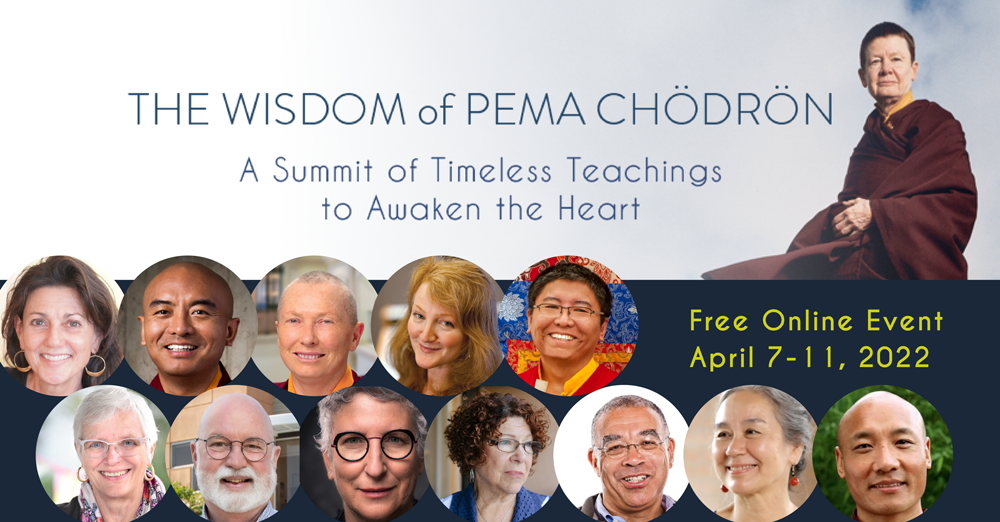
    As someone who’s benefitted immensely from Pema’s teachings, I’m excited to share a one-of-a-kind opportunity to hear from 11 Buddhist teachers and heart friends inspired by Pema Chödrön. In this life-changing event you’ll explore powerful teachings to transform difficulty and live fearlessly with an open and compassionate heart.

    The Wisdom of Pema Chödrön: A Summit of Timeless Teachings to Awaken the Heart is a FREE online event taking place from April 7-11.

    Sign up here to save your spot.

    When you sign up, you’ll receive a free gift: 5 Teachings of Pema Chödrön (instant PDF download)

    Hosted by Krista Tippett, award-winning creator and host of On Being, this free, 5-day summit will include presentations from Tsoknyi Rinpoche, Mingyur Rinpoche, Elizabeth Mattis Namgyel, Gaylon Ferguson, Judy Lief, Fr. Greg Boyle, Tami Simon, Margaret Wheatley, Anam Thubten, Karma Lekshe Tsomo, and Arawana Hayashi.

    In addition to the inspiring talks, spiritual teachings, and practice instruction from summit presenters, each day of the summit also includes Tonglen and lojong workshops with Judy Lief and exclusive archival teachings from Pema Chödrön, courtesy of Shambhala Publications.

    This free online summit is for you if you’ve found yourself asking:

    • How can I shake feelings of restlessness and learn to be okay with uncertainty?
    • How can I embrace life’s ups and downs and use challenges to awaken my heart?
    • How can I learn to practice loving-kindness when I feel hurt or betrayed?
    • How can I move more gracefully through undeniable change?
    • How can I bring more joy into my life, and into the lives of others?

    As Pema says, “From great suffering can come hatred, resentment, and despair… or from great suffering can come great openness of heart and a great sense of kinship with others.”

    I hope you enjoy the summit and learn new ways to cultivate openness, kinship, joy, and resilience, inspired by one of the greatest Buddhist teachers of our time, Pema Chödrön.

    Join the FREE Wisdom of Pema Chödrön Summit

    If you have any issues signing up or need additional support, please contact Lion’s Roar at learn@lionsroar.com.

  • BetterHelp: The World’s Largest Online Therapy Platform

    BetterHelp: The World’s Largest Online Therapy Platform

    **Though this is a sponsored post, you can trust I only recommend products and services I personally love!

    If you’re like most people, you’re probably starting to consider the goals and dreams you’d like to pursue in the New Year.

    Maybe you’re visualizing the person you want to be, reflecting on what you hope to accomplish, and strategizing about everything you need to do (and stop doing) to finally feel happy with your life.

    Most of us spend our lives chasing happiness, checking accomplishments and milestones off a life to-do list, as if each pen stroke brings us one step closer to bliss. Except that’s not how it works.

    And that’s why most of us never find that elusive happiness we’re all seeking: We focus on all the things we think we need to acquire or achieve instead of looking within and figuring out what’s really holding us back. The unresolved traumas, the core wounds, the limiting beliefs—all the mental and emotional hurdles that keep us down and stuck.

    It’s easier to focus on externals, but addressing the internal doesn’t have to be so hard if we get the right help and support.

    For me, it all started with therapy. I’m pretty sure I wouldn’t be here today if not for the healing and insight I gained through years of inner work on a therapist’s couch. I’d probably still be bulimic, depressed, and driven by self-loathing, if I was even here at all.

    Fortunately, a lot has changed since then, and you don’t even need to leave your house to overcome your demons, break through your patterns, and free yourself from bad habits.

    If you’d like to make 2022 the year you finally get out of your own way, I highly recommend BetterHelp, the world’s largest online therapy platform.

    What Is BetterHelp?

    BetterHelp can assess your needs and match you with your own licensed professional therapist in under forty-eight hours. This isn’t a crisis line. It’s not self-help. It’s professional therapy, done securely online.

    The service is available worldwide, which means you may be able to find a therapist who deals with issues local professionals aren’t trained to address,

    It’s more affordable than traditional therapy, and financial aid is available for those who need it.

    How Does BetterHelp Work?

    After you’re matched with a therapist, you’ll be able to schedule weekly video or phone sessions, and you can also log into your account any time to send a message to your therapist.

    You can count on timely and thoughtful feedback whenever you reach out. But if ever you feel your therapist isn’t a good match, no worries—BetterHelp makes it easy and free to change therapists.

    Why Choose BetterHelp?

    Though I haven’t personally utilized BetterHelp, I feel confident introducing this service to you because I know how many people it’s helped. You can visit their site and you’ll find new testimonials added daily. Some recent ones include:

    I have been talking to Kamara to help me with my anxiety and depression over certain life events, since June of this year 2021. I find Kamara very attentive, intuitive, empathetic, and understanding. She is enabling me to think about my challenges in a way that is constructive and helpful in my healing journey. She gently encourages self-examination in a safe, caring way and allows self-expression without interruption, offering encouragement when needed. I would wholeheartedly recommend Kamara Marsh as a dedicated, knowledgeable, and effective therapist.

    Melanie is extremely patient, and kind. She listens and empathizes with your concerns and gets you to confront your fears and worries whilst supporting you. She gives you the tools and the cues to work through your anxieties, and works with you to develop a deeper understanding into yourself. I have only had a few sessions with Melanie, but I am going to continue with her as I have faith in her practice.

    Many people think therapists offer advice and solutions to help them achieve their goals and overcome their problems. They imagine the right therapist will have all the answers to fix what isn’t working in their life. But that’s not what therapy is.

    A qualified therapist helps you dig deeper and see clearer so you can better understand yourself and find your own answers. When you find your own answers, little can stop you, because you will have discovered not what’s right, but what’s right for you personally. And you’ll gain the skills needed to do it again and again, as you navigate life’s inevitable setbacks and challenges.

    If you’re ready to take charge of your mental health and make meaningful change in your life, visit BetterHelp to get matched with a professional therapist—and as a Tiny Buddha reader, you’ll get 20% off your first month.

    I hope you get the help you need to start creating your own roadmap to happiness!

  • How Life’s Daily Challenges Can Actually Be Gifts in Disguise

    How Life’s Daily Challenges Can Actually Be Gifts in Disguise

    “Smile at your patterns.” ~Tsoknyi Rinpoche

    Partway through Eckhart Tolle’s Conscious Manifestation course, I furiously jotted down his teachings about challenges and obstacles to remind myself that they’re not only a normal part of the human experience but necessary for spiritual growth. “Yes!!!!” I wrote in agreement.

    When faced with difficulty, the human tendency is to react and resist, and when we do this, we add suffering to an already difficult situation. This tendency is reflexive within me, and my mindfulness practice has enabled me to either observe the cascading habit pattern as it unfolds, which disentangles me from its snare, or to gently accept what is happening and proceed with calm action and a quiet mind.

    When we can practice acceptance and equanimity, when we can say, “Okay, this is my present moment experience, and I can allow it because it’s already here,” we soften and open in the most tender way. And with this opening, we can receive a bounty of lessons and wisdom that our obstinance so often obscures.

    A few days after listening to Eckhart’s talk, I had to see several doctors and get lab work done to address symptoms I’d been experiencing. The entire week was pockmarked with small difficulties.

    First, the doctor’s office lost my lab sample, so I had to go back and give another one. Then the lab work process got delayed, and in an attempt to access my results, I spent two hours getting transferred between multiple staff members who ultimately said they couldn’t help me.

    At the end of the week, I confronted my last hurdle: I arrived for a follow-up appointment, only to be told that the automated system had canceled it and that the doctor was not available.

    After I explained my situation and expressed my discontent, the medical assistant managed to rebook me with another doctor. I softened, thanked her, and sat down, acutely aware that I’d lost my (spiritual) way.

    With each setback, I was upset and resistant. Like a snake releasing venom, I texted my husband flurries of frustrations, spoke exasperatingly to hospital staff, and felt my body tighten with stress.

    I realized that I only softened to the medical assistant because she told me what I wanted to hear, and within moments, this insight allowed me to look back on the entire series of events with a compassionate and non-judgmental eye. 

    I saw with clarity that in cloying for ease, I only created more difficulty. I saw that I had been behaving as if everything were a threat—like the healthcare system was out to get me—and that the real predator was my own mind. Immediately, I felt an internal release, like a nearly bursting balloon slowly deflating with the prick of a pin. I realized I could stop fighting. I realized that I could choose to surrender.

    After my appointment, I had to go to the lab, and I arrived at what felt like a crowded DMV: people everywhere, red ticket numbers glaring overhead, and a wait that seemed unending. I took a deep breath, pulled a number, and decided that I was going to use the wait—which I now perceived as an opportunity, not a threat—for mindfulness, presence, and spiritual practice.

    I looked around me at all the people. I watched as children caringly pushed their elderly parents in wheelchairs, as a pregnant woman patiently engaged her three children, and as a person laboringly limped to the ticket machine, burdened by a massive leg brace.

    I thought: Everyone is here because they are experiencing some difficulty; everyone has health scares; everyone is taking time out of their days to be here; everyone is waiting.

    I was so touched by the kindness and patience I witnessed. Suddenly, my story became enveloped in everyone’s story. I was them and they were me. I felt a deep kinship—a tenderness that made me feel enveloped in, rather than targeted by, the human experience. 

    As my awareness expanded further and further outside myself, I began connecting with those around me. I told the pregnant woman sitting beside me that I admired her patience, and when she shared that she was fasting for a half day of pregnancy-related lab work, I became even more aware that mindset is a choice.

    I made eye contact with a man whose gentleness I perceived underneath his masked face. We didn’t say anything, but we said everything.

    I kept scanning the room, and I noticed it had transformed from a chaotic, undesirable place, to somewhere I wanted to stay, somewhere I felt deep meaning and connection. Then I noticed that the space did not transform; I simply changed my relationship to it.

    When I left the lab, I was buoyant. I felt energized, connected, and light. I was overwhelmed with the experiential realization that the entire week was a skillfully designed lesson on challenges. I saw what happens when I fight to make them go away, and then I saw what happens when I invite them in, with an open heart and an open mind.

    “Challenges as gifts” left the theoretical world of quotes and concepts and burrowed into my lived experience. It stays there, and reminds me of itself, when I allow it to shine its light.

  • Are You Sick of Waiting, Wanting, and Wishing for a Better Life?

    Are You Sick of Waiting, Wanting, and Wishing for a Better Life?

    “Perseverance is not a long race; it is many short races one after another.” ~Walter Elliott

    I often find myself impatient with the pace of my progress. Waiting for my life to move forward can sometimes feel like I’m watching paint dry.

    There are so many moments when we feel like our life is at a standstill. This is generally where I double down with my intensity. I hit it with everything I can. The crash comes soon after from the inevitable violent collision of my mind, body, and spirit as they’re pushed beyond their limits.

    The idea of having to wait for anything is a first-world problem. The thought that your cat’s costume might not arrive in time for Halloween is enough to bring some people to tears. Just thinking of Mr. Whiskers having to go out as a plain ol’ cat is a bloody crime.

    And that’s waiting for a cat costume.

    What about that book you wish would just write itself?

    What about that scale that still shows you being forty pounds heavier than you want to be?

    What about that bank account that still isn’t bigger than your credit card bill?

    These are not things we want to wait for. We want the juice without the squeeze.

    We’ve grown so impatient with the idea of waiting for results that we act like moving slowly is a poison to progress. We default to believing the antidote is a shot of intensity straight to the veins. But all that gives us is further frustration, anger, guilt that we’re not doing enough, and the feeling that we need to push harder.

    It’s such a horrible way to approach life. Especially since the only finish line comes when you take your final breath. And I don’t know about you, but I’m in no rush to get there early.

    It’s exhausting even thinking about that period of my life when I wanted to write a book, lose forty pounds, and stop feeling broke. Not a day would pass when I wouldn’t be consumed by feelings of doubt and hopelessness. I should have been pushing out diamonds with the amount of pressure I was putting on myself.

    That struggle led to a life-changing aha moment for me. I realized that there are two ways to approach making progress. You can hit it hard with intensity. Or you can set a long-term aim with consistency.

    Which of these do you think is sustainable for making progress?

    Think back to the children’s story of the tortoise versus the hare. These are lessons worth revisiting for their simple and profound principles on approaching life.

    We all overestimate what we can accomplish in a day, but we underestimate what we can accomplish in a year with steady momentum.

    How do you write a book? By establishing a daily writing habit.

    How do you lose forty pounds? By moving your body every day and eating less than you burn.

    How do you get out of debt? By making a daily choice to spend less than you earn (and invest the difference).

    You’re not going to write a book in a day, but there’s a damn good chance you’ll have one in a year.

    You’re not going to lose forty pounds in a day, but you could in a year.

    You won’t get out of debt in a day, but you’ll set a trajectory for wealth creation that lasts the rest of your life.

    How different could your life be a year from now if you committed to something that’s important to you?

    Sit with that idea for a moment. Soak it in.

    What would it feel like to hold that book in your hands?

    What would it feel like to look at that scale and see the number you want to see?

    What would it feel like to be debt-free and investing in your future?

    I’m serious. Feel it. Wait till you get goosebumps.

    That is peace of mind, relief, and a sense of fulfillment tied up in a bow on Christmas morning. That is the realization that you can have almost anything you want in your life if you stay disciplined with your priorities. That is the power of consistent daily habits.

    There’s a saying about hope not being a strategy for change. I do believe hope is a beautiful emotion. But I’ve seen myself get stuck for years waiting, wanting, and wishing for a better life. Hope didn’t give me a way out because it left me at the mercy of my current circumstances.

    Writer Lu Xun said, “Hope is like a road in the country; there was never a road, but when many people walk on it, the road comes into existence.”

    This is the power of action and putting one foot in front of the other.

    Every action you take is a vote toward the person you want to be. The more we align the things we do on a daily basis with the person we want to become, the more fulfillment we feel in the little things that get us there.

    What do you wish you could change if only it didn’t feel so hard? And what could it mean for your life if every day you prioritized this change and did one small thing to work toward it?

    Make the decision to commit to a simple daily habit that reflects the person you want to be and the life you want to live. When you do this, you’re deciding to take back control of your life. You’re deciding to give yourself a better future. You’re deciding that you matter.

  • Everyone Has Struggles, and We All Have Our Own Lessons to Learn

    Everyone Has Struggles, and We All Have Our Own Lessons to Learn

    “The more we love the more we lose. The more we lose the more we learn. The more we learn the more we love. It comes full circle. Life is the school; love is the lesson. We cannot lose.” ~Kate McGahan

    I remember reading somewhere that we are all here on this earth to learn a lesson.

    It’s one that is made for us, and only us. Like a special recipe concocted in the stars and implanted in our tiny developing foetus.

    While it may sound a bit “woo-woo,” it was extremely comforting to read that.

    For much of my life I would compare my life to others. I’d look at those who seemed to have it all together and wonder if they ever struggled. I felt envious as they seemingly sailed through life.

    Why do I have to deal with this and not them? What did I do wrong?”

    But maybe they are not here to learn my lesson. They are here to learn theirs, whatever that might be.

    While my life has been filled with typical ups and downs, it came to a crushing low when my sister died in 2013.

    The pain of her loss was so intense I wanted to claw myself out of my body. I really believed I was the only person in the whole world who experienced pain this excruciating.

    I would go to parties and watch people laughing and having the best time and feel so incredibly alone. It was like I was banished to another dark and miserable planet while everyone else merrily went about their lives. It angered me that others weren’t suffering like me. I kept asking myself again and again, “Why me? Why my sister?”

    I was too absorbed in my anguish to recognize that others were also going through hardships.

    It’s been seven years since my sister died, and now I understand that while my grief is specific and particular, it is not unique. Grief is just another emotion we human beings will experience during our journey through life. It’s just one of those emotions that don’t get as much airtime as joy, so we assume no one else experiences it.

    Along the way, I’ve met others who have confided in me their stories of trauma and pain that I was completely spared of. It reminded me that while things could have been different, it doesn’t necessarily mean they would have been better.

    This journey of learning that grief is shared by so many others has humbled me deeply. We all experience tragedies and heartbreak. There is no one in the world who doesn’t get hit with some kind of pain, no matter how happy and cheerful they may appear on the outset.

    When we think we are alone in our suffering we are not making it better for anyone, let alone ourselves. Focusing on ourselves and our pain is like a vortex that only isolates us further and makes us feel worse.

    In these times of immense suffering, it’s important to get outside of ourselves. Often the best remedy is to volunteer or help someone who is less fortunate than you. It will suddenly become clear that you are not the only one struggling.

    It can be so easy to forget this, especially since we live in a world of social media. Everywhere you turn there is an Instagram story being born. Everyone seems to be having the best time ever. At least that’s what they want you to think. But how much do you really know about these people you follow?

    There is a whole other side to everyone person you meet, whether online or in person, you may never actually see.

    So next time you catch yourself looking at others or scanning through social media and wondering why your life couldn’t go as smoothly as theirs, remember that there are people looking at your life wishing they had something about yours. It’s sort of like that quote, “Every time you point a finger, there are three pointing back at you.” It can be  applied to this situation too.

    And remember that everyone is fighting a battle you know nothing about.

    Someone may struggle their whole life with an eating disorder and envy a particular model or celebrity for having a perfect body, not realizing that this particular model is coping with severe PTSD.

    The list of struggles we can face is as endless as there are people on this planet. You simply never know what someone is going through. But you can know for sure that everyone has their own path, their own challenges, and their own lessons to learn.

    I wish someone had told me this earlier, but maybe I wouldn’t have listened. Maybe this was one of the many lessons I needed to learn: no one has better or worse, they just have it different.

  • The Art of Self-Soothing: How to Make Resilience More Sustainable

    The Art of Self-Soothing: How to Make Resilience More Sustainable

    “I’ve missed more than 9,000 shots in my career. I’ve lost almost 300 games. Twenty-six times I’ve been trusted to take the game-winning shot and missed. I’ve failed over and over and over again in my life. And that is why I succeed.” ~Micheal Jordan 

    I believe that self-soothing is the key to accessing all happiness and success. All things being equal, when someone is able to self-soothe, they are more resourceful and more powerful than those who haven’t learned that skill yet. Here’s why.  

    Great success (whether professional or personal) comes with a great deal of responsibility. That responsibility can potentially lead to stress and is often accompanied by failures along the way. Most of us are familiar with that famous Michael Jordan quote—it was even in a ’90s commercial.

    Resilience is a great skill. In fact, that path is clearly recognizable to anyone who has achieved a lot. But it’s perspective that shows you that those failures aren’t “this is the end of everything and we’re all going to die” failures. Instead, they’re just medium or even small-sized stumbling blocks. 

    When you’re not yet at the end of your career or life, how do you know? Well, you don’t. So how can you function when things don’t go your way? How do you stay calm and grounded when something unexpected and shocking happens?

    The more “monodimensional” action-oriented side of resilience is to “power through” the hard times, sharpening your blade with your teeth. And while this might work sometimes, it takes a toll on your emotional well-being—can you feel that cortisol going through the roof?

    It’s easy to miss that monodimensional, action-based resilience is actually very weak, and ultimately unsustainable, if it’s not supported by a strong and playful mind. And I believe that Jordan had such a mind and demonstrated it throughout his career. 

    It’s not just persisting despite failures; it’s also how you feel every day, about your failures and in general. It’s about not allowing all the negative experiences to poison your daily well-being. 

    So how do you make resilience more sustainable? There is a softer way to deal with stumbling blocks, one that hopefully doesn’t lead to too much stress or burnout. One that, when mastered, will keep the emotional well-being floodgates open.

    One that you will want to teach to your friends, your kids, your parents, and your enemies too. This second dimension of resilience is self-soothing.

    I was raised in the household of Ms. and Mr. Stress. Growing up, I watched them take deep dives into (probably unnecessary) pools of stress. There was always something that wasn’t okay, something that needed to be fixed, not enough money or not enough time.

    Here’s a classic scene from my youth: When a piece of equipment, like the washing machine, would break, our whole family had to be part of the sorrow, anger, and anxiety associated with such an unfortunate event. But it wouldn’t be fixed right away (because it mightheal by itself, no?) When it would be absolutely clear that there was no hope for the poor washer, the focus would switch to panicking about the money needed to replace it.

    Once the washing machine was replaced, the problem became that perhaps it won’t be as good as the previous one, or it might take up more space, or it’s louder. It was never possible to relax, for fear that everything wasn’t perfect. It was obligatory to look for potential problems, scanning every single detail with “Terminator vision.”

    When we could finally be certain that everything was okay, we could then move onto the next thing that needed to be fixed.

    I was exposed to chronic stress for most of my childhood and teenage years. I didn’t enjoy the environment, but I didn’t know why. I didn’t have words for it, and I didn’t have the concepts to understand it. I didn’t know that I could live differently. Or better yet, I knew other parents were more relaxed, but I just thought they were luckier individuals. 

    When I moved out, aged twenty-two, I left the country and moved to Holland, to a tiny student city whose pretty canals were filled with swans and ducks, and where most family houses had cute and well-groomed front yards. I watched kids on tiny bikes ride with their parents to school, and people of all ages sit for coffee in wooden decorated cafes. It was nothing like the stress-filled metropolis I was used to, and people seemed to me to be so calm. 

    I loved it instantly, and I felt the well-being flood me, but I didn’t know why. Over the course of the following years, I lived in other places too. For some segments of my life, I even went back to my childhood home.

    It wasn’t until ten years after I first moved out that I was able to finally learn the names and the concepts that defined the emotional dichotomy I kept experiencing when I would go back and forth.

    The understanding came in two steps. During my masters, when studying the brain, I learned how the pre-frontal cortex works as a simulator of experiences. We all, as humans, are capable of imagining in great detail something that hasn’t yet happened and make it just as real as something that happened the day before.

    From psychologist Dan Gilbert, I learned that the brain is also capable of synthesizing happiness (or the cocktail of chemicals that we interpret as happiness). And a functioning brain will return you to a state of happiness withinmonths or within a year even after very traumatic events.

    In a fascinating TED talk (The Surprising Science of Happiness), Gilbert presents data from two groups of people: people who won the lottery and people who lost the use of their legs. One year after the event, the level of happiness of the two groups is identical.

    Very often, we hear people (or even our own selves) say how, with hindsight, some terrible event has revealed itself to be a kind of bliss. The bottom line is that it doesn’t matter what the cause of happiness was; if it feels like happiness, it is happiness.

    The brain is capable of synthesizing happiness (or sadness, or stress, or panic, or even anger, for that matter) independently of the external conditions. This is not surprising. If you think about it, what we attempt to achieve through meditation is nothing but a firmer hold on the steadiness of the brain, which will then lead us (or keep us) in homeostasis, a state of physical balance. This is why meditation feels good, and also why it can be so hard to start meditating when your mind is all over the place if you don’t let yourself ease into it.

    Once I grasped these concepts, I made my first leap into understanding emotional well-being. I saw people like my parents constantly training their minds to see faults and problems, rehearsing negative feelings, and therefore leaving completely to chance their effectiveness at reacting to more significant issues.

    The second leap happened a few years later. I was done with my studies and was anxiously juggling the various areas of my life. 

    Over the course of less than a year, I lost my job in academia. I didn’t manage to get a new one (failure one). I got kicked out of a house where I loved to live (failure two) by a person whom I considered a friend (failure three). The man I had a relationship with left to be someone else (failure four), and I injured myself in such a way that was unable to use my right arm for months (failure five). Forget typing—how was I going to apply to new jobs?

    As soon as I could, I packed my stuff, moved back with my parents to be taken care of, and got the final part of the treatment for my arm.

    This setback happened when I was thirty-three to thirty-four. After the first months feeling loss and mourning for my previous life, I realized I wasn’t making it easy for myself. I was lingering in anger, obsessing over every small thing that wasn’t just right, and being devastated by all the big ones that weren’t right at all.

    Then it clicked. My situation was no different than worrying about broken domestic appliances, stressing over taxes, feeling insulted by bad books or movies, getting annoyed by politicians and by lost socks. 

    I had to make it easier for myself. I had to find the irony in everything and spend more time thinking about what was working. 

    I wanted to “detox” from the victim mentality. I started looking at my life as the blankest of slates. And felt exhilarated.

    In fact, my life was even better than a blank slate. I had all my skills, my knowledge, and my health. I had no ties, no debt, no contracts, and no furniture stored somewhere. Ultimately, I had a very supportive family and a place to stay temporarily in Rome, one of the most beautiful cities in the world.

    Today, this list of positives is easy to make and I could go on. Now it’s easy for me to see how previously I had made myself more miserable, focusing on all that was going wrong. But I can still vividly remember how overwhelming it all felt and how it seemed impossible to stop that snowball from rolling down and becoming more bitter.

    From my new place of clarity, balance, and bliss, I decided I’d devise tricks to prevent myself from ever tumbling down into deep negativity again. If I took care of how I felt every day and developed practical techniques to deflect my attention from the small daily problems, maybe I’d develop enough of a muscle that I could use if and when big problems occurred.

    So I took a “masterclass in myself.” I learned what it is that makes me laugh, what grabs my attention, what relaxes me. Knowing these things will help anyone to stop that negative snowball before it hijacks your thoughts completely. 

    I have a great passion for comedy, and I figured out that, regardless of my mental state, listening to my favorite comedian will reset my mood 100% of the time. I know that nature documentaries (especially those about Space) will hypnotize me and make me slightly detached from my body, so when I’m sick or in pain, these are my go-to’s. I know that when I feel flustered or my mind feels scattered, walking and listening to certain music will bring me closer to calm.

    Coming up with a list of ready-to-use resources like these ones, but tailored for you, is one of the greatest resources a person can have. And the more these resources are on autopilot, the easier juggling your life will become. For me, today, listening to comedy when I’m annoyed is as natural as drinking water if I’m thirsty. And every day, I’m still adding new practices to my arsenal.

    There are two caveats to all this: Be aware of the cause of what makes you feel bad and watch out for escapism.

    If you’re chronically depressed, I would never recommend watching comedy from morning until bed. If you have recurring anger issues, I wouldn’t recommend pumping them away at the gym. You need to seek professional help. Similarly, finding things that cheer you up is great, yet spending your whole day seeking ways to entertain yourself might not be the most constructive way to go about your life.

    Self-regulation is one of those responsibilities that adults have, and it’s a great one to embrace. A rule of thumb is: If you’re still enjoying whatever it is you are self-soothing with, then great. If you’re neutral about it, it’s time to move on. And if you realize you’re not enjoying other things that you could have been enjoying, then your self-soothing has gotten out of hand. Don’t beat yourself up though; next time you’ll do better.

    Generally, though, all it takes is to distract yourself sufficiently from the negative thought/memory of the event. Some other time you might want to consolidate some positivity to that memory. There are many ways (from NLP techniques to meditation techniques to hypnosis, and more), but for simple daily life, what I found works well for me is this three-step process:

     1) Allowing some time for my immediate reaction to express itself. I don’t want to suppress anything, but I don’t want that state of reaction to be the place where I now reside.

     2) I’ll go ahead with my self-soothing technique of choice and try to reduce the amount of time that my mind broadcasts thoughts about the problem.

     3) After a little time has passed, I’ll pick up the topic and briefly discuss it with a trusted friend. Someone who doesn’t have any stake in it, who won’t be triggered by it, and who can provide both constructive and positive comments.

    If you master a basic self-soothing practice, you’ll notice an immediate improvement in how you can handle the small daily hiccups. And with a little time (really not much time at all), you’ll be able to handle bigger and more complex problems with a lot less effort. 

    What’s wonderful about this skill is that it will continue to grow with you. As you add more pieces from your personal growth journey, they’ll strengthen this new skill as well.

    A strong self-soothing practice will enable you to help and be compassionate with the people around you. It will also trickle down to your kids, providing them with one of the greatest resources they can receive from you.
  • How to Get Through Hard Times Without Hurting People We Love

    How to Get Through Hard Times Without Hurting People We Love

    “If your compassion does not include yourself, it is incomplete.” ~Buddha

    Just the other day, I had one of those moments with my husband, and not the kind of moment they write about in romance novels.

    The world has been so different these last several months, and so many are feeling the effects of months of struggle, uncertainty, frustration, and limitations.

    I consider myself to be someone who works to see the positive, finds the silver living in situations, and believes in the best of people, and that things can and will always get better. But lately, that has been more of a struggle.

    My husband is amazing, and incredible in so many ways, but he is always the more likely to see the bottom falling out, expect bad things, and struggle with restrictions and limitations being placed on him.

    So, after trying really hard, and I mean really, really hard to stay positive, my better half kept dipping into the dumps, and I finally hit my wall.

    After sitting at lunch and realizing, I really don’t want to spend the rest of this day like this, I gave him an out from this tension and clear animosity growing with each passing minute. I told him to go see his friends, take time away from me, and try and let go of his frustration at least a little, even for a moment (in the hopes that it would also let me release some of mine).

    And then I walked out, somewhat dramatically, like they do in the movies, when you don’t even bother to look back. More like a huff.

    My first thought was that he is driving me crazy, which he has done consistently for almost thirty years, all while acknowledging that the last few months have been awful.

    I felt like I was fuming, and then came back to the question of “Why is it so hard right now? Why is he being like this? Why am I so bothered by him being like this? Why can’t we just figure it out and be gracious?”

    The plain and simple answer is, right now, things just kind of suck. Sugarcoating it seems to downplay the effects of what so many are experiencing, and it minimizes the struggle, which is quite real.

    Right now, we are experiencing a pandemic, which has shifted the entire world and its way of being, in a way few of us have ever known. We have seen economies struggling to keep up. Lives are being lost.  Quarantines have been put in place.

    There is no normal for so many, but somehow, we are still supposed to “act normal.”

    It’s a struggle and coping well can feel like a nearly impossible task, leaving people feeling like they are failing personally, during a time when they are already hurting in other ways. Family members are feeling impatient with one another. Couples are bickering more. People are quick to lose their temper and even quicker to feel anxious, sad, or angry at their lack of control right now.

    People are frustrated, they are scared. Times are uncertain, and there is a sense of gloom and doom that continues to hang over so many.

    There is a sense of powerlessness, and so many people continue to describe the feeling of being “stuck.”  Plans can’t really be made. Vacations can’t be had. Life as normal still ceases to exist, and no one can really say if, or when, things will gain some sense of consistency.

    We need to recognize how stressful that can be, not only for our mental well-being but also in our daily lives, as we interact with the ones we love most.

    So, for myself, after the dramatic exit and a few minutes of driving in the car, the more logical part of myself gained control for a moment.

    I realized that amid situations that feel chaotic, we all need a little chaos coping checklist,or maybe now it could be aCOVID coping checklist,” to help endure these stressful times that we are all working hard to get through, day by day. Here is mine.

    1. Stop. And breathe.

    Never underestimate the power you give yourself when you just stop and breathe. Allow yourself to pause and be deliberate with your breath. Take a few slow breaths to reconnect to yourself rather than just the heat of the moment. Let your breath fill you, guide you, and calm you.

    2. Acknowledge your emotions.

    Don’t deny yourself the right to feel angry, sad, or frustrated. And don’t deny your partner, friend, family, or colleague that right either. And definitely do not judge your emotion as not being worthy or valid. Our emotions are understandable given the current state of affairs, and they often clue us in to what we need, so listen to them, and honor them.

    3. Just because you love them, you don’t always have to like them.

    Remember you can love someone unconditionally and still feel angry with them, hurt by them, or want time or space apart from them.

    Couples together forever still have disagreements. Parents get frustrated by their children. Friends can rub each other the wrong way.

    We are human beings, prone to error and able to become easily overwhelmed at times. It is okay to not like the ones you love every moment of the day. Allowing yourself to remember that may help you focus on the love more, and the dislike less.

    4. Give yourself (and others) a break.

    Physically and mentally. Take a moment (or as many as you can and need) to remove yourself from a situation.

    Maybe you need to take a walk by yourself or go into another room and get lost in some music. Let yourself find a quiet spot and read something calming or inspiring, or go have that glass of wine and watch the rom-com or action movie you wanted to watch. Just take a break, you deserve it.

    5. Accept that it is okay to not be okay right now.

    Even if you are that person who always sees the rainbow after the storm, or the bright side to a situation, you may not feel able to do that right now. And that’s okay.

    Naturally, if even the cheerful ones in the room are feeling gloomy, the ones who are more likely to see the storm may feel they are drowning in it. Remind them too that it’s okay, and offer any support you can, if you are able. Someday, hopefully soon enough, we will all find our way back to okay.

    6. Give yourself and those you love the gift of compassion.

    No one out there is perfect, and we should never strive for perfection. Instead, strive to be better than you were before. If yesterday was hard, see what you can learn from it. Remind yourself that you are doing the best you can. If you need to forgive someone for snapping at you, or forgive yourself for being harsh, give that gift.

    Lighten the load you are carrying by replacing it with more compassion. Maybe right now isn’t the time for high unreachable expectations, but rather gentle exercises in kindness and consideration, for others, but especially for yourself.

    These are tough times. Maybe the best thing we can do for ourselves and the people we love is be understand that these “moments” will happen.

    Having these difficult moments with our loved ones, like I had myself, doesn’t mean you are somehow not the amazing person you are striving to be, or for that matter, that they aren’t either. It doesn’t mean you are somehow failing right now if you feel angry, scared, or worried. It means you’re human.

    7. Even in the midst of chaos, seek to find gratitude.

    During adversity and times when you feel unable to find your balance, gratitude can be a tool for comfort. It can remind you that even when you feel frustrated, doubtful, and stressed, you will find your blessings if you look for them.

    Maybe it’s that you have a family, even if they get on your nerves. Maybe you are grateful for that roof over your head that you so desperately long to escape from for a while. Maybe you are blessed to have a job where you can work from home, even if you would rather be at work.

    Gratitude can help ease your anxiety, and when the anxious feelings leave you feeling adrift in a storm, your ability to find blessings and feel grateful can ground you, and leave you feeling abundant, even during adversity.

    The truth is, everyone is doing the best they can right now. Using a mental checklist for the times that leave us overwhelmed gives us a chance for structure amidst chaos. And using a checklist like this, shared and read by many, can remind everyone that the struggle is real, but we are all in this together.

    As for me, the very next day—after going through this whole checklist—the frustration lessened, the fuming went away, and I started looking for my silver lining again.

    I will try and follow this checklist as often as needed and be as gentle with my loved ones as I can, but also with myself so that my compassion is complete.

  • Radical Gratitude: How to Turn Your Pain into Peace

    Radical Gratitude: How to Turn Your Pain into Peace

    My journey to living in gratitude began in 2010. And let me say that up until that time, until I was age forty-five, I was a complainer, griper, and a whiner, with absolutely no reason to complain!

    Luckily, I was saved from these very wasteful, counter-productive habits when I was given a blank journal one Thanksgiving season by a New Thought minister, who told us if we journaled five things we were grateful for forty days, our life would change exponentially for the better.

    I dutifully wrote my gratitude lists, and oh my god, my life did change. It worked! I let go of complaining and started focusing on all the good in my life, and there is plenty.

    Since then:

    1. I have written five or ten things to be grateful for almost every day for years and years. Each morning and each evening, I also reflect on what I am thankful for.

    2. I have realized (and I am thankful) that it is now my calling and passion to share the power of gratitude to inspire others.

    3, Because of my passion to share gratitude, I have written and published five books on gratitude!

    Nowadays, I keep my gratitude practice alive and well by sending out daily email gratitude reflections to a group, and I also write letters to the universe several times a week about what I am thankful for now, and in advance. I find that each year, my gratitude practice expands. Nowadays, I often write paragraphs rather than a short list about what I am grateful for.

    Did you know that scientific studies prove that being grateful helps to be more peaceful, more joyful, and healthier? It is said that you cannot be simultaneously mad or depressed while being grateful, and I’ve found this to be true.

    It is my belief that we can almost always find a reason to be grateful, even when confronted with tragedies, unexpected disasters, or even ill health—a practice known as “radical gratitude.” And this holds true for challenging people in our lives as well. Here are two disclaimers:

    • Forgiveness and acceptance can often be key to finding the gratitude in a situation, but these two concepts will not be discussed in this article. The article would be too long!
    • One more disclaimer: I realize there are some tragedies where a person cannot ever feel gratitude, such as losing a loved one or being sexually abused. It may not work for everybody and every situation.

    But more often than not, we can find the gratitude in negative situations in our life.

    My Personal Experience of Finding Gratitude in Tough Times

    In the summer of 2018, Oregon (where I live) had many devastating wildfires. We watched in horror and disbelief as it came closer and closer to our home. It became obvious we would probably be evacuated. The smoke was black, firefighters and National Guard were checking everyone’s IDs before letting them enter the street to our house.

    Neighbors and I got out of our cars to stop and watch it burning fields and trees so close to our homes. I tried to keep a positive attitude, but it got to be only a half-mile up the street from our house. Very, very scary! I love where we live, and the thought of losing our home was terrifying.

    On a Saturday afternoon, as I tried to take a nap to escape, our phones started ringing and texting that we were in Level 3, evacuation time. Get out now.

    We took our dogs and my cockatiels, computer, important papers, and some clothes and left the rest. We were evacuated for six days and got to come home—all houses and neighbors were thankfully safe and sound. Here are my gratitude takeaways:

    1. We were taken in by friends from the Center for Spiritual Living where I attend, and actually about eight other people had offered us refuge as well. I am very grateful for that, and for Alison and Gary who made us feel at home, helping me set my computer up at their house so I could work and putting up with us and our messy pets. We all became much closer friends through this experience, and we socialize with them regularly.

    2. I am now grateful for the firefighters and all personnel who helped—in my heart, not only in my head. They are amazing!

    3. I think the biggest gratitude I have for the wildfire experience is that I was able to surrender and let go of coming back to our home. This was the only way to stay sane, and that was a gift. After all, it is love, not possessions that matter, and I got clearer on that through the experience.

    When I was thirty-five, I lost my beautiful mother when she was only fifty-seven through cancer. This was a horrible time in my life. I remember waking up feeling good and then immediately feeling dread and sorrow, when I remembered that Mom would die soon.

    One of my gratitude takeaways from that grief-stricken time is that I was Mom’s main caregiver, and that brought me much closer to her in those last nine months. My sisters and I got closer because of that experience, and that was the first time I got introduced to A Course in Miracles, a spiritual set of lessons that changed my life for the better.

    My mother had what I called “Angels” helping her from The Center for Attitudinal Healing in Tiburon, CA and they studied A Course in Miracles, which prompted me to study it as well, because they were so giving and inspirational to me.

    Also, before she died, my mother spent time reflecting on her cancer and what could have caused it, and felt that being a people-pleaser and fearful all her life had prompted the disease. She left me with the message not to be like her, which I am very grateful for and have always remembered, and changed my codependent behavior because of it. Additionally, we had time to say goodbye, which cancer usually provides, and that was a big blessing too.

    One more example that changed my life incredibly in so many ways was going through a divorce after twenty-four years. This was a very difficult decision, I wasn’t sure if it was the right one, and my ex-husband ended up deciding for us. I was heartbroken. So heartbroken that I finally sought out the Center for Spiritual Living, in Santa Rosa, CA, which many people in my life had gently suggested I might attend because they felt I would love it too. And I did!

    From the moment I entered, I got tears in my eyes, seeing all the loving, warm people. As I listened to the talk, I realized even more that this would be my spiritual home the rest of my life, and it has been.

    I am eternally grateful for my divorce now. I took the spiritual classes voraciously; became a licensed practitioner, now serving in Oregon where I live. I am blessed to teach spiritual classes and workshops, and in 2019, I spoke at two Centers for Spiritual Living about the topics in this article.

    I eventually met my second husband, who I have been with for almost twenty years, and we are much more compatible. He asked me to move to Oregon and I did. And I am in love with the forest, rivers, and beauty. None of this would have happened had I stayed in my first marriage. Very thankful!

    In each of these cases, some gratitude was easily available, but more came later. It may take time, even many years to find the gratitude, but looking for it helps your healing.

    I want to mention several well-known people and how they found radical gratitude in their lives. Each is very inspiring to me!

    Viktor Frankl was a psychiatrist who ended up being put into a concentration camp during the Holocaust, and amazingly, found a way to stay positive. He ended up writing a very impactful book as a result of his experience—Man’s Search for Meaning—which has sold fifteen million copies and thus, impacted so many people’s lives.

    His premise is that we need to find meaning in life, and that will help carry us through even the hardest situations. He was a walking example. Here is a quote from his powerful book:

    “Everything can be taken…but one thing: the last of the human freedoms—to choose one’s attitude in any given set of circumstances, to choose one’s own way.”

    Will Pye who wrote a wonderful book on the subject of radical gratitude, The Gratitude Prescription, after he was diagnosed with a brain tumor and, through gratitude, healed himself completely.

    Here is a quote from his excellent book:

    “In looking at our self and our life story through the lens of gratitude, we can come into contact with the beauty and heroism inherent in every human alive. Gratitude for self supports a compassion encompassing all of us.”

    There are other examples too, of physical healing, where the person ends up being grateful for the illness. Anita Moorjani realized on a deep level that we are love after a near death experience, and could let go of her fear of cancer completely, and had a spontaneous remission. It is her calling to share her findings with others, and she wrote a beautiful book about her experience, Dying to Be Me, which has reached millions of people across the world.

    Helen Keller has always been one of my heroes. Even though she was deaf and blind at such a young age, she somehow always found reasons to express her gratitude. I share a very powerful quote from her:

    “The best and most beautiful things in the world cannot be seen or even touched—they must be felt with the heart. I thank God for my handicaps. So much has been given me, I have no time to ponder over that which has been denied.”

    In conclusion, I truly believe that we can almost always find gratitude in even the most challenging situations. It may take time, so be patient. Life is about how we respond to it, and we are always at choice, like Victor Frankl and Helen Keller so beautifully prove. I feel my own life examples also show this.

    Being radically grateful is not always easy but incredibly worthwhile. Our attitude truly affects our lives, and living with gratitude is powerful beyond measure.

  • What Helps Me Put Things in Perspective

    What Helps Me Put Things in Perspective

    “The fact that we live at the bottom of a deep gravity well, on the surface of a gas covered planet going around a nuclear fireball 90 million miles away and think this to be normal is obviously some indication of how skewed our perspective tends to be.” ~Douglas Adams

    The Buddha famously said that life is full of suffering. While I acknowledge there is much suffering in the world, for my privileged life in the West, I like to think of it more as life being full of challenges. You see, sometimes the suffering part is optional.

    Now again, I’m not talking about war, famine, trauma or other life-threatening or intolerable living situations. I’m talking about your regular developed world problems.

    The hot water stopped working.
    The subway is over-crowded.
    Your child has the flu.
    You didn’t get the job we thought we deserved.
    Your friend isn’t talking to you.
    You can’t afford a new car.

    Those regular sort of problems that we encounter on a regular basis that interrupt our well-being. We get annoyed by them, ruminate about them, and make them bigger than they need to be. Our minds tend to go straight to the negative, and that is usually to beat ourselves up in some way or predict the worst-case scenario.

    Suddenly our temporary irritation becomes a BIG problem.

    I’ll never find a plumber who is reliable.
    I hate this subway ride—I can’t keep doing this.
    How am I going to keep my job if I have to keep taking days off? What if it is something more serious?
    I’ll never find a good job.
    I’m a terrible friend / they’re a terrible friend.
    I need more money.

    Our brains are incredibly unhelpful. We have this negative bias that is designed to keep us safe, a useful characteristic for our ancestors, but not so functional in these modern times. We don’t need our minds to play out to the worst possible outcome and we certainly don’t need it to keep reminding us of our perceived inadequacies.

    I was reminded of this recently when I had a falling out with my youngest child. I kept replaying it over and over in my head.

    What if we never sort this out?
    What if she doesn’t want a close relationship with me anymore?
    Where did I go wrong in my parenting that she could behave like this?
    She hates me!
    I am a bad mother.

    Yep. Over and over again in my head either going to worst case scenario or beating myself up.

    And all the while making the situation much worse than it needed to be.

    And then I remembered: A problem is only a problem when we decide it’s a problem. 

    We could also decide it’s not a big deal.

    It was time to get some perspective.

    I made a choice to get out my own head and take a step back. And then I asked myself the following questions:

    What would my best friend tell me about this situation?
    She would tell me that my daughter is stressed and tends to get emotional when she is stressed. She would tell me not to take it personally.

    What would I tell my best friend if they were going through this?
    I would tell her that her daughter is a teenager behaving like a teenager and we don’t have to go to every argument we are invited to. I would reassure her that this is a small issue that will be resolved quickly.

    What would someone you admire say about this?
    This too shall pass…

    What would a judge and a jury tell you?
    You have a good relationship and this is just a small matter.

    Is this going to matter in five minutes, five days, five months, five years from now?
    Yes, no, no, no.

    Suddenly I felt much better. Putting it into perspective and getting outside views on the situation is so helpful in getting our minds back to the real issues. And removing ourselves from the situation has a way of really allowing us to see what is important and what it not.

    And it allows us to reduce the size of the problem significantly.

    However, to me, that only goes so far.

    I like to keep moving further and further back.

    And I remind myself of the following reality:

    We live on a little blue planet literally in the middle of nowhere. I don’t know how we got here but whatever your beliefs, it is some kind of miracle.

    We are the perfect distance from the sun to have temperatures that we can not only survive but thrive in.

    And this planet we get to live on is truly magnificent. If someone asked me to create a planet for humans to live on that was not only life -sustaining but also the most beautiful planet imaginable, I could not create something more magnificent than Earth.

    If that weren’t enough, we get to live in the 21st century. Imagine how much more difficult life would have been for us if we had been born 100 years earlier? 200 years earlier? It’s difficult to fathom the hardships we would have had to go through just to survive.

    And if you’re still not convinced that that is enough, think about this:  If you are reading this you have access to a computer and the internet, something most of the world does not.

    You are probably living in a somewhat developed country where clean water, fresh food and shelter are all in abundant supply.  You also probably don’t have to worry about war, famine or natural disasters on a regular basis.

    In other words, you have won the lottery. The only lottery that really matters, anyway.

    And the opportunities that come with that privilege are mind-blowing. 

    We can do anything we want in this life.

    We are free to choose any life we can imagine.

    I don’t know how we got here or why we are here, but one thing is for sure, I’m going to hang on and enjoy the ride.

    Suddenly the petty distractions of life become even pettier.

    Do I really want to be arguing with my daughter?

    Do I really need to make a big deal out of this?

    And the bigger question: Do we really want to waste this life worrying about things that don’t really matter?

    I know what my answer will always be…

  • When Things Go Wrong, I Remember This Day

    When Things Go Wrong, I Remember This Day

    “There is no such thing as a problem without a gift for you in its hands. You seek problems because you need their gifts.” ~Richard Bach

    I’d wanted to visit Alaska nearly my entire life. I’d always wanted to see the vast landscape, majestic scenery, and awesome wildlife. So as a single, middle-aged mom with two boys aged fourteen and twelve, we went.

    It was going to be an epic trip—travel from our home in the Midwest to Anchorage, a few days to Denali and back, then down to the coast and a cruise all the way to Vancouver. So much to see, and I was finally there! I was thrilled to experience it all with my boys.

    The first few days of the trip exceeded my expectations. The train ride to Talkeetna was amazing, the lodge we stayed in was perfect, and one clear morning, we got to see Denali! I could practically hear the angels singing when the clouds parted and the mountain was visible.

    After the Denali leg of the trip, we returned to Anchorage to catch a bus to Seward, where we were going to board our cruise ship and head down the coast for the wonders ahead. We had eaten breakfast and were supposed to have lunch at a wildlife rescue center, and then board our ship. It was a lovely sunny day.

    But only an hour or so outside Anchorage, all the traffic on the two-lane highway came to a dead stop. Right there in the middle of nowhere, with the Cook Inlet on our right and the mountains on our left, we were stopped along with all the other traffic in both directions on the highway.

    The bus driver learned there had been a terrible accident up ahead that had involved seven vehicles. Some people were transported by helicopter back to Anchorage with serious injuries; some died. It was truly horrible.

    After the first hour of being stopped, passengers on our bus started getting anxious about how long we’d be stuck and if the cruise boat would leave without us, ruining our vacations.

    The driver told us the traffic jam was many miles long. My kids were hungry for lunch and starting to get stressed about missing the boat. I knew they were trying to figure out my reaction, and they’d probably catch my mood. If I was upset, angry, or anxious, they would be too.

    I realized at that moment that the universe had sent me a test! I think I actually chuckled to myself.

    I’d been interested in spirituality since my youth, reading and studying and pondering a lot. But I hadn’t expected to be tested in front of my kids on my long-awaited dream vacation. I decided in that moment to make some choices in accordance with all that I’d learned, and here’s how they played out.

    1. Acceptance of what is

    I told my kids that I didn’t know for sure if we’d miss our cruise, but that even if we did, we’d find a way to salvage the vacation. They were hungry and bored—their cell phones didn’t work out here. What should we do, Mom? How are we going to pass the time?

    I told them I was going to talk to people, and they should, too. They resisted at first. What will we talk about? We don’t know these people. But we were allowed to get out of the bus and stand beside it with the others, so we did. Wow was it beautiful there—water glimmering with sunlight, green fields in front of gorgeous mountains. And miles of vehicles standing still!

    2. Gratitude

    After a few hours, the wreckers started coming by on the opposite side of the road carrying the crushed vehicles back to Anchorage. One was flattened; another had its roof missing. Awful. My boys and I said a silent prayer for all the people who had been in the cars, and gave thanks that we weren’t among them. None of those people expected their day would end this way.

    3. Calm

    As the hours passed, people were getting hungry and thirsty and more anxious. The tour company sent water, and we had a working restroom on the bus, so we were okay. The boys were hungry, but we’d eat again later.

    We heard stories about people on the other busses yelling at their drivers, threatening, cursing, and acting badly. No one on our bus was doing that, which was another reason to be grateful.

    Before it got dark, our driver told us the cruise line was holding the boat because eleven busses were stuck in the traffic jam. We truly had nothing more to worry about.

    It got dark out and the moon was shining when the bus started moving again. We had been stopped for ten hours! The boys fell asleep on the bus, and we finally got to the boat at midnight. They had a big buffet for all who had been stuck and we were on our way.

    Sometimes when we anticipate something for a very long time, it turns out much differently that we’d imagined. I’m so glad I recognized a test when it presented itself. Now whenever I find myself being tested, I try to apply the lessons that served me so well in a traffic jam in the most breathtaking spot you could ever be stranded.

    Acceptance, gratitude, calm. Embrace the situation for what it is. Find something to appreciate. Keep things in perspective. Things often aren’t as bad as they seem, and even when a lot is beyond our control, we can always control our attitude and how we respond.

  • How to Find Your Fighting Spirit When Life Gets Tough

    How to Find Your Fighting Spirit When Life Gets Tough

    “Sometimes, life will kick you around, but sooner or later, you realize you’re not just a survivor. You’re a warrior, and you’re stronger than anything life throws your way.” ~Brooke Davis

    No matter how positive we are, how healthily we live, or how much kindness, generosity, or fairness we practice, shit happens. To all of us. And suddenly, we find ourselves juggling more balls than it seems humanly possible to juggle.

    I’ve had my share of this…

    When my father died suddenly when I was in my twenties. When I was lost in a bottomless depression for two years in my thirties. When I had to undergo neurosurgery to remove a brain tumor in my forties.

    It seems that I got one ‘biggie’ like that in every decade of my adult life!

    They knocked the wind out of me, plunged me into unspeakable darkness and despair, and brought me face to face with my worst fears.

    I know what not knowing how to go on feels like.

    Yet somehow, I went on and came through.

    I used to see myself as a survivor—able to bear great pain and live through the suffering until things got better. That’s a quality and a strength, for sure. It’s an acceptance of what’s happening to you. An inner, maybe quiet, determination to still want to live, despite it all. That’s one way of not giving up and making it through.

    But more recently, I’ve been inspired to cultivate another quality I’ve discovered in myself, in addition to that: my fighting spirit.

    It was a revelation to me that, instead of bearing what life throws at me, I can consciously choose not to let it beat me. That I can be a warrior, as well as a survivor!

    Fighting is a way of standing up to your inner voice of discouragement and resignation: a decision to show up and do what you can even when it’s tough and you want to give up.

    And I’m finding that…

    My fighting spirit is a great resource to have in my life toolbox.

    I can call upon it when I need it. It adds to my resilience and self-reliance when life gets tough. And I also find that it comes in handy when I want to make changes for the better in my life, but struggle with the unforeseen complexities of, or resistance to, what I want to do.

    Now, don’t get me wrong: Fight is not always called for when life gets tough.

    Sometimes we need to let ourselves be sad, down, or angry before we can find an appropriate response to what happened to us.

    When we’ve pushed ourselves too hard, we might need to give ourselves the space to rest or even be ill for a while, before finding our way to heal.

    Sometimes all we can do is indeed hang in there and survive as best we can.

    And sometimes we need to let go of the fight, allowing things to happen as they will and going with the flow.

    But fighting is called for when something important is at stake.

    When you need to speak up for yourself (or someone or something that really matters to you). When you want to save a significant relationship that you’re on the verge of losing. When you’re facing a critical illness. Or when you need to stand up to the voices inside you that make you want to shrink away and disappear when it’s important to stay and be seen or heard.

    Recently, I’ve fought more than ever before—and consciously so.

    I’ve fought for living the creative and passionate life I am called to live. For my professional practice to continue to evolve. For my writing to find a place in the world. For my mother, who got diagnosed with Motoneuron Disease in her eighties, to have a dignified last phase of her life. For keeping my gallbladder when I developed a gallstone. The examples are many.

    So, if you’d like some inspiration to discover and cultivate your own fighting spirit, I offer you…

    6 Ways to Find the Fight in Yourself

    These strategies help me when I don’t want to give in to the temptation to throw in the towel too soon. When I need to keep going even though it’s tough. When I need to stand up for what really matters to me. I hope you’ll find them helpful too!

    1. You can do this!

    Make “You can do this!” your mantra, repeating it to yourself, even aloud, when you feel discouraged. Strengthen yourself in every way possible—by exercising, meditating, or arming yourself with knowledge and support—to help you believe you really can handle whatever is coming.

    I remember the time when it became clear that I wasn’t going to be able to avoid brain surgery. This is a radical operation, and I was terrified of its risks and what it might do to me. The fact that the surgeons were going to cut into my brain—the center of my consciousness, my thoughts and my reasoning, my story and my memories—made my fears a thousand times worse!

    Yet my fighting spirit kicked in: I got physically fit and strong. I learned what I could about my tumor and my surgery. I did the inner psychological work to oust the demons that had perhaps contributed to bring the tumor on. And I got alternative health support from hypnotherapy, homeopathy, Ayurveda, and even angelic healing!

    As I responded to my challenge in this way, I discovered a voice within me that spoke “I can do this!” into the storm of my fears, growing increasingly loud, strong, and determined.

    2. Don’t let it beat you.

    When adversity strikes, we are faced with a stark choice: We can either let it beat us or not.

    My mother always says to herself, when facing a difficulty, “Who’s the boss here—me or this challenge?” She’s experienced hiding under her desk as a schoolgirl when the bombs fell during the war. She suffered frostbite on her feet in the winter because she didn’t own sturdy shoes. She lived through leaving her homeland to start a new life in a foreign country. Yet none of this destroyed her.

    Perhaps it is true that hardship builds character. If you never have it tough and you never need to fight, you never learn how. You never build that fighting muscle.

    We all have to face fear, pain, and harshness in life. But we can make a conscious choice to respond in ways that affirm our spirit. We can choose not to be discouraged, not to give in, not to despair—at least not for too long. We can call upon our inner strength, fight back, and rebuild ourselves.

    My mother found her way back to her happy nature after the heaviest blows—the early death of her husband and facing Motoneuron Disease in her eighties. She knows that adversity can only really beat her if she lets it. And I watch in awe as, time after time, she makes a conscious inner decision that she won’t. ‘Cause she’s the boss.

    3. Why do we fall?

    This is from the film Batman Begins. It’s how Batman’s father consoles his son when he’s had a setback. “Why do we fall?” he asks him. When the boy doesn’t have an answer, the father says: “So we can learn how to stand up again.”

    Whether you’re a Batman fan or not, remind yourself of this when you’re down and feel like giving up. Then find your fight and stand up again.

    4. Keep trying—intelligently.

    They say that Rome wasn’t built in a day. Equally, you might not resolve a complex and challenging situation in one day. It may take several attempts to find your way through. Even if one attempt fails, it’s important to keep trying, but keep trying intelligently.

    Ask yourself what you can learn from your previous attempt. What worked, what didn’t, and what you need to do differently this time. Then try again, using those insights. The story goes that Thomas Edison tried and rejected ten thousand combinations of material before he came up with a workable light bulb. Know that your ‘failed’ attempts are the stepping stones that will ultimately lead you to where you want to be.

    5. Keep showing up.

    I have a friend who has had a most debilitating, not clearly diagnosed illness for years. Yet she makes a point, always, to show up whenever possible, in whatever way she can: to work, to choir practice, to family activities…

    She dresses up and puts her make up on. And when she’s too weak to be there in the real world, she’s there online, writing and sharing her beautiful reflections about life. If that’s not fighting spirit, and truly inspiring, I don’t know what is.

    So if you’re struggling too, ask yourself: In what ways, however small, can I keep showing up?

    6. Insist and persist.

    This was one of my methods for getting stuff done when I worked in the challenging and fast-paced world of management consulting. I’d be friendly, charming, great to work with—but I wouldn’t go away until the work that needed doing was done and people had made the contribution that was necessary. My colleagues used to joke that I could be like a dog with a bone.

    Insisting and persisting serves me well when life gets challenging for myself, too: I use it to understand what’s going on, find the help I need, and try different ways of responding to what’s happening. And I won’t stop until I am through.

    Perhaps that’s one kind of stubbornness worth cultivating!

    My fighting spirit is a useful string to my bow of life skills, and I shall be forever grateful for the experiences that helped me discover and hone it.

    Over to you now…

    When life piles on the challenges, and you’re pushed to the edge, where and how do you find your fighting spirit? How do you go on?

  • 10 Powerful Quotes on Overcoming Adversity (and a Book Giveaway)

    10 Powerful Quotes on Overcoming Adversity (and a Book Giveaway)

    UPDATE: The winners for this giveaway have been chosen. They are Kristie St. Germain and Suzanne Hermary.

    As the year is coming to a close, now seems like a perfect time to shine a spotlight on one of my favorite books of 2017.

    Tiny Buddha contributor Harriet Cabelly has crafted a masterpiece in her book Living Well Despite Adversity: Inspiration for Finding Renewed Meaning and Joy in Your Life.

    Harriet’s faced her share of personal challenges in life, from going through a life-threatening medical crisis with her daughter to rebuilding her life after divorce. But this book isn’t just about her own journey. It features interviews with dozens of people who’ve learned to thrive despite illness, loss, and other tragedies.

    Uplifting and empowering, Living Well Despite Adversity offers hope and inspiration for anyone who’s struggling in life.

    The stories are raw, the lessons powerful, and the messages universal. While some of the names are well known—including Cheryl Strayed and Meredith Viera—many were new to me; and I couldn’t have been more grateful for the chance to learn a little about their journeys and what’s helped them heal and grow.

    I’ve shared below some of my favorite excerpts from the book, but first…

    The Giveaway

    Harriet has generously offered to provide two copies of Living Well Despite Adversity to Tiny Buddha readers. To enter the giveaway:

    • Leave a comment below. You don’t have to write anything specific. ”Count me in” is sufficient. But if you feel inclined, please share your favorite quote on overcoming adversity or something that’s helped you get through tough times.
    • For an extra entry, share this giveaway on one of your social media pages and post the link in a second comment.

    You can enter until midnight, PST, on Monday, December 17th.

    The Quotes

    From Michael Hingson, who was born blind, later survived 9-11 with the help of his guide dog, and then wrote the bestselling memoir Thunder Dog:

    “If I were to suggest to other people what they ‘should’ do if they’re going through a tragedy or any kind of unexpected change I would say you must start with accepting the fact that the change happened, especially if you didn’t have control over it. And even if you did and it took an unexpected turn where you were left in a quandary, you must start with ‘All right, where am I?’ Get over the fact that it happened—‘Now where do I go from here?’ I don’t care what the challenge is, we all can start with that.”

    From Amy Morin, who lost her mother, husband, and father-in-law in quick succession and then wrote the book 13 Things Mentally Strong People Don’t Do:

    “It’s tempting to try to avoid the sadness and distress associated with grief—but if there’s one thing I’ve learned, it’s that you have to face your emotions head-on. Other people will try to cheer you up because they’re uncomfortable with you being sad, but let yourself feel sad and angry and lonely. Time doesn’t heal anything. It’s what you do with that time that matters. So it’s important to use your time to heal—and part of healing means experiencing a wide variety of emotions. And don’t be afraid to ask for help from friends, family, and professionals. Your connections with other people can make all the difference in the world.”

    From Natalie Taylor, who lost her husband, Josh, while pregnant with their first child:

    “One thing I try to say to myself when I hit a bad patch is this idea that ‘it will pass.’ I won’t feel this way the whole day or the whole week. So I sort of embrace it and go through it because it will pass. It’s not that I ignore it. When I do get sad I remind myself that I’ll be happy again, eventually, or I’ll do something else in the day that will make me happy. I just know that things change quickly, although with grief they don’t change so quickly. At this point, four years out, my day-to-day attitude is so much more positive than it was three or four years ago obviously.

    From Meredith Viera, journalist, TV personality, and caregiver to her husband Richard Cohen, who’s been living with MS for more than thirty years:

    “Build that group of friends, that support system around you. Go for it. Don’t be afraid. Don’t feel that you’re a burden to other people. And don’t be ashamed of illness. What you’ll discover is everybody else has their own thing. People don’t like to talk about stuff. They hide it, but if you’re open and you say you need help, people will be there for you. It’s important to know they’re there. It’s like it takes a village; when there’s illness it takes a village too. Most people have been phenomenal.”

    From Laverne Bissky, who started the No Ordinary Journey Foundation to help children, like her daughter, who struggle with Cerebral Palsy:

    “For me coping is about balance: not static balance but dynamic balance because life is always in a state of flux. It’s about knowing when to push hard and when to rest. When to fight and when to let go. When to use and when to conserve resources. When to work hard and when to have fun. Practicing mindfulness helps me to know when to shift between these. It’s about paying attention to what is going on inside of you.”

    From Natasha Alexenko, sexual assault survivor and founder of Natasha’s Justice Project, whose mission is to ensure rape kits are tested and investigated quickly:

    “You don’t always have to be productive. You’re biggest responsibility is to yourself and making sure you’re OK. If you are not feeling well emotionally or mentally, you should treat yourself almost like you’re ill. If you had a cold you wouldn’t necessarily mop your floors or do your laundry. You’re allowed to take a moment to smell the roses and not be hard on yourself.”

    From Julie Genovese, who wrote the memoir Nothing Short of Joy to share her story of living with a physically and emotionally challenging form of dwarfism:

    “I didn’t realize I had a choice of how to see my challenges. When I turned it around to see those challenges as adventures or as mountains to climb so that I could see a fantastic view, my attitude changed; that shift in perspective would change all of it. I realized I did have more of this inner divine power than I had realized in the past. It’s a universal quality that keeps us moving forward. It’s that desire to be our own truth, to be our whole self. We are all born into these different handicaps, visible or invisible, and they are the catalyst to wake us up and remind us that we came here for growth and awareness. Our hardship and struggles are that springboard to appreciate what we can have here if we look at it differently, or if we experience it with new senses—like jumping into a pool after a horribly hot day is ten times better than jumping into a pool every day when you’ve never really gotten hot. As humans we have these catalysts to keep prodding us forward and to keep remembering there’s a greater and more beautiful truth than maybe what we’re living.”

    From Dr. Daniel Gottlieb, psychologist, author, and radio show host, who’s been paraplegic since a car accident three decades ago:

    “When I’m in a dark hole, I want someone who loves me enough to sit there next to me and not tell me there’s light on the other side. Words are not going to do anything and 90% of the time they’re going to be patronizing. They’re also going to be a byproduct of your own anxiety and helplessness. Just sit with me. Just have the courage to try to fathom what I’m experiencing.”

    From Judy Shephard, who lost her son to an anti-gay hate crime and then founded the Matthew Shephard Foundation to help erase hate:

    “In my personal experience, as well as that of many very close friends and family members, you don’t ‘emerge.’ The darkness is always there; it just gets different. It becomes something you can look at with some objectivity. We still have joy and happiness in our lives; it’s just different. At least, that is what it has been for my family to date. My advice is not to let anyone tell you the accepted time limit for grief—it is limitless. That being said, it must also become something you embrace rather than fear. We’ve encouraged our friends and family to still share memories of Matt, not to shy away from remembering him. He will always be a part of our lives and that is a good thing.”

    From Julia Fox Garrison, stroke survivor and author of the memoir Don’t Leave Me This Way:

    “I think we are conditioned to say the word ‘can’t’ which closes all doors to possibilities. I have discovered that if you include the word ‘yet’ then the door to opportunity remains ajar. I used to say ‘can’t’ so often that it became second nature in conversation. Now I avoid saying ‘can’t’, but when I need to say it, I always include the qualifier, ‘yet’. So I can’t rollerblade yet, but I plan on it someday, maybe.”

    You can learn more about Living Well Despite Adversity: Inspiration for Finding Renewed Meaning and Joy in Your Life on Amazon here.

    FTC Disclosure: I receive complimentary books for reviews and interviews on tinybuddha.com, but I am not compensated for writing or obligated to write anything specific. I am an Amazon affiliate, meaning I earn a percentage of all books purchased through the links I provide on this site. 

  • 4 Ways to Get Your Mind Off Yourself and Replace Worry with Joy

    4 Ways to Get Your Mind Off Yourself and Replace Worry with Joy

    “The only way to be truly happy is to get your mind off yourself and help somebody else.” ~Joyce Meyer

    A couple of years ago, I was dealing with two major life changes at the same time.

    The first change was that my husband and I moved from Maryland to Delaware after our son finished high school. And though the distance wasn’t far (about a three-hour drive from my parents’ house in Washington, D.C.), I had grown up in D.C. and this marked the first time I had ever moved away from that area.

    The second change was that our son was heading off to college and I would have to learn to navigate life without him being physically with me.

    I remember a time when he was in first grade and I was so busy dealing with work that I forgot to pack his lunch. When I picked him up from school, he climbed into the backseat and said, “You forgot to send my lunch today.” And while other kids who had paid for lunch got hot dogs, my son told me he didn’t get one.

    I immediately burst into tears from guilt and the thought of him being hungry all day. He said, “Mom! It’s okay. There will be other hot dogs!” And he was right. It certainly wasn’t the end of the world, but I sometimes think of that incident because it sums up how much I want to protect him from everything that could go wrong.

    In the midst of these life changes, my anxiety levels were at an all-time high. Every morning I woke up with a racing heart and an overwhelming sense of losing control. I was getting used to living in a small town, faced with making new friends, and missing our son all at the same time.

    Then one day, I heard Joyce Meyer say something that helped me put things in perspective and propelled me to take charge of my life in a way that I had never done before. The simple advice: Get your mind off yourself and start focusing on others, and see how that makes you feel.

    I was willing to try it. And sure enough, it didn’t take long before I began waking up feeling calm and refreshed.

    The heart palpitations subsided, and I embarked on a path of acceptance—acceptance that change is a natural part of life, that we raise kids to be independent and go off on their own, which meant it was okay that I had moved away from my hometown and it was also okay that my son was leaving for college.

    I also accepted the fact that I’m not supposed to be in control of everything in the universe anyway. What a relief!

    Here are four tips that worked for me.

    Tip #1: Spend time with children.

    One of the first things I did was sign up to help kids with reading and other homework at the Boys & Girls Club in our area—one afternoon a week after I finished work.

    I looked forward to it because it was energizing to see the kids make progress with their reading skills over time. Kids also are masters at living in the present moment. One minute, kids argue and the next minute they share cookies. Adults need more of that forgiving spirit.

    And the laughter—kids laugh and laugh with wild abandon. Their antics always brought me joy, and I hadn’t laughed that hard in a long time. I admired their ability to play, let loose, and have fun.

    Tip #2: Accept a new challenge.

    When a friend invited me to join her in leading the kids at church in song and dance for Vacation Bible School, I wasn’t so sure at first. Could my brain even learn the material? But I decided to take on the challenge and worked hard at learning the words, hand motions, and dance moves for five songs.

    We were charged with demonstrating the songs during the week of Vacation Bible School so that the kids could follow along. This meant lots or preparation beforehand—watching videos and practicing dance steps over and over.

    If I slid into worrying about my son or other negative thoughts, I could pull up a video, practice a song, and fill my brain with inspirational messages. And I surprised myself because I did learn. Then when Vacation Bible School rolled around, it was so inspiring to see all the kids’ excitement at learning all the songs and dance moves.

    Tip #3: Volunteer for a cause that’s close to your heart.

    One day I came across a newspaper article about a beach home in my area that serves as a place where families dealing with cancer can have a place of respite and enjoy family fun time. It’s meant to be a place of joy and peace at the beach, and it truly is.

    I think it especially caught my attention because the family that launched the beach home did so in honor of their son, who died of a brain tumor while he was in college. During his illness, he had been happy to have the beach as an escape, and his family wanted to pass on that feeling to others.

    There is a great group of volunteers who take turns greeting the families when they come to stay at the beach for a week. I was immediately drawn in to this wonderful cause and joined the effort.

    Tip #4: Join a group class.

    I have always loved ballet and took classes as a child. So when I signed up for an adult ballet class near my home, I wasn’t quite sure what to expect. What I found was pure joy as I met each week in the studio with other women and danced all my worries away as we moved along to fabulous music.

    Nobody cared how high you could lift your leg. It was all about moving and having fun. There’s something about a group class that heightens your awareness of others around you. We all had the same goals and tried to stay in step with the music. We even had recitals where we performed in small groups for an audience. We all worked together so that the group could succeed. And for an added bonus, I met some of my best friends in that class.

    I’ve learned that getting my mind off myself frees me to not only pay more attention to the needs of others, but also to take action to connect with them and help them. Less time dwelling on my fears means more time practicing compassion and making a difference. I believe that’s what a positive, meaningful life is all about.

  • 7 Crucial Steps to Minimize Drama in Your Life

    7 Crucial Steps to Minimize Drama in Your Life

    “When you are not honoring the present moment by allowing it to be, you are creating drama.” ~Eckhart Tolle

    Well into my twenties, all of my friendships with women looked a lot like junior high.

    One day, we’d be codependent and attached at the hip, sending incessant play-by-play emails throughout the workday like one too many notes in class.

    The next day, we’d be dragging each other by the hair into a heap of combined emotional issues, complete with nasty suspicions, unfounded accusations, and a dramatic reconciliation that would inevitably be short-lived.

    Shortly after one toxic friendship eroded, I found a new one, like a mythological creature that regenerates its head immediately after it’s cut off. Things weren’t much different with the men I dated.

    For a long time, I lamented all the damaging relationships I’d been in, as if I was some kind of victim who always got the short end of the stick.

    Then one day I realized there was a reason I always found myself in dramatic relationships: I was attracted to drama like a moth to a flame.

    Chaos was the status quo for the majority of my life, and when it wasn’t there, I panicked. I didn’t feel comfortable unless I was fighting someone or, at the very least, fighting myself.

    The things I said and did contradicted each other because it was easier to blame the world and stay the same than it would be to really see myself and make a change.

    You might not be a recovering drama queen like me, but you’ve probably encountered your share of relationship histrionics.

    Maybe your close friend has as many catastrophes as there are days of the week. Maybe you’re the person everyone calls with their problems. Or maybe you unknowingly turn small issues into major crises, and you’d like to stop feeling so overwhelmed.

    Whatever the case, you probably have at least a little drama in your life that you’d like to minimize.

    With this in mind, I recently asked on the Tiny Buddha Facebook page: How do you minimize drama in your life? I took a sampling of the 183 responses and formulated this guide to defusing drama: (more…)