Tag: challenge

  • Free New Year Meditation & Writing Challenge

    Free New Year Meditation & Writing Challenge

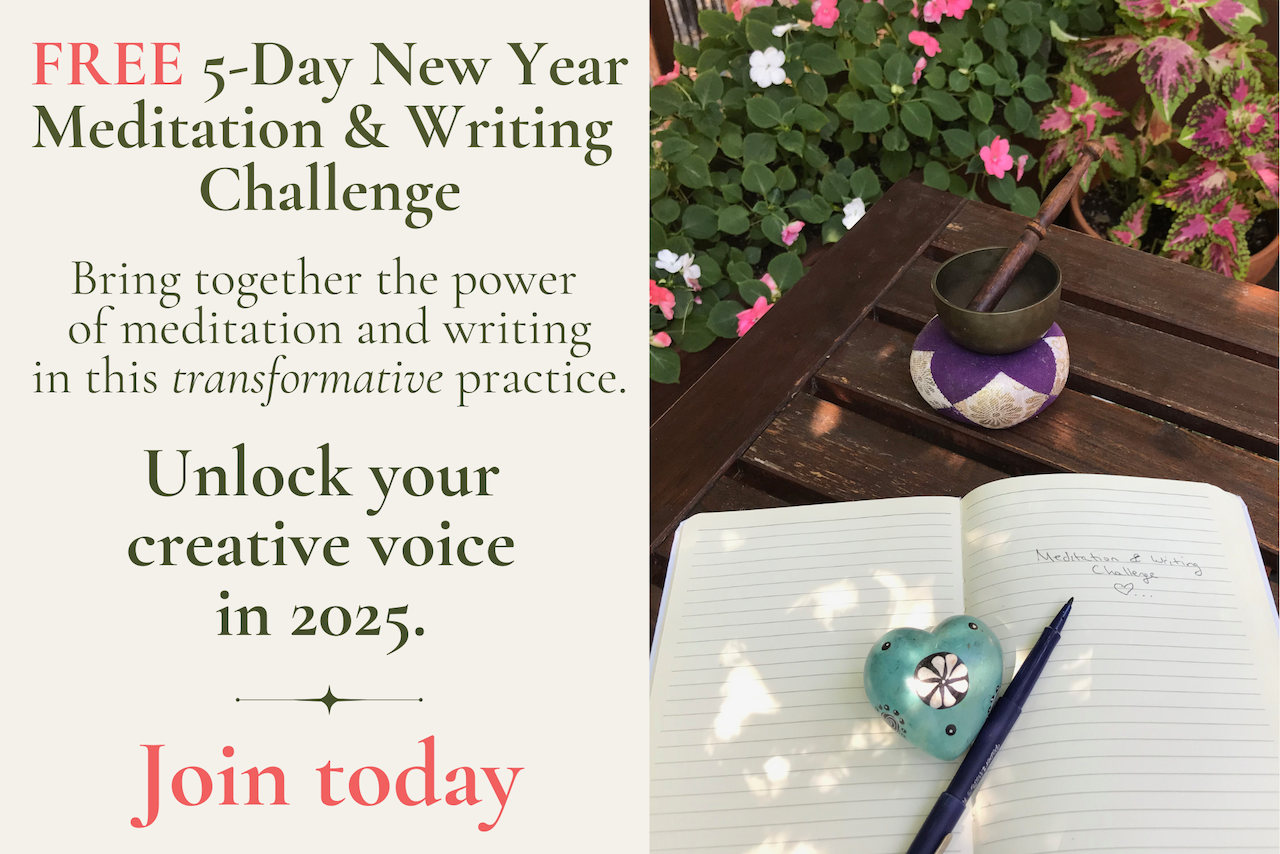
    Hi friend! As you might recall, last fall I shared an empowering five-day meditation and writing challenge from Tiny Buddha contributor Nadia Colburn. This month, she’s back with another free meditation and writing challenge, designed for the new year, focused on transformation, and I can’t recommend it enough!

    Founder of the online creative writing school Align Your Story, Nadia is a poet, memoirist, and yogi who has a talent for helping people create inner calm and access their most authentic voice.

    That’s what I love about her challenges—they allow us to turn down the mental noise that creates stress and confusion and tune into the gold of our intuition and creative genius.

    Each day’s fifteen-minute recording includes a short meditation, an evocative poem, and a prompt-based writing exercise inspired by that day’s piece.

    Though the meditation practices all vary, they all gave me quick access to increased calm and focus. And the poems and prompts are all perfect for this season of transformation, when so many of us are looking to get unstuck and create positive change.

    Like last time, I recognized common themes in my writing—blocks I need to address, fears I need to face, beliefs I need to challenge, and truths I need to accept.

    Life has been particularly overwhelming in recent months, due to significant challenges in every area of my life, and I’ve often felt lost in the haze of my own mind. Each day’s challenge elicited a new aha moment for me, giving me hope that greater clarity is coming.

    You don’t need to even think of yourself as a writer to enjoy and get something out of this challenge. It’s for anyone who wants to connect with themselves more deeply and perhaps find some of the answers they’ve been seeking externally within the quiet of their own mind.

    Some of Nadia’s past participants have noted how easily their writing flowed after meditation and how the prompts brought them unexpected insights.

    If you decide to give this challenge a try, I have a feeling it could do the same for you. You can access it for free here.

    Happy writing!

  • A Little Hope and Encouragement for Hard Times

    A Little Hope and Encouragement for Hard Times

    “If your path demands you to walk through hell, walk as though you own the place.” ~Unknown

    Trigger warning: This content contains references to self-harm and suicide.

    It was in the spring semester during graduate school. I was living alone in a one-bedroom apartment and working nearly full-time hours at night.

    The anti-depressants weren’t working so well. I was keeping up with my therapist, but I suppose it was too much.

    I felt too much. It hurt so much and couldn’t handle it. You could list out the symptoms of depression, and I had them all.

    Unable to deal with the stress of college, broken relationships, or other life events, any added stressor seemed unbearable. I cried a lot, had terrible neck pain, and even failed one of my classes.

    I’d hurt myself more with wild hope that the physical pain would outweigh the emotional. It was a low point at the bottom of the pendulum swing.

    When I began to feel like eternal sleep was the only peace in sight, I turned myself in by telling my therapist exactly what I was planning to do. They wasted no time and had me in safe hands quickly.

    That was the second time I went to the mental hospital within a year. I stayed in my room mostly and cried a lot, but the staff were kind and helpful.

    My psychiatrist was concerned about the underlying cause. He eventually landed on clinical depression and general anxiety disorder. After a three-day stay and medication adjustment, I was released.

    Over the next while, I did well enough. Eventually finishing my graduate degree had a positive effect on my chronic migraines.

    I’d had multiple treatments to ease the headaches. Once a migraine attack lasted for two weeks. When they suddenly eased, my doctor basically shrugged and attributed them to stress.

    About a year later, I had a new therapist and psychiatrist. Finally, I was diagnosed with treatment-resistant depression, general anxiety disorder, and borderline personality disorder.

    It explained why I had been through so many medication adjustments, the bouts of insomnia, and the frequent mood swings. I believe that simply having some answers helped.

    My medication was adjusted again, and I began to feel much better. There was no more self-harming, and I grew my support group. I am with the same therapist and on the same medication several years later.

    During all of this, I changed jobs twice, lost a mentor to COVID, and moved to a new house. There were also things going on in my family that were out of my control.

    What was obvious was that I was able to cope with life events much better than before. I learned to adopt a lot of tools to help combat old habits.

    For example, instead of freaking out over a situation, I could take a moment and meditate if able. I was able to considerably lower my stress and anxiety this way.

    Instead of isolating after a rejection, I could seek out a close friend to talk to or go out with. To help me stop thinking negative thoughts about myself, I’d write positive things on sticky notes and place them around the house. Like:

    “You have a good work ethic.”

    “You are a loyal friend.”

    “You have a beautiful smile.”

    Yes, they felt like lies after listening to self-hatred for so long, but perseverance made the difference.

    At some point, I had a moment. A realization.

    Sometimes we go through things and feel like we don’t have the strength to make it through.

    “This is how I go out,” was often a phrase I’ve uttered to myself in defeat. It’s easy to focus on the negative and let ourselves be overwhelmed. That’s why reflection is so important.

    The beauty of it is that if we can push through, the current struggle will shrink behind us like a bend in the road.

    Everything we endure serves to make us stronger and much more fit to face the next challenge.

    Currently, I’m experiencing some things that would have crushed the old me. Obstacles I’ve never faced before. People have repeatedly asked if I am all right.

    “I will be,” is a favorite response of mine. It signifies faith and the belief that things are not static. Things always change.

    Sure, I get sad sometimes, but giving up is out of the question. I’m constantly reminded of the saying:

    “I didn’t come this far to only come this far.” ~Matthew Reilly

    Hope is a beacon I keep burning in my soul. I feed it daily, and it illuminates an otherwise deep darkness.

    I had to go through all of that to be strong enough for right now. All of this—the waiting, the sleepless nights, the hard work—it’s all going to be another bend in the road. A story to share. It’s muscle to climb the next hill.

    I guess you could say I’m owning this struggle. Walking through ‘hell’ like I own the place.

    When new stressors and worries come up, I put them in the pile of things I can’t do anything about. If so-called obligations arise, I am at liberty to decline for my peace of mind.

    When good news comes around, it’s a glimmer of light. Daylight piercing through the other end of my dark tunnel.

    It combines with the light of hope inside and urges me onward and upward. I’m expectantly moving toward it and looking for the next stage in my journey.

    As a final thought, those tough experiences made it possible for me to help and encourage people today.

    There were times that I thought no good could possibly come from the pain. Looking back though, I feel only gratitude. I’m grateful for myself for persevering, for the professionals that helped me, and for my support people that listened.

    If you are facing something difficult, own it in the knowledge that you will get through it. One day you will look back on it and smile.

    Live it.

    Feel it.

    Own it.

    Overcome it.

  • FREE 30-Day Take Your Power Back Challenge

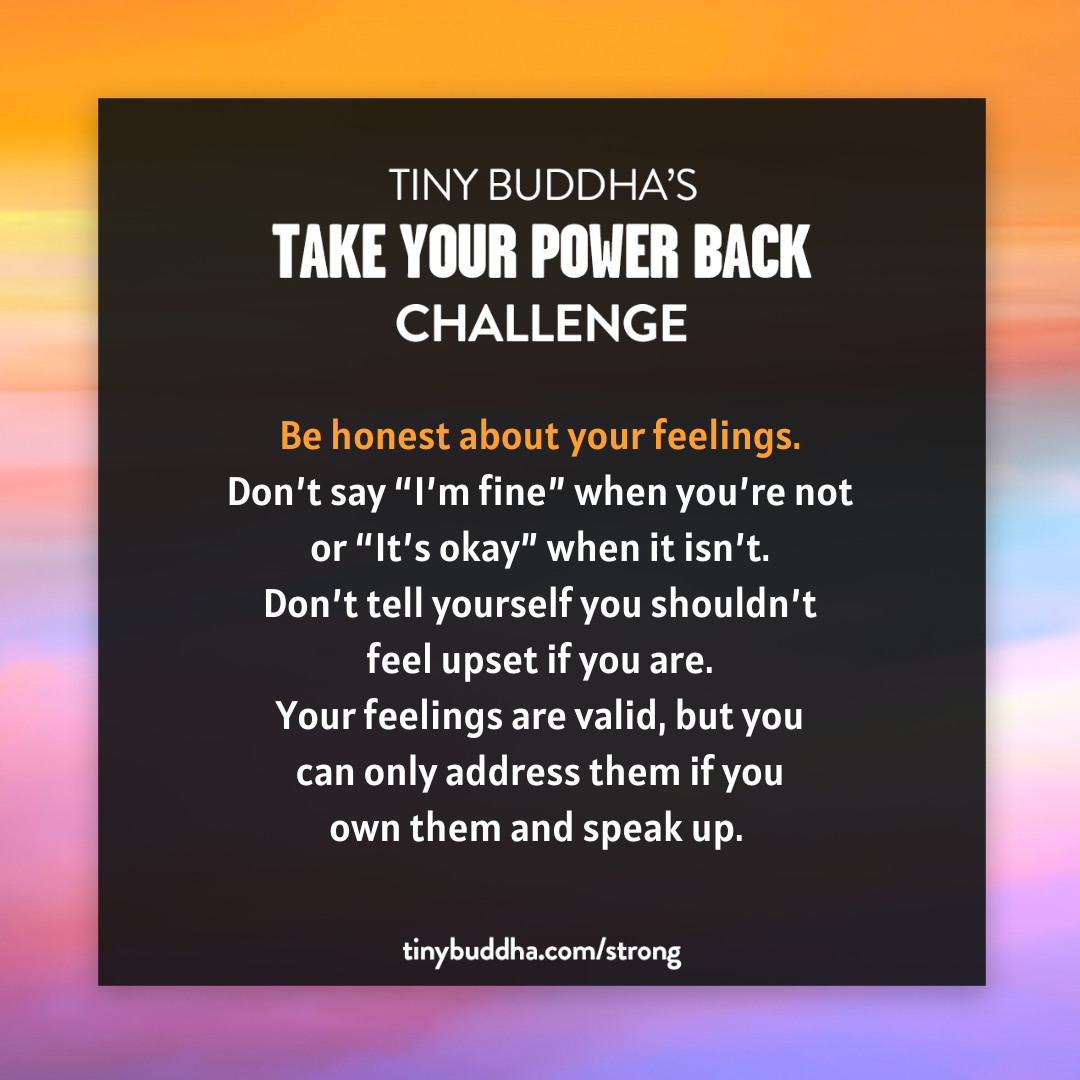
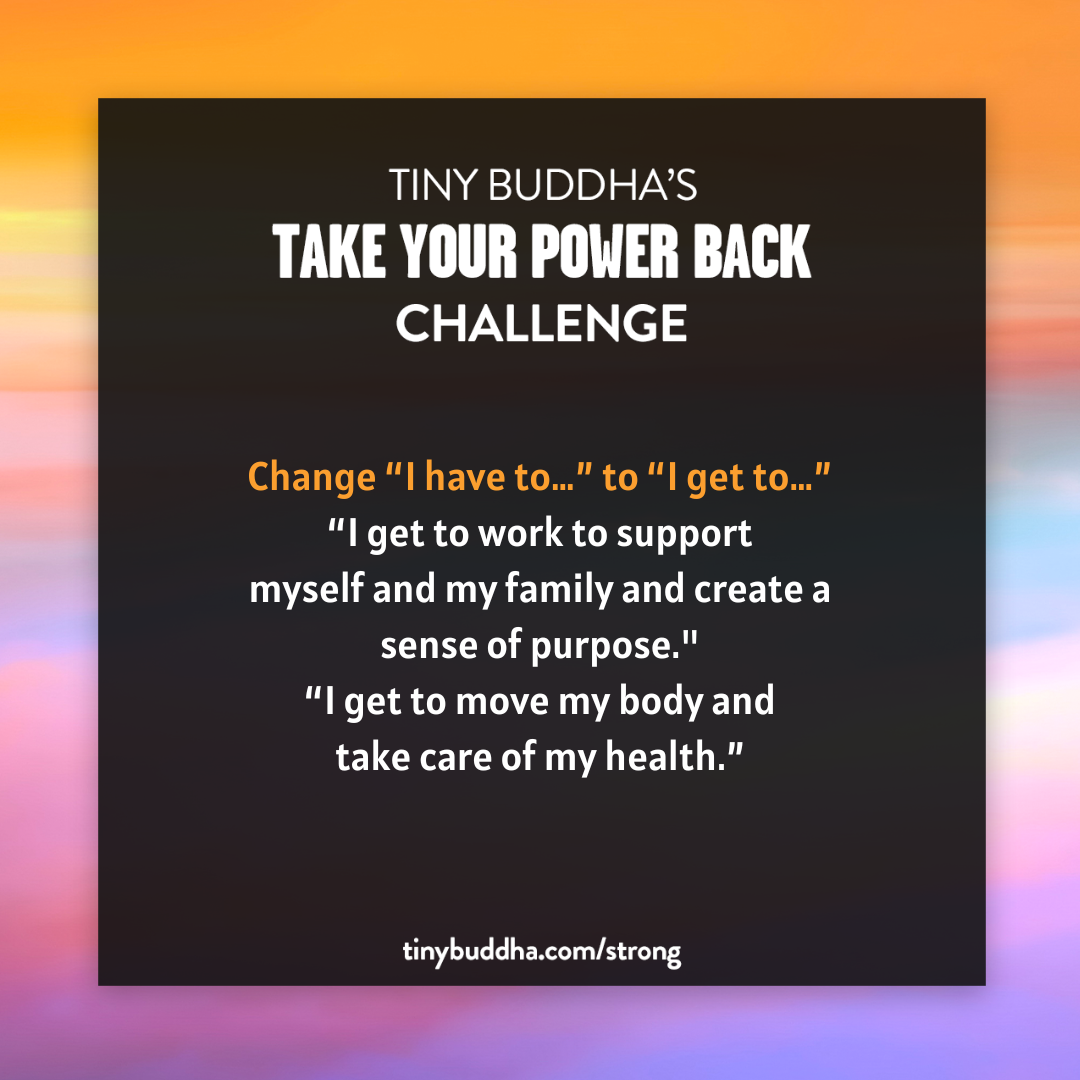
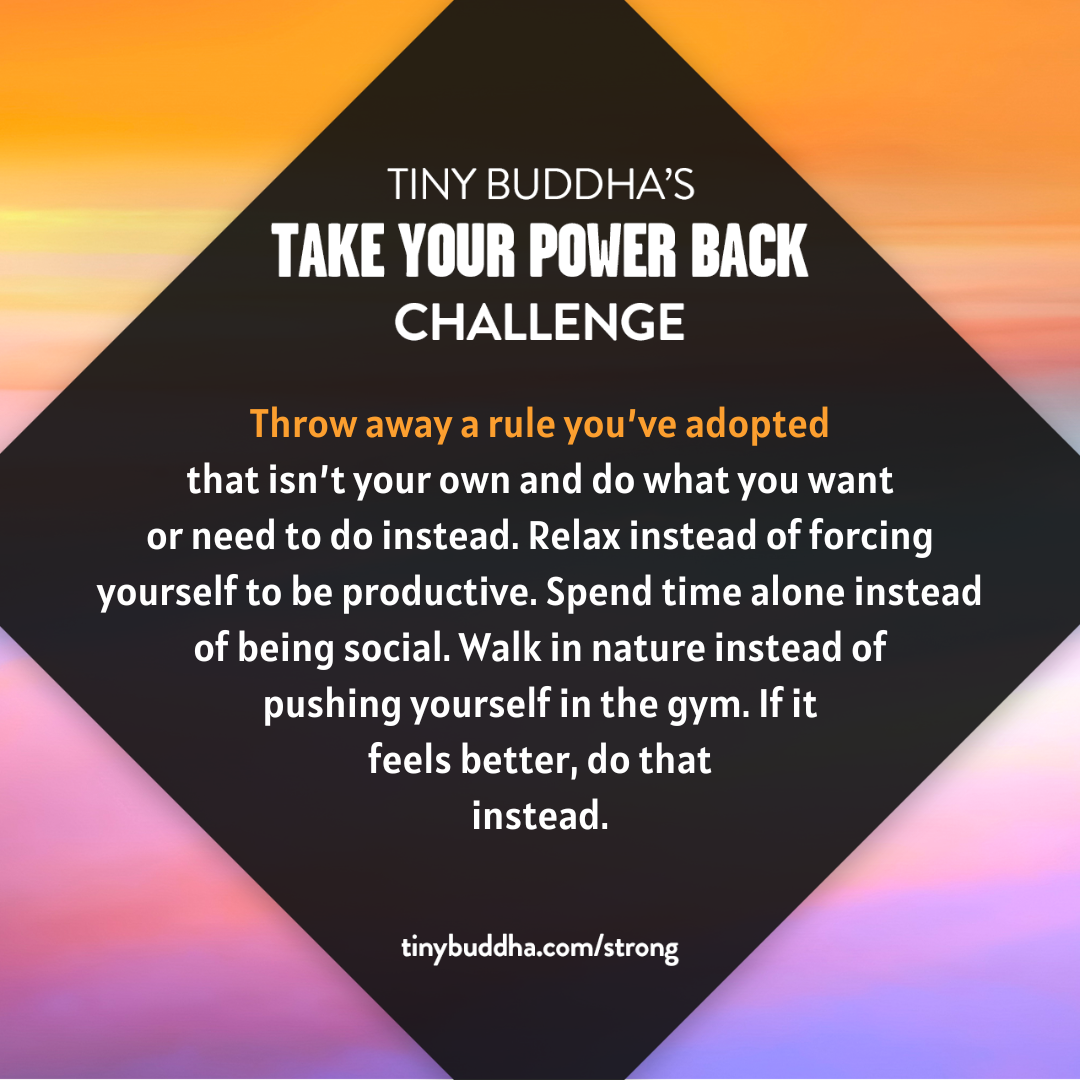
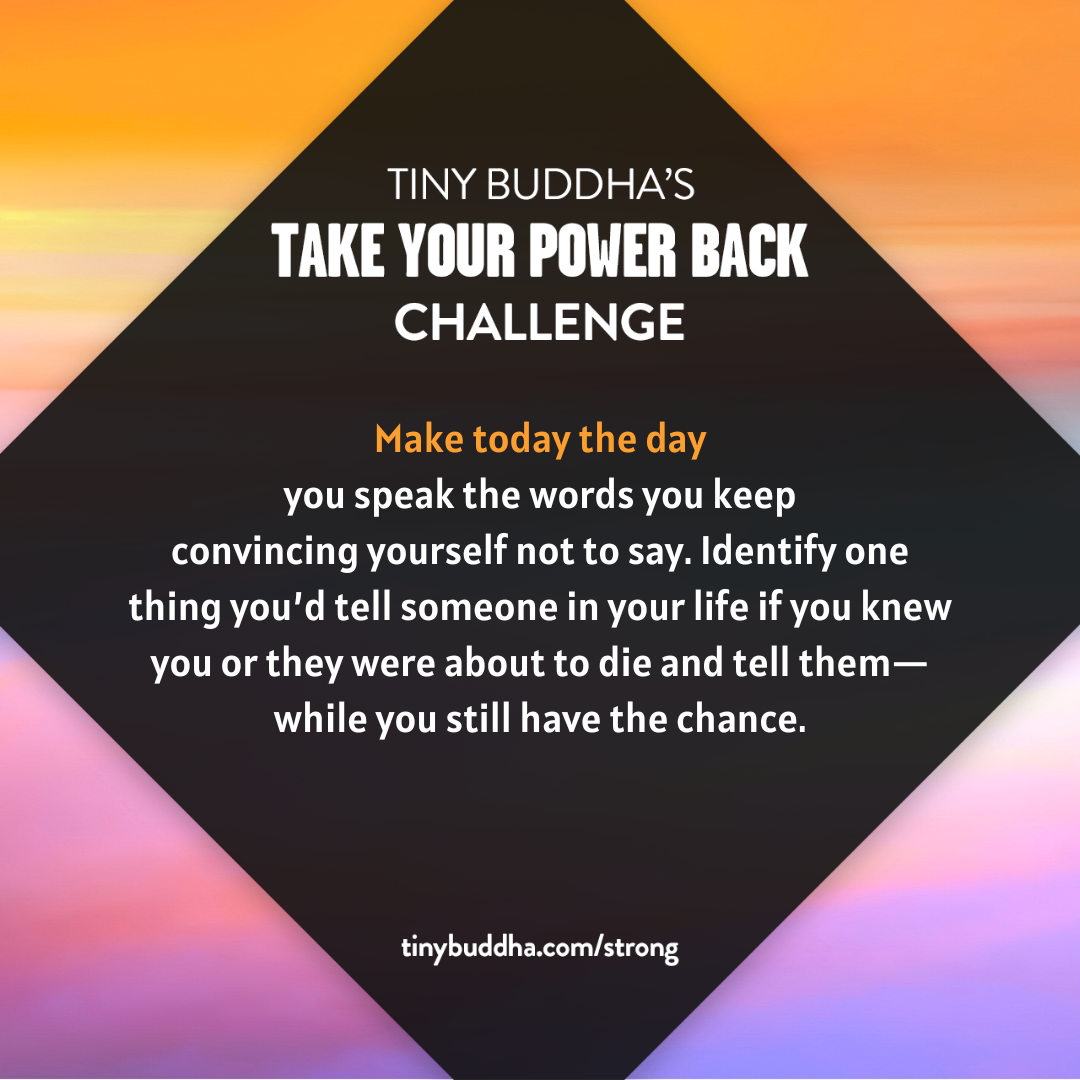
    FREE 30-Day Take Your Power Back Challenge

    Do you ever feel like you’re stuck in a pattern of waiting?

    Waiting on things to change or people to change.

    Waiting for closure or clarity or certainty.

    Waiting for life to get easier. Waiting for your heart to feel better.

    Waiting for an opportunity or a relationship or something you think you need to finally feel happy and at peace.

    I suspect most of us spend years and even decades waiting, feeling powerless over some, if not all, aspects of our lives.

    I know I’ve been there before. This is when I was the most depressed. When I felt completely helpless, like I couldn’t change my life if I wanted, so why even bother trying?

    It made sense that I felt this way as a kid, when I literally wasn’t in control. Maybe you felt this way too. But as adults we have far more power than we may realize. We don’t have to accept things that hurt us or hurt ourselves through our actions and reactions.

    We just have to recognize where we’ve given our power away and start taking it back, one small step at a time.

    One thought at a time. One change at a time. One boundary at a time. One need at a time.

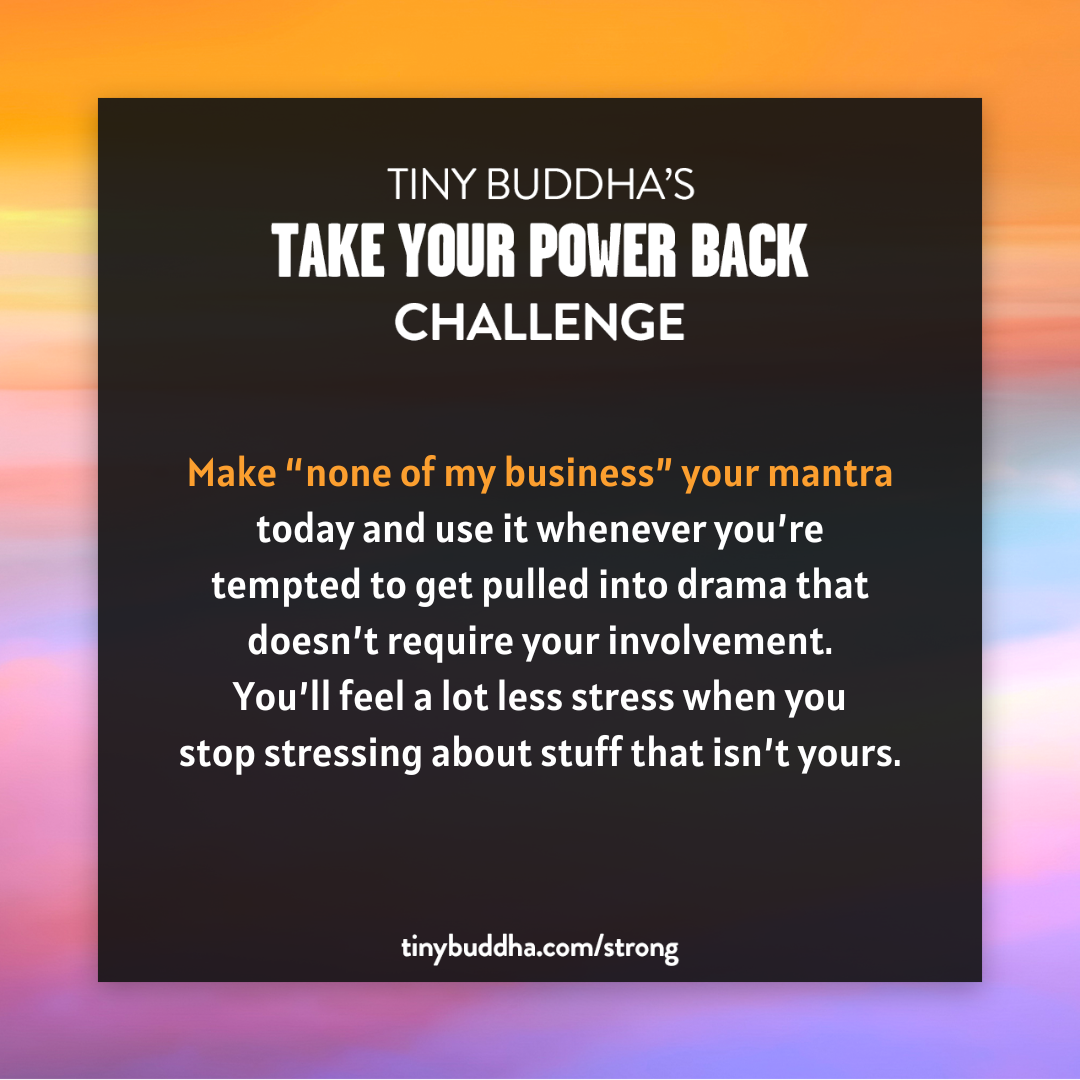
    With this in mind, I recently created a 30-Day Take Your Power Back Challenge—the latest tool in a collection of companions to my new Inner Strength Journal.

    They’re all steps we can take to create change in our lives—many of them minor things that can have a massive impact. I know when I do any of these things, I feel far less anxious and a lot more in control.

    You can find the challenge here, along with the following other free resources:

    • 15 Things You Don’t Have to Do Anymore
    • Take Your Power Back Worksheet
    • 10 Things to Tell Yourself When You’re Going Through a Hard Time
    • Your Daily Support Plan Worksheet
    • 15 Things You Can’t Control (and What You Can Control Instead)
    • Letting Go of Control Worksheet

    I hope they’re all helpful to you! If you’d like to learn more about my new Inner Strength Journal, which was recently a #1 bestseller on Amazon, you can read more here.

  • 4 Ways to Save Your Sanity When Life Gets Hard and Overwhelming

    4 Ways to Save Your Sanity When Life Gets Hard and Overwhelming

    “You can’t stop the waves, but you can learn to surf.” ~Jon Kabat Zinn

    In December of 2020, we noticed Mom’s speech seemed difficult. Like she had stuffed cotton balls in her mouth, and someone was restraining her jaw from moving. We asked her about it, she said it was nothing.

    We hadn’t seen each other since we got together over the holidays. On New Year’s Day 2020, we clinked glasses filled with sparkling wine and shared bold predictions about how this was going to be our best year yet (spoiler alert, it wasn’t).

    With every passing week and conversation, it got worse. We brought it up many times, my sister and I. We pleaded with her to see a doctor. We were separated by thousands of miles and a closed border. My sister in Virginia, me in California, Mom in Canada.

    She said no, it wasn’t a big deal, it was getting better (spoiler alert again, it also wasn’t). She insisted she was fine. She could eat, drink, work, and speak. It was all good. She repeated this message as our worries grew. We felt powerless to help, especially in the face of her denial and refusal to get care.

    In March of 2021, I got an odd message on Facebook messenger. It was from a woman who said she worked with my mother, asking me to call her. She had taken my mother to the hospital the night before, where she was admitted for extreme dehydration and exhaustion.

    Her symptoms made no sense to them either, so she endured a battery of tests. Ultimately, it was revealed that what ailed her was amyotrophic lateral sclerosis, also known as ALS or Lou Gehrig’s disease. A horrible progressive nervous system disease that causes loss of muscle control. It is always fatal, with no known cure.

    Her disease first attacked her ability to speak and swallow, an unusual first set of symptoms. When she was hospitalized, she finally admitted she hadn’t eaten a real meal in thirty days and had been able to drink less and less.

    My sister and I are both career women with young families. I work for a tech company. The work is fast moving, complex, and nuanced. I used to pride myself on my “meeting endurance.” I often tackled days with ten to fourteen meetings, with enough energy left to crank out work deliverables, do an intense workout, and spend time with my six-year-old twins.

    With my mother’s diagnosis and the new responsibilities of caregiving during a pandemic, I had to revisit many of my previous beliefs and assumptions. Here’s what I learned. I hope it helps you too.

    Lesson 1: Out with stretch goals, in with baseline goals.

    I’m a (sometimes) recovering overachiever. I have a history of establishing huge stretch goals and basking in satisfaction when I smash them. For years I was motivated by the striving to do more, be better.

    Until I wasn’t.

    With my mother’s diagnosis and the challenges of parenting and working in a pandemic, overwhelm swallowed me whole. It felt like I was surrounded by fuzzy darkness. Like I was moving through molasses.

    I wasn’t alone, of course; mental health issues skyrocketed globally. Rates of depression and anxiety are rising. The term “languishing” was introduced to express the lack of thriving many more experienced.

    I had to rethink my relationship to accomplishment.

    I have given myself a break from stretch goals. I now set what I call baseline goals. Baseline goals are super small, completely achievable objectives. They are daily or weekly practices that have compounding impact when practiced consistently over years. Simply put, baseline goals are the smallest possible thing you can commit to that will support your well-being.

    Instead of an overwhelming big picture, you create a concrete short-term focus.

    Instead of a lengthy, high-intensity fitness routine or a stretch goal (let’s train for a marathon!), the baseline goal is fifteen minutes or more of movement six days a week. Walking counts. Slow yoga counts. Dancing in the living room definitely counts. I can do fifteen minutes.

    Instead of kicking off a complex transformation project (let’s reinvent how we interact with our customers!), the baseline goal is each morning to determine the biggest priority for the day, and the absolute minimum action that needs to be taken. Then do that thing first. I can figure out one priority. I can do one thing.

    It turns out that when you’re super clear on your minimums, it frees up a lot of the capacity used up by trying to do it all. It releases the guilt from impossibly high standards.

    Lesson 2: Separate your future problems from your current problems.

    It has become almost a mantra for me to say, “That’s not a problem I need to solve today.” There are SO. MANY. PROBLEMS. So many decisions to make.

    I had to learn to be discerning about which problems I needed to tackle now and acknowledge that there were many I didn’t have enough information to figure out, so it made no difference to think about them.

    When my sister and I moved my mother into an assisted living community, our minds were invaded by the “what ifs,” and “what will we do when?”.

    “What if she needs more care than they can give?”, “What if we can’t support the costs?”, “What if we need to move her again?”, “What if they close the borders?”, “What if they disallow visitors?”.

    We started asking ourselves, “What problems do we need to solve right now?”.

    The only problem we needed to solve was immediate care and needs. We didn’t need to know the future. We could respond to new needs as they emerged.

    It’s clearly not a healthy long-term behavior to ignore the future, but in crisis, clarifying where action and decisions are needed has been helpful in deescalating anxiety.

    Lesson 3: Self-compassion is the new black.

    There are many days when I feel like I’m failing in every dimension. No matter where I am or what I’m doing, I am racked with guilt and self-criticism because I’m not somewhere else, doing more.

    Self-compassion is when we give ourselves the same kindness we’d extend to a good friend. When the guilt comes (and I haven’t yet figured out how to keep it at bay), and the self-critical talk starts, I pretend I’m talking to a dear friend. I’m doing my best. That’s all I can do.

    Lesson 4: Embrace the suck.

    It’s easy to become overwhelmed. To let my thoughts spiral into fear, worrying about the future in anticipation of what’s to come. I’ve now come to realize that when I do this, I am borrowing problems from the future. I am suffering in anticipation of things that may or may not come to pass.

    All I have to do is be here, now. That’s all. I don’t need to live the future yet; I just need to live the present.

    Jon Kabat-Zinn said, “Give yourself permission to allow this moment to be exactly as it is, and allow yourself to be exactly as you are.”

    And right now, there are many moments that are difficult and painful. And I am often sad, depleted, and upset. That’s okay.

    I can’t skip the hard parts; I have to experience them. And only by experiencing the most excruciating parts can I also fully experience the joyful moments.

    You only ever have to deal with the moment you’re in right now. We can do hard things.

  • How I Get Through Hard Times Using Curiosity, Compassion, and Challenge

    How I Get Through Hard Times Using Curiosity, Compassion, and Challenge

    “Sometimes the worst things that happen in our lives put us on the path to the best things that will ever happen to us.” ~Unknown

    Until I was thirty-seven, I thought I’d led a pretty charmed life: I had a supportive family and good friends, I’d done well academically, always got the jobs I’d applied for, and met and married the perfect man for me.

    In 2013, when I was thirty-five weeks pregnant with my second child, I was diagnosed with stage 3 breast cancer. My baby was induced at thirty-seven weeks, and my chemo started ten days later. In a funny way I was relieved; Okay, I thought, I’ve been seriously lucky up until now that no one has been ill in my life, so if I can survive this, then this is as bad as it gets.

    And that year was bad—moving home, caring for a toddler and a newborn, and going through aggressive cancer treatment was horrendous, but I hunkered down, tried not to think too much about it, and survived.

    In December 2014, literally as we were clinking champagne glasses to celebrate my all-clear results, my husband had a devastating call from his mum in New Zealand. She had just been diagnosed with a rare and incurable cancer. Early the following year my dad was diagnosed with stage 4 bowel cancer, and my mother-in-law died that spring.

    It was at this point I started to feel weighed down with a heaviness. This wasn’t the deal… I’d taken the cancer hit for the team, everyone else was supposed to stay well. I started to lose my trust in the world.

    My urge to control everything and everyone around me, which I now realize I have had since childhood, went into overdrive. I became fearful of change and made list upon list to organize and reorganize my life until I had anticipated everything that might go wrong and put things in place to deal with it.

    My brave dad endured a variety of invasive and aggressive treatments, but his health continued to decline. I could not control what was happening or the sense of loss and grief that at times I felt were swamping me.

    Something had to change: I started journaling, yoga, and meditation. Slowly I felt my anxiety and my panicked grip on my life begin to lessen. I looked inward and I started to notice familiar feelings and patterns, recognized myself responding to roles and labels that I no longer felt to be true.

    There were shifts; very, very small shifts, but with two small children, a husband working long hours, and a dad with rapidly declining health, even small shifts made a difference to my capacity to cope.

    Toward the middle of 2015 my husband started to get awful headaches, nausea, and dizzy spells. He was in a very stressful job, so decided to leave work at the beginning of 2016 to get his health back and decide what he really wanted to do with his life. However, in the spring of 2016 he was diagnosed with an incurable brain tumor. At that stage my children were three and five.

    The next couple of years were consumed by medical appointments for my dad and my husband, alongside the busyness that goes hand in hand with raising young children, but I continued my inner work. I examined my feelings. Was that really how I felt? Had I felt that way before? What helped then, what might help now? Is the story I’m telling myself about this true? What do I need right now?

    In spring 2018 my dad died, in spring 2019 my husband died, and in spring 2020 the UK went into its first lockdown due to Covid-19.

    Every year since 2014 I’ve said to myself, well surely the worst has happened, this year has to be better, and yet each year something else monumental and life-changing has happened. The past seven years have been relentless, and at times I have been overwhelmed by the responsibility of caring for the people I love most in the world.

    People used to hear my story open mouthed and ask, “How do you cope?” I would reply in a way designed to brush them off, remove their focus of attention, and minimize my pain by saying, “Oh well, you know, you just deal with what life throws at you.” I knew that this wasn’t true, but a flippant reply was easier than the truth. After years of continual inner work however, this is my honest reply:

    To boost your resilience, to heal, and to ultimately thrive you have to be prepared to turn over the picture-perfect patchwork quilt of your outer life that you present to the world and take a good look at the messy stiches on the underside.

    You need to be prepared to look at the messiest of those stiches and painstakingly unpick them so that you can find the knots, the tangles, and the imperfections. It’s only when you connect with your authentic self that you’re able to respond to your unique needs in times of crisis and learn what you need to do to foster your own resilience.

    The way of doing this will be different for everyone, but if I could boil it down to one pithy statement it would be to always keep in awareness the 3 C’s: curiosity, compassion, and challenge.

    Here are some ways I’ve applied this in the last seven years to help me, and perhaps these ideas might help you too.

    Allow your feelings.

    Other people are allowed to feel uncomfortable about this, but that is not your responsibility. Your responsibility is to embrace your emotions so you can process them and work through them instead of repressing, denying, or numbing them with substances and distractions.

    In my life this idea of numbing or distracting has taken shape in many ways. One is the compulsion to check my phone rather than sit with feelings of restlessness, boredom, or uncertainty. Sometimes I find myself opening my fridge or cupboard, not because I’m hungry, but because I’m anxious or agitated.

    Recently, I’ve needed to work on sitting with my feelings when I say “no” to someone and worry there will be painful repercussions if I don’t keep other people happy.

    These are all hugely uncomfortable realizations, but offer an opportunity to spot patterns—do I always reach for food after a specific event, do I always reach for my phone when I feel a certain way in my body?

    Once I’ve shown a curiosity about my choices, I can have understanding and compassion for why and challenge myself to do something else. Instead of food can I do some rounds of a breathing exercise? Instead of the phone can I practice some simple yoga poses? Can I pause before saying “yes” to something I know won’t serve me and think of the times I’ve said “no” and there haven’t been negative repercussions?

    Key questions here are: What do I really need, what am I afraid of, and how can I soothe my threat system in that moment before reacting?

    Put your needs first.

    I learned that however much I was needed by other people (and with a dying dad, a dying husband, and two small children I was needed a lot), I had to start the day knowing that at some point I was going to make time to put my needs first.

    Sometimes that was getting up early to enjoy a hot chocolate in peace, often it was taking some quiet time in nature. I joined a gym with a pool because swimming is something I find hugely supportive for my mental health, and I joined an online yoga site as I no longer had the lengthy chunks of time I needed to get to a class in person.

    Embrace ritual and routine.

    Decision fatigue contributes massively to how overwhelmed I can become; routines provide a secure framework for my family to feel supported and give me more energy for the unexpected things that life inevitably throws at me.

    My routine includes:

    • Planning my week ahead on a Sunday—I have a simple document with columns for appointments, reminders, to-do list, and well-being
    • Putting out school clothes and making lunches the night before
    • Having a grocery delivery booked in for the same day and time each week
    • Menu planning and pre-preparing simple meals for the nights of the week that I know will be busy or I am working late

    Put together a well-being toolkit.

    Explore ideas and suggestions that you might find supportive, but don’t feel beholden to it. You don’t need to use all of the tools all of the time. Learning to listen to what you need in the moment (and giving yourself permission to act on it!) is really empowering.

    My well-being toolkit includes…

    • Breathing exercises
    • Journaling
    • Yoga
    • Reading
    • Running
    • Meeting friends for tea
    • Trying out new recipes
    • Sitting still—either meditating, focusing on my breath, or just letting my mind wander

    Build a supportive team around you and know their individual strengths.

    No one person can deliver everything you need. Manage your expectations about what each treasured person can bring to your life and learn who to go to for what.

    Challenge the narratives, expectations, and labels in your life (my 3 C’s).

    Do they still serve you or feel true; where do they come from; what do you need in order to let some of them go

    There were ways I perceived myself and labels others had given me that only addressed the way I presented myself outwardly. By turning over the quilt and looking at the stiches that made up these labels with curiosity and compassion I was able to challenge them.

    For example, am I really “standoffish,” or is that just my defense against crippling social anxiety? Am I really “bossy,” or am I just frightened of how unsafe the world will feel if I lose control? Am I really “capable” or just terrified of asking for help and being rejected?

    I would never suggest this is a simple process, and reaching even a modicum of self-awareness is a daily and never-ending challenge for me. There are no black-and-white answers, so it’s important to become accepting of living in the grey area.

    Ultimately, I believe that approaching each day, every response, every feeling with curiosity invites compassion and understanding, which helps us challenge and address underlying insecurities and outdated narratives that keep us down and stuck.

    Supporting ourselves to see beyond the labels, roles, and responsibilities layered on through our lives allows for the possibility of the emergence of the authentic self.

    This is a work in progress, I am a work in progress, and always will be.

    Some days I am overwhelmed with sadness, a heavy heart, and a sense of loss; some days I awaken already infused with a sense of gratitude and joy. Every day, however, I wake up prepared to be curious and interested, to approach all interactions with myself and others with compassion, and to do what I can to challenge thoughts and beliefs that I don’t want to take into my future. I just know that next year will be a better year.
  • Free 7-Day Sleep Challenge: Meditations, Tips, and Tools for a Restful Night

    Free 7-Day Sleep Challenge: Meditations, Tips, and Tools for a Restful Night

    Does stress cause sleepless nights, or does a lack of sleep cause stress?

    Both have been true for me, especially since becoming a parent, and I’m guessing for you too.

    When life gets challenging, it’s hard to shut your brain off at night.

    You know it’s important to get a good night’s sleep. You know you feel better in the day when you’re well-rested. But it’s hard to relax, physically and mentally, when you have a lot on your mind. It’s like there’s a tornado inside your head, and all the sheep-counting in the world couldn’t pull you out.

    And when you haven’t gotten adequate rest, it’s hard to function and deal with, well, anything. You feel on edge, easily irritated, and perhaps both foggy and jittery—like you can’t think clearly, and yet you can’t stop thinking… because you have a lot to do and figure out, and you can’t afford to stop just because you’re tired.

    If you’ve experienced your share of restless nights and exhausted days, and you’d like to improve your sleep routine, I highly recommend the 7-Day Sleep Challenge, from Mindfulness.com.

    This challenge was designed to help you make good sleep a lasting habit so you can become a healthier, happier you.

    Led by mindfulness teacher and international speaker Cory Muscara, the challenge provides daily emails with practical advice to quickly improve your sleep, nightly audio coaching sessions, and a corresponding meditation for each, to guide your mind and body toward better rest.

    This FREE 7-Day Sleep Challenge is for you if:

    • You can’t go to sleep at night, and you wake up tired
    • You wake up in the middle of the night and lie there for hours trying to get back to sleep
    • You feel reactive throughout the day and small things set you off
    • You don’t have the energy to do the things you enjoy
    • You frequently complain about lack of focus and poor memory
    • You are ready to make good sleep a habit

    Benefits of Better Sleep

    When we get the recommended seven-plus hours of sleep, we enjoy a wide range of benefits:

    • Increased focus and productivity
    • Strengthened immune system
    • Lower risk of heart disease and stroke
    • Decreased risk of diabetes
    • Improved memory
    • Decreased stress, anxiety, and depression
    • Balances excessive weight fluctuations
    • Decreased risk of chronic diseases

    Life is just plain better when you’re well-rested.

    You feel calmer, more energized, and better able to focus and enjoy your day, and you’re far less likely to say and do things you’ll  later regret. Which means good sleep not only boosts your physical and mental health, it can also improve your relationships.

    And odds are you’ll also feel better about yourself when you’re showing up as the person you want to be—not an easily irritated zombie who can’t wait to collapse into bed (only to toss, turn, and stress about how few hours you have left to sleep before another draining day).

    Ready to sleep your way to a healthier, happier you? Click here to take the FREE 7-Day Sleep Challenge and get the tools you need to wind down and fall asleep more easily and get the restorative rest you need to be your best!

  • The People Who Hurt Us Are Vehicles for Our Growth

    The People Who Hurt Us Are Vehicles for Our Growth

    “You only see in others what you have in yourself.” ~Annette Noontil

    I now recognize, after observing painful patterns repeat many times, how things that trigger me are just lessons I need to learn that are often delivered through other people. The more painful the experience, the more I can see (in retrospect) I learned from it.

    Every now and then, when I find myself getting sucked into thoughts about the rightness or wrongness of a situation and how much pain it’s causing me, I take a step backward. I can see that people are just the mechanism to my growth, and painful experiences are just big Wrong Way signs redirecting me to my best life.

    In his book Scattered Minds, Dr. Gabor Maté wrote, “It is well recognized now that people will form relationships with others exactly at the same level of psychological development and self-acceptance as their own… What we might call the law of equal development holds true even if the people themselves buy into the mythology that one of them is more emotionally mature than the other.”

    I love this insight from Dr Maté, especially when he goes on to give a typical example of a married couple with one spouse that appears to be functioning in the world more successfully than the other. When the relationship is examined more closely it can usually be seen that both people have a lot of maturing to do in order to be able to function healthily as individuals rather than in a codependent state.

    It’s no coincidence that we form relationships with people who trigger us. We are drawn to people who are, in some way, a match to our own issues, and they both challenge us and help us heal and grow.

    As a homeopathic practitioner recently observed, about two differing constitutions often drawn to one another: “One is in their head and has to learn to connect from their heart, the other is in their heart and has to learn to connect from their head.”

    But all this holds true whether it’s an intimate relationship or a more distant one; if someone triggers you (positively or negatively) they have something to teach. Michael Kerr puts it simply as “People gravitate toward their emotional mirror images.”

    “People tend to sort themselves out by levels of emotional development for many purposes, not just marriage, “ writes Stanley Greenspan, “because those functioning at different levels are practically speaking different languages…. People widely separated developmentally in fact have very little to talk about.”

    It can be tough to look at people I have, at one time, literally despised and consider that we were emotional mirror images—for example, a jealous colleague who went out of her way to discredit me on a number of occasions. This doesn’t mean that I am a bully because someone bullied me (although it could mean that for someone else); it means that we both had an equal emotional stake in the same interaction.

    In retrospect, I can see that my former colleague triggered pain from my childhood relationship with my mother.

    My colleague’s modus operandi was an unfiltered lashing out at anything that stood in her way. Her unprofessional conduct went unchecked and unmanaged because she had been promoted for the short-term results she’d achieved.

    Her behavior reflected the unfiltered (tongue) lashing I often received from my mum when she was feeling highly anxious.

    As a child, I learned to stay out of trouble by anticipating her emotions and striving for perfection in my behavior so that I received no criticism (which was usually unfounded and always delivered in a way that felt crushing and unfair).

    Not that I was ever passive, but when I wanted something I would go after it from a point of defense, justifying myself rationally rather than having healthy boundaries around my own needs and desires.

    To be criticized publicly by a colleague was, therefore, not something that felt safe to me. My attempts at repairing the relationship privately were unsuccessful, and it was not until I stood up in a meeting and told her pointedly that I would not allow her (nor anyone else) to bully me that I garnered her respect.

    This experience allowed me to see how much hurt I’d been harboring from my childhood, and to put energy into healing that old wound rather than perpetuating any more situations that echoed it.

    With the benefit of hindsight and my own years of parenting, I can now see I wasn’t responsible for my mum’s anxiety; rather it was an amplification of her own anxiety as a child in reaction to the culture and environment she grew up in, and the way her behavior was managed.

    While it’s easier for me these days to detach myself from issues that trigger me emotionally, note that I do still get triggered. That, I believe, will never change because there is no surer way to know what we do want without first experiencing what we don’t want. It is just best not to get stuck feeling sorry for ourselves.

    I’ll admit it’s sometimes hard to see a way through the emotions of the moment, especially when it relates to an ongoing situation. When I’m triggered, it’s still through other people whom I would dearly love to validate my view, just as they would no doubt love me to validate theirs, so there is a lot to work on.

    The beauty, though, is that I mostly choose to do it from a point of intrigue and willingness to learn and grow rather than feeling powerless and at the mercy of others.

    Again, note I said mostly. Old habits die hard, and there are still many times where I’ll find myself turning to confidants to rant about something. For this reason I choose to confide in people who gently prompt me back to the observer’s chair, and the broader view.

    And when similar situations keep arising, I know that life is presenting an important lesson for me. It’s not always immediately obvious what the real lesson is and how I can overcome my struggle, but experience has taught me that things become clear when they are ready to; my job is to cope as best as I can with my frustrations rather than make myself miserable.

    And since the lessons are most often delivered through others, I try not to vilify them for their part. I know that in the future I will be thanking them—even if only inwardly—for the role they played in my ongoing growth and journey through life.

    So what are you currently triggered by, and who is the focus of your frustrations? Think about past situations where you’ve felt similarly. When was the first time you can recall feeling this way? Try to see the pattern, and what it might be telling you.

    Rather than living through the pain as a helpless victim, try to see the lessons you’ve come to learn. In whatever way the lesson is being played out, the true lesson will be some version of learning to love yourself more; it always is.

    Can you imagine a world full of people who are seeking their power through self-love rather than trying to take from others? Now that is a world I’d like to live in.

  • 6 Things My Heroes Taught Me About Overcoming Hard Times

    6 Things My Heroes Taught Me About Overcoming Hard Times

    “A hero is an ordinary individual who finds the strength to persevere and endure in spite of overwhelming obstacles.” ~Christopher Reeve

    It all happened so suddenly that it felt just like a flash flood. One minute the road was clear and drivable, and the next it was a raging river. Before I knew what happened, my life went from being only slightly a mess to being a complete mess, my car teetering on the edge of the water, ready to go for a swim at any minute.

    I had left a job I liked and found a job I thought I would love, but didn’t end up loving at all.

    I had hurt a good friend who was extremely important to me, and is now out of my life for the most part.

    I felt like a financial mess from constantly playing catch up and living paycheck to paycheck, and I was going to have to move out of an apartment and town I really loved.

    It’s funny how when even just one thing is going great, all the other things that aren’t going so hot are manageable. But if nothing is okay, then everything seems insurmountable and completely overwhelming.

    Faced with more doom and gloom than I could stand, I wanted to melt into my bed and never get back up. And honestly, for a few days I did.

    I didn’t want to talk to anyone about what was going on. I didn’t want to admit defeat or ask for help. Even my very best friends only knew bits and pieces of what was going on inside my head. And honestly, the one person I would have bared my soul to, the person who I always ran to with stuff like this, was no longer speaking to me.

    So now what? I realized that if I didn’t want to talk to the people who inspired me most, I could still apply what I had learned from them. They had taught me so much over the years through their advice, and their example, that through them, I found my way.

    1. You can cry for five minutes and then you have to put your big girl pants on and deal with it.

    One of my best friends, and someone whose strength I really admire, taught me that life isn’t going to wait for you to have a pity party; it’s going to go on without you.

    She always says to her kids and friends, “Where does crying get you? Nowhere.” So, while it’s okay to cry a little and allow yourself some much-needed time to wallow, eventually that has to end.

    Spend a weekend in bed with some feel-good movies and junk food, journal your feelings, take a long hot bath, cry and scream into your pillow, and indulge in some self-care and pampering. But don’t get stuck there. It is so easy to get stuck there.

    Give yourself a cut off time to pull it together and start to figure out how you are going to get through this bump in the road. Becoming a blubbering mess isn’t an option, as tempting as it is.

    2. Laughter is the best medicine.

    You have to have a sense of humor about your situation. Laughter can bring down blood pressure and relieve stress. You’d be doing yourself and your health a favor to find some humor each day in the ridiculousness that you are going through. There’s even something called laughter yoga, which in and of itself is funny, but honestly, they are on to something. Have you ever felt bad after a good laugh?

    If you’re so miserable you can’t think of anything funny, don’t go it alone. Hang out with a friend who can usually make you laugh, or call someone who does the same. I usually call my mom because she inspired this advice, and every time we talk about the crazy stuff going on in our lives, we always end up laughing about it.

    3. What you did before won’t work now if you want a different outcome.

    These next three pearls of wisdom, about taking action and setting goals, come from a mentor and dear friend who’s advised me over the years.

    You have cried, you have laughed, and now it’s time to think about how you got here.

    True, some situations are completely unavoidable, and life can deal us some horrible blows we could not have anticipated. However, if you contributed to your current situation, even in the smallest way, you have to reflect on what got you there.

    That shouldn’t take long—it should be glaringly obvious where you went wrong—but the key here is to actually change that behavior. That’s the hard part, and honestly, something that has to be continuously worked on.

    I eventually realized that I needed to change my impulsive decision making after it caused me to lose a relationship that was very dear to me, among other things. Consciously making the decision to work on it daily, and seeing the change that choice has made in my life gave me back a sense of pride, and makes the sting of that mistake more bearable.

    However, it’s easy to do this while in the midst of dealing with the fallout of a miscalculation or mistake. You think, man I’ll never do that again, what was I thinking? I’m going to change! But then when all is right with the world and these troubles are a distant memory, you can slip back into old habits.

    Unless you make a commitment to stay aware and work daily to change, and stay changed for the better, you will find yourself back here again, and again, and again.

    4. A plan is only good if it is actionable, and you take action.

    As you start to feel better, you will want to come up with a plan. It’s amazing how empowering it is to tackle the problem head on and figure out what outcome you want and what you need to do to get there. But is it realistic? Is it something that will make your current situation and your future better?

    Here’s a tip: It shouldn’t be the first plan you think of. Usually that one is the easiest, “the quick solve,” and it won’t get you where you want to be in the long run. You have to think long and hard about what you really want, how you feasibly can get there, and if it is doable at this time with the resources you have.

    Make sure your working toward what you want every day, and tweaking as you go if it starts to look like you aren’t making any headway. Checking in with yourself and staying grounded will help you stick to the plan and see success.

    Usually when I make a plan I think a lot about what I want, not necessarily what I need. I decided to keep my head out of the clouds this time, and made a more realistic plan then I usually would have.

    I had to accept some unwelcome changes (moving, new financial situation, loss), but knew those things were necessary to be successful this time around. In the process I found a new career I love, and am on my way to overcoming months of remorse over past situations.

    5. Suck it up and do what you have to do to get where you want to be.

    A few years ago, the good friend and mentor I mentioned earlier suggested that, to catch up on bills and get out from behind my current financial situation, I should give up my car. That way I would save money by not having a monthly car or insurance payment. After a few months of saving and catching up I could buy a used car outright. She suggested taking the bus and getting rides from friends when needed in the meantime.

    Aghast, I told her there was no way I could do that.

    “Why not? Because it would be too hard?” she had pointedly asked.

    I just told her I wasn’t willing to give up my car, and instead, decided on a quick solve that fixed the problem for the moment, but not in the long run. I never got to exactly where I wanted to be financially.

    Now looking back, I see the wisdom in what she was suggesting. Sometimes we need to make a sacrifice and do something unpleasant to get to a better future.

    Nothing worthwhile comes by walking an easy, breezy path, and it shouldn’t. I thought about this a lot when recently deciding to move somewhere much cheaper so I could save money and catch up. Sure, it wasn’t what I wanted to do, but it was necessary to get on the right track.

    It can be really hard to decide to bite the bullet and do something difficult that you really don’t want to do, but once you’re through it on the other side you will be glad, and proud, that you did.

    6. Keep believing that the best is yet to come.

    It doesn’t matter how old you are, or how wrong things have gone, there’s always potential for a better tomorrow. It’s not going to stay this way forever; it can’t. Don’t get so bogged down in the misery of today that you forget to get excited for the future, and what you’re doing to make it a good one.

    A close friend and soul sister of mine had a bumper sticker that read: Always believe that something wonderful is about to happen. She helps remind me that you have to keep the hope inside you alive, because nothing is so far gone that it cant be fixed, or grow into something new and better. In the meantime, life is passing you by.

    Find some good in your day and appreciate it in between all the wallowing, planning, and doing. You don’t want to miss out on months of your life because something bad happened and now that has become your entire focus.

    It could even be something as small as a walk with your dog, or the smell of fresh air blowing in through your window. Every day has something to enjoy, even for a moment, before we get back to going hard after our goals.

  • When Things Go Wrong: 5 Tips for Navigating Your “Why Me” Moments

    When Things Go Wrong: 5 Tips for Navigating Your “Why Me” Moments

    Frustrated man

    “Getting over a painful experience is much like crossing monkey bars. You have to let go at some point in order to move forward.” ~C.S. Lewis

    Have you ever been cruising down the highway of life only to unexpectedly hit a major pothole that completely threw you off? Maybe you lost a job, ended a relationship, or were betrayed by a friend.

    It’s easy to wonder “why did this happen to me?” and stay buried in the pothole. It’s up to us to break free and regain our cruising speed on our life journey. Easier said than done, right?

    I hit a major pothole in my professional life that blindsided me and left me feeling alone and unsure of what to do. Through this experience, I learned a lot about getting out of the pothole and getting back to living my fullest life. Let me start by telling you a little about my journey to the pothole.

    The Rise

    I grew up very much an academic, excelling in school all the way through the ranks of getting a Ph.D. in Operations Research (which is essentially applied math).

    After that final graduation, I went off into the work force to put all of my newly learned skills, tools, and techniques to work. I worked as an analyst directly for two US federal agencies and also at a federally funded research and development center (FFRDC).

    While at the FFRDC, I began talking to two colleagues/ friends, and we decided that we should strike out on our own. We started an analytical consulting company and began pursuing federal contracts. We were very successful.

    As with most businesses, we had our ups and downs, but overall life was good. As owners, our skill sets complemented each other very well, but we did have some differences in our business philosophies that in the back of my mind I always viewed as a ticking time bomb.

    The Fall

    Fast-forward six years. All of sudden I found myself at real odds with my business partners and everything began to unravel. My partners gave me an ultimatum that was crushing, and I was forced to move on.

    It was unexpected, and I was deeply hurt. I didn’t know where to turn. I had devoted everything to this company and partnership over the last six years…what was I going to do now? Why me?!?!

    Pulling it together after this blow was definitely a challenge professionally and personally, and I learned some valuable lessons about getting through the “why me” moments in life.

    The Lessons

    1. Don’t get caught up in your story.

    When bad things happen, it’s very easy to get caught up in the drama. We can get a lot of things from repeating our story to others such as sympathy, support, and encouragement. But wallowing in that story keeps you living in the past and not focused on being present to what’s in front of you right now.

    Initially, I would go into all of the gory details of the “break up” when people asked me why I wasn’t in the business anymore, but pretty soon I grew tired of living in and repeating that story. Although people still asked me what happened, my response was just that I had irreconcilable differences with my partners. No bells, no whistles…simply, I’ve moved on. This kept me out of my story.

    2. Don’t consume yourself in placing blame.

    It’s easy to focus on placing blame on yourself and/or others when difficulties arise. What could I have done differently? Why did they do this to me? Why didn’t I try harder?

    Focusing on all these “what ifs” won’t change the situation or ease your pain and sorrow. Focus your energy on what you can do right here, right now, to move forward.

    3. Accept where you are. 

    As hard as it may be, you have to accept what happened. You can try not to, but it will only bring you more pain. Accepting your present circumstance is the first step to moving forward. 

    We have a natural tendency to judge and analyze the things that occur in our lives and label them as right or wrong, good or bad. Once we decide something is wrong or bad, we often spend a lot of time and energy complaining about it, feeling sorry for ourselves, pondering on how it could have gone differently, and/or trying to ‘fix’ it.

    Shifting from that place of judgment and ‘fixing’ to a state of acceptance frees up that energy to explore new possibilities available from our current reality.

    That doesn’t mean you have to like your current situation, but you do need to accept that you are where you are. It will clear your mind to take action to move to a better place.

    4. Find the lesson.

    This can be really hard because most potholes appear to be nothing but trouble when you hit them. But over time, you’ll likely realize that the pothole was actually there to teach or show you something.

    Perhaps a job loss is setting you up to pursue something you’ll enjoy more. Maybe ending your relationship with your significant other frees you to meet the true love of your life. It may not be apparent immediately, but there is a lesson to be learned and an opportunity to grow.

    For me, the end of my partnership freed me to advise other small business owners. During my time in the partnership, I learned how to run a small business and picked up several skills directly from my partners. I’m grateful because all of this prepared me to do what I do now which is extremely gratifying.

    5. Focus on your vision.

    Instead of holding a pity party, take the time to think about what you really want. Developing a vision of what you do want in your life (instead of focusing on your current situation and what you don’t want) is very powerful.

    If you pile all of your energy into thinking about what happened and how it could have gone differently, you’ll stay stuck. Create a new vision for yourself so you can move forward. Focus on the positive things you want to see in your life and set the intention to pursue them.

    This may require some rework of your previous plans, but that’s okay. Change can be good and may lead to things better than you could have imagined.

    Life can definitely blindside you at times. Those unexpected circumstances or events can make or break you depending on how you recover. You may not have had control over what happened, but you do have a choice in how you respond.

    Accept your current reality, but don’t let it define you. Keep your eyes open for the lessons to be learned and create a clear vision of what you want moving forward. Set your intention on your vision and allow it to unfold.

  • When Life Takes a Detour: Turning Uncertainty Into Joy

    When Life Takes a Detour: Turning Uncertainty Into Joy

    Happy Woman

    “I will love the light for it shows me the way, yet I will endure the darkness because it shows me the stars.” ~Og Mandino

    You know when you get a major wake up call that shakes you to the core and gets you to focus on what’s truly important? That’s what 2014 was for me.

    My boyfriend and I had gotten married in May 2014 after moving from Toronto to a small town to be closer to his aging mother.

    I was working thirteen-hour days to re-establish my wellness business, and things were slowly picking up. I was finally adjusting to the quiet country night and whinnying horses across the road. I envisioned a “happily ever after.”

    Life, however, had other plans.

    In August, three months after our wedding, my husband had a debilitating stroke that almost killed him. Actually, it was his third stroke. The first two left him speechless for a few weeks, but the last one paralyzed him on his left side.

    Boom! Life changed forever, in an instant. He had to learn how to eat, walk, and adjust to the possibility of not being able to use his left hand again. I had to adjust to the idea of being a thirty-four-year old caregiver, and felt so very alone in my new surroundings.

    Between driving back and forth to the hospital every day for three months, the song and dance of having to buy a new car, and having to find a new accessible place to live, in a new town (even farther from my family and friends), I completely lost myself.

    I didn’t know who I was as a wife, and I didn’t know what I wanted in life anymore. There was too much “newness,” and I felt like a boat with no anchor. The transition to the “new normal” was a challenge, to say the least.

    I often dipped back into my memory of how things used to be and stressed out about things I’d never really given a second thought: As a caregiver, would I be able to leave the house at all? How would we cope being farther away from friends and family? What if he had another debilitating stroke and had no choice but to live in a nursing home?

    Thankfully, our adjustment to our new situation and surroundings got better as the months rolled on. After a while, I was able to slowly turn my uncertainty into joy. That is what I want to share with you today.

    Step 1: Make space to process your “now.”

    When you’re dealing with new challenges and uncertainty, it can be disorienting and overwhelming. It almost feels like you’re driving along a familiar route, and in the blink of an eye you’re on a completely different street. You have no clue where you are and how to get back to where you were.

    The first question you may ask yourself is, “What the heck just happened?!”

    When adversity and uncertainty present themselves and you’re left trying to re-establish a life that’s comfortable and familiar, it’s easy to dwell on should, woulda, coulda or bury yourself in distractions.

    This, however, is the perfect opportunity to carve out some time to process how you’re really feeling in the present moment. For me, this was a daily routine of meditation and talking to friends. Make it a point to connect with your body and emotions every day so you can move forward with a clearer head.

    There’s no shame in getting support to process your current situation, either.

    Step 2: Define what a joyful life looks and feels like to you.

    Going with the same analogy above, you can try to find a way to get back to the street you were on, but did that path truly make you happy?

    Before trying to “fix the problem,” it’s important to sit down with yourself and have an honest conversation. What was missing in your life before? What would have to be in place for you to live the joyful version of yourself, every day?

    What I realized through my husband’s health crisis was that I wasn’t making time to actually live. To me, living meant working hard but also making time for family and fun.

    I became committed to unplugging in the evenings to spend time with my husband and ditching my computer every afternoon for daily walks. I now feel more active and connected to my spirit.

    It may take less than you think to make your vision a reality.

    Step 3: Take care of your body to minimize the blues.

    The stress that comes with adversity and uncertainty sometimes leads to unhealthy coping mechanisms. For me, stress leads to carb and sugar binging, which leads to weight gain, which leads to lowered energy and lowered self-esteem.

    Making a date with a friend, your partner, or yourself every day to get outside for ten to twenty minutes might be all you need to boost your mood, energy, and overall health. Exercise is a great mood booster too.

    Step 4: Let go of limiting thoughts around not knowing or not being in control.

    If you’re Type-A like me, you actually beat yourself up for not being able to think up a clever solution. I tried to be the drill sergeant reminding him to do his daily exercises, but this only stressed him out. I put a lot of pressure on myself to make money quickly, but having limited opportunities to leave the house shut that down almost 90% of the time.

    There’s no shame in not being able to fix a situation. Sometimes it’s a matter of being patient instead of fixing.

    Once you let go of the idea of having to control everything and accept yourself for what you are (human, that is), it becomes easier to connect with yourself, others, and your desires from a calmer, joyful place.

    Step 5: Stay curious and explore something new.

    Whether or not you’ve figured out what your perfect scenario would be—the big picture of your what you really want in life—it’s important to stay open to unexpected opportunities that pique your interest. This will help you infuse your day with tiny pieces of joy.

    After my husband’s stroke, I had no clue what I wanted to do, and that was really scary for me.

    Eventually, with some help from a social worker and friends, I started to trust the universe and view my limbo as an opportunity to try something I’ve always wanted to try: drawing. It was soothing for me, low cost, and brought me more joy than I ever thought it could. My ideas and energy started to flow again, and it eventually led me to start a new business.

    Never underestimate the power of exploration with intention.

    What’s in your box?

    You can’t predict the way your life will unfold. There isn’t a book you can read that will prepare you for what you’ll actually experience and feel if the rug is pulled from under you.

    Uncertainty can be a big package of overwhelm and fear. But, actively looking for and believing that there are other things in the box, like gratitude and joy, can make the package you’ve been given a whole lot more rewarding.

    Happy woman image via Shutterstock

  • How to Be Your Own Hero When Faced With a Hopeless Challenge

    How to Be Your Own Hero When Faced With a Hopeless Challenge

    Superhero

    “You are very powerful, provided you know how powerful you are.” ~Yogi Bhajan

    Can you remember a time when you felt completely helpless?

    I do. It was the day my daughter was diagnosed with a serious digestive illness. The doctor told us in the hospital chapel, and he acted like it was a death sentence. His one and only solution was to hand us sets of harsh prescriptions.

    I was in shock, and I knew deep down that something just didn’t add up. Her symptoms hadn’t even been that severe, although she had lost a significant amount of weight. What was happening to my little girl?

    I turned to some of the most highly respected specialists, hoping to stumble upon one who was willing and able to think outside the prescription pad. Instead, the best any of them could do was offer a pill of a different color.

    At that point, doctors seemed more like villains than the heroes I was hoping for. So, I took matters into my own hands.

    The journey was long, and we had many ups and downs. With every step forward, we had to take a step back. I became concerned that my daughter would never lead a normal life, but we kept going and never gave up.

    Then, something amazing happened. After four long years, we finally found the missing piece of her complicated health puzzle. Not only did our persistence and determination pay off, but my daughter got her life back! Her digestive system had healed, and the future was bright once again.

    It was a true miracle.

    After that experience, I realized that I could overcome almost any obstacle, as long as I set my mind to it. Now I know that no matter how unbearable or hopeless a situation may initially seem, I have the power to do something about it.

    You do, too.

    Here’s how to unleash your inner superhero, if and when you’re faced with a serious challenge of your own.

    1. Act like a sea star, not a wounded bird.

    While a wounded bird usually can’t heal on its own, a sea star regenerates its own limbs. It doesn’t have to wait for another sea star, or a human, to come to the rescue.

    Doctors backed me into a corner when they implied there was no alternative to their short sighted, one-size-fits-all solution. One even accused me of being a bad mom. That’s when I knew that I had to empower myself to help my daughter as best I could.

    The bottom line:

    You don’t always need someone or something else to help you overcome your obstacle. Yes, outside help can be beneficial. But you have the power within you to seek and potentially find solutions to your problem. First, you must acknowledge that you have tremendous power within. Then, and only then, can you take steps to unleash it.

    2. Remember: the world is your oyster.

    Did you know that oysters form pearls as a way to protect themselves from foreign substances, such as sand? Well, you could say that you have “pearls of wisdom” that give you the power to protect yourself and your loved ones.

    It all starts with trusting your gut instincts. If I had ignored mine early on, then I would have missed an important clue that doctors’ advice could be more harmful than helpful to my daughter. And I would not have given myself a chance to connect the many dots that ultimately set her health free.

    The bottom line:

    Listen to your inner voice. Not only is it there to protect you, but it can guide you toward people, places, information, and ideas that can transform your life.

    3. Dive deep into the research.

    Just think about how many expert opinions, and stories of real and imaginary people who have walked in similar shoes, are available in books and online resources. But the best ones are not always easy to find.

    I can’t tell you how many books and articles I’ve read ever since my daughter was diagnosed. Some were helpful; others were not. But there was one book that truly changed, and quite possibly even saved, my daughter’s life. And countless others as well.

    The bottom line:

    To become your own hero, go above and beyond surface level information. Reading the right book or article can not only relieve stress, but also provide you with valuable guidance that you probably won’t find anywhere else.

    4. Avoid becoming overwhelmed.

    On the other hand, so much information is available these days that exposing yourself to too much of it can actually work against you. Confusion can lead to indecision, which can easily prevent you from moving forward.

    I caught myself going down the rabbit hole many times during those four years. Eventually, I learned to nip it in the bud, using simple stress-reduction techniques. I would practice deep breathing, go for a walk, listen to music, cook, or write. The time away allowed me to see things with a fresh perspective.

    The bottom line:

    Stress relief is crucial during challenging times, and especially when negative thinking patterns set in. Try different techniques, and set aside time for them every day, even if it’s only for a few minutes. The mental break will do you good, so don’t feel guilty taking it.

    5. Learn from your mistakes. (We all make them!)

    While every decision and action may seem like a monumental task, in reality, you will likely go through a lot of trial and error before you find a complete solution. Be patient with yourself.

    During our four-year journey, I made decisions based upon the limited information I had at the time. Nothing was ever clear-cut. I moved forward, knowing I’d make mistakes. And in the end, those mistakes allowed me to connect important dots and make the necessary adjustments.

    The bottom line:

    Do not strive for perfection. Learn from mistakes and move on. Fully immerse yourself in the journey, without allowing fear to paralyze you along the way.

    6. Don’t be afraid to ask for help.

    Sometimes, life can get so challenging that we isolate ourselves. And while a certain amount of alone time can be transformative, you should find a source of emotional support as well.

    This was a tough one for me since most of my friends and family members just didn’t understand what I was going through, and seeing my daughter experience the same thing at such an awkward age was heartbreaking. But I got a lot of support from a handful of people, including some forward-thinking health care providers. I couldn’t have gotten through those four years without their help.

    The bottom line:

    Do what you need to do on your own, but don’t be afraid to ask for personal and/or professional support. Seek out people who lift you up, rather than pull you down.

    7. Make gratitude a daily habit.

    When you stop and think about everything you have to be thankful for, the situation seems a lot less bleak. A little gratitude can go a long way. And true hero power cannot be unleashed without it!

    It was my gratitude for having been blessed with such a wonderful family that fueled my every action during our four-year journey. I was reminded of it every day, when I looked at my two beautiful children. At times, I felt like a lion protecting her cub. Love motivated me from the core of my soul, each and every day.

    The bottom line:

    Every day, count on one hand five good things that are happening in your life. May they remind you of the five arms of a sea star. Jot them down in a journal, so you can revisit them anytime.
    Do you believe you can become your own hero?

    It’s not as hard as you might think.

    And you don’t have to risk your life to do so.

    Looking back on my experience with my daughter, it wasn’t any one grand, heroic gesture that turned her life around. It was small, consistent actions taken by both of us that ultimately got us where we needed to go.

    It was our faith in a positive outcome, even when the path was unclear.

    So, if and when life ever throws you a hopeless challenge, know that you can face it head on and make it through to the other side.
    All you have to do is have faith in yourself, and make the decision to try.

    Because no matter how difficult a situation may be and how helpless you may initially feel, there’s always hope. Even if you’ve hit rock bottom and have lost all faith in many of the people around you, the one person you can always count on is you.

    As a true American hero, Theodore Roosevelt once said, “Believe you can, and you’re halfway there.”

    If you believe in yourself, there’s nothing you can’t do!

    Superhero image via Shutterstock