Tag: caregiving

  • How I Found My Midlife Roar in the Beautiful Mess of Perimenopause

    How I Found My Midlife Roar in the Beautiful Mess of Perimenopause

    “Menopause is a journey where you rediscover yourself and become the woman you were always meant to be.” ~Dr. Christiane Northrup

    I recently had a healing session with a dear client of mine.

    “Before we begin,” she asked, “how are you?”

    I blinked and said, “Oh, you know, the usual. Just navigating perimenopause. Hallucinating about living alone without my partner one minute and panicking about dying alone the next.”

    She burst into laughter.

    “Oh, thank God,” she said. “I find myself browsing apartment listings weekly. Good to know I’m not the only one.”

    Ah, yes, the sacred scrolls of apartment listings, or how I see it, midlife porn for the spiritually exhausted woman who just wants to drink tea in silence without someone breathing in her direction in the morning.

    Another friend, a psychologist, recently told me her partner kept his old studio even after they moved in together. Every month, during her hormonal spikes, he retreats there for a few days. Sometimes, they upgrade to one night per week in addition to that.

    Brilliant! I call that preventative medicine. Maybe the couple that gives each other space stays together and doesn’t make weird headlines in the “Relationships Gone Wrong” subreddit.

    Because here is the truth no one prepared me for: perimenopause is not just a hormonal rollercoaster; it’s a full-blown existential rave. One moment, I’m craving solitude like it’s a basic human right; the next, I’m sobbing at a dog food commercial and wondering if I’ll end up alone in a nursing home run by AI robots.

    And then there’s the fog that makes my brain feel like a group chat with no admin and everyone talking at once. My short-term memory, once razor-sharp, now resembles a moth-eaten scarf. Entire thoughts evaporate mid-sentence, names disappear like ghosts, and I have started writing everything down so I don’t forget.

    Add to that the sleepless nights, the 3 a.m. existential spirals, and the relief that I’m not suffering from the other fifty-plus perimenopausal symptoms. At least for now…

    It reminds me of my teenage years when I slammed my door (multiple times, one after another, because once wasn’t enough to make my point!), rolled my eyes, and decided everyone was annoying.

    Well, welcome to perimenopause: the reboot. Only now, you can’t blame puberty. And yet, you are expected to function, hold a job, maybe raise a human or two.

    My partner, bless him, is a genuinely kind, grounded man. He cooks. He shops. He walks our Shiba Inu pup. He supports my business and all my spiritual rants. And yet, lately, his mere existence makes me want to silently pack a bag and join a women-only monastery in the Pyrenees.

    My midlife journey is wrapped in complexities. I have an estranged father and a mother with Parkinson’s disease who lives in the UK. Thanks to Brexit, I can’t just pack up and live with her. Nor does she want to leave the UK.

    And I? I’m nomadic by nature. My roots are in motion, more like driftwood than oak, so even if she wanted to join me, there is no permanent place I call home.

    Recently, I signed a power of attorney for my mum’s health and finances. The doctor had suggested it after suspecting early signs of dementia. “It’s best to get your affairs in order now,” she said.

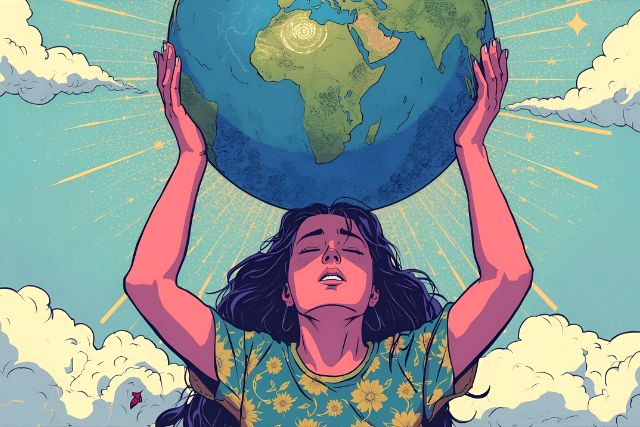
    I nodded. And then, I woke up with a frozen right shoulder the next morning. My body had declared mutiny, and I knew this wasn’t random. My right shoulder was reacting to the invisible weight, the pressure, the emotional inheritance of being the one who holds it all.

    And I can’t help but wonder: how many of us in midlife are carrying too much? How many of us have aching backs, inflamed joints, tight jaws, and no idea that our bodies are the ones screaming when we don’t?

    Our generation inherited the burnout of our mothers and the emotional silence of our fathers. And now, our bodies are saying, “Enough.” And through it all, my body shows up. Even when aching or confused. Even when the wiring feels off. She—this body—keeps holding me. Keeps asking me to come home.

    But amid the aches and obligations, something else began to stir beneath the surface, and I realized that not all is negative. I also recognize midlife for what it is: a powerful transition. A threshold. A sacred invitation to step into deeper sovereignty.

    I believe that beneath the hormonal rollercoaster lies something deeper: A quiet, seismic shift from performing to becoming. What if midlife isn’t just about loss or exhaustion but also a portal: a wild, fiery, phoenix-shaped portal to something richer and more meaningful?

    In mythology, there is a sacred archetype we rarely talk about: the Crone. The word comes from Old Norse and Celtic roots and was reclaimed by Jungian analyst Marion Woodman and feminist scholars to signify the wise elder woman—she who sees in the dark, who knows, who no longer needs to be pretty or polite.

    She is bone and truth and howl, and what’s even better, she is awakening inside of us, taking up more and more space inside our minds, hearts, and souls.

    Midlife is when we begin to embody her. It’s when we stop whispering and start roaring. It’s when we say, “Actually, no, I won’t do that. I don’t want to. I’m tired. And I need silence, space, and possibly a cabin in the woods with good Wi-Fi and nobody talking.”

    We begin to reclaim our right to be contradictory, to change our minds, to speak from the fire in our bellies instead of the scripts we memorized to be loved.

    I’m proud to announce that my people-pleasing days are over. Gone is the spiritual language I used to soften my rage, to be accepted in the love-and-light circles. I started questioning toxic positivity years ago, but now I am fully allergic to it.

    Don’t tell me “Everything happens for a reason” when there are genocides unfolding as we speak. Don’t tell me to raise my vibration while I’m caring for a mother who might forget my name in the near future. Don’t tell me that anger is a “low frequency” emotion when it’s a healthy response to witnessing atrocities happening everywhere.

    My anger, or sacred rage as I like to call it, is what fuels me to speak up, to raise my voice, to speak about what’s important to me.

    Midlife isn’t just a phase; it’s a rite of passage that comes with many gifts and also responsibilities.

    One: Grounded power.

    While my thirties were spent floating in “ascension” mode—channeling, visualizing, forever raising my frequency—my forties have been a lesson in descension: in landing fully in my body, in the mess, in the moment. In letting my roots grow deep and wild and unafraid. I no longer want to float or ascend.

    Two: Embodied truth.

    Midlife strips us of our masks. I no longer pretend. I tell the truth in my podcast, in my sessions, in my writing. I don’t want clients who expect me to be their guru. I want kinship. I want real, authentic connections.

    And yes, I still have moments of spiraling. I still fantasize about living alone. But I also know now, deeply, that those longings aren’t escapism. They are calls to return to myself, and this return to self needs some form of silence and solitude.

    Three: Fierce compassion.

    I no longer hold back what I feel. But I also no longer feel the need to carry everyone else’s pain. Right now, I am learning to care deeply without losing myself.

    As Anaïs Nin said, “And the day came when the risk to remain tight in a bud was more painful than the risk it took to blossom.”

    Midlife, for me, is the season of blooming open even if the petals are a little singed. I might not go and live alone any time soon, but I will spend a month alone traveling through China this September. And my partner, the understanding man that he is, will stay with my mum to take care of her that month.

    So if you, too, are hallucinating about renting a solo flat, crying over a parent’s future, snapping at your beloved for simply blinking, and wondering who you even are right now, you are not broken. And you are also not alone. You are becoming.

    Welcome to the middle. It’s messy and holy and completely yours. This season isn’t meant to break you. It’s meant to reintroduce you to the version of yourself that was always waiting.

    And if your shoulder or your back starts acting up: Pause. Breathe. Put your hand on your heart and whisper, “I hear you.”

    Then, slowly, powerfully, roar. Because your voice—raw, ragged, and real—was never meant to whisper.
  • The Enormous Cost of Being the One Who Holds Everything Together

    The Enormous Cost of Being the One Who Holds Everything Together

    “For most of history, Anonymous was a woman.” ~Virginia Woolf

    There’s a kind of work in our society that doesn’t come with a title or pay, and for a long time, I didn’t even notice I was doing it. I just lived inside it. It shaped my days, my stress, my identity.

    These days, I see it more clearly. I can name it now. I don’t only live inside it, but I still return to it—especially as a parent, especially when things stretch thin. The difference is now, I pause. I reflect. I ask myself if I have to hold it all. Sometimes I still do. But not by default. Not blindly. Well, usually anyway.

    I’m writing to make the invisible visible. To name what I rarely heard said out loud, not just to others, but to myself. When I’m holding the center while everything pulls at the edges, absorbing what others don’t even realize needs carrying, I see myself. I’m not overreacting. I’m not asking for too much. I’m doing the work that holds lives together.

    I am often the one who remembers the dentist appointment, Mufti Day, the allergy meds, the forecast, the birthday, the swimming bag. Or the one who keeps the emotional boat steady—calming the toddler (or the adult acting like one), soothing tension between co-parents, biting my tongue so dinner doesn’t derail, all while managing the storm inside my own heart, or gut, or head.

    This work has many names to me: mental load, emotional labor, logistical labor and, especially, narrative labor (the effort of constantly explaining myself, justifying choices, making life make sense for everyone else). It’s the work that says, “I’ll just do it; it’s quicker.” Or, “It’s fine, I’ll figure it out” Or, “No one else will remember, so I’ll make a list.”

    But here’s what’s changed: I recognize it now. I’m no longer trying to prove I can handle everything. I’ve learned that sometimes, the quiet question inside—“Why is it always me?”—is actually wisdom, not weakness. It’s a sign to pause. To reset. To shift the pattern.

    While I see this most obviously in motherhood, I know it exists everywhere. In caring for aging parents. In supporting partners with chronic illness or disability. In blended families and complex co-parenting. In friendships and workplaces, where someone quietly holds the emotional glue.

    I’ve watched how, without this work, so many people and systems quietly fall apart. And I’ve also learned the cost of doing it all, all the time. That cost lives in the body.

    These days, my body can often feel like that old board game Operation—except the buzzer is jammed on and the batteries are dying. A constant low-level fog on my brain, with a weariness that sinks deep into my bones. It’s not always visible, but it’s there in my clenched jaw, racing thoughts at 3 a.m., or that strange, sudden overwhelm that never quite becomes tears.

    I used to downplay my own needs because there was no room for them. I kept things light even while crumbling, especially when my kids were young. I was the strong one everyone leaned on, even when I longed for someone else to take the weight.

    Now, I try to notice that impulse. To catch it in the moment. To remind myself I am not a machine. That asking for help doesn’t make me weak; it makes me wise.

    If this sounds like you too, you are not alone.

    This is for those of us managing households and trauma responses. For those parenting kids who live in two homes, two worlds. For those doing the extra work to help a child thrive in a system that wasn’t built for them. For those stuck in meetings, trying to help others see what should already be obvious. For those holding finances, feelings, and fallout.

    And then there’s judgment. The kind that seeps through tone, silence, side comments. The kind you can feel in the air. Suddenly, you’re not being witnessed; you’re being evaluated.

    It often lands hardest on those making unconventional caregiving choices. The stay-at-home parent “not contributing.” The adult child who cuts back work to care for parents. The partner quietly managing chronic illness. The blended-family parent navigating chaos.

    I once read, “Judgment assumes superiority. It lacks curiosity. It flattens your life into a one-dimensional story and acts like it knows the ending.” That’s exactly what it feels like.

    I’ve carried that weight many times—judgment from those who don’t live my reality. For a long time, my nervous system told me it wasn’t safe not to care what others thought. Even when I knew the wisdom of that old saying “Don’t take criticism from someone you wouldn’t go to for advice.”

    It’s always ironic; the ones who carry the least are often quickest to critique how you carry the most.

    And so here’s my truth: I won’t apologize for being there for my kids while they still need me. I won’t apologize for showing up for the people I love.

    There’s another saying, “Don’t judge someone until you’ve walked a mile in their shoes.” But most don’t want the shoes; they just want the right to judge from the sidelines. Or, as Brené Brown puts it, “If you’re not in the arena getting your ass kicked, I’m not interested in your feedback.”

    Because here’s what’s often missed: most people don’t realize how much they rely on invisible labor… until it stops.

    They don’t have to think about whether the PE gear is clean. Who will follow up with the lawyer or the school. How tension gets diffused or meltdowns averted. Why the fridge is never empty or the calendar runs smoothly.

    But when I’ve stepped away? Things fall through the cracks. Conversations go sideways. The house might be quiet, but not peaceful.

    This isn’t about guilt. It’s about value. This work enables others to succeed, to rest, to function—precisely because someone else is holding the complexity.

    Invisible labor holds everything together, until it can’t. I know this. The migraines, the kidney stones, the menstrual issues—they brought me to my knees. My body was trying to protect itself. Fair call. This work isn’t bottomless. It’s not free. And it’s not a given.

    So many of us do this work quietly, without even naming it in ourselves. Because when something is always expected, it starts to feel like it doesn’t count.

    But it does count. It is work. It deserves to be seen, not just when it collapses, but while it’s still holding the thread.

    We are not invisible. We are not unreasonable. We are not weak for needing rest or recognition.

    We are doing work that keeps lives afloat. That work matters. We matter. But boundaries matter too. No one is coming to save us. And we can’t keep rescuing others from their own responsibilities.

    Yes, there will be excuses. But unless there’s a clear diagnosis, the sixteen-year-old who won’t get out of bed for school? That’s theirs to navigate, not mine to carry. Let there be real-world consequences. How else will they grow? How else will they take responsibility? How else will they learn to stand on their own two feet?

    So today, I pause. I see what I’m carrying. I value what someone else is. I ask where the load can be shared. I wonder what would change if we truly recognised the weight behind what seems effortless.

    Because the most important work isn’t always the loudest, but it’s often the most essential.

    And maybe the first step isn’t changing everything. It’s noticing it. Naming it. Starting there.

  • Walking My Mother Home: On Aging, Love, and Letting Go

    Walking My Mother Home: On Aging, Love, and Letting Go

    “To love someone deeply is to learn the art of holding on and letting go—sometimes at the very same time.” ~Unknown

    Nothing has softened me—or challenged me—like caring for my ninety-six-year-old mother as she slowly withdraws from the world. I thought I was strong, but this is a different kind of strength—one rooted in surrender, not control.

    She once moved with rhythm and faith—attending Kingdom Hall for over sixty years, sharp in mind and dressed with dignity. She’s a fine and good Christian woman, often compared to Julie Andrews for her beauty and radiant grace. But now, she rarely gets out of her robe. She sleeps through the day. The services she once cherished are left unplayed. She says she’s tired and feels ‘off.’ That’s all.

    I ache to restore her to who she was. But no encouragement or gesture can bring that version of her back. Something in me keeps reaching for her past, even as she settles into her present.

    As someone used to teaching, creating, and mentoring, I’ve built a life around helping others move forward. I’m solution-oriented. I try to inspire change.

    But I can’t fix this. I can’t lift her out of time’s embrace. Viktor Frankl, the psychiatrist and Holocaust survivor, wrote, “When we are no longer able to change a situation, we are challenged to change ourselves.” That quote feels especially personal now. Because I can’t change what’s happening to my mother—but I can soften my resistance. I can change the way I show up.

    Walking Each Other Home

    There’s a beautiful quote by Ram Dass that returns to me in this quiet moment: “We’re all just walking each other home.” I think about that when I bring her a bowl of soup, hold her hand, or whisper, “I love you.”

    I’m not here to bring her back to life as it was. I’m here to walk beside her—gently, imperfectly, faithfully—as she lets go of this chapter.

    I think often of Pope John Paul II, who remained remarkably compassionate while bedridden in the last days of his life. As his body failed, he interpreted his suffering not as a burden, but as solidarity with the poor and the sick. His vulnerability became a doorway to greater understanding. That vision moved me deeply. Because that’s what I hope to do—not just care for my mother but be transformed by the act of caring.

    I’ve studied meditation. I’ve written and taught about presence in filmmaking. But this—daily care, raw emotion, the unknown—is the deepest form of mindfulness I’ve ever known.

    Thich Nhat Hanh teaches that “When you love someone, the best thing you can offer is your presence.” So I try to be there. Not fixing. Not explaining. Just breathing. Just sitting beside her.

    In Buddhism, impermanence is not a punishment—it’s a truth. Everything beautiful fades. Clinging brings suffering. Peace comes from loving without grasping. That’s what I’m learning, slowly, as I witness her journey unfold.

    Some days, I feel like I’m failing. I lose patience. I say too much, and I say it too loudly. But I show up again. I apologize. I soften. I learn.

    There’s a quiet kind of love growing in me. It doesn’t look like grand gestures. It looks like warming her tea with honey. Adjusting her blanket. Noticing she’s cold before she says a word. This is slow-burning compassion—the kind that asks nothing in return. It’s not about being a hero. It’s about being human.

    I used to think wisdom came from those who spoke the most. But now I see that some of the greatest teachers say little at all. My mother, mostly silent now, is teaching me about humility, aging, and surrender.

    Like Pope John Paul II, I want to turn my suffering into understanding. To feel my heart break open—not shut down—and to know that this is not just her time of transition, it’s mine too.

    Lately, my own health has begun to shift—macular degeneration, diastolic heart failure, near-blindness, persistent fatigue, and a growing sense that I, too, am aging. At first, I resisted. I wanted to stay useful and strong. But now, I see these changes as reminders: to live gently, to love fully, and to be present. My body is not the problem—it’s the messenger. And its message is simple: this isn’t about me. It’s about how well I show up for her.

    So what is it that I’m learning here in this strange, quiet space between caregiving and grief?

    • You don’t have to be perfect to be present.
    • Love doesn’t always look like joy. Sometimes it looks like patience.
    • Letting go isn’t failure—it’s an expression of grace.
    • Even in loss, there is growth.
    • The end of one life chapter can open your heart to all of humanity.

    A Whisper Before Sleep

    Each night, I make sure she’s ready to sleep. Sometimes she’s dozing. Sometimes she’s half-aware. Sometimes she’s just staring at the TV. But every night, I whisper, “I love you, Mom.” Maybe she hears me. Maybe not. But I say it anyway—because love, at this point, is more about presence than response.

    And now, another quiet miracle has entered her world. Nugget—the small, grey-furred cat who is super cute and equally crazy—has become her closest companion. My mother never cared much for animals. She found them messy, distant. But Nugget changed all that.

    This tiny creature curls at her feet, climbs into her lap, and purrs without question. And my mother responds—stroking her fur, talking softly, calling her ‘my little kitty.’ It’s pure, surprising, and profound. Nugget brings her back to the present in ways I cannot. She opens a door to tenderness that has long remained closed.

    My mother still shares vivid stories from the distant past, though she forgets what happened an hour ago. Still, she knows me. She knows Nugget. And for that, I am grateful.

    I still wish I could do more. But I show up—quietly, imperfectly, with love. I walk her home the best I can.

    And in that walking, in that surrender, I’m beginning to understand what it really means to be alive.

  • The Circle of Love: How I Paid It Forward After My Mom’s Death

    The Circle of Love: How I Paid It Forward After My Mom’s Death

    “If you feel like you’re losing everything, remember that trees lose their leaves every year and they still stand tall and wait for better days to come.” ~Unknown

    Years ago, I was a young housewife, raising two children, and still practically a child myself. When my mother fell ill, we realized it was chronic and I felt the blow.

    Mom had been my closest friend and supporter throughout my entire life. I was still her baby, even though I had babies of my own. And it was a point of pride with me.

    As Mom gradually diminished into a shell of her former self, I tried to help take care of her. There were months of dialysis, hospitalizations, home health care, and finally, both of her legs were amputated.

    To say this was devastating is an understatement. Mom had always been active, a go-getter, and a great tennis player. And how she did love wearing her pretty shoes!

    My dad, brothers, and I grieved with Mom, along with everyone else who loved her. The core of our family was heavily damaged. We did not know which way to turn.

    As time passed, the wonderful nurses of East 3 showed us how to care for Mom. We brushed her teeth, fixed her hair, tempted her with treats, and whatever else we could do to make her happy.

    Nothing worked. As Mom grew sicker, we finally realized what was coming. The overwhelming sense of loss when she passed was indescribable.

    It was a double loss for me. Not only did I lose my mother, but also my best friend. How would I survive without her?

    Would my babies remember her? Would I forget her? What would happen to our family?

    However, the loss pulled my family together and we planned a funeral, burial, and dealt with the onslaught of family and friends.

    On the day of her funeral, I informed my dad I wanted to go to nursing school. He was not encouraging. In fact, he informed me how much he hated to hear it because he had seen how hard nurses worked and the way they were treated.

    I was adamant. Even though I was not known for my science knowledge or my people skills, I went to school.

    Along the way, I experienced another pregnancy and the birth of a daughter. The following day, I was back in class to take an Anatomy and Physiology test.

    My test score was 86. I discovered I was an extremely determined individual. Nothing was going to stop me from getting that nursing diploma!

    After four years of classes and clinical rotations, I graduated as co-salutatorian of my class. Thank heavens for my husband, who kept the home fires burning while I studied!

    Upon graduating, I went to work on South 10, in Oncology, the treatment of cancer patients. We had a lot of patient overflow from other floors. So the clinical experience during my time there was amazing!

    However, the challenges of being short-staffed, overwhelmed with too many patients and insufficient support, did not help my anxiety level! As a result, I did not feel that I handled my job very well.

    I was nervous around others in the workplace, even though I wanted to help them. It was terrifying to think I could make a mistake and end up harming someone or lose the nursing license for which I worked so hard.

    And I did make some mistakes. Thankfully, none that resulted in significant harm. Of course, this did nothing for my fledgling confidence and anxiety.

    I thought about quitting. I hated feeling trapped. In the mornings before work, I would throw up from nervousness.

    I was outside my comfort zone. But I kept returning to work. After the schooling, hours spent studying, and monetary investment involved, how could I throw it all away?

    Undoubtedly, I was scared. It was horrifying to feel so frightened in such a noble profession. The anxiety almost crippled me. I became fatigued. Irritable. My self-esteem, which had been a struggle my entire life, was at an all-time low.

    Then came a very busy day when I was nearing the end of my shift. I was mentally and physically exhausted and looking forward to going home soon.

    When the charge nurse informed me that I was getting an end of shift transfer, I wanted to cry. In this particular case, I needed to perform end-of-life care. And would also have to complete a ton of paperwork.

    The patient was an elderly man coming from MICU (Medical Intensive Care Unit). His end was near, and he was coming to me to die.

    Obviously, I was not thrilled to be dealing with such a patient at the end of the day. Notably, my attitude was not good.

    Yet I had made an oath to care for others and I was committed to that oath.

    So I did not show my bad attitude to anyone and instead hid it inside my heart.

    Shortly afterward, the patient was transported to his new room on South 10. He had a nasogastric tube going into his nose, down his esophagus, and into his stomach. It was to suck out the toxins and poisons building up in his system.

    Also present was a catheter, which drained the urine from his bladder.

    As the man’s family wanted to continue feeding him, IV nutrition was still in place. This meant blood sugar checks were to be performed four time a day. These checks measured the sugar content in his bloodstream to see if it was a healthy level.

    In other words, my new patient required a lot of care.

    The man’s wife and daughter were with him and not quite ready to let him go. But the patient had been made a DNR. (Do Not Resuscitate). This meant no life saving measures were to be used.

    It was simply his time to go.

    The patient was unresponsive, and the daughter convinced her weary mother to leave for a while and get some rest.

    Meanwhile, I monitored the patient, kept him comfortable, and answered his daughter’s many questions carefully and thoughtfully.

    Unbidden, this was a reminder of a painful situation years earlier when it was my mother in that bed. At that time, it was me depending upon the nurse to take care of my dying mother.

    Those nurses had offered comfort. They had helped me cope with Mom’s pain and end of life. Now, it was my turn to do the same thing for someone else.

    I was with another patient when my new patient’s emergency alarm went off. I walked out into the hallway where the charge nurse met me and instructed me to go into his room. Sure enough, my new patient was gone.

    His daughter was beside him when he left his tired body behind. She looked so forlorn and alone. My instinct was to reach out and give her a hug.

    She hugged me back and kept holding onto me as if I were her lifeline. I suppose I was in that moment.

    So for a long time, I sat and listened to her while she talked. She told me about her dad and how much she loved him

    When I eventually rose to leave the room, the daughter said to me, “God brought my dad to this floor to die because he was bringing us to you.” Then she added, “Thank you.”

    Her words filled me with pride. Sometimes, you just instinctively know the right words to say in a situation and when to listen. I learned that I have this skill in the very darkest moments of life.

    And it is a skill of which I am very proud.

    With my self-confidence restored, I, once again, was proud of myself and of my profession. I had eased one of the most painful times in a daughter’s life and brought her comfort.

    I had come full circle.

  • Addicted to Helping: Why We Need to Stop Trying to Fix People

    Addicted to Helping: Why We Need to Stop Trying to Fix People

    Caregiver

    “Compassion is not a relationship between the healer and the wounded. It’s a relationship between equals.” ~Pema Chodron

    After college, I was hustling hard to get a work visa so that I could stay in the US.

    But then my mom got caught up in a political scandal, and without much reflection on how much this would alter my life’s plans, I dropped my dream of staying in America, drove 1,000 miles, and flew another 500 to be by her side.

    Would she have crumbled without me there? My mama is a tough chick, so I highly doubt it.

    But at the time, I (subconsciously) believed that when the ones we love are hurting, their pain trumps everything. Their pain gets top priority, and whatever goals and dreams we’ve been working toward now pale in comparison.

    At the time, I thought that love meant tending to the other person’s needs first, always.

    And this form of self-sacrifice came naturally to me (I’d behaved this way even as a young child), so I was lucky, right? Having inherent caregiver qualities is a beautiful gift, right?

    Yes. And maybe not.

    Are You a Natural Caregiver?

    You’ll know if you have this trait too, because people will often tell you their secrets mere minutes after meeting you.

    When someone has just been in a car accident or broken up with their boyfriend, you wrap your arms around them and for the first time that day, their body fully relaxes.

    People tell you they feel at home in your presence. Safe. Heard. Cared for.

    There’s so much beauty in having a trait like this. Without much effort, you nurture and care for those around you. It is a gift you give us all.

    But there’s another side to the caregiver coin.

    Helping other people can become addictive. It can begin to feel like the only way to show your love is to prostrate yourself at the needs of others.

    Oh, you’re hurting? Lemme swoop in and save the day.

    Oh, you’re broke? Lemme dump my savings into your bank account and all will be well.

    Oh, you’re single again? Lemme set you up with my neighbor’s son.

    Whatever your ailment, I’ve got a fix for you!

    And the gratitude from the people we’re supposedly ‘fixing’ tends to flow so steadily that we become convinced of the healthiness of our stance.

    We’re confident that healing every sore spot we see is not only natural and enjoyable, but it’s the main reason we were put on this planet.

    When you carry the Nurturer Gene, fixing other people can easily become a destructive self-identity. 

    You will martyr yourself over and over again in order to meet the invisible quota of Lives Helped that floats above your head.

    You will obsessively analyze how every choice you make might impact those around you.

    You will assess every meal, every dollar spent, every vacation taken (or not taken) based on how it will impact the people you feel a responsibility to care for.

    Because, in this unhealthy version of caregiving, our understanding of love has become warped. Love now looks like a relentless string of sacrifice.

    Your thoughts might go something like this:

    If I don’t love her with my constant presence, she will feel sad and lonely.

    If I don’t love him with my attentive eye observing everything, he’ll get sick again, or maybe even die.

    If I don’t love them with my efficiencies managing everything, someone will get hurt. Things will go very wrong if I’m not here to take care of them all.

    Sometimes, love calls on us to invest our energy and time in tending to someone else’s pain.

    But not 100% of the time. And not with the nurturing going down a one-way street, pouring out of the same person, over and over again.

    If you see this pattern in any of your relationships, consider what it would take to expand your definition of what it means to nurture, to love, to care for.

    A healthy caregiver not only nourishes the needs of others, but also nourishes her own.

    Holistic nourishment. Nourishment of the whole of us, for all of us—which includes you.

    Self-nourishment might look like hiring a babysitter so you can have a romantic getaway with your hubby.

    Self-care might mean taking the job on the other side of the country, even though it means you’ll only see your parents twice a year.

    Self-love might be quietly soaking in a bubble bath instead of probing everyone for a detailed account of their day.

    You are not responsible for the world’s pain.

    Share your talents and resources. Generously give your time and attention. But you cannot pour a magical tonic on the wounds of every person walking the planet. It’s not your job. And if it were, it’d be a sucky job because you’d fail at it every single day.

    Especially when we identify as being “spiritual,” we can lift up words like “compassion,” “generosity,” and “kindness” to such a degree that we forget that even “compassion” sometimes must say no.

    Even “generosity” has to allocate some of her resources for herself.

    And even “kindness” must muster the nerve to walk away sometimes.

    If you are the person in your relationship or family or company that defaults to caregiver and wound-tender, give thanks for the ease with which you dish out your love.

    But be careful about inhaling that caregiver role to such a degree that your identity becomes dependent on having someone nearby to nurture.

    Give your love. Freely and deeply.

    And trust that even if you’re not there to ‘fix’ them, everyone will be just fine.

    Photo by Valerie Everett