Tag: calmness

  • 5 Things You Need to Know If You’re Interested in Meditation

    5 Things You Need to Know If You’re Interested in Meditation

    “The fruit of meditation is not the absence of thoughts, but the fact that thoughts cease to harm us.” ~Bokar Rinpoche

    My inspiration to start meditating came from one of the most unlikely sources—a Star Wars movie.

    When I saw the wise Jedi Master Yoda meditating, I thought that there had to be something more to this than merely sitting silently with your eyes closed.

    Eventually, my curiosity got the better of me, and I decided to find out for myself.

    That was over six years ago. Since then, my life has changed for the better in both subtle and profound ways.

    It has considerably improved my mental clarity and focus and made me feel grounded in my life. The number of unhelpful thoughts in my mind has significantly reduced, and it’s helped me to become more present in my daily life and less on autopilot.

    The relationship with my family members has vastly improved, as I had the habit of being particularly reactive around them. Now that I’ve built the habit of recognizing thoughts and letting them pass, I’m better able to stop myself from unconsciously reacting. Which means I’m more likely to respond from a rational place and less likely to do and say things I regret.

    It’s also made it easier for me to deal with cravings and urges, and I’ve developed a kind of will power and self-control that I have never had before.

    However, it hasn’t always been easy. And in some ways, I made it harder on myself.

    Here are some things I’ve learned over the years of practicing meditation that I wish I knew when I first started out.

    1. Be easy on yourself.

    When it came to meditation, this was something I had trouble with.

    On far too many occasions, I would find myself lost in my thoughts or drifting in and out of sleep while meditating, and I’d then become frustrated.

    It took me years of meditating before I finally realized that being frustrated or hard on yourself for not being able to meditate doesn’t make anything better.

    One of the main reasons why we find meditation difficult is because we enter it with a goal-oriented mindset, expecting our minds to calm down within a very limited timeframe.

    It’s the failure to meet our own expectations that can make meditation frustrating.

    Instead, be willing to be extra patient and easy on yourself and let go of all expectations. This will not only make your meditation sessions a lot easier but also make them more effective.

    Always remember to be kind to yourself. If you struggle, accept it and let it go. After all, there is always tomorrow or the next meditation session.

    2. Take deep breaths.

    Many of us meditate to find some peace from our thoughts, but our thoughts can be loud and overwhelming. Taking a few deep breaths can make it easier to calm the chatter in your head before you sit down to meditate.

    Deep breathing activates our parasympathetic nervous system, which helps to promote a state of calm and relaxation in our body.

    A simple breathing exercise you can use is the 4-7-8 technique.

    • Inhale slowly through your nose, to a mental count of four.
    • Hold your breath, for a count of seven.
    • Exhale completely through your mouth, making a whoosh sound, to a count of eight.
    • This completes one cycle. Repeat it for ten times or more according to your preference.

    3. You have to put in the work.

    If you want to progress in meditation and have a calmer mind, you have to put in the work.

    Having a sense of discipline and routine goes a long way. If you decide to meditate for fifteen minutes each day, stick to it no matter how distracted your mind is when you sit down to meditate.

    Many times I would cut my meditation short or sometimes skip it all together when it seemed difficult to sit down and be still. But skipping one or two days can make it much harder to meditate the next time around and can make you prone to skip many more.

    Ever since I began exercising (physical workout) daily, I’ve understood some days you are not going to feel like doing it, but once you do it you will always feel better, and the same applies for meditation.

    Make it a point to show up every day, no matter what mental state you are in, because you always feel better by the end of it.

    4. Stop chasing experiences.

    As you meditate daily, after a while, you may start to have different kinds of experiences such as seeing different colors and visuals, experiencing your whole body vibrating, and even feeling intense energy in your chakras (energy centres).

    During some meditations I would feel so happy and at peace, and I would start craving these kinds of experiences.

    The problem is that the more you meditate with that kind of mindset, the more distracted you will be during meditation, then the inner chatter gets even noisier.

    While meditating, it’s always best not to chase any experiences, since you will most likely be disappointed if that’s what you are after.

    5. You are not your thoughts.

    The first time I read The Power of Now, by Eckhart Tolle, I didn’t really understand what the book was all about.

    However, after reading it for the second time a couple of years later, the main message hit me and has since had a life-changing impact on me—the fact that you are not your thoughts.

    Here is how Eckhart Tolle puts it:

    The most decisive event in your life is when you discover you are not your thoughts or emotions. Instead, you can be present as the awareness behind the thoughts and emotions.”

    Understanding that the thoughts that pop into my head during meditation are not mine, I realize that I’m under no obligation to follow them while meditating. I can simply observe them and let them pass. And that’s where I find peace.

    Practicing meditation has allowed me to slow down and savor life without the urge to be always doing something or require constant stimulation.

    If you’ve never meditated, you may find it hard to see yourself as someone who meditates and may feel that it’s not your thing.

    Try it for yourself and find out. Who knows, you just might get hooked.
  • Calmness Is Contagious, Even If You’re Faking It

    Calmness Is Contagious, Even If You’re Faking It

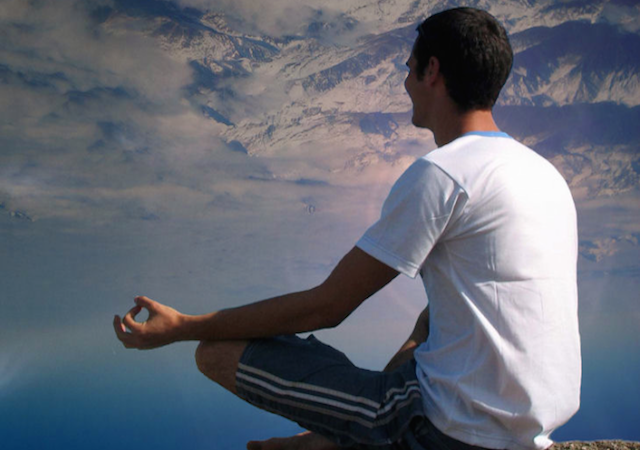
    Man meditating

    “Peace of mind is not the absence of conflict from life, but the ability to cope with it.” ~Unknown

    We had just reached cruising altitude, and my friend and I were settling in for the eight-hour flight from Tokyo to Honolulu. Exhausted after spending the day in the airport, we were excited to finally be in the air with beaches awaiting us at our destination.

    Jered and I were on an adventure around the world flying with standby tickets to any destination that had open seats. Even though we had been trying to get a seat to Bangkok, then Sydney, then Seoul, then Frankfurt, and then Paris, all with no luck, we decided to take the only available seats on the last plane of the day.

    After getting comfortable we decided to pass the time by racing each other in solving our Rubik’s cubes (what can I say; this is what we did for fun). It turns out this odd hobby was about to help me on the road to improving my inner calmness.

    “BANG!” We hit sudden, unexpected turbulence from a winter storm. I only remember two things: my stomach squishing into my throat as we hit an air pocket and a little girl in the aisle flying to the ceiling.

    Thankfully, there was a nearby flight attendant who heroically jumped, caught the girl, and curled up on the floor before she got hurt. 

    The plane was jerking violently in all directions. People were screaming. The pilot was on the intercom saying something, but no one could hear it over the chaos.

    Throughout the maelstrom my friend and I stayed focused on our cubes, continuing to spin their sides as we attempted to solve them before the other could. While my exterior seemed calm and focused, in my mind I was screaming.

    My hands were clammy and it became harder to keep my hold on the plastic toy in my hands. I was afraid I was going to die.

    The worst of it was over in twenty or so minutes, but the flight was still rough for several hours. As the sun started to rise and the flight had been calm for a couple hours, passengers slowly started to liven up again, chatting with the people around them about the experience.

    Having spent the time focused on the cube in front of me, I was surprised when the guy sitting next to me said, “Man, I was freaking out. I was about to lose it, but then I looked over and saw you two just playing with those things. You two were so calm that it helped me calm down too.”  

    This struck me as odd since I felt the same way he did, just internally. But soon other passengers sitting around us around us started chiming in, sharing the same experience. It seems a wave of collective calm slowly rolled over the back of the plane helping to ease some of the tension.

    Without being aware of it, I projected calmness to the people around me. They in turn became calmer. And ultimately my internal fear started to fade away as well.

    It was a surreal experience, but it became clear to me that calmness was contagious, even if I was only faking it.

    In many meditative traditions a calm, clear mind is often said to be like a still pond under a full moon. The smooth surface is transparent, allowing the moonlight to clearly illuminate the bottom of the pond. It is also like a mirror, reflecting back in perfect detail the moon and the night sky.

    Unfortunately, however, our minds are not always clear. The surface is full of ripples that make it hard to see the bottom and distort the image of the moon. While these ripples are sometimes created by the wind or the environment, most of them are caused by rocks dropped into the pond; rocks created in our minds.

    These rocks are emotions like anger, hatred, or fear. Often without realizing it we are constantly throwing these stones into our ponds, never letting it return to stillness.

    Returning to a calm mind is simple. Just stop throwing rocks and let the waves calm down on their own. Despite this, we often try to calm our minds by throwing more rocks into to pond.

    Sometimes when I can tell my wife is upset with me, but tells me nothing is wrong, I start to provoke her, “What’s wrong? I know something is wrong! Why won’t you tell me what’s wrong!?”

    I genuinely want to calm things down but, as you can imagine, I end up making her feel worse because I continue to throw rocks instead of letting things calm down on their own.

    When we do stop throwing rocks, though, the effect can be powerful and lasting. As we are interconnected with others, the stillness of our mind, the refusal to throw rocks, can help others find the same peace.

    When people see that your mind is clear it helps them realize that they too can let go.

    I still think about that flight from time to time, but mostly when I’m flying. I used to be a fearless flyer, but even today I feel pangs of panic, that squirt of adrenaline down the back of my neck, every time a plane bumps or shakes.

    However, as I’ve increased my awareness of my own emotions, I can sense when I’m holding a rock and then I set it down.

    Here’s an exercise to try. Next time there’s something or someone causing you distress: stop talking. Pause and take a moment to take a few deep breaths. Begin to watch your thoughts and note the upsetting ones. Don’t ignore them, just notice them. These are your rocks.

    As you notice anger or hatred forming in your mind, imagine it as a rock. See yourself holding that rock, poised to toss it into your mind. But instead of throwing it, picture yourself gently setting it down beside you. Take a deep breath. Let it go.

    Practice this when you can. Not only does cultivating calmness have tremendous effects on your personal state of mind, you never know how big an effect you may have on the others around you.

    Photo by oddsock

  • Lashing Out is Losing Control; Calmness Is Strength and Power

    Lashing Out is Losing Control; Calmness Is Strength and Power

    Calm Man

    “Self-control is strength. Right thought is mastery. Calmness is power.” ~James Allen

    I would like to share something personal with you. It’s the story of how I first glimpsed what true strength and power is and where they come from. I hope this story helps to further illuminate your journey through life.

    I remember one day when I was in the back seat of my parents’ car. I was probably about thirteen years old. We were parked in a hotel driveway, waiting, though I can’t recall why.

    After a few minutes, another car pulled up behind ours and the driver began to impatiently honk at us. Soon he began to scream and curse as well. I turned and saw a man whose face was bright red, scarred deeply by wrinkles of rage and bitterness.

    The driver had obviously lost control of his emotions, as it was impossible for us to go anywhere with his car blocking us in. It was as clear as day that we were stuck until he moved. What on earth did he want us to do?

    My father sat in the driver’s seat, gazing into the rearview mirror. His face was strained with confusion, trying to figure out how to process what was happening.

    My father is a great man, always striving to do what is right, strictly honest and keen to help others. Finally, somewhat frustrated, my father opened the door so he could go and speak with the impatient man in the car behind us.

    I remember feeling afraid when he stood up because I knew that the other person was really angry.

    I watched my father begin to walk toward the other car. As the car horn continued to blow, my father abruptly stopped and paused. He seemed to be contemplating something, and it appeared as if his entire being softened.

    Slowly, he returned to the car and sat back down. My father’s expression was one that I had never seen before on him: a look of straining and struggle with a hint of shame. Eventually, the other man drove off and that was the end of the incident.

    The image of my father’s face profoundly affected me and was forever tattooed in my memory. I was just a young child and, in my mind, my father was perfect. He was my hero and I idolized him.

    He is not a large man and I have never known him to fight; yet I felt a tinge of disappointment that he hadn’t stood his ground and confronted the other man. I felt that he had retreated. And my impression was that he felt the same way.

    A few days later my father shared with me a dream that he had the night before. In his dream, I had beaten up the man who was honking the horn.

    At the time, despite being young, I was a black belt in Taekwondo. I remember wishing that I really had beaten him up. I wanted to get even with the man who had embarrassed my father.

    I became full of anger. I imagined myself beating him up again and again yelling, “This is for my father!”

    I was angry, partly because he had hurt my father, but mostly because he had hurt me. He revealed to me a flaw in my father’s character: he was afraid and perhaps not strong enough to fight back. It left me bewildered and, for the first time, I realized that my hero wasn’t perfect.

    Something deep inside me was forever changed.

    Years later, as a college student, a friend and I went out for a meal. While eating, an acquaintance of ours lost his temper and began yelling at my friend. My friend listened silently, showing no change in his demeanor.

    Eventually, the man finished yelling and my friend quietly stood up and walked away without saying a word. I was so impressed by how calm he was.

    Later, I asked him how he managed to keep his cool. He smiled and told me, “A strong person is not one who knocks other people down; it is one who does not let his anger get the better of him.”

    I was stunned. I knew that he was completely right. Who demonstrated more strength: the person who had lost control of his temper or my friend who had kept his?

    These words touched my soul and aroused in me an understanding of where true power comes from: it comes from within. And inner strength dwarfs physical strength.

    That night, this realization lingered in my mind. As I was digesting this lesson, suddenly I remembered the incident with my father and the horn-honker, many years before.

    A voice within me asked, “Who was the stronger man?” and chills slowly crept up my spine as I realized that it was, in fact, my father. While the other man had allowed his rage to overcome him, my father had controlled himself.

    The other man had lost; he lost to himself when he allowed his emotions to take over. My father, on the other hand, had stood victorious over himself, conquering his own emotions, commanding them down. The other man was a slave to his passions; my father was the master of his.

    It was then that I saw my father for the truly strong and courageous man that he is. The weak and easy path would have been to return anger with anger, yelling with yelling. But my father had the strength to resist this; he had the power to calm his mind while a tempest raged about him.

    It was in this moment, that my own path became a bit clearer. I realized that I must embark on a journey of conquering myself, because I now knew that I did not want to be a slave. The only other option was to master myself, to command the hidden forces within.

    When you feel negative emotions rising, threatening to overcome you and make you into their puppet, remember that the strength and power needed to maintain calmness lie forever within you.

    Calm man image via Shutterstock

  • The Secret to Replacing Agitation with Calmness

    The Secret to Replacing Agitation with Calmness

    Calm Man

    “Calmness is the cradle of power.” ~Josiah Gilbert Holland

    I was interested, recently, to find that our local supermarket had set up an area with ten self-service checkouts. For years I‘d accepted the normal method of bagging and paying for my stuff. No stress there. But they’d installed some new technology and I was keen to give it a try.

    All new things bring with them hiccups or small difficulties of some kind. The self-service area was no exception.

    Sure, I did receive the correct change. And, it was definitely the fun experience I looked forward to. However, a queuing area hadn’t yet been established, so people just jumped into a vacant self-service spot as soon as one became available, oblivious to the fact that others were waiting.

    Here was the dilemma.

    Should I have called out in a loud voice, “Hey you! What about the queue?” (angry response) OR “Excuse me. Do you mind going to the end of the queue?”(polite response) OR continue to wait in line without commenting. (I could either churn myself up internally or mutter to the person next to me or to myself.)

    Being a bit shy, I was not fond of using the angry or polite responses. I was actually churning inside over such a small thing. After all, it only meant I’d be held up a few minutes.

    Have you been guilty of getting anxious inside over something as trivial as queue jumping?

    The Secret to Replacing Agitation with Calmness

    So what is the secret?

    I’ve given it the name: reaction awareness. Let me explain.

    When you are in a situation where you feel your insides churning, become aware of your reaction to that situation. By observing what is happening in this way, you are in control. You have the power to calm the negative reaction welling up inside you.

    Reaction awareness allows you to replace a churning reaction with a calming one. You’ll actually lessen the severity of any negativity that arises.

    How It Works in Practice

    Okay, you’re aware of your reaction, but how can you lessen the negative results of each particular situation, on your body?

    Reaction awareness consists of two techniques.

    One technique deals with developing calmness as soon as a stress or annoyance arises. Of course, not all of the ideas listed below are ideal for each situation. Your choice will depend on where you are and what has happened.

    On the other hand, you might select just one that you’ll use every time because you know it would be the most comfortable and useful response for you.

    The second technique involves the regular practice of activities that over the long term will become part of you, like a habit. These activities will strengthen you so that when situations occur in the future, you’ll be ready and well prepared for them. You’ll be equipped to handle yourself better.

    Quick Techniques for Immediate Use

    • Use breathing. Take a few deep breaths to calm yourself. Turn away from the situation so that it’s out of sight for a minute or two.
    • Reduce surrounding noise. Turn off loud music and change to calm, quieter sounds.
    • Ask someone to massage your shoulders. This is where tension is stored. A quick massage can release the tension and relax you.
    • Count to ten. This was the technique popularized when I was a kid.
    • Drink water. Make a warm drink with lemon to soothe you, or have a glass of water.

    Activities to Practice Over Time for Long-Term Benefit

    • Use breathing exercises. The most basic is to inhale, then exhale, using the nose, both to the count of four. Yoga enthusiasts will know various breathing exercises they can use. Or consult a practitioner for the ones that will give you most benefit.
    • Sit quietly. We are conditioned to thinking we must be doing something every moment of every day. If we’re not sending a text message, we’re “tweeting” or “liking” someone. Just sit and quietly read, practice mindfulness, or enjoy a short time of shut-eye.
    • Walk or jog outdoors. Choose a place with trees, grass, or flowers, because they send a calming message to the brain.
    • Have “me” time. You are important so treat yourself as important. Do something you love doing but rarely have (or make) time to do.
    • Recognize the triggers. Know particular situations in advance when you’re sure you’ll flare up or need calming. Two of mine are feeling very cold, or feeling thirsty/hungry. Know the triggers that create agitation for you, so you can be better prepared. You’ll gain that state of calmness quicker.

    Because the last five listed above are ideas to be used over the long term, it’s important to practice them on a regular basis. You might like to select just one or two and master them.

    Try them. See which ones calm you down. Your body will thank you because calmness, rather than an uptight feeling, will be the norm.

    Why Should You Use Reaction Awareness?

    It’s healthy. Your body doesn’t respond as angrily as you might without using it.

    According to Josiah Holland, calmness is the place from which power emerges. In other words, by using this technique, you are developing an inner strength—an inner power and confidence—because you are in control of each situation. You haven’t let your emotions take control of you.

    Using reaction awareness is definitely not a sign of weakness. The confidence it creates in your ability to handle awkward or difficult situations by reacting calmly enables you to face each day with your head held high. You exude that special quality not many people have, of inner peace and strength.

    In Summary

    Many times each week, you’ll find yourself in situations where you can either forget all about action awareness, or use it. The choice is yours. Remember, you are in charge of your life and your health.

    When you practice reaction awareness, you’ll be prepared for anything—almost. In whatever situation you find yourself, you’ll be replacing agitation with calmness.

    As you deal with every issue, you’ll become more confident. You’ll become a source of strength and calm for others around you.

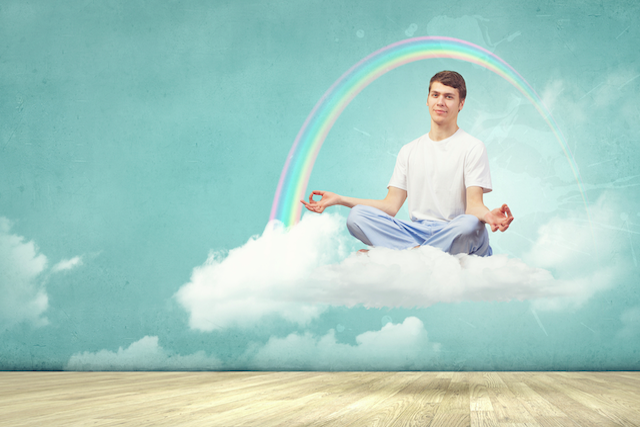
    Calm man on a cloud image via Shutterstock