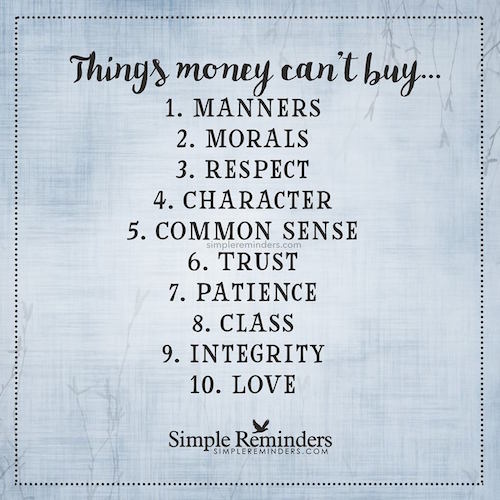
Source: Simple Reminders
“Joy comes not through possession or ownership but through a wise and loving heart.” ~Buddha
We all have these random little personal philosophies or rules that we live by. Oftentimes, these rules are hidden beneath the surface, not in a form that we are aware of or is easily expressible.
But I do have one particular “random little personal philosophy” that I live by (and am aware of!) and would like to explore further. It is my philosophy of tipping.
This philosophy of tipping was thought up specifically with reference to tipping, say, in restaurants, but can easily be generalized. Here is the original formulation:
I cannot afford to eat at this restaurant if I cannot also afford to give a large tip.
Now, this doesn’t mean I need to give a huge tip each time—I just need to be willing to in advance.
So, if I’m going to a restaurant where I know a decent meal will cost $20, I will commit before going in that I am willing to spend closer to $30. Generally, the tip will be fairly typical—about 20% for a good job—but the actual magnitude isn’t the point.
What matters in this case is that I consider a large tip to actually be a part of the cost of the meal already. Of course, the tip is part of the cost of a meal, but I don’t think most people look at it that way.
Rather, most people think of the menu price as the cost, and the tip is this annoying extra that you have to pay at the end. I’ve had friends who go out to eat with me, order whatever they want off the menu, and then find that they don’t have enough cash to pay for a tip at all.
In my case, if I didn’t have the money available to give a sizable tip, I wouldn’t even make it inside the restaurant. After all, that would mean I couldn’t afford it.
This may sound like a very simple life philosophy, and one that hardly seems worth reading about (let alone writing about). But the implications, when the principle is taken to its logical conclusion, are far more significant. Let’s generalize it now:
If I am not willing to share something, I shouldn’t get it in the first place.
Please, do not take this to be a legitimate moral or economic principle—it is pure and simply a life philosophy, or a heuristic for making choices in my own life. Your property is your own and you are certainly not an immoral person if you don’t share, but you may very well be happier if you do.
A major benefit of all this is its fiscal sensibility. While you may end up spending more on tips and getting extras of certain things in order to share, you will ultimately end up being more careful with your finances and use your money less.
This sort of mindset makes you far more likely to have a potluck with friends than to go out to eat, or to save money rather than spend it.
But once you’ve really internalized the idea, you’ll also find yourself experiencing a significant happiness boost. Why? Because giving feels good. Being kind feels good. And sharing positive experiences with others feels good.
Ultimately, it involves spending more time and money on others and less on yourself. You certainly shouldn’t be neglecting your own needs and desires. But when you do nice things for yourself, make sure you have a little extra so somebody else can enjoy it with you.
Okay, great. So how does this work in practice?
As a whiskey lover, I consider it a nice treat to drink a delicious, high quality whiskey. Jameson may be perfectly fine most of the time, but I like to have Johnny Walker Black Label around for special occasions.
Unfortunately, JW Black is pretty expensive—it would be very easy for me to hoard it and not let other people drink any. Instead, I drink it primarily when I have close friends around. It’s a vastly better experience when shared!
The nature of the material possessions that I tend to purchase is similar; I try to buy things that have more sharing potential. Most of my possessions at this point are books and DVDs, both of which I am routinely lending out to others or enjoying with them.
Predictably, this lends itself to a more “simple” lifestyle. I buy a lot less than I could, but the things I do own have a high return on investment with regards to my happiness.
A big part of this philosophy, though, is to share with strangers. If you are going out for a night of drinks in the city, throw an extra few singles in your pocket to give to the homeless people in the area. If you can’t afford $5 to give to five homeless people, then you can’t afford the $50-100 it would take to go out.
It’s not just about money, either. The same principle can apply to the way you use your time.
If you can afford to play video games all day Saturday, then you can spend an hour of that time volunteering at a soup kitchen or helping a friend move. In fact, studies have shown that spending time on others makes you feel as though you have more time available…cool!
As with most areas in life, it is hard to apply a philosophy like this perfectly, but that’s not the point. I’m far from perfect with this, but even so, I’ve derived great benefits from focusing on this principle, and you can too.
Friends sharing image via Shutterstock

“Happiness can only be found if you free yourself from all other distractions.” ~Saul Bellow
When I was twenty I bought my first serious piece of furniture.
It was a sofa covered in a nubby sort of fabric, a creamy shade of white with tan and light brown threads woven through that made the modern style seem warm and welcoming.
It was beautiful. And on the day my sofa arrived, I celebrated. I celebrated not only a beautiful addition to my little apartment but also a step into adulthood.
After all, I bought it on credit, and I was thrilled that a social authority as important as a fancy furniture store should give me and my waitress job a nod of approval.
But my joy was tempered by a sobering thought that felt like a weight on my shoulders: I can’t fit this sofa in my backpack.
I’d been traveling, working, writing, and figuring out life for a few years already, but I still wasn’t where I wanted to be. And I didn’t have the words to express the feeling that I was only vaguely aware of. But I was feeling something. And I ignored it.
Over the next ten years or so—and almost as many living situations—my sofa and I took in a bedroom and a kitchen set along with an entire house full of furniture.
A husband, too. I had just (finally) finished grad school, and my goal was to write full-time as a freelancer instead of part-time as I had been. I wanted to write more poetry. Teach writing. Play my guitar. Travel. Live my life as I’d dreamed of living it.
The sparkle of shiny new toys pulled me in directions that made my goals almost impossible.
But two incomes suddenly made lots of other stuff possible: a lavish wedding, a big house, complete remodeling, and a new patio. Redecorating, buying just the right outdoor furniture, planting flowers, trees, and bushes… I even built a koi pond with a waterfall.
I taught for a few years, but I was hardly writing, and I was losing my focus. I was getting confused with too many choices, no planning, and too little experience. I struggled with time management, and I usually failed.
I became a wine expert, and I drank it far more often than I wrote about it.
I fell into the rabbit hole called stuff.
I’d never had much, but now, closets were stuffed with games and skis and skates and snorkeling gear.
Expertly organized closets promised to restore order, but they sagged with the weight of suitcases and carry-ons, cameras and camcorders, and clothes for every situation. Tools stuffed a garage and a shed, while the finest wine glasses, china, and gadgets took over the kitchen.
An enormous 100-year-old piano rolled into place in the mélange.
The house was bulging and sinking at the same time.
I wasn’t writing. I was falling apart, and I couldn’t work. I saw doctor after doctor for muscle pain, chest pain, and insomnia. Nightmares, even.
The hot tub was supposed to help with the stress, but it was just more stuff. There were other problems in my marriage, too, serious problems, and I finally gave up trying to get things back on course.
And I got rid of the last of the stuff just a few days ago.
I have other, more important things to do than take care of stuff.
I’m a bit older now, a bit wiser, and I’m listening to that inner voice I ignored so long ago. I’m catching up on what I should have been doing—writing, improving my writing, and teaching it—what I wanted to be doing but couldn’t because I wasn’t focused.
It’s time to strap on my backpack again—it was never meant to carry a sofa, but my laptop fits just fine.
I’m glad I recognized the crazy path I was on while I’m still relatively young.
My lessons were painful, and I wish someone would have given me a good, swift kick and made me look in a mirror. Why didn’t anyone shout, “Why aren’t you writing? What happened to your goals? Focus!” Maybe I had to learn my own lessons, but I’m not afraid to shout them out now, nice and loud.
It’s like an addiction or a temporary fix. And no matter what you see online, in magazines, or on TV shows that promote home and garden ideas or lifestyles—even simple or minimalist lifestyles—remember, it’s a business trying to sell you products that promise happiness. Don’t fall for it.
I’m creative, and I love beauty. But somehow, unconsciously, by creating a beautiful home—with lots of stuff—I was also fashioning myself into someone I thought I wanted to be, something others wanted me to be.
But I was already myself, and the path with the least resistance, the path that offered the most immediate reward didn’t leave time for the hard stuff: my goals and my writing.
The friends I made back then are long gone. I was naïve, and if I hadn’t been seduced by stuff—expensive dinners, flowers for every occasion, a huge diamond engagement ring that really wasn’t me—I might have seen that my relationship could never work.
I was the poet in black trying to fit into someone else’s upscale suburban lifestyle, and there wasn’t room for anything else much less me.
My life plan didn’t include all the stuff money can buy. But the money spent wasn’t the problem; the problem was that I worshipped at the altar of materialism, and I sacrificed myself and my goals.
What’s the point of spending time and effort on stuff when it leaves little or no time for your real goals?
A solid relationship is created with empathy, love, and communication, not stuff. But we nurtured our marriage with Home and Garden TV or the Food Network, furniture showrooms, and glossy magazines with products that promised the good life. And underneath it all, I just wanted the space to work on my own goals, not another set of china, a new TV, or a new iPod.
Some stuff is important, and there’s nothing wrong with buying what you need.
But it’s about priorities and the price you might pay for stuff that doesn’t support your goals and dreams. Think about it.
Are you working toward your goals and the things that truly matter to you?
Or are you down the rabbit hole?
Stressed woman shopping image via Shutterstock

by Lori Deschene
“Throw moderation to the winds, and the greatest pleasures bring the greatest pains.” ~Democritus
Around the holidays we tend to talk more about consumerism. Especially knowing that Black Friday started even earlier than usual this year (on Thursday night), a lot of us feel that our consumption has gotten out of hand.
Many people I know have suggested we should curb our impulse to buy and only purchase necessities, but I can’t help but wonder if perhaps the solution is less about extremism and more about moderation.
Making a drastic change can seem appealing when we’re frustrated or overwhelmed with the way things are, but going from one extreme to another rarely provides a viable long-term solution.
The problem isn’t that we buy things we don’t need; it’s that we buy lots of things we don’t need to fill our assorted emotional voids.
Does anyone need a piece of jewelry? Or a painting? Or an app?
No—but good, talented people create these things. So long as we don’t mistakenly attach our happiness to them, we can both support those people and enjoy the fruits of their labor by purchasing their creations, when we’re financially able.
No one goes into debt for occasionally treating themselves to something they would appreciate wearing, displaying, or using. We only run into issues when we spend compulsively and beyond our means.
And buying gifts for other people—this can provide a lot of joy for the buyer and the giver, if we don’t pressure ourselves to spend extravagantly.
Every year, each of my family members spend five dollars on stocking stuffers for the other four, so that we each end up with twenty dollars of stuff. None of us need the gum, combs, and magazines we get, but it’s fun and easily doable.
The problem isn’t that we live in a consumer culture. It’s that we’re not always mindful of how and why we each consume.
In much the same way, advertising itself isn’t fundamentally bad; everyone who supports themselves sells something, whether it’s a product, a course, or a service; that requires them to promote it. (more…)